EP2985602B1 - Procédé d'évaluation du degré de désagrégation par les intempéries du charbon, procédé d'évaluation des propriétés de cokéfaction du charbon désagrégé par les intempéries, procédé de régulation du degré de désagrégation par les intempéries du charbon et procédé de production de cokes - Google Patents
Procédé d'évaluation du degré de désagrégation par les intempéries du charbon, procédé d'évaluation des propriétés de cokéfaction du charbon désagrégé par les intempéries, procédé de régulation du degré de désagrégation par les intempéries du charbon et procédé de production de cokes Download PDFInfo
- Publication number
- EP2985602B1 EP2985602B1 EP14782384.3A EP14782384A EP2985602B1 EP 2985602 B1 EP2985602 B1 EP 2985602B1 EP 14782384 A EP14782384 A EP 14782384A EP 2985602 B1 EP2985602 B1 EP 2985602B1
- Authority
- EP
- European Patent Office
- Prior art keywords
- coal
- semicoke
- surface tension
- weathering
- brands
- Prior art date
- Legal status (The legal status is an assumption and is not a legal conclusion. Google has not performed a legal analysis and makes no representation as to the accuracy of the status listed.)
- Active
Links
Images

Classifications
-
- G—PHYSICS
- G01—MEASURING; TESTING
- G01N—INVESTIGATING OR ANALYSING MATERIALS BY DETERMINING THEIR CHEMICAL OR PHYSICAL PROPERTIES
- G01N33/00—Investigating or analysing materials by specific methods not covered by groups G01N1/00 - G01N31/00
- G01N33/22—Fuels; Explosives
- G01N33/222—Solid fuels, e.g. coal
-
- G—PHYSICS
- G01—MEASURING; TESTING
- G01N—INVESTIGATING OR ANALYSING MATERIALS BY DETERMINING THEIR CHEMICAL OR PHYSICAL PROPERTIES
- G01N33/00—Investigating or analysing materials by specific methods not covered by groups G01N1/00 - G01N31/00
- G01N33/22—Fuels; Explosives
-
- B—PERFORMING OPERATIONS; TRANSPORTING
- B01—PHYSICAL OR CHEMICAL PROCESSES OR APPARATUS IN GENERAL
- B01F—MIXING, e.g. DISSOLVING, EMULSIFYING OR DISPERSING
- B01F23/00—Mixing according to the phases to be mixed, e.g. dispersing or emulsifying
- B01F23/60—Mixing solids with solids
-
- B—PERFORMING OPERATIONS; TRANSPORTING
- B01—PHYSICAL OR CHEMICAL PROCESSES OR APPARATUS IN GENERAL
- B01F—MIXING, e.g. DISSOLVING, EMULSIFYING OR DISPERSING
- B01F35/00—Accessories for mixers; Auxiliary operations or auxiliary devices; Parts or details of general application
- B01F35/20—Measuring; Control or regulation
- B01F35/21—Measuring
- B01F35/213—Measuring of the properties of the mixtures, e.g. temperature, density or colour
-
- C—CHEMISTRY; METALLURGY
- C10—PETROLEUM, GAS OR COKE INDUSTRIES; TECHNICAL GASES CONTAINING CARBON MONOXIDE; FUELS; LUBRICANTS; PEAT
- C10B—DESTRUCTIVE DISTILLATION OF CARBONACEOUS MATERIALS FOR PRODUCTION OF GAS, COKE, TAR, OR SIMILAR MATERIALS
- C10B57/00—Other carbonising or coking processes; Features of destructive distillation processes in general
- C10B57/04—Other carbonising or coking processes; Features of destructive distillation processes in general using charges of special composition
-
- G—PHYSICS
- G01—MEASURING; TESTING
- G01N—INVESTIGATING OR ANALYSING MATERIALS BY DETERMINING THEIR CHEMICAL OR PHYSICAL PROPERTIES
- G01N13/00—Investigating surface or boundary effects, e.g. wetting power; Investigating diffusion effects; Analysing materials by determining surface, boundary, or diffusion effects
-
- G—PHYSICS
- G01—MEASURING; TESTING
- G01N—INVESTIGATING OR ANALYSING MATERIALS BY DETERMINING THEIR CHEMICAL OR PHYSICAL PROPERTIES
- G01N17/00—Investigating resistance of materials to the weather, to corrosion, or to light
Definitions
- the present invention relates to a method for evaluating a weathering degree of coal which is used as a raw material for coke, a method for evaluating a coking property of weathered coal, a method for controlling a weathering degree of coal, and a method for producing coke.
- Coke which is used in a blast furnace is required to be sufficiently strong, that is, to have sufficient strength in order to maintain gas permeability in the blast furnace. Since the coke is typically produced by carbonizing in a coke oven a coal blend which is prepared by blending plural brands of coal and the properties of such plural brands of coal strongly influence the strength of coke.
- a coal In a steel plant, a coal mine or the like, a coal is stored in a stock yard or etc. until the coal is used. During storage thereof, the coal is subjected to weathering as a result of being exposed to atmospheric air. It is known that the weathering influences properties of coal such as a caking property, amount of heat generation, and coking property of coal in various ways (see Non Patent Literature 1). In addition, it is reported that, in the case where coal (weathered coal) which has been subjected to weathering is added to a coal blend, there is an unexpected decrease in the strength of coke which is produced from such a coal blend (see Non Patent Literature 2). Thus, in the case where a weathered coal is added to a coal blend, there may be an unexpected decrease in strength.
- weathering degree of coal refers to the degree of change in the properties of coal due to weathering
- known examples of a method for evaluating the weathering degree of coal include (A), (B), and (C) below.
- Fluidity of coal refers to a property which is determined by using a method for determining the fluidity of coal by a Gieseler plastometer prescribed in JIS M 8801, in which maximum fluidity MF is used as an index. Since there is a tendency for maximum fluidity MF to decrease with an increase in the number of weathering days, and since maximum fluidity MF is used as one of the factors for controlling the quality of coke, in particular, the strength of coke, maximum fluidity MF has an advantage in that it is used as an index for both weathering degree and strength control (see Non Patent Literature 3).
- Patent Literature 1 proposes a method in which the weathering degree of coal is determined by using as indices the relationships among the contents of three constituents, that is, CH 4 , CO, and CO 2 in a gas which is generated when coal is heated. With this method, it is possible to determine the weathering degree of coal whose MF is equal to or less than the detection limit due to weathering, and it is possible to estimate the amount of decrease in strength.
- Non Patent Literature 4 reports that it is possible to determine the weathering degree of coal by using as an index the surface tension of unheated coal which is determined by using a film flotation method.
- Non Patent Literature 4 describes that the surface tension of coal increases as weathering progresses.
- FUERSTENAU D W ET AL "characterization of coal oxidation and coal wetting behavior by film floatation”
- COAL PREPARATION AN INTERNATIONAL JOURNAL, TAYLOR & FRANCIS, US, vol. 10, no.
- the method (B) it is possible to determine the weathering degree of coal having a low maximum fluidity MF and the amount of decrease in the strength of coke.
- a technique for estimating the amount of decrease in the strength of coke is disclosed only with a result in the case where one kind of coal is carbonized, and since there is no mention of estimating strength in the case where plural kinds of coal are blended as is the case with a practical operation, there is a problem in that the result in the case of a coal blend is not clear.
- the present invention has been completed in view of the situation described above, and an object of the present invention is to provide, by using an index with which the influence on the strength of coke can be evaluated, a method for evaluating the weathering degree of coal and the coking property of weathered coal within the ranges in which the weathering degree and coking property cannot be determined by using conventional methods and a method for controlling the weathering degree of coal with which it is possible to add weathered coal to a coal blend to be used for producing coke without decreasing the strength of coke by using the index.
- the present invention by using the surface tension of the semicoke which is prepared by performing a heat treatment on weathered coal as an index for weathering degree of coal, it is possible to evaluate the weathering degree of the coal even within the range in which weathering degree cannot be determined by using conventional methods.
- This evaluation makes it possible to produce coke while controlling the weathering degree of coal to be within the range in which a decrease in the strength of the coke can be suppressed. Accordingly, it is possible to add weathered coal to a coal blend which is made into coke having desired strength.
- Semicoke is prepared by performing a heat treatment on coal. Although the semicoke has not drawn much attention in conventional coke producing techniques, the present inventors focuses on the semicoke to find that it is possible to evaluate the adhesiveness between two kinds of coal on the basis of the difference in surface tension between the two kinds of the semicoke or on the basis of the interfacial tension of the semicoke.
- the present inventors focus on a phenomenon in which if a weathered coal is added to a coal blend, there may be an unexpected decrease in the strength of coke which is obtained by carbonizing the coal blend.
- the present inventors diligently conduct investigations regarding the phenomenon and finding described above to find that it is possible to evaluate the weathering degree of coal in a mixture of plural brands of coal by using the surface tension of the semicoke which is prepared from each of plural brands of coal as an index.
- the present inventors found that it is possible to control the strength of coke by evaluating the amount of decrease in the strength of coke due to weathering and by controlling the weathering degree of coal by using the index described above or the interfacial tension of a semicoke blend which is prepared by blending plural brands of semicoke.
- interfacial tension can be calculated from surface tension
- the present inventors diligently conducted experiments on the basis of the presumption described above to specifically clarify that, in the case where the interfacial tension of a semicoke blend, which is prepared from a coal mixture composed of plural brands of coal, is higher than 0.03 mN/m, there is a decrease in the strength of coke which is obtained by carbonizing the coal mixture.
- matrixes W and ⁇ are expressed by the relational expressions below in terms of the blending ratio w i of an i-th coal, that is coal i, and the interfacial tension ⁇ ij between semicoke i, which is prepared from the i-th coal i, and semicoke j, which is prepared from a j-th coal, that is coal j. It is primarily preferable that a blending ratio w i be indicated by the blending ratio of semicoke in a semicoke mixture which is prepared from a coal mixture.
- w i is indicated in terms of the blending ratio of each coal in a coal mixture.
- ⁇ ⁇ 11 ⁇ 12 ⁇ ⁇ 1 j ⁇ ⁇ 1 n ⁇ 21 ⁇ 22 ⁇ ⁇ ⁇ ⁇ ⁇ i 1 ⁇ ij ⁇ in ⁇ ⁇ ⁇ ⁇ n 1 ⁇ ⁇ ⁇ nj ⁇ ⁇ nn
- W w 1 w 2 ⁇ w i ⁇ w n
- relational expression (6) which is derived by simplifying relational expression (1) by using the variance ⁇ ⁇ 2 of the surface tension of a semicoke blend, the value of the interfacial tension of semicoke can be calculated.
- the interfacial tension of a semicoke blend decreases with decreasing differences in surface tension among plural brands of semicoke which are prepared from plural brands of coal, and the interfacial tension increases with increasing differences in surface tension. Therefore, in order to prevent the strength of coke from decreasing, it is preferable to blend brands of coal which become brands of semicoke having surface tensions close to each other.
- the present inventors diligently conducted investigations and experiments, and as a result, also found that, in the case where the difference in surface tension among brands of semicoke is used as an index, when the difference ⁇ in surface tension between the semicoke which is prepared from a coal mixture composed of one or plural brands of coal selected from among all the plural brands of coal and the semicoke which is prepared from the remaining brands of coal other than the brands of coal used for the coal mixture among all the plural brands of coal is higher than 1.5 mN/m, there is a significant decrease in the strength of coke which is prepared from all the plural brands of coal.
- the coal mixture is called "mixture" for descriptive purposes.
- a temperature at which coal is heated in order to prepare semicoke be in a temperature range in which coal particles are heated to start softening, adhere to each other, and solidify to form coke, that is, from a temperature equal to or higher than 350°C, at which coal particles start to soften, to a temperature equal to or lower than 800°C, at which coking is completed. Therefore, it is preferable that semicoke be prepared by heating the coal at a temperature of 350°C or higher and by then cooling the coal in an atmosphere sealed from the air or in an atmosphere of an inert gas.
- a temperature which contributes particularly to adhesion within the heating temperature range of 350°C or higher and 800°C or lower is a temperature at which softening is occurring
- a temperature range in which softening of coal is occurring in a coke producing process is 350°C or higher and 550°C or lower
- an adhesion structure is determined at a temperature of about 500°C
- the heating temperature be about 500°C, that is, 480°C or higher and 520°C or lower.
- the heating temperature for treating weathered coal in order to prepare semicoke be 350°C or higher and 800°C or lower, more preferably 350°C or higher and 550°C or lower, or most preferably 480°C or higher and 520°C or lower.
- Coal is cooled in an atmosphere of an inert gas in order to decrease the measurement error of surface tension, because, since coal has a high temperature immediately after heating has been performed, a structural change occurs due to partial oxidization on the surface of coal in the case where cooling is performed in an atmosphere containing oxygen, which results in the measurement error of surface tension.
- a rare gas such as helium gas or argon gas or nitrogen gas may be used as an inert gas, and it is appropriate that nitrogen gas be used.
- coal be rapidly cooled after heating has been performed. Heated coal is rapidly cooled in order to maintain a molecular structure which has been formed in the softened state, and it is preferable that cooling be performed at a cooling rate of 10°C/sec or more at which it is considered that the molecular structure does not change.
- a rapid cooling method include a method using a liquid such as liquid nitrogen, iced water, or water or an inert gas such as nitrogen gas, since gas cooling takes a long time to cool the inside of coal and causes variations in cooling rates, and since cooling with iced water or water influences the results of the measurement of surface tension due to the adhesion of water, it is preferable that rapid cooling be performed by using liquid nitrogen. Specifically, it is appropriate that a vessel containing coal be dipped into liquid nitrogen.
- a method for performing a heat treatment on coal in the present invention is as follows.
- a method for determining surface tension examples include a sessile drop method, a capillary-rise method, a maximum bubble pressure method, a pendant drop method, a drop weight method, a plate method (Wilhelmy method), an advancing/receding contact angle method, a ring method, a tilting plate method, a retention time measurement method, a film flotation method, and the like. Since coal is composed of various molecular structures, it is presumed that the surface tension of coal is not uniform. Therefore, it is particularly preferable that a film flotation method ( D.W. Fuerstenau; "International Journal of Mineral Processing, 20(1987), p. 153 .) be used, because it is expected that the surface tension distribution can be evaluated.
- a film flotation method D.W. Fuerstenau; "International Journal of Mineral Processing, 20(1987), p. 153 .
- the surface tension distribution of a sample by dropping sample particles onto various kinds of liquids having various surface tensions, by determining the proportion in terms of the mass of floating sample particles for each kind of liquid, and by representing the results in the form of a frequency distribution curve.
- the diameter of the sample particles whose surface tension is to be determined since it is preferable to determine surface tension when the contact angle of the object sample with the liquid is almost 0°, and since the contact angle increases with an increase in the diameter of the pulverized sample particle, it is preferable that the particle diameter be as small as possible. However, since the particles tend to aggregate in the case where the diameter of sample particles is less than 53 ⁇ m, it is preferable that the sample be pulverized so that the diameter of sample particles is 53 to 150 ⁇ m to prevent the aggregation.
- a film flotation method utilizes the flotation phenomenon of a material (sample particles) due to surface tension, it is necessary that measurement be conducted under the condition that the gravity of the material is negligible. Because there is an increase in contact angle due to the influence of gravity in the case where the density of the material is high. Therefore, the surface tension preferably measured regarding a material having a density of 2000 kg/m 3 or less with which it is considered that a contact angle is not influenced by gravity.
- an index of the surface tension of semicoke examples include the average value of surface tension distribution (average surface tension), the standard deviation of surface tension distribution, the surface tension of a peak value in surface tension distribution, two values of the maximum surface tension and the minimum surface tension in surface tension distribution, and the distribution function of surface tension distribution.
- the average value of surface tension distribution (the average value of ⁇ ) is expressed by, for example relational expression (8) below.
- ⁇ with an overbar average value of surface tension distribution
- the present inventers measured the surface tension of the semicoke which was prepared by performing a heat treatment at a temperature of 500°C on a brand of coal to be used for producing coke among brands of coal which had not been weathered. From the measurement results, the surface tension of the semicoke determined by using the method described above was 37.0 to 45.0 mN/m with a measurement error of 0.4 mN/m. Such values of surface tension and measurement error are related to the average value of the surface tension distribution of semicoke determined by using the method described above, and, hereinafter, the value given as a surface tension refers to the average value of the surface tension distribution described above, unless otherwise noted.
- Coal A through coal E which were used in the present experiments and the properties of the brands of coal and the brands of semicoke which were prepared from the brands of coal are given in Table 1.
- Such brands of semicoke were prepared by using the processes (a') through (d') above.
- the present inventers investigated the relationship between the weathering degrees of coal A through coal E and the surface tensions of the brands of semicoke which were respectively prepared from coal A through coal E.
- the one with suffix 0 indicates coal before weathering was performed
- the one with suffix 1 indicates coal which had been subjected to accelerated weathering at a temperature of 150°C for 3 hours being heated in air atmosphere
- the one with suffix 2 indicates coal which had been subjected to accelerated weathering at a temperature of 150°C for 5 hours being heated in air atmosphere.
- the one with suffix 3 indicates coal A which had been subjected to spontaneous weathering for 3 months in atmospheric air.
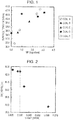
- the present inventors determined the maximum fluidity MF of each of the coal named in Table 1 and the surface tension of the semicoke which was prepared from each of the named coals. The determination results are given in Fig. 1 .
- a measurement value of a MF of 0 ddpm is indicated by a point on the line for a logMF of 0.
- the surface tension ⁇ [mN/m] in Table 1 indicates the value of the surface tension of the semicoke which was prepared from the corresponding coal listed in the "Coal Name" column.
- the value of the surface tension represents the average value of the surface tension distribution which was obtained by using a film flotation method as described above.
- Table 1 the mean maximum reflectance Ro of vitrinite in coal and maximum fluidity MF for each coal name are given.
- maximum fluidity MF is one of the indices for determining weathering degree. It is known that, as the weathering of coal progresses, the maximum fluidity MF of the coal decreases.
- the mean maximum reflectance Ro of vitrinite in coal in Table 1 is given for reference.
- the Ash value and the VM value in Table 1 are values determined for coal before weathering was performed, and a change in the Ash value or VM value due to weathering was not observed.
- the values of Ash and VM in Table 1 are based on dry weight and expressed in units of [%, d.b.] in Table 1.
- Fig. 1 indicates, it is clarified that, in the case of the same brand of coal, as maximum fluidity MF decreases due to weathering, the surface tension of the semicoke which is prepared from the weathered coal decreases. From the results for coal name A 3 , it is clarified that there is a decrease in surface tension due to spontaneous weathering as is the case with weathering due to accelerated weathering through heating. Therefore, it is clarified that, by determining surface tension at a base point in time when the evaluation of weathering degree is started, for example, immediately after the start of storing, and by determining surface tension at a time when weathering degree is to be evaluated, it is possible to quantitatively assess weathering degree.
- the present inventors clarified that the surface tension ⁇ of semicoke correlates with the weathering degree of coal through the maximum fluidity MF of the coal. From this clarification, it is presumed that the interfacial tension of semicoke, which is calculated from the surface tension of semicoke, correlates with the weathering degree of coal.
- the present inventors focused on this relationship to think that there is a relationship between the strength of coke and the difference in surface tension between two kinds of semicoke where one of them is prepared from weathered brands of coal and the other is prepared from the remaining brands of coal for a coal blend other than the weathered brands of coal, and there is a significant decrease of the strength of coke in the relationship in the case where the difference in surface tension is higher than a certain threshold value.
- the present inventors conducted further additional experiments, and as a result, clarified that there is a significant decrease in the strength of coke in the case where the difference in surface tension between the two kinds of semicoke is higher than 1.5 mN/m.
- the present inventors considered about the presence of the threshold value for a difference in the surface tension of semicoke and considered that there is also such a threshold value for the surface tension of semicoke, and conducted further additional experiments. As a result, the present inventors found that, in the case where the value of the surface tension of the semicoke which is prepared by performing a heat treatment at a temperature of 500°C is 39.5 mN/m, this is the critical value at which there is a decrease in the strength of coke.
- the value of 39.5 mN/m means the surface tension of the semicoke which is prepared by performing a heat treatment at a temperature of 500°C on the weathered coal be used for the coal blend.
- the threshold value of the surface tension of semicoke which influences the strength of coke, based on the results of a carbonizing test as described in EXAMPLE
- the method for controlling the weathering degree of coal according to the present invention is based on the assumption that the weathering degree of coal is controlled when the coal is stored, for example, in a stock yard. That is to say, since weathering of coal spontaneously progresses in atmospheric air, it is possible to prevent a decrease in the strength of coke over the long term, for example, in the case where it is possible to control the weathering degree of each brand of coal and to use a weathered brand of coal before the weathering degree reaches the limit.
- the surface tension of each brand of semicoke which is prepared from each of the brands of coal included in coal stock which can be used for producing coke is determined in advance (previously).
- coal stock refers to coal stored in a storage place such as a stock yard, and, usually, plural brands of coal are stored in the storage place.
- proportion of each brand of coal to the whole coal stock refers to the abundance ratio of each brand of coal in the coal stock.
- the coal may be treated as a part of the coal stock.
- Examples of a method for determining the surface tension distribution include a method in which a surface tension distribution is obtained by determining the surface tension of semicoke by using the film flotation method described above, a method in which a surface tension distribution is obtained by using the values of surface tension determined by a third party using the film flotation method or the other method, and a method in which a surface tension distribution is obtained from a third party.
- the weathering degrees of plural brands of coal included in coal stock be controlled by using as indices the interfacial tensions or surface tensions of plural brands of semicoke which are prepared from the plural brands of coal and by using controlling methods (1) through (3) described below.
- controlling methods (1) through (3) there is no particular limitation on the number of brands of coal included in coal stock in the present invention.
- the weathering degree of a control target brand of coal is controlled so that the semicoke which is prepared by performing a heat treatment on the control target brand of coal has a surface tension of 39.5 mN/m or higher, the value of 39.5 mN/m is the surface tension of the semicoke which is prepared by performing a heat treatment at a temperature of 500°C on the weathered coal.
- the weathering degree so that the surface tension is 39.5 mN/m or higher in the case where the surface tension of the semicoke which is prepared by performing a heat treatment at a temperature of 500°C is determined and controlled, it is not necessary to limit the heat treatment temperature to 500°C.
- the control value of the surface tension of semicoke is a value equivalent to 39.5 mN/m in terms of the surface tension of the semicoke which is prepared by performing a heat treatment at a temperature of 500°C in the case where the surface tension of the semicoke which is prepared by performing a heat treatment at a temperature different from 500°C is used for the control.
- Process [C] above may be performed in combination with or instead of process [B] above.
- the relationship between the weathering condition of some coal for example, a storage period in a stock yard alone or coupled with climate conditions during storage, or the like
- the surface tension of the semicoke which is prepared from the coal at a temperature of, for example, 500°C is obtained in advance, since it is possible to estimate surface tension in accordance with practical weathering condition, the estimated value may be used for control.
- this case is determined to be a case of excessive weathering, and the weathering degree of coal is controlled so that surface tension of the semicoke which is prepared from the coal is not lower than the value equivalent to 39.5 mN/m and the weathering is suppressed.
- weathering rate varies depending on the brand of coal, it is acceptable that the surface tension of a brand of semicoke having a low weathering rate be determined with lower frequency, that the surface tension of a brand of semicoke having a high weathering rate be determined with higher frequency, and that weathering degree be controlled based on the brand of coal having a high weathering rate.
- coal stock in a stock yard is controlled so that the semicoke which is prepared from the coal included in the coal stock has a chemical composition that always realizes the surface tension of an average preferable value and so that it is possible to avoid a situation in which a large amount of weathered coal, which causes a decrease in strength, is stored. Moreover, by assessing the weathering degree of coal, it is possible to add weathered coal to a coal blend without the occurrence of a decrease in the strength of coke which has been unpredictable to date.
- the method for evaluating the weathering degree of coal in which the weathering degree of weathered coal is evaluated by using the surface tension of the semicoke which is prepared by performing a heat treatment on the weathered coal as an index was tried and verified.
- coal F and coals G through M were provided, and a part of coal F was subjected to intentionally accelerated weathering.
- the interfacial tension ⁇ inter of a semicoke blend which is prepared from a coal mixture which was composed of these kinds of coal with certain blending ratios was determined.
- each semicoke was prepared from each brand of coal by the above processes (a') through (d').
- Mean maximum reflectance Ro of vitrinite in coal was determined in accordance with JIS M 8816
- maximum fluidity MF was determined in accordance with JIS M 8801
- ash (Ash) and volatile matter (VM) were determined in accordance with JIS M 8812.
- the determined values are given in Table 2 and Table 3.
- Maximum fluidity MF (ddpm) is indicated in Table 2 and Table 3 in terms of the common logarithm of MF (logMF).
- Surface tension ⁇ [mN/m] is the value of the surface tension of the semicoke which is prepared from the coal named in "Coal Name" column. The value for the surface tension was derived as the average value of the surface tension distribution which was obtained by using a film flotation method as described above.
- Coke was produced from a coal mixture which was composed of coals F 0 through F 4 given in Table 2 and coals G through M given in Table 3 with appropriate blending ratios, and the strength of the coke was determined.
- the blending ratios of the constituent kinds of coal of the coal mixture and the properties of each coal blend are given in Table 4.
- Ro and logMF of a coal mixture given in Table 4 are the conditions used in the mixture of a practical operation, and it is known that the strength of coke is fundamentally constant for constant Ro and logMF according to a knowledge based on conventional coal blending.
- the values of Ro and logMF are respectively the weighted average values of these properties of the constituent kinds of coal of the coal mixture weighted by the blending ratios of the constituent kinds of coal.
- Interfacial tension ⁇ inter1 was calculated by relational expression (1) from the surface tensions of the plural kinds of semicoke which are prepared from the plural brands of coal included in the coal mixture and the blending ratios of the constituent kinds of coal included in the coal mixture.
- ⁇ inter2 is the value of the interfacial tension of semicoke calculated by relational expression (6) as is the case with relational expression (1).
- weighted average value of the surface tensions of the kinds of semicoke which are prepared from the remaining brands of coal other than coal F or weathered coal F included in the coal mixture weighted by the blending ratios of the remaining brands of coal for descriptive purposes, also called "weighted average"
- weighted average the difference between the weighted average and the surface tension of coal F or weathered coal F
- Coke was produced by carbonizing the coal mixture which was composed of the constituent kinds of coal with the blending ratios given in Table 4, and the strength of the coke was determined. 16 kg of the coal mixture controlled to have coal particles having a diameter of 3 mm or less of 100 mass% and a humidity of 8 mass% was compacted to the bulk density of 750 kg/m 3 and then carbonized in an electric furnace. After carbonization had been performed at a heating wall temperature was 1100°C for 6 hours, nitrogen cooling was performed in order to obtain coke. The strength of coke was evaluated by using a drum strength index DI150/15 based on a drum strength test method in accordance with JIS K 2151 and coke strength after CO 2 reaction CSR based on ISO 18894. The values of DI150/15 and CSR are given in Table 4.
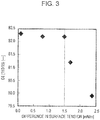
- Fig. 2 illustrates the relationship between interfacial tension ⁇ inter1 and drum strength index DI150/15, and Fig.
- FIG. 3 illustrates the relationship between the difference from the weighted average value and drum strength index DI150/15.
- FIG. 2 and Fig. 3 indicate, it is clarified that the strength of coke significantly changes at a point for an interfacial tension ⁇ inter1 of 0.03 mN/m and at a point for a difference from the weighted average value of 1.5 mN/m.
- Fig. 4 illustrates the relationship between the surface tension of semicoke and drum strength index DI150/15. As the graph of Fig.
- a semicoke sample was prepared from each of coal N and coal O with various heat treatment temperatures by using the same method as used in EXAMPLE 1, and the surface tension of the semicoke was determined. The results of the determination are given in Table 5.
Landscapes
- Chemical & Material Sciences (AREA)
- Life Sciences & Earth Sciences (AREA)
- Health & Medical Sciences (AREA)
- Analytical Chemistry (AREA)
- Biochemistry (AREA)
- Pathology (AREA)
- Immunology (AREA)
- General Physics & Mathematics (AREA)
- General Health & Medical Sciences (AREA)
- Physics & Mathematics (AREA)
- Engineering & Computer Science (AREA)
- Medicinal Chemistry (AREA)
- Organic Chemistry (AREA)
- Food Science & Technology (AREA)
- Materials Engineering (AREA)
- Oil, Petroleum & Natural Gas (AREA)
- Chemical Kinetics & Catalysis (AREA)
- Biodiversity & Conservation Biology (AREA)
- Ecology (AREA)
- Environmental & Geological Engineering (AREA)
- Environmental Sciences (AREA)
- Coke Industry (AREA)
- Solid Fuels And Fuel-Associated Substances (AREA)
Claims (6)
- Procédé pour évaluer un degré d'altération d'un charbon comprenant :utilisation d'une tension de surface en tant qu'indice pour évaluer le degré d'altération,caractérisé en ce quela tension de surface d'un semi-coke est utilisée, le semi-coke étant préparé en appliquant un traitement thermique à une température supérieure ou égale à 350 °C et inférieure ou égale à 800 °C à un charbon altéré et puis en refroidissant le charbon dans une atmosphère étanche à l'air ou dans une atmosphère d'un gaz inerte.
- Le procédé selon la revendication 1, dans lequel le charbon altéré est inclus dans un mélange de charbon à partir duquel du coke est produit et le degré d'altération est évalué selon une quantité de diminution dans la force du coke, la quantité de diminution dans la force du coke étant évaluée par l'indice.
- Procédé pour contrôler un degré d'altération par les intempéries d'un charbon, comprenant les étapes de :détermination de l'indice pour évaluer le degré d'altération de chaque type de charbon de multiples types de charbon inclus dans un stock de charbon selon la revendication 1,évaluation pour chaque type d'une proportion du stock de charbon selon son abondance dans le stock de charbon ; etcontrôle ultérieur du degré d'altération du charbon dans un état de mélange des multiples types de semi-coke selon les proportions évaluées respectives pour préparer un mélange de semi-coke afin qu'une valeur de tension interfaciale γinter du mélange de semi-coke, qui est déduite des tensions de surface et des proportions de chacun des types, ne dépasse pas 0,03 mN/m.
- Procédé pour contrôler un degré d'altération d'un charbon, comprenant les étapes de :détermination de l'indice pour évaluer le degré d'altération de chaque type de charbon de multiples types de charbon inclus dans un stock de charbon selon la revendication 1,évaluation pour chaque type d'une proportion du stock de charbon selon son abondance dans le stock de charbon ; etcontrôle ultérieur du degré d'altération d'un type de charbon cible de contrôle inclus dans le stock de charbon de sorte qu'une différence Δγ dans une tension de surface soit de 1,5 mN/m ou inférieure, la différence Δγ étant entre une valeur de la surface de tension du semi-coke, qui est préparé en appliquant un traitement thermique au type de charbon cible de contrôle, et une valeur moyenne pondérée, qui est calculée en effectuant une moyenne pondérée, selon les proportions évaluées des types de charbon restants, les tensions de surface des types de semi-coke qui sont préparés en appliquant un traitement thermique aux types de charbon restants autres que le type de charbon cible de contrôle inclus dans le stock de charbon.
- Procédé pour contrôler un degré d'altération d'un charbon comprenant :
contrôle du degré d'altération d'un type de charbon cible de contrôle en utilisant le procédé selon la revendication 1 de sorte qu'un semi-coke qui est préparé à partir du type de charbon cible de contrôle altéré présente une tension de surface correspondant à 39,5 mN/m ou plus, la valeur de 39,5 mN/m constituant une tension de surface du semi-coke qui est préparé en appliquant un traitement thermique à une température de 500 °C au type de charbon altéré. - Procédé de production de coke comprenant les étapes de :préparation d'un mélange de charbon en mélangeant les types de charbon dont des degrés d'altération ont été contrôlés selon l'une quelconque des revendications 3 à 5 ; etproduction de coke par carbonisation du mélange de charbon.
Applications Claiming Priority (2)
| Application Number | Priority Date | Filing Date | Title |
|---|---|---|---|
| JP2013083490 | 2013-04-12 | ||
| PCT/JP2014/002013 WO2014167843A1 (fr) | 2013-04-12 | 2014-04-08 | Procédé d'évaluation du degré de désagrégation par les intempéries du charbon, procédé d'évaluation des propriétés de cokéfaction du charbon désagrégé par les intempéries, procédé de régulation du degré de désagrégation par les intempéries du charbon et procédé de production de cokes |
Publications (3)
| Publication Number | Publication Date |
|---|---|
| EP2985602A1 EP2985602A1 (fr) | 2016-02-17 |
| EP2985602A4 EP2985602A4 (fr) | 2016-05-04 |
| EP2985602B1 true EP2985602B1 (fr) | 2021-10-06 |
Family
ID=51689264
Family Applications (1)
| Application Number | Title | Priority Date | Filing Date |
|---|---|---|---|
| EP14782384.3A Active EP2985602B1 (fr) | 2013-04-12 | 2014-04-08 | Procédé d'évaluation du degré de désagrégation par les intempéries du charbon, procédé d'évaluation des propriétés de cokéfaction du charbon désagrégé par les intempéries, procédé de régulation du degré de désagrégation par les intempéries du charbon et procédé de production de cokes |
Country Status (7)
| Country | Link |
|---|---|
| US (1) | US9970921B2 (fr) |
| EP (1) | EP2985602B1 (fr) |
| JP (1) | JP6044708B2 (fr) |
| KR (1) | KR101756760B1 (fr) |
| CN (1) | CN105122055B (fr) |
| RU (1) | RU2640183C2 (fr) |
| WO (1) | WO2014167843A1 (fr) |
Families Citing this family (9)
| Publication number | Priority date | Publication date | Assignee | Title |
|---|---|---|---|---|
| JP6856178B2 (ja) * | 2019-03-04 | 2021-04-07 | Jfeスチール株式会社 | 石炭の評価方法及び配合炭の調製方法並びにコークスの製造方法 |
| CA3130078C (fr) * | 2019-03-15 | 2023-08-22 | Jfe Steel Corporation | Procede d'evaluation du charbon, procede de preparation de charbon melange, et procede de production de coke |
| EP3950888B1 (fr) * | 2019-03-28 | 2025-08-20 | JFE Steel Corporation | Procédé pour la production de mélange de charbons et procédé pour la production de coke |
| WO2021085146A1 (fr) * | 2019-10-28 | 2021-05-06 | Jfeスチール株式会社 | Procédé d'estimation de tension superficielle de structure inerte dans du charbon, procédé d'estimation de tension superficielle de charbon et procédé de production de coke |
| AU2020376541B2 (en) | 2019-10-28 | 2023-11-02 | Jfe Steel Corporation | Method for estimating surface tension of coal and method for producing coke |
| CN114901782B (zh) * | 2020-01-07 | 2024-05-03 | 杰富意钢铁株式会社 | 混煤的制造方法和焦炭的制造方法 |
| AU2021329613B2 (en) | 2020-08-17 | 2024-01-11 | Jfe Steel Corporation | Method for evaluating thermoplasticity of coal or caking additive |
| CN111961772A (zh) * | 2020-08-19 | 2020-11-20 | 付光临 | 一种改质兰炭的制备方法及其应用 |
| CN112029525A (zh) * | 2020-08-28 | 2020-12-04 | 广东韶钢松山股份有限公司 | 一种鉴定炼焦煤风化氧化变质程度的方法 |
Family Cites Families (12)
| Publication number | Priority date | Publication date | Assignee | Title |
|---|---|---|---|---|
| US4135983A (en) * | 1970-12-28 | 1979-01-23 | Kureha Kagaku Kogyo Kabushiki Kaisha | Method for improving coking property of coal for use in production of cokes |
| JPS54110897A (en) | 1978-02-20 | 1979-08-30 | Nippon Steel Corp | Measuring method of degrees of weathering of coal |
| SU941392A1 (ru) * | 1980-05-07 | 1982-07-07 | Днепродзержинский Ордена Трудового Красного Знамени Индустриальный Институт Им.М.И.Арсеничева | Способ получени кокса |
| SU1214718A1 (ru) * | 1984-06-06 | 1986-02-28 | Кузнецкий Филиал Восточного Ордена Трудового Красного Знамени Научно-Исследовательского Углехимического Института | Способ подготовки шихты к коксованию |
| JPS61191943A (ja) | 1985-02-20 | 1986-08-26 | Nippon Steel Chem Co Ltd | 石炭の風化度判定法 |
| SU1663015A1 (ru) * | 1988-02-29 | 1991-07-15 | Институт физико-органической химии и углехимии АН УССР | Способ получени кокса |
| JP3302446B2 (ja) * | 1993-05-28 | 2002-07-15 | 関西熱化学株式会社 | 石炭風化度の判定方法 |
| JP4385816B2 (ja) | 2004-03-29 | 2009-12-16 | Jfeスチール株式会社 | 配合炭のコークス強度推定方法及びコークスの製造方法 |
| KR100865223B1 (ko) | 2004-09-30 | 2008-10-23 | 제이에프이 스틸 가부시키가이샤 | 코크스의 제조방법 및 제조설비 |
| JP5201250B2 (ja) | 2010-09-01 | 2013-06-05 | Jfeスチール株式会社 | 冶金用コークスの製造方法および冶金用コークス製造用粘結材 |
| CN104710999B (zh) | 2010-09-01 | 2017-06-06 | 杰富意钢铁株式会社 | 煤及粘结材料的软化熔融特性评价方法、以及焦炭的制造方法 |
| JP5062353B2 (ja) | 2010-09-01 | 2012-10-31 | Jfeスチール株式会社 | 石炭及び粘結材の軟化溶融特性の評価方法 |
-
2014
- 2014-04-08 RU RU2015148544A patent/RU2640183C2/ru active
- 2014-04-08 JP JP2015511113A patent/JP6044708B2/ja active Active
- 2014-04-08 KR KR1020157030510A patent/KR101756760B1/ko not_active Expired - Fee Related
- 2014-04-08 CN CN201480020903.4A patent/CN105122055B/zh active Active
- 2014-04-08 EP EP14782384.3A patent/EP2985602B1/fr active Active
- 2014-04-08 WO PCT/JP2014/002013 patent/WO2014167843A1/fr not_active Ceased
- 2014-04-08 US US14/783,608 patent/US9970921B2/en active Active
Also Published As
| Publication number | Publication date |
|---|---|
| RU2640183C2 (ru) | 2017-12-26 |
| JP6044708B2 (ja) | 2016-12-14 |
| JPWO2014167843A1 (ja) | 2017-02-16 |
| US9970921B2 (en) | 2018-05-15 |
| US20160084816A1 (en) | 2016-03-24 |
| KR101756760B1 (ko) | 2017-07-12 |
| CN105122055A (zh) | 2015-12-02 |
| RU2015148544A (ru) | 2017-05-19 |
| CN105122055B (zh) | 2017-03-15 |
| KR20150133827A (ko) | 2015-11-30 |
| EP2985602A4 (fr) | 2016-05-04 |
| EP2985602A1 (fr) | 2016-02-17 |
| WO2014167843A1 (fr) | 2014-10-16 |
Similar Documents
| Publication | Publication Date | Title |
|---|---|---|
| EP2985602B1 (fr) | Procédé d'évaluation du degré de désagrégation par les intempéries du charbon, procédé d'évaluation des propriétés de cokéfaction du charbon désagrégé par les intempéries, procédé de régulation du degré de désagrégation par les intempéries du charbon et procédé de production de cokes | |
| US9463980B2 (en) | Method for manufacturing coke | |
| US9845439B2 (en) | Method for blending coals for cokemaking and method for producing coke | |
| JP5686223B2 (ja) | 石炭の配合方法及び配合炭、並びに、コークス製造方法 | |
| EP2980187B1 (fr) | Procédé de préparation d'un mélange de charbon pour la production de coke, mélange de charbon et procédé de production de coke | |
| CA3152870A1 (fr) | Procede d'estimation de la tension superficielle du charbon et procede de production de coke | |
| US12110457B2 (en) | Method of estimating surface tension of coal inert material, method of estimating surface tension of coal, and method of producing coke | |
| CN104204140B (zh) | 用于制造焦炭的煤混合物的制备方法及煤混合物、以及焦炭制造方法 |
Legal Events
| Date | Code | Title | Description |
|---|---|---|---|
| PUAI | Public reference made under article 153(3) epc to a published international application that has entered the european phase |
Free format text: ORIGINAL CODE: 0009012 |
|
| 17P | Request for examination filed |
Effective date: 20151110 |
|
| AK | Designated contracting states |
Kind code of ref document: A1 Designated state(s): AL AT BE BG CH CY CZ DE DK EE ES FI FR GB GR HR HU IE IS IT LI LT LU LV MC MK MT NL NO PL PT RO RS SE SI SK SM TR |
|
| AX | Request for extension of the european patent |
Extension state: BA ME |
|
| A4 | Supplementary search report drawn up and despatched |
Effective date: 20160404 |
|
| RIC1 | Information provided on ipc code assigned before grant |
Ipc: G01N 13/00 20060101ALI20160329BHEP Ipc: G01N 33/22 20060101AFI20160329BHEP Ipc: C10B 57/04 20060101ALI20160329BHEP |
|
| DAX | Request for extension of the european patent (deleted) | ||
| GRAP | Despatch of communication of intention to grant a patent |
Free format text: ORIGINAL CODE: EPIDOSNIGR1 |
|
| STAA | Information on the status of an ep patent application or granted ep patent |
Free format text: STATUS: GRANT OF PATENT IS INTENDED |
|
| RIC1 | Information provided on ipc code assigned before grant |
Ipc: G01N 13/00 20060101ALI20210331BHEP Ipc: C10B 57/04 20060101ALI20210331BHEP Ipc: G01N 33/22 20060101AFI20210331BHEP |
|
| INTG | Intention to grant announced |
Effective date: 20210429 |
|
| GRAS | Grant fee paid |
Free format text: ORIGINAL CODE: EPIDOSNIGR3 |
|
| GRAA | (expected) grant |
Free format text: ORIGINAL CODE: 0009210 |
|
| STAA | Information on the status of an ep patent application or granted ep patent |
Free format text: STATUS: THE PATENT HAS BEEN GRANTED |
|
| AK | Designated contracting states |
Kind code of ref document: B1 Designated state(s): AL AT BE BG CH CY CZ DE DK EE ES FI FR GB GR HR HU IE IS IT LI LT LU LV MC MK MT NL NO PL PT RO RS SE SI SK SM TR |
|
| REG | Reference to a national code |
Ref country code: GB Ref legal event code: FG4D |
|
| REG | Reference to a national code |
Ref country code: CH Ref legal event code: EP Ref country code: AT Ref legal event code: REF Ref document number: 1436637 Country of ref document: AT Kind code of ref document: T Effective date: 20211015 |
|
| REG | Reference to a national code |
Ref country code: IE Ref legal event code: FG4D |
|
| REG | Reference to a national code |
Ref country code: DE Ref legal event code: R096 Ref document number: 602014080528 Country of ref document: DE |
|
| REG | Reference to a national code |
Ref country code: NL Ref legal event code: FP |
|
| REG | Reference to a national code |
Ref country code: LT Ref legal event code: MG9D |
|
| REG | Reference to a national code |
Ref country code: AT Ref legal event code: MK05 Ref document number: 1436637 Country of ref document: AT Kind code of ref document: T Effective date: 20211006 |
|
| PG25 | Lapsed in a contracting state [announced via postgrant information from national office to epo] |
Ref country code: RS Free format text: LAPSE BECAUSE OF FAILURE TO SUBMIT A TRANSLATION OF THE DESCRIPTION OR TO PAY THE FEE WITHIN THE PRESCRIBED TIME-LIMIT Effective date: 20211006 Ref country code: LT Free format text: LAPSE BECAUSE OF FAILURE TO SUBMIT A TRANSLATION OF THE DESCRIPTION OR TO PAY THE FEE WITHIN THE PRESCRIBED TIME-LIMIT Effective date: 20211006 Ref country code: FI Free format text: LAPSE BECAUSE OF FAILURE TO SUBMIT A TRANSLATION OF THE DESCRIPTION OR TO PAY THE FEE WITHIN THE PRESCRIBED TIME-LIMIT Effective date: 20211006 Ref country code: BG Free format text: LAPSE BECAUSE OF FAILURE TO SUBMIT A TRANSLATION OF THE DESCRIPTION OR TO PAY THE FEE WITHIN THE PRESCRIBED TIME-LIMIT Effective date: 20220106 Ref country code: AT Free format text: LAPSE BECAUSE OF FAILURE TO SUBMIT A TRANSLATION OF THE DESCRIPTION OR TO PAY THE FEE WITHIN THE PRESCRIBED TIME-LIMIT Effective date: 20211006 |
|
| PG25 | Lapsed in a contracting state [announced via postgrant information from national office to epo] |
Ref country code: IS Free format text: LAPSE BECAUSE OF FAILURE TO SUBMIT A TRANSLATION OF THE DESCRIPTION OR TO PAY THE FEE WITHIN THE PRESCRIBED TIME-LIMIT Effective date: 20220206 Ref country code: SE Free format text: LAPSE BECAUSE OF FAILURE TO SUBMIT A TRANSLATION OF THE DESCRIPTION OR TO PAY THE FEE WITHIN THE PRESCRIBED TIME-LIMIT Effective date: 20211006 Ref country code: PT Free format text: LAPSE BECAUSE OF FAILURE TO SUBMIT A TRANSLATION OF THE DESCRIPTION OR TO PAY THE FEE WITHIN THE PRESCRIBED TIME-LIMIT Effective date: 20220207 Ref country code: PL Free format text: LAPSE BECAUSE OF FAILURE TO SUBMIT A TRANSLATION OF THE DESCRIPTION OR TO PAY THE FEE WITHIN THE PRESCRIBED TIME-LIMIT Effective date: 20211006 Ref country code: NO Free format text: LAPSE BECAUSE OF FAILURE TO SUBMIT A TRANSLATION OF THE DESCRIPTION OR TO PAY THE FEE WITHIN THE PRESCRIBED TIME-LIMIT Effective date: 20220106 Ref country code: LV Free format text: LAPSE BECAUSE OF FAILURE TO SUBMIT A TRANSLATION OF THE DESCRIPTION OR TO PAY THE FEE WITHIN THE PRESCRIBED TIME-LIMIT Effective date: 20211006 Ref country code: HR Free format text: LAPSE BECAUSE OF FAILURE TO SUBMIT A TRANSLATION OF THE DESCRIPTION OR TO PAY THE FEE WITHIN THE PRESCRIBED TIME-LIMIT Effective date: 20211006 Ref country code: GR Free format text: LAPSE BECAUSE OF FAILURE TO SUBMIT A TRANSLATION OF THE DESCRIPTION OR TO PAY THE FEE WITHIN THE PRESCRIBED TIME-LIMIT Effective date: 20220107 Ref country code: ES Free format text: LAPSE BECAUSE OF FAILURE TO SUBMIT A TRANSLATION OF THE DESCRIPTION OR TO PAY THE FEE WITHIN THE PRESCRIBED TIME-LIMIT Effective date: 20211006 |
|
| REG | Reference to a national code |
Ref country code: DE Ref legal event code: R097 Ref document number: 602014080528 Country of ref document: DE |
|
| PG25 | Lapsed in a contracting state [announced via postgrant information from national office to epo] |
Ref country code: SM Free format text: LAPSE BECAUSE OF FAILURE TO SUBMIT A TRANSLATION OF THE DESCRIPTION OR TO PAY THE FEE WITHIN THE PRESCRIBED TIME-LIMIT Effective date: 20211006 Ref country code: SK Free format text: LAPSE BECAUSE OF FAILURE TO SUBMIT A TRANSLATION OF THE DESCRIPTION OR TO PAY THE FEE WITHIN THE PRESCRIBED TIME-LIMIT Effective date: 20211006 Ref country code: RO Free format text: LAPSE BECAUSE OF FAILURE TO SUBMIT A TRANSLATION OF THE DESCRIPTION OR TO PAY THE FEE WITHIN THE PRESCRIBED TIME-LIMIT Effective date: 20211006 Ref country code: EE Free format text: LAPSE BECAUSE OF FAILURE TO SUBMIT A TRANSLATION OF THE DESCRIPTION OR TO PAY THE FEE WITHIN THE PRESCRIBED TIME-LIMIT Effective date: 20211006 Ref country code: DK Free format text: LAPSE BECAUSE OF FAILURE TO SUBMIT A TRANSLATION OF THE DESCRIPTION OR TO PAY THE FEE WITHIN THE PRESCRIBED TIME-LIMIT Effective date: 20211006 Ref country code: CZ Free format text: LAPSE BECAUSE OF FAILURE TO SUBMIT A TRANSLATION OF THE DESCRIPTION OR TO PAY THE FEE WITHIN THE PRESCRIBED TIME-LIMIT Effective date: 20211006 |
|
| PLBE | No opposition filed within time limit |
Free format text: ORIGINAL CODE: 0009261 |
|
| STAA | Information on the status of an ep patent application or granted ep patent |
Free format text: STATUS: NO OPPOSITION FILED WITHIN TIME LIMIT |
|
| 26N | No opposition filed |
Effective date: 20220707 |
|
| PG25 | Lapsed in a contracting state [announced via postgrant information from national office to epo] |
Ref country code: AL Free format text: LAPSE BECAUSE OF FAILURE TO SUBMIT A TRANSLATION OF THE DESCRIPTION OR TO PAY THE FEE WITHIN THE PRESCRIBED TIME-LIMIT Effective date: 20211006 |
|
| PG25 | Lapsed in a contracting state [announced via postgrant information from national office to epo] |
Ref country code: SI Free format text: LAPSE BECAUSE OF FAILURE TO SUBMIT A TRANSLATION OF THE DESCRIPTION OR TO PAY THE FEE WITHIN THE PRESCRIBED TIME-LIMIT Effective date: 20211006 |
|
| REG | Reference to a national code |
Ref country code: CH Ref legal event code: PL |
|
| REG | Reference to a national code |
Ref country code: BE Ref legal event code: MM Effective date: 20220430 |
|
| PG25 | Lapsed in a contracting state [announced via postgrant information from national office to epo] |
Ref country code: MC Free format text: LAPSE BECAUSE OF FAILURE TO SUBMIT A TRANSLATION OF THE DESCRIPTION OR TO PAY THE FEE WITHIN THE PRESCRIBED TIME-LIMIT Effective date: 20211006 Ref country code: LU Free format text: LAPSE BECAUSE OF NON-PAYMENT OF DUE FEES Effective date: 20220408 Ref country code: LI Free format text: LAPSE BECAUSE OF NON-PAYMENT OF DUE FEES Effective date: 20220430 Ref country code: CH Free format text: LAPSE BECAUSE OF NON-PAYMENT OF DUE FEES Effective date: 20220430 |
|
| PG25 | Lapsed in a contracting state [announced via postgrant information from national office to epo] |
Ref country code: BE Free format text: LAPSE BECAUSE OF NON-PAYMENT OF DUE FEES Effective date: 20220430 |
|
| PG25 | Lapsed in a contracting state [announced via postgrant information from national office to epo] |
Ref country code: IE Free format text: LAPSE BECAUSE OF NON-PAYMENT OF DUE FEES Effective date: 20220408 |
|
| PGFP | Annual fee paid to national office [announced via postgrant information from national office to epo] |
Ref country code: IT Payment date: 20230310 Year of fee payment: 10 Ref country code: GB Payment date: 20230302 Year of fee payment: 10 |
|
| PGFP | Annual fee paid to national office [announced via postgrant information from national office to epo] |
Ref country code: NL Payment date: 20230314 Year of fee payment: 10 |
|
| PG25 | Lapsed in a contracting state [announced via postgrant information from national office to epo] |
Ref country code: HU Free format text: LAPSE BECAUSE OF FAILURE TO SUBMIT A TRANSLATION OF THE DESCRIPTION OR TO PAY THE FEE WITHIN THE PRESCRIBED TIME-LIMIT; INVALID AB INITIO Effective date: 20140408 |
|
| PG25 | Lapsed in a contracting state [announced via postgrant information from national office to epo] |
Ref country code: MK Free format text: LAPSE BECAUSE OF FAILURE TO SUBMIT A TRANSLATION OF THE DESCRIPTION OR TO PAY THE FEE WITHIN THE PRESCRIBED TIME-LIMIT Effective date: 20211006 Ref country code: CY Free format text: LAPSE BECAUSE OF FAILURE TO SUBMIT A TRANSLATION OF THE DESCRIPTION OR TO PAY THE FEE WITHIN THE PRESCRIBED TIME-LIMIT Effective date: 20211006 |
|
| PG25 | Lapsed in a contracting state [announced via postgrant information from national office to epo] |
Ref country code: MT Free format text: LAPSE BECAUSE OF FAILURE TO SUBMIT A TRANSLATION OF THE DESCRIPTION OR TO PAY THE FEE WITHIN THE PRESCRIBED TIME-LIMIT Effective date: 20211006 |
|
| REG | Reference to a national code |
Ref country code: NL Ref legal event code: MM Effective date: 20240501 |
|
| GBPC | Gb: european patent ceased through non-payment of renewal fee |
Effective date: 20240408 |
|
| PG25 | Lapsed in a contracting state [announced via postgrant information from national office to epo] |
Ref country code: NL Free format text: LAPSE BECAUSE OF NON-PAYMENT OF DUE FEES Effective date: 20240501 |
|
| PG25 | Lapsed in a contracting state [announced via postgrant information from national office to epo] |
Ref country code: GB Free format text: LAPSE BECAUSE OF NON-PAYMENT OF DUE FEES Effective date: 20240408 |
|
| PG25 | Lapsed in a contracting state [announced via postgrant information from national office to epo] |
Ref country code: NL Free format text: LAPSE BECAUSE OF NON-PAYMENT OF DUE FEES Effective date: 20240501 Ref country code: GB Free format text: LAPSE BECAUSE OF NON-PAYMENT OF DUE FEES Effective date: 20240408 |
|
| PG25 | Lapsed in a contracting state [announced via postgrant information from national office to epo] |
Ref country code: IT Free format text: LAPSE BECAUSE OF NON-PAYMENT OF DUE FEES Effective date: 20240408 |
|
| PGFP | Annual fee paid to national office [announced via postgrant information from national office to epo] |
Ref country code: TR Payment date: 20250321 Year of fee payment: 12 |
|
| PGFP | Annual fee paid to national office [announced via postgrant information from national office to epo] |
Ref country code: DE Payment date: 20250305 Year of fee payment: 12 |
|
| PGFP | Annual fee paid to national office [announced via postgrant information from national office to epo] |
Ref country code: FR Payment date: 20260309 Year of fee payment: 13 |