EP2986543B1 - Séparation de paquets - Google Patents
Séparation de paquets Download PDFInfo
- Publication number
- EP2986543B1 EP2986543B1 EP14717759.6A EP14717759A EP2986543B1 EP 2986543 B1 EP2986543 B1 EP 2986543B1 EP 14717759 A EP14717759 A EP 14717759A EP 2986543 B1 EP2986543 B1 EP 2986543B1
- Authority
- EP
- European Patent Office
- Prior art keywords
- transport
- transport means
- packages
- speed
- lengthwise
- Prior art date
- Legal status (The legal status is an assumption and is not a legal conclusion. Google has not performed a legal analysis and makes no representation as to the accuracy of the status listed.)
- Active
Links
Images


Classifications
-
- B—PERFORMING OPERATIONS; TRANSPORTING
- B65—CONVEYING; PACKING; STORING; HANDLING THIN OR FILAMENTARY MATERIAL
- B65G—TRANSPORT OR STORAGE DEVICES, e.g. CONVEYORS FOR LOADING OR TIPPING, SHOP CONVEYOR SYSTEMS OR PNEUMATIC TUBE CONVEYORS
- B65G47/00—Article or material-handling devices associated with conveyors; Methods employing such devices
- B65G47/22—Devices influencing the relative position or the attitude of articles during transit by conveyors
- B65G47/26—Devices influencing the relative position or the attitude of articles during transit by conveyors arranging the articles, e.g. varying spacing between individual articles
- B65G47/30—Devices influencing the relative position or the attitude of articles during transit by conveyors arranging the articles, e.g. varying spacing between individual articles during transit by a series of conveyors
- B65G47/31—Devices influencing the relative position or the attitude of articles during transit by conveyors arranging the articles, e.g. varying spacing between individual articles during transit by a series of conveyors by varying the relative speeds of the conveyors forming the series
-
- B—PERFORMING OPERATIONS; TRANSPORTING
- B65—CONVEYING; PACKING; STORING; HANDLING THIN OR FILAMENTARY MATERIAL
- B65G—TRANSPORT OR STORAGE DEVICES, e.g. CONVEYORS FOR LOADING OR TIPPING, SHOP CONVEYOR SYSTEMS OR PNEUMATIC TUBE CONVEYORS
- B65G15/00—Conveyors having endless load-conveying surfaces, i.e. belts and like continuous members, to which tractive effort is transmitted by means other than endless driving elements of similar configuration
- B65G15/10—Conveyors having endless load-conveying surfaces, i.e. belts and like continuous members, to which tractive effort is transmitted by means other than endless driving elements of similar configuration comprising two or more co-operating endless surfaces with parallel longitudinal axes, or a multiplicity of parallel elements, e.g. ropes defining an endless surface
- B65G15/105—Conveyors having endless load-conveying surfaces, i.e. belts and like continuous members, to which tractive effort is transmitted by means other than endless driving elements of similar configuration comprising two or more co-operating endless surfaces with parallel longitudinal axes, or a multiplicity of parallel elements, e.g. ropes defining an endless surface the surface being formed by two or more ropes
-
- B—PERFORMING OPERATIONS; TRANSPORTING
- B65—CONVEYING; PACKING; STORING; HANDLING THIN OR FILAMENTARY MATERIAL
- B65G—TRANSPORT OR STORAGE DEVICES, e.g. CONVEYORS FOR LOADING OR TIPPING, SHOP CONVEYOR SYSTEMS OR PNEUMATIC TUBE CONVEYORS
- B65G47/00—Article or material-handling devices associated with conveyors; Methods employing such devices
- B65G47/52—Devices for transferring articles or materials between conveyors i.e. discharging or feeding devices
- B65G47/68—Devices for transferring articles or materials between conveyors i.e. discharging or feeding devices adapted to receive articles arriving in one layer from one conveyor lane and to transfer them in individual layers to more than one conveyor lane or to one broader conveyor lane, or vice versa, e.g. combining the flows of articles conveyed by more than one conveyor
- B65G47/682—Devices for transferring articles or materials between conveyors i.e. discharging or feeding devices adapted to receive articles arriving in one layer from one conveyor lane and to transfer them in individual layers to more than one conveyor lane or to one broader conveyor lane, or vice versa, e.g. combining the flows of articles conveyed by more than one conveyor from a single conveyor lane consisting of one conveyor or several adjacent conveyors
Definitions
- the invention relates to a method and a device for separating packages, in particular for separating packets.
- Packages are transported, for example, as mail items from logistics companies from a sender to a recipient.
- the packets are usually first transported to parcel centers, the exit centers, where they are sorted by reception areas. From there they are transported to further parcel centers in the respective reception area, the entrance centers.
- the packages can be sorted by sub-centers, from where they can be delivered to the receiving address.
- large quantities of parcels are delivered daily. Due to the large quantity, these packages can only be sorted economically automatically.
- conventional sorting systems require a stream of individual packages.
- the deliveries of the packages in the parcel centers are usually carried out by trucks, which are discharged, for example, with a discharge module.
- the packages are made available to the sorting system in the form of a disorderly package delivery, a so-called bulk.
- the packages are present as a three-dimensional pile, that is, the packages are behind, next to and above each other.
- the packages may have different dimensions in all three dimensions.
- the packages need not have a cuboid shape, but may have all possible shapes, in particular roller-shaped forms.
- the packages may also have different weights.
- EP 0499899 A1 a device for separating packaged by piece packaged goods with variable cross-section and different input lengths.
- the packages will be transported with a first conveyor to the separating station, where the packages are gripped with gripping devices and sold individually to a second conveyor.
- portal robots are well known to those skilled in the art. Such portal robots have, for example, a gripping arm and can have four or more degrees of freedom. With such robots, packages can be grabbed and dropped off to individuals elsewhere.
- the object of the invention is therefore to specify a method and an apparatus for separating bulk mail, in particular parcels, which minimizes the disadvantages of known systems described above. According to the invention, this object is achieved by a method having the features of independent claim 1. Advantageous developments of the method will become apparent from the dependent claims 2-8. The object is further achieved by a device according to claim 9. Advantageous embodiments of the device will become apparent from the dependent claims 10-17.
- the inventive method for separating packages assumes that the packages are initially as unsorted, in all three dimensions extended pile, that is, as a so-called bulk present.
- the packages are in front, side by side and one above the other.
- the packages are transported in the form of a package stream on at least two different transport means with different transport speeds, wherein the transport direction is deflected at least once by approximately 45 °.
- the package flow is first spread out in the plane by bringing overlying packages are brought to case.
- the forming two-dimensional package stream is transferred partly subsequently and partly in parallel thereto by enlarging the available area with subsequent merging into a single-layer and single-row, i.e. one-dimensional, package stream.
- the packages are transported to different heights during transport on the at least two different transport means.
- the package stream is divided in the at least one diversion into a plurality of package streams, wherein it is also advantageous if the multiple package streams are transported at different transport speeds.
- the package streams are combined in an advantageous embodiment of the inventive method again into a single package stream.
- the packages are transported on fifteen different means of transport and thereby isolated.
- a horizontal transport of the packages takes place by means of a first transport means with a first transport speed, wherein the first transport means has a start page and a downstream side arranged in the transport direction.
- the first transport means may comprise side guides which prevent packages from falling laterally from the first transport means.
- the packages can spread laterally to the side guides. Due to the bulk material-like position of the packages in bulk on the means of transport, which transports the bulk, it comes to relative movements between the packages with each other, the packages and the means of transport and the Packages and the side guides.
- the first transport means is a hinge chain conveyor. It has also proved to be advantageous if the first means of transport transports the packages at a first transport speed of approximately 1.5 m / min.
- the pitch angle ⁇ 1 can be between 1 ° and 25 °, preferably between 7 ° and 15 °.
- the surface of the second conveyor is designed to be particularly grippy, so that the packages after delivery as quickly as possible take the higher speed and so entrained in stacked packages the lowest package, while the overlying packages because of Mass inertia not be carried away so quickly and fall off the bottom package.
- the second transport speed is about 4 m / min.
- the three-dimensional package stream continues to move in multiple layers next to each other and even in several layers one above the other, but is flatter than on the first means of transport.
- the second transport may, for example, smooth-surfaced side guides, which prevent packages can fall laterally from the transport.
- the third Transport means may, for example, have smooth-surfaced side guides which prevent packages from falling laterally from the means of transport.
- the second transport means is a belt conveyor.
- the third transport may also be a belt conveyor.
- the packages are transferred to a fourth transport with an inlet side and a downstream side arranged in the transport direction, wherein the inlet side of the fourth transport is located lower than the outlet side of the third transport.
- the packages are transported on the fourth Transthesis with a further increased transport speed.
- this new transport speed can be more than four times as high as the transport speed on the preceding means of transport, whereby the package stream is significantly equalized.
- the fourth transport speed is about 32 m / min. Large gaps are created between the packages. Packages on top of each other are now only isolated.
- the fourth means of transport may, for example, have smooth-surfaced side guides which prevent packages from falling down laterally from the means of transport.
- the first subset of the packages is transported on the fifth transport with a fifth transport speed, wherein the fifth transport speed is greater than the fourth transport speed.
- the second subset of the packages is transported on the seventh transport with a seventh transport speed, wherein the seventh transport speed is greater than the fourth transport speed.
- Transport speeds of, for example, 40 m / min. for the fifth means of transport and of 70 m / min. for the seventh transport have proved to be advantageous.
- the first subset of the packages is transferred to a sixth transport having an inlet side and a downstream side arranged in the transport direction and transported on the sixth transport at a sixth transport speed, wherein the sixth transport speed is greater than the fifth transport speed, whereby the package flow is further equalized.
- a sixth transport speed of about 50 m / min. has proven to be advantageous.
- the fifth and sixth transport means may, for example, smooth-surfaced side guides on its outer side, that is, the opposite side of the seventh transport means, which prevent packages can fall laterally from the transport means.
- the seventh means of transport on its side opposite the fifth and sixth transport means may have, for example, a smooth-surfaced side guide which prevents packages from falling down laterally from the means of transport.
- the fourth and / or fifth and / or sixth and / or seventh transport means is a strip conveyor.
- the connection to a preceding or subsequent means of transport at an angle, for example at an angle of 45 °, can be produced in a particularly uncomplicated manner with a strip conveyor.
- the first and second subset of the packages are transferred via an adjacent to the outlet sides of the sixth and seventh transport first longitudinal side of an eighth transport on an eighth transport with an inlet side, a downstream direction in the transport direction outlet side and a second longitudinal side, the second longitudinal side in Is arranged substantially parallel to the first longitudinal side and the longitudinal sides are arranged at an angle of approximately 45 ° to the outlet sides of the sixth and seventh transport means and wherein the eighth transport means by an inclination angle ⁇ 1 is inclined about its longitudinal axis so that its first longitudinal side is higher as its second longitudinal side.
- the inclination angle ⁇ 1 can be between 10 ° and 40 °, preferably between 20 ° and 25 °.
- the eighth transport means is arranged so that its first longitudinal side is lower than the outlet sides of the sixth and seventh transport means.
- the eighth transport means may comprise at least one deflector which is fixed in a direction substantially inclined by 45 ° relative to the longitudinal direction of the eighth transport means at such a height above the eighth transport that the movement of the means of transport is not hindered while transported on the means of transport Packages are deflected by the deflector from the transport direction predetermined by the transport. This further divides the package stream.
- this deflector causes packages that remain very firmly on the eighth transport, not necessarily transported to the outlet side of the means of transport and could cause a jam there.
- the packages are transported on the eighth transport at an eighth transport speed, the eighth transport speed being lower than the sixth and seventh transport speeds.
- a transport speed of about 32 m / min. has proven to be advantageous.
- the packages are passed over the second longitudinal side of the eighth transport on a ninth transport, which has an inlet side, an outlet side and a first longitudinal side and a second longitudinal side, wherein the transfer of the packages on the ninth transport over the first longitudinal side of the ninth transport takes place and wherein the ninth means of transport to a Inclination angle ⁇ 2 is inclined about its longitudinal axis so that its first longitudinal side is higher than its second longitudinal side.
- the inclination angle ⁇ 2 between 5 ° and 25 °, preferably between 9 ° and 14 °, amount.
- the packages are transported on the ninth transport with a ninth transport speed, wherein the ninth transport speed with, for example, about 50 m / min. is higher than the eighth transport speed.
- a first part of the packages is transferred to a tenth transport having an inlet side and a downstream side arranged in the transport direction, while the remaining second part of the packages to a substantially parallel to the ninth transport arranged eleventh transport with an inlet side and a downstream arranged in the transport direction outlet side as well as a first longitudinal side facing the ninth transport means and a second longitudinal side opposite the first longitudinal side, wherein the tenth and the eleventh transport means are arranged substantially horizontally and the outlet side of the ninth transport means is in a higher or the same height position as the inlet side of the tenth Transport means and the second longitudinal side of the ninth transport means is located at a higher or the same height position as the first longitudinal side of the eleventh transport means, and wherein the transfer of the remaining second part of the packages from the ninth transport means to the eleventh transport means takes place via the second longitudinal side of the ninth transport means and the first longitudinal side of the eleventh transport means.
- the first part of the packages is transported on the tenth transport at a tenth transport speed, wherein the tenth transport speed is greater than the ninth transport speed.
- the remaining second part of the packages is transported on the eleventh transport with an eleventh transport speed, wherein the eleventh transport speed is greater than the ninth and the tenth transport speed.
- Transport speeds of about 60 m / min. for the tenth transport speed and at the rate of approximately 100 m / min. for the eleventh transport speed have proved to be advantageous.
- a first subset of the first part of the packages is transferred to the eleventh transport, the transfer takes place from the second longitudinal side of the ninth transport on the first longitudinal side of the eleventh transport.
- the remaining subset of the first part of the packages is transferred to a twelfth transport with an inlet side and a downstream side arranged in the transport direction and an adjacent to the second longitudinal side of the tenth transport first longitudinal side and one of the first longitudinal side opposite second longitudinal side, wherein the remaining subset of first part of the packages over the second longitudinal side of the tenth transport and the first longitudinal side of the twelfth transport is transferred to the twelfth transport.
- the second part of the packages is passed over the outlet side of the eleventh transport and the inlet side of the twelfth transport on the twelfth transport.
- the packages are transported on the twelfth transport with a twelfth transport speed, wherein the twelfth transport speed is smaller than the tenth and the eleventh transport speed.
- the twelfth transport speed may be about 50 m / min. be.
- the packages are transferred to a thirteenth transport with an inlet side and a downstream side arranged in the transport direction and further transported on the thirteenth transport with a thirteenth transport speed, the thirteenth transport speed is greater than the twelfth transport speed.
- a comparison with the twelfth transport speed significantly higher thirteenth transport speed of for example 150 m / min. has proven to be particularly advantageous.
- the lower-lying conveyor promote with an increasing speed, with an increase in the speeds of, for example, 32 m / min as the eighth transport speed over 50 m / min has proven to be the ninth transport speed to 100m / min as the eleventh transport speed advantageous.
- each an oblique, fixed deflector is mounted at the respective outlet side of the substantially parallel arranged eighth, ninth and twelfth transport means.
- These deflectors can also be made in one piece, so that the deflector extends over all three outlet sides.
- the deflectors in angles ⁇ 1 , ⁇ 2 , ⁇ 3 are each mounted between 10 ° and 80 °, preferably between 15 ° and 50 °, to the longitudinal axis of the conveyor.
- Another effect of this solid, slippery side guide is that the packages usually conform to the entire surface and thus align.
- the eighth, ninth and eleventh conveying means are belt conveyors, while the tenth conveying means is an inclined roller conveyor.
- the rollers of this inclined roller conveyor are arranged obliquely in a particularly preferred embodiment, whereby the effect of the oblique side guide is reinforced, that individual packages that have not slipped yet by the inclined arrangement of the eighth and ninth transport on the following eleventh transport, in the conveying direction pass right to the following twelfth transport.
- the packages align themselves with the left-hand side guide.
- the package stream converted meanwhile in the preceding areas from the three-dimensional to the two-dimensional package stream is converted into a one-dimensional package stream.
- the transported by the eighth, ninth and eleventh means of transport on the twelfth transport packages are partly here still side by side.
- On the side guide of the twelfth transport oriented in the conveying direction forward lying packages from. If packages are still parallel, the parcels are moved parallel to the right in the conveying direction as a result of the lateral guide.
- the twelfth conveying means is designed as a accumulating roller conveyor, on which the packages are dammed up into a two-dimensional package flow.
- the accumulation roller conveyor as Inclined roller conveyor configured, the effect caused by the oblique side guide effect that the packages are transferred to the subsequent thirteenth transport, amplified.
- the right of the two parallel packages is now first deported to the much faster moving thirteenth transport.
- An approximately by a factor of three compared to the twelfth transport speed increased thirteenth transport speed has proved to be advantageous.
- the surface of the thirteenth transport means is designed to be particularly grippy, so that a high friction between packages and the transport surface occurs.
- the thirteenth transport means is a running at about 150 m / min belt conveyor with a conveyor belt with a particularly grippy surface. Packages captured by this belt are thus dragged away so that practically no more packages are next to each other on the thirteenth transport and the package flow is one-dimensional.
- the packages are transferred from the thirteenth transport to a fourteenth transport with an inlet side and an outlet side arranged downstream in the transport direction, the fourteenth transport means describing a circular arc of approximately 90 °.
- the packages are transported on the fourteenth transport with a fourteenth transport speed, wherein the fourteenth transport speed is increased again compared to the thirteenth transport speed.
- a fourteenth transport speed of about 160 m / min. proved to be particularly advantageous.
- the high curve speed leads to the fact that rotationally symmetrical packages such as rollers roll by the centrifugal force to the outside of the transport and can be supplied to a container at the outlet of the curve. At least at the outer radius of this conveyor a smooth-surfaced side guide is provided for this purpose in a preferred embodiment.
- the fourteenth transport is carried out in a preferred embodiment as Kurvengurtsleyer.
- the width of the fourteenth transport means is smaller than that of the subsequent fifteenth transport means, which adjoins the inner radius of the fourteenth transport means aligned. In this way non-sortable rotationally symmetrical packages can be sorted out and collected.
- the fifteenth transport means is an inclined roller conveyor.
- Ausricht designeder called means of transport, which are now successively funded packages are aligned on one side.
- At least one of the belt conveyors may comprise an endless conveyor belt which is deflected at the outlet side of the respective belt conveyor by approximately 180 ° and on the underside of the respective belt conveyor back to the inlet side of the respective belt conveyor, where it is again deflected by approximately 180 ° so that it runs on the top of the respective belt conveyor back toward the outlet side, wherein in the conveyor belt at least one relative conveying means is embedded, wherein the relative conveying means in a storage rotatably mounted around itself rotational body and this rotational body during the running of the conveyor belt on the bottom of the belt conveyor is rotated.
- the storage can be designed so that the rotational body can rotate only in one direction, preferably in the conveying direction, whereby an unwanted slowing down of the package flow can be prevented.
- the rotary body is caused to rotate by friction on a surface fixed in relation to the movement of the conveyor belt.
- the rotary body can be a ball.
- the rotary body may also be a roller.
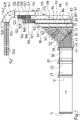
- Fig. 1 shows a plan view of an inventive device for separating packages with fifteen means of transport.
- the packages 1 to be separated are provided to the device as a three-dimensional pile, a so-called bulk, on the first transport means 10.
- the packages 1 are not shown in the figures.
- the packages are in the bulk in front of, next to and above each other.
- the first transport is designed as a hinge chain conveyor with an inlet side 11 and an outlet side 12.
- the packages 1 are by means of the first transport means 10 at about 1.5 m / min. transported in the direction of the subsequent second transport means 20.
- the hinge chain conveyor has side guides (not shown) which prevent packages 1 from falling down laterally from the transport means 10.
- the packages 1 can spread laterally to the side guides. Due to the bulk material-like position of the packages 1 in bulk on the hinge chain conveyor 10, there are relative movements between the packages 1 with each other, the packages 1 and the transport means 10 and the packages 1 and the side guides.
- the height difference between the outlet side of the first transport means 10 and the inlet side of the second transport means is approximately 20 mm.
- the packages 1 are on the second transport means 20 at a speed of 4 m / min. transported.
- the webbing of the second conveyor 20 has a particularly grippy surface.
- the packages 1 thereby take after passing the higher speed jerky, which is entrained in stacked packages 1, the lowermost package 1, while the overlying packages 1 are not so fast entrained because of the inertia and of the lowest Pack 1 fall down.
- the three-dimensional package stream continues to move in multiple layers next to each other and even more layers above each other, but is flatter than on the first transport means 10.
- the second transport 20 has smooth-surfaced side guides that prevent packages 1 can fall laterally from the transport 20.
- the packages 1 are again on the third transport means 30, which is also designed as a belt conveyor, with a higher transport speed of about 7 m / min. transported as lying on the front of the second transport 20.
- the third transport means 30 also has smooth-surfaced side guides (not shown), which prevent packages 1 can fall laterally from the transport means 30.
- the packages 1 are transferred to a fourth transport means 40 having an inlet side 41 and a downstream side 42 arranged in the transport direction, wherein the inlet side 41 of the fourth transport means 40 is arranged approximately 20 mm lower than the outlet side 32 of the third transport means 30.
- the packages. 1 be on the fourth Transffen 40 with a further increased transport speed of about 32 m / min. transported. As a result, the package stream is significantly equalized. There are large gaps between the packages 1 generated. Overlay packages 1 are now only isolated.
- the fourth transport means 40 is designed as a strip conveyor and has smooth-surfaced side guides (not shown), which prevent packages 1 can fall laterally from the transport means 40.
- a first subset of the packages 1 is transferred to a fifth transport means 50 having an inlet side 51 and an outlet side 52 arranged behind in the transport direction, while a second subset of the packages 1 to a seventh transport means arranged substantially parallel to the fifth transport means 50 70 with an inlet side 71 and an outlet side 72 arranged behind it in the transport direction, wherein the inlet sides 51, 71 of the fifth and seventh transport means 50, 70 are arranged at an angle of approximately 45 ° to the outlet side of the fourth transport means 40.
- the first subset of the packages 1 is on the fifth transport means 50 at a speed of about 40 m / min. transported.
- the second subset of the packages 1 is on the seventh transport means 70 at a speed of about 70 m / min. transported.
- the first subset of the packages 1 is transferred from the fifth transport means 50 to a sixth transport means 60 with an inlet side 61 and an outlet side 62 arranged downstream in the transport direction and on the sixth transport means 60 with a sixth transport speed of approximately 50 m / min. transported. This further equalizes the package stream.
- the fifth and sixth transport means 50, 60 have smooth-surfaced lateral guides on their outer side, that is to say the side opposite the seventh transport means 70 (not shown), which prevent packages 1 from falling laterally from the transport means 50, 60.
- the seventh transport means 70 on its fifth and sixth transport means 50, 60 opposite side on a smooth-surfaced side guide (not shown), which prevents packages 1 can fall laterally from the transport means 70.
- the width of the inlet side 41 of the fourth transport means 40 is about 2.20 m, while the total outlet width 61, 71 of the parallel sixth and seventh transport means 60, 70 is over 5 m.
- fourth, fifth, sixth and seventh transport means 40, 50, 60, 70 come Strip conveyor used.
- the connection to a preceding or subsequent transport means 30, 80 at the 45 ° angle can be produced in a particularly uncomplicated way with a strip conveyor.
- the first and second subset of the packages 1 via a to the outlet sides 62, 72 of the sixth and seventh transport means 60, 70 adjacent first longitudinal side 83 of an eighth transport 80 on an eighth transport 80 with an inlet side 81, an arranged downstream in the transport direction outlet side 82 and a second longitudinal side 84 passed, wherein the second longitudinal side 84 is arranged substantially parallel to the first longitudinal side 83 and the longitudinal sides 83, 84 at an angle of approximately 45 ° to the outlet sides 62, 72 of the sixth and seventh transport means 60, 70 are arranged and wherein the eighth transport means 80 is inclined by an inclination angle ⁇ 1 of about 22.5 ° about its longitudinal axis so that its first longitudinal side 83 is higher than its second longitudinal side 84.
- the eighth transport means 80 is arranged so that its first Longitudinal side 83 is lower than the outlet sides 61, 71 of the sixth and seventh
- the eighth transport means 80 has three deflectors 85, 86, 106, which are fixed in a direction inclined substantially at 45 ° with respect to the longitudinal direction of the eighth transport means 80 at such a height above the eighth transport means 80 that the movement of the transport means 80 is not hindered.
- Packages 1 transported on the means of transport 80 are divided by the central deflectors 85, 86 into individual product packages.
- the deflectors 85, 86 have a height which reaches at most up to the surface of the sixth and seventh transport means 60, 70 zoom.
- the last deflector 106 is located in the vicinity of the outlet side 82 of the eighth transport means 80 and is arranged so that it is seen in the transport direction of the eighth transport means 80 behind the left in the transport direction of the sixth transport means 60 outside of the sixth transport means 60, whereby packages 1 be prevented from leaving the device on the outlet side 82 of the eighth transport and at the same time no packages from the sixth transport means 60 seen in the transport direction of the eighth transport means 80 can fall behind the deflector 106.
- the deflectors 85, 86 cause packages 1, which remain very firmly on the eighth transport 80, not necessarily to the outlet side 81 of the Transport means 80 could be transported and cause a jam there.
- the packages 1 are on the eighth transport 80 with an eighth transport speed of 32 m / min. transported.
- the eighth transport is designed as a belt conveyor.
- the packages are passed over the second longitudinal side 84 of the eighth transport means 80 to a ninth transport means 90, which has an inlet side 91, an outlet side 92 and a first longitudinal side 93 and a second longitudinal side 94, wherein the transfer of the packages 1 to the ninth Transport means 90 via the first longitudinal side 93 of the ninth transport means 90 and wherein the ninth transport means 90 is inclined by an inclination angle ⁇ 2 of about 11 ° about its longitudinal axis so that its first longitudinal side 93 is higher than its second longitudinal side 94.
- the packages are on the ninth transport 90 with a ninth transport speed of 50 m / min. transported.
- the ninth transport means 90 is designed as a belt conveyor.
- a first part of the packages 1 is transferred to a tenth transporting means 100 with an inlet side 101 and an outlet side 102 arranged behind it in the transport direction, while the remaining second part of the packages 1 to an eleventh transporting means 110 arranged substantially parallel to the ninth transport means 90 with an inlet side 111 and a downstream side 112 arranged in the transport direction and a first longitudinal side 113 facing the ninth transport means 90 and a second longitudinal side 114 opposite the first longitudinal side 113, wherein the tenth and the eleventh transport means 100, 110 are arranged substantially horizontally and the Outlet side 92 of the ninth transport means 90 is in a higher or equal position as the inlet side 101 of the tenth transport means 100 and the second longitudinal side 94 of the ninth transport means 90 are at a higher or equal high positi on is like the first longitudinal side 113 of the eleventh transport means 110, and wherein the transfer of the remaining second part of the packages 1 of the ninth transport means 90 to the eleventh transport means 110 on the second longitudinal side 94 of the ninth transport means 90
- the first part of the packages 1 is on the tenth transport 100 with a tenth Transport speed of about 60 m / min. transported.
- the remaining second part of the packages 1 is on the eleventh transport 110 with an eleventh transport speed of about 100 m / min. transported.
- the tenth transport 100 is designed as an inclined roller conveyor, while the eleventh transport 110 is designed as a belt conveyor.
- a first subset of the first part of the packages 1 is transferred to the eleventh transport 110, wherein the transfer takes place from the second longitudinal side 94 of the ninth transport means 90 to the first longitudinal side 113 of the eleventh transport means 110.
- the remaining portion of the first part of the packages 1 is on a twelfth transport 120 with an inlet side 121 and a downstream side arranged in the transport direction 122 and a second longitudinal side 104 of the tenth transport 100 adjacent first longitudinal side 123 and one of the first longitudinal side 123 opposite second Passing longitudinal side 124, wherein the remaining portion of the first part of the packages 1 on the second longitudinal side 104 of the tenth transport 100 and the first longitudinal side 123 of the twelfth transport 120 is transferred to the twelfth transport 120.
- the second part of the packages 1 is transferred via the outlet side 111 of the eleventh transport means 110 and the inlet side 121 of the twelfth transport means 120 to the twelfth transport means 120.
- the packages 1 are on the twelfth transport 120 with a twelfth transport speed of about 20 m / min. transported.
- the twelfth transport 120 is designed as accumulation roller conveyor.
- the packages 1 are transferred to a thirteenth transport means 130 with an inlet side 131 and an outlet side 132 arranged downstream in the transport direction and on the thirteenth transport means 130 with a thirteenth transport speed of approximately 150 m / min. transported further.
- the thirteenth transport 130 is designed as a belt conveyor.
- the arrangement of the eighth, ninth and eleventh conveying means 80, 90, 110 as a cascaded, substantially parallel erected conveying means 80, 90, 110, the packages 1 is given the freedom to fall laterally when lateral jostling on the underlying conveyor 90, 110 allow.
- the lower-lying conveyor 90, 110 promote with increasing speed.
- an oblique, fixed deflector 106 is mounted at the respective outlet side 82, 92, 122 of the substantially parallel arranged eighth, ninth and twelfth transport means 80, 90, 120.
- this deflector is designed in two pieces, with a first piece on the outlet side 82 of the eighth transport 80 is mounted and the second piece on the tenth transport 100 and the twelfth transport 120 extends.
- the angles ⁇ 1 , ⁇ 2 of the two pieces of the deflector 106 to the longitudinal axes of the transport means 80, 90, 110, 100, 120 are different.
- the angle ⁇ 1 of the piece of the deflector 106 which is mounted on the eighth transport means 80 approximately 45 ° to the longitudinal axis of this transport means 80, while the second on the tenth and twelfth transport means 100, 120 reaching piece of the deflector 106 an angle ⁇ 2 of 22.5 ° to the longitudinal axes of the transport means 80, 90, 110, 100, 120 forms.
- the deflector 106 may also be made in one piece, so that it extends over all three outlet sides at the same angle.
- the deflector 106 forces the packages 1 in the form of a side guide on the next, parallel and slightly deeper conveyor 90, 120 or 130, said conveyor 90, 120, 130 also deducted with a relation to the previous conveyor increased speed.
- Another effect of this solid, sliding deflector deflector 106 is that the packages 1 usually conform to the entire surface and thus align. However, this alignment and nestling is also dependent on the weight and area of the package 1 and the coefficient of friction between the package 1 and the surface of the respective conveyor 80, 100, 120. Therefore, the last of these three cascaded conveyor 130 is designed as a roller conveyor with a very narrow role division ,
- the tenth conveying means 100 is an inclined roller conveyor, wherein the rollers are arranged obliquely, whereby the effect of the oblique deflector 106 is reinforced, that individual packages 1, not yet by the inclined arrangement of the eighth and ninth transport means 80, 90 on the subsequent eleventh transport means 110 have slipped, in the conveying direction to the right on the following twelve transport 120 passed.
- the packages align 1 on the left side side guide.
- the package stream converted meanwhile in the preceding areas from the three-dimensional to the two-dimensional package stream is converted into a one-dimensional package stream.
- the transported from the eighth, ninth and eleventh transport means 80, 90, 110 on the twelfth transport 120 packages 1 are partially still here next to each other.
- the forward viewed in the conveying direction packages 1 align. If packages 1 are still parallel, then the parcels 1 are moved parallel to the right as viewed in the conveying direction by the side guide.
- the twelfth conveying means 120 is designed as a accumulating roller conveyor, on which the packages 1 are dammed into a two-dimensional package flow. If the accumulation roller conveyor 120 is designed as an inclined roller conveyor, the effect caused by the oblique deflector 106 that the packages 1 are transferred to the following thirteenth transport means 130 is amplified. The right of the two parallel packages 1 is now first deported to the much faster moving thirteenth transport 130.
- the surface of the thirteenth transport means 130 which is designed as a belt conveyor, is designed to be particularly grippy, so that a high degree of friction occurs between packages 1 and the transport surface. From the webbing of the thirteenth transport means 130 detected packages 1 are weggezerrt, so that practically no more packages are 1 side by side on the thirteenth transport means 130 and the package flow is one-dimensional.
- the packages 1 are transferred from the thirteenth transporting means 130 to a fourteenth transporting means 140 having an inlet side 141 and a downstream side 142 arranged in the transport direction, the fourteenth transporting means 140 being a curved belt conveyor describing a circular arc of approximately 90 °.
- the packages 1 are transported on the fourteenth transporting means 140 at a fourteenth transporting speed, the fourteenth transporting speed being again opposite the thirteenth transporting speed to approximately 160 m / min. is increased.
- the high curve speed leads to the fact that rotationally symmetrical packages 1 such as rollers by the centrifugal force to the outside the transport means 140 roll and at the outlet of the curve a container 160 can be supplied.
- a smooth-surfaced side guide is provided at the outer radius of this conveyor 140 .
- the width of the fourteenth transport means 140 is smaller than that of the subsequent fifteenth transport means 150, which adjoins the inner radius of the fourteenth transport means 140. In this way non-sortable rotationally symmetrical packages 1 can be sorted out and collected
- the fifteenth transporting means 150 is an inclined roller conveyor. On this also Ausricht considereder transport means now funded in succession packages 1 are aligned on one side.
- fifteenth transport means 150 At the outlet side of the last, fifteenth transport means 150 so that there is a one-dimensional package flow from which the packages processed 1 unilaterally further processed, for example, sorted, can be.
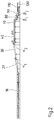
- Fig. 2 shows a side view of the device according to the invention Fig. 1 , Visible is the arrangement of the second and third transport means 20, 30 as rising belt conveyor.
- the pitch angles ⁇ 1 and ⁇ 2 are the same and are approximately 9 °. However, the pitch angles ⁇ 1 and ⁇ 2 can also assume different values.
- the cascading arrangement of the second, third and fourth transport means 20, 30, 40 can be seen, wherein the respective inlet sides 31, 41 of the third and fourth transport means 30, 40 each about 20 mm below the outlet sides 22, 32 of the second and third Transport means 20, 30 are located.
- the inclined to its longitudinal axis arrangement of the eighth and ninth transport means 80, 90 can be seen, wherein the eighth transport 80 by an inclination angle ⁇ 1 of 22.5 ° and the ninth means of transport by an inclination angle ⁇ 2 of 11 ° to the longitudinal axes of respective transport means 80, 90 are inclined.
- Fig. 3 shows a plan view of a ball slide according to the invention.
- the vertically higher arranged outlet side 22 of the second and / or third transport means 20 has a ball slide 26, wherein the ball slide 26 has a quarter ball shape and the uppermost point of the ball slide surface is at the same or lower level as the casserole side 22 and the foot the ball slide 26 in the width direction approximately equal to the width of the outlet side 22, wherein the inlet side 31 of the following transport means 30 is wider than the ball slide 26.
- the height difference between the outlet side 22 of the one and the inlet side 31 of the following means of transport 30 for the packages 1 overcome particularly gently, the effect that stacked in the higher direction packages 1 in the transfer of one tilt to the subsequent transport, is maintained.
- the ball slide 26 can be made of a metallic material, plastic, wood or a mixture of several of these materials. It has a smooth surface. Alternatively, it may also have a rough surface with a high coefficient of friction to the packages 1, whereby the described tilting effect of stacked packages 1, which slip over the ball slide 26, is reinforced.
- Fig. 4 is a side view of a ball slide 26. In this view, the two inclination angles ⁇ 1 and ⁇ 2 of the second and third transport means 20, 30 can be seen.
- Fig. 5 is at least one of the belt conveyors 20, 30, 80, 90, 110, 130 may comprise an endless conveyor belt 200, which at the outlet side 22, 32, 82, 92, 112 , 132 of the respective belt conveyor 20, 30, 80, 90, 110, 130 deflected by approximately 180 ° and on the underside of the respective belt conveyor 20, 30, 80, 90, 110, 130 back to the inlet side 21, 31, 81, 91, 111, 131 of the respective belt conveyor 20, 30, 80, 90, 110, 130 runs, where it is again deflected by approximately 180 °, so that it on the top of the respective belt conveyor 20, 30, 80, 90, 110, 130 again in the direction of the outlet side 22, 32, 82, 92, 112, 132 runs, wherein in the conveyor belt 200 at least one relative conveying means 212, 213, wherein the relative conveying means 212, 213 has a rotational body 212, 213 rotatably mounted about itself in a bearing 215, and this rotational body 212, 213 during running of the conveyor
- the bearing 215 may be configured such that the rotary body 212, 213 can rotate only in one direction, preferably in the conveying direction, whereby an unwanted slowing down of the package flow can be prevented.
- the rotating body 212, 213 may be caused to rotate during running of the conveyor belt 200 on the underside of the belt conveyor 20, 30, 80, 90, 110, 130 by friction on a surface fixed relative to the movement of the conveyor belt 200.
- This is a particularly simple and effective method of providing rotation means 212, 213 without providing their own drive.
- the rotary body 212 may be a ball.
- the rotary body 213 may also be a roller.
Landscapes
- Engineering & Computer Science (AREA)
- Mechanical Engineering (AREA)
- Attitude Control For Articles On Conveyors (AREA)
Claims (22)
- Procédé de séparation de paquets (1), les paquets (1) étant tout d'abord en vrac, les paquets (1) étant transportés sous la forme d'un flux de paquets sur au moins deux moyens de transport différents (10, 20, 30, 40, 50, 60, 70, 80, 90, 100, 110, 120, 130, 140, 150) avec des vitesses de transport différentes, caractérisé en ce que la direction du transport est déviée au moins une fois d'environ 45°.
- Procédé selon la revendication 1, caractérisé en ce que les paquets (1) sont transportés à des hauteurs différentes pendant le transport sur les au moins deux moyens de transport différents (10, 20, 30, 40, 50, 60, 70, 80, 90, 100, 110, 120, 130, 140, 150).
- Procédé selon la revendication 1 ou 2, caractérisé en ce que le flux de paquets est réparti en plusieurs flux de paquents dans l'au moins une déviation.
- Procédé selon la revendication 3, caractérisé en ce que les plusieurs flux de paquets sont transportés à des vitesses de transport différentes.
- Procédé selon la revendication 3 ou 4, caractérisé en ce que les plusieurs flux de paquets sont regroupés en un seul flux de paquets pendant le transport sur les au moins deux moyens de transport différents (10, 20, 30, 40, 50, 60, 70, 80, 90, 100, 110, 120, 130, 140, 150).
- Procédé selon l'une des revendications précédentes, caractérisé par les étapes suivantes :- transport horizontal des paquets (1) au moyen d'un premier moyen de transport (10) à une première vitesse de transport, le premier moyen de transport (10) présentant un côté de départ (11) et un côté de sortie (12) situé derrière dans la direction du transport ;- transfert des paquets (1) vers un deuxième moyen de transport (20) avec un côté d'entrée (21) et un côté de sortie (22) situé derrière dans la direction du transport, le côté d'entrée (21) du deuxième moyen de transport (20) étant situé plus bas que le côté de sortie (12) du premier moyen de transport (10) et le deuxième moyen de transport (20) étant réalisé montant avec un premier angle d'inclinaison (α1) dans la direction du transport ;- transport des paquets (1) sur le deuxième moyen de transport (20) avec une deuxième vitesse de transport, la deuxième vitesse de transport étant supérieure à la première vitesse de transport ;- transfert des paquets (1) vers un troisième moyen de transport (30) avec un côté d'entrée (31) et un côté de sortie (32) situé derrière dans la direction du transport, le côté d'entrée (31) du troisième moyen de transport (30) étant situé plus bas que le côté de sortie (22) du deuxième moyen de transport (20) et le troisième moyen de transport (30) étant réalisé montant avec un deuxième angle d'inclinaison (α2) dans la direction du transport ;- transport des paquets (1) sur le troisième moyen de transport (30) à une troisième vitesse de transport, la troisième vitesse de transport étant supérieure à la deuxième vitesse de transport ;- transfert des paquets (1) vers un quatrième moyen de transport (40) avec un côté d'entrée (41) et un côté de sortie (42) situé derrière dans la direction du transport, le côté d'entrée (41) du quatrième moyen de transport (40) étant situé plus bas que le côté de sortie (32) du troisième moyen de transport (30) ;- transport des paquets (1) sur le quatrième moyen de transport (40) à une quatrième vitesse de transport, la quatrième vitesse de transport étant supérieure à la troisième vitesse de transport ;- transfert d'une première quantité partielle de paquets (1) vers un cinquième moyen de transport (50) avec un côté d'entrée (51) et un côté de sortie (52) situé derrière dans la direction du transport et transfert d'une deuxième quantité partielle de paquets (1) vers un septième moyen de transport (70), sensiblement parallèle au cinquième moyen de transport (50), avec un côté d'entrée (71) et un côté de sortie (72) situé derrière dans la direction du transport, le côté d'entrée (51, 71) des cinquième et septième moyens de transport (50, 70) étant agencés avec un angle d'environ 45° avec le côté de sortie (42) du quatrième moyen de transport (40) ;- transport de la première quantité partielle de paquets (1) sur le cinquième moyen de transport (50) à une cinquième vitesse de transport, la cinquième vitesse de transport étant supérieure à la quatrième vitesse de transport, et transport de la deuxième quantité partielle de paquets (1) sur le septième moyen de transport (70) à une septième vitesse de transport, la septième vitesse de transport étant supérieure à la quatrième vitesse de transport ;- transfert de la première quantité partielle de paquets (1) vers un sixième moyen de transport (60) avec un côté d'entrée (61) et un côté de sortie (62) situé derrière dans la direction du transport ;- transport de la première quantité partielle der paquets (1) sur le sixième moyen de transport (60) à une sixième vitesse de transport, la sixième vitesse de transport étant supérieure à la cinquième vitesse de transport ;- transfert des première et deuxième quantités partielles de paquets (1) via un premier côté long (83) d'un huitième moyen de transport (80) adjacent aux côtés de sortie (61, 71) des sixième et septième moyen de transport (60, 70) vers un huitième moyen de transport (80) avec un côté d'entrée (81), un côté de sortie (82) situé derrière dans la direction du transport et un deuxième côté long (84), le deuxième côté long (84) étant sensiblement parallèle au premier côté long (83) et les côtés longs (83, 84) formant un angle d'environ 45° avec les côtés de sortie (62, 72) des sixième et septième moyens de transport (60, 70) et le huitième moyen de transport (80) étant incliné d'un angle d'inclinaison β1 par rapport à son axe longitudinal de telle sorte que son premier côté long (83) est situé plus haut que son deuxième côté long (84) ;- transport des paquets (1) sur le huitième moyen de transport (80) à une huitième vitesse de transport, la huitième vitesse de transport étant inférieure aux sixième et septième vitesses de transport ;- transfert des paquets (1) via le deuxième côté long (84) du huitième moyen de transport (80) vers un neuvième moyen de transport (90) qui dispose d'un côté d'entrée (91), d'un côté de sortie (92) et d'un premier côté long (93) et d'un deuxième côté long (94), le transfert des paquets (1) vers le neuvième moyen de transport (90) s'effectuant via le premier côté long (93) du neuvième moyen de transport et le
neuvième moyen de transport étant incliné d'un angle d'inclinaison β2 par rapport à son axe longitudinal de telle sorte que son premier côté long (93) est situé plus haut que son deuxième côté long (94) ;- transport des paquets (1) sur le neuvième moyen de transport (90) à une neuvième vitesse de transport, la neuvième vitesse de transport étant supérieure à la huitième vitesse de transport;- transfert d'une première partie des paquets (1) vers un dixième moyen de transport (100) avec un côté d'entrée (101) et un côté de sortie (102) situé derrière dans la direction du transport, et transfert de la deuxième partie restante des paquets (1) vers un onzième moyen de transport (110) sensiblement parallèle au neuvième moyen de transport (90), avec un côté d'entrée (111) et un côté de sortie (112) situé derrière dans la direction du transport ainsi qu'un premier côté long (113) tourné vers le neuvième moyen de transport (90) et un deuxième côté long (114) en regard du premier côté long (113), les dixième et onzième moyens de transport (100, 110) étant agencés sensiblement horizontalement et le côté de sortie (92) du neuvième moyen de transport se trouvant dans une position plus élevée ou à la même hauteur que le côté d'entrée (101) du dixième moyen de transport (110) et le deuxième côté long (94) du neuvième moyen de transport (90) se trouvant à une position plus élevée ou à la même hauteur que le premier côté long (113) du onzième moyen de transport (110), et le transfert de la deuxième partie restante des paquets (1) du neuvième moyen de transport (90) vers le onzième moyen de transport (110) s'effectuant via le deuxième côté long (94) du neuvième moyen de transport (90) et le premier côté long (111) du onzième moyen de transport (110) ;- transport de la première partie des paquets (1) sur le dixième moyen de transport (100) à une dixième vitesse de transport, la dixième vitesse de transport étant supérieure à la neuvième vitesse de transport, et transport de la deuxième partie restante des paquets (1) sur le onzième moyen de transport (110) à une onzième vitesse de transport, la onzième vitesse de transport étant supérieure aux neuvième et dixième vitesses de transport ;- transfert d'une première quantité partielle de paquets (1) vers le onzième moyen de transport (110), le transfert s'effectuant du deuxième côté long (94) du neuvième moyen de transport (90) vers le premier côté long (113) du onzième moyen de transport (110), et transfert de la quantité partielle restante de la première partie des paquets (1) vers un douzième moyen de transport (120) avec un côté d'entrée (121) et un côté de sortie (122) situé derrière dans la direction du transport ainsi qu'un premier côté long (123) adjacent au deuxième côté long (104) du dixième moyen de transport (100) en regard du deuxième côté long (124), la quantité partielle restante de la première partie des paquets (1) étant transférée au douzième moyen de transport (120) via le deuxième côté long (104) du dixième moyen de transport (100) et le premier côté long (123) du douzième moyen de transport (120), et transfert de la deuxième partie des paquets (1) au douzième moyen de transport (120) via le côté de sortie (112) du onzième moyen de transport (110) et le côté d'entrée (121) du douzième moyen de transport (120) ;- transport des paquets (1) sur le douzième moyen de transport (120) à une douzième vitesse de transport, la douzième vitesse de transport étant inférieure aux dixième et onzième vitesse de transport ;- transfert des paquets (1) vers un treizième moyen de transport (130) avec un côté d'entrée (131) et un côté de sortie (132) situé derrière dans la direction du transport ;- transport des paquets (1) sur le treizième moyen de transport (130) à une treizième vitesse de transport, la treizième vitesse de transport étant supérieure à la douzième vitesse de transport ;- transfert des paquets (1) vers un quatorzième moyen de transport (140) avec un côté d'entrée (141) et un côté de sortie (142) situé derrière dans la direction du transport, le quatorzième moyens de transport (140) décrivant un arc de cercle d'environ 90° ;- transport des paquets (1) sur le quatorzième moyen de transport (140) à une quatorzième vitesse de transport, la quatorzième vitesse de transport étant supérieure à la treizième vitesse de transport ;- transfert d'au moins une quantité partielle des paquets (1) vers un quinzième moyen de transport (150) avec un côté d'entrée (151) et un côté de sortie (152) situé derrière dans la direction du transport ;- transport des paquets (1) sur le quinzième moyen de transport (150). - Procédé selon la revendication 6, caractérisé en ce que seulement une quantité partielle des paquets (1) est transférée du quatorzième moyen de transport (140) au quinzième moyen de transport (150), tandis qu'une autre quantité partielle des paquets (1) est amenée du quatorzième moyen de transport (140) à un récipient.
- Procédé selon la revendication 6 ou 7, caractérisé en ce que la première vitesse de transport est d'environ 1,5 m/min, tandis que la deuxième vitesse de transport est d'environ 4 m/min, la troisième vitesse de transport, d'environ 7 m/min, la quatrième vitesse de transport, d'environ 32 m/min, la cinquième vitesse de transport, d'environ 40 m/min, la sixième vitesse de transport, d'environ 50 m/min, la septième vitesse de transport, d'environ 70 m/min., la huitième vitesse de transport, d'environ 32 m/min, la neuvième vitesse de transport, d'environ 50 m/min, la dixième vitesse de transport, d'environ 60 m/min, la onzième vitesse de transport, d'environ 100 m/min, la douzième vitesse de transport, d'environ 50 m/min, la treizième vitesse de transport, d'environ 150 m/min, la quatorzième vitesse de transport, d'environ 160 m/min.
- Dispositif de séparation de paquets (1), les paquets (1) étant tout d'abord en vrac, comprenant une pluralité de moyens de transport (10, 20, 30, 40, 50, 60, 70, 80, 90, 100, 110, 120, 130, 140, 150), les moyens de transport (10, 20, 30, 40, 50, 60, 70, 80, 90, 100, 110, 120, 130, 140, 150) étant agencés en une suite de moyens de transport, une première et une dernière partie des moyens de transport (10, 20, 30, 40, 80, 100, 120, 130, 140, 150) étant agencés l'une à la suite de l'autre, tandis qu'une autre partie des moyens de transport (50, 60, 70, 90, 110) située entre les première et dernière parties des moyens de transport (10, 20, 30, 40, 80, 100, 120, 130, 140, 150) est agencée au moins en partie parallèlement, au moins l'un des moyens de transport (20, 30) de la première partie des moyens de transport (10, 20, 30, 40) étant agencé montant verticalement et une autre partie des moyens de transport (80, 90) en aval de la première partie si on la considère dans la direction du transport étant agencée descendante verticalement et le côté de sortie (22, 32) d'au moins un moyen de transport (20, 30) de la première partie des moyens de transport (10, 20, 30, 40) étant situé plus haut, en direction verticale, que le côté d'entrée (31, 41) du moyen de transport (30, 40) suivant si on le considère dans la direction du transport, caractérisé en ce qu'au moins le côté d'entrée (21, 31, 41, 51, 61, 71, 81, 91, 101, 111, 121, 131, 141, 151) d'un moyen de transport (20, 30, 40, 50, 60, 70, 80, 90, 100, 110, 120, 130, 140, 150) faisant suite à un moyen de transport (10, 20, 30, 40, 50, 60, 70, 80, 90, 100, 110, 120, 130, 140) forme un angle d'environ 45° avec le côté de sortie (12, 22, 32, 42, 52, 62, 72, 82, 92, 102, 112, 122, 132, 142) du moyen de transport (10, 20, 30, 40, 50, 60, 70, 80, 90, 100, 110, 120, 130, 140) précédent.
- Dispositif selon la revendication 9, caractérisé en ce que la suite de moyens de transport comporte au moins deux déviations d'environ 90° chacune.
- Dispositif selon la revendication 10, caractérisé en ce que figurent, parmi les moyens de transport (10, 20, 30, 40, 50, 60, 70, 80, 90, 100, 110, 120, 130, 140, 150) des convoyeurs à courroie, des convoyeurs à rouleaux inclinés, convoyeurs à bande et des convoyeurs à rouleaux à accumulation.
- Dispositif selon la revendication 11, caractérisé en ce que les moyens de transport (40, 50, 60, 70) contiennent des convoyeurs à bande dans la première déviation.
- Dispositif selon la revendication 11 ou 12, caractérisé en ce qu'au moins un moyen de transport (140) est, dans la deuxième déviation, un convoyeur à courroie curviligne.
- Dispositif selon l'une des revendications 9-13, caractérisé en ce qu'au moins un huitième moyen de transport (80) faisant suite à la première déviation présente un premier (83) et un deuxième côté long (84), le deuxième côté long (84) étant sensiblement parallèle au premier côté long (83) et les côtés longs (83, 84) formant un angle d'environ 45° avec les côtés de sortie (62, 72) des sixième et septième moyens de transport (60, 70) et le huitième moyen de transport (80) étant incliné d'un angle d'inclinaison β1 par rapport à son axe longitudinal de telle sorte que son premier côté long (83) est situé plus haut que son deuxième côté long (84).
- Dispositif selon l'une des revendications 9-14, caractérisé en ce qu'un neuvième moyen de transport (90) présente un premier (93) et un deuxième côté long (94), le deuxième côté long (94) étant sensiblement parallèle au premier côté long (93) et les côtés longs (93, 94) étant sensiblement parallèles aux côtés longs (83, 84) d'un huitième moyen de transport (80) et le neuvième moyen de transport (90) étant incliné d'un angle d'inclinaison β2 par rapport à son axe longitudinal de telle sorte que son premier côté long (93) est situé plus haut que son deuxième côté long (94) et le premier côté long (93) du neuvième moyen de transport (90) n'étant pas situé plus haut que le deuxième côté long (84) du huitième moyen de transport (80).
- Dispositif selon l'une ou plusieurs des revendications 14-15, caractérisé en ce que le huitième moyen de transport (80) comporte au moins un déflecteur (85) fixé dans une direction inclinée de sensiblement 45° par rapport à la direction longitudinale du huitième moyen de transport (80) à une hauteur telle au-dessus du huitième moyen de transport (80) que le mouvement du moyen de transport n'est pas entravé pendant que des paquets transportés sur le moyen de transport sont déviés par le déflecteur (85) de la direction du transport imposée par le moyen de transport (80).
- Dispositif selon l'une ou plusieurs des revendications 14-16, caractérisé en ce qu'au moins le huitième (80), un dixième (100) et un douzième (120) moyen de transport présentent, sur leur côté de sortie respectif, (82, 102, 122) des déflecteurs (86, 106, 126) qui sont fixés avec un angle Y compris entre 10° et 80°, et de préférence entre 15° et 50°, par rapport à l'axe longitudinal du moyen de transport respectif (80, 100, 120) et qui terminent le moyen de transport respectif (80, 100, 120) pour les paquets transportés dessus.
- Dispositif selon l'une ou plusieurs des revendications 11-17, le convoyeur à courroie (20, 30, 80, 90,110, 130,140) comportant une courroie de transport sans fin (200) qui est déviée d'environ 180° sur le côté de sortie (22, 32, 82, 92, 112, 132, 142) du convoyeur à courroie respectif (20, 30, 80, 90,110, 130,140) et qui, sur la partie inférieure du convoyeur à courroie respectif (20, 30, 80, 90,110, 130,140), revient vers le côté d'entrée (21, 31, 81, 91, 111, 131, 141) du convoyeur à courroie respectif (20, 30, 80, 90,110, 130,140), où elle est de nouveau déviée d'environ 180°, de sorte que, sur la partie supérieure du convoyeur à courroie respectif (20, 30, 80, 90,110, 130,140), elle revient vers le côté de sortie (22, 32, 82, 92, 112, 132, 142), caractérisé en ce qu'au moins un moyen de transport relatif (212, 213) est incorporé à la courroie de transport (200) d'un convoyeur à courroie (20, 30, 80, 90,110, 130,140), le moyen de transport relatif (212, 213) comportant un corps rotatif (212, 213) logé rotatif sur lui-même dans un logement (215) et ce corps rotatif (212, 213) étant mis en rotation lorsque la courroie de transport (200) court sur la partie inférieure du convoyeur à courroie (20, 30, 80, 90,110, 130,140).
- Dispositif selon la revendication 18, caractérisé en ce que le corps rotatif (211) est mis en rotation lorsque la courroie de transport (200) court sur la partie inférieure du convoyeur à courroie (20, 30, 80, 90,110, 130,140) par frottement sur une surface fixe relativement au mouvement de la courroie de transport (200).
- Dispositif selon la revendication 17 ou 18, caractérisé en ce que le corps rotatif (211) est une bille (212).
- Dispositif selon la revendication 17 ou 18, caractérisé en ce que le corps rotatif (211) est un rouleau (213).
- Dispositif selon l'une ou plusieurs des revendications 9 à 21, caractérisé en ce qu'au moins l'un des côtés de sortie (22, 32) situé plus haut dans le sens vertical comporte une glissière à bille (26), la glissière à bille (26) ayant la forme d'un quart de bille et le point supérieur de la surface de la glissière à bille (26) étant à la même hauteur ou à une hauteur inférieure au côté de sortie (22, 32) et la base de la glissière à bille (26) présente dans le sens de la largeur une étendue approximativement égale à la largeur du côté de sortie (22, 32), le côté d'entrée (31, 41) du moyen de transport suivant (30, 40) étant plus large que la glissière à bille (26).
Applications Claiming Priority (2)
| Application Number | Priority Date | Filing Date | Title |
|---|---|---|---|
| DE102013206790.9A DE102013206790A1 (de) | 2013-04-16 | 2013-04-16 | Paketvereinzelung |
| PCT/EP2014/057565 WO2014170294A1 (fr) | 2013-04-16 | 2014-04-15 | Séparation de paquets |
Publications (2)
| Publication Number | Publication Date |
|---|---|
| EP2986543A1 EP2986543A1 (fr) | 2016-02-24 |
| EP2986543B1 true EP2986543B1 (fr) | 2017-06-14 |
Family
ID=50489096
Family Applications (1)
| Application Number | Title | Priority Date | Filing Date |
|---|---|---|---|
| EP14717759.6A Active EP2986543B1 (fr) | 2013-04-16 | 2014-04-15 | Séparation de paquets |
Country Status (5)
| Country | Link |
|---|---|
| US (2) | US9878854B2 (fr) |
| EP (1) | EP2986543B1 (fr) |
| CN (1) | CN105143074B (fr) |
| DE (1) | DE102013206790A1 (fr) |
| WO (1) | WO2014170294A1 (fr) |
Families Citing this family (12)
| Publication number | Priority date | Publication date | Assignee | Title |
|---|---|---|---|---|
| FR3029902B1 (fr) * | 2014-12-15 | 2018-09-28 | Fives Syleps | Procede et dispositif d'egrainage de colis. |
| FR3052761B1 (fr) * | 2016-06-16 | 2021-10-22 | Syleps | Procede et dispositif d'egrainage de colis a debit regule. |
| US10053299B1 (en) * | 2017-05-05 | 2018-08-21 | Amazon Technologies, Inc. | Multi-level conveyor system that reorients objects into a sequential orientation |
| CN107098131B (zh) * | 2017-06-16 | 2023-09-01 | 北京京东乾石科技有限公司 | 供件装置 |
| CN108816770B (zh) * | 2018-06-06 | 2020-04-21 | 乐禾食品集团股份有限公司 | 一种仓储物流分拣设备及其分拣工艺 |
| US10988327B1 (en) | 2018-07-06 | 2021-04-27 | Span Tech Llc | Sortation system and related methods |
| US10961060B1 (en) * | 2018-12-13 | 2021-03-30 | Amazon Technologies, Inc. | Automated singulation system |
| US10781053B1 (en) | 2018-12-13 | 2020-09-22 | Amazon Technologies, Inc. | Control system for automated singulation system |
| DE102019114469B4 (de) * | 2019-05-29 | 2025-10-16 | Deutsche Post Ag | Verfahren zur Überwachung und/oder Instandhaltung einer Förderanlage und Förderanlage |
| US11407595B2 (en) * | 2019-12-10 | 2022-08-09 | Intelligrated Headquarters, Llc | Methods and apparatuses for performing article singulation |
| DE102020120336A1 (de) * | 2020-07-31 | 2022-02-03 | Krones Aktiengesellschaft | Transportvorrichtung und Verfahren zur Verteilung einer Vielzahl gleichartig geformter und dimensionierter Artikel |
| DE102020125077A1 (de) * | 2020-09-25 | 2022-03-31 | Deutsche Post Ag | Vorrichtung zur Ausrichtung von Packstücken |
Family Cites Families (28)
| Publication number | Priority date | Publication date | Assignee | Title |
|---|---|---|---|---|
| DE3410287C2 (de) * | 1983-04-09 | 1995-07-13 | Will E C H Gmbh & Co | Vorrichtung zum Ausschleusen von Papierstapeln an Papierverarbeitungsmaschinen |
| SE500076C2 (sv) * | 1989-03-23 | 1994-04-11 | Sellbergs Engineering Ab | Sätt att omhänderta avfall |
| DE9102036U1 (de) | 1991-02-21 | 1991-05-08 | Ekkehard Kempf GmbH, 7080 Aalen | Vorrichtung zum Vereinzeln von paketweise zusammengestelltem Stückgut |
| DE4332341A1 (de) * | 1993-09-23 | 1995-03-30 | Koenig Transportanlagen Gmbh | Vorrichtung zum Zusammenführen und Beschleunigen eines Stroms aufrecht stehender Flaschen o. dgl. |
| CN2210723Y (zh) * | 1994-11-10 | 1995-10-25 | 上海邮政科学技术研究所 | 多用途高速分拣机 |
| US5868238A (en) * | 1997-04-25 | 1999-02-09 | United Parcel Service Of America, Inc. | High speed smart diverter for a conveyor sorter |
| DE29710147U1 (de) * | 1997-06-11 | 1997-08-21 | KHS Maschinen- und Anlagenbau AG, 44143 Dortmund | Vorrichtung zum Zusammenführen eines mehrspurigen Gefäßstromes in einen einreihigen Gefäßstrom |
| US5950800A (en) * | 1997-07-17 | 1999-09-14 | Sandvik Sorting Systems, Inc. | Conveying methods and apparatus |
| BR0110367A (pt) * | 2000-04-27 | 2003-02-18 | Siemens Ag | Transportador de separação de artigo |
| US7137502B2 (en) | 2002-05-07 | 2006-11-21 | Lockheed Martin Corporation | Mail tray singulator and method of use |
| EP1382553A1 (fr) * | 2002-06-19 | 2004-01-21 | Siemens Schweiz AG | Convoyeur de séparation |
| CN101027236A (zh) * | 2004-06-21 | 2007-08-29 | 西门子共同研究公司 | 高速率节省空间的物品单一化装置 |
| EP1962717B1 (fr) | 2005-12-21 | 2013-02-27 | Laitram, LLC | Echangeur de transporteur |
| CN101795948B (zh) | 2007-08-27 | 2013-03-06 | 莱特拉姆有限责任公司 | 孤立毗连物品的方法 |
| EP2052998B1 (fr) * | 2007-10-23 | 2011-05-18 | IMA LIFE S.r.l. | Appareil de convoyage |
| US7607533B2 (en) | 2008-03-14 | 2009-10-27 | Laitram, L.L.C. | Conveyors and methods for non-uniformly accelerating conveyed articles |
| US20110022221A1 (en) * | 2009-07-24 | 2011-01-27 | Laitram, L.L.C. | Roller-belt sorter with control grid |
| WO2011025942A1 (fr) * | 2009-08-28 | 2011-03-03 | Dematic Corp. | Admission de transporteur |
| JP5513137B2 (ja) * | 2010-01-05 | 2014-06-04 | トーヨーカネツソリューションズ株式会社 | アキュムレーションコンベヤ |
| DK2883821T3 (en) * | 2010-03-08 | 2017-01-30 | Laitram Llc | Transport system and method |
| CN202063543U (zh) * | 2011-05-09 | 2011-12-07 | 于龙泉 | 玻璃瓶理瓶机 |
| CN202138848U (zh) | 2011-05-31 | 2012-02-08 | 郑州雷世玛科技有限公司 | 快递包裹分拣控制系统 |
| US20130248325A1 (en) * | 2012-03-23 | 2013-09-26 | C.G. Bretting Manufacturing Co., Inc. | High speed small pack wrapper |
| US9078390B2 (en) * | 2012-04-02 | 2015-07-14 | Firefly Equipment, Llc | Conveyor system for controlling spacing between sod slabs |
| CN202828978U (zh) * | 2012-08-28 | 2013-03-27 | 符坤 | 料袋拆垛机 |
| US20140138211A1 (en) * | 2012-11-19 | 2014-05-22 | The Procter & Gamble Company | Method and system for conveying rolled absorbent products |
| US9038810B2 (en) * | 2013-03-12 | 2015-05-26 | Fives Intralogistics Corp. | Singulator conveyor |
| JP2017048018A (ja) * | 2015-09-02 | 2017-03-09 | 株式会社東芝 | 物品仕分装置 |
-
2013
- 2013-04-16 DE DE102013206790.9A patent/DE102013206790A1/de not_active Withdrawn
-
2014
- 2014-04-15 WO PCT/EP2014/057565 patent/WO2014170294A1/fr not_active Ceased
- 2014-04-15 CN CN201480020753.7A patent/CN105143074B/zh active Active
- 2014-04-15 US US14/782,794 patent/US9878854B2/en active Active
- 2014-04-15 EP EP14717759.6A patent/EP2986543B1/fr active Active
-
2017
- 2017-12-06 US US15/833,975 patent/US10501269B2/en active Active
Also Published As
| Publication number | Publication date |
|---|---|
| CN105143074B (zh) | 2018-06-29 |
| EP2986543A1 (fr) | 2016-02-24 |
| CN105143074A (zh) | 2015-12-09 |
| US10501269B2 (en) | 2019-12-10 |
| US9878854B2 (en) | 2018-01-30 |
| US20160311630A1 (en) | 2016-10-27 |
| DE102013206790A1 (de) | 2014-10-16 |
| US20180093835A1 (en) | 2018-04-05 |
| WO2014170294A1 (fr) | 2014-10-23 |
Similar Documents
| Publication | Publication Date | Title |
|---|---|---|
| WO2014170294A1 (fr) | Séparation de paquets | |
| DE69823060T2 (de) | Transportverfahren und -vorrichtung | |
| EP3115322B1 (fr) | Procede et dispositif destines a la depalettisation de pneus | |
| EP2316580B1 (fr) | Dispositif et procédé de traitement d'objets ayant différentes dimensions | |
| EP3248913B1 (fr) | Convoyeur de singularisation et procédé de transport destinés à séparer une marchandise de détail le long d'au moins une bande de transport | |
| EP3287396A1 (fr) | Systeme d'alimentation a segments | |
| EP1868923B1 (fr) | Dispositif de transport comprenant au moins une glissiere pour des articles de detail et procede pour empiler des articles de detail dans un conteneur | |
| DE10141375C1 (de) | Vorrichtung zum Trennen von Sendungen in Dickenklassen | |
| DE102014224147A1 (de) | Verfahren zur Packgutzusammenführung und Packgutfördervorrichtung | |
| EP3208001B1 (fr) | Séparateur pneumatique doté d'une triple séparation | |
| DE69515772T2 (de) | Verfahren und vorrichtung zum überlappen von dokumenten | |
| DE102004040100B4 (de) | Verfahren und Vorrichtung zum Sortieren von Postsendungen | |
| EP2297014B1 (fr) | Dispositif d'insertion et procédé d'insertion | |
| EP3013715A1 (fr) | Dispositif et procédé de dépilage et de transport d'objets empilés | |
| DE10148226C1 (de) | Vorrichtung zum Trennen von flachen Sendungen in Dickenklassen | |
| EP2055660B1 (fr) | Dispositif de retournement cadencé d'objets plats | |
| DE10317417B4 (de) | Vereinzelungs- und Fördervorrichtung | |
| DE20019292U1 (de) | Vorrichtung zum Sortieren und Stapeln von Stückgütern | |
| EP4310032A1 (fr) | Dispositif d'alignement ou de positionnement. rotation d'objets avec une surface glissante | |
| CH715814A1 (de) | Übergabesystem für Förderobjekte mit einer Fördereinrichtung und einer Übergabevorrichtung. | |
| EP2260950B1 (fr) | Procédé et dispositif de transport régulé d'objets | |
| EP1547948B1 (fr) | Dispositif pour séparer des lettres | |
| EP1522513A2 (fr) | Dispositif pour séparer des produits plats disposés en formation imbriquée | |
| DE102016100593B4 (de) | Sammelvorrichtung und Verfahren zum Sammeln von blattförmigen Gütern | |
| DE1105342B (de) | Vorrichtung zum Aussortieren und Zufuehren ungeordnet anfallender Sendungen zu Staplern |
Legal Events
| Date | Code | Title | Description |
|---|---|---|---|
| PUAI | Public reference made under article 153(3) epc to a published international application that has entered the european phase |
Free format text: ORIGINAL CODE: 0009012 |
|
| 17P | Request for examination filed |
Effective date: 20151116 |
|
| AK | Designated contracting states |
Kind code of ref document: A1 Designated state(s): AL AT BE BG CH CY CZ DE DK EE ES FI FR GB GR HR HU IE IS IT LI LT LU LV MC MK MT NL NO PL PT RO RS SE SI SK SM TR |
|
| AX | Request for extension of the european patent |
Extension state: BA ME |
|
| RIN1 | Information on inventor provided before grant (corrected) |
Inventor name: VENTZ, KAI Inventor name: WARNECKE, KARL Inventor name: HUKE, STEFAN Inventor name: KRAEMER, ARND Inventor name: HARTMANN, BERND Inventor name: EID, TILMANN Inventor name: WALTER, DETLEF Inventor name: DIOP, SIDY |
|
| DAX | Request for extension of the european patent (deleted) | ||
| GRAP | Despatch of communication of intention to grant a patent |
Free format text: ORIGINAL CODE: EPIDOSNIGR1 |
|
| STAA | Information on the status of an ep patent application or granted ep patent |
Free format text: STATUS: GRANT OF PATENT IS INTENDED |
|
| INTG | Intention to grant announced |
Effective date: 20161125 |
|
| GRAS | Grant fee paid |
Free format text: ORIGINAL CODE: EPIDOSNIGR3 |
|
| GRAA | (expected) grant |
Free format text: ORIGINAL CODE: 0009210 |
|
| STAA | Information on the status of an ep patent application or granted ep patent |
Free format text: STATUS: THE PATENT HAS BEEN GRANTED |
|
| AK | Designated contracting states |
Kind code of ref document: B1 Designated state(s): AL AT BE BG CH CY CZ DE DK EE ES FI FR GB GR HR HU IE IS IT LI LT LU LV MC MK MT NL NO PL PT RO RS SE SI SK SM TR |
|
| REG | Reference to a national code |
Ref country code: GB Ref legal event code: FG4D Free format text: NOT ENGLISH |
|
| REG | Reference to a national code |
Ref country code: CH Ref legal event code: EP Ref country code: AT Ref legal event code: REF Ref document number: 900753 Country of ref document: AT Kind code of ref document: T Effective date: 20170615 |
|
| REG | Reference to a national code |
Ref country code: IE Ref legal event code: FG4D Free format text: LANGUAGE OF EP DOCUMENT: GERMAN |
|
| REG | Reference to a national code |
Ref country code: DE Ref legal event code: R096 Ref document number: 502014004207 Country of ref document: DE |
|
| REG | Reference to a national code |
Ref country code: CH Ref legal event code: NV Representative=s name: R.A. EGLI AND CO, PATENTANWAELTE, CH |
|
| REG | Reference to a national code |
Ref country code: NL Ref legal event code: FP |
|
| REG | Reference to a national code |
Ref country code: LT Ref legal event code: MG4D |
|
| PG25 | Lapsed in a contracting state [announced via postgrant information from national office to epo] |
Ref country code: FI Free format text: LAPSE BECAUSE OF FAILURE TO SUBMIT A TRANSLATION OF THE DESCRIPTION OR TO PAY THE FEE WITHIN THE PRESCRIBED TIME-LIMIT Effective date: 20170614 Ref country code: GR Free format text: LAPSE BECAUSE OF FAILURE TO SUBMIT A TRANSLATION OF THE DESCRIPTION OR TO PAY THE FEE WITHIN THE PRESCRIBED TIME-LIMIT Effective date: 20170915 Ref country code: LT Free format text: LAPSE BECAUSE OF FAILURE TO SUBMIT A TRANSLATION OF THE DESCRIPTION OR TO PAY THE FEE WITHIN THE PRESCRIBED TIME-LIMIT Effective date: 20170614 Ref country code: NO Free format text: LAPSE BECAUSE OF FAILURE TO SUBMIT A TRANSLATION OF THE DESCRIPTION OR TO PAY THE FEE WITHIN THE PRESCRIBED TIME-LIMIT Effective date: 20170914 Ref country code: HR Free format text: LAPSE BECAUSE OF FAILURE TO SUBMIT A TRANSLATION OF THE DESCRIPTION OR TO PAY THE FEE WITHIN THE PRESCRIBED TIME-LIMIT Effective date: 20170614 |
|
| PG25 | Lapsed in a contracting state [announced via postgrant information from national office to epo] |
Ref country code: BG Free format text: LAPSE BECAUSE OF FAILURE TO SUBMIT A TRANSLATION OF THE DESCRIPTION OR TO PAY THE FEE WITHIN THE PRESCRIBED TIME-LIMIT Effective date: 20170914 Ref country code: SE Free format text: LAPSE BECAUSE OF FAILURE TO SUBMIT A TRANSLATION OF THE DESCRIPTION OR TO PAY THE FEE WITHIN THE PRESCRIBED TIME-LIMIT Effective date: 20170614 Ref country code: RS Free format text: LAPSE BECAUSE OF FAILURE TO SUBMIT A TRANSLATION OF THE DESCRIPTION OR TO PAY THE FEE WITHIN THE PRESCRIBED TIME-LIMIT Effective date: 20170614 Ref country code: LV Free format text: LAPSE BECAUSE OF FAILURE TO SUBMIT A TRANSLATION OF THE DESCRIPTION OR TO PAY THE FEE WITHIN THE PRESCRIBED TIME-LIMIT Effective date: 20170614 |
|
| PG25 | Lapsed in a contracting state [announced via postgrant information from national office to epo] |
Ref country code: EE Free format text: LAPSE BECAUSE OF FAILURE TO SUBMIT A TRANSLATION OF THE DESCRIPTION OR TO PAY THE FEE WITHIN THE PRESCRIBED TIME-LIMIT Effective date: 20170614 Ref country code: SK Free format text: LAPSE BECAUSE OF FAILURE TO SUBMIT A TRANSLATION OF THE DESCRIPTION OR TO PAY THE FEE WITHIN THE PRESCRIBED TIME-LIMIT Effective date: 20170614 Ref country code: RO Free format text: LAPSE BECAUSE OF FAILURE TO SUBMIT A TRANSLATION OF THE DESCRIPTION OR TO PAY THE FEE WITHIN THE PRESCRIBED TIME-LIMIT Effective date: 20170614 Ref country code: CZ Free format text: LAPSE BECAUSE OF FAILURE TO SUBMIT A TRANSLATION OF THE DESCRIPTION OR TO PAY THE FEE WITHIN THE PRESCRIBED TIME-LIMIT Effective date: 20170614 |
|
| PG25 | Lapsed in a contracting state [announced via postgrant information from national office to epo] |
Ref country code: PL Free format text: LAPSE BECAUSE OF FAILURE TO SUBMIT A TRANSLATION OF THE DESCRIPTION OR TO PAY THE FEE WITHIN THE PRESCRIBED TIME-LIMIT Effective date: 20170614 Ref country code: IS Free format text: LAPSE BECAUSE OF FAILURE TO SUBMIT A TRANSLATION OF THE DESCRIPTION OR TO PAY THE FEE WITHIN THE PRESCRIBED TIME-LIMIT Effective date: 20171014 Ref country code: ES Free format text: LAPSE BECAUSE OF FAILURE TO SUBMIT A TRANSLATION OF THE DESCRIPTION OR TO PAY THE FEE WITHIN THE PRESCRIBED TIME-LIMIT Effective date: 20170614 Ref country code: SM Free format text: LAPSE BECAUSE OF FAILURE TO SUBMIT A TRANSLATION OF THE DESCRIPTION OR TO PAY THE FEE WITHIN THE PRESCRIBED TIME-LIMIT Effective date: 20170614 |
|
| REG | Reference to a national code |
Ref country code: DE Ref legal event code: R097 Ref document number: 502014004207 Country of ref document: DE |
|
| PLBE | No opposition filed within time limit |
Free format text: ORIGINAL CODE: 0009261 |
|
| REG | Reference to a national code |
Ref country code: FR Ref legal event code: PLFP Year of fee payment: 5 |
|
| STAA | Information on the status of an ep patent application or granted ep patent |
Free format text: STATUS: NO OPPOSITION FILED WITHIN TIME LIMIT |
|
| PG25 | Lapsed in a contracting state [announced via postgrant information from national office to epo] |
Ref country code: DK Free format text: LAPSE BECAUSE OF FAILURE TO SUBMIT A TRANSLATION OF THE DESCRIPTION OR TO PAY THE FEE WITHIN THE PRESCRIBED TIME-LIMIT Effective date: 20170614 |
|
| 26N | No opposition filed |
Effective date: 20180315 |
|
| PG25 | Lapsed in a contracting state [announced via postgrant information from national office to epo] |
Ref country code: SI Free format text: LAPSE BECAUSE OF FAILURE TO SUBMIT A TRANSLATION OF THE DESCRIPTION OR TO PAY THE FEE WITHIN THE PRESCRIBED TIME-LIMIT Effective date: 20170614 |
|
| PG25 | Lapsed in a contracting state [announced via postgrant information from national office to epo] |
Ref country code: MT Free format text: LAPSE BECAUSE OF FAILURE TO SUBMIT A TRANSLATION OF THE DESCRIPTION OR TO PAY THE FEE WITHIN THE PRESCRIBED TIME-LIMIT Effective date: 20170614 |
|
| PG25 | Lapsed in a contracting state [announced via postgrant information from national office to epo] |
Ref country code: MC Free format text: LAPSE BECAUSE OF FAILURE TO SUBMIT A TRANSLATION OF THE DESCRIPTION OR TO PAY THE FEE WITHIN THE PRESCRIBED TIME-LIMIT Effective date: 20170614 |
|
| REG | Reference to a national code |
Ref country code: DE Ref legal event code: R082 Ref document number: 502014004207 Country of ref document: DE Representative=s name: DOMPATENT VON KREISLER SELTING WERNER - PARTNE, DE |
|
| REG | Reference to a national code |
Ref country code: BE Ref legal event code: MM Effective date: 20180430 |
|
| REG | Reference to a national code |
Ref country code: IE Ref legal event code: MM4A |
|
| PG25 | Lapsed in a contracting state [announced via postgrant information from national office to epo] |
Ref country code: LU Free format text: LAPSE BECAUSE OF NON-PAYMENT OF DUE FEES Effective date: 20180415 |
|
| PG25 | Lapsed in a contracting state [announced via postgrant information from national office to epo] |
Ref country code: BE Free format text: LAPSE BECAUSE OF NON-PAYMENT OF DUE FEES Effective date: 20180430 |
|
| PG25 | Lapsed in a contracting state [announced via postgrant information from national office to epo] |
Ref country code: IE Free format text: LAPSE BECAUSE OF NON-PAYMENT OF DUE FEES Effective date: 20180415 |
|
| PG25 | Lapsed in a contracting state [announced via postgrant information from national office to epo] |
Ref country code: TR Free format text: LAPSE BECAUSE OF FAILURE TO SUBMIT A TRANSLATION OF THE DESCRIPTION OR TO PAY THE FEE WITHIN THE PRESCRIBED TIME-LIMIT Effective date: 20170614 |
|
| PG25 | Lapsed in a contracting state [announced via postgrant information from national office to epo] |
Ref country code: PT Free format text: LAPSE BECAUSE OF FAILURE TO SUBMIT A TRANSLATION OF THE DESCRIPTION OR TO PAY THE FEE WITHIN THE PRESCRIBED TIME-LIMIT Effective date: 20170614 |
|
| PG25 | Lapsed in a contracting state [announced via postgrant information from national office to epo] |
Ref country code: CY Free format text: LAPSE BECAUSE OF FAILURE TO SUBMIT A TRANSLATION OF THE DESCRIPTION OR TO PAY THE FEE WITHIN THE PRESCRIBED TIME-LIMIT Effective date: 20170614 Ref country code: MK Free format text: LAPSE BECAUSE OF NON-PAYMENT OF DUE FEES Effective date: 20170614 Ref country code: HU Free format text: LAPSE BECAUSE OF FAILURE TO SUBMIT A TRANSLATION OF THE DESCRIPTION OR TO PAY THE FEE WITHIN THE PRESCRIBED TIME-LIMIT; INVALID AB INITIO Effective date: 20140415 |
|
| PG25 | Lapsed in a contracting state [announced via postgrant information from national office to epo] |
Ref country code: AL Free format text: LAPSE BECAUSE OF FAILURE TO SUBMIT A TRANSLATION OF THE DESCRIPTION OR TO PAY THE FEE WITHIN THE PRESCRIBED TIME-LIMIT Effective date: 20170614 |
|
| PGFP | Annual fee paid to national office [announced via postgrant information from national office to epo] |
Ref country code: NL Payment date: 20250422 Year of fee payment: 12 |
|
| PGFP | Annual fee paid to national office [announced via postgrant information from national office to epo] |
Ref country code: DE Payment date: 20250314 Year of fee payment: 12 |
|
| PGFP | Annual fee paid to national office [announced via postgrant information from national office to epo] |
Ref country code: IT Payment date: 20250430 Year of fee payment: 12 |
|
| PGFP | Annual fee paid to national office [announced via postgrant information from national office to epo] |
Ref country code: FR Payment date: 20250422 Year of fee payment: 12 |
|
| PGFP | Annual fee paid to national office [announced via postgrant information from national office to epo] |
Ref country code: CH Payment date: 20250501 Year of fee payment: 12 |
|
| PGFP | Annual fee paid to national office [announced via postgrant information from national office to epo] |
Ref country code: AT Payment date: 20250416 Year of fee payment: 12 |
|
| PGFP | Annual fee paid to national office [announced via postgrant information from national office to epo] |
Ref country code: GB Payment date: 20260324 Year of fee payment: 13 |
|
| REG | Reference to a national code |
Ref country code: CH Ref legal event code: U11 Free format text: ST27 STATUS EVENT CODE: U-0-0-U10-U11 (AS PROVIDED BY THE NATIONAL OFFICE) Effective date: 20260501 |