EP2987430A1 - Polsterkissen - Google Patents
Polsterkissen Download PDFInfo
- Publication number
- EP2987430A1 EP2987430A1 EP15180226.1A EP15180226A EP2987430A1 EP 2987430 A1 EP2987430 A1 EP 2987430A1 EP 15180226 A EP15180226 A EP 15180226A EP 2987430 A1 EP2987430 A1 EP 2987430A1
- Authority
- EP
- European Patent Office
- Prior art keywords
- hardness
- layer
- seating
- core layer
- ratio
- Prior art date
- Legal status (The legal status is an assumption and is not a legal conclusion. Google has not performed a legal analysis and makes no representation as to the accuracy of the status listed.)
- Granted
Links
- 239000010410 layer Substances 0.000 claims abstract description 87
- 239000002344 surface layer Substances 0.000 claims abstract description 72
- 239000012792 core layer Substances 0.000 claims description 85
- 238000012360 testing method Methods 0.000 claims description 27
- 239000000463 material Substances 0.000 claims description 21
- 238000000034 method Methods 0.000 claims description 10
- 229920003002 synthetic resin Polymers 0.000 claims description 6
- 239000000057 synthetic resin Substances 0.000 claims description 6
- 235000019589 hardness Nutrition 0.000 description 119
- 239000012948 isocyanate Substances 0.000 description 21
- 150000002513 isocyanates Chemical class 0.000 description 20
- 229920005862 polyol Polymers 0.000 description 19
- 150000003077 polyols Chemical class 0.000 description 19
- UPMLOUAZCHDJJD-UHFFFAOYSA-N 4,4'-Diphenylmethane Diisocyanate Chemical compound C1=CC(N=C=O)=CC=C1CC1=CC=C(N=C=O)C=C1 UPMLOUAZCHDJJD-UHFFFAOYSA-N 0.000 description 14
- 230000000694 effects Effects 0.000 description 11
- 239000006260 foam Substances 0.000 description 10
- DVKJHBMWWAPEIU-UHFFFAOYSA-N toluene 2,4-diisocyanate Chemical compound CC1=CC=C(N=C=O)C=C1N=C=O DVKJHBMWWAPEIU-UHFFFAOYSA-N 0.000 description 10
- 230000000052 comparative effect Effects 0.000 description 9
- 238000000465 moulding Methods 0.000 description 9
- -1 aromatic isocyanates Chemical class 0.000 description 8
- 239000003054 catalyst Substances 0.000 description 8
- 239000005056 polyisocyanate Substances 0.000 description 8
- 229920001228 polyisocyanate Polymers 0.000 description 8
- 229920005830 Polyurethane Foam Polymers 0.000 description 7
- 210000001217 buttock Anatomy 0.000 description 7
- 238000009826 distribution Methods 0.000 description 7
- 239000007788 liquid Substances 0.000 description 7
- 239000000203 mixture Substances 0.000 description 7
- 239000011496 polyurethane foam Substances 0.000 description 7
- 239000003431 cross linking reagent Substances 0.000 description 6
- 239000004744 fabric Substances 0.000 description 6
- 238000004519 manufacturing process Methods 0.000 description 6
- 239000003381 stabilizer Substances 0.000 description 6
- JOYRKODLDBILNP-UHFFFAOYSA-N Ethyl urethane Chemical compound CCOC(N)=O JOYRKODLDBILNP-UHFFFAOYSA-N 0.000 description 5
- 150000001875 compounds Chemical class 0.000 description 5
- 229920000642 polymer Polymers 0.000 description 5
- 239000000126 substance Substances 0.000 description 5
- 238000010030 laminating Methods 0.000 description 4
- 210000000689 upper leg Anatomy 0.000 description 4
- LYCAIKOWRPUZTN-UHFFFAOYSA-N Ethylene glycol Chemical compound OCCO LYCAIKOWRPUZTN-UHFFFAOYSA-N 0.000 description 3
- DNIAPMSPPWPWGF-UHFFFAOYSA-N Propylene glycol Chemical compound CC(O)CO DNIAPMSPPWPWGF-UHFFFAOYSA-N 0.000 description 3
- ZMANZCXQSJIPKH-UHFFFAOYSA-N Triethylamine Chemical compound CCN(CC)CC ZMANZCXQSJIPKH-UHFFFAOYSA-N 0.000 description 3
- 238000005520 cutting process Methods 0.000 description 3
- 239000004088 foaming agent Substances 0.000 description 3
- 238000005259 measurement Methods 0.000 description 3
- XLYOFNOQVPJJNP-UHFFFAOYSA-N water Substances O XLYOFNOQVPJJNP-UHFFFAOYSA-N 0.000 description 3
- CURLTUGMZLYLDI-UHFFFAOYSA-N Carbon dioxide Chemical compound O=C=O CURLTUGMZLYLDI-UHFFFAOYSA-N 0.000 description 2
- RGSFGYAAUTVSQA-UHFFFAOYSA-N Cyclopentane Chemical compound C1CCCC1 RGSFGYAAUTVSQA-UHFFFAOYSA-N 0.000 description 2
- 206010016322 Feeling abnormal Diseases 0.000 description 2
- PEDCQBHIVMGVHV-UHFFFAOYSA-N Glycerine Chemical compound OCC(O)CO PEDCQBHIVMGVHV-UHFFFAOYSA-N 0.000 description 2
- 229920000265 Polyparaphenylene Polymers 0.000 description 2
- 150000001412 amines Chemical class 0.000 description 2
- WERYXYBDKMZEQL-UHFFFAOYSA-N butane-1,4-diol Chemical compound OCCCCO WERYXYBDKMZEQL-UHFFFAOYSA-N 0.000 description 2
- 230000000994 depressogenic effect Effects 0.000 description 2
- 238000010586 diagram Methods 0.000 description 2
- ZBCBWPMODOFKDW-UHFFFAOYSA-N diethanolamine Chemical compound OCCNCCO ZBCBWPMODOFKDW-UHFFFAOYSA-N 0.000 description 2
- 238000005516 engineering process Methods 0.000 description 2
- 239000000835 fiber Substances 0.000 description 2
- 125000004435 hydrogen atom Chemical group [H]* 0.000 description 2
- QWTDNUCVQCZILF-UHFFFAOYSA-N isopentane Chemical compound CCC(C)C QWTDNUCVQCZILF-UHFFFAOYSA-N 0.000 description 2
- 229920005906 polyester polyol Polymers 0.000 description 2
- SCVFZCLFOSHCOH-UHFFFAOYSA-M potassium acetate Chemical compound [K+].CC([O-])=O SCVFZCLFOSHCOH-UHFFFAOYSA-M 0.000 description 2
- 238000005070 sampling Methods 0.000 description 2
- 230000001953 sensory effect Effects 0.000 description 2
- 150000005846 sugar alcohols Polymers 0.000 description 2
- IMNIMPAHZVJRPE-UHFFFAOYSA-N triethylenediamine Chemical compound C1CN2CCN1CC2 IMNIMPAHZVJRPE-UHFFFAOYSA-N 0.000 description 2
- FKTHNVSLHLHISI-UHFFFAOYSA-N 1,2-bis(isocyanatomethyl)benzene Chemical compound O=C=NCC1=CC=CC=C1CN=C=O FKTHNVSLHLHISI-UHFFFAOYSA-N 0.000 description 1
- RNFJDJUURJAICM-UHFFFAOYSA-N 2,2,4,4,6,6-hexaphenoxy-1,3,5-triaza-2$l^{5},4$l^{5},6$l^{5}-triphosphacyclohexa-1,3,5-triene Chemical compound N=1P(OC=2C=CC=CC=2)(OC=2C=CC=CC=2)=NP(OC=2C=CC=CC=2)(OC=2C=CC=CC=2)=NP=1(OC=1C=CC=CC=1)OC1=CC=CC=C1 RNFJDJUURJAICM-UHFFFAOYSA-N 0.000 description 1
- HZAXFHJVJLSVMW-UHFFFAOYSA-N 2-Aminoethan-1-ol Chemical compound NCCO HZAXFHJVJLSVMW-UHFFFAOYSA-N 0.000 description 1
- GTEXIOINCJRBIO-UHFFFAOYSA-N 2-[2-(dimethylamino)ethoxy]-n,n-dimethylethanamine Chemical compound CN(C)CCOCCN(C)C GTEXIOINCJRBIO-UHFFFAOYSA-N 0.000 description 1
- BFSVOASYOCHEOV-UHFFFAOYSA-N 2-diethylaminoethanol Chemical compound CCN(CC)CCO BFSVOASYOCHEOV-UHFFFAOYSA-N 0.000 description 1
- HVCNXQOWACZAFN-UHFFFAOYSA-N 4-ethylmorpholine Chemical compound CCN1CCOCC1 HVCNXQOWACZAFN-UHFFFAOYSA-N 0.000 description 1
- IJGRMHOSHXDMSA-UHFFFAOYSA-N Atomic nitrogen Chemical compound N#N IJGRMHOSHXDMSA-UHFFFAOYSA-N 0.000 description 1
- 229920000742 Cotton Polymers 0.000 description 1
- IAYPIBMASNFSPL-UHFFFAOYSA-N Ethylene oxide Chemical compound C1CO1 IAYPIBMASNFSPL-UHFFFAOYSA-N 0.000 description 1
- 239000005057 Hexamethylene diisocyanate Substances 0.000 description 1
- 239000005058 Isophorone diisocyanate Substances 0.000 description 1
- UEEJHVSXFDXPFK-UHFFFAOYSA-N N-dimethylaminoethanol Chemical compound CN(C)CCO UEEJHVSXFDXPFK-UHFFFAOYSA-N 0.000 description 1
- OFBQJSOFQDEBGM-UHFFFAOYSA-N Pentane Chemical compound CCCCC OFBQJSOFQDEBGM-UHFFFAOYSA-N 0.000 description 1
- 239000004614 Process Aid Substances 0.000 description 1
- GOOHAUXETOMSMM-UHFFFAOYSA-N Propylene oxide Chemical compound CC1CO1 GOOHAUXETOMSMM-UHFFFAOYSA-N 0.000 description 1
- XUIMIQQOPSSXEZ-UHFFFAOYSA-N Silicon Chemical compound [Si] XUIMIQQOPSSXEZ-UHFFFAOYSA-N 0.000 description 1
- GSEJCLTVZPLZKY-UHFFFAOYSA-N Triethanolamine Chemical compound OCCN(CCO)CCO GSEJCLTVZPLZKY-UHFFFAOYSA-N 0.000 description 1
- ZJCCRDAZUWHFQH-UHFFFAOYSA-N Trimethylolpropane Chemical compound CCC(CO)(CO)CO ZJCCRDAZUWHFQH-UHFFFAOYSA-N 0.000 description 1
- 229920006311 Urethane elastomer Polymers 0.000 description 1
- KXBFLNPZHXDQLV-UHFFFAOYSA-N [cyclohexyl(diisocyanato)methyl]cyclohexane Chemical compound C1CCCCC1C(N=C=O)(N=C=O)C1CCCCC1 KXBFLNPZHXDQLV-UHFFFAOYSA-N 0.000 description 1
- UKLDJPRMSDWDSL-UHFFFAOYSA-L [dibutyl(dodecanoyloxy)stannyl] dodecanoate Chemical compound CCCCCCCCCCCC(=O)O[Sn](CCCC)(CCCC)OC(=O)CCCCCCCCCCC UKLDJPRMSDWDSL-UHFFFAOYSA-L 0.000 description 1
- 229920001893 acrylonitrile styrene Polymers 0.000 description 1
- 239000000853 adhesive Substances 0.000 description 1
- 230000001070 adhesive effect Effects 0.000 description 1
- 125000002723 alicyclic group Chemical group 0.000 description 1
- 125000001931 aliphatic group Chemical group 0.000 description 1
- 239000002585 base Substances 0.000 description 1
- OHJMTUPIZMNBFR-UHFFFAOYSA-N biuret Chemical compound NC(=O)NC(N)=O OHJMTUPIZMNBFR-UHFFFAOYSA-N 0.000 description 1
- 238000009835 boiling Methods 0.000 description 1
- 239000001569 carbon dioxide Substances 0.000 description 1
- 229910002092 carbon dioxide Inorganic materials 0.000 description 1
- 150000007942 carboxylates Chemical class 0.000 description 1
- 230000015556 catabolic process Effects 0.000 description 1
- 238000006243 chemical reaction Methods 0.000 description 1
- 239000003086 colorant Substances 0.000 description 1
- 238000006731 degradation reaction Methods 0.000 description 1
- 239000012975 dibutyltin dilaurate Substances 0.000 description 1
- AFABGHUZZDYHJO-UHFFFAOYSA-N dimethyl butane Natural products CCCC(C)C AFABGHUZZDYHJO-UHFFFAOYSA-N 0.000 description 1
- XXBDWLFCJWSEKW-UHFFFAOYSA-N dimethylbenzylamine Chemical compound CN(C)CC1=CC=CC=C1 XXBDWLFCJWSEKW-UHFFFAOYSA-N 0.000 description 1
- 229910001873 dinitrogen Inorganic materials 0.000 description 1
- 238000011156 evaluation Methods 0.000 description 1
- 239000000945 filler Substances 0.000 description 1
- 239000003063 flame retardant Substances 0.000 description 1
- 238000010097 foam moulding Methods 0.000 description 1
- 239000007789 gas Substances 0.000 description 1
- 235000011187 glycerol Nutrition 0.000 description 1
- DMEGYFMYUHOHGS-UHFFFAOYSA-N heptamethylene Natural products C1CCCCCC1 DMEGYFMYUHOHGS-UHFFFAOYSA-N 0.000 description 1
- RRAMGCGOFNQTLD-UHFFFAOYSA-N hexamethylene diisocyanate Chemical compound O=C=NCCCCCCN=C=O RRAMGCGOFNQTLD-UHFFFAOYSA-N 0.000 description 1
- 239000001257 hydrogen Substances 0.000 description 1
- 229910052739 hydrogen Inorganic materials 0.000 description 1
- 239000003112 inhibitor Substances 0.000 description 1
- 239000003999 initiator Substances 0.000 description 1
- 238000009434 installation Methods 0.000 description 1
- IQPQWNKOIGAROB-UHFFFAOYSA-N isocyanate group Chemical group [N-]=C=O IQPQWNKOIGAROB-UHFFFAOYSA-N 0.000 description 1
- NIMLQBUJDJZYEJ-UHFFFAOYSA-N isophorone diisocyanate Chemical compound CC1(C)CC(N=C=O)CC(C)(CN=C=O)C1 NIMLQBUJDJZYEJ-UHFFFAOYSA-N 0.000 description 1
- 150000002596 lactones Chemical class 0.000 description 1
- 239000010985 leather Substances 0.000 description 1
- 239000002649 leather substitute Substances 0.000 description 1
- 238000003754 machining Methods 0.000 description 1
- 229910052751 metal Inorganic materials 0.000 description 1
- 239000002184 metal Substances 0.000 description 1
- 150000002736 metal compounds Chemical class 0.000 description 1
- AYLRODJJLADBOB-QMMMGPOBSA-N methyl (2s)-2,6-diisocyanatohexanoate Chemical compound COC(=O)[C@@H](N=C=O)CCCCN=C=O AYLRODJJLADBOB-QMMMGPOBSA-N 0.000 description 1
- CRVGTESFCCXCTH-UHFFFAOYSA-N methyl diethanolamine Chemical compound OCCN(C)CCO CRVGTESFCCXCTH-UHFFFAOYSA-N 0.000 description 1
- 238000012986 modification Methods 0.000 description 1
- 230000004048 modification Effects 0.000 description 1
- 239000006082 mold release agent Substances 0.000 description 1
- TXXWBTOATXBWDR-UHFFFAOYSA-N n,n,n',n'-tetramethylhexane-1,6-diamine Chemical compound CN(C)CCCCCCN(C)C TXXWBTOATXBWDR-UHFFFAOYSA-N 0.000 description 1
- 239000004745 nonwoven fabric Substances 0.000 description 1
- 150000002894 organic compounds Chemical class 0.000 description 1
- 230000003647 oxidation Effects 0.000 description 1
- 238000007254 oxidation reaction Methods 0.000 description 1
- MSSNHSVIGIHOJA-UHFFFAOYSA-N pentafluoropropane Chemical compound FC(F)CC(F)(F)F MSSNHSVIGIHOJA-UHFFFAOYSA-N 0.000 description 1
- UKODFQOELJFMII-UHFFFAOYSA-N pentamethyldiethylenetriamine Chemical compound CN(C)CCN(C)CCN(C)C UKODFQOELJFMII-UHFFFAOYSA-N 0.000 description 1
- 230000000704 physical effect Effects 0.000 description 1
- 239000004014 plasticizer Substances 0.000 description 1
- 229920000233 poly(alkylene oxides) Polymers 0.000 description 1
- 229920002239 polyacrylonitrile Polymers 0.000 description 1
- 229920000515 polycarbonate Polymers 0.000 description 1
- 239000004417 polycarbonate Substances 0.000 description 1
- 230000000379 polymerizing effect Effects 0.000 description 1
- 229920000098 polyolefin Polymers 0.000 description 1
- 239000004814 polyurethane Substances 0.000 description 1
- 229920002635 polyurethane Polymers 0.000 description 1
- ZUFQCVZBBNZMKD-UHFFFAOYSA-M potassium 2-ethylhexanoate Chemical compound [K+].CCCCC(CC)C([O-])=O ZUFQCVZBBNZMKD-UHFFFAOYSA-M 0.000 description 1
- 235000011056 potassium acetate Nutrition 0.000 description 1
- SCUZVMOVTVSBLE-UHFFFAOYSA-N prop-2-enenitrile;styrene Chemical compound C=CC#N.C=CC1=CC=CC=C1 SCUZVMOVTVSBLE-UHFFFAOYSA-N 0.000 description 1
- 239000002994 raw material Substances 0.000 description 1
- 229910052710 silicon Inorganic materials 0.000 description 1
- 239000010703 silicon Substances 0.000 description 1
- WSFQLUVWDKCYSW-UHFFFAOYSA-M sodium;2-hydroxy-3-morpholin-4-ylpropane-1-sulfonate Chemical compound [Na+].[O-]S(=O)(=O)CC(O)CN1CCOCC1 WSFQLUVWDKCYSW-UHFFFAOYSA-M 0.000 description 1
- 239000007787 solid Substances 0.000 description 1
- 239000004094 surface-active agent Substances 0.000 description 1
- 229920002803 thermoplastic polyurethane Polymers 0.000 description 1
- KSBAEPSJVUENNK-UHFFFAOYSA-L tin(ii) 2-ethylhexanoate Chemical compound [Sn+2].CCCCC(CC)C([O-])=O.CCCCC(CC)C([O-])=O KSBAEPSJVUENNK-UHFFFAOYSA-L 0.000 description 1
- IMFACGCPASFAPR-UHFFFAOYSA-N tributylamine Chemical compound CCCCN(CCCC)CCCC IMFACGCPASFAPR-UHFFFAOYSA-N 0.000 description 1
- YFTHZRPMJXBUME-UHFFFAOYSA-N tripropylamine Chemical compound CCCN(CCC)CCC YFTHZRPMJXBUME-UHFFFAOYSA-N 0.000 description 1
- 239000006097 ultraviolet radiation absorber Substances 0.000 description 1
- 210000002268 wool Anatomy 0.000 description 1
- 239000008096 xylene Substances 0.000 description 1
Images
Classifications
-
- B—PERFORMING OPERATIONS; TRANSPORTING
- B60—VEHICLES IN GENERAL
- B60N—SEATS SPECIALLY ADAPTED FOR VEHICLES; VEHICLE PASSENGER ACCOMMODATION NOT OTHERWISE PROVIDED FOR
- B60N2/00—Seats specially adapted for vehicles; Arrangement or mounting of seats in vehicles
- B60N2/64—Back-rests or cushions
- B60N2/646—Back-rests or cushions shape of the cushion
-
- A—HUMAN NECESSITIES
- A47—FURNITURE; DOMESTIC ARTICLES OR APPLIANCES; COFFEE MILLS; SPICE MILLS; SUCTION CLEANERS IN GENERAL
- A47C—CHAIRS; SOFAS; BEDS
- A47C27/00—Spring, stuffed or fluid mattresses or cushions specially adapted for chairs, beds or sofas
- A47C27/14—Spring, stuffed or fluid mattresses or cushions specially adapted for chairs, beds or sofas with foamed material inlays
-
- A—HUMAN NECESSITIES
- A47—FURNITURE; DOMESTIC ARTICLES OR APPLIANCES; COFFEE MILLS; SPICE MILLS; SUCTION CLEANERS IN GENERAL
- A47C—CHAIRS; SOFAS; BEDS
- A47C27/00—Spring, stuffed or fluid mattresses or cushions specially adapted for chairs, beds or sofas
- A47C27/14—Spring, stuffed or fluid mattresses or cushions specially adapted for chairs, beds or sofas with foamed material inlays
- A47C27/15—Spring, stuffed or fluid mattresses or cushions specially adapted for chairs, beds or sofas with foamed material inlays consisting of two or more layers
-
- A—HUMAN NECESSITIES
- A47—FURNITURE; DOMESTIC ARTICLES OR APPLIANCES; COFFEE MILLS; SPICE MILLS; SUCTION CLEANERS IN GENERAL
- A47C—CHAIRS; SOFAS; BEDS
- A47C7/00—Parts, details, or accessories of chairs or stools
- A47C7/02—Seat parts
- A47C7/029—Seat parts of non-adjustable shape adapted to a user contour or ergonomic seating positions
Definitions
- the present invention relates to a cushion pad, particularly, to a cushion pad that reduces a bottom-hitting feeling.
- Patent Literature 1 discloses the technology that sets the difference between the whole density and the core density of the cushion pad to 5 kg/m 3 or less to reduce the bottom-hitting feeling.
- Patent Literature 1 JP-A No. 2010-280855
- the present invention has been made to solve the above-described problem, and it is an object of the present invention to provide a cushion pad that reduces the bottom-hitting feeling.
- a cushion pad includes a support portion having: a seating surface on which a seated person is seated; and a bottom surface on an opposite side to the seating surface.
- the support portion has a ratio of a hardness of a bottom surface layer including the bottom surface to a hardness of a seating layer including the seating surface. The ratio is set to 1.0 to 1.1.
- the seating layer and the bottom surface layer are at least a part of a plurality of layered test pieces sampled by equally dividing the support portion in a thickness direction.
- the hardness is a 25% hardness measured in compliance with D method specified in JIS K6400-2 (the 2012 edition) regarding the test piece.
- the hardness of the seating layer is identical to the hardness of the bottom surface layer or slightly smaller than the hardness of the bottom surface layer. This allows providing a soft feeling to the seated person during seating. Furthermore, when the hardness of the bottom surface layer is 1.0 to 1.1 with respect to the hardness of the seating layer, the bottom surface layer can support the load of the seated person while reducing the increase in reactive force by the bottom surface layer. This consequently provides an effect that allows reducing the bottom-hitting feeling.
- the test piece includes a first core layer positioned between a thickness center and the seating layer.
- the thickness center is a center in the thickness direction sandwiched between the seating surface and the bottom surface.
- the support portion has a ratio of a hardness of the first core layer to the hardness of the seating layer. The ratio is set to 1.0 to 1.1.
- the test piece includes a second core layer positioned between a thickness center and the bottom surface layer.
- the thickness center is a center in the thickness direction sandwiched between the seating surface and the bottom surface.
- the support portion has a ratio of a hardness of the second core layer to the hardness of the seating layer. The ratio is set to 1.0 to 1.1.
- the second core layer allows reducing the increase in reactive force by the second core layer while supporting the load of the seated person. In addition to the effect of claims 1 or 2, this provides an effect that allows further reducing the bottom-hitting feeling.
- the support portion has a ratio of a hardness of the bottom surface layer to the hardness of the first core layer.
- the ratio is set to 1.0 to 1.1.
- the support portion is integrally molded by a single foamed synthetic resin material.
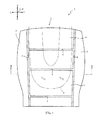
- Fig. 1 is a plan view of a cushion pad 1 according to a first embodiment of the present invention.
- a description will be given of the cushion pad 1 mounted on a vehicle (in particular, an automobile) having vibration.
- the respective arrows U-D, L-R, and F-B in Fig. 1 denote the above-below direction, the right-left direction, and the front-rear direction of a vehicle (not shown) on which the cushion pad 1 is mounted (the same applies to Fig. 2 ).
- the cushion pad 1 which is a base material integrally molded with the flexible polyurethane foam (one type of foamed synthetic resin material), includes: a support portion 2, which supports the buttocks and the back side of the thigh of a seated person H; and side support portions 5, which are arranged on both sides of the support portion 2 in the right-left direction (the arrow L-R direction).
- the side support portions 5 are portions that support the side portions of the thigh and the buttocks.
- the support portion 2 is partitioned by a lateral groove 8, which extends in the right-left direction, into: a rear support portion 3, which supports the buttocks; and a front support portion 4, which supports the back side of the thigh.
- the rear support portion 3 supports the buttocks including the right and left ischial tuberosity portions T1 and T2 of the seated person H in a seated state.
- the respective lateral grooves 7 and 9 are depressed parallel to the lateral groove 8.
- a pair of longitudinal grooves 6, which extends in the front-rear direction (the arrow F-B direction) is formed in the boundary portion between the support portion 2 and the side support portion 5.
- the pair of longitudinal grooves 6 couples to the respective both ends of the lateral grooves 7, 8, and 9.
- the longitudinal groove 6 and the lateral grooves 7, 8, and 9 are portions for pulling and securing a surface skin (not shown) such as fabric, artificial leather, or leather to the cushion pad 1.
- the cushion pad 1 has a feature in the hardness distribution in the above-below direction (the arrow U-D the direction) of the support portion 2 (the rear support portion 3).
- a layered test piece sampled from the rear support portion 3 (molded object) is used to measure the hardness so as to obtain the hardness distribution.
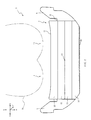
- Fig. 2 is a schematic diagram where the test pieces sampled by equally dividing the support portion 2 (the rear support portion 3) in the thickness direction (the above-below direction) are overlapped with a cross-sectional view of the cushion pad 1 taken along the line II-II in Fig. 1 .
- the rear support portion 3 is a portion formed on the inner side of the pair of longitudinal grooves 6 and 6 in the right-left direction, has a seating surface 11, on which the seated person H is seated, and a bottom surface 12 on the opposite side of the seating surface 11, and has a cross section formed in an approximately horizontally long rectangular shape.
- the rear support portion 3 is equally divided in the above-below direction (the arrow U-D direction) to measure the hardness. A plurality of layered test pieces is sampled.
- the rear support portion 3 (the support portion) in the above-below direction (the arrow U-D direction) is equally sectionalized into four layers.
- the four layers formed by equally dividing the rear support portion 3 into four portions in the above-below direction (the arrow U-D direction) are: a seating layer 21 including the seating surface 11; a first core layer 22 positioned under the seating layer 21; a second core layer 23 positioned under the first core layer 22; and a bottom surface layer 24, which is positioned under the second core layer 23 and includes the bottom surface 12.
- the seating layer 21 and the first core layer 22 are positioned on the seating surface 11 side of a thickness center 13 as the center of the rear support portion 3 in the thickness direction.
- the second core layer 23 and the bottom surface layer 24 are positioned on the bottom surface 12 side of the thickness center 13.
- JIS K6400-2 is Japanese Industrial Standards made by based on ISO 2439 (Fourth Edition: issued in 2008), ISO 3386-1 (Second Edition: issued in 1986), and ISO 3386-2 (Second Edition: issued in 1997).
- the test piece is placed on a support plate (not shown) in the state where the respective layers are flat, and the centers of the respective layers are pre-compressed by a pressure plate (not shown) as a flat disk having a diameter of 200 mm.
- the test piece is pressurized to have a thickness of 25 ⁇ 1% of the thickness of the test piece at a rate of 100 ⁇ 20 mm/minute.
- the force (unit: N) after holding this state for 20 ⁇ 1 seconds is the 25% hardness of the layer.
- the 25% hardness is defined as "hardness.”
- the bottom surface layer 24 is placed on a support plate (not shown) side while facing the bottom surface 12 side after a reinforced fabric (not shown) molded integrally with the bottom surface 12 is removed. Then, the hardness is measured. This is for reducing the influence of the reinforced fabric. Furthermore, the seating layer 21 is placed while the seating surface 11 side faces a support plate (not shown) side, and the hardness is measured. This is for reducing the skin layer.
- the hardness (25% hardness) of the seating layer 21 is preferably set to 120 to 220 N.
- the hardness of the seating layer 21 becomes low. This increases sinking so as to cause poor seating comfort and be likely to cause a bottom-hitting feeling.
- the hardness of the seating layer 21 exceeds 220 N, a hard touch feeling is provided during seating so as to reduce the comfort.
- the thickness (the dimension in the above-below direction) of the support portion 2 is preferably set to 30 to 80 mm.
- a thickness thinner than 30 mm deteriorates the touch feeling during seating, and a thickness thicker than 80 mm causes a large height so as to increase the installation space.
- the seating layer 21, the first core layer 22, the second core layer 23, and the bottom surface layer 24 are set to approximately the identical hardness. Specifically, the ratio of the hardness of the bottom surface layer 24 to the hardness of the seating layer 21 is set to 1.0 to 1.1. It is to be noted that, the ratio of the hardness of the "bottom surface layer” to the hardness of the "seating layer” is the value obtained by rounding the quotient of the hardness of the bottom surface layer is divided by the hardness of the seating layer to one decimal place.
- the hardness of the seating layer 21 is identical to the hardness of the bottom surface layer 24 or slightly smaller than the hardness of the bottom surface layer 24. This allows providing a soft feeling to the seated person H during seating. This consequently provides a fit feeling of the buttocks to the seated person H. Furthermore, when the hardness of the bottom surface layer 24 is 1.0 to 1.1 with respect to the hardness of the seating layer 21, the bottom surface layer 24 can support the load of the seated person H while reducing the increase in reactive force by the bottom surface layer 24. This consequently allows reducing the bottom-hitting feeling.
- the ratio of the hardness of the bottom surface layer 24 to the hardness of the seating layer 21 is less than 1.0, sinking of the bottom surface layer 24 is likely to occur and thus a bottom-hitting feeling is likely to be provided.
- the ratio of the hardness of the bottom surface layer 24 to the hardness of the seating layer 21 exceeds 1.1, the reactive force of the bottom surface layer 24 (the touch feeling of contact with the bottom surface layer 24) is likely to provide a bottom-hitting feeling.
- the ratio of the hardness of the first core layer 22 to the hardness of the seating layer 21 is set to 1.0 to 1.1. Accordingly, the first core layer 22 allows reducing the increase in reactive force by the first core layer 22 while supporting the load of the seated person H. This allows further reducing the bottom-hitting feeling.
- the ratio of the hardness of the first core layer 22 to the hardness of the seating layer 21 is less than 1.0, sinking of the first core layer 22 is likely to occur so as to cause poor seating comfort.
- the ratio of the hardness of the first core layer 22 to the hardness of the seating layer 21 exceeds 1.1, the reactive force (the touch feeling of contact with the first core layer 22) of the first core layer 22 is likely to provide a bottom-hitting feeling.
- the ratio of the hardness of the second core layer 23 to the hardness of the seating layer 21 is set to 1.0 to 1.1. Accordingly, the second core layer 23 allows reducing the increase in reactive force by the second core layer 23 while supporting the load of the seated person H. This allows further reducing the bottom-hitting feeling.
- the ratio of the hardness of the second core layer 23 to the hardness of the seating layer 21 is less than 1.0, sinking of the second core layer 23 is likely to occur so as to cause poor seating comfort.
- the ratio of the hardness of the second core layer 23 to the hardness of the seating layer 21 exceeds 1.1, the reactive force of the second core layer 23 (the touch feeling of contact with the second core layer 23) is likely to provide a bottom-hitting feeling.
- the ratio of the hardness of the bottom surface layer 24 to the hardness of the first core layer 22 is set to 1.0 to 1.1. Accordingly, the bottom surface layer 24 allows reducing the increase in reactive force by the bottom surface layer 24 while supporting the load of the seated person H. This allows further reducing the bottom-hitting feeling.
- the ratio of the hardness of the bottom surface layer 24 to the hardness of the first core layer 22 is less than 1.0, sinking of the bottom surface layer 24 is likely to occur so as to cause poor seating comfort and the bottom-hitting feeling is likely to be provided.
- the ratio of the hardness of the bottom surface layer 24 to the hardness of the first core layer 22 exceeds 1.1, the reactive force of the bottom surface layer 24 (the touch feeling of contact with the bottom surface layer 24) is likely to provide a bottom-hitting feeling.
- the rear support portion 3 is integrally molded by a single foamed synthetic resin material. Accordingly, in the manufacturing process of the cushion pad, this allows eliminating the processes for burying an insert material to adjust the hardness and for laminating a plurality of layers having similar hardnesses. This allows saving the manufacturing cost of the cushion pad 1.
- the cushion pad 1 is manufactured by injecting a compound liquid (foamable raw liquid) containing a polyol component, a polyisocyanate component, a foaming agent, and a catalyst to a molding die (the lower die) and foam molding inside the molding die (the lower die and the upper die). It is to be noted that, the cushion pad 1 can be molded integrally with the bottom surface 12 by preliminarily attaching a reinforced fabric such as coarse wool cloth and nonwoven fabric on the molding die (the upper die). Furthermore, after the cushion pad 1 is molded, a reinforced fabric can be bonded to the bottom surface 12.
- the polyol component can employ polyetherpolyol, polyester polyol, polycarbonate polyol, polyolefin polyol, and lactone-based polyol.
- polyetherpolyol is preferred because the raw material cost is low and the water resistance is excellent.
- polymer polyol can be used in combination.
- Polymer polyol employs, for example, material obtained by graft-copolymerizing a polymer component such as polyacrylonitrile and acrylonitrile-styrene copolymer to polyetherpolyol containing polyalkylene oxide.
- the weight average molecular weight of the polyol component is preferred to be 6000 to 10000. In the case where the weight average molecular weight is less than 6000, the flexibility of the obtained foam is lost such that degradation in physical property or a decrease in elastic performance is likely to occur. In the case where the weight average molecular weight exceeds 10000, the hardness of the foam is likely to decrease.
- the polyisocyanate component can employ publicly-known various polyfunctional aliphatic, alicyclic, and aromatic isocyanates.
- tolylene diisocyanate TDI
- methylene diphenyl diisocyanate MDI
- dicyclohexylmethane diisocyanate triphenyl diisocyanate
- xylene diisocyanate polymethylene polyphenylene polyisocyanate, hexamethylene diisocyanate
- isophorone diisocyanate ortho-toluidine diisocyanate, naphthylene diisocyanate, xylylene diisocyanate, lysine diisocyanate, and similar component
- one kind may be used alone or two or more kinds may be used in combination.
- MDI-based isocyanates typified by methylene diphenyl diisocyanate include, for example, methylene diphenyl diisocyanate (pure MDI), polyphenylene polymethylene polyisocyanate (polymeric MDI), polymeric body of these, urethane-modified body of these, urea-modified body, allophanate-modified body, biuret modified body, carbodiimide-modified body, uretonimine-modified body, uretdione-modified body, isocyanurate-modified body, and the mixture of two or more kinds of these.
- pure MDI methylene diphenyl diisocyanate
- polymeric MDI polymeric MDI
- polymeric body of these urethane-modified body of these, urea-modified body, allophanate-modified body, biuret modified body, carbodiimide-modified body, uretonimine-modified body, uretdi
- terminal isocyanate prepolymer can also be used.
- Terminal isocyanate prepolymer is obtained by preliminarily causing a reaction of: polyol such as polyetherpolyol and polyester polyol; and polyisocyanate (such as TDI-based isocyanate and MDI-based isocyanate).
- polyol such as polyetherpolyol and polyester polyol
- polyisocyanate such as TDI-based isocyanate and MDI-based isocyanate.
- Use of terminal isocyanate prepolymer allows controlling the viscosity of the compound liquid (foamable raw liquid), the primary structure of polymer, the compatibility, and it is preferable.
- the polyisocyanate component preferably employs MDI-based isocyanate, which allows molding an elastic foam having a small rebound resilience compared with the elastic foam by TDI-based isocyanate.
- MDI-based material:TDI-based material 100:0 to 75:25, preferably, 100:0 to 80:20.
- the mass ratio of the TDI-based material in the polyisocyanate component becomes larger than 20/100, the wobbling feeling in the obtained product tends to decrease.
- the mass ratio of the TDI-based material becomes larger than 25/100, this trend becomes remarkable.
- the isocyanate index (the percentage of the equivalence ratio of the isocyanate group to the active hydrogen group) of the polyisocyanate component is set to, for example, 85 to 130.
- the foaming agent mainly employs water.
- molding can also be performed by concomitantly using a small amount of a low boiling point organic compound such as cyclopentane, normal pentane, isopentane, and HFC-245fa or using a gas loading device so as to mix and dissolve air, nitrogen gas, liquefied carbon dioxide, or similar material in the raw liquid.
- a low boiling point organic compound such as cyclopentane, normal pentane, isopentane, and HFC-245fa
- the preferred addition amount of the foaming agent depends on the set density of the obtained product, but is normally 0.5 to 15 mass% with respect to the polyol component.
- the catalyst can employ various urethane catalysts that are publicly-known in this field.
- reactive amine such as triethylamine, tripropylamine, tributylamine, N-methylmorphiline, N-ethylmorpholine, dimethylbenzylamine, N,N,N',N'-tetramethylhexamethylenediamine, N,N,N',N',N''-pentamethyldiethylenetriamine, and bis-(2-dimethylaminoethyl) ether, or organic acid salt of these; metal carboxylate such as potassium acetate and potassium octoate, or an organic metal compound such as stannous octoate, dibutyl tin dilaurate, and zinc naphthenate can be employed.
- an amine catalyst having an active hydrogen group such as N,N-dimethylethanolamine and N,N-diethylethanolamine is also preferred. The preferred addition amount of the catalyst is 0.01 to 10 mass% with respect
- a polyvalent active hydrogen compound having a low molecular weight is used as a crosslinking agent.
- the crosslinking agent facilitates the adjustment of the spring property of the cushion pad.
- the crosslinking agent employs, for example: polyhydric alcohols such as ethylene glycol, propylene glycol, 1,4-butanediol, trimethylolpropane, and glycerin; a compound obtained by polymerizing ethylene oxide or propylene oxide using these polyhydric alcohols as an initiator; and alkanolamines such as monoethanolamine, diethanolamine, triethanolamine, and N-methyldiethanolamine. These compounds can be used alone or as the mixture of two or more kinds.
- a foam stabilizer is used as necessary.
- the foam stabilizer can employ an organic silicon-based surfactant that is publicly-known in this field.
- the preferred addition amount of the foam stabilizer is 0.1 to 10 mass% with respect to the polyol component.
- a flame retardant, a plasticizer, a cell opener, an oxidation inhibitor, an ultraviolet absorber, a colorant, various fillers, an internal mold release agent, or other process aids are used.
- the compositions of the compound liquid (foamable raw liquid) for molding the cushion pad in Examples and Comparative examples are shown in Table 1.
- the numerical value shown in Table 1 denotes the unit mass (mass ratio).
- the isocyanate amount in Table 1 is the mass ratio of isocyanate to polyol (to 100 of polyol).
- Isocyanates 1 to 3 are the component ratios to the entire isocyanate.
- Example 1 Example 2
- Example 3 Example 4 Comparative example 1 Comparative example 2 Comparative example 3 polyol 1 80 80 80 80 2 60 60 60 3 20 20 20 20 40 40 40 40 crosslinking agent 1 1.0 1.0 1.0 1.0 1.5 1.5 1.5 2 2.5 2.5 2.5 cell opener 2.0 2.0 2.0 2.0 foam stabilizer 1 1.0 1.0 1.0 1.0 0.3 0.3 0.3 2 0.7 0.7 0.7 catalyst 1 0.45 0.45 0.45 0.45 0.45 0.45 0.45 2 0.05 0.05 0.05 0.05 0.10 0.10 0.10 water 2.2 2.2 2.2 2.2 2.4 2.4 2.4 isocyanate amount 44.4 44.4 44.4 35.7 35.7 35.7 isocyanate 1 5 15 25 80 70 60 2 100 95 85 75 3 20 30 40 hardness seating layer 1.00 1.00 1.00 1.00 1.00 1.00 1.00 first core layer 1.04 1.03 1.03 1.03 0.89 0.88 0.87 second core layer 1.03 1.03 1.05 1.06 0.91 0.86 0.90 bottom surface layer 1.03 1.05 1.07 1.09 0.84 0.85 0.84 bottom-hitting feeling Excellent
- the rear support portion 3 was equally divided into four portions in the thickness direction (having 20 mm for each thickness) to sample four test pieces (the seating layer 21, the first core layer 22, the second core layer 23, and the bottom surface layer 24) (see Fig. 2 ). Then, the 25% hardnesses in the respective center portions were measured in compliance with D method specified in JIS K6400-2 (the 2012 edition). After the measurement, the ratios (the hardnesses of the respective layers is divided by the hardness of the seating layer 21) of the hardnesses of the respective layers to the hardness of the seating layer 21 were calculated (rounded to two decimal places), and were listed in Table 1.
- the hardnesses of the first core layer 22, the second core layer 23, and the bottom surface layer 24 are set to be larger than the hardness of the seating layer 21. Furthermore, the ratio of the hardness of the first core layer 22 to the hardness of the seating layer 21, the ratio of the hardness of the second core layer 23 to the hardness of the seating layer 21, the ratio of the hardness of the bottom surface layer 24 to the seating layer 21, the ratio of the hardness of the bottom surface layer 24 to the first core layer 22 are all set to 1.0 to 1.1.
- the hardnesses of the first core layer 22, the second core layer 23, and the bottom surface layer 24 are set to be smaller than the hardness of the seating layer 21. Furthermore, the ratio of the hardness of the first core layer 22 to the hardness of the seating layer 21, the ratio of the hardness of the second core layer 23 to the hardness of the seating layer 21, and the ratio of the hardness of the bottom surface layer 24 to the seating layer 21 are all set to 0.8 to 0.9.
- Examples 1 to 4 were evaluated to be excellent or considerably excellent in bottom-hitting feeling. In contrast, Comparative examples 1 to 3 were evaluated to have a large bottom-hitting feeling.
- These Examples find that the ratio of the hardness of the first core layer 22 to the hardness of the seating layer 21, the ratio of the hardness of the second core layer 23 to the hardness of the seating layer 21, the ratio of the hardness of the bottom surface layer 24 to the seating layer 21, and the ratio of the hardness of the bottom surface layer 24 to the first core layer 22 are all set to 1.0 to 1.1 so as to allow reducing the bottom-hitting feeling.
- the ratio of the hardness of the bottom surface layer 24 to the hardness of the seating layer 21 is set to 1.0 to 1.1. This allows the bottom surface layer 24 to support the load while reducing the increase in reactive force by the bottom surface layer 24. This consequently allows reducing the bottom-hitting feeling.
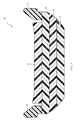
- Fig. 3 is a cross-sectional view of a cushion pad 30 according to the second embodiment.
- the cushion pad 30 includes: a seating layer 31, on which the seated person is seated; a first core layer 32, which is arranged under the seating layer 31; a second core layer 33, which is arranged under the first core layer 32; and a bottom surface layer 34, which is arranged under the second core layer 33.
- a side support portions 35 are arranged on the outer side of the seating layer 31 in the right-left direction.
- the seating layer 31, the first core layer 32, the second core layer 33, and the bottom surface layer 34 are bonded to one another to be laminated.
- the side support portions 35 are bonded to both right and left sides of the first core layer 32.
- the materials are selected such that the hardnesses of the first core layer 32, the second core layer 33, and the bottom surface layer 34 are larger than the hardness (the 25% hardness measured in compliance with D method specified in JIS K6400-2 (the 2012 edition)) of the seating layer 31.
- the ratio of the hardness of the first core layer 32 to the hardness of the seating layer 31, the ratio of the hardness of the second core layer 33 to the hardness of the seating layer 31, the ratio of the hardness of the bottom surface layer 34 to the seating layer 31, and the ratio of the hardness of the bottom surface layer 34 to the first core layer 32 are all set to 1.0 to 1.1.
- the seating layer 31, the first core layer 32, the second core layer 33, and the bottom surface layer 34 are all formed in a tabular shape using flexible polyurethane foam (molded urethane).
- the hardness distributions of the seating layer 31, the first core layer 32, the second core layer 33, and the bottom surface layer 34 are set similarly to the hardness distributions in the cushion pad 1 (the rear support portion 3) according to the first embodiment. Therefore, the description of these is omitted.
- the cushion pad 30 in the second embodiment allows achieving the operation and effect similar to those of the cushion pad 1 in the first embodiment.
- cushion pads 1 and 30 to be mounted on a vehicle have been described, this should not necessarily be construed in a limiting sense.
- the cushion pads 1 and 30 may obviously be applied to a cushion material equipped with another transportation means such as a vehicle (such as a railway vehicle), a ship, and an aircraft other than the automobile or applied to a cushion material of furniture or similar product.
- the number (the number of layers) of the test pieces is not limited to these.
- the thickness of the test piece can be set to a size that allows measurement of the hardness as necessary.
- the number of the test pieces can be set to the number that allows sampling of the test piece having this thickness as necessary. It is to be noted that, taking into consideration the size the cushion pad 1 (the rear support portion 3), it is appropriate to sectionalize the rear support portion 3 into four layers or five layers.
- the thickness of the test piece is preferred to be 20 to 25 mm in length.
- the side support portions 5 and 35 are disposed in the cushion pads 1 and 30, this should not necessarily be construed in a limiting sense.
- the side support portions 5 and 35 can be omitted. This is because the cushion pads 1 and 30 (the support portion 2) are excellent in fit feeling and excellent in holding property (restraint property) of the side portions of the buttocks and the thigh.
- the front support portion 4 can also be set to have a hardness distribution similar to that of the rear support portion 3.
- the seating layer 31, the first core layer 32, the second core layer 33, and the bottom surface layer 34 are all formed with the flexible polyurethane foam (molded urethane) molded by the molding die in a predetermined shape, this should not necessarily be construed in a limiting sense. It is obviously possible to employ other materials.
- the other materials include, for example, slab urethane formed by cutting off the molded flexible polyurethane foam, chip urethane formed by crushing the listing and similar material generated in the manufacturing process of the flexible polyurethane foam, a three dimensional net-like body constituted of a plurality of three-dimensionally intertwined fibers made of synthetic resin, a fiber body such as solid cotton, a synthetic resin-made elastic body such as urethane rubber and thermoplastic elastomer. Laminating these materials allows obtaining a predetermined hardness distribution.
- the hardnesses, the densities, and the shapes of the seating layer 31, the first core layer 32, the second core layer 33, and the bottom surface layer 34 are set as necessary by, for example, selecting materials, designing the cavity shape of the molding die, cutting, and machining.
- the respective layers of the seating layer 31, the first core layer 32, the second core layer 33, and the bottom surface layer 34 are formed in a tabular shape. This should not necessarily be construed in a limiting sense. These layers can obviously be formed in a curved plate shape. This is because the seating layer 31, the first core layer 32, the second core layer 33, and the bottom surface layer 34 can be molded into a predetermined shape by mold forming, cutting, or similar method. It is obviously possible to form these layers in a curved plate shape so as to dispose the portion having a large hardness on the lateral side of the buttocks of the seated person.
Landscapes
- Engineering & Computer Science (AREA)
- Aviation & Aerospace Engineering (AREA)
- Transportation (AREA)
- Mechanical Engineering (AREA)
- Mattresses And Other Support Structures For Chairs And Beds (AREA)
- Chair Legs, Seat Parts, And Backrests (AREA)
- Seats For Vehicles (AREA)
Applications Claiming Priority (1)
| Application Number | Priority Date | Filing Date | Title |
|---|---|---|---|
| JP2014166296A JP2016041211A (ja) | 2014-08-19 | 2014-08-19 | クッションパッド |
Publications (2)
| Publication Number | Publication Date |
|---|---|
| EP2987430A1 true EP2987430A1 (de) | 2016-02-24 |
| EP2987430B1 EP2987430B1 (de) | 2019-02-27 |
Family
ID=53969134
Family Applications (1)
| Application Number | Title | Priority Date | Filing Date |
|---|---|---|---|
| EP15180226.1A Not-in-force EP2987430B1 (de) | 2014-08-19 | 2015-08-07 | Polsterkissen |
Country Status (4)
| Country | Link |
|---|---|
| US (1) | US9573504B2 (de) |
| EP (1) | EP2987430B1 (de) |
| JP (1) | JP2016041211A (de) |
| CN (1) | CN105361524B (de) |
Cited By (1)
| Publication number | Priority date | Publication date | Assignee | Title |
|---|---|---|---|---|
| EP3626131A4 (de) * | 2017-05-16 | 2020-04-22 | Bridgestone Corporation | Geformter schaumkörper |
Families Citing this family (22)
| Publication number | Priority date | Publication date | Assignee | Title |
|---|---|---|---|---|
| JP5976511B2 (ja) * | 2012-11-26 | 2016-08-23 | 東洋ゴム工業株式会社 | シートパッド |
| JP6179458B2 (ja) * | 2014-05-20 | 2017-08-16 | トヨタ紡織株式会社 | 乗物用シート |
| JP6675822B2 (ja) | 2014-07-24 | 2020-04-08 | 株式会社東洋クオリティワン | クッションパッドの製造方法 |
| JP6308905B2 (ja) * | 2014-08-05 | 2018-04-11 | 東洋ゴム工業株式会社 | クッションパッド |
| WO2016117423A1 (ja) * | 2015-01-19 | 2016-07-28 | 株式会社ブリヂストン | シート用パッド |
| JP6641564B2 (ja) * | 2015-10-27 | 2020-02-05 | トヨタ紡織株式会社 | パッド |
| JP6655431B2 (ja) * | 2016-03-04 | 2020-02-26 | 株式会社タチエス | 車両用シート |
| JP6746448B2 (ja) * | 2016-09-21 | 2020-08-26 | 株式会社東洋クオリティワン | ポリオール組成物および軟質ポリウレタンフォーム |
| JP6823982B2 (ja) * | 2016-09-21 | 2021-02-03 | 株式会社東洋クオリティワン | シートパッド |
| US10486565B2 (en) * | 2017-05-09 | 2019-11-26 | Lear Corporation | Dual firmness foam flex point elimination |
| JP7377771B2 (ja) * | 2020-06-22 | 2023-11-10 | 株式会社イノアックコーポレーション | 車両用シート基材と車両用シート |
| US12319183B2 (en) | 2021-03-31 | 2025-06-03 | Lear Corporation | Seat support |
| US12269384B2 (en) | 2021-03-31 | 2025-04-08 | Lear Corporation | Seat support |
| US11807143B2 (en) | 2021-12-02 | 2023-11-07 | Lear Corporation | Vehicle seating system and method for producing same |
| US12479143B2 (en) | 2021-12-20 | 2025-11-25 | Lear Corporation | System and method of making a mesh cushion |
| US12325168B2 (en) | 2021-12-20 | 2025-06-10 | Lear Corporation | System and method of making a mesh cushion |
| US12384094B2 (en) | 2022-03-08 | 2025-08-12 | Lear Corporation | Method for producing a vehicle interior component |
| US12454111B2 (en) | 2022-05-11 | 2025-10-28 | Lear Corporation | Tool to manufacture a cushion |
| WO2023244543A1 (en) * | 2022-06-14 | 2023-12-21 | Lear Corporation | Extruded plastic mesh, seat assembly, cushion and/or method of forming |
| US12509343B2 (en) | 2023-02-28 | 2025-12-30 | Lear Corporation | Automated trench manufacturing and assembly for attaching trim covers to a cushion assembly |
| US12325624B2 (en) | 2023-03-06 | 2025-06-10 | Lear Corporation | Seat assembly, cushion, and tool and method of forming |
| US12286044B2 (en) | 2023-05-12 | 2025-04-29 | Lear Corporation | Method and apparatus for producing a vehicle interior component |
Citations (6)
| Publication number | Priority date | Publication date | Assignee | Title |
|---|---|---|---|---|
| GB2000964A (en) * | 1977-07-08 | 1979-01-24 | Rockwell International Corp | Seat cushion assembly |
| US20100146708A1 (en) * | 2006-08-24 | 2010-06-17 | Sante Plus, Inc. | Stretch Assisting Cushion |
| JP2010280855A (ja) | 2009-06-05 | 2010-12-16 | Nippon Polyurethane Ind Co Ltd | 車輌用シートクッション用軟質ポリウレタンフォームおよびその製造方法 |
| JP2012125397A (ja) * | 2010-12-15 | 2012-07-05 | Bridgestone Corp | 車両用シートパッド |
| US8566987B1 (en) * | 2011-04-12 | 2013-10-29 | Robert S. Burge | Anatomical seat cushion |
| JP2014128359A (ja) * | 2012-12-28 | 2014-07-10 | Toyo Tire & Rubber Co Ltd | シートクッションパッド |
Family Cites Families (7)
| Publication number | Priority date | Publication date | Assignee | Title |
|---|---|---|---|---|
| DE29720057U1 (de) * | 1997-11-12 | 1998-01-02 | Diamona Hermann Koch GmbH & Co. KG Fabrik für Wohn- und Schlafkomfort, 38446 Wolfsburg | Matratze |
| JP4719342B2 (ja) * | 2000-08-24 | 2011-07-06 | 株式会社イノアックコーポレーション | シートクッション用パッド |
| CN101061155B (zh) * | 2004-11-24 | 2010-07-21 | 旭硝子株式会社 | 软质聚氨酯泡沫塑料、其制造方法以及汽车用座垫 |
| CN2803688Y (zh) * | 2005-01-26 | 2006-08-09 | 李敏华 | 多层结构的垫子 |
| JP4926599B2 (ja) * | 2006-08-09 | 2012-05-09 | 株式会社イノアックコーポレーション | シートクッション |
| US7661764B2 (en) * | 2006-08-30 | 2010-02-16 | Lear Corporation | Vehicle seat assembly having a hardness gradient via “A” surface intrusions and/or protrusions |
| CN102762133B (zh) * | 2010-02-19 | 2014-11-19 | 井上株式会社 | 缓冲垫及其制造方法 |
-
2014
- 2014-08-19 JP JP2014166296A patent/JP2016041211A/ja active Pending
-
2015
- 2015-08-07 EP EP15180226.1A patent/EP2987430B1/de not_active Not-in-force
- 2015-08-17 US US14/827,524 patent/US9573504B2/en not_active Expired - Fee Related
- 2015-08-18 CN CN201510508421.XA patent/CN105361524B/zh active Active
Patent Citations (6)
| Publication number | Priority date | Publication date | Assignee | Title |
|---|---|---|---|---|
| GB2000964A (en) * | 1977-07-08 | 1979-01-24 | Rockwell International Corp | Seat cushion assembly |
| US20100146708A1 (en) * | 2006-08-24 | 2010-06-17 | Sante Plus, Inc. | Stretch Assisting Cushion |
| JP2010280855A (ja) | 2009-06-05 | 2010-12-16 | Nippon Polyurethane Ind Co Ltd | 車輌用シートクッション用軟質ポリウレタンフォームおよびその製造方法 |
| JP2012125397A (ja) * | 2010-12-15 | 2012-07-05 | Bridgestone Corp | 車両用シートパッド |
| US8566987B1 (en) * | 2011-04-12 | 2013-10-29 | Robert S. Burge | Anatomical seat cushion |
| JP2014128359A (ja) * | 2012-12-28 | 2014-07-10 | Toyo Tire & Rubber Co Ltd | シートクッションパッド |
Non-Patent Citations (3)
| Title |
|---|
| "ISO 2439", 2008 |
| "ISO 3386-1", 1986 |
| "ISO 3386-2", 1997 |
Cited By (2)
| Publication number | Priority date | Publication date | Assignee | Title |
|---|---|---|---|---|
| EP3626131A4 (de) * | 2017-05-16 | 2020-04-22 | Bridgestone Corporation | Geformter schaumkörper |
| US10919424B2 (en) | 2017-05-16 | 2021-02-16 | Bridgestone Corporation | Molded foam body |
Also Published As
| Publication number | Publication date |
|---|---|
| JP2016041211A (ja) | 2016-03-31 |
| CN105361524A (zh) | 2016-03-02 |
| US9573504B2 (en) | 2017-02-21 |
| CN105361524B (zh) | 2018-12-14 |
| US20160052435A1 (en) | 2016-02-25 |
| EP2987430B1 (de) | 2019-02-27 |
Similar Documents
| Publication | Publication Date | Title |
|---|---|---|
| EP2987430B1 (de) | Polsterkissen | |
| EP2977259B1 (de) | Polsterkissen | |
| EP2982270B1 (de) | Polsterkissen | |
| US9962002B2 (en) | Cushion pad | |
| CA2790042C (en) | Cushion pad and method for manufacturing the same | |
| US10166893B2 (en) | Seat pad | |
| JP6746448B2 (ja) | ポリオール組成物および軟質ポリウレタンフォーム | |
| JP7434077B2 (ja) | 車両用シート基材と車両用シート | |
| WO2020262485A1 (ja) | 車両用シート基材と車両用シート | |
| JP7638799B2 (ja) | 車両用シート基材と車両用シート | |
| JP7377771B2 (ja) | 車両用シート基材と車両用シート | |
| JP6964466B2 (ja) | シートパッド | |
| JP2018016748A (ja) | 低反発性ポリウレタンフォームの製造方法と低反発性ポリウレタンフォーム用組成物と低反発性ポリウレタンフォーム | |
| CA3259879A1 (en) | Seat pad |
Legal Events
| Date | Code | Title | Description |
|---|---|---|---|
| PUAI | Public reference made under article 153(3) epc to a published international application that has entered the european phase |
Free format text: ORIGINAL CODE: 0009012 |
|
| 17P | Request for examination filed |
Effective date: 20150807 |
|
| AK | Designated contracting states |
Kind code of ref document: A1 Designated state(s): AL AT BE BG CH CY CZ DE DK EE ES FI FR GB GR HR HU IE IS IT LI LT LU LV MC MK MT NL NO PL PT RO RS SE SI SK SM TR |
|
| AX | Request for extension of the european patent |
Extension state: BA ME |
|
| RBV | Designated contracting states (corrected) |
Designated state(s): AL AT BE BG CH CY CZ DE DK EE ES FI FR GB GR HR HU IE IS IT LI LT LU LV MC MK MT NL NO PL PT RO RS SE SI SK SM TR |
|
| STAA | Information on the status of an ep patent application or granted ep patent |
Free format text: STATUS: EXAMINATION IS IN PROGRESS |
|
| 17Q | First examination report despatched |
Effective date: 20170221 |
|
| RAP1 | Party data changed (applicant data changed or rights of an application transferred) |
Owner name: TOYO TIRE & RUBBER CO., LTD. |
|
| RIN1 | Information on inventor provided before grant (corrected) |
Inventor name: NAKADA, TORU |
|
| GRAP | Despatch of communication of intention to grant a patent |
Free format text: ORIGINAL CODE: EPIDOSNIGR1 |
|
| STAA | Information on the status of an ep patent application or granted ep patent |
Free format text: STATUS: GRANT OF PATENT IS INTENDED |
|
| INTG | Intention to grant announced |
Effective date: 20180914 |
|
| GRAS | Grant fee paid |
Free format text: ORIGINAL CODE: EPIDOSNIGR3 |
|
| GRAA | (expected) grant |
Free format text: ORIGINAL CODE: 0009210 |
|
| STAA | Information on the status of an ep patent application or granted ep patent |
Free format text: STATUS: THE PATENT HAS BEEN GRANTED |
|
| REG | Reference to a national code |
Ref country code: DE Ref legal event code: R082 Ref document number: 602015025238 Country of ref document: DE Representative=s name: PRUEFER & PARTNER MBB PATENTANWAELTE RECHTSANW, DE Ref country code: DE Ref legal event code: R081 Ref document number: 602015025238 Country of ref document: DE Owner name: TOYO TIRE CORPORATION, ITAMI-SHI, JP Free format text: FORMER OWNER: TOYO TIRE & RUBBER CO., LTD., ITAMI-SHI, HYOGO, JP Ref country code: DE Ref legal event code: R081 Ref document number: 602015025238 Country of ref document: DE Owner name: TOYO QUALITY ONE CORPORATION, KAWAGOE-SHI, JP Free format text: FORMER OWNER: TOYO TIRE & RUBBER CO., LTD., ITAMI-SHI, HYOGO, JP |
|
| AK | Designated contracting states |
Kind code of ref document: B1 Designated state(s): AL AT BE BG CH CY CZ DE DK EE ES FI FR GB GR HR HU IE IS IT LI LT LU LV MC MK MT NL NO PL PT RO RS SE SI SK SM TR |
|
| REG | Reference to a national code |
Ref country code: GB Ref legal event code: FG4D |
|
| REG | Reference to a national code |
Ref country code: CH Ref legal event code: EP |
|
| REG | Reference to a national code |
Ref country code: AT Ref legal event code: REF Ref document number: 1100125 Country of ref document: AT Kind code of ref document: T Effective date: 20190315 |
|
| REG | Reference to a national code |
Ref country code: IE Ref legal event code: FG4D |
|
| REG | Reference to a national code |
Ref country code: DE Ref legal event code: R096 Ref document number: 602015025238 Country of ref document: DE |
|
| REG | Reference to a national code |
Ref country code: NL Ref legal event code: MP Effective date: 20190227 |
|
| REG | Reference to a national code |
Ref country code: LT Ref legal event code: MG4D |
|
| PG25 | Lapsed in a contracting state [announced via postgrant information from national office to epo] |
Ref country code: LT Free format text: LAPSE BECAUSE OF FAILURE TO SUBMIT A TRANSLATION OF THE DESCRIPTION OR TO PAY THE FEE WITHIN THE PRESCRIBED TIME-LIMIT Effective date: 20190227 Ref country code: FI Free format text: LAPSE BECAUSE OF FAILURE TO SUBMIT A TRANSLATION OF THE DESCRIPTION OR TO PAY THE FEE WITHIN THE PRESCRIBED TIME-LIMIT Effective date: 20190227 Ref country code: SE Free format text: LAPSE BECAUSE OF FAILURE TO SUBMIT A TRANSLATION OF THE DESCRIPTION OR TO PAY THE FEE WITHIN THE PRESCRIBED TIME-LIMIT Effective date: 20190227 Ref country code: NO Free format text: LAPSE BECAUSE OF FAILURE TO SUBMIT A TRANSLATION OF THE DESCRIPTION OR TO PAY THE FEE WITHIN THE PRESCRIBED TIME-LIMIT Effective date: 20190527 Ref country code: PT Free format text: LAPSE BECAUSE OF FAILURE TO SUBMIT A TRANSLATION OF THE DESCRIPTION OR TO PAY THE FEE WITHIN THE PRESCRIBED TIME-LIMIT Effective date: 20190627 |
|
| PG25 | Lapsed in a contracting state [announced via postgrant information from national office to epo] |
Ref country code: GR Free format text: LAPSE BECAUSE OF FAILURE TO SUBMIT A TRANSLATION OF THE DESCRIPTION OR TO PAY THE FEE WITHIN THE PRESCRIBED TIME-LIMIT Effective date: 20190528 Ref country code: HR Free format text: LAPSE BECAUSE OF FAILURE TO SUBMIT A TRANSLATION OF THE DESCRIPTION OR TO PAY THE FEE WITHIN THE PRESCRIBED TIME-LIMIT Effective date: 20190227 Ref country code: RS Free format text: LAPSE BECAUSE OF FAILURE TO SUBMIT A TRANSLATION OF THE DESCRIPTION OR TO PAY THE FEE WITHIN THE PRESCRIBED TIME-LIMIT Effective date: 20190227 Ref country code: BG Free format text: LAPSE BECAUSE OF FAILURE TO SUBMIT A TRANSLATION OF THE DESCRIPTION OR TO PAY THE FEE WITHIN THE PRESCRIBED TIME-LIMIT Effective date: 20190527 Ref country code: LV Free format text: LAPSE BECAUSE OF FAILURE TO SUBMIT A TRANSLATION OF THE DESCRIPTION OR TO PAY THE FEE WITHIN THE PRESCRIBED TIME-LIMIT Effective date: 20190227 Ref country code: IS Free format text: LAPSE BECAUSE OF FAILURE TO SUBMIT A TRANSLATION OF THE DESCRIPTION OR TO PAY THE FEE WITHIN THE PRESCRIBED TIME-LIMIT Effective date: 20190627 Ref country code: NL Free format text: LAPSE BECAUSE OF FAILURE TO SUBMIT A TRANSLATION OF THE DESCRIPTION OR TO PAY THE FEE WITHIN THE PRESCRIBED TIME-LIMIT Effective date: 20190227 |
|
| REG | Reference to a national code |
Ref country code: AT Ref legal event code: MK05 Ref document number: 1100125 Country of ref document: AT Kind code of ref document: T Effective date: 20190227 |
|
| PG25 | Lapsed in a contracting state [announced via postgrant information from national office to epo] |
Ref country code: RO Free format text: LAPSE BECAUSE OF FAILURE TO SUBMIT A TRANSLATION OF THE DESCRIPTION OR TO PAY THE FEE WITHIN THE PRESCRIBED TIME-LIMIT Effective date: 20190227 Ref country code: SK Free format text: LAPSE BECAUSE OF FAILURE TO SUBMIT A TRANSLATION OF THE DESCRIPTION OR TO PAY THE FEE WITHIN THE PRESCRIBED TIME-LIMIT Effective date: 20190227 Ref country code: CZ Free format text: LAPSE BECAUSE OF FAILURE TO SUBMIT A TRANSLATION OF THE DESCRIPTION OR TO PAY THE FEE WITHIN THE PRESCRIBED TIME-LIMIT Effective date: 20190227 Ref country code: ES Free format text: LAPSE BECAUSE OF FAILURE TO SUBMIT A TRANSLATION OF THE DESCRIPTION OR TO PAY THE FEE WITHIN THE PRESCRIBED TIME-LIMIT Effective date: 20190227 Ref country code: AL Free format text: LAPSE BECAUSE OF FAILURE TO SUBMIT A TRANSLATION OF THE DESCRIPTION OR TO PAY THE FEE WITHIN THE PRESCRIBED TIME-LIMIT Effective date: 20190227 Ref country code: EE Free format text: LAPSE BECAUSE OF FAILURE TO SUBMIT A TRANSLATION OF THE DESCRIPTION OR TO PAY THE FEE WITHIN THE PRESCRIBED TIME-LIMIT Effective date: 20190227 Ref country code: IT Free format text: LAPSE BECAUSE OF FAILURE TO SUBMIT A TRANSLATION OF THE DESCRIPTION OR TO PAY THE FEE WITHIN THE PRESCRIBED TIME-LIMIT Effective date: 20190227 Ref country code: DK Free format text: LAPSE BECAUSE OF FAILURE TO SUBMIT A TRANSLATION OF THE DESCRIPTION OR TO PAY THE FEE WITHIN THE PRESCRIBED TIME-LIMIT Effective date: 20190227 |
|
| REG | Reference to a national code |
Ref country code: DE Ref legal event code: R097 Ref document number: 602015025238 Country of ref document: DE |
|
| PG25 | Lapsed in a contracting state [announced via postgrant information from national office to epo] |
Ref country code: PL Free format text: LAPSE BECAUSE OF FAILURE TO SUBMIT A TRANSLATION OF THE DESCRIPTION OR TO PAY THE FEE WITHIN THE PRESCRIBED TIME-LIMIT Effective date: 20190227 Ref country code: SM Free format text: LAPSE BECAUSE OF FAILURE TO SUBMIT A TRANSLATION OF THE DESCRIPTION OR TO PAY THE FEE WITHIN THE PRESCRIBED TIME-LIMIT Effective date: 20190227 |
|
| PG25 | Lapsed in a contracting state [announced via postgrant information from national office to epo] |
Ref country code: AT Free format text: LAPSE BECAUSE OF FAILURE TO SUBMIT A TRANSLATION OF THE DESCRIPTION OR TO PAY THE FEE WITHIN THE PRESCRIBED TIME-LIMIT Effective date: 20190227 |
|
| PLBE | No opposition filed within time limit |
Free format text: ORIGINAL CODE: 0009261 |
|
| STAA | Information on the status of an ep patent application or granted ep patent |
Free format text: STATUS: NO OPPOSITION FILED WITHIN TIME LIMIT |
|
| 26N | No opposition filed |
Effective date: 20191128 |
|
| REG | Reference to a national code |
Ref country code: DE Ref legal event code: R082 Ref document number: 602015025238 Country of ref document: DE Representative=s name: PRUEFER & PARTNER MBB PATENTANWAELTE RECHTSANW, DE Ref country code: DE Ref legal event code: R081 Ref document number: 602015025238 Country of ref document: DE Owner name: TOYO QUALITY ONE CORPORATION, KAWAGOE-SHI, JP Free format text: FORMER OWNER: TOYO TIRE CORPORATION, ITAMI-SHI, HYOGO, JP |
|
| PG25 | Lapsed in a contracting state [announced via postgrant information from national office to epo] |
Ref country code: SI Free format text: LAPSE BECAUSE OF FAILURE TO SUBMIT A TRANSLATION OF THE DESCRIPTION OR TO PAY THE FEE WITHIN THE PRESCRIBED TIME-LIMIT Effective date: 20190227 |
|
| PG25 | Lapsed in a contracting state [announced via postgrant information from national office to epo] |
Ref country code: TR Free format text: LAPSE BECAUSE OF FAILURE TO SUBMIT A TRANSLATION OF THE DESCRIPTION OR TO PAY THE FEE WITHIN THE PRESCRIBED TIME-LIMIT Effective date: 20190227 |
|
| GBPC | Gb: european patent ceased through non-payment of renewal fee |
Effective date: 20190807 |
|
| PG25 | Lapsed in a contracting state [announced via postgrant information from national office to epo] |
Ref country code: LU Free format text: LAPSE BECAUSE OF NON-PAYMENT OF DUE FEES Effective date: 20190807 Ref country code: MC Free format text: LAPSE BECAUSE OF FAILURE TO SUBMIT A TRANSLATION OF THE DESCRIPTION OR TO PAY THE FEE WITHIN THE PRESCRIBED TIME-LIMIT Effective date: 20190227 Ref country code: LI Free format text: LAPSE BECAUSE OF NON-PAYMENT OF DUE FEES Effective date: 20190831 Ref country code: CH Free format text: LAPSE BECAUSE OF NON-PAYMENT OF DUE FEES Effective date: 20190831 |
|
| REG | Reference to a national code |
Ref country code: BE Ref legal event code: MM Effective date: 20190831 |
|
| PG25 | Lapsed in a contracting state [announced via postgrant information from national office to epo] |
Ref country code: FR Free format text: LAPSE BECAUSE OF NON-PAYMENT OF DUE FEES Effective date: 20190831 Ref country code: IE Free format text: LAPSE BECAUSE OF NON-PAYMENT OF DUE FEES Effective date: 20190807 |
|
| PG25 | Lapsed in a contracting state [announced via postgrant information from national office to epo] |
Ref country code: GB Free format text: LAPSE BECAUSE OF NON-PAYMENT OF DUE FEES Effective date: 20190807 Ref country code: BE Free format text: LAPSE BECAUSE OF NON-PAYMENT OF DUE FEES Effective date: 20190831 |
|
| PG25 | Lapsed in a contracting state [announced via postgrant information from national office to epo] |
Ref country code: CY Free format text: LAPSE BECAUSE OF FAILURE TO SUBMIT A TRANSLATION OF THE DESCRIPTION OR TO PAY THE FEE WITHIN THE PRESCRIBED TIME-LIMIT Effective date: 20190227 |
|
| PG25 | Lapsed in a contracting state [announced via postgrant information from national office to epo] |
Ref country code: MT Free format text: LAPSE BECAUSE OF FAILURE TO SUBMIT A TRANSLATION OF THE DESCRIPTION OR TO PAY THE FEE WITHIN THE PRESCRIBED TIME-LIMIT Effective date: 20190227 Ref country code: HU Free format text: LAPSE BECAUSE OF FAILURE TO SUBMIT A TRANSLATION OF THE DESCRIPTION OR TO PAY THE FEE WITHIN THE PRESCRIBED TIME-LIMIT; INVALID AB INITIO Effective date: 20150807 |
|
| PGFP | Annual fee paid to national office [announced via postgrant information from national office to epo] |
Ref country code: DE Payment date: 20210819 Year of fee payment: 7 |
|
| PG25 | Lapsed in a contracting state [announced via postgrant information from national office to epo] |
Ref country code: MK Free format text: LAPSE BECAUSE OF FAILURE TO SUBMIT A TRANSLATION OF THE DESCRIPTION OR TO PAY THE FEE WITHIN THE PRESCRIBED TIME-LIMIT Effective date: 20190227 |
|
| REG | Reference to a national code |
Ref country code: DE Ref legal event code: R119 Ref document number: 602015025238 Country of ref document: DE |
|
| PG25 | Lapsed in a contracting state [announced via postgrant information from national office to epo] |
Ref country code: DE Free format text: LAPSE BECAUSE OF NON-PAYMENT OF DUE FEES Effective date: 20230301 |