EP2988662B1 - Système et procédé pour extraire des informations physiologiques - Google Patents
Système et procédé pour extraire des informations physiologiques Download PDFInfo
- Publication number
- EP2988662B1 EP2988662B1 EP15721165.7A EP15721165A EP2988662B1 EP 2988662 B1 EP2988662 B1 EP 2988662B1 EP 15721165 A EP15721165 A EP 15721165A EP 2988662 B1 EP2988662 B1 EP 2988662B1
- Authority
- EP
- European Patent Office
- Prior art keywords
- signal
- subject
- electromagnetic radiation
- change
- rate
- Prior art date
- Legal status (The legal status is an assumption and is not a legal conclusion. Google has not performed a legal analysis and makes no representation as to the accuracy of the status listed.)
- Not-in-force
Links
Images


Classifications
-
- A—HUMAN NECESSITIES
- A61—MEDICAL OR VETERINARY SCIENCE; HYGIENE
- A61B—DIAGNOSIS; SURGERY; IDENTIFICATION
- A61B5/00—Measuring for diagnostic purposes; Identification of persons
- A61B5/145—Measuring characteristics of blood in vivo, e.g. gas concentration or pH-value ; Measuring characteristics of body fluids or tissues, e.g. interstitial fluid or cerebral tissue
- A61B5/1455—Measuring characteristics of blood in vivo, e.g. gas concentration or pH-value ; Measuring characteristics of body fluids or tissues, e.g. interstitial fluid or cerebral tissue using optical sensors, e.g. spectral photometrical oximeters
- A61B5/14551—Measuring characteristics of blood in vivo, e.g. gas concentration or pH-value ; Measuring characteristics of body fluids or tissues, e.g. interstitial fluid or cerebral tissue using optical sensors, e.g. spectral photometrical oximeters for measuring blood gases
-
- A—HUMAN NECESSITIES
- A61—MEDICAL OR VETERINARY SCIENCE; HYGIENE
- A61B—DIAGNOSIS; SURGERY; IDENTIFICATION
- A61B5/00—Measuring for diagnostic purposes; Identification of persons
- A61B5/72—Signal processing specially adapted for physiological signals or for diagnostic purposes
- A61B5/7271—Specific aspects of physiological measurement analysis
- A61B5/7278—Artificial waveform generation or derivation, e.g. synthesizing signals from measured signals
-
- A—HUMAN NECESSITIES
- A61—MEDICAL OR VETERINARY SCIENCE; HYGIENE
- A61B—DIAGNOSIS; SURGERY; IDENTIFICATION
- A61B5/00—Measuring for diagnostic purposes; Identification of persons
- A61B5/0059—Measuring for diagnostic purposes; Identification of persons using light, e.g. diagnosis by transillumination, diascopy, fluorescence
- A61B5/0075—Measuring for diagnostic purposes; Identification of persons using light, e.g. diagnosis by transillumination, diascopy, fluorescence by spectroscopy, i.e. measuring spectra, e.g. Raman spectroscopy, infrared absorption spectroscopy
-
- A—HUMAN NECESSITIES
- A61—MEDICAL OR VETERINARY SCIENCE; HYGIENE
- A61B—DIAGNOSIS; SURGERY; IDENTIFICATION
- A61B5/00—Measuring for diagnostic purposes; Identification of persons
- A61B5/0059—Measuring for diagnostic purposes; Identification of persons using light, e.g. diagnosis by transillumination, diascopy, fluorescence
- A61B5/0077—Devices for viewing the surface of the body, e.g. camera, magnifying lens
-
- A—HUMAN NECESSITIES
- A61—MEDICAL OR VETERINARY SCIENCE; HYGIENE
- A61B—DIAGNOSIS; SURGERY; IDENTIFICATION
- A61B5/00—Measuring for diagnostic purposes; Identification of persons
- A61B5/01—Measuring temperature of body parts ; Diagnostic temperature sensing, e.g. for malignant or inflamed tissue
-
- A—HUMAN NECESSITIES
- A61—MEDICAL OR VETERINARY SCIENCE; HYGIENE
- A61B—DIAGNOSIS; SURGERY; IDENTIFICATION
- A61B5/00—Measuring for diagnostic purposes; Identification of persons
- A61B5/02—Detecting, measuring or recording for evaluating the cardiovascular system, e.g. pulse, heart rate, blood pressure or blood flow
-
- A—HUMAN NECESSITIES
- A61—MEDICAL OR VETERINARY SCIENCE; HYGIENE
- A61B—DIAGNOSIS; SURGERY; IDENTIFICATION
- A61B5/00—Measuring for diagnostic purposes; Identification of persons
- A61B5/02—Detecting, measuring or recording for evaluating the cardiovascular system, e.g. pulse, heart rate, blood pressure or blood flow
- A61B5/0205—Simultaneously evaluating both cardiovascular conditions and different types of body conditions, e.g. heart and respiratory condition
-
- A—HUMAN NECESSITIES
- A61—MEDICAL OR VETERINARY SCIENCE; HYGIENE
- A61B—DIAGNOSIS; SURGERY; IDENTIFICATION
- A61B5/00—Measuring for diagnostic purposes; Identification of persons
- A61B5/02—Detecting, measuring or recording for evaluating the cardiovascular system, e.g. pulse, heart rate, blood pressure or blood flow
- A61B5/0205—Simultaneously evaluating both cardiovascular conditions and different types of body conditions, e.g. heart and respiratory condition
- A61B5/02055—Simultaneously evaluating both cardiovascular condition and temperature
-
- A—HUMAN NECESSITIES
- A61—MEDICAL OR VETERINARY SCIENCE; HYGIENE
- A61B—DIAGNOSIS; SURGERY; IDENTIFICATION
- A61B5/00—Measuring for diagnostic purposes; Identification of persons
- A61B5/02—Detecting, measuring or recording for evaluating the cardiovascular system, e.g. pulse, heart rate, blood pressure or blood flow
- A61B5/021—Measuring pressure in heart or blood vessels
-
- A—HUMAN NECESSITIES
- A61—MEDICAL OR VETERINARY SCIENCE; HYGIENE
- A61B—DIAGNOSIS; SURGERY; IDENTIFICATION
- A61B5/00—Measuring for diagnostic purposes; Identification of persons
- A61B5/02—Detecting, measuring or recording for evaluating the cardiovascular system, e.g. pulse, heart rate, blood pressure or blood flow
- A61B5/024—Measuring pulse rate or heart rate
- A61B5/02416—Measuring pulse rate or heart rate using photoplethysmograph signals, e.g. generated by infrared radiation
-
- A—HUMAN NECESSITIES
- A61—MEDICAL OR VETERINARY SCIENCE; HYGIENE
- A61B—DIAGNOSIS; SURGERY; IDENTIFICATION
- A61B5/00—Measuring for diagnostic purposes; Identification of persons
- A61B5/02—Detecting, measuring or recording for evaluating the cardiovascular system, e.g. pulse, heart rate, blood pressure or blood flow
- A61B5/026—Measuring blood flow
- A61B5/0261—Measuring blood flow using optical means, e.g. infrared light
-
- A—HUMAN NECESSITIES
- A61—MEDICAL OR VETERINARY SCIENCE; HYGIENE
- A61B—DIAGNOSIS; SURGERY; IDENTIFICATION
- A61B5/00—Measuring for diagnostic purposes; Identification of persons
- A61B5/02—Detecting, measuring or recording for evaluating the cardiovascular system, e.g. pulse, heart rate, blood pressure or blood flow
- A61B5/026—Measuring blood flow
- A61B5/0295—Measuring blood flow using plethysmography, i.e. measuring the variations in the volume of a body part as modified by the circulation of blood therethrough, e.g. impedance plethysmography
-
- A—HUMAN NECESSITIES
- A61—MEDICAL OR VETERINARY SCIENCE; HYGIENE
- A61B—DIAGNOSIS; SURGERY; IDENTIFICATION
- A61B5/00—Measuring for diagnostic purposes; Identification of persons
- A61B5/08—Measuring devices for evaluating the respiratory organs
-
- A—HUMAN NECESSITIES
- A61—MEDICAL OR VETERINARY SCIENCE; HYGIENE
- A61B—DIAGNOSIS; SURGERY; IDENTIFICATION
- A61B5/00—Measuring for diagnostic purposes; Identification of persons
- A61B5/103—Measuring devices for testing the shape, pattern, colour, size or movement of the body or parts thereof, for diagnostic purposes
- A61B5/1032—Determining colour of tissue for diagnostic purposes
-
- A—HUMAN NECESSITIES
- A61—MEDICAL OR VETERINARY SCIENCE; HYGIENE
- A61B—DIAGNOSIS; SURGERY; IDENTIFICATION
- A61B5/00—Measuring for diagnostic purposes; Identification of persons
- A61B5/145—Measuring characteristics of blood in vivo, e.g. gas concentration or pH-value ; Measuring characteristics of body fluids or tissues, e.g. interstitial fluid or cerebral tissue
- A61B5/1455—Measuring characteristics of blood in vivo, e.g. gas concentration or pH-value ; Measuring characteristics of body fluids or tissues, e.g. interstitial fluid or cerebral tissue using optical sensors, e.g. spectral photometrical oximeters
-
- A—HUMAN NECESSITIES
- A61—MEDICAL OR VETERINARY SCIENCE; HYGIENE
- A61B—DIAGNOSIS; SURGERY; IDENTIFICATION
- A61B5/00—Measuring for diagnostic purposes; Identification of persons
- A61B5/145—Measuring characteristics of blood in vivo, e.g. gas concentration or pH-value ; Measuring characteristics of body fluids or tissues, e.g. interstitial fluid or cerebral tissue
- A61B5/1455—Measuring characteristics of blood in vivo, e.g. gas concentration or pH-value ; Measuring characteristics of body fluids or tissues, e.g. interstitial fluid or cerebral tissue using optical sensors, e.g. spectral photometrical oximeters
- A61B5/14551—Measuring characteristics of blood in vivo, e.g. gas concentration or pH-value ; Measuring characteristics of body fluids or tissues, e.g. interstitial fluid or cerebral tissue using optical sensors, e.g. spectral photometrical oximeters for measuring blood gases
- A61B5/14552—Details of sensors specially adapted therefor
-
- A—HUMAN NECESSITIES
- A61—MEDICAL OR VETERINARY SCIENCE; HYGIENE
- A61B—DIAGNOSIS; SURGERY; IDENTIFICATION
- A61B5/00—Measuring for diagnostic purposes; Identification of persons
- A61B5/68—Arrangements of detecting, measuring or recording means, e.g. sensors, in relation to patient
- A61B5/6887—Arrangements of detecting, measuring or recording means, e.g. sensors, in relation to patient mounted on external non-worn devices, e.g. non-medical devices
-
- A—HUMAN NECESSITIES
- A61—MEDICAL OR VETERINARY SCIENCE; HYGIENE
- A61B—DIAGNOSIS; SURGERY; IDENTIFICATION
- A61B5/00—Measuring for diagnostic purposes; Identification of persons
- A61B5/72—Signal processing specially adapted for physiological signals or for diagnostic purposes
- A61B5/7203—Signal processing specially adapted for physiological signals or for diagnostic purposes for noise prevention, reduction or removal
- A61B5/7207—Signal processing specially adapted for physiological signals or for diagnostic purposes for noise prevention, reduction or removal of noise induced by motion artifacts
-
- A—HUMAN NECESSITIES
- A61—MEDICAL OR VETERINARY SCIENCE; HYGIENE
- A61B—DIAGNOSIS; SURGERY; IDENTIFICATION
- A61B5/00—Measuring for diagnostic purposes; Identification of persons
- A61B5/72—Signal processing specially adapted for physiological signals or for diagnostic purposes
- A61B5/7203—Signal processing specially adapted for physiological signals or for diagnostic purposes for noise prevention, reduction or removal
- A61B5/7207—Signal processing specially adapted for physiological signals or for diagnostic purposes for noise prevention, reduction or removal of noise induced by motion artifacts
- A61B5/721—Signal processing specially adapted for physiological signals or for diagnostic purposes for noise prevention, reduction or removal of noise induced by motion artifacts using a separate sensor to detect motion or using motion information derived from signals other than the physiological signal to be measured
-
- A—HUMAN NECESSITIES
- A61—MEDICAL OR VETERINARY SCIENCE; HYGIENE
- A61B—DIAGNOSIS; SURGERY; IDENTIFICATION
- A61B5/00—Measuring for diagnostic purposes; Identification of persons
- A61B5/72—Signal processing specially adapted for physiological signals or for diagnostic purposes
- A61B5/7225—Details of analogue processing, e.g. isolation amplifier, gain or sensitivity adjustment, filtering, baseline or drift compensation
-
- A—HUMAN NECESSITIES
- A61—MEDICAL OR VETERINARY SCIENCE; HYGIENE
- A61B—DIAGNOSIS; SURGERY; IDENTIFICATION
- A61B5/00—Measuring for diagnostic purposes; Identification of persons
- A61B5/72—Signal processing specially adapted for physiological signals or for diagnostic purposes
- A61B5/7235—Details of waveform analysis
- A61B5/7246—Details of waveform analysis using correlation, e.g. template matching or determination of similarity
-
- G—PHYSICS
- G06—COMPUTING OR CALCULATING; COUNTING
- G06V—IMAGE OR VIDEO RECOGNITION OR UNDERSTANDING
- G06V40/00—Recognition of biometric, human-related or animal-related patterns in image or video data
- G06V40/40—Spoof detection, e.g. liveness detection
- G06V40/45—Detection of the body part being alive
-
- A—HUMAN NECESSITIES
- A61—MEDICAL OR VETERINARY SCIENCE; HYGIENE
- A61B—DIAGNOSIS; SURGERY; IDENTIFICATION
- A61B2562/00—Details of sensors; Constructional details of sensor housings or probes; Accessories for sensors
- A61B2562/02—Details of sensors specially adapted for in-vivo measurements
- A61B2562/0233—Special features of optical sensors or probes classified in A61B5/00
- A61B2562/0238—Optical sensor arrangements for performing transmission measurements on body tissue
-
- A—HUMAN NECESSITIES
- A61—MEDICAL OR VETERINARY SCIENCE; HYGIENE
- A61B—DIAGNOSIS; SURGERY; IDENTIFICATION
- A61B2576/00—Medical imaging apparatus involving image processing or analysis
Definitions
- the present invention relates to a device, system and method for extracting physiological information indicative of at least one vital sign of a subject from detected electromagnetic radiation transmitted through or reflected from a subject, such as a person or animal.
- Vital signs of a person for example the heart rate (HR), the respiration rate (RR) or the arterial blood oxygen saturation, serve as indicators of the current state of a person and as powerful predictors of serious medical events. For this reason, vital signs are extensively monitored in inpatient and outpatient care settings, at home or in further health, leisure and fitness settings.
- HR heart rate
- RR respiration rate
- RR arterial blood oxygen saturation
- Plethysmography generally refers to the measurement of volume changes of an organ or a body part and in particular to the detection of volume changes due to a cardio-vascular pulse wave traveling through the body of a subject with every heartbeat.
- Photoplethysmography is an optical measurement technique that evaluates a time-variant change of light reflectance or transmission of an area or volume of interest.
- PPG is based on the principle that blood absorbs light more than surrounding tissue, so variations in blood volume with every heart beat affect transmission or reflectance correspondingly.
- a PPG waveform can comprise information attributable to further physiological phenomena such as the respiration.
- a typical pulse oximeter comprises a red LED and an infrared LED as light sources and one photodiode for detecting light that has been transmitted through patient tissue.
- Commercially available pulse oximeters quickly switch between measurements at a red and an infrared wavelength and thereby measure the transmittance of the same area or volume of tissue at two different wavelengths. This is referred to as time-division-multiplexing.
- the transmittance over time at each wavelength gives the PPG waveforms for red and infrared wavelengths.
- contact PPG is regarded as a basically non-invasive technique, contact PPG measurement is often experienced as being unpleasant and obtrusive, since the pulse oximeter is directly attached to the subject and any cables limit the freedom to move and might hinder a workflow.
- Modem photoplethysmography sensors do not always provide fast and reliable measurement in critical situations. For instance, contact finger pulse oximeters (based on transmissive PPG) are vulnerable to motion of a hand, and fails in case of centralization of a patient due to lower blood volumes on body peripherals. Contact forehead pulse oximeter sensors (using a reflective PPG measurement mode) are supposed to be more robust to a centralization effect. However, the accuracy, robustness and responsiveness of a forehead sensor depends heavily on correct positioning of a sensor on a forehead and proper pressure applied to a skin (too tight application of a sensor might reduce a local blood pulsatility, too loose application might lead to non-reliable measurements due to motion artifacts and/or venous pulsatility).
- remote PPG remote PPG
- camera rPPG device also called camera rPPG device herein
- Remote PPG utilizes light sources or, in general radiation sources, disposed remotely from the subject of interest.
- a detector e.g., a camera or a photo detector, can be disposed remotely from the subject of interest. Therefore, remote photoplethysmographic systems and devices are considered unobtrusive and well suited for medical as well as non-medical everyday applications.
- remote PPG devices typically achieve a lower signal-to-noise ratio.
- Verkruysse et al. "Remote plethysmographic imaging using ambient light", Optics Express, 16(26), 22 December 2008, pp. 21434-21445 demonstrates that photoplethysmographic signals can be measured remotely using ambient light and a conventional consumer level video camera, using red, green and blue colour channels.
- the system comprises a monochrome CMOS-camera and a light source with LEDs of three different wavelengths.
- the camera sequentially acquires three movies of the subject at the three different wavelengths.
- the pulse rate can be determined from a movie at a single wavelength, whereas at least two movies at different wavelengths are required for determining the oxygen saturation.
- the measurements are performed in a darkroom, using only one wavelength at a time.
- vital signs can be measured, which are revealed by minute light absorption changes in the skin caused by the pulsating blood volume, i.e. by periodic color changes of the human skin induced by the blood volume pulse.
- SNR signal-to-noise ratio
- the vital sign results from a dynamically varying mix of at least two color (sometimes including infrared) channels.
- the mix can be found using various techniques, such as blind source separation techniques, and a selection algorithm, or with an energy minimization, minimizing the signal energy in all but a predefined color direction determined by the blood absorption spectrum.
- Such a method is e.g. described in G. de Haan and V. Jeanne, "Robust pulse-rate from chrominance-based rPPG ", IEEE Transactions on Biomedical Engineering, Vol. 60, No. 10, October, 2013, pp. 2878-2886 .
- a device for extracting physiological information indicative of at least one vital sign of a subject from detected electromagnetic radiation transmitted through or reflected from a subject comprising:
- a system for extracting physiological information indicative of at least one vital sign of a subject from detected electromagnetic radiation transmitted through or reflected from a subject comprising:
- a computer program which comprises program code means for causing a computer to perform the steps of the method disclosed herein when said computer program is carried out on a computer as well as a non-transitory computer-readable recording medium that stores therein a computer program product, which, when executed by a processor, causes the method disclosed herein to be performed.
- the present invention aims at improving the SNR of the vital sign, particularly in these near stationary cases.
- the present invention is based on the idea to limit the mixture and/or its rate of change, particularly when a low energy is observed in the color channels or a derived signal, as proposed in an embodiment. Limiting the rate of change has the advantage that it still allows all possible mixtures.
- the invention is equally applicable to various or even all known methods for obtaining the mixed signal(s), e.g. methods using blind source separation (BSS), such as principal component analysis (PCA) or independent component analysis (ICA), methods based on chrominance signals (CHRO-method (CHROM) as disclosed in the above mentioned paper of G. de Haan et al.), methods based on energy minimization in all dimensions but a predefined one (also called PBV-method), and BSS-methods using guidance from PBV or CHRO.
- BSS blind source separation
- PCA principal component analysis
- ICA independent component analysis
- CHRO-method CHRO-method
- PBV-method energy minimization in all dimensions but a predefined one
- BSS-methods using guidance from PBV
- the mixed signal as a mixture of at least two signal channels representative of respective wavelength portions, for instance as a mixture of three signal channels representing red, green and blue signals from a color video camera, but they differ in the way to determine the optimal weighting scheme used for mixing the at least two signal channels.
- the resulting weights are aimed at a mixture in which the distortions disappear, i.e. the "weighting vector" is substantially orthogonal to the main distortions, as usually caused by subject motion.
- this commonly used weighting scheme is not used, but a more sophisticated control of the signal mixer is applied, according to which limitations are, particularly under certain conditions applied to the mixing and/or the rate-of-change to improve the SNR.
- the controller is configured to limit the relative contributions and/or the rate-of-change only in case the energy of the at least two signal channels or a derived measure is below an energy threshold.
- an energy threshold As explained above, in this case the conventional mixing leads to a reduced SNR. Above the energy threshold the mixing is preferably performed conventionally, i.e. without any limiting so that also above the energy threshold the best SNR can be obtained.
- the energy threshold may be predetermined (e.g. in a calibration measurement), adaptable, e.g. by the user, or self-learning.
- said input interface is configured to receive a motion signal indicating motion of the subject or part of the subject and wherein said controller is configured to limit the relative contributions and/or the rate-of-change only in case the motion is below a motion threshold.
- the motion signal may be acquired in various ways, e.g. by use of one or more body sensors attached to the subject's body (e.g. accelerometers), by use of motion sensor arranged or in or at a device that is in contact with the subject (e.g. pressure sensors within a mattress), or by use of information obtained from images of the subject. Above the motion threshold the mixing is preferably performed conventionally.
- the motion threshold like the energy threshold, may be predetermined (e.g. in a calibration measurement), adaptable, e.g. by the user, or self-learning.
- the controller is configured to limit the relative contributions and/or the rate-of-change to a predetermined value or range.
- the predetermined value or range may e.g. be obtained in a calibration measurement as well.
- the setting of a predetermined value or range for the relative contributions and/or the rate-of-change allows to optimally control to obtain an increased SNR.
- said controller is configured to limit the rate-of-change by updating, in particular by recursively updating, the relative contributions. This may be realized by updating weighting factors by which the relative contributions are multiplied for the mixing.
- the at least two signal channels are selected from a wavelength interval between 300nm and 1000nm, in particular represent the wavelength portions corresponding to red, green and blue light. This is particularly used when the PPG signals are obtained from image signals acquired by a (e.g. conventional) video camera and when the above mentioned principles of remote PPG are used for deriving one or more vital signs.
- infrared light may also be used in addition or instead of another color channel. For instance, for night-time applications one or more infrared wavelengths may be used in addition or alternatively.
- the interaction of electromagnetic radiation, in particular light, with biological tissue is complex and includes the (optical) processes of (multiple) scattering, backscattering, absorption, transmission and (diffuse) reflection.
- the term "reflect” as used in the context of the present invention is not to be construed as limited to specular reflection but comprises the afore-mentioned types of interaction of electromagnetic radiation, in particular light, with tissue and any combinations thereof.
- vitamin sign refers to a physiological parameter of a subject (i.e. a living being) and derivative parameters.
- the term “vital sign” comprises blood volume pulse-signal, heart rate (HR) (sometimes also called pulse rate), heart rate variability (pulse rate variability), pulsatility strength, perfusion, perfusion indicator, perfusion variability, Traube Hering Mayer waves, respiratory rate (RR), skin temperature, blood pressure, a concentration of a substance in blood and/or tissue, such as (arterial) blood oxygen saturation or glucose level.
- HR heart rate
- RR respiratory rate
- skin temperature blood pressure
- concentration of a substance in blood and/or tissue such as (arterial) blood oxygen saturation or glucose level.
- vitamin sign generally includes health indications obtained from the shape of the PPG signal (e.g. shape may say something about partial arterial blockage (e.g. shape obtained from PPG signals of the hand gets more sinusoidal when applying a blood-pressure cuff on the arm), or about the skin thickness (e.g. a PPG
- vitamin sign information as used in the context of the present invention comprises the one or more measured vital signs as defined above. Furthermore, it comprises data referring to a physiological parameter, corresponding waveform traces or data referring to a physiological parameter of a time that can serve for subsequent analysis.
- a skin pixel area means an area comprising one skin pixel or a group of adjacent skin pixels, i.e. a data signal may be derived for a single pixel or a group of skin pixels.
- said signal mixer is configured to use blind source separation, in particular principal component analysis or independent component analysis, to compute the at least one mixed signal.
- blind source separation in particular principal component analysis or independent component analysis
- said signal mixer is configured to compute a single mixed signal that correlates with the at least two signal channels in a predetermined set of one or more ratios.
- the correlation may e.g. be computed as the inner product of the single mixed signal and the at least two signal channels.
- said signal mixer is configured to compute the at least one mixed signal as a mix of at least 2 orthogonal color difference signals.
- R-G red minus green
- R+G-2*B red plus green minus two times blue
- the background of this way of mixing has been given in G. de Haan and V. Jeanne, "Robust pulse-rate from chrominance-based rPPG ", IEEE Transactions on Biomedical Engineering 2013 Oct; 60(10): 2878-86 .
- the color difference signals inherently suppress the specular reflection and the mix of at least two color difference signals suppresses further motion-induced distortions in the vital sign output signal.
- the subsequently explained embodiments provide applications of the invention to BSS, a method using the blood-volume pulse, and a chrominance-based method.
- the detector for detecting electromagnetic radiation transmitted through or reflected from a skin region of a subject and for deriving detection data from the detected electromagnetic radiation may be implemented in various ways.
- the detector comprises a plethysmography sensor configured for being mounted to a skin portion of the subject for acquiring photo-plethysmography signals.
- a sensor may e.g. be an optical plethysmography sensor mounted to a finger or earlobe or a sensor arranged within a wristband or wristwatch.
- the detector may comprise an imaging unit for acquiring a sequence of image frames of the subject over time, from which photo-plethysmography signals can be derived using the principle of remote PPG.
- the data stream may thus comprise a sequence of image frames or, more precisely, a series of image frames comprising spectral information. For instance, RGB-images comprising color information can be utilized. However, also frames representing infrared (IR) and red (R) information can form the sequence of frames.
- the image frames can represent the observed subject and further elements.
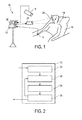
- Fig. 1 shows a schematic diagram of a system 10 according to the present invention including a device 12 for extracting physiological information indicative of at least one vital sign of a subject 14 from detected electromagnetic radiation transmitted through or reflected from a subject.
- the subject 14, in this example a patient lies in a bed 16, e.g. in a hospital or other healthcare facility, but may also be a neonate or premature infant, e.g. lying in an incubator, or person at home or in a different environment.
- the subject 14, in this example a patient lies in a bed 16, e.g. in a hospital or other healthcare facility, but may also be a neonate or premature infant, e.g. lying in an incubator, or person at home or in a different environment.
- the detector which may alternatively (which is preferred) or together be used.
- the embodiment of the system 10 two different embodiments of the detector are shown.
- the detector comprises a camera 18 (also referred to as imaging unit, or as camera-based or remote PPG sensor) including a suitable photosensor for (remotely and unobtrusively) capturing image frames of the subject 14, in particular for acquiring a sequence of image frames of the subject 14 over time, from which photo-plethysmography signals can be derived.
- the image frames captured by the camera 18 may particularly correspond to a video sequence captured by means of an analog or digital photosensor, e.g. in a (digital) camera.
- a camera 18 usually includes a photosensor, such as a CMOS or CCD sensor, which may also operate in a specific spectral range (visible, IR) or provide information for different spectral ranges.
- the camera 18 may provide an analog or digital signal.
- the image frames include a plurality of image pixels having associated pixel values. Particularly, the image frames include pixels representing light intensity values captured with different photosensitive elements of a photosensor. These photosensitive elements may be sensitive in a specific spectral range (i.e. representing a specific color).
- the image frames include at least some image pixels being representative of a skin portion of the subject. Thereby, an image pixel may correspond to one photosensitive element of a photodetector and its (analog or digital) output or may be determined based on a combination (e.g. through binning) of a plurality of the photosensitive elements.
- the detector comprises one or more optical photo-plethysmography sensor(s) 19 (also referred to as contact PPG sensor(s)) configured for being mounted to a skin portion of the subject 14 for acquiring photo-plethysmography signals.
- the PPG sensor(s) 19 may e.g. be designed in the form of a finger-clip for measuring the blood oxygen saturation or a heart rate sensor for measuring the heart rate, just to name a few of all the possible embodiments.
- the system 10 may further optionally comprise a light source 22 (also called illumination source), such as a lamp, for illuminating a region of interest 24, such as the skin of the patient's face (e.g. part of the cheek or forehead), with light, for instance in a predetermined wavelength range or ranges (e.g. in the red, green and/or infrared wavelength range(s)).
- a predetermined wavelength range or ranges e.g. in the red, green and/or infrared wavelength range(s)
- the light reflected from said region of interest 24 in response to said illumination is detected by the camera 18.
- no dedicated light source is provided, but ambient light is used for illumination of the subject 14. From the reflected light only light in a desired wavelength range (e.g. green light) may be detected and/or evaluated.
- the device 12 is further connected to an interface 20 for displaying the determined information and/or for providing medical personnel with an interface to change settings of the device 12, the camera 18, the PPG sensor(s) 19, the light source 22 and/or any other parameter of the system 10.
- an interface 20 may comprise different displays, buttons, touchscreens, keyboards or other human machine interface means.
- a system 10 as illustrated in Fig. 1 may, e.g., be located in a hospital, healthcare facility, elderly care facility or the like. Apart from the monitoring of patients, the present invention may also be applied in other fields such as neonate monitoring, general surveillance applications, security monitoring or so-called live style environments, such as fitness equipment, or the like.
- the uni- or bidirectional communication between the device 12, the camera 18, the PPG sensor(s) 19 and the interface 20 may work via a wireless or wired communication interface.
- Other embodiments of the present invention may include a device 12, which is not provided stand-alone, but integrated into the camera 18 or the interface 20.
- Fig. 2 shows a more detailed schematic illustration of an embodiment of the device 12 according to the present invention.
- the device 12 comprises an input interface 30 for receiving a data stream 28 of detection data derived from detected electromagnetic radiation transmitted through or reflected from a skin region of a subject 14.
- the data stream of detection data is e.g. provided by the camera 18 and/or one or more PPG sensor(s) 19, and the detection data comprises wavelength-dependent reflection or transmission information in at least two signal channels representative of respective wavelength portions.
- a signal mixer 32 is provided for dynamically mixing the at least two signal channels into at least one mixed signal.
- Various embodiments exist for said mixing which will be explained in more detail below.
- a processor 34 is provided for deriving physiological information indicative of at least one vital sign from the at least one mixed signal.
- the way to obtain PPG signals from detected light, e.g. from images of a region of interest or from signals of a contact PPG sensor, is generally known in the field of remote or contact photo-plethymography, e.g. from the above described documents, and shall thus not be explained in more detail here.
- a controller 36 is provided for controlling the signal mixer to limit the relative contributions of the at least two signal channels mixed into at least one mixed signal and/or the rate-of-change at which said relative contributions are allowed to dynamically change. In this way the reliability and accuracy of the obtained physiological information can be increased in various situations in which the conventional processing would lead to a degradation of the obtained physiological information as will also be explained in more detail below.
- the various units of the device 12 may be comprised in one or multiple digital or analog processors depending on how and where the invention is applied.
- the different units may completely or partly be implemented in software and carried out on a personal computer connected to one or more detectors. Some or all of the required functionality may also be implemented in hardware, e.g. in an application specific integrated circuit (ASIC) or in a field programmable gate array (FPGA).
- ASIC application specific integrated circuit
- FPGA field programmable gate array
- the output vital sign is the pulse signal S.
- S the pulse signal
- methods to find S said methods being referred to as ICA, PCA, PBV, CHROM, and ICA/PCA guided by PBV/CHROM.
- These methods can be interpreted as providing the pulse signal as a mixture of red, green and blue signals from a color video camera, but they differ in the way to determine the optimal weighting scheme.
- the resulting weights are aimed at a mixture in which the distortions disappear, i.e. the "weighting vector" is substantially orthogonal to the main distortions usually caused by subject motion.
- the beating of the heart causes pressure variations in the arteries as the heart pumps blood against the resistance of the vascular bed. Since the arteries are elastic, their diameter changes in sync with the pressure variations. These diameter changes occur even in the smaller vessels of the skin, where the blood volume variations cause a changing absorption of the light.
- the absolute PPG-amplitude 51 as a function of wavelength was measured by Corral et al. "Optimal wavelength selection for non-contact reflection photoplethysmography", 22nd Congress of the International Commission for Optics: Light for the Development of the World, Proc. of SPIE Vol. 8011, 801191 using a spectrometer and a white, halogen, illumination.
- This curve 51 shows a strong amplitude peak around 550 nm, as shown in Fig. 3B .
- a derived relative PPG 50 has been included, which, apart from the higher noisiness for shorter wavelengths, corresponds reasonably well with the prediction from the model of Hülsbusch.
- the increased noise-level is to be expected given the weaker emission of the (halogen) lamp and the higher absorption of the skin for shorter wavelengths.
- the noise-free curve from the model of Hülsbusch was used to predict the PPG-amplitude in the color channels of a regular video camera.
- the camera samples the visual light spectrum in a rather coarse sense using three color channels for the three primary colors of the eye, i.e. red, green and blue. These color channels are typically centered around 450 nm, 550 nm, and 650 nm, and have a relative wide bandwidth of some 100 nm and are consequently partially overlapping.
- the relative PPG-amplitude can be predicted for different skin-tones and spectral compositions of the light source.
- the unit length normalized blood volume pulse vector shall be defined as P bv , providing the relative PPG-strength in the red, green and blue camera signal as shown in Fig. 4A .
- P bv The unit length normalized blood volume pulse vector
- the responses H red (w) (curve 60 in Fig. 4A ), H green (w) (curve 61 in Fig. 4A ) and H blue (w) (curve 62 in Fig. 4A ) of the red, green and blue channel, respectively were measured as a function of the wavelength w, of a global-shutter color CCD cameral, the skin reflectance 64 of a subject, ⁇ s (w), and used the absolute PPG-amplitude curve 63 derived from the model of Hülsbusch, PPG(w).
- P bv [0.29, 0.81, 0.50].
- Fig. 4B shows how the same wavelength interval contributes to each of the camera color channels (red: 70, green: 71, blue: 72).
- the precise blood volume pulse vector depends on the color filters of the camera, the spectrum of the light and the skin-reflectance, as the model shows. In practice the vector turns out to be remarkably stable though. In the following this shall be verified this for a range of skin-tones.
- the stable character of P bv can be used to distinguish color variations caused by blood volume change from variations due to alternative causes.
- Earlier methods to find the pulse signal from video have been described by Hommesbusch (as mentioned above), Poh et al. "Non-contact, automated cardiac pulse measurements using video imaging and blind source separation", Opt. Express 18(10), pp. 10762-10774 (2010 ), and Lewandowska et al. "Measuring Pulse Rate with a Webcam - a Non-contact Method for Evaluating Cardiac Activity", in Proc. FedCSIS, 2011, pp. 405-410 .
- ⁇ corresponds to the mean.
- Hommesbusch separated the noise and the PPG signal into two independent signals built as a linear combination of two color channels. One combination approximated a clean PPG signal, the other contained noise due to motion. As an optimization criterion he minimized the energy in the pulse-signal.
- Poh et al. and Lewandowska et al. both proposed to use a linear combination of the three color channels to obtain the pulse signal.
- Poh et al. used the ICA while Lewandowska et al. used the PCA to find this linear combination. Since it is a priori unknown which weighted color signal is the pulse signal all of them used the periodic nature of the pulse signal as the selection criterion.
- PBV-method uses the blood volume pulse vector as basically described in US 2013/271591 A1 .
- the best results are obtained if the band-passed filtered versions of R n , G n and B n are used.
- the known direction of P bv is used to discriminate between the pulse signal and distortions. This not only removes the assumption that the pulse is the only periodic component in the video, but also eliminates assumptions on the orientation of the distortion signals. To this end, it is assumed as before that the pulse signal is built as a linear combination of normalized color signals as in Eq. (3).
- P bv the characteristic wavelength dependency of the PPG-signal, as reflected in the normalized blood volume pulse, P bv , can be used to estimate the pulse signal from the time-sequential RGB pixel data averaged over the skin area. This algorithm is referred to as the PBV-method.
- W of Eq. (5) or (8) obtained from the CHRO- or PBV-method to guide the component selection.
- a good option chooses the component that has the largest (absolute) correlation.
- the resulting algorithms allow a weighting that more precisely minimizes the distortions, since the assumptions - known distortions for CHRO, and stable P bv for PBV - are used for guidance only and small deviations play no role.
- a second common distortion is due to specular reflections, which typically causes the saturation of the color to change but not the hue.
- the weight vector W is limited to a range around the vector orthogonal to intensity and saturation, i.e. W is limited to a range (fixed angle) around the earlier mentioned default vector Wd.
- the above limitations are only activated in case the problem is likely, i.e. has a likelihood of existence above a likelihood threshold.
- This can be estimated e.g. by the standard deviation of the color signals, or a chrominance signal, the eigenvalues in a PCA-based method, or the norm of the covariance matrix, Q, of the PBV-method (see eq. (8)).
- a drawback of the described embodiments may be that the limitation choice is based on the most common distortion. This could be suboptimal is particular cases.
- a preferred embodiment computes the "default" weighting vector Wd by updating the aforementioned default vector every time a signal segment is encountered that seems to have a near optimal level of distortion as explained below.
- the norm of Q can be used to select W(reliable).
- a very high norm usually implies unreliable W due to excessive distortion and a very small norm implies an unreliable W due to absence of distortion, so an intermediate value suggests updating Wd.
- the norm of Y can be used instead.
- a very high norm usually implies unreliable mixing due to excessive distortion and a very small norm implies an unreliable ⁇ (and hence W) due to absence of distortion, so an intermediate value suggests updating ⁇ .
- the invention aims at improving the performance of rPPG and PPG algorithms for situations where the level of distortions is very low (near stationary subject).
- the weighting vector becomes poorly defined and a SNR results that is a lot worse than what one would expect for such an "easy” case.
- the limits have been fixed and experimentally optimized to provide a good SNR. Since "limiting" showed to be less good than limiting the rate-of-change (e.g. by recursive low-pass filtering), most effort has been focused on that option.
- a local method as mentioned above is generally expected to be less sensitive to noise, as individual noisy results are averaged. Nonetheless, experimental results show a significant improvement (more than 1dB in SNR), even though sequences were tested that contained hundreds of sub-regions in a large skin area.
- a movie shot at the NICU of a neonate shows clear improvement, i.e. the motion artifacts, in this case due to respiratory motion in a colored environment, are significantly reduced (though not completely eliminated).
- the present invention can be applied in the field of health care, e.g. unobtrusive remote patient monitoring, general surveillances, security monitoring and so-called lifestyle environments, such as fitness equipment, or the like.
- Applications may include monitoring of oxygen saturation (pulse oximetry), heart rate, blood pressure, cardiac output, changes of blood perfusion, assessment of autonomic functions, and detection of peripheral vascular diseases.
- the present invention can e.g. be used for rapid and reliable pulse detection of a critical patient, for instance during automated CPR (cardiopulmonary resuscitation).
- the system can be used for monitoring of vital signs of neonates as well.
- the present invention improves the SNR considerably for near stationary subjects and consequently leads to a more accurate beat-to-beat measurement.
- a computer program may be stored/distributed on a suitable medium, such as an optical storage medium or a solid-state medium supplied together with or as part of other hardware, but may also be distributed in other forms, such as via the Internet or other wired or wireless telecommunication systems.
- a suitable medium such as an optical storage medium or a solid-state medium supplied together with or as part of other hardware, but may also be distributed in other forms, such as via the Internet or other wired or wireless telecommunication systems.
Landscapes
- Health & Medical Sciences (AREA)
- Life Sciences & Earth Sciences (AREA)
- Engineering & Computer Science (AREA)
- Physics & Mathematics (AREA)
- Public Health (AREA)
- Veterinary Medicine (AREA)
- General Health & Medical Sciences (AREA)
- Animal Behavior & Ethology (AREA)
- Surgery (AREA)
- Biophysics (AREA)
- Pathology (AREA)
- Biomedical Technology (AREA)
- Heart & Thoracic Surgery (AREA)
- Medical Informatics (AREA)
- Molecular Biology (AREA)
- Physiology (AREA)
- Cardiology (AREA)
- Signal Processing (AREA)
- Computer Vision & Pattern Recognition (AREA)
- Artificial Intelligence (AREA)
- Psychiatry (AREA)
- Spectroscopy & Molecular Physics (AREA)
- Optics & Photonics (AREA)
- Hematology (AREA)
- Pulmonology (AREA)
- Theoretical Computer Science (AREA)
- Multimedia (AREA)
- General Physics & Mathematics (AREA)
- Human Computer Interaction (AREA)
- Power Engineering (AREA)
- Vascular Medicine (AREA)
- Dentistry (AREA)
- Oral & Maxillofacial Surgery (AREA)
- Measurement Of The Respiration, Hearing Ability, Form, And Blood Characteristics Of Living Organisms (AREA)
- Measuring Pulse, Heart Rate, Blood Pressure Or Blood Flow (AREA)
- Measuring And Recording Apparatus For Diagnosis (AREA)
Claims (13)
- Dispositif pour extraire des informations physiologiques indicatives d'au moins un signe vital d'un sujet à partir d'un rayonnement électromagnétique détecté transmis à travers ou réfléchi par un sujet (14), ledit dispositif comprenant :- une interface d'entrée (30) pour recevoir un flux de données de données de détection dérivées d'un rayonnement électromagnétique détecté transmis à travers ou réfléchi par une région de peau d'un sujet, dans lequel les données de détection comprennent des informations de transmission ou de réflexion dépendant de la longueur d'onde dans au moins deux canaux de signaux représentatifs de parties de longueur d'onde respectives,- un mélangeur de signaux (32) pour mélanger dynamiquement les au moins deux canaux de signaux en au moins un signal mélangé,- un processeur (34) pour dériver des informations physiologiques indicatives d'au moins un signe vital à partir de l'au moins un signal mélangé, caractérisé par- un dispositif de commande (36) pour commander le mélangeur de signaux afin de limiter les contributions relatives des au moins deux canaux de signaux mélangés en au moins un signal mélangé et/ou la vitesse de changement à laquelle lesdites contributions relatives sont autorisées à changer dynamiquement.
- Dispositif selon la revendication 1,
dans lequel le dispositif de commande (36) est configuré pour limiter les contributions relatives et/ou leur vitesse de changement uniquement dans le cas où l'énergie des au moins deux canaux de signaux ou une mesure dérivée se situe sous un seuil d'énergie. - Dispositif selon la revendication 1,
dans lequel ladite interface d'entrée (30) est configurée pour recevoir un signal de mouvement indiquant le mouvement du sujet ou d'une partie du sujet et
dans lequel ledit dispositif de commande (36) est configuré pour limiter les contributions relatives et/ou leur vitesse de changement uniquement dans le cas où le mouvement se situe sous un seuil de mouvement. - Dispositif selon la revendication 1,
dans lequel le dispositif de commande (36) est configuré pour limiter les contributions relatives et/ou la vitesse de changement à une valeur ou plage prédéterminée. - Dispositif selon la revendication 1,
dans lequel le dispositif de commande (36) est configuré pour limiter la vitesse de changement en mettant à jour, en particulier en mettant à jour de manière récursive, les contributions relatives. - Dispositif selon la revendication 1,
dans lequel les au moins deux canaux de signaux sont sélectionnés à partir d'un intervalle de longueur d'onde entre 300 nm et 1 000 nm, en particulier représentent les parties de longueur d'onde correspondant à la lumière rouge, verte et bleue. - Dispositif selon la revendication 1,
dans lequel ledit mélangeur de signaux (32) est configuré pour utiliser la séparation aveugle de sources, en particulier une analyse de composantes principales ou une analyse de composantes indépendantes, pour calculer l'au moins un signal mélangé. - Dispositif selon la revendication 1,
dans lequel ledit mélangeur de signaux (32) est configuré pour calculer un signal mélangé unique qui se corrèle avec les au moins deux canaux de signaux dans un ensemble prédéterminé d'un ou de plusieurs rapports. - Dispositif selon la revendication 1,
dans lequel ledit mélangeur de signaux (32) est configuré pour calculer l'au moins un signal mélangé à partir d'au moins deux signaux de différence de couleur orthogonaux. - Procédé pour extraire des informations physiologiques indicatives d'au moins un signe vital d'un sujet à partir d'un rayonnement électromagnétique détecté transmis à travers ou réfléchi par un sujet (14), ledit procédé comprenant :- la réception d'un flux de données de données de détection dérivées d'un rayonnement électromagnétique détecté transmis à travers ou réfléchi par une région de peau d'un sujet, dans lequel les données de détection comprennent des informations de transmission ou de réflexion dépendant de la longueur d'onde dans au moins deux canaux de signaux représentatifs de parties de longueur d'onde respectives,- le mélange dynamique des au moins deux canaux de signaux en au moins un signal mélangé,- la dérive d'informations physiologiques indicatives d'au moins un signe vital à partir de l'au moins un signal mélangé, caractérisé par- la commande du mélangeur de signaux afin de limiter les contributions relatives des au moins deux canaux de signaux mélangés en au moins un signal mélangé et/ou la vitesse de changement à laquelle lesdites contributions relatives sont autorisées à changer dynamiquement.
- Système pour extraire des informations physiologiques indicatives d'au moins un signe vital d'un sujet à partir d'un rayonnement électromagnétique détecté transmis à travers ou réfléchi par un sujet, le système comprenant :- un détecteur (18, 19) pour détecter un rayonnement électromagnétique transmis à travers ou réfléchi par une région de peau d'un sujet et pour dériver des données de détection à partir du rayonnement électromagnétique détecté, dans lequel les données de détection comprennent des informations de transmission ou de réflexion dépendant de la longueur d'onde dans au moins deux canaux de signaux représentatifs de parties de longueur d'onde respectives, et- un dispositif (12) selon la revendication 1 pour extraire des informations physiologiques desdites données de détection.
- Système selon la revendication 11,
dans lequel ledit détecteur comprend un capteur de pléthysmographie (19) configuré pour être monté sur une partie de peau du sujet pour acquérir des signaux de photo-pléthysmographie et/ou une unité d'imagerie (18) pour acquérir une séquence de trames d'image du sujet avec le temps, à partir desquelles des signaux de photo-pléthysmographie peuvent être dérivés. - Programme informatique comprenant un moyen de code de programme pour amener un ordinateur à réaliser les étapes du procédé selon la revendication 10 quand ledit programme informatique est réalisé sur l'ordinateur.
Priority Applications (1)
| Application Number | Priority Date | Filing Date | Title |
|---|---|---|---|
| EP15721165.7A EP2988662B1 (fr) | 2014-05-07 | 2015-04-28 | Système et procédé pour extraire des informations physiologiques |
Applications Claiming Priority (4)
| Application Number | Priority Date | Filing Date | Title |
|---|---|---|---|
| EP14167417 | 2014-05-07 | ||
| US201461990141P | 2014-05-08 | 2014-05-08 | |
| EP15721165.7A EP2988662B1 (fr) | 2014-05-07 | 2015-04-28 | Système et procédé pour extraire des informations physiologiques |
| PCT/EP2015/059112 WO2015169634A1 (fr) | 2014-05-07 | 2015-04-28 | Dispositif, système et procédé pour extraire des informations physiologiques |
Publications (2)
| Publication Number | Publication Date |
|---|---|
| EP2988662A1 EP2988662A1 (fr) | 2016-03-02 |
| EP2988662B1 true EP2988662B1 (fr) | 2016-09-28 |
Family
ID=50679910
Family Applications (1)
| Application Number | Title | Priority Date | Filing Date |
|---|---|---|---|
| EP15721165.7A Not-in-force EP2988662B1 (fr) | 2014-05-07 | 2015-04-28 | Système et procédé pour extraire des informations physiologiques |
Country Status (8)
| Country | Link |
|---|---|
| US (1) | US10349900B2 (fr) |
| EP (1) | EP2988662B1 (fr) |
| JP (1) | JP6114469B2 (fr) |
| CN (1) | CN105451646B (fr) |
| BR (1) | BR112015031882A2 (fr) |
| ES (1) | ES2604812T3 (fr) |
| RU (1) | RU2015156254A (fr) |
| WO (1) | WO2015169634A1 (fr) |
Cited By (1)
| Publication number | Priority date | Publication date | Assignee | Title |
|---|---|---|---|---|
| CN109171649A (zh) * | 2018-08-30 | 2019-01-11 | 合肥工业大学 | 智能影像式生命体征探测仪 |
Families Citing this family (30)
| Publication number | Priority date | Publication date | Assignee | Title |
|---|---|---|---|---|
| US20200305739A1 (en) * | 2019-04-01 | 2020-10-01 | Anya L. Getman | Portable scanning device and processing system |
| US10660533B2 (en) | 2014-09-30 | 2020-05-26 | Rapsodo Pte. Ltd. | Remote heart rate monitoring based on imaging for moving subjects |
| EP3539586B1 (fr) | 2014-10-10 | 2022-08-24 | NxStage Medical Inc. | Procédés d'équilibrage de flux |
| CN105455781A (zh) * | 2015-11-17 | 2016-04-06 | 努比亚技术有限公司 | 信息处理方法及电子设备 |
| EP3383258B1 (fr) * | 2015-12-01 | 2019-06-05 | Koninklijke Philips N.V. | Système et procédé permettant de déterminer les informations de signes vitaux d'une personne |
| EP3402402A1 (fr) * | 2016-01-15 | 2018-11-21 | Koninklijke Philips N.V. | Dispositif, système et procédé pour produire une image photopléthysmographique portant une informations sur un signe vital d'un sujet |
| EP4501262A3 (fr) | 2016-06-19 | 2025-05-14 | Orthospin Ltd. | Interface utilisateur pour dispositif d'entretoise |
| US10335045B2 (en) | 2016-06-24 | 2019-07-02 | Universita Degli Studi Di Trento | Self-adaptive matrix completion for heart rate estimation from face videos under realistic conditions |
| CN109328031A (zh) * | 2016-06-24 | 2019-02-12 | 皇家飞利浦有限公司 | 用于生命体征检测的系统和方法 |
| US10376221B2 (en) * | 2016-07-06 | 2019-08-13 | Biosense Webster (Israel) Ltd. | Automatic creation of multiple electroanatomic maps |
| WO2018017623A1 (fr) | 2016-07-18 | 2018-01-25 | Nxstage Medical, Inc. | Dispositifs, procédés, et systèmes d'équilibrage de débits |
| KR101936784B1 (ko) * | 2016-12-12 | 2019-01-09 | 광주과학기술원 | 이미지로부터 실시간으로 혈류변화를 측정하기 위한 방법, 장치 및 컴퓨터-판독가능 저장 매체 |
| US11865243B2 (en) | 2016-08-30 | 2024-01-09 | Nxstage Medical, Inc. | Parameter monitoring in medical treatment systems |
| CN109890274B (zh) * | 2016-11-01 | 2022-06-21 | 皇家飞利浦有限公司 | 用于确定对象的核心体温的设备、系统和方法 |
| WO2018150554A1 (fr) * | 2017-02-20 | 2018-08-23 | マクセル株式会社 | Dispositif de mesure d'onde d'impulsion, dispositif terminal mobile, et procédé de mesure d'onde d'impulsion |
| EP3375351A1 (fr) | 2017-03-13 | 2018-09-19 | Koninklijke Philips N.V. | Dispositif, système et procédé de mesure et de traitement des signaux physiologiques d'un sujet |
| TW201903708A (zh) * | 2017-06-06 | 2019-01-16 | 國立陽明大學 | 數位減影血管攝影圖像的分析方法與系統 |
| WO2019032590A1 (fr) | 2017-08-09 | 2019-02-14 | The Board Of Trustees Of The Leland Stanford Junior University | Scanner tactile biométrique interactif |
| CA3088293C (fr) * | 2018-01-15 | 2023-09-05 | Vital Biosciences Inc. | Analyse d'echantillon fondee sur l'emittance d'ondes electromagnetiques |
| CN110236509A (zh) * | 2018-03-07 | 2019-09-17 | 台北科技大学 | 于视频中实时分析生理特征的方法 |
| CN109008998A (zh) * | 2018-05-28 | 2018-12-18 | 四川大学 | 智能脉搏信号检测系统 |
| EP3581091A1 (fr) * | 2018-06-12 | 2019-12-18 | Koninklijke Philips N.V. | Système et procédé permettant de déterminer au moins un signe vital d'une personne |
| EP3581093A1 (fr) * | 2018-06-13 | 2019-12-18 | Koninklijke Philips N.V. | Détermination de la fiabilité des signes vitaux chez un sujet surveillé |
| JP7212499B2 (ja) | 2018-10-31 | 2023-01-25 | 株式会社日立製作所 | 生体情報検出装置及び生体情報検出方法 |
| WO2020126337A2 (fr) * | 2018-12-21 | 2020-06-25 | Ams Ag | Systèmes de biodétection intégrés |
| EP3698704A1 (fr) * | 2019-02-20 | 2020-08-26 | Koninklijke Philips N.V. | Dispositif, système et procédé permettant de déterminer des informations physiologiques |
| TWI690296B (zh) * | 2019-02-22 | 2020-04-11 | 黃世杰 | 局部血循狀態即時監控系統 |
| WO2020237228A1 (fr) | 2019-05-23 | 2020-11-26 | Nxstage Medical, Inc. | Dispositifs, procédés, et systèmes de synchronisation d'écoulement |
| JP2024532332A (ja) * | 2021-08-27 | 2024-09-05 | グーグル エルエルシー | 緑色光をフィルタとして使用する酸素飽和度の推定 |
| US20230240624A1 (en) * | 2022-02-01 | 2023-08-03 | Adam Benjamin Tannenbaum | System for monitoring vital signs |
Family Cites Families (28)
| Publication number | Priority date | Publication date | Assignee | Title |
|---|---|---|---|---|
| US5853364A (en) * | 1995-08-07 | 1998-12-29 | Nellcor Puritan Bennett, Inc. | Method and apparatus for estimating physiological parameters using model-based adaptive filtering |
| WO1998018256A2 (fr) * | 1996-10-24 | 1998-04-30 | Philips Electronics N.V. | Filtrage du bruit |
| US20040235950A1 (en) * | 1999-05-20 | 2004-11-25 | Voorhees John J. | Compositions and methods for use against acne-induced inflammation and dermal matrix-degrading enzymes |
| US8126524B2 (en) | 2003-09-12 | 2012-02-28 | Or-Nim Medical Ltd. | Method and apparatus for noninvasively monitoring parameters of a region of interest in a human body |
| DE102004016435B4 (de) | 2004-03-31 | 2009-05-28 | Imedos Gmbh | Verfahren zur spektralphotometrischen Ermittlung der Sauerstoffsättigung des Blutes in optisch zugänglichen Blutgefäßen |
| EP1611847A1 (fr) * | 2004-06-28 | 2006-01-04 | Datex-Ohmeda, Inc. | Validation des signaux d'oximétrie pulsée en présence potentielle des artéfacts |
| DK1863387T3 (da) | 2005-03-16 | 2013-09-16 | Or Nim Medical Ltd | Ikke-invasive målinger i en menneskekrop |
| GB0607270D0 (en) * | 2006-04-11 | 2006-05-17 | Univ Nottingham | The pulsing blood supply |
| JP4573843B2 (ja) * | 2007-01-18 | 2010-11-04 | 株式会社豊田中央研究所 | 電力用半導体素子の駆動回路 |
| JP5369726B2 (ja) * | 2009-02-02 | 2013-12-18 | セイコーエプソン株式会社 | 拍動検出装置、および拍動検出方法 |
| KR101141002B1 (ko) * | 2009-07-28 | 2012-05-02 | 삼성전기주식회사 | 편평형 진동모터 |
| DE102010006956B4 (de) * | 2010-02-02 | 2012-03-29 | Technische Universität Berlin | Verfahren und Messgerät zum Messen der Sauerstoffsättigung im Blut |
| US20110251493A1 (en) * | 2010-03-22 | 2011-10-13 | Massachusetts Institute Of Technology | Method and system for measurement of physiological parameters |
| KR101172971B1 (ko) * | 2010-07-09 | 2012-08-09 | 엔에이치엔(주) | 이웃 연결 서비스 시스템 및 방법 |
| TR201910715T4 (tr) * | 2011-01-05 | 2019-08-21 | Koninklijke Philips Nv | Karakteristik sinyallerden bilgiyi ekstrakte etmek için cihaz ve yöntem. |
| BR112013017072A2 (pt) | 2011-01-05 | 2018-02-14 | Koninl Philips Electronics Nv | dispositivo de codificação de vídeo para codificar dados de vídeo, método de codificação de vídeo para codificar dados de vídeo, dispositivo de decodificação de vídeo para decodificar um fluxo de vídeo, método de decodificação de vídeo para decodificar um fluxo de vídeo codificado, sistema de codificação de vídeo para codificar e decodificar dados de vídeo e programa de computador. |
| CN103476330B (zh) * | 2011-04-21 | 2016-07-13 | 皇家飞利浦有限公司 | 用于人的生命体征测量的设备和方法 |
| WO2012158840A1 (fr) | 2011-05-17 | 2012-11-22 | Lifeflow Technologies, Inc. | Suivi des patients et étiquette de surveillance |
| JP5672144B2 (ja) * | 2011-05-20 | 2015-02-18 | 富士通株式会社 | 心拍数・呼吸数検出装置,方法およびプログラム |
| EP2748762B1 (fr) | 2011-08-26 | 2019-05-15 | Koninklijke Philips N.V. | Détection de signal à distorsion réduite |
| EP2745240A2 (fr) * | 2011-09-29 | 2014-06-25 | Koninklijke Philips N.V. | Détection de signal à distorsion réduite |
| US10542925B2 (en) * | 2012-02-28 | 2020-01-28 | Koninklijke Philips N.V. | Device and method for monitoring vital signs |
| US20150297142A1 (en) * | 2012-07-30 | 2015-10-22 | Koninklijke Philips N.V. | Device and method for extracting physiological information |
| WO2014024104A1 (fr) | 2012-08-06 | 2014-02-13 | Koninklijke Philips N.V. | Dispositif et procédé d'extraction d'informations physiologiques |
| CN105007806B (zh) * | 2013-03-13 | 2019-04-05 | 皇家飞利浦有限公司 | 用于确定来自对象的生命体征的装置和方法 |
| EP2967377A1 (fr) * | 2013-03-14 | 2016-01-20 | Koninklijke Philips N.V. | Dispositif et procédé pour obtenir des informations de signe vital d'un sujet |
| CN105101875A (zh) * | 2013-04-09 | 2015-11-25 | 皇家飞利浦有限公司 | 用于根据图像数据来确定胸部呼吸信号和腹部呼吸信号的装置和方法 |
| JP6142664B2 (ja) * | 2013-05-14 | 2017-06-07 | 富士通株式会社 | 脈波検出装置、脈波検出プログラム、脈波検出方法及びコンテンツ評価システム |
-
2015
- 2015-04-28 BR BR112015031882A patent/BR112015031882A2/pt not_active IP Right Cessation
- 2015-04-28 RU RU2015156254A patent/RU2015156254A/ru not_active Application Discontinuation
- 2015-04-28 EP EP15721165.7A patent/EP2988662B1/fr not_active Not-in-force
- 2015-04-28 ES ES15721165.7T patent/ES2604812T3/es active Active
- 2015-04-28 CN CN201580001446.9A patent/CN105451646B/zh not_active Expired - Fee Related
- 2015-04-28 JP JP2016516034A patent/JP6114469B2/ja not_active Expired - Fee Related
- 2015-04-28 WO PCT/EP2015/059112 patent/WO2015169634A1/fr not_active Ceased
- 2015-05-04 US US14/703,008 patent/US10349900B2/en not_active Expired - Fee Related
Cited By (1)
| Publication number | Priority date | Publication date | Assignee | Title |
|---|---|---|---|---|
| CN109171649A (zh) * | 2018-08-30 | 2019-01-11 | 合肥工业大学 | 智能影像式生命体征探测仪 |
Also Published As
| Publication number | Publication date |
|---|---|
| BR112015031882A2 (pt) | 2017-07-25 |
| WO2015169634A1 (fr) | 2015-11-12 |
| JP2016526947A (ja) | 2016-09-08 |
| US20150320363A1 (en) | 2015-11-12 |
| CN105451646B (zh) | 2017-04-26 |
| EP2988662A1 (fr) | 2016-03-02 |
| JP6114469B2 (ja) | 2017-04-12 |
| RU2015156254A (ru) | 2017-07-04 |
| RU2015156254A3 (fr) | 2018-11-29 |
| CN105451646A (zh) | 2016-03-30 |
| US10349900B2 (en) | 2019-07-16 |
| ES2604812T3 (es) | 2017-03-09 |
Similar Documents
| Publication | Publication Date | Title |
|---|---|---|
| EP2988662B1 (fr) | Système et procédé pour extraire des informations physiologiques | |
| US12064269B2 (en) | Device, system and method for generating a photoplethysmographic image carrying vital sign information of a subject | |
| EP3355787B1 (fr) | Dispositif, procédé et programme informatique permettant d'extraire des informations physiologiques | |
| EP3383258B1 (fr) | Système et procédé permettant de déterminer les informations de signes vitaux d'une personne | |
| EP3479754A1 (fr) | Dispositif, système et procédé de détermination d'au moins un signe vital d'un sujet | |
| CN113498326B (zh) | 用于确定生理信息的设备、系统和方法 | |
| EP3422931B1 (fr) | Système, dispositif et procédé permettant de déterminer un signe vital d'une personne | |
| US11712185B2 (en) | Device, system and method for extracting physiological information indicative of at least one vital sign of a subject | |
| EP3517034A1 (fr) | Système, dispositif et procédé permettant de déterminer au moins un signe vital d'une personne |
Legal Events
| Date | Code | Title | Description |
|---|---|---|---|
| PUAI | Public reference made under article 153(3) epc to a published international application that has entered the european phase |
Free format text: ORIGINAL CODE: 0009012 |
|
| 17P | Request for examination filed |
Effective date: 20151125 |
|
| AK | Designated contracting states |
Kind code of ref document: A1 Designated state(s): AL AT BE BG CH CY CZ DE DK EE ES FI FR GB GR HR HU IE IS IT LI LT LU LV MC MK MT NL NO PL PT RO RS SE SI SK SM TR |
|
| AX | Request for extension of the european patent |
Extension state: BA ME |
|
| REG | Reference to a national code |
Ref country code: DE Ref legal event code: R079 Ref document number: 602015000397 Country of ref document: DE Free format text: PREVIOUS MAIN CLASS: A61B0005024000 Ipc: A61B0005000000 |
|
| GRAP | Despatch of communication of intention to grant a patent |
Free format text: ORIGINAL CODE: EPIDOSNIGR1 |
|
| RIC1 | Information provided on ipc code assigned before grant |
Ipc: A61B 5/024 20060101ALI20160404BHEP Ipc: A61B 5/1455 20060101ALI20160404BHEP Ipc: A61B 5/00 20060101AFI20160404BHEP Ipc: A61B 5/026 20060101ALI20160404BHEP |
|
| INTG | Intention to grant announced |
Effective date: 20160418 |
|
| GRAS | Grant fee paid |
Free format text: ORIGINAL CODE: EPIDOSNIGR3 |
|
| GRAA | (expected) grant |
Free format text: ORIGINAL CODE: 0009210 |
|
| AK | Designated contracting states |
Kind code of ref document: B1 Designated state(s): AL AT BE BG CH CY CZ DE DK EE ES FI FR GB GR HR HU IE IS IT LI LT LU LV MC MK MT NL NO PL PT RO RS SE SI SK SM TR |
|
| DAV | Request for validation of the european patent (deleted) | ||
| DAX | Request for extension of the european patent (deleted) | ||
| REG | Reference to a national code |
Ref country code: GB Ref legal event code: FG4D |
|
| REG | Reference to a national code |
Ref country code: CH Ref legal event code: EP |
|
| REG | Reference to a national code |
Ref country code: AT Ref legal event code: REF Ref document number: 832042 Country of ref document: AT Kind code of ref document: T Effective date: 20161015 |
|
| REG | Reference to a national code |
Ref country code: IE Ref legal event code: FG4D |
|
| REG | Reference to a national code |
Ref country code: DE Ref legal event code: R096 Ref document number: 602015000397 Country of ref document: DE |
|
| REG | Reference to a national code |
Ref country code: LT Ref legal event code: MG4D |
|
| PG25 | Lapsed in a contracting state [announced via postgrant information from national office to epo] |
Ref country code: HR Free format text: LAPSE BECAUSE OF FAILURE TO SUBMIT A TRANSLATION OF THE DESCRIPTION OR TO PAY THE FEE WITHIN THE PRESCRIBED TIME-LIMIT Effective date: 20160928 Ref country code: LT Free format text: LAPSE BECAUSE OF FAILURE TO SUBMIT A TRANSLATION OF THE DESCRIPTION OR TO PAY THE FEE WITHIN THE PRESCRIBED TIME-LIMIT Effective date: 20160928 Ref country code: FI Free format text: LAPSE BECAUSE OF FAILURE TO SUBMIT A TRANSLATION OF THE DESCRIPTION OR TO PAY THE FEE WITHIN THE PRESCRIBED TIME-LIMIT Effective date: 20160928 Ref country code: NO Free format text: LAPSE BECAUSE OF FAILURE TO SUBMIT A TRANSLATION OF THE DESCRIPTION OR TO PAY THE FEE WITHIN THE PRESCRIBED TIME-LIMIT Effective date: 20161228 Ref country code: RS Free format text: LAPSE BECAUSE OF FAILURE TO SUBMIT A TRANSLATION OF THE DESCRIPTION OR TO PAY THE FEE WITHIN THE PRESCRIBED TIME-LIMIT Effective date: 20160928 |
|
| REG | Reference to a national code |
Ref country code: NL Ref legal event code: MP Effective date: 20160928 |
|
| REG | Reference to a national code |
Ref country code: AT Ref legal event code: MK05 Ref document number: 832042 Country of ref document: AT Kind code of ref document: T Effective date: 20160928 |
|
| PG25 | Lapsed in a contracting state [announced via postgrant information from national office to epo] |
Ref country code: NL Free format text: LAPSE BECAUSE OF FAILURE TO SUBMIT A TRANSLATION OF THE DESCRIPTION OR TO PAY THE FEE WITHIN THE PRESCRIBED TIME-LIMIT Effective date: 20160928 Ref country code: GR Free format text: LAPSE BECAUSE OF FAILURE TO SUBMIT A TRANSLATION OF THE DESCRIPTION OR TO PAY THE FEE WITHIN THE PRESCRIBED TIME-LIMIT Effective date: 20161229 Ref country code: SE Free format text: LAPSE BECAUSE OF FAILURE TO SUBMIT A TRANSLATION OF THE DESCRIPTION OR TO PAY THE FEE WITHIN THE PRESCRIBED TIME-LIMIT Effective date: 20160928 Ref country code: LV Free format text: LAPSE BECAUSE OF FAILURE TO SUBMIT A TRANSLATION OF THE DESCRIPTION OR TO PAY THE FEE WITHIN THE PRESCRIBED TIME-LIMIT Effective date: 20160928 |
|
| REG | Reference to a national code |
Ref country code: ES Ref legal event code: FG2A Ref document number: 2604812 Country of ref document: ES Kind code of ref document: T3 Effective date: 20170309 |
|
| PG25 | Lapsed in a contracting state [announced via postgrant information from national office to epo] |
Ref country code: RO Free format text: LAPSE BECAUSE OF FAILURE TO SUBMIT A TRANSLATION OF THE DESCRIPTION OR TO PAY THE FEE WITHIN THE PRESCRIBED TIME-LIMIT Effective date: 20160928 Ref country code: EE Free format text: LAPSE BECAUSE OF FAILURE TO SUBMIT A TRANSLATION OF THE DESCRIPTION OR TO PAY THE FEE WITHIN THE PRESCRIBED TIME-LIMIT Effective date: 20160928 |
|
| REG | Reference to a national code |
Ref country code: FR Ref legal event code: PLFP Year of fee payment: 3 |
|
| PG25 | Lapsed in a contracting state [announced via postgrant information from national office to epo] |
Ref country code: PL Free format text: LAPSE BECAUSE OF FAILURE TO SUBMIT A TRANSLATION OF THE DESCRIPTION OR TO PAY THE FEE WITHIN THE PRESCRIBED TIME-LIMIT Effective date: 20160928 Ref country code: IS Free format text: LAPSE BECAUSE OF FAILURE TO SUBMIT A TRANSLATION OF THE DESCRIPTION OR TO PAY THE FEE WITHIN THE PRESCRIBED TIME-LIMIT Effective date: 20170128 Ref country code: CZ Free format text: LAPSE BECAUSE OF FAILURE TO SUBMIT A TRANSLATION OF THE DESCRIPTION OR TO PAY THE FEE WITHIN THE PRESCRIBED TIME-LIMIT Effective date: 20160928 Ref country code: SM Free format text: LAPSE BECAUSE OF FAILURE TO SUBMIT A TRANSLATION OF THE DESCRIPTION OR TO PAY THE FEE WITHIN THE PRESCRIBED TIME-LIMIT Effective date: 20160928 Ref country code: BE Free format text: LAPSE BECAUSE OF FAILURE TO SUBMIT A TRANSLATION OF THE DESCRIPTION OR TO PAY THE FEE WITHIN THE PRESCRIBED TIME-LIMIT Effective date: 20160928 Ref country code: PT Free format text: LAPSE BECAUSE OF FAILURE TO SUBMIT A TRANSLATION OF THE DESCRIPTION OR TO PAY THE FEE WITHIN THE PRESCRIBED TIME-LIMIT Effective date: 20170130 Ref country code: SK Free format text: LAPSE BECAUSE OF FAILURE TO SUBMIT A TRANSLATION OF THE DESCRIPTION OR TO PAY THE FEE WITHIN THE PRESCRIBED TIME-LIMIT Effective date: 20160928 Ref country code: AT Free format text: LAPSE BECAUSE OF FAILURE TO SUBMIT A TRANSLATION OF THE DESCRIPTION OR TO PAY THE FEE WITHIN THE PRESCRIBED TIME-LIMIT Effective date: 20160928 Ref country code: BG Free format text: LAPSE BECAUSE OF FAILURE TO SUBMIT A TRANSLATION OF THE DESCRIPTION OR TO PAY THE FEE WITHIN THE PRESCRIBED TIME-LIMIT Effective date: 20161228 |
|
| REG | Reference to a national code |
Ref country code: DE Ref legal event code: R097 Ref document number: 602015000397 Country of ref document: DE |
|
| PG25 | Lapsed in a contracting state [announced via postgrant information from national office to epo] |
Ref country code: DK Free format text: LAPSE BECAUSE OF FAILURE TO SUBMIT A TRANSLATION OF THE DESCRIPTION OR TO PAY THE FEE WITHIN THE PRESCRIBED TIME-LIMIT Effective date: 20160928 |
|
| PLBE | No opposition filed within time limit |
Free format text: ORIGINAL CODE: 0009261 |
|
| STAA | Information on the status of an ep patent application or granted ep patent |
Free format text: STATUS: NO OPPOSITION FILED WITHIN TIME LIMIT |
|
| 26N | No opposition filed |
Effective date: 20170629 |
|
| PG25 | Lapsed in a contracting state [announced via postgrant information from national office to epo] |
Ref country code: SI Free format text: LAPSE BECAUSE OF FAILURE TO SUBMIT A TRANSLATION OF THE DESCRIPTION OR TO PAY THE FEE WITHIN THE PRESCRIBED TIME-LIMIT Effective date: 20160928 |
|
| REG | Reference to a national code |
Ref country code: IE Ref legal event code: MM4A |
|
| PG25 | Lapsed in a contracting state [announced via postgrant information from national office to epo] |
Ref country code: MC Free format text: LAPSE BECAUSE OF FAILURE TO SUBMIT A TRANSLATION OF THE DESCRIPTION OR TO PAY THE FEE WITHIN THE PRESCRIBED TIME-LIMIT Effective date: 20160928 |
|
| PG25 | Lapsed in a contracting state [announced via postgrant information from national office to epo] |
Ref country code: LU Free format text: LAPSE BECAUSE OF NON-PAYMENT OF DUE FEES Effective date: 20170428 |
|
| PG25 | Lapsed in a contracting state [announced via postgrant information from national office to epo] |
Ref country code: IE Free format text: LAPSE BECAUSE OF NON-PAYMENT OF DUE FEES Effective date: 20170428 |
|
| REG | Reference to a national code |
Ref country code: FR Ref legal event code: PLFP Year of fee payment: 4 |
|
| PGFP | Annual fee paid to national office [announced via postgrant information from national office to epo] |
Ref country code: ES Payment date: 20180522 Year of fee payment: 4 |
|
| PGFP | Annual fee paid to national office [announced via postgrant information from national office to epo] |
Ref country code: IT Payment date: 20180430 Year of fee payment: 4 Ref country code: TR Payment date: 20180425 Year of fee payment: 4 |
|
| PG25 | Lapsed in a contracting state [announced via postgrant information from national office to epo] |
Ref country code: MT Free format text: LAPSE BECAUSE OF NON-PAYMENT OF DUE FEES Effective date: 20170428 |
|
| PG25 | Lapsed in a contracting state [announced via postgrant information from national office to epo] |
Ref country code: AL Free format text: LAPSE BECAUSE OF FAILURE TO SUBMIT A TRANSLATION OF THE DESCRIPTION OR TO PAY THE FEE WITHIN THE PRESCRIBED TIME-LIMIT Effective date: 20160928 |
|
| REG | Reference to a national code |
Ref country code: CH Ref legal event code: PL |
|
| PG25 | Lapsed in a contracting state [announced via postgrant information from national office to epo] |
Ref country code: LI Free format text: LAPSE BECAUSE OF NON-PAYMENT OF DUE FEES Effective date: 20180430 Ref country code: CH Free format text: LAPSE BECAUSE OF NON-PAYMENT OF DUE FEES Effective date: 20180430 |
|
| PG25 | Lapsed in a contracting state [announced via postgrant information from national office to epo] |
Ref country code: HU Free format text: LAPSE BECAUSE OF FAILURE TO SUBMIT A TRANSLATION OF THE DESCRIPTION OR TO PAY THE FEE WITHIN THE PRESCRIBED TIME-LIMIT; INVALID AB INITIO Effective date: 20150428 |
|
| PGFP | Annual fee paid to national office [announced via postgrant information from national office to epo] |
Ref country code: FR Payment date: 20190426 Year of fee payment: 5 |
|
| PG25 | Lapsed in a contracting state [announced via postgrant information from national office to epo] |
Ref country code: CY Free format text: LAPSE BECAUSE OF FAILURE TO SUBMIT A TRANSLATION OF THE DESCRIPTION OR TO PAY THE FEE WITHIN THE PRESCRIBED TIME-LIMIT Effective date: 20160928 |
|
| PGFP | Annual fee paid to national office [announced via postgrant information from national office to epo] |
Ref country code: GB Payment date: 20190429 Year of fee payment: 5 Ref country code: DE Payment date: 20190628 Year of fee payment: 5 |
|
| PG25 | Lapsed in a contracting state [announced via postgrant information from national office to epo] |
Ref country code: MK Free format text: LAPSE BECAUSE OF FAILURE TO SUBMIT A TRANSLATION OF THE DESCRIPTION OR TO PAY THE FEE WITHIN THE PRESCRIBED TIME-LIMIT Effective date: 20160928 |
|
| PG25 | Lapsed in a contracting state [announced via postgrant information from national office to epo] |
Ref country code: IT Free format text: LAPSE BECAUSE OF NON-PAYMENT OF DUE FEES Effective date: 20190428 |
|
| REG | Reference to a national code |
Ref country code: ES Ref legal event code: FD2A Effective date: 20200828 |
|
| PG25 | Lapsed in a contracting state [announced via postgrant information from national office to epo] |
Ref country code: ES Free format text: LAPSE BECAUSE OF NON-PAYMENT OF DUE FEES Effective date: 20190429 |
|
| REG | Reference to a national code |
Ref country code: DE Ref legal event code: R119 Ref document number: 602015000397 Country of ref document: DE |
|
| PG25 | Lapsed in a contracting state [announced via postgrant information from national office to epo] |
Ref country code: FR Free format text: LAPSE BECAUSE OF NON-PAYMENT OF DUE FEES Effective date: 20200430 Ref country code: DE Free format text: LAPSE BECAUSE OF NON-PAYMENT OF DUE FEES Effective date: 20201103 |
|
| GBPC | Gb: european patent ceased through non-payment of renewal fee |
Effective date: 20200428 |
|
| PG25 | Lapsed in a contracting state [announced via postgrant information from national office to epo] |
Ref country code: GB Free format text: LAPSE BECAUSE OF NON-PAYMENT OF DUE FEES Effective date: 20200428 |
|
| PG25 | Lapsed in a contracting state [announced via postgrant information from national office to epo] |
Ref country code: TR Free format text: LAPSE BECAUSE OF NON-PAYMENT OF DUE FEES Effective date: 20190428 |