EP2989073B1 - Procédés pour produire des carburants - Google Patents
Procédés pour produire des carburants Download PDFInfo
- Publication number
- EP2989073B1 EP2989073B1 EP14736493.9A EP14736493A EP2989073B1 EP 2989073 B1 EP2989073 B1 EP 2989073B1 EP 14736493 A EP14736493 A EP 14736493A EP 2989073 B1 EP2989073 B1 EP 2989073B1
- Authority
- EP
- European Patent Office
- Prior art keywords
- mixture
- butanol
- alcohols
- ketones
- ethanol
- Prior art date
- Legal status (The legal status is an assumption and is not a legal conclusion. Google has not performed a legal analysis and makes no representation as to the accuracy of the status listed.)
- Not-in-force
Links
Images




Classifications
-
- C—CHEMISTRY; METALLURGY
- C10—PETROLEUM, GAS OR COKE INDUSTRIES; TECHNICAL GASES CONTAINING CARBON MONOXIDE; FUELS; LUBRICANTS; PEAT
- C10L—FUELS NOT OTHERWISE PROVIDED FOR; NATURAL GAS; SYNTHETIC NATURAL GAS OBTAINED BY PROCESSES NOT COVERED BY SUBCLASSES C10G OR C10K; LIQUIFIED PETROLEUM GAS; USE OF ADDITIVES TO FUELS OR FIRES; FIRE-LIGHTERS
- C10L1/00—Liquid carbonaceous fuels
- C10L1/02—Liquid carbonaceous fuels essentially based on components consisting of carbon, hydrogen, and oxygen only
-
- C—CHEMISTRY; METALLURGY
- C07—ORGANIC CHEMISTRY
- C07C—ACYCLIC OR CARBOCYCLIC COMPOUNDS
- C07C45/00—Preparation of compounds having >C = O groups bound only to carbon or hydrogen atoms; Preparation of chelates of such compounds
- C07C45/45—Preparation of compounds having >C = O groups bound only to carbon or hydrogen atoms; Preparation of chelates of such compounds by condensation
-
- C—CHEMISTRY; METALLURGY
- C07—ORGANIC CHEMISTRY
- C07C—ACYCLIC OR CARBOCYCLIC COMPOUNDS
- C07C45/00—Preparation of compounds having >C = O groups bound only to carbon or hydrogen atoms; Preparation of chelates of such compounds
- C07C45/61—Preparation of compounds having >C = O groups bound only to carbon or hydrogen atoms; Preparation of chelates of such compounds by reactions not involving the formation of >C = O groups
- C07C45/67—Preparation of compounds having >C = O groups bound only to carbon or hydrogen atoms; Preparation of chelates of such compounds by reactions not involving the formation of >C = O groups by isomerisation; by change of size of the carbon skeleton
- C07C45/68—Preparation of compounds having >C = O groups bound only to carbon or hydrogen atoms; Preparation of chelates of such compounds by reactions not involving the formation of >C = O groups by isomerisation; by change of size of the carbon skeleton by increase in the number of carbon atoms
- C07C45/70—Preparation of compounds having >C = O groups bound only to carbon or hydrogen atoms; Preparation of chelates of such compounds by reactions not involving the formation of >C = O groups by isomerisation; by change of size of the carbon skeleton by increase in the number of carbon atoms by reaction with functional groups containing oxygen only in singly bound form
- C07C45/71—Preparation of compounds having >C = O groups bound only to carbon or hydrogen atoms; Preparation of chelates of such compounds by reactions not involving the formation of >C = O groups by isomerisation; by change of size of the carbon skeleton by increase in the number of carbon atoms by reaction with functional groups containing oxygen only in singly bound form being hydroxy groups
-
- C—CHEMISTRY; METALLURGY
- C12—BIOCHEMISTRY; BEER; SPIRITS; WINE; VINEGAR; MICROBIOLOGY; ENZYMOLOGY; MUTATION OR GENETIC ENGINEERING
- C12P—FERMENTATION OR ENZYME-USING PROCESSES TO SYNTHESISE A DESIRED CHEMICAL COMPOUND OR COMPOSITION OR TO SEPARATE OPTICAL ISOMERS FROM A RACEMIC MIXTURE
- C12P7/00—Preparation of oxygen-containing organic compounds
- C12P7/24—Preparation of oxygen-containing organic compounds containing a carbonyl group
- C12P7/26—Ketones
-
- H—ELECTRICITY
- H04—ELECTRIC COMMUNICATION TECHNIQUE
- H04L—TRANSMISSION OF DIGITAL INFORMATION, e.g. TELEGRAPHIC COMMUNICATION
- H04L67/00—Network arrangements or protocols for supporting network services or applications
- H04L67/01—Protocols
- H04L67/10—Protocols in which an application is distributed across nodes in the network
-
- C—CHEMISTRY; METALLURGY
- C10—PETROLEUM, GAS OR COKE INDUSTRIES; TECHNICAL GASES CONTAINING CARBON MONOXIDE; FUELS; LUBRICANTS; PEAT
- C10L—FUELS NOT OTHERWISE PROVIDED FOR; NATURAL GAS; SYNTHETIC NATURAL GAS OBTAINED BY PROCESSES NOT COVERED BY SUBCLASSES C10G OR C10K; LIQUIFIED PETROLEUM GAS; USE OF ADDITIVES TO FUELS OR FIRES; FIRE-LIGHTERS
- C10L2200/00—Components of fuel compositions
- C10L2200/04—Organic compounds
- C10L2200/0461—Fractions defined by their origin
- C10L2200/0469—Renewables or materials of biological origin
-
- C—CHEMISTRY; METALLURGY
- C10—PETROLEUM, GAS OR COKE INDUSTRIES; TECHNICAL GASES CONTAINING CARBON MONOXIDE; FUELS; LUBRICANTS; PEAT
- C10L—FUELS NOT OTHERWISE PROVIDED FOR; NATURAL GAS; SYNTHETIC NATURAL GAS OBTAINED BY PROCESSES NOT COVERED BY SUBCLASSES C10G OR C10K; LIQUIFIED PETROLEUM GAS; USE OF ADDITIVES TO FUELS OR FIRES; FIRE-LIGHTERS
- C10L2290/00—Fuel preparation or upgrading, processes or apparatus therefore, comprising specific process steps or apparatus units
- C10L2290/26—Composting, fermenting or anaerobic digestion fuel components or materials from which fuels are prepared
-
- C—CHEMISTRY; METALLURGY
- C12—BIOCHEMISTRY; BEER; SPIRITS; WINE; VINEGAR; MICROBIOLOGY; ENZYMOLOGY; MUTATION OR GENETIC ENGINEERING
- C12P—FERMENTATION OR ENZYME-USING PROCESSES TO SYNTHESISE A DESIRED CHEMICAL COMPOUND OR COMPOSITION OR TO SEPARATE OPTICAL ISOMERS FROM A RACEMIC MIXTURE
- C12P2203/00—Fermentation products obtained from optionally pretreated or hydrolyzed cellulosic or lignocellulosic material as the carbon source
-
- Y—GENERAL TAGGING OF NEW TECHNOLOGICAL DEVELOPMENTS; GENERAL TAGGING OF CROSS-SECTIONAL TECHNOLOGIES SPANNING OVER SEVERAL SECTIONS OF THE IPC; TECHNICAL SUBJECTS COVERED BY FORMER USPC CROSS-REFERENCE ART COLLECTIONS [XRACs] AND DIGESTS
- Y02—TECHNOLOGIES OR APPLICATIONS FOR MITIGATION OR ADAPTATION AGAINST CLIMATE CHANGE
- Y02E—REDUCTION OF GREENHOUSE GAS [GHG] EMISSIONS, RELATED TO ENERGY GENERATION, TRANSMISSION OR DISTRIBUTION
- Y02E50/00—Technologies for the production of fuel of non-fossil origin
- Y02E50/10—Biofuels, e.g. bio-diesel
-
- Y—GENERAL TAGGING OF NEW TECHNOLOGICAL DEVELOPMENTS; GENERAL TAGGING OF CROSS-SECTIONAL TECHNOLOGIES SPANNING OVER SEVERAL SECTIONS OF THE IPC; TECHNICAL SUBJECTS COVERED BY FORMER USPC CROSS-REFERENCE ART COLLECTIONS [XRACs] AND DIGESTS
- Y02—TECHNOLOGIES OR APPLICATIONS FOR MITIGATION OR ADAPTATION AGAINST CLIMATE CHANGE
- Y02P—CLIMATE CHANGE MITIGATION TECHNOLOGIES IN THE PRODUCTION OR PROCESSING OF GOODS
- Y02P20/00—Technologies relating to chemical industry
- Y02P20/50—Improvements relating to the production of bulk chemicals
- Y02P20/582—Recycling of unreacted starting or intermediate materials
Definitions
- the present disclosure generally relates to the production of fuels, and more specifically, to the catalytic conversion of alcohols into hydrocarbon ketones suitable for use as components in fuels, such as gasoline, jet and diesel fuels.
- the alcohols used in the methods described herein may be a mixture of alcohols obtained from fermentation of biomass, including for example, fermentation to produce isopropanol-butanol-ethanol (IBE) or acetone-butanol-ethanol (ABE).
- Lignocellulosic biomass is typically made up of cellulose, hemicellulose, and lignin. These biomass components are non-edible, carbohydrate-rich polymers that may serve as a renewable source of energy. They typically make up to at least 70% of the dry weight of biomass. As such, conversion of these non-edible biomass components into bio-fuels is of ongoing interest that can benefit the environment and reduce petroleum imports. See A. Demirbas, Energy Sources, Part B: Economics, Planning and Policy, 3(2) 177-185 (2008 ).
- chemical processing routes may involve high temperature pyrolysis or biomass liquefaction; pyrolysis products (syngas) can be converted via Fischer-Tropsch chemistry to higher carbon number fuels.
- Biological routes typically first hydrolyze the polysaccharide content of biomass to monosaccharides using cellulase and hemicellulase enzymes. These monosaccharides are then microbially converted to fuels.
- WO 2012/166267 A2 discloses methods to produce ketones suitable for use as fuels and lubricants by catalytic conversion of an aceton-butanol-ethanol (ABE) fermentation product mixture that can be derived from biomass.
- ABE aceton-butanol-ethanol
- a method of producing a mixture of hydrocarbon ketones comprising contacting at least two or more alcohols with metal catalyst and optionally base to produce a mixture of hydrocarbon ketones, wherein at least one of the two or more alcohols is a secondary alcohol.
- the metal catalyst comprises Pd, Cu, and hydrotalcite (HT).
- the at least two or more alcohols are C 1 -C 20 alcohols, and at least one of the two or more alcohols is a secondary C 3 -C 20 alcohol.
- the secondary alcohol is isopropanol, 2-butanol, 2-pentanol, 2-hexanol, 2-heptanol, 2-octanol, 2-nonanol, 2-decanol, 2-undecanol, 2-dodecanol, 2-tridecanol, 2-tetradecanol, 2-pentadecanol, 2-hexadecanol, 2-heptadecanol, 2-octadecanol, 2-nonadecanol, 2-icosanol, 2,3-butanediol, acetoin, or any combination thereof.
- the two or more alcohols are two alcohols or three alcohols.
- the two alcohols are isopropanol and n-butanol. In some embodiments, the three alcohols are isopropanol, n-butanol and ethanol. In some embodiments, the three alcohols are 2-butanol, n-butanol and ethanol.
- a method of producing a mixture of hydrocarbon ketones comprising contacting a secondary alcohol and one or more primary alcohols with metal catalyst and optionally base to produce a mixture of hydrocarbon ketones.
- the metal catalyst comprises Pd, Cu, and hydrotalcite (HT).
- the secondary alcohol is a C 3 -C 20 alcohol.
- the secondary alcohol is isopropanol, 2-butanol, 2-pentanol, 2-hexanol, 2-heptanol, 2-octanol, 2-nonanol, 2-decanol, 2-undecanol, 2-dodecanol, 2-tridecanol, 2-tetradecanol, 2-pentadecanol, 2-hexadecanol, 2-heptadecanol, 2-octadecanol, 2-nonadecanol, 2-icosanol, 2,3-butanediol, acetoin, or any combination thereof.
- the one or more primary alcohols are C 1 -C 20 alcohols.
- the one or more primary alcohols are n-butanol, ethanol, or 2-ethyl-hexanol, or any combination thereof.
- the secondary alcohol is isopropanol, and the one or more primary alcohols are butanol and ethanol.
- the isopropanol and ethanol are provided in a ratio of about 2.3 to about 1.
- the butanol is provided in stoichiometric excess of the isopropanol and ethanol.
- the secondary alcohol is 2-butanol, and the one or more primary alcohols are n-butanol, ethanol, or any combination thereof.
- contacting the secondary alcohol with the metal catalyst and optionally the base oxidizes the secondary alcohol to produce a ketone.
- at least a portion of the mixture of hydrocarbon ketones are produced from double alkylation of the ketone.
- at least 70% of the mixture of hydrocarbon ketones are produced from double alkylation of the ketone.
- a method of producing a mixture of hydrocarbon ketones comprising contacting acetone and at least two or more primary alcohols with catalyst and optionally base to produce a mixture of hydrocarbon ketones.
- the catalyst comprises Pd, Cu, and hydrotalcite (HT).
- the catalyst comprises Pd and Cu impregnated on hydrotalcite.
- the catalyst further comprises TiO 2 .
- the catalyst comprises Pd-Cu/HT, Pd-Cu/HT-C, Pd-Cu/HT/C, Pd-Cu/NiHT, PdCu/ZnHT, PdCu/ZnHT.
- hydrocarbon ketones or a mixture of hydrocarbon ketones, produced according to any of the methods described herein.
- composition that includes (a) a gasoline fuel, a jet fuel, a diesel fuel, or any mixtures thereof; and (b) one or more hydrocarbon ketones, or a mixture of hydrocarbon ketones, produced according to any of the methods described herein.
- ком ⁇ онентs and/or ketones may be obtained from any commercially available sources, as well as any methods known to one of skill in the art.
- IBE isopropanol-butanol-ethanol
- ABE acetone-butanol-ethanol
- the alcohols When a mixture of alcohols is provided, at least one of the alcohols is a secondary alcohol or an alcohol with at least one secondary alcohol moiety, which can be oxidized to a ketone in situ and subsequently alkylated by the metal catalyst and optionally base with other alcohols present in the reaction mixture.
- the mixture of alcohols may include a secondary alcohol such as isopropanol, which can be oxidized to acetone and subsequently alkylated to produce a mixture of hydrocarbon ketones.
- a ketone such as acetone, can directly be provided for reaction with one or more alcohols.
- the fuel components prepared according to the methods provided herein include hydrocarbon ketones.
- a method of producing a mixture of hydrocarbon ketones by contacting at least two or more alcohols, wherein at least one of the two or more alcohols is a secondary alcohol, with metal catalyst and optionally base, to produce a mixture of hydrocarbon ketones.
- Such hydrocarbon ketones can be further processed to produce suitable alcohols and/or alkanes for use as fuels and other products.
- IBE isopropanol, butanol and ethanol
- ABE acetone, butanol and ethanol
- the various methods to produce the mixture of hydrocarbon ketones suitable for use as components in fuel are described in further detail below.
- fuel e.g., gasoline, jet and diesel
- the choice of the starting materials used and the reaction conditions selected can tune the mix of hydrocarbon ketones produced.
- the reaction conditions can be selected to allow for greater kinetic control of the alkylation reaction to preferentially produce hydrocarbon ketones more suitable for use as components in jet and diesel fuel (e.g., C 5 -C 20+ alkanones or C 11+ alkanones, respectively).
- a mixture of hydrocarbon ketones can be produced according to the methods described herein by contacting at least two or more alcohols with metal catalyst and optionally base.
- at least one of the two or more alcohols has a secondary alcohol moiety.
- the method involves contacting at least one secondary alcohol (e.g ., R'R"-CH-OH) and at least one primary alcohol (e.g ., R'-CH 2 -OH) with metal catalyst and optionally base.
- the method involves contacting one secondary alcohol and at least one primary alcohol with metal catalyst and optionally base.
- Suitable primary alcohols may include, for example, ethanol, n-propanol, n-butanol, or 2-methylpropan-1-ol.
- Suitable secondary alcohols may include, for example, isopropanol, 2-butanol, and 2-pentanol.
- the secondary alcohols disclosed herein contain at least one terminal methyl group.
- one or more of the alcohols used herein may include one or more -OH groups.
- at least one of the alcohols has a structure of formula (A): wherein n is 0 or 1 or 2 and R is CH 3 or H.
- at least one of the alcohols is isopropanol, 2,3-butanediol, glycerol, or any mixture thereof.
- at least one of the -OH groups is bonded to the carbon atom adjacent to a terminal methyl group.
- One or more of the alcohols used in the methods described herein may independently be linear or branched. In some embodiments, all linear alcohols may be used. For example, in one embodiment, a mixture of isopropanol, n-butanol and ethanol may be used. In other embodiments, all branched alcohols may be used. In yet other embodiments, a mixture of linear and branched alcohols may be used.
- one or more of the alcohols used in the methods described herein may be optionally substituted.
- one or more of the alcohols may be substituted with 1 to 5 substituents, 1 to 4 substituents, 1 to 3 substituents, 1 to 2 substituents, or 1 substituent.
- Suitable substituents may include, for example, alkyl, cycloalkyl, aryl, heteroaryl, alkenyl, alkynyl, oxo, -OH, or esters.
- any substituent that is not destroyed by base/reduction is contemplated (e.g., aryl or heteroaryl).
- any substituent that may be hydrolyzed e.g., esters
- reduced e.g., alkenyl or alkynyl
- one or more of the alcohols are unsubstituted.
- one or more of the alcohols are substituted.
- a mixture of unsubstituted and substituted alcohols may be used.
- a mixture of acetoin, n-butanol and ethanol may be used.
- the alcohols used herein may contain a primary alcohol moiety (e.g., -R'-CH 2 -OH), a secondary alcohol moiety (e.g., -R'R"-CH-OH), or a combination thereof.
- a primary alcohol moiety e.g., -R'-CH 2 -OH
- a secondary alcohol moiety e.g., -R'R"-CH-OH
- the alcohols are C 1 -C 20 alcohols, C 2 -C 10 alcohols, C 2 -C 8 alcohols, C 2 -C 6 alcohols, C 2 -C 4 alcohols.
- the alcohols may include isopropanol and butanol.
- the alcohols may include isopropanol and ethanol.
- the alcohols may include isopropanol, butanol, and ethanol.
- the alcohols may include 2-butanol and n-butanol.
- the secondary alcohol is a C 3 -C 20 alcohol. In some embodiments, the secondary alcohol is isopropanol, 2-butanol, or a combination thereof. In preferred embodiments, the secondary alcohols disclosed herein contain at least one terminal methyl group.
- the one or more primary alcohols are independently C 1 -C 20 alcohols, C 2 -C 10 alcohols, C 2 -C 8 alcohols, C 2 -C 6 alcohols, or C 2 -C 4 alcohols. In some embodiments, the one or more primary alcohols are n-butanol, ethanol, or 2-ethyl-hexanol, or any combination thereof.
- the secondary alcohol is isopropanol, and the one or more primary alcohols are butanol and ethanol. In some embodiments, the isopropanol and ethanol are provided in a ratio of about 2.3 to about 1. In some embodiments, the butanol is provided in stoichiometric excess of the isopropanol and ethanol. In some embodiments, the secondary alcohol is 2-butanol, and the one or more primary alcohols are n-butanol, ethanol, or any combination thereof.
- the metal catalyst (including, for example, metal catalysts having a basic support) and optionally in combination with base may oxidize the alcohol having at least one secondary alcohol moiety or the secondary alcohol to produce a ketone. Once the ketone is formed, the metal catalyst and optional base further promote alkylation of the ketone with one or more of the other alcohols present in the reaction mixture.
- ketone starting material can replace the use of an alcohol having at least one secondary alcohol moiety or a secondary alcohol, which can convert to a ketone in situ.
- all of the catalysts, bases, and reaction conditions described herein may apply to reactions involving a mixture of alcohols as starting materials (e.g., IBE), as well as to reactions involving a mixture of ketone(s) and alcohols as starting materials (e.g., ABE).
- the ketone starting material disclosed herein contains at least one terminal methyl group.
- alcohols and/or ketones provided for use in the methods described herein may be obtained from any commercially available sources, or accordingly to any methods generally known by one of skill in the art.
- the alcohols and/or ketones are produced from biological processes, such as by fermentation.
- an isopropanol-butanol-ethanol (IBE) mixture is used as the alcohol starting materials in the reaction to produce hydrocarbon ketones.
- IBE isopropanol-butanol-ethanol
- In situ formation of acetone in lower concentration via dehydrogenation of isopropanol during the IBE alkylation reaction was observed to unexpectedly favor the aldol condensation with 2-ethyl hexanal formed from the Guerbet reaction of butanol, thereby increasing the concentration of C 11+ compounds in the mixture of hydrocarbon ketones compared to a process where acetone is used directly ( e.g., acetone-butanol-ethanol or ABE starting materials).
- C 11+ compounds may be useful for the production of jet and diesel fuels, which generally contain higher hydrocarbon components than gasoline.
- an acetone-butanol-ethanol (ABE) mixture is used as the ketone-alcohol starting materials in the reaction to produce hydrocarbon ketones.
- the IBE or ABE feedstocks may be enriched in butanol and 2-ethylhexanol by reacting ethanol and butanol in a Guerbet reactor prior to feeding the materials to the main alkylation reactor.
- 2-ethylhexanol that is produced in the Guerbet reactor may also be used in the synthesis of C 11+ compounds.
- the Guerbet reactor may be the first portion of the main aldol condensation reactor ( e.g., one reactor with multiple feed inlets).
- the fermentation product mixture described herein may be derived from renewable sources, such as biomass.
- the biomass is first converted into sugars, which is then used as the feedstock to produce the fermentation product mixture.
- Sugars suitable for use as feedstock to produce the fermentation product mixture may include, for example, monosaccharides, disaccharides, or oligosaccharides.
- the sugars may include any C 5 saccharides or C 6 saccharides, or a combination of C 5 and C 6 saccharides.
- the sugars may include arabinose, lyxose, ribose, xylose, ribulose, xylulose, allose, altrose, glucose, sucrose, cellobiose, mannose, gulose, idose, galactose, talose, psicose, fructose, sorbose, tagatose, xylobiose, glucose oligomers, xylose oligomers, or a mixture thereof.
- the sugars may include glucose, sucrose or xylose, or a mixture thereof.
- the sugars may include glucose or sucrose, or a mixture thereof.
- biomass may undergo pretreatment processes known in the art to more effectively liberate sugars from the biomass.
- the biomass is typically made up of organic compounds that are relatively high in oxygen, such as carbohydrates, and may also contain a wide variety of other organic compounds.
- the biomass is made up of cellulose, hemicellulose, and/or lignin.
- suitable carbon sources for fermentation may include, for example, pectin, whey, butyric and acetic acids.
- the sugars used as feedstock in the fermentation process may be derived from non-renewable sources, or from both renewable and non-renewable sources.
- the fermentation product mixture may include one or more alcohols.
- the fermentation product mixture may be an IBE mixture produced by fermenting sugars using any host capable of producing hydrocarbons (e.g., ethanol and heavier hydrocarbons).
- Suitable carbon sources for IBE fermentation may include, for example, glucose, xylose, sucrose, cellobiose, pectin, whey, butyric acid, or acetic acid.
- the fermentation host is bacteria from the Clostridia family (e.g., Clostridium acetobutylicum, Clostridium beijerinckii).
- Clostridia bacteria have the ability to convert biomass-derived carbohydrates into an IBE mixture from both hexoses and pentoses. IBE may be produced from a biological source. It was recently reported that C. acetobutylicum would produce IBE by expression of the secondary alcohol dehydrogenase (SADH) from Clostridium beijerinckii strain B593. Lee, J., et al. Appl. Environ. Microbiol. 2012, 78, 1416 . It should be understood, however, that any fermentation host capable of converting sugars into a mixture of one or more alcohols may be employed to provide the starting materials for the process described herein.
- SADH secondary alcohol dehydrogenase
- the fermentation product mixture may be used without further purification or isolation steps after the fermentation process. In other embodiments, the fermentation product mixture is isolated after the fermentation process. Any techniques known in the art may be used to isolate the fermentation product mixture (e.g ., IBE mixture) after the fermentation process.
- the starting materials used in the processes described herein are not limited to isopropanol, butanol, and ethanol as the alcohols.
- the alcohols may be any length.
- the fermentation product mixture may include other alcohols including, for example, methanol, propanol, 2-methylpropan-1-ol, pentanol, and 2-ethyl-1-hexanol.
- Additional alcohols may be added to the fermentation product mixture to vary the range of molecular weights and structures obtained from the process described herein. In some embodiments, these additional alcohols may be added to the fermentation product mixture before use in the reaction with the catalyst. In other embodiments, these additional alcohols may be added during the reaction. These additions to the fermentation product mixture may be useful for improving the product properties for specific applications, such as biodiesel.
- the alcohols added to the fermentation product mixture may be saturated or unsaturated.
- the fermentation product mixture may include a ketone and one or more alcohols.
- the fermentation product mixture may include a ketone and one alcohol, or a ketone and two alcohols.
- the ketone is acetone.
- the one or more alcohols may be one or more primary alcohols.
- the one or more alcohols may be one or more C 1- C 20 , C 1- C 15 , C 1- C 10 or C 1- C 8 primary alcohols.
- the fermentation product mixture may be an ABE mixture produced by fermenting sugars using any host capable of producing hydrocarbons ( e.g ., ethanol and heavier hydrocarbons).
- the fermentation host is bacteria from the Clostridia family (e.g., Clostridium acetobutylicum, Clostridium beijerinckii).
- Clostridia bacteria have the ability to convert biomass-derived carbohydrates into an ABE mixture from both hexoses and pentoses. It should be understood, however, that any fermentation host capable of converting sugars into a mixture of a ketone and one or more alcohols may be employed to provide the starting materials for the process described herein.
- the fermentation product mixture may be used without further purification or isolation steps after the fermentation process. In other embodiments, the fermentation product mixture is isolated after the fermentation process. Any techniques known in the art may be used to isolate the fermentation product mixture (e.g ., ABE mixture) after the fermentation process.
- the starting materials used in the process described herein are not limited to butanol and ethanol as the alcohols.
- the alcohols may be any length.
- the fermentation product mixture may include primary alcohols including, for example, methanol, ethanol, propanol, 2-methylpropan-1-ol, butanol, pentanol, and 2-ethyl-1-hexanol.
- the ABE mixture has a mass ratio of about 3 to about 6 to about 1, but the ratio of acetone to the two or more primary alcohols may vary.
- the fermentation process may be optimized to reduce the amount of ethanol produced, so as to maximize butanol yields.
- Additional ketones and alcohols may be added to the fermentation product mixture to vary the range of molecular weights and structures obtained from the process described herein. In some embodiments, these additional ketones and alcohols may be added to the fermentation product mixture before use in the reaction with the catalyst. In other embodiments, these additional ketones and alcohols may be added during the reaction. These additions to the fermentation product mixture may be useful for improving the product properties for specific applications, such as biodiesel.
- the alcohols and ketones added to the fermentation product mixture may be saturated or unsaturated.
- the fermentation product mixture may also include bio-derived ketones through ketonization of volatile fatty acids.
- acetic acid may be ketonized via fermentation to form acetone, which can be converted into a mix of higher ketones using the methods described herein to produce gasoline and gasoline precursors.
- Propionic acid may also be ketonized via fermentation to form 3-pentanone, which can be converted into a mix of higher ketones using the methods described herein to produce gasoline and gasoline precursors.
- an extractant may be used to selectively isolate the fermentation product mixture from the aqueous phase into an organic (water immiscible) phase.
- An extractant is a chemical used to recover certain products from the fermentation broth.
- an extractant may be used to recover isopropanol, butanol, and ethanol from the fermentation broth.
- an extractant may be used to recover isopropanol and butanol from the fermentation broth.
- an extractant may be used to recover acetone, butanol, and ethanol from the fermentation broth.
- an extractant may be used to recover acetone and butanol from the fermentation broth.
- Suitable extractants may include tributyrin (also known as glyceryl tributyrate), oleyl alcohol, polypropylene glycol (of varying molecular weights), or mixtures of these extractants.
- the extractant does not inhibit the growth of the microorganism producing the fermentation product mixture, or decrease the rate of formation of the fermentation products.
- the extractant can be chosen from a class of materials that are (a) not inhibitory to microorganisms (b) have very low solubility in water, and (c) have very low water solubility, referring to the amount of water that can be dissolved in the extractant.
- in situ extraction may be conducted during the fermentation, and can reduce the inhibitory effect of some of products generated from the fermentation process.
- the fermentation process described above may yield metabolites, which have inherent toxicity that may affect the catalysis of the alkylation reaction under aqueous conditions.
- the use of a selective, non-toxic, water-immiscible extractant can remove in situ inhibitory metabolites produced during fermentation. Removal of such inhibitory products can increase solvent titers and yields, lower distillation costs, and reduce water usage and reactor sizes.
- the extractant employed should be non-inhibitory.
- the extractant may be toxic if used in a process where the cells are removed prior to exposure to the extractant.
- an extractant may be used on the fermentation product mixture after fermentation has taken place to selectively extract certain components of the fermentation product mixture from the aqueous phase into the organic phase.
- an extractant such as tributyrin may be used on the fermentation product mixture to relative amounts of acetone and butanol in the fermentation product mixture used in the alkylation reactions described herein.
- Such fermentation products can be recovered from the extractant by distillation. When the boiling points of the extractants employed are much higher than those of the fermentation products, the energy requirements for distillation can be reduced. Since the extractants have very little solubility for water, almost no water is present in the extractant, leaving primarily the fermentation products.
- an extractant can selectively separate acetone, butanol, and ethanol from an ABE mixture in ratios suitable for subsequent alkylation reactions to yield fuel products.
- an extractant can selectively separate acetone and butanol from an ABE mixture in ratios suitable for subsequent alkylation reactions to yield fuel products, and minimize the amount of ethanol extracted.
- minimizing the amount of ethanol in the ABE mixture undergoing alkylation may, in some instances, be desirable for controlling the molecular weight of the products, such as for producing longer chained products.
- the addition of an extractant to the fermentation culture may, in certain embodiments, reduce the formation the Guerbet product.
- the addition of an extractant to the fermentation culture produces at least 40%, 50%, 60%, 70%, 80% or 90% double-alkylated products.
- the extractant is glyceryl tributyrate.
- an extractant can selectively separate isopropanol, butanol, and ethanol from an IBE mixture in ratios suitable for subsequent alkylation reactions to yield fuel products.
- the extractant is oleyl alcohol.
- an extractant affords simultaneous removal of residual inhibitors and the desired product during biofuel fermentation, a key advantage over existing recovery technologies.
- Inhibitors that may be removed using an extractant include, for example, furfural, vanillin, syringaldehyde, p-coumaric acid, and ferulic acid. Removal of these inhibitors can enhance fermentation titer, productivities, and yields for the production of fermentation products, including IBE or ABE.
- ketones and alcohols may be used to selectively separate ketones and alcohols from a fermentation mixture (e.g., acetone, butanol, and ethanol from an ABE mixture) or alcohols from a fermentation mixture (e.g., isopropanol, butanol, and ethanol from an IBE mixture) for subsequent alkylation reactions to yield fuel products.
- pervaporation is a membrane separation technique that can be utilized to separate liquid mixtures through a membrane via a solution-diffusion mechanism. First, permeation through the membrane takes place, and then the permeate is collected as a vapor on the other side of the membrane.
- the evaporation of the permeate on the permeate side of the membrane creates the driving force for the transfer of the permeate.
- the pervaporation membrane behaves as a selective barrier between the feed and the permeate; therefore, the selection of the pervaporation membrane is crucial to achieve high selectivity and fluxes.
- the permeability of the components through the membrane is the multiplication of their diffusion and solubility in the membrane material. For instance, for pervaporation of alcohol-water mixtures, the diffusivity of water is greater than the diffusivity of the alcohol due to the smaller dimension of the water molecule. Therefore, a membrane material with higher alcohol solubility should be selected to obtain high alcohol permselectivity.
- Polydimethylsiloxane is well known as a membrane material for ethanol separation from dilute aqueous ethanol mixture due to its hydrophobic nature and high free volume which allows excellent selectivity and high fluxes. Pervaporation is one exemplary separation technique. Other separation techniques known in the art may be employed.
- Pervaporation may also be used to separate the ketones and alcohols from the extraction solvent (e.g., acetone and butanol from an extracted ABE mixture) or alcohols from the extraction solvent (e.g., isopropanol, butanol, and ethanol from an extracted IBE mixture).
- Pervaporation is one exemplary separation technique. Other separation techniques known in the art may be employed.
- the methods described herein further include providing a pervaporation membrane, and contacting the fermentation product mixture with the pervaporation membrane to selectively separate ketones and alcohols from a fermentation mixture (e.g., acetone and butanol from an ABE mixture) or alcohols from a fermentation mixture (e.g ., isopropanol, butanol, and ethanol from an IBE mixture).
- a pervaporation membrane is PDMS.
- the pervaporation membrane is a poly(styrene- b -dialkylsiloxane- b- styrene) triblock copolymer that has a polydialkylsiloxane block and polystyrene end blocks.
- the triblock copolymer has a molecular weight in the range of about 110 kg/mol to about 1000 kg/mol. In other embodiments, the triblock copolymer has a molecular weight in the range of about 110 kg/mol to about 500 kg/mol. In some embodiments, the triblock copolymer has a molecular weight in the range of about 120 kg/mol to about 300 kg/mol.
- the triblock copolymer has a molecular weight in the range of about 130 kg/mol to about 300 kg/mol. In some embodiments, the triblock copolymer has a morphology, and wherein the morphology is a cylindrical, lamellar, double diamond, or gyroid morphology. In some embodiments, the triblock copolymer has a morphology, and wherein the morphology is a cylindrical or lamellar morphology. In some embodiments, the triblock copolymer has a morphology, and wherein the morphology is a cylindrical morphology.
- the triblock copolymer has a domain spacing (d), and wherein the domain spacing is in the range of about 20 to about 90 nanometers. In some embodiments, the triblock copolymer loses about 5% of weight at a temperature in the range of about 290°C to about 350°C.
- the polydialkylsiloxane is polydimethylsiloxane. In some embodiments, the polydialkylsiloxane block has a volume fraction of about 0.6 to about 0.95 relative to the polystyrene end blocks.
- metal catalyst that can catalyze the alkylation of a ketone may be employed in the methods described herein.
- any metal catalyst that can catalyze the alkylation or the double alkylation of a ketone, such as acetone may be employed in the methods described herein.
- the metal catalyst can also be selected to catalyze the in situ formation of a ketone from a secondary alcohol (e.g., acetone from isopropanol).
- the metal catalyst includes a transition metal, e.g. a late transition metal.
- the metal catalyst includes a metal selected from the group consisting of ruthenium, iron, palladium, platinum, cobalt, and copper. Mixtures of these metals are also contemplated, including for example metal alloys.
- the ruthenium, iron, palladium, platinum, cobalt, and copper either used alone or in combination, may also be combined with other metals such as lanthanides.
- the metal catalyst may include transition metals such as nickel, ruthenium, rhodium, palladium, rhenium, iridium, or platinum.
- the metal catalyst is [Ir(COD)Cl] 2 , RuCl 2 (COD), PtCl 2 (COD), [Rh(COD)Cl] 2 , Ni/Si-Alumina, Ru/C, Rh/C, Pt/C, or Pd/C.
- the metal catalyst is a single component metal oxides alkaline earth oxides such as alkali metal oxides rare earth oxides (e.g., ThO 2 , ZrO 2 , ZnO, and TiO 2 ).
- alkali metal oxides rare earth oxides e.g., ThO 2 , ZrO 2 , ZnO, and TiO 2 .
- the catalyst comprises palladium and copper.
- the metal catalyst is a palladium-based catalyst.
- Palladium-based catalysts may include palladium metal, and complexes of suitable ligands including those containing P and/or N atoms for coordinating to the palladium atoms, and other simple palladium salts either in the presence or absence of ligands.
- Palladium-based catalysts may also include palladium and palladium complexes supported or tethered on solid supports, such as palladium on carbon (Pd/C), as well as palladium black, palladium clusters, or palladium clusters containing other metals.
- Pd/C palladium on carbon
- Suitable examples of palladium-based catalysts may include Pd(OAc) 2 , Pd 2 (dba) 3 , Pd(OH) 2 /C, Pd/C, Pd/CaCO 3 , Pd/Alumina, and Pd-polyethylenimines on silica.
- a combination of one or metals may be used, such as metal alloys.
- the combination of one or metals is Pd and Cu.
- the metal catalyst contains Pd/Cu, in which Pd is present in molar excess of Cu.
- the metal catalyst contains Pd/Cu, in which Cu is present in molar excess of Pd.
- the metal catalyst contains Pd/Cu at a molar ratio of between 10:1 and 1:10.
- the metal catalyst contains Pd/Cu at a molar ratio of 1:1, 2:1, 3:1, 4:1, 5:1, 1:2, 1:3, 1:4, or 1:5.
- the metal catalyst contains Pd/Cu at a 2:1 molar ratio.
- the metal catalyst may be recycled in the methods described herein.
- additional fermentation product mixture e.g ., ABE or IBE mixture
- ABE or IBE mixture may be added to the reaction vessel to further increase the overall product yield.
- the metal catalyst may be a solid-supported metal catalyst.
- a solid-supported metal catalyst used herein typically is metal catalyst where the metal is deposited or impregnated onto a support.
- the support is selected from the group consisting of hydrotalcite, single component metal oxides, alkaline earth oxides, alkali metal oxides, rare earth oxides, ThO2, MgO, Na doped MgO, SrO, BaO, CaO, ZnO, La 2 O 3 , TiO 2 , ZrO 2 , Al 2 O 3 , hydroxyapatite, fluorapatite, tert -butoxyapatite, sepiolite, basic zeolites, alkali ion-exchanged zeolites, alkali ionadded zeolites, Pd/NaY zeolite, Pd/NH 4 - ⁇ zeolite, supported alkali metal ions, alkali metal ions on alumina, alkali metal ions on silica, alkali metal on alkaline earth oxide, alkali metals and alkali metal hydroxides on alumina, Metal/SiO 2 , Na/S
- the support is an alkali exchanged zeolite such as NaY, KY, RbY, CsY, NaX, KX, RbX, and CsX.
- a metal such as Pd or Cu is deposited on the alkali exchanged zeolite and used as the metal based catalyst such as, for example, Pd/CsY and Cu/CsY.
- alkali metal ions are added to the support (e.g., alkali metal ions on alumina, alkali metal ions on silica, alkali metal on alkaline earth oxide, alkali metals and alkali metal hydroxides on alumina).
- the catalyst according to the present invention comprises hydrotalcite (HT).
- the support is a hydrotalcite.
- the hydrotalcite comprises one or more metals selected from the group consisting of magnesium, aluminum, lithium, zinc, copper, and nickel.
- the one or more metals are selected from the group consisting of palladium, copper, nickel, zinc, ruthenium, cobalt, and platinum.
- the hydrotalcite is selected from the group consisting of Mg-Al, Li-Al, Zn-Al, Cu-Zn-Al, and Ni-Mg-Al hydrotalcite.
- hydrotalcites can be tuned by varying the magnesium-aluminum ratio, by rehydrating calcined hydrotalcite, and doping hydrotalcite with Na and K.
- hydrotalcites are prepared by co-precipitation of alkaline earth metal salts and/or aluminum nitrates in a solution that includes urea or ammonia and ammonium carbonate or potassium hydroxide and potassium carbonate or sodium hydroxide and sodium carbonate.
- alkaline earth metal supports might be prepared by decomposition of nitrate, carbonate or dicarboxylic acid salts at elevated temperatures, from 450°C to 900°C.
- the catalysts include one or more metals, and a basic support.
- Catalyst basicity may be measured by a variety of techniques known to one of skill in the art.
- basicity of the catalyst can be measured by CO 2 temperature-programmed desorption (TPD).
- the CO 2 TPD is carried out by adsorbing CO 2 to the catalyst at room temperature and heating up to 773 K (or similar assay).
- preferred catalysts have base site densities measured by CO 2 TPD of at least 50 micromoles/gram of catalyst.
- preferred catalysts have base site densities by CO 2 TPD of at least 10 micromoles/gram of catalyst.
- all preferred catalysts of all types have base site densities by CO 2 TPD of at least 10 micromoles/gram of catalyst.
- Basicity of the catalyst may also be measured using zero charge determination (Regalbuto), or using the Hammett indicator method.
- the metal catalysts have a pKa from 10 to 16. In other embodiments, the metal catalysts have a pKa from 11 to 15. In some embodiments, the metal catalysts has a CO 2 desorption of at least 200°C. Quantitative determination of the pKa and other methods to characterize the basicity of a catalyst support such as hydrotalcite are known in the art. See, e.g., A. Corma, et al., J. of Catalysis, 1992, 134, 58 and D. Debecker, et al., Chem. Eur. J., 2009, 15, 3920 .
- the metal catalyst can be prepared by any methods known to one of skill in the art.
- impregnation e.g., incipient wetness impregnation
- a support such as hydrotalcite
- metal salt such as palladium chloride or copper acetate
- the metal salt and support are allowed to react for a period of time between 1 and 24 hours at a temperature between room temperature and 200°C, or more specifically between 50 and 120°C.
- the reaction mixture may be stirred under a hydrogen atmosphere.
- the solid catalyst is then filtered and washed with copious amounts of solvent.
- the solid may then be dried under vacuum at a temperature between 80 and 150°C.
- other additives may be added to the reaction mixture such as alkali metal salts (e.g ., sodium chloride or potassium chloride) or base as described above.
- the metal catalyst may also be prepared by impregnation (e.g ., incipient wetness impregnation) of metal salts on basic supports, followed by calcination at temperatures higher than 300°C in air or inert gases and/or reduction in mixtures of hydrogen and inert gases.
- the metal catalyst may be prepared by synthesizing metal nanoparticle ex situ and supporting said nanoparticles on the basic metal support using a solvent.
- the metal catalyst prepared by impregnation e.g ., incipient wetness impregnation
- the metal catalyst prepared by impregnation includes at least two metals.
- the metal catalyst contains Pd and Cu.
- the metal catalyst contains Pd/Cu.
- the ratio of Pd and Cu can vary, in which Pd may be in molar excess of Cu (e.g., in a 2:1 molar ratio), or Cu may be in molar excess of Pd ( e.g., in a 1:2 molar ratio).
- the metal catalyst may also be prepared by using the aforementioned methods for supporting metals on basic supports, with the difference that the supports are inert and include SiO 2 and carbon.
- the basic supports are also prepared as mentioned above, but no metal is supported on them.
- the basic supports and the metal catalysts are physically mixed before the reaction.
- the metal catalyst may also be prepared by simultaneous or successive impregnation (e.g., incipient wetness impregnation) of solutions of nitrate or acetate salts of alkali or alkaline earth metals and appropriate salts or complexes of the metals disclosed herein onto inert supports, followed by calcination and reduction in conditions mentioned above.
- the metal catalyst may be prepared by impregnation (e.g ., incipient wetness impregnation) of alkali salts onto inert supports, followed by calcination and impregnation ( e.g ., incipient wetness impregnation) of ex-situ synthesized metal nanoparticles.
- the catalyst according to the present invention includes hydrotalcite.
- the catalyst includes hydrotalcite and two or more metals.
- the two or more metals may include, for example, palladium (Pd), copper (Cu), nickel (Ni), zinc (Zn), ruthenium (Ru), cobalt (Co), and platinum (Pt).
- the hydrotalcite may be used as part of the catalyst in one or more ways.
- the hydrotalcite may include one or more metals deposited by coprecipitation or impregnation (e.g ., incipient wetness impregnation). Such examples may include Pd/HT, Cu/HT, and Pd-Cu/HT.
- the hydrotalcite may be coprecipitated or impregnated on carbon support (e.g., HT/C), and one or more metals may be coprecipitated or impregnated on such carbon support.
- carbon support e.g., HT/C
- metals may be coprecipitated or impregnated on such carbon support.
- the hydrotalcite may be mixed with carbon to produce a support ( e.g., HT-C), and one or more metals may be coprecipitated or impregnated on such carbon support.
- Such examples may include Pd/HT-C or Pd-Cu/HT-C.
- hydrotalcite may be used in combination with other catalysts such that the HT is one catalyst out of a mixture of catalysts used.
- Such an example may include a mixture of catalysts: Cu/SiO 2 and Pd/C and HT.
- the catalyst includes: palladium (Pd), copper (Cu), and hydrotalcite.
- the Pd, Cu, or a combination thereof may be coprecipitated or impregnated on the hydrotalcite by methods known in the art.
- the hydrotalcite may be impregnated on carbon support by methods known in the art.
- the catalyst may further include TiO 2 .
- suitable catalysts may include Pd-Cu/HT; Pd-Cu/HT-C; Pd-Cu/HT and TiO 2 ; or Pd-Cu/HT-C and TiO 2 .
- the catalyst may include lanthanum oxide (La 2 O 3 ).
- the La 2 O 3 may be prepared from any suitable methods known in the art.
- the La 2 O 3 may be prepared from the calcination of La 2 (C 2 O 4 ) 3 or La 2 (NO 3 ) 3 at or above 500°C.
- the catalyst includes La 2 O 3 and one or more metals.
- the one or more metals may include, for example, palladium (Pd), copper (Cu), nickel (Ni), zinc (Zn), ruthenium (Ru), cobalt (Co), and platinum (Pt).
- the La 2 O 3 may be used as part of the catalyst in one or more ways.
- the La 2 O 3 may include one or more metals deposited by coprecipitation or impregnation (e.g., incipient wetness impregnation).
- the La 2 O 3 may be coprecipitated or impregnated on carbon support (e.g., La 2 O 3 /C).
- the La 2 O 3 may be used in combination with other catalysts such that the La 2 O 3 is one catalyst out of a mixture of catalysts used.
- the La 2 O 3 may be used in a mixture with one or more metal-containing catalysts.
- the catalyst may include magnesium oxide (MgO).
- the catalyst includes MgO and one or more metals.
- the one or more metals may include, for example, palladium (Pd), copper (Cu), nickel (Ni), zinc (Zn), ruthenium (Ru), cobalt (Co), and platinum (Pt).
- the MgO may be used as part of the catalyst in one or more ways.
- the MgO may include one or more metals (including one or more metal oxides) deposited by coprecipitation or impregnation (e.g ., incipient wetness impregnation). Such examples may include Cu/MgO, SrO/MgO, or CaO/MgO.
- the MgO may be coprecipitated or impregnated on carbon support or silica support. Such examples include MgO/C, and MgO/SiO 2 .
- the MgO may be used in combination with other catalysts such that the MgO is one catalyst out of a mixture of catalysts used. For instance, the MgO may be used in a mixture with one or more metal-containing catalysts.
- the catalyst may include titanium dioxide (TiO 2 ).
- the catalyst includes TiO 2 and one or more metals.
- the one or more metals may include, for example, palladium (Pd), copper (Cu), nickel (Ni), zinc (Zn), ruthenium (Ru), cobalt (Co), and platinum (Pt).
- the TiO 2 may be used as part of the catalyst in one or more ways.
- the TiO 2 may include one or more metals deposited by coprecipitation or impregnation (e.g., incipient wetness impregnation).
- the TiO 2 may be co-precipitated or impregnated on carbon support (e.g ., TiO 2 /C).
- the TiO 2 may be used in combination with other catalysts such that the TiO 2 is one catalyst out of a mixture of catalysts used.
- the TiO 2 may be used in a mixture with one or more metal-containing catalysts.
- Such examples may include a mixture of catalysts: Pd-Cu/HT and TiO 2 ; or Pd-Cu/HT-C and TiO 2 .
- the catalyst includes Pd-Cu/HT, Pd-Cu/HT-C, Pd-Cu/HT/C, Pd/HT, Cu/HT, Cu/ZnO/Al 2 O 3 , hydroxyapatite, perovskite, Cu/MgO, (Cu/ZnO/Al 2 O 3 )/HT, BaO/SiO 2 , MgO/SiO 2 , SrO/SiO 2 , CaO/SiO 2 , SrO/MgO, CaO/MgO, Pd-Cu/NiHT, Cu/NiHT, PdCu/ZnHT, Cu/ZnHT, PdCu/ZnHT, Ru/HT, Cu-Ru/HT, Co/HT, Pt/HT, Pt-Cu/HT, Cu/SiO 2 , Pd/C, CaO/C, SrO/C, BaO/C, La 2 O 3 /C, CeO 2 /C, HT/C
- Pd-Cu/HT-C refers to palladium and copper impregnated on a support of hydrotalcite mixed with carbon
- Pd-Cu/HT/C refers to palladium and copper impregnated on a support of hydrotalcite impregnated on carbon.
- any combinations of the catalysts above may be used. In certain embodiments, any combinations of the catalysts above may be used, provided that at least Pd, Cu and HT is present in the catalyst.
- the catalyst includes:
- exemplary catalysts described above may be used for any of the methods described herein, including methods that involve at least two or more alcohols (e.g., isopropanol-butanol-ethanol) or methods that involve acetone and two or more primary alcohols (e.g., acetone-butanol-ethanol).
- alcohols e.g., isopropanol-butanol-ethanol
- primary alcohols e.g., acetone-butanol-ethanol
- base is used in combination with the metal catalyst to convert the mixture of alcohols or the mixture of alcohols and ketones into a hydrocarbon ketone product mixture. It should be understood that, in certain embodiments, even when the metal catalyst has a basic support, base may additionally be added to the reaction mixture.
- Bases that promotes alkylation of the ketone may be used.
- any base that promotes double alkylation of acetone may be used.
- the base may also promote the reduction of the oligomerization of the ketone and formation the Guerbet product.
- the base is K 3 PO 4 .
- the base and metal catalyst are two separate components that may be combined and contacted with the reactants.
- the base is first supported or impregnated on a support material typically containing the metal catalyst and contacted with the reactants.
- Suitable bases may include inorganic bases (e.g., hydroxides of alkali metals and alkaline earth metals), and organic bases.
- inorganic bases may include potassium hydroxide, barium hydroxide, cesium hydroxide, sodium hydroxide, strontium hydroxide, calcium hydroxide, lithium hydroxide, rubidium hydroxide, magnesium hydroxide.
- organic bases may include triethylamine, trimethylamine, pyridine, and methyl amine.
- the base has a pKa from 10 to 16. In other embodiments, the base has a pKa from 11 to 15. In certain embodiments, the base is KOH, Ba(OH) 2 .8H 2 O, K 2 CO 3 , KOAc, KH 2 PO 4 , Na 2 HPO 4 , pyridine, or Et 3 N.
- the type of base used may be determined by the desired strength of the base and its ability to promote alkylation of a ketone, without producing undesirable side reactions or side products.
- the amount of base selected may affect the overall reaction yield, and the proportion of alkylated products.
- the type of base used may be determined by the desired strength of the base and its ability to promote double alkylation of acetone, without producing undesirable side reactions or side products.
- the amount of base selected may affect the overall reaction yield, and the proportion of double-alkylated products. For example, increasing the amount of base increases the overall reaction yield, as well as the selectivity for double-alkylation. In some embodiments, at least 0.3 mole equivalents of base are used.
- between 0.32 to 1.3 mole equivalents of base are used. In yet other embodiments, between 0.9 to 1.5 mole equivalents of base are used. In yet other embodiments, between 0.95 to 1.3 mole equivalents of base are used. In certain embodiments, 0.95 mole equivalents of base are used.
- the base used may be calcined.
- the base can be pretreated at a high temperature to obtain a more active material.
- the K 3 PO 4 may be heated at about 600°C to obtain a material that is more active in promoting the alkylation reaction described herein.
- the methods of producing the hydrocarbon ketones is performed neat, i.e., without addition of a solvent.
- the methods of producing the hydrocarbon ketones may be performed with a solvent.
- any solvent that promotes alkylation of the ketone may be employed in the process described herein.
- any solvent that promotes double alkylation of acetone may be employed in the process described herein.
- the solvent may be an organic solvent.
- Organic solvents may include aromatics (e.g., toluene, benzene), ketones (e.g., acetone or methyl ethyl ketone), acetates ( e.g., ethyl acetate or isopropylacetate), nitriles ( e.g., acetonitrile), alcohols ( e.g., butanol, ethanol, isopropanol), or ethers ( e.g., diglyme, monoglyme, diglybu, THF).
- diglyme refers to diethylene glycol dimethyl ether.
- diglybu refers to diethylene glycol dibutyl ether.
- a suitable solvent employed in the process described herein is one that may be used in the fermentation process, may be used in the extraction of the fermentation product mixture from the fermentation process, or may be blended directly with the products from the fermentation process.
- Other considerations include the promotion of the reaction rate, the formation of the reaction products, and the promotion or reduction of the Guerbet product and oligomerization of the ketone ( e.g ., acetone).
- the solvent may include toluene, ethyl acetate, diglyme, monoglyme, butanol, diglybu, oleyl alcohol, dibutyl phthalate, or mixtures of these solvents.
- the operating temperatures used in the methods described herein to produce the hydrocarbon ketones may vary.
- the operating temperature range refers to the range of temperatures across a reaction zone.
- the operating temperature is the reflux temperature of the solvent if one is used.
- the reaction mixture containing the alcohols and the metal catalyst is heated to an operating temperature range suitable to increase selectivity for double-alkylated hydrocarbon ketones.
- the operating temperature range selected may vary depending on various factors, including the solvent, base, and catalyst used. In some embodiments, the operating temperature range is between about 100°C to about 400°C, between about 190°C to about 350°C, or between about 220°C to about 270°C.
- the operating temperature range is between about 110°C to about 250°C, or between about 180°C to 250°C.
- the reaction may be exothermic and inter-stage cooling may be utilized to maintain the temperature at the operating temperature.
- the operating pressure of the methods described herein to produce the hydrocarbon ketones may vary.
- the operating pressure refers to the pressure across a reaction zone. In some embodiments, the pressure is between 100 kPa (1 atm) and 6100 kPa (60 atm).
- the reaction may be carried out for 24 hours, but the time of the reaction will also vary with the reaction conditions (e.g ., reaction temperature), catalyst activity, desired yield, and desired conversion (e.g ., low conversion with recycle).
- the reaction time is determined by the rate of conversion of the starting material.
- the reaction time is determined by the rate of double-alkylation of the starting material.
- the reaction mixture is heated for 10 to 30 hours. In other embodiments, the reaction mixture is heated for 10 to 20 hours. In yet other embodiments, the reaction mixture is heated for 1 to 10 hours. In yet other embodiments, the reaction mixture is heated for 30 minutes to 10 hours.
- gasoline products may include the shorter-chained products, such as 2-pentanone, 4-heptanone, and 2-heptanone.
- jet/diesel products may include the heavier-chained products, such as 4-nonanone, 2-methyl-4-nonanone, and 6-undecanone.
- the reaction would be in a plug flow reactor, such as a packed bed reactor, as either a single reactor or a multiple tube reactor.
- unreacted feedstocks and/or one or more intermediate reaction products are separated from the products downstream of the reactor and recycled back into the reaction zone to be contacted with the catalyst.
- the one or more intermediates is selected from the group consisting of 2-pentanone, 2-heptanone, 4-heptanone, and mixtures thereof
- in situ formation of acetone in lower concentration via dehydrogenation of isopropanol during the IBE alkylation reaction favors the aldol condensation with 2-ethyl hexanol formed from the Guerbet reaction of butanol thereby increasing the concentration of C 11+ compounds in the mixture of hydrocarbon ketones.
- the additional hydrogen generated from isopropanol could be used for the reduction of ketones in order to improve fuel properties.
- the ABE or IBE feedstocks may be enriched in butanol and 2-ethylhexanol by reacting ethanol and butanol in a Guerbet reactor prior to the main ABE reactor. Also 2-ethylhexanol that is produced in the Guerbet reactor might be used in the synthesis of C 11+ compounds.
- addition of hydrogen into the feedstock may prevent deactivation of the catalyst by hydrogenating away precursors to carbonaceous deposits and may give a process handle to control the equilibrium between aldehydes/ketones and alcohols.
- the addition of hydrogen may also improve the thermodynamics and kinetics, by accelerating hydrogenation of the ⁇ , ⁇ -unsaturated aldehydes and by hydrogenating the ketone end product to an alcohol which may have a positive effect on the fuel properties.
- the reaction may be performed in a plug flow reactor (PFR).
- PFR plug flow reactor
- a PFR may not operate at 100% conversions. Instead, it may operate at lower conversions and the unreacted feedstock is separated from the products downstream of the reactor and recycled back into the PFR.
- butyl butyrate and long chain esters are formed (6% yield based on butanol).
- the esters could be hydrogenated back to alcohols.
- the catalyst is recycled or unconverted feedstock is recycled.
- the supernatant is separated from the solid catalyst after centrifugation.
- the solid is washed with a solvent (e.g., ethanol) multiple times ( e.g., 3-4) and is dried.
- the dried solid may then be added to reactants and subsequent cycles may be carried out.
- catalyst regeneration may include heating at 500°C under air in order to combust carbonaceous deposits on the catalysts.
- Unconverted feedstock may be separated from the products by distillation and returned to the reactor.
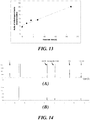
- FIG. 11 An exemplary integrated system including fermentation, extraction, and catalysis is shown in FIG. 11 .
- such an integrated system may be used for an ABE or IBE process.
- the methods described herein can convert a mixture of alcohols or a mixture of ketones and alcohols into a mixture of hydrocarbon ketones suitable for use as components in fuels (e.g., gasoline, jet and diesel fuels).
- fuels e.g., gasoline, jet and diesel fuels.
- the hydrocarbon ketone has a structure of formula (I): wherein each R 1 and R 2 is independently alkyl, alkenyl, alkynyl, cycloalkyl, aryl, or heteroaryl.
- alkyl refers to a monoradical unbranched or branched saturated hydrocarbon chain.
- alkyl has 1 to 20 carbon atoms ( i.e., C 1-20 alkyl), 1 to 10 carbon atoms ( i.e., C 1-10 alkyl), 1 to 8 carbon atoms ( i.e., C 1-8 alkyl), 1 to 6 carbon atoms ( i.e., C 1-6 alkyl), or 1 to 4 carbon atoms ( i.e., C 1-4 alkyl).
- alkyl groups include methyl, ethyl, propyl, isopropyl, n-butyl, sec-butyl, tert-butyl, pentyl, 2-pentyl, isopentyl, neopentyl, hexyl, 2-hexyl, 3-hexyl, and 3-methylpentyl.
- alkyl residue having a specific number of carbons all geometric isomers having that number of carbons may be encompassed; thus, for example, "butyl” can include n-butyl, sec-butyl, isobutyl and t-butyl; "propyl” can include n-propyl and isopropyl.
- Cycloalkyl refers to a cyclic alkyl group.
- cycloalkyl has from 3 to 20 ring carbon atoms ( i.e., C 3-20 cycloalkyl), or 3 to 12 ring carbon atoms ( i.e., C 3-12 cycloalkyl), or 3 to 8 ring carbon atoms ( i.e., C 3-8 cycloalkyl).
- Examples of cycloalkyl groups include cyclopropyl, cyclobutyl, cyclopentyl, and cyclohexyl.
- Aryl refers to an aromatic carbocyclic group having a single ring (e.g., phenyl), multiple rings ( e.g., biphenyl), or multiple fused rings ( e.g., naphthyl, fluorenyl, and anthryl).
- aryl has 6 to 20 ring carbon atoms ( i.e., C 6-20 aryl), or 6 to 12 carbon ring atoms ( i.e., C 6-12 aryl).
- Heteroaryl refers to an aryl group, wherein at least one carbon atom of the designated carbocyclic group has been replaced by a heteroatom selected from N, O and S.
- the hydrocarbon ketone is an alkanone.
- the alkyl chains of the alkanone may be linear or branched. Examples of alkanones include pentanone, heptanone, heptanone, nonanone, and undecanone.
- the alkanones have a linear arrangement, such as 2-pentanone, 4-heptanone, 2-heptanone, 4-nonanone, and 6-undecanone.
- the alkanones have a branched arrangement, such as 2-methyl-4-nonanone.
- alkanones include those with at least five carbons (C 5+ alkanones), at least seven carbons (C 7+ alkanones), at least nine carbons (C 9+ alkanones), or at least (C 11+ alkanones), or between five and twenty carbons (C 5 -C 20 alkanones), between seven and twenty carbons (C 7 -C 20 alkanones), or between eleven and twenty carbons (C 11 -C 20 alkanones).
- the starting materials, metal catalyst, base, solvent and/or reactions conditions can be selected to tune the yield of the hydrocarbon ketone product mixture.
- the metal catalyst, base, solvent and/or reactions conditions can be selected to favor double-alkylation and/or the production of heavier hydrocarbon ketones in the mixture.
- the term “yield” refers to the total amount of product relative to the amount of ketone precursor (e.g., secondary alcohol, such as isopropanol) or ketone (e.g., acetone) present in the starting reaction mixture.
- ketone precursor e.g., secondary alcohol, such as isopropanol
- ketone e.g., acetone
- the overall reaction yield refers to the combined molar yields of the ketone products, calculated with respect to the molar amount of ketone precursor or ketone present in the starting reaction mixture.
- the reaction conditions yield hydrocarbon ketones (e.g., alkanones) with molecular weights suitable for use as fuels.
- alkanones suitable for use as fuels may include those with at least 5 carbons, at least 7 carbons, or at least 11 carbons.
- the alkanones produced using the methods described herein are unbranched. In other embodiments, the alkanones produced are branched.
- the hydrocarbon ketone has a structure of formula (I): wherein each R 1 and R 2 is independently alkyl.
- R 1 and R 2 may be independently substituted or unsubstituted alkyls.
- the alkyls may be any length.
- each R 1 and R 2 is independently methyl, ethyl, propyl, isopropyl, butyl, pentyl, hexyl, heptyl, or octyl.
- the one or more compounds of Formula (I) are C 5 -C 19 ketones. In other embodiments, the one or more compounds of Formula (I) are C 5 -C 11 ketones. In yet other embodiments, the one or more compounds of Formula (I) are C 11 -C 19 ketones.
- the one or more compounds of Formula (I) may include
- At least one of one or more compounds of Formula (I) is a double-alkylated product.
- at least 50% of the product mixture is made up of one or more double-alkylated products.
- less than 20% of the product mixture is made up of one or more mono-alkylated products.
- the reaction mixture contains a ketone (e.g ., acetone) or a secondary alcohol such as isopropanol that is oxidized to a ketone
- a ketone e.g ., acetone
- a secondary alcohol such as isopropanol
- at least 5%, 10%, 20%, 30%, 40%, 50%, 60%, 70%, 80%, or 90% of the mixture of hydrocarbon ketones is produced from double alkylation of the ketone.
- at least 70% of the mixture of hydrocarbon ketones is produced from double alkylation of the ketone.
- at least 80% of the mixture of hydrocarbon ketones is produced from double alkylation of the ketone.
- at least 90% of the mixture of hydrocarbon ketones is produced from double alkylation of the ketone.
- the mixture of hydrocarbon ketones is a mixture of C 7+ hydrocarbon ketones. In some embodiments, at least 5%, 10%, 20%, 30%, 40%, 50%, 60%, 70%, 80%, or 90% of the mixture of hydrocarbon ketones is C 7+ ketones. In some embodiments, at least 70% of the mixture of hydrocarbon ketones is C 7+ ketones. In some embodiments, at least 80% of the mixture of hydrocarbon ketones is C 7+ ketones. In some embodiments, at least 90% of the mixture of hydrocarbon ketones is C 7+ ketones.
- the mixture of hydrocarbon ketones is a mixture of C 11+ hydrocarbon ketones. In some embodiments, at least 5%, 10%, 20%, 30%, 40%, 50%, 60%, 70%, 80%, or 90% of the mixture of hydrocarbon ketones is C 11+ ketones. In some embodiments, at least 30% of the mixture of hydrocarbon ketones is C 11+ ketones. In some embodiments, at least 40% of the mixture of hydrocarbon ketones is C 11+ ketones. In some embodiments, at least 50% of the mixture of hydrocarbon ketones is C 11+ ketones. In some embodiments, at least 60% of the mixture of hydrocarbon ketones is C 11+ ketones. In some embodiments, at least 70% of the mixture of hydrocarbon ketones is C 11+ ketones. In some embodiments, at least 80% of the mixture of hydrocarbon ketones is C 11+ ketones. In some embodiments, at least 90% of the mixture of hydrocarbon ketones is C 11+ ketones.
- the mixture of hydrocarbon ketones is a mixture of C 15+ hydrocarbon ketones. In some embodiments, at least 5%, 10%, 20%, 30%, 40%, 50%, 60%, 70%, 80%, or 90% of the mixture of hydrocarbon ketones is C 15+ ketones. In some embodiments, at least 30% of the mixture of hydrocarbon ketones is C 15+ ketones. In some embodiments, at least 40% of the mixture of hydrocarbon ketones is C 15+ ketones. In some embodiments, at least 50% of the mixture of hydrocarbon ketones is C 15+ ketones. In some embodiments, at least 60% of the mixture of hydrocarbon ketones is C 15+ ketones. In some embodiments, at least 70% of the mixture of hydrocarbon ketones is C 15+ ketones. In some embodiments, at least 80% of the mixture of hydrocarbon ketones is C 15+ ketones. In some embodiments, at least 90% of the mixture of hydrocarbon ketones is C 15+ ketones.
- the mixture of hydrocarbon ketones is a mixture of C 7 -C 19 hydrocarbon ketones. In some embodiments, at least 5%, 10%, 20%, 30%, 40%, 50%, 60%, 70%, 80%, or 90% of the mixture of hydrocarbon ketones is C 7 -C 19 ketones. In some embodiments, at least 70% of the mixture of hydrocarbon ketones is C 7 -C 19 ketones. In some embodiments, at least 80% of the mixture of hydrocarbon ketones is C 7 -C 19 ketones. In some embodiments, at least 90% of the mixture of hydrocarbon ketones is C 7 -C 19 ketones.
- the mixture of hydrocarbon ketones is a mixture of C 7 -C 15 hydrocarbon ketones. In some embodiments, at least 5%, 10%, 20%, 30%, 40%, 50%, 60%, 70%, 80%, or 90% of the mixture of hydrocarbon ketones is C 7 -C 15 ketones. In some embodiments, at least 70% of the mixture of hydrocarbon ketones is C 7 -C 15 ketones. In some embodiments, at least 80% of the mixture of hydrocarbon ketones is C 7 -C 15 ketones. In some embodiments, at least 90% of the mixture of hydrocarbon ketones is C 7 -C 15 ketones.
- the mixture of hydrocarbon ketones is selected from the group consisting of 2-pentanone, 4-heptanone, 2-heptanone, 4-nonanone, 2-methyl-4-nonanone, 6-undecanone, 5-ethylundecan-6-one, 5,7-diethylundecan-6-one, 5,7-dibutylundecan-6-one, 9-ethyltridecan-6-one, 5,11-diethylpentadecan-8-one, 5-butylundecan-6-one, 5-butyl-7-ethylundecan-6-one, and any combinations thereof.
- the mixture of hydrocarbon ketones is selected from the group consisting of 2-pentanone, 4-heptanone, 2-heptanone, 4-nonanone, 2-methyl-4-nonanone, 6-undecanone, and any combinations thereof.
- at least 20% of the mixture of hydrocarbon ketones is C 7+ hydrocarbon ketones. In some embodiments, at least 20% of the mixture of hydrocarbon ketones is C 11+ hydrocarbon ketones.
- metal catalyst can lead to a significant increase in rate of the formation of higher hydrocarbon ketones, including, for example, C 11+ hydrocarbon ketones.
- Metal catalyst containing two or more metals may lead to the increase in rate of formation of higher hydrocarbon ketones, such as a Pd/Cu alloy.
- the alloy may have a molar excess of Pd compared to Cu ( e.g., a 2:1 molar ratio of Pd:Cu), or a molar excess of Cu compared to Pd ( e.g., a 1:2 molar ratio of Pd:Cu), or a 1:1 molar ratio of metals.
- metal catalyst including two or more metals forms C 5 -C 11 ketones at a rate 2.5 times the rate of formation of C 5 -C 11 ketones by metal catalyst including one of the two or more metals. In some embodiments, metal catalyst including two or more metals forms C 5 -C 11 ketones at a rate 5.6 times the rate of formation of C 5 -C 11 ketones by metal catalyst including one of the two or more metals. In some embodiments, metal catalyst including two or more metals forms C 11+ ketones at a rate 33 times the rate of formation of C 11+ ketones by metal catalyst including one of the two or more metals.
- the rate of formation of the ketone products may be measured by a variety of techniques, including analysis of the reaction mixture at various time intervals by GC analysis.
- these one or more compounds may be further hydrogenated, deformylated, isomerized, hydrodeoxygenated, or catalytically reformed.
- the double-alkylated products may be subsequently converted to either corresponding alcohols or alkanes, suitable for the manufacture of a fuel.
- hydrocarbon ketones are also methods to further convert one or more of the hydrocarbon ketones into one or more alcohols suitable for use as fuels.
- alcohols may include:
- the one or more compounds of Formula (I) may be converted into their corresponding alcohols in the presence of metal catalyst.
- the one or more compounds of Formula (I) may be converted into their corresponding alkanes in the presence of metal catalyst.
- ketones such as 4-heptanone, 4-nonanone, and 6-undecanone, produced by the methods disclosed herein may be further deoxygenated to produce heptane, nonane, and undecane, respectively.
- alkanes may be blended into diesel and jet fuel, or may be used independently as fuels following minor refinery upgrading.
- the double-alkylated products obtained from the process described herein may be suitable for use as fuels that can power transportation vehicles (e.g., jets, diesel vehicles) and other combustion turbine applications.
- each of the compounds of Formula (I), or each of the alkanones, in the product mixture can be separated before use in producing the corresponding alcohol or alkane.
- fuel refers to a composition made up of a compound containing at least one carbon-hydrogen bond, which produces heat and power when burned. Fuel may be produced using plant-derived biomass as a feedstock, for example, lignocellulose. Fuel may also contain more than one type of compound, and includes mixtures of compounds.
- transportation fuel refers to a fuel that is suitable for use as a power source for transportation vehicles. Suitable fuels may include, for example, gasoline, jet and diesel fuels.
- Fuels or fuel components may also be obtained from the Guerbet reaction that may take place.
- the dimerization of butanol via Guerbet reaction may be followed by alkylation with acetone or 2-butanone in a one-pot two-step process to yield one or more ketones ranging from C 11 -C 27 .
- compositions that include a fuel (e.g., gasoline, jet or diesel) and one or more hydrocarbon ketones, or a mixture of hydrocarbon ketones, produced according to any of the methods described herein.
- a fuel e.g., gasoline, jet or diesel
- hydrocarbon ketones e.g., gasoline, jet or diesel
- the composition is a gasoline fuel composition that includes a gasoline fuel or a gasoline blending stock, and one or more hydrocarbon ketones, or any derivatives thereof (e.g., alcohols, alkanes), that are produced according to any of the methods described herein.
- the one or more hydrocarbon ketones are C 5 -C 7 hydrocarbon ketones.
- the composition is a jet fuel composition that includes a jet fuel or a jet blending stock, and one or more hydrocarbon ketones, or any derivatives thereof (e.g., alcohols, alkanes), that are produced according to any of the methods described herein.
- the one or more hydrocarbon ketones are C 7 -C 11 hydrocarbon ketones.
- the composition is a diesel fuel composition that includes a diesel fuel or a diesel blending stock, and one or more hydrocarbon ketones, or any derivatives thereof (e.g ., alcohols, alkanes), that are produced according to any of the methods described herein.
- the one or more hydrocarbon ketones are one or more C 7+ hydrocarbon ketones.
- the term "about” refers to an approximation of a stated value within an acceptable range. Preferably, the range is +/- 10% of the stated value.
- This Example demonstrates the production of a mixture of alkanones from an acetone-butanol-ethanol (ABE) starting mixture using a metal/hydrotalcite catalyst.
- the metal/hydrotalcite catalysts used in this Example were prepared according to the following procedures.
- the Q-tube was sealed and the reaction mixture was stirred for 24 hours at 240°C in a pre-heated metal block.
- the reaction mixture was cooled to room temperature and dodecane (internal standard) was added.
- the reaction mixture was diluted with tetrahydrofuran and the GC analysis of the reaction mixture was carried out.
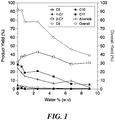
- This Example demonstrates the effect of water on the alkylation reaction of an ABE mixture.
- the reaction was performed according to the procedure described in Example 1 above, using the following acetone (2.3 mmol), butanol (2 mL), ethanol, (1 mmol), 3.2 wt% Cu/HT (0.8 mol%), H 2 O (wt%) at 240 °C for 24 hours.
- Different weight percentages of water with respect to the total weight of ABE used in the reaction was added to the reaction mixture.
- This Example demonstrates the reusability of Pd/HT and Cu/HT.
- 0.5 wt% Pd/HT (0.15 mol%) or 3.2 wt% Cu/HT (0.8 mol%) were reacted with acetone (2.3 mmol), butanol (2 mL), and ethanol (1 mmol) at 240°C for 24 hours according to the procedure described in Example 1 above.
- the catalysts were subsequently separated from their liquid supernatant by centrifugation. The supernatants were removed and the catalysts dried and washed with ethanol before applying the respective catalysts to another cycle of acetone alkylation.
- Table 2 summarizes the results of the Pd/HT recycling experiments.
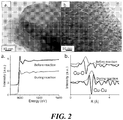
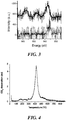
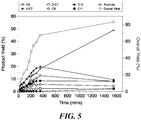
- Example 2 demonstrates the characterization of the Cu/HT used in Example 1 above. Standard techniques were used to characterize the catalyst to evaluate the activity of Cu/HT.
- Cu/HT was prepared according to the procedure in Example 1 above.
- the high-resolution transmission electron microscope (HR-TEM) images of Cu/HT catalyst were obtained, and indicated the formation of Cu clusters with diameter of 2 ⁇ 1 nm loaded on 150 ⁇ 50 nm HT support ( FIG. 2 ).
- the clusters were analyzed by extended x-ray absorption fine structures (EXAFS) and x-ray photoelectron spectroscopy (XPS).
- EXAFS extended x-ray absorption fine structures
- XPS x-ray photoelectron spectroscopy
- the x-ray absorption measurements showed that CuO is the main species in the heterogeneous Cu/HT catalyst. Similar results were obtained by XPS measurements ( FIG. 3 ). In-situ EXAFS measurements showed that CuO was reduced to Cu(0) at 250°C under continuous flow of the ABE mixture, prior to the formation of products ( FIG. 2 ).
- TBD Temperature desorption studies was used to determine the surface basicity of Cu/HT.
- Cu/HT was prepared according to the procedure in Example 1 above. The catalyst was treated under a stream of CO 2 at ambient temperature and pressure for 30 minutes after which the pretreated sample was placed in a Netzsch TGA-MS and heated to 900°C at a ramp rate of 5 °C/min, while monitoring the weight of the sample and the total ion current from the gas stream. Maximum CO 2 desorption was seen at 419°C in the TBD profile ( FIG. 4 ).
- This Example compares the production of alkanones from an acetone-butanol-ethanol (ABE) and isopropanol-butanol-ethanol (IBE) starting mixture using a metal/hydrotalcite catalyst.
- C 11+ hydrocarbon ketones such as C 13 , C 15 and C 19 ketones
- 2-ethyl hexanal can be produced via dimerization reaction of butanal, which is a slow process compared to the alkylation reaction of acetone under our reaction conditions. See FIG. 10 .
- This Example demonstrates the production of a mixture of linear and branched alkanones using 2-butanol as the secondary alcohol and one or two primary alcohols, e.g., n-butanol and ethanol.
- This Example demonstrates the production of IBE from fermentation of C. acetobutylicum.
- Clostridium acetobutylicum was routinely stored and grown out of anaerobic -80C glycerol stocks. Cultures were grown in CGM: glucose (6%), yeast extract (5.0 gl -1 ), ammonium acetate (2.0 gl -1 ), NaCl (1.0 gl -1 ), K 2 HPO 4 (0.75 gl -1 ), KH 2 PO 4 (0.75 gl -1 ), cysteine-HCl (0.5 gl -1 ), MgSO 4 .7H 2 O (0.4 gl -1 ), FeSO 4 .7H 2 O (0.04 gl -1 ), MnSO 4 .H 2 O (0.02 gl -1 ).
- CGM glucose (6%), yeast extract (5.0 gl -1 ), ammonium acetate (2.0 gl -1 ), NaCl (1.0 gl -1 ), K 2 HPO 4 (0.75 gl -1 ), KH 2 PO 4 (0
- Recombinant strains of C. acetobutylicum were supplemented with 80 mgl -1 erythromycin.
- Recombinant E. coli strains were grown in Luria broth medium supplemented with the appropriate antibioitics carbenicillin (100 mgl -1) and chloramphenicol (35 mgl -1 ).
- E. coli Top10 was used to propagate all plasmids before expression in C . acetobutylicum ATCC824. Methylation of all plasmids prior to transformation in ATCC824 was carried out with the pANl plasmid as previously described. See Mermelstein, L. D.; Papoutsakis, E. T. Applied and environmental microbiology 1993, 59, 1077-81 . Table 6.
- the pIMP1 Clostridium/E. coli shuttle vector generously provided by the Papoutsakis group, was used to construct all of the strains for this study.
- the construction of a synthetic acetone operon containing C . acetobutylicum adc_ctfa_ctfb genes was achieved as previously described. See Mermelstein, L. D.; Papoutsakis, E. T.; Petersen, D. J.; Bennett, G. N. Biotechnology and bioengineering 1993, 42, 1053-60 .
- DNA fragments to construct this operon were PCR amplified from genomic DNA. Primers used and the restriction sites inserted in the operon can be found in Table 7 below. This operon was expressed under control of the native C .
- the sequence for the sadh gene was identified from C . beijerinkcii strain B593 and synthesized by GeneArt® under the control of the C . acetobutylicum ATCC824 adc promoter and terminator.
- the synthesized SADH construct was cloned upstream of the synthetic acetone operon by restriction digest with SfoI / EcoRI followed by ligation to produce pSACE.
- the final construct sequence was verified before transformation into ATCC824. Transformation of the pSACE plasmid into C . acetobutylicum was performed by electroporation as previously described. Two days after transformation colonies were picked and PCR sequenced to verify the presence of the pSACE plasmid.
- Clostridium acetobutylicum ATCC824 was transformed into an isopropanol, 1-butanol, ethanol production strain through expression of the secondary alcohol dehydrogenase from Clostridium beijerinckii strain B593 under the control of the acetoacetate decarboxylase promoter and terminator. Increased isopropanol production was achieved by over-expression of both the CoA-transferase (ctfA/B) and acetoacetate decarboxylase (adc) genes. The aforementioned genes were also expressed under control of the acetoacetate decarboxylase promoter. See FIG 7A & 7B .
- a synthetic mixture was prepared with ethanol (5gl -1 ), isopropanol (5gl -1 ), and 1-butanol (10gl -1 ).
- a 1-L batch fermentation of the SACE strain produced in Example 11 was conducted and 21.5 g l -1 of alcohols (6.2 g l -1 isopropanol, 3.8 g l -1 ethanol, and 11.5 g l -1 butanol) were produced from 54 g/L of glucose in 35 hours.
- the results after 46 hours are summarized in FIG. 6 .
- Extractive fermentations were operated in fed-batch mode with intermittent addition of a concentrated media solution containing 500 gl -1 glucose and 50 gl -1 yeast extract.
- 500 mL of N 2 degassed oleyl alcohol was added to the 1L fermentation broth 16 hours after inoculation.
- Isopropanol, 1-butanol, and ethanol concentrations were measured in the extractant phase by GC/FID.
- This Example demonstrates the effect of varying pH on isopropanol production from fermentation using the SACE strain produced according to the methods in Example 11 above.
- Acetate was added to regulate pH after solventogenesis and drive isopropanol production.
- Early initiation of isopropanol production (8 hours).
- Significant ethanol production was observed after isopropanol production stalled (25 hours).
- Butanol yield was observed to be 0.2 g/g gluc
- isopropanol-butanol-ethanol yield was observed to be 0.38 g/g gluc . See FIG. 8 .
- This Example demonstrates an IBE extractive fermentation using oleyl alcohol as an extractant.
- Fed batch fermentation was performed, using an initial glucose concentration of 65 g/L.
- the volume ratio of media to oleyl alcohol used was 2:1 on a 1.5 L scale.
- the pH was controlled at ⁇ 5.0.
- Concentrated media 500 g/L glucose and 50 g/L yeast extract was added periodically.
- Oleyl alcohol was added once pH was observed to begin to increase (after 16 hours). N 2 sparging was suspended after oleyl alcohol addition.
- This Example demonstrates the effect of combining carbon or zeolite with the hydrotalcite catalyst on reaction yield.
- the reaction was performed according to the procedure described in Example 1 above and in accordance with the conditions in the reaction scheme above, using the following: acetone (4.6 mmol), butanol (5.52 mL), ethanol, (5.52 mmol), the type and amount of catalyst and the amount of water used as specified in the Table 9 below. Table 9.
- the yields observed were higher in the presence of carbon or zeolite compared to the yields observed when the carbon or zeolite was not added.
- higher yields of dialkylated compounds such as 6-C11 and 2-C9 were observed when the reactions in this Example were performed in the presence of carbon or zeolite.
- This Example demonstrates the effects in the phase and surface area of the hydrotalcite-based catalysts over the course of reactions in the liquid and gas phases.
- Gas-phase flow reactor study About 300 mg of catalyst were placed in a quartz frit on the inside of a tubular reactor. A gas mixture consisting of 85 kPa He and 15 kPa ABE mix was passed over the catalyst at a temperature of 473 K. The reactor effluent was analyzed by online gas chromatography.
- Liquid-phase flow reactor study 1g of Pd-Cu/HT catalyst was placed on a stainless steel frit in a tubular stainless steel reactor. A liquid ABE mix was passed over the catalyst at a temperature of 513 K and the effluent of the reactor was collected and analyzed by GC offline.
- the surface area of the Pd-Cu/HT catalysts was observed to decrease as the batch reaction time increases.
- X-ray diffraction patterns of the catalyst in the reaction mixture taken at different times during the reaction also indicated that the catalyst partially changed structure, from the cubic periclase structure to the lamellar hydrotalcite structure.
- Diffraction patterns of spent catalysts also showed a broad peak centered around 38 degrees 2 ⁇ , which may correspond to an amorphous hydrated magnesium/aluminum oxide phase. This structural transition has been attributed to the formation of water during the reaction and the reaction of this water with the Mg 6 Al 2 O 9 oxide to form the lower-surface-area lamellar structure.
- the ratio of decarbonylation to dehydrogenation was observed to decrease as the catalyst ages. Less carbon loss and defunctionalization was observed as a result of decarbonylation. This behavior may be attributed to increased alloying of Pd and Cu during reaction, resulting in a more selective catalyst.
- This Example demonstrates the effect of various hydrotalcite catalysts on decarbonylation in the Guerbet reaction of 1-octanol.
- the reaction was performed according to the procedure described in Example 1 above and in accordance with the conditions in the reaction scheme above, using the following: 1-octanol (3 mmol), the catalyst described in Table 10 below (100 mg). Selectivity was determined by GC. Table 10. No. Catalyst (0.9 mol%) Conv.
- the catalyst for reaction no. 4 was obtained by passing mixture of acetone and ethanol over the fresh catalyst at 250 °C for 24 hours. Improved selectivity for C16-OH was observed. Impregnating HT on carbon support was observed to further suppress decarbonylation.
- FIGS. 14A (Pd-Cu/HT) and 14B (Pd-Cu/5% HT/C) compare the products formed from the reaction above. As seen in FIG. 14B , when HT was impregnated on carbon support, decarbonylation was suppressed.
- the reaction was performed according to the procedure described in Example 1 above and in accordance with the conditions set forth under each table below.
- metal oxides impregnated on carbon were prepared by incipient wetness impregnation of an aqueous solution of the metal nitrate(s) onto the carbon support.
- the solid was dried at 110 C at ambient air and treated under a flow of He (100 ml/min) at 400°C or 500°C for 4h (5 °C / min).
- metal oxides impregnated diverse supports e.g ., La2O3, TiO2, HT, and SiO 2
- the solid was dried at 110 C at ambient air and calcined under stagnant ambient air at 300 to 900 C (1 to 10 C/min ramp rate).
- HiFuel® refers to a Cu/ZnO/Al 2 O 3 catalyst that was obtained from a commercially available source. HiFuel® may be prepared by coprecipitation of Cu, Zn, and Al oxides followed by reduction. The catalysts in Table 11 above were obtained or prepared as follows:
- Reaction conditions 4.6 mmol acetone, 7.4 mmol butanol, 2 mmol ethanol, 350 mg of the catalyst set forth in Table 14 above (and 25 mg HiFuel®, 70 mg Pd/C, where applicable), reacted for 2 hours at 250 °C.
- a mixture of the three catalysts listed in Table 15 above for each reaction was used, and the three catalysts were obtained from commercially available sources or prepared as described herein.
- La 2 O 3 may be prepared from the calcination of La 2 (C 2 O 4 ) 3 or La 2 (NO 3 ) 3 (as indicated in Table 14 above) at or above 500°C.
- This Example demonstrates the effect of various catalysts on the acetone-butanol-(2-ethylhexanol) reaction.
- the reaction was performed according to the procedure described in Example 1 above and in accordance with the following conditions: 4.60 mmol acetone, 5.52 mmol butanol, 5.52 mmol 2-ethylhexanol, 350 mg of the catalyst set forth in Table 14 above (and 25 mg HiFuel®, 70 mg Pd/C, where applicable), reacted for 2 hours at 250 °C.
- a mixture of the catalysts listed in Table 15 below for each reaction was used, and the catalysts were obtained from commercially available sources or prepared as described herein. Table 15.
Landscapes
- Chemical & Material Sciences (AREA)
- Organic Chemistry (AREA)
- Chemical Kinetics & Catalysis (AREA)
- Engineering & Computer Science (AREA)
- Oil, Petroleum & Natural Gas (AREA)
- General Chemical & Material Sciences (AREA)
- Wood Science & Technology (AREA)
- Zoology (AREA)
- Life Sciences & Earth Sciences (AREA)
- Microbiology (AREA)
- Biotechnology (AREA)
- Health & Medical Sciences (AREA)
- Biochemistry (AREA)
- Bioinformatics & Cheminformatics (AREA)
- General Engineering & Computer Science (AREA)
- General Health & Medical Sciences (AREA)
- Genetics & Genomics (AREA)
- Computer Networks & Wireless Communication (AREA)
- Signal Processing (AREA)
- Organic Low-Molecular-Weight Compounds And Preparation Thereof (AREA)
- Catalysts (AREA)
- Liquid Carbonaceous Fuels (AREA)
- Preparation Of Compounds By Using Micro-Organisms (AREA)
- Business, Economics & Management (AREA)
- Marketing (AREA)
- Finance (AREA)
- Economics (AREA)
- Strategic Management (AREA)
- Physics & Mathematics (AREA)
- General Business, Economics & Management (AREA)
- General Physics & Mathematics (AREA)
- Theoretical Computer Science (AREA)
- Development Economics (AREA)
- Accounting & Taxation (AREA)
- Exhaust Gas After Treatment (AREA)
Claims (9)
- Procédé de production d'un mélange d'hydrocarbures cétones, comprenant la mise en contact de l'acétone et d'au moins deux alcools primaires avec un catalyseur et éventuellement une base pour produire un mélange d'hydrocarbures cétones,
le catalyseur comprenant Pd, Cu et hydrotalcite (HT). - Procédé de production d'un mélange d'hydrocarbures cétones, comprenant(i) la mise en contact de deux ou plusieurs alcools avec un catalyseur de métal et éventuellement une base pour produire un mélange d'hydrocarbures cétones, au moins l'un des deux ou plusieurs alcools est un alcool secondaire, ou(ii) la mise en contact d'un alcool secondaire et d'un ou de plusieurs alcools avec un catalyseur de métal et éventuellement une base pour produire un mélange d'hydrocarbures cétones ;
le catalyseur comprenant Pd, Cu et hydrotalcite (HT). - Procédé selon la revendication 2, dans lequel :(a) les deux ou plusieurs alcools sont :(i) l'isopropanol et le n-butanol ;(ii) l'isopropanol, le n-butanol et l'éthanol ; ou(iii) le 2-butanol, le n-butanol et l'éthanol ; ou(b) l'alcool secondaire est l'isopropanol, le 2-butanol, le 2-pentanol, le 2-hexanol, le 2-heptanol, le 2-octanol, le 2-nonanol, le 2-décanol, le 2-undécanol, le 2-dodécanol, le 2-tridécanol, le 2-tétradécanol, le 2-pentadécanol, le 2-hexadécanol, le 2-heptadécanol, le 2-octadécanol, le 2-nonadécanol, le 2-icananol, le 2,3-butanediol, l'acétoïne ou toute combinaison de ceux-ci, ou(c) l'un ou plusieurs alcools primaires sont le n-butanol, l'éthanol ou le 2-éthylhexanol, ou toute combinaison de ceux-ci ; ou(d) l'alcool secondaire est l'isopropanol, l'un ou plusieurs alcools primaires sont le butanol et l'éthanol ; ou(e) l'alcool secondaire est le 2-butanol, et l'un ou plusieurs alcools primaires sont le n-butanol, l'éthanol ou toute combinaison de ceux-ci ; ou toute combinaison de (a) et de (b).
- Procédé selon la revendication 2, dans lequel :les deux ou plusieurs alcools sont l'isopropanol, le butanol et l'éthanol ; oul'alcool secondaire est l'isopropanol et l'un ou plusieurs alcools primaires sont le butanol et l'éthanol ;dans lequel le procédé comprend en outre :a) la mise en contact d'une biomasse ou de sucres avec un hôte de fermentation pour produire un mélange de produits de fermentation, le mélange de produits de fermentation comprenant l'isopropanol, le butanol et l'éthanol ; etb) l'isolement d'au moins une partie de l'isopropanol, du butanol et de l'éthanol du mélange de produits de fermentation avant la mise en contact de l'isopropanol, du butanol et de l'éthanol avec un catalyseur de métal et éventuellement une base.
- Procédé selon l'une quelconque des revendications 1 à 4, dans lequel :(a) Pd et Cu sont coprécipités ou imprégnés sur le HT ; ou(b) le HT est coprécipité ou imprégné sur du carbone pour former un support, et Pd et Cu sont coprécipités ou imprégnés sur le support ; ou(c) le HT est mélangé avec du carbone pour former un support, et Pd et Cu sont coprécipités ou imprégnés sur le support.
- Procédé selon l'une quelconque des revendications 1 à 4, dans lequel :(i) au moins une partie du mélange d'hydrocarbures cétones est produite par double alkylation de l'acétone ; ou(ii) au moins 70% du mélange d'hydrocarbures cétones sont produits par double alkylation de l'acétone ; ou(iii) l'alcool secondaire est oxydé pour produire une cétone, et au moins une partie du mélange d'hydrocarbures cétones est produite par double alkylation de la cétone ; ou(iv) l'alcool secondaire est oxydé pour produire une cétone, et au moins 70% du mélange d'hydrocarbures cétones est produite par double alkylation de la cétone ; ou(v) le mélange d'hydrocarbures cétones est un mélange d'hydrocarbures cétones en C5-15 ; ou(vi) le mélange d'hydrocarbures cétones est choisi dans le groupe consistant en 2-pentanone, 4-heptanone, 2-heptanone, 4-nonanone, 2-méthyl-4-nonanone, 6- undécanone, 5-éthylundécanone-6-one, 5,7-diéthylundécanique-6, 5,7-dibutylundécanane-6-one, 9-éthyltridécanane-6, 5,11-diéthylpentadécanane-8-one, 5-butylundécanone-6-one, 5-butyl-7-éthylundécanone-6-one et toute combinaison de ceux-ci ; ou
toute combinaison de (i) à (vi). - Procédé selon l'une quelconque des revendications 1 à 6, dans lequel :(i) au moins 70% du mélange d'hydrocarbures cétones est hydrocarbures cétones en C7+ ;(ii) au moins 40% du mélange d'hydrocarbures cétones est hydrocarbures cétones en C11+.
- Procédé selon l'une quelconque des revendications 1 à 7, dans lequel la base est choisie dans le groupe constitué de K3PO4, KOH, Ba(OH)2.8H2O, K2CO3, KOAc, KH2PO4, Na2HPO4, pyridine, Et3N et toute combinaison de ceux-ci.
- Procédé selon l'une quelconque des revendications 1 à 8, dans lequel le catalyseur de métal comprend :Pd-Cu/HT ;Pd-Cu/HT/C ;Pd-Cu/HT et zéolite ;Pd-Cu/HT/C et zéolite ;Pd-Cu/HT et TiO2 ;Pd-Cu/HT-C et TiO2 ;Pd-Cu/HT/C et TiO2 ;Pd-Cu/C et HT ;Pd-Cu/HT-C ;Pd-Cu/NiHT ;PdCu/ZnHT ;Pd-Cu/ZnHT ;Cu/SiO2, Pd/C et HT/C ;Cu/SiO2, Pd/C et HT ;Cu/ZnO/Al2O3, Pd/C et HT ; ouPd-Cu/ZnO/HT.
Applications Claiming Priority (2)
| Application Number | Priority Date | Filing Date | Title |
|---|---|---|---|
| US201361816617P | 2013-04-26 | 2013-04-26 | |
| PCT/US2014/035545 WO2014176552A2 (fr) | 2013-04-26 | 2014-04-25 | Procédés pour produire des carburants |
Publications (2)
| Publication Number | Publication Date |
|---|---|
| EP2989073A2 EP2989073A2 (fr) | 2016-03-02 |
| EP2989073B1 true EP2989073B1 (fr) | 2020-06-03 |
Family
ID=51136764
Family Applications (1)
| Application Number | Title | Priority Date | Filing Date |
|---|---|---|---|
| EP14736493.9A Not-in-force EP2989073B1 (fr) | 2013-04-26 | 2014-04-25 | Procédés pour produire des carburants |
Country Status (6)
| Country | Link |
|---|---|
| US (1) | US9790444B2 (fr) |
| EP (1) | EP2989073B1 (fr) |
| CN (1) | CN105308015A (fr) |
| BR (1) | BR112015027037A2 (fr) |
| EA (1) | EA032556B1 (fr) |
| WO (1) | WO2014176552A2 (fr) |
Families Citing this family (20)
| Publication number | Priority date | Publication date | Assignee | Title |
|---|---|---|---|---|
| EP3212602A1 (fr) * | 2014-10-29 | 2017-09-06 | The Regents of the University of California | Procédés de production de carburants, d'additifs pour essence et de lubrifiants à l'aide de catalyseurs aminés |
| BR112017008899A2 (pt) | 2014-10-29 | 2017-12-19 | Bp Corp North America Inc | métodos para produzir combustíveis, aditivos de gasolina e lubrificantes usando catalisadores de amina |
| US9822053B2 (en) * | 2016-01-28 | 2017-11-21 | Eastman Chemical Company | Single step conversion of N-butyraldehyde to 2-ethylhexanal |
| CN105567551A (zh) * | 2016-03-14 | 2016-05-11 | 大连理工大学 | 一种生产c5-c19烷酮的系统及方法 |
| WO2017201644A1 (fr) * | 2016-05-23 | 2017-11-30 | 中国石油天然气股份有限公司 | Catalyseur d'hydrogénation sur support à base de palladium et son procédé de préparation et son application |
| CN106345512B (zh) * | 2016-08-03 | 2019-03-05 | 江苏大学 | 一种二元合金催化剂及其制备方法和用途 |
| EP3301144B1 (fr) | 2016-09-29 | 2021-03-17 | Neste Oyj | Gazole comprenant du 5-nonanone |
| CN108002994B (zh) * | 2016-10-31 | 2021-03-30 | 中国科学院大连化学物理研究所 | 一种制备高碳酮的方法 |
| CN108117480B (zh) * | 2016-11-26 | 2021-09-03 | 中国科学院大连化学物理研究所 | 一种催化转化甲醇和乙醇混合液制备异丁醇的方法 |
| KR101919371B1 (ko) * | 2017-01-11 | 2019-02-08 | 한양대학교 산학협력단 | 바이오매스의 발효 생성물로부터 지방족 케톤을 제조하기 위한 촉매 및 이의 제조방법 |
| CN109422638B (zh) * | 2017-08-31 | 2021-11-23 | 中国科学院大连化学物理研究所 | Abe发酵液转化制备酮类化合物方法 |
| CN109422630B (zh) * | 2017-08-31 | 2021-12-14 | 中国科学院大连化学物理研究所 | 乙酸与乙醇两段法制备酮类化合物 |
| CN110465298B (zh) * | 2019-08-29 | 2022-01-28 | 湘潭大学 | 一种用于糖类发酵产物abe直接制备长碳链化合物的催化剂及其制备方法 |
| CN110976906B (zh) * | 2019-12-04 | 2021-07-27 | 山西大学 | 一种荧光钯纳米簇及其合成方法和应用 |
| US12454497B2 (en) * | 2020-06-02 | 2025-10-28 | Alliance For Sustainable Energy, Llc | Fuels and methods of making the same |
| CN111647449B (zh) * | 2020-06-17 | 2022-06-21 | 北京化工大学 | 一种高性能航空替代燃料及其制备方法 |
| BR102020020883A2 (pt) * | 2020-10-09 | 2022-04-26 | Petróleo Brasileiro S.A. - Petrobras | Processo para produção de querosene de aviação renovável |
| LT4141090T (lt) | 2021-08-31 | 2023-11-27 | Swedish Biofuels Ab | Variklių kuro gamybos iš etanolio būdas |
| GEAP202416468A (en) | 2021-08-31 | 2024-05-10 | Swedish Biofuels Ab | Method for producing motor fuel from ethanol |
| CN113991083A (zh) * | 2021-10-27 | 2022-01-28 | 长沙矿冶研究院有限责任公司 | 一种基于氧化镧纳米棒的锂硫电池正极材料的制备方法 |
Family Cites Families (41)
| Publication number | Priority date | Publication date | Assignee | Title |
|---|---|---|---|---|
| GB400384A (en) * | 1932-08-15 | 1933-10-26 | Degussa | Improvements relating to the production of higher ketones |
| US2434631A (en) | 1945-02-10 | 1948-01-13 | Shell Dev | Hydrolysis of acetone autocondensation products |
| GB723280A (en) | 1951-10-22 | 1955-02-02 | Bataafsche Petroleum | Improvements in or relating to the production of ketones |
| US3781307A (en) | 1969-08-12 | 1973-12-25 | Rhone Poulenc Sa | Ruthenium catalyzed process for the alkylation of ketones |
| DE2257675A1 (de) | 1972-11-24 | 1974-05-30 | Hoechst Ag | Verfahren zur alkylierung von ketonen |
| US4250259A (en) | 1979-03-30 | 1981-02-10 | Exxon Research & Engineering Co. | Microbiological production of ketones from C3 -C6 secondary alcohols |
| US5550300A (en) | 1994-12-30 | 1996-08-27 | Texaco Chemical Inc. | Gradient catalyst system for the integrated production of isopropyl alcohol and diisopropyl ethers |
| US5817593A (en) | 1995-06-02 | 1998-10-06 | The Dow Chemical Company | Catalyst and process for producing amines |
| IL132883A0 (en) | 1997-05-14 | 2001-03-19 | Univ Illinois | A method of producing butanol using a mutant strain of clostridium beijerinckii |
| US20050089979A1 (en) | 2003-09-18 | 2005-04-28 | Ezeji Thaddeus C. | Process for continuous solvent production |
| US20070275447A1 (en) | 2006-05-25 | 2007-11-29 | Lewis Randy S | Indirect or direct fermentation of biomass to fuel alcohol |
| US20090030239A1 (en) | 2006-06-16 | 2009-01-29 | D Amore Michael B | Process for making butenes from aqueous isobutanol |
| US20080015397A1 (en) | 2006-06-16 | 2008-01-17 | D Amore Michael B | Process for making isooctenes from aqueous 1-butanol |
| US20090036716A1 (en) | 2006-06-16 | 2009-02-05 | D Amore Michael B | Process for making dibutyl ethers from aqueous 1-butanol |
| US20080015395A1 (en) | 2006-06-16 | 2008-01-17 | D Amore Michael B | Process for making butenes from aqueous 1-butanol |
| US20080103337A1 (en) | 2006-06-16 | 2008-05-01 | D Amore Michael B | Process for making dibutyl ethers from aqueous isobutanol |
| US8556999B2 (en) | 2007-07-27 | 2013-10-15 | Swift Fuels, Llc | Renewable engine fuel and method of producing same |
| US8049048B2 (en) | 2006-07-27 | 2011-11-01 | Swift Enterprises, Ltd. | Renewable engine fuel |
| US20080132732A1 (en) | 2006-12-01 | 2008-06-05 | Leo Ernest Manzer | Process for making butenes from aqueous 2-butanol |
| US20080132733A1 (en) | 2006-12-01 | 2008-06-05 | Leo Ernest Manzer | Process for making dibutyl ethers from aqueous 2-butanol |
| US20080132730A1 (en) | 2006-12-01 | 2008-06-05 | Leo Ernest Manzer | Process for making butenes from dry 2-butanol |
| MX316324B (es) | 2007-03-08 | 2013-12-11 | Virent Energy Systems Inc | Sintesis de combustibles liquidos y quimicos de hidrocarburos oxigenados. |
| WO2008111941A2 (fr) | 2007-03-14 | 2008-09-18 | Fangxiao Yang | Procédé et système pour production de butanol |
| WO2008124490A1 (fr) | 2007-04-03 | 2008-10-16 | The Ohio State University | Procédés de production du butanol |
| KR100926128B1 (ko) | 2007-06-19 | 2009-11-11 | 포항공과대학교 산학협력단 | 자성체 나노촉매 및 이의 제조 방법 |
| WO2009036076A1 (fr) | 2007-09-11 | 2009-03-19 | Tetravitae Bioscience, Inc. | Procédé pour la production de solvant à l'aide d'adsorption en phase liquide |
| FR2921385B1 (fr) | 2007-09-21 | 2010-02-26 | Inst Francais Du Petrole | Procede de transformation de biomasse en produits renfermant des groupements acetals et leur utilisation comme biocarburants |
| US8075642B2 (en) | 2008-04-14 | 2011-12-13 | Wisconsin Alumni Research Foundation | Single-reactor process for producing liquid-phase organic compounds from biomass |
| EP2331486A2 (fr) | 2008-08-27 | 2011-06-15 | Virent Energy Systems Inc. | Synthèse de carburants liquides à partir de biomasse |
| US8697924B2 (en) * | 2008-09-05 | 2014-04-15 | Shell Oil Company | Liquid fuel compositions |
| EP2168656A1 (fr) | 2008-09-30 | 2010-03-31 | Sued-Chemie AG | Procédé de récupération et de purification pour molécules organiques |
| CN101440381B (zh) | 2008-12-26 | 2011-06-15 | 中国科学院广州能源研究所 | 一种以戊糖和己糖共发酵生产丙酮丁醇的方法 |
| WO2010096618A1 (fr) | 2009-02-19 | 2010-08-26 | Trans Ionics Corporation | Procédés d'extraction et de séparation pour la récupération de solutés organiques à partir de sources d'alimentation et appareils pour réaliser lesdits procédés |
| RU2405827C2 (ru) | 2009-02-25 | 2010-12-10 | Дэвон Инвестмент Лимитед | Способ получения органических растворителей |
| US8497105B2 (en) | 2009-06-26 | 2013-07-30 | Cobalt Technologies, Inc. | Integrated system and process for bioproduct production |
| IT1397886B1 (it) | 2009-12-23 | 2013-02-04 | Eni Spa | Procedimento per la produzione di componenti di carburanti per autotrazione. |
| BR112012016883A2 (pt) | 2010-01-08 | 2018-06-05 | Gevo Inc | metodos integrados de preparar produsot quimicos renovaveis |
| CN101787378A (zh) | 2010-03-12 | 2010-07-28 | 王建设 | 一种连续萃取发酵生产生物丁醇的方法和装置 |
| CN102933525A (zh) | 2010-05-12 | 2013-02-13 | 国际壳牌研究有限公司 | 包括生物质氢解及随后脱氢和醇醛缩合以生产链烷烃的方法 |
| GB201011079D0 (en) | 2010-07-01 | 2010-08-18 | Court Of Edinburgh Napier Univ | Process for the manufacture of biofuels |
| MX2013013555A (es) * | 2011-05-27 | 2014-02-27 | Bp Corp North America Inc | Metodo para convertir mezcla de fermentacion en combustible. |
-
2014
- 2014-04-25 US US14/786,153 patent/US9790444B2/en not_active Expired - Fee Related
- 2014-04-25 BR BR112015027037A patent/BR112015027037A2/pt not_active Application Discontinuation
- 2014-04-25 WO PCT/US2014/035545 patent/WO2014176552A2/fr not_active Ceased
- 2014-04-25 EP EP14736493.9A patent/EP2989073B1/fr not_active Not-in-force
- 2014-04-25 EA EA201592061A patent/EA032556B1/ru not_active IP Right Cessation
- 2014-04-25 CN CN201480033096.XA patent/CN105308015A/zh active Pending
Non-Patent Citations (2)
| Title |
|---|
| KONSTANTINOS A. GOULAS ET AL: "Synergistic Effects in Bimetallic Palladium-Copper Catalysts Improve Selectivity in Oxygenate Coupling Reactions", JOURNAL OF THE AMERICAN CHEMICAL SOCIETY, vol. 138, no. 21, 19 May 2016 (2016-05-19), pages 6805 - 6812, XP055531432, ISSN: 0002-7863, DOI: 10.1021/jacs.6b02247 * |
| SANIL SREEKUMAR ET AL: "Chemocatalytic Upgrading of Tailored Fermentation Products Toward Biodiesel", CHEMSUSCHEM, vol. 7, no. 9, 15 July 2014 (2014-07-15), DE, pages 2445 - 2448, XP055457543, ISSN: 1864-5631, DOI: 10.1002/cssc.201402244 * |
Also Published As
| Publication number | Publication date |
|---|---|
| BR112015027037A2 (pt) | 2017-07-25 |
| WO2014176552A3 (fr) | 2015-01-08 |
| US9790444B2 (en) | 2017-10-17 |
| CN105308015A (zh) | 2016-02-03 |
| EA032556B1 (ru) | 2019-06-28 |
| US20160152907A1 (en) | 2016-06-02 |
| EA201592061A1 (ru) | 2016-07-29 |
| WO2014176552A2 (fr) | 2014-10-30 |
| EP2989073A2 (fr) | 2016-03-02 |
Similar Documents
| Publication | Publication Date | Title |
|---|---|---|
| EP2989073B1 (fr) | Procédés pour produire des carburants | |
| RU2518371C1 (ru) | Способ получения этиленгликоля из полиоксисоединений | |
| EP3207004B1 (fr) | Procédés de conversion d'éthanol en hydrocarbures inférieurs fonctionnalisés | |
| CN103805224B (zh) | 一种航空煤油的制备方法 | |
| BRPI0717691A2 (pt) | " metodo de fabricação de 2-butanol e processo" | |
| CN107253937B (zh) | 一种γ-戊内酯的合成方法 | |
| Zhu et al. | Upgrade of solvent-free acetone–butanol–ethanol mixture to high-value biofuels over Ni-containing MgO–SiO2 catalysts with greatly improved water-resistance | |
| US20210246092A1 (en) | Method and catalyst for producing methylbenzyl alcohol from ethanol by catalytic conversion | |
| Dziugan et al. | Continuous catalytic coupling of raw bioethanol into butanol and higher homologues | |
| Tabassum et al. | A review on synthesis and transformation of ethanol into olefins using various catalysts | |
| EP2516359B1 (fr) | Procédé de préparation d'éthylbenzène | |
| CN116964179A (zh) | 生产可再生航空煤油的方法 | |
| JP2015054819A (ja) | 3−ブテン−2−オール及び1,3−ブタジエンの製造方法 | |
| AU2012351177A1 (en) | Method for the purpose of a catalytic condensation or coupling | |
| KR101177565B1 (ko) | 고순도 부탄올 제조 공정 | |
| US20140275636A1 (en) | Catalysts For Forming Diethyl Ether | |
| EP3023479A1 (fr) | Procédé de désoxygénation d'alcools et son utilisation | |
| Jin et al. | Enhanced hydrodeoxygenation of biomass-derived polyols to light alkanes over boron oxide modified nickel silicate catalysts | |
| CN110267742B (zh) | 用于从生物质的发酵产物中制备脂肪族酮的催化剂及其制备方法 | |
| US20150239799A1 (en) | Process and catalyst for conversion of acetic acid to isobutene | |
| KR102613061B1 (ko) | 함산소 화합물의 수소첨가 탈산소 반응용 촉매 및 이를 이용하여 바이오매스로부터 바이오나프타를 제조하는 방법 | |
| US11839867B2 (en) | Catalytic method for the production of hydrocarbons and aromatic compounds from oxygenated compounds contained in aqueous mixtures | |
| Yeap | Catalytic upgrading of biomass-derived carboxylic acids to fuels and chemicals | |
| Grushevenko et al. | Potential of Membrane-Based Separation Methods for Producing Low-Carbon Petrochemicals and Renewable Jet Fuels from ABE Fermentation Products (A Review) | |
| Subramaniam | Biomass Derived Oxygenates Upgrading Over Mixed Oxide Catalysts |
Legal Events
| Date | Code | Title | Description |
|---|---|---|---|
| PUAI | Public reference made under article 153(3) epc to a published international application that has entered the european phase |
Free format text: ORIGINAL CODE: 0009012 |
|
| 17P | Request for examination filed |
Effective date: 20151027 |
|
| AK | Designated contracting states |
Kind code of ref document: A2 Designated state(s): AL AT BE BG CH CY CZ DE DK EE ES FI FR GB GR HR HU IE IS IT LI LT LU LV MC MK MT NL NO PL PT RO RS SE SI SK SM TR |
|
| AX | Request for extension of the european patent |
Extension state: BA ME |
|
| RIN1 | Information on inventor provided before grant (corrected) |
Inventor name: BINDER, JOSEPH, B. Inventor name: GOKHALE, AMIT, A. Inventor name: BLANCH, HARVEY, W. Inventor name: GUNBAS, GORKEM Inventor name: TOSTE, F., DEAN Inventor name: GOULAS, KONSTANTINOS, A. Inventor name: SREEKUMAR, SANIL Inventor name: BAER, ZACHARY, C. Inventor name: CLARK, DOUGLAS, S. |
|
| DAX | Request for extension of the european patent (deleted) | ||
| STAA | Information on the status of an ep patent application or granted ep patent |
Free format text: STATUS: EXAMINATION IS IN PROGRESS |
|
| 17Q | First examination report despatched |
Effective date: 20180316 |
|
| RAP1 | Party data changed (applicant data changed or rights of an application transferred) |
Owner name: THE REGENTS OF THE UNIVERSITY OF CALIFORNIA Owner name: BP CORPORATION NORTH AMERICA INC. |
|
| GRAP | Despatch of communication of intention to grant a patent |
Free format text: ORIGINAL CODE: EPIDOSNIGR1 |
|
| STAA | Information on the status of an ep patent application or granted ep patent |
Free format text: STATUS: GRANT OF PATENT IS INTENDED |
|
| INTG | Intention to grant announced |
Effective date: 20190801 |
|
| RIN1 | Information on inventor provided before grant (corrected) |
Inventor name: BLANCH, HARVEY W. Inventor name: TOSTE, F. DEAN Inventor name: BINDER, JOSEPH B. Inventor name: CLARK, DOUGLAS S. Inventor name: BAER, ZACHARY C. Inventor name: GOKHALE, AMIT A. Inventor name: GOULAS, KONSTANTINOS A. Inventor name: SREEKUMAR, SANIL Inventor name: GUNBAS, GORKEM |
|
| GRAJ | Information related to disapproval of communication of intention to grant by the applicant or resumption of examination proceedings by the epo deleted |
Free format text: ORIGINAL CODE: EPIDOSDIGR1 |
|
| GRAL | Information related to payment of fee for publishing/printing deleted |
Free format text: ORIGINAL CODE: EPIDOSDIGR3 |
|
| STAA | Information on the status of an ep patent application or granted ep patent |
Free format text: STATUS: EXAMINATION IS IN PROGRESS |
|
| GRAS | Grant fee paid |
Free format text: ORIGINAL CODE: EPIDOSNIGR3 |
|
| INTC | Intention to grant announced (deleted) | ||
| RIN1 | Information on inventor provided before grant (corrected) |
Inventor name: TOSTE, F. DEAN Inventor name: CLARK, DOUGLAS S. Inventor name: BINDER, JOSEPH B. Inventor name: BLANCH, HARVEY W. Inventor name: GOKHALE, AMIT A. Inventor name: BAER, ZACHARY C. Inventor name: GOULAS, KONSTANTINOS A. Inventor name: SREEKUMAR, SANIL Inventor name: GUNBAS, GORKEM |
|
| GRAR | Information related to intention to grant a patent recorded |
Free format text: ORIGINAL CODE: EPIDOSNIGR71 |
|
| STAA | Information on the status of an ep patent application or granted ep patent |
Free format text: STATUS: GRANT OF PATENT IS INTENDED |
|
| INTG | Intention to grant announced |
Effective date: 20200221 |
|
| GRAA | (expected) grant |
Free format text: ORIGINAL CODE: 0009210 |
|
| STAA | Information on the status of an ep patent application or granted ep patent |
Free format text: STATUS: THE PATENT HAS BEEN GRANTED |
|
| AK | Designated contracting states |
Kind code of ref document: B1 Designated state(s): AL AT BE BG CH CY CZ DE DK EE ES FI FR GB GR HR HU IE IS IT LI LT LU LV MC MK MT NL NO PL PT RO RS SE SI SK SM TR |
|
| REG | Reference to a national code |
Ref country code: GB Ref legal event code: FG4D |
|
| REG | Reference to a national code |
Ref country code: CH Ref legal event code: EP Ref country code: AT Ref legal event code: REF Ref document number: 1276872 Country of ref document: AT Kind code of ref document: T Effective date: 20200615 |
|
| REG | Reference to a national code |
Ref country code: DE Ref legal event code: R096 Ref document number: 602014066199 Country of ref document: DE |
|
| REG | Reference to a national code |
Ref country code: NL Ref legal event code: FP |
|
| REG | Reference to a national code |
Ref country code: LT Ref legal event code: MG4D |
|
| PG25 | Lapsed in a contracting state [announced via postgrant information from national office to epo] |
Ref country code: FI Free format text: LAPSE BECAUSE OF FAILURE TO SUBMIT A TRANSLATION OF THE DESCRIPTION OR TO PAY THE FEE WITHIN THE PRESCRIBED TIME-LIMIT Effective date: 20200603 Ref country code: SE Free format text: LAPSE BECAUSE OF FAILURE TO SUBMIT A TRANSLATION OF THE DESCRIPTION OR TO PAY THE FEE WITHIN THE PRESCRIBED TIME-LIMIT Effective date: 20200603 Ref country code: LT Free format text: LAPSE BECAUSE OF FAILURE TO SUBMIT A TRANSLATION OF THE DESCRIPTION OR TO PAY THE FEE WITHIN THE PRESCRIBED TIME-LIMIT Effective date: 20200603 Ref country code: NO Free format text: LAPSE BECAUSE OF FAILURE TO SUBMIT A TRANSLATION OF THE DESCRIPTION OR TO PAY THE FEE WITHIN THE PRESCRIBED TIME-LIMIT Effective date: 20200903 Ref country code: GR Free format text: LAPSE BECAUSE OF FAILURE TO SUBMIT A TRANSLATION OF THE DESCRIPTION OR TO PAY THE FEE WITHIN THE PRESCRIBED TIME-LIMIT Effective date: 20200904 |
|
| PG25 | Lapsed in a contracting state [announced via postgrant information from national office to epo] |
Ref country code: BG Free format text: LAPSE BECAUSE OF FAILURE TO SUBMIT A TRANSLATION OF THE DESCRIPTION OR TO PAY THE FEE WITHIN THE PRESCRIBED TIME-LIMIT Effective date: 20200903 Ref country code: RS Free format text: LAPSE BECAUSE OF FAILURE TO SUBMIT A TRANSLATION OF THE DESCRIPTION OR TO PAY THE FEE WITHIN THE PRESCRIBED TIME-LIMIT Effective date: 20200603 Ref country code: LV Free format text: LAPSE BECAUSE OF FAILURE TO SUBMIT A TRANSLATION OF THE DESCRIPTION OR TO PAY THE FEE WITHIN THE PRESCRIBED TIME-LIMIT Effective date: 20200603 Ref country code: HR Free format text: LAPSE BECAUSE OF FAILURE TO SUBMIT A TRANSLATION OF THE DESCRIPTION OR TO PAY THE FEE WITHIN THE PRESCRIBED TIME-LIMIT Effective date: 20200603 |
|
| REG | Reference to a national code |
Ref country code: AT Ref legal event code: MK05 Ref document number: 1276872 Country of ref document: AT Kind code of ref document: T Effective date: 20200603 |
|
| PG25 | Lapsed in a contracting state [announced via postgrant information from national office to epo] |
Ref country code: AL Free format text: LAPSE BECAUSE OF FAILURE TO SUBMIT A TRANSLATION OF THE DESCRIPTION OR TO PAY THE FEE WITHIN THE PRESCRIBED TIME-LIMIT Effective date: 20200603 |
|
| PG25 | Lapsed in a contracting state [announced via postgrant information from national office to epo] |
Ref country code: AT Free format text: LAPSE BECAUSE OF FAILURE TO SUBMIT A TRANSLATION OF THE DESCRIPTION OR TO PAY THE FEE WITHIN THE PRESCRIBED TIME-LIMIT Effective date: 20200603 Ref country code: ES Free format text: LAPSE BECAUSE OF FAILURE TO SUBMIT A TRANSLATION OF THE DESCRIPTION OR TO PAY THE FEE WITHIN THE PRESCRIBED TIME-LIMIT Effective date: 20200603 Ref country code: EE Free format text: LAPSE BECAUSE OF FAILURE TO SUBMIT A TRANSLATION OF THE DESCRIPTION OR TO PAY THE FEE WITHIN THE PRESCRIBED TIME-LIMIT Effective date: 20200603 Ref country code: SM Free format text: LAPSE BECAUSE OF FAILURE TO SUBMIT A TRANSLATION OF THE DESCRIPTION OR TO PAY THE FEE WITHIN THE PRESCRIBED TIME-LIMIT Effective date: 20200603 Ref country code: PT Free format text: LAPSE BECAUSE OF FAILURE TO SUBMIT A TRANSLATION OF THE DESCRIPTION OR TO PAY THE FEE WITHIN THE PRESCRIBED TIME-LIMIT Effective date: 20201006 Ref country code: IT Free format text: LAPSE BECAUSE OF FAILURE TO SUBMIT A TRANSLATION OF THE DESCRIPTION OR TO PAY THE FEE WITHIN THE PRESCRIBED TIME-LIMIT Effective date: 20200603 Ref country code: RO Free format text: LAPSE BECAUSE OF FAILURE TO SUBMIT A TRANSLATION OF THE DESCRIPTION OR TO PAY THE FEE WITHIN THE PRESCRIBED TIME-LIMIT Effective date: 20200603 Ref country code: CZ Free format text: LAPSE BECAUSE OF FAILURE TO SUBMIT A TRANSLATION OF THE DESCRIPTION OR TO PAY THE FEE WITHIN THE PRESCRIBED TIME-LIMIT Effective date: 20200603 |
|
| PG25 | Lapsed in a contracting state [announced via postgrant information from national office to epo] |
Ref country code: SK Free format text: LAPSE BECAUSE OF FAILURE TO SUBMIT A TRANSLATION OF THE DESCRIPTION OR TO PAY THE FEE WITHIN THE PRESCRIBED TIME-LIMIT Effective date: 20200603 Ref country code: PL Free format text: LAPSE BECAUSE OF FAILURE TO SUBMIT A TRANSLATION OF THE DESCRIPTION OR TO PAY THE FEE WITHIN THE PRESCRIBED TIME-LIMIT Effective date: 20200603 Ref country code: IS Free format text: LAPSE BECAUSE OF FAILURE TO SUBMIT A TRANSLATION OF THE DESCRIPTION OR TO PAY THE FEE WITHIN THE PRESCRIBED TIME-LIMIT Effective date: 20201003 |
|
| REG | Reference to a national code |
Ref country code: DE Ref legal event code: R097 Ref document number: 602014066199 Country of ref document: DE |
|
| PLBE | No opposition filed within time limit |
Free format text: ORIGINAL CODE: 0009261 |
|
| STAA | Information on the status of an ep patent application or granted ep patent |
Free format text: STATUS: NO OPPOSITION FILED WITHIN TIME LIMIT |
|
| PG25 | Lapsed in a contracting state [announced via postgrant information from national office to epo] |
Ref country code: DK Free format text: LAPSE BECAUSE OF FAILURE TO SUBMIT A TRANSLATION OF THE DESCRIPTION OR TO PAY THE FEE WITHIN THE PRESCRIBED TIME-LIMIT Effective date: 20200603 |
|
| 26N | No opposition filed |
Effective date: 20210304 |
|
| PG25 | Lapsed in a contracting state [announced via postgrant information from national office to epo] |
Ref country code: SI Free format text: LAPSE BECAUSE OF FAILURE TO SUBMIT A TRANSLATION OF THE DESCRIPTION OR TO PAY THE FEE WITHIN THE PRESCRIBED TIME-LIMIT Effective date: 20200603 |
|
| REG | Reference to a national code |
Ref country code: DE Ref legal event code: R119 Ref document number: 602014066199 Country of ref document: DE |
|
| PG25 | Lapsed in a contracting state [announced via postgrant information from national office to epo] |
Ref country code: MC Free format text: LAPSE BECAUSE OF FAILURE TO SUBMIT A TRANSLATION OF THE DESCRIPTION OR TO PAY THE FEE WITHIN THE PRESCRIBED TIME-LIMIT Effective date: 20200603 |
|
| REG | Reference to a national code |
Ref country code: NL Ref legal event code: MM Effective date: 20210501 |
|
| GBPC | Gb: european patent ceased through non-payment of renewal fee |
Effective date: 20210425 |
|
| PG25 | Lapsed in a contracting state [announced via postgrant information from national office to epo] |
Ref country code: LU Free format text: LAPSE BECAUSE OF NON-PAYMENT OF DUE FEES Effective date: 20210425 |
|
| REG | Reference to a national code |
Ref country code: BE Ref legal event code: MM Effective date: 20210430 |
|
| PG25 | Lapsed in a contracting state [announced via postgrant information from national office to epo] |
Ref country code: DE Free format text: LAPSE BECAUSE OF NON-PAYMENT OF DUE FEES Effective date: 20211103 Ref country code: FR Free format text: LAPSE BECAUSE OF NON-PAYMENT OF DUE FEES Effective date: 20210430 Ref country code: GB Free format text: LAPSE BECAUSE OF NON-PAYMENT OF DUE FEES Effective date: 20210425 Ref country code: CH Free format text: LAPSE BECAUSE OF NON-PAYMENT OF DUE FEES Effective date: 20210430 Ref country code: LI Free format text: LAPSE BECAUSE OF NON-PAYMENT OF DUE FEES Effective date: 20210430 |
|
| PG25 | Lapsed in a contracting state [announced via postgrant information from national office to epo] |
Ref country code: NL Free format text: LAPSE BECAUSE OF NON-PAYMENT OF DUE FEES Effective date: 20210501 |
|
| PG25 | Lapsed in a contracting state [announced via postgrant information from national office to epo] |
Ref country code: IE Free format text: LAPSE BECAUSE OF NON-PAYMENT OF DUE FEES Effective date: 20210425 |
|
| PG25 | Lapsed in a contracting state [announced via postgrant information from national office to epo] |
Ref country code: IS Free format text: LAPSE BECAUSE OF FAILURE TO SUBMIT A TRANSLATION OF THE DESCRIPTION OR TO PAY THE FEE WITHIN THE PRESCRIBED TIME-LIMIT Effective date: 20201003 |
|
| PG25 | Lapsed in a contracting state [announced via postgrant information from national office to epo] |
Ref country code: BE Free format text: LAPSE BECAUSE OF NON-PAYMENT OF DUE FEES Effective date: 20210430 |
|
| PG25 | Lapsed in a contracting state [announced via postgrant information from national office to epo] |
Ref country code: HU Free format text: LAPSE BECAUSE OF FAILURE TO SUBMIT A TRANSLATION OF THE DESCRIPTION OR TO PAY THE FEE WITHIN THE PRESCRIBED TIME-LIMIT; INVALID AB INITIO Effective date: 20140425 |
|
| PG25 | Lapsed in a contracting state [announced via postgrant information from national office to epo] |
Ref country code: CY Free format text: LAPSE BECAUSE OF FAILURE TO SUBMIT A TRANSLATION OF THE DESCRIPTION OR TO PAY THE FEE WITHIN THE PRESCRIBED TIME-LIMIT Effective date: 20200603 |
|
| PG25 | Lapsed in a contracting state [announced via postgrant information from national office to epo] |
Ref country code: MK Free format text: LAPSE BECAUSE OF FAILURE TO SUBMIT A TRANSLATION OF THE DESCRIPTION OR TO PAY THE FEE WITHIN THE PRESCRIBED TIME-LIMIT Effective date: 20200603 |
|
| PG25 | Lapsed in a contracting state [announced via postgrant information from national office to epo] |
Ref country code: MT Free format text: LAPSE BECAUSE OF FAILURE TO SUBMIT A TRANSLATION OF THE DESCRIPTION OR TO PAY THE FEE WITHIN THE PRESCRIBED TIME-LIMIT Effective date: 20200603 |
|
| PG25 | Lapsed in a contracting state [announced via postgrant information from national office to epo] |
Ref country code: TR Free format text: LAPSE BECAUSE OF FAILURE TO SUBMIT A TRANSLATION OF THE DESCRIPTION OR TO PAY THE FEE WITHIN THE PRESCRIBED TIME-LIMIT Effective date: 20200603 |