EP2990227A1 - Reifen mit gummilaufflächen in den intermedialen und peripheren zonen mit weg des geringsten elektrischen widerstands - Google Patents
Reifen mit gummilaufflächen in den intermedialen und peripheren zonen mit weg des geringsten elektrischen widerstands Download PDFInfo
- Publication number
- EP2990227A1 EP2990227A1 EP15181450.6A EP15181450A EP2990227A1 EP 2990227 A1 EP2990227 A1 EP 2990227A1 EP 15181450 A EP15181450 A EP 15181450A EP 2990227 A1 EP2990227 A1 EP 2990227A1
- Authority
- EP
- European Patent Office
- Prior art keywords
- tread
- rubber
- zone
- lateral
- rubber layer
- Prior art date
- Legal status (The legal status is an assumption and is not a legal conclusion. Google has not performed a legal analysis and makes no representation as to the accuracy of the status listed.)
- Granted
Links
Images


Classifications
-
- B—PERFORMING OPERATIONS; TRANSPORTING
- B60—VEHICLES IN GENERAL
- B60C—VEHICLE TYRES; TYRE INFLATION; TYRE CHANGING; CONNECTING VALVES TO INFLATABLE ELASTIC BODIES IN GENERAL; DEVICES OR ARRANGEMENTS RELATED TO TYRES
- B60C11/00—Tyre tread bands; Tread patterns; Anti-skid inserts
- B60C11/0041—Tyre tread bands; Tread patterns; Anti-skid inserts comprising different tread rubber layers
- B60C11/005—Tyre tread bands; Tread patterns; Anti-skid inserts comprising different tread rubber layers with cap and base layers
- B60C11/0058—Tyre tread bands; Tread patterns; Anti-skid inserts comprising different tread rubber layers with cap and base layers with different cap rubber layers in the axial direction
-
- B—PERFORMING OPERATIONS; TRANSPORTING
- B60—VEHICLES IN GENERAL
- B60C—VEHICLE TYRES; TYRE INFLATION; TYRE CHANGING; CONNECTING VALVES TO INFLATABLE ELASTIC BODIES IN GENERAL; DEVICES OR ARRANGEMENTS RELATED TO TYRES
- B60C1/00—Tyres characterised by the chemical composition or the physical arrangement or mixture of the composition
- B60C1/0016—Compositions of the tread
-
- B—PERFORMING OPERATIONS; TRANSPORTING
- B60—VEHICLES IN GENERAL
- B60C—VEHICLE TYRES; TYRE INFLATION; TYRE CHANGING; CONNECTING VALVES TO INFLATABLE ELASTIC BODIES IN GENERAL; DEVICES OR ARRANGEMENTS RELATED TO TYRES
- B60C11/00—Tyre tread bands; Tread patterns; Anti-skid inserts
- B60C11/0008—Tyre tread bands; Tread patterns; Anti-skid inserts characterised by the tread rubber
-
- B—PERFORMING OPERATIONS; TRANSPORTING
- B60—VEHICLES IN GENERAL
- B60C—VEHICLE TYRES; TYRE INFLATION; TYRE CHANGING; CONNECTING VALVES TO INFLATABLE ELASTIC BODIES IN GENERAL; DEVICES OR ARRANGEMENTS RELATED TO TYRES
- B60C11/00—Tyre tread bands; Tread patterns; Anti-skid inserts
- B60C11/03—Tread patterns
- B60C11/0311—Patterns comprising tread lugs arranged parallel or oblique to the axis of rotation
-
- B—PERFORMING OPERATIONS; TRANSPORTING
- B60—VEHICLES IN GENERAL
- B60C—VEHICLE TYRES; TYRE INFLATION; TYRE CHANGING; CONNECTING VALVES TO INFLATABLE ELASTIC BODIES IN GENERAL; DEVICES OR ARRANGEMENTS RELATED TO TYRES
- B60C19/00—Tyre parts or constructions not otherwise provided for
- B60C19/08—Electric-charge-dissipating arrangements
- B60C19/082—Electric-charge-dissipating arrangements comprising a conductive tread insert
-
- B—PERFORMING OPERATIONS; TRANSPORTING
- B60—VEHICLES IN GENERAL
- B60C—VEHICLE TYRES; TYRE INFLATION; TYRE CHANGING; CONNECTING VALVES TO INFLATABLE ELASTIC BODIES IN GENERAL; DEVICES OR ARRANGEMENTS RELATED TO TYRES
- B60C11/00—Tyre tread bands; Tread patterns; Anti-skid inserts
- B60C11/03—Tread patterns
- B60C11/0306—Patterns comprising block rows or discontinuous ribs
-
- B—PERFORMING OPERATIONS; TRANSPORTING
- B60—VEHICLES IN GENERAL
- B60C—VEHICLE TYRES; TYRE INFLATION; TYRE CHANGING; CONNECTING VALVES TO INFLATABLE ELASTIC BODIES IN GENERAL; DEVICES OR ARRANGEMENTS RELATED TO TYRES
- B60C1/00—Tyres characterised by the chemical composition or the physical arrangement or mixture of the composition
- B60C2001/0083—Compositions of the cap ply layers
-
- B—PERFORMING OPERATIONS; TRANSPORTING
- B60—VEHICLES IN GENERAL
- B60C—VEHICLE TYRES; TYRE INFLATION; TYRE CHANGING; CONNECTING VALVES TO INFLATABLE ELASTIC BODIES IN GENERAL; DEVICES OR ARRANGEMENTS RELATED TO TYRES
- B60C11/00—Tyre tread bands; Tread patterns; Anti-skid inserts
- B60C11/0008—Tyre tread bands; Tread patterns; Anti-skid inserts characterised by the tread rubber
- B60C2011/0016—Physical properties or dimensions
- B60C2011/0025—Modulus or tan delta
Definitions
- the invention relates to a tire having a rubber tread of a circumferentially zoned tread.
- the tread zones comprise three circumferential load bearing zones, with each zone containing a portion of the running surface of the tread, comprising a preferably silica-rich intermedial rubber zone positioned between and extending beneath two preferably carbon black-rich lateral tread zones.
- the tread configuration contains an underlying, preferably carbon black-rich base rubber layer.
- the intermedial and preferably stratified lateral zones comprise rubber compositions having differentiated rebound physical properties.
- a path of least electrical resistance extends from a lateral preferably carbon black-rich rubber tread zone to the preferably carbon black-rich tread base layer by an extension of a lateral tread zone or by an intermediate preferably carbon black-rich rubber bridge.
- Tire treads for pneumatic tires typically have running surfaces of a unitary rubber composition and therefore rubber properties attributed to the tread rubber composition across the face of the tread.
- the tread is usually composed of a lug and groove configuration composed of ground-contacting lugs with intervening grooves between the lugs.
- Tires intended for heavy duty, in a sense of carrying large loads are typically intended to experience internal heat generation during the service, or operation, of the tire and to experience considerable stress at lateral, portion(s) of the tread, including tread grooves contained in the tread's ground-contacting lateral tread zones due to, for example, vehicular cornering and tire scuffing against roadside objects including, for example, roadside curbs.
- tire stress is excessive, a surface cracking of a surface of a groove wall contained in a stratified lateral zone of the tread may occur in response to the considerable stress.
- the outer, ground-contacting, tread cap rubber layer typically comprises a relatively low hysteretic rubber composition to promote relatively low internal heat generation as the tire is used in service as evidenced by relatively high rubber rebound and relatively low tan delta physical properties to, in turn, thereby promote a low rolling resistance of the tire tread as well as extended tread shoulder groove durability.
- the outer tread cap rubber layer in a form of circumferential zones of significantly different physical properties, particularly rubber compositions of differing physical properties such as hot rebound (100°C) properties (as measured using ASTM D1054 or DIN53512 with a Zwick rebound resilience tester) which are indicative of hysteresis of the rubber composition and predictive of rate of internal heat generation during use of the tire and also predictive of rolling resistance of the tire.
- tread zones are preferably provided as a silica-rich intermedial rubber zone to promote lower hysteresis with resultant lower internal heat build-up across a major portion of the breadth of the tire tread positioned between and underlying preferably carbon black-rich lateral tread rubber zones.
- the preferably silica-rich intermedial rubber zone which extends across a major portion of the carbon black rich underlying tread base rubber layer, with a higher 100°C hot rebound property, thereby a lower hysteresis property, than the overlying preferably carbon black-rich lateral tread rubber zones to promote a relative maximization of reduced internal heat build-up within the tread.
- the lateral tread zone rubber composition is therefore proposed to have a relatively lower 100°C hot rebound property, thereby a higher hysteresis. It is further desired for the lateral tread zone rubber composition to have a greater or equal, preferably greater tear resistance property compared to the intermedial tread zone rubber, particularly to reinforce tread grooves contained in the stratified lateral tread zones.
- tires have heretofore been proposed having an outer surface composed of a plurality of circumferential zones of rubber compositions to promote various properties for the tread's running surface.
- a tire with tread containing a combination of circumferential intermedial and lateral zones of rubber compositions to promote significantly differentiated physical properties to include rebound properties to therefore promote differentiated hysteresis properties.
- the higher rebound property (e.g. lower hysteresis property) for the tread intermedial zone layer, as compared to the lateral tread zone layer, is desired to promote, or maximize, a beneficially lower internal heat build up for the tread.
- the central portion of the tread is a dual layered composite of an intermedial tread cap rubber zone layer and tread base rubber layer.
- the lateral portions of the tread are triple layered composites of the lateral tread rubber zones, the portion of the intermedial tread zone which extends beneath and underlies the lateral tread zones and the tread base rubber layer which underlies the intermedial tread zone.
- the tire tread thereby comprises a cooperative layered composite of the aforesaid circumferential rubber layers.
- tread grooves are contained in both the intermedial tread zone and the lateral tread zones.
- lateral tread zone rubber layers With a tear resistance property, it is intended that tear resistance of the surface of the grooves contained in the lateral portion of the tread is promoted.
- rubber and “elastomer” may be used interchangeably, unless otherwise provided.
- rubber composition may be used interchangeably to refer to "rubber which has been blended or mixed with various ingredients and materials” and such terms are well known to those having skill in the rubber mixing or rubber compounding art.
- cure and “vulcanize” may be used interchangeably unless otherwise provided.
- the term “phr” may be used to refer to parts of a respective material per 100 parts by weight of rubber, or elastomer.
- the invention relates to a tire in accordance with claim 1.
- a tire having a circumferential rubber tread composed of a cap/base configuration comprising an outer tread cap rubber layer with a lug and groove configuration with the outer portions of the tread lugs providing the running surface of the tread, and a tread base rubber layer underlying the outer tread cap rubber layer; wherein the outer tread cap rubber layer is composed of three circumferential load bearing zones comprising a preferably silica-rich intermedial tread zone rubber layer positioned between and extending beneath two preferably carbon black-rich lateral tread zone rubber layers to thereby underlie the lateral tread zone rubber layers and overlay the carbon back-rich tread base rubber layer; wherein outer tread lug surfaces of the intermedial tread zone rubber layer and the lateral tread zone rubber layers comprise the running surface of the tread; wherein rubber composition of the intermedial tread zone rubber layer has a 100°C hot rebound property (as measured using ASTM D1054 or DIN53512 with a Zwick rebound resilience tester) greater than the 100°C hot rebound property of the rubber composition of the
- the rubber composition of the intermedial tread zone rubber layer is preferably silica-rich and then contains at least 40 phr of silica such as precipitated silica (synthetic amorphous precipitated silica) and a maximum of 30 phr of rubber reinforcing carbon black and is therefore relatively electrical resistive (relatively electrically non-conductive, relative to the carbon black rich rubber compositions of the tread configuration).
- the preferably rubber reinforcing carbon black-rich rubber compositions of the lateral tread zone rubber layer, tread base rubber layer and rubber bridge preferably contains at least 40 phr of rubber reinforcing carbon black and may also contain silica such as precipitated silica reinforcement.
- Said silica reinforcement is used together with a silica coupling agent as will be hereinafter discussed.
- the value of the 100°C hot rebound property of the intermedial tread zone rubber composition is at least 4 units greater than the 100°C hot rebound property value of the stratified tread zone rubber composition.
- the 100°C hot rebound value of the intermedial tread zone rubber composition may be in arrange of from 60 to 80 percent and the 100°C hot rebound value of the rubber composition of the tread zone rubber composition may be in a range of from 56 to 76 so long as the 100°C rebound values differ by at least 4 units (e.g. percentage units, for example, a hot rebound value of 80 percent for the intermedial zone rubber composition and hot rebound value of 76 percent, or less, for the lateral tread zone rubber composition).
- the stratified lateral tread zone rubber composition it is further desired for the stratified lateral tread zone rubber composition to have a greater or equal, preferably greater, tear resistance property than the intermedial tread zone rubber.
- the elastomers of the rubber compositions of the intermedial tread rubber zone and lateral tread rubber zones may be the same or different so long as the 100°C hot rebound property of the rubber composition of the intermedial tread rubber zone is greater than the 100°C hot rebound property of the rubber composition of the stratified lateral rubber zones.
- the rubber composition of the intermedial zone is preferably silica-rich in a sense of containing at least 40 phr of precipitated silica and a maximum of 30 phr of rubber reinforcing carbon black so long as the 100°C hot rebound property of the intermedial tread zone is greater than the 100°C hot rebound property of the stratified tread zones.
- rubber composition of the lateral tread lateral zones and tread base rubber layer are composed of preferably carbon black-rich rubber compositions in a sense of containing at least 40 phr of rubber reinforcing carbon black zones so long as the 100°C hot rebound property of the intermedial tread zone is greater than the 100°C hot rebound property of the stratified tread zones.
- the span of the running surface of the intermedial tread zone rubber layer axially spans from 30 to 80 percent of the running surface of the tread cap rubber layer and the two lateral tread rubber zone rubber layers collectively span from 20 to 70 percent of the running surface of the tread cap rubber layer where said span of running surface of the tread includes the running surfaces of the tread lugs and widths of the tread grooves between the tread lugs.
- the span of the running surfaces of the two individual lateral tread zones may be of equal widths, or at least of substantially equal widths, or may be asymmetrical in a sense that they are of unequal widths, namely, for example, of widths within 80 to 120 percent of each other.
- the span of the running surface of the tread cap layer includes the outer running surface of the tread lugs (intended to be ground contacting) and the width of the included grooves between the lugs.
- the Grosch abrasion rate (e.g. Grosch high abrasion rate) of the rubber composition of the running surfaces of the intermedial tread rubber layer and lateral tread zone rubber layers are desirably similar.
- their Grosch abrasion rates may be within 5 to 20 percent of each other.
- the tear resistance (Newtons at 95°C) of the rubber composition of the lateral tread zones is at least 20 percent greater than the tear resistance of the rubber composition of the intermedial tread zone.
- the lateral tread zones, intermedial tread zone and underlying tread base are co-extruded together to form an integral and unified tread composite.
- the rubber composition of the intermedial, tread cap zone has a lower tan delta value at 10 percent strain (100°C) than the rubber composition of the two lateral tread cap zones which is predictive of lower hysteresis which is, in turn, predictive of lower internal heat buildup during tire service and a beneficially lower rolling resistance contribution of the intermedial tread cap rubber layer for the tire.
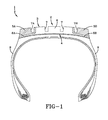
- FIG 1 illustrates the tire with two spaced apart preferably rubber reinforcing carbon black-rich lateral tread zone rubber layers and a preferably precipitated silica rich-intermedial tread zone rubber layer of which a portion extends in an axially outward direction from each side of the intermedial tread zone beneath the lateral tread zones and thereby joins and separates the lateral tread zones from each other.
- FIG 2 illustrates the tire of FIG 1 where the tread base rubber layer is an extension of the carbon black-rich lateral tread rubber zone.
- FIG 3 illustrates the tire of FIG 1 where the path of least electrical resistance is comprised of a rubber reinforcing carbon black-rich rubber bridge component.
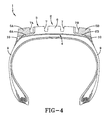
- FIG 4 also illustrates the tire of FIG 1 where the path of least electrical resistance includes a rubber reinforcing black-rich rubber bridge component similar to FIG 3 for which the tread base rubber layer is illustrated as extending beneath the carbon black-rich bridge component and optionally axially outward to the outer surface of the tire sidewall.
- FIG 1 illustrates a pneumatic tire partial cross section 1 having a tread 2 of a cap/base configuration, namely an outer tread cap rubber layer 3 of a lug and groove configuration and an underlying tread base rubber layer 4.
- the outer tread cap rubber layer 3 contains tread running surfaces (not numbered) contained on the outer surfaces of the tread lugs of the tread 2 and is composed of at least three or three circumferential tread zones, each a part of the tread's running surface, comprising a preferably silica-rich intermedial tread zone rubber layer 6 between two spaced apart individual preferably carbon black-rich lateral tread rubber zones 5A and 5B of which portions 6A and 6B of the intermedial tread zone 6 extend beneath and thereby underlie both of the lateral tread zones 5A and 5B and also overlay the preferably carbon black-rich tread base rubber layer 4.
- the outlying lateral tread zones 5A and 5B are thereby spaced apart from each other.
- the carbon black-rich tread base rubber layer 4 thereby underlies the silica-rich intermedial tread zone rubber layer 6 and is exclusive of the carbon black-rich lateral tread zones 5A and 5B.
- the lateral tread zones 5A and 5B are shown as being of the same width although they may be of widths which differ from each other.
- the silica-rich rubber composition of the intermedial tread zone 6 contains at least 40 phr of precipitated silica reinforcement and a maximum of 30 phr of rubber reinforcing carbon black which therefore renders the intermedial tread rubber composition electrically resistive relative to carbon black-rich lateral tread zone rubber compositions.
- the rubber reinforcing carbon black-rich rubber compositions of the lateral tread zones 5A and 5B, tread base rubber layer 4 and sidewall rubber layer 9, as well as the bridging rubber component 10 shown in FIG 3 and in FIG 4 each contain at least 40 phr rubber reinforcing carbon black which renders them relatively less electrically resistive, therefore relatively more electrically conductive, than the rubber composition of the precipitated silica-rich intermedial tread rubber zone.
- the tread lug and groove configuration of the tread cap rubber layer provides tread lugs with intervening grooves with grooves 7 contained in the intermedial tread zone layer 6 and grooves 7A and 7B contained in the lateral tread zone layers 5A and 5B with each of the lateral tread zones thereby containing at least one tread groove.
- the lateral tread zone layer rubber compositions have a significantly greater tear resistance property than the intermedial zone layer rubber composition to thereby aid in protecting the tread grooves 7A and 7B contained in the stratified lateral tread zone layers 5A and 5B.
- the intermedial tread zone 6 is depicted as constituting 45 to 60 percent of the spanned running surface of the tire tread 2 and the two individual lateral tread zone layers 5A and 5B are of a substantially equal width and correspondingly collectively constitute 55 to 40 percent of the spanned running surface of the tire tread 2.
- the intermedial and stratified lateral tread zone rubber compositions may comprise the same or different elastomers so long as the 100°C hot rebound property of the intermedial zone rubber is greater than that of the stratified lateral zone rubbers.
- the span of the running surface of the tread cap layer includes the outer running surface of the tread lugs (intended to be ground contacting) and the width of the included grooves between the lugs.
- a path of low or least electrical resistance is provided between the carbon black-rich lateral tread rubber zones 5A and 5B to the carbon black rich tread base rubber layer 4 by an extension 8 of lateral tread rubber zones 5A and 5B which extends from the lateral tread zone to and joins the tread base rubber layer 4 and optionally also joins and overlays the carbon black-rich tire sidewall 9.
- a path of least or low electrical resistance is provided between the carbon black-rich lateral tread rubber zones 5A and 5B and the carbon black rich tread base rubber layer 4 by a carbon black-rich bridge rubber component 10 which is positioned between and joins the lateral tread rubber zones 5A and 5B and tread base rubber layer 4.
- FIG 4 differs from FIG 3 in a sense that the tread base rubber layer 4 extends axially outward beneath (and in contact with by joining) the bridge rubber component 10.
- the tread base rubber layer 4 is illustrated as extending axially outward beneath the bridge rubber component 10 to the outer surface of the tire sidewall 9.
- the tread base rubber layer 4 may, for example, primarily comprise either cis 1,4-polyisoprene rubber, preferably natural rubber, or a combination of the cis 1,4-polyisoprene rubber and a polybutadiene rubber selected from cis 1,4-polybutadiene rubber and trans 1,4-polybutadiene rubber.
- cis 1,4-polyisoprene rubber preferably natural rubber
- a polybutadiene rubber selected from cis 1,4-polybutadiene rubber and trans 1,4-polybutadiene rubber.
- it may also contain up to 20 phr (e.g.
- At least one additional conjugated diene based elastomer such as, for example, at least one additional diene-based elastomer selected from at least one of styrene/butadiene rubber, isoprene/butadiene rubber, trans 1,4-polybutadiene, low vinyl polybutadiene having vinyl content in a range of 10 to 40 percent, and styrene/isoprene/butadiene rubber, preferably a styrene/butadiene copolymer rubber.
- additional conjugated diene based elastomer such as, for example, at least one additional diene-based elastomer selected from at least one of styrene/butadiene rubber, isoprene/butadiene rubber, trans 1,4-polybutadiene, low vinyl polybutadiene having vinyl content in a range of 10 to 40 percent, and styrene/isoprene/butadiene
- the coupling agent for the precipitated silica reinforcement of the respective zones of the tread may be, for example, an alkoxysilyl polysulfide such as for example, a bis(3-trialkoxysilylalkyl) polysulfide wherein alkyl radicals for said alkoxy groups are selected from one or more of methyl and ethyl radicals, preferably an ethyl radical and the alkyl radical for said silylalkyl component is selected from butyl, propyl and amyl radicals, preferably a propyl radical and wherein said polysulfide component contains from 2 to 8, with an average of from 2 to 2.6 or an average of from 3.5 to 4, connecting sulfur atoms in its polysulfidic bridge, preferably an average of from 2 to 2.6 connecting sulfur atoms to the exclusion of such polysulfides having greater than 2.6 connecting sulfur atoms.
- an alkoxysilyl polysulfide such as for example, a bis(3-
- Such coupling agents are, for example, bis(3-triethoxysilylpropyl) polysulfide having an average of from 2 to 2.6 or an average of from 3.5 to 4, connecting sulfur atoms in its polysulfidic bridge, sometimes preferably an average of from 2 to 2.6 connecting sulfur atoms to the exclusion of a bis(3-triethoxysilylpropyl) polysulfide containing an average of greater than 2.6 connecting sulfur atoms in its polysulfidic bridge.
- Such coupling agent may, for example, be added directly to the elastomer mixture or may be added as a composite of precipitated silica and such coupling agent formed by treating a precipitated silica therewith or by treating a colloidal silica therewith and precipitating the resulting composite.
- the silica aggregates preferably employed in this invention are precipitated silicas such as, for example, those obtained by the acidification of a soluble silicate, e.g., sodium silicate and may include co-precipitated silica and a minor amount of aluminum.
- the silicas used might usually be characterized, for example, by having a BET surface area, as measured using nitrogen gas, preferably in the range of 40 to 600, and more usually in a range of 50 to 300 square meters per gram.
- the BET method of measuring surface area is described in the Journal of the American Chemical Society, Volume 60, Page 304 (1930 ).
- the silica may also be typically characterized by having a dibutylphthalate (DBP) absorption value in a range of 50 to 400 cm 3 /100g, and more usually 100 to 300 cm 3 /100g.
- DBP dibutylphthalate
- silicas may be considered for use in this invention such as, only for example herein, silicas from PPG Industries under the Hi-Sil trademark with designations Hi-Sil 210 and Hi-Sil 243; silicas from Rhodia as, for example, Zeosil 1165MP and Zeosil 165GR; silicas from J. M. Huber Corporation as, for example, Zeopol 8745 and Zeopol 8715; silicas from Degussa AG with, for example, designations VN2, VN3 and Ultrasil 7005, as well as other grades of silica, particularly precipitated silicas, which can be used for elastomer reinforcement.
- silica couplers may be organomercaptosilanes such as, for example, triethoxy mercaptopropyl silane, trimethoxy mercaptopropyl silane, methyl dimethoxy mercaptopropyl silane, methyl diethoxy mercaptopropyl silane, dimethyl methoxy mercaptopropyl silane, triethoxy mercaptoethyl silane, and tripropoxy mercaptopropyl silane.
- organomercaptosilanes such as, for example, triethoxy mercaptopropyl silane, trimethoxy mercaptopropyl silane, methyl dimethoxy mercaptopropyl silane, methyl diethoxy mercaptopropyl silane, dimethyl methoxy mercaptopropyl silane, triethoxy mercaptoethyl silane, and tripropoxy mercaptopropyl silane.
- the tear resistance may be determined, for example, by ASTM D1876-1 taken with DIN 53539 using a 5 mm wide tear width provided by a longitudinal open space, sometimes referred to as a window, cut or otherwise provided, in the film positioned between the two rubber test pieces where the window provides a geometrically defined area, namely the tear width, for portions of two rubber test pieces to be pressed and cured together after which the force to pull the test pieces apart is measured.
- the rubber compositions for the tire tread components may be prepared in a sequential series of at least two separate and individual preparatory internal rubber mixing steps, or stages, in which the diene-based elastomer is first mixed with the prescribed carbon black and/or silica in a subsequent, separate mixing step and followed by a final mixing step where curatives are blended at a lower temperature and for a substantially shorter period of time.
- the rubber mixture is actually removed from the rubber mixer and cooled to a temperature of less than 40°C and, for example, in a range of 40°C to 20°C and then added back to an internal rubber mixer for the next sequential mixing step, or stage.
- the forming of a tire component is contemplated to be by conventional means such as, for example, by extrusion of rubber composition to provide a shaped, unvulcanized rubber component such as, for example, a tire tread.
- the tire as a manufactured article, is prepared by shaping and sulfur curing the assembly of its components at an elevated temperature (e.g. 140°C to 180°C) and elevated pressure in a suitable mold.
- elevated temperature e.g. 140°C to 180°C
- elevated pressure e.g. 150°C to 180°C
- the rubber composition would be compounded by methods generally known in the rubber compounding art, such as mixing the various sulfur-vulcanizable constituent rubbers with various commonly used additive materials, as herein before discussed, such as, for example, curing aids such as sulfur, activators, retarders and accelerators, processing additives, such as rubber processing oils, resins including tackifying resins, silicas, and plasticizers, fillers, pigments, fatty acid, zinc oxide, waxes, antioxidants and antiozonants, peptizing agents and reinforcing materials such as, for example, carbon black.
- curing aids such as sulfur, activators, retarders and accelerators
- processing additives such as rubber processing oils, resins including tackifying resins, silicas, and plasticizers
- fillers pigments, fatty acid, zinc oxide, waxes, antioxidants and antiozonants
- peptizing agents and reinforcing materials such as, for example, carbon black.
- the additives mentioned above are selected and commonly used in conventional amounts.
- Typical amounts of fatty acids if used which may be comprised of stearic acid which may also contain at least one of palmitic and oleac acids, may comprise 0.5 to 3 phr.
- Typical amounts of zinc oxide comprise 1 to 5 phr.
- Typical amounts of waxes, if used, comprise 1 to 5 phr. Often microcrystalline waxes are used.
- Typical amounts of peptizers, if used, comprise 0.1 to 1 phr. Typical peptizers may be, for example, pentachlorothiophenol and dibenzamidodiphenyl disulfide.
- the vulcanization is conducted in the presence of a sulfur vulcanizing agent.
- suitable sulfur vulcanizing agents include elemental sulfur (free sulfur) or sulfur donating vulcanizing agents, for example, an amine disulfide, polymeric polysulfide or sulfur olefin adducts.
- the sulfur vulcanizing agent is elemental sulfur.
- sulfur vulcanizing agents are used in an amount ranging from 0.5 to 4 phr, or even, in some circumstances, up to 8 phr, with a range of from 1.5 to 2.5, sometimes from 2 to 2.5, being preferred.
- Accelerators are used to control the time and/or temperature required for vulcanization and to improve the properties of the vulcanizate.
- a single accelerator system may be used, i.e., primary accelerator.
- a primary accelerator(s) is used in total amounts ranging from 0.5 to 4, preferably 0.8 to 2.5, phr.
- combinations of a primary and a secondary accelerator might be used with the secondary accelerator being used in smaller amounts (of 0.05 to 3 phr) in order to activate and to improve the properties of the vulcanizate. Combinations of these accelerators might be expected to produce a synergistic effect on the final properties and are somewhat better than those produced by use of either accelerator alone.
- delayed action accelerators may be used which are not affected by normal processing temperatures but produce a satisfactory cure at ordinary vulcanization temperatures.
- Vulcanization retarders might also be used.
- Suitable types of accelerators that may be used in the present invention are amines, disulfides, guanidines, thioureas, thiazoles, thiurams, sulfenamides, dithiocarbamates and xanthates.
- the primary accelerator is a sulfenamide.
- the secondary accelerator is preferably a guanidine, dithiocarbamate or thiuram compound.
- the mixing of the rubber composition can preferably be accomplished by the aforesaid sequential mixing process.
- the ingredients may be mixed in at least three stages, namely, at least two non-productive (preparatory) stages followed by a productive (final) mix stage.
- the final curatives are typically mixed in the final stage which is conventionally called the "productive" or “final” mix stage in which the mixing typically occurs at a temperature, or ultimate temperature, lower than the mix temperature(s) of the preceding non-productive mix stage(s).
- Proposed rubber compositions were prepared for use for the intermedial and lateral tread zone rubber layers for the tire of this invention.
- the proposed intermedial tread zone rubber composition is referred in this Example as rubber Sample A.
- the proposed lateral tread zone rubber composition is referred in this Example as rubber Sample B.
- the rubber composition may be prepared by mixing the elastomers(s) without sulfur and sulfur cure accelerators in a first non-productive mixing stage (NP-1) in an internal rubber mixer, for example, for 4 minutes to a temperature of, for example, of 160°C. If desired, the rubber mixture may then mixed in a second non-productive mixing stage (NP-2) in an internal rubber mixer, for example, for 4 minutes to a temperature of, for example, 160°C with or without adding additional ingredients. The resulting rubber mixture may then be mixed in a productive mixing stage (PR) in an internal rubber mixer with sulfur and sulfur cure accelerator(s), for example, for 2 minutes to a temperature of, for example, 110°C. The rubber composition may then sheeted out and cooled to, for example, below 50°C between each of the non-productive mixing steps and prior to the productive mixing step.
- NP-1 non-productive mixing stage
- NP-2 second non-productive mixing stage
- PR productive mixing stage
- the rubber composition may then sheeted out and cooled to, for example, below 50°
- Table 1 presents basic rubber formulations for proposed intermedial tire tread zone (rubber Sample A) and peripheral tire tread zone (rubber Sample B) rubber compositions for the zoned tread of this invention.
- Table 1 (Intermedial and Lateral Tread Cap Zones) Parts (phr) Non-productive Mix Step (NP1)
- A Intermedial
- B (Lateral) Natural cis 1,4-polyisoprene rubber (TTR20) 35 35 Cis 1,4-polybutadiene rubber 1 65 65 Carbon black (N121) 35 35 Silica, precipitated 2 15 15 Silica coupling agent 3 2 0 Composite of silica coupling agent and carbon black (50/50 weight ratio) *4 0 2 Wax microcrystalline and paraffin 1.5 1.5 Fatty acid 5 2 2 Antioxidants 4 4 Zinc oxide 3 3
- Final Mix Step (PR) Sulfur 1.1 0.9 Accelerator(s) 6 1.6 1.5 *Therefore 1 phr of coupling agent and 1 phr rubber reinforcing carbon black.
- Cis 1,4-polybutadiene rubber (said organic solvent solution polymerized 1,3-butadiene monomer in the presence of a neodymium catalyst) as CB25TM from the Lanxess Company having a Tg of -105°C and heterogeneity index in a range of from 1.5/1 to 2.2/1 2
- Precipitated silica as ZeosilTM Z1165 MP from the Rhodia Company
- Silica coupling agent comprised of bis(3-triethoxysilylpropyl) polysulfide having an average of from 2 to 2.6 connecting sulfur atoms as Si266TM from Evonic 4
- Table 2 represents the uncured and cured behavior and various physical properties of the rubber compositions for the intermedial (rubber Sample A) and lateral (rubber Sample B) tire tread zone rubber layers based upon the basic formulations illustrated in Table 1.
- ATS Automated Test System instrument
- An Instron instrument may be used to pull the rubber pieces apart using an Instron instrument at 95°C with the force required being reported as Newtons force.
- the Grosch high severity abrasion rate may be conducted on an LAT-100 Abrader and is measured in terms of mg/km of rubber abraded away.
- the test rubber sample is placed at a slip angle under constant load (Newtons) as it traverses a given distance on a rotating abrasive disk (disk from HB Schleifstoff GmbH).
- a high abrasion severity test may be run, for example, at a load of 70 Newtons, 12° slip angle, disk speed of 20 km/hr and distance of 250 meters.
- a tire is provided with a configured circumferential tread zones to provide a running surface with zones having similar rates of abrasion resistance but with lower hysteresis in the intermedial tread zone which extends axially outward beneath the higher hysteresis lateral tread zones for a purpose of maximizing such lower hysteresis for the tread and with a higher tear resistance for the lateral tread rubber zone to promote resistance to groove surface cracking in tread groove(s) contained in the lateral tread zones.
- Such innovative tread configuration is intended to promote lower rolling resistance for the tire tread across the width of the tread by the extended intermedial tread zone which extends axially outward beneath the lateral tread zones and to beneficially promote tear resistance for the outlying lateral tread zones, the combination of which is considered to be a significant departure from past practice.
Landscapes
- Engineering & Computer Science (AREA)
- Mechanical Engineering (AREA)
- Compositions Of Macromolecular Compounds (AREA)
- Tires In General (AREA)
Applications Claiming Priority (2)
| Application Number | Priority Date | Filing Date | Title |
|---|---|---|---|
| US201414470166A | 2014-08-27 | 2014-08-27 | |
| US14/609,540 US9809058B2 (en) | 2014-08-27 | 2015-01-30 | Tire with rubber tread of intermedial and lateral zones with path of least electrical resistance |
Publications (2)
| Publication Number | Publication Date |
|---|---|
| EP2990227A1 true EP2990227A1 (de) | 2016-03-02 |
| EP2990227B1 EP2990227B1 (de) | 2017-03-29 |
Family
ID=54062619
Family Applications (1)
| Application Number | Title | Priority Date | Filing Date |
|---|---|---|---|
| EP15181450.6A Not-in-force EP2990227B1 (de) | 2014-08-27 | 2015-08-18 | Reifen mit gummilaufflächen in den intermedialen und peripheren zonen mit weg des geringsten elektrischen widerstands |
Country Status (2)
| Country | Link |
|---|---|
| US (2) | US9809058B2 (de) |
| EP (1) | EP2990227B1 (de) |
Cited By (1)
| Publication number | Priority date | Publication date | Assignee | Title |
|---|---|---|---|---|
| EP4296088A1 (de) * | 2022-06-24 | 2023-12-27 | Sumitomo Rubber Industries, Ltd. | Reifen |
Families Citing this family (11)
| Publication number | Priority date | Publication date | Assignee | Title |
|---|---|---|---|---|
| FR3044008B1 (fr) * | 2015-11-19 | 2017-12-08 | Michelin & Cie | Bande de roulement pour pneumatique d'avion |
| WO2017116393A1 (en) * | 2015-12-28 | 2017-07-06 | Compagnie Generale Des Etablissements Michelin | Heavy truck tire |
| FR3065914B1 (fr) * | 2017-05-02 | 2019-06-07 | Compagnie Generale Des Etablissements Michelin | Architecture de sommet electro-conductrice d''un pneumatique pour vehicule lourd de type genie civil |
| CN114728546B (zh) | 2019-05-07 | 2024-01-30 | 固特异轮胎和橡胶公司 | 导电胎面烟囱合成物 |
| FR3098448B1 (fr) * | 2019-07-11 | 2021-06-11 | Michelin & Cie | Pneumatique pour vehicule du genie civil a faible empreinte environnementale |
| EP3778264B1 (de) | 2019-08-15 | 2023-09-13 | The Goodyear Tire & Rubber Company | Reifenlauffläche und reifen mit einer lauffläche |
| EP3778263B1 (de) | 2019-08-15 | 2022-06-22 | The Goodyear Tire & Rubber Company | Reifenlauffläche und reifen mit einer lauffläche |
| EP3778262B1 (de) | 2019-08-15 | 2022-09-28 | The Goodyear Tire & Rubber Company | Reifenlauffläche und reifen mit einer lauffläche |
| IT201900020092A1 (it) * | 2019-10-30 | 2021-04-30 | Trelleborg Wheel Sys Italia Spa | Pneumatico solido dotato di mezzi di segnalazione dello stato di eccessiva usura |
| US12583261B2 (en) * | 2021-08-31 | 2026-03-24 | The Goodyear Tire & Rubber Company | Aircraft tire with zoned tread |
| DE102021209583A1 (de) * | 2021-09-01 | 2023-03-02 | Continental Reifen Deutschland Gmbh | Mehrlagiger Laufstreifen für den Einsatz in Fahrzeugreifen |
Citations (12)
| Publication number | Priority date | Publication date | Assignee | Title |
|---|---|---|---|---|
| US4385653A (en) * | 1979-12-31 | 1983-05-31 | Toyo Rubber Industry Co., Ltd. | Pneumatic tire having a tread constructed of at least two kinds of rubbers |
| EP0798142A1 (de) | 1996-03-29 | 1997-10-01 | Continental Aktiengesellschaft | Fahrzeugluftreifen |
| EP0718127B1 (de) | 1994-12-21 | 1999-05-12 | Dunlop GmbH | Fahrzeugreifen |
| DE19812934C2 (de) | 1998-03-24 | 2002-12-12 | Pirelli Reifenwerk Gmbh & Co K | Fahrzeugreifen mit einem Laufstreifen, der einen Cap-Bereich und einen Base-Bereich aufweist |
| US6959744B2 (en) | 2002-12-20 | 2005-11-01 | The Goodyear Tire & Rubber Company | Tire with rubber tread of diverse zoned rubber compositions |
| EP1609624A1 (de) * | 2004-06-24 | 2005-12-28 | Continental Aktiengesellschaft | Fahrzeugluftreifen |
| US7131474B2 (en) | 2002-12-12 | 2006-11-07 | The Goodyear Tire & Rubber Company | Tire with rubber tread of load bearing central and lateral zones |
| US20070017617A1 (en) | 2005-07-22 | 2007-01-25 | Lafrique Michel M | Tire with tread of cap/semibase construction |
| JP2009051314A (ja) * | 2007-08-24 | 2009-03-12 | Bridgestone Corp | 二輪車用タイヤ |
| US20090107597A1 (en) | 2007-10-26 | 2009-04-30 | Bernd Richard Loewenhaupt | Tire with wear resistant rubber tread |
| US7559348B2 (en) | 2004-02-03 | 2009-07-14 | The Goodyear Tire & Rubber Company | Tire with rubber tread of circumferential zones with graduated physical properties |
| US7789117B2 (en) | 2006-01-27 | 2010-09-07 | The Goodyear Tire & Rubber Company | Tire with circumferential rubber tread having a lateral outboard control element |
Family Cites Families (3)
| Publication number | Priority date | Publication date | Assignee | Title |
|---|---|---|---|---|
| US6230773B1 (en) * | 1998-03-17 | 2001-05-15 | The Goodyear Tire & Rubber Company | Tire with sidewall carcass reinforcement |
| US9539860B2 (en) * | 2014-08-27 | 2017-01-10 | The Goodyear Tire & Rubber Company | Tire with rubber tread of intermedial and lateral zones with periperial sidewall extensions |
| US9545823B2 (en) * | 2014-08-27 | 2017-01-17 | The Goodyear Tire & Rubber Company | Tire with circumferentially zoned tread including stratified lateral zones and peripheral sidewall extensions |
-
2015
- 2015-01-30 US US14/609,540 patent/US9809058B2/en active Active
- 2015-08-18 EP EP15181450.6A patent/EP2990227B1/de not_active Not-in-force
- 2015-08-26 US US14/836,346 patent/US10040318B2/en active Active
Patent Citations (13)
| Publication number | Priority date | Publication date | Assignee | Title |
|---|---|---|---|---|
| US4385653A (en) * | 1979-12-31 | 1983-05-31 | Toyo Rubber Industry Co., Ltd. | Pneumatic tire having a tread constructed of at least two kinds of rubbers |
| EP0718127B1 (de) | 1994-12-21 | 1999-05-12 | Dunlop GmbH | Fahrzeugreifen |
| EP0798142A1 (de) | 1996-03-29 | 1997-10-01 | Continental Aktiengesellschaft | Fahrzeugluftreifen |
| DE19812934C2 (de) | 1998-03-24 | 2002-12-12 | Pirelli Reifenwerk Gmbh & Co K | Fahrzeugreifen mit einem Laufstreifen, der einen Cap-Bereich und einen Base-Bereich aufweist |
| US7131474B2 (en) | 2002-12-12 | 2006-11-07 | The Goodyear Tire & Rubber Company | Tire with rubber tread of load bearing central and lateral zones |
| US6959744B2 (en) | 2002-12-20 | 2005-11-01 | The Goodyear Tire & Rubber Company | Tire with rubber tread of diverse zoned rubber compositions |
| US7559348B2 (en) | 2004-02-03 | 2009-07-14 | The Goodyear Tire & Rubber Company | Tire with rubber tread of circumferential zones with graduated physical properties |
| US8662123B2 (en) | 2004-02-03 | 2014-03-04 | The Goodyear Tire & Rubber Company | Tire with rubber tread of circumferential zones with graduated physical properties |
| EP1609624A1 (de) * | 2004-06-24 | 2005-12-28 | Continental Aktiengesellschaft | Fahrzeugluftreifen |
| US20070017617A1 (en) | 2005-07-22 | 2007-01-25 | Lafrique Michel M | Tire with tread of cap/semibase construction |
| US7789117B2 (en) | 2006-01-27 | 2010-09-07 | The Goodyear Tire & Rubber Company | Tire with circumferential rubber tread having a lateral outboard control element |
| JP2009051314A (ja) * | 2007-08-24 | 2009-03-12 | Bridgestone Corp | 二輪車用タイヤ |
| US20090107597A1 (en) | 2007-10-26 | 2009-04-30 | Bernd Richard Loewenhaupt | Tire with wear resistant rubber tread |
Non-Patent Citations (1)
| Title |
|---|
| JOURNAL OF THE AMERICAN CHEMICAL SOCIETY, vol. 60, 1930, pages 304 |
Cited By (1)
| Publication number | Priority date | Publication date | Assignee | Title |
|---|---|---|---|---|
| EP4296088A1 (de) * | 2022-06-24 | 2023-12-27 | Sumitomo Rubber Industries, Ltd. | Reifen |
Also Published As
| Publication number | Publication date |
|---|---|
| US10040318B2 (en) | 2018-08-07 |
| EP2990227B1 (de) | 2017-03-29 |
| US9809058B2 (en) | 2017-11-07 |
| US20160059634A1 (en) | 2016-03-03 |
| US20160221395A1 (en) | 2016-08-04 |
Similar Documents
| Publication | Publication Date | Title |
|---|---|---|
| EP2990227B1 (de) | Reifen mit gummilaufflächen in den intermedialen und peripheren zonen mit weg des geringsten elektrischen widerstands | |
| EP1431078B1 (de) | Reifen mit Lauffläche bestehend aus verschiedenen Gummimischungen | |
| EP2108527B1 (de) | Reifen mit Lauffläche mit mittlerer Gummischicht und einer Mikrosphärendispersion | |
| US9539860B2 (en) | Tire with rubber tread of intermedial and lateral zones with periperial sidewall extensions | |
| EP1428689B1 (de) | Reifen mit mehrteiliger reifenlauffläche | |
| EP1818188B1 (de) | Reifen mit umlaufender Gummilauffläche mit seitlichem Außenbedienteil | |
| US6959743B2 (en) | Tire with silica-rich tread cap layer and carbon black-rich supporting transition zone of intermediate and base layers | |
| EP2052880B1 (de) | Luftreifen mit abriebfester Gummilauffläche | |
| EP1640182B1 (de) | Flugzeugreifen | |
| EP2990226B1 (de) | Reifen mit umlaufend gezonter lauffläche mit geschichteten seitenzonen und peripheren seitenwanderweiterungszonen | |
| EP2147806B1 (de) | Reifen mit Lauffläche, die eine zweilagige Laufflächenkronenschicht aufweist | |
| EP2522530B1 (de) | Reifen mit einer Lauffläche, die eine Grundschicht mit Gummizusammensetzungen mit unterschiedlichen Zonen aufweist | |
| US20020011293A1 (en) | Tire with reinforced rubber sidewall | |
| EP1897702A1 (de) | Reifen mit Lauffläche mit äußerer Kappenschicht und darunter liegender Übergangsschicht mit Maiskolben-Granulat | |
| EP1897703A1 (de) | Reifen mit Lauffläche mit einer Übergangsschicht aus depolymerisiertem Gummi, vorgehärtetem Gummi oder Kohlenstaub | |
| EP2990224B1 (de) | Reifen mit gummilaufflächen in den intermedialen und peripheren geschichteten zonen | |
| EP2530095A1 (de) | Reifen mit Lauffläche aus Polybutadienkautschuk | |
| EP2889157B1 (de) | Reifen mit Gummiblock mit Profilrillen zur Verbindung der Reifenkarkasse durch den Profilunterbau hindurch bis in die Laufflächenkrone |
Legal Events
| Date | Code | Title | Description |
|---|---|---|---|
| PUAI | Public reference made under article 153(3) epc to a published international application that has entered the european phase |
Free format text: ORIGINAL CODE: 0009012 |
|
| AK | Designated contracting states |
Kind code of ref document: A1 Designated state(s): AL AT BE BG CH CY CZ DE DK EE ES FI FR GB GR HR HU IE IS IT LI LT LU LV MC MK MT NL NO PL PT RO RS SE SI SK SM TR |
|
| AX | Request for extension of the european patent |
Extension state: BA ME |
|
| 17P | Request for examination filed |
Effective date: 20160902 |
|
| RBV | Designated contracting states (corrected) |
Designated state(s): AL AT BE BG CH CY CZ DE DK EE ES FI FR GB GR HR HU IE IS IT LI LT LU LV MC MK MT NL NO PL PT RO RS SE SI SK SM TR |
|
| GRAP | Despatch of communication of intention to grant a patent |
Free format text: ORIGINAL CODE: EPIDOSNIGR1 |
|
| RIC1 | Information provided on ipc code assigned before grant |
Ipc: B60C 11/00 20060101AFI20160927BHEP |
|
| INTG | Intention to grant announced |
Effective date: 20161024 |
|
| GRAS | Grant fee paid |
Free format text: ORIGINAL CODE: EPIDOSNIGR3 |
|
| GRAA | (expected) grant |
Free format text: ORIGINAL CODE: 0009210 |
|
| AK | Designated contracting states |
Kind code of ref document: B1 Designated state(s): AL AT BE BG CH CY CZ DE DK EE ES FI FR GB GR HR HU IE IS IT LI LT LU LV MC MK MT NL NO PL PT RO RS SE SI SK SM TR |
|
| REG | Reference to a national code |
Ref country code: GB Ref legal event code: FG4D |
|
| REG | Reference to a national code |
Ref country code: CH Ref legal event code: EP |
|
| REG | Reference to a national code |
Ref country code: AT Ref legal event code: REF Ref document number: 879371 Country of ref document: AT Kind code of ref document: T Effective date: 20170415 |
|
| REG | Reference to a national code |
Ref country code: IE Ref legal event code: FG4D |
|
| REG | Reference to a national code |
Ref country code: DE Ref legal event code: R096 Ref document number: 602015002006 Country of ref document: DE |
|
| REG | Reference to a national code |
Ref country code: FR Ref legal event code: PLFP Year of fee payment: 3 |
|
| PG25 | Lapsed in a contracting state [announced via postgrant information from national office to epo] |
Ref country code: FI Free format text: LAPSE BECAUSE OF FAILURE TO SUBMIT A TRANSLATION OF THE DESCRIPTION OR TO PAY THE FEE WITHIN THE PRESCRIBED TIME-LIMIT Effective date: 20170329 Ref country code: LT Free format text: LAPSE BECAUSE OF FAILURE TO SUBMIT A TRANSLATION OF THE DESCRIPTION OR TO PAY THE FEE WITHIN THE PRESCRIBED TIME-LIMIT Effective date: 20170329 Ref country code: NO Free format text: LAPSE BECAUSE OF FAILURE TO SUBMIT A TRANSLATION OF THE DESCRIPTION OR TO PAY THE FEE WITHIN THE PRESCRIBED TIME-LIMIT Effective date: 20170629 Ref country code: GR Free format text: LAPSE BECAUSE OF FAILURE TO SUBMIT A TRANSLATION OF THE DESCRIPTION OR TO PAY THE FEE WITHIN THE PRESCRIBED TIME-LIMIT Effective date: 20170630 Ref country code: HR Free format text: LAPSE BECAUSE OF FAILURE TO SUBMIT A TRANSLATION OF THE DESCRIPTION OR TO PAY THE FEE WITHIN THE PRESCRIBED TIME-LIMIT Effective date: 20170329 |
|
| REG | Reference to a national code |
Ref country code: NL Ref legal event code: MP Effective date: 20170329 |
|
| REG | Reference to a national code |
Ref country code: AT Ref legal event code: MK05 Ref document number: 879371 Country of ref document: AT Kind code of ref document: T Effective date: 20170329 |
|
| PG25 | Lapsed in a contracting state [announced via postgrant information from national office to epo] |
Ref country code: BG Free format text: LAPSE BECAUSE OF FAILURE TO SUBMIT A TRANSLATION OF THE DESCRIPTION OR TO PAY THE FEE WITHIN THE PRESCRIBED TIME-LIMIT Effective date: 20170629 Ref country code: LV Free format text: LAPSE BECAUSE OF FAILURE TO SUBMIT A TRANSLATION OF THE DESCRIPTION OR TO PAY THE FEE WITHIN THE PRESCRIBED TIME-LIMIT Effective date: 20170329 Ref country code: SE Free format text: LAPSE BECAUSE OF FAILURE TO SUBMIT A TRANSLATION OF THE DESCRIPTION OR TO PAY THE FEE WITHIN THE PRESCRIBED TIME-LIMIT Effective date: 20170329 Ref country code: RS Free format text: LAPSE BECAUSE OF FAILURE TO SUBMIT A TRANSLATION OF THE DESCRIPTION OR TO PAY THE FEE WITHIN THE PRESCRIBED TIME-LIMIT Effective date: 20170329 |
|
| PG25 | Lapsed in a contracting state [announced via postgrant information from national office to epo] |
Ref country code: NL Free format text: LAPSE BECAUSE OF FAILURE TO SUBMIT A TRANSLATION OF THE DESCRIPTION OR TO PAY THE FEE WITHIN THE PRESCRIBED TIME-LIMIT Effective date: 20170329 |
|
| PG25 | Lapsed in a contracting state [announced via postgrant information from national office to epo] |
Ref country code: AT Free format text: LAPSE BECAUSE OF FAILURE TO SUBMIT A TRANSLATION OF THE DESCRIPTION OR TO PAY THE FEE WITHIN THE PRESCRIBED TIME-LIMIT Effective date: 20170329 Ref country code: SK Free format text: LAPSE BECAUSE OF FAILURE TO SUBMIT A TRANSLATION OF THE DESCRIPTION OR TO PAY THE FEE WITHIN THE PRESCRIBED TIME-LIMIT Effective date: 20170329 Ref country code: RO Free format text: LAPSE BECAUSE OF FAILURE TO SUBMIT A TRANSLATION OF THE DESCRIPTION OR TO PAY THE FEE WITHIN THE PRESCRIBED TIME-LIMIT Effective date: 20170329 Ref country code: CZ Free format text: LAPSE BECAUSE OF FAILURE TO SUBMIT A TRANSLATION OF THE DESCRIPTION OR TO PAY THE FEE WITHIN THE PRESCRIBED TIME-LIMIT Effective date: 20170329 Ref country code: EE Free format text: LAPSE BECAUSE OF FAILURE TO SUBMIT A TRANSLATION OF THE DESCRIPTION OR TO PAY THE FEE WITHIN THE PRESCRIBED TIME-LIMIT Effective date: 20170329 Ref country code: ES Free format text: LAPSE BECAUSE OF FAILURE TO SUBMIT A TRANSLATION OF THE DESCRIPTION OR TO PAY THE FEE WITHIN THE PRESCRIBED TIME-LIMIT Effective date: 20170329 |
|
| PG25 | Lapsed in a contracting state [announced via postgrant information from national office to epo] |
Ref country code: SM Free format text: LAPSE BECAUSE OF FAILURE TO SUBMIT A TRANSLATION OF THE DESCRIPTION OR TO PAY THE FEE WITHIN THE PRESCRIBED TIME-LIMIT Effective date: 20170329 Ref country code: IS Free format text: LAPSE BECAUSE OF FAILURE TO SUBMIT A TRANSLATION OF THE DESCRIPTION OR TO PAY THE FEE WITHIN THE PRESCRIBED TIME-LIMIT Effective date: 20170729 Ref country code: PL Free format text: LAPSE BECAUSE OF FAILURE TO SUBMIT A TRANSLATION OF THE DESCRIPTION OR TO PAY THE FEE WITHIN THE PRESCRIBED TIME-LIMIT Effective date: 20170329 |
|
| REG | Reference to a national code |
Ref country code: DE Ref legal event code: R097 Ref document number: 602015002006 Country of ref document: DE |
|
| PG25 | Lapsed in a contracting state [announced via postgrant information from national office to epo] |
Ref country code: DK Free format text: LAPSE BECAUSE OF FAILURE TO SUBMIT A TRANSLATION OF THE DESCRIPTION OR TO PAY THE FEE WITHIN THE PRESCRIBED TIME-LIMIT Effective date: 20170329 |
|
| PLBE | No opposition filed within time limit |
Free format text: ORIGINAL CODE: 0009261 |
|
| STAA | Information on the status of an ep patent application or granted ep patent |
Free format text: STATUS: NO OPPOSITION FILED WITHIN TIME LIMIT |
|
| 26N | No opposition filed |
Effective date: 20180103 |
|
| PG25 | Lapsed in a contracting state [announced via postgrant information from national office to epo] |
Ref country code: MC Free format text: LAPSE BECAUSE OF FAILURE TO SUBMIT A TRANSLATION OF THE DESCRIPTION OR TO PAY THE FEE WITHIN THE PRESCRIBED TIME-LIMIT Effective date: 20170329 |
|
| REG | Reference to a national code |
Ref country code: BE Ref legal event code: MM Effective date: 20170831 |
|
| REG | Reference to a national code |
Ref country code: IE Ref legal event code: MM4A |
|
| PG25 | Lapsed in a contracting state [announced via postgrant information from national office to epo] |
Ref country code: SI Free format text: LAPSE BECAUSE OF FAILURE TO SUBMIT A TRANSLATION OF THE DESCRIPTION OR TO PAY THE FEE WITHIN THE PRESCRIBED TIME-LIMIT Effective date: 20170329 |
|
| PG25 | Lapsed in a contracting state [announced via postgrant information from national office to epo] |
Ref country code: LU Free format text: LAPSE BECAUSE OF NON-PAYMENT OF DUE FEES Effective date: 20170818 |
|
| REG | Reference to a national code |
Ref country code: FR Ref legal event code: PLFP Year of fee payment: 4 |
|
| PG25 | Lapsed in a contracting state [announced via postgrant information from national office to epo] |
Ref country code: IE Free format text: LAPSE BECAUSE OF NON-PAYMENT OF DUE FEES Effective date: 20170818 |
|
| PG25 | Lapsed in a contracting state [announced via postgrant information from national office to epo] |
Ref country code: BE Free format text: LAPSE BECAUSE OF NON-PAYMENT OF DUE FEES Effective date: 20170831 |
|
| PG25 | Lapsed in a contracting state [announced via postgrant information from national office to epo] |
Ref country code: MT Free format text: LAPSE BECAUSE OF NON-PAYMENT OF DUE FEES Effective date: 20170818 |
|
| REG | Reference to a national code |
Ref country code: CH Ref legal event code: PL |
|
| PG25 | Lapsed in a contracting state [announced via postgrant information from national office to epo] |
Ref country code: LI Free format text: LAPSE BECAUSE OF NON-PAYMENT OF DUE FEES Effective date: 20180831 Ref country code: CH Free format text: LAPSE BECAUSE OF NON-PAYMENT OF DUE FEES Effective date: 20180831 |
|
| PG25 | Lapsed in a contracting state [announced via postgrant information from national office to epo] |
Ref country code: HU Free format text: LAPSE BECAUSE OF FAILURE TO SUBMIT A TRANSLATION OF THE DESCRIPTION OR TO PAY THE FEE WITHIN THE PRESCRIBED TIME-LIMIT; INVALID AB INITIO Effective date: 20150818 |
|
| PG25 | Lapsed in a contracting state [announced via postgrant information from national office to epo] |
Ref country code: CY Free format text: LAPSE BECAUSE OF FAILURE TO SUBMIT A TRANSLATION OF THE DESCRIPTION OR TO PAY THE FEE WITHIN THE PRESCRIBED TIME-LIMIT Effective date: 20170329 |
|
| PG25 | Lapsed in a contracting state [announced via postgrant information from national office to epo] |
Ref country code: MK Free format text: LAPSE BECAUSE OF FAILURE TO SUBMIT A TRANSLATION OF THE DESCRIPTION OR TO PAY THE FEE WITHIN THE PRESCRIBED TIME-LIMIT Effective date: 20170329 |
|
| PG25 | Lapsed in a contracting state [announced via postgrant information from national office to epo] |
Ref country code: TR Free format text: LAPSE BECAUSE OF FAILURE TO SUBMIT A TRANSLATION OF THE DESCRIPTION OR TO PAY THE FEE WITHIN THE PRESCRIBED TIME-LIMIT Effective date: 20170329 |
|
| GBPC | Gb: european patent ceased through non-payment of renewal fee |
Effective date: 20190818 |
|
| PG25 | Lapsed in a contracting state [announced via postgrant information from national office to epo] |
Ref country code: PT Free format text: LAPSE BECAUSE OF FAILURE TO SUBMIT A TRANSLATION OF THE DESCRIPTION OR TO PAY THE FEE WITHIN THE PRESCRIBED TIME-LIMIT Effective date: 20170329 |
|
| PG25 | Lapsed in a contracting state [announced via postgrant information from national office to epo] |
Ref country code: AL Free format text: LAPSE BECAUSE OF FAILURE TO SUBMIT A TRANSLATION OF THE DESCRIPTION OR TO PAY THE FEE WITHIN THE PRESCRIBED TIME-LIMIT Effective date: 20170329 |
|
| PG25 | Lapsed in a contracting state [announced via postgrant information from national office to epo] |
Ref country code: GB Free format text: LAPSE BECAUSE OF NON-PAYMENT OF DUE FEES Effective date: 20190818 |
|
| PGFP | Annual fee paid to national office [announced via postgrant information from national office to epo] |
Ref country code: FR Payment date: 20240611 Year of fee payment: 10 |
|
| PGFP | Annual fee paid to national office [announced via postgrant information from national office to epo] |
Ref country code: DE Payment date: 20240625 Year of fee payment: 10 |
|
| PGFP | Annual fee paid to national office [announced via postgrant information from national office to epo] |
Ref country code: IT Payment date: 20240710 Year of fee payment: 10 |
|
| REG | Reference to a national code |
Ref country code: DE Ref legal event code: R119 Ref document number: 602015002006 Country of ref document: DE |
|
| PG25 | Lapsed in a contracting state [announced via postgrant information from national office to epo] |
Ref country code: IT Free format text: LAPSE BECAUSE OF NON-PAYMENT OF DUE FEES Effective date: 20250818 |
|
| PG25 | Lapsed in a contracting state [announced via postgrant information from national office to epo] |
Ref country code: DE Free format text: LAPSE BECAUSE OF NON-PAYMENT OF DUE FEES Effective date: 20260303 |
|
| PG25 | Lapsed in a contracting state [announced via postgrant information from national office to epo] |
Ref country code: FR Free format text: LAPSE BECAUSE OF NON-PAYMENT OF DUE FEES Effective date: 20250831 |