EP2990363A1 - Förderbandanordnung für eine druckvorrichtung - Google Patents
Förderbandanordnung für eine druckvorrichtung Download PDFInfo
- Publication number
- EP2990363A1 EP2990363A1 EP15181736.8A EP15181736A EP2990363A1 EP 2990363 A1 EP2990363 A1 EP 2990363A1 EP 15181736 A EP15181736 A EP 15181736A EP 2990363 A1 EP2990363 A1 EP 2990363A1
- Authority
- EP
- European Patent Office
- Prior art keywords
- conveyor belt
- conveying
- conveying part
- upstream
- downstream
- Prior art date
- Legal status (The legal status is an assumption and is not a legal conclusion. Google has not performed a legal analysis and makes no representation as to the accuracy of the status listed.)
- Granted
Links
- 238000007639 printing Methods 0.000 title claims abstract description 36
- 238000011144 upstream manufacturing Methods 0.000 claims abstract description 44
- 238000000034 method Methods 0.000 claims description 27
- 238000001035 drying Methods 0.000 claims description 20
- 230000007704 transition Effects 0.000 claims description 9
- 229920000573 polyethylene Polymers 0.000 claims description 7
- 239000004698 Polyethylene Substances 0.000 claims description 6
- 239000004699 Ultra-high molecular weight polyethylene Substances 0.000 claims description 4
- -1 polyethylene Polymers 0.000 claims description 4
- 229920000785 ultra high molecular weight polyethylene Polymers 0.000 claims description 4
- 230000000712 assembly Effects 0.000 claims description 3
- 238000000429 assembly Methods 0.000 claims description 3
- 239000004033 plastic Substances 0.000 claims description 3
- 229920003023 plastic Polymers 0.000 claims description 3
- 239000007788 liquid Substances 0.000 description 42
- 238000002203 pretreatment Methods 0.000 description 41
- 239000000976 ink Substances 0.000 description 18
- 230000007246 mechanism Effects 0.000 description 13
- 230000015572 biosynthetic process Effects 0.000 description 11
- 239000011347 resin Substances 0.000 description 11
- 229920005989 resin Polymers 0.000 description 11
- 230000008569 process Effects 0.000 description 10
- 238000007641 inkjet printing Methods 0.000 description 9
- 239000000463 material Substances 0.000 description 8
- XLYOFNOQVPJJNP-UHFFFAOYSA-N water Substances O XLYOFNOQVPJJNP-UHFFFAOYSA-N 0.000 description 8
- 238000003851 corona treatment Methods 0.000 description 7
- 238000009832 plasma treatment Methods 0.000 description 6
- 238000000576 coating method Methods 0.000 description 5
- 239000011241 protective layer Substances 0.000 description 5
- 239000007789 gas Substances 0.000 description 4
- 230000005855 radiation Effects 0.000 description 4
- 239000002904 solvent Substances 0.000 description 4
- QTBSBXVTEAMEQO-UHFFFAOYSA-N Acetic acid Chemical compound CC(O)=O QTBSBXVTEAMEQO-UHFFFAOYSA-N 0.000 description 3
- 238000010521 absorption reaction Methods 0.000 description 3
- 239000000203 mixture Substances 0.000 description 3
- 238000007761 roller coating Methods 0.000 description 3
- 230000007480 spreading Effects 0.000 description 3
- 239000004094 surface-active agent Substances 0.000 description 3
- XKRFYHLGVUSROY-UHFFFAOYSA-N Argon Chemical compound [Ar] XKRFYHLGVUSROY-UHFFFAOYSA-N 0.000 description 2
- IJGRMHOSHXDMSA-UHFFFAOYSA-N Atomic nitrogen Chemical compound N#N IJGRMHOSHXDMSA-UHFFFAOYSA-N 0.000 description 2
- CURLTUGMZLYLDI-UHFFFAOYSA-N Carbon dioxide Chemical compound O=C=O CURLTUGMZLYLDI-UHFFFAOYSA-N 0.000 description 2
- 229910000640 Fe alloy Inorganic materials 0.000 description 2
- YCKRFDGAMUMZLT-UHFFFAOYSA-N Fluorine atom Chemical compound [F] YCKRFDGAMUMZLT-UHFFFAOYSA-N 0.000 description 2
- VEXZGXHMUGYJMC-UHFFFAOYSA-N Hydrochloric acid Chemical compound Cl VEXZGXHMUGYJMC-UHFFFAOYSA-N 0.000 description 2
- NBIIXXVUZAFLBC-UHFFFAOYSA-N Phosphoric acid Chemical compound OP(O)(O)=O NBIIXXVUZAFLBC-UHFFFAOYSA-N 0.000 description 2
- 239000004743 Polypropylene Substances 0.000 description 2
- QAOWNCQODCNURD-UHFFFAOYSA-N Sulfuric acid Chemical compound OS(O)(=O)=O QAOWNCQODCNURD-UHFFFAOYSA-N 0.000 description 2
- 239000002253 acid Substances 0.000 description 2
- 239000000654 additive Substances 0.000 description 2
- 238000006243 chemical reaction Methods 0.000 description 2
- 239000011248 coating agent Substances 0.000 description 2
- 238000001704 evaporation Methods 0.000 description 2
- 230000008020 evaporation Effects 0.000 description 2
- 229910052731 fluorine Inorganic materials 0.000 description 2
- 239000011737 fluorine Substances 0.000 description 2
- JVTAAEKCZFNVCJ-UHFFFAOYSA-N lactic acid Chemical compound CC(O)C(O)=O JVTAAEKCZFNVCJ-UHFFFAOYSA-N 0.000 description 2
- VNWKTOKETHGBQD-UHFFFAOYSA-N methane Chemical compound C VNWKTOKETHGBQD-UHFFFAOYSA-N 0.000 description 2
- 239000002245 particle Substances 0.000 description 2
- 239000000049 pigment Substances 0.000 description 2
- 229920000642 polymer Polymers 0.000 description 2
- 229920001155 polypropylene Polymers 0.000 description 2
- 239000007787 solid Substances 0.000 description 2
- 239000004925 Acrylic resin Substances 0.000 description 1
- 229920000178 Acrylic resin Polymers 0.000 description 1
- 238000010306 acid treatment Methods 0.000 description 1
- 150000007513 acids Chemical class 0.000 description 1
- 239000003570 air Substances 0.000 description 1
- 229910000147 aluminium phosphate Inorganic materials 0.000 description 1
- 239000002518 antifoaming agent Substances 0.000 description 1
- 229940121375 antifungal agent Drugs 0.000 description 1
- 239000003429 antifungal agent Substances 0.000 description 1
- 239000007864 aqueous solution Substances 0.000 description 1
- 229910052786 argon Inorganic materials 0.000 description 1
- QVGXLLKOCUKJST-UHFFFAOYSA-N atomic oxygen Chemical compound [O] QVGXLLKOCUKJST-UHFFFAOYSA-N 0.000 description 1
- 239000001569 carbon dioxide Substances 0.000 description 1
- 229960004424 carbon dioxide Drugs 0.000 description 1
- 229910002092 carbon dioxide Inorganic materials 0.000 description 1
- 125000002091 cationic group Chemical group 0.000 description 1
- 239000001913 cellulose Substances 0.000 description 1
- 229920002678 cellulose Polymers 0.000 description 1
- 238000004140 cleaning Methods 0.000 description 1
- 239000011247 coating layer Substances 0.000 description 1
- 150000001875 compounds Chemical class 0.000 description 1
- 238000010276 construction Methods 0.000 description 1
- 238000011109 contamination Methods 0.000 description 1
- 238000001816 cooling Methods 0.000 description 1
- 239000006184 cosolvent Substances 0.000 description 1
- 238000007766 curtain coating Methods 0.000 description 1
- 230000001419 dependent effect Effects 0.000 description 1
- 230000000694 effects Effects 0.000 description 1
- 230000009477 glass transition Effects 0.000 description 1
- 230000006872 improvement Effects 0.000 description 1
- 239000004310 lactic acid Substances 0.000 description 1
- 235000014655 lactic acid Nutrition 0.000 description 1
- 238000010030 laminating Methods 0.000 description 1
- 239000007791 liquid phase Substances 0.000 description 1
- 239000002184 metal Substances 0.000 description 1
- 238000012986 modification Methods 0.000 description 1
- 230000004048 modification Effects 0.000 description 1
- 229910052754 neon Inorganic materials 0.000 description 1
- GKAOGPIIYCISHV-UHFFFAOYSA-N neon atom Chemical compound [Ne] GKAOGPIIYCISHV-UHFFFAOYSA-N 0.000 description 1
- 229910052757 nitrogen Inorganic materials 0.000 description 1
- 239000001301 oxygen Substances 0.000 description 1
- 229910052760 oxygen Inorganic materials 0.000 description 1
- 239000012071 phase Substances 0.000 description 1
- 230000000704 physical effect Effects 0.000 description 1
- 230000002787 reinforcement Effects 0.000 description 1
- 150000003839 salts Chemical class 0.000 description 1
- 229920006395 saturated elastomer Polymers 0.000 description 1
- 229920002050 silicone resin Polymers 0.000 description 1
- 239000000243 solution Substances 0.000 description 1
- 238000005507 spraying Methods 0.000 description 1
- 229920005792 styrene-acrylic resin Polymers 0.000 description 1
- 230000008961 swelling Effects 0.000 description 1
- 229920002803 thermoplastic polyurethane Polymers 0.000 description 1
- 230000037303 wrinkles Effects 0.000 description 1
Images

Classifications
-
- B—PERFORMING OPERATIONS; TRANSPORTING
- B41—PRINTING; LINING MACHINES; TYPEWRITERS; STAMPS
- B41J—TYPEWRITERS; SELECTIVE PRINTING MECHANISMS, i.e. MECHANISMS PRINTING OTHERWISE THAN FROM A FORME; CORRECTION OF TYPOGRAPHICAL ERRORS
- B41J11/00—Devices or arrangements of selective printing mechanisms, e.g. ink-jet printers or thermal printers, for supporting or handling copy material in sheet or web form
- B41J11/007—Conveyor belts or like feeding devices
-
- B—PERFORMING OPERATIONS; TRANSPORTING
- B65—CONVEYING; PACKING; STORING; HANDLING THIN OR FILAMENTARY MATERIAL
- B65G—TRANSPORT OR STORAGE DEVICES, e.g. CONVEYORS FOR LOADING OR TIPPING, SHOP CONVEYOR SYSTEMS OR PNEUMATIC TUBE CONVEYORS
- B65G15/00—Conveyors having endless load-conveying surfaces, i.e. belts and like continuous members, to which tractive effort is transmitted by means other than endless driving elements of similar configuration
- B65G15/28—Conveyors with a load-conveying surface formed by a single flat belt, not otherwise provided for
-
- B—PERFORMING OPERATIONS; TRANSPORTING
- B65—CONVEYING; PACKING; STORING; HANDLING THIN OR FILAMENTARY MATERIAL
- B65G—TRANSPORT OR STORAGE DEVICES, e.g. CONVEYORS FOR LOADING OR TIPPING, SHOP CONVEYOR SYSTEMS OR PNEUMATIC TUBE CONVEYORS
- B65G15/00—Conveyors having endless load-conveying surfaces, i.e. belts and like continuous members, to which tractive effort is transmitted by means other than endless driving elements of similar configuration
- B65G15/60—Arrangements for supporting or guiding belts, e.g. by fluid jets
- B65G15/62—Guides for sliding belts
-
- B—PERFORMING OPERATIONS; TRANSPORTING
- B65—CONVEYING; PACKING; STORING; HANDLING THIN OR FILAMENTARY MATERIAL
- B65G—TRANSPORT OR STORAGE DEVICES, e.g. CONVEYORS FOR LOADING OR TIPPING, SHOP CONVEYOR SYSTEMS OR PNEUMATIC TUBE CONVEYORS
- B65G15/00—Conveyors having endless load-conveying surfaces, i.e. belts and like continuous members, to which tractive effort is transmitted by means other than endless driving elements of similar configuration
- B65G15/60—Arrangements for supporting or guiding belts, e.g. by fluid jets
- B65G15/64—Arrangements for supporting or guiding belts, e.g. by fluid jets for automatically maintaining the position of the belts
-
- B—PERFORMING OPERATIONS; TRANSPORTING
- B65—CONVEYING; PACKING; STORING; HANDLING THIN OR FILAMENTARY MATERIAL
- B65H—HANDLING THIN OR FILAMENTARY MATERIAL, e.g. SHEETS, WEBS, CABLES
- B65H5/00—Feeding articles separated from piles; Feeding articles to machines
- B65H5/02—Feeding articles separated from piles; Feeding articles to machines by belts or chains, e.g. between belts or chains
- B65H5/021—Feeding articles separated from piles; Feeding articles to machines by belts or chains, e.g. between belts or chains by belts
-
- B—PERFORMING OPERATIONS; TRANSPORTING
- B65—CONVEYING; PACKING; STORING; HANDLING THIN OR FILAMENTARY MATERIAL
- B65H—HANDLING THIN OR FILAMENTARY MATERIAL, e.g. SHEETS, WEBS, CABLES
- B65H7/00—Controlling article feeding, separating, pile-advancing, or associated apparatus, to take account of incorrect feeding, absence of articles, or presence of faulty articles
- B65H7/02—Controlling article feeding, separating, pile-advancing, or associated apparatus, to take account of incorrect feeding, absence of articles, or presence of faulty articles by feelers or detectors
- B65H7/06—Controlling article feeding, separating, pile-advancing, or associated apparatus, to take account of incorrect feeding, absence of articles, or presence of faulty articles by feelers or detectors responsive to presence of faulty articles or incorrect separation or feed
- B65H7/10—Controlling article feeding, separating, pile-advancing, or associated apparatus, to take account of incorrect feeding, absence of articles, or presence of faulty articles by feelers or detectors responsive to presence of faulty articles or incorrect separation or feed responsive to incorrect side register
-
- B—PERFORMING OPERATIONS; TRANSPORTING
- B65—CONVEYING; PACKING; STORING; HANDLING THIN OR FILAMENTARY MATERIAL
- B65H—HANDLING THIN OR FILAMENTARY MATERIAL, e.g. SHEETS, WEBS, CABLES
- B65H2404/00—Parts for transporting or guiding the handled material
- B65H2404/20—Belts
- B65H2404/25—Driving or guiding arrangements
-
- B—PERFORMING OPERATIONS; TRANSPORTING
- B65—CONVEYING; PACKING; STORING; HANDLING THIN OR FILAMENTARY MATERIAL
- B65H—HANDLING THIN OR FILAMENTARY MATERIAL, e.g. SHEETS, WEBS, CABLES
- B65H2511/00—Dimensions; Position; Numbers; Identification; Occurrences
- B65H2511/20—Location in space
-
- B—PERFORMING OPERATIONS; TRANSPORTING
- B65—CONVEYING; PACKING; STORING; HANDLING THIN OR FILAMENTARY MATERIAL
- B65H—HANDLING THIN OR FILAMENTARY MATERIAL, e.g. SHEETS, WEBS, CABLES
- B65H2511/00—Dimensions; Position; Numbers; Identification; Occurrences
- B65H2511/20—Location in space
- B65H2511/24—Irregularities, e.g. in orientation or skewness
-
- B—PERFORMING OPERATIONS; TRANSPORTING
- B65—CONVEYING; PACKING; STORING; HANDLING THIN OR FILAMENTARY MATERIAL
- B65H—HANDLING THIN OR FILAMENTARY MATERIAL, e.g. SHEETS, WEBS, CABLES
- B65H2553/00—Sensing or detecting means
- B65H2553/40—Sensing or detecting means using optical, e.g. photographic, elements
- B65H2553/42—Cameras
-
- B—PERFORMING OPERATIONS; TRANSPORTING
- B65—CONVEYING; PACKING; STORING; HANDLING THIN OR FILAMENTARY MATERIAL
- B65H—HANDLING THIN OR FILAMENTARY MATERIAL, e.g. SHEETS, WEBS, CABLES
- B65H2701/00—Handled material; Storage means
- B65H2701/10—Handled articles or webs
- B65H2701/13—Parts concerned of the handled material
- B65H2701/131—Edges
- B65H2701/1315—Edges side edges, i.e. regarded in context of transport
Definitions
- the present invention relates to a conveying belt assembly for a printing device, a method for controlling the position of an endless conveyor belt, and the use of a conveying belt assembly.
- the present invention has as its object to provide a conveying belt assembly for a printing device, which conveying belt assembly allows very accurate control of the position of the conveyor belt or its conveying part.
- a conveying belt assembly for a printing device comprising:
- the conveyor belt therefore might easily drift sideways in a direction transverse to the conveying direction. Which is a unwanted characteristic of a conveyor belt guided around sliding supports in case position control of the objects transported is required.
- this low friction in a direction transverse to the conveying direction is used to obtain an accurate control of the position of the conveying part of the belt and/or of the position of the object transported or to be transported.
- the conveying belt assembly according to the invention allows for direct control of the position of the conveying part of the conveyor belt. Further, the control algorithm is much less complicated and the use of many costly accurate parts can be avoided due to the direct control.
- the position sensing device of the assembly according to the invention can be realized in many manners already known to the skilled man.
- a camera, CCD etcetera can be used on the edge of the belt or on a pattern provided on the belt in order to measure the position of the belt in transverse direction.
- actuator devices of the assembly according to the invention can be realized in several manners within the scope of the invention as follows from the claims. According to a further embodiment of the invention, wherein the actuator devices comprises one or more from the following group:
- a magnetic force can be used when the conveyor belt comprises a material susceptible for magnetic forces.
- a material will in general be a magnetic or magnetizable material, like Fe or a suitable Fe alloy.
- This material can for example be present in the form of reinforcement wires of the conveying belt.
- Another manner of adjusting the transverse position of the conveying part is by adjusting the angle of the rotational axis of the driving roller.
- Still another manner is using pusher elements on opposing sides of the conveyor belt. These pushing elements allow easy control of the transverse position of the belt just by pushing in the correct direction.
- a gripper like a vacuum device, might be used to grip the conveyor belt and move it in transverse direction.
- other actuator devices are conceivable as well.
- the conveyor belt assembly according to the invention might further be provided with both an upstream and a downstream actuator device, wherein the upstream actuator device and downstream actuator device might be of the same type or might be of different type.
- the conveying belt assembly might further comprises a plate, like a print surface plate or vacuum plate, arranged parallel to the conveying part on the inner side of the endless conveyor belt.
- a plate provides support to the conveying part and in case of a vacuum plate it assists in keeping the object transported - in general a sheet of paper which is treated or is to be treated -.
- the assembly is especially of the so called sliding conveyor belt type.
- a sliding conveyor belt is a belt guided all around sliding surfaces, i.e. surfaces with respect to which the belt slides when passing the surface. In general a sliding conveyor belt has no support surfaces moving together with the belt part passing along it.
- the conveyor belt might be wrapped around said two sliding supports and a plate arranged parallel to the conveying part on the inside of the conveyor belt; wherein the return part of the conveyor belt, extending from the downstream sliding support up to the upstream sliding support, is freely hanging.
- the inside of an endless conveyor belt is in this application defined as the inside of the endless loop, i.e. the side of the conveyor belt where the conveying part faces the return part and vice versa.
- the sliding supports might have a supporting surface comprising a plastic, like PE (polyethene or polyethylene) or UHMWPE (Ultra-high-molecular-weight polyethylene). Plastics allow in general low friction in an easy manner.
- PE polyethene or polyethylene
- UHMWPE Ultra-high-molecular-weight polyethylene
- the sliding supports might comprise an air bearing.
- the driving roller might be arranged opposite the downstream sliding support for cooperation with the downstream sliding support.
- the driving roller will be pressed against the outside of the belt part passing the downstream sliding support.
- the friction element is arranged opposite the upstream sliding support for cooperation with the upstream sliding support.
- the friction element will be pressed against the outside of the belt part passing the upstream sliding support.
- the friction element might be a stationary element pressed against the belt surface, but it might also be a rotating element providing friction due to resistance against rotation of the rotating element.
- the invention relates to a printer device, comprising a conveying belt assembly according to the invention, and further comprising one or more from the following group:
- the invention relates to a method for controlling the position of an endless conveyor belt of a printing device, wherein the endless conveyor belt is a sliding belt wrapped around two sliding, one of the sliding supports being arranged at the downstream end of the conveying part defining the downstream transition between the conveying part and the return part, the other of the sliding supports being arranged at the upstream end of the conveying part defining the upstream transition between the conveying part and the return part; wherein the method comprises the step of applying a force to the conveying part, which force acts in transverse direction of the conveyor belt.
- the invention relates to the use of a conveying belt assembly according to the invention in order to control the position of a conveyor belt of a printing device.
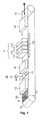
- FIG. 1 and Fig. 2 show schematic representations of an inkjet printing system and an inkjet marking device, respectively.
- Fig. 1 shows that a sheet of a receiving medium, in particular a machine coated medium, P, is transported in a direction for conveyance as indicated by arrows 50 and 51 and with the aid of transportation mechanism 12.
- Transportation mechanism 12 may be a driven belt system comprising one (as shown in Fig. 1 ) or more belts. Alternatively, one or more of these belts may be exchanged for one or more drums.
- a transportation mechanism may be suitably configured depending on the requirements (e.g. sheet registration accuracy) of the sheet transportation in each step of the printing process and may hence comprise one or more driven belts and/or one or more drums.
- the sheets need to be fixed to the transportation mechanism.
- the way of fixation is not particularly limited and may be selected from electrostatic fixation, mechanical fixation (e.g. clamping) and vacuum fixation. Of these vacuum fixation is preferred.
- the printing process as described below comprises the following steps: media pre-treatment, image formation, drying and fixing and optionally post treatment.
- the receiving medium may be pretreated, i.e. treated prior to printing an image on the medium.
- the pre-treatment step may comprise one or more of the following:
- any conventionally known methods can be used.
- Specific examples of an application way include: a roller coating, an ink-jet application, a curtain coating and a spray coating.
- a roller coating (see 14 in Fig. 1 ) method is preferable because this coating method does not need to take into consideration of ejection properties and it can apply the pre-treatment liquid homogeneously to a recording medium.
- the amount of the applied pre-treatment liquid with a roller or with other means to a recording medium can be suitably adjusted by controlling: the physical properties of the pre-treatment liquid; and the contact pressure of a roller in a roller coater to the recording medium and the rotational speed of a roller in a roller coater which is used for a coater of the pre-treatment liquid.
- As an application area of the pre-treatment liquid it may be possible to apply only to the printed portion, or to the entire surface of both the printed portion and the non-printed portion.
- the pre-treatment liquid when the pre-treatment liquid is applied only to the printed portion, unevenness may occur between the application area and a non-application area caused by swelling of cellulose contained in the coated printing paper with the water in the pre-treatment liquid followed by drying. Then, from the viewpoint of drying uniformly, it is preferable to apply a pre-treatment liquid to the entire surface of a coated printing paper, and roller coating can be preferably used as a coating method to the whole surface.
- the pre-treatment liquid may be an aqueous pre-treatment liquid.
- Corona or plasma treatment may be used as a pre-treatment step by exposing a sheet of a receiving medium to corona discharge or plasma treatment.
- media like polyethylene (PE) films, polypropylene (PP) films, polyetyleneterephtalate (PET) films and machine coated media
- the adhesion and spreading of the ink can be improved by increasing the surface energy of the media.
- machine coated media the absorption of water can be promoted which may induce faster fixation of the image and less puddling on the receiving medium.
- Surface properties of the receiving medium may be tuned by using different gases or gas mixtures as medium in the corona or plasma treatment. Examples are air, oxygen, nitrogen, carbondioxide, methane, fluorine gas, argon, neon and mixtures thereof. Corona treatment in air is most preferred.
- Fig. 1 shows that the sheet of receiving medium P may be conveyed to and passed through a first pre-treatment module 13, which module may comprise a preheater, for example a radiation heater, a corona/plasma treatment unit, a gaseous acid treatment unit or a combination of any of the above.
- a predetermined quantity of the pre-treatment liquid is applied on the surface of the receiving medium P at pre-treatment liquid applying member 14.
- the pre-treatment liquid is provided from storage tank 15 of the pre-treatment liquid to the pre-treatment liquid applying member 14 composed of double rolls 16 and 17. Each surface of the double rolls may be covered with a porous resin material such as sponge.
- the pre-treatment liquid is transferred to main roll 17, and a predetermined quantity is applied on the surface of the receiving medium P.
- the coated printing paper P on which the pre-treatment liquid was supplied may optionally be heated and dried by drying member 18 which is composed of a drying heater installed at the downstream position of the pre-treatment liquid applying member 14 in order to decrease the quantity of the water content in the pre-treatment liquid to a predetermined range. It is preferable to decrease the water content in an amount of 1.0 weight% to 30 weight% based on the total water content in the provided pre-treatment liquid provided on the receiving medium P.
- a cleaning unit (not shown) may be installed and/or the transportation mechanism may be comprised of multiple belts or drums as described above. The latter measure prevents contamination of the upstream parts of the transportation mechanism, in particular of the transportation mechanism in the printing region.
- Image formation is performed in such a manner that, employing an inkjet printer loaded with inkjet inks, ink droplets are ejected from the inkjet heads based on the digital signals onto a print medium.
- single pass inkjet printing is an inkjet recording method with which ink droplets are deposited onto the receiving medium to form all pixels of the image by a single passage of a receiving medium underneath an inkjet marking module.
- 11 represents an inkjet marking module comprising four inkjet marking devices, indicated with 111, 112, 113 and 114, each arranged to eject an ink of a different color (e.g. Cyan, Magenta, Yellow and blacK).
- the nozzle pitch of each head is e.g. about 360 dpi.
- "dpi" indicates a dot number per 2.54 cm.
- An inkjet marking device for use in single pass inkjet printing, 111, 112, 113, 114 has a length, L, of at least the width of the desired printing range, indicated with double arrow 52, the printing range being perpendicular to the media transport direction, indicated with arrows 50 and 51.
- the inkjet marking device may comprise a single printhead having a length of at least the width of said desired printing range.
- the inkjet marking device may also be constructed by combining two or more inkjet heads, such that the combined lengths of the individual inkjet heads cover the entire width of the printing range.
- Such a constructed inkjet marking device is also termed a page wide array (PWA) of printheads.
- PWA page wide array
- FIG. 2A shows an inkjet marking device111 (112, 113, 114 may be identical) comprising 7 individual inkjet heads (201, 202, 203, 204, 205, 206, 207) which are arranged in two parallel rows, a first row comprising four inkjet heads (201 - 204) and a second row comprising three inkjet heads (205 - 207) which are arranged in a staggered configuration with respect to the inkjet heads of the first row.
- the staggered arrangement provides a page wide array of nozzles which are substantially equidistant in the length direction of the inkjet marking device.
- the staggered configuration may also provide a redundancy of nozzles in the area where the inkjet heads of the first row and the second row overlap, see 70 in Fig. 2B .
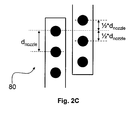
- Staggering may further be used to decrease the nozzle pitch (hence increasing the print resolution) in the length direction of the inkjet marking device, e.g. by arranging the second row of inkjet heads such that the positions of the nozzles of the inkjet heads of the second row are shifted in the length direction of the inkjet marking device by half the nozzle pitch, the nozzle pitch being the distance between adjacent nozzles in an inkjet head, d nozzle (see Fig. 2C , which represents a detailed view of 80 in Fig. 2B ).
- the resolution may be further increased by using more rows of inkjet heads, each of which are arranged such that the positions of the nozzles of each row are shifted in the length direction with respect to the positions of the nozzles of all other rows.
- an inkjet head i.e. printhead
- an inkjet head may be either an on-demand type or a continuous type inkjet head.
- an ink ejection system there may be usable either the electric-mechanical conversion system (e.g., a single-cavity type, a double-cavity type, a bender type, a piston type, a shear mode type, or a shared wall type), or an electric-thermal conversion system (e.g., a thermal inkjet type, or a Bubble Jet type (registered trade name)).
- a piezo type inkjet recording head which has nozzles of a diameter of 30 ⁇ m or less in the current image forming method.
- Fig. 1 shows that after pre-treatment, the receiving medium P is conveyed to upstream part of the inkjet marking module 11. Then, image formation is carried out by each color ink ejecting from each inkjet marking device 111, 112, 113 and 114 arranged so that the whole width of the receiving medium P is covered.
- the image formation may be carried out while the receiving medium is temperature controlled.
- a temperature control device 19 may be arranged to control the temperature of the surface of the transportation mechanism (e.g. belt or drum) underneath the inkjet marking module 11.
- the temperature control device 19 may be used to control the surface temperature of the receiving medium P, for example in the range of 30°C to 60°C.
- the temperature control device 19 may comprise heaters, such as radiation heaters, and a cooling means, for example a cold blast, in order to control the surface temperature of the receiving medium within said range. Subsequently and while printing, the receiving medium P is conveyed to the down stream part of the inkjet marking module 11.
- the prints After an image has been formed on the receiving medium, the prints have to be dried and the image has to be fixed onto the receiving medium. Drying comprises the evaporation of solvents, in particular those solvents that have poor absorption characteristics with respect to the selected receiving medium.
- Fig. 1 schematically shows a drying and fixing unit 20, which may comprise a heater, for example a radiation heater.
- a drying and fixing unit 20 After an image has been formed, the print is conveyed to and passed through the drying and fixing unit 20. The print is heated such that solvents present in the printed image, to a large extent water, evaporate. The speed of evaporation and hence drying may be enhanced by increasing the air refresh rate in the drying and fixing unit 20. Simultaneously, film formation of the ink occurs, because the prints are heated to a temperature above the minimum film formation temperature (MFT).
- MFT minimum film formation temperature
- the residence time of the print in the drying and fixing unit 20 and the temperature at which the drying and fixing unit 20 operates are optimized, such that when the print leaves the drying and fixing unit 20 a dry and robust print has been obtained.
- the transportation mechanism 12 in the fixing and drying unit 20 may be separated from the transportation mechanism of the pre-treatment and printing section of the printing apparatus and may comprise a belt or a drum.
- the print may be post treated, which is an optional step in the printing process.
- the prints may be post treated by laminating the prints.
- the post-treatment step comprises a step of applying (e.g. by jetting) a post-treatment liquid onto the surface of the coating layer, onto which the inkjet ink has been applied, so as to form a transparent protective layer on the printed recording medium.
- the post-treatment liquid may be applied over the entire surface of an image on the recording medium or may be applied only to specific portions of the surface of an image.
- the method of applying the post-treatment liquid is not particularly limited, and is selected from various methods depending on the type of the post-treatment liquid. However, the same method as used in the coating method of the pre-treatment liquid or an inkjet printing method is preferably used.
- inkjet printing method is particularly preferable in view of, avoiding contact between the printed image and the used post-treatment liquid applicator; the construction of an inkjet recording apparatus used; and the storage stability of the post-treatment liquid.
- a post-treatment liquid containing a transparent resin is applied on the surface of a formed image so that a dry adhesion amount of the post-treatment liquid is 0.5 g/m 2 to 10 g/m 2 , preferably 2 g/m 2 to 8 g/m 2 , thereby forming a protective layer on the recording medium.
- the dry adhesion amount is less than 0.5 g/m 2 , almost no improvement in image quality (image density, color saturation, glossiness and fixability) is obtained.
- the dry adhesion amount is more than 10 g/m 2 , it is disadvantageous in cost efficiency, because the dryness of the protective layer degrades and the effect of improving the image quality is saturated.
- an aqueous solution comprising components capable of forming a transparent protective layer over a recording medium (e.g. a water-dispersible resin, a surfactant, water, and additives as required) is preferably used.
- the water-dispersible resin comprised in the post-treatment liquid preferably has a glass transition temperature (T g ) of -30°C or higher, and more preferably in the range of -20°C to 100°C.
- T g glass transition temperature
- MFT minimum film forming temperature
- the water-dispersible resin may be radiation curable to improve the glossiness and fixability of the image.
- the water-dispersible resin for example, an acrylic resin, a styrene-acrylic resin, a urethane resin, an acryl-silicone resin, a fluorine resin and the like are preferably used.
- the water-dispersible resin can be suitably selected from the same materials as that used for the inkjet ink.
- the amount of the water-dispersible resin contained, as a solid content, in the protective layer is preferably 1% by mass to 50% by mass.
- the surfactant comprised in the post-treatment liquid is not particularly limited and may be suitably selected from those used in the inkjet ink. Examples of the other components of the post-treatment liquid include antifungal agents, antifoaming agents, and pH adjustors.
- the printing process was described such that the image formation step was performed in-line with the pre-treatment step (e.g. application of an (aqueous) pre-treatment liquid) and a drying and fixing step, all performed by the same apparatus (see Fig. 1 ).
- the printing process is not restricted to the above-mentioned embodiment.
- a method in which two or more machines are connected through a belt conveyor, drum conveyor or a roller, and the step of applying a pre-treatment liquid, the (optional) step of drying a coating solution, the step of ejecting an inkjet ink to form an image and the step or drying an fixing the printed image are performed. It is, however, preferable to carry out image formation with the above defined in-line image forming method.
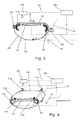
- FIG 3 shows schematically a conveying belt assembly 300 according to the invention.
- This assembly comprises an endless conveyor belt 303 having a conveying part 304 and a return part 305.
- the rotational direction of the conveyor belt 303 is defined by the conveying direction R and a transverse direction T ( figure 4 ) is defined as the direction perpendicular to arrow R and parallel to the conveyor belt.
- the endless conveyor belt 303 is wrapped around two sliding supports 301 and 302.
- Sliding support 301 is arranged downstream of the conveying part 304 and called downstream sliding support.
- Sliding support 302 is arranged upstream of the conveying part.
- downstream and upstream are in this application defined with respect to the conveying direction R.
- the transition between the conveying part and the return part is defined by the downstream and upstream sliding support 301 and 302.
- the assembly further comprises a driving roller 306.
- This driving roller 306 is arranged downstream of the conveying part 304 and is, during use, in urging contact with the outside of the conveyor belt 303.
- the driving roller cooperates in this example with the downstream sliding support 301, but cooperation with another passive roller or another actively driven driving roller on the inside of the conveyor belt is possible as well.
- a friction element 307 is arranged upstream of the conveying part 304.
- a friction element 307 is provided upstream of the conveying part.
- This friction element 307 is in urging contact with the conveyor belt.
- This friction element 307 might be a stationary element pressed against the outside of the conveyor belt 303 and cooperating with the upstream sliding support 302.
- the friction element can however also be designed differently. It might be a rotating element cooperating with the upstream sliding support or with another element arranged on the inside of the conveyor belt 303.
- the return part 305 is freely hanging between the downstream and upstream sliding support.
- the assembly according to the invention comprises a control system.
- the control system comprises a position sensing device 309 adapted to sense the position of the conveying part 304 with respect to the transverse direction.
- This sensing device 309 might comprise a camera or CCD or other sensor which measures the position of a side edge of the conveying part of the belt and/or of a pattern or marking provided on the belt 303.
- the camera or CCD or other sensor might also measure the position of a sheet of receiving medium, like a sheet of paper. This position of the sheet of receiving medium might already be measured before this sheet of receiving medium is introduced onto the conveyor belt of the assembly according to the invention.
- the control system further comprises a controller 308.
- This controller 308 is on the one hand operatively connected - by wire 310 - with the position sensing device 309 in order to receive sensor signals representing a position sensed by the position sensing device 309, and is on the other hand operatively connected - by wire 311 - with at least one actuator device, to be discussed below.
- the actuator device receives a control signal generated by the controller on the basis of amongst others the sensor signal(s) received from the at least one sensing device. It is to be noted that operatively connected encompasses, according to the present invention, wire connections as well as wireless connections.
- the at least one actuator device might comprise a vacuum plate 312 arranged against the inner side of the conveying part 304 of the endless conveyor belt 303. By shifting this vacuum plate 312 in transverse direction, the position of the conveying part with respect to the transverse direction T can be controlled as the vacuum plate might firm;ly grip the conveying part.
- the at least one actuator device according to the invention might also comprise a device applying a magnetic force to the conveying part of the actuator device.
- a device applying a magnetic force can be achieved by providing the belt with magnetic or magnetizable material, like Fe or an Fe alloy and providing, for example, the plate 312 with electro magnets.
- the plate 312 might be a vacuum plate or a regular support plate without any vacuum.
- the actuator device might comprise one or more pusher assemblies 313a, 313b, 314a, 314b, each comprising a pusher on each side of the conveyor belt 303.
- Each pusher of a pusher assembly is adapted to push against a lateral side 315, 316 of the conveyor belt.
- the actuator device might be adapted to adjust the angle of the rotational axis 317 of the driving roller element with respect to the transverse direction.
- plurality is defined as two or more than two.
- another is defined as at least a second or more.
- the terms including and/or having, as used herein, are defined as comprising (i.e., open language).
- coupled is defined as connected, although not necessarily directly.
Landscapes
- Engineering & Computer Science (AREA)
- Mechanical Engineering (AREA)
- Ink Jet (AREA)
Priority Applications (1)
| Application Number | Priority Date | Filing Date | Title |
|---|---|---|---|
| EP15181736.8A EP2990363B1 (de) | 2014-08-26 | 2015-08-20 | Förderbandanordnung für eine druckvorrichtung |
Applications Claiming Priority (2)
| Application Number | Priority Date | Filing Date | Title |
|---|---|---|---|
| EP14182318 | 2014-08-26 | ||
| EP15181736.8A EP2990363B1 (de) | 2014-08-26 | 2015-08-20 | Förderbandanordnung für eine druckvorrichtung |
Publications (2)
| Publication Number | Publication Date |
|---|---|
| EP2990363A1 true EP2990363A1 (de) | 2016-03-02 |
| EP2990363B1 EP2990363B1 (de) | 2017-07-12 |
Family
ID=51392190
Family Applications (1)
| Application Number | Title | Priority Date | Filing Date |
|---|---|---|---|
| EP15181736.8A Not-in-force EP2990363B1 (de) | 2014-08-26 | 2015-08-20 | Förderbandanordnung für eine druckvorrichtung |
Country Status (2)
| Country | Link |
|---|---|
| US (1) | US9522551B2 (de) |
| EP (1) | EP2990363B1 (de) |
Cited By (1)
| Publication number | Priority date | Publication date | Assignee | Title |
|---|---|---|---|---|
| CN106882616A (zh) * | 2017-03-18 | 2017-06-23 | 边继庆 | 旋转机 |
Families Citing this family (7)
| Publication number | Priority date | Publication date | Assignee | Title |
|---|---|---|---|---|
| JP6276446B1 (ja) * | 2017-03-24 | 2018-02-07 | 中外炉工業株式会社 | 蛇行修正可能な帯状材の搬送装置 |
| CN109228645B (zh) * | 2018-10-24 | 2024-02-09 | 深圳市威利特自动化设备有限公司 | 印刷生产系统 |
| DE102018133452A1 (de) * | 2018-12-21 | 2020-06-25 | Bdt Media Automation Gmbh | Vorrichtung zur seitlichen Positionierung der in einer Transportrichtung gesehenen Seitenkante von flachen, flexiblen Objekten |
| CN112938558B (zh) * | 2021-01-29 | 2023-04-07 | 贵阳天海数码科技有限公司 | 基于扫描的图像自动纠正系统 |
| CN113059902A (zh) * | 2021-02-26 | 2021-07-02 | 芜湖昌立包装有限公司 | 一种纸箱加工用的智能化水墨印刷机 |
| CN119317581A (zh) * | 2022-06-06 | 2025-01-14 | 欧佩克斯公司 | 具有物品扫描站的物料搬运装置 |
| CN115872093B (zh) * | 2022-12-29 | 2025-12-12 | 深圳迎凯生物科技有限公司 | 样本输送系统 |
Citations (3)
| Publication number | Priority date | Publication date | Assignee | Title |
|---|---|---|---|---|
| US20090145729A1 (en) * | 2007-12-05 | 2009-06-11 | Seiko Epson Corporation | Belt skew correction device, belt transportation device, and recording device |
| WO2012021059A1 (en) * | 2010-08-12 | 2012-02-16 | C.C.M. Beheer B.V. | Belt conveyor with an actuator for moving the belt in a lateral direction |
| US20130222456A1 (en) * | 2012-02-28 | 2013-08-29 | Kyocera Document Solutions Inc. | Image forming apparatus with conveyance belt movement correction |
Family Cites Families (3)
| Publication number | Priority date | Publication date | Assignee | Title |
|---|---|---|---|---|
| DE102006023111A1 (de) | 2006-05-16 | 2007-11-22 | Werner Kammann Maschinenfabrik Gmbh & Co. Kg | Vorrichtung zum Beschichten von Objekten |
| AT509764B1 (de) | 2010-05-11 | 2012-03-15 | Zimmer Maschb Ges M B H J | Messvorrichtung einer druckmaschine |
| US11481297B2 (en) | 2021-01-05 | 2022-10-25 | Honeywell International Inc. | Event input device testing |
-
2015
- 2015-08-12 US US14/824,791 patent/US9522551B2/en not_active Expired - Fee Related
- 2015-08-20 EP EP15181736.8A patent/EP2990363B1/de not_active Not-in-force
Patent Citations (3)
| Publication number | Priority date | Publication date | Assignee | Title |
|---|---|---|---|---|
| US20090145729A1 (en) * | 2007-12-05 | 2009-06-11 | Seiko Epson Corporation | Belt skew correction device, belt transportation device, and recording device |
| WO2012021059A1 (en) * | 2010-08-12 | 2012-02-16 | C.C.M. Beheer B.V. | Belt conveyor with an actuator for moving the belt in a lateral direction |
| US20130222456A1 (en) * | 2012-02-28 | 2013-08-29 | Kyocera Document Solutions Inc. | Image forming apparatus with conveyance belt movement correction |
Cited By (1)
| Publication number | Priority date | Publication date | Assignee | Title |
|---|---|---|---|---|
| CN106882616A (zh) * | 2017-03-18 | 2017-06-23 | 边继庆 | 旋转机 |
Also Published As
| Publication number | Publication date |
|---|---|
| US9522551B2 (en) | 2016-12-20 |
| EP2990363B1 (de) | 2017-07-12 |
| US20160059584A1 (en) | 2016-03-03 |
Similar Documents
| Publication | Publication Date | Title |
|---|---|---|
| EP2990363B1 (de) | Förderbandanordnung für eine druckvorrichtung | |
| EP3020558B1 (de) | Transportmechanismus und -verfahren zum transportieren eines druckmediums in einem drucksystem | |
| US9452607B2 (en) | Assembly of a print head and a maintenance unit and method for the use of said assembly | |
| US9850086B2 (en) | Conveyor mechanism and a method for adjusting a conveyor mechanism | |
| CN104334358B (zh) | 打印系统中的打印介质的真空下拉 | |
| US20130286071A1 (en) | Color-to-color correction in a printing system | |
| WO2013131751A1 (en) | Recording substrate treatment apparatus, printing system and method of drying | |
| US9738097B2 (en) | Device for redirecting sheets in a printing system | |
| US9707778B2 (en) | Belt on belt sheet transport system for a printing system | |
| EP3028863B1 (de) | Bogenverarbeitungsvorrichtung mit drehtrommel | |
| US9090424B1 (en) | Drive roller configuration providing reduced web wrinkling | |
| EP3063010B1 (de) | Verfahren zur bestimmung der funktion eines druckkopfkühlers | |
| EP2993148B1 (de) | Druckvorrichtung mit blatttrennsystem, und dazugehöriges verfahren zur trennung eines blattes | |
| EP4656389A1 (de) | Druckvorrichtung, druckverfahren und verfahren zum abdecken einer druckeinheit | |
| EP3290366A1 (de) | Bogenverarbeitungsvorrichtung mit drehtrommel | |
| NL2027440B1 (en) | Page-wide Print Head Array and Printer Comprising said Page-wide Print Head Array | |
| EP4656388A1 (de) | Druckvorrichtung und verfahren zur wartung einer druckvorrichtung | |
| EP3587131B1 (de) | Druckvorrichtung und verfahren zum positionieren einer druckkopfanordnung in einer druckervorrichtung |
Legal Events
| Date | Code | Title | Description |
|---|---|---|---|
| PUAI | Public reference made under article 153(3) epc to a published international application that has entered the european phase |
Free format text: ORIGINAL CODE: 0009012 |
|
| AK | Designated contracting states |
Kind code of ref document: A1 Designated state(s): AL AT BE BG CH CY CZ DE DK EE ES FI FR GB GR HR HU IE IS IT LI LT LU LV MC MK MT NL NO PL PT RO RS SE SI SK SM TR |
|
| AX | Request for extension of the european patent |
Extension state: BA ME |
|
| TPAC | Observations filed by third parties |
Free format text: ORIGINAL CODE: EPIDOSNTIPA |
|
| 17P | Request for examination filed |
Effective date: 20160902 |
|
| RBV | Designated contracting states (corrected) |
Designated state(s): AL AT BE BG CH CY CZ DE DK EE ES FI FR GB GR HR HU IE IS IT LI LT LU LV MC MK MT NL NO PL PT RO RS SE SI SK SM TR |
|
| GRAP | Despatch of communication of intention to grant a patent |
Free format text: ORIGINAL CODE: EPIDOSNIGR1 |
|
| STAA | Information on the status of an ep patent application or granted ep patent |
Free format text: STATUS: GRANT OF PATENT IS INTENDED |
|
| INTG | Intention to grant announced |
Effective date: 20170213 |
|
| GRAS | Grant fee paid |
Free format text: ORIGINAL CODE: EPIDOSNIGR3 |
|
| GRAA | (expected) grant |
Free format text: ORIGINAL CODE: 0009210 |
|
| STAA | Information on the status of an ep patent application or granted ep patent |
Free format text: STATUS: THE PATENT HAS BEEN GRANTED |
|
| AK | Designated contracting states |
Kind code of ref document: B1 Designated state(s): AL AT BE BG CH CY CZ DE DK EE ES FI FR GB GR HR HU IE IS IT LI LT LU LV MC MK MT NL NO PL PT RO RS SE SI SK SM TR |
|
| REG | Reference to a national code |
Ref country code: GB Ref legal event code: FG4D |
|
| REG | Reference to a national code |
Ref country code: CH Ref legal event code: EP |
|
| REG | Reference to a national code |
Ref country code: AT Ref legal event code: REF Ref document number: 908116 Country of ref document: AT Kind code of ref document: T Effective date: 20170715 |
|
| REG | Reference to a national code |
Ref country code: IE Ref legal event code: FG4D |
|
| REG | Reference to a national code |
Ref country code: FR Ref legal event code: PLFP Year of fee payment: 3 |
|
| REG | Reference to a national code |
Ref country code: DE Ref legal event code: R096 Ref document number: 602015003521 Country of ref document: DE |
|
| REG | Reference to a national code |
Ref country code: NL Ref legal event code: FP |
|
| REG | Reference to a national code |
Ref country code: LT Ref legal event code: MG4D |
|
| REG | Reference to a national code |
Ref country code: AT Ref legal event code: MK05 Ref document number: 908116 Country of ref document: AT Kind code of ref document: T Effective date: 20170712 |
|
| PG25 | Lapsed in a contracting state [announced via postgrant information from national office to epo] |
Ref country code: SE Free format text: LAPSE BECAUSE OF FAILURE TO SUBMIT A TRANSLATION OF THE DESCRIPTION OR TO PAY THE FEE WITHIN THE PRESCRIBED TIME-LIMIT Effective date: 20170712 Ref country code: FI Free format text: LAPSE BECAUSE OF FAILURE TO SUBMIT A TRANSLATION OF THE DESCRIPTION OR TO PAY THE FEE WITHIN THE PRESCRIBED TIME-LIMIT Effective date: 20170712 Ref country code: AT Free format text: LAPSE BECAUSE OF FAILURE TO SUBMIT A TRANSLATION OF THE DESCRIPTION OR TO PAY THE FEE WITHIN THE PRESCRIBED TIME-LIMIT Effective date: 20170712 Ref country code: LT Free format text: LAPSE BECAUSE OF FAILURE TO SUBMIT A TRANSLATION OF THE DESCRIPTION OR TO PAY THE FEE WITHIN THE PRESCRIBED TIME-LIMIT Effective date: 20170712 Ref country code: HR Free format text: LAPSE BECAUSE OF FAILURE TO SUBMIT A TRANSLATION OF THE DESCRIPTION OR TO PAY THE FEE WITHIN THE PRESCRIBED TIME-LIMIT Effective date: 20170712 Ref country code: NO Free format text: LAPSE BECAUSE OF FAILURE TO SUBMIT A TRANSLATION OF THE DESCRIPTION OR TO PAY THE FEE WITHIN THE PRESCRIBED TIME-LIMIT Effective date: 20171012 |
|
| PG25 | Lapsed in a contracting state [announced via postgrant information from national office to epo] |
Ref country code: RS Free format text: LAPSE BECAUSE OF FAILURE TO SUBMIT A TRANSLATION OF THE DESCRIPTION OR TO PAY THE FEE WITHIN THE PRESCRIBED TIME-LIMIT Effective date: 20170712 Ref country code: ES Free format text: LAPSE BECAUSE OF FAILURE TO SUBMIT A TRANSLATION OF THE DESCRIPTION OR TO PAY THE FEE WITHIN THE PRESCRIBED TIME-LIMIT Effective date: 20170712 Ref country code: LV Free format text: LAPSE BECAUSE OF FAILURE TO SUBMIT A TRANSLATION OF THE DESCRIPTION OR TO PAY THE FEE WITHIN THE PRESCRIBED TIME-LIMIT Effective date: 20170712 Ref country code: GR Free format text: LAPSE BECAUSE OF FAILURE TO SUBMIT A TRANSLATION OF THE DESCRIPTION OR TO PAY THE FEE WITHIN THE PRESCRIBED TIME-LIMIT Effective date: 20171013 Ref country code: IS Free format text: LAPSE BECAUSE OF FAILURE TO SUBMIT A TRANSLATION OF THE DESCRIPTION OR TO PAY THE FEE WITHIN THE PRESCRIBED TIME-LIMIT Effective date: 20171112 Ref country code: PL Free format text: LAPSE BECAUSE OF FAILURE TO SUBMIT A TRANSLATION OF THE DESCRIPTION OR TO PAY THE FEE WITHIN THE PRESCRIBED TIME-LIMIT Effective date: 20170712 Ref country code: BG Free format text: LAPSE BECAUSE OF FAILURE TO SUBMIT A TRANSLATION OF THE DESCRIPTION OR TO PAY THE FEE WITHIN THE PRESCRIBED TIME-LIMIT Effective date: 20171012 |
|
| REG | Reference to a national code |
Ref country code: DE Ref legal event code: R097 Ref document number: 602015003521 Country of ref document: DE |
|
| PG25 | Lapsed in a contracting state [announced via postgrant information from national office to epo] |
Ref country code: CZ Free format text: LAPSE BECAUSE OF FAILURE TO SUBMIT A TRANSLATION OF THE DESCRIPTION OR TO PAY THE FEE WITHIN THE PRESCRIBED TIME-LIMIT Effective date: 20170712 Ref country code: DK Free format text: LAPSE BECAUSE OF FAILURE TO SUBMIT A TRANSLATION OF THE DESCRIPTION OR TO PAY THE FEE WITHIN THE PRESCRIBED TIME-LIMIT Effective date: 20170712 Ref country code: MC Free format text: LAPSE BECAUSE OF FAILURE TO SUBMIT A TRANSLATION OF THE DESCRIPTION OR TO PAY THE FEE WITHIN THE PRESCRIBED TIME-LIMIT Effective date: 20170712 Ref country code: RO Free format text: LAPSE BECAUSE OF FAILURE TO SUBMIT A TRANSLATION OF THE DESCRIPTION OR TO PAY THE FEE WITHIN THE PRESCRIBED TIME-LIMIT Effective date: 20170712 |
|
| REG | Reference to a national code |
Ref country code: BE Ref legal event code: MM Effective date: 20170831 |
|
| PLBE | No opposition filed within time limit |
Free format text: ORIGINAL CODE: 0009261 |
|
| STAA | Information on the status of an ep patent application or granted ep patent |
Free format text: STATUS: NO OPPOSITION FILED WITHIN TIME LIMIT |
|
| REG | Reference to a national code |
Ref country code: IE Ref legal event code: MM4A |
|
| PG25 | Lapsed in a contracting state [announced via postgrant information from national office to epo] |
Ref country code: IT Free format text: LAPSE BECAUSE OF FAILURE TO SUBMIT A TRANSLATION OF THE DESCRIPTION OR TO PAY THE FEE WITHIN THE PRESCRIBED TIME-LIMIT Effective date: 20170712 Ref country code: SK Free format text: LAPSE BECAUSE OF FAILURE TO SUBMIT A TRANSLATION OF THE DESCRIPTION OR TO PAY THE FEE WITHIN THE PRESCRIBED TIME-LIMIT Effective date: 20170712 Ref country code: SM Free format text: LAPSE BECAUSE OF FAILURE TO SUBMIT A TRANSLATION OF THE DESCRIPTION OR TO PAY THE FEE WITHIN THE PRESCRIBED TIME-LIMIT Effective date: 20170712 Ref country code: EE Free format text: LAPSE BECAUSE OF FAILURE TO SUBMIT A TRANSLATION OF THE DESCRIPTION OR TO PAY THE FEE WITHIN THE PRESCRIBED TIME-LIMIT Effective date: 20170712 |
|
| 26N | No opposition filed |
Effective date: 20180413 |
|
| PG25 | Lapsed in a contracting state [announced via postgrant information from national office to epo] |
Ref country code: LU Free format text: LAPSE BECAUSE OF NON-PAYMENT OF DUE FEES Effective date: 20170820 |
|
| PG25 | Lapsed in a contracting state [announced via postgrant information from national office to epo] |
Ref country code: IE Free format text: LAPSE BECAUSE OF NON-PAYMENT OF DUE FEES Effective date: 20170820 |
|
| REG | Reference to a national code |
Ref country code: FR Ref legal event code: PLFP Year of fee payment: 4 |
|
| PG25 | Lapsed in a contracting state [announced via postgrant information from national office to epo] |
Ref country code: SI Free format text: LAPSE BECAUSE OF FAILURE TO SUBMIT A TRANSLATION OF THE DESCRIPTION OR TO PAY THE FEE WITHIN THE PRESCRIBED TIME-LIMIT Effective date: 20170712 Ref country code: BE Free format text: LAPSE BECAUSE OF NON-PAYMENT OF DUE FEES Effective date: 20170831 |
|
| PG25 | Lapsed in a contracting state [announced via postgrant information from national office to epo] |
Ref country code: MT Free format text: LAPSE BECAUSE OF NON-PAYMENT OF DUE FEES Effective date: 20170820 |
|
| PGFP | Annual fee paid to national office [announced via postgrant information from national office to epo] |
Ref country code: AT Payment date: 20180522 Year of fee payment: 8 |
|
| REG | Reference to a national code |
Ref country code: CH Ref legal event code: PL |
|
| PG25 | Lapsed in a contracting state [announced via postgrant information from national office to epo] |
Ref country code: CH Free format text: LAPSE BECAUSE OF NON-PAYMENT OF DUE FEES Effective date: 20180831 Ref country code: LI Free format text: LAPSE BECAUSE OF NON-PAYMENT OF DUE FEES Effective date: 20180831 |
|
| PG25 | Lapsed in a contracting state [announced via postgrant information from national office to epo] |
Ref country code: HU Free format text: LAPSE BECAUSE OF FAILURE TO SUBMIT A TRANSLATION OF THE DESCRIPTION OR TO PAY THE FEE WITHIN THE PRESCRIBED TIME-LIMIT; INVALID AB INITIO Effective date: 20150820 |
|
| PG25 | Lapsed in a contracting state [announced via postgrant information from national office to epo] |
Ref country code: CY Free format text: LAPSE BECAUSE OF FAILURE TO SUBMIT A TRANSLATION OF THE DESCRIPTION OR TO PAY THE FEE WITHIN THE PRESCRIBED TIME-LIMIT Effective date: 20170712 |
|
| PG25 | Lapsed in a contracting state [announced via postgrant information from national office to epo] |
Ref country code: MK Free format text: LAPSE BECAUSE OF FAILURE TO SUBMIT A TRANSLATION OF THE DESCRIPTION OR TO PAY THE FEE WITHIN THE PRESCRIBED TIME-LIMIT Effective date: 20170712 |
|
| PG25 | Lapsed in a contracting state [announced via postgrant information from national office to epo] |
Ref country code: TR Free format text: LAPSE BECAUSE OF FAILURE TO SUBMIT A TRANSLATION OF THE DESCRIPTION OR TO PAY THE FEE WITHIN THE PRESCRIBED TIME-LIMIT Effective date: 20170712 |
|
| GBPC | Gb: european patent ceased through non-payment of renewal fee |
Effective date: 20190820 |
|
| PG25 | Lapsed in a contracting state [announced via postgrant information from national office to epo] |
Ref country code: PT Free format text: LAPSE BECAUSE OF FAILURE TO SUBMIT A TRANSLATION OF THE DESCRIPTION OR TO PAY THE FEE WITHIN THE PRESCRIBED TIME-LIMIT Effective date: 20170712 |
|
| PG25 | Lapsed in a contracting state [announced via postgrant information from national office to epo] |
Ref country code: FR Free format text: LAPSE BECAUSE OF NON-PAYMENT OF DUE FEES Effective date: 20190831 Ref country code: AL Free format text: LAPSE BECAUSE OF FAILURE TO SUBMIT A TRANSLATION OF THE DESCRIPTION OR TO PAY THE FEE WITHIN THE PRESCRIBED TIME-LIMIT Effective date: 20170712 |
|
| PG25 | Lapsed in a contracting state [announced via postgrant information from national office to epo] |
Ref country code: GB Free format text: LAPSE BECAUSE OF NON-PAYMENT OF DUE FEES Effective date: 20190820 |
|
| PGFP | Annual fee paid to national office [announced via postgrant information from national office to epo] |
Ref country code: NL Payment date: 20210721 Year of fee payment: 7 |
|
| PGFP | Annual fee paid to national office [announced via postgrant information from national office to epo] |
Ref country code: DE Payment date: 20210819 Year of fee payment: 7 |
|
| REG | Reference to a national code |
Ref country code: DE Ref legal event code: R119 Ref document number: 602015003521 Country of ref document: DE |
|
| REG | Reference to a national code |
Ref country code: NL Ref legal event code: MM Effective date: 20220901 |
|
| PG25 | Lapsed in a contracting state [announced via postgrant information from national office to epo] |
Ref country code: NL Free format text: LAPSE BECAUSE OF NON-PAYMENT OF DUE FEES Effective date: 20220901 |
|
| PG25 | Lapsed in a contracting state [announced via postgrant information from national office to epo] |
Ref country code: DE Free format text: LAPSE BECAUSE OF NON-PAYMENT OF DUE FEES Effective date: 20230301 |