EP2995421A1 - Wide strip grinding machine with a device for controlling the tension roller for generating a pre-defined grinding pattern and method therefor - Google Patents
Wide strip grinding machine with a device for controlling the tension roller for generating a pre-defined grinding pattern and method therefor Download PDFInfo
- Publication number
- EP2995421A1 EP2995421A1 EP15185043.5A EP15185043A EP2995421A1 EP 2995421 A1 EP2995421 A1 EP 2995421A1 EP 15185043 A EP15185043 A EP 15185043A EP 2995421 A1 EP2995421 A1 EP 2995421A1
- Authority
- EP
- European Patent Office
- Prior art keywords
- belt
- grinding
- controller
- signal
- wide
- Prior art date
- Legal status (The legal status is an assumption and is not a legal conclusion. Google has not performed a legal analysis and makes no representation as to the accuracy of the status listed.)
- Granted
Links
Images


Classifications
-
- B—PERFORMING OPERATIONS; TRANSPORTING
- B24—GRINDING; POLISHING
- B24B—MACHINES, DEVICES, OR PROCESSES FOR GRINDING OR POLISHING; DRESSING OR CONDITIONING OF ABRADING SURFACES; FEEDING OF GRINDING, POLISHING, OR LAPPING AGENTS
- B24B21/00—Machines or devices using grinding or polishing belts; Accessories therefor
- B24B21/18—Accessories
- B24B21/20—Accessories for controlling or adjusting the tracking or the tension of the grinding belt
-
- B—PERFORMING OPERATIONS; TRANSPORTING
- B24—GRINDING; POLISHING
- B24B—MACHINES, DEVICES, OR PROCESSES FOR GRINDING OR POLISHING; DRESSING OR CONDITIONING OF ABRADING SURFACES; FEEDING OF GRINDING, POLISHING, OR LAPPING AGENTS
- B24B21/00—Machines or devices using grinding or polishing belts; Accessories therefor
- B24B21/04—Machines or devices using grinding or polishing belts; Accessories therefor for grinding plane surfaces
- B24B21/12—Machines or devices using grinding or polishing belts; Accessories therefor for grinding plane surfaces involving a contact wheel or roller pressing the belt against the work
Definitions
- the invention relates to a wide-belt sanding machine with a sanding belt, which is guided over a grinding roller and a position-controlled tensioning roller. Furthermore, the invention relates to an associated method.
- the sanding belt is stretched over at least two rollers.
- one of the rollers serves as a grinding roller and the other roller as a tensioning roller.
- the abrasive belt is designed as an endless belt. With the length and width ratios used, it is difficult to center the belt over spherical rollers without additional control. To make matters worse still band tolerance and elongation are added.
- a control is described in which the position of the edge of the sanding belt is detected with a light barrier.
- a pneumatic adjusting member is used to control the abrasive belt. Due to the control of the adjusting member is continuously operated, which is a continuous oscillation of the grinding belt with a certain hysteresis Episode has. The resulting traces of oscillation significantly affect the grinding result.
- the DE 20 2012 100 928 U1 Hans Weber Maschinenfabrik describes a wide-belt sanding machine with a position-controlled tensioning roller. By specifying a constant setpoint, the random oscillation of the grinding belt is effectively prevented.
- DE 10 2007 012 580 A1 describes a method for guiding the tape of a belt grinding machine, in which the lateral position of an abrasive belt is detected by means of an analog edge sensor.
- the signals from the analog edge sensor are fed to an electropneumatic governor, which regulates the pressure of a pneumatic oscillation cylinder, resulting in a nearly stationary abrasive belt.
- the signal of the analog edge sensor can be acted upon via a control unit, so that a tensioning roller pivots about a pivot point.
- DE 11 38 658 A describes a device for regulating and controlling the running of abrasive belts on belt grinders.
- a motor drive controls a pivotable tape roll to perform continuous, uniform forced oscillations about a swing axis.
- the frequency and amplitude of the vibrations is adjustable.
- the abrasive belt is passed over a sanding roller and a tension roller.
- the tensioning roller is adjustable in its position by means of an actuator in such a way that the grinding belt occupies a predetermined position on the grinding roller.
- a position detector e.g. a photocell detected.
- This light barrier comprises a beam source and a detector. With the light barrier, the edge of the sanding belt is captured in a silhouette process.
- the detector generates a continuous analog actual signal, which is dependent on the position of the grinding belt with respect to the light barrier and thus also with respect to the position of the grinding belt on the grinding roller.
- the analog actual signal is fed to a controller which controls the actuator continuously so that by changing the position of the tensioning roller, the grinding belt on the grinding roller maintains a predetermined position.
- a controller generates an oscillating signal, which is supplied as a reference variable to the controller.
- This controller controls the actuator so that the abrasive belt changes its lateral position with respect to the light barrier according to the time course of the reference variable. Accordingly, in conjunction with the forward movement of the workpiece under the abrasive roller, a grinding pattern defined by the guide size results.
- the controller may generate as oscillating signal, for example, a sinusoidal signal, a triangular signal, a trapezoidal signal or an overlay of these signals. Accordingly, as a grinding pattern along the workpiece surface, a sinusoidal pattern, a triangular pattern, a trapezoidal pattern or an overlay of these patterns result. It should be noted that in the steady state of the control loop, the disturbances, e.g. a random emigration of the movement of the grinding belt, are corrected and no longer occur such disturbances in the grinding pattern.
- the oscillating signal generated by the controller may include time periods with constant signal level in its time course. These are expressed in the grinding pattern as path sections with a constant abrasive structure.
- the controller comprises a function generator for generating periodic and non-periodic signals. In this way, a variety of waveforms can be provided for the command variable, resulting in a wide range of patterns.
- the controller is designed as a programmable logic controller (PLC).
- PLC programmable logic controller
- an optical reflex sensor in addition to the above-mentioned forked light barrier, an optical reflex sensor, a mechanical contactor, a capacitive or inductive sensor, an ultrasonic sensor or a compressed air sensor, e.g. according to the nozzle-flapper principle works to be used. It is essential that the position detector used in each case detects the web edge continuously and continuously images its position in a signal, preferably analog.
- the actuator is pneumatic and comprises at least one bellows cylinder, which operates against a restoring element.
- These bellows cylinders have no slip-stick effect, whereby the control process is more continuous.
- a pneumatic muscle cylinder with similar functional behavior can be used.
- the axis of rotation of the tensioning roller is adjustable in at least one plane. It is particularly advantageous if this plane is selected parallel to the material surface to be ground. As a result, the actuator can be constructed particularly simple.
- the controller is a proportional controller.
- This proportional controller is particularly simple in construction and can be easily implemented, e.g. in the form of a solenoid valve which adjusts the pneumatic pressure supplied to the actuator.
- control loop additionally has an integral and / or differential behavior.
- This integral behavior of the control loop improves the control to minimize the permanent setpoint value deviation typical of a proportional controller.
- a differential behavior increases the control speed of the control loop.
- the tensioning roller is centrally supported by means of a tower shaft and can be rotated about the longitudinal axis of the tower shaft.
- a gimbal is achieved when the tension roller is mounted so that it can oscillate about a third axis which is aligned perpendicular to the longitudinal axis of the tower shaft.
- the tension roller can be particularly easily aligned so that a grinding belt with different circumferential lengths touches the tension roller at each point.
- the sanding roller is driven by motor means. This improves the control in that the mass of the drive does not have to be moved with the tension roller from the actuator. As a result, the actuator can be constructed simpler.
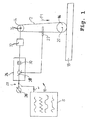
- FIG. 1 shows a schematic structure of a control loop 10 for position control of an abrasive belt 12.
- the sanding belt 12 is guided over a tension roller 14 and a grinding roller 16.
- the sanding roller 16 presses the sanding belt 12 onto a workpiece 18 to be sanded.
- the sanding belt 12 is an endless sanding belt with a width of up to about 3 meters. Due to the manufacturing process, such an abrasive belt 12 is not quite uniform, ie the circumference at one edge of the belt usually differs from the circumference at the other edge of the belt. Therefore, in the grinding operation, the grinding belt 12 tends to emigrate along a rotation axis 20 of the grinding roller 16 in the predetermined direction in addition to the rotation direction indicated by the arrow P1. The lateral movement in the direction of the axis of rotation 20 is a disturbance. With the help of the control loop 10, the position of the grinding belt 12 is monitored on the grinding roller 16 and counteracts the disturbing movement actively.
- a detector in the light barrier 22 generates a continuous analog actual signal.
- the analog actual signal is a DC signal, in this embodiment, a voltage between 0 volts and +10 volts.
- a signal of 0 volts corresponds to a position of the belt edge of the sanding belt 12 at one end of the detection range of the light barrier 22, while a signal of +10 volts means a position of the belt edge of the sanding belt 12 at the other detection limit of the light barrier 22.
- This analog actual signal is according to FIG. 1 a controller 24 which provides the pneumatic pressure for a pneumatic actuator. Furthermore, the controller 24 may be supplied in a variant of a generated by a desired value encoder 26 analog target signal.
- the desired signal corresponds to a desired position of the sanding belt 12 on the sanding roller 16. At the desired value encoder 26, the desired position of the sanding belt 12 is adjustable.
- the input of the controller 24 is connected via a switching device 29 to the output of a controller S, which supplies as command variable w optionally oscillating signals to the controller 24.
- a sinusoidal signal, a trapezoidal signal and a triangular signal for the controller S are shown as signals.
- the controller 24 comprises a summing element 28 and a proportional controller 30.
- the summing element 28 is supplied with desired signal and actual signal.
- the formed deviation between Target signal and actual signal is supplied to the proportional controller 30, which generates a corresponding control signal.
- This exemplary pneumatic signal may process the pneumatic actuator 32.
- the actuator 32 which includes, for example, a bellows cylinder, changes the position of a rotation axis 34 of the tension roller 14 to the effect that the grinding belt 12 complies with the target position predetermined by the desired signal on the grinding roller 16.
- the change in position of the rotation axis 34 will later in the Figures 3 and 4 described.
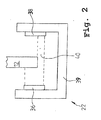
- FIG. 2 shows as an example of a position detector, the light barrier 22, which is a fork light barrier in this embodiment, in which the abrasive belt 12 is immersed with its side edge.
- the fork light barrier 22 comprises a large-area light-emitting diode as a beam source 36 and a phototransistor 38 optimized for an emission wavelength of the light-emitting diode 36.
- light-emitting diode 36 and detector 38 are optimally aligned with one another on a U-shaped carrier 39.
- the edge of the sanding belt 12 is guided in such a way that, in its desired position on the sanding roller 16, it partially covers a light beam 40 emitted by the light-emitting diode 36 and thus partially shades the detector 38.
- the electrical signal generated by the detector 38 is proportional to the amount of light arriving at the detector 38, which in turn depends on the position of the band edge of the grinding belt 12. If the sanding belt 12 covers the entire light beam 40, then the detector 38 will output a signal of 0 volt. If the light beam 40 at the detector 38 is not shadowed by the abrasive belt 12 at all, then the detector 38 will output a signal of 10 volts. In a partial shading of the detector 38th the voltage signal of the detector 38 is proportional to the shading and thus dependent on the position of the grinding belt 12.
- FIG. 3 shows a position of the tension roller 14 and the grinding belt 12 in an adjustment of the position of the tension roller 14 by the actuator 32.
- This actuator 32 has the position of the axis of rotation 34 of the tension roller 14 changed so that it occupies the position shown in dashed lines 14 '.
- the tension roller 14 is mounted centrally by a tower shaft 46 and can be pivoted about an axis of rotation 15.
- the actuator 32 engages the end 44 of the tension roller 14 and pivots this end 44 about the axis of rotation 15 so as to provide the positions shown at 44 'and 44 "by the reference numerals 42, 42' and 42"
- Tensioning roller 14 denotes.
- the tower shaft 46 supports the tension roller 14 in the center and can pivot about the rotation axis 15. If the tension roller 14 is gimbal connected to the tower roller 46 (gimbal suspension), it can also be pivoted in a third axis perpendicular to the axis of rotation 15, wherein the paper plane of the FIG. 4 leaves.
- the tensioning roller 14 can be moved in the direction of the longitudinal axis of the tower shaft 46 in order to be able to tension sanding belts 12 of different lengths and to enable the replacement of sanding belts.
- the tensioning roller 14 is aligned by a movement about the third axis in such a way that the grinding belt 12 touches the tensioning roller 14 at each point of the tensioning roller 14.
- the control circuit 10 (FIG. FIG. 1 ) controlled by the controller S, which is advantageously designed as a programmable logic controller (PLC).
- the signal generated by this control S is supplied as a reference variable w the controller 24, which controls the actuator 32 so that the grinding belt 12 changes its lateral position according to the time course of the reference variable w.
- a grinding pattern is generated on its surface, which follows in the steady state of the control loop 10 in close approximation to the time course of the reference variable w.
- By the action of the control loop 10 and random disturbances are regulated, which can occur, for example, due to the unevenness of the grinding belt 12.
- the controller S comprises a preferably programmable function generator, with the aid of which periodic and non-periodic signals can be generated.
- the signal generated by the controller in its time course may contain time segments with constant signal level.
- the control circuit 10 causes a constant grinding pattern to be generated along a path on the surface of the workpiece. It is also possible to superimpose different sinusoidal signals, which lead to different time profiles of the reference variable w in accordance with the composition of Fourier components, thereby providing the user with a broad spectrum of grinding patterns for surfaces of workpieces.
- Another development provides that a plurality of grinding patterns and the associated signal curves for the oscillating signal are stored in a memory. A user can then select one of these different grinding patterns.
- the controller S then supplies the associated signal profile to the controller 24 as a reference variable w and the wideband grinding machine thus controlled generates the grinding pattern on the surface of the workpiece.
Landscapes
- Engineering & Computer Science (AREA)
- Mechanical Engineering (AREA)
- Finish Polishing, Edge Sharpening, And Grinding By Specific Grinding Devices (AREA)
Abstract
Beschrieben wird eine Breitbandschleifmaschine und ein Verfahren, bei dem die Kante eines Schleifbandes (12) durch einen Lage-Detektor (22) erfasst wird, der Lage-Detektor (22) ein kontinuierliches Ist-Signal abhängig von der Lage des Schleifbandes (12) erzeugt. Eine Steuerung (S) erzeugt ein oszillierendes Signal, das als Führungsgröße (w) einem Regler (24) zugeführt ist, der ein Stellglied (32) s,o ansteuert, dass das Schleifband (12) seine Lage entsprechend dem zeitlichen Verlauf der Führungsgröße (w) ändert, um ein vorgegebenes Schleifmuster auf einer Oberfläche eines Werkstücks (18) zu erzeugen.A wide-belt sander and a method in which the edge of a sanding belt (12) is detected by a position detector (22), the position detector (22) generates a continuous actual signal depending on the position of the sanding belt (12) , A controller (S) generates an oscillating signal, which is fed as a reference variable (w) to a controller (24) which controls an actuator (32) s, o, that the grinding belt (12) its position corresponding to the time course of the reference variable ( w) changes to produce a predetermined grinding pattern on a surface of a workpiece (18).
Description
Die Erfindung betrifft eine Breitbandschleifmaschine mit einem Schleifband, das über eine Schleifwalze und eine lagegeregelte Spannwalze geführt ist. Ferner betrifft die Erfindung ein zugehöriges Verfahren.The invention relates to a wide-belt sanding machine with a sanding belt, which is guided over a grinding roller and a position-controlled tensioning roller. Furthermore, the invention relates to an associated method.
Bei Breitbandschleifmaschinen wird das Schleifband über mindestens zwei Walzen gespannt. Hierbei dient eine der Walzen als Schleifwalze und die andere Walze als Spannwalze. Das Schleifband ist als Endlosband ausgeführt. Bei den verwendeten Längen- und Breitenverhältnissen ist es schwierig, über ballige Rollen ohne zusätzliche Steuerung das Band zu zentrieren. Erschwerend kommen noch Bandtoleranz und Dehnung hinzu.For wide belt sanders, the sanding belt is stretched over at least two rollers. Here, one of the rollers serves as a grinding roller and the other roller as a tensioning roller. The abrasive belt is designed as an endless belt. With the length and width ratios used, it is difficult to center the belt over spherical rollers without additional control. To make matters worse still band tolerance and elongation are added.
Jeder dieser Effekte führt im Betrieb des Schleifbands dazu, dass das Schleifband auf den Walzen in Richtung der Drehachsen der Walzen wandern kann. Daher besteht die Notwendigkeit, die Position des Schleifbandes auf der Schleifwalze zu überwachen und der Bewegung des Schleifbandes in axialer Richtung der Schleifwalze aktiv entgegenzuwirken.Each of these effects, during operation of the abrasive belt, causes the abrasive belt to travel on the rollers in the direction of the axes of rotation of the rollers. Therefore, there is a need to monitor the position of the abrasive belt on the abrasive roller and actively counteract the movement of the abrasive belt in the axial direction of the abrasive roller.
In der
Die
Es ist Aufgabe der Erfindung, eine Breitbandschleifmaschine und ein Verfahren anzugeben, die bzw. das ein vorbestimmtes oszillierendes Schleifmuster auf dem Werkstück erzeugt.It is an object of the invention to provide a wide belt sander and a method which produces a predetermined oscillating abrasive pattern on the workpiece.
Diese Aufgabe wird für eine Breitbandschleifmaschine mit den Merkmalen des Anspruchs 1 gelöst. Vorteilhafte Weiterbildungen sind in den abhängigen Ansprüchen angegeben.This object is achieved for a wide-belt sanding machine with the features of claim 1. Advantageous developments are specified in the dependent claims.
In der Breitbandschleifmaschine nach der Erfindung wird das Schleifband über eine Schleifwalze und eine Spannwalze geführt. Die Spannwalze ist mittels eines Stellgliedes in ihrer Lage derart verstellbar, dass das Schleifband auf der Schleifwalze eine vorbestimmte Lage einnimmt. Zum Erfassen der Ist-Lage des Schleifbands auf der Schleifwalze wird die Position einer Kante des Schleifbandes mittels eines Lage-Detektors, z.B. einer Lichtschranke erfasst. Diese Lichtschranke umfasst eine Strahlquelle und einen Detektor. Mit der Lichtschranke wird die Kante des Schleifbandes in einem Schattenrissverfahren erfasst. Somit erzeugt der Detektor ein kontinuierliches analoges Ist-Signal, welches abhängig von der Lage des Schleifbandes in Bezug auf die Lichtschranke und somit auch in Bezug auf die Lage des Schleifbandes auf der Schleifwalze ist. Das analoge Ist-Signal ist einem Regler zugeführt, der das Stellglied kontinuierlich so ansteuert, dass durch Positionsänderung der Spannwalze das Schleifband auf der Schleifwalze eine vorbestimmte Lage einhält.In the wide belt sander of the invention, the abrasive belt is passed over a sanding roller and a tension roller. The tensioning roller is adjustable in its position by means of an actuator in such a way that the grinding belt occupies a predetermined position on the grinding roller. For detecting the actual position of the grinding belt on the grinding roller, the position of an edge of the grinding belt is detected by means of a position detector, e.g. a photocell detected. This light barrier comprises a beam source and a detector. With the light barrier, the edge of the sanding belt is captured in a silhouette process. Thus, the detector generates a continuous analog actual signal, which is dependent on the position of the grinding belt with respect to the light barrier and thus also with respect to the position of the grinding belt on the grinding roller. The analog actual signal is fed to a controller which controls the actuator continuously so that by changing the position of the tensioning roller, the grinding belt on the grinding roller maintains a predetermined position.
Gemäß der Erfindung erzeugt eine Steuerung ein oszillierendes Signal, das als Führungsgröße dem Regler zugeführt ist. Dieser Regler steuert das Stellglied so an, dass das Schleifband seine seitliche Lage in Bezug auf die Lichtschranke entsprechend dem zeitlichen Verlauf der Führungsgröße ändert. Demgemäß ergibt sich in Verbindung mit der Vorwärtsbewegung des Werkstücks unter der Schleifwalze ein durch die Führungsgröße definiertes Schleifmuster.According to the invention, a controller generates an oscillating signal, which is supplied as a reference variable to the controller. This controller controls the actuator so that the abrasive belt changes its lateral position with respect to the light barrier according to the time course of the reference variable. Accordingly, in conjunction with the forward movement of the workpiece under the abrasive roller, a grinding pattern defined by the guide size results.
Die Steuerung kann als oszillierendes Signal beispielsweise ein sinusförmiges Signal, ein dreieckförmiges Signal, ein trapezförmiges Signal oder eine Überlagerung aus diesen Signalen erzeugen. Demgemäß ergeben sich als Schleifmuster entlang der Werkstückoberfläche ein sinusförmiges Muster, ein dreieckförmiges Muster, ein trapezförmiges Muster oder eine Überlagerung aus diesen Mustern. Zu beachten ist, dass im eingeschwungenen Zustand des Regelkreises auch die Störgrößen, z.B. ein zufälliges Auswandern der Bewegung des Schleifbandes, ausgeregelt werden und solche Störungen im Schleifmuster nicht mehr vorkommen.The controller may generate as oscillating signal, for example, a sinusoidal signal, a triangular signal, a trapezoidal signal or an overlay of these signals. Accordingly, as a grinding pattern along the workpiece surface, a sinusoidal pattern, a triangular pattern, a trapezoidal pattern or an overlay of these patterns result. It should be noted that in the steady state of the control loop, the disturbances, e.g. a random emigration of the movement of the grinding belt, are corrected and no longer occur such disturbances in the grinding pattern.
Um ansprechende Schleifmuster zu erzeugen, kann das von der Steuerung erzeugte oszillierende Signal in seinem zeitlichen Verlauf Zeitabschnitte mit konstanter Signalhöhe enthalten. Diese äußern sich im Schleifmuster als Wegabschnitte mit konstanter Schleifstruktur.In order to produce attractive grinding patterns, the oscillating signal generated by the controller may include time periods with constant signal level in its time course. These are expressed in the grinding pattern as path sections with a constant abrasive structure.
Vorteilhaft ist es, wenn die Steuerung einen Funktionsgenerator zur Erzeugung periodischer und nicht periodischer Signale umfasst. Auf diese Weise kann für die Führungsgröße eine Vielzahl von Signalformen bereitgestellt werden, welche zu einem breiten Spektrum an Schleifmustern führt.It is advantageous if the controller comprises a function generator for generating periodic and non-periodic signals. In this way, a variety of waveforms can be provided for the command variable, resulting in a wide range of patterns.
Besonders vorteilhaft ist es, wenn die Steuerung als speicherprogrammierbare Steuerung (SPS) ausgebildet ist. Eine solche Steuerung hat einen modularen Aufbau und ist in ihrer Anwendung von einer Bedienperson leicht einzustellen, so dass eine hohe Flexibilität bei der Auswahl eines gewünschten Schleifmusters gegeben ist.It is particularly advantageous if the controller is designed as a programmable logic controller (PLC). Such a controller has a modular construction and is easy to adjust in its application by an operator, so that a high flexibility in the selection of a desired grinding pattern is given.
Als Lage-Detektor kann neben der bereits erwähnten Gabellichtschranke ein optischer Reflexsensor, ein mechanischer Kontaktgeber, ein kapazitiver oder induktiver Sensor, ein Ultraschallsensor oder ein Druckluftsensor, der z.B. nach dem Düse-Prallplatte-Prinzip arbeitet, eingesetzt werden. Wesentlich ist, dass der jeweils verwendete Lage-Detektor die Bahnkante fortlaufend erfasst und ihre Lage in einem Signal, vorzugsweise analog, kontinuierlich abbildet.As a position detector, in addition to the above-mentioned forked light barrier, an optical reflex sensor, a mechanical contactor, a capacitive or inductive sensor, an ultrasonic sensor or a compressed air sensor, e.g. according to the nozzle-flapper principle works to be used. It is essential that the position detector used in each case detects the web edge continuously and continuously images its position in a signal, preferably analog.
In einer vorteilhaften Ausgestaltung ist das Stellglied pneumatisch und umfasst mindestens einen Balgzylinder, der gegen ein zurückstellendes Element arbeitet. Diese Balgzylinder weisen keinen slip-stick-Effekt auf, wodurch der Regelvorgang kontinuierlicher ist. Alternativ kann auch ein pneumatischer Muskel-Zylinder mit ähnlichem Funktionsverhalten eingesetzt werden.In an advantageous embodiment, the actuator is pneumatic and comprises at least one bellows cylinder, which operates against a restoring element. These bellows cylinders have no slip-stick effect, whereby the control process is more continuous. Alternatively, a pneumatic muscle cylinder with similar functional behavior can be used.
In einer vorteilhaften Ausführungsform der Bandschleifmaschine ist die Rotationsachse der Spannwalze in mindestens einer Ebene verstellbar. Besonders vorteilhaft ist es, wenn diese Ebene parallel zu der zu schleifenden Werkstoffoberfläche gewählt ist. Dadurch kann das Stellglied besonders einfach aufgebaut werden.In an advantageous embodiment of the belt grinding machine, the axis of rotation of the tensioning roller is adjustable in at least one plane. It is particularly advantageous if this plane is selected parallel to the material surface to be ground. As a result, the actuator can be constructed particularly simple.
In einer vorteilhaften Weiterbildung ist der Regler ein Proportionalregler. Dieser Proportionalregler ist besonders einfach aufgebaut und lässt sich leicht realisieren, z.B. in Form eines Magnetventils, welches den dem Stellglied zugeführten pneumatischen Druck einstellt.In an advantageous development of the controller is a proportional controller. This proportional controller is particularly simple in construction and can be easily implemented, e.g. in the form of a solenoid valve which adjusts the pneumatic pressure supplied to the actuator.
In einer anderen Weiterbildung hat der Regelkreis zusätzlich ein integrales und/oder differentielles Verhalten. Dieses integrale Verhalten des Regelkreises verbessert die Regelung dahingehend, dass die für einen Proportionalregler typische dauerhafte Soll-Wert-Abweichung minimiert wird. Ein differentielles Verhalten erhöht die Regelgeschwindigkeit des Regelkreises.In another development, the control loop additionally has an integral and / or differential behavior. This integral behavior of the control loop improves the control to minimize the permanent setpoint value deviation typical of a proportional controller. A differential behavior increases the control speed of the control loop.
Besonders vorteilhaft ist es, wenn die Spannwalze mittels einer Turmwelle mittig abgestützt und um die Längsachse der Turmwelle verdrehbar ist. Eine kardanische Aufhängung wird erreicht, wenn die Spannwalze dabei so gelagert ist, dass sie um eine dritte Achse, die senkrecht zur Längsachse der Turmwelle ausgerichtet ist, pendeln kann. Durch diese Aufhängung kann die Spannwalze besonders einfach so ausgerichtet werden, dass ein Schleifband mit unterschiedlichen Umfangslängen die Spannwalze an jeder Stelle berührt.It is particularly advantageous if the tensioning roller is centrally supported by means of a tower shaft and can be rotated about the longitudinal axis of the tower shaft. A gimbal is achieved when the tension roller is mounted so that it can oscillate about a third axis which is aligned perpendicular to the longitudinal axis of the tower shaft. By this suspension, the tension roller can be particularly easily aligned so that a grinding belt with different circumferential lengths touches the tension roller at each point.
In einer anderen Weiterbildung der Breitbandschleifmaschine wird die Schleifwalze durch motorische Mittel angetrieben. Dies verbessert die Regelung dahingehend, dass die Masse des Antriebs nicht mit der Spannwalze vom Stellglied bewegt werden muss. Dadurch kann das Stellglied einfacher aufgebaut sein.In another development of the wide-belt sanding machine, the sanding roller is driven by motor means. This improves the control in that the mass of the drive does not have to be moved with the tension roller from the actuator. As a result, the actuator can be constructed simpler.
Gemäß einem weiteren Aspekt der Erfindung wird ein Verfahren zum Erzeugen vorbestimmter Schleifmuster auf der Oberfläche eines Werkstücks angegeben. Die mit dem Verfahren erreichbaren technischen Vorteile wurden bereits im Zusammenhang mit der Einrichtung beschrieben.According to another aspect of the invention, there is provided a method of producing predetermined abrasive patterns on the surface of a workpiece. The technical advantages that can be achieved with the method have already been described in connection with the device.
Die Erfindung wird im Folgenden anhand eines Ausführungsbeispiels unter Bezugnahme auf die Figuren erläutert. Darin zeigen
- Figur 1
- einen schematischen Aufbau eines Regelkreises zur Lageregelung eines Schleifbandes,
- Figur 2
- einen schematischen Aufbau eines Detektors,
- Figur 3
- eine Lage von Spannwalze und Schleifband nach
Figur 1 bei einer Verstellung durch den Regler, und - Figur 4
- mögliche Lagen der Spannwalze nach
Figur 3 entsprechend dem Ausschnitt A-A.
- FIG. 1
- a schematic structure of a control loop for position control of an abrasive belt,
- FIG. 2
- a schematic structure of a detector,
- FIG. 3
- a layer of tension roller and sanding belt after
FIG. 1 at an adjustment by the regulator, and - FIG. 4
- possible positions of the tension roller after
FIG. 3 according to the section AA.
Das Schleifband 12 ist ein Endlosschleifband mit einer Breite von bis zu ca. 3 Metern. Herstellungsbedingt ist ein derartiges Schleifband 12 nicht ganz gleichmäßig, d.h. der Umfang an der einen Bandkante unterscheidet sich üblicherweise vom Umfang an der anderen Bandkante. Daher neigt das Schleifband 12 im Schleifbetrieb dazu, zusätzlich zu der durch den Pfeil P1 angedeuteten Umlaufrichtung entlang einer Rotationsachse 20 der Schleifwalze 16 vorgegebenen Richtung auszuwandern. Die seitliche Bewegung in Richtung der Rotationsachse 20 ist eine Störgröße. Mit Hilfe des Regelkreises 10 wird die Lage des Schleifbandes 12 auf der Schleifwalze 16 überwacht und der Störbewegung aktiv entgegengewirkt.The sanding
Eine in
Dieses analoge Ist-Signal ist gemäß
Besonders vorteilhaft ist, wenn anstelle des Soll-Wert-Gebers 26 über eine Schalteinrichtung 29 der Eingang des Reglers 24 mit dem Ausgang einer Steuerung S verbunden ist, die als Führungsgröße w wahlweise oszillierende Signale dem Regler 24 zuführt. Beispielhaft sind als Signale ein sinusförmiges Signal, ein trapezförmiges Signal und ein dreiecksförmiges Signal für die Steuerung S dargestellt.It is particularly advantageous if, instead of the
In einer allgemeinen Ausführungsform umfasst der Regler 24 ein Summierglied 28 sowie einen Proportionalregler 30. Dem Summierglied 28 werden Soll-Signal und Ist-Signal zugeführt. Die gebildete Regelabweichung zwischen Soll-Signal und Ist-Signal wird dem Proportionalregler 30 zugeführt, welcher ein entsprechendes Steuersignal erzeugt. Dieses beispielhafte pneumatische Signal kann das pneumatische Stellglied 32 verarbeiten.In a general embodiment, the
Das Stellglied 32, das z.B. einen Balgzylinder umfasst, verändert die Lage einer Rotationsachse 34 der Spannwalze 14 dahingehend, dass das Schleifband 12 die durch das Soll-Signal vorbestimmte Soll-Position auf der Schleifwalze 16 einhält. Die Lageänderung der Rotationsachse 34 wird später in den
Wie aus
Die Turmwelle 46 stützt die Spannwalze 14 mittig und kann diese um die Drehachse 15 verschwenken. Wenn die Spannwalze 14 kardanisch mit der Turmwalze 46 verbunden ist (kardanische Aufhängung), so kann sie auch in einer dritten Achse senkrecht zur Drehachse 15 verschwenkt werden, wobei sie die Papierebene der
Die Spannwalze 14 ist in Richtung der Längsachse der Turmwelle 46 bewegbar, um unterschiedlich lange Schleifbänder 12 spannen zu können und das Auswechseln von Schleifbändern zu ermöglichen. Dabei richtet sich die Spannwalze 14 durch eine Bewegung um die dritte Achse so aus, dass das Schleifband 12 die Spannrolle 14 an jeder Stelle der Spannwalze 14 berührt. Zum Erzeugen eines gewünschten Schleifmusters auf der Oberfläche des Werkstücks 18 wird der Regelkreis 10 (
Vorteilhaft ist es, wenn die Steuerung S einen vorzugsweise programmierbaren Funktionsgenerator umfasst, mit dessen Hilfe periodische und nicht periodische Signale erzeugt werden können. Beispielsweise kann das von der Steuerung erzeugte Signal in seinem zeitlichen Verlauf Zeitabschnitte mit kontanter Signalhöhe enthalten. Hierbei bewirkt der Regelkreis 10, dass ein konstantes Schleifmuster entlang eines Weges auf der Oberfläche des Werkstücks erzeugt wird. Auch eine Überlagerung verschiedener sinusförmiger Signale ist möglich, die entsprechend der Zusammensetzung von Fourier-Komponenten zu unterschiedlichen zeitlichen Verläufen der Führungsgröße w führen, wodurch für den Anwender ein breites Spektrum an Schleifmustern für Oberflächen von Werkstücken bereitgestellt wird.It is advantageous if the controller S comprises a preferably programmable function generator, with the aid of which periodic and non-periodic signals can be generated. For example, the signal generated by the controller in its time course may contain time segments with constant signal level. Here, the
Es ist auch möglich, dass ein Anwender für eine gewünschte Oberflächenstruktur ein Soll-Schleifmuster skizziert. Mit Hilfe der Steuerung S und des programmierbaren Funktionsgenerators kann dann ein Signalverlauf für das oszillierende Signal generiert werden, welches zu dem Soll-Schleifmuster gehört oder diesem möglichst nahe kommt. Dieser Signalverlauf wird dem Regler 24 als Führungsgröße w zugeführt, woraufhin die Bandschleifmaschine bei der schleifenden Bearbeitung dieses Soll-Schleifmuster erzeugt bzw. ein Muster erzeugt, welches diesem möglichst nahe kommt.It is also possible for a user to sketch a desired grinding pattern for a desired surface structure. With the aid of the controller S and the programmable function generator, it is then possible to generate a signal curve for the oscillating signal which belongs to the desired grinding pattern or comes as close as possible to it. This signal curve is fed to the
Eine andere Weiterbildung sieht vor, dass mehrere Schleifmuster und die zugehörigen Signalverläufe für das oszillierende Signal in einem Speicher gespeichert werden. Ein Anwender kann dann aus diesen verschiedenen Schleifmustern eines auswählen. Die Steuerung S führt dann den zugehörigen Signalverlauf dem Regler 24 als Führungsgröße w zu und die so angesteuerte Breitbandschleifmaschine erzeugt das Schleifmuster auf der Oberfläche des Werkstücks.Another development provides that a plurality of grinding patterns and the associated signal curves for the oscillating signal are stored in a memory. A user can then select one of these different grinding patterns. The controller S then supplies the associated signal profile to the
- 1010
- Regelkreisloop
- 12, 12'12, 12 '
- Schleifbandsanding belt
- 14, 14', 14"14, 14 ', 14 "
- Spannwalzetension roller
- 1515
- Drehachseaxis of rotation
- 1616
- Schleifwalzegrinding roll
- 1818
- Werkstückworkpiece
- 2020
- Rotationsachseaxis of rotation
- 2222
- Lichtschrankephotocell
- 2424
- Reglerregulator
- 2626
- SollwertgeberSetpoint generator
- 2828
- Summiergliedsumming
- 2929
- Schaltelementswitching element
- 3030
- Proportionalreglerproportional controller
- 3232
- Stellgliedactuator
- 34, 34', 34"34, 34 ', 34 "
- Rotationsachseaxis of rotation
- 3636
- Leuchtdiodeled
- 3838
- Fototransistorphototransistor
- 3939
- Trägercarrier
- 4040
- Lichtstrahlbeam of light
- 42, 42', 42"42, 42 ', 42 "
- Ende der SpannwalzeEnd of the tension roller
- 44; 44', 44"44; 44 ', 44 "
- Ende der SpannwalzeEnd of the tension roller
- 4646
- Turmwelletower shaft
- P1P1
- Pfeilarrow
- SS
- Steuerungcontrol
- ww
- Führungsgrößecommand variable
Claims (14)
wobei die Spannwalze (14) mittels eines Stellgliedes (32) in ihrer Lage derart verstellbar ist, dass das Schleifband (12) auf der Schleifwalze (16) eine vorbestimmte Lage einnimmt,
die Lage einer Kante des Schleifbandes (12) durch einen Lage-Detektor (22) erfasst wird,
der Lage-Detektor (22) ein kontinuierliches Ist-Signal abhängig von der Lage des Schleifbandes (12) erzeugt,
und wobei das Ist-Signal einem Regler (24) zugeführt ist, der das Stellglied (32) kontinuierlich so ansteuert, dass das Schleifband (12) auf der Schleifwalze (16) eine vorbestimmte Lage einhält, dadurch gekennzeichnet,
dass eine Steuerung (S) ein oszillierendes Signal erzeugt, das als Führungsgröße (w) dem Regler (24) zugeführt ist, und dass der Regler (24) das Stellglied (32) so ansteuert, dass das Schleifband (12) seine Lage entsprechend dem zeitlichen Verlauf der Führungsgröße (w) ändert, um ein vorgegebenes Schleifmuster auf einer Oberfläche eines Werkstücks (18) zu erzeugen.Wide-belt sanding machine with a sanding belt (12) which is guided over a sanding roller (16) and a tensioning roller (14),
wherein the tensioning roller (14) is adjustable in its position by means of an actuator (32) in such a way that the grinding belt (12) assumes a predetermined position on the grinding roller (16),
the position of an edge of the sanding belt (12) is detected by a position detector (22),
the position detector (22) generates a continuous actual signal as a function of the position of the grinding belt (12),
and wherein the actual signal is fed to a controller (24) which continuously controls the actuator (32) so that the grinding belt (12) on the grinding roller (16) maintains a predetermined position, characterized
in that a controller (S) generates an oscillating signal which is fed to the controller (24) as a reference variable (w), and in that the controller (24) controls the actuator (32) so that the grinding belt (12) moves in accordance with the changes over time of the reference variable (w) in order to produce a predetermined grinding pattern on a surface of a workpiece (18).
bei dem die Spannwalze (14) mittels eines Stellgliedes (32) in ihrer Lage derart verstellbar wird, dass das Schleifband (12) auf der Schleifwalze (16) eine vorbestimmte Lage einnimmt,
die Lage einer Kante des Schleifbandes (12) durch einen Lage-Detektor (22) erfasst wird,
der Lage-Detektor (22) ein kontinuierliches Ist-Signal abhängig von der Lage des Schleifbandes (12) erzeugt,
und bei dem das Ist-Signal einem Regler (24) zugeführt ist, der das Stellglied (32) kontinuierlich so ansteuert, dass das Schleifband (12) auf der Schleifwalze (16) eine vorbestimmte Lage einhält, dadurch gekennzeichnet,
dass durch eine Steuerung (S) ein oszillierendes Signal erzeugt wird, das als Führungsgröße (w) dem Regler (24) zugeführt wird,
und dass der Regler (24) das Stellglied (32) so ansteuert, dass das Schleifband (12) seine Lage entsprechend dem zeitlichen Verlauf der Führungsgröße (w) ändert, um ein vorgegebenes Schleifmuster (S) auf der Oberfläche des Werkstücks (18) zu erzeugen.A method of grinding the surface of a workpiece with a wide belt sander comprising a sanding belt (12) passed over a sanding roller (16) and a tension roller (14),
in which the tensioning roller (14) is adjustable in its position by means of an actuator (32) in such a way that the grinding belt (12) assumes a predetermined position on the grinding roller (16),
the position of an edge of the sanding belt (12) is detected by a position detector (22),
the position detector (22) generates a continuous actual signal as a function of the position of the grinding belt (12),
and in which the actual signal is supplied to a controller (24) which continuously controls the actuator (32) so that the grinding belt (12) on the grinding roller (16) maintains a predetermined position, characterized
in that an oscillating signal is generated by a controller (S) which is fed as a reference variable (w) to the controller (24),
and that the controller (24) controls the actuator (32) so that the abrasive belt (12) changes its position in accordance with the timing of the guide amount (w) to a predetermined grinding pattern (S) on the surface of the workpiece (18) produce.
und dass dieser Signalverlauf dem Regler (24) als Führungsgröße (w) zugeführt wird.A method according to claim 11, characterized in that a target grinding pattern is provided, with the aid of the controller (S) a signal curve for the oscillating signal is generated, which corresponds to the desired grinding pattern or comes as close as possible,
and that this waveform is supplied to the controller (24) as a reference variable (w).
Applications Claiming Priority (1)
| Application Number | Priority Date | Filing Date | Title |
|---|---|---|---|
| DE202014104310.1U DE202014104310U1 (en) | 2014-09-12 | 2014-09-12 | Wide-belt sander with control of the tension roller for generating a predetermined grinding pattern |
Publications (2)
| Publication Number | Publication Date |
|---|---|
| EP2995421A1 true EP2995421A1 (en) | 2016-03-16 |
| EP2995421B1 EP2995421B1 (en) | 2022-01-19 |
Family
ID=54145639
Family Applications (1)
| Application Number | Title | Priority Date | Filing Date |
|---|---|---|---|
| EP15185043.5A Not-in-force EP2995421B1 (en) | 2014-09-12 | 2015-09-14 | Wide strip grinding machine with a device for controlling the tension roller for generating a pre-defined grinding pattern and method therefor |
Country Status (2)
| Country | Link |
|---|---|
| EP (1) | EP2995421B1 (en) |
| DE (1) | DE202014104310U1 (en) |
Cited By (5)
| Publication number | Priority date | Publication date | Assignee | Title |
|---|---|---|---|---|
| WO2020038829A1 (en) | 2018-08-21 | 2020-02-27 | Langhammer Gmbh | Discharge belt for a palletising device |
| US20200070305A1 (en) * | 2018-08-29 | 2020-03-05 | Vsm Vereinigte Schmirgel- Und Maschinen-Fabriken Ag | Endless abrasive belt for a sanding machine |
| CN112847062A (en) * | 2021-01-07 | 2021-05-28 | 福建居怡竹木业有限公司 | Archaizing soft sand machine connecting mechanism |
| CN118068774A (en) * | 2024-02-20 | 2024-05-24 | 苏州铼钠克信息技术有限公司 | Method and device for planning oscillation grinding path, electronic equipment and storage medium |
| IT202300009645A1 (en) * | 2023-05-12 | 2024-11-12 | Scm Group Spa | Sanding machine for processing pieces |
Families Citing this family (5)
| Publication number | Priority date | Publication date | Assignee | Title |
|---|---|---|---|---|
| DE102017206179A1 (en) * | 2017-04-11 | 2018-10-11 | Homag Bohrsysteme Gmbh | grinder |
| DE102018114447A1 (en) * | 2018-06-15 | 2019-12-19 | Shl Ag | Device and method for grinding and / or polishing workpieces |
| EP3599050A1 (en) | 2018-07-27 | 2020-01-29 | Steinemann Technology AG | Grinding assembly for a grinding machine |
| DE102019105098A1 (en) * | 2018-07-27 | 2020-01-30 | Steinemann Technology Ag | Grinding arrangement for a grinding machine |
| CN114083403B (en) * | 2022-01-19 | 2022-04-29 | 杭州金鱼家电有限公司 | Abrasive belt grinding workbench for cover plate of washing machine |
Citations (6)
| Publication number | Priority date | Publication date | Assignee | Title |
|---|---|---|---|---|
| DE1138658B (en) | 1959-02-16 | 1962-10-25 | Ernst Carstens Maschinenfabrik | Device for regulating and controlling the running of sanding belts on belt sanding machines |
| DE3331429A1 (en) | 1983-08-31 | 1985-03-21 | Gebr. Bütfering Maschinenfabrik, 4720 Beckum | Method and device for controlling the position of an object |
| US6126512A (en) * | 1998-07-10 | 2000-10-03 | Aplex Inc. | Robust belt tracking and control system for hostile environment |
| US6899594B1 (en) * | 2004-03-30 | 2005-05-31 | Lam Research Corporation | Relative lateral motion in linear CMP |
| DE102007012580A1 (en) | 2007-03-13 | 2008-09-18 | Steinemann Technology Ag | Method for guiding the tape of a belt grinding machine |
| DE202012100928U1 (en) | 2012-03-15 | 2013-05-27 | Hans Weber Maschinenfabrik Gmbh | Wide belt sanding machine with position-controlled tensioning roller |
-
2014
- 2014-09-12 DE DE202014104310.1U patent/DE202014104310U1/en not_active Expired - Lifetime
-
2015
- 2015-09-14 EP EP15185043.5A patent/EP2995421B1/en not_active Not-in-force
Patent Citations (6)
| Publication number | Priority date | Publication date | Assignee | Title |
|---|---|---|---|---|
| DE1138658B (en) | 1959-02-16 | 1962-10-25 | Ernst Carstens Maschinenfabrik | Device for regulating and controlling the running of sanding belts on belt sanding machines |
| DE3331429A1 (en) | 1983-08-31 | 1985-03-21 | Gebr. Bütfering Maschinenfabrik, 4720 Beckum | Method and device for controlling the position of an object |
| US6126512A (en) * | 1998-07-10 | 2000-10-03 | Aplex Inc. | Robust belt tracking and control system for hostile environment |
| US6899594B1 (en) * | 2004-03-30 | 2005-05-31 | Lam Research Corporation | Relative lateral motion in linear CMP |
| DE102007012580A1 (en) | 2007-03-13 | 2008-09-18 | Steinemann Technology Ag | Method for guiding the tape of a belt grinding machine |
| DE202012100928U1 (en) | 2012-03-15 | 2013-05-27 | Hans Weber Maschinenfabrik Gmbh | Wide belt sanding machine with position-controlled tensioning roller |
Cited By (10)
| Publication number | Priority date | Publication date | Assignee | Title |
|---|---|---|---|---|
| WO2020038829A1 (en) | 2018-08-21 | 2020-02-27 | Langhammer Gmbh | Discharge belt for a palletising device |
| DE102018214048A1 (en) * | 2018-08-21 | 2020-02-27 | Langhammer Gmbh | Settling belt for a palletizing device |
| DE102018214048B4 (en) * | 2018-08-21 | 2020-11-26 | Körber Supply Chain Automation Eisenberg GmbH | Drop-off belt for a palletizing device |
| US11511941B2 (en) | 2018-08-21 | 2022-11-29 | Koerber Supply Chain Automation Eisenberg Gmbh | Discharge belt for a palletising device |
| US20200070305A1 (en) * | 2018-08-29 | 2020-03-05 | Vsm Vereinigte Schmirgel- Und Maschinen-Fabriken Ag | Endless abrasive belt for a sanding machine |
| US11529713B2 (en) * | 2018-08-29 | 2022-12-20 | Vsm Vereinigte Schmirgel- Und Maschinen-Fabriken Ag | Endless abrasive belt for a sanding machine |
| CN112847062A (en) * | 2021-01-07 | 2021-05-28 | 福建居怡竹木业有限公司 | Archaizing soft sand machine connecting mechanism |
| IT202300009645A1 (en) * | 2023-05-12 | 2024-11-12 | Scm Group Spa | Sanding machine for processing pieces |
| EP4461465A1 (en) * | 2023-05-12 | 2024-11-13 | SCM Group S.p.A. | Sanding machine for machining workpieces |
| CN118068774A (en) * | 2024-02-20 | 2024-05-24 | 苏州铼钠克信息技术有限公司 | Method and device for planning oscillation grinding path, electronic equipment and storage medium |
Also Published As
| Publication number | Publication date |
|---|---|
| DE202014104310U1 (en) | 2015-12-16 |
| EP2995421B1 (en) | 2022-01-19 |
Similar Documents
| Publication | Publication Date | Title |
|---|---|---|
| EP2995421B1 (en) | Wide strip grinding machine with a device for controlling the tension roller for generating a pre-defined grinding pattern and method therefor | |
| EP2565310B1 (en) | Warp knitting machine | |
| DE102007051047A1 (en) | Pressing device for cutting means and apparatus and method for finishing of peripheral surfaces on cylindrical workpiece sections | |
| DE102010052311A1 (en) | Method and device for finishing curved workpiece surfaces on workpieces by means of finishing tape | |
| EP3641985A1 (en) | Honing method and machine tool for contour honing | |
| DE102012200852A1 (en) | Upper blade holder for blade assembly for roller winding cutting device for longitudinal cutting of paper web, has engaging device designed and arranged such that upper blade is moved in sections along distances in superimposed manner | |
| WO2018024769A2 (en) | Machining device and machining method | |
| DE102007012580A1 (en) | Method for guiding the tape of a belt grinding machine | |
| DE19852257A1 (en) | Winding machine for winding a material web | |
| EP0959032B1 (en) | Method and winding machine for winding a material web | |
| DE102015209609B4 (en) | Method for the conformation of a cylindrical bore and process chain for the shaping of cylindrical bores | |
| DE102014211937C5 (en) | Method and device for finish machining peripheral surfaces of rotationally symmetrical workpiece sections | |
| EP2573020B1 (en) | Thread laying device and method for producing a yarn bobbin wound with a yarn | |
| DE202012100928U1 (en) | Wide belt sanding machine with position-controlled tensioning roller | |
| EP3810345B1 (en) | Device and method for transporting strip material, in particular a hot strip | |
| DE102010052271B4 (en) | Honing tool and method for honing the inner surface of a bore in a workpiece | |
| DE102014203018B4 (en) | Finishing method and device for finishing | |
| EP1520827B1 (en) | Method and apparatus for controlling the yarn tension in a textile machine and use of the method | |
| DE69819861T2 (en) | Device for delivering an elastically expandable thread to knitting machines | |
| EP3271097A1 (en) | Method for producing rotationally symmetrical, non-cylindrical bores using a honing tool | |
| DE4030375A1 (en) | METHOD AND DEVICE FOR FINISHING THE ECCENTRIC CAM SURFACE ON THE CAMS OF A CAMSHAFT | |
| DE10102184B4 (en) | Method and device for the automatic fine machining of surfaces | |
| DE2729346A1 (en) | Paper roll clamping roller preloading mechanism - has force regulated by detector for paper roll diameter with pneumatic ram providing pressure | |
| EP1396310B1 (en) | Surfacing process and machine | |
| DE102016123126A1 (en) | Cam grinding device and cam grinding method |
Legal Events
| Date | Code | Title | Description |
|---|---|---|---|
| PUAI | Public reference made under article 153(3) epc to a published international application that has entered the european phase |
Free format text: ORIGINAL CODE: 0009012 |
|
| AK | Designated contracting states |
Kind code of ref document: A1 Designated state(s): AL AT BE BG CH CY CZ DE DK EE ES FI FR GB GR HR HU IE IS IT LI LT LU LV MC MK MT NL NO PL PT RO RS SE SI SK SM TR |
|
| AX | Request for extension of the european patent |
Extension state: BA ME |
|
| 17P | Request for examination filed |
Effective date: 20160905 |
|
| RBV | Designated contracting states (corrected) |
Designated state(s): AL AT BE BG CH CY CZ DE DK EE ES FI FR GB GR HR HU IE IS IT LI LT LU LV MC MK MT NL NO PL PT RO RS SE SI SK SM TR |
|
| STAA | Information on the status of an ep patent application or granted ep patent |
Free format text: STATUS: EXAMINATION IS IN PROGRESS |
|
| 17Q | First examination report despatched |
Effective date: 20190516 |
|
| GRAP | Despatch of communication of intention to grant a patent |
Free format text: ORIGINAL CODE: EPIDOSNIGR1 |
|
| STAA | Information on the status of an ep patent application or granted ep patent |
Free format text: STATUS: GRANT OF PATENT IS INTENDED |
|
| INTG | Intention to grant announced |
Effective date: 20210903 |
|
| GRAS | Grant fee paid |
Free format text: ORIGINAL CODE: EPIDOSNIGR3 |
|
| GRAA | (expected) grant |
Free format text: ORIGINAL CODE: 0009210 |
|
| STAA | Information on the status of an ep patent application or granted ep patent |
Free format text: STATUS: THE PATENT HAS BEEN GRANTED |
|
| AK | Designated contracting states |
Kind code of ref document: B1 Designated state(s): AL AT BE BG CH CY CZ DE DK EE ES FI FR GB GR HR HU IE IS IT LI LT LU LV MC MK MT NL NO PL PT RO RS SE SI SK SM TR |
|
| REG | Reference to a national code |
Ref country code: GB Ref legal event code: FG4D Free format text: NOT ENGLISH |
|
| REG | Reference to a national code |
Ref country code: CH Ref legal event code: EP |
|
| REG | Reference to a national code |
Ref country code: DE Ref legal event code: R096 Ref document number: 502015015582 Country of ref document: DE |
|
| REG | Reference to a national code |
Ref country code: AT Ref legal event code: REF Ref document number: 1463511 Country of ref document: AT Kind code of ref document: T Effective date: 20220215 |
|
| REG | Reference to a national code |
Ref country code: IE Ref legal event code: FG4D Free format text: LANGUAGE OF EP DOCUMENT: GERMAN |
|
| REG | Reference to a national code |
Ref country code: LT Ref legal event code: MG9D |
|
| REG | Reference to a national code |
Ref country code: NL Ref legal event code: MP Effective date: 20220119 |
|
| PG25 | Lapsed in a contracting state [announced via postgrant information from national office to epo] |
Ref country code: NL Free format text: LAPSE BECAUSE OF FAILURE TO SUBMIT A TRANSLATION OF THE DESCRIPTION OR TO PAY THE FEE WITHIN THE PRESCRIBED TIME-LIMIT Effective date: 20220119 |
|
| PG25 | Lapsed in a contracting state [announced via postgrant information from national office to epo] |
Ref country code: SE Free format text: LAPSE BECAUSE OF FAILURE TO SUBMIT A TRANSLATION OF THE DESCRIPTION OR TO PAY THE FEE WITHIN THE PRESCRIBED TIME-LIMIT Effective date: 20220119 Ref country code: RS Free format text: LAPSE BECAUSE OF FAILURE TO SUBMIT A TRANSLATION OF THE DESCRIPTION OR TO PAY THE FEE WITHIN THE PRESCRIBED TIME-LIMIT Effective date: 20220119 Ref country code: PT Free format text: LAPSE BECAUSE OF FAILURE TO SUBMIT A TRANSLATION OF THE DESCRIPTION OR TO PAY THE FEE WITHIN THE PRESCRIBED TIME-LIMIT Effective date: 20220519 Ref country code: NO Free format text: LAPSE BECAUSE OF FAILURE TO SUBMIT A TRANSLATION OF THE DESCRIPTION OR TO PAY THE FEE WITHIN THE PRESCRIBED TIME-LIMIT Effective date: 20220419 Ref country code: LT Free format text: LAPSE BECAUSE OF FAILURE TO SUBMIT A TRANSLATION OF THE DESCRIPTION OR TO PAY THE FEE WITHIN THE PRESCRIBED TIME-LIMIT Effective date: 20220119 Ref country code: HR Free format text: LAPSE BECAUSE OF FAILURE TO SUBMIT A TRANSLATION OF THE DESCRIPTION OR TO PAY THE FEE WITHIN THE PRESCRIBED TIME-LIMIT Effective date: 20220119 Ref country code: ES Free format text: LAPSE BECAUSE OF FAILURE TO SUBMIT A TRANSLATION OF THE DESCRIPTION OR TO PAY THE FEE WITHIN THE PRESCRIBED TIME-LIMIT Effective date: 20220119 Ref country code: BG Free format text: LAPSE BECAUSE OF FAILURE TO SUBMIT A TRANSLATION OF THE DESCRIPTION OR TO PAY THE FEE WITHIN THE PRESCRIBED TIME-LIMIT Effective date: 20220419 |
|
| PG25 | Lapsed in a contracting state [announced via postgrant information from national office to epo] |
Ref country code: PL Free format text: LAPSE BECAUSE OF FAILURE TO SUBMIT A TRANSLATION OF THE DESCRIPTION OR TO PAY THE FEE WITHIN THE PRESCRIBED TIME-LIMIT Effective date: 20220119 Ref country code: LV Free format text: LAPSE BECAUSE OF FAILURE TO SUBMIT A TRANSLATION OF THE DESCRIPTION OR TO PAY THE FEE WITHIN THE PRESCRIBED TIME-LIMIT Effective date: 20220119 Ref country code: GR Free format text: LAPSE BECAUSE OF FAILURE TO SUBMIT A TRANSLATION OF THE DESCRIPTION OR TO PAY THE FEE WITHIN THE PRESCRIBED TIME-LIMIT Effective date: 20220420 Ref country code: FI Free format text: LAPSE BECAUSE OF FAILURE TO SUBMIT A TRANSLATION OF THE DESCRIPTION OR TO PAY THE FEE WITHIN THE PRESCRIBED TIME-LIMIT Effective date: 20220119 |
|
| PG25 | Lapsed in a contracting state [announced via postgrant information from national office to epo] |
Ref country code: IS Free format text: LAPSE BECAUSE OF FAILURE TO SUBMIT A TRANSLATION OF THE DESCRIPTION OR TO PAY THE FEE WITHIN THE PRESCRIBED TIME-LIMIT Effective date: 20220519 |
|
| REG | Reference to a national code |
Ref country code: DE Ref legal event code: R097 Ref document number: 502015015582 Country of ref document: DE |
|
| PG25 | Lapsed in a contracting state [announced via postgrant information from national office to epo] |
Ref country code: SM Free format text: LAPSE BECAUSE OF FAILURE TO SUBMIT A TRANSLATION OF THE DESCRIPTION OR TO PAY THE FEE WITHIN THE PRESCRIBED TIME-LIMIT Effective date: 20220119 Ref country code: SK Free format text: LAPSE BECAUSE OF FAILURE TO SUBMIT A TRANSLATION OF THE DESCRIPTION OR TO PAY THE FEE WITHIN THE PRESCRIBED TIME-LIMIT Effective date: 20220119 Ref country code: RO Free format text: LAPSE BECAUSE OF FAILURE TO SUBMIT A TRANSLATION OF THE DESCRIPTION OR TO PAY THE FEE WITHIN THE PRESCRIBED TIME-LIMIT Effective date: 20220119 Ref country code: EE Free format text: LAPSE BECAUSE OF FAILURE TO SUBMIT A TRANSLATION OF THE DESCRIPTION OR TO PAY THE FEE WITHIN THE PRESCRIBED TIME-LIMIT Effective date: 20220119 Ref country code: DK Free format text: LAPSE BECAUSE OF FAILURE TO SUBMIT A TRANSLATION OF THE DESCRIPTION OR TO PAY THE FEE WITHIN THE PRESCRIBED TIME-LIMIT Effective date: 20220119 Ref country code: CZ Free format text: LAPSE BECAUSE OF FAILURE TO SUBMIT A TRANSLATION OF THE DESCRIPTION OR TO PAY THE FEE WITHIN THE PRESCRIBED TIME-LIMIT Effective date: 20220119 |
|
| PLBE | No opposition filed within time limit |
Free format text: ORIGINAL CODE: 0009261 |
|
| STAA | Information on the status of an ep patent application or granted ep patent |
Free format text: STATUS: NO OPPOSITION FILED WITHIN TIME LIMIT |
|
| PG25 | Lapsed in a contracting state [announced via postgrant information from national office to epo] |
Ref country code: AL Free format text: LAPSE BECAUSE OF FAILURE TO SUBMIT A TRANSLATION OF THE DESCRIPTION OR TO PAY THE FEE WITHIN THE PRESCRIBED TIME-LIMIT Effective date: 20220119 |
|
| 26N | No opposition filed |
Effective date: 20221020 |
|
| PG25 | Lapsed in a contracting state [announced via postgrant information from national office to epo] |
Ref country code: SI Free format text: LAPSE BECAUSE OF FAILURE TO SUBMIT A TRANSLATION OF THE DESCRIPTION OR TO PAY THE FEE WITHIN THE PRESCRIBED TIME-LIMIT Effective date: 20220119 |
|
| REG | Reference to a national code |
Ref country code: DE Ref legal event code: R119 Ref document number: 502015015582 Country of ref document: DE |
|
| PG25 | Lapsed in a contracting state [announced via postgrant information from national office to epo] |
Ref country code: MC Free format text: LAPSE BECAUSE OF FAILURE TO SUBMIT A TRANSLATION OF THE DESCRIPTION OR TO PAY THE FEE WITHIN THE PRESCRIBED TIME-LIMIT Effective date: 20220119 |
|
| REG | Reference to a national code |
Ref country code: CH Ref legal event code: PL |
|
| GBPC | Gb: european patent ceased through non-payment of renewal fee |
Effective date: 20220914 |
|
| REG | Reference to a national code |
Ref country code: BE Ref legal event code: MM Effective date: 20220930 |
|
| PG25 | Lapsed in a contracting state [announced via postgrant information from national office to epo] |
Ref country code: LU Free format text: LAPSE BECAUSE OF NON-PAYMENT OF DUE FEES Effective date: 20220914 |
|
| PG25 | Lapsed in a contracting state [announced via postgrant information from national office to epo] |
Ref country code: LI Free format text: LAPSE BECAUSE OF NON-PAYMENT OF DUE FEES Effective date: 20220930 Ref country code: IT Free format text: LAPSE BECAUSE OF FAILURE TO SUBMIT A TRANSLATION OF THE DESCRIPTION OR TO PAY THE FEE WITHIN THE PRESCRIBED TIME-LIMIT Effective date: 20220119 Ref country code: IE Free format text: LAPSE BECAUSE OF NON-PAYMENT OF DUE FEES Effective date: 20220914 Ref country code: FR Free format text: LAPSE BECAUSE OF NON-PAYMENT OF DUE FEES Effective date: 20220930 Ref country code: DE Free format text: LAPSE BECAUSE OF NON-PAYMENT OF DUE FEES Effective date: 20230401 Ref country code: CH Free format text: LAPSE BECAUSE OF NON-PAYMENT OF DUE FEES Effective date: 20220930 |
|
| PG25 | Lapsed in a contracting state [announced via postgrant information from national office to epo] |
Ref country code: BE Free format text: LAPSE BECAUSE OF NON-PAYMENT OF DUE FEES Effective date: 20220930 |
|
| PG25 | Lapsed in a contracting state [announced via postgrant information from national office to epo] |
Ref country code: GB Free format text: LAPSE BECAUSE OF NON-PAYMENT OF DUE FEES Effective date: 20220914 |
|
| REG | Reference to a national code |
Ref country code: AT Ref legal event code: MM01 Ref document number: 1463511 Country of ref document: AT Kind code of ref document: T Effective date: 20220914 |
|
| PG25 | Lapsed in a contracting state [announced via postgrant information from national office to epo] |
Ref country code: AT Free format text: LAPSE BECAUSE OF NON-PAYMENT OF DUE FEES Effective date: 20220914 |
|
| PG25 | Lapsed in a contracting state [announced via postgrant information from national office to epo] |
Ref country code: HU Free format text: LAPSE BECAUSE OF FAILURE TO SUBMIT A TRANSLATION OF THE DESCRIPTION OR TO PAY THE FEE WITHIN THE PRESCRIBED TIME-LIMIT; INVALID AB INITIO Effective date: 20150914 |
|
| PG25 | Lapsed in a contracting state [announced via postgrant information from national office to epo] |
Ref country code: CY Free format text: LAPSE BECAUSE OF FAILURE TO SUBMIT A TRANSLATION OF THE DESCRIPTION OR TO PAY THE FEE WITHIN THE PRESCRIBED TIME-LIMIT Effective date: 20220119 |
|
| PG25 | Lapsed in a contracting state [announced via postgrant information from national office to epo] |
Ref country code: MK Free format text: LAPSE BECAUSE OF FAILURE TO SUBMIT A TRANSLATION OF THE DESCRIPTION OR TO PAY THE FEE WITHIN THE PRESCRIBED TIME-LIMIT Effective date: 20220119 |
|
| PG25 | Lapsed in a contracting state [announced via postgrant information from national office to epo] |
Ref country code: MT Free format text: LAPSE BECAUSE OF FAILURE TO SUBMIT A TRANSLATION OF THE DESCRIPTION OR TO PAY THE FEE WITHIN THE PRESCRIBED TIME-LIMIT Effective date: 20220119 |
|
| PG25 | Lapsed in a contracting state [announced via postgrant information from national office to epo] |
Ref country code: TR Free format text: LAPSE BECAUSE OF FAILURE TO SUBMIT A TRANSLATION OF THE DESCRIPTION OR TO PAY THE FEE WITHIN THE PRESCRIBED TIME-LIMIT Effective date: 20220119 |