EP2995462B1 - A method for managing ink quality of an inkjet printer versus temperature - Google Patents
A method for managing ink quality of an inkjet printer versus temperature Download PDFInfo
- Publication number
- EP2995462B1 EP2995462B1 EP15183343.1A EP15183343A EP2995462B1 EP 2995462 B1 EP2995462 B1 EP 2995462B1 EP 15183343 A EP15183343 A EP 15183343A EP 2995462 B1 EP2995462 B1 EP 2995462B1
- Authority
- EP
- European Patent Office
- Prior art keywords
- viscosity
- ink
- solvent
- solvents
- mixture
- Prior art date
- Legal status (The legal status is an assumption and is not a legal conclusion. Google has not performed a legal analysis and makes no representation as to the accuracy of the status listed.)
- Not-in-force
Links
Images






Classifications
-
- B—PERFORMING OPERATIONS; TRANSPORTING
- B41—PRINTING; LINING MACHINES; TYPEWRITERS; STAMPS
- B41J—TYPEWRITERS; SELECTIVE PRINTING MECHANISMS, i.e. MECHANISMS PRINTING OTHERWISE THAN FROM A FORME; CORRECTION OF TYPOGRAPHICAL ERRORS
- B41J2/00—Typewriters or selective printing mechanisms characterised by the printing or marking process for which they are designed
- B41J2/005—Typewriters or selective printing mechanisms characterised by the printing or marking process for which they are designed characterised by bringing liquid or particles selectively into contact with a printing material
- B41J2/01—Ink jet
- B41J2/015—Ink jet characterised by the jet generation process
- B41J2/04—Ink jet characterised by the jet generation process generating single droplets or particles on demand
- B41J2/045—Ink jet characterised by the jet generation process generating single droplets or particles on demand by pressure, e.g. electromechanical transducers
- B41J2/04501—Control methods or devices therefor, e.g. driver circuits, control circuits
- B41J2/04563—Control methods or devices therefor, e.g. driver circuits, control circuits detecting head temperature; Ink temperature
-
- B—PERFORMING OPERATIONS; TRANSPORTING
- B41—PRINTING; LINING MACHINES; TYPEWRITERS; STAMPS
- B41J—TYPEWRITERS; SELECTIVE PRINTING MECHANISMS, i.e. MECHANISMS PRINTING OTHERWISE THAN FROM A FORME; CORRECTION OF TYPOGRAPHICAL ERRORS
- B41J2/00—Typewriters or selective printing mechanisms characterised by the printing or marking process for which they are designed
- B41J2/005—Typewriters or selective printing mechanisms characterised by the printing or marking process for which they are designed characterised by bringing liquid or particles selectively into contact with a printing material
- B41J2/01—Ink jet
- B41J2/015—Ink jet characterised by the jet generation process
- B41J2/04—Ink jet characterised by the jet generation process generating single droplets or particles on demand
- B41J2/045—Ink jet characterised by the jet generation process generating single droplets or particles on demand by pressure, e.g. electromechanical transducers
- B41J2/04501—Control methods or devices therefor, e.g. driver circuits, control circuits
- B41J2/04571—Control methods or devices therefor, e.g. driver circuits, control circuits detecting viscosity
-
- B—PERFORMING OPERATIONS; TRANSPORTING
- B41—PRINTING; LINING MACHINES; TYPEWRITERS; STAMPS
- B41J—TYPEWRITERS; SELECTIVE PRINTING MECHANISMS, i.e. MECHANISMS PRINTING OTHERWISE THAN FROM A FORME; CORRECTION OF TYPOGRAPHICAL ERRORS
- B41J2/00—Typewriters or selective printing mechanisms characterised by the printing or marking process for which they are designed
- B41J2/005—Typewriters or selective printing mechanisms characterised by the printing or marking process for which they are designed characterised by bringing liquid or particles selectively into contact with a printing material
- B41J2/01—Ink jet
- B41J2/17—Ink jet characterised by ink handling
- B41J2/175—Ink supply systems ; Circuit parts therefor
-
- B—PERFORMING OPERATIONS; TRANSPORTING
- B41—PRINTING; LINING MACHINES; TYPEWRITERS; STAMPS
- B41J—TYPEWRITERS; SELECTIVE PRINTING MECHANISMS, i.e. MECHANISMS PRINTING OTHERWISE THAN FROM A FORME; CORRECTION OF TYPOGRAPHICAL ERRORS
- B41J2/00—Typewriters or selective printing mechanisms characterised by the printing or marking process for which they are designed
- B41J2/005—Typewriters or selective printing mechanisms characterised by the printing or marking process for which they are designed characterised by bringing liquid or particles selectively into contact with a printing material
- B41J2/01—Ink jet
- B41J2/17—Ink jet characterised by ink handling
- B41J2/195—Ink jet characterised by ink handling for monitoring ink quality
-
- C—CHEMISTRY; METALLURGY
- C09—DYES; PAINTS; POLISHES; NATURAL RESINS; ADHESIVES; COMPOSITIONS NOT OTHERWISE PROVIDED FOR; APPLICATIONS OF MATERIALS NOT OTHERWISE PROVIDED FOR
- C09D—COATING COMPOSITIONS, e.g. PAINTS, VARNISHES OR LACQUERS; FILLING PASTES; CHEMICAL PAINT OR INK REMOVERS; INKS; CORRECTING FLUIDS; WOODSTAINS; PASTES OR SOLIDS FOR COLOURING OR PRINTING; USE OF MATERIALS THEREFOR
- C09D11/00—Inks
- C09D11/30—Inkjet printing inks
-
- C—CHEMISTRY; METALLURGY
- C09—DYES; PAINTS; POLISHES; NATURAL RESINS; ADHESIVES; COMPOSITIONS NOT OTHERWISE PROVIDED FOR; APPLICATIONS OF MATERIALS NOT OTHERWISE PROVIDED FOR
- C09D—COATING COMPOSITIONS, e.g. PAINTS, VARNISHES OR LACQUERS; FILLING PASTES; CHEMICAL PAINT OR INK REMOVERS; INKS; CORRECTING FLUIDS; WOODSTAINS; PASTES OR SOLIDS FOR COLOURING OR PRINTING; USE OF MATERIALS THEREFOR
- C09D11/00—Inks
- C09D11/30—Inkjet printing inks
- C09D11/38—Inkjet printing inks characterised by non-macromolecular additives other than solvents, pigments or dyes
Definitions
- the present invention relates to a method for managing the quality of the ink of an inkjet printer, more specifically of a continuous deflected inkjet printer versus temperature.
- the ink not used for printing is recycled.
- the recovered ink does not have the same properties as the ink emitted in the jet, mainly because of evaporation of solvent.
- the evaporation of the solvent should actually be compensated by exactly adding the amount of evaporated solvent in order to keep the quality of the ink constant. In order to ensure servo-control of this solvent addition without any fluctuation ("pumping"), the evaporation rate should be taken into account.
- Document [1] takes into account the measurement of the emptying time, by the inkjet, of a calibrated volume.
- a temperature sensor enables the taking into account of the natural influence of temperature on the quality of the ink. The temperature actually acts on the viscosity and on the specific gravity of the ink.
- the achieved servo-control uses a temperature-dependent emptying curve.
- a reference point is established upon starting the machine in order to take into account dispersions between the different contemplated applications.
- the machine used is equipped with a specific device (ball viscosimeter) giving the possibility of determining the viscosity of the ink of the machine.
- a viscosity/temperature curve expresses the set operating value.
- This method is based on the time-dependent change in the operating pressure versus the temperature of the ink by imposing a constant jet speed.
- This method not only ensures a servo-control of the ink quality but further gives the possibility of having a printing quality independent of temperature, by means of a constant jet speed. It also achieves a measurement of the speed of the jet.
- the operating curve which constitutes the set value of the quality of the ink, both takes into account the viscosity and the specific gravity of the ink.
- This method requires the intervention of the operator and the establishment of the reference pressure is achieved by varying the operating temperature of reference machines.
- WO 2012/066360 discloses a method for managing the quality of an ink of an inkjet printer versus temperature resorting to the management of the viscosity of the ink versus temperature.
- the inks for inkjet printers generally contain a solvent or a mixture of solvents in which are dissolved or dispersed, coloring materials, binders, generally polymeric binders, and various other additives in minor amounts.
- the binders have the function of coating the coloring materials and of having the ink adhere on the various supports to be marked.
- the binders have the effect of increasing the viscosity of the solvent or of the mixture of solvents.
- the solvent(s) may be water or any kinds of organic solvents with different volatility depending on the goal set by the formulator.
- the management of the viscosity of the inks by inkjet printers requires storing in memory the viscosity of each ink used or which may be used in the printer versus temperature.
- the goal of the present invention is, inter alia, to provide a method for managing the quality of the ink of an inkjet printer versus temperature by resorting to managing the viscosity of the ink versus temperature, which meets this need.
- a method for managing the quality of an ink of an inkjet printer versus temperature resorting to the management of the viscosity of the ink versus temperature, said ink comprising a solvent or a mixture of solvents, and said solvent or mixture of solvents representing at least 50% by mass of the total mass of the ink, wherein the viscosity of the ink at a temperature T is calculated from the following parameters:
- the calculated viscosity of the ink may further be corrected by using a fourth parameter, a so-called correction factor k.
- the ink may comprise a solvent or a mixture of solvents, one or several coloring material(s), optionally one or several binder(s), and optionally one or several additive(s).
- the ink may comprise from 40% to 99%, preferably from 50% to 95%, still preferably from 60% to 90% by mass of the solvent or of the mixture of solvents based on the total mass of the ink.
- the viscosity of the ink at the reference temperature is obtained by a measurement carried out in a laboratory.
- the reference temperature T ref is 20°C.
- the viscosity of the ink at the temperature T is calculated by multiplying the viscosity of the ink at the reference temperature by the ratio of the viscosity of the solvent or of the mixture of solvents at temperature T to the viscosity of the solvent or of the mixture of solvents at the reference temperature.
- the viscosity of each of the inks used in the printer at the reference temperature T ref and the parameters K or Ln(K), and -E/R of the equation giving the viscosity of the solvent or of the mixture of solvents of each of said inks may be stored in the machine memory of the printer, and the curve of variation of the viscosity of the ink in the range of operating temperatures of the printer is established.
- the viscosity of the ink at temperature T may be calculated by multiplying the viscosity of the ink at the reference temperature T ref by the ratio of the viscosity of the solvent or of the mixture of solvents at temperature T to the viscosity of the solvent or of the mixture of solvents at the reference temperature and further by (1-k(T-T ref )) wherein k is the correction factor.
- the correction factor k may have a value comprised between 0 and 0.02, preferably between 5.10 -3 and 10 -2 , for example 0.0047, rounded to 0.005.
- correction factor k is determined in the laboratory in the following way:
- the correction factor k is determined in the laboratory and the viscosity of each of the inks is measured in the laboratory.
- correction factor k was determined for a given set of inks, considered as representative of the inks used in a given printer, it is not necessary to recalculate k when a new ink is used in this printer, it is sufficient to use the already calculated value of k.
- the correction factor k may also be stored in the machine memory of the printer.
- the management of the viscosity of the ink may be achieved in the following way: During the operation of the printer, the viscosity and the temperature T of the ink are measured, the viscosity of the ink measured at temperature T is compared with the viscosity of the ink calculated at the same temperature T, and:
- the method according to the invention meets the needs as stated above.
- the viscosity of the ink at a temperature T is calculated from only three parameters, i.e. the viscosity of the ink at a single reference temperature T ref and the parameters K or Ln(K), and -E/R of the equation giving the viscosity of the solvent or of the mixture of solvents.
- a fourth parameter a so-called correction factor k may be used.
- This correction factor may be the same for all the inks.
- the viscosity of the ink at the reference temperature is measured once and for all in the laboratory.
- the viscosity of the solvent or of the mixture of solvents as a function of temperature is also measured once and for all in the laboratory and the parameters K and -E/R are calculated from said experimental values.
- the printer can then recalculate the viscosity the ink should have at the temperature T at which the ink (and generally the printer) is, at any time, and thus can adjust said viscosity, for example by the required additions of solvent or mixture of solvents.
- the temperature T of the ink is generally measured by the printer using temperature measuring means such as a thermocouple or several thermocouples.
- the calculation of the viscosity of the ink at the temperature T measured by the printer, during operation thereof is carried out as follows: Multiply the viscosity of the ink at the reference temperature by the viscosity of the solvent or of the mixture of solvents at the temperature T measured by the printer, and divide the result of said multiplication by the viscosity of the solvent or for the mixture of solvents at the reference temperature.
- a slope correction factor may be further applied by multiplying the result of the above division by (1-k(T-Tref)), wherein k is for example 0.0047, rounded to 0,005.
- the method according to the invention is simple, reliable, is suitable for all inks, regardless of whether the base solvent is for example water, alcohol, MEK or mixtures of these solvents or of others and regardless of the other ingredients of the ink.
- the base solvent is for example water, alcohol, MEK or mixtures of these solvents or of others and regardless of the other ingredients of the ink.
- the method according to the invention may be applied with an inkjet printer comprising a recovery tank, devices for adding solvent or the mixture of solvents and for adding ink driven by a control unit by means of solenoid valves, pressure, temperature and jet velocity sensors at the output of the printer head connected to this control unit, a pressure regulator.
- these are the raw data relating to viscosity versus temperature of 29 different inks designated as 5312, 5506, FT265, 5311, 2550, 5153, 5151, 7540, FT128, 5135, 2323, 2702, 5532, 5137, 7703, FT184, 5144M, 2328, 5139, 9155, FT210, 2151, 2160, 5117, FT207, FT248, 2157, 2538 and 2588 inks, which have been gathered on a same graph, Fig. 14 .
- the viscosities of the inks vary between 0 and 50°C by a factor of about 2 to 4, and from 2 to more than 6 for certain inks.
- inks do not have all the same viscosity at the reference temperature of 20°C, they may be compared more easily by dividing the viscosity at a temperature T by the viscosity at 20°C for each ink.
- solvents water, ethanol (EtOH), methyl ethyl ketone (MEK), MEK/EtOH/methoxypropanol acetate or PMA/Methanol (MeOH) mixture (68/26.6/1/4.4), the MEK/1,2-propanediol/water mixture, the EtOH/water mixture (1/1), the MEK/methoxypropanol acetate mixture (89/11), the methyl isopropyl ketone (MiPK), the EtOH/1,2 propanediol mixture (88/11) and the MEK/EtOH mixture (28/72).
- Ln ( ⁇ ) Ln(K)-E/RT (2), wherein ⁇ is the dynamic viscosity (in cPs) and T is the temperature (in K).
- Fig. 3 is a graph which gives the Ln(viscosity ⁇ ) versus 1/T (in K) for the aforementioned 10 solvents or mixture of solvents used presently in inks for inkjet printers.
- Fig. 4 is a graph which gives the Ln (viscosity at T/viscosity at 20°C) versus 1/T (in K) of the 10 solvents or mixtures of solvents mentioned above presently used in inks for inkjet printers.
- V reduced V ink /V solvent
- the obtained curve is quasi flat, which shows that the variation of the viscosity with temperature is essentially due to the solvent or to the mixture of solvents and much less to the other ingredients of the ink such as the coloring agents and the pigments.
- the variation of the relative viscosity is not more than ⁇ 20% between 0 and 50°C, to be compared with the ratios mentioned earlier which were from 2 to more than 6.
- the viscosity curve of an ink for example from 0 to 50°C may be determined by only 3 parameters and optionally 4 parameters, instead of a complete curve, i.e.:
- a fourth parameter is used: the slope correction factor k.
- the viscosity of the ink may be approximated to within ⁇ 20%, only 3 factors, parameters, are required and sufficient. For greater accuracy, i.e. ⁇ 10 % or better ⁇ 5 %, a 4 th factor, i.e. the correction factor k, is required.
- the method according to the invention is applied to the calculation of the viscosity of various inks for inkjet printers.
- 0.0047 is an average value of the correction factor for all the tested inks and may be rounded to 0.005.
- the calculation method according to the invention is applied to an ink with a « gentle slope » designated as 5137, the solvent of which is MEK.
- Fig. 9 gives the measured experimental viscosity (in cPs) (points ⁇ ) and the viscosity calculated according to the invention (points ⁇ ) versus temperature (°C) for this ink.
- the calculation method according to the invention is applied to an ink with a « steep slope » designated as 2538, for which the solvent is MEK.
- Fig. 10 gives the measured experimental viscosity (in cPs) (points ⁇ ) and the viscosity calculated according to the invention (points ⁇ ) versus temperature (°C) for this ink.
- the calculation method according to the invention is applied to an ink designated as 7703, for which the solvent is water.
- Fig. 11 gives the measured experimental viscosity (in cPs) (points ⁇ ) and the viscosity calculated according to the invention (points ⁇ ) versus temperature (°C) for this ink.
- the calculation method according to the invention is applied to an ink designated as 7540, for which the solvent is alcohol.
- Fig. 12 gives the measured experimental viscosity (in cPs) (points ⁇ ) and the viscosity calculated according to the invention (points ⁇ ) versus temperature (°C) for this ink.
- the calculation method according to the invention is applied to an ink designated as FT248, for which the solvent is alcohol.
- Fig. 13 gives the measured experimental viscosity (in cPs) (points ⁇ ) and the viscosity calculated according to the invention (points ⁇ ) versus temperature (°C) for this ink.
- the calculation method according to the invention is applied to an ink designated as 5139, for which the solvent is the MEK/methoxypropanol acetate mixture mentioned above.
- Fig. 15 gives the measured experimental viscosity (in cPs) (points ⁇ , curve in thin solid line), the viscosity calculated according to the invention (curve in thick solid line), and the viscosity calculated according to the invention and further corrected by applying a correction factor (curve in dotted lines) versus temperature (in °C) for this ink.
- the calculation method according to the invention is applied to an ink designated as 5311, for which the solvent is the alcohol/1,2-propanediol mixture mentioned above.
- Fig. 16 gives the measured experimental viscosity (in cPs) (points ⁇ , curve in thin solid line), the viscosity calculated according to the invention (curve in thick solid line), and the viscosity calculated according to the invention and further corrected by applying a correction factor (curve in dotted lines) versus temperature (in °C) for this ink.
- the calculation method according to the invention is applied to an ink designated as FT128, for which the solvent is the alcohol/water mixture mentioned above.
- Fig. 17 gives the measured experimental viscosity (in cPs) (points ⁇ , curve in thin solid line), the viscosity calculated according to the invention (curve in thick solid line), and the viscosity calculated according to the invention and further corrected by applying a correction factor (curve in dotted lines) versus temperature (in °C) for this ink.
- Examples 1 to 8 provided above show that the method according to the invention gives excellent results since it is ascertained that the measured experimental viscosity curves and the curves giving the viscosity calculated according to the invention, and a fortiori the curves giving the viscosity calculated and further corrected according to the invention quasi coincide or are very close to each other.
Landscapes
- Chemical & Material Sciences (AREA)
- Engineering & Computer Science (AREA)
- Life Sciences & Earth Sciences (AREA)
- Materials Engineering (AREA)
- Wood Science & Technology (AREA)
- Organic Chemistry (AREA)
- Quality & Reliability (AREA)
- Ink Jet (AREA)
- Inks, Pencil-Leads, Or Crayons (AREA)
- Inking, Control Or Cleaning Of Printing Machines (AREA)
Description
- The present invention relates to a method for managing the quality of the ink of an inkjet printer, more specifically of a continuous deflected inkjet printer versus temperature.
- In an inkjet printer using the principle of a continuous deflected jet, the ink not used for printing is recycled. However, the recovered ink does not have the same properties as the ink emitted in the jet, mainly because of evaporation of solvent.
- Two documents, i.e. documents
EP-A2-0 333 325 [1] andEP-A1-0 142 265 [2], describe methods for controlling the drift in the quality of the ink. - The evaporation of the solvent should actually be compensated by exactly adding the amount of evaporated solvent in order to keep the quality of the ink constant. In order to ensure servo-control of this solvent addition without any fluctuation ("pumping"), the evaporation rate should be taken into account.
- Document [1] takes into account the measurement of the emptying time, by the inkjet, of a calibrated volume. A temperature sensor enables the taking into account of the natural influence of temperature on the quality of the ink. The temperature actually acts on the viscosity and on the specific gravity of the ink. The achieved servo-control uses a temperature-dependent emptying curve. A reference point is established upon starting the machine in order to take into account dispersions between the different contemplated applications. In document [2], the machine used is equipped with a specific device (ball viscosimeter) giving the possibility of determining the viscosity of the ink of the machine. A viscosity/temperature curve expresses the set operating value.
- However, the time-dependent change in the specific gravity of the ink is absolutely not considered. This method is independent of the inkjet and does not involve the operating pressure. This machine works at constant pressure and does not ensure constant writing quality over a large temperature range. Further, such an achievement is of a high cost because of the use of a solenoid valve, a calibrated ball, detectors, piping...
- Another method is described in document
FR-A1-2 636 884 - This method is based on the time-dependent change in the operating pressure versus the temperature of the ink by imposing a constant jet speed.
- This method not only ensures a servo-control of the ink quality but further gives the possibility of having a printing quality independent of temperature, by means of a constant jet speed. It also achieves a measurement of the speed of the jet. The operating curve, which constitutes the set value of the quality of the ink, both takes into account the viscosity and the specific gravity of the ink. This method requires the intervention of the operator and the establishment of the reference pressure is achieved by varying the operating temperature of reference machines.
WO 2012/066360 discloses a method for managing the quality of an ink of an inkjet printer versus temperature resorting to the management of the viscosity of the ink versus temperature. - Document
EP-A1-1 048 470 [4], also published asUS-B1-6,450,601 describes a method for managing the ink quality in an inkjet printer, in which information on the ink pressure P, temperature T and jet speed V, and a desired pressure value curve P setvalue ("Pconsigne") as a function of temperature T and speed V, are available for each of the inks qualified for this printer model. Therefore it is noted that the management of the quality of the ink of an inkjet printer versus temperature often resorts to the management of the viscosity of the ink versus temperature. The viscosity of the ink of an inkjet printer depends on the constituents which enter into the composition of the ink. - Thus, the inks for inkjet printers generally contain a solvent or a mixture of solvents in which are dissolved or dispersed, coloring materials, binders, generally polymeric binders, and various other additives in minor amounts.
- The binders have the function of coating the coloring materials and of having the ink adhere on the various supports to be marked. The binders have the effect of increasing the viscosity of the solvent or of the mixture of solvents.
- The solvent(s) may be water or any kinds of organic solvents with different volatility depending on the goal set by the formulator.
- Many inks have the same solvents while these inks moreover have quite different compositions of binders and coloring materials.
- The management of the viscosity of the inks by inkjet printers requires storing in memory the viscosity of each ink used or which may be used in the printer versus temperature.
- It is therefore necessary to establish reference curves for each of these inks and then to store these curves in the memory of the printer. This is the case in documents [1], [2], [3], [4], mentioned above.
- Establishing these curves requires the carrying out of a large number of measurements of viscosity versus temperature for each of these inks. The number of inks used for an inkjet printer may be large which multiplies by as much the number of measurements to be conducted.
- The operation which consists of programming the memories of printers with such a large amount of informations specific to each of the inks used is also long and tedious.
- Further, every time a new ink is used in the printer, the specific curve giving the viscosity of this specific ink versus temperature has to be established and the thereby collected data have to be introduced into the memory of the printer.
- Therefore, considering the foregoing, there exists a need for a method for managing the quality of the ink of an inkjet printer versus temperature by resorting to the management of the viscosity of the ink versus temperature which does not require the establishment of reference curves giving the viscosity versus temperature for each of the specific inks used or which may be used in the printer, as well as the storage of these curves into the memory of the printer.
- The goal of the present invention is, inter alia, to provide a method for managing the quality of the ink of an inkjet printer versus temperature by resorting to managing the viscosity of the ink versus temperature, which meets this need.
- This goal, and further other ones, are achieved, according to the invention by a method for managing the quality of an ink of an inkjet printer versus temperature resorting to the management of the viscosity of the ink versus temperature, said ink comprising a solvent or a mixture of solvents, and said solvent or mixture of solvents representing at least 50% by mass of the total mass of the ink, wherein the viscosity of the ink at a temperature T is calculated from the following parameters:
- the viscosity of the ink at a single reference temperature Tref;
- the parameters K or Ln(K), and -E/R of the equation giving the viscosity of the solvent or of the mixture of solvents:

- Advantageously, the calculated viscosity of the ink may further be corrected by using a fourth parameter, a so-called correction factor k.
- Generally, the ink may comprise a solvent or a mixture of solvents, one or several coloring material(s), optionally one or several binder(s), and optionally one or several additive(s).
- The ink may comprise from 40% to 99%, preferably from 50% to 95%, still preferably from 60% to 90% by mass of the solvent or of the mixture of solvents based on the total mass of the ink.
- Advantageously, the viscosity of the ink at the reference temperature is obtained by a measurement carried out in a laboratory.
- Preferably, the reference temperature Tref is 20°C.
- Advantageously, the equation giving the viscosity of the solvent or the mixture of solvents:

- Advantageously, the viscosity of the ink at the temperature T is calculated by multiplying the viscosity of the ink at the reference temperature by the ratio of the viscosity of the solvent or of the mixture of solvents at temperature T to the viscosity of the solvent or of the mixture of solvents at the reference temperature.
- Advantageously, the viscosity of each of the inks used in the printer at the reference temperature Tref, and the parameters K or Ln(K), and -E/R of the equation giving the viscosity of the solvent or of the mixture of solvents of each of said inks may be stored in the machine memory of the printer, and the curve of variation of the viscosity of the ink in the range of operating temperatures of the printer is established.
- If higher accuracy is desired, then the viscosity of the ink at temperature T may be calculated by multiplying the viscosity of the ink at the reference temperature Tref by the ratio of the viscosity of the solvent or of the mixture of solvents at temperature T to the viscosity of the solvent or of the mixture of solvents at the reference temperature and further by (1-k(T-Tref)) wherein k is the correction factor.
- Advantageously, the correction factor k may have a value comprised between 0 and 0.02, preferably between 5.10-3 and 10-2, for example 0.0047, rounded to 0.005.
- Advantageously, the correction factor k is determined in the laboratory in the following way:
- the viscosity of each of the inks of the set of inks used in a printer, is measured at two temperatures at least, including the reference temperature Tref, selected in the range of operating temperatures of the printer;
- the viscosity of each of the inks of the set of inks used in the printer, is calculated at said at least two temperatures, selected in the range of operating temperatures of the printer;
- for each ink and each temperature at which the viscosity was measured and calculated, a correction factor ki is determined, this correction factor ki being such that when the calculated viscosity of the ink is multiplied by (1-ki) the measured viscosity is obtained;
- all the factors ki determined for all the temperatures and for all the inks of the set of inks are averaged, whereby the factor k is obtained.
- Generally, the correction factor k is determined in the laboratory and the viscosity of each of the inks is measured in the laboratory.
- As the correction factor k was determined for a given set of inks, considered as representative of the inks used in a given printer, it is not necessary to recalculate k when a new ink is used in this printer, it is sufficient to use the already calculated value of k.
- Advantageously, the correction factor k may also be stored in the machine memory of the printer.
- The management of the viscosity of the ink may be achieved in the following way:
During the operation of the printer, the viscosity and the temperature T of the ink are measured, the viscosity of the ink measured at temperature T is compared with the viscosity of the ink calculated at the same temperature T, and: - if the measured viscosity of the ink is greater than the calculated viscosity of the ink, an addition of solvent or of a mixture of solvents into the ink is then ordered so that the measured viscosity of the ink is equal to the calculated viscosity of the ink; or else
- if the measured viscosity of the ink is less than the calculated viscosity of the ink (therefore there has been a too large addition of solvent or of a mixture of solvents), then one waits for the time required so that the solvent or the mixture of solvents evaporates and so that the measured viscosity of the ink is equal to the calculated viscosity of the ink.
- In other words, if the measured viscosity during operation deviates from the calculated, theoretical viscosity curve, this means that the variation of viscosity, is not « normal », does not originate from the variation of temperature, but rather originates from a loss of solvent or of a mixture of solvents by evaporation (case when the viscosity increases) or from a too large addition of solvent or of the mixture of solvents (case when the viscosity decreases).
- The method according to the invention has never been described in the prior art as notably represented by the documents mentioned above.
- The method according to the invention meets the needs as stated above.
- in the method according to the invention, the viscosity of the ink at a temperature T is calculated from only three parameters, i.e. the viscosity of the ink at a single reference temperature Tref and the parameters K or Ln(K), and -E/R of the equation giving the viscosity of the solvent or of the mixture of solvents.
- Optionally, a fourth parameter, a so-called correction factor k may be used. This correction factor may be the same for all the inks.
- It becomes unnecessary according to the invention, in the most general case when the correction factor k is not used, to measure the viscosity of each ink over the whole range of operating temperatures of the printer and to store these values into the memory of the printer.
- It is sufficient to store in the machine memory of the printer, the viscosity of each of the inks used or which may be used in the printer at the reference temperature Tref and the parameters K or Ln(K), and -E/R of the equation giving the viscosity of the solvent or of the mixture of solvents of each of said inks.
- In other words, and to summarize, in the method according to the invention, the viscosity of the ink at the reference temperature is measured once and for all in the laboratory.
- The viscosity of the solvent or of the mixture of solvents as a function of temperature is also measured once and for all in the laboratory and the parameters K and -E/R are calculated from said experimental values.
- The ordinate at the origin of the curve defined by equation Ln(viscosity of the solvent) = Ln(K)-E/RT (1) gives Ln(K), and the slope of said curve gives -E/R.
- K is also called "preexponential factor" because said equation (1) can also be written: viscosity of the solvent = K.exp(-E/RT).
- Once the calculation parameters (viscosity of the ink at the reference temperature, and parameters K and -E/R for the solvent or for the mixture of solvents) have been stored in the memory of the printer, the printer can then recalculate the viscosity the ink should have at the temperature T at which the ink (and generally the printer) is, at any time, and thus can adjust said viscosity, for example by the required additions of solvent or mixture of solvents.
- The temperature T of the ink is generally measured by the printer using temperature measuring means such as a thermocouple or several thermocouples.
- One of the specific interests, advantages of the method according to the invention is that several inks may comprise the same solvent or mixture of solvents.
- With the method according to the invention, it is not necessary to measure the viscosity of said several inks as a function of temperature, it is only necessary to measure the viscosity of the solvent or of the mixture of solvents common to all said inks.
- The calculation of the viscosity of the ink at the temperature T measured by the printer, during operation thereof is carried out as follows:
Multiply the viscosity of the ink at the reference temperature by the viscosity of the solvent or of the mixture of solvents at the temperature T measured by the printer, and divide the result of said multiplication by the viscosity of the solvent or for the mixture of solvents at the reference temperature. - A slope correction factor may be further applied by multiplying the result of the above division by (1-k(T-Tref)), wherein k is for example 0.0047, rounded to 0,005.
- The method according to the invention is simple, reliable, is suitable for all inks, regardless of whether the base solvent is for example water, alcohol, MEK or mixtures of these solvents or of others and regardless of the other ingredients of the ink.
- The method according to the invention may be applied with an inkjet printer comprising a recovery tank, devices for adding solvent or the mixture of solvents and for adding ink driven by a control unit by means of solenoid valves, pressure, temperature and jet velocity sensors at the output of the printer head connected to this control unit, a pressure regulator.
- The invention will be better understood upon reading the detailed description which follows, notably made in connection with particular embodiments in the form of examples.
-
-
Fig. 1 is a graph which gives the viscosity (in cPs) versus temperature (°C) of 10 solvents or mixtures of solvents presently used in inks for inkjet printers, i.e. water, ethanol (EtOH), methyl ethyl ketone (MEK), MEK/EtOH/PMA (methoxypropanol acetate)/methanol (MeOH) mixture (proportions: 68/26.6/1/4.4), methyl isopropyl ketone (MIPK), MEK/EtOH mixture (28/72), MEK/1,2-propanediol/water mixture, EtOH/water mixture (1/1), MEK/PMA (methoxypropanol acetate) mixture (89/11), EtOH/1,2-propanediol mixture (88/11).
The given proportions are proportions by mass. -
Fig. 2 is a graph which gives the viscosity at temperature T/viscosity at 20°C ratio versus temperature T (in °C) of the 10 same solvents or mixtures of solvents as those ofFig. 1 . -
Fig. 3 is a graph which gives the Ln (viscosity) versus 1/T (in K) of the 10 same solvents or mixtures of solvents like those ofFig. 1 . -
Fig. 4 is a graph which gives the Ln (viscosity at T/viscosity at 20°C) versus 1/T (in K) of the 10 same solvents or mixtures of solvents like those ofFig. 1 . -
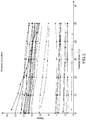
Fig. 5 is a graph which gives the reduced viscosity (Vreduced) or relative viscosity which is equal, at a given temperature, to the ratio of the viscosity of the ink to the viscosity of the solvent or of the mixture of solvents of this ink (Vreduced = Vink/Vsolvent) versus temperature (°C), for 29 inks presently used in inkjet printers designated as 5312, 5506, FT265, 5311, 2550, 5153, 5151, 7540, FT128, 5135, 2323, 2702, 5532, 5137, 7703, FT184, 5144M, 2328, 5139, 9155, FT210, 2151, 2160, 5117, FT207, FT248, 2157, 2538 and 2588 inks. -
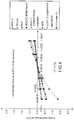
Fig. 6 is a graph which gives the ratio of the relative viscosity of the ink over the relative viscosity at 20°C versus temperature (in °C) for 4 inks presently used in inkjet printers, so-called « gentle slope » (or "low slope" or "soft slope") inks.
These inks are the inks designated as 5137, 5139, 5117, and 2160 inks. -
Fig. 7 is a graph which gives the ratio of the relative viscosity of the ink over the relative viscosity at 20°C versus temperature (in °C) for 3 inks presently used in inkjet printers so-called « steep slope » inks.
These inks are the inks designated as 5153, 2538, and 2588 inks. -
Fig. 8 is a graph which gives the ratio of the relative viscosity of the ink over the relative viscosity at 20°C versus temperature (in °C) for 10 inks presently used in inkjet printers, so-called « medium slope » inks.
These inks are the inks designated as 5506, 7540, 7703, 9155, FT265, FT248, 5144 M, 2157, 2550, and 5532 inks. -
Fig. 9 is a graph which gives the measured experimental viscosity (in cPs), (points ◆) and the calculated viscosity according to the invention (points ▲) versus temperature (in °C) for an ink, designated as 5137 ink, with a « gentle slope », the essential solvent of which is MEK. -
Fig. 10 is a graph which gives the measured experimental viscosity (in cPs), (points ◆) and the calculated viscosity according to the invention (points ▲) versus temperature (in °C) for an ink, designated as 2538 ink, with a « steep slope », the solvent of which is MEK. -
Fig. 11 is a graph which gives the measured experimental viscosity (in cPs), (points ◆) and the viscosity calculated according to the invention (points ▲) versus temperature (in °C) for an ink, designated as 7703 ink, the solvent of which is water. -
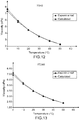
Fig. 12 is a graph which gives the measured experimental viscosity (in cPs), (points ◆) and the viscosity calculated according to the invention (points ▲) versus temperature (in °C) for an ink, designated as 7540 ink, the solvent of which is ethanol. -
Fig. 13 is a graph which gives the measured experimental viscosity (in cPs), (points ◆) and the viscosity calculated according to the invention (points ▲) versus temperature (in °C) for an ink, designated as FT248 ink, the solvent of which is ethanol. -
Fig. 14 is a graph which gives the viscosity (in cPs) versus temperature (in °C) of 29 different inks presently used in inkjet printers, designated as 5312, 5506, FT265, 5311, 2550, 5153, 5151, 7540, FT128, 5135, 2323, 2702, 5532, 5137, 7703, FT184, 5144M, 2328, 5139, 9155, FT210, 2151, 2160, 5117, FT207, FT248, 2157, 2538 and 2588 inks. -
Fig. 15 is a graph which gives the measured experimental viscosity (in cPs), (points ◆, curve in thin solid line), the viscosity calculated according to the invention (curve in thick solid line), and the viscosity calculated according to the invention and further corrected by applying a correction factor (curve in dotted lines) versus temperature (in °C) for an ink, designated as 5139 ink, the solvent of which is the MEK/methoxypropanol acetate mixture mentioned above. -
Fig. 16 is a graph which gives the measured experimental viscosity (in cPs), (points ◆, curve in thin solid line), the viscosity calculated according to the invention (curve in thick solid line), and the viscosity calculated according to the invention and further corrected by applying a correction factor (curve in dotted lines) versus temperature (in °C) for an ink, designated as 5311 ink, the solvent of which is the ethanol/1,2-propanediol mixture mentioned above. -
Fig. 17 is a graph which gives the measured experimental viscosity (in cPs), (points ◆, curve in thin solid line), the viscosity calculated according to the invention (curve in thick solid line), and the viscosity calculated according to the invention and further corrected by applying a correction factor (curve in dotted lines) versus temperature (in °C) for an ink, designated as FT128 ink, the solvent of which is the ethanol/water mixture mentioned above. - When the curves which give the viscosity versus temperature of the base solvents of the inks for inkjet printers such as water, alcohol (ethanol), and methyl ethyl ketone (MEK), which may be found in the literature, are examined, it is seen that the variations of the viscosity of the solvents versus temperature, are of the same order as those of the corresponding inks in relative values.
- All the curves which give the viscosity versus temperature of the inks which are required for proper operation of the present inkjet printers were therefore collected.
- More exactly, these are the raw data relating to viscosity versus temperature of 29 different inks designated as 5312, 5506, FT265, 5311, 2550, 5153, 5151, 7540, FT128, 5135, 2323, 2702, 5532, 5137, 7703, FT184, 5144M, 2328, 5139, 9155, FT210, 2151, 2160, 5117, FT207, FT248, 2157, 2538 and 2588 inks, which have been gathered on a same graph,
Fig. 14 . - On this graph it may be seen that the viscosities of the inks vary between 0 and 50°C by a factor of about 2 to 4, and from 2 to more than 6 for certain inks.
- As these inks do not have all the same viscosity at the reference temperature of 20°C, they may be compared more easily by dividing the viscosity at a temperature T by the viscosity at 20°C for each ink.
- The thereby obtained values were gathered on a same graph, which is not either reproduced here because of its complexity.
- The curves which give the viscosity, versus temperature, of the 10 solvents, or mixtures of solvents of these inks are given in
Fig. 1 . - These curves were extracted from the literature or else, notably for the mixtures of solvents, established from viscosity measurements conducted in the laboratory.
- These solvents are water, ethanol (EtOH), methyl ethyl ketone (MEK), MEK/EtOH/methoxypropanol acetate or PMA/Methanol (MeOH) mixture (68/26.6/1/4.4), the MEK/1,2-propanediol/water mixture, the EtOH/water mixture (1/1), the MEK/methoxypropanol acetate mixture (89/11), the methyl isopropyl ketone (MiPK), the EtOH/1,2 propanediol mixture (88/11) and the MEK/EtOH mixture (28/72).
- A particular way for comparing these curves is to divide them by their viscosity at 20°C. In other words, the curves which give the viscosity at temperature T/viscosity at 20°C ratio versus temperature T (in °C) of the aforementioned 10 solvents or mixtures of solvents are plotted (
Fig. 2 ). - In order to be able to calculate the viscosity of the solvent or of the mixtures of solvents at all the intermediate temperatures, it is possible to smooth these data by an equation of the Arrhenius type which is perfectly suitable over a reduced range of temperatures, such as the relevant range from 0°C to 50°C.
- The viscosity curve of each solvent or mixture of solvents which gives the viscosity versus temperature may therefore be described by an equation of the type η = K.e -E/RT (1)
- Either as a logarithm: Ln (η) = Ln(K)-E/RT (2), wherein η is the dynamic viscosity (in cPs) and T is the temperature (in K).
- It is therefore noted that only two parameters i.e. Ln(K) and -E/R are involved in this equation.
- For each of these curves, the ordinate at the origin gives Ln(K) and the slope gives -E/R.
-
Fig. 3 is a graph which gives the Ln(viscosity η) versus 1/T (in K) for the aforementioned 10 solvents or mixture of solvents used presently in inks for inkjet printers. - In the same way, the ratio of the viscosity of the solvent or of the mixture of solvents to the reference viscosity (for example at 20°C) gives as logarithms: Ln (viscosity at T/viscosity at 20°C) = Ln (viscosity)- Ln (viscosity at 20°C) = Ln(K)-E/RT-Ln (viscosity at 20°C).
-
Fig. 4 is a graph which gives the Ln (viscosity at T/viscosity at 20°C) versus 1/T (in K) of the 10 solvents or mixtures of solvents mentioned above presently used in inks for inkjet printers. - If the reduced viscosity (Vreduced), or relative viscosity (which is equal, at a given temperature, to the ratio of the viscosity of the ink to the viscosity of the solvent or of the mixture of solvents of this ink i.e. Vreduced = Vink/Vsolvent) is calculated at each of the temperatures, for the inks mentioned above presently used in inkjet printers, the relative viscosity curves of these inks are then obtained which are plotted in
Fig. 5 . - It may be seen that these relative, reduced viscosity curves of the inks are much more linear when they are compared with the viscosity curves for which the curvatures are very large (
Fig. 14 ). - It may also be ascertained that the slopes of the curves of
Fig. 5 are very similar. - If these relative, reduced viscosities are reduced to a common value at 20°C by dividing them by the viscosity at 20°C, a graph is then obtained, which gives for each ink mentioned above the relative viscosity/relative viscosity at 20°C ratio versus temperature (in °C).
- This graph is not reproduced here because of its complexity.
- It is seen on this graph that the essential portion of the variation of the viscosity of the ink stems from that of the solvent or of the mixture of solvents.
- It then becomes clear that by calculating the relative viscosity, the contribution of the solvent or of the mixture of solvents to the effect of temperature is suppressed.
- In other words, if the relative viscosity of an ink is measured versus temperature, the obtained curve is quasi flat, which shows that the variation of the viscosity with temperature is essentially due to the solvent or to the mixture of solvents and much less to the other ingredients of the ink such as the coloring agents and the pigments.
- Indeed, the curves of this graph are close to straight lines with slopes generally comprised between -0.003 and -0.006°C-1.
- For all these inks, the variation of the relative viscosity is not more than ± 20% between 0 and 50°C, to be compared with the ratios mentioned earlier which were from 2 to more than 6.
- If the bundle of curves, which gives for each ink the relative viscosity/relative viscosity at 20°C ratio versus temperature (in °C), is now examined with more attention, it may be seen that there are:
- a few inks which show relatively gentle (low, soft) slopes of the ratio of viscosities, of less than -0.004°C-1 (
Fig. 6 ). - a few other inks with the steepest slopes, greater than -0.006°C-1 (
Fig. 7 ). - The greater number of inks with intermediate, medium, slopes, between
- 0.0045 and -0.006°C-1 (
Fig. 8 ). - From these observations, it is possible to estimate relatively well the viscosity versus temperature curves by only knowing the viscosity at a single temperature and that of the solvent or of the mixture of solvents (it may even be sufficient to only know the viscosity of the majority solvent of the mixture of solvents) at all the desired temperatures, i.e. generally in the range of operating temperatures of the inkjet printer, for example from 0°C to 50°C.
- In other words, according to the invention, the viscosity curve of an ink, for example from 0 to 50°C may be determined by only 3 parameters and optionally 4 parameters, instead of a complete curve, i.e.:
- the viscosity of the ink at 20°C;
- the viscosity parameters of the solvent or of the mixture of solvents. Ln(K) and -E/R.
- If greater accuracy is desired, then a fourth parameter is used: the slope correction factor k.
- In a simplified embodiment wherein the viscosity of the ink may be approximated to within ± 20%, only 3 factors, parameters, are required and sufficient. For greater accuracy, i.e. ± 10 % or better ± 5 %, a 4th factor, i.e. the correction factor k, is required.
- The calculation of the viscosity of an ink at a temperature T may be expressed in generic terms as follows:
- Let
- ηeT be the viscosity of the ink at temperature T;
- ηeTref be the viscosity of the ink at the reference temperature Tref (for example 20°C);
- ηsT be the viscosity of the solvent or of the mixture of solvents at temperature T;
- ηsTref be the viscosity of the solvent or of the mixture of solvents at the reference temperature Tref (for example 20°C);
- ηreT be the relative viscosity of the ink at temperature T;

- ηreTref is the relative restricted viscosity of the ink at the reference temperature Tref (for example 20°C).
- It is therefore possible to calculate the viscosity curve of an ink at a temperature T only from:
- 1. the viscosity of the ink at a single temperature (Tref).
- 2. the ratio of the viscosity of the solvent or of the mixture of solvents at the same temperature T, to the viscosity of the solvent or of the mixture of solvents at the reference temperature Tref.
- This calculation is carried out with an approximation of about ± 20%.
- For a better approximation, it is possible to add the correction factor k.
- In the following examples, the method according to the invention is applied to the calculation of the viscosity of various inks for inkjet printers.
- In order to calculate the viscosity of an ink at a given temperature T, the method is simple:
- 1. Multiply the viscosity of the ink at the reference temperature (20°C for example), by the ratio of the viscosity of the solvent or of the mixture of solvents at the same temperature T to the viscosity of the solvent or of the mixture of solvents at the reference temperature (20°C).
- 2. Optionally correct the result by multiplying it by (1-k x (T-Tref)), wherein k is a correction factor such as 0.0047, rounded to 0.005.
- The value of the correction factor k, for example k = 0.0047 (rounded to 0.005) is obtained as discussed above, by averaging the values of the correction factors ki to be applied to the viscosity calculated at a given temperature in order to obtain the real viscosity actually measured at this temperature, on a given ink set representative of the inks.
- In the following examples, the calculation method according to the invention as discussed above is applied to various inks by assuming a correction factor k (average correction factor) of 0.0047. 0.0047 is an average value of the correction factor for all the tested inks and may be rounded to 0.005.
- In this example, the calculation method according to the invention, as discussed above, is applied to an ink with a « gentle slope » designated as 5137, the solvent of which is MEK.
-
Fig. 9 gives the measured experimental viscosity (in cPs) (points ◆) and the viscosity calculated according to the invention (points ▲) versus temperature (°C) for this ink. - In this example, the calculation method according to the invention, as discussed above, is applied to an ink with a « steep slope » designated as 2538, for which the solvent is MEK.
-
Fig. 10 gives the measured experimental viscosity (in cPs) (points ◆) and the viscosity calculated according to the invention (points ▲) versus temperature (°C) for this ink. - In this example, the calculation method according to the invention, as discussed above, is applied to an ink designated as 7703, for which the solvent is water.
-
Fig. 11 gives the measured experimental viscosity (in cPs) (points ◆) and the viscosity calculated according to the invention (points ▲) versus temperature (°C) for this ink. - In this example, the calculation method according to the invention, as discussed above, is applied to an ink designated as 7540, for which the solvent is alcohol.
-
Fig. 12 gives the measured experimental viscosity (in cPs) (points ◆) and the viscosity calculated according to the invention (points ▲) versus temperature (°C) for this ink. - In this example, the calculation method according to the invention, as discussed above, is applied to an ink designated as FT248, for which the solvent is alcohol.
-
Fig. 13 gives the measured experimental viscosity (in cPs) (points ◆) and the viscosity calculated according to the invention (points ▲) versus temperature (°C) for this ink. - In this example, the calculation method according to the invention, as discussed above, is applied to an ink designated as 5139, for which the solvent is the MEK/methoxypropanol acetate mixture mentioned above.
-
Fig. 15 gives the measured experimental viscosity (in cPs) (points ◆, curve in thin solid line), the viscosity calculated according to the invention (curve in thick solid line), and the viscosity calculated according to the invention and further corrected by applying a correction factor (curve in dotted lines) versus temperature (in °C) for this ink. - In this example, the calculation method according to the invention, as discussed above, is applied to an ink designated as 5311, for which the solvent is the alcohol/1,2-propanediol mixture mentioned above.
-
Fig. 16 gives the measured experimental viscosity (in cPs) (points ◆, curve in thin solid line), the viscosity calculated according to the invention (curve in thick solid line), and the viscosity calculated according to the invention and further corrected by applying a correction factor (curve in dotted lines) versus temperature (in °C) for this ink. - In this example, the calculation method according to the invention, as discussed above, is applied to an ink designated as FT128, for which the solvent is the alcohol/water mixture mentioned above.
-
Fig. 17 gives the measured experimental viscosity (in cPs) (points ◆, curve in thin solid line), the viscosity calculated according to the invention (curve in thick solid line), and the viscosity calculated according to the invention and further corrected by applying a correction factor (curve in dotted lines) versus temperature (in °C) for this ink. - Examples 1 to 8 provided above show that the method according to the invention gives excellent results since it is ascertained that the measured experimental viscosity curves and the curves giving the viscosity calculated according to the invention, and a fortiori the curves giving the viscosity calculated and further corrected according to the invention quasi coincide or are very close to each other.
- These examples further show that excellent results are obtained with the method according to the invention regardless of the solvent of the ink whether this is water, MEK or alcohol or mixtures of solvents, and regardless of the ink and of the ingredients thereof other than the solvent or of the mixture of solvents.
The usual value of R is 8.314472 Pa.m3.K-1.mol-1.
It was shown that:
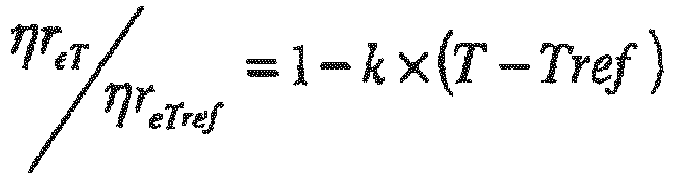

In a first approximation with


Claims (14)
- A method for managing the quality of an ink of an inkjet printer versus temperature resorting to the management of the viscosity of the ink versus temperature, said ink comprising a solvent or a mixture of solvents, and said solvent or mixture of solvents representing at least 50% by mass of the total mass of the ink, wherein the viscosity of the ink at a temperature T is calculated from the following parameters:- the viscosity of the ink at a single reference temperature Tref;- the parameters K or Ln(K), and -E/R of the equation (1) giving the viscosity of the solvent or of the mixture of solvents: Ln (viscosity of the solvent or of the mixture of solvents) = Ln(K)-E/RT (1), wherein E is the Arrhenius activation energy given in J/mol, and R is the ideal gas constant.
- The method according to claim 1, wherein the calculated viscosity of the ink is further corrected by using a fourth parameter a so-called correction factor k.
- The method according to claim 1 or 2, wherein the ink comprises a solvent or a mixture of solvents, one or several coloring material(s), optionally one or several binder(s), and optionally one or several additive(s).
- The method according to any one of the preceding claims, wherein the ink comprises from 40% to 99%, preferably from 50% to 95%, still preferably from 60% to 90% by mass of the solvent or of the mixture of solvents based on the total mass of the ink.
- The method according to any one of the preceding claims, wherein the viscosity of the ink at the reference temperature is obtained by a measurement carried out in a laboratory.
- The method according to any one of the preceding claims, wherein the reference temperature Tref is 20°C.
- The method according to any of the preceding claims, wherein the equation giving the viscosity of the solvent or of the mixture of solvents:
Ln (viscosity of the solvent or of the mixture of solvents) = Ln(K)-E/RT (1) is determined by measuring the viscosity of the solvent or of the mixture of solvents at several temperatures located in the range of operating temperatures of the printer, for example from 0°C to 50°C, or extracted from the literature. - The method according to any one of the preceding claims, wherein the viscosity of the ink at the temperature T is calculated by multiplying the viscosity of the ink at the reference temperature by the ratio of the viscosity of the solvent or of the mixture of solvents at temperature T to the viscosity of the solvent or of the mixture of solvents at the reference temperature.
- The method according to claim 8, wherein the viscosity of the ink at temperature T is calculated by multiplying the viscosity of the ink at the reference temperature Tref by the ratio of the viscosity of the solvent or of the mixture of solvents at temperature T to the viscosity of the solvent or of the mixture of solvents at the reference temperature and further by (1-k(T-Tref)) wherein k is the correction factor.
- The method according to any one of claims 2 to 9, wherein the correction factor k has a value comprised between 0 and 0.02, preferably between 5.10-3 and 10-2, for example 0.0047, rounded to 0.005.
- The method according to any one of claims 2 to 10, wherein the correction factor k is determined in the following way:- the viscosity of each of the inks of a set of inks used in a printer is measured at at least two temperatures, including the reference temperature Tref, selected in the range of operating temperatures of the printer;- the viscosity of each of the inks of the set of inks used in the printer is calculated at said at least two temperatures, selected in the range of operating temperatures of the printer;- for each ink and each temperature at which the viscosity was measured and calculated, a correction factor ki is determined, this correction factor ki being such that when the calculated viscosity of the ink is multiplied by (1-ki), the measured viscosity is obtained;- all the determined factors ki for all the temperatures and all the inks of the set of inks are averaged, whereby the factor k is obtained.
- The method according to anyone of claims 2 to 11, wherein the correction factor k is stored in the machine memory of the printer.
- The method according to any one of the preceding claims, wherein the viscosity of each of the inks used in the printer at the reference temperature Tref, and the parameters K or Ln(K), and -E/R of the equation giving the viscosity of the solvent or of the mixture of solvents of each of said inks are stored in the machine memory of the printer, and the curve of variation of the viscosity of the ink in the range of operating temperatures of the printer is established.
- The method according to any one of the preceding claims, wherein, during the operation of the printer, the viscosity and the temperature T of the ink are measured, the viscosity of the ink measured at temperature T is compared with the viscosity of the ink calculated at the same temperature T, and:- if the measured viscosity of the ink is greater than the calculated viscosity of the ink, an addition of solvent or of a mixture of solvents is then ordered into the ink so that the measured viscosity of the ink is equal to the calculated viscosity of the ink; or else- if the measured viscosity of the ink is less than the calculated viscosity of the ink, then one waits for the time required so that the solvent or the mixture of solvents evaporates and so that the measured viscosity of the ink is equal to the calculated viscosity of the ink.
Applications Claiming Priority (1)
| Application Number | Priority Date | Filing Date | Title |
|---|---|---|---|
| FR1458284A FR3025454B1 (en) | 2014-09-04 | 2014-09-04 | METHOD FOR MANAGING THE QUALITY OF THE INK OF AN INK JET PRINTER BASED ON TEMPERATURE. |
Publications (2)
| Publication Number | Publication Date |
|---|---|
| EP2995462A1 EP2995462A1 (en) | 2016-03-16 |
| EP2995462B1 true EP2995462B1 (en) | 2019-03-27 |
Family
ID=52273233
Family Applications (1)
| Application Number | Title | Priority Date | Filing Date |
|---|---|---|---|
| EP15183343.1A Not-in-force EP2995462B1 (en) | 2014-09-04 | 2015-09-01 | A method for managing ink quality of an inkjet printer versus temperature |
Country Status (4)
| Country | Link |
|---|---|
| US (1) | US10144216B2 (en) |
| EP (1) | EP2995462B1 (en) |
| CN (1) | CN105404480A (en) |
| FR (1) | FR3025454B1 (en) |
Families Citing this family (6)
| Publication number | Priority date | Publication date | Assignee | Title |
|---|---|---|---|---|
| FR3019494A1 (en) | 2014-04-08 | 2015-10-09 | Markem Imaje Holding | ROBUST DROP GENERATOR |
| FR3045458B1 (en) | 2015-12-22 | 2018-02-16 | Dover Europe Sarl | INK JET PRINTER WITH ENHANCED SOLVENT RECOVERY CIRCUIT |
| JP6929637B2 (en) * | 2016-12-01 | 2021-09-01 | キヤノン株式会社 | Recording device and recording method |
| JP6950199B2 (en) * | 2017-02-28 | 2021-10-13 | ブラザー工業株式会社 | Liquid discharge device |
| CN109895499B (en) * | 2019-03-14 | 2021-04-27 | 中钞油墨有限公司 | A kind of method for preventing engraving gravure ink printing thickening and aging |
| US11919291B2 (en) * | 2020-12-16 | 2024-03-05 | Sii Printek Inc. | Characteristic table generation system, method of generating characteristic table, and program of generating characteristic table |
Family Cites Families (15)
| Publication number | Priority date | Publication date | Assignee | Title |
|---|---|---|---|---|
| GB8327999D0 (en) | 1983-10-19 | 1983-11-23 | Domino Printing Sciences Ltd | Hydraulic systems |
| US4860027A (en) | 1988-03-18 | 1989-08-22 | A. B. Dick Company | Ink drop control system with temperature compensation |
| FR2636884B1 (en) | 1988-09-29 | 1990-11-02 | Imaje Sa | DEVICE FOR MONITORING AND REGULATING AN INK AND ITS TREATMENT IN A CONTINUOUS INK JET PRINTER |
| JP3596574B2 (en) * | 1996-11-18 | 2004-12-02 | 富士写真フイルム株式会社 | Thermal recording method |
| FR2792874B1 (en) | 1999-04-28 | 2001-06-22 | Imaje Sa | INK-JET PRINTER AND METHOD FOR MANAGING THE QUALITY OF THE INK OF SUCH A PRINTER |
| GB2471395A (en) * | 2009-06-24 | 2010-12-29 | Time Temperature Monitoring Ltd | Time temperature monitor |
| US9360875B2 (en) * | 2009-11-12 | 2016-06-07 | Michael R. Bonner | Viscosity feedback temperature control system |
| JP2012020408A (en) * | 2010-07-12 | 2012-02-02 | Seiko Epson Corp | Liquid ejecting apparatus and control method |
| GB201019680D0 (en) * | 2010-11-19 | 2011-01-05 | Domino Printing Sciences Plc | Improvements in or relating to inkjet printers |
| FR2972457B1 (en) | 2011-03-09 | 2014-09-12 | Markem Imaje | INK COMPOSITION FOR CONTINUOUS JET PRINTING. |
| FR2974811B1 (en) | 2011-05-05 | 2015-01-16 | Markem Imaje | LIQUID, BIODEGRADABLE, INK COMPOSITION FOR INKJET PRINTING. |
| JP2013056478A (en) * | 2011-09-08 | 2013-03-28 | Toshiba Tec Corp | Inkjet printer and ink circulation control method thereof |
| JP2013146925A (en) * | 2012-01-19 | 2013-08-01 | Seiko Epson Corp | Ink jet recording method, ink jet recording apparatus, and recording material |
| EP2636884A1 (en) | 2012-03-06 | 2013-09-11 | Georges Parrino | Device for converting the kinetic energy of a fluid into mechanical energy, with adjustment of the power picked up |
| CN104487545B (en) * | 2012-05-25 | 2017-05-10 | 庄信万丰股份有限公司 | Printing of liquid crystal droplet laser resonators on a wet polymer solution and product made therewith |
-
2014
- 2014-09-04 FR FR1458284A patent/FR3025454B1/en not_active Expired - Fee Related
-
2015
- 2015-09-01 EP EP15183343.1A patent/EP2995462B1/en not_active Not-in-force
- 2015-09-03 US US14/844,532 patent/US10144216B2/en active Active
- 2015-09-06 CN CN201510560079.8A patent/CN105404480A/en active Pending
Non-Patent Citations (1)
| Title |
|---|
| None * |
Also Published As
| Publication number | Publication date |
|---|---|
| CN105404480A (en) | 2016-03-16 |
| US10144216B2 (en) | 2018-12-04 |
| FR3025454B1 (en) | 2016-12-23 |
| FR3025454A1 (en) | 2016-03-11 |
| US20160067962A1 (en) | 2016-03-10 |
| EP2995462A1 (en) | 2016-03-16 |
Similar Documents
| Publication | Publication Date | Title |
|---|---|---|
| EP2995462B1 (en) | A method for managing ink quality of an inkjet printer versus temperature | |
| Marsh et al. | Dynamic contact angles and hydrodynamics near a moving contact line | |
| Ting et al. | Phase equilibrium modeling of mixtures of long-chain and short-chain alkanes using Peng–Robinson and SAFT | |
| Berg et al. | Recommended viscosities of 11 dilute gases at 25° C | |
| Homes et al. | Evaporation driven by conductive heat transport | |
| CN105814310A (en) | Improved flow regulating system for supplying propellant fluid to an electric thruster of a space vehicle | |
| DE102012106657A1 (en) | A method of thermally determining a mass flow of a gaseous medium and a thermal mass flowmeter | |
| Pope et al. | Extended Lee model for the turbine meter & calibrations with surrogate fluids | |
| González et al. | Dynamic viscosities of 2-butanol with alkanes (C8, C10, and C12) at several temperatures | |
| Fugel et al. | A corresponding-states analysis of the liquid-vapor equilibrium properties of common water models | |
| JP7258757B2 (en) | Method for estimating combustion properties of gases that may contain hydrogen | |
| Mitkin et al. | The physics of aerobreakup. IV. Strain-thickening liquids | |
| Vlasov | Diffusion-kinetic model of gas hydrate film growth along the gas–water interface | |
| Abedi et al. | Influence of wall slip in the radial displacement of a yield strength material in a Hele–Shaw cell | |
| US9010891B2 (en) | Systems and methods for in-line gel ink mixing | |
| Bagalkot et al. | Interfacial tension and CO 2 diffusion coefficients for a CO 2+ water and n-decane system at pressures of 10 to 160 bar | |
| Anderson | Imbibition of a liquid droplet on a deformable porous substrate | |
| Nieto de Castro et al. | Metrology of viscosity: Have we learned enough? | |
| Aurbach et al. | Wetting phenomena of droplets and gas bubbles: Contact angle hysteresis based on varying liquid–solid and solid–gas interfacial tensions | |
| Osaki et al. | Stress overshoot of polymer solutions at high rates of shear; polystyrene with bimodal molecular weight distribution | |
| US20140030113A1 (en) | Method and System for Determining a Pump Setpoint | |
| Brocos et al. | A proposal for the estimation of binary mixture activity coefficients from surface tension measurements throughout the entire concentration range | |
| Testov et al. | The informational reliability evaluation of zinc nitrate hexahydrate physicochemical properties for applied research | |
| CN114424062B (en) | System and method for real-time determination of fluid energy content | |
| Ottani et al. | Densities, viscosities, and excess molar enthalpies of propylene carbonate+ anisole or+ phenetole at (293.15, 303.15, and 313.15) K |
Legal Events
| Date | Code | Title | Description |
|---|---|---|---|
| PUAI | Public reference made under article 153(3) epc to a published international application that has entered the european phase |
Free format text: ORIGINAL CODE: 0009012 |
|
| AK | Designated contracting states |
Kind code of ref document: A1 Designated state(s): AL AT BE BG CH CY CZ DE DK EE ES FI FR GB GR HR HU IE IS IT LI LT LU LV MC MK MT NL NO PL PT RO RS SE SI SK SM TR |
|
| AX | Request for extension of the european patent |
Extension state: BA ME |
|
| 17P | Request for examination filed |
Effective date: 20160720 |
|
| RBV | Designated contracting states (corrected) |
Designated state(s): AL AT BE BG CH CY CZ DE DK EE ES FI FR GB GR HR HU IE IS IT LI LT LU LV MC MK MT NL NO PL PT RO RS SE SI SK SM TR |
|
| GRAP | Despatch of communication of intention to grant a patent |
Free format text: ORIGINAL CODE: EPIDOSNIGR1 |
|
| STAA | Information on the status of an ep patent application or granted ep patent |
Free format text: STATUS: GRANT OF PATENT IS INTENDED |
|
| INTG | Intention to grant announced |
Effective date: 20180914 |
|
| GRAJ | Information related to disapproval of communication of intention to grant by the applicant or resumption of examination proceedings by the epo deleted |
Free format text: ORIGINAL CODE: EPIDOSDIGR1 |
|
| STAA | Information on the status of an ep patent application or granted ep patent |
Free format text: STATUS: REQUEST FOR EXAMINATION WAS MADE |
|
| GRAR | Information related to intention to grant a patent recorded |
Free format text: ORIGINAL CODE: EPIDOSNIGR71 |
|
| GRAS | Grant fee paid |
Free format text: ORIGINAL CODE: EPIDOSNIGR3 |
|
| STAA | Information on the status of an ep patent application or granted ep patent |
Free format text: STATUS: GRANT OF PATENT IS INTENDED |
|
| INTC | Intention to grant announced (deleted) | ||
| GRAA | (expected) grant |
Free format text: ORIGINAL CODE: 0009210 |
|
| STAA | Information on the status of an ep patent application or granted ep patent |
Free format text: STATUS: THE PATENT HAS BEEN GRANTED |
|
| INTG | Intention to grant announced |
Effective date: 20190121 |
|
| AK | Designated contracting states |
Kind code of ref document: B1 Designated state(s): AL AT BE BG CH CY CZ DE DK EE ES FI FR GB GR HR HU IE IS IT LI LT LU LV MC MK MT NL NO PL PT RO RS SE SI SK SM TR |
|
| REG | Reference to a national code |
Ref country code: GB Ref legal event code: FG4D |
|
| REG | Reference to a national code |
Ref country code: CH Ref legal event code: EP |
|
| REG | Reference to a national code |
Ref country code: AT Ref legal event code: REF Ref document number: 1112584 Country of ref document: AT Kind code of ref document: T Effective date: 20190415 |
|
| REG | Reference to a national code |
Ref country code: IE Ref legal event code: FG4D |
|
| REG | Reference to a national code |
Ref country code: DE Ref legal event code: R096 Ref document number: 602015027042 Country of ref document: DE |
|
| PG25 | Lapsed in a contracting state [announced via postgrant information from national office to epo] |
Ref country code: LT Free format text: LAPSE BECAUSE OF FAILURE TO SUBMIT A TRANSLATION OF THE DESCRIPTION OR TO PAY THE FEE WITHIN THE PRESCRIBED TIME-LIMIT Effective date: 20190327 Ref country code: NO Free format text: LAPSE BECAUSE OF FAILURE TO SUBMIT A TRANSLATION OF THE DESCRIPTION OR TO PAY THE FEE WITHIN THE PRESCRIBED TIME-LIMIT Effective date: 20190627 Ref country code: SE Free format text: LAPSE BECAUSE OF FAILURE TO SUBMIT A TRANSLATION OF THE DESCRIPTION OR TO PAY THE FEE WITHIN THE PRESCRIBED TIME-LIMIT Effective date: 20190327 Ref country code: FI Free format text: LAPSE BECAUSE OF FAILURE TO SUBMIT A TRANSLATION OF THE DESCRIPTION OR TO PAY THE FEE WITHIN THE PRESCRIBED TIME-LIMIT Effective date: 20190327 |
|
| REG | Reference to a national code |
Ref country code: NL Ref legal event code: MP Effective date: 20190327 |
|
| PG25 | Lapsed in a contracting state [announced via postgrant information from national office to epo] |
Ref country code: LV Free format text: LAPSE BECAUSE OF FAILURE TO SUBMIT A TRANSLATION OF THE DESCRIPTION OR TO PAY THE FEE WITHIN THE PRESCRIBED TIME-LIMIT Effective date: 20190327 Ref country code: BG Free format text: LAPSE BECAUSE OF FAILURE TO SUBMIT A TRANSLATION OF THE DESCRIPTION OR TO PAY THE FEE WITHIN THE PRESCRIBED TIME-LIMIT Effective date: 20190627 Ref country code: RS Free format text: LAPSE BECAUSE OF FAILURE TO SUBMIT A TRANSLATION OF THE DESCRIPTION OR TO PAY THE FEE WITHIN THE PRESCRIBED TIME-LIMIT Effective date: 20190327 Ref country code: HR Free format text: LAPSE BECAUSE OF FAILURE TO SUBMIT A TRANSLATION OF THE DESCRIPTION OR TO PAY THE FEE WITHIN THE PRESCRIBED TIME-LIMIT Effective date: 20190327 Ref country code: GR Free format text: LAPSE BECAUSE OF FAILURE TO SUBMIT A TRANSLATION OF THE DESCRIPTION OR TO PAY THE FEE WITHIN THE PRESCRIBED TIME-LIMIT Effective date: 20190628 Ref country code: NL Free format text: LAPSE BECAUSE OF FAILURE TO SUBMIT A TRANSLATION OF THE DESCRIPTION OR TO PAY THE FEE WITHIN THE PRESCRIBED TIME-LIMIT Effective date: 20190327 |
|
| REG | Reference to a national code |
Ref country code: AT Ref legal event code: MK05 Ref document number: 1112584 Country of ref document: AT Kind code of ref document: T Effective date: 20190327 |
|
| PG25 | Lapsed in a contracting state [announced via postgrant information from national office to epo] |
Ref country code: PT Free format text: LAPSE BECAUSE OF FAILURE TO SUBMIT A TRANSLATION OF THE DESCRIPTION OR TO PAY THE FEE WITHIN THE PRESCRIBED TIME-LIMIT Effective date: 20190727 Ref country code: AL Free format text: LAPSE BECAUSE OF FAILURE TO SUBMIT A TRANSLATION OF THE DESCRIPTION OR TO PAY THE FEE WITHIN THE PRESCRIBED TIME-LIMIT Effective date: 20190327 Ref country code: ES Free format text: LAPSE BECAUSE OF FAILURE TO SUBMIT A TRANSLATION OF THE DESCRIPTION OR TO PAY THE FEE WITHIN THE PRESCRIBED TIME-LIMIT Effective date: 20190327 Ref country code: SK Free format text: LAPSE BECAUSE OF FAILURE TO SUBMIT A TRANSLATION OF THE DESCRIPTION OR TO PAY THE FEE WITHIN THE PRESCRIBED TIME-LIMIT Effective date: 20190327 Ref country code: RO Free format text: LAPSE BECAUSE OF FAILURE TO SUBMIT A TRANSLATION OF THE DESCRIPTION OR TO PAY THE FEE WITHIN THE PRESCRIBED TIME-LIMIT Effective date: 20190327 Ref country code: CZ Free format text: LAPSE BECAUSE OF FAILURE TO SUBMIT A TRANSLATION OF THE DESCRIPTION OR TO PAY THE FEE WITHIN THE PRESCRIBED TIME-LIMIT Effective date: 20190327 Ref country code: IT Free format text: LAPSE BECAUSE OF FAILURE TO SUBMIT A TRANSLATION OF THE DESCRIPTION OR TO PAY THE FEE WITHIN THE PRESCRIBED TIME-LIMIT Effective date: 20190327 Ref country code: EE Free format text: LAPSE BECAUSE OF FAILURE TO SUBMIT A TRANSLATION OF THE DESCRIPTION OR TO PAY THE FEE WITHIN THE PRESCRIBED TIME-LIMIT Effective date: 20190327 |
|
| PG25 | Lapsed in a contracting state [announced via postgrant information from national office to epo] |
Ref country code: PL Free format text: LAPSE BECAUSE OF FAILURE TO SUBMIT A TRANSLATION OF THE DESCRIPTION OR TO PAY THE FEE WITHIN THE PRESCRIBED TIME-LIMIT Effective date: 20190327 Ref country code: SM Free format text: LAPSE BECAUSE OF FAILURE TO SUBMIT A TRANSLATION OF THE DESCRIPTION OR TO PAY THE FEE WITHIN THE PRESCRIBED TIME-LIMIT Effective date: 20190327 |
|
| PG25 | Lapsed in a contracting state [announced via postgrant information from national office to epo] |
Ref country code: IS Free format text: LAPSE BECAUSE OF FAILURE TO SUBMIT A TRANSLATION OF THE DESCRIPTION OR TO PAY THE FEE WITHIN THE PRESCRIBED TIME-LIMIT Effective date: 20190727 Ref country code: AT Free format text: LAPSE BECAUSE OF FAILURE TO SUBMIT A TRANSLATION OF THE DESCRIPTION OR TO PAY THE FEE WITHIN THE PRESCRIBED TIME-LIMIT Effective date: 20190327 |
|
| REG | Reference to a national code |
Ref country code: DE Ref legal event code: R097 Ref document number: 602015027042 Country of ref document: DE |
|
| PG25 | Lapsed in a contracting state [announced via postgrant information from national office to epo] |
Ref country code: DK Free format text: LAPSE BECAUSE OF FAILURE TO SUBMIT A TRANSLATION OF THE DESCRIPTION OR TO PAY THE FEE WITHIN THE PRESCRIBED TIME-LIMIT Effective date: 20190327 |
|
| PLBE | No opposition filed within time limit |
Free format text: ORIGINAL CODE: 0009261 |
|
| STAA | Information on the status of an ep patent application or granted ep patent |
Free format text: STATUS: NO OPPOSITION FILED WITHIN TIME LIMIT |
|
| PG25 | Lapsed in a contracting state [announced via postgrant information from national office to epo] |
Ref country code: SI Free format text: LAPSE BECAUSE OF FAILURE TO SUBMIT A TRANSLATION OF THE DESCRIPTION OR TO PAY THE FEE WITHIN THE PRESCRIBED TIME-LIMIT Effective date: 20190327 |
|
| 26N | No opposition filed |
Effective date: 20200103 |
|
| PG25 | Lapsed in a contracting state [announced via postgrant information from national office to epo] |
Ref country code: TR Free format text: LAPSE BECAUSE OF FAILURE TO SUBMIT A TRANSLATION OF THE DESCRIPTION OR TO PAY THE FEE WITHIN THE PRESCRIBED TIME-LIMIT Effective date: 20190327 |
|
| PG25 | Lapsed in a contracting state [announced via postgrant information from national office to epo] |
Ref country code: MC Free format text: LAPSE BECAUSE OF FAILURE TO SUBMIT A TRANSLATION OF THE DESCRIPTION OR TO PAY THE FEE WITHIN THE PRESCRIBED TIME-LIMIT Effective date: 20190327 |
|
| REG | Reference to a national code |
Ref country code: CH Ref legal event code: PL |
|
| PG25 | Lapsed in a contracting state [announced via postgrant information from national office to epo] |
Ref country code: IE Free format text: LAPSE BECAUSE OF NON-PAYMENT OF DUE FEES Effective date: 20190901 Ref country code: LU Free format text: LAPSE BECAUSE OF NON-PAYMENT OF DUE FEES Effective date: 20190901 Ref country code: LI Free format text: LAPSE BECAUSE OF NON-PAYMENT OF DUE FEES Effective date: 20190930 Ref country code: CH Free format text: LAPSE BECAUSE OF NON-PAYMENT OF DUE FEES Effective date: 20190930 |
|
| REG | Reference to a national code |
Ref country code: BE Ref legal event code: MM Effective date: 20190930 |
|
| PG25 | Lapsed in a contracting state [announced via postgrant information from national office to epo] |
Ref country code: BE Free format text: LAPSE BECAUSE OF NON-PAYMENT OF DUE FEES Effective date: 20190930 |
|
| GBPC | Gb: european patent ceased through non-payment of renewal fee |
Effective date: 20190901 |
|
| PG25 | Lapsed in a contracting state [announced via postgrant information from national office to epo] |
Ref country code: GB Free format text: LAPSE BECAUSE OF NON-PAYMENT OF DUE FEES Effective date: 20190901 Ref country code: FR Free format text: LAPSE BECAUSE OF NON-PAYMENT OF DUE FEES Effective date: 20190930 |
|
| PG25 | Lapsed in a contracting state [announced via postgrant information from national office to epo] |
Ref country code: CY Free format text: LAPSE BECAUSE OF FAILURE TO SUBMIT A TRANSLATION OF THE DESCRIPTION OR TO PAY THE FEE WITHIN THE PRESCRIBED TIME-LIMIT Effective date: 20190327 |
|
| PG25 | Lapsed in a contracting state [announced via postgrant information from national office to epo] |
Ref country code: HU Free format text: LAPSE BECAUSE OF FAILURE TO SUBMIT A TRANSLATION OF THE DESCRIPTION OR TO PAY THE FEE WITHIN THE PRESCRIBED TIME-LIMIT; INVALID AB INITIO Effective date: 20150901 Ref country code: MT Free format text: LAPSE BECAUSE OF FAILURE TO SUBMIT A TRANSLATION OF THE DESCRIPTION OR TO PAY THE FEE WITHIN THE PRESCRIBED TIME-LIMIT Effective date: 20190327 |
|
| PG25 | Lapsed in a contracting state [announced via postgrant information from national office to epo] |
Ref country code: MK Free format text: LAPSE BECAUSE OF FAILURE TO SUBMIT A TRANSLATION OF THE DESCRIPTION OR TO PAY THE FEE WITHIN THE PRESCRIBED TIME-LIMIT Effective date: 20190327 |
|
| PGFP | Annual fee paid to national office [announced via postgrant information from national office to epo] |
Ref country code: DE Payment date: 20220927 Year of fee payment: 8 |
|
| REG | Reference to a national code |
Ref country code: DE Ref legal event code: R119 Ref document number: 602015027042 Country of ref document: DE |
|
| PG25 | Lapsed in a contracting state [announced via postgrant information from national office to epo] |
Ref country code: DE Free format text: LAPSE BECAUSE OF NON-PAYMENT OF DUE FEES Effective date: 20240403 |