EP2995614B1 - Transition metal-catalyzed processes for the preparation of n-allyl compounds and use thereof - Google Patents
Transition metal-catalyzed processes for the preparation of n-allyl compounds and use thereof Download PDFInfo
- Publication number
- EP2995614B1 EP2995614B1 EP15186900.5A EP15186900A EP2995614B1 EP 2995614 B1 EP2995614 B1 EP 2995614B1 EP 15186900 A EP15186900 A EP 15186900A EP 2995614 B1 EP2995614 B1 EP 2995614B1
- Authority
- EP
- European Patent Office
- Prior art keywords
- compound
- formula
- allyl
- transition metal
- reaction
- Prior art date
- Legal status (The legal status is an assumption and is not a legal conclusion. Google has not performed a legal analysis and makes no representation as to the accuracy of the status listed.)
- Active
Links
- 238000000034 method Methods 0.000 title claims description 90
- 230000008569 process Effects 0.000 title description 26
- 230000007704 transition Effects 0.000 title description 22
- 238000002360 preparation method Methods 0.000 title description 9
- 150000001875 compounds Chemical class 0.000 claims description 198
- 239000003054 catalyst Substances 0.000 claims description 76
- 229910052723 transition metal Inorganic materials 0.000 claims description 68
- 150000003624 transition metals Chemical class 0.000 claims description 68
- YMWUJEATGCHHMB-UHFFFAOYSA-N Dichloromethane Chemical compound ClCCl YMWUJEATGCHHMB-UHFFFAOYSA-N 0.000 claims description 65
- 125000003903 2-propenyl group Chemical group [H]C([*])([H])C([H])=C([H])[H] 0.000 claims description 55
- MSXVEPNJUHWQHW-UHFFFAOYSA-N 2-methylbutan-2-ol Chemical compound CCC(C)(C)O MSXVEPNJUHWQHW-UHFFFAOYSA-N 0.000 claims description 51
- -1 β-methoxyethoxymethyl Chemical group 0.000 claims description 46
- XEKOWRVHYACXOJ-UHFFFAOYSA-N Ethyl acetate Chemical compound CCOC(C)=O XEKOWRVHYACXOJ-UHFFFAOYSA-N 0.000 claims description 45
- 239000002516 radical scavenger Substances 0.000 claims description 35
- 239000002904 solvent Substances 0.000 claims description 35
- NFHFRUOZVGFOOS-UHFFFAOYSA-N Pd(PPh3)4 Substances [Pd].C1=CC=CC=C1P(C=1C=CC=CC=1)C1=CC=CC=C1.C1=CC=CC=C1P(C=1C=CC=CC=1)C1=CC=CC=C1.C1=CC=CC=C1P(C=1C=CC=CC=1)C1=CC=CC=C1.C1=CC=CC=C1P(C=1C=CC=CC=1)C1=CC=CC=C1 NFHFRUOZVGFOOS-UHFFFAOYSA-N 0.000 claims description 33
- HEDRZPFGACZZDS-UHFFFAOYSA-N Chloroform Chemical compound ClC(Cl)Cl HEDRZPFGACZZDS-UHFFFAOYSA-N 0.000 claims description 28
- WEVYAHXRMPXWCK-UHFFFAOYSA-N Acetonitrile Chemical compound CC#N WEVYAHXRMPXWCK-UHFFFAOYSA-N 0.000 claims description 18
- DKGAVHZHDRPRBM-UHFFFAOYSA-N Tert-Butanol Chemical compound CC(C)(C)O DKGAVHZHDRPRBM-UHFFFAOYSA-N 0.000 claims description 18
- YXFVVABEGXRONW-UHFFFAOYSA-N Toluene Chemical compound CC1=CC=CC=C1 YXFVVABEGXRONW-UHFFFAOYSA-N 0.000 claims description 18
- QVGXLLKOCUKJST-UHFFFAOYSA-N atomic oxygen Chemical group [O] QVGXLLKOCUKJST-UHFFFAOYSA-N 0.000 claims description 17
- UHOVQNZJYSORNB-UHFFFAOYSA-N Benzene Chemical compound C1=CC=CC=C1 UHOVQNZJYSORNB-UHFFFAOYSA-N 0.000 claims description 15
- WSLDOOZREJYCGB-UHFFFAOYSA-N 1,2-Dichloroethane Chemical compound ClCCCl WSLDOOZREJYCGB-UHFFFAOYSA-N 0.000 claims description 14
- RFFLAFLAYFXFSW-UHFFFAOYSA-N 1,2-dichlorobenzene Chemical compound ClC1=CC=CC=C1Cl RFFLAFLAYFXFSW-UHFFFAOYSA-N 0.000 claims description 12
- FRDAATYAJDYRNW-UHFFFAOYSA-N 3-methyl-3-pentanol Chemical compound CCC(C)(O)CC FRDAATYAJDYRNW-UHFFFAOYSA-N 0.000 claims description 12
- CSCPPACGZOOCGX-UHFFFAOYSA-N Acetone Chemical compound CC(C)=O CSCPPACGZOOCGX-UHFFFAOYSA-N 0.000 claims description 12
- WYURNTSHIVDZCO-UHFFFAOYSA-N Tetrahydrofuran Chemical compound C1CCOC1 WYURNTSHIVDZCO-UHFFFAOYSA-N 0.000 claims description 11
- 125000002496 methyl group Chemical group [H]C([H])([H])* 0.000 claims description 11
- 125000000217 alkyl group Chemical group 0.000 claims description 10
- 125000004169 (C1-C6) alkyl group Chemical group 0.000 claims description 9
- ZMXDDKWLCZADIW-UHFFFAOYSA-N N,N-Dimethylformamide Chemical compound CN(C)C=O ZMXDDKWLCZADIW-UHFFFAOYSA-N 0.000 claims description 9
- GETTZEONDQJALK-UHFFFAOYSA-N (trifluoromethyl)benzene Chemical compound FC(F)(F)C1=CC=CC=C1 GETTZEONDQJALK-UHFFFAOYSA-N 0.000 claims description 8
- MVPPADPHJFYWMZ-UHFFFAOYSA-N chlorobenzene Chemical compound ClC1=CC=CC=C1 MVPPADPHJFYWMZ-UHFFFAOYSA-N 0.000 claims description 8
- VZGDMQKNWNREIO-UHFFFAOYSA-N tetrachloromethane Chemical compound ClC(Cl)(Cl)Cl VZGDMQKNWNREIO-UHFFFAOYSA-N 0.000 claims description 8
- 125000001797 benzyl group Chemical group [H]C1=C([H])C([H])=C(C([H])=C1[H])C([H])([H])* 0.000 claims description 7
- RFZHJHSNHYIRNE-UHFFFAOYSA-N 2,3-dimethylpentan-3-ol Chemical compound CCC(C)(O)C(C)C RFZHJHSNHYIRNE-UHFFFAOYSA-N 0.000 claims description 6
- KRIMXCDMVRMCTC-UHFFFAOYSA-N 2-methylhexan-2-ol Chemical compound CCCCC(C)(C)O KRIMXCDMVRMCTC-UHFFFAOYSA-N 0.000 claims description 6
- DVEFUHVVWJONKR-UHFFFAOYSA-N 3-ethylpentan-1-ol Chemical compound CCC(CC)CCO DVEFUHVVWJONKR-UHFFFAOYSA-N 0.000 claims description 6
- 125000001997 phenyl group Chemical group [H]C1=C([H])C([H])=C(*)C([H])=C1[H] 0.000 claims description 6
- 125000002221 trityl group Chemical group [H]C1=C([H])C([H])=C([H])C([H])=C1C([*])(C1=C(C(=C(C(=C1[H])[H])[H])[H])[H])C1=C([H])C([H])=C([H])C([H])=C1[H] 0.000 claims description 6
- RYHBNJHYFVUHQT-UHFFFAOYSA-N 1,4-Dioxane Chemical compound C1COCCO1 RYHBNJHYFVUHQT-UHFFFAOYSA-N 0.000 claims description 5
- YQTCQNIPQMJNTI-UHFFFAOYSA-N 2,2-dimethylpropan-1-one Chemical group CC(C)(C)[C]=O YQTCQNIPQMJNTI-UHFFFAOYSA-N 0.000 claims description 5
- 125000003342 alkenyl group Chemical group 0.000 claims description 5
- 125000005448 ethoxyethyl group Chemical group [H]C([H])([H])C([H])([H])OC([H])([H])C([H])([H])* 0.000 claims description 5
- 125000004184 methoxymethyl group Chemical group [H]C([H])([H])OC([H])([H])* 0.000 claims description 5
- 125000004092 methylthiomethyl group Chemical group [H]C([H])([H])SC([H])([H])* 0.000 claims description 5
- 125000001981 tert-butyldimethylsilyl group Chemical group [H]C([H])([H])[Si]([H])(C([H])([H])[H])[*]C(C([H])([H])[H])(C([H])([H])[H])C([H])([H])[H] 0.000 claims description 5
- 125000000025 triisopropylsilyl group Chemical group C(C)(C)[Si](C(C)C)(C(C)C)* 0.000 claims description 5
- 125000000026 trimethylsilyl group Chemical group [H]C([H])([H])[Si]([*])(C([H])([H])[H])C([H])([H])[H] 0.000 claims description 5
- CTQNGGLPUBDAKN-UHFFFAOYSA-N O-Xylene Chemical compound CC1=CC=CC=C1C CTQNGGLPUBDAKN-UHFFFAOYSA-N 0.000 claims description 4
- 239000008096 xylene Substances 0.000 claims description 4
- 125000004178 (C1-C4) alkyl group Chemical group 0.000 claims description 3
- XTHFKEDIFFGKHM-UHFFFAOYSA-N Dimethoxyethane Chemical compound COCCOC XTHFKEDIFFGKHM-UHFFFAOYSA-N 0.000 claims description 3
- 125000000304 alkynyl group Chemical group 0.000 claims description 3
- 125000003236 benzoyl group Chemical group [H]C1=C([H])C([H])=C(C([H])=C1[H])C(*)=O 0.000 claims description 3
- 125000000037 tert-butyldiphenylsilyl group Chemical group [H]C1=C([H])C([H])=C([H])C([H])=C1[Si]([H])([*]C(C([H])([H])[H])(C([H])([H])[H])C([H])([H])[H])C1=C([H])C([H])=C([H])C([H])=C1[H] 0.000 claims description 3
- 125000001412 tetrahydropyranyl group Chemical group 0.000 claims description 3
- YLQBMQCUIZJEEH-UHFFFAOYSA-N tetrahydrofuran Natural products C=1C=COC=1 YLQBMQCUIZJEEH-UHFFFAOYSA-N 0.000 claims 1
- 238000006243 chemical reaction Methods 0.000 description 171
- 239000000203 mixture Substances 0.000 description 52
- RIOQSEWOXXDEQQ-UHFFFAOYSA-N triphenylphosphine Chemical compound C1=CC=CC=C1P(C=1C=CC=CC=1)C1=CC=CC=C1 RIOQSEWOXXDEQQ-UHFFFAOYSA-N 0.000 description 47
- 229960005118 oxymorphone Drugs 0.000 description 44
- 239000011541 reaction mixture Substances 0.000 description 43
- 229960004127 naloxone Drugs 0.000 description 40
- OKKJLVBELUTLKV-UHFFFAOYSA-N Methanol Chemical compound OC OKKJLVBELUTLKV-UHFFFAOYSA-N 0.000 description 39
- UQCNKQCJZOAFTQ-ISWURRPUSA-N Oxymorphone Chemical compound O([C@H]1C(CC[C@]23O)=O)C4=C5[C@@]12CCN(C)[C@@H]3CC5=CC=C4O UQCNKQCJZOAFTQ-ISWURRPUSA-N 0.000 description 36
- UZHSEJADLWPNLE-GRGSLBFTSA-N naloxone Chemical compound O=C([C@@H]1O2)CC[C@@]3(O)[C@H]4CC5=CC=C(O)C2=C5[C@@]13CCN4CC=C UZHSEJADLWPNLE-GRGSLBFTSA-N 0.000 description 35
- HEMHJVSKTPXQMS-UHFFFAOYSA-M Sodium hydroxide Chemical compound [OH-].[Na+] HEMHJVSKTPXQMS-UHFFFAOYSA-M 0.000 description 33
- 239000000047 product Substances 0.000 description 33
- KDLHZDBZIXYQEI-UHFFFAOYSA-N palladium Substances [Pd] KDLHZDBZIXYQEI-UHFFFAOYSA-N 0.000 description 32
- BWHMMNNQKKPAPP-UHFFFAOYSA-L potassium carbonate Chemical compound [K+].[K+].[O-]C([O-])=O BWHMMNNQKKPAPP-UHFFFAOYSA-L 0.000 description 30
- 239000002585 base Substances 0.000 description 29
- 238000003756 stirring Methods 0.000 description 26
- HLMSIZPQBSYUNL-IPOQPSJVSA-N Noroxymorphone Chemical compound O=C([C@@H]1O2)CC[C@@]3(O)[C@H]4CC5=CC=C(O)C2=C5[C@@]13CCN4 HLMSIZPQBSYUNL-IPOQPSJVSA-N 0.000 description 21
- 238000006114 decarboxylation reaction Methods 0.000 description 21
- CAEWJEXPFKNBQL-UHFFFAOYSA-N prop-2-enyl carbonochloridate Chemical compound ClC(=O)OCC=C CAEWJEXPFKNBQL-UHFFFAOYSA-N 0.000 description 21
- LFQSCWFLJHTTHZ-UHFFFAOYSA-N Ethanol Chemical compound CCO LFQSCWFLJHTTHZ-UHFFFAOYSA-N 0.000 description 18
- ZKLXUUYLEHCAMF-UUWFMWQGSA-N Oripavine Chemical compound C([C@@H](N(CC1)C)C2=CC=C3OC)C4=CC=C(O)C5=C4[C@@]21[C@H]3O5 ZKLXUUYLEHCAMF-UUWFMWQGSA-N 0.000 description 18
- ZKLXUUYLEHCAMF-UHFFFAOYSA-N Oripavine Natural products COC1=CC=C2C(N(CC3)C)CC4=CC=C(O)C5=C4C23C1O5 ZKLXUUYLEHCAMF-UHFFFAOYSA-N 0.000 description 18
- BDAGIHXWWSANSR-UHFFFAOYSA-N methanoic acid Natural products OC=O BDAGIHXWWSANSR-UHFFFAOYSA-N 0.000 description 18
- UIIMBOGNXHQVGW-UHFFFAOYSA-M Sodium bicarbonate Chemical compound [Na+].OC([O-])=O UIIMBOGNXHQVGW-UHFFFAOYSA-M 0.000 description 16
- QTBSBXVTEAMEQO-UHFFFAOYSA-N Acetic acid Chemical compound CC(O)=O QTBSBXVTEAMEQO-UHFFFAOYSA-N 0.000 description 15
- 230000015572 biosynthetic process Effects 0.000 description 15
- 229910000027 potassium carbonate Inorganic materials 0.000 description 15
- VEXZGXHMUGYJMC-UHFFFAOYSA-N Hydrochloric acid Chemical compound Cl VEXZGXHMUGYJMC-UHFFFAOYSA-N 0.000 description 14
- CDBYLPFSWZWCQE-UHFFFAOYSA-L Sodium Carbonate Chemical compound [Na+].[Na+].[O-]C([O-])=O CDBYLPFSWZWCQE-UHFFFAOYSA-L 0.000 description 14
- KWYUFKZDYYNOTN-UHFFFAOYSA-M potassium hydroxide Substances [OH-].[K+] KWYUFKZDYYNOTN-UHFFFAOYSA-M 0.000 description 14
- 238000010992 reflux Methods 0.000 description 14
- 239000007787 solid Substances 0.000 description 14
- BVKZGUZCCUSVTD-UHFFFAOYSA-L Carbonate Chemical compound [O-]C([O-])=O BVKZGUZCCUSVTD-UHFFFAOYSA-L 0.000 description 13
- 230000003197 catalytic effect Effects 0.000 description 13
- 125000002887 hydroxy group Chemical group [H]O* 0.000 description 13
- XLYOFNOQVPJJNP-UHFFFAOYSA-N water Substances O XLYOFNOQVPJJNP-UHFFFAOYSA-N 0.000 description 13
- MHAJPDPJQMAIIY-UHFFFAOYSA-N Hydrogen peroxide Chemical compound OO MHAJPDPJQMAIIY-UHFFFAOYSA-N 0.000 description 12
- 229910004749 OS(O)2 Inorganic materials 0.000 description 12
- ZMANZCXQSJIPKH-UHFFFAOYSA-N Triethylamine Chemical compound CCN(CC)CC ZMANZCXQSJIPKH-UHFFFAOYSA-N 0.000 description 12
- 239000003153 chemical reaction reagent Substances 0.000 description 12
- 238000004128 high performance liquid chromatography Methods 0.000 description 12
- 239000010410 layer Substances 0.000 description 12
- 238000006555 catalytic reaction Methods 0.000 description 11
- XMBWDFGMSWQBCA-UHFFFAOYSA-M iodide Chemical compound [I-] XMBWDFGMSWQBCA-UHFFFAOYSA-M 0.000 description 11
- 150000003512 tertiary amines Chemical class 0.000 description 11
- JKJWYKGYGWOAHT-UHFFFAOYSA-N bis(prop-2-enyl) carbonate Chemical compound C=CCOC(=O)OCC=C JKJWYKGYGWOAHT-UHFFFAOYSA-N 0.000 description 10
- FJDQFPXHSGXQBY-UHFFFAOYSA-L caesium carbonate Chemical compound [Cs+].[Cs+].[O-]C([O-])=O FJDQFPXHSGXQBY-UHFFFAOYSA-L 0.000 description 10
- OSWFIVFLDKOXQC-UHFFFAOYSA-N 4-(3-methoxyphenyl)aniline Chemical compound COC1=CC=CC(C=2C=CC(N)=CC=2)=C1 OSWFIVFLDKOXQC-UHFFFAOYSA-N 0.000 description 9
- 239000000706 filtrate Substances 0.000 description 9
- 235000019253 formic acid Nutrition 0.000 description 9
- 239000000543 intermediate Substances 0.000 description 9
- 238000003786 synthesis reaction Methods 0.000 description 9
- 150000004703 alkoxides Chemical class 0.000 description 8
- 229910052739 hydrogen Inorganic materials 0.000 description 8
- 239000001257 hydrogen Substances 0.000 description 8
- 239000012044 organic layer Substances 0.000 description 8
- 229960002085 oxycodone Drugs 0.000 description 8
- 229910000030 sodium bicarbonate Inorganic materials 0.000 description 8
- UFHFLCQGNIYNRP-UHFFFAOYSA-N Hydrogen Chemical compound [H][H] UFHFLCQGNIYNRP-UHFFFAOYSA-N 0.000 description 7
- BRUQQQPBMZOVGD-XFKAJCMBSA-N Oxycodone Chemical compound O=C([C@@H]1O2)CC[C@@]3(O)[C@H]4CC5=CC=C(OC)C2=C5[C@@]13CCN4C BRUQQQPBMZOVGD-XFKAJCMBSA-N 0.000 description 7
- 238000003379 elimination reaction Methods 0.000 description 7
- 238000005984 hydrogenation reaction Methods 0.000 description 7
- 238000007254 oxidation reaction Methods 0.000 description 7
- 229910052763 palladium Inorganic materials 0.000 description 7
- 229910000029 sodium carbonate Inorganic materials 0.000 description 7
- 239000000243 solution Substances 0.000 description 7
- 239000007858 starting material Substances 0.000 description 7
- LJGHYPLBDBRCRZ-UHFFFAOYSA-N 3-(3-aminophenyl)sulfonylaniline Chemical compound NC1=CC=CC(S(=O)(=O)C=2C=C(N)C=CC=2)=C1 LJGHYPLBDBRCRZ-UHFFFAOYSA-N 0.000 description 6
- KFSLWBXXFJQRDL-UHFFFAOYSA-N Peracetic acid Chemical compound CC(=O)OO KFSLWBXXFJQRDL-UHFFFAOYSA-N 0.000 description 6
- VYPSYNLAJGMNEJ-UHFFFAOYSA-N Silicium dioxide Chemical compound O=[Si]=O VYPSYNLAJGMNEJ-UHFFFAOYSA-N 0.000 description 6
- 238000005937 allylation reaction Methods 0.000 description 6
- 239000012298 atmosphere Substances 0.000 description 6
- 125000002837 carbocyclic group Chemical group 0.000 description 6
- 238000006900 dealkylation reaction Methods 0.000 description 6
- 238000010520 demethylation reaction Methods 0.000 description 6
- 230000008030 elimination Effects 0.000 description 6
- 230000007062 hydrolysis Effects 0.000 description 6
- 238000006460 hydrolysis reaction Methods 0.000 description 6
- 238000011065 in-situ storage Methods 0.000 description 6
- BQJCRHHNABKAKU-KBQPJGBKSA-N morphine Chemical compound O([C@H]1[C@H](C=C[C@H]23)O)C4=C5[C@@]12CCN(C)[C@@H]3CC5=CC=C4O BQJCRHHNABKAKU-KBQPJGBKSA-N 0.000 description 6
- 150000004965 peroxy acids Chemical class 0.000 description 6
- 239000011736 potassium bicarbonate Substances 0.000 description 6
- 229910000028 potassium bicarbonate Inorganic materials 0.000 description 6
- TYJJADVDDVDEDZ-UHFFFAOYSA-M potassium hydrogencarbonate Chemical compound [K+].OC([O-])=O TYJJADVDDVDEDZ-UHFFFAOYSA-M 0.000 description 6
- 125000004429 atom Chemical group 0.000 description 5
- JEHKKBHWRAXMCH-UHFFFAOYSA-N benzenesulfinic acid Chemical compound O[S@@](=O)C1=CC=CC=C1 JEHKKBHWRAXMCH-UHFFFAOYSA-N 0.000 description 5
- 229910000024 caesium carbonate Inorganic materials 0.000 description 5
- 239000007795 chemical reaction product Substances 0.000 description 5
- 238000004821 distillation Methods 0.000 description 5
- 239000003960 organic solvent Substances 0.000 description 5
- 230000003647 oxidation Effects 0.000 description 5
- YJVFFLUZDVXJQI-UHFFFAOYSA-L palladium(ii) acetate Chemical compound [Pd+2].CC([O-])=O.CC([O-])=O YJVFFLUZDVXJQI-UHFFFAOYSA-L 0.000 description 5
- XYFCBTPGUUZFHI-UHFFFAOYSA-N phosphine group Chemical group P XYFCBTPGUUZFHI-UHFFFAOYSA-N 0.000 description 5
- BASFCYQUMIYNBI-UHFFFAOYSA-N platinum Chemical compound [Pt] BASFCYQUMIYNBI-UHFFFAOYSA-N 0.000 description 5
- 239000000376 reactant Substances 0.000 description 5
- 239000011734 sodium Substances 0.000 description 5
- 229910052708 sodium Inorganic materials 0.000 description 5
- JRTIUDXYIUKIIE-KZUMESAESA-N (1z,5z)-cycloocta-1,5-diene;nickel Chemical compound [Ni].C\1C\C=C/CC\C=C/1.C\1C\C=C/CC\C=C/1 JRTIUDXYIUKIIE-KZUMESAESA-N 0.000 description 4
- VFNHLTBRAFJQER-ISWURRPUSA-N (4r,4as,7ar,12bs)-4a,9-dihydroxy-3-methyl-2,4,7a,13-tetrahydro-1h-4,12-methanobenzofuro[3,2-e]isoquinoline-7-one Chemical compound O=C([C@@H]1O2)C=C[C@@]3(O)[C@]4([H])N(C)CC[C@]13C1=C2C(O)=CC=C1C4 VFNHLTBRAFJQER-ISWURRPUSA-N 0.000 description 4
- IJGRMHOSHXDMSA-UHFFFAOYSA-N Atomic nitrogen Chemical compound N#N IJGRMHOSHXDMSA-UHFFFAOYSA-N 0.000 description 4
- KXDHJXZQYSOELW-UHFFFAOYSA-M Carbamate Chemical compound NC([O-])=O KXDHJXZQYSOELW-UHFFFAOYSA-M 0.000 description 4
- DGAQECJNVWCQMB-PUAWFVPOSA-M Ilexoside XXIX Chemical group C[C@@H]1CC[C@@]2(CC[C@@]3(C(=CC[C@H]4[C@]3(CC[C@@H]5[C@@]4(CC[C@@H](C5(C)C)OS(=O)(=O)[O-])C)C)[C@@H]2[C@]1(C)O)C)C(=O)O[C@H]6[C@@H]([C@H]([C@@H]([C@H](O6)CO)O)O)O.[Na+] DGAQECJNVWCQMB-PUAWFVPOSA-M 0.000 description 4
- WMFOQBRAJBCJND-UHFFFAOYSA-M Lithium hydroxide Chemical compound [Li+].[OH-] WMFOQBRAJBCJND-UHFFFAOYSA-M 0.000 description 4
- YNAVUWVOSKDBBP-UHFFFAOYSA-N Morpholine Chemical compound C1COCCN1 YNAVUWVOSKDBBP-UHFFFAOYSA-N 0.000 description 4
- 229910021586 Nickel(II) chloride Inorganic materials 0.000 description 4
- PMZURENOXWZQFD-UHFFFAOYSA-L Sodium Sulfate Chemical compound [Na+].[Na+].[O-]S([O-])(=O)=O PMZURENOXWZQFD-UHFFFAOYSA-L 0.000 description 4
- VSCWAEJMTAWNJL-UHFFFAOYSA-K aluminium trichloride Chemical compound Cl[Al](Cl)Cl VSCWAEJMTAWNJL-UHFFFAOYSA-K 0.000 description 4
- 229910052799 carbon Inorganic materials 0.000 description 4
- 239000007810 chemical reaction solvent Substances 0.000 description 4
- OROGSEYTTFOCAN-DNJOTXNNSA-N codeine Chemical compound C([C@H]1[C@H](N(CC[C@@]112)C)C3)=C[C@H](O)[C@@H]1OC1=C2C3=CC=C1OC OROGSEYTTFOCAN-DNJOTXNNSA-N 0.000 description 4
- 229910052736 halogen Inorganic materials 0.000 description 4
- 150000002367 halogens Chemical class 0.000 description 4
- FQXXSQDCDRQNQE-UHFFFAOYSA-N markiertes Thebain Natural products COC1=CC=C2C(N(CC3)C)CC4=CC=C(OC)C5=C4C23C1O5 FQXXSQDCDRQNQE-UHFFFAOYSA-N 0.000 description 4
- 238000002156 mixing Methods 0.000 description 4
- QMMRZOWCJAIUJA-UHFFFAOYSA-L nickel dichloride Chemical compound Cl[Ni]Cl QMMRZOWCJAIUJA-UHFFFAOYSA-L 0.000 description 4
- KFBKRCXOTTUAFS-UHFFFAOYSA-N nickel;triphenylphosphane Chemical compound [Ni].C1=CC=CC=C1P(C=1C=CC=CC=1)C1=CC=CC=C1.C1=CC=CC=C1P(C=1C=CC=CC=1)C1=CC=CC=C1.C1=CC=CC=C1P(C=1C=CC=CC=1)C1=CC=CC=C1.C1=CC=CC=C1P(C=1C=CC=CC=1)C1=CC=CC=C1 KFBKRCXOTTUAFS-UHFFFAOYSA-N 0.000 description 4
- 229940127240 opiate Drugs 0.000 description 4
- 125000002097 pentamethylcyclopentadienyl group Chemical group 0.000 description 4
- 150000003335 secondary amines Chemical class 0.000 description 4
- 229910052938 sodium sulfate Inorganic materials 0.000 description 4
- 235000011152 sodium sulphate Nutrition 0.000 description 4
- 239000000126 substance Substances 0.000 description 4
- 150000003509 tertiary alcohols Chemical class 0.000 description 4
- FQXXSQDCDRQNQE-VMDGZTHMSA-N thebaine Chemical compound C([C@@H](N(CC1)C)C2=CC=C3OC)C4=CC=C(OC)C5=C4[C@@]21[C@H]3O5 FQXXSQDCDRQNQE-VMDGZTHMSA-N 0.000 description 4
- 229930003945 thebaine Natural products 0.000 description 4
- BDZBKCUKTQZUTL-UHFFFAOYSA-N triethyl phosphite Chemical compound CCOP(OCC)OCC BDZBKCUKTQZUTL-UHFFFAOYSA-N 0.000 description 4
- FXJVNINSOKCNJP-UHFFFAOYSA-N 4-methylbenzenesulfinic acid Chemical compound CC1=CC=C(S(O)=O)C=C1 FXJVNINSOKCNJP-UHFFFAOYSA-N 0.000 description 3
- HBAQYPYDRFILMT-UHFFFAOYSA-N 8-[3-(1-cyclopropylpyrazol-4-yl)-1H-pyrazolo[4,3-d]pyrimidin-5-yl]-3-methyl-3,8-diazabicyclo[3.2.1]octan-2-one Chemical class C1(CC1)N1N=CC(=C1)C1=NNC2=C1N=C(N=C2)N1C2C(N(CC1CC2)C)=O HBAQYPYDRFILMT-UHFFFAOYSA-N 0.000 description 3
- VHUUQVKOLVNVRT-UHFFFAOYSA-N Ammonium hydroxide Chemical compound [NH4+].[OH-] VHUUQVKOLVNVRT-UHFFFAOYSA-N 0.000 description 3
- UNMYWSMUMWPJLR-UHFFFAOYSA-L Calcium iodide Chemical compound [Ca+2].[I-].[I-] UNMYWSMUMWPJLR-UHFFFAOYSA-L 0.000 description 3
- RTZKZFJDLAIYFH-UHFFFAOYSA-N Diethyl ether Chemical compound CCOCC RTZKZFJDLAIYFH-UHFFFAOYSA-N 0.000 description 3
- IAZDPXIOMUYVGZ-UHFFFAOYSA-N Dimethylsulphoxide Chemical compound CS(C)=O IAZDPXIOMUYVGZ-UHFFFAOYSA-N 0.000 description 3
- SJRJJKPEHAURKC-UHFFFAOYSA-N N-Methylmorpholine Chemical compound CN1CCOCC1 SJRJJKPEHAURKC-UHFFFAOYSA-N 0.000 description 3
- RIKMCJUNPCRFMW-ISWURRPUSA-N Noroxycodone Chemical compound O=C([C@@H]1O2)CC[C@@]3(O)[C@H]4CC5=CC=C(OC)C2=C5[C@@]13CCN4 RIKMCJUNPCRFMW-ISWURRPUSA-N 0.000 description 3
- 125000000746 allylic group Chemical group 0.000 description 3
- 239000000908 ammonium hydroxide Substances 0.000 description 3
- UKFWSNCTAHXBQN-UHFFFAOYSA-N ammonium iodide Chemical compound [NH4+].[I-] UKFWSNCTAHXBQN-UHFFFAOYSA-N 0.000 description 3
- 229910001640 calcium iodide Inorganic materials 0.000 description 3
- 125000004432 carbon atom Chemical group C* 0.000 description 3
- 230000020335 dealkylation Effects 0.000 description 3
- HPNMFZURTQLUMO-UHFFFAOYSA-N diethylamine Chemical compound CCNCC HPNMFZURTQLUMO-UHFFFAOYSA-N 0.000 description 3
- 238000000605 extraction Methods 0.000 description 3
- 239000007788 liquid Substances 0.000 description 3
- BLQJIBCZHWBKSL-UHFFFAOYSA-L magnesium iodide Chemical compound [Mg+2].[I-].[I-] BLQJIBCZHWBKSL-UHFFFAOYSA-L 0.000 description 3
- 229910001641 magnesium iodide Inorganic materials 0.000 description 3
- 239000000463 material Substances 0.000 description 3
- 229960005181 morphine Drugs 0.000 description 3
- 238000005580 one pot reaction Methods 0.000 description 3
- 125000004430 oxygen atom Chemical group O* 0.000 description 3
- OCAAZRFBJBEVPS-UHFFFAOYSA-N prop-2-enyl carbamate Chemical compound NC(=O)OCC=C OCAAZRFBJBEVPS-UHFFFAOYSA-N 0.000 description 3
- 238000000746 purification Methods 0.000 description 3
- 239000012279 sodium borohydride Substances 0.000 description 3
- 229910000033 sodium borohydride Inorganic materials 0.000 description 3
- QAOWNCQODCNURD-UHFFFAOYSA-N sulfuric acid Substances OS(O)(=O)=O QAOWNCQODCNURD-UHFFFAOYSA-N 0.000 description 3
- DPKBAXPHAYBPRL-UHFFFAOYSA-M tetrabutylazanium;iodide Chemical compound [I-].CCCC[N+](CCCC)(CCCC)CCCC DPKBAXPHAYBPRL-UHFFFAOYSA-M 0.000 description 3
- NAWXUBYGYWOOIX-SFHVURJKSA-N (2s)-2-[[4-[2-(2,4-diaminoquinazolin-6-yl)ethyl]benzoyl]amino]-4-methylidenepentanedioic acid Chemical compound C1=CC2=NC(N)=NC(N)=C2C=C1CCC1=CC=C(C(=O)N[C@@H](CC(=C)C(O)=O)C(O)=O)C=C1 NAWXUBYGYWOOIX-SFHVURJKSA-N 0.000 description 2
- 0 *C(CC1)([C@@](Cc2ccc3N)*(CC=N)CC4)C44c2c3O[C@]4C1*=* Chemical compound *C(CC1)([C@@](Cc2ccc3N)*(CC=N)CC4)C44c2c3O[C@]4C1*=* 0.000 description 2
- QZTKDVCDBIDYMD-UHFFFAOYSA-N 2,2'-[(2-amino-2-oxoethyl)imino]diacetic acid Chemical compound NC(=O)CN(CC(O)=O)CC(O)=O QZTKDVCDBIDYMD-UHFFFAOYSA-N 0.000 description 2
- IHPYMWDTONKSCO-UHFFFAOYSA-N 2,2'-piperazine-1,4-diylbisethanesulfonic acid Chemical compound OS(=O)(=O)CCN1CCN(CCS(O)(=O)=O)CC1 IHPYMWDTONKSCO-UHFFFAOYSA-N 0.000 description 2
- ZWEHNKRNPOVVGH-UHFFFAOYSA-N 2-Butanone Chemical compound CCC(C)=O ZWEHNKRNPOVVGH-UHFFFAOYSA-N 0.000 description 2
- JKMHFZQWWAIEOD-UHFFFAOYSA-N 2-[4-(2-hydroxyethyl)piperazin-1-yl]ethanesulfonic acid Chemical compound OCC[NH+]1CCN(CCS([O-])(=O)=O)CC1 JKMHFZQWWAIEOD-UHFFFAOYSA-N 0.000 description 2
- DVLFYONBTKHTER-UHFFFAOYSA-N 3-(N-morpholino)propanesulfonic acid Chemical compound OS(=O)(=O)CCCN1CCOCC1 DVLFYONBTKHTER-UHFFFAOYSA-N 0.000 description 2
- ZHNUHDYFZUAESO-UHFFFAOYSA-N Formamide Chemical compound NC=O ZHNUHDYFZUAESO-UHFFFAOYSA-N 0.000 description 2
- OWXMKDGYPWMGEB-UHFFFAOYSA-N HEPPS Chemical compound OCCN1CCN(CCCS(O)(=O)=O)CC1 OWXMKDGYPWMGEB-UHFFFAOYSA-N 0.000 description 2
- 229910010084 LiAlH4 Inorganic materials 0.000 description 2
- JGFZNNIVVJXRND-UHFFFAOYSA-N N,N-Diisopropylethylamine (DIPEA) Chemical compound CCN(C(C)C)C(C)C JGFZNNIVVJXRND-UHFFFAOYSA-N 0.000 description 2
- FSVCELGFZIQNCK-UHFFFAOYSA-N N,N-bis(2-hydroxyethyl)glycine Chemical compound OCCN(CCO)CC(O)=O FSVCELGFZIQNCK-UHFFFAOYSA-N 0.000 description 2
- SECXISVLQFMRJM-UHFFFAOYSA-N N-Methylpyrrolidone Chemical compound CN1CCCC1=O SECXISVLQFMRJM-UHFFFAOYSA-N 0.000 description 2
- MKWKNSIESPFAQN-UHFFFAOYSA-N N-cyclohexyl-2-aminoethanesulfonic acid Chemical compound OS(=O)(=O)CCNC1CCCCC1 MKWKNSIESPFAQN-UHFFFAOYSA-N 0.000 description 2
- ATHHXGZTWNVVOU-UHFFFAOYSA-N N-methylformamide Chemical compound CNC=O ATHHXGZTWNVVOU-UHFFFAOYSA-N 0.000 description 2
- JOCBASBOOFNAJA-UHFFFAOYSA-N N-tris(hydroxymethyl)methyl-2-aminoethanesulfonic acid Chemical compound OCC(CO)(CO)NCCS(O)(=O)=O JOCBASBOOFNAJA-UHFFFAOYSA-N 0.000 description 2
- XBDQKXXYIPTUBI-UHFFFAOYSA-M Propionate Chemical compound CCC([O-])=O XBDQKXXYIPTUBI-UHFFFAOYSA-M 0.000 description 2
- JUJWROOIHBZHMG-UHFFFAOYSA-N Pyridine Chemical compound C1=CC=NC=C1 JUJWROOIHBZHMG-UHFFFAOYSA-N 0.000 description 2
- SMWDFEZZVXVKRB-UHFFFAOYSA-N Quinoline Chemical compound N1=CC=CC2=CC=CC=C21 SMWDFEZZVXVKRB-UHFFFAOYSA-N 0.000 description 2
- KEAYESYHFKHZAL-UHFFFAOYSA-N Sodium Chemical compound [Na] KEAYESYHFKHZAL-UHFFFAOYSA-N 0.000 description 2
- 125000002777 acetyl group Chemical group [H]C([H])([H])C(*)=O 0.000 description 2
- 239000002253 acid Substances 0.000 description 2
- 150000001336 alkenes Chemical class 0.000 description 2
- 150000001345 alkine derivatives Chemical class 0.000 description 2
- XXROGKLTLUQVRX-UHFFFAOYSA-N allyl alcohol Chemical compound OCC=C XXROGKLTLUQVRX-UHFFFAOYSA-N 0.000 description 2
- 238000013459 approach Methods 0.000 description 2
- 239000007864 aqueous solution Substances 0.000 description 2
- WXNOJTUTEXAZLD-UHFFFAOYSA-L benzonitrile;dichloropalladium Chemical compound Cl[Pd]Cl.N#CC1=CC=CC=C1.N#CC1=CC=CC=C1 WXNOJTUTEXAZLD-UHFFFAOYSA-L 0.000 description 2
- RMRJXGBAOAMLHD-IHFGGWKQSA-N buprenorphine Chemical compound C([C@]12[C@H]3OC=4C(O)=CC=C(C2=4)C[C@@H]2[C@]11CC[C@]3([C@H](C1)[C@](C)(O)C(C)(C)C)OC)CN2CC1CC1 RMRJXGBAOAMLHD-IHFGGWKQSA-N 0.000 description 2
- 229960001736 buprenorphine Drugs 0.000 description 2
- 239000011203 carbon fibre reinforced carbon Substances 0.000 description 2
- 125000005587 carbonate group Chemical group 0.000 description 2
- 150000004649 carbonic acid derivatives Chemical class 0.000 description 2
- 238000003776 cleavage reaction Methods 0.000 description 2
- 229960004126 codeine Drugs 0.000 description 2
- 238000001816 cooling Methods 0.000 description 2
- 239000012043 crude product Substances 0.000 description 2
- BADXJIPKFRBFOT-UHFFFAOYSA-N dimedone Chemical compound CC1(C)CC(=O)CC(=O)C1 BADXJIPKFRBFOT-UHFFFAOYSA-N 0.000 description 2
- 229910000397 disodium phosphate Inorganic materials 0.000 description 2
- 238000001914 filtration Methods 0.000 description 2
- 239000012634 fragment Substances 0.000 description 2
- 239000012458 free base Substances 0.000 description 2
- 125000000524 functional group Chemical group 0.000 description 2
- 150000002430 hydrocarbons Chemical group 0.000 description 2
- OROGSEYTTFOCAN-UHFFFAOYSA-N hydrocodone Natural products C1C(N(CCC234)C)C2C=CC(O)C3OC2=C4C1=CC=C2OC OROGSEYTTFOCAN-UHFFFAOYSA-N 0.000 description 2
- 125000004435 hydrogen atom Chemical group [H]* 0.000 description 2
- 239000012280 lithium aluminium hydride Substances 0.000 description 2
- ZCSHNCUQKCANBX-UHFFFAOYSA-N lithium diisopropylamide Chemical compound [Li+].CC(C)[N-]C(C)C ZCSHNCUQKCANBX-UHFFFAOYSA-N 0.000 description 2
- 229910000032 lithium hydrogen carbonate Inorganic materials 0.000 description 2
- UBJFKNSINUCEAL-UHFFFAOYSA-N lithium;2-methylpropane Chemical compound [Li+].C[C-](C)C UBJFKNSINUCEAL-UHFFFAOYSA-N 0.000 description 2
- 238000004519 manufacturing process Methods 0.000 description 2
- 230000001404 mediated effect Effects 0.000 description 2
- DQCKKXVULJGBQN-XFWGSAIBSA-N naltrexone Chemical compound N1([C@@H]2CC3=CC=C(C=4O[C@@H]5[C@](C3=4)([C@]2(CCC5=O)O)CC1)O)CC1CC1 DQCKKXVULJGBQN-XFWGSAIBSA-N 0.000 description 2
- 229960003086 naltrexone Drugs 0.000 description 2
- 229930014626 natural product Natural products 0.000 description 2
- LQNUZADURLCDLV-UHFFFAOYSA-N nitrobenzene Chemical compound [O-][N+](=O)C1=CC=CC=C1 LQNUZADURLCDLV-UHFFFAOYSA-N 0.000 description 2
- 229910052757 nitrogen Inorganic materials 0.000 description 2
- 229940005483 opioid analgesics Drugs 0.000 description 2
- 230000001590 oxidative effect Effects 0.000 description 2
- 229910052760 oxygen Inorganic materials 0.000 description 2
- 239000001301 oxygen Substances 0.000 description 2
- 125000000636 p-nitrophenyl group Chemical group [H]C1=C([H])C(=C([H])C([H])=C1*)[N+]([O-])=O 0.000 description 2
- XCRBXWCUXJNEFX-UHFFFAOYSA-N peroxybenzoic acid Chemical compound OOC(=O)C1=CC=CC=C1 XCRBXWCUXJNEFX-UHFFFAOYSA-N 0.000 description 2
- TZJMWWMHEONRNP-UHFFFAOYSA-M phenylmethanesulfinate tetrabutylazanium Chemical compound C(C1=CC=CC=C1)S(=O)[O-].C(CCC)[N+](CCCC)(CCCC)CCCC TZJMWWMHEONRNP-UHFFFAOYSA-M 0.000 description 2
- SCVFZCLFOSHCOH-UHFFFAOYSA-M potassium acetate Chemical compound [K+].CC([O-])=O SCVFZCLFOSHCOH-UHFFFAOYSA-M 0.000 description 2
- LPNYRYFBWFDTMA-UHFFFAOYSA-N potassium tert-butoxide Chemical compound [K+].CC(C)(C)[O-] LPNYRYFBWFDTMA-UHFFFAOYSA-N 0.000 description 2
- 239000010970 precious metal Substances 0.000 description 2
- 239000002244 precipitate Substances 0.000 description 2
- 230000009467 reduction Effects 0.000 description 2
- XWGJFPHUCFXLBL-UHFFFAOYSA-M rongalite Chemical compound [Na+].OCS([O-])=O XWGJFPHUCFXLBL-UHFFFAOYSA-M 0.000 description 2
- 230000007017 scission Effects 0.000 description 2
- JPJALAQPGMAKDF-UHFFFAOYSA-N selenium dioxide Chemical compound O=[Se]=O JPJALAQPGMAKDF-UHFFFAOYSA-N 0.000 description 2
- 235000017557 sodium bicarbonate Nutrition 0.000 description 2
- WBHQBSYUUJJSRZ-UHFFFAOYSA-M sodium bisulfate Chemical compound [Na+].OS([O-])(=O)=O WBHQBSYUUJJSRZ-UHFFFAOYSA-M 0.000 description 2
- 229910000342 sodium bisulfate Inorganic materials 0.000 description 2
- QDRKDTQENPPHOJ-UHFFFAOYSA-N sodium ethoxide Chemical compound [Na+].CC[O-] QDRKDTQENPPHOJ-UHFFFAOYSA-N 0.000 description 2
- 239000012312 sodium hydride Substances 0.000 description 2
- 229910000104 sodium hydride Inorganic materials 0.000 description 2
- MFRIHAYPQRLWNB-UHFFFAOYSA-N sodium tert-butoxide Chemical compound [Na+].CC(C)(C)[O-] MFRIHAYPQRLWNB-UHFFFAOYSA-N 0.000 description 2
- KHDBMTLGTSGEEG-UHFFFAOYSA-M sodium;2-methylbenzenesulfinate Chemical compound [Na+].CC1=CC=CC=C1S([O-])=O KHDBMTLGTSGEEG-UHFFFAOYSA-M 0.000 description 2
- AMKPYVBQLZMLRA-UHFFFAOYSA-M sodium;4-chloro-3-nitrobenzenesulfinate Chemical compound [Na+].[O-][N+](=O)C1=CC(S([O-])=O)=CC=C1Cl AMKPYVBQLZMLRA-UHFFFAOYSA-M 0.000 description 2
- RRLLXOFIOPVYOP-UHFFFAOYSA-M sodium;thiophene-2-sulfinate Chemical compound [Na+].[O-]S(=O)C1=CC=CS1 RRLLXOFIOPVYOP-UHFFFAOYSA-M 0.000 description 2
- 239000000758 substrate Substances 0.000 description 2
- 239000000725 suspension Substances 0.000 description 2
- 238000009901 transfer hydrogenation reaction Methods 0.000 description 2
- 229910000406 trisodium phosphate Inorganic materials 0.000 description 2
- 229920002554 vinyl polymer Polymers 0.000 description 2
- 238000010626 work up procedure Methods 0.000 description 2
- YQYVFVRQLZMJKJ-JBBXEZCESA-N (+)-cyclazocine Chemical compound C([C@@]1(C)C2=CC(O)=CC=C2C[C@@H]2[C@@H]1C)CN2CC1CC1 YQYVFVRQLZMJKJ-JBBXEZCESA-N 0.000 description 1
- YZBBUYKPTHDZHF-KNVGNIICSA-N (3R)-7,2'-dihydroxy-4'-methoxyisoflavanol Chemical compound OC1=CC(OC)=CC=C1[C@H]1C(O)C2=CC=C(O)C=C2OC1 YZBBUYKPTHDZHF-KNVGNIICSA-N 0.000 description 1
- AVQQQNCBBIEMEU-UHFFFAOYSA-N 1,1,3,3-tetramethylurea Chemical compound CN(C)C(=O)N(C)C AVQQQNCBBIEMEU-UHFFFAOYSA-N 0.000 description 1
- 125000005918 1,2-dimethylbutyl group Chemical group 0.000 description 1
- 125000006218 1-ethylbutyl group Chemical group [H]C([H])([H])C([H])([H])C([H])([H])C([H])(*)C([H])([H])C([H])([H])[H] 0.000 description 1
- LJCZNYWLQZZIOS-UHFFFAOYSA-N 2,2,2-trichlorethoxycarbonyl chloride Chemical class ClC(=O)OCC(Cl)(Cl)Cl LJCZNYWLQZZIOS-UHFFFAOYSA-N 0.000 description 1
- SXGZJKUKBWWHRA-UHFFFAOYSA-N 2-(N-morpholiniumyl)ethanesulfonate Chemical compound [O-]S(=O)(=O)CC[NH+]1CCOCC1 SXGZJKUKBWWHRA-UHFFFAOYSA-N 0.000 description 1
- 125000006176 2-ethylbutyl group Chemical group [H]C([H])([H])C([H])([H])C([H])(C([H])([H])*)C([H])([H])C([H])([H])[H] 0.000 description 1
- 125000006040 2-hexenyl group Chemical group 0.000 description 1
- 125000004493 2-methylbut-1-yl group Chemical group CC(C*)CC 0.000 description 1
- 125000005916 2-methylpentyl group Chemical group 0.000 description 1
- NHQDETIJWKXCTC-UHFFFAOYSA-N 3-chloroperbenzoic acid Chemical compound OOC(=O)C1=CC=CC(Cl)=C1 NHQDETIJWKXCTC-UHFFFAOYSA-N 0.000 description 1
- 125000006041 3-hexenyl group Chemical group 0.000 description 1
- 125000003542 3-methylbutan-2-yl group Chemical group [H]C([H])([H])C([H])(*)C([H])(C([H])([H])[H])C([H])([H])[H] 0.000 description 1
- 125000005917 3-methylpentyl group Chemical group 0.000 description 1
- ATVJXMYDOSMEPO-UHFFFAOYSA-N 3-prop-2-enoxyprop-1-ene Chemical compound C=CCOCC=C ATVJXMYDOSMEPO-UHFFFAOYSA-N 0.000 description 1
- BTJIUGUIPKRLHP-UHFFFAOYSA-N 4-nitrophenol Chemical compound OC1=CC=C([N+]([O-])=O)C=C1 BTJIUGUIPKRLHP-UHFFFAOYSA-N 0.000 description 1
- 239000007991 ACES buffer Substances 0.000 description 1
- QTBSBXVTEAMEQO-UHFFFAOYSA-M Acetate Chemical compound CC([O-])=O QTBSBXVTEAMEQO-UHFFFAOYSA-M 0.000 description 1
- OSDWBNJEKMUWAV-UHFFFAOYSA-N Allyl chloride Chemical compound ClCC=C OSDWBNJEKMUWAV-UHFFFAOYSA-N 0.000 description 1
- 239000004135 Bone phosphate Substances 0.000 description 1
- 239000008000 CHES buffer Substances 0.000 description 1
- VVSASNKOFCZVES-UHFFFAOYSA-N CN(C(CC(N1C)=O)=O)C1=O Chemical compound CN(C(CC(N1C)=O)=O)C1=O VVSASNKOFCZVES-UHFFFAOYSA-N 0.000 description 1
- QOKONLWZMIOVCF-UHFFFAOYSA-N COS(C(C=C1[N+]([O-])=O)=CCC=C1Cl)=O Chemical compound COS(C(C=C1[N+]([O-])=O)=CCC=C1Cl)=O QOKONLWZMIOVCF-UHFFFAOYSA-N 0.000 description 1
- QOHLEXPTCVVODW-UHFFFAOYSA-N COS(c1ccc[s]1)=O Chemical compound COS(c1ccc[s]1)=O QOHLEXPTCVVODW-UHFFFAOYSA-N 0.000 description 1
- WMUYJHSRMOORHK-BIIVOSGPSA-N C[C@H](O)[C@@H](O)[C@@H](N(C)C)CC=O Chemical compound C[C@H](O)[C@@H](O)[C@@H](N(C)C)CC=O WMUYJHSRMOORHK-BIIVOSGPSA-N 0.000 description 1
- KORNTPPJEAJQIU-KJXAQDMKSA-N Cabaser Chemical compound C1=CC([C@H]2C[C@H](CN(CC=C)[C@@H]2C2)C(=O)N(CCCN(C)C)C(=O)NCC)=C3C2=CNC3=C1 KORNTPPJEAJQIU-KJXAQDMKSA-N 0.000 description 1
- OKTJSMMVPCPJKN-UHFFFAOYSA-N Carbon Chemical compound [C] OKTJSMMVPCPJKN-UHFFFAOYSA-N 0.000 description 1
- 239000004215 Carbon black (E152) Substances 0.000 description 1
- 238000007445 Chromatographic isolation Methods 0.000 description 1
- PJWWRFATQTVXHA-UHFFFAOYSA-N Cyclohexylaminopropanesulfonic acid Chemical compound OS(=O)(=O)CCCNC1CCCCC1 PJWWRFATQTVXHA-UHFFFAOYSA-N 0.000 description 1
- GSNUFIFRDBKVIE-UHFFFAOYSA-N DMF Natural products CC1=CC=C(C)O1 GSNUFIFRDBKVIE-UHFFFAOYSA-N 0.000 description 1
- DAVNRFCJMIONPO-UKRRQHHQSA-N Elymoclavine Chemical compound C1=CC([C@H]2C=C(CO)CN([C@@H]2C2)C)=C3C2=CNC3=C1 DAVNRFCJMIONPO-UKRRQHHQSA-N 0.000 description 1
- BDAGIHXWWSANSR-UHFFFAOYSA-M Formate Chemical compound [O-]C=O BDAGIHXWWSANSR-UHFFFAOYSA-M 0.000 description 1
- 239000007995 HEPES buffer Substances 0.000 description 1
- AVXURJPOCDRRFD-UHFFFAOYSA-N Hydroxylamine Chemical compound ON AVXURJPOCDRRFD-UHFFFAOYSA-N 0.000 description 1
- 206010022998 Irritability Diseases 0.000 description 1
- OZYUPQUCAUTOBP-QXAKKESOSA-N Levallorphan Chemical compound C([C@H]12)CCC[C@@]11CCN(CC=C)[C@@H]2CC2=CC=C(O)C=C21 OZYUPQUCAUTOBP-QXAKKESOSA-N 0.000 description 1
- 239000012448 Lithium borohydride Substances 0.000 description 1
- BIXJFIJYBLJTMK-UHFFFAOYSA-N Lysergol Natural products C1=CC(C2=CC(CO)CN(C2C2)C)=C3C2=CNC3=C1 BIXJFIJYBLJTMK-UHFFFAOYSA-N 0.000 description 1
- NTIZESTWPVYFNL-UHFFFAOYSA-N Methyl isobutyl ketone Chemical compound CC(C)CC(C)=O NTIZESTWPVYFNL-UHFFFAOYSA-N 0.000 description 1
- UIHCLUNTQKBZGK-UHFFFAOYSA-N Methyl isobutyl ketone Natural products CCC(C)C(C)=O UIHCLUNTQKBZGK-UHFFFAOYSA-N 0.000 description 1
- YNLCVAQJIKOXER-UHFFFAOYSA-N N-[tris(hydroxymethyl)methyl]-3-aminopropanesulfonic acid Chemical compound OCC(CO)(CO)NCCCS(O)(=O)=O YNLCVAQJIKOXER-UHFFFAOYSA-N 0.000 description 1
- AHVYPIQETPWLSZ-UHFFFAOYSA-N N-methyl-pyrrolidine Natural products CN1CC=CC1 AHVYPIQETPWLSZ-UHFFFAOYSA-N 0.000 description 1
- OHLUUHNLEMFGTQ-UHFFFAOYSA-N N-methylacetamide Chemical compound CNC(C)=O OHLUUHNLEMFGTQ-UHFFFAOYSA-N 0.000 description 1
- LFTLOKWAGJYHHR-UHFFFAOYSA-N N-methylmorpholine N-oxide Chemical compound CN1(=O)CCOCC1 LFTLOKWAGJYHHR-UHFFFAOYSA-N 0.000 description 1
- WJBLNOPPDWQMCH-MBPVOVBZSA-N Nalmefene Chemical compound N1([C@@H]2CC3=CC=C(C=4O[C@@H]5[C@](C3=4)([C@]2(CCC5=C)O)CC1)O)CC1CC1 WJBLNOPPDWQMCH-MBPVOVBZSA-N 0.000 description 1
- UIQMVEYFGZJHCZ-SSTWWWIQSA-N Nalorphine Chemical compound C([C@@H](N(CC1)CC=C)[C@@H]2C=C[C@@H]3O)C4=CC=C(O)C5=C4[C@@]21[C@H]3O5 UIQMVEYFGZJHCZ-SSTWWWIQSA-N 0.000 description 1
- MHABMANUFPZXEB-UHFFFAOYSA-N O-demethyl-aloesaponarin I Natural products O=C1C2=CC=CC(O)=C2C(=O)C2=C1C=C(O)C(C(O)=O)=C2C MHABMANUFPZXEB-UHFFFAOYSA-N 0.000 description 1
- 239000007990 PIPES buffer Substances 0.000 description 1
- 229910002666 PdCl2 Inorganic materials 0.000 description 1
- YNHIGQDRGKUECZ-UHFFFAOYSA-L PdCl2(PPh3)2 Substances [Cl-].[Cl-].[Pd+2].C1=CC=CC=C1P(C=1C=CC=CC=1)C1=CC=CC=C1.C1=CC=CC=C1P(C=1C=CC=CC=1)C1=CC=CC=C1 YNHIGQDRGKUECZ-UHFFFAOYSA-L 0.000 description 1
- 229910021604 Rhodium(III) chloride Inorganic materials 0.000 description 1
- 229910003910 SiCl4 Inorganic materials 0.000 description 1
- 208000034953 Twin anemia-polycythemia sequence Diseases 0.000 description 1
- 239000000370 acceptor Substances 0.000 description 1
- KXKVLQRXCPHEJC-UHFFFAOYSA-N acetic acid trimethyl ester Natural products COC(C)=O KXKVLQRXCPHEJC-UHFFFAOYSA-N 0.000 description 1
- 230000021736 acetylation Effects 0.000 description 1
- 238000006640 acetylation reaction Methods 0.000 description 1
- 150000001263 acyl chlorides Chemical class 0.000 description 1
- 150000001346 alkyl aryl ethers Chemical class 0.000 description 1
- 125000005115 alkyl carbamoyl group Chemical group 0.000 description 1
- BHELZAPQIKSEDF-UHFFFAOYSA-N allyl bromide Chemical compound BrCC=C BHELZAPQIKSEDF-UHFFFAOYSA-N 0.000 description 1
- 150000001412 amines Chemical class 0.000 description 1
- 239000011260 aqueous acid Substances 0.000 description 1
- 125000005604 azodicarboxylate group Chemical group 0.000 description 1
- 239000007998 bicine buffer Substances 0.000 description 1
- 150000001642 boronic acid derivatives Chemical class 0.000 description 1
- FLHFTXCMKFVKRP-UHFFFAOYSA-N bromomethylcyclobutane Chemical compound BrCC1CCC1 FLHFTXCMKFVKRP-UHFFFAOYSA-N 0.000 description 1
- AEILLAXRDHDKDY-UHFFFAOYSA-N bromomethylcyclopropane Chemical compound BrCC1CC1 AEILLAXRDHDKDY-UHFFFAOYSA-N 0.000 description 1
- 239000000872 buffer Substances 0.000 description 1
- 229960004596 cabergoline Drugs 0.000 description 1
- DKVNPHBNOWQYFE-UHFFFAOYSA-N carbamodithioic acid Chemical compound NC(S)=S DKVNPHBNOWQYFE-UHFFFAOYSA-N 0.000 description 1
- 150000005323 carbonate salts Chemical class 0.000 description 1
- BVKZGUZCCUSVTD-UHFFFAOYSA-N carbonic acid Chemical class OC(O)=O BVKZGUZCCUSVTD-UHFFFAOYSA-N 0.000 description 1
- JYYOBHFYCIDXHH-UHFFFAOYSA-N carbonic acid;hydrate Chemical compound O.OC(O)=O JYYOBHFYCIDXHH-UHFFFAOYSA-N 0.000 description 1
- 238000007385 chemical modification Methods 0.000 description 1
- 238000009833 condensation Methods 0.000 description 1
- 230000005494 condensation Effects 0.000 description 1
- ATDGTVJJHBUTRL-UHFFFAOYSA-N cyanogen bromide Chemical compound BrC#N ATDGTVJJHBUTRL-UHFFFAOYSA-N 0.000 description 1
- 229950002213 cyclazocine Drugs 0.000 description 1
- 125000000753 cycloalkyl group Chemical group 0.000 description 1
- 125000001047 cyclobutenyl group Chemical group C1(=CCC1)* 0.000 description 1
- 125000001995 cyclobutyl group Chemical group [H]C1([H])C([H])([H])C([H])(*)C1([H])[H] 0.000 description 1
- 125000000596 cyclohexenyl group Chemical group C1(=CCCCC1)* 0.000 description 1
- 125000000113 cyclohexyl group Chemical group [H]C1([H])C([H])([H])C([H])([H])C([H])(*)C([H])([H])C1([H])[H] 0.000 description 1
- 125000002433 cyclopentenyl group Chemical group C1(=CCCC1)* 0.000 description 1
- 125000001511 cyclopentyl group Chemical group [H]C1([H])C([H])([H])C([H])([H])C([H])(*)C1([H])[H] 0.000 description 1
- 125000000298 cyclopropenyl group Chemical group [H]C1=C([H])C1([H])* 0.000 description 1
- 125000001559 cyclopropyl group Chemical group [H]C1([H])C([H])([H])C1([H])* 0.000 description 1
- 238000007275 deallylation reaction Methods 0.000 description 1
- 230000001419 dependent effect Effects 0.000 description 1
- FAMRKDQNMBBFBR-BQYQJAHWSA-N diethyl azodicarboxylate Substances CCOC(=O)\N=N\C(=O)OCC FAMRKDQNMBBFBR-BQYQJAHWSA-N 0.000 description 1
- ZPWVASYFFYYZEW-UHFFFAOYSA-L dipotassium hydrogen phosphate Chemical compound [K+].[K+].OP([O-])([O-])=O ZPWVASYFFYYZEW-UHFFFAOYSA-L 0.000 description 1
- 229910000396 dipotassium phosphate Inorganic materials 0.000 description 1
- BNIILDVGGAEEIG-UHFFFAOYSA-L disodium hydrogen phosphate Chemical compound [Na+].[Na+].OP([O-])([O-])=O BNIILDVGGAEEIG-UHFFFAOYSA-L 0.000 description 1
- 239000012990 dithiocarbamate Substances 0.000 description 1
- GUVUOGQBMYCBQP-UHFFFAOYSA-N dmpu Chemical compound CN1CCCN(C)C1=O GUVUOGQBMYCBQP-UHFFFAOYSA-N 0.000 description 1
- 229940079593 drug Drugs 0.000 description 1
- 239000003814 drug Substances 0.000 description 1
- DAVNRFCJMIONPO-UHFFFAOYSA-N elymoclavine Natural products C1=CC(C2C=C(CO)CN(C2C2)C)=C3C2=CNC3=C1 DAVNRFCJMIONPO-UHFFFAOYSA-N 0.000 description 1
- 239000004210 ether based solvent Substances 0.000 description 1
- 125000001033 ether group Chemical group 0.000 description 1
- 125000001495 ethyl group Chemical group [H]C([H])([H])C([H])([H])* 0.000 description 1
- FAMRKDQNMBBFBR-UHFFFAOYSA-N ethyl n-ethoxycarbonyliminocarbamate Chemical compound CCOC(=O)N=NC(=O)OCC FAMRKDQNMBBFBR-UHFFFAOYSA-N 0.000 description 1
- 238000001704 evaporation Methods 0.000 description 1
- 230000008020 evaporation Effects 0.000 description 1
- 239000006260 foam Substances 0.000 description 1
- WBJINCZRORDGAQ-UHFFFAOYSA-N formic acid ethyl ester Natural products CCOC=O WBJINCZRORDGAQ-UHFFFAOYSA-N 0.000 description 1
- 125000001475 halogen functional group Chemical group 0.000 description 1
- 125000003187 heptyl group Chemical group [H]C([*])([H])C([H])([H])C([H])([H])C([H])([H])C([H])([H])C([H])([H])C([H])([H])[H] 0.000 description 1
- GNOIPBMMFNIUFM-UHFFFAOYSA-N hexamethylphosphoric triamide Chemical compound CN(C)P(=O)(N(C)C)N(C)C GNOIPBMMFNIUFM-UHFFFAOYSA-N 0.000 description 1
- 229930195733 hydrocarbon Natural products 0.000 description 1
- 150000002431 hydrogen Chemical class 0.000 description 1
- 150000004679 hydroxides Chemical class 0.000 description 1
- 238000010348 incorporation Methods 0.000 description 1
- 239000004615 ingredient Substances 0.000 description 1
- 239000013067 intermediate product Substances 0.000 description 1
- 150000002500 ions Chemical class 0.000 description 1
- 125000004491 isohexyl group Chemical group C(CCC(C)C)* 0.000 description 1
- 125000001972 isopentyl group Chemical group [H]C([H])([H])C([H])(C([H])([H])[H])C([H])([H])C([H])([H])* 0.000 description 1
- 125000001449 isopropyl group Chemical group [H]C([H])([H])C([H])(*)C([H])([H])[H] 0.000 description 1
- HQBZLVPZOGIAIQ-SDDDUWNISA-N ketazocine Chemical compound N1([C@H]2[C@@H]([C@](CC1)(C)C=1C(=CC=C(O)C=1)C2=O)C)CC1CC1 HQBZLVPZOGIAIQ-SDDDUWNISA-N 0.000 description 1
- 229950007980 ketazocine Drugs 0.000 description 1
- 229960000263 levallorphan Drugs 0.000 description 1
- 239000011981 lindlar catalyst Substances 0.000 description 1
- 229910052744 lithium Inorganic materials 0.000 description 1
- BIXJFIJYBLJTMK-MEBBXXQBSA-N lysergol Chemical compound C1=CC(C2=C[C@@H](CO)CN([C@@H]2C2)C)=C3C2=CNC3=C1 BIXJFIJYBLJTMK-MEBBXXQBSA-N 0.000 description 1
- 229910052751 metal Inorganic materials 0.000 description 1
- 125000000956 methoxy group Chemical group [H]C([H])([H])O* 0.000 description 1
- NSPJNIDYTSSIIY-UHFFFAOYSA-N methoxy(methoxymethoxy)methane Chemical compound COCOCOC NSPJNIDYTSSIIY-UHFFFAOYSA-N 0.000 description 1
- 125000006431 methyl cyclopropyl group Chemical group 0.000 description 1
- UIWVQFSAXYWENY-UHFFFAOYSA-N n'-ethylacetohydrazide Chemical compound CCNNC(C)=O UIWVQFSAXYWENY-UHFFFAOYSA-N 0.000 description 1
- MBHINSULENHCMF-UHFFFAOYSA-N n,n-dimethylpropanamide Chemical compound CCC(=O)N(C)C MBHINSULENHCMF-UHFFFAOYSA-N 0.000 description 1
- PSHKMPUSSFXUIA-UHFFFAOYSA-N n,n-dimethylpyridin-2-amine Chemical compound CN(C)C1=CC=CC=N1 PSHKMPUSSFXUIA-UHFFFAOYSA-N 0.000 description 1
- PVWOIHVRPOBWPI-UHFFFAOYSA-N n-propyl iodide Chemical compound CCCI PVWOIHVRPOBWPI-UHFFFAOYSA-N 0.000 description 1
- NETZHAKZCGBWSS-CEDHKZHLSA-N nalbuphine Chemical compound C([C@]12[C@H]3OC=4C(O)=CC=C(C2=4)C[C@@H]2[C@]1(O)CC[C@@H]3O)CN2CC1CCC1 NETZHAKZCGBWSS-CEDHKZHLSA-N 0.000 description 1
- 229960000805 nalbuphine Drugs 0.000 description 1
- 229960005297 nalmefene Drugs 0.000 description 1
- 229960000938 nalorphine Drugs 0.000 description 1
- LYGJENNIWJXYER-UHFFFAOYSA-N nitromethane Chemical compound C[N+]([O-])=O LYGJENNIWJXYER-UHFFFAOYSA-N 0.000 description 1
- 125000001181 organosilyl group Chemical group [SiH3]* 0.000 description 1
- 239000012285 osmium tetroxide Substances 0.000 description 1
- 229910000489 osmium tetroxide Inorganic materials 0.000 description 1
- PIBWKRNGBLPSSY-UHFFFAOYSA-L palladium(II) chloride Chemical compound Cl[Pd]Cl PIBWKRNGBLPSSY-UHFFFAOYSA-L 0.000 description 1
- 230000037361 pathway Effects 0.000 description 1
- VOKSWYLNZZRQPF-GDIGMMSISA-N pentazocine Chemical compound C1C2=CC=C(O)C=C2[C@@]2(C)[C@@H](C)[C@@H]1N(CC=C(C)C)CC2 VOKSWYLNZZRQPF-GDIGMMSISA-N 0.000 description 1
- 229960005301 pentazocine Drugs 0.000 description 1
- 230000000737 periodic effect Effects 0.000 description 1
- ISWSIDIOOBJBQZ-UHFFFAOYSA-N phenol group Chemical group C1(=CC=CC=C1)O ISWSIDIOOBJBQZ-UHFFFAOYSA-N 0.000 description 1
- PARWUHTVGZSQPD-UHFFFAOYSA-N phenylsilane Chemical compound [SiH3]C1=CC=CC=C1 PARWUHTVGZSQPD-UHFFFAOYSA-N 0.000 description 1
- 150000003013 phosphoric acid derivatives Chemical class 0.000 description 1
- 229910052697 platinum Inorganic materials 0.000 description 1
- 229910052700 potassium Inorganic materials 0.000 description 1
- VVWRJUBEIPHGQF-UHFFFAOYSA-N propan-2-yl n-propan-2-yloxycarbonyliminocarbamate Chemical compound CC(C)OC(=O)N=NC(=O)OC(C)C VVWRJUBEIPHGQF-UHFFFAOYSA-N 0.000 description 1
- FVSKHRXBFJPNKK-UHFFFAOYSA-N propionitrile Chemical compound CCC#N FVSKHRXBFJPNKK-UHFFFAOYSA-N 0.000 description 1
- 125000001436 propyl group Chemical group [H]C([*])([H])C([H])([H])C([H])([H])[H] 0.000 description 1
- 125000006239 protecting group Chemical group 0.000 description 1
- UMJSCPRVCHMLSP-UHFFFAOYSA-N pyridine Natural products COC1=CC=CN=C1 UMJSCPRVCHMLSP-UHFFFAOYSA-N 0.000 description 1
- 230000009257 reactivity Effects 0.000 description 1
- 230000000717 retained effect Effects 0.000 description 1
- SONJTKJMTWTJCT-UHFFFAOYSA-K rhodium(iii) chloride Chemical compound [Cl-].[Cl-].[Cl-].[Rh+3] SONJTKJMTWTJCT-UHFFFAOYSA-K 0.000 description 1
- 125000006413 ring segment Chemical group 0.000 description 1
- 150000003839 salts Chemical class 0.000 description 1
- 229920006395 saturated elastomer Polymers 0.000 description 1
- 125000003548 sec-pentyl group Chemical group [H]C([H])([H])C([H])([H])C([H])([H])C([H])(*)C([H])([H])[H] 0.000 description 1
- FDNAPBUWERUEDA-UHFFFAOYSA-N silicon tetrachloride Chemical compound Cl[Si](Cl)(Cl)Cl FDNAPBUWERUEDA-UHFFFAOYSA-N 0.000 description 1
- 241000894007 species Species 0.000 description 1
- 238000006467 substitution reaction Methods 0.000 description 1
- HXJUTPCZVOIRIF-UHFFFAOYSA-N sulfolane Chemical compound O=S1(=O)CCCC1 HXJUTPCZVOIRIF-UHFFFAOYSA-N 0.000 description 1
- 229960003080 taurine Drugs 0.000 description 1
- 125000000999 tert-butyl group Chemical group [H]C([H])([H])C(*)(C([H])([H])[H])C([H])([H])[H] 0.000 description 1
- 125000001973 tert-pentyl group Chemical group [H]C([H])([H])C([H])([H])C(*)(C([H])([H])[H])C([H])([H])[H] 0.000 description 1
- 238000012360 testing method Methods 0.000 description 1
- 150000003568 thioethers Chemical class 0.000 description 1
- JOXIMZWYDAKGHI-UHFFFAOYSA-N toluene-4-sulfonic acid Chemical compound CC1=CC=C(S(O)(=O)=O)C=C1 JOXIMZWYDAKGHI-UHFFFAOYSA-N 0.000 description 1
- 231100000331 toxic Toxicity 0.000 description 1
- 230000002588 toxic effect Effects 0.000 description 1
- DBGVGMSCBYYSLD-UHFFFAOYSA-N tributylstannane Chemical compound CCCC[SnH](CCCC)CCCC DBGVGMSCBYYSLD-UHFFFAOYSA-N 0.000 description 1
- LWIHDJKSTIGBAC-UHFFFAOYSA-K tripotassium phosphate Chemical compound [K+].[K+].[K+].[O-]P([O-])([O-])=O LWIHDJKSTIGBAC-UHFFFAOYSA-K 0.000 description 1
- 229910000404 tripotassium phosphate Inorganic materials 0.000 description 1
- RYFMWSXOAZQYPI-UHFFFAOYSA-K trisodium phosphate Chemical compound [Na+].[Na+].[Na+].[O-]P([O-])([O-])=O RYFMWSXOAZQYPI-UHFFFAOYSA-K 0.000 description 1
- 125000000391 vinyl group Chemical group [H]C([*])=C([H])[H] 0.000 description 1
- 238000005406 washing Methods 0.000 description 1
Classifications
-
- C—CHEMISTRY; METALLURGY
- C07—ORGANIC CHEMISTRY
- C07D—HETEROCYCLIC COMPOUNDS
- C07D489/00—Heterocyclic compounds containing 4aH-8, 9 c- Iminoethano-phenanthro [4, 5-b, c, d] furan ring systems, e.g. derivatives of [4, 5-epoxy]-morphinan of the formula:
- C07D489/06—Heterocyclic compounds containing 4aH-8, 9 c- Iminoethano-phenanthro [4, 5-b, c, d] furan ring systems, e.g. derivatives of [4, 5-epoxy]-morphinan of the formula: with a hetero atom directly attached in position 14
- C07D489/08—Oxygen atom
-
- A—HUMAN NECESSITIES
- A61—MEDICAL OR VETERINARY SCIENCE; HYGIENE
- A61P—SPECIFIC THERAPEUTIC ACTIVITY OF CHEMICAL COMPOUNDS OR MEDICINAL PREPARATIONS
- A61P25/00—Drugs for disorders of the nervous system
- A61P25/04—Centrally acting analgesics, e.g. opioids
-
- B—PERFORMING OPERATIONS; TRANSPORTING
- B01—PHYSICAL OR CHEMICAL PROCESSES OR APPARATUS IN GENERAL
- B01J—CHEMICAL OR PHYSICAL PROCESSES, e.g. CATALYSIS OR COLLOID CHEMISTRY; THEIR RELEVANT APPARATUS
- B01J23/00—Catalysts comprising metals or metal oxides or hydroxides, not provided for in group B01J21/00
- B01J23/38—Catalysts comprising metals or metal oxides or hydroxides, not provided for in group B01J21/00 of noble metals
- B01J23/40—Catalysts comprising metals or metal oxides or hydroxides, not provided for in group B01J21/00 of noble metals of the platinum group metals
- B01J23/42—Platinum
-
- B—PERFORMING OPERATIONS; TRANSPORTING
- B01—PHYSICAL OR CHEMICAL PROCESSES OR APPARATUS IN GENERAL
- B01J—CHEMICAL OR PHYSICAL PROCESSES, e.g. CATALYSIS OR COLLOID CHEMISTRY; THEIR RELEVANT APPARATUS
- B01J23/00—Catalysts comprising metals or metal oxides or hydroxides, not provided for in group B01J21/00
- B01J23/38—Catalysts comprising metals or metal oxides or hydroxides, not provided for in group B01J21/00 of noble metals
- B01J23/40—Catalysts comprising metals or metal oxides or hydroxides, not provided for in group B01J21/00 of noble metals of the platinum group metals
- B01J23/44—Palladium
-
- B—PERFORMING OPERATIONS; TRANSPORTING
- B01—PHYSICAL OR CHEMICAL PROCESSES OR APPARATUS IN GENERAL
- B01J—CHEMICAL OR PHYSICAL PROCESSES, e.g. CATALYSIS OR COLLOID CHEMISTRY; THEIR RELEVANT APPARATUS
- B01J31/00—Catalysts comprising hydrides, coordination complexes or organic compounds
- B01J31/16—Catalysts comprising hydrides, coordination complexes or organic compounds containing coordination complexes
- B01J31/18—Catalysts comprising hydrides, coordination complexes or organic compounds containing coordination complexes containing nitrogen, phosphorus, arsenic or antimony as complexing atoms, e.g. in pyridine ligands, or in resonance therewith, e.g. in isocyanide ligands C=N-R or as complexed central atoms
- B01J31/1845—Catalysts comprising hydrides, coordination complexes or organic compounds containing coordination complexes containing nitrogen, phosphorus, arsenic or antimony as complexing atoms, e.g. in pyridine ligands, or in resonance therewith, e.g. in isocyanide ligands C=N-R or as complexed central atoms the ligands containing phosphorus
- B01J31/185—Phosphites ((RO)3P), their isomeric phosphonates (R(RO)2P=O) and RO-substitution derivatives thereof
- B01J31/1855—Triamide derivatives thereof
-
- B—PERFORMING OPERATIONS; TRANSPORTING
- B01—PHYSICAL OR CHEMICAL PROCESSES OR APPARATUS IN GENERAL
- B01J—CHEMICAL OR PHYSICAL PROCESSES, e.g. CATALYSIS OR COLLOID CHEMISTRY; THEIR RELEVANT APPARATUS
- B01J31/00—Catalysts comprising hydrides, coordination complexes or organic compounds
- B01J31/16—Catalysts comprising hydrides, coordination complexes or organic compounds containing coordination complexes
- B01J31/20—Carbonyls
-
- B—PERFORMING OPERATIONS; TRANSPORTING
- B01—PHYSICAL OR CHEMICAL PROCESSES OR APPARATUS IN GENERAL
- B01J—CHEMICAL OR PHYSICAL PROCESSES, e.g. CATALYSIS OR COLLOID CHEMISTRY; THEIR RELEVANT APPARATUS
- B01J31/00—Catalysts comprising hydrides, coordination complexes or organic compounds
- B01J31/16—Catalysts comprising hydrides, coordination complexes or organic compounds containing coordination complexes
- B01J31/22—Organic complexes
- B01J31/2282—Unsaturated compounds used as ligands
- B01J31/2295—Cyclic compounds, e.g. cyclopentadienyls
-
- B—PERFORMING OPERATIONS; TRANSPORTING
- B01—PHYSICAL OR CHEMICAL PROCESSES OR APPARATUS IN GENERAL
- B01J—CHEMICAL OR PHYSICAL PROCESSES, e.g. CATALYSIS OR COLLOID CHEMISTRY; THEIR RELEVANT APPARATUS
- B01J31/00—Catalysts comprising hydrides, coordination complexes or organic compounds
- B01J31/16—Catalysts comprising hydrides, coordination complexes or organic compounds containing coordination complexes
- B01J31/24—Phosphines, i.e. phosphorus bonded to only carbon atoms, or to both carbon and hydrogen atoms, including e.g. sp2-hybridised phosphorus compounds such as phosphabenzene, phosphole or anionic phospholide ligands
- B01J31/2404—Cyclic ligands, including e.g. non-condensed polycyclic ligands, the phosphine-P atom being a ring member or a substituent on the ring
- B01J31/2409—Cyclic ligands, including e.g. non-condensed polycyclic ligands, the phosphine-P atom being a ring member or a substituent on the ring with more than one complexing phosphine-P atom
- B01J31/2414—Cyclic ligands, including e.g. non-condensed polycyclic ligands, the phosphine-P atom being a ring member or a substituent on the ring with more than one complexing phosphine-P atom comprising aliphatic or saturated rings
-
- C—CHEMISTRY; METALLURGY
- C07—ORGANIC CHEMISTRY
- C07C—ACYCLIC OR CARBOCYCLIC COMPOUNDS
- C07C209/00—Preparation of compounds containing amino groups bound to a carbon skeleton
-
- C—CHEMISTRY; METALLURGY
- C07—ORGANIC CHEMISTRY
- C07C—ACYCLIC OR CARBOCYCLIC COMPOUNDS
- C07C209/00—Preparation of compounds containing amino groups bound to a carbon skeleton
- C07C209/44—Preparation of compounds containing amino groups bound to a carbon skeleton by reduction of carboxylic acids or esters thereof in presence of ammonia or amines, or by reduction of nitriles, carboxylic acid amides, imines or imino-ethers
-
- C—CHEMISTRY; METALLURGY
- C07—ORGANIC CHEMISTRY
- C07C—ACYCLIC OR CARBOCYCLIC COMPOUNDS
- C07C269/00—Preparation of derivatives of carbamic acid, i.e. compounds containing any of the groups, the nitrogen atom not being part of nitro or nitroso groups
- C07C269/04—Preparation of derivatives of carbamic acid, i.e. compounds containing any of the groups, the nitrogen atom not being part of nitro or nitroso groups from amines with formation of carbamate groups
-
- C—CHEMISTRY; METALLURGY
- C07—ORGANIC CHEMISTRY
- C07D—HETEROCYCLIC COMPOUNDS
- C07D265/00—Heterocyclic compounds containing six-membered rings having one nitrogen atom and one oxygen atom as the only ring hetero atoms
- C07D265/28—1,4-Oxazines; Hydrogenated 1,4-oxazines
- C07D265/30—1,4-Oxazines; Hydrogenated 1,4-oxazines not condensed with other rings
-
- C—CHEMISTRY; METALLURGY
- C07—ORGANIC CHEMISTRY
- C07D—HETEROCYCLIC COMPOUNDS
- C07D295/00—Heterocyclic compounds containing polymethylene-imine rings with at least five ring members, 3-azabicyclo [3.2.2] nonane, piperazine, morpholine or thiomorpholine rings, having only hydrogen atoms directly attached to the ring carbon atoms
- C07D295/02—Heterocyclic compounds containing polymethylene-imine rings with at least five ring members, 3-azabicyclo [3.2.2] nonane, piperazine, morpholine or thiomorpholine rings, having only hydrogen atoms directly attached to the ring carbon atoms containing only hydrogen and carbon atoms in addition to the ring hetero elements
- C07D295/027—Heterocyclic compounds containing polymethylene-imine rings with at least five ring members, 3-azabicyclo [3.2.2] nonane, piperazine, morpholine or thiomorpholine rings, having only hydrogen atoms directly attached to the ring carbon atoms containing only hydrogen and carbon atoms in addition to the ring hetero elements containing only one hetero ring
- C07D295/03—Heterocyclic compounds containing polymethylene-imine rings with at least five ring members, 3-azabicyclo [3.2.2] nonane, piperazine, morpholine or thiomorpholine rings, having only hydrogen atoms directly attached to the ring carbon atoms containing only hydrogen and carbon atoms in addition to the ring hetero elements containing only one hetero ring with the ring nitrogen atoms directly attached to acyclic carbon atoms
-
- C—CHEMISTRY; METALLURGY
- C07—ORGANIC CHEMISTRY
- C07D—HETEROCYCLIC COMPOUNDS
- C07D295/00—Heterocyclic compounds containing polymethylene-imine rings with at least five ring members, 3-azabicyclo [3.2.2] nonane, piperazine, morpholine or thiomorpholine rings, having only hydrogen atoms directly attached to the ring carbon atoms
- C07D295/16—Heterocyclic compounds containing polymethylene-imine rings with at least five ring members, 3-azabicyclo [3.2.2] nonane, piperazine, morpholine or thiomorpholine rings, having only hydrogen atoms directly attached to the ring carbon atoms acylated on ring nitrogen atoms
- C07D295/20—Heterocyclic compounds containing polymethylene-imine rings with at least five ring members, 3-azabicyclo [3.2.2] nonane, piperazine, morpholine or thiomorpholine rings, having only hydrogen atoms directly attached to the ring carbon atoms acylated on ring nitrogen atoms by radicals derived from carbonic acid, or sulfur or nitrogen analogues thereof
- C07D295/205—Radicals derived from carbonic acid
-
- B—PERFORMING OPERATIONS; TRANSPORTING
- B01—PHYSICAL OR CHEMICAL PROCESSES OR APPARATUS IN GENERAL
- B01J—CHEMICAL OR PHYSICAL PROCESSES, e.g. CATALYSIS OR COLLOID CHEMISTRY; THEIR RELEVANT APPARATUS
- B01J2231/00—Catalytic reactions performed with catalysts classified in B01J31/00
- B01J2231/40—Substitution reactions at carbon centres, e.g. C-C or C-X, i.e. carbon-hetero atom, cross-coupling, C-H activation or ring-opening reactions
-
- B—PERFORMING OPERATIONS; TRANSPORTING
- B01—PHYSICAL OR CHEMICAL PROCESSES OR APPARATUS IN GENERAL
- B01J—CHEMICAL OR PHYSICAL PROCESSES, e.g. CATALYSIS OR COLLOID CHEMISTRY; THEIR RELEVANT APPARATUS
- B01J2531/00—Additional information regarding catalytic systems classified in B01J31/00
- B01J2531/60—Complexes comprising metals of Group VI (VIA or VIB) as the central metal
- B01J2531/64—Molybdenum
-
- B—PERFORMING OPERATIONS; TRANSPORTING
- B01—PHYSICAL OR CHEMICAL PROCESSES OR APPARATUS IN GENERAL
- B01J—CHEMICAL OR PHYSICAL PROCESSES, e.g. CATALYSIS OR COLLOID CHEMISTRY; THEIR RELEVANT APPARATUS
- B01J2531/00—Additional information regarding catalytic systems classified in B01J31/00
- B01J2531/80—Complexes comprising metals of Group VIII as the central metal
- B01J2531/82—Metals of the platinum group
- B01J2531/821—Ruthenium
-
- B—PERFORMING OPERATIONS; TRANSPORTING
- B01—PHYSICAL OR CHEMICAL PROCESSES OR APPARATUS IN GENERAL
- B01J—CHEMICAL OR PHYSICAL PROCESSES, e.g. CATALYSIS OR COLLOID CHEMISTRY; THEIR RELEVANT APPARATUS
- B01J2531/00—Additional information regarding catalytic systems classified in B01J31/00
- B01J2531/80—Complexes comprising metals of Group VIII as the central metal
- B01J2531/82—Metals of the platinum group
- B01J2531/824—Palladium
-
- B—PERFORMING OPERATIONS; TRANSPORTING
- B01—PHYSICAL OR CHEMICAL PROCESSES OR APPARATUS IN GENERAL
- B01J—CHEMICAL OR PHYSICAL PROCESSES, e.g. CATALYSIS OR COLLOID CHEMISTRY; THEIR RELEVANT APPARATUS
- B01J2531/00—Additional information regarding catalytic systems classified in B01J31/00
- B01J2531/80—Complexes comprising metals of Group VIII as the central metal
- B01J2531/82—Metals of the platinum group
- B01J2531/828—Platinum
-
- B—PERFORMING OPERATIONS; TRANSPORTING
- B01—PHYSICAL OR CHEMICAL PROCESSES OR APPARATUS IN GENERAL
- B01J—CHEMICAL OR PHYSICAL PROCESSES, e.g. CATALYSIS OR COLLOID CHEMISTRY; THEIR RELEVANT APPARATUS
- B01J2531/00—Additional information regarding catalytic systems classified in B01J31/00
- B01J2531/80—Complexes comprising metals of Group VIII as the central metal
- B01J2531/84—Metals of the iron group
- B01J2531/847—Nickel
-
- Y—GENERAL TAGGING OF NEW TECHNOLOGICAL DEVELOPMENTS; GENERAL TAGGING OF CROSS-SECTIONAL TECHNOLOGIES SPANNING OVER SEVERAL SECTIONS OF THE IPC; TECHNICAL SUBJECTS COVERED BY FORMER USPC CROSS-REFERENCE ART COLLECTIONS [XRACs] AND DIGESTS
- Y02—TECHNOLOGIES OR APPLICATIONS FOR MITIGATION OR ADAPTATION AGAINST CLIMATE CHANGE
- Y02P—CLIMATE CHANGE MITIGATION TECHNOLOGIES IN THE PRODUCTION OR PROCESSING OF GOODS
- Y02P20/00—Technologies relating to chemical industry
- Y02P20/50—Improvements relating to the production of bulk chemicals
- Y02P20/55—Design of synthesis routes, e.g. reducing the use of auxiliary or protecting groups
Definitions
- the present invention provides processes for preparing nor-compounds from N-allyl amines or allyl carbamates of opioids.
- N-dealkylation of tertiary amines is a key chemical transformation in many processes for the preparation of clinically and commercially important compounds.
- Methods for N-dealkylation of tertiary amines are known in the art and include reaction of the tertiary amine with cyanogen bromide ( see, e.g., U.S. Patent Nos.
- Patent Nos. 3,905,981 and 4,472,253 Olofson et al. (1984) J. Org. Chem. 49(11):2081-2083 ; and Rice et al. (1975) J. Org. Chem. 40(12):1850-1851 ).
- N-dealkylation particularly N-demethylation of tertiary amines
- photochemical cleavage as well as the formation and hydrolysis of dithiocarbamate, methyloxymethylether, and amine N-oxide intermediates to provide the corresponding secondary amine derivatives
- dithiocarbamate methyloxymethylether
- amine N-oxide intermediates to provide the corresponding secondary amine derivatives
- methods for the preparation of noroxymorphone and noroxycodone involve removal of the naturally occurring opioid N-methyl group to provide the corresponding secondary amine.
- Methods for the preparation of other semi-synthetic opiate derivatives e.g., naloxone, naltrexone, nalorphine, nalmefene, and nalbuphine, involve removal of that naturally occurring opioid N-methyl group and its replacement with another alkyl or an alkenyl moiety.
- the ultimate starting materials for preparation of these semi-synthetic compounds include the natural products morphine, codeine, thebaine, and oripavine.
- thebaine and oripavine are particularly useful because they are readily oxidized to introduce the 14-hydroxyl group carried by each of the above semi-synthetic opiates.
- the semi-synthetic processes for the synthesis of buprenorphine, levallorphan, pentazocine, cyclazocine, and ketazocine also involve replacement of an N-methyl group of a tertiary amine with an alkyl or an alkenyl moiety.
- Synthesis of cabergoline from either lysergol or elymoclavine also involves replacement of a tertiary N-methyl group with an allyl moiety.
- the tertiary amine is converted to an intermediate that is subsequently cleaved to provide the corresponding dealkylated (demethylated) secondary amine.
- the secondary amine can then be realkylated, e.g., by condensation with an alkyl or alkenyl halide selected from among propyl iodide, cyclopropyl methyl bromide, cyclobutyl methyl bromide, and allyl bromide ( see, e.g., U.S. Patent Nos. 3,905,981 ; 4,141,897 ; 3,254,088 ; 3,332,950 ; and 3,433,791 ).
- EP 1 555 266 A1 describes an N-deallylation in its Example 14.
- the present invention provides methods for the preparation of nor-compounds from N-allyl derivatives or N-allyl carbamate derivatives of opioids.
- the present invention provides methods that include transition metal-catalyzed decarboxylation reactions that are useful for the conversion of oxymorphone to noroxymorphone.
- the present invention provides processes that include transition metal-catalyzed decarboxylation reactions, for the preparation of noroxymorphone from oripavine.
- the present invention provides a method for the conversion of naloxone to noroxymorphone.
- the method according to the invention requires the presence of a transition metal catalyst.
- the transition metal catalyst is present in an amount which enables the reaction to proceed. In certain embodiments, the transition metal catalyst is present in a sub-stoichiometric amount. In certain embodiments, the transition metal catalyst is present in a catalytic amount. In certain embodiments, the transition metal catalyst is present in an amount of from 0.001 to 30 mol% or of any numerical value within this range. In certain embodiments, the transition metal catalyst is present in an amount of from 0.1 to 10 mol% or of any numerical value within this range (like 5 mol%).
- the present invention provides a method for making a compound of formula (57) comprising contacting a compound of formula (41) with an allyl scavenger and a transition metal catalyst, to provide the compound of Formula (57);
- the present invention provides a method for making a compound of Formula (57) comprising contacting a compound of Formula (42) with an allyl scavenger and a transition metal catalyst, to provide the compound of Formula (57);
- the present invention provides a method for making a compound of Formula (57) comprising (a) contacting a compound of Formula (42) with a transition metal catalyst to provide a compound of Formula (41) and
- R 14 and R 16 are each independently selected from -OH, -H, and -OR 17 ;
- R 17 is an oxygen protecting group.
- the allyl scavenger is compound (146)
- the methods disclosed herein are readily adapted for the synthesis of clinically and commercially important compounds including naloxone, naltrexone, noroxymorphone, noroxycodone and buprenorphine.
- the methods disclosed herein are useful for incorporation into overall processes.
- the methods disclosed herein are also readily adapted to the synthesis of clinically and commercially important compounds from morphine, codeine, and thebaine.
- the present invention in one embodiment, provides methods for the conversion of oxymorphone to noroxymorphone, and processes for the conversion of oripavine to noroxymorphone that comprise the transition metal-catalyzed reactions disclosed herein.
- the present invention provides "one pot” processes for the conversion of oxymorphone to noroxymorphone, and "one pot” processes for the conversion of oripavine to noroxymorphone that comprise the transition metal-catalyzed reactions disclosed herein.
- the present invention provides methods for the conversion of naloxone to noroxymorphone.
- -(C 1 -C 6 ) alkyl as used herein means a straight or branched hydrocarbon chain having 1, 2, 3, 4, 5, or 6 carbon atoms that can contain or consist of a carbocyclic group.
- Representative straight chain -(C 1 -C 6 ) alkyls include methyl, -ethyl, - n -propyl, - n -butyl, - n -pentyl and - n -hexyl.
- Representative branched chain -(C 1 -C 6 ) alkyls include - iso -propyl, - sec -butyl, - iso -butyl, - tert -butyl, - iso -pentyl, -neopentyl, 1-methylbutyl, 2-methylbutyl, 3-methylbutyl, 1,1-dimethylpropyl, 1,2-dimethylpropyl, 1-methylpentyl, 2-methylpentyl, 3-methylpentyl, 4-methylpentyl, 1-ethylbutyl, 2-ethylbutyl, 3-ethylbutyl, 1,1-dimethylbutyl, 1,2-dimethylbutyl, 1,3-dimethylbutyl, 2,2-dimethylbutyl, 2,3-dimethylbutyl, 3,3-dimethylbutyl, methyl cyclopropyl, methyl cyclobutyl.
- -(C 2 -C 6 ) alkenyl as used herein means a straight chain or branched hydrocarbon that can contain a carbocyclic group, having 2, 3, 4, 5, or 6 carbon atoms and including at least one carbon-carbon double bond.
- Representative straight chain and branched -(C 2 -C 6 ) alkenyls include -vinyl, -allyl, -1-butenyl, -2-butenyl, - iso -butylenyl, -1-pentenyl, -2-pentenyl, -3-methyl-1-butenyl, -2-methyl-2-butenyl, -2,3-dimethyl-2-butenyl, -1-hexenyl, 2-hexenyl, 3-hexenyl.
- -(C 2 -C 6 ) alkynyl as used herein means a straight chain or branched non-cyclic hydrocarbon having 2, 3, 4, 5, or 6 carbon atoms and including at least one carbon-carbon triple bond.
- Representative straight chain and branched -(C 2 -C 6 ) alkynyls include -acetylenyl, -propynyl, -1-butynyl, -2-butynyl, -1-pentynyl, -2-pentynyl, -3-methyl-1-butynyl, -4-pentynyl, -1-hexynyl, -2-hexynyl, -5-hexynyl.
- Carbocyclic as used herein means a ring structure in which all of the ring atoms are carbon.
- a carbocyclic group can be saturated or unsaturated.
- An unsaturated carbocyclic group can contain 1, 2, 3, or 4 double bonds or 1, 2, 3, or 4 triple bonds.
- Representative carbocyclic groups include cyclopropyl, cyclopropenyl, cyclobutyl, cyclobutenyl, cyclopentyl, cyclopentenyl, cyclohexyl, cyclohexenyl.
- Halogen as used herein means -F, -Cl, -Br, or -I. In certain embodiments, only a subset of the halogens are employed, e.g., the halogen can be selected from -Cl, -Br, and -I.
- leaving group as used herein means an atom, a group of atoms, or a molecular fragment that is detached, eliminated, or removed from the rest of a molecule during a reaction, e.g., a group that is displaced in a substitution reaction or elimination reaction.
- Representative examples of such leaving groups include -Cl, -Br, -I, -OS(O) 2 C 4 F 9 ,-OS(O) 2 CF 3 , -OS(O) 2 F, - para -toluene sulfonate, and -OS(O) 2 CH 3 .
- the leaving group is a halogen selected from -Cl, -Br, and -I. In other embodiments, the leaving group is -Br.
- Oxygen protecting group as used herein means an atom, a group of atoms, or a molecular fragment group introduced into a molecule by chemical modification that is capable of modifying the reactivity of an oxygen atom, particularly that of a hydroxyl group, in order to obtain chemoselectivity in a subsequent chemical reaction and which, after the reaction for which protection is employed, can be removed without disturbing the remainder of the molecule.
- oxygen protecting groups include allyl, acetyl, benzoyl, benzyl, ⁇ -methoxyethoxymethyl, dimethoxytrityl, methoxymethyl, para-methoxybenzyl, methylthiomethyl, pivaloyl, tetrahydropyranyl, trityl, silyl (trimethylsilyl, tert -butyldimethylsilyl, tert -butyldimethylsilyloxymethyl, and tri- iso -propylsilyl), methyl, and ethoxyethyl.
- an oxygen atom can be protected during a chemical reaction; e.g., the 3-hydroxyl of an opioid can react with a haloformate reagent to provide a "protected" 3-carbonate derivative.
- alkylated hydroxyl groups are considered protected by the bound alkyl moiety; e.g., the 3-methoxy group of thebaine is considered, in this context, to carry a 3-hydroxyl moiety protected by the bound methyl group.
- hydroxyl groups that react with a haloformate reagent yielding a carbonate derivative are considered protected hydroxyl groups.
- Transition metal catalyst as used herein means a catalyst comprising any of the transition elements capable of participating in a catalytic cycle, i.e., any of the metallic elements within Groups 3 to 12 in the Periodic Table.
- transition metal catalyst encompasses those catalysts that comprise a transition metal of various oxidative states and that are capable of allylic decarboxylation.
- Transition metal catalysts useful in methods disclosed herein include complexes comprising a transition metal selected from the group consisting of Pd[0], Pd[II], Ni[0], Ni[II], Mo[0], Ru[II], Rh[I], and combinations of two or more thereof.
- transition metal catalysts useful in the methods disclosed herein include those comprising 1, 2, 3, or 4 phosphine moieties.
- transition metal complexes include Pd(PPh 3 ) 4 , Pd(Ph 2 P(CH 2 ) 4 PPh 2 ) 2 , Ni(PPh 3 ) 4 , Ni(Ph 2 P(CH 2 ) 4 PPh 2 ) 2 , ((pentamethylcyclopentadienyl)RuCl) 4 , [Pd(DBA) 2 ]/PPh 3 , [Pd(OAc) 2 ]/PPh 3 , [Ni(COD) 2 ]/PPh 3 , NiCl 2 /PPh 3 , Ni[P(OEt) 3 ] 4 , [Mo(CO) 6 -DPPE], RhH(PPh 3 ) 4 -P( n -Bu) 3 , and combinations of two or more thereof.
- the transition metal catalyst comprises Pd(PPh 3 ) 4 . In certain cases, the transition metal catalyst consists essentially of Pd(PPh 3 ) 4 . In certain cases, such as in case of the claimed invention, the transition metal catalyst is Pd(PPh 3 ) 4 . In certain cases, the transition metal catalyst can be prepared in situ. For example, triphenylphosphine (PPh 3 ) can be added to a mixture containing PdCl 2 to prepare the catalysts PdCl 2 (PPh 3 ) 2 or Pd(PPh 3 ) 4 in situ.
- triphenylphosphine PPh 3
- an "allyl scavenger” as used herein can be selected from those known in the art, e.g., from among the following illustrative examples: methanol, ethanol, and combinations of two or more thereof.
- the allyl scavenger is selected from the group consisting of sodium 2-ethylhexonate, morpholine, dimedone, 4-methylbenzensulfinic acid, sodium hydroxymethyl sulfinate, benzenesulfinic acid, sodium toluene sulfinate, sodium 2-thiophene sulfinate, tetrabutylammonium toluene sulfinate, N,N-dimethyl barbituric acid, sodium 4-chloro-3-nitrobenzene sulfinate, formic acid, diethyl amine, methanol, ethanol, and combinations of two or more thereof.
- the allyl scavenger is compound (146)
- the allyl scavenger is methanol.
- the allyl scavenger is compound (146).
- a “hydrogenation” is the addition of two hydrogen atoms to a double bond, thus converting it into a single bond, or the addition of two or four hydrogen atoms to a triple bond, thus converting it into a double or a single bond. It can be carried out using routine methods known in the art, for example, with a hydrogen atmosphere in the presence of a precious metal catalyst such as a carbon-supported palladium (Pd/C) or Pt/C. In other cases, a double bond can be subjected to transfer hydrogenation. In certain cases, reduction (hydrogenation) of an alkyne to an alkene is carried out in methanol with hydrogen and quinoline in the presence of 5% Lindlar catalyst. In other cases, the reduction of an alkyne to an alkene is carried out in the presence of NaBH 4 , hydrogen, diethyl amine and Ni[II]acetate in aqueous methanol.
- a precious metal catalyst such as a carbon-supported palladium (Pd/C)
- an “oxidation” is the addition of one or more (generally two) oxygen atoms to an unsaturated structural element. It can be carried out using routine methods known in the art. In certain embodiments, it is carried out using a peroxy acid, wherein the peroxy acid can be peroxybenzoic acid, performic acid, or peracetic acid, which can be prepared in situ by mixing hydrogen peroxide and excess formic acid or excess acetic acid. In a particular embodiment, it is performic acid, prepared by combining formic acid and hydrogen peroxide in a reaction mixture. In certain embodiments, the oxidation is carried out by adding osmium tetroxide and N-methyl morpholine N-oxide.
- R 14' , R 15' , and R 16' include not only R 14 , R 15 , and R 16 , respectively, but also, when an R 14 , R 15 , and/or R 16 group is present as an -OH group or contains an -OH group, the reaction product of a compound of formula (48) with that -OH group to form a group comprising a carbonate.
- R 14' , R 15' , and R 16' groups include, in addition to the respective R 14 , R 15 , and R 16 groups, such carbonate-containing reaction products.
- certain reaction pathways described herein convert the carbonate portion of the carbonate-containing reaction product into an ether group.
- R 14' , R 15' , and R 16' further include such ether-containing reaction products.
- R 14 when R 14 is selected to be a particular moiety that is not an -OH group, then R 14' is also that particular R 14 moiety.
- R 15 when R 15 is selected to be a particular moiety that is not an -OH group, then R 15' is also that particular R 15 moiety.
- R 16 when R 16 is selected to be a particular moiety that is not an -OH group, then R 16' is also that particular R 16 moiety.
- an R 14' , R 15' , and/or R 16' group(s) is or contains a carbonate-containing group formed from an -OH group
- that carbonate-containing group can be converted back to the -OH group. Conversion of the carbonate-containing group to the -OH group can be carried out in the presence of a suitable base.
- an R 14' , R 15' , and/or R 16' group is an allyl carbonate
- that allyl carbonate can first be converted into an -O-allyl group through a transition metal catalyzed decarboxylation reaction, in accordance with the present disclosure. Thereafter, the -O-allyl group can be converted into an -OH group in the presence of a suitable allyl scavenger, as described herein.
- Sub-stoichiometric amount means an amount which is smaller than the stoichiometric amounts of a reactant(s) of the reactions described herein.
- a sub-stoichiometric amount can be any numerical value within the range of from 0.001 to 99 mol% of the starting reactant or the compounds taking place in the reaction schemes described herein. In certain cases, the sub-stoichiometric amount is in the range of from 20 to 70 mol%, 25 to 65 mol% or 30 to 60 mol% of the starting reactant, e.g. 30 mol% or 60 mol%.
- Catalytic amount is a sub-stoichiometric amount which is sufficient to exert a catalytic effect on the reactions described herein.
- a catalytic amount can be any numerical value within the range of from 0.01 to 99 mol% of the starting reactant or the compounds taking its place in the reaction schemes described herein.
- the catalytic amount is in the range of from 20 to 70 mol%, 25 to 65 mol% or 30 to 60 mol% of the starting reactant or has any numerical value within these ranges, e.g. 30 mol% or 60 mol%.
- An illustrative example for a catalytic compound to which these ranges apply is the iodide salt used in the context of present disclosure.
- the catalytic amount is in the range of from 0.001 to 30 mol%, 0.01 to 20 mol% , 0.1 to 10 mol%, 2 to 8 mol%, or 3 to 7 mol% of the starting reagent or has any numerical value within these ranges, e.g. about 5 mol%.
- An illustrative example for a compound to which these ranges apply is the transition metal catalyst used in the context of present disclosure.
- a solvent consisting essentially of a tertiary alcohol contains said tertiary alcohol as major component, typically in an amount of more than 50 vol%, and other solvents (e.g . 1,2-dichloroethane, chloroform, dichloromethane, or acetonitrile) in a total amount of less than 50 vol%.
- Consisting essentially of means “comprising between 50 vol% and 100 vol% or any numeric value within this range of the subsequently named compound.” In certain cases, “consisting essentially of” means “comprising from 80 to up to 100 vol% (excepting 100 vol%, as this is represented by “consisting of” in the context of present disclosure) or any numeric value within this range of the subsequently named compound, e.g. as in "a solvent comprising from 80 to up to 100 vol% tertiary alcohol”.
- Compounds disclosed herein can contain one or more asymmetric centers and can thus give rise to enantiomers, diastereomers, and other stereoisomeric forms.
- compounds described herein that contain one or more olefinic double bonds or other centers of geometric asymmetry unless specified otherwise, it is intended to include both E and Z geometric isomers.
- the methods disclosed herein can be used with each of the enantiomers, diastereomers, and other stereoisomeric forms of the reagents disclosed herein to provide each of the enantiomers, diastereomers, and other stereoisomeric forms of the products disclosed herein.
- the process for preparing N-allyl noroxycodone can be depicted as comprising two steps.
- a tertiary amine is demethylated by contacting the tertiary amine with an allyl haloformate (in this case allyl chloroformate, compound (102)) in a solvent in the presence of a base to provide the intermediate N-allyl carbamate.
- an allyl haloformate in this case allyl chloroformate, compound (102)
- R 44 and R 45 will depend on the functional groups present at R 42 and R 43 , respectively. It will be appreciated that when R 42 is H, then -OR 44 can include allyl carbonate Likewise, when R 43 is H, then -OR 45 can be an allyl carbonate. The extent of allyl carbonate formation at the positions comprising R 42 and R 43 is dependent on the relative rate of reaction at these sites compared to the rate of reaction of the tertiary amine. Allyl carbonates can be converted back to -OH groups using methods described below. It will be further appreciated that when -OR 42 is selected to be a particular moiety that is not an -OH group, then -OR 44 is also that particular -OR 42 moiety. Likewise, it will be appreciated that when -OR 43 is selected to be a particular moiety that is not an -OH group, then -OR 45 is also that particular -OR 43 moiety.
- Table 1 summarizes data from five reactions according to Scheme 2. These include N-demethylation of: 3,14-bis-acetoxy-oxymorphone (Reaction 1 in Table 1), oxycodone (Reaction 2), oxymorphone (Reaction 3), and 3-allyl oxymorphone (Reaction 4).
- Reaction 1 in Table 1 3,14-bis-acetoxy-oxymorphone
- Reaction 2 oxycodone
- Reaction 3 oxymorphone
- Reaction 4 3-allyl oxymorphone
- Reaction 5 oxymorphone was demethylated with excess allyl chloroformate (compound (102)) in the presence of K 2 CO 3 using tert-amyl alcohol as the solvent. Reaction 5 was carried out according to the method described in Example 3 (described below), in which additional amounts of allyl chloroformate are added throughout the duration of the reaction. In this instance, more than 97% of oxymorphone was consumed.
- Table 1 Reaction R 42 R 43 Solvent % Starting Opioid Consumed 1 Acetyl Acetyl ClCH 2 CH 2 Cl 60 2 CH 3 H ClCH 2 CH 2 Cl 78 3 H H ClCH 2 CH 2 Cl 62 4 Allyl H ClCH 2 CH 2 Cl 50 5 H H > 97
- the intermediate N-allyl carbamate is decarboxylated in a transition metal-catalyzed reaction to provide the corresponding N-allyl derivative.
- a transition metal catalyst comprising palladium[0] in the reaction depicted in Scheme 3.
- R 46 and R 47 will depend on the functional groups present at R 44 and R 45 , respectively.
- R 46 and R 47 can be -H, -CH 3 , acetyl, or allyl. In certain cases, R 47 is -H.
- Table 2 provides the results obtained upon decarboxylation of the oxymorphone and oxycodone functionalized carbamate starting compounds identified in Table 2.
- a reaction with 3,14-bis-acetoxy compounds provided a complex mixture of products (Reaction 1 of Table 2 below).
- decarboxylation of substrates in which the 3- and 14-hydroxyl groups were not protected by acetylation, and therefore were present as free hydroxyl groups or as carbonate derivatives thereof provided improved yields (Reactions 2 and 3 of Table 2).
- oxymorphone can be contacted with allyl chloroformate to provide the 17-carbamate of oxymorphone, 17-allyloxycarbonyl-noroxomorphone (compound (105)) ( e.g., see Example 3 below).
- Compound (105) in turn can be decarboxylated to provide compound (104) (naloxone) in a transition metal-catalyzed reaction, as depicted in Scheme 5.
- the decarboxylation reaction depicted in Scheme 5 can be incorporated in an overall process, depicted in Scheme 6, for conversion of oripavine to naloxone.
- the synthetic approach of Scheme 6 can be carried out as a "one pot” process without chromatographic isolation of the intermediate products.
- the transition metal-catalyzed decarboxylation of 17-allyloxycarbonyl noroxymorphone can be exploited to provide the overall process for conversion of the natural product oripavine (compound (106)) to the semi-synthetic derivative thereof, naloxone (compound (104)) according the reaction scheme depicted below.
- the 3-hydroxyl of oripavine and the 3- and 14-hydroxyls of compound (107) and compound (108) (oxymorphone) need not be protected in one or more separate steps.
- the phenolic 3-OH is expected to react with the allyl halo formate reagent employed in the demethylation reaction to yield the 3-allyl carbonate.
- the 14-OH is typically less reactive than the 3-OH group, a 14-allyl carbonate group can also be formed by reaction with the haloformate reagent.
- Step 1 of Scheme 6 depicts the oxidation of oripavine (compound (106)) to 14-hydroxymorphinone (compound (107)) which can be carried out by contacting oripavine with a peroxyacid such as peracetic acid, performic acid, or m -chloroperbenzoic acid.
- a peroxyacid such as peracetic acid, performic acid, or m -chloroperbenzoic acid.
- the peroxy acid can be formed in situ, for example by addition of hydrogen peroxide to acetic acid or to formic acid.
- Step 2 of Scheme 6 the oxidized compound (compound (107)) is hydrogenated to oxymorphone (compound (108)).
- Hydrogenation can be carried out, for example, with a hydrogen atmosphere in the presence of a precious metal catalyst such as a carbon-supported palladium (Pd/C) or Pt/C (see, e.g., Krassnig et al. (1996) Arch. Pharm. Med. Chem. 329:325-326 ; U.S. Patent No. 5,112,975 to Wallace ; U.S. Patent No. 4,472,253 to Schwartz ; and U.S. Patent Nos. 1,485,673 and 1,468,805 to Freund et al .).
- a precious metal catalyst such as a carbon-supported palladium (Pd/C) or Pt/C
- an allyl haloformate e.g., allyl chloroformate (compound (102)
- the Step 3 starting material, oxymorphone (compound (106)), may be taken up in a solvent in the presence of a base.
- the solvent can be any suitable solvent in which the reaction can proceed.
- the solvent is selected from the group consisting of ether solvents, acetonitrile, benzene, DMF, DMSO, N,N-dimethylpropionamide, DMPU, DMI, DME, DMAC, NMP, ethyl acetate, ethyl formate, ethyl-methyl ketone, iso -butylmethylketone, formamide, hexamethylphosphoramide, methyl acetate, N-methylacetamide, N-methylformamide, nitrobenzene, nitromethane, propionitrile, sulfolane, tetramethylurea, THF, toluene, CHCl 3 , CH 2 Cl 2 , 1,2-dichloroethane, acetone, tert -a
- the solvent comprises, consists essentially, or is ( i.e., consists of) a tertiary alcohol selected from the group consisting of tert-amyl alcohol, tert -butyl alcohol, 3-methyl-3-pentanol, 2,3-dimethyl-3-pentanol, 3-ethyl pentanol, 2-methyl-2-hexanol, and combinations of two or more thereof.
- the solvent comprises tert -amyl alcohol.
- the solvent consists essentially of tert -amyl alcohol.
- the solvent is tert- amyl alcohol.
- the base is selected from the group consisting of borate salts (such as, for example, NaBO 3 ), di- and tri-basic phosphate salts (such as, for example, Na 2 HPO 4 , Na 3 PO 4 , combinations thereof), bicarbonate salts (such as, for example, NaHCO 3 , KHCO 3 , combinations thereof), hydroxide salts (such as, for example, NaOH, KOH, combinations thereof), carbonate salts (such as, for example, Na 2 CO 3 , K 2 CO 3 , Cs 2 CO 3 , combinations of two or more thereof), organic proton acceptors (such as, for example, pyridine, triethylamine, di- iso -propylethylamine, N-methylmorpholine, N,N-dimethylaminopyridine, combinations of two or more thereof), organic buffers (such as, for example, N-(2-acetamido)-2-aminoethane sulfonic acid (ACES),
- the base is selected from the group consisting of NaHCO 3 , KHCO 3 , LiHCO 3 , KHCO 3 , LiHCO 3 , Na 2 CO 3 , K 2 CO 3 , Cs 2 CO 3 , NaOH, KOH, Na 2 HP0 4 Na 3 PO 4 , K 2 HPO 4 , K 3 PO 4 , and combinations of two or more thereof.
- the base is selected from the group consisting of triethylamine, di- iso -propylethylamine, Na 2 CO 3 , NaHCO 3 , KHCO 3 , K 2 CO 3 , Cs 2 CO 3 , and combinations of two or more thereof.
- the base is NaHCO 3 .
- Step 3 of Scheme 6 can be carried out in the presence of an iodide salt, which can be selected from the group consisting of NaI, KI, LiI, CsI, RuI, MgI 2 , CaI 2 , NH 4 I, tetrabutylammonium iodide, and combinations of two or more thereof.
- the iodide salt is NaI.
- the iodide salt is present in a sub-stoichiometric amount.
- the iodide salt is present in a catalytic amount.
- the allyl haloformate here allyl chloroformate (compound (102))
- the reaction run at a temperature within the range of from about 15°C to about 85°C, or from about 20°C to about 75°C, or from about 25°C to about 75°C, or from about 35°C to about 70°C, or from about 45°C to about 65°C, or from about 50°C to about 60°C for an initial period of time within the range of from about 0.5 hours to about 2 hours, or from about 0.5 hours to about 1.5 hours, or from about 0.75 hours to about 1.25 hours.
- the reaction is run at a temperature of about 55°C.
- the reaction is run for an initial period of about one hour. An aliquot of the mixture is analyzed to determine the extent of the reaction. If the reaction has not proceeded to the extent desired, the mixture is heated, thereby removing water (e.g., as an azeotrope with tert -amyl alcohol) and allyl chloroformate, as well as any ethanol, allyl chloride, or allyl alcohol that might be present in the reaction. After cooling, the solvent is replenished as necessary, additional allyl haloformate reagent is added, and the reaction continued. This cycle of testing, distillation, solvent replenishment, and allyl haloformate addition can be repeated one or more times.
- the allyl carbamate product R 48 moiety can be an allyloxycarbonyl moiety and, in certain cases, R 49 will be a hydroxyl moiety while, in other embodiments, R 48 and R 49 will both be allyloxycarbonyl moieties. Where R 48 and R 49 are each hydroxyl moieties, the compound is 17-allyloxycarbonyl noroxymorphone, compound (105).
- Step 4 can involve multiple sub-steps that result in conversion of the 17-allyloxycarbonyl intermediate, carrying a 3-allyloxycarbonyl moiety and/or 14-allyloxycarbonyl moiety, to the end product, naloxone, as depicted in Scheme 6.
- Step 4 of Scheme 6 therefore, reflects conversion of the allyl carbamate group (17-allyloxycarbonyl group) to an N-allyl moiety via the transition metal-catalyzed reaction depicted in Schemes 1 and 3, and where both R 48 and R 49 either are hydroxyl groups or are converted to hydroxyl groups, the product of Step 4 of Scheme 6 is compound (104), i.e., naloxone.
- the product of Step 3 of Scheme 6 can include both of the following compounds. That is, the product of Step 3 of Scheme 6 is expected to carry an allyloxycarbonyl group at both the 3-position and the 17-position, and can also carry an allyloxycarbonyl moiety at the 14-position as well. In certain cases, the product of Step 3 of Scheme 6 carries a free hydroxyl at the 14-position and, in particular cases, the product of Step 3 of Scheme 6 is almost entirely compound (109).
- an initial product of Step 3 of Scheme 6 can be compound (145): and therefore, the products of Step 3 of Scheme 6 can include compound (145), compound (109), and compound (110).
- the product(s) of Step 3 of Scheme 6 are contacted with a transition metal catalyst, whereby the 14-allyloxycarbonyl group is converted to a hydroxyl, the N-allylcarbamate group is converted to an N-allyl moiety, and the 3-allyloxycarbonyl is converted to a 3-allyl ether moiety, as depicted in Scheme 7.
- the mixture of 3,17-diallyloxycarbonyl-noroxymorphone (compound (109)) and 3,14,17-triallyloxycarbonyl-noroxymorphone (compound (110)) is dissolved in a solvent (e.g. , chloroform or methylene chloride) and a suitable transition metal catalyst, e.g., tetrakis(triphenylphosphine)palladium[0], is added.
- a suitable transition metal catalyst e.g., tetrakis(triphenylphosphine)palladium[0] is added.
- the decarboxylation reaction is carried out for a suitable time and at an appropriate temperature for the reaction to proceed to completion. In one embodiment, the reaction is carried out for four hours at a temperature of about 20°C.
- the reaction mixture is filtered and the filtrate concentrated.
- the resulting oil is taken up in a solvent, e.g., ethyl acetate, extracted with acid, e.g., 0.5N HCl, and the aqueous layer washed with an organic solvent, which in one case is ethyl acetate.
- the aqueous layer is basified, e.g., to pH 9.1 using 50% aqueous NaOH, and extracted with an organic solvent which, in one case, is chloroform.
- the recovered organic layers are combined, dried, filtered, and concentrated to provide an oil comprising the product, 3-allyl-naloxone (compound (103)), as depicted in Scheme 7 above.
- the 3-allylether naloxone product (compound (103)) is oxygen de-allylated to naloxone, by contact with a suitable transition metal catalyst, e.g., tetrakis(triphenylphosphine)palladium[0], in the presence of a base and an allyl scavenger.
- a suitable transition metal catalyst e.g., tetrakis(triphenylphosphine)palladium[0]
- the base is K 2 CO 3 .
- the allyl scavenger can be selected from the group consisting of sodium 2-ethylhexonate, morpholine, dimedone, 4-methylbenzensulfinic acid, sodium hydroxymethyl sulfinate, benzenesulfinic acid, sodium toluene sulfinate, sodium 2-thiophene sulfinate, tetrabutylammonium toluene sulfinate, N,N-dimethyl barbituric acid, sodium 4-chloro-3-nitrobenzene sulfinate, formic acid, diethyl amine, methanol, ethanol, and combinations of two or more thereof.
- the allyl scavenger is methanol.
- the base is K 2 CO 3 and the allyl scavenger is methanol, i.e., the reaction is that depicted in Scheme 8.
- 3-allylether-naloxone is taken up in a suitable solvent and contacted with a base and a transition metal catalyst in the presence of an allyl scavenger.
- the base can be selected from among those described above as useful in Step 3 of Scheme 6, and the transition metal catalyst is a catalyst that comprises a transition metal selected from the group consisting of Pd[0], Pd[II], Ni[0], Ni[II], Mo[0], Ru[II], Rh[I], and combinations of two or more thereof.
- the transition metal catalyst is a complex selected from the group consisting of Pd(PPh 3 ) 4 , Pd(Ph 2 P(CH 2 ) 4 PPh 2 ) 2 , Ni(PPh 3 ) 4 , Ni(Ph 2 P(CH 2 ) 4 PPh 2 ) 2 , ((pentamethylcyclopentadienyl)RuCl) 4 , [Pd(DBA) 2 ]/PPh 3 , [Pd(OAc) 2 ]/PPh 3 , [Ni(COD) 2 ]/PPh 3 , NiCl 2 /PPh 3 , Ni[P(OEt) 3 ] 4 , [Mo(CO) 6 -DPPE], RhH(PPh 3 ) 4 -P( n -Bu) 3 , and combinations of two or more thereof.
- the transition metal catalyst comprises 1, 2, 3, or 4 phosphine moieties.
- the transition metal catalyst is tetrakis(triphenylphosphine)palladium[0].
- the base is potassium carbonate and the allyl scavenger is methanol.
- the de-allylation reaction is carried out for a suitable time and at an appropriate temperature for the reaction to proceed to completion; in one reaction, the reaction is carried out for four hours at a temperature of about 20°C, i.e., a temperature typically within the range of from about 15°C to about 25°C, or from about 17°C to about 23°C, or from about 19°C to about 21°C.
- the reaction mixture is filtered and the filtrate concentrated.
- the resulting oil is taken up in a solvent, e.g., ethyl acetate, extracted with acid, e.g., 0.5N HCl, and the aqueous layer washed with an organic solvent, which in one reaction is ethyl acetate.
- the aqueous layer is basified, e.g., to pH 9 using 50% aqueous NaOH, and extracted with an organic solvent which, in one reaction, is chloroform.
- the recovered organic layers are combined, dried, filtered, and concentrated to provide an oil comprising the product, naloxone.
- the transition metal catalyst is Pd(PPh 3 ) 4
- the base is K 2 CO 3
- the solvent is chloroform
- the allyl scavenger is methanol.
- the 3-allylcarbonate and 14-allylcarbonate groups can be cleaved before the transition metal-catalyzed decarboxylation of the 17-carbamate moiety.
- base and water are added and the reaction mixture is heated at a temperature and for a time sufficient to hydrolyze the 3-allyoxycarbonyl and 14-allyloxycarbonyl moieties.
- the reaction mixture is first acidified to a pH of about pH 1 to about pH 2, and the layers allowed to separate. The organic layer is retained, washed with 10% sodium hydrogen sulfate, and concentrated to provide 17-allyloxycarbonyl-noroxymorphone.
- This hydrolysis step can be incorporated into an overall process, e.g., for the production of naloxone from oripavine, as depicted in Scheme 10.
- Step 4A The base-mediated hydrolysis step described above is depicted as Step 4A in Scheme 10 and the transition metal-catalyzed decarboxylation step (Step 4B of Scheme 10) corresponds to the reaction depicted in Schemes 3 and 5, above.
- the compounds of formula (109) and formula (110) are converted to compound (104) in Step 4C mediated by a transition metal catalyst in the presence of an allyl scavenger (e.g., as depicted in Scheme 9).
- oripavine (compound (106)) is oxidized (Step 1) with a peroxy acid to 14-hydroxy morphinone (compound (107)).
- the peroxy acid may be peroxybenzoic acid, performic acid, or peracetic acid, which can be prepared in situ by mixing hydrogen peroxide and excess formic acid or excess acetic acid.
- oripavine is oxidized in performic acid, prepared by combining oripavine, formic acid, and hydrogen peroxide into a reaction mixture.
- the reaction mixture is warmed to a suitable temperature within the range of from about 25°C to about 80°C, or from about 30°C to about 70°C, or from about 35°C to about 65°C, or from about 40°C to about 60°C, or from about 45°C to about 55°C, and maintained at that temperature for about 0.5 hours to about 3.5 hours, or from about 1 hour to about 3 hours, or from about 1.5 hours to about 2.5 hours, until the starting material is consumed.
- the oxidation is carried out at about 48°C for about 2 hours.
- the crude product, 14-hydroxy-morphinone (compound (107)) of the oxidation reaction (Step 1) is then taken directly on to the second step without purification.
- the crude 14-hydroxy-morphinone (compound (107)) is hydrogenated (Step 2) in the presence of a palladium catalyst under a hydrogen atmosphere at 40-45°C (Step 2) to provide oxymorphone (compound (108)).
- the hydrogen can be provided at a pressure of from about 15-70 psig, or from about 20-65 psig, or from about 25-60 psig, or from about 30-55 psig, or from about 35-50 psig. In one reaction, hydrogen is provided at a pressure of 40-45 psig.
- the hydrogenation is carried out at a temperature within the range of from about 25°C to about 80°C, or from about 30°C to about 70°C, or from about 35°C to about 65°C, or from about 40°C to about 60°C. In certain reactions, the hydrogenation is carried out at a temperature within the range of from about 40°C to about 45°C.
- the reaction mixture is then cooled to a temperature within the range of from about 2°C to about 10°C and filtered to remove the catalyst.
- the pH of the filtrate is adjusted and the reaction mixture stirred to allow the resultant crude oxymorphone free base to form a precipitate that is filtered, washed and dried.
- Step 4A the mixture is heated to 80-85°C for at least 15 hours to destroy excess allyl chloroformate and to hydrolyze the 3-carbonate moiety as well as any 14-carbonate groups that might be present, providing the 17-allylcarbamate derivative of noroxymorphone (compound (105)).
- the product, noroxymorphone-17-allylcarbamate can be extracted into a suitable organic solvent which can be filtered, washed, and dried using normal work-up procedures. If desired, the product can be recovered by evaporation of that solvent.
- the reaction of oxymorphone with allyl chloroformate can be carried out in the presence of an iodide salt, which can be selected from the group consisting of NaI, KI, LiI, CsI, RuI, MgI 2 , CaI 2 , NH 4 I, tetrabutylammonium iodide, and combinations of two or more thereof.
- an iodide salt which can be selected from the group consisting of NaI, KI, LiI, CsI, RuI, MgI 2 , CaI 2 , NH 4 I, tetrabutylammonium iodide, and combinations of two or more thereof.
- the iodide salt is NaI.
- the iodide salt is present in a sub-stoichiometric amount.
- the iodide salt is present in a catalytic amount.
- N-allyl carbamate noroxymorphone (compound (105)) is taken up in an appropriate solvent, e.g., chloroform, and contacted with a transition metal catalyst, e.g., tetrakis(triphenylphosphine)palladium[0].
- a transition metal catalyst e.g., tetrakis(triphenylphosphine)palladium[0].
- the resulting mixture is allowed to stir at a temperature of about 20°C before being filtered, e.g., through a pad of CELITE.
- the desired product, naloxone (compound (104)) is then separated from the reaction by normal work-up procedures.
- oxymorphone (compound (108)) starting material can be prepared from oripavine (compound (106)) according to the methods depicted in Schemes 6 and 10 above, and the product noroxymorphone-17-allylcarbamate (compound (105)) can be converted to naloxone (compound (104)) by the transition metal-catalyzed decarboxylation reactions depicted in Schemes 3, 5, 6, 7, 9, and 10 above.
- oxymorphone can be converted to naloxone as depicted in Scheme 12.
- transition metal catalyst is depicted in Scheme 12 as "Pd[0],” as noted above other transition metal catalysts, including those transition metal catalysts comprising Pd[II], Ni[0], Ni[II], Mo[0], Ru[II], and Rh[I], can be used in those reactions.
- the transition metal catalyst comprises 1, 2, 3, or 4 phosphine moieties.
- the transition metal catalyst is tetrakis(triphenylphosphine)palladium[0].
- the present invention as claimed pertains to a method for conversion of oxymorphone and naloxone to noroxymorphone as depicted in Scheme 14.
- Naloxone (compound (104)) is contacted with an allyl scavenger, i.e., N,N-dimethyl barbituric acid (compound (146)), and a transition metal catalyst, i.e., tetrakis(triphenylphosphine)palladium[0], in dichloromethane at a temperature of about 20°C.
- a transition metal catalyst i.e., tetrakis(triphenylphosphine)palladium[0]
- Naloxone as a suspension in dichloromethane is added, and the resulting mixture stirred overnight at a temperature within the range of from about 10°C to about 70°C, or from about 20°C to about 60°C, or from about 30°C to about 60°C.
- the mixture is cooled and the solids collected by filtration, washed with dichloromethane, and then washed with water.
- the washed solids are dissolved in aqueous acid (e.g., 10:1 water:concentrated sulfuric acid) at a temperature within the range of from about 10°C to about 70°C, or from about 20°C to about 60°C, or from about 30°C to about 60°C, and the solution washed with dichloromethane before being basified to a pH within the range of from about pH 8 to about pH 10, e.g., using 28% ammonium hydroxide.
- the solids are collected by filtration and dried to provide the desired product, noroxymorphone ( see, e.g., Example 7).
- oxymorphone is first converted to naloxone by the methods depicted in Schemes 10 and 12 above, and then to noroxymorphone by the method depicted in Scheme 14, thereby providing an overall process for conversion of oxymorphone to noroxymorphone.
- R 14 , R 15 , and R 16 are as defined previously.
- the transition metal catalyst may be selected from the group consisting of Pd(PPh 3 ) 4 , Pd(Ph 2 P(CH 2 ) 4 PPh 2 ) 2 , Ni(PPh 3 ) 4 , Ni(Ph 2 P(CH 2 ) 4 PPh 2 ) 2 , ((pentamethylcyclopentadienyl)RuCl) 4 , [Pd(DBA) 2 ]/PPh 3 , [Pd(OAc) 2 ]/PPh 3 , [Ni(COD) 2 ]/PPh 3 , NiCl 2 /PPh 3 , Ni[P(OEt) 3 ] 4 , [Mo(CO) 6 -DPPE], RhH(PPh 3 ) 4 -P( n -Bu) 3 , and combinations of two or more thereof.
- the transition metal catalyst comprises 1, 2, 3, or 4 phosphine moieties.
- the transition metal catalyst is tetrakis(triphenyl) (
- the transition metal catalyst is present in a sub-stoichiometric amount. In certain reactions, the transition metal catalyst is present in a catalytic amount. In certain reactions, the transition metal catalyst is present in an amount of from 0.001 to 30 mol% or of any numerical value within this range. In certain reactions, the transition metal catalyst is present in an amount of from 0.1 to 10 mol% or of any numerical value within this range (like about 5 mol%).
- the decarboxylation reaction is carried out in a solvent selected from the group consisting of CHCl 3 , CH 2 Cl 2 , 1,2-dichloroethane, toluene, THF, ethyl acetate, acetone, tert -amyl alcohol, tert -butyl alcohol, 3-methyl-3-pentanol, 2,3-dimethyl-3-pentanol, 3-ethyl pentanol, 2-methyl-2-hexanol, acetonitrile, benzene, carbon tetrachloride, chlorobenzene, 1,2-dichlorobenzene, DMF, trifluorotoluene, 1,4-dioxane, 1,2-dimethoyxethane, xylene, and combinations of two or more thereof.
- a solvent selected from the group consisting of CHCl 3 , CH 2 Cl 2 , 1,2-dichloroethane, toluene
- the oxygen protecting group, R 17 is selected from the group consisting of tert-butyl-diphenylsilyl, tert -butyl-dimethylsilyl, trimethylsilyl, tri- iso- propylsilyl, tert -butyldimethylsilyloxymethyl, ⁇ -methoxyethoxymethyl, [bis-(4-methoxyphenyl)phenylmethyl)], methoxymethyl, para -methoxybenzyl, methylthiomethyl, pivaloyl, methyl, ethoxyethyl, triphenylmethyl, -C(O)(C 1 -C 4 ) alkyl, -C(O)OR 18 , and -(C 1 -C 6 ) alkyl, each alkyl being unsubstituted or substituted with 1, 2, 3, 4, or 5 independently-selected R 21 groups; R 18 is -(C 1 -C 6 ) alkyl,
- the base is selected from the group consisting of Na 2 CO 3 , NaHCO 3 , KHCO 3 , K 2 CO 3 , Cs 2 CO 3 , NaOH, KOH, LiOH, and combinations of two or more thereof.
- the allyl ether can be cleaved (1) in the presence of Pd/C, para-toluene sulfonic acid in water or methanol at a temperature within the range of from about 60°C to about 80°C for about 6 hours (see, e.g., Boss et al. (1976) Angw. 24Chem., Int. Ed., Engl. 15:558 ); (2) in the presence of selenium dioxide/acetic acid in dioxane at reflux temperature for about one hour ( see, e.g., Kariyone et al. (1970) Tetrahedron Lett.
- the present disclosure also provides a method for making a compound of formula (41) in which a compound of formula (45) is contacted with a compound of formula (48) in a solvent comprising a base to provide a compound of formula (95) which can be decarboxylated in the transition metal-catalyzed reaction described in Section 4.3.1 to provide a compound of formula (41), where R 14 , R 14' , R 15 , R 15' , R 16 , R 16' , and X are defined as above.
- the base is selected from the group consisting of Na 2 CO 3 , NaHCO 3 , KHCO 3 , K 2 CO 3 , Cs 2 CO 3 , NaOH, KOH, LiOH, and combinations of two or more thereof.
- the solvent is selected from the group consisting of CHCl 3 , CH 2 Cl 2 , 1,2-dichloroethane, toluene, THF, ethyl acetate, acetone, tert -amyl alcohol, tert -butyl alcohol, 3-methyl-3-pentanol, 2,3-dimethyl-3-pentanol, 3-ethyl pentanol, 2-methyl-2-hexanol, acetonitrile, benzene, carbon tetrachloride, chlorobenzene, 1,2-dichlorobenzene, DMF, trifluorotoluene, 1,4-dioxane, 1,2-dimethoyxethane, xylene, and combinations of two or more thereof.
- the solvent is selected from the group consisting of tert -amyl alcohol, tert -butyl alcohol, 3-methyl-3-pentanol, 2,3-dimethyl-3-pentanol, 3-ethyl pentanol, 2-methyl-2-hexanol, and combinations of two or more thereof.
- the solvent is tert -amyl alcohol.
- the reaction is carried out in the presence of a catalytic amount of an iodide salt which can be selected from, e.g., NaI, KI, LiI, CsI, RuI, MgI 2 , CaI 2 , NH 4 I, tetrabutylammonium iodide, and combinations of two or more thereof.
- an iodide salt which can be selected from, e.g., NaI, KI, LiI, CsI, RuI, MgI 2 , CaI 2 , NH 4 I, tetrabutylammonium iodide, and combinations of two or more thereof.
- the iodide salt is NaI.
- the present disclosure also provides a method for making a compound of formula (41), in which a compound of formula (45) is contacted with a compound of formula (46) to provide a compound of formula (47) where R 14 , R 14' , R 15 , R 15' , R 16 , R 16' , X, and Y are defined as above.
- the leaving group Y is selected from - Cl, -Br, -I, -OS(O) 2 C 4 F 9 , -OS(O) 2 CF 3 , -OS(O) 2 F, - para -toluene sulfonate, and - OS(O) 2 CH 3 .
- Y is -Cl.
- the compound of formula (47) is converted to a compound of formula (42) under conditions and/or in the presence of a reagent that promotes elimination of the leaving group, Y.
- elimination of the leaving group Y is promoted by heat.
- elimination of the leaving group Y is promoted by exposure to light of an appropriate wavelength.
- elimination of the leaving group Y is promoted by including a reagent that is a base.
- the reagent is a base
- it can, for example, be selected from the group consisting of NaOH, KOH, tert -BuONa, tert -BuOK, lithium di- iso -propylamide, sodium hydride, tert- butyl lithium, LiAlH 4 , AlCl 3 , triethylamine, sodium ethoxide, LiN(Et) 2 , KOAc, and combinations of two or more thereof.
- the compound of formula (42) can be decarboxylated in the transition metal-catalyzed reaction described in Section 4.3.1 to provide a compound of formula (41).
- the base is selected from the group consisting of NaOH, KOH, tert -BuONa, tert-BuOK, lithium di- iso -propylamide, sodium hydride, tert- butyl lithium, LiAlH 4 , AlCl 3 , triethylamine, sodium ethoxide, LiN(Et) 2 , KOAc, and combinations of two or more thereof.
- the present disclosure also provides a method for making a compound of formula (41) comprising the step of contacting a compound of formula (49) with base to provide a compound of formula (50) which is a compound of formula (42) in which R 14 is -OH.
- R 15 O and R 16 is -OH.
- the present disclosure also provides a method for making compounds of formula (41), which comprises contacting a compound of formula (45) with a compound of formula (10) to provide a compound of formula (60) wherein R 14 , R 14' , R 15 , R 15' , R 16 , R 16 , and X are defined as above.
- the compound of formula (60) is contacted with an alkoxide derivative compound of formula (61) to provide the compound of formula (95)
- R 9 is selected from phenyl and 4-nitro-phenyl
- R 14' , R 15' , and R 16' are defined as above
- M is selected from the group consisting of Na, K, and Li.
- the compound of formula (95) can be converted to the compound of formula (42) by basic hydrolysis.
- the compound of formula (42) can be decarboxylated in a transition metal-catalyzed reaction as described in Section 4.3.1 above, to provide a compound of formula (41).
- Formation of the alkoxide derivative compound of formula (61) and conditions for the reaction of the alkoxide derivative compound of formula (61) with the compound of formula (60) to provide the compound of formula (42) can be carried out according to the methods disclosed by Villani et al. (1986) Arzneim-Forsch./Drug Res. 36(II), No. 9:1311-1314 .
- the present disclosure provides a method for making compounds of formula (41), in which a compound of formula (47) is contacted with a transition metal catalyst in a solvent to provide the compound of formula (41), where R 14 , R 14' , R 15 , R 15' R 16 , R 16 , and Y are defined as above.
- the leaving group Y can be selected from -Cl, -Br, -I, -OS(O) 2 C 4 F 9 , -OS(O) 2 CF 3 , -OS(O) 2 F, -para- toluene sulfonate, and -OS(O) 2 CH 3 .
- Y is -Cl.
- the oxygen protecting group, R 17 can be selected from the group consisting of consisting tert -butyl-diphenylsilyl, tert -butyl-dimethylsilyl, trimethylsilyl, tri- iso -propylsilyl, tert -butyldimethylsilyloxymethyl, ⁇ -methoxyethoxymethyl, [bis-(4-methoxyphenyl)phenylmethyl)], methoxymethyl, para-methoxybenzyl, methylthiomethyl, pivaloyl, methyl, ethoxyethyl, triphenylmethyl, -C(O)(C 1 -C 4 ) alkyl, -C(O)OR 24 , and -(C 1 -C 6 ) alkyl, each alkyl being unsubstituted or substituted with 1, 2, 3, 4, or 5 independently-selected R 25 groups; R 24 is -(C 1 -C 6 ) alkyl,
- the transition metal catalyst is selected from the group consisting of Pd(PPh 3 ) 4 , Pd(Ph 2 P(CH 2 ) 4 PPh 2 ) 2 , Ni(PPh 3 ) 4 , Ni(Ph 2 P(CH 2 ) 4 PPh 2 ) 2 , ((pentamethylcyclopentadienyl)RuCl) 4 , [Pd(DBA) 2 ]/PPh 3 , [Pd(OAc) 2 ]/PPh 3 , [Ni(COD) 2 ]/PPh 3 , NiCl 2 /PPh 3 , Ni[P(OEt) 3 ] 4 , [Mo(CO) 6 -DPPE], RhH(PPh 3 ) 4 -P( n -Bu) 3 , and combinations of two or more thereof.
- the transition metal catalyst comprises 1, 2, 3, or 4 phosphine moieties.
- the transition metal catalyst is tetrakis(
- the compound of formula (51) may be prepared by oxidizing a compound of formula (52) to provide a compound of formula (53) and hydrogenating the compound of formula (53) to provide the compound of formula (51).
- R 14 is -OH. In another reaction, R 14 is -OCH 3 .
- the compound of formula (52) is oxidized to the product of formula (53) with performic acid, which can be prepared in situ by mixing hydrogen peroxide and excess formic acid.
- the reaction is warmed to a temperature within the range of from about 20°C to about 80°C, or within the range of from about 30°C to about 70°C, or within the range of from about 40°C to about 60°C, and maintained at that temperature for a time sufficient to allow the starting material to be consumed. In certain cases, the reaction is carried out at a temperature of about 50°C for about two hours.
- the oxidized product, a compound of formula (53), can be taken as the crude product of the oxidation reaction directly on to the next step (hydrogenation of the 7,8-double bond) without purification.
- the crude compound of formula (53) is hydrogenated in the presence of a catalyst under a hydrogen atmosphere at a temperature within the range of from about 10°C to about 75°C, or within the range of from about 25°C to about 65°C, or within the range of from about 30°C to about 55°C.
- the hydrogenation is carried out at a temperature within the range of from about 40°C to about 45°C.
- the catalyst can be, e.g., a palladium or a platinum catalyst and can be dispersed on a solid support as, e.g., Pd/C or Pt/C.
- the present invention as claimed pertains in one embodiment to a method for making compounds of formula (57) which comprises contacting a compound of formula (42) with a transition metal catalyst in the presence of an allyl scavenger to provide the compound of formula (57).
- R 14 and R 16 are each independently selected from -OH, -H, and -OR 17 ;
- R 17 is an oxygen protecting group.
- the allyl scavenger is N,N-dimethyl barbituric acid.
- the transition metal catalyst is Pd(PPh 3 ) 4 .
- the allyl scavenger is N,N-dimethyl barbituric acid.
- the transition metal catalyst is Pd(PPh 3 ) 4 .
- the compound of formula (41) is taken up in dichloromethane and N,N-dimethyl barbituric acid (0.5 to 1.0 equivalents) and tetrakis(triphenylphosphine)palladium[0] (0.05 equivalents), and the reaction mixture is stirred at about 20°C and then at about 40°C for 16 hours. Once the reaction is deemed complete, the mixture is cooled to a temperature of about 20°C and the solids filtered under reduced pressure. The solids can be washed with dichloromethane and then with water before being taken up in a 10:1 mixture of water: concentrated sulfuric acid at 40°C.
- the warmed aqueous solution is washed with dichloromethane and then basified to a pH of 9.05 with 28% ammonium hydroxide.
- the resulting solids are filtered and dried under reduced pressure at 100°C for 20 hours to yield the product, a compound of formula (57).
- the present disclosure also provides a method for making compounds of formula (42), which comprises contacting a compound of formula (45) with a compound of formula (10) to provide a compound of formula (60)
- the compound of formula (60) is contacted with an alkoxide derivative compound of formula (61) to provide a compound of formula (95).
- R 9 is selected from phenyl and 4-nitro-phenyl;
- R 14 , R 14' , R 15 , R 15' , R 16 , R 16 ', X, and M are defined as above.
- the compound o formula (60) can then be converted to the compound of formula (42) by converting any carbonate groups present to -OH groups.
- the compound of formula (42) can be then be decarboxylated in a transition metal-catalyzed reaction as described in Section 4.3.1 above to provide a compound of formula (41).
- oxycodone (3.15 g, 9.99 mmol), potassium carbonate (2.07 g, 15.0 mmol), dichloromethane (31.5 mL), and 1,2-dichloroethane (15 mL).
- the flask was equipped with a reflux condenser and the mixture was allowed to stir at a temperature of about 20°C under an atmosphere of nitrogen.
- a first portion of allyl chloroformate (6.35 mL, 59.95 mmol) drop-wise over 5 minutes.
- the resulting reaction mixture was heated to reflux at 52.5°C and allowed to stir at that temperature for 16 hours. Thereafter, the reaction mixture was sampled and analyzed by HPLC; approximately 32% of the starting oxycodone was determined to remain.
- the mixture was cooled to a temperature of about 20°C and filtered through a pad of CELITE to remove residual solids.
- the filtrate was concentrated under reduced pressure.
- the resulting material was dissolved in a mixture of ethyl acetate (150 mL) and 0.5N aqueous hydrochloric acid (120 mL). The layers were separated and the organic layer was washed with water (100 mL). The organic layer was concentrated under reduced pressure to provide a 2:1 mixture of 17-allyloxycarbonyl-noroxycodone:14,17-di-allyloxycarbonyl-noroxycodone as a yellow oil (1.98 g, 4.79 mmol).
- oxymorphone (6.02 g, 19.96 mmol), potassium carbonate (4.15 g, 30.03 mmol), and 1,2-dichloroethane (60 mL).
- the flask was equipped with a reflux condenser and the mixture was allowed to stir at a temperature of about 20°C under an atmosphere of nitrogen.
- a first portion of allyl chloroformate (12.7 mL, 119.91 mmol) drop-wise over 10 minutes.
- the resulting reaction mixture was heated to reflux at 81.5°C and allowed to stir at that temperature for 18 hours. Thereafter, the reaction mixture was sampled and analyzed by HPLC; approximately 24% of 3-allyloxycarbonyl oxymorphone was determined to be present.
- the major product observed was 3-allyloxycarbonyl-oxymorphone.
- oxymorphone (10.06 g, 33.38 mmol)
- sodium bicarbonate (8.46 g, 100.70 mmol)
- tert-amyl alcohol 70 mL
- the flask was equipped with a Dean-Stark trap and condenser.
- the mixture was allowed to stir at a temperature of about 20°C for 5 minutes.
- a first portion of allyl chloroformate (3.90 mL, 36.69 mmol) drop-wise over 5 minutes.
- the resulting reaction mixture was heated to 55°C and allowed to stir at that temperature for 1 hour.
- reaction mixture was sampled and analyzed by HPLC; the conversion to 3-allyloxycarbonyl-oxymorphone was determined to be greater than 99%.
- the reaction mixture was heated to 105°C and 25 mL of reaction solvent was removed from the round bottom flask by distillation into the Dean-Stark trap.
- the mixture was cooled to 85°C.
- a second portion of allyl chloroformate (8.90 mL, 83.73 mmol).
- the resulting reaction mixture was allowed to stir at 85°C for 6 hours and then cooled to a temperature of about 20°C and stirred at that temperature for 16 hours. Thereafter, the reaction mixture was sampled and analyzed by HPLC; approximately 42% of 3-allyloxycarbonyl-oxymorphone was determined to remain.
- the 25 mL of liquid in the Dean-Stark trap was emptied and an additional 30 mL of tert -amyl alcohol was added to the mixture.
- the resulting reaction mixture was heated to 105°C and 25 mL of reaction solvent was removed from the round bottom flask by distillation into the Dean-Stark trap.
- the mixture was cooled to 85°C and a third portion of allyl chloroformate (3.90 mL, 36.69 mmol) was added.
- the resulting reaction mixture was allowed to stir at 85°C for 6 hours and then cooled to a temperature of about 20°C and stirred at that temperature for 16 hours. Thereafter, the reaction mixture was sampled and analyzed by HPLC; approximately 28% of 3-allyloxycarbonyl-oxymorphone was determined to remain.
- the 25 mL of liquid in the Dean-Stark trap was emptied and an additional 20 mL of tert -amyl alcohol was added to the mixture.
- the resulting reaction mixture was heated to 105°C and 25 mL of reaction solvent was removed from the round bottom flask by distillation into the Dean-Stark trap.
- the mixture was cooled to 85°C and a fourth portion of allyl chloroformate (3.90 mL, 36.69 mmol) was added.
- the resulting reaction mixture was allowed to stir at 85°C for 6 hours and then cooled to a temperature of about 20°C and stirred at that temperature for 16 hours. Thereafter, the reaction mixture was sampled and analyzed by HPLC; approximately 7% of 3-allyloxycarbonyl-oxymorphone was determined to remain.
- the 25 mL of liquid in the Dean-Stark trap was emptied and an additional 25 mL of tert -amyl alcohol was added to the mixture.
- the resulting reaction mixture was heated to 105°C and 25 mL of reaction solvent was removed from the round bottom flask by distillation into the Dean-Stark trap.
- reaction mixture was added sodium carbonate (4.74 g, 44.72 mmol) and water (35 mL). The reaction mixture was heated to 90°C and allowed to stir at that temperature for 17 hours. The reaction mixture was cooled to a temperature of about 20°C and sampled for HPLC analysis; the results demonstrated that greater than 99% conversion to 17-allyloxycarbonyl-noroxymorphone was achieved.
- the reaction mixture was acidified to a pH of 1.5 with concentrated hydrochloric acid (10 mL) and the mixture was allowed to stir for 10 minutes. Mixing was stopped and the layers were allowed to separate. The organic layer was separated and washed twice with 10% aqueous sodium hydrogen sulfate (50 mL for each wash). The organic layer was concentrated under reduced pressure to provide crude 17-allyloxycarbonyl-noroxymorphone as a yellow foam (8.85 g, 23.83 mmol).
- Example 4 Decarboxylative Allylation of 17-Allyloxycarbonyl-noroxycodone and 14,17-Di-allyloxycarboynly-noroxycodone
- the resulting oil was dissolved in ethyl acetate (20 mL) and the product was extracted with 0.5N aqueous hydrochloric acid (100 mL). The aqueous layer was basified to a pH of 10.2 with 50% sodium hydroxide and extracted three times with dichloromethane (150 mL for each extraction). The combined organic portions were dried with sodium sulfate, filtered, and concentrated under reduced pressure to provide N-allyl-oxycodone as a yellow oil (183 mg, 0.54 mmol).
- Example 5 Decarboxylative Allylation of 3,17-Di-allyloxycarbonyl-noroxymorphone:3,14,17-Tri-allyloxycarbonyl-noroxymorphone
- the resulting oil was dissolved in ethyl acetate (100 mL) and the product was extracted with 0.5N aqueous hydrochloric acid (100 mL). The aqueous layer was washed twice with ethyl acetate (100 mL for each wash). The aqueous layer was basified to a pH of 9.5 with 50% sodium hydroxide and extracted three times with chloroform (100 mL for each extraction).
- the resulting oil was dissolved in ethyl acetate (50 mL) and extracted with 0.5N aqueous hydrochloric acid (75 mL). The aqueous layer was washed twice with ethyl acetate (50 mL for each wash). The aqueous layer was basified to a pH of 9.0 with 50% sodium hydroxide and extracted three times with chloroform (50 mL for each extraction). The organic portions were combined, dried with sodium sulfate, filtered, and concentrated under reduced pressure to provide naloxone as a yellow oil (0.23 g, 0.70 mmol).
- N,N-dimethyl barbituric acid 32.56 g, 208.5 mmol
- tetrakis(triphenylphosphine)palladium[0] 20.36 g, 17.6 mmol
- dichloromethane 1.5 L
- the mixture was stirred at a temperature of about 20°C.
- naloxone 110.90 g, 338.8 mmol
- the resulting reaction mixture was stirred at 38°C for 16 hours.
- the mixture was cooled to a temperature of about 20°C and the solids were filtered off under reduced pressure.
- the solids were washed with dichloromethane (5 L) followed by washing with water (2.5 L). The solids were dissolved into a 10:1 mixture ofwater:concentrated sulfuric acid at 40°C. The heated aqueous solution was washed with dichloromethane (0.5 L) and then basified to a pH of 9.05 with 28% ammonium hydroxide. The resulting solids were filtered and dried under reduced pressure at 100°C for 20 hours to provide noroxymorphone as a white solid (87.12 g, 303.2 mmol).
Landscapes
- Chemical & Material Sciences (AREA)
- Organic Chemistry (AREA)
- Engineering & Computer Science (AREA)
- Chemical Kinetics & Catalysis (AREA)
- Materials Engineering (AREA)
- Inorganic Chemistry (AREA)
- Health & Medical Sciences (AREA)
- Medicinal Chemistry (AREA)
- Animal Behavior & Ethology (AREA)
- Neurology (AREA)
- Neurosurgery (AREA)
- General Chemical & Material Sciences (AREA)
- Bioinformatics & Cheminformatics (AREA)
- Nuclear Medicine, Radiotherapy & Molecular Imaging (AREA)
- Pharmacology & Pharmacy (AREA)
- Life Sciences & Earth Sciences (AREA)
- Biomedical Technology (AREA)
- General Health & Medical Sciences (AREA)
- Public Health (AREA)
- Veterinary Medicine (AREA)
- Pain & Pain Management (AREA)
- Organic Low-Molecular-Weight Compounds And Preparation Thereof (AREA)
- Low-Molecular Organic Synthesis Reactions Using Catalysts (AREA)
- Pharmaceuticals Containing Other Organic And Inorganic Compounds (AREA)
Description
- The present invention provides processes for preparing nor-compounds from N-allyl amines or allyl carbamates of opioids.
- N-dealkylation of tertiary amines is a key chemical transformation in many processes for the preparation of clinically and commercially important compounds. Methods for N-dealkylation of tertiary amines are known in the art and include reaction of the tertiary amine with cyanogen bromide (see, e.g.,
U.S. Patent Nos. 3,254,088 and3,433,791 ; and Cooley et al., "Amine Dealkylations with Acyl Chlorides" (1989) Synthesis 1-7), dialkyl azodicarboxylates including diethylazodicarboxylate and di-iso-propylazodicarboxylate, (see, e.g.,GB 1,124,441 U.S. Patent Nos. 3,905,981 and4,472,253 ; Olofson et al. (1984) J. Org. Chem. 49(11):2081-2083; and Rice et al. (1975) J. Org. Chem. 40(12):1850-1851). - Additional methods for N-dealkylation, particularly N-demethylation of tertiary amines, involve photochemical cleavage, as well as the formation and hydrolysis of dithiocarbamate, methyloxymethylether, and amine N-oxide intermediates to provide the corresponding secondary amine derivatives (see, e.g., Santamaria et al. (1989) Tetrahedron Lett. 30:2927; Santamaria et al. (1990) Tetrahedron Lett. 31:4735; Acosta et al. (1994) J. Chem. Soc., Chem. Commun. 17(7):1985-1986; Murahashi et al. (1988) J. Am. Chem. Soc. 110:8256; Murahashi (1995) Angew. Chem., Int. Ed., Engl. 34:2443; Polniaszek et al. (1992) J. Org. Chem. 57:4103; Murahashi et al. (1992) Tetrahedron Lett. 33:6991; Murahashi et al. (2003) J. Am. Chem. Soc. 125:15312; McCamley et al. (2003) J. Org. Chem. Soc. 68:9847; Gesson et al., "Preparation of N-Demethyl and N-Alkyl Analogs of L-Rhodosamine" (Nov. 1990) Synlett. 669-670; Rosenau et al. (2004) Org. Lett. 6:541; Menchaca et al. (2003) J. Org. Chem. 68:8859; Periasamy et al. (2000) J. Org. Chem. 65:3548; Saaby et al. (2000) Angew. Chem., Int. Ed., Engl. 39(22):4114-4116; Denis et al. (2002) Tetrahedron Lett. 43:4171; and Zhang et al. (2005) Org. Lett. 7:3239).
- In particular, methods for the preparation of noroxymorphone and noroxycodone involve removal of the naturally occurring opioid N-methyl group to provide the corresponding secondary amine. Methods for the preparation of other semi-synthetic opiate derivatives, e.g., naloxone, naltrexone, nalorphine, nalmefene, and nalbuphine, involve removal of that naturally occurring opioid N-methyl group and its replacement with another alkyl or an alkenyl moiety. The ultimate starting materials for preparation of these semi-synthetic compounds include the natural products morphine, codeine, thebaine, and oripavine. Among these, thebaine and oripavine are particularly useful because they are readily oxidized to introduce the 14-hydroxyl group carried by each of the above semi-synthetic opiates. In a similar manner, the semi-synthetic processes for the synthesis of buprenorphine, levallorphan, pentazocine, cyclazocine, and ketazocine also involve replacement of an N-methyl group of a tertiary amine with an alkyl or an alkenyl moiety. Synthesis of cabergoline from either lysergol or elymoclavine also involves replacement of a tertiary N-methyl group with an allyl moiety.
- As described in the above references, the tertiary amine is converted to an intermediate that is subsequently cleaved to provide the corresponding dealkylated (demethylated) secondary amine. The secondary amine can then be realkylated, e.g., by condensation with an alkyl or alkenyl halide selected from among propyl iodide, cyclopropyl methyl bromide, cyclobutyl methyl bromide, and allyl bromide (see, e.g.,
U.S. Patent Nos. 3,905,981 ;4,141,897 ;3,254,088 ;3,332,950 ; and3,433,791 ). - However, these reactions can involve the use of materials and reagents that are relatively expensive, toxic and environmentally burdensome. Furthermore, the synthetic schemes disclosed generally involve three steps for conversion of a tertiary amine to the corresponding N-allyl derivative, as noted above. Such processes also may require purification of intermediates, extended process times, and harsh reaction conditions, and may provide overall yields that are not commercially viable.
-
US 2009/156818 describes the preparation of unnatural (+)-opiates via an alkylcarbamoyl intermediate. -
EP 1 555 266 A1 describes an N-deallylation in its Example 14. - Accordingly, there remains a need for more efficient methods for preparing semi-synthetic opiate derivatives including noroxymorphone and noroxycodone.
- The present invention provides methods for the preparation of nor-compounds from N-allyl derivatives or N-allyl carbamate derivatives of opioids.
- In certain embodiments, the present invention provides methods that include transition metal-catalyzed decarboxylation reactions that are useful for the conversion of oxymorphone to noroxymorphone.
- In a specific embodiment, the present invention provides processes that include transition metal-catalyzed decarboxylation reactions, for the preparation of noroxymorphone from oripavine.
- In a further embodiment, the present invention provides a method for the conversion of naloxone to noroxymorphone.
- The method according to the invention requires the presence of a transition metal catalyst. The transition metal catalyst is present in an amount which enables the reaction to proceed. In certain embodiments, the transition metal catalyst is present in a sub-stoichiometric amount. In certain embodiments, the transition metal catalyst is present in a catalytic amount. In certain embodiments, the transition metal catalyst is present in an amount of from 0.001 to 30 mol% or of any numerical value within this range. In certain embodiments, the transition metal catalyst is present in an amount of from 0.1 to 10 mol% or of any numerical value within this range (like 5 mol%).
- In one embodiment, therefore, the present invention provides a method for making a compound of formula (57)

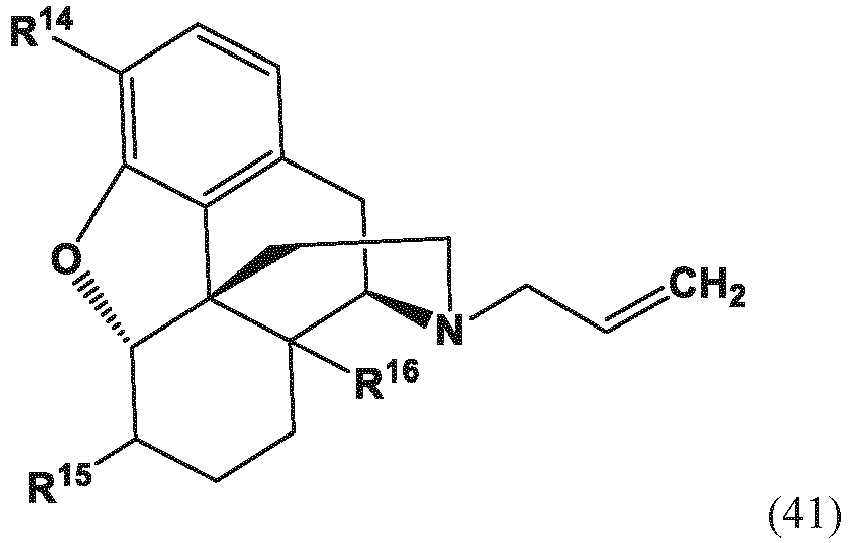
- wherein:
- the transition metal catalyst is Pd(PPh3)4;
- the allyl scavenger is N,N-dimethyl barbituric acid;
- R14 and R16 are each independently selected from -OH, -H, and -OR17;
- R15 is selected from -OH, -H, -OR17, =O, and =CH2; and
- R17 is an oxygen protecting group.
- In another embodiment, the present invention provides a method for making a compound of Formula (57)


- wherein:
- the transition metal catalyst is Pd(PPh3)4;
- the allyl scavenger is N,N-dimethyl barbituric acid;
- R14 and R16 are each independently selected from -OH, -H, and -OR17;
- R15 is selected from -OH, -H, -OR17, =O, and =CH2; and
- R17 is an oxygen protecting group.
- In another embodiment, the present invention provides a method for making a compound of Formula (57)


- (b) contacting a product from step (a) comprising the compound of Formula (41) with an allyl scavenger to provide the compound of Formula (57);
- wherein:
- the transition metal catalyst is Pd(PPh3)4;
- the allyl scavenger is N,N-dimethyl barbituric acid;
- wherein:
- R14 and R16 are each independently selected from -OH, -H, and -OR17;
R15 is selected from -OH, -H, -OR17, =O, and =CH2; and
R17 is an oxygen protecting group. - The allyl scavenger is compound (146)

- The compound of formula (41)


- The methods disclosed herein are readily adapted for the synthesis of clinically and commercially important compounds including naloxone, naltrexone, noroxymorphone, noroxycodone and buprenorphine. In particular embodiments, the methods disclosed herein are useful for incorporation into overall processes. The methods disclosed herein are also readily adapted to the synthesis of clinically and commercially important compounds from morphine, codeine, and thebaine.
- The present invention, in one embodiment, provides methods for the conversion of oxymorphone to noroxymorphone, and processes for the conversion of oripavine to noroxymorphone that comprise the transition metal-catalyzed reactions disclosed herein. In certain embodiments, the present invention provides "one pot" processes for the conversion of oxymorphone to noroxymorphone, and "one pot" processes for the conversion of oripavine to noroxymorphone that comprise the transition metal-catalyzed reactions disclosed herein.
- In a further embodiment, the present invention provides methods for the conversion of naloxone to noroxymorphone.
- As used herein, the following terms are intended to have the following meanings:
- "-(C1-C6) alkyl" as used herein means a straight or branched hydrocarbon chain having 1, 2, 3, 4, 5, or 6 carbon atoms that can contain or consist of a carbocyclic group. Representative straight chain -(C1-C6) alkyls include methyl, -ethyl, -n-propyl, -n-butyl, -n-pentyl and -n-hexyl. Representative branched chain -(C1-C6) alkyls include -iso-propyl, -sec-butyl, -iso-butyl, -tert-butyl, -iso-pentyl, -neopentyl, 1-methylbutyl, 2-methylbutyl, 3-methylbutyl, 1,1-dimethylpropyl, 1,2-dimethylpropyl, 1-methylpentyl, 2-methylpentyl, 3-methylpentyl, 4-methylpentyl, 1-ethylbutyl, 2-ethylbutyl, 3-ethylbutyl, 1,1-dimethylbutyl, 1,2-dimethylbutyl, 1,3-dimethylbutyl, 2,2-dimethylbutyl, 2,3-dimethylbutyl, 3,3-dimethylbutyl, methyl cyclopropyl, methyl cyclobutyl.
- "-(C2-C6) alkenyl" as used herein means a straight chain or branched hydrocarbon that can contain a carbocyclic group, having 2, 3, 4, 5, or 6 carbon atoms and including at least one carbon-carbon double bond. Representative straight chain and branched -(C2-C6) alkenyls include -vinyl, -allyl, -1-butenyl, -2-butenyl, -iso-butylenyl, -1-pentenyl, -2-pentenyl, -3-methyl-1-butenyl, -2-methyl-2-butenyl, -2,3-dimethyl-2-butenyl, -1-hexenyl, 2-hexenyl, 3-hexenyl.
- "-(C2-C6) alkynyl" as used herein means a straight chain or branched non-cyclic hydrocarbon having 2, 3, 4, 5, or 6 carbon atoms and including at least one carbon-carbon triple bond. Representative straight chain and branched -(C2-C6) alkynyls include -acetylenyl, -propynyl, -1-butynyl, -2-butynyl, -1-pentynyl, -2-pentynyl, -3-methyl-1-butynyl, -4-pentynyl, -1-hexynyl, -2-hexynyl, -5-hexynyl.
- "Carbocyclic" as used herein means a ring structure in which all of the ring atoms are carbon. A carbocyclic group can be saturated or unsaturated. An unsaturated carbocyclic group can contain 1, 2, 3, or 4 double bonds or 1, 2, 3, or 4 triple bonds. Representative carbocyclic groups include cyclopropyl, cyclopropenyl, cyclobutyl, cyclobutenyl, cyclopentyl, cyclopentenyl, cyclohexyl, cyclohexenyl.
- "Halogen" as used herein means -F, -Cl, -Br, or -I. In certain embodiments, only a subset of the halogens are employed, e.g., the halogen can be selected from -Cl, -Br, and -I.
- "Leaving group" as used herein means an atom, a group of atoms, or a molecular fragment that is detached, eliminated, or removed from the rest of a molecule during a reaction, e.g., a group that is displaced in a substitution reaction or elimination reaction. Representative examples of such leaving groups include -Cl, -Br, -I, -OS(O)2C4F9,-OS(O)2CF3, -OS(O)2F, -para-toluene sulfonate, and -OS(O)2CH3. In certain embodiments, the leaving group is a halogen selected from -Cl, -Br, and -I. In other embodiments, the leaving group is -Br.
- "Oxygen protecting group" as used herein means an atom, a group of atoms, or a molecular fragment group introduced into a molecule by chemical modification that is capable of modifying the reactivity of an oxygen atom, particularly that of a hydroxyl group, in order to obtain chemoselectivity in a subsequent chemical reaction and which, after the reaction for which protection is employed, can be removed without disturbing the remainder of the molecule. Representative examples of such oxygen protecting groups include allyl, acetyl, benzoyl, benzyl, β-methoxyethoxymethyl, dimethoxytrityl, methoxymethyl, para-methoxybenzyl, methylthiomethyl, pivaloyl, tetrahydropyranyl, trityl, silyl (trimethylsilyl, tert-butyldimethylsilyl, tert-butyldimethylsilyloxymethyl, and tri-iso-propylsilyl), methyl, and ethoxyethyl. In certain embodiments, an oxygen atom can be protected during a chemical reaction; e.g., the 3-hydroxyl of an opioid can react with a haloformate reagent to provide a "protected" 3-carbonate derivative. As used herein, alkylated hydroxyl groups are considered protected by the bound alkyl moiety; e.g., the 3-methoxy group of thebaine is considered, in this context, to carry a 3-hydroxyl moiety protected by the bound methyl group. In a similar manner, hydroxyl groups that react with a haloformate reagent yielding a carbonate derivative are considered protected hydroxyl groups. For example, reaction of a hydroxyl group with allyl chloroformate provides a carbonate moiety as the product, (-OC(O)O-CH2-CH=CH2), which can be represented herein as -OR17, where the protecting group ("R17") is the allyl oxycarbonyl moiety (-C(O)O-CH2-CH=CH2).
- "Transition metal catalyst" as used herein means a catalyst comprising any of the transition elements capable of participating in a catalytic cycle, i.e., any of the metallic elements within Groups 3 to 12 in the Periodic Table. As used herein, the phrase "transition metal catalyst" encompasses those catalysts that comprise a transition metal of various oxidative states and that are capable of allylic decarboxylation. Transition metal catalysts useful in methods disclosed herein include complexes comprising a transition metal selected from the group consisting of Pd[0], Pd[II], Ni[0], Ni[II], Mo[0], Ru[II], Rh[I], and combinations of two or more thereof. In certain cases, transition metal catalysts useful in the methods disclosed herein include those comprising 1, 2, 3, or 4 phosphine moieties. Examples of such transition metal complexes include Pd(PPh3)4, Pd(Ph2P(CH2)4PPh2)2, Ni(PPh3)4, Ni(Ph2P(CH2)4PPh2)2, ((pentamethylcyclopentadienyl)RuCl)4, [Pd(DBA)2]/PPh3, [Pd(OAc)2]/PPh3, [Ni(COD)2]/PPh3, NiCl2/PPh3, Ni[P(OEt)3]4, [Mo(CO)6-DPPE], RhH(PPh3)4-P(n-Bu)3, and combinations of two or more thereof. In certain cases, the transition metal catalyst comprises Pd(PPh3)4. In certain cases, the transition metal catalyst consists essentially of Pd(PPh3)4. In certain cases, such as in case of the claimed invention, the transition metal catalyst is Pd(PPh3)4. In certain cases, the transition metal catalyst can be prepared in situ. For example, triphenylphosphine (PPh3) can be added to a mixture containing PdCl2 to prepare the catalysts PdCl2(PPh3)2 or Pd(PPh3)4 in situ.
- An "allyl scavenger" as used herein can be selected from those known in the art, e.g., from among the following illustrative examples:


- A "hydrogenation" is the addition of two hydrogen atoms to a double bond, thus converting it into a single bond, or the addition of two or four hydrogen atoms to a triple bond, thus converting it into a double or a single bond. It can be carried out using routine methods known in the art, for example, with a hydrogen atmosphere in the presence of a precious metal catalyst such as a carbon-supported palladium (Pd/C) or Pt/C. In other cases, a double bond can be subjected to transfer hydrogenation. In certain cases, reduction (hydrogenation) of an alkyne to an alkene is carried out in methanol with hydrogen and quinoline in the presence of 5% Lindlar catalyst. In other cases, the reduction of an alkyne to an alkene is carried out in the presence of NaBH4, hydrogen, diethyl amine and Ni[II]acetate in aqueous methanol.
- An "oxidation" is the addition of one or more (generally two) oxygen atoms to an unsaturated structural element. It can be carried out using routine methods known in the art. In certain embodiments, it is carried out using a peroxy acid, wherein the peroxy acid can be peroxybenzoic acid, performic acid, or peracetic acid, which can be prepared in situ by mixing hydrogen peroxide and excess formic acid or excess acetic acid. In a particular embodiment, it is performic acid, prepared by combining formic acid and hydrogen peroxide in a reaction mixture. In certain embodiments, the oxidation is carried out by adding osmium tetroxide and N-methyl morpholine N-oxide.
- Numbering of the atoms in the structures disclosed herein is based upon the following scheme, using the chemical structure of morphine as the reference:

- As used throughout herein, it is to be understood that R14', R15', and R16' include not only R14, R15, and R16, respectively, but also, when an R14, R15, and/or R16 group is present as an -OH group or contains an -OH group, the reaction product of a compound of formula (48) with that -OH group to form a group comprising a carbonate. Thus, R14', R15', and R16' groups include, in addition to the respective R14, R15, and R16 groups, such carbonate-containing reaction products. Even further, certain reaction pathways described herein convert the carbonate portion of the carbonate-containing reaction product into an ether group. Thus, R14', R15', and R16' further include such ether-containing reaction products.
- It is also to be understood that when R14 is selected to be a particular moiety that is not an -OH group, then R14' is also that particular R14 moiety. Likewise, it is to be understood that when R15 is selected to be a particular moiety that is not an -OH group, then R15' is also that particular R15 moiety. Likewise, it is to be understood that when R16 is selected to be a particular moiety that is not an -OH group, then R16' is also that particular R16 moiety.
- Where an R14', R15', and/or R16' group(s) is or contains a carbonate-containing group formed from an -OH group, that carbonate-containing group can be converted back to the -OH group. Conversion of the carbonate-containing group to the -OH group can be carried out in the presence of a suitable base. Alternatively, when an R14', R15', and/or R16' group is an allyl carbonate, that allyl carbonate can first be converted into an -O-allyl group through a transition metal catalyzed decarboxylation reaction, in accordance with the present disclosure. Thereafter, the -O-allyl group can be converted into an -OH group in the presence of a suitable allyl scavenger, as described herein.
- "Sub-stoichiometric amount" means an amount which is smaller than the stoichiometric amounts of a reactant(s) of the reactions described herein. A sub-stoichiometric amount can be any numerical value within the range of from 0.001 to 99 mol% of the starting reactant or the compounds taking place in the reaction schemes described herein. In certain cases, the sub-stoichiometric amount is in the range of from 20 to 70 mol%, 25 to 65 mol% or 30 to 60 mol% of the starting reactant, e.g. 30 mol% or 60 mol%.
- "Catalytic amount" is a sub-stoichiometric amount which is sufficient to exert a catalytic effect on the reactions described herein. Typically, a catalytic amount can be any numerical value within the range of from 0.01 to 99 mol% of the starting reactant or the compounds taking its place in the reaction schemes described herein. In certain cases, the catalytic amount is in the range of from 20 to 70 mol%, 25 to 65 mol% or 30 to 60 mol% of the starting reactant or has any numerical value within these ranges, e.g. 30 mol% or 60 mol%. An illustrative example for a catalytic compound to which these ranges apply is the iodide salt used in the context of present disclosure. In certain other cases, the catalytic amount is in the range of from 0.001 to 30 mol%, 0.01 to 20 mol% , 0.1 to 10 mol%, 2 to 8 mol%, or 3 to 7 mol% of the starting reagent or has any numerical value within these ranges, e.g. about 5 mol%. An illustrative example for a compound to which these ranges apply is the transition metal catalyst used in the context of present disclosure.
- "Consisting essentially of" in the context of present disclosure means that the subsequently named component(s) is necessarily included but that another unlisted ingredient(s) that does not materially affect the basic properties can also be present. In certain cases, the subsequently named component is the major component of the compound named before the term. E.g., a solvent consisting essentially of a tertiary alcohol contains said tertiary alcohol as major component, typically in an amount of more than 50 vol%, and other solvents (e.g. 1,2-dichloroethane, chloroform, dichloromethane, or acetonitrile) in a total amount of less than 50 vol%. In these cases, "consisting essentially of" means "comprising between 50 vol% and 100 vol% or any numeric value within this range of the subsequently named compound." In certain cases, "consisting essentially of" means "comprising from 80 to up to 100 vol% (excepting 100 vol%, as this is represented by "consisting of" in the context of present disclosure) or any numeric value within this range of the subsequently named compound, e.g. as in "a solvent comprising from 80 to up to 100 vol% tertiary alcohol".
- Compounds disclosed herein can contain one or more asymmetric centers and can thus give rise to enantiomers, diastereomers, and other stereoisomeric forms. In reference to all compounds described herein that contain one or more olefinic double bonds or other centers of geometric asymmetry, unless specified otherwise, it is intended to include both E and Z geometric isomers. The methods disclosed herein can be used with each of the enantiomers, diastereomers, and other stereoisomeric forms of the reagents disclosed herein to provide each of the enantiomers, diastereomers, and other stereoisomeric forms of the products disclosed herein.
- In the event of doubt as to the agreement of a depicted chemical structure and a chemical name, the depicted chemical structure governs.
- It will be appreciated that various features of the invention which are, for clarity, described in the context of separate embodiments, can also be provided in combination in a single embodiment unless otherwise specifically herein excluded. Conversely, various features of the invention which are, for brevity, described in the context of a single embodiment, can also be provided separately and/or in any suitable subcombination unless otherwise specifically herein excluded.
- The following sections do not only describe the claimed invention, i.e. processes for preparing compound (57) (sections 4.4 and 4.8), but also processes for preparing their starting materials (41) and (42) (sections 4.2, 4.3, 4.5, 4.6, 4.7 and 4.9).
- The process for preparing N-allyl noroxycodone can be depicted as comprising two steps. In the first step, which is depicted in Scheme 2, a tertiary amine is demethylated by contacting the tertiary amine with an allyl haloformate (in this case allyl chloroformate, compound (102)) in a solvent in the presence of a base to provide the intermediate N-allyl carbamate.

- The definitions of R44 and R45 will depend on the functional groups present at R42 and R43, respectively. It will be appreciated that when R42 is H, then -OR44 can include allyl carbonate

- Table 1 summarizes data from five reactions according to Scheme 2. These include N-demethylation of: 3,14-bis-acetoxy-oxymorphone (Reaction 1 in Table 1), oxycodone (Reaction 2), oxymorphone (Reaction 3), and 3-allyl oxymorphone (Reaction 4). Each of Reactions 1-4 was carried out with excess (at least 6 equivalents excess) allyl chloroformate (compound (102)) in the presence of potassium carbonate (1.5 equivalents) in 1,2-dichloroethane at reflux temperature for 48 hours. In the first four reactions, which were carried out at the reflux temperature of 1,2-dichloroethane (approximately 84°C), 50-78% of the starting opioid was consumed.
- In Reaction 5, oxymorphone was demethylated with excess allyl chloroformate (compound (102)) in the presence of K2CO3 using tert-amyl alcohol as the solvent. Reaction 5 was carried out according to the method described in Example 3 (described below), in which additional amounts of allyl chloroformate are added throughout the duration of the reaction. In this instance, more than 97% of oxymorphone was consumed.
Table 1 Reaction R42 R43 Solvent % Starting Opioid Consumed 1 Acetyl Acetyl ClCH2CH2Cl 60 2 CH3 H ClCH2CH2Cl 78 3 H H ClCH2CH2Cl 62 4 Allyl H ClCH2CH2Cl 50 5 H H 
> 97 - In the second step, the intermediate N-allyl carbamate is decarboxylated in a transition metal-catalyzed reaction to provide the corresponding N-allyl derivative. As illustrated in Scheme 3, the carbamate products of Table 1 were contacted with a transition metal catalyst comprising palladium[0] in the reaction depicted in Scheme 3.
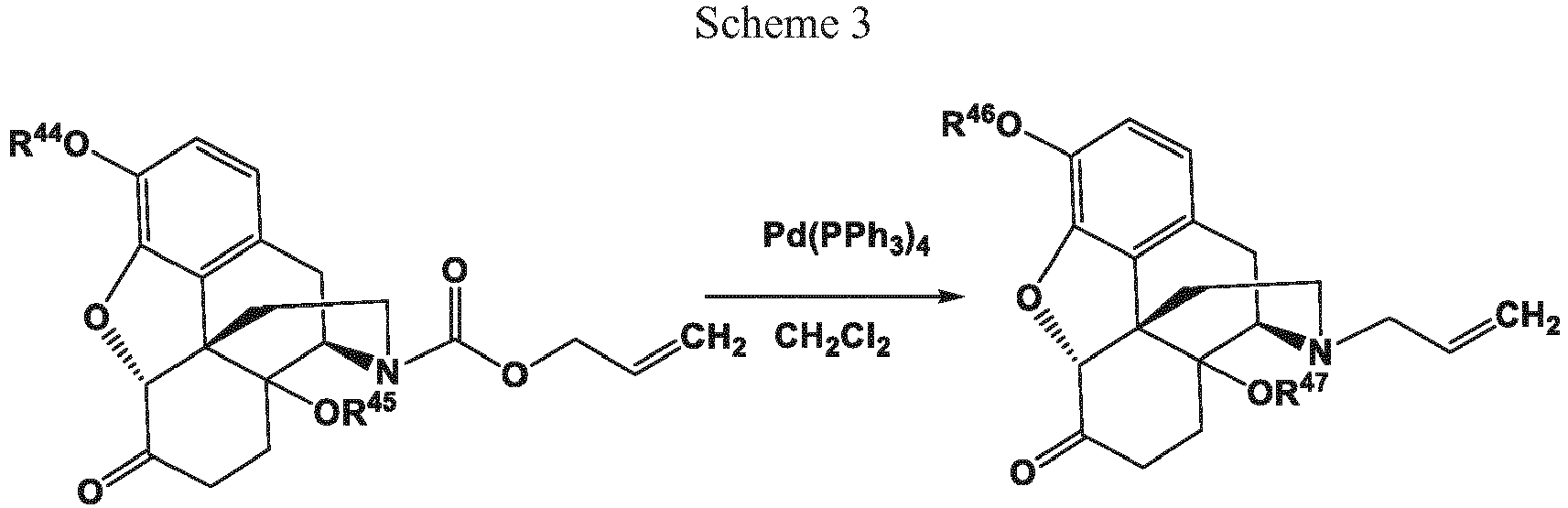
- The definitions of R46 and R47 will depend on the functional groups present at R44 and R45, respectively. In Scheme 3, R46 and R47 can be -H, -CH3, acetyl, or allyl. In certain cases, R47 is -H.
- Table 2 provides the results obtained upon decarboxylation of the oxymorphone and oxycodone functionalized carbamate starting compounds identified in Table 2. As indicated in Table 2, a reaction with 3,14-bis-acetoxy compounds provided a complex mixture of products (Reaction 1 of Table 2 below). In contrast, decarboxylation of substrates in which the 3- and 14-hydroxyl groups were not protected by acetylation, and therefore were present as free hydroxyl groups or as carbonate derivatives thereof, provided improved yields (Reactions 2 and 3 of Table 2). In these reactions, the decarboxylation reactions were carried out in dichloromethane at a temperature of about 25°C in the presence of a catalytic amount (0.05 equivalents) of tetrakis(triphenylphosphine)palladium[0].
Table 2 Reaction R44 R45 Conversion 1 Acetyl Acetyl About 5%, many products 2 CH3 H / Allyl carbonate (a) > 99% 3 Allyl carbonate (b) H / Allyl carbonate (a) > 99% (a) Indicates a mixture of 14-hydroxyl and 14-allyl carbonate species.
(b) Indicates that the 3-position of the compound carried an allyl carbonate moiety. As noted below, in Reaction 3 of Table 2, the 3-carbonate moiety is converted to the 3-allyl ether in the transition metal-catalyzed decarboxylation reactions depicted in Scheme 3 (i.e., R46 is allyl). - It has also been found that 14-functionalized allyl carbonates selectively undergo allylic decarboxylation, yielding the desired 14-hydroxyl products. Therefore, in Reactions 2 and 3 of Table 2, the product of the transition metal-catalyzed reaction depicted in Scheme 3 is one in which R47 is -H.
- It has also been found that allylic decarboxylation was successful with 3-allyl functionalized substrates, e.g., where R44 of Scheme 3 is an allyl carbonate moiety (Reaction 3 of Table 2). In this instance, the 3-allylcarbonate group was converted to a 3-allyl ether derivative rather than to a free hydroxyl (i.e., R46 is allyl). The 3-allyl ether can be converted to the corresponding 3-OH in a transition metal-catalyzed reaction in the presence of a base and an allyl scavenger (e.g., methanol), as depicted in Scheme 4.

- In other reactions, e.g., as depicted in Scheme 10, formation of the 3-allyl ether can be avoided by incorporating a base-treatment step after synthesis of the N-allyl carbamate derivative comprising a 3-carbonate moiety but before the transition metal-catalyzed decarboxylation reaction depicted in Scheme 3 above and Scheme 5 below.
- As indicated in Section 4.2.1, oxymorphone can be contacted with allyl chloroformate to provide the 17-carbamate of oxymorphone, 17-allyloxycarbonyl-noroxomorphone (compound (105)) (e.g., see Example 3 below). Compound (105) in turn can be decarboxylated to provide compound (104) (naloxone) in a transition metal-catalyzed reaction, as depicted in Scheme 5.

- The decarboxylation reaction depicted in Scheme 5 can be incorporated in an overall process, depicted in Scheme 6, for conversion of oripavine to naloxone. In fact, the synthetic approach of Scheme 6 can be carried out as a "one pot" process without chromatographic isolation of the intermediate products.
- The transition metal-catalyzed decarboxylation of 17-allyloxycarbonyl noroxymorphone can be exploited to provide the overall process for conversion of the natural product oripavine (compound (106)) to the semi-synthetic derivative thereof, naloxone (compound (104)) according the reaction scheme depicted below. In these reactions, the 3-hydroxyl of oripavine and the 3- and 14-hydroxyls of compound (107) and compound (108) (oxymorphone) need not be protected in one or more separate steps. As disclosed below, the phenolic 3-OH is expected to react with the allyl halo formate reagent employed in the demethylation reaction to yield the 3-allyl carbonate. Although the 14-OH is typically less reactive than the 3-OH group, a 14-allyl carbonate group can also be formed by reaction with the haloformate reagent.
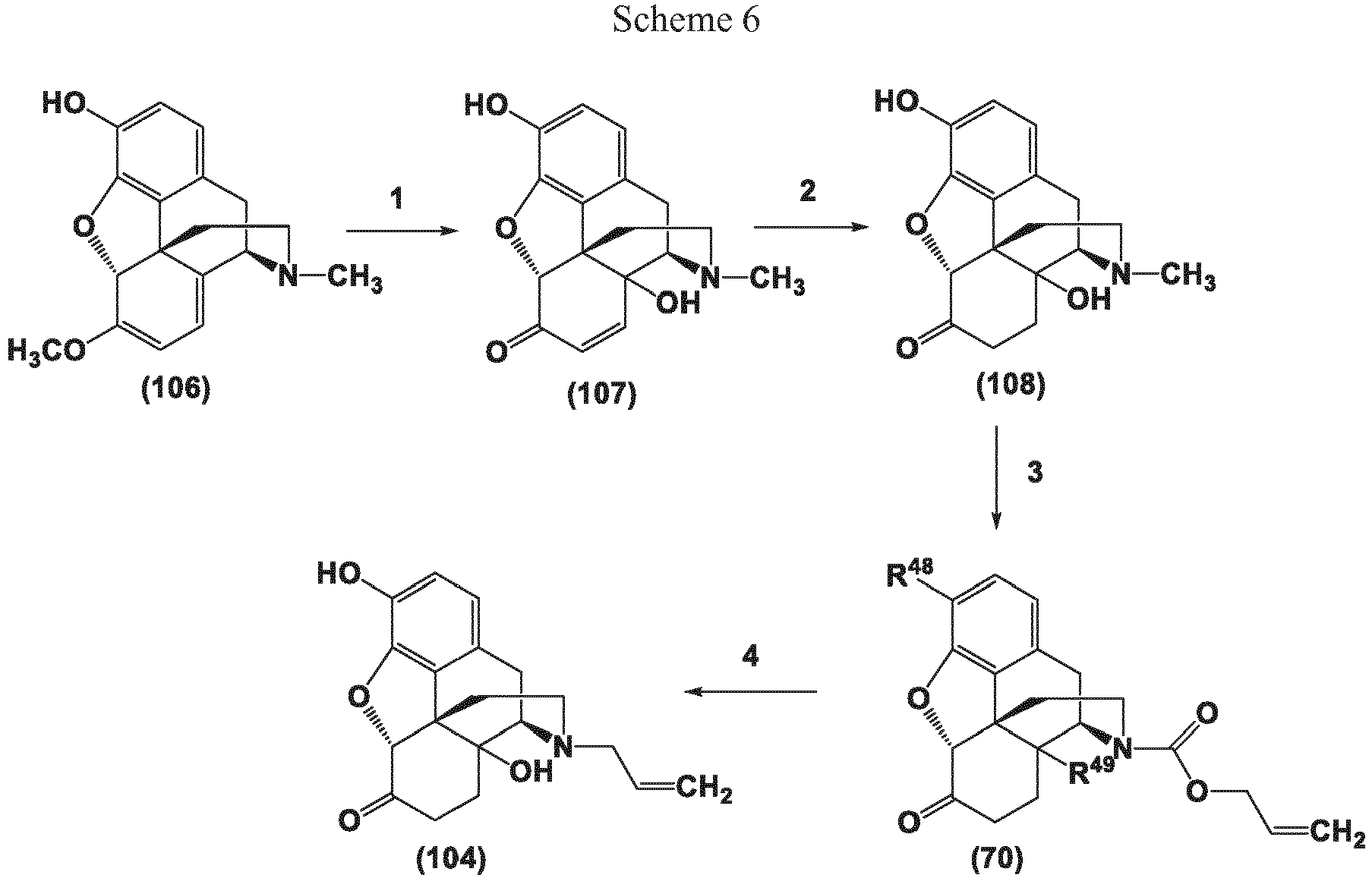
- Step 1 of Scheme 6 depicts the oxidation of oripavine (compound (106)) to 14-hydroxymorphinone (compound (107)) which can be carried out by contacting oripavine with a peroxyacid such as peracetic acid, performic acid, or m-chloroperbenzoic acid. The peroxy acid can be formed in situ, for example by addition of hydrogen peroxide to acetic acid or to formic acid.
- In Step 2 of Scheme 6, the oxidized compound (compound (107)) is hydrogenated to oxymorphone (compound (108)). Hydrogenation can be carried out, for example, with a hydrogen atmosphere in the presence of a precious metal catalyst such as a carbon-supported palladium (Pd/C) or Pt/C (see, e.g., Krassnig et al. (1996) Arch. Pharm. Med. Chem. 329:325-326;
U.S. Patent No. 5,112,975 to Wallace ;U.S. Patent No. 4,472,253 to Schwartz ; andU.S. Patent Nos. 1,485,673 and1,468,805 to Freund et al .). Or the 7,8-double bond of compound (107) can be subjected to transfer hydrogenation to provide compound (108) (see, e.g.,WO 2005/097801 A1 ;U.S. Patent No. 6,177,567 B1 ;WO 2006/094672 A1 ; and Fahrenholtz (1972) J. Org. Chem. 37(13):2204-2207). - In Step 3 of Scheme 6, oxymorphone can be contacted with an allyl haloformate, e.g., allyl chloroformate


- The Step 3 starting material, oxymorphone (compound (106)), may be taken up in a solvent in the presence of a base. The solvent can be any suitable solvent in which the reaction can proceed. In certain reactions, the solvent is selected from the group consisting of ether solvents, acetonitrile, benzene, DMF, DMSO, N,N-dimethylpropionamide, DMPU, DMI, DME, DMAC, NMP, ethyl acetate, ethyl formate, ethyl-methyl ketone, iso-butylmethylketone, formamide, hexamethylphosphoramide, methyl acetate, N-methylacetamide, N-methylformamide, nitrobenzene, nitromethane, propionitrile, sulfolane, tetramethylurea, THF, toluene, CHCl3, CH2Cl2, 1,2-dichloroethane, acetone, tert-amyl alcohol, tert-butyl alcohol, 3-methyl-3-pentanol, 2,3-dimethyl-3-pentanol, 3-ethyl pentanol, 2-methyl-2-hexanol, carbon tetrachloride, chlorobenzene, 1,2-dichlorobenzene, trifluorotoluene, 1,4-dioxane, 1,2-dimethoyxethane, xylene, and combinations of two or more thereof.
- In particular reactions of Step 3, the solvent comprises, consists essentially, or is (i.e., consists of) a tertiary alcohol selected from the group consisting of tert-amyl alcohol, tert-butyl alcohol, 3-methyl-3-pentanol, 2,3-dimethyl-3-pentanol, 3-ethyl pentanol, 2-methyl-2-hexanol, and combinations of two or more thereof. In a specific reaction, the solvent comprises tert-amyl alcohol. In another specific reaction, the solvent consists essentially of tert-amyl alcohol. In another specific reaction, the solvent is tert-amyl alcohol.
- In certain reactions of Step 3, the base is selected from the group consisting of borate salts (such as, for example, NaBO3), di- and tri-basic phosphate salts (such as, for example, Na2HPO4, Na3PO4, combinations thereof), bicarbonate salts (such as, for example, NaHCO3, KHCO3, combinations thereof), hydroxide salts (such as, for example, NaOH, KOH, combinations thereof), carbonate salts (such as, for example, Na2CO3, K2CO3, Cs2CO3, combinations of two or more thereof), organic proton acceptors (such as, for example, pyridine, triethylamine, di-iso-propylethylamine, N-methylmorpholine, N,N-dimethylaminopyridine, combinations of two or more thereof), organic buffers (such as, for example, N-(2-acetamido)-2-aminoethane sulfonic acid (ACES), N-(2-acetamido)-iminodiacetic acid (ADA), N,N-bis(2-hydroxyethyl)glycine (BICINE), 3-(cyclohexylamino)-1-propanesulfonic acid (CAPS), 2-(cyclohexylamino) ethanesulfonic acid (CHES), 4-(2-hydroxyethyl)-1-piperazinepropanesulfonic acid (EPPS), 4-(2-hydroxyethyl)piperazine-1-ethanesulfonic acid (HEPES), 2-(4-morpholinyl) ethanesulfonic acid (MES), 4-morpholinepropanesulfonic acid (MOPS), 1,4-piperazinediethanesulfonic acid (PIPES), [(2-hydroxy-1,1-bis(hydroxymethyl)ethyl)amino]-1-propanesulfonic acid (TAPS), 2-[(2-hydroxy-1,1-bis(hydroxymethyl)ethyl)amino]ethanesulfonic acid (TES), any salt thereof and/or combinations of two or more thereof. In certain reactions, the base is selected from the group consisting of NaHCO3, KHCO3, LiHCO3, KHCO3, LiHCO3, Na2CO3, K2CO3, Cs2CO3, NaOH, KOH, Na2HP04Na3PO4, K2HPO4, K3PO4, and combinations of two or more thereof. In specific reactions, the base is selected from the group consisting of triethylamine, di-iso-propylethylamine, Na2CO3, NaHCO3, KHCO3, K2CO3, Cs2CO3, and combinations of two or more thereof. In a specific reaction, the base is NaHCO3.
- Step 3 of Scheme 6 can be carried out in the presence of an iodide salt, which can be selected from the group consisting of NaI, KI, LiI, CsI, RuI, MgI2, CaI2, NH4I, tetrabutylammonium iodide, and combinations of two or more thereof. In certain reactions, the iodide salt is NaI. In certain reactions, the iodide salt is present in a sub-stoichiometric amount. In certain reactions, the iodide salt is present in a catalytic amount.
- In one reaction, the allyl haloformate, here allyl chloroformate (compound (102)), is added to the mixture and the reaction run at a temperature within the range of from about 15°C to about 85°C, or from about 20°C to about 75°C, or from about 25°C to about 75°C, or from about 35°C to about 70°C, or from about 45°C to about 65°C, or from about 50°C to about 60°C for an initial period of time within the range of from about 0.5 hours to about 2 hours, or from about 0.5 hours to about 1.5 hours, or from about 0.75 hours to about 1.25 hours. In certain reactions, the reaction is run at a temperature of about 55°C. In certain reactions, the reaction is run for an initial period of about one hour. An aliquot of the mixture is analyzed to determine the extent of the reaction. If the reaction has not proceeded to the extent desired, the mixture is heated, thereby removing water (e.g., as an azeotrope with tert-amyl alcohol) and allyl chloroformate, as well as any ethanol, allyl chloride, or allyl alcohol that might be present in the reaction. After cooling, the solvent is replenished as necessary, additional allyl haloformate reagent is added, and the reaction continued. This cycle of testing, distillation, solvent replenishment, and allyl haloformate addition can be repeated one or more times. In certain cases, particularly where the base treatment step (Step 4A of Scheme 10 below) is omitted, the allyl carbamate product R48 moiety can be an allyloxycarbonyl moiety and, in certain cases, R49 will be a hydroxyl moiety while, in other embodiments, R48 and R49 will both be allyloxycarbonyl moieties. Where R48 and R49 are each hydroxyl moieties, the compound is 17-allyloxycarbonyl noroxymorphone, compound (105).
- In certain reactions, e.g., those in which R48 and/or R49 are allyloxycarbonyl groups, Step 4 can involve multiple sub-steps that result in conversion of the 17-allyloxycarbonyl intermediate, carrying a 3-allyloxycarbonyl moiety and/or 14-allyloxycarbonyl moiety, to the end product, naloxone, as depicted in Scheme 6. Step 4 of Scheme 6, therefore, reflects conversion of the allyl carbamate group (17-allyloxycarbonyl group) to an N-allyl moiety via the transition metal-catalyzed reaction depicted in Schemes 1 and 3, and where both R48 and R49 either are hydroxyl groups or are converted to hydroxyl groups, the product of Step 4 of Scheme 6 is compound (104), i.e., naloxone.
- More specifically, the product of Step 3 of Scheme 6 (i.e., compounds of formula (70)) can include both of the following compounds.

- In certain reactions, particularly at early time points (see, e.g., Example 3), an initial product of Step 3 of Scheme 6, can be compound (145):

- In one reaction, the product(s) of Step 3 of Scheme 6 are contacted with a transition metal catalyst, whereby the 14-allyloxycarbonyl group is converted to a hydroxyl, the N-allylcarbamate group is converted to an N-allyl moiety, and the 3-allyloxycarbonyl is converted to a 3-allyl ether moiety, as depicted in Scheme 7.

- In certain reactions, the mixture of 3,17-diallyloxycarbonyl-noroxymorphone (compound (109)) and 3,14,17-triallyloxycarbonyl-noroxymorphone (compound (110)) is dissolved in a solvent (e.g., chloroform or methylene chloride) and a suitable transition metal catalyst, e.g., tetrakis(triphenylphosphine)palladium[0], is added. The decarboxylation reaction is carried out for a suitable time and at an appropriate temperature for the reaction to proceed to completion. In one embodiment, the reaction is carried out for four hours at a temperature of about 20°C.
- The reaction mixture is filtered and the filtrate concentrated. The resulting oil is taken up in a solvent, e.g., ethyl acetate, extracted with acid, e.g., 0.5N HCl, and the aqueous layer washed with an organic solvent, which in one case is ethyl acetate. The aqueous layer is basified, e.g., to pH 9.1 using 50% aqueous NaOH, and extracted with an organic solvent which, in one case, is chloroform. The recovered organic layers are combined, dried, filtered, and concentrated to provide an oil comprising the product, 3-allyl-naloxone (compound (103)), as depicted in Scheme 7 above.
- In one reaction, the 3-allylether naloxone product (compound (103)) is oxygen de-allylated to naloxone, by contact with a suitable transition metal catalyst, e.g., tetrakis(triphenylphosphine)palladium[0], in the presence of a base and an allyl scavenger. In certain reactions, the base is K2CO3.
- In one reaction, the allyl scavenger can be selected from the group consisting of sodium 2-ethylhexonate, morpholine, dimedone, 4-methylbenzensulfinic acid, sodium hydroxymethyl sulfinate, benzenesulfinic acid, sodium toluene sulfinate, sodium 2-thiophene sulfinate, tetrabutylammonium toluene sulfinate, N,N-dimethyl barbituric acid, sodium 4-chloro-3-nitrobenzene sulfinate, formic acid, diethyl amine, methanol, ethanol, and combinations of two or more thereof. In another reaction, the allyl scavenger is methanol.
- In a particular reaction, the base is K2CO3 and the allyl scavenger is methanol, i.e., the reaction is that depicted in Scheme 8.

- Thus, in one reaction, 3-allylether-naloxone is taken up in a suitable solvent and contacted with a base and a transition metal catalyst in the presence of an allyl scavenger. The base can be selected from among those described above as useful in Step 3 of Scheme 6, and the transition metal catalyst is a catalyst that comprises a transition metal selected from the group consisting of Pd[0], Pd[II], Ni[0], Ni[II], Mo[0], Ru[II], Rh[I], and combinations of two or more thereof. In certain reactions, the transition metal catalyst is a complex selected from the group consisting of Pd(PPh3)4, Pd(Ph2P(CH2)4PPh2)2, Ni(PPh3)4, Ni(Ph2P(CH2)4PPh2)2, ((pentamethylcyclopentadienyl)RuCl)4, [Pd(DBA)2]/PPh3, [Pd(OAc)2]/PPh3, [Ni(COD)2]/PPh3, NiCl2/PPh3, Ni[P(OEt)3]4, [Mo(CO)6-DPPE], RhH(PPh3)4-P(n-Bu)3, and combinations of two or more thereof. In another reaction, the transition metal catalyst comprises 1, 2, 3, or 4 phosphine moieties. In another reaction, the transition metal catalyst is tetrakis(triphenylphosphine)palladium[0]. In one reaction, the base is potassium carbonate and the allyl scavenger is methanol. The de-allylation reaction is carried out for a suitable time and at an appropriate temperature for the reaction to proceed to completion; in one reaction, the reaction is carried out for four hours at a temperature of about 20°C, i.e., a temperature typically within the range of from about 15°C to about 25°C, or from about 17°C to about 23°C, or from about 19°C to about 21°C.
- The reaction mixture is filtered and the filtrate concentrated. The resulting oil is taken up in a solvent, e.g., ethyl acetate, extracted with acid, e.g., 0.5N HCl, and the aqueous layer washed with an organic solvent, which in one reaction is ethyl acetate. The aqueous layer is basified, e.g., to pH 9 using 50% aqueous NaOH, and extracted with an organic solvent which, in one reaction, is chloroform. The recovered organic layers are combined, dried, filtered, and concentrated to provide an oil comprising the product, naloxone.
- The reactions of Schemes 7 and 8 can be combined by including a base and an allyl scavenger in the reaction mixture used for decarboxylative de-allylation, thereby providing the reaction scheme depicted in Scheme 9.

- In certain reactions, the transition metal catalyst is Pd(PPh3)4, the base is K2CO3, the solvent is chloroform, and the allyl scavenger is methanol. The reaction depicted in Scheme 9 therefore permits formation of naloxone from the 3,17-diallyloxycarbonyl and 3,14,17-triallyloxycarbonyl intermediates, and combinations thereof, in a single step.
- In another approach, the 3-allylcarbonate and 14-allylcarbonate groups can be cleaved before the transition metal-catalyzed decarboxylation of the 17-carbamate moiety. In this reaction, once Step 3 of Scheme 6 is deemed complete, base and water are added and the reaction mixture is heated at a temperature and for a time sufficient to hydrolyze the 3-allyoxycarbonyl and 14-allyloxycarbonyl moieties. After cooling, the reaction mixture is first acidified to a pH of about pH 1 to about pH 2, and the layers allowed to separate. The organic layer is retained, washed with 10% sodium hydrogen sulfate, and concentrated to provide 17-allyloxycarbonyl-noroxymorphone. This hydrolysis step can be incorporated into an overall process, e.g., for the production of naloxone from oripavine, as depicted in Scheme 10.
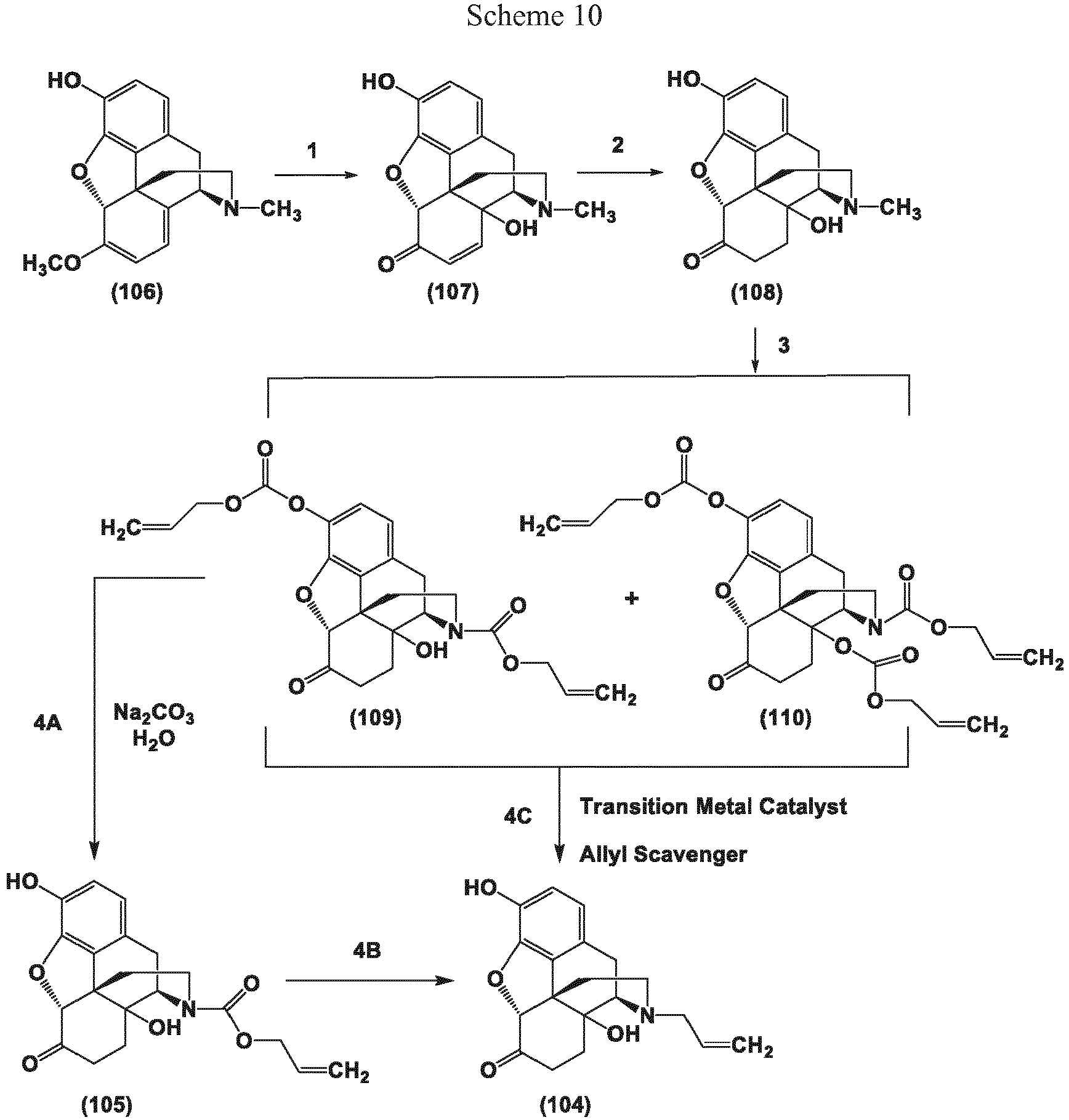
- The base-mediated hydrolysis step described above is depicted as Step 4A in Scheme 10 and the transition metal-catalyzed decarboxylation step (Step 4B of Scheme 10) corresponds to the reaction depicted in Schemes 3 and 5, above.
- In certain reactions, the compounds of formula (109) and formula (110) are converted to compound (104) in Step 4C mediated by a transition metal catalyst in the presence of an allyl scavenger (e.g., as depicted in Scheme 9).
- In one process of Scheme 10, oripavine (compound (106)) is oxidized (Step 1) with a peroxy acid to 14-hydroxy morphinone (compound (107)). The peroxy acid may be peroxybenzoic acid, performic acid, or peracetic acid, which can be prepared in situ by mixing hydrogen peroxide and excess formic acid or excess acetic acid. In a particular reaction, oripavine is oxidized in performic acid, prepared by combining oripavine, formic acid, and hydrogen peroxide into a reaction mixture. The reaction mixture is warmed to a suitable temperature within the range of from about 25°C to about 80°C, or from about 30°C to about 70°C, or from about 35°C to about 65°C, or from about 40°C to about 60°C, or from about 45°C to about 55°C, and maintained at that temperature for about 0.5 hours to about 3.5 hours, or from about 1 hour to about 3 hours, or from about 1.5 hours to about 2.5 hours, until the starting material is consumed. In particular reactions, the oxidation is carried out at about 48°C for about 2 hours.
- The crude product, 14-hydroxy-morphinone (compound (107)) of the oxidation reaction (Step 1) is then taken directly on to the second step without purification. Thus, once oxidation is complete, the crude 14-hydroxy-morphinone (compound (107)) is hydrogenated (Step 2) in the presence of a palladium catalyst under a hydrogen atmosphere at 40-45°C (Step 2) to provide oxymorphone (compound (108)). The hydrogen can be provided at a pressure of from about 15-70 psig, or from about 20-65 psig, or from about 25-60 psig, or from about 30-55 psig, or from about 35-50 psig. In one reaction, hydrogen is provided at a pressure of 40-45 psig. The hydrogenation is carried out at a temperature within the range of from about 25°C to about 80°C, or from about 30°C to about 70°C, or from about 35°C to about 65°C, or from about 40°C to about 60°C. In certain reactions, the hydrogenation is carried out at a temperature within the range of from about 40°C to about 45°C. The reaction mixture is then cooled to a temperature within the range of from about 2°C to about 10°C and filtered to remove the catalyst. The pH of the filtrate is adjusted and the reaction mixture stirred to allow the resultant crude oxymorphone free base to form a precipitate that is filtered, washed and dried.
- Crude oxymorphone, which contains residual water and, in some instances, can also contain residual ethanol, is dissolved in tert-amyl alcohol and the solution dried to remove water. This oxymorphone solution is then treated with excess allyl chloroformate (compound (102)) and sodium bicarbonate at 70-85°C (Step 3). Once the reaction is complete (i.e., conversion of oxymorphone to the 3-allylcarbonate-N-allylcarbamate noroxymorphone (compound (109)), in which none, some, or all of the 14-OH can also be converted to a 14-allylcarbonate group (i.e. compound (110)), water and sodium carbonate are added and, in Step 4A, the mixture is heated to 80-85°C for at least 15 hours to destroy excess allyl chloroformate and to hydrolyze the 3-carbonate moiety as well as any 14-carbonate groups that might be present, providing the 17-allylcarbamate derivative of noroxymorphone (compound (105)). The product, noroxymorphone-17-allylcarbamate, can be extracted into a suitable organic solvent which can be filtered, washed, and dried using normal work-up procedures. If desired, the product can be recovered by evaporation of that solvent.
- The reaction of oxymorphone with allyl chloroformate can be carried out in the presence of an iodide salt, which can be selected from the group consisting of NaI, KI, LiI, CsI, RuI, MgI2, CaI2, NH4I, tetrabutylammonium iodide, and combinations of two or more thereof. In certain reactions, the iodide salt is NaI. In certain reactions, the iodide salt is present in a sub-stoichiometric amount. In certain reactions, the iodide salt is present in a catalytic amount.
- In the decarboxylation reaction, Step 4B, N-allyl carbamate noroxymorphone (compound (105)) is taken up in an appropriate solvent, e.g., chloroform, and contacted with a transition metal catalyst, e.g., tetrakis(triphenylphosphine)palladium[0]. The resulting mixture is allowed to stir at a temperature of about 20°C before being filtered, e.g., through a pad of CELITE. The desired product, naloxone (compound (104)), is then separated from the reaction by normal work-up procedures.
- In another reaction, oxymorphone is converted to noroxymorphone-17-allylcarbamate in two steps, as depicted in Scheme 11.

- As provided above, oxymorphone (compound (108)) starting material can be prepared from oripavine (compound (106)) according to the methods depicted in Schemes 6 and 10 above, and the product noroxymorphone-17-allylcarbamate (compound (105)) can be converted to naloxone (compound (104)) by the transition metal-catalyzed decarboxylation reactions depicted in Schemes 3, 5, 6, 7, 9, and 10 above.
- In a further reaction, oxymorphone can be converted to naloxone as depicted in Scheme 12.

- Although the transition metal catalyst is depicted in Scheme 12 as "Pd[0]," as noted above other transition metal catalysts, including those transition metal catalysts comprising Pd[II], Ni[0], Ni[II], Mo[0], Ru[II], and Rh[I], can be used in those reactions. In another reaction, the transition metal catalyst comprises 1, 2, 3, or 4 phosphine moieties. In another reaction, the transition metal catalyst is tetrakis(triphenylphosphine)palladium[0].
- The present invention as claimed pertains to a method for conversion of oxymorphone and naloxone to noroxymorphone as depicted in Scheme 14.
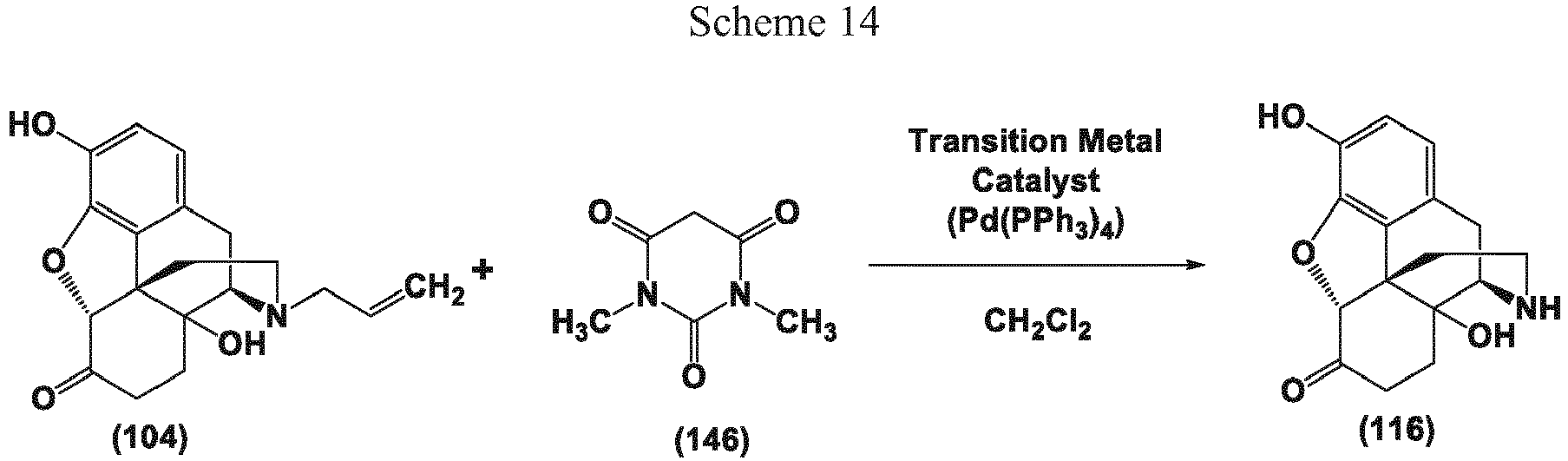
- Naloxone (compound (104)) is contacted with an allyl scavenger, i.e., N,N-dimethyl barbituric acid (compound (146)), and a transition metal catalyst, i.e., tetrakis(triphenylphosphine)palladium[0], in dichloromethane at a temperature of about 20°C. Naloxone as a suspension in dichloromethane is added, and the resulting mixture stirred overnight at a temperature within the range of from about 10°C to about 70°C, or from about 20°C to about 60°C, or from about 30°C to about 60°C. The mixture is cooled and the solids collected by filtration, washed with dichloromethane, and then washed with water. The washed solids are dissolved in aqueous acid (e.g., 10:1 water:concentrated sulfuric acid) at a temperature within the range of from about 10°C to about 70°C, or from about 20°C to about 60°C, or from about 30°C to about 60°C, and the solution washed with dichloromethane before being basified to a pH within the range of from about pH 8 to about pH 10, e.g., using 28% ammonium hydroxide. The solids are collected by filtration and dried to provide the desired product, noroxymorphone (see, e.g., Example 7).
- In other aspects of this embodiment, for example, oxymorphone is first converted to naloxone by the methods depicted in Schemes 10 and 12 above, and then to noroxymorphone by the method depicted in Scheme 14, thereby providing an overall process for conversion of oxymorphone to noroxymorphone.
- The present disclosure provides a method for making compound of formula (41)


- In a particular embodiment, R14 and R16 are each -OH, and R15 is =O, and therefore the compound of formula (41) is naloxone.
- In one reaction, R14 is selected from -OC(O)OCH2CH=CH2, and -OH and R16 is-OH. In another reaction, R14, R14', R16, and R16' are each -OH and R15 and R15' are each =O.
- The transition metal catalyst may be selected from the group consisting of Pd(PPh3)4, Pd(Ph2P(CH2)4PPh2)2, Ni(PPh3)4, Ni(Ph2P(CH2)4PPh2)2, ((pentamethylcyclopentadienyl)RuCl)4, [Pd(DBA)2]/PPh3, [Pd(OAc)2]/PPh3, [Ni(COD)2]/PPh3, NiCl2/PPh3, Ni[P(OEt)3]4, [Mo(CO)6-DPPE], RhH(PPh3)4-P(n-Bu)3, and combinations of two or more thereof. In another reaction, the transition metal catalyst comprises 1, 2, 3, or 4 phosphine moieties. In another reaction, the transition metal catalyst is tetrakis(triphenylphosphine)palladium[0].
- In certain reactions, the transition metal catalyst is present in a sub-stoichiometric amount. In certain reactions, the transition metal catalyst is present in a catalytic amount. In certain reactions, the transition metal catalyst is present in an amount of from 0.001 to 30 mol% or of any numerical value within this range. In certain reactions, the transition metal catalyst is present in an amount of from 0.1 to 10 mol% or of any numerical value within this range (like about 5 mol%).
- In another reaction, the decarboxylation reaction is carried out in a solvent selected from the group consisting of CHCl3, CH2Cl2, 1,2-dichloroethane, toluene, THF, ethyl acetate, acetone, tert-amyl alcohol, tert-butyl alcohol, 3-methyl-3-pentanol, 2,3-dimethyl-3-pentanol, 3-ethyl pentanol, 2-methyl-2-hexanol, acetonitrile, benzene, carbon tetrachloride, chlorobenzene, 1,2-dichlorobenzene, DMF, trifluorotoluene, 1,4-dioxane, 1,2-dimethoyxethane, xylene, and combinations of two or more thereof.
- In certain reactions, the oxygen protecting group, R17, is selected from the group consisting of tert-butyl-diphenylsilyl, tert-butyl-dimethylsilyl, trimethylsilyl, tri-iso-propylsilyl, tert-butyldimethylsilyloxymethyl, β-methoxyethoxymethyl, [bis-(4-methoxyphenyl)phenylmethyl)], methoxymethyl, para-methoxybenzyl, methylthiomethyl, pivaloyl, methyl, ethoxyethyl, triphenylmethyl, -C(O)(C1-C4) alkyl, -C(O)OR18, and -(C1-C6) alkyl, each alkyl being unsubstituted or substituted with 1, 2, 3, 4, or 5 independently-selected R21 groups; R18 is -(C1-C6) alkyl, -(C2-C6) alkenyl, or -(C2-C6) alkynyl, each alkyl, alkenyl, and alkynyl being unsubstituted or substituted with 1, 2, 3, 4, or 5 independently-selected R21 groups; and each R21 is independently selected from -OH, -Cl, -Br, -I, -NH2, -CN, and phenyl.
- In a method for making a compound of formula (41), in which moiety R14 is -OH, thereby providing a compound of formula (44)


- In particular reactions, the base is selected from the group consisting of Na2CO3, NaHCO3, KHCO3, K2CO3, Cs2CO3, NaOH, KOH, LiOH, and combinations of two or more thereof.
- In other reactions, the allyl ether can be cleaved (1) in the presence of Pd/C, para-toluene sulfonic acid in water or methanol at a temperature within the range of from about 60°C to about 80°C for about 6 hours (see, e.g., Boss et al. (1976) Angw. 24Chem., Int. Ed., Engl. 15:558); (2) in the presence of selenium dioxide/acetic acid in dioxane at reflux temperature for about one hour (see, e.g., Kariyone et al. (1970) Tetrahedron Lett. 11(33):2885-2888); (3) in the presence of NaAlH2(OCH2CH2OCH3), in toluene at reflux temperature for about ten hours (see, e.g., Kametani et al. (1976) J. Org. Chem. 41:2545); (4) in the presence of Ph3P/Pd(OAc)2 in formic acid at about 90°C for one hour (see, e.g., Hey et al. (1973) Angew. Chem., Int. Ed., Engl. 12:928); (5) in the presence of a Pd[0] catalyst, Bu3SnH, in acetic acid and para-nitrophenol (see, e.g., Four et al. (1982) Tetrahedron Lett. 23:1825); (6) in the presence of Pd(Ph3P)4 and LiBH4 in THF (see, e.g., Bois-Choussey et al. (1996) J. Org. Chem. 61:9309); in this method, NaBH4 can also be used as an allyl scavenging agent (see, e.g., Beugelmans et al. (1994) Tetrahedron Lett. 35:4349); (7) in the presence of Pd(Ph3P)4 and PhSiH3 for about 0.5 hours (see, e.g., Dessolin et al. (1995) Tetrahedron Lett. 36:5741); (8) in the presence of bis(benzonitrile)palladium (II) chloride, in benzene at reflux temperature for from about 16 hours to about 20 hours (see, e.g., Bruce et al., "Cleavage of Allyl Phenyl Ethers by Bis(benzonitrile)palladium (II) Chloride" (July 1981) J. Chem. Res. Synop. No. 7, p. 193); (9) in the presence of RhCl3 in ethanol at reflux temperature (see, e.g., Martin et al. (1982) J. Org. Chem. 47:1513); (10) in the presence of LiPPh2 in THF at reflux temperature for about four hours (see, e.g., Mann et al., "761. The Dealkylation of Alkyl Aryl Ethers and Sulphides by Diaryl-phosphide and -arsenide Ions" (1965) J. Chem. Soc. pp. 4120-4127); (11) in the presence of SiCl4 and Nal, in CH2Cl2 and acetonitrile for about eight hours (see, e.g., Bhatt et al. (Dec. 1982) Synthesis 12:1048-1050); and (12) in the presence of NaBH4 and I2 in THF at 0°C (see, e.g., Thomas et al. (1997) Tetrahedron Lett. 38:4721).
- The present disclosure also provides a method for making a compound of formula (41)


- In certain reactions, the base is selected from the group consisting of Na2CO3, NaHCO3, KHCO3, K2CO3, Cs2CO3, NaOH, KOH, LiOH, and combinations of two or more thereof.
- In certain reactions, the solvent is selected from the group consisting of CHCl3, CH2Cl2, 1,2-dichloroethane, toluene, THF, ethyl acetate, acetone, tert-amyl alcohol, tert-butyl alcohol, 3-methyl-3-pentanol, 2,3-dimethyl-3-pentanol, 3-ethyl pentanol, 2-methyl-2-hexanol, acetonitrile, benzene, carbon tetrachloride, chlorobenzene, 1,2-dichlorobenzene, DMF, trifluorotoluene, 1,4-dioxane, 1,2-dimethoyxethane, xylene, and combinations of two or more thereof.
- In particular reactions, the solvent is selected from the group consisting of tert-amyl alcohol, tert-butyl alcohol, 3-methyl-3-pentanol, 2,3-dimethyl-3-pentanol, 3-ethyl pentanol, 2-methyl-2-hexanol, and combinations of two or more thereof. In a specific embodiment the solvent is tert-amyl alcohol.
- In another case, the reaction is carried out in the presence of a catalytic amount of an iodide salt which can be selected from, e.g., NaI, KI, LiI, CsI, RuI, MgI2, CaI2, NH4I, tetrabutylammonium iodide, and combinations of two or more thereof. In certain embodiments, the iodide salt is NaI.
- The present disclosure also provides a method for making a compound of formula (41), in which a compound of formula (45)


- In certain reactions, the compound of formula (47) is converted to a compound of formula (42) under conditions and/or in the presence of a reagent that promotes elimination of the leaving group, Y. In one reactions, elimination of the leaving group Y is promoted by heat. In another reaction, elimination of the leaving group Y is promoted by exposure to light of an appropriate wavelength. In a further reaction, elimination of the leaving group Y is promoted by including a reagent that is a base. Where the reagent is a base, it can, for example, be selected from the group consisting of NaOH, KOH, tert-BuONa, tert-BuOK, lithium di-iso-propylamide, sodium hydride, tert-butyl lithium, LiAlH4, AlCl3, triethylamine, sodium ethoxide, LiN(Et)2, KOAc, and combinations of two or more thereof.
- The compound of formula (42) can be decarboxylated in the transition metal-catalyzed reaction described in Section 4.3.1 to provide a compound of formula (41). In certain reactions, the base is selected from the group consisting of NaOH, KOH, tert-BuONa, tert-BuOK, lithium di-iso-propylamide, sodium hydride, tert-butyl lithium, LiAlH4, AlCl3, triethylamine, sodium ethoxide, LiN(Et)2, KOAc, and combinations of two or more thereof.
- The present disclosure also provides a method for making a compound of formula (41) comprising the step of contacting a compound of formula (49)


- The present disclosure also provides a method for making compounds of formula (41), which comprises contacting a compound of formula (45)


- The compound of formula (60) is contacted with an alkoxide derivative compound of formula (61)


- Formation of the alkoxide derivative compound of formula (61) and conditions for the reaction of the alkoxide derivative compound of formula (61) with the compound of formula (60) to provide the compound of formula (42) can be carried out according to the methods disclosed by Villani et al. (1986) Arzneim-Forsch./Drug Res. 36(II), No. 9:1311-1314. Accordingly, in one reaction, the alkoxide derivative is NaO-CH2CH=CH2 and it is prepared by reacting sodium with a 15-30 fold molar excess of HO-CH2CH=CH2 to provide an alkoxide solution which is contacted with a solution of a compound of formula (60), and the mixture is heated at 100°C for four hours and then allowed to stand at a temperature of about 20°C for about 16 hours, to provide as the desired product a compound of formula (42).
- The present disclosure provides a method for making compounds of formula (41), in which a compound of formula (47)
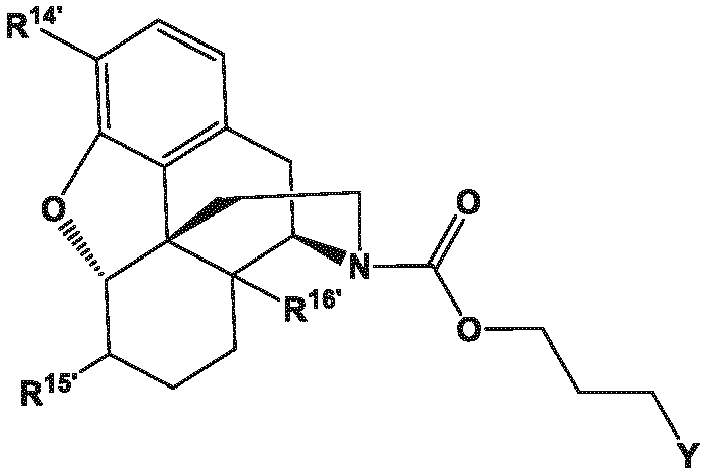
- The oxygen protecting group, R17, can be selected from the group consisting of consisting tert-butyl-diphenylsilyl, tert-butyl-dimethylsilyl, trimethylsilyl, tri-iso-propylsilyl, tert-butyldimethylsilyloxymethyl, β-methoxyethoxymethyl, [bis-(4-methoxyphenyl)phenylmethyl)], methoxymethyl, para-methoxybenzyl, methylthiomethyl, pivaloyl, methyl, ethoxyethyl, triphenylmethyl, -C(O)(C1-C4) alkyl, -C(O)OR24, and -(C1-C6) alkyl, each alkyl being unsubstituted or substituted with 1, 2, 3, 4, or 5 independently-selected R25 groups; R24 is -(C1-C6) alkyl, -(C2-C6) alkenyl, or -(C2-C6) alkynyl, each alkyl, alkenyl, and alkynyl being unsubstituted or substituted with 1, 2, 3, 4, or 5 independently-selected R25 groups; and each R25 is independently selected from -OH, -Cl, -Br, -I, -NH2, -CN, and phenyl.
- In certain methods, the transition metal catalyst is selected from the group consisting of Pd(PPh3)4, Pd(Ph2P(CH2)4PPh2)2, Ni(PPh3)4, Ni(Ph2P(CH2)4PPh2)2, ((pentamethylcyclopentadienyl)RuCl)4, [Pd(DBA)2]/PPh3, [Pd(OAc)2]/PPh3, [Ni(COD)2]/PPh3, NiCl2/PPh3, Ni[P(OEt)3]4, [Mo(CO)6-DPPE], RhH(PPh3)4-P(n-Bu)3, and combinations of two or more thereof. In another method, the transition metal catalyst comprises 1, 2, 3, or 4 phosphine moieties. In another method, the transition metal catalyst is tetrakis(triphenylphosphine)palladium[0].
- In particular methods, R14' and R16' are each independently selected from - OH and -OC(O)O(CH2)3Y, and R15 is =O.
- Further methods comprise
- (a) reacting a compound of formula (45)


- (b) optionally, converting the compound of formula (47) to the compound of formula (94)

- (c) converting the compound of formula (47) or the compound of formula (94) to a compound of formula (42)

- (d) converting the compound of formula (42) to the compound of formula (41), where R14, R14', R15, R15', R16, R16', X, and Y are defined as above.
- For a carbonate-containing group present at R14', R15', and/or R16, formed from an R14', R15, and/or R16 -OH group, respectively, that carbonate-containing group can be converted back to the -OH group after the decarboxylation step.
- In certain methods disclosed above, the compound of formula (45)
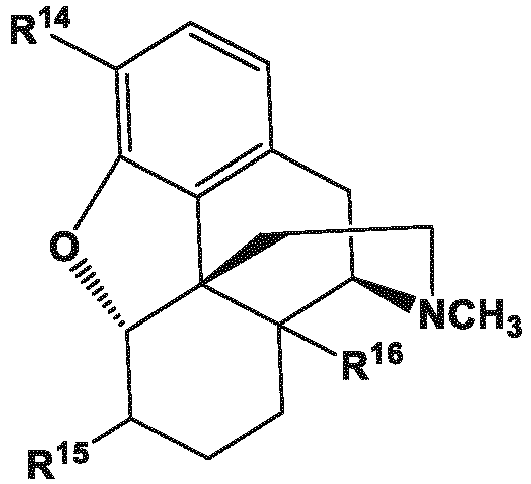
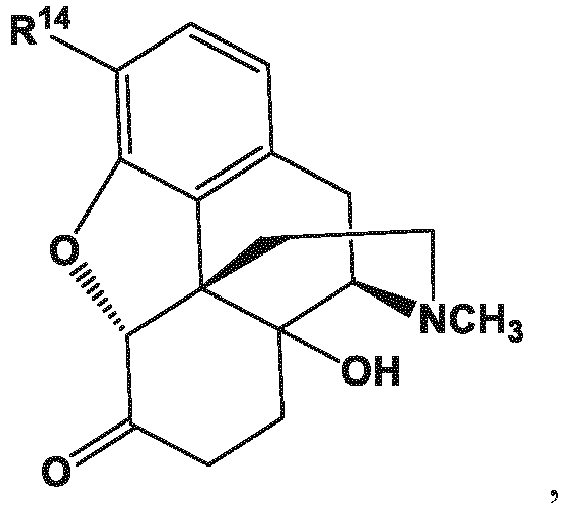
- The compound of formula (51) may be prepared by oxidizing a compound of formula (52)
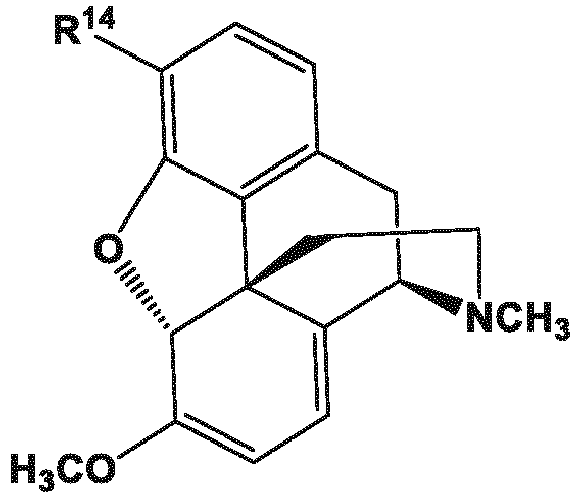

- In one reaction, R14 is -OH. In another reaction, R14 is -OCH3.
- In one reaction, the compound of formula (52) is oxidized to the product of formula (53) with performic acid, which can be prepared in situ by mixing hydrogen peroxide and excess formic acid. The reaction is warmed to a temperature within the range of from about 20°C to about 80°C, or within the range of from about 30°C to about 70°C, or within the range of from about 40°C to about 60°C, and maintained at that temperature for a time sufficient to allow the starting material to be consumed. In certain cases, the reaction is carried out at a temperature of about 50°C for about two hours.
- The oxidized product, a compound of formula (53), can be taken as the crude product of the oxidation reaction directly on to the next step (hydrogenation of the 7,8-double bond) without purification. In this reaction, the crude compound of formula (53) is hydrogenated in the presence of a catalyst under a hydrogen atmosphere at a temperature within the range of from about 10°C to about 75°C, or within the range of from about 25°C to about 65°C, or within the range of from about 30°C to about 55°C. In certain cases, the hydrogenation is carried out at a temperature within the range of from about 40°C to about 45°C. The catalyst can be, e.g., a palladium or a platinum catalyst and can be dispersed on a solid support as, e.g., Pd/C or Pt/C. Once the reaction is deemed complete, the mixture is then cooled to a temperature within the range of from about 2°C to about 10°C and filtered to remove the catalyst. The pH of the filtrate is adjusted and the reaction mixture stirred to allow the resultant crude compound of formula (51) as the free base to form a precipitate that is filtered, washed, and dried.
- The present invention as claimed pertains in one embodiment to a method for making compounds of formula (57)


- In another embodiment of the present invention, the compound of formula (57) is prepared by contacting a compound of formula (41)

- In one embodiment, the compound of formula (41) is taken up in dichloromethane and N,N-dimethyl barbituric acid (0.5 to 1.0 equivalents) and tetrakis(triphenylphosphine)palladium[0] (0.05 equivalents), and the reaction mixture is stirred at about 20°C and then at about 40°C for 16 hours. Once the reaction is deemed complete, the mixture is cooled to a temperature of about 20°C and the solids filtered under reduced pressure. The solids can be washed with dichloromethane and then with water before being taken up in a 10:1 mixture of water: concentrated sulfuric acid at 40°C. The warmed aqueous solution is washed with dichloromethane and then basified to a pH of 9.05 with 28% ammonium hydroxide. The resulting solids are filtered and dried under reduced pressure at 100°C for 20 hours to yield the product, a compound of formula (57).
- The present disclosure also provides a method for making compounds of formula (42), which comprises contacting a compound of formula (45)


- The compound of formula (60) is contacted with an alkoxide derivative compound of formula (61)
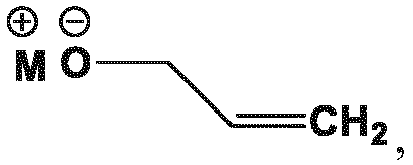
- In one reaction, the alkoxide derivative is NaO-CH2CH=CH2 which is prepared by reacting sodium with a 15-30 fold molar excess of HO-CH2CH=CH2 to provide an alkoxide solution which is contacted with a solution of a compound of formula (60), and the mixture is heated at 100°C for four hours and then allowed to stand at a temperature of about 20°C for about 16 hours to provide the compound of formula (42). The compound of formula (42) can be then be decarboxylated in a transition metal-catalyzed reaction as described in Section 4.3.1 above to provide a compound of formula (41).
- The following examples are set forth to assist in understanding the invention and should not be construed as specifically limiting the invention described and claimed herein.
- The reactions and processes of the present disclosure are described in more detail below.
-

- Into a round bottom flask equipped with a stir bar was charged oxycodone (3.15 g, 9.99 mmol), potassium carbonate (2.07 g, 15.0 mmol), dichloromethane (31.5 mL), and 1,2-dichloroethane (15 mL). The flask was equipped with a reflux condenser and the mixture was allowed to stir at a temperature of about 20°C under an atmosphere of nitrogen. Into the mixture was added a first portion of allyl chloroformate (6.35 mL, 59.95 mmol) drop-wise over 5 minutes. The resulting reaction mixture was heated to reflux at 52.5°C and allowed to stir at that temperature for 16 hours. Thereafter, the reaction mixture was sampled and analyzed by HPLC; approximately 32% of the starting oxycodone was determined to remain.
- Into the mixture was added a second and final portion (3.2 mL, 30.21 mmol) of allyl chloroformate and an additional 16.5 mL of 1,2-dichloroethane. The resulting reaction mixture was heated to reflux at 57.5°C and allowed to stir for an additional 24 hours. Thereafter, the reaction mixture was sampled and analyzed by HPLC; approximately 22% of oxycodone was determined to remain.
- The mixture was cooled to a temperature of about 20°C and filtered through a pad of CELITE to remove residual solids. The filtrate was concentrated under reduced pressure. The resulting material was dissolved in a mixture of ethyl acetate (150 mL) and 0.5N aqueous hydrochloric acid (120 mL). The layers were separated and the organic layer was washed with water (100 mL). The organic layer was concentrated under reduced pressure to provide a 2:1 mixture of 17-allyloxycarbonyl-noroxycodone:14,17-di-allyloxycarbonyl-noroxycodone as a yellow oil (1.98 g, 4.79 mmol).
-

- Into a round bottom flask equipped with a stir bar was charged oxymorphone (6.02 g, 19.96 mmol), potassium carbonate (4.15 g, 30.03 mmol), and 1,2-dichloroethane (60 mL). The flask was equipped with a reflux condenser and the mixture was allowed to stir at a temperature of about 20°C under an atmosphere of nitrogen. Into the mixture was added a first portion of allyl chloroformate (12.7 mL, 119.91 mmol) drop-wise over 10 minutes. The resulting reaction mixture was heated to reflux at 81.5°C and allowed to stir at that temperature for 18 hours. Thereafter, the reaction mixture was sampled and analyzed by HPLC; approximately 24% of 3-allyloxycarbonyl oxymorphone was determined to be present. As noted above, at initial time points the major product observed was 3-allyloxycarbonyl-oxymorphone.
- Into the mixture was added a second and final portion (4.2 mL, 39.65 mmol) of allyl chloroformate and an additional 2.07 g (14.98 mmol) of potassium carbonate. The resulting reaction mixture was allowed to stir for an additional 24 hours at reflux. Thereafter, the reaction mixture was sampled and analyzed by HPLC; approximately 18% of 3-allyloxycarbonyl oxymorphone was determined to be present.
- The mixture was cooled to a temperature of about 20°C and filtered through a pad of CELITE to remove residual solids. The filtrate was concentrated under reduced pressure. The resulting material was dissolved in a mixture of ethyl acetate (200 mL) and 0.5N aqueous hydrochloric acid (150 mL). The organic layer was dried with sodium sulfate, filtered, and concentrated under reduced pressure to provide a 3:1 mixture of 3,17-di-allyloxycarbonyl-noroxymorphone:3,14,17-tri-allyloxycarbonyl-noroxymorphone as a yellow oil (5.64 g, 12.38 mmol).
-
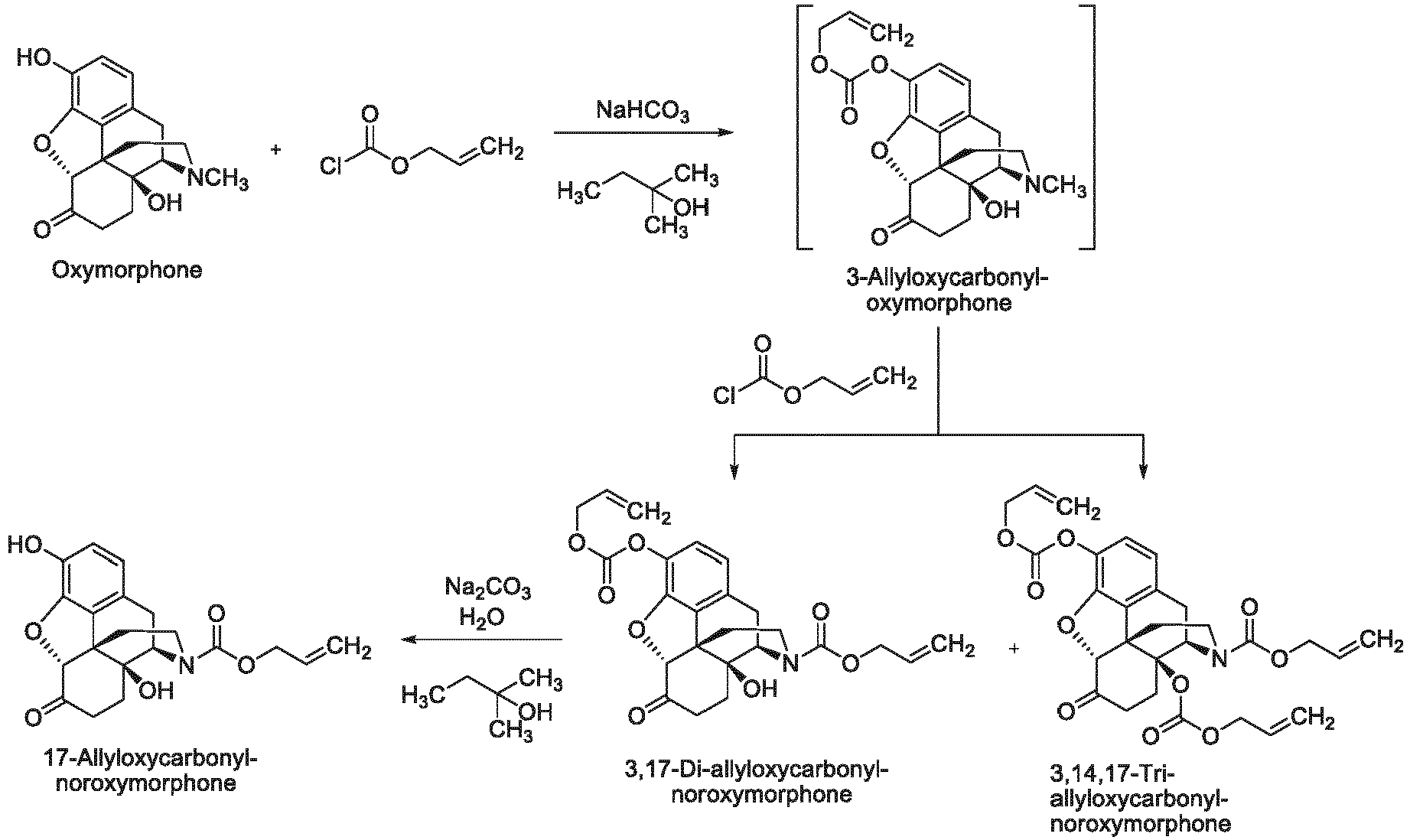
- Into a round bottom flask equipped with a stir bar was charged oxymorphone (10.06 g, 33.38 mmol), sodium bicarbonate (8.46 g, 100.70 mmol), and tert-amyl alcohol (70 mL). The flask was equipped with a Dean-Stark trap and condenser. The mixture was allowed to stir at a temperature of about 20°C for 5 minutes. Into the mixture was added a first portion of allyl chloroformate (3.90 mL, 36.69 mmol) drop-wise over 5 minutes. The resulting reaction mixture was heated to 55°C and allowed to stir at that temperature for 1 hour. Thereafter, the reaction mixture was sampled and analyzed by HPLC; the conversion to 3-allyloxycarbonyl-oxymorphone was determined to be greater than 99%. The reaction mixture was heated to 105°C and 25 mL of reaction solvent was removed from the round bottom flask by distillation into the Dean-Stark trap.
- The mixture was cooled to 85°C. Into the mixture was added a second portion of allyl chloroformate (8.90 mL, 83.73 mmol). The resulting reaction mixture was allowed to stir at 85°C for 6 hours and then cooled to a temperature of about 20°C and stirred at that temperature for 16 hours. Thereafter, the reaction mixture was sampled and analyzed by HPLC; approximately 42% of 3-allyloxycarbonyl-oxymorphone was determined to remain. The 25 mL of liquid in the Dean-Stark trap was emptied and an additional 30 mL of tert-amyl alcohol was added to the mixture. The resulting reaction mixture was heated to 105°C and 25 mL of reaction solvent was removed from the round bottom flask by distillation into the Dean-Stark trap.
- The mixture was cooled to 85°C and a third portion of allyl chloroformate (3.90 mL, 36.69 mmol) was added. The resulting reaction mixture was allowed to stir at 85°C for 6 hours and then cooled to a temperature of about 20°C and stirred at that temperature for 16 hours. Thereafter, the reaction mixture was sampled and analyzed by HPLC; approximately 28% of 3-allyloxycarbonyl-oxymorphone was determined to remain. The 25 mL of liquid in the Dean-Stark trap was emptied and an additional 20 mL of tert-amyl alcohol was added to the mixture. The resulting reaction mixture was heated to 105°C and 25 mL of reaction solvent was removed from the round bottom flask by distillation into the Dean-Stark trap.
- The mixture was cooled to 85°C and a fourth portion of allyl chloroformate (3.90 mL, 36.69 mmol) was added. The resulting reaction mixture was allowed to stir at 85°C for 6 hours and then cooled to a temperature of about 20°C and stirred at that temperature for 16 hours. Thereafter, the reaction mixture was sampled and analyzed by HPLC; approximately 7% of 3-allyloxycarbonyl-oxymorphone was determined to remain. The 25 mL of liquid in the Dean-Stark trap was emptied and an additional 25 mL of tert-amyl alcohol was added to the mixture. The resulting reaction mixture was heated to 105°C and 25 mL of reaction solvent was removed from the round bottom flask by distillation into the Dean-Stark trap.
- The mixture was cooled to 85°C and a fifth and final portion of allyl chloroformate (3.90 mL, 36.69 mmol) was added. The resulting reaction mixture was allowed to stir at 85°C for 6 hours and then cooled to a temperature of about 20°C and stirred at that temperature for 16 hours. Thereafter, the reaction mixture was sampled and analyzed by HPLC; approximately 0.6% of 3-allyloxycarbonyl-oxymorphone was determined to remain. HPLC analysis also demonstrated that a 6.3:1 mixture of 3,17-diallyloxycarbonyl-noroxymorphone:3,14,17-tri-allyloxycarbonyl-noroxymorphone was prepared.
- To the reaction mixture was added sodium carbonate (4.74 g, 44.72 mmol) and water (35 mL). The reaction mixture was heated to 90°C and allowed to stir at that temperature for 17 hours. The reaction mixture was cooled to a temperature of about 20°C and sampled for HPLC analysis; the results demonstrated that greater than 99% conversion to 17-allyloxycarbonyl-noroxymorphone was achieved. The reaction mixture was acidified to a pH of 1.5 with concentrated hydrochloric acid (10 mL) and the mixture was allowed to stir for 10 minutes. Mixing was stopped and the layers were allowed to separate. The organic layer was separated and washed twice with 10% aqueous sodium hydrogen sulfate (50 mL for each wash). The organic layer was concentrated under reduced pressure to provide crude 17-allyloxycarbonyl-noroxymorphone as a yellow foam (8.85 g, 23.83 mmol).
-

- Into a round bottom flask equipped with a stir bar was dissolved a 2:1 mixture of 17-allyloxycarbonyl-noroxycodone:14,17-di-allyloxycarbonyl-noroxycodone (264 mg, 0.67 mmol) in dichloromethane (5 mL). The mixture was allowed to stir at a temperature of about 20°C for 10 minutes. To the mixture was added tetrakis(triphenylphosphine)palladium[0] (40 mg, 0.035 mmol). The resulting reaction mixture was allowed to stir at a temperature of about 20°C for 3 hours before being filtered through a pad of CELITE. The filtrate was concentrated under reduced pressure. The resulting oil was dissolved in ethyl acetate (20 mL) and the product was extracted with 0.5N aqueous hydrochloric acid (100 mL). The aqueous layer was basified to a pH of 10.2 with 50% sodium hydroxide and extracted three times with dichloromethane (150 mL for each extraction). The combined organic portions were dried with sodium sulfate, filtered, and concentrated under reduced pressure to provide N-allyl-oxycodone as a yellow oil (183 mg, 0.54 mmol).
-

- Into a round bottom flask equipped with a stir bar was dissolved a 3:1 mixture of 3,17-di-allyloxycarbonyl-noroxymorphone:3,14,17-tri-allyloxycarbonyl-noroxymorphone (1.41 g, 2.98 mmol) in chloroform (10 mL). The mixture was allowed to stir at a temperature of about 20°C for 10 minutes. To the mixture was added tetrakis(triphenylphosphine)palladium[0] (180 mg, 0.155 mmol). The resulting reaction mixture was allowed to stir at a temperature of about 20°C for 4 hours before being filtered through a pad of CELITE. The filtrate was concentrated under reduced pressure. The resulting oil was dissolved in ethyl acetate (100 mL) and the product was extracted with 0.5N aqueous hydrochloric acid (100 mL). The aqueous layer was washed twice with ethyl acetate (100 mL for each wash). The aqueous layer was basified to a pH of 9.5 with 50% sodium hydroxide and extracted three times with chloroform (100 mL for each extraction). The organic portions were combined, dried with sodium sulfate, filtered, and concentrated under reduced pressure to provide 3-allyl-naloxone as a yellow oil, contaminated with approximately 25% of triphenylphosphine (1.41 g of oil containing about 1.05 g of 3-allyl-naloxone (about 2.88 mmol)).
-

- Into a round bottom flask equipped with a stir bar was dissolved 3-allyl-naloxone (0.28 g, 0.76 mmol) in methanol (10 mL). To the mixture was added potassium carbonate (0.40 g, 2.89 mmol) and tetrakis(triphenylphosphine)palladium[0] (0.0215 g, 0.019 mmol). The resulting reaction mixture was allowed to stir at a temperature of about 20°C for 4 hours. Thereafter, the reaction mixture was sampled and analyzed by HPLC; the results demonstrated that greater than 99% conversion to naloxone was achieved. The mixture was filtered through a pad of CELITE and the filtrate was concentrated under reduced pressure. The resulting oil was dissolved in ethyl acetate (50 mL) and extracted with 0.5N aqueous hydrochloric acid (75 mL). The aqueous layer was washed twice with ethyl acetate (50 mL for each wash). The aqueous layer was basified to a pH of 9.0 with 50% sodium hydroxide and extracted three times with chloroform (50 mL for each extraction). The organic portions were combined, dried with sodium sulfate, filtered, and concentrated under reduced pressure to provide naloxone as a yellow oil (0.23 g, 0.70 mmol).
-

- Into a 5 L reactor equipped with an overhead stirrer and reflux condenser was dissolved N,N-dimethyl barbituric acid (32.56 g, 208.5 mmol) and tetrakis(triphenylphosphine)palladium[0] (20.36 g, 17.6 mmol) in dichloromethane (1.5 L). The mixture was stirred at a temperature of about 20°C. Into the mixture was charged naloxone (110.90 g, 338.8 mmol) as a suspension in dichloromethane (1 L). The resulting reaction mixture was stirred at 38°C for 16 hours. The mixture was cooled to a temperature of about 20°C and the solids were filtered off under reduced pressure. The solids were washed with dichloromethane (5 L) followed by washing with water (2.5 L). The solids were dissolved into a 10:1 mixture ofwater:concentrated sulfuric acid at 40°C. The heated aqueous solution was washed with dichloromethane (0.5 L) and then basified to a pH of 9.05 with 28% ammonium hydroxide. The resulting solids were filtered and dried under reduced pressure at 100°C for 20 hours to provide noroxymorphone as a white solid (87.12 g, 303.2 mmol).
Claims (8)
- A method for making a compound of formula (57)

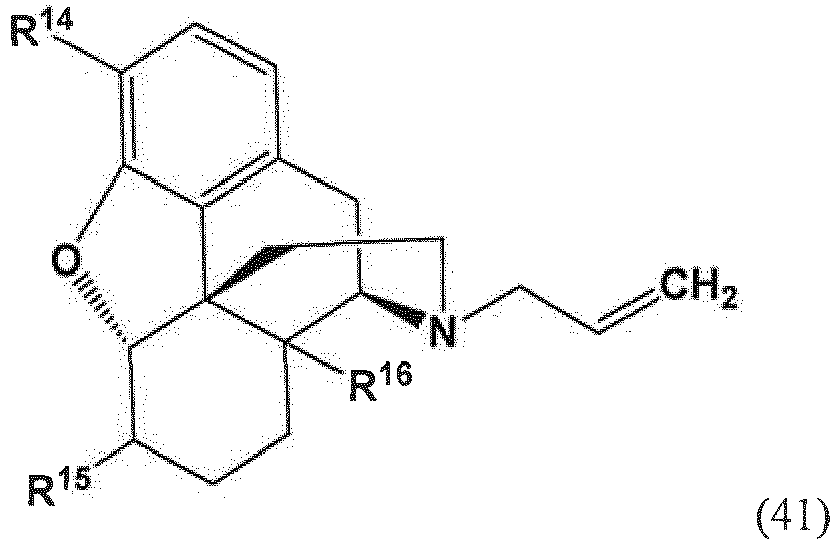
wherein:the transition metal catalyst is Pd(PPh3)4;the allyl scavenger is N,N-dimethyl barbituric acid;R14 and R16 are each independently selected from -OH, -H, and -OR17;R15 is selected from -OH, -H, -OR17, =O, and =CH2; andR17 is an oxygen protecting group. - A method for making a compound of Formula (57)

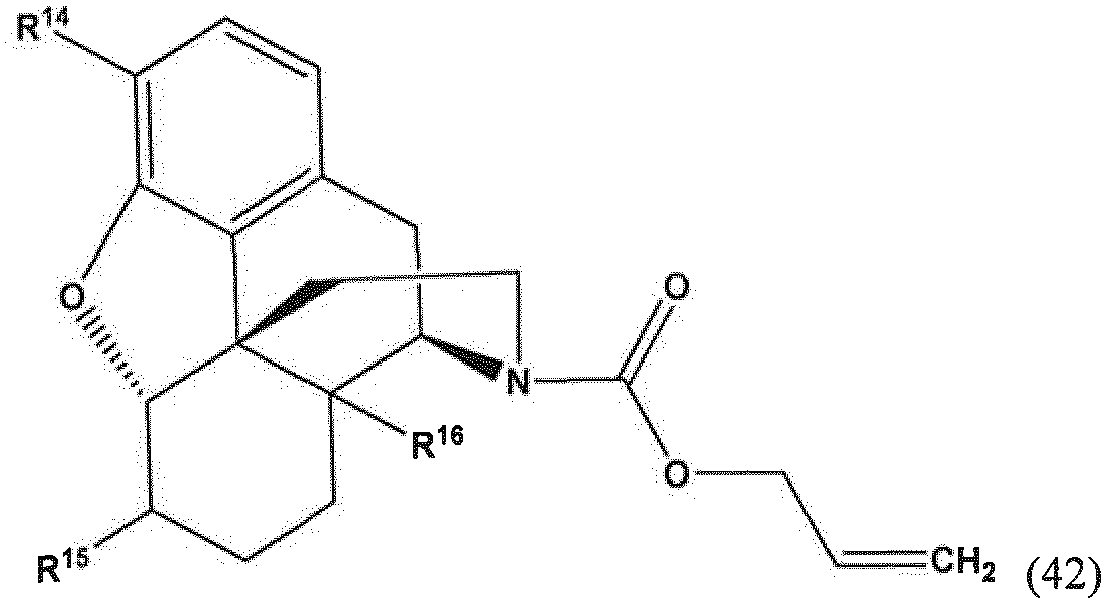
wherein:the transition metal catalyst is Pd(PPh3)4;the allyl scavenger is N,N-dimethyl barbituric acid;R14 and R16 are each independently selected from -OH, -H, and -OR17;R15 is selected from -OH, -H, -OR17, =O, and =CH2; andR17 is an oxygen protecting group. - A method for making a compound of Formula (57)

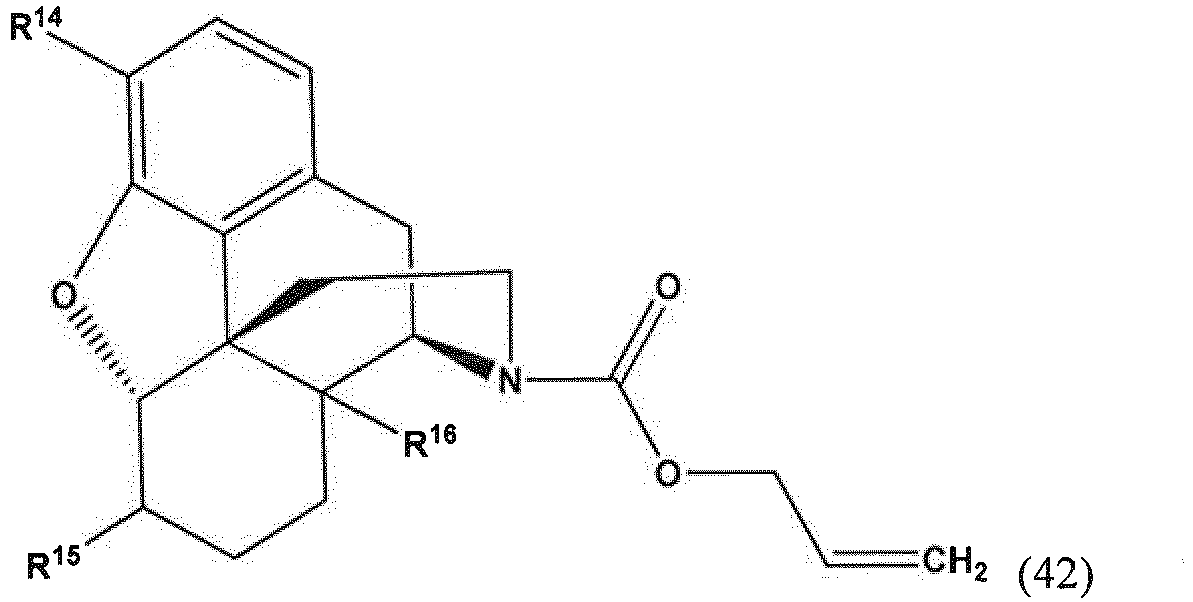
 (b) contacting a product from step (a) comprising the compound of Formula (41) with an allyl scavenger to provide the compound of Formula (57);wherein:the transition metal catalyst is Pd(PPh3)4;the allyl scavenger is N,N-dimethyl barbituric acid;R14 and R16 are each independently selected from -OH, -H, and -OR17;R15 is selected from -OH, -H, -OR17, =O, and =CH2; andR17 is an oxygen protecting group.
 - The method of any one of claims 1 to 3, wherein the contacting occurs in a solvent, wherein the solvent is selected from the group consisting of chloroform, dichloromethane, 1,2-dichloroethane, toluene, tetrahydrofuran, ethyl acetate, acetone, tert-amyl alcohol, tert-butyl alcohol, 3-methyl-3-pentanol, 2,3-dimethyl-3-pentanol, 3-ethyl-pentanol, 2-methyl-2-hexanol, acetonitrile, benzene, carbon tetrachloride, chlorobenzene, 1,2-dichlorobenzene, N,N-dimethylformamide, trifluorotoluene, 1,4-dioxane, 1,2-dimethoxyethane, xylene, and combinations of two or more thereof.
- The method of claim 4, wherein the solvent is selected from the group consisting of chloroform, dichloromethane, 1,2-dichloroethane, and combinations of two or more thereof.
- The method of any one of claims 1 to 5, wherein:the oxygen protecting group is selected from the group consisting of allyl, benzoyl, benzyl, β-methoxyethoxymethyl, dimethoxytrityl, methoxymethyl, para-methoxybenzyl, methylthiomethyl, pivaloyl, tetrahydropyranyl, trityl, trimethylsilyl, tert-butyldimethylsilyl, tert-butyldimethylsilyloxymethyl, tri-iso-propylsilyl, methyl, ethoxyethyl,-C(O)O-CH2-CH=CH2, tert-butyl-diphenylsilyl, [bis-(4-methoxyphenyl)phenylmethyl)], triphenylmethyl, C(O)(C1-C4) alkyl, -C(O)OR18, and -(C1-C6) alkyl, each alkyl being unsubstituted or substituted with 1, 2, 3, 4, or 5 independently-selected R21 groups;
each R18 is independently selected from -(C1-C6) alkyl, -(C2-C6) alkenyl, and -(C2-C6) alkynyl, each alkyl, alkenyl, and alkynyl being unsubstituted or substituted with 1, 2, 3, 4, or 5 independently-selected R21 groups; andeach R21 is independently selected from -Cl, -Br, -I, -NH2, -CN, and phenyl. - The method of claim 6, wherein the oxygen protecting group is allyl, benzoyl, benzyl, β-methoxyethoxymethyl, dimethoxytrityl, methoxymethyl, para-methoxybenzyl, methylthiomethyl, pivaloyl, tetrahydropyranyl, trityl, trimethylsilyl, tert-butyldimethylsilyl, tert-butyldimethylsilyloxymethyl, tri-iso-propylsilyl, methyl, ethoxyethyl, or -C(O)O-CH2-CH=CH2.
- The method of any one of claims 1 to 7, wherein:R14 and R16 are each -OH; andR15 is = O.
Applications Claiming Priority (2)
| Application Number | Priority Date | Filing Date | Title |
|---|---|---|---|
| US35403610P | 2010-06-11 | 2010-06-11 | |
| EP11736154.3A EP2580201B1 (en) | 2010-06-11 | 2011-06-10 | Transition metal-catalyzed processes for the preparation of n-allyl compounds and use thereof |
Related Parent Applications (2)
| Application Number | Title | Priority Date | Filing Date |
|---|---|---|---|
| EP11736154.3A Division-Into EP2580201B1 (en) | 2010-06-11 | 2011-06-10 | Transition metal-catalyzed processes for the preparation of n-allyl compounds and use thereof |
| EP11736154.3A Division EP2580201B1 (en) | 2010-06-11 | 2011-06-10 | Transition metal-catalyzed processes for the preparation of n-allyl compounds and use thereof |
Publications (3)
| Publication Number | Publication Date |
|---|---|
| EP2995614A1 EP2995614A1 (en) | 2016-03-16 |
| EP2995614B1 true EP2995614B1 (en) | 2018-01-31 |
| EP2995614B8 EP2995614B8 (en) | 2018-03-28 |
Family
ID=44532955
Family Applications (2)
| Application Number | Title | Priority Date | Filing Date |
|---|---|---|---|
| EP15186900.5A Active EP2995614B8 (en) | 2010-06-11 | 2011-06-10 | Transition metal-catalyzed processes for the preparation of n-allyl compounds and use thereof |
| EP11736154.3A Active EP2580201B1 (en) | 2010-06-11 | 2011-06-10 | Transition metal-catalyzed processes for the preparation of n-allyl compounds and use thereof |
Family Applications After (1)
| Application Number | Title | Priority Date | Filing Date |
|---|---|---|---|
| EP11736154.3A Active EP2580201B1 (en) | 2010-06-11 | 2011-06-10 | Transition metal-catalyzed processes for the preparation of n-allyl compounds and use thereof |
Country Status (9)
| Country | Link |
|---|---|
| US (5) | US9127014B2 (en) |
| EP (2) | EP2995614B8 (en) |
| JP (3) | JP5736040B2 (en) |
| AU (1) | AU2011263417B2 (en) |
| CA (2) | CA2802295C (en) |
| ES (2) | ES2645725T3 (en) |
| IL (1) | IL223566B (en) |
| TW (1) | TWI478928B (en) |
| WO (1) | WO2011154827A2 (en) |
Families Citing this family (7)
| Publication number | Priority date | Publication date | Assignee | Title |
|---|---|---|---|---|
| JP2013529595A (en) | 2010-06-11 | 2013-07-22 | ローズ テクノロジーズ | Method for N-dealkylation of tertiary amines |
| ES2645725T3 (en) | 2010-06-11 | 2017-12-07 | Rhodes Technologies | Transition metal catalyzed processes for the preparation and use of N-allyl compounds |
| US8981098B2 (en) * | 2012-02-03 | 2015-03-17 | Brock University | Process for the preparation of morphine analogs via the reaction of organometallic reagents with an oxazolidine derived from morphinans |
| ES2784690T3 (en) | 2013-12-05 | 2020-09-29 | Univ Bath | New opioid compounds and their uses |
| WO2017179976A1 (en) | 2016-04-14 | 2017-10-19 | Rijksuniversiteit Groningen | Means and methods for the n-dealkylation of amines |
| WO2018175628A1 (en) * | 2017-03-21 | 2018-09-27 | California Institute Of Technology | Biocatalytic synthesis of strained carbocycles |
| CN119350937B (en) * | 2024-10-30 | 2025-08-12 | 广东豪之盛新材料有限公司 | Double-component aerosol spray paint and preparation method thereof |
Family Cites Families (121)
| Publication number | Priority date | Publication date | Assignee | Title |
|---|---|---|---|---|
| US495A (en) | 1837-12-01 | Machine for sizing paper | ||
| US1485673A (en) | 1924-03-04 | Ministrator | ||
| US1468805A (en) | 1923-09-25 | Htabtin ereund | ||
| US5952A (en) | 1848-12-05 | Abraham bassford | ||
| US2191786A (en) | 1938-03-18 | 1940-02-27 | C A Miketta | Continuous process for making adipic acid |
| BE466549A (en) | 1945-07-17 | |||
| US2772270A (en) | 1954-10-21 | 1956-11-27 | M J Lewenstein | 14-hydroxymorphinone and 8, 14-dihydroxydihydromorphinone |
| US2806033A (en) | 1955-08-03 | 1957-09-10 | Lewenstein | Morphine derivative |
| US3474101A (en) | 1960-09-05 | 1969-10-21 | Reckitt & Sons Ltd | Thebaine and oripavine derivatives |
| GB939287A (en) | 1961-03-14 | 1963-10-09 | Sankyo Co | New morphinone and codeinone derivatives and process for preparing the same |
| US3254088A (en) | 1961-03-14 | 1966-05-31 | Lewenstein | Morphine derivative |
| US3332950A (en) | 1963-03-23 | 1967-07-25 | Endo Lab | 14-hydroxydihydronormorphinone derivatives |
| US3342824A (en) | 1964-12-07 | 1967-09-19 | Lilly Co Eli | Normorphines |
| US3355486A (en) | 1965-01-08 | 1967-11-28 | Fmc Corp | Continuous process of synthesizing amino-iminomethane-sulfinic acid |
| DE1938219A1 (en) | 1968-07-26 | 1970-02-12 | Sankyo Co | Process for the preparation of 14-hydroxy-normorphinone derivatives |
| GB1312447A (en) | 1969-05-14 | 1973-04-04 | Nat Res Dev | Method of continuous addition of a component to a chemical or biological system and apparatus therefor |
| GB1317210A (en) | 1970-12-11 | 1973-05-16 | Macarlan Smith Ltd | Reduction of thebaine |
| US4217287A (en) | 1971-10-06 | 1980-08-12 | Gulf Research & Development Company | Epoxidation of alpha-olefins |
| US3855185A (en) | 1972-02-09 | 1974-12-17 | Uniroyal Inc | Hydrogenation catalyst |
| DE2229770A1 (en) | 1972-06-19 | 1974-01-10 | Boehringer Sohn Ingelheim | N- (HETEROARYLMETHYL) -7ALPHA-ACYL6,14-ENDOAETHENOTETRAHYDRO-NORORIPAVIN AND -THEBAINE, THEIR HYDROGENATION PRODUCTS AND ACID ADDITIONAL SALTS AND PROCESS FOR THEIR PRODUCTION |
| US3923987A (en) | 1972-08-07 | 1975-12-02 | Boehringer Sohn Ingelheim | Pharmaceutical compositions containing an n-furyl-or thienyl-methyl)- -oxy-7,8 -dihydro-normorphinone or norcodeinone and method of use |
| DE2238839A1 (en) | 1972-08-07 | 1974-02-14 | Boehringer Sohn Ingelheim | NEW MORPHINONE DERIVATIVES, THEIR ACID ADDITIONAL SALTS, THE PROCESS FOR THEIR PRODUCTION AND THEIR USE FOR THE MANUFACTURING OF MEDICINAL PRODUCTS |
| US3905981A (en) | 1973-10-12 | 1975-09-16 | Research Corp | N-dealkylation of tertiary amines |
| US4003903A (en) | 1975-02-12 | 1977-01-18 | Florida Board Of Regents | N-acyl-N-norsalutaridines and process for making them |
| GB1520139A (en) | 1976-06-08 | 1978-08-02 | Ferranti Ltd | Gyroscopic apparatus |
| US4045440A (en) | 1976-09-16 | 1977-08-30 | The United States Of America As Represented By The Department Of Health, Education And Welfare | Method of producing thebaine from codeine and oripavine from morphine |
| US4141897A (en) | 1976-12-20 | 1979-02-27 | Research Corporation | N-dealkylation of N-alkyl-14-hydroxymorphinans and derivatives thereof |
| US4161597A (en) * | 1976-12-20 | 1979-07-17 | Research Corporation | N-alkyl-14-hydroxymorphinans and derivatives |
| DE2727805A1 (en) | 1977-06-21 | 1979-01-04 | Goedecke Ag | METHOD FOR PRODUCING OXYNORMORPHONE |
| DE2963614D1 (en) * | 1978-09-19 | 1982-10-28 | Du Pont | Fluorination process and fluoro analogs of hydrocodone and oxycodone |
| US4472253A (en) | 1981-08-17 | 1984-09-18 | The Florida Board Of Regents On Behalf Of The Florida State University | Process for the preparation of an N-substituted 3-O-alkyl-14-hydroxynormorphinone derivative |
| US4795813A (en) | 1981-08-17 | 1989-01-03 | The Florida Board Of Regents On Behalf Of The Florida State University | Synthesis of derivatives of codeine and other 3-O-alkylmorphines |
| US4535157A (en) | 1983-11-01 | 1985-08-13 | Key Pharmaceuticals, Inc. | Process for making 6-desoxy-6-methylenenaloxone and 6-desoxy-6-methylenenaltrexone |
| US4639520A (en) | 1984-03-27 | 1987-01-27 | Mallinckrodt, Inc. | Preparation of 14-hydroxy-N-ethoxy-carbonyl-norcodeinone |
| FR2562072B1 (en) | 1984-03-27 | 1989-07-07 | Mallinckrodt Inc | PROCESS FOR THE PREPARATION OF NOROXYMORPHONE FROM MORPHINE, AND INTERMEDIATE COMPOUNDS USED IN THIS PROCESS |
| US5112975A (en) | 1984-03-27 | 1992-05-12 | Mallinckrodt Specialty Chemicals Company | Preparation of noroxymorphone from morphine |
| FR2564838B1 (en) | 1984-05-25 | 1986-11-07 | Sanofi Sa | PROCESS FOR DEALKYLATION OF ALKALOIDS AND INTERMEDIATES |
| US4667037A (en) | 1985-06-06 | 1987-05-19 | E. I. Du Pont De Nemours And Company | Dealkylation of opioid ethers |
| US5668285A (en) | 1986-10-31 | 1997-09-16 | The United States Of America As Represented By The Department Of Health And Human Services | Total synthesis of northebaine, normophine, noroxymorphone enantiomers and derivatives via N-Nor intermediates |
| DK0508234T3 (en) * | 1991-04-11 | 1996-10-28 | Hoffmann La Roche | Beta-lactams |
| US6323212B1 (en) | 1992-01-23 | 2001-11-27 | Toray Industries, Inc. | Morphinan derivative and its pharmaceutical applications |
| US5587474A (en) | 1992-06-18 | 1996-12-24 | Tanabe Seiyaku Co., Ltd. | Method for removing the protecting group for carboxyl group |
| EP0632041A1 (en) | 1993-07-01 | 1995-01-04 | Katholieke Universiteit Nijmegen | New morphine derivatives having improved analgesic and narcotic properties |
| US5518988A (en) | 1994-06-03 | 1996-05-21 | North Carolina State University | Method of counteracting an ethylene response in plants |
| US5849761A (en) | 1995-09-12 | 1998-12-15 | Regents Of The University Of California | Peripherally active anti-hyperalgesic opiates |
| US5994327A (en) | 1995-11-17 | 1999-11-30 | Astra Ab | Process for the preparation of morphinans |
| EP0912577A2 (en) | 1996-05-21 | 1999-05-06 | THE UNITED STATES OF AMERICA, as represented by the Secretary of the Department of Health and Human Services | Novel methods of o-demethylation and n-deprotection |
| US6067749A (en) | 1996-07-11 | 2000-05-30 | Tasmanian Alkaloids Pty. Ltd. | Papaver somniferum strain with high concentration of thebaine and oripavine |
| US5869669A (en) | 1996-07-26 | 1999-02-09 | Penick Corporation | Preparation of 14-hydroxynormorphinones from normorphinone dienol acylates |
| GB9616253D0 (en) | 1996-08-01 | 1996-09-11 | Johnson Matthey Plc | Preparation of narcotic analgesics |
| US5847166A (en) | 1996-10-10 | 1998-12-08 | Massachusetts Institute Of Technology | Synthesis of aryl ethers |
| AU1402497A (en) * | 1996-11-19 | 1998-06-10 | Astra Aktiebolag | New process for the preparation of morphinans |
| GB9713703D0 (en) | 1997-06-30 | 1997-09-03 | Johnson Matthey Plc | Preparation of opiates |
| US6017849A (en) | 1998-08-20 | 2000-01-25 | Biotechnologies For Horticulture, Inc. | Synthesis methods, complexes and delivery methods for the safe and convenient storage, transport and application of compounds for inhibiting the ethylene response in plants |
| US6335459B1 (en) | 1998-12-23 | 2002-01-01 | Syntex (U.S.A.) Llc | Aryl carboxylic acid and aryl tetrazole derivatives as IP receptor modulators |
| US6405301B1 (en) | 1999-06-15 | 2002-06-11 | U.S. Philips Corporation | Parallel data processing |
| CA2379119A1 (en) | 1999-07-12 | 2001-01-18 | Xoma Technology Ltd. | Method to identify inhibitors f1/f0 atpase |
| US6177567B1 (en) | 1999-10-15 | 2001-01-23 | Boehringer Ingelheim Chemicals, Inc. | Method for preparing oxycodone |
| TW452907B (en) | 1999-11-22 | 2001-09-01 | Winbond Electronics Corp | Testing device and method of positive mobile ion contamination |
| US6994827B2 (en) | 2000-06-03 | 2006-02-07 | Symyx Technologies, Inc. | Parallel semicontinuous or continuous reactors |
| GB0015562D0 (en) | 2000-06-23 | 2000-08-16 | Pfizer Ltd | Heterocycles |
| AUPQ968300A0 (en) | 2000-08-25 | 2000-09-21 | Glaxo Wellcome Australia Ltd | Chemical methods |
| AU2002223968A1 (en) | 2000-12-21 | 2002-07-01 | Warner Lambert Company Llc | Piperidine derivatives as subtype selective n-methyl-d-aspartate antagonists |
| ATE466016T1 (en) | 2001-08-23 | 2010-05-15 | Organon Nv | METHOD FOR PRODUCING A 14-HYDROXYNORMORPHINONE DERIVATIVE |
| US6569170B1 (en) | 2001-09-20 | 2003-05-27 | David L. Kellogg | Method of cleaning skin |
| US6927294B1 (en) * | 2002-03-08 | 2005-08-09 | University Of Southern California | Nitrogen-containing heterocycles |
| US7501433B2 (en) | 2002-05-17 | 2009-03-10 | Jenken Biosciences, Inc. | Opioid and opioid-like compounds and uses thereof |
| US20060009497A1 (en) | 2002-06-27 | 2006-01-12 | Actelion Pharmaceuticals, Ltd. | Novel tetrahydropyridine derivatives as renin inhibitors |
| HK1079786B (en) | 2002-10-09 | 2010-03-12 | 东丽株式会社 | Remedies or preventives for urinary frequency or urinary incontinence and morphinan derivatives having nitrogen-containing heterocyclic group |
| ES2332453T3 (en) | 2002-11-08 | 2010-02-05 | Mallinckrodt Inc. | PROCESS FOR THE PREPARATION OF SALTS OF N-ALQUILO CUATERNARIO DE ALCALOIDES DE MORFINANO. |
| US6790959B1 (en) | 2003-06-05 | 2004-09-14 | Halsey Drug Company, Inc. | Process for manufacturing thebaine |
| US6864370B1 (en) | 2003-06-05 | 2005-03-08 | Zhaiwei Lin | Process for manufacturing oxycodone |
| US20050065033A1 (en) | 2003-08-21 | 2005-03-24 | Jacobson Richard Martin | Method to inhibit ethylene responses in plants |
| US7875718B2 (en) | 2003-09-22 | 2011-01-25 | Johnson Matthey Public Limited Company | Process for the synthesis of morphinane compounds and intermediates thereof |
| WO2005065195A2 (en) | 2003-12-19 | 2005-07-21 | Merck & Co., Inc. | Phenylamide and pyridylamide beta-secretase inhibitors for the treatment of alzheimer's disease |
| HUP0400517A3 (en) * | 2004-03-04 | 2006-05-29 | Richter Gedeon Vegyeszet | Process for producing cabergoline |
| TWI483944B (en) | 2004-03-30 | 2015-05-11 | Euro Celtique Sa | A oxycodone hydrochloride composition containing less than 25 PPM of 14-hydroxycodeinone, a pharmaceutical dosage form, a delayed release oral dosage form, and a pharmaceutically acceptable package |
| AU2004202517A1 (en) | 2004-05-06 | 2005-11-24 | Glaxosmithkline Australia Pty Ltd | Method of Altering the Alkaloid Composition in Poppy Plants |
| US6949645B1 (en) | 2004-05-20 | 2005-09-27 | Acura Pharmaceuticals, Inc. | Process for the production of opiates |
| US6972332B1 (en) | 2004-05-20 | 2005-12-06 | Acura Pharmaceuticals, Inc. | Process for the production of opiates |
| US20060005112A1 (en) | 2004-07-02 | 2006-01-05 | David Lilly | System and method of report layout |
| GB2429206A (en) | 2004-07-09 | 2007-02-21 | Tasmanian Alkaloids Pty Ltd | Process for the synthesis of hydromorphone |
| WO2006084389A1 (en) | 2005-02-11 | 2006-08-17 | Cilag Ltd. | Method for purifying noroxymorphone compounds |
| AU2006216715A1 (en) | 2005-02-22 | 2006-08-31 | Ceres Inc. | Modulating plant alkaloids |
| PT1861405E (en) | 2005-03-04 | 2009-07-27 | Euro Celtique Sa | Method of reducing alpha, beta- unsaturated ketones in opioid compositions |
| MX2007010851A (en) | 2005-03-10 | 2007-11-12 | Mallinckrodt Inc | Processes for preparing morphinans and intermediates thereof. |
| EP1858894A1 (en) | 2005-03-17 | 2007-11-28 | Synthon Argentina S.A. | Improved process for making cabergoline |
| US20060236421A1 (en) | 2005-04-14 | 2006-10-19 | Pennell Roger I | Secondary metabolite production via manipulation of genome methylation |
| ATE493417T1 (en) | 2005-06-16 | 2011-01-15 | Mallinckrodt Inc | SYNTHETIC ROUTE TO 14-HYDROXYLOPIATES VIA 1-HALOGENETHEBAIN OR ANALOGS |
| US20070117720A1 (en) | 2005-11-18 | 2007-05-24 | Jacobson Richard M | Compositions with cyclopropenes |
| US8993764B2 (en) | 2006-01-05 | 2015-03-31 | Mallinckrodt Llc | Use of oripavine as a starting material for buprenorphine |
| US20070199090A1 (en) | 2006-02-22 | 2007-08-23 | Nestor Apuya | Modulating alkaloid biosynthesis |
| MX2008013594A (en) | 2006-04-21 | 2009-01-16 | Nektar Therapeutics Al Corp | Stereoselective reduction of a morphinone. |
| WO2007137785A2 (en) | 2006-05-25 | 2007-12-06 | Alpharma (Bermuda) Investments Ltd | Process useful in the preparation of morphinan antagonists |
| CA2661302A1 (en) | 2006-08-16 | 2008-02-21 | Auspex Pharmaceuticals, Inc. | Preparation and utility of opioid analgesics |
| US20080125592A1 (en) | 2006-10-17 | 2008-05-29 | Penick Corporation | Process for preparing oxymorphone, naltrexone, and buprenorphine |
| AU2007313103C1 (en) | 2006-10-17 | 2014-01-30 | Penick Corporation | Process for preparing oxymorphone |
| CA2674915C (en) * | 2006-10-17 | 2015-06-30 | Penick Corporation | Process for preparing oxymorphone |
| EP2101773A2 (en) | 2006-11-22 | 2009-09-23 | Progenics Pharmaceuticals, Inc. | (r)-n-stereoisomers of 7,8-saturated-4,5-epoxy-morphinanium analogs |
| MX2009005461A (en) | 2006-11-22 | 2009-08-28 | Progenics Pharm Inc | N-oxides of 4,5-epoxy-morphinanium analogs. |
| JP2010511726A (en) * | 2006-12-04 | 2010-04-15 | ノランコ・インコーポレーテツド | Method for producing oxycodone with low concentration of 14-hydroxycodeinone |
| GB0624880D0 (en) | 2006-12-14 | 2007-01-24 | Johnson Matthey Plc | Improved method for making analgesics |
| EP2125870A4 (en) * | 2007-02-16 | 2011-04-06 | Boehringer Ingelheim Int | INHIBITORS OF NS3 PROTEASE OF HEPATITIS C |
| EP2137189B1 (en) | 2007-03-06 | 2015-05-06 | Mallinckrodt LLC | Process for the preparation of quaternary n-alkyl morphinan alkaloid salts |
| EP2125824B2 (en) | 2007-03-23 | 2023-11-15 | Mallinckrodt LLC | Improved preparation of oxymorphone from oripavine |
| JP5373764B2 (en) | 2007-04-16 | 2013-12-18 | マリンクロッド エルエルシー | Novel opiate reduction using catalytic hydrogen transfer reaction |
| US7939665B2 (en) | 2007-05-04 | 2011-05-10 | Apotex Pharmachem Inc. | Efficient process for the preparation of cabergoline and its intermediates |
| AU2008207580B2 (en) * | 2007-05-04 | 2011-04-14 | SpecGx LLC | Improved process for the preparation of 6-alpha-hydroxy-N-alkylated opiates |
| US7999104B2 (en) | 2007-06-29 | 2011-08-16 | Brock University | Methods for one-pot N-demethylation/N-acylation of morphine and tropane alkaloids |
| US7935820B2 (en) | 2007-06-29 | 2011-05-03 | Brock University | Methods for N-demethylation of morphine and tropane alkaloids |
| CA2696349A1 (en) | 2007-08-15 | 2009-02-19 | President And Fellows Of Harvard College | Heterocyclic inhibitors of necroptosis |
| EP2222642B1 (en) * | 2007-12-17 | 2014-02-12 | Mallinckrodt LLC | Process and compounds for the production of (+) opiates |
| CA2709882A1 (en) | 2007-12-17 | 2009-06-25 | Peter X. Wang | N-demethylation of n-methyl morphinans |
| AU2008338971B2 (en) | 2007-12-17 | 2013-08-29 | SpecGx LLC | Processes for the preparation of normorphinan salts |
| WO2009122436A2 (en) | 2008-03-31 | 2009-10-08 | Sun Pharmaceutical Industries Ltd. | An improved process for the preparation of morphinane analogues |
| WO2010017573A1 (en) * | 2008-08-11 | 2010-02-18 | Tasmanian Alkaloids Pty Limited | PROCESS FOR MAKING MORPHINAN-6α-OLS |
| US8269006B2 (en) * | 2008-09-30 | 2012-09-18 | Mallinckrodt Llc | Processes for the selective amination of ketomorphinans |
| MY158251A (en) | 2009-05-25 | 2016-09-30 | H Lundbeck As | Method for the preparation of nalmefene hydrochloride |
| JP2013529595A (en) | 2010-06-11 | 2013-07-22 | ローズ テクノロジーズ | Method for N-dealkylation of tertiary amines |
| ES2645725T3 (en) | 2010-06-11 | 2017-12-07 | Rhodes Technologies | Transition metal catalyzed processes for the preparation and use of N-allyl compounds |
| AU2011271429B2 (en) | 2010-06-30 | 2016-04-21 | Upsher-Smith Laboratories, Llc | Sustained release composition comprising an amine as active agent and a salt of a cyclic organic acid |
-
2011
- 2011-06-10 ES ES11736154.3T patent/ES2645725T3/en active Active
- 2011-06-10 EP EP15186900.5A patent/EP2995614B8/en active Active
- 2011-06-10 ES ES15186900.5T patent/ES2666404T3/en active Active
- 2011-06-10 JP JP2013513776A patent/JP5736040B2/en not_active Expired - Fee Related
- 2011-06-10 WO PCT/IB2011/001330 patent/WO2011154827A2/en not_active Ceased
- 2011-06-10 AU AU2011263417A patent/AU2011263417B2/en not_active Ceased
- 2011-06-10 EP EP11736154.3A patent/EP2580201B1/en active Active
- 2011-06-10 TW TW100120387A patent/TWI478928B/en not_active IP Right Cessation
- 2011-06-10 CA CA2802295A patent/CA2802295C/en not_active Expired - Fee Related
- 2011-06-10 CA CA2936749A patent/CA2936749C/en not_active Expired - Fee Related
-
2012
- 2012-12-11 IL IL223566A patent/IL223566B/en active IP Right Grant
- 2012-12-11 US US13/711,520 patent/US9127014B2/en active Active
-
2014
- 2014-12-25 JP JP2014262237A patent/JP6127040B2/en active Active
-
2015
- 2015-08-04 US US14/818,199 patent/US9593124B2/en active Active
- 2015-08-14 US US14/827,104 patent/US9624232B2/en active Active
- 2015-08-14 US US14/827,132 patent/US9499557B2/en active Active
- 2015-08-14 US US14/827,085 patent/US9657030B2/en active Active
-
2017
- 2017-02-14 JP JP2017024559A patent/JP2017137317A/en active Pending
Non-Patent Citations (1)
| Title |
|---|
| None * |
Also Published As
| Publication number | Publication date |
|---|---|
| US9127014B2 (en) | 2015-09-08 |
| TWI478928B (en) | 2015-04-01 |
| WO2011154827A3 (en) | 2012-08-23 |
| IL223566B (en) | 2018-05-31 |
| AU2011263417A1 (en) | 2012-12-13 |
| EP2580201B1 (en) | 2017-08-02 |
| US20150336972A1 (en) | 2015-11-26 |
| EP2580201A2 (en) | 2013-04-17 |
| US20130102780A1 (en) | 2013-04-25 |
| US20150353569A1 (en) | 2015-12-10 |
| CA2936749C (en) | 2019-07-09 |
| CA2936749A1 (en) | 2011-12-15 |
| US20150353568A1 (en) | 2015-12-10 |
| CA2802295A1 (en) | 2011-12-15 |
| EP2995614A1 (en) | 2016-03-16 |
| ES2645725T3 (en) | 2017-12-07 |
| EP2995614B8 (en) | 2018-03-28 |
| AU2011263417B2 (en) | 2014-03-27 |
| JP6127040B2 (en) | 2017-05-10 |
| US9499557B2 (en) | 2016-11-22 |
| JP2013529596A (en) | 2013-07-22 |
| US9593124B2 (en) | 2017-03-14 |
| TW201219397A (en) | 2012-05-16 |
| WO2011154827A2 (en) | 2011-12-15 |
| JP2015107980A (en) | 2015-06-11 |
| JP5736040B2 (en) | 2015-06-17 |
| US9624232B2 (en) | 2017-04-18 |
| ES2666404T3 (en) | 2018-05-04 |
| US9657030B2 (en) | 2017-05-23 |
| US20150353567A1 (en) | 2015-12-10 |
| CA2802295C (en) | 2016-09-20 |
| JP2017137317A (en) | 2017-08-10 |
Similar Documents
| Publication | Publication Date | Title |
|---|---|---|
| TWI471289B (en) | Process for n-dealkylation of tertiary amines | |
| EP2580201B1 (en) | Transition metal-catalyzed processes for the preparation of n-allyl compounds and use thereof | |
| AU2009233315B2 (en) | An improved process for the preparation of morphinane analogues | |
| US20100022774A1 (en) | Process useful in the preparation of morphinan antagonists | |
| US7928234B2 (en) | Conversion of thebaine to morphine derivatives |
Legal Events
| Date | Code | Title | Description |
|---|---|---|---|
| PUAI | Public reference made under article 153(3) epc to a published international application that has entered the european phase |
Free format text: ORIGINAL CODE: 0009012 |
|
| 17P | Request for examination filed |
Effective date: 20150925 |
|
| AC | Divisional application: reference to earlier application |
Ref document number: 2580201 Country of ref document: EP Kind code of ref document: P |
|
| AK | Designated contracting states |
Kind code of ref document: A1 Designated state(s): AL AT BE BG CH CY CZ DE DK EE ES FI FR GB GR HR HU IE IS IT LI LT LU LV MC MK MT NL NO PL PT RO RS SE SI SK SM TR |
|
| AX | Request for extension of the european patent |
Extension state: BA ME |
|
| STAA | Information on the status of an ep patent application or granted ep patent |
Free format text: STATUS: EXAMINATION IS IN PROGRESS |
|
| 17Q | First examination report despatched |
Effective date: 20170510 |
|
| GRAP | Despatch of communication of intention to grant a patent |
Free format text: ORIGINAL CODE: EPIDOSNIGR1 |
|
| STAA | Information on the status of an ep patent application or granted ep patent |
Free format text: STATUS: GRANT OF PATENT IS INTENDED |
|
| INTG | Intention to grant announced |
Effective date: 20170811 |
|
| RIN1 | Information on inventor provided before grant (corrected) |
Inventor name: STYMIEST, JAKE, L. Inventor name: GIGUERE, JOSHUA, R. Inventor name: MCCARTHY, KEITH, E. Inventor name: REISCH, HELGE, A. Inventor name: SANDOVAL, SERGIO |
|
| GRAS | Grant fee paid |
Free format text: ORIGINAL CODE: EPIDOSNIGR3 |
|
| GRAA | (expected) grant |
Free format text: ORIGINAL CODE: 0009210 |
|
| STAA | Information on the status of an ep patent application or granted ep patent |
Free format text: STATUS: THE PATENT HAS BEEN GRANTED |
|
| AC | Divisional application: reference to earlier application |
Ref document number: 2580201 Country of ref document: EP Kind code of ref document: P |
|
| AK | Designated contracting states |
Kind code of ref document: B1 Designated state(s): AL AT BE BG CH CY CZ DE DK EE ES FI FR GB GR HR HU IE IS IT LI LT LU LV MC MK MT NL NO PL PT RO RS SE SI SK SM TR |
|
| AX | Request for extension of the european patent |
Extension state: BA ME |
|
| GRAT | Correction requested after decision to grant or after decision to maintain patent in amended form |
Free format text: ORIGINAL CODE: EPIDOSNCDEC |
|
| REG | Reference to a national code |
Ref country code: GB Ref legal event code: FG4D Ref country code: CH Ref legal event code: EP |
|
| REG | Reference to a national code |
Ref country code: AT Ref legal event code: REF Ref document number: 967252 Country of ref document: AT Kind code of ref document: T Effective date: 20180215 |
|
| REG | Reference to a national code |
Ref country code: IE Ref legal event code: FG4D |
|
| REG | Reference to a national code |
Ref country code: DE Ref legal event code: R096 Ref document number: 602011045493 Country of ref document: DE |
|
| REG | Reference to a national code |
Ref country code: CH Ref legal event code: NV Representative=s name: BOVARD AG PATENT- UND MARKENANWAELTE, CH |
|
| REG | Reference to a national code |
Ref country code: NL Ref legal event code: FP |
|
| REG | Reference to a national code |
Ref country code: ES Ref legal event code: FG2A Ref document number: 2666404 Country of ref document: ES Kind code of ref document: T3 Effective date: 20180504 |
|
| REG | Reference to a national code |
Ref country code: DE Ref legal event code: R082 Ref document number: 602011045493 Country of ref document: DE Representative=s name: MAIWALD PATENTANWALTS- UND RECHTSANWALTSGESELL, DE Ref country code: FR Ref legal event code: PLFP Year of fee payment: 8 |
|
| REG | Reference to a national code |
Ref country code: LT Ref legal event code: MG4D |
|
| REG | Reference to a national code |
Ref country code: AT Ref legal event code: MK05 Ref document number: 967252 Country of ref document: AT Kind code of ref document: T Effective date: 20180131 |
|
| PG25 | Lapsed in a contracting state [announced via postgrant information from national office to epo] |
Ref country code: HR Free format text: LAPSE BECAUSE OF FAILURE TO SUBMIT A TRANSLATION OF THE DESCRIPTION OR TO PAY THE FEE WITHIN THE PRESCRIBED TIME-LIMIT Effective date: 20180131 Ref country code: LT Free format text: LAPSE BECAUSE OF FAILURE TO SUBMIT A TRANSLATION OF THE DESCRIPTION OR TO PAY THE FEE WITHIN THE PRESCRIBED TIME-LIMIT Effective date: 20180131 Ref country code: NO Free format text: LAPSE BECAUSE OF FAILURE TO SUBMIT A TRANSLATION OF THE DESCRIPTION OR TO PAY THE FEE WITHIN THE PRESCRIBED TIME-LIMIT Effective date: 20180430 Ref country code: FI Free format text: LAPSE BECAUSE OF FAILURE TO SUBMIT A TRANSLATION OF THE DESCRIPTION OR TO PAY THE FEE WITHIN THE PRESCRIBED TIME-LIMIT Effective date: 20180131 |
|
| PG25 | Lapsed in a contracting state [announced via postgrant information from national office to epo] |
Ref country code: LV Free format text: LAPSE BECAUSE OF FAILURE TO SUBMIT A TRANSLATION OF THE DESCRIPTION OR TO PAY THE FEE WITHIN THE PRESCRIBED TIME-LIMIT Effective date: 20180131 Ref country code: AT Free format text: LAPSE BECAUSE OF FAILURE TO SUBMIT A TRANSLATION OF THE DESCRIPTION OR TO PAY THE FEE WITHIN THE PRESCRIBED TIME-LIMIT Effective date: 20180131 Ref country code: RS Free format text: LAPSE BECAUSE OF FAILURE TO SUBMIT A TRANSLATION OF THE DESCRIPTION OR TO PAY THE FEE WITHIN THE PRESCRIBED TIME-LIMIT Effective date: 20180131 Ref country code: PL Free format text: LAPSE BECAUSE OF FAILURE TO SUBMIT A TRANSLATION OF THE DESCRIPTION OR TO PAY THE FEE WITHIN THE PRESCRIBED TIME-LIMIT Effective date: 20180131 Ref country code: GR Free format text: LAPSE BECAUSE OF FAILURE TO SUBMIT A TRANSLATION OF THE DESCRIPTION OR TO PAY THE FEE WITHIN THE PRESCRIBED TIME-LIMIT Effective date: 20180501 Ref country code: BG Free format text: LAPSE BECAUSE OF FAILURE TO SUBMIT A TRANSLATION OF THE DESCRIPTION OR TO PAY THE FEE WITHIN THE PRESCRIBED TIME-LIMIT Effective date: 20180430 Ref country code: SE Free format text: LAPSE BECAUSE OF FAILURE TO SUBMIT A TRANSLATION OF THE DESCRIPTION OR TO PAY THE FEE WITHIN THE PRESCRIBED TIME-LIMIT Effective date: 20180131 Ref country code: IS Free format text: LAPSE BECAUSE OF FAILURE TO SUBMIT A TRANSLATION OF THE DESCRIPTION OR TO PAY THE FEE WITHIN THE PRESCRIBED TIME-LIMIT Effective date: 20180531 |
|
| PG25 | Lapsed in a contracting state [announced via postgrant information from national office to epo] |
Ref country code: AL Free format text: LAPSE BECAUSE OF FAILURE TO SUBMIT A TRANSLATION OF THE DESCRIPTION OR TO PAY THE FEE WITHIN THE PRESCRIBED TIME-LIMIT Effective date: 20180131 Ref country code: RO Free format text: LAPSE BECAUSE OF FAILURE TO SUBMIT A TRANSLATION OF THE DESCRIPTION OR TO PAY THE FEE WITHIN THE PRESCRIBED TIME-LIMIT Effective date: 20180131 Ref country code: EE Free format text: LAPSE BECAUSE OF FAILURE TO SUBMIT A TRANSLATION OF THE DESCRIPTION OR TO PAY THE FEE WITHIN THE PRESCRIBED TIME-LIMIT Effective date: 20180131 |
|
| REG | Reference to a national code |
Ref country code: DE Ref legal event code: R097 Ref document number: 602011045493 Country of ref document: DE |
|
| PG25 | Lapsed in a contracting state [announced via postgrant information from national office to epo] |
Ref country code: SK Free format text: LAPSE BECAUSE OF FAILURE TO SUBMIT A TRANSLATION OF THE DESCRIPTION OR TO PAY THE FEE WITHIN THE PRESCRIBED TIME-LIMIT Effective date: 20180131 Ref country code: DK Free format text: LAPSE BECAUSE OF FAILURE TO SUBMIT A TRANSLATION OF THE DESCRIPTION OR TO PAY THE FEE WITHIN THE PRESCRIBED TIME-LIMIT Effective date: 20180131 Ref country code: SM Free format text: LAPSE BECAUSE OF FAILURE TO SUBMIT A TRANSLATION OF THE DESCRIPTION OR TO PAY THE FEE WITHIN THE PRESCRIBED TIME-LIMIT Effective date: 20180131 Ref country code: CZ Free format text: LAPSE BECAUSE OF FAILURE TO SUBMIT A TRANSLATION OF THE DESCRIPTION OR TO PAY THE FEE WITHIN THE PRESCRIBED TIME-LIMIT Effective date: 20180131 |
|
| PLBE | No opposition filed within time limit |
Free format text: ORIGINAL CODE: 0009261 |
|
| STAA | Information on the status of an ep patent application or granted ep patent |
Free format text: STATUS: NO OPPOSITION FILED WITHIN TIME LIMIT |
|
| 26N | No opposition filed |
Effective date: 20181102 |
|
| PG25 | Lapsed in a contracting state [announced via postgrant information from national office to epo] |
Ref country code: SI Free format text: LAPSE BECAUSE OF FAILURE TO SUBMIT A TRANSLATION OF THE DESCRIPTION OR TO PAY THE FEE WITHIN THE PRESCRIBED TIME-LIMIT Effective date: 20180131 |
|
| REG | Reference to a national code |
Ref country code: BE Ref legal event code: MM Effective date: 20180630 |
|
| REG | Reference to a national code |
Ref country code: IE Ref legal event code: MM4A |
|
| PG25 | Lapsed in a contracting state [announced via postgrant information from national office to epo] |
Ref country code: LU Free format text: LAPSE BECAUSE OF NON-PAYMENT OF DUE FEES Effective date: 20180610 Ref country code: MC Free format text: LAPSE BECAUSE OF FAILURE TO SUBMIT A TRANSLATION OF THE DESCRIPTION OR TO PAY THE FEE WITHIN THE PRESCRIBED TIME-LIMIT Effective date: 20180131 |
|
| PG25 | Lapsed in a contracting state [announced via postgrant information from national office to epo] |
Ref country code: IE Free format text: LAPSE BECAUSE OF NON-PAYMENT OF DUE FEES Effective date: 20180610 |
|
| PG25 | Lapsed in a contracting state [announced via postgrant information from national office to epo] |
Ref country code: BE Free format text: LAPSE BECAUSE OF NON-PAYMENT OF DUE FEES Effective date: 20180630 |
|
| PG25 | Lapsed in a contracting state [announced via postgrant information from national office to epo] |
Ref country code: MT Free format text: LAPSE BECAUSE OF NON-PAYMENT OF DUE FEES Effective date: 20180610 |
|
| PG25 | Lapsed in a contracting state [announced via postgrant information from national office to epo] |
Ref country code: TR Free format text: LAPSE BECAUSE OF FAILURE TO SUBMIT A TRANSLATION OF THE DESCRIPTION OR TO PAY THE FEE WITHIN THE PRESCRIBED TIME-LIMIT Effective date: 20180131 |
|
| PG25 | Lapsed in a contracting state [announced via postgrant information from national office to epo] |
Ref country code: PT Free format text: LAPSE BECAUSE OF FAILURE TO SUBMIT A TRANSLATION OF THE DESCRIPTION OR TO PAY THE FEE WITHIN THE PRESCRIBED TIME-LIMIT Effective date: 20180131 |
|
| PG25 | Lapsed in a contracting state [announced via postgrant information from national office to epo] |
Ref country code: HU Free format text: LAPSE BECAUSE OF FAILURE TO SUBMIT A TRANSLATION OF THE DESCRIPTION OR TO PAY THE FEE WITHIN THE PRESCRIBED TIME-LIMIT; INVALID AB INITIO Effective date: 20110610 Ref country code: MK Free format text: LAPSE BECAUSE OF NON-PAYMENT OF DUE FEES Effective date: 20180131 Ref country code: CY Free format text: LAPSE BECAUSE OF FAILURE TO SUBMIT A TRANSLATION OF THE DESCRIPTION OR TO PAY THE FEE WITHIN THE PRESCRIBED TIME-LIMIT Effective date: 20180131 |
|
| PGFP | Annual fee paid to national office [announced via postgrant information from national office to epo] |
Ref country code: DE Payment date: 20200519 Year of fee payment: 10 Ref country code: CH Payment date: 20200525 Year of fee payment: 10 Ref country code: FR Payment date: 20200520 Year of fee payment: 10 Ref country code: NL Payment date: 20200525 Year of fee payment: 10 |
|
| PGFP | Annual fee paid to national office [announced via postgrant information from national office to epo] |
Ref country code: GB Payment date: 20200525 Year of fee payment: 10 Ref country code: IT Payment date: 20200519 Year of fee payment: 10 |
|
| REG | Reference to a national code |
Ref country code: CH Ref legal event code: PFA Owner name: RHODES TECHNOLOGIES, US Free format text: FORMER OWNER: RHODES TECHNOLOGIES INC., US |
|
| PGFP | Annual fee paid to national office [announced via postgrant information from national office to epo] |
Ref country code: ES Payment date: 20200701 Year of fee payment: 10 |
|
| REG | Reference to a national code |
Ref country code: DE Ref legal event code: R119 Ref document number: 602011045493 Country of ref document: DE |
|
| REG | Reference to a national code |
Ref country code: CH Ref legal event code: PL |
|
| REG | Reference to a national code |
Ref country code: NL Ref legal event code: MM Effective date: 20210701 |
|
| GBPC | Gb: european patent ceased through non-payment of renewal fee |
Effective date: 20210610 |
|
| PG25 | Lapsed in a contracting state [announced via postgrant information from national office to epo] |
Ref country code: LI Free format text: LAPSE BECAUSE OF NON-PAYMENT OF DUE FEES Effective date: 20210630 Ref country code: GB Free format text: LAPSE BECAUSE OF NON-PAYMENT OF DUE FEES Effective date: 20210610 Ref country code: DE Free format text: LAPSE BECAUSE OF NON-PAYMENT OF DUE FEES Effective date: 20220101 Ref country code: CH Free format text: LAPSE BECAUSE OF NON-PAYMENT OF DUE FEES Effective date: 20210630 |
|
| PG25 | Lapsed in a contracting state [announced via postgrant information from national office to epo] |
Ref country code: NL Free format text: LAPSE BECAUSE OF NON-PAYMENT OF DUE FEES Effective date: 20210701 Ref country code: FR Free format text: LAPSE BECAUSE OF NON-PAYMENT OF DUE FEES Effective date: 20210630 |
|
| PG25 | Lapsed in a contracting state [announced via postgrant information from national office to epo] |
Ref country code: IT Free format text: LAPSE BECAUSE OF NON-PAYMENT OF DUE FEES Effective date: 20210610 |
|
| REG | Reference to a national code |
Ref country code: ES Ref legal event code: FD2A Effective date: 20220831 |
|
| PG25 | Lapsed in a contracting state [announced via postgrant information from national office to epo] |
Ref country code: ES Free format text: LAPSE BECAUSE OF NON-PAYMENT OF DUE FEES Effective date: 20210611 |