EP2996007A1 - Verfahren zum betrieb eines haushaltsgerätesystems - Google Patents
Verfahren zum betrieb eines haushaltsgerätesystems Download PDFInfo
- Publication number
- EP2996007A1 EP2996007A1 EP15181187.4A EP15181187A EP2996007A1 EP 2996007 A1 EP2996007 A1 EP 2996007A1 EP 15181187 A EP15181187 A EP 15181187A EP 2996007 A1 EP2996007 A1 EP 2996007A1
- Authority
- EP
- European Patent Office
- Prior art keywords
- appliance
- mobile
- stationary
- household appliance
- household
- Prior art date
- Legal status (The legal status is an assumption and is not a legal conclusion. Google has not performed a legal analysis and makes no representation as to the accuracy of the status listed.)
- Granted
Links
Images
Classifications
-
- A—HUMAN NECESSITIES
- A47—FURNITURE; DOMESTIC ARTICLES OR APPLIANCES; COFFEE MILLS; SPICE MILLS; SUCTION CLEANERS IN GENERAL
- A47L—DOMESTIC WASHING OR CLEANING; SUCTION CLEANERS IN GENERAL
- A47L9/00—Details or accessories of suction cleaners, e.g. mechanical means for controlling the suction or for effecting pulsating action; Storing devices specially adapted to suction cleaners or parts thereof; Carrying-vehicles specially adapted for suction cleaners
- A47L9/28—Installation of the electric equipment, e.g. adaptation or attachment to the suction cleaner; Controlling suction cleaners by electric means
- A47L9/2894—Details related to signal transmission in suction cleaners
-
- A—HUMAN NECESSITIES
- A47—FURNITURE; DOMESTIC ARTICLES OR APPLIANCES; COFFEE MILLS; SPICE MILLS; SUCTION CLEANERS IN GENERAL
- A47L—DOMESTIC WASHING OR CLEANING; SUCTION CLEANERS IN GENERAL
- A47L9/00—Details or accessories of suction cleaners, e.g. mechanical means for controlling the suction or for effecting pulsating action; Storing devices specially adapted to suction cleaners or parts thereof; Carrying-vehicles specially adapted for suction cleaners
- A47L9/28—Installation of the electric equipment, e.g. adaptation or attachment to the suction cleaner; Controlling suction cleaners by electric means
-
- B—PERFORMING OPERATIONS; TRANSPORTING
- B25—HAND TOOLS; PORTABLE POWER-DRIVEN TOOLS; MANIPULATORS
- B25J—MANIPULATORS; CHAMBERS PROVIDED WITH MANIPULATION DEVICES
- B25J9/00—Program-controlled manipulators
- B25J9/0003—Home robots, i.e. small robots for domestic use
-
- G—PHYSICS
- G08—SIGNALLING
- G08C—TRANSMISSION SYSTEMS FOR MEASURED VALUES, CONTROL OR SIMILAR SIGNALS
- G08C17/00—Arrangements for transmitting signals characterised by the use of a wireless electrical link
- G08C17/02—Arrangements for transmitting signals characterised by the use of a wireless electrical link using a radio link
-
- H—ELECTRICITY
- H04—ELECTRIC COMMUNICATION TECHNIQUE
- H04W—WIRELESS COMMUNICATION NETWORKS
- H04W4/00—Services specially adapted for wireless communication networks; Facilities therefor
- H04W4/70—Services for machine-to-machine communication [M2M] or machine type communication [MTC]
-
- H—ELECTRICITY
- H04—ELECTRIC COMMUNICATION TECHNIQUE
- H04W—WIRELESS COMMUNICATION NETWORKS
- H04W4/00—Services specially adapted for wireless communication networks; Facilities therefor
- H04W4/80—Services using short range communication, e.g. near-field communication [NFC], radio-frequency identification [RFID] or low energy communication
-
- H—ELECTRICITY
- H04—ELECTRIC COMMUNICATION TECHNIQUE
- H04W—WIRELESS COMMUNICATION NETWORKS
- H04W76/00—Connection management
- H04W76/10—Connection setup
-
- A—HUMAN NECESSITIES
- A47—FURNITURE; DOMESTIC ARTICLES OR APPLIANCES; COFFEE MILLS; SPICE MILLS; SUCTION CLEANERS IN GENERAL
- A47L—DOMESTIC WASHING OR CLEANING; SUCTION CLEANERS IN GENERAL
- A47L2201/00—Robotic cleaning machines, i.e. with automatic control of the travelling movement or the cleaning operation
-
- Y—GENERAL TAGGING OF NEW TECHNOLOGICAL DEVELOPMENTS; GENERAL TAGGING OF CROSS-SECTIONAL TECHNOLOGIES SPANNING OVER SEVERAL SECTIONS OF THE IPC; TECHNICAL SUBJECTS COVERED BY FORMER USPC CROSS-REFERENCE ART COLLECTIONS [XRACs] AND DIGESTS
- Y10—TECHNICAL SUBJECTS COVERED BY FORMER USPC
- Y10S—TECHNICAL SUBJECTS COVERED BY FORMER USPC CROSS-REFERENCE ART COLLECTIONS [XRACs] AND DIGESTS
- Y10S901/00—Robots
- Y10S901/01—Mobile robot
Definitions
- the invention relates to a method for operating a household appliance system, namely a household appliance device comprising at least one stationary household appliance and a mobile household appliance, wherein the mobile domestic appliance is set up to transmit and / or receive data in a wireless manner.
- a wireless communication with a mobile home appliance in the form of a vacuum robot is for example from the EP 2 384 680 A known.
- a user battery-powered control device in the manner of a remote control proposed by means of which certain status information, such as the operating life of the vacuum robot or the number of filter cleaning cycles, but also a state of charge of the robot carried by the vacuum cleaner batteries can be queried and displayed.
- certain status information such as the operating life of the vacuum robot or the number of filter cleaning cycles, but also a state of charge of the robot carried by the vacuum cleaner batteries can be queried and displayed.
- a commercial personal computer is proposed as the interface for a wireless communication with a robot vacuum, so that the robot vacuum is to be operated as a result on the Internet to which the personal computer is connected.
- At least one additional device (operating device, personal computer, permanently transmitting signal sources) is required in each case in order to come into contact with the vacuum robot or so that the vacuum robot can perform functions such as navigation in the room.
- the advantage of the invention is that in a household normally already existing devices, namely household appliances and concrete stationary household appliances, such as stoves, refrigerators, hobs, washing machines, dryers and the like, for a wireless communication with the mobile home appliance, so for example a vacuum robot to become usable.
- An additional device or even a plurality of additional devices is or are no longer necessary. This means on the one hand a cost reduction, but also a total of savings of raw materials and means a relief for the user of the mobile home appliance, which can no longer lose or misplace a remote control previously required, for example, to query a status information of the vacuum robot.
- a vacuum robot as a mobile home appliance.
- the general term "mobile home appliance” should be read with every mention of a vacuum robot.
- a mobile household appliance here are merely exemplary a conventional vacuum cleaner, so for example a vacuum cleaner in the form of a vacuum cleaner or the like, or called a so-called household robot.
- the at least one fixed household appliance or one of the fixed domestic appliances of the household appliance system acts as a user interface for the vacuum robot.
- the vacuum robot then elements and devices that are commonly used as a user interface, not required. This reduces the material and manufacturing costs of the vacuum robot and further reduces the need for maintenance of the vacuum robot due to non-existent, previously necessary elements, devices and / or functions.
- the vacuum robot sends at least status information to the stationary domestic appliance by means of a wireless communication and the fixed domestic appliance outputs the received status information by means of a display device comprised by the stationary domestic appliance out.
- the display elements and the like are dispensable in this way.
- the fixed domestic appliance has a display device in the form of a screen or a display, extended status information or status information with an additional information content can be output.
- a vacuum robot has hitherto usually had a display device in the form of an LED or an LCD display to indicate a low charge state of the battery carried by the vacuum robot, and / or a display device in the form of an LED or a LCD display for filling level indicator has.
- a comparable display device is now no longer necessary on the part of the vacuum robot.
- the state of charge and / or degree of charge indicator as well as the display of further status information can take place by means of the display device encompassed by the stationary household appliance.
- the state of charge and filling level indication can take place simultaneously as extended status information, for example, so that the user can acquire several information at a glance.
- the state of charge and / or degree of filling on the display device of the stationary domestic appliance may further comprise additional information, such as a predicted remaining time based on the state of charge and / or a predicted possible remaining operating time based on a degree of filling of the dust bag or dust collector.
- the use of a display device of a stationary household appliance for displaying status information of the vacuum robot also has the advantage that the user does not have to go to the vacuum robot and bend over to the vacuum robot or lift the vacuum robot.
- the vacuum robot may remain in operation during the retrieval and display of one or more status information and continue a suction or remain in the charging station, for example to continue or complete a charging process of the battery.
- an operator action of a user is detected by means of an operating element comprised by the stationary domestic appliance and by means of the stationary domestic appliance an automatic control information generated in relation to the operator action wirelessly sent to the mobile home appliance.
- the vacuum robot is operated and / or configured in this way by means of a stationary household appliance and a control element encompassed thereof or a plurality of control elements, without the user having to go to the vacuum robot and stoop to the vacuum robot or lift the vacuum robot.
- the vacuum cleaner can remain in operation during such an operation and continue its movement, for example, a suction, or remain in the charging station, for example, to continue charging or complete the battery.
- the at least one stationary domestic appliance or a stationary domestic appliance of the household appliance system functions as a gateway and / or communication infrastructure for the vacuum robot.
- the stationary household appliances and the robotic vacuum cleaner have appropriate networking technologies for this purpose. Examples include IPv4 / IPv6 routing capabilities or so-called meshed networking technologies, such as ZigBee.
- the stationary household appliance acts as a gateway for the vacuum robot
- various service and remote maintenance functions can be performed on the stationary household appliance suction robot.
- a software update in the vacuum robot can be recorded on the stationary household appliance.
- the vacuum robot can report the results of a self-diagnosis to the stationary household appliance, which then proposes to the user of the vacuum robot himself or by access to a server, which can be reached, for example, in the Internet, a possible solution or a further procedure.
- a server which can be reached, for example, in the Internet, a possible solution or a further procedure.
- an additional provision of new cleaning or special programs in the memory of Saugroboters possible, for example, provided by a carpet manufacturer for the carpets cleaning program.
- the mobile domestic appliance carries out a position determination by means of the data received without wires from at least three stationary domestic appliances.
- the data received for determining the position may be data which is transmitted together with or in parallel with other user data, for example control information.
- the position determination then takes place, for example, on the basis of transit time measurements or an evaluation of received signal strengths. Time values as the basis for a transit time measurement or the reception strength are determined during reception of a preamble of a data packet comprising the data.
- This approach is feasible with a variety of available short-range wireless technologies, such as WLAN, Bluetooth or IEEE 802.15.4 / ZigBee.
- the vacuum robot exchanges data with at least one stationary domestic appliance in a wireless manner
- the mobile domestic appliance with at least one sensor in particular a temperature and / or humidity sensor
- the vacuum robot can detect, for example, a water outlet from a washing machine. The sensor continuously supplies a sensor signal during operation of the vacuum robot. As soon as the sensor signal exceeds a predetermined or predefinable threshold, this indicates water in the range of motion of the vacuum robot.
- the vacuum robot can then switch it off, for example, by means of the communicative connection to the washing machine.
- the moisture sensor is assigned to the washing machine in a configuration of the vacuum robot, so that the vacuum robot can automatically determine the stationary domestic appliance to be controlled on the basis of a respective threshold value violation and such an assignment.
- the monitoring of the sensor signal with respect to a threshold value can be linked to a plausibility check. Exceeding the threshold, for example, will then shut down the washing machine only if the vacuum cleaner is near the washing machine (or home appliance associated with the sensor signal) at the time the threshold is exceeded.
- the distance to the household appliance or to all household appliances is regularly determined automatically by the vacuum robot. Whether the vacuum robot was thus at such a close proximity to the washing machine at the time of exceeding the threshold value at which the sensor signal can plausibly be traced back to a water outlet in the automatic washing machine can then be automatically checked on the part of the vacuum robot. For this purpose, it is checked whether the determined distance to the household appliance is smaller than a predetermined or predefinable distance limit value.
- the shutdown of the household appliance or any other action in relation to the household appliance will only be triggered if both conditions (threshold overrun, distance limit underrun) are met.
- the configuration of the vacuum robot for this purpose includes in at least one memory cell the optionally adjustable by the user distance limit or in each case a household appliance associated sensor, because, for example, in a washing machine in case of failure with a water leakage to a greater extent is to be expected than a refrigerator.
- a message to Example is transmitted by means of the above-mentioned gateway functionality to a mobile phone or the like of the user and / or that the message by means of single or all display devices of displayed by the household appliance system stationary household appliances is displayed so that the user is promptly informed about the exceptional situation.
- the invention is therefore also a mobile household appliance, for example a mobile household appliance in the form of a vacuum robot, with means for carrying out the method described here and below and a stationary household appliance with such means and a household appliance system with such household appliances.
- the means for carrying out the method are, for example, a control unit with a microprocessor or the like and a memory in which a control program executable by means of the microprocessor is loaded, which comprises an implementation of the respective method steps in software.
- the invention is also a computer program, namely such a control program, with machine-readable program code instructions and a data carrier on which such a computer program / control program is stored.
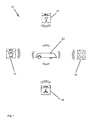
- the system 10 comprises at least one stationary household appliance 12, in the illustrated scenario exemplarily four household appliances 12, 14, 16, 18, namely a washing machine 12, a Dishwasher 14, a hob 16 and a stove 18, and a mobile home appliance 20.
- the mobile home appliance 20 is shown by way of example as suction robot 20 and the following Description is continued - without renouncing a more general validity - the example of a vacuum robot 20 as a mobile home appliance 20.
- other household appliances come into consideration, however, the type of the respective household appliance 12-18 is not of particular importance, so that such devices in the following generally referred to as household appliance 12-18 and including any type of Household appliance is understood.
- the mobile domestic appliance 20, in this case the vacuum robot 20, is communicatively connected to at least one stationary domestic appliance 12-18 of the system 10. This is in the illustration in FIG. 1 shown by the emanating from the individual devices 12-18,20 wavefronts. Means for wireless communicative connection of two or more devices are known per se in the form of corresponding transmitting and / or receiving devices.
- the mobile home appliance 20 and at least one stationary home appliance 12-18 may exchange data.
- the suction robot 20 it is not necessary for the suction robot 20 - as shown in the schematically simplified illustration in FIG. 1 between all household appliances 12-18 included in the home appliance system 10.
- a stationary household appliance 12-18 and the vacuum robot 20 in the illustration in FIG. 1 not shown obstacles, for example, furnishings of a kitchen or a living room, are located, without that the wireless communication link between the respective stationary household appliance 12-18 and the vacuum robot 20 would be questioned.
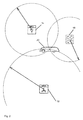
- FIG. 2 shows in a schematically simplified form the position determination of the vacuum robot 20 based on known positions of individual stationary household appliances 12-18.
- the vacuum robot 20 determines - for example, based on a signal delay of one of a stationary household appliance 12-18 transmitted to the vacuum robot 20 data packets - a distance to the respective household appliance 12-18.
- the distances are illustrated in the illustration in Figure 2 by each of one of the household appliances 12-18 outgoing and inscribed in a circle around the household appliance 12-18 arrows.
- the vacuum robot 20 can determine its position in space by means of a control unit comprised thereof.
- the stationary household appliances 12-18 are considered as fixed reference points and used as so-called anchor nodes for determining the position (localization) of the vacuum robot 20.
- the control robot included in the suction robot 20 is for Example, using basically known per se triangulation algorithms automatically determines the position of the vacuum robot 20.
- the position of the vacuum robot 20 is determined by means of a control unit comprised of one of the stationary domestic appliances 12-18 and then transmitted to the vacuum robot 20 in a line-less manner.
- the determined position information can be used, for example, to correct a position information obtained by other means, for example, a position information after leaving the loading station due to the movements of the wheels of the vacuum robot 20. Additionally or alternatively, the determined position information can also be used to detect and / or transmit spatial and / or position-specific suction parameters. These include, for example, information about the frequency of cleaning a room, a room section or a position in the room, which are detected, for example, for statistical purposes, or information about a given at a certain position flooring, which are transmitted to the suction robot 20 on a lineless, whereupon this automatically adapts the suction operation to the respective floor covering.
- an operating mode is also possible in which the suction robot 20 perceives changes in the respectively processed space via sensors comprised by it, for example distance sensors or contact sensors. If the user of the robotic vacuum cleaner 20 sets via one of the home appliances 12-18 that he is absent for a long time, the suction robot 20 checks during suction operation during the absence of the user, whether changes to the spatial environment have occurred. Detects the vacuum robot 20 by means of its sensor such a change, it can be concluded that an unauthorized access. The vacuum robot 20 then generates a relevant message. This is first transmitted by the vacuum robot 20 in a line-less way to one of the stationary household appliances 12-18.
- the message is forwarded, for example to the Internet or to a device connected to the Internet, for example a personal computer in the household.
Landscapes
- Engineering & Computer Science (AREA)
- Computer Networks & Wireless Communication (AREA)
- Signal Processing (AREA)
- Mechanical Engineering (AREA)
- Physics & Mathematics (AREA)
- General Physics & Mathematics (AREA)
- Robotics (AREA)
- Electric Vacuum Cleaner (AREA)
- Control Of Position, Course, Altitude, Or Attitude Of Moving Bodies (AREA)
Abstract
Description
- Die Erfindung betrifft ein Verfahren zum Betrieb eines Haushaltsgerätesystems, nämlich eines zumindest ein ortsfestes Haushaltsgerät und ein mobiles Haushaltsgerät umfassenden Haushaltsgerätesystems, wobei das mobile Haushaltsgerät zum Senden und/oder Empfangen von Daten auf leitungslosem Wege eingerichtet ist.
- Die Nutzung einer leitungslosen Kommunikation mit einem mobilen Haushaltsgerät in Form eines Saugroboters ist zum Beispiel aus der
EP 2 384 680 A bekannt. Dort wird eine von einem Benutzer mitführbare, batteriebetriebene Bedieneinrichtung nach Art einer Fernbedienung vorgeschlagen, mittels derer bestimmte Statusinformationen, wie zum Beispiel die Betriebsdauer des Saugroboters oder die Anzahl der Filterreinigungszyklen, aber auch ein Ladezustand der vom Saugroboter mitgeführten Akkus, abgefragt und angezeigt werden können. In derUS 2002/0060542 A wird die Verwendung eines handelsüblichen Personalcomputers als Schnittstelle für eine leitungslose Kommunikation mit einem Saugroboter vorgeschlagen, so dass der Saugroboter im Ergebnis über das Internet bedienbar sein soll, an das der Personalcomputer angeschlossen ist. - In der
US 6,459,955 B wird ein Ansatz beschrieben, mit dem eine Positionsbestimmung eines Saugroboters in einem Raum mittels in dem Raum befindlicher Signalquellen möglich sein soll, wobei die Signalquellen dauerhaft ein Funksignal abstrahlen, welches der Saugroboter mittels einer beweglichen Antenne empfängt und daraufhin anhand der jeweiligen Antennenposition eine Winkelposition zu jeweils einer Signalquelle ermittelt. - Bei dem genannten Stand der Technik ist jeweils zumindest ein zusätzliches Gerät (Bedieneinrichtung, Personalcomputer, dauerhaft sendende Signalquellen) erforderlich, um mit dem Saugroboter in Kontakt zu treten oder damit der Saugroboter Funktionen wie eine Navigation im Raum durchführen kann.
- Eine Aufgabe der Erfindung besteht ausgehend von diesem Stand der Technik darin, eine besonders einfache Möglichkeit zur Nutzung einer drahtlosen Kommunikation mit einem mobilen Haushaltsgerät, wie zum Beispiel einem Saugroboter, anzugeben.
- Der im Folgenden beschriebene Ansatz soll dazu einen Beitrag leisten und entsprechend wird hier zur Lösung der vorstehend skizzierten Aufgabe ein Verfahren mit den Merkmalen des Anspruchs 1, nämlich ein Verfahren zum Betrieb eines zumindest ein ortsfestes Haushaltsgerät und ein mobiles Haushaltsgerät umfassenden Haushaltsgerätesystems, vorgeschlagen, bei dem das mobile Haushaltsgerät mit dem zumindest einen ortsfesten Haushaltsgerät des Haushaltsgerätesystems leitungslos kommunikativ verbunden ist und bei dem das mobile Haushaltsgerät und zumindest ein ortsfestes Haushaltsgerät zum Austausch von Daten auf leitungslosem Wege eingerichtet sind und im Betrieb auf diese Weise Daten austauschen.
- Der Vorteil der Erfindung besteht darin, dass in einem Haushalt normalerweise ohnehin vorhandene Geräte, nämlich Haushaltsgeräte und konkret ortsfeste Haushaltsgeräte, wie Herde, Kühlschränke, Kochfelder, Waschmaschinen, Wäschetrockner und dergleichen, für eine leitungslose Kommunikation mit dem mobilen Haushaltsgerät, also zum Beispiel einem Saugroboter, verwendbar werden. Ein zusätzliches Gerät oder gar eine Mehrzahl zusätzlicher Geräte ist bzw. sind damit nicht mehr erforderlich. Dies bedeutet zum einen eine Kostenreduktion, bedingt insgesamt aber auch Einsparung von Rohstoffen und bedeutet eine Erleichterung für den Benutzer des mobilen Haushaltsgeräts, der eine bisher zum Beispiel zum Abfragen einer Statusinformation des Saugroboters benötigte Fernbedienung nicht mehr verlieren oder verlegen kann.
- Vorteilhafte Ausgestaltungen und Weiterbildungen der Erfindung ergeben sich aus den nachfolgenden Unteransprüchen. Dabei verwendete Rückbeziehungen weisen auf die weitere Ausbildung des Gegenstandes des Hauptanspruches durch die Merkmale des jeweiligen Unteranspruches hin. Sie sind nicht als ein Verzicht auf die Erzielung eines selbständigen, gegenständlichen Schutzes für die Merkmalskombinationen der rückbezogenen Unteransprüche zu verstehen. Des Weiteren ist im Hinblick auf eine Auslegung der Ansprüche bei einer näheren Konkretisierung eines Merkmals in einem nachgeordneten Anspruch davon auszugehen, dass eine derartige Beschränkung in den jeweils vorangehenden Ansprüchen nicht vorhanden ist.
- Die nachfolgende Beschreibung wird im Interesse einer besseren Lesbarkeit, aber ohne Verzicht auf eine weitergehende Allgemeingültigkeit, am Beispiel eines Saugroboters als mobilem Haushaltsgerät fortgesetzt. Entsprechend ist bei jeder Erwähnung eines Saugroboters der allgemeine Begriff "mobiles Haushaltsgerät" mitzulesen. Als weitere Ausführungsform eines solchen mobilen Haushaltsgeräts seien hier lediglich exemplarisch ein herkömmlicher Staubsauger, also zum Beispiel ein Staubsauger in Form eines Bodenstaubsaugers oder dergleichen, oder auch ein sogenannter Haushaltsroboter genannt.
- Hinsichtlich der zwischen dem Saugroboter und zumindest einem ortsfesten Haushaltsgerät austauschbaren Daten kommen vielfältige Möglichkeiten in Betracht, von denen einige nachfolgend exemplarisch erörtert werden.
- Demgemäß ist bei einer Ausführungsform des Betriebsverfahrens vorgesehen, dass das zumindest eine ortsfeste Haushaltsgerät oder eines der ortsfesten Haushaltsgeräte des Haushaltsgerätesystems als Benutzerschnittstelle für den Saugroboter fungiert. Beim Saugroboter sind dann Elemente und Vorrichtungen, die üblicherweise als Benutzerschnittstelle verwendet werden, nicht erforderlich. Dies verringert die Material- und Herstellungskosten des Saugroboters und im Weiteren reduziert sich aufgrund nicht vorhandener, bisher notwendiger Elemente, Vorrichtungen und/oder Funktionen der Wartungsbedarf des Saugroboters.
- Bei einer speziellen Ausführungsform des Betriebsverfahrens, bei dem ein ortsfestes Haushaltsgerät als Benutzerschnittstelle für den Saugroboter fungiert, sendet der Saugroboter zumindest eine Statusinformation im Wege einer leitungslosen Kommunikation an das ortsfeste Haushaltsgerät und das ortsfeste Haushaltsgerät gibt die empfangene Statusinformation mittels einer von dem ortsfesten Haushaltsgerät umfassten Anzeigeeinrichtung aus. Auf Seiten des Saugroboters werden auf diese Weise Anzeigeelemente und dergleichen entbehrlich. Zudem lassen sich, wenn das ortsfeste Haushaltsgerät über eine Anzeigeeinrichtung in Form eines Bildschirms oder eines Displays verfügt, erweiterte Statusinformationen oder Statusinformationen mit einem zusätzlichen Informationsgehalt ausgeben. Exemplarisch kann dazu darauf verwiesen werden, dass ein Saugroboter bisher üblicherweise über eine Anzeigeeinrichtung in Form einer LED oder einer LCD-Anzeige verfügt, um einen niedrigen Ladezustand des von dem Saugroboter mitgeführten Akkus anzuzeigen, und/oder über eine Anzeigeeinrichtung in Form einer LED oder einer LCD-Anzeige zur Füllgradanzeige verfügt. Eine solche oder eine vergleichbare Anzeigeeinrichtung ist nun auf Seiten des Saugroboters nicht mehr notwendig. Die Ladezustands- und/oder Füllgradanzeige sowie die Anzeige weiterer Statusinformationen kann mittels der von dem ortsfesten Haushaltsgerät umfassten Anzeigeeinrichtung erfolgen. Die Ladezustands- und Füllgradanzeige kann dabei als erweiterte Statusinformation zum Beispiel gleichzeitig erfolgen, so dass der Benutzer mehrere Informationen mit einem Blick erfassen kann. Die Ladezustands- und/oder Füllgradanzeige auf der Anzeigeeinrichtung des ortsfesten Haushaltsgeräts kann darüber hinaus zusätzliche Informationen umfassen, wie zum Beispiel eine prognostizierte Restlaufzeit auf Basis des Ladezustands und/oder eine prognostizierte mögliche verbleibende Betriebsdauer auf Basis eines Füllgrads des Staubbeutels oder Staubsammelbehälters.
- Weitere mögliche Statusinformationen, die auf diesem Wege einem Benutzer des Saugroboters einfach zugänglich gemacht werden können, ohne dabei den Saugroboter durch eine leistungsfähige Anzeigeeinrichtung, die beim Betrieb des Saugroboters auch beschädigt werden kann, zu verteuern, sind
- eine Anzeige eines Reinigungsfortschritts, zum Beispiel in Form einer prozentualen Angabe pro Raum oder bezogen auf den gesamten Wohnraum,
- eine Restzeitanzeige bis zum Abschluss der Reinigung eines Raums oder des gesamten Wohnraums,
- weitere Informationen zum Akkuzustand, wie zum Beispiel eine voraussichtliche Restlebensdauer des Akkus,
- Alarmmeldungen, wie zum Beispiel ein Festhängen des Saugroboters, insbesondere eine durch eine Ortsinformation, wie zum Beispiel einen vorgegebenen Raumnamen spezifizierte Alarmmeldung zum Festhängen des Saugroboters sowie
- Wartungs- und/oder Serviceinformationen, wie zum Beispiel ein Hinweis auf eine Notwendigkeit zur Reinigung oder zum Austausch bestimmter Teile des Saugroboters.
- Neben den erweiterten Möglichkeiten zur Darstellung von Statusinformationen hat die Verwendung einer Anzeigeeinrichtung eines ortsfesten Haushaltsgeräts zur Darstellung von Statusinformationen des Saugroboters darüber hinaus auch den Vorteil, dass sich der Benutzer nicht zum Saugroboter begeben und zum Saugroboter bücken oder den Saugroboter anheben muss. Darüber hinaus kann der Saugroboter während des Abrufs und der Anzeige einzelner oder mehrerer Statusinformationen in Betrieb bleiben und einen Saugvorgang fortsetzen oder in der Ladestation verbleiben, zum Beispiel um einen Aufladevorgang des Akkus fortzusetzen oder abzuschließen.
- Bei einer weiteren oder alternativen Ausführungsform des Betriebsverfahrens, bei dem ein ortsfestes Haushaltsgerät als Benutzerschnittstelle für den Saugroboter fungiert, werden mittels eines von dem ortsfesten Haushaltsgerät umfassten Bedienelements eine Bedienhandlung eines Benutzers erfasst und mittels des ortsfesten Haushaltsgeräts eine in Bezug auf die Bedienhandlung automatisch generierte Steuerinformation auf leitungslosem Wege an das mobile Haushaltsgerät gesendet.
- Der Saugroboter wird auf diese Weise mittels eines ortsfesten Haushaltsgeräts und eines davon umfassten Bedienelements oder einer Mehrzahl davon umfasster Bedienelemente bedienbar und/oder konfigurierbar, ohne dass sich der Benutzer zum Saugroboter begeben und zum Saugroboter bücken oder den Saugroboter anheben muss. Darüber hinaus kann der Saugroboter während eines solchen Bedienvorgangs in Betrieb bleiben und seine Bewegung, also zum Beispiel einen Saugvorgang, fortsetzen oder in der Ladestation verbleiben, zum Beispiel um einen Aufladevorgang des Akkus fortzusetzen oder abzuschließen.
- Bei einer solchen Konfiguration des Saugroboters mittels leitungslos übermittelter Daten kommt zum Beispiel in Betracht, Reinigungszeiten, eine Reinigungsreihenfolge oder ein Reinigungsverhalten und dergleichen festzulegen. Bei einer Bedienung des Saugroboters mittels leitungslos übermittelter Daten ist zum Beispiel die Reinigung eines bestimmten Raumes oder die Reinigung eines gesamten Reinigungsbereichs abrufbar. Zusätzlich kann der Benutzer einen sogenannten spot clean, also das gezielte Anfahren einer bestimmten Reinigungsposition, aktivieren. Ganz allgemein ist mit einer Bedienung des Saugroboters mittels leitungslos übermittelter Daten eine Fernsteuerung des Saugroboters in jeglicher Hinsicht möglich.
- Bei einer weiteren Ausführungsform des Betriebsverfahrens, bei dem der Saugroboter mit zumindest einem ortsfesten Haushaltsgerät auf leitungslosem Wege Daten austauscht, ist vorgesehen, dass das zumindest eine ortsfeste Haushaltsgerät oder ein ortsfestes Haushaltsgerät des Haushaltsgerätesystems als Gateway und/oder Kommunikationsinfrastruktur für den Saugroboter fungiert. Die ortsfesten Haushaltsgeräte und der Saugroboter verfügen hierzu über entsprechende Vernetzungstechnologien. Beispiele hierfür sind IPv4/IPv6-Routingfähigkeiten oder sogenannte meshed networking Technologien, wie zum Beispiel ZigBee.
- Wenn zumindest ein ortsfestes Haushaltsgerät des Haushaltsgerätesystems und der Saugroboter zum leitungslosen Senden und Empfangen von Daten eingerichtet sind, insbesondere wenn das ortsfeste Haushaltsgerät als Gateway für den Saugroboter fungiert, können verschiedene Service- und Fernwartungsfunktionen über das ortsfeste Haushaltsgerät beim Saugroboter durchgeführt werden. Beispielsweise kann über das ortsfeste Haushaltsgerät ein Software-Update beim Saugroboter eingespielt werden. Zudem kann der Saugroboter Ergebnisse einer Selbstdiagnose an das ortsfeste Haushaltsgerät melden, welches dann selbst oder mittels Zugriff auf einen zum Beispiel im Internet erreichbaren Server dem Benutzer des Saugroboters eine Lösungsmöglichkeit oder ein weiteres Vorgehen vorschlägt. Darüber hinaus oder alternativ ist auf diesem Wege auch eine zusätzliche Bereitstellung von neuen Reinigungs- oder Spezialprogrammen im Speicher des Saugroboters möglich, zum Beispiel ein von einem Teppichhersteller für dessen Teppiche bereitgestelltes Reinigungsprogramm.
- Bei einer weiteren Ausführungsform des Betriebsverfahrens, bei dem der Saugroboter mit zumindest einem ortsfesten Haushaltsgerät auf leitungslosem Wege Daten austauscht, ist vorgesehen, dass das mobile Haushaltsgerät eine Positionsbestimmung mittels der von mindestens drei ortsfesten Haushaltsgeräten leitungslos empfangenen Daten durchführt. Bei den zur Positionsbestimmung empfangenen Daten kann es sich um Daten handeln, die zusammen mit oder parallel zu sonstigen Nutzdaten, zum Beispiel Steuerinformationen, übertragen werden. Die Positionsbestimmung erfolgt dann zum Beispiel anhand von Laufzeitmessungen oder einer Auswertung von Empfangssignalstärken. Zeitwerte als Basis für eine Laufzeitmessung oder die Empfangsstärke werden dabei während eines Empfangs einer Präambel eines die Daten umfassenden Datenpakets bestimmt. Dieser Ansatz ist mit einer Vielzahl von verfügbaren Kurzstrecken-Funktechnologien, zum Beispiel WLAN, Bluetooth oder IEEE 802.15.4/ ZigBee, realisierbar.
- Bei einer nochmals weiteren Ausführungsform des Betriebsverfahrens, bei dem der Saugroboter mit zumindest einem ortsfesten Haushaltsgerät auf leitungslosem Wege Daten austauscht, ist vorgesehen, dass das mobile Haushaltsgerät mit zumindest einem davon umfassten Sensor, insbesondere einem Temperatur- und/oder Feuchtigkeitssensor, seine Umgebung überwacht und anhand der von dem Sensor erhaltenen Daten zum Beispiel ein ortsfestes Haushaltsgerät abschaltet, indem diesem ein Abschaltsignal übermittelt wird, oder einen Benutzer des Saugroboters über eine erkannte Ausnahmesituation informiert. Im Falle eines als Feuchtigkeitssensor ausgeführten Sensors kann der Saugroboter zum Beispiel einen Wasseraustritt aus einem Waschautomaten detektieren. Der Sensor liefert beim Betrieb des Saugroboters fortwährend ein Sensorsignal. Sobald das Sensorsignal einen vorgegebenen oder vorgebbaren Schwellwert überschreitet, deutet dies auf Wasser im Bewegungsbereich des Saugroboters hin. Dann kann der Saugroboter mittels der kommunikativen Verbindung zu dem Waschautomaten diesen zum Beispiel abschalten. Dafür ist der Feuchtigkeitssensor in einer Konfiguration des Saugroboters dem Waschautomaten zugeordnet, so dass der Saugroboter selbsttätig anhand einer jeweiligen Schwellwertüberschreitung und einer solchen Zuordnung das jeweils anzusteuernde ortsfeste Haushaltsgerät ermitteln kann.
- Darüber hinaus kann die Überwachung des Sensorsignals in Bezug auf einen Schwellwert mit einer Plausibilitätsprüfung verknüpft sein. Dann führt die Überschreitung des Schwellwerts zum Beispiel nur dann zu einer Abschaltung des Waschautomaten, wenn sich der Saugroboter zum Zeitpunkt der Schwellwertüberschreitung in der Nähe des Waschautomaten (oder des mit dem Sensorsignal verknüpften Haushaltsgeräts) befindet. Der Abstand zum Haushaltsgerät oder zu allen Haushaltsgeräten wird regelmäßig automatisch durch den Saugroboter ermittelt. Ob sich der Saugroboter also zum Zeitpunkt der Schwellwertüberschreitung in einer solchen Nähe zum Waschautomaten befunden hat, bei der das Sensorsignal plausibel auf einen Wasseraustritt beim Waschautomaten zurückgeführt werden kann, ist dann automatisch auf Seiten des Saugroboters abprüfbar. Dafür wird überprüft, ob der ermittelte Abstand zu dem Haushaltsgerät kleiner als ein vorgegebener oder vorgebbarer Abstandsgrenzwert ist. Die Abschaltung des Haushaltsgeräts oder eine sonstige Aktion in Bezug auf das Haushaltsgerät wird nur dann ausgelöst, wenn beide Bedingungen (Schwellwertüberschreitung, Abstandsgrenzwertunterschreitung) erfüllt sind. Die Konfiguration des Saugroboters umfasst dafür in zumindest einer Speicherzelle den ggf. durch den Benutzer anpassbaren Abstandsgrenzwert oder jeweils einen einem Haushaltsgerät zugeordneten Sensor, weil zum Beispiel bei einem Waschautomaten im Fehlerfall mit einem Wasseraustritt in einem größeren Umfang zu rechnen ist als bei einem Kühlschrank.
- Zusätzlich oder alternativ ist bei einer solchen, gegebenenfalls durch eine Plausibilitätskontrolle unterstützten automatischen Überwachung einzelner oder aller Haushaltsgeräte durch den Saugroboter bei einer besonderen Ausführungsform auch vorgesehen, dass im Falle einer anhand einer Schwellwertüberschreitung erkannten Ausnahmesituation automatisch auf Seiten des Saugroboters eine Nachricht generiert wird, die zum Beispiel mittels der oben erwähnten Gateway-Funktionalität an ein Mobiltelefon oder dergleichen des Benutzers übermittelt wird und/oder dass die Nachricht mittels einzelner oder aller Anzeigeeinrichtungen der von dem Haushaltsgerätesystem umfassten ortsfesten Haushaltsgeräte angezeigt wird, so dass der Benutzer zeitnah über die Ausnahmesituation informiert wird.
- Insgesamt ist die Erfindung damit auch ein mobiles Haushaltsgerät, zum Beispiel ein mobiles Haushaltsgerät in Form eines Saugroboters, mit Mitteln zur Ausführung des hier und im Folgenden beschriebenen Verfahrens sowie ein ortsfestes Haushaltgerät mit solchen Mitteln und ein Haushaltsgerätesystem mit solchen Haushaltsgeräten. Bei den Mitteln zur Ausführung des Verfahrens handelt es sich zum Beispiel um eine Steuereinheit mit einem Mikroprozessor oder dergleichen sowie einen Speicher, in den ein mittels des Mikroprozessors ausführbares Steuerprogramm geladen ist, das eine Implementierung der jeweiligen Verfahrensschritte in Software umfasst. Damit ist die Erfindung auch ein Computerprogramm, nämlich ein solches Steuerprogramm, mit maschinenlesbarem Programmcodeanweisungen und ein Datenträger, auf dem ein solches Computerprogramm/Steuerprogramm gespeichert ist.
- Ein Ausführungsbeispiel der Erfindung ist in den Zeichnungen rein schematisch dargestellt und wird nachfolgend näher beschrieben. Einander entsprechende Gegenstände oder Elemente sind in allen Figuren mit den gleichen Bezugszeichen versehen. Das oder jedes Ausführungsbeispiel ist nicht als Einschränkung der Erfindung zu verstehen. Vielmehr sind im Rahmen der vorliegenden Offenbarung durchaus auch Änderungen und Modifikationen möglich, insbesondere solche Varianten und Kombinationen, die zum Beispiel durch Kombination oder Abwandlung von einzelnen in Verbindung mit den im allgemeinen oder speziellen Beschreibungsteil beschriebenen sowie in den Ansprüchen und/oder der Zeichnung enthaltenen Merkmalen bzw. Elementen oder Verfahrensschritten für den Fachmann im Hinblick auf die Lösung der Aufgabe entnehmbar sind und durch kombinierbare Merkmale zu einem neuen Gegenstand führen.
- Es zeigen
- Figur 1
- ein Haushaltsgerätesystem mit mehreren ortsfesten Haushaltsgeräten und einem mobilen Haushaltsgerät und
- Figur 2
- ein Anwendungsszenario für ein Haushaltsgerätesystem, bei dem das mobile Haushaltsgerät mit einzelnen ortsfesten Haushaltsgeräten leitungslos kommunikativ verbunden ist.
- Die Darstellung in
Figur 1 zeigt in schematisch stark vereinfachter Form ein im Folgenden mitunter auch nur kurz als System 10 bezeichnetes Haushaltegerätesystem 10. Das System 10 umfasst zumindest ein ortsfestes Haushaltsgerät 12, beim dargestellten Szenario exemplarisch vier Haushaltsgeräte 12, 14, 16, 18, nämlich einen Waschautomaten 12, einen Geschirrspüler 14, ein Kochfeld 16 und einen Herd 18, sowie ein mobiles Haushaltsgerät 20. Das mobile Haushaltsgerät 20 ist exemplarisch als Saugroboter 20 gezeigt und die nachfolgende Beschreibung wird - ohne Verzicht auf eine weitergehende Allgemeingültigkeit - am Beispiel eines Saugroboters 20 als mobilem Haushaltsgerät 20 fortgesetzt. Anstelle der vorgenannten Haushaltsgeräte 12-18 kommen auch andere Haushaltsgeräte in Betracht, allerdings ist die Art des jeweiligen Haushaltsgeräts 12-18 nicht von besonderer Bedeutung, so dass auf solche Geräte im Folgenden allgemein als Haushaltsgerät 12-18 Bezug genommen wird und darunter jede Art von Haushaltsgerät zu verstehen ist. - Das mobile Haushaltsgerät 20, hier also der Saugroboter 20, ist mit zumindest einem ortsfesten Haushaltsgerät 12-18 des Systems 10 leitungslos kommunikativ verbunden. Dies ist in der Darstellung in
Figur 1 durch die von den einzelnen Geräten 12-18,20 ausgehenden Wellenfronten gezeigt. Mittel zur leitungslosen kommunikativen Verbindung zweier oder mehrerer Geräte sind in Form entsprechender Sende- und/oder Empfangseinrichtungen an sich bekannt. - Aufgrund der leitungslosen kommunikativen Verbindung zwischen dem Saugroboter 20 und einem der Haushaltsgeräte 12-18 oder mehreren Haushaltsgeräten 12-18 können das mobile Haushaltsgerät 20 und zumindest ein ortsfestes Haushaltsgerät 12-18 Daten austauschen. Selbstverständlich ist es dafür nicht erforderlich, dass sich der Saugroboter 20 - wie dies in der schematisch vereinfachten Darstellung in
Figur 1 gezeigt ist - zwischen allen von dem Haushaltsgerätesystem 10 umfassten Haushaltsgeräten 12-18 befindet. Darüber hinaus können sich zwischen einem ortsfesten Haushaltsgerät 12-18 und dem Saugroboter 20 auch in der Darstellung inFigur 1 nicht gezeigte Hindernisse, zum Beispiel Einrichtungsgegenstände einer Küche oder eines Wohnraums, befinden, ohne dass dadurch die leitungslose kommunikative Verbindung zwischen dem jeweiligen ortsfesten Haushaltsgerät 12-18 und dem Saugroboter 20 infrage gestellt wäre. - Die Darstellung in
Figur 2 zeigt in schematisch vereinfachter Form die Positionsbestimmung des Saugroboters 20 anhand bekannter Positionen einzelner ortsfester Haushaltsgeräte 12-18. Der Saugroboter 20 ermittelt - zum Beispiel anhand einer Signallaufzeit eines von einem ortsfesten Haushaltsgerät 12-18 zum Saugroboter 20 übertragenen Datenpakets - einen Abstand zu dem jeweiligen Haushaltsgerät 12-18. Die Abstände sind in der Darstellung in Figur 2 durch die jeweils von einem der Haushaltsgeräte 12-18 ausgehenden und in einen Kreis um das Haushaltsgerät 12-18 eingeschriebenen Pfeile verdeutlicht. - Anhand zumindest dreier auf diese Weise ermittelter Abstände zu jeweils einem ortsfesten Haushaltsgerät 12-18 sowie der Position der jeweiligen Haushaltsgeräte 12-18 kann der Saugroboter 20 mittels einer davon umfassten Steuereinheit seine Position im Raum bestimmen. Die ortsfesten Haushaltsgeräte 12-18 werden dabei als feste Referenzpunkte betrachtet und als sogenannte anchor nodes für die Positionsbestimmung (Lokalisierung) des Saugroboters 20 verwendet. Mittels der von dem Saugroboter 20 umfassten Steuereinheit wird zum Beispiel unter Verwendung grundsätzlich an sich bekannter Triangulationsalgorithmen automatisch die Position des Saugroboters 20 bestimmt. Alternativ kann auch vorgesehen sein, dass die Position des Saugroboters 20 mittels einer von einem der ortsfesten Haushaltsgeräte 12-18 umfassten Steuereinheit ermittelt und anschließend auf leitungslosem Wege an den Saugroboter 20 übertragen wird.
- Die ermittelte Positionsinformation kann zum Beispiel verwendet werden, um eine auf anderem Wege erhaltene Positionsinformation zu korrigieren, zum Beispiel eine nach dem Verlassen der Ladestation aufgrund der Bewegungen der Räder des Saugroboters 20 nachgeführte Positionsinformation. Zusätzlich oder alternativ kann die ermittelte Positionsinformation auch zur Erfassung und/oder Übermittlung raum- und/oder positionsspezifischer Saugparameter verwendet werden. Dazu zählen zum Beispiel Informationen über die Reinigungshäufigkeit eines Raums, eines Raumabschnitts oder einer Position im Raum, die zum Beispiel für statistische Zwecke erfasst werden, oder Informationen über einen an einer bestimmten Position gegebenen Bodenbelag, die auf leitungslosem Wege an den Saugroboter 20 übermittelt werden, woraufhin dieser den Saugbetrieb automatisch an den jeweiligen Bodenbelag anpasst.
- Mit dem hier beschriebenen Ansatz ist es erstmals möglich, in einem Haushalt ohnehin vorhandene Haushaltsgeräte 12-18, insbesondere ortsfeste Haushaltsgeräte 12-18, für eine Bedienung eines mobilen Haushaltsgeräts 20 zu verwenden. Der Begriff Bedienung ist dabei insbesondere anhand der vorstehend erläuterten Beispiele weit auszulegen und die jetzt mögliche Bedienung basiert auf einer bidirektionalen leitungslosen Kommunikation zwischen einem mobilen Haushaltsgerät 20, zum Beispiel einem Saugroboter 20, und zumindest einem ortsfesten Haushaltsgerät 12-18.
- Mit dem hier beschriebenen Ansatz wird zum Beispiel auch eine Betriebsart möglich, bei dem der Saugroboter 20 über davon umfasste Sensoren, zum Beispiel Entfernungssensoren oder Kontaktsensoren, Veränderungen im jeweils bearbeiteten Raum wahrnimmt. Wenn der Benutzer des Saugroboters 20 über eines der Haushaltsgeräte 12-18 einstellt, dass er für längere Zeit abwesend ist, überprüft der Saugroboter 20 beim Saugbetrieb während der Abwesenheit des Benutzers, ob Veränderungen an der räumlichen Umgebung aufgetreten sind. Detektiert der Saugroboter 20 mittels seiner Sensorik eine solche Veränderung, kann auf einen unbefugten Zutritt geschlossen werden. Der Saugroboter 20 generiert dann eine diesbezügliche Nachricht. Diese wird vom Saugroboter 20 zunächst auf leitungslosem Wege zu einem der ortsfesten Haushaltsgeräte 12-18 übermittelt. Von diesem wird die Nachricht weitergeleitet, zum Beispiel ins Internet oder an ein mit dem Internet verbundenes Gerät, zum Beispiel einen in dem Haushalt befindlichen Personalcomputer. Jedenfalls wird die ursprünglich vom Saugroboter 20 aufgrund der detektierten Veränderungen an der räumlichen Umgebung generierte und innerhalb des Haushalts vom Saugroboter 20 an zumindest eines der ortsfesten Haushaltsgeräte 12-18 übermittelte Nachricht an den Benutzer weitergeleitet, so dass dieser entsprechende Maßnahmen einleiten kann.
-
- 10
- System, Haushaltsgerätesystem
- 12
- ortsfestes Haushaltsgerät (Waschautomat)
- 14
- ortsfestes Haushaltsgerät (Geschirrspüler)
- 16
- ortsfestes Haushaltsgerät (Kochfeld)
- 18
- ortsfestes Haushaltsgerät (Herd)
- 20
- mobiles Haushaltsgerät (Saugroboter)
Claims (10)
- Verfahren zum Betrieb eines zumindest ein ortsfestes Haushaltsgerät (12-18) und ein mobiles Haushaltsgerät (20) umfassenden Systems (10),
wobei das mobile Haushaltsgerät (20) mit dem zumindest einen ortsfesten Haushaltsgerät (12-18) des Systems (10) leitungslos kommunikativ verbunden ist und
wobei das mobile Haushaltsgerät (20) und zumindest ein ortsfestes Haushaltsgerät (12-18) Daten austauschen. - Betriebsverfahren nach Anspruch 1, wobei das zumindest eine ortsfeste Haushaltsgerät (12-18) oder ein ortsfestes Haushaltsgerät (12-18) des Systems (10) als Benutzerschnittstelle für das mobile Haushaltsgerät (20) fungiert.
- Betriebsverfahren nach Anspruch 2, wobei das mobile Haushaltsgerät (20) eine Statusinformation an das ortsfeste Haushaltsgerät (12-18) sendet und das ortsfeste Haushaltsgerät (12-18) die empfangene Statusinformation mittels einer von dem ortsfesten Haushaltsgerät (12-18) umfassten Anzeigeeinrichtung ausgibt.
- Betriebsverfahren nach Anspruch 2 oder 3, wobei mittels eines von dem ortsfesten Haushaltsgerät (12-18) umfassten Bedienelements eine Bedienhandlung eines Benutzers erfasst wird und das ortsfeste Haushaltsgerät (12-18) eine in Bezug auf die Bedienhandlung automatisch generierte Steuerinformation an das mobile Haushaltsgerät (20) sendet.
- Betriebsverfahren nach einem der vorangehenden Ansprüche, wobei das zumindest eine ortsfeste Haushaltsgerät (12-18) oder ein ortsfestes Haushaltsgerät (12-18) des Systems (10) als Gateway für das mobile Haushaltsgerät (20) fungiert.
- Betriebsverfahren nach einem der vorangehenden Ansprüche, wobei das mobile Haushaltsgerät (20) eine Positionsbestimmung mittels der von mindestens drei ortsfesten Haushaltsgeräten (12-18) leitungslos empfangenen Daten durchführt.
- Betriebsverfahren nach einem der vorangehenden Ansprüche, wobei das mobile Haushaltsgerät (20) mit zumindest einem davon umfassten Sensor, insbesondere einem Temperatur- und/oder Feuchtigkeitssensor, seine Umgebung überwacht und im Falle eines einen vorgegebenen oder vorgebbaren Schwellwert überschreitenden Ausgangssignals des Sensors ein dem Sensor in einer Konfiguration des mobilen Haushaltsgeräts (20) zugeordnetes ortsfestes Haushaltsgerät (12-18) abschaltet.
- Betriebsverfahren nach Anspruch 7, wobei die Schwellwertüberwachung zusammen mit einer abstandsbezogenen Plausibilitätskontrolle durchgeführt wird.
- Mobiles Haushaltsgerät (20), insbesondere Saugroboter (20), mit Mitteln zur Ausführung eines Betriebsverfahrens nach einem der vorangehenden Ansprüche.
- Haushaltsgerätesystem (10) mit zumindest einem ortsfesten Haushaltsgerät (12-18) und zumindest einem mobilen Haushaltsgerät (20), wobei das zumindest eine ortsfeste Haushaltsgerät (12-18) und das zumindest eine mobile Haushaltsgerät (20) Mittel zur Ausführung eines Betriebsverfahrens nach einem der Ansprüche 1 bis 8 umfasst.
Applications Claiming Priority (1)
| Application Number | Priority Date | Filing Date | Title |
|---|---|---|---|
| DE102014113040.5A DE102014113040A1 (de) | 2014-09-10 | 2014-09-10 | Verfahren zum Betrieb eines Haushaltsgerätesystems |
Publications (2)
| Publication Number | Publication Date |
|---|---|
| EP2996007A1 true EP2996007A1 (de) | 2016-03-16 |
| EP2996007B1 EP2996007B1 (de) | 2020-01-08 |
Family
ID=53900753
Family Applications (1)
| Application Number | Title | Priority Date | Filing Date |
|---|---|---|---|
| EP15181187.4A Active EP2996007B1 (de) | 2014-09-10 | 2015-08-17 | Verfahren zum betrieb eines haushaltsgerätesystems |
Country Status (3)
| Country | Link |
|---|---|
| US (1) | US10238259B2 (de) |
| EP (1) | EP2996007B1 (de) |
| DE (1) | DE102014113040A1 (de) |
Cited By (1)
| Publication number | Priority date | Publication date | Assignee | Title |
|---|---|---|---|---|
| EP3418005A1 (de) * | 2017-06-16 | 2018-12-26 | Vorwerk & Co. Interholding GmbH | System aus mindestens einem haushaltsgerät, mindestens einem sich selbsttätig fortbewegenden reinigungsgerät und einer steuereinrichtung |
Families Citing this family (24)
| Publication number | Priority date | Publication date | Assignee | Title |
|---|---|---|---|---|
| US9939816B2 (en) * | 2013-10-14 | 2018-04-10 | Keonn Technologies S.L. | Automated inventory taking moveable platform |
| DE102015109775B3 (de) | 2015-06-18 | 2016-09-22 | RobArt GmbH | Optischer Triangulationssensor zur Entfernungsmessung |
| DE102015114883A1 (de) | 2015-09-04 | 2017-03-09 | RobArt GmbH | Identifizierung und Lokalisierung einer Basisstation eines autonomen mobilen Roboters |
| DE102015119501A1 (de) | 2015-11-11 | 2017-05-11 | RobArt GmbH | Unterteilung von Karten für die Roboternavigation |
| DE102015119865B4 (de) | 2015-11-17 | 2023-12-21 | RobArt GmbH | Robotergestützte Bearbeitung einer Oberfläche mittels eines Roboters |
| DE102015121666B3 (de) | 2015-12-11 | 2017-05-24 | RobArt GmbH | Fernsteuerung eines mobilen, autonomen Roboters |
| DE102016102644A1 (de) | 2016-02-15 | 2017-08-17 | RobArt GmbH | Verfahren zur Steuerung eines autonomen mobilen Roboters |
| DE102016213174B4 (de) * | 2016-07-19 | 2025-11-13 | BSH Hausgeräte GmbH | Erstellung einer semantischen Karte |
| WO2018024897A1 (de) | 2016-08-05 | 2018-02-08 | RobArt GmbH | Verfahren zur steuerung eines autonomen mobilen roboters |
| DE102016124894B4 (de) * | 2016-12-20 | 2021-06-10 | Miele & Cie. Kg | Verfahren und Vorrichtung zum Erstellen einer Bedienoberfläche zum Bedienen eines Gebäudeautomationssystems mittels eines Reinigungsroboters, Reinigungsroboter und Gebäudeautomationssystem |
| JP2020509500A (ja) | 2017-03-02 | 2020-03-26 | ロブアート ゲーエムベーハーROBART GmbH | 自律移動ロボットの制御方法 |
| DE102017104427A1 (de) | 2017-03-02 | 2018-09-06 | RobArt GmbH | Verfahren zur Steuerung eines autonomen, mobilen Roboters |
| DE102017109219A1 (de) | 2017-04-28 | 2018-10-31 | RobArt GmbH | Verfahren für die Roboternavigation |
| EP3655865B1 (de) * | 2017-07-20 | 2022-07-20 | Hyperlync Technologies, Inc. | Robotersteuerung für mehrere vorrichtungen |
| US10761187B2 (en) * | 2018-04-11 | 2020-09-01 | Infineon Technologies Ag | Liquid detection using millimeter-wave radar sensor |
| US11259676B2 (en) | 2018-08-30 | 2022-03-01 | Sensirion Ag | Vacuum cleaner device |
| CN110870717B (zh) | 2018-08-30 | 2021-08-03 | 盛思锐股份公司 | 真空吸尘器设备 |
| CN110584544A (zh) * | 2019-09-26 | 2019-12-20 | 青岛海尔科技有限公司 | 基于智能家居操作系统的清扫方法及装置、存储介质 |
| CN113143112A (zh) * | 2020-01-07 | 2021-07-23 | 佛山市云米电器科技有限公司 | 清洁设备控制方法、清洁系统、清洁设备及存储介质 |
| US12613504B2 (en) * | 2021-02-02 | 2026-04-28 | True Manufacturing Co., Inc. | Systems and methods for managing leased appliances |
| US11936489B2 (en) | 2021-02-02 | 2024-03-19 | True Manufacturing Co., Inc. | Systems, methods, and appliances that enable regional control of refrigeration appliances |
| DE102021102654A1 (de) * | 2021-02-04 | 2022-08-04 | Vorwerk & Co. Interholding Gesellschaft mit beschränkter Haftung | System zum Reinigen einer Umgebung |
| US12379144B2 (en) | 2022-03-10 | 2025-08-05 | True Manufacturing Co., Inc. | Ice maker and system and method for monitoring water filter of the ice maker |
| CN119585578A (zh) | 2022-07-28 | 2025-03-07 | 真实制造有限公司 | 用于制冷设备的资产管理和物联网装置 |
Citations (5)
| Publication number | Priority date | Publication date | Assignee | Title |
|---|---|---|---|---|
| US20020060542A1 (en) | 2000-11-22 | 2002-05-23 | Jeong-Gon Song | Mobile robot system using RF module |
| US6459955B1 (en) | 1999-11-18 | 2002-10-01 | The Procter & Gamble Company | Home cleaning robot |
| US20080105134A1 (en) * | 2005-06-09 | 2008-05-08 | Whirlpool Corporation | Appliance network for a networked appliance and a cooking sensor accessory |
| EP2384680A1 (de) | 2010-04-26 | 2011-11-09 | Guido Valentini | Vorrichtung mit drahtloser Kommunikation zur Handhabung von Industriemaschinen wie etwa Oberflächenreiniger und Staubsauger |
| US20140166047A1 (en) * | 2012-12-05 | 2014-06-19 | Vorwerk & Co. Interholding Gmbh | Traveling cleaning appliance and method for operating such an appliance |
Family Cites Families (8)
| Publication number | Priority date | Publication date | Assignee | Title |
|---|---|---|---|---|
| WO2009038772A2 (en) * | 2007-09-20 | 2009-03-26 | Evolution Robotics | Transferable intelligent control device |
| US8798834B2 (en) * | 2010-02-17 | 2014-08-05 | Lg Electronics Inc. | Movable component for a network system |
| US8533144B1 (en) * | 2012-11-12 | 2013-09-10 | State Farm Mutual Automobile Insurance Company | Automation and security application store suggestions based on usage data |
| KR102046928B1 (ko) * | 2013-01-07 | 2019-12-02 | 엘지전자 주식회사 | 이동 단말기, 및 그 동작 방법 |
| WO2014113091A1 (en) * | 2013-01-18 | 2014-07-24 | Irobot Corporation | Environmental management systems including mobile robots and methods using same |
| US20150370272A1 (en) * | 2014-06-23 | 2015-12-24 | Google Inc. | Intelligent configuration of a smart environment based on arrival time |
| US9860077B2 (en) * | 2014-09-17 | 2018-01-02 | Brain Corporation | Home animation apparatus and methods |
| KR101620260B1 (ko) * | 2015-01-12 | 2016-05-12 | 엘지전자 주식회사 | 네트워크 시스템 및 그 제어방법 |
-
2014
- 2014-09-10 DE DE102014113040.5A patent/DE102014113040A1/de not_active Withdrawn
-
2015
- 2015-08-17 EP EP15181187.4A patent/EP2996007B1/de active Active
- 2015-08-31 US US14/840,110 patent/US10238259B2/en active Active
Patent Citations (5)
| Publication number | Priority date | Publication date | Assignee | Title |
|---|---|---|---|---|
| US6459955B1 (en) | 1999-11-18 | 2002-10-01 | The Procter & Gamble Company | Home cleaning robot |
| US20020060542A1 (en) | 2000-11-22 | 2002-05-23 | Jeong-Gon Song | Mobile robot system using RF module |
| US20080105134A1 (en) * | 2005-06-09 | 2008-05-08 | Whirlpool Corporation | Appliance network for a networked appliance and a cooking sensor accessory |
| EP2384680A1 (de) | 2010-04-26 | 2011-11-09 | Guido Valentini | Vorrichtung mit drahtloser Kommunikation zur Handhabung von Industriemaschinen wie etwa Oberflächenreiniger und Staubsauger |
| US20140166047A1 (en) * | 2012-12-05 | 2014-06-19 | Vorwerk & Co. Interholding Gmbh | Traveling cleaning appliance and method for operating such an appliance |
Cited By (1)
| Publication number | Priority date | Publication date | Assignee | Title |
|---|---|---|---|---|
| EP3418005A1 (de) * | 2017-06-16 | 2018-12-26 | Vorwerk & Co. Interholding GmbH | System aus mindestens einem haushaltsgerät, mindestens einem sich selbsttätig fortbewegenden reinigungsgerät und einer steuereinrichtung |
Also Published As
| Publication number | Publication date |
|---|---|
| DE102014113040A1 (de) | 2016-03-10 |
| EP2996007B1 (de) | 2020-01-08 |
| US10238259B2 (en) | 2019-03-26 |
| US20160066759A1 (en) | 2016-03-10 |
Similar Documents
| Publication | Publication Date | Title |
|---|---|---|
| EP2996007B1 (de) | Verfahren zum betrieb eines haushaltsgerätesystems | |
| EP3418005B1 (de) | System aus mindestens einem haushaltsgerät, mindestens einem sich selbsttätig fortbewegenden reinigungsgerät und einer steuereinrichtung | |
| EP3619585B1 (de) | Verfahren zur steuerung von reinigungsgeräten | |
| DE102011006062B4 (de) | Verfahren zur autonomen Inspektion einer Umgebung oder Bearbeitung von Bodenflächen | |
| DE102015211642B3 (de) | Kommunikationsvorrichtung, Steuervorrichtung und System für den Fahrzeugbereich | |
| EP2617341B1 (de) | Selbsttätig verfahrbares Gerät sowie Verfahren zum Betreiben eines solchen Gerätes | |
| EP3415065A1 (de) | System mit mindestens zwei reinigungsgeräten | |
| DE102014110104B4 (de) | System zur Steuerung von beweglichen Mobileinheiten | |
| DE102010037100A1 (de) | Selbsttätig verfahrbares Gerät | |
| DE102012200293A1 (de) | Ansteuerung eines Haushaltsgeräts | |
| EP3862938B1 (de) | Verfahren zum betrieb eines reinigungssystems | |
| EP3848770B1 (de) | Verfahren zum betrieb eines systems mit zwei sich selbsttätig fortbewegenden bodenbearbeitungsgeräten sowie system zur durchführung eines solchen verfahrens | |
| WO2015149962A1 (de) | Bereitstellung von fahrzeugfunktionen in kombination mit einem induktivladesystem | |
| EP2917796A1 (de) | Vorrichtung zur verbesserung von fertigungsprozessen | |
| DE102014119401A1 (de) | Verfahren zur Nutzung der relativen Position eines Nutzers zu einem Fahrzeug und Nutzungssystem | |
| WO2019015898A1 (de) | Kommunikationsnetzwerk | |
| DE102016109015A1 (de) | Haushaltsgerät und Verfahren zum Überwachen eines Haushaltsgeräts | |
| EP4483771A1 (de) | Verfahren zum betrieb eines mobilen, selbstfahrenden geräts | |
| EP3321227B1 (de) | Flurförderzeug mit einer automatisch koppelbaren funkfernbedienung sowie ein verfahren zum automatischen koppeln einer funkfernbedienung mit einem flurförderzeug | |
| WO2016005059A1 (de) | Steuervorrichtung und verfahren zur fernsteuerung einer klimaanlage | |
| DE102013202727A1 (de) | Sensor, Vorrichtung, Verfahren und Computerprogramme zur Bestimmung einer Position | |
| WO2017153144A1 (de) | Beleuchtungssystem mit automatischer bakenkonfiguration | |
| DE102018131732A1 (de) | System aus mindestens einem Bodenbearbeitungsgerät und mindestens einer Signalsendeeinrichtung sowie Betriebsverfahren dafür | |
| DE102021214206A1 (de) | Autonomes mobiles Arbeitsgerät | |
| DE102017107181B4 (de) | Selbsttätig verfahrbares Haushaltsgerät |
Legal Events
| Date | Code | Title | Description |
|---|---|---|---|
| PUAI | Public reference made under article 153(3) epc to a published international application that has entered the european phase |
Free format text: ORIGINAL CODE: 0009012 |
|
| AK | Designated contracting states |
Kind code of ref document: A1 Designated state(s): AL AT BE BG CH CY CZ DE DK EE ES FI FR GB GR HR HU IE IS IT LI LT LU LV MC MK MT NL NO PL PT RO RS SE SI SK SM TR |
|
| AX | Request for extension of the european patent |
Extension state: BA ME |
|
| 17P | Request for examination filed |
Effective date: 20160708 |
|
| RBV | Designated contracting states (corrected) |
Designated state(s): AL AT BE BG CH CY CZ DE DK EE ES FI FR GB GR HR HU IE IS IT LI LT LU LV MC MK MT NL NO PL PT RO RS SE SI SK SM TR |
|
| STAA | Information on the status of an ep patent application or granted ep patent |
Free format text: STATUS: EXAMINATION IS IN PROGRESS |
|
| 17Q | First examination report despatched |
Effective date: 20180110 |
|
| GRAP | Despatch of communication of intention to grant a patent |
Free format text: ORIGINAL CODE: EPIDOSNIGR1 |
|
| STAA | Information on the status of an ep patent application or granted ep patent |
Free format text: STATUS: GRANT OF PATENT IS INTENDED |
|
| INTG | Intention to grant announced |
Effective date: 20190829 |
|
| GRAS | Grant fee paid |
Free format text: ORIGINAL CODE: EPIDOSNIGR3 |
|
| GRAA | (expected) grant |
Free format text: ORIGINAL CODE: 0009210 |
|
| STAA | Information on the status of an ep patent application or granted ep patent |
Free format text: STATUS: THE PATENT HAS BEEN GRANTED |
|
| AK | Designated contracting states |
Kind code of ref document: B1 Designated state(s): AL AT BE BG CH CY CZ DE DK EE ES FI FR GB GR HR HU IE IS IT LI LT LU LV MC MK MT NL NO PL PT RO RS SE SI SK SM TR |
|
| REG | Reference to a national code |
Ref country code: GB Ref legal event code: FG4D Free format text: NOT ENGLISH |
|
| REG | Reference to a national code |
Ref country code: DE Ref legal event code: R084 Ref document number: 502015011443 Country of ref document: DE |
|
| REG | Reference to a national code |
Ref country code: CH Ref legal event code: EP |
|
| REG | Reference to a national code |
Ref country code: IE Ref legal event code: FG4D Free format text: LANGUAGE OF EP DOCUMENT: GERMAN |
|
| REG | Reference to a national code |
Ref country code: DE Ref legal event code: R096 Ref document number: 502015011443 Country of ref document: DE |
|
| REG | Reference to a national code |
Ref country code: AT Ref legal event code: REF Ref document number: 1223481 Country of ref document: AT Kind code of ref document: T Effective date: 20200215 |
|
| REG | Reference to a national code |
Ref country code: GB Ref legal event code: 746 Effective date: 20200331 |
|
| REG | Reference to a national code |
Ref country code: NL Ref legal event code: MP Effective date: 20200108 |
|
| REG | Reference to a national code |
Ref country code: LT Ref legal event code: MG4D |
|
| PG25 | Lapsed in a contracting state [announced via postgrant information from national office to epo] |
Ref country code: NO Free format text: LAPSE BECAUSE OF FAILURE TO SUBMIT A TRANSLATION OF THE DESCRIPTION OR TO PAY THE FEE WITHIN THE PRESCRIBED TIME-LIMIT Effective date: 20200408 Ref country code: FI Free format text: LAPSE BECAUSE OF FAILURE TO SUBMIT A TRANSLATION OF THE DESCRIPTION OR TO PAY THE FEE WITHIN THE PRESCRIBED TIME-LIMIT Effective date: 20200108 Ref country code: NL Free format text: LAPSE BECAUSE OF FAILURE TO SUBMIT A TRANSLATION OF THE DESCRIPTION OR TO PAY THE FEE WITHIN THE PRESCRIBED TIME-LIMIT Effective date: 20200108 Ref country code: RS Free format text: LAPSE BECAUSE OF FAILURE TO SUBMIT A TRANSLATION OF THE DESCRIPTION OR TO PAY THE FEE WITHIN THE PRESCRIBED TIME-LIMIT Effective date: 20200108 Ref country code: PT Free format text: LAPSE BECAUSE OF FAILURE TO SUBMIT A TRANSLATION OF THE DESCRIPTION OR TO PAY THE FEE WITHIN THE PRESCRIBED TIME-LIMIT Effective date: 20200531 Ref country code: LT Free format text: LAPSE BECAUSE OF FAILURE TO SUBMIT A TRANSLATION OF THE DESCRIPTION OR TO PAY THE FEE WITHIN THE PRESCRIBED TIME-LIMIT Effective date: 20200108 |
|
| PG25 | Lapsed in a contracting state [announced via postgrant information from national office to epo] |
Ref country code: IS Free format text: LAPSE BECAUSE OF FAILURE TO SUBMIT A TRANSLATION OF THE DESCRIPTION OR TO PAY THE FEE WITHIN THE PRESCRIBED TIME-LIMIT Effective date: 20200508 Ref country code: BG Free format text: LAPSE BECAUSE OF FAILURE TO SUBMIT A TRANSLATION OF THE DESCRIPTION OR TO PAY THE FEE WITHIN THE PRESCRIBED TIME-LIMIT Effective date: 20200408 Ref country code: GR Free format text: LAPSE BECAUSE OF FAILURE TO SUBMIT A TRANSLATION OF THE DESCRIPTION OR TO PAY THE FEE WITHIN THE PRESCRIBED TIME-LIMIT Effective date: 20200409 Ref country code: SE Free format text: LAPSE BECAUSE OF FAILURE TO SUBMIT A TRANSLATION OF THE DESCRIPTION OR TO PAY THE FEE WITHIN THE PRESCRIBED TIME-LIMIT Effective date: 20200108 Ref country code: LV Free format text: LAPSE BECAUSE OF FAILURE TO SUBMIT A TRANSLATION OF THE DESCRIPTION OR TO PAY THE FEE WITHIN THE PRESCRIBED TIME-LIMIT Effective date: 20200108 Ref country code: HR Free format text: LAPSE BECAUSE OF FAILURE TO SUBMIT A TRANSLATION OF THE DESCRIPTION OR TO PAY THE FEE WITHIN THE PRESCRIBED TIME-LIMIT Effective date: 20200108 |
|
| REG | Reference to a national code |
Ref country code: DE Ref legal event code: R097 Ref document number: 502015011443 Country of ref document: DE |
|
| PG25 | Lapsed in a contracting state [announced via postgrant information from national office to epo] |
Ref country code: ES Free format text: LAPSE BECAUSE OF FAILURE TO SUBMIT A TRANSLATION OF THE DESCRIPTION OR TO PAY THE FEE WITHIN THE PRESCRIBED TIME-LIMIT Effective date: 20200108 Ref country code: SK Free format text: LAPSE BECAUSE OF FAILURE TO SUBMIT A TRANSLATION OF THE DESCRIPTION OR TO PAY THE FEE WITHIN THE PRESCRIBED TIME-LIMIT Effective date: 20200108 Ref country code: RO Free format text: LAPSE BECAUSE OF FAILURE TO SUBMIT A TRANSLATION OF THE DESCRIPTION OR TO PAY THE FEE WITHIN THE PRESCRIBED TIME-LIMIT Effective date: 20200108 Ref country code: CZ Free format text: LAPSE BECAUSE OF FAILURE TO SUBMIT A TRANSLATION OF THE DESCRIPTION OR TO PAY THE FEE WITHIN THE PRESCRIBED TIME-LIMIT Effective date: 20200108 Ref country code: DK Free format text: LAPSE BECAUSE OF FAILURE TO SUBMIT A TRANSLATION OF THE DESCRIPTION OR TO PAY THE FEE WITHIN THE PRESCRIBED TIME-LIMIT Effective date: 20200108 Ref country code: SM Free format text: LAPSE BECAUSE OF FAILURE TO SUBMIT A TRANSLATION OF THE DESCRIPTION OR TO PAY THE FEE WITHIN THE PRESCRIBED TIME-LIMIT Effective date: 20200108 Ref country code: EE Free format text: LAPSE BECAUSE OF FAILURE TO SUBMIT A TRANSLATION OF THE DESCRIPTION OR TO PAY THE FEE WITHIN THE PRESCRIBED TIME-LIMIT Effective date: 20200108 |
|
| PLBE | No opposition filed within time limit |
Free format text: ORIGINAL CODE: 0009261 |
|
| STAA | Information on the status of an ep patent application or granted ep patent |
Free format text: STATUS: NO OPPOSITION FILED WITHIN TIME LIMIT |
|
| 26N | No opposition filed |
Effective date: 20201009 |
|
| PG25 | Lapsed in a contracting state [announced via postgrant information from national office to epo] |
Ref country code: IT Free format text: LAPSE BECAUSE OF FAILURE TO SUBMIT A TRANSLATION OF THE DESCRIPTION OR TO PAY THE FEE WITHIN THE PRESCRIBED TIME-LIMIT Effective date: 20200108 |
|
| PG25 | Lapsed in a contracting state [announced via postgrant information from national office to epo] |
Ref country code: PL Free format text: LAPSE BECAUSE OF FAILURE TO SUBMIT A TRANSLATION OF THE DESCRIPTION OR TO PAY THE FEE WITHIN THE PRESCRIBED TIME-LIMIT Effective date: 20200108 Ref country code: SI Free format text: LAPSE BECAUSE OF FAILURE TO SUBMIT A TRANSLATION OF THE DESCRIPTION OR TO PAY THE FEE WITHIN THE PRESCRIBED TIME-LIMIT Effective date: 20200108 |
|
| PG25 | Lapsed in a contracting state [announced via postgrant information from national office to epo] |
Ref country code: MC Free format text: LAPSE BECAUSE OF FAILURE TO SUBMIT A TRANSLATION OF THE DESCRIPTION OR TO PAY THE FEE WITHIN THE PRESCRIBED TIME-LIMIT Effective date: 20200108 |
|
| REG | Reference to a national code |
Ref country code: CH Ref legal event code: PL |
|
| PG25 | Lapsed in a contracting state [announced via postgrant information from national office to epo] |
Ref country code: CH Free format text: LAPSE BECAUSE OF NON-PAYMENT OF DUE FEES Effective date: 20200831 Ref country code: LU Free format text: LAPSE BECAUSE OF NON-PAYMENT OF DUE FEES Effective date: 20200817 Ref country code: LI Free format text: LAPSE BECAUSE OF NON-PAYMENT OF DUE FEES Effective date: 20200831 |
|
| REG | Reference to a national code |
Ref country code: BE Ref legal event code: MM Effective date: 20200831 |
|
| PG25 | Lapsed in a contracting state [announced via postgrant information from national office to epo] |
Ref country code: BE Free format text: LAPSE BECAUSE OF NON-PAYMENT OF DUE FEES Effective date: 20200831 Ref country code: IE Free format text: LAPSE BECAUSE OF NON-PAYMENT OF DUE FEES Effective date: 20200817 |
|
| REG | Reference to a national code |
Ref country code: AT Ref legal event code: MM01 Ref document number: 1223481 Country of ref document: AT Kind code of ref document: T Effective date: 20200817 |
|
| PG25 | Lapsed in a contracting state [announced via postgrant information from national office to epo] |
Ref country code: AT Free format text: LAPSE BECAUSE OF NON-PAYMENT OF DUE FEES Effective date: 20200817 |
|
| PG25 | Lapsed in a contracting state [announced via postgrant information from national office to epo] |
Ref country code: TR Free format text: LAPSE BECAUSE OF FAILURE TO SUBMIT A TRANSLATION OF THE DESCRIPTION OR TO PAY THE FEE WITHIN THE PRESCRIBED TIME-LIMIT Effective date: 20200108 Ref country code: MT Free format text: LAPSE BECAUSE OF FAILURE TO SUBMIT A TRANSLATION OF THE DESCRIPTION OR TO PAY THE FEE WITHIN THE PRESCRIBED TIME-LIMIT Effective date: 20200108 Ref country code: CY Free format text: LAPSE BECAUSE OF FAILURE TO SUBMIT A TRANSLATION OF THE DESCRIPTION OR TO PAY THE FEE WITHIN THE PRESCRIBED TIME-LIMIT Effective date: 20200108 |
|
| PG25 | Lapsed in a contracting state [announced via postgrant information from national office to epo] |
Ref country code: MK Free format text: LAPSE BECAUSE OF FAILURE TO SUBMIT A TRANSLATION OF THE DESCRIPTION OR TO PAY THE FEE WITHIN THE PRESCRIBED TIME-LIMIT Effective date: 20200108 Ref country code: AL Free format text: LAPSE BECAUSE OF FAILURE TO SUBMIT A TRANSLATION OF THE DESCRIPTION OR TO PAY THE FEE WITHIN THE PRESCRIBED TIME-LIMIT Effective date: 20200108 |
|
| P01 | Opt-out of the competence of the unified patent court (upc) registered |
Effective date: 20230528 |
|
| REG | Reference to a national code |
Ref country code: DE Ref legal event code: R079 Ref document number: 502015011443 Country of ref document: DE Free format text: PREVIOUS MAIN CLASS: G05D0001020000 Ipc: G05D0001430000 |
|
| PGFP | Annual fee paid to national office [announced via postgrant information from national office to epo] |
Ref country code: DE Payment date: 20250831 Year of fee payment: 11 |
|
| PGFP | Annual fee paid to national office [announced via postgrant information from national office to epo] |
Ref country code: GB Payment date: 20250826 Year of fee payment: 11 |
|
| PGFP | Annual fee paid to national office [announced via postgrant information from national office to epo] |
Ref country code: FR Payment date: 20250825 Year of fee payment: 11 |