EP2996111A1 - Skalierbares adaptives Lärmschutzsystem - Google Patents
Skalierbares adaptives Lärmschutzsystem Download PDFInfo
- Publication number
- EP2996111A1 EP2996111A1 EP14184177.5A EP14184177A EP2996111A1 EP 2996111 A1 EP2996111 A1 EP 2996111A1 EP 14184177 A EP14184177 A EP 14184177A EP 2996111 A1 EP2996111 A1 EP 2996111A1
- Authority
- EP
- European Patent Office
- Prior art keywords
- signal
- noise
- error
- signals
- listening
- Prior art date
- Legal status (The legal status is an assumption and is not a legal conclusion. Google has not performed a legal analysis and makes no representation as to the accuracy of the status listed.)
- Withdrawn
Links
Images

Classifications
-
- G—PHYSICS
- G10—MUSICAL INSTRUMENTS; ACOUSTICS
- G10K—SOUND-PRODUCING DEVICES; METHODS OR DEVICES FOR PROTECTING AGAINST, OR FOR DAMPING, NOISE OR OTHER ACOUSTIC WAVES IN GENERAL; ACOUSTICS NOT OTHERWISE PROVIDED FOR
- G10K11/00—Methods or devices for transmitting, conducting or directing sound in general; Methods or devices for protecting against, or for damping, noise or other acoustic waves in general
- G10K11/16—Methods or devices for protecting against, or for damping, noise or other acoustic waves in general
- G10K11/175—Methods or devices for protecting against, or for damping, noise or other acoustic waves in general using interference effects; Masking sound
- G10K11/178—Methods or devices for protecting against, or for damping, noise or other acoustic waves in general using interference effects; Masking sound by electro-acoustically regenerating the original acoustic waves in anti-phase
- G10K11/1787—General system configurations
- G10K11/17879—General system configurations using both a reference signal and an error signal
- G10K11/17883—General system configurations using both a reference signal and an error signal the reference signal being derived from a machine operating condition, e.g. engine RPM or vehicle speed
-
- G—PHYSICS
- G10—MUSICAL INSTRUMENTS; ACOUSTICS
- G10K—SOUND-PRODUCING DEVICES; METHODS OR DEVICES FOR PROTECTING AGAINST, OR FOR DAMPING, NOISE OR OTHER ACOUSTIC WAVES IN GENERAL; ACOUSTICS NOT OTHERWISE PROVIDED FOR
- G10K11/00—Methods or devices for transmitting, conducting or directing sound in general; Methods or devices for protecting against, or for damping, noise or other acoustic waves in general
- G10K11/16—Methods or devices for protecting against, or for damping, noise or other acoustic waves in general
- G10K11/175—Methods or devices for protecting against, or for damping, noise or other acoustic waves in general using interference effects; Masking sound
- G10K11/178—Methods or devices for protecting against, or for damping, noise or other acoustic waves in general using interference effects; Masking sound by electro-acoustically regenerating the original acoustic waves in anti-phase
- G10K11/1781—Methods or devices for protecting against, or for damping, noise or other acoustic waves in general using interference effects; Masking sound by electro-acoustically regenerating the original acoustic waves in anti-phase characterised by the analysis of input or output signals, e.g. frequency range, modes, transfer functions
- G10K11/17821—Methods or devices for protecting against, or for damping, noise or other acoustic waves in general using interference effects; Masking sound by electro-acoustically regenerating the original acoustic waves in anti-phase characterised by the analysis of input or output signals, e.g. frequency range, modes, transfer functions characterised by the analysis of the input signals only
-
- G—PHYSICS
- G10—MUSICAL INSTRUMENTS; ACOUSTICS
- G10K—SOUND-PRODUCING DEVICES; METHODS OR DEVICES FOR PROTECTING AGAINST, OR FOR DAMPING, NOISE OR OTHER ACOUSTIC WAVES IN GENERAL; ACOUSTICS NOT OTHERWISE PROVIDED FOR
- G10K11/00—Methods or devices for transmitting, conducting or directing sound in general; Methods or devices for protecting against, or for damping, noise or other acoustic waves in general
- G10K11/16—Methods or devices for protecting against, or for damping, noise or other acoustic waves in general
- G10K11/175—Methods or devices for protecting against, or for damping, noise or other acoustic waves in general using interference effects; Masking sound
- G10K11/178—Methods or devices for protecting against, or for damping, noise or other acoustic waves in general using interference effects; Masking sound by electro-acoustically regenerating the original acoustic waves in anti-phase
- G10K11/1781—Methods or devices for protecting against, or for damping, noise or other acoustic waves in general using interference effects; Masking sound by electro-acoustically regenerating the original acoustic waves in anti-phase characterised by the analysis of input or output signals, e.g. frequency range, modes, transfer functions
- G10K11/17821—Methods or devices for protecting against, or for damping, noise or other acoustic waves in general using interference effects; Masking sound by electro-acoustically regenerating the original acoustic waves in anti-phase characterised by the analysis of input or output signals, e.g. frequency range, modes, transfer functions characterised by the analysis of the input signals only
- G10K11/17825—Error signals
-
- G—PHYSICS
- G10—MUSICAL INSTRUMENTS; ACOUSTICS
- G10K—SOUND-PRODUCING DEVICES; METHODS OR DEVICES FOR PROTECTING AGAINST, OR FOR DAMPING, NOISE OR OTHER ACOUSTIC WAVES IN GENERAL; ACOUSTICS NOT OTHERWISE PROVIDED FOR
- G10K11/00—Methods or devices for transmitting, conducting or directing sound in general; Methods or devices for protecting against, or for damping, noise or other acoustic waves in general
- G10K11/16—Methods or devices for protecting against, or for damping, noise or other acoustic waves in general
- G10K11/175—Methods or devices for protecting against, or for damping, noise or other acoustic waves in general using interference effects; Masking sound
- G10K11/178—Methods or devices for protecting against, or for damping, noise or other acoustic waves in general using interference effects; Masking sound by electro-acoustically regenerating the original acoustic waves in anti-phase
- G10K11/1785—Methods, e.g. algorithms; Devices
- G10K11/17853—Methods, e.g. algorithms; Devices of the filter
- G10K11/17854—Methods, e.g. algorithms; Devices of the filter the filter being an adaptive filter
-
- G—PHYSICS
- G10—MUSICAL INSTRUMENTS; ACOUSTICS
- G10K—SOUND-PRODUCING DEVICES; METHODS OR DEVICES FOR PROTECTING AGAINST, OR FOR DAMPING, NOISE OR OTHER ACOUSTIC WAVES IN GENERAL; ACOUSTICS NOT OTHERWISE PROVIDED FOR
- G10K11/00—Methods or devices for transmitting, conducting or directing sound in general; Methods or devices for protecting against, or for damping, noise or other acoustic waves in general
- G10K11/16—Methods or devices for protecting against, or for damping, noise or other acoustic waves in general
- G10K11/175—Methods or devices for protecting against, or for damping, noise or other acoustic waves in general using interference effects; Masking sound
- G10K11/178—Methods or devices for protecting against, or for damping, noise or other acoustic waves in general using interference effects; Masking sound by electro-acoustically regenerating the original acoustic waves in anti-phase
- G10K11/1785—Methods, e.g. algorithms; Devices
- G10K11/17857—Geometric disposition, e.g. placement of microphones
-
- G—PHYSICS
- G10—MUSICAL INSTRUMENTS; ACOUSTICS
- G10K—SOUND-PRODUCING DEVICES; METHODS OR DEVICES FOR PROTECTING AGAINST, OR FOR DAMPING, NOISE OR OTHER ACOUSTIC WAVES IN GENERAL; ACOUSTICS NOT OTHERWISE PROVIDED FOR
- G10K11/00—Methods or devices for transmitting, conducting or directing sound in general; Methods or devices for protecting against, or for damping, noise or other acoustic waves in general
- G10K11/16—Methods or devices for protecting against, or for damping, noise or other acoustic waves in general
- G10K11/175—Methods or devices for protecting against, or for damping, noise or other acoustic waves in general using interference effects; Masking sound
- G10K11/178—Methods or devices for protecting against, or for damping, noise or other acoustic waves in general using interference effects; Masking sound by electro-acoustically regenerating the original acoustic waves in anti-phase
- G10K11/1787—General system configurations
- G10K11/17879—General system configurations using both a reference signal and an error signal
- G10K11/17881—General system configurations using both a reference signal and an error signal the reference signal being an acoustic signal, e.g. recorded with a microphone
-
- G—PHYSICS
- G10—MUSICAL INSTRUMENTS; ACOUSTICS
- G10K—SOUND-PRODUCING DEVICES; METHODS OR DEVICES FOR PROTECTING AGAINST, OR FOR DAMPING, NOISE OR OTHER ACOUSTIC WAVES IN GENERAL; ACOUSTICS NOT OTHERWISE PROVIDED FOR
- G10K2210/00—Details of active noise control [ANC] covered by G10K11/178 but not provided for in any of its subgroups
- G10K2210/10—Applications
- G10K2210/128—Vehicles
- G10K2210/1282—Automobiles
-
- G—PHYSICS
- G10—MUSICAL INSTRUMENTS; ACOUSTICS
- G10K—SOUND-PRODUCING DEVICES; METHODS OR DEVICES FOR PROTECTING AGAINST, OR FOR DAMPING, NOISE OR OTHER ACOUSTIC WAVES IN GENERAL; ACOUSTICS NOT OTHERWISE PROVIDED FOR
- G10K2210/00—Details of active noise control [ANC] covered by G10K11/178 but not provided for in any of its subgroups
- G10K2210/30—Means
- G10K2210/301—Computational
- G10K2210/3011—Single acoustic input
-
- G—PHYSICS
- G10—MUSICAL INSTRUMENTS; ACOUSTICS
- G10K—SOUND-PRODUCING DEVICES; METHODS OR DEVICES FOR PROTECTING AGAINST, OR FOR DAMPING, NOISE OR OTHER ACOUSTIC WAVES IN GENERAL; ACOUSTICS NOT OTHERWISE PROVIDED FOR
- G10K2210/00—Details of active noise control [ANC] covered by G10K11/178 but not provided for in any of its subgroups
- G10K2210/30—Means
- G10K2210/301—Computational
- G10K2210/3026—Feedback
-
- G—PHYSICS
- G10—MUSICAL INSTRUMENTS; ACOUSTICS
- G10K—SOUND-PRODUCING DEVICES; METHODS OR DEVICES FOR PROTECTING AGAINST, OR FOR DAMPING, NOISE OR OTHER ACOUSTIC WAVES IN GENERAL; ACOUSTICS NOT OTHERWISE PROVIDED FOR
- G10K2210/00—Details of active noise control [ANC] covered by G10K11/178 but not provided for in any of its subgroups
- G10K2210/30—Means
- G10K2210/301—Computational
- G10K2210/3027—Feedforward
-
- G—PHYSICS
- G10—MUSICAL INSTRUMENTS; ACOUSTICS
- G10K—SOUND-PRODUCING DEVICES; METHODS OR DEVICES FOR PROTECTING AGAINST, OR FOR DAMPING, NOISE OR OTHER ACOUSTIC WAVES IN GENERAL; ACOUSTICS NOT OTHERWISE PROVIDED FOR
- G10K2210/00—Details of active noise control [ANC] covered by G10K11/178 but not provided for in any of its subgroups
- G10K2210/30—Means
- G10K2210/301—Computational
- G10K2210/3031—Hardware, e.g. architecture
-
- G—PHYSICS
- G10—MUSICAL INSTRUMENTS; ACOUSTICS
- G10K—SOUND-PRODUCING DEVICES; METHODS OR DEVICES FOR PROTECTING AGAINST, OR FOR DAMPING, NOISE OR OTHER ACOUSTIC WAVES IN GENERAL; ACOUSTICS NOT OTHERWISE PROVIDED FOR
- G10K2210/00—Details of active noise control [ANC] covered by G10K11/178 but not provided for in any of its subgroups
- G10K2210/30—Means
- G10K2210/301—Computational
- G10K2210/3046—Multiple acoustic inputs, multiple acoustic outputs
Definitions
- the present invention relates to an active noise control (ANC) system, in particular to an ANC system with a variable and adjustable number of "sweet spots”.
- ANC active noise control
- Disturbing noise - in contrast to a useful sound signal - is sound that is not intended to meet a certain receiver, e.g., a listener's ears.
- the generation process of noise and disturbing sound signals can generally be divided into three sub-processes. These are the generation of noise by a noise source, the transmission of the noise away from the noise source and the radiation of the noise signal. Suppression of noise may take place directly at the noise source, for example, by means of damping. Suppression may also be achieved by inhibiting or damping the transmission and/or radiation of noise. However, in many applications, these efforts do not yield the desired effect of reducing the noise level in a listening room below an acceptable limit. Deficiencies in noise reduction can be observed especially in the bass frequency range.
- noise control methods and systems may be employed that eliminate or at least reduce the noise radiated into a listening room by means of destructive interference, i.e., by superposing the noise signal with a compensation signal.
- Such systems and methods are summarized under the term active noise cancelling or active noise control (ANC).
- noise covers, among other things, noise generated by mechanical vibrations of the engine or fans and components mechanically coupled to them, noise generated by the wind when driving and noise generated by the tires.
- Modern motor vehicles may comprise features such as so-called “rear seat entertainment", which presents high-fidelity audio using a plurality of loudspeakers arranged within the passenger compartment of the motor vehicle.
- disturbing noise has to be considered in digital audio processing.
- another goal of active noise control is to facilitate conversations between people sitting in the rear seats and the front seats.
- a noise sensor for example, a microphone or non-acoustic sensor
- a noise sensor may be employed to obtain an electrical reference signal that represents the disturbing noise signal generated by a noise source.
- This reference signal is fed to an adaptive filter; the filtered reference signal is then supplied to an acoustic actuator (e.g., a loudspeaker) that generates a compensation sound field in phase opposition to the noise within a defined portion of the listening room (i.e., within the sweet spot), thus eliminating or at least damping the noise within this defined portion of the listening room.
- the residual noise signal may be measured by means of microphones in or close to each sweet spot.
- the resulting microphone output signals may be used as error signals, which are fed back to the adaptive filter, where the filter coefficients of the adaptive filter are modified such that the a norm (e.g., the power) of the error signals is minimized.
- a known digital signal processing method frequently used in adaptive filters is an enhancement of the known least mean squares (LMS) method for minimizing the error signal, or more precisely the power of the error signal.
- LMS least mean squares
- These enhanced LMS methods include, for example, the filtered-x LMS (FXLMS) algorithm (or modified versions thereof) and related methods such as the filtered-error LMS (FELMS) algorithm.
- FXLMS filtered-x LMS
- FELMS filtered-error LMS
- a model that represents the acoustic transmission path from the acoustic actuator (i.e., loudspeaker) to the error signal sensor (i.e., microphone) is thereby required to apply the FXLMS (or any related) algorithm.
- This acoustic transmission path from the loudspeaker to the microphone is usually referred to as the "secondary path" of the ANC system, whereas the acoustic transmission path from the noise source to the microphone is usually referred to as the "primary path" of the ANC system.
- ANC systems have multiple inputs (at least one error microphone in each listener position, i.e., sweet spot) and multiple outputs (a plurality of loudspeakers); they are thus referred to as “multi-channel” or “MIMO" (multiple input/multiple output) systems.
- MIMO multiple input/multiple output
- the secondary path is represented as a matrix of transfer functions, each representing the transfer behavior of the listening room from one specific loudspeaker to one specific microphone (including the characteristics of the microphone, loudspeaker, amplifier, etc.). The more channels an ANC system has, the more difficult it is to achieve a sufficient damping of noise in the sweet spots.
- a noise reduction system includes a plurality of microphones, each associated with a listening position and configured to provide an error signal that represents a residual noise signal at the respective listening position.
- the system further includes a plurality of loudspeakers, each being configured to receive a loudspeaker signal and to radiate a respective acoustic signal that interferes with noise at the listening positions.
- An adaptive multi-channel filter is supplied with a reference signal; it is configured to filter the reference signal and to provide, as filtered signals, the loudspeaker signals.
- the filter characteristics of the adaptive filter bank are adapted based on the error signals that are weighted with respective weight factors.
- the weight factors used for weighting the error signals are either one or zero, dependent on whether or not the listening position is occupied by a listener.
- a method for reducing noise at a plurality of listening positions includes providing a plurality of error signals by measurement, wherein each error signal represents a residual noise at one of the listening positions.
- a plurality of loudspeakers are used to generate an acoustic signal, which interferes with noise at the listening positions.
- the method includes filtering a reference signal by using an adaptive multi-channel filter bank that provides loudspeaker signals to the respective loudspeakers as filtered signals.
- the filter characteristics of the adaptive filter bank are adapted based on the error signals weighted with respective weight factors.
- the weight factors used for weighting the error signals are either one or zero, dependent on whether or not the listening position is occupied by a listener.
- An exemplary active noise control (ANC) system improves music reproduction or speech intelligibility in the interior of a motor vehicle or the operation of an active headset with the suppression of undesired noises to increase the quality of the presented acoustic signals.
- the basic principle of such active noise control systems is thereby based on the superposition of an existing undesired disturbing signal (i.e., noise) with a compensation signal generated with the help of the active noise control system and superposed in phase opposition with the undesired disturbing noise signal, thus yielding destructive interference. In an ideal case, complete elimination of the undesired noise signal is thereby achieved.
- a signal that is correlated with the undesired disturbing noise (often referred to as "reference signal”) is used to generate a compensation signal that is supplied to a compensation actuator.
- the compensation actuator is a loudspeaker.
- a feedback ANC system is present if the compensation signal is derived not from a measured reference signal correlated to the disturbing noise but rather only from the system response. That is, the reference signal is estimated from the system response in feedback ANC systems.
- the “system” is the overall transmission path from the noise source to the listening position where noise cancellation is desired.
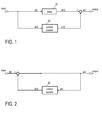
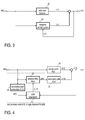
- FIG. 1 and FIG. 2 illustrate a feedforward structure and a feedback structure, respectively, for generating a compensation signal to at least partly compensate for (or ideally to eliminate) the undesired disturbing noise signal.
- the reference signal that represents the noise signal at the location of the noise source is denoted by x[n].
- the disturbing noise at the listening position where noise cancellation is desired is denoted by d[n].
- the compensation signal destructively superposing disturbing noise d[n] at the listening position is denoted by y[n]
- resulting error signal d[n]-y[n] i.e., the residual noise
- Feedforward systems may encompass a higher effectiveness than feedback arrangements, in particular due to the possibility of the broadband reduction of disturbing noises. This is a result of the fact that a signal representing the disturbing noise (i.e., reference signal x[n]) may be directly processed and used to actively counteract disturbing noise signal d[n].
- a signal representing the disturbing noise i.e., reference signal x[n]
- Such a feedforward system is illustrated in FIG. 1 in an exemplary manner.
- FIG. 1 illustrates the signal flow in a basic feedforward structure.
- Input signal x[n] e.g., the noise signal at the noise source, or a signal derived from and correlated to the noise signal
- Input signal x[n] is often referred to as reference signal x[n] for the active noise control.
- Primary path system 10 may basically impose a delay on input signal x[n], for example, due to the propagation of the noise from the noise source to that portion of the listening room (i.e., the listening position) where suppression of the disturbing noise signal should be achieved (i.e., to the desired point of silence).
- the delayed input signal is denoted by d[n] and represents the disturbing noise to be suppressed at the listening position.
- reference signal x[n] is filtered such that the filtered reference signal (denoted by y[n]), when superposed with disturbing noise signal d[n], compensates for the noise due to destructive interference in the respective portion of the listening room.
- the output signal of the feedforward structure of FIG. 1 may be regarded as error signal e[n], which is a residual signal comprising the signal components of disturbing noise signal d[n] that were not suppressed by the superposition with filtered reference signal y[n].
- the signal power of error signal e[n] may be regarded as a quality measure for the noise cancellation achieved.
- Noise suppression active noise control
- An advantageous effect of feedback systems is that they can thereby be effectively operated even if a suitable signal (i.e., a reference signal) correlating with the disturbing noise is not available to control the active noise control arrangement. This is the case, for example, when applying ANC systems in environments that are not known a priori and in which specific information about the noise source is not available.
- FIG. 2 The principle of a feedback structure is illustrated in FIG. 2 .
- undesired acoustic noise signal d[n] is suppressed by a filtered input signal (compensation signal y[n]) provided by feedback control system 20.
- the residual signal (error signal e[n]) serves as an input for feedback loop 20.
- said arrangements are implemented for the most part so as to be adaptive, because the noise level and the spectral composition of the noise to be reduced may, for example, also be subject to chronological changes due to changing ambient conditions.
- the changes of the ambient conditions can be caused by different driving speeds (wind noises, tire noises), different load states, different engine speeds or one or more open windows.
- the transfer functions of the primary and secondary path systems may change over time.
- An unknown system may be iteratively estimated by means of an adaptive filter.
- the filter coefficients of the adaptive filter are thereby modified such that the transfer characteristic of the adaptive filter approximately matches the transfer characteristic of the unknown system.
- digital filters are used as adaptive filters (for example, finite impulse response (FIR) or infinite impulse response (IIR) filters) whose filter coefficients are modified according to a given adaptation algorithm.
- the adaptation of the filter coefficients is a recursive process that permanently optimizes the filter characteristic of the adaptive filter by minimizing an error signal that is essentially the difference between the outputs of the unknown system and the adaptive filter, wherein both are supplied with the same input signal. If a norm of the error signal approaches zero, the transfer characteristic of the adaptive filter approaches the transfer characteristic of the unknown system.
- the unknown system may thus represent the path of the noise signal from the noise source to the spot where noise suppression should be achieved (primary path).
- the noise signal is thereby "filtered" by the transfer characteristic of the signal path, which - in the case of a motor vehicle - essentially comprises the passenger compartment (primary path transfer function).
- the primary path may additionally comprise the transmission path from the actual noise source (e.g., the engine or tires) to the car body or the passenger compartment, as well as the transfer characteristics of the microphones used.
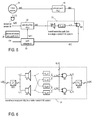
- FIG. 3 generally illustrates the estimation of unknown system 10 by means of adaptive filter 20.
- Input signal x[n] is supplied to unknown system 10 and adaptive filter 20.
- the output signal d[n] of unknown system 10and the output signal y[n] of adaptive filter 20 are destructively superposed (i.e., subtracted); the residual signal, i.e., error signal e[n], is fed back to the adaptation algorithm implemented in adaptive filter 20.
- a least mean square (LMS) algorithm may, for example, be employed for calculating modified filter coefficients such that a norm (e.g., the power) of error signal e[n] becomes minimal.
- LMS least mean square
- the LMS algorithm thereby represents an algorithm for the approximation of the solution to the least mean squares problem, as it is often used when utilizing adaptive filters, which are realized, for example, in digital signal processors.
- the algorithm is based on the method of the steepest descent (gradient descent method) and computes the gradient in a simple manner.
- the algorithm thereby operates in a time-recursive manner. That is, the algorithm is run again with each new data set, and the solution is updated. Due to its relatively low complexity and low memory requirement, the LMS algorithm is often used for adaptive filters and adaptive control, which are realized in digital signal processors. Further methods may include the following: recursive least squares, QR decomposition least squares, least squares lattices, QR decomposition lattices, gradient adaptive lattices, zero forcing, stochastic gradients, etc.
- the filtered-x LMS (FXLMS) algorithm and modifications or extensions thereof are quite often used as special embodiments of the LMS algorithm.
- the modified filtered-x LMS (MFXLMS) algorithm is an example of such a modification.
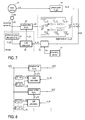
- FIG. 4 illustrates the basic structure of an ANC system employing the FXLMS algorithm in an exemplary manner. It also illustrates the basic principle of a digital feedforward active noise control system. To simplify matters, components such as amplifiers, analog-digital converters and digital-analog converters, which are required for realization, are not illustrated herein. All signals are denoted as digital signals, with time index n placed in squared brackets. Transfer functions are denoted as discrete time transfer functions in the z domain, as ANC systems are usually implemented using digital signal processors.
- Secondary path system 21, with transfer function S(z) is arranged downstream of adaptive filter 22; it represents the signal path from the loudspeaker radiating the compensation signal provided by adaptive filter 22 to the portion of the listening room where noise d[n] should be suppressed.
- the secondary path comprises the transfer characteristics of all components downstream of adaptive filter 21: for example, amplifiers, digital-analog converters, loudspeakers, acoustic transmission paths, microphones and analog-digital converters.
- estimation S*(z) (system 24) of secondary path transfer function S(z) is required.
- Primary path system 10 and secondary path system 21 are "real" systems that essentially represent the physical properties of the listening room, wherein the other transfer functions are implemented in a digital signal processor.
- Input signal x[n] represents the noise signal generated by a noise source and is therefore often referred to as "reference signal”. It is measured by an acoustic or non-acoustic sensor for further processing. Input signal x[n] is transported to a listening position via primary path system 10, which provides disturbing noise signal d[n] as an output at the listening location where noise cancellation is desired. When using a non-acoustic sensor, the input signal may be indirectly derived from the sensor signal. Reference signal x[n] is further supplied to adaptive filter 22, which provides filtered signal y[n].
- Filtered signal y[n] is supplied to secondary path system 21, which provides modified filtered signal y'[n] (i.e., the compensation signal); modified filtered signal y'[n] destructively superposes with disturbing noise signal d[n], which is the output of primary path system 10. Therefore, the adaptive filter has to impose an additional 180° phase shift on the signal path.
- the "result" of the superposition is a measurable residual signal that is used as error signal e[n] for adaptation unit 23.
- estimated model S*(z) of secondary path transfer function S(z) is required.
- Estimated secondary path transfer function S*(z) also receives input signal x[n] and provides modified reference signal x'[n] to adaptation unit 23.
- Residual error signal e[n] which may be measured by means of a microphone, is supplied to adaptation unit 23 and modified input signal x'[n], which is provided by estimated secondary path transfer function S*(z).
- Adaptation unit 23 is configured to calculate filter coefficients w k of adaptive filter transfer function W(z) from modified reference signal x'[n] (filtered x) and error signal e[k] such that a norm (e.g., the power or L 2 norm) of error signal ⁇ e[k] ⁇ becomes minimal.
- a norm e.g., the power or L 2 norm
- An LMS algorithm may be a good choice for this purpose, as already discussed above.
- Circuit blocks 22, 23 and 24 form active noise control unit 20, which may be fully implemented in a digital signal processor.
- Alternatives or modifications of the filtered-x LMS algorithm such as the filtered-e LMS algorithm are of course applicable.
- FIG. 5 illustrates a system for active noise control according to the structure of FIG. 4 .
- FIG. 5 illustrates a single-channel ANC system as an example. A generalization of the multi-channel case will be shown later with reference to FIG. 6 .
- the system of FIG. 5 illustrates noise source 31 generating the input noise signal (i.e., reference signal x[n]) for the ANC system, loudspeaker LS1 radiating filtered reference signal y[n] and microphone M1 sensing residual error signal e[n].
- the noise signal generated by noise source 31 serves as input signal x[n] to the primary path.
- Output d[n] of primary path system 10 represents noise signal d[n] to be suppressed at the listening position.
- Electrical representation x e [n] of input signal x[n] may be provided by acoustic sensor 32 (e.g., a microphone or vibration sensor that is sensitive in the audible frequency spectrum or at least in a desired spectral range thereof).
- Electrical representation x e [n] of input signal x[n] i.e., the sensor signal
- filtered signal y[n] is supplied to secondary path 21.
- the output signal of secondary path 21 is compensation signal y'[n], which is destructively interfering with noise d[n] filtered by primary path 10.
- the residual signal is measured with microphone 32, whose output signal is supplied to adaptation unit 23 as error signal e[n].
- the adaptation unit calculates optimal filter coefficients w k [n] for adaptive filter 22.
- the FXLMS algorithm may be used for this calculation, as discussed above. Since acoustic sensor 32 is capable of detecting the noise signal generated by noise source 31 in a broad frequency band of the audible spectrum, the arrangement of FIG. 5 may be used for broadband ANC applications.
- acoustic sensor 32 may be replaced by a non-acoustic sensor (e.g., a rotational speed sensor) and a signal generator to synthesize electrical representation x e [n] of reference signal x[n].
- the signal generator may use the base frequency, which is measured with the non-acoustic sensor, and higher order harmonics to synthesize reference signal x e [n].
- the non-acoustic sensor may be, for example, a revolution sensor that gives information on the rotational speed of a car engine, which may be regarded as a main noise source.
- the overall secondary path transfer function S(z) comprises the following: the transfer characteristics of loudspeaker LS1, which receives filtered reference signal y[n]; the acoustic transmission path characterized by transfer function S 11 (z); the transfer characteristics of microphone M1; and the transfer characteristics of necessary electrical components such as amplifiers, analog-digital converters, digital-analog converters, etc.
- transfer function S 11 (z) is relevant, as illustrated in FIG. 5 .
- adaptive filter 22 comprises one filter W v (z) for each channel.
- each of the W microphones receives an acoustic signal from each of the V loudspeakers, resulting in a total number of VxW acoustic transmission paths (four transmission paths in the example of FIG. 6 ).
- compensation signal y'[n] is W-dimensional vector y w '[n], each component being superposed with a corresponding disturbing noise signal component d w [n] at the respective listening position where a microphone is located.
- Superposition y w '[n]+d w [n] yields W-dimensional error signal e w [n], wherein compensation signal y w '[n] is at least approximately in phase opposition to noise signal d w [n] at the respective listening position.
- analog-digital converters and digital-analog converters are illustrated in FIG. 6 .
- FIG. 7 illustrates one exemplary multi-channel ANC system in accordance with one example of the invention.
- the example of FIG. 7 is a multi-channel enhancement of the single-channel ANC system of FIG. 4 .
- Adaptive filter 22 is thus supplied with electric reference signal x e [n], and it provides vector y v [n] of six compensation signals y 1 [n], y 2 [n], y 3 [n], y 4 [n], y 5 [n] and y 6 [n], which are supplied to the six respective loudspeakers LS1, LS2, LS3, LS4, LS5 and LS6.
- the resulting sound field gives rise to four compensation signals y' w [n] (modified by the secondary path transfer functions) at the positions of the four respective microphones M1, M2, M3 and M4.
- LMS adaptation unit 23 and the secondary path estimation is essentially the same as in the example of FIG. 4 .
- the vector of error signals e w [n] is supplied to error weighting unit 26, which usually weights (squared) error signals ew[n] to obtain weighted error signals e'w[n].
- the cost function is minimized using the aforementioned LMS algorithms implemented in LMS adaptation unit 23.
- the total error signal is calculated depending on the occupancy of the listening positions (sweet spots).
- the listening room (the target room for ANC) is the passenger compartment of the vehicle.
- the sweet spots can be generated at the driver's position (usually front left, FL) and the three passengers' positions (front right, FR, rear left, RL, and rear right, RR).
- Each of these positions (FL, FR, RL, RR) is associated with at least one microphone and is referred to as a listening position.
- the four microphones M1 (M FR ), M2 (M FL ), M3 (M RL ) and M4 (M RR ) denote the respective listening positions or sweet spots.
- the matrix g ww of weights can also be regarded as the representation of an output of an array of seat occupancy detectors.
- Seat occupancy detectors are already installed and used in many modern vehicles, e.g., to trigger an alarm signal in case a seat is occupied and the respective restraint system (safety belt) is not fastened.
- other sensors such as cameras, head tracking systems or the like may be used.
- any sensor or sensor system capable of detecting whether or not a listener occupies a listening position is regarded as an occupancy sensor.
- the sensor output can thus be used as input for the weighting, as shown, for example, in equations (3) and (4).
- the weighting may be achieved in different ways. As mentioned, multiplication with an appropriate matrix of weights is an option (see equation (4)). However, another option is to simply switch off the microphones (or deactivate the respective microphone amplifiers) for the unoccupied listening positions.
- the improved ANC system is scalable with regard to the number of error microphones used and thus with regard to the number of sweet spots.
- This scaling can be applied to noise reduction systems in general, including road noise cancellation (RNC) and engine order cancellation (EOC) systems.
- Noise reduction systems such as ANC, EOC and RNC systems have essentially the same topology (the signal processing structure) and differ only in the way electrical representation x e [n] of input signal x[n] (the reference signal) is obtained.
- an acoustic sensor such as acoustic sensor 32 (see FIG. 7 )
- non-acoustic sensors may also be used.
- accelerometers are used, which are positioned close to the vehicle's suspension.
- the use of a rotational speed sensor to measure the rotational speed of the engine is another option.
- the most that can be achieved with an ANC/EOC/RNC system is an equal damping of noise in each listening position (sweet spot). Particularly in a car, it is often the case that not all listening positions (seats) are occupied. By reducing the number of microphones and thus the number of sweet spots, the achievable damping in the listening positions that are actually occupied by a person can be improved.
- the noise level in the "deactivated" listening positions may even become higher, as compared to when all error microphones contribute to the total error signal. However, this is irrelevant in a listening position that is not occupied.
- the best performance (i.e., the highest damping of noise in a listening position) may be achieved when only a single error microphone contributes to the total error signal used for the adaptation of adaptive filter 22 (see FIG. 7 ). This single microphone is typically associated with the driver's listening position.
- FIG. 8 For the multi-channel system of FIG. 7 , some details of the filtered-x LMS algorithm are illustrated in FIG. 8 .
- (estimated) secondary path 24 can be represented by a matrix of VxW transfer functions S vw (z).
- estimated reference signal x e [n] is supplied to each filter W 1 (z), W 2 (z), ..., W v (z) of filter bank 22; these filters generate compensation signals y 1 [n], y 2 [n], ..., y v [n] as output signals supplied to loudspeakers L1, L2, ..., LV, respectively.
- VxW secondary path transfer functions Svw(z) are used to generate a corresponding number of VxW filtered (filtered-x) reference signals x vw [n], wherein filtered reference signals x 11 [n], x 12 [n], ..., x 1w [n] are used in the LMS adaptation unit associated with filter W 1 (z), filtered reference signals x 21 [n], x 22 [n], ..., x 2w [n] are used in the LMS adaptation unit associated with filter W 2 (z) and so on, as shown in FIG. 8 .
- weighted error signals e'w[n] are used in the LMS adaptation.
- reference (input) signal x[n] is obtained by estimation in feedback systems (using estimated secondary path system 24') rather than by a sensor (as is the case in feedforward systems; see FIG. 7 ).
- Estimated reference signal(s) x w [n] is/are obtained by adding residual noise ew[n] to estimated compensation signal y" w [n], which is calculated from adaptive filter output signal y v [n] using estimated secondary path transfer matrix S*(z) (system 24' in FIG.
- Signals y' w [n] superpose with the respective noise signals d w [n] at the positions of the microphones. As mentioned before, this superposition is a destructive interference that is modeled by subtractor SUB, which provides the vector of error signals e w [n].
- the error signals may be weighted using error weighting unit 26 in the same manner as described with reference to FIG. 7 .
- one reference signal x w [n] ⁇ x 1 [n], x 2 [n], ..., x w [n] ⁇ is calculated for each listening position by adding estimated compensation signals y" w [n] to error signals e w [n], which were picked up by the error microphones.
- the signal processing structure is known and is thus not discussed in further detail.
- weighted error signals e'[n] are used in the LMS adaptation (FXLMS adaptation unit 23' in FIG. 10 ) of adaptive filter bank 22. That is, error signals e[n], which correspond to unoccupied listening positions, are weighted with zero.
Landscapes
- Physics & Mathematics (AREA)
- Engineering & Computer Science (AREA)
- Acoustics & Sound (AREA)
- Multimedia (AREA)
- Soundproofing, Sound Blocking, And Sound Damping (AREA)
- Fittings On The Vehicle Exterior For Carrying Loads, And Devices For Holding Or Mounting Articles (AREA)
Priority Applications (1)
| Application Number | Priority Date | Filing Date | Title |
|---|---|---|---|
| EP14184177.5A EP2996111A1 (de) | 2014-09-10 | 2014-09-10 | Skalierbares adaptives Lärmschutzsystem |
Applications Claiming Priority (1)
| Application Number | Priority Date | Filing Date | Title |
|---|---|---|---|
| EP14184177.5A EP2996111A1 (de) | 2014-09-10 | 2014-09-10 | Skalierbares adaptives Lärmschutzsystem |
Publications (1)
| Publication Number | Publication Date |
|---|---|
| EP2996111A1 true EP2996111A1 (de) | 2016-03-16 |
Family
ID=51518618
Family Applications (1)
| Application Number | Title | Priority Date | Filing Date |
|---|---|---|---|
| EP14184177.5A Withdrawn EP2996111A1 (de) | 2014-09-10 | 2014-09-10 | Skalierbares adaptives Lärmschutzsystem |
Country Status (1)
| Country | Link |
|---|---|
| EP (1) | EP2996111A1 (de) |
Cited By (14)
| Publication number | Priority date | Publication date | Assignee | Title |
|---|---|---|---|---|
| CN107274881A (zh) * | 2016-03-31 | 2017-10-20 | 哈曼贝克自动系统股份有限公司 | 自动噪声控制 |
| CN107600011A (zh) * | 2017-08-02 | 2018-01-19 | 上海迪彼电子科技有限公司 | 一种汽车发动机噪声的主动控制降噪系统及方法 |
| CN109427324A (zh) * | 2017-08-22 | 2019-03-05 | 通用汽车环球科技运作有限责任公司 | 用于控制源自车辆外部来源的噪声的方法和系统 |
| EP3528241A1 (de) * | 2018-02-20 | 2019-08-21 | Panasonic Intellectual Property Management Co., Ltd. | Rauschminderungsvorrichtung, rauschminderungssystem und rauschminderungssteuerungsverfahren |
| US10418021B2 (en) | 2018-02-21 | 2019-09-17 | Panasonic Intellectual Property Management Co., Ltd. | Noise reduction device, noise reduction system, and noise reduction control method |
| WO2020047293A1 (en) * | 2018-08-31 | 2020-03-05 | Bose Corporation | Systems and methods for noise-cancellation with shaping and weighting filters |
| CN111063334A (zh) * | 2019-12-27 | 2020-04-24 | 博迈科海洋工程股份有限公司 | 一种建筑模块密闭空间前馈主动降噪方法 |
| CN112242146A (zh) * | 2019-07-16 | 2021-01-19 | 阿尔派株式会社 | 噪音降低装置、车辆、噪音降低系统以及噪音降低方法 |
| CN113345401A (zh) * | 2021-05-31 | 2021-09-03 | 锐迪科微电子(上海)有限公司 | 可穿戴设备的主动降噪系统的校准方法及装置、存储介质、终端 |
| CN114067777A (zh) * | 2020-08-06 | 2022-02-18 | 阿尔卑斯阿尔派株式会社 | 主动噪声控制系统 |
| CN115762463A (zh) * | 2022-11-14 | 2023-03-07 | 武汉理工大学 | 一种应用于车内路噪分区主动控制的系统及其控制方法 |
| CN116469365A (zh) * | 2023-05-09 | 2023-07-21 | 重庆长安汽车股份有限公司 | 多区域降噪性能可调的噪声控制系统、方法与计算机设备 |
| EP4362009A1 (de) * | 2022-10-28 | 2024-05-01 | Harman International Industries, Inc. | System und verfahren zur sekundärpfadumschaltung für aktive rauschunterdrückung |
| US12249310B2 (en) | 2022-10-28 | 2025-03-11 | Harman International Industries, Incorporated | System and method for estimating secondary path impulse response for active noise cancellation |
Citations (4)
| Publication number | Priority date | Publication date | Assignee | Title |
|---|---|---|---|---|
| US5426703A (en) * | 1991-06-28 | 1995-06-20 | Nissan Motor Co., Ltd. | Active noise eliminating system |
| US5485523A (en) * | 1992-03-17 | 1996-01-16 | Fuji Jukogyo Kabushiki Kaisha | Active noise reduction system for automobile compartment |
| US5689572A (en) * | 1993-12-08 | 1997-11-18 | Hitachi, Ltd. | Method of actively controlling noise, and apparatus thereof |
| US20100124337A1 (en) * | 2008-11-20 | 2010-05-20 | Harman International Industries, Incorporated | Quiet zone control system |
-
2014
- 2014-09-10 EP EP14184177.5A patent/EP2996111A1/de not_active Withdrawn
Patent Citations (4)
| Publication number | Priority date | Publication date | Assignee | Title |
|---|---|---|---|---|
| US5426703A (en) * | 1991-06-28 | 1995-06-20 | Nissan Motor Co., Ltd. | Active noise eliminating system |
| US5485523A (en) * | 1992-03-17 | 1996-01-16 | Fuji Jukogyo Kabushiki Kaisha | Active noise reduction system for automobile compartment |
| US5689572A (en) * | 1993-12-08 | 1997-11-18 | Hitachi, Ltd. | Method of actively controlling noise, and apparatus thereof |
| US20100124337A1 (en) * | 2008-11-20 | 2010-05-20 | Harman International Industries, Incorporated | Quiet zone control system |
Non-Patent Citations (1)
| Title |
|---|
| KUO S M ET AL: "ACTIVE NOISE CONTROL: A TUTORIAL REVIEW", PROCEEDINGS OF THE IEEE, IEEE. NEW YORK, US, vol. 87, no. 6, 1 June 1999 (1999-06-01), pages 943 - 973, XP011044219, ISSN: 0018-9219, DOI: 10.1109/5.763310 * |
Cited By (21)
| Publication number | Priority date | Publication date | Assignee | Title |
|---|---|---|---|---|
| CN107274881A (zh) * | 2016-03-31 | 2017-10-20 | 哈曼贝克自动系统股份有限公司 | 自动噪声控制 |
| CN107274881B (zh) * | 2016-03-31 | 2024-02-06 | 哈曼贝克自动系统股份有限公司 | 自动噪声控制 |
| CN107600011A (zh) * | 2017-08-02 | 2018-01-19 | 上海迪彼电子科技有限公司 | 一种汽车发动机噪声的主动控制降噪系统及方法 |
| CN109427324A (zh) * | 2017-08-22 | 2019-03-05 | 通用汽车环球科技运作有限责任公司 | 用于控制源自车辆外部来源的噪声的方法和系统 |
| EP3528241A1 (de) * | 2018-02-20 | 2019-08-21 | Panasonic Intellectual Property Management Co., Ltd. | Rauschminderungsvorrichtung, rauschminderungssystem und rauschminderungssteuerungsverfahren |
| US10418021B2 (en) | 2018-02-21 | 2019-09-17 | Panasonic Intellectual Property Management Co., Ltd. | Noise reduction device, noise reduction system, and noise reduction control method |
| EP3844741A1 (de) * | 2018-08-31 | 2021-07-07 | Bose Corporation | Systeme und verfahren zur rauschunterdrückung mit formungs- und gewichtungsfiltern |
| US10741165B2 (en) | 2018-08-31 | 2020-08-11 | Bose Corporation | Systems and methods for noise-cancellation with shaping and weighting filters |
| WO2020047293A1 (en) * | 2018-08-31 | 2020-03-05 | Bose Corporation | Systems and methods for noise-cancellation with shaping and weighting filters |
| US11276385B2 (en) | 2019-07-16 | 2022-03-15 | Alpine Electronics, Inc. | Noise reduction device, vehicle, noise reduction system, and noise reduction method |
| EP3767618A1 (de) * | 2019-07-16 | 2021-01-20 | Alpine Electronics, Inc. | Rauschminderungsvorrichtung, fahrzeug, rauschminderungssystem und rauschminderungssteuerungsverfahren |
| CN112242146A (zh) * | 2019-07-16 | 2021-01-19 | 阿尔派株式会社 | 噪音降低装置、车辆、噪音降低系统以及噪音降低方法 |
| CN112242146B (zh) * | 2019-07-16 | 2025-06-24 | 阿尔派株式会社 | 噪音降低装置、车辆以及噪音降低方法 |
| CN111063334A (zh) * | 2019-12-27 | 2020-04-24 | 博迈科海洋工程股份有限公司 | 一种建筑模块密闭空间前馈主动降噪方法 |
| CN114067777A (zh) * | 2020-08-06 | 2022-02-18 | 阿尔卑斯阿尔派株式会社 | 主动噪声控制系统 |
| CN113345401A (zh) * | 2021-05-31 | 2021-09-03 | 锐迪科微电子(上海)有限公司 | 可穿戴设备的主动降噪系统的校准方法及装置、存储介质、终端 |
| EP4362009A1 (de) * | 2022-10-28 | 2024-05-01 | Harman International Industries, Inc. | System und verfahren zur sekundärpfadumschaltung für aktive rauschunterdrückung |
| US12230241B2 (en) | 2022-10-28 | 2025-02-18 | Harman International Industries, Incorporated | System and method for secondary path switching for active noise cancellation |
| US12249310B2 (en) | 2022-10-28 | 2025-03-11 | Harman International Industries, Incorporated | System and method for estimating secondary path impulse response for active noise cancellation |
| CN115762463A (zh) * | 2022-11-14 | 2023-03-07 | 武汉理工大学 | 一种应用于车内路噪分区主动控制的系统及其控制方法 |
| CN116469365A (zh) * | 2023-05-09 | 2023-07-21 | 重庆长安汽车股份有限公司 | 多区域降噪性能可调的噪声控制系统、方法与计算机设备 |
Similar Documents
| Publication | Publication Date | Title |
|---|---|---|
| EP2996112B1 (de) | Adaptives Rauschunterdrückungsystem mit verbesserter Robustheit | |
| EP2996111A1 (de) | Skalierbares adaptives Lärmschutzsystem | |
| US10373600B2 (en) | Active noise control system | |
| EP2216774B1 (de) | Adaptives Geräuschdämpfungssystem und entsprechendes Verfahren | |
| US8565443B2 (en) | Adaptive noise control system | |
| EP3437090B1 (de) | Adaptive modellierung eines sekundären pfads in einem system zur aktiven rauschunterdrückung | |
| EP2239729B1 (de) | Ruhezonen-Steuersystem | |
| EP3188181B1 (de) | Aktives lärmschutzsystem mit quellengetrenntem referenzsignal | |
| JP7149336B2 (ja) | フィードバック補償を用いたアクティブノイズコントロール | |
| CN112805778A (zh) | 用于使用麦克风投射进行噪声消除的系统和方法 | |
| EP3759708B1 (de) | Vorwärtsgekoppelte aktive geräuschsteuerung | |
| EP2257082A1 (de) | Hintergrundgeräusch-Schätzung in einem Lautsprecher-Raum-Mikrophon-System | |
| US12597411B2 (en) | Systems and methods for virtual microphones in active noise cancellation |
Legal Events
| Date | Code | Title | Description |
|---|---|---|---|
| PUAI | Public reference made under article 153(3) epc to a published international application that has entered the european phase |
Free format text: ORIGINAL CODE: 0009012 |
|
| AK | Designated contracting states |
Kind code of ref document: A1 Designated state(s): AL AT BE BG CH CY CZ DE DK EE ES FI FR GB GR HR HU IE IS IT LI LT LU LV MC MK MT NL NO PL PT RO RS SE SI SK SM TR |
|
| AX | Request for extension of the european patent |
Extension state: BA ME |
|
| STAA | Information on the status of an ep patent application or granted ep patent |
Free format text: STATUS: THE APPLICATION IS DEEMED TO BE WITHDRAWN |
|
| 18D | Application deemed to be withdrawn |
Effective date: 20160917 |