EP2996280A1 - Kommunikationsverfahren und -vorrichtung mit public-key-verschlüsselung - Google Patents
Kommunikationsverfahren und -vorrichtung mit public-key-verschlüsselung Download PDFInfo
- Publication number
- EP2996280A1 EP2996280A1 EP15790431.9A EP15790431A EP2996280A1 EP 2996280 A1 EP2996280 A1 EP 2996280A1 EP 15790431 A EP15790431 A EP 15790431A EP 2996280 A1 EP2996280 A1 EP 2996280A1
- Authority
- EP
- European Patent Office
- Prior art keywords
- polynomial
- random
- truncated
- system parameter
- ring
- Prior art date
- Legal status (The legal status is an assumption and is not a legal conclusion. Google has not performed a legal analysis and makes no representation as to the accuracy of the status listed.)
- Withdrawn
Links
- 238000000034 method Methods 0.000 title claims abstract description 149
- 238000004891 communication Methods 0.000 title claims abstract description 62
- 238000004364 calculation method Methods 0.000 claims abstract description 61
- 238000004422 calculation algorithm Methods 0.000 description 17
- 238000010586 diagram Methods 0.000 description 9
- 230000008569 process Effects 0.000 description 7
- 238000012545 processing Methods 0.000 description 7
- 230000000694 effects Effects 0.000 description 6
- 238000005516 engineering process Methods 0.000 description 2
- 238000012067 mathematical method Methods 0.000 description 2
- 238000011160 research Methods 0.000 description 2
- 238000011161 development Methods 0.000 description 1
- 230000003993 interaction Effects 0.000 description 1
- 238000012986 modification Methods 0.000 description 1
- 230000004048 modification Effects 0.000 description 1
- 230000003287 optical effect Effects 0.000 description 1
Images



Classifications
-
- H—ELECTRICITY
- H04—ELECTRIC COMMUNICATION TECHNIQUE
- H04L—TRANSMISSION OF DIGITAL INFORMATION, e.g. TELEGRAPHIC COMMUNICATION
- H04L9/00—Cryptographic mechanisms or cryptographic arrangements for secret or secure communications; Network security protocols
- H04L9/06—Cryptographic mechanisms or cryptographic arrangements for secret or secure communications; Network security protocols the encryption apparatus using shift registers or memories for block-wise or stream coding, e.g. DES systems or RC4; Hash functions; Pseudorandom sequence generators
- H04L9/0618—Block ciphers, i.e. encrypting groups of characters of a plain text message using fixed encryption transformation
-
- H—ELECTRICITY
- H04—ELECTRIC COMMUNICATION TECHNIQUE
- H04L—TRANSMISSION OF DIGITAL INFORMATION, e.g. TELEGRAPHIC COMMUNICATION
- H04L9/00—Cryptographic mechanisms or cryptographic arrangements for secret or secure communications; Network security protocols
- H04L9/30—Public key, i.e. encryption algorithm being computationally infeasible to invert or user's encryption keys not requiring secrecy
- H04L9/3093—Public key, i.e. encryption algorithm being computationally infeasible to invert or user's encryption keys not requiring secrecy involving Lattices or polynomial equations, e.g. NTRU scheme
Definitions
- Embodiments of the present invention relate to communications technologies, and in particular, to a method and an apparatus for public-key encrypted communication.
- the public key encryption manner has two important principles: First, it is required that an encrypted ciphertext must be secure on the premise that an encryption algorithm and a public key are both made public; second, it is required that calculation or processing for both data encryption at the transmit end and data decryption at the receive end by using a private key should be simple but deciphering should be difficult for other persons not having the private key.
- NTRU Network Theory Research Unit
- the NTRU is a cryptographic system based on a polynomial ring.
- a specific algorithm is as follows: using a public key and a private key respectively for encryption and decryption, where the public key and the private key are calculated according to system parameters N, p, and q and two randomly selected polynomials f and g .
- N, p, and q parameters for encryption and decryption
- Embodiments of the present invention provide a method and an apparatus for public-key encrypted communication, so as to achieve a public-key encrypted communication manner with higher security.
- a first aspect of the embodiments of the present invention provides a method for public-key encrypted communication, including:
- the random information includes a first random polynomial and a second random polynomial
- the performing, by a first device, encryption according to a first public key and random information to obtain a first ciphertext specifically includes:
- the plaintext information is represented as a polynomial on a second truncated polynomial ring modulo a second system parameter
- the encrypting, by the first device, plaintext information according to a second public key to obtain a second ciphertext specifically includes:
- the calculating, by the first device, on a first truncated polynomial ring modulo a first system parameter according to the first public key, the first random polynomial, and the second random polynomial, to obtain the first ciphertext specifically includes:
- the calculating, by the first device, on the second truncated polynomial ring modulo the second system parameter according to the second public key, the first random polynomial, the second random polynomial, and the plaintext information, to obtain the second ciphertext specifically includes:
- the first public key is obtained through calculation on the first truncated polynomial ring modulo the first system parameter according to the first system parameter, a third random polynomial, and a fourth random polynomial
- the third random polynomial has an inverse element on both the first truncated polynomial ring modulo the first system parameter and a third truncated polynomial ring modulo a third system parameter
- the fourth random polynomial has an inverse element on the first truncated polynomial ring modulo the first system parameter.
- the second public key is randomly selected on the second truncated polynomial ring, and the second truncated polynomial ring is Z q 2 [ X ]/ X N - 1 .
- a second aspect of the embodiments of the present invention provides a method for public-key encrypted communication, including:
- the calculating, by the second device, according to a first private key, a second private key, and the first ciphertext to obtain a second random polynomial specifically includes:
- the obtaining a first random polynomial according to a third private key specifically includes:
- the obtaining, by the second device, plaintext information according to the first random polynomial, the second random polynomial, the second ciphertext, and a second public key specifically includes:
- the calculating, by the second device, on a first truncated polynomial ring modulo a first system parameter according to the first ciphertext and the first private key to obtain a procedure parameter specifically includes:
- the obtaining, by the second device, the second random polynomial on a third truncated polynomial ring modulo a third system parameter according to the procedure parameter and the second private key specifically includes:
- the calculating, by the second device, on the first truncated polynomial ring modulo the first system parameter according to the procedure parameter and the third private key to obtain the first random polynomial specifically includes:
- the calculating, by the second device, on a second truncated polynomial ring modulo a second system parameter according to the first random polynomial, the second random polynomial, the second ciphertext, and the second public key to obtain the plaintext information specifically includes:
- the first private key is a third random polynomial
- the second private key is an inverse element of the third random polynomial on the third truncated polynomial ring modulo the third system parameter
- the third private key is obtained through calculation according to an inverse element of the third system parameter and an inverse element of a fourth random polynomial on the first truncated polynomial ring modulo the first system parameter.
- a third aspect of the embodiments of the present invention provides an apparatus for public-key encrypted communication, including:
- the random information includes a first random polynomial and a second random polynomial
- the encryption unit is specifically configured to:
- the plaintext information is represented as a polynomial on a second truncated polynomial ring modulo a second system parameter, and the encryption unit is further specifically configured to:
- the encryption unit is configured to calculate on the first truncated polynomial ring modulo the first system parameter according to the first public key, the first random polynomial, and the second random polynomial to obtain the first ciphertext, and is specifically configured to:
- the encryption unit is configured to calculate on the second truncated polynomial ring modulo the second system parameter according to the second public key, the first random polynomial, the second random polynomial, and the plaintext information to obtain the second ciphertext, and is specifically configured to:
- the first public key is obtained through calculation on the first truncated polynomial ring modulo the first system parameter according to the first system parameter, a third random polynomial, and a fourth random polynomial
- the third random polynomial has an inverse element on both the first truncated polynomial ring modulo the first system parameter and a third truncated polynomial ring modulo a third system parameter
- the fourth random polynomial has an inverse element on the first truncated polynomial ring modulo the first system parameter.
- the second public key is randomly selected on the second truncated polynomial ring, and the second truncated polynomial ring is Z q 2 [ X ]/ X N - 1 .
- a fourth aspect of the embodiments of the present invention provides an apparatus for public-key encrypted communication, including:
- the decryption unit is specifically configured to:
- the decryption unit is further specifically configured to:
- the decryption unit is further specifically configured to:
- the decryption unit calculates on the first truncated polynomial ring modulo the first system parameter according to the first ciphertext and the first private key to obtain the procedure parameter, and is specifically configured to:
- the decryption unit obtains the second random polynomial on the third truncated polynomial ring modulo the third system parameter according to the procedure parameter and the second private key, and is specifically configured to:
- the decryption unit calculates on the first truncated polynomial ring modulo the first system parameter according to the procedure parameter and the third private key to obtain the first random polynomial, and is specifically configured to:
- the decryption unit calculates on the second truncated polynomial ring modulo the second system parameter according to the first random polynomial, the second random polynomial, the second ciphertext, and the second public key to obtain the plaintext information, and is specifically configured to:
- the first private key is a third random polynomial
- the second private key is an inverse element of the third random polynomial on the third truncated polynomial ring modulo the third system parameter
- the third private key is obtained through calculation according to an inverse element of the third system parameter and an inverse element of a fourth random polynomial on the first truncated polynomial ring modulo the first system parameter.
- a first device encrypts random information according to a first public key to obtain a first ciphertext, and encrypts plaintext information according to a second public key to obtain a second ciphertext, where the plaintext information is unencrypted data to be sent by the first device to a second device, the first public key is represented in a form of a polynomial, the first public key is obtained through calculation on a truncated polynomial ring according to system parameters, the second public key is represented in a form of a polynomial, the second public key is randomly selected on a truncated polynomial ring, and the random information is randomly selected on a truncated polynomial ring; and the first device sends the first ciphertext and the second ciphertext to the second device.
- This is equivalent to using random information as a shared key, encrypting the random information, and then using a public key and
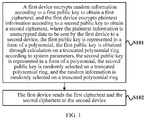
- FIG. 1 is a flowchart of Embodiment 1 of a method for public-key encrypted communication according to the present invention. As shown in FIG. 1 , the method in this embodiment may include:
- devices at a transmit end and a receive end for public key communication may be respectively referred to as a first device and a second device, and unencrypted data to be sent by the first device to the second device during public key communication may be referred to as plaintext information.
- the first public key and the second public key may be generated by a key generation device for the public key communication.
- the key generation device may be the second device or another trusted third-party device.
- the first device acquires, from the key generation device, the first public key and the first public key that are required for encrypted communication with the second device, that is, a public key certificate of the second device.
- the key generation device also generates a first private key, a second private key, and a third private key, which are paired with the first public key and the second public key.
- Information about the public keys is stored in a public key certificate issued by a public key infrastructure (Public Key Infrastructure, PKI for short).
- the first public key may be represented in a form of a polynomial.
- the first public key may be calculated on a truncated polynomial ring according to system parameters.
- System parameters refer to a group of parameters preset by the key generation device, the first device at the transmit end, and the first device at the receive end based on consideration of security and calculation efficiency in a process of public key communication.
- a truncated polynomial ring refers to a set of univariate (N-1) th -degree polynomials whose coefficients are integers. The truncated polynomial ring used to calculate the first public key may be determined according to the system parameters used in this public key communication.
- the second public key may be represented in a form of a polynomial.
- the second public key is randomly selected on a truncated polynomial ring.
- the truncated polynomial ring used to select the second public key may be determined according to the system parameters used in this public key communication.
- the random information may be randomly selected on a truncated polynomial ring by the first device according to requirements on security and encryption efficiency, that is, the random information may be any univariate polynomial.
- Coefficients of the univariate polynomial may constitute a vector, and a norm value of the vector of the coefficients is inversely proportional to encryption efficiency. Therefore, the first device may preferably use a univariate polynomial whose vector of coefficients has the smallest norm as the random information.
- the first ciphertext obtained by the first device by using the first public key to encrypt the random information and the second ciphertext obtained by the first device by encrypting the plaintext information according to the second public key and the random information are a pair of polynomials.
- That the first device encrypts the random information according to the first public key to obtain the first ciphertext is similar to that two communication parties first negotiate a shared key and insert the shared key into a type of one-way trapdoor function, so as to implement probabilistic encryption.
- the random information is carried.
- the random information is equivalent to the shared key of the two communication parties.
- That the first device encrypts the plaintext information according to the second public key to obtain the second ciphertext is similar to using a shared key to implement one-time pad encryption.
- the second ciphertext carries the plaintext information. According to the encryption mode for obtaining the second ciphertext, the plaintext information is not leaked.
- the foregoing method is used to verify security of the encryption manner in the present invention; because in the present invention, encryption is performed twice by constructing two polynomial-based one-way trapdoor functions, the probability that an attacker breaks semantic security of the algorithm is negligible, while the probability that semantic security of the NTRU encryption algorithm in the prior art is broken is non-negligible. Therefore, it can be proved by using a mathematical method that the present invention has higher security compared with the prior art.
- a first device encrypts random information according to a first public key to obtain a first ciphertext, and encrypts plaintext information according to a second public key to obtain a second ciphertext, where the plaintext information is unencrypted data to be sent by the first device to a second device, the first public key is represented in a form of a polynomial, the first public key is obtained through calculation on a truncated polynomial ring according to system parameters, the second public key is represented in a form of a polynomial, the second public key is randomly selected on a truncated polynomial ring, and the random information is randomly selected on a truncated polynomial ring; and the first device sends the first ciphertext and the second ciphertext to the second device.
- This is equivalent to using random information as a shared key, encrypting the random information, and then using a public key and the
- Embodiment 1 of the method shown in FIG. 1 includes an optional implementation manner, which is different from the method shown in FIG. 1 in that:
- the performing, by a first device, encryption according to a first public key and random information to obtain a first ciphertext in S101 may specifically include:
- the plaintext information in S101 may be represented as a polynomial on a second truncated polynomial ring modulo a second system parameter.
- the encrypting, by the first device, plaintext information according to a second public key to obtain a second ciphertext in S101 may specifically include:
- the first public key in S101-1 may be obtained through calculation on the first truncated polynomial ring by the key generation device according to the first system parameter, a third random polynomial, and a fourth random polynomial.
- the third random polynomial and the fourth random polynomial may be randomly selected by the key generation device.
- a value range of the third random polynomial should satisfy that the third random polynomial has an inverse element on both the first truncated polynomial ring modulo the first system parameter and a third truncated polynomial ring modulo a third system parameter, and a value range of the fourth random polynomial is a polynomial having an inverse element on the first truncated polynomial ring.
- the second public key in S101-2 may be randomly selected by the key generation device, and a value range of the second public key is any polynomial on the second truncated polynomial ring.
- the first system parameter in S101-1, the second system parameter in S101-2, and a fourth system parameter N may all be preset by the key generation device according to requirements on security and key generation performance.
- 503 may be selected as the fourth system parameter N .
- q 1 is 239, and q 2 is 241; or q 1 is 269, and q 2 is 271.
- a truncated polynomial ring refers to a set of univariate (N-1) th -degree polynomials whose coefficients are integers, and can be generally represented as Z [ X ]/ X N -1; the first truncated polynomial ring Z q 1 [ X ]/ X N -1 modulo the first system parameter in S101-1 refers to a truncated polynomial ring obtained from the truncated polynomial ring modulo the first system parameter.
- the third truncated polynomial ring Z p [ X ]/ X N -1 modulo the third system parameter refers to a truncated polynomial ring obtained from the truncated polynomial ring modulo the third system parameter.
- a modulo operation on a polynomial refers to division of a polynomial by a modulus polynomial
- a result of the modulo operation on the polynomial refers to a remainder polynomial obtained through division of the polynomial by the modulus polynomial.
- an operation result of a polynomial modulo a polynomial X N -1 is a remainder polynomial of division of the polynomial by the polynomial X N - 1.
- modulo operation results within an absolute minimum complete residue system are used.
- operation results within a minimum complete residue system of a natural number modulo 3 are -1, 0, and 1 instead of 0, 1, and 2.
- a polynomial whose coefficient is +1 or -1 or 0 may be selected on the truncated polynomial ring Z [ X ]/ X N -1, where a quantity of terms whose coefficient is +1 is about N/3, a quantity of terms whose coefficient is -1 is about N/3-1, and coefficients of the rest of the terms are 0.
- the first device sends the first ciphertext and the second ciphertext to the second device, so that the second device performs decryption according to the first ciphertext and the second ciphertext as well as the first private key, the second private key, and the third private key that correspond to the first public key and the second public key to obtain the plaintext information.
- This is equivalent to using random information as a shared key, encrypting the random information, and then using a public key and the random information to encrypt plaintext information, thereby achieving a public-key encrypted communication manner with higher security.
- the encryption method of the present invention has some improvements in aspects of encryption speed, decryption speed, and ciphertext expansion ratio.
- FIG. 2 is a flowchart of Embodiment 2 of a method for public-key encrypted communication according to the present invention. As shown in FIG. 2 , the method in this embodiment may include:
- the first ciphertext and the second ciphertext that are sent by the first device and received by the second device are encrypted data, and the first ciphertext and the second ciphertext may be a pair of polynomials.
- the first private key may be represented in a form of a polynomial, and the first private key may be randomly selected on a truncated polynomial ring;
- the second private key may be represented in a form of a polynomial, and the second private key may be an inverse element of the first private key on the truncated polynomial ring;
- the third private key may be represented in a form of a polynomial, and the third private key may be obtained through calculation according to an inverse element of a system parameter and a polynomial having an inverse element on a truncated polynomial.
- System parameters refer to a group of parameters preset by a key generation device, the first device at the transmit end, and the first device at the receive end based on consideration of security and calculation efficiency in a process of public key communication.
- a truncated polynomial ring refers to a set of univariate (N-1) th -degree polynomials whose coefficients are integers.
- the truncated polynomial ring used to select the first private key, the truncated polynomial ring used to select the second private key, and the truncated polynomial ring used to select the third private key may be separately determined according to the system parameters used in this public key communication.
- the second device acquires, from the key generation device for public key communication, private key information and public key information that are required for decryption.
- the key generation device may be the second device or another trusted third-party device.
- the first private key, the second private key, the third private key, and the second public key may be generated by the key generation device for public key communication.
- the first private key, the second private key, and the third private key that are generated by the key generation device match the first public key and the second public key.
- the process in which the second device calculates according to the first private key, the second private key, the first system parameter, and the first ciphertext to obtain the second random polynomial and obtains the first random polynomial according to the third private key is similar to that two communications parties negotiate a shared key, obtain the second random polynomial corresponding to a one-way trapdoor function through decryption according to the first private key, the second private key, and the first ciphertext, and obtain the first random polynomial through decryption according to the third private key, which is equivalent to acquiring the shared key of the two communications parties from the first ciphertext.
- the one-way trapdoor function is used by the first device during data encryption, and the system parameter is the same as a system parameter used by the first device during data encryption.
- the second device can calculate according to the one-way trapdoor function used by the first device in the encryption process, the first private key, the second private key, the first system parameter, the third private key, and the first ciphertext to obtain the second random polynomial and the first random polynomial.
- the second device can calculate according to the one-way trapdoor function used by the first device in the encryption process, the first random polynomial, the second random polynomial, the second public key, and the second ciphertext to obtain the plaintext information.
- Security of the method shown in this embodiment of the present invention is the same as that of the method shown in FIG. 1 .
- Embodiment 2 of the method shown in FIG. 2 includes an optional implementation manner, which is different from the method shown in FIG. 2 in that:
- the obtaining a first random polynomial according to a third private key in S202 may specifically include:
- the obtaining, by the second device, plaintext information according to the first random polynomial, the second random polynomial, the second ciphertext, and a second public key in S203 may specifically include:
- the first private key is a third random polynomial
- the second private key is an inverse element of the third random polynomial on the third truncated polynomial ring modulo the third system parameter
- the third private key is obtained through calculation according to an inverse element of the third system parameter and an inverse element of a fourth random polynomial on the first truncated polynomial ring modulo the first system parameter.
- the third random polynomial and the fourth random polynomial are randomly selected by the key generation device.
- a value range of the third random polynomial is a polynomial having an inverse element on both the first truncated polynomial and the third truncated polynomial ring modulo the third system parameter
- a value range of the fourth random polynomial is a polynomial having an inverse element on the first truncated polynomial ring modulo the first system parameter.
- the second device receives a first ciphertext and a second ciphertext that are sent by a first device, and calculates according to a first private key, a second private key, a first system parameter, a third private key, and the first ciphertext to obtain a second random polynomial and a first random polynomial, and then obtains plaintext information according to the first random polynomial, the second random polynomial, the second ciphertext, and a second public key.
- This achieves a public-key encrypted communication manner whose security can be proved.
- the encryption method of this application has some improvements in aspects of encryption speed, decryption speed, and ciphertext expansion ratio.
- FIG. 3 is a flowchart of Embodiment 3 of a method for public-key encrypted communication according to the present invention.
- This embodiment describes a process of interaction between a first device at a transmit end and a second device at a receive end that use the methods for public-key encrypted communication shown in FIG. 1 and FIG. 2 .
- the method in this embodiment may include:
- the plaintext information is unencrypted data to be sent by the first device to a second device, and the random information is randomly selected on a truncated polynomial ring.
- the first public key and the second public key are generated by a key generation device, and the key generation device may be the second device or another trusted third-party device.
- the first public key is represented in a form of a polynomial, and the first public key is obtained through calculation on a truncated polynomial ring according to system parameters.
- the second public key is represented in a form of a polynomial, and the second public key is randomly selected on a truncated polynomial ring.
- the first random polynomial may be represented as a polynomial on a second truncated polynomial ring modulo a second system parameter.
- the first private key, the second private key, and the third public key are generated by a key generation device, and the key generation device may be the second device or another trusted third-party device.
- the first private key may be represented in a form of a polynomial, and the first private key may be randomly selected on a truncated polynomial ring;
- the second private key may be represented in a form of a polynomial, and the second private key may be an inverse element of the first private key on the truncated polynomial ring;
- the third private key may be represented in a form of a polynomial, and the third private key may be obtained through calculation according to an inverse element of a system parameter and a polynomial having an inverse element on a truncated polynomial.
- step 301 the method further includes:
- the first public key may be represented in a form of a polynomial, and the first public key is obtained through calculation on a truncated polynomial ring according to system parameters;
- the second public key is represented in a form of a polynomial, and the second public key is randomly selected on a truncated polynomial ring;
- the first private key is represented in a form of a polynomial, the first private key is randomly selected on a truncated polynomial ring,
- the second private key is represented in a form of a polynomial, the second private key is an inverse element of the first private key on the truncated polynomial ring,
- the third private key is represented in a form of a polynomial, and the third private key is obtained through calculation according to an inverse element of a system parameter and a polynomial having an inverse element on a truncated polynomial.
- the first device may search for the public keys of the second device by using a PKI.
- This embodiment has the same technical solution and technical effect as those of the methods for public-key encrypted communication shown in FIG. 1 and FIG. 2 , and the details are not described herein again.
- the first device sends the first ciphertext and the second ciphertext to the second device
- the second device performs decryption according to the first ciphertext and the second ciphertext as well as the first private key, the second private key, and the third private key that correspond to the first public key and the second public key to obtain the plaintext information, thereby achieving a public-key encrypted communication manner whose security can be proved.
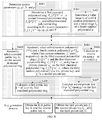
- FIG. 4 is a schematic processing diagram of an optional implementation manner of step 300 in the method shown in FIG. 3 . As shown in FIG. 4 , this embodiment is executed by a key generation device.
- the key generation device may be the second device or the third-party device.
- the method in this embodiment may include:
- the key generation device publishes q 1 , q 2 , p, and N, where h 1 and h 2 are public keys of the second device.
- This embodiment has the same technical solution and technical effect as those of the methods for public-key encrypted communication shown in FIG. 1 to FIG. 3 , and the details are not described herein again.
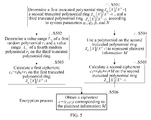
- FIG. 5 is a schematic processing diagram of an optional implementation manner of step 301 in the method shown in FIG. 3 . As shown in FIG. 5 , this embodiment is executed by a first device. The method in this embodiment may include:
- This embodiment has the same technical solution and technical effect as those of the methods for public-key encrypted communication shown in FIG. 1 to FIG. 4 , and the details are not described herein again.
- FIG. 6 is a schematic processing diagram of an optional implementation manner of step 303 and step 304 in the method shown in FIG. 3 . As shown in FIG. 6 , this embodiment is executed by a second device. The method in this embodiment may include:
- h 2 is the second public key
- c 2 is the second ciphertext
- h 2 and c 2 may be obtained by using the method shown in FIG. 4 .
- This embodiment has the same technical solution and technical effect as those of the methods for public-key encrypted communication shown in FIG. 1 to FIG. 5 , and the details are not described herein again.
- an embodiment of the present invention further provides an optional implementation manner, which is different from the methods shown in FIG. 4 to FIG. 6 in that step S405 in the method shown in FIG. 4 may be implemented by using a method shown in S405-1.
- f q 1 ⁇ 1 is an inverse element of the third random on the first truncated polynomial ring modulo the first system parameter
- g is the fourth random polynomial
- q 1 is the first system parameter
- the first truncated polynomial ring is Z q 1 [ X ]/ X N - 1 .
- step S503 in the method shown in FIG. 5 may be implemented by using a method shown in S503-1.
- h 1 is a first public key, and h 1 may be obtained by using the method shown in step S405-1.
- the encryption manner provided in the present invention can still provide higher security.
- the encryption method of the present invention has some advantages in aspects of encryption speed, decryption speed, and ciphertext expansion ratio. A specific comparison is as follows:
- the encryption speed of the method for public-key encrypted communication in the present invention is higher than that of the NTRU algorithm.
- a to-be-encrypted plaintext has a length of N log 2 p log 2 q 2 bits.
- a plaintext having a length of N log 2 q 2 bits can be encrypted each time; therefore, encryption needs to be performed for log 2 p times.
- the solution of the present invention requires about 2log 2 p polynomial multiplication operations on the ring Z q 1 [ X ]/ X N - 1 .
- the original NTRU algorithm can encrypt a plaintext having a length of N log 2 p bits each time; therefore, to encrypt a plaintext having a length of N log 2 p log 2 q 2 bits, the NTRU requires log 2 q 2 ⁇ log 2 q 1 times of encryption.
- a ratio of the quantity of calculations required by the present invention to the quantity of calculations required by the NTRU algorithm is about 2log 2 p :log 2 q 1 .
- the ratio is about 0.4, that is, the encryption speed of the present invention is about 2.5 times that of the NTRU.
- the decryption speed of the method for public-key encrypted communication in the present invention is higher than that of the NTRU algorithm.
- plaintext information corresponding to a to-be-decrypted ciphertext has a length of N log 2 p log 2 q 2 bits.
- the present invention requires about 3.04 multiplication operations on the ring Z q 1 [ X ]/ X N - 1 . Therefore, to decrypt a ciphertext corresponding to a plaintext having a length of N log 2 p log 2 q 2 bits, the present invention requires about 3.04log 2 p multiplication operations on the ring Z q 1 [ X ]/ X N - 1 .
- the NTRU algorithm requires running a decryption algorithm for log 2 q 2 ⁇ log 2 q 1 times.
- the plaintext information is represented as a polynomial on a second truncated polynomial ring modulo a second system parameter, and the encryption unit 11 is further specifically configured to:
- the first public key is obtained through calculation on the first truncated polynomial ring modulo the first system parameter according to the first system parameter, a third random polynomial, and a fourth random polynomial, the third random polynomial has an inverse element on both the first truncated polynomial ring modulo the first system parameter and a third truncated polynomial ring modulo a third system parameter, and the fourth random polynomial has an inverse element on the first truncated polynomial ring modulo the first system parameter.
- the second public key is randomly selected on the second truncated polynomial ring.
- the encryption unit 11 is configured to calculate on the first truncated polynomial ring modulo the first system parameter according to the first public key, the first random polynomial, and the second random polynomial to obtain the first ciphertext, and is specifically configured to:
- the encryption unit 11 is configured to calculate on the second truncated polynomial ring modulo the second system parameter according to the second public key, the first random polynomial, the second random polynomial, and the plaintext information to obtain the second ciphertext, and is specifically configured to:
- the first public key is obtained through calculation on the first truncated polynomial ring according to p f q 1 ⁇ 1 g , where p is the third system parameter, f is the third random polynomial, f q 1 ⁇ 1 is an inverse element of the third random polynomial on the first truncated polynomial ring modulo the first system parameter, g is the fourth random polynomial, q 1 is the first system parameter, and the first truncated polynomial ring is Z q 1 [ X ]/X N - 1; and the second public key is randomly selected on the second truncated polynomial ring, and the second truncated polynomial ring is Z q 2 [ X ]/ X N - 1 .
- the apparatus in this embodiment may be configured to execute the technical solutions of the method embodiments shown in FIG. 1 to FIG. 6 .
- the implementation principle and technical effect of this embodiment are similar to those of the method embodiments shown in FIG. 1 to FIG. 6 , and the details are not described herein again.
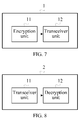
- FIG. 8 is a schematic structural diagram of Embodiment 2 of an apparatus for public-key encrypted communication according to the present invention.
- the apparatus in this embodiment may be a second device, that is, a receive end for public key communication.
- the apparatus 2 in this embodiment may include: a transceiver unit 11 and a decryption unit 12, where the transceiver unit 11 is configured to receive a first ciphertext and a second ciphertext that are sent by a first device; and the decryption unit 12 is configured to calculate according to a first private key, a second private key, and the first ciphertext to obtain a second random polynomial, and obtain a first random polynomial according to a third private key, where the first private key is represented in a form of a polynomial, the first private key is randomly selected on a truncated polynomial ring, the second private key is represented in a form of a polynomial, the second private key is an inverse element of
- the decryption unit 12 is specifically configured to:
- the decryption unit 12 is further specifically configured to:
- the decryption unit 12 is further specifically configured to:
- the first private key is a third random polynomial
- the second private key is an inverse element of the third random polynomial on the third truncated polynomial ring modulo the third system parameter
- the third private key is obtained through calculation according to an inverse element of the third system parameter and an inverse element of a fourth random polynomial on the first truncated polynomial ring modulo the first system parameter.
- the decryption unit 12 calculates on the first truncated polynomial ring modulo the first system parameter according to the first ciphertext and the first private key to obtain the procedure parameter, and may be specifically configured to:
- the decryption unit 12 obtains the second random polynomial on the third truncated polynomial ring modulo the third system parameter according to the procedure parameter and the second private key, and may be specifically configured to:
- the decryption unit 12 calculates on the first truncated polynomial ring modulo the first system parameter according to the procedure parameter and the third private key to obtain the first random polynomial, and may be specifically configured to:
- the decryption unit 12 calculates on the second truncated polynomial ring modulo the second system parameter according to the first random polynomial, the second random polynomial, the second ciphertext, and the second public key to obtain the plaintext information, and may be specifically configured to:
- the apparatus in this embodiment may be configured to execute the technical solutions of the method embodiments shown in FIG. 1 to FIG. 6 .
- the implementation principle and technical effect of this embodiment are similar to those of the method embodiments shown in FIG. 1 to FIG. 6 , and the details are not described herein again.
- the program may be stored in a computer-readable storage medium.
- the foregoing storage medium includes: any medium that can store program code, such as a ROM, a RAM, a magnetic disk, or an optical disc.
Landscapes
- Engineering & Computer Science (AREA)
- Signal Processing (AREA)
- Computer Networks & Wireless Communication (AREA)
- Computer Security & Cryptography (AREA)
- Mathematical Optimization (AREA)
- Mathematical Physics (AREA)
- Pure & Applied Mathematics (AREA)
- Physics & Mathematics (AREA)
- Computing Systems (AREA)
- Theoretical Computer Science (AREA)
- Mathematical Analysis (AREA)
- General Physics & Mathematics (AREA)
- Algebra (AREA)
- Mobile Radio Communication Systems (AREA)
- Storage Device Security (AREA)
- Lock And Its Accessories (AREA)
Applications Claiming Priority (2)
| Application Number | Priority Date | Filing Date | Title |
|---|---|---|---|
| CN201410315215.2A CN105337737B (zh) | 2014-07-03 | 2014-07-03 | 公钥加密通信方法和装置 |
| PCT/CN2015/071619 WO2016000447A1 (zh) | 2014-07-03 | 2015-01-27 | 公钥加密通信方法和装置 |
Publications (2)
| Publication Number | Publication Date |
|---|---|
| EP2996280A1 true EP2996280A1 (de) | 2016-03-16 |
| EP2996280A4 EP2996280A4 (de) | 2016-09-07 |
Family
ID=55018403
Family Applications (1)
| Application Number | Title | Priority Date | Filing Date |
|---|---|---|---|
| EP15790431.9A Withdrawn EP2996280A4 (de) | 2014-07-03 | 2015-01-27 | Kommunikationsverfahren und -vorrichtung mit public-key-verschlüsselung |
Country Status (4)
| Country | Link |
|---|---|
| US (1) | US20160119120A1 (de) |
| EP (1) | EP2996280A4 (de) |
| CN (1) | CN105337737B (de) |
| WO (1) | WO2016000447A1 (de) |
Cited By (1)
| Publication number | Priority date | Publication date | Assignee | Title |
|---|---|---|---|---|
| CN109756335A (zh) * | 2018-12-28 | 2019-05-14 | 江宝安 | 一种阶为梅森素数的有限域乘法群的公钥加密解密方法 |
Families Citing this family (19)
| Publication number | Priority date | Publication date | Assignee | Title |
|---|---|---|---|---|
| CN111585749B (zh) * | 2016-10-26 | 2023-04-07 | 创新先进技术有限公司 | 数据传输方法、装置、系统及设备 |
| CN107359979B (zh) * | 2017-07-25 | 2019-11-01 | 西安电子科技大学 | 基于截断多项式的对称全同态加密方法 |
| CN111314287A (zh) * | 2019-12-20 | 2020-06-19 | 淮北师范大学 | 一种公钥加密通信方式和装置 |
| JP7273742B2 (ja) * | 2020-02-07 | 2023-05-15 | 株式会社東芝 | 暗号化装置、復号装置、暗号方法、復号方法、暗号化プログラム及び復号プログラム |
| CN114117560B (zh) * | 2020-08-25 | 2025-05-09 | 华为技术有限公司 | Java智能卡密钥协商的方法和装置 |
| CN112235112B (zh) * | 2020-09-03 | 2022-03-18 | 中国电子科技集团公司第三十研究所 | 基于零语义化与一次一密的ip加密方法、系统及存储介质 |
| CN112422275A (zh) * | 2020-10-26 | 2021-02-26 | 深圳Tcl新技术有限公司 | Uart通信中的秘钥协商方法、系统、设备及计算机存储介质 |
| JP7443217B2 (ja) * | 2020-11-12 | 2024-03-05 | 株式会社東芝 | 暗号化装置、復号装置、暗号方法、復号方法、暗号化プログラム及び復号プログラム |
| US12438697B2 (en) * | 2021-01-14 | 2025-10-07 | Ntt, Inc. | Communication system, information processing apparatus, communication method and program |
| US11444767B1 (en) * | 2021-03-03 | 2022-09-13 | Nxp B.V. | Method for multiplying polynomials for a cryptographic operation |
| CN113093678B (zh) * | 2021-04-07 | 2022-12-20 | 国能(泉州)热电有限公司 | 一种电厂dcs系统数据处理方法 |
| US20230300120A1 (en) * | 2022-03-15 | 2023-09-21 | The United States Of America, As Represented By The Secretary Of The Navy | System and method for lattice-based cryptography |
| CN116827565A (zh) * | 2022-03-21 | 2023-09-29 | 中国移动通信集团河南有限公司 | 一种数据访问方法、系统、装置以及存储介质 |
| CN114969805B (zh) * | 2022-04-18 | 2023-09-19 | 中移互联网有限公司 | 服务查询方法、装置、电子设备及存储介质 |
| KR102905668B1 (ko) * | 2022-09-26 | 2025-12-29 | 조선대학교산학협력단 | 다항식 환을 이용한 비대칭키 기반의 보안 통신을 수행하기 위한 전자 장치 및 그 동작 방법 |
| JP7768872B2 (ja) * | 2022-12-06 | 2025-11-12 | 株式会社東芝 | 暗号化装置、復号装置、鍵生成装置、暗号方法、復号方法、鍵生成方法、暗号化プログラム、復号プログラム及び鍵生成プログラム |
| CN116744299B (zh) * | 2023-07-07 | 2026-04-17 | 中国移动通信集团江苏有限公司 | 基于云端的身份认证方法及系统 |
| CN119496660B (zh) * | 2024-11-25 | 2025-06-06 | 杭州师范大学 | 一种安全高效的身份认证方法 |
| CN120825286B (zh) * | 2025-09-12 | 2025-11-21 | 湖北大学 | 一种针对后量子ntru密码算法的安全性分析方法 |
Family Cites Families (7)
| Publication number | Priority date | Publication date | Assignee | Title |
|---|---|---|---|---|
| EP0920753B1 (de) * | 1996-08-19 | 2006-12-13 | NTRU Cryptosystems, Inc. | Kryptographisches verfahren und vorrichtung mit öffentlichem schlüssel |
| AU2003302544A1 (en) * | 2002-12-03 | 2004-06-23 | Matsushita Electric Industrial Co., Ltd. | Key sharing system, shared key creation device, and shared key restoration device |
| CN1692598A (zh) * | 2002-12-03 | 2005-11-02 | 松下电器产业株式会社 | 密钥共享系统、共享密钥生成装置及共享密钥复原装置 |
| JP4422981B2 (ja) * | 2003-06-12 | 2010-03-03 | パナソニック株式会社 | 暗号通信システム |
| KR20070011293A (ko) * | 2004-05-12 | 2007-01-24 | 마쯔시다덴기산교 가부시키가이샤 | 암호 시스템, 암호 장치, 복호 장치, 프로그램 및 집적회로 |
| JP4575283B2 (ja) * | 2005-11-15 | 2010-11-04 | 株式会社東芝 | 暗号装置、復号装置、プログラム及び方法 |
| CN103580859B (zh) * | 2013-11-11 | 2017-05-10 | 国家电网公司 | 一种用于智能用电互动的非对称加密方法 |
-
2014
- 2014-07-03 CN CN201410315215.2A patent/CN105337737B/zh active Active
-
2015
- 2015-01-27 EP EP15790431.9A patent/EP2996280A4/de not_active Withdrawn
- 2015-01-27 WO PCT/CN2015/071619 patent/WO2016000447A1/zh not_active Ceased
- 2015-12-31 US US14/985,942 patent/US20160119120A1/en not_active Abandoned
Cited By (2)
| Publication number | Priority date | Publication date | Assignee | Title |
|---|---|---|---|---|
| CN109756335A (zh) * | 2018-12-28 | 2019-05-14 | 江宝安 | 一种阶为梅森素数的有限域乘法群的公钥加密解密方法 |
| CN109756335B (zh) * | 2018-12-28 | 2022-04-15 | 江宝安 | 一种阶为梅森素数的有限域乘法群的公钥加密解密方法 |
Also Published As
| Publication number | Publication date |
|---|---|
| US20160119120A1 (en) | 2016-04-28 |
| CN105337737B (zh) | 2018-11-20 |
| CN105337737A (zh) | 2016-02-17 |
| EP2996280A4 (de) | 2016-09-07 |
| WO2016000447A1 (zh) | 2016-01-07 |
Similar Documents
| Publication | Publication Date | Title |
|---|---|---|
| US20160119120A1 (en) | Method and apparatus for public-key encrypted communication | |
| US10785019B2 (en) | Data transmission method and apparatus | |
| US20240356730A1 (en) | Computer-implemented system and method for highly secure, high speed encryption and transmission of data | |
| CN113259329B (zh) | 一种数据不经意传输方法、装置、电子设备及存储介质 | |
| EP2882132B1 (de) | Verschlüsselungsvorrichtung, entschlüsselungsvorrichtung, verschlüsselungsverfahren, entschlüsselungsverfahren und programm | |
| US8429408B2 (en) | Masking the output of random number generators in key generation protocols | |
| US20120166791A1 (en) | System and method for mutually authenticated cryptographic key exchange using matrices | |
| CN107534558B (zh) | 用于保护经由数据总线传输的数据的信息安全的方法以及数据总线系统 | |
| CN112910627A (zh) | 密钥的更新方法、数据解密方法、数字签名的验证方法 | |
| CN111478911A (zh) | 一种采用轻量化密钥交换算法的即时通信加密方法 | |
| EP3455997B1 (de) | Verschlüsselung für einfache vorrichtungen durch zufallsgenerierungsabladung | |
| EP3879750A1 (de) | Kommunikationsendgeräte und programme | |
| Lee et al. | Security analysis of end-to-end encryption in Telegram | |
| KR20040009766A (ko) | 암호 시스템에서 송수신 장치 및 방법 | |
| WO2020085151A1 (ja) | サーバ装置、通信端末、通信システム、及びプログラム | |
| CN104917611A (zh) | 用于云计算的数据加解密处理方法和装置 | |
| CN108337084A (zh) | 一种密钥分发系统、方法及装置 | |
| CN115883212A (zh) | 信息处理方法、装置、电子设备和存储介质 | |
| KR101575681B1 (ko) | 속성 기반 암호화 방법 | |
| KR20200131688A (ko) | 비밀키 생성 장치 및 방법, 연산키 생성 장치 및 방법 | |
| KR101793528B1 (ko) | 무인증서 공개키 암호 시스템 | |
| CN108965278A (zh) | 交易请求处理方法及装置 | |
| US7231048B2 (en) | Key sharing system, public key cryptosystem, signature system, key sharing apparatus, encryption apparatus, decryption apparatus, signature apparatus, authentication apparatus, key sharing method, encryption method, decryption method, signature method, authentication method, and programs | |
| CN109361506B (zh) | 信息处理方法 | |
| CN115314192B (zh) | 具有两个独立监管方的公钥加密方法、解密方法及其系统 |
Legal Events
| Date | Code | Title | Description |
|---|---|---|---|
| PUAI | Public reference made under article 153(3) epc to a published international application that has entered the european phase |
Free format text: ORIGINAL CODE: 0009012 |
|
| 17P | Request for examination filed |
Effective date: 20151116 |
|
| AK | Designated contracting states |
Kind code of ref document: A1 Designated state(s): AL AT BE BG CH CY CZ DE DK EE ES FI FR GB GR HR HU IE IS IT LI LT LU LV MC MK MT NL NO PL PT RO RS SE SI SK SM TR |
|
| AX | Request for extension of the european patent |
Extension state: BA ME |
|
| A4 | Supplementary search report drawn up and despatched |
Effective date: 20160808 |
|
| RIC1 | Information provided on ipc code assigned before grant |
Ipc: H04L 9/30 20060101AFI20160802BHEP |
|
| DAX | Request for extension of the european patent (deleted) | ||
| STAA | Information on the status of an ep patent application or granted ep patent |
Free format text: STATUS: THE APPLICATION HAS BEEN WITHDRAWN |
|
| 18W | Application withdrawn |
Effective date: 20181029 |