EP2997676B1 - Procédé, dispositif et système de communication pour la réduction des dégradations de transmission optique - Google Patents
Procédé, dispositif et système de communication pour la réduction des dégradations de transmission optique Download PDFInfo
- Publication number
- EP2997676B1 EP2997676B1 EP14729222.1A EP14729222A EP2997676B1 EP 2997676 B1 EP2997676 B1 EP 2997676B1 EP 14729222 A EP14729222 A EP 14729222A EP 2997676 B1 EP2997676 B1 EP 2997676B1
- Authority
- EP
- European Patent Office
- Prior art keywords
- nonlinear coefficient
- nonlinear
- value
- symbols
- received
- Prior art date
- Legal status (The legal status is an assumption and is not a legal conclusion. Google has not performed a legal analysis and makes no representation as to the accuracy of the status listed.)
- Active
Links
- 230000003287 optical effect Effects 0.000 title claims description 43
- 238000000034 method Methods 0.000 title claims description 34
- 230000005540 biological transmission Effects 0.000 title claims description 23
- 230000006735 deficit Effects 0.000 title claims description 22
- 238000004891 communication Methods 0.000 title claims description 7
- 239000000835 fiber Substances 0.000 claims description 45
- 238000005457 optimization Methods 0.000 claims description 17
- 238000011084 recovery Methods 0.000 claims description 16
- 230000001427 coherent effect Effects 0.000 claims description 14
- 238000012549 training Methods 0.000 claims description 10
- 230000007246 mechanism Effects 0.000 claims description 9
- 230000007480 spreading Effects 0.000 claims description 8
- 230000009022 nonlinear effect Effects 0.000 claims description 7
- 238000004364 calculation method Methods 0.000 claims description 4
- 230000003044 adaptive effect Effects 0.000 description 14
- 239000006185 dispersion Substances 0.000 description 9
- 230000000875 corresponding effect Effects 0.000 description 8
- 238000010586 diagram Methods 0.000 description 8
- 230000009021 linear effect Effects 0.000 description 7
- 238000012545 processing Methods 0.000 description 7
- 239000013307 optical fiber Substances 0.000 description 6
- VYPSYNLAJGMNEJ-UHFFFAOYSA-N Silicium dioxide Chemical group O=[Si]=O VYPSYNLAJGMNEJ-UHFFFAOYSA-N 0.000 description 3
- 230000010287 polarization Effects 0.000 description 3
- 235000012239 silicon dioxide Nutrition 0.000 description 3
- 238000013459 approach Methods 0.000 description 2
- 230000008901 benefit Effects 0.000 description 2
- 238000012937 correction Methods 0.000 description 2
- 230000001419 dependent effect Effects 0.000 description 2
- 230000006872 improvement Effects 0.000 description 2
- 230000000116 mitigating effect Effects 0.000 description 2
- 238000012544 monitoring process Methods 0.000 description 2
- 230000000644 propagated effect Effects 0.000 description 2
- 230000005374 Kerr effect Effects 0.000 description 1
- 108091034117 Oligonucleotide Proteins 0.000 description 1
- 230000006978 adaptation Effects 0.000 description 1
- 238000004458 analytical method Methods 0.000 description 1
- 230000008859 change Effects 0.000 description 1
- 230000002596 correlated effect Effects 0.000 description 1
- 230000001934 delay Effects 0.000 description 1
- 238000001514 detection method Methods 0.000 description 1
- 238000011161 development Methods 0.000 description 1
- 230000008030 elimination Effects 0.000 description 1
- 238000003379 elimination reaction Methods 0.000 description 1
- 238000005516 engineering process Methods 0.000 description 1
- 238000001914 filtration Methods 0.000 description 1
- 230000000670 limiting effect Effects 0.000 description 1
- 238000012805 post-processing Methods 0.000 description 1
- 230000008569 process Effects 0.000 description 1
- 230000009467 reduction Effects 0.000 description 1
- 238000012795 verification Methods 0.000 description 1
Images






Classifications
-
- H—ELECTRICITY
- H04—ELECTRIC COMMUNICATION TECHNIQUE
- H04B—TRANSMISSION
- H04B10/00—Transmission systems employing electromagnetic waves other than radio-waves, e.g. infrared, visible or ultraviolet light, or employing corpuscular radiation, e.g. quantum communication
- H04B10/50—Transmitters
- H04B10/58—Compensation for non-linear transmitter output
-
- H—ELECTRICITY
- H04—ELECTRIC COMMUNICATION TECHNIQUE
- H04B—TRANSMISSION
- H04B10/00—Transmission systems employing electromagnetic waves other than radio-waves, e.g. infrared, visible or ultraviolet light, or employing corpuscular radiation, e.g. quantum communication
- H04B10/25—Arrangements specific to fibre transmission
- H04B10/2507—Arrangements specific to fibre transmission for the reduction or elimination of distortion or dispersion
- H04B10/2543—Arrangements specific to fibre transmission for the reduction or elimination of distortion or dispersion due to fibre non-linearities, e.g. Kerr effect
-
- H—ELECTRICITY
- H04—ELECTRIC COMMUNICATION TECHNIQUE
- H04B—TRANSMISSION
- H04B10/00—Transmission systems employing electromagnetic waves other than radio-waves, e.g. infrared, visible or ultraviolet light, or employing corpuscular radiation, e.g. quantum communication
- H04B10/60—Receivers
-
- H—ELECTRICITY
- H04—ELECTRIC COMMUNICATION TECHNIQUE
- H04B—TRANSMISSION
- H04B10/00—Transmission systems employing electromagnetic waves other than radio-waves, e.g. infrared, visible or ultraviolet light, or employing corpuscular radiation, e.g. quantum communication
- H04B10/60—Receivers
- H04B10/61—Coherent receivers
- H04B10/616—Details of the electronic signal processing in coherent optical receivers
- H04B10/6163—Compensation of non-linear effects in the fiber optic link, e.g. self-phase modulation [SPM], cross-phase modulation [XPM], four wave mixing [FWM]
Definitions
- the invention relates to a method, to a device and to a communication system for reducing optical transmission impairments.
- Linear impairments include chromatic dispersion (CD), polarization-mode dispersion (PMD), symbol timing offset and optical filtering.
- Nonlinear propagation impairments include self-phase modulation (SPM), cross-phase modulation (XPM), four-wave mixing (FWM) and nonlinear phase noise (NLPN).
- SPM self-phase modulation
- XPM cross-phase modulation
- FWM four-wave mixing
- NLPN nonlinear phase noise
- the optical signal amplitude and phase can be estimated at each point of the fiber.
- a compensating algorithm has been proposed as a universal technique for jointly compensating linear and nonlinear impairments which is referred to as Digital Back Propagation (DBP).
- DBP Digital Back Propagation
- the nonlinear coefficient ⁇ ("Gamma") and the effective length of the fiber are exemplary parameters of DBP to be adjusted and optimized.
- phase modulated optical signals will be used at a high symbol rate.
- This means nonlinear transmission impairments like Self-Phase Modulation (SPM) are limiting effects and therefore DBP may lead to a significant improvement of transmission performance.
- SPM Self-Phase Modulation
- the DBP method assumes full knowledge of the link (i.e. knowledge of the fiber span configurations and parameters) in terms of fiber types, measured optical powers, fiber lengths, etc. Unfortunately, such information is usually only partially available. Therefore, based on an accurate inversion of the optical propagation equation, DBP cannot provide reliable distortion compensation if a precise description of the link is missing.
- Optical systems may consist of tens or even hundreds of links. Hence, it is quite unlikely that an accurate system description can be obtained. Moreover, even assuming a perfect knowledge of the link, the values of the optical power along the system cannot be measured correctly. This causes a further degree of uncertainty whenever a DSP is designed to compensate nonlinearities by applying DBP.
- the problem to be solved is to provide an improved optical performance monitoring technique, particularly an improved and robust solution for DBP implementation.
- a method for reducing optical transmission impairments, particularly nonlinear effects, of at least one link comprising the following steps:
- This solution represents an optical performance monitoring technique to estimate the nonlinear coefficient ⁇ (Gamma) of a homogeneous link.
- a "fiber optic link” may be a transmitter, receiver, cable assembly or an interface that can transmit information between two points.
- a link may also be a fiber optic span in the sense of an optical fiber/cable terminated at both ends optionally including devices that add, subtract or attenuate optical signals.
- this solution beneficially uses information which is already available after carrier recovery of the received signal which results in an accelerated determination of a correct or an improved nonlinear coefficient ⁇ .
- FEC Forward Error Correction
- the steps a) to c) will be repeated until the nonlinear coefficient value reaches or exceeds a value or threshold.
- the value can be a predetermined value.
- the steps a) to c) will be repeated until the nonlinear coefficient value reaches an optimal value.
- the bit error rate (BER) of an information transmission over the link or span may have reached its minimum.
- the control mechanism comprises a Digital Backward Propagation algorithm (DBP).
- DBP Digital Backward Propagation algorithm
- the phase information is extracted after a carrier recovery of the received optical signal.
- a cost function is derived based on the extracted phase information and an optimization algorithm is applied in connection with that cost function to determine the nonlinear coefficient ⁇ .
- an optimization algorithm is applied in connection with that cost function to determine the nonlinear coefficient ⁇ .
- the extracted phase information comprises a spreading of receiving symbols being part of that received coherent optical signal, and that the determination of the nonlinear coefficient ⁇ is such that a reduced spreading of the receiving symbols is achieved.
- Spreading can be understood as a statistical function, also known as “scattering” or “inter-symbol interference”.
- the respective spreading of the received symbols comprises respective phase differences between the received symbols and respective transmitted symbols which are derived either with or without a training sequence.
- a "blind method” using symbols which have already been decided or classified) or a data aided method (using training symbols) are both valid.
- the received optical signal is a coherent signal based on a 16 QAM modulation, wherein
- the optimization algorithm is based on the steepest descent algorithm.
- the optimization algorithm starts by calculating two values of the cost function corresponding to two different values of the nonlinear coefficient ⁇ , and wherein the first starting value of the nonlinear coefficient is represented by a selected initial value.
- any kind of value can be selected as initial starting value, preferred based on experience and possible real physical values.
- the nonlinear coefficient ⁇ is refined as an n-dimensional nonlinear coefficient, representing n single links, wherein the n-dimensional nonlinear coefficient is determined by an n-dimensional calculation.
- optical transmission impairments of more than one optical link can be compensated.
- the proposed solution can be applied in future network scenarios where optical signals are transmitted via several links.
- a device comprising a control mechanism for reducing optical transmission impairments, particularly nonlinear effects, of at least one link which can be connected to the device and a processor unit.
- the processor unit is arranged such that the following steps can be executed or processed:
- the device is a communication device, in particular a or being associated with a receiver for optical signals.
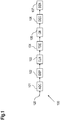
- a common used DSP-based coherent receiver is exemplarily depicted according to prior art.
- a received signal 120 is digitally converted by a block of four analog-to-digital converters 101.
- bulk chromatic dispersion and nonlinear effects are compensated by a Digital Back-Propagation (DBP) algorithm implemented by a DBP Module 102.
- DBP Digital Back-Propagation
- a signal polarization de-multiplexing is performed by a time domain equalizer 104, which can also be implemented in a carrier recovery module 105.
- the succeeding steps process received coherent signals via the modules carrier recovery 105, decision making on received symbols 106 and estimation of a bit error rate 107.
- the coherent receiver can be refined as a data-aided receiver (i.e. using training sequences (TS)). Nevertheless, the proposed method can also be realized by utilizing a receiver, which operates without training sequences (also referred to as "blind receiver”).
- TS training sequences
- the DBP algorithm or DBP module 102 requires a description of the link, which is used for back-propagation purposes. It is one of the advantages of the proposed solution that DBP can be used even by applying an arbitrary or incorrect link description. An incorrect link description can result (among others) the following, statistically independent, sources of errors:
- Homogeneous links comprise equal fibers for all spans (an optical fiber/cable terminated at both ends which may include devices that add, subtract, or attenuate optical signals) which is the usual scenario for point-to-point connections.
- Inhomogeneous links are usually found in meshed optical networks, where links comprising the same type of fiber can hardly be found.
- the error on estimating the length of a single link or span does not really cause a problem as, after compensation of linear and nonlinear effects, this error will be averaged out - provided that the error is confined to a reasonable range. Errors of up to 20% on the length specification do not induce any significant impairment, in case DBP is used.
- the coherent receiver 200 shown in Fig.2a is based on the receiver according to Fig.1 .
- a feedback connection 220 is provided between the carrier recovery module 105 and the DBP module which is now an adaptive DBP (A-DBP) module 202.
- A-DBP adaptive DBP
- an adaptive estimation module 210 is part of the feedback connection 220.
- a signal 230 which is the resulting outcome of the carrier recovery 105 is passed on to the Estimation Module 210, where the nonlinear coefficient parameter ⁇ ("Gamma") is estimated or calculated respectively by processing the internal signal 230 forwarded from the carrier recovery module 105 as will be described further below.
- a wrong description with regard to the type of fiber can initially be provided to the adaptive DBP module 202. Additionally, a correct description of a dispersion parameter is provided to the adaptive DBP module 202. Apart from this, further knowledge being available concerning the link will be the number of spans and the individual length of the spans.
- the initial value of the nonlinear coefficient ⁇ i.e. ⁇ (0)
- the proposed initial value for ⁇ (0) can be set (e.g., per default) at 1.3 1/(W*km), which may correspond to an average value for commercially available fibers.
- ⁇ (1) indicates the next iteration after ⁇ (0).
- the actual selected value of the nonlinear coefficient ⁇ (represented by signal 231 in Fig.2 ) is forwarded to the Adaptive DBP Module 202.
- training sequences (TS) being part of the received signal 120 are extracted and used to derive the residual nonlinear phase difference between received and (originally) transmitted symbols or sequences of symbols - see step 250 in Fig.2b . It is noted that this is also possible without any training sequence by deriving the residual nonlinear phase difference between received symbols and respective symbols after decision, (which is also called “blind method” or “blind receiver”).
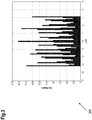
- a 16 QAM modulation format is applied for the received signal 120.
- Fig.3 presents the respective histogram 300 of the derived phase difference ⁇ (t) of such kind of 16 QAM modulated signal, comprising 12 peaks corresponding to the 12 phases of a 16 QAM modulated signal, whereby the value of the phase difference ⁇ (t) at the very left and right side of the histogram 300 represent the same angle.
- This phase information can be obtained by mathematically manipulating the phase information being part of the received symbols (e.g., elimination of phase ambiguity).
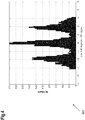
- the 4 th power is applied to the incoming signal 120 before deriving the residual nonlinear phase difference at the adaptive Estimation Module 210.
- the respective histogram 400 of the 4 th power signal is shown in FIG.4 where only three phases of a single quadrant can be identified accordingly.
- This information (“spreading of received symbols"), presented in Fig.4 , is the basis for calculating the nonlinear coefficient ⁇ by deriving and evaluating a cost function as suggested - step 251 in Fib.2b.
- CF ⁇ ⁇ 1 + ⁇ ⁇ 3 * 1 / R 2 + ⁇ ⁇ 2 * 1 / R 1 + 1 / R 3
- the cost function CF is the basis for estimating a variation ⁇ of gamma, which is now explained in more detail:
- An optimized (in the purpose of improved) value of the nonlinear coefficient ⁇ can be calculated by minimizing the cost function CF mentioned above.
- the algorithm for optimizing the nonlinear coefficient value ⁇ e.g., according to the "steepest descent algorithm", which is a known optimization algorithm, "http://en.wikipedia.org/wiki/Gradient_descent"
- ⁇ i + 1 ⁇ i + ⁇ i
- the algorithm can also be applied by considering only the algebraic sign of the gradient.
- the new value of the nonlinear coefficient y(i+1) is forwarded to the adaptive DBP module 202, wherein the received signal 120 is processed by applying the new value ⁇ (i+1) - step 253 in Fig. 2b .
- the gradient of the cost function CF is evaluated with respect to the previous iteration, whereas a change of the sign of the gradient indicates an end of the iteration loop, i.e. a minimum of the cost function has been reached.
- the iterative optimization algorithm can be stopped - step 252 in Fig. 2b .
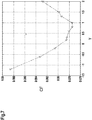
- Fig.6 shows an example (calculated by simulated data) of the derived cost function CF as a function of the nonlinear coefficient ⁇ based on a SSMF fiber with 16-QAM.
- the algorithm for determining the optimized value of the nonlinear coefficient ⁇ starts by calculating two results of the cost function CF (corresponding to two different initial values of ⁇ ).
- the convergence factor ⁇ has to be optimized as well to achieve a reduction of computational time without losing quality in estimation accuracy.
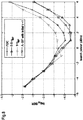
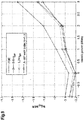
- Fig.8 and Fig.9 show examples concerning the quality performance of the proposed method based on a Log10(BER) versus power (dBm) performance, wherein Log10(BER) is correlated with the quality of the received signal 120 after BER calculation.
- Fig.8 is showing the Log10(BER) versus power (dBm) performance for simulated data propagated over a 8x82km LA-PSCF.
- the first curve (FDE) is showing the alignment of the signal-quality dependent from the power injected into the fiber by compensating only linear impairments using a Frequency Domain Equalizer (FDE).
- the proposed method is working correctly, i.e. the derived optimized value of the nonlinear coefficient ⁇ after termination of the optimization algorithm according to the proposed method is exactly the same or nearly the same value like the nonlinear coefficient value ⁇ of the real fiber.
- Fig.9 is showing the Log10(BER) versus power (dBm) performance for experimental data propagated over 8x82 km of SSMF.
- the first curve (FDE) is showing the alignment of the quality dependent from the power injected into the fiber by only compensating linear impairments using a Frequency Domain Equalizer (FDE).
- the aforementioned cost function CF determined exemplarily for processing a 16 QAM modulated signal, is one possible embodiment applying the proposed solution.
- the proposed solution can be applied for all kinds of modulation formats.
- CF gen ⁇ k ⁇ K ⁇ upper , k + ⁇ lower , k ⁇ 1 R k + ⁇ center ⁇ ⁇ i ⁇ I 1 R i with k ⁇ K;i ⁇ I
- CF 16 ⁇ k ⁇ K K max ⁇ upper + ⁇ lower ⁇ 1 R 2 + ⁇ center ⁇ 1 R 1 + 1 R 3 with k ⁇ [2]; i ⁇ [1,3]
- Fig. 10 shows the corresponding 16 QAM constellation diagram applied to the 4 th power.
- CF 32 ⁇ k ⁇ K ⁇ upper , k + ⁇ lower , k ⁇ 1 R k + ⁇ center ⁇ ⁇ i ⁇ I 1 R i with k ⁇ [2,4,5]; i ⁇ [1, 3]
- Fig.11 shows the corresponding 32 QAM constellation diagram applied to the 4 th power.
- CF 64 ⁇ k ⁇ K ⁇ upper , k + ⁇ lower , k ⁇ 1 R k + ⁇ center ⁇ ⁇ i ⁇ I 1 R i with k ⁇ [2,4,5,6,7,8]; i ⁇ [1,3,6,9]
- Fig.12 shows the corresponding 64 QAM constellation diagram to the 4 th power.
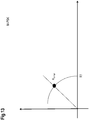
- Fig.13 shows the corresponding M-PSK constellation diagram to the 4 th power.
- the proposed solution for adaptive Digital Back Propagation is capable of a suitable set of parameters for a DBP implementation after a very short initialization cycle.
- the coding of the optimization algorithm can be implemented in a DSP (Digital Signal Processor).
- the proposed approach can be implemented in various optical transmission systems using coherent detection, including single carrier and multi carrier, single mode and multi mode.
Landscapes
- Physics & Mathematics (AREA)
- Nonlinear Science (AREA)
- Electromagnetism (AREA)
- Engineering & Computer Science (AREA)
- Computer Networks & Wireless Communication (AREA)
- Signal Processing (AREA)
- Optical Communication System (AREA)
Claims (14)
- Procédé pour réduire les dégradations de transmission optique, en particulier les défauts non linéaires, d'au moins une liaison, comprenant les étapes suivantes :a) extraction d'une information de phase (Δθ) d'un signal optique (120) reçu via l'au moins une liaison, dans lequel l'information de phase (Δθ) est basée sur une différence de phase non linéaire résiduelle entre des symboles ou des séquences de symboles reçus et transmis ;b) détermination du coefficient non linéaire (γ) associé avec l'au moins une liaison, sur la base de l'information de phase (Δθ),c) application d'un mécanisme de régulation (202) en utilisant le coefficient non linéaire (y),dans lequel le mécanisme de régulation (202) comprend un algorithme de propagation arrière numérique, et
dans lequel :- une fonction de coût (CF) est dérivée sur la base de l'information de phase (Δθ) extraite, et- un algorithme d'optimisation est appliqué en liaison avec cette fonction de coût (CF) pour déterminer le coefficient non linéaire (γ). - Procédé selon la revendication 1, comprenant
la répétition des étapes a) à c) jusqu'à ce que la valeur de coefficient non linéaire (γ) atteigne ou dépasse une valeur. - Procédé selon l'une quelconque des revendications précédentes, dans lequel l'information de phase (Δθ) est extraite après une récupération de porteuse (105) du signal optique reçu (102).
- Procédé selon l'une quelconque des revendications précédentes, dans lequel- l'information de phase extraite comprend un étalement de symboles reçus (501...504) faisant partie de ce signal optique reçu (102), et- la détermination du coefficient non linéaire (γ) est telle qu'un étalement réduit des symboles de réception (501...504) est obtenu.
- Procédé selon la revendication 4, dans lequel l'étalement respectif des symboles reçus (501...504) comprend des différences de phase (Δθ) respectives entre les symboles reçus (θTS, θDEC) et les symboles transmis (θRX) respectifs qui sont dérivés avec ou bien sans une séquence de formation.
- Procédé selon la revendication 5, dans lequel- le signal optique reçu (102) est un signal cohérent basé sur une modulation 16-QAM ;- la puissance 4 est appliquée au signal optique reçu,- les différences de phase (Δθ) respectives sont dérivées d'un signal de puissance 4,- la fonction de coût (CF), basée sur ces différences de phase (Δθ) dérivées, est définie par CF = [δθ1 + δθ3] ∗ (1/R2) + δθ2 ∗ (1/R1 + 1/R3), dans lequel- δθ1, δθ2 et δθ3 sont représentatifs de l'écart standard pour chacune des différences de phase respectives, et- R1, R2 et R3 sont représentatifs des rayons de la constellation 16-QAM.
- Procédé selon l'une des revendications précédentes, dans lequel l'algorithme d'optimisation est basé sur l'algorithme de descente la plus forte.
- Procédé selon la revendication 7, dans lequel l'algorithme de descente la plus forte est défini par γ(i + 1) = γ (i) + µΔγ(i), dans lequel- i est l'indice du temps discret,- γ(i + 1) représente la valeur du coefficient non linéaire à l'itération (i + 1),- γ(i) représente la valeur du coefficient non linéaire à l'étape d'itération (i) précédente,- µ représente le facteur de convergence, comprenant une longueur de fibre efficace Leff et une puissance de canal P,- Δγ(i) = αCF(γ)/αγ.
- Procédé selon la revendication 7 ou 8, dans lequel- l'algorithme d'optimisation débute en calculant deux valeurs de la fonction de coût correspondant à deux valeurs différentes du coefficient non linéaire (γ), et- la première valeur de début du coefficient non linéaire (γ) est représentée par une valeur initiale sélectionnée.
- Procédé selon l'une quelconque des revendications précédentes, dans lequel- le coefficient non linéaire (γ) est affiné comme un coefficient non linéaire à n dimensions, représentant n liaisons simples,- le coefficient non linéaire à n dimensions est déterminé par un calcul à n dimensions.
- Dispositif comprenant- un mécanisme de régulation pour réduire les dégradations de transmission optique, en particulier les effets non linéaires, d'au moins une liaison simple qui peut être connectée au dispositif, le mécanisme de régulation (202) comprenant un algorithme de propagation arrière numérique, et- une unité de traitement qui est agencée de telle sorte que les étapes suivantes puissent être exécutées :dans lequel :a) extraction d'une information de phase (Δθ) d'un signal optique (120) reçu via l'au moins une liaison, dans lequel l'information de phase (Δθ) est basée sur une différence de phase non linéaire résiduelle entre des symboles ou des séquences de symboles reçus et transmis ;b) détermination du coefficient non linéaire (γ), associé avec l'au moins une liaison, sur la base de l'information de phase (Δθ),c) application du mécanisme de régulation (202) en utilisant le coefficient non linéaire (γ),- une fonction de coût (CF) est dérivée sur la base de l'information de phase (Δθ) extraite, et- un algorithme d'optimisation est appliqué en liaison avec cette fonction de coût (CF) pour déterminer le coefficient non linéaire (γ).
- Dispositif selon la revendication 11, dans lequel l'unité de traitement est conçue de telle sorte que les étapes a) à c) puissent être répétées jusqu'à ce que la valeur de coefficient non linéaire (γ) atteigne ou dépasse une valeur.
- Dispositif selon la revendication 11 ou 12, dans lequel ledit dispositif est un dispositif de communication, en particulier un récepteur pour signaux optiques ou associé à celui-ci.
- Système de communication comprenant le dispositif selon l'une quelconque des revendications 11 à 13 précédentes.
Priority Applications (1)
| Application Number | Priority Date | Filing Date | Title |
|---|---|---|---|
| EP14729222.1A EP2997676B1 (fr) | 2013-05-13 | 2014-05-12 | Procédé, dispositif et système de communication pour la réduction des dégradations de transmission optique |
Applications Claiming Priority (3)
| Application Number | Priority Date | Filing Date | Title |
|---|---|---|---|
| EP13167440.0A EP2804334A1 (fr) | 2013-05-13 | 2013-05-13 | Procédé, dispositif et système de communication pour la réduction des dégradations de transmission optique |
| EP14729222.1A EP2997676B1 (fr) | 2013-05-13 | 2014-05-12 | Procédé, dispositif et système de communication pour la réduction des dégradations de transmission optique |
| PCT/EP2014/059654 WO2014184139A1 (fr) | 2013-05-13 | 2014-05-12 | Procédé, dispositif et système de communication pour réduire les dégradations de transmission optique |
Publications (2)
| Publication Number | Publication Date |
|---|---|
| EP2997676A1 EP2997676A1 (fr) | 2016-03-23 |
| EP2997676B1 true EP2997676B1 (fr) | 2020-05-06 |
Family
ID=48326190
Family Applications (2)
| Application Number | Title | Priority Date | Filing Date |
|---|---|---|---|
| EP13167440.0A Withdrawn EP2804334A1 (fr) | 2013-05-13 | 2013-05-13 | Procédé, dispositif et système de communication pour la réduction des dégradations de transmission optique |
| EP14729222.1A Active EP2997676B1 (fr) | 2013-05-13 | 2014-05-12 | Procédé, dispositif et système de communication pour la réduction des dégradations de transmission optique |
Family Applications Before (1)
| Application Number | Title | Priority Date | Filing Date |
|---|---|---|---|
| EP13167440.0A Withdrawn EP2804334A1 (fr) | 2013-05-13 | 2013-05-13 | Procédé, dispositif et système de communication pour la réduction des dégradations de transmission optique |
Country Status (4)
| Country | Link |
|---|---|
| US (1) | US10439730B2 (fr) |
| EP (2) | EP2804334A1 (fr) |
| CN (1) | CN105432029B (fr) |
| WO (1) | WO2014184139A1 (fr) |
Families Citing this family (15)
| Publication number | Priority date | Publication date | Assignee | Title |
|---|---|---|---|---|
| EP2804334A1 (fr) | 2013-05-13 | 2014-11-19 | Xieon Networks S.à.r.l. | Procédé, dispositif et système de communication pour la réduction des dégradations de transmission optique |
| GB201605120D0 (en) * | 2016-03-24 | 2016-05-11 | Univ Aston | System and method for the transmission of optic signals |
| JP6759742B2 (ja) * | 2016-06-16 | 2020-09-23 | 富士通株式会社 | 受信装置及び設定方法 |
| EP3324169A1 (fr) * | 2016-11-22 | 2018-05-23 | Xieon Networks S.à r.l. | Détection de facteurs de gain et de pertes exagérées de traces otdr unidirectionnelles |
| US10887022B2 (en) * | 2017-06-15 | 2021-01-05 | Nokia Of America Corporation | Backward propagation with compensation of some nonlinear effects of polarization mode dispersion |
| US10833770B2 (en) * | 2018-06-22 | 2020-11-10 | Nec Corporation | Optical fiber nonlinearity compensation using neural networks |
| CN110336609B (zh) * | 2019-05-31 | 2021-03-30 | 中山大学 | 一种多跨段光纤传输系统优化方法 |
| CN111457927B (zh) * | 2020-04-26 | 2021-03-05 | 北京工商大学 | 动态障碍物下的无人巡航船多目标路径规划方法 |
| CN111917474B (zh) * | 2020-07-22 | 2022-07-29 | 北京理工大学 | 一种隐式三元组神经网络及光纤非线性损伤均衡方法 |
| CN114553314B (zh) * | 2020-11-27 | 2023-08-22 | 华为技术有限公司 | 非线性损伤补偿方法、装置、传输设备以及存储介质 |
| CN113595641B (zh) * | 2021-07-23 | 2022-05-17 | 成都信息工程大学 | 一种基于ma-dbp算法的光纤非线性均衡方法 |
| CN113703199B (zh) * | 2021-07-30 | 2024-02-20 | 山东师范大学 | 一种提高光场相干度自修复能力的方法及装置 |
| CN114629766B (zh) * | 2022-01-30 | 2023-09-05 | 北京邮电大学 | 光纤通信中的符号判决方法、装置、电子设备及存储介质 |
| CN115173940B (zh) * | 2022-06-27 | 2024-04-23 | 华中科技大学 | 多信道光传输系统链路联合损伤监测方法及系统 |
| CN117081677B (zh) * | 2023-10-13 | 2023-12-15 | 湖北大学 | 一种对sefdm系统中载波间损伤的处理方法及设备 |
Family Cites Families (49)
| Publication number | Priority date | Publication date | Assignee | Title |
|---|---|---|---|---|
| US7471904B2 (en) * | 2003-07-25 | 2008-12-30 | Alcatel-Lucent Usa Inc. | Method and apparatus for electronic equalization in optical communication systems |
| EP2086130B1 (fr) * | 2008-01-29 | 2013-01-09 | Alcatel Lucent | Modulation combinée de phase et de polarisation pour communication optique |
| JP5181770B2 (ja) * | 2008-03-27 | 2013-04-10 | 富士通株式会社 | 光伝送システム |
| ATE488920T1 (de) * | 2008-07-16 | 2010-12-15 | Alcatel Lucent | Adaptiver nichtlinearitätsausgleich in einem kohärenten empfänger |
| US8095019B2 (en) * | 2008-07-30 | 2012-01-10 | Alcatel Lucent | Digital clock and data recovery scheme |
| JP5298894B2 (ja) * | 2009-01-30 | 2013-09-25 | 富士通株式会社 | 歪み補償装置,光受信装置及び光送受信システム |
| US9166703B2 (en) * | 2009-02-20 | 2015-10-20 | Telefonaktiebolaget L M Ericsson (Publ) | Equalizer for an optical transmission system |
| US8306418B2 (en) * | 2009-03-10 | 2012-11-06 | Tyco Electronics Subsea Communications Llc | Data pattern dependent distortion compensation in a coherent optical signal receiver |
| FI20095288A0 (fi) * | 2009-03-19 | 2009-03-19 | Luxdyne Oy | Kohinan vaimentaminen optisessa vastaanottimessa |
| JP5482273B2 (ja) * | 2010-02-12 | 2014-05-07 | 富士通株式会社 | 光受信器 |
| US9762323B2 (en) * | 2010-03-19 | 2017-09-12 | Ofidium Pty. Ltd. | Method and apparatus for fiber non-linearity mitigation |
| US8494368B2 (en) * | 2010-04-16 | 2013-07-23 | Alcatel Lucent | Electronic nonlinearity compensation for optical transmission systems |
| US8693890B2 (en) * | 2010-08-20 | 2014-04-08 | Nec Laboratories America, Inc. | Look-up table and digital transmitter based architecture for fiber nonlinearity compensation |
| CN102386968B (zh) * | 2010-08-31 | 2015-07-15 | 富士通株式会社 | 自相位调制噪声计算装置、消除装置和光相干接收机 |
| CN102420660B (zh) * | 2010-09-28 | 2014-09-03 | 富士通株式会社 | 非线性补偿装置和发射机 |
| CN102136866B (zh) * | 2010-12-09 | 2014-07-30 | 华为技术有限公司 | 光传输设备和光传输系统及光传输参数配置方法 |
| US9236951B2 (en) * | 2010-12-22 | 2016-01-12 | Ofidium Pty. Ltd. | Electronic compensation of cross-phase modulation |
| JP5120507B2 (ja) * | 2011-02-01 | 2013-01-16 | 日本電気株式会社 | 光受信器、偏光分離装置および偏光分離方法 |
| JP5692245B2 (ja) * | 2011-02-02 | 2015-04-01 | 日本電気株式会社 | 光受信機および光受信方法 |
| JP5671071B2 (ja) * | 2011-02-07 | 2015-02-18 | 日本電信電話株式会社 | デジタル信号処理装置 |
| CN102655433B (zh) * | 2011-03-04 | 2016-03-30 | 富士通株式会社 | 非线性损伤补偿方法和装置 |
| CN102655432B (zh) * | 2011-03-04 | 2015-08-26 | 富士通株式会社 | 非线性损伤补偿方法和装置 |
| CN103023570B (zh) * | 2011-09-26 | 2016-03-30 | 富士通株式会社 | 非线性补偿装置、方法和发射机 |
| JP2013081066A (ja) * | 2011-10-04 | 2013-05-02 | Nec Corp | コヒーレント光受信機およびコヒーレント光受信方法 |
| CN103095374B (zh) * | 2011-10-28 | 2016-04-20 | 富士通株式会社 | 偏振复用光通信系统的自适应非线性均衡的方法和装置 |
| CN102511153B (zh) * | 2011-11-16 | 2014-09-03 | 华为技术有限公司 | 一种微波预失真信号生成方法和装置 |
| EP2660984B1 (fr) * | 2011-12-01 | 2016-03-23 | Huawei Technologies Co., Ltd. | Dispositif de compensation de signal optique |
| US8983309B2 (en) * | 2012-02-13 | 2015-03-17 | Ciena Corporation | Constrained continuous phase modulation and demodulation in an optical communications system |
| CN103312414B (zh) * | 2012-03-16 | 2016-03-30 | 富士通株式会社 | 一种逆信道装置和包含该装置的发射机、接收机及系统 |
| US9025963B2 (en) * | 2012-03-29 | 2015-05-05 | Juniper Networks, Inc. | Processing data in a coherent optical communication system |
| CN103378908B (zh) * | 2012-04-11 | 2016-03-23 | 富士通株式会社 | 一种强度调制直接检测系统的非线性损伤补偿方法和装置 |
| US8559496B1 (en) * | 2012-06-20 | 2013-10-15 | MagnaCom Ltd. | Signal reception using non-linearity-compensated, partial response feedback |
| US9184854B2 (en) * | 2012-10-09 | 2015-11-10 | Nec Laboratories America, Inc. | Inter-band cross-phase modulation compensation for the mitigation of intra-channel nonlinear impairments in optical fiber transmission |
| US9225429B2 (en) * | 2012-12-21 | 2015-12-29 | Zte Corporation | Recovering data from quadrature phase shift keying modulated optical signals |
| US9831956B2 (en) * | 2013-02-07 | 2017-11-28 | Nec Corporation | Signal processing device and signal processing method |
| US9853765B2 (en) * | 2013-04-09 | 2017-12-26 | Nec Corporation | Signal processing device and signal processing method for optical polarization multiplexed signal |
| CN104104445B (zh) * | 2013-04-10 | 2017-06-30 | 富士通株式会社 | 非线性加权系数的计算装置以及方法 |
| EP2804334A1 (fr) | 2013-05-13 | 2014-11-19 | Xieon Networks S.à.r.l. | Procédé, dispositif et système de communication pour la réduction des dégradations de transmission optique |
| JP6135415B2 (ja) * | 2013-09-11 | 2017-05-31 | 富士通株式会社 | 非線形歪み補償装置及び方法並びに光受信器 |
| CN104579477B (zh) * | 2013-10-15 | 2017-10-31 | 富士通株式会社 | 信道间非线性损伤的补偿装置及方法 |
| JP6281387B2 (ja) * | 2014-04-07 | 2018-02-21 | 富士通株式会社 | デジタルコヒーレント受信器および受信方法 |
| US20150295649A1 (en) * | 2014-04-11 | 2015-10-15 | Futurewei Technologies, Inc. | Method and system for performing fiber nonlinearity compensation for optical 16qam |
| JP6661263B2 (ja) * | 2014-09-03 | 2020-03-11 | 富士通株式会社 | 光伝送装置、非線形歪み補償方法及び非線形歪み予等化方法 |
| JP6405833B2 (ja) * | 2014-09-25 | 2018-10-17 | 富士通株式会社 | 信号処理装置及び信号処理方法 |
| JP6380136B2 (ja) * | 2015-01-30 | 2018-08-29 | 富士通株式会社 | 推定装置、及び、推定方法 |
| US9906309B2 (en) * | 2015-03-31 | 2018-02-27 | Infinera Corporation | System and method for determining nonlinear mitigation perturbative distortion coefficients using a received optical signal |
| US9917712B2 (en) * | 2016-03-14 | 2018-03-13 | Mitsubishi Electric Research Laboratories, Inc. | Frequency domain equalizer for optical communications |
| JP6690091B2 (ja) * | 2016-07-27 | 2020-04-28 | 富士通株式会社 | 信号処理装置および信号処理方法 |
| JP6885093B2 (ja) * | 2017-02-16 | 2021-06-09 | 富士通株式会社 | 伝送路監視装置及び伝送路の監視方法 |
-
2013
- 2013-05-13 EP EP13167440.0A patent/EP2804334A1/fr not_active Withdrawn
-
2014
- 2014-05-12 WO PCT/EP2014/059654 patent/WO2014184139A1/fr not_active Ceased
- 2014-05-12 EP EP14729222.1A patent/EP2997676B1/fr active Active
- 2014-05-12 US US14/890,373 patent/US10439730B2/en active Active
- 2014-05-12 CN CN201480027244.7A patent/CN105432029B/zh active Active
Non-Patent Citations (1)
| Title |
|---|
| None * |
Also Published As
| Publication number | Publication date |
|---|---|
| EP2997676A1 (fr) | 2016-03-23 |
| US10439730B2 (en) | 2019-10-08 |
| CN105432029B (zh) | 2018-11-09 |
| WO2014184139A1 (fr) | 2014-11-20 |
| EP2804334A1 (fr) | 2014-11-19 |
| US20160127047A1 (en) | 2016-05-05 |
| CN105432029A (zh) | 2016-03-23 |
Similar Documents
| Publication | Publication Date | Title |
|---|---|---|
| EP2997676B1 (fr) | Procédé, dispositif et système de communication pour la réduction des dégradations de transmission optique | |
| Sasai et al. | Digital longitudinal monitoring of optical fiber communication link | |
| EP2922221B1 (fr) | Techniques pour une égalisation aveugle de signaux de modulation d'amplitude en quadrature d'ordre élevé | |
| US11270200B2 (en) | Single-step nonlinearity compensation using artificial intelligence for digital coherent transmission systems | |
| EP2613452B1 (fr) | Dispositif de filtre numérique, procédé de filtrage numérique et programme de commande pour dispositif de filtre numérique | |
| EP2858272B1 (fr) | Compensateur de distorsion non linéaire, procédé de compensation de distorsion non linéaire et récepteur optique | |
| US9628189B2 (en) | System optimization of pulse shaping filters in fiber optic networks | |
| US20100014873A1 (en) | Adaptive non-linearity compensation in coherent receiver | |
| Lin et al. | Adaptive digital back-propagation for optical communication systems | |
| EP3096470B1 (fr) | Procédé et système d'atténuation d'interférence non linéaire | |
| Do et al. | Data-aided OSNR estimation for QPSK and 16-QAM coherent optical system | |
| Czegledi et al. | Digital backpropagation accounting for polarization-mode dispersion | |
| Pan et al. | Chromatic dispersion monitoring and automated compensation for NRZ and RZ data using clock regeneration and fading without adding signaling | |
| US10148465B2 (en) | Training assisted joint equalization | |
| Chen et al. | Full-field, carrier-less, polarization-diversity, direct detection receiver based on phase retrieval | |
| Dahan et al. | Universal virtual lab: A fast and accurate simulation tool for wideband nonlinear DWDM systems | |
| EP4300848B1 (fr) | Moniteur de liaison à fibres optiques basé sur récepteur | |
| US12451964B2 (en) | Method and apparatus for correcting optical waveform distortion and optical signal receiving apparatus | |
| Ip et al. | Nonlinear impairment compensation using backpropagation | |
| Liang et al. | Perturbation-assisted DBP for nonlinear compensation in polarization multiplexed systems | |
| EP4107878B1 (fr) | Détermination de la dispersion chromatique dans une liaison optique | |
| EP3133751A1 (fr) | Procédé de compensation de non-linéarité dans des systèmes de transmission optique | |
| Goroshko et al. | Fundamental limitations of digital back propagation due to polarization mode dispersion | |
| Abdullah et al. | DSP techniques for reducing chromatic dispersion in optical communication systems | |
| Di Rosa | Digital optimization techniques for multi-band optical communication systems |
Legal Events
| Date | Code | Title | Description |
|---|---|---|---|
| PUAI | Public reference made under article 153(3) epc to a published international application that has entered the european phase |
Free format text: ORIGINAL CODE: 0009012 |
|
| 17P | Request for examination filed |
Effective date: 20151013 |
|
| AK | Designated contracting states |
Kind code of ref document: A1 Designated state(s): AL AT BE BG CH CY CZ DE DK EE ES FI FR GB GR HR HU IE IS IT LI LT LU LV MC MK MT NL NO PL PT RO RS SE SI SK SM TR |
|
| AX | Request for extension of the european patent |
Extension state: BA ME |
|
| RIN1 | Information on inventor provided before grant (corrected) |
Inventor name: SLEIFFER, VINCENTIUS ANTONIUS JOHANNES MAR Inventor name: LIN, CHIEN-YU Inventor name: NAPOLI, ANTONIO Inventor name: SPINNLER, BERNHARD |
|
| DAX | Request for extension of the european patent (deleted) | ||
| STAA | Information on the status of an ep patent application or granted ep patent |
Free format text: STATUS: EXAMINATION IS IN PROGRESS |
|
| 17Q | First examination report despatched |
Effective date: 20171130 |
|
| GRAP | Despatch of communication of intention to grant a patent |
Free format text: ORIGINAL CODE: EPIDOSNIGR1 |
|
| STAA | Information on the status of an ep patent application or granted ep patent |
Free format text: STATUS: GRANT OF PATENT IS INTENDED |
|
| INTG | Intention to grant announced |
Effective date: 20191203 |
|
| GRAS | Grant fee paid |
Free format text: ORIGINAL CODE: EPIDOSNIGR3 |
|
| GRAA | (expected) grant |
Free format text: ORIGINAL CODE: 0009210 |
|
| STAA | Information on the status of an ep patent application or granted ep patent |
Free format text: STATUS: THE PATENT HAS BEEN GRANTED |
|
| AK | Designated contracting states |
Kind code of ref document: B1 Designated state(s): AL AT BE BG CH CY CZ DE DK EE ES FI FR GB GR HR HU IE IS IT LI LT LU LV MC MK MT NL NO PL PT RO RS SE SI SK SM TR |
|
| RAP1 | Party data changed (applicant data changed or rights of an application transferred) |
Owner name: XIEON NETWORKS S.A R.L. |
|
| REG | Reference to a national code |
Ref country code: GB Ref legal event code: FG4D |
|
| REG | Reference to a national code |
Ref country code: CH Ref legal event code: EP Ref country code: AT Ref legal event code: REF Ref document number: 1268497 Country of ref document: AT Kind code of ref document: T Effective date: 20200515 |
|
| REG | Reference to a national code |
Ref country code: DE Ref legal event code: R096 Ref document number: 602014064949 Country of ref document: DE |
|
| REG | Reference to a national code |
Ref country code: IE Ref legal event code: FG4D |
|
| REG | Reference to a national code |
Ref country code: LT Ref legal event code: MG4D |
|
| REG | Reference to a national code |
Ref country code: NL Ref legal event code: MP Effective date: 20200506 |
|
| PG25 | Lapsed in a contracting state [announced via postgrant information from national office to epo] |
Ref country code: SE Free format text: LAPSE BECAUSE OF FAILURE TO SUBMIT A TRANSLATION OF THE DESCRIPTION OR TO PAY THE FEE WITHIN THE PRESCRIBED TIME-LIMIT Effective date: 20200506 Ref country code: PT Free format text: LAPSE BECAUSE OF FAILURE TO SUBMIT A TRANSLATION OF THE DESCRIPTION OR TO PAY THE FEE WITHIN THE PRESCRIBED TIME-LIMIT Effective date: 20200907 Ref country code: FI Free format text: LAPSE BECAUSE OF FAILURE TO SUBMIT A TRANSLATION OF THE DESCRIPTION OR TO PAY THE FEE WITHIN THE PRESCRIBED TIME-LIMIT Effective date: 20200506 Ref country code: NO Free format text: LAPSE BECAUSE OF FAILURE TO SUBMIT A TRANSLATION OF THE DESCRIPTION OR TO PAY THE FEE WITHIN THE PRESCRIBED TIME-LIMIT Effective date: 20200806 Ref country code: IS Free format text: LAPSE BECAUSE OF FAILURE TO SUBMIT A TRANSLATION OF THE DESCRIPTION OR TO PAY THE FEE WITHIN THE PRESCRIBED TIME-LIMIT Effective date: 20200906 Ref country code: LT Free format text: LAPSE BECAUSE OF FAILURE TO SUBMIT A TRANSLATION OF THE DESCRIPTION OR TO PAY THE FEE WITHIN THE PRESCRIBED TIME-LIMIT Effective date: 20200506 Ref country code: GR Free format text: LAPSE BECAUSE OF FAILURE TO SUBMIT A TRANSLATION OF THE DESCRIPTION OR TO PAY THE FEE WITHIN THE PRESCRIBED TIME-LIMIT Effective date: 20200807 |
|
| PG25 | Lapsed in a contracting state [announced via postgrant information from national office to epo] |
Ref country code: LV Free format text: LAPSE BECAUSE OF FAILURE TO SUBMIT A TRANSLATION OF THE DESCRIPTION OR TO PAY THE FEE WITHIN THE PRESCRIBED TIME-LIMIT Effective date: 20200506 Ref country code: RS Free format text: LAPSE BECAUSE OF FAILURE TO SUBMIT A TRANSLATION OF THE DESCRIPTION OR TO PAY THE FEE WITHIN THE PRESCRIBED TIME-LIMIT Effective date: 20200506 Ref country code: BG Free format text: LAPSE BECAUSE OF FAILURE TO SUBMIT A TRANSLATION OF THE DESCRIPTION OR TO PAY THE FEE WITHIN THE PRESCRIBED TIME-LIMIT Effective date: 20200806 Ref country code: HR Free format text: LAPSE BECAUSE OF FAILURE TO SUBMIT A TRANSLATION OF THE DESCRIPTION OR TO PAY THE FEE WITHIN THE PRESCRIBED TIME-LIMIT Effective date: 20200506 |
|
| REG | Reference to a national code |
Ref country code: DE Ref legal event code: R119 Ref document number: 602014064949 Country of ref document: DE |
|
| REG | Reference to a national code |
Ref country code: AT Ref legal event code: MK05 Ref document number: 1268497 Country of ref document: AT Kind code of ref document: T Effective date: 20200506 |
|
| PG25 | Lapsed in a contracting state [announced via postgrant information from national office to epo] |
Ref country code: NL Free format text: LAPSE BECAUSE OF FAILURE TO SUBMIT A TRANSLATION OF THE DESCRIPTION OR TO PAY THE FEE WITHIN THE PRESCRIBED TIME-LIMIT Effective date: 20200506 Ref country code: AL Free format text: LAPSE BECAUSE OF FAILURE TO SUBMIT A TRANSLATION OF THE DESCRIPTION OR TO PAY THE FEE WITHIN THE PRESCRIBED TIME-LIMIT Effective date: 20200506 |
|
| PG25 | Lapsed in a contracting state [announced via postgrant information from national office to epo] |
Ref country code: IT Free format text: LAPSE BECAUSE OF FAILURE TO SUBMIT A TRANSLATION OF THE DESCRIPTION OR TO PAY THE FEE WITHIN THE PRESCRIBED TIME-LIMIT Effective date: 20200506 Ref country code: RO Free format text: LAPSE BECAUSE OF FAILURE TO SUBMIT A TRANSLATION OF THE DESCRIPTION OR TO PAY THE FEE WITHIN THE PRESCRIBED TIME-LIMIT Effective date: 20200506 Ref country code: CZ Free format text: LAPSE BECAUSE OF FAILURE TO SUBMIT A TRANSLATION OF THE DESCRIPTION OR TO PAY THE FEE WITHIN THE PRESCRIBED TIME-LIMIT Effective date: 20200506 Ref country code: SM Free format text: LAPSE BECAUSE OF FAILURE TO SUBMIT A TRANSLATION OF THE DESCRIPTION OR TO PAY THE FEE WITHIN THE PRESCRIBED TIME-LIMIT Effective date: 20200506 Ref country code: EE Free format text: LAPSE BECAUSE OF FAILURE TO SUBMIT A TRANSLATION OF THE DESCRIPTION OR TO PAY THE FEE WITHIN THE PRESCRIBED TIME-LIMIT Effective date: 20200506 Ref country code: AT Free format text: LAPSE BECAUSE OF FAILURE TO SUBMIT A TRANSLATION OF THE DESCRIPTION OR TO PAY THE FEE WITHIN THE PRESCRIBED TIME-LIMIT Effective date: 20200506 Ref country code: LI Free format text: LAPSE BECAUSE OF NON-PAYMENT OF DUE FEES Effective date: 20200531 Ref country code: DK Free format text: LAPSE BECAUSE OF FAILURE TO SUBMIT A TRANSLATION OF THE DESCRIPTION OR TO PAY THE FEE WITHIN THE PRESCRIBED TIME-LIMIT Effective date: 20200506 Ref country code: ES Free format text: LAPSE BECAUSE OF FAILURE TO SUBMIT A TRANSLATION OF THE DESCRIPTION OR TO PAY THE FEE WITHIN THE PRESCRIBED TIME-LIMIT Effective date: 20200506 Ref country code: CH Free format text: LAPSE BECAUSE OF NON-PAYMENT OF DUE FEES Effective date: 20200531 |
|
| PG25 | Lapsed in a contracting state [announced via postgrant information from national office to epo] |
Ref country code: SK Free format text: LAPSE BECAUSE OF FAILURE TO SUBMIT A TRANSLATION OF THE DESCRIPTION OR TO PAY THE FEE WITHIN THE PRESCRIBED TIME-LIMIT Effective date: 20200506 Ref country code: PL Free format text: LAPSE BECAUSE OF FAILURE TO SUBMIT A TRANSLATION OF THE DESCRIPTION OR TO PAY THE FEE WITHIN THE PRESCRIBED TIME-LIMIT Effective date: 20200506 Ref country code: MC Free format text: LAPSE BECAUSE OF FAILURE TO SUBMIT A TRANSLATION OF THE DESCRIPTION OR TO PAY THE FEE WITHIN THE PRESCRIBED TIME-LIMIT Effective date: 20200506 |
|
| PLBE | No opposition filed within time limit |
Free format text: ORIGINAL CODE: 0009261 |
|
| STAA | Information on the status of an ep patent application or granted ep patent |
Free format text: STATUS: NO OPPOSITION FILED WITHIN TIME LIMIT |
|
| REG | Reference to a national code |
Ref country code: BE Ref legal event code: MM Effective date: 20200531 |
|
| PG25 | Lapsed in a contracting state [announced via postgrant information from national office to epo] |
Ref country code: LU Free format text: LAPSE BECAUSE OF NON-PAYMENT OF DUE FEES Effective date: 20200512 |
|
| 26N | No opposition filed |
Effective date: 20210209 |
|
| GBPC | Gb: european patent ceased through non-payment of renewal fee |
Effective date: 20200806 |
|
| PG25 | Lapsed in a contracting state [announced via postgrant information from national office to epo] |
Ref country code: FR Free format text: LAPSE BECAUSE OF NON-PAYMENT OF DUE FEES Effective date: 20200706 Ref country code: IE Free format text: LAPSE BECAUSE OF NON-PAYMENT OF DUE FEES Effective date: 20200512 |
|
| PG25 | Lapsed in a contracting state [announced via postgrant information from national office to epo] |
Ref country code: BE Free format text: LAPSE BECAUSE OF NON-PAYMENT OF DUE FEES Effective date: 20200531 Ref country code: DE Free format text: LAPSE BECAUSE OF NON-PAYMENT OF DUE FEES Effective date: 20201201 Ref country code: SI Free format text: LAPSE BECAUSE OF FAILURE TO SUBMIT A TRANSLATION OF THE DESCRIPTION OR TO PAY THE FEE WITHIN THE PRESCRIBED TIME-LIMIT Effective date: 20200506 |
|
| PG25 | Lapsed in a contracting state [announced via postgrant information from national office to epo] |
Ref country code: GB Free format text: LAPSE BECAUSE OF NON-PAYMENT OF DUE FEES Effective date: 20200806 |
|
| PG25 | Lapsed in a contracting state [announced via postgrant information from national office to epo] |
Ref country code: TR Free format text: LAPSE BECAUSE OF FAILURE TO SUBMIT A TRANSLATION OF THE DESCRIPTION OR TO PAY THE FEE WITHIN THE PRESCRIBED TIME-LIMIT Effective date: 20200506 Ref country code: MT Free format text: LAPSE BECAUSE OF FAILURE TO SUBMIT A TRANSLATION OF THE DESCRIPTION OR TO PAY THE FEE WITHIN THE PRESCRIBED TIME-LIMIT Effective date: 20200506 Ref country code: CY Free format text: LAPSE BECAUSE OF FAILURE TO SUBMIT A TRANSLATION OF THE DESCRIPTION OR TO PAY THE FEE WITHIN THE PRESCRIBED TIME-LIMIT Effective date: 20200506 |
|
| PG25 | Lapsed in a contracting state [announced via postgrant information from national office to epo] |
Ref country code: MK Free format text: LAPSE BECAUSE OF FAILURE TO SUBMIT A TRANSLATION OF THE DESCRIPTION OR TO PAY THE FEE WITHIN THE PRESCRIBED TIME-LIMIT Effective date: 20200506 |