EP2997833A1 - Oberflächenreaktives Calciumkarbonat zur Verwendung als Trennmittel - Google Patents
Oberflächenreaktives Calciumkarbonat zur Verwendung als Trennmittel Download PDFInfo
- Publication number
- EP2997833A1 EP2997833A1 EP14185739.1A EP14185739A EP2997833A1 EP 2997833 A1 EP2997833 A1 EP 2997833A1 EP 14185739 A EP14185739 A EP 14185739A EP 2997833 A1 EP2997833 A1 EP 2997833A1
- Authority
- EP
- European Patent Office
- Prior art keywords
- calcium carbonate
- acid
- composition
- reacted calcium
- carbon dioxide
- Prior art date
- Legal status (The legal status is an assumption and is not a legal conclusion. Google has not performed a legal analysis and makes no representation as to the accuracy of the status listed.)
- Granted
Links
Images

Classifications
-
- A—HUMAN NECESSITIES
- A23—FOODS OR FOODSTUFFS; TREATMENT THEREOF, NOT COVERED BY OTHER CLASSES
- A23P—SHAPING OR WORKING OF FOODSTUFFS, NOT FULLY COVERED BY A SINGLE OTHER SUBCLASS
- A23P10/00—Shaping or working of foodstuffs characterised by the products
- A23P10/40—Shaping or working of foodstuffs characterised by the products free-flowing powder or instant powder, i.e. powder which is reconstituted rapidly when liquid is added
- A23P10/43—Shaping or working of foodstuffs characterised by the products free-flowing powder or instant powder, i.e. powder which is reconstituted rapidly when liquid is added using anti-caking agents or agents improving flowability, added during or after formation of the powder
-
- C—CHEMISTRY; METALLURGY
- C01—INORGANIC CHEMISTRY
- C01F—COMPOUNDS OF THE METALS BERYLLIUM, MAGNESIUM, ALUMINIUM, CALCIUM, STRONTIUM, BARIUM, RADIUM, THORIUM, OR OF THE RARE-EARTH METALS
- C01F11/00—Compounds of calcium, strontium, or barium
- C01F11/18—Carbonates
-
- A—HUMAN NECESSITIES
- A23—FOODS OR FOODSTUFFS; TREATMENT THEREOF, NOT COVERED BY OTHER CLASSES
- A23K—FODDER
- A23K20/00—Accessory food factors for animal feeding-stuffs
- A23K20/10—Organic substances
-
- A—HUMAN NECESSITIES
- A23—FOODS OR FOODSTUFFS; TREATMENT THEREOF, NOT COVERED BY OTHER CLASSES
- A23L—FOODS, FOODSTUFFS OR NON-ALCOHOLIC BEVERAGES, NOT OTHERWISE PROVIDED FOR; PREPARATION OR TREATMENT THEREOF
- A23L29/00—Foods or foodstuffs containing additives; Preparation or treatment thereof
-
- C—CHEMISTRY; METALLURGY
- C09—DYES; PAINTS; POLISHES; NATURAL RESINS; ADHESIVES; COMPOSITIONS NOT OTHERWISE PROVIDED FOR; APPLICATIONS OF MATERIALS NOT OTHERWISE PROVIDED FOR
- C09C—TREATMENT OF INORGANIC MATERIALS, OTHER THAN FIBROUS FILLERS, TO ENHANCE THEIR PIGMENTING OR FILLING PROPERTIES ; PREPARATION OF CARBON BLACK ; PREPARATION OF INORGANIC MATERIALS WHICH ARE NO SINGLE CHEMICAL COMPOUNDS AND WHICH ARE MAINLY USED AS PIGMENTS OR FILLERS
- C09C1/00—Treatment of specific inorganic materials other than fibrous fillers; Preparation of carbon black
- C09C1/02—Compounds of alkaline earth metals or magnesium
- C09C1/021—Calcium carbonates
-
- C—CHEMISTRY; METALLURGY
- C09—DYES; PAINTS; POLISHES; NATURAL RESINS; ADHESIVES; COMPOSITIONS NOT OTHERWISE PROVIDED FOR; APPLICATIONS OF MATERIALS NOT OTHERWISE PROVIDED FOR
- C09C—TREATMENT OF INORGANIC MATERIALS, OTHER THAN FIBROUS FILLERS, TO ENHANCE THEIR PIGMENTING OR FILLING PROPERTIES ; PREPARATION OF CARBON BLACK ; PREPARATION OF INORGANIC MATERIALS WHICH ARE NO SINGLE CHEMICAL COMPOUNDS AND WHICH ARE MAINLY USED AS PIGMENTS OR FILLERS
- C09C1/00—Treatment of specific inorganic materials other than fibrous fillers; Preparation of carbon black
- C09C1/02—Compounds of alkaline earth metals or magnesium
- C09C1/021—Calcium carbonates
- C09C1/022—Treatment with inorganic compounds
-
- A—HUMAN NECESSITIES
- A23—FOODS OR FOODSTUFFS; TREATMENT THEREOF, NOT COVERED BY OTHER CLASSES
- A23V—INDEXING SCHEME RELATING TO FOODS, FOODSTUFFS OR NON-ALCOHOLIC BEVERAGES AND LACTIC OR PROPIONIC ACID BACTERIA USED IN FOODSTUFFS OR FOOD PREPARATION
- A23V2002/00—Food compositions, function of food ingredients or processes for food or foodstuffs
-
- C—CHEMISTRY; METALLURGY
- C01—INORGANIC CHEMISTRY
- C01P—INDEXING SCHEME RELATING TO STRUCTURAL AND PHYSICAL ASPECTS OF SOLID INORGANIC COMPOUNDS
- C01P2004/00—Particle morphology
- C01P2004/01—Particle morphology depicted by an image
- C01P2004/03—Particle morphology depicted by an image obtained by SEM
-
- C—CHEMISTRY; METALLURGY
- C01—INORGANIC CHEMISTRY
- C01P—INDEXING SCHEME RELATING TO STRUCTURAL AND PHYSICAL ASPECTS OF SOLID INORGANIC COMPOUNDS
- C01P2004/00—Particle morphology
- C01P2004/60—Particles characterised by their size
- C01P2004/61—Micrometer sized, i.e. from 1-100 micrometer
-
- C—CHEMISTRY; METALLURGY
- C01—INORGANIC CHEMISTRY
- C01P—INDEXING SCHEME RELATING TO STRUCTURAL AND PHYSICAL ASPECTS OF SOLID INORGANIC COMPOUNDS
- C01P2004/00—Particle morphology
- C01P2004/60—Particles characterised by their size
- C01P2004/62—Submicrometer sized, i.e. from 0.1-1 micrometer
-
- C—CHEMISTRY; METALLURGY
- C01—INORGANIC CHEMISTRY
- C01P—INDEXING SCHEME RELATING TO STRUCTURAL AND PHYSICAL ASPECTS OF SOLID INORGANIC COMPOUNDS
- C01P2006/00—Physical properties of inorganic compounds
- C01P2006/12—Surface area
-
- C—CHEMISTRY; METALLURGY
- C01—INORGANIC CHEMISTRY
- C01P—INDEXING SCHEME RELATING TO STRUCTURAL AND PHYSICAL ASPECTS OF SOLID INORGANIC COMPOUNDS
- C01P2006/00—Physical properties of inorganic compounds
- C01P2006/14—Pore volume
-
- C—CHEMISTRY; METALLURGY
- C01—INORGANIC CHEMISTRY
- C01P—INDEXING SCHEME RELATING TO STRUCTURAL AND PHYSICAL ASPECTS OF SOLID INORGANIC COMPOUNDS
- C01P2006/00—Physical properties of inorganic compounds
- C01P2006/16—Pore diameter
-
- C—CHEMISTRY; METALLURGY
- C01—INORGANIC CHEMISTRY
- C01P—INDEXING SCHEME RELATING TO STRUCTURAL AND PHYSICAL ASPECTS OF SOLID INORGANIC COMPOUNDS
- C01P2006/00—Physical properties of inorganic compounds
- C01P2006/16—Pore diameter
- C01P2006/17—Pore diameter distribution
Definitions
- the present invention relates to the use of a surface-reacted calcium carbonate as anti-caking agent, to a method for preventing caking, to a composition comprising the anti-caking agent, wherein the composition is selected from the group consisting of a food composition, a feed composition, a nutraceutical composition and a cosmetic composition, as well as to a method for the production of such a composition.
- compositions in particulate form like salt, sugar, pudding powder or packet soup often agglomerate, a phenomenon also known as caking. Caking can occur at nearly any temperature and nearly any relative humidity, but most of the time a higher temperature or a higher relative humidity will result in a more pronounced caking problem. This is often the case if the storage conditions are not controlled, for example, in powdered compositions like salt, sugar or spices in private households. Usually, these compositions or products are sold in paper bags or cardboard boxes, which are air and moisture permeable, and are stored in the kitchen cupboard, and, therefore, are delivered to the environmental conditions in the cupboard without protection or control.
- Caking results in the hardening of such particulate compositions and in a certain period of time aggregates or lumps are formed within the particulate compositions. This aggregation may result in many problems and economical losses. For example, caked powders are not suitable for further blending or cannot be properly discharged in automated installations. These products must then be processed with a hammer mill, or remelted or simply thrown away, which can create enormous additional costs and wasted resources. Customers often consider it as a loss of quality if particulate compositions like salt or sugar are not flowable anymore after some time but form lumps in the packaging.
- Examples of typical anti-caking additives are wheat flour, native starch, calcium carbonate, phosphates, silicon dioxide, or calcium silicate.
- US 5,149,552 discloses calcium salts of citric acid that can be used as anti-caking agents in fructose-sweetened powdered soft drinks.
- alkali oxides or earth alkali hydroxides like MgO, CaO, Mg(OH) 2 , Ca(OH) 2 , Mg(OH) 2 ⁇ Ca(OH) 2 and mixtures thereof are used as anti-caking additives in powdered compositions.
- US 3,273,960 discloses alkaline earth metal hyperphosphates that can be used as anti-caking agents in particulated salts such as monocalcium orthophosphate monohydrate (MCP).
- MCP monocalcium orthophosphate monohydrate
- US 2004/0109927 discloses carbonate-based anti-caking agents comprising a carbonate-based core material and an encapsulating agent that possesses hydrophobic properties. Depending on the field of application, these anti-caking agents have sometimes to be used in high amounts to control, reduce or prevent caking in the desired compositions.
- anti-caking agents in many fields of application and especially in food industry additives like anti-caking agents have to be labelled in the list of ingredients in the order of the amount contained in the respective composition or product. Therefore, it is desirable to use anti-caking agents in low amounts.
- Anti-caking agents that may be used in a reduced amount at good anti-caking efficacy are precipitated silica particles.
- sodium borohydride containing a silica-based anti-caking agent is disclosed.
- Such silica particles e.g. fumed or precipitated silica particles
- precipitated silica consists of primary particles (also called ultimate particles) that are aggregated to secondary particles (also called aggregates). Said primary particles, the precipitated silica consists of, are usually nano-scale particles having a particle size of below 100 nm ( Handbook of Fillers for Plastic, edited by Harry S.
- the silica-based anti-caking agent in EP 0 489 492 has primary particles in the range of 1 to 20 nm.
- nano-scale particles are a very controversial, emotional topic of discussion in the food, feed, nutraceutical and cosmetic fields. Depending on a chosen material, it may not yet have been clarified if its nano-scale particles are harmful to human health and, therefore, products labelled in this way may be refused by the consumers. Furthermore, it is currently intensely discussed by the European Food Safety Authority (EFSA) whether food ingredients containing certain nano-scale particles should be specifically labelled on the final packaging.
- EFSA European Food Safety Authority
- agents that can be used for controlling, reducing or preventing caking of particulate compositions. It is another object of the present invention to provide anti-caking agents which provide a good anti-caking efficacy at low concentration.
- a use of a surface-reacted calcium carbonate as anti-caking agent is provided, wherein the surface-reacted calcium carbonate is a reaction product of natural ground or precipitated calcium carbonate with carbon dioxide and at least one acid in an aqueous medium, wherein the carbon dioxide is formed in situ by the acid treatment and/or is supplied from an external source.
- a method for controlling, reducing or preventing caking of a particulate composition comprising the step of adding to a particulate composition a surface-reacted calcium carbonate, wherein the surface-reacted calcium carbonate is a reaction product of natural ground or precipitated calcium carbonate with carbon dioxide and at least one acid in an aqueous medium, wherein the carbon dioxide is formed in situ by the acid treatment and/or is supplied from an external source.
- a composition comprising an anti-caking agent
- the anti-caking agent contains surface-reacted calcium carbonate
- the surface-reacted calcium carbonate is a reaction product of natural ground or precipitated calcium carbonate with carbon dioxide and at least one acid in an aqueous medium, wherein the carbon dioxide is formed in situ by the acid treatment and/or is supplied from an external source
- the composition is selected from the group consisting of a food composition, a feed composition, a nutraceutical composition and a cosmetic composition.
- a method for the production of a compositions comprising the step of mixing a surface-reacted calcium carbonate with a composition selected from the group consisting of a food composition, a feed composition, a nutraceutical composition and a cosmetic composition, wherein the surface-reacted calcium carbonate is a reaction product of natural ground or precipitated calcium carbonate with carbon dioxide and at least one acid in an aqueous medium, wherein the carbon dioxide is formed in situ by the acid treatment and/or is supplied from an external source.
- the natural ground calcium carbonate is selected from calcium carbonate containing minerals, preferably selected from the group consisting of marble, chalk, dolomite, limestone, and mixtures thereof.
- the precipitated calcium carbonate is selected from the group consisting of precipitated calcium carbonates having aragonitic, vateritic or calcitic mineralogical crystal forms, and mixtures thereof.
- the surface-reacted calcium carbonate has a specific surface area of from 1 m 2 /g to 200 m 2 /g, preferably from 20 m 2 /g to 180 m 2 /g, more preferably from 30 m 2 /g to 160 m 2 /g, even more preferably from 40 m 2 /g to 150 m 2 /g, and most preferably from 50 m 2 /g to 140 m 2 /g, measured using nitrogen and the BET method according to ISO 9277.
- the surface-reacted calcium carbonate particles have a volume median grain diameter d 50 of from 0.1 to 50 ⁇ m, preferably from 0.5 to 25 ⁇ m, more preferably from 0.8 to 20 ⁇ m, even more preferably from 1 to 10 ⁇ m, and most preferably from 4 to 8 ⁇ m.
- the surface-reacted calcium carbonate has an intra-particle intruded specific pore volume within the range of 0.150 to 1.300 cm 3 /g, preferably of 0.300 to 1.250 cm 3 /g, and most preferably of 0.400 to 1.210 cm 3 /g, calculated from a mercury intrusion porosimetry measurement.
- the at least one acid is selected from the group consisting of hydrochloric acid, sulphuric acid, sulphurous acid, phosphoric acid, citric acid, oxalic acid, acetic acid, formic acid, and mixtures thereof, preferably the at least one acid is selected from the group consisting of hydrochloric acid, sulphuric acid, sulphurous acid, phosphoric acid, oxalic acid, and mixtures thereof, and more preferably the at least one acid is phosphoric acid or a mixture of phosphoric acid and citric acid.
- the anti-caking agent is used in a composition selected from the group consisting of a food composition, a feed composition, a nutraceutical composition and a cosmetic composition, and preferably the composition is selected from a food composition or a feed composition.
- the food composition is food salt, curing salt, salt substitute, milk powder, skimmed milk powder, cream powder, egg powder, whey fat powder, protein powder, vending machine powder, grated cheese, sugar, powdered food flavour, spice, seasoning, packet soup mixture, baking mixture, pudding powder, mousse powder, or sauce powder.
- the feed composition is pet food, milk replacer for animals, or mineral salt for animals.
- the surface-reacted calcium carbonate is present in the composition in an amount between 0.1 and 10 wt.-%, preferably in an amount between 0.2 and 5 wt.-%, more preferably in an amount between 0.3 and 3 wt.-%, and most preferably in an amount between 0.5 and 2.5 wt.-%, based on the total weight of the composition.
- an “acid” is defined as Br ⁇ nsted-Lowry acid, that is to say, it is an H 3 O + ion provider.
- An “acid salt” is defined as an H 3 O + ion-provider, e.g., a hydrogen-containing salt, which is partially neutralised by an electropositive element.
- a “salt” is defined as an electrically neutral ionic compound formed from anions and cations.
- a “partially crystalline salt” is defined as a salt that, on XRD analysis, presents an essentially discrete diffraction pattern.
- pK a is the symbol representing the acid dissociation constant associated with a given ionisable hydrogen in a given acid, and is indicative of the natural degree of dissociation of this hydrogen from this acid at equilibrium in water at a given temperature.
- Such pK a values may be found in reference textbooks such as Harris, D. C. "Quantitative Chemical Analysis: 3rd Edition", 1991, W.H. Freeman & Co. (USA), ISBN 0-7167-2170-8 .
- Natural ground calcium carbonate in the meaning of the present invention is a calcium carbonate obtained from natural sources, such as limestone, marble, dolomite, or chalk, and processed through a wet and/or dry treatment such as grinding, screening and/or fractionating, for example, by a cyclone or classifier.
- Precipitated calcium carbonate in the meaning of the present invention is a synthesised material, obtained by precipitation following reaction of carbon dioxide and lime in an aqueous, semi-dry or humid environment or by precipitation of a calcium and carbonate ion source in water.
- PCC may be in the vateritic, calcitic or aragonitic crystal form.
- a "surface-reacted calcium carbonate” is a material comprising calcium carbonate and an insoluble, at least partially crystalline, non-carbonate calcium salt, preferably, extending from the surface of at least part of the calcium carbonate.
- the calcium ions forming said at least partially crystalline non-carbonate calcium salt originate largely from the starting calcium carbonate material that also serves to form the surface-reacted calcium carbonate core.
- Such salts may include OH - anions and/or crystal water.
- water-insoluble materials are defined as materials which, when mixed with deionised water and filtered on a filter having a 0.2 ⁇ m pore size at 20°C to recover the liquid filtrate, provide less than or equal to 0.1 g of recovered solid material following evaporation at 95 to 100°C of 100 g of said liquid filtrate.
- Water-soluble materials are defined as materials leading to the recovery of greater than 0.1 g of recovered solid material following evaporation at 95 to 100°C of 100 g of said liquid filtrate.
- the "particle size" of a calcium carbonate and other materials is described by its distribution of particle sizes.
- the value d x represents the diameter relative to which x % by weight of the particles have diameters less than d x .
- the d 50 value is thus the weight median particle size, i.e. 50 wt.-% of all grains are bigger or smaller than this particle size.
- the particle size is specified as weight median particle size d 50 unless indicated otherwise.
- a Sedigraph For determining the weight median particle size d 50 value a Sedigraph can be used.
- the "particle size" of surface-reacted calcium is described as volume determined particle size distributions.
- a Malvern Mastersizer 2000 can be used for determining the volume determined particle size distribution.
- the weight determined particle size distribution may correspond to the volume determined particle size if the density of all the particles is equal.
- a “nano-scale particle” in the meaning of the present invention refers to fine particles with at least one dimension less than 200 nm.
- a “specific surface area (SSA)" of a calcium carbonate in the meaning of the present invention is defined as the surface area of the calcium carbonate divided by its mass. As used herein, the specific surface area is measured by nitrogen gas adsorption using the BET isotherm (ISO 9277:2010) and is specified in m 2 /g.
- an "anti-caking agent” in the meaning of the present invention refers to an agent or additive that can be added to particulate compositions such as dust, powders or granules and controls, reduces or prevents the agglomeration or caking of these compositions. More precisely, the formation of aggregates or lumps within particulate compositions is controlled, reduced or prevented by the addition of the anti-caking agent to the particulate compositions.
- the "porosity” or “pore volume” refers to the intra-particle intruded specific pore volume.
- the porosity or pore volume is measured using a Micromeritics Autopore IV 9500 mercury porosimeter having a maximum applied pressure of 414 MPa (60 000 psi), equivalent to a Laplace throat diameter of 0.004 ⁇ m.
- a “suspension” or “slurry” in the meaning of the present invention comprises insoluble solids and water, and optionally further additives, and usually contains large amounts of solids and, thus, is more viscous and can be of higher density than the liquid from which it is formed.
- the present invention it has been found that calcium carbonate, which has been surface treated in a certain way, can be used as anti-caking agent.
- a surface-reacted calcium carbonate as anti-caking agent is provided, wherein the surface-reacted calcium carbonate is a reaction product of natural ground or precipitated calcium carbonate with carbon dioxide and at least one acid, wherein the carbon dioxide is formed in situ by the acid treatment and/or is supplied from an external source.
- the surface-reacted calcium carbonate used according to the present invention is a reaction product of natural ground or precipitated calcium carbonate with carbon dioxide and at least one acid in an aqueous medium, wherein the carbon dioxide is formed in situ by the acid treatment and/or is supplied from an external source.
- acid treatment in the meaning of the present invention refers to the reaction of the natural ground or precipitated calcium carbonate and the at least one acid in the aqueous medium. By this reaction carbon dioxide can be formed in-situ in the aqueous medium.
- Natural ground calcium carbonate is understood to be a naturally occurring form of calcium carbonate, mined from sedimentary rocks such as limestone or chalk, or from metamorphic marble rocks.
- Calcium carbonate is known to exist mainly as three types of crystal polymorphs: calcite, aragonite and vaterite.
- Calcite the most common crystal polymorph, is considered to be the most stable crystal form of calcium carbonate. Less common is aragonite, which has a discrete or clustered needle orthorhombic crystal structure.
- Vaterite is the rarest calcium carbonate polymorph and is generally unstable.
- Natural calcium carbonate is almost exclusively of the calcitic polymorph, which is said to be trigonal-rhombohedral and represents the most stable of the calcium carbonate polymorphs.
- the term "source" of the calcium carbonate in the meaning of the present invention refers to the naturally occurring mineral material from which the calcium carbonate is obtained.
- the source of the calcium carbonate may comprise further naturally occurring components such as magnesium carbonate, alum
- the natural ground calcium carbonate is selected from calcium carbonate containing minerals selected from the group consisting of marble, chalk, dolomite, limestone, and mixtures thereof.
- the GCC is obtained by dry grinding. According to another embodiment of the present invention the GCC is obtained by wet grinding and optionally subsequent drying.
- the grinding step can be carried out with any conventional grinding device, for example, under conditions such that comminution predominantly results from impacts with a secondary body, i.e. in one or more of: a ball mill, a rod mill, a vibrating mill, a roll crusher, a centrifugal impact mill, a vertical bead mill, an attrition mill, a pin mill, a hammer mill, a pulveriser, a shredder, a de-clumper, a knife cutter, or other such equipment known to the skilled man.
- a ball mill i.e. in one or more of: a ball mill, a rod mill, a vibrating mill, a roll crusher, a centrifugal impact mill, a vertical bead mill, an attrition mill, a pin mill, a hammer mill, a pulveriser, a shredder, a de-clumper, a knife cutter, or other such equipment known to the skilled man.
- the grinding step may be performed under conditions such that autogenous grinding takes place and/or by horizontal ball milling, and/or other such processes known to the skilled man. It is to be noted that the same grinding methods can be used for dry grinding the calcium carbonate containing mineral material.
- the wet processed ground calcium carbonate containing mineral material thus obtained may be washed and dewatered by well-known processes, e.g. by flocculation, filtration or forced evaporation prior to drying.
- the subsequent step of drying may be carried out in a single step such as spray drying, or in at least two steps. It is also common that such a mineral material undergoes a beneficiation step (such as a flotation, bleaching or magnetic separation step) to remove impurities.
- a beneficiation step such as a flotation, bleaching or magnetic separation step
- Precipitated calcium carbonate in the meaning of the present invention is a synthesized material, generally obtained by precipitation following reaction of carbon dioxide and lime in an aqueous environment or by precipitation of a calcium and carbonate ion source in water or by precipitation of calcium and carbonate ions, for example CaCl 2 and Na 2 CO 3 , out of solution. Further possible ways of producing PCC are the lime soda process, or the Solvay process in which PCC is a by-product of ammonia production. Precipitated calcium carbonate exists in three primary crystalline forms: calcite, aragonite and vaterite, and there are many different polymorphs (crystal habits) for each of these crystalline forms.
- Calcite has a trigonal structure with typical crystal habits such as scalenohedral (S-PCC), rhombohedral (R-PCC), hexagonal prismatic, pinacoidal, colloidal (C-PCC), cubic, and prismatic (P-PCC).
- Aragonite is an orthorhombic structure with typical crystal habits of twinned hexagonal prismatic crystals, as well as a diverse assortment of thin elongated prismatic, curved bladed, steep pyramidal, chisel shaped crystals, branching tree, and coral or worm-like form.
- Vaterite belongs to the hexagonal crystal system.
- the obtained PCC slurry can be mechanically dewatered and dried.
- the precipitated calcium carbonate is selected from the group consisting of precipitated calcium carbonates having aragonitic, vateritic or calcitic mineralogical crystal forms, and mixtures thereof.
- the natural ground or precipitated calcium carbonate is ground prior to the treatment with the at least one acid and carbon dioxide.
- the grinding step can be carried out with any conventional grinding device such as a grinding mill known to the skilled person.
- the natural ground or precipitated calcium carbonate is suspended in water.
- the slurry has a content of natural ground or precipitated calcium carbonate within the range of 1 wt.-% to 80 wt.-%, more preferably 3 wt.-% to 60 wt.-%, and even more preferably 5 wt.-% to 40 wt.-%, based on the weight of the slurry.
- the natural ground or precipitated calcium carbonate has a weight median particle size d 50 of from 0.1 to 50 ⁇ m, preferably from 0.5 to 25 ⁇ m, more preferably from 0.8 to 20 ⁇ m, even more preferably from 1.0 to 10 ⁇ m and most preferably from 1.2 to 8 ⁇ m.
- At least one acid is added to the aqueous suspension containing the natural ground or precipitated calcium carbonate.
- the at least one acid can be any strong acid, medium-strong acid, or weak acid, or mixtures thereof, generating H 3 O + ions under the preparation conditions.
- the at least one acid can also be an acidic salt, generating H 3 O + ions under the preparation conditions.
- the at least one acid is a strong acid having a pK a of 0 or less at 20°C.
- the at least one acid is a medium-strong acid having a pK a value from 0 to 2.5 at 20°C. If the pK a at 20°C is 0 or less, the acid is preferably selected from sulphuric acid, hydrochloric acid, or mixtures thereof. If the pK a at 20°C is from 0 to 2.5, the acid is preferably selected from H 2 SO 3 , H 3 PO 4 , oxalic acid, or mixtures thereof. According to a preferred embodiment, the least one acid is H 3 PO 4 .
- the at least one acid can also be an acidic salt, for example, HSO 4 - or H 2 PO 4 - , being at least partially neutralized by a corresponding cation such as Li + , Na + or K + , or HPO 4 2- , being at least partially neutralised by a corresponding cation such as Li + , Na + , K + , Mg 2+ or Ca 2+ .
- the at least one acid can also be a mixture of one or more acids and one or more acidic salts.
- the at least one acid is a weak acid having a pK a value of greater than 2.5 and less than or equal to 7, when measured at 20°C, associated with the ionisation of the first available hydrogen, and having a corresponding anion formed on loss of this first available hydrogen, which is capable of forming water-soluble calcium salts.
- the weak acid has a pK a value from 2.6 to 5 at 20°C, and more preferably the weak acid is selected from the group consisting of acetic acid, formic acid, propanoic acid, and mixtures thereof.
- At least one water-soluble salt which in the case of a hydrogen-containing salt has a pK a of greater than 7, when measured at 20°C, associated with the ionisation of the first available hydrogen, and the salt anion of which is capable of forming water-insoluble calcium salts, is additionally added.
- the cation of said water-soluble salt is preferably selected from the group consisting of potassium, sodium, lithium and mixtures thereof. In a more preferred embodiment, said cation is sodium. It is of note that depending on the charge of the anion, more than one of said cations may be present to provide an electrically neutral ionic compound.
- the anion of said water-soluble salt is preferably selected from the group consisting of phosphate, dihydrogen phosphate, monohydrogen phosphate, oxalate, silicate, mixtures thereof and hydrates thereof.
- said anion is selected from the group consisting of phosphate, dihydrogen phosphate, monohydrogen phosphate, mixtures thereof and hydrates thereof.
- said anion is selected from the group consisting of dihydrogen phosphate, monohydrogen phosphate, mixtures thereof and hydrates thereof.
- Water-soluble salt addition may be performed dropwise or in one step. In the case of drop wise addition, this addition preferably takes place within a time period of 15 minutes. It is more preferred to add said salt in one step.
- the at least one acid is selected from the group consisting of hydrochloric acid, sulphuric acid, sulphurous acid, phosphoric acid, citric acid, oxalic acid, acetic acid, formic acid, and mixtures thereof.
- the at least one acid is selected from the group consisting of hydrochloric acid, sulphuric acid, sulphurous acid, phosphoric acid, oxalic acid, H 2 PO 4 - , being at least partially neutralised by a corresponding cation such as Li + , Na + or K + , HPO 4 2- , being at least partially neutralised by a corresponding cation such as Li + , Na + , K + , Mg 2+ or Ca 2+ , and mixtures thereof, more preferably the at least one acid is selected from the group consisting of hydrochloric acid, sulphuric acid, sulphurous acid, phosphoric acid, oxalic acid, or mixtures thereof, and most preferably, the at least one acid is phosphoric acid.
- the at least one acid is a mixture of one or more acids.
- the at least one acid is a mixture of phosphoric acid and citric acid.
- the one or more acids may be added simultaneously or successively.
- the at least one acid can be added to the suspension as a concentrated solution or a more diluted solution.
- the molar ratio of the at least one acid to the natural ground or precipitated calcium carbonate is from 0.01 to 0.6, preferably from 0.05 to 0.55, and more preferably from 0.1 to 0.5.
- the natural ground or precipitated calcium carbonate is treated with carbon dioxide.
- the carbon dioxide can be formed in situ by the acid treatment and/or can be supplied from an external source. If a strong acid such as sulphuric acid or hydrochloric acid or a medium-strong acid such as phosphoric acid is used for the acid treatment of the natural ground or precipitated calcium carbonate, the carbon dioxide is automatically formed in a sufficient amount to achieve the required molar concentration. Alternatively or additionally, the carbon dioxide can be supplied from an external source.
- the surface-reacted calcium carbonate is a reaction product of natural ground or precipitated calcium carbonate with carbon dioxide and at least one acid, wherein the carbon dioxide is formed in situ as a result of contacting the at least one acid with the natural ground or precipitated calcium carbonate and/or is supplied from an external source.
- Acid treatment and treatment with carbon dioxide can be carried out simultaneously which is the case when a strong or medium-strong acid is used. It is also possible to carry out acid treatment first, e.g. with a medium strong acid having a pK a in the range of 0 to 2.5 at 20°C, wherein carbon dioxide is formed in situ, and thus, the carbon dioxide treatment will automatically be carried out simultaneously with the acid treatment, followed by the additional treatment with carbon dioxide supplied from an external source.
- the concentration of gaseous carbon dioxide in the suspension is, in terms of volume, such that the ratio (volume of suspension): (volume of gaseous CO 2 ) is from 1:0.05 to 1:20, even more preferably from 1:0.05 to 1:5.
- the acid treatment step and/or the carbon dioxide treatment step are repeated at least once, more preferably several times.
- the pH of the aqueous suspension naturally reaches a value of greater than 6.0, preferably greater than 6.5, more preferably greater than 7.0, even more preferably greater than 7.5, thereby preparing the surface-reacted natural ground or precipitated calcium carbonate as an aqueous suspension having a pH of greater than 6.0, preferably greater than 6.5, more preferably greater than 7.0, even more preferably greater than 7.5. If the aqueous suspension is allowed to reach equilibrium, the pH is greater than 7. A pH of greater than 6.0 can be adjusted without the addition of a base when stirring of the aqueous suspension is continued for a sufficient time period, preferably 1 hour to 10 hours, more preferably 1 to 5 hours.
- the pH of the aqueous suspension may be increased to a value greater than 6 by adding a base subsequent to carbon dioxide treatment.
- Any conventional base such as sodium hydroxide or potassium hydroxide can be used.
- surface-reacted precipitated calcium carbonate is obtained.
- surface-reacted precipitated calcium carbonate is obtained by contacting precipitated calcium carbonate with H 3 O + ions and with anions being solubilized in an aqueous medium and being capable of forming water-insoluble calcium salts, in an aqueous medium to form a slurry of surface-reacted precipitated calcium carbonate, wherein said surface-reacted precipitated calcium carbonate comprises an insoluble, at least partially crystalline calcium salt of said anion formed on the surface of at least part of the precipitated calcium carbonate.
- Said solubilized calcium ions correspond to an excess of solubilized calcium ions relative to the solubilized calcium ions naturally generated on dissolution of precipitated calcium carbonate by H 3 O + ions, where said H 3 O + ions are provided solely in the form of a counterion to the anion, i.e. via the addition of the anion in the form of an acid or non-calcium acid salt, and in absence of any further calcium ion or calcium ion generating source.
- Said excess solubilized calcium ions are preferably provided by the addition of a soluble neutral or acid calcium salt, or by the addition of an acid or a neutral or acid non-calcium salt which generates a soluble neutral or acid calcium salt in situ.
- Said H 3 O + ions may be provided by the addition of an acid or an acid salt of said anion, or the addition of an acid or an acid salt which simultaneously serves to provide all or part of said excess solubilized calcium ions.
- the surface-reacted calcium carbonate is obtained by a process comprising the steps of:
- At least one acid having a pK a value of 0 or less at 20°C is added in step b) to the suspension of step a).
- at least one acid having a pK a value from 0 to 2.5 at 20°C is added in step b) to the suspension of step a).
- the carbon dioxide used in step c) can be formed in situ by the acid treatment of step b) and/or can be supplied from an external source.
- the surface-reacted calcium carbonate is obtained by a process comprising the steps of:
- the natural ground or precipitated calcium carbonate is reacted with the at least one acid and/or the carbon dioxide in the presence of at least one compound selected from the group consisting of silicate, magnesium oxide, citric acid, aluminium sulphate, aluminium nitrate, aluminium chloride, and mixtures thereof.
- these components can be added to an aqueous suspension comprising the natural ground or precipitated calcium carbonate before adding the at least one acid and/or carbon dioxide.
- the aqueous suspension described above will be dried afterwards.
- the subsequent step of drying may be carried out by any method known to the skilled person.
- the drying can be carried out in a single step such as spray drying, or in at least two steps, e.g. by applying a first heating step to the surface-reacted calcium carbonate in order to reduce the associated moisture content, and applying a second heating step to the surface-reacted calcium carbonate in order to reduce the remaining moisture content.
- dry surface-reacted calcium carbonate is understood to be a surface-reacted calcium carbonate having less than 1.8 % by weight of water relative to the surface-reacted calcium carbonate weight.
- the % water may be determined by heating the surface-reacted calcium carbonate to 105°C in a drying chamber using the method according to ISO 787-2.
- the surface-reacted natural ground or precipitated calcium carbonate to be used in the present invention is provided in dry form.
- the surface-reacted calcium carbonate is preferably in the form of dust or powder and most preferably in the form of powder.
- the surface-reacted calcium carbonate comprises an insoluble, at least partially crystalline calcium salt of an anion of the at least one acid, which is formed on the surface of the natural ground or precipitated calcium carbonate.
- the insoluble, at least partially crystalline salt of an anion of the at least one acid covers the surface of the natural ground or precipitated calcium carbonate at least partially, preferably completely.
- the anion may be sulphate, sulphite, phosphate, citrate, oxalate, acetate and/or formiate.
- the surface-reacted calcium carbonate is a reaction product of natural ground calcium carbonate and at least one acid, preferably phosphoric acid. According to another preferred embodiment, the surface-reacted calcium carbonate is a reaction product of natural ground calcium carbonate and phosphoric acid in combination with citric acid.
- the surface-reacted calcium carbonate has a specific surface area of from 1 m 2 /g to 200 m 2 /g, preferably from 20 m 2 /g to 180 m 2 /g, more preferably from 30 to 160 m 2 /g, even more preferably from 40 m 2 /g to 150 m 2 /g, and most preferably from 50 m 2 /g to 140 m 2 /g, measured using nitrogen and the BET method according to ISO 9277.
- the surface-reacted calcium carbonate has a volume median grain diameter d 50 of from 0.1 to 50 ⁇ m, preferably from 0.5 to 25 ⁇ m, more preferably from 0.8 to 20 ⁇ m, even more preferably from 1 to 10 ⁇ m, and most preferably from 4 to 8 ⁇ m.
- the surface-reacted calcium carbonate has a volume median grain diameter d 50 of from 0.1 to 50 ⁇ m, preferably from 0.5 to 45 ⁇ m, more preferably from 1 to 40 ⁇ m, and most preferably from 5 to 35 ⁇ m.
- the volume median grain diameter is measured with a Malvern Mastersizer 2000 Laser Diffraction System. The method and the instrument are known to the skilled person and are commonly used to determine grain sizes of fillers and pigments.
- the surface-reacted calcium carbonate has an intra-particle intruded specific pore volume within the range of 0.150 to 1.300 cm 3 /g, preferably of 0.300 to 1.250 cm 3 /g, and most preferably of 0.400 to 1.210 cm 3 /g, calculated from mercury intrusion porosimetry measurement as described in the experimental section.
- the total pore volume seen in the cumulative intrusion data can be separated into two regions with the intrusion data from 214 ⁇ m down to about 1 - 4 ⁇ m showing the coarse packing of the sample between any agglomerate structures contributing strongly. Below these diameters lies the fine inter-particle packing of the particles themselves. If they also have intra-particle pores, then this region appears bimodal.
- the intra- and/or inter particle pores of the surface-reacted calcium carbonate are hollow and, therefore, the surface-reacted calcium carbonate is unloaded. In other words, the surface-reacted calcium carbonate is not used as a carrying agent.
- the surface-reacted calcium carbonate may be in the form of dust or powder and preferably in the form of powder.
- the surface-reacted calcium carbonate does not contain nano-scale particles, e.g. particles with at least one dimension less than 200 nm.
- the surface-reacted calcium carbonate does not contain particles that have a number based median particle size d 50 of less than 200 nm.
- a Malvern Zetasizer Nano ZS can be used employing dynamic light scattering to determine the equivalent spherical hydrodynamic Stokes diameter.
- a use of a surface-reacted calcium carbonate as anti-caking agent is provided, wherein the surface-reacted calcium carbonate is a reaction product of natural ground or precipitated calcium carbonate with carbon dioxide and at least one acid in an aqueous medium, wherein the carbon dioxide is formed in situ by the acid treatment and/or is supplied from an external source.
- “Caking” according to the present invention refers to the formation of aggregates or lumps in particulate compositions which results in the hardening of such compositions.
- “Particulate compositions” according to the present invention are compositions that are in particulate form, e.g. in form of dust, powder, granules or flakes.
- the surface-reacted calcium carbonate may have a similar or even better anti-caking efficacy than conventional anti-caking agents such as natural ground calcium carbonate, calcium citrate or monocalcium phosphate, which may allow to use the inventive anti-caking agents in reduced amounts in particulate compositions.
- conventional anti-caking agents such as natural ground calcium carbonate, calcium citrate or monocalcium phosphate
- the surface-reacted calcium carbonate of the present invention may have a particle size in the micrometre range. Therefore, by using the surface-reacted calcium carbonate as anti-caking agent, the contamination of particulate materials with nano-scale particles can be avoided.
- the surface-reacted calcium carbonate of the present invention is non-toxic and can be produced in food-grade quality by using food grade source materials.
- Natural ground or precipitated calcium carbonate is an easy available material having no hazardous effect on health and surface-reacted calcium carbonate can be manufactured thereof in high yield at a very good price/performance ratio.
- the surface-reacted calcium carbonate of the present invention can be used in any kind of particulate material as anti-caking agents.
- the surface-reacted calcium carbonate may be used as anti-caking agent in a food composition, a feed composition, a nutraceutical composition, a cosmetic composition, an agriculture composition, a building material, or a powdered detergent.
- the surface-reacted calcium carbonate is used as anti-caking agent in a composition selected from the group consisting of a food composition, a feed composition, a nutraceutical composition, and a cosmetic composition, and preferably the composition is selected from a food composition or a feed composition.
- a composition comprising an anti-caking agent
- the anti-caking agent contains surface-reacted calcium carbonate
- the surface-reacted calcium carbonate is a reaction product of natural ground or precipitated calcium carbonate with carbon dioxide and at least one acid in an aqueous medium, wherein the carbon dioxide is formed in situ by the acid treatment and/or is supplied from an external source and wherein the composition is selected from the group consisting of a food composition, a feed composition, a nutraceutical composition and a cosmetic composition.
- composition refers to any kind of composition including ready-to-use and pre-mix compositions.
- a pre-mix composition is a mixture to which further components have to be added before use.
- a “food composition” according to the present invention is any composition that is intended for human consumption.
- the food composition is food salt, curing salt, salt substitute, milk powder, skimmed milk powder, cream powder, egg powder, whey fat powder, protein powder, vending machine powder, grated cheese, sugar, powdered food flavour, spice, seasoning, packet soup mixture, baking mixture, pudding powder, mousse powder, or sauce powder.
- Food salt is any salt that comprises NaCl in food-grade quality.
- Curing salt is a mixture of table salt and sodium nitrite and optionally sodium nitrate.
- Salt substitutes are low-sodium table salt alternatives to circumvent the risk of high blood pressure and cardiovascular disease. They usually contain mostly potassium chloride or potassium lactate.
- Grated cheese may be any cheese that can be produced in grated form, for example, Cheddar, Emmentaler, Gruyère, Edamer, butter cheese, feta, mozzarella, Gouda, or mixtures thereof.
- Sugar may be any sugar that that is intended for human consumption, for example, white sugar, fruit sugar, backer sugar, powdered sugar, coarse sugar, sanding sugar, or brown sugar like turbinado sugar, evaporated cane juice, Muscovado or Barbados sugar, or Demerara sugar.
- Powder flavourings or powdered food flavours are dried versions of intense liquid flavours and can be used to enhance flavours where liquids may compromise the recipe.
- Powder flavourings are, for example, obtainable as almond, apple, banana, blackcurrant, cherry, lemon, orange, peach, rhubarb, or strawberry powder flavourings.
- a spice is a vegetation product that has an aromatic or pungent to the taste quality which is used for flavouring while cooking.
- a seasoning is a mixture of several flavouring components such as sugars, salts and spices. Thus, a spice can thought of as a subset of a seasoning.
- Spices used in the present invention are, for example, pepper, cinnamon, chili, coriander, tomato, fennel seeds, garlic, paprika or vanilla in powdered form or mixtures like curry, or garam masala.
- compositions are intended for human consumption these compositions and pre-mixes may contain food-grade ingredients. Therefore, it is preferred that the surface-reacted calcium carbonate that is used as anti-caking agent in such food compositions is obtained from food-grade starting materials, e.g. from food-grade calcium carbonate, food-grade acid and food-grade carbon dioxide.
- Food-grade according to the present invention is any composition or chemical that is approved for use in food, or in the manufacture of products that will be in contact with food. The statutory regulations may thereby differ from one country to another.
- a "feed composition” according to the present invention is any composition that is intended for animal consumption.
- the feed composition is pet food, milk replacer for animals, or mineral salt for animals.
- the feed composition is a pet food composition.
- the pet food composition comprises additives selected from the group comprising preservatives, additives like sodium benzoate, dye, vitamin powder, trace elements, amino acids, urea and digestibility enhancers.
- Nutraceutical is a combination of the words “nutrition” and “pharmaceutical”.
- a “nutraceutical composition” according to the present invention is any composition that is derived from food sources that are purported to provide extra health benefits, in addition to the basic nutritional value found in foods. Such compositions may, for example, prevent chronic diseases, improve health, delay the aging process, increase life expectancy, or support the structure or function of the body.
- a "cosmetic composition” according to the present invention is any composition that is intended to be applied to the human body, for example, the hair or skin, for cleansing, beautifying, promoting attractiveness, or altering the appearance without affecting the body's structure or functions.
- the cosmetic composition is a powdered composition like, powdered make-up, powdered eye shadow, powdered rouge, talcum powder, body powder, or dry shampoo.
- the surface-reacted calcium carbonate is present in the composition in an amount between 0.1 and 10 wt.-%, preferably in an amount between 0.2 and 5 wt.-%, more preferably in an amount between 0.3 and 3 wt.-%, and most preferably in an amount between 0.5 and 2.5 wt.-%, based on the total weight of the composition.
- a method for controlling, reducing or preventing caking of a particulate composition comprising the step of adding to a particulate compositions at least one surface-reacted calcium carbonate, wherein the surface-reacted calcium carbonate is a reaction product of natural ground or precipitated calcium carbonate with carbon dioxide and at least one acid in an aqueous medium, wherein the carbon dioxide is formed in situ by the acid treatment and/or is supplied from an external source.
- a method for the production of a composition wherein a surface-reacted calcium carbonate is mixed with a composition selected from the group consisting of a food composition, a feed composition, a nutraceutical composition and a cosmetic composition, wherein the surface-reacted calcium carbonate is a reaction product of natural ground or precipitated calcium carbonate with carbon dioxide and at least one acid in an aqueous medium, wherein the carbon dioxide is formed in situ by the acid treatment and/or is supplied from an external source.
- the mixing may be performed in any order but preferably the surface-reacted calcium carbonate is added to the particulate composition.
- the mixing can be carried out with any conventional mixing device known to the skilled person.
- a surface-reacted calcium carbonate as anti-caking agent
- the surface-reacted calcium carbonate is a reaction product of natural ground calcium carbonate with carbon dioxide and phosphoric acid in an aqueous medium, wherein the carbon dioxide is formed in situ by the treatment with phosphoric acid and/or is supplied from an external source.
- the use of a surface-reacted calcium carbonate as anti-caking agent is provided, wherein the surface-reacted calcium carbonate is a reaction product of natural ground calcium carbonate with carbon dioxide and phosphoric acid in combination with citric acid in an aqueous medium, wherein the carbon dioxide is formed in situ by the treatment with phosphoric acid and/or is supplied from an external source.
- the natural ground calcium carbonate has a weight median particle size d 50 of from 1 to 50 ⁇ m and/or the surface-reacted calcium carbonate has a volume median grain diameter d 50 of from 0.1 to 50 ⁇ m.
- a composition comprising an anti-caking
- the anti-caking agent contains surface-reacted calcium carbonate
- the surface-reacted calcium carbonate is a reaction product of natural ground calcium carbonate with carbon dioxide and phosphoric acid, or phosphoric acid in combination with citric acid, in an aqueous medium, wherein the carbon dioxide is formed in situ by the treatment with phosphoric acid and/or is supplied from an external source.
- the natural ground calcium carbonate has a weight median particle size d 50 of from 1 to 50 ⁇ m and/or the surface-reacted calcium carbonate has a volume median grain diameter d 50 of from 0.1 to 50 ⁇ m.
- the BET specific surface area is measured via the BET process according to ISO 9277 using nitrogen, following conditioning of the sample by heating at 250°C for a period of 30 minutes. Prior to such measurements, the sample is filtered within a Büchner funnel, rinsed with deionised water and dried at 110°C in an oven for at least 12 hours.
- the volume median particle size d 50 of surface-reacted calcium carbonate was evaluated using a Malvern Mastersizer 2000 Laser Diffraction System (Malvern Instruments Plc., Great Britain).
- the d 50 or d 98 value measured using a Malvern Mastersizer 2000 Laser Diffraction System, indicates a diameter value such that 50 % or 98 % by volume, respectively, of the particles have a diameter of less than this value.
- the raw data obtained by the measurement are analysed using the Mie theory, with a particle refractive index of 1.57 and an absorption index of 0.005.
- the weight median particle size of all other particulate materials is determined by the sedimentation method, which is an analysis of sedimentation behaviour in a gravimetric field.
- the measurement is made with a SedigraphTM 5100, Micromeritics Instrument Corporation. The method and the instrument are known to the skilled person and are commonly used to determine grain size of fillers and pigments.
- the measurement is carried out in an aqueous solution of 0.1 wt.-% Na 4 P 2 O 7 .
- the samples are dispersed using a high speed stirrer and supersonicated.
- the porosity or pore volume was measured using a Micromeritics Autopore IV 9500 mercury porosimeter having a maximum applied pressure of 414 MPa (60 000 psi), equivalent to a Laplace throat diameter of 0.004 ⁇ m.
- the equilibration time used at each pressure step was 20 seconds.
- the sample material was sealed in a 5 ml chamber powder penetrometer for analysis.
- the data were corrected for mercury compression, penetrometer expansion and sample material compression using the software Pore-Comp ( Gane, P.A.C., Kettle, J.P., Matthews, G.P. and Ridgway, C.J., "Void Space Structure of Compressible Polymer Spheres and Consolidated Calcium Carbonate Paper-Coating Formulations", Industrial and Engineering Chemistry Research, 35(5), 1996, p1753-1764 .).
- GCC Natural ground calcium carbonate
- aqueous suspension of natural ground calcium carbonate was prepared by adjusting the solids content of a ground limestone calcium carbonate from Omya SAS, Orgon, having a weight based median particle size of 1.3 ⁇ m, as determined by sedimentation, such that a solids content of 10 wt.-%, based on the total weight of the aqueous suspension, was obtained.
- the resulting surface-reacted calcium carbonate SRCC1 had an intra-particle intruded specific pore volume of 0.871 g/cm 3 for the pore diameter range of 0.004 to 0.4 ⁇ m, a volume median grain diameter ( d 50 ) of 7.3 ⁇ m and a d 98 of 16.6 ⁇ m as measured by laser diffraction (Malvern Mastersizer 2000) and a specific surface area of 52.1 m 2 g -1 .
- an aqueous suspension of natural ground calcium carbonate was prepared by adjusting the solids content of a ground limestone calcium carbonate from Omya SAS, Orgon, having a weight based median particle size of 1.2 ⁇ m, as determined by sedimentation, such that a solids content of 10 wt.-%, based on the total weight of the aqueous suspension, was obtained. Whilst mixing the suspension, 1.8 kg of an aqueous solution containing 30 wt.-% phosphoric acid, based on the total weight of the aqueous suspension, was added to said suspension over a period of 10 minutes at a temperature of 70°C.
- citric acid was added in form of a solution containing 50 wt.-% citric acid, over a period of 20 seconds. After the addition of the phosphoric acid and the citric acid, the slurry was stirred for additional 5 minutes, before removing it from the vessel and drying. During the acid treatment carbon dioxide was formed in situ in the aqueous suspension.
- the resulting surface-reacted calcium carbonate SRCC2 had an intra-particle intruded specific pore volume of 1.206 g/cm 3 for the pore diameter range of 0.004 to 0.8 ⁇ m, a volume median grain diameter ( d 50 ) of 30.4 ⁇ m and a d 98 of 64.6 ⁇ m as measured by laser diffraction (Malvern Mastersizer 2000) and a specific surface area of 139.5 m 2 g -1 .
- Sea salt was used as particulate composition.
- samples were prepared by mixing the particulate composition with 1.0 wt.-% of the respective anti-caking agent, based on the total weight of the sample.
- the respective particulate composition without a caking-agent was used.
- Table 2 Particulate compositions with comparative anti-caking agents.
- Table 3 Particulate composition with inventive anti-caking agents.
- the samples comprising the inventive anti-caking agents maintain their powdered form or remain at least in a half-compacted state, i.e. the caking is reduced.
- the results clearly show that the compositions have a good separation efficacy in comparison to the comparative compositions comprising conventional anti-caking agents like monocalcium phosphate (MCP-M fine), ground calcium carbonate (GCC) or calcium citrate (Ca citrate).
- MCP-M fine monocalcium phosphate
- GCC ground calcium carbonate
- Ca citrate calcium citrate
- composition comprising 1 wt.-% of amorphous silica precipitate, based on the total weight of the compositions, shows comparable good anti-caking properties.
- anti-caking agents such as amorphous silica precipitate suffer from the drawback that they are in form of aggregates or secondary particles, which in turn consist of primary nano-scale particles. Therefore, a composition comprising such an anti-caking agent may have to be labelled in the future as containing nano-scale particles on the final package, which is undesirable.
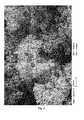
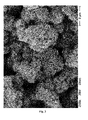
- Figs. 1 and 2 Scanning electron microscope (SEM) micrograph pictures of the amorphous silica are shown in Figs. 1 and 2.
- Fig. 2 is a magnified section of Fig. 1 , which reveals that primary nano-size particles are agglomerated to bigger secondary particles having a particles size in the micrometre range.
- Fig. 3 shows a SEM micrograph of a surface-treated calcium carbonate according to the present invention. The porous surface structure of the surface-reacted calcium carbonate is clearly visible and it can be gathered from Fig. 3 that nano-size particles are not present.
Landscapes
- Chemical & Material Sciences (AREA)
- Organic Chemistry (AREA)
- Life Sciences & Earth Sciences (AREA)
- Polymers & Plastics (AREA)
- Engineering & Computer Science (AREA)
- Food Science & Technology (AREA)
- Geology (AREA)
- Inorganic Chemistry (AREA)
- Animal Husbandry (AREA)
- Nutrition Science (AREA)
- Health & Medical Sciences (AREA)
- Zoology (AREA)
- Compounds Of Alkaline-Earth Elements, Aluminum Or Rare-Earth Metals (AREA)
- Coloring Foods And Improving Nutritive Qualities (AREA)
- Cosmetics (AREA)
- Fodder In General (AREA)
- Pigments, Carbon Blacks, Or Wood Stains (AREA)
- Confectionery (AREA)
- Dairy Products (AREA)
- Bakery Products And Manufacturing Methods Therefor (AREA)
Priority Applications (16)
| Application Number | Priority Date | Filing Date | Title |
|---|---|---|---|
| ES14185739.1T ES2667337T3 (es) | 2014-09-22 | 2014-09-22 | Carbonato de calcio tratado mediante reacción superficial para su uso como agente antiapelmazante |
| PL14185739T PL2997833T3 (pl) | 2014-09-22 | 2014-09-22 | Przereagowany powierzchniowo węglan wapnia stosowany jako środek przeciwzbrylający |
| EP14185739.1A EP2997833B1 (de) | 2014-09-22 | 2014-09-22 | Oberflächenreaktives Calciumkarbonat zur Verwendung als Trennmittel |
| TW104130573A TW201622750A (zh) | 2014-09-22 | 2015-09-16 | 用作抗結塊劑之經表面反應碳酸鈣 |
| EP15775121.5A EP3197292A1 (de) | 2014-09-22 | 2015-09-17 | Oberflächenreaktives calciumcarbonat zur verwendung als trennmittel |
| RU2017113822A RU2664575C1 (ru) | 2014-09-22 | 2015-09-17 | Карбонат кальция с подвергнутой химической обработке поверхностью для использования в качестве ингибитора комкования |
| PCT/EP2015/071307 WO2016046051A1 (en) | 2014-09-22 | 2015-09-17 | Surface-reacted calcium carbonate for use as anti-caking agent |
| US15/512,616 US20170290365A1 (en) | 2014-09-22 | 2015-09-17 | Surface-reacted calcium carbonate for use as anti-caking agent |
| BR112017005780-8A BR112017005780B1 (pt) | 2014-09-22 | 2015-09-17 | Uso de um carbonato de cálcio reagido na superfície como agente antiaglomerante, métodos para controlar, reduzir ou evitar aglomeração de uma composição particulada e para produzir uma composição, e, composição |
| AU2015321058A AU2015321058B2 (en) | 2014-09-22 | 2015-09-17 | Surface-reacted calcium carbonate for use as anti-caking agent |
| CA2960866A CA2960866C (en) | 2014-09-22 | 2015-09-17 | Surface-reacted calcium carbonate for use as anti-caking agent |
| CN201580050921.1A CN107072284B (zh) | 2014-09-22 | 2015-09-17 | 用作防结块剂的经表面反应的碳酸钙 |
| ARP150103020A AR101974A1 (es) | 2014-09-22 | 2015-09-18 | Composición que comprende un carbonato de calcio reaccionado en la superficie como agente antiaglomerante |
| UY0001036313A UY36313A (es) | 2014-09-22 | 2015-09-21 | Composición que comprende un carbonato de calcio reaccionado en la superficie como agente antiaglomerante, y método para producirla |
| IL251088A IL251088A0 (en) | 2014-09-22 | 2017-03-12 | Surface coated calcium carbonate for use as an anti-caking agent |
| ZA2017/02833A ZA201702833B (en) | 2014-09-22 | 2017-04-21 | Surface-reacted calcium carbonate for use as anti-caking agent |
Applications Claiming Priority (1)
| Application Number | Priority Date | Filing Date | Title |
|---|---|---|---|
| EP14185739.1A EP2997833B1 (de) | 2014-09-22 | 2014-09-22 | Oberflächenreaktives Calciumkarbonat zur Verwendung als Trennmittel |
Publications (2)
| Publication Number | Publication Date |
|---|---|
| EP2997833A1 true EP2997833A1 (de) | 2016-03-23 |
| EP2997833B1 EP2997833B1 (de) | 2018-01-31 |
Family
ID=51609938
Family Applications (2)
| Application Number | Title | Priority Date | Filing Date |
|---|---|---|---|
| EP14185739.1A Active EP2997833B1 (de) | 2014-09-22 | 2014-09-22 | Oberflächenreaktives Calciumkarbonat zur Verwendung als Trennmittel |
| EP15775121.5A Withdrawn EP3197292A1 (de) | 2014-09-22 | 2015-09-17 | Oberflächenreaktives calciumcarbonat zur verwendung als trennmittel |
Family Applications After (1)
| Application Number | Title | Priority Date | Filing Date |
|---|---|---|---|
| EP15775121.5A Withdrawn EP3197292A1 (de) | 2014-09-22 | 2015-09-17 | Oberflächenreaktives calciumcarbonat zur verwendung als trennmittel |
Country Status (15)
| Country | Link |
|---|---|
| US (1) | US20170290365A1 (de) |
| EP (2) | EP2997833B1 (de) |
| CN (1) | CN107072284B (de) |
| AR (1) | AR101974A1 (de) |
| AU (1) | AU2015321058B2 (de) |
| BR (1) | BR112017005780B1 (de) |
| CA (1) | CA2960866C (de) |
| ES (1) | ES2667337T3 (de) |
| IL (1) | IL251088A0 (de) |
| PL (1) | PL2997833T3 (de) |
| RU (1) | RU2664575C1 (de) |
| TW (1) | TW201622750A (de) |
| UY (1) | UY36313A (de) |
| WO (1) | WO2016046051A1 (de) |
| ZA (1) | ZA201702833B (de) |
Cited By (9)
| Publication number | Priority date | Publication date | Assignee | Title |
|---|---|---|---|---|
| EP3400810A1 (de) * | 2017-05-11 | 2018-11-14 | Omya International AG | Oberflächenreaktives kalziumkarbonat in lebensmitteln |
| WO2019105729A1 (en) * | 2017-11-30 | 2019-06-06 | Unilever N.V. | Savoury, particulate compositions comprising tomato powder |
| EP3245257B1 (de) | 2015-01-15 | 2019-11-13 | Omya International AG | Oberflächenbehandeltes calciumcarbonat mit verbesserter stabilität in umgebungen mit einem ph-wert von 4,5 bis 7 |
| EP3725851A1 (de) * | 2019-04-16 | 2020-10-21 | Omya International AG | Verfahren zur herstellung von oberflächenreaktivem calciumcarbonat |
| WO2021175658A1 (en) | 2020-03-03 | 2021-09-10 | Omya International Ag | Anticaking agent |
| WO2022175248A1 (en) | 2021-02-18 | 2022-08-25 | Omya International Ag | Anti-pollution agent |
| CN115803001A (zh) * | 2020-07-20 | 2023-03-14 | Omya国际股份公司 | 用于益生组合物的稳定化试剂 |
| WO2023227585A1 (en) | 2022-05-25 | 2023-11-30 | Omya International Ag | White uv-absorbing surface-reacted calcium carbonate doped with a titanium species |
| WO2023227600A1 (en) | 2022-05-25 | 2023-11-30 | Omya International Ag | Process for producing a white uv-absorbing surface-reacted calcium carbonate doped with a titanium species, a white uv-absorbing surface-reacted calcium carbonate and use thereof |
Families Citing this family (13)
| Publication number | Priority date | Publication date | Assignee | Title |
|---|---|---|---|---|
| EP3069713A1 (de) * | 2015-03-20 | 2016-09-21 | Omya International AG | Dispergierbare dosierungsform |
| EP3260114A1 (de) | 2016-06-21 | 2017-12-27 | Omya International AG | Verfahren zur herstellung einer darreichungsform |
| EP3275537A1 (de) * | 2016-07-25 | 2018-01-31 | Omya International AG | Oberflächenmodifiziertes calciumcarbonat als träger für übergangsmetallbasierte katalysatoren |
| EP3520798A1 (de) * | 2018-01-31 | 2019-08-07 | Omya International AG | Verwendung von funktionalisiertem calciumcarbonat als wirkstoff |
| CN108752088A (zh) * | 2018-05-29 | 2018-11-06 | 贵州紫云月华新材料有限公司 | 一种化肥防结块专用改性碳酸钙及其制备方法 |
| EP3620498A1 (de) | 2018-09-10 | 2020-03-11 | Omya International AG | Feuchtigkeitsaufnehmende, -speichernde und/oder -freisetzende zusammensetzung |
| ES2945216T3 (es) * | 2018-11-26 | 2023-06-29 | Purac Biochem Bv | Composición de conservante alimentario particulada |
| EP3693339A1 (de) * | 2019-02-01 | 2020-08-12 | Omya International AG | Herstellung von oberflächenreagierten kalziumsalzen durch mahlinduzierte umwandlung |
| EP3733785A1 (de) * | 2019-05-03 | 2020-11-04 | Omya International AG | Oberflächenreagiertes magnesiumcarbonat als trägermaterial für die freisetzung eines oder mehrerer wirkstoffe in einer heimpflegeformulierung |
| AR119243A1 (es) * | 2019-07-08 | 2021-12-01 | Omya Int Ag | Composición seca cosmética y/o para el cuidado de la piel |
| CN112574598A (zh) * | 2021-01-25 | 2021-03-30 | 广西华纳新材料科技有限公司 | 一种提高重质碳酸钙比表面积的方法 |
| EP4493661A1 (de) * | 2022-03-16 | 2025-01-22 | The Procter & Gamble Company | Mit gefälltem calciumcarbonat umhüllte waschmittelgranulate |
| CN115259715B (zh) * | 2022-08-25 | 2024-04-02 | 上海城建物资有限公司 | 一种抗结团剂及其制备与应用 |
Citations (17)
| Publication number | Priority date | Publication date | Assignee | Title |
|---|---|---|---|---|
| US3273960A (en) | 1961-10-17 | 1966-09-20 | Monsanto Co | Caking resistant monocalcium phosphate, monohydrate and process for its manufacture |
| EP0489492A1 (de) | 1990-12-05 | 1992-06-10 | Morton International, Inc. | Natriumborohydridzusammensetzungen und Verfahren zur Herstellung von kompaktem Natriumborohydrid |
| US5149552A (en) | 1991-05-23 | 1992-09-22 | Kraft General Foods, Inc. | Calcium citrate anticaking agent |
| DE19517498A1 (de) * | 1995-05-12 | 1996-11-14 | Budenheim Rud A Oetker Chemie | Verfahren zur Anreicherung mit Spurensubstanzen und Rieselhilfsmittel hierfür |
| WO2000039222A1 (fr) | 1998-12-24 | 2000-07-06 | Plüss-Staufer Ag | NOUVELLE CHARGE OU PIGMENT OU MINERAL TRAITE POUR PAPIER, NOTAMMENT PIGMENT CONTENANT DU CaCO3 NATUREL, SON PROCEDE DE FABRICATION, COMPOSITIONS LES CONTENANT, ET LEURS APPLICATIONS |
| EP1249271A1 (de) | 2001-04-09 | 2002-10-16 | Puratos N.V. | Neue Zusatzstoffe die das verbacken pulverförmiger Emulgatoren vermeiden |
| US20030213937A1 (en) * | 2001-02-22 | 2003-11-20 | Isaac Yaniv | Precipitated aragonite and a process for producing it |
| US20040109927A1 (en) | 2002-11-27 | 2004-06-10 | Ang Jit Fu | Carbonate-based anti-caking agent with reduced gas release properties |
| WO2004083316A1 (fr) | 2003-03-18 | 2004-09-30 | Omya Development Ag | Nouveau pigment mineral contenant du carbonate de calcium, suspension aqueuse le contenant et ses usages |
| WO2005121257A2 (fr) | 2004-06-11 | 2005-12-22 | Omya Development Ag | Nouveau pigment mineral sec contenant du carbonate de calcium, suspension aqueuse le contenant et ses usages |
| EP2070991A1 (de) | 2007-12-12 | 2009-06-17 | Omya Development AG | Oberflächenreaktives Fällungskalziumkarbonat, Herstellungsverfahren dafür und Verwendungen davon |
| WO2009114227A1 (en) * | 2008-03-11 | 2009-09-17 | Mallinckrodt Inc. | Use of magnesium stearate dihydrate for lubrication of solid industrial or consumer products |
| WO2010037753A1 (en) | 2008-09-30 | 2010-04-08 | Omya Development Ag | New controlled release active agent carrier |
| WO2010051458A1 (en) * | 2008-10-31 | 2010-05-06 | Calera Corporation | Non-cementitious compositions comprising co2 sequestering additives |
| EP2264109A1 (de) | 2009-06-15 | 2010-12-22 | Omya Development AG | Verfahren zur Herstellung von oberflächenreaktivem Kalziumkarbonat und Verwendung |
| EP2264108A1 (de) | 2009-06-15 | 2010-12-22 | Omya Development AG | Verfahren zur Herstellung eines an der Oberfläche reagierten Calciumcarbonats, das eine schwache Säure anwendet, resultierende Produkte und deren Verwendungen |
| WO2013165600A1 (en) * | 2012-05-03 | 2013-11-07 | Calera Corporation | Non-cementitious compositions comprising vaterite and methods thereof |
Family Cites Families (4)
| Publication number | Priority date | Publication date | Assignee | Title |
|---|---|---|---|---|
| WO2001066467A1 (en) * | 2000-03-06 | 2001-09-13 | 3P Technologies Ltd. | Precipitated aragonite and a process for producing it |
| US9901755B2 (en) * | 2011-09-23 | 2018-02-27 | Sancastle Worldwide Corporation | Composition for preventing or treating dentin-associated symptoms or diseases, and method using the same |
| PT2883573T (pt) * | 2013-12-13 | 2018-01-04 | Omya Int Ag | Composição de limpeza abrasiva |
| TWI654141B (zh) * | 2014-03-31 | 2019-03-21 | 日商日本製紙股份有限公司 | Calcium carbonate microparticles and method of producing the same |
-
2014
- 2014-09-22 ES ES14185739.1T patent/ES2667337T3/es active Active
- 2014-09-22 PL PL14185739T patent/PL2997833T3/pl unknown
- 2014-09-22 EP EP14185739.1A patent/EP2997833B1/de active Active
-
2015
- 2015-09-16 TW TW104130573A patent/TW201622750A/zh unknown
- 2015-09-17 CN CN201580050921.1A patent/CN107072284B/zh active Active
- 2015-09-17 AU AU2015321058A patent/AU2015321058B2/en active Active
- 2015-09-17 BR BR112017005780-8A patent/BR112017005780B1/pt active IP Right Grant
- 2015-09-17 RU RU2017113822A patent/RU2664575C1/ru active
- 2015-09-17 CA CA2960866A patent/CA2960866C/en active Active
- 2015-09-17 WO PCT/EP2015/071307 patent/WO2016046051A1/en not_active Ceased
- 2015-09-17 EP EP15775121.5A patent/EP3197292A1/de not_active Withdrawn
- 2015-09-17 US US15/512,616 patent/US20170290365A1/en not_active Abandoned
- 2015-09-18 AR ARP150103020A patent/AR101974A1/es active IP Right Grant
- 2015-09-21 UY UY0001036313A patent/UY36313A/es not_active Application Discontinuation
-
2017
- 2017-03-12 IL IL251088A patent/IL251088A0/en unknown
- 2017-04-21 ZA ZA2017/02833A patent/ZA201702833B/en unknown
Patent Citations (19)
| Publication number | Priority date | Publication date | Assignee | Title |
|---|---|---|---|---|
| US3273960A (en) | 1961-10-17 | 1966-09-20 | Monsanto Co | Caking resistant monocalcium phosphate, monohydrate and process for its manufacture |
| EP0489492A1 (de) | 1990-12-05 | 1992-06-10 | Morton International, Inc. | Natriumborohydridzusammensetzungen und Verfahren zur Herstellung von kompaktem Natriumborohydrid |
| US5149552A (en) | 1991-05-23 | 1992-09-22 | Kraft General Foods, Inc. | Calcium citrate anticaking agent |
| DE19517498A1 (de) * | 1995-05-12 | 1996-11-14 | Budenheim Rud A Oetker Chemie | Verfahren zur Anreicherung mit Spurensubstanzen und Rieselhilfsmittel hierfür |
| WO2000039222A1 (fr) | 1998-12-24 | 2000-07-06 | Plüss-Staufer Ag | NOUVELLE CHARGE OU PIGMENT OU MINERAL TRAITE POUR PAPIER, NOTAMMENT PIGMENT CONTENANT DU CaCO3 NATUREL, SON PROCEDE DE FABRICATION, COMPOSITIONS LES CONTENANT, ET LEURS APPLICATIONS |
| US20040020410A1 (en) | 1998-12-24 | 2004-02-05 | Omya Ag | Filler or pigment or processed mineral for paper, in particular a pigment containing natural CaCO3, its manufacturing process, preparations containing it and their applications |
| US20030213937A1 (en) * | 2001-02-22 | 2003-11-20 | Isaac Yaniv | Precipitated aragonite and a process for producing it |
| EP1249271A1 (de) | 2001-04-09 | 2002-10-16 | Puratos N.V. | Neue Zusatzstoffe die das verbacken pulverförmiger Emulgatoren vermeiden |
| US20040109927A1 (en) | 2002-11-27 | 2004-06-10 | Ang Jit Fu | Carbonate-based anti-caking agent with reduced gas release properties |
| WO2004083316A1 (fr) | 2003-03-18 | 2004-09-30 | Omya Development Ag | Nouveau pigment mineral contenant du carbonate de calcium, suspension aqueuse le contenant et ses usages |
| WO2005121257A2 (fr) | 2004-06-11 | 2005-12-22 | Omya Development Ag | Nouveau pigment mineral sec contenant du carbonate de calcium, suspension aqueuse le contenant et ses usages |
| EP2070991A1 (de) | 2007-12-12 | 2009-06-17 | Omya Development AG | Oberflächenreaktives Fällungskalziumkarbonat, Herstellungsverfahren dafür und Verwendungen davon |
| WO2009074492A1 (en) | 2007-12-12 | 2009-06-18 | Omya Development Ag | Surface-reacted precipitated calcium carbonate, process to make same, and uses thereof |
| WO2009114227A1 (en) * | 2008-03-11 | 2009-09-17 | Mallinckrodt Inc. | Use of magnesium stearate dihydrate for lubrication of solid industrial or consumer products |
| WO2010037753A1 (en) | 2008-09-30 | 2010-04-08 | Omya Development Ag | New controlled release active agent carrier |
| WO2010051458A1 (en) * | 2008-10-31 | 2010-05-06 | Calera Corporation | Non-cementitious compositions comprising co2 sequestering additives |
| EP2264109A1 (de) | 2009-06-15 | 2010-12-22 | Omya Development AG | Verfahren zur Herstellung von oberflächenreaktivem Kalziumkarbonat und Verwendung |
| EP2264108A1 (de) | 2009-06-15 | 2010-12-22 | Omya Development AG | Verfahren zur Herstellung eines an der Oberfläche reagierten Calciumcarbonats, das eine schwache Säure anwendet, resultierende Produkte und deren Verwendungen |
| WO2013165600A1 (en) * | 2012-05-03 | 2013-11-07 | Calera Corporation | Non-cementitious compositions comprising vaterite and methods thereof |
Non-Patent Citations (4)
| Title |
|---|
| "Handbook of Fillers for Plastic", VAN NOSTRAND REINHOLD, pages: 170 |
| "Scientific Opinion on re-evaluation of calcium carbonate (E 170) as a food additive EFSA Panel on Food Additives and Nutrient Sources added to Food (ANS)", EFSA JOURNAL EFSA JOURNAL, 1 January 2011 (2011-01-01), pages 4 - 73, XP055171488, Retrieved from the Internet <URL:http://www.efsa.europa.eu/en/efsajournal/doc/2318.pdf> [retrieved on 20150223], DOI: 10.2903/j.efsa.2011.2318 * |
| GANE, P.A.C.; KETTLE, J.P.; MATTHEWS, G.P.; RIDGWAY, C.J.: "Void Space Structure of Compressible Polymer Spheres and Consolidated Calcium Carbonate Paper-Coating Formulations", INDUSTRIAL AND ENGINEERING CHEMISTRY RESEARCH, vol. 35, no. 5, 1996, pages 1753 - 1764 |
| HARRIS, D. C.: "Quantitative Chemical Analysis", 1991, W.H. FREEMAN & CO. |
Cited By (19)
| Publication number | Priority date | Publication date | Assignee | Title |
|---|---|---|---|---|
| EP3245257B1 (de) | 2015-01-15 | 2019-11-13 | Omya International AG | Oberflächenbehandeltes calciumcarbonat mit verbesserter stabilität in umgebungen mit einem ph-wert von 4,5 bis 7 |
| AU2018265209B2 (en) * | 2017-05-11 | 2023-09-21 | Omya International Ag | Surface-reacted calcium carbonate in food |
| WO2018206709A1 (en) * | 2017-05-11 | 2018-11-15 | Omya International Ag | Surface-reacted calcium carbonate in food |
| KR20200006117A (ko) * | 2017-05-11 | 2020-01-17 | 옴야 인터내셔널 아게 | 식품 중의 표면-반응된 탄산칼슘 |
| EP3400810A1 (de) * | 2017-05-11 | 2018-11-14 | Omya International AG | Oberflächenreaktives kalziumkarbonat in lebensmitteln |
| US20220104525A1 (en) * | 2017-05-11 | 2022-04-07 | Omya International Ag | Surface-reacted calcium carbonate in food |
| US11889853B2 (en) * | 2017-05-11 | 2024-02-06 | Omya International Ag | Surface-reacted calcium carbonate in food |
| WO2019105729A1 (en) * | 2017-11-30 | 2019-06-06 | Unilever N.V. | Savoury, particulate compositions comprising tomato powder |
| CN111432657A (zh) * | 2017-11-30 | 2020-07-17 | 荷兰联合利华有限公司 | 包含番茄粉的咸鲜颗粒组合物 |
| EP3716789B1 (de) | 2017-11-30 | 2024-10-09 | Unilever IP Holdings B.V. | Schmackhafte teilchenförmige zusammensetzungen mit tomatenpulver |
| EP3725851A1 (de) * | 2019-04-16 | 2020-10-21 | Omya International AG | Verfahren zur herstellung von oberflächenreaktivem calciumcarbonat |
| WO2020212204A1 (en) * | 2019-04-16 | 2020-10-22 | Omya International Ag | Process for preparing surface-reacted calcium carbonate |
| WO2021175658A1 (en) | 2020-03-03 | 2021-09-10 | Omya International Ag | Anticaking agent |
| CN115038342B (zh) * | 2020-03-03 | 2024-02-02 | 欧米亚国际集团 | 抗结块剂 |
| CN115038342A (zh) * | 2020-03-03 | 2022-09-09 | 欧米亚国际集团 | 抗结块剂 |
| CN115803001A (zh) * | 2020-07-20 | 2023-03-14 | Omya国际股份公司 | 用于益生组合物的稳定化试剂 |
| WO2022175248A1 (en) | 2021-02-18 | 2022-08-25 | Omya International Ag | Anti-pollution agent |
| WO2023227585A1 (en) | 2022-05-25 | 2023-11-30 | Omya International Ag | White uv-absorbing surface-reacted calcium carbonate doped with a titanium species |
| WO2023227600A1 (en) | 2022-05-25 | 2023-11-30 | Omya International Ag | Process for producing a white uv-absorbing surface-reacted calcium carbonate doped with a titanium species, a white uv-absorbing surface-reacted calcium carbonate and use thereof |
Also Published As
| Publication number | Publication date |
|---|---|
| US20170290365A1 (en) | 2017-10-12 |
| ES2667337T3 (es) | 2018-05-10 |
| IL251088A0 (en) | 2017-04-30 |
| AU2015321058B2 (en) | 2017-10-05 |
| ZA201702833B (en) | 2018-08-29 |
| CN107072284A (zh) | 2017-08-18 |
| EP3197292A1 (de) | 2017-08-02 |
| EP2997833B1 (de) | 2018-01-31 |
| RU2664575C1 (ru) | 2018-08-21 |
| CA2960866A1 (en) | 2016-03-31 |
| PL2997833T3 (pl) | 2018-07-31 |
| CN107072284B (zh) | 2019-07-19 |
| UY36313A (es) | 2016-04-29 |
| WO2016046051A1 (en) | 2016-03-31 |
| TW201622750A (zh) | 2016-07-01 |
| AR101974A1 (es) | 2017-01-25 |
| AU2015321058A1 (en) | 2017-05-18 |
| BR112017005780A2 (pt) | 2017-12-12 |
| CA2960866C (en) | 2019-03-12 |
| BR112017005780B1 (pt) | 2021-10-19 |
Similar Documents
| Publication | Publication Date | Title |
|---|---|---|
| EP2997833B1 (de) | Oberflächenreaktives Calciumkarbonat zur Verwendung als Trennmittel | |
| EP3400810A1 (de) | Oberflächenreaktives kalziumkarbonat in lebensmitteln | |
| JP2020513058A (ja) | 表面改質炭酸カルシウム及び粉砕天然炭酸カルシウムを含む顔料組成物 | |
| JP7699596B2 (ja) | アンチケーキング剤 | |
| EP3820945B1 (de) | Oberflächenreagiertes calciumkarbonat zur stabilisierung von minzöl | |
| EP3746045B1 (de) | Nicht-therapeutische verwendung von funktionalisiertem calciumcarbonat als wirkstoff | |
| EP3956402B1 (de) | Verfahren zur herstellung von oberflächenreaktivem calciumcarbonat | |
| BR112020023937B1 (pt) | Carbonato de cálcio reativo na superfície, e, uso de um carbonato de cálcio reativo na superfície |
Legal Events
| Date | Code | Title | Description |
|---|---|---|---|
| PUAI | Public reference made under article 153(3) epc to a published international application that has entered the european phase |
Free format text: ORIGINAL CODE: 0009012 |
|
| 17P | Request for examination filed |
Effective date: 20140922 |
|
| AK | Designated contracting states |
Kind code of ref document: A1 Designated state(s): AL AT BE BG CH CY CZ DE DK EE ES FI FR GB GR HR HU IE IS IT LI LT LU LV MC MK MT NL NO PL PT RO RS SE SI SK SM TR |
|
| AX | Request for extension of the european patent |
Extension state: BA ME |
|
| RIN1 | Information on inventor provided before grant (corrected) |
Inventor name: BUDDE, TANJA |
|
| STAA | Information on the status of an ep patent application or granted ep patent |
Free format text: STATUS: EXAMINATION IS IN PROGRESS |
|
| 17Q | First examination report despatched |
Effective date: 20161223 |
|
| REG | Reference to a national code |
Ref country code: DE Ref legal event code: R079 Ref document number: 602014020292 Country of ref document: DE Free format text: PREVIOUS MAIN CLASS: A23L0005000000 Ipc: A23P0010430000 |
|
| RIC1 | Information provided on ipc code assigned before grant |
Ipc: A23L 5/00 20160101ALI20170608BHEP Ipc: C01F 11/18 20060101ALI20170608BHEP Ipc: A23P 10/43 20160101AFI20170608BHEP Ipc: C09C 1/02 20060101ALI20170608BHEP |
|
| GRAP | Despatch of communication of intention to grant a patent |
Free format text: ORIGINAL CODE: EPIDOSNIGR1 |
|
| STAA | Information on the status of an ep patent application or granted ep patent |
Free format text: STATUS: GRANT OF PATENT IS INTENDED |
|
| INTG | Intention to grant announced |
Effective date: 20170808 |
|
| GRAS | Grant fee paid |
Free format text: ORIGINAL CODE: EPIDOSNIGR3 |
|
| GRAJ | Information related to disapproval of communication of intention to grant by the applicant or resumption of examination proceedings by the epo deleted |
Free format text: ORIGINAL CODE: EPIDOSDIGR1 |
|
| GRAL | Information related to payment of fee for publishing/printing deleted |
Free format text: ORIGINAL CODE: EPIDOSDIGR3 |
|
| STAA | Information on the status of an ep patent application or granted ep patent |
Free format text: STATUS: EXAMINATION IS IN PROGRESS |
|
| GRAR | Information related to intention to grant a patent recorded |
Free format text: ORIGINAL CODE: EPIDOSNIGR71 |
|
| STAA | Information on the status of an ep patent application or granted ep patent |
Free format text: STATUS: GRANT OF PATENT IS INTENDED |
|
| GRAA | (expected) grant |
Free format text: ORIGINAL CODE: 0009210 |
|
| STAA | Information on the status of an ep patent application or granted ep patent |
Free format text: STATUS: THE PATENT HAS BEEN GRANTED |
|
| INTC | Intention to grant announced (deleted) | ||
| INTG | Intention to grant announced |
Effective date: 20171220 |
|
| AK | Designated contracting states |
Kind code of ref document: B1 Designated state(s): AL AT BE BG CH CY CZ DE DK EE ES FI FR GB GR HR HU IE IS IT LI LT LU LV MC MK MT NL NO PL PT RO RS SE SI SK SM TR |
|
| AX | Request for extension of the european patent |
Extension state: BA ME |
|
| REG | Reference to a national code |
Ref country code: GB Ref legal event code: FG4D Ref country code: CH Ref legal event code: EP |
|
| REG | Reference to a national code |
Ref country code: AT Ref legal event code: REF Ref document number: 966526 Country of ref document: AT Kind code of ref document: T Effective date: 20180215 |
|
| REG | Reference to a national code |
Ref country code: IE Ref legal event code: FG4D |
|
| REG | Reference to a national code |
Ref country code: DE Ref legal event code: R096 Ref document number: 602014020292 Country of ref document: DE |
|
| REG | Reference to a national code |
Ref country code: SE Ref legal event code: TRGR |
|
| REG | Reference to a national code |
Ref country code: NL Ref legal event code: FP |
|
| REG | Reference to a national code |
Ref country code: ES Ref legal event code: FG2A Ref document number: 2667337 Country of ref document: ES Kind code of ref document: T3 Effective date: 20180510 |
|
| REG | Reference to a national code |
Ref country code: LT Ref legal event code: MG4D |
|
| PG25 | Lapsed in a contracting state [announced via postgrant information from national office to epo] |
Ref country code: LT Free format text: LAPSE BECAUSE OF FAILURE TO SUBMIT A TRANSLATION OF THE DESCRIPTION OR TO PAY THE FEE WITHIN THE PRESCRIBED TIME-LIMIT Effective date: 20180131 Ref country code: FI Free format text: LAPSE BECAUSE OF FAILURE TO SUBMIT A TRANSLATION OF THE DESCRIPTION OR TO PAY THE FEE WITHIN THE PRESCRIBED TIME-LIMIT Effective date: 20180131 Ref country code: NO Free format text: LAPSE BECAUSE OF FAILURE TO SUBMIT A TRANSLATION OF THE DESCRIPTION OR TO PAY THE FEE WITHIN THE PRESCRIBED TIME-LIMIT Effective date: 20180430 Ref country code: HR Free format text: LAPSE BECAUSE OF FAILURE TO SUBMIT A TRANSLATION OF THE DESCRIPTION OR TO PAY THE FEE WITHIN THE PRESCRIBED TIME-LIMIT Effective date: 20180131 |
|
| PG25 | Lapsed in a contracting state [announced via postgrant information from national office to epo] |
Ref country code: RS Free format text: LAPSE BECAUSE OF FAILURE TO SUBMIT A TRANSLATION OF THE DESCRIPTION OR TO PAY THE FEE WITHIN THE PRESCRIBED TIME-LIMIT Effective date: 20180131 Ref country code: GR Free format text: LAPSE BECAUSE OF FAILURE TO SUBMIT A TRANSLATION OF THE DESCRIPTION OR TO PAY THE FEE WITHIN THE PRESCRIBED TIME-LIMIT Effective date: 20180501 Ref country code: IS Free format text: LAPSE BECAUSE OF FAILURE TO SUBMIT A TRANSLATION OF THE DESCRIPTION OR TO PAY THE FEE WITHIN THE PRESCRIBED TIME-LIMIT Effective date: 20180531 Ref country code: BG Free format text: LAPSE BECAUSE OF FAILURE TO SUBMIT A TRANSLATION OF THE DESCRIPTION OR TO PAY THE FEE WITHIN THE PRESCRIBED TIME-LIMIT Effective date: 20180430 Ref country code: LV Free format text: LAPSE BECAUSE OF FAILURE TO SUBMIT A TRANSLATION OF THE DESCRIPTION OR TO PAY THE FEE WITHIN THE PRESCRIBED TIME-LIMIT Effective date: 20180131 |
|
| REG | Reference to a national code |
Ref country code: FR Ref legal event code: PLFP Year of fee payment: 5 |
|
| PG25 | Lapsed in a contracting state [announced via postgrant information from national office to epo] |
Ref country code: RO Free format text: LAPSE BECAUSE OF FAILURE TO SUBMIT A TRANSLATION OF THE DESCRIPTION OR TO PAY THE FEE WITHIN THE PRESCRIBED TIME-LIMIT Effective date: 20180131 Ref country code: EE Free format text: LAPSE BECAUSE OF FAILURE TO SUBMIT A TRANSLATION OF THE DESCRIPTION OR TO PAY THE FEE WITHIN THE PRESCRIBED TIME-LIMIT Effective date: 20180131 Ref country code: AL Free format text: LAPSE BECAUSE OF FAILURE TO SUBMIT A TRANSLATION OF THE DESCRIPTION OR TO PAY THE FEE WITHIN THE PRESCRIBED TIME-LIMIT Effective date: 20180131 |
|
| REG | Reference to a national code |
Ref country code: DE Ref legal event code: R097 Ref document number: 602014020292 Country of ref document: DE |
|
| PG25 | Lapsed in a contracting state [announced via postgrant information from national office to epo] |
Ref country code: SM Free format text: LAPSE BECAUSE OF FAILURE TO SUBMIT A TRANSLATION OF THE DESCRIPTION OR TO PAY THE FEE WITHIN THE PRESCRIBED TIME-LIMIT Effective date: 20180131 Ref country code: SK Free format text: LAPSE BECAUSE OF FAILURE TO SUBMIT A TRANSLATION OF THE DESCRIPTION OR TO PAY THE FEE WITHIN THE PRESCRIBED TIME-LIMIT Effective date: 20180131 Ref country code: DK Free format text: LAPSE BECAUSE OF FAILURE TO SUBMIT A TRANSLATION OF THE DESCRIPTION OR TO PAY THE FEE WITHIN THE PRESCRIBED TIME-LIMIT Effective date: 20180131 Ref country code: CZ Free format text: LAPSE BECAUSE OF FAILURE TO SUBMIT A TRANSLATION OF THE DESCRIPTION OR TO PAY THE FEE WITHIN THE PRESCRIBED TIME-LIMIT Effective date: 20180131 |
|
| PLBE | No opposition filed within time limit |
Free format text: ORIGINAL CODE: 0009261 |
|
| STAA | Information on the status of an ep patent application or granted ep patent |
Free format text: STATUS: NO OPPOSITION FILED WITHIN TIME LIMIT |
|
| 26N | No opposition filed |
Effective date: 20181102 |
|
| PG25 | Lapsed in a contracting state [announced via postgrant information from national office to epo] |
Ref country code: SI Free format text: LAPSE BECAUSE OF FAILURE TO SUBMIT A TRANSLATION OF THE DESCRIPTION OR TO PAY THE FEE WITHIN THE PRESCRIBED TIME-LIMIT Effective date: 20180131 |
|
| PG25 | Lapsed in a contracting state [announced via postgrant information from national office to epo] |
Ref country code: MC Free format text: LAPSE BECAUSE OF FAILURE TO SUBMIT A TRANSLATION OF THE DESCRIPTION OR TO PAY THE FEE WITHIN THE PRESCRIBED TIME-LIMIT Effective date: 20180131 |
|
| REG | Reference to a national code |
Ref country code: IE Ref legal event code: MM4A |
|
| PG25 | Lapsed in a contracting state [announced via postgrant information from national office to epo] |
Ref country code: LU Free format text: LAPSE BECAUSE OF NON-PAYMENT OF DUE FEES Effective date: 20180922 |
|
| PG25 | Lapsed in a contracting state [announced via postgrant information from national office to epo] |
Ref country code: IE Free format text: LAPSE BECAUSE OF NON-PAYMENT OF DUE FEES Effective date: 20180922 |
|
| PG25 | Lapsed in a contracting state [announced via postgrant information from national office to epo] |
Ref country code: MT Free format text: LAPSE BECAUSE OF NON-PAYMENT OF DUE FEES Effective date: 20180922 |
|
| PG25 | Lapsed in a contracting state [announced via postgrant information from national office to epo] |
Ref country code: PT Free format text: LAPSE BECAUSE OF FAILURE TO SUBMIT A TRANSLATION OF THE DESCRIPTION OR TO PAY THE FEE WITHIN THE PRESCRIBED TIME-LIMIT Effective date: 20180131 |
|
| PG25 | Lapsed in a contracting state [announced via postgrant information from national office to epo] |
Ref country code: HU Free format text: LAPSE BECAUSE OF FAILURE TO SUBMIT A TRANSLATION OF THE DESCRIPTION OR TO PAY THE FEE WITHIN THE PRESCRIBED TIME-LIMIT; INVALID AB INITIO Effective date: 20140922 Ref country code: CY Free format text: LAPSE BECAUSE OF FAILURE TO SUBMIT A TRANSLATION OF THE DESCRIPTION OR TO PAY THE FEE WITHIN THE PRESCRIBED TIME-LIMIT Effective date: 20180131 Ref country code: MK Free format text: LAPSE BECAUSE OF NON-PAYMENT OF DUE FEES Effective date: 20180131 |
|
| P01 | Opt-out of the competence of the unified patent court (upc) registered |
Effective date: 20230517 |
|
| REG | Reference to a national code |
Ref country code: CH Ref legal event code: U11 Free format text: ST27 STATUS EVENT CODE: U-0-0-U10-U11 (AS PROVIDED BY THE NATIONAL OFFICE) Effective date: 20251001 |
|
| PGFP | Annual fee paid to national office [announced via postgrant information from national office to epo] |
Ref country code: DE Payment date: 20250919 Year of fee payment: 12 |
|
| PGFP | Annual fee paid to national office [announced via postgrant information from national office to epo] |
Ref country code: PL Payment date: 20250912 Year of fee payment: 12 Ref country code: NL Payment date: 20250918 Year of fee payment: 12 Ref country code: TR Payment date: 20250916 Year of fee payment: 12 Ref country code: IT Payment date: 20250923 Year of fee payment: 12 |
|
| PGFP | Annual fee paid to national office [announced via postgrant information from national office to epo] |
Ref country code: GB Payment date: 20250919 Year of fee payment: 12 Ref country code: BE Payment date: 20250918 Year of fee payment: 12 |
|
| PGFP | Annual fee paid to national office [announced via postgrant information from national office to epo] |
Ref country code: FR Payment date: 20250922 Year of fee payment: 12 Ref country code: AT Payment date: 20250919 Year of fee payment: 12 |
|
| PGFP | Annual fee paid to national office [announced via postgrant information from national office to epo] |
Ref country code: SE Payment date: 20250918 Year of fee payment: 12 |
|
| PGFP | Annual fee paid to national office [announced via postgrant information from national office to epo] |
Ref country code: CH Payment date: 20251001 Year of fee payment: 12 |
|
| PGFP | Annual fee paid to national office [announced via postgrant information from national office to epo] |
Ref country code: ES Payment date: 20251028 Year of fee payment: 12 |