EP2999514B1 - Verfahren für parameter zur tiefen hirnstimulation - Google Patents
Verfahren für parameter zur tiefen hirnstimulation Download PDFInfo
- Publication number
- EP2999514B1 EP2999514B1 EP14801270.1A EP14801270A EP2999514B1 EP 2999514 B1 EP2999514 B1 EP 2999514B1 EP 14801270 A EP14801270 A EP 14801270A EP 2999514 B1 EP2999514 B1 EP 2999514B1
- Authority
- EP
- European Patent Office
- Prior art keywords
- stimulation
- patterns
- regular
- neural activity
- activity
- Prior art date
- Legal status (The legal status is an assumption and is not a legal conclusion. Google has not performed a legal analysis and makes no representation as to the accuracy of the status listed.)
- Active
Links
Images


Classifications
-
- A—HUMAN NECESSITIES
- A61—MEDICAL OR VETERINARY SCIENCE; HYGIENE
- A61N—ELECTROTHERAPY; MAGNETOTHERAPY; RADIATION THERAPY; ULTRASOUND THERAPY
- A61N1/00—Electrotherapy; Circuits therefor
- A61N1/18—Applying electric currents by contact electrodes
- A61N1/32—Applying electric currents by contact electrodes alternating or intermittent currents
- A61N1/36—Applying electric currents by contact electrodes alternating or intermittent currents for stimulation
- A61N1/3605—Implantable neurostimulators for stimulating central or peripheral nerve system
- A61N1/36128—Control systems
- A61N1/36135—Control systems using physiological parameters
- A61N1/36139—Control systems using physiological parameters with automatic adjustment
-
- A—HUMAN NECESSITIES
- A61—MEDICAL OR VETERINARY SCIENCE; HYGIENE
- A61B—DIAGNOSIS; SURGERY; IDENTIFICATION
- A61B5/00—Measuring for diagnostic purposes; Identification of persons
- A61B5/24—Detecting, measuring or recording bioelectric or biomagnetic signals of the body or parts thereof
-
- A—HUMAN NECESSITIES
- A61—MEDICAL OR VETERINARY SCIENCE; HYGIENE
- A61B—DIAGNOSIS; SURGERY; IDENTIFICATION
- A61B5/00—Measuring for diagnostic purposes; Identification of persons
- A61B5/40—Detecting, measuring or recording for evaluating the nervous system
- A61B5/4058—Detecting, measuring or recording for evaluating the nervous system for evaluating the central nervous system
- A61B5/4064—Evaluating the brain
-
- A—HUMAN NECESSITIES
- A61—MEDICAL OR VETERINARY SCIENCE; HYGIENE
- A61B—DIAGNOSIS; SURGERY; IDENTIFICATION
- A61B5/00—Measuring for diagnostic purposes; Identification of persons
- A61B5/40—Detecting, measuring or recording for evaluating the nervous system
- A61B5/4076—Diagnosing or monitoring particular conditions of the nervous system
- A61B5/4082—Diagnosing or monitoring movement diseases, e.g. Parkinson, Huntington or Tourette
-
- A—HUMAN NECESSITIES
- A61—MEDICAL OR VETERINARY SCIENCE; HYGIENE
- A61B—DIAGNOSIS; SURGERY; IDENTIFICATION
- A61B5/00—Measuring for diagnostic purposes; Identification of persons
- A61B5/48—Other medical applications
- A61B5/4836—Diagnosis combined with treatment in closed-loop systems or methods
-
- A—HUMAN NECESSITIES
- A61—MEDICAL OR VETERINARY SCIENCE; HYGIENE
- A61N—ELECTROTHERAPY; MAGNETOTHERAPY; RADIATION THERAPY; ULTRASOUND THERAPY
- A61N1/00—Electrotherapy; Circuits therefor
- A61N1/18—Applying electric currents by contact electrodes
- A61N1/32—Applying electric currents by contact electrodes alternating or intermittent currents
- A61N1/36—Applying electric currents by contact electrodes alternating or intermittent currents for stimulation
- A61N1/3605—Implantable neurostimulators for stimulating central or peripheral nerve system
- A61N1/3606—Implantable neurostimulators for stimulating central or peripheral nerve system adapted for a particular treatment
- A61N1/36067—Movement disorders, e.g. tremor or Parkinson disease
-
- A—HUMAN NECESSITIES
- A61—MEDICAL OR VETERINARY SCIENCE; HYGIENE
- A61N—ELECTROTHERAPY; MAGNETOTHERAPY; RADIATION THERAPY; ULTRASOUND THERAPY
- A61N1/00—Electrotherapy; Circuits therefor
- A61N1/18—Applying electric currents by contact electrodes
- A61N1/32—Applying electric currents by contact electrodes alternating or intermittent currents
- A61N1/36—Applying electric currents by contact electrodes alternating or intermittent currents for stimulation
- A61N1/3605—Implantable neurostimulators for stimulating central or peripheral nerve system
- A61N1/3606—Implantable neurostimulators for stimulating central or peripheral nerve system adapted for a particular treatment
- A61N1/36082—Cognitive or psychiatric applications, e.g. dementia or Alzheimer's disease
-
- A—HUMAN NECESSITIES
- A61—MEDICAL OR VETERINARY SCIENCE; HYGIENE
- A61N—ELECTROTHERAPY; MAGNETOTHERAPY; RADIATION THERAPY; ULTRASOUND THERAPY
- A61N1/00—Electrotherapy; Circuits therefor
- A61N1/02—Details
- A61N1/04—Electrodes
- A61N1/05—Electrodes for implantation or insertion into the body, e.g. heart electrode
- A61N1/0526—Head electrodes
- A61N1/0529—Electrodes for brain stimulation
- A61N1/0534—Electrodes for deep brain stimulation
-
- G—PHYSICS
- G06—COMPUTING OR CALCULATING; COUNTING
- G06F—ELECTRIC DIGITAL DATA PROCESSING
- G06F2218/00—Aspects of pattern recognition specially adapted for signal processing
- G06F2218/12—Classification; Matching
-
- G—PHYSICS
- G16—INFORMATION AND COMMUNICATION TECHNOLOGY [ICT] SPECIALLY ADAPTED FOR SPECIFIC APPLICATION FIELDS
- G16H—HEALTHCARE INFORMATICS, i.e. INFORMATION AND COMMUNICATION TECHNOLOGY [ICT] SPECIALLY ADAPTED FOR THE HANDLING OR PROCESSING OF MEDICAL OR HEALTHCARE DATA
- G16H50/00—ICT specially adapted for medical diagnosis, medical simulation or medical data mining; ICT specially adapted for detecting, monitoring or modelling epidemics or pandemics
- G16H50/50—ICT specially adapted for medical diagnosis, medical simulation or medical data mining; ICT specially adapted for detecting, monitoring or modelling epidemics or pandemics for simulation or modelling of medical disorders
Definitions
- the present invention relates generally to the field of deep brain stimulation using devices, systems and methods for tuning non-regular temporal patterns of brain stimulation. Specifically, the present invention relates to methods for generating a brain stimulation pattern for treating a patient with a neurological disorder.
- Deep Brain Stimulation (DBS) has been found to be successful in treating a variety of neurological disorders, including movement disorders.
- DBS Deep Brain Stimulation
- Such treatment involves placement of a DBS type lead into a targeted region of the brain through a burr hole drilled in the patient's skull, and the application of appropriate stimulation through the lead to the targeted region.
- Oscillatory and synchronous neural activity appears to be the cause of many neurological disorders and may be important for the proper functioning of brain structures. While existing systems and methods can provide benefits to patients suffering from neurological disorders, many quality of life issues still remain. Current systems and methods of deep brain stimulation rely on process that use a fixed temporal pattern of stimulation or randomly generates a pattern of stimulation.
- Pfaff and colleagues have proposed using non-regular patterns of stimulation in mammals, including humans, that are comprised of a series of pulses whose interpulse intervals are varied using a non-linear dynamical system (Pfaff and Quinkert; 2010). Their stimulation methods seem to be effective in an arousal model of a minimally conscience state (Quinkert and Pfaff; 2012). These patterns of stimulation are essentially randomly generated, rather than designed for a specific disorder and symptom(s). The devices, systems and methods described herein use model-based design to create specific patterns of stimulation.
- Feng et al. used an optimization protocol in a model that showed, incorrectly, symptom reduction with regular, low frequency stimulation (10 Hz) that previous clinical work has demonstrated to be ineffective.
- the Feng et al. model was not validated.
- the Feng et al. stimulation patterns are generated by an optimization protocol that generates parameters defining a stochastic process. That stochastic process, in turn, randomly generates a pattern of stimulation.
- Feng et al. used a genetic algorithm to design a stochastic process that is capable of generating a random pattern of stimulation that performs well in their non-validated model.
- US 2011/0270348 A1 describes a programming system allowing a user to program therapy parameter values for therapy delivered by a medical device.
- the present invention relates to the embodiments characterized in the appended claims. Any embodiment, which is in contradiction to the subject-matter of claim 1, is not part of the invention.
- Oscillatory and synchronous neural activity appears to be the cause of many neurological disorders and may be important for the proper functioning of brain structures. There is evidence that the spectral characteristics of neural activity differ across symptoms. Therefore, the invention described herein is useful to patients with neurological disorders, including movement disorders, because it may provide customized stimulation parameters based on specific symptoms.
- the customized stimulation may be more effective and/or efficient than regular high frequency stimulation and/or stimulation patterns described previously.
- the temporal pattern of stimulation may be adjusted as changes in symptoms occur, perhaps because of disease progression or changes due to medications.
- Described herein are systems and methods for the design and application of specific temporal non-regular patterns of stimulation according to the symptom experienced by a patient with a neurological disorder or proxies for symptom.
- One aspect described herein provides for increasing the efficacy and/or efficiency of deep brain stimulation (DBS) using parameters of stimulation that are custom tailored to a unique set of one or more symptoms.
- DBS deep brain stimulation
- One aspect of the present teachings provides a method for generating a brain stimulation pattern for treating a patient with a neurological disorder comprising, consisting of, or consisting essentially of identifying at least one symptom of the neurological disorder, and optimizing a computational model of the brain stimulation pattern to suppress oscillations in a model associated with the at least one symptom of the neurological disorder.
- One aspect described herein provides methods for generating brain stimulation parameters to treat specific symptoms of a neurological disorder comprising, consisting of, or consisting essentially of optimizing, using a computational model, the temporal patterns of stimulation to suppress oscillations associated with the specific symptom.
- Another aspect of the present disclosure provides methods of treating one or more specific symptoms in a subject suffering from a neurological disorder comprising, consisting of, or consisting essentially of optimizing, using a computational model, the temporal patterns of stimulation to suppress oscillations associated with the specific symptom; configuring a pulse generator with the optimized parameters; and delivering to the subject the pattern of stimulation thereby treating the one or specific symptoms.
- Another aspect of the present disclosure provides method for treating a symptom of a neurological disorder, the method comprising, consisting of or consisting essentially of identifying at least one symptom of the neurological disorder in a patient, generating a brain stimulation pattern by optimizing a computational model of the stimulation pattern to suppress oscillations in a model associated with the at least one symptom of the neurological disorder, configuring a pulse generator with the brain stimulation pattern, and delivering to the patient the brain stimulation pattern with the pulse generator, thereby treating the at least one symptom of the neurological disorder.
- One aspect of the present disclosure provides methods for generating patient-specific tuning of brain stimulation parameters comprising, consisting of, or consisting essentially of (a) recording neural activity of the patient to generate a patient-specific neural activity; (b) tuning a model to reproduce the observed patient-specific neural activity; and (c) optimizing the parameters of stimulation using the tuned model.
- One aspect of the present disclosure provides a method for generating a brain stimulation pattern for treating a patient with a neurological disorder comprising, consisting of or essentially consisting of recording the neural activity of the patient, tuning a computational model of the stimulation pattern to reproduce the observed neural activity, and optimizing the computational model of the stimulation pattern using the tuned model.
- Another aspect of the present disclosure provides methods of delivering patient-specific tuning of brain stimulation parameters to a subject suffering from a neurological disorder comprising, consisting of, or consisting essentially of recording neural activity of the patient to generate a patient-specific neural activity, tuning a model to reproduce the observed patient-specific neural activity, optimizing the parameters of stimulation using the tuned model; and configuring a pulse generator with the optimized parameters to administer stimulation to the patient to disrupt or promote oscillatory or synchronous activity.
- Another aspect of the present disclosure provides a method for treating a patient having a neurological disorder comprising, consisting of or consisting essentially of recording neural activity of the patient, tuning a computational model of a stimulation pattern to reproduce the observed neural activity, optimizing the computational model of the stimulation pattern using the tuned model, configuring a pulse generator with the optimized stimulation pattern, and delivering to the patient the stimulation pattern with the pulse generator to disrupt or promote oscillatory or synchronous neural activity.
- the neurological disorder comprises Parkinson's Disease.
- the optimization comprises using an algorithm selected from the group consisting of an evolutionary algorithm, swarm intelligence algorithms and other optimization techniques.
- the algorithm comprises an evolutionary algorithm.
- the algorithm comprises a Genetic Algorithm.
- the pulse generator is implantable.
- Another aspect of the present disclosure provides for all that is disclosed and illustrated herein.
- the present disclosure provides devices, systems and methods for recording pertinent neural •activity during any type of brain stimulation, including non-regular patterns of stimulation and processing techniques for these recorded signals and stimulation parameter optimization based on these recorded signals.
- One aspect provides a device capable of recording neural activity during any type of brain stimulation comprising, consisting of, or consisting essentially of (a) a stimulating electrode with at least one stimulating contact; (b) at least one recording contact in electrical communication with a multi-stage series amplification device, the device may include a powered preamplifier to measure the differential signal from the recording contacts to reduce common-mode noise and at least two additional amplifier stages that are in series to increase gain and filter the signal; (c) a plurality of antiparallel diode clamps positioned at the inputs of the at least two additional amplifier stages; and (d) a parallel resistor positioned across the stimulating electrodes to allow accumulated charge on the stimulating contacts to discharge between pulses.
- the at least one recording contact is non-stimulating.
- the powered preamplifier is battery powered.
- the at least two additional amplifier stages are internally grounded through an opto-isolated CMOS multiplexer.
- the device is implantable.
- aspects of the present disclosure provide systems comprising, consisting of or consisting essentially of the device and methods of making and using the device. Another aspect of the present disclosure provides for all that is disclosed and illustrated herein.
- One aspect described herein may include a device that can deliver non-regular temporal patterns of stimulation and simultaneously record neural activity and mitigate the effects of the stimulus artifacts through amplifier blanking and/or stimulation relay.
- novel data processing techniques for this application are described in detail that can be used to overcome any bias or error introduced into signal characteristics of interest such as the spectral content
- novel applications for using the recorded neural activity as feedback to modulate the stimulation parameters are described.
- the temporal pattern of stimulation can be a stimulation parameter that is modified, optimized, or otherwise learned based on the recorded neural activity.
- Articles "a” and “an” are used herein to refer to one or to more than one (i.e. at least one) of the grammatical object of the article.
- an element means at least one element and can include more than one element.
- Neural activity can be recorded from electrodes situated within the brain.
- the activity may serve as a biomarker for disease and provide insight into the stimulation parameters that should be used.
- Selection or optimization of non-regular temporal patterns of stimulation can be performed based on neural recordings from a patient. These recording can be conducted intermittently or on a continuous basis. Recording neural activity during stimulation can be very challenging, especially during non-regular patterns of stimulation because, contrary to regular high frequency (>100 Hz) stimulation, there is no guarantee of separation in the frequency domain between neural signals of interest (typically ⁇ 100 Hz for local field potentials) and stimulation artifacts. Therefore, there is no opportunity to exploit this separation in the frequency domain and suppress stimulation artifacts via filtering (frequency domain solution).
- Non-regular patterns of stimulation show great promise in more effectively and/or efficiently reducing symptoms of neurological disorders.
- the efficacy of the non-regular stimulation may depend on the ability to disrupt or otherwise change ongoing neural activity. Further, patterns may be optimized to disrupt certain pathological patterns of neural activity. These therapeutic approaches rely on the ability to record the underlying neural activity, even in the presence of non-regular stimulation. A novel device and methods for achieving this goal is described below. Further, applications for these neural recordings are described.
- neural activity during non-regular stimulation may be recorded.
- a method for achieving these recordings while mitigating the deleterious effects of stimulation artifact is described.
- applications of these recordings and methods for selection or optimization of temporal patterns of stimulation based on recorded signals are described.
- non-regular patterns of deep brain stimulation may be applied in patients with neurological disorders, including Parkinson's Disease, movement disorders, epilepsy, and psychiatric disorders such as obsessive-compulsion disorder and depression.
- the non-regular stimulation patterns or trains may also be readily applied to other classes of electrical stimulation of the nervous system including, but not limited to, cortical stimulation, spinal cord stimulation, and peripheral nerve stimulation (including sensory and motor), to provide the attendant benefits described herein and to treat diseases such as but not limited to Parkinson's Disease, Essential Tremor, Movement Disorders, Dystonia, Epilepsy, Pain, psychiatric disorders such as Obsessive Compulsive Disorder, Depression, and Tourette's Syndrome.
- Randomly generated patterns of stimulation with a high average frequency are ineffective at suppressing motor symptoms in essential tremor (ET) and Parkinson's disease (PD) (Birdno 2009, Dorval 2010). It was not until more structured patterns of stimulation designed to expose the effects of certain characteristics of the stimulation were tested that non-regular, high-frequency patterns of stimulation that significantly improved a measure of motor performance when compared to regular stimulation at a comparable frequency were found. (Brocker et al" 2013; Birdno et al., 2011).
- non-regular, low frequency patterns of deep brain stimulation in patients with Parkinson's Disease may be applied.
- the methods used to generate non-regular, low frequency patterns of stimulation are described in U.S. Patent Publication No. 2013-0231715 and U.S. Patent No. 8,447,405 .
- the systems and methodologies disclosed herein include an objective function that maximizes therapeutic benefit (i.e., minimizing the oscillatory power in a particular band of frequencies) and may improve stimulation efficiency by explicitly or implicitly during an optimization protocol to reduce the stimulation frequency, using a model of the subthalamic nucleus (STN) that reproduces the frequency tuning of symptom reduction that has been documented clinically.
- the stimulation designed by the optimization protocol consists of deterministic, repeating patterns.
- LFPs local field potentials
- a time-solution may be utilized to mitigate the effect of stimulation artifacts, regardless of the stimulation parameters and pattern.
- optimized temporally non-regular patterns of stimulation may be used to increase the efficacy and/or efficiency of brain stimulation.
- the efficacy of these non-regular patterns of stimulation may be due to the ability of the stimulation pattern to disrupt oscillatory and synchronous neural activity.
- the oscillations and synchrony may occur at different frequencies and with different levels of power depending on disease progression, medication state, arousal, and intended movement.
- Deep brain stimulation for Parkinson's Disease is used.
- oscillatory and synchronous neural activity is a common feature of many physiological and pathological brain processes, and the present teachings may apply to all situations were brain stimulation may be used to attenuate or potentiate oscillatory or synchronous activity, including, without limitation Essential Tremor, Movement Disorders, Dystonia, Epilepsy, Pain, psychiatric disorders such as Obsessive Compulsive Disorder, Depression, and Tourette's Syndrome.
- Akinetic motor symptoms in Parkinson's Disease (PD) are associated with oscillatory and synchronous activity in the beta frequency band (10-35 Hz); parkinsonian tremor is associated with low frequency oscillations near the tremor frequency (1-10 Hz); and dyskinesia are associated with synchronized oscillations in the gamma frequency band (around 70 Hz).
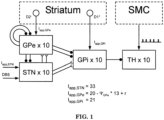
- a computation model of the basal ganglia ( Figure 1 ; a modified version of the So et al., (2012) model), was developed that can reproduce tremor-, akinesia-, and dyskinesia-related oscillations. Therefore, individual symptoms of neurological disorders may be targeted by targeting the underlying pathological neural activity with novel non-regular temporal patterns of brain stimulation, such as those disclosed in U.S. Patent No. 8,447,405 .
- decreases in dopamine in the striatum may be modeled by decreasing the applied current to external globus pallidus (GPe).
- GPe external globus pallidus
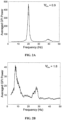
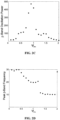
- the neurons in all nuclei in the model begin to display synchronous oscillations and the frequency and power of these oscillations depend on the amount of current applied to the GPe ( Figure 2 ).
- the model displays synchronous oscillations at beta band frequencies (10-30 Hz). Beta band oscillations and synchronization are present in human patients with PD and are strongly correlated with the presence and resolution by treatment of motor symptoms associated with PD.
- the neurons In other ranges of currents applied to the GPe the neurons begin to show oscillatory/synchronous activity at frequencies associated with tremor in human patients with PD (0-10 Hz).
- the model can also reproduce dyskinesia-related oscillations in the gamma frequency band if the GPe current is increased to simulate over stimulation with levodopa.
- the model's neural activity also may show several clinically relevant frequencies of oscillatory/synchronous activity, and thereby enables designing and optimizing patterns of stimulation for the individual symptoms of the neurological disorder.
- the model predicts that different patients with PD may have different peak-frequencies of oscillations or synchronization depending on their level of dopamine depletion. Therefore, patients may respond differently to specific temporal patterns of brain stimulation that disrupt the oscillatory activity.
- non-regular patterns of stimulation may be applied to treat specific patient symptoms as opposed to or in addition to patient specific design and optimization of non-regular patterns of stimulation. Symptom-specific factors to guide optimization, either explicitly in the optimization cost function, or implicitly via modifications of the model characteristics are also described.
- non-regular patterns of stimulation may be designed to ameliorate specific symptoms of a neurological disorder (e.g., PD) using a computational model to optimize the patterns of stimulation to suppress oscillations associated with the symptoms.
- the engineering optimization technique may be the GA, although the present teachings are not limited to this. Any appropriate algorithm may be utilized without departing from the present teachings.
- the design and application of symptom-specific brain stimulation parameters were developed using engineering optimization techniques to treat patients categorized by symptom(s).
- the temporal pattern of stimulation that is delivered to the patient may be selected to ameliorate the patient's symptoms in a desirable manner instead of developing one effective and/or efficient stimulation pattern.
- custom patterns of stimulation may be tailored to different combinations of one or more symptoms.
- a computational model of the relevant brain structures that exhibits the relevant oscillatory/synchronous activity may be used to develop these customized patterns of stimulation.
- the pattern of stimulation that is delivered may be changed to maintain optimal symptom reduction during changes in medication status, behavioral state, or disease progression.
- patients may be categorized according to their symptom(s).
- the patient may receive a non-regular pattern of stimulation designed specifically to ameliorate that patient's combination of one or more symptoms.
- the non-regular patterns of stimulation may be optimized for different symptoms by using engineering optimization techniques in a model that demonstrates activity associated with the symptom(s) of interest.
- the engineering optimization techniques may include a GA, and may include a cost function that incentivizes reducing the activity in the model that is associated with a symptom.
- the cost function could also include increasing types of activity in the computational model thought to offset pathological activity and symptoms.
- the cost function could also include measures of stimulation energy (e.g., pulse frequency, pulse amplitude, pulse duration, waveform shape, or functions thereof).
- the cost function could also include physical measurements of symptoms, for example, tremor, rigidity, or bradykinesia.
- the cost function could also include biomarkers related to disease status or symptom level including functional imaging measures, neurochemical concentrations, or measures of activity from single or multiple neurons (e.g., electroencephalogram).
- bradykinesia is a cardinal symptom of PD, and there are different approaches to designing a non-regular temporal pattern of stimulation for this symptom.
- the pattern of stimulation to suppress beta band activity in a computational model may be optimized because beta band neural activity is associated with bradykinesia.
- a pattern of stimulation to maximize gamma frequency neural activity in the computational model may be optimized.
- Gamma band activity is associated with prokinetic conditions in PD, and therefore could be useful for patients with bradykinesia.
- a pattern with two or more optimization criteria for example a non-regular pattern that is optimized to simultaneously reduce beta band activity and maximize gamma band activity may be utilized.
- the stimulation parameters may be selected to treat specific symptoms of the neurological disorder.
- Tremor in patients with PD is associated with low frequency oscillatory activity in the 1 to 10 Hz range.
- the model described above displays oscillatory activity in this frequency range, and may be used to optimize stimulation parameters to disrupt low frequency oscillatory neural activity.
- Oscillatory neural activity with frequencies between 10 to 30 Hz is associated with bradykinesia in patients with PD.
- the computational model described reproduces oscillatory activity in this frequency range. Therefore, stimulation patterns are designed to effectively disrupt 10 to 30 Hz oscillations in the model's neural activity. In this way, stimulation parameters are optimized to target specific symptoms of the disease.
- Recording the patient's neural activity may guide selection of optimal pattern of stimulation. Recording may include local field potential recorded through the brain stimulation electrode, either during the initial electrode implantation or during implantable pulse generator (IPG) replacement surgery, or at intervals or an a continuous basis by an IPG capable of such recordings. Recordings may also involve single-unit recordings or electroencephalogram (EEG) recordings.
- IPG implantable pulse generator
- optimization techniques may include factors specific to an individual symptom. These factors may include physical measures of the symptoms, either by instrumentation, clinical examination, or clinical rating scales, neural activity related to the symptom(s), energy consumption, imaging results, disease characteristics (including disease progression, stage, and manifesting symptom), and target nucleus.
- the non-regular patterns of stimulation may be generated using a computational model of DBS in the subthalamic nucleus (STN).
- Stimulation patterns may be designed using a model where the current applied to the globus pallidus externus (GPe) is tuned so that the spectral characteristics of the model neuron activity match the neural activity associated with one or more symptoms of PD.
- stimulation parameters may be designed to modulate neural activity associated with certain symptoms.
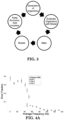
- the computational model may be combined with an optimization algorithm, for example, the GA, to design these patterns of stimulation. The progression of a GA is illustrated in Figure 3 .
- the GA there are several important characteristics of the GA that should be highlighted.
- an embodiment of the present teachings used an evolutionary algorithm, namely a GA
- the present teachings are not limited to GAs. All model-based optimization techniques including, but limited to, other evolutionary algorithms, swarm intelligence algorithms, and other optimization techniques may be used.
- present teachings shall not be limited to this particular model of the PD state or to any set of models of neurological disorders.
- Present or future models of neurological disorders that are treated with brain stimulation, currently or in the future, are candidates for use with the methods described in these teachings.
- these teachings are not limited to a particular pattern or set of patterns generated by the methods described-here. A few exemplary patterns of stimulation designed by the GA are shown in Figure 4 .
- the present teachings described are implemented in an implantable pulse generator capable of producing specific patterns of the non-regular stimulation.
- the device may also record local field potentials or other neural activity so that the device may deliver the temporal pattern of stimulation that is most effective for the type of neural activity recorded.
- the device may be configured to be programmed to deliver such applicable temporal pattern of stimulation.
- An implantable pulse generator may generate and deliver non-regular patterns of stimulation while simultaneously recording neural activity.
- the implantable pulse generator may use an amplifier-blanking paradigm that briefly grounds the inputs during a short period encompassing the stimulation pulse. This prevents violating the input specifications of the amplifiers (railing the amplifiers), and the short gaps in the data may be overcome with real-time or post-processing analysis methods described below.
- the recorded neural activity may be used to monitor performance of the stimulation pattern; control when the stimulation pattern is applied; trigger switches between pre-programmed patterns of stimulation; control interleaving between different stimulation patterns; and/or allow for in vivo optimization of the temporal pattern of stimulation.
- the device and methods described herein are not limited to application of any particular type of stimulation. However, the device and methods may be especially useful during non-regular temporal patterns of stimulation, because there is strong impetus for using non-regular patterns of stimulation for the treatment of patients with neurological disorders. Mechanisms exist at the cellular and systems level to explain the effectiveness of specific temporal patterns of stimulation.
- non-regular stimulation of the nervous system relies on the sensitivity of neurons to the specific timing of stimulation pulses.
- specific timing of the stimulation is important to individual neurons or even a population of neurons, it may be advantageous for DBS systems to use non-regular temporal patterns of stimulation to exploit this sensitivity.
- the importance or the timing of inputs to a neuron as it relates to information transfer in the system is a common idea that is termed temporal (or spatiotemporal) coding.
- a non-regular stimulation pattern could be more effective than regular stimulation at disrupting or reversing pathological features or a neurological disorder such as PD.
- a non-regular pattern of stimulation may be able to disrupt pathological synchronization and oscillations that are common in systems affected by PD.
- brain stimulation Because the primary goal of brain stimulation is to modulate neural activity in the brain, recording neural activity during brain stimulation enables evaluation of the effects of stimulation on neural activity. Further, it can guide application, selection, and optimization of stimulation parameters, such as the pattern of stimulation, either intermittently or continually.
- LFPs Local field potentials
- ECAPs electrically evoked compound action potentials
- FIG. 5 is a diagram of the DBS-ECAP instrumentation used for stimulus artifact reduction and ECAP recording during DBS.
- anti-series, current-limiting diodes were connected to the DBS lead prior to the amplification stages (a); differential recordings were made from DBS contacts 0 and 2 (b), and served as inputs to the preamplifier (A 1 ) (c).
- Two additional series amplifier stages (A 2 and A 3 ) further increased the gain and filtered the signal with 10 Hz to 10kHz pass-band (d).
- Anti-parallel diodes (1 N4154) were placed at the inputs A2 and A3 (e).
- an opto-isolated CMOS multiplexer 74HC4053 internally grounded the signal path in amplifiers A2 and A3 (e).
- a PhotoMOS relay (AQV212(A)) disconnected the stimulating electrodes in between DBS pulses (g).
- the parallel resistances enabled any accumulated charge on the stimulating electrodes to discharge between DBS pulses, and enabled near-critical damping of the signal recovery from artifact to baseline (h).
- Monopolar stimulation was delivered between DBS contact 1 and a distant return electrode.
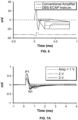
- Figures 7A-7C depict in vivo ECAP responses measured across stimulation parameters and recorded from a mini DBS electrode implanted in the thalamus of a cat using the DBS-ECAP instrumentation. For each of Figures 7A- 7C , individual ECAP responses and the average ECAP waveform are shown.
- Figure 7A shows ECAP responses for DBS amplitudes between 1 and 3 V.
- Figure 7B shows pulse widths of 50 and 100 ⁇ s/phase. The magnitude and duration of the early positive (P1) and negative (N1) waves generally increased with DBS amplitude and pulse width.
- Figure 7C shows ECAP responses for DBS frequencies of 10 and 100 Hz. Secondary positive (P2) and negative (N2) waves were generated at 10 Hz but decayed during the 100 Hz DBS train and were not present in the average signal.
- Recordings may be made from two non-stimulating contacts on the four contact DBS electrode, which may eliminate the need for additional recording electrodes and help ensure that the recording contacts are near the neurons activated by stimulation.
- the recording contacts serve as inputs to the DBS-ECAP instrumentation, which uses stages of series amplification and several circuit components to reduce the stimulus artifact (Kent and Grill, 2012).
- Amplifier blanking and a stimulus relay circuit may be used to suppress the stimulus artifact and its duration.
- the first stage may utilize a battery-powered preamplifier (Al, SRS60, Stanford Research Systems), which may measure the differential signal from the recording contacts to reduce common mode noise, and provide gain and high input impedance.
- a battery-powered preamplifier Al, SRS60, Stanford Research Systems
- Two additional amplifier stages (A2 and A3, SR560) may be placed in series to increase gain further and to filter the signal with a 10 Hz to 10 kHz pass-band.
- Anti-parallel diode clamps (1N4154, Fairchild Semiconductor) may be placed at the inputs of A2 and A3 to ground the line if the input voltage exceeds approximately ⁇ 0.7 V, thereby selectively clipping the stimulus artifact and enabling increased gain without saturation.
- the signal paths in amplifiers A2 and A3 may be internally grounded through an opto-isolated CMOS multiplexer (74HC4053), blanking the output for the duration of each stimulus pulse and a subsequent 1 00 ⁇ s.
- the rapid turn-off time of this CMOS switch (10 ⁇ s) may ensure that short latency ECAP responses may still be recorded.
- a low-resistance, rapid-response Photo MOS relay (AQV212(A), Panasonic) may disconnect the stimulating electrodes between DBS pulses. This may limit capacitive discharge from the electrode-tissue interface through the stimulator after each pulse, and thereby may reduce the duration of the stimulus artifact (McGill et al, 1982).
- a 10 kS2 parallel resistor may be placed across the stimulating electrodes to allow accumulated charge on the stimulating contacts to discharge between pulses. Further, this resistor may enable near critical damping of the signal recovery from artifact to baseline.
- the digital pulse controlling the closing of the stimulator relay may be turned off approximately 40 ps before the end of the DBS pulse to account for the intrinsic delay of the relay.
- the digital pulses controlling the amplifier blanking and closing of the stimulator relay may be turned on approximately 2 ms before each DBS pulse to account for turn on delays, and to discharge any charge remaining on the stimulating electrodes.
- a time-domain solution may be incorporated into an implantable pulse generator device. Grounding or blanking the signal recorded from the unused electrode contacts during the stimulation pulse and possibly the time immediately preceding and following the pulse may be utilized.
- an amplifier blanking paradigm such as the one described above for the ECAP instrumentation may be used.
- the blanking of the signal may introduce "gaps" into the LFP signals, but these gaps can be overcome with data processing techniques discussed below. It is important that low pass filtering be avoided in any stage before the blanking of the stimulation artifact, because any low pass filtering may prolong the duration of the artifact signal and require an increased blanking epoch after the stimulation pulse is delivered.
- Some of the device capabilities include, but are not limited to, delivering non-regular temporal patterns of stimulation; delivering regular temporal patterns of stimulation; utilizing a range of stimulation parameters, including pulse widths, pulse waveforms, average stimulation frequency, and applied voltages or currents; recording neural activity through electrode contacts during stimulation-off epoch; including electrically evoked compound action potentials and local field potentials; recording neural activity during stimulation-on epoch through unused electrode contacts, including during non-regular temporal patterns of stimulation; differential and single-ended recordings; appropriate signal amplification; signal conditioning and filtering; using diodes to clip high amplitude input signals; intermittently blanking input signal; using a programmable method to shorten the stimulus artifact during recording of stimulation evoked neural activity such as ECAPS; on-board data processing of recorded neural activity; real-time or post hoc optimization or learning of stimulation parameters, including temporal pattern of stimulation; telemetry with devices outside of patient's body; and pattern optimization during telemetry sessions with device running optimization/learning algorithms
- the device may be an implantable, hermetically sealed-device.
- the device may include an on-board power source (e.g., a rechargeable or non-rechargeable battery).
- the device may use as short of a pulse as possible (e.g., symmetric biphasic pulses), which may reduce the duration of time the input is blanked.
- the input signal may be blanked during the stimulation pulse and possibly for a short period of time before and/or after the stimulation pulse.
- the device may include a programmable blanking configuration that could be used to record different types of neural signals.
- the device may include a stimulation relay paradigm as depicted in Figure 5 .
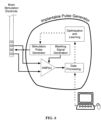
- Figure 8 depicts an embodiment of the present teachings in which the device may include stimulation pulse generation components coupled to a blanking signal generation module.
- the blanking signal may be sent to the amplifier/filtering module (AMP(s)) to perform the signal blanking described above.
- AMP amplifier/filtering module
- a data processor may perform required data processing (described below).
- This module may have the ability to communicate wirelessly with devices outside the patient's body.
- the optimization and learning module may use the processed data to control stimulation parameters.
- One of the simplest techniques is to use linear interpolation within the gaps to join the data points before and after the gaps. This method may introduce bias depending on the signal characteristics of interest. For example, signal spectral characteristics are the preferred signal characteristic and linear interpolation will introduce bias into the spectrum estimate.
- Another data processing option is to fill in the gaps with data generated by a model trained on data before and/or after the gap. For example, data generated by the autoregressive (AR) model will have the same characteristics (spectral and otherwise) as the data the model was trained on, and may produce a good proxy for the real data (Walter et al., 2012).
- AR autoregressive
- linear interpolation may be used in combination with AR modeling to mitigate the chance of jumps in the reconstructed signal.
- Any method for calculating the AR model e.g., least squares, Burg's algorithm, etc.
- the other data processing approach may be to work around the gaps and directly estimate the statistics or signal characteristics of interest. If the spectral content of the recorded signal is of interest, one may bypass reconstructing the data in the gaps entirely and instead train an AR model on the data around the gaps and calculate the power spectrum calculated directly from the model (Walter et al., 2012).
- Several other methods for data analysis exist that may enable working around the gaps in the recorded signal while still extracting the information of interest without introducing bias.
- the recorded neural activity can be used purely for monitoring purposes and indicate the efficacy of the stimulation.
- the recorded activity or summary statistics from the recordings can be downloaded from the device by a healthcare provider, company representative, device programmer, certified research scientists, or any appropriate person.
- the recorded neural activity can be used to guide intermittent or continuous modulation of stimulation parameters.
- Non-regular temporal patterns of stimulation can be demand-controlled, and stimulation may remain off when not needed (e.g., when the patient is asleep).
- the recorded neural activity can also be used as a trigger or indicator for switching between pre-programmed temporal patterns of stimulation. These different patterns may have different levels of energy efficiency, efficacy, or be targeted for different situations (e.g., On/Off medications) or be targeted for different symptoms (e.g., tremor or bradykinesia).
- the ECAP signals can be coupled with a computational model to determine which neural elements generate the ECAP signatures and thereby mediate the beneficial treatment effects of DBS. Stimulation parameters can be modified to improve the efficacy of treatment by enabling targeted stimulation of the neural elements that produce the desired response.
- the recorded neural activity can be used to guide in vivo optimization or learning algorithm based modulation of the temporal pattern of stimulation.
- Non-regular patterns of stimulation can be built one interpulse interval at a time based on the recorded neural activity.
- engineering optimization algorithms such as a GA can be used to design non-regular patterns of stimulation.
- a control system may be used to guide the temporal pattern or stimulation.
- machine learning algorithms can be used to learn the pattern of stimulation that meets the stimulation objectives (based on the recorded neural activity) most effectively. This can take place in real time.
- Any in vivo optimization/learning or temporal patterns of stimulation includes safety features to prevent undesired stimulation parameters or uncomfortable side effects. There is a defined period of time when the optimization runs, which could be after the initial electrode and pulse generator implantation or periodically thereafter.
- Non-regular temporal patterns of stimulation can be updated and optimized intermittently to meet stimulation objectives (e.g., suppress recorded pathological patterns of neural activity while minimizing energy usage). Further, the continuous recording or neural activity allows real-time optimization of the non-regular pattern or stimulation via an automated optimization algorithm incorporated into the implantable pulse generator.
- stimulation objectives e.g., suppress recorded pathological patterns of neural activity while minimizing energy usage.
- the continuous recording or neural activity allows real-time optimization of the non-regular pattern or stimulation via an automated optimization algorithm incorporated into the implantable pulse generator.
- ECAPs may indicate how neurons respond during stimulation, and so may better reveal the mechanisms of action of DBS and serve as a reliable feedback signal for brain stimulation.
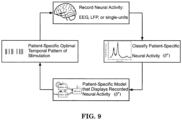
- Patient-specific recordings of neural activity can be used to guide patient-specific optimization of brain stimulation parameters, including optimal temporal patterns of stimulation. Recordings taken from the patient characterize the oscillatory/synchronous neural activity. A model, such as the one described above, may be tuned to reproduce the observed oscillatory/synchronous neural activity. This patient-specific model may be used to develop or optimize the parameters of stimulation ( Figure 9 ). Stimulation parameters, including the temporal pattern, may be chosen or optimized to disrupt or- promote oscillatory or synchronous activity based on the neural activity that a specific patient exhibits. While the present teachings may be applicable to myriad neurological disorders, PD may involve disrupting beta band activity; and because each patient's neural activity may have slightly different spectra, patient-specific stimulation parameters may more effectively disrupt pathological activity than one-size-fits-all parameters.
- the stimulation parameters may be selected to treat specific symptoms of a neurological disorder.
- Tremor in patients with PD is associated with low frequency oscillatory activity in the 1-10 Hz range.
- the model described herein may be capable of exhibiting oscillatory activity in this frequency range, and may be used to optimize stimulation parameters to disrupt low frequency oscillatory neural activity.
- Oscillatory neural activity with frequencies between 10 and 30 Hz may be associated with bradykinesia in patients with PD.
- the computational model described herein may also be capable of reproducing oscillatory activity in this frequency range. Therefore, stimulation patterns may be designed to effectively disrupt 10 to 30 Hz oscillations in the model's neural activity. In this way, stimulation parameters can be optimized to target specific symptoms of the disease.
- Patients may receive "tune-ups” if the frequency or characteristics of their oscillatory/synchronous activity changes, for example, during disease progression or changes in medication status.
- Recording the patient's neural activity may involve local field potential recordings through the brain stimulation electrode, either during the initial electrode implantation or during IPG replacement surgery, or at intervals or on a continuous basis by an IPG capable of such recordings. Recordings may also involve single-unit recordings or EEG recordings.
- the present teachings therefore, describe the selection of specific stimulation parameters and temporally non-regular patterns of stimulation according to the neural activity recorded from a particular patient using a patient-specific computational model that reproduces the observed neural activity.
- the non-regular patterns of stimulation may be generated using a computational model of DBS in the STN.
- Stimulation patterns may be designed using a model where the current applied to the GPe is tuned so that the spectral characteristics of the model neurons' activity generally match the patient's recorded neural activity. In this way, different stimulation parameters may be designed to modulate neural activity with specific spectral characteristics.
- the computational model may be combined with an optimization algorithm, for example, the GA, to design these patterns of stimulation. The progression of a GA is illustrated in Figure 3 . Resulting patterns of non-regular stimulation can be tested using an intraoperative experiment.
- the GA there are several important characteristics of the GA that should be highlighted.
- present teachings shall not be limited to any particular model of the PD state or to any set of models of neurological disorders.
- Present or future models of neurological disorders that are treated with brain stimulation, currently or in the future, are candidates for use with the described system and method.
- the present teachings are not limited to a particular pattern or set of patterns generated by the methods described here. Examples of patterns of stimulation designed by the GA are shown in Figure 10. It will be appreciated that any pattern or set of patterns may be used for the system and method described herein.
- an IPG capable of producing specific patterns of the non-regular stimulation may be used.
- the device may record local field potentials or other neural activity so that the device may deliver the temporal pattern of stimulation that is most effective for the type of neural activity recorded.
- Patient specific brain stimulation parameters may be designed based on recorded neural activity.
- the temporal pattern of stimulation that is delivered to the patient may be selected to modulate the patient's neural activity in a desirable manner. Instead of developing a handful of effective and/or efficient stimulation patterns, custom patterns of stimulation may be tailored to each individual patient.
- a computational model of the relevant brain structures that exhibits the relevant oscillatory/synchronous activity may be used to develop these customized patterns of stimulation.
- the pattern of stimulation delivered may be changed to maintain optimal symptom reduction during changes in medication status, behavioral state, or disease progression. For example, recordings of patient specific brain oscillatory activity during wakeful rest, activity, and sleep, can be used to design specific optimal temporal patterns of stimulation for of each these states.
- the invention described herein is useful to patients with neurological disorders because it may provide customized stimulation parameters based on their neural activity.
- the customized stimulation may be more effective and/or efficient than regular high frequency stimulation and/or some other stimulation patterns.
- the present teachings may allow the temporal pattern of stimulation to be adjusted as changes in neural activity occur, perhaps because of disease progression.
Landscapes
- Health & Medical Sciences (AREA)
- Life Sciences & Earth Sciences (AREA)
- Neurology (AREA)
- Neurosurgery (AREA)
- General Health & Medical Sciences (AREA)
- Veterinary Medicine (AREA)
- Biomedical Technology (AREA)
- Engineering & Computer Science (AREA)
- Public Health (AREA)
- Animal Behavior & Ethology (AREA)
- Biophysics (AREA)
- Surgery (AREA)
- Molecular Biology (AREA)
- Physics & Mathematics (AREA)
- Medical Informatics (AREA)
- Heart & Thoracic Surgery (AREA)
- Pathology (AREA)
- Nuclear Medicine, Radiotherapy & Molecular Imaging (AREA)
- Radiology & Medical Imaging (AREA)
- Physiology (AREA)
- Hospice & Palliative Care (AREA)
- Developmental Disabilities (AREA)
- Psychology (AREA)
- Child & Adolescent Psychology (AREA)
- Psychiatry (AREA)
- Electrotherapy Devices (AREA)
Claims (2)
- Verfahren zum Erzeugen eines Hirnstimulationsmusters zur Behandlung eines Patienten mit einer neurologischen Störung, wobei es sich bei der neurologischen Erkrankung um die Parkinson-Krankheit (PD) handelt, wobei das Verfahren umfasst:Identifizieren mindestens eines Symptoms der neurologischen Störung, wobei das mindestens eine Symptom der neurologischen Störung aus der Gruppe, bestehend aus akinetischen motorischen Symptomen und Parkinson-Tremor, ausgewählt ist; undOptimieren eines Rechenmodells des Hirnstimulationsmusters, um Schwingungen in einem Modell zu unterdrücken, die mit dem mindestens einen Symptom der neurologischen Störung verbunden sind,wobei das Rechenmodell des Hirnstimulationsmusters synchrone Schwingungen auf der Grundlage von Strom anzeigt, der an einen im Rechenmodell bereitgestellten externen Globus Pallidus (GPe) angelegt wird,wobei(i) falls das mindestens eine Symptom der neurologischen Störung ein akinetisches motorisches Symptom ist, das Rechenmodell des Hirnstimulationsmusters synchrone Schwingungen im Beta-Frequenzband von 10 bis 30 Hz zeigt; und(ii) falls das mindestens eine Symptom der neurologischen Störung Parkinson-Tremor ist, das Rechenmodell des Hirnstimulationsmusters synchrone Schwingungen im Frequenzband von 1 bis 10 Hz zeigt.
- Verfahren nach Anspruch 1, wobei das Gehirnstimulationsmuster ein nicht regelmäßiges, nicht zufälliges zeitliches Gehirnstimulationsmuster ist.
Applications Claiming Priority (4)
| Application Number | Priority Date | Filing Date | Title |
|---|---|---|---|
| US201361825692P | 2013-05-21 | 2013-05-21 | |
| US201361826201P | 2013-05-22 | 2013-05-22 | |
| US201361826077P | 2013-05-22 | 2013-05-22 | |
| PCT/US2014/038809 WO2014189944A2 (en) | 2013-05-21 | 2014-05-20 | Devices, systems and methods for deep brain stimulation parameters |
Publications (3)
| Publication Number | Publication Date |
|---|---|
| EP2999514A2 EP2999514A2 (de) | 2016-03-30 |
| EP2999514A4 EP2999514A4 (de) | 2017-03-15 |
| EP2999514B1 true EP2999514B1 (de) | 2024-12-11 |
Family
ID=51934331
Family Applications (1)
| Application Number | Title | Priority Date | Filing Date |
|---|---|---|---|
| EP14801270.1A Active EP2999514B1 (de) | 2013-05-21 | 2014-05-20 | Verfahren für parameter zur tiefen hirnstimulation |
Country Status (5)
| Country | Link |
|---|---|
| US (2) | US20140350634A1 (de) |
| EP (1) | EP2999514B1 (de) |
| AU (4) | AU2014268697A1 (de) |
| CA (1) | CA2916239C (de) |
| WO (1) | WO2014189944A2 (de) |
Families Citing this family (78)
| Publication number | Priority date | Publication date | Assignee | Title |
|---|---|---|---|---|
| US9974455B2 (en) | 2011-05-13 | 2018-05-22 | Saluda Medical Pty Ltd. | Method and apparatus for estimating neural recruitment |
| US9386934B2 (en) | 2011-05-13 | 2016-07-12 | Saluda Medical Pty Ltd. | Method and apparatus for measurement of neural response |
| WO2012155185A1 (en) | 2011-05-13 | 2012-11-22 | National Ict Australia Ltd | Method and apparatus for measurement of neural response |
| US9872990B2 (en) | 2011-05-13 | 2018-01-23 | Saluda Medical Pty Limited | Method and apparatus for application of a neural stimulus |
| WO2014071446A1 (en) | 2012-11-06 | 2014-05-15 | Saluda Medical Pty Ltd | Method and system for controlling electrical conditions of tissue ii |
| DK2908904T3 (da) | 2012-11-06 | 2020-12-14 | Saluda Medical Pty Ltd | System til styring af vævs elektriske tilstand |
| US12453510B2 (en) * | 2012-11-16 | 2025-10-28 | Stim Science Inc. | Neuromodulation method and system for sleep disorders |
| US20200155061A1 (en) * | 2018-11-19 | 2020-05-21 | Stimscience Inc. | Neuromodulation method and system for sleep disorders |
| US10946196B2 (en) | 2012-11-16 | 2021-03-16 | Stimscience Inc. | System for variably configurable, adaptable electrode arrays and effectuating software |
| ES3033225T3 (en) | 2013-11-15 | 2025-07-31 | Closed Loop Medical Pty Ltd | Monitoring brain neural potentials |
| CA2929874C (en) | 2013-11-22 | 2023-06-13 | Saluda Medical Pty Ltd | Method and device for detecting a neural response in a neural measurement |
| WO2015109239A1 (en) * | 2014-01-17 | 2015-07-23 | Medtronic, Inc. | Movement disorder symptom control |
| EP3122247B1 (de) | 2014-03-28 | 2025-05-07 | Saluda Medical Pty Ltd | Beurteilung des neutralen zustands aus aktionspotential |
| WO2015168735A1 (en) | 2014-05-05 | 2015-11-12 | Saluda Medical Pty Ltd | Improved neural measurement |
| EP3838331B1 (de) | 2014-07-25 | 2024-05-22 | Saluda Medical Pty Limited | Neurostimulationsdosierung |
| US11006846B2 (en) | 2014-11-17 | 2021-05-18 | Saluda Medical Pty Ltd | Method and device for detecting a neural response in neural measurements |
| WO2016090420A1 (en) | 2014-12-11 | 2016-06-16 | Saluda Medical Pty Ltd | Implantable electrode positioning |
| AU2015362091B2 (en) | 2014-12-11 | 2020-11-26 | Saluda Medical Pty Ltd | Method and device for feedback control of neural stimulation |
| WO2016115596A1 (en) | 2015-01-19 | 2016-07-28 | Saluda Medical Pty Ltd | Method and device for neural implant communication |
| EP3280487B1 (de) | 2015-04-09 | 2021-09-15 | Saluda Medical Pty Limited | Kalkulation des abstands zwischen elektrode und nerv |
| WO2016182894A1 (en) * | 2015-05-08 | 2016-11-17 | Duke University | Systems and methods for spinal cord stimulation |
| JP7071257B2 (ja) | 2015-05-31 | 2022-05-18 | クローズド・ループ・メディカル・ピーティーワイ・リミテッド | 脳神経刺激装置電極の取付け |
| CN107613860B (zh) | 2015-05-31 | 2022-01-11 | 闭环医疗私人有限公司 | 脑神经活动监测 |
| AU2016269843B2 (en) | 2015-06-01 | 2021-03-04 | Closed Loop Medical Pty Ltd | Motor fibre neuromodulation |
| WO2016196790A1 (en) * | 2015-06-02 | 2016-12-08 | Battelle Memorial Institute | Closed loop deep brain stimulation systems and methods |
| US20180353759A1 (en) * | 2015-06-04 | 2018-12-13 | The Regents Of The University Of California | Methods and Systems for Treating Neurological Movement Disorders |
| US20160375248A1 (en) * | 2015-06-29 | 2016-12-29 | Boston Scientific Neuromodulation Corporation | Systems and methods for selecting stimulation parameters based on stimulation target region, effects, or side effects |
| US10842997B2 (en) * | 2015-08-26 | 2020-11-24 | Boston Scientific Neuromodulation Corporation | Machine learning to optimize spinal cord stimulation |
| EP3352844B1 (de) * | 2015-09-21 | 2020-04-29 | Boston Scientific Neuromodulation Corporation | Automatisierte programmoptimierung |
| US10561848B2 (en) | 2015-10-13 | 2020-02-18 | Regents Of The University Of Minnesota | Systems and methods for programming and operating deep brain stimulation arrays |
| AU2017246242B2 (en) | 2016-04-05 | 2022-06-23 | Saluda Medical Pty Ltd | Improved feedback control of neuromodulation |
| US10327655B2 (en) | 2016-04-11 | 2019-06-25 | Paradromics, Inc. | Neural-interface probe and methods of packaging the same |
| US10589096B2 (en) | 2016-04-25 | 2020-03-17 | The Board Of Regents Of The University Of Texas System | Systems and methods for network based neurostimulation of cognitive processes |
| WO2017219096A1 (en) | 2016-06-24 | 2017-12-28 | Saluda Medical Pty Ltd | Neural stimulation for reduced artefact |
| WO2018027259A1 (en) * | 2016-08-08 | 2018-02-15 | Bionics Institute | Systems and methods for monitoring neural activity |
| US10864368B2 (en) | 2016-09-27 | 2020-12-15 | Medtronic, Inc. | Adaptive deep brain stimulation using homeostatic window |
| US10426949B2 (en) | 2016-10-26 | 2019-10-01 | Regents Of The University Of Minnesota | Systems and methods for optimizing programming and use of neuromodulation systems |
| WO2018093765A1 (en) * | 2016-11-15 | 2018-05-24 | Regents Of The University Of California | Methods and apparatuses for improving peripheral nerve function |
| EP4223358A1 (de) * | 2016-12-21 | 2023-08-09 | Duke University | Verfahren zum entwurf von zeitlichen mustern der nervensystemstimulation |
| WO2018183967A1 (en) | 2017-03-30 | 2018-10-04 | Paradromics, Inc. | Patterned microwire bundles and methods of producing the same |
| WO2019060298A1 (en) | 2017-09-19 | 2019-03-28 | Neuroenhancement Lab, LLC | METHOD AND APPARATUS FOR NEURO-ACTIVATION |
| US11064938B2 (en) | 2017-10-31 | 2021-07-20 | Stimscience Inc. | Mediation of traumatic brain injury |
| US11801004B2 (en) * | 2017-10-31 | 2023-10-31 | Stimscience, Inc. | Systems, methods, and devices for intracranial measurement, stimulation, and generation of brain state models |
| US11717686B2 (en) | 2017-12-04 | 2023-08-08 | Neuroenhancement Lab, LLC | Method and apparatus for neuroenhancement to facilitate learning and performance |
| US12280219B2 (en) | 2017-12-31 | 2025-04-22 | NeuroLight, Inc. | Method and apparatus for neuroenhancement to enhance emotional response |
| US11478603B2 (en) | 2017-12-31 | 2022-10-25 | Neuroenhancement Lab, LLC | Method and apparatus for neuroenhancement to enhance emotional response |
| US11660452B2 (en) | 2018-02-26 | 2023-05-30 | Pacesetter, Inc. | Systems and methods for predicting beneficial spinal cords stimulation temporal patterns |
| US20190275331A1 (en) * | 2018-03-12 | 2019-09-12 | Boston Scientific Neuromodulation Corporation | Neural Stimulation with Decomposition of Evoked Compound Action Potentials |
| US11364361B2 (en) | 2018-04-20 | 2022-06-21 | Neuroenhancement Lab, LLC | System and method for inducing sleep by transplanting mental states |
| ES2993811T3 (en) | 2018-04-27 | 2025-01-09 | Saluda Medical Pty Ltd | Neurostimulation of mixed nerves |
| US20190388020A1 (en) * | 2018-06-20 | 2019-12-26 | NeuroPlus Inc. | System and Method for Treating and Preventing Cognitive Disorders |
| US11452839B2 (en) | 2018-09-14 | 2022-09-27 | Neuroenhancement Lab, LLC | System and method of improving sleep |
| US11273310B2 (en) | 2019-01-22 | 2022-03-15 | General Electric Company | Systems and methods for predicting optimal deep brain stimulation parameters |
| US10905882B2 (en) | 2019-01-22 | 2021-02-02 | General Electric Company | Systems and methods for predicting optimal deep brain stimulation parameters |
| CN113795298B (zh) | 2019-03-04 | 2025-05-06 | 波士顿科学神经调制公司 | 神经调制治疗的用户加权闭环调节 |
| WO2020198460A1 (en) * | 2019-03-27 | 2020-10-01 | The General Hospital Corporation | Method for designing electromagnetic coils with explicit peripheral nerve stimulation constraint based on an oracle penalty |
| US20200324117A1 (en) * | 2019-04-15 | 2020-10-15 | Advanced Neuromodulation Systems, Inc. | Systems and methods of generating stimulation patterns |
| US11786694B2 (en) | 2019-05-24 | 2023-10-17 | NeuroLight, Inc. | Device, method, and app for facilitating sleep |
| CN114513986A (zh) * | 2019-08-06 | 2022-05-17 | 深部脑刺激技术有限公司 | 用于监测神经活动的系统和方法 |
| WO2021162794A1 (en) * | 2020-02-14 | 2021-08-19 | Boston Scientific Neuromodulation Corporation | Systems and methods for using electrospinogram signals for closed loop control in spinal cord stimulation therapy |
| US12370367B2 (en) | 2020-08-14 | 2025-07-29 | University Of Houston System | System and method for determining deep brain stimulation parameters |
| US12168134B2 (en) | 2020-08-14 | 2024-12-17 | University Of Houston System | System and method for locating an implantation site in the brain |
| WO2022087050A1 (en) * | 2020-10-23 | 2022-04-28 | Research Development Foundation | Apparatus and methods for phase-agnostic stimuli |
| US12324916B2 (en) * | 2021-01-13 | 2025-06-10 | Medtronic, Inc. | Hybrid control policy for ECAP-servoed neuromodulation |
| WO2022173871A1 (en) | 2021-02-09 | 2022-08-18 | The Regents Of The University Of California | Methods and apparatuses for treating stroke using low-frequency stimulation |
| CN113282009B (zh) * | 2021-05-20 | 2022-07-01 | 天津大学 | 帕金森闭环神经调控硬件在环测试系统 |
| US12377274B2 (en) * | 2021-07-22 | 2025-08-05 | Boston Scientific Neuromodulation Corporation | Interpolation methods for neural responses |
| US20230069981A1 (en) * | 2021-09-07 | 2023-03-09 | Medtronic, Inc. | Physiological signal sensing for closed-loop stimulation |
| US11911170B2 (en) | 2021-09-13 | 2024-02-27 | Christopher J. Rourk | Deep brain sensing and stimulation probe |
| CN113940689B (zh) * | 2021-09-14 | 2023-05-05 | 复旦大学 | 一种闭环深部脑刺激伪迹抑制系统 |
| US12171995B1 (en) | 2021-10-07 | 2024-12-24 | Paradromics, Inc. | Methods for improved biocompatibility for human implanted medical devices |
| EP4429757A4 (de) * | 2021-11-08 | 2025-07-30 | Univ New York | Neurale schnittstelle mit geschlossenem regelkreis zur schmerzkontrolle |
| WO2023129840A1 (en) | 2021-12-28 | 2023-07-06 | Boston Scientific Neuromodulation Corporation | Adaptive deep brain stimulation based on neural signals with dynamics |
| US12244360B2 (en) * | 2022-02-17 | 2025-03-04 | Qualcomm Incorporated | Relay characteristic reporting and control |
| US20240066302A1 (en) * | 2022-03-07 | 2024-02-29 | Ian Loren Halpern | Adaptive neural interface |
| US12567495B2 (en) | 2022-10-19 | 2026-03-03 | Boston Scientific Neuromodulation Corporation | Neuroanatomy-based search to optimize trajectory selection during DBS targeting |
| EP4608497A1 (de) * | 2022-10-28 | 2025-09-03 | Medtronic, Inc. | Erkennung von veränderungen des nervenzustands für tiefenhirnstimulation (dbs) unter verwendung von evozierter resonanter neuronaler aktivität (erna) |
| WO2024102987A1 (en) * | 2022-11-11 | 2024-05-16 | Duke University | Systems and methods for administering and assessing brain stimulation |
Family Cites Families (11)
| Publication number | Priority date | Publication date | Assignee | Title |
|---|---|---|---|---|
| US6195585B1 (en) * | 1998-06-26 | 2001-02-27 | Advanced Bionics Corporation | Remote monitoring of implantable cochlear stimulator |
| US7346382B2 (en) * | 2004-07-07 | 2008-03-18 | The Cleveland Clinic Foundation | Brain stimulation models, systems, devices, and methods |
| US7424322B2 (en) * | 2005-02-03 | 2008-09-09 | Cardinal Health 209, Inc. | Method and apparatus for stimulus artifact suppression |
| WO2008017416A2 (en) * | 2006-08-07 | 2008-02-14 | Eth Zurich | Multitransducer array and method for configuring such a device |
| US10688303B2 (en) * | 2008-04-18 | 2020-06-23 | Medtronic, Inc. | Therapy target selection for psychiatric disorder therapy |
| EP2340078B1 (de) * | 2008-10-03 | 2023-08-30 | Duke University | Nicht-reguläre elektrische stimulationsmuster zur behandlung von neurologischen erkrankungen |
| US8923981B2 (en) | 2008-10-03 | 2014-12-30 | Duke University | Non-regular electrical stimulation patterns designed with a cost function for treating neurological disorders |
| EP2411090B1 (de) * | 2009-03-22 | 2015-08-19 | Sorin CRM SAS | Optimale tiefe gehirnstimulationstherapie mit q-lernen |
| US8588899B2 (en) * | 2010-03-24 | 2013-11-19 | Steven John Schiff | Model based control of Parkinson's disease |
| US8364272B2 (en) * | 2010-04-30 | 2013-01-29 | Medtronic, Inc. | Brain stimulation programming |
| US8473063B2 (en) * | 2010-09-22 | 2013-06-25 | Medtronic, Inc. | Method and apparatus for event-triggered reinforcement of a favorable brain state |
-
2014
- 2014-05-20 US US14/282,496 patent/US20140350634A1/en not_active Abandoned
- 2014-05-20 AU AU2014268697A patent/AU2014268697A1/en not_active Abandoned
- 2014-05-20 CA CA2916239A patent/CA2916239C/en active Active
- 2014-05-20 WO PCT/US2014/038809 patent/WO2014189944A2/en not_active Ceased
- 2014-05-20 EP EP14801270.1A patent/EP2999514B1/de active Active
-
2018
- 2018-07-20 US US16/041,106 patent/US20180333582A1/en not_active Abandoned
-
2019
- 2019-03-14 AU AU2019201763A patent/AU2019201763B2/en not_active Ceased
-
2021
- 2021-06-21 AU AU2021204159A patent/AU2021204159B2/en not_active Ceased
-
2023
- 2023-07-27 AU AU2023208148A patent/AU2023208148A1/en not_active Abandoned
Also Published As
| Publication number | Publication date |
|---|---|
| US20180333582A1 (en) | 2018-11-22 |
| EP2999514A4 (de) | 2017-03-15 |
| WO2014189944A2 (en) | 2014-11-27 |
| US20140350634A1 (en) | 2014-11-27 |
| AU2014268697A1 (en) | 2016-01-21 |
| CA2916239C (en) | 2024-01-02 |
| WO2014189944A3 (en) | 2015-02-05 |
| AU2019201763B2 (en) | 2021-03-25 |
| AU2023208148A1 (en) | 2023-08-17 |
| AU2021204159A1 (en) | 2021-07-15 |
| AU2021204159B2 (en) | 2023-04-27 |
| AU2019201763A1 (en) | 2019-04-04 |
| EP2999514A2 (de) | 2016-03-30 |
| CA2916239A1 (en) | 2014-11-27 |
Similar Documents
| Publication | Publication Date | Title |
|---|---|---|
| AU2021204159B2 (en) | Devices, systems and methods for deep brain stimulation parameters | |
| US20220323765A1 (en) | Method to design temporal patterns of nervous system stimulation | |
| Parastarfeizabadi et al. | Advances in closed-loop deep brain stimulation devices | |
| EP3554628B1 (de) | Vorrichtung zur behandlung neurologischer störungen durch elektrostimulation | |
| US6480743B1 (en) | System and method for adaptive brain stimulation | |
| WO2004043536A1 (en) | System for adaptive brain stimulation | |
| US11963779B2 (en) | Neurological event detection tools for implantable medical devices | |
| Greenwald et al. | Implantable neurotechnologies: bidirectional neural interfaces—applications and VLSI circuit implementations | |
| CN104144728A (zh) | 校准侵入式、电的且去同步化的神经刺激的装置和方法 | |
| US10617869B2 (en) | Device for effective invasive desynchronizing neurostimulation | |
| WO2014071504A1 (en) | Method and apparatus for suppressing seizure-like events | |
| US11013919B2 (en) | Systems and methods for controlling brain activity | |
| WO2011106617A1 (en) | Neuromodulation having non-linear dynamics | |
| US20160082263A1 (en) | System and method for determining optimal deep brain stimulation parameters for treating intractable epilepsy | |
| Gmel et al. | A new biomarker for closed-loop deep brain stimulation in the subthalamic nucleus for patients with Parkinson's disease | |
| EP4389196A1 (de) | Verfahren, system und computerprogramm zum betreiben einer neurostimulationsvorrichtung mit weniger nebenwirkungen | |
| Suzuki et al. | Optimizing deep brain stimulation parameters for balancing dopaminergic neural activities in Parkinson’s disease: a computational approach based on network resonance | |
| EP4713937A1 (de) | Anpassbare signalverarbeitung für neuromodulationstherapie | |
| WO2024086315A1 (en) | Implantable medical device (imd) including sensing amplifier circuitry | |
| WO2022214600A1 (en) | Closed-loop autocalibration method for a computer brain interface device, computer program and computer brain interface device | |
| Beuter | 17 Closed-loop Cortical Stimulation |
Legal Events
| Date | Code | Title | Description |
|---|---|---|---|
| PUAI | Public reference made under article 153(3) epc to a published international application that has entered the european phase |
Free format text: ORIGINAL CODE: 0009012 |
|
| 17P | Request for examination filed |
Effective date: 20151221 |
|
| AK | Designated contracting states |
Kind code of ref document: A2 Designated state(s): AL AT BE BG CH CY CZ DE DK EE ES FI FR GB GR HR HU IE IS IT LI LT LU LV MC MK MT NL NO PL PT RO RS SE SI SK SM TR |
|
| AX | Request for extension of the european patent |
Extension state: BA ME |
|
| DAX | Request for extension of the european patent (deleted) | ||
| RIN1 | Information on inventor provided before grant (corrected) |
Inventor name: BROCKER, DAVID T. Inventor name: KENT, ALEXANDER R. Inventor name: GRILL, WARREN M. |
|
| RIC1 | Information provided on ipc code assigned before grant |
Ipc: A61N 1/36 20060101AFI20161102BHEP |
|
| A4 | Supplementary search report drawn up and despatched |
Effective date: 20170215 |
|
| RIC1 | Information provided on ipc code assigned before grant |
Ipc: A61N 1/36 20060101AFI20170209BHEP |
|
| STAA | Information on the status of an ep patent application or granted ep patent |
Free format text: STATUS: EXAMINATION IS IN PROGRESS |
|
| 17Q | First examination report despatched |
Effective date: 20190724 |
|
| GRAP | Despatch of communication of intention to grant a patent |
Free format text: ORIGINAL CODE: EPIDOSNIGR1 |
|
| STAA | Information on the status of an ep patent application or granted ep patent |
Free format text: STATUS: GRANT OF PATENT IS INTENDED |
|
| INTG | Intention to grant announced |
Effective date: 20231215 |
|
| GRAS | Grant fee paid |
Free format text: ORIGINAL CODE: EPIDOSNIGR3 |
|
| GRAA | (expected) grant |
Free format text: ORIGINAL CODE: 0009210 |
|
| STAA | Information on the status of an ep patent application or granted ep patent |
Free format text: STATUS: THE PATENT HAS BEEN GRANTED |
|
| AK | Designated contracting states |
Kind code of ref document: B1 Designated state(s): AL AT BE BG CH CY CZ DE DK EE ES FI FR GB GR HR HU IE IS IT LI LT LU LV MC MK MT NL NO PL PT RO RS SE SI SK SM TR |
|
| REG | Reference to a national code |
Ref country code: GB Ref legal event code: FG4D |
|
| REG | Reference to a national code |
Ref country code: CH Ref legal event code: EP |
|
| REG | Reference to a national code |
Ref country code: DE Ref legal event code: R096 Ref document number: 602014091323 Country of ref document: DE |
|
| REG | Reference to a national code |
Ref country code: IE Ref legal event code: FG4D |
|
| REG | Reference to a national code |
Ref country code: LT Ref legal event code: MG9D |
|
| PG25 | Lapsed in a contracting state [announced via postgrant information from national office to epo] |
Ref country code: HR Free format text: LAPSE BECAUSE OF FAILURE TO SUBMIT A TRANSLATION OF THE DESCRIPTION OR TO PAY THE FEE WITHIN THE PRESCRIBED TIME-LIMIT Effective date: 20241211 |
|
| PG25 | Lapsed in a contracting state [announced via postgrant information from national office to epo] |
Ref country code: FI Free format text: LAPSE BECAUSE OF FAILURE TO SUBMIT A TRANSLATION OF THE DESCRIPTION OR TO PAY THE FEE WITHIN THE PRESCRIBED TIME-LIMIT Effective date: 20241211 |
|
| PG25 | Lapsed in a contracting state [announced via postgrant information from national office to epo] |
Ref country code: BG Free format text: LAPSE BECAUSE OF FAILURE TO SUBMIT A TRANSLATION OF THE DESCRIPTION OR TO PAY THE FEE WITHIN THE PRESCRIBED TIME-LIMIT Effective date: 20241211 |
|
| REG | Reference to a national code |
Ref country code: NL Ref legal event code: MP Effective date: 20241211 |
|
| PG25 | Lapsed in a contracting state [announced via postgrant information from national office to epo] |
Ref country code: ES Free format text: LAPSE BECAUSE OF FAILURE TO SUBMIT A TRANSLATION OF THE DESCRIPTION OR TO PAY THE FEE WITHIN THE PRESCRIBED TIME-LIMIT Effective date: 20241211 |
|
| PG25 | Lapsed in a contracting state [announced via postgrant information from national office to epo] |
Ref country code: NO Free format text: LAPSE BECAUSE OF FAILURE TO SUBMIT A TRANSLATION OF THE DESCRIPTION OR TO PAY THE FEE WITHIN THE PRESCRIBED TIME-LIMIT Effective date: 20250311 |
|
| PG25 | Lapsed in a contracting state [announced via postgrant information from national office to epo] |
Ref country code: LV Free format text: LAPSE BECAUSE OF FAILURE TO SUBMIT A TRANSLATION OF THE DESCRIPTION OR TO PAY THE FEE WITHIN THE PRESCRIBED TIME-LIMIT Effective date: 20241211 Ref country code: GR Free format text: LAPSE BECAUSE OF FAILURE TO SUBMIT A TRANSLATION OF THE DESCRIPTION OR TO PAY THE FEE WITHIN THE PRESCRIBED TIME-LIMIT Effective date: 20250312 |
|
| PG25 | Lapsed in a contracting state [announced via postgrant information from national office to epo] |
Ref country code: RS Free format text: LAPSE BECAUSE OF FAILURE TO SUBMIT A TRANSLATION OF THE DESCRIPTION OR TO PAY THE FEE WITHIN THE PRESCRIBED TIME-LIMIT Effective date: 20250311 |
|
| PG25 | Lapsed in a contracting state [announced via postgrant information from national office to epo] |
Ref country code: NL Free format text: LAPSE BECAUSE OF FAILURE TO SUBMIT A TRANSLATION OF THE DESCRIPTION OR TO PAY THE FEE WITHIN THE PRESCRIBED TIME-LIMIT Effective date: 20241211 |
|
| REG | Reference to a national code |
Ref country code: AT Ref legal event code: MK05 Ref document number: 1749926 Country of ref document: AT Kind code of ref document: T Effective date: 20241211 |
|
| PG25 | Lapsed in a contracting state [announced via postgrant information from national office to epo] |
Ref country code: SM Free format text: LAPSE BECAUSE OF FAILURE TO SUBMIT A TRANSLATION OF THE DESCRIPTION OR TO PAY THE FEE WITHIN THE PRESCRIBED TIME-LIMIT Effective date: 20241211 |
|
| PG25 | Lapsed in a contracting state [announced via postgrant information from national office to epo] |
Ref country code: PL Free format text: LAPSE BECAUSE OF FAILURE TO SUBMIT A TRANSLATION OF THE DESCRIPTION OR TO PAY THE FEE WITHIN THE PRESCRIBED TIME-LIMIT Effective date: 20241211 |
|
| PG25 | Lapsed in a contracting state [announced via postgrant information from national office to epo] |
Ref country code: IS Free format text: LAPSE BECAUSE OF FAILURE TO SUBMIT A TRANSLATION OF THE DESCRIPTION OR TO PAY THE FEE WITHIN THE PRESCRIBED TIME-LIMIT Effective date: 20250411 |
|
| PG25 | Lapsed in a contracting state [announced via postgrant information from national office to epo] |
Ref country code: PT Free format text: LAPSE BECAUSE OF FAILURE TO SUBMIT A TRANSLATION OF THE DESCRIPTION OR TO PAY THE FEE WITHIN THE PRESCRIBED TIME-LIMIT Effective date: 20250411 |
|
| PG25 | Lapsed in a contracting state [announced via postgrant information from national office to epo] |
Ref country code: EE Free format text: LAPSE BECAUSE OF FAILURE TO SUBMIT A TRANSLATION OF THE DESCRIPTION OR TO PAY THE FEE WITHIN THE PRESCRIBED TIME-LIMIT Effective date: 20241211 |
|
| PG25 | Lapsed in a contracting state [announced via postgrant information from national office to epo] |
Ref country code: AT Free format text: LAPSE BECAUSE OF FAILURE TO SUBMIT A TRANSLATION OF THE DESCRIPTION OR TO PAY THE FEE WITHIN THE PRESCRIBED TIME-LIMIT Effective date: 20241211 Ref country code: RO Free format text: LAPSE BECAUSE OF FAILURE TO SUBMIT A TRANSLATION OF THE DESCRIPTION OR TO PAY THE FEE WITHIN THE PRESCRIBED TIME-LIMIT Effective date: 20241211 |
|
| PG25 | Lapsed in a contracting state [announced via postgrant information from national office to epo] |
Ref country code: SK Free format text: LAPSE BECAUSE OF FAILURE TO SUBMIT A TRANSLATION OF THE DESCRIPTION OR TO PAY THE FEE WITHIN THE PRESCRIBED TIME-LIMIT Effective date: 20241211 |
|
| PG25 | Lapsed in a contracting state [announced via postgrant information from national office to epo] |
Ref country code: CZ Free format text: LAPSE BECAUSE OF FAILURE TO SUBMIT A TRANSLATION OF THE DESCRIPTION OR TO PAY THE FEE WITHIN THE PRESCRIBED TIME-LIMIT Effective date: 20241211 |
|
| PG25 | Lapsed in a contracting state [announced via postgrant information from national office to epo] |
Ref country code: IT Free format text: LAPSE BECAUSE OF FAILURE TO SUBMIT A TRANSLATION OF THE DESCRIPTION OR TO PAY THE FEE WITHIN THE PRESCRIBED TIME-LIMIT Effective date: 20241211 |
|
| PG25 | Lapsed in a contracting state [announced via postgrant information from national office to epo] |
Ref country code: SE Free format text: LAPSE BECAUSE OF FAILURE TO SUBMIT A TRANSLATION OF THE DESCRIPTION OR TO PAY THE FEE WITHIN THE PRESCRIBED TIME-LIMIT Effective date: 20241211 |
|
| REG | Reference to a national code |
Ref country code: DE Ref legal event code: R097 Ref document number: 602014091323 Country of ref document: DE |
|
| PG25 | Lapsed in a contracting state [announced via postgrant information from national office to epo] |
Ref country code: DK Free format text: LAPSE BECAUSE OF FAILURE TO SUBMIT A TRANSLATION OF THE DESCRIPTION OR TO PAY THE FEE WITHIN THE PRESCRIBED TIME-LIMIT Effective date: 20241211 |
|
| PLBE | No opposition filed within time limit |
Free format text: ORIGINAL CODE: 0009261 |
|
| STAA | Information on the status of an ep patent application or granted ep patent |
Free format text: STATUS: NO OPPOSITION FILED WITHIN TIME LIMIT |
|
| REG | Reference to a national code |
Ref country code: CH Ref legal event code: L10 Free format text: ST27 STATUS EVENT CODE: U-0-0-L10-L00 (AS PROVIDED BY THE NATIONAL OFFICE) Effective date: 20251022 |
|
| 26N | No opposition filed |
Effective date: 20250912 |
|
| REG | Reference to a national code |
Ref country code: DE Ref legal event code: R119 Ref document number: 602014091323 Country of ref document: DE |
|
| REG | Reference to a national code |
Ref country code: CH Ref legal event code: H13 Free format text: ST27 STATUS EVENT CODE: U-0-0-H10-H13 (AS PROVIDED BY THE NATIONAL OFFICE) Effective date: 20251223 |
|
| PG25 | Lapsed in a contracting state [announced via postgrant information from national office to epo] |
Ref country code: LU Free format text: LAPSE BECAUSE OF NON-PAYMENT OF DUE FEES Effective date: 20250520 |
|
| PG25 | Lapsed in a contracting state [announced via postgrant information from national office to epo] |
Ref country code: CH Free format text: LAPSE BECAUSE OF NON-PAYMENT OF DUE FEES Effective date: 20250531 |
|
| GBPC | Gb: european patent ceased through non-payment of renewal fee |
Effective date: 20250520 |
|
| REG | Reference to a national code |
Ref country code: BE Ref legal event code: MM Effective date: 20250531 |
|
| PG25 | Lapsed in a contracting state [announced via postgrant information from national office to epo] |
Ref country code: MC Free format text: LAPSE BECAUSE OF FAILURE TO SUBMIT A TRANSLATION OF THE DESCRIPTION OR TO PAY THE FEE WITHIN THE PRESCRIBED TIME-LIMIT Effective date: 20241211 |
|
| PG25 | Lapsed in a contracting state [announced via postgrant information from national office to epo] |
Ref country code: GB Free format text: LAPSE BECAUSE OF NON-PAYMENT OF DUE FEES Effective date: 20250520 |
|
| PG25 | Lapsed in a contracting state [announced via postgrant information from national office to epo] |
Ref country code: IE Free format text: LAPSE BECAUSE OF NON-PAYMENT OF DUE FEES Effective date: 20250520 Ref country code: DE Free format text: LAPSE BECAUSE OF NON-PAYMENT OF DUE FEES Effective date: 20251202 |
|
| PG25 | Lapsed in a contracting state [announced via postgrant information from national office to epo] |
Ref country code: BE Free format text: LAPSE BECAUSE OF NON-PAYMENT OF DUE FEES Effective date: 20250531 |
|
| PG25 | Lapsed in a contracting state [announced via postgrant information from national office to epo] |
Ref country code: FR Free format text: LAPSE BECAUSE OF NON-PAYMENT OF DUE FEES Effective date: 20250531 |