EP3000080B1 - Systèmes pour stocker des données de titulaire de carte et traiter des transactions - Google Patents
Systèmes pour stocker des données de titulaire de carte et traiter des transactions Download PDFInfo
- Publication number
- EP3000080B1 EP3000080B1 EP14822777.0A EP14822777A EP3000080B1 EP 3000080 B1 EP3000080 B1 EP 3000080B1 EP 14822777 A EP14822777 A EP 14822777A EP 3000080 B1 EP3000080 B1 EP 3000080B1
- Authority
- EP
- European Patent Office
- Prior art keywords
- consumer
- stored
- merchant
- token
- data
- Prior art date
- Legal status (The legal status is an assumption and is not a legal conclusion. Google has not performed a legal analysis and makes no representation as to the accuracy of the status listed.)
- Active
Links
Images


Classifications
-
- G—PHYSICS
- G06—COMPUTING OR CALCULATING; COUNTING
- G06Q—INFORMATION AND COMMUNICATION TECHNOLOGY [ICT] SPECIALLY ADAPTED FOR ADMINISTRATIVE, COMMERCIAL, FINANCIAL, MANAGERIAL OR SUPERVISORY PURPOSES; SYSTEMS OR METHODS SPECIALLY ADAPTED FOR ADMINISTRATIVE, COMMERCIAL, FINANCIAL, MANAGERIAL OR SUPERVISORY PURPOSES, NOT OTHERWISE PROVIDED FOR
- G06Q20/00—Payment architectures, schemes or protocols
- G06Q20/08—Payment architectures
-
- G—PHYSICS
- G06—COMPUTING OR CALCULATING; COUNTING
- G06Q—INFORMATION AND COMMUNICATION TECHNOLOGY [ICT] SPECIALLY ADAPTED FOR ADMINISTRATIVE, COMMERCIAL, FINANCIAL, MANAGERIAL OR SUPERVISORY PURPOSES; SYSTEMS OR METHODS SPECIALLY ADAPTED FOR ADMINISTRATIVE, COMMERCIAL, FINANCIAL, MANAGERIAL OR SUPERVISORY PURPOSES, NOT OTHERWISE PROVIDED FOR
- G06Q20/00—Payment architectures, schemes or protocols
- G06Q20/30—Payment architectures, schemes or protocols characterised by the use of specific devices or networks
- G06Q20/36—Payment architectures, schemes or protocols characterised by the use of specific devices or networks using electronic wallets or electronic money safes
- G06Q20/367—Payment architectures, schemes or protocols characterised by the use of specific devices or networks using electronic wallets or electronic money safes involving electronic purses or money safes
- G06Q20/3672—Payment architectures, schemes or protocols characterised by the use of specific devices or networks using electronic wallets or electronic money safes involving electronic purses or money safes initialising or reloading thereof
-
- G—PHYSICS
- G06—COMPUTING OR CALCULATING; COUNTING
- G06Q—INFORMATION AND COMMUNICATION TECHNOLOGY [ICT] SPECIALLY ADAPTED FOR ADMINISTRATIVE, COMMERCIAL, FINANCIAL, MANAGERIAL OR SUPERVISORY PURPOSES; SYSTEMS OR METHODS SPECIALLY ADAPTED FOR ADMINISTRATIVE, COMMERCIAL, FINANCIAL, MANAGERIAL OR SUPERVISORY PURPOSES, NOT OTHERWISE PROVIDED FOR
- G06Q20/00—Payment architectures, schemes or protocols
- G06Q20/02—Payment architectures, schemes or protocols involving a neutral party, e.g. certification authority, notary or trusted third party [TTP]
- G06Q20/027—Payment architectures, schemes or protocols involving a neutral party, e.g. certification authority, notary or trusted third party [TTP] involving a payment switch or gateway
-
- G—PHYSICS
- G06—COMPUTING OR CALCULATING; COUNTING
- G06Q—INFORMATION AND COMMUNICATION TECHNOLOGY [ICT] SPECIALLY ADAPTED FOR ADMINISTRATIVE, COMMERCIAL, FINANCIAL, MANAGERIAL OR SUPERVISORY PURPOSES; SYSTEMS OR METHODS SPECIALLY ADAPTED FOR ADMINISTRATIVE, COMMERCIAL, FINANCIAL, MANAGERIAL OR SUPERVISORY PURPOSES, NOT OTHERWISE PROVIDED FOR
- G06Q20/00—Payment architectures, schemes or protocols
- G06Q20/38—Payment protocols; Details thereof
- G06Q20/382—Payment protocols; Details thereof insuring higher security of transaction
- G06Q20/3821—Electronic credentials
- G06Q20/38215—Use of certificates or encrypted proofs of transaction rights
-
- G—PHYSICS
- G06—COMPUTING OR CALCULATING; COUNTING
- G06Q—INFORMATION AND COMMUNICATION TECHNOLOGY [ICT] SPECIALLY ADAPTED FOR ADMINISTRATIVE, COMMERCIAL, FINANCIAL, MANAGERIAL OR SUPERVISORY PURPOSES; SYSTEMS OR METHODS SPECIALLY ADAPTED FOR ADMINISTRATIVE, COMMERCIAL, FINANCIAL, MANAGERIAL OR SUPERVISORY PURPOSES, NOT OTHERWISE PROVIDED FOR
- G06Q20/00—Payment architectures, schemes or protocols
- G06Q20/38—Payment protocols; Details thereof
- G06Q20/385—Payment protocols; Details thereof using an alias or single-use codes
Definitions
- the technology described in this application relates to systems and methods for storing cardholder data and processing transactions in a distributed system architecture, which may offer increased convenience to consumers and to merchants.
- GB2493138 discloses a system for secure payment which includes a client, for example installed on a mobile communication device, that stores a unique user ID number, a first encryption key and encrypted second ID number of an account such as a CVV2 for a bank account.
- Cardholder data is the information contained on a consumer's payment card or other payment instrument.
- Payment cards include credit cards, debit cards or gift cards, and are typically in the form of a plastic card with cardholder data printed on both sides and also contained in digital format on a magnetic stripe or electronic chip embedded in the payment card.
- a consumer In card-not-present payment transactions, such as payments made remotely by a consumer to a merchant by means of an e-commerce website or system, a consumer typically provides at least three items of cardholder data to an e-commerce merchant: the consumer's card number, expiry date and Card Verification Value (CVV), which may also be called a Card Security Code (CSC), Card Validation Code (CVC) or Card Identification Number (CID).
- CVV Card Security Code
- CVC Card Validation Code
- CID Card Identification Number
- the card number is a 16 digit numeric code called the Primary Account Number (PAN), which is embossed on a front side of the payment card.
- PAN Primary Account Number
- the expiry date is a 4 digit month and year numeric code also embossed on the front side of the payment card
- the CVV is a 3 or 4 digit security code which is printed on the payment card in a non-embossed manner.
- the CVV number is used to validate card-not-present transactions.
- the e-commerce merchant receives these three items of cardholder data - the PAN, expiry date and CVV - and provides them to an acquiring bank, either directly or via an intermediary gateway or switch called a payment service provider.
- the acquiring bank uses the cardholder data to initiate a payment request to an issuing bank of the consumer through a payment processing network such as those provided by Visa@ or MasterCard®. Payment authorization and settlement are facilitated by means of well-known processes by the payment processing network between the issuing bank and acquiring bank.
- PCI DSS Payment Card Industry Data Security Standard
- issuing and acquiring banks have agreed to process transactions from specific e-commerce merchants without the need for a consumer to enter the CVV number, for example in the case of Amazon.com in the United States.
- a simplified checkout experience is possible in which the consumer simply selects payment without entering further information, and the transaction is able to be processed with a single action by the consumer.
- these transactions are more susceptible to fraud as there is no CVV present and, furthermore, are not available to most merchants or in most parts of the world.
- Embodiments of the technology aim to address these and other problems.
- the present invention provides a computer-implemented method as defined in independent claim 1, a system as defined in independent claim 14 and a method as defined in independent claim 16.
- cardholder data is to be given a wide meaning and includes any payment credentials that belong to a consumer, irrespective of the form of the payment credentials or the type of account or system against which the consumer transacts using those payment credentials.
- FIG. 1 illustrates a system (100) for storing cardholder data and processing transactions according to an embodiment of the technology.
- the system includes a remotely accessible merchant server computer (102) which hosts an e-commerce website (104).
- the e-commerce website (104) is accessible through the internet (106) by a number of consumer terminal devices (108), which may be laptop or desktop computers, mobile phones, tablet computers, or the like, in each case controlled by a consumer (110).
- the merchant e-commerce website (104) may be any electronically accessible portal through which the merchant offers goods or services for sale to the consumers, for example an online bookstore, media store, hardware store, general retail store, facility for downloading software, or any other e-commerce site through which the consumers (110) can shop.
- the merchant e-commerce website (104) enables the consumers (110) to create consumer profiles where stored preferences, purchases and other data can be associated with a consumer so as to personalize the consumer's experience when using the e-commerce website, for example by remembering the user's preferences or previous transactions. Typically, the consumer will be prompted to complete an initial sign-up or registration process in which a unique username and a consumer-selected password or other token is created by which the consumer is to log in to the e-commerce website.
- the merchant server (102) has a database (112) associated therewith on which the merchant server (102) is to store information, for example the consumer profile login credentials and data associated with the particular consumer profile.
- the merchant server (102) is connected to a payment service provider (114), the payment service provider (114) also being in the form of a remotely accessible server computer.
- the connection between the payment service provider (114) and the merchant server (102) is by means of an application programming interface (API) (116) defined by the payment service provider, across an encrypted communication channel such as Hypertext Transfer Protocol Secure (HTTPS), Transport Layer Security / Secure Sockets Layer (TLS/SSL) or other secure channel.
- API application programming interface
- HTTPS Hypertext Transfer Protocol Secure
- TLS/SSL Transport Layer Security / Secure Sockets Layer
- the merchant server (102) is required to have previously registered or signed up with the payment service provider (114) in order to set up the secure channel, and the merchant server (102) is required to provide the payment service provider (114) with certain details such as the acquiring bank with which the merchant banks.
- the payment service provider (114) functions as a gateway for routing payment information to and from one of a number of acquiring banks (118) with which the payment service provider (114) has a secure connection.
- the payment service provider (114) selects the correct acquiring bank (118) of the merchant with which to transact.
- the acquiring bank (118) communicates through a payment processing network (120), such as Visa's VisaNet® or MasterCard's Banknet®, with an issuing bank (122) that issued cardholder data to an applicable consumer (110).
- the cardholder data processed by the payment service provider (114) may be information contained on a consumer's payment card or other payment instrument, such as the consumer's credit card, debit card or gift card, or may be payment credentials issued in other ways to a consumer, such as credentials issued over-the-air to a mobile device of the consumer.
- the cardholder data is issued to the consumer (110) by an issuing bank (122), and is typically printed on both sides of a plastic payment card of the consumer and also contained in digital format on a magnetic stripe or electronic chip embedded in the payment card.
- the cardholder data contains three important pieces of information which the payment service provider requires to be to process transactions on behalf of the merchant.
- PAN Primary Account Number
- CVV Card Verification Value
- the payment service provider (114) has a database (117) on which it can store information, such as consumer credentials to be stored on behalf of the merchant server (102) as further described herein.
- the payment service provider (114) is to offer the merchant server (102) the ability for a consumer (110) to pay for a purchase on the e-commerce website (104) using stored consumer cardholder data, without requiring the consumer (110) to enter the CVV of his or her stored cardholder data.
- FIG. 2 is a block diagram of logical components of a server computer (150) on which embodiments of the technology can be implemented.
- the server computer (150) may be the merchant server (102), the payment service provider server (114) or a different server computer.
- the server computer (150) includes a first receiving module (152) for receiving cardholder data belonging to a consumer, the cardholder data including consumer credentials which are to be stored and at least one data item which is not to be stored, such as the CVV.
- the server computer (150) also includes a reference token obtaining module (154) for obtaining a unique consumer reference token, and a database (156) for storing the credentials which are to be stored in association with the consumer reference token.
- An encrypting module (158) is included for combining the consumer reference token and the data item which is not to be stored and encrypting the combination to form an encrypted token, and a transmitting module (160) is provided for transmitting the encrypted token to a third party for storage thereof by the third party.
- An erasing module (162) is operable to erase the encrypted token transmitted to the third party and the data item which is not to be stored from all memory of the server computer (150).
- a second receiving module (164) is included which is to receive the encrypted token from the third party, and a decrypting module (166) is provided for decrypting the encrypted token to extract the consumer reference token and the data item which is not to be stored therefrom.
- a querying module (168) is capable of querying the database (156) to obtain the consumer credentials stored on the database, and a transaction initiating module (170) initiates a payment transaction using the consumer credentials stored on the database (156) together with the data item which is not to be stored.
- Figure 3 is swim lane flow chart which illustrates one embodiment of technology, carried out during an initial stage in which cardholder data of a consumer is to be stored.
- a consumer creates a consumer profile on the e-commerce website of the merchant, and the merchant creates a consumer identifier (ID) associated with the consumer.
- ID consumer identifier
- the consumer then elects to input and save cardholder data at a next stage (202).
- the merchant e-commerce website then either redirects the consumer to the payment service provider, for example, by linking the consumer to a secure website hosted by the payment service provider, or alternatively the e-commerce website connects to the payment service provider by means of the API.
- the payment service provider receives a merchant identifier from the merchant, which is an identifier unique to a particular merchant that is established during the stage when the merchant registers with the payment service provider.
- the merchant identifier enables the payment service provider to uniquely identify the merchant with which it is transacting.
- the payment service provider also receives the merchant's consumer ID.
- the payment service provider then receives the cardholder data, in this case the consumer's PAN, expiry date and CVV.
- the cardholder data can be received either directly by the payment service provider in the case where the consumer was redirected to a secure website hosted by the payment service provider, or alternatively may be received from the merchant by means of the API in the case where the consumer enters the cardholder data on the merchant e-commerce website.
- the payment service provider then submits the cardholder data to the acquiring bank of the merchant, which receives it at a next stage (208) and routes the cardholder data to the payment processing network.
- the payment processing network routes the cardholder data to the applicable issuing bank identified in the cardholder data. It will be appreciated that the issuing bank in respect of the consumer can, of course, be the same entity as the acquiring bank of the merchant.
- the issuing bank then checks the cardholder data for validity, generates a response message at a next stage (214) and sends the response message to the payment processing network.
- the payment processing network receives the response and sends it to the acquiring bank at a next stage (216), which receives the response and sends it to the payment service provider at a next stage (218).
- the payment service provider checks the response to determine if the cardholder data is valid. If the cardholder data is not valid, the payment service provider sends a message to the merchant, at a next stage (222), that the transaction has failed and the cardholder data cannot be stored.
- the payment service provider creates a new, unique consumer reference token at a next stage (224).
- the unique consumer reference token may be a numeric or alphanumeric code that is unique to the particular cardholder data, and is chosen to be of sufficient length (e.g. 10 characters or longer) so as to be unique in respect of all consumers.
- the payment service provider then links this token to the PAN, expiry date, merchant identifier and the merchant's consumer identifier and stores the linked record on the payment service provider's database, at a next stage (226).
- the PAN and expiry date are encrypted before being linked to the consumer reference token and stored on the database.
- the payment service provider combines the consumer reference token with the CVV and encrypts the combination to form an encrypted token. While the entire CVV may be combined with the consumer reference token, in some embodiments only a portion of the CVV is combined with the consumer reference token and the remaining portion is stored on the database together with the PAN and expiry date. Splitting the CVV in this way may increase security because even if the encrypted token is decrypted by an unauthorized party, that party will not have the entire CVV.
- the consumer reference token and CVV are combined and encrypted by inputting both the CVV and consumer reference token into a hardware security module (HSM) of the payment service provider, which encrypts the combination using strong encryption.
- HSM hardware security module
- An HSM is a hardware device that is capable of running a secure operating system and provide secure key management to generate cryptographic keys, set the capabilities and security limits of keys, implement key backup and recovery, prepare keys for storage and perform key revocation and destruction.
- the HSM device can encrypt and decrypt data using Data Encryption Standard (DES), Triple Data Encryption Standard/Algorithm (TDES/TDEA), DES-X, Secure Socket Layer (SSL), Advanced Encryption Standard (AES), Blowfish, Serpent, Twofish, Threefish, International Data Encryption Algorithm (IDEA), Rivest, Shamir, & Adleman (RSA), Digital Signature Algorithm (DSA), Tiny Encryption Algorithm (TEA), extended TEA (XTEA), and/or other encryption algorithms or protocols.
- DES Data Encryption Standard
- TDES/TDEA Triple Data Encryption Standard/Algorithm
- SSL Secure Socket Layer
- AES Advanced Encryption Standard
- Blowfish Serpent, Twofish, Threefish
- International Data Encryption Algorithm IDEA
- Rivest Rivest
- Shamir Rivest
- & Adleman RSA
- DSA Digital Signature
- the encrypted token is then transmitted to the merchant at a next stage (230), where the merchant stores it on the merchant's database in association with the consumer profile.
- the merchant also stores the consumer ID it created at the first stage (200) in association with the consumer profile.
- the payment service provider then erases the encrypted token and the CVV from all memory of the payment service provider.
- the payment service provider does not store the CVV of the cardholder data, and does not retain the CVV in temporary memory for longer than it takes to complete the illustrated transaction flow. It will also be appreciated that the only information stored by the merchant is the consumer ID and the encrypted token.
- the encrypted token is a combination of the consumer reference token (itself a just a unique token generated by the PSP) and the CVV, which have been encrypted by the payment service provider and are thus incapable of being decrypted by or at the merchant.
- Figure 4 is a swim lane flow chart which illustrates processing a transaction during one or more subsequent stages in which the consumer selects to pay the merchant using stored cardholder data.
- a first stage (300) the consumer selects to pay for a purchase on the merchant e-commerce website using cardholder data which has been previously stored according to the method illustrated in Figure 3 .
- the merchant queries the merchant database and retrieves the merchant's consumer ID and the encrypted token associated with the selected stored cardholder data. The merchant then submits this information, together with the payment amount, to the payment service provider.
- the payment service provider receives the merchant's consumer ID, the encrypted token, the payment amount and also the merchant identifier of the particular merchant that is requesting payment.
- the merchant identifier is validated to make sure that the merchant has previously been set-up as a merchant with the PSP at a next stage (305). If the merchant is not valid, the transaction fails at an end stage (312) and the encrypted token is erased from memory.
- the PSP checks if the received consumer ID is on the database. If it is not, then the transaction fails at the end stage (312). Otherwise, the PSP uses the merchant's consumer ID to look up the linked record on the PSP database, which contains the consumer ID, consumer reference token, PAN, expiry date and the merchant identifier.
- the merchant identifier stored in the record is compared with the merchant identifier received from the merchant, and if they do not match then the transaction fails at the end stage (312). This could indicate that the encrypted token and consumer ID had been fraudulently obtained from an authorized merchant and an attempt was being made to use it by an unauthorized merchant.
- This stage in other words, checks that the consumer ID does in fact belong to the correct merchant. If the merchant identifiers match, then at a next stage (309), the payment service provider uses the HSM to decrypt the encrypted token to yield the consumer reference token and the CVV. In the case where only a portion of the CVV was encrypted into the encrypted token, the remaining portion of the CVV is obtained by querying the database.
- the consumer reference token stored on the record is then compared with the consumer reference token obtained from the HSM decryption to determine if they match as an additional security step to validate the encrypted token. If they do not match, then the transaction fails at a next stage (313), and the encrypted token and CVV are erased from memory.
- a failure of the consumer reference tokens matching could indicate internal fraud at the merchant, where someone with access to the merchant database attempts to assign an encrypted token associated with one consumer to a different consumer (i.e. to transact for themselves at the merchant using someone else's cardholder details). This step prevents the payment from proceeding if this had occurred.
- the payment service provider submits the PAN, expiry date, CVV and payment amount to the merchant's acquiring bank for further processing.
- the further processing occurs according to normal transaction flow processes, where the acquiring bank receives the cardholder data and payment amount at a next stage (316) and submits it to the payment processing network, the payment processing network routes the cardholder data to the issuing bank for authorization at a next stage (318), the issuing bank performs authorization and generates a response message at a next stage (320), and the response is routed back through the payment processing network and the acquiring bank (stages 322 and 324) to the payment service provider.
- the payment service provider sends a transaction success message to the merchant at a next stage (328) and the payment service provider erases the encrypted token and the CVV from memory at the final stage (332). If the transaction was not approved, the payment service provider sends a transaction failure message to the merchant at a next stage (330), and the payment service provider erases the encrypted token and the CVV from memory at the final stage (332).
- the technology enables transactions that are more secure and less susceptible to fraud than transactions which are processed without CVV numbers, and can be used in respect of those card-not-present transactions where the use of the CVV number is mandatory.
- the merchant can enable a single-action checkout procedure for its consumers, in which the consumer is to pay using stored cardholder data by performing a single action such as clicking on a payment button, thus facilitating a simplified consumer check-out process.
- This may be especially advantageous where the consumer is transacting on a mobile device where entering information may be less convenient than on other devices such as laptop and desktop computers.
- the merchant and payment service provider are separate entities, but in a different embodiment the steps of the method are performed by the merchant only. In such a case, it is the merchant which generates the consumer reference token and combines it with the CVV to form the encrypted token.
- the third party that stores the encrypted token could be a different merchant, other third party secure data store, or an electronic device of the consumer, such as a mobile device of the consumer.
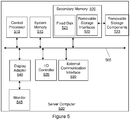
- FIG. 5 illustrates an example of a server computer (500) in which various aspects of the disclosure may be implemented.
- the server computer (500) may be suitable for storing and executing computer program code.
- the various participants and elements in the previously described system diagrams may use any suitable number of subsystems or components of the server computer (500) to facilitate the functions described herein.
- the server computer (500) may include subsystems or components interconnected via a communication infrastructure (505) (for example, a communications bus, a cross-over bar device, or a network).
- the server computer (500) may include at least one central processor (510) and at least one memory component in the form of computer-readable media.
- the memory components may include system memory (515), which may include read only memory (ROM) and random access memory (RAM).
- system memory may include read only memory (ROM) and random access memory (RAM).
- ROM read only memory
- RAM random access memory
- BIOS basic input/output system
- System software may be stored in the system memory (515) including operating system software.
- the memory components may also include secondary memory (520).
- the secondary memory (520) may include a fixed disk (521), such as a hard disk drive, and, optionally, one or more removable-storage interfaces (522) for removable-storage components (523).
- the removable-storage interfaces (522) may be in the form of removablestorage drives (for example, magnetic tape drives, optical disk drives etc.) for corresponding removable storage-components (for example, a magnetic tape, an optical disk etc.), which may be written to and read by the removable-storage drive.
- removablestorage drives for example, magnetic tape drives, optical disk drives etc.
- removable storage-components for example, a magnetic tape, an optical disk etc.
- the removable-storage interfaces (522) may also be in the form of ports or sockets for interfacing with other forms of removable-storage components (523) such as a flash memory drive, external hard drive, or removable memory chip, etc.
- the server computer (500) may include an external communications interface (530) for operation of the server computer (500) in a networked environment enabling transfer of data between multiple server computers (500).
- Data transferred via the external communications interface (530) may be in the form of signals, which may be electronic, electromagnetic, optical, radio, or other types of signal.
- the external communications interface (530) may enable communication of data between the server computer (500) and other server computers including external storage facilities. Web services may be accessible by the server computer (500) via the communications interface (530).
- the external communications interface (530) may also enable other forms of communication to and from the server computer (500) including, voice communication, near field communication, Bluetooth, etc.
- the computer-readable media in the form of the various memory components may provide storage of computer-executable instructions, data structures, program modules, and other data.
- a computer program product may be provided by a computer-readable medium having stored computer-readable program code executable by the central processor (510).
- a computer program product may be provided by a non-transient computer-readable medium, or may be provided via a signal or other transient means via the communications interface (530).
- Interconnection via the communication infrastructure (505) allows a central processor (510) to communicate with each subsystem or component and to control the execution of instructions from the memory components, as well as the exchange of information between subsystems or components.
- Peripherals such as printers, scanners or the like
- input/output (I/O) devices such as a mouse, touchpad, keyboard, microphone, or the like
- server computer (500) may couple to the server computer (500) either directly or via an I/O controller (535).
- I/O controller such as a serial port.
- monitors (545) may be coupled via a display or video adapter (540) to the server computer (500).
- the software components or functions described in this application may be implemented as software code to be executed by one or more processors using any suitable computer language such as, for example, Java, C++, or Perl using, for example, conventional or object-oriented techniques.
- the software code may be stored as a series of instructions, or commands on a non-transitory computer-readable medium, such as a random access memory (RAM) or a read-only memory (ROM). Any such computer-readable medium may also reside on or within a single computational apparatus, and may be present on or within different computational apparatuses within a system or network. Any of the steps, operations, or processes described herein may be performed or implemented with one or more hardware or software modules, alone or in combination with other devices.
- a software module is implemented within a computer program product comprising a non-transient computer-readable medium containing computer program code, which can be executed by a computer processor for performing any or all of the steps, operations, or processes described herein.
- a software module is implemented with a computer program product comprising a non-transient computer-readable medium containing computer program code, which can be executed by a computer processor for performing any or all of the steps, operations, or processes described.
Landscapes
- Business, Economics & Management (AREA)
- Accounting & Taxation (AREA)
- Engineering & Computer Science (AREA)
- General Physics & Mathematics (AREA)
- Physics & Mathematics (AREA)
- General Business, Economics & Management (AREA)
- Strategic Management (AREA)
- Theoretical Computer Science (AREA)
- Finance (AREA)
- Computer Security & Cryptography (AREA)
- Computer Networks & Wireless Communication (AREA)
- Financial Or Insurance-Related Operations Such As Payment And Settlement (AREA)
- Storage Device Security (AREA)
Claims (17)
- Procédé mis en oeuvre par ordinateur, réalisé au niveau d'un ordinateur serveur (150), comprenant les étapes ci-dessous consistant à :recevoir (206) des données de titulaire de carte appartenant à un consommateur (110), les données de titulaire de carte incluant des justificatifs d'identité de consommateur devant être stockés et au moins un article de données qui ne doit pas être stocké ;obtenir (224) un jeton de référence de consommateur unique ;stocker (226) les justificatifs d'identité qui doivent être stockés, sur une base de données (156), en association avec le jeton de référence de consommateur ;combiner (228) le jeton de référence de consommateur avec au moins une partie de l'article de données qui ne doit pas être stocké et chiffrer la combinaison en vue de former un jeton chiffré ;transmettre (228) le jeton chiffré à un tiers en vue d'un stockage de celui-ci par le tiers ; eteffacer (232) le jeton chiffré transmis au tiers et ladite au moins une partie combinée de l'article de données qui ne doit pas être stocké de la totalité de la mémoire de l'ordinateur serveur (150).
- Procédé selon la revendication 1, dans lequel, avant d'être stockés (226) sur la base de données, les justificatifs d'identité qui doivent être stockés sont combinés avec une partie restante de l'article de données qui ne doit pas être stocké, et la combinaison est chiffrée, où la partie restante correspond à cette partie de l'article de données qui n'est pas chiffrée dans le jeton chiffré.
- Procédé selon la revendication 1 ou 2, dans lequel, au cours d'un ou plusieurs stades dans lesquels le consommateur (110) choisit de payer en utilisant des données de titulaire de carte stockées, le procédé comprend les étapes ci-dessous consistant à :recevoir (304) le jeton chiffré en provenance du tiers ;déchiffrer (309) le jeton chiffré en vue d'extraire de celui-ci le jeton de référence de consommateur et tout ou partie de l'article de données qui ne doit pas être stocké ;interroger (307) la base de données en vue d'obtenir les justificatifs d'identité de consommateur stockés sur la base de données (156), incluant une quelconque partie restante de l'article de données ;initialiser (314) une transaction de paiement en utilisant les justificatifs d'identité de consommateur stockés sur la base de données (156) conjointement avec l'article de données qui ne doit pas être stocké ; etsuite à l'achèvement de la transaction de paiement, effacer (332) le jeton chiffré reçu en provenance du tiers et la totalité ou la partie extraite de l'article de données qui ne doit pas être stocké de la totalité de la mémoire de l'ordinateur serveur.
- Procédé selon la revendication 3, dans lequel le procédé comprend les étapes ci-dessous consistant à :recevoir un identifiant (ID) de consommateur ; etstocker l'ID de consommateur en association avec le jeton de référence de consommateur sur la base de données ; etau cours de chaque stade dans lequel le consommateur (110) choisit de payer en utilisant des données de titulaire de carte stockées :recevoir (304) l'ID de consommateur ;interroger (307) la base de données en vue de retrouver le jeton de référence de consommateur stocké qui est associé à l'ID de consommateur ; etsuite au déchiffrement (307) du jeton chiffré pour extraire de celui-ci le jeton de référence de consommateur et tout ou partie de l'article de données qui ne doit pas être stocké, comparer (310) le jeton de référence de consommateur extrait au jeton de référence de consommateur stocké, et si les jetons de référence de consommateur ne sont pas identiques, refuser (313) d'initier la transaction de paiement.
- Procédé selon la revendication 3 ou 4, dans lequel l'ordinateur serveur (150) est un ordinateur serveur d'un fournisseur de services de paiement (114), et dans lequel les données de titulaire de carte sont reçues en provenance ou au nom d'un commerçant (102) qui communique avec le fournisseur de services de paiement (114).
- Procédé selon la revendication 5, dans lequel le tiers auquel le jeton chiffré est transmis est le commerçant (102).
- Procédé selon la revendication 6, dans lequel le procédé inclut les étapes ci-dessous consistant à :recevoir (204) un identifiant du commerçant ; etstocker (226) l'identifiant du commerçant en association avec le jeton de référence de consommateur sur la base de données ; etau cours de chaque stade dans lequel le consommateur choisit de payer en utilisant des données de titulaire de carte stockées :recevoir (304) un identifiant du commerçant ; etmettre en oeuvre (305) une vérification destinée à garantir que le commerçant fournissant le jeton chiffré est le même commerçant que le commerçant lié au jeton de référence de consommateur, et si le commerçant n'est pas le même, refuser (312) d'initier la transaction de paiement.
- Procédé selon l'une quelconque des revendications 5 à 7, dans lequel le commerçant (102) exploite un site web de commerce électronique (104), et le commerçant (102) reçoit les données de titulaire de carte en provenance du consommateur (110) au moyen du site web de commerce électronique (104) et transmet les données de titulaire de carte au fournisseur de services de paiement (114) à travers une interface de programmation d'application (API) (116) entre le commerçant (102) et le fournisseur de services de paiement (114).
- Procédé selon l'une quelconque des revendications 5 à 7, dans lequel le commerçant (102) exploite un site web de commerce électronique (104), et suite à la réception d'une demande d'un consommateur (110) visant à acheter un article, le site web de commerce électronique (114) redirige le consommateur (110) vers une interface accessible par voie électronique du fournisseur de services de paiement (114) où les données de titulaire de carte sont saisies par le consommateur (110).
- Procédé selon la revendication 8 ou 9, dans lequel le tiers auquel le jeton chiffré est transmis est le commerçant (102), le commerçant (102) permet au consommateur (110) de créer (200) un profil de consommateur auprès du commerçant (102), et suite à la réception du jeton chiffré en provenance du fournisseur de services de paiement (114), le commerçant (102) stocke (230) le jeton chiffré en association avec le profil de consommateur à des fins de récupération ultérieure.
- Procédé selon l'une quelconque des revendications 1 à 4, dans lequel l'ordinateur serveur (150) est un ordinateur serveur d'un commerçant (102), les données de titulaire de carte sont reçues en provenance d'un dispositif électronique (108) du consommateur (110), et le tiers auquel le jeton chiffré est transmis est le dispositif électronique (108) du consommateur (110).
- Procédé selon l'une quelconque des revendications précédentes, dans lequel les données de titulaire de carte incluent un numéro de compte primaire (PAN), une date d'expiration, et un cryptogramme visuel (CVV), dans lequel les justificatifs d'identité de consommateur qui doivent être stockés sont le numéro PAN et la date d'expiration, et l'article de données qui ne doit pas être stocké est le cryptogramme CVV.
- Procédé selon l'une quelconque des revendications précédentes, dans lequel, après l'étape de réception (206) des données de titulaire de carte, le procédé comprend les étapes ci-dessous consistant à :transmettre (206) les données de titulaire de carte à une banque acquéreuse (118) d'un commerçant (102), qui à son tour achemine les données de titulaire de carte vers une banque émettrice (122) du consommateur (110) à travers un réseau de traitement de paiements (120) afin que la banque émettrice (122) valide les données de titulaire de carte ;recevoir (220) une réponse de la banque acquéreuse (118) indiquant si les données de titulaire de carte sont valides ou non ;en réponse au fait que la banque acquéreuse (118) indique que les données de titulaire de carte ne sont pas valides, générer un message d'échec indiquant que les données de titulaire de carte fournies n'étaient pas valides et qu'elles ne peuvent pas être stockées, et empêcher la mise en oeuvre d'étapes supplémentaires du procédé ; eten réponse au fait que la banque acquéreuse (118) indique que les données de titulaire de carte sont valides, mettre en oeuvre les étapes supplémentaires du procédé.
- Système destiné à stocker des données de titulaire de carte et à initier des transactions de paiement, comprenant un ordinateur serveur (150) présentant :un premier module de réception (152) destiné à recevoir des données de titulaire de carte appartenant à un consommateur (110), les données de titulaire de carte incluant des justificatifs d'identité de consommateur devant être stockés et au moins un article de données qui ne doit pas être stocké ;un module d'obtention (154) destiné à obtenir un jeton de référence de consommateur unique ;une base de données (156) destinée à stocker les justificatifs d'identité qui doivent être stockés, en association avec le jeton de référence de consommateur ;un module de chiffrement (158) destiné à combiner le jeton de référence de consommateur avec au moins une partie de l'article de données qui ne doit pas être stocké et à chiffrer la combinaison en vue de former un jeton chiffré ;un module de transmission (160) destiné à transmettre le jeton chiffré à un tiers en vue d'un stockage de celui-ci par le tiers ; etun module d'effacement (162) destiné à effacer le jeton chiffré transmis au tiers et ladite au moins une partie combinée de l'article de données qui ne doit pas être stocké de la totalité de la mémoire de l'ordinateur serveur.
- Système selon la revendication 14, lequel inclut :un second module de réception (164) destiné à recevoir le jeton chiffré en provenance du tiers ;un module de déchiffrement (166) destiné à déchiffrer le jeton chiffré en vue d'extraire de celui-ci le jeton de référence de consommateur et tout ou partie de l'article de données qui ne doit pas être stocké ;un module d'interrogation (168) destiné à interroger la base de données (156) en vue d'obtenir les justificatifs d'identité de consommateur stockés sur la base de données (156) incluant une quelconque partie restante de l'article de données ; etun module d'initiation de transaction (170) destiné à initier une transaction de paiement en utilisant les justificatifs d'identité de consommateur stockés sur la base de données (156) conjointement avec l'article de données qui ne doit pas être stocké.
- Procédé mis en oeuvre au niveau d'un ordinateur serveur d'un commerçant, comprenant les étapes ci-dessous consistant à :recevoir des données de titulaire de carte appartenant à un consommateur (110), les données de titulaire de carte incluant des justificatifs d'identité de consommateur qui doivent être stockés et au moins un article de données qui ne doit pas être stocké ;transmettre l'article de données qui ne doit pas être stocké à un ordinateur serveur d'un fournisseur de services de paiement (114), le fournisseur de services de paiement (114) obtenant (224) un jeton de référence de consommateur unique, combinant (228) le jeton de référence de consommateur avec au moins une partie de l'article de données qui ne doit pas être stocké et chiffrant (228) la combinaison en vue de former un jeton chiffré ;recevoir le jeton chiffré en provenance du fournisseur de services de paiement, le fournisseur de services de paiement ayant effacé (232) ladite au moins une partie combinée de l'article de données qui ne doit pas être stocké et le jeton chiffré de la totalité de la mémoire du fournisseur de services de paiement (114) ; etstocker (230) le jeton chiffré sur une base de données de commerçant.
- Procédé selon la revendication 16, dans lequel, au cours d'un ou plusieurs stades dans lesquels le consommateur (110) choisit de payer en utilisant des données de titulaire de carte stockées, le procédé comprend l'étape ci-dessous consistant à :transmettre (302) le jeton chiffré au fournisseur de services de paiement (114), le fournisseur de services de paiement (114) déchiffrant (309) le jeton chiffré en vue d'extraire de celui-ci le jeton de référence de consommateur et tout ou partie de l'article de données qui ne doit pas être stocké, de sorte qu'une transaction de paiement peut être initiée par le fournisseur de services de paiement (114) en utilisant les justificatifs d'identité de consommateur et ledit au moins un article de données qui ne peut pas être stocké.
Priority Applications (2)
| Application Number | Priority Date | Filing Date | Title |
|---|---|---|---|
| EP17151882.2A EP3217342A1 (fr) | 2013-07-12 | 2014-07-10 | Systèmes de mémorisation de données de détenteur de carte et de traitement de transactions |
| PL14822777T PL3000080T3 (pl) | 2013-07-12 | 2014-07-10 | Systemy do przechowywania danych posiadacza karty i przetwarzania transakcji |
Applications Claiming Priority (2)
| Application Number | Priority Date | Filing Date | Title |
|---|---|---|---|
| ZA201305249 | 2013-07-12 | ||
| PCT/IB2014/063002 WO2015004625A1 (fr) | 2013-07-12 | 2014-07-10 | Systèmes pour stocker des données de titulaire de carte et traiter des transactions |
Related Child Applications (1)
| Application Number | Title | Priority Date | Filing Date |
|---|---|---|---|
| EP17151882.2A Division EP3217342A1 (fr) | 2013-07-12 | 2014-07-10 | Systèmes de mémorisation de données de détenteur de carte et de traitement de transactions |
Publications (3)
| Publication Number | Publication Date |
|---|---|
| EP3000080A1 EP3000080A1 (fr) | 2016-03-30 |
| EP3000080A4 EP3000080A4 (fr) | 2016-04-06 |
| EP3000080B1 true EP3000080B1 (fr) | 2017-01-25 |
Family
ID=52279410
Family Applications (2)
| Application Number | Title | Priority Date | Filing Date |
|---|---|---|---|
| EP17151882.2A Withdrawn EP3217342A1 (fr) | 2013-07-12 | 2014-07-10 | Systèmes de mémorisation de données de détenteur de carte et de traitement de transactions |
| EP14822777.0A Active EP3000080B1 (fr) | 2013-07-12 | 2014-07-10 | Systèmes pour stocker des données de titulaire de carte et traiter des transactions |
Family Applications Before (1)
| Application Number | Title | Priority Date | Filing Date |
|---|---|---|---|
| EP17151882.2A Withdrawn EP3217342A1 (fr) | 2013-07-12 | 2014-07-10 | Systèmes de mémorisation de données de détenteur de carte et de traitement de transactions |
Country Status (6)
| Country | Link |
|---|---|
| US (1) | US10733598B2 (fr) |
| EP (2) | EP3217342A1 (fr) |
| AP (1) | AP2015008912A0 (fr) |
| PL (1) | PL3000080T3 (fr) |
| WO (1) | WO2015004625A1 (fr) |
| ZA (1) | ZA201509132B (fr) |
Families Citing this family (27)
| Publication number | Priority date | Publication date | Assignee | Title |
|---|---|---|---|---|
| US20100312333A1 (en) | 2009-04-29 | 2010-12-09 | The Cleveland Clinic Foundation | Apparatus and method for replacing a diseased cardiac valve |
| US20090276040A1 (en) | 2008-05-01 | 2009-11-05 | Edwards Lifesciences Corporation | Device and method for replacing mitral valve |
| US8652202B2 (en) | 2008-08-22 | 2014-02-18 | Edwards Lifesciences Corporation | Prosthetic heart valve and delivery apparatus |
| WO2010057262A1 (fr) | 2008-11-21 | 2010-05-27 | Percutaneous Cardiovascular Solutions Pty Limited | Prothèse de valve cardiaque et procédé |
| AU2010236288A1 (en) | 2009-04-15 | 2011-10-20 | Cardiaq Valve Technologies, Inc. | Vascular implant and delivery system |
| US8652203B2 (en) | 2010-09-23 | 2014-02-18 | Cardiaq Valve Technologies, Inc. | Replacement heart valves, delivery devices and methods |
| US8449599B2 (en) | 2009-12-04 | 2013-05-28 | Edwards Lifesciences Corporation | Prosthetic valve for replacing mitral valve |
| US10417702B2 (en) * | 2011-05-26 | 2019-09-17 | Facebook, Inc. | Dynamically providing a third-party checkout option |
| US9439763B2 (en) | 2013-02-04 | 2016-09-13 | Edwards Lifesciences Corporation | Prosthetic valve for replacing mitral valve |
| US20140277427A1 (en) | 2013-03-14 | 2014-09-18 | Cardiaq Valve Technologies, Inc. | Prosthesis for atraumatically grasping intralumenal tissue and methods of delivery |
| RU2017114607A (ru) | 2014-09-28 | 2018-10-29 | Кардиокинетикс, Инк. | Устройства для терапии нарушений функции сердца |
| WO2016053287A1 (fr) * | 2014-09-30 | 2016-04-07 | Hewlett-Packard Development Company, L.P. | Authentification d'utilisateur |
| CN106999281B (zh) | 2014-11-26 | 2020-05-05 | 爱德华兹生命科学公司 | 经导管人工心脏瓣膜和递送系统 |
| CN107204957B (zh) * | 2016-03-16 | 2020-04-28 | 阿里巴巴集团控股有限公司 | 一种账号绑定和业务处理的方法及装置 |
| US11250424B2 (en) | 2016-05-19 | 2022-02-15 | Visa International Service Association | Systems and methods for creating subtokens using primary tokens |
| US10432570B2 (en) * | 2016-06-02 | 2019-10-01 | Mastercard International Incorporated | Systems and methods for transaction messaging using social networking platforms |
| US10350062B2 (en) | 2016-07-21 | 2019-07-16 | Edwards Lifesciences Corporation | Replacement heart valve prosthesis |
| US20180174137A1 (en) * | 2016-12-21 | 2018-06-21 | Facebook, Inc. | Providing device and system agnostic electronic payment tokens |
| EP3648708A4 (fr) | 2017-07-06 | 2021-03-31 | Edwards Lifesciences Corporation | Système et éléments de pose manoeuvrables |
| US10848467B2 (en) | 2017-12-06 | 2020-11-24 | Mastercard International Incorporated | Systems and methods for securing a laptop computer device |
| US11487896B2 (en) | 2018-06-18 | 2022-11-01 | Bright Lion, Inc. | Sensitive data shield for networks |
| US11470062B2 (en) * | 2019-03-22 | 2022-10-11 | Raytheon Technologies Corporation | Secure reprogramming of embedded processing system |
| JP7381601B2 (ja) | 2019-04-12 | 2023-11-15 | エドワーズ ライフサイエンシーズ コーポレイション | マルチパートフレーム及び関連するレジリエントブリッジ特徴部を備えた弁 |
| WO2020219459A1 (fr) | 2019-04-23 | 2020-10-29 | Edwards Lifesciences Corporation | Système motorisé de pose d'implant |
| US20220180360A1 (en) * | 2019-10-07 | 2022-06-09 | Sandeep Aggarwal | Methods and systems of implementing a token transfer feature |
| CA3116912A1 (fr) * | 2020-04-30 | 2021-10-30 | Bright Lion, Inc. | Reseau d`assurance de la securite de commerce electronique |
| KR102918984B1 (ko) | 2021-10-27 | 2026-01-28 | 에드워즈 라이프사이언시스 코포레이션 | 인공 심장 판막의 클림핑 및 로딩을 위한 시스템 및 방법 |
Family Cites Families (13)
| Publication number | Priority date | Publication date | Assignee | Title |
|---|---|---|---|---|
| US5826245A (en) * | 1995-03-20 | 1998-10-20 | Sandberg-Diment; Erik | Providing verification information for a transaction |
| US7349867B2 (en) * | 2000-12-22 | 2008-03-25 | Invenda Corporation | Tracking transactions by using addresses in a communications network |
| US6931382B2 (en) * | 2001-01-24 | 2005-08-16 | Cdck Corporation | Payment instrument authorization technique |
| US20030167408A1 (en) | 2002-03-01 | 2003-09-04 | Fitzpatrick Gregory P. | Randomized bit dispersal of sensitive data sets |
| US7347361B2 (en) * | 2005-06-13 | 2008-03-25 | Robert Lovett | System, method and program product for account transaction validation |
| US20100274634A1 (en) * | 2007-12-20 | 2010-10-28 | Meyer Ifrah | Method and system of conducting a communication |
| US7922082B2 (en) * | 2008-01-04 | 2011-04-12 | M2 International Ltd. | Dynamic card validation value |
| US20130212012A1 (en) * | 2010-10-15 | 2013-08-15 | 34 Solutions, Llc | System And Method For Mobile Electronic Purchasing |
| EP2633484A4 (fr) * | 2010-10-29 | 2015-01-21 | Exodus Payment Systems Llc | Procédé et système permettant de traiter des transactions au moyen d'un jeton |
| US9141945B2 (en) * | 2010-12-02 | 2015-09-22 | Appmobi Iplc, Inc. | Secure distributed single action payment system |
| GB2493138A (en) | 2011-07-15 | 2013-01-30 | Flick Mobile Ltd | A system for secure payment transactions |
| KR102092238B1 (ko) * | 2011-08-08 | 2020-03-24 | 비자 인터네셔널 서비스 어소시에이션 | 집적 칩을 이용한 지불 기기 |
| US10275750B2 (en) * | 2011-12-09 | 2019-04-30 | Cayan Llc | Payment processing and customer engagement platform methods, apparatuses and media |
-
2014
- 2014-07-10 PL PL14822777T patent/PL3000080T3/pl unknown
- 2014-07-10 EP EP17151882.2A patent/EP3217342A1/fr not_active Withdrawn
- 2014-07-10 US US14/899,009 patent/US10733598B2/en active Active
- 2014-07-10 AP AP2015008912A patent/AP2015008912A0/xx unknown
- 2014-07-10 WO PCT/IB2014/063002 patent/WO2015004625A1/fr not_active Ceased
- 2014-07-10 EP EP14822777.0A patent/EP3000080B1/fr active Active
-
2015
- 2015-12-15 ZA ZA2015/09132A patent/ZA201509132B/en unknown
Non-Patent Citations (1)
| Title |
|---|
| None * |
Also Published As
| Publication number | Publication date |
|---|---|
| EP3000080A1 (fr) | 2016-03-30 |
| AP2015008912A0 (en) | 2015-12-31 |
| US10733598B2 (en) | 2020-08-04 |
| WO2015004625A1 (fr) | 2015-01-15 |
| US20160125397A1 (en) | 2016-05-05 |
| PL3000080T3 (pl) | 2017-07-31 |
| EP3217342A1 (fr) | 2017-09-13 |
| EP3000080A4 (fr) | 2016-04-06 |
| ZA201509132B (en) | 2017-04-26 |
Similar Documents
| Publication | Publication Date | Title |
|---|---|---|
| EP3000080B1 (fr) | Systèmes pour stocker des données de titulaire de carte et traiter des transactions | |
| JP7407254B2 (ja) | 位置照合を使用する認証システムおよび方法 | |
| JP6603765B2 (ja) | セキュアエレメントを用いずに移動装置に対する遠隔通知サービスメッセージをセキュアに送信するための方法およびシステム | |
| AU2015259162B2 (en) | Master applet for secure remote payment processing | |
| KR102025816B1 (ko) | 보안 요소 없이 사용자 및 모바일 장치를 보안 인증하는 방법 및 시스템 | |
| EP1922686B1 (fr) | Procede et systeme permettant d'executer une authentification mutuelle a deux facteurs | |
| KR102151579B1 (ko) | 보안 요소들이 구비되어 있지 않은 모바일 기기에서 어드밴스트 저장 키를 생성하는 방법 및 시스템 | |
| AU2025220823A1 (en) | Systems and methods for cryptographic authentication of contactless cards | |
| CN107438992A (zh) | 浏览器与密码的集成 | |
| WO2020069210A1 (fr) | Systèmes, procédés et programmes d'ordinateur permettant d'obtenir un navigateur de stockage d'identités | |
| WO2015126632A1 (fr) | Système et procédé pour un terminal consommateur internet (ict) |
Legal Events
| Date | Code | Title | Description |
|---|---|---|---|
| PUAI | Public reference made under article 153(3) epc to a published international application that has entered the european phase |
Free format text: ORIGINAL CODE: 0009012 |
|
| 17P | Request for examination filed |
Effective date: 20151222 |
|
| AK | Designated contracting states |
Kind code of ref document: A1 Designated state(s): AL AT BE BG CH CY CZ DE DK EE ES FI FR GB GR HR HU IE IS IT LI LT LU LV MC MK MT NL NO PL PT RO RS SE SI SK SM TR |
|
| AX | Request for extension of the european patent |
Extension state: BA ME |
|
| A4 | Supplementary search report drawn up and despatched |
Effective date: 20160308 |
|
| RIC1 | Information provided on ipc code assigned before grant |
Ipc: G06Q 20/08 20120101AFI20160302BHEP Ipc: G06Q 20/00 20120101ALI20160302BHEP |
|
| GRAP | Despatch of communication of intention to grant a patent |
Free format text: ORIGINAL CODE: EPIDOSNIGR1 |
|
| DAX | Request for extension of the european patent (deleted) | ||
| INTG | Intention to grant announced |
Effective date: 20160729 |
|
| GRAS | Grant fee paid |
Free format text: ORIGINAL CODE: EPIDOSNIGR3 |
|
| GRAA | (expected) grant |
Free format text: ORIGINAL CODE: 0009210 |
|
| AK | Designated contracting states |
Kind code of ref document: B1 Designated state(s): AL AT BE BG CH CY CZ DE DK EE ES FI FR GB GR HR HU IE IS IT LI LT LU LV MC MK MT NL NO PL PT RO RS SE SI SK SM TR |
|
| REG | Reference to a national code |
Ref country code: GB Ref legal event code: FG4D |
|
| REG | Reference to a national code |
Ref country code: CH Ref legal event code: EP |
|
| REG | Reference to a national code |
Ref country code: AT Ref legal event code: REF Ref document number: 864521 Country of ref document: AT Kind code of ref document: T Effective date: 20170215 |
|
| REG | Reference to a national code |
Ref country code: IE Ref legal event code: FG4D |
|
| REG | Reference to a national code |
Ref country code: NL Ref legal event code: FP |
|
| REG | Reference to a national code |
Ref country code: DE Ref legal event code: R096 Ref document number: 602014006418 Country of ref document: DE |
|
| REG | Reference to a national code |
Ref country code: LT Ref legal event code: MG4D |
|
| REG | Reference to a national code |
Ref country code: AT Ref legal event code: MK05 Ref document number: 864521 Country of ref document: AT Kind code of ref document: T Effective date: 20170125 |
|
| REG | Reference to a national code |
Ref country code: FR Ref legal event code: PLFP Year of fee payment: 4 |
|
| PG25 | Lapsed in a contracting state [announced via postgrant information from national office to epo] |
Ref country code: IS Free format text: LAPSE BECAUSE OF FAILURE TO SUBMIT A TRANSLATION OF THE DESCRIPTION OR TO PAY THE FEE WITHIN THE PRESCRIBED TIME-LIMIT Effective date: 20170525 Ref country code: HR Free format text: LAPSE BECAUSE OF FAILURE TO SUBMIT A TRANSLATION OF THE DESCRIPTION OR TO PAY THE FEE WITHIN THE PRESCRIBED TIME-LIMIT Effective date: 20170125 Ref country code: LT Free format text: LAPSE BECAUSE OF FAILURE TO SUBMIT A TRANSLATION OF THE DESCRIPTION OR TO PAY THE FEE WITHIN THE PRESCRIBED TIME-LIMIT Effective date: 20170125 Ref country code: NO Free format text: LAPSE BECAUSE OF FAILURE TO SUBMIT A TRANSLATION OF THE DESCRIPTION OR TO PAY THE FEE WITHIN THE PRESCRIBED TIME-LIMIT Effective date: 20170425 Ref country code: FI Free format text: LAPSE BECAUSE OF FAILURE TO SUBMIT A TRANSLATION OF THE DESCRIPTION OR TO PAY THE FEE WITHIN THE PRESCRIBED TIME-LIMIT Effective date: 20170125 Ref country code: GR Free format text: LAPSE BECAUSE OF FAILURE TO SUBMIT A TRANSLATION OF THE DESCRIPTION OR TO PAY THE FEE WITHIN THE PRESCRIBED TIME-LIMIT Effective date: 20170426 |
|
| PG25 | Lapsed in a contracting state [announced via postgrant information from national office to epo] |
Ref country code: RS Free format text: LAPSE BECAUSE OF FAILURE TO SUBMIT A TRANSLATION OF THE DESCRIPTION OR TO PAY THE FEE WITHIN THE PRESCRIBED TIME-LIMIT Effective date: 20170125 Ref country code: BG Free format text: LAPSE BECAUSE OF FAILURE TO SUBMIT A TRANSLATION OF THE DESCRIPTION OR TO PAY THE FEE WITHIN THE PRESCRIBED TIME-LIMIT Effective date: 20170425 Ref country code: ES Free format text: LAPSE BECAUSE OF FAILURE TO SUBMIT A TRANSLATION OF THE DESCRIPTION OR TO PAY THE FEE WITHIN THE PRESCRIBED TIME-LIMIT Effective date: 20170125 Ref country code: AT Free format text: LAPSE BECAUSE OF FAILURE TO SUBMIT A TRANSLATION OF THE DESCRIPTION OR TO PAY THE FEE WITHIN THE PRESCRIBED TIME-LIMIT Effective date: 20170125 Ref country code: PT Free format text: LAPSE BECAUSE OF FAILURE TO SUBMIT A TRANSLATION OF THE DESCRIPTION OR TO PAY THE FEE WITHIN THE PRESCRIBED TIME-LIMIT Effective date: 20170525 Ref country code: LV Free format text: LAPSE BECAUSE OF FAILURE TO SUBMIT A TRANSLATION OF THE DESCRIPTION OR TO PAY THE FEE WITHIN THE PRESCRIBED TIME-LIMIT Effective date: 20170125 Ref country code: SE Free format text: LAPSE BECAUSE OF FAILURE TO SUBMIT A TRANSLATION OF THE DESCRIPTION OR TO PAY THE FEE WITHIN THE PRESCRIBED TIME-LIMIT Effective date: 20170125 |
|
| REG | Reference to a national code |
Ref country code: DE Ref legal event code: R097 Ref document number: 602014006418 Country of ref document: DE |
|
| PG25 | Lapsed in a contracting state [announced via postgrant information from national office to epo] |
Ref country code: RO Free format text: LAPSE BECAUSE OF FAILURE TO SUBMIT A TRANSLATION OF THE DESCRIPTION OR TO PAY THE FEE WITHIN THE PRESCRIBED TIME-LIMIT Effective date: 20170125 Ref country code: IT Free format text: LAPSE BECAUSE OF FAILURE TO SUBMIT A TRANSLATION OF THE DESCRIPTION OR TO PAY THE FEE WITHIN THE PRESCRIBED TIME-LIMIT Effective date: 20170125 Ref country code: SK Free format text: LAPSE BECAUSE OF FAILURE TO SUBMIT A TRANSLATION OF THE DESCRIPTION OR TO PAY THE FEE WITHIN THE PRESCRIBED TIME-LIMIT Effective date: 20170125 Ref country code: CZ Free format text: LAPSE BECAUSE OF FAILURE TO SUBMIT A TRANSLATION OF THE DESCRIPTION OR TO PAY THE FEE WITHIN THE PRESCRIBED TIME-LIMIT Effective date: 20170125 Ref country code: EE Free format text: LAPSE BECAUSE OF FAILURE TO SUBMIT A TRANSLATION OF THE DESCRIPTION OR TO PAY THE FEE WITHIN THE PRESCRIBED TIME-LIMIT Effective date: 20170125 |
|
| PG25 | Lapsed in a contracting state [announced via postgrant information from national office to epo] |
Ref country code: DK Free format text: LAPSE BECAUSE OF FAILURE TO SUBMIT A TRANSLATION OF THE DESCRIPTION OR TO PAY THE FEE WITHIN THE PRESCRIBED TIME-LIMIT Effective date: 20170125 Ref country code: SM Free format text: LAPSE BECAUSE OF FAILURE TO SUBMIT A TRANSLATION OF THE DESCRIPTION OR TO PAY THE FEE WITHIN THE PRESCRIBED TIME-LIMIT Effective date: 20170125 |
|
| PLBE | No opposition filed within time limit |
Free format text: ORIGINAL CODE: 0009261 |
|
| STAA | Information on the status of an ep patent application or granted ep patent |
Free format text: STATUS: NO OPPOSITION FILED WITHIN TIME LIMIT |
|
| 26N | No opposition filed |
Effective date: 20171026 |
|
| PG25 | Lapsed in a contracting state [announced via postgrant information from national office to epo] |
Ref country code: SI Free format text: LAPSE BECAUSE OF FAILURE TO SUBMIT A TRANSLATION OF THE DESCRIPTION OR TO PAY THE FEE WITHIN THE PRESCRIBED TIME-LIMIT Effective date: 20170125 |
|
| REG | Reference to a national code |
Ref country code: CH Ref legal event code: PL |
|
| REG | Reference to a national code |
Ref country code: IE Ref legal event code: MM4A |
|
| PG25 | Lapsed in a contracting state [announced via postgrant information from national office to epo] |
Ref country code: IE Free format text: LAPSE BECAUSE OF NON-PAYMENT OF DUE FEES Effective date: 20170710 Ref country code: LI Free format text: LAPSE BECAUSE OF NON-PAYMENT OF DUE FEES Effective date: 20170731 Ref country code: CH Free format text: LAPSE BECAUSE OF NON-PAYMENT OF DUE FEES Effective date: 20170731 |
|
| REG | Reference to a national code |
Ref country code: BE Ref legal event code: MM Effective date: 20170731 |
|
| PG25 | Lapsed in a contracting state [announced via postgrant information from national office to epo] |
Ref country code: LU Free format text: LAPSE BECAUSE OF NON-PAYMENT OF DUE FEES Effective date: 20170710 |
|
| REG | Reference to a national code |
Ref country code: FR Ref legal event code: PLFP Year of fee payment: 5 |
|
| PG25 | Lapsed in a contracting state [announced via postgrant information from national office to epo] |
Ref country code: BE Free format text: LAPSE BECAUSE OF NON-PAYMENT OF DUE FEES Effective date: 20170731 |
|
| PG25 | Lapsed in a contracting state [announced via postgrant information from national office to epo] |
Ref country code: MT Free format text: LAPSE BECAUSE OF NON-PAYMENT OF DUE FEES Effective date: 20170710 |
|
| PG25 | Lapsed in a contracting state [announced via postgrant information from national office to epo] |
Ref country code: MC Free format text: LAPSE BECAUSE OF FAILURE TO SUBMIT A TRANSLATION OF THE DESCRIPTION OR TO PAY THE FEE WITHIN THE PRESCRIBED TIME-LIMIT Effective date: 20170125 Ref country code: HU Free format text: LAPSE BECAUSE OF FAILURE TO SUBMIT A TRANSLATION OF THE DESCRIPTION OR TO PAY THE FEE WITHIN THE PRESCRIBED TIME-LIMIT; INVALID AB INITIO Effective date: 20140710 |
|
| PG25 | Lapsed in a contracting state [announced via postgrant information from national office to epo] |
Ref country code: CY Free format text: LAPSE BECAUSE OF FAILURE TO SUBMIT A TRANSLATION OF THE DESCRIPTION OR TO PAY THE FEE WITHIN THE PRESCRIBED TIME-LIMIT Effective date: 20170125 |
|
| PG25 | Lapsed in a contracting state [announced via postgrant information from national office to epo] |
Ref country code: MK Free format text: LAPSE BECAUSE OF FAILURE TO SUBMIT A TRANSLATION OF THE DESCRIPTION OR TO PAY THE FEE WITHIN THE PRESCRIBED TIME-LIMIT Effective date: 20170125 |
|
| PG25 | Lapsed in a contracting state [announced via postgrant information from national office to epo] |
Ref country code: TR Free format text: LAPSE BECAUSE OF FAILURE TO SUBMIT A TRANSLATION OF THE DESCRIPTION OR TO PAY THE FEE WITHIN THE PRESCRIBED TIME-LIMIT Effective date: 20170125 |
|
| PG25 | Lapsed in a contracting state [announced via postgrant information from national office to epo] |
Ref country code: AL Free format text: LAPSE BECAUSE OF FAILURE TO SUBMIT A TRANSLATION OF THE DESCRIPTION OR TO PAY THE FEE WITHIN THE PRESCRIBED TIME-LIMIT Effective date: 20170125 |
|
| P01 | Opt-out of the competence of the unified patent court (upc) registered |
Effective date: 20230510 |
|
| PGFP | Annual fee paid to national office [announced via postgrant information from national office to epo] |
Ref country code: GB Payment date: 20240627 Year of fee payment: 11 |
|
| PGFP | Annual fee paid to national office [announced via postgrant information from national office to epo] |
Ref country code: PL Payment date: 20240624 Year of fee payment: 11 |
|
| PGFP | Annual fee paid to national office [announced via postgrant information from national office to epo] |
Ref country code: NL Payment date: 20240721 Year of fee payment: 11 |
|
| PGFP | Annual fee paid to national office [announced via postgrant information from national office to epo] |
Ref country code: DE Payment date: 20240723 Year of fee payment: 11 |
|
| PGFP | Annual fee paid to national office [announced via postgrant information from national office to epo] |
Ref country code: FR Payment date: 20240707 Year of fee payment: 11 |
|
| REG | Reference to a national code |
Ref country code: DE Ref legal event code: R119 Ref document number: 602014006418 Country of ref document: DE |
|
| REG | Reference to a national code |
Ref country code: NL Ref legal event code: MM Effective date: 20250801 |
|
| GBPC | Gb: european patent ceased through non-payment of renewal fee |
Effective date: 20250710 |
|
| PG25 | Lapsed in a contracting state [announced via postgrant information from national office to epo] |
Ref country code: GB Free format text: LAPSE BECAUSE OF NON-PAYMENT OF DUE FEES Effective date: 20250710 |
|
| PG25 | Lapsed in a contracting state [announced via postgrant information from national office to epo] |
Ref country code: DE Free format text: LAPSE BECAUSE OF NON-PAYMENT OF DUE FEES Effective date: 20260203 |
|
| PG25 | Lapsed in a contracting state [announced via postgrant information from national office to epo] |
Ref country code: NL Free format text: LAPSE BECAUSE OF NON-PAYMENT OF DUE FEES Effective date: 20250801 |
|
| PG25 | Lapsed in a contracting state [announced via postgrant information from national office to epo] |
Ref country code: FR Free format text: LAPSE BECAUSE OF NON-PAYMENT OF DUE FEES Effective date: 20250731 |