EP3000204B1 - System und verfahren für mehrfache zellenabschaltung in drahtlosen netzwerken - Google Patents
System und verfahren für mehrfache zellenabschaltung in drahtlosen netzwerken Download PDFInfo
- Publication number
- EP3000204B1 EP3000204B1 EP14826725.5A EP14826725A EP3000204B1 EP 3000204 B1 EP3000204 B1 EP 3000204B1 EP 14826725 A EP14826725 A EP 14826725A EP 3000204 B1 EP3000204 B1 EP 3000204B1
- Authority
- EP
- European Patent Office
- Prior art keywords
- network
- nop
- subset
- cells
- traffic
- Prior art date
- Legal status (The legal status is an assumption and is not a legal conclusion. Google has not performed a legal analysis and makes no representation as to the accuracy of the status listed.)
- Active
Links
Images





Classifications
-
- H—ELECTRICITY
- H04—ELECTRIC COMMUNICATION TECHNIQUE
- H04W—WIRELESS COMMUNICATION NETWORKS
- H04W52/00—Power management, e.g. Transmission Power Control [TPC] or power classes
- H04W52/02—Power saving arrangements
- H04W52/0203—Power saving arrangements in the radio access network or backbone network of wireless communication networks
- H04W52/0206—Power saving arrangements in the radio access network or backbone network of wireless communication networks in access points, e.g. base stations
-
- H—ELECTRICITY
- H04—ELECTRIC COMMUNICATION TECHNIQUE
- H04L—TRANSMISSION OF DIGITAL INFORMATION, e.g. TELEGRAPHIC COMMUNICATION
- H04L41/00—Arrangements for maintenance, administration or management of data switching networks, e.g. of packet switching networks
- H04L41/08—Configuration management of networks or network elements
- H04L41/0803—Configuration setting
- H04L41/0823—Configuration setting characterised by the purposes of a change of settings, e.g. optimising configuration for enhancing reliability
- H04L41/0833—Configuration setting characterised by the purposes of a change of settings, e.g. optimising configuration for enhancing reliability for reduction of network energy consumption
-
- H—ELECTRICITY
- H04—ELECTRIC COMMUNICATION TECHNIQUE
- H04W—WIRELESS COMMUNICATION NETWORKS
- H04W16/00—Network planning, e.g. coverage or traffic planning tools; Network deployment, e.g. resource partitioning or cells structures
- H04W16/02—Resource partitioning among network components, e.g. reuse partitioning
- H04W16/06—Hybrid resource partitioning, e.g. channel borrowing
- H04W16/08—Load shedding arrangements
-
- H—ELECTRICITY
- H04—ELECTRIC COMMUNICATION TECHNIQUE
- H04W—WIRELESS COMMUNICATION NETWORKS
- H04W16/00—Network planning, e.g. coverage or traffic planning tools; Network deployment, e.g. resource partitioning or cells structures
- H04W16/24—Cell structures
-
- H—ELECTRICITY
- H04—ELECTRIC COMMUNICATION TECHNIQUE
- H04W—WIRELESS COMMUNICATION NETWORKS
- H04W24/00—Supervisory, monitoring or testing arrangements
- H04W24/02—Arrangements for optimising operational condition
-
- H—ELECTRICITY
- H04—ELECTRIC COMMUNICATION TECHNIQUE
- H04W—WIRELESS COMMUNICATION NETWORKS
- H04W28/00—Network traffic management; Network resource management
- H04W28/02—Traffic management, e.g. flow control or congestion control
- H04W28/0231—Traffic management, e.g. flow control or congestion control based on communication conditions
-
- H—ELECTRICITY
- H04—ELECTRIC COMMUNICATION TECHNIQUE
- H04W—WIRELESS COMMUNICATION NETWORKS
- H04W52/00—Power management, e.g. Transmission Power Control [TPC] or power classes
- H04W52/02—Power saving arrangements
- H04W52/0209—Power saving arrangements in terminal devices
- H04W52/0251—Power saving arrangements in terminal devices using monitoring of local events, e.g. events related to user activity
- H04W52/0258—Power saving arrangements in terminal devices using monitoring of local events, e.g. events related to user activity controlling an operation mode according to history or models of usage information, e.g. activity schedule or time of day
-
- H—ELECTRICITY
- H04—ELECTRIC COMMUNICATION TECHNIQUE
- H04W—WIRELESS COMMUNICATION NETWORKS
- H04W76/00—Connection management
- H04W76/20—Manipulation of established connections
- H04W76/27—Transitions between radio resource control [RRC] states
-
- H—ELECTRICITY
- H04—ELECTRIC COMMUNICATION TECHNIQUE
- H04W—WIRELESS COMMUNICATION NETWORKS
- H04W76/00—Connection management
- H04W76/20—Manipulation of established connections
- H04W76/28—Discontinuous transmission [DTX]; Discontinuous reception [DRX]
-
- Y—GENERAL TAGGING OF NEW TECHNOLOGICAL DEVELOPMENTS; GENERAL TAGGING OF CROSS-SECTIONAL TECHNOLOGIES SPANNING OVER SEVERAL SECTIONS OF THE IPC; TECHNICAL SUBJECTS COVERED BY FORMER USPC CROSS-REFERENCE ART COLLECTIONS [XRACs] AND DIGESTS
- Y02—TECHNOLOGIES OR APPLICATIONS FOR MITIGATION OR ADAPTATION AGAINST CLIMATE CHANGE
- Y02D—CLIMATE CHANGE MITIGATION TECHNOLOGIES IN INFORMATION AND COMMUNICATION TECHNOLOGIES [ICT], I.E. INFORMATION AND COMMUNICATION TECHNOLOGIES AIMING AT THE REDUCTION OF THEIR OWN ENERGY USE
- Y02D30/00—Reducing energy consumption in communication networks
- Y02D30/70—Reducing energy consumption in communication networks in wireless communication networks
Definitions
- the present invention relates to wireless communications, and, in particular embodiments, to a system and methods for multi-objective cell switch-off in cellular networks.
- CSO Cell switch-off
- QoS quality of service
- US Patent Application Publication No. 2012/244869 is directed to a method and system for network scaling for network energy savings that makes use of partial cell switch off to obtain performance estimates for different cell switch off scenarios.
- US Patent Application Publication No. 2012/004009 is directed to a method of managing energy consumption of base stations, and to the corresponding base stations carrying out the method.
- US Patent Application Publication No. 2013/137446 is directed to an apparatus and method for dynamic reorganization of cell structures in a wireless network.
- US Patent Application Publication No. 2013/005385 is directed to a method and system for re-selecting network parameters in a cellular network
- US Patent No. 7,996,334 is directed to a multi-objective evolutionary algorithm based engineering design optimization method.
- a method performed by a network component for cell switch-off in a wireless network comprising: defining a set of Network Operation Points, NOP, each NOP in the set representing a state for each cell in a coverage area in the wireless network and having an associated Network Energy Level, NEL, defined as the number of active cells in the NOP; determining, a subset of the set of NOPs, each NOP in the subset representing a Pareto-efficient solution to a multi-objective problem of minimizing the NEL of the NOP in the subset, , and minimizing a total number of handovers associated with moving from a current NOP to the NOP in the subset; matching a current traffic profile to one of a plurality of traffic profiles stored in a database; evaluating performances of each NOP in the determined subset in accordance with the one traffic profile stored in the database matched to the current traffic profile; selecting an NOP from the subset of NOPs
- a network component enabling cell switch-off in a wireless network
- the network component comprising: at least one processor; a non-transitory computer readable storage medium storing programming for execution by the at least one processor, the programming including instructions to: define a set of Network Operation Points, NOP, each NOP in the set representing a state for each cell in a coverage area in the wireless network and having an associated Network Energy Level, NEL, defined as the number of active cells in the NOP; determine, a subset of the set of NOPs, each NOP in the subset representing a pareto-efficient solution to a multi-objective problem of minimizing the NEL of the NOP in the subset, and minimizing a total number of handovers associated with moving from a current NOP to the NOP in the subset; match a current traffic profile to one of a plurality of traffic profiles stored in a database; evaluate performances of each NOP in the determined subset in accordance with the one
- Typical CSO schemes for solving the CSO problem include snapshot based CSO schemes. Such schemes use network-wide scheduling in each snapshot of a determined time period with the goal of minimizing the number of cells or base stations in the network.
- the terms base stations and cells are used herein interchangeably to refer to radio serving nodes and their coverage regions.
- traffic information is taken into account explicitly (e.g., user locations and channel states are assumed to be known) to make the cell switch on/off decisions.
- the decisions are made at a relatively short time scale with oversimplifying assumptions.
- the schemes employ heuristic approaches, such as centralized greedy-drop or greedy-add algorithms.
- the limitations of such schemes include requiring high real-time complexity and a mainly centralized operation by a central decision making component.
- the schemes also cause difficulty in terms of scalability (e.g., proportional to the number of users and cells) and feasibility (e.g., a high number of on/off transitions).
- the CSO schemes also include other long term traffic behavior based CSO schemes.
- Such schemes utilize long term traffic behaviour based on traffic prediction and estimation.
- the schemes based on long term traffic behaviour assume long-term slow variation and hence fixed and cyclic traffic load over shorter times.
- the schemes are more suitable at the macro-cellular network level but may not be feasible for more localized implementation at a smaller scale of the network.
- the schemes do not capture more rapid load variations, e.g., for highly bursty data or in Heterogeneous Networks (HetNets) comprising macro cells and lower power cells (e.g., femtocells or pico cells).
- HetNets Heterogeneous Networks
- switching a cell on and off is a procedure that requires some time to migrate users gradually to the new best serving cells by means of handovers. Due to latency and delay constraints for ensuring QoS, it is desirable to minimize the number of on/off switching procedures, also referred to as transitions, and the resulting handoffs between cells.
- Another issue to be considered for the CSO procedure is that provider coverage criteria should be fulfilled to avoid significant coverage holes.
- Another issue is that cellular networks are quite dynamic as users come and go randomly all over the coverage area. In view of such issues, there is a need for efficient solutions to the CSO problem, which consider such issues.
- Embodiments are provided herein for a multi-objective scheme for solving the CSO problem.
- the multi-objective CSO scheme includes a stochastic (random) search to find different sets of network configurations representing efficient solutions (e.g., Pareto efficient solutions) to the CSO problem.
- the sets of network configurations provide different levels of aggregate capacity and energy consumptions.
- the solutions are also based on weighted network capacity, which is a metric introduced herein to guide the stochastic search towards network configurations that best (or better) fit each traffic profile.
- the weighted network capacity is also referred to herein as aggregate network capacity.
- the multi-objective CSO scheme minimizes or reduces the number of active bases stations (which also minimizes on/off transitions) while allowing enough capacity according to traffic needs.
- the solutions For example, in the solutions, some base stations, which may be statistically needed for future traffic, are kept on.
- the set of solutions are specific for each network and spatial traffic distribution, which can be modeled as probability spaces over the coverage area.
- the traffic distribution is also referred to herein as traffic profile or pattern.
- the solutions can be obtained using heuristic approaches and alternatively using Multi-objective Evolutionary Algorithms (MOEAs).
- MOEAs Multi-objective Evolutionary Algorithms
- the solutions can be computed off-line, stored in a database, and compared every determined interval of time (e.g., periodically) with current traffic profiles. This reduces the complexity and time for real-time implementation.
- the solutions can be implemented in a centralized manner by the network or alternatively in a distributed-hierarchical manner. Examples of the CSO objective functions for optimizing energy level consumption and aggregate network capacity are described below. However, other suitable functions or modifications to such functions can be used in other embodiments to achieve the same objectives.
- FIG. 1 illustrates a wireless (e.g., cellular) network 100 for communicating data.
- the network 100 comprises a base station (BS) having a coverage area 101, also referred to as a cell, a plurality of client mobile devices 120, and a backhaul network 130.
- the BS 110 may comprise any component capable of providing wireless access by establishing at least one of uplink (dashed line) and downlink (dotted line) connections with the mobile devices 120. Examples of the BS 110 include a base station, an enhanced base station (eNB), a femtocell, and other wirelessly enabled devices.
- the mobile devices 120 may comprise any component capable of establishing a wireless connection with the BS 110, such as a user equipment (UE) or other wirelessly enabled devices.
- UE user equipment
- the backhaul network 130 may be any component or collection of components that allow data to be exchanged between the BS 110 and a remote end (not shown).
- the network can comprise a plurality of cells 101, which may have some overlap between each other. The overlap corresponds to an area with combined coverage from more than one cell 101.
- the network 100 may comprise various other wireless devices, such as relays, low power nodes, and other user or client devices with wireless communications capability.
- the CSO scheme can be implemented in wireless or cellular networks, such as the network 100.
- the scheme may be implemented by a central server or network controller of the network, or in a distributed manner by controllers associated with the cells or each group of cells, also referred to herein as a cluster of cells.
- the networks may be dense cellular networks where the number of mobile devices per area (e.g., per cell or cluster) is relatively large. Due to the density of mobile devices, such networks have challenging traffic demands and would benefit substantially from a CSO scheme.
- This multi-objective scheme aims to minimize (or reduce) the number of active cells or BSs while allowing sufficient network capacity according to traffic need (QoS).
- a sufficient number of BSs is kept, for a period of time, to minimize or reduce on/off transitions.
- the scheme can take into account coverage criteria, such as minimum noise level (e.g., signal to noise ratio (SINR)) and received power.
- SINR signal to noise ratio
- the scheme can also model inter-cell interference realistically and allow for flexible quality of service (QoS) definitions.
- the traffic behavior can be considered implicitly by means of probability spaces. As such, the complexity is independent of the number of users. Traffic pattern prediction/estimation can be added to the scheme, which can reduce the number of lookup tables for obtaining solutions.
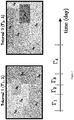
- FIG. 2 illustrates examples of traffic profiles at subsequent time intervals.
- the intervals can have equal or different lengths in time, e.g., seconds.
- the traffic profile is an estimation of the traffic pattern using statistical attributes of traffic over a defined interval of time, e.g., as opposed to a snapshot of instantaneous traffic.
- the traffic distribution or profile, ⁇ in a coverage region of the network (e.g., of clusters of cells) is modeled as multiple patches of traffic density.
- the arrival time of users can be modeled as a Poisson (or any other suitable probability function) distributed random variable with a corresponding mean ⁇ .
- the traffic profile can change at the different intervals.
- the traffic profiles at the intervals, the number of patches, the sizes of patches, and the respective probability distribution function mean values can change.
- the CSO scheme comprises establishing a mathematical system model of the network, its components, and resources.
- the model can be formulated by mathematical representation, which can be implemented and solved on a suitable processor.
- the cellular system of the network comprises L cells, where L is an integer. Each one of the L cells can be switched on or off (on/off), e.g., for a given interval of time.
- the system also has a defined bandwidth, B SYS , which represents full frequency reuse.
- the network is an Orthogonal Frequency-Division Multiple Access (OFDMA) network and the system model is tailored accordingly.
- the coverage area of a cell is modeled as a grid of A small area elements, also referred to herein as pixels, where A is an integer.
- OFDMA Orthogonal Frequency-Division Multiple Access
- the pixels in the grid can have the same size area or different size areas.
- the pixels may also have the same geometric shape, e.g., squares or rectangles, or variable shapes.
- An example of a suitable pixel is a square pixel of 20 meters x 20 meters.
- G A long term channel gain parameter, G, is introduced, where G ⁇ R A ⁇ L (the matrix of real numbers in the A ⁇ L space).
- the long term channel gain accounts for large scale fading effects such as propagation losses, antennas gains and shadowing.
- the cell selection is determined as best SINR policy over a reference signal (RS).
- the RS transmitted power (RTSP) is represented by the parameter p RS ⁇ R L .
- the data channel power is represented as p D ⁇ R L .
- p D p RS .
- the cell selection is based on the best SINR policy, e.g., based on the best RS received power (RSRP).
- RSRP best RS received power
- S c is the binary complement of S.
- a pixel is in outage if it does not meet the following criteria: if the minimum received power R a , l * ⁇ P min Rx and if the minimum SINR ⁇ ( a ) ⁇ ⁇ min .
- ⁇ ( a ) [u( ⁇ ( a ) - ⁇ min )] ⁇ [u( R ( a , l *) - P min Rx ) ] ⁇ g ⁇ a .
- the scheme also includes two model concepts.
- the first concept is the network operation point (NOP), which represents any possible state of the network in terms of active and non-active (switched off) cells.
- NOP network operation point
- a network composed of L cells has 2 L NOPs.
- Each NOP can be represented by a binary string x of length L . This can be represented as x ⁇ L , where L ⁇ 0,1 L .
- the second concept is the network energy level (NEL), which is defined as the number of active cells in a NOP.
- the l th NEL is defined as L 1 ⁇ x ⁇ L
- x ⁇ 1 l .
- the formulation above is used to achieve multiple objectives or optimization targets of the CSO scheme.
- the overall energy consumption in the network can be assumed proportional to the number of active cells.
- the vector n ⁇ R L contains the inverse of the sum of each column in S, which represents the number of pixels served by each cell.
- f 2 can be modified in such a way that bandwidth allocation to pixels is proportional to spectral efficiency or rate in order to improve the cell edge performance.
- f 2 can be modified to provide total uniform coverage needed by the operator.
- the CSO problem is addressed by means of the NOPs featuring Pareto efficiency in terms of NEL, f 1 , and weighted network capacity, f 2 .
- the search space is thus reduced from 2 L to L.
- the multi-objective problem can be formulated as follows: minimize the difference [ f 1 (x)- f 2 (x)] subject to an allowable outage constraint (( v T ⁇ 1)/ A ) ⁇ ⁇ .
- the parameter ⁇ indicates how much (coverage) area is allowed.
- Figure 3 shows an embodiment of the CSO scheme for solving the multi-objective CSO problem.
- a set of Pareto efficient (with respect to f 1 and f 2 ) solutions ⁇ * is determined for every given traffic profile ⁇ .
- the solutions are based on the network geometry/parameters, traffic profile, and coverage constraints.
- the estimation comprises the calculation of the long term channel gain, G , by solving the model formulated above using MOEAs or a minimum distance heuristic algorithm.
- the performance of the estimated set of solutions ⁇ * can then be evaluated. This includes determining, for each time interval, which element of ⁇ * has the lowest NEL that satisfies the QoS requirements.
- Figure 4 shows a relation between the two functions f 1 and f 2 .
- the values shown represent solutions ⁇ * specific to one traffic profile.
- the solutions are obtained by considering the tradeoff between aggregate network capacity (related to f 2 ) and the number of switched-off cells (related to f 1 ). These criteria are conflicting objectives, and hence, multi-objective optimization represents a convenient approach to investigate CSO through the Pareto dominance notion.
- the Pareto efficiency is a concept in multi-objective optimization.
- a solution x * ⁇ ⁇ has Pareto efficiency if and only if there does not exist a solution x ⁇ ⁇ , such that x dominates x*.
- the set ⁇ * of Pareto efficient solutions is called optimal non-dominated set and its image is known as the Optimal Pareto Front (OPF).
- OPF Optimal Pareto Front
- PF a near-optimal or estimated Pareto front
- the solutions to the multi-objective CSO problem can be obtained using MOEAs (also referred to sometimes as metaheuristic algorithms), such as using a Non-dominated Sorting Genetic Algorithm II (NSGA-II), e.g., as described in a publication of IEEE Transactions on Evolutionary Computation dated April 2020 by K. Deb et al. and entitled " A Fast and Elitist Multi-objective Genetic Algorithm: NSGA-II," in vol. 6, no. 2, pp. 182-197 .
- the solutions can be obtained using heuristic-based algorithms, such as a minimum hamming distance (also referred to as minimum distance) algorithm.
- the minimum distance algorithm is used to find a minimum distance set of solutions.
- An example of the algorithm is as described by the following pseudocode:
- Figure 5 shows a computer simulation environment with 54 cells.
- Figure 6 shows a spatial pattern with an irregular spatial traffic distribution in the 54 cells according to the simulation.
- the figure shows areas with variable traffic densities, ranging from 10 to 1.
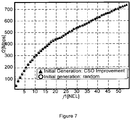
- Figure 7 shows the weighted network capacity values versus network energy levels for the spatial traffic distribution.
- the curve of Figure 7 represents the Pareto efficient solutions (which are obtained (using NSGA-II) for this traffic distribution).
- This set of solutions is specific to a spatial traffic profile (traffic distribution), modeled as probability spaces over the coverage area as described above. Multiple sets of solutions can be obtained similarly for multiple corresponding modeled traffic profiles.
- the sets of solutions can be computed off-line, e.g., prior to implementing the cell switch-off, and stored in a database.
- the current traffic profile is compared every certain time, for instance at each defined interval of time, with the computed traffic profiles.
- the solutions can be stored in the form of lookup tables in the database.
- the lookup tables serve to match the existing or real-time traffic profile in the network with a matching (or closest matching) traffic profile considered in the data base.
- the solutions obtained for a matching profile are then examined to select a solution that satisfies the QoS requirement.
- the solution corresponds to the NEL ( f 1 value) associated with a weighted network capacity ( f 2 value) that fulfils the QoS requirement.
- the CSO scheme above is implemented in a hierarchical/distributed manner.
- the hierarchical/distributed implementation splits the cells (or BSs) in the network into multiple groups or clusters.
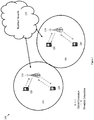
- the cells are represented as triangles and the clusters are represented as circles.
- the clusters can overlap. This means that some cells can belong to more than one cluster (triangles can belong to more than one circle).
- local decisions for the cells within each cluster can be made by obtaining only the traffic profiles of the cells in that cluster and comparing this information with a local database of pre-computed solutions. This can be accomplished in regular intervals.
- the grouping of the cells into clusters can be hierarchical, where a plurality of clusters can be further grouped into a larger cluster as a next level of the hierarchy. In this case, some traffic profiles require referring decisions to the next level in the hierarchy. This can be accomplished in larger intervals, e.g., less frequently than the decision making of the cells in a cluster.
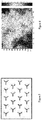
- Figure 9 illustrates stored CSO solutions for clusters of cells according to a hierarchical/distributed implementation.
- the solutions are pre-computed and stored in a database.
- the database comprises multiple sets of solutions, where each set corresponds to a cluster of cells.
- each grid represents a cell.
- the database comprises multiple clusters of cells.
- Each cluster is represented as a block of grids. Overlapping cells can belong to adjacent clusters, as shown.
- different sets of solutions for different clusters can include overlapping cells.
- the CSO pattern of overlapping cells takes into account local decisions in neighboring clusters. If solutions based on the traffic of different clusters imply a different individual decision for an overlapping cell, a conservative approach can be adopted, such as keeping the overlapping cell on and excluding the overlapping cell from the switch-off operation.
- FIG 10 shows stored CSO solutions for one cluster in the mega-cluster of Figure 9 .
- a grouping of clusters as shown in figure 9 , is a larger cluster (a cluster of clusters), which is referred to herein as a mega-cluster.
- a mega-cluster global long term decisions (solutions to decide one solution from) can be made taking into account traffic profiles at longer time scales, e.g., 60 minutes.
- Each cell, in a cluster of L' cells may have autonomous or local decisions (solutions) based on local traffic profiles created by exchanging information with other cells in the cluster. These local cell decisions can be taken in relatively small time scales, e.g., about 10 minutes.
- Each cell in the cluster can be associated with the same database of the traffic profiles and corresponding lookup tables.
- the local solutions comprise L' individual decisions, one for each cell in the cluster. The decisions can be sub-optimal, and hence are subjected to global decisions (at a network level). Traffic profiles (and corresponding set of solutions) can be accumulated and refined or updated based on historical observations, such as by statistical analysis of the observed traffic over time.
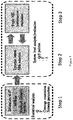
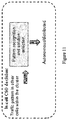
- Figure 11 illustrates an embodiment of an in-cell CSO decision.
- the detected or observed traffic patterns (traffic profiles) in other cells within the same cluster of the considered cell are used as input to the decision and selection process of the solution.
- the pattern recognition and solution selection is then performed based on this input in addition to the traffic pattern of the considered cell.
- This provides an autonomous decision for this cell as part of the distributed CSO decision.
- the decision can then be used as input to the cluster decision (small time scales) and the mega-cluster decision (large time scales).
- Figure 12 shows a CSO in-cluster signaling for a CSO hierarchical/distributed operation.
- the traffic patterns are identified autonomously at each cell. This information is then propagated within the cluster (between the cells of the cluster) to allow for the distributed operation.
- the traffic pattern information can include the number of users (load) and the proportion of center and edge users (spatial information).
- Figure 13 shows a signaling between clusters of cells for the CSO hierarchical/distributed operation. This signaling can be subsequent to the in-cluster signaling.
- the local (consolidated) traffic profiles within different clusters are exchanged among the clusters to improve the decision-making process, especially for the overlapping cells.
- Figure 14 shows a centralized/global traffic pattern calibration for the CSO hierarchical/distributed operation. This operation can be subsequent to the signaling between clusters and implemented in the long term (large time scales).
- the signaling is exchanged between the cluster plane and a central network component, such as a network controller or server configured for this operation.
- Each cluster sends the consolidated traffic profile to the central network component, in a hierarchical signaling exchange.
- the central network component then performs long term near-optimal CSO decisions involving all considered cells in the network.
- the signaled solutions are used to further calibrate the autonomous CSO decisions taken locally by the cells within each cluster.
- FIG. 15 illustrates an embodiment of a CSO method 1500.
- a plurality of traffic distribution patterns or profiles are modeled as probability spaces over the coverage area.
- each traffic profile is modeled as multiple patches of traffic density, where each patch is assigned a mean value of user arrival time according to a suitable probability distribution function (pdf), e.g., a Poisson distribution.
- PDF probability distribution function
- a set of efficient solutions is calculated for each traffic profile according to a multi-objective function to minimize the network energy level in terms of active cells and maximize the network capacity that best fits the traffic profile.
- the multi-objective function can also be subject to the allowable outage constraint by the network provider or operator, e.g., in accordance with traffic needs or QoS requirements.
- the efficient solution for the multi-objective problem can be obtained as a set of Pareto efficient solutions determined for every given traffic profile.
- a near-optimal Pareto front (PF) can be found as a near-optimal solution to the multi-objective problem.
- the set of solutions for each one of the traffic profiles are stored, e.g., as lookup tables for the traffic profiles, in a database.
- the detected current traffic profile at a time interval is matched to a stored traffic profile in the database. This step can be implemented at a cell level, a cluster level, a mega-cluster level, or an overall network level, e.g., in accordance with a central or distributed hierarchical implementation.
- the solutions corresponding to the matched traffic profile in the database are evaluated, and a suitable solution is selected.
- the selected solution minimizes the number of active cells (energy level) but allows enough capacity to meet QoS requirements, e.g., minimizing transitions and handoffs.
- the selected solution can also be based on other constraints, such as guaranteeing provider coverage criteria to avoid significant coverage holes, radio resource management for fast fading environments, or other criteria.
- FIG 16 is a block diagram of a processing system 1600 that can be used to implement various embodiments.
- the processing system 1600 can be part of a BS or other network components. Specific devices may utilize all of the components shown, or only a subset of the components, and levels of integration may vary from device to device. Furthermore, a device may contain multiple instances of a component, such as multiple processing units, processors, memories, transmitters, receivers, etc.
- the processing system 1600 may comprise a processing unit 1601 equipped with one or more input/output devices, such as a speaker, microphone, mouse, touchscreen, keypad, keyboard, printer, display, and the like.
- the processing unit 1601 may include a central processing unit (CPU) 1610, a memory 1620, a mass storage device 1630, a video adapter 1640, and an I/O interface 1660 connected to a bus.
- the bus may be one or more of any type of several bus architectures including a memory bus or memory controller, a peripheral bus, a video bus, or the like.
- the CPU 1610 may comprise any type of electronic data processor.
- the memory 1620 may comprise any type of system memory such as static random access memory (SRAM), dynamic random access memory (DRAM), synchronous DRAM (SDRAM), read-only memory (ROM), a combination thereof, or the like.
- the memory 1620 may include ROM for use at boot-up, and DRAM for program and data storage for use while executing programs.
- the memory 1620 is non-transitory.
- the mass storage device 1630 may comprise any type of storage device configured to store data, programs, and other information and to make the data, programs, and other information accessible via the bus.
- the mass storage device 1630 may comprise, for example, one or more of a solid state drive, hard disk drive, a magnetic disk drive, an optical disk drive, or the like.
- the video adapter 1640 and the I/O interface 1660 provide interfaces to couple external input and output devices to the processing unit.
- input and output devices include a display 1690 coupled to the video adapter 1640 and any combination of mouse/keyboard/printer 1670 coupled to the I/O interface 1660.
- Other devices may be coupled to the processing unit 1601, and additional or fewer interface cards may be utilized.
- a serial interface card (not shown) may be used to provide a serial interface for a printer.
- the processing unit 1601 also includes one or more network interfaces 1650, which may comprise wired links, such as an Ethernet cable or the like, and/or wireless links to access nodes or one or more networks 1680.
- the network interface 1650 allows the processing unit 1601 to communicate with remote units via the networks 1680.
- the network interface 1650 may provide wireless communication via one or more transmitters/transmit antennas and one or more receivers/receive antennas.
- the processing unit 1601 is coupled to a local-area network or a wide-area network for data processing and communications with remote devices, such as other processing units, the Internet, remote storage facilities, or the like.
- the method comprises modeling a plurality of traffic distribution patterns as probability spaces over a coverage area or the wireless network; calculating a set of solutions for each one of the traffic distribution patterns according to a multi-objective function, wherein the multi-objective function reduces a network energy level in terms of active cells and maintains an aggregate network capacity according to traffic need; storing the set of solutions for each one of the traffic distribution patterns in a database; detecting a current traffic distribution pattern of the wireless network at a predefined time interval; matching the current traffic distribution pattern to one of the traffic distribution patterns stored in the database; and selecting a solution from the set of solutions corresponding to the one of the traffic distribution patterns.
- the detecting, matching, and selecting steps are performed by the network component as part of a hierarchical and distributed implementation involving a plurality of cells and a plurality of clusters of cells in the wireless network.
- the network component is associated with one of the cells, and wherein detecting the current traffic profile includes exchanging traffic load information with other cells within a same cluster of cells in the wireless network, and in a further option, cells of the same cluster share the database of the set of solutions for the modeled traffic distribution patterns.
- the network component is associated with one of the clusters of cells, wherein detecting the current traffic profile includes exchanging traffic load information with other clusters of cells in the wireless network, and wherein the solution is selected in accordance with individual solutions obtained from the cells of the one of the clusters.
- the network component is associated with a grouping of the clusters of cells, wherein detecting the current traffic profile includes exchanging traffic load information with other groups of clusters in the wireless network, and wherein the solution is selected in accordance with individual solutions obtained from the clusters in the grouping, and optionally the detecting, matching, and selecting steps are performed by the network component associated with the grouping of the clusters of cells at a longer time interval in comparison to the clusters and cells.
- the network component is a global network component of the wireless network, and wherein selecting the solution includes calibrating between individual solutions obtained from the cells, the clusters, or a plurality of groups of clusters.
Landscapes
- Engineering & Computer Science (AREA)
- Computer Networks & Wireless Communication (AREA)
- Signal Processing (AREA)
- Mobile Radio Communication Systems (AREA)
Claims (11)
- Verfahren (1500), das durch eine Netzkomponente ausgeführt wird, zur Zellenabschaltung in einem drahtlosen Netz, wobei das Verfahren Folgendes umfasst:Definieren einer Menge von Netzoperationspunkten, NOP, wobei jeder NOP in der Menge einen Zustand für jede Zelle in einem Versorgungsbereich in dem drahtlosen Netz repräsentiert und einen zugeordneten Netzenergiepegel, NEL, aufweist, der als die Anzahl aktiver Zellen in dem NOP definiert ist;Bestimmen (1520) einer Teilmenge aus der Menge von NOPs, wobei jeder NOP in der Teilmenge eine Pareto-effiziente Lösung für ein Mehrzielproblem zum Minimieren des NEL des NOP in der Teilmenge repräsentiert, und Minimieren einer Gesamtzahl von Übergaben, die der Bewegung von einem aktuellen NOP zu dem NOP in der Teilmenge zugeordnet sind;Abgleichen (1540) eines aktuellen Verkehrsprofils mit einem aus mehreren in einer Datenbank gespeicherten Verkehrsprofilen;Auswerten der Leistung (1550) jedes NOP in der bestimmten Teilmenge in Übereinstimmung mit dem einen Verkehrsprofil, das in der Datenbank gespeichert ist, das mit dem aktuellen Verkehrsprofil abgeglichen ist;Auswählen (1550) eines NOP aus der Teilmenge von NOPs, der eine Pareto-effiziente Lösung repräsentiert, in Übereinstimmung mit der Auswertung, wobei der ausgewählte NOP einen Zustand für jede Zelle, die in dem Versorgungsbereich abgeschaltet werden soll, repräsentiert.
- Verfahren (1500) nach Anspruch 1, wobei die Menge von NOPs, die in Übereinstimmung mit dem abgeglichenen Verkehrsprofil ausgewertet wird, eine Anzahl von Lösungen proportional einer Gesamtzahl der Zellen in dem drahtlosen Netz umfasst.
- Verfahren (1500) nach Anspruch 1, wobei der Bestimmungsschritt ferner das Aufrechterhalten der aggregierten Netzkapazität in Übereinstimmung mit dem gegebenen Verkehrsprofil und einer Dienstgüte-Anforderung (QoS-Anforderung) umfasst.
- Verfahren (1500) nach Anspruch 1, wobei der Bestimmungsschritt das Definieren der Teilmenge, um NOPs zu beinhalten, die in Abhängigkeit von einer Beschränkung des zulässigen Ausfalls eine Differenz zwischen einer ersten Funktion der Anzahl aktiver Zellen und einer zweiten Funktion der aggregierten Netzkapazität minimierten, umfasst.
- Verfahren (1500) nach Anspruch 4, wobei das Minimieren der Differenz in Abhängigkeit von der Beschränkung des zulässigen Ausfalls Lücken in der Abdeckung des drahtlosen Netzes durch Berücksichtigung von Abdeckungskriterien des Betreibers vermeidet.
- Verfahren (1500) nach Anspruch 1, wobei das aktuelle Verkehrsprofil ein aktuelles Verkehrsverteilungsmuster ist, das in Echtzeit während eines vorbestimmten Zeitintervalls des drahtlosen Netzes detektiert wird.
- Verfahren (1500) nach Anspruch 1, wobei der Bestimmungsschritt das Auswählen der Teilmenge von NOPs in Übereinstimmung mit einem evolutionären Mehrziel-Algorithmus, MOEA, und/oder einem heuristischen Minimalabstands-Algorithmus umfasst.
- Verfahren (1500) nach Anspruch 1, wobei die Netzkomponente eines aus einer Basisstation in einer der Zellen, einer Steuereinheit, die einem Cluster der Zellen zugeordnet ist, und einer zentralen Netzsteuereinheit für alle Zellen ist.
- Netzkomponente (1601), die Zellenabschaltung in einem drahtlosen Netz ermöglicht, wobei die Netzkomponente Folgendes umfasst:wenigstens einen Prozessor (1610);ein nicht-transitorisches computerlesbares Speichermedium (1620), das eine Programmierung zur Ausführung durch den wenigstens einen Prozessor speichert, wobei die Programmierung Anweisungen enthält zum:Definieren einer Menge von Netzoperationspunkten, NOP, wobei jeder NOP in der Menge einen Zustand für jede Zelle in einem Versorgungsbereich in dem drahtlosen Netz repräsentiert und einen zugeordneten Netzenergiepegel, NEL, aufweist, der als die Anzahl aktiver Zellen in dem NOP definiert ist;Bestimmen einer Teilmenge aus der Menge von NOPs, wobei jeder NOP in der Teilmenge eine Pareto-effiziente Lösung für ein Mehrzielproblem zum Minimieren des NEL des NOP in der Teilmenge repräsentiert, und Minimieren einer Gesamtzahl von Übergaben, die der Bewegung von einem aktuellen NOP zu dem NOP in der Teilmenge zugeordnet sind.Abgleichen eines aktuellen Verkehrsprofils mit einem aus mehreren in einer Datenbank gespeicherten Verkehrsprofilen;Auswerten der Leistung jedes NOP in der bestimmten Teilmenge in Übereinstimmung mit dem einen Verkehrsprofil, das in der Datenbank gespeichert ist, das mit dem aktuellen Verkehrsprofil abgeglichen ist;Auswählen eines NOP aus der Teilmenge von NOPs, der eine Pareto-effiziente Lösung repräsentiert, in Übereinstimmung mit dem Auswerten der Leistung jedes NOP in der bestimmten Teilmenge, wobei der ausgewählte NOP einen Zustand für jede Zelle, die in dem Versorgungsbereich abgeschaltet werden soll, repräsentiert.
- Netzkomponente (1601) nach Anspruch 9, wobei die Anweisungen, die Menge von NOPs zu bestimmen, ferner Anweisungen enthalten, die aggregierte Netzkapazität in Übereinstimmung mit dem gegebenen Verkehrsprofil und einer Dienstgüte-Anforderung (QoS-Anforderung) aufrechtzuerhalten.
- Netzkomponente (1601) nach Anspruch 9, wobei das drahtlose Netz eines aus einem heterogenen Netz, das Makrozellen und Niederleistungszellen umfasst, einem Netz, das stoßweisen Verkehr führt, und einem Netz mit orthogonaler Frequenzmultiplexierung, OFDMA-Netz, ist.
Applications Claiming Priority (2)
| Application Number | Priority Date | Filing Date | Title |
|---|---|---|---|
| US201361847403P | 2013-07-17 | 2013-07-17 | |
| PCT/US2014/047041 WO2015009937A1 (en) | 2013-07-17 | 2014-07-17 | System and methods for multi-objective cell switch-off in wireless networks |
Publications (3)
| Publication Number | Publication Date |
|---|---|
| EP3000204A1 EP3000204A1 (de) | 2016-03-30 |
| EP3000204A4 EP3000204A4 (de) | 2016-09-28 |
| EP3000204B1 true EP3000204B1 (de) | 2018-05-02 |
Family
ID=52343489
Family Applications (1)
| Application Number | Title | Priority Date | Filing Date |
|---|---|---|---|
| EP14826725.5A Active EP3000204B1 (de) | 2013-07-17 | 2014-07-17 | System und verfahren für mehrfache zellenabschaltung in drahtlosen netzwerken |
Country Status (4)
| Country | Link |
|---|---|
| US (1) | US9730153B2 (de) |
| EP (1) | EP3000204B1 (de) |
| CN (1) | CN105531963B (de) |
| WO (1) | WO2015009937A1 (de) |
Families Citing this family (21)
| Publication number | Priority date | Publication date | Assignee | Title |
|---|---|---|---|---|
| US9980218B2 (en) * | 2015-02-27 | 2018-05-22 | Huawei Technologies Canada Co., Ltd. | System and method for user terminal-aware cell switch-off |
| US10588094B2 (en) * | 2016-09-27 | 2020-03-10 | T-Mobile Usa, Inc. | Load-based power adjustments for cellular communication sites |
| TWI637651B (zh) * | 2018-01-03 | 2018-10-01 | 和碩聯合科技股份有限公司 | 無線熱點運作方法 |
| CN108848520B (zh) * | 2018-05-28 | 2020-04-10 | 西安交通大学 | 一种基于流量预测与基站状态的基站休眠方法 |
| CN109089245B (zh) * | 2018-08-07 | 2021-10-15 | 国网江苏省电力有限公司电力科学研究院 | 计及蜂窝用户最低传输速率的设备间通信方法及装置 |
| CN111065114B (zh) * | 2018-10-17 | 2021-12-28 | 华为技术有限公司 | 节能管理方法、装置及存储介质 |
| EP4000228A4 (de) | 2019-07-18 | 2023-06-21 | The Board of Regents of the University of Oklahoma | Proaktive mobile netzwerkoptimierung |
| CN110996377B (zh) * | 2019-11-25 | 2023-04-18 | 宜通世纪科技股份有限公司 | 一种基站节能方法、系统、装置和存储介质 |
| CN111600921B (zh) * | 2020-03-23 | 2023-08-15 | 平安银行股份有限公司 | 基于中间件的请求发送方法、装置和计算机设备 |
| US11202234B1 (en) * | 2020-06-03 | 2021-12-14 | Dish Wireless L.L.C. | Method and system for smart operating bandwidth adaptation during power outages |
| US11265135B2 (en) | 2020-06-03 | 2022-03-01 | Dish Wireless Llc | Method and system for slicing assigning for load shedding to minimize power consumption where gNB is controlled for slice assignments for enterprise users |
| US11405941B2 (en) | 2020-07-31 | 2022-08-02 | DISH Wireless L.L.C | Method and system for traffic shaping at the DU/CU to artificially reduce the total traffic load on the radio receiver so that not all the TTLs are carrying data |
| US11470549B2 (en) | 2020-07-31 | 2022-10-11 | Dish Wireless L.L.C. | Method and system for implementing mini-slot scheduling for all UEs that only are enabled to lower power usage |
| US11696137B2 (en) * | 2020-07-31 | 2023-07-04 | T-Mobile Usa, Inc. | Detecting malicious small cells based on a connectivity schedule |
| CN114501596B (zh) * | 2020-10-23 | 2024-01-12 | 中国移动通信集团河北有限公司 | 多层网络关断节能方法、装置、设备及存储介质 |
| CN115150923B (zh) * | 2021-03-31 | 2025-04-15 | 中国移动通信集团河南有限公司 | 一种基站的节能控制方法及装置 |
| US11470490B1 (en) | 2021-05-17 | 2022-10-11 | T-Mobile Usa, Inc. | Determining performance of a wireless telecommunication network |
| US11902829B2 (en) * | 2021-07-15 | 2024-02-13 | Rakuten Mobile, Inc. | Traffic pattern identification and network function control method and apparatus |
| EP4464078A1 (de) * | 2022-01-12 | 2024-11-20 | Telefonaktiebolaget LM Ericsson (publ) | Trägerverriegelung auf basis des interferenzpegels |
| US12058539B2 (en) | 2022-01-14 | 2024-08-06 | T-Mobile Usa, Inc. | Dynamic telecommunications network outage recovery based on predictive models |
| US20250227480A1 (en) * | 2024-01-05 | 2025-07-10 | Netscout Systems, Inc. | Systems and methods for multi-objective radio network optimization |
Family Cites Families (14)
| Publication number | Priority date | Publication date | Assignee | Title |
|---|---|---|---|---|
| US6584330B1 (en) * | 2000-07-18 | 2003-06-24 | Telefonaktiebolaget Lm Ericsson (Publ) | Adaptive power management for a node of a cellular telecommunications network |
| US7466652B2 (en) * | 2003-08-14 | 2008-12-16 | Telcordia Technologies, Inc. | Auto-IP traffic optimization in mobile telecommunications systems |
| US7398257B2 (en) | 2003-12-24 | 2008-07-08 | Yamaha Hatsudoki Kabushiki Kaisha | Multiobjective optimization apparatus, multiobjective optimization method and multiobjective optimization program |
| US20060026680A1 (en) * | 2004-07-29 | 2006-02-02 | Zakas Phillip H | System and method of characterizing and managing electronic traffic |
| JP5228119B2 (ja) * | 2009-03-13 | 2013-07-03 | テレフオンアクチーボラゲット エル エム エリクソン(パブル) | 基地局のエネルギー消費管理 |
| ES2382280B1 (es) * | 2009-06-30 | 2013-05-08 | Vodafone España S.A.U. | Sistema, metodo y antena interior para reducir el consumo de potencia de estaciones base que proporcionan cobertura interior. |
| US8886262B2 (en) * | 2009-10-28 | 2014-11-11 | Nec Europe Ltd. | Method for operating a wireless radio network and a network |
| US7996344B1 (en) * | 2010-03-08 | 2011-08-09 | Livermore Software Technology Corporation | Multi-objective evolutionary algorithm based engineering design optimization |
| WO2011151684A1 (en) * | 2010-05-13 | 2011-12-08 | Alcatel Lucent | Dynamic reorganization of cell structures in wireless networks |
| JP5610074B2 (ja) * | 2010-06-30 | 2014-10-22 | 富士通株式会社 | エネルギ効率の良いモバイルオーバレイネットワークの遷移メカニズム |
| US20120244869A1 (en) * | 2011-03-21 | 2012-09-27 | Qualcomm Incorporated | Network scaling for network energy savings |
| GB2492364B (en) * | 2011-06-29 | 2016-03-30 | Fujitsu Ltd | Re-selecting network parameters in a cellular wireless network |
| EP2665312B1 (de) * | 2012-05-15 | 2014-06-04 | Fujitsu Limited | Zellenaktivierung und -deaktivierung in heterogenen Netzwerken |
| CN102917446B (zh) * | 2012-09-29 | 2014-11-19 | 北京邮电大学 | 一种面向绿色节能的动态小区休眠方法 |
-
2014
- 2014-07-17 EP EP14826725.5A patent/EP3000204B1/de active Active
- 2014-07-17 CN CN201480037924.7A patent/CN105531963B/zh active Active
- 2014-07-17 WO PCT/US2014/047041 patent/WO2015009937A1/en not_active Ceased
- 2014-07-17 US US14/334,134 patent/US9730153B2/en active Active
Non-Patent Citations (1)
| Title |
|---|
| None * |
Also Published As
| Publication number | Publication date |
|---|---|
| CN105531963A (zh) | 2016-04-27 |
| US20150023163A1 (en) | 2015-01-22 |
| WO2015009937A1 (en) | 2015-01-22 |
| EP3000204A4 (de) | 2016-09-28 |
| US9730153B2 (en) | 2017-08-08 |
| EP3000204A1 (de) | 2016-03-30 |
| CN105531963B (zh) | 2019-08-13 |
Similar Documents
| Publication | Publication Date | Title |
|---|---|---|
| EP3000204B1 (de) | System und verfahren für mehrfache zellenabschaltung in drahtlosen netzwerken | |
| US20230422058A1 (en) | Method and apparatus of sharing information related to status | |
| Qiu et al. | Hierarchical resource allocation framework for hyper-dense small cell networks | |
| Hasan et al. | Cluster-based load balancing algorithm for ultra-dense heterogeneous networks | |
| Fan et al. | Self-optimization of coverage and capacity based on a fuzzy neural network with cooperative reinforcement learning | |
| Qiu et al. | Demand‐aware resource allocation for ultra‐dense small cell networks: an interference‐separation clustering‐based solution | |
| US9282568B2 (en) | Method and system for dynamic, joint assignment of power and scheduling of users for wireless systems | |
| Mirzaei Somarin et al. | Big Data Based Self-Optimization Networking in Next Generation Mobile Networks. | |
| US11799733B2 (en) | Energy usage in a communications network | |
| Moysen et al. | A machine learning enabled network planning tool | |
| González et al. | A novel multiobjective cell switch-off framework for cellular networks | |
| Abode et al. | Power control for 6G industrial wireless subnetworks: A graph neural network approach | |
| Wei et al. | Joint optimization of cluster formation and power control for interference-limited machine-to-machine communications | |
| Dghais et al. | Dynamic clustering for power effective small cell deployment in HetNet 5G networks | |
| Xenakis et al. | Topology control with coverage and lifetime optimization of wireless sensor networks with unequal energy distribution | |
| Yu et al. | Interference coordination strategy based on Nash bargaining for small‐cell networks | |
| KR101400138B1 (ko) | 펨토 베이스 스테이션들의 파워 제어 방법 및 펨토셀 네트워크 시스템 | |
| Wang et al. | Toward green network: an expanding of base station energy-saving algorithm in city-scale deployment | |
| Ntassah et al. | PPO-EPO: Energy and performance optimization for O-RAN using reinforcement learning | |
| EP4449687A1 (de) | Verteiltes maschinenlernen | |
| Wu et al. | Performance evaluation of 5G mmWave networks with physical-layer and capacity-limited blocking | |
| EP3725118B1 (de) | Vorrichtungen und verfahren zur steuerung von basisstationen eines kommunikationsnetzes | |
| Ozyurt et al. | Intracell frequency band exiling for green wireless networks: Implementation, performance metrics, and use cases | |
| CN101820684A (zh) | 资源度量的调整方法 | |
| EP4132120A1 (de) | Optimierung des energieverbrauchs durch abschalten von zellen |
Legal Events
| Date | Code | Title | Description |
|---|---|---|---|
| PUAI | Public reference made under article 153(3) epc to a published international application that has entered the european phase |
Free format text: ORIGINAL CODE: 0009012 |
|
| 17P | Request for examination filed |
Effective date: 20151221 |
|
| AK | Designated contracting states |
Kind code of ref document: A1 Designated state(s): AL AT BE BG CH CY CZ DE DK EE ES FI FR GB GR HR HU IE IS IT LI LT LU LV MC MK MT NL NO PL PT RO RS SE SI SK SM TR |
|
| AX | Request for extension of the european patent |
Extension state: BA ME |
|
| RIC1 | Information provided on ipc code assigned before grant |
Ipc: H04W 28/02 20090101ALN20160429BHEP Ipc: H04W 16/24 20090101ALN20160429BHEP Ipc: H04W 36/08 20090101ALN20160429BHEP Ipc: H04W 52/02 20090101ALN20160429BHEP Ipc: H04W 76/04 20090101ALN20160429BHEP Ipc: H04L 12/26 20060101AFI20160429BHEP |
|
| A4 | Supplementary search report drawn up and despatched |
Effective date: 20160825 |
|
| RIC1 | Information provided on ipc code assigned before grant |
Ipc: H04W 76/04 20090101ALN20160819BHEP Ipc: H04W 36/08 20090101ALN20160819BHEP Ipc: H04W 24/02 20090101ALN20160819BHEP Ipc: H04W 28/02 20090101ALN20160819BHEP Ipc: H04W 52/02 20090101ALI20160819BHEP Ipc: H04W 16/24 20090101ALN20160819BHEP Ipc: H04L 12/26 20060101AFI20160819BHEP |
|
| DAX | Request for extension of the european patent (deleted) | ||
| 17Q | First examination report despatched |
Effective date: 20170425 |
|
| GRAP | Despatch of communication of intention to grant a patent |
Free format text: ORIGINAL CODE: EPIDOSNIGR1 |
|
| RIC1 | Information provided on ipc code assigned before grant |
Ipc: H04W 76/04 20090101ALN20171031BHEP Ipc: H04W 52/02 20090101ALI20171031BHEP Ipc: H04W 36/08 20090101ALN20171031BHEP Ipc: H04W 28/02 20090101ALN20171031BHEP Ipc: H04L 12/26 20060101AFI20171031BHEP Ipc: H04L 12/24 20060101ALN20171031BHEP Ipc: H04W 16/24 20090101ALN20171031BHEP Ipc: H04W 24/02 20090101ALN20171031BHEP |
|
| INTG | Intention to grant announced |
Effective date: 20171115 |
|
| GRAS | Grant fee paid |
Free format text: ORIGINAL CODE: EPIDOSNIGR3 |
|
| GRAA | (expected) grant |
Free format text: ORIGINAL CODE: 0009210 |
|
| AK | Designated contracting states |
Kind code of ref document: B1 Designated state(s): AL AT BE BG CH CY CZ DE DK EE ES FI FR GB GR HR HU IE IS IT LI LT LU LV MC MK MT NL NO PL PT RO RS SE SI SK SM TR |
|
| REG | Reference to a national code |
Ref country code: GB Ref legal event code: FG4D |
|
| REG | Reference to a national code |
Ref country code: CH Ref legal event code: EP Ref country code: AT Ref legal event code: REF Ref document number: 996380 Country of ref document: AT Kind code of ref document: T Effective date: 20180515 |
|
| REG | Reference to a national code |
Ref country code: DE Ref legal event code: R096 Ref document number: 602014025023 Country of ref document: DE Ref country code: IE Ref legal event code: FG4D |
|
| REG | Reference to a national code |
Ref country code: NL Ref legal event code: MP Effective date: 20180502 |
|
| REG | Reference to a national code |
Ref country code: LT Ref legal event code: MG4D |
|
| PG25 | Lapsed in a contracting state [announced via postgrant information from national office to epo] |
Ref country code: NO Free format text: LAPSE BECAUSE OF FAILURE TO SUBMIT A TRANSLATION OF THE DESCRIPTION OR TO PAY THE FEE WITHIN THE PRESCRIBED TIME-LIMIT Effective date: 20180802 Ref country code: BG Free format text: LAPSE BECAUSE OF FAILURE TO SUBMIT A TRANSLATION OF THE DESCRIPTION OR TO PAY THE FEE WITHIN THE PRESCRIBED TIME-LIMIT Effective date: 20180802 Ref country code: FI Free format text: LAPSE BECAUSE OF FAILURE TO SUBMIT A TRANSLATION OF THE DESCRIPTION OR TO PAY THE FEE WITHIN THE PRESCRIBED TIME-LIMIT Effective date: 20180502 Ref country code: SE Free format text: LAPSE BECAUSE OF FAILURE TO SUBMIT A TRANSLATION OF THE DESCRIPTION OR TO PAY THE FEE WITHIN THE PRESCRIBED TIME-LIMIT Effective date: 20180502 Ref country code: ES Free format text: LAPSE BECAUSE OF FAILURE TO SUBMIT A TRANSLATION OF THE DESCRIPTION OR TO PAY THE FEE WITHIN THE PRESCRIBED TIME-LIMIT Effective date: 20180502 Ref country code: LT Free format text: LAPSE BECAUSE OF FAILURE TO SUBMIT A TRANSLATION OF THE DESCRIPTION OR TO PAY THE FEE WITHIN THE PRESCRIBED TIME-LIMIT Effective date: 20180502 |
|
| PG25 | Lapsed in a contracting state [announced via postgrant information from national office to epo] |
Ref country code: RS Free format text: LAPSE BECAUSE OF FAILURE TO SUBMIT A TRANSLATION OF THE DESCRIPTION OR TO PAY THE FEE WITHIN THE PRESCRIBED TIME-LIMIT Effective date: 20180502 Ref country code: HR Free format text: LAPSE BECAUSE OF FAILURE TO SUBMIT A TRANSLATION OF THE DESCRIPTION OR TO PAY THE FEE WITHIN THE PRESCRIBED TIME-LIMIT Effective date: 20180502 Ref country code: NL Free format text: LAPSE BECAUSE OF FAILURE TO SUBMIT A TRANSLATION OF THE DESCRIPTION OR TO PAY THE FEE WITHIN THE PRESCRIBED TIME-LIMIT Effective date: 20180502 Ref country code: LV Free format text: LAPSE BECAUSE OF FAILURE TO SUBMIT A TRANSLATION OF THE DESCRIPTION OR TO PAY THE FEE WITHIN THE PRESCRIBED TIME-LIMIT Effective date: 20180502 Ref country code: GR Free format text: LAPSE BECAUSE OF FAILURE TO SUBMIT A TRANSLATION OF THE DESCRIPTION OR TO PAY THE FEE WITHIN THE PRESCRIBED TIME-LIMIT Effective date: 20180803 |
|
| REG | Reference to a national code |
Ref country code: AT Ref legal event code: MK05 Ref document number: 996380 Country of ref document: AT Kind code of ref document: T Effective date: 20180502 |
|
| PG25 | Lapsed in a contracting state [announced via postgrant information from national office to epo] |
Ref country code: PL Free format text: LAPSE BECAUSE OF FAILURE TO SUBMIT A TRANSLATION OF THE DESCRIPTION OR TO PAY THE FEE WITHIN THE PRESCRIBED TIME-LIMIT Effective date: 20180502 Ref country code: DK Free format text: LAPSE BECAUSE OF FAILURE TO SUBMIT A TRANSLATION OF THE DESCRIPTION OR TO PAY THE FEE WITHIN THE PRESCRIBED TIME-LIMIT Effective date: 20180502 Ref country code: RO Free format text: LAPSE BECAUSE OF FAILURE TO SUBMIT A TRANSLATION OF THE DESCRIPTION OR TO PAY THE FEE WITHIN THE PRESCRIBED TIME-LIMIT Effective date: 20180502 Ref country code: AT Free format text: LAPSE BECAUSE OF FAILURE TO SUBMIT A TRANSLATION OF THE DESCRIPTION OR TO PAY THE FEE WITHIN THE PRESCRIBED TIME-LIMIT Effective date: 20180502 Ref country code: CZ Free format text: LAPSE BECAUSE OF FAILURE TO SUBMIT A TRANSLATION OF THE DESCRIPTION OR TO PAY THE FEE WITHIN THE PRESCRIBED TIME-LIMIT Effective date: 20180502 Ref country code: EE Free format text: LAPSE BECAUSE OF FAILURE TO SUBMIT A TRANSLATION OF THE DESCRIPTION OR TO PAY THE FEE WITHIN THE PRESCRIBED TIME-LIMIT Effective date: 20180502 Ref country code: SK Free format text: LAPSE BECAUSE OF FAILURE TO SUBMIT A TRANSLATION OF THE DESCRIPTION OR TO PAY THE FEE WITHIN THE PRESCRIBED TIME-LIMIT Effective date: 20180502 |
|
| REG | Reference to a national code |
Ref country code: CH Ref legal event code: PK Free format text: BERICHTIGUNGEN |
|
| REG | Reference to a national code |
Ref country code: DE Ref legal event code: R097 Ref document number: 602014025023 Country of ref document: DE |
|
| RIC2 | Information provided on ipc code assigned after grant |
Ipc: H04W 16/24 20090101ALN20171031BHEP Ipc: H04W 36/08 20090101ALN20171031BHEP Ipc: H04L 12/26 20060101AFI20171031BHEP Ipc: H04W 76/04 20090101ALN20171031BHEP Ipc: H04W 52/02 20090101ALI20171031BHEP Ipc: H04W 28/02 20090101ALN20171031BHEP Ipc: H04W 24/02 20090101ALN20171031BHEP Ipc: H04L 12/24 20060101ALN20171031BHEP |
|
| PG25 | Lapsed in a contracting state [announced via postgrant information from national office to epo] |
Ref country code: SM Free format text: LAPSE BECAUSE OF FAILURE TO SUBMIT A TRANSLATION OF THE DESCRIPTION OR TO PAY THE FEE WITHIN THE PRESCRIBED TIME-LIMIT Effective date: 20180502 Ref country code: IT Free format text: LAPSE BECAUSE OF FAILURE TO SUBMIT A TRANSLATION OF THE DESCRIPTION OR TO PAY THE FEE WITHIN THE PRESCRIBED TIME-LIMIT Effective date: 20180502 |
|
| REG | Reference to a national code |
Ref country code: CH Ref legal event code: PL |
|
| PLBE | No opposition filed within time limit |
Free format text: ORIGINAL CODE: 0009261 |
|
| STAA | Information on the status of an ep patent application or granted ep patent |
Free format text: STATUS: NO OPPOSITION FILED WITHIN TIME LIMIT |
|
| PG25 | Lapsed in a contracting state [announced via postgrant information from national office to epo] |
Ref country code: MC Free format text: LAPSE BECAUSE OF FAILURE TO SUBMIT A TRANSLATION OF THE DESCRIPTION OR TO PAY THE FEE WITHIN THE PRESCRIBED TIME-LIMIT Effective date: 20180502 Ref country code: LU Free format text: LAPSE BECAUSE OF NON-PAYMENT OF DUE FEES Effective date: 20180717 |
|
| REG | Reference to a national code |
Ref country code: BE Ref legal event code: MM Effective date: 20180731 |
|
| 26N | No opposition filed |
Effective date: 20190205 |
|
| REG | Reference to a national code |
Ref country code: IE Ref legal event code: MM4A |
|
| GBPC | Gb: european patent ceased through non-payment of renewal fee |
Effective date: 20180802 |
|
| PG25 | Lapsed in a contracting state [announced via postgrant information from national office to epo] |
Ref country code: CH Free format text: LAPSE BECAUSE OF NON-PAYMENT OF DUE FEES Effective date: 20180731 Ref country code: FR Free format text: LAPSE BECAUSE OF NON-PAYMENT OF DUE FEES Effective date: 20180731 Ref country code: LI Free format text: LAPSE BECAUSE OF NON-PAYMENT OF DUE FEES Effective date: 20180731 Ref country code: IE Free format text: LAPSE BECAUSE OF NON-PAYMENT OF DUE FEES Effective date: 20180717 |
|
| PG25 | Lapsed in a contracting state [announced via postgrant information from national office to epo] |
Ref country code: BE Free format text: LAPSE BECAUSE OF NON-PAYMENT OF DUE FEES Effective date: 20180731 Ref country code: SI Free format text: LAPSE BECAUSE OF FAILURE TO SUBMIT A TRANSLATION OF THE DESCRIPTION OR TO PAY THE FEE WITHIN THE PRESCRIBED TIME-LIMIT Effective date: 20180502 |
|
| PG25 | Lapsed in a contracting state [announced via postgrant information from national office to epo] |
Ref country code: GB Free format text: LAPSE BECAUSE OF NON-PAYMENT OF DUE FEES Effective date: 20180802 |
|
| PG25 | Lapsed in a contracting state [announced via postgrant information from national office to epo] |
Ref country code: AL Free format text: LAPSE BECAUSE OF FAILURE TO SUBMIT A TRANSLATION OF THE DESCRIPTION OR TO PAY THE FEE WITHIN THE PRESCRIBED TIME-LIMIT Effective date: 20180502 |
|
| PG25 | Lapsed in a contracting state [announced via postgrant information from national office to epo] |
Ref country code: MT Free format text: LAPSE BECAUSE OF NON-PAYMENT OF DUE FEES Effective date: 20180717 |
|
| PG25 | Lapsed in a contracting state [announced via postgrant information from national office to epo] |
Ref country code: TR Free format text: LAPSE BECAUSE OF FAILURE TO SUBMIT A TRANSLATION OF THE DESCRIPTION OR TO PAY THE FEE WITHIN THE PRESCRIBED TIME-LIMIT Effective date: 20180502 |
|
| PG25 | Lapsed in a contracting state [announced via postgrant information from national office to epo] |
Ref country code: PT Free format text: LAPSE BECAUSE OF FAILURE TO SUBMIT A TRANSLATION OF THE DESCRIPTION OR TO PAY THE FEE WITHIN THE PRESCRIBED TIME-LIMIT Effective date: 20180502 |
|
| PG25 | Lapsed in a contracting state [announced via postgrant information from national office to epo] |
Ref country code: HU Free format text: LAPSE BECAUSE OF FAILURE TO SUBMIT A TRANSLATION OF THE DESCRIPTION OR TO PAY THE FEE WITHIN THE PRESCRIBED TIME-LIMIT; INVALID AB INITIO Effective date: 20140717 Ref country code: CY Free format text: LAPSE BECAUSE OF FAILURE TO SUBMIT A TRANSLATION OF THE DESCRIPTION OR TO PAY THE FEE WITHIN THE PRESCRIBED TIME-LIMIT Effective date: 20180502 Ref country code: MK Free format text: LAPSE BECAUSE OF NON-PAYMENT OF DUE FEES Effective date: 20180502 |
|
| PG25 | Lapsed in a contracting state [announced via postgrant information from national office to epo] |
Ref country code: IS Free format text: LAPSE BECAUSE OF FAILURE TO SUBMIT A TRANSLATION OF THE DESCRIPTION OR TO PAY THE FEE WITHIN THE PRESCRIBED TIME-LIMIT Effective date: 20180902 |
|
| REG | Reference to a national code |
Ref country code: DE Ref legal event code: R079 Ref document number: 602014025023 Country of ref document: DE Free format text: PREVIOUS MAIN CLASS: H04L0012260000 Ipc: H04L0043000000 |
|
| PGFP | Annual fee paid to national office [announced via postgrant information from national office to epo] |
Ref country code: DE Payment date: 20250604 Year of fee payment: 12 |