EP3000351A1 - Procede de fabrication d'une brosse a dents et brosse a dents - Google Patents
Procede de fabrication d'une brosse a dents et brosse a dents Download PDFInfo
- Publication number
- EP3000351A1 EP3000351A1 EP15187837.8A EP15187837A EP3000351A1 EP 3000351 A1 EP3000351 A1 EP 3000351A1 EP 15187837 A EP15187837 A EP 15187837A EP 3000351 A1 EP3000351 A1 EP 3000351A1
- Authority
- EP
- European Patent Office
- Prior art keywords
- active substance
- der
- soft
- brush
- membrane
- Prior art date
- Legal status (The legal status is an assumption and is not a legal conclusion. Google has not performed a legal analysis and makes no representation as to the accuracy of the status listed.)
- Granted
Links
- 238000000034 method Methods 0.000 title claims abstract description 44
- 238000004519 manufacturing process Methods 0.000 title claims description 24
- 239000013543 active substance Substances 0.000 claims abstract description 230
- 238000004140 cleaning Methods 0.000 claims abstract description 93
- XLYOFNOQVPJJNP-UHFFFAOYSA-N water Substances O XLYOFNOQVPJJNP-UHFFFAOYSA-N 0.000 claims abstract description 53
- 239000000126 substance Substances 0.000 claims abstract description 13
- 239000012528 membrane Substances 0.000 claims description 100
- 210000003128 head Anatomy 0.000 claims description 41
- 239000007779 soft material Substances 0.000 claims description 40
- 239000000463 material Substances 0.000 claims description 39
- 238000001746 injection moulding Methods 0.000 claims description 21
- 239000007787 solid Substances 0.000 claims description 12
- 238000009732 tufting Methods 0.000 claims description 8
- 239000007788 liquid Substances 0.000 claims description 7
- 210000000214 mouth Anatomy 0.000 claims description 6
- 201000010153 skin papilloma Diseases 0.000 claims description 5
- 229920002472 Starch Polymers 0.000 claims description 4
- 208000000260 Warts Diseases 0.000 claims description 4
- 229920000642 polymer Polymers 0.000 claims description 4
- 239000008107 starch Substances 0.000 claims description 4
- 235000019698 starch Nutrition 0.000 claims description 4
- 239000002198 insoluble material Substances 0.000 claims 1
- 210000004379 membrane Anatomy 0.000 description 103
- 238000003780 insertion Methods 0.000 description 20
- 230000037431 insertion Effects 0.000 description 20
- 239000012876 carrier material Substances 0.000 description 19
- 230000000694 effects Effects 0.000 description 19
- 239000000606 toothpaste Substances 0.000 description 16
- 229940034610 toothpaste Drugs 0.000 description 16
- 238000002347 injection Methods 0.000 description 15
- 239000007924 injection Substances 0.000 description 15
- 239000006072 paste Substances 0.000 description 15
- 238000004873 anchoring Methods 0.000 description 13
- 230000008901 benefit Effects 0.000 description 10
- 238000013461 design Methods 0.000 description 8
- 229920001155 polypropylene Polymers 0.000 description 8
- 238000005086 pumping Methods 0.000 description 8
- 239000004743 Polypropylene Substances 0.000 description 7
- DNIAPMSPPWPWGF-UHFFFAOYSA-N Propylene glycol Chemical compound CC(O)CO DNIAPMSPPWPWGF-UHFFFAOYSA-N 0.000 description 6
- 230000009471 action Effects 0.000 description 6
- KRKNYBCHXYNGOX-UHFFFAOYSA-N citric acid Chemical compound OC(=O)CC(O)(C(O)=O)CC(O)=O KRKNYBCHXYNGOX-UHFFFAOYSA-N 0.000 description 6
- -1 polyethylene Polymers 0.000 description 6
- 230000008569 process Effects 0.000 description 6
- PEDCQBHIVMGVHV-UHFFFAOYSA-N Glycerine Chemical compound OCC(O)CO PEDCQBHIVMGVHV-UHFFFAOYSA-N 0.000 description 5
- 239000004698 Polyethylene Substances 0.000 description 5
- 239000004480 active ingredient Substances 0.000 description 5
- 239000011159 matrix material Substances 0.000 description 5
- 238000004806 packaging method and process Methods 0.000 description 5
- 229920000573 polyethylene Polymers 0.000 description 5
- CDBYLPFSWZWCQE-UHFFFAOYSA-L Sodium Carbonate Chemical compound [Na+].[Na+].[O-]C([O-])=O CDBYLPFSWZWCQE-UHFFFAOYSA-L 0.000 description 4
- GWEVSGVZZGPLCZ-UHFFFAOYSA-N Titan oxide Chemical compound O=[Ti]=O GWEVSGVZZGPLCZ-UHFFFAOYSA-N 0.000 description 4
- 238000004026 adhesive bonding Methods 0.000 description 4
- 238000004061 bleaching Methods 0.000 description 4
- 230000008859 change Effects 0.000 description 4
- 239000012459 cleaning agent Substances 0.000 description 4
- 238000011161 development Methods 0.000 description 4
- 230000018109 developmental process Effects 0.000 description 4
- 239000004615 ingredient Substances 0.000 description 4
- 230000014759 maintenance of location Effects 0.000 description 4
- BWHMMNNQKKPAPP-UHFFFAOYSA-L potassium carbonate Chemical compound [K+].[K+].[O-]C([O-])=O BWHMMNNQKKPAPP-UHFFFAOYSA-L 0.000 description 4
- CVHZOJJKTDOEJC-UHFFFAOYSA-N saccharin Chemical compound C1=CC=C2C(=O)NS(=O)(=O)C2=C1 CVHZOJJKTDOEJC-UHFFFAOYSA-N 0.000 description 4
- PUZPDOWCWNUUKD-UHFFFAOYSA-M sodium fluoride Chemical compound [F-].[Na+] PUZPDOWCWNUUKD-UHFFFAOYSA-M 0.000 description 4
- 239000001488 sodium phosphate Substances 0.000 description 4
- 238000003466 welding Methods 0.000 description 4
- 230000002087 whitening effect Effects 0.000 description 4
- 230000000844 anti-bacterial effect Effects 0.000 description 3
- 239000002775 capsule Substances 0.000 description 3
- CVSVTCORWBXHQV-UHFFFAOYSA-N creatine Chemical compound NC(=[NH2+])N(C)CC([O-])=O CVSVTCORWBXHQV-UHFFFAOYSA-N 0.000 description 3
- 238000004851 dishwashing Methods 0.000 description 3
- 238000004090 dissolution Methods 0.000 description 3
- 238000005516 engineering process Methods 0.000 description 3
- 239000012530 fluid Substances 0.000 description 3
- 229920003023 plastic Polymers 0.000 description 3
- 239000004033 plastic Substances 0.000 description 3
- 229920000728 polyester Polymers 0.000 description 3
- 229920002725 thermoplastic elastomer Polymers 0.000 description 3
- 241000251468 Actinopterygii Species 0.000 description 2
- KWIUHFFTVRNATP-UHFFFAOYSA-N Betaine Natural products C[N+](C)(C)CC([O-])=O KWIUHFFTVRNATP-UHFFFAOYSA-N 0.000 description 2
- 229920002134 Carboxymethyl cellulose Polymers 0.000 description 2
- FBPFZTCFMRRESA-FSIIMWSLSA-N D-Glucitol Natural products OC[C@H](O)[C@H](O)[C@@H](O)[C@H](O)CO FBPFZTCFMRRESA-FSIIMWSLSA-N 0.000 description 2
- 241001295925 Gegenes Species 0.000 description 2
- WQZGKKKJIJFFOK-GASJEMHNSA-N Glucose Natural products OC[C@H]1OC(O)[C@H](O)[C@@H](O)[C@@H]1O WQZGKKKJIJFFOK-GASJEMHNSA-N 0.000 description 2
- MHAJPDPJQMAIIY-UHFFFAOYSA-N Hydrogen peroxide Chemical compound OO MHAJPDPJQMAIIY-UHFFFAOYSA-N 0.000 description 2
- FYYHWMGAXLPEAU-UHFFFAOYSA-N Magnesium Chemical compound [Mg] FYYHWMGAXLPEAU-UHFFFAOYSA-N 0.000 description 2
- 229920002774 Maltodextrin Polymers 0.000 description 2
- 239000005913 Maltodextrin Substances 0.000 description 2
- KWIUHFFTVRNATP-UHFFFAOYSA-O N,N,N-trimethylglycinium Chemical compound C[N+](C)(C)CC(O)=O KWIUHFFTVRNATP-UHFFFAOYSA-O 0.000 description 2
- NBIIXXVUZAFLBC-UHFFFAOYSA-N Phosphoric acid Chemical compound OP(O)(O)=O NBIIXXVUZAFLBC-UHFFFAOYSA-N 0.000 description 2
- 239000004952 Polyamide Substances 0.000 description 2
- UIIMBOGNXHQVGW-DEQYMQKBSA-M Sodium bicarbonate-14C Chemical compound [Na+].O[14C]([O-])=O UIIMBOGNXHQVGW-DEQYMQKBSA-M 0.000 description 2
- DBMJMQXJHONAFJ-UHFFFAOYSA-M Sodium laurylsulphate Chemical compound [Na+].CCCCCCCCCCCCOS([O-])(=O)=O DBMJMQXJHONAFJ-UHFFFAOYSA-M 0.000 description 2
- XEFQLINVKFYRCS-UHFFFAOYSA-N Triclosan Chemical compound OC1=CC(Cl)=CC=C1OC1=CC=C(Cl)C=C1Cl XEFQLINVKFYRCS-UHFFFAOYSA-N 0.000 description 2
- 208000027418 Wounds and injury Diseases 0.000 description 2
- PNEYBMLMFCGWSK-UHFFFAOYSA-N aluminium oxide Inorganic materials [O-2].[O-2].[O-2].[Al+3].[Al+3] PNEYBMLMFCGWSK-UHFFFAOYSA-N 0.000 description 2
- TZCXTZWJZNENPQ-UHFFFAOYSA-L barium sulfate Chemical compound [Ba+2].[O-]S([O-])(=O)=O TZCXTZWJZNENPQ-UHFFFAOYSA-L 0.000 description 2
- 238000005452 bending Methods 0.000 description 2
- 229960003237 betaine Drugs 0.000 description 2
- 230000015572 biosynthetic process Effects 0.000 description 2
- 230000001680 brushing effect Effects 0.000 description 2
- 239000001768 carboxy methyl cellulose Substances 0.000 description 2
- 235000010948 carboxy methyl cellulose Nutrition 0.000 description 2
- 239000001913 cellulose Substances 0.000 description 2
- 229920002678 cellulose Polymers 0.000 description 2
- 238000004040 coloring Methods 0.000 description 2
- 150000001875 compounds Chemical class 0.000 description 2
- 238000005520 cutting process Methods 0.000 description 2
- 230000001419 dependent effect Effects 0.000 description 2
- 239000003599 detergent Substances 0.000 description 2
- LRCFXGAMWKDGLA-UHFFFAOYSA-N dioxosilane;hydrate Chemical compound O.O=[Si]=O LRCFXGAMWKDGLA-UHFFFAOYSA-N 0.000 description 2
- BNIILDVGGAEEIG-UHFFFAOYSA-L disodium hydrogen phosphate Chemical compound [Na+].[Na+].OP([O-])([O-])=O BNIILDVGGAEEIG-UHFFFAOYSA-L 0.000 description 2
- 229910000397 disodium phosphate Inorganic materials 0.000 description 2
- 235000019800 disodium phosphate Nutrition 0.000 description 2
- 238000001035 drying Methods 0.000 description 2
- 239000013013 elastic material Substances 0.000 description 2
- 239000000796 flavoring agent Substances 0.000 description 2
- 235000019634 flavors Nutrition 0.000 description 2
- 210000002816 gill Anatomy 0.000 description 2
- 239000008103 glucose Substances 0.000 description 2
- 235000011187 glycerol Nutrition 0.000 description 2
- 208000014674 injury Diseases 0.000 description 2
- 239000011777 magnesium Substances 0.000 description 2
- 229910052749 magnesium Inorganic materials 0.000 description 2
- 229940035034 maltodextrin Drugs 0.000 description 2
- 238000000465 moulding Methods 0.000 description 2
- 210000003254 palate Anatomy 0.000 description 2
- 235000011837 pasties Nutrition 0.000 description 2
- 229920003229 poly(methyl methacrylate) Polymers 0.000 description 2
- 229920002647 polyamide Polymers 0.000 description 2
- 239000004926 polymethyl methacrylate Substances 0.000 description 2
- 229920002635 polyurethane Polymers 0.000 description 2
- 239000004814 polyurethane Substances 0.000 description 2
- 229910000027 potassium carbonate Inorganic materials 0.000 description 2
- 235000013772 propylene glycol Nutrition 0.000 description 2
- 229940081974 saccharin Drugs 0.000 description 2
- 235000019204 saccharin Nutrition 0.000 description 2
- 239000000901 saccharin and its Na,K and Ca salt Substances 0.000 description 2
- 229960004029 silicic acid Drugs 0.000 description 2
- 239000011734 sodium Substances 0.000 description 2
- 229910052708 sodium Inorganic materials 0.000 description 2
- WXMKPNITSTVMEF-UHFFFAOYSA-M sodium benzoate Chemical compound [Na+].[O-]C(=O)C1=CC=CC=C1 WXMKPNITSTVMEF-UHFFFAOYSA-M 0.000 description 2
- 235000010234 sodium benzoate Nutrition 0.000 description 2
- 239000004299 sodium benzoate Substances 0.000 description 2
- 229910000029 sodium carbonate Inorganic materials 0.000 description 2
- FQENQNTWSFEDLI-UHFFFAOYSA-J sodium diphosphate Chemical compound [Na+].[Na+].[Na+].[Na+].[O-]P([O-])(=O)OP([O-])([O-])=O FQENQNTWSFEDLI-UHFFFAOYSA-J 0.000 description 2
- 239000011775 sodium fluoride Substances 0.000 description 2
- 235000013024 sodium fluoride Nutrition 0.000 description 2
- GCLGEJMYGQKIIW-UHFFFAOYSA-H sodium hexametaphosphate Chemical compound [Na]OP1(=O)OP(=O)(O[Na])OP(=O)(O[Na])OP(=O)(O[Na])OP(=O)(O[Na])OP(=O)(O[Na])O1 GCLGEJMYGQKIIW-UHFFFAOYSA-H 0.000 description 2
- 235000019982 sodium hexametaphosphate Nutrition 0.000 description 2
- 235000019333 sodium laurylsulphate Nutrition 0.000 description 2
- RYYKJJJTJZKILX-UHFFFAOYSA-M sodium octadecanoate Chemical compound [Na+].CCCCCCCCCCCCCCCCCC([O-])=O RYYKJJJTJZKILX-UHFFFAOYSA-M 0.000 description 2
- 229960001922 sodium perborate Drugs 0.000 description 2
- YKLJGMBLPUQQOI-UHFFFAOYSA-M sodium;oxidooxy(oxo)borane Chemical compound [Na+].[O-]OB=O YKLJGMBLPUQQOI-UHFFFAOYSA-M 0.000 description 2
- 239000002904 solvent Substances 0.000 description 2
- 239000000600 sorbitol Substances 0.000 description 2
- 239000003826 tablet Substances 0.000 description 2
- 235000019818 tetrasodium diphosphate Nutrition 0.000 description 2
- 239000001577 tetrasodium phosphonato phosphate Substances 0.000 description 2
- 239000004408 titanium dioxide Substances 0.000 description 2
- 235000010215 titanium dioxide Nutrition 0.000 description 2
- 229960003500 triclosan Drugs 0.000 description 2
- RYFMWSXOAZQYPI-UHFFFAOYSA-K trisodium phosphate Chemical compound [Na+].[Na+].[Na+].[O-]P([O-])([O-])=O RYFMWSXOAZQYPI-UHFFFAOYSA-K 0.000 description 2
- 229910000406 trisodium phosphate Inorganic materials 0.000 description 2
- 235000019801 trisodium phosphate Nutrition 0.000 description 2
- 229920002261 Corn starch Polymers 0.000 description 1
- 229920000742 Cotton Polymers 0.000 description 1
- 241000446313 Lamella Species 0.000 description 1
- 235000019759 Maize starch Nutrition 0.000 description 1
- 229920003171 Poly (ethylene oxide) Polymers 0.000 description 1
- 239000004793 Polystyrene Substances 0.000 description 1
- QAOWNCQODCNURD-UHFFFAOYSA-L Sulfate Chemical compound [O-]S([O-])(=O)=O QAOWNCQODCNURD-UHFFFAOYSA-L 0.000 description 1
- HCHKCACWOHOZIP-UHFFFAOYSA-N Zinc Chemical compound [Zn] HCHKCACWOHOZIP-UHFFFAOYSA-N 0.000 description 1
- 239000002253 acid Substances 0.000 description 1
- 239000000654 additive Substances 0.000 description 1
- 230000000996 additive effect Effects 0.000 description 1
- 230000002411 adverse Effects 0.000 description 1
- 238000004220 aggregation Methods 0.000 description 1
- 230000002776 aggregation Effects 0.000 description 1
- 230000032683 aging Effects 0.000 description 1
- 229910000147 aluminium phosphate Inorganic materials 0.000 description 1
- 230000015556 catabolic process Effects 0.000 description 1
- 238000006243 chemical reaction Methods 0.000 description 1
- 239000011248 coating agent Substances 0.000 description 1
- 238000000576 coating method Methods 0.000 description 1
- 230000000295 complement effect Effects 0.000 description 1
- 229960003624 creatine Drugs 0.000 description 1
- 239000006046 creatine Substances 0.000 description 1
- 230000006378 damage Effects 0.000 description 1
- 238000013016 damping Methods 0.000 description 1
- 238000006731 degradation reaction Methods 0.000 description 1
- 239000000551 dentifrice Substances 0.000 description 1
- 210000004513 dentition Anatomy 0.000 description 1
- 239000007938 effervescent tablet Substances 0.000 description 1
- 238000005538 encapsulation Methods 0.000 description 1
- 210000000887 face Anatomy 0.000 description 1
- 238000011010 flushing procedure Methods 0.000 description 1
- 239000011888 foil Substances 0.000 description 1
- 239000012634 fragment Substances 0.000 description 1
- 239000011521 glass Substances 0.000 description 1
- 229960005150 glycerol Drugs 0.000 description 1
- 238000010438 heat treatment Methods 0.000 description 1
- 238000009434 installation Methods 0.000 description 1
- 230000003993 interaction Effects 0.000 description 1
- 230000001788 irregular Effects 0.000 description 1
- 238000010297 mechanical methods and process Methods 0.000 description 1
- 230000005226 mechanical processes and functions Effects 0.000 description 1
- 230000005012 migration Effects 0.000 description 1
- 238000013508 migration Methods 0.000 description 1
- 230000004048 modification Effects 0.000 description 1
- 238000012986 modification Methods 0.000 description 1
- 239000006187 pill Substances 0.000 description 1
- 238000002360 preparation method Methods 0.000 description 1
- 238000003825 pressing Methods 0.000 description 1
- 238000004080 punching Methods 0.000 description 1
- 239000000344 soap Substances 0.000 description 1
- 239000000243 solution Substances 0.000 description 1
- 210000002023 somite Anatomy 0.000 description 1
- 230000000087 stabilizing effect Effects 0.000 description 1
- 239000011145 styrene acrylonitrile resin Substances 0.000 description 1
- 239000000725 suspension Substances 0.000 description 1
- 229920001169 thermoplastic Polymers 0.000 description 1
- 239000004416 thermosoftening plastic Substances 0.000 description 1
- 230000008719 thickening Effects 0.000 description 1
- 230000036346 tooth eruption Effects 0.000 description 1
- 230000007704 transition Effects 0.000 description 1
- 208000008918 voyeurism Diseases 0.000 description 1
- 229920006186 water-soluble synthetic resin Polymers 0.000 description 1
- 239000012866 water-soluble synthetic resin Substances 0.000 description 1
- 230000003313 weakening effect Effects 0.000 description 1
- NWONKYPBYAMBJT-UHFFFAOYSA-L zinc sulfate Chemical compound [Zn+2].[O-]S([O-])(=O)=O NWONKYPBYAMBJT-UHFFFAOYSA-L 0.000 description 1
- 229960001763 zinc sulfate Drugs 0.000 description 1
- 229910000368 zinc sulfate Inorganic materials 0.000 description 1
Images




Classifications
-
- A—HUMAN NECESSITIES
- A46—BRUSHWARE
- A46B—BRUSHES
- A46B11/00—Brushes with reservoir or other means for applying substances, e.g. paints, pastes, water
- A46B11/001—Brushes with reservoir or other means for applying substances, e.g. paints, pastes, water with integral reservoirs
- A46B11/0068—Brushes where the reservoir is specifically intended for solid substance that dissolves gradually
-
- A—HUMAN NECESSITIES
- A46—BRUSHWARE
- A46B—BRUSHES
- A46B11/00—Brushes with reservoir or other means for applying substances, e.g. paints, pastes, water
- A46B11/0003—Brushes with reservoir or other means for applying substances, e.g. paints, pastes, water containing only one dose of substance, e.g. single-use toothbrushes
-
- A—HUMAN NECESSITIES
- A46—BRUSHWARE
- A46B—BRUSHES
- A46B11/00—Brushes with reservoir or other means for applying substances, e.g. paints, pastes, water
- A46B11/001—Brushes with reservoir or other means for applying substances, e.g. paints, pastes, water with integral reservoirs
- A46B11/002—Brushes with reservoir or other means for applying substances, e.g. paints, pastes, water with integral reservoirs pressurised at moment of use manually or by powered means
- A46B11/0041—Flexible or deformable reservoirs, e.g. resilient bulbs, compressible tubes
-
- A—HUMAN NECESSITIES
- A46—BRUSHWARE
- A46B—BRUSHES
- A46B11/00—Brushes with reservoir or other means for applying substances, e.g. paints, pastes, water
- A46B11/001—Brushes with reservoir or other means for applying substances, e.g. paints, pastes, water with integral reservoirs
- A46B11/0062—Brushes where the reservoir is specifically intended for being refilled when empty
-
- A—HUMAN NECESSITIES
- A46—BRUSHWARE
- A46B—BRUSHES
- A46B15/00—Other brushes; Brushes with additional arrangements
- A46B15/0091—Container, e.g. bag or box with a collection of various devices
-
- A—HUMAN NECESSITIES
- A46—BRUSHWARE
- A46D—MANUFACTURE OF BRUSHES
- A46D3/00—Preparing, i.e. Manufacturing brush bodies
-
- A—HUMAN NECESSITIES
- A46—BRUSHWARE
- A46B—BRUSHES
- A46B2200/00—Brushes characterized by their functions, uses or applications
- A46B2200/10—For human or animal care
- A46B2200/1066—Toothbrush for cleaning the teeth or dentures
Definitions
- the invention relates to a method for producing a toothbrush and a toothbrush according to the preamble of claim 1 and 21, respectively.
- Disposable toothbrushes which already contain toothpaste in various ways.
- US 5,346,324 and US 5,909,977 is low-viscosity toothpaste in a reservoir in the grip area and is pushed by a piston in the head area, where it exits through openings in the region of the bristles.
- the disadvantage of this is the difficult dosage of toothpaste, the need to use very thin toothpaste, the cumbersome handle, the frequent drying and congestion of the fluid channel and the difficult to impossible refilling of the reservoir.
- toothbrushes are known in which a predetermined amount of toothpaste is located in a hollow area in the head area and is pressed out prior to cleaning by manual deformation of the head area.
- a slit-like, initially closed opening so that the toothpaste can escape. Multiple use by refilling or exact dosage is not possible.
- the delivery of toothpaste is also associated with relatively great effort. Show similar examples with toothpaste dispensing by manual squeezing FR 2 583 625 or US 5,865,195 , In the US 5,490,530 can they Outlets are resealed by a slide. The toothpaste is squeezed out by pressing a button located on the underside of the head and reducing the volume of the toothpaste reservoir.
- the user has to act by hand on the brush to release toothpaste at all. Since this requires a certain amount of power and a certain amount of skill for the desired dosage, the known toothbrushes are not easy for anyone to handle.
- a disposable toothbrush in the bristle area contains an encapsulated dose of liquid dentifrice.
- the capsule is broken by contact with the teeth.
- the problem in addition to the restriction to single use, that the detergent can escape even with improper treatment.
- the invention is therefore based on the object to provide methods for producing a toothbrush and a toothbrush, with an active substance available for multiple use and / or refilling the Active substance and allows easy handling and simple dosage of the active substance. Furthermore, a method for producing such a brush is to be specified.
- an active substance element which consists of a carrier material and an active substance incorporated therein.
- the carrier material releases the active substance in a controlled manner on contact with water.
- the carrier material is preferably solid, but may also be a high viscosity paste. It is preferably largely dimensionally stable without contact with water.
- the cavity is adapted to the shape of the active substance element with a defined external shape.
- the volume of the hollow region is greater than the volume of the active substance element, in particular by 1-2 times, at most 4 times greater.
- the active substance can also protrude out of the head to form sufficient attack surface for the release of active substances. This ensures that the active substance element is well bathed in water during use.
- the release of the active substance is purely passive by flushing the active substance element with water, manual influence of the brush is not necessary.
- the brush would therefore already deliver significant active substances, if you would insert them at temperatures of 15 ° C or higher in water.
- the cleaning movement can additionally support the migration of the active substance through the improved liquid circulation, it is the goal that the brush releases active substances in the context of water even without mechanical action.
- the dosage can be adjusted and predefined by a suitable choice of the solubility or decomposability of the active substance element or its ability to deliver the active substance and the size of the outlet openings and thus likewise not dependent on the skill of the user.
- the brush is at least in the region of the hollow area so flexible that the hollow area during normal use, ie during cleaning, deformed such that water is sucked into the hollow area and pushed out again.
- the invention exploits a pumping / suction effect made possible by the flexibility of the hollow region with respect to the solvent water.
- the hollow region is for this purpose preferably adapted to the shape of the active substance element, that this is at least partially spaced from the inner wall and is thus washed in use of water.
- the hollow area becomes Advantageously, by thin-walled boundary elements with a wall thickness of less than 3 mm, preferably less than 1.5 mm, of rubber-elastic soft material at least partially enclosed to generate said pumping action even at the slightest touch.
- the entire brush head may also have flexible, movable portions, e.g. a flexible brush head front. Due to the flexible deflection of this partial area, the volume of the hollow area is likewise influenced and in turn the pumping / suction effect described above arises.
- the flexibility of the brush head is formed at the point at which the hollow region occupies the largest proportion of the cross section of the brush head. This has the advantage that only a small proportion of the head cross-section must be made flexible. This can be achieved by means of targeted material weakening, e.g. Film hinge, side tunnel, etc., done in the hard component or by combining the hard and soft component. It is also possible to completely form the flexible zone from soft material.
- the active substance element is preferably a solid or a highly viscous, dimensionally stable paste, but may also be formed by an encapsulated liquid, pasty or granular substance with a water-soluble coating.
- a suitable choice of the solubility or decomposability of the active substance element or its encapsulation a well-defined dosing up to a uniform release of active substance during a Putzvorgangs succeeds.
- a solid or a highly viscous paste a multiple use of the same active substance element is possible, if so dimensioned or its solubility or decomposability is chosen so that it survives several typical cleaning operations.
- the active substances are delivered depending on the purpose before, during or after the cleaning process. The risk of drying or clogging of openings does not exist in this case, since any residues can be rinsed off easily after use.
- the active substance element comprises a largely dimensionally stable carrier, from which the active substance is washed out, but which retains its original shape.
- it contains an indicator by which it changes color or fades with the service life or the number of inserts.
- the active substance element can be refilled by a resealable inlet opening.
- the brush consists of a head part with a cleaning structure, usually bristles, a neck part and a handle part. All sub-elements can be off consist of at least one hard and one or more soft components.
- hard components for example, polystyrene (PS), styrene acrylonitrile (SAN), polyester (PET), polyethylene (PE) polymethyl methacrylate (PMMA), Acrylbuthadienstyrol (ABS), etc., preferably polypropylene (PP) are used.
- the soft component used is a rubber-elastic material such as polyurethane (PUR) or polyethylene (PE), preferably a thermoplastic elastomer (TPE or TPU).
- Hardenings of less than 70 Shore A, preferably less than 40 Shore A, are used in the brush head.
- the bristle field is preferably formed at least partially with conventional bristles such as polyamide (PA) or polyester (PBT) and optionally with rubber-elastic cleaning or massage elements.
- the conventional bristles have, for example, a cylindrical geometry with a diameter of less than 0.25 mm, preferably between 0.1 mm - 0.2 mm and are combined into bundles.
- the rubber-elastic massage or cleaning elements usually have larger diameter with the smallest dimensions in the cross section of 0.5 to 5 mm, preferably 0.5 to 2 mm.
- the hollow area offers at least space for an active substance element, preferably the hollow area offers additional space so that the active substance element can be lapped with water and the active substance can thereby unfold its effect by means of partial or complete dissolution.
- the volume of the hollow region is maximally four times, more preferably one to two times larger than the size (the volume in original size) of the active substance element.
- the hollow region has a volume of 5 to 1500 mm 3, preferably 100 to 500 mm 3 .
- the active substance element can be clamped laterally or vertically in the hollow region.
- projections or other geometric elements in the soft or / and hard component in the hollow area are preferably used for this purpose. This ensures that the active substance element during the cleaning process can not be beaten back and forth within the hollow area and at most prematurely break apart.
- the active substance element can also protrude outwardly through recesses in the boundary of the cavity and can be seen laterally or on the bristle-carrying side from the brush head.
- the hollow region is preferably generally designed so that the active substance element is stably positioned despite continuous degradation in the hollow region.
- the hollow region is provided with a flexible element, preferably made of soft material, which exerts a kind of spring action on the active substance element, e.g. an outer wall of the hollow portion is arched by inserting the active substance element to the outside.
- the active substance element in original size is fixed with a certain bias in the hollow area.
- the inner shape of the hollow portion follows, with the exception of the above-mentioned projections substantially the geometric shape of the active substance element, preferably with a predefined distance.
- the hollow region can be designed as a slot into which a plate-shaped or foil-shaped active substance element can be introduced.
- the active substance element can be introduced in a rod-shaped or cylindrical geometry into a correspondingly shaped hollow region.
- the hollow area lies in the plan view of the cleaning structure, preferably within the bristle field, if conventional bristles are present. This makes it possible for the hollow region to be produced with a thin wall, but still enough conventional bristles can be anchored around the hollow region with a certain anchoring depth that is technically determined.
- cleaning elements made of a soft component formed, which require less head volume or anchoring depth than conventional bristles for anchoring.
- conventional bristles require the hard component for secure anchoring. Since the hollow area on the bristle-carrying side of the brush head is preferably delimited by a membrane of soft material, it is technically very difficult to anchor conventional bristles in this area.
- the hollow region is bounded by a wall of hard and / or soft component, but preferably at least in regions by soft component, since in this way the abovementioned flexibility can be achieved in a simple manner.
- Bristle anchoring advantages are found when the hollow area is in a region adjacent to the brush head, e.g. in the brush neck or in the transition between the brush neck and the brush head, which comes into contact with water.
- This refinement has the advantage that consideration must not be given to the hollow region within the brush head with respect to the anchoring of the bristles. The fact that the active substance does not escape where it generally has the best effect, ie in the head area, is accepted.
- the hollow region has at least one outlet opening for the entry of water, for the release of the active substance dissolved in water and for the rinsing out of the hollow area after use under the tap.
- at least one introduction opening for introduction of the active substance element by the user is additionally present.
- the insertion opening is larger than in the open state an outlet opening.
- the insertion opening is preferably located on the brush head back and the outlet opening on the brush head front.
- Alternative design variants show the insertion opening on the brush head side.
- the outlet openings may alternatively / additionally be applied on the side and / or rear side of the brush head.
- the insertion opening is preferably reclosable. But it can also serve as an outlet opening and does not complete the hollow area completely sealed.
- the insertion opening may be formed by means of a removable or head-integrated lid or closure, e.g. by means of a molded directly on the head film hinge.
- a membrane of soft material with a corresponding opening, e.g. with one or more crossed slots, which corresponds to the size of the active substance element, as a resealable element.
- the membrane can simultaneously represent a flexible wall of the hollow area and / or serve as a carrier of cleaning / massage elements.
- slots other geometric elements may be provided which allow the introduction of the active substance element and prevent its escape as far as possible, e.g. an expandable hole in the membrane that is smaller than the active substance element.
- this has a thickness of less than 3 mm, preferably a thickness of 0.7 - 1.5 mm.
- 2 to 6 slots are preferably used as the introduction opening.
- the length of the slots for toothbrushes is 3 - 15 mm, preferably around 6 - 10 mm.
- the insertion opening may have a securing device which prevents or at least impedes the falling out of the active substance element during use.
- the membrane is formed with slits or a funnel such that the introduction of the active substance takes place with little pressure (for example 10 to 300 g), but falling out by means of e.g. funnel-shaped geometry in the opening area requires more pressure. Less preferred but also possible are additional locking or securing elements.
- the insertion opening may still be closed during the first use (first opening safeguard or seal).
- first opening safeguard can be broken by the user, e.g. by cutting thin residual connections within the prefabricated slots.
- the outlet openings allow a continuous, but limited exit of the active substance dissolved in water.
- the number of openings and their size (total surface of the outlet opening) and the water solubility of the active substance element or of the carrier material determine the actual exit of the active substance dissolved or dispersed in water.
- the outlet openings (number and size) of the water solubility of the active substance are adjusted in order to determine the range of the active substance during use.
- the dissolution of the active substance element can also serve as a time indicator for the (total) cleaning time that has been carried out so far.
- a single outlet opening preferably falls below a minimum area is not of 0.05 mm 2. Because smaller openings can easily pollute and thus affect the fluid exchange. Moreover, it is advantageous if the user examines the size of the hollow substance still existing active substance element through the outlet openings and possibly decide whether the active substance should be refilled. For these reasons, surfaces of 0.05 to 100 mm 2 are preferably used for the outlet openings, preferably 1 to 20 mm 2 . This ensures accurate dosing and prevents the active substance or fragments of the active substance element from being able to leave the hollow region in an uncontrolled manner.
- the individual outlet openings on a brush head can have different sizes (areas) in order to weight outlet quantity and outlet location.
- individual groups of outlet openings are provided at designated locations on the brush head.
- the exit of the active substances at different points of the bristle field with respect to quantity and location can be controlled.
- one to five groups (clusters) are formed by outlet openings.
- These groups of exit openings may also be positioned asymmetrically with respect to the longitudinal axis on the brush head.
- the different groups of outlet openings are preferably manufactured in one operation from the same material.
- outlet openings when the outlet openings are embedded in the rubber-elastic material, this is operated from an injection point for all groups, ie the material side, these groups are interconnected.
- the outlet openings can be designed so that they have geometric elements which increase the surface in the vicinity of the outlet opening in order to keep the active substance as possible in the region of the brush head.
- a substantially funnel-shaped or at least outwardly opening geometry can be used. This also favors a simple cleaning of the hollow area after use under the tap. Additional cleaning and massage elements in the area of the outlet openings have the same advantage.
- sponge-like and / or holey soft elements can be placed in the region of the outlet openings, which also contribute to the better retention of the active substance.
- the outlet openings can be formed in the hard material and / or in the soft material of the brush head. However, they are preferably integrated into the above-described membrane made of soft material. In this case, it preferably has a thickness of less than 3 mm, preferably from 0.7 to 1.5 mm.
- the hollow region is preferably bounded by membranes of soft material as described above.
- These membrane (s) are flexible to adapt to the environment (gums, teeth, oral cavity, etc.) during use and to exert a certain pumping and suction effect on the hollow area during the cleaning process with the plastering pressure on the membrane. These effects can be enhanced by a domed shape of the membrane.
- the membrane can form a kind of expandable network structure.
- This network structure as described above, minimum outlet openings of at least 0.05 mm 2 area.
- network structures can be installed on all sides of the brush head. These preferably have a convex U-shaped or pan-shaped outer geometry for enlarging the surface and thus for maximizing the cavity.
- the cross webs of the network have a diameter of 0.1 - 2 mm, preferably 0, 2 - 0.5 mm and made of soft material (eg TPE or PE).
- cleaning and massage elements made of soft material are preferably formed on the flexible membranes which delimit the hollow region.
- a part of the brush head with a flexible membrane and this design with cleaning and / or massage elements made of soft material can be advantageously used for brushes which have no hollow area for active substances, but, for. only an empty or no hollow area.
- the membrane and the cleaning and / or massage elements are manufactured in one operation, in particular by injection molding. It succeeds in the production of a brush with a particularly elastic suspended cleaning / massage structure. Unless specifically related to the hollow area, the following preferred embodiments also apply to brushes without a hollow area, but with a membrane provided with a cleaning / massage structure.
- cleaning and / or massage elements which are located in the region of the outlet openings, are aligned parallel to the Entformungscardi of the brush head.
- Fabrication technically more complex, but more effective in use are cleaning or massage elements, which are aligned at a certain angle, preferably substantially perpendicular, to the possibly curved membrane surface.
- the cleaning or massage elements which are located in the region of the outlet openings, are preferably less long than the conventional bristles in their environment, so that during use in the end of the cleaning or massage elements can form a kind of reservoir for the active substance dissolved in water.
- the cleaning and massage elements may themselves have outlet openings, which may be e.g. with straw-shaped bristles, lamellae and warts with holes is the case. These have the advantage that they can bring the active substance directly to the site. By capillary action, the active substance can travel a relatively long way in this case.
- the membrane can deliver or pass active substances even in the submicroscopic range, e.g. through microporosity, semipermeability.
- the active substance element is preferably a solid which, in use, at least partially dissolves in the water.
- the active substance element in solid form is shaped in the form of a tablet, pill, a rod-shaped element, plate or foil corresponding to the hollow region.
- a paste or kneadable mass having a dynamic viscosity higher than conventional commercially available pastes (toothpaste) may also be employed. This can be a spatially defined Shape are prepared and the active substance as long as possible in the hollow area.
- the paste can harden after introduction into the hollow region in order to deliver the active substance in various applications.
- the active substance can be easily portioned by the user.
- the solid is already pre-portioned in the sales packaging.
- the paste can be simply portioned by the consumer due to the given volume of the hollow area.
- the active substances can be used together with conventional cleaning agents or independently of these.
- the brush can generally also be used without active substances with conventional cleaning agents.
- Suitable carrier materials are, for example, biodegradable substances based on starch or plastics which are not chemically reactive with the active substances.
- a preferred carrier material is Polyox® from Dow Chemicals, a water soluble synthetic resin based on polyethylene oxide polymers which is suitable for forming a matrix or carrier for an active substance and, moreover, can be processed in a variety of ways due to its thermoplastic properties, eg cast , sprayed or extruded.
- both the single use of an active substance element as well as the multiple use is possible.
- use of the brush consumes an active substance element.
- the active substance element can be reintroduced before each use or even occasionally used.
- use of the brush consumes only a portion of the active substance element.
- the user recognizes when the active substance is used up, and can then replenish the brush by means of a new active substance element.
- concentration or amount of the active substance is set much lower in the intended single use than in multiple use.
- the concentration corresponds approximately to the concentration of the active ingredients of conventional pastes.
- the corresponding concentration is increased by a multiple.
- the range / duration of use of the active substance element is also influenced by the water solubility and water circulation / openings.
- the system hollow area, openings and water solubility of the active substance element can be set so that the user can be displayed a certain duration of use (time indicator).
- time indicator the properties for single use are chosen so that the active ingredient is used up after 3 minutes cleaning time.
- the active ingredient is depleted after a typical 3 month use period, indicating that the entire brush should be replaced due to wear.
- Under or in the active substance element can possibly even one Lettering (eg, 'Change') are hidden, which is exposed after the exhaustion of the active substance and visible to the user and the user to the upcoming change of the active substance element or the recommended change of the brush attentive.
- the active substance element can be provided with additional recesses, concave or convex elements on the surface.
- the color of the active substance element is preferably chosen so that it differs significantly from brush head and the user can easily judge the consumption of the active substance.
- the solubility or decomposability of the active substance and of the carrier material depends on the water temperature used.
- the user can control the delivery of the amount of active substance by controlling the water temperature. With a temperature increase from 10 ° C to 40 ° C, the delivered amount of active substance increases significantly.
- the active substance is incorporated in an advantageous development in an effervescent tablet or paste with effervescence as a carrier material. This additional function allows the user to determine during use whether the active substance is already used up or is still present in the hollow area without removing the brush from the mouth.
- the brush is packaged such that the package unambiguously shows the brush and active substance element to the consumer.
- the active substance element is preferably provided in a part of the packaging which is independent of the opening of the brush packaging.
- the active substance element remains hygienically closed until the opening of the intended portion.
- a first active substance element is preferably already placed in the sales packaging in the hollow region of the brush head.
- the brush head is placed in the package so that the inlet and outlet openings can be shown.
- a so-called double blister offers itself, which allows the user to view both brush head sides.
- only the active substance element can be provided as a replacement (refill).
- the active substance may be provided in a suitable carrier material in a dispenser for portionwise delivery.
- the brush head can be introduced in this embodiment variant in the dispenser and the active substance are then donated mechanically through the introduction opening into the hollow area.
- the active substance and the carrier material in a state of aggregation other than in the brush head on or after use.
- the active substance can, for example, be poured or sprayed into the cavity in liquid form (for example by heating or with a solvent). After curing, the active substance element is formed, which releases the corresponding active ingredients in use with water.
- the active substance element is preferably before attachment the cleaning elements such as bristles, etc. introduced into the cavity.
- Injection of the membrane with any existing cleaning and massage elements can be performed before or after the onset of conventional bristles.
- the injection points for the membrane and any cleaning or massage elements placed on it should be selected as far as possible within the head or in the neck region of the brush. At most, areas of soft material can be made in the handle of the toothbrush in the same operation with the same material.
- the cleaning or massage elements which are arranged in the region of the membrane, made with the same material in one operation with the membrane.
- a compromise between the functionality of the membrane can be (a) flexibility: pumping action, cleaning assistance, introduction of the active substance, (b) Adhesion to the hard material etc. and stiffness of the cleaning or massage elements (cleaning effect, massage effect) can be found.
- the connection of the membranes of soft material to the hard component of the brush head is preferably carried out in multi-component injection molding.
- a geometry element of 0.1 to 2 mm depth / length is preferably formed on the predominant region of the connection of the membrane to the hard component for better connection of the membrane.
- the first introduction of the active substance element into the brush head may be provided by the consumer during the first use or during the manufacturing process of the brush.
- the methods with a two-part brush head in particular by means of AFT, are particularly suitable.
- the active substance element is placed in the toothbrush head before the bristled AFT plate is indissolubly welded with the toothbrush handle.
- the AFT procedure generally lends itself to placing an additional component or element between the bristled AFT plate and the toothbrush handle.
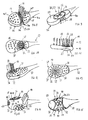
- FIG. 1-4 show various views of a head portion 10 of a toothbrush according to the invention.
- a cleaning structure 12 consisting of conventional bristles 14, summarized in bundles, and soft elastic cleaning elements 16 is attached.
- the conventional bristles 14 instead of the conventional bristles 14, in some cases only the anchoring areas 38 of the bristle bundles are indicated.
- the head region 10 consists of a hard component 30 that is solid (see also FIG Fig. 5-7 ) and in particular the conventional bristles 14 with a certain Anchorage depth are anchored.
- a circular or elliptical recess 31 which is circular or elliptical in plan view and which is covered on the front and rear sides by a flexible wall 28 in the form of an elastic membrane 28 or 26 made of soft material 32.
- a hollow region 22 is formed within the head region 10.
- the soft elastic structure 16 is anchored in the front membrane 28.
- the membrane and the soft elastic structure are formed together in one manufacturing step from the same material from the same injection point.
- the membrane 26 on the back 20 has two crossed slots, which serve as a reclosable insertion opening 34 for an active substance element 24.
- the front side membrane 28 has outlet openings 36 through which water can enter the hollow region 22 and enriched with active substance can escape again.
- the wall region of the hollow region 22 formed of soft material 32 forms a flexible zone 29. Under cleaning pressure, the toothbrush deforms in this zone 29 such that water is sucked into the hollow region 22 and pushed out again.
- the membranes 26, 28 may also be made of a hard component with a correspondingly small wall thickness in order to achieve the necessary flexibility.
- a soft component has advantages insofar as the anchoring of cleaning elements in a thin hard material layer is problematic in terms of manufacture, but the simultaneous injection of soft elastic elements onto a soft membrane is unproblematic.
- the flexible elements of the membrane and cleaning elements are made of soft material.
- the hard component forms only structuring, stabilizing elements of the membrane or merely serves as a production-related material compound.
- the hollow portion 22 is adapted to the shape of an active substance element 24 that this is at least partially spaced from the inner wall 23.
- an active substance element 24 For secure retention of the active substance element 24, inwardly projecting projections or edges 40 are formed out of the flexible membranes 26, 28 ( Fig. 5-7 ). Due to the flexibility of the membranes 26, 28, the active substance element 24 is well positioned even as the resolution progresses.
- outlet openings 36 are each located between the soft-elastic cleaning elements 16 within the front-side membrane 28.
- the membrane surface thus has a net-like perforated structure.
- Fig. 8, 9 show another example of a hard and soft component 30, 32 existing toothbrush.
- the soft component 32 forms a flexible zone 29, the the two otherwise separate parts 10 ', 10 "of the hard-material brush head 10 join together.
- the whole brush-head front part 10' can deflect relative to the brush head back part 10".
- the hollow region 22 is bounded on the front and rear side and additionally also laterally by thin material layers (membranes 26, 28) made of soft component 32 and in the longitudinal direction by the hard component 30.
- a compound of hard component 30 can additionally be guided within the soft component 32, which makes it possible to produce the two brush head parts 10 ', 10 "from hard component 30 in one working step, preferably this connection is made very thin so that the flexibility is not adversely affected
- conventional bristles 14 are anchored in the hard component 30, while the soft component 32 is provided with soft-elastic cleaning elements 16.
- the insertion opening 34 is as in FIG Fig. 1-7 designed as a cross slot.
- FIG. 10 shows a substantially Fig. 1-7 corresponding example in which the flexible zone 29 with the hollow portion 22 is not centrally located within the bristle field, but rather the neck portion 52 faces. This has the advantage that the most heavily loaded zone in the brush head front can be formed from conventional bristles.
- the flexible zone 29 formed of soft material 32 occupies the entire brush tip and is in the supervision designed substantially circular. In a concentric arrangement, it carries here from inside to outside soft elastic cleaning elements 16, outlet openings 36 and conventional bristles 14 (or their anchoring areas). Toward the neck region 52, a conventional bristle field embedded in the hard component 30 adjoins. The outlet openings 36 are so large that the underlying hollow area 22 is visible.
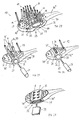
- the part of the brush head formed from the hard component 30 is in one piece. However, it has recesses in such a way that a flexible zone 29 connected to the rear side 20 with three regions (clusters) 44 is formed by outlet openings 36. These are located at the top and on the sides of the head region 10 in a respective outwardly curved flexible wall / membrane 28, preferably made of soft material 32.
- the remaining area of the head part 10 is bristled on the front side 18 with conventional bristles 14; on the back there is again a cross-shaped insertion opening 34 as in Fig. 5-7 ,
- Fig. 16-21 show examples of different shapes of the flexible zone 29 in a toothbrush according to the invention in front and rear view ( Fig. 16-19 ) or only in front view ( Fig. 20, 21 ). On the back is in all examples, in turn, a cross-shaped insertion opening 34 as in Fig. 5-7 (only partially shown).
- the flexible zone 29 has three laterally disposed, gill-like regions 46 (or cluster 44) with lamellar cleaning / massage elements 16 and in between arranged outlets 36.
- the areas 46 are connected to each other at the rear via a material bridge of soft material 32 (see Fig. 17 ).
- the lamellae / fish gills are less pronounced and only two lateral clusters 44 are present.
- Fig. 20 shows a modification thereof with asymmetrically curved geometry.
- the outlet openings 36 are uniformly distributed over the lateral edge of the head portion 10 and each knob-like surrounded by soft material, so that also here by the knobs during cleaning results in a massage effect.
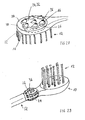
- Fig. 22, 23 show a brush in front and rear view, in which the outlet openings 36 are located on the back facing away from the bristle 20 and thus the active substance is released mainly at the back 20.
- the back 20 is largely made of hard material 30 which is broken like a net and the view of the hollow portion 22 within the brush head 10 releases.
- the hollow portion 22 extends substantially over the entire surface of the head portion 10. The sufficient flexibility of the wall of the hollow portion 22 is achieved by a correspondingly thin material thickness and through the openings or outlet openings 36.
- a portion of the hollow portion 22 is covered on the back by a membrane 26 made of soft material 32, in which are arranged radially, serving as an insertion opening 34 slots.
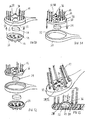
- the brush head 10 consists of two parts (tip 10 'and neck-side region 10 ") of a hard component 30 joined together by a flexible zone 29 of soft material 32 or a combination of hard and soft material
- the flexible zone 29 is a hollow portion 22 in the form of a tubular recess formed with an elliptical cross-section.
- the hollow region 22 is limited to the front side 18 by three webs 48 made of soft material 32. Between the webs 48 are two outlet openings 36 with a total width of about half the head width.
- the underside of the hollow portion 22 is the entire surface of soft material 32 or a combination of hard and soft material.
- Soft elastic cleaning elements 16 are arranged on the webs 48, conventional bristles 14 are anchored on the hard areas at the top and in the neck area. Between the webs 48 and the bottom 66 of the hollow portion 22 an elliptical insertion opening 34 for the active substance element 24 is formed. This has essentially the shape of a cylinder with elliptical cross-section and rounded edges. The active substance element 24 is clamped between the webs and the bottom 66. Laterally, however, it is spaced from the inner wall of the hollow portion 22, so that it is washed around there and in the region of the outlet openings 36 of water. Due to the spatial shape with a substantially two-part hard component 30 and the parts connecting flexible zone 29 made of soft material 32 of the brush head is particularly flexible. Alternatively, the webs 48 may also be made of the hard component 30 and hingedly connect the tip and the neck-side region; the flexibility is ensured in this case by a correspondingly thin wall thickness of the webs 48.
- Fig. 25-27 show variations of the example Fig. 24 also with an essentially two-part head region 10 made of a hard component 30 and a flexible zone 29 connecting the parts 10 ', 10 " Soft component 32 or a combination of hard and soft component, in which the hollow portion 22 is accommodated for receiving the active substance element 24.
- the hollow portion 22 and the active substance element 24 themselves are cylindrical with a circular cross section.
- the introduction opening 34 is likewise circular and may have a smaller diameter than the hollow area 22 itself, so that the active substance element 24 in the hollow area 22 can be at least partially washed around.
- the hollow region 22 is substantially surrounded by soft material 32 in its radial direction with the exception of the outlet openings 36 in the front-side membrane 28.
- Fig. 25 are formed in the membrane 28 tubular soft-elastic cleaning elements 16, the interior of which communicates with the hollow portion 22, so that dissolved active substance is discharged via outlet openings 36 'at the upper end of the cleaning elements 16.
- the active substance delivery is enhanced by the capillary effect.
- No soft elastic cleaning elements are arranged on the soft component.
- Fig. 27 shows an analogous example with an elongated in the longitudinal direction of the brush head elastic zone 29 in which a substantially cuboid hollow portion 22 is formed.
- This is adapted to a plate-shaped or foil-shaped active substance element 24.
- the plate or sheet-shaped hollow portion 22 can be mounted as backpack-shaped structure on the brush head back.
- the active substance element 24 has a thickness of 0.01 to 5.0 mm, preferably 0.05 to 1.0 mm.
- the hollow region 22 on the rear side 20 of the brush head is covered by a flexible membrane 26 of soft material 32 and otherwise formed within the hard component 30.
- the outlet openings 36 are formed on the membrane 26 within knob-shaped or funnel-like elevations, which can simultaneously act as cleaning or massage elements 16, in particular for the palate and tongue.
- the existing of the hard component 30 front 18 can thus be bristled conventionally above the hollow portion 22.
- a combination of this embodiment with a previously shown flexible membrane on the front of the brush head is also conceivable.
- Fig. 29 shows a toothbrush, wherein the hollow portion 22 is formed by a cage-like, adapted to a spherical or ellipsoidal shape of the active substance element thickening in the neck region 52.
- This has a plurality of outlet openings 36, through which the hollow portion 22 is visible.
- the boundary of the hollow region may be formed of hard and / or soft component, resulting in the latter case, a damping zone in the neck region 52. The flexibility of this zone favors the previously discussed pumping action around the active substance element.
- Fig. 30-33 show schematically different production methods for brushes according to the invention. Of course, these manufacturing methods can be used for all design variants shown.
- the toothbrush is made of two parts consisting of hard and / or soft component 30 by injection molding, on the one hand the bristle side upper half of the brush head and on the other hand the back cover 54.
- the upper half is a recess for the active substance element 24th formed, which is later closed with the lid 54 to form the hollow portion 22.
- the outlet openings 36 and optionally cleaning elements 16 are formed of soft component 32.
- Conventional bristles are anchored laterally from the cleaning elements 16 by conventional plugging or In Mold Tufting (IMT).
- IMT In Mold Tufting
- the lid 54 may include a membrane of soft component, in which the outlet openings are formed in knob-like elevations. Lid 54 and remaining brush head are then connected to the inclusion of a flat active substance element 24 releasably (snapping, sliding, locking, etc.) or non-detachable (gluing, welding, positive locking, etc.).
- the toothbrush is also made of two parts of a hard and / or soft component by injection molding.
- the brush head back half of the brush head has a plate-shaped recess which forms a cavity 22 in the assembled state with a support plate 56.
- the carrier plate is made including openings, which are closed in a further injection molding with soft component 32 to form a membrane 26 and possibly soft elastic cleaning elements 16 of soft component.
- the conventional bristles 14 are then anchored in the support plate 56.
- the support plate 56 can also be bristled in the Anchor Free Tufting process, which has the advantage that the support plate can be made thinner.
- the support plate is then releasably (snap, slide, clicks, etc.) or non-detachable (gluing, welding, positive locking, etc.) connected to the rest of the toothbrush, wherein an active substance element 24 is enclosed in the cavity 22.
- Fig. 32 shows a combination of the examples FIGS. 30 and 31 with a three-part (annular body, support plate 56 and back cover 54) existing brush head.
- Fig. 33 shows a further example in which the active substance in the manufacture of the toothbrush is inserted or injected into a recess in the hard component 30 and overmolded with the soft component 32.
- a cavity 22 is formed with a flexible wall in the form of a thin membrane 26 of soft component 32.
- openings 36 for the entry and exit of water or water-soluble active substance are present.
- the flexibility of the wall of the hollow portion 22 results from the choice of a wall material having a certain elasticity, in particular by having at least one membrane of soft material 32, and / or by the overall existing bending elasticity of the existing hard and / or soft material brush. As long as the sufficient contact with water or the sufficient dissolution of the active substance is ensured, it is sufficient if the pumping / suction effect or volume change of the hollow region is only slightly or not at all due to the plastering pressure.
- FIGS. 34 and 35 show a self-explanatory package 58 for a toothbrush with active substance, in which in addition to a matched to the brush shape recess 60, a detachable area, each with an active substance element 24 is present. The user therefore immediately recognizes which product it is.
- the embodiment variants shown above can of course also be used in electric toothbrushes.
- the mechanical movement or vibration of at least a part of the brush head additionally promotes the fluid exchange into and out of the hollow area. If the brush head is subdivided into a movable and a non-movable brush head segment, the hollow region, within the variants described above, is preferably accommodated in the non-movable segment.
- Fig. 36 shows a domestic brush with also a head, neck and handle portion 10, 52, 62.
- head portion 10 In the head portion 10 is a hollow portion 22 which is reclosable on the cleaning structure 12 side facing away by a flap 64 and can take an active substance element 24.
- flap 64 In the flap 64 are the outlet openings for the dissolved active substance.
- the dishwashing brush In the dishwashing brush is preferably a solid soap as Active substance element used. All previously shown design variants can be adopted analogously for the dishwashing brush. The dimensions given are to be adjusted in relation to the dimensions of the dishwashing brush head.
Landscapes
- Engineering & Computer Science (AREA)
- Manufacturing & Machinery (AREA)
- Brushes (AREA)
Applications Claiming Priority (4)
| Application Number | Priority Date | Filing Date | Title |
|---|---|---|---|
| EP20040022614 EP1639913B1 (fr) | 2004-09-22 | 2004-09-22 | Brosse, notamment brosse à dents et procédé de fabrication |
| EP10011705.0A EP2335521B1 (fr) | 2004-09-22 | 2005-09-07 | Brosse, en particulier brosse à dents |
| EP05785195.8A EP1796507B1 (fr) | 2004-09-22 | 2005-09-07 | Brosse, en particulier brosse à dents, et procédé de production de cette brosse |
| PCT/EP2005/009615 WO2006032367A1 (fr) | 2004-09-22 | 2005-09-07 | Brosse, en particulier brosse a dents, et procede de production de cette brosse |
Related Parent Applications (3)
| Application Number | Title | Priority Date | Filing Date |
|---|---|---|---|
| EP10011705.0A Division EP2335521B1 (fr) | 2004-09-22 | 2005-09-07 | Brosse, en particulier brosse à dents |
| EP10011705.0A Division-Into EP2335521B1 (fr) | 2004-09-22 | 2005-09-07 | Brosse, en particulier brosse à dents |
| EP05785195.8A Division EP1796507B1 (fr) | 2004-09-22 | 2005-09-07 | Brosse, en particulier brosse à dents, et procédé de production de cette brosse |
Publications (2)
| Publication Number | Publication Date |
|---|---|
| EP3000351A1 true EP3000351A1 (fr) | 2016-03-30 |
| EP3000351B1 EP3000351B1 (fr) | 2020-02-12 |
Family
ID=34926668
Family Applications (4)
| Application Number | Title | Priority Date | Filing Date |
|---|---|---|---|
| EP20040022614 Expired - Lifetime EP1639913B1 (fr) | 2004-09-22 | 2004-09-22 | Brosse, notamment brosse à dents et procédé de fabrication |
| EP15187837.8A Expired - Lifetime EP3000351B1 (fr) | 2004-09-22 | 2005-09-07 | Procédé de fabrication d'une brosse à dents et brosse à dents |
| EP05785195.8A Expired - Lifetime EP1796507B1 (fr) | 2004-09-22 | 2005-09-07 | Brosse, en particulier brosse à dents, et procédé de production de cette brosse |
| EP10011705.0A Expired - Lifetime EP2335521B1 (fr) | 2004-09-22 | 2005-09-07 | Brosse, en particulier brosse à dents |
Family Applications Before (1)
| Application Number | Title | Priority Date | Filing Date |
|---|---|---|---|
| EP20040022614 Expired - Lifetime EP1639913B1 (fr) | 2004-09-22 | 2004-09-22 | Brosse, notamment brosse à dents et procédé de fabrication |
Family Applications After (2)
| Application Number | Title | Priority Date | Filing Date |
|---|---|---|---|
| EP05785195.8A Expired - Lifetime EP1796507B1 (fr) | 2004-09-22 | 2005-09-07 | Brosse, en particulier brosse à dents, et procédé de production de cette brosse |
| EP10011705.0A Expired - Lifetime EP2335521B1 (fr) | 2004-09-22 | 2005-09-07 | Brosse, en particulier brosse à dents |
Country Status (4)
| Country | Link |
|---|---|
| US (6) | US8109686B2 (fr) |
| EP (4) | EP1639913B1 (fr) |
| AT (1) | ATE534314T1 (fr) |
| WO (1) | WO2006032367A1 (fr) |
Families Citing this family (91)
| Publication number | Priority date | Publication date | Assignee | Title |
|---|---|---|---|---|
| US8806695B2 (en) | 2002-08-09 | 2014-08-19 | Colgate-Palmolive Company | Oral care implement having flexibly supported cleaning elements extending in opposite directions |
| US7930792B2 (en) * | 2007-01-19 | 2011-04-26 | Colgate-Palmolive Company | Oral care implement |
| US7478959B2 (en) | 2002-09-05 | 2009-01-20 | Colgate-Palmolive Company | Oral care toothbrush |
| US8240937B2 (en) | 2002-09-05 | 2012-08-14 | Colgate-Palmolive Company | Oral care implement with bead retention |
| HU227090B1 (hu) | 2006-11-21 | 2010-06-28 | Istvan Piller | Helyben keletkezõ szén-dioxiddal mûködõ fog- és ínytisztító szerkezet |
| US8517728B2 (en) * | 2007-01-24 | 2013-08-27 | Colgate-Palmolive Company | Oral care implement having fluid delivery system |
| US8075216B2 (en) | 2007-01-25 | 2011-12-13 | Colgate-Palmolive Company | Oral care implement housing an oral care agent |
| AU2008211597B2 (en) * | 2007-02-02 | 2014-01-16 | The Gillette Company Llc | Oral hygiene implements having flexible elements, and methods of making the same |
| US8240936B2 (en) * | 2007-02-22 | 2012-08-14 | Colgate-Palmolive Company | Toothbrush having soft tissue cleaning elements |
| DE102007021314A1 (de) * | 2007-05-07 | 2008-11-13 | Gerresheimer Wilden Ag Schweiz | Zahnbürste |
| US8881332B2 (en) | 2007-08-17 | 2014-11-11 | Lise W. Noble | Toothbrush system utilizing oral care capsule |
| US8156599B2 (en) * | 2007-10-03 | 2012-04-17 | Colgate-Palmolive Company | Oral care implement having a head insert |
| EP2285251B1 (fr) | 2008-05-06 | 2018-07-11 | Colgate-Palmolive Company | Outil muni d'un système de réaction et distribution |
| EP2328510B1 (fr) | 2008-06-04 | 2014-10-15 | Colgate-Palmolive Company | Instrument de soin buccal avec système de cavitation |
| CA2726681C (fr) * | 2008-06-14 | 2016-10-11 | Werner Hiltmann | Brosse |
| AU2014202126B2 (en) * | 2008-06-25 | 2016-03-03 | Colgate-Palmolive Company | Oral care implement with channel from store to first and second face of the head |
| US8459892B2 (en) * | 2008-06-25 | 2013-06-11 | Colgate-Palmolive Company | Oral care implement |
| AU2012202440B2 (en) * | 2008-06-25 | 2014-01-16 | Colgate-Palmolive Company | Oral care implement with channel from store to first and second face of the head |
| US8282298B2 (en) * | 2008-06-26 | 2012-10-09 | Colgate-Palmolive Company | Oral care implement |
| JP5555253B2 (ja) | 2008-12-30 | 2014-07-23 | コーニンクレッカ フィリップス エヌ ヴェ | 異なる歯科領域に対し異なるブラシ毛区画を有する歯磨き用マウスピース |
| USD660599S1 (en) * | 2009-02-05 | 2012-05-29 | Colgate-Palmolive Company | Toothbrush |
| US8113729B2 (en) * | 2009-07-08 | 2012-02-14 | Dental Development Systems, Llc | Toothpaste droplets |
| WO2011025810A1 (fr) * | 2009-08-26 | 2011-03-03 | Gmz Associates, Ltd | Brosse à dents écologique |
| US8529150B2 (en) | 2009-09-23 | 2013-09-10 | Richard Carl Olson | Toothbrush device |
| USD654696S1 (en) | 2009-12-18 | 2012-02-28 | Colgate-Palmolive Company | Toothbrush handle with tissue cleaner |
| USD675830S1 (en) | 2009-12-18 | 2013-02-12 | Colgate-Palmolive Company | Toothbrush |
| US8500766B2 (en) | 2009-12-18 | 2013-08-06 | Colgate-Palmolive Company | Oral care implement multiple soft tissue cleaner components |
| USD654695S1 (en) | 2009-12-18 | 2012-02-28 | Colgate-Palmolive Company | Toothbrush |
| USD654270S1 (en) | 2009-12-18 | 2012-02-21 | Colgate-Palmolive Company | Toothbrush handle |
| USD632484S1 (en) | 2009-12-18 | 2011-02-15 | Eduardo Jimenez | Toothbrush handle with tissue cleaner |
| EP3300627B1 (fr) | 2010-02-26 | 2020-09-30 | Colgate-Palmolive Company | Système d'administration de fluide pour un instrument de soin buccal |
| US8398326B2 (en) | 2010-03-04 | 2013-03-19 | Colgate-Palmolive Company | Fluid dispensing oral care implement |
| AU2011232843B2 (en) * | 2010-03-31 | 2014-07-10 | Colgate-Palmolive Company | Oral care implement |
| TWI462709B (zh) | 2010-03-31 | 2014-12-01 | Colgate Palmolive Co | 可快速釋放味道的口腔保健用具 |
| KR101586548B1 (ko) * | 2010-08-12 | 2016-01-18 | 미쓰비시 엔피쯔 가부시키가이샤 | 도포구 |
| US9510667B2 (en) * | 2010-08-16 | 2016-12-06 | Theg, Inc. | Disposable toothbrush |
| US20120055497A1 (en) * | 2010-09-03 | 2012-03-08 | Marni Markell Hurwitz | Oral hygiene implement and method of use |
| ES2536848T3 (es) * | 2010-11-12 | 2015-05-29 | Dental Care Innovation Gmbh | Sistema de limpieza dental |
| EP2651776B1 (fr) | 2010-12-15 | 2015-05-06 | Colgate-Palmolive Company | Coffret de soins d'hygiène buccale et distributeur destiné à être utilisé avec celui-ci |
| KR20150004868A (ko) * | 2010-12-22 | 2015-01-13 | 콜게이트-파아므올리브캄파니 | 구강관리 키트 |
| WO2012093085A2 (fr) | 2011-01-04 | 2012-07-12 | Trisa Holding Ag | Brosse à dents comportant des soies injectées et procédé et dispositif pour fabriquer une telle brosse à dents |
| CN103402457B (zh) | 2011-03-09 | 2015-11-25 | 高露洁-棕榄公司 | 齿间清洁装置 |
| CA2831430C (fr) | 2011-03-28 | 2015-11-24 | Colgate-Palmolive Company | Brosse a dents ayant une distribution de fluide d'hygiene buccale |
| AU2011365511B2 (en) | 2011-04-15 | 2015-01-29 | Colgate-Palmolive Company | Oral care kit |
| US20120272468A1 (en) * | 2011-04-26 | 2012-11-01 | The Procter & Gamble Company | Oral Care Device Comprising A Synthetic Polymer Derived From A Renewable Resource And Methods Of Producing Said Device |
| CN103491825B (zh) * | 2011-04-29 | 2015-12-02 | 高露洁-棕榄公司 | 具有流体耗尽的视觉指示器的口腔护理器具 |
| WO2013078358A2 (fr) | 2011-11-22 | 2013-05-30 | The Gillette Company | Procédé pour produire une brosse à dents pourvue d'une cavité interne |
| US9756931B2 (en) | 2011-11-22 | 2017-09-12 | The Procter & Gamble Company | Method for producing a toothbrush having an inner cavity |
| US9510664B2 (en) | 2011-11-22 | 2016-12-06 | The Procter & Gamble Co | Toothbrush having an inner cavity |
| US9420877B2 (en) | 2011-11-22 | 2016-08-23 | The Procter & Gamble Company | Method for producing a toothbrush having an inner cavity |
| US9463593B2 (en) | 2011-11-22 | 2016-10-11 | The Procter & Gamble Company | Method for producing a toothbrush having an inner cavity |
| US20130000659A1 (en) * | 2011-12-01 | 2013-01-03 | Davis John J | Toothbrush/toothpaste fluoride dosing toothbrush, system and method |
| DE102011122106A1 (de) * | 2011-12-22 | 2013-06-27 | Carl Freudenberg Kg | Besenblock mit Borstenstruktur |
| CA2864892A1 (fr) * | 2012-03-01 | 2013-09-06 | Colgate-Palmolive Company | Accessoire de soins buccaux |
| US20130266361A1 (en) * | 2012-04-09 | 2013-10-10 | Jeffrey A. Gilbert | Disposable Toothbrush Having an Internal Toothpaste Cartridge |
| EP2866610A1 (fr) | 2012-07-02 | 2015-05-06 | Trisa Holding AG | Procédé de fabrication de brosses, notamment de brossettes interdentaires, et brosses, notamment brossettes interdentaires, et groupe de produits composés de plusieurs brosses |
| IN2015DN03043A (fr) | 2012-10-26 | 2015-10-02 | Colgate Palmolive Co | |
| KR102046534B1 (ko) | 2013-01-25 | 2019-11-19 | 삼성전자주식회사 | 기판 가공 방법 |
| MX373913B (es) * | 2013-11-05 | 2020-07-09 | Colgate Palmolive Co | Implemento para el cuidado bucal. |
| WO2016015237A1 (fr) | 2014-07-30 | 2016-02-04 | Colgate-Palmolive Company | Instrument de soins buccaux et procede de fabrication d'un instrument de soins buccaux |
| FR3024942B1 (fr) * | 2014-08-19 | 2016-08-19 | Oreal | Embout reservoir |
| EP3200651B1 (fr) * | 2014-09-29 | 2019-03-20 | Koninklijke Philips N.V. | Dispositif d'hygiène bucco-dentaire comprenant un système d'administration de liquide sans pompe |
| EP3223657B1 (fr) * | 2014-12-23 | 2022-12-07 | Colgate-Palmolive Company | Accessoire de soins buccaux |
| DE202015009203U1 (de) * | 2015-04-10 | 2016-11-21 | Klemens Hanses | Toilettenbürste mit einem Reinigungsmittelbehälter |
| CN112890408A (zh) | 2015-11-04 | 2021-06-04 | 特里沙控股公司 | 带有被注射的刷毛的身体护理刷 |
| US9700127B2 (en) * | 2015-11-10 | 2017-07-11 | Dr. Bob's Ltd. | Toothbrush having tufted bristles and tongue brush bristles emanating from the same surface |
| US10165852B1 (en) * | 2016-04-05 | 2019-01-01 | William R. Christman | Teeth cleaning implement |
| WO2017182355A1 (fr) | 2016-04-20 | 2017-10-26 | Trisa Holding Ag | Produit de type brosse et procédé de fabrication |
| USD825741S1 (en) | 2016-12-15 | 2018-08-14 | Water Pik, Inc. | Oral irrigator handle |
| US10390607B2 (en) | 2016-12-20 | 2019-08-27 | Colgate-Palmolive Company | Liquid supply apparatus and personal care implement containing the same |
| AU2017382712B2 (en) | 2016-12-20 | 2020-08-27 | Colgate-Palmolive Company | Fluid supply apparatus and personal care implement containing the same |
| US11000117B2 (en) | 2016-12-20 | 2021-05-11 | Colgate-Palmolive Company | Fluid dispensing implement having curly tube with vent openings |
| CA3044285A1 (fr) | 2016-12-20 | 2018-06-28 | Colgate-Palmolive Company | Appareil d'alimentation en fluide et accessoire de soins personnels le contenant |
| CN110730641B (zh) | 2017-03-16 | 2022-03-25 | 洁碧有限公司 | 用于与口腔试剂一起使用的口腔冲洗器手柄 |
| US11071854B2 (en) * | 2017-06-27 | 2021-07-27 | Colgate-Palmolive Company | Oral care implement |
| EP3470015B1 (fr) | 2017-10-11 | 2021-07-07 | Trisa Holding AG | Partie poignée de la brosse à dents électrique et brosse à dents électrique dotée d'une partie poignée de la brosse électrique et une brosse enfichable |
| DE102017220748A1 (de) * | 2017-11-21 | 2019-05-23 | M+C Schiffer Gmbh | Zahnbürste |
| WO2019104288A1 (fr) | 2017-11-27 | 2019-05-31 | Colgate-Palmolive Company | Accessoire de soins buccaux |
| US10849419B2 (en) | 2018-03-08 | 2020-12-01 | Olson Ip Technologies, Inc. | Oral care device |
| US10674808B2 (en) | 2018-03-23 | 2020-06-09 | Colgate-Palmolive Company | Oral care implement and method of forming the same |
| US10849422B2 (en) | 2018-11-13 | 2020-12-01 | Colgate-Palmolive Company | Method of sanitizing a toothbrush |
| US10638832B1 (en) | 2018-11-13 | 2020-05-05 | Colgate-Palmolive Company | Fluid dispensing oral care implement |
| US11484112B2 (en) | 2018-11-13 | 2022-11-01 | Colgate-Palmolive Company | Method of whitening teeth |
| CN113056309A (zh) | 2018-11-27 | 2021-06-29 | 高露洁-棕榄公司 | 具有释放组分的口腔护理器具 |
| RU2695822C1 (ru) * | 2018-12-12 | 2019-07-29 | Антон Петрович Усов | Зубная щетка |
| RU189491U1 (ru) * | 2018-12-17 | 2019-05-23 | Антон Петрович Усов | Зубная щетка |
| US10827824B1 (en) * | 2019-05-10 | 2020-11-10 | George S. Ferzli | Personal care brush with single dose dispenser |
| RU2706822C1 (ru) * | 2019-06-20 | 2019-11-21 | Антон Петрович Усов | Зубная щетка для ухода за полостью рта |
| US11051606B2 (en) | 2019-06-28 | 2021-07-06 | Colgate-Palmolive Company | Oral care implement and method of assembling the same |
| CN110353397B (zh) * | 2019-08-05 | 2024-05-17 | 慈溪赛嘉电子有限公司 | 牙刷 |
| GB2604462B (en) * | 2022-04-07 | 2023-06-28 | Ruka Hair Ltd | A selfcare brush |
Citations (9)
| Publication number | Priority date | Publication date | Assignee | Title |
|---|---|---|---|---|
| US1947721A (en) * | 1931-12-30 | 1934-02-20 | Stanley V Laub | Toothbrush |
| US1947720A (en) | 1931-04-09 | 1934-02-20 | Stanley V Laub | Toothbrush |
| FR2583625A1 (fr) | 1985-06-20 | 1986-12-26 | Barry Christian | Dispositif d'hygiene pour brosser les dents |
| GB2263863A (en) * | 1992-02-07 | 1993-08-11 | Flors Luisa Armelles | Toothbrush having a toothpaste compartment |
| US5346324A (en) | 1991-09-19 | 1994-09-13 | Youti Kuo | Dentifrice dispensing toothbrush with replaceable cartridge |
| US5490530A (en) | 1994-05-03 | 1996-02-13 | Snowden; Patricia | Disposable toothcare assembly |
| US5865195A (en) | 1997-07-03 | 1999-02-02 | Carter; Theresa | Oral hygiene system |
| US5909977A (en) | 1997-03-31 | 1999-06-08 | Kuo; Youti | Dentifrice dispensing toothbrush with refillable cartridge |
| WO2004021914A2 (fr) | 2002-09-05 | 2004-03-18 | Colgate-Palmolive Company | Brosse a dents jetable |
Family Cites Families (31)
| Publication number | Priority date | Publication date | Assignee | Title |
|---|---|---|---|---|
| US1060524A (en) * | 1911-04-13 | 1913-04-29 | Leonard F Wolfe | Blacking-brush. |
| US1797946A (en) * | 1930-01-08 | 1931-03-24 | Eichel Emil | Toothbrush |
| US1944067A (en) * | 1932-11-04 | 1934-01-16 | Claude R Collins | Fountain toothbrush |
| US1995374A (en) * | 1934-04-23 | 1935-03-26 | James D Young | Dentifrice holding toothbrush |
| US2127794A (en) * | 1935-02-19 | 1938-08-23 | Wastman Gothard | Dispensing device |
| US2216333A (en) * | 1936-06-13 | 1940-10-01 | White | Antisepticized brush |
| GB491140A (en) | 1938-02-14 | 1938-08-26 | Eric Leopold Hugo Cosby | Improvements in or relating to brushes |
| US2262982A (en) * | 1938-08-24 | 1941-11-18 | Frank E Wolcott | Toothbrush |
| US2260100A (en) * | 1940-05-27 | 1941-10-21 | Deitrich | Fountain applicator |
| US2778045A (en) * | 1952-10-31 | 1957-01-22 | Bly Isaiah | Dentifrice-containing capsules |
| US2739328A (en) * | 1955-01-12 | 1956-03-27 | Dorothy K Bernier | Soap brush |
| FR2554331A1 (fr) | 1983-11-03 | 1985-05-10 | Corgier Monique | Brosse a dents perfectionnee |
| WO1988001839A1 (fr) * | 1986-09-08 | 1988-03-24 | Ginebre Frederic | Brosse a dents |
| US5061106A (en) * | 1988-03-08 | 1991-10-29 | Colgate-Palmolive Company | Toothbrush with slow release of disinfectant and antibacterial agents and method of manufacturing the same |
| FR2629989A1 (fr) | 1988-04-15 | 1989-10-20 | Camara Naby | Brosse a dent a alveole garnie |
| BE1001993A7 (fr) | 1988-05-24 | 1990-05-15 | Desmedt Robert | Brosse a dents a usage unique dentifrice incorpore. |
| US5066155A (en) | 1988-08-29 | 1991-11-19 | English Philip H | Toothbrush and paste dispenser |
| FR2646068A1 (fr) * | 1989-04-19 | 1990-10-26 | Louin Patrice | Brosse a dents jetable a pastilles-dentifrice incorporees |
| US5181531A (en) * | 1991-07-18 | 1993-01-26 | Dario Escoto | Tooth cleaning kit for vending machines |
| US5392482A (en) * | 1993-11-26 | 1995-02-28 | Drulias; Dean | Disposable toothbrush |
| NL9400631A (nl) * | 1994-04-20 | 1995-12-01 | Wilhelmina Walthera Johanna Co | Tandenborstel, bestaande uit houder en borsteldeel. |
| ITMI952073A1 (it) | 1995-10-12 | 1997-04-12 | Vittorio Quattrocolo | Dispositivo per la pulizia dentale del tipo usa e getta |
| GB2323026B (en) | 1997-03-12 | 2001-05-09 | Wisdom Toothbrushes Ltd | Colour-changing wear-indicating filaments |
| DE29718117U1 (de) * | 1997-10-13 | 1998-01-22 | Ott, Michael, 26683 Saterland | Toilettenbürste mit extra 75 cm langem Stil und auswechselbarem, perforiertem Bürstenkopf, in den eine Reinigungs-Desinfektionspatrone eingeführt werden kann |
| GB2343619A (en) * | 1998-10-07 | 2000-05-17 | Christina Elsender | Disposable reservoir toothbrush |
| EP1164891A1 (fr) | 1999-03-10 | 2002-01-02 | Tri-Concepts (Proprietary) Limited | Brosse a dents jetable |
| DE10013495B4 (de) * | 2000-03-20 | 2004-01-29 | Klemens Hanses | Toilettenbürste |
| EP1190643A1 (fr) * | 2000-09-20 | 2002-03-27 | Givaudan SA | Dispositif pour appliquer une matière active sur une surface et récipient contenant une dose unique de matière active |
| ITMI20010045U1 (it) | 2001-01-26 | 2002-07-26 | Vanni Calligaro | Spazzolino da denti perfezionato |
| US6602013B2 (en) * | 2001-08-27 | 2003-08-05 | Frank Clark | Chewable toothbrush |
| US7331731B2 (en) * | 2002-09-05 | 2008-02-19 | Colgate-Palmolive Company | Oral care toothbrush |
-
2004
- 2004-09-22 EP EP20040022614 patent/EP1639913B1/fr not_active Expired - Lifetime
- 2004-09-22 AT AT04022614T patent/ATE534314T1/de active
-
2005
- 2005-09-07 EP EP15187837.8A patent/EP3000351B1/fr not_active Expired - Lifetime
- 2005-09-07 US US11/662,486 patent/US8109686B2/en not_active Expired - Fee Related
- 2005-09-07 EP EP05785195.8A patent/EP1796507B1/fr not_active Expired - Lifetime
- 2005-09-07 EP EP10011705.0A patent/EP2335521B1/fr not_active Expired - Lifetime
- 2005-09-07 WO PCT/EP2005/009615 patent/WO2006032367A1/fr not_active Ceased
-
2011
- 2011-12-30 US US13/341,212 patent/US8408833B2/en not_active Expired - Fee Related
-
2013
- 2013-02-27 US US13/779,032 patent/US8851781B2/en not_active Expired - Lifetime
-
2014
- 2014-08-13 US US14/458,710 patent/US9538837B2/en not_active Expired - Fee Related
-
2016
- 2016-12-07 US US15/371,578 patent/US10390606B2/en not_active Expired - Lifetime
-
2019
- 2019-06-19 US US16/445,757 patent/US10856647B2/en not_active Expired - Fee Related
Patent Citations (10)
| Publication number | Priority date | Publication date | Assignee | Title |
|---|---|---|---|---|
| US1947720A (en) | 1931-04-09 | 1934-02-20 | Stanley V Laub | Toothbrush |
| US1947721A (en) * | 1931-12-30 | 1934-02-20 | Stanley V Laub | Toothbrush |
| FR2583625A1 (fr) | 1985-06-20 | 1986-12-26 | Barry Christian | Dispositif d'hygiene pour brosser les dents |
| US5346324A (en) | 1991-09-19 | 1994-09-13 | Youti Kuo | Dentifrice dispensing toothbrush with replaceable cartridge |
| GB2263863A (en) * | 1992-02-07 | 1993-08-11 | Flors Luisa Armelles | Toothbrush having a toothpaste compartment |
| US5366310A (en) | 1992-02-07 | 1994-11-22 | Luisa Armelles Flors | Toothbrush with slide in supply |
| US5490530A (en) | 1994-05-03 | 1996-02-13 | Snowden; Patricia | Disposable toothcare assembly |
| US5909977A (en) | 1997-03-31 | 1999-06-08 | Kuo; Youti | Dentifrice dispensing toothbrush with refillable cartridge |
| US5865195A (en) | 1997-07-03 | 1999-02-02 | Carter; Theresa | Oral hygiene system |
| WO2004021914A2 (fr) | 2002-09-05 | 2004-03-18 | Colgate-Palmolive Company | Brosse a dents jetable |
Also Published As
| Publication number | Publication date |
|---|---|
| US10390606B2 (en) | 2019-08-27 |
| EP1639913B1 (fr) | 2011-11-23 |
| EP1796507A1 (fr) | 2007-06-20 |
| EP1796507B1 (fr) | 2013-10-23 |
| EP3000351B1 (fr) | 2020-02-12 |
| US10856647B2 (en) | 2020-12-08 |
| US8851781B2 (en) | 2014-10-07 |
| US20130212823A1 (en) | 2013-08-22 |
| US9538837B2 (en) | 2017-01-10 |
| EP2335521A1 (fr) | 2011-06-22 |
| EP2335521B1 (fr) | 2015-12-16 |
| US8109686B2 (en) | 2012-02-07 |
| US20140348569A1 (en) | 2014-11-27 |
| US20080014010A1 (en) | 2008-01-17 |
| US20120121312A1 (en) | 2012-05-17 |
| EP1639913A1 (fr) | 2006-03-29 |
| ATE534314T1 (de) | 2011-12-15 |
| US20170079420A1 (en) | 2017-03-23 |
| WO2006032367A1 (fr) | 2006-03-30 |
| US8408833B2 (en) | 2013-04-02 |
| US20190357666A1 (en) | 2019-11-28 |
Similar Documents
| Publication | Publication Date | Title |
|---|---|---|
| EP2335521B1 (fr) | Brosse, en particulier brosse à dents | |
| EP3445205B1 (fr) | Produit de type brosse | |
| EP2343018B1 (fr) | Outil de protection orale | |
| CN105792701B (zh) | 具有带有不同的口腔护理添加剂的股线部件的螺旋刷毛以及包括该螺旋刷毛的口腔护理器具 | |
| EP1220626B1 (fr) | Brosse, notamment brosse a dents | |
| CN105813504B (zh) | 具有带有不同的口腔护理添加剂的部件的多部件式刷毛以及包括该多部件式刷毛的口腔护理器具 | |
| EP3684221B1 (fr) | Dispositif applicateur | |
| EP2670278B1 (fr) | Pinceau doseur pour application locale ciblée | |
| WO2017076839A1 (fr) | Brosse de soin corporel, pourvue de soies fabriquées par moulage par injection | |
| CA2878761A1 (fr) | Accessoire de soin buccal pourvu d'un canal allant de la reserve a la premiere et seconde face de la tete | |
| CH712546A2 (de) | Mundhygienemittel. | |
| AU2011224060B2 (en) | Oral care implement | |
| HK1159455B (en) | Oral care implement |
Legal Events
| Date | Code | Title | Description |
|---|---|---|---|
| PUAI | Public reference made under article 153(3) epc to a published international application that has entered the european phase |
Free format text: ORIGINAL CODE: 0009012 |
|
| AC | Divisional application: reference to earlier application |
Ref document number: 1796507 Country of ref document: EP Kind code of ref document: P Ref document number: 2335521 Country of ref document: EP Kind code of ref document: P |
|
| AK | Designated contracting states |
Kind code of ref document: A1 Designated state(s): AT BE BG CH CY CZ DE DK EE ES FI FR GB GR HU IE IS IT LI LT LU LV MC NL PL PT RO SE SI SK TR |
|
| 17P | Request for examination filed |
Effective date: 20160916 |
|
| RBV | Designated contracting states (corrected) |
Designated state(s): AT BE BG CH CY CZ DE DK EE ES FI FR GB GR HU IE IS IT LI LT LU LV MC NL PL PT RO SE SI SK TR |
|
| STAA | Information on the status of an ep patent application or granted ep patent |
Free format text: STATUS: EXAMINATION IS IN PROGRESS |
|
| 17Q | First examination report despatched |
Effective date: 20181005 |
|
| GRAP | Despatch of communication of intention to grant a patent |
Free format text: ORIGINAL CODE: EPIDOSNIGR1 |
|
| STAA | Information on the status of an ep patent application or granted ep patent |
Free format text: STATUS: GRANT OF PATENT IS INTENDED |
|
| RIC1 | Information provided on ipc code assigned before grant |
Ipc: A46B 11/00 20060101AFI20190802BHEP |
|
| INTG | Intention to grant announced |
Effective date: 20190821 |
|
| GRAS | Grant fee paid |
Free format text: ORIGINAL CODE: EPIDOSNIGR3 |
|
| GRAA | (expected) grant |
Free format text: ORIGINAL CODE: 0009210 |
|
| STAA | Information on the status of an ep patent application or granted ep patent |
Free format text: STATUS: THE PATENT HAS BEEN GRANTED |
|
| AC | Divisional application: reference to earlier application |
Ref document number: 1796507 Country of ref document: EP Kind code of ref document: P Ref document number: 2335521 Country of ref document: EP Kind code of ref document: P |
|
| AK | Designated contracting states |
Kind code of ref document: B1 Designated state(s): AT BE BG CH CY CZ DE DK EE ES FI FR GB GR HU IE IS IT LI LT LU LV MC NL PL PT RO SE SI SK TR |
|
| REG | Reference to a national code |
Ref country code: GB Ref legal event code: FG4D Free format text: NOT ENGLISH |
|
| REG | Reference to a national code |
Ref country code: CH Ref legal event code: EP |
|
| REG | Reference to a national code |
Ref country code: AT Ref legal event code: REF Ref document number: 1230946 Country of ref document: AT Kind code of ref document: T Effective date: 20200215 |
|
| REG | Reference to a national code |
Ref country code: DE Ref legal event code: R096 Ref document number: 502005016118 Country of ref document: DE |
|
| REG | Reference to a national code |
Ref country code: IE Ref legal event code: FG4D Free format text: LANGUAGE OF EP DOCUMENT: GERMAN |
|
| PG25 | Lapsed in a contracting state [announced via postgrant information from national office to epo] |
Ref country code: FI Free format text: LAPSE BECAUSE OF FAILURE TO SUBMIT A TRANSLATION OF THE DESCRIPTION OR TO PAY THE FEE WITHIN THE PRESCRIBED TIME-LIMIT Effective date: 20200212 |
|
| REG | Reference to a national code |
Ref country code: LT Ref legal event code: MG4D |
|
| REG | Reference to a national code |
Ref country code: NL Ref legal event code: MP Effective date: 20200212 |
|
| PG25 | Lapsed in a contracting state [announced via postgrant information from national office to epo] |
Ref country code: IS Free format text: LAPSE BECAUSE OF FAILURE TO SUBMIT A TRANSLATION OF THE DESCRIPTION OR TO PAY THE FEE WITHIN THE PRESCRIBED TIME-LIMIT Effective date: 20200612 Ref country code: GR Free format text: LAPSE BECAUSE OF FAILURE TO SUBMIT A TRANSLATION OF THE DESCRIPTION OR TO PAY THE FEE WITHIN THE PRESCRIBED TIME-LIMIT Effective date: 20200513 Ref country code: SE Free format text: LAPSE BECAUSE OF FAILURE TO SUBMIT A TRANSLATION OF THE DESCRIPTION OR TO PAY THE FEE WITHIN THE PRESCRIBED TIME-LIMIT Effective date: 20200212 Ref country code: LV Free format text: LAPSE BECAUSE OF FAILURE TO SUBMIT A TRANSLATION OF THE DESCRIPTION OR TO PAY THE FEE WITHIN THE PRESCRIBED TIME-LIMIT Effective date: 20200212 Ref country code: BG Free format text: LAPSE BECAUSE OF FAILURE TO SUBMIT A TRANSLATION OF THE DESCRIPTION OR TO PAY THE FEE WITHIN THE PRESCRIBED TIME-LIMIT Effective date: 20200512 |
|
| PG25 | Lapsed in a contracting state [announced via postgrant information from national office to epo] |
Ref country code: NL Free format text: LAPSE BECAUSE OF FAILURE TO SUBMIT A TRANSLATION OF THE DESCRIPTION OR TO PAY THE FEE WITHIN THE PRESCRIBED TIME-LIMIT Effective date: 20200212 |
|
| PG25 | Lapsed in a contracting state [announced via postgrant information from national office to epo] |
Ref country code: DK Free format text: LAPSE BECAUSE OF FAILURE TO SUBMIT A TRANSLATION OF THE DESCRIPTION OR TO PAY THE FEE WITHIN THE PRESCRIBED TIME-LIMIT Effective date: 20200212 Ref country code: LT Free format text: LAPSE BECAUSE OF FAILURE TO SUBMIT A TRANSLATION OF THE DESCRIPTION OR TO PAY THE FEE WITHIN THE PRESCRIBED TIME-LIMIT Effective date: 20200212 Ref country code: PT Free format text: LAPSE BECAUSE OF FAILURE TO SUBMIT A TRANSLATION OF THE DESCRIPTION OR TO PAY THE FEE WITHIN THE PRESCRIBED TIME-LIMIT Effective date: 20200705 Ref country code: EE Free format text: LAPSE BECAUSE OF FAILURE TO SUBMIT A TRANSLATION OF THE DESCRIPTION OR TO PAY THE FEE WITHIN THE PRESCRIBED TIME-LIMIT Effective date: 20200212 Ref country code: ES Free format text: LAPSE BECAUSE OF FAILURE TO SUBMIT A TRANSLATION OF THE DESCRIPTION OR TO PAY THE FEE WITHIN THE PRESCRIBED TIME-LIMIT Effective date: 20200212 Ref country code: CZ Free format text: LAPSE BECAUSE OF FAILURE TO SUBMIT A TRANSLATION OF THE DESCRIPTION OR TO PAY THE FEE WITHIN THE PRESCRIBED TIME-LIMIT Effective date: 20200212 Ref country code: RO Free format text: LAPSE BECAUSE OF FAILURE TO SUBMIT A TRANSLATION OF THE DESCRIPTION OR TO PAY THE FEE WITHIN THE PRESCRIBED TIME-LIMIT Effective date: 20200212 Ref country code: SK Free format text: LAPSE BECAUSE OF FAILURE TO SUBMIT A TRANSLATION OF THE DESCRIPTION OR TO PAY THE FEE WITHIN THE PRESCRIBED TIME-LIMIT Effective date: 20200212 |
|
| REG | Reference to a national code |
Ref country code: DE Ref legal event code: R097 Ref document number: 502005016118 Country of ref document: DE |
|
| PLBE | No opposition filed within time limit |
Free format text: ORIGINAL CODE: 0009261 |
|
| STAA | Information on the status of an ep patent application or granted ep patent |
Free format text: STATUS: NO OPPOSITION FILED WITHIN TIME LIMIT |
|
| 26N | No opposition filed |
Effective date: 20201113 |
|
| PG25 | Lapsed in a contracting state [announced via postgrant information from national office to epo] |
Ref country code: IT Free format text: LAPSE BECAUSE OF FAILURE TO SUBMIT A TRANSLATION OF THE DESCRIPTION OR TO PAY THE FEE WITHIN THE PRESCRIBED TIME-LIMIT Effective date: 20200212 |
|
| PG25 | Lapsed in a contracting state [announced via postgrant information from national office to epo] |
Ref country code: PL Free format text: LAPSE BECAUSE OF FAILURE TO SUBMIT A TRANSLATION OF THE DESCRIPTION OR TO PAY THE FEE WITHIN THE PRESCRIBED TIME-LIMIT Effective date: 20200212 Ref country code: SI Free format text: LAPSE BECAUSE OF FAILURE TO SUBMIT A TRANSLATION OF THE DESCRIPTION OR TO PAY THE FEE WITHIN THE PRESCRIBED TIME-LIMIT Effective date: 20200212 |
|
| PG25 | Lapsed in a contracting state [announced via postgrant information from national office to epo] |
Ref country code: MC Free format text: LAPSE BECAUSE OF FAILURE TO SUBMIT A TRANSLATION OF THE DESCRIPTION OR TO PAY THE FEE WITHIN THE PRESCRIBED TIME-LIMIT Effective date: 20200212 |
|
| REG | Reference to a national code |
Ref country code: BE Ref legal event code: MM Effective date: 20200930 |
|
| PG25 | Lapsed in a contracting state [announced via postgrant information from national office to epo] |
Ref country code: LU Free format text: LAPSE BECAUSE OF NON-PAYMENT OF DUE FEES Effective date: 20200907 |
|
| PG25 | Lapsed in a contracting state [announced via postgrant information from national office to epo] |
Ref country code: IE Free format text: LAPSE BECAUSE OF NON-PAYMENT OF DUE FEES Effective date: 20200907 Ref country code: BE Free format text: LAPSE BECAUSE OF NON-PAYMENT OF DUE FEES Effective date: 20200930 |
|
| PGFP | Annual fee paid to national office [announced via postgrant information from national office to epo] |
Ref country code: CH Payment date: 20210920 Year of fee payment: 17 Ref country code: FR Payment date: 20210921 Year of fee payment: 17 |
|
| REG | Reference to a national code |
Ref country code: AT Ref legal event code: MM01 Ref document number: 1230946 Country of ref document: AT Kind code of ref document: T Effective date: 20200907 |
|
| PGFP | Annual fee paid to national office [announced via postgrant information from national office to epo] |
Ref country code: GB Payment date: 20210920 Year of fee payment: 17 Ref country code: DE Payment date: 20210920 Year of fee payment: 17 |
|
| PG25 | Lapsed in a contracting state [announced via postgrant information from national office to epo] |
Ref country code: AT Free format text: LAPSE BECAUSE OF NON-PAYMENT OF DUE FEES Effective date: 20200907 |
|
| PG25 | Lapsed in a contracting state [announced via postgrant information from national office to epo] |
Ref country code: TR Free format text: LAPSE BECAUSE OF FAILURE TO SUBMIT A TRANSLATION OF THE DESCRIPTION OR TO PAY THE FEE WITHIN THE PRESCRIBED TIME-LIMIT Effective date: 20200212 Ref country code: CY Free format text: LAPSE BECAUSE OF FAILURE TO SUBMIT A TRANSLATION OF THE DESCRIPTION OR TO PAY THE FEE WITHIN THE PRESCRIBED TIME-LIMIT Effective date: 20200212 |
|
| REG | Reference to a national code |
Ref country code: DE Ref legal event code: R119 Ref document number: 502005016118 Country of ref document: DE |
|
| REG | Reference to a national code |
Ref country code: CH Ref legal event code: PL |
|
| GBPC | Gb: european patent ceased through non-payment of renewal fee |
Effective date: 20220907 |
|
| PG25 | Lapsed in a contracting state [announced via postgrant information from national office to epo] |
Ref country code: LI Free format text: LAPSE BECAUSE OF NON-PAYMENT OF DUE FEES Effective date: 20220930 Ref country code: FR Free format text: LAPSE BECAUSE OF NON-PAYMENT OF DUE FEES Effective date: 20220930 Ref country code: DE Free format text: LAPSE BECAUSE OF NON-PAYMENT OF DUE FEES Effective date: 20230401 Ref country code: CH Free format text: LAPSE BECAUSE OF NON-PAYMENT OF DUE FEES Effective date: 20220930 |
|
| PG25 | Lapsed in a contracting state [announced via postgrant information from national office to epo] |
Ref country code: GB Free format text: LAPSE BECAUSE OF NON-PAYMENT OF DUE FEES Effective date: 20220907 |