EP3000357B1 - Möbel und möbelbeschlag zur verbindung von möbelteilen - Google Patents
Möbel und möbelbeschlag zur verbindung von möbelteilen Download PDFInfo
- Publication number
- EP3000357B1 EP3000357B1 EP15184809.0A EP15184809A EP3000357B1 EP 3000357 B1 EP3000357 B1 EP 3000357B1 EP 15184809 A EP15184809 A EP 15184809A EP 3000357 B1 EP3000357 B1 EP 3000357B1
- Authority
- EP
- European Patent Office
- Prior art keywords
- furniture
- cover plate
- clamping element
- base
- base plate
- Prior art date
- Legal status (The legal status is an assumption and is not a legal conclusion. Google has not performed a legal analysis and makes no representation as to the accuracy of the status listed.)
- Active
Links
Images




Classifications
-
- A—HUMAN NECESSITIES
- A47—FURNITURE; DOMESTIC ARTICLES OR APPLIANCES; COFFEE MILLS; SPICE MILLS; SUCTION CLEANERS IN GENERAL
- A47C—CHAIRS; SOFAS; BEDS
- A47C7/00—Parts, details, or accessories of chairs or stools
- A47C7/54—Supports for the arms
- A47C7/546—Supports for the arms of detachable type
-
- A—HUMAN NECESSITIES
- A47—FURNITURE; DOMESTIC ARTICLES OR APPLIANCES; COFFEE MILLS; SPICE MILLS; SUCTION CLEANERS IN GENERAL
- A47C—CHAIRS; SOFAS; BEDS
- A47C13/00—Convertible chairs, stools or benches
- A47C13/005—Modular seating
-
- A—HUMAN NECESSITIES
- A47—FURNITURE; DOMESTIC ARTICLES OR APPLIANCES; COFFEE MILLS; SPICE MILLS; SUCTION CLEANERS IN GENERAL
- A47C—CHAIRS; SOFAS; BEDS
- A47C4/00—Foldable, collapsible or dismountable chairs
- A47C4/02—Dismountable chairs
- A47C4/028—Upholstered chairs, e.g. metal, plastic or wooden chairs
-
- A—HUMAN NECESSITIES
- A47—FURNITURE; DOMESTIC ARTICLES OR APPLIANCES; COFFEE MILLS; SPICE MILLS; SUCTION CLEANERS IN GENERAL
- A47C—CHAIRS; SOFAS; BEDS
- A47C7/00—Parts, details, or accessories of chairs or stools
- A47C7/36—Supports for the head or the back
- A47C7/40—Supports for the head or the back for the back
- A47C7/42—Supports for the head or the back for the back of detachable or loose type
-
- F—MECHANICAL ENGINEERING; LIGHTING; HEATING; WEAPONS; BLASTING
- F16—ENGINEERING ELEMENTS AND UNITS; GENERAL MEASURES FOR PRODUCING AND MAINTAINING EFFECTIVE FUNCTIONING OF MACHINES OR INSTALLATIONS; THERMAL INSULATION IN GENERAL
- F16B—DEVICES FOR FASTENING OR SECURING CONSTRUCTIONAL ELEMENTS OR MACHINE PARTS TOGETHER, e.g. NAILS, BOLTS, CIRCLIPS, CLAMPS, CLIPS OR WEDGES; JOINTS OR JOINTING
- F16B12/00—Jointing of furniture or the like, e.g. hidden from exterior
- F16B12/10—Jointing of furniture or the like, e.g. hidden from exterior using pegs, bolts, tenons, clamps, clips, or the like
- F16B12/12—Jointing of furniture or the like, e.g. hidden from exterior using pegs, bolts, tenons, clamps, clips, or the like for non-metal furniture parts, e.g. made of wood, of plastics
- F16B12/20—Jointing of furniture or the like, e.g. hidden from exterior using pegs, bolts, tenons, clamps, clips, or the like for non-metal furniture parts, e.g. made of wood, of plastics using clamps, clips, wedges, sliding bolts, or the like
- F16B12/2009—Jointing of furniture or the like, e.g. hidden from exterior using pegs, bolts, tenons, clamps, clips, or the like for non-metal furniture parts, e.g. made of wood, of plastics using clamps, clips, wedges, sliding bolts, or the like actuated by rotary motion
-
- F—MECHANICAL ENGINEERING; LIGHTING; HEATING; WEAPONS; BLASTING
- F16—ENGINEERING ELEMENTS AND UNITS; GENERAL MEASURES FOR PRODUCING AND MAINTAINING EFFECTIVE FUNCTIONING OF MACHINES OR INSTALLATIONS; THERMAL INSULATION IN GENERAL
- F16B—DEVICES FOR FASTENING OR SECURING CONSTRUCTIONAL ELEMENTS OR MACHINE PARTS TOGETHER, e.g. NAILS, BOLTS, CIRCLIPS, CLAMPS, CLIPS OR WEDGES; JOINTS OR JOINTING
- F16B12/00—Jointing of furniture or the like, e.g. hidden from exterior
- F16B12/54—Fittings for bedsteads or the like
- F16B12/60—Fittings for detachable side panels
Definitions
- the invention relates to a furniture fitting for connecting furniture parts, in particular upholstered furniture, with a base element that can be fastened to a first furniture part and a cover plate that can be fastened to a second furniture part, the base element having a base plate on which a protruding clamping element is rotatably fastened.
- the cover plate has a recess, with the clamping element protruding at least partially through the recess in at least one rotational position when the base element and cover plate are joined together, and with the clamping element overlapping the cover plate in the region of the edges of the recess at least in sections after rotation and thus shaping the cover plate. and positively connected to the base element.
- a pivoting lever is provided which protrudes laterally beyond the base element and is coupled to the tensioning element in a rotationally fixed manner.
- the invention also relates to a piece of furniture with at least two furniture parts.
- Plug connections are often used to connect larger furniture parts such as seat parts, back parts or side parts of upholstered furniture.
- the disadvantage of such plug-in connections is that they are released again when the furniture parts move against the joining direction when they are connected.
- connecting straps applied from the outside are used with such large furniture parts, which, however, is only possible in non-visible areas, for example on the underside of a sofa, due to the risk of injury and for design reasons.
- a plug-and-turn connection between a functional element, for example a bolt or a threaded carrier, and a plate-shaped carrier component.
- the plug-and-turn connection can be used to conceal the functional elements mentioned.
- the functional element is inserted into a pot-shaped receiving recess of the carrier component and fixed there by a rotary movement with a bayonet catch.
- This type of hidden connection is unsuitable for large furniture parts, since large furniture parts generally cannot be rotated when connecting.
- the rotary movement prevents two furniture parts to be connected from being able to be connected to one another with more than one furniture fitting, which is usually necessary for large furniture parts.
- the pamphlet DE 20 2014 100 019 U1 describes a furniture fitting in which a base element and a cover plate are each attached to one of two furniture parts to be detachably connected to one another.
- a twistable Clamping element which overlaps the cover plate in sections in the area of a recess after twisting, the cover plate and a base plate of the basic element and thus the two furniture parts can be positively and non-positively connected to one another.
- To twist the tensioning element it is connected to an axially arranged toggle-type handle.
- a similar furniture fitting is also from the publications US 4,402,117A known.
- the pamphlet EP 1 110 485 A1 describes a furniture fitting with which two adjacent pieces of furniture can be connected.
- boards are attached to both furniture parts in one plane next to each other, one of which overlaps the other board with a protruding bar.
- the ledger is fastened to the panel below using a toggle.
- the toggle is connected to an eccentric element which is guided through a hole in the underlying plate and engages there by rotating the toggle.
- the fitting is not suitable for a concealed connection of panels lying on top of one another.
- the clamping element and the pivoting lever are rotatably mounted on the base plate by means of a rivet and are coupled to one another in a rotationally fixed manner via the rivet, the rivet having a polygonal section and being guided through polygonal openings in the clamping element and the pivoting lever.
- the clamping element can be rotated via the swiveling lever and the connection between the base element and the cover plate can be established or released again.
- the furniture fitting can thus preferably be used for connecting upholstered furniture parts, with the furniture fitting being concealed in the upholstery gap between the furniture parts and at the same time the swiveling lever being able to be actuated easily by engaging in the upholstery gap.
- the clamping element which is rotatably attached to the base plate of the base element, allows the base element and the cover plate, which are each mounted on the furniture parts to be connected, to be joined together by a pure translational movement and then connected to one another by twisting the clamping element. Since a pure translational movement takes place as a joining movement, several such furniture fittings can be attached to two furniture parts to connect them. The connection can be separated again by turning the clamping element back into the starting position, also referred to below as the unlocked position.
- a pivoting lever is provided which protrudes laterally beyond the base element and is coupled to the tensioning element in a rotationally fixed manner.
- the clamping element can be rotated via the swiveling lever and the connection between the base element and the cover plate can be established or released again.
- Such a furniture fitting can preferably be used to connect upholstered furniture parts, with the furniture fitting being concealed in the upholstery gap between the furniture parts and at the same time the pivoting lever being able to be conveniently actuated by engaging in the upholstery gap.
- the design of the furniture fitting and its arrangement on the piece of furniture is preferably carried out in such a way that the pivoted lever is no longer visible after assembly. Accordingly, the pivoting lever is designed in such a way that it rests as well as possible on the base element in the closed state. Alternatively, the pivoting fog can also be designed as a deliberately visible design element.
- a raised contact surface preferably in the form of an embossed bead, is present on the base plate, preferably in an edge area of the base plate, with at least one pivoting area of the pivoting lever being cut out.
- the cover plate rests on the elevated support when the connection is joined.
- a gap is formed between the cover plate and the base plate, in which the pivoting lever can be moved.
- bevels are provided on the tensioning element and/or the recess in the cover plate.
- the bevels interact with one another, as a result of which the clamping element can also grip a cover plate that does not lie completely on the base element and pull it onto the base element.
- a clamping between the clamping element and thus the base element and the cover plate is achieved, whereby a firm and resilient connection of the two components is provided.
- at least one side edge of the recess in the cover plate and/or the clamping element is provided with a chamfer in order to form a starting bevel.
- the tensioning element has at least one tensioning wing pointing radially outwards, which is beveled and/or set at an angle relative to the base plate in order to form a starting bevel.
- the bevel can be formed by a chamfer on at least one side edge of the clamping wing.
- An inclined position can be formed, for example, by folding a part of the clamping wing.
- At least one protruding centering bolt is arranged on the base plate, which in a joining position penetrates into corresponding bores in the cover plate.
- the centering bolt absorbs transverse forces acting between them.
- the at least one centering bolt is preferably tapered at its free end, as a result of which the cover plate and the base element are automatically aligned with one another when they are joined together. More preferably, at least two centering bolts are provided, as a result of which a torque acting between the base element and the cover plates is absorbed in the connected state and a non-rotatable connection is thus created between the base element and the cover plate.
- cover plates and the base plates can be provided with embossing or passages that can be inserted into correspondingly made openings or bores in the furniture parts.
- a piece of furniture according to the invention with at least two furniture parts, at least one such furniture fitting is provided for connecting the at least two furniture parts.
- the advantages mentioned above in connection with the furniture fitting result. Since no intervention in the interior of the piece of furniture is required to assemble the furniture parts, the furniture fitting according to the invention also enables the individual furniture parts to be completely upholstered before the individual furniture parts are assembled to form the complete piece of furniture.
- FIG. 1 shows a piece of seating furniture composed of several furniture parts in a perspective schematic drawing. Shown is a sofa with a seat part 1, a backrest 2 and a side part 3. Furniture fittings, which each have a base element 10 and a cover plate 20, are provided for connecting the individual furniture parts.
- the base element 10 is in each case attached to one of the furniture parts, for example by means of screws, and the associated cover plate 20 to another of the furniture parts.
- the backrest 2 is lowered onto the seat part 1 along the dashed line shown, whereby the arranged on the underside of the backrest 2 and in the 1 Cover plates 20 that are not visible on the backrest 2 are joined to the basic elements 10 that are mounted on the seat part 1 .
- Pivoting levers 15 are arranged on the basic elements 10 and, after the backrest 2 has been placed on the seat part 1, protrude from the gap between the two furniture parts. Pivoting the pivoting lever 15 braces the cover plates 20 in relation to the basic elements 10 and thus fixes the backrest 2 to the seat part 1 .
- the pivoting lever 15 When the pivoting lever 15 is actuated, it pivots into the upholstery gap between the seat part 1 and the backrest 2, so that the entire furniture fitting is no longer visibly arranged between the furniture parts.
- the side part 3 is moved towards the unit made up of the seat part 1 and the backrest 2 along the connecting lines shown in the lower area.
- the three cover plates 20, which are mounted on the side part 3, are thus joined to the associated basic elements 10 and locked in turn by actuating the pivoting lever 15.
- In 2 is a furniture fitting, as in the example 1 used is shown in more detail in an exploded perspective view.
- the base element 10 has a base plate 11 into which mounting holes 111 are introduced for fastening the base element 10 to a piece of furniture.
- the mounting holes 111 are formed with a countersink for countersunk screws.
- the basic shape of the base plate 11 is rectangular in the exemplary embodiment shown, with raised supports 12 being applied to the base plate 11 as bearing surfaces for the cover plate 20 in the region of the shorter transverse sides.
- the base plate 11 is preferably made of sheet metal in a stamping process.
- the raised supports 12 can preferably be embossed as beads during the stamping process.
- the raised supports 12 can also be welded to the base plate 11 as separate sheet metal elements or glued to the base plate 11 as separate plastic elements, for example produced in an injection molding process.
- a bore 113 is introduced through the raised supports 12 and the base plate 11, in each case a centering bolt 13 is inserted and connected to the base plate 11, for example riveted.
- the centering bolts provide an additional attachment for the raised supports 12 in the case where the raised supports 12 are formed as separate elements.
- a bearing bore 112 is arranged in the center of the base plate 11, into which a rivet 14 is inserted from the underside of the base plate 11, which rests against the underside of the base plate 11 with a laterally projecting edge 141 and can rotate freely in the bearing bore 112.
- a pivoting lever 15 , a spacer 16 and a tensioning element 17 are placed on the rivet 14 from the upper side of the base plate 11 .
- the attached pivoting lever 15 protrudes with a handle 151 laterally beyond the surface of the base element 10 .
- the pivoting lever 15 is angled.
- the rivet 14 is inserted through a polygonal opening 152 of the lever and is also designed with a polygonal section 142 in the contact area with the pivoting lever 15 . In this way, the pivoting lever 15 and the rivet 14 are coupled to one another in a rotationally fixed manner.
- the clamping element 17 is a sheet metal element which is produced in a stamping and bending process and has a flat central area in which a central polygonal opening 172 is located. Outer sections of the clamping element 17 are bent obliquely upwards towards two opposite sides. These sections are referred to as clamping wings 171 below.
- the polygonal opening 172 of the tensioning element 17 is also in the area of the polygonal section 142 of the rivet 14 so that the tensioning element 17 is non-rotatably connected to the rivet 14 and thus non-rotatably to the pivoting lever 15 .
- the rivet 14 is stamped in the area of a rivet head 143 protruding upwards from the clamping element 17 .
- Slightly protruding stops 114 are arranged on the base plate 11 in the area of the bearing bore 112 and limit the pivoting range of the pivoting lever 15 .
- the stops 114 facilitate the correct setting of the optimal unlocked position and locked position.
- the furniture fitting has the cover plate 20, which can be detachably connected to the base element 10.
- the cover plate 20 has the same outer dimensions as the base plate 11 and is also manufactured as a stamped part from sheet metal. It has mounting holes 201 with which the cover plate 20, like the base plate 11, can be attached to a piece of furniture.
- centering openings 202 are introduced into the cover plate 20, into which the centering bolts 13 penetrate when the cover plate 20 is assembled onto the base element 10.
- the centering bolts 13 can be tapered in the area of their free end, for example by having a circumferential chamfer 131 on the upper edge (cf. figure 5 ). A taper extending over a longer section of the centering bolt 13 is also possible.
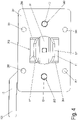
- FIG. 3 shows the furniture fittings 2 in a plan view after the top plate 20 has been assembled onto the base element 10.
- the latter protrudes at least partially (in terms of its height) through a recess 203 in the top plate 20.
- the recess 203 is rectangular in the illustrated embodiment and dimensioned so that the clamping element 17 with its clamping wings 171 in the shown rotational position of the clamping element 17 just fits through the recess 203.
- the pivoting lever 15 is pivoted by 90° in this exemplary embodiment and then assumes the 4 position shown.
- the pivoting movement of the pivoting lever 15 leads to a corresponding rotation of the clamping element 17.
- sections of the clamping element 17 overlap the cover plate 20 in the area of the edges of the recess 203.
- the inclined clamping wings 171 of the clamping element 17 first run onto the side edges of the recess 203 .
- the corresponding side edges are provided with a chamfer 204 in the exemplary embodiment shown.
- the chamfered side edge and the sloping clamping wings 171 thus form run-on bevels, through which the cover plate 20 is pressed in the direction of the base plate 11 when running against one another.
- the cover plate 20 Since the cover plate 20 only rests on the raised supports 12 in its outer region, the cover plate 20 and to a certain extent also the base plate 11 can bend slightly in a resilient manner and are thus clamped against one another by the clamping element 17 .
- the spring effect of the cover plate 20 and optionally the base plate 11 also compensates for tolerances if the height of the rivet 14 and the thickness of the clamping lever 15 and/or the spacer disk 16 have material-related tolerances.
- the form fit achieved by the clamping element 17 overlapping the cover plate 20 absorbs forces acting axially along the axis of rotation of the clamping element 17 .
- the additional non-positive connection between the cover plate 20 and the base element 10 due to the bracing also absorbs transverse forces acting between the base element 10 and the cover plate 20 . These are additionally caught by the centering bolts 13.
- a concealed connection of large furniture parts is achieved with the furniture fitting according to the application, which can absorb forces and torques in every direction. The connection can also be released and re-established several times without any problems and without tools.
- figure 5 and 6 is the furniture fitting 4 shown in the locked state again each in a side view, where figure 5 a view on the long side of the base plate 11 and the cover plate 20 represents and 6 a view of the shorter transverse side of the cover plate 20 or the base plate 11.
- a substantially rectangular base plate 11 is used for the base element 10 and a cover plate 20 of the same shape.
- mounting holes 111 and 201 are provided, as well as centering bolts 13, which are connected to the base plate 11 and protrude through corresponding centering openings 202 of the cover plate 20 when the cover plate 20 and base plate 11 are in the assembled state.
- a raised support 12 designed as a bead is provided, which forms a support surface for the cover plate 20 .
- the bead 12 is formed by a protruding embossing of the base plate 11, but can also be formed by a separate element, as already mentioned in the first exemplary embodiment.
- a tensioning element 17 is provided, which is rotatably mounted on a rivet 14 on the base plate 11 .
- a laterally protruding pivoting lever 15 is connected in a rotationally fixed manner to the rivet 14 and thus to the tensioning element 17 .
- the clamping element 17 has the shape of a bow tie, in which, starting from a central round section, two clamping wings 171 in the shape of a segment of a circle, which extend radially outwards, are opposite one another.
- the side edges of the clamping wings 171 are provided with a chamfer 173.
- the shape of the recess 203 in the cover plate 20 is adapted to that of the clamping element 17 .
- the side edges of the recess 203 are also provided with a chamfer 204 here.
- the chamfer 173 on the recess 203 and the chamfer 204 of the side edges in turn form run-on bevels, which when the clamping element 17 is rotated from the in the 7 rotational position shown accrue on each other, whereby the cover plate 20 is pressed onto the base element 10.
Landscapes
- Engineering & Computer Science (AREA)
- General Engineering & Computer Science (AREA)
- Mechanical Engineering (AREA)
- Life Sciences & Earth Sciences (AREA)
- Wood Science & Technology (AREA)
- Hinges (AREA)
- Connection Of Plates (AREA)
- Cabinets, Racks, Or The Like Of Rigid Construction (AREA)
Description
- Die Erfindung betrifft einen Möbelbeschlag zur Verbindung von Möbelteilen, insbesondere von Polstermöbeln, mit einem an einem ersten Möbelteil befestigbaren Grundelement und einer an einem zweiten Möbelteil befestigbaren Deckplatte, wobei das Grundelement eine Grundplatte aufweist, an der ein hervorstehendes Spannelement drehbar befestigt. Die Deckplatte weist eine Aussparung auf, wobei das Spannelement in zumindest einer Drehstellung beim Aufeinanderfügen von Grundelement und Deckplatte zumindest teilweise durch die Aussparung ragt und wobei das Spannelement nach einer Verdrehung die Deckplatte im Bereich der Ränder der Aussparung zumindest abschnittsweise übergreift und so die Deckplatte form- und kraftschlüssig mit dem Grundelement verbindet. Es ist ein seitlich über das Grundelement hinausragender Schwenkhebel vorgesehen, der drehfest mit dem Spannelement gekoppelt ist. Die Erfindung betrifft weiterhin ein Möbel mit mindestens zwei Möbelteilen.
- Zur Verbindung von größeren Möbelteilen wie beispielsweise Sitzteilen, Rückenteilen oder Seitenteilen eines Polstermöbels werden häufig Steckverbindungen eingesetzt. Nachteilig bei derartigen Steckverbindungen ist, dass sie bei Bewegung der Möbelteile entgegen der Fügerichtung beim Verbinden wieder gelöst wird. Alternativ oder zusätzlich werden bei derartigen großen Möbelteilen von außen aufgebrachte Verbindungslaschen verwendet, was aufgrund von Verletzungsgefahren und aus Designgründen jedoch nur in nicht sichtbaren Bereichen, beispielsweise an einer Unterseite eines Sofas, möglich ist.
- Aus der Druckschrift
DE 10 2005 023 124 A1 ist eine Steck-Dreh-Verbindung zwischen einem Funktionselement, beispielsweise einem Bolzen oder einem Gewindeträger, und einem plattenförmigen Trägerbauteil beschrieben. Die Steck-Dreh-Verbindung kann eingesetzt werden, um die genannten Funktionselemente verdeckt festzulegen. Das Funktionselement wird dabei in eine topfförmige Aufnahmemulde des Trägerbauteils eingesteckt und dort durch eine Drehbewegung mit einem Bajonettverschluss festgelegt. Diese Art der verdeckten Verbindung ist für große Möbelteile ungeeignet, da mit großen Möbelteilen im Regelfall keine Drehbewegung beim Verbinden ausgeführt werden kann. Zudem verhindert die Drehbewegung, dass zwei zu verbindende Möbelteile mit mehr als einem Möbelbeschlag miteinander verbunden werden können, was für große Möbelteile jedoch üblicherweise notwendig ist. - Die Druckschrift
DE 20 2014 100 019 U1 beschreibet einen Möbelbeschlag, bei dem ein Grundelement und eine Deckplatte an jeweils einem von zwei miteinander lösbar zu verbindenden Möbelteilen befestigt wird. Über ein verdrehbares Spannelement, das nach einer Verdrehung die Deckplatte abschnittsweise im Bereich einer Aussparung übergreift, können die Deckplatte und eine Grundplatte des Grundelements und damit die beiden Möbelteile form- und kraftschlüssig miteinander verbunden werden. Zur Verdrehung des Spannelements ist dieses mit einem axial angeordneten knebelartigen Griff verbunden. Ein ähnlicher Möbelbeschlag ist auch aus der DruckschriftenUS 4,402,117 A bekannt. - Die Druckschrift
EP 1 110 485 A1 beschreibt einen Möbelbeschlag, mit dem zwei nebeneinander liegende Möbelteil verbunden werden können. Dazu werden auf beide Möbelteile in einer Ebene nebeneinander Platten befestigt, von denen eine mit einem überstehenden Riegel die andere Platte überlappt. Im Überlappungsbereich wird der Riegel mit Hilfe eines Knebels an der unterliegenden Platte befestigt. Der Knebel ist dazu mit einem exzentrischen Element verbunden, das durch eine Bohrung in der unterliegenden Platte geführt wird und dort durch Drehung des Knebels eingreift. Der Beschlag ist allerdings nicht für eine verdeckte Verbindung von übereinander liegenden Platten geeignet. - Es ist eine Aufgabe der vorliegenden Erfindung, einen Möbelbeschlag für Möbelteile, insbesondere große Möbelteile von Polstermöbeln, zu schaffen, der eine auch entgegen der Fügerichtung belastbare und verdeckte Verbindung schafft, die möglichst werkzeuglos einfach hergestellt und auch wieder gelöst werden kann.
- Diese Aufgabe wird durch einen Möbelbeschlag bzw. ein Möbel mit den Merkmalen des jeweiligen unabhängigen Anspruchs gelöst. Vorteilhafte Ausgestaltungen und Weiterbildungen sind in den abhängigen Ansprüchen angegeben.
- Bei einem erfindungsgemäßen Möbelbeschlag der eingangs genannten Art sind das Spannelement und der Schwenkhebel mittels eines Niets drehbar an der Grundplatte gelagert und über den Niet drehfest miteinander gekoppelt, wobei der Niet einen Mehrkantabschnitt aufweist und durch Mehrkantöffnungen des Spannelements und des Schwenkhebels geführt ist.
- Über den Schwenkhebel kann das Spannelement verdreht und damit die Verbindung von Grundelement und Deckplatte hergestellt bzw. wieder gelöst werden. Der Möbelbeschlag kann so bevorzugt zur Verbindung von Polstermöbelteilen eingesetzt werden, wobei der Möbelbeschlag im Polsterspalt zwischen den Möbelteilen verdeckt ist und gleichzeitig durch Eingriff in den Polsterspalt der Schwenkhebel bequem betätigt werden kann.
- Durch das drehbar auf der Grundplatte des Grundelementes befestigte Spannelement können das Grundelement und die Deckplatte, die jeweils an den zu verbindenden Möbelteilen montiert sind, durch eine reine Translationsbewegung zusammen gefügt werden und danach durch eine Verdrehung des Spannelements miteinander verbunden werden. Da eine reine Translationsbewegung als Fügebewegung erfolgt, können mehrere derartige Möbelbeschläge zur Verbindung von zwei Möbelteilen an diesen befestigt sein. Die Verbindung kann durch ein Zurückdrehen des Spannelements in die Ausgangsposition, nachfolgend auch entriegelte Position genannt, wieder getrennt werden.
- In einer vorteilhaften Ausgestaltung des Möbelbeschlags ist ein seitlich über das Grundelement hinausragender Schwenkhebel vorgesehen, der drehfest mit dem Spannelement gekoppelt ist. Über den Schwenkhebel kann das Spannelement verdreht und damit die Verbindung von Grundelement und Deckplatte hergestellt bzw. wieder gelöst werden. Ein derartiger Möbelbeschlag kann bevorzugt zur Verbindung von Polstermöbelteilen eingesetzt werden, wobei der Möbelbeschlag im Polsterspalt zwischen den Möbelteilen verdeckt ist und gleichzeitig durch Eingriff in den Polsterspalt der Schwenkhebel bequem betätigt werden kann.
- Die Auslegung des Möbelbeschlags und seine Anordnung an dem Möbel erfolgt bevorzugt so, dass der Schwenkhebel nach der Montage nicht mehr sichtbar ist. Entsprechend ist der Schwenkhebel so ausgebildet, dass er im Schließzustand möglichst gut an dem Grundelement anliegt. Alternativ kann der Schwenknebel aber auch als bewusst sichtbares Designelement ausgebildet sein.
- In einer ebenfalls bevorzugten Weiterbildung ist eine bevorzugt als geprägte Sicke ausgebildete erhöhte Auflagefläche an der Grundplatte vorhanden, bevorzugt in einem Randbereich der Grundplatte, wobei zumindest ein Schwenkbereich des Schwenkhebels ausgespart ist. Die Deckplatte liegt bei dieser Ausgestaltung bei gefügter Verbindung auf der erhöhten Auflage auf. Im Schwenkbereich des Hebels ist so ein Spalt zwischen Deckplatte und Grundplatte gebildet, in dem der Schwenkhebel bewegbar ist. Bei Auflage der Deckplatte nur in einem Randbereich der Grundplatte kann der mittlere Bereich der Deckplatte gegenüber der Grundplatte einfedern, wodurch eine kraftschlüssige und Toleranzen ausgleichende Verspannung der beiden Platten zueinander erzielt wird.
- In einer weiteren vorteilhaften Ausgestaltung des Möbelbeschlags sind Anlaufschrägen an dem Spannelement und/oder der Aussparung der Deckplatte vorgesehen. Beim Schließen der Verbindung zwischen Grundelement und Deckplatte wechselwirken die Anlaufschrägen miteinander, wodurch das Spannelement auch eine nicht vollständig auf dem Grundelement aufliegende Deckplatte greifen und auf das Grundelement heranziehen kann. Bei weiterer Drehbewegung des Spannelements wird eine Verspannung zwischen Spannelement und damit Grundelement und Deckplatte erreicht, wodurch eine feste und belastbare Verbindung der beiden Bauteile gegeben ist. In einer bevorzugten Ausgestaltung ist mindestens eine Seitenkante der Aussparung der Deckplatte und/oder des Spannelements mit einer Fase versehen, um eine Anlaufschräge zu bilden. In einer weiteren vorteilhaften Ausgestaltung weist das Spannelement mindestens einen radial nach außen weisenden Spannflügel auf, der angeschrägt und/oder gegenüber der Grundplatte schräg gestellt ist, um eine Anlaufschräge zu bilden. Die Anschrägung kann dabei durch eine Fase an mindestens einer Seitenkante des Spannflügels gebildet sein. Eine Schrägstellung kann beispielsweise durch eine Abkantung eines Teils des Spannflügels gebildet sein.
- In einer weiteren vorteilhaften Ausgestaltung des Möbelbeschlags ist an der Grundplatte mindestens ein hervorstehender Zentrierbolzen angeordnet, der in einer Fügeposition in korrespondierende Bohrungen der Deckplatte dringt. Der Zentrierbolzen nimmt im verbundenen Zustand von Grundelement und Deckplatte zwischen diesen wirkende Querkräfte auf. Bevorzugt ist der mindestens eine Zentrierbolzen an seinem freien Ende verjüngt, wodurch sich die Deckplatte und das Grundelement beim Aufeinanderfügen selbständig zueinander ausrichten. Weiter bevorzugt sind mindestens zwei Zentrierbolzen vorgesehen, wodurch ein zwischen Grundelement und Deckplatten wirkendes Drehmoment im verbundenen Zustand aufgenommen wird und so eine drehfeste Verbindung zwischen Grundelement und Deckplatte geschaffen ist.
- Um eine lagerichtige Positionierung zweier Möbelteile zu erreichen, können die Deckplatten und die Grundplatten mit Prägungen beziehungsweise Durchzüge versehen werden, die sich in entsprechend angebrachte Öffnungen beziehungsweise Bohrungen in den Möbelteilen fügen lassen.
- Bei einem erfindungsgemäßen Möbel mit mindestens zwei Möbelteilen ist wenigstens ein derartiger Möbelbeschlag zur Verbindung der mindestens zwei Möbelteile vorgesehen. Es ergeben sich unter anderem die zuvor genannten im Zusammenhang mit dem Möbelbeschlag genannten Vorteile. Da zum Zusammensetzen der Möbelteile kein Eingriff in das Innere des Möbels erforderlich ist, ermöglicht der erfindungsgemäße Möbelbeschlag zudem ein vollständiges Polstern der einzelnen Möbelteile vor dem Zusammensetzen der einzelnen Möbelteile zum kompletten Möbel.
- Die Erfindung wird nachfolgend anhand von Ausführungsbeispielen mithilfe von Figuren näher erläutert. Die Figuren zeigen:
- Fig. 1
- eine perspektivische schematische Explosionsdarstellung eines Möbels mit mehreren Möbelteilen und Verbindungsbeschlägen;
- Fig. 2
- eine perspektivische Explosionsdarstellung eines Möbelbeschlag in einem ersten Ausführungsbeispiel;
- Fig. 3
- eine Draufsicht auf den Möbelbeschlag der
Fig.2 in einem entriegelten Zustand; - Fig. 4
- eine Draufsicht auf den Möbelbeschlag der
Fig.2 in einem verriegelten Zustand; - Fig. 5, 6
- jeweils eine Seitenansicht des Möbelbeschlags des ersten Ausführungsbeispiels aus verschiedenen Blickrichtungen und
- Fig. 7
- eine perspektivische Ansicht eines Möbelbeschlags in einem zweiten Ausführungsbeispiel
-
Fig. 1 zeigt in einer perspektivischen schematischen Zeichnung ein aus mehreren Möbelteilen zusammengesetztes Sitzmöbel. Dargestellt ist ein Sofa mit einem Sitzteil 1, einer Rückenlehne 2 und einem Seitenteil 3. Zur Verbindung der einzelnen Möbelteile sind Möbelbeschläge vorgesehen, die jeweils ein Grundelement 10 und eine Deckplatte 20 aufweisen. Das Grundelement 10 ist jeweils an einem der Möbelteile befestigt, beispielsweise mithilfe von Schrauben, und die dazugehörige Deckplatte 20 an einem anderen der Möbelteile. - Zum Zusammensetzen des gezeigten Möbels wird die Rückenlehne 2 auf das Sitzteil 1 entlang der dargestellten gestrichelten Linie abgesenkt, wodurch die an der Unterseite der Rückenlehne 2 angeordneten und in der
Fig. 1 nicht sichtbaren an der Rückenlehne 2 montierten Deckplatten 20 mit den am Sitzteil 1 montierten Grundelementen 10 aufeinandergefügt werden. An den Grundelementen 10 sind Schwenkhebel 15 angeordnet, die nach dem Aufsetzen der Rückenlehne 2 auf das Sitzteil 1 aus dem Spalt zwischen den beiden Möbelteilen herausragen. Ein Verschwenken der Schwenkhebel 15 verspannt die Deckplatten 20 gegenüber den Grundelementen 10 und legt so die Rückenlehne 2 am Sitzteil 1 fest. Beim Betätigen der Schwenkhebel 15 schwenken diese in den Polsterspalt zwischen dem Sitzteil 1 und der Rückenlehne 2 ein, sodass der gesamte Möbelbeschlag nicht mehr sichtbar zwischen den Möbelteilen verdeckt angeordnet ist. - Nach dem Verbinden von Sitzteil 1 und Rückenlehne 2 wird das Seitenteil 3 entlang der im unteren Bereich dargestellten Verbindungslinien auf die Einheit aus Sitzteil 1 und Rückenlehne 2 zubewegt. Die drei Deckplatten 20, die am Seitenteil 3 montiert sind, werden dadurch auf die zugehörigen Grundelemente 10 gefügt und wiederum durch Betätigung der Schwenkhebel 15 arretiert.
- Es versteht sich, dass die Anzahl der zur Verbindung der Möbelteile verwendeten Möbelbeschläge je nach Belastung variieren kann.
- In
Fig. 2 ist ein Möbelbeschlag, wie er bei dem Beispiel derFig. 1 verwendet wird, detaillierter in einer perspektivischen Explosionszeichnung dargestellt. - Das Grundelement 10 weist eine Grundplatte 11 auf, in die Montagelöcher 111 zur Befestigung des Grundelements 10 an einem Möbelteil eingebracht sind. Die Montagelöcher 111 sind vorliegend mit einer Versenkung für Senkkopfschrauben ausgebildet.
- Die Grundform der Grundplatte 11 ist im dargestellten Ausführungsbeispiel rechteckig, wobei im Bereich der kürzeren Querseiten erhöhte Auflagen 12 als Auflageflächen für die Deckplatte 20 auf die Grundplatte 11 aufgebracht sind.
- Die Grundplatte 11 ist bevorzugt aus Blech in einem Stanzverfahren gefertigt. Die erhöhten Auflagen 12 können bevorzugt während des Stanzverfahrens als Sicken geprägt werden. Alternativ können die erhöhten Auflagen 12 auch als separate Blechelemente auf der Grundplatte 11 verschweißt werden oder als separate Kunststoffelemente, beispielsweise in einem Spritzgussverfahren gefertigt, auf die Grundplatte 11 aufgeklebt werden. Im Bereich der erhöhten Auflagen 12 ist eine Bohrung 113 durch die erhöhten Auflagen 12 und die Grundplatte 11 eingebracht, in die jeweils ein Zentrierbolzen 13 eingesteckt und mit der Grundplatte 11 verbunden, beispielsweise vernietet wird. Die Zentrierbolzen stellen in dem Fall, wo die erhöhten Auflagen 12 als separate Elemente ausgebildet sind, eine zusätzliche Befestigung für die erhöhten Auflagen 12 dar. Der Zentrierbolzen 13 steht im Wesentlichen senkrecht zur Oberfläche der Grundplatte 11 und der erhöhten Auflage 12 hervor.
- Mittig in der Grundplatte 11 ist eine Lagerbohrung 112 angeordnet, in die von der Unterseite der Grundplatte 11 her ein Niet 14 eingesteckt wird, der mit einem seitlich überstehenden Rand 141 an der Unterseite der Grundplatte 11 anliegt und sich in der Lagerbohrung 112 frei drehen kann. Von der Oberseite der Grundplatte 11 her ist auf den Niet 14 ein Schwenkhebel 15, eine Distanzscheibe 16 und ein Spannelement 17 aufgesetzt. Der aufgesetzte Schwenkhebel 15 ragt mit einem Griff 151 seitlich über die Fläche des Grundelementes 10 hinaus. Im dargestellten Ausführungsbeispiel ist der Schwenkhebel 15 winklig ausgeführt. Der Niet 14 ist durch eine Mehrkantöffnung 152 des Hebels gesteckt und ist im Kontaktbereich mit dem Schwenkhebel 15 ebenfalls mit einem Mehrkantabschnitt 142 ausgebildet. Der Schwenkhebel 15 und der Niet 14 sind auf diese Weise drehfest miteinander gekoppelt.
- Das Spannelement 17 ist im dargestellten Ausführungsbeispiel ein in einem Stanzbiegeprozess hergestelltes Blechelement, das einen ebenen Mittelbereich aufweist, in dem sich eine zentrale Mehrkantöffnung 172 befindet. Zu zwei gegenüberliegenden Seiten hin sind äußere Abschnitte des Spannelements 17 schräg nach oben gebogen. Diese Abschnitte werden nachfolgend als Spannflügel 171 bezeichnet. Die Mehrkantöffnung 172 des Spannelements17 liegt ebenfalls im Bereich des Mehrkantabschnitt 142 des Niets 14, sodass das Spannelement 17 drehfest mit dem Niet 14 und damit drehfest mit dem Schwenkhebel 15 verbunden ist. Nach Aufsetzen des Spannelements 17 wird der Niet 14 im Bereich eines nach oben aus dem Spannelement 17 ragenden Nietkopfs 143 verprägt.
- Im Bereich der Lagerbohrung 112 sind an der Grundplatte 11 leicht hervorstehende Anschläge 114 angeordnet, die den Schwenkbereich des Schwenkhebels 15 begrenzen. Die Anschläge 114 erleichtern das korrekte Einstellen der optimalen Entriegelungsposition und Verrieglungsposition.
- Neben dem Grundelement 10 weist der Möbelbeschlag die Deckplatte 20 auf, die mit dem Grundelement 10 lösbar verbunden werden kann. Die Deckplatte 20 hat vorliegend dieselben Außenabmessungen wie die Grundplatte 11 und ist ebenfalls als ein Stanzteil aus Blech gefertigt. Sie weist Montagelöcher 201 auf, mit der die Deckplatte 20 wie die Grundplatte 11 an einem Möbelteil befestigt werden kann. Weiterhin sind in die Deckplatte 20 Zentrieröffnungen 202 eingebracht, in die beim Zusammenfügen der Deckplatte 20 auf das Grundelement 10 die Zentrierbolzen 13 dringen. Um das Zusammenfügen von Deckplatte 20 und Grundelement 10 zu vereinfachen, können die Zentrierbolzen 13 im Bereich ihres freien Endes verjüngt sein, beispielsweise indem sie eine umlaufende Fase 131 am oberen Rand aufweisen (vgl.
Fig. 5 ). Auch eine sich über einen längeren Abschnitt des Zentrierbolzens 13 erstreckende Verjüngung ist möglich. -
Fig. 3 zeigt den Möbelbeschlag ausFig. 2 in einer Draufsicht nach dem Aufeinanderfügen von Deckplatte 20 auf das Grundelement 10. In der gezeigten Drehstellung des Spannelements 17 ragt dieses zumindest teilweise (im Hinblick auf seine Höhe) durch eine Aussparung 203 der Deckplatte 20 hindurch. Die Aussparung 203 ist im dargestellten Ausführungsbeispiel rechteckig und so dimensioniert, dass das Spannelement 17 mit seinen Spannflügeln 171 in der dargestellten Drehstellung des Spannelements 17 gerade durch die Aussparung 203 passt. - Zum Verbinden der Deckplatte 20 mit dem Grundelement 10 wird der Schwenkhebel 15 in diesem Ausführungsbeispiel um 90° verschwenkt und nimmt dann die in
Fig. 4 dargestellte Stellung ein. Die Schwenkbewegung des Schwenkhebels 15 führt zu einer entsprechenden Drehung des Spannelements 17. Durch die Drehung übergreifen Abschnitte des Spannelements 17 die Deckplatte 20 im Bereich der Ränder der Aussparung 203. - Bei der Drehbewegung des Spannelements 17 laufen zunächst die schräg stehenden Spannflügel 171 des Spannelements 17 auf Seitenkanten der Aussparung 203 auf. Um dieses Auflaufen zu unterstützen, sind die entsprechenden Seitenkanten im dargestellten Ausführungsbeispiel mit einer Fase 204 versehen. Die angefaste Seitenkante sowie die schräg stehenden Spannflügel 171 bilden so Anlaufschrägen, durch die beim Aufeinanderlaufen die Deckplatte 20 in Richtung der Grundplatte 11 gedrückt wird.
- Da die Deckplatte 20 nur in ihrem äußeren Bereich auf den erhöhten Auflagen 12 aufliegt, können sich die Deckplatte 20 und im gewissen Maße auch die Grundplatte 11 leicht federnd durchbiegen und werden so durch das Spannelement 17 gegeneinander verspannt. Durch die Federwirkung der Deckplatte 20 und gegebenenfalls der Grundplatte 11 ist zudem ein Toleranzausgleich gegeben, falls die Höhe des Niets 14 sowie die Dicke des Spannhebels 15 und/oder der Distanzscheibe 16 materialbedingte Toleranzen aufweisen.
- Der durch das Übergreifen des Spannelements 17 auf die Deckplatte 20 erreichte Formschluss nimmt axial entlang der Drehachse des Spannelements 17 wirkende Kräfte auf. Die durch das Verspannen zusätzlich kraftschlüssige Verbindung zwischen der Deckplatte 20 und dem Grundelement 10 nimmt zudem zwischen dem Grundelement 10 und der Deckplatte 20 wirkende Querkräfte auf. Diese werden zusätzlich durch die Zentrierbolzen 13 aufgefangen. Zusammenfassend wird mit dem anmeldungsgemäßen Möbelbeschlag eine verdeckte Verbindung von großen Möbelteilen erzielt, die Kräfte und Drehmomente in jeder Richtung aufnehmen kann. Die Verbindung kann zudem problemlos und ohne Werkzeug mehrfach gelöst und wieder hergestellt werden.
- In den
Fig. 5 und6 ist der Möbelbeschlag derFig. 4 im verriegelten Zustand nochmals jeweils in einer Seitenansicht dargestellt, wobeiFig. 5 eine Ansicht auf die Längsseite der Grundplatte 11 bzw. der Deckplatte 20 darstellt undFig. 6 eine Ansicht auf die kürzere Querseite der Deckplatte 20 bzw. der Grundplatte 11. - In
Fig. 7 ist ein zweites Ausführungsbeispiel eines anwendungsgemäßen Möbelbeschlags dargestellt. Gleiche Bezugszeichen kennzeichnen in dieser Figur gleiche oder gleichwirkende Elemente wie bei den voranstehenden Figuren. Auch bei diesem Ausführungsbeispiel ist eine im Wesentlichen rechteckige Grundplatte 11 für das Grundelement 10 und eine Deckplatte 20 der gleichen Form verwendet. Wiederum sind Montagelöcher 111 bzw. 201 vorgesehen, sowie Zentrierbolzen 13, die mit der Grundplatte 11 verbunden sind und die im zusammengefügten Zustand von Deckplatte 20 und Grundplatte 11 durch entsprechende Zentrieröffnungen 202 der Deckplatte 20 ragen. - Ebenfalls wie beim ersten Ausführungsbeispiel ist eine als Sicke ausgebildete erhöhte Auflage 12 vorgesehen, die eine Auflagefläche für die Deckplatte 20 bildet. Die Sicke 12 ist durch eine hervorstehende Prägung der Grundplatte 11 gebildet, kann aber, wie im ersten Ausführungsbeispiel bereits erwähnt, auch durch ein separates Element gebildet werden.
- Ebenfalls analog zum ersten Ausführungsbeispiel ist ein Spannelement 17 vorgesehen, das auf einem Niet 14 drehbar an der Grundplatte 11 gelagert ist. Drehfest mit dem Niet 14 und damit dem Spannelement 17 ist ein seitlicher herausragender Schwenkhebel 15 verbunden.
- Ein Unterschied zum ersten Ausführungsbeispiel besteht in der Ausgestaltung des Spannelements 17 und der Aussparung 203, durch die das Spannelement 17 ragt. Das Spannelement 17 hat vorliegend die Form einer Fliege, bei der ausgehend von einem mittleren runden Abschnitt zwei sich radial nach außen erstreckende kreissegmentförmige Spannflügel 171 gegenüberstehen. Dabei sind die Seitenkanten der Spannflügel 171 mit einer Fase 173 versehen. Denkbar ist natürlich auch, das Spannelement mit nur einem sich radial nach außen erstreckenden kreissegmentförmigen Spannflügel zu versehen.
- Die Aussparung 203 der Deckplatte 20 ist in ihrer Form dem Spannelement 17 angepasst. Wie beim ersten Ausführungsbeispiel sind auch hier Seitenkanten der Aussparung 203 mit einer Fase 204 versehen. Die Fase 173 an der Aussparung 203 und die Fase 204 der Seitenkanten bilden wiederum Anlaufschrägen, die bei einer Verdrehung des Spannelements 17 aus der in der
Fig. 7 gezeigten Drehstellung aufeinander auflaufen, wodurch die Deckplatte 20 auf das Grundelement 10 gepresst wird. -
- 1
- Sitzteil
- 2
- Rückenlehne
- 3
- Seitenteil
- 10
- Grundelement
- 11
- Grundplatte
- 111
- Montageloch
- 112
- Bohrung für Niet
- 113
- Bohrung für Zentrierbolzen
- 114
- Anschlag
- 12
- Auflage / Sicke
- 13
- Zentrierbolzen
- 131
- Fase
- 14
- Niet
- 141
- überstehender Rand
- 142
- Mehrkantabschnitt
- 143
- Nietkopf
- 15
- Schwenkhebel
- 151
- Griff
- 152
- Mehrkantöffnung
- 16
- Distanzscheibe
- 17
- Spannelement
- 171
- Spannflügel
- 172
- Mehrkantöffnung
- 173
- Fase
- 20
- Deckplatte
- 201
- Montageloch
- 202
- Zentrieröffnung
- 203
- Aussparung
- 204
- Fase
Claims (8)
- Möbelbeschlag zur Verbindung von Möbelteilen, insbesondere von Polstermöbeln, mit einem an einem ersten Möbelteil befestigbaren Grundelement (10) und einer an einem zweiten Möbelteil befestigbaren Deckplatte (20), wobei- das Grundelement (10) eine Grundplatte (11) aufweist, an der ein hervorstehendes Spannelement (17) drehbar befestigt ist und- die Deckplatte (20) eine Aussparung (203) aufweist, wobei- das Spannelement (17) in zumindest einer Drehstellung beim Aufeinanderfügen von Grundelement (10) und Deckplatte (20) zumindest teilweise durch die Aussparung (203) ragt, und wobei- das Spannelement (17) nach einer Verdrehung die Deckplatte (20) im Bereich der Aussparung (203) zumindest abschnittsweise übergreift und so die Deckplatte (20) form- und kraftschlüssig mit dem Grundelement (10) verbindet,wobei mit dem Spannelement (17) ein seitlich über das Grundelement (10) hinausragenden Schwenkhebel (15) drehfestgekoppelt ist,dadurch gekennzeichnet, dassdas Spannelement (17) und der Schwenkhebel (15) mittels eines Niets (14) drehbar an der Grundplatte (11) gelagert sind und über den Niet (14) drehfest miteinander gekoppelt sind, wobei der Niet (14) einen Mehrkantabschnitt (142) aufweist und durch Mehrkantöffnungen (172, 152) des Spannelements (17) und des Schwenkhebels (15) geführt ist.
- Möbelbeschlag nach Anspruch 1, bei dem mindestens eine erhöhte Auflage (12) für die Deckplatte (20) an der Grundplatte (11) vorhanden ist.
- Möbelbeschlag nach Anspruch 2, bei dem die erhöhte Auflage (12) in einem Randbereich der Grundplatte (11) ausgebildet ist, wobei zumindest ein Schwenkbereich des Schwenkhebels (15) ausgespart ist.
- Möbelbeschlag nach einem der Ansprüche 1 bis 3, bei dem Anlaufschrägen an dem Spannelement (17) und/oder der Aussparung (203) der Deckplatte (20) vorgesehen sind.
- Möbelbeschlag nach Anspruch 4, bei dem mindestens eine Seitenkante der Aussparung (203) und/oder des Spannelements (17) mit einer Fase (204, 173) versehen ist.
- Möbelbeschlag nach Anspruch 4 oder 5, bei dem das Spannelement (17) mindestens einen radial nach außen weisenden Spannflügel (171) aufweist, der angeschrägt und/oder gegenüber der Grundplatte (11) schräg gestellt ist.
- Möbelbeschlag nach einem der Ansprüche 1 bis 6, bei dem an der Grundplatte (11) mindestens ein hervorstehender Zentrierbolzen (13) angeordnet ist.
- Möbel mit mindestens zwei Möbelteilen, dadurch gekennzeichnet, dass zum Verbinden der mindestens zwei Möbelteile wenigstens ein Möbelbeschlag gemäß einem der Ansprüche 1 bis 7 vorgesehen ist.
Applications Claiming Priority (1)
| Application Number | Priority Date | Filing Date | Title |
|---|---|---|---|
| DE102014114045.1A DE102014114045B4 (de) | 2014-09-26 | 2014-09-26 | Möbel und Möbelbeschlag zur Verbindung von Möbelteilen |
Publications (2)
| Publication Number | Publication Date |
|---|---|
| EP3000357A1 EP3000357A1 (de) | 2016-03-30 |
| EP3000357B1 true EP3000357B1 (de) | 2023-01-18 |
Family
ID=54106249
Family Applications (1)
| Application Number | Title | Priority Date | Filing Date |
|---|---|---|---|
| EP15184809.0A Active EP3000357B1 (de) | 2014-09-26 | 2015-09-11 | Möbel und möbelbeschlag zur verbindung von möbelteilen |
Country Status (4)
| Country | Link |
|---|---|
| EP (1) | EP3000357B1 (de) |
| DE (1) | DE102014114045B4 (de) |
| ES (1) | ES2941689T3 (de) |
| PL (1) | PL3000357T3 (de) |
Family Cites Families (8)
| Publication number | Priority date | Publication date | Assignee | Title |
|---|---|---|---|---|
| GB489675A (en) * | 1937-02-06 | 1938-08-02 | Wales Ltd | Improvements relating to catches or fastenings for the rails of drop-side cots or bedsteads |
| JPS5750571Y2 (de) * | 1979-10-01 | 1982-11-05 | ||
| DE4016486A1 (de) * | 1990-05-22 | 1991-11-28 | Wilkhahn Wilkening & Hahne | Verbindungseinrichtung |
| DE29922635U1 (de) * | 1999-12-23 | 2000-02-24 | Heinrich Brune GmbH & Co., 53639 Königswinter | Einrichtung zum gegenseitigen Verriegeln von gruppierbaren Möbeln |
| AT5785U1 (de) * | 2001-11-07 | 2002-11-25 | Hilber Beschlaege Ges Mbh | Vorrichtung zum lösbaren verbinden zweier oder mehrerer bauelemente ohne einsatz von werkzeugen |
| DE102005023124A1 (de) | 2005-05-19 | 2006-11-30 | Böllhoff Verbindungstechnik GmbH | Steck-Dreh-Verbindung |
| US20140079511A1 (en) * | 2012-09-14 | 2014-03-20 | Worthington Maritime, LLC | Mounting Fastener for Securing Loads to Surfaces |
| CN203591077U (zh) * | 2013-12-04 | 2014-05-14 | 杭州中艺实业有限公司 | 一种模块化沙发 |
-
2014
- 2014-09-26 DE DE102014114045.1A patent/DE102014114045B4/de active Active
-
2015
- 2015-09-11 EP EP15184809.0A patent/EP3000357B1/de active Active
- 2015-09-11 ES ES15184809T patent/ES2941689T3/es active Active
- 2015-09-11 PL PL15184809.0T patent/PL3000357T3/pl unknown
Also Published As
| Publication number | Publication date |
|---|---|
| ES2941689T3 (es) | 2023-05-24 |
| DE102014114045A1 (de) | 2016-03-31 |
| PL3000357T3 (pl) | 2023-06-05 |
| EP3000357A1 (de) | 2016-03-30 |
| DE102014114045B4 (de) | 2026-01-22 |
Similar Documents
| Publication | Publication Date | Title |
|---|---|---|
| DE2810626C2 (de) | Verbindungsbeschlag für senkrecht aufeinanderstehende Möbelteile | |
| EP2901888B1 (de) | Möbel | |
| EP2504509B1 (de) | Verdeckt angeordnetes 180°-scharnier | |
| EP3324789B1 (de) | Möbel mit rahmen zum sichern einer klappbaren möbelsäule | |
| EP2636830B1 (de) | Türbandbefestigung, Baugruppe mit der Türbandbefestigung und einem Türband sowie Türanordnung | |
| EP2181290B1 (de) | Haushaltsgerätetür mit einer vorrichtung zum verbinden von glasscheiben | |
| DE19517924B4 (de) | Möbelbeschlagteil | |
| WO2016045940A1 (de) | Möbelscharnier | |
| EP2112301B1 (de) | Griffrosette für einen Handgriff eines Beschlags | |
| EP3000357B1 (de) | Möbel und möbelbeschlag zur verbindung von möbelteilen | |
| EP3228879B1 (de) | Verbindungsbeschlag, anordnung und verfahren zum verbinden von zwei leichtbauplatten | |
| EP2565351B1 (de) | Griffanordnung | |
| EP2486824B1 (de) | Frontblende für Möbel | |
| EP2446775B1 (de) | Verbindungsanordnung zur werkzeuglosen Montage von Möbelteilen | |
| DE19812300A1 (de) | Tisch | |
| DE29716096U1 (de) | Schnellverschluß | |
| EP2233039B1 (de) | Schubkastenführung | |
| EP3663500B1 (de) | Verriegelungsbeschlag für aneinander grenzende rahmen-konstruktionsteile | |
| EP2339101B9 (de) | Türscharnier für Kraftfahrzeuge | |
| EP2226440A2 (de) | Beschlagelement | |
| EP2446776B1 (de) | Verbindungsvorrichtung zum Verbinden eines ersten und eines zweiten Möbelbauteils mit einem dritten Möbelbauteil, Teilesatz sowie Tisch | |
| DE2824631A1 (de) | Beschlag fuer scheibenfoermige glaskoerper | |
| DE102004044754A1 (de) | Neigungsverstellbeschlag für die Rückenlehne eines Kraftfahrzeugsitzes | |
| DE20107248U1 (de) | Unterfederungselement eines Sitz- oder Liegemöbels | |
| DE7907976U1 (de) | Beschlag zum Verbinden von zwei Bauteilen aus Holz o.dgl |
Legal Events
| Date | Code | Title | Description |
|---|---|---|---|
| PUAI | Public reference made under article 153(3) epc to a published international application that has entered the european phase |
Free format text: ORIGINAL CODE: 0009012 |
|
| AK | Designated contracting states |
Kind code of ref document: A1 Designated state(s): AL AT BE BG CH CY CZ DE DK EE ES FI FR GB GR HR HU IE IS IT LI LT LU LV MC MK MT NL NO PL PT RO RS SE SI SK SM TR |
|
| AX | Request for extension of the european patent |
Extension state: BA ME |
|
| RIN1 | Information on inventor provided before grant (corrected) |
Inventor name: SCHWETTMANN, EIKE Inventor name: NILL, OLIVER Inventor name: STRAUSS, GERD |
|
| 17P | Request for examination filed |
Effective date: 20160908 |
|
| RBV | Designated contracting states (corrected) |
Designated state(s): AL AT BE BG CH CY CZ DE DK EE ES FI FR GB GR HR HU IE IS IT LI LT LU LV MC MK MT NL NO PL PT RO RS SE SI SK SM TR |
|
| STAA | Information on the status of an ep patent application or granted ep patent |
Free format text: STATUS: EXAMINATION IS IN PROGRESS |
|
| 17Q | First examination report despatched |
Effective date: 20190716 |
|
| REG | Reference to a national code |
Ref country code: DE Ref legal event code: R079 Ref document number: 502015016244 Country of ref document: DE Free format text: PREVIOUS MAIN CLASS: A47C0007420000 Ipc: A47C0004020000 |
|
| RIC1 | Information provided on ipc code assigned before grant |
Ipc: F16B 12/60 20060101ALI20220512BHEP Ipc: A47C 13/00 20060101ALI20220512BHEP Ipc: A47C 7/54 20060101ALI20220512BHEP Ipc: A47C 7/42 20060101ALI20220512BHEP Ipc: F16B 12/20 20060101ALI20220512BHEP Ipc: A47C 4/02 20060101AFI20220512BHEP |
|
| GRAP | Despatch of communication of intention to grant a patent |
Free format text: ORIGINAL CODE: EPIDOSNIGR1 |
|
| STAA | Information on the status of an ep patent application or granted ep patent |
Free format text: STATUS: GRANT OF PATENT IS INTENDED |
|
| INTG | Intention to grant announced |
Effective date: 20220830 |
|
| GRAS | Grant fee paid |
Free format text: ORIGINAL CODE: EPIDOSNIGR3 |
|
| GRAA | (expected) grant |
Free format text: ORIGINAL CODE: 0009210 |
|
| STAA | Information on the status of an ep patent application or granted ep patent |
Free format text: STATUS: THE PATENT HAS BEEN GRANTED |
|
| AK | Designated contracting states |
Kind code of ref document: B1 Designated state(s): AL AT BE BG CH CY CZ DE DK EE ES FI FR GB GR HR HU IE IS IT LI LT LU LV MC MK MT NL NO PL PT RO RS SE SI SK SM TR |
|
| REG | Reference to a national code |
Ref country code: GB Ref legal event code: FG4D Free format text: NOT ENGLISH |
|
| REG | Reference to a national code |
Ref country code: CH Ref legal event code: EP |
|
| REG | Reference to a national code |
Ref country code: AT Ref legal event code: REF Ref document number: 1544220 Country of ref document: AT Kind code of ref document: T Effective date: 20230215 Ref country code: IE Ref legal event code: FG4D Free format text: LANGUAGE OF EP DOCUMENT: GERMAN |
|
| REG | Reference to a national code |
Ref country code: DE Ref legal event code: R096 Ref document number: 502015016244 Country of ref document: DE |
|
| REG | Reference to a national code |
Ref country code: LT Ref legal event code: MG9D |
|
| REG | Reference to a national code |
Ref country code: NL Ref legal event code: MP Effective date: 20230118 Ref country code: ES Ref legal event code: FG2A Ref document number: 2941689 Country of ref document: ES Kind code of ref document: T3 Effective date: 20230524 |
|
| PG25 | Lapsed in a contracting state [announced via postgrant information from national office to epo] |
Ref country code: NL Free format text: LAPSE BECAUSE OF FAILURE TO SUBMIT A TRANSLATION OF THE DESCRIPTION OR TO PAY THE FEE WITHIN THE PRESCRIBED TIME-LIMIT Effective date: 20230118 |
|
| PG25 | Lapsed in a contracting state [announced via postgrant information from national office to epo] |
Ref country code: RS Free format text: LAPSE BECAUSE OF FAILURE TO SUBMIT A TRANSLATION OF THE DESCRIPTION OR TO PAY THE FEE WITHIN THE PRESCRIBED TIME-LIMIT Effective date: 20230118 Ref country code: PT Free format text: LAPSE BECAUSE OF FAILURE TO SUBMIT A TRANSLATION OF THE DESCRIPTION OR TO PAY THE FEE WITHIN THE PRESCRIBED TIME-LIMIT Effective date: 20230518 Ref country code: NO Free format text: LAPSE BECAUSE OF FAILURE TO SUBMIT A TRANSLATION OF THE DESCRIPTION OR TO PAY THE FEE WITHIN THE PRESCRIBED TIME-LIMIT Effective date: 20230418 Ref country code: LV Free format text: LAPSE BECAUSE OF FAILURE TO SUBMIT A TRANSLATION OF THE DESCRIPTION OR TO PAY THE FEE WITHIN THE PRESCRIBED TIME-LIMIT Effective date: 20230118 Ref country code: LT Free format text: LAPSE BECAUSE OF FAILURE TO SUBMIT A TRANSLATION OF THE DESCRIPTION OR TO PAY THE FEE WITHIN THE PRESCRIBED TIME-LIMIT Effective date: 20230118 Ref country code: HR Free format text: LAPSE BECAUSE OF FAILURE TO SUBMIT A TRANSLATION OF THE DESCRIPTION OR TO PAY THE FEE WITHIN THE PRESCRIBED TIME-LIMIT Effective date: 20230118 |
|
| PG25 | Lapsed in a contracting state [announced via postgrant information from national office to epo] |
Ref country code: SE Free format text: LAPSE BECAUSE OF FAILURE TO SUBMIT A TRANSLATION OF THE DESCRIPTION OR TO PAY THE FEE WITHIN THE PRESCRIBED TIME-LIMIT Effective date: 20230118 Ref country code: IS Free format text: LAPSE BECAUSE OF FAILURE TO SUBMIT A TRANSLATION OF THE DESCRIPTION OR TO PAY THE FEE WITHIN THE PRESCRIBED TIME-LIMIT Effective date: 20230518 Ref country code: GR Free format text: LAPSE BECAUSE OF FAILURE TO SUBMIT A TRANSLATION OF THE DESCRIPTION OR TO PAY THE FEE WITHIN THE PRESCRIBED TIME-LIMIT Effective date: 20230419 Ref country code: FI Free format text: LAPSE BECAUSE OF FAILURE TO SUBMIT A TRANSLATION OF THE DESCRIPTION OR TO PAY THE FEE WITHIN THE PRESCRIBED TIME-LIMIT Effective date: 20230118 |
|
| REG | Reference to a national code |
Ref country code: DE Ref legal event code: R097 Ref document number: 502015016244 Country of ref document: DE |
|
| PG25 | Lapsed in a contracting state [announced via postgrant information from national office to epo] |
Ref country code: SM Free format text: LAPSE BECAUSE OF FAILURE TO SUBMIT A TRANSLATION OF THE DESCRIPTION OR TO PAY THE FEE WITHIN THE PRESCRIBED TIME-LIMIT Effective date: 20230118 Ref country code: RO Free format text: LAPSE BECAUSE OF FAILURE TO SUBMIT A TRANSLATION OF THE DESCRIPTION OR TO PAY THE FEE WITHIN THE PRESCRIBED TIME-LIMIT Effective date: 20230118 Ref country code: EE Free format text: LAPSE BECAUSE OF FAILURE TO SUBMIT A TRANSLATION OF THE DESCRIPTION OR TO PAY THE FEE WITHIN THE PRESCRIBED TIME-LIMIT Effective date: 20230118 Ref country code: DK Free format text: LAPSE BECAUSE OF FAILURE TO SUBMIT A TRANSLATION OF THE DESCRIPTION OR TO PAY THE FEE WITHIN THE PRESCRIBED TIME-LIMIT Effective date: 20230118 Ref country code: CZ Free format text: LAPSE BECAUSE OF FAILURE TO SUBMIT A TRANSLATION OF THE DESCRIPTION OR TO PAY THE FEE WITHIN THE PRESCRIBED TIME-LIMIT Effective date: 20230118 |
|
| PLBE | No opposition filed within time limit |
Free format text: ORIGINAL CODE: 0009261 |
|
| STAA | Information on the status of an ep patent application or granted ep patent |
Free format text: STATUS: NO OPPOSITION FILED WITHIN TIME LIMIT |
|
| PG25 | Lapsed in a contracting state [announced via postgrant information from national office to epo] |
Ref country code: SK Free format text: LAPSE BECAUSE OF FAILURE TO SUBMIT A TRANSLATION OF THE DESCRIPTION OR TO PAY THE FEE WITHIN THE PRESCRIBED TIME-LIMIT Effective date: 20230118 |
|
| 26N | No opposition filed |
Effective date: 20231019 |
|
| PG25 | Lapsed in a contracting state [announced via postgrant information from national office to epo] |
Ref country code: SI Free format text: LAPSE BECAUSE OF FAILURE TO SUBMIT A TRANSLATION OF THE DESCRIPTION OR TO PAY THE FEE WITHIN THE PRESCRIBED TIME-LIMIT Effective date: 20230118 |
|
| REG | Reference to a national code |
Ref country code: CH Ref legal event code: PL |
|
| PG25 | Lapsed in a contracting state [announced via postgrant information from national office to epo] |
Ref country code: LU Free format text: LAPSE BECAUSE OF NON-PAYMENT OF DUE FEES Effective date: 20230911 |
|
| REG | Reference to a national code |
Ref country code: BE Ref legal event code: MM Effective date: 20230930 |
|
| GBPC | Gb: european patent ceased through non-payment of renewal fee |
Effective date: 20230911 |
|
| PG25 | Lapsed in a contracting state [announced via postgrant information from national office to epo] |
Ref country code: LU Free format text: LAPSE BECAUSE OF NON-PAYMENT OF DUE FEES Effective date: 20230911 Ref country code: MC Free format text: LAPSE BECAUSE OF FAILURE TO SUBMIT A TRANSLATION OF THE DESCRIPTION OR TO PAY THE FEE WITHIN THE PRESCRIBED TIME-LIMIT Effective date: 20230118 |
|
| REG | Reference to a national code |
Ref country code: IE Ref legal event code: MM4A |
|
| PG25 | Lapsed in a contracting state [announced via postgrant information from national office to epo] |
Ref country code: IE Free format text: LAPSE BECAUSE OF NON-PAYMENT OF DUE FEES Effective date: 20230911 |
|
| PG25 | Lapsed in a contracting state [announced via postgrant information from national office to epo] |
Ref country code: GB Free format text: LAPSE BECAUSE OF NON-PAYMENT OF DUE FEES Effective date: 20230911 |
|
| PG25 | Lapsed in a contracting state [announced via postgrant information from national office to epo] |
Ref country code: CH Free format text: LAPSE BECAUSE OF NON-PAYMENT OF DUE FEES Effective date: 20230930 |
|
| PG25 | Lapsed in a contracting state [announced via postgrant information from national office to epo] |
Ref country code: IE Free format text: LAPSE BECAUSE OF NON-PAYMENT OF DUE FEES Effective date: 20230911 Ref country code: GB Free format text: LAPSE BECAUSE OF NON-PAYMENT OF DUE FEES Effective date: 20230911 Ref country code: CH Free format text: LAPSE BECAUSE OF NON-PAYMENT OF DUE FEES Effective date: 20230930 |
|
| PG25 | Lapsed in a contracting state [announced via postgrant information from national office to epo] |
Ref country code: BE Free format text: LAPSE BECAUSE OF NON-PAYMENT OF DUE FEES Effective date: 20230930 |
|
| PG25 | Lapsed in a contracting state [announced via postgrant information from national office to epo] |
Ref country code: BG Free format text: LAPSE BECAUSE OF FAILURE TO SUBMIT A TRANSLATION OF THE DESCRIPTION OR TO PAY THE FEE WITHIN THE PRESCRIBED TIME-LIMIT Effective date: 20230118 |
|
| REG | Reference to a national code |
Ref country code: AT Ref legal event code: MM01 Ref document number: 1544220 Country of ref document: AT Kind code of ref document: T Effective date: 20230911 |
|
| PG25 | Lapsed in a contracting state [announced via postgrant information from national office to epo] |
Ref country code: BG Free format text: LAPSE BECAUSE OF FAILURE TO SUBMIT A TRANSLATION OF THE DESCRIPTION OR TO PAY THE FEE WITHIN THE PRESCRIBED TIME-LIMIT Effective date: 20230118 |
|
| PG25 | Lapsed in a contracting state [announced via postgrant information from national office to epo] |
Ref country code: AT Free format text: LAPSE BECAUSE OF NON-PAYMENT OF DUE FEES Effective date: 20230911 |
|
| PGFP | Annual fee paid to national office [announced via postgrant information from national office to epo] |
Ref country code: ES Payment date: 20241018 Year of fee payment: 10 |
|
| PG25 | Lapsed in a contracting state [announced via postgrant information from national office to epo] |
Ref country code: AT Free format text: LAPSE BECAUSE OF NON-PAYMENT OF DUE FEES Effective date: 20230911 |
|
| PG25 | Lapsed in a contracting state [announced via postgrant information from national office to epo] |
Ref country code: CY Free format text: LAPSE BECAUSE OF FAILURE TO SUBMIT A TRANSLATION OF THE DESCRIPTION OR TO PAY THE FEE WITHIN THE PRESCRIBED TIME-LIMIT; INVALID AB INITIO Effective date: 20150911 |
|
| PG25 | Lapsed in a contracting state [announced via postgrant information from national office to epo] |
Ref country code: HU Free format text: LAPSE BECAUSE OF FAILURE TO SUBMIT A TRANSLATION OF THE DESCRIPTION OR TO PAY THE FEE WITHIN THE PRESCRIBED TIME-LIMIT; INVALID AB INITIO Effective date: 20150911 |
|
| PGFP | Annual fee paid to national office [announced via postgrant information from national office to epo] |
Ref country code: DE Payment date: 20250919 Year of fee payment: 11 |
|
| PGFP | Annual fee paid to national office [announced via postgrant information from national office to epo] |
Ref country code: PL Payment date: 20250829 Year of fee payment: 11 |
|
| PGFP | Annual fee paid to national office [announced via postgrant information from national office to epo] |
Ref country code: FR Payment date: 20250925 Year of fee payment: 11 |
|
| PG25 | Lapsed in a contracting state [announced via postgrant information from national office to epo] |
Ref country code: TR Free format text: LAPSE BECAUSE OF FAILURE TO SUBMIT A TRANSLATION OF THE DESCRIPTION OR TO PAY THE FEE WITHIN THE PRESCRIBED TIME-LIMIT Effective date: 20230118 |
|
| PGFP | Annual fee paid to national office [announced via postgrant information from national office to epo] |
Ref country code: IT Payment date: 20250930 Year of fee payment: 11 |