EP3000451A1 - Non-tisse extensible - Google Patents
Non-tisse extensible Download PDFInfo
- Publication number
- EP3000451A1 EP3000451A1 EP15178833.8A EP15178833A EP3000451A1 EP 3000451 A1 EP3000451 A1 EP 3000451A1 EP 15178833 A EP15178833 A EP 15178833A EP 3000451 A1 EP3000451 A1 EP 3000451A1
- Authority
- EP
- European Patent Office
- Prior art keywords
- nonwoven fabric
- stretchable nonwoven
- pattern
- fabric according
- calender
- Prior art date
- Legal status (The legal status is an assumption and is not a legal conclusion. Google has not performed a legal analysis and makes no representation as to the accuracy of the status listed.)
- Granted
Links
Images
Classifications
-
- D—TEXTILES; PAPER
- D04—BRAIDING; LACE-MAKING; KNITTING; TRIMMINGS; NON-WOVEN FABRICS
- D04H—MAKING TEXTILE FABRICS, e.g. FROM FIBRES OR FILAMENTARY MATERIAL; FABRICS MADE BY SUCH PROCESSES OR APPARATUS, e.g. FELTS, NON-WOVEN FABRICS; COTTON-WOOL; WADDING ; NON-WOVEN FABRICS FROM STAPLE FIBRES, FILAMENTS OR YARNS, BONDED WITH AT LEAST ONE WEB-LIKE MATERIAL DURING THEIR CONSOLIDATION
- D04H1/00—Non-woven fabrics formed wholly or mainly of staple fibres or like relatively short fibres
- D04H1/40—Non-woven fabrics formed wholly or mainly of staple fibres or like relatively short fibres from fleeces or layers composed of fibres without existing or potential cohesive properties
- D04H1/42—Non-woven fabrics formed wholly or mainly of staple fibres or like relatively short fibres from fleeces or layers composed of fibres without existing or potential cohesive properties characterised by the use of certain kinds of fibres insofar as this use has no preponderant influence on the consolidation of the fleece
- D04H1/4282—Addition polymers
-
- A—HUMAN NECESSITIES
- A61—MEDICAL OR VETERINARY SCIENCE; HYGIENE
- A61F—FILTERS IMPLANTABLE INTO BLOOD VESSELS; PROSTHESES; DEVICES PROVIDING PATENCY TO, OR PREVENTING COLLAPSING OF, TUBULAR STRUCTURES OF THE BODY, e.g. STENTS; ORTHOPAEDIC, NURSING OR CONTRACEPTIVE DEVICES; FOMENTATION; TREATMENT OR PROTECTION OF EYES OR EARS; BANDAGES, DRESSINGS OR ABSORBENT PADS; FIRST-AID KITS
- A61F13/00—Bandages or dressings; Absorbent pads
- A61F13/15—Absorbent pads, e.g. sanitary towels, swabs or tampons for external or internal application to the body; Supporting or fastening means therefor; Tampon applicators
- A61F13/56—Supporting or fastening means
- A61F13/62—Mechanical fastening means ; Fabric strip fastener elements, e.g. hook and loop
- A61F13/622—Fabric strip fastener elements, e.g. hook and loop
-
- A—HUMAN NECESSITIES
- A61—MEDICAL OR VETERINARY SCIENCE; HYGIENE
- A61F—FILTERS IMPLANTABLE INTO BLOOD VESSELS; PROSTHESES; DEVICES PROVIDING PATENCY TO, OR PREVENTING COLLAPSING OF, TUBULAR STRUCTURES OF THE BODY, e.g. STENTS; ORTHOPAEDIC, NURSING OR CONTRACEPTIVE DEVICES; FOMENTATION; TREATMENT OR PROTECTION OF EYES OR EARS; BANDAGES, DRESSINGS OR ABSORBENT PADS; FIRST-AID KITS
- A61F13/00—Bandages or dressings; Absorbent pads
- A61F13/15—Absorbent pads, e.g. sanitary towels, swabs or tampons for external or internal application to the body; Supporting or fastening means therefor; Tampon applicators
- A61F13/56—Supporting or fastening means
- A61F13/62—Mechanical fastening means ; Fabric strip fastener elements, e.g. hook and loop
- A61F13/622—Fabric strip fastener elements, e.g. hook and loop
- A61F13/627—Fabric strip fastener elements, e.g. hook and loop characterised by the loop
-
- D—TEXTILES; PAPER
- D04—BRAIDING; LACE-MAKING; KNITTING; TRIMMINGS; NON-WOVEN FABRICS
- D04H—MAKING TEXTILE FABRICS, e.g. FROM FIBRES OR FILAMENTARY MATERIAL; FABRICS MADE BY SUCH PROCESSES OR APPARATUS, e.g. FELTS, NON-WOVEN FABRICS; COTTON-WOOL; WADDING ; NON-WOVEN FABRICS FROM STAPLE FIBRES, FILAMENTS OR YARNS, BONDED WITH AT LEAST ONE WEB-LIKE MATERIAL DURING THEIR CONSOLIDATION
- D04H1/00—Non-woven fabrics formed wholly or mainly of staple fibres or like relatively short fibres
- D04H1/40—Non-woven fabrics formed wholly or mainly of staple fibres or like relatively short fibres from fleeces or layers composed of fibres without existing or potential cohesive properties
- D04H1/42—Non-woven fabrics formed wholly or mainly of staple fibres or like relatively short fibres from fleeces or layers composed of fibres without existing or potential cohesive properties characterised by the use of certain kinds of fibres insofar as this use has no preponderant influence on the consolidation of the fleece
- D04H1/4282—Addition polymers
- D04H1/4291—Olefin series
-
- D—TEXTILES; PAPER
- D04—BRAIDING; LACE-MAKING; KNITTING; TRIMMINGS; NON-WOVEN FABRICS
- D04H—MAKING TEXTILE FABRICS, e.g. FROM FIBRES OR FILAMENTARY MATERIAL; FABRICS MADE BY SUCH PROCESSES OR APPARATUS, e.g. FELTS, NON-WOVEN FABRICS; COTTON-WOOL; WADDING ; NON-WOVEN FABRICS FROM STAPLE FIBRES, FILAMENTS OR YARNS, BONDED WITH AT LEAST ONE WEB-LIKE MATERIAL DURING THEIR CONSOLIDATION
- D04H1/00—Non-woven fabrics formed wholly or mainly of staple fibres or like relatively short fibres
- D04H1/40—Non-woven fabrics formed wholly or mainly of staple fibres or like relatively short fibres from fleeces or layers composed of fibres without existing or potential cohesive properties
- D04H1/44—Non-woven fabrics formed wholly or mainly of staple fibres or like relatively short fibres from fleeces or layers composed of fibres without existing or potential cohesive properties the fleeces or layers being consolidated by mechanical means, e.g. by rolling
- D04H1/46—Non-woven fabrics formed wholly or mainly of staple fibres or like relatively short fibres from fleeces or layers composed of fibres without existing or potential cohesive properties the fleeces or layers being consolidated by mechanical means, e.g. by rolling by needling or like operations to cause entanglement of fibres
- D04H1/48—Non-woven fabrics formed wholly or mainly of staple fibres or like relatively short fibres from fleeces or layers composed of fibres without existing or potential cohesive properties the fleeces or layers being consolidated by mechanical means, e.g. by rolling by needling or like operations to cause entanglement of fibres in combination with at least one other method of consolidation
- D04H1/485—Non-woven fabrics formed wholly or mainly of staple fibres or like relatively short fibres from fleeces or layers composed of fibres without existing or potential cohesive properties the fleeces or layers being consolidated by mechanical means, e.g. by rolling by needling or like operations to cause entanglement of fibres in combination with at least one other method of consolidation in combination with weld-bonding
-
- D—TEXTILES; PAPER
- D04—BRAIDING; LACE-MAKING; KNITTING; TRIMMINGS; NON-WOVEN FABRICS
- D04H—MAKING TEXTILE FABRICS, e.g. FROM FIBRES OR FILAMENTARY MATERIAL; FABRICS MADE BY SUCH PROCESSES OR APPARATUS, e.g. FELTS, NON-WOVEN FABRICS; COTTON-WOOL; WADDING ; NON-WOVEN FABRICS FROM STAPLE FIBRES, FILAMENTS OR YARNS, BONDED WITH AT LEAST ONE WEB-LIKE MATERIAL DURING THEIR CONSOLIDATION
- D04H1/00—Non-woven fabrics formed wholly or mainly of staple fibres or like relatively short fibres
- D04H1/40—Non-woven fabrics formed wholly or mainly of staple fibres or like relatively short fibres from fleeces or layers composed of fibres without existing or potential cohesive properties
- D04H1/54—Non-woven fabrics formed wholly or mainly of staple fibres or like relatively short fibres from fleeces or layers composed of fibres without existing or potential cohesive properties by welding together the fibres, e.g. by partially melting or dissolving
- D04H1/542—Adhesive fibres
- D04H1/544—Olefin series
Definitions
- the present invention is concerned with stretchable nonwovens, such as are used as components in elastic closure systems for personal care articles such as diapers.
- Such closure systems include, for example, a fibrous material sitting on the diaper waistband, the so-called Landing Zone, and as a counterpart the so-called diaper ear.
- the diaper ear consists of a multilayer laminate which, on the side facing the landing zone, has hook material which hooks into the landing zone when the diaper is closed.
- elastic components To increase the comfort and fit contain these laminates, which are used for diaper ears, elastic components, often foils that allow after closing the diaper by the restoring force of the Elastikanteils an adaptation of the diaper collar to the body shape.
- the elastic components In order to provide the user with an appealing feeling, the elastic components are covered with textile cover materials.
- Suitable materials for this consist mostly of laminates, in which an elastic layer is covered at least on one side with a cover layer.
- the bond between the layers can be done by gluing or thermal lamination.
- Cover layers may consist of thermal calender-bonded staple fiber webs. Generating here is the EP2069141 B1 ,
- a disadvantage of staple fiber webs produced in this way is that in the functional area of the diaper ear they build up a force-strain curve that is too steep compared to the elastic component, which the user perceives as negative.
- laminates using thermal calender-consolidated staple fiber webs are activated in an additional step.
- This activation represents an overstretching of the material in the transverse direction with the purpose of breaking up a large part of the existing binding points, so that in later use, the force to be applied to stretch the diaper ear is minimized.
- This activation takes place in the laminated state, i. together with the elastic component.
- the disadvantage is that in this case these nonwovens are damaged in their structure in such a way that the fibers forming the nonwoven are no longer completely held in the nonwoven. As a result, fibers can be discharged from the fleece and fluff, and delamination is possible.
- thermally calender-bonded nonwovens meet the requirements b), e) and g), but do not meet the other requirements.
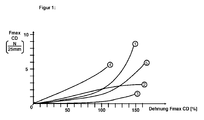
- the EP 1921192B1 describes the use of hydroentangled filament or staple fiber nonwovens for the same purpose. Due to the hydroentanglement, the solidification points of the fibers are not rigidly fixed to each other but flexible. A characteristic of such a material force-elongation curve is the FIG. 1 To take curve 1. The above-described activation process can be omitted in the use of such nonwovens.
- the waterjet needling reorients the fibers so that the original two-dimensional fiber orientation is converted into a three-dimensional fiber orientation.
- the fibers are therefore more strongly integrated into the nonwoven, so that the risk of dust formation during processing or flaking during use is minimized.
- hydroentangled nonwoven fabrics fulfill the requirements a), c), d), e) and f), but do not meet the other requirements.
- Thermal calender consolidation refers to a solidification process for cover layers according to the invention.
- the basic techniques are described in the book " Nonwovens ", published by Wiley VCH, 2nd edition, 2012, pages 385-395 described.
- Preferred according to the invention is a thermobond calender, ie a system operating by means of pressure and heat. In this case, a combination of smooth roller and engraved counter roll, which has a pointwise welding of the nonwoven fabric forming fibers result.
- the use of an ultrasonic calender is also possible. Characteristic of calender engraving are the solidification surface, also referred to as pressing surface, and the number of solidification points per unit area, also referred to as number of figures.
- the solidification area is given in% and describes how much of the material surface, in this case the nonwoven surface, is covered with welding points.
- the engraving patterns used are preferably ellipses, other forms of solidification points such as diamonds, rods or circles are not excluded.
- the solidification points are preferably distributed uniformly on the roll surface. Arrangements of the solidification points, for example in the form of intersecting solidification point rows with larger free areas between the rows, are also conceivable.
- Hydroentanglement refers to a solidification process for cover layers according to the invention.
- the basic techniques are described in the book “ Nonwovens ", published by Wiley VCH, 2nd edition, 2012, pages 340-359 described.
- fiber and staple fiber are used synonymously in the context of this description. They denote synthetically produced fibers which have a defined cut length, expressed in mm and a defined fiber diameter, also referred to as titre and given in dtex.
- the fibers are, unless explicitly stated, of thermoplastic polymers such as, but not limited to, polypropylene, polyester, polyamide, polyethylene, polylactide.
- fibers in the titer range from 1.0 dtex to 4.4 dtex, with the range of 1.3 to 2.2 dtex being preferred according to the invention.
- the preferred cutting lengths are in the range of 35 to 55 mm, more preferably 40 to 50 mm.
- the maximum fiber tensile elongations of usable fibers are in the range of 130 to 580%.
- Nonwovens suitable as covering materials for the stated purpose generally have basis weights ranging between 20 and 40 g / m 2 . Below 20 g / m 2, the mechanical strengths are too low weights per unit area of 40 g / m 2 and higher are on the one hand economically not interesting, on the other hand, such nonwoven fabrics are based on higher forces, so that they are no longer suitable for the intended use. They consist mostly of nonwovens made of dry staple fibers, which are thermally solidified by means of calendering.
- the stretching behavior of such nonwoven fabrics can be influenced in the transverse direction, for example, by the choice of the fibers used. Fibers with higher fiber elongation also result in higher elongation in the transverse direction at the same consolidation settings. On the other hand, one can influence, for example, by the choice of calender engraving. A reduction in the number of figures per cm 2 for the same total solidification surface leads to an increase in elongation, but it also reduces the strength. As a result, such a material is mechanically so unstable that safe processing is no longer possible, the width entry and the Abflusen are too high.
- the fleece width of the tensile load area is between 20 and 40mm.
- the tensile load that a user builds when closing a diaper is in the range up to a maximum of 10N.
- elastic laminates are covered on both sides with covering materials. This results in a load for a single layer of cover material of a maximum of 5N / diaper tube width.
- the load that is built up is therefore in a range of about 5N / 30mm. This represents a force in which a carded and thermal Calender-strengthened fleece already torn, but at least mechanically damaged. See Table 1, Sample 2.
- the curve 1 in FIG. 1 shows the force-elongation behavior of a hydroentangled nonwoven under load in the transverse direction. At the beginning of the load, a smaller slope of the curve is shown in comparison to calender-bonded nonwovens, which then increases almost exponentially when an elongation of about 100% is exceeded. This is explained by knotting among the individual fibers in the fiber entangling points. This effect is positive for the application, the user perceives this behavior was similar to the diaper ear, thereby preventing overstretching in use.
- pattern 3a a batt was produced analogously to pattern 2 and solidified with a calender analogously to pattern 5. As can be seen in Table 1, the pattern has no mechanical stability.
- Sample 5 has a 50% reduction in solidification area compared to Sample 4. Nevertheless, the longitudinal strength is at the same level, considering the transverse strength, this is slightly increased compared to pattern 4.
- pattern 5 has a Fmax elongation in the transverse direction in height of 163%, which is 53% higher than Pattern 4, is at the level of Patterns 1 and 2.
- sample 5 is also less than that of pattern 1 or 2 due to the combination of hydroentanglement and calender consolidation. This is advantageous because it allows more running meters to be wound up with the same roll diameter. As a result, there are fewer roll changes per unit of time during processing and therefore also to low waste shares.
- nonwovens embodied according to the invention are particularly suitable as cover materials for elastic closure systems, since they fulfill all the points of the requirement profile mentioned in the introduction in comparison with the prior art.
Landscapes
- Engineering & Computer Science (AREA)
- Health & Medical Sciences (AREA)
- Textile Engineering (AREA)
- Mechanical Engineering (AREA)
- Vascular Medicine (AREA)
- Heart & Thoracic Surgery (AREA)
- Biomedical Technology (AREA)
- Life Sciences & Earth Sciences (AREA)
- Animal Behavior & Ethology (AREA)
- General Health & Medical Sciences (AREA)
- Public Health (AREA)
- Veterinary Medicine (AREA)
- Epidemiology (AREA)
- Nonwoven Fabrics (AREA)
Applications Claiming Priority (1)
| Application Number | Priority Date | Filing Date | Title |
|---|---|---|---|
| DE102014013808.9A DE102014013808A1 (de) | 2014-09-23 | 2014-09-23 | Dehnbarer Vliesstoff |
Publications (2)
| Publication Number | Publication Date |
|---|---|
| EP3000451A1 true EP3000451A1 (fr) | 2016-03-30 |
| EP3000451B1 EP3000451B1 (fr) | 2018-04-11 |
Family
ID=53938080
Family Applications (1)
| Application Number | Title | Priority Date | Filing Date |
|---|---|---|---|
| EP15178833.8A Active EP3000451B1 (fr) | 2014-09-23 | 2015-07-29 | Non-tisse extensible |
Country Status (2)
| Country | Link |
|---|---|
| EP (1) | EP3000451B1 (fr) |
| DE (1) | DE102014013808A1 (fr) |
Citations (6)
| Publication number | Priority date | Publication date | Assignee | Title |
|---|---|---|---|---|
| WO2003007864A1 (fr) * | 2001-07-18 | 2003-01-30 | Polymer Group, Inc. | Stratifie elastique non tisse |
| WO2008066417A1 (fr) * | 2006-11-29 | 2008-06-05 | Sca Hygiene Products Ab | Matériau non tissé hydroenchevêtré |
| EP2008565A2 (fr) * | 2007-06-14 | 2008-12-31 | Carl Freudenberg KG | Article de nettoyage et son utilisation |
| EP1921192B1 (fr) | 2006-11-13 | 2010-04-07 | Rkw Se | Bande de matériau élastique transversalement, à plusieurs couches, fabriquée en utilisant des tissus non tissés |
| EP2228209A1 (fr) * | 2009-03-11 | 2010-09-15 | Nordenia Deutschland Gronau GmbH | Complexe multicouche elastique, en particulier pour un système de feremture de couche |
| EP2069141B1 (fr) | 2006-09-15 | 2014-01-08 | Sandler AG | Matériau stratifié à tension zéro susceptible d'activation |
Family Cites Families (4)
| Publication number | Priority date | Publication date | Assignee | Title |
|---|---|---|---|---|
| US20020188268A1 (en) * | 1999-06-30 | 2002-12-12 | Mark James Kline | Elastomeric side panel for use with convertible absorbent articles |
| US6589638B1 (en) * | 1997-09-15 | 2003-07-08 | Kimberly-Clark Worldwide, Inc. | Stretch-pillowed bulked laminate useful as an ideal loop fastener component |
| BRPI0419263A (pt) * | 2004-12-29 | 2007-12-18 | Sca Hygiene Prod Ab | meios de fixação em forma de um cinto para um artigo absorvente |
| JP5005696B2 (ja) * | 2006-02-24 | 2012-08-22 | 三井化学株式会社 | ファスナー受け側部材用不織布 |
-
2014
- 2014-09-23 DE DE102014013808.9A patent/DE102014013808A1/de not_active Ceased
-
2015
- 2015-07-29 EP EP15178833.8A patent/EP3000451B1/fr active Active
Patent Citations (6)
| Publication number | Priority date | Publication date | Assignee | Title |
|---|---|---|---|---|
| WO2003007864A1 (fr) * | 2001-07-18 | 2003-01-30 | Polymer Group, Inc. | Stratifie elastique non tisse |
| EP2069141B1 (fr) | 2006-09-15 | 2014-01-08 | Sandler AG | Matériau stratifié à tension zéro susceptible d'activation |
| EP1921192B1 (fr) | 2006-11-13 | 2010-04-07 | Rkw Se | Bande de matériau élastique transversalement, à plusieurs couches, fabriquée en utilisant des tissus non tissés |
| WO2008066417A1 (fr) * | 2006-11-29 | 2008-06-05 | Sca Hygiene Products Ab | Matériau non tissé hydroenchevêtré |
| EP2008565A2 (fr) * | 2007-06-14 | 2008-12-31 | Carl Freudenberg KG | Article de nettoyage et son utilisation |
| EP2228209A1 (fr) * | 2009-03-11 | 2010-09-15 | Nordenia Deutschland Gronau GmbH | Complexe multicouche elastique, en particulier pour un système de feremture de couche |
Non-Patent Citations (5)
| Title |
|---|
| "Vliesstoffe", 2012, VERLAG WILEY VCH |
| "Vliesstoffe", 2012, VERLAG WILEY VCH, pages: 340 - 359 |
| "Vliesstoffe", 2012, VERLAG WILEY VCH, pages: 385 - 395 |
| "Vliesstoffe", 2012, VILEY VCH, pages: 343 |
| DR.HORNFECK; BERNHUBER: "Performance and Fit", January 2013, pages: 56 - 62 |
Also Published As
| Publication number | Publication date |
|---|---|
| DE102014013808A1 (de) | 2016-03-24 |
| EP3000451B1 (fr) | 2018-04-11 |
Similar Documents
| Publication | Publication Date | Title |
|---|---|---|
| EP1159478B1 (fr) | Surface textile structuree en trois dimensions et procede permettant de la produire | |
| DE69430377T2 (de) | Nachbehandlung von laminierten vliesen | |
| DE60019928T2 (de) | Verfahren zur herstellung von materialien mit kontrollierter porosität | |
| DE68919492T2 (de) | Elastomerischer Vliesstoff und Verfahren zu dessen Herstellung. | |
| DE69711616T2 (de) | Dauerhafte, wasserstrahlenverfestigte vliesstoffe | |
| EP3058127B1 (fr) | Composite non-tissé volumineux et procédé de fabrication de celui-ci | |
| EP1277865B1 (fr) | Non-tissé tridimensionnel à motifs réguliers, son procédé de fabrication ainsi que ses applications | |
| DE60103753T2 (de) | Fusselfreier dicker und weicher vliesstoff | |
| DE10232147B4 (de) | Thermobondiertes und perforertes Vlies | |
| DE10319754A1 (de) | Elastischer Verbundstoff, Verfahren zu dessen Herstellung und dessen Verwendung | |
| DE2110344B2 (de) | Vliesstoff aus orientierten Endlos-Fäden aus thermoplastischem Polymer | |
| DE102009055951A1 (de) | Absorbierende Struktur | |
| DE102007018377A1 (de) | Verfahren zur Herstellung eines elastischen Vliesstoffverbundmaterials | |
| WO2004038078A2 (fr) | Matiere non tissee a proprietes elastiques, procede de production associe et dispositif pour realiser ce procede | |
| DE10103627B4 (de) | Vliesstoff mit Struktur | |
| EP1712351A1 (fr) | Textile non tisse élastique composite et procédé de préparation | |
| DE69331065T2 (de) | Nachbehandlung von vliesstoffe. | |
| DE112018003388T5 (de) | Air-Through-Vlies für Absorptionsartikel | |
| DE202010018588U1 (de) | Mehrschichtiges Vliesverbundmaterial mit elastischen Eigenschaften | |
| DE112014003037T5 (de) | Vliesbahn mit verbesserter Schnittkantenqualitat und Verfahren zum Verleihen derselben | |
| EP3338749A1 (fr) | Stratifié non-tissé | |
| DE102015010966A1 (de) | Reinigungstextil | |
| DE19927785C2 (de) | Textiler Verbundstoff mit hoher textiler Weichheit und verbesserter Lagenhaftung | |
| EP3128057B1 (fr) | Tissu non tisse extensible, procede de fabrication d'un tissu non tisse extensible et son utilisation | |
| EP3000451B1 (fr) | Non-tisse extensible |
Legal Events
| Date | Code | Title | Description |
|---|---|---|---|
| PUAI | Public reference made under article 153(3) epc to a published international application that has entered the european phase |
Free format text: ORIGINAL CODE: 0009012 |
|
| 17P | Request for examination filed |
Effective date: 20150810 |
|
| AK | Designated contracting states |
Kind code of ref document: A1 Designated state(s): AL AT BE BG CH CY CZ DE DK EE ES FI FR GB GR HR HU IE IS IT LI LT LU LV MC MK MT NL NO PL PT RO RS SE SI SK SM TR |
|
| AX | Request for extension of the european patent |
Extension state: BA ME |
|
| 17Q | First examination report despatched |
Effective date: 20170331 |
|
| GRAP | Despatch of communication of intention to grant a patent |
Free format text: ORIGINAL CODE: EPIDOSNIGR1 |
|
| INTG | Intention to grant announced |
Effective date: 20171106 |
|
| GRAS | Grant fee paid |
Free format text: ORIGINAL CODE: EPIDOSNIGR3 |
|
| GRAA | (expected) grant |
Free format text: ORIGINAL CODE: 0009210 |
|
| RBV | Designated contracting states (corrected) |
Designated state(s): DE FR IT |
|
| AK | Designated contracting states |
Kind code of ref document: B1 Designated state(s): DE FR IT |
|
| REG | Reference to a national code |
Ref country code: DE Ref legal event code: R096 Ref document number: 502015003800 Country of ref document: DE |
|
| REG | Reference to a national code |
Ref country code: FR Ref legal event code: PLFP Year of fee payment: 4 |
|
| REG | Reference to a national code |
Ref country code: DE Ref legal event code: R097 Ref document number: 502015003800 Country of ref document: DE |
|
| PLBE | No opposition filed within time limit |
Free format text: ORIGINAL CODE: 0009261 |
|
| STAA | Information on the status of an ep patent application or granted ep patent |
Free format text: STATUS: NO OPPOSITION FILED WITHIN TIME LIMIT |
|
| 26N | No opposition filed |
Effective date: 20190114 |
|
| PGFP | Annual fee paid to national office [announced via postgrant information from national office to epo] |
Ref country code: DE Payment date: 20250514 Year of fee payment: 11 |
|
| PGFP | Annual fee paid to national office [announced via postgrant information from national office to epo] |
Ref country code: IT Payment date: 20250729 Year of fee payment: 11 |
|
| PGFP | Annual fee paid to national office [announced via postgrant information from national office to epo] |
Ref country code: FR Payment date: 20250729 Year of fee payment: 11 |