EP3000792B1 - Systemes de fixation au moyen de charges a fines particules - Google Patents
Systemes de fixation au moyen de charges a fines particules Download PDFInfo
- Publication number
- EP3000792B1 EP3000792B1 EP15401095.3A EP15401095A EP3000792B1 EP 3000792 B1 EP3000792 B1 EP 3000792B1 EP 15401095 A EP15401095 A EP 15401095A EP 3000792 B1 EP3000792 B1 EP 3000792B1
- Authority
- EP
- European Patent Office
- Prior art keywords
- meth
- filler
- component
- use according
- acrylate
- Prior art date
- Legal status (The legal status is an assumption and is not a legal conclusion. Google has not performed a legal analysis and makes no representation as to the accuracy of the status listed.)
- Active
Links
Images
Classifications
-
- C—CHEMISTRY; METALLURGY
- C08—ORGANIC MACROMOLECULAR COMPOUNDS; THEIR PREPARATION OR CHEMICAL WORKING-UP; COMPOSITIONS BASED THEREON
- C08K—Use of inorganic or non-macromolecular organic substances as compounding ingredients
- C08K5/00—Use of organic ingredients
- C08K5/54—Silicon-containing compounds
-
- C—CHEMISTRY; METALLURGY
- C04—CEMENTS; CONCRETE; ARTIFICIAL STONE; CERAMICS; REFRACTORIES
- C04B—LIME, MAGNESIA; SLAG; CEMENTS; COMPOSITIONS THEREOF, e.g. MORTARS, CONCRETE OR LIKE BUILDING MATERIALS; ARTIFICIAL STONE; CERAMICS; REFRACTORIES; TREATMENT OF NATURAL STONE
- C04B26/00—Compositions of mortars, concrete or artificial stone, containing only organic binders, e.g. polymer or resin concrete
- C04B26/02—Macromolecular compounds
- C04B26/04—Macromolecular compounds obtained by reactions only involving carbon-to-carbon unsaturated bonds
- C04B26/06—Acrylates
-
- C—CHEMISTRY; METALLURGY
- C04—CEMENTS; CONCRETE; ARTIFICIAL STONE; CERAMICS; REFRACTORIES
- C04B—LIME, MAGNESIA; SLAG; CEMENTS; COMPOSITIONS THEREOF, e.g. MORTARS, CONCRETE OR LIKE BUILDING MATERIALS; ARTIFICIAL STONE; CERAMICS; REFRACTORIES; TREATMENT OF NATURAL STONE
- C04B26/00—Compositions of mortars, concrete or artificial stone, containing only organic binders, e.g. polymer or resin concrete
- C04B26/02—Macromolecular compounds
- C04B26/10—Macromolecular compounds obtained otherwise than by reactions only involving carbon-to-carbon unsaturated bonds
-
- C—CHEMISTRY; METALLURGY
- C04—CEMENTS; CONCRETE; ARTIFICIAL STONE; CERAMICS; REFRACTORIES
- C04B—LIME, MAGNESIA; SLAG; CEMENTS; COMPOSITIONS THEREOF, e.g. MORTARS, CONCRETE OR LIKE BUILDING MATERIALS; ARTIFICIAL STONE; CERAMICS; REFRACTORIES; TREATMENT OF NATURAL STONE
- C04B26/00—Compositions of mortars, concrete or artificial stone, containing only organic binders, e.g. polymer or resin concrete
- C04B26/02—Macromolecular compounds
- C04B26/10—Macromolecular compounds obtained otherwise than by reactions only involving carbon-to-carbon unsaturated bonds
- C04B26/14—Polyepoxides
-
- C—CHEMISTRY; METALLURGY
- C04—CEMENTS; CONCRETE; ARTIFICIAL STONE; CERAMICS; REFRACTORIES
- C04B—LIME, MAGNESIA; SLAG; CEMENTS; COMPOSITIONS THEREOF, e.g. MORTARS, CONCRETE OR LIKE BUILDING MATERIALS; ARTIFICIAL STONE; CERAMICS; REFRACTORIES; TREATMENT OF NATURAL STONE
- C04B26/00—Compositions of mortars, concrete or artificial stone, containing only organic binders, e.g. polymer or resin concrete
- C04B26/02—Macromolecular compounds
- C04B26/10—Macromolecular compounds obtained otherwise than by reactions only involving carbon-to-carbon unsaturated bonds
- C04B26/16—Polyurethanes
-
- C—CHEMISTRY; METALLURGY
- C04—CEMENTS; CONCRETE; ARTIFICIAL STONE; CERAMICS; REFRACTORIES
- C04B—LIME, MAGNESIA; SLAG; CEMENTS; COMPOSITIONS THEREOF, e.g. MORTARS, CONCRETE OR LIKE BUILDING MATERIALS; ARTIFICIAL STONE; CERAMICS; REFRACTORIES; TREATMENT OF NATURAL STONE
- C04B40/00—Processes, in general, for influencing or modifying the properties of mortars, concrete or artificial stone compositions, e.g. their setting or hardening ability
- C04B40/06—Inhibiting the setting, e.g. mortars of the deferred action type containing water in breakable containers ; Inhibiting the action of active ingredients
- C04B40/0641—Mechanical separation of ingredients, e.g. accelerator in breakable microcapsules
- C04B40/065—Two or more component mortars
-
- C—CHEMISTRY; METALLURGY
- C08—ORGANIC MACROMOLECULAR COMPOUNDS; THEIR PREPARATION OR CHEMICAL WORKING-UP; COMPOSITIONS BASED THEREON
- C08G—MACROMOLECULAR COMPOUNDS OBTAINED OTHERWISE THAN BY REACTIONS ONLY INVOLVING UNSATURATED CARBON-TO-CARBON BONDS
- C08G18/00—Polymeric products of isocyanates or isothiocyanates
- C08G18/06—Polymeric products of isocyanates or isothiocyanates with compounds having active hydrogen
- C08G18/28—Polymeric products of isocyanates or isothiocyanates with compounds having active hydrogen characterised by the compounds used containing active hydrogen
- C08G18/67—Unsaturated compounds having active hydrogen
- C08G18/671—Unsaturated compounds having only one group containing active hydrogen
- C08G18/672—Esters of acrylic or alkyl acrylic acid having only one group containing active hydrogen
-
- C—CHEMISTRY; METALLURGY
- C08—ORGANIC MACROMOLECULAR COMPOUNDS; THEIR PREPARATION OR CHEMICAL WORKING-UP; COMPOSITIONS BASED THEREON
- C08G—MACROMOLECULAR COMPOUNDS OBTAINED OTHERWISE THAN BY REACTIONS ONLY INVOLVING UNSATURATED CARBON-TO-CARBON BONDS
- C08G18/00—Polymeric products of isocyanates or isothiocyanates
- C08G18/06—Polymeric products of isocyanates or isothiocyanates with compounds having active hydrogen
- C08G18/28—Polymeric products of isocyanates or isothiocyanates with compounds having active hydrogen characterised by the compounds used containing active hydrogen
- C08G18/67—Unsaturated compounds having active hydrogen
- C08G18/671—Unsaturated compounds having only one group containing active hydrogen
- C08G18/672—Esters of acrylic or alkyl acrylic acid having only one group containing active hydrogen
- C08G18/673—Esters of acrylic or alkyl acrylic acid having only one group containing active hydrogen containing two or more acrylate or alkylacrylate ester groups
-
- C—CHEMISTRY; METALLURGY
- C08—ORGANIC MACROMOLECULAR COMPOUNDS; THEIR PREPARATION OR CHEMICAL WORKING-UP; COMPOSITIONS BASED THEREON
- C08K—Use of inorganic or non-macromolecular organic substances as compounding ingredients
- C08K3/00—Use of inorganic substances as compounding ingredients
- C08K3/18—Oxygen-containing compounds, e.g. metal carbonyls
- C08K3/20—Oxides; Hydroxides
- C08K3/22—Oxides; Hydroxides of metals
-
- C—CHEMISTRY; METALLURGY
- C08—ORGANIC MACROMOLECULAR COMPOUNDS; THEIR PREPARATION OR CHEMICAL WORKING-UP; COMPOSITIONS BASED THEREON
- C08K—Use of inorganic or non-macromolecular organic substances as compounding ingredients
- C08K3/00—Use of inorganic substances as compounding ingredients
- C08K3/34—Silicon-containing compounds
- C08K3/36—Silica
-
- C—CHEMISTRY; METALLURGY
- C08—ORGANIC MACROMOLECULAR COMPOUNDS; THEIR PREPARATION OR CHEMICAL WORKING-UP; COMPOSITIONS BASED THEREON
- C08L—COMPOSITIONS OF MACROMOLECULAR COMPOUNDS
- C08L63/00—Compositions of epoxy resins; Compositions of derivatives of epoxy resins
-
- C—CHEMISTRY; METALLURGY
- C08—ORGANIC MACROMOLECULAR COMPOUNDS; THEIR PREPARATION OR CHEMICAL WORKING-UP; COMPOSITIONS BASED THEREON
- C08L—COMPOSITIONS OF MACROMOLECULAR COMPOUNDS
- C08L75/00—Compositions of polyureas or polyurethanes; Compositions of derivatives of such polymers
- C08L75/04—Polyurethanes
- C08L75/14—Polyurethanes having carbon-to-carbon unsaturated bonds
-
- C—CHEMISTRY; METALLURGY
- C08—ORGANIC MACROMOLECULAR COMPOUNDS; THEIR PREPARATION OR CHEMICAL WORKING-UP; COMPOSITIONS BASED THEREON
- C08L—COMPOSITIONS OF MACROMOLECULAR COMPOUNDS
- C08L75/00—Compositions of polyureas or polyurethanes; Compositions of derivatives of such polymers
- C08L75/04—Polyurethanes
- C08L75/14—Polyurethanes having carbon-to-carbon unsaturated bonds
- C08L75/16—Polyurethanes having carbon-to-carbon unsaturated bonds having terminal carbon-to-carbon unsaturated bonds
-
- C—CHEMISTRY; METALLURGY
- C09—DYES; PAINTS; POLISHES; NATURAL RESINS; ADHESIVES; COMPOSITIONS NOT OTHERWISE PROVIDED FOR; APPLICATIONS OF MATERIALS NOT OTHERWISE PROVIDED FOR
- C09J—ADHESIVES; NON-MECHANICAL ASPECTS OF ADHESIVE PROCESSES IN GENERAL; ADHESIVE PROCESSES NOT PROVIDED FOR ELSEWHERE; USE OF MATERIALS AS ADHESIVES
- C09J4/00—Adhesives based on organic non-macromolecular compounds having at least one polymerisable carbon-to-carbon unsaturated bond ; adhesives, based on monomers of macromolecular compounds of groups C09J183/00 - C09J183/16
-
- E—FIXED CONSTRUCTIONS
- E04—BUILDING
- E04B—GENERAL BUILDING CONSTRUCTIONS; WALLS, e.g. PARTITIONS; ROOFS; FLOORS; CEILINGS; INSULATION OR OTHER PROTECTION OF BUILDINGS
- E04B1/00—Constructions in general; Structures which are not restricted either to walls, e.g. partitions, or floors or ceilings or roofs
- E04B1/38—Connections for building structures in general
- E04B1/41—Connecting devices specially adapted for embedding in concrete or masonry
-
- C—CHEMISTRY; METALLURGY
- C04—CEMENTS; CONCRETE; ARTIFICIAL STONE; CERAMICS; REFRACTORIES
- C04B—LIME, MAGNESIA; SLAG; CEMENTS; COMPOSITIONS THEREOF, e.g. MORTARS, CONCRETE OR LIKE BUILDING MATERIALS; ARTIFICIAL STONE; CERAMICS; REFRACTORIES; TREATMENT OF NATURAL STONE
- C04B2111/00—Mortars, concrete or artificial stone or mixtures to prepare them, characterised by specific function, property or use
- C04B2111/00474—Uses not provided for elsewhere in C04B2111/00
- C04B2111/00715—Uses not provided for elsewhere in C04B2111/00 for fixing bolts or the like
-
- C—CHEMISTRY; METALLURGY
- C08—ORGANIC MACROMOLECULAR COMPOUNDS; THEIR PREPARATION OR CHEMICAL WORKING-UP; COMPOSITIONS BASED THEREON
- C08F—MACROMOLECULAR COMPOUNDS OBTAINED BY REACTIONS ONLY INVOLVING CARBON-TO-CARBON UNSATURATED BONDS
- C08F222/00—Copolymers of compounds having one or more unsaturated aliphatic radicals, each having only one carbon-to-carbon double bond, and at least one being terminated by a carboxyl radical and containing at least one other carboxyl radical in the molecule; Salts, anhydrides, esters, amides, imides, or nitriles thereof
- C08F222/10—Esters
- C08F222/1006—Esters of polyhydric alcohols or polyhydric phenols
- C08F222/106—Esters of polycondensation macromers
- C08F222/1065—Esters of polycondensation macromers of alcohol terminated (poly)urethanes, e.g. urethane(meth)acrylates
-
- C—CHEMISTRY; METALLURGY
- C08—ORGANIC MACROMOLECULAR COMPOUNDS; THEIR PREPARATION OR CHEMICAL WORKING-UP; COMPOSITIONS BASED THEREON
- C08F—MACROMOLECULAR COMPOUNDS OBTAINED BY REACTIONS ONLY INVOLVING CARBON-TO-CARBON UNSATURATED BONDS
- C08F222/00—Copolymers of compounds having one or more unsaturated aliphatic radicals, each having only one carbon-to-carbon double bond, and at least one being terminated by a carboxyl radical and containing at least one other carboxyl radical in the molecule; Salts, anhydrides, esters, amides, imides, or nitriles thereof
- C08F222/10—Esters
- C08F222/1006—Esters of polyhydric alcohols or polyhydric phenols
- C08F222/106—Esters of polycondensation macromers
- C08F222/1067—Esters of polycondensation macromers of alcohol terminated epoxy functional polymers, e.g. epoxy(meth)acrylates
-
- C—CHEMISTRY; METALLURGY
- C08—ORGANIC MACROMOLECULAR COMPOUNDS; THEIR PREPARATION OR CHEMICAL WORKING-UP; COMPOSITIONS BASED THEREON
- C08K—Use of inorganic or non-macromolecular organic substances as compounding ingredients
- C08K3/00—Use of inorganic substances as compounding ingredients
- C08K3/18—Oxygen-containing compounds, e.g. metal carbonyls
- C08K3/20—Oxides; Hydroxides
- C08K3/22—Oxides; Hydroxides of metals
- C08K2003/2227—Oxides; Hydroxides of metals of aluminium
Definitions
- the invention as defined in the respective claims 1 to 15, relates to (i) the use of at least one filler selected from oxides of silicon and aluminum, or mixed oxides with the presence of further cations in a multi-component fastening artificial mortar system for fastening anchoring elements in building substrates, which in one component reactive synthetic resins based on (i) urethane (meth) acrylate, (ii) epoxy resin based or (iii) based on radically curing (or curable) unsaturated reactive resins, in another component hardener and the at least one filler selected of oxides of silicon and aluminum, or mixed oxides with the presence of further cations, characterized in that the average grain size d50 of the at least one filler is 40 ⁇ m or less to increase the bond tension compared to fillers with a larger average grain size, the average grain size d50 using grading curve determinations by sieving or by laser granulometry is determined; and (ii) a multi-component fastening mortar system, in
- DE 10 2020 051818 B3 relates to two-component mortars with radically curable resins and a range of fillers for use in the chemical fastening of anchors in boreholes.
- a permanent task remains to provide such fastening systems that show particularly good properties, such as high tensile and compressive strength, and thus meet the high requirements, particularly in the construction sector.
- the invention therefore relates in a first embodiment to the use of a filler as defined in claim 1 or one of the claims dependent thereon and the multi-component fastening mortar system as defined in claim 9 and the claims dependent therefrom.
- the present disclosure mentions the use of the multicomponent synthetic mortar systems defined in the preceding paragraph (or below) to secure anchoring elements in a hole or gap in a building substrate.
- the present disclosure also mentions a method for fastening an anchoring element in a hole or gap in a building substrate, in which a multi-component artificial mortar system according to the invention and an anchoring element are introduced into the hole or gap and allowed to harden.
- the inventive fastening artificial mortar system according to claim 9 or any claim dependent thereon furthermore has a silane containing at least one Si-bonded hydrolyzable group as an additive, or the fillers are modified with such a silane prior to their addition, the silane being one that is used in the Polymerization of the anchoring compounds on the one hand reactive groups in the form of epoxy groups or amino groups for corresponding epoxy-based anchoring compounds or also olefinic double bonds, e.g. in (meth) acrylate groups, for corresponding radically curable anchoring compounds, on the other hand hydrolyzable groups bonded to Si, such as alkoxy (e.g. with 1 to 7 Carbon atoms) or halogeno, such as chloro.
- the surface modification can, for example, with silanes that contain one or more hydrolyzable groups, such as alkoxy, e.g. methoxy or ethoxy, bonded to the silicon atom, e.g. selected from the group consisting of 3-aminopropyltrialkoxysilanes, such as 3-aminopropyl-trimethoxysilane or 3- Aminopropyl-triethoxysilane, 3-glycidyloxypropyltrialkoxysilanes (particularly preferred for epoxy-based systems), such as 3-glycidyloxypropyltrimethoxysilane or -ethoxysilane, glycidyloxymethyltrimethoxysilane, 3-glycidyloxysiline (3-glycidyloxypropyl) (trimkidyloxysiline, trimoxy-amysiline, 3-amethoxypropyl) bis (trimoxysilin, 3-amethoxysilin, 3-
- the at least one silane containing the at least one Si-bonded hydrolyzable group as an additive, or the at least one silane used to modify the fillers prior to their addition is selected in particular from those that are used during the polymerization the anchoring compounds on the one hand reactive groups in the form of epoxy groups or amino groups for corresponding epoxy-based anchoring compounds) and on the other hand hydrolyzable groups bonded to Si, such as alkoxy (e.g. with 1 to 7 carbon atoms) or halogen, such as chloro.
- Such silanes which contain one or more hydrolyzable groups, such as alkoxy, for example methoxy or ethoxy, bonded to the silicon atom are selected, for example, from the group consisting of 3-aminopropyltrialkoxysilanes, such as 3-aminopropyl-trimethoxysilane or 3-aminopropyl-triethoxysilane , 3-glycidyloxypropyltrialkoxysilanes (particularly preferred for epoxy-based systems), such as 3-glycidyloxypropyltrimethoxysilane or -ethoxysilane, glycidyloxymethyltrimethoxysilane, 3-glycidyloxypropylmethyldi-methoxysilane, bispopropyl) amine (3-propyl) amine, bispopropyl) amine (3-propyl) amine (3-propyl) amine, bis (3-trialylkoxysilyl) amine, bis
- 3- (meth) acryloyl-oxypropyltrialkoxysilanes such as 3- (meth) acryloyl-oxypropyltrimethoxysilane or triethoxysilane or 3- (meth) acryloyl-oxymethyltrimethoxysilane or -triethoxysilane, 3- (meth) -acryloyl-oxethoxypropylmysilane or, furthermore, can be used
- Alkenylalkoxysilanes such as vinylalkoxysilanes, for example vinyltrimethoxysilane or vinyltriethoxysilane, as such silanes be preferred.
- Such silanes can also be added as such to at least one component of a two- or multi-component artificial fastening mortar system.
- the surface modification can then optionally take place in the context of the mixing process, the storage and / or the thorough mixing of the components and the subsequent curing during the fastening.
- the silanes with hydrolyzable groups can then be used in an anchoring compound according to the invention, for example in a weight fraction of 0.01 to 50, in particular 0.1 or more wt .-%, such as from 1 to 30 wt .-%, preferably 2 or more% by weight, such as from 2 to 30 or up to 15% by weight, from 3 or more% by weight, such as from 3 to 20 or up to 10% by weight, even more preferably from 3.5 or more % By weight, for example from 3.5 to 20 or up to 8% by weight, may be provided.
- the mean particle size d50 is defined as the particle size at which 50% by weight of the particles is smaller than the specified particle size d50.
- grading curve determinations are traditionally provided with sieves or (especially for smaller particles with a diameter of less than 1 ⁇ m) laser granulometry.
- d50 values given in the examples correspond to the manufacturer's specifications.
- proportions or contents in percent each mean percent by weight ("% by weight”) or the relative weight proportion, based on all ingredients of a resin composition according to the invention (without packaging material), unless otherwise stated or evident.
- Metal acrylic stands for acrylic, methacrylic or acrylic and methacrylic (as a mixture).
- Oxides of silicon (preferred) or aluminum are primarily silicon dioxide (particularly preferred) or "aluminum oxide" (Al 2 O 3 ).
- Mixed oxides are above all oxides thereof in the additional presence of one or more oxides selected from oxides from the group of metals, which in particular consists of calcium, titanium, iron, sodium or the like.
- Silicon dioxide, in particular quartz, silicates, or aluminum oxide, in particular ⁇ -aluminum oxide, are particularly preferred.
- Oxides of silicon or mixed oxides of silicon and aluminum are particularly preferred, and oxides of silicon even more.
- gypsum, chalk and aluminum hydroxides are excluded as the only fillers, since according to previous results no influence of the particle size can be found with these.
- a particular embodiment relates to those urethane (meth) acrylate resins which, according to the in DE 10 2013 101 861.3 or can be produced analogously to this (can be produced or, in particular, are produced), which is briefly outlined below:
- HPMA The technically available HPMA is to be seen as a mixture of 2-hydroxypropyl methacrylate and hydroxyisopropyl methacrylate - other aliphatic alcohols having an olefinic bond can also be present as technical isomer mixtures or as pure isomers.
- An isocyanate with an average functionality of less than 2 or 2 or in particular more than 2, for example from 2.1 to 5, for example from 2.2 to 4, advantageously for example from 2.3 to 3.5, is, for example Polyisocyanate with uretdione, isocyanurate, iminooxadiazinone, uretonimine, biuret, allophanate and / or carbodiimide structures (advantageously with a molecular weight distribution such that no single molecular species is more than 50 percent by weight and at the same time more than 50 percent by weight of the chains are composed of at least 3 + 1 covalently bound monomer units / reactants (see more precise polymer definition according to REACH)) or preferably one (e.g.
- crude MDI crude product of the industrial production of MDI without separation of the individual Isomers eg by distillation
- isomers and higher functional homologues eg an average molecular weight in the order of 200 to 800 g / mol and a functionality as indicated above, eg with an average molecular weight of 280 to 500, eg 310 to 480 and a functionality of 2.4 to 3.4, for example 3.2.
- PMDIs are preferred which are obtained from the crude MDI itself or from the crude MDI, for example by distilling off and / or adding monomeric MDI and have an average molecular weight of 310-450 and also uretdione, isocyanurate, iminooxadiazinone , Uretonimine, biuret, allophanate and / or carbodiimide structures.
- PMDIs with a molecular weight distribution such that no individual molecular species are present to an extent of more than 50% by weight are particularly preferred.
- urethane (meth) acrylate resins is preferably carried out in the presence of a catalyst, corresponding catalysts which catalyze the reaction between hydroxyl groups and isocyanate groups are sufficiently known to the person skilled in the art, for example a tertiary amine such as 1,2-dimethylimidazole , Diazabicyclooctane, diazabicyclononane, or an organometallic compound (for example of K, Sn, Pb, Bi, Al and in particular also of transition metals such as Ti, Zr, Fe, Zn, Cu); as well as mixtures of two or more thereof; for example (based on the reaction mixture) in a proportion of 0.001 to 2.5% by weight; preferably in the presence of stabilizers (inhibitors) such as phenothiazine, TEMPO, TEMPOL, hydroquinone, dimethyl hydroquinone, triphenyl phosphite, tert-butyl hydroquinone, hydro
- Suitable catalysts and stabilizers are known to the person skilled in the art, for example as shown in " Polyurethane plastic manual 7 "by Becker, GW; Braun, D .; Oertel, G., 3rd edition, Carl Hanser Verlag, 1993 , evident.
- reaction can be carried out without a solvent (the aliphatic alcohol having at least one C -C double bond, in particular the hydroxy (lower) alkyl (meth) acrylate itself then serves as the solvent) or in the presence of a suitable solvent, for example another reactive diluent.
- a solvent the aliphatic alcohol having at least one C -C double bond, in particular the hydroxy (lower) alkyl (meth) acrylate itself then serves as the solvent
- a suitable solvent for example another reactive diluent.
- Reactive here refers to the formulation of the adhesive and its curing, not to the addition of the alcohol to the isocyanate.
- the reaction can also be carried out in such a way that a prepolymer is formed via a pre-extension and only then the remaining isocyanate groups with the aliphatic alcohol having at least one CC double bond, in particular the hydroxy (lower) alkyl (meth) acrylate, as above or below as described.
- the above-mentioned isocyanates and polyols with two or more hydroxyl groups per molecule and / or polyamines with two or more amino groups per molecule and / or polyamines are used to achieve an average isocyanate functionality of less than two, two or in particular greater than two Aminols with two or more Amino and hydroxyl groups per molecule are used, or isocyanates with a functionality of 2 with polyols, polyamines or aminols with an average OH and / or amino functionality of more than 2 are used.
- Polyols are, in particular, di- or higher-functional alcohols, for example secondary products of ethylene or propylene oxide, such as ethanediol, di- or triethylene glycol, propane-1,2- or -1-3-diol, dipropylene glycol, other diols, such as 1,2-, 1,3- or 1,4-butanediol, 1,6-hexanediol, neopentyl glycol, 2-ethylpropane-1,3-diol or 2,2-bis (4-hydroxycyclohexyl) propane , Triethanolamine, bisphenol A or bisphenol F or their oxyethylation, hydrogenation and / or halogenation products, higher alcohols such as glycerol, trimethylolpropane, hexanetriol and pentaerythritol, hydroxyl-containing polyethers, for example oligomers of aliphatic or aromatic oxi
- polyethers and dicarboxylic acids or their anhydrides e.g. adipic acid, phthalic acid, isophthalic acid, terephthalic acid, tetra- or hexahydrophthalic acid, endomethylenetetrahydrophthalic acid, maleic acid, fumaric acid
- hydroxyl compounds with aromatic structural units which cause chain stiffening such as fumaric acid, or branched or star-shaped hydroxy compounds, in particular tri- or. higher-functional alcohols and / or polyethers or polyesters which contain their structural units.
- Lower alkanediols give divalent radicals -O-lower alkylene-O-) are particularly preferred.
- Aminols are compounds which in particular contain one or more hydroxyl and one or more amino groups in one and the same molecule.
- Preferred examples are aliphatic aminols, in particular hydroxy lower alkylamines (result in radicals -NH-lower alkylene-O- or -O-lower alkylene-NH-), such as ethanolamine, diethanolamine or 3-aminopropanol, or aromatic aminols, such as 2-, 3- or 4- Aminophenol.
- Polyamines are organic amino compounds with 2 or more amino groups, especially hydrazine, N, N'-dimethylhydrazine, aliphatic di- or polyamines, especially lower alkanediamines (result in radicals -NH-lower alkyl-NH-), such as ethylenediamine, 1,3-diaminopropane, tetra- or hexamethylenediamine or diethylenetriamine, or aromatic di- or polyamines such as phenylenediamine, 2,4- and 2,6-toluenediamine, or 4,4'-diaminodiphenylmethane, polyether diamines (polyethylene oxides with terminal Amino groups) or polyphenyl / polymethylene polyamines, which are obtainable by condensation of anilines with formaldehyde.
- the ratio of free isocyanate groups of the isocyanate (s) to hydroxyl groups of the hydroxy lower alkyl (meth) acrylate (s) is advantageously chosen such that rapid and complete conversion of the isocyanate groups results, that is, the molar amount of hydroxyl groups (and thus the correlating molar
- the amount of hydroxy lower alkyl (meth) acrylate) is greater than the molar amount of isocyanate groups, for example 1.03 to 5 times as large, such as 1.05 to 4 times as large or 1.1 to 3 times as large. Excess hydroxy lower alkyl (meth) acrylate serves as a reactive diluent.
- the U (M) A resins obtainable by means of the process are those which represent urethane (meth) acrylate resins which can be used or are present in accordance with the invention in the reactive synthetic resins based on urethane (meth) acrylate.
- the synthetic mortar systems according to the invention can also contain other common constituents (e.g. additives or other constituents mentioned above or below) in addition to the constituents mentioned above. These further constituents can, for example, be present in a total amount of up to 80, preferably between 0.01 and 65% by weight. Such customary constituents are also possible where “based on” is not expressly mentioned.
- Examples of further ingredients of reactive synthetic resins based on urethane (meth) acrylate or fixing synthetic mortar systems containing them are metal salt-based or preferably amine accelerators, inhibitors, non-reactive thinners, reactive thinners, thixotropic agents, other fillers than the fillers used according to the invention and / or other additives, or mixtures of two or more of these ingredients.
- Cu-, Co, Mn, Sn or Ce salts such as, for example, copper octanoate
- Suitable amine accelerators are those with a sufficiently high activity, such as in particular (preferably tertiary, in particular hydroxyalkylamino group-substituted) aromatic amines selected from the group consisting of epoxyalkylated anilines, toluidines or xylidines, such as ethoxylated toluidine, aniline or xylidine, for example N, N-bis (hydroxypropyl- or hydroxyethyl) -toluidines or -xylidines, such as N, N- bis (hydroxypropyl- or hydroxyethyl) -p-toluidine, N, N-bis (hydroxyethyl) -xylidine and very particularly corresponding higher alkoxylated technical products are selected.
- One or more such accelerators are possible.
- the accelerators preferably have a proportion (concentrioxyl
- Non-phenolic (anaerobic) and / or phenolic inhibitors can be added as inhibitors.
- Phenolic inhibitors are (non-alkylated or alkylated) hydroquinones, such as hydroquinone, and also mono-, di- or trimethylhydroquinone, (non-alkylated or alkylated ) Phenols, such as 4,4'-methylene-bis (2,6-di-tert-butylphenol), 1,3,5-trimethyl-2,4,6-tris (3,5-di-tert-butyl- 4-hydroxy-benzyl) benzene, (non-alkylated or alkylated) catechols such as tert-butyl catechol, 3,5-di-tert-butyl-1,2-benzenediol or, or in particular 4-methoxyphenol, or mixtures of two or more of them, in question. These preferably have a proportion of up to 1% by weight, in particular, if present, between
- Phenothiazine or organic nitroxyl radicals are preferably considered as non-phenolic or anaerobic (ie, in contrast to the phenolic inhibitors, also effective without oxygen) (which in particular hardly influence the curing times).
- Organic nitroxyl radicals that can be added are, for example, as described in FIG DE 199 56 509 are described, in particular 1-oxyl-2,2,6,6-tetramethylpiperidin-4-ol ("4-OH-TEMPO" or "TEMPOL").
- the weight fraction of the non-phenolic inhibitors is preferably, based on the reaction resin formulation, in the range from 1 ppm (weight based) to 2% by weight, in particular, for example, in the range from 5 ppm to 1% by weight.
- Vegetable oils such as castor oil, or, furthermore, bioalcohols and fatty acids and their esters, or mixtures of two, can be added as non-reactive diluents or more thereof, for example in a proportion of 3 to 60% by weight, for example from 4 to 55% by weight.
- Customary rheological aids which cause thixotropy can be used as thixotropic agents, such as fumed silica or (e.g. with silanes) surface-treated silica.
- thixotropic agents such as fumed silica or (e.g. with silanes) surface-treated silica.
- they can be added in a weight proportion of from 0.01 to 50% by weight, for example from 0.5 to 20% by weight.
- customary fillers with larger medium grains in particular chalk, quartz sand, quartz powder, corundum or the like, which can be added as powder in granular form or in the form of shaped bodies, can be used, or others, such as core or shell meal from plants, which increases the biogenic carbon content, such as olive kernel meal, coconut shell meal or also walnut shell meal, or hydraulic fillers, as described above under the epoxides, or mixtures thereof, wherein the fillers can furthermore or in particular also be silanized.
- the fillers can be present in one or more components of a multi-component artificial fastening mortar system according to the invention, for example one or both components of a corresponding two-component kit; the proportion of fillers is preferably 0 to 90% by weight, for example 10 to 50% by weight (whereby the covering material destroyed when anchoring elements are introduced (e.g. shattered glass or shattered plastic), for example shards from cartridges, are also included as fillers can).
- it is also possible to add hydraulically hardenable fillers such as gypsum, quicklime or cement (e.g. clay or Portland cement), water glasses or active aluminum hydroxides, or two or more of them.
- customary fillers in particular cements (e.g. Portland cements or high-alumina cements), chalks, sand, quartz sand, quartz flour or the like, which can be added as powder, in granular form or in the form of shaped bodies, can be used, or mixtures of two or more more of it, wherein the fillers can furthermore or in particular also be silanized.
- additives can also be added, such as plasticizers, non-reactive diluents, flexibilizers, stabilizers, rheological aids, wetting agents and dispersants, Coloring additives, such as dyes or, in particular, pigments, for example for differently coloring the components for better control of their mixing, or the like, mixtures of two or more thereof.
- Such further additives can preferably be added in total in proportions by weight of a total of 0 to 90%, for example from 0 to 40% by weight.
- reactive thinners one or more radically hardening unsaturated reactive thinners in biogenic or non-biogenic form can also be added, which are primarily to be understood as those that are radically hardening (which includes “hardenable (e.g. before adding hardener)")
- Components include organic compounds with unsaturated (e.g. olefinic) radicals or in particular consist of such compounds, e.g.
- (meth) acrylate or (meth) acrylamide monomers such as acrylic acid and / or methacrylic acid or preferably their esters (as (meth) acrylates referred to) or amides
- (meth) acrylates such as mono-, di-, tri- or poly (meth) acrylates (including hydroxy-lower alkyl (meth) acrylates, which are also obtained from the U (M)
- a resin production according to the invention in excess Reactive diluents can be included, such as hydroxypropyl (meth) acrylate or hydroxyethyl (meth) acrylate, alkyl (meth) acrylates with 1 to 10 (meth) acrylate groups, such as Mo no-, di-, tri-, tetra-, penta-, hexa- or poly (meth) acrylates, e.g.
- alkyl di or tri (meth) acrylates such as 1,2-ethanediol di (meth) acrylate, butanediol di (meth) acrylate, such as 1,3- or in particular 1,4-butanediol di (meth) acrylate, hexanediol di (meth) acrylate, 1,10-decanediol di (meth) acrylate, diethyl glycol di (meth) acrylate, particularly preferably oligoalkylene glycol di (meth) acrylates , as in DE 10 2014 109355.0 (Filing date July 4, 2014), trimethylolpropane tri (meth) acrylate, glycerol tri (meth) acrylate, polyglycerol poly (meth) acrylate, polyethylene glycol di (meth) acrylate, cycloalkyl, bicycloalkyl or heterocyclyl (meth) acrylates, in which cyclo
- the free-radically curable oligoalkylene glycol di (meth) acrylates mentioned are in particular those of the formula I, in which the radicals R independently of one another are C 1 -C 7 -alkyl, in particular methyl, and in which n is on average 2.5 to 13, preferably 3.5 to 10, in particular 4 to 8 and especially 4, 2 to 7, in particular 4, 5 and 6 stands.
- the reactive synthetic resins based on epoxy which can be used or provided in the use of or in artificial fastening mortar systems according to the invention contain an epoxy component, preferably based on glycidyl compounds, for example those with an average glycidyl group functionality of 1.5 or greater, in particular 2 or greater , for example from 2 to 10, which can optionally contain further glycidyl ethers as reactive diluents.
- an epoxy component preferably based on glycidyl compounds, for example those with an average glycidyl group functionality of 1.5 or greater, in particular 2 or greater , for example from 2 to 10, which can optionally contain further glycidyl ethers as reactive diluents.
- the epoxides of the epoxy component are preferably poly (including di) glycidyl ethers of at least one polyhydric alcohol or phenol, such as novolak, bisphenol F or bisphenol A, or mixtures of such epoxides, for example obtainable by reacting the corresponding polyhydric Alcohols with epichlorohydrin.
- polyhydric alcohol or phenol such as novolak, bisphenol F or bisphenol A
- examples are trimethylolpropane triglycidyl ether, novolak epoxy resins, bisphenol A epichlorohydrin resins and / or bisphenol F epichlorohydrin resins, for example with an average molecular weight of ⁇ 2000.
- the epoxy resins can for example have an epoxide equivalent of 120 to 2000, preferably 130 to 400, such as in particular 155 to 195, for example 165 to 185.
- the proportion of the epoxy component of the artificial fastening mortar system is preferably 5 to less than 100% by weight, in particular 10 to 80% by weight, 10 to 70% by weight or 10 to 60% by weight. Mixtures of two or more such epoxy components are also possible.
- Suitable epoxy resins, reactive thinners and hardeners are also in the standard work of Lee H and Neville K, "Handbook of Epoxy Resins" (New. York: McGraw-Hill), 1982 to find.
- the artificial fastening mortar systems according to the invention can also contain other customary components (e.g. additives or other components mentioned above or below) in addition to the components mentioned above.
- these further constituents can, for example, be present in a total amount of up to 80, preferably between 0.01 and 65% by weight.
- Such customary constituents are also possible where “based on” is not expressly mentioned.
- further constituents are one or more selected from accelerators, reactive thinners, thixotropic agents, further fillers in addition to the fillers present or used according to the invention and further additives.
- tert-amines such as imidazoles or tert-aminophenols, such as tris-2,4,6-dimethylaminomethylphenol, organophosphines or Lewis bases or acids, such as phosphoric acid esters, or mixtures of two or more thereof, in one or ( in particular in the case of multi-component systems) be included in several of the components, preferably in each case in a hardener component, for example in a weight fraction of 0.001 to 15% by weight.
- rheological aids such as pyrogenic silica
- they can be added in a weight proportion of from 0.001 to 50% by weight, for example from 1 to 20% by weight.
- fillers as mentioned above for the urethane methacrylate resins can also be used.
- additives can also be added or included, such as plasticizers, non-reactive diluents, flexibilizers, rheological aids, wetting agents, coloring additives such as dyes or especially pigments, for example for different coloring of the components for better control of their mixing, or the like, or mixtures of two or more of them. (Residual) water contents are also not excluded here.
- coloring additives such as dyes or especially pigments, for example for different coloring of the components for better control of their mixing, or the like, or mixtures of two or more of them.
- residual water contents are also not excluded here.
- Other substances can also appear during storage, such as gases or, in particular, substances in a gaseous state of aggregation.
- Such further additives can preferably be added in total in proportions by weight of a total of 0 to 90%, for example from 0 to 40% by weight.
- epoxides such as trimethylolpropane triglycidyl ether or hexanediol diglycidyl ether, which have a lower viscosity than epoxides containing aromatic groups, can also be used as reactive diluents, for example in a weight proportion of 0.1 to 90% by weight, e.g. between 0.5 and 75% by weight or between 1 and 40% by weight.
- the hardener contains at least one compound commonly used for epoxy hardening (reaction partner in polyaddition).
- the term "hardener” preferably means at least one compound customary for epoxy hardening with or without the addition of fillers and / or other additives such as water, thickeners and / or other additives, in other words the complete hardener component.
- the hardener can be used as a separate component and / or (especially in a protected form, i.e. in microencapsulated form, for example) also in the reaction resin formulation (as a hardenable component, i.e. one which, after mixing with the hardener, hardens through polymerization after the shell of the microcapsule has broken open) be incorporated.
- Usual additives can be added, such as fillers (in particular as defined above) and / or (in particular for the production of a paste or emulsion) solvents such as benzyl alcohol and / or water, with water as a reactant for the hydrolysis of silanes or siloxanes containing hydrolyzable groups can serve and is preferably only included if the hardener component is otherwise free of silanes or siloxanes.
- the further additives of the hardener component of an epoxy-based synthetic mortar system according to the invention can, for example be provided in a weight proportion of a total of 0.01 to 70 wt .-%, for example from 1 to 40 wt .-%, based on the hardener component.
- the compounds customary for epoxy curing are in particular those with two or more groups selected from amino, imino, and mercapto, for example corresponding amines (preferred), thiols, or aminothiols, or mixtures thereof , for example as in Lee H and Neville K, "Handbook of Epoxy Resins" (New. York: McGraw-Hill), 1982 , mentioned, for example di- or polyamines mentioned therein, and / or di- or polythiols.
- the compounds customary for epoxy curing preferably have no rubber modification or other impact modifiers (such as, for example, amino-functionalized butadiene or butadiene-acrylonitrile polymers).
- Aliphatic can mean, for example, 1 to 20 chain atoms (carbon or (e.g. 1 to 3) heteroatoms selected independently of one another from O, S and N).
- Mixtures of two or more of the cited compounds customary for epoxy curing can also be used or included.
- the compounds customary for epoxy curing are present, preferably in amounts of up to 95% by weight, preferably from 2 to 70% by weight, for example from 10 to 50%.
- the proportion of these compounds in a possible preferred embodiment of the invention is 1 to 100% by weight, for example 3 to 95% by weight, for example 4 to 95% by weight, 5 to 90% by weight % or 10 to 80% by weight.
- Radically curing (or curable) unsaturated reactive synthetic resins are primarily to be understood as meaning those which contain organic compounds with unsaturated (e.g. olefinic) residues or in particular as free-radically curing (which includes "curable (e.g. before the addition of hardener)") constituents consist of these, in particular those which comprise curable esters with unsaturated carboxylic acid residues; e.g.
- (meth) acrylate or (meth) acrylamide monomers such as acrylic acid and / or methacrylic acid or preferably their esters (referred to as (meth) acrylates) or amides
- (meth) acrylates such as mono-, di-, tri- or poly (meth) acrylates (including hydroxypropyl (meth) acrylate, hydroxyethyl (meth) acrylate, ethylene glycol di (meth) acrylate, butanediol di (meth) acrylate, hexanediol dimethacrylate, particularly preferred Oligoalkylene glycol di (meth) acrylates as described above or in DE 10 2014 109355.0 (in particular as mentioned above under formula I) or (preferably in each case propoxylated or in particular ethoxylated) aromatic diol, such as bisphenol A, bisphenol F or novolak (especially di) (meth) acrylate), epoxy (meth ) acrylates
- epoxy (meth) acrylates present or used in particular embodiments of the invention are those of the formula where n stands for a number greater than or equal to 1 (if mixtures of different molecules with different n values are present and are represented by the formula, non-integer numbers are also possible as mean values).
- propoxylated or, in particular, ethoxylated aromatic diol such as bisphenol A, bisphenol F or novolak (especially di -) (meth) acrylates
- a and b each independently represent a number greater than or equal to 0 with the proviso that at least one of the values is preferably greater than 0, preferably both are 1 or greater (if mixtures of different molecules with different (a and b) values are present and are represented by the formula, non-integer numbers are also possible as mean values).
- aminic accelerators are aminic accelerators, inhibitors, non-reactive or further (apart from the biogenic) reactive diluents, thixotropic agents, further than the fillers according to the invention and / or further additives.
- the hardener for reactive synthetic resins according to (i) and (iii) contains at least one peroxide as the actual initiator.
- the term "hardener” here preferably means, above and below, pure initiators or phlegmatized initiators with or without the addition of fillers and / or other additives such as water, thickeners and / or other additives such as dyes, pigments, additives and the like in other words, the complete hardener component.
- customary additives such as plaster of paris, chalk, pyrogenic (preferably surface-treated, such as hydrophobized) silica, phthalates, chlorinated paraffin or the like can be added.
- fillers and / or (especially for the production of a paste or emulsion) solvents non-reactive thinners, such as liquid (e.g. epoxidized or hydroxyl-containing) oils, e.g. castor oil, or water, thickeners, fillers (such as those mentioned above) and
- non-reactive thinners such as liquid (e.g. epoxidized or hydroxyl-containing) oils, e.g. castor oil, or water, thickeners, fillers (such as those mentioned above) and
- the proportion of all additives can be, for example, a weight proportion of 0.1 to 99.5% by weight, for example 1 to 99.5% by weight.
- initiators for the curing of the reaction resin formulations according to the invention are, for example, free-radical-forming peroxides, for example organic peroxides, such as diacyl peroxides, for example dibenzoyl peroxide, ketone peroxides, such as methyl ethyl ketone peroxide or cyclohexanone peroxide, or alkyl peresters, such as tert-butyl perbenzoate, inorganic peroxides, such as persulfates or perborates, as well as mixtures thereof use.
- organic peroxides such as diacyl peroxides, for example dibenzoyl peroxide, ketone peroxides, such as methyl ethyl ketone peroxide or cyclohexanone peroxide, or alkyl peresters, such as tert-butyl perbenzoate
- inorganic peroxides such as persulfates or perborates, as well as
- Said hardener system can be present as a finished hardener composition (for example with microencapsulated components a) and b) or preferably only when mixed with further components of a synthetic resin composition (as it were as a composition (mixture)), for example when used.
- the proportion of initiator (actual hardener) based on the hardener component is 0.5 to 90% by weight, in particular 0.9 to 30% by weight.
- the proportion of the hardener in a synthetic resin fastening mortar according to the invention is preferably, based on the mass (weight) of all reactants and additives without packaging, in a range from 1 to 60% by weight, for example 2 to 50% by weight, the proportion of peroxide, also based on the mass of the entire associated reaction resin formulation (100%), at 0.1 or more% by weight, in a particularly preferred embodiment at 0.1 to ⁇ 1% by weight, and also at 1 to 10% by weight.
- the radically curable unsaturated reactive resin (or the total amount of its components) is provided, for example, in a weight proportion of 5 to 99.5%, such as from 10 to 98.5, e.g. 10 to 89.5%.
- the synthetic mortar systems according to the invention can also contain other conventional ingredients (for example additives or other constituents as mentioned above or below) in addition to the components mentioned.
- these further Ingredients can be present together, for example, in a total amount of up to 80, preferably between 0.01 and 65% by weight.
- Such customary ingredients are also included where “based on” is not expressly mentioned.
- vegetable oils such as castor oil, or also bio alcohols and fatty acids and their esters, or mixtures of two or more thereof, for example in a proportion of 3 to 60% by weight, can be added as non-reactive thinners, for example from 4 to 55% by weight.
- Alkyl stands within this disclosure in particular for an unbranched or mono- or multiply branched alkyl radical with, for example, 1 to 20, preferably 1 to 10 carbon atoms, for example with 1 to 4 carbon atoms, such as methyl, ethyl, n-propyl, isopropyl, n-butyl, sec-butyl, isobutyl or tert-butyl.
- “Lower alkyl” means alkyl of 1 to 7, preferably 1 to 4, carbon atoms.
- Cycloalkyl stands in particular for mono-, di- or tricyclic, preferably monocyclic, cycloalkyl with 3 to 20 carbon atoms, preferably with 3 to 10 carbon atoms, in the ring, in particular for cyclopentyl or cyclohexyl.
- Aryl also in arylalkyl, aralkyl stands for a mono-, di- or tricyclic, preferably monocyclic, unsaturated cyclic hydrocarbon radical, such as in particular phenyl or naphthyl, where aryl can be unsubstituted or substituted, for example by one or more, for example up to three, C 1 -C 7 -alkyl radicals.
- a hole or gap is to be understood as such a hole or gap that is present in a building substrate and is accessible from the outside, for example a borehole or an area or the like that is recessed when mortaring with cement or plaster.
- the reactive synthetic resin (s) e.g. as component A
- the hardener e.g. as component B
- the reactive synthetic resin (s) and the hardener are stored separately from one another in a two- or multi-component system before they are at the desired location (e.g. at or in a hole or gap, such as borehole) are mixed with one another.
- Components that would otherwise react undesirably with one another such as water and the hydrolyzable groups of the silanes to be used according to the invention or water and cement, are preferably to be kept separate from one another before use in the hole or gap.
- a component (A) of such a two- or further multicomponent system therefore contains the reactive synthetic resin (s), while component (B) contains the hardener.
- the silanes can be provided independently as a third component, or they are part of the reactive synthetic resin and / or hardener components.
- the components in which silanes are present are to be kept largely free of water (for example less than 0.1%, in particular less than 0.05% by weight of water based on the total weight of the respective component) to cause undesired hydrolysis and crosslinking by means of the Si-bonded hydrolyzable groups, or the silanes and the water are to be kept separate from one another (for example by microencapsulation).
- the silanes can also be present in oligomerized form (for example formed by reaction with water present during storage or prepared beforehand, for example according to or analogously to that in DE 10 2011 086 862 A1 methods shown from the above-mentioned (at least essentially monomeric) silanes.
- the fixing mortar systems to be used according to the invention injection synthetic resin systems
- injection synthetic resin systems can consequently be provided and also used as single (if otherwise reactive components, e.g. the hardener, are protected, for example encapsulated with other existing components) or preferably multi-component systems (multi-component kit).
- a multi-component kit is in particular a two- or multi-component kit (preferably a two-component kit) with a component (A), which contains several reactive synthetic resins, as described above and below, and hardener (component (B)), whereby further additives can be provided in one or both of the components, preferably a two- or further multi-chamber device, to be understood in which the mutually reactive components (A) and (B) and possibly further separate components are contained in this way that they cannot react with one another during storage, preferably in such a way that they do not come into contact with one another before use, which, however, enables components (A) and (B) and, if necessary, other components to be attached to the desired location for example, directly in front of or in a hole, to be mixed and, if necessary, introduced so that the hardening reaction can take place there.
- cartridges for example made of plastic, ceramic or in particular glass, in which the components are separated from one another by destructible demarcation walls or integrated separate destructible containers (for example when an anchoring element is driven into a hole or a gap, such as a borehole), for example as nested cartridges such as ampoules; as well as in particular multi-component or in particular two-component cartridges (which are also particularly preferred), in the chambers of which the several or preferably two components (in particular (A) and (B)) of the fastening mortar according to the invention with the compositions mentioned above and below are contained for storage before use , whereby a static mixer is preferably also part of the corresponding kit.
- a static mixer is preferably also part of the corresponding kit.
- a fastening mortar system according to the invention is used at the desired location by mixing the associated components, especially close to or directly in front of a hole or (for example, especially when using static mixers or when smashing appropriate cartridges) within a hole or gap, e.g. a borehole.
- anchoring elements made of metal (e.g. undercut anchors, threaded rods, screws, drill anchors, bolts) or another material, such as plastic or wood, in (solid) building substrates, including Concrete or masonry fall, especially if they are part of artificially constructed structures, especially masonry, ceilings, walls, floors, slabs, pillars or the like (e.g. made of concrete, natural stone, masonry made of solid or perforated stones, also plastic or wood), to be understood in particular in holes such as boreholes.
- metal e.g. undercut anchors, threaded rods, screws, drill anchors, bolts
- another material such as plastic or wood
- anchoring elements for example, railings, covering elements such as panels, facades or other structural elements can be attached.
- the anchoring element (s) is / are introduced preferably already a short time, preferably 30 minutes or less, after the components of the artificial fastening mortar system according to the invention have been mixed.
- Embodiments of the invention can also be found in the examples.
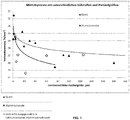
- Figure 1 shows the dependence of the bond stress on the average grain size of the particles used from Example 1.
- Example 1 Inventive and comparative 2-component synthetic mortar systems
- the following 2 components were each produced for 2-component synthetic mortar systems according to the invention (the average grain size d50 of the filler is 40 ⁇ m or less): Synthetic resin component raw material Proportion of [%] Urethane methacrylate resin 35.5 Methacryloxypropyltrimethoxysilane 6th Inhibitor mix (selected from t-BBC, hydroquinone and / or Tempol) 0.06 Amine accelerator 0.5 filler 56 fumed silica 1.94 total 100 Harder raw material Proportion of [%] Demineralised water 30th phlegmatized dibenzoyl peroxide (33%) 42 Quartz sand 26.5 Additives and thickeners 1.5 total 100
- quartz quartz, ⁇ -aluminum oxides, plasters, chalks and aluminum hydroxides are used in the specified fineness in the respective recipes.
- the synthetic resin component and the hardener are filled into commercially available cartridges with a mixing ratio of 5: 1.
- the values for the bond stress can also be found in Fig. 1 in graphical representation.
- the circular symbols represent the materials with no size effect.
- the tensile strength is and was determined on shoulder bars of test specimen type 1 BA in accordance with DIN EN ISO 527; the compressive strength is measured in accordance with DIN EN ISO 604 after a curing time of 23 ° C. for 24 hours.
- Example 2 (starting material): (A) Production of a urethane methacrylate resin:
- PMDI Diphenylmethane diisocyanate with isomers and higher functional homologues, molecular weight 430 g / mol, functionality 3.2 (manufacturer information)
- BDDMA 1,4-butanediol dimethacrylate (technical product)
- the components were filled into a 3: 1 cartridge and tested against the product FIS EM 390 S from fischerwerke GmbH & Co. KG.
- the bond tension could be increased by more than 10%.
Landscapes
- Chemical & Material Sciences (AREA)
- Organic Chemistry (AREA)
- Engineering & Computer Science (AREA)
- Chemical Kinetics & Catalysis (AREA)
- Ceramic Engineering (AREA)
- Polymers & Plastics (AREA)
- Health & Medical Sciences (AREA)
- Medicinal Chemistry (AREA)
- Structural Engineering (AREA)
- Materials Engineering (AREA)
- Architecture (AREA)
- Civil Engineering (AREA)
- Analytical Chemistry (AREA)
- Physics & Mathematics (AREA)
- Electromagnetism (AREA)
- Adhesives Or Adhesive Processes (AREA)
- Inorganic Chemistry (AREA)
- Nanotechnology (AREA)
- Dispersion Chemistry (AREA)
- Macromonomer-Based Addition Polymer (AREA)
- Epoxy Resins (AREA)
- Compositions Of Macromolecular Compounds (AREA)
- Polyurethanes Or Polyureas (AREA)
- Sealing Material Composition (AREA)
Claims (15)
- Utilisation d'au moins une substance de charge sélectionnée parmi des oxydes de silicium et d'aluminium ou des oxydes mixtes, en présence de cations supplémentaires, dans un système de mortier artificiel de fixation à composants multiples, dévolu à la fixation d'éléments d'ancrage dans des substrats de construction et renfermant, dans un composant, des résines synthétiques réactives (i) à base de (méth)acrylate d'uréthane, (ii) à base de résine époxyde ou (iii) à base de résines réactives insaturées durcissant (respectivement aptes au durcissement) par voie radicalaire, des durcisseurs dans un autre composant, et la substance de charge à présence minimale, sélectionnée parmi des oxydes de silicium et d'aluminium ou des oxydes mixtes, en présence de cations supplémentaires, caractérisée par le fait que la granulométrie moyenne d50 de la substance de charge à présence minimale est de l'ordre de 40 µm ou moins, en vue d'accroître la contrainte d'adhérence par rapport à des substances de charge à granulométrie moyenne supérieure, ladite granulométrie moyenne d50 étant déterminée par des déterminations de courbes de gradation à l'aide de tamis, ou par mesure granulométrique au laser.
- Utilisation selon la revendication 1, les substances de charge étant sélectionnées à partir d'oxydes de silicium et d'aluminium.
- Utilisation selon la revendication 1, caractérisée par le fait que la substance de charge, à présence minimale, possède une granulométrie moyenne d50 de 20 µm ou moins.
- Utilisation selon la revendication 1 ou la revendication 2, caractérisée par le fait qu'un oxyde de l'aluminium est sélectionné en tant que substance de charge.
- Utilisation selon la revendication 1 ou la revendication 2, caractérisée par le fait qu'un oxyde de silicium est sélectionné en tant que substance de charge.
- Utilisation selon l'une des revendications 1 à 5, caractérisée par le fait que la substance de charge, à présence minimale, possède une granulométrie moyenne de 10 µm ou moins.
- Utilisation selon l'une des revendications 1 à 5, caractérisée par le fait que la substance de charge, à présence minimale, est sélectionnée au sein du groupe comprenant du dioxyde de silicium et de l'oxyde d'aluminium ou des oxydes mixtes de ces derniers, avec présence additionnelle d'un ou plusieurs oxyde(s) sélectionné(s) parmi des oxydes du groupe de métaux comprenant notamment du calcium, du titane, du fer et du sodium, en particulier de l'oxyde d'a-aluminium.
- Utilisation selon l'une des revendications 1 à 7, caractérisée par le fait qu'au moins un silane, contenant au moins un groupe hydrolysable à liaison Si, est inclus en tant qu'adjuvant supplémentaire, ou bien la substance de charge se présente sous une forme modifiée par un tel silane, lequel silane comporte, outre au moins un groupe hydrolysable à liaison Si, des groupes époxy ou amino.
- Système de mortier de fixation à composants multiples, dévolu à la fixation d'éléments d'ancrage dans des substrats de construction et renfermant, dans un composant, des résines synthétiques réactives (i) à base de (méth)acrylate d'uréthane, (ii) à base de résine époxyde ou (iii) à base de résines réactives insaturées durcissant (respectivement aptes au durcissement) par voie radicalaire, des durcisseurs dans un autre composant, et au moins une substance de charge sélectionnée parmi des oxydes de silicium et d'aluminium ou des oxydes mixtes, en présence de cations supplémentaires, et dont la granulométrie moyenne d50 est de l'ordre de 40 µm ou moins, caractérisé par le fait qu'il renferme, en tant qu'adjuvant supplémentaire, au moins un silane contenant au moins un groupe hydrolysable à liaison Si, ou bien la substance de charge se présente sous une forme modifiée par un tel silane, lequel silane comporte, outre au moins un groupe hydrolysable à liaison Si, des groupes époxy ou amino dédiés à des masses d'ancrage correspondantes, à base époxy, ou des composés doubles oléfiniques destinés à des masses d'ancrage aptes au durcissement par voie radicalaire.
- Utilisation conforme à la revendication 8 ou système de mortier de fixation à composants multiples conforme à la revendication 9, caractérisé(e) par le fait que le silane se présente sous la forme
3-(méth)acryloyl-oxypropyltrialcoxysilane,
comme 3-(méth)acryloyl-oxypropyltriméthoxysilane ou -triéthoxysilane ou 3-(méth)acryloyl-oxyméthyltriméthoxysilane ou -triéthoxysilane, 3-(méth)acryloyl-oxypropylméthyldiméthoxysilane,
alcénylalcoxysilane, comme vinyltriméthoxysilane ou vinyltriéthoxysilane et/ou tétraalcoxysilane,
comme tétraéthoxysilane, tétraméthoxysilane ou tétrapropoxysilane,
voire un mélange de deux ou plus, parmi ces derniers ;
et/ou la substance de charge est modifiée en surface par ces derniers. - Utilisation conforme à l'une des revendications 1 à 8 ou 10, ou système de mortier de fixation à composants multiples conforme à la revendication 9, caractérisé(e) par le fait qu'une résine (ii) à base de résine époxyde, ou notamment (iii) à base de résines réactives insaturées durcissant (respectivement aptes au durcissement) par voie radicalaire, est employée en tant que résine synthétique réactive.
- Utilisation conforme à l'une des revendications 1 à 8 ou 10, ou système de mortier de fixation à composants multiples conforme à la revendication 9, caractérisé(e) par le fait qu'une résine à base de (méth)acrylate d'uréthane se présente en tant que résine synthétique réactive.
- Utilisation conforme à la revendication 12 ou système de mortier de fixation à composants multiples conforme à la revendication 9, caractérisé(e) par le fait que la résine synthétique réactive à base de (méth)acrylate d'uréthane a été obtenue par la réaction d'un di- ou polyisocyanate monomère avancé, et/ou par la réaction d'un di- ou polyisocyanate polymère avec du (méth)acrylate d'hydroxyéthyle ou d'hydroxypropyle.
- Utilisation conforme à l'une des revendications 1 à 8 ou 10 à 13, ou système de mortier de fixation à composants multiples conforme à la revendication 9, revêtant la forme d'un système à deux composants.
- Système de mortier de fixation à composants multiples conforme à la revendication 9, caractérisé par le fait que la substance de charge, à présence minimale, possède une granulométrie moyenne d50 de 20 µm ou moins.
Priority Applications (2)
| Application Number | Priority Date | Filing Date | Title |
|---|---|---|---|
| PL15401095T PL3000792T3 (pl) | 2014-09-23 | 2015-09-08 | Układy mocujące z wypełniaczami drobnoziarnistymi |
| EP21155567.7A EP3835280A1 (fr) | 2014-09-23 | 2015-09-08 | Systèmes de fixation comportant des charges à fines particules |
Applications Claiming Priority (2)
| Application Number | Priority Date | Filing Date | Title |
|---|---|---|---|
| DE102014013800 | 2014-09-23 | ||
| DE102015113352.0A DE102015113352A1 (de) | 2014-09-23 | 2015-08-13 | Befestigungssysteme mit feinteiligen Füllstoffen |
Related Child Applications (2)
| Application Number | Title | Priority Date | Filing Date |
|---|---|---|---|
| EP21155567.7A Division-Into EP3835280A1 (fr) | 2014-09-23 | 2015-09-08 | Systèmes de fixation comportant des charges à fines particules |
| EP21155567.7A Division EP3835280A1 (fr) | 2014-09-23 | 2015-09-08 | Systèmes de fixation comportant des charges à fines particules |
Publications (2)
| Publication Number | Publication Date |
|---|---|
| EP3000792A1 EP3000792A1 (fr) | 2016-03-30 |
| EP3000792B1 true EP3000792B1 (fr) | 2021-04-14 |
Family
ID=54478688
Family Applications (2)
| Application Number | Title | Priority Date | Filing Date |
|---|---|---|---|
| EP15401095.3A Active EP3000792B1 (fr) | 2014-09-23 | 2015-09-08 | Systemes de fixation au moyen de charges a fines particules |
| EP21155567.7A Pending EP3835280A1 (fr) | 2014-09-23 | 2015-09-08 | Systèmes de fixation comportant des charges à fines particules |
Family Applications After (1)
| Application Number | Title | Priority Date | Filing Date |
|---|---|---|---|
| EP21155567.7A Pending EP3835280A1 (fr) | 2014-09-23 | 2015-09-08 | Systèmes de fixation comportant des charges à fines particules |
Country Status (7)
| Country | Link |
|---|---|
| US (2) | US10711116B2 (fr) |
| EP (2) | EP3000792B1 (fr) |
| JP (1) | JP6579880B2 (fr) |
| CN (2) | CN113603393A (fr) |
| DE (3) | DE102015113352A1 (fr) |
| ES (1) | ES2881284T3 (fr) |
| PL (1) | PL3000792T3 (fr) |
Families Citing this family (42)
| Publication number | Priority date | Publication date | Assignee | Title |
|---|---|---|---|---|
| EP3290457A1 (fr) * | 2016-08-30 | 2018-03-07 | HILTI Aktiengesellschaft | Mortier bicomposant et son utilisation |
| EP3299350A1 (fr) * | 2016-09-26 | 2018-03-28 | HILTI Aktiengesellschaft | Masse de mortier bicomposant et son utilisation |
| WO2018109617A1 (fr) | 2016-12-13 | 2018-06-21 | 3M Innovative Properties Company | Stabilisation d'époxy au moyen d'acides barbituriques substitués |
| EP3424968A1 (fr) * | 2017-07-03 | 2019-01-09 | HILTI Aktiengesellschaft | Composés de méthacrylate d'uréthane et leur utilisation |
| EP3428208A1 (fr) * | 2017-07-10 | 2019-01-16 | HILTI Aktiengesellschaft | Procédé de préparation d'une composition d'une résine uréthane stable au stockage contenant de tempol |
| PL3447078T3 (pl) * | 2017-08-23 | 2020-07-13 | Hilti Aktiengesellschaft | Kołek chemiczny i jego zastosowanie |
| EP3587380A1 (fr) * | 2018-06-27 | 2020-01-01 | HILTI Aktiengesellschaft | Utilisation des alkylimidazolidon(méth)acrylates en tant que diluant réactif dans une composition de résine réactive |
| EP3626756A1 (fr) | 2018-09-19 | 2020-03-25 | Hilti Aktiengesellschaft | Composition durcissante pour une masse de résine époxy, masse de résine époxy et système de résine époxy multicomposant |
| EP3626757A1 (fr) | 2018-09-19 | 2020-03-25 | Hilti Aktiengesellschaft | Utilisation de sels en tant qu'accélérateur dans un masse de résine époxy destiné à la fixation chimique |
| JP7142771B2 (ja) | 2018-09-19 | 2022-09-27 | ヒルティ アクチエンゲゼルシャフト | エポキシ樹脂化合物用の硬化剤組成物、エポキシ樹脂化合物、および多成分エポキシ樹脂系 |
| US11535699B2 (en) | 2018-09-19 | 2022-12-27 | Hilti Aktiengesellschaft | Curing composition for an epoxy resin compound, epoxy resin compound and multi-component epoxy resin system |
| EP3733731A1 (fr) | 2019-04-30 | 2020-11-04 | Hilti Aktiengesellschaft | Composition durcissante pour une masse de résine époxy, masse de résine époxy et système de résine époxy multicomposant à durcissement à température basse amélioré |
| EP3786133A1 (fr) | 2019-08-27 | 2021-03-03 | Hilti Aktiengesellschaft | Masse de mortier comportant des bases de mannich à des fins de fixation à résistance améliorée à la température |
| EP3838981A1 (fr) * | 2019-12-18 | 2021-06-23 | Hilti Aktiengesellschaft | Composant de résine réactive, système de résine réactive comportant ledit composant de résine réactive et leur utilisation |
| EP3838862A1 (fr) * | 2019-12-18 | 2021-06-23 | Hilti Aktiengesellschaft | Utilisation d'une composition de résine réactive pour la fixation chimique d'un moyen d'ancrage dans un trou de forage |
| CN111019281B (zh) * | 2019-12-19 | 2021-12-10 | 上海贝塔建筑科技有限公司 | 一种丙烯酸酯环氧树脂杂化乳液、其制备方法、用途和使用其的人工彩砂 |
| EP3882294A1 (fr) | 2020-03-18 | 2021-09-22 | Hilti Aktiengesellschaft | Composition de durcisseur à base de diaminométhylcyclohexane et de 1,3-cyclo-hexane-bis(méthylamine) pour une masse de résine époxy, masse de résine époxy et système de résine époxy multicomposant |
| EP3882292A1 (fr) | 2020-03-20 | 2021-09-22 | Hilti Aktiengesellschaft | Composition de mortier à base d'adduits isocyanate-amine, système de résine multicomposant ainsi que procédé et utilisation du système de résine multicomposant destinés à fixer des éléments de construction |
| EP3909933A1 (fr) * | 2020-05-15 | 2021-11-17 | Hilti Aktiengesellschaft | Composant initiateur à base d'alcalisilicate pour l'utilisation dans un système de mortier inorganique cimentaire à composants multiples |
| EP3945082A1 (fr) | 2020-07-28 | 2022-02-02 | Hilti Aktiengesellschaft | Durcisseur pour masses de résine époxy à des fins de fixation |
| EP4049990B1 (fr) | 2021-02-24 | 2023-11-15 | fischerwerke GmbH & Co. KG | Mélanges de résines à identité sécurisée pour la technique de fixation, leur fabrication et leur utilisation |
| DE102021129647A1 (de) | 2021-02-24 | 2022-08-25 | Fischerwerke Gmbh & Co. Kg | Identitätsgesicherte Kunstharzmischungen für die Befestigungstechnik, ihre Herstellung und Verwendung |
| EP4074671A1 (fr) | 2021-04-16 | 2022-10-19 | Hilti Aktiengesellschaft | Matériau de résine époxy à composants multiples avec des particules fines |
| EP4119589A1 (fr) | 2021-07-16 | 2023-01-18 | Hilti Aktiengesellschaft | Mélanges de résine époxy comprenant des molécules époxyde-acrylate hybrides et compositions de résine réactives à composants multiples |
| EP4119590A1 (fr) | 2021-07-16 | 2023-01-18 | Hilti Aktiengesellschaft | Molécules hybrides époxyde-acrylate et leur utilisation pour l'ancrage chimique |
| EP4124629A1 (fr) | 2021-07-29 | 2023-02-01 | Hilti Aktiengesellschaft | Matériau de résine époxy à composants multiples avec des charges |
| KR102414943B1 (ko) * | 2021-11-24 | 2022-06-30 | 백지웅 | 수축 저감형 초조강 및 조강 시멘트 콘크리트 조성물 및 이를 이용한 도로포장 유지보수공법 |
| EP4310124A1 (fr) | 2022-07-20 | 2024-01-24 | Hilti Aktiengesellschaft | Composition à composants multiples à des fins de fixation comportant des fractions eew/ahew non stochiometriques, matière de mortier fabriquée à partir de celle-ci et cheville chimique fabriquée à partir de celle-ci |
| EP4310125A1 (fr) | 2022-07-20 | 2024-01-24 | Hilti Aktiengesellschaft | Amines tertiaires destinées à l'amélioration du comportement au fluage des chevilles chimiques |
| EP4332143A1 (fr) | 2022-08-29 | 2024-03-06 | Hilti Aktiengesellschaft | Système de résine à plusieurs composants à base d'alcool époxy |
| EP4615930A1 (fr) | 2022-11-10 | 2025-09-17 | fischerwerke GmbH & Co. KG | Mortier haute performance à base de tbx et analogues |
| DE102023118527A1 (de) | 2022-11-10 | 2024-05-16 | Fischerwerke Gmbh & Co. Kg | Hochleistungsmörtel mit TBX und Analogen |
| EP4375263A1 (fr) | 2022-11-24 | 2024-05-29 | Hilti Aktiengesellschaft | Système de résine à plusieurs composants comprenant de l'isocyanate, du dmtda et du dtda |
| EP4375262A1 (fr) | 2022-11-24 | 2024-05-29 | Hilti Aktiengesellschaft | Système de résine à plusieurs composants comprenant un mélange d'isocyanates |
| EP4458877A1 (fr) | 2023-05-05 | 2024-11-06 | Hilti Aktiengesellschaft | Utilisation d'une amine tertiaire pour améliorer les propriétés d'une cheville chimique |
| EP4488315A1 (fr) | 2023-07-07 | 2025-01-08 | Hilti Aktiengesellschaft | Composition de durcisseur comprenant des sels de thiocyanate |
| EP4563613A1 (fr) | 2023-11-30 | 2025-06-04 | Hilti Aktiengesellschaft | Utilisation d'un composé époxy trifonctionnel pour améliorer les propriétés d'une cheville chimique |
| EP4563615A1 (fr) | 2023-11-30 | 2025-06-04 | Hilti Aktiengesellschaft | Utilisation de composés époxydes polyfonctionnels pour améliorer les propriétés d'une cheville chimique |
| WO2025147697A1 (fr) * | 2024-01-05 | 2025-07-10 | Sumitomo Chemical Advanced Technologies, Llc, D.B.A. Sumika Electronic Materials | Compositions de caoutchouc contenant de l'acétate ou du butyrate de phloroglucinol destinées à être utilisées dans des bandes de roulement de pneus de véhicules lourds |
| WO2025170770A1 (fr) * | 2024-02-05 | 2025-08-14 | Dow Global Technologies Llc | Compositions thermoconductrices |
| WO2025231394A1 (fr) * | 2024-05-02 | 2025-11-06 | Biobond Adhesives, Inc. | Système adhésif à base biologique |
| EP4656609A1 (fr) | 2024-05-26 | 2025-12-03 | fischerwerke GmbH & Co. KG | Système de mortier à radicaux libres stabilisé par le temps de gel |
Citations (1)
| Publication number | Priority date | Publication date | Assignee | Title |
|---|---|---|---|---|
| EP2826796A1 (fr) * | 2013-07-18 | 2015-01-21 | HILTI Aktiengesellschaft | Utilisation d'une masse de mortier multicomposants à base d'époxyde-amine |
Family Cites Families (31)
| Publication number | Priority date | Publication date | Assignee | Title |
|---|---|---|---|---|
| JPS6028478A (ja) | 1983-07-27 | 1985-02-13 | Asahi Chem Ind Co Ltd | 耐食性に優れたボルト固定用固着材 |
| US4931490A (en) * | 1983-10-04 | 1990-06-05 | Armeniades C D | Expandable polymer concretes and mortars utilizing low cure temperature polymers |
| DE3812814A1 (de) * | 1988-04-16 | 1989-11-02 | Hilti Ag | Verwendung von zweikomponenten-reaktionsharzen fuer befestigungszwecke |
| DE3940309A1 (de) | 1989-12-06 | 1991-06-13 | Hilti Ag | Moertelmasse |
| DE4111828A1 (de) | 1991-04-11 | 1992-10-15 | Basf Ag | Patrone fuer die chemische befestigungstechnik |
| DE4331052A1 (de) | 1993-09-13 | 1995-03-16 | Hoechst Ag | Härtungskomponente für Epoxidharze |
| IT1288706B1 (it) * | 1996-01-09 | 1998-09-23 | Patrizio Agus | Malta rigenerante e protettiva per cementi, calcestruzzi degradati e vari. |
| DE19632749A1 (de) | 1996-08-14 | 1998-02-19 | Hoechst Ag | Härtungskomponente für Epoxidharze und deren Verwendung |
| JP2000169820A (ja) * | 1998-12-09 | 2000-06-20 | Sekisui Chem Co Ltd | 接着剤組成物 |
| DE19956509A1 (de) | 1999-11-24 | 2001-01-18 | Basf Ag | Inhibitorkomposition zur Stabilisierung von ethylenisch ungesättigten Verbindungen gegen vorzeitige radikalische Polymerisation |
| US7022410B2 (en) * | 2003-12-16 | 2006-04-04 | General Electric Company | Combinations of resin compositions and methods of use thereof |
| DE102004008464A1 (de) | 2004-02-19 | 2005-09-15 | Fischerwerke Artur Fischer Gmbh & Co. Kg | Mehrkomponentenkit für Befestigungszwecke und dessen Verwendung |
| DE102004035567B4 (de) * | 2004-07-22 | 2006-10-26 | Hilti Ag | Zweikomponenten-Mörtelmasse und ihre Verwendung |
| WO2007054112A1 (fr) * | 2005-11-10 | 2007-05-18 | Henkel Ag & Co. Kgaa | Substances adhesives, d'etancheite, et de revetement contenant des particules de verre en tant que matiere de charge |
| TW200730578A (en) * | 2005-12-08 | 2007-08-16 | Hitachi Chemical Co Ltd | Liquid resin composition for electronic element and electronic element device |
| DE102009043792B4 (de) * | 2009-09-30 | 2013-04-11 | Hilti Aktiengesellschaft | Zweikomponenten-Mörtelmasse und ihre Verwendung |
| JP2011173779A (ja) * | 2010-01-26 | 2011-09-08 | Sakai Chem Ind Co Ltd | シリカ粒子とその製造方法、及びそれを含む樹脂組成物 |
| DE102010015981A1 (de) | 2010-03-16 | 2011-09-22 | Fischerwerke Gmbh & Co. Kg | Epoxidbasierter Befestigungsmörtel mit Silanzusätzen |
| DE102010051818B3 (de) * | 2010-11-18 | 2012-02-16 | Hilti Aktiengesellschaft | Zweikomponenten-Mörtelmasse und ihre Verwendung |
| EP2468791A1 (fr) | 2010-12-22 | 2012-06-27 | Sika Technology AG | Utilisation de thiocarbonates dans des formules de résine époxy pour l'amélioration de surfaces |
| DE102011078785B4 (de) | 2011-07-07 | 2013-03-07 | Hilti Aktiengesellschaft | Härterzusammensetzung, diese enthaltendes Mehrkomponenten-Mörtelsystem, dessen Verwendung sowie Patrone, Kartusche oder Folienbeutel enthaltend ein Mehrkomponenten - Mörtelsystem |
| DE202011110267U1 (de) | 2011-11-22 | 2013-03-26 | Evonik Degussa Gmbh | Zusammensetzung olefinisch funktionalisierter Siloxanoligomere basierend auf Alkoxysilanen |
| DE102012216972B3 (de) | 2012-09-21 | 2013-09-19 | Hilti Aktiengesellschaft | Verwendung oberflächenfunktionalisierter Kieselsäuren als Additiv für Reaktionsharz-Zusammensetzungen sowie dieses enthaltende Harz- und Härter-Zusammensetzungen |
| DE102012221446A1 (de) | 2012-11-23 | 2014-05-28 | Hilti Aktiengesellschaft | Harzmischung auf Epoxy(meth)acrylatharz-Basis und deren Verwendung |
| EP2931782B1 (fr) * | 2012-12-11 | 2016-12-07 | fischerwerke GmbH & Co. KG | Matière à base d'époxy à des fins de fixation, son utilisation et l'utilisation de composants déterminés |
| DE102013101861A1 (de) | 2013-02-26 | 2014-08-28 | Miele & Cie. Kg | Geschirrspülautomat, insbesondere Haushaltsgeschirrspülmaschine |
| EP2826797A1 (fr) | 2013-07-18 | 2015-01-21 | HILTI Aktiengesellschaft | Composants durcisseurs, masse de mortier contenant ceux-ci et leur utilisation |
| DE102013114061A1 (de) | 2013-12-16 | 2015-06-18 | Fischerwerke Gmbh & Co. Kg | Thiole und/oder Thiolester und Metallsalze als Härtersystem in Harzzusammensetzungen unter anderem für die Befestigungstechnik |
| DE102015003221A1 (de) | 2014-04-11 | 2015-10-15 | Fischerwerke Gmbh & Co. Kg | CH-Acide Verbindungen und Metallsalze als Härtesystem, entsprechende Harzzusammensetzungen unter anderem für die Befestigungstechnik |
| DE102014109355A1 (de) | 2014-07-04 | 2016-01-07 | Fischerwerke Gmbh & Co. Kg | Reaktivverdünner für die chemische Befestigung |
| DE102015109125A1 (de) | 2014-07-04 | 2016-01-07 | Fischerwerke Gmbh & Co. Kg | Epoxidbasiertes Befestigungskunstmörtelsystem mit Siloxanoligomeren |
-
2015
- 2015-08-13 DE DE102015113352.0A patent/DE102015113352A1/de active Pending
- 2015-09-08 PL PL15401095T patent/PL3000792T3/pl unknown
- 2015-09-08 ES ES15401095T patent/ES2881284T3/es active Active
- 2015-09-08 EP EP15401095.3A patent/EP3000792B1/fr active Active
- 2015-09-08 DE DE202015009665.4U patent/DE202015009665U1/de not_active Expired - Lifetime
- 2015-09-08 EP EP21155567.7A patent/EP3835280A1/fr active Pending
- 2015-09-08 DE DE202015009664.6U patent/DE202015009664U1/de not_active Expired - Lifetime
- 2015-09-18 JP JP2015185131A patent/JP6579880B2/ja not_active Expired - Fee Related
- 2015-09-22 CN CN202110913908.1A patent/CN113603393A/zh active Pending
- 2015-09-22 US US14/860,870 patent/US10711116B2/en active Active
- 2015-09-22 CN CN201510609861.4A patent/CN105440658A/zh active Pending
-
2020
- 2020-06-10 US US16/897,675 patent/US11795301B2/en active Active
Patent Citations (1)
| Publication number | Priority date | Publication date | Assignee | Title |
|---|---|---|---|---|
| EP2826796A1 (fr) * | 2013-07-18 | 2015-01-21 | HILTI Aktiengesellschaft | Utilisation d'une masse de mortier multicomposants à base d'époxyde-amine |
Also Published As
| Publication number | Publication date |
|---|---|
| CN113603393A (zh) | 2021-11-05 |
| ES2881284T3 (es) | 2021-11-29 |
| EP3000792A1 (fr) | 2016-03-30 |
| US20160083563A1 (en) | 2016-03-24 |
| JP6579880B2 (ja) | 2019-09-25 |
| PL3000792T3 (pl) | 2021-11-02 |
| US10711116B2 (en) | 2020-07-14 |
| DE202015009664U1 (de) | 2018-12-06 |
| CN105440658A (zh) | 2016-03-30 |
| JP2016069270A (ja) | 2016-05-09 |
| EP3835280A1 (fr) | 2021-06-16 |
| US11795301B2 (en) | 2023-10-24 |
| DE102015113352A1 (de) | 2016-03-24 |
| US20200299486A1 (en) | 2020-09-24 |
| DE202015009665U1 (de) | 2018-12-06 |
Similar Documents
| Publication | Publication Date | Title |
|---|---|---|
| EP3000792B1 (fr) | Systemes de fixation au moyen de charges a fines particules | |
| EP3164432B1 (fr) | Diluant réactif pour la fixation chimique | |
| EP2513007B1 (fr) | Mortier de fixation à polymérisation radicalaire contenant des additifs silane et son utilisation | |
| WO2015018466A1 (fr) | Adhésif à base de résine synthétique comportant des diluants réactifs et des résines biogènes | |
| WO2022002567A1 (fr) | Imines spéciales et leurs produits de départ, et leur utilisation lors du durcissement de résines réactives par polyaddition ou polymérisation radicalaire | |
| EP3424972B1 (fr) | Composés de méthacrylate d'uréthane et leur utilisation | |
| EP2985318B1 (fr) | Masse de résine synthétique durcissable par voie radicalaire avec des additifs de siloxanes oligomériques. | |
| EP3194503B1 (fr) | Masse de résine synthétique durcissable par voie radicalaire avec des additifs de siloxanes oligomériques. | |
| EP3652226B1 (fr) | Procédé de préparation d'une composition d'une résine uréthane stable au stockage contenant de tempol | |
| EP3818026B2 (fr) | Utilisation d'un kit exempt de phtalate pour fixer des éléments d'ancrage dans le domaine de la construction | |
| EP4177235A1 (fr) | Matières de recyclage pulvérisées en tant que charges pour systèmes à composants multiples destinées à la fixation chimique | |
| EP3365383B1 (fr) | Système de fixation à base de résine synthétique contenant des vinylester-uréthanestels que des (méth)acrylates d'uréthane à base de matières premières renouvelables | |
| EP3424968A1 (fr) | Composés de méthacrylate d'uréthane et leur utilisation | |
| EP2838950A2 (fr) | Utilisation de radicaux nitroxyde ss-phosphorylés en tant qu'inhibiteurs pour des résines réactives, résines réactives les contenant et leur utilisation | |
| EP3882291A1 (fr) | Systèmes de fixation en résine comprenant un diluant réactif mono fonctionnel, leur production et utilisations | |
| EP4177229A1 (fr) | Farine de brique en tant que charge dans les systèmes à composants multiples pour la fixation chimique | |
| EP4049990B1 (fr) | Mélanges de résines à identité sécurisée pour la technique de fixation, leur fabrication et leur utilisation | |
| EP3649169B1 (fr) | Composés de méthacrylate d'uréthane comprenant une résine de réaction, composants de résine de réaction et système de résine de réaction et son utilisation | |
| EP4491596A1 (fr) | Système de fixation à résine synthétique durcissable par voie radicalaire à polarité équilibrée par un diluant réactif |
Legal Events
| Date | Code | Title | Description |
|---|---|---|---|
| PUAI | Public reference made under article 153(3) epc to a published international application that has entered the european phase |
Free format text: ORIGINAL CODE: 0009012 |
|
| AK | Designated contracting states |
Kind code of ref document: A1 Designated state(s): AL AT BE BG CH CY CZ DE DK EE ES FI FR GB GR HR HU IE IS IT LI LT LU LV MC MK MT NL NO PL PT RO RS SE SI SK SM TR |
|
| AX | Request for extension of the european patent |
Extension state: BA ME |
|
| 17P | Request for examination filed |
Effective date: 20160919 |
|
| RBV | Designated contracting states (corrected) |
Designated state(s): AL AT BE BG CH CY CZ DE DK EE ES FI FR GB GR HR HU IE IS IT LI LT LU LV MC MK MT NL NO PL PT RO RS SE SI SK SM TR |
|
| STAA | Information on the status of an ep patent application or granted ep patent |
Free format text: STATUS: EXAMINATION IS IN PROGRESS |
|
| 17Q | First examination report despatched |
Effective date: 20170322 |
|
| GRAP | Despatch of communication of intention to grant a patent |
Free format text: ORIGINAL CODE: EPIDOSNIGR1 |
|
| STAA | Information on the status of an ep patent application or granted ep patent |
Free format text: STATUS: GRANT OF PATENT IS INTENDED |
|
| RIC1 | Information provided on ipc code assigned before grant |
Ipc: C04B 111/00 20060101ALN20201113BHEP Ipc: C09J 4/00 20060101ALI20201113BHEP Ipc: C09J 175/00 20060101ALI20201113BHEP Ipc: C09J 4/06 20060101ALI20201113BHEP Ipc: C04B 40/06 20060101ALI20201113BHEP Ipc: C04B 26/10 20060101ALI20201113BHEP Ipc: C04B 26/06 20060101AFI20201113BHEP Ipc: C09J 163/00 20060101ALI20201113BHEP Ipc: C04B 26/14 20060101ALI20201113BHEP |
|
| INTG | Intention to grant announced |
Effective date: 20201210 |
|
| GRAS | Grant fee paid |
Free format text: ORIGINAL CODE: EPIDOSNIGR3 |
|
| GRAA | (expected) grant |
Free format text: ORIGINAL CODE: 0009210 |
|
| STAA | Information on the status of an ep patent application or granted ep patent |
Free format text: STATUS: THE PATENT HAS BEEN GRANTED |
|
| AK | Designated contracting states |
Kind code of ref document: B1 Designated state(s): AL AT BE BG CH CY CZ DE DK EE ES FI FR GB GR HR HU IE IS IT LI LT LU LV MC MK MT NL NO PL PT RO RS SE SI SK SM TR |
|
| REG | Reference to a national code |
Ref country code: GB Ref legal event code: FG4D Free format text: NOT ENGLISH |
|
| REG | Reference to a national code |
Ref country code: CH Ref legal event code: EP |
|
| REG | Reference to a national code |
Ref country code: DE Ref legal event code: R096 Ref document number: 502015014552 Country of ref document: DE |
|
| REG | Reference to a national code |
Ref country code: IE Ref legal event code: FG4D Free format text: LANGUAGE OF EP DOCUMENT: GERMAN |
|
| REG | Reference to a national code |
Ref country code: AT Ref legal event code: REF Ref document number: 1382247 Country of ref document: AT Kind code of ref document: T Effective date: 20210515 |
|
| REG | Reference to a national code |
Ref country code: NL Ref legal event code: FP |
|
| REG | Reference to a national code |
Ref country code: LT Ref legal event code: MG9D |
|
| PG25 | Lapsed in a contracting state [announced via postgrant information from national office to epo] |
Ref country code: HR Free format text: LAPSE BECAUSE OF FAILURE TO SUBMIT A TRANSLATION OF THE DESCRIPTION OR TO PAY THE FEE WITHIN THE PRESCRIBED TIME-LIMIT Effective date: 20210414 Ref country code: BG Free format text: LAPSE BECAUSE OF FAILURE TO SUBMIT A TRANSLATION OF THE DESCRIPTION OR TO PAY THE FEE WITHIN THE PRESCRIBED TIME-LIMIT Effective date: 20210714 Ref country code: FI Free format text: LAPSE BECAUSE OF FAILURE TO SUBMIT A TRANSLATION OF THE DESCRIPTION OR TO PAY THE FEE WITHIN THE PRESCRIBED TIME-LIMIT Effective date: 20210414 Ref country code: LT Free format text: LAPSE BECAUSE OF FAILURE TO SUBMIT A TRANSLATION OF THE DESCRIPTION OR TO PAY THE FEE WITHIN THE PRESCRIBED TIME-LIMIT Effective date: 20210414 |
|
| REG | Reference to a national code |
Ref country code: ES Ref legal event code: FG2A Ref document number: 2881284 Country of ref document: ES Kind code of ref document: T3 Effective date: 20211129 |
|
| PG25 | Lapsed in a contracting state [announced via postgrant information from national office to epo] |
Ref country code: NO Free format text: LAPSE BECAUSE OF FAILURE TO SUBMIT A TRANSLATION OF THE DESCRIPTION OR TO PAY THE FEE WITHIN THE PRESCRIBED TIME-LIMIT Effective date: 20210714 Ref country code: PT Free format text: LAPSE BECAUSE OF FAILURE TO SUBMIT A TRANSLATION OF THE DESCRIPTION OR TO PAY THE FEE WITHIN THE PRESCRIBED TIME-LIMIT Effective date: 20210816 Ref country code: RS Free format text: LAPSE BECAUSE OF FAILURE TO SUBMIT A TRANSLATION OF THE DESCRIPTION OR TO PAY THE FEE WITHIN THE PRESCRIBED TIME-LIMIT Effective date: 20210414 Ref country code: SE Free format text: LAPSE BECAUSE OF FAILURE TO SUBMIT A TRANSLATION OF THE DESCRIPTION OR TO PAY THE FEE WITHIN THE PRESCRIBED TIME-LIMIT Effective date: 20210414 Ref country code: LV Free format text: LAPSE BECAUSE OF FAILURE TO SUBMIT A TRANSLATION OF THE DESCRIPTION OR TO PAY THE FEE WITHIN THE PRESCRIBED TIME-LIMIT Effective date: 20210414 Ref country code: GR Free format text: LAPSE BECAUSE OF FAILURE TO SUBMIT A TRANSLATION OF THE DESCRIPTION OR TO PAY THE FEE WITHIN THE PRESCRIBED TIME-LIMIT Effective date: 20210715 Ref country code: IS Free format text: LAPSE BECAUSE OF FAILURE TO SUBMIT A TRANSLATION OF THE DESCRIPTION OR TO PAY THE FEE WITHIN THE PRESCRIBED TIME-LIMIT Effective date: 20210814 |
|
| REG | Reference to a national code |
Ref country code: DE Ref legal event code: R097 Ref document number: 502015014552 Country of ref document: DE |
|
| PG25 | Lapsed in a contracting state [announced via postgrant information from national office to epo] |
Ref country code: EE Free format text: LAPSE BECAUSE OF FAILURE TO SUBMIT A TRANSLATION OF THE DESCRIPTION OR TO PAY THE FEE WITHIN THE PRESCRIBED TIME-LIMIT Effective date: 20210414 Ref country code: CZ Free format text: LAPSE BECAUSE OF FAILURE TO SUBMIT A TRANSLATION OF THE DESCRIPTION OR TO PAY THE FEE WITHIN THE PRESCRIBED TIME-LIMIT Effective date: 20210414 Ref country code: DK Free format text: LAPSE BECAUSE OF FAILURE TO SUBMIT A TRANSLATION OF THE DESCRIPTION OR TO PAY THE FEE WITHIN THE PRESCRIBED TIME-LIMIT Effective date: 20210414 Ref country code: SK Free format text: LAPSE BECAUSE OF FAILURE TO SUBMIT A TRANSLATION OF THE DESCRIPTION OR TO PAY THE FEE WITHIN THE PRESCRIBED TIME-LIMIT Effective date: 20210414 Ref country code: SM Free format text: LAPSE BECAUSE OF FAILURE TO SUBMIT A TRANSLATION OF THE DESCRIPTION OR TO PAY THE FEE WITHIN THE PRESCRIBED TIME-LIMIT Effective date: 20210414 Ref country code: RO Free format text: LAPSE BECAUSE OF FAILURE TO SUBMIT A TRANSLATION OF THE DESCRIPTION OR TO PAY THE FEE WITHIN THE PRESCRIBED TIME-LIMIT Effective date: 20210414 |
|
| PLBE | No opposition filed within time limit |
Free format text: ORIGINAL CODE: 0009261 |
|
| STAA | Information on the status of an ep patent application or granted ep patent |
Free format text: STATUS: NO OPPOSITION FILED WITHIN TIME LIMIT |
|
| 26N | No opposition filed |
Effective date: 20220117 |
|
| REG | Reference to a national code |
Ref country code: CH Ref legal event code: PL |
|
| REG | Reference to a national code |
Ref country code: BE Ref legal event code: MM Effective date: 20210930 |
|
| PG25 | Lapsed in a contracting state [announced via postgrant information from national office to epo] |
Ref country code: IS Free format text: LAPSE BECAUSE OF FAILURE TO SUBMIT A TRANSLATION OF THE DESCRIPTION OR TO PAY THE FEE WITHIN THE PRESCRIBED TIME-LIMIT Effective date: 20210814 Ref country code: MC Free format text: LAPSE BECAUSE OF FAILURE TO SUBMIT A TRANSLATION OF THE DESCRIPTION OR TO PAY THE FEE WITHIN THE PRESCRIBED TIME-LIMIT Effective date: 20210414 Ref country code: AL Free format text: LAPSE BECAUSE OF FAILURE TO SUBMIT A TRANSLATION OF THE DESCRIPTION OR TO PAY THE FEE WITHIN THE PRESCRIBED TIME-LIMIT Effective date: 20210414 |
|
| PG25 | Lapsed in a contracting state [announced via postgrant information from national office to epo] |
Ref country code: LU Free format text: LAPSE BECAUSE OF NON-PAYMENT OF DUE FEES Effective date: 20210908 Ref country code: IE Free format text: LAPSE BECAUSE OF NON-PAYMENT OF DUE FEES Effective date: 20210908 Ref country code: BE Free format text: LAPSE BECAUSE OF NON-PAYMENT OF DUE FEES Effective date: 20210930 |
|
| PG25 | Lapsed in a contracting state [announced via postgrant information from national office to epo] |
Ref country code: LI Free format text: LAPSE BECAUSE OF NON-PAYMENT OF DUE FEES Effective date: 20210930 Ref country code: CH Free format text: LAPSE BECAUSE OF NON-PAYMENT OF DUE FEES Effective date: 20210930 |
|
| PG25 | Lapsed in a contracting state [announced via postgrant information from national office to epo] |
Ref country code: HU Free format text: LAPSE BECAUSE OF FAILURE TO SUBMIT A TRANSLATION OF THE DESCRIPTION OR TO PAY THE FEE WITHIN THE PRESCRIBED TIME-LIMIT; INVALID AB INITIO Effective date: 20150908 |
|
| P01 | Opt-out of the competence of the unified patent court (upc) registered |
Effective date: 20230321 |
|
| P02 | Opt-out of the competence of the unified patent court (upc) changed |
Effective date: 20230329 |
|
| PG25 | Lapsed in a contracting state [announced via postgrant information from national office to epo] |
Ref country code: CY Free format text: LAPSE BECAUSE OF FAILURE TO SUBMIT A TRANSLATION OF THE DESCRIPTION OR TO PAY THE FEE WITHIN THE PRESCRIBED TIME-LIMIT Effective date: 20210414 |
|
| PGFP | Annual fee paid to national office [announced via postgrant information from national office to epo] |
Ref country code: AT Payment date: 20230921 Year of fee payment: 9 |
|
| PG25 | Lapsed in a contracting state [announced via postgrant information from national office to epo] |
Ref country code: MK Free format text: LAPSE BECAUSE OF FAILURE TO SUBMIT A TRANSLATION OF THE DESCRIPTION OR TO PAY THE FEE WITHIN THE PRESCRIBED TIME-LIMIT Effective date: 20210414 |
|
| PG25 | Lapsed in a contracting state [announced via postgrant information from national office to epo] |
Ref country code: TR Free format text: LAPSE BECAUSE OF FAILURE TO SUBMIT A TRANSLATION OF THE DESCRIPTION OR TO PAY THE FEE WITHIN THE PRESCRIBED TIME-LIMIT Effective date: 20210414 |
|
| PG25 | Lapsed in a contracting state [announced via postgrant information from national office to epo] |
Ref country code: MT Free format text: LAPSE BECAUSE OF FAILURE TO SUBMIT A TRANSLATION OF THE DESCRIPTION OR TO PAY THE FEE WITHIN THE PRESCRIBED TIME-LIMIT Effective date: 20210414 |
|
| REG | Reference to a national code |
Ref country code: AT Ref legal event code: MM01 Ref document number: 1382247 Country of ref document: AT Kind code of ref document: T Effective date: 20240908 |
|
| PG25 | Lapsed in a contracting state [announced via postgrant information from national office to epo] |
Ref country code: AT Free format text: LAPSE BECAUSE OF NON-PAYMENT OF DUE FEES Effective date: 20240908 |
|
| PGFP | Annual fee paid to national office [announced via postgrant information from national office to epo] |
Ref country code: DE Payment date: 20250806 Year of fee payment: 11 |
|
| PGFP | Annual fee paid to national office [announced via postgrant information from national office to epo] |
Ref country code: PL Payment date: 20250828 Year of fee payment: 11 Ref country code: IT Payment date: 20250923 Year of fee payment: 11 Ref country code: NL Payment date: 20250918 Year of fee payment: 11 |
|
| PGFP | Annual fee paid to national office [announced via postgrant information from national office to epo] |
Ref country code: GB Payment date: 20250919 Year of fee payment: 11 |
|
| PGFP | Annual fee paid to national office [announced via postgrant information from national office to epo] |
Ref country code: FR Payment date: 20250922 Year of fee payment: 11 |
|
| PGFP | Annual fee paid to national office [announced via postgrant information from national office to epo] |
Ref country code: ES Payment date: 20251028 Year of fee payment: 11 |