EP3000802A1 - Procédés de fabrication d'hydrocarbures chlorinés - Google Patents
Procédés de fabrication d'hydrocarbures chlorinés Download PDFInfo
- Publication number
- EP3000802A1 EP3000802A1 EP15189546.3A EP15189546A EP3000802A1 EP 3000802 A1 EP3000802 A1 EP 3000802A1 EP 15189546 A EP15189546 A EP 15189546A EP 3000802 A1 EP3000802 A1 EP 3000802A1
- Authority
- EP
- European Patent Office
- Prior art keywords
- reactor
- pentachloropropane
- continuously
- tetrachloropropane
- carbon tetrachloride
- Prior art date
- Legal status (The legal status is an assumption and is not a legal conclusion. Google has not performed a legal analysis and makes no representation as to the accuracy of the status listed.)
- Granted
Links
Images




Classifications
-
- C—CHEMISTRY; METALLURGY
- C07—ORGANIC CHEMISTRY
- C07C—ACYCLIC OR CARBOCYCLIC COMPOUNDS
- C07C17/00—Preparation of halogenated hydrocarbons
- C07C17/25—Preparation of halogenated hydrocarbons by splitting-off hydrogen halides from halogenated hydrocarbons
-
- C—CHEMISTRY; METALLURGY
- C07—ORGANIC CHEMISTRY
- C07C—ACYCLIC OR CARBOCYCLIC COMPOUNDS
- C07C17/00—Preparation of halogenated hydrocarbons
- C07C17/013—Preparation of halogenated hydrocarbons by addition of halogens
- C07C17/04—Preparation of halogenated hydrocarbons by addition of halogens to unsaturated halogenated hydrocarbons
-
- C—CHEMISTRY; METALLURGY
- C07—ORGANIC CHEMISTRY
- C07C—ACYCLIC OR CARBOCYCLIC COMPOUNDS
- C07C17/00—Preparation of halogenated hydrocarbons
- C07C17/093—Preparation of halogenated hydrocarbons by replacement by halogens
- C07C17/10—Preparation of halogenated hydrocarbons by replacement by halogens of hydrogen atoms
-
- C—CHEMISTRY; METALLURGY
- C07—ORGANIC CHEMISTRY
- C07C—ACYCLIC OR CARBOCYCLIC COMPOUNDS
- C07C17/00—Preparation of halogenated hydrocarbons
- C07C17/26—Preparation of halogenated hydrocarbons by reactions involving an increase in the number of carbon atoms in the skeleton
- C07C17/272—Preparation of halogenated hydrocarbons by reactions involving an increase in the number of carbon atoms in the skeleton by addition reactions
- C07C17/275—Preparation of halogenated hydrocarbons by reactions involving an increase in the number of carbon atoms in the skeleton by addition reactions of hydrocarbons and halogenated hydrocarbons
-
- C—CHEMISTRY; METALLURGY
- C07—ORGANIC CHEMISTRY
- C07C—ACYCLIC OR CARBOCYCLIC COMPOUNDS
- C07C17/00—Preparation of halogenated hydrocarbons
- C07C17/38—Separation; Purification; Stabilisation; Use of additives
-
- C—CHEMISTRY; METALLURGY
- C07—ORGANIC CHEMISTRY
- C07C—ACYCLIC OR CARBOCYCLIC COMPOUNDS
- C07C17/00—Preparation of halogenated hydrocarbons
- C07C17/38—Separation; Purification; Stabilisation; Use of additives
- C07C17/383—Separation; Purification; Stabilisation; Use of additives by distillation
-
- C—CHEMISTRY; METALLURGY
- C07—ORGANIC CHEMISTRY
- C07C—ACYCLIC OR CARBOCYCLIC COMPOUNDS
- C07C19/00—Acyclic saturated compounds containing halogen atoms
- C07C19/01—Acyclic saturated compounds containing halogen atoms containing chlorine
-
- C—CHEMISTRY; METALLURGY
- C07—ORGANIC CHEMISTRY
- C07C—ACYCLIC OR CARBOCYCLIC COMPOUNDS
- C07C21/00—Acyclic unsaturated compounds containing halogen atoms
- C07C21/02—Acyclic unsaturated compounds containing halogen atoms containing carbon-to-carbon double bonds
- C07C21/04—Chloro-alkenes
-
- Y—GENERAL TAGGING OF NEW TECHNOLOGICAL DEVELOPMENTS; GENERAL TAGGING OF CROSS-SECTIONAL TECHNOLOGIES SPANNING OVER SEVERAL SECTIONS OF THE IPC; TECHNICAL SUBJECTS COVERED BY FORMER USPC CROSS-REFERENCE ART COLLECTIONS [XRACs] AND DIGESTS
- Y02—TECHNOLOGIES OR APPLICATIONS FOR MITIGATION OR ADAPTATION AGAINST CLIMATE CHANGE
- Y02P—CLIMATE CHANGE MITIGATION TECHNOLOGIES IN THE PRODUCTION OR PROCESSING OF GOODS
- Y02P20/00—Technologies relating to chemical industry
- Y02P20/10—Process efficiency
Definitions
- the systems and methods disclosed herein include a process of making 1,1,1,2,3-pentachloropropane, the process comprising heating 1,1,1,3-tetrachloropropane in the presence of ferric chloride and chlorine to produce 1,1,1,2,3-pentachloropropane.
- the systems and methods disclosed herein include the manufacture of 1,1,2,3-tetrachloropropene, including (i) reacting carbon tetrachloride with ethylene in the presence of iron chlorides, iron metal, and a trialkylphosphate in a first reaction zone to produce reactor effluent containing 1,1,1,3-tetrachloropropane; (ii) distilling said reactor effluent to produce an overhead stream and a bottom stream, the overhead stream comprising a crude 1,1,1,3-tetrachloropropane solution comprising unreacted carbon tetrachloride and zero or more low-boiling contaminants, and the bottom stream comprising 1,1,1,3-tetrachloropropane, iron metal, iron compounds, one or more phosphorus-containing catalyst components, and high-boiling byproducts; (iii) reacting in a second reaction zone the overhead stream with chlorine in the presence of ferric chloride to produce crude liquid 1,1,1,2,3-pentach
- the systems and methods disclosed herein include the manufacture of 1,1,2,3-tetrachloropropene, including: (i) reacting carbon tetrachloride with ethylene in the presence of iron chlorides, iron metal, and trialkylphosphate to produce a reactor effluent comprising 1,1,1,3-tetrachloropropane; (ii) distilling said reactor effluent to produce an overhead stream and a bottom stream, the overhead stream comprising a first crude 1,1,1,3-tetrachloropropane solution containing unreacted carbon tetrachloride and zero or more low-boiling contaminants, and the bottom stream comprising 1,1,1,3-tetrachloropropane, iron compounds, one or more phosphorus-containing catalyst components, and high-boiling byproducts; (iii) distilling the first crude 1,1,1,3-tetrachloropropane solution from ii) to produce a substantially pure carbon tetrachloride stream,
- the methods provide for fewer processing steps than was disclosed in the art. In some embodiments, the methods avoid the use of certain reagents that were disclosed in the art methods. In some embodiments, the methods reduce the waste streams produced relative to the art methods.
- 1,1,1,3-tetrachloropropane is produced as described in one of US20040225166A1 , US2003000648709 , or US20040027520 , the contents of each of which is hereby incorporated by reference.
- US20040225166A1 describes a process for the synthesis of 1,1,1,3-tetrachloropropane in which a fraction of the catalyst and cocatalyst are separated after the reaction and recycled wherein the reaction mixture is distilled in a catalyst recovery unit resulting in the formation of "overhead fraction".
- This overhead fraction contains 1,1,1,3-tetrachloropropane and unreacted carbon tetrachloride, and some other components such as unreacted ethylene, or byproducts perchloroethylene, 1,2-dichloroethane, 1-chlorobutane, chloroform, or trichloropropene.
- the overhead fraction as described in US20040225166A1 can be further processed in methods and processes described herein, for example, conversion of the 1,1,1,3-tetrachloropropane into 1,1,1,2,3-pentachloropropane.
- the overhead fraction from the catalyst recovery unit as described in US20040225166A1 can be separated to produce both a stream containing an enhanced concentration of 1,1,1,3-tetrachloropropane and a stream containing an enhanced concentration of carbon tetrachloride.
- the recovered carbon tetrachloride and the relatively low-boiling byproducts contained therein can be partially recycled to a 1,1,1,3-tetrachloropropane reaction, for example, a reaction described in US20040225166A1 .
- a small amount of the carbon tetrachloride can be purged from the system, for example, as waste, or as a feedstock for other processes.
- the purging of the carbon tetrachloride can be effected to control the concentration of low-boiling materials in the 1,1,1,3-tetrachloropropane reactor.
- the process producing 1,1,1,3-tetrachloropropane can produce a product that contains up to about 50 wt% carbon tetrachloride, for example, from about 3 to about 30 wt%, together with small amounts (e.g., less than about 5 wt% total) of materials such as perchloroethylene, 1,2-dichloroethane, 1-chlorobutane, chloroform, or trichloropropene.
- the 1,1,1,3-tetrachloropropane product does not contain more than trace quantities (e.g., less than 1000 ppm each) of water or tributylphosphate or trialkylphosphate.
- 1,1,1,3-tetrachloropropane is produced by the reaction of carbon tetrachloride with ethylene in the presence of a catalyst as follows. Carbon tetrachloride (CCl 4 ) and ethylene are reacted in the presence of iron metal, iron chlorides, and a trialkyl phosphate, such as tributylphosphate (TBP), to produce 1,1,1,3-tetrachloropropane in a continuous or batch process. Excess carbon tetrachloride is fed into the reaction mixture, so that the product liquid contains unreacted carbon tetrachloride.
- a catalyst as follows. Carbon tetrachloride (CCl 4 ) and ethylene are reacted in the presence of iron metal, iron chlorides, and a trialkyl phosphate, such as tributylphosphate (TBP), to produce 1,1,1,3-tetrachloropropane in a continuous or batch process. Excess carbon tetrachloride
- the product liquid is distilled, producing an overhead mixture of carbon tetrachloride and 1,1,1,3-tetrachloropropane, and a bottoms mixture containing catalyst components (the iron and phosphorus containing species), 1,1,1,3-tetrachloropropane, and high-boiling byproducts.
- the term "batch process” refers to a mode of carrying out a chemical process in which the process begins with the reagents which are reacted under suitable reaction conditions for a suitable time and converted to product. The process is then terminated, and the reaction mixture containing the product is collected. The reaction mixture is typically further processed in order to isolate and/or purify the product from unreacted starting materials.
- the term “continuous process” refers to a mode of carrying out a chemical process in which, once the process has been established, reagents are added to a vessel in which reaction is occurring and products are simultaneously removed. Ideally, a continuous process may be operated to convert a substantially continuous stream of starting materials into a substantially continuous stream of products.
- Substantially continuously or substantially continuous when referring to addition of reagents, removal of products or other operations (such as heating, cooling, agitating, etc) performed as a part of chemical processes mean that the operation is carried out over a period of time during the course of the process, in contrast to batch-wise or periodic performance of such operations. The terms are not meant, however, to exclude the possibility of periodic interruption in the operation.
- the bottoms mixture is generally partly recycled to the 1,1,1,3-tetrachloropropane reactor, and partly purged (e.g., in some instances, the purging can control catalyst degradation and high-boils concentration in the system).
- high-boils refers to materials that either are not volatile, or have normal boiling points higher than that of a preferred product, such as 1,1,1,3-tetrachloropropane.
- the normal boiling point of 1,1,1,3-tetrachloropropane is about 155 to 160 °C.
- the overhead mixture of CCl 4 and 1,1,1,3-tetrachloropropane can be sent without further purification to a subsequent reaction step.
- some or most e.g., 0-100%, of the carbon tetrachloride can be separated from the 1,1,1,3-tetrachloropropane, and some or most of the carbon tetrachloride can be recycled to the 1,1,1,3-tetrachloropropane reactor, while the 1,1,1,3-tetrachloropropane is sent to the next reaction step. It is preferred that the mixture going to the next reaction step should contain from 3 to 30 wt% carbon tetrachloride, so that any excess over this amount may be separated and recycled or purged.
- 1,1,1,2,3-Pentachloropropane may be formed by a process wherein 1,1,1,3-tetrachloropropane is reacted with chlorine in the presence of ferric chloride catalyst to produce 1,1,1,2,3-pentachloropropane and hydrogen chloride.
- 1,1,1,3-tetrachloropropane is dehydrochlorinated, in the presence of ferric chloride, producing 1,1,3-trichloropropene as an intermediate in situ, which adds chlorine in a reaction also catalyzed by ferric chloride, to produce 1,1,1,2,3-pentachloropropane as shown below.
- the present process is generally carried out in one chemical operation, without the intermediate isolation or purification of 1,1,3-trichloropropene prior to the reaction which forms 1,1,1,2,3-pentachloropropane, although unreacted 1,1,3-trichloropropene may be collected and recycled into the process.
- the crude product from the process contains a ratio of at least 1.5:1 by weight of 1,1,1,2,3-pentachloropropane to 1,1,3-trichloropropene, more preferably at least about 2:1, 3:1, 5:1, 9:1, 10:1, 100:1, 1000:1, or 5000:1 or greater.
- the 1,1,1,3-tetrachloropropane feedstock used as starting material for this process can generally be obtained by any convenient method.
- the 1,1,1,3-tetrachloropropane feedstock may contain up to about 50 wt% carbon tetrachloride, and up to 5 wt% total of chlorinated hydrocarbons such as perchloroethylene, chloroform, 1,2-dichloroethane, chlorobutane, trichloropropene, etc.
- the 1,1,1,3-tetrachloropropane feedstock used generally does not contain more than 1000 ppm each of water, trialkylphosphate, alcohols, or other materials that strongly bind with or deactivate Lewis acid catalysts such as ferric chloride.
- the total amount of such deactivating compounds is preferably less than 1000 ppm by weight.
- the chlorine feedstock is generally substantially pure and dry; it contains less than about 0.5 wt% water, and more preferably less than 0.05 wt% water.
- the ferric chloride catalyst is generally anhydrous, containing no more than 3 wt% water.
- the ferric chloride catalyst is generally handled as a solid.
- the reaction is generally performed by heating a reaction mixture containing 1,1,1,3-tetrachloropropane, ferric chloride and chlorine to produce 1,1,1,2,3-pentachloropropane.
- the reaction mixture may further contain carbon tetrachloride, for example in an amount up to about 50 wt% of the reaction mixture, for example from about 3 to about 30 wt%.
- the ferric chloride is preferably present in the mixture in a catalytic amount, preferably 25000 ppm or lower, for example about 5000 ppm, 2000 ppm, or 1000 ppm or lower.
- the ferric chloride may be present in an amount in the range of from about 10 to about 25000 ppm, from about 20 to about 5000 or about 20 to about 10000 ppm, from about 30 to about 2000 ppm, from about 30 to about 1000 ppm, or from about 50 to about 2000 ppm, or from about 50 to about 1000 ppm for example.
- At least a portion of the process is performed in equipment which includes a reaction zone, a separation zone and a condensing zone.
- Hydrogen chloride is a coproduct of the process.
- the hydrogen chloride coproduct is removed from the reaction zone through a separation zone and a condensing zone.
- the separation zone may comprise an empty tube or a tube containing packing or other structure suitable for promoting vapor-liquid contacting
- the condensing zone may comprise a vessel suitable for causing some of the components of the hydrogen chloride stream, such as 1,1,3-trichloropropene or carbon tetrachloride, to condense as a liquid.
- the hydrogen chloride exiting the reaction zone contains 1,1,3-trichloropropene and/or carbon tetrachloride and 1,1,3-trichloropropene and/or carbon tetrachloride are recycled into the reaction zone via the condensing zone.
- the reaction temperature for the reaction to form 1,1,1,2,3-pentachloropropane is in a range from about 40 °C to about 120 °C.
- the reaction pressure is in a range from about 1 to about 300 psig.
- the 1,1,1,2,3-pentachloropropane can be produced in a semi-batch or continuous process.
- 1,1,1,3-tetrachloropropane liquid feedstock is generally placed with ferric chloride solid in a vessel equipped with means for agitation and temperature control.
- the mixture is generally heated and agitated at a temperature between 40 °C and 120 °C, while chlorine gas is introduced below the surface of the liquid at a rate low enough that the reaction temperature remains controllable, and high enough to consume a substantial fraction of the 1,1,3-trichloropropene intermediate as it forms.
- the various process conditions should be regulated so as to keep the 1,1,3-tetrachloropropene concentration in the liquid below about 20 wt% at all times during the reaction.
- the various process conditions should be regulated to keep the steady-state 1,1,3-tetrachloropropene concentration in the liquid below about 5 wt%.
- the hydrogen chloride coproduct of the process forming 1,1,1,2,3-pentachloropropane is generally allowed to escape the reactor, for example, through a pressure control valve.
- the pressure is optionally controlled at from 0 to 300 psig, and more preferably from 2 to 100 psig.
- the hydrogen chloride-containing stream is cooled to condense organic materials such as carbon tetrachloride or 1,1,3-trichloropropene, and return these materials to the reactor.
- the rates are set to substantially match.
- the rate of chlorine feed may be directly controlled.
- the rate of 1,1,3-trichloropropene production may be indirectly controlled, and may vary with time.
- the rate of 1,1,3-trichloropropene production may be influenced by the concentration of ferric chloride catalyst and the temperature. If too much chlorine is fed relative to the rate of 1,1,3-trichloropropene production, then unreacted chlorine can exit the reactor with hydrogen chloride coproduct.
- the rate of chlorine feed should preferably be controlled to limit the concentration of 1,1,3-trichloropropene in the reactor liquid to between about 0.03 and 20 wt% at any time during the reaction, and more preferably between 0.03 and 10 wt%.
- the semi-batch process can take, for example, from about 0.5 to about 24 hours to complete. Completion is generally marked by conversion of more than 90% of the 1,1,1,3-tetrachloropropane fed to products, and by conversion of more than 90% of the resulting 1,1,3-trichlororopropene to products.
- 1,1,1,3-tetrachloropropane liquid feedstock and chlorine gas are generally fed substantially continuously to a reactor equipped with means for agitation and temperature control.
- Hydrogen chloride coproduct is taken out continuously, optionally via a pressure control valve.
- the hydrogen chloride-containing stream is cooled so that condensed organic materials such as 1,1,3-trichloropropene and carbon tetrachloride may be returned to the reactor.
- the liquid product can be taken out continuously, for example via such conventional means as a level-controlled pump, etc.
- the chlorine gas is sparged into the liquid.
- Ferric chloride can be added substantially continuously or periodically. If the ferric chloride is added periodically, then a fixed amount is generally be added at least once per 0.5 to three turnovers of the reactor liquid, where turnover time is calculated as follows.
- the liquid reactor effluent flow rate is F[liters/hr]
- Reactor liquid temperature is generally maintained between 40 °C and 120 °C.
- Reactor pressure is generally maintained between 0 psig and 300 psig. Turnover time is generally between 0.5 hour and 24 hours.
- Ferric chloride concentration in the reactor liquid is generally in the range from about 30 ppm to about 1000 ppm, for example from about 30 ppm and about 1000 ppm, by weight.
- the chlorine / 1,1,1,3-tetrachloropropane feed ratio is preferably about 0.90 to 1.10 mol/mol, and more preferably between 1.01 and 1.05 mol/mol.
- the 1,1,1,3-tetrachloropropane feedstock contains from about 0.0 wt% to about 50 wt% carbon tetrachloride. It is preferable that the 1,1,1,3-tetrachloropropane feedstock should contain from 3 to 30 wt% carbon tetrachloride.
- the reactor can be operated so as to produce very low concentrations of 1,1,3-trichloropropene in the effluent, for example, less than 3 wt%, or so as to produce considerable amounts, say, more than 3 wt%. If the intended application for the 1,1,3-trichloropropene is to make 1,1,1,2,3-pentachloropropane, then it is preferable to operate the reactor so as to produce very low concentrations of 1,1,3-trichloropropene in the liquid reactor effluent, and to return nearly all of the 1,1,3-trichloropropene contained in the hydrogen chloride vent stream to the reactor.
- the reactor may be operated so as to produce both 1,1,3-trichloropropene, recoverable from the reactor vent stream, and 1,1,1,2,3-pentachloropropane, contained in the reactor liquid effluent stream. It is preferable in all cases to maintain low concentrations of 1,1,3-trichloropropene in the liquid reactor effluent.
- the desired product produced by the processes described above is crude 1,1,1,2,3-pentachloropropane liquid.
- the product also contains ferric chloride catalyst, and small amounts of one or more of unreacted 1,1,1,3-tetrachloropropane, 1,1,3-trichloropropene intermediate, 1,1,2,3-tetrachloropropene byproduct.
- the crude product includes a small amount of undesired byproducts such as hexachloropropane.
- the crude 1,1,1,2,3-pentachloropropane liquid further purified.
- the concentration of 1,1,1,2,3-pentachloropropane in the crude liquid is generally higher than 50 wt%.
- the crude liquid contains up to about 30 wt% carbon tetrachloride.
- the concentration of 1,1,1,3-tetrachloropropane in the crude 1,1,1,2,3-pentachloropropane product is generally lower than about 5 wt%.
- crude 1,1,1,2,3-pentachloropropane is removed from the reaction zone.
- crude 1,1,1,2,3-pentachloropropane is removed from the reaction zone periodically.
- crude 1,1,1,2,3-pentachloropropane is removed from the reaction zone substantially continuously.
- Figure 1 depicts an exemplary process of making 1,1,1,2,3-pentachloropropane (HCC240db).
- 1,1,1,3-tetrachloropropane, carbon tetrachloride, ferric chloride, and chlorine are fed into a reaction zone.
- the reaction is maintained at a temperature such that at least a portion of the reaction and products move into the separation and/or condensing zone.
- At least a portion of the hydrogen chloride product is removed by exiting the condensing zone.
- the 1,1,1,2,3-pentachloropropane product is removed from the reaction zone in a liquid effluent.
- 1,1,2,3-Tetrachloropropene may be formed by a process in which 1,1,1,2,3-pentachloropropane is dehydrochlorinated in the presence of ferric chloride catalyst to produce 1,1,2,3-tetrachloropropene product and hydrogen chloride coproduct.
- the 1,1,1,2,3-pentachloropropane used for the preparation of 1,1,2,3-tetrachloropropene may be prepared by one of the aforementioned processes for preparing 1,1,1,2,3-pentachloropropane.
- the crude 1,1,1,2,3-pentachloropropane reactor effluent from a reactor in which 1,1,1,2,3-pentachloropropane is formed is dehydrochlorinated directly, without prior purification and without added catalysts or reagents.
- the 1,1,2,3-tetrachloropropene product is substantially free of 2,3,3,3-tetrachloropropene.
- the aforementioned ferric chloride-catalyzed dehydrochlorination may avoid the use of sodium hydroxide or aqueous alkali for dehydrochlorination of 1,1,1,2,3-pentachloropropane.
- Purified 1,1,1,2,3-pentachloropropane or crude 1,1,1,2,3-pentachloropropane that contains ferric chloride catalyst is generally fed to a reactive distillation system.
- ferric chloride may be separately added to the system. This would certainly be necessary if purified 1,1,1,2,3-pentachloropropane is employed as feedstock.
- Ferric chloride may be added during the course of the reaction and such addition can be continuous or periodic. When ferric chloride is added, the ferric chloride may be added to the process periodically. For example, ferric chloride may be fed into the reaction zone at least once per 0.5 to 3 liquid turnovers, and wherein one turnover is the time calculated as the ratio of liquid inventory in the reactor to the liquid flow rate out of the reactor. Alternatively, the ferric chloride may be added continuously.
- the amount of ferric chloride maintained in the reaction zone is preferably a catalytic amount, for example about 50000 ppm or lower.
- the ferric chloride may be present in an amount in the range of from about 10 to about 50000 ppm, from about 100 to about 25000 ppm, or from about 1000 to about 20000 ppm, for example. In some embodiments, during the course of the reaction an amount in the range from about 30 to about 20000 ppm by weight, for example about 1000 to about 20000 ppm, of ferric chloride is maintained in the reaction zone.
- a process for the preparation of 1,1,2,3-tetrachloropropene may use reactive distillation.
- such a process includes dehydrochlorinating 1,1,1,2,3-pentachloropropane in a reaction zone in the presence of ferric chloride to produce 1,1,2,3-tetrachloropropene and hydrogen chloride, wherein the 1,1,2,3-tetrachloropropene and the hydrogen chloride are removed from the reaction zone by distillation during the course of the dehydrochlorination reaction, for example being removed as they form, continuously or substantially continuously.
- unpurified product liquid from the 1,1,1,2,3-pentachloropropane reactor which already contains ferric chloride catalyst, is fed continuously to a reactive distillation system.
- the system can be equipped with a reaction zone, a separation zone, and a condensing zone.
- the feed enters the reaction zone, which is generally located below the separation zone.
- the liquid in the reaction zone is heated and agitated. Any means for providing agitation and heat can be used.
- the agitation can be provided via pumped circulation loops, or by stirring.
- Heat can be provided through a jacket on the vessel, or by internal heat exchangers, or by external heat exchangers.
- the reactor liquid does not contain more than 1000 ppm each of water, trialkylphosphate, alcohols, or other materials that strongly bind with or deactivate Lewis acid catalysts such as ferric chloride.
- the total of such deactivating compounds is generally less than 1000 ppm by weight.
- means for adding more ferric chloride catalyst are included. Such addition can be continuous or periodic.
- the reactive distillation system may be operated in a continuous process wherein reagent addition and product removal are performed at the same time.
- a reagent solution comprising 1,1,1,2,3-pentachloropropane and ferric chloride may be introduced periodically or substantially continuously into the reaction zone.
- the reagent solution may be a crude, partially purified or purified product from the above-described processes of preparing 1,1,1,2,3-pentachloropropane.
- the reagent solution used for the synthesis of 1,1,2,3-tetrachloropropene may further contain one or more of carbon tetrachloride, 1,1,3-trichloropropene, 1,1,1,3-tetrachloropropane, or hexachloropropane.
- the reaction zone may be substantially free of sodium hydroxide or aqueous sodium hydroxide.
- products may be removed from the liquid reaction mixture reaction zone as well as by distillation.
- the liquid reaction mixture which comprises unreacted 1,1,1,2,3-pentachloropropane, ferric chloride, non-volatile material, and high-boiling by-products, is removed from the reaction zone.
- the liquid reaction mixture may be removed continuously or substantially continuously from the reaction zone. Alternatively, the liquid reaction mixture may be removed periodically.
- the unreacted 1,1,1,2,3-pentachloropropane contained in the liquid reaction mixture removed from the reaction zone may be substantially separated from other components and recycled into the reaction zone.
- two product streams exit the reactive distillation system.
- the bottom stream continuously or periodically removes high-boiling or non-boiling materials such as unreacted 1,1,1,2,3-pentachloropropane, hexachloropropane, pentachlorohexene, hexachlorohexane, and ferric chloride.
- the overhead stream continuously removes 1,1,2,3-tetrachloropropene product, hydrogen chloride, and, in some embodiments, unreacted 1,1,1,2,3-pentachloropropane, 1,1,1,3-tetrachloropropane, and 1,1,3-trichloropropene.
- the overhead stream generally removes carbon tetrachloride, if such is present in the feed.
- the reactive distillation is generally performed using reactive distillation equipment which includes a reaction zone, a separation zone, and a condensing zone.
- the separation zone is generally positioned vertically above the reaction zone.
- the separation could comprise a tube.
- the separation zone may contain a surface, for example packing material or other structures, suitable for promoting efficient contact of vapor and liquid streams. The separation zone therefore promotes separation of more volatile and less volatile components of the reaction mixture.
- the liquid in the reaction zone contains the ferric chloride catalyst, most of the unreacted pentachloropropane, and some of the reaction products.
- the dehydrochlorination reaction generally occurs in the reaction zone.
- the separation zone is generally operated at an overhead pressure of about 100 to about 600 torr, to provide a bottoms temperature in the reaction zone ranging from about 120°C to about 180°C.
- the 1,1,2,3-tetrachloropropene product continuously exits the reaction zone through the separation zone, together with hydrogen chloride.
- the separation zone keeps most of the unreacted 1,1,1,2,3-pentachloropropane in the reaction zone, and allows most of the 1,1,2,3-tetrachloropropene product to escape the reaction zone.
- the vapor stream is generally cooled, thus causing 1,1,2,3-tetrachloropropene, unreacted 1,1,1,2,3-pentachloropropane, and components such as carbon tetrachloride, 1,1,1,3-tetrachloropropane, and 1,1,3-trichloropropane to condense.
- the uncondensed hydrogen chloride can be further purified or sent elsewhere for disposal or employment.
- a portion of the condensate may be returned to the separation zone as reflux liquid, and a portion may be removed as product.
- about 10% of the condensed 1,1,2,3-tetrachloropropene may be removed as product.
- the product may optionally be sent to a product purification system for further purification.
- a product purification system produces purified 1,1,2,3-tetrachloropropene product suitable for its intended application, and separates other components of the reactive distillation column overhead stream.
- carbon tetrachloride, 1,1,3-trichloropropene, and/or 1,1,1,3-tetrachloropropane can be recovered in suitably pure form, and either recycled into any of the aforementioned chemical processes employing the particular compound, or else sent to other employment.
- a continuous or periodic purge can be taken from the reaction zone to maintain the ferric chloride concentration in a range from about 1000 ppm to about 20000 ppm by weight.
- This purge can also remove the catalytically inactive iron-containing tars and polymers, as well as catalyst poisons, if any are present.
- the purge thus can be operated to maintain catalytic activity and to remove high-boiling and non-boiling contaminants from the system.
- Crude 1,1,2,3-tetrachloropropene product is generally continuously removed from the separation zone overhead.
- the continuous removal can reduce the quantity of 1,1,2,3-tetrachloropropene in contact with the ferric chloride catalyst in the reaction zone. While not being bound by theory, it is believed this reduces the likelihood of the olefin reducing the catalytically active ferric chloride to inactive ferrous chloride, which can help preserve the catalyst life.
- the crude 1,1,2,3-tetrachloropropene overhead product can be further distilled in a conventional manner to remove any undesired lower and higher boiling compounds.
- Figure 2 depicts an exemplary process for producing 1,1,2,3-tetrachloropropene.
- 1,1,1,2,3-Pentachloropropane and ferric chloride are fed into a reaction zone.
- the reaction zone is maintained at a temperature and pressure such that at least a portion of the reaction products move into the separation and/or condensing zones.
- At least a portion of the hydrogen chloride product is removed by exiting the condensing zone.
- At least a portion of crude 1,1,2,3-tetrachloropropene product is condensed in the condensing zone and subsequently removed from the process.
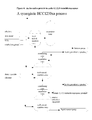
- Figure 3 depicts a synergistic process for producing 1,1,2,3-tetrachloropropene.
- 1,1,1,3-Tetrachloropropane, ferric chloride, and chlorine, and optionally carbon tetrachloride (not shown) are fed into a reaction zone shown in the upper portion of Figure 3 .
- the reaction is maintained at a temperature such that at least a portion of the reaction products move into the separation and/or condensing zones.
- At least a portion of the hydrogen chloride product is removed by exiting the condensing zone.
- the 1,1,1,2,3-pentachloropropane product is removed from the reaction zone in a liquid effluent and subsequently introduced into a second reaction zone shown in the lower portion of Figure 3 .
- the second reaction zone is maintained at a temperature such that at least a portion of the reaction products move into the separation and/or condensing zone. At least a portion of the hydrogen chloride product is removed by exiting the condensing zone. At least a portion of crude 1,1,2,3-tetrachloropropene product is condensed in the condensing zone and subsequently removed from the process.
- Figure 4 depicts an exemplary synergistic process for producing 1,1,2,3-tetrachloropropene.
- Ethylene, iron metal, carbon tetrachloride, and trialkylphosphate are introduced into a first reaction zone, shown near the top of Figure 4 .
- the liquid reactor effluent passes into a first separation zone, which separates the first reactor effluent into an overhead and a bottoms stream.
- the bottoms stream which contains catalyst components, is partly returned to the first reaction zone and partly purged.
- the overhead stream which contains 1,1,1,3-tetrachloropropane product and unreacted carbon tetrachloride, passes to a second reaction zone, shown near the center of Figure 4 .
- Chlorine and ferric chloride catalyst are also introduced into the second reaction zone, where 1,1,1,2,3-pentachloropropane and hydrogen chloride are produced. At least some of the hydrogen chloride product is removed as a gas via the overhead separation and condensing zones. At least some of the 1,1,3-trichloropropene byproduct and the carbon tetrachloride solvent, and other volatile organic materials, are condensed and returned to the reaction zone via the separation and condensing zones.
- the liquid effluent from the second reaction zone contains, at least, 1,1,1,2,3-pentachloropropane product and ferric chloride catalyst. This material is transferred to a third reaction zone, shown near the bottom of Figure 4 .
- 1,1,1,2,3-pentachloropropane is catalytically dehydrochlorinated to produce 1,1,2,3-tetrachloropropene and hydrogen chloride.
- At least some of the 1,1,2,3-tetrachloropropene and hydrogen chloride products pass through the separation zone into the condensing zone, wherein some of the 1,1,2,3-tetrachloropropene is condensed, and thereby separated from hydrogen chloride gas. This partly purified hydrogen chloride gas is removed from the condensing zone.
- the condensed 1,1,2,3-tetrachloropropene product is partly returned to the separation zone as reflux liquid, and partly removed as crude 1,1,2,3-tetrachloropropene product liquid.
- the latter may be further purified by any known means.
- a liquid purge stream is taken from the third reaction zone. This stream contains ferric chloride catalyst, unreacted 1,1,1,2,3-pentachloropropane, and high-boiling or non-volatile byproducts.
- the present invention provides, in particular, the following embodiments:
- the equipment used in examples 1-4 was a 20-tray, 25mm i.d. vacuum-jacketed Pyrex laboratory distillation column equipped with a 1-liter bottoms flask and means for operation at sub-atmospheric pressure.
- a pump continuously fed liquid material directly into the bottoms flask.
- a swinging-bucket type reflux head allowed controlled withdrawal of overhead product.
- a separate pump removed liquid from the bottoms flask periodically.
- Table 1 shows the run conditions for examples 1-4. Overhead formation rate of the 1,1,2,3-tetrachloropropene product is shown in Figure 1 .
- Table 1 Conditions for Examples 1-4 Example number 1 2 3 4 overhead pressure torr 280 495 480 350 bottoms temperature °C 159-160 173-177 169-179 154-157 bottoms residence time hr 4.5 7 8 8 liquid feed source Synthetic Synthetic tetrachloropropane chlorination tetrachloropropane chlorination liquid feed composition 1,1,1,2,3-pentachloropropane wt% 45.0 90.8 61.0 80.0 misc.
- the bottoms flask of the distillation column was charged with a mixture of about 90 percent 1,1,1,2,3-pentachloropropane, with about 10 percent other miscellaneous chlorocarbons.
- About 0.27 grams of solid anhydrous ferric chloride was added to the liquid, with stirring, giving a bottoms ferric chloride concentration of 1000 ppmw.
- the column pressure was adjusted to 280 torr, and sufficient heat was applied to the bottoms flask to reflux liquid in the column.
- a synthetic feed comprised of 45 percent 1,1,1,2,3-pentachloropropane and 55 percent other miscellaneous chlorocarbons was fed continuously to the bottoms flask to give a liquid residence time in the bottoms of approximately 4.5 hours.
- the synthetic feed contained no ferric chloride.
- Liquid draw from the reflux head was started simultaneously with the feed at a rate sufficient to maintain the liquid level in the bottoms flask.
- the bottoms temperature over the course of the test ranged from 159-160°C.
- the bottoms flask of a distillation column was charged with a mixture of about 96 percent 1,1,1,2,3-pentachloropropane, with about four percent other miscellaneous chlorocarbons.
- About 0.96 grams of solid anhydrous ferric chloride was added to the liquid, with stirring, to give a bottoms ferric chloride concentration of 2030 ppmw.
- the column pressure was adjusted to 495 torr, and sufficient heat was applied to the bottoms flask to reflux liquid in the column.
- a synthetic feed comprised of 90.8 percent 1,1,1,2,3-pentachloropropane and 9.2 percent other miscellaneous chlorocarbons was fed continuously to the bottoms flask so as to give a liquid residence time in the bottoms of approximately 7 hours.
- the feed contained no ferric chloride. Liquid draw from the reflux head was started simultaneously with the feed at a rate sufficient to maintain the liquid level in the bottoms flask.
- the formation rate then began to steadily fall to below 0.19 mole/hr at 16 hours.
- the bottoms temperature over the course of the test steadily increased from 173-177°C.
- a feed mixture containing 1,1,1,2,3-pentachloropropane was prepared by liquid-phase chlorination of 1,1,1,3-tetrachloropropane in the presence of dissolved ferric chloride.
- the unpurified chlorination product containing approximately 80 percent 1,1,1,2,3-pentachloropropane, 20 percent other miscellaneous chlorocarbons, and 150 ppmw ferric chloride, was charged to the bottoms flask of the distillation column. No additional solid ferric chloride was added to the liquid.
- the column pressure was adjusted to 480 torr, and sufficient heat was applied to the bottoms flask to reflux liquid in the column.
- a synthetic feed comprised of 61 percent 1,1,1,2,3-pentachloropropane and 39 percent other miscellaneous chlorocarbons was fed continuously to the bottoms flask so as to give a liquid residence time in the bottoms of approximately 8 hours.
- the feed contained no ferric chloride.
- Liquid draw from the reflux head was started simultaneously with the feed at a rate sufficient to maintain the liquid level in the bottoms flask.
- the formation rate of 1,1,2,3-tetrachloropropene peaked at 0.24 mole/hr at 8.2 hours run time, as shown in figure 5 .
- the formation rate then rapidly fell to below 0.03 mole/hr at 13 hours, indicating the dehydrochlorination reaction had nearly stopped.
- the bottoms temperature over the course of the test steadily increased from 169-179°C.
- a feed mixture containing primarily 1,1,1,2,3-pentachloropropane was prepared by liquid-phase chlorination of 1,1,1,3-tetrachloropropane in the presence of dissolved ferric chloride.
- the crude chlorination product containing approximately 80 percent 1,1,1,2,3-pentachloropropane, 20 percent other miscellaneous chlorocarbons, and 280 ppmw ferric chloride, was charged to the bottoms flask of the distillation column. No additional solid ferric chloride was added to the liquid.
- the column pressure was adjusted to 350 torr, and sufficient heat was applied to the bottoms flask to reflux liquid in the column.
- the crude trichloropropene chlorination product containing 80 percent 1,1,1,2,3-pentachloropropane, 20 percent other miscellaneous chlorocarbons, and 280 ppmw ferric chloride was fed continuously to the bottoms flask so as to give a liquid residence time of approximately 8 hours.
- Liquid draw from the reflux head was started simultaneously with the feed at a rate sufficient to maintain the liquid level in the bottoms flask.
- Liquid was withdrawn from the bottoms flask every 2-3 hours of operation. The volume of the liquid withdrawn was about seven percent of the volume of material fed over that same time period.
- Reactor liquid temperature was maintained at about 77 C, and pressure was kept at 10 psig.
- Reactor liquid volume was about 1.05 liters, and the estimated liquid effluent flow rate was 0.155 liters per hour, so that the estimated turnover time was 6.8 hours.
- Chlorine and hydrogen chloride flow rates in the vent stream were measured via timed samples caught in potassium iodide solution. At the end of 15.0 hours operation (about 2.0 liquid turnovers), a sample of the liquid reactor effluent was analyzed by gas chromatography.
- the starting material for this example (trial 53315701) was produced by the same pilot plant unit as before, in the same way. However, the carbon tetrachloride was then separated from the 1,1,1,3-tetrachloropropane by distillation, producing sample 53315501. The latter material contained 0.06 wt% carbon tetrachloride, 0.21 wt% 1,1,3-trichloropropene, 0.041 wt% perchloroethylene, 99.60 wt% 1,1,1,3-tetrachloropropane, and 0.09 wt% other volatile components. This material was placed in D 1 and fed to the reactor. The experiment was performed like Example 8, except for the difference in the feedstock. Reactor temperature was kept at 82 C; liquid turnover time was 7.3 hours; ferric chloride average concentration was 510 ppm; total run time was 2.1 turnovers.
- the liquid feedstock (sample 53315312) for this example was produced by the same pilot plant unit as in Example 7. It contained 22.46 wt% carbon tetrachloride, 76.09 wt% 1,1,1,3-tetrachloropropane, 0.23 wt% chloroform, 0.09 wt% 1-chlorobutane, 0.13 wt% perchloroethylene, and 1.0 wt% other volatile materials.
- the experiment was conducted at higher temperature, with less ferric chloride catalyst, relative to Example 7. Reactor temperature was kept at 92 C; liquid turnover time was 7.2 hours; ferric chloride average concentration was 180 ppm; total run time was 2.0 turnovers. Reactor pressure was 9-10 psig, as usual.
- Chlorine conversion was 98%; 1,1,1,3-tetrachloropropane conversion was 97%.
- the yields of 1,1,3-trichloropropene, 1,1,1,2,3-pentachloropropane, and 1,1,2,3-tetrachloropropene on 1,1,1,3-tetrachloropropane fed were 2.7, 85, and 5.7 percent, respectively.
- the yield of the usual four undesired prominent high-boiling byproducts was 2.2 wt% in the reactor effluent.
Landscapes
- Chemical & Material Sciences (AREA)
- Organic Chemistry (AREA)
- Chemical Kinetics & Catalysis (AREA)
- Organic Low-Molecular-Weight Compounds And Preparation Thereof (AREA)
- Low-Molecular Organic Synthesis Reactions Using Catalysts (AREA)
- Catalysts (AREA)
Applications Claiming Priority (4)
| Application Number | Priority Date | Filing Date | Title |
|---|---|---|---|
| US1498107P | 2007-12-19 | 2007-12-19 | |
| PCT/US2008/087246 WO2009085862A1 (fr) | 2007-12-19 | 2008-12-17 | Procédés de fabrication d'hydrocarbures chlorés |
| EP08867081.5A EP2231565B1 (fr) | 2007-12-19 | 2008-12-17 | Procédés de fabrication d'hydrocarbures chlorés |
| EP13184308.8A EP2687504B1 (fr) | 2007-12-19 | 2008-12-17 | Procédés de fabrication d'hydrocarbures chlorinés |
Related Parent Applications (2)
| Application Number | Title | Priority Date | Filing Date |
|---|---|---|---|
| EP13184308.8A Division EP2687504B1 (fr) | 2007-12-19 | 2008-12-17 | Procédés de fabrication d'hydrocarbures chlorinés |
| EP08867081.5A Division EP2231565B1 (fr) | 2007-12-19 | 2008-12-17 | Procédés de fabrication d'hydrocarbures chlorés |
Publications (2)
| Publication Number | Publication Date |
|---|---|
| EP3000802A1 true EP3000802A1 (fr) | 2016-03-30 |
| EP3000802B1 EP3000802B1 (fr) | 2018-07-11 |
Family
ID=40403948
Family Applications (3)
| Application Number | Title | Priority Date | Filing Date |
|---|---|---|---|
| EP15189546.3A Active EP3000802B1 (fr) | 2007-12-19 | 2008-12-17 | Procédés de fabrication d'hydrocarbures chlorinés |
| EP08867081.5A Active EP2231565B1 (fr) | 2007-12-19 | 2008-12-17 | Procédés de fabrication d'hydrocarbures chlorés |
| EP13184308.8A Active EP2687504B1 (fr) | 2007-12-19 | 2008-12-17 | Procédés de fabrication d'hydrocarbures chlorinés |
Family Applications After (2)
| Application Number | Title | Priority Date | Filing Date |
|---|---|---|---|
| EP08867081.5A Active EP2231565B1 (fr) | 2007-12-19 | 2008-12-17 | Procédés de fabrication d'hydrocarbures chlorés |
| EP13184308.8A Active EP2687504B1 (fr) | 2007-12-19 | 2008-12-17 | Procédés de fabrication d'hydrocarbures chlorinés |
Country Status (15)
| Country | Link |
|---|---|
| US (9) | US8115038B2 (fr) |
| EP (3) | EP3000802B1 (fr) |
| JP (5) | JP5508281B2 (fr) |
| CN (2) | CN101903312B (fr) |
| CA (2) | CA2964090C (fr) |
| CY (2) | CY1115240T1 (fr) |
| DK (2) | DK2687504T3 (fr) |
| ES (2) | ES2557571T3 (fr) |
| HR (2) | HRP20140465T1 (fr) |
| HU (1) | HUE028244T2 (fr) |
| PL (2) | PL2687504T3 (fr) |
| PT (2) | PT2231565E (fr) |
| SI (2) | SI2687504T1 (fr) |
| TW (2) | TWI507378B (fr) |
| WO (1) | WO2009085862A1 (fr) |
Families Citing this family (84)
| Publication number | Priority date | Publication date | Assignee | Title |
|---|---|---|---|---|
| US8115038B2 (en) | 2007-12-19 | 2012-02-14 | Occidental Chemical Corporation | Methods of making chlorinated hydrocarbons |
| JP6022770B2 (ja) * | 2008-10-13 | 2016-11-09 | ブルー キューブ アイピー エルエルシー | 塩素化及び/又はフッ素化プロペンの製造方法 |
| JP2010248104A (ja) * | 2009-04-14 | 2010-11-04 | Tokuyama Corp | 1,1,1,2,3−ペンタクロロプロパンの製造方法 |
| JP2011057650A (ja) * | 2009-09-14 | 2011-03-24 | Tokuyama Corp | クロロプロペンの製造方法 |
| JP5782038B2 (ja) | 2009-10-09 | 2015-09-24 | ダウ グローバル テクノロジーズ エルエルシー | 等温多管式反応器及び該反応器を組み込んだプロセス |
| CN102665890B (zh) * | 2009-10-09 | 2016-02-24 | 蓝立方知识产权公司 | 生产氯化和/或氟化丙烯和高级烯烃的绝热活塞流反应器及方法 |
| JP5767231B2 (ja) | 2009-10-09 | 2015-08-19 | ダウ グローバル テクノロジーズ エルエルシー | 塩素化及び/又はフッ素化されたプロペン及びより高級なアルケンを製造するプロセス |
| BR112012007916A2 (pt) | 2009-10-09 | 2019-09-24 | Dow Global Technologies Llc | processo de etapa para a produção de propenos clorados ou fluorados e processo para preparar 1,1,3,3 - tetrafluorprop-1-eno |
| EP2504299B1 (fr) | 2009-11-27 | 2018-01-17 | Daikin Industries, Ltd. | Procédé de synthèse de 1,1,2,3-tétrachloropropène |
| DE102010034682B4 (de) * | 2010-08-18 | 2014-07-31 | Technische Universität Bergakademie Freiberg | Verfahren zur Herstellung von Hydroboranen |
| JP5653833B2 (ja) * | 2010-12-16 | 2015-01-14 | 株式会社トクヤマ | ポリクロロプロパンの製造方法 |
| KR101756752B1 (ko) * | 2010-12-16 | 2017-07-12 | 가부시끼가이샤 도꾸야마 | 탄소수 3의 염소화탄화수소의 제조 방법 |
| CN102199071B (zh) * | 2011-04-08 | 2013-05-01 | 北京宇极科技发展有限公司 | 一种2,3,3,3-四氟丙烯的合成方法 |
| JP6212035B2 (ja) * | 2011-05-31 | 2017-10-11 | ブルー キューブ アイピー エルエルシー | 塩素化プロペンの製造方法 |
| WO2012166394A1 (fr) | 2011-05-31 | 2012-12-06 | Dow Global Technologies, Llc | Procédé pour la production de propènes chlorés |
| US8722946B2 (en) * | 2011-06-03 | 2014-05-13 | Honeywell International Inc. | Method for avoiding the generation of by-products during the production of haloalkane compounds |
| JP6267114B2 (ja) | 2011-06-08 | 2018-01-24 | ダウ アグロサイエンシィズ エルエルシー | 塩素化および/またはフッ素化プロペンを生成するためのプロセス |
| CN102295521B (zh) * | 2011-07-12 | 2014-03-12 | 汪国良 | 五氯乙烷液相催化制备四氯乙烯的方法 |
| CN108929192A (zh) | 2011-08-07 | 2018-12-04 | 蓝立方知识产权有限责任公司 | 生产氯化的丙烯的方法 |
| CN103717557A (zh) | 2011-08-07 | 2014-04-09 | 陶氏环球技术有限责任公司 | 生产氯化的丙烯的方法 |
| KR20140104947A (ko) * | 2011-10-14 | 2014-08-29 | 셀마 벡터세빅 | 2,3,3,3-테트라플루오로프로펜의 제조 방법 |
| IN2014CN03748A (fr) | 2011-11-21 | 2015-09-25 | Dow Global Technologies Llc | |
| CA2856545A1 (fr) | 2011-12-02 | 2013-06-06 | Dow Global Technologies Llc | Procede de production d'alcanes chlores |
| JP6050375B2 (ja) * | 2011-12-02 | 2016-12-21 | ブルー キューブ アイピー エルエルシー | クロロアルカンの製造方法 |
| JP6170068B2 (ja) | 2011-12-13 | 2017-07-26 | ブルー キューブ アイピー エルエルシー | 塩素化プロパン及びプロペンの製造方法 |
| IN2014CN04418A (fr) | 2011-12-22 | 2015-09-04 | Dow Global Technologies Llc | |
| WO2013096706A1 (fr) | 2011-12-23 | 2013-06-27 | Dow Global Technologies, Llc | Procédé de production d'alcènes et/ou de composés aromatiques |
| JP5858830B2 (ja) * | 2012-03-14 | 2016-02-10 | 株式会社トクヤマ | ポリクロロプロパンの製造方法 |
| JP5858836B2 (ja) * | 2012-03-19 | 2016-02-10 | 株式会社トクヤマ | ポリクロロプロパンの製造方法 |
| CN103567170A (zh) * | 2012-07-31 | 2014-02-12 | 曹汉平 | 去除甲烷氯化物的氯化装置的结垢物的方法 |
| EP2897930A1 (fr) | 2012-09-20 | 2015-07-29 | Dow Global Technologies LLC | Procédé de production de propènes chlorés |
| US9598334B2 (en) | 2012-09-20 | 2017-03-21 | Blue Cube Ip Llc | Process for the production of chlorinated propenes |
| CA2885329A1 (fr) | 2012-09-30 | 2014-03-04 | Dow Global Technologies Llc | Bac a deversoir et procedes incorporant celui-ci |
| US10065157B2 (en) | 2012-10-26 | 2018-09-04 | Blue Cube Ip Llc | Mixer and processes incorporating the same |
| JP6247311B2 (ja) | 2012-12-18 | 2017-12-13 | ブルー キューブ アイピー エルエルシー | 塩素化プロペンを生成するための方法 |
| CA2894168C (fr) | 2012-12-19 | 2018-04-24 | Dow Global Technologies Llc | Procede de production de propenes chlores |
| US9289758B2 (en) | 2013-01-22 | 2016-03-22 | Axiall Ohio, Inc. | Processes for producing chlorinated hydrocarbons and methods for recovering polyvalent antimony catalysts therefrom |
| US8889930B2 (en) | 2013-01-22 | 2014-11-18 | Axiall Ohio, Inc. | Process for producing chlorinated hydrocarbons |
| US8907147B2 (en) * | 2013-02-04 | 2014-12-09 | Honeywell International Inc. | Synthesis of 1,1,2,3-tetrachloropropene |
| US20140215970A1 (en) * | 2013-02-04 | 2014-08-07 | Honeywell International Inc. | METHODS OF HANDLING CHLORINATED COMPOUNDS USED FOR MANUFACTURING HFO-1234yf |
| US9067858B2 (en) | 2013-02-12 | 2015-06-30 | Occidental Chemical Corporation | Methods for recovering 1,1,1,2,3-pentachloropropane |
| US8877991B2 (en) | 2013-02-19 | 2014-11-04 | Honeywell International Inc. | Methods for the dehydrochlorination of 1,1,1,3-tetrachloropropane to 1,1,3-trichloropropene |
| US8889929B2 (en) * | 2013-02-19 | 2014-11-18 | Honeywell International Inc. | Process to make 1,1,2,3-tetrachloropropene from 1,1,3-trichloropropene and/or 3,3,3-trichloropropene |
| CA2901450A1 (fr) | 2013-02-27 | 2014-09-04 | Blue Cube Ip Llc | Procede pour la production de propenes chlores |
| US20160002127A1 (en) | 2013-02-28 | 2016-01-07 | Blue Cube Ip Llc | Process for the production of chlorinated propanes |
| CA2903760C (fr) * | 2013-03-09 | 2018-02-20 | Blue Cube Ip Llc | Procede pour la production d'alcanes chlores |
| US8889927B2 (en) * | 2013-03-12 | 2014-11-18 | Honeywell International Inc. | Method to reduce the formation of high boiling compounds during the dehydrochlorination of 1,1,1,3-tetrachloropropane |
| US8889928B2 (en) | 2013-03-12 | 2014-11-18 | Honeywell International Inc. | Method to improve 1,1,3-trichloropropene and/or 3,3,3-trichloropropene selectivity during the dehydrochlorination of 1,1,1,3-tetrachloropropane |
| US9090531B2 (en) * | 2013-03-14 | 2015-07-28 | Honeywell International Inc. | Method for mitigating HCL generation during 1,1,2,3-tetrachloropropene purification |
| US9139497B2 (en) | 2013-10-23 | 2015-09-22 | Axiall Ohio, Inc. | Process for producing chlorinated hydrocarbons in the presence of a polyvalent bismuth compound |
| US9663425B2 (en) * | 2014-03-31 | 2017-05-30 | Honeywell International Inc. | Method to produce 1,1,2,3-tetrachloropropene with high yield |
| CN110483233B (zh) | 2014-05-16 | 2022-06-14 | 西方化学股份有限公司 | 制备1,1,3,3-四氯丙烯的方法 |
| FR3027303B1 (fr) | 2014-10-16 | 2016-10-07 | Arkema France | Compositions a base de 1,1,1,2,3-pentachloropropane |
| US9896400B2 (en) * | 2014-10-16 | 2018-02-20 | Spolek Pro Chemickou A Hutni Vyrobu A.S. | Process for producing a chlorinated C3-6 alkane |
| KR102606455B1 (ko) * | 2014-10-16 | 2023-11-29 | 스폴렉 프로 케미코우 어 허트니 비로부, 아크시오바 스폴렉노스트 | 공정 |
| TWI770558B (zh) | 2014-10-16 | 2022-07-11 | 捷克商史波克專業化學杭尼維洛普合股公司 | 用於製備高純度1,1,1,2,3-五氯丙烷產物之方法 |
| WO2016058568A1 (fr) | 2014-10-16 | 2016-04-21 | Spolek Pro Chemickou A Hutni Vyrobu, Akciova Spolecnost | Procédé de production d'alcanes chlorés de grande pureté |
| JP2017537887A (ja) * | 2014-10-22 | 2017-12-21 | アクシアル オハイオ、インコーポレイテッド | 多価モリブデン化合物の存在下で塩化炭化水素を生成するためのプロセス |
| EP3330242A1 (fr) * | 2015-07-30 | 2018-06-06 | Tokuyama Corporation | Procédé de production d'un chloroalcane d'ordre supérieur |
| WO2017028826A2 (fr) * | 2015-08-19 | 2017-02-23 | Spolek Pro Chemickou A Hutni Vyrobu, Akciova Spolecnost | Procédé de production de composés alcènes et alcanes en c3 chlorés |
| CN105418360B (zh) * | 2015-11-11 | 2017-09-08 | 西安近代化学研究所 | 一种制备1,1,1,3,3‑五氯丁烷的方法 |
| EP3426697B1 (fr) * | 2016-03-08 | 2023-07-12 | Oxy Vinyls LP | Procédés d'obtention de particules de polychlorure de vinyle pour la préparation de polychlorure de vinyle chloré |
| TWI734751B (zh) * | 2016-03-08 | 2021-08-01 | 美商奧克希凡尼爾公司 | 氯化聚氯乙烯之方法 |
| US10793496B2 (en) | 2016-04-13 | 2020-10-06 | Spolek Pro Chemickou A Hutni Vyrobu A.S. | Process for producing a chlorinated alkane |
| KR20190008221A (ko) | 2016-04-13 | 2019-01-23 | 아르끄마 프랑스 | 2,3,3,3-테트라플루오로프로펜의 제조 방법 |
| EP3805188A1 (fr) | 2016-07-05 | 2021-04-14 | Occidental Chemical Corporation | Photochloration de chloroforme en tétrachlorure de carbone |
| KR102826497B1 (ko) * | 2016-07-26 | 2025-06-26 | 옥시덴탈 케미컬 코포레이션 | 염화 탄화수소 제조공정 |
| TWI860085B (zh) | 2016-07-26 | 2024-10-21 | 美商西方化學公司 | 製造鹵化丙烷之方法 |
| JP6995108B2 (ja) * | 2016-07-27 | 2022-02-21 | ザ ケマーズ カンパニー エフシー リミテッド ライアビリティ カンパニー | ハロゲン化オレフィンを製造するための方法 |
| CN108069817B (zh) * | 2016-11-07 | 2021-01-26 | 江西天宇化工有限公司 | 一锅法高选择性、高收率制备1,1,1,2,3-五氯丙烷的方法 |
| CN109809959B (zh) | 2017-11-22 | 2021-10-01 | 江西天宇化工有限公司 | 一种1,1,1,2,3-五氯丙烷的制备方法 |
| JP7187573B2 (ja) * | 2018-04-03 | 2022-12-12 | ブルー キューブ アイピー エルエルシー | 塩素化アルカンの生成において触媒を再循環させるための方法 |
| WO2020041667A1 (fr) | 2018-08-24 | 2020-02-27 | Blue Cube Ip Llc | Déshydrochloration/chloration monotope d'un chloroalcane pour produire un mélange d'alcènes chlorés et d'alcanes chlorés |
| CN113329986A (zh) | 2019-01-10 | 2021-08-31 | 西方化学股份有限公司 | 部分氯化的氯代甲烷光氯化成四氯化碳 |
| CN110511112A (zh) * | 2019-08-16 | 2019-11-29 | 浙江巨化技术中心有限公司 | 一种1,1,2,3-四氯丙烯的制备方法 |
| CN111604041B (zh) * | 2020-06-18 | 2023-04-07 | 大连九信精细化工有限公司 | 一种γ-氧化铝改性催化剂、其制备方法及在合成1,1,3-三氯丙烯中的应用 |
| EP4251599A4 (fr) * | 2020-11-30 | 2024-11-13 | Blue Cube IP LLC | Procédé pour le traitement d'un courant de sous-produits lourds provenant de la production de propanes chlorés |
| CN116265097B (zh) * | 2021-12-17 | 2024-10-08 | 中国科学院宁波材料技术与工程研究所 | 用于气固相反应连续生产1,1,1,3-四氯丙烷的催化剂、其制备方法与应用 |
| CN115108882B (zh) | 2022-06-07 | 2024-04-12 | 浙江衢化氟化学有限公司 | 一种1,1,1,2,3-五氯丙烷的连续制备方法 |
| CN115722255B (zh) * | 2022-10-13 | 2024-08-27 | 浙江衢化氟化学有限公司 | 一种用于生产1,1,1,2,3-五氯丙烷的负载型催化剂及其制备方法和应用 |
| US12091376B2 (en) | 2022-10-24 | 2024-09-17 | Randolph Belter | Iron salt catalyst regeneration |
| US12304878B2 (en) | 2022-10-24 | 2025-05-20 | Randolph Belter | Iron salt catalyst regeneration |
| CN117024244A (zh) * | 2023-04-28 | 2023-11-10 | 江苏扬农化工集团有限公司 | 一种五氯丙烷原料反应精馏制备1,1,2,3-四氯丙烯的方法 |
| CN116422252B (zh) * | 2023-05-21 | 2026-01-06 | 江苏理文化工有限公司 | 四氯化碳生产氯化氢的装置 |
Citations (5)
| Publication number | Priority date | Publication date | Assignee | Title |
|---|---|---|---|---|
| US2478008A (en) * | 1943-05-27 | 1949-08-02 | Pennsylvania Salt Mfg Co | Process of producing a solid pentachloropropane |
| US4535194A (en) | 1983-07-06 | 1985-08-13 | Monsanto Co. | Process for producing 1,1,2,3-tetrachloropropene |
| US4650914A (en) | 1983-07-06 | 1987-03-17 | Monsanto Company | Process for producing 1,1,2,3-tetrachloropropene |
| US20040027520A1 (en) | 2002-08-02 | 2004-02-12 | Eastman Kodak Company | Multilayer optical compensator, liquid crystal display, and process |
| US20040225166A1 (en) | 2003-05-05 | 2004-11-11 | Vulcan Chemicals A Business Group Of Vulcan Materials Company | Method for producing 1,1,1,3-tetrachloropropane and other haloalkanes with iron catalyst |
Family Cites Families (30)
| Publication number | Priority date | Publication date | Assignee | Title |
|---|---|---|---|---|
| US2097442A (en) * | 1935-05-13 | 1937-11-02 | Du Pont | Process of chlorinating 1,1-dichlorpropene-1 |
| US2323227A (en) * | 1938-10-12 | 1943-06-29 | Du Pont | Preparation of 2,2,3-trichlorobutane |
| US2420975A (en) | 1943-05-27 | 1947-05-20 | Pennsylvania Salt Mfg Co | Process of producing a solid pentachloropropane |
| US2607802A (en) | 1951-03-28 | 1952-08-19 | Dow Chemical Co | Bromination of aromatic compounds |
| FR1598840A (fr) * | 1968-12-27 | 1970-07-06 | ||
| JPS493500B1 (fr) * | 1970-10-16 | 1974-01-26 | ||
| NL160542C (nl) * | 1971-12-17 | 1979-11-15 | Monsanto Co | Werkwijze voor het bereiden van 1,1,2,3,-tetrachloorpro- peen. |
| US3823195A (en) * | 1971-12-27 | 1974-07-09 | Monsanto Co | Preparation of 1,1,2,3-tetrachloropropene from 1,2,3-trichloropropane |
| JPS4966613A (fr) * | 1972-10-27 | 1974-06-27 | ||
| NL7500046A (nl) * | 1974-01-11 | 1975-07-15 | Montedison Spa | Werkwijze voor de bereiding van nieuwe insek- e verbindingen. |
| JPS62263134A (ja) * | 1982-04-01 | 1987-11-16 | ヘイロウカ−ボン プロダクツ コ−ポレイシヨン | 1,1,1,3−テトラクロロプロパンの製法 |
| EP0729932A1 (fr) | 1995-03-03 | 1996-09-04 | Central Glass Company, Limited | Procédé pour la préparation de propane halogéné |
| US5902914A (en) | 1995-08-14 | 1999-05-11 | Alliedsignal Inc. | Process for the preparation of halogenated alkanes |
| US5705779A (en) | 1996-08-08 | 1998-01-06 | Alliedsignal Inc. | Preparation of 1,1,1,3,3-pentachloropropane by photochlorination of 1,1,1,3-tetrachloropropane |
| US5811605A (en) * | 1997-02-19 | 1998-09-22 | Ppg Industries, Inc. | Preparation of 1,2,3,3-tetrachloropropene |
| US6193221B1 (en) | 1998-04-10 | 2001-02-27 | Grt, Inc. | Method of and apparatus for producing sub-micron bubbles in liquids, slurries, and sludges |
| JP2000086545A (ja) | 1998-09-18 | 2000-03-28 | Asahi Glass Co Ltd | 1,1,1,3,3−ペンタクロロプロパンの製造方法 |
| US6187978B1 (en) | 1999-05-12 | 2001-02-13 | Alliedsignal Inc. | Continuous process for manufacturing halogenated compounds |
| US6313360B1 (en) | 2000-09-29 | 2001-11-06 | Vulcan Materials Company | Process for the manufacture of 1, 1, 1, 3, 3-pentachloropropane |
| US6534688B2 (en) * | 2001-06-11 | 2003-03-18 | Vulcan Chemicals | Dehydrochlorination stabilization of polychlorinated alkanes |
| US7094936B1 (en) | 2001-07-20 | 2006-08-22 | Great Lakes Chemical Corporation | Process for preparing halogenated alkanes |
| US7230146B2 (en) | 2003-10-27 | 2007-06-12 | Honeywell International Inc. | Process for producing fluoropropenes |
| US7102041B2 (en) | 2004-12-08 | 2006-09-05 | Honeywell International Inc. | Continuous process for preparing halogenated compounds |
| US8115039B2 (en) * | 2005-03-28 | 2012-02-14 | Shell Oil Company | Catalytic distillation process for primary haloalkanes |
| US7211703B2 (en) * | 2005-04-27 | 2007-05-01 | Calgon Carbon Corporation | Method of separating E and Z isomers of an alkene alcohol and derivatives thereof |
| CN100388976C (zh) * | 2006-07-07 | 2008-05-21 | 宁夏大学 | 一种氯代烷烃脱氯化氢反应生成氯代烯烃的催化剂及其制备方法 |
| US9738577B2 (en) | 2006-10-11 | 2017-08-22 | Honeywell International Inc. | Process for the manufacture of 1,1,1,3,3-pentachloropropane |
| US8258355B2 (en) * | 2007-07-25 | 2012-09-04 | Honeywell International Inc. | Processes for preparing 1,1,2,3-tetrachloropropene |
| US8115038B2 (en) | 2007-12-19 | 2012-02-14 | Occidental Chemical Corporation | Methods of making chlorinated hydrocarbons |
| US8722946B2 (en) | 2011-06-03 | 2014-05-13 | Honeywell International Inc. | Method for avoiding the generation of by-products during the production of haloalkane compounds |
-
2008
- 2008-12-17 US US12/337,409 patent/US8115038B2/en active Active
- 2008-12-17 CN CN200880122115.0A patent/CN101903312B/zh active Active
- 2008-12-17 SI SI200831553T patent/SI2687504T1/sl unknown
- 2008-12-17 ES ES13184308.8T patent/ES2557571T3/es active Active
- 2008-12-17 EP EP15189546.3A patent/EP3000802B1/fr active Active
- 2008-12-17 CA CA2964090A patent/CA2964090C/fr active Active
- 2008-12-17 HU HUE13184308A patent/HUE028244T2/en unknown
- 2008-12-17 EP EP08867081.5A patent/EP2231565B1/fr active Active
- 2008-12-17 PT PT88670815T patent/PT2231565E/pt unknown
- 2008-12-17 WO PCT/US2008/087246 patent/WO2009085862A1/fr not_active Ceased
- 2008-12-17 DK DK13184308.8T patent/DK2687504T3/en active
- 2008-12-17 DK DK08867081.5T patent/DK2231565T3/da active
- 2008-12-17 CN CN201410263883.5A patent/CN104130100B/zh active Active
- 2008-12-17 PL PL13184308T patent/PL2687504T3/pl unknown
- 2008-12-17 JP JP2010539753A patent/JP5508281B2/ja active Active
- 2008-12-17 CA CA2708643A patent/CA2708643C/fr active Active
- 2008-12-17 PT PT131843088T patent/PT2687504E/pt unknown
- 2008-12-17 EP EP13184308.8A patent/EP2687504B1/fr active Active
- 2008-12-17 HR HRP20140465AT patent/HRP20140465T1/hr unknown
- 2008-12-17 PL PL08867081T patent/PL2231565T3/pl unknown
- 2008-12-17 ES ES08867081.5T patent/ES2468555T3/es active Active
- 2008-12-17 SI SI200831207T patent/SI2231565T1/sl unknown
- 2008-12-19 TW TW097149959A patent/TWI507378B/zh active
- 2008-12-19 TW TW104117538A patent/TWI583657B/zh active
-
2011
- 2011-10-13 US US13/272,561 patent/US8487146B2/en active Active
-
2012
- 2012-08-17 US US13/588,240 patent/US8614363B2/en active Active
-
2013
- 2013-11-15 US US14/081,377 patent/US8912372B2/en active Active
-
2014
- 2014-03-20 JP JP2014058743A patent/JP5746390B2/ja active Active
- 2014-06-03 CY CY20141100394T patent/CY1115240T1/el unknown
- 2014-11-26 US US14/554,883 patent/US9139495B2/en active Active
-
2015
- 2015-05-07 JP JP2015094929A patent/JP6219876B2/ja active Active
- 2015-08-17 US US14/827,367 patent/US9650319B2/en active Active
- 2015-12-07 HR HRP20151335TT patent/HRP20151335T1/hr unknown
- 2015-12-22 CY CY20151101178T patent/CY1117077T1/el unknown
-
2017
- 2017-04-21 US US15/493,908 patent/US9981892B2/en active Active
- 2017-05-30 JP JP2017106251A patent/JP6613264B2/ja active Active
-
2018
- 2018-05-16 US US15/980,932 patent/US10526261B2/en active Active
-
2019
- 2019-11-01 JP JP2019199967A patent/JP7046885B2/ja active Active
- 2019-12-05 US US16/704,978 patent/US10787403B2/en active Active
Patent Citations (5)
| Publication number | Priority date | Publication date | Assignee | Title |
|---|---|---|---|---|
| US2478008A (en) * | 1943-05-27 | 1949-08-02 | Pennsylvania Salt Mfg Co | Process of producing a solid pentachloropropane |
| US4535194A (en) | 1983-07-06 | 1985-08-13 | Monsanto Co. | Process for producing 1,1,2,3-tetrachloropropene |
| US4650914A (en) | 1983-07-06 | 1987-03-17 | Monsanto Company | Process for producing 1,1,2,3-tetrachloropropene |
| US20040027520A1 (en) | 2002-08-02 | 2004-02-12 | Eastman Kodak Company | Multilayer optical compensator, liquid crystal display, and process |
| US20040225166A1 (en) | 2003-05-05 | 2004-11-11 | Vulcan Chemicals A Business Group Of Vulcan Materials Company | Method for producing 1,1,1,3-tetrachloropropane and other haloalkanes with iron catalyst |
Also Published As
Similar Documents
| Publication | Publication Date | Title |
|---|---|---|
| US10787403B2 (en) | Methods of making chlorinated hydrocarbons | |
| HK1216637B (en) | Methods of making clorinated hydrocarbons | |
| HK1151276B (en) | Methods of making chlorinated hydrocarbons | |
| HK1201820B (en) | Methods of making chlorinated hydrocarbons |
Legal Events
| Date | Code | Title | Description |
|---|---|---|---|
| PUAI | Public reference made under article 153(3) epc to a published international application that has entered the european phase |
Free format text: ORIGINAL CODE: 0009012 |
|
| AC | Divisional application: reference to earlier application |
Ref document number: 2231565 Country of ref document: EP Kind code of ref document: P Ref document number: 2687504 Country of ref document: EP Kind code of ref document: P |
|
| AK | Designated contracting states |
Kind code of ref document: A1 Designated state(s): AT BE BG CH CY CZ DE DK EE ES FI FR GB GR HR HU IE IS IT LI LT LU LV MC MT NL NO PL PT RO SE SI SK TR |
|
| 17P | Request for examination filed |
Effective date: 20160929 |
|
| RBV | Designated contracting states (corrected) |
Designated state(s): AT BE BG CH CY CZ DE DK EE ES FI FR GB GR HR HU IE IS IT LI LT LU LV MC MT NL NO PL PT RO SE SI SK TR |
|
| REG | Reference to a national code |
Ref country code: HK Ref legal event code: DE Ref document number: 1216637 Country of ref document: HK |
|
| R17P | Request for examination filed (corrected) |
Effective date: 20160929 |
|
| 17Q | First examination report despatched |
Effective date: 20170125 |
|
| GRAP | Despatch of communication of intention to grant a patent |
Free format text: ORIGINAL CODE: EPIDOSNIGR1 |
|
| INTG | Intention to grant announced |
Effective date: 20180219 |
|
| GRAA | (expected) grant |
Free format text: ORIGINAL CODE: 0009210 |
|
| AC | Divisional application: reference to earlier application |
Ref document number: 2687504 Country of ref document: EP Kind code of ref document: P Ref document number: 2231565 Country of ref document: EP Kind code of ref document: P |
|
| AK | Designated contracting states |
Kind code of ref document: B1 Designated state(s): AT BE BG CH CY CZ DE DK EE ES FI FR GB GR HR HU IE IS IT LI LT LU LV MC MT NL NO PL PT RO SE SI SK TR |
|
| REG | Reference to a national code |
Ref country code: GB Ref legal event code: FG4D |
|
| REG | Reference to a national code |
Ref country code: CH Ref legal event code: EP |
|
| REG | Reference to a national code |
Ref country code: AT Ref legal event code: REF Ref document number: 1016710 Country of ref document: AT Kind code of ref document: T Effective date: 20180715 |
|
| GRAS | Grant fee paid |
Free format text: ORIGINAL CODE: EPIDOSNIGR3 |
|
| REG | Reference to a national code |
Ref country code: IE Ref legal event code: FG4D |
|
| REG | Reference to a national code |
Ref country code: DE Ref legal event code: R096 Ref document number: 602008056022 Country of ref document: DE |
|
| REG | Reference to a national code |
Ref country code: NL Ref legal event code: MP Effective date: 20180711 |
|
| REG | Reference to a national code |
Ref country code: LT Ref legal event code: MG4D |
|
| REG | Reference to a national code |
Ref country code: AT Ref legal event code: MK05 Ref document number: 1016710 Country of ref document: AT Kind code of ref document: T Effective date: 20180711 |
|
| PG25 | Lapsed in a contracting state [announced via postgrant information from national office to epo] |
Ref country code: NL Free format text: LAPSE BECAUSE OF FAILURE TO SUBMIT A TRANSLATION OF THE DESCRIPTION OR TO PAY THE FEE WITHIN THE PRESCRIBED TIME-LIMIT Effective date: 20180711 |
|
| PG25 | Lapsed in a contracting state [announced via postgrant information from national office to epo] |
Ref country code: FI Free format text: LAPSE BECAUSE OF FAILURE TO SUBMIT A TRANSLATION OF THE DESCRIPTION OR TO PAY THE FEE WITHIN THE PRESCRIBED TIME-LIMIT Effective date: 20180711 Ref country code: LT Free format text: LAPSE BECAUSE OF FAILURE TO SUBMIT A TRANSLATION OF THE DESCRIPTION OR TO PAY THE FEE WITHIN THE PRESCRIBED TIME-LIMIT Effective date: 20180711 Ref country code: PL Free format text: LAPSE BECAUSE OF FAILURE TO SUBMIT A TRANSLATION OF THE DESCRIPTION OR TO PAY THE FEE WITHIN THE PRESCRIBED TIME-LIMIT Effective date: 20180711 Ref country code: SE Free format text: LAPSE BECAUSE OF FAILURE TO SUBMIT A TRANSLATION OF THE DESCRIPTION OR TO PAY THE FEE WITHIN THE PRESCRIBED TIME-LIMIT Effective date: 20180711 Ref country code: NO Free format text: LAPSE BECAUSE OF FAILURE TO SUBMIT A TRANSLATION OF THE DESCRIPTION OR TO PAY THE FEE WITHIN THE PRESCRIBED TIME-LIMIT Effective date: 20181011 Ref country code: GR Free format text: LAPSE BECAUSE OF FAILURE TO SUBMIT A TRANSLATION OF THE DESCRIPTION OR TO PAY THE FEE WITHIN THE PRESCRIBED TIME-LIMIT Effective date: 20181012 Ref country code: IS Free format text: LAPSE BECAUSE OF FAILURE TO SUBMIT A TRANSLATION OF THE DESCRIPTION OR TO PAY THE FEE WITHIN THE PRESCRIBED TIME-LIMIT Effective date: 20181111 Ref country code: AT Free format text: LAPSE BECAUSE OF FAILURE TO SUBMIT A TRANSLATION OF THE DESCRIPTION OR TO PAY THE FEE WITHIN THE PRESCRIBED TIME-LIMIT Effective date: 20180711 Ref country code: BG Free format text: LAPSE BECAUSE OF FAILURE TO SUBMIT A TRANSLATION OF THE DESCRIPTION OR TO PAY THE FEE WITHIN THE PRESCRIBED TIME-LIMIT Effective date: 20181011 |
|
| PG25 | Lapsed in a contracting state [announced via postgrant information from national office to epo] |
Ref country code: HR Free format text: LAPSE BECAUSE OF FAILURE TO SUBMIT A TRANSLATION OF THE DESCRIPTION OR TO PAY THE FEE WITHIN THE PRESCRIBED TIME-LIMIT Effective date: 20180711 Ref country code: ES Free format text: LAPSE BECAUSE OF FAILURE TO SUBMIT A TRANSLATION OF THE DESCRIPTION OR TO PAY THE FEE WITHIN THE PRESCRIBED TIME-LIMIT Effective date: 20180711 Ref country code: LV Free format text: LAPSE BECAUSE OF FAILURE TO SUBMIT A TRANSLATION OF THE DESCRIPTION OR TO PAY THE FEE WITHIN THE PRESCRIBED TIME-LIMIT Effective date: 20180711 |
|
| REG | Reference to a national code |
Ref country code: DE Ref legal event code: R097 Ref document number: 602008056022 Country of ref document: DE |
|
| PG25 | Lapsed in a contracting state [announced via postgrant information from national office to epo] |
Ref country code: RO Free format text: LAPSE BECAUSE OF FAILURE TO SUBMIT A TRANSLATION OF THE DESCRIPTION OR TO PAY THE FEE WITHIN THE PRESCRIBED TIME-LIMIT Effective date: 20180711 Ref country code: IT Free format text: LAPSE BECAUSE OF FAILURE TO SUBMIT A TRANSLATION OF THE DESCRIPTION OR TO PAY THE FEE WITHIN THE PRESCRIBED TIME-LIMIT Effective date: 20180711 Ref country code: EE Free format text: LAPSE BECAUSE OF FAILURE TO SUBMIT A TRANSLATION OF THE DESCRIPTION OR TO PAY THE FEE WITHIN THE PRESCRIBED TIME-LIMIT Effective date: 20180711 |
|
| PLBE | No opposition filed within time limit |
Free format text: ORIGINAL CODE: 0009261 |
|
| STAA | Information on the status of an ep patent application or granted ep patent |
Free format text: STATUS: NO OPPOSITION FILED WITHIN TIME LIMIT |
|
| PG25 | Lapsed in a contracting state [announced via postgrant information from national office to epo] |
Ref country code: DK Free format text: LAPSE BECAUSE OF FAILURE TO SUBMIT A TRANSLATION OF THE DESCRIPTION OR TO PAY THE FEE WITHIN THE PRESCRIBED TIME-LIMIT Effective date: 20180711 Ref country code: SK Free format text: LAPSE BECAUSE OF FAILURE TO SUBMIT A TRANSLATION OF THE DESCRIPTION OR TO PAY THE FEE WITHIN THE PRESCRIBED TIME-LIMIT Effective date: 20180711 |
|
| 26N | No opposition filed |
Effective date: 20190412 |
|
| REG | Reference to a national code |
Ref country code: CH Ref legal event code: PL |
|
| PG25 | Lapsed in a contracting state [announced via postgrant information from national office to epo] |
Ref country code: SI Free format text: LAPSE BECAUSE OF FAILURE TO SUBMIT A TRANSLATION OF THE DESCRIPTION OR TO PAY THE FEE WITHIN THE PRESCRIBED TIME-LIMIT Effective date: 20180711 Ref country code: MC Free format text: LAPSE BECAUSE OF FAILURE TO SUBMIT A TRANSLATION OF THE DESCRIPTION OR TO PAY THE FEE WITHIN THE PRESCRIBED TIME-LIMIT Effective date: 20180711 Ref country code: LU Free format text: LAPSE BECAUSE OF NON-PAYMENT OF DUE FEES Effective date: 20181217 |
|
| REG | Reference to a national code |
Ref country code: IE Ref legal event code: MM4A |
|
| REG | Reference to a national code |
Ref country code: BE Ref legal event code: MM Effective date: 20181231 |
|
| PG25 | Lapsed in a contracting state [announced via postgrant information from national office to epo] |
Ref country code: IE Free format text: LAPSE BECAUSE OF NON-PAYMENT OF DUE FEES Effective date: 20181217 |
|
| PG25 | Lapsed in a contracting state [announced via postgrant information from national office to epo] |
Ref country code: BE Free format text: LAPSE BECAUSE OF NON-PAYMENT OF DUE FEES Effective date: 20181231 |
|
| PG25 | Lapsed in a contracting state [announced via postgrant information from national office to epo] |
Ref country code: LI Free format text: LAPSE BECAUSE OF NON-PAYMENT OF DUE FEES Effective date: 20181231 Ref country code: CH Free format text: LAPSE BECAUSE OF NON-PAYMENT OF DUE FEES Effective date: 20181231 |
|
| PG25 | Lapsed in a contracting state [announced via postgrant information from national office to epo] |
Ref country code: MT Free format text: LAPSE BECAUSE OF NON-PAYMENT OF DUE FEES Effective date: 20181217 |
|
| PG25 | Lapsed in a contracting state [announced via postgrant information from national office to epo] |
Ref country code: TR Free format text: LAPSE BECAUSE OF FAILURE TO SUBMIT A TRANSLATION OF THE DESCRIPTION OR TO PAY THE FEE WITHIN THE PRESCRIBED TIME-LIMIT Effective date: 20180711 |
|
| PG25 | Lapsed in a contracting state [announced via postgrant information from national office to epo] |
Ref country code: PT Free format text: LAPSE BECAUSE OF FAILURE TO SUBMIT A TRANSLATION OF THE DESCRIPTION OR TO PAY THE FEE WITHIN THE PRESCRIBED TIME-LIMIT Effective date: 20180711 |
|
| PG25 | Lapsed in a contracting state [announced via postgrant information from national office to epo] |
Ref country code: CY Free format text: LAPSE BECAUSE OF FAILURE TO SUBMIT A TRANSLATION OF THE DESCRIPTION OR TO PAY THE FEE WITHIN THE PRESCRIBED TIME-LIMIT Effective date: 20180711 Ref country code: HU Free format text: LAPSE BECAUSE OF FAILURE TO SUBMIT A TRANSLATION OF THE DESCRIPTION OR TO PAY THE FEE WITHIN THE PRESCRIBED TIME-LIMIT; INVALID AB INITIO Effective date: 20081217 |
|
| P01 | Opt-out of the competence of the unified patent court (upc) registered |
Effective date: 20230521 |
|
| PGFP | Annual fee paid to national office [announced via postgrant information from national office to epo] |
Ref country code: DE Payment date: 20251118 Year of fee payment: 18 |
|
| PGFP | Annual fee paid to national office [announced via postgrant information from national office to epo] |
Ref country code: GB Payment date: 20251113 Year of fee payment: 18 |
|
| PGFP | Annual fee paid to national office [announced via postgrant information from national office to epo] |
Ref country code: FR Payment date: 20251111 Year of fee payment: 18 |
|
| PGFP | Annual fee paid to national office [announced via postgrant information from national office to epo] |
Ref country code: CZ Payment date: 20251118 Year of fee payment: 18 |