EP3002736A1 - Dispositif d'activation d'une fonction d'un vehicule automobile - Google Patents
Dispositif d'activation d'une fonction d'un vehicule automobile Download PDFInfo
- Publication number
- EP3002736A1 EP3002736A1 EP15186733.0A EP15186733A EP3002736A1 EP 3002736 A1 EP3002736 A1 EP 3002736A1 EP 15186733 A EP15186733 A EP 15186733A EP 3002736 A1 EP3002736 A1 EP 3002736A1
- Authority
- EP
- European Patent Office
- Prior art keywords
- vehicle
- user
- holographic
- holographic representation
- function
- Prior art date
- Legal status (The legal status is an assumption and is not a legal conclusion. Google has not performed a legal analysis and makes no representation as to the accuracy of the status listed.)
- Granted
Links
Images






Classifications
-
- G—PHYSICS
- G07—CHECKING-DEVICES
- G07C—TIME OR ATTENDANCE REGISTERS; REGISTERING OR INDICATING THE WORKING OF MACHINES; GENERATING RANDOM NUMBERS; VOTING OR LOTTERY APPARATUS; ARRANGEMENTS, SYSTEMS OR APPARATUS FOR CHECKING NOT PROVIDED FOR ELSEWHERE
- G07C9/00—Individual registration on entry or exit
- G07C9/00174—Electronically operated locks; Circuits therefor; Nonmechanical keys therefor, e.g. passive or active electrical keys or other data carriers without mechanical keys
- G07C9/00309—Electronically operated locks; Circuits therefor; Nonmechanical keys therefor, e.g. passive or active electrical keys or other data carriers without mechanical keys operated with bidirectional data transmission between data carrier and locks
-
- B—PERFORMING OPERATIONS; TRANSPORTING
- B60—VEHICLES IN GENERAL
- B60Q—ARRANGEMENT OF SIGNALLING OR LIGHTING DEVICES, THE MOUNTING OR SUPPORTING THEREOF OR CIRCUITS THEREFOR, FOR VEHICLES IN GENERAL
- B60Q1/00—Arrangement of optical signalling or lighting devices, the mounting or supporting thereof or circuits therefor
- B60Q1/26—Arrangement of optical signalling or lighting devices, the mounting or supporting thereof or circuits therefor the devices being primarily intended to indicate the vehicle, or parts thereof, or to give signals, to other traffic
- B60Q1/48—Arrangement of optical signalling or lighting devices, the mounting or supporting thereof or circuits therefor the devices being primarily intended to indicate the vehicle, or parts thereof, or to give signals, to other traffic for parking purposes
- B60Q1/482—Arrangement of optical signalling or lighting devices, the mounting or supporting thereof or circuits therefor the devices being primarily intended to indicate the vehicle, or parts thereof, or to give signals, to other traffic for parking purposes for locating vehicle in parking lot
-
- B—PERFORMING OPERATIONS; TRANSPORTING
- B60—VEHICLES IN GENERAL
- B60Q—ARRANGEMENT OF SIGNALLING OR LIGHTING DEVICES, THE MOUNTING OR SUPPORTING THEREOF OR CIRCUITS THEREFOR, FOR VEHICLES IN GENERAL
- B60Q1/00—Arrangement of optical signalling or lighting devices, the mounting or supporting thereof or circuits therefor
- B60Q1/26—Arrangement of optical signalling or lighting devices, the mounting or supporting thereof or circuits therefor the devices being primarily intended to indicate the vehicle, or parts thereof, or to give signals, to other traffic
- B60Q1/50—Arrangement of optical signalling or lighting devices, the mounting or supporting thereof or circuits therefor the devices being primarily intended to indicate the vehicle, or parts thereof, or to give signals, to other traffic for indicating other intentions or conditions, e.g. request for waiting or overtaking
- B60Q1/525—Arrangement of optical signalling or lighting devices, the mounting or supporting thereof or circuits therefor the devices being primarily intended to indicate the vehicle, or parts thereof, or to give signals, to other traffic for indicating other intentions or conditions, e.g. request for waiting or overtaking automatically indicating risk of collision between vehicles in traffic or with pedestrians, e.g. after risk assessment using the vehicle sensor data
- B60Q1/535—Arrangement of optical signalling or lighting devices, the mounting or supporting thereof or circuits therefor the devices being primarily intended to indicate the vehicle, or parts thereof, or to give signals, to other traffic for indicating other intentions or conditions, e.g. request for waiting or overtaking automatically indicating risk of collision between vehicles in traffic or with pedestrians, e.g. after risk assessment using the vehicle sensor data to prevent rear-end collisions, e.g. by indicating safety distance at the rear of the vehicle
-
- B—PERFORMING OPERATIONS; TRANSPORTING
- B60—VEHICLES IN GENERAL
- B60R—VEHICLES, VEHICLE FITTINGS, OR VEHICLE PARTS, NOT OTHERWISE PROVIDED FOR
- B60R25/00—Fittings or systems for preventing or indicating unauthorised use or theft of vehicles
- B60R25/20—Means to switch the anti-theft system on or off
-
- B—PERFORMING OPERATIONS; TRANSPORTING
- B60—VEHICLES IN GENERAL
- B60R—VEHICLES, VEHICLE FITTINGS, OR VEHICLE PARTS, NOT OTHERWISE PROVIDED FOR
- B60R25/00—Fittings or systems for preventing or indicating unauthorised use or theft of vehicles
- B60R25/20—Means to switch the anti-theft system on or off
- B60R25/2045—Means to switch the anti-theft system on or off by hand gestures
-
- B—PERFORMING OPERATIONS; TRANSPORTING
- B60—VEHICLES IN GENERAL
- B60R—VEHICLES, VEHICLE FITTINGS, OR VEHICLE PARTS, NOT OTHERWISE PROVIDED FOR
- B60R25/00—Fittings or systems for preventing or indicating unauthorised use or theft of vehicles
- B60R25/20—Means to switch the anti-theft system on or off
- B60R25/2054—Means to switch the anti-theft system on or off by foot gestures
-
- G—PHYSICS
- G03—PHOTOGRAPHY; CINEMATOGRAPHY; ANALOGOUS TECHNIQUES USING WAVES OTHER THAN OPTICAL WAVES; ELECTROGRAPHY; HOLOGRAPHY
- G03H—HOLOGRAPHIC PROCESSES OR APPARATUS
- G03H1/00—Holographic processes or apparatus using light, infrared or ultraviolet waves for obtaining holograms or for obtaining an image from them; Details peculiar thereto
- G03H1/22—Processes or apparatus for obtaining an optical image from holograms
- G03H1/2202—Reconstruction geometries or arrangements
-
- B—PERFORMING OPERATIONS; TRANSPORTING
- B60—VEHICLES IN GENERAL
- B60Q—ARRANGEMENT OF SIGNALLING OR LIGHTING DEVICES, THE MOUNTING OR SUPPORTING THEREOF OR CIRCUITS THEREFOR, FOR VEHICLES IN GENERAL
- B60Q1/00—Arrangement of optical signalling or lighting devices, the mounting or supporting thereof or circuits therefor
- B60Q1/26—Arrangement of optical signalling or lighting devices, the mounting or supporting thereof or circuits therefor the devices being primarily intended to indicate the vehicle, or parts thereof, or to give signals, to other traffic
- B60Q1/50—Arrangement of optical signalling or lighting devices, the mounting or supporting thereof or circuits therefor the devices being primarily intended to indicate the vehicle, or parts thereof, or to give signals, to other traffic for indicating other intentions or conditions, e.g. request for waiting or overtaking
-
- G—PHYSICS
- G03—PHOTOGRAPHY; CINEMATOGRAPHY; ANALOGOUS TECHNIQUES USING WAVES OTHER THAN OPTICAL WAVES; ELECTROGRAPHY; HOLOGRAPHY
- G03H—HOLOGRAPHIC PROCESSES OR APPARATUS
- G03H1/00—Holographic processes or apparatus using light, infrared or ultraviolet waves for obtaining holograms or for obtaining an image from them; Details peculiar thereto
- G03H1/22—Processes or apparatus for obtaining an optical image from holograms
- G03H1/2294—Addressing the hologram to an active spatial light modulator
-
- G—PHYSICS
- G03—PHOTOGRAPHY; CINEMATOGRAPHY; ANALOGOUS TECHNIQUES USING WAVES OTHER THAN OPTICAL WAVES; ELECTROGRAPHY; HOLOGRAPHY
- G03H—HOLOGRAPHIC PROCESSES OR APPARATUS
- G03H2226/00—Electro-optic or electronic components relating to digital holography
- G03H2226/05—Means for tracking the observer
-
- G—PHYSICS
- G07—CHECKING-DEVICES
- G07C—TIME OR ATTENDANCE REGISTERS; REGISTERING OR INDICATING THE WORKING OF MACHINES; GENERATING RANDOM NUMBERS; VOTING OR LOTTERY APPARATUS; ARRANGEMENTS, SYSTEMS OR APPARATUS FOR CHECKING NOT PROVIDED FOR ELSEWHERE
- G07C2209/00—Indexing scheme relating to groups G07C9/00 - G07C9/38
- G07C2209/14—With a sequence of inputs of different identification information
-
- G—PHYSICS
- G07—CHECKING-DEVICES
- G07C—TIME OR ATTENDANCE REGISTERS; REGISTERING OR INDICATING THE WORKING OF MACHINES; GENERATING RANDOM NUMBERS; VOTING OR LOTTERY APPARATUS; ARRANGEMENTS, SYSTEMS OR APPARATUS FOR CHECKING NOT PROVIDED FOR ELSEWHERE
- G07C2209/00—Indexing scheme relating to groups G07C9/00 - G07C9/38
- G07C2209/60—Indexing scheme relating to groups G07C9/00174 - G07C9/00944
- G07C2209/62—Comprising means for indicating the status of the lock
-
- G—PHYSICS
- G07—CHECKING-DEVICES
- G07C—TIME OR ATTENDANCE REGISTERS; REGISTERING OR INDICATING THE WORKING OF MACHINES; GENERATING RANDOM NUMBERS; VOTING OR LOTTERY APPARATUS; ARRANGEMENTS, SYSTEMS OR APPARATUS FOR CHECKING NOT PROVIDED FOR ELSEWHERE
- G07C2209/00—Indexing scheme relating to groups G07C9/00 - G07C9/38
- G07C2209/60—Indexing scheme relating to groups G07C9/00174 - G07C9/00944
- G07C2209/63—Comprising locating means for detecting the position of the data carrier, i.e. within the vehicle or within a certain distance from the vehicle
-
- G—PHYSICS
- G07—CHECKING-DEVICES
- G07C—TIME OR ATTENDANCE REGISTERS; REGISTERING OR INDICATING THE WORKING OF MACHINES; GENERATING RANDOM NUMBERS; VOTING OR LOTTERY APPARATUS; ARRANGEMENTS, SYSTEMS OR APPARATUS FOR CHECKING NOT PROVIDED FOR ELSEWHERE
- G07C2209/00—Indexing scheme relating to groups G07C9/00 - G07C9/38
- G07C2209/60—Indexing scheme relating to groups G07C9/00174 - G07C9/00944
- G07C2209/63—Comprising locating means for detecting the position of the data carrier, i.e. within the vehicle or within a certain distance from the vehicle
- G07C2209/64—Comprising locating means for detecting the position of the data carrier, i.e. within the vehicle or within a certain distance from the vehicle using a proximity sensor
Definitions
- the invention relates to a device for activating a function of a vehicle according to independent claim 1. Furthermore, the invention relates to a method for activating a function of a vehicle according to independent claim 8.
- proximity sensors of a vehicle are used to detect an approach of a user.
- an authentication process with an ID transmitter (identification transmitter) of the user can be initiated, for example, by a communication device of the vehicle. It is known to transmit a wake-up signal to the ID transmitter via radio, so that the authentication process automatically when approaching without manual Operation of the ID transmitter can be done by the user.
- security systems with passive keyless entry and / or keyless-go functionality are suitable for this purpose.
- a manual operation of the ID transmitter and other functions of the vehicle such.
- the opening of a tailgate to be activated.
- other functions of the vehicle are controlled, such. Example, a flashing of the flashing lights in a successful authentication or activation of lighting of the vehicle.
- the device according to the invention serves to activate a function of a vehicle, in particular of a motor vehicle.
- a holographic device for generating provided for a user visible holographic representation.
- the device according to the invention has a communication device for communication with a mobile ID transmitter for authentication of the user.
- a detection device for detecting an activation action of the user on the holographic representation is provided, wherein the holographic representation can be activated as a function of the authentication of the user and the function as a function of the detected activation action.
- An approximation of the user can be z. B. are detected by the vehicle, in which case an authentication process is initiated. After a positive authentication of the user by the communication device, for example, the vehicle can be unlocked.
- holographic representations have the advantage that they can be used intuitively by a user to activate functions.
- the holographic representations offer a realistic, three-dimensional and spatial representation of a 3-D scene or of recorded objects. Because of these particular characteristics of the holographic representation, it is perceived by a user with particular attention. Further, the holographic representation itself may serve as an input and / or control means for the user to perform activation acts, as will be described in detail below.
- the expression of the activation action refers to the fact that the spatial properties of the holographic representation specify the activation action and perform a deliberate action on the holographic representation in order to carry out the activation action of the user.
- the user can, for example, actuate or touch the holographic representation subjectively.
- the actuation or contact is therefore subjective, since the object visualized by the holographic representation usually no real origin in the room can be assigned (otherwise, for example, in a volume display).
- the holographic representation is visible at least from certain directions.
- the holographic representation does not form a real existing control panel, but merely creates its illusion for the user.
- the holographic representation at a certain distance from the vehicle, ie in particular the object visualized by the holographic representation, and can be used to actuate (ie to carry out the activation action) e.g. B. approach the position of the object.
- activation is a function of the vehicle, such.
- the holographic representation or a plurality of holographic representations serve to activate various functions of the vehicle.
- a sensor device is provided, as a result of which a conscious action, in particular an activation action and / or an approach of the user within a surveillance area, can be detected.
- the sensor device may be formed separately from the detection device or at least partially comprise the detection device. It is conceivable, for example, that the sensor device has sensor units, such as a camera unit, which are also used by the detection device and has further sensor units, such as a capacitive sensor, which, for example, has a capacitive sensor. B. is used exclusively by the sensor device for detecting an approach.
- the sensor device may be suitable for detecting a conscious action of the user within the monitoring area. The conscious action can z.
- an unconscious action is an (eg unconscious) approach to the vehicle or accidental contact with the vehicle.
- an unconscious act such as the approach, for example, no function of the vehicle (if the approaching user does not carry a mobile ID transmitter with which a positive authentication is possible) or it takes place in a positive authentication z.
- B. only an unlocking of the vehicle and / or an activation of the holographic representation. To z. B.
- the holography device has at least one light source for emitting light, a hologram unit for modulating the emitted light and an output for emitting the modulated light (the wave field).
- the light source may be, for example, a coherent light source such as a laser.
- the laser can be, for example, a continuous wave laser or a pulse laser and z. B. be designed as a solid-state laser, as a gas laser or as a diode laser.
- Such a light source which emits light with a high coherence length, has the advantage that the holographic structure can be greatly simplified.
- the use of at least one less expensive white-light source which can be designed, for example, as a halogen lamp or light-emitting diode.
- the use of a fiber laser is conceivable, whereby the space requirement of the device according to the invention can be greatly reduced.
- a holographic representation ie a defined wave field
- the light emitted by the light source must be modulated.
- a hologram unit designed as a holographic plate can be used.
- the hologram unit can also serve as a transmission hologram or as a reflection hologram.
- the hologram unit or the holographic plate in this case comprises the hologram, which carries the information for modulating the light.
- the hologram modulates the light from which it is illuminated, in particular in such a way that the intensity and phase of the light are changed in such a way that a defined wave field is formed.
- the hologram therefore contains a predefined intensity and phase information, e.g. In the form of an interference pattern.
- a predefined intensity and phase information e.g. In the form of an interference pattern.
- photoresists can be exposed, wherein the hologram can be formed, for example, as a polymer.
- the hologram unit may also be possible for the hologram unit to have a plasmon hologram.
- the holography device can use plasmon holography.
- a photosensitive plastic z.
- each three monochrome holograms in the colors red, green and blue are recorded.
- Such a plasmon (color) hologram can also be reconstructed, for example, by white light.
- the carrier of the holograms, ie, for example, the holographic plate is then z. B. vapor-coated with a silver layer. Since the holographic plate has, for example, a silver layer, evanescent light waves can occur during the impact of the light waves and / or z. B. in the silver layer plasma waves or plasmons are excited. Because z. B.
- a wavy surface of the holographic plate is provided, can be emitted by the resulting plasmons in a defined manner light. Further, by controlling the angle of incidence, only light having certain wavelengths can be emitted so that the generated holographic representation can be generated from the previously stored colors (eg, red, green, and blue). Further, it is possible that the hologram of the hologram unit by a z. B. is a computer generated real-time hologram. This z. B. a holographic plate are used, which z. B. cyclically with intensity and phase information or with an interference pattern can be described. For describing the holographic plate with the hologram, for example, a pulse laser can be used.
- Angle multiplexing also allows multicolor color holograms to be written on the holographic plate.
- a real-time hologram ie a hologram that can be rewritten several times, and thus contains variable intensity and phase information, can also be realized by light modulators.
- the hologram unit may, for example, have a spatial light modulator (SLM), a plasmon phase modulator and / or metamaterial.
- SLM spatial light modulator
- a spatial light modulator can be controlled, for example, electronically and / or optically, so that certain areas z. B. be switched translucent or opaque. In this way, the intensity and / or the phase of the light can be modulated to produce a holographic representation.
- a plasmon phase modulator based on the Pockels effect.
- the hologram unit may comprise a non-linear polymer. In this way, a very efficient modulation of the light is possible.
- a light guide unit with a transport means and / or a lighting means can be provided.
- the transport can be z.
- a glass fiber such as a multimode or monomode fiber.
- transporting the light and / or for illuminating the hologram unit to use a plasmonic waveguide and / or metamaterial for the illumination means, so as to improve the optical properties of the means of transport and / or the illumination means, such.
- the light guide unit a coupling means such.
- plastic optical fiber eg., Polycarbonate or polymethylmethacrylate.
- a hologram unit of the holographic device for generating the holographic representation has a hologram, and in particular the hologram is formed changeable.
- the variable hologram is, for example, a real-time hologram, which z. B. by a spatial light modulator, a plasmon phase modulator and / or can be generated by a hologram writable metamaterial and / or photorefractive polymer.
- the intensity and / or phase information of the hologram of the hologram unit is z. B. temporally, cyclically, visually and / or electronically changeable.
- the holographic representation can then be provided, for example, that the holographic plate with the hologram z. B. is replaced by a mechanism by another holographic plate with another hologram.
- a cost-effective design of the holography device is possible.
- a control unit is provided, wherein the control unit is designed such that the hologram of the hologram unit can be determined by the control unit, in particular according to a predefined hologram, wherein a non-volatile memory unit comprises the predefined hologram.
- the control unit can, for example, a processor, a Microprocessor, a microcontroller or the like and z. B. be formed separately from the vehicle electronics or integrated in the vehicle electronics.
- control unit may in particular be electrically connected to the non-volatile memory unit, the non-volatile memory unit being used, for example, as a flash memory, as a read-only memory (ROM), as an Electrically Erasable Programmable Read-only Memory (EEPROM), as an SD memory Memory and / or be designed as a hard disk and can be integrated, for example, in the control unit.
- the non-volatile memory unit may also include various holograms, ie intensity and phase information. This information can be used by the control unit to rewrite the hologram unit hologram.
- the control unit for example, electronically control a light modulator of the hologram unit.
- moving holographic representations can be generated by cyclically rewriting the hologram of the hologram unit.
- any information such.
- the non-volatile memory unit can be z. B. include this information.
- the vehicle information can z. B. information about the tank filling, information about the state of a locking device of the vehicle by the user definable information, information about the state of the doors (eg., Open or closed) or z. B. be the numbers of the license plate of the vehicle.
- an evaluation unit may be provided in the control unit, which reads out the information stored in the non-volatile memory unit, evaluates it and converts it into a hologram (ie into the intensity and phase information).
- the control unit the hologram can be described in the hologram unit, so that upon illumination of the holographic plate by the light emitted from the light source, a defined wave field is formed, whereby the hologram described above is reconstructed. Then, when a user looks at the defined wave field created by this reconstruction, the user sees the holographic representation as an object with the information previously read from the non-volatile memory unit.
- the sensor device and / or the detection device may comprise at least one distance sensor, a camera unit, a capacitive sensor and / or an optical sensor.
- the sensor device serves z.
- the detection of an approach of an object such as the user of the vehicle
- the approach can be detected, for example, also direction-dependent.
- an optical sensor in the rear and / or side region of the vehicle and / or a capacitive sensor eg in the door handles and / or in the rear handle
- the sensors or sensor units of the sensor device can preferably also be used at least partially by the detection device, wherein the detection device can also have separate own sensors, for example.
- the detection device can detect a conscious action and / or activation action of the user within a detection area (which extends, for example, within the surveillance area).
- a detection area which extends, for example, within the surveillance area.
- the data of the sensor units and / or detection units of the detection device which monitor the detection range of z. B. evaluated an evaluation of the control unit.
- z. B. a certain movement pattern z. B. be determined by evaluating the data of a camera unit of the detection device.
- a reliable detection of an activation action of the user is possible.
- the sensor device and / or the detection device on or in at least one distance sensor, a bumper, a start / stop button (ie a button for engine start), an emblem, a handle, a door handle and / or rear handle, a sill, a license plate, in the region of a sliding door and / or a camera unit of the vehicle is arranged and / or integrated.
- the sensor device and / or the detection device at least partially, ie, for example, only individual sensor units of the sensor device and / or the detection device on or in at least the distance sensor, the bumper, the start / stop button, the emblem , the handle bar, the door handle and / or the rear handle, the sill, the license plate, in the sliding door and / or the camera unit of the Vehicle are arranged and / or integrated.
- the distance sensor could serve as a sensor unit, and further z.
- FIG. B. optical sensor units in the region of the bumper and / or the handle bar, and / or be arranged in the rear of the vehicle.
- An arrangement z. B. in the door handle or in the rear handle has the advantage that an approximation z. B. a hand of the user to open the movable part, z. B. the door and / or the tailgate or the boot lid can be reliably determined.
- the camera unit is arranged, for example, in the rear of the vehicle, this z. B. simultaneously serve as a rear view camera and / or parking aid and for detecting an activation action of the user.
- At least one output of the holographic device on or in at least one distance sensor, a bumper, a start / stop button, an emblem, a handle, a door handle and / or rear handle, a sill, a license plate is arranged and / or integrated in the region of a sliding door and / or a camera unit of the vehicle.
- the arrangement of the outputs of the holographic device to z. B. several areas on the vehicle has the advantage that the holographic representation on different sides of the vehicle (eg., Passenger door, driver's door, rear area) can be generated.
- the holographic representation could also have other functions, eg. B. for lighting the license plate, as apron lighting z. B. in the area of the doors and / or the tailgate, z. B. effect by projection onto the floor and / or an adaptation of the appearance of the vehicle.
- a vehicle decoration which adapts the perceptible appearance of the vehicle, z. B. arises at a standstill of the vehicle and / or while driving through the holographic representation.
- several outputs may be provided which produce, for example, in different directions a holographic representation.
- the outputs of the holographic device z. B. also in Area of the sensor device and / or the detection device, that is arranged on or in the corresponding sensor units and / or be integrated.
- an arrangement or integration in the camera unit of the parking aid is conceivable or in the distance sensors on the bumpers of the vehicle. In this way, a flexible holographic representation in different directions can be generated.
- the device is arranged on a mounting module for easy mounting to the vehicle, the mounting module is particularly suitable to be mounted in a receptacle in the tailgate and / or a license plate.
- the mounting module may, for example, have a carrier on which the device, in particular with the holographic device by fastening means, such as screws, z. B. is releasably attached.
- the device may optionally be fixed to the carrier or the mounting module non-positively and / or positively.
- the mounting module with the device according to the invention can, for. B.
- the device according to the invention can also be retrofitted to the vehicle by means of a retrofit kit.
- a display device comprising at least one display element, wherein in particular the display elements are flashing lights, brake lights and / or headlights of the vehicle.
- the holographic representation is activated, wherein the user must perform an activation action on the holographic representation to activate a function of the vehicle.
- the display elements the user can preferably be pointed to the activation act, where it can be conveyed for example, an instruction.
- z. B. the left turn signal lights up to alert the user that a movement in the indicated direction z. B. causes the opening of the tailgate.
- instructions for an activation action to the user can be signaled by the display elements and / or the holographic representation.
- the instructions may be signaled, for example, such that an activation of the display element and / or the holographic representation is to be understood as a request for movement in the direction of the display element or holographic representation, so as to activate an associated function of the vehicle.
- a comfortable control of the functions can be realized by the corresponding assignment of functions to the display elements and / or to the holographic representations.
- the invention likewise relates to a method for activating a function of a vehicle, in particular of a motor vehicle, with a holographic device for generating a visible to a user holographic representation and a communication device for communication with a mobile ID transmitter for authentication of the user, and a detection device for detecting an activation action of the user on the holographic representation, wherein the holographic representation is activated in dependence on the authentication of the user and the function in dependence on the detected activation action.
- the inventive method brings the same advantages as they have been explained in detail with respect to a device according to the invention.
- the method according to the invention may be suitable for operating a device according to the invention.
- the detection of the approach of the user is carried out for example by the sensor device, wherein a sensor unit such as a camera unit and / or capacitive sensor drives the communication device for authentication when approaching an object.
- the communication device sends z. B. a wake-up signal, which is from the ID transmitter z. B. can be received only within the surveillance area.
- the wake-up signal is transmitted for example via a radio link in an LF (low frequency) frequency range.
- the ID transmitter z. B. via the same radio connection and / or via another radio connection in z. B a HF (High Frequency) frequency range and / or via Bluetooth and / or NFC (Near Field Communication) transmit a response signal to the communication device.
- the response signal contains, for example, a security code, which can be adjusted on the vehicle side with a predetermined code. If the two codes match, the authentication is positive and, for example, a first function of the vehicle is activated.
- This first function of the vehicle may be, for example, an unlocking of the locking device of the vehicle, whereby in this way, for example, an opening of the doors and / or the tailgate is possible.
- a second function such as opening the doors or the tailgate and / or starting the engine instead.
- the user In order to activate a second function of the vehicle as well, the user first has to perform an activation action on the holographic display which is activated after the authentication.
- the first function is a function of a safety system of the vehicle, in particular an unlocking of the vehicle
- the second function is a function for opening a movable part of the vehicle, in particular a door, a sliding door and / or a Tailgate is. It is conceivable that the second function, such as the opening of the movable part of the vehicle, after detection of an activation action z.
- a drive unit of the vehicle For example, be provided as a drive unit motors which z. B. are electronically connected to the control unit.
- the corresponding assigned activation unit can then be electronically activated by the control unit in order to activate the assigned functions.
- the opening of the door and / or the automatic opening of the tailgate is possible. In this way, a user who carries, for example, a heavy object does not need to open the tailgate itself, whereby a very high level of comfort is achieved.
- the holographic representation is automatically activated after an approach of the user, after an authentication, after the activation of a first function of the vehicle and / or after an actuation of the ID transmitter by the user. It is conceivable, for example, that the user before the authentication z. B. a button or button on the ID transmitter is actuated to activate the holographic representation. It is also conceivable that the holographic representation is automatically activated after the occurrence of certain events, such as an approach of an object. In this way, the holographic representation can be used for a variety of functions.
- the holographic representation is activated exclusively in the case of a positive authentication and / or a defined conscious action of the user, in particular an actuation of the ID transmitter, a defined movement pattern and / or an approach of the user.
- a conscious action of the user can be, for example, the approach to a specific area of the vehicle and / or the touch on z.
- an actuator of the vehicle such as a door handle and / or a Sensor surface of a sensor, be.
- This sensor can, for example, below a bumper z.
- Example be arranged in the rear of the vehicle, which for example, a foot of the user can be used to activate the holographic representation. In this way, a flexible and comfortable activation of the holographic representation can be made possible.
- the conscious action is a defined movement of a body part of the user, in particular in the surveillance area, wherein in particular the body part is a foot and / or a hand of the user. It is provided in particular that the monitoring area is monitored by the sensor device or by the detection device by sensor units which are suitable to detect such a defined movement.
- the detection device or the sensor device can distinguish between an activation by a foot and an activation by a user's hand, so that a function of the vehicle can be activated as a function of the body part used for activation.
- an activation act is a conscious action in the area of a detection area, in particular a subjective touch of a holographic representation by the user.
- an activation act can be exclusively a subjective touch of a holographic representation and / or a subjective interaction with a holographic representation.
- the activated holographic representation it is therefore necessary for the activated holographic representation to be compared with the conscious action or movement of the user.
- a camera unit of the detection device detect the movement of the user, and z.
- a first step determine whether it is a conscious act, and in the second step, determine whether and what interaction with the holographic representation takes place. If an activation action, ie an action directed to an activation of a function of the vehicle, is detected on the holographic display, the successful Detection to be communicated or confirmed to the user.
- the confirmation can be done for example by activating the display elements of the display device of the vehicle or z. B. by further signaling units of the vehicle.
- these signaling units may also be suitable for addressing further visual sensations of the user in addition to the visual.
- the signaling units can be used in conjunction with the holographic representations z. B. still lead to a much more realistic perception of the scene by the user.
- the detection range is predetermined by defined positions, in particular within the monitoring range, wherein in particular the position of the holographic representation and the position of an associated detection range are substantially identical. Since an activation act is, for example, an interaction of the user with the holographic representation, the position or subjective position of the holographic representation must be known and evaluable by the user in order to detect this interaction. If, for example, the holographic representation is to be touched for activation by the activation action, an approach of the user to the subjective position of the holographic representation must be recognized. In this way, a reliable evaluation of the activation action, for. B. by the control unit and / or the detection device possible.
- At least one detection area is associated with at least one holographic representation and at least one function of the vehicle so that an activation action of the user, in particular the subjective touch of a holographic representation, triggers an associated function.
- An activation action can be z. B. also a subjective touch of the holographic representation by the user and / or entering the detection area, which is associated with the holographic representation, in particular for a defined duration. The duration is z. B. predetermined by a timer and After reaching the required duration, the successfully performed activation act can be performed for. B. be signaled by a display device or display units to the user.
- holographic representations can be generated, which each have specific detection areas for activation actions, wherein the different activation actions are assigned to the different holographic representations each certain functions of the vehicle.
- a first function can be activated by a first activation action on a first holographic representation
- a second function of the vehicle can be activated by a second activation action on a second holographic representation.
- z. B. each door (and thus, for example, the tailgate) of the vehicle has its own activation act to the opening.
- an activation of the ID transmitter generates a trigger signal which is activated, in particular for a defined period of time, which automatically causes activation of the holographic representation after authentication.
- a trigger signal which is activated, in particular for a defined period of time, which automatically causes activation of the holographic representation after authentication.
- the user can previously, before the recording of the heavy object and prior to authentication, actuate the ID transmitter so that the trigger signal is generated, which causes the automatic activation of the holographic representation after the authentication , Thus, after the approach or authentication to activate the holographic representation no further operation of the ID transmitter is necessary.
- the holographic representation is generated at a defined distance from the vehicle, in particular in the rear region of the vehicle, as a result of which, in particular, distance information about the vehicle is visible to users of subsequent vehicles. Too tight opening of subsequent vehicles is a serious hazard in road traffic.
- B. be provided that by the sensor device, the distance z. B. is detected by distance sensors in the rear of the vehicle to subsequent vehicles. If the distance falls below a certain limit value, then, for example, a holographic representation can be activated which signals the distance too short.
- the defined distance, in which the holographic representation is generated in the rear region of the vehicle corresponds to the required distance for a reasonable safety distance.
- the holographic representation is activated depending on the situation, in particular as a distance signal when the distance to a following vehicle falls below a defined distance, and / or as a warning when a threatening accident detected and / or hazard warning system of Vehicle is activated, and / or as an indicator for a defined and / or determined by the user information, and / or as a locating signal, in particular in an operation of the ID transmitter and / or in an emergency and / or unlocking the vehicle. Due to the situation-dependent activation of the holographic representation, a very meaningful use of the holographic representation or the holography device of the vehicle can take place, since the holographic representation can have a very high signal effect.
- the holographic display may serve as a support to warn subsequent vehicles when the vehicle's hazard warning lights have been activated by the user.
- a holographic representation z. B. be activated as a representation of a warning triangle.
- further information can be visualized by the holographic representation, z. Eg definable texts or words.
- an imminent accident can be detected by distance sensors of the sensor device by a too fast and too large reduction of the distance.
- the holographic representation is activated and / or changed depending on the situation.
- the distance to objects, in particular following vehicles, and / or an accident is detected by the sensor device and / or the detection device, wherein in particular an imminent accident is detected.
- z. B. only while driving the distance sensors of the vehicle are used and / or a camera unit in the rear of the vehicle is used to detect the distance to subsequent vehicles.
- distance sensors and / or a camera unit of the vehicle in the front region of the vehicle is used to detect the distance of the vehicle to vehicles in front.
- ultrasonic sensors and radar sensors can also be used as distance sensors.
- the holographic representation can be activated.
- an authentication process can be carried out in a detection of the ID transmitter in the surveillance area, wherein the communication device is in particular a pollendes system, and cyclically sends out a radio signal for detecting the ID transmitter.
- the regularly emitted radio signal can be received by an ID transmitter, which is located in the monitoring area, the ID transmitter then z. B. emit a response signal and the ID transmitter are detected.
- An advantage here is that the approach of the user with the ID transmitter by the communication device can be detected very reliably by the communication device.
- the sensor device can monitor a monitoring area of the vehicle such that an approach of an object, in particular of the user, is detected.
- the hologram unit has a hologram, which z. B. contains an interference pattern that causes the modulation of the light. In this way, a very realistic representation can be generated for a user.
- a wake-up signal is transmitted contactlessly to the ID transmitter, whereupon the ID transmitter transmits a response signal with a security code to the communication device.
- the transmission of the wake-up signal from the vehicle to the ID transmitter and the transmission of the response signal from the ID transmitter to the vehicle corresponds in particular to the authentication process.
- the ID transmitter can thereby effect an authentication solely by the approach to the vehicle, without requiring an operation of the user on the ID transmitter, so that z. B. unlocking of the vehicle can take place.
- the sensor device and / or the detection device may have an optical sensor unit in order to create a monitoring area and / or detection area, wherein the sensor unit emits in particular pulsed light and / or light in the non-visible area for detection.
- the sensor unit emits in particular pulsed light and / or light in the non-visible area for detection.
- it is z. B. also conceivable that ultrasonic waves for detecting the sensor device and / or the detection device are used.
- a reliable monitoring of the monitoring area or the detection area can be achieved.
- FIGS. 1a and 1b show a vehicle 1 with a device 10 according to the invention, wherein an output 24 of a holographic device 20 of the device 10 according to the invention can be seen.
- the output 24 is arranged in the embodiment shown in an emblem 1.2 of the vehicle 1. It is conceivable that a further output 24 and / or a further holography device 20 is arranged on the front side of the vehicle 1 on another emblem 1.2 and / or on further positions of the vehicle 1. For example, an arrangement in the region of the bumper 1.5, on the rear side and / or on the front side of the vehicle 1 is conceivable.
- the holography device 20 generates a holographic representation 30 that is visible to a user 3.
- the holographic representation 30 has a symbol (in this case a vehicle 1 with an open trunk lid), which points the user 3 to the function 110 of the vehicle 1 associated with the holographic representation 30 and the corresponding activation action. So it is conceivable that z. B. in an interaction of the user 3 with the holographic representation 30, the corresponding function 110 is activated and z. B. the opening of the boot lid is done.
- a holographic representation 30 is shown, which is not assigned a function 110, but which merely displays a warning z. B. represents for subsequent vehicles. It is also clear from the examples that generation of the holographic representation 30 in different directions of the vehicle 1 is possible.
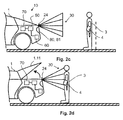
- FIGS. 2a to 2d a further embodiment of the device 10 according to the invention is shown, wherein a detection device 70, a sensor device 50 and a communication device 60 within the vehicle 1 z. B. are arranged in the rear area.
- the detection devices 70, the communication device 60 and the sensor device 50 are connected to each other electronically.
- the sensor device 50 detects a monitoring area 51, which is indicated by an arrow in FIG FIG. 2a is shown.
- the threshold to the monitoring area 51 is in FIGS. 2a and 2b represented by a dashed line, wherein when entering the user 3 in particular with an ID transmitter 4 in the monitoring area 51, the approach by z. B.
- a sensor unit 50.1, not shown, can be detected in the rear area and an authentication process with the ID transmitter 4 can be triggered by the communication device 60.
- FIG. 2b shown Is done in FIG. 2b shown authentication process with the communication device 60 successfully, ie is the Authentication is positive, as in Figure 2c a holographic representation 30 is generated by the holography device 20.
- the light wave field (wave field) 31 generated by the holography device 20, which generates the holographic representation 30, is emitted through an output 24 of the holography device 20.
- the light wave field 31 strikes the eyes of the user 3, which is the illusion of an object of the holographic representation 30 z. B. spaced from the vehicle 1 perceives. Now the user 3 z. B.
- a display device 80 with display elements 81 to interact with the holographic representation 30.
- This can be, for example, a touch of the holographic representation 30 in order to activate a function 110 of the vehicle 1.
- the user 3 is moving in the direction of the holographic representation 30, ie to the position at which the user 3 perceives the holographic representation 30.
- This position ie in particular the detection area 71 of the detection device 70 is monitored by the detection device 70 or by sensor units 50.1, whereby an approximation can be detected and the corresponding activation action can be evaluated.
- the function 110 associated with the holographic representation 30 is activated.
- the opening of a tailgate 1.11 of the vehicle 1, wherein the movement of the tailgate 1.11 by an arrow in the Figure 2d is shown.
- FIGS. 3a to 3d Various embodiments with possible arrangements of the holography device 20 are shown. It can be z.
- a holography device 20 may have a plurality of outputs 24 over which lightwave arrays 31 are emitted and thus various holographic representations 30 are generated. It is also conceivable that the various outputs 24 and thus the various light wave fields 31 for the representation z.
- the output 24 is arranged on an emblem 1.2 in the rear region of the vehicle 1.
- FIG. 3a the output 24 is arranged on an emblem 1.2 in the rear region of the vehicle 1.
- the output 24 is integrated in a distance sensor 50.2 of the sensor device 50.
- the distance sensors 50.2 of the sensor device 50 can also be used, for example, for monitoring the monitoring area 51 for detecting an approach of the user 3. It is also possible for the distance sensors 50. 2 to be used simultaneously for detecting the activation action by the detection device 70 within the detection area 71. Also, several outputs 24 z. B. be arranged at different distance sensors 50.2, as in 3d figure represented and / or integrated.
- FIGS. 4a to 4b an emblem 1.2 of the vehicle 1 is shown on an assembly module 11 in an enlarged view. It is possible that the emblem 1.2 as in FIG. 4b is shown, for. B. opened by a drive unit of the vehicle 1 and / or can be pivoted. An output 24 of the holography device 20 can be arranged on the inside of the emblem 1.2, z. B. on or integrated in a camera unit 50.3.
- FIG. 5 a door handle 1.1 of the vehicle 1 is shown, in which case the output 24 of the holography device 20 in the range z. B. a keyhole is arranged.
- holographic representations 30 can also be generated in the side region of the vehicle 1.
- FIG. 6 schematically a side view of the vehicle 1 is shown, wherein the vehicle 1 has a sliding door 1.8, with a sill 1.9.
- the output 24 of the holography device 20 is arranged on the sill 1.9.
- a holographic representation 30 produced in this way can also be used, for example, for apron lighting in the side area of the vehicle 1.
- FIG. 7 schematically a construction according to a first embodiment of the device 10 according to the invention is shown.
- the holography device 20 which has a light source 21 which is connected to a hologram unit 23 via a light guide unit 22.
- the light emitted by the light source 21, which is indicated by arrows, can by a means of transport 22.1 and a lighting means 22.2 of the light guide unit 22 are passed.
- the transport means 22.1 is formed, for example, as a glass fiber, wherein the illumination means 22.2 may be, for example, a coupling element, a prism, a plasmon waveguide or the like in order to achieve a defined illumination of the hologram unit 23.
- the hologram unit 23 in this case has a holographic plate 23.1 which modulates the light emitted by the light source 21, wherein the wave field generated by the modulation 31 with defined intensity and phase characteristics emitted from the output 24 and so generates the holographic representation 30.
- the hologram of the holographic plate 23.1 and the hologram unit 23 and / or the light source 21 may be unchangeable, in which case different holographic representations 30 z. B. can be generated by an exchange of the hologram. Further, it is conceivable that the hologram of the holographic plate 23.1 and the hologram unit 23 is also designed changeable, and z. B. can be controlled by a control unit 40 with an evaluation unit 40.1.
- the evaluation unit 40.1 may be electronically connected to the hologram unit 23, wherein the evaluation unit 40.1 z. B. controls a spatial light modulator of the hologram unit 23.
- the evaluation unit 40. 1 can store the predefined hologram image z. B. read from a non-volatile memory unit 40.2 and transmitted to the hologram unit 23.
- the holographic representation 30 by the vehicle electronics 1.12 z. B. is controlled via an interface unit 40.3 of the control unit 40.
- the control unit 40 may serve to activate or deactivate the holographic display 30.
- the control unit 40 z. B. connected to the communication device 60 and the detection device 70 to z. B. to detect an activation action or get a positive detection transmitted.
- FIG. 8 schematically another embodiment of the device 10 according to the invention and in particular the holography device 20 is shown.
- the holography device 20 has the evaluation unit 40.1, a non-volatile memory unit 40.2 and an interface unit 40.3.
- the interface unit 40.3 is connected to an electronics system 1.12 of the vehicle 1. Since it may be possible for the holography device 20 to have a plurality of outputs 24, FIG FIG. 8 an example further output 24 is shown, wherein a further hologram unit 23 is controlled by the evaluation unit 40.1.
- the control unit 40 with the evaluation unit 40.1, the non-volatile memory unit 40.2 and the interface unit 40.3 is integrated, a flexible and simple installation of the holographic device 20 z. B. on an assembly module 11 on the vehicle 1 possible.
- FIG. 9 an exemplary application of a holographic representation 30 is shown, which can serve as a distance sensor to a following vehicle 1, for example.
- FIG. 10 is a further example of application of the holographic representation 30 shown, wherein also a first holographic representation 30a and a second holographic representation 30b can be used, which are associated with a first detection area 71a and a second detection area 71b.
- a first holographic representation 30a and a second holographic representation 30b can be used, which are associated with a first detection area 71a and a second detection area 71b.
- the driver's door can be opened, for example, and an activation action in the area of the second detection area 71b can open a second door of the vehicle 1, for example.
- FIG. 11 a further application of the holographic representation 30 is shown, wherein, for example, in an operation of the ID transmitter 4 by the user 3 to facilitate finding the vehicle 1, a holographic representation 30 above the vehicle 1 can be generated.
- an activation action of the user 3 z. B. can also be done in the manner of a certain movement pattern on the holographic representation 30. This may be, for example, a particular gesture, with the holographic representation 30 alerting the user 3 to the nature of the gesture required to perform the activation action.
- FIG. 12 For example, this is an activation action requiring movement of the user's hand 3.
- FIG. 13 On the other hand, a movement of a foot of the user 3 is necessary to carry out the act of activation, whereupon the Holographic representation 30 in the form of a gate with a ball indicates. The touch of the ball can lead to the activation of the function 110 of the vehicle 1.
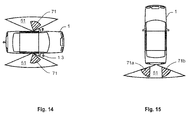
- FIG. 14 the lateral monitoring areas 51 of the vehicle 1 are shown, whereby further monitoring areas 51 may be provided.
- a detection area 71 is additionally provided, which is monitored by the detection device 70.
- the communication device 60 can also have an antenna 1.3, in order likewise to monitor a monitoring area 51 or to detect the approach of an ID transmitter 4.
- the monitoring area 51 is shown in the rear area of the vehicle 1, wherein the monitoring area 51 can also have a plurality of detection areas 71.
- a first detection area 71a and a second detection area 71b is provided which z. B. of separate sensor units 50.1 of the detection device 70 can be monitored. It is Z. B. conceivable that in each detection area 71, a holographic representation 30 is generated, which can be activated by the user 3 by an activation act.
- FIG. 16 is a schematic representation of the visualization of the inventive method 100 shown.
- a first method step 100.1 the detection of an approach of an object, in particular of the user 3, ensues, wherein after successful detection of the approach as an second method step 100.2 an authentication with the ID transmitter 4 takes place. If the authentication is positive, a first function 111 of the vehicle 1 is activated and a third method step 100.3 is carried out.
- the third method step 100.3 is the generation of a holographic representation 30, which can be operated by an activation action of the user 3. If such an activation action is detected in the fourth method step 100.4, then a second function 112 can be performed.
- FIG. 17 further method steps of a method 100 according to the invention are visualized.
- the generation of a holographic representation 30 is shown, with the fifth method step 100.5 light of a light source 21 of a holography device 20 is emitted.
- the sixth process step 100.6 is the illumination of a hologram unit 23 and the seventh process step 100.7 the modulation of the emitted light to generate the holographic representation 30.
- the first method step 100.1 is a detection of an approximation, as a second method step 100.2 an authentication, whereby with positive authentication a first 100.3a, a second 100.3b and a third holographic representation 100.3c are generated.
- Each of the holographic representations are assigned different activation actions and functions.
- a first activation action 100.4a is detected, the activation of a first assigned function 113a ensues; upon detection of a second activation action 100.4b, the activation of a second assigned function 113b takes place, and the activation of a third assigned function occurs when a third activation action 100.4c is detected Function 113c.
- These functions may be, for example, the opening of different doors 1.10 of the vehicle 1.
Landscapes
- Engineering & Computer Science (AREA)
- Mechanical Engineering (AREA)
- Physics & Mathematics (AREA)
- General Physics & Mathematics (AREA)
- Human Computer Interaction (AREA)
- Computer Networks & Wireless Communication (AREA)
- Transportation (AREA)
- Lock And Its Accessories (AREA)
Applications Claiming Priority (1)
| Application Number | Priority Date | Filing Date | Title |
|---|---|---|---|
| DE102014114049.4A DE102014114049A1 (de) | 2014-09-26 | 2014-09-26 | Vorrichtung zur Aktivierung einer Funktion eines Fahrzeuges |
Publications (2)
| Publication Number | Publication Date |
|---|---|
| EP3002736A1 true EP3002736A1 (fr) | 2016-04-06 |
| EP3002736B1 EP3002736B1 (fr) | 2020-07-08 |
Family
ID=54251975
Family Applications (1)
| Application Number | Title | Priority Date | Filing Date |
|---|---|---|---|
| EP15186733.0A Active EP3002736B1 (fr) | 2014-09-26 | 2015-09-24 | Dispositif d'activation d'une fonction d'un vehicule automobile |
Country Status (2)
| Country | Link |
|---|---|
| EP (1) | EP3002736B1 (fr) |
| DE (1) | DE102014114049A1 (fr) |
Cited By (14)
| Publication number | Priority date | Publication date | Assignee | Title |
|---|---|---|---|---|
| WO2017207291A1 (fr) * | 2016-05-30 | 2017-12-07 | Huf Hülsbeck & Fürst Gmbh & Co. Kg | Système d'accès pour activer au moins une fonction au niveau d'un véhicule |
| DE102017205277A1 (de) | 2017-03-29 | 2018-10-04 | Bayerische Motoren Werke Aktiengesellschaft | Verfahren zur Interaktion zwischen einem Fortbewegungsmittel und einem Insassen, Fahrerassistenzsystem und Fortbewegungsmittel |
| US10144337B1 (en) | 2017-06-02 | 2018-12-04 | Ford Global Technologies, Llc | Vehicle light assembly |
| WO2019175293A1 (fr) * | 2018-03-16 | 2019-09-19 | Brose Fahrzeugteile Gmbh & Co. Kommanditgesellschaft, Bamberg | Capteur et procédé pour ouvrir un hayon |
| WO2019185461A1 (fr) * | 2018-03-26 | 2019-10-03 | Brose Fahrzeugteile Gmbh & Co. Kommanditgesellschaft, Bamberg | Procédé de commande d'un agencement d'élément de volet motorisé d'un véhicule automobile |
| WO2019185467A1 (fr) * | 2018-03-26 | 2019-10-03 | Brose Fahrzeugteile Gmbh & Co. Kommanditgesellschaft, Bamberg | Procédé de commande d'un dispositif de volet motorisé d'un véhicule automobile |
| EP3651126A1 (fr) * | 2018-11-06 | 2020-05-13 | Huf Hülsbeck & Fürst GmbH & Co. KG | Système de contrôle d'accès, véhicule et procédé pour détecter un désir d'accès |
| CN112158165A (zh) * | 2020-09-30 | 2021-01-01 | 重庆长安汽车股份有限公司 | 车辆解闭锁与快速启动方法、系统、车辆及存储介质 |
| CN112542112A (zh) * | 2019-09-20 | 2021-03-23 | 全耐塑料欧洲公司 | 带有用户界面的车辆部件 |
| US11518299B2 (en) | 2020-02-27 | 2022-12-06 | Ford Global Technologies, Llc | Holographic projection system and method for a vehicle |
| EP4122765A1 (fr) * | 2021-07-23 | 2023-01-25 | Carl Zeiss Jena GmbH | Contrôle holographique d'accès |
| WO2023002025A1 (fr) * | 2021-07-23 | 2023-01-26 | Carl Zeiss Jena Gmbh | Contrôle d'accès holographique |
| CN116601367A (zh) * | 2020-10-19 | 2023-08-15 | 胡夫·许尔斯贝克和福斯特有限及两合公司 | 用于针对车辆探测激活区域内的激活行为的系统 |
| WO2025103762A1 (fr) * | 2023-11-14 | 2025-05-22 | Valeo Vision | Guide de lumière pour dispositif lumineux destiné à équiper un véhicule automobile |
Families Citing this family (7)
| Publication number | Priority date | Publication date | Assignee | Title |
|---|---|---|---|---|
| DE102016222556A1 (de) * | 2016-11-16 | 2018-05-17 | Bayerische Motoren Werke Aktiengesellschaft | Verkehrssignaleinrichtung und Verfahren zum Betreiben eines Plasmaobjekts |
| DE102020112797A1 (de) | 2020-05-12 | 2021-11-18 | Bayerische Motoren Werke Aktiengesellschaft | Bedieneinheit für eine Fahrzeugtür |
| DE102021207573A1 (de) | 2021-02-01 | 2022-08-04 | Carl Zeiss Jena Gmbh | Holographische einstiegsleuchte in einem türrahmen |
| DE102021111743B4 (de) | 2021-05-06 | 2025-11-06 | Dr. Ing. H.C. F. Porsche Aktiengesellschaft | Verfahren zum Anzeigen eines dreidimensionalen Hologramms |
| DE102021111744B4 (de) | 2021-05-06 | 2025-10-16 | Dr. Ing. H.C. F. Porsche Aktiengesellschaft | Verfahren zum Anzeigen eines dreidimensionalen Hologramms und Computerprogrammprodukt |
| DE102023113661A1 (de) * | 2023-05-24 | 2024-11-28 | Marelli Automotive Lighting Reutlingen (Germany) GmbH | Vorrichtung zum berührungslosen Auslösen wenigstens einer Funktion eines Kraftfahrzeugs |
| EP4560381A1 (fr) * | 2023-11-24 | 2025-05-28 | Motherson Innovations Company Ltd. | Système pour caméra et affichage holographique |
Citations (5)
| Publication number | Priority date | Publication date | Assignee | Title |
|---|---|---|---|---|
| US7054045B2 (en) * | 2003-07-03 | 2006-05-30 | Holotouch, Inc. | Holographic human-machine interfaces |
| DE102006000777A1 (de) * | 2005-01-05 | 2006-07-13 | General Motors Corp., Detroit | Vituelle Tastatur für Fahrzeugzutrittssteuerung |
| FR2936545A1 (fr) * | 2008-10-01 | 2010-04-02 | Valeo Securite Habitacle | Dispositif de deverrouillage automatique d'un ouvrant de vehicule automatique. |
| DE102009044389A1 (de) * | 2009-11-02 | 2011-05-05 | Witte-Velbert Gmbh & Co. Kg | Tür- oder Heckklappenöffnungseinrichtung |
| FR2995269A1 (fr) * | 2012-09-07 | 2014-03-14 | Peugeot Citroen Automobiles Sa | Dispositif holographique de signalisation pour vehicule |
Family Cites Families (2)
| Publication number | Priority date | Publication date | Assignee | Title |
|---|---|---|---|---|
| CN101675291B (zh) * | 2007-05-01 | 2011-09-14 | 皇家飞利浦电子股份有限公司 | 用于产生光束和全息3d图像的汽车照明单元 |
| DE102008021989A1 (de) * | 2008-05-02 | 2008-12-18 | Daimler Ag | Vorrichtung zum Ver- und Entriegeln einer mittels eines elektronischen Zugangsberechtigungssystems gesicherten Fahrzeugtür für ein Fahrzeug |
-
2014
- 2014-09-26 DE DE102014114049.4A patent/DE102014114049A1/de not_active Withdrawn
-
2015
- 2015-09-24 EP EP15186733.0A patent/EP3002736B1/fr active Active
Patent Citations (5)
| Publication number | Priority date | Publication date | Assignee | Title |
|---|---|---|---|---|
| US7054045B2 (en) * | 2003-07-03 | 2006-05-30 | Holotouch, Inc. | Holographic human-machine interfaces |
| DE102006000777A1 (de) * | 2005-01-05 | 2006-07-13 | General Motors Corp., Detroit | Vituelle Tastatur für Fahrzeugzutrittssteuerung |
| FR2936545A1 (fr) * | 2008-10-01 | 2010-04-02 | Valeo Securite Habitacle | Dispositif de deverrouillage automatique d'un ouvrant de vehicule automatique. |
| DE102009044389A1 (de) * | 2009-11-02 | 2011-05-05 | Witte-Velbert Gmbh & Co. Kg | Tür- oder Heckklappenöffnungseinrichtung |
| FR2995269A1 (fr) * | 2012-09-07 | 2014-03-14 | Peugeot Citroen Automobiles Sa | Dispositif holographique de signalisation pour vehicule |
Cited By (18)
| Publication number | Priority date | Publication date | Assignee | Title |
|---|---|---|---|---|
| CN108883722A (zh) * | 2016-05-30 | 2018-11-23 | 胡夫·许尔斯贝克和福斯特有限及两合公司 | 用于激活车辆中的至少一个功能的进入系统 |
| WO2017207291A1 (fr) * | 2016-05-30 | 2017-12-07 | Huf Hülsbeck & Fürst Gmbh & Co. Kg | Système d'accès pour activer au moins une fonction au niveau d'un véhicule |
| DE102017205277A1 (de) | 2017-03-29 | 2018-10-04 | Bayerische Motoren Werke Aktiengesellschaft | Verfahren zur Interaktion zwischen einem Fortbewegungsmittel und einem Insassen, Fahrerassistenzsystem und Fortbewegungsmittel |
| US10144337B1 (en) | 2017-06-02 | 2018-12-04 | Ford Global Technologies, Llc | Vehicle light assembly |
| WO2019175293A1 (fr) * | 2018-03-16 | 2019-09-19 | Brose Fahrzeugteile Gmbh & Co. Kommanditgesellschaft, Bamberg | Capteur et procédé pour ouvrir un hayon |
| WO2019185461A1 (fr) * | 2018-03-26 | 2019-10-03 | Brose Fahrzeugteile Gmbh & Co. Kommanditgesellschaft, Bamberg | Procédé de commande d'un agencement d'élément de volet motorisé d'un véhicule automobile |
| WO2019185467A1 (fr) * | 2018-03-26 | 2019-10-03 | Brose Fahrzeugteile Gmbh & Co. Kommanditgesellschaft, Bamberg | Procédé de commande d'un dispositif de volet motorisé d'un véhicule automobile |
| EP3651126A1 (fr) * | 2018-11-06 | 2020-05-13 | Huf Hülsbeck & Fürst GmbH & Co. KG | Système de contrôle d'accès, véhicule et procédé pour détecter un désir d'accès |
| JP7641489B2 (ja) | 2019-09-20 | 2025-03-07 | オーピーモビリティ エスイー | ユーザインターフェースを備えた車両部品 |
| CN112542112A (zh) * | 2019-09-20 | 2021-03-23 | 全耐塑料欧洲公司 | 带有用户界面的车辆部件 |
| JP2021051744A (ja) * | 2019-09-20 | 2021-04-01 | コンパニー プラスチック オムニウム エスウCompagnie Plastic Omnium Se | ユーザインターフェースを備えた車両部品 |
| US11518299B2 (en) | 2020-02-27 | 2022-12-06 | Ford Global Technologies, Llc | Holographic projection system and method for a vehicle |
| CN112158165A (zh) * | 2020-09-30 | 2021-01-01 | 重庆长安汽车股份有限公司 | 车辆解闭锁与快速启动方法、系统、车辆及存储介质 |
| CN116601367A (zh) * | 2020-10-19 | 2023-08-15 | 胡夫·许尔斯贝克和福斯特有限及两合公司 | 用于针对车辆探测激活区域内的激活行为的系统 |
| WO2023002025A1 (fr) * | 2021-07-23 | 2023-01-26 | Carl Zeiss Jena Gmbh | Contrôle d'accès holographique |
| EP4122765A1 (fr) * | 2021-07-23 | 2023-01-25 | Carl Zeiss Jena GmbH | Contrôle holographique d'accès |
| US12406540B2 (en) | 2021-07-23 | 2025-09-02 | Carl Zeiss Jena Gmbh | Holographic access control |
| WO2025103762A1 (fr) * | 2023-11-14 | 2025-05-22 | Valeo Vision | Guide de lumière pour dispositif lumineux destiné à équiper un véhicule automobile |
Also Published As
| Publication number | Publication date |
|---|---|
| DE102014114049A1 (de) | 2016-03-31 |
| EP3002736B1 (fr) | 2020-07-08 |
Similar Documents
| Publication | Publication Date | Title |
|---|---|---|
| EP3002736B1 (fr) | Dispositif d'activation d'une fonction d'un vehicule automobile | |
| EP3708757B1 (fr) | Module de montage pour un véhicule automobile doté d'un système de capteur optique et d'un actionnement d'urgence | |
| EP3099539B1 (fr) | Module prêt au montage pour véhicule à moteur | |
| EP3099542B1 (fr) | Logo pour véhicule à moteur comportant un système capteur, et procédé correspondant | |
| EP3099547B1 (fr) | Module prêt au montage | |
| US10501052B2 (en) | Assembly module for a motor vehicle with an optical sensor system for monitoring a detection region | |
| DE102011084366A1 (de) | Fernbedienung für ein Parkassistenzsystem und ein per Fernbedienung kontrollierbares Parkassistenzsystem | |
| DE112015001401T5 (de) | Fahrzeugfunktionssteuerungssystem verwendend projizierte Zeichen | |
| DE102013225852A1 (de) | Verfahren und Vorrichtung zum Steuern von zumindest einer Beleuchtungseinrichtung eines Fahrzeugs | |
| WO2014023391A1 (fr) | Commande d'un dispositif d'éclairage intérieur pour signaler un risque de collision à un usager d'un véhicule automobile | |
| DE102014100144A1 (de) | Fahrzeugaussentürgriffbeleuchtung | |
| DE102014226188A1 (de) | Kommunikation zwischen einem Fahrzeug und einem Verkehrsteilnehmer im Umfeld des Fahrzeugs | |
| DE102014101190A1 (de) | Montagemodul | |
| DE102014101201A1 (de) | Montagemodul für ein Kraftfahrzeug | |
| WO2022156935A2 (fr) | Procédé permettant de faire fonctionner un dispositif d'éclairage périphérique d'un véhicule | |
| DE102008003936A1 (de) | Vorrichtung zur Ausgabe von Warnmeldungen für ein Kraftfahrzeug | |
| DE102011101708A1 (de) | Verfahren und Steuermittel zum automatischen Steuern eines Kraftfahrzeugs | |
| DE102005034097B4 (de) | Schließsystem für ein Fahrzeug | |
| WO2018103878A1 (fr) | Procédé de visualisation d'un état de conduite | |
| DE102013209561A1 (de) | Systeme und verfahren zur bestätigung eines möglicherweise unbeabsichtigt an ein fahrzeug gegebenen befehls | |
| DE102017007761A1 (de) | Vorrichtung zur kamerabasierten Umgebungserfassung für ein Fahrzeug und Steuerungsverfahren hierfür | |
| DE102014205243A1 (de) | Vorrichtung und Verfahren zur Steuerung des Erscheinungsbildes eines oder mehrerer sichtbaren Fahrzeugteile | |
| DE102016209992B4 (de) | Steuervorrichtung und Verfahren zum Betreiben einer motorisch aufschwenkbaren Fahrzeugklappe eines Kraftfahrzeugs sowie Kraftfahrzeug | |
| DE102014205242A1 (de) | Vorrichtung zur Veränderung des räumlichen Erscheinungsbilds eines oder mehrerer von außen sichtbarer Fahrzeugteile eines Fahrzeugs | |
| WO2020249333A1 (fr) | Éclairage d'un interstice de porte de véhicule pour soutenir la facilité de commande de systèmes automatiques d'ouverture de porte |
Legal Events
| Date | Code | Title | Description |
|---|---|---|---|
| PUAI | Public reference made under article 153(3) epc to a published international application that has entered the european phase |
Free format text: ORIGINAL CODE: 0009012 |
|
| AK | Designated contracting states |
Kind code of ref document: A1 Designated state(s): AL AT BE BG CH CY CZ DE DK EE ES FI FR GB GR HR HU IE IS IT LI LT LU LV MC MK MT NL NO PL PT RO RS SE SI SK SM TR |
|
| AX | Request for extension of the european patent |
Extension state: BA ME |
|
| 17P | Request for examination filed |
Effective date: 20161006 |
|
| RBV | Designated contracting states (corrected) |
Designated state(s): AL AT BE BG CH CY CZ DE DK EE ES FI FR GB GR HR HU IE IS IT LI LT LU LV MC MK MT NL NO PL PT RO RS SE SI SK SM TR |
|
| STAA | Information on the status of an ep patent application or granted ep patent |
Free format text: STATUS: EXAMINATION IS IN PROGRESS |
|
| 17Q | First examination report despatched |
Effective date: 20171023 |
|
| GRAP | Despatch of communication of intention to grant a patent |
Free format text: ORIGINAL CODE: EPIDOSNIGR1 |
|
| STAA | Information on the status of an ep patent application or granted ep patent |
Free format text: STATUS: GRANT OF PATENT IS INTENDED |
|
| RIC1 | Information provided on ipc code assigned before grant |
Ipc: B60R 25/20 20130101ALI20200123BHEP Ipc: B60Q 1/50 20060101ALN20200123BHEP Ipc: G07C 9/00 20200101AFI20200123BHEP |
|
| RIC1 | Information provided on ipc code assigned before grant |
Ipc: B60Q 1/50 20060101ALN20200128BHEP Ipc: B60R 25/20 20130101ALI20200128BHEP Ipc: G07C 9/00 20200101AFI20200128BHEP |
|
| INTG | Intention to grant announced |
Effective date: 20200226 |
|
| GRAS | Grant fee paid |
Free format text: ORIGINAL CODE: EPIDOSNIGR3 |
|
| GRAA | (expected) grant |
Free format text: ORIGINAL CODE: 0009210 |
|
| STAA | Information on the status of an ep patent application or granted ep patent |
Free format text: STATUS: THE PATENT HAS BEEN GRANTED |
|
| AK | Designated contracting states |
Kind code of ref document: B1 Designated state(s): AL AT BE BG CH CY CZ DE DK EE ES FI FR GB GR HR HU IE IS IT LI LT LU LV MC MK MT NL NO PL PT RO RS SE SI SK SM TR |
|
| REG | Reference to a national code |
Ref country code: CH Ref legal event code: EP Ref country code: AT Ref legal event code: REF Ref document number: 1289295 Country of ref document: AT Kind code of ref document: T Effective date: 20200715 |
|
| REG | Reference to a national code |
Ref country code: DE Ref legal event code: R096 Ref document number: 502015012947 Country of ref document: DE |
|
| REG | Reference to a national code |
Ref country code: IE Ref legal event code: FG4D Free format text: LANGUAGE OF EP DOCUMENT: GERMAN |
|
| REG | Reference to a national code |
Ref country code: LT Ref legal event code: MG4D |
|
| REG | Reference to a national code |
Ref country code: NL Ref legal event code: MP Effective date: 20200708 |
|
| PG25 | Lapsed in a contracting state [announced via postgrant information from national office to epo] |
Ref country code: GR Free format text: LAPSE BECAUSE OF FAILURE TO SUBMIT A TRANSLATION OF THE DESCRIPTION OR TO PAY THE FEE WITHIN THE PRESCRIBED TIME-LIMIT Effective date: 20201009 Ref country code: FI Free format text: LAPSE BECAUSE OF FAILURE TO SUBMIT A TRANSLATION OF THE DESCRIPTION OR TO PAY THE FEE WITHIN THE PRESCRIBED TIME-LIMIT Effective date: 20200708 Ref country code: NO Free format text: LAPSE BECAUSE OF FAILURE TO SUBMIT A TRANSLATION OF THE DESCRIPTION OR TO PAY THE FEE WITHIN THE PRESCRIBED TIME-LIMIT Effective date: 20201008 Ref country code: LT Free format text: LAPSE BECAUSE OF FAILURE TO SUBMIT A TRANSLATION OF THE DESCRIPTION OR TO PAY THE FEE WITHIN THE PRESCRIBED TIME-LIMIT Effective date: 20200708 Ref country code: PT Free format text: LAPSE BECAUSE OF FAILURE TO SUBMIT A TRANSLATION OF THE DESCRIPTION OR TO PAY THE FEE WITHIN THE PRESCRIBED TIME-LIMIT Effective date: 20201109 Ref country code: SE Free format text: LAPSE BECAUSE OF FAILURE TO SUBMIT A TRANSLATION OF THE DESCRIPTION OR TO PAY THE FEE WITHIN THE PRESCRIBED TIME-LIMIT Effective date: 20200708 Ref country code: BG Free format text: LAPSE BECAUSE OF FAILURE TO SUBMIT A TRANSLATION OF THE DESCRIPTION OR TO PAY THE FEE WITHIN THE PRESCRIBED TIME-LIMIT Effective date: 20201008 Ref country code: ES Free format text: LAPSE BECAUSE OF FAILURE TO SUBMIT A TRANSLATION OF THE DESCRIPTION OR TO PAY THE FEE WITHIN THE PRESCRIBED TIME-LIMIT Effective date: 20200708 Ref country code: HR Free format text: LAPSE BECAUSE OF FAILURE TO SUBMIT A TRANSLATION OF THE DESCRIPTION OR TO PAY THE FEE WITHIN THE PRESCRIBED TIME-LIMIT Effective date: 20200708 |
|
| PG25 | Lapsed in a contracting state [announced via postgrant information from national office to epo] |
Ref country code: LV Free format text: LAPSE BECAUSE OF FAILURE TO SUBMIT A TRANSLATION OF THE DESCRIPTION OR TO PAY THE FEE WITHIN THE PRESCRIBED TIME-LIMIT Effective date: 20200708 Ref country code: PL Free format text: LAPSE BECAUSE OF FAILURE TO SUBMIT A TRANSLATION OF THE DESCRIPTION OR TO PAY THE FEE WITHIN THE PRESCRIBED TIME-LIMIT Effective date: 20200708 Ref country code: RS Free format text: LAPSE BECAUSE OF FAILURE TO SUBMIT A TRANSLATION OF THE DESCRIPTION OR TO PAY THE FEE WITHIN THE PRESCRIBED TIME-LIMIT Effective date: 20200708 Ref country code: IS Free format text: LAPSE BECAUSE OF FAILURE TO SUBMIT A TRANSLATION OF THE DESCRIPTION OR TO PAY THE FEE WITHIN THE PRESCRIBED TIME-LIMIT Effective date: 20201108 |
|
| PG25 | Lapsed in a contracting state [announced via postgrant information from national office to epo] |
Ref country code: NL Free format text: LAPSE BECAUSE OF FAILURE TO SUBMIT A TRANSLATION OF THE DESCRIPTION OR TO PAY THE FEE WITHIN THE PRESCRIBED TIME-LIMIT Effective date: 20200708 |
|
| REG | Reference to a national code |
Ref country code: DE Ref legal event code: R097 Ref document number: 502015012947 Country of ref document: DE |
|
| PG25 | Lapsed in a contracting state [announced via postgrant information from national office to epo] |
Ref country code: MC Free format text: LAPSE BECAUSE OF FAILURE TO SUBMIT A TRANSLATION OF THE DESCRIPTION OR TO PAY THE FEE WITHIN THE PRESCRIBED TIME-LIMIT Effective date: 20200708 Ref country code: EE Free format text: LAPSE BECAUSE OF FAILURE TO SUBMIT A TRANSLATION OF THE DESCRIPTION OR TO PAY THE FEE WITHIN THE PRESCRIBED TIME-LIMIT Effective date: 20200708 Ref country code: RO Free format text: LAPSE BECAUSE OF FAILURE TO SUBMIT A TRANSLATION OF THE DESCRIPTION OR TO PAY THE FEE WITHIN THE PRESCRIBED TIME-LIMIT Effective date: 20200708 Ref country code: SM Free format text: LAPSE BECAUSE OF FAILURE TO SUBMIT A TRANSLATION OF THE DESCRIPTION OR TO PAY THE FEE WITHIN THE PRESCRIBED TIME-LIMIT Effective date: 20200708 Ref country code: IT Free format text: LAPSE BECAUSE OF FAILURE TO SUBMIT A TRANSLATION OF THE DESCRIPTION OR TO PAY THE FEE WITHIN THE PRESCRIBED TIME-LIMIT Effective date: 20200708 Ref country code: CZ Free format text: LAPSE BECAUSE OF FAILURE TO SUBMIT A TRANSLATION OF THE DESCRIPTION OR TO PAY THE FEE WITHIN THE PRESCRIBED TIME-LIMIT Effective date: 20200708 Ref country code: DK Free format text: LAPSE BECAUSE OF FAILURE TO SUBMIT A TRANSLATION OF THE DESCRIPTION OR TO PAY THE FEE WITHIN THE PRESCRIBED TIME-LIMIT Effective date: 20200708 |
|
| REG | Reference to a national code |
Ref country code: CH Ref legal event code: PL |
|
| PLBE | No opposition filed within time limit |
Free format text: ORIGINAL CODE: 0009261 |
|
| STAA | Information on the status of an ep patent application or granted ep patent |
Free format text: STATUS: NO OPPOSITION FILED WITHIN TIME LIMIT |
|
| PG25 | Lapsed in a contracting state [announced via postgrant information from national office to epo] |
Ref country code: AL Free format text: LAPSE BECAUSE OF FAILURE TO SUBMIT A TRANSLATION OF THE DESCRIPTION OR TO PAY THE FEE WITHIN THE PRESCRIBED TIME-LIMIT Effective date: 20200708 |
|
| 26N | No opposition filed |
Effective date: 20210409 |
|
| REG | Reference to a national code |
Ref country code: BE Ref legal event code: MM Effective date: 20200930 |
|
| PG25 | Lapsed in a contracting state [announced via postgrant information from national office to epo] |
Ref country code: SK Free format text: LAPSE BECAUSE OF FAILURE TO SUBMIT A TRANSLATION OF THE DESCRIPTION OR TO PAY THE FEE WITHIN THE PRESCRIBED TIME-LIMIT Effective date: 20200708 Ref country code: LU Free format text: LAPSE BECAUSE OF NON-PAYMENT OF DUE FEES Effective date: 20200924 |
|
| PG25 | Lapsed in a contracting state [announced via postgrant information from national office to epo] |
Ref country code: LI Free format text: LAPSE BECAUSE OF NON-PAYMENT OF DUE FEES Effective date: 20200930 Ref country code: IE Free format text: LAPSE BECAUSE OF NON-PAYMENT OF DUE FEES Effective date: 20200924 Ref country code: SI Free format text: LAPSE BECAUSE OF FAILURE TO SUBMIT A TRANSLATION OF THE DESCRIPTION OR TO PAY THE FEE WITHIN THE PRESCRIBED TIME-LIMIT Effective date: 20200708 Ref country code: CH Free format text: LAPSE BECAUSE OF NON-PAYMENT OF DUE FEES Effective date: 20200930 Ref country code: BE Free format text: LAPSE BECAUSE OF NON-PAYMENT OF DUE FEES Effective date: 20200930 |
|
| PGFP | Annual fee paid to national office [announced via postgrant information from national office to epo] |
Ref country code: FR Payment date: 20210927 Year of fee payment: 7 |
|
| REG | Reference to a national code |
Ref country code: AT Ref legal event code: MM01 Ref document number: 1289295 Country of ref document: AT Kind code of ref document: T Effective date: 20200924 |
|
| PGFP | Annual fee paid to national office [announced via postgrant information from national office to epo] |
Ref country code: GB Payment date: 20210923 Year of fee payment: 7 |
|
| PG25 | Lapsed in a contracting state [announced via postgrant information from national office to epo] |
Ref country code: AT Free format text: LAPSE BECAUSE OF NON-PAYMENT OF DUE FEES Effective date: 20200924 |
|
| PG25 | Lapsed in a contracting state [announced via postgrant information from national office to epo] |
Ref country code: TR Free format text: LAPSE BECAUSE OF FAILURE TO SUBMIT A TRANSLATION OF THE DESCRIPTION OR TO PAY THE FEE WITHIN THE PRESCRIBED TIME-LIMIT Effective date: 20200708 Ref country code: MT Free format text: LAPSE BECAUSE OF FAILURE TO SUBMIT A TRANSLATION OF THE DESCRIPTION OR TO PAY THE FEE WITHIN THE PRESCRIBED TIME-LIMIT Effective date: 20200708 Ref country code: CY Free format text: LAPSE BECAUSE OF FAILURE TO SUBMIT A TRANSLATION OF THE DESCRIPTION OR TO PAY THE FEE WITHIN THE PRESCRIBED TIME-LIMIT Effective date: 20200708 |
|
| PG25 | Lapsed in a contracting state [announced via postgrant information from national office to epo] |
Ref country code: MK Free format text: LAPSE BECAUSE OF FAILURE TO SUBMIT A TRANSLATION OF THE DESCRIPTION OR TO PAY THE FEE WITHIN THE PRESCRIBED TIME-LIMIT Effective date: 20200708 |
|
| GBPC | Gb: european patent ceased through non-payment of renewal fee |
Effective date: 20220924 |
|
| P01 | Opt-out of the competence of the unified patent court (upc) registered |
Effective date: 20230426 |
|
| PG25 | Lapsed in a contracting state [announced via postgrant information from national office to epo] |
Ref country code: FR Free format text: LAPSE BECAUSE OF NON-PAYMENT OF DUE FEES Effective date: 20220930 |
|
| PG25 | Lapsed in a contracting state [announced via postgrant information from national office to epo] |
Ref country code: GB Free format text: LAPSE BECAUSE OF NON-PAYMENT OF DUE FEES Effective date: 20220924 |
|
| PGFP | Annual fee paid to national office [announced via postgrant information from national office to epo] |
Ref country code: DE Payment date: 20250919 Year of fee payment: 11 |