EP3003999B1 - Heat resistant separation fabric - Google Patents
Heat resistant separation fabric Download PDFInfo
- Publication number
- EP3003999B1 EP3003999B1 EP14725069.0A EP14725069A EP3003999B1 EP 3003999 B1 EP3003999 B1 EP 3003999B1 EP 14725069 A EP14725069 A EP 14725069A EP 3003999 B1 EP3003999 B1 EP 3003999B1
- Authority
- EP
- European Patent Office
- Prior art keywords
- heat resistant
- stainless steel
- resistant separation
- steel fibers
- separation fabric
- Prior art date
- Legal status (The legal status is an assumption and is not a legal conclusion. Google has not performed a legal analysis and makes no representation as to the accuracy of the status listed.)
- Active
Links
Images
Classifications
-
- C—CHEMISTRY; METALLURGY
- C03—GLASS; MINERAL OR SLAG WOOL
- C03B—MANUFACTURE, SHAPING, OR SUPPLEMENTARY PROCESSES
- C03B40/00—Preventing adhesion between glass and glass or between glass and the means used to shape it, hold it or support it
- C03B40/005—Fabrics, felts or loose covers
-
- B—PERFORMING OPERATIONS; TRANSPORTING
- B05—SPRAYING OR ATOMISING IN GENERAL; APPLYING FLUENT MATERIALS TO SURFACES, IN GENERAL
- B05D—PROCESSES FOR APPLYING FLUENT MATERIALS TO SURFACES, IN GENERAL
- B05D1/00—Processes for applying liquids or other fluent materials
- B05D1/18—Processes for applying liquids or other fluent materials performed by dipping
-
- C—CHEMISTRY; METALLURGY
- C03—GLASS; MINERAL OR SLAG WOOL
- C03B—MANUFACTURE, SHAPING, OR SUPPLEMENTARY PROCESSES
- C03B35/00—Transporting of glass products during their manufacture, e.g. hot glass lenses, prisms
-
- C—CHEMISTRY; METALLURGY
- C03—GLASS; MINERAL OR SLAG WOOL
- C03B—MANUFACTURE, SHAPING, OR SUPPLEMENTARY PROCESSES
- C03B35/00—Transporting of glass products during their manufacture, e.g. hot glass lenses, prisms
- C03B35/14—Transporting hot glass sheets or ribbons, e.g. by heat-resistant conveyor belts or bands
- C03B35/16—Transporting hot glass sheets or ribbons, e.g. by heat-resistant conveyor belts or bands by roller conveyors
- C03B35/18—Construction of the conveyor rollers ; Materials, coatings or coverings thereof
- C03B35/181—Materials, coatings, loose coverings or sleeves thereof
-
- C—CHEMISTRY; METALLURGY
- C03—GLASS; MINERAL OR SLAG WOOL
- C03B—MANUFACTURE, SHAPING, OR SUPPLEMENTARY PROCESSES
- C03B35/00—Transporting of glass products during their manufacture, e.g. hot glass lenses, prisms
- C03B35/14—Transporting hot glass sheets or ribbons, e.g. by heat-resistant conveyor belts or bands
- C03B35/20—Transporting hot glass sheets or ribbons, e.g. by heat-resistant conveyor belts or bands by gripping tongs or supporting frames
- C03B35/202—Transporting hot glass sheets or ribbons, e.g. by heat-resistant conveyor belts or bands by gripping tongs or supporting frames by supporting frames
- C03B35/207—Construction or design of supporting frames
-
- C—CHEMISTRY; METALLURGY
- C22—METALLURGY; FERROUS OR NON-FERROUS ALLOYS; TREATMENT OF ALLOYS OR NON-FERROUS METALS
- C22C—ALLOYS
- C22C38/00—Ferrous alloys, e.g. steel alloys
-
- C—CHEMISTRY; METALLURGY
- C22—METALLURGY; FERROUS OR NON-FERROUS ALLOYS; TREATMENT OF ALLOYS OR NON-FERROUS METALS
- C22C—ALLOYS
- C22C38/00—Ferrous alloys, e.g. steel alloys
- C22C38/18—Ferrous alloys, e.g. steel alloys containing chromium
-
- C—CHEMISTRY; METALLURGY
- C22—METALLURGY; FERROUS OR NON-FERROUS ALLOYS; TREATMENT OF ALLOYS OR NON-FERROUS METALS
- C22C—ALLOYS
- C22C38/00—Ferrous alloys, e.g. steel alloys
- C22C38/18—Ferrous alloys, e.g. steel alloys containing chromium
- C22C38/40—Ferrous alloys, e.g. steel alloys containing chromium with nickel
-
- D—TEXTILES; PAPER
- D03—WEAVING
- D03D—WOVEN FABRICS; METHODS OF WEAVING; LOOMS
- D03D15/00—Woven fabrics characterised by the material, structure or properties of the fibres, filaments, yarns, threads or other warp or weft elements used
- D03D15/20—Woven fabrics characterised by the material, structure or properties of the fibres, filaments, yarns, threads or other warp or weft elements used characterised by the material of the fibres or filaments constituting the yarns or threads
- D03D15/242—Woven fabrics characterised by the material, structure or properties of the fibres, filaments, yarns, threads or other warp or weft elements used characterised by the material of the fibres or filaments constituting the yarns or threads inorganic, e.g. basalt
- D03D15/267—Glass
-
- D—TEXTILES; PAPER
- D10—INDEXING SCHEME ASSOCIATED WITH SUBLASSES OF SECTION D, RELATING TO TEXTILES
- D10B—INDEXING SCHEME ASSOCIATED WITH SUBLASSES OF SECTION D, RELATING TO TEXTILES
- D10B2101/00—Inorganic fibres
- D10B2101/20—Metallic fibres
Definitions
- the invention relates to the field of heat resistant separation fabrics such as can be used in the production of car glass.
- the heat resistant separation fabrics of the invention comprise stainless steel fibers.
- Such fabrics can be used to cover moulds, rings and transport rollers (e.g. in the car glass industry) to avoid direct contact between the moulds, rings and transport rollers and the hot glass panels or products.
- Heat resistant separation fabrics that comprise stainless steel fibers are known (see e.g. in WO00/40792 and in WO2011/117048 ). Such fabrics are e.g. used in the production of car glass (so called lites) to avoid direct contact between tooling (moulds, rings, rollers) and the hot glass.
- the fabrics can consist for 100% of stainless steel fibers (e.g. in JP2001164442A2 ), or can be blends of stainless steel fibers with other fibers (e.g. in WO99/47738A1 ), e.g. with glass fiber or with poly(p-phenylene-2, 6-benzobisoxazole) fibers (see for the latter in WO00/61508A1 ). Fabrics comprising stainless steel fibers have the benefit that they have a long life time and good temperature resistance.
- the first aspect of the invention is a heat resistant separation fabric comprising stainless steel fibers.
- the stainless steel fibers are made out of an alloy comprising more than 12% (and preferably more than 18%) by weight of chromium.
- the stainless steel fibers comprise an oxide skin, wherein the atomic percentage of Cr at 5 nm depth of the oxide skin divided by the sum of the atomic percentages of Cr and Fe at 5 nm depth of said oxide skin, and multiplied with 100 to express as a percentage, is higher than 30%, preferably higher than 40%.
- the atomic percentage of the elements Cr and Fe at a specified depth of the oxide skin can be determined by means of XPS (X-ray Photoelectron Spectroscopy), using sputtering to measure element composition at different depths.
- the fabrics of the invention are sufficiently flexible in that the fabrics can even be draped easily on double curved moulds.
- the heat resistant separation fabrics of the invention as covering of tooling (e.g. moulds, rollers or rings) in car glass production, the quality of the car glass at start-up with new coverings is improved to a large extent. This is especially important when small series of car glass products have to be made, as it can lead to frequent changes of tooling coverings. In such cases, the lifetime of the tooling covering is of lesser importance; however, it is beneficial that as from start-up of production with new covering, good quality car glass products are produced.
- the stainless steel fibers are made out of an austenitic stainless steel alloy.
- the stainless steel fibers comprise more than 16 % by weight of chromium, and preferably less than 28% by weight of chromium.
- the alloy comprises more than 6% by weight of nickel, more preferably more than 15% by weight of nickel. Preferably, the alloy comprises less than 25 % by weight of nickel.
- stainless steel fibers made out of an alloy of the 300 series of ASTM A313 can be advantageously used for the invention.
- Preferred examples of alloys for the invention are 316, 316L and 347 (according to ASTM A313).
- the equivalent diameter of the stainless steel fibers is larger than 4 ⁇ m, preferably larger than 6 ⁇ m.
- the equivalent diameter of the stainless steel fibers is smaller than 25 ⁇ m, preferably smaller than 20 ⁇ m, more preferably smaller than 15 ⁇ m.
- Examples of equivalent fiber diameters that can advantageously be used are 6.5 ⁇ m, 8 ⁇ m, 12 ⁇ m and 22 ⁇ m.
- equivalent diameter is meant the diameter of a circle that has the same surface area as the surface area of the cross section of a fiber, which is not necessarily having a circular cross section.
- the stainless steel fibers are made via bundled drawing.
- the stainless steel fibers are of discrete length (e.g. fibers obtained via stretch breaking of bundle drawn fiber bundles) and spun into a yarn.
- the heat resistant separation fabric comprises stainless steel fibers in two-ply or three-ply yarns.
- the stainless steel fibers have in the oxide skin an atomic percentage of Cr divided by the sum of the atomic percentages of Cr and Fe of the oxide skin, and multiplied with 100, higher than 30%, preferably higher than 40%, from the surface till minimum at a depth of 25 nm (and preferably till minimum at a depth of 40 nm, and more preferably till minimum at a depth of 60 nm) from the fiber surface.
- Heat resistant separation fabrics according to such embodiments have even better start-up behavior when used as covering for tooling that comes in contact with hot glass products.
- the oxide skin covers the complete surface of the stainless steel fibers.
- the complete coverage of the full surface of the stainless steel fibers by the oxide skin reinforces the start-up benefits of the heat resistant separation fabric.
- the potential range of the current plateau of the heat resistant separation material as measured in cyclic potentiodynamic polarization is at least 0.18 V.
- Cyclic potentiodynamic polarization is a test that can be performed to evaluate whether or not the full surface of the stainless steel fibers of the heat resistant fabric of the invention is covered by an oxide skin.
- the preferred minimum value for the potential range of the current plateau is an indication of full coverage of the stainless steel fibers by the oxide skin, and contributing to improved beneficial start-up behaviour of the heat resistant separation material.
- Cyclic potentiodynamic polarization is an electrochemical technique that is a fairly simple routine technique in laboratories specialized in electrochemistry. This technique is based on potentiodynamic anodic measurements as described in the standards ASTM G5-94(2004) and ASTM G61-86(2009).
- a voltage is applied between the sample, used as working electrode, and an inert counter electrode (e.g. carbon, gold or platinum electrode). The voltage is consecutively increased with a constant increment resulting in a scan rate expressed in Volt per minute or Volt per second. When the voltage is applied to the sample the current between the sample and an inert counter electrode is recorded.
- the potential is ramped at a continuous, often slow rate relative to a reference electrode using an instrument called a potentiostat.
- the potential is first increased at a constant rate (forward scan).
- the scan direction is reversed at some chosen maximum current or voltage and progresses at the same rate in the backward or reverse direction.
- the scan is terminated at another chosen voltage.
- the electrical current is measured.
- a plot can be made of the relation between the applied voltage and the logarithm of the electrical current that is measured.
- the voltage measurement is compared to the Standard Hydrogen Electrode (SHE) as described in the IUPAC Compendium of Chemical Terminology, 2nd ed. (the "Gold Book"), compiled by A. D. McNaught and A. Wilkinson. Blackwell Scientific Publications, Oxford (1997 ). XML on-line corrected version http://goldbook.iupac.org/S05917.html.
- SHE Standard Hydrogen Electrode
- a standardized lab reference electrode like a calomel (SCE) or silver / silver chloride (Ag/AgCl) electrode may be used.
- the electrolyte in which the electrodes are immersed contains 5% by weight of NaCl in a 40/60 by volume of water / ethanol mixture. Ethanol is used in the electrolyte in order to assure complete wetting of the sample material, as incomplete wetting of the material would result in an errorteous measurement of the voltage.
- the pH of the electrolyte is adjusted to 2 using HCl.
- As reference electrode Ag/AgCl (0.22 V versus Standard Hydrogen Electrode (SHE)) is used.
- the scan rate used in the tests is 5 mV/s. Potential values are compared to the Standard Hydrogen Electrode (SHE) electrode.
- the potential range of the current plateau is the range of the potential in the first part of the potential versus the logarithm of the current that shows a linear relationship (as defined between the two points of inflection) between the potential and the logarithm of het current.
- the current plateau is described as "passive region” in fig. 4, in ASTM G3-89 (2010)).
- the range of the potential of the current plateau for fabrics of the invention is illustrated in figure 2 of this patent application (indicated with F in figure 2 ) and is measured between the two points of inflection.
- the breakdown potential is the potential at the end of the current plateau, where the potential versus the logarithm of the current shows a point of inflection.
- the breakdown potential is illustrated in figure 2 (indicated with H).
- the breakdown potential of the heat resistant separation material as measured in cyclic potentiodynamic polarization is higher than 0.55 V, preferably higher than 0.60 V, compared to the Standard Hydrogen Electrode (SHE) electrode.
- SHE Standard Hydrogen Electrode
- the preferred minimum values for the breakdown potential are an indication of full coverage of the stainless steel fibers by the oxide skin, and contributing to improved beneficial start-up behaviour of the heat resistant separation material.
- the heat resistant separation fabric consists out of stainless steel fibers.
- the heat resistant separation fabric comprises more than one fiber type, e.g. stainless steel fibers and glass fibers or poly(p-phenylene-2, 6-benzobisoxazole) fibers (PBO fibers).
- the blend can be made as an intimate blend and spinning yarns out of the blended fibers, or yarns out of one fiber type can be combined via plying, or different yarn types can be combined when producing the fabric, e.g. via knitting, weaving or braiding.
- the treatment of the stainless steel fibers to create the oxide skin can be performed on stainless steel fibers as such, or on spun yarns comprising or consisting out of stainless steel fibers, or on fabrics.
- the fabric comprises fibers that are not stainless steel fibers
- the stainless steel fibers are treated to create the oxide skin layer in a form in which only stainless steel fibers (and no other fibers) are present, e.g. in fiber form or in the form of yarns consisting out of stainless steel fibers.
- the heat resistant separation material of the invention can e.g. be a knitted fabric, a woven fabric, a braided fabric or a felt.
- a felt is a nonwoven fabric comprising stainless steel fibers.
- a specific embodiment of the invention is a heat resistant separation fabric that is a sleeve, e.g. a tubular sleeve, e.g. a knitted sleeve, e.g. a circular knitted sleeve, e.g. a braided sleeve.
- Such sleeves can e.g. be used as covering for rollers transporting glass panels and lites in car glass manufacturing. It has surprisingly been observed that the sleeves according to the invention were solving - additionally to the improved quality of glass panels at start up - the slippage problem that occurred on prior art sleeves. The glass panels are transported on the rollers that are driven. Subsequent rollers have a higher speed and are thus accelerating the car glass panels. With prior art sleeves, it was observed that slippage could occur between the rollers and the car glass panel, resulting in incorrect transport of the glass panel. The sleeves according to the invention showed to solve this problem as substantially no slippage occurs between the roller and the car glass.
- a specific embodiment of the invention is a heat resistant separation fabric according to the invention that is a press mould covering or a quench ring covering.
- a method for the production of a heat resistant separation fabric as in the first aspect of the invention comprises the treatment of stainless steel fibers made out of an alloy comprising more than 12 % by weight of chromium (and preferably more than 18% by weight of chromium), in fiber, yarn or fabric form, in an acid, in order to build an oxide skin on said stainless steel fibers, wherein in the oxide skin the atomic percentage of Cr at 5 nm depth of said oxide skin divided by the sum of the atomic percentages of Cr and Fe at 5 nm depth of said oxide skin, and multiplied with 100 to express the result as a percentage, is higher than 30%, preferably higher than 40%.
- the stainless steel fibers are e.g. made out of an alloy of the 300 series of ASTM A313.
- a heat resistant separation material comprising stainless steel fibers, or a yarn comprising stainless steel fibers or the stainless steel fibers themselves are treated in nitric acid, preferably at a temperature of at least 50 °C.
- An acid comprising nitric acid can be used in the method.
- the concentration of nitric acid in the treatment is at least 20 % by volume, more preferably at least 30 % by volume, and preferably less than 50% by volume in water.
- the treatment in acid is performed during a period of at least 1 hour, more preferably during a period of at least 1.5 hours, more preferably at least 2 hours, even more preferably at least 2 hours and preferably below 4 hours.
- the method can be performed on stainless steel fibers, or on yarns comprising or consisting out of stainless steel fibers, or on fabrics comprising or consisting out of stainless steel fibers.
- Another aspect of the invention is the use of a heat resistant separation fabric of the first aspect of the invention as covering of tooling that comes in contact with hot glass products in glass products manufacturing, in order to improve the quality of the glass products when starting glass products manufacturing with new covering.
- Such products could be car glass products or hollow glass products (e.g. bottles).
- a first example of a heat resistant separation material according to the invention is a weft knitted mould covering fabric consisting out of stainless steel fibers of diameter 12 ⁇ m out of stainless steel alloy 316L, spun into yarns of Nm 11/2.
- the fabric has a specific weight of 950 g/m 2 .
- a second example of a heat resistant separation material according to the invention is a circular weft knitted tubular sleeve of diameter 60 mm (in unstretched state) consisting out of stainless steel fibers of diameter 12 ⁇ m out of stainless steel alloy 347, spun into yarns of Nm 11/2.
- the sleeve has a specific weight of 136 g/m 2 .
- the fabrics according to the invention were treated in an aqueous solution of 30 % by volume of nitric acid during a time period of one hour at a temperature of 50°C. Afterwards, the fabric was neutralized, rinsed and dried.
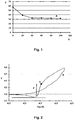
- Figure 1 shows the percentage of atomic Cr over the sum of the atomic percentages of Cr and Fe over the depth from the surface of the stainless steel fibers for an example of the invention (curve A).
- the test results have been obtained using XPS.
- X the depth in nanometer from the stainless steel fiber surface (which obviously coincides with the surface of the oxide layer) is shown.
- the Y-axis shows the atomic percentage of Cr divided by the sum of the atomic percentages of Cr and Fe, and multiplied with 100, to express the result as a percentage.
- Curve A shows the result as a function of the depth from the surface of the stainless steel fiber.
- Figure 2 shows a cyclic potentiodynamic polarization (CPP) curve for an example of heat resistant separation fabric according to the invention.
- the vertical axis V indicates the potential (in Volt) relative to an SHE-electrode (Standard Hydrogen Electrode).
- the horizontal axis log (A) indicates the logarithm of the measured electrical current in Ampere.
- E represents the measured CPP curve of the sample.
- F is the potential range of the current plateau (measured from inflection point to inflection point), and H is the breakdown potential. In the example shown ( figure 2 ) the potential range of the current plateau is 0.19 V and the breakdown potential is 0.56 V.
- Another example of the invention made with a treatment time of two hours in the acid solution, showed a potential range of the current plateau of 0.20 V and a breakdown potential of 0.61 V.
Landscapes
- Chemical & Material Sciences (AREA)
- Engineering & Computer Science (AREA)
- Materials Engineering (AREA)
- Organic Chemistry (AREA)
- Mechanical Engineering (AREA)
- Metallurgy (AREA)
- Inorganic Chemistry (AREA)
- Textile Engineering (AREA)
- Woven Fabrics (AREA)
- Treatments For Attaching Organic Compounds To Fibrous Goods (AREA)
Priority Applications (2)
| Application Number | Priority Date | Filing Date | Title |
|---|---|---|---|
| PL14725069T PL3003999T3 (pl) | 2013-05-29 | 2014-05-13 | Termoodporna tkanina rozdzielająca |
| EP14725069.0A EP3003999B1 (en) | 2013-05-29 | 2014-05-13 | Heat resistant separation fabric |
Applications Claiming Priority (3)
| Application Number | Priority Date | Filing Date | Title |
|---|---|---|---|
| EP13169688 | 2013-05-29 | ||
| PCT/EP2014/059709 WO2014191193A1 (en) | 2013-05-29 | 2014-05-13 | Heat resistant separation fabric |
| EP14725069.0A EP3003999B1 (en) | 2013-05-29 | 2014-05-13 | Heat resistant separation fabric |
Publications (2)
| Publication Number | Publication Date |
|---|---|
| EP3003999A1 EP3003999A1 (en) | 2016-04-13 |
| EP3003999B1 true EP3003999B1 (en) | 2017-03-01 |
Family
ID=48577508
Family Applications (1)
| Application Number | Title | Priority Date | Filing Date |
|---|---|---|---|
| EP14725069.0A Active EP3003999B1 (en) | 2013-05-29 | 2014-05-13 | Heat resistant separation fabric |
Country Status (6)
| Country | Link |
|---|---|
| US (1) | US20160083285A1 (pl) |
| EP (1) | EP3003999B1 (pl) |
| CN (1) | CN105246845B (pl) |
| HU (1) | HUE034243T2 (pl) |
| PL (1) | PL3003999T3 (pl) |
| WO (1) | WO2014191193A1 (pl) |
Families Citing this family (16)
| Publication number | Priority date | Publication date | Assignee | Title |
|---|---|---|---|---|
| US10223479B1 (en) | 2014-05-20 | 2019-03-05 | State Farm Mutual Automobile Insurance Company | Autonomous vehicle operation feature evaluation |
| US9972054B1 (en) | 2014-05-20 | 2018-05-15 | State Farm Mutual Automobile Insurance Company | Accident fault determination for autonomous vehicles |
| US11669090B2 (en) | 2014-05-20 | 2023-06-06 | State Farm Mutual Automobile Insurance Company | Autonomous vehicle operation feature monitoring and evaluation of effectiveness |
| US10373259B1 (en) | 2014-05-20 | 2019-08-06 | State Farm Mutual Automobile Insurance Company | Fully autonomous vehicle insurance pricing |
| US10599155B1 (en) | 2014-05-20 | 2020-03-24 | State Farm Mutual Automobile Insurance Company | Autonomous vehicle operation feature monitoring and evaluation of effectiveness |
| US10540723B1 (en) | 2014-07-21 | 2020-01-21 | State Farm Mutual Automobile Insurance Company | Methods of providing insurance savings based upon telematics and usage-based insurance |
| US11127290B1 (en) | 2014-11-13 | 2021-09-21 | State Farm Mutual Automobile Insurance Company | Autonomous vehicle infrastructure communication device |
| US10163350B1 (en) | 2015-08-28 | 2018-12-25 | State Farm Mutual Automobile Insurance Company | Vehicular driver warnings |
| US11719545B2 (en) | 2016-01-22 | 2023-08-08 | Hyundai Motor Company | Autonomous vehicle component damage and salvage assessment |
| US10134278B1 (en) | 2016-01-22 | 2018-11-20 | State Farm Mutual Automobile Insurance Company | Autonomous vehicle application |
| US10395332B1 (en) | 2016-01-22 | 2019-08-27 | State Farm Mutual Automobile Insurance Company | Coordinated autonomous vehicle automatic area scanning |
| US10747234B1 (en) | 2016-01-22 | 2020-08-18 | State Farm Mutual Automobile Insurance Company | Method and system for enhancing the functionality of a vehicle |
| US11242051B1 (en) | 2016-01-22 | 2022-02-08 | State Farm Mutual Automobile Insurance Company | Autonomous vehicle action communications |
| US11441916B1 (en) | 2016-01-22 | 2022-09-13 | State Farm Mutual Automobile Insurance Company | Autonomous vehicle trip routing |
| US10324463B1 (en) | 2016-01-22 | 2019-06-18 | State Farm Mutual Automobile Insurance Company | Autonomous vehicle operation adjustment based upon route |
| US11840474B2 (en) | 2017-11-17 | 2023-12-12 | Nv Bekaert Sa | Heat resistant separation fabric |
Family Cites Families (10)
| Publication number | Priority date | Publication date | Assignee | Title |
|---|---|---|---|---|
| FR2673424B1 (fr) * | 1991-03-01 | 1993-12-03 | Saint Gobain Vitrage Internal | Revetement pour formes de bombage. |
| US5607520A (en) * | 1995-08-18 | 1997-03-04 | Northrop Grumman Corporation | Reel-to-reel passivation of stainless steel wire |
| DE69731788T2 (de) * | 1996-05-29 | 2005-12-08 | Sumitomo Metal Industries, Ltd. | Verwendung eines rostfreien Stahles in oder beinhaltend Wasser mit zugesetztem Ozon |
| US5858200A (en) * | 1996-05-30 | 1999-01-12 | Bridgestone Metalpha Corporation | Method of and apparatus for manufacturing metallic fiber and the twine of metallic fibers, and method of coloring metallic fiber and the twine of metallic fibers |
| BE1012976A3 (nl) | 1998-03-18 | 2001-07-03 | Bekaert Sa Nv | Dunne heterogene breistof omvattende metaalvezels. |
| JP4776076B2 (ja) | 1999-01-08 | 2011-09-21 | ナムローゼ・フェンノートシャップ・ベーカート・ソシエテ・アノニム | 編み目を増やした鋼ファイバのメリヤス生地 |
| PT1169272E (pt) | 1999-04-09 | 2002-11-29 | Bekaert Sa Nv | Material de cobertura resistente ao calor |
| JP4301664B2 (ja) * | 1999-12-03 | 2009-07-22 | 日本精線株式会社 | ガラス成形型の緩衝材用の耐熱編布 |
| KR20130008032A (ko) | 2010-03-26 | 2013-01-21 | 엔브이 베카에르트 에스에이 | 유리 또는 세라믹 섬유 및 금속 섬유를 갖는 하이브리드 슬리브 |
| BE1020217A3 (nl) * | 2011-09-09 | 2013-06-04 | Bekaert Sa Nv | Weefsels voor de productie van spiegels. |
-
2014
- 2014-05-13 CN CN201480029969.XA patent/CN105246845B/zh active Active
- 2014-05-13 EP EP14725069.0A patent/EP3003999B1/en active Active
- 2014-05-13 HU HUE14725069A patent/HUE034243T2/en unknown
- 2014-05-13 US US14/785,256 patent/US20160083285A1/en not_active Abandoned
- 2014-05-13 PL PL14725069T patent/PL3003999T3/pl unknown
- 2014-05-13 WO PCT/EP2014/059709 patent/WO2014191193A1/en not_active Ceased
Non-Patent Citations (1)
| Title |
|---|
| None * |
Also Published As
| Publication number | Publication date |
|---|---|
| CN105246845B (zh) | 2018-03-16 |
| WO2014191193A1 (en) | 2014-12-04 |
| PL3003999T3 (pl) | 2017-08-31 |
| EP3003999A1 (en) | 2016-04-13 |
| US20160083285A1 (en) | 2016-03-24 |
| HUE034243T2 (en) | 2018-02-28 |
| CN105246845A (zh) | 2016-01-13 |
Similar Documents
| Publication | Publication Date | Title |
|---|---|---|
| EP3003999B1 (en) | Heat resistant separation fabric | |
| Jacobs et al. | High temporal resolution measurements of dopamine with carbon nanotube yarn microelectrodes | |
| Schmidt et al. | Carbon nanotube yarn electrodes for enhanced detection of neurotransmitter dynamics in live brain tissue | |
| CN112272717A (zh) | 用于使用旋转生产具有纳米层压物涂层的多个制品的设备、系统和方法 | |
| JPWO2010150450A1 (ja) | 高強度極細鋼線及びその製造方法 | |
| KR20160145722A (ko) | 연료 전지용 세퍼레이터재 및 그의 제조 방법 | |
| GB2159178A (en) | A method of electrochemically surface treating carbon fibers, fibers treated by the method, and composite materials including such fibers | |
| DE2807054A1 (de) | Elektrode | |
| JP5202998B2 (ja) | チャック装置、引張試験装置、およびチャック装置の製造方法 | |
| JP5081570B2 (ja) | チタン材ならびにチタン材製造方法 | |
| JP5625288B2 (ja) | 耐食耐摩耗部材およびその製造方法 | |
| Weber et al. | Electrochemical performance of boron-and nitrogen-doped tetrahedral amorphous carbon | |
| WO2015139731A1 (de) | Verfahren zum entschichten von keramischen hartstoffschichten von stahl- und hartmetall-substraten | |
| Akbarov et al. | Development of electroconductive polyacrylonitrile fibers through chemical metallization and galvanisation | |
| JP2008240140A (ja) | 耐腐食疲労特性に優れたゴム製品補強用鋼線及びその製造方法 | |
| Asai et al. | Fabrication of an all-diamond microelectrode using a chromium mask | |
| EP3710625B1 (en) | Heat resistant separation fabric | |
| US9487882B2 (en) | Titanium material and method for producing titanium material | |
| CN107255662A (zh) | 一种探针载体和葡萄糖探针及其制备方法与应用 | |
| EP0220766A1 (en) | Steel cord with high corrosion fatigue resistance | |
| JP7608395B2 (ja) | 燃料電池のセパレータ用のステンレス鋼板の製造方法 | |
| Kim et al. | Integrated reinforcement of carbon nanotube fibers for enhancement of their applicability, mechanical and electrical properties | |
| CN115244225B (zh) | 单丝、钢帘线、轮胎 | |
| JP4878139B2 (ja) | 鉄族金属とMo及び/又はWからなる合金の電気めっき方法 | |
| Foisal | Conductive Coating of Polyether Ether Ketone (Peek) Filament Yarn |
Legal Events
| Date | Code | Title | Description |
|---|---|---|---|
| PUAI | Public reference made under article 153(3) epc to a published international application that has entered the european phase |
Free format text: ORIGINAL CODE: 0009012 |
|
| 17P | Request for examination filed |
Effective date: 20150930 |
|
| AK | Designated contracting states |
Kind code of ref document: A1 Designated state(s): AL AT BE BG CH CY CZ DE DK EE ES FI FR GB GR HR HU IE IS IT LI LT LU LV MC MK MT NL NO PL PT RO RS SE SI SK SM TR |
|
| AX | Request for extension of the european patent |
Extension state: BA ME |
|
| DAX | Request for extension of the european patent (deleted) | ||
| GRAP | Despatch of communication of intention to grant a patent |
Free format text: ORIGINAL CODE: EPIDOSNIGR1 |
|
| INTG | Intention to grant announced |
Effective date: 20161011 |
|
| GRAS | Grant fee paid |
Free format text: ORIGINAL CODE: EPIDOSNIGR3 |
|
| GRAA | (expected) grant |
Free format text: ORIGINAL CODE: 0009210 |
|
| AK | Designated contracting states |
Kind code of ref document: B1 Designated state(s): AL AT BE BG CH CY CZ DE DK EE ES FI FR GB GR HR HU IE IS IT LI LT LU LV MC MK MT NL NO PL PT RO RS SE SI SK SM TR |
|
| REG | Reference to a national code |
Ref country code: GB Ref legal event code: FG4D |
|
| REG | Reference to a national code |
Ref country code: CH Ref legal event code: EP Ref country code: AT Ref legal event code: REF Ref document number: 871065 Country of ref document: AT Kind code of ref document: T Effective date: 20170315 |
|
| REG | Reference to a national code |
Ref country code: IE Ref legal event code: FG4D |
|
| REG | Reference to a national code |
Ref country code: DE Ref legal event code: R096 Ref document number: 602014007173 Country of ref document: DE |
|
| REG | Reference to a national code |
Ref country code: NL Ref legal event code: MP Effective date: 20170301 |
|
| REG | Reference to a national code |
Ref country code: LT Ref legal event code: MG4D |
|
| REG | Reference to a national code |
Ref country code: AT Ref legal event code: MK05 Ref document number: 871065 Country of ref document: AT Kind code of ref document: T Effective date: 20170301 |
|
| PG25 | Lapsed in a contracting state [announced via postgrant information from national office to epo] |
Ref country code: FI Free format text: LAPSE BECAUSE OF FAILURE TO SUBMIT A TRANSLATION OF THE DESCRIPTION OR TO PAY THE FEE WITHIN THE PRESCRIBED TIME-LIMIT Effective date: 20170301 Ref country code: LT Free format text: LAPSE BECAUSE OF FAILURE TO SUBMIT A TRANSLATION OF THE DESCRIPTION OR TO PAY THE FEE WITHIN THE PRESCRIBED TIME-LIMIT Effective date: 20170301 Ref country code: NO Free format text: LAPSE BECAUSE OF FAILURE TO SUBMIT A TRANSLATION OF THE DESCRIPTION OR TO PAY THE FEE WITHIN THE PRESCRIBED TIME-LIMIT Effective date: 20170601 Ref country code: HR Free format text: LAPSE BECAUSE OF FAILURE TO SUBMIT A TRANSLATION OF THE DESCRIPTION OR TO PAY THE FEE WITHIN THE PRESCRIBED TIME-LIMIT Effective date: 20170301 Ref country code: GR Free format text: LAPSE BECAUSE OF FAILURE TO SUBMIT A TRANSLATION OF THE DESCRIPTION OR TO PAY THE FEE WITHIN THE PRESCRIBED TIME-LIMIT Effective date: 20170602 |
|
| PG25 | Lapsed in a contracting state [announced via postgrant information from national office to epo] |
Ref country code: ES Free format text: LAPSE BECAUSE OF FAILURE TO SUBMIT A TRANSLATION OF THE DESCRIPTION OR TO PAY THE FEE WITHIN THE PRESCRIBED TIME-LIMIT Effective date: 20170301 Ref country code: BG Free format text: LAPSE BECAUSE OF FAILURE TO SUBMIT A TRANSLATION OF THE DESCRIPTION OR TO PAY THE FEE WITHIN THE PRESCRIBED TIME-LIMIT Effective date: 20170601 Ref country code: SE Free format text: LAPSE BECAUSE OF FAILURE TO SUBMIT A TRANSLATION OF THE DESCRIPTION OR TO PAY THE FEE WITHIN THE PRESCRIBED TIME-LIMIT Effective date: 20170301 Ref country code: AT Free format text: LAPSE BECAUSE OF FAILURE TO SUBMIT A TRANSLATION OF THE DESCRIPTION OR TO PAY THE FEE WITHIN THE PRESCRIBED TIME-LIMIT Effective date: 20170301 Ref country code: RS Free format text: LAPSE BECAUSE OF FAILURE TO SUBMIT A TRANSLATION OF THE DESCRIPTION OR TO PAY THE FEE WITHIN THE PRESCRIBED TIME-LIMIT Effective date: 20170301 Ref country code: LV Free format text: LAPSE BECAUSE OF FAILURE TO SUBMIT A TRANSLATION OF THE DESCRIPTION OR TO PAY THE FEE WITHIN THE PRESCRIBED TIME-LIMIT Effective date: 20170301 |
|
| PG25 | Lapsed in a contracting state [announced via postgrant information from national office to epo] |
Ref country code: NL Free format text: LAPSE BECAUSE OF FAILURE TO SUBMIT A TRANSLATION OF THE DESCRIPTION OR TO PAY THE FEE WITHIN THE PRESCRIBED TIME-LIMIT Effective date: 20170301 |
|
| PG25 | Lapsed in a contracting state [announced via postgrant information from national office to epo] |
Ref country code: SK Free format text: LAPSE BECAUSE OF FAILURE TO SUBMIT A TRANSLATION OF THE DESCRIPTION OR TO PAY THE FEE WITHIN THE PRESCRIBED TIME-LIMIT Effective date: 20170301 Ref country code: RO Free format text: LAPSE BECAUSE OF FAILURE TO SUBMIT A TRANSLATION OF THE DESCRIPTION OR TO PAY THE FEE WITHIN THE PRESCRIBED TIME-LIMIT Effective date: 20170301 Ref country code: CZ Free format text: LAPSE BECAUSE OF FAILURE TO SUBMIT A TRANSLATION OF THE DESCRIPTION OR TO PAY THE FEE WITHIN THE PRESCRIBED TIME-LIMIT Effective date: 20170301 Ref country code: EE Free format text: LAPSE BECAUSE OF FAILURE TO SUBMIT A TRANSLATION OF THE DESCRIPTION OR TO PAY THE FEE WITHIN THE PRESCRIBED TIME-LIMIT Effective date: 20170301 |
|
| PG25 | Lapsed in a contracting state [announced via postgrant information from national office to epo] |
Ref country code: PT Free format text: LAPSE BECAUSE OF FAILURE TO SUBMIT A TRANSLATION OF THE DESCRIPTION OR TO PAY THE FEE WITHIN THE PRESCRIBED TIME-LIMIT Effective date: 20170703 Ref country code: IS Free format text: LAPSE BECAUSE OF FAILURE TO SUBMIT A TRANSLATION OF THE DESCRIPTION OR TO PAY THE FEE WITHIN THE PRESCRIBED TIME-LIMIT Effective date: 20170701 Ref country code: SM Free format text: LAPSE BECAUSE OF FAILURE TO SUBMIT A TRANSLATION OF THE DESCRIPTION OR TO PAY THE FEE WITHIN THE PRESCRIBED TIME-LIMIT Effective date: 20170301 |
|
| REG | Reference to a national code |
Ref country code: DE Ref legal event code: R119 Ref document number: 602014007173 Country of ref document: DE |
|
| REG | Reference to a national code |
Ref country code: CH Ref legal event code: PL |
|
| PLBE | No opposition filed within time limit |
Free format text: ORIGINAL CODE: 0009261 |
|
| STAA | Information on the status of an ep patent application or granted ep patent |
Free format text: STATUS: NO OPPOSITION FILED WITHIN TIME LIMIT |
|
| PG25 | Lapsed in a contracting state [announced via postgrant information from national office to epo] |
Ref country code: DK Free format text: LAPSE BECAUSE OF FAILURE TO SUBMIT A TRANSLATION OF THE DESCRIPTION OR TO PAY THE FEE WITHIN THE PRESCRIBED TIME-LIMIT Effective date: 20170301 Ref country code: MC Free format text: LAPSE BECAUSE OF FAILURE TO SUBMIT A TRANSLATION OF THE DESCRIPTION OR TO PAY THE FEE WITHIN THE PRESCRIBED TIME-LIMIT Effective date: 20170301 |
|
| 26N | No opposition filed |
Effective date: 20171204 |
|
| REG | Reference to a national code |
Ref country code: IE Ref legal event code: MM4A |
|
| PG25 | Lapsed in a contracting state [announced via postgrant information from national office to epo] |
Ref country code: SI Free format text: LAPSE BECAUSE OF FAILURE TO SUBMIT A TRANSLATION OF THE DESCRIPTION OR TO PAY THE FEE WITHIN THE PRESCRIBED TIME-LIMIT Effective date: 20170301 Ref country code: LI Free format text: LAPSE BECAUSE OF NON-PAYMENT OF DUE FEES Effective date: 20170531 Ref country code: CH Free format text: LAPSE BECAUSE OF NON-PAYMENT OF DUE FEES Effective date: 20170531 |
|
| REG | Reference to a national code |
Ref country code: HU Ref legal event code: AG4A Ref document number: E034243 Country of ref document: HU |
|
| REG | Reference to a national code |
Ref country code: FR Ref legal event code: ST Effective date: 20180131 |
|
| REG | Reference to a national code |
Ref country code: BE Ref legal event code: MM Effective date: 20170531 |
|
| PG25 | Lapsed in a contracting state [announced via postgrant information from national office to epo] |
Ref country code: IE Free format text: LAPSE BECAUSE OF NON-PAYMENT OF DUE FEES Effective date: 20170513 Ref country code: DE Free format text: LAPSE BECAUSE OF NON-PAYMENT OF DUE FEES Effective date: 20171201 |
|
| PG25 | Lapsed in a contracting state [announced via postgrant information from national office to epo] |
Ref country code: FR Free format text: LAPSE BECAUSE OF NON-PAYMENT OF DUE FEES Effective date: 20170531 |
|
| PG25 | Lapsed in a contracting state [announced via postgrant information from national office to epo] |
Ref country code: BE Free format text: LAPSE BECAUSE OF NON-PAYMENT OF DUE FEES Effective date: 20170531 |
|
| PG25 | Lapsed in a contracting state [announced via postgrant information from national office to epo] |
Ref country code: MT Free format text: LAPSE BECAUSE OF NON-PAYMENT OF DUE FEES Effective date: 20170513 |
|
| GBPC | Gb: european patent ceased through non-payment of renewal fee |
Effective date: 20180513 |
|
| PG25 | Lapsed in a contracting state [announced via postgrant information from national office to epo] |
Ref country code: GB Free format text: LAPSE BECAUSE OF NON-PAYMENT OF DUE FEES Effective date: 20180513 |
|
| PG25 | Lapsed in a contracting state [announced via postgrant information from national office to epo] |
Ref country code: CY Free format text: LAPSE BECAUSE OF FAILURE TO SUBMIT A TRANSLATION OF THE DESCRIPTION OR TO PAY THE FEE WITHIN THE PRESCRIBED TIME-LIMIT Effective date: 20170301 |
|
| PG25 | Lapsed in a contracting state [announced via postgrant information from national office to epo] |
Ref country code: MK Free format text: LAPSE BECAUSE OF FAILURE TO SUBMIT A TRANSLATION OF THE DESCRIPTION OR TO PAY THE FEE WITHIN THE PRESCRIBED TIME-LIMIT Effective date: 20170301 |
|
| PG25 | Lapsed in a contracting state [announced via postgrant information from national office to epo] |
Ref country code: TR Free format text: LAPSE BECAUSE OF FAILURE TO SUBMIT A TRANSLATION OF THE DESCRIPTION OR TO PAY THE FEE WITHIN THE PRESCRIBED TIME-LIMIT Effective date: 20170301 |
|
| PG25 | Lapsed in a contracting state [announced via postgrant information from national office to epo] |
Ref country code: AL Free format text: LAPSE BECAUSE OF FAILURE TO SUBMIT A TRANSLATION OF THE DESCRIPTION OR TO PAY THE FEE WITHIN THE PRESCRIBED TIME-LIMIT Effective date: 20170301 |
|
| P01 | Opt-out of the competence of the unified patent court (upc) registered |
Effective date: 20230619 |
|
| PGFP | Annual fee paid to national office [announced via postgrant information from national office to epo] |
Ref country code: LU Payment date: 20240522 Year of fee payment: 11 |
|
| PGFP | Annual fee paid to national office [announced via postgrant information from national office to epo] |
Ref country code: PL Payment date: 20240505 Year of fee payment: 11 |
|
| PGFP | Annual fee paid to national office [announced via postgrant information from national office to epo] |
Ref country code: HU Payment date: 20240523 Year of fee payment: 11 |
|
| PGFP | Annual fee paid to national office [announced via postgrant information from national office to epo] |
Ref country code: IT Payment date: 20240524 Year of fee payment: 11 |
|
| PG25 | Lapsed in a contracting state [announced via postgrant information from national office to epo] |
Ref country code: HU Free format text: LAPSE BECAUSE OF NON-PAYMENT OF DUE FEES Effective date: 20250514 Ref country code: LU Free format text: LAPSE BECAUSE OF NON-PAYMENT OF DUE FEES Effective date: 20250513 |
|
| PG25 | Lapsed in a contracting state [announced via postgrant information from national office to epo] |
Ref country code: IT Free format text: LAPSE BECAUSE OF NON-PAYMENT OF DUE FEES Effective date: 20250513 |