EP3008077B1 - Catalyseurs complexes à base de ruthénium ou d'osmium - Google Patents
Catalyseurs complexes à base de ruthénium ou d'osmium Download PDFInfo
- Publication number
- EP3008077B1 EP3008077B1 EP14738745.0A EP14738745A EP3008077B1 EP 3008077 B1 EP3008077 B1 EP 3008077B1 EP 14738745 A EP14738745 A EP 14738745A EP 3008077 B1 EP3008077 B1 EP 3008077B1
- Authority
- EP
- European Patent Office
- Prior art keywords
- butyl
- unsubstituted
- substituted
- alkyl
- propyl
- Prior art date
- Legal status (The legal status is an assumption and is not a legal conclusion. Google has not performed a legal analysis and makes no representation as to the accuracy of the status listed.)
- Active
Links
- 0 CC1N([*+])CCN1[*+] Chemical compound CC1N([*+])CCN1[*+] 0.000 description 8
- TXRUBUGERHLKKJ-UHFFFAOYSA-N CC(N(C(C1c2ccccc2)c2ccccc2)SC)N1SC Chemical compound CC(N(C(C1c2ccccc2)c2ccccc2)SC)N1SC TXRUBUGERHLKKJ-UHFFFAOYSA-N 0.000 description 1
- POKQCCVKEUHHGT-UHFFFAOYSA-N CC(N(CC1)SC)N1SC Chemical compound CC(N(CC1)SC)N1SC POKQCCVKEUHHGT-UHFFFAOYSA-N 0.000 description 1
- WPFMEDHMXYBRPF-RQZCQDPDSA-N Cc(cc(cc1C)Br)c1/N=C/c(cccc1)c1O Chemical compound Cc(cc(cc1C)Br)c1/N=C/c(cccc1)c1O WPFMEDHMXYBRPF-RQZCQDPDSA-N 0.000 description 1
- WCCXIUFTQLFKKU-CXUHLZMHSA-N Cc1cccc(C)c1/N=C/c(cc(cc1)[N+]([O-])=O)c1O Chemical compound Cc1cccc(C)c1/N=C/c(cc(cc1)[N+]([O-])=O)c1O WCCXIUFTQLFKKU-CXUHLZMHSA-N 0.000 description 1
- GZIINMPSUAXFFL-MHWRWJLKSA-N Cc1cccc(C)c1/N=C/c(cccc1)c1O Chemical compound Cc1cccc(C)c1/N=C/c(cccc1)c1O GZIINMPSUAXFFL-MHWRWJLKSA-N 0.000 description 1
Images


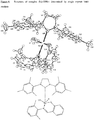
Classifications
-
- C—CHEMISTRY; METALLURGY
- C07—ORGANIC CHEMISTRY
- C07F—ACYCLIC, CARBOCYCLIC OR HETEROCYCLIC COMPOUNDS CONTAINING ELEMENTS OTHER THAN CARBON, HYDROGEN, HALOGEN, OXYGEN, NITROGEN, SULFUR, SELENIUM OR TELLURIUM
- C07F15/00—Compounds containing elements of Groups 8, 9, 10 or 18 of the Periodic Table
- C07F15/0006—Compounds containing elements of Groups 8, 9, 10 or 18 of the Periodic Table compounds of the platinum group
- C07F15/0046—Ruthenium compounds
-
- B—PERFORMING OPERATIONS; TRANSPORTING
- B01—PHYSICAL OR CHEMICAL PROCESSES OR APPARATUS IN GENERAL
- B01J—CHEMICAL OR PHYSICAL PROCESSES, e.g. CATALYSIS OR COLLOID CHEMISTRY; THEIR RELEVANT APPARATUS
- B01J31/00—Catalysts comprising hydrides, coordination complexes or organic compounds
- B01J31/16—Catalysts comprising hydrides, coordination complexes or organic compounds containing coordination complexes
- B01J31/22—Organic complexes
- B01J31/2204—Organic complexes the ligands containing oxygen or sulfur as complexing atoms
- B01J31/2208—Oxygen, e.g. acetylacetonates
- B01J31/2217—At least one oxygen and one nitrogen atom present as complexing atoms in an at least bidentate or bridging ligand
-
- B—PERFORMING OPERATIONS; TRANSPORTING
- B01—PHYSICAL OR CHEMICAL PROCESSES OR APPARATUS IN GENERAL
- B01J—CHEMICAL OR PHYSICAL PROCESSES, e.g. CATALYSIS OR COLLOID CHEMISTRY; THEIR RELEVANT APPARATUS
- B01J31/00—Catalysts comprising hydrides, coordination complexes or organic compounds
- B01J31/16—Catalysts comprising hydrides, coordination complexes or organic compounds containing coordination complexes
- B01J31/22—Organic complexes
- B01J31/2204—Organic complexes the ligands containing oxygen or sulfur as complexing atoms
- B01J31/2208—Oxygen, e.g. acetylacetonates
- B01J31/2226—Anionic ligands, i.e. the overall ligand carries at least one formal negative charge
- B01J31/2243—At least one oxygen and one nitrogen atom present as complexing atoms in an at least bidentate or bridging ligand
-
- B—PERFORMING OPERATIONS; TRANSPORTING
- B01—PHYSICAL OR CHEMICAL PROCESSES OR APPARATUS IN GENERAL
- B01J—CHEMICAL OR PHYSICAL PROCESSES, e.g. CATALYSIS OR COLLOID CHEMISTRY; THEIR RELEVANT APPARATUS
- B01J31/00—Catalysts comprising hydrides, coordination complexes or organic compounds
- B01J31/16—Catalysts comprising hydrides, coordination complexes or organic compounds containing coordination complexes
- B01J31/22—Organic complexes
- B01J31/2265—Carbenes or carbynes, i.e.(image)
- B01J31/2269—Heterocyclic carbenes
- B01J31/2273—Heterocyclic carbenes with only nitrogen as heteroatomic ring members, e.g. 1,3-diarylimidazoline-2-ylidenes
-
- B—PERFORMING OPERATIONS; TRANSPORTING
- B01—PHYSICAL OR CHEMICAL PROCESSES OR APPARATUS IN GENERAL
- B01J—CHEMICAL OR PHYSICAL PROCESSES, e.g. CATALYSIS OR COLLOID CHEMISTRY; THEIR RELEVANT APPARATUS
- B01J31/00—Catalysts comprising hydrides, coordination complexes or organic compounds
- B01J31/16—Catalysts comprising hydrides, coordination complexes or organic compounds containing coordination complexes
- B01J31/22—Organic complexes
- B01J31/2265—Carbenes or carbynes, i.e.(image)
- B01J31/2278—Complexes comprising two carbene ligands differing from each other, e.g. Grubbs second generation catalysts
-
- C—CHEMISTRY; METALLURGY
- C07—ORGANIC CHEMISTRY
- C07C—ACYCLIC OR CARBOCYCLIC COMPOUNDS
- C07C5/00—Preparation of hydrocarbons from hydrocarbons containing the same number of carbon atoms
- C07C5/02—Preparation of hydrocarbons from hydrocarbons containing the same number of carbon atoms by hydrogenation
- C07C5/03—Preparation of hydrocarbons from hydrocarbons containing the same number of carbon atoms by hydrogenation of non-aromatic carbon-to-carbon double bonds
-
- C—CHEMISTRY; METALLURGY
- C08—ORGANIC MACROMOLECULAR COMPOUNDS; THEIR PREPARATION OR CHEMICAL WORKING-UP; COMPOSITIONS BASED THEREON
- C08C—TREATMENT OR CHEMICAL MODIFICATION OF RUBBERS
- C08C19/00—Chemical modification of rubber
- C08C19/02—Hydrogenation
-
- C—CHEMISTRY; METALLURGY
- C08—ORGANIC MACROMOLECULAR COMPOUNDS; THEIR PREPARATION OR CHEMICAL WORKING-UP; COMPOSITIONS BASED THEREON
- C08F—MACROMOLECULAR COMPOUNDS OBTAINED BY REACTIONS ONLY INVOLVING CARBON-TO-CARBON UNSATURATED BONDS
- C08F236/00—Copolymers of compounds having one or more unsaturated aliphatic radicals, at least one having two or more carbon-to-carbon double bonds
- C08F236/02—Copolymers of compounds having one or more unsaturated aliphatic radicals, at least one having two or more carbon-to-carbon double bonds the radical having only two carbon-to-carbon double bonds
- C08F236/04—Copolymers of compounds having one or more unsaturated aliphatic radicals, at least one having two or more carbon-to-carbon double bonds the radical having only two carbon-to-carbon double bonds conjugated
- C08F236/12—Copolymers of compounds having one or more unsaturated aliphatic radicals, at least one having two or more carbon-to-carbon double bonds the radical having only two carbon-to-carbon double bonds conjugated with nitriles
-
- C—CHEMISTRY; METALLURGY
- C08—ORGANIC MACROMOLECULAR COMPOUNDS; THEIR PREPARATION OR CHEMICAL WORKING-UP; COMPOSITIONS BASED THEREON
- C08L—COMPOSITIONS OF MACROMOLECULAR COMPOUNDS
- C08L15/00—Compositions of rubber derivatives
- C08L15/005—Hydrogenated nitrile rubber
-
- B—PERFORMING OPERATIONS; TRANSPORTING
- B01—PHYSICAL OR CHEMICAL PROCESSES OR APPARATUS IN GENERAL
- B01J—CHEMICAL OR PHYSICAL PROCESSES, e.g. CATALYSIS OR COLLOID CHEMISTRY; THEIR RELEVANT APPARATUS
- B01J2231/00—Catalytic reactions performed with catalysts classified in B01J31/00
- B01J2231/60—Reduction reactions, e.g. hydrogenation
- B01J2231/64—Reductions in general of organic substrates, e.g. hydride reductions or hydrogenations
- B01J2231/641—Hydrogenation of organic substrates, i.e. H2 or H-transfer hydrogenations, e.g. Fischer-Tropsch processes
- B01J2231/645—Hydrogenation of organic substrates, i.e. H2 or H-transfer hydrogenations, e.g. Fischer-Tropsch processes of C=C or C-C triple bonds
-
- B—PERFORMING OPERATIONS; TRANSPORTING
- B01—PHYSICAL OR CHEMICAL PROCESSES OR APPARATUS IN GENERAL
- B01J—CHEMICAL OR PHYSICAL PROCESSES, e.g. CATALYSIS OR COLLOID CHEMISTRY; THEIR RELEVANT APPARATUS
- B01J2531/00—Additional information regarding catalytic systems classified in B01J31/00
- B01J2531/80—Complexes comprising metals of Group VIII as the central metal
- B01J2531/82—Metals of the platinum group
- B01J2531/821—Ruthenium
-
- B—PERFORMING OPERATIONS; TRANSPORTING
- B01—PHYSICAL OR CHEMICAL PROCESSES OR APPARATUS IN GENERAL
- B01J—CHEMICAL OR PHYSICAL PROCESSES, e.g. CATALYSIS OR COLLOID CHEMISTRY; THEIR RELEVANT APPARATUS
- B01J2531/00—Additional information regarding catalytic systems classified in B01J31/00
- B01J2531/80—Complexes comprising metals of Group VIII as the central metal
- B01J2531/82—Metals of the platinum group
- B01J2531/825—Osmium
-
- C—CHEMISTRY; METALLURGY
- C07—ORGANIC CHEMISTRY
- C07C—ACYCLIC OR CARBOCYCLIC COMPOUNDS
- C07C2531/00—Catalysts comprising hydrides, coordination complexes or organic compounds
- C07C2531/16—Catalysts comprising hydrides, coordination complexes or organic compounds containing coordination complexes
- C07C2531/22—Organic complexes
Definitions
- the present invention relates to ruthenium and osmium based complex structures, to the synthesis thereof and the use as catalysts for hydrogenating unsaturated compounds.
- R 1 and R 2 have the following meanings in compounds 8a-h:
- Ru-based NHC-Schiff base metathesis catalysts disclosed have for example the following structures wherein the numberings given below the formulae are the same as used in Chem. Rev., 2010, 110(3), 1746-1787 . wherein R 1 and R 2 have the following meanings in compounds 343 to 349:
- Ru-based NHC-Schiff base catalysts are mainly disclosed as catalysts catalysts for atom transfer radical polymerization (ATRP), ring-opening metathesis polymerization (ROMP), ring-closing metathesis (RCM), olefin isomerisation, enol ester synthesis and Kharasch addition.
- JP 2002/030057A does not contain any disclosure or teaching whether or not such catalysts are suited and active for the hydrogenation of other types of compounds or polymers with high conversion rates and if yes under which conditions and with which activity.
- a complex RuHCl(CO)(PPh 3 ) 3 is converted with 2,1,3-benzothiadiazole ("BTD") to prepare the complex RuHCl(CO)(PPh 3 ) 2 (BTD).
- BTD 2,1,3-benzothiadiazole
- a Schiff base is then added to the complex RuHCl(CO)(PPh 3 ) 2 (BTD) to remove the BTD ligand in order to introduce the Schiff-base ligand to the Ru/Os metal center as shown in the following scheme.
- the invention relates to novel complexes having the general formula (I) wherein
- novel complexes of general formula (I) can be prepared according to various routes.
- the present invention also relates to processes for preparing the complexes of general formula (I).
- novel Ru and Os based complexes of general formula (I) are excellently suited for a broad variety of hydrogenation reactions.
- novel catalysts according to general formula (I) are excellently suited for hydrogenating a broad variety of unsaturated compounds, whether these unsaturated compounds are low molecular weight substances, oligomers or polymers.
- the novel catalysts according to general formula (I) are in particular suited for hydrogenating unsaturated polymers like nitrile rubber showing a very high hydrogenation activity so that the use of co-catalysts is no longer necessary and the amount of catalyst to be used is so low that a later removal and recycling of the catalyst may be skipped.
- nitrile rubber can be hydrogenated to more than 90% conversion within 4 hours using the novel complex catalyst with an extreme low Ru metal loading of e.g. ⁇ 22 ppm of Ru (corresponding to 0.015 phr of the complex catalyst).
- novel complex catalysts show a very high stability when being exposed to air or water. Additionally and very surprisingly the novel complex catalysts may be used at substantially lower hydrogenation temperatures. With regard to the hydrogenation of nitrile rubber it was shown that the novel catalysts are already very active at 65°C only. This is unexpected as other ruthenium based Schiff base catalysts known from prior art are only active at more elevated temperatures. If nitrile rubber is hydrogenated in the presence of the novel complexes the resulting hydrogenated nitrile rubber does not show any gel formation.
- substituted used for the purposes of the present patent application means that a hydrogen atom on an indicated radical or atom has been replaced by another group or moiety, with the proviso that the valency of the atom indicated is not exceeded and the substitution leads to a stable compound.
- the present invention provides complexes of general formula (I) wherein
- the N-heterocyclic carbene ligand represents a cyclic carbene type ligand with at least one nitrogen as hetero atom being present in the ring.
- the ring can exhibit different substitution patterns on the ring atoms. Preferably this substitution pattern provides a certain degree of steric crowing.
- N-heterocyclic carbene ligand(s) (hereinafter referred to as "NHC-ligand(s) and depicted as “NHC” in the general formulae) is/are preferably based on imidazoline or imidazolidine moieties.
- the NHC-ligand typically has a structure corresponding to the general formulae (IIa) to (IIe) wherein
- R 8 , R 9 , R 10 , and R 11 can independently of one another, be substituted by one or more substituents, preferably straight-chain or branched C 1 -C 10 -alkyl, C 3 -C 8 -cycloalkyl, C 1 -C 10 -alkoxy, C 6 -C 24 -aryl, C 2 -C 20 -heteroaryl, C 2 -C 20 -heterocyclyl, and a functional group selected from the group consisting of hydroxy, thiol, thioether, ketone, aldehyde, ester, ether, amine, imine, amide, nitro, carboxylic acid, disulphide, carbonate, isocyanate, carbodiimide, carboalkoxy, carbamate and halogen, wherein the abovementioned substituents, to the extent chemically possible, may in turn be substituted by one or more substituents, preferably selected from the group
- R 8 and R 9 may be either unsubstituted or substituted by one or more further substituents selected from the group consisting of straight-chain or branched C 1 -C 10 -alkyl or C 1 -C 10 -alkoxy, C 3 -C 8 -cycloalkyl, C 6 -C 24 -aryl, and a functional group selected from the group consisting of hydroxy, thiol, thioether, ketone, aldehyde, ester, ether, amine, imine, amide, nitro, carboxylic acid, disulphide, carbonate, isocyanate, carbodiimide, carboalkoxy, carbamate and halogen, wherein all these substituents may in turn be either unsubstituted or substituted by one or more substituents, preferably selected from the group consisting of halogen, in particular chlorine or bromine, C 1 -C 5 -alkyl, C 1 -C 5 -
- R 10 and R 11 may be either unsubstituted or substituted by one or more further substituents selected from the group consisting of straight-chain or branched C 1 -C 10 -alkyl or C 1 -C 10 -alkoxy, C 3 -C 8 -cycloalkyl, C 6 -C 24 -aryl, and a functional group selected from the group consisting of hydroxy, thiol, thioether, ketone, aldehyde, ester, ether, amine, imine, amide, nitro, carboxylic acid, disulphide, carbonate, isocyanate, carbodiimide, carboalkoxy, carbamate and halogen, wherein all these substituents may in turn be either unsubstituted or substituted by one or more substituents, preferably selected from the group consisting of halogen, in particular chlorine or bromine, C 1 -C 5 -alkyl, C 1 -C 5 -alkoxy
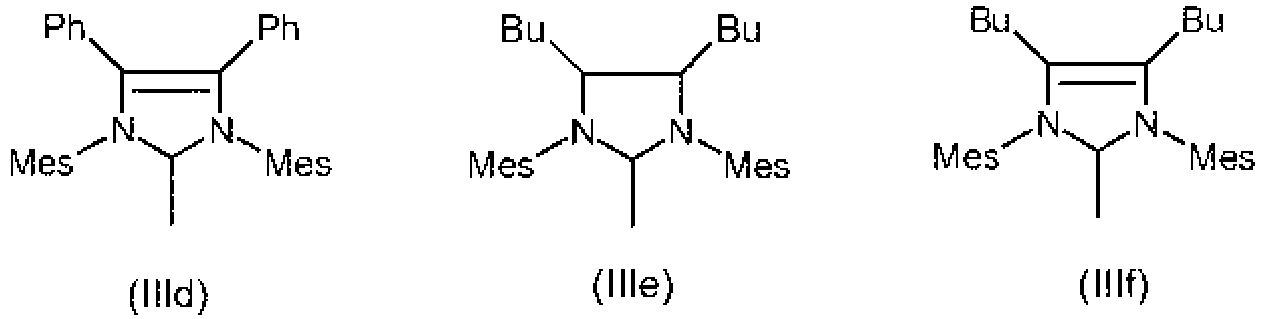
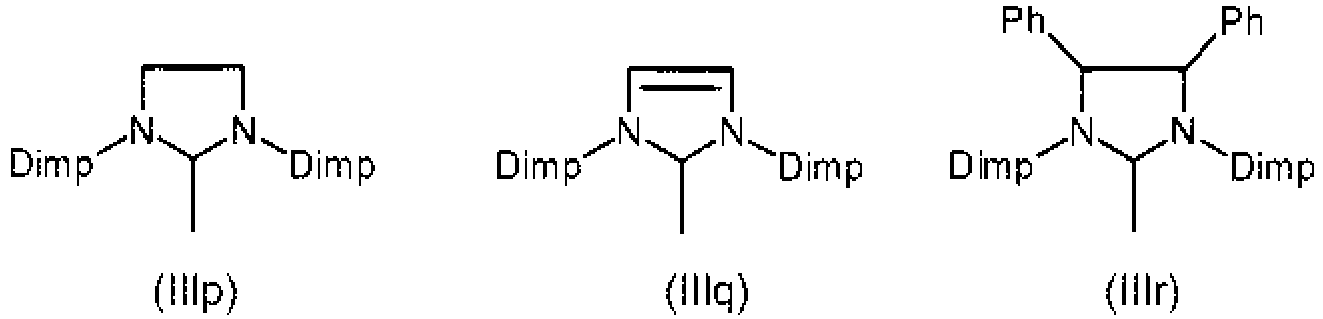
- NHC-ligands have the following structures (IIIa) to (IIIu), where "Ph” means in each case phenyl, "Bu” means in each case butyl, i.e. either n-butyl, sec.-butyl, iso-butyl or tert.-butyl, "Mes” represents in each case 2,4,6-trimethylphenyl, "Dipp” means in all cases 2,6-diisopropylphenyl and "Dimp” means in each case 2,6-dimethylphenyl.
- NHC-ligand contains not only an "N” (nitrogen), but also an “O” (oxygen) in the ring it is preferred that the substitution pattern of R 8 , R 9 , R 10 and/or R 11 provides a certain steric crowding.
- novel highly active catalysts can be synthesized starting from cheaply available raw materials and three different routes are available as possible pathways:
- the compounds of general formula (I) can be manufactured by reacting a compound of general formula (1) M XY (CO)(PR 3 ) n (1) wherein
- the process according to Route 1 is typically performed in one or more organic solvents, preferably selected from the group consisting of ethers, more preferably THF, dioxane, and diethylether, alkanes, more preferably hexane, aromatic solvents, more preferably toluene, and benzene, halogenated hydrocarbon, more preferably chloroform and chlorobenzene, ester, more preferably ethyl acetate, ketone, more preferably methyl ethyl ketone, acetone, and alcohols, more preferably methanol, ethanol and methyloxyethanol. Further on the process pursuant to route 1 is typically performed either without any catalyst or in the presence of at least one catalyst, preferably Ag 2 CO 3 or TlOEt.
- organic solvents preferably selected from the group consisting of ethers, more preferably THF, dioxane, and diethylether, alkanes, more preferably hexane, aromatic solvents, more preferably
- Compound (1) is typically either commercially available or can be synthesized according to processes known to a person skilled in the art.
- the following compounds of general formula (1) can be used: RuHCl(CO)(PR 3 ) n , RuH 2 (CO)(PR 3 ) n , or RuCl 2 (CO)(PR 3 ) n wherein R and n shall have the meanings defined above for general formula (I).
- RuHCl(CO)(PCy 3 ) 2 More preferably the following compounds of general formula (1) can be used: RuHCl(CO)(PCy 3 ) 2 , RuHCl(CO)(PPh 3 ) 3 , RuCl 2 (CO)(PCy 3 ) 2 , RuCl 2 (CO)(PPh 3 ) 3 , RuH 2 (CO)(PCy 3 ) 2 , or RuH 2 (CO)(PPh 3 ) 3 .
- RuHCl(CO)(PCy 3 ) 2 and RuHCl(CO)(PPh 3 ) 3 can be prepared from RuCl 3 and the corresponding phosphine in alcohol easily according to Journal of Molecular Catalysis A: Chemical, 1997, 126, 115 for RuHCl(CO)(PCy 3 ) 2 and Inorg. Synth. 1974, 15, 48 for RuHCl(CO)(PPh 3 ) 3 .
- RuCl 2 (CO)(PCy 3 ) 2 can be prepared from RuCl 3 and PCy 3 in the presence of CO pursuant to Journal of Organometallic Chemistry, 1974, 65, 93 .
- RuCl 2 (CO)(PPh 3 ) 3 can be prepared following Comprehensive Organometallic Chemistry 1982, Vol 4, chapter 32.9 .
- RuH 2 (CO)(PPh 3 ) 3 is commercially available, e.g. from Strem.
- Preferred examples of the compounds of general formula (2) are the following.
- the compounds of general formula (I) can be manufactured by reacting a compound of general formula (4) MXY (CO)(NHC)(PR 3 ) (4) wherein
- Typical examples of complex (4) include RuHCl(CO)(IMes)(PPh 3 ), RuHCl(CO)(SIMes)(PPh 3 ), RuHCl(CO)(IPr)(PPh 3 ), RuHCl(CO)(IMes)(PCy 3 ), RuHCl(CO)(SIMes)(PCy 3 ), and RuHCl(CO)(IPr)(PCy 3 ).
- the process according to route 2 is typically performed in one or more organic solvents, preferably selected from the group consisting of ethers, more preferably THF, dioxane, and diethylether, alkanes, more preferably hexane, aromatic solvents, more preferably toluene, and benzene, halogenated hydrocarbon, more preferably chloroform and chlorobenzene, ester, more preferably ethyl acetate, ketone, more preferably methyl ethyl ketone, acetone, and alcohols, more preferably methanol, ethanol and methyloxyethanol. Further on the process pursuant to route 2 is typically performed either without any catalyst or in the presence of at least one catalyst, preferably Ag 2 CO 3 or TlOEt.
- organic solvents preferably selected from the group consisting of ethers, more preferably THF, dioxane, and diethylether, alkanes, more preferably hexane, aromatic solvents, more preferably
- the compounds of general formula (I) can be manufactured by reacting a compound of general formula (5) wherein
- the compound of general formula (5) may be prepared by converting MXY(CO)(PR 3 ) 3 wherein M, X, Y, and R having the meaning set forth above with regard to formula (4) with 2,1,3-benzoselenadiazole (BSD) or 2,1,3-benzothiadiazole (BTD) according to the method described in Inorganica Chimica Acta 358, 2005, 3218-26 .
- RuHCl(CO)(PPh 3 ) 3 can be reacted with 2,1,3-benzoselenadiazole (BSD) or 2,1,3-benzothiadiazole (BTD) pursuant to the method described in Inorganica Chimica Acta 358, 2005, 3218-26 .
- Typical and preferred compounds (5) are those in which X is H, Y is Cl, Z is either S or Se, and NHC is an N-heterocyclic carbene, preferably an N-heterocyclic carbene ligand selected from formulae (IIa) to (IIe) as defined below, more preferably an N-heterocyclic carbene ligand selected from formulae (IIIa) to (IIIu) as defined below.
- the process according to Route 3 is typically performed in one or more organic solvents, preferably selected from the group consisting of ethers, more preferably THF, dioxane, and diethylether, alkanes, more preferably hexane, aromatic solvents, more preferably toluene, and benzene, halogenated hydrocarbon, more preferably chloroform, dichloromethane and chlorobenzene, ester, more preferably ethyl acetate, ketone, more preferably methyl ethyl ketone, acetone, and alcohols, more preferably methanol, ethanol and methyloxyethanol.
- organic solvents preferably selected from the group consisting of ethers, more preferably THF, dioxane, and diethylether, alkanes, more preferably hexane, aromatic solvents, more preferably toluene, and benzene, halogenated hydrocarbon, more preferably chloroform, dichloromethane and
- novel Ru and Os based complexes of general formula (I) are useful as catalysts, either alone or in combination with suitable co-catalysts or additives, for the hydrogenation of a wide variety of unsaturated organic and polymeric materials. However, is has proven not necessary to add any co-catalysts of additives.
- the present invention relates to the use of the complexes of general formula (I) as catalysts for hydrogenation reactions.
- the process of the present invention is broadly applicable to the hydrogenation of a variety of substrates, including terminal olefins, internal olefins, cyclic olefins, conjugated olefins, and any further olefins having at least one carbon-carbon double bond and additionally at least one further polar unsaturated double or triple bond.
- the process is also applicable to the hydrogenation of polymers having carbon-carbon double bonds. Such polymers may represent homo-, co- or terpolymers.
- terminal olefin or alkene it is possible to hydrogenate a hydrocarbon compound with a terminal unsaturated carbon-carbon double bond having the general formula C n H 2n .
- the terminal olefin can be a straight-chain or a branched hydrocarbon compound of any length, preferably 1-hexene.
- the internal olefin can be a straight-chain or a branched hydrocarbon of any length, preferably 2-hexene.
- a cyclic olefin or cycloalkene it is possible to hydrogenate a hydrocarbon compound with a cyclic unsaturated carbon-carbon double bond having the general formula C n H 2n-2 .
- the cyclic olefin can be a ring of any size, preferably cyclohexene.
- conjugated olefin or dialkene it is possible to hydrogenate a hydrocarbon compound with conjugated carbon-carbon unsaturated double bonds.
- the conjugation can be a straight-chain or a branched hydrocarbon of any length, preferably styrene.
- olefin it is also possible to selectively hydrogenate a hydrocarbon compound with at least one unsaturated carbon-carbon double bond and least one other unsaturated polar double or triple bond.
- unsaturated polar bonds are surprisingly left unaltered.
- the carbon-carbon double bond in such olefins can be of any nature including terminal, internal, cyclic and conjugated ones.
- the additional unsaturated polar bond can be of any nature with preference given to carbon-nitrogen, carbon-phosphorus, carbon-oxygen, and carbon-sulfur unsaturated polar bonds.
- Polymers having carbon-carbon double bonds may also be subjected to the inventive process.
- Such polymers preferably comprise repeating units based on at least one conjugated diene monomer.
- the conjugated diene can be of any nature.
- (C 4 -C 6 ) conjugated dienes are used.
- Preference is given to 1,3-butadiene, isoprene, 1-methylbutadiene, 2,3-dimethylbutadiene, piperylene, chloroprene, or mixtures thereof. More preference is given to 1,3-butadiene, isoprene or mixtures thereof. Particular preference is given to 1,3-butadiene.
- polymers having carbon-carbon double bonds may be subjected to the inventive process which comprise repeating units of not only at least one conjugated diene as monomer (a) but additionally at least one further copolymerizable monomer (b).
- Suitable monomers (b) are olefins, such as ethylene or propylene.
- suitable monomers (b) are vinylaromatic monomers, like styrene, ⁇ -methyl styrene, o-chlorostyrene or vinyltoluenes, vinylesters of aliphatic or branched C 1 -C 18 monocarboxylic acids, such as vinyl acetate, vinyl propionate, vinyl butyrate, vinyl valerate, vinyl hexanoate, vinyl 2-ethylhexanoate, vinyl decanoate, vinyl laurate and vinyl stearate.
- vinylaromatic monomers like styrene, ⁇ -methyl styrene, o-chlorostyrene or vinyltoluenes
- vinylesters of aliphatic or branched C 1 -C 18 monocarboxylic acids such as vinyl acetate, vinyl propionate, vinyl butyrate, vinyl valerate, vinyl hexanoate, vinyl 2-ethylhexanoate, vinyl decanoate, vinyl
- a preferred polymer to be used in the present invention is a copolymer of 1,3-butadiene and styrene or alpha-methylstyrene. Said copolymers may have a random or block type structure.
- suitable monomers (b) are esters of ethylenically unsaturated monocarboxylic acids or mono- or diesters of dicarboxylic acids with generally C 1 -C 12 alkanols, e.g. esters of acrylic acid, methacrylic acid, maleic acid, fumaric acid and itaconic acid with e.g.
- Nitrile rubbers also abbreviated as "NBR" represent copolymers or terpolymers containing repeating units of at least one conjugated diene, at least one ⁇ , ⁇ -unsaturated nitrile monomer and, if appropriate, one or more further copolymerizable monomers.
- the conjugated diene can be of any nature. Preference is given to using (C 4 -C 6 ) conjugated dienes, more preferably selected from the group consisting of 1,3-butadiene, isoprene, 2,3-dimethylbutadiene, piperylene and mixtures thereof. Very particular preference is given to 1,3-butadiene and isoprene or mixtures thereof. Especial preference is given to 1,3-butadiene.
- ⁇ , ⁇ -unsaturated nitrile it is possible to use any known ⁇ , ⁇ -unsaturated nitrile, preferably a (C 3 -C 5 ) ⁇ , ⁇ -unsaturated nitrile, more preferably selected from the group consisting of acrylonitrile, methacrylonitrile, ethacrylonitrile and mixtures thereof. Particular preference is given to acrylonitrile.
- a particularly preferred nitrile rubber used in the process of this invention is thus a copolymer having repeating units derived from acrylonitrile and 1,3-butadiene.
- the nitrile rubber may comprise repeating units of one or more further copolymerizable monomers known in the art, e.g. ⁇ , ⁇ -unsaturated (preferably mono-unsaturated) monocarboxylic acids, their esters and amides, ⁇ , ⁇ -unsaturated (preferably mono-unsaturated) dicarboxylic acids, their mono- oder diesters, as well as the respective anhydrides or amides of said ⁇ , ⁇ -unsaturated dicarboxylic acids.
- ⁇ , ⁇ -unsaturated (preferably mono-unsaturated) monocarboxylic acids e.g. ⁇ , ⁇ -unsaturated (preferably mono-unsaturated) monocarboxylic acids, their esters and amides
- ⁇ , ⁇ -unsaturated (preferably mono-unsaturated) dicarboxylic acids e.g. ⁇ , ⁇ -unsaturated (preferably mono-unsaturated) dicarboxylic acids, their esters and
- ⁇ , ⁇ -unsaturated monocarboxylic acids acrylic acid and methacrylic acid are preferably used.
- Esters of ⁇ , ⁇ -unsaturated monocarboxylic acids may also be used, in particular alkyl esters, alkoxyalkyl esters, aryl esters, cycloalkylesters, cyanoalkyl esters, hydroxyalkyl esters, and fluoroalkyl esters.
- alkyl esters C 1 -C 18 alkyl esters of the ⁇ , ⁇ -unsaturated monocarboxylic acids are preferably used, more preferably C 1 -C 18 alkyl esters of acrylic acid or methacrylic acid, such as methylacrylate, ethylacrylate, propylacrylate, n-butylacrylate, tert.-butylacrylate, 2-ethylhexylacrylate, n-dodecylacrylate, methylmethacrylate, ethylmethacrylate, propylmethacrylate, n-butylmethacrylate, tert.-butylmethacrylate and 2-ethylhexyl-methacrylate.
- acrylic acid or methacrylic acid such as methylacrylate, ethylacrylate, propylacrylate, n-butylacrylate, tert.-butylacrylate, 2-ethylhexylacrylate,
- alkoxyalkyl esters C 2 -C 18 alkoxyalkyl esters of ⁇ , ⁇ -unsaturated monocarboxylic acids are preferably used, more preferably alkoxyalkylester of acrylic acid or methacrylic acid such as methoxy methyl(meth)acrylate, methoxy ethyl(meth)acrylate, ethoxyethyl(meth)acrylate and methoxyethyl(meth)acrylate.
- aryl esters preferably C 6 -C 14 -aryl-, more preferably C 6 -C 10 -aryl esters and most preferably the aforementioned aryl esters of acrylates and methacrylates.
- cycloalkyl esters preferably C 5 - C 12 -, more preferably C 6 -C 12 -cyclo-alkyl and most preferably the aforementioned cycloalkyl acrylates and methacrylates are used.
- cyanoalkyl esters in particular cyanoalkyl acrylates or cyanoalkyl methacrylates, with 2 to 12 C atoms in the cyanoalkyl group, preferably ⁇ -cyanoethyl acrylate, ⁇ -cyanoethyl acrylate or cyanobutyl methacrylate.
- hydroxyalkyl esters are used, in particular hydroxyalkyl acrylates and hydroxyalkyl methacrylates with 1 to 12 C-atoms in the hydroxylalkyl group, preferably 2-hydroxyethyl acrylate, 2-hydroxyethyl methacrylate or 3-hydroxypropyl acrylate.
- fluorobenzyl esters in particular fluorobenzyl acrylates or fluorobenzyl methacrylates, preferably trifluoroethyl acrylate and tetrafluoropropyl methacrylate.
- Substituted amino group containing acrylates and methacrylates may also be used like dimethylaminomethyl acrylate and diethylaminoethylacrylate.
- esters of the ⁇ , ⁇ -unsaturated carboxylic acids may also be used, like e.g. polyethyleneglycol(meth)acrylate, polypropyleneglycole(meth)acrylate, glycidyl(meth) acrylate, epoxy(meth)acrylate, N-(2-hydroxyethyl)acrylamide, N-(2-hydroxymethyl) acrylamide or urethane(meth)acrylate.
- Furthon ⁇ , ⁇ -unsaturated dicarboxylic acids may be used, preferably maleic acid, fumaric acid, crotonic acid, itaconic acid, citraconic acid and mesaconic acid.
- anhydrides of ⁇ , ⁇ -unsaturated dicarboxylic acids are used, preferably maleic anhydride, itaconic anhydride, itaconic anhydride, citraconic anhydride and mesaconic anhydride.
- mono- or diesters of ⁇ , ⁇ -unsaturated dicarboxylic acids can be used.
- Suitable alkyl esters are e.g. C 1 -C 10 -alkyl, preferably ethyl-, n-propyl-, iso-propyl, n-butyl-, tert.-butyl, n-pentyl- oder n-hexyl mono- or diesters.
- Suitable alkoxyalkyl esters are C 2 -C 12 -alkoxyalkyl-, preferably C 3 -C 8 -alkoxyalkyl mono- or diesters.
- Suitable hydroxyalkyl esters are C 1 -C 12 hydroxyalkyl-, preferably C 2 -C 8 -hydroxyalkyl mono- or diesters.
- Suitable cycloalkyl esters are C 5 -C 12 -cycloalkyl-, preferably C 6 -C 12 -cycloalkyl mono- or diesters.
- Suitable alkylcycloalkyl esters are C 6 -C 12 -alkylcycloalkyl-, preferably C 7 -C 10 -alkylcycloalkyl mono- or diesters.
- Suitable aryl esters are C 6 -C 14 -aryl, preferably C 6 -C 10 -aryl mono- or diesters.
- ⁇ , ⁇ -ethylenically unsaturated dicarboxylic acid monoester monomers include
- vinyl aromatic monomers like styrol, ⁇ -methylstyrol and vinylpyridine, as well as non-conjugated dienes like 4-cyanocyclohexene and 4-vinylcyclohexene, as well as alkines like 1- or 2-butine may be used.
- the proportions of conjugated diene and ⁇ , ⁇ -unsaturated nitrile in the NBR polymers to be used can vary within wide ranges.
- the proportion of the conjugated diene or the sum of conjugated dienes is usually in the range from 40 to 90% by weight, preferably in the range from 60 to 85% by weight, based on the total polymer.
- the proportion of ⁇ , ⁇ -unsaturated nitrile or the sum of ⁇ , ⁇ -unsaturated nitriles is usually from 10 to 60% by weight, preferably from 15 to 40% by weight, based on the total polymer.
- the proportions of the monomers in each case add up to 100% by weight.
- the additional monomers can be present in amounts of from 0 to 40% by weight, preferably from 0.1 to 40% by weight, particularly preferably from 1 to 30% by weight, based on the total polymer.
- corresponding proportions of the conjugated diene or dienes and/or the ⁇ , ⁇ -unsaturated nitrile or nitriles are replaced by proportions of the additional monomers, with the proportions of all monomers in each case adding up to 100% by weight.
- Nitrile rubbers which can be used for the purposes of the invention are also commercially available, e.g. as products from the product range of the Perbunan® and Krynac® grades of Lanxess Deutschland GmbH.
- the hydrogenation of the unsaturated substrates, in particular the nitrile rubber can be carried out by bringing the unsaturated substrates, in particular the nitrile rubber, into contact with the novel complex catalyst of general formula (I) in the presence of hydrogen.
- the hydrogenation is preferably carried out at a temperature in the range of from 30°C to 200°C, preferably from 40°C to 180°C, most preferably from 50°C to 160°C and at a hydrogen pressure in the range of 0.5 MPa to 35 MPa, more preferably of 3.0 MPa to 10 MPa.
- the hydrogenation time is from 10 minutes to 48 hours, preferably from 15 minutes to 24 hours, more preferably from 30 minutes to 4 hours, even more preferably from 1 hour to 8 hours and most preferably from 1 hour to 3 hours.
- the amount of the complex catalyst to the unsaturated substrates, in particular the nitrile rubber depends on the nature and the catalytic activity of the catalyst.
- the amount of catalyst employed is typically chosen in the range of from 1 to 1000 ppm of noble metal, preferably from 2 to 500 ppm, in particular from 5 to 250 ppm, based on the unsaturated substrates, in particular the nitrile rubber used.
- a solution of the unsaturated substrates, in particular the nitrile rubber in a suitable solvent is prepared.
- concentration of the the unsaturated substrates, in particular the nitrile rubber in the hydrogenation reaction is not critical, but it should naturally be ensured that the reaction is not adversely affected by an excessively high viscosity of the reaction mixture and any associated mixing problem.
- concentration of the unsaturated substrates, in particular the nitrile rubber in the reaction mixture is preferably in the range from 1 to 25% by weight, particularly preferably in the range from 5 to 20% by weight, based on the total reaction mixture.
- the hydrogenation reaction is typically carried out in a suitable solvent which does not deactivate the catalyst used and also does not adversely affect the reaction in any other way.
- suitable solvents include but are not restricted to dichloromethane, benzene, toluene, monochlorobenzene, methyl ethyl ketone, acetone, methyl isobutyl ketone, tetrahydrofuran, tetrahydropyran, dioxane and cyclohexane.
- the particularly preferred solvents are monochlorobenzene, methyl ethyl ketone and acetone.
- Such solution of the nitrile rubber is then brought into contact with the catalyst according to general formula (I) in the presence of hydrogen at the pressure mentioned above.
- the reaction mixture is typically stirred or any kind of shear can be introduced to allow sufficient contact of the solution with the hydrogen phase.
- One major advantage of the present invention resides in the fact that the complex catalyst used is very active, so that the catalyst residue in the final HNBR products can be low enough to make the catalyst metal removal or recycle step alleviated or even unnecessary.
- the catalysts used during the process of the present invention may be removed. Such removal can be performed e.g. by using ion-exchange resins as described in EP-A-2 072 532 A1 and EP-A-2 072 533 A1 .
- the reaction mixture obtained after the completion of the hydrogenation reaction can be taken and treated with an ion-exchange resin at e.g. 100 °C for 48 hours under nitrogen which leads to a bonding of the catalyst to the resin while the reaction mixture can be worked up with the usual finishing methods.
- the rubber can then be obtained from the solution by known workup procedures such as steam coagulation, solvent evaporation or precipitation and dried to a degree that allows usage in typical rubber processing methods.
- the present invention also relates to a process for selectively hydrogenating the carbon-carbon double bonds in diene-based polymers which polymers are present in latex form, this means as a suspension of diene-based polymer particles in an aqueous medium, by using the novel complex catalyst of general formula (I) in the presence of hydrogen, therefore resulting in a hydrogenated diene-based polymer present in an aqueous suspension.
- a process for selectively hydrogenating the carbon-carbon double bonds in diene-based polymers which polymers are present in latex form this means as a suspension of diene-based polymer particles in an aqueous medium, by using the novel complex catalyst of general formula (I) in the presence of hydrogen, therefore resulting in a hydrogenated diene-based polymer present in an aqueous suspension.
- Such process which may also be referred as latex hydrogenation can be achieved with a high degree of hydrogenation.
- latices include both suspensions prepared by free-radical polymerization of aqueous monomer emulsions (primary suspensions) and those whose polymers have been prepared by whatever methode or route and are then converted to an aqueous suspension form (secondary suspensions).
- primary suspensions suspensions prepared by free-radical polymerization of aqueous monomer emulsions
- secondary suspensions aqueous suspension form
- aqueous suspension also embraces, in principle, suspensions of microcapsules.
- the polymer solid content in the aqueous suspension lies in the range of from 1 to 75 % by weight, more preferably from 5 to 30 % by weight based on the total weight of the aqueous suspension.
- such polymers contain repeating units of at least one conjugated diene and depending on the type of reaction, the conjugated dienes are 1,4- and/or 1,2 polymerized.
- Suitable free-radical polymerization initiators include organic peroxides, such as tert-butyl hydroperoxide, benzoyl hydroperoxide, diisopropylbenzoyl peroxide, inorganic peroxides, such as hydrogen peroxide, salts of peroxomono and/or peroxodisulfuric acid, especially the ammonium and/or alkali metal peroxodisulfates (persulfates), and azo compounds, particular preference being given to the persulfates.
- organic peroxides such as tert-butyl hydroperoxide, benzoyl hydroperoxide, diisopropylbenzoyl peroxide
- inorganic peroxides such as hydrogen peroxide, salts of peroxomono and/or peroxodisulfuric acid, especially the ammonium and/or alkali metal peroxodisulfates (persulfates), and azo compounds, particular preference being given to the persul
- polymerization initiators are employed in customary amounts, such as in amounts of from 0,01 to 5, preferably from 0,1 to 2,0 %b.w., based on the monomers to be polymerized.
- the monomer mixtures can, if desired, be polymerized in the presence of customary regulators, such as mercaptans, an example of which is tert.-dodecyl mercaptan. These regulators are then used in an amount of from 0.01 to 5 % b.w., based on the overall amount of the mixture.
- emulsifiers there are no particular restrictions on the emulsifiers that can be used. Preference is given to neutral emulsifiers such as ethoxylated mono, di- and trialkylphenols (ethyleneoxide degree: 3 to 50; Alkyl C 4 to C 9 ) or ethoxylated fatty alcohols (ethyleneoxide degree: 3 to 50; alkyl C 4 to C 9 ) and/or anionic emulsifiers, such as the alkali metal and ammonium salts of fatty acids (alkyl: C 12 to C 24 ), of alkyl sulfates (alkyl: C 8 to C 22 ), of sulfuric monoesters of ethoxylated alkanols (ethyleneoxide degree: 4 to 30, alkyl: C 8 to C 22 ) and of ethoxylated alkylphenols (ethyleneoxide degree: 3 to 50, alkyl: C 4 to C 20 ), of alkylsulfonic acids (alkyl: C
- alkali metal and/or ammonium salts especially the sodium salts, of alkylarylsulfonic acids, alkylsulfonic acids (eg. sulfonated C 12 -C 18 paraffin), alkylsulfates (eg. sodium lauryl sulfonate) and of the sulphuric monoesters of ethoxylated alkanols (eg. sulfoxylated ethoxylate of lauryl alcohol with 2 to 3 ethyleneoxide units).
- alkylarylsulfonic acids alkylsulfonic acids (eg. sulfonated C 12 -C 18 paraffin)
- alkylsulfates eg. sodium lauryl sulfonate
- sulphuric monoesters of ethoxylated alkanols eg. sulfoxylated ethoxylate of lauryl alcohol with 2 to 3 ethyleneoxide units.
- emulsifiers
- emulsifiers are given in Houben-Weyl, loc. Cit., pp. 192-208. Instead of or in a mixture with emulsifiers it is also possible, however, to employ conventional protective colloids, such as polyvinyl alcohol, polyvinylpyrrolidone or amphiphilic block polymers with short hydrophobic blocks, for the purpose of co-stabilization. In general the amount of emulsifiers used, based on the monomers to be polymerized, will not exceed 5% by weight.
- the free-radical polymerization reaction can be carried out by the whole-batch initial charge (batch) technique, but is preferably operated, especially on the industrial scale, in accordance with the feed technique.
- the major amount (generally from 50 to 100% by weight) of the monomers to be polymerized are added to the polymerization vessel in accordance with the progress of the polymerization of the monomers already in the polymerization vessel.
- the free-radical initiator system can be either included entirely in the initial charge to the polymerization vessel or else added continuously or in stages to the polymerization reaction at the rate at which it is consumed in the course of the free-radical aqueous emulsion polymerization. In each individual case this will depend, as is known, both on the chemical nature of the initiator system and on the polymerization temperature.
- the initiator system is preferably supplied to the polymerization zone at the rate at which it is consumed.
- the polymerization reaction may also be conducted in the presence of an aqueous polymer suspension as polymer seed latex.
- an aqueous polymer suspension as polymer seed latex.
- Such techniques are generally known to the skilled worker and are described e.g. in DE-A 42 13 967 , DE-A 42 13 968 , EP-A 567 811 , EP 567 812 or EP 567 819 .
- the seed in the initial charge or to add it continuously or in stages in the course of polymerization.
- the polymerization is preferably carried out with the seed in the initial charge.
- the amount of seed polymer is preferably in the range from 0.05 to 5% by weight, preferably from 0.1 to 2% by weight and, in particular, from 0.2 to 1% by weight, based on the monomers a) to d).
- the polymer particles of the seed latex that is used preferably have weight-average diameters in the range from 10 to 100 nm, preferably fro 20 to 60 nm and in particular, about 30 nm. Preference is given to the use of a polystyrene seed.
- the polymerization reaction is preferably carried out above atmospheric pressure.
- the polymerization time can vary within a wide range, and is generally from 1 to 15 hours, preferably from 3 to 10 hours.
- the temperature of polymerization is also variable a wide range and, depending on the initiator used, is from about 0 to 110°C.
- the polymer suspensions prepared in this way generally have solid contents of up to 75% by weight.
- the suspensions For use in the hydrogenation process of the invention it is possible to employ the suspensions with these solid contents. In some cases, however, it is advisable to dilute the suspensions to an appropriate solid content beforehand.
- the solid content of the suspensions employed is preferably in the range from 5 to 30% by weight, based on the overall weight of suspension.
- a hydrogenation of a nitrile rubber latex is preferably carried out at a temperature in the range of from 30°C to 150°C under hydrogen pressure, preferably from 40°C to 140°C, most preferably from 50°C to 130°C and at a hydrogen pressure in the range of 0.5 MPa to 35 MPa, more preferably of 3.0 MPa to 10 MPa.
- the hydrogenation time is from 10 minutes to 48 hours, preferably from 15 minutes to 36 hours, more preferably from 30 minutes to 24 hours, even more preferably from 1 hour to 20 hours and most preferably from 1 hour to 18 hours.
- the amount of the complex catalyst to the unsaturated substrates, in particular the nitrile rubber depends on the nature and the catalytic activity of the catalyst.
- the amount of catalyst employed is typically chosen in the range of from 1 to 1000 ppm of noble metal, preferably from 2 to 500 ppm, in particular from 5 to 250 ppm, based on the unsaturated substrates, in particular the nitrile rubber in the latex form.
- hydrogenation is a reaction of the double bonds present in the the unsaturated substrates, in particular the nitrile rubber to an extent of at least 50%, preferably 70-100%, more preferably 80-100%, even more preferably 90 - 100 % and most preferably 95-100%.
- Mw Mooney viscosity
- Complex (Ic)-IMes was prepared from complex (3c)-PCy 3 . 200 mg of complex (3c)-PCy 3 and 133 mg of IMes were dissolved in 20 mL of anhydrous hexane and the solution was stirred at 50°C for 17 hours. Afterwards the solution was cooled to room temperature and the obtained precipitate was filtered and washed three times witch 3 mL hexane. After drying, 200 mg of yellow solid was obtained. The yield was 96%. The reaction was completely conducted under inert gas protection.
- RhCl(PPh 3 ) 3 was purchased from Sigma-Aldrich and used without further purification.
- nitrile butadiene rubbers shown in the below Table 1 as used in the examples are all commercially available from Lanxess Deutschland GmbH and had the properties given in Table 1.
- Table 1 Nitrile butadiene rubbers used in the Examples NBR Acrylanitrile content % by weight Mooney viscosity ML 1+4@100°C Mn Mw PDI Perbunan ® 3431 F 35 28.8 76,612 257,771 3.36 Krynac ® X740 27 36.0 81,020 236,370 2.86 Krynac ® 4450F 44 42.0 81,506 232,840 2.92 Krynac ® 3330F 33 29.0 86,175 242,022 2.80
- the molecular weights M n and M w were determined by a Waters GPC system equipped with a Waters 1515 high performance liquid chromatography pump, a Waters 717plus autosampler, a PL gel 10 ⁇ m mixed B column and a Waters 2414 RI detector.
- the GPC test was carried out at 40 °C at 1 mL/min of flow rate with THF as the eluent, and the GPC column was calibrated with narrow PS standard samples.
- the spectrum of nitrile rubber before, during and after the hydrogenation reaction was recorded on a Perkin Elmer spectrum 100 FT-IR spectrometer.
- the solution of the (hydrogenated) nitrile butadiene rubber in MCB was cast onto a KBr disk and dried to form a film for the test.
- the hydrogenation degree was determined by the FT-IR analysis according to the ASTM D 5670-95 method.
- the residue double bonds, RDB can be calculated to be (1-hydrogenation degree)*100%.
- the hydrogenation degree was calculated through 1 H NMR spectra and the RDB values were calculated through FT-IR spectra.
- Example 1 and 2 The reaction conditions and results of Examples 1 and 2 are summarized in Table 2.
- Table 2 Examples 1 and 2 Ex. Substrate Catalyst solution Hydrogenation conditions HD [%] (Ia)-SIMes [mg] MCB [mL] H 2 [MPa] Agitation [rpm] Temp [°C] Time [hrs] 1 15g 2-pentene in 235g MCB 10 15 0.84 800 130 5 99+ 2 300ml 1-tetradecene 10 15 0.84 800 130 5 68
- Example 10 (Ex. 10):
- Example Mn Mw PDI CEx. 1 94,953 265,278 2.79 Ex. 3 105,365 309,760 2.94 Ex. 4 99,648 286,372 2.87 Ex. 5 101,159 307,925 3.04 Ex.
- Example 16 Hydrogenation of nitrile rubber latex
- the above mentioned NBR latex was diluted to 6wt% solid content by adding deionized water.
- 152 g of the diluted NBR latex was filled into an autoclave (600 mL volume) and bubbled with nitrogen gas for 20 minutes to remove dissolved oxygen; the autoclave was heated to 138°C, and then 36.5 mg (0.4 phr) of the Catalyst (Ia)-SIMes (dissolved in 10 mL degassed MCB) solution was shot into the autoclave by hydrogen gas, and the hydrogen pressure was raised to 8.4 MPa. Samples were taken out at intervals for FT-IR test to monitor the RDB. After 19 hours, the latex was cooled down and the pressure was released. Finally the HNBR latex was coagulated by adding CaCl2 and dried in vacuo.
Landscapes
- Chemical & Material Sciences (AREA)
- Organic Chemistry (AREA)
- Chemical Kinetics & Catalysis (AREA)
- Engineering & Computer Science (AREA)
- Inorganic Chemistry (AREA)
- Materials Engineering (AREA)
- Medicinal Chemistry (AREA)
- Polymers & Plastics (AREA)
- Health & Medical Sciences (AREA)
- General Chemical & Material Sciences (AREA)
- Catalysts (AREA)
- Organic Low-Molecular-Weight Compounds And Preparation Thereof (AREA)
- Low-Molecular Organic Synthesis Reactions Using Catalysts (AREA)
- Addition Polymer Or Copolymer, Post-Treatments, Or Chemical Modifications (AREA)
- Oil, Petroleum & Natural Gas (AREA)
Claims (21)
- Complexes ayant la formule générale (I)
 M est le ruthénium ou l'osmiumY représente H, F, Cl, Br, I, CF3, pyridine, -OC6H5, CF3COO-, CH3SO3-, ou BF4R1, R2, R3, et R4 sont identiques ou différents et représentent H ; NO2 ; CF3 ; halogène, de préférence F, Cl, Br, ou I ; oualkyle en C1-C14 à chaîne linéaire ou ramifié, substitué ou non substitué, de préférence alkyle en C1-C8, plus préférablement méthyle, éthyle, n-propyle, i-propyle, n-butyle, i-butyle ou tert-butyle ; oucycloalkyle en C3-C10 substitué ou non substitué, de préférence cycloalkyle en C5-C8, plus préférablement cyclopentyle, cyclohexyle ou cycloheptyle ; ou aryle en C6-C14 substitué ou non substitué, de préférence aryle en C6-C10, plus préférablement phényle, ledit groupe aryle, plus préférablement phényle, étant non substitué ou contenant 1, 2, 3, 4 ou 5 substituants identiques ou différents ; ou OR7, OC(=O)R7, CO(=O)R7, SO3R7, SO3N(R7)2 ou SO3Na où R7 représente H, alkyle en C1-C14 à chaîne linéaire ou ramifié, substitué ou non substitué, de préférence alkyle en C1-C8, plus préférablement méthyle, éthyle, n-propyle, i-propyle, n-butyle, i-butyle ou tert-butyle ; ou(N(R8)3)+X- où X est un halogénure, de préférence un chlorure, et les R8 sont identiques ou différents et représentent H ; alkyle en C1-C14 à chaîne linéaire ou ramifié, substitué ou non substitué, de préférence alkyle en C1-C8, plus préférablement méthyle, éthyle, n-propyle, i-propyle, n-butyle, i-butyle ou tert-butyle ; aryle en C6-C14 substitué ou non substitué, de préférence aryle en C6-C10, plus préférablement phényle, ledit groupe aryle, plus préférablement phényle, étant non substitué ou contenant 1, 2, 3, 4 ou 5 substituants ; de manière préférée entre toutes N(CH3)(C2H5)2 +Cl-, N(C2H5)2H+Cl-, NH3 +Cl-, NH(CH3)2 +Cl-, ou N(CH3)3 +Cl- ;tris (alcoxy en C1-C6) silyl-(alkyle en C1-C6), tris (aryloxy en C6-C14)silyl-(alkyle en C1-C6), ou tris (cycloalcoxy en C3-C10)silyl-(alkyle en C1-C6), de préférence triséthoxysilyl-n-propyle ;R5 représente H ; oualkyle en C1-C14 à chaîne linéaire ou ramifié, substitué ou non substitué, de préférence alkyle en C1-C8, plus préférablement méthyle, éthyle, n-propyle, i-propyle, n-butyle, i-butyle ou tert-butyle ; oucycloalkyle en C3-C10 substitué ou non substitué, de préférence cycloalkyle en C5-C8, plus préférablement cyclopentyle, cyclohexyle ou cycloheptyle ; ouaryle en C6-C14 substitué ou non substitué, de préférence aryle en C6-C10, plus préférablement phényle, ledit groupe aryle, de préférence phényle, étant non substitué ou contenant 1, 2, 3, 4 ou 5 substituants identiques ou différents, encore plus préférablement 1, 2 ou 3 substituants identiques ou différents qui sont situés aux positions o et/ou p ; ouR6 représente H, oualkyle en C1-C14 à chaîne linéaire ou ramifié, substitué ou non substitué, de préférence alkyle en C1-C8, plus préférablement méthyle, éthyle, n-propyle, i-propyle, n-butyle, i-butyle ou tert-butyle ; oucycloalkyle en C3-C10 substitué ou non substitué, de préférence cycloalkyle en C5-C8, plus préférablement cyclopentyle, cyclohexyle ou cycloheptyle ; ouaryle en C6-C14 substitué ou non substitué, de préférence aryle en C6-C10, plus préférablement phényle, ledit groupe aryle, plus préférablement phényle, étant non substitué ou contenant 1, 2, 3, 4 ou 5 substituants ; etNHC représente un ligand de carbène N-hétérocyclique.
 - Complexes de formule générale (I) selon la revendication 1 dans laquelle
M est le ruthénium
Y est H ou Cl,
R1, R2, R3, et R4 sont identiques ou différents et représentent
H ; NO2 ; F, Cl, ou Br ; ou
alkyle en C1-C8 à chaîne linéaire ou ramifié, substitué ou non substitué, plus préférablement méthyle, éthyle, n-propyle, i-propyle, n-butyle, i-butyle, et tert-butyle ; ou cycloalkyle en C5-C8 substitué ou non substitué, plus préférablement cyclopentyle, cyclohexyle ou cycloheptyle ; ou
aryle en C1-C14 substitué ou non substitué, de préférence aryle en C6-C10, plus préférablement phényle, ledit groupe aryle, plus préférablement phényle, étant non substitué ou contenant 1, 2, 3, 4 ou 5 substituants identiques ou différents ; ou OR7, OC(=O)R7, CO(=O)R7, SO3R7, SO3N(R7)2 ou SO3Na où R7 représente H, alkyle en C1-C14 à chaîne linéaire ou ramifié, substitué ou non substitué, de préférence alkyle en C1-C8, plus préférablement méthyle, éthyle, n-propyle, i-propyle, n-butyle, i-butyle ou tert-butyle ;
R5 représente H ; ou
alkyle en C1-C14 à chaîne linéaire ou ramifié, substitué ou non substitué, de préférence alkyle en C1-C8, plus préférablement méthyle, éthyle, n-propyle, i-propyle, n-butyle, i-butyle ou tert-butyle ; ou
cycloalkyle en C3-C10 substitué ou non substitué, de préférence cycloalkyle en C5-C8, plus préférablement cyclopentyle, cyclohexyle ou cycloheptyle ; ou aryle en C6-C14 substitué ou non substitué, de préférence aryle en C6-C10, plus préférablement phényle, ledit groupe aryle, plus préférablement phényle, étant non substitué ou contenant 1, 2, 3, 4 ou 5 substituants identiques ou différents, encore plus préférablement 1, 2 ou 3 substituants identiques ou différents qui sont situé aux positions o et/ou p et qui sont choisis dans le groupe constitué d'alkyle en C1-C8, en particulier méthyle, éthyle, n-propyle, i-propyle, n-butyle, i-butyle et tert-butyle, halogène, en particulier Cl, Br et I, OR7, OC(=O)R7, et CO(=O)R7 où R7 représente H, alkyle en C1-C14 à chaîne linéaire ou ramifié, substitué ou non substitué, de préférence alkyle en C1-C8, plus préférablement méthyle, éthyle, n-propyle, i-propyle, n-butyle, i-butyle, ou tert-butyle ;
R6 représente H, ou
alkyle en C1-C14 à chaîne linéaire ou ramifié, substitué ou non substitué, de préférence alkyle en C1-C8, plus préférablement méthyle, éthyle, n-propyle, i-propyle, n-butyle, i-butyle ou tert-butyle ;
cycloalkyle en C3-C10 substitué ou non substitué, de préférence cycloalkyle en C5-C8, plus préférablement cyclopentyle, cyclohexyle ou cycloheptyle ; ou
aryle en C6-C14 substitué ou non substitué, de préférence aryle en C1-C10, plus préférablement phényle, ledit groupe aryle, plus préférablement phényle, étant non substitué ou contenant 1, 2, 3, 4 ou 5 substituants identiques ou différents ; et
NHC représente un ligand de carbène N-hétérocyclique. - Complexes de formule générale (I) selon la revendication 1 dans lesquels
M est le ruthénium
Y est H ou Cl,
R1, R2, R3, et R4 sont tous H ou R1, R3, et R4 sont tous H tandis que R2 est simultanément NO2 ;
R5 représente H ;
alkyle en C1-C8 à chaîne linéaire ou ramifié, substitué ou non substitué, plus préférablement méthyle, éthyle, n-propyle, i-propyle, n-butyle, i-butyle ou tert-butyle ; ou cycloalkyle en C5-C8 substitué ou non substitué, plus préférablement cyclopentyle, cyclohexyle ou cycloheptyle ; ou
aryle en C6-C10 substitué ou non substitué, plus préférablement phényle, ledit groupe aryle, plus préférablement phényle, étant non substitué ou contenant 1, 2, 3, 4 ou 5 substituants identiques ou différents, encore plus préférablement 1, 2 ou 3 substituants identiques ou différents qui sont situés aux positions o et/ou p et qui sont choisis dans le groupe constitué d'alkyle en C1-C8, en particulier méthyle, éthyle, n-propyle, i-propyle, n-butyle, i-butyle, et tert-butyle, halogène, en particulier Cl, Br, et I, OR7, OC(=O)R7, et CO(=O)R7 dans lequel R7 représente H, alkyle en C1-C14 à chaîne linéaire ou ramifié, substitué ou non substitué, de préférence alkyle en C1-C8,
plus préférablement méthyle, éthyle, n-propyle, i-propyle, n-butyle, i-butyle ou tert-butyle ;
R6 représente H, ou
alkyle en C1-C14 à chaîne linéaire ou ramifié, substitué ou non substitué, de préférence alkyle en C1-C8, plus préférablement méthyle, éthyle, n-propyle, i-propyle, n-butyle, i-butyle ou tert-butyle ; ou
cycloalkyle en C3-C10 substitué ou non substitué, de préférence cycloalkyle en C5-C8, plus préférablement cyclopentyle, cyclohexyle ou cycloheptyle ; ou
aryle en C6-C14 substitué ou non substitué, de préférence aryle en C6-C10, plus préférablement phényle, ledit groupe aryle, plus préférablement phényle, étant non substitué ou contenant 1, 2, 3, 4 ou 5 substituants identiques ou différents ; et
NHC représente un ligand de carbène N-hétérocyclique. - Complexes de formule générale (I) selon l'une quelconque des revendications 1 à 3 dans lesquels le ligand de carbène N-hétérocyclique représente un ligand de type carbène cyclique avec au moins un azote en tant qu'hétéroatome étant présent dans le cycle, de préférence à base d'imidazoline ou de fragments d'imidazolidine, plus préférablement ayant une structure correspondant aux formules générales (IIa) à (IIe)
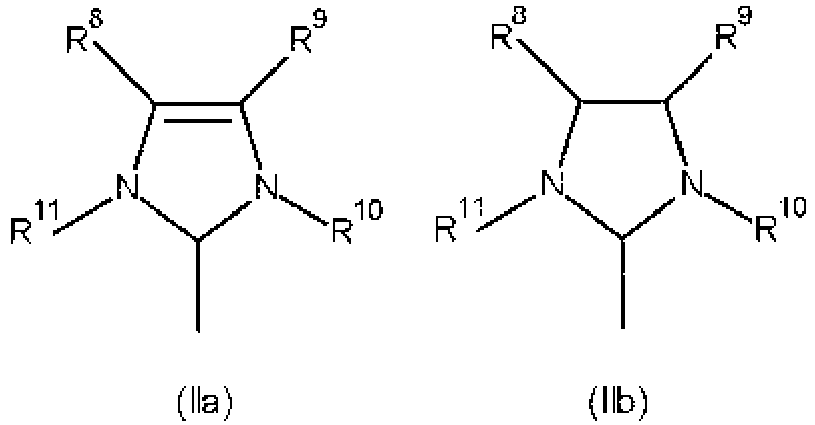

R8, R9, R10 et R11 sont identiques ou différents et représentent hydrogène, alkyle en C1-C30 à chaîne linéaire ou ramifié, cycloalkyle en C3-C20, alcényle en C2-C20, alcynyle en C2-C20, aryle en C6-C24, alkaryle en C7-C25, hétéroaryle en C2-C20, hétérocyclyle en C2-C20, alcoxy en C1-C20, alcényloxy en C2-C20, alcynyloxy en C2-C20, aryloxy en C6-C20, alcoxycarbonyle en C2-C20, alkylthio en C1-C20, arylthio en C6-C20, -Si(R)3 ; -O-Si(R)3, -O-C(=O)R, C(=O)R, -C(=O)N(R)2, -NR-C(=O)-N(R)2, -SO2N(R)2, -S(=O)R, -S(=O)2R, -O-S(=O)2R, halogène, nitro ou cyano ; où, dans tous les cas ci-dessus, concernant les définitions de R8, R9, R10 et R11, le groupe R étant identique ou différent et représentant hydrogène, alkyle en C1-C30, cycloalkyle en C3-C20, alcényle en C2-C20, alcynyle en C2-C20, aryle en C6-C24 ou hétéroaryle en C2-C20, et où R8, R9, R10 et R11 peuvent, indépendamment les uns des autres, être non substitués ou substitués par un ou plusieurs substituants, de préférence alkyle en C1-C10 à chaîne linéaire ou ramifié, cycloalkyle en C3-C8, alcoxy en C1-C10, aryle en C6-C24, hétéroaryle en C2-C20, hétérocyclique en C2-C20, un groupe fonctionnel choisi dans le groupe constitué d'hydroxy, thiol, thioéther, cétone, aldéhyde, ester, éther, amine, imine, amide, nitro, acide carboxylique, disulfure, carbonate, isocyanate, carbodiimide, carboalcoxy, carbamate et halogène, les substituants mentionnés ci-dessus pouvant, indépendamment les uns des autres, être non substitués ou sont eux-mêmes substitués par un ou plusieurs substituants, de préférence choisis dans le groupe constitué d'halogène, en particulier chlore ou brome, alkyle en C1-C5, alcoxy en C1-C5 et phényle. - Complexes selon la revendication 4, dans lesquels, dans le(s) ligand(s) NHC dans les catalyseurs de formule générale (I)
R8 et R9 sont identiques ou différents et représentent hydrogène, aryle en C6-C24, plus préférablement phényle, alkyle en C1-C10 à chaîne linéaire ou ramifié, plus préférablement méthyle, éthyle, n-propyle, i-propyle, n-butyle, sec-butyle, et i-butyle, ou forment une structure cycloalkyle ou aryle conjointement avec les atomes de carbone auxquels ils sont liés, et
R10 et R11 sont identiques ou différents et représentent de préférence alkyle en C1-C10 à chaîne linéaire ou ramifié, plus préférablement i-propyle ou néopentyle, cycloalkyle en C3-C10, plus préférablement adamantyle, aryle en C6-C24 substitué ou non substitué, plus préférablement phényle, 2,6-diisopropylphényle, 2,6-diméthylphényle, 2,4,6-triméthylphényle, alkylsulfonate en C1-C10, ou arylsulfonate en C6-C10. - Complexes selon la revendication 4, dans lequel le(s) ligand(s) NHC dans les catalyseurs de formule générale (I) ont les structures (IIIa) à (IIIu), où "Ph" désigne dans chaque cas phényle, "Bu" désigne dans chaque cas butyle, c'est-à-dire n-butyle, sec-butyle, iso-butyle ou tert-butyle, "Mes" représente dans chaque cas 2,4,6-triméthylphényle, "Dipp" désigne dans tous les cas 2,6-diisopropylphényle et "Dimp" désigne dans chaque cas 2,6-diméthylphényle.




- Complexes selon la revendication 1 choisis dans le groupe constitué de (Ia)-IMes, (Ia)-SIMes, (Ia)-IPr, (Ib)-IMes, (Ib)-SIMes, (Ib)-IPr, (Ic)-IMes, (Ic)-SIMes, (Ic)-IPr, où "IMes" désigne N,N'-bis(mésityl)imidazol-2-ylidène, "SIMes" désigne N,N'-bis(mésityl)imidazolidin-2-ylidène, "IPr" désigne N,N'-bis(2,6-diisopropyl- phényl)imidazol-2-ylidène et "ItBu" désigne N,N'-bis(tert-butyl)imidazol-2-ylidène


- Procédé de préparation des complexes de formule générale (I) selon la revendication 1 comprenant la réaction d'un composé de formule générale (1)
MXY(CO)(PR3)n (1)
dans laquelleM est le ruthénium ou l'osmium, de préférence le ruthéniumX est H, Cl, Br ou I ;Y représente H, F, Cl, Br, I, CF3, pyridine, -OC6F15, CF3COO-, CH3SO3- ou BF4 ;R représentealkyle en C1-C14 substitué ou non substitué, de préférence alkyle en C1-C6 ;cycloalkyle en C3-C8 substitué ou non substitué, de préférence cyclopentyle, cyclohexyle ou cycloheptyle ;aryle en C6-C14 substitué ou non substitué, de préférence phényle substitué ou non substitué, plus préférablement phényle ; etn est 3, si R représente aryle en C6-C14 substitué ou non substitué, de préférence phényle substitué ou non substitué, plus préférablement phényle ; oun est 2, si R représente alkyle en C1-C14 substitué ou non substitué, de préférence alkyle en C1-C6 ou cycloalkyle en C3-C8 substitué ou non substitué, de préférence cyclopentyle, cyclohexyle ou cycloheptyle ;avec un composé de formule générale (2) R1, R2, R3, et R4 sont identiques ou différents et représententH ; NO2 ; CF3 ; halogène, de préférence F, Cl, Br, ou I ; oualkyle en C1-C14 à chaîne linéaire ou ramifié, substitué ou non substitué, de préférence alkyle en C1-C8, plus préférablement méthyle, éthyle, n-propyle, i-propyle, n-butyle, i-butyle ou tert-butyle ;cycloalkyle en C3-C10 substitué ou non substitué, de préférence cycloalkyle en C5-C8, plus préférablement cyclopentyle, cyclohexyle ou cycloheptyle ;aryle en C6-C14 substitué ou non substitué, de préférence aryle en C6-C10, plus préférablement phényle, ledit groupe aryle étant non substitué ou contenant 1, 2, 3, 4 ou 5 substituants identiques ou différents ;OR7, OC(=O)R7, CO(=O)R7, SO3R7, SO3N(R7)2 ou SO3Na où R7 représente H, alkyle en C1-C14 à chaîne linéaire ou ramifié, substitué ou non substitué, de préférence alkyle en C1-C8, plus préférablement méthyle, éthyle, n-propyle, i-propyle, n-butyle, i-butyle ou tert-butyle ;(N(R8)3)+X- où X est un halogénure, de préférence un chlorure, et les R8 sont identiques ou différents et représentent H ; alkyle en C1-C14 à chaîne linéaire ou ramifié, substitué ou non substitué, de préférence alkyle en C1-C8, plus préférablement méthyle, éthyle, n-propyle, i-propyle, n-butyle, i-butyle, et tert-butyle ; aryle en C6-C14 substitué ou non substitué, de préférence aryle en C6-C10, plus préférablement phényle, ledit groupe aryle étant non substitué ou contenant 1, 2, 3, 4 ou 5 substituants identiques ou différents ; de manière préférée entre toutes N(CH3)(C2H5)2 +Cl-, N(C2H5)2H+Cl-, NH3 +Cl-, NH(CH3)2 +Cl- ou N(CH3)3 +Cl- ;tris(alcoxy en C1-C6)silyl-(alkyle en C1-C6), tris (aryloxy en C6-C14)silyl-(alkyle en C1-C6), ou tris (cycloalcoxy en C3-C10)silyl-(alkyle en C1-C6), de préférence triséthoxysilyl-n-propyle ;R5 représente H ;alkyle en C1-C14 à chaîne linéaire ou ramifié, substitué ou non substitué, de préférence alkyle en C1-C8, plus préférablement méthyle, éthyle, n-propyle, i-propyle, n-butyle, i-butyle ou tert-butyle ;cycloalkyle en C3-C10 substitué ou non substitué, de préférence cycloalkyle en C5-C8, plus préférablement cyclopentyle, cyclohexyle ou cycloheptyle ;aryle en C6-C14 substitué ou non substitué, de préférence aryle en C6-C10, plus préférablement phényle, ledit groupe aryle, plus préférablement phényle, étant non substitué ou contenant 1, 2, 3, 4 ou 5 substituants identiques ou différents, encore plus préférablement 1, 2 ou 3 substituants identiques ou différents qui sont situés aux positions o et/ou p ; etR6 représente H, oualkyle en C1-C14 à chaîne linéaire ou ramifié, substitué ou non substitué, de préférence alkyle en C1-C8, plus préférablement méthyle, éthyle, n-propyle, i-propyle, n-butyle, i-butyle ou tert-butyle ; oucycloalkyle en C3-C10 substitué ou non substitué, de préférence cycloalkyle en C5-C8, plus préférablement cyclopentyle, cyclohexyle ou cycloheptyle ; ouaryle en C6-C14 substitué ou non substitué, de préférence aryle en C6-C10, plus préférablement phényle, ledit groupe aryle, plus préférablement phényle, étant non substitué ou contenant 1, 2, 3, 4 ou 5 substituants identiques ou différents ; etpour obtenir un composé de formule générale (3)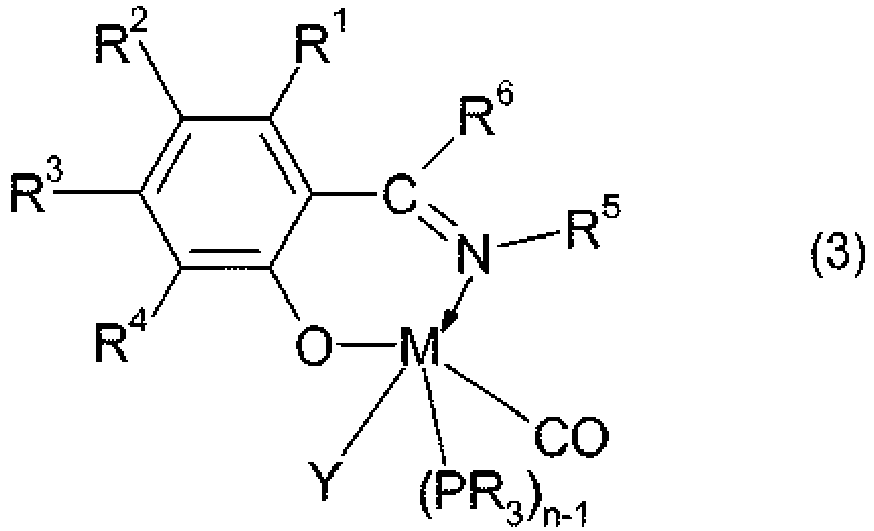
R1, R2, R3, R4, R5, R6, n, M, Y et R doivent tous avoir les mêmes significations générales, préférées et plus préférées que celles décrites ci-dessus pour les formules générales (1) et (2),
qui réagit ensuite avec un carbène N-hétérocyclique pour obtenir les composés de formule générale (I). - Procédé selon la revendication 8 comprenant la réaction d'un composé de formule générale (1) dans lequel
M est le ruthénium ;
X est H, Cl, Br ou I ;
Y représente H, F, Cl, Br, I, CF3, pyridine, -OC6F15, CF3COO-, CH3SO3-, ou BF4
PR3 représentant triphénylphosphine (PPh3) avec n étant 3 ou tricyclohexylphosphine (PCy3) avec n étant 2,
avec un composé de formule générale (2) dans laquelle R1, R2, R3, et R4 sont identiques ou différents et représentent
H ; NO2 ; F, Cl, ou Br ; ou
alkyle en C1-C8 à chaîne linéaire ou ramifié, substitué ou non substitué, plus préférablement méthyle, éthyle, n-propyle, i-propyle, n-butyle, i-butyle, et tert-butyle ; substitué ou non substitué cycloalkyle en C5-C8, plus préférablement cyclopentyle, cyclohexyle ou cycloheptyle ;
aryle en C6-C14 substitué ou non substitué, de préférence aryle en C6-C10, plus préférablement phényle, ledit groupe aryle, de préférence phényle, étant non substitué ou contenant 1, 2, 3, 4 ou 5 substituants ;
OR7, OC(=O)R7, CO(=O)R7, SO3R7, SO3N(R7)2 ou SO3Na où R7 représente H, alkyle en C1-C14 à chaîne linéaire ou ramifié, substitué ou non substitué, de préférence alkyle en C1-C8, plus préférablement méthyle, éthyle, n-propyle, i-propyle, n-butyle, i-butyle ou tert-butyle ;
R5 est alkyle en C1-C8 à chaîne linéaire ou ramifié, plus préférablement méthyle, éthyle, n-propyle, i-propyle, n-butyle, i-butyle, et tert-butyle qui est non substitué ou substitué par OR7, OC(=O)R7, ou CO(=O)R7, où R7 représente H, alkyle en C1-C14 à chaîne linéaire ou ramifié, substitué ou non substitué, de préférence alkyle en C1-C8, plus préférablement méthyle, éthyle, n-propyle, i-propyle, n-butyle, i-butyle ou tert-butyle ;
aryle en C6-C14 substitué ou non substitué, de préférence aryle en C6-C10, plus préférablement phényle, qui est non substitué ou qui contient 1, 2, 3, 4 ou 5 substituants identiques ou différents, encore plus préférablement 1, 2 ou 3 substituants identiques ou différents qui sont situés aux positions o et/ou p et qui sont choisis dans le groupe constitué d'alkyle en C1-C8, en particulier méthyle, éthyle, n-propyle, i-propyle, n-butyle, i-butyle et tert-butyle, halogène, en particulier Cl, Br, et I, OR7, OC(=O)R7, ou CO(=O)R7 où R7 représente H, alkyle en C1-C14 à chaîne linéaire ou ramifié, substitué ou non substitué, de préférence alkyle en C1-C8, plus préférablement méthyle, éthyle, n-propyle, i-propyle, n-butyle, i-butyle ou tert-butyle ; et
R6 représente H, ou
alkyle en C1-C14 à chaîne linéaire ou ramifié, substitué ou non substitué, de préférence alkyle en C1-C8, plus préférablement méthyle, éthyle, n-propyle, i-propyle, n-butyle, i-butyle ou tert-butyle ; ou
cycloalkyle en C3-C10 substitué ou non substitué, de préférence cycloalkyle en C5-C8, plus préférablement cyclopentyle, cyclohexyle ou cycloheptyle ; ou
aryle en C6-C14 substitué ou non substitué, de préférence aryle en C6-C10, plus préférablement phényle, ledit groupe aryle, plus préférablement phényle, étant non substitué ou contenant 1, 2, 3, 4 ou 5 substituants identiques ou différents ; et
pour obtenir un composé de formule générale (3) dans lequel
M est le ruthénium
R1, R2, R3, R4, R5, R6, n, Y et R doivent avoir les mêmes significations que celles décrites pour les modes de réalisation préférés des formules générales (1) et (2), qui réagit ensuite avec un carbène N-hétérocyclique pour obtenir le composé de formule générale (I) où M est le ruthénium et R1, R2, R3, R4, R5, Y et NHC doivent tous avoir les mêmes significations que celles décrites ci-dessus pour les composés de formules générales (1) et (2). - Procédé selon la revendication 8 dans lequel le composé de formule générale (1) est choisi dans le groupe constitué de RuHCl(CO)(PR3)n, RuH2(CO)(PR3)n, et RuCl2(CO)(PR3)n où R et n doivent avoir les définitions présentées dans la revendication 7 pour la formule générale (I) et plus préférablement choisi dans le groupe constitué de RuHCl(CO)(PCy3)2, RuHCl(CO)(PPh3)3, RuCl2(CO)(PCy3)2, RuCl2(CO)(PPh3)3, RuH2(CO)(PCy3)2, et RuH2(CO)(PPh3)3 et le composé de formule générale (2) est choisi dans le groupe constitué de

- Procédé selon la revendication 10 conduisant à un composé des formules suivantes


- Procédé de préparation des complexes selon la revendication 1 comprenant la réaction d'un composé de formule générale (4)
MXY(CO)(NHC)(PR3) (4)
dans laquelleM est le ruthénium ou l'osmium, de préférence le ruthénium,X est H, Cl, Br ou I ;Y représente H, F, Cl, Br, I, CF3, pyridine, -OC6H5 ; CF3COO-, CH3SO3-, ou BF4R est identique ou différent, de préférence identique et représente alkyle en C1-C14 substitué ou non substitué, de préférence alkyle en C1-C6 ; cycloalkyle en C3-C8 substitué ou non substitué, de préférence cyclopentyle, cyclohexyle ou cycloheptyle ;aryle en C6-C14 substitué ou non substitué, de préférence phényle substitué ou non substitué, plus préférablement phényle ; etn est 3, si les R représentent aryle en C6-C14 substitué ou non substitué, de phényle préférence substitué ou non substitué, plus préférablement phényle ; oun est 2, si les R représentent alkyle en C1-C14 substitué ou non substitué, de préférence alkyle en C1-C6 ou cycloalkyle en C3-C8 substitué ou non substitué, de préférence cyclopentyle, cyclohexyle ou cycloheptyle ; etNHC est un carbène N-hétérocyclique ;avec un composé de formule générale (2) R1, R2, R3, et R4 sont identiques ou différents et représententH ; NO2 ; CF3 ; halogène, de préférence F, Cl, Br, ou I ; oualkyle en C1-C14 à chaîne linéaire ou ramifié, substitué ou non substitué, de préférence alkyle en C1-C8, plus préférablement méthyle, éthyle, n-propyle, i-propyle, n-butyle, i-butyle, et tert-butyle ;cycloalkyle en C3-C10 substitué ou non substitué, de préférence cycloalkyle en C5-C8, plus préférablement cyclopentyle, cyclohexyle ou cycloheptyle ;aryle en C6-C14 substitué ou non substitué, de préférence aryle en C6-C10, plus préférablement phényle, ledit groupe aryle, de préférence phényle, étant non substitué ou contenant 1, 2, 3, 4 ou 5 substituants ;OR7, OC(=O)R7, CO(=O)R7, SO3R7, SO3N(R7)2 ou SO3Na où R7 représente H, alkyle en C1-C14 à chaîne linéaire ou ramifié, substitué ou non substitué, de préférence alkyle en C1-C8, plus préférablement méthyle, éthyle, n-propyle, i-propyle, n-butyle, i-butyle ou tert-butyle ;(N(R8)3)+X- où X est un halogénure, de préférence un chlorure, et les R sont identiques ou différents et représentent H ; alkyle en C1-C14 à chaîne linéaire ou ramifié, substitué ou non substitué, de préférence alkyle en C1-C8, plus préférablement méthyle, éthyle, n-propyle, i-propyle, n-butyle, i-butyle, et tert-butyle ; aryle en C6-C14 substitué ou non substitué, de préférence aryle en C6-C10, plus préférablement phényle, ledit groupe aryle étant non substitué ou contenant 1, 2, 3, 4 ou 5 substituants ; de manière préférée entre toutes N(CH3)(C2H5)2 +Cl-, N(C2H5)2H+Cl-, NH3 +Cl- ;NH(CH3)2 +Cl-, ou N(CH3)3 +Cl- ; tris (alcoxy en C1-C6)silyl-(alkyle en C1-C6), tris (aryloxy en C6-C14)silyl-(alkyle en C1-C8), ou tris (cycloalcoxy en C3-C10)silyl-(alkyle en C1-C6), de préférence triséthoxysilyl-n-propyle ;R5 représente H ;alkyle en C1-C14 à chaîne linéaire ou ramifié, substitué ou non substitué, de préférence alkyle en C1-C8, plus préférablement méthyle, éthyle, n-propyle, i-propyle, n-butyle, i-butyle, et tert-butyle ;cycloalkyle en C3-C10 substitué ou non substitué, de préférence cycloalkyle en C3-C8, plus préférablement cyclopentyle, cyclohexyle ou cycloheptyle ;aryle en C6-C14 substitué ou non substitué, de préférence aryle en C6-C10, plus préférablement phényle, ledit groupe aryle, de préférence phényle, étant non substitué ou contenant 1, 2, 3, 4 ou 5 substituants ;qui contient 1, 2, 3, 4 ou 5 substituants identiques ou différents, encore plus préférablement 1, 2 ou 3 substituants identiques ou différents qui sont situé aux positions o et/ou p ; etR6 représente H, oualkyle en C1-C14 à chaîne linéaire ou ramifié, substitué ou non substitué, de préférence alkyle en C1-C8, plus préférablement méthyle, éthyle, n-propyle, i-propyle, n-butyle, i-butyle ou tert-butyle ; oucycloalkyle en C3-C10 substitué ou non substitué, de préférence cycloalkyle en C5-C8, plus préférablement cyclopentyle, cyclohexyle ou cycloheptyle ; ouaryle en C6-C14 substitué ou non substitué, de préférence aryle en C6-C10, plus préférablement phényle, ledit groupe aryle, plus préférablement phényle, étant non substitué ou contenant 1, 2, 3, 4 ou 5 substituants identiques ou différents ; etpour obtenir un composé de formule générale (I) dans lequel R1, R2, R3, R4, R5, M, Y et R doivent avoir les mêmes significations générales, préférées et plus préférées que celles décrites ci-dessus pour les formules générales (2) et (4).
 - Procédé selon la revendication 12 dans lequel le complexe (4) est choisi dans le groupe constitué de RuHCl(CO)(IMes)(PPh3), RuHCl(CO)(SIMes)(PPh3), RuHCl(CO)(IPr)(PPh3), RuHCl(CO)(IMes)(PCy3), RuHCl(CO)(SIMes)(PCy3) et RuHCl(CO)(IPr)(PCy3).
- Procédé selon l'une quelconque des revendications 8 à 13 dans lequel la réaction est conduite dans un ou plusieurs solvants organiques, de préférence choisis dans le groupe constitué d'éthers, plus préférablement THF, le dioxane et l'éther diéthylique, des alcanes, plus préférablement l'hexane, des solvants aromatiques, plus préférablement le toluène et le benzène, un hydrocarbure halogéné, plus préférablement le chloroforme et le chlorobenzène, un ester, plus préférablement l'acétate d'éthyle, une cétone, plus préférablement la méthyléthylcétone, l'acétone, et des alcools, plus préférablement le méthanol, l'éthanol et le méthyloxyéthanol et sans aucun catalyseur ou en présence d'au moins un catalyseur, de préférence Ag2CO3 ou TIOEt.
- Utilisation des complexes de formule générale (I) selon l'une quelconque des revendications 1 à 7 en tant que catalyseurs, de préférence pour des réactions d'hydrogénation.
- Procédé de fabrication de composés partiellement ou complètement saturés par mise en contact de composés insaturés contenant au moins une double liaison C=C, de préférence des oléfines terminales, des oléfines internes, des oléfines cycliques, des oléfines conjuguées, d'autres oléfines ayant au moins une double liaison carbone-carbone et en outre, au moins une double ou triple liaison insaturée polaire supplémentaire, ou des oligomères ou polymères ayant des doubles liaisons carbone-carbone, avec de l'hydrogène en présence d'au moins un complexe de formule générale (I) selon l'une quelconque des revendications 1 à 7.
- Procédé selon la revendication 16 dans lequel un polymère comprenant des motifs de répétition à base d'au moins un monomère de diène conjugué, plus préférablement un caoutchouc nitrile comprenant (i) des motifs de répétition d'au moins un diène conjugué, plus préférablement au moins un diène conjugué en C4-C6, encore plus préférablement choisi dans le groupe constitué des 1,3-butadiène, isoprène, 1-méthylbutadiène, 2,3-diméthylbutadiène, pipérylène, chloroprène, et des mélanges de ceux-ci, et de manière préférée entre toutes 1,3-butadiène, (ii) au moins un monomère de nitrile α,β-insaturé, de préférence un nitrile α,β-insaturé en C3-C5, plus préférablement choisi dans le groupe constitué des acrylonitrile, méthacrylonitrile, éthacrylonitrile et des mélanges de ceux-ci, de manière préférée entre toutes l'acrylonitrile, et (iii) aucun, un ou plusieurs termonomères, de préférence choisis dans le groupe constitué d'acides monocarboxyliques α,β-insaturés, de manière préférée entre toutes mono-insaturés, leurs esters et amides, d'acides dicarboxyliques α,β-insaturés, de manière préférée entre toutes mono-insaturés, leurs mono- ou diesters, les anhydrides et amides respectifs desdits acides dicarboxyliques α,β-insaturés.
- Procédé selon la revendication 16 ou 17 dans lequel l'hydrogénation est conduite à une température dans la plage de 30 °C à 200 °C, de préférence de 40 °C à 180 °C, de manière préférée entre toutes de 50 °C à 160 °C et à une pression d'hydrogène dans la plage de 0,5 MPa à 35 MPa, et plus préférablement de 3,0 MPa à 10 MPa.
- Procédé selon l'une quelconque des revendications 16 à 18 dans lequel la quantité du complexe de formule générale (I) par rapport aux substrats insaturés, en particulier le caoutchouc nitrile, est dans la plage de 1 à 1000 ppm de métal noble, de préférence de 2 à 500 ppm, en particulier de 5 à 250 ppm, sur la base des substrats insaturés, en particulier le caoutchouc nitrile utilisé.
- Procédé selon l'une quelconque des revendications 17 à 19, dans lequel le polymère à base de diène est présent dans une suspension aqueuse.
- Procédé selon l'une quelconque des revendications 20 ou 21, dans lequel le catalyseur de formule générale (I) est utilisé en une quantité dans la plage de 0,01 à 5,0 % en poids, de préférence de 0,02 % à 2,0 % en poids sur la base du poids du polymère à base de diène présent dans la suspension aqueuse.
Applications Claiming Priority (2)
| Application Number | Priority Date | Filing Date | Title |
|---|---|---|---|
| PCT/CN2013/077107 WO2014198022A1 (fr) | 2013-06-09 | 2013-06-09 | Catalyseurs de type complexes à base de ruthénium ou d'osmium |
| PCT/EP2014/061823 WO2014198658A1 (fr) | 2013-06-09 | 2014-06-06 | Catalyseurs complexes à base de ruthénium ou d'osmium |
Publications (2)
| Publication Number | Publication Date |
|---|---|
| EP3008077A1 EP3008077A1 (fr) | 2016-04-20 |
| EP3008077B1 true EP3008077B1 (fr) | 2017-08-09 |
Family
ID=51177028
Family Applications (1)
| Application Number | Title | Priority Date | Filing Date |
|---|---|---|---|
| EP14738745.0A Active EP3008077B1 (fr) | 2013-06-09 | 2014-06-06 | Catalyseurs complexes à base de ruthénium ou d'osmium |
Country Status (5)
| Country | Link |
|---|---|
| US (1) | US9802972B2 (fr) |
| EP (1) | EP3008077B1 (fr) |
| JP (1) | JP6174794B2 (fr) |
| TW (1) | TWI614257B (fr) |
| WO (2) | WO2014198022A1 (fr) |
Families Citing this family (7)
| Publication number | Priority date | Publication date | Assignee | Title |
|---|---|---|---|---|
| WO2014198022A1 (fr) | 2013-06-09 | 2014-12-18 | Lanxess Deutschland Gmbh | Catalyseurs de type complexes à base de ruthénium ou d'osmium |
| JP6671709B2 (ja) * | 2016-03-22 | 2020-03-25 | 学校法人日本大学 | 電解液の製造方法 |
| CN112004598B (zh) * | 2018-04-20 | 2024-07-19 | 阿朗新科德国有限责任公司 | 氢化催化剂组合物及其用于氢化丁腈橡胶的用途 |
| JP2021532208A (ja) | 2018-07-23 | 2021-11-25 | アランセオ・ドイチュランド・ゲーエムベーハー | 水素化ニトリルゴムを製造するための方法及びそのhnbr組成物 |
| EP3827030B1 (fr) * | 2018-07-23 | 2024-03-27 | ARLANXEO Deutschland GmbH | Hydrogénation de caoutchouc nitrile |
| EP3898706B1 (fr) | 2018-12-17 | 2025-10-01 | ARLANXEO Deutschland GmbH | Procédé de production de solutions hnbr comportant des solvants alternatifs |
| CN114262394B (zh) * | 2020-09-16 | 2023-08-18 | 浙江赞昇新材料有限公司 | 液体氢化丁腈橡胶及其制备方法和应用 |
Family Cites Families (22)
| Publication number | Priority date | Publication date | Assignee | Title |
|---|---|---|---|---|
| DE3803450A1 (de) | 1988-02-05 | 1989-08-17 | Hoechst Ag | Emissionsarme dispersionsfarben, anstrichmittel und kunststoffdispersionsputze sowie verfahren zu ihrer herstellung |
| DE3834734A1 (de) | 1988-10-12 | 1990-04-19 | Basf Ag | Verfahren zur herstellung von polymerisaten aus olefinisch ungesaettigten monomeren |
| DE3902103A1 (de) | 1989-01-25 | 1990-08-02 | Roehm Gmbh | Bindemittel fuer waessrige glanzfarben |
| CA2091128C (fr) | 1992-03-08 | 1999-07-27 | Michael A. Taylor | Extraction de substances organiques volatiles de solutions et de dispersions de polymeres |
| DE4213964A1 (de) | 1992-04-29 | 1993-11-04 | Basf Ag | Waessrige polymerisatdispersionen |
| DE4213965A1 (de) | 1992-04-29 | 1993-11-04 | Basf Ag | Waessrige polymerisatdispersion |
| DE4213968A1 (de) | 1992-04-29 | 1993-11-04 | Basf Ag | Waessrige polymerisatdispersion |
| DE4213967A1 (de) | 1992-04-29 | 1993-11-04 | Basf Ag | Waessrige polymerisatdispersion |
| DE4213969A1 (de) | 1992-04-29 | 1993-11-04 | Basf Ag | Waessrige polymerisatdispersion |
| CN1120180C (zh) | 1994-06-03 | 2003-09-03 | 巴斯福股份公司 | 聚合物水分散液的制备 |
| DE4435422A1 (de) | 1994-10-04 | 1996-04-18 | Basf Ag | Verfahren zur Herstellung einer wäßrigen Polymerisatdispersion |
| US5977393A (en) * | 1997-11-21 | 1999-11-02 | California Institute Of Technology | Schiff base derivatives of ruthenium and osmium olefin metathesis catalysts |
| DE19815275B4 (de) * | 1998-04-06 | 2009-06-25 | Evonik Degussa Gmbh | Alkylidenkomplexe des Rutheniums mit N-heterozyklischen Carbenliganden und deren Verwendung als hochaktive, selektive Katalysatoren für die Olefin-Metathese |
| JP3861570B2 (ja) | 2000-07-11 | 2006-12-20 | 宇部興産株式会社 | シクロドデセンの製造法 |
| JP2002030057A (ja) * | 2000-07-11 | 2002-01-29 | Ube Ind Ltd | 新規ルテニウム錯体 |
| US20070185343A1 (en) | 2004-02-26 | 2007-08-09 | Universiteit Gent | Metal complexes for use in olefin metathesis and atom group transfer reactions |
| ATE512945T1 (de) * | 2004-02-26 | 2011-07-15 | Telene Sas | Metallkomplexe und deren verwendung in der olefinmetathese und atom- oder gruppenübertragungsreaktionen |
| US8877936B2 (en) * | 2008-04-09 | 2014-11-04 | California Institute Of Technology | Ruthenium olefin metathesis catalysts bearing N-heterocyclic carbene ligands with substituted backbone |
| PL2151445T3 (pl) | 2008-08-01 | 2015-08-31 | Rimtec Corp | Sposób wytwarzania dwufunkcyjnych katalizatorów rutenowych będących zasadą Schiffa zawierającą ligand typu salicyloaldiminy |
| US20110137043A1 (en) * | 2009-12-09 | 2011-06-09 | Telene S.A.S. | Process for the preparation of bidentate schiff base ruthenium catalysts containing a salicylaldimine-type ligand |
| JP5976807B2 (ja) | 2011-08-15 | 2016-08-24 | ザ・ガヴァニング・カウンシル・オヴ・ユニヴァーシティー・オヴ・トロント | ルテニウム系錯体触媒 |
| WO2014198022A1 (fr) | 2013-06-09 | 2014-12-18 | Lanxess Deutschland Gmbh | Catalyseurs de type complexes à base de ruthénium ou d'osmium |
-
2013
- 2013-06-09 WO PCT/CN2013/077107 patent/WO2014198022A1/fr not_active Ceased
-
2014
- 2014-06-06 US US14/896,412 patent/US9802972B2/en active Active
- 2014-06-06 EP EP14738745.0A patent/EP3008077B1/fr active Active
- 2014-06-06 JP JP2016517621A patent/JP6174794B2/ja active Active
- 2014-06-06 WO PCT/EP2014/061823 patent/WO2014198658A1/fr not_active Ceased
- 2014-06-09 TW TW103119856A patent/TWI614257B/zh not_active IP Right Cessation
Non-Patent Citations (1)
| Title |
|---|
| None * |
Also Published As
| Publication number | Publication date |
|---|---|
| US20160122376A1 (en) | 2016-05-05 |
| JP6174794B2 (ja) | 2017-08-02 |
| EP3008077A1 (fr) | 2016-04-20 |
| TW201512207A (zh) | 2015-04-01 |
| TWI614257B (zh) | 2018-02-11 |
| US9802972B2 (en) | 2017-10-31 |
| WO2014198658A1 (fr) | 2014-12-18 |
| WO2014198022A1 (fr) | 2014-12-18 |
| JP2016527194A (ja) | 2016-09-08 |
Similar Documents
| Publication | Publication Date | Title |
|---|---|---|
| EP3008077B1 (fr) | Catalyseurs complexes à base de ruthénium ou d'osmium | |
| EP2676969B1 (fr) | Tandem métathèse et hydrogénation d'un latex de polymère à base de diène | |
| EP2841463B1 (fr) | Hydrogénation de caoutchouc nitrile | |
| EP3004124B1 (fr) | Nouveaux complexes de métaux de transition, leur préparation et leur utilisation | |
| EP3283496B1 (fr) | Catalyseurs complexes à base d'osmium, de ruthénium et d'or | |
| EP3134206B1 (fr) | Complexes triazole-carbène à base de ruthénium | |
| CN104271607B (zh) | 丁腈橡胶的氢化 | |
| EP3827030B1 (fr) | Hydrogénation de caoutchouc nitrile | |
| CN105392792B (zh) | 钌基或锇基络合物催化剂 | |
| KR20160018518A (ko) | 루테늄- 또는 오스뮴-기재 착물 촉매 |
Legal Events
| Date | Code | Title | Description |
|---|---|---|---|
| PUAI | Public reference made under article 153(3) epc to a published international application that has entered the european phase |
Free format text: ORIGINAL CODE: 0009012 |
|
| 17P | Request for examination filed |
Effective date: 20160111 |
|
| AK | Designated contracting states |
Kind code of ref document: A1 Designated state(s): AL AT BE BG CH CY CZ DE DK EE ES FI FR GB GR HR HU IE IS IT LI LT LU LV MC MK MT NL NO PL PT RO RS SE SI SK SM TR |
|
| AX | Request for extension of the european patent |
Extension state: BA ME |
|
| RAP1 | Party data changed (applicant data changed or rights of an application transferred) |
Owner name: ARLANXEO DEUTSCHLAND GMBH |
|
| DAX | Request for extension of the european patent (deleted) | ||
| GRAP | Despatch of communication of intention to grant a patent |
Free format text: ORIGINAL CODE: EPIDOSNIGR1 |
|
| RIC1 | Information provided on ipc code assigned before grant |
Ipc: C07F 15/00 20060101AFI20170120BHEP Ipc: C08F 236/12 20060101ALI20170120BHEP Ipc: B01J 31/22 20060101ALI20170120BHEP Ipc: C08L 15/00 20060101ALI20170120BHEP Ipc: C07C 5/03 20060101ALI20170120BHEP Ipc: C08C 19/02 20060101ALI20170120BHEP |
|
| INTG | Intention to grant announced |
Effective date: 20170210 |
|
| GRAS | Grant fee paid |
Free format text: ORIGINAL CODE: EPIDOSNIGR3 |
|
| GRAA | (expected) grant |
Free format text: ORIGINAL CODE: 0009210 |
|
| AK | Designated contracting states |
Kind code of ref document: B1 Designated state(s): AL AT BE BG CH CY CZ DE DK EE ES FI FR GB GR HR HU IE IS IT LI LT LU LV MC MK MT NL NO PL PT RO RS SE SI SK SM TR |
|
| REG | Reference to a national code |
Ref country code: GB Ref legal event code: FG4D |
|
| REG | Reference to a national code |
Ref country code: CH Ref legal event code: EP Ref country code: AT Ref legal event code: REF Ref document number: 916694 Country of ref document: AT Kind code of ref document: T Effective date: 20170815 |
|
| REG | Reference to a national code |
Ref country code: IE Ref legal event code: FG4D |
|
| REG | Reference to a national code |
Ref country code: DE Ref legal event code: R096 Ref document number: 602014012909 Country of ref document: DE |
|
| REG | Reference to a national code |
Ref country code: NL Ref legal event code: MP Effective date: 20170809 |
|
| REG | Reference to a national code |
Ref country code: LT Ref legal event code: MG4D |
|
| REG | Reference to a national code |
Ref country code: AT Ref legal event code: MK05 Ref document number: 916694 Country of ref document: AT Kind code of ref document: T Effective date: 20170809 |
|
| PG25 | Lapsed in a contracting state [announced via postgrant information from national office to epo] |
Ref country code: SE Free format text: LAPSE BECAUSE OF FAILURE TO SUBMIT A TRANSLATION OF THE DESCRIPTION OR TO PAY THE FEE WITHIN THE PRESCRIBED TIME-LIMIT Effective date: 20170809 Ref country code: FI Free format text: LAPSE BECAUSE OF FAILURE TO SUBMIT A TRANSLATION OF THE DESCRIPTION OR TO PAY THE FEE WITHIN THE PRESCRIBED TIME-LIMIT Effective date: 20170809 Ref country code: HR Free format text: LAPSE BECAUSE OF FAILURE TO SUBMIT A TRANSLATION OF THE DESCRIPTION OR TO PAY THE FEE WITHIN THE PRESCRIBED TIME-LIMIT Effective date: 20170809 Ref country code: NL Free format text: LAPSE BECAUSE OF FAILURE TO SUBMIT A TRANSLATION OF THE DESCRIPTION OR TO PAY THE FEE WITHIN THE PRESCRIBED TIME-LIMIT Effective date: 20170809 Ref country code: NO Free format text: LAPSE BECAUSE OF FAILURE TO SUBMIT A TRANSLATION OF THE DESCRIPTION OR TO PAY THE FEE WITHIN THE PRESCRIBED TIME-LIMIT Effective date: 20171109 Ref country code: LT Free format text: LAPSE BECAUSE OF FAILURE TO SUBMIT A TRANSLATION OF THE DESCRIPTION OR TO PAY THE FEE WITHIN THE PRESCRIBED TIME-LIMIT Effective date: 20170809 Ref country code: AT Free format text: LAPSE BECAUSE OF FAILURE TO SUBMIT A TRANSLATION OF THE DESCRIPTION OR TO PAY THE FEE WITHIN THE PRESCRIBED TIME-LIMIT Effective date: 20170809 |
|
| PG25 | Lapsed in a contracting state [announced via postgrant information from national office to epo] |
Ref country code: LV Free format text: LAPSE BECAUSE OF FAILURE TO SUBMIT A TRANSLATION OF THE DESCRIPTION OR TO PAY THE FEE WITHIN THE PRESCRIBED TIME-LIMIT Effective date: 20170809 Ref country code: IS Free format text: LAPSE BECAUSE OF FAILURE TO SUBMIT A TRANSLATION OF THE DESCRIPTION OR TO PAY THE FEE WITHIN THE PRESCRIBED TIME-LIMIT Effective date: 20171209 Ref country code: BG Free format text: LAPSE BECAUSE OF FAILURE TO SUBMIT A TRANSLATION OF THE DESCRIPTION OR TO PAY THE FEE WITHIN THE PRESCRIBED TIME-LIMIT Effective date: 20171109 Ref country code: ES Free format text: LAPSE BECAUSE OF FAILURE TO SUBMIT A TRANSLATION OF THE DESCRIPTION OR TO PAY THE FEE WITHIN THE PRESCRIBED TIME-LIMIT Effective date: 20170809 Ref country code: RS Free format text: LAPSE BECAUSE OF FAILURE TO SUBMIT A TRANSLATION OF THE DESCRIPTION OR TO PAY THE FEE WITHIN THE PRESCRIBED TIME-LIMIT Effective date: 20170809 Ref country code: GR Free format text: LAPSE BECAUSE OF FAILURE TO SUBMIT A TRANSLATION OF THE DESCRIPTION OR TO PAY THE FEE WITHIN THE PRESCRIBED TIME-LIMIT Effective date: 20171110 Ref country code: PL Free format text: LAPSE BECAUSE OF FAILURE TO SUBMIT A TRANSLATION OF THE DESCRIPTION OR TO PAY THE FEE WITHIN THE PRESCRIBED TIME-LIMIT Effective date: 20170809 |
|
| PG25 | Lapsed in a contracting state [announced via postgrant information from national office to epo] |
Ref country code: RO Free format text: LAPSE BECAUSE OF FAILURE TO SUBMIT A TRANSLATION OF THE DESCRIPTION OR TO PAY THE FEE WITHIN THE PRESCRIBED TIME-LIMIT Effective date: 20170809 Ref country code: CZ Free format text: LAPSE BECAUSE OF FAILURE TO SUBMIT A TRANSLATION OF THE DESCRIPTION OR TO PAY THE FEE WITHIN THE PRESCRIBED TIME-LIMIT Effective date: 20170809 Ref country code: DK Free format text: LAPSE BECAUSE OF FAILURE TO SUBMIT A TRANSLATION OF THE DESCRIPTION OR TO PAY THE FEE WITHIN THE PRESCRIBED TIME-LIMIT Effective date: 20170809 |
|
| REG | Reference to a national code |
Ref country code: FR Ref legal event code: PLFP Year of fee payment: 5 Ref country code: DE Ref legal event code: R097 Ref document number: 602014012909 Country of ref document: DE |
|
| PG25 | Lapsed in a contracting state [announced via postgrant information from national office to epo] |
Ref country code: SM Free format text: LAPSE BECAUSE OF FAILURE TO SUBMIT A TRANSLATION OF THE DESCRIPTION OR TO PAY THE FEE WITHIN THE PRESCRIBED TIME-LIMIT Effective date: 20170809 Ref country code: EE Free format text: LAPSE BECAUSE OF FAILURE TO SUBMIT A TRANSLATION OF THE DESCRIPTION OR TO PAY THE FEE WITHIN THE PRESCRIBED TIME-LIMIT Effective date: 20170809 Ref country code: SK Free format text: LAPSE BECAUSE OF FAILURE TO SUBMIT A TRANSLATION OF THE DESCRIPTION OR TO PAY THE FEE WITHIN THE PRESCRIBED TIME-LIMIT Effective date: 20170809 |
|
| PLBE | No opposition filed within time limit |
Free format text: ORIGINAL CODE: 0009261 |
|
| STAA | Information on the status of an ep patent application or granted ep patent |
Free format text: STATUS: NO OPPOSITION FILED WITHIN TIME LIMIT |
|
| 26N | No opposition filed |
Effective date: 20180511 |
|
| PG25 | Lapsed in a contracting state [announced via postgrant information from national office to epo] |
Ref country code: SI Free format text: LAPSE BECAUSE OF FAILURE TO SUBMIT A TRANSLATION OF THE DESCRIPTION OR TO PAY THE FEE WITHIN THE PRESCRIBED TIME-LIMIT Effective date: 20170809 |
|
| REG | Reference to a national code |
Ref country code: CH Ref legal event code: PL |
|
| REG | Reference to a national code |
Ref country code: BE Ref legal event code: MM Effective date: 20180630 |
|
| REG | Reference to a national code |
Ref country code: IE Ref legal event code: MM4A |
|
| PG25 | Lapsed in a contracting state [announced via postgrant information from national office to epo] |
Ref country code: LU Free format text: LAPSE BECAUSE OF NON-PAYMENT OF DUE FEES Effective date: 20180606 Ref country code: MC Free format text: LAPSE BECAUSE OF FAILURE TO SUBMIT A TRANSLATION OF THE DESCRIPTION OR TO PAY THE FEE WITHIN THE PRESCRIBED TIME-LIMIT Effective date: 20170809 |
|
| PG25 | Lapsed in a contracting state [announced via postgrant information from national office to epo] |
Ref country code: LI Free format text: LAPSE BECAUSE OF NON-PAYMENT OF DUE FEES Effective date: 20180630 Ref country code: CH Free format text: LAPSE BECAUSE OF NON-PAYMENT OF DUE FEES Effective date: 20180630 Ref country code: IE Free format text: LAPSE BECAUSE OF NON-PAYMENT OF DUE FEES Effective date: 20180606 |
|
| PG25 | Lapsed in a contracting state [announced via postgrant information from national office to epo] |
Ref country code: BE Free format text: LAPSE BECAUSE OF NON-PAYMENT OF DUE FEES Effective date: 20180630 |
|
| PG25 | Lapsed in a contracting state [announced via postgrant information from national office to epo] |
Ref country code: MT Free format text: LAPSE BECAUSE OF NON-PAYMENT OF DUE FEES Effective date: 20180606 |
|
| PG25 | Lapsed in a contracting state [announced via postgrant information from national office to epo] |
Ref country code: TR Free format text: LAPSE BECAUSE OF FAILURE TO SUBMIT A TRANSLATION OF THE DESCRIPTION OR TO PAY THE FEE WITHIN THE PRESCRIBED TIME-LIMIT Effective date: 20170809 |
|
| PG25 | Lapsed in a contracting state [announced via postgrant information from national office to epo] |
Ref country code: PT Free format text: LAPSE BECAUSE OF FAILURE TO SUBMIT A TRANSLATION OF THE DESCRIPTION OR TO PAY THE FEE WITHIN THE PRESCRIBED TIME-LIMIT Effective date: 20170809 |
|
| PG25 | Lapsed in a contracting state [announced via postgrant information from national office to epo] |
Ref country code: HU Free format text: LAPSE BECAUSE OF FAILURE TO SUBMIT A TRANSLATION OF THE DESCRIPTION OR TO PAY THE FEE WITHIN THE PRESCRIBED TIME-LIMIT; INVALID AB INITIO Effective date: 20140606 Ref country code: CY Free format text: LAPSE BECAUSE OF FAILURE TO SUBMIT A TRANSLATION OF THE DESCRIPTION OR TO PAY THE FEE WITHIN THE PRESCRIBED TIME-LIMIT Effective date: 20170809 Ref country code: MK Free format text: LAPSE BECAUSE OF NON-PAYMENT OF DUE FEES Effective date: 20170809 |
|
| PG25 | Lapsed in a contracting state [announced via postgrant information from national office to epo] |
Ref country code: AL Free format text: LAPSE BECAUSE OF FAILURE TO SUBMIT A TRANSLATION OF THE DESCRIPTION OR TO PAY THE FEE WITHIN THE PRESCRIBED TIME-LIMIT Effective date: 20170809 |
|
| REG | Reference to a national code |
Ref country code: FR Ref legal event code: PLFP Year of fee payment: 10 |
|
| P01 | Opt-out of the competence of the unified patent court (upc) registered |
Effective date: 20230608 |
|
| PGFP | Annual fee paid to national office [announced via postgrant information from national office to epo] |
Ref country code: DE Payment date: 20250402 Year of fee payment: 12 |
|
| PGFP | Annual fee paid to national office [announced via postgrant information from national office to epo] |
Ref country code: GB Payment date: 20250401 Year of fee payment: 12 |
|
| PGFP | Annual fee paid to national office [announced via postgrant information from national office to epo] |
Ref country code: IT Payment date: 20250522 Year of fee payment: 12 |
|
| PGFP | Annual fee paid to national office [announced via postgrant information from national office to epo] |
Ref country code: FR Payment date: 20250401 Year of fee payment: 12 |