EP3010066B1 - Organische lichtemittierende vorrichtung - Google Patents
Organische lichtemittierende vorrichtung Download PDFInfo
- Publication number
- EP3010066B1 EP3010066B1 EP15190327.5A EP15190327A EP3010066B1 EP 3010066 B1 EP3010066 B1 EP 3010066B1 EP 15190327 A EP15190327 A EP 15190327A EP 3010066 B1 EP3010066 B1 EP 3010066B1
- Authority
- EP
- European Patent Office
- Prior art keywords
- group
- substituted
- salt
- unsubstituted
- iso
- Prior art date
- Legal status (The legal status is an assumption and is not a legal conclusion. Google has not performed a legal analysis and makes no representation as to the accuracy of the status listed.)
- Active
Links
- 0 *c(cc1)cc2c1ccc(-c1ccccc1)c2 Chemical compound *c(cc1)cc2c1ccc(-c1ccccc1)c2 0.000 description 48
- DIGHEXDNGRCZJQ-UHFFFAOYSA-N Cc1c(C2(c(cccc3)c3-c3c2cccc3)c2c-3cccc2)c-3ccc1 Chemical compound Cc1c(C2(c(cccc3)c3-c3c2cccc3)c2c-3cccc2)c-3ccc1 DIGHEXDNGRCZJQ-UHFFFAOYSA-N 0.000 description 2
- RIMSXNVESINCPE-UHFFFAOYSA-N Cc1ccc2-c3ccccc3C3(c4ccccc4-c4c3cccc4)c2c1 Chemical compound Cc1ccc2-c3ccccc3C3(c4ccccc4-c4c3cccc4)c2c1 RIMSXNVESINCPE-UHFFFAOYSA-N 0.000 description 2
- NSLPSLVTXPGGJV-UHFFFAOYSA-N c(cc1)ccc1-c(cc1)ccc1N(c(cc1)cc(c2c3cccc2)c1[n]3-c1ccccc1)c1c2-c3ccccc3C3(c4ccccc4-c4c3cccc4)c2ccc1 Chemical compound c(cc1)ccc1-c(cc1)ccc1N(c(cc1)cc(c2c3cccc2)c1[n]3-c1ccccc1)c1c2-c3ccccc3C3(c4ccccc4-c4c3cccc4)c2ccc1 NSLPSLVTXPGGJV-UHFFFAOYSA-N 0.000 description 2
- KFEGNTGOCJTROD-UHFFFAOYSA-N C(C1)C=CC2=C1C1(c3ccccc3-c3ccccc13)c1cccc(N(c(cc3c4c5cccc4)ccc3[n]5-c3ccccc3)c(cccc3)c3-c3ccccc3)c21 Chemical compound C(C1)C=CC2=C1C1(c3ccccc3-c3ccccc13)c1cccc(N(c(cc3c4c5cccc4)ccc3[n]5-c3ccccc3)c(cccc3)c3-c3ccccc3)c21 KFEGNTGOCJTROD-UHFFFAOYSA-N 0.000 description 1
- PTVSQEASVAEWPR-UHFFFAOYSA-N C(C1)C=CC=C1C1(c2ccccc2-c2ccccc12)C1=CC=CCC1 Chemical compound C(C1)C=CC=C1C1(c2ccccc2-c2ccccc12)C1=CC=CCC1 PTVSQEASVAEWPR-UHFFFAOYSA-N 0.000 description 1
- OMOQKJCCDRXHJZ-CPSFFCFKSA-N CC(C(C=C1)F)C=C1[n]1c(ccc(N(c2ccccc2)c(cc2)ccc2-c(cc2)ccc2N(c2ccccc2)c(cc2)cc(c(C=C)c3/C=C\C)c2[n]3-c(cc2)ccc2F)c2)c2c2ccccc12 Chemical compound CC(C(C=C1)F)C=C1[n]1c(ccc(N(c2ccccc2)c(cc2)ccc2-c(cc2)ccc2N(c2ccccc2)c(cc2)cc(c(C=C)c3/C=C\C)c2[n]3-c(cc2)ccc2F)c2)c2c2ccccc12 OMOQKJCCDRXHJZ-CPSFFCFKSA-N 0.000 description 1
- FXODPBRWOAMLSK-UHFFFAOYSA-N CC(C)(C1C2)c3ccccc3C1=CC=C2N(c(cc1)ccc1-c1c2[s]c(cccc3)c3c2ccc1)c(cccc12)c1-c1ccccc1C21c2cc(C3=CCCC(c(cc4)ccc4N(c(cc4)ccc4-c4c5[s]c6ccccc6c5ccc4)c4c5-c6ccccc6C6(c7ccccc7-c7c6cccc7)c5ccc4)=C3)ccc2-c2c1cccc2 Chemical compound CC(C)(C1C2)c3ccccc3C1=CC=C2N(c(cc1)ccc1-c1c2[s]c(cccc3)c3c2ccc1)c(cccc12)c1-c1ccccc1C21c2cc(C3=CCCC(c(cc4)ccc4N(c(cc4)ccc4-c4c5[s]c6ccccc6c5ccc4)c4c5-c6ccccc6C6(c7ccccc7-c7c6cccc7)c5ccc4)=C3)ccc2-c2c1cccc2 FXODPBRWOAMLSK-UHFFFAOYSA-N 0.000 description 1
- YRWUXQAPTWMXCD-UHFFFAOYSA-N CC(C)(c1ccc2)C(C=CCC3)=C3c1c2-c(cc1)c2[o]c(cccc3)c3c2c1N(c(cc1)ccc1-c1ccccc1)c(cc1)ccc1-c(cc1)ccc1-[n]1c(cccc2)c2c2c1cccc2 Chemical compound CC(C)(c1ccc2)C(C=CCC3)=C3c1c2-c(cc1)c2[o]c(cccc3)c3c2c1N(c(cc1)ccc1-c1ccccc1)c(cc1)ccc1-c(cc1)ccc1-[n]1c(cccc2)c2c2c1cccc2 YRWUXQAPTWMXCD-UHFFFAOYSA-N 0.000 description 1
- WXRMVBWAJHDPIR-UHFFFAOYSA-N CC(C)(c1ccccc1-c1c2)c1ccc2N(c(cc1)ccc1-c(cc1)ccc1-c1ccc2-c3cc(N(c(cc4)ccc4-c4ccccc4)c(cc4)cc5c4-c4ccccc4C5(c4ccccc4)c4ccccc4)ccc3C(C)(C)c2c1)c(cc1)cc2c1-c1ccccc1C2(c1ccccc1)c1ccccc1 Chemical compound CC(C)(c1ccccc1-c1c2)c1ccc2N(c(cc1)ccc1-c(cc1)ccc1-c1ccc2-c3cc(N(c(cc4)ccc4-c4ccccc4)c(cc4)cc5c4-c4ccccc4C5(c4ccccc4)c4ccccc4)ccc3C(C)(C)c2c1)c(cc1)cc2c1-c1ccccc1C2(c1ccccc1)c1ccccc1 WXRMVBWAJHDPIR-UHFFFAOYSA-N 0.000 description 1
- NOXVEJKOBFGLOU-UHFFFAOYSA-N CC(C1)C=Cc(c2cc(N(c(cc3)ccc3-c(cc3)ccc3N(c(cc3)ccc3C#N)c(cc3)cc(c4c5cccc4)c3[n]5-c3ccccc3)c(cc3)ccc3C#N)ccc22)c1[n]2-c1ccccc1 Chemical compound CC(C1)C=Cc(c2cc(N(c(cc3)ccc3-c(cc3)ccc3N(c(cc3)ccc3C#N)c(cc3)cc(c4c5cccc4)c3[n]5-c3ccccc3)c(cc3)ccc3C#N)ccc22)c1[n]2-c1ccccc1 NOXVEJKOBFGLOU-UHFFFAOYSA-N 0.000 description 1
- KPSOJEMLLOWAGJ-UHFFFAOYSA-N CC1(C)c(cc(cc2)N(c(cc3)cc4c3c3ccccc3[n]4-c3ccccc3)c3c4-c5ccccc5C5(c(cccc6)c6-c6ccccc56)c4ccc3)c2-c2c1cccc2 Chemical compound CC1(C)c(cc(cc2)N(c(cc3)cc4c3c3ccccc3[n]4-c3ccccc3)c3c4-c5ccccc5C5(c(cccc6)c6-c6ccccc56)c4ccc3)c2-c2c1cccc2 KPSOJEMLLOWAGJ-UHFFFAOYSA-N 0.000 description 1
- XIGCJKFAVRKPBO-UHFFFAOYSA-N CC1(C)c(cc(cc2)N(c(cc3)cc4c3c3ccccc3[s]4)c3cccc4c3-c3ccccc3C43c4ccccc4-c4ccccc34)c2-c2ccccc12 Chemical compound CC1(C)c(cc(cc2)N(c(cc3)cc4c3c3ccccc3[s]4)c3cccc4c3-c3ccccc3C43c4ccccc4-c4ccccc34)c2-c2ccccc12 XIGCJKFAVRKPBO-UHFFFAOYSA-N 0.000 description 1
- XSDXKECVRXGWFF-UHFFFAOYSA-N CC1(C)c(cc(cc2)N(c(cc3c4ccccc44)ccc3[n]4-c3ccccc3)c3c4-c5ccccc5C5(c(cccc6)c6-c6c5cccc6)c4ccc3)c2-c2ccccc12 Chemical compound CC1(C)c(cc(cc2)N(c(cc3c4ccccc44)ccc3[n]4-c3ccccc3)c3c4-c5ccccc5C5(c(cccc6)c6-c6c5cccc6)c4ccc3)c2-c2ccccc12 XSDXKECVRXGWFF-UHFFFAOYSA-N 0.000 description 1
- FQGBBWBABCCUTR-UHFFFAOYSA-N CC1(C)c(cc(cc2)N(c(cc3c4ccccc44)ccc3[n]4-c3ccccc3)c3c4-c5ccccc5C5(c(cccc6)c6C6=C5CCC=C6)c4ccc3)c2-c2ccccc12 Chemical compound CC1(C)c(cc(cc2)N(c(cc3c4ccccc44)ccc3[n]4-c3ccccc3)c3c4-c5ccccc5C5(c(cccc6)c6C6=C5CCC=C6)c4ccc3)c2-c2ccccc12 FQGBBWBABCCUTR-UHFFFAOYSA-N 0.000 description 1
- RDMHVTAERCWKMW-UHFFFAOYSA-N CC1(C)c(cc(cc2)N(c3cc(-c4cc(-c(cc5)ccc5-c(cc5)ccc5N(c5ccc(C6(c7ccccc7-c7ccccc67)c(c-6c7)ccc7-c(cc7)ccc7-c(cc7)ccc7N(c7cc(-c8c(C9%10c%11ccccc%11-c%11c9cccc%11)cccc8)c%10cc7)c7ccc(c(cccc8)c8[o]8)c8c7)c-6c5)c5ccc6[o]c(cccc7)c7c6c5)ccc4C45c6ccccc6-c6c4cccc6)c5cc3)c3ccc4[o]c5ccccc5c4c3)c2-c2ccccc12 Chemical compound CC1(C)c(cc(cc2)N(c3cc(-c4cc(-c(cc5)ccc5-c(cc5)ccc5N(c5ccc(C6(c7ccccc7-c7ccccc67)c(c-6c7)ccc7-c(cc7)ccc7-c(cc7)ccc7N(c7cc(-c8c(C9%10c%11ccccc%11-c%11c9cccc%11)cccc8)c%10cc7)c7ccc(c(cccc8)c8[o]8)c8c7)c-6c5)c5ccc6[o]c(cccc7)c7c6c5)ccc4C45c6ccccc6-c6c4cccc6)c5cc3)c3ccc4[o]c5ccccc5c4c3)c2-c2ccccc12 RDMHVTAERCWKMW-UHFFFAOYSA-N 0.000 description 1
- JQMVOJCYLHPTPM-UHFFFAOYSA-N CC1(C)c2cccc(N(c(cc3)ccc3-c3ccc4[o]c(cccc5)c5c4c3)c(cc3C4(C)C)ccc3-c(cc3)c4cc3-c(cc3C(C)(C)c4ccc5)ccc3-c4c5N(c(cc3)ccc3-c3ccccc3)c(cc3)ccc3-c3ccc4[o]c5ccccc5c4c3)c2-c2c1cccc2 Chemical compound CC1(C)c2cccc(N(c(cc3)ccc3-c3ccc4[o]c(cccc5)c5c4c3)c(cc3C4(C)C)ccc3-c(cc3)c4cc3-c(cc3C(C)(C)c4ccc5)ccc3-c4c5N(c(cc3)ccc3-c3ccccc3)c(cc3)ccc3-c3ccc4[o]c5ccccc5c4c3)c2-c2c1cccc2 JQMVOJCYLHPTPM-UHFFFAOYSA-N 0.000 description 1
- DAVAZMBRBKUERC-UHFFFAOYSA-N CC1C=C(C=CC(c2ccccc2)=C2)C2=CC1 Chemical compound CC1C=C(C=CC(c2ccccc2)=C2)C2=CC1 DAVAZMBRBKUERC-UHFFFAOYSA-N 0.000 description 1
- ASXLPXYEPJIKKE-WMZJFQQLSA-N CCC(C)(C=CC=C1)/C1=C\C Chemical compound CCC(C)(C=CC=C1)/C1=C\C ASXLPXYEPJIKKE-WMZJFQQLSA-N 0.000 description 1
- VBEPBFUFDGMUDQ-WAYWQWQTSA-N CCC1C(N/C=C\C=C)=C1 Chemical compound CCC1C(N/C=C\C=C)=C1 VBEPBFUFDGMUDQ-WAYWQWQTSA-N 0.000 description 1
- OPLJIJLMUAXNHY-UHFFFAOYSA-N CC[IH]c1cc(cc(cc2)-c3ccccc3)c2cc1 Chemical compound CC[IH]c1cc(cc(cc2)-c3ccccc3)c2cc1 OPLJIJLMUAXNHY-UHFFFAOYSA-N 0.000 description 1
- YYVKSTYNQIYWFG-UHFFFAOYSA-N C[IH]c(c1ccc2)cccc1c2-c1ccccc1 Chemical compound C[IH]c(c1ccc2)cccc1c2-c1ccccc1 YYVKSTYNQIYWFG-UHFFFAOYSA-N 0.000 description 1
- VTKMFJSESAHMLR-UHFFFAOYSA-N Cc(cc1)cc2c1[o]c1ccccc21 Chemical compound Cc(cc1)cc2c1[o]c1ccccc21 VTKMFJSESAHMLR-UHFFFAOYSA-N 0.000 description 1
- NEHRORCRHNZHFA-UHFFFAOYSA-N Cc1c(c(C=CC(C2)c(cc3N)cc4c3[s]c3ccccc43)c2[o]2)c2ccc1 Chemical compound Cc1c(c(C=CC(C2)c(cc3N)cc4c3[s]c3ccccc43)c2[o]2)c2ccc1 NEHRORCRHNZHFA-UHFFFAOYSA-N 0.000 description 1
- QPUYECUOLPXSFR-UHFFFAOYSA-N Cc1c(cccc2)c2ccc1 Chemical compound Cc1c(cccc2)c2ccc1 QPUYECUOLPXSFR-UHFFFAOYSA-N 0.000 description 1
- ZCUUNWCHTZCPDL-UHFFFAOYSA-N Cc1ccc(C2(c3ccccc3-c3c2cccc3)c2ccccc2-2)c-2c1 Chemical compound Cc1ccc(C2(c3ccccc3-c3c2cccc3)c2ccccc2-2)c-2c1 ZCUUNWCHTZCPDL-UHFFFAOYSA-N 0.000 description 1
- KANLOADZXMMCQA-UHFFFAOYSA-N Cc1ccc2c(cccc3)c3ccc2c1 Chemical compound Cc1ccc2c(cccc3)c3ccc2c1 KANLOADZXMMCQA-UHFFFAOYSA-N 0.000 description 1
- YXFVVABEGXRONW-UHFFFAOYSA-N Cc1ccccc1 Chemical compound Cc1ccccc1 YXFVVABEGXRONW-UHFFFAOYSA-N 0.000 description 1
- WGYYFLITOGQIRV-UHFFFAOYSA-N Fc(cc1)ccc1N(c(cc1)ccc1-c(cc1)ccc1N(c(cc1)ccc1F)c(cc1c2ccccc22)ccc1[n]2-c1ccccc1)c(cc1)cc(c2ccccc22)c1[n]2-c1ccccc1 Chemical compound Fc(cc1)ccc1N(c(cc1)ccc1-c(cc1)ccc1N(c(cc1)ccc1F)c(cc1c2ccccc22)ccc1[n]2-c1ccccc1)c(cc1)cc(c2ccccc22)c1[n]2-c1ccccc1 WGYYFLITOGQIRV-UHFFFAOYSA-N 0.000 description 1
- HULRCCQOVMTNLJ-UHFFFAOYSA-N Ic1cc(-c2cc3ccccc3cc2)cc(-c2c(cccc3)c3ccc2)c1 Chemical compound Ic1cc(-c2cc3ccccc3cc2)cc(-c2c(cccc3)c3ccc2)c1 HULRCCQOVMTNLJ-UHFFFAOYSA-N 0.000 description 1
- UREANSLTQZCJLI-UHFFFAOYSA-N Nc(c1ccc2)cccc1c2-c1ccccc1 Chemical compound Nc(c1ccc2)cccc1c2-c1ccccc1 UREANSLTQZCJLI-UHFFFAOYSA-N 0.000 description 1
- JBIJLHTVPXGSAM-UHFFFAOYSA-N Nc1cc2ccccc2cc1 Chemical compound Nc1cc2ccccc2cc1 JBIJLHTVPXGSAM-UHFFFAOYSA-N 0.000 description 1
- HPNTZCAYLSSXRP-UHFFFAOYSA-N Nc1ccc(-c2ccccc2)c2c1cccc2 Chemical compound Nc1ccc(-c2ccccc2)c2c1cccc2 HPNTZCAYLSSXRP-UHFFFAOYSA-N 0.000 description 1
- ISWSIDIOOBJBQZ-UHFFFAOYSA-N Oc1ccccc1 Chemical compound Oc1ccccc1 ISWSIDIOOBJBQZ-UHFFFAOYSA-N 0.000 description 1
- TXFXCPIRRKNHNL-UHFFFAOYSA-N c(cc1)ccc1-c(cc1)ccc1N(c(cc1)cc2c1c(cccc1)c1[n]2-c1ccccc1)c1c2-c3ccccc3C3(c4ccccc4-c4c3cccc4)c2ccc1 Chemical compound c(cc1)ccc1-c(cc1)ccc1N(c(cc1)cc2c1c(cccc1)c1[n]2-c1ccccc1)c1c2-c3ccccc3C3(c4ccccc4-c4c3cccc4)c2ccc1 TXFXCPIRRKNHNL-UHFFFAOYSA-N 0.000 description 1
- PLPKCHNSHKDPOL-UHFFFAOYSA-N c(cc1)ccc1-c(cccc1)c1N(c(cc1c2c3cccc2)ccc1[n]3-c1ccccc1)c1c2-c3ccccc3C3(c(cccc4)c4-c4c3cccc4)c2ccc1 Chemical compound c(cc1)ccc1-c(cccc1)c1N(c(cc1c2c3cccc2)ccc1[n]3-c1ccccc1)c1c2-c3ccccc3C3(c(cccc4)c4-c4c3cccc4)c2ccc1 PLPKCHNSHKDPOL-UHFFFAOYSA-N 0.000 description 1
- ICXPFAQLSMINJH-UHFFFAOYSA-N c(cc1)ccc1-c1cc(N(c(cc2)ccc2-c(cc2)ccc2N(c(cc2c3ccccc33)ccc2[n]3-c2ccccc2)c2cccc(-c3ccccc3)c2)c(cc2c3c4cccc3)ccc2[n]4-c2ccccc2)ccc1 Chemical compound c(cc1)ccc1-c1cc(N(c(cc2)ccc2-c(cc2)ccc2N(c(cc2c3ccccc33)ccc2[n]3-c2ccccc2)c2cccc(-c3ccccc3)c2)c(cc2c3c4cccc3)ccc2[n]4-c2ccccc2)ccc1 ICXPFAQLSMINJH-UHFFFAOYSA-N 0.000 description 1
- KYABQAVXGQECKE-UHFFFAOYSA-N c(cc1)ccc1-c1cccc(N(c(cc2)cc3c2c2ccccc2[n]3-c2ccccc2)c2c3-c4ccccc4C4(c5ccccc5-c5c4cccc5)c3ccc2)c1 Chemical compound c(cc1)ccc1-c1cccc(N(c(cc2)cc3c2c2ccccc2[n]3-c2ccccc2)c2c3-c4ccccc4C4(c5ccccc5-c5c4cccc5)c3ccc2)c1 KYABQAVXGQECKE-UHFFFAOYSA-N 0.000 description 1
- HZOSRUTYJKUXRA-UHFFFAOYSA-N c(cc1)ccc1-c1cccc(N(c(cc2)ccc2-c2c3[s]c(cccc4)c4c3ccc2)c2cccc3c2-c2ccccc2C32c3ccccc3-c3c2cccc3)c1 Chemical compound c(cc1)ccc1-c1cccc(N(c(cc2)ccc2-c2c3[s]c(cccc4)c4c3ccc2)c2cccc3c2-c2ccccc2C32c3ccccc3-c3c2cccc3)c1 HZOSRUTYJKUXRA-UHFFFAOYSA-N 0.000 description 1
- FMQMYFLHGCWTKK-UHFFFAOYSA-N c(cc1)ccc1-c1cccc(N(c(cc2c3c4cccc3)ccc2[n]4-c2ccccc2)c2c3-c4ccccc4C4(c5ccccc5-c5ccccc45)c3ccc2)c1 Chemical compound c(cc1)ccc1-c1cccc(N(c(cc2c3c4cccc3)ccc2[n]4-c2ccccc2)c2c3-c4ccccc4C4(c5ccccc5-c5ccccc45)c3ccc2)c1 FMQMYFLHGCWTKK-UHFFFAOYSA-N 0.000 description 1
- UHOVQNZJYSORNB-UHFFFAOYSA-N c1ccccc1 Chemical compound c1ccccc1 UHOVQNZJYSORNB-UHFFFAOYSA-N 0.000 description 1
Images

Classifications
-
- H—ELECTRICITY
- H10—SEMICONDUCTOR DEVICES; ELECTRIC SOLID-STATE DEVICES NOT OTHERWISE PROVIDED FOR
- H10K—ORGANIC ELECTRIC SOLID-STATE DEVICES
- H10K50/00—Organic light-emitting devices
- H10K50/10—OLEDs or polymer light-emitting diodes [PLED]
- H10K50/11—OLEDs or polymer light-emitting diodes [PLED] characterised by the electroluminescent [EL] layers
-
- H—ELECTRICITY
- H10—SEMICONDUCTOR DEVICES; ELECTRIC SOLID-STATE DEVICES NOT OTHERWISE PROVIDED FOR
- H10K—ORGANIC ELECTRIC SOLID-STATE DEVICES
- H10K50/00—Organic light-emitting devices
-
- C—CHEMISTRY; METALLURGY
- C09—DYES; PAINTS; POLISHES; NATURAL RESINS; ADHESIVES; COMPOSITIONS NOT OTHERWISE PROVIDED FOR; APPLICATIONS OF MATERIALS NOT OTHERWISE PROVIDED FOR
- C09K—MATERIALS FOR MISCELLANEOUS APPLICATIONS, NOT PROVIDED FOR ELSEWHERE
- C09K11/00—Luminescent materials, e.g. electroluminescent or chemiluminescent
- C09K11/06—Luminescent materials, e.g. electroluminescent or chemiluminescent containing organic luminescent materials
-
- H—ELECTRICITY
- H10—SEMICONDUCTOR DEVICES; ELECTRIC SOLID-STATE DEVICES NOT OTHERWISE PROVIDED FOR
- H10K—ORGANIC ELECTRIC SOLID-STATE DEVICES
- H10K85/00—Organic materials used in the body or electrodes of devices covered by this subclass
- H10K85/30—Coordination compounds
- H10K85/341—Transition metal complexes, e.g. Ru(II)polypyridine complexes
- H10K85/342—Transition metal complexes, e.g. Ru(II)polypyridine complexes comprising iridium
-
- H—ELECTRICITY
- H10—SEMICONDUCTOR DEVICES; ELECTRIC SOLID-STATE DEVICES NOT OTHERWISE PROVIDED FOR
- H10K—ORGANIC ELECTRIC SOLID-STATE DEVICES
- H10K85/00—Organic materials used in the body or electrodes of devices covered by this subclass
- H10K85/40—Organosilicon compounds, e.g. TIPS pentacene
-
- H—ELECTRICITY
- H10—SEMICONDUCTOR DEVICES; ELECTRIC SOLID-STATE DEVICES NOT OTHERWISE PROVIDED FOR
- H10K—ORGANIC ELECTRIC SOLID-STATE DEVICES
- H10K85/00—Organic materials used in the body or electrodes of devices covered by this subclass
- H10K85/60—Organic compounds having low molecular weight
- H10K85/631—Amine compounds having at least two aryl rest on at least one amine-nitrogen atom, e.g. triphenylamine
- H10K85/633—Amine compounds having at least two aryl rest on at least one amine-nitrogen atom, e.g. triphenylamine comprising polycyclic condensed aromatic hydrocarbons as substituents on the nitrogen atom
-
- H—ELECTRICITY
- H10—SEMICONDUCTOR DEVICES; ELECTRIC SOLID-STATE DEVICES NOT OTHERWISE PROVIDED FOR
- H10K—ORGANIC ELECTRIC SOLID-STATE DEVICES
- H10K85/00—Organic materials used in the body or electrodes of devices covered by this subclass
- H10K85/60—Organic compounds having low molecular weight
- H10K85/649—Aromatic compounds comprising a hetero atom
- H10K85/654—Aromatic compounds comprising a hetero atom comprising only nitrogen as heteroatom
-
- C—CHEMISTRY; METALLURGY
- C09—DYES; PAINTS; POLISHES; NATURAL RESINS; ADHESIVES; COMPOSITIONS NOT OTHERWISE PROVIDED FOR; APPLICATIONS OF MATERIALS NOT OTHERWISE PROVIDED FOR
- C09K—MATERIALS FOR MISCELLANEOUS APPLICATIONS, NOT PROVIDED FOR ELSEWHERE
- C09K2211/00—Chemical nature of organic luminescent or tenebrescent compounds
- C09K2211/10—Non-macromolecular compounds
- C09K2211/1003—Carbocyclic compounds
- C09K2211/1007—Non-condensed systems
-
- C—CHEMISTRY; METALLURGY
- C09—DYES; PAINTS; POLISHES; NATURAL RESINS; ADHESIVES; COMPOSITIONS NOT OTHERWISE PROVIDED FOR; APPLICATIONS OF MATERIALS NOT OTHERWISE PROVIDED FOR
- C09K—MATERIALS FOR MISCELLANEOUS APPLICATIONS, NOT PROVIDED FOR ELSEWHERE
- C09K2211/00—Chemical nature of organic luminescent or tenebrescent compounds
- C09K2211/10—Non-macromolecular compounds
- C09K2211/1018—Heterocyclic compounds
- C09K2211/1025—Heterocyclic compounds characterised by ligands
- C09K2211/1029—Heterocyclic compounds characterised by ligands containing one nitrogen atom as the heteroatom
-
- H—ELECTRICITY
- H10—SEMICONDUCTOR DEVICES; ELECTRIC SOLID-STATE DEVICES NOT OTHERWISE PROVIDED FOR
- H10K—ORGANIC ELECTRIC SOLID-STATE DEVICES
- H10K2101/00—Properties of the organic materials covered by group H10K85/00
- H10K2101/10—Triplet emission
-
- H—ELECTRICITY
- H10—SEMICONDUCTOR DEVICES; ELECTRIC SOLID-STATE DEVICES NOT OTHERWISE PROVIDED FOR
- H10K—ORGANIC ELECTRIC SOLID-STATE DEVICES
- H10K50/00—Organic light-emitting devices
- H10K50/10—OLEDs or polymer light-emitting diodes [PLED]
- H10K50/14—Carrier transporting layers
- H10K50/15—Hole transporting layers
- H10K50/156—Hole transporting layers comprising a multilayered structure
-
- H—ELECTRICITY
- H10—SEMICONDUCTOR DEVICES; ELECTRIC SOLID-STATE DEVICES NOT OTHERWISE PROVIDED FOR
- H10K—ORGANIC ELECTRIC SOLID-STATE DEVICES
- H10K85/00—Organic materials used in the body or electrodes of devices covered by this subclass
- H10K85/30—Coordination compounds
- H10K85/321—Metal complexes comprising a group IIIA element, e.g. Tris (8-hydroxyquinoline) gallium [Gaq3]
- H10K85/324—Metal complexes comprising a group IIIA element, e.g. Tris (8-hydroxyquinoline) gallium [Gaq3] comprising aluminium, e.g. Alq3
-
- H—ELECTRICITY
- H10—SEMICONDUCTOR DEVICES; ELECTRIC SOLID-STATE DEVICES NOT OTHERWISE PROVIDED FOR
- H10K—ORGANIC ELECTRIC SOLID-STATE DEVICES
- H10K85/00—Organic materials used in the body or electrodes of devices covered by this subclass
- H10K85/60—Organic compounds having low molecular weight
- H10K85/615—Polycyclic condensed aromatic hydrocarbons, e.g. anthracene
- H10K85/624—Polycyclic condensed aromatic hydrocarbons, e.g. anthracene containing six or more rings
-
- H—ELECTRICITY
- H10—SEMICONDUCTOR DEVICES; ELECTRIC SOLID-STATE DEVICES NOT OTHERWISE PROVIDED FOR
- H10K—ORGANIC ELECTRIC SOLID-STATE DEVICES
- H10K85/00—Organic materials used in the body or electrodes of devices covered by this subclass
- H10K85/60—Organic compounds having low molecular weight
- H10K85/615—Polycyclic condensed aromatic hydrocarbons, e.g. anthracene
- H10K85/626—Polycyclic condensed aromatic hydrocarbons, e.g. anthracene containing more than one polycyclic condensed aromatic rings, e.g. bis-anthracene
-
- H—ELECTRICITY
- H10—SEMICONDUCTOR DEVICES; ELECTRIC SOLID-STATE DEVICES NOT OTHERWISE PROVIDED FOR
- H10K—ORGANIC ELECTRIC SOLID-STATE DEVICES
- H10K85/00—Organic materials used in the body or electrodes of devices covered by this subclass
- H10K85/60—Organic compounds having low molecular weight
- H10K85/631—Amine compounds having at least two aryl rest on at least one amine-nitrogen atom, e.g. triphenylamine
Definitions
- Organic light emitting devices are self-emission devices that have wide viewing angles, high contrast ratios, short response times, and excellent brightness, driving voltage, and response speed characteristics, and produce full-color images.
- An organic light-emitting device may include a first electrode disposed on a substrate, and a hole transport region, an emission layer, an electron transport region, and a second electrode, which are sequentially disposed on the first electrode. Holes provided from the first electrode may move toward the emission layer through the hole transport region, and electrons provided from the second electrode may move toward the emission layer through the electron transport region. Carriers, such as holes and electrons, recombine in the emission layer to produce excitons. These excitons change from an excited state to a ground state, thereby generating light.
- WO 2014/007565 A1 and WO 2014/007564 A1 each disclose an OLED comprising a first electrode, a second electrode facing the first electrode, an emission layer disposed between said electrodes, a hole transport region disposed between the first electrode and the emission layer, and a second hole transport layer.
- the hole transport region comprises a compound falling under below mentioned Formula 2.
- US 2014/197386 A1 discloses another exemplary embodiment of an OLED device including organometallic compounds in an emission layer.
- One or more exemplary embodiments include an organic light-emitting device.
- an organic light-emitting device as defined in claim 1.
- FIG. 1 is a schematic cross-sectional view of an organic light-emitting device according to an embodiment.
- a first electrode may be an anode, which is a hole injection electrode
- a second electrode may be a cathode, which is an electron injection electrode.
- the first electrode may be a cathode, which is an electron injection electrode
- the second electrode may be an anode, which is a hole injection electrode.
- organic layer refers to a single layer and/or a plurality of layers disposed between the first electrode and the second electrode of an organic light-emitting device.
- a material included in the "organic layer” is not limited to an organic material.
- FIG. 1 is a schematic view of an organic light-emitting device 10 according to an embodiment.
- the organic light-emitting device 10 includes a first electrode 110, an organic layer 150, and a second electrode 190.
- a substrate may be additionally disposed under the first electrode 110 or above the second electrode 190.
- the substrate may be a glass substrate or transparent plastic substrate, each with excellent mechanical strength, thermal stability, transparency, surface smoothness, ease of handling, and water-resistance.
- the first electrode 110 may be formed by depositing or sputtering a material for forming a first electrode on the substrate.
- the material for the first electrode 110 may be selected from materials with a high work function to facilitate hole injection.
- the first electrode 110 may be a reflective electrode or a transmissive electrode.
- the material for the first electrode 110 may be a transparent and highly conductive material, and examples of such a material are indium tin oxide (ITO), indium zinc oxide (IZO), tin oxide (SnO 2 ), and zinc oxide (ZnO).
- the first electrode 110 is a semi-transmissive electrode or a reflective electrode
- a material for forming the first electrode 110 at least one of magnesium (Mg), aluminum(AI), aluminum-lithium(AI-Li), calcium (Ca), magnesium-indium(Mg-In), magnesium-silver (Mg-Ag) may be used.
- the first electrode 110 may have a single-layer structure, or a multi-layer structure including two or more layers.
- the first electrode 110 may have a three-layered structure of ITO/Ag/ITO, but the structure of the first electrode 110 is not limited thereto.
- the organic layer 150 is disposed on the first electrode 110.
- the organic layer 150 may include an emission layer.
- the organic layer 150 comprises a hole transport region disposed between the first electrode 110 and the emission layer.
- the organic layer 150 may further include an electron transport region disposed between the emission layer and the second electrode 190.
- the hole transport region comprises an amine-based compound represented by Formula 2:
- Ar 21 is represented by one of Formulae 8-1 and 8-2:
- L 21 to L 23 in Formula 2 may be each independently selected from a phenylene group, a pentalenylene group, an indenylene group, a naphthylene group, an azulenylene group, a heptalenylene group, an indacenylene group, an acenaphthylene group, a fluorenylene group, a spiro-fluorenylene group, a benzofluorenylene group, a dibenzofluorenylene group, a phenalenylene group, a phenanthrenylene group, an anthracenylene group, a fluoranthenylene group, an triphenylenylene group, a pyrenylene group, a chrysenylene group, a naphthacenylene group, a picenylene group, a perylenylene group, a pentaphenylene group, a hexacenylene group
- L 21 to L 23 in Formula 2 may be each independently selected from a phenylene group, a naphthylene group, a fluorenylene group, a phenanthrenylene group, an anthracenylene group, a triphenylenylene group, a pyrrolylene group, a thiophenylene group, a furanylene group, a pyridinylene group, a pyrazinylene group, a pyrimidinylene group, an indolylene group, a quinolinylene group, an isoquinolinylene group, a benzoquinolinylene group, a naphthyridinylene group, a quinoxalinylene group, a quinazolinylene group, a cinnolinylene group, a carbazolylene group, a phenanthridinylene group, a benzimidazolylene group, a benzofuranylene group, a
- L 21 to L 23 in Formula 2 may be each independently represented by one of Formulae 3-1 to 3-21, but they are not limited thereto:
- L 21 to L 23 in Formula 2 may be each independently represented by one of Formulae 4-1 to 4-42, but they are not limited thereto:
- R 21 and R 22 in Formula 2 may be each independently selected from a phenyl group, a pentalenyl group, an indenyl group, a naphthyl group, an azulenyl group, a heptalenyl group, an indacenyl group, an acenaphthyl group, a fluorenyl group, a spiro-fluorenyl group, a benzofluorenyl group, a dibenzofluorenyl group, a phenalenyl group, a phenanthrenyl group, an anthracenyl group, a fluoranthenyl group, a triphenylenyl group, a pyrenyl group, a chrysenyl group, a naphthacenyl group, a picenyl group, a perylenyl group, a pentaphenyl group, a hexacenyl
- R 21 and R 22 in Formula 2 may be each independently selected from a phenyl group, a naphthyl group, a fluorenyl group, a spiro-fluorenyl group, a benzofluorenyl group, a dibenzofluorenyl group, a phenanthrenyl group, a pyridinyl group, a pyrazinyl group, a pyrimidinyl group, a quinolinyl group, an isoquinolinyl group, a naphthyridinyl group, a quinoxalinyl group, a quinazolinyl group, a cinnolinyl group, a triazinyl group, a dibenzofuranyl group, and a dibenzothiophenyl group; and a phenyl group, a naphthyl group, a fluorenyl group, a spiro-fluorenyl group,
- R 21 and R 22 in Formula 2 may be each independently selected from ligands represented by Formulae 5-1 to 5-14, but they are not limited thereto:
- R 21 and R 22 in Formula 2 may be each independently selected from groups represented by one of Formulae 6-1 to 6-55, but they are not limited thereto:
- a plurality of R 21 (s) may be identical to or different from each other.
- b21 may be 1, but is not limited thereto.
- b22 in Formula 2 indicates the number of R 22 (s), and b22 may be selected from 1, 2, and 3.
- b22 is 2 or more, a plurality of R 22 (s) may be identical to or different from each other.
- b22 may be 1, but is not limited thereto.
- R 81 to R 96 in Formulae 8-1 and 8-2 may be each independently selected from hydrogen, deuterium, -F, -Cl, -Br, -I, a hydroxyl group, a cyano group, a nitro group, an amino group, an amidino group, a hydrazine group, a hydrazone group, a carboxylic acid or a salt thereof, a sulfonic acid or a salt thereof, a phosphoric acid or a salt thereof, a substituted or unsubstituted C 1 -C 60 alkyl group, a substituted or unsubstituted C 2 -C 60 alkenyl group, a substituted or unsubstituted C 2 -C 60 alkynyl group, a substituted or unsubstituted C 1 -C 60 alkoxy group, a substituted or unsubstituted C 3 -C 10 cycloalkyl group, a substituted or unsubsti
- R 96 are each and at least one of substituents of the substituted C 1 -C 60 alkyl group, substituted C 2 -C 60 alkenyl group, substituted C 2 -C 60 alkynyl group, substituted C 1 -C 60 alkoxy group, substituted C 3 -C 10 cycloalkyl group, substituted C 1 -C 10 heterocycloalkyl group, substituted C 3 -C 10 cycloalkenyl group, substituted C 1 -C 10 heterocycloalkenyl group, substituted C 6 -C 60 aryl group, substituted C 6 -C 60 aryloxy group, substituted C 6 -C 60 arylthio group, substituted C 1 -C 60 heteroaryl group, substituted monovalent non-aromatic condensed polycyclic group, and a substituted monovalent non-aromatic condensed heteropolycyclic group may be selected from deuterium, -F, -Cl, -Br, -I
- R 81 to R 96 in Formulae 8-1 and 8-2 may be each independently selected from hydrogen, deuterium, -F, -CI, -Br, -I, a hydroxyl group, a cyano group, a nitro group, an amino group, an amidino group, a hydrazine group, a hydrazone group, a carboxylic acid or a salt thereof, a sulfonic acid or a salt thereof, a phosphoric acid or a salt thereof, a C 1 -C 60 alkyl group, a C 1 -C 60 alkoxy group, a C 6 -C 60 aryl group, a C 1 -C 60 heteroaryl group, a monovalent non-aromatic condensed polycyclic group, and a monovalent non-aromatic condensed heteropolycyclic group, provided that substituents in the number of n21 selected from R 81 to R 96 are each but they are not limited thereto.
- R 81 to R 96 in Formulae 8-1 and 8-2 may be each independently selected from hydrogen, deuterium, -F, -Cl, -Br, -I, a cyano group, a nitro group, a C 1 -C 60 alkyl group, a C 1 -C 60 alkoxy group, and groups represented by Formulae 6-1 to 6-55, provided that substituents in the number of n21 selected from R 81 to R 96 are each but they are not limited thereto: * in Formulae 6-1 to 6-55 indicates a binding site to a neighboring site.
- R 81 to R 96 in Formulae 8-1 and 8-2 may be each independently selected from hydrogen, groups represented by Formulae 6-1 to 6-3, and groups represented by Formulae 6-31 to 6-55, provided that substituents in the number of n21 selected from R 81 to R 96 are but they are not limited thereto: * in Formulae 6-1 to 6-3 and Formulae 6-31 to 6-55 indicates a binding site to a neighboring site.
- n21 in Formula 2 indicates the number of a moiety represented by and n21 may be selected from 1, 2, 3, and 4.
- n21 is 2 or more, a plurality of (s) may be identical to or different from each other.
- n21 may be selected from 1, 2, and 4, but is not limited thereto.
- the amine-based compound may be represented by one of Formulae 2-1 to 2-6, but they are not limited thereto:
- the amine-based compound may be selected from compounds illustrated below, but they are not limited thereto:
- the hole transport region may have a single-layered structure including a single material, a single-layered structure including a plurality of different materials, or a multi-layered structure having a plurality of layers including a plurality of different materials.
- the hole transport region includes an auxiliary layer, which may include the amine-based compound.
- the hole transport region may further include at least one of a hole injection layer, a hole transport layer, and an electron blocking layer, but the structure of the hole transport region is not limited thereto.
- the hole transport region may have a single-layer structure including a plurality of different materials, or may have a structure of hole injection layer/hole transport layer/auxiliary layer, hole injection layer/auxiliary layer or hole transport layer/auxiliary layer, which are sequentially located on the first electrode 110 in this stated order, but the structure of the hole transport region is not limited thereto.
- the auxiliary layer may be formed on the hole injection layer or the hole transport layer by using one or more methods selected from vacuum deposition, spin coating casting, a Langmuir-Blodgett (LB) method, ink-jet printing, laser-printing, and laser-induced thermal imaging.
- LB Langmuir-Blodgett
- deposition and coating conditions for the auxiliary layer may be determined by referring to the deposition and coating conditions for the hole injection layer.
- a thickness of the auxiliary layer may be in a range of about 1 to about 100 nm (about 10 ⁇ to about 1,000 ⁇ ).
- a thickness of the auxiliary layer may be in a range of about 20 to 45 nm (about 200 ⁇ to about 450 ⁇ ).
- a thickness of the auxiliary layer may be in a range of about 50 to about 100 nm (about 500 ⁇ to about 1000 ⁇ ).
- the auxiliary layer may have satisfactory hole transporting ability without a substantial increase in driving voltage.
- improved efficiency may be provided.
- the roll-off phenomenon may be improved.
- the auxiliary layer may be adjacent to the emission layer.
- the hole injection layer may be formed on the first electrode 110 by using one or more methods selected from vacuum deposition, spin coating, casting, an LB method, ink-jet printing, laser-printing, and laser-induced thermal imaging.
- conditions for the vacuum deposition may include, for example, a deposition temperature of about 100 to about 500 °C, a vacuum degree of about 10 -8 to about 10 -3 torr, and a vacuum speed of about 0,001 to about 10 nm/sec (about 0.01 to about 100 ⁇ /sec), and the conditions may be appropriately adjusted by taking into account a compound for forming the hole injection layer and the structure of the hole injection layer to be formed.
- the spin coating may be performed at a coating rate of about 2,000 rpm to about 5,000 rpm, and at a temperature of about 80°C to 200°C by taking into account a compound for a hole injection layer to be deposited, and the structure of the hole injection layer.
- the hole transport layer may be formed on the first electrode 110 or the hole injection layer by using one or more methods selected from vacuum deposition, spin coating, casting, an LB method, ink-jet printing, laser-printing, and laser-induced thermal imaging.
- deposition and coating conditions for the hole transport layer may be the same as the deposition and coating conditions for the hole injection layer.
- the hole transport region may include, in addition to the amine-based compound represented by Formula 2, at least one selected from m-MTDATA, TDATA, 2-TNATA, NPB, ⁇ -NPB, TPD, Spiro-TPD, Spiro-NPB, ⁇ -NPB, TAPC, HMTPD, 4,4',4"-tris(N-carbazolyl)triphenylamine (TCTA), polyaniline/dodecylbenzenesulfonic acid (Pani/DBSA), poly(3,4-ethylenedioxythiophene)/poly(4-styrenesulfonate) (PEDOT/PSS), polyaniline/camphor sulfonicacid (Pani/CSA), (polyaniline)/poly(4-styrenesulfonate) (PANI/PSS), a compound represented by Formula 201 below, and a compound represented by Formula 202 below:
- the compound represented by Formula 201 may be represented by Formula 201A:
- the compound represented by Formula 201 may be represented by Formula 201A-1, but the structure thereof is not limited thereto:
- the compound represented by Formula 202 may be represented by Formula 202A, but the structure thereof is not limited thereto: Regarding Formulae 201A, 201A-1, and 202A, L 201 to L 203 , xa1 to xa3, xa5, and R 202 to R 204 are already described above, R 211 and R 212 may be understood by referring to descriptions of R 203 and R 213 to R 216 are each independently selected from hydrogen, deuterium, -F, -Cl, -Br, -I, a hydroxyl group, a cyano group, a nitro group, an amino group, an amidino group, a hydrazine group, a hydrazone group, a carboxyl group or a salt thereof, a sulfonic acid or a salt thereof, a phosphoric acid or a salt thereof, a C 1 -C 60 alkyl group, a C 2 -C 60 alkenyl group, a C 2 -C
- the compound represented by Formula 201 and the compound represented by Formula 202 may each be selected from Compounds HT1 to HT20, but they are not limited thereto:
- a thickness of the hole transport region may be in a range of about 100 ⁇ to about 10,000 ⁇ , for example, about 100 ⁇ to about 2,000 ⁇ .
- a thickness of the hole injection layer may be in a range of about 100 ⁇ to about 10,000 ⁇ , for example, about 100 ⁇ to about 1,000 ⁇
- a thickness of the hole transport layer may be in a range of about 50 ⁇ to about 2000 ⁇ , for example, about 100 ⁇ to about 1,500 ⁇ .
- the hole transport region may further include, in addition to these materials, a charge-generation material for the improvement of conductive properties.
- the charge-generation material may be homogeneously or unhomogeneously dispersed in the hole transport region.
- the charge-generation material may be, for example, a p-dopant.
- the p-dopant may be one selected from a quinone derivative, a metal oxide, and a cyano group-containing compound, but embodiments are not limited thereto.
- a quinone derivative such as tetracyanoquinonedimethane (TCNQ) or 2,3,5,6-tetrafluoro-tetracyano-1,4-benzoquinonedimethane (F4-TCNQ)
- a metal oxide such as a tungsten oxide or a molybdenum oxide
- Compound HT-D1 illustrated below but are not limited thereto.
- the hole transport region may further include, in addition to the hole injection layer and the hole transport layer, at least one of a buffer layer and an electron blocking layer. Since the buffer layer may compensate for an optical resonance distance according to a wavelength of light emitted from the emission layer, light-emission efficiency of a formed organic light-emitting device may be improved. For use as a material included in the buffer layer, materials that are included in the hole transport region may be used.
- the electron blocking layer prevents injection of electrons from the electron transport region.
- An emission layer is formed on the first electrode 110 or the hole transport region by using one or more methods selected from vacuum deposition, spin coating, casting, an LB method, ink-jet printing, laser-printing, and laser-induced thermal imaging.
- deposition and coating conditions for the emission may be the same as those for the hole injection layer.
- the emission layer may be patterned into a red emission layer, a green emission layer, or a blue emission layer, according to a sub pixel.
- the emission layer may have a stacked structure of a red emission layer, a green emission layer, and a blue emission layer, or may include a red-light emission material, a green-light emission material, and a blue-light emission material, which are mixed with each other in a single layer, to emit white light.
- the emission layer may be a white emission layer, and may further include a color converting layer or a color filter to turn white light into light of a desired color.
- the emission layer may include a host and a dopant.
- the host may include at least one selected from TPBi, TBADN, AND, CBP, CDBP, and TCP:
- the host may include a compound represented by one of Formulae 301 to 303:
- L 301 to L 303 in Formula 301 may be each independently selected from a phenylene group, a naphthylene group, a fluorenylene group, a spiro-fluorenylene group, a benzofluorenylene group, a dibenzofluorenylene group, a phenanthrenylene group, an anthracenylene group, a pyrenylene group, and a chrysenylene group; and a phenylene group, a naphthylene group, a fluorenylene group, a spiro-fluorenylene group, a benzofluorenylene group, a dibenzofluorenylene group, a phenanthrenylene group, an anthracenylene group, a pyrenylene group, and a chrysenylene group, each substituted with at least one selected from deuterium, -F, -Cl, -Br,
- the host may include a compound represented by one of Formulae 301A, 301B, 301C, 302A, 303A, 303B, 303C, 303D, 303E, 303F, 303G, 303H, 303I, and 303J:
- Substituents in Formulae 301A, 301B, 301C, 302A, 303A, 303B, 303C, 303D, 303E, 303F, 303G, 303H, 303I, and 303J may be the same as described above.
- a compound represented by one of Formulae 301 to 303 may be represented by one of Compounds H43 to H129, but is not limited thereto:
- the host may include at least one selected from Compounds H130 to H132, but is not limited thereto:
- the dopant may include at least one phosphorescent dopant.
- the at least one phosphorescent dopant may include the organometallic compound represented by Formula 1: ⁇ Formula 1> M(L 1 ) n1 (L 2 ) n2 .
- n1 in Formula 1 indicates the number of L 1 (s), and n1 may be 1 or 2. When n1 is 2, two L 1 (s) may be identical to or different from each other.
- n2 in Formula 1 indicates the number of L 2 (s), and n2 may be 1 or 2. When n2 is 2, two L 2 (s) may be identical to or different from each other.
- n1 and n2 in Formula 1 may be 2 or 3.
- the sum of n1 and n2 in Formula 1 may be 3, but is not limited thereto.
- Y 1 to Y 4 are each independently carbon (C) or nitrogen (N), Y 1 and Y 2 are linked to each other via a single bond or a double bond, and Y 3 and Y 4 are linked to each other via a single bond or a double bond,
- Y 1 may be N and Y 2 to Y 4 may each be C, but they are not limited thereto.
- CY 1 and CY 2 in Formula 1A may be each independently selected from a C 5 -C 60 cyclic group and a C 2 -C 60 heterocyclic group, and CY 1 and CY 2 may be optionally linked to each other via a single bond or a first linking group.
- CY 1 and CY 2 in Formula 1A may be each independently selected from a benzene, a naphthalene, a fluorene, a spiro-fluorene, an indene, a furan, a thiophene, a carbazole, a benzofuran, a benzothiophene, a dibenzofuran, a dibenzothiophene, a pyrrole, an imidazole, a pyrazole, a thiazole, an isothiazole, an oxazole, an isooxazole, a triazole, a pyridine, a pyrazine, a pyrimidine, a quinoline, an isoquinoline, a benzoquinoline, a quinoxaline, a quinazoline, a naphthyridine, an indole, a benzimidazole, a benzoxazole, an an in
- CY 1 in Formula 1A may be selected from a pyrrole, an imidazole, a pyrazole, a thiazole, an isothiazole, an oxazole, an isooxazole, a triazole, a pyridine, a pyrazine, a pyrimidine, a quinoline, an isoquinoline, a benzoquinoline, a quinoxaline, a quinazoline, a naphthyridine, a benzimidazole, a benzoxazole, an isobenzoxazole, an oxadiazole, and a triazine, but is not limited thereto.
- CY 1 in Formula 1A may be selected from a pyrrole, an imidazole, a pyrazole, a triazole, a pyridine, a pyrimidine, a pyrazine, a quinoline, an isoquinoline, and oxadiazole, and a triazine, but is not limited thereto.
- CY 1 in Formula 1A may be selected from a pyrrole, an imidazole, a pyrazole, a triazole, a pyridine, a pyrimidine, a pyrazine, and a triazine, but is not limited thereto.
- CY 2 in Formula 1A may be selected from a benzene, a naphthalene, a fluorene, a carbazole, a furan, a thiophene, a benzofuran, a benzothiophene, a dibenzofuran, a dibenzothiophene, a pyridine, a pyrazine, a pyrimidine, a quinoline, an isoquinoline, a benzoquinoline, a quinoxaline, a quinazoline, a naphthyridine, an indole, an oxadiazole, and a triazine, but is not limited thereto.
- CY 2 in Formula 1A may be selected from a benzene, a naphthalene, a fluorene, a carbazole, a furan, a thiophene, a benzofuran, a benzothiophene, a dibenzofuran, a dibenzothiophene, an indole, a pyridine, a pyrimidine, a pyrazine, and a triazine, but is not limited thereto.
- CY 2 in Formula 1A may be selected from a benzene, a pyridine, a pyrimidine, a pyrazine, a triazine, a carbazole, a dibenzofuran, and a dibenzothiophene, but is not limited thereto.
- CY 1 may be selected from a pyrrole, an imidazole, a pyrazole, a triazole, a pyridine, a pyrimidine, a pyrazine, a triazine, a quinoline, an isoquinoline, and an oxadiazole; and CY 2 may be selected from a benzene, a naphthalene, a fluorene, a carbazole, a furan, a thiophene, a benzofuran, a benzothiophene, a dibenzofuran, a dibenzothiophene, an indole, a pyridine, a pyrimidine, a pyrazine, an oxadiazole, and a triazine, but they are not limited thereto.
- R 1 to R 3 in Formula 1B may be each independently selected from a C 1 -C 10 alkyl group; and a C 1 -C 10 alkyl group, substituted with at least one selected from deuterium, -F, -Cl, -Br, -I, a hydroxyl group, a cyano group, a nitro group, an amino group, an amidino group, a hydrazine group, a hydrazone group, a carboxylic acid or a salt thereof, a sulfonic acid or a salt thereof, and a phosphoric acid or a salt thereof.
- R 1 to R 3 in Formula 1B may be each independently selected from a methyl group, an ethyl group, an n-propyl group, an iso-propyl group, an n-butyl group, an iso-butyl group, a sec-butyl group, a tert-butyl group, an n-pentyl group, an iso-pentyl group, a sec-pentyl group, a tert-pentyl group, an n-hexyl group, an iso-hexyl group, a sec-hexyl group, a tert-hexyl group, an n-heptyl group, an iso-heptyl group, a sec-heptyl group, a tert-heptyl group, an n-octyl group, an iso-octyl group, a sec-octyl group, a tert-octy
- R 1 to R 3 in Formula 1B may be each independently selected from a methyl group, an ethyl group, an n-propyl group, an iso-propyl group, an n-butyl group, an iso-butyl group, a sec-butyl group, a tert-butyl group, an n-pentyl group, an isopentyl group, a sec-pentyl group, and a tert-pentyl group; and a methyl group, an ethyl group, an n-propyl group, an iso-propyl group, an n-butyl group, an iso-butyl group, a sec-butyl group, a tert-butyl group, an n-pentyl group, an isopentyl group, a sec-pentyl group, and a tert-pentyl group, each substituted with at least one selected from deuterium
- R 1 to R 3 in Formula 1B may be each independently selected from a methyl group, an ethyl group, an n-propyl group, an iso-propyl group, an n-butyl group, an iso-butyl group, a sec-butyl group, and a tert-butyl group, but they are not limited thereto.
- R 1 to R 3 in Formula 1B may be identical to each other, but they are not limited thereto.
- Z 1 , Z 2 , and R 11 to R 17 in Formulae 1A and 1B may be each independently selected from hydrogen, deuterium, a hydroxyl group, a nitro group, an amino group, an amidino group, a hydrazine group, a hydrazone group, a carboxylic acid or a salt thereof, a sulfonic acid or a salt thereof, a phosphoric acid or a salt thereof, a substituted or unsubstituted C 1 -C 60 alkyl group, a substituted or unsubstituted C 2 -C 60 alkenyl group, a substituted or unsubstituted C 2 -C 60 alkynyl group, a substituted or unsubstituted C 1 -C 60 alkoxy group, a substituted or unsubstituted C 3 -C 10 cycloalkyl group, a substituted or unsubstituted C 1 -C 10 heterocycloalkyl group,
- Z 1 , Z 2 , and R 11 to R 17 in Formulae 1A and 1B may be each independently selected from hydrogen, deuterium, -F, -Cl, -Br, -I, a hydroxyl group, a cyano group, a nitro group, an amino group, an amidino group, a hydrazine group, a hydrazone group, a carboxylic acid or a salt thereof, a sulfonic acid or a salt thereof, a phosphoric acid or a salt thereof, -SF 5 , a C 1 -C 20 alkyl group, and a C 1 -C 20 alkoxy group; a C 1 -C 20 alkyl group and a C 1 -C 20 alkoxy group, each substituted with at least one selected from deuterium, -F, -Cl, -Br, -I, a hydroxyl group, a cyano group, a nitro group, an amino group, an
- Z 1 , Z 2 , and R 11 to R 17 in Formulae 1A and 1B may be each independently selected from hydrogen, -F, a cyano group, a nitro group, -SF 5 , a methyl group, an ethyl group, an n-propyl group, an iso-propyl group, an n-butyl group, an iso-butyl group, a sec-butyl group, a tert-butyl group, an n-pentyl group, an iso-pentyl group, a sec-pentyl group, a tert-pentyl group, an n-hexyl group, an iso-hexyl group, a sec-hexyl group, a tert-hexyl group, an n-heptyl group, an iso-heptyl group, a sec-heptyl group, a tert-heptyl group, an iso-h
- the organometallic compound represented by Formula 1 may be selected from Compounds PD-1 to PD-192 excluded PD-80, but the structure thereof is not limited thereto:
- An amount of the dopant in the emission layer may be, in general, in a range of about 0.01 to about 15 parts by weight based on 100 parts by weight of the host, but is not limited thereto.
- a thickness of the emission layer may be in a range of about 10 to about 100 nm (about 100
- the thickness of the emission layer is within this range, excellent light-emission characteristics may be obtained without a substantial increase in driving voltage.
- the phosphorescent dopant may emit green light or red light, but may instead emit other colors of light.
- an electron transport region may be disposed on the emission layer.
- the electron transport region may include at least one selected from a hole blocking layer, an electron transport layer, and an electron injection layer, but is not limited thereto.
- the electron transport region may have a structure of electron transport layer/electron injection layer or a structure of hole blocking layer/electron transport layer/electron injection layer, wherein layers of each structure are sequentially stacked in a direction out of the emission layer in the stated order, but the structure thereof is not limited thereto.
- the electron transport region may include a hole blocking layer.
- the hole blocking layer may be formed, when the emission layer includes a phosphorescent dopant, to prevent diffusion of excitons or holes into an electron transport layer.
- the hole blocking layer may be formed on the emission layer by using one or more methods selected from vacuum deposition, spin coating casting, an LB method, ink-jet printing, laser-printing, and laser-induced thermal imaging.
- deposition and coating conditions for the hole blocking layer may be determined by referring to the deposition and coating conditions for the hole injection layer.
- the hole blocking layer may include, for example, at least one of BCP and Bphen, but is not limited thereto:
- a thickness of the hole blocking layer may be in a range of about 2 to about 100 nm (about 20 ⁇ to about 1,000 ⁇ ), for example, about 3 to about 30 nm (about 30 ⁇ to about 300 ⁇ ). When the thickness of the hole blocking layer is within these ranges, the hole blocking layer may have excellent hole blocking characteristics without a substantial increase in driving voltage.
- the electron transport region may include an electron transport layer.
- the electron transport layer may be formed on the emission layer or the hole blocking layer by using one or more methods selected from vacuum deposition, spin coating casting, an LB method, ink-jet printing, laser-printing, or laser-induced thermal imaging.
- deposition and coating conditions for the electron transport layer may be the same as the deposition and coating conditions for the hole injection layer.
- the electron transport layer may further include, in addition to the organometallic compound represented by Formula 1, at least one selected from BCP, Bphen, Alq 3 , Balq, TAZ, and NTAZ:
- the electron transport layer may further include at least one of compounds represented by Formula 601 below: ⁇ Formula 601> Ar 601 -[(L 601 ) xe1 -E 601 ] xe2
- the electron transport layer may further include, the amine-based compound represented by Formula 1, at least one of compounds represented by Formula 602:
- X 611 may be N or C-(L 611 ) xe611 R 611
- X 612 may be N or C-(L 612 ) xe612 -R 612
- X 613 may be N or C-(L 613 ) xe613 -R 613
- at least one of X 611 to X 613 may be N
- L 611 to L 616 may be the same as explained in connection with L 201 ;
- R 611 to R 616 may be each independently selected from a phenyl group, a naphthyl group, a fluorenyl group, a spiro-fluorenyl group, a benzofluorenyl group, a dibenzofluorenyl group, a phenanthrenyl group, an anthracenyl group, a pyrenyl group, a chrysenyl group, a pyridinyl group, a pyra
- the compound represented by Formula 601 and the compound represented by Formula 602 may each include at least one of Compounds ET1 to ET15 illustrated below.
- a thickness of the electron transport layer may be in a range of about 10 to about 100 nm (about 100 ⁇ to about 1,000 ⁇ ), for example, about 15 to about 50 nm (about 150 ⁇ to about 500 ⁇ ). When the thickness of the electron transport layer is within the range described above, the electron transport layer may have satisfactory electron transport characteristics without a substantial increase in driving voltage.
- the electron transport layer may further include, in addition to the materials described above, a metal-containing material.
- the metal-containing material may include a Li complex.
- the Li complex may include, for example, Compound ET-D1 (lithium quinolate, LiQ) or ET-D2:
- the electron transport region may include an electron injection layer that facilitates the injection of electrons from the second electrode 190.
- the electron injection layer may be formed on the electron transport layer by using one or more methods selected from vacuum deposition, spin coating casting, an LB method, ink-jet printing, laser-printing, and laser-induced thermal imaging.
- deposition and coating conditions for the electron injection layer may be the same as those for the hole injection layer.
- the electron injection layer may include at least one selected from, LiF, NaCl, CsF, Li 2 O, BaO, and LiQ.
- a thickness of the electron injection layer may be in a range of about 0,1 to about 10 nm (about 1 ⁇ to about 100 ⁇ ), for example, about 0,3 to about 90 nm (about 3 ⁇ to about 90 ⁇ ). When the thickness of the electron injection layer is within the range described above, the electron injection layer may have satisfactory electron injection characteristics without a substantial increase in driving voltage.
- the second electrode 190 may be disposed on the organic layer 150 having such a structure.
- the second electrode 190 may be a cathode which is an electron injection electrode, and in this regard, a material for the second electrode 190 may be selected from metal, an alloy, an electrically conductive compound, and a mixture thereof, which have a relatively low work function.
- a material for the second electrode 190 are lithium (Li), magnesium (Mg), aluminum (Al), aluminum-lithium (Al-Li), calcium (Ca), magnesium-indium (Mg-In), and magnesium-silver (Mg-Ag).
- the material for forming the second electrode 190 may be ITO or IZO.
- the second electrode 190 may be a reflective electrode, a semi-transmissive electrode, or a transmissive electrode.
- the organic light-emitting device has been described with reference to FIG. 1 , but is not limited thereto.
- a C 1 -C 60 alkyl group used herein refers to a linear or branched aliphatic hydrocarbon monovalent group having 1 to 60 carbon atoms, and detailed examples thereof are a methyl group, an ethyl group, an n-propyl group, an iso-propyl group, an n-butyl group, an iso-butyl group, a sec-butyl group, a tert-butyl group, a pentyl group, an iso-amyl group, and a hexyl group.
- a C 1 -C 60 alkylene group used herein refers to a divalent group having the same structure as that of the C 1 -C 60 alkyl group.
- a C 1 -C 60 alkoxy group used herein refers to a monovalent group represented by -OA 101 (wherein A 101 is the C 1 -C 60 alkyl group), and examples thereof are a methoxy group, an ethoxy group, and an isopropyloxy group.
- a C 2 -C 60 alkenyl group used herein refers to a hydrocarbon group having the same structure as that of the C 2 -C 60 alkyl group, except for at least one carbon double bond in the middle or at the terminal of the C 2 -C 60 alkyl group, and examples thereof are an ethenyl group, a prophenyl group, and a butenyl group.
- a C 2 -C 60 alkenylene group used herein refers to a divalent group having the same structure as that of the C 2 -C 60 alkenyl group.
- a C 2 -C 60 alkynyl group used herein refers to a hydrocarbon group having the same structure as that of the C 2 -C 60 alkyl group, except for at least one carbon triple bond in the middle or at the terminal of the C 2 -C 60 alkyl group, and examples thereof are an ethynyl group and a propynyl group.
- a C 2 -C 60 alkynylene group used herein refers to a divalent group having the same structure as that of the C 2 -C 60 alkynyl group.
- a C 3 -C 10 cycloalkyl group used herein refers to a monovalent saturated hydrocarbon monocyclic group having 3 to 10 carbon atoms, and examples thereof are a cyclopropyl group, a cyclobutyl group, a cyclopentyl group, a cyclohexyl group, and a cycloheptyl group.
- a C 3 -C 10 cycloalkylene group used herein refers to a divalent group having the same structure as that of the C 3 -C 10 cycloalkyl group.
- a C 1 -C 10 heterocycloalkyl group used herein refers to a monovalent monocyclic group having at least one heteroatom selected from N, O, P, and S as a ring-forming atom and 1 to 10 carbon atoms, and examples thereof are a tetrahydrofuranyl group and a tetrahydrothiophenyl group.
- a C 1 -C 10 heterocycloalkylene group used herein refers to a divalent group having the same structure as the C 1 -C 10 heterocycloalkyl group.
- a C 3 -C 10 cycloalkenyl group used herein refers to a monovalent monocyclic group that has 3 to 10 carbon atoms and at least one double bond in the ring thereof and does not have aromaticity, and examples thereof are a cyclopentenyl group, a cyclohexenyl group, and a cycloheptenyl group.
- a C 3 -C 10 cycloalkenylene group used herein refers to a divalent group having the same structure as the C 3 -C 10 cycloalkenyl group.
- a C 1 -C 10 heterocycloalkenyl group used herein refers to a monovalent monocyclic group that has at least one heteroatom selected from N, O, P, and S as a ring-forming atom, 1 to 10 carbon atoms, and at least one double bond in its ring.
- Examples of the C 1 -C 10 heterocycloalkenyl group are a 2,3-hydrofuranyl group and a 2,3-hydrothiophenyl group.
- a C 1 -C 10 heterocycloalkenylene group used herein refers to a divalent group having the same structure as the C 1 -C 10 heterocycloalkenyl group.
- a C 6 -C 60 aryl group used herein refers to a monovalent group having a carbocyclic aromatic system having 6 to 60 carbon atoms
- a C 6 -C 60 arylene group used herein refers to a divalent group having a carbocyclic aromatic system having 6 to 60 carbon atoms.
- Examples of the C 6 -C 60 aryl group are a phenyl group, a naphthyl group, an anthracenyl group, a phenanthrenyl group, a pyrenyl group, and a chrysenyl group.
- the C 6 -C 60 aryl group and the C 6 -C 60 arylene group each include two or more rings, the rings may be fused to each other.
- a C 1 -C 60 heteroaryl group used herein refers to a monovalent group having a carbocyclic aromatic system that has at least one heteroatom selected from N, O, P, and S as a ring-forming atom, and 1 to 60 carbon atoms.
- a C 1 -C 60 heteroarylene group used herein refers to a divalent group having a carbocyclic aromatic system that has at least one heteroatom selected from N, O, P, and S as a ring-forming atom, and 1 to 60 carbon atoms.
- Examples of the C 1 -C 60 heteroaryl group are a pyridinyl group, a pyrimidinyl group, a pyrazinyl group, a pyridazinyl group, a triazinyl group, a quinolinyl group, and an isoquinolinyl group.
- the C 1 -C 60 heteroaryl group and the C 1 -C 60 heteroarylene group each include two or more rings, the rings may be fused to each other.
- the C 6 -C 60 aryloxy used herein indicates -OA 102 (wherein A 102 is the C 6 -C 60 aryl group), and the C 6 -C 60 arylthio indicates -SA 103 (wherein A 103 is the C 6 -C 60 aryl group).
- a monovalent non-aromatic condensed polycyclic group used herein refers to a monovalent group that has two or more rings condensed to each other, only carbon atoms as a ring forming atom, and non-aromacity in the entire molecular structure.
- Detailed examples of the monovalent non-aromatic condensed polycyclic group are a fluorenyl group.
- a divalent non-aromatic condensed polycyclic group used herein refers to a divalent group having the same structure as the monovalent non-aromatic condensed polycyclic group.
- a monovalent non-aromatic condensed heteropolycyclic group used herein refers to a monovalent group that has two or more rings condensed to each other, has a heteroatom selected from N, O P, and S, other than carbon atoms, as a ring forming atom, and has non-aromacity in the entire molecular structure.
- Detailed examples of the monovalent non-aromatic condensed heteropolycyclic group are a carbazolyl group.
- a divalent non-aromatic condensed heteropolycyclic group used herein refers to a divalent group having the same structure as the monovalent non-aromatic condensed heteropolycyclic group.
- Ph used herein refers to a phenyl group
- Me used herein refers to a methyl group
- Et used herein refers to an ethyl group
- ter-Bu or “But” used herein refers to a tert-butyl.
- ITO/Ag/ITO glass substrate was sonicated with isopropyl alcohol and pure water, each for 5 minutes, and then, exposed to ultraviolet light for 30 minutes and then ozone to form the structure of an anode on a substrate.
- m-MTDATA was vacuum-deposited on the resultant structure to form a hole injection layer having a thickness of 35nm (350 ⁇ ), and then, NPB was vacuum-deposited thereon to form a hole transport layer having a thickness of 50nm (500 ⁇ ). Then, Compound 1 was deposited thereon to form an auxiliary layer having a thickness of 20nm (200 ⁇ ).
- mCP(host) and PD-2(dopant) were co-deposited at a weight ratio of 90:10 on the auxiliary layer to form an emission layer having a thickness of 30nm (300 ⁇ ).
- Alq3 and LiF were co-deposited at a weight ratio of 1: 1 on the emission layer to form an electron transport layer having a thickness of 30nm (300 ⁇ ).
- LiF was vacuum-deposited on the electron transport layer to form an electron injection layer having a thickness of 1nm (10 ⁇ )
- MgAl a weight ratio of 90:10 was vacuum-deposited to form a cathode having a thickness of 15nm (150 ⁇ ), thereby completing manufacture of an organic light-emitting device.
- ITO/Ag/ITO glass substrate was sonicated with isopropyl alcohol and pure water, each for 5 minutes, and then, exposed to ultraviolet light for 30 minutes and then ozone to form the structure of an anode on a substrate.
- m-MTDATA was vacuum-deposited on the resultant structure to form a hole injection layer having a thickness of 35nm (350 ⁇ ), and then, NPB was vacuum-deposited thereon to form a hole transport layer having a thickness of 50nm (500 ⁇ ). Then, Compound 1 was deposited thereon to form an auxiliary layer having a thickness of 50nm (500 ⁇ ).
- mCP(host) and PD-51(dopant) were co-deposited at a weight ratio of 90:10 on the auxiliary layer to form an emission layer having a thickness of 30nm (300 ⁇ ).
- Alq3 and LiF were co-deposited at a weight ratio of 1: 1 on the emission layer to form an electron transport layer having a thickness of 30nm (300 ⁇ ).
- LiF was vacuum-deposited on the electron transport layer to form an electron injection layer having a thickness of 1nm (10 ⁇ )
- MgAl a weight ratio of 90:10 was vacuum-deposited to form a cathode having a thickness of 100nm (1,000 ⁇ ), thereby completing manufacture of an organic light-emitting device.
- Example G1 1 PD-2 1.3 1.2 0.23/0.71
- Example G2 1 PD-3 1.4 1.2 0.22/0.70
- Example G3 1 PD-50 1.4 1.3 0.23/0.69
- Example G4 1 PD-5 1.3 1.2 0.22 / 0.69
- Example G5 1 PD-8 1.4 1.2 0.23 / 0.70
- Example G6 2 PD-2 1.4 1.2 0.22 / 0.70
- Example G8 2 PD-50 1.3 1.2 0.22 / 0.70
- Example G9 2 PD-5 1.3 1 0.22 / 0.69
- Example G10 2 PD-8 1.4 1 0.22 / 0.70
- Example G11 3 PD-2 1.3 1.3 0.23 / 0.70
- Example G12 3 PD-3 1.4 1.2 0.22 / 0.71
- Example G13 3 PD-50 1.4 1.1 0.23 / 0.70
- Example G14 3 PD-5 1.4 1 0.22 /
- Organic light-emitting devices may have high efficiency and long lifespan characteristics.
Landscapes
- Chemical & Material Sciences (AREA)
- Engineering & Computer Science (AREA)
- Materials Engineering (AREA)
- Physics & Mathematics (AREA)
- Organic Chemistry (AREA)
- Spectroscopy & Molecular Physics (AREA)
- Optics & Photonics (AREA)
- Crystallography & Structural Chemistry (AREA)
- Inorganic Chemistry (AREA)
- Electroluminescent Light Sources (AREA)
Claims (20)
- Organische lichtemittierende Vorrichtung (10), umfassend: eine erste Elektrode (110); eine zweite Elektrode (190); eine Emissionsschicht zwischen der ersten Elektrode (110) und der zweiten Elektrode (190); und eine Lochtransportregion zwischen der ersten Elektrode (110) und der Emissionsschicht, wobei die Emissionsschicht eine organometallische Verbindung umfasst, die durch Formel 1 dargestellt ist, und die Lochtransportregion eine Verbindung auf Aminbasis umfasst, die durch Formel 2 dargestellt ist:
<Formel 1> M(L1)n1(L2)n2


 M aus Iridium (Ir), Platin (Pt), Osmium (Os), Titan (Ti), Zirkon (Zr), Hafnium (Hf), Europium (Eu), Terbium (Tb), Thulium (Tm) und Rhodium (Rh) ausgewählt ist;L1 ein Ligand ist, dargestellt durch Formel 1A;L2 ein Ligand ist, dargestellt durch Formel 1B;L1 bis L2 sich voneinander unterscheiden;n1 und n2 jeweils unabhängig 1 oder 2 sind und die Summe von n1 und n2 2 oder 3 ist und wenn n1 2 ist, zwei von L1 identisch oder unterschiedlich sind und wenn n2 2 ist, zwei von L2 identisch oder unterschiedlich sind;Y1 bis Y4 jeweils unabhängig Kohlenstoff (C) oder Stickstoff (N) sind, Y1 und Y2 über eine Einzelbindung oder eine Doppelbindung aneinander gebunden sind und Y3 und Y4 über eine Einzelbindung oder eine Doppelbindung aneinander gebunden sind,CY1 und CY2 jeweils unabhängig ausgewählt sind aus einer C5-C60 zyklischen Gruppe und einer C2-C60 heterozyklischen Gruppe und CY1 und CY2 optional über eine Einzelbindung oder eine erste Bindungsgruppe aneinander gebunden sind,R1 und R3 jeweils unabhängig ausgewählt sind auseiner C1-C10 Alkylgruppe; undeiner C1-C10 Alkylgruppe, substituiert mit zumindest einem, ausgewählt aus Deuterium, -F, -Cl, -Br, -I, einer Hydroxylgruppe, einer Cyanogruppe, einer Nitrogruppe einer Aminogruppe, einer Amidinogruppe, einer Hydrazingruppe, einer Hydrazongruppe, einer Carbonsäure oder einem Salz davon, einer Sulfonsäure oder einem Salz davon und einer Phosphorsäure oder einem Salz davon;Z1, Z2 und R11 bis R17 jeweils unabhängig ausgewählt sind aus Wasserstoff, Deuterium, einer Hydroxylgruppe, einer Nitrogruppe, einer Aminogruppe, einer Amidinogruppe, einer Hydrazingruppe, einer Hydrazongruppe, einer Carbonsäure oder einem Salz davon, einer Sulfonsäure oder einem Salz davon, einer Phosphorsäure oder einem Salz davon, einer substituierten oder unsubstituierten C1-C60 Alkylgruppe, einer substituierten oder unsubstituierten C2-C60 Alkenylgruppe, einer substituierten oder unsubstituierten C2-C60 Alkinylgruppe, einer substituierten oder unsubstituierten C1-C60 Alkoxygruppe, einer substituierten oder unsubstituierten C3-C10 Cykloalkylgruppe, einer substituierten oder unsubstituierten C1-C10 Heterocycloalkylgruppe, einer substituierten oder unsubstituierten C3-C10 Cycloalkenylgruppe, einer substituierten oder unsubstituierten C1-C10 Heterocycloalkenylgruppe, einer substituierten oder unsubstituierten C6-C60 Arylgruppe, einer substituierten oder unsubstituierten C6-C60 Aryloxygruppe, einer substituierten oder unsubstituierten C6-C60 Arylthiogruppe, einer substituierten oder unsubstituierten C1-C60 Heteroarylgruppe, einer substituierten oder unsubstituierten, einwertigen, nicht aromatischen, kondensierten, polycyclischen Gruppe, einer substituierten oder unsubstituierten, einwertigen, nicht aromatischen, kondensierten, heteropolycyclischen Gruppe, -N(Q1)(Q2),-Si(Q3)(Q4)(Q5) und -B(Q6)(Q7), vorausgesetzt, dass R12 nicht Wasserstoff ist und zwei benachbarte Substituenten, die aus R14 und R17 ausgewählt sind, optional zur Bildung eines kondensierten Rings aneinander gebunden sind:a1 und a2 jeweils unabhängig eine ganze Zahl sind, ausgewählt aus 1 bis 5, wenn a1 2 oder mehr ist, eine Vielzahl von Z1s identisch oder unterschiedlich sind, und wenn a2 2 oder mehr ist, eine Vielzahl von Z2s identisch oder unterschiedlich sind,jedes von * und *' eine Bindungsstelle an M in Formel 1 angibt;Ar21 durch eine von Formeln 8-1 und 8-2 dargestellt ist;L21 bis L23 jeweils unabhängig ausgewählt sind aus einer substituierten oder unsubstituierten C3-C10 Cycloalkylengruppe, einer substituierten oder unsubstituierten C1-C10 Heterocycloalkylengruppe, einer substituierten oder unsubstituierten C3-C10 Cycloalkenylengruppe, einer substituierten oder unsubstituierten C1-C10 Heterocycloalkenylengruppe, einer substituierten oder unsubstituierten C6-C60 Arylengruppe, einer substituierten oder unsubstituierten C1-C60 Heteroarylengruppe, einer substituierten oder unsubstituierten, zweiwertigen, nicht aromatischen, kondensierten, polycyclischen Gruppe und einer substituierten oder unsubstituierten, zweiwertigen, nicht aromatischen, kondensierten, heteropolycyclischen Gruppe;a21 bis a23 jeweils unabhängig ausgewählt sind aus 0, 1, 2 und 3;R21 und R22 jeweils unabhängig ausgewählt sind aus einer substituierten oder unsubstituierten C3-C10 Cycloalkylgruppe, einer substituierten oder unsubstituierten C1-C10 Heterocycloalkylgruppe, einer substituierten oder unsubstituierten C3-C10 Cycloalkenylgruppe, einer substituierten oder unsubstituierten C1-C10 Heterocycloalkenylgruppe, einer substituierten oder unsubstituierten C6-C60 Arylgruppe, einer substituierten oder unsubstituierten C1-C60 Heteroarylgruppe, einer substituierten oder unsubstituierten, einwertigen, nicht aromatischen, kondensierten, polycyclischen Gruppe und einer substituierten oder unsubstituierten, einwertigen, nicht aromatischen, kondensierten, heteropolycyclischen Gruppe;b21 und b22 jeweils unabhängig ausgewählt sind aus 1, 2 und 3;R81 bis R96 jeweils unabhängig ausgewählt sind aus
 n21 ausgewählt ist aus 1, 2, 3 und 4 und, wenn n21 2 oder mehr ist, eine Vielzahl von
 zumindest einer von Substituenten der substituierten C1-C10 Cycloalkenylgruppe, substituierten C1-C10 Heterocycloalkenylgruppe, substituierten C3-C10 Cycloalkenylengruppe, substituierten C1-C10 Heterocycloalkenylengruppe, substituierten C6-C60 Arylengruppe, substituierten C1-C60 Heteroarylengruppe, substituierten zweiwertigen, nicht aromatischen, kondensierten, polycyclischen Gruppe, substituierten zweiwertigen, nicht aromatischen, kondensierten, heteropolycyclischen Gruppe, substituierten C1-C60 Alkylgruppe, substituierten C2-C60 Alkenylgruppe, substituierten C2-C60Alkinylgruppe, substituierten C1-C60 Alkoxygruppe, substituierten C3-C10 Cycloalkylgruppe, substituierten C1-C10 Heterocycloalkylgruppe, substituierten C3-C10 Cycloalkenylgruppe, substituierten C1-C10 Heterocycloalkenylgruppe, substituierten C6-C60 Arylgruppe, substituierten C6-C60 Aryloxygruppe, substituierten C6-C60 Arylthiogruppe, substituierten C1-C60 Heteroarylgruppe, substituierten, einwertigen, nicht aromatischen, kondensierten, polycyclischen Gruppe und substituierten, einwertigen, nicht aromatischen, kondensierten, heteropolycyclischen Gruppe ausgewählt ist auseiner C1-C60 Alkylgruppe, einer C2-C60 Alkenylgruppe, einer C2-C60 Alkinylgruppe und einer C1-C60 Alkoxygruppe, jeweils substituiert mit zumindest einem ausgewählt aus Deuterium, -F, -Cl, -Br, -I, einer Hydroxylgruppe, einer Cyanogruppe, einer Nitrogruppe einer Aminogruppe, einer Amidinogruppe, einer Hydrazingruppe, einer Hydrazongruppe, einer Carbonsäure oder einem Salz davon, einer Sulfonsäure oder einem Salz davon, einer Phosphorsäure oder einem Salz davon, einer C3-C10 Cycloalkylgruppe, einer C1-C10 Heterocycloalkylgruppe, einer C3-C10 Cycloalkenylgruppe, einer C1-C10 Heterocycloalkenylgruppe, einer C6-C60 Arylgruppe, einer C6-C60 Aryloxygruppe, einer C6-C60 Arylthiogruppe, einer C1-C60 Heteroarylgruppe, einer einwertigen, nicht aromatischen, kondensierten, polycyclischen Gruppe, einer einwertigen, nicht aromatischen, kondensierten, heteropolycyclischen Gruppe, -N(Q11)(Q12), - Si(Q13)(Q14)(Q15) und -B(Q16)(Q17);
Deuterium, -F, -Cl, -Br, -I, einer Hydroxylgruppe, einer Cyanogruppe, einer Nitrogruppe einer Aminogruppe, einer Amidinogruppe, einer Hydrazingruppe, einer Hydrazongruppe, einer Carbonsäure oder einem Salz davon, einer Sulfonsäure oder einem Salz davon, einer Phosphorsäure oder einem Salz davon, einer C1-C60 Alkylgruppe, einer C2-C60 Alkenylgruppe, einer C2-C60 Alkinylgruppe und einer C1-C60 Alkoxygruppe;
einer C3-C10 Cycloalkylgruppe, einer C1-C10 Heterocycloalkylgruppe, einer C3-C10 Cycloalkenylgruppe, einer C1-C10 Heterocycloalkenylgruppe, einer C6-C60 Arylgruppe, einer C6-C60 Aryloxygruppe, einer C6-C60 Arylthiogruppe, einer C1-C60 Heteroarylgruppe, einer einwertigen, nicht aromatischen, kondensierten, polycyclischen Gruppe und einer einwertigen, nicht aromatischen, kondensierten, heteropolycyclischen Gruppe; einer C3-C10 Cycloalkylgruppe, einer C1-C10 Heterocycloalkylgruppe, einer C3-C10 Cycloalkenylgruppe, einer C1-C10 Heterocycloalkenylgruppe, einer C6-C60 Arylgruppe, einer C6-C60 Aryloxygruppe, einer C6-C60 Arylthiogruppe, einer C1-C60 Heteroarylgruppe, einer einwertigen, nicht aromatischen, kondensierten, polycyclischen Gruppe und einer einwertigen, nicht aromatischen, kondensierten, heteropolycyclischen Gruppe, jeweils substituiert mit zumindest einem ausgewählt aus Deuterium, -F, -Cl,-Br, -I, einer Hydroxylgruppe, einer Cyanogruppe, einer Nitrogruppe einer Aminogruppe, einer Amidinogruppe, einer Hydrazingruppe, einer Hydrazongruppe, einer Carbonsäure oder einem Salz davon, einer Sulfonsäure oder einem Salz davon, einer Phosphorsäure oder einem Salz davon, einer C1-C60 Alkylgruppe, einer C2-C60 Alkenylgruppe, einer C2-C60 Alkinylgruppe, einer C1-C60 Alkoxygruppe, einer C3-C10 Cycloalkylgruppe, einer C1-C10 Heterocycloalkylgruppe, einer C3-C10 Cycloalkenylgruppe, einer C1-C10 Heterocycloalkenylgruppe, einer C6-C60 Arylgruppe, einer C6-C60 Aryloxygruppe, einer C6-C60 Arylthiogruppe, einer C1-C60 Heteroarylgruppe, einer einwertigen, nicht aromatischen, kondensierten, polycyclischen Gruppe, einer einwertigen, nicht aromatischen, kondensierten, heteropolycyclischen Gruppe, -N(Q21)(Q22),-Si(Q23)(Q24)(Q25) und -B(Q26)(Q27); und
-N(Q31)(Q32), -Si(Q33)(Q34)(Q35) und -B(Q36)(Q37);
wobei Q1 bis Q7, Q11 bis Q17, Q21 bis Q27 und Q31 bis Q37 jeweils unabhängig ausgewählt sind aus Wasserstoff, Deuterium, -F, -Cl, -Br, -I, einer Hydroxylgruppe, einer Cyanogruppe, einer Nitrogruppe einer Aminogruppe, einer Amidinogruppe, einer Hydrazingruppe, einer Hydrazongruppe, einer Carbonsäure oder einem Salz davon, einer Sulfonsäure oder einem Salz davon, einer Phosphorsäure oder einem Salz davon, einer C1-C60 Alkylgruppe, einer C2-C60 Alkenylgruppe, einer C2-C60 Alkinylgruppe, einer C1-C60 Alkoxygruppe, einer C3-C10 Cycloalkylgruppe, einer C1-C10 Heterocycloalkylgruppe, einer C3-C10 Cycloalkenylgruppe, einer C1-C10 Heterocycloalkenylgruppe, einer C6-C60 Arylgruppe, einer C6-C60 Aryloxygruppe, einer C6-C60 Arylthiogruppe, einer C1-C60 Heteroarylgruppe, einer einwertigen, nicht aromatischen, kondensierten, polycyclischen Gruppe und einer einwertigen, nicht aromatischen, kondensierten, heteropolycyclischen Gruppe. - Organische lichtemittierende Vorrichtung nach Anspruch 1, wobei M IR ist.
- Organische lichtemittierende Vorrichtung nach Anspruch 1, wobei Y1 N ist und jedes von Y2 bis Y4 C ist.
- Organische lichtemittierende Vorrichtung nach Anspruch 1, wobei
CY1 ausgewählt ist aus einem Imidazol, einem Pyrzol, eine Triazol, einem Pyridin, einem Pyrimidin, einem Pyrazin, einem Triazin, einem Chinolin, einem Isochinolin und einem Oxadiazol; und
CY2 ausgewählt ist aus einem Benzol, einem Naphthalin, einem Fluoren, einem Carbazol, einem Furan, einem Thiophen, einem Bezofuran, einem Bezothipphen, einem Dibezofuran, einem Dibenzothiophen, einem Indol, einem Pyridin, einem Pyrimidin, einem Pyrazin, einem Oxadiazol und einem Triazin. - Organische lichtemittierende Vorrichtung nach Anspruch 1, wobei
R1 bis R3 jeweils unabhängig ausgewählt sind aus
einer Methylgruppe, einer Ethylgruppe, einer n-Propylgruppe, einer iso-Propylgruppe, einer n-Butylgruppe, einer iso-Butylgruppe, einer sec-Butylgruppe, einer tert-Butylgruppe, einer n-Pentylgruppe, einer iso-Pentylgruppe, einer sec-Pentylgruppe, einer tert-Pentylgruppe, einer n-Hexylgruppe, einer iso-Hexylgruppe, einer sec-Hexylgruppe, einer tert-Hexylgruppe, einer n-Heptylgruppe, einer iso-Heptylgruppe, einer sec-Heptylgruppe, einer tert-Heptylgruppe, einer n-Octylgruppe, einer iso-Octylgruppe, einer sec-Octylgruppe, einer tert-Octylgruppe, einer n-Nonylgruppe, einer iso-Nonylgruppe, einer sec-Nonylgruppe, einer tert-Nonylgruppe, einer n-Decylgruppe, einer iso-Decylgruppe, einer sec-Decylgruppe und einer tert-Decylgruppe; und
einer Methylgruppe, einer Ethylgruppe, einer n-Propylgruppe, einer iso-Propylgruppe, einer n-Butylgruppe, einer iso-Butylgruppe, einer sec-Butylgruppe, einer tert-Butylgruppe, einer n-Pentylgruppe, einer iso-Pentylgruppe, einer sec-Pentylgruppe, einer tert-Pentylgruppe, einer n-Hexylgruppe, einer iso-Hexylgruppe, einer sec-Hexylgruppe, einer tert-Hexylgruppe, einer n-Heptylgruppe, einer iso-Heptylgruppe, einer sec-Heptylgruppe, einer tert-Heptylgruppe, einer n-Octylgruppe, einer iso-Octylgruppe, einer sec-Octylgruppe, einer tert-Octylgruppe, einer n-Nonylgruppe, einer iso-Nonylgruppe, einer sec-Nonylgruppe, einer tert-Nonylgruppe, einer n-Decylgruppe, einer iso-Decylgruppe, einer sec-Decylgruppe und einer tert-Decylgruppe, jeweils substituiert mit zumindest einem, ausgewählt aus Deuterium, -F, -Cl, -Br, -I, einer Hydroxylgruppe, einer Cyanogruppe, einer Nitrogruppe einer Aminogruppe, einer Amidinogruppe, einer Hydrazingruppe, einer Hydrazongruppe, einer Carbonsäure oder einem Salz davon, einer Sulfonsäure oder einem Salz davon und einer Phosphorsäure oder einem Salz davon. - Organische lichtemittierende Vorrichtung nach Anspruch 1, wobei
R1 bis R3 jeweils unabhängig ausgewählt sind aus
einer Methylgruppe, einer Ethylgruppe, einer n-Propylgruppe, einer iso-Propylgruppe, einer n-Butylgruppe, einer iso-Butylgruppe, einer sec-Butylgruppe und einer tert-Butylgruppe. - Organische lichtemittierende Vorrichtung nach Anspruch 1, wobei
R1 bis R3 identisch sind. - Organische lichtemittierende Vorrichtung nach Anspruch 1, wobei
Z1, Z2 und R11 bis R17 jeweils unabhängig ausgewählt sind aus Wasserstoff, Deuterium, -F, -Cl, -Br, -I, einer Hydroxylgruppe, einer Cyanogruppe, einer Nitrogruppe einer Aminogruppe, einer Amidinogruppe, einer Hydrazingruppe, einer Hydrazongruppe, einer Carbonsäure oder einem Salz davon, einer Sulfonsäure oder einem Salz davon, einer Phosphorsäure oder einem Salz davon, -SF5, einer C1-C20 Alkylgruppe und einer C1-C20 Alkoxygruppe;
einer C1-C20 Alkylgruppe und einer C1-C20 Alkoxygruppe, jeweils substituiert mit zumindest einem, ausgewählt aus Deuterium, -F, -Cl, -Br, -I, einer Hydroxylgruppe, einer Cyanogruppe, einer Nitrogruppe einer Aminogruppe, einer Amidinogruppe, einer Hydrazingruppe, einer Hydrazongruppe, einer Carbonsäure oder einem Salz davon, einer Sulfonsäure oder einem Salz davon, einer Phosphorsäure oder einem Salz davon, einer Phenylgruppe, einer Naphthylgruppe, einer Pyridinylgruppe und einer Pyrimidinylgruppe;
einer Phenylgruppe, einer Naphthylgruppe, einer Fluorenylgruppe, einer Phenanthrenylgruppe, einer Anthracenylgruppe, einer Fluoranthenylgruppe, einer Triphenylenylgruppe, einer Pyrenylgruppe, einer Chrysenylgruppe, einer Pyrrolylgruppe, einer Thiophenylgruppe, einer Furanylgruppe, einer Imidazolylgruppe, einer Pyrazolylgruppe, einer Thiazolylgruppe, einer Isothiazolylgruppe, einer Oxazolylgruppe, einer Isoxazolylgruppe, einer Pyridinylgruppe, einer Pyrazinylgruppe, einer Pyrimidinylgruppe, einer Pyridazinylgruppe, einer Isoindolylgruppe, einer Indolylgruppe, einer Indazolylgruppe, einer Purinylgruppe, einer Chinolinylgruppe, einer Isochinolinylgruppe, einer Benzochinolinylgruppe, einer Chinoxalinylgruppe, einer Chinazolinylgruppe, einer Cinnolinylgruppe, einer Carbazolylgruppe, einer Phenanthrolinylgruppe, einer Benzimidazolylgruppe, einer Benzofuranylgruppe, einer Benzothiophenylgruppe, einer Isobenzothiazolylgruppe, einer Benzoxazolylgruppe, einer Isobenzoxazolylgruppe, einer Triazolylgruppe, einer Tetrazolylgruppe, einer Oxadiozolylgruppe, einer Triazinylgruppe, einer Dibenzofuranylgruppe, einer Dibenzothiophenylgruppe, einer Benzocarbazolylgruppe, einer Dibenzocarbazolylgruppe, einer Imidazopyridinylgruppe und einer Imidazopyrimidinylgruppe; und
einer Phenylgruppe, einer Naphthylgruppe, einer Fluorenylgruppe, einer Phenanthrenylgruppe, einer Anthracenylgruppe, einer Fluoranthenylgruppe, einer Triphenylenylgruppe, einer Pyrenylgruppe, einer Chrysenylgruppe, einer Pyrrolylgruppe, einer Thiophenylgruppe, einer Furanylgruppe, einer Imidazolylgruppe, einer Pyrazolylgruppe, einer Thiazolylgruppe, einer Isothiazolylgruppe, einer Oxazolylgruppe, einer Isoxazolylgruppe, einer Pyridinylgruppe, einer Pyrazinylgruppe, einer Pyrimidinylgruppe, einer Pyridazinylgruppe, einer Isoindolylgruppe, einer Indolylgruppe, einer Indazolylgruppe, einer Purinylgruppe, einer Chinolinylgruppe, einer Isochinolinylgruppe, einer Benzochinolinylgruppe, einer Chinoxalinylgruppe, einer Chinazolinylgruppe, einer Cinnolinylgruppe, einer Carbazolylgruppe, einer Phenanthrolinylgruppe, einer Benzimidazolylgruppe, einer Benzofuranylgruppe, einer Benzothiophenylgruppe, einer Isobenzothiazolylgruppe, einer Benzoxazolylgruppe, einer Isobenzoxazolylgruppe, einer Triazolylgruppe, einer Tetrazolylgruppe, einer Oxadiozolylgruppe, einer Triazinylgruppe, einer Dibenzofuranylgruppe, einer Dibenzothiophenylgruppe, einer Benzocarbazolylgruppe, einer Dibenzocarbazolylgruppe, einer Imidazopyridinylgruppe und einer Imidazopyrimidinylgruppe, jeweils substituiert mit zumindest einem, ausgewählt aus Deuterium, -F, -Cl, -Br, -I, einer Hydroxylgruppe, einer Cyanogruppe, einer Nitrogruppe einer Aminogruppe, einer Amidinogruppe, einer Hydrazingruppe, einer Hydrazongruppe, einer Carbonsäure oder einem Salz davon, einer Sulfonsäure oder einem Salz davon, einer Phosphorsäure oder einem Salz davon, einer C1-C20 Alkylgruppe, einer C1-C20 Alkoxygruppe, einer Phenylgruppe, einer Naphthylgruppe, einer Fluorenylgruppe, einer Phenanthrenylgruppe, einer Anthracenylgruppe, einer Fluoranthenylgruppe, einer Triphenylenylgruppe, einer Pyrenylgruppe, einer Chrysenylgruppe, einer Pyrrolylgruppe, einer Thiophenylgruppe, einer Furanylgruppe, einer Imidazolylgruppe, einer Pyrazolylgruppe, einer Thiazolylgruppe, einer Isothiazolylgruppe, einer Oxazolylgruppe, einer Isoxazolylgruppe, einer Pyridinylgruppe, einer Pyrazinylgruppe, einer Pyrimidinylgruppe, einer Pyridazinylgruppe, einer Isoindolylgruppe, einer Indolylgruppe, einer Indazolylgruppe, einer Purinylgruppe, einer Chinolinylgruppe, einer Isochinolinylgruppe, einer Benzochinolinylgruppe, einer Chinoxalinylgruppe, einer Chinazolinylgruppe, einer Cinnolinylgruppe, einer Carbazolylgruppe, einer Phenanthrolinylgruppe, einer Benzimidazolylgruppe, einer Benzofuranylgruppe, einer Benzothiophenylgruppe, einer Isobenzothiazolylgruppe, einer Benzoxazolylgruppe, einer Isobenzoxazolylgruppe, einer Triazolylgruppe, einer Tetrazolylgruppe, einer Oxadiozolylgruppe, einer Triazinylgruppe, einer Dibenzofuranylgruppe, einer Dibenzothiophenylgruppe, einer Benzocarbazolylgruppe, einer Dibenzocarbazolylgruppe, einer Imidazopyridinylgruppe und einer Imidazopyrimidinylgruppe, vorausgesetzt, dass R12 nicht Wasserstoff ist. - Organische lichtemittierende Vorrichtung nach Anspruch 1, wobei
Z1, Z2 und R11 bis R17 jeweils unabhängig ausgewählt sind aus
Wasserstoff, -F, einer Cyanogruppe, einer Nitrogruppe, -SF5, einer Methylgruppe, einer Ethylgruppe, einer n-Propylgruppe, einer iso-Propylgruppe, einer n-Butylgruppe, einer iso-Butylgruppe, einer sec-Butylgruppe, einer tert-Butylgruppe, einer n-Pentylgruppe, einer iso-Pentylgruppe, einer sec-Pentylgruppe, einer tert-Pentylgruppe, einer n-Hexylgruppe, einer iso-Hexylgruppe, einer sec-Hexylgruppe, einer tert-Hexylgruppe, einer n-Heptylgruppe, einer iso-Heptylgruppe, einer sec-Heptylgruppe, einer tert-Heptylgruppe, einer n-Octylgruppe, einer iso-Octylgruppe, einer sec-Octylgruppe, einer tert-Octylgruppe, einer n-Nonylgruppe, einer iso-Nonylgruppe, einer sec-Nonylgruppe, einer tert-Nonylgruppe, einer n-Decylgruppe, einer iso-Decylgruppe, einer sec-Decylgruppe, einer tert-Decylgruppe, einer Methoxygruppe, einer Ethoxygruppe, einer Propoxygruppe, einer Butoxygruppe, einer Pentoxygruppe, einer Phenylgruppe, einer Naphthylgruppe, einer Pyridinylgruppe und einer Pyrimidinylgruppe; und
einer Methylgruppe, einer Ethylgruppe, einer n-Propylgruppe, einer iso-Propylgruppe, einer n-Butylgruppe, einer iso-Butylgruppe, einer sec-Butylgruppe, einer tert-Butylgruppe, einer n-Pentylgruppe, einer iso-Pentylgruppe, einer sec-Pentylgruppe, einer tert-Pentylgruppe, einer n-Hexylgruppe, einer iso-Hexylgruppe, einer sec-Hexylgruppe, einer tert-Hexylgruppe, einer n-Heptylgruppe, einer iso-Heptylgruppe, einer sec-Heptylgruppe, einer tert-Heptylgruppe, einer n-Octylgruppe, einer iso-Octylgruppe, einer sec-Octylgruppe, einer tert-Octylgruppe, einer n-Nonylgruppe, einer iso-Nonylgruppe, einer sec-Nonylgruppe, einer tert-Nonylgruppe, einer n-Decylgruppe, einer iso-Decylgruppe, einer sec-Decylgruppe, einer tert-Decylgruppe, einer Methoxygruppe, einer Ethoxygruppe, einer Propoxygruppe, einer Butoxygruppe, einer Pentoxygruppe, einer Phenylgruppe, einer Naphthylgruppe, einer Pyridinylgruppe und einer Pyrimidinylgruppe, jeweils substituiert mit zumindest einem, ausgewählt aus -F, einer Cyanogruppe und einer Nitrogruppe, vorausgesetzt, dass
R12 nicht Wasserstoff ist. - Organische lichtemittierende Vorrichtung nach Anspruch 1, wobei
die organometallische Verbindung ausgewählt ist aus Verbindungen PD-1 bis PD-79 und PD-81 bis PD-192:

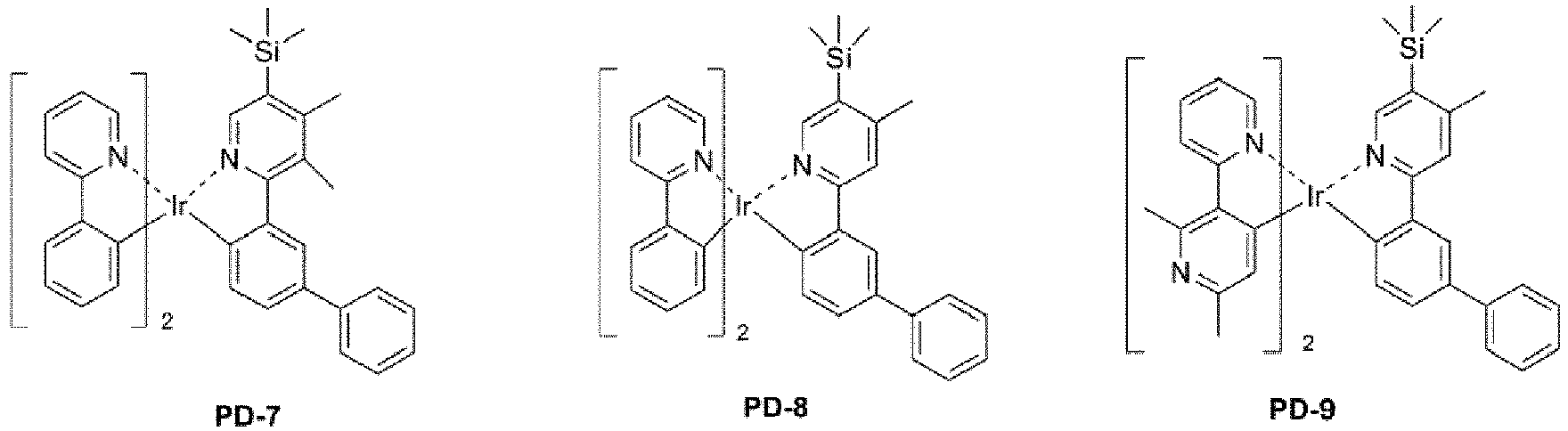


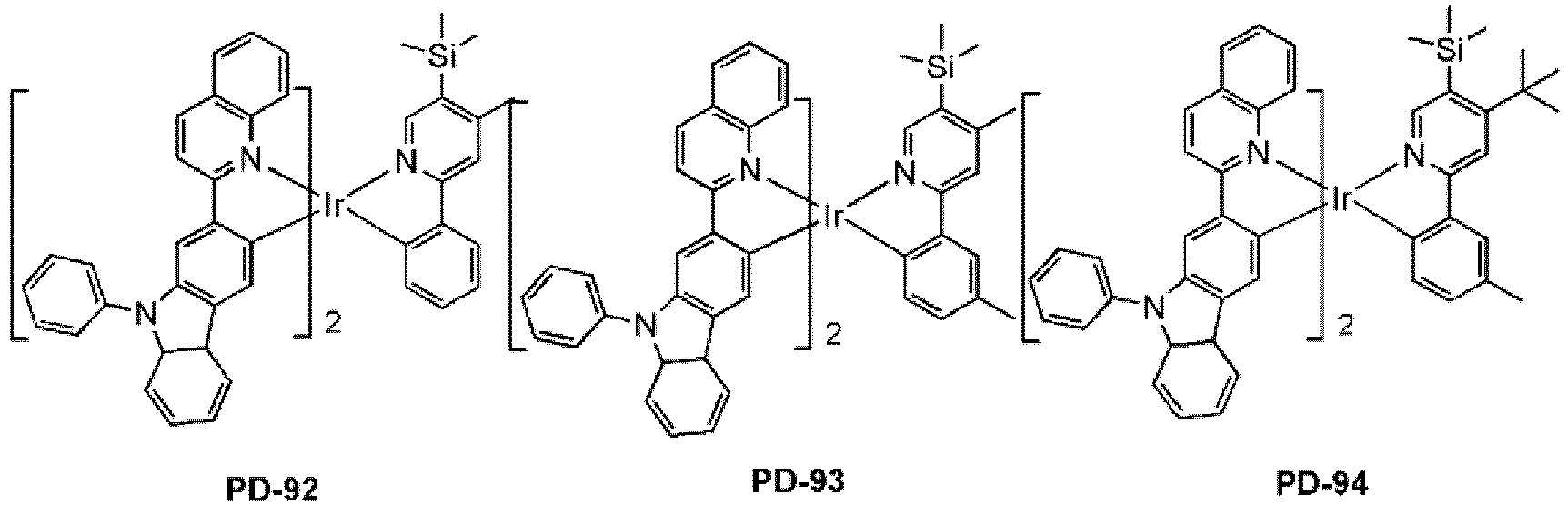


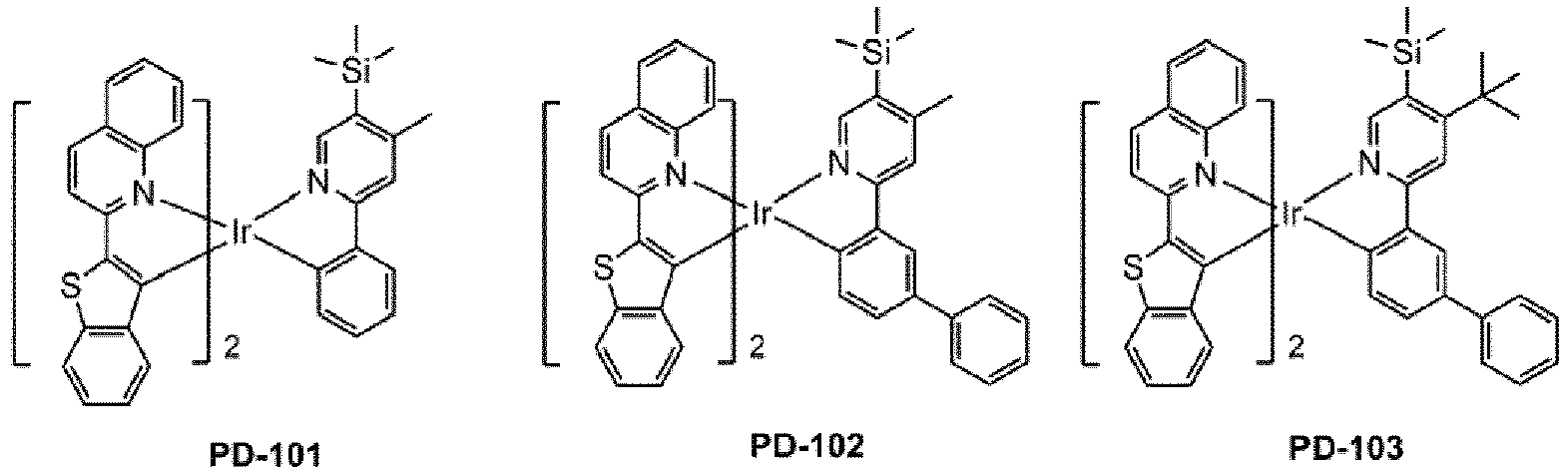


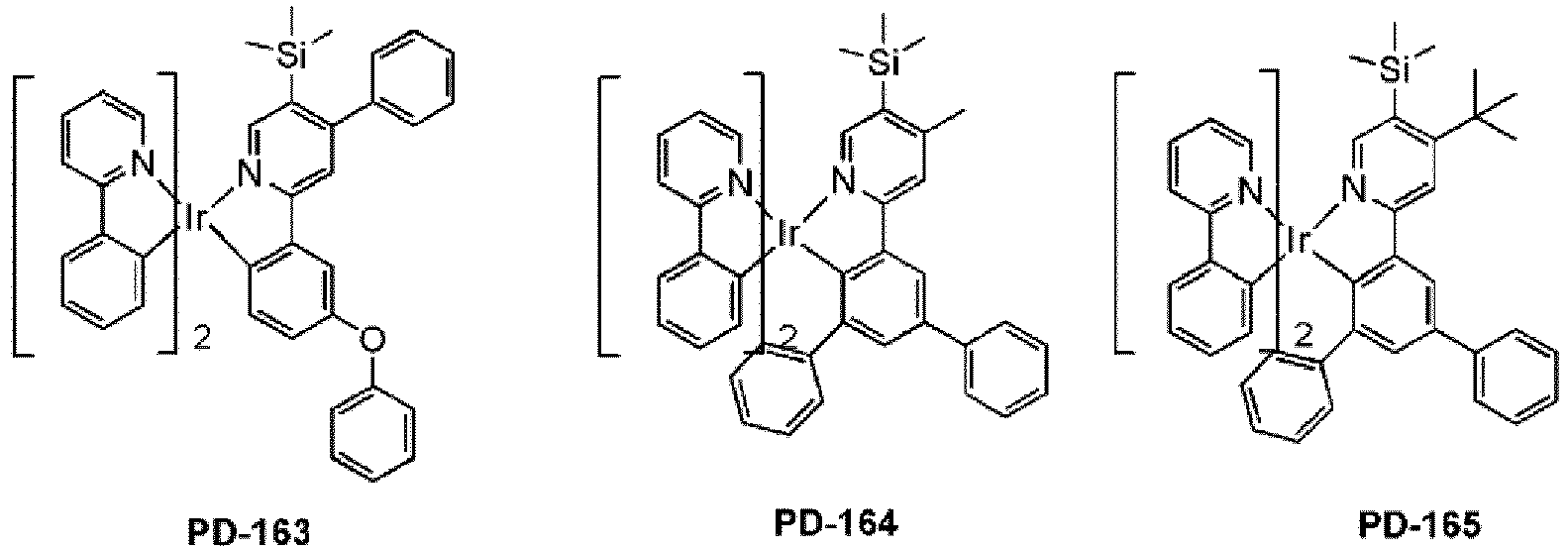


- Organische lichtemittierende Vorrichtung nach Anspruch 1, wobei
L21 bis L23 jeweils unabhängig ausgewählt sind aus einer Phenylengruppe, einer Pentalenylengruppe, einer Indenylengruppe, einer Naphthylengruppe, einer Azulenylengruppe, einer Heptalenylengruppe, einer Indacenylengruppe, einer Acenaphthylengruppe, einer Fluorenylengruppe, einer spiro-Fluorenylengruppe, einer Benzofluorenylengruppe, einer Dibenzofluorenylengruppe, einer Phenalenylengruppe, einer Phenanthrenylengruppe, einer Anthrazenylengruppe, einer Fluoranthenylengruppe, einer Triphenylenylengruppe, einer Pyrenylengruppe, einer Chrysenylengruppe, einer Napththacenylengruppe, einer Picenylengruppe, einer Perylenylengruppe, einer Pentaphenylengruppe, einer Hexacenylengruppe, einer Pentacenylengruppe, einer Rubicenylengruppe, einer Coronenylengruppe, einer Ovalenylengruppe, einer Pyrrolylengruppe, einer Thiophenylengruppe, einer Furanylengruppe, einer Imidazolylengruppe, einer Pyrazolylengruppe, einer Thiazolylengruppe, einer Isothiazolylengruppe, einer Oxazolylengruppe, einer Isoxazolylengruppe, einer Pyridinylengruppe, einer Pyrazinylengruppe, einer Pyrimidinylengruppe, einer Pyridazinylengruppe, einer Isoindolylengruppe, einer Indolylengruppe, einer Indazolylengruppe, einer Purinylengruppe, einer Chinolinylengruppe, einer Isochinolinylengruppe, einer Benzochinolinylengruppe, einer Phthalazinylengruppe, einer Naphthyridinylengruppe, einer Chinoxalinylengruppe, einer Chinazolinylengruppe, einer Cinnolinylengruppe, einer Carbazolylengruppe, einer Phenanthridinylengruppe, einer Acridinylengruppe, einer Phenanthrolinylengruppe, einer Phenazinylengruppe, einer Benzimidazolylengruppe, einer Benzofuranylengruppe, einer Benzothiophenylengruppe, einer Isobenzothiazolylengruppe, einer Benzoxazolylengruppe, einer Isobenzoxazolylengruppe, einer Triazolylengruppe, einer Tetrazolylengruppe, einer Oxadiazolylengruppe, einer Triazinylengruppe, einer Dibenzofuranylengruppe, einer Dibenzothiophenylengruppe, einer Benzocarbazolylengruppe und einer Dibenzocarbazolylengruppe; und
einer Phenylengruppe, einer Pentalenylengruppe, einer Indenylengruppe, einer Naphthylengruppe, einer Azulenylengruppe, einer Heptalenylengruppe, einer Indacenylengruppe, einer Acenaphthylengruppe, einer Fluorenylengruppe, einer spiro-Fluorenylengruppe, einer Benzofluorenylengruppe, einer Dibenzofluorenylengruppe, einer Phenalenylengruppe, einer Phenanthrenylengruppe, einer Anthrazenylengruppe, einer Fluoranthenylengruppe, einer Triphenylenylengruppe, einer Pyrenylengruppe, einer Chrysenylengruppe, einer Napththacenylengruppe, einer Picenylengruppe, einer Perylenylengruppe, einer Pentaphenylengruppe, einer Hexacenylengruppe, einer Pentacenylengruppe, einer Rubicenylengruppe, einer Coronenylengruppe, einer Ovalenylengruppe, einer Pyrrolylengruppe, einer Thiophenylengruppe, einer Furanylengruppe, einer Imidazolylengruppe, einer Pyrazolylengruppe, einer Thiazolylengruppe, einer Isothiazolylengruppe, einer Oxazolylengruppe, einer Isoxazolylengruppe, einer Pyridinylengruppe, einer Pyrazinylengruppe, einer Pyrimidinylengruppe, einer Pyridazinylengruppe, einer Isoindolylengruppe, einer Indolylengruppe, einer Indazolylengruppe, einer Purinylengruppe, einer Chinolinylengruppe, einer Isochinolinylengruppe, einer Benzochinolinylengruppe, einer Phthalazinylengruppe, einer Naphthyridinylengruppe, einer Chinoxalinylengruppe, einer Chinazolinylengruppe, einer Cinnolinylengruppe, einer Carbazolylengruppe, einer Phenanthridinylengruppe, einer Acridinylengruppe, einer Phenanthrolinylengruppe, einer Phenazinylengruppe, einer Benzimidazolylengruppe, einer Benzofuranylengruppe, einer Benzothiophenylengruppe, einer Isobenzothiazolylengruppe, einer Benzoxazolylengruppe, einer Isobenzoxazolylengruppe, einer Triazolylengruppe, einer Tetrazolylengruppe, einer Oxadiazolylengruppe, einer Triazinylengruppe, einer Dibenzofuranylengruppe, einer Dibenzothiophenylengruppe, einer Benzocarbazolylengruppe und einer Dibenzocarbazolylengruppe, jeweils substituiert mit zumindest einem ausgewählt aus Deuterium, -F, -Cl, - Br, -I, einer Hydroxylgruppe, einer Cyanogruppe, einer Nitrogruppe einer Aminogruppe, einer Amidinogruppe, einer Hydrazingruppe, einer Hydrazongruppe, einer Carbonsäure oder einem Salz davon, einer Sulfonsäure oder einem Salz davon, einer Phosphorsäure oder einem Salz davon, einer C1-C20 Alkylgruppe, einer C1-C20 Alkoxygruppe, einer Cyclopentylgruppe, einer Cyclohexylgruppe, einer Cycloheptylgruppe, einer Cyclopentenylgruppe, einer Cyclohexenylgruppe, einer Phenylgruppe, einer Pentalenylgruppe, einer Indenylgruppe, einer Napththylgruppe, einer Azulenylgruppe, einer Heptalenylgruppe, einer Indacenylgruppe, einer Acenaphthylgruppe, einer Fluorenylgruppe, einer spiro- Fluorenylgruppe, einer Benzofluorenylgruppe, einer Dibenzofluorenylgruppe, einer Phenalenylgruppe, einer Phenanthrenylgruppe, einer Anthrazenylgruppe, einer Fluoranthenylgruppe, einer Triphenylenylgruppe, einer Pyrenylgruppe, einer Chrysenylgruppe, einer Napththacenylgruppe, einer Picenylgruppe, einer Perylenylgruppe, einer Pentaphenylgruppe, einer Hexacenylgruppe, einer Pentacenylgruppe, einer Rubicenylgruppe, einer Coronenylgruppe, einer Ovalenylgruppe, einer Pyrrolylgruppe, einer Thiophenylgruppe, einer Furanylgruppe, einer Imidazolylgruppe, einer Pyrazolylgruppe, einer Thiazolylgruppe, einer Isothiazolylgruppe, einer Oxazolylgruppe, einer Isoxazolylgruppe, einer Pyridinylgruppe, einer Pyrazinylgruppe, einer Pyrimidinylgruppe, einer Pyridazinylgruppe, einer Isoindolylgruppe, einer Indolylgruppe, einer Indazolylgruppe, einer Purinylgruppe, einer Chinolinylgruppe, einer Isochinolinylgruppe, einer Benzochinolinylgruppe, einer Phthalazinylgruppe, einer Naphthyridinylgruppe, einer Chinoxalinylgruppe, einer Chinazolinylgruppe, einer Cinnolinylgruppe, einer Carbazolylgruppe, einer Phenanthridinylgruppe, einer Acridinylgruppe, einer Phenanthrolinylgruppe, einer Phenazinylgruppe, einer Benzimidazolylgruppe, einer Benzofuranylgruppe, einer Benzothiophenylgruppe, einer Isobenzothiazolylgruppe, einer Benzoxazolylgruppe, einer Isobenzoxazolylgruppe, einer Triazolylgruppe, einer Tetrazolylgruppe, einer Oxadiazolylgruppe, einer Triazinylgruppe, einer Dibenzofuranylgruppe, einer Dibenzothiophenylgruppe, einer Benzocarbazolylgruppe, einer Dibenzocarbazolylgruppe einer Thiadiazolylgruppe und einer Imidazopyridinylgruppe. - Organische lichtemittierende Vorrichtung nach Anspruch 1, wobei
L21 bis L23 jeweils unabhängig durch eine von Formeln 3-1 bis 3-21 dargestellt sind: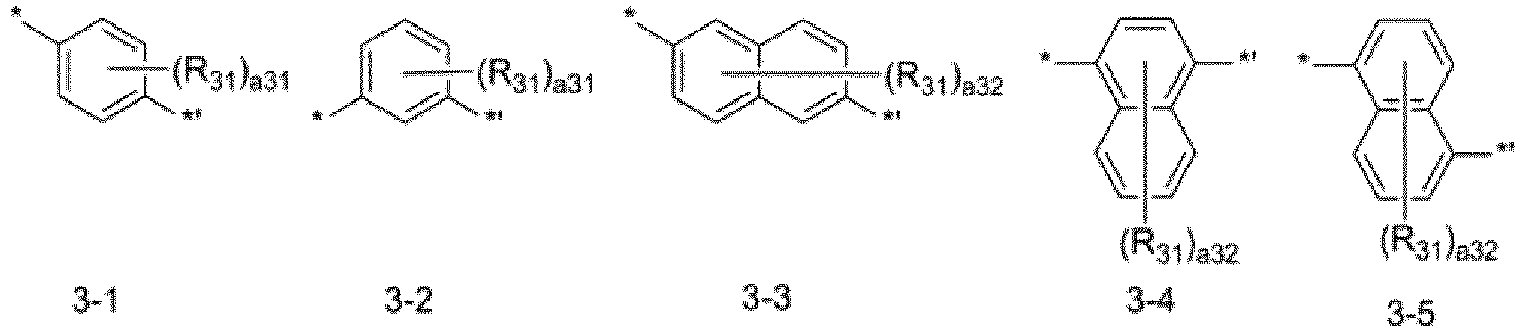


 Y31 ausgewählt ist aus C(R33)(R34), N(R33), O, S und Si(R33)(R34);R31 bis R34 jeweils unabhängig ausgewählt sind aus Wasserstoff, Deuterium, -F, -Cl, -Br, -I, einer Hydroxylgruppe, einer Cyanogruppe, einer Nitrogruppe einer Aminogruppe, einer Amidinogruppe, einer Hydrazingruppe, einer Hydrazongruppe, einer Carbonsäure oder einem Salz davon, einer Sulfonsäure oder einem Salz davon, einer Phosphorsäure oder einem Salz davon, einer C1-C20 Alkylgruppe, einer C1-C20 Alkoxygruppe, einer Phenylgruppe, einer Naphthylgruppe, einer Fluorenylgruppe, einer spiro-Fluorenylgruppe, einer Benzofluorenylgruppe, einer Dibenzofluorenylgruppe, einer Phenanthrenylgruppe, einer Anthracenylgruppe, einer Pyrenylgruppe, einer Chrysenylgruppe, einer Pyridinylgruppe, einer Pyrazinylgruppe, einer Pyrimidinylgruppe, einer Pyridazinylgruppe, einer Chinolinylgruppe, einer Isochinolinylgruppe, einer Chinoxalinylgruppe, einer Chinazolinylgruppe, einer Carbazolylgruppe und einer Triazinylgruppe;a31 ausgewählt ist aus 1, 2, 3 und 4;a32 ausgewählt ist aus 1, 2, 3, 4, 5 und 6;a33 ausgewählt ist aus 1, 2, 3, 4, 5, 6, 7 und 8;a34 ausgewählt ist aus 1, 2, 3, 4 und 5;a35 ausgewählt ist aus 1, 2 und 3;a36 ausgewählt ist aus 1 und 2; undjedes von * und *' eine Bindungsstelle an eine benachbarte Stelle angibt.
 - Organische lichtemittierende Vorrichtung nach Anspruch 1, wobei
R21 und R22 jeweils unabhängig ausgewählt sind aus einer Phenylgruppe, einer Pentalenylgruppe, einer Indenylgruppe, einer Napththylgruppe, einer Azulenylgruppe, einer Heptalenylgruppe, einer Indacenylgruppe, einer Acenaphthylgruppe, einer Fluorenylgruppe, einer spiro- Fluorenylgruppe, einer Benzofluorenylgruppe, einer Dibenzofluorenylgruppe, einer Phenalenylgruppe, einer Phenanthrenylgruppe, einer Anthrazenylgruppe, einer Fluoranthenylgruppe, einer Triphenylenylgruppe, einer Pyrenylgruppe, einer Chrysenylgruppe, einer Napththacenylgruppe, einer Picenylgruppe, einer Perylenylgruppe, einer Pentaphenylgruppe, einer Hexacenylgruppe, einer Pentacenylgruppe, einer Rubicenylgruppe, einer Coronenylgruppe, einer Ovalenylgruppe, einer Pyrrolylgruppe, einer Thiophenylgruppe, einer Furanylgruppe, einer Imidazolylgruppe, einer Pyrazolylgruppe, einer Thiazolylgruppe, einer Isothiazolylgruppe, einer Oxazolylgruppe, einer Isoxazolylgruppe, einer Pyridinylgruppe, einer Pyrazinylgruppe, einer Pyrimidinylgruppe, einer Pyridazinylgruppe, einer Isoindolylgruppe, einer Indolylgruppe, einer Indazolylgruppe, einer Purinylgruppe, einer Chinolinylgruppe, einer Isochinolinylgruppe, einer Carbazolylgruppe, einer Benzochinolinylgruppe, einer Phthalazinylgruppe, einer Naphthyridinylgruppe, einer Chinoxalinylgruppe, einer Benzochinoxalinylgruppe, einer Chinazolinylgruppe, einer Benzochinazolinylgruppe, einer Cinnolinylgruppe, einer Phenanthridinylgruppe, einer Acridinylgruppe, einer Phenanthrolinylgruppe, einer Phenazinylgruppe, einer Benzimidazolylgruppe, einer Benzofuranylgruppe, einer Benzothiophenylgruppe, einer Isobenzothiazolylgruppe, einer Benzoxazolylgruppe, einer Isobenzoxazolylgruppe, einer Triazolylgruppe, einer Tetrazolylgruppe, einer Oxadiazolylgruppe, einer Triazinylgruppe, einer Dibenzofuranylgruppe, einer Dibenzothiophenylgruppe, einer Dibenzosilolylgruppe, einer Benzocarbazolylgruppe, einer Dibenzocarbazolylgruppe einer Thiadiazolylgruppe, einer Imidazopyridinylgruppe und einer Imidazopyrimidinylgruppe; und
einer Phenylgruppe, einer Pentalenylgruppe, einer Indenylgruppe, einer Napththylgruppe, einer Azulenylgruppe, einer Heptalenylgruppe, einer Indacenylgruppe, einer Acenaphthylgruppe, einer Fluorenylgruppe, einer spiro- Fluorenylgruppe, einer Benzofluorenylgruppe, einer Dibenzofluorenylgruppe, einer Phenalenylgruppe, einer Phenanthrenylgruppe, einer Anthrazenylgruppe, einer Fluoranthenylgruppe, einer Triphenylenylgruppe, einer Pyrenylgruppe, einer Chrysenylgruppe, einer Napththacenylgruppe, einer Picenylgruppe, einer Perylenylgruppe, einer Pentaphenylgruppe, einer Hexacenylgruppe, einer Pentacenylgruppe, einer Rubicenylgruppe, einer Coronenylgruppe, einer Ovalenylgruppe, einer Pyrrolylgruppe, einer Thiophenylgruppe, einer Furanylgruppe, einer Imidazolylgruppe, einer Pyrazolylgruppe, einer Thiazolylgruppe, einer Isothiazolylgruppe, einer Oxazolylgruppe, einer Isoxazolylgruppe, einer Pyridinylgruppe, einer Pyrazinylgruppe, einer Pyrimidinylgruppe, einer Pyridazinylgruppe, einer Isoindolylgruppe, einer Indolylgruppe, einer Indazolylgruppe, einer Purinylgruppe, einer Chinolinylgruppe, einer Isochinolinylgruppe, einer Carbazolylgruppe, einer Benzochinolinylgruppe, einer Phthalazinylgruppe, einer Naphthyridinylgruppe, einer Chinoxalinylgruppe, einer Benzochinoxalinylgruppe, einer Chinazolinylgruppe, einer Benzochinazolinylgruppe, einer Cinnolinylgruppe, einer Phenanthridinylgruppe, einer Acridinylgruppe, einer Phenanthrolinylgruppe, einer Phenazinylgruppe, einer Benzimidazolylgruppe, einer Benzofuranylgruppe, einer Benzothiophenylgruppe, einer Isobenzothiazolylgruppe, einer Benzoxazolylgruppe, einer Isobenzoxazolylgruppe, einer Triazolylgruppe, einer Tetrazolylgruppe, einer Oxadiazolylgruppe, einer Triazinylgruppe, einer Dibenzofuranylgruppe, einer Dibenzothiophenylgruppe, einer Dibenzosilolylgruppe, einer Benzocarbazolylgruppe, einer Dibenzocarbazolylgruppe einer Thiadiazolylgruppe, einer Imidazopyridinylgruppe und einer Imidazopyrimidinylgruppe, jeweils substituiert mit zumindest einem ausgewählt sind aus Deuterium, -F,-Cl, -Br, -I, einer Hydroxylgruppe, einer Cyanogruppe, einer Nitrogruppe einer Aminogruppe, einer Amidinogruppe, einer Hydrazingruppe, einer Hydrazongruppe, einer Carbonsäure oder einem Salz davon, einer Sulfonsäure oder einem Salz davon, einer Phosphorsäure oder einem Salz davon, einer C1-C20 Alkylgruppe, einer C1-C20 Alkoxygruppe, einer Phenylgruppe, einer Biphenylgruppe, einer Pentalenylgruppe, einer Indenylgruppe, einer Napththylgruppe, einer Azulenylgruppe, einer Heptalenylgruppe, einer Indacenylgruppe, einer Acenaphthylgruppe, einer Fluorenylgruppe, einer spiro-Fluorenylgruppe, einer Benzofluorenylgruppe, einer Dibenzofluorenylgruppe, einer Phenalenylgruppe, einer Phenanthrenylgruppe, einer Anthrazenylgruppe, einer Fluoranthenylgruppe, einer Triphenylenylgruppe, einer Pyrenylgruppe, einer Chrysenylgruppe, einer Napththacenylgruppe, einer Picenylgruppe, einer Perylenylgruppe, einer Pentaphenylgruppe, einer Hexacenylgruppe, einer Pentacenylgruppe, einer Rubicenylgruppe, einer Coronenylgruppe, einer Ovalenylgruppe, einer Pyrrolylgruppe, einer Thiophenylgruppe, einer Furanylgruppe, einer Imidazolylgruppe, einer Pyrazolylgruppe, einer Thiazolylgruppe, einer Isothiazolylgruppe, einer Oxazolylgruppe, einer Isoxazolylgruppe, einer Pyridinylgruppe, einer Pyrazinylgruppe, einer Pyrimidinylgruppe, einer Pyridazinylgruppe, einer Isoindolylgruppe, einer Indolylgruppe, einer Indazolylgruppe, einer Purinylgruppe, einer Chinolinylgruppe, einer Isochinolinylgruppe, einer Carbazolylgruppe, einer Benzochinolinylgruppe, einer Phthalazinylgruppe, einer Naphthyridinylgruppe, einer Chinoxalinylgruppe, einer Benzochinoxalinylgruppe, einer Chinazolinylgruppe, einer Benzochinazolinylgruppe, einer Cinnolinylgruppe, einer Carbazolylgruppe, einer Phenanthridinylgruppe, einer Acridinylgruppe, einer Phenanthrolinylgruppe, einer Phenazinylgruppe, einer Benzimidazolylgruppe, einer Benzofuranylgruppe, einer Benzothiophenylgruppe, einer Isobenzothiazolylgruppe, einer Benzoxazolylgruppe, einer Isobenzoxazolylgruppe, einer Triazolylgruppe, einer Tetrazolylgruppe, einer Oxadiazolylgruppe, einer Triazinylgruppe, einer Dibenzofuranylgruppe, einer Dibenzothiophenylgruppe, einer Benzocarbazolylgruppe, einer Dibenzocarbazolylgruppe einer Thiadiazolylgruppe, einer Imidazopyridinylgruppe und einer Imidazopyrimidinylgruppe. - Organische lichtemittierende Vorrichtung nach Anspruch 1, wobei
R21 und R22 jeweils unabhängig ausgewählt sind aus Gruppen, die durch Formeln 5-1 bis 5-14 dargestellt sind:


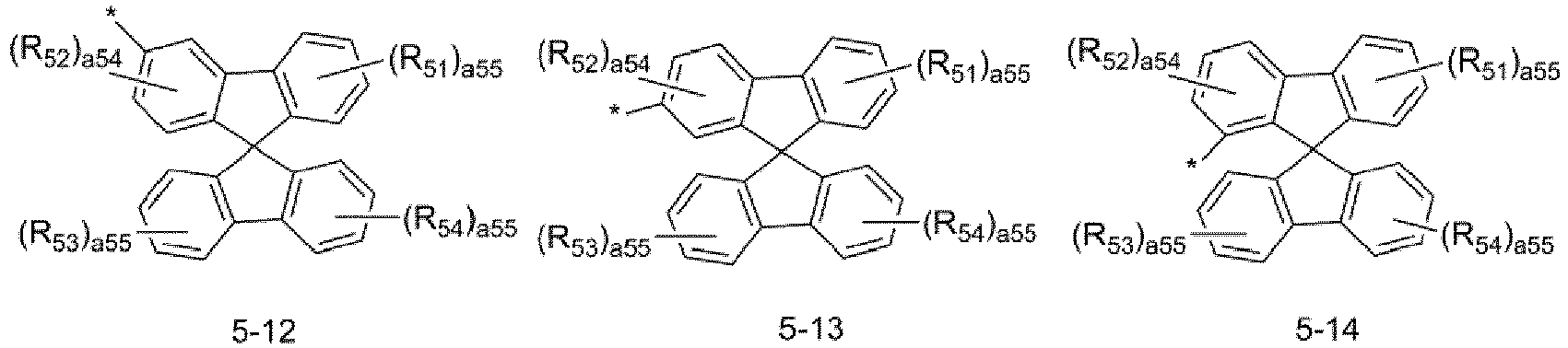 Y51 ausgewählt ist aus C(R53)(R54), N(R53), O und S;R51 bis R54 jeweils unabhängig ausgewählt sind aus Wasserstoff, Deuterium, -F, -Cl, -Br, -I, einer Hydroxylgruppe, einer Cyanogruppe, einer Nitrogruppe einer Aminogruppe, einer Amidinogruppe, einer Hydrazingruppe, einer Hydrazongruppe, einer Carbonsäure oder einem Salz davon, einer Sulfonsäure oder einem Salz davon, einer Phosphorsäure oder einem Salz davon, einer C1-C20 Alkylgruppe, -CD3, -CF3, einer C1-C20 Alkoxygruppe, einer Phenylgruppe, einer Naphthylgruppe, einer Fluorenylgruppe, einer spiro-Fluorenylengruppe, einer Benzofluorenylengruppe, einer Dibenzofluorenylengruppe, einer Phenanthrenylgruppe, einer Anthracenylgruppe, einer Pyrenylgruppe, einer Chrysenylgruppe, einer Pyridinylgruppe, einer Pyrazinylgruppe, einer Pyrimidinylgruppe, einer Pyridazinylgruppe, einer Chinolinylgruppe, einer Isochinolinylgruppe, einer Chinoxalinylgruppe, einer Chinazolinylgruppe, einer Carbazolylgruppe und einer Triazinylgruppe;a51 ausgewählt ist aus 1, 2, 3, 4 und 5;a52 ausgewählt ist aus 1, 2, 3, 4, 5, 6 und 7;a53 ausgewählt ist aus 1, 2, 3, 4, 5 und 6;a54 ausgewählt ist aus 1, 2 und 3;a55 ausgewählt ist aus 1, 2, 4 und 4; und* eine Bindungsstelle an eine benachbarte Stelle angibt.
 - Organische lichtemittierende Vorrichtung nach Anspruch 1, wobei
R21 und R22 jeweils unabhängig ausgewählt sind aus Gruppen, die durch Formeln 6-1 bis 6-55 dargestellt sind: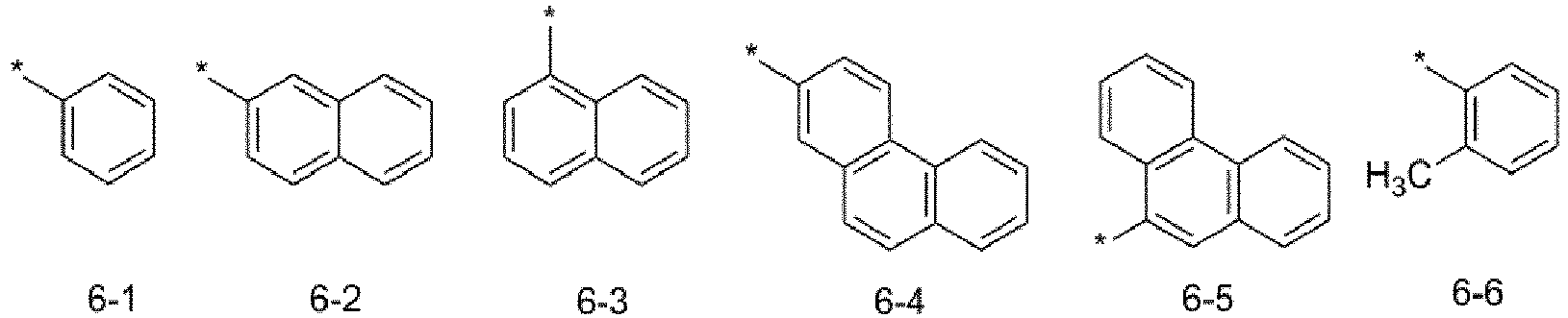


* eine Bindungsstelle an eine benachbarte Stelle angibt. - Organische lichtemittierende Vorrichtung nach Anspruch 1, wobei
R81 bis R96 jeweils unabhängig ausgewählt sind aus


* eine Bindungsstelle an eine benachbarte Stelle angibt. - Organische lichtemittierende Vorrichtung nach Anspruch 1, wobei
die Verbindung auf Aminbasis durch eine von Formeln 2-1 bis 2-6 dargestellt ist:


 L21 bis L23, R21, R22 und R81 bis R96 dieselben wie in Anspruch 1 beschrieben sind;L24 bis L32 jeweils unabhängig dieselben wie in Verbindung mit L21 beschrieben sind; undR23 und R28 jeweils unabhängig dieselben wie in Verbindung mit R21 beschrieben sind.
 - Organische lichtemittierende Vorrichtung nach Anspruch 1, wobei die Verbindung auf Aminbasis aus Verbindungen ausgewählt ist, die in der Folge dargestellt sind.

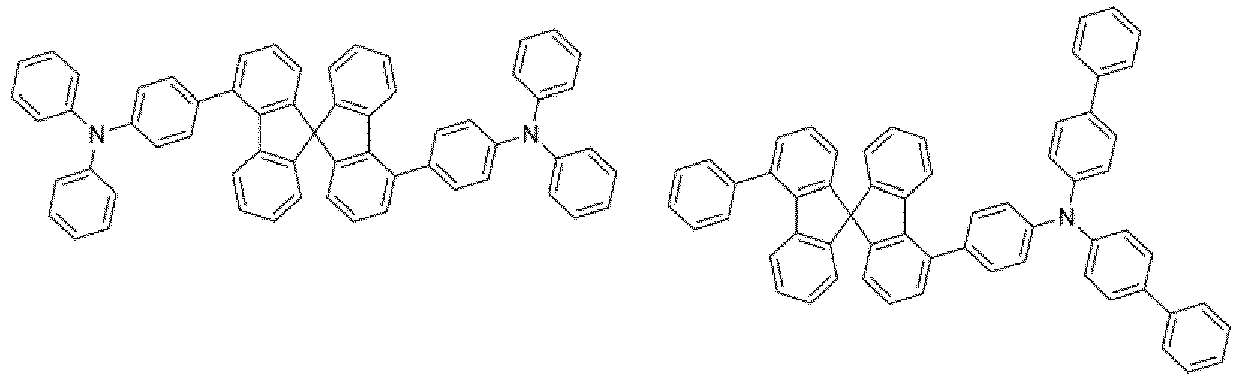


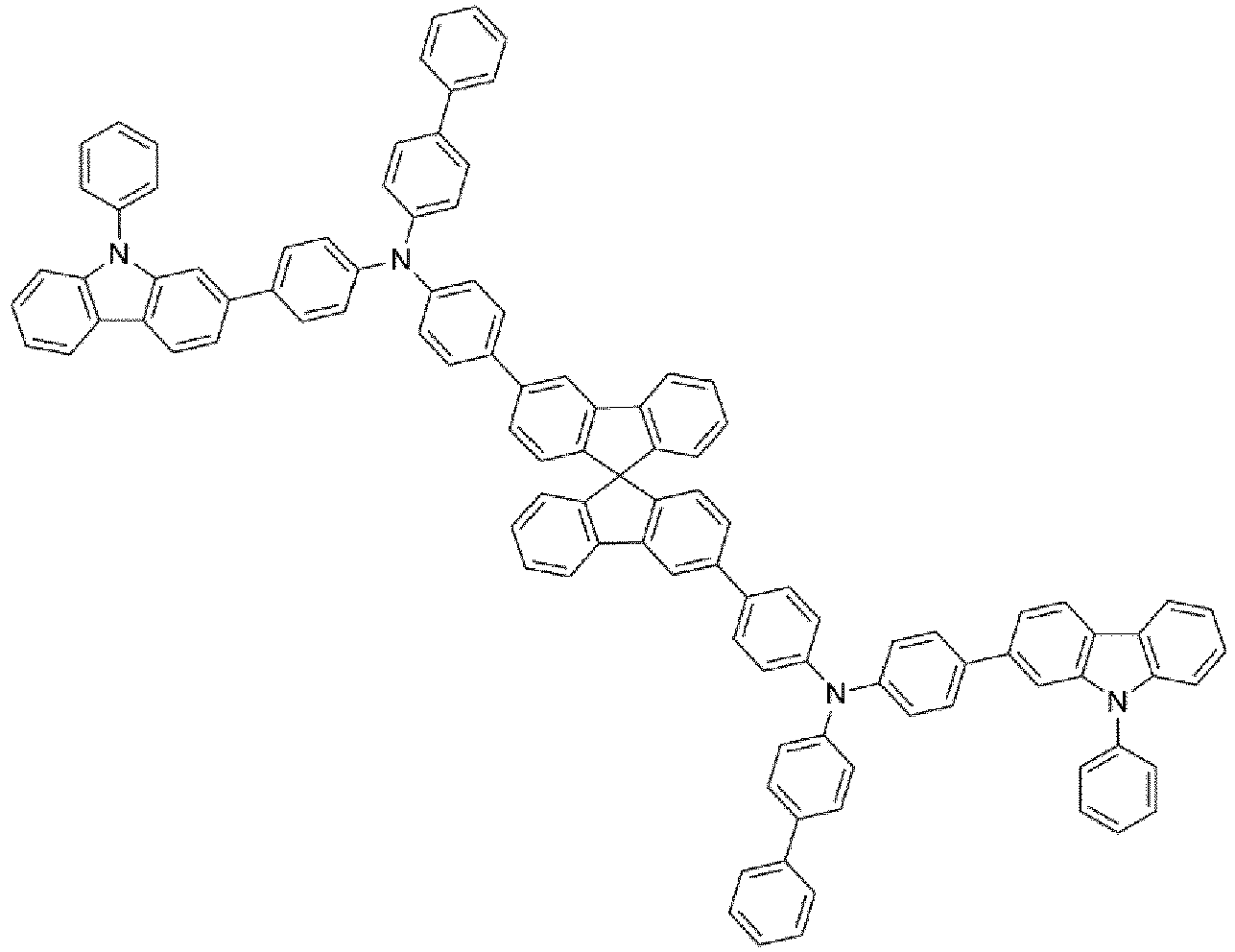

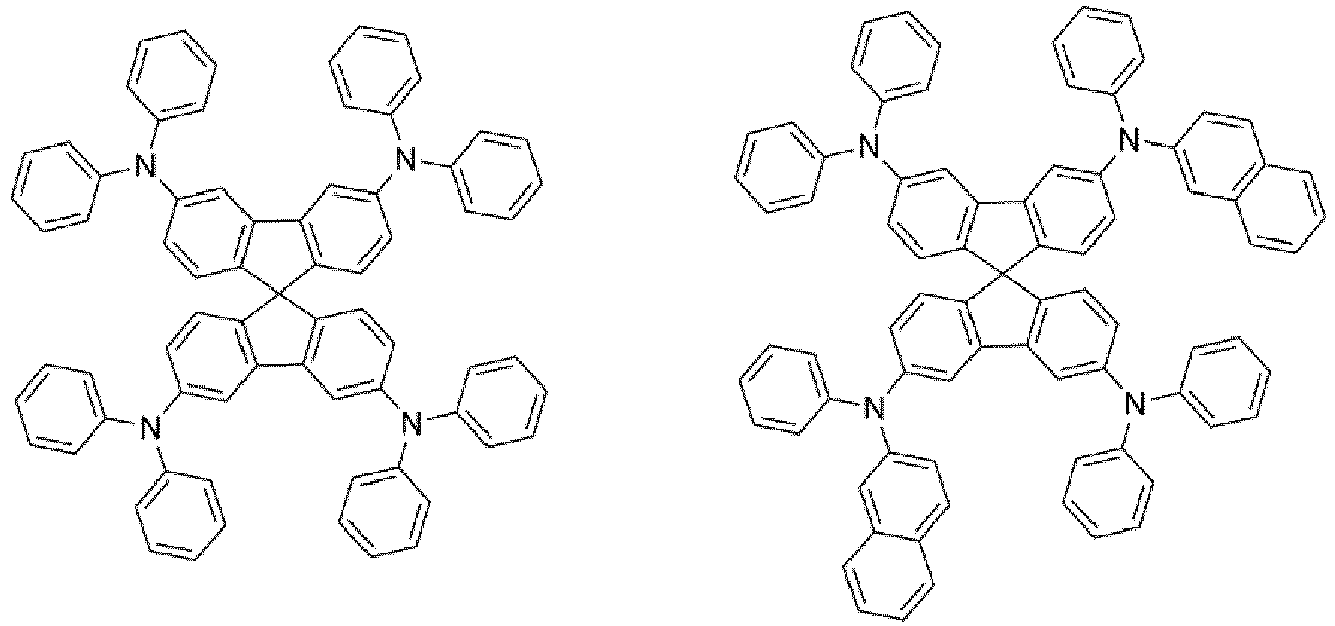


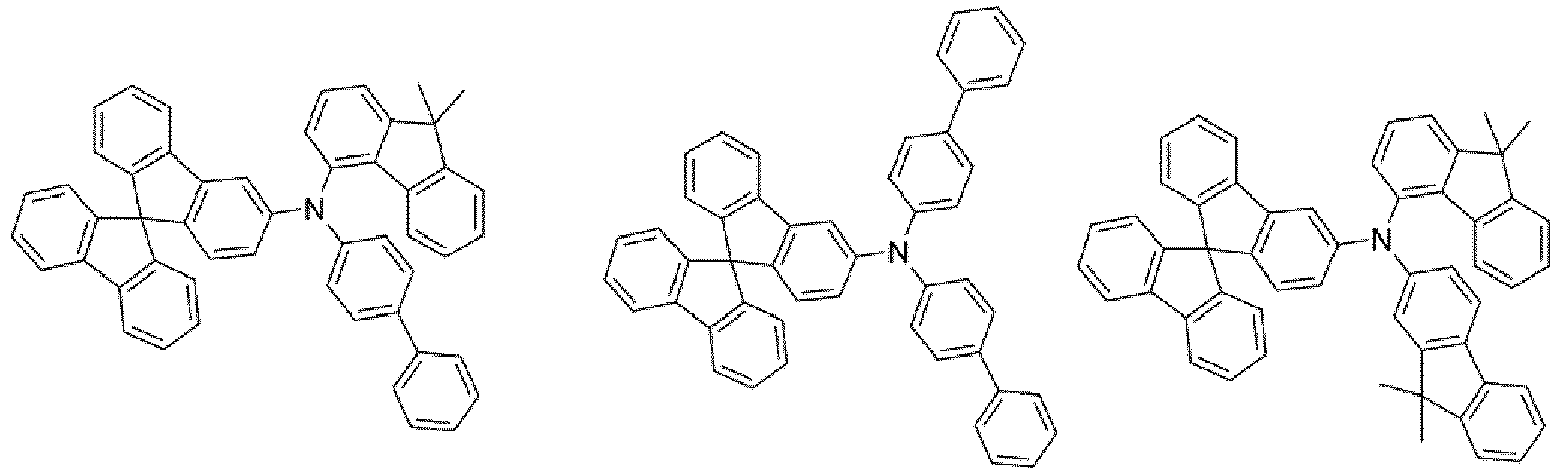


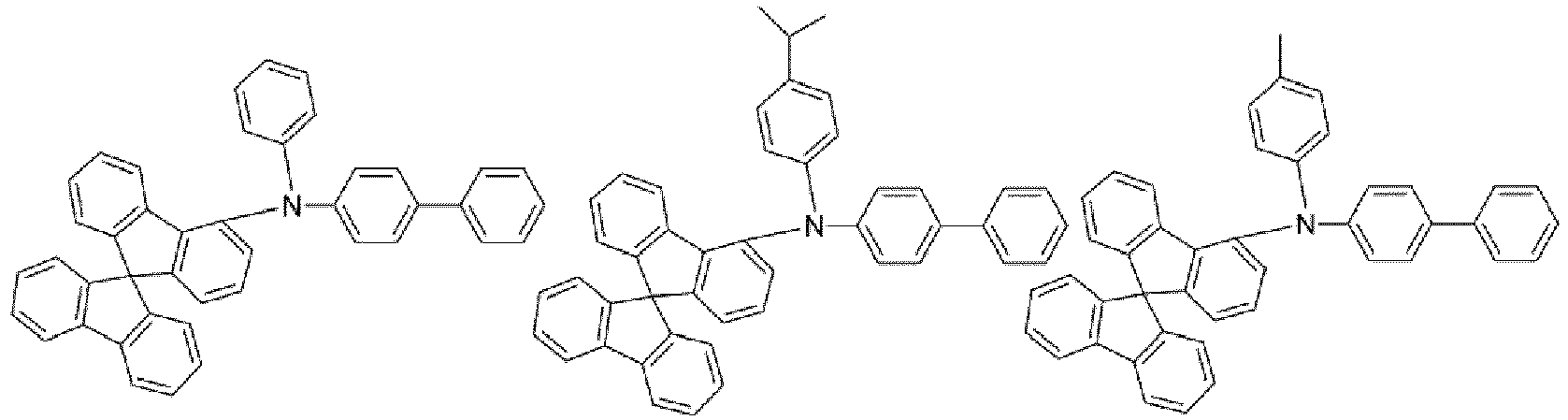


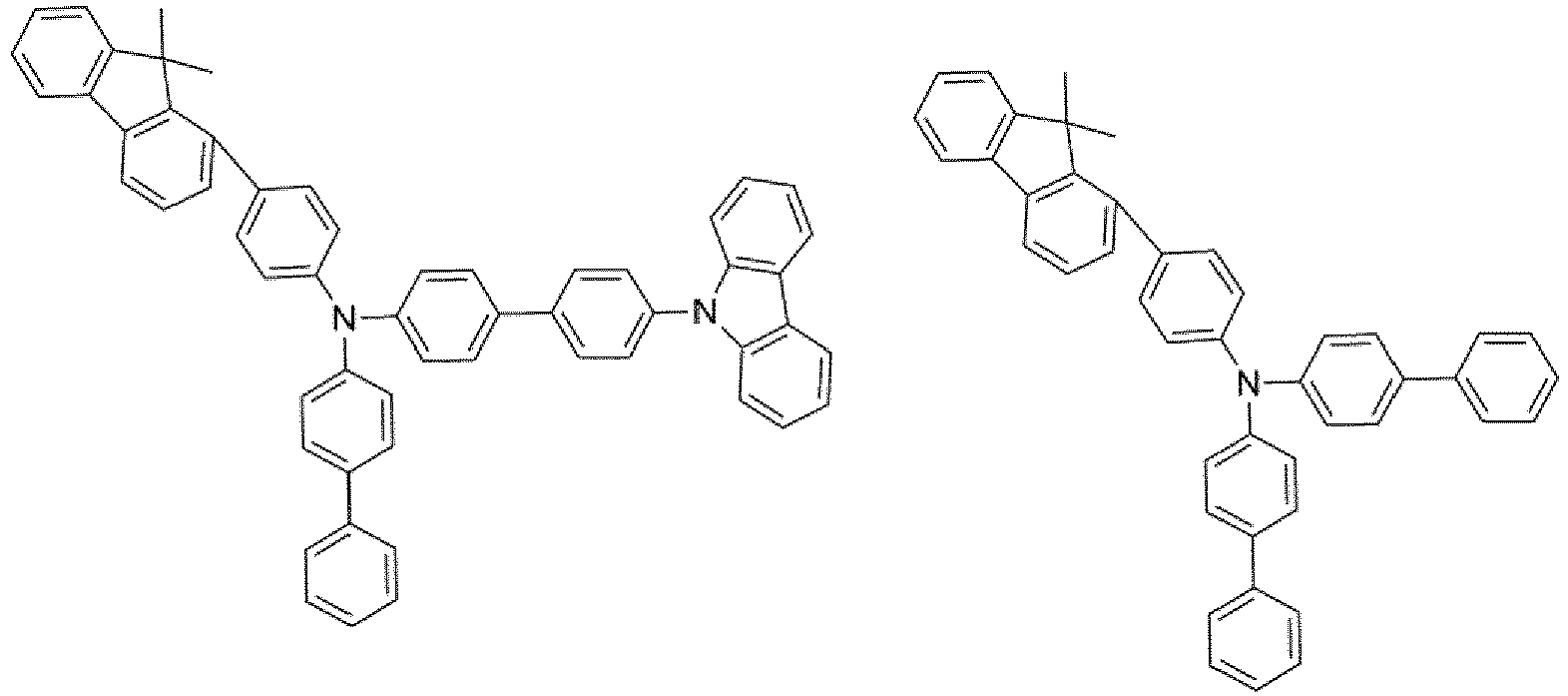
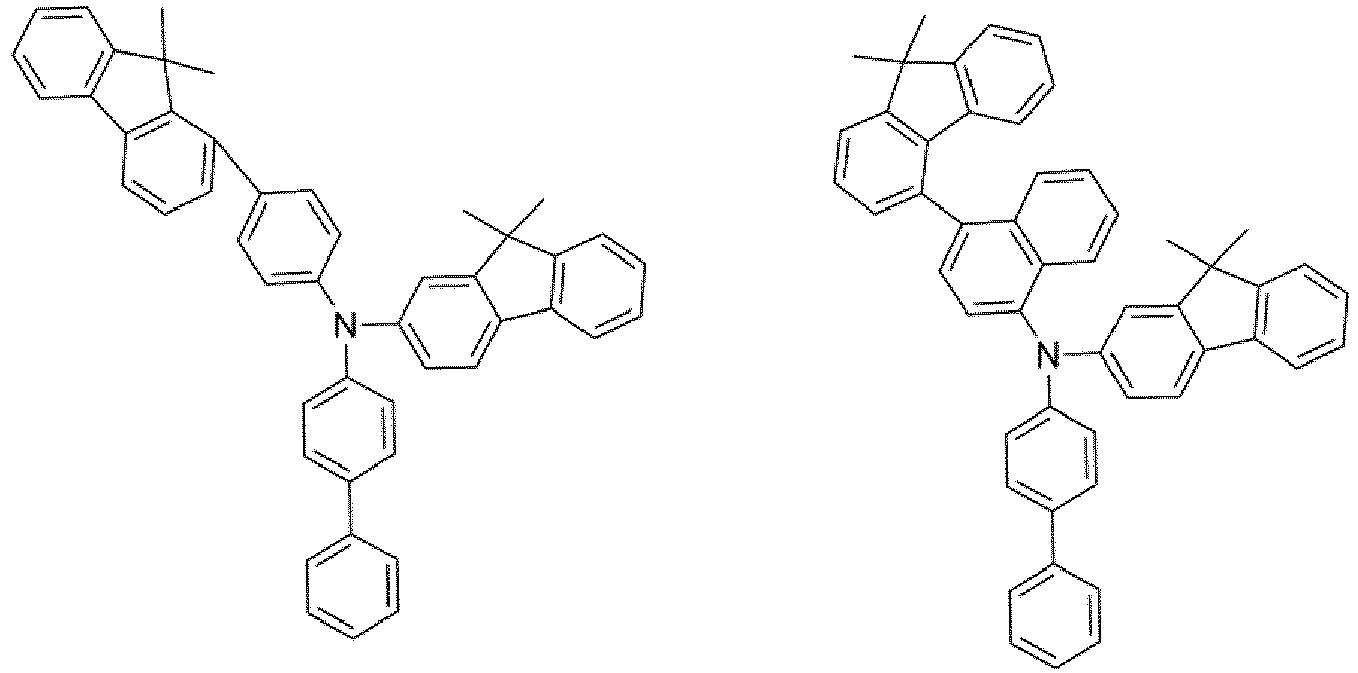


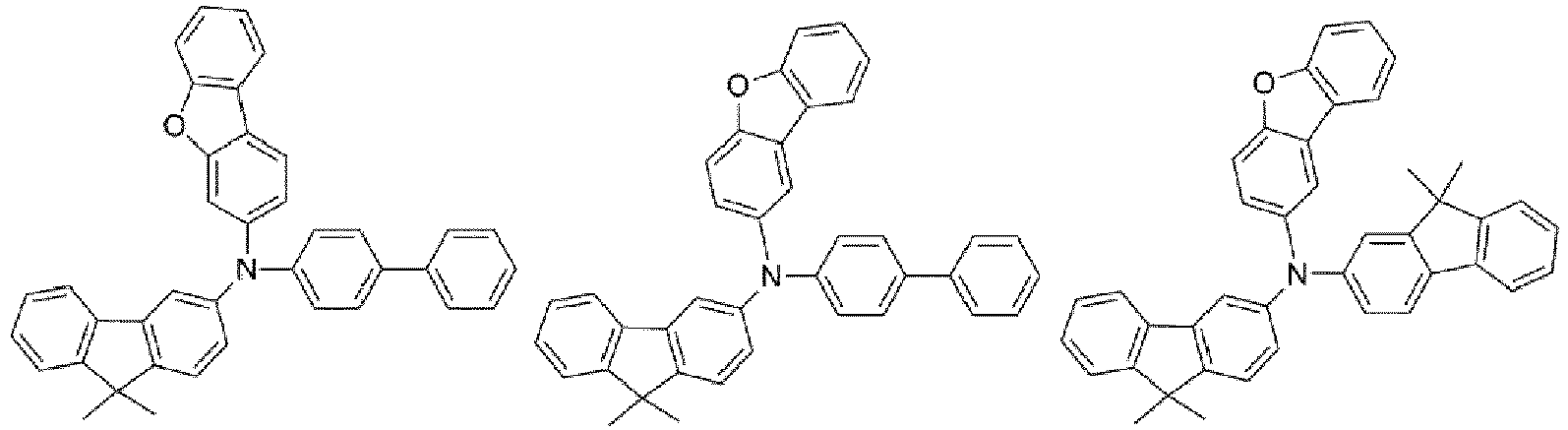


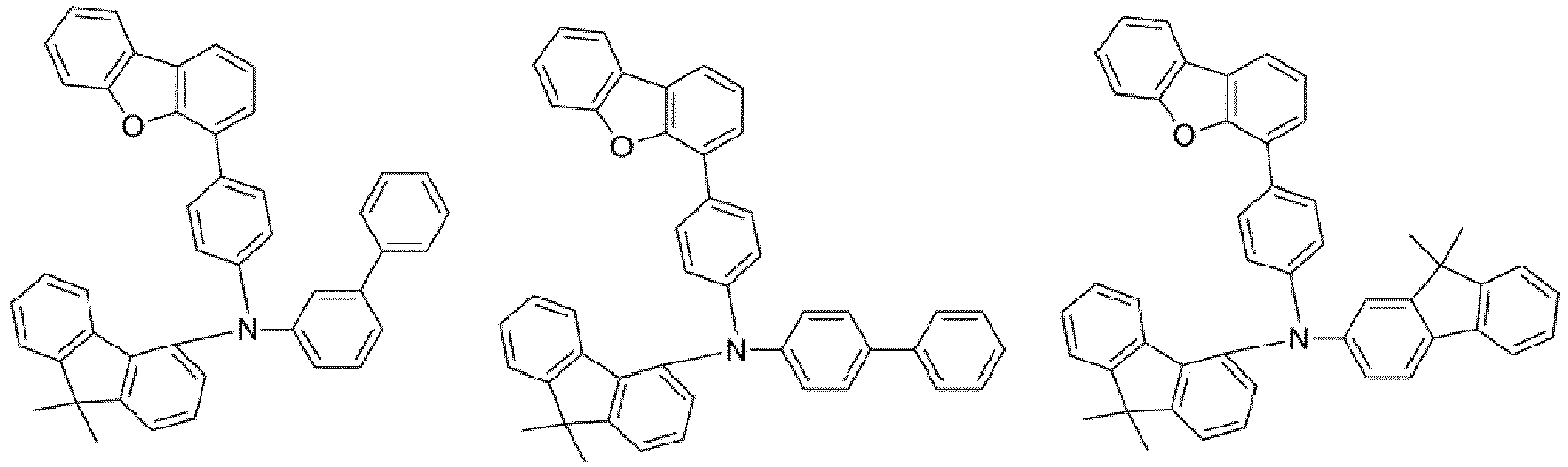


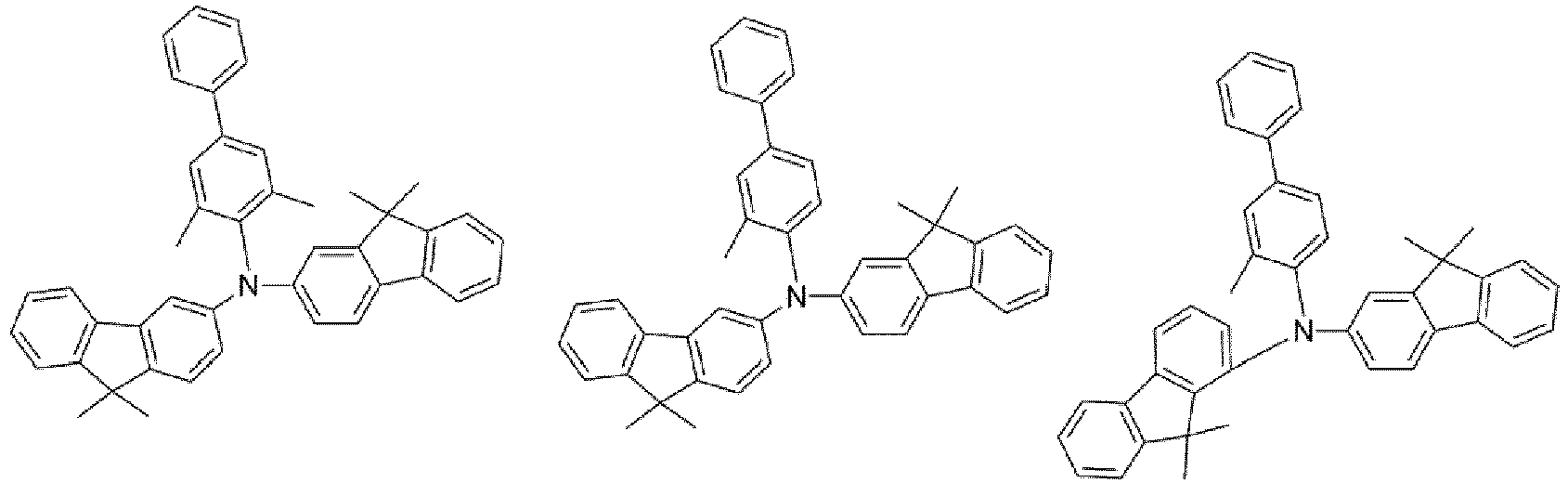


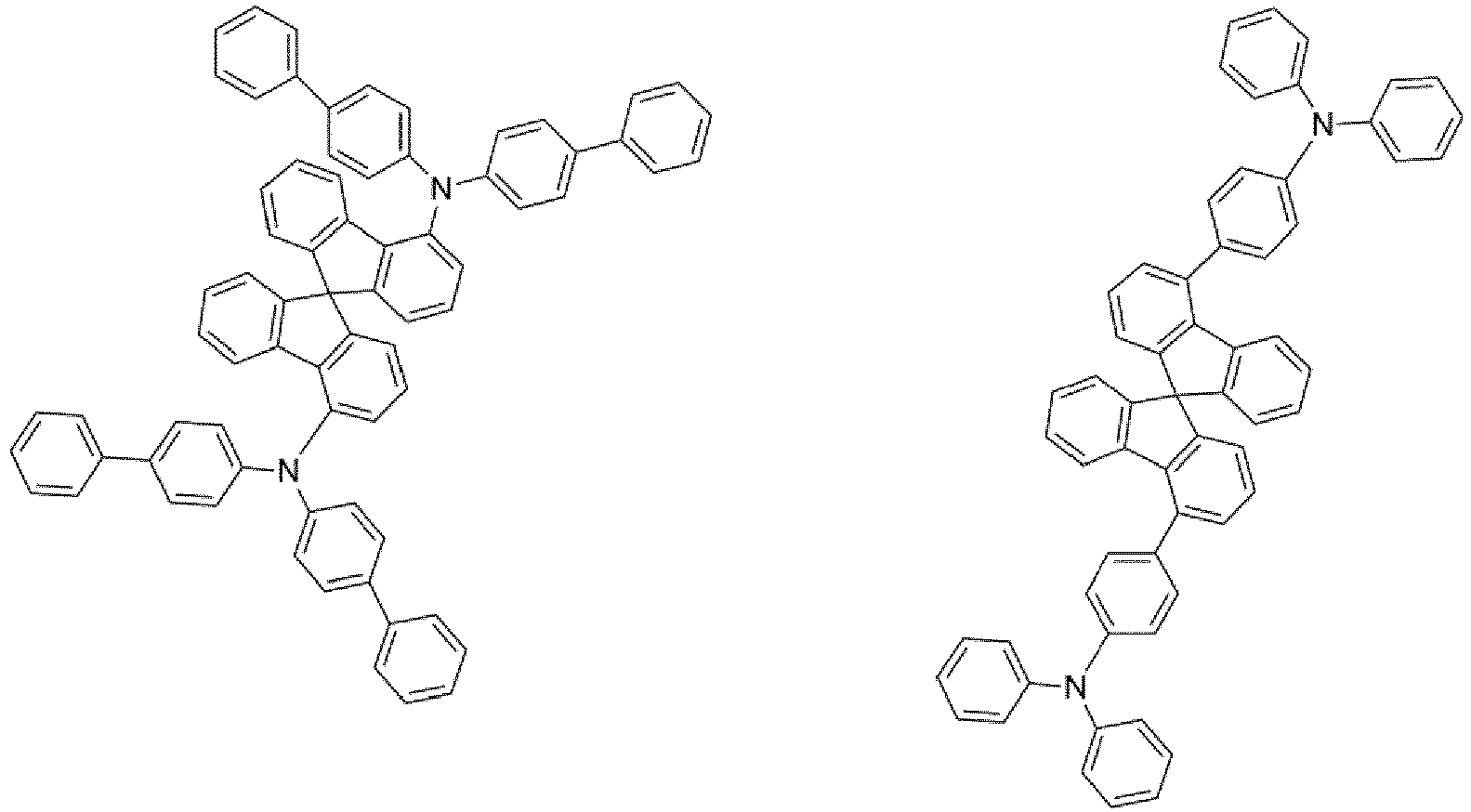

- Organische lichtemittierende Vorrichtung nach Anspruch 1, wobei
die Lochtransportregion eine Hilfsschicht umfasst, die die Verbindung auf Aminbasis umfasst. - Organische lichtemittierende Vorrichtung nach Anspruch 1, wobei
sich die Emissionsschicht neben der Hilfsschicht befindet.
Applications Claiming Priority (1)
| Application Number | Priority Date | Filing Date | Title |
|---|---|---|---|
| KR1020140141197A KR102343144B1 (ko) | 2014-10-17 | 2014-10-17 | 유기 발광 소자 |
Publications (2)
| Publication Number | Publication Date |
|---|---|
| EP3010066A1 EP3010066A1 (de) | 2016-04-20 |
| EP3010066B1 true EP3010066B1 (de) | 2019-02-27 |
Family
ID=54849750
Family Applications (1)
| Application Number | Title | Priority Date | Filing Date |
|---|---|---|---|
| EP15190327.5A Active EP3010066B1 (de) | 2014-10-17 | 2015-10-19 | Organische lichtemittierende vorrichtung |
Country Status (4)
| Country | Link |
|---|---|
| US (1) | US20160111644A1 (de) |
| EP (1) | EP3010066B1 (de) |
| KR (1) | KR102343144B1 (de) |
| CN (1) | CN105529400B (de) |
Cited By (1)
| Publication number | Priority date | Publication date | Assignee | Title |
|---|---|---|---|---|
| WO2020262507A1 (ja) | 2019-06-28 | 2020-12-30 | 出光興産株式会社 | 化合物、有機エレクトロルミネッセンス素子用材料、有機エレクトロルミネッセンス素子及び電子機器 |
Families Citing this family (42)
| Publication number | Priority date | Publication date | Assignee | Title |
|---|---|---|---|---|
| JP6674734B2 (ja) * | 2014-10-29 | 2020-04-01 | 三星ディスプレイ株式會社Samsung Display Co.,Ltd. | 有機エレクトロルミネッセンス素子用材料及びそれを用いた有機エレクトロルミネッセンス素子 |
| KR102344883B1 (ko) * | 2014-12-17 | 2021-12-29 | 삼성전자주식회사 | 유기금속 화합물 및 이를 포함한 유기 발광 소자 |
| JP6735743B2 (ja) * | 2015-06-11 | 2020-08-05 | 保土谷化学工業株式会社 | アリールアミン化合物および有機エレクトロルミネッセンス素子 |
| KR102660538B1 (ko) * | 2015-07-22 | 2024-04-24 | 메르크 파텐트 게엠베하 | 유기 전계발광 소자용 재료 |
| JP6983754B2 (ja) * | 2015-07-29 | 2021-12-17 | メルク パテント ゲーエムベーハー | 有機エレクトロルミネッセンス素子のための材料 |
| JP6709487B2 (ja) * | 2015-11-17 | 2020-06-17 | 国立研究開発法人産業技術総合研究所 | イリジウム錯体ならびに該化合物を用いた発光材料および有機発光素子 |
| KR20250009554A (ko) * | 2015-12-16 | 2025-01-17 | 메르크 파텐트 게엠베하 | 유기 전계발광 소자용 재료 |
| KR102740106B1 (ko) | 2016-03-03 | 2024-12-09 | 메르크 파텐트 게엠베하 | 유기 전계 발광 장치용 재료 |
| KR101961346B1 (ko) * | 2016-05-27 | 2019-03-25 | 주식회사 엘지화학 | 유기 발광 소자 |
| KR101744248B1 (ko) | 2016-09-06 | 2017-06-07 | 주식회사 엘지화학 | 유기발광 소자 |
| KR102316570B1 (ko) * | 2016-10-19 | 2021-10-22 | (주)피엔에이치테크 | 유기발광 화합물 및 이를 포함하는 유기발광소자 |
| KR102798572B1 (ko) * | 2017-01-02 | 2025-04-23 | 주식회사 동진쎄미켐 | 신규 화합물 및 이를 포함하는 유기 발광 소자 |
| KR20180080100A (ko) * | 2017-01-02 | 2018-07-11 | 주식회사 동진쎄미켐 | 신규 화합물 및 이를 포함하는 유기 발광 소자 |
| KR102032954B1 (ko) * | 2017-03-13 | 2019-10-16 | 주식회사 엘지화학 | 신규한 헤테로 고리 화합물 및 이를 이용한 유기 발광 소자 |
| US10844085B2 (en) * | 2017-03-29 | 2020-11-24 | Universal Display Corporation | Organic electroluminescent materials and devices |
| US11139443B2 (en) | 2017-03-31 | 2021-10-05 | Universal Display Corporation | Organic electroluminescent materials and devices |
| WO2019002190A1 (en) * | 2017-06-28 | 2019-01-03 | Merck Patent Gmbh | MATERIALS FOR ELECTRONIC DEVICES |
| KR20250035612A (ko) | 2017-11-23 | 2025-03-12 | 메르크 파텐트 게엠베하 | 전자 디바이스용 재료 |
| KR102595918B1 (ko) * | 2018-01-18 | 2023-11-14 | 삼성디스플레이 주식회사 | 유기금속 화합물, 이를 포함한 유기 발광 소자 및 상기 유기 발광 소자를 포함한 유기 발광 장치 |
| WO2019185060A1 (zh) * | 2018-03-29 | 2019-10-03 | 江苏三月光电科技有限公司 | 一种以芳胺接双二甲基芴为核心的化合物及其应用 |
| CN110317140B (zh) * | 2018-03-29 | 2022-05-13 | 江苏三月科技股份有限公司 | 一种以芳胺接双二甲基芴为核心的化合物及其应用 |
| JP7438965B2 (ja) * | 2018-04-04 | 2024-02-27 | メルク パテント ゲーエムベーハー | 電子デバイス用材料 |
| CN110577508B (zh) * | 2018-06-07 | 2021-11-05 | 江苏三月科技股份有限公司 | 一种以三芳胺为核心的化合物及其应用 |
| KR102863216B1 (ko) * | 2018-09-21 | 2025-09-23 | 주식회사 동진쎄미켐 | 신규한 캡핑층용 화합물 및 이를 포함하는 유기 발광 소자 |
| TWI702207B (zh) * | 2018-11-02 | 2020-08-21 | 昱鐳光電科技股份有限公司 | 芳胺化合物及其有機電激發光裝置 |
| US12477890B2 (en) | 2019-02-01 | 2025-11-18 | Universal Display Corporation | Organic electroluminescent materials and devices |
| KR102832850B1 (ko) * | 2019-04-17 | 2025-07-14 | 엘지디스플레이 주식회사 | 신규 화합물 및 유기 발광 소자 |
| TW202110788A (zh) * | 2019-05-03 | 2021-03-16 | 德商麥克專利有限公司 | 電子裝置 |
| CN111533678B (zh) * | 2019-07-19 | 2021-07-20 | 南京高光半导体材料有限公司 | 高效率电子阻挡材料及使用该种材料的有机电致发光器件 |
| KR102239440B1 (ko) | 2019-07-31 | 2021-04-13 | 주식회사 엘지화학 | 다환 화합물 및 이를 포함하는 유기 발광 소자 |
| KR20210067946A (ko) * | 2019-11-29 | 2021-06-08 | 주식회사 엘지화학 | 유기 발광 소자 |
| CN111548278B (zh) * | 2019-12-31 | 2021-05-28 | 南京高光半导体材料有限公司 | 一种新型有机电致发光化合物及有机电致发光器件 |
| KR102599003B1 (ko) | 2020-04-20 | 2023-11-03 | 삼성에스디아이 주식회사 | 유기 광전자 소자용 조성물, 유기 광전자 소자 및 표시 장치 |
| US12310229B2 (en) * | 2020-05-21 | 2025-05-20 | Samsung Electronics Co., Ltd. | Organometallic compound, organic light-emitting device including organometallic compound, and electronic apparatus including organic light-emitting device |
| CN114195747B (zh) * | 2020-09-18 | 2023-06-27 | 广州华睿光电材料有限公司 | 芳胺类有机化合物、混合物、组合物及有机电子器件 |
| WO2022140878A1 (zh) * | 2020-12-28 | 2022-07-07 | 京东方科技集团股份有限公司 | 有机电致发光器件和显示装置 |
| US20230146354A1 (en) * | 2021-08-20 | 2023-05-11 | Semiconductor Energy Laboratory Co., Ltd. | Light-emitting device, light-emitting apparatus, organic compound, electronic appliance, and lighting device |
| JP2023062277A (ja) * | 2021-10-21 | 2023-05-08 | 三菱ケミカル株式会社 | ポリトリアリールアミン化合物、並びに発電デバイス及びその製造方法 |
| KR20230101261A (ko) * | 2021-12-29 | 2023-07-06 | 비피시 주식회사 | 정공수송 화합물 및 이를 포함한 유기 발광 소자 |
| CN116283725B (zh) * | 2023-01-16 | 2025-06-24 | 烟台显华科技集团股份有限公司 | 一种芳胺取代的二苯并五元环化合物及其应用 |
| CN116535323B (zh) * | 2023-04-28 | 2025-03-14 | 浙江虹舞科技有限公司 | 一种三芳胺类化合物以及包含该化合物的有机电致发光器件 |
| KR20250052126A (ko) * | 2023-10-11 | 2025-04-18 | 삼성에스디아이 주식회사 | 유기 광전자 소자 및 표시 장치 |
Family Cites Families (4)
| Publication number | Priority date | Publication date | Assignee | Title |
|---|---|---|---|---|
| JP2015524610A (ja) * | 2012-07-04 | 2015-08-24 | サムスン エスディアイ カンパニー,リミテッド | 有機発光素子用組成物、これを含む有機発光層および有機発光素子 |
| JP6189431B2 (ja) * | 2012-07-04 | 2017-08-30 | サムスン エスディアイ カンパニー, リミテッドSamsung Sdi Co., Ltd. | 有機光電子素子用化合物、これを含む有機発光素子および前記有機発光素子を含む表示装置 |
| US9725476B2 (en) * | 2012-07-09 | 2017-08-08 | Universal Display Corporation | Silylated metal complexes |
| KR101820865B1 (ko) * | 2013-01-17 | 2018-01-22 | 삼성전자주식회사 | 유기광전자소자용 재료, 이를 포함하는 유기발광소자 및 상기 유기발광소자를 포함하는 표시장치 |
-
2014
- 2014-10-17 KR KR1020140141197A patent/KR102343144B1/ko active Active
-
2015
- 2015-10-16 US US14/885,977 patent/US20160111644A1/en not_active Abandoned
- 2015-10-19 CN CN201510679877.2A patent/CN105529400B/zh active Active
- 2015-10-19 EP EP15190327.5A patent/EP3010066B1/de active Active
Non-Patent Citations (1)
| Title |
|---|
| None * |
Cited By (4)
| Publication number | Priority date | Publication date | Assignee | Title |
|---|---|---|---|---|
| WO2020262507A1 (ja) | 2019-06-28 | 2020-12-30 | 出光興産株式会社 | 化合物、有機エレクトロルミネッセンス素子用材料、有機エレクトロルミネッセンス素子及び電子機器 |
| KR20210002359A (ko) | 2019-06-28 | 2021-01-07 | 이데미쓰 고산 가부시키가이샤 | 화합물, 유기 전기발광 소자용 재료, 유기 전기발광 소자 및 전자 기기 |
| US11053437B2 (en) | 2019-06-28 | 2021-07-06 | Idemitsu Kosan Co., Ltd. | Compound, material for organic electroluminescent devices, organic electroluminescent device and electronic device |
| KR20210129235A (ko) | 2019-06-28 | 2021-10-27 | 이데미쓰 고산 가부시키가이샤 | 화합물, 유기 전기발광 소자용 재료, 유기 전기발광 소자 및 전자 기기 |
Also Published As
| Publication number | Publication date |
|---|---|
| CN105529400B (zh) | 2020-08-18 |
| CN105529400A (zh) | 2016-04-27 |
| KR20160046075A (ko) | 2016-04-28 |
| US20160111644A1 (en) | 2016-04-21 |
| EP3010066A1 (de) | 2016-04-20 |
| KR102343144B1 (ko) | 2021-12-27 |
Similar Documents
| Publication | Publication Date | Title |
|---|---|---|
| EP3010066B1 (de) | Organische lichtemittierende vorrichtung | |
| EP3010067B1 (de) | Organische lichtemittierende vorrichtung | |
| EP3188268B1 (de) | Organische lichtemittierende vorrichtung | |
| EP2978040B1 (de) | Organische lichtemittierende vorrichtung | |
| KR102577004B1 (ko) | 유기 발광 소자 | |
| KR102338908B1 (ko) | 유기 발광 소자 | |
| KR102321377B1 (ko) | 유기 발광 소자 | |
| KR102417122B1 (ko) | 유기 발광 소자 | |
| EP3010068B1 (de) | Organische lichtemittierende vorrichtung | |
| EP4225006B1 (de) | Organische lichtemittierende vorrichtung | |
| KR102527225B1 (ko) | 유기 발광 소자 | |
| KR102346674B1 (ko) | 유기 발광 소자 | |
| KR102318417B1 (ko) | 유기 발광 소자 | |
| KR102774157B1 (ko) | 유기 발광 소자 | |
| KR102849589B1 (ko) | 유기 발광 소자 | |
| KR102230191B1 (ko) | 유기 발광 소자 | |
| EP3561896B1 (de) | Organische lichtemittierende vorrichtung und verfahren zur herstellung davon | |
| KR102285389B1 (ko) | 유기 발광 소자 | |
| US9722191B2 (en) | Organic light-emitting device | |
| KR20230130598A (ko) | 유기 발광 소자 | |
| KR102483949B1 (ko) | 축합환 화합물 및 이를 포함한 유기 발광 소자 | |
| KR20200078804A (ko) | 아지드 화합물, 이를 포함한 유기 발광 소자 및 이의 제조 방법 | |
| KR102285388B1 (ko) | 유기 발광 소자 | |
| KR20240069698A (ko) | 유기 발광 소자 | |
| KR102462420B1 (ko) | 축합환 화합물 및 이를 포함한 유기 발광 소자 |
Legal Events
| Date | Code | Title | Description |
|---|---|---|---|
| PUAI | Public reference made under article 153(3) epc to a published international application that has entered the european phase |
Free format text: ORIGINAL CODE: 0009012 |
|
| AK | Designated contracting states |
Kind code of ref document: A1 Designated state(s): AL AT BE BG CH CY CZ DE DK EE ES FI FR GB GR HR HU IE IS IT LI LT LU LV MC MK MT NL NO PL PT RO RS SE SI SK SM TR |
|
| AX | Request for extension of the european patent |
Extension state: BA ME |
|
| 17P | Request for examination filed |
Effective date: 20161010 |
|
| RBV | Designated contracting states (corrected) |
Designated state(s): AL AT BE BG CH CY CZ DE DK EE ES FI FR GB GR HR HU IE IS IT LI LT LU LV MC MK MT NL NO PL PT RO RS SE SI SK SM TR |
|
| GRAP | Despatch of communication of intention to grant a patent |
Free format text: ORIGINAL CODE: EPIDOSNIGR1 |
|
| STAA | Information on the status of an ep patent application or granted ep patent |
Free format text: STATUS: GRANT OF PATENT IS INTENDED |
|
| RIC1 | Information provided on ipc code assigned before grant |
Ipc: H01L 51/54 20060101AFI20180828BHEP |
|
| INTG | Intention to grant announced |
Effective date: 20180913 |
|
| GRAS | Grant fee paid |
Free format text: ORIGINAL CODE: EPIDOSNIGR3 |
|
| GRAA | (expected) grant |
Free format text: ORIGINAL CODE: 0009210 |
|
| STAA | Information on the status of an ep patent application or granted ep patent |
Free format text: STATUS: THE PATENT HAS BEEN GRANTED |
|
| AK | Designated contracting states |
Kind code of ref document: B1 Designated state(s): AL AT BE BG CH CY CZ DE DK EE ES FI FR GB GR HR HU IE IS IT LI LT LU LV MC MK MT NL NO PL PT RO RS SE SI SK SM TR |
|
| REG | Reference to a national code |
Ref country code: GB Ref legal event code: FG4D |
|
| REG | Reference to a national code |
Ref country code: CH Ref legal event code: EP |
|
| REG | Reference to a national code |
Ref country code: AT Ref legal event code: REF Ref document number: 1102616 Country of ref document: AT Kind code of ref document: T Effective date: 20190315 |
|
| REG | Reference to a national code |
Ref country code: IE Ref legal event code: FG4D |
|
| REG | Reference to a national code |
Ref country code: DE Ref legal event code: R096 Ref document number: 602015025261 Country of ref document: DE |
|
| REG | Reference to a national code |
Ref country code: NL Ref legal event code: MP Effective date: 20190227 |
|
| REG | Reference to a national code |
Ref country code: LT Ref legal event code: MG4D |
|
| PG25 | Lapsed in a contracting state [announced via postgrant information from national office to epo] |
Ref country code: PT Free format text: LAPSE BECAUSE OF FAILURE TO SUBMIT A TRANSLATION OF THE DESCRIPTION OR TO PAY THE FEE WITHIN THE PRESCRIBED TIME-LIMIT Effective date: 20190627 Ref country code: SE Free format text: LAPSE BECAUSE OF FAILURE TO SUBMIT A TRANSLATION OF THE DESCRIPTION OR TO PAY THE FEE WITHIN THE PRESCRIBED TIME-LIMIT Effective date: 20190227 Ref country code: NO Free format text: LAPSE BECAUSE OF FAILURE TO SUBMIT A TRANSLATION OF THE DESCRIPTION OR TO PAY THE FEE WITHIN THE PRESCRIBED TIME-LIMIT Effective date: 20190527 Ref country code: LT Free format text: LAPSE BECAUSE OF FAILURE TO SUBMIT A TRANSLATION OF THE DESCRIPTION OR TO PAY THE FEE WITHIN THE PRESCRIBED TIME-LIMIT Effective date: 20190227 Ref country code: FI Free format text: LAPSE BECAUSE OF FAILURE TO SUBMIT A TRANSLATION OF THE DESCRIPTION OR TO PAY THE FEE WITHIN THE PRESCRIBED TIME-LIMIT Effective date: 20190227 |
|
| PG25 | Lapsed in a contracting state [announced via postgrant information from national office to epo] |
Ref country code: GR Free format text: LAPSE BECAUSE OF FAILURE TO SUBMIT A TRANSLATION OF THE DESCRIPTION OR TO PAY THE FEE WITHIN THE PRESCRIBED TIME-LIMIT Effective date: 20190528 Ref country code: BG Free format text: LAPSE BECAUSE OF FAILURE TO SUBMIT A TRANSLATION OF THE DESCRIPTION OR TO PAY THE FEE WITHIN THE PRESCRIBED TIME-LIMIT Effective date: 20190527 Ref country code: RS Free format text: LAPSE BECAUSE OF FAILURE TO SUBMIT A TRANSLATION OF THE DESCRIPTION OR TO PAY THE FEE WITHIN THE PRESCRIBED TIME-LIMIT Effective date: 20190227 Ref country code: NL Free format text: LAPSE BECAUSE OF FAILURE TO SUBMIT A TRANSLATION OF THE DESCRIPTION OR TO PAY THE FEE WITHIN THE PRESCRIBED TIME-LIMIT Effective date: 20190227 Ref country code: HR Free format text: LAPSE BECAUSE OF FAILURE TO SUBMIT A TRANSLATION OF THE DESCRIPTION OR TO PAY THE FEE WITHIN THE PRESCRIBED TIME-LIMIT Effective date: 20190227 Ref country code: IS Free format text: LAPSE BECAUSE OF FAILURE TO SUBMIT A TRANSLATION OF THE DESCRIPTION OR TO PAY THE FEE WITHIN THE PRESCRIBED TIME-LIMIT Effective date: 20190627 Ref country code: LV Free format text: LAPSE BECAUSE OF FAILURE TO SUBMIT A TRANSLATION OF THE DESCRIPTION OR TO PAY THE FEE WITHIN THE PRESCRIBED TIME-LIMIT Effective date: 20190227 |
|
| REG | Reference to a national code |
Ref country code: AT Ref legal event code: MK05 Ref document number: 1102616 Country of ref document: AT Kind code of ref document: T Effective date: 20190227 |
|
| PG25 | Lapsed in a contracting state [announced via postgrant information from national office to epo] |
Ref country code: SK Free format text: LAPSE BECAUSE OF FAILURE TO SUBMIT A TRANSLATION OF THE DESCRIPTION OR TO PAY THE FEE WITHIN THE PRESCRIBED TIME-LIMIT Effective date: 20190227 Ref country code: RO Free format text: LAPSE BECAUSE OF FAILURE TO SUBMIT A TRANSLATION OF THE DESCRIPTION OR TO PAY THE FEE WITHIN THE PRESCRIBED TIME-LIMIT Effective date: 20190227 Ref country code: IT Free format text: LAPSE BECAUSE OF FAILURE TO SUBMIT A TRANSLATION OF THE DESCRIPTION OR TO PAY THE FEE WITHIN THE PRESCRIBED TIME-LIMIT Effective date: 20190227 Ref country code: EE Free format text: LAPSE BECAUSE OF FAILURE TO SUBMIT A TRANSLATION OF THE DESCRIPTION OR TO PAY THE FEE WITHIN THE PRESCRIBED TIME-LIMIT Effective date: 20190227 Ref country code: AL Free format text: LAPSE BECAUSE OF FAILURE TO SUBMIT A TRANSLATION OF THE DESCRIPTION OR TO PAY THE FEE WITHIN THE PRESCRIBED TIME-LIMIT Effective date: 20190227 Ref country code: DK Free format text: LAPSE BECAUSE OF FAILURE TO SUBMIT A TRANSLATION OF THE DESCRIPTION OR TO PAY THE FEE WITHIN THE PRESCRIBED TIME-LIMIT Effective date: 20190227 Ref country code: CZ Free format text: LAPSE BECAUSE OF FAILURE TO SUBMIT A TRANSLATION OF THE DESCRIPTION OR TO PAY THE FEE WITHIN THE PRESCRIBED TIME-LIMIT Effective date: 20190227 Ref country code: ES Free format text: LAPSE BECAUSE OF FAILURE TO SUBMIT A TRANSLATION OF THE DESCRIPTION OR TO PAY THE FEE WITHIN THE PRESCRIBED TIME-LIMIT Effective date: 20190227 |
|
| REG | Reference to a national code |
Ref country code: DE Ref legal event code: R097 Ref document number: 602015025261 Country of ref document: DE |
|
| PG25 | Lapsed in a contracting state [announced via postgrant information from national office to epo] |
Ref country code: SM Free format text: LAPSE BECAUSE OF FAILURE TO SUBMIT A TRANSLATION OF THE DESCRIPTION OR TO PAY THE FEE WITHIN THE PRESCRIBED TIME-LIMIT Effective date: 20190227 Ref country code: PL Free format text: LAPSE BECAUSE OF FAILURE TO SUBMIT A TRANSLATION OF THE DESCRIPTION OR TO PAY THE FEE WITHIN THE PRESCRIBED TIME-LIMIT Effective date: 20190227 |
|
| PG25 | Lapsed in a contracting state [announced via postgrant information from national office to epo] |
Ref country code: AT Free format text: LAPSE BECAUSE OF FAILURE TO SUBMIT A TRANSLATION OF THE DESCRIPTION OR TO PAY THE FEE WITHIN THE PRESCRIBED TIME-LIMIT Effective date: 20190227 |
|
| PLBE | No opposition filed within time limit |
Free format text: ORIGINAL CODE: 0009261 |
|
| STAA | Information on the status of an ep patent application or granted ep patent |
Free format text: STATUS: NO OPPOSITION FILED WITHIN TIME LIMIT |
|
| 26N | No opposition filed |
Effective date: 20191128 |
|
| PG25 | Lapsed in a contracting state [announced via postgrant information from national office to epo] |
Ref country code: SI Free format text: LAPSE BECAUSE OF FAILURE TO SUBMIT A TRANSLATION OF THE DESCRIPTION OR TO PAY THE FEE WITHIN THE PRESCRIBED TIME-LIMIT Effective date: 20190227 |
|
| PG25 | Lapsed in a contracting state [announced via postgrant information from national office to epo] |
Ref country code: TR Free format text: LAPSE BECAUSE OF FAILURE TO SUBMIT A TRANSLATION OF THE DESCRIPTION OR TO PAY THE FEE WITHIN THE PRESCRIBED TIME-LIMIT Effective date: 20190227 |
|
| PG25 | Lapsed in a contracting state [announced via postgrant information from national office to epo] |
Ref country code: MC Free format text: LAPSE BECAUSE OF FAILURE TO SUBMIT A TRANSLATION OF THE DESCRIPTION OR TO PAY THE FEE WITHIN THE PRESCRIBED TIME-LIMIT Effective date: 20190227 |
|
| REG | Reference to a national code |
Ref country code: CH Ref legal event code: PL |
|
| PG25 | Lapsed in a contracting state [announced via postgrant information from national office to epo] |
Ref country code: LU Free format text: LAPSE BECAUSE OF NON-PAYMENT OF DUE FEES Effective date: 20191019 Ref country code: LI Free format text: LAPSE BECAUSE OF NON-PAYMENT OF DUE FEES Effective date: 20191031 Ref country code: CH Free format text: LAPSE BECAUSE OF NON-PAYMENT OF DUE FEES Effective date: 20191031 |
|
| REG | Reference to a national code |
Ref country code: BE Ref legal event code: MM Effective date: 20191031 |
|
| PG25 | Lapsed in a contracting state [announced via postgrant information from national office to epo] |
Ref country code: BE Free format text: LAPSE BECAUSE OF NON-PAYMENT OF DUE FEES Effective date: 20191031 |
|
| GBPC | Gb: european patent ceased through non-payment of renewal fee |
Effective date: 20191019 |
|
| PG25 | Lapsed in a contracting state [announced via postgrant information from national office to epo] |
Ref country code: FR Free format text: LAPSE BECAUSE OF NON-PAYMENT OF DUE FEES Effective date: 20191031 Ref country code: GB Free format text: LAPSE BECAUSE OF NON-PAYMENT OF DUE FEES Effective date: 20191019 Ref country code: IE Free format text: LAPSE BECAUSE OF NON-PAYMENT OF DUE FEES Effective date: 20191019 |
|
| PG25 | Lapsed in a contracting state [announced via postgrant information from national office to epo] |
Ref country code: CY Free format text: LAPSE BECAUSE OF FAILURE TO SUBMIT A TRANSLATION OF THE DESCRIPTION OR TO PAY THE FEE WITHIN THE PRESCRIBED TIME-LIMIT Effective date: 20190227 |
|
| PG25 | Lapsed in a contracting state [announced via postgrant information from national office to epo] |
Ref country code: MT Free format text: LAPSE BECAUSE OF FAILURE TO SUBMIT A TRANSLATION OF THE DESCRIPTION OR TO PAY THE FEE WITHIN THE PRESCRIBED TIME-LIMIT Effective date: 20190227 Ref country code: HU Free format text: LAPSE BECAUSE OF FAILURE TO SUBMIT A TRANSLATION OF THE DESCRIPTION OR TO PAY THE FEE WITHIN THE PRESCRIBED TIME-LIMIT; INVALID AB INITIO Effective date: 20151019 |
|
| PG25 | Lapsed in a contracting state [announced via postgrant information from national office to epo] |
Ref country code: MK Free format text: LAPSE BECAUSE OF FAILURE TO SUBMIT A TRANSLATION OF THE DESCRIPTION OR TO PAY THE FEE WITHIN THE PRESCRIBED TIME-LIMIT Effective date: 20190227 |
|
| REG | Reference to a national code |
Ref country code: DE Ref legal event code: R079 Ref document number: 602015025261 Country of ref document: DE Free format text: PREVIOUS MAIN CLASS: H01L0051540000 Ipc: H10K0085000000 |
|
| P01 | Opt-out of the competence of the unified patent court (upc) registered |
Effective date: 20230517 |
|
| PGFP | Annual fee paid to national office [announced via postgrant information from national office to epo] |
Ref country code: DE Payment date: 20250922 Year of fee payment: 11 |