EP3010873B1 - Phlegmatisation of an explosive in an aqueous suspension - Google Patents
Phlegmatisation of an explosive in an aqueous suspension Download PDFInfo
- Publication number
- EP3010873B1 EP3010873B1 EP14813443.0A EP14813443A EP3010873B1 EP 3010873 B1 EP3010873 B1 EP 3010873B1 EP 14813443 A EP14813443 A EP 14813443A EP 3010873 B1 EP3010873 B1 EP 3010873B1
- Authority
- EP
- European Patent Office
- Prior art keywords
- dispersion
- aqueous suspension
- explosive
- decomposer
- weight
- Prior art date
- Legal status (The legal status is an assumption and is not a legal conclusion. Google has not performed a legal analysis and makes no representation as to the accuracy of the status listed.)
- Active
Links
Images


Classifications
-
- C—CHEMISTRY; METALLURGY
- C06—EXPLOSIVES; MATCHES
- C06B—EXPLOSIVES OR THERMIC COMPOSITIONS; MANUFACTURE THEREOF; USE OF SINGLE SUBSTANCES AS EXPLOSIVES
- C06B23/00—Compositions characterised by non-explosive or non-thermic constituents
- C06B23/005—Desensitisers, phlegmatisers
-
- B—PERFORMING OPERATIONS; TRANSPORTING
- B01—PHYSICAL OR CHEMICAL PROCESSES OR APPARATUS IN GENERAL
- B01F—MIXING, e.g. DISSOLVING, EMULSIFYING OR DISPERSING
- B01F33/00—Other mixers; Mixing plants; Combinations of mixers
- B01F33/80—Mixing plants; Combinations of mixers
- B01F33/805—Mixing plants; Combinations of mixers for granular material
- B01F33/8052—Mixing plants; Combinations of mixers for granular material involving other than mixing operations, e.g. milling, sieving or drying
-
- B—PERFORMING OPERATIONS; TRANSPORTING
- B01—PHYSICAL OR CHEMICAL PROCESSES OR APPARATUS IN GENERAL
- B01F—MIXING, e.g. DISSOLVING, EMULSIFYING OR DISPERSING
- B01F33/00—Other mixers; Mixing plants; Combinations of mixers
- B01F33/80—Mixing plants; Combinations of mixers
- B01F33/81—Combinations of similar mixers, e.g. with rotary stirring devices in two or more receptacles
- B01F33/811—Combinations of similar mixers, e.g. with rotary stirring devices in two or more receptacles in two or more consecutive, i.e. successive, mixing receptacles or being consecutively arranged
-
- B—PERFORMING OPERATIONS; TRANSPORTING
- B01—PHYSICAL OR CHEMICAL PROCESSES OR APPARATUS IN GENERAL
- B01F—MIXING, e.g. DISSOLVING, EMULSIFYING OR DISPERSING
- B01F33/00—Other mixers; Mixing plants; Combinations of mixers
- B01F33/80—Mixing plants; Combinations of mixers
- B01F33/81—Combinations of similar mixers, e.g. with rotary stirring devices in two or more receptacles
- B01F33/813—Combinations of similar mixers, e.g. with rotary stirring devices in two or more receptacles mixing simultaneously in two or more mixing receptacles
-
- B—PERFORMING OPERATIONS; TRANSPORTING
- B01—PHYSICAL OR CHEMICAL PROCESSES OR APPARATUS IN GENERAL
- B01F—MIXING, e.g. DISSOLVING, EMULSIFYING OR DISPERSING
- B01F33/00—Other mixers; Mixing plants; Combinations of mixers
- B01F33/80—Mixing plants; Combinations of mixers
- B01F33/84—Mixing plants with mixing receptacles receiving material dispensed from several component receptacles, e.g. paint tins
-
- B—PERFORMING OPERATIONS; TRANSPORTING
- B05—SPRAYING OR ATOMISING IN GENERAL; APPLYING FLUENT MATERIALS TO SURFACES, IN GENERAL
- B05C—APPARATUS FOR APPLYING FLUENT MATERIALS TO SURFACES, IN GENERAL
- B05C3/00—Apparatus in which the work is brought into contact with a bulk quantity of liquid or other fluent material
- B05C3/02—Apparatus in which the work is brought into contact with a bulk quantity of liquid or other fluent material the work being immersed in the liquid or other fluent material
- B05C3/04—Apparatus in which the work is brought into contact with a bulk quantity of liquid or other fluent material the work being immersed in the liquid or other fluent material with special provision for agitating the work or the liquid or other fluent material
- B05C3/08—Apparatus in which the work is brought into contact with a bulk quantity of liquid or other fluent material the work being immersed in the liquid or other fluent material with special provision for agitating the work or the liquid or other fluent material the work and the liquid or other fluent material being agitated together in a container, e.g. tumbled
-
- B—PERFORMING OPERATIONS; TRANSPORTING
- B05—SPRAYING OR ATOMISING IN GENERAL; APPLYING FLUENT MATERIALS TO SURFACES, IN GENERAL
- B05D—PROCESSES FOR APPLYING FLUENT MATERIALS TO SURFACES, IN GENERAL
- B05D1/00—Processes for applying liquids or other fluent materials
- B05D1/007—Processes for applying liquids or other fluent materials using an electrostatic field
-
- B—PERFORMING OPERATIONS; TRANSPORTING
- B05—SPRAYING OR ATOMISING IN GENERAL; APPLYING FLUENT MATERIALS TO SURFACES, IN GENERAL
- B05D—PROCESSES FOR APPLYING FLUENT MATERIALS TO SURFACES, IN GENERAL
- B05D1/00—Processes for applying liquids or other fluent materials
- B05D1/18—Processes for applying liquids or other fluent materials performed by dipping
-
- C—CHEMISTRY; METALLURGY
- C06—EXPLOSIVES; MATCHES
- C06B—EXPLOSIVES OR THERMIC COMPOSITIONS; MANUFACTURE THEREOF; USE OF SINGLE SUBSTANCES AS EXPLOSIVES
- C06B45/00—Compositions or products which are defined by structure or arrangement of component of product
- C06B45/18—Compositions or products which are defined by structure or arrangement of component of product comprising a coated component
- C06B45/20—Compositions or products which are defined by structure or arrangement of component of product comprising a coated component the component base containing an organic explosive or an organic thermic component
- C06B45/22—Compositions or products which are defined by structure or arrangement of component of product comprising a coated component the component base containing an organic explosive or an organic thermic component the coating containing an organic compound
Definitions
- the present invention concerns a method for phlegmatising an explosive in an aqueous suspension.
- an explosive such as PETN, TNT, RDX, or HMX can be phlegmatised by means of surface treatment with a phlegmatising agent, usually a wax, so that the explosive is desensitised in order to prevent accidental initiation of the explosive during processing, for example on extrusion of explosive charges.
- Phlegmatisation is ordinarily carried out in an aqueous suspension containing a finely dispersed wax.
- the wax suspension is heated to a temperature immediately above the melting point of the wax, whereupon the wax melts and is deposited as wax particles on the surface of the explosive crystals.
- the wax suspension is then cooled to a temperature below the solidification point of the wax so that it solidifies and forms a protective coating on the explosive.
- a problem with said method is that the process of melting and solidification of the wax is lengthy, consumes energy, and is harmful to the environment.
- a further drawback is caused by the unevenness of wax deposition on the explosive surface, resulting in problems such as uncoated surfaces due to uneven distribution of the wax in the aqueous suspension.
- US4092187 , US4425170 and EP0492098 disclose methods for phlegmatizing explosive particles in aqueous dispersion by coating the particles with a wax.
- a principal object of the present invention is to provide a simple, energy-saving, and environmentally friendly method for phlegmatising explosives in an aqueous suspension.
- the present invention therefore provides a simpler and more environmentally friendly method of phlegmatisation in an aqueous suspension containing a phlegmatising agent and an emulsifying agent.
- the dispersion decomposer also contains graphite at a ratio of 0-1 part by weight of graphite to 300-400 parts by weight of water, and the dispersion-decomposing agent contains carboxylic acid.
- the invention provides a series of advantages and effects compared to conventional phlegmatisation methods, with the most important being as follows:
- the invention is based on the principle that a phlegmatising agent, preferably polyethylene, is deposited on the surface of the explosive by means of their opposite electric charges.
- a phlegmatising agent preferably polyethylene
- the mechanism is shown schematically in Figs. 1a, 1b, 1c, and 1d .
- Fig. 1a shows an anionic aqueous suspension containing crystals of an explosive to be phlegmatised with a phlegmatising agent, preferably polyethylene (PE), which is dispersed in the aqueous suspension using an anion-active dispersing agent.
- a phlegmatising agent preferably polyethylene (PE)
- the continuous circles in Fig. 1a represent PE particles, with negatively charged hydrophilic components of the dispersing agent extending outward from said PE particles. Ions having an opposite electric charge are bound to the hydrophilic component of the dispersing agent, which is of great significance for the stability of the dispersion.
- the electric potential in the double layer decreases linearly with the distance from the surface of the PE particle. When the potential drops below a certain value, the dispersion decomposes and the PE particles agglomerate.
- Figs. 1b and 1c show the anionic aqueous dispersion during and after addition of a dispersion decomposer (such as CH 3 COOH).
- a dispersion decomposer such as CH 3 COOH
- Addition of the dispersion decomposer causes protonation of the aqueous dispersion by positive ions (H + ), which causes the electric potential to drop to a value at which the dispersion decomposes in the aqueous solution and the PE particles are deposited directly on the crystal surface.
- the dispersion decomposer destabilises the dispersion and imparts a positive charge to the PE particles.
- the PE particles can no longer agglomerate with one another when the dispersion decomposes because ions of the opposite electric charge on the surface of the explosive crystals have sufficient attractive force (the crystals are considerably larger than PE molecules, which facilitates the attraction) to attract the PE particles onto their surfaces, Fig. 1d .
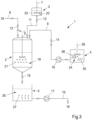
- Fig. 2 is a flow chart of phlegmatisation of an explosive 21 in an aqueous suspension 20 that specifies the substances and operations involved.
- An aqueous suspension 20 containing 75-80 wt % of water 22 and 20-25 wt % of an explosive 21 is prepared.
- a dispersion solution 24 and a dispersion decomposing solution 23, also referred to as a dispersion decomposer are also prepared.
- the dispersion solution 24 contains 40-80 wt % of water 22, 20-50 wt % of a phlegmatising agent 25, 0-10 wt % of a dispersing agent 26, also referred to as an emulsifier, 2-4 wt % of a pH-increasing agent containing one or more inorganic hydroxides, and 0-1 wt % of stabilisers and preservatives.
- the dispersion decomposer 23 contains 0-5 wt % of water and 95-100 wt % of a dispersion-decomposing agent.
- PE waxes particularly PE of the LD (low-density) type
- LD low-density
- Other phlegmatising agents 25 of interest are PE waxes of the HD (high-density) type, PTFE (polytetrafluoroethylene), MDPE (medium-density polyethylene), LLDPE (linear low-density polyethylene), beeswax, palm oil, montan wax, candelilla wax, and paraffin oil.
- the dispersing agent 26, also referred to as a surfactant, is preferably of the anion-active type.
- Anion-active surfactants are surfactants in which the hydrophilic component is composed of sulphates (R-O-SO3-), sulphonates (R-SO3-), or carboxylates (R-CO2-).
- a suitable dispersing agent 26 contains one or more of the following anion-active surfactants: ammonium dodecyl sulphate (CH 3 (CH 2 ) 10 CH 2 OSO 3 NH 4 ), sodium dodecyl sulphate (CH 3 (CH 2 ) 11 OSO 3 Na), sodium dodecyl benzene sulfonate (C 12 H 25 C 6 H 4 SO 3 Na), sodium laureth sulphate (CH 3 (CH 2 ) 10 CH 2 (OCH 2 CH 2 ) n OSSO 3 Na), and sodium stearate (C 18 H 35 NaO 2 ).
- ammonium dodecyl sulphate CH 3 (CH 2 ) 10 CH 2 OSO 3 NH 4
- sodium dodecyl sulphate CH 3 (CH 2 ) 11 OSO 3 Na
- sodium dodecyl benzene sulfonate C 12 H 25 C 6 H 4 SO 3 Na
- sodium laureth sulphate CH 3 (CH 2
- a suitable pH-increasing agent contains one or more inorganic hydroxides, preferably sodium hydroxide and/or potassium hydroxide.
- a suitable dispersion-decomposing agent contains a carboxylic acid, preferably acetic acid. The proper choice of a dispersion-decomposing agent improves conductivity and the phlegmatising effect, while allowing more thorough coverage of the explosive crystals with a thin polymer layer. In addition to more even coating, this also provides stronger adhesion. Acetic acid has been shown in experiments to provide particularly favourable results in anionic solutions.
- the dispersion 24 is added while stirring to the aqueous suspension 20 in an amount equivalent to 4-15 parts by weight of dispersion solution 24 to 400-500 parts by weight of the aqueous suspension 20.
- the aqueous suspension 20 is heated while stirring to approx. 30 °C.
- the dispersion decomposer 23 is added while stirring to the aqueous suspension 20 in an amount equivalent to 0.5-1 part by weight of the dispersion decomposer to 400-500 parts by weight of the aqueous suspension 20.
- the revolution speed should be in the range of 100-300 rpm, and preferably 150 rpm.
- the addition of acetic acid reduces the pH value of the aqueous suspension 20, causing the dispersion to be protonated and decomposed, with the result that polyethylene is deposited as particles and absorbed on the surface of the explosive.
- the dispersion is decomposed via deprotonation of a cationic aqueous suspension 20.
- the dispersion is decomposed by stirring in a non-ionic aqueous suspension 20.
- the wax suspension 20 is heated to 35-40 °C in order to reduce the viscosity of the mixture, reduce surface tension, and improve conductivity, and is then slowly cooled to approx. 25 °C.
- the phlegmatised explosive 27 is separated from the aqueous suspension 20 by filtration. The explosive 27 is then washed in purified water to eliminate any residues of the dispersion decomposer and dried, preferably with warm air.
- Fig. 2 shows a preferred embodiment of a processing device (not according to the present invention) 1 for phlegmatising an explosive 21 in an aqueous suspension 20 comprising a dispersion solution 24, containing a phlegmatising agent 25 and a dispersing agent 26, and a dispersion decomposer 23.
- the device 1 comprises a first mixing unit 2 for preparing the aqueous suspension 20 containing the explosive 21 and water 19, a second mixing unit 4 for preparing the dispersion solution 24 containing the phlegmatising agent and the dispersing agent, and a third mixing unit 3 for preparing the dispersion decomposer 23 containing water 19 and a dispersion-decomposing substance 22.
- the vessel 5 is also connected to a chemical outlet 18 via a third tube 10 and a filter pump 17.
- the three mixing units 2, 3, and 4 are positioned relative to one another in such a manner that the dispersion solution 24 and the dispersion decomposer 23 can easily be transferred from the respective mixing unit 4 or 3 to the aqueous suspension 20 in the first mixing unit 2.
- the second mixing unit 4 which is positioned beside the first mixing unit 2, is connected to the first mixing unit 2 via a first tube 9, a first regulating valve 14, and a pump 16.
- the third mixing unit 3 is positioned at a higher level than the first mixing unit 2 and connected to the first mixing unit 2 via a second tube 11 and a second drain valve or opening valve 12.
- a water tube 8 for filling of water 19 is also connected to the first mixing unit 2 via a third regulating valve 13.
- the third mixing unit 4 is positioned at a higher level than the first mixing unit 2, allowing the difference in height to be used for transferring the dispersion solution 23.
- All three mixing units 3,4,5 are equipped with stirrers 6, 7, 25 and heating coils, but the heating coils are not shown in Fig. 2 .
- the wax suspension 20 containing a phlegmatised explosive 27 is discharged from the first mixing unit 2 via the bottom valve 15 into the Nutsche filter 5.
- the phlegmatised explosive is then separated/filtered from the aqueous suspension 20 by pumping the aqueous suspension 20 using the filter pump 17 via the insert of the Nutsche filter 5 and via a fourth tube to a chemical outlet 18 for recovery or destruction of the chemical residues.
Landscapes
- Chemical & Material Sciences (AREA)
- Organic Chemistry (AREA)
- Chemical Kinetics & Catalysis (AREA)
- Crystallography & Structural Chemistry (AREA)
- Organic Low-Molecular-Weight Compounds And Preparation Thereof (AREA)
- Colloid Chemistry (AREA)
- Paints Or Removers (AREA)
Priority Applications (1)
| Application Number | Priority Date | Filing Date | Title |
|---|---|---|---|
| RS20230938A RS64706B1 (sr) | 2013-06-18 | 2014-06-17 | Flegmatizacija eksploziva u vodenoj suspenziji |
Applications Claiming Priority (2)
| Application Number | Priority Date | Filing Date | Title |
|---|---|---|---|
| SE1330075A SE537770C2 (sv) | 2013-06-18 | 2013-06-18 | Flegmatisering av sprängämne i vattensuspension |
| PCT/SE2014/000080 WO2014204374A1 (en) | 2013-06-18 | 2014-06-17 | Phlegmatisation of an explosive in an aqueous suspension |
Publications (4)
| Publication Number | Publication Date |
|---|---|
| EP3010873A1 EP3010873A1 (en) | 2016-04-27 |
| EP3010873A4 EP3010873A4 (en) | 2017-02-22 |
| EP3010873B1 true EP3010873B1 (en) | 2023-09-13 |
| EP3010873C0 EP3010873C0 (en) | 2023-09-13 |
Family
ID=52104975
Family Applications (1)
| Application Number | Title | Priority Date | Filing Date |
|---|---|---|---|
| EP14813443.0A Active EP3010873B1 (en) | 2013-06-18 | 2014-06-17 | Phlegmatisation of an explosive in an aqueous suspension |
Country Status (8)
| Country | Link |
|---|---|
| US (1) | US10287219B2 (sr) |
| EP (1) | EP3010873B1 (sr) |
| ES (1) | ES2959617T3 (sr) |
| HU (1) | HUE063155T2 (sr) |
| PL (1) | PL3010873T3 (sr) |
| RS (1) | RS64706B1 (sr) |
| SE (1) | SE537770C2 (sr) |
| WO (1) | WO2014204374A1 (sr) |
Families Citing this family (2)
| Publication number | Priority date | Publication date | Assignee | Title |
|---|---|---|---|---|
| US20220074288A1 (en) * | 2019-01-16 | 2022-03-10 | Halliburton Energy Services, Inc. | Shaped charge utilizing polymer coated petn |
| CN114907173B (zh) * | 2022-05-05 | 2023-03-24 | 中国工程物理研究院化工材料研究所 | 一种具有强降感包覆层结构的炸药及其制备方法 |
Family Cites Families (14)
| Publication number | Priority date | Publication date | Assignee | Title |
|---|---|---|---|---|
| GB574271A (en) | 1942-09-09 | 1945-12-31 | Ernest Gordon Cockbain | Desensitization of explosives |
| GB574879A (en) | 1942-11-18 | 1946-01-24 | Ernest Gordon Cockbain | Improvements relating to explosive compositions |
| US3310569A (en) * | 1962-04-09 | 1967-03-21 | Olin Mathieson | Crystalline double salt of lead nitroaminotetrazole and lead styphnate |
| US3773535A (en) * | 1972-02-25 | 1973-11-20 | Ferro Corp | Abrasion resistant stabilized lead chromate pigments coated with silica and polyolefin wax |
| US4092187A (en) * | 1976-08-18 | 1978-05-30 | The United States Of America As Represented By The Secretary Of The Army | Process for coating crystalline high explosives |
| GB1596403A (en) | 1977-05-11 | 1981-08-26 | Secr Defence | Desensitizing explosives |
| AT365680B (de) * | 1979-09-25 | 1982-02-10 | Mobil Oil Austria | Verfahren zur herstellung von schwach bis stark geleimtem papier oder karton |
| US4357185A (en) | 1981-05-20 | 1982-11-02 | The United States Of America As Represented By The Secretary Of The Navy | Process for coating crystalline explosives with polyethylene wax |
| US4338230A (en) * | 1981-06-22 | 1982-07-06 | Eastman Kodak Company | Emulsifiable polyolefin waxes prepared by reacting pivalolactone and a polyolefin wax containing carboxyl groups |
| ATE104263T1 (de) | 1990-12-21 | 1994-04-15 | Contraves Pyrotec Ag | Verfahren zur herstellung verpressbarer, wachsgebundener explosivstoffgranulate. |
| DE4435404A1 (de) * | 1994-10-04 | 1996-04-11 | Henkel Kgaa | Verfahren zur Herstellung stabilisierter wäßriger Polyolefinwachs-Dispersionen |
| US6214137B1 (en) * | 1997-10-07 | 2001-04-10 | Cordant Technologies Inc. | High performance explosive containing CL-20 |
| AU2002322838A1 (en) | 2001-08-01 | 2003-02-17 | Alliant Techsystems Inc. | Low sensitivity explosive compositions and method for making explosive compositions |
| EP2323990B1 (en) * | 2008-08-21 | 2014-06-18 | Dynamit Nobel GmbH Explosivstoff- und Systemtechnik | Methods for the production of 2-halo-4-nitroimidazole and intermediates thereof |
-
2013
- 2013-06-18 SE SE1330075A patent/SE537770C2/sv unknown
-
2014
- 2014-06-17 US US14/899,818 patent/US10287219B2/en active Active
- 2014-06-17 WO PCT/SE2014/000080 patent/WO2014204374A1/en not_active Ceased
- 2014-06-17 EP EP14813443.0A patent/EP3010873B1/en active Active
- 2014-06-17 HU HUE14813443A patent/HUE063155T2/hu unknown
- 2014-06-17 PL PL14813443.0T patent/PL3010873T3/pl unknown
- 2014-06-17 RS RS20230938A patent/RS64706B1/sr unknown
- 2014-06-17 ES ES14813443T patent/ES2959617T3/es active Active
Non-Patent Citations (1)
| Title |
|---|
| ANONYMOUS: "A-C 656 | Honeywell Additives", 15 September 2020 (2020-09-15), XP055730944, Retrieved from the Internet <URL:https://www.additiveschemicals-honeywell.com/performance-additives/products/a-c-656/> [retrieved on 20200915] * |
Also Published As
| Publication number | Publication date |
|---|---|
| SE537770C2 (sv) | 2015-10-13 |
| EP3010873A1 (en) | 2016-04-27 |
| US10287219B2 (en) | 2019-05-14 |
| EP3010873C0 (en) | 2023-09-13 |
| WO2014204374A1 (en) | 2014-12-24 |
| ES2959617T3 (es) | 2024-02-27 |
| SE1330075A1 (sv) | 2014-12-19 |
| US20160137566A1 (en) | 2016-05-19 |
| EP3010873A4 (en) | 2017-02-22 |
| HUE063155T2 (hu) | 2023-12-28 |
| PL3010873T3 (pl) | 2024-01-29 |
| RS64706B1 (sr) | 2023-11-30 |
Similar Documents
| Publication | Publication Date | Title |
|---|---|---|
| Hussein et al. | Application of emulsion and Pickering emulsion liquid membrane technique for wastewater treatment: an overview | |
| DE2327182C3 (de) | Verfahren zur Herstellung von granulatartigen Pigmentdispersionen | |
| EP1829923B1 (de) | Zusammensetzung enthaltend mikroverkapseltes Kautschukadditiv | |
| JP2018114497A (ja) | 切替可能水組成物、浸透圧勾配を調整するための方法、およびイオン強度を調整するための調整方法 | |
| US10287219B2 (en) | Phlegmatisation of an explosive in an aqueous suspension | |
| CN106083495A (zh) | 一种乳液固化制备得到的包覆炸药微球及其制备方法 | |
| CN106432791A (zh) | 一种聚乙烯废弃物的回收工艺 | |
| JP4275976B2 (ja) | 微粒子含有分散液の濃縮法および微粒子回収方法 | |
| CN110204406A (zh) | 乳化炸药废料高效安全、环保回收再利用工艺 | |
| WO2009038404A3 (en) | Method of preparing toner | |
| AU2016341192B2 (en) | Compositions and methods for separating immiscible liquids | |
| DE2212495B2 (de) | Verfahren zur herstellung von elektrophotographischen suspensionsentwicklern | |
| CN103264167A (zh) | 一种表面改性纳米铜微粒及其制作方法 | |
| CN106432794A (zh) | 一种聚氨酯废弃物的回收工艺 | |
| WO2007093278A1 (de) | Zwei- oder mehrstufiges entlackungsverfahren | |
| JP2016222801A (ja) | ポリフッ化ビニリデン樹脂粒子分散液、およびポリフッ化ビニリデン樹脂粒子分散液の製造方法 | |
| US20210230379A1 (en) | Method for producing polyamide 4 particles | |
| JP5894373B2 (ja) | セルロース多孔質粒子の製造方法 | |
| DE102014114831A1 (de) | Verfahren zur Herstellung von Zielpolymerprodukten aus kunststoffhaltigen Materialien und nach diesem Verfahren erhältliche körnige oder pulverförmige Zielpolymerprodukte | |
| CN106432792A (zh) | 一种聚酰亚胺废弃物的回收工艺 | |
| CN115781995B (zh) | 一种基于poss基有机硅乳化剂的半永久型脱模剂及其制备方法 | |
| US2915449A (en) | Emulsion dewaxing of mineral oils accompanied by intensive agitation | |
| JPH06299107A (ja) | 塗膜剥離剤組成液及び塗膜剥離方法 | |
| JP2012006766A (ja) | シリカ中空球状粒子の製造方法 | |
| DE2260740A1 (de) | Verfahren zum bilden von kapseln |
Legal Events
| Date | Code | Title | Description |
|---|---|---|---|
| PUAI | Public reference made under article 153(3) epc to a published international application that has entered the european phase |
Free format text: ORIGINAL CODE: 0009012 |
|
| 17P | Request for examination filed |
Effective date: 20160118 |
|
| AK | Designated contracting states |
Kind code of ref document: A1 Designated state(s): AL AT BE BG CH CY CZ DE DK EE ES FI FR GB GR HR HU IE IS IT LI LT LU LV MC MK MT NL NO PL PT RO RS SE SI SK SM TR |
|
| AX | Request for extension of the european patent |
Extension state: BA ME |
|
| DAX | Request for extension of the european patent (deleted) | ||
| A4 | Supplementary search report drawn up and despatched |
Effective date: 20170123 |
|
| RIC1 | Information provided on ipc code assigned before grant |
Ipc: C06B 45/22 20060101ALI20170117BHEP Ipc: B01F 13/10 20060101ALI20170117BHEP Ipc: C06B 23/00 20060101AFI20170117BHEP |
|
| STAA | Information on the status of an ep patent application or granted ep patent |
Free format text: STATUS: EXAMINATION IS IN PROGRESS |
|
| 17Q | First examination report despatched |
Effective date: 20190108 |
|
| GRAP | Despatch of communication of intention to grant a patent |
Free format text: ORIGINAL CODE: EPIDOSNIGR1 |
|
| STAA | Information on the status of an ep patent application or granted ep patent |
Free format text: STATUS: GRANT OF PATENT IS INTENDED |
|
| RIC1 | Information provided on ipc code assigned before grant |
Ipc: C06B 45/22 20060101ALI20230405BHEP Ipc: C06B 23/00 20060101AFI20230405BHEP |
|
| INTG | Intention to grant announced |
Effective date: 20230419 |
|
| GRAS | Grant fee paid |
Free format text: ORIGINAL CODE: EPIDOSNIGR3 |
|
| GRAA | (expected) grant |
Free format text: ORIGINAL CODE: 0009210 |
|
| STAA | Information on the status of an ep patent application or granted ep patent |
Free format text: STATUS: THE PATENT HAS BEEN GRANTED |
|
| AK | Designated contracting states |
Kind code of ref document: B1 Designated state(s): AL AT BE BG CH CY CZ DE DK EE ES FI FR GB GR HR HU IE IS IT LI LT LU LV MC MK MT NL NO PL PT RO RS SE SI SK SM TR |
|
| REG | Reference to a national code |
Ref country code: GB Ref legal event code: FG4D |
|
| REG | Reference to a national code |
Ref country code: CH Ref legal event code: EP |
|
| REG | Reference to a national code |
Ref country code: DE Ref legal event code: R096 Ref document number: 602014088319 Country of ref document: DE |
|
| REG | Reference to a national code |
Ref country code: IE Ref legal event code: FG4D |
|
| U01 | Request for unitary effect filed |
Effective date: 20230918 |
|
| U07 | Unitary effect registered |
Designated state(s): AT BE BG DE DK EE FI FR IT LT LU LV MT NL PT SE SI Effective date: 20230922 |
|
| REG | Reference to a national code |
Ref country code: NO Ref legal event code: T2 Effective date: 20230913 |
|
| REG | Reference to a national code |
Ref country code: HU Ref legal event code: AG4A Ref document number: E063155 Country of ref document: HU |
|
| REG | Reference to a national code |
Ref country code: GR Ref legal event code: EP Ref document number: 20230401941 Country of ref document: GR Effective date: 20231211 |
|
| REG | Reference to a national code |
Ref country code: SK Ref legal event code: T3 Ref document number: E 42525 Country of ref document: SK |
|
| PG25 | Lapsed in a contracting state [announced via postgrant information from national office to epo] |
Ref country code: HR Free format text: LAPSE BECAUSE OF FAILURE TO SUBMIT A TRANSLATION OF THE DESCRIPTION OR TO PAY THE FEE WITHIN THE PRESCRIBED TIME-LIMIT Effective date: 20230913 |
|
| REG | Reference to a national code |
Ref country code: ES Ref legal event code: FG2A Ref document number: 2959617 Country of ref document: ES Kind code of ref document: T3 Effective date: 20240227 |
|
| PG25 | Lapsed in a contracting state [announced via postgrant information from national office to epo] |
Ref country code: IS Free format text: LAPSE BECAUSE OF FAILURE TO SUBMIT A TRANSLATION OF THE DESCRIPTION OR TO PAY THE FEE WITHIN THE PRESCRIBED TIME-LIMIT Effective date: 20240113 |
|
| PG25 | Lapsed in a contracting state [announced via postgrant information from national office to epo] |
Ref country code: SM Free format text: LAPSE BECAUSE OF FAILURE TO SUBMIT A TRANSLATION OF THE DESCRIPTION OR TO PAY THE FEE WITHIN THE PRESCRIBED TIME-LIMIT Effective date: 20230913 Ref country code: IS Free format text: LAPSE BECAUSE OF FAILURE TO SUBMIT A TRANSLATION OF THE DESCRIPTION OR TO PAY THE FEE WITHIN THE PRESCRIBED TIME-LIMIT Effective date: 20240113 |
|
| REG | Reference to a national code |
Ref country code: DE Ref legal event code: R097 Ref document number: 602014088319 Country of ref document: DE |
|
| PLBE | No opposition filed within time limit |
Free format text: ORIGINAL CODE: 0009261 |
|
| STAA | Information on the status of an ep patent application or granted ep patent |
Free format text: STATUS: NO OPPOSITION FILED WITHIN TIME LIMIT |
|
| U20 | Renewal fee for the european patent with unitary effect paid |
Year of fee payment: 11 Effective date: 20240625 |
|
| 26N | No opposition filed |
Effective date: 20240614 |
|
| PG25 | Lapsed in a contracting state [announced via postgrant information from national office to epo] |
Ref country code: MC Free format text: LAPSE BECAUSE OF FAILURE TO SUBMIT A TRANSLATION OF THE DESCRIPTION OR TO PAY THE FEE WITHIN THE PRESCRIBED TIME-LIMIT Effective date: 20230913 |
|
| PGFP | Annual fee paid to national office [announced via postgrant information from national office to epo] |
Ref country code: PL Payment date: 20250610 Year of fee payment: 12 |
|
| PGFP | Annual fee paid to national office [announced via postgrant information from national office to epo] |
Ref country code: GB Payment date: 20250617 Year of fee payment: 12 |
|
| PGFP | Annual fee paid to national office [announced via postgrant information from national office to epo] |
Ref country code: RS Payment date: 20250611 Year of fee payment: 12 Ref country code: NO Payment date: 20250617 Year of fee payment: 12 |
|
| PGFP | Annual fee paid to national office [announced via postgrant information from national office to epo] |
Ref country code: HU Payment date: 20250626 Year of fee payment: 12 |
|
| PGFP | Annual fee paid to national office [announced via postgrant information from national office to epo] |
Ref country code: GR Payment date: 20250619 Year of fee payment: 12 |
|
| PGFP | Annual fee paid to national office [announced via postgrant information from national office to epo] |
Ref country code: RO Payment date: 20250613 Year of fee payment: 12 |
|
| PGFP | Annual fee paid to national office [announced via postgrant information from national office to epo] |
Ref country code: TR Payment date: 20250611 Year of fee payment: 12 Ref country code: SK Payment date: 20250616 Year of fee payment: 12 |
|
| PGFP | Annual fee paid to national office [announced via postgrant information from national office to epo] |
Ref country code: CZ Payment date: 20250611 Year of fee payment: 12 |
|
| PGFP | Annual fee paid to national office [announced via postgrant information from national office to epo] |
Ref country code: IE Payment date: 20250617 Year of fee payment: 12 |
|
| U20 | Renewal fee for the european patent with unitary effect paid |
Year of fee payment: 12 Effective date: 20250624 |
|
| PGFP | Annual fee paid to national office [announced via postgrant information from national office to epo] |
Ref country code: ES Payment date: 20250710 Year of fee payment: 12 |
|
| PGFP | Annual fee paid to national office [announced via postgrant information from national office to epo] |
Ref country code: CH Payment date: 20250701 Year of fee payment: 12 |
|
| PG25 | Lapsed in a contracting state [announced via postgrant information from national office to epo] |
Ref country code: CY Free format text: LAPSE BECAUSE OF FAILURE TO SUBMIT A TRANSLATION OF THE DESCRIPTION OR TO PAY THE FEE WITHIN THE PRESCRIBED TIME-LIMIT; INVALID AB INITIO Effective date: 20140617 |