EP3011105B1 - Papier couché - Google Patents
Papier couché Download PDFInfo
- Publication number
- EP3011105B1 EP3011105B1 EP14813764.9A EP14813764A EP3011105B1 EP 3011105 B1 EP3011105 B1 EP 3011105B1 EP 14813764 A EP14813764 A EP 14813764A EP 3011105 B1 EP3011105 B1 EP 3011105B1
- Authority
- EP
- European Patent Office
- Prior art keywords
- coating
- titanium dioxide
- paper
- stanchion
- pigment
- Prior art date
- Legal status (The legal status is an assumption and is not a legal conclusion. Google has not performed a legal analysis and makes no representation as to the accuracy of the status listed.)
- Active
Links
Images










Classifications
-
- D—TEXTILES; PAPER
- D21—PAPER-MAKING; PRODUCTION OF CELLULOSE
- D21H—PULP COMPOSITIONS; PREPARATION THEREOF NOT COVERED BY SUBCLASSES D21C OR D21D; IMPREGNATING OR COATING OF PAPER; TREATMENT OF FINISHED PAPER NOT COVERED BY CLASS B31 OR SUBCLASS D21G; PAPER NOT OTHERWISE PROVIDED FOR
- D21H19/00—Coated paper; Coating material
- D21H19/36—Coatings with pigments
- D21H19/38—Coatings with pigments characterised by the pigments
- D21H19/385—Oxides, hydroxides or carbonates
-
- C—CHEMISTRY; METALLURGY
- C09—DYES; PAINTS; POLISHES; NATURAL RESINS; ADHESIVES; COMPOSITIONS NOT OTHERWISE PROVIDED FOR; APPLICATIONS OF MATERIALS NOT OTHERWISE PROVIDED FOR
- C09C—TREATMENT OF INORGANIC MATERIALS, OTHER THAN FIBROUS FILLERS, TO ENHANCE THEIR PIGMENTING OR FILLING PROPERTIES ; PREPARATION OF CARBON BLACK ; PREPARATION OF INORGANIC MATERIALS WHICH ARE NO SINGLE CHEMICAL COMPOUNDS AND WHICH ARE MAINLY USED AS PIGMENTS OR FILLERS
- C09C1/00—Treatment of specific inorganic materials other than fibrous fillers; Preparation of carbon black
- C09C1/36—Compounds of titanium
- C09C1/3607—Titanium dioxide
- C09C1/3676—Treatment with macro-molecular organic compounds
-
- C—CHEMISTRY; METALLURGY
- C09—DYES; PAINTS; POLISHES; NATURAL RESINS; ADHESIVES; COMPOSITIONS NOT OTHERWISE PROVIDED FOR; APPLICATIONS OF MATERIALS NOT OTHERWISE PROVIDED FOR
- C09C—TREATMENT OF INORGANIC MATERIALS, OTHER THAN FIBROUS FILLERS, TO ENHANCE THEIR PIGMENTING OR FILLING PROPERTIES ; PREPARATION OF CARBON BLACK ; PREPARATION OF INORGANIC MATERIALS WHICH ARE NO SINGLE CHEMICAL COMPOUNDS AND WHICH ARE MAINLY USED AS PIGMENTS OR FILLERS
- C09C3/00—Treatment in general of inorganic materials, other than fibrous fillers, to enhance their pigmenting or filling properties
- C09C3/10—Treatment with macromolecular organic compounds
-
- D—TEXTILES; PAPER
- D21—PAPER-MAKING; PRODUCTION OF CELLULOSE
- D21H—PULP COMPOSITIONS; PREPARATION THEREOF NOT COVERED BY SUBCLASSES D21C OR D21D; IMPREGNATING OR COATING OF PAPER; TREATMENT OF FINISHED PAPER NOT COVERED BY CLASS B31 OR SUBCLASS D21G; PAPER NOT OTHERWISE PROVIDED FOR
- D21H25/00—After-treatment of paper not provided for in groups D21H17/00 - D21H23/00
- D21H25/08—Rearranging applied substances, e.g. metering, smoothing; Removing excess material
- D21H25/12—Rearranging applied substances, e.g. metering, smoothing; Removing excess material with an essentially cylindrical body, e.g. roll or rod
- D21H25/14—Rearranging applied substances, e.g. metering, smoothing; Removing excess material with an essentially cylindrical body, e.g. roll or rod the body being a casting drum, a heated roll or a calender
-
- C—CHEMISTRY; METALLURGY
- C01—INORGANIC CHEMISTRY
- C01P—INDEXING SCHEME RELATING TO STRUCTURAL AND PHYSICAL ASPECTS OF SOLID INORGANIC COMPOUNDS
- C01P2004/00—Particle morphology
- C01P2004/01—Particle morphology depicted by an image
- C01P2004/03—Particle morphology depicted by an image obtained by SEM
-
- C—CHEMISTRY; METALLURGY
- C01—INORGANIC CHEMISTRY
- C01P—INDEXING SCHEME RELATING TO STRUCTURAL AND PHYSICAL ASPECTS OF SOLID INORGANIC COMPOUNDS
- C01P2004/00—Particle morphology
- C01P2004/01—Particle morphology depicted by an image
- C01P2004/04—Particle morphology depicted by an image obtained by TEM, STEM, STM or AFM
-
- C—CHEMISTRY; METALLURGY
- C01—INORGANIC CHEMISTRY
- C01P—INDEXING SCHEME RELATING TO STRUCTURAL AND PHYSICAL ASPECTS OF SOLID INORGANIC COMPOUNDS
- C01P2006/00—Physical properties of inorganic compounds
- C01P2006/10—Solid density
-
- C—CHEMISTRY; METALLURGY
- C01—INORGANIC CHEMISTRY
- C01P—INDEXING SCHEME RELATING TO STRUCTURAL AND PHYSICAL ASPECTS OF SOLID INORGANIC COMPOUNDS
- C01P2006/00—Physical properties of inorganic compounds
- C01P2006/40—Electric properties
-
- C—CHEMISTRY; METALLURGY
- C01—INORGANIC CHEMISTRY
- C01P—INDEXING SCHEME RELATING TO STRUCTURAL AND PHYSICAL ASPECTS OF SOLID INORGANIC COMPOUNDS
- C01P2006/00—Physical properties of inorganic compounds
- C01P2006/60—Optical properties, e.g. expressed in CIELAB-values
-
- C—CHEMISTRY; METALLURGY
- C01—INORGANIC CHEMISTRY
- C01P—INDEXING SCHEME RELATING TO STRUCTURAL AND PHYSICAL ASPECTS OF SOLID INORGANIC COMPOUNDS
- C01P2006/00—Physical properties of inorganic compounds
- C01P2006/60—Optical properties, e.g. expressed in CIELAB-values
- C01P2006/62—L* (lightness axis)
-
- C—CHEMISTRY; METALLURGY
- C01—INORGANIC CHEMISTRY
- C01P—INDEXING SCHEME RELATING TO STRUCTURAL AND PHYSICAL ASPECTS OF SOLID INORGANIC COMPOUNDS
- C01P2006/00—Physical properties of inorganic compounds
- C01P2006/60—Optical properties, e.g. expressed in CIELAB-values
- C01P2006/63—Optical properties, e.g. expressed in CIELAB-values a* (red-green axis)
-
- C—CHEMISTRY; METALLURGY
- C01—INORGANIC CHEMISTRY
- C01P—INDEXING SCHEME RELATING TO STRUCTURAL AND PHYSICAL ASPECTS OF SOLID INORGANIC COMPOUNDS
- C01P2006/00—Physical properties of inorganic compounds
- C01P2006/60—Optical properties, e.g. expressed in CIELAB-values
- C01P2006/64—Optical properties, e.g. expressed in CIELAB-values b* (yellow-blue axis)
-
- Y—GENERAL TAGGING OF NEW TECHNOLOGICAL DEVELOPMENTS; GENERAL TAGGING OF CROSS-SECTIONAL TECHNOLOGIES SPANNING OVER SEVERAL SECTIONS OF THE IPC; TECHNICAL SUBJECTS COVERED BY FORMER USPC CROSS-REFERENCE ART COLLECTIONS [XRACs] AND DIGESTS
- Y10—TECHNICAL SUBJECTS COVERED BY FORMER USPC
- Y10T—TECHNICAL SUBJECTS COVERED BY FORMER US CLASSIFICATION
- Y10T428/00—Stock material or miscellaneous articles
- Y10T428/25—Web or sheet containing structurally defined element or component and including a second component containing structurally defined particles
-
- Y—GENERAL TAGGING OF NEW TECHNOLOGICAL DEVELOPMENTS; GENERAL TAGGING OF CROSS-SECTIONAL TECHNOLOGIES SPANNING OVER SEVERAL SECTIONS OF THE IPC; TECHNICAL SUBJECTS COVERED BY FORMER USPC CROSS-REFERENCE ART COLLECTIONS [XRACs] AND DIGESTS
- Y10—TECHNICAL SUBJECTS COVERED BY FORMER USPC
- Y10T—TECHNICAL SUBJECTS COVERED BY FORMER US CLASSIFICATION
- Y10T428/00—Stock material or miscellaneous articles
- Y10T428/25—Web or sheet containing structurally defined element or component and including a second component containing structurally defined particles
- Y10T428/254—Polymeric or resinous material
-
- Y—GENERAL TAGGING OF NEW TECHNOLOGICAL DEVELOPMENTS; GENERAL TAGGING OF CROSS-SECTIONAL TECHNOLOGIES SPANNING OVER SEVERAL SECTIONS OF THE IPC; TECHNICAL SUBJECTS COVERED BY FORMER USPC CROSS-REFERENCE ART COLLECTIONS [XRACs] AND DIGESTS
- Y10—TECHNICAL SUBJECTS COVERED BY FORMER USPC
- Y10T—TECHNICAL SUBJECTS COVERED BY FORMER US CLASSIFICATION
- Y10T428/00—Stock material or miscellaneous articles
- Y10T428/25—Web or sheet containing structurally defined element or component and including a second component containing structurally defined particles
- Y10T428/256—Heavy metal or aluminum or compound thereof
Definitions
- the present invention relates to coated paper wherein the coating contains an encapsulated pigment such as titanium dioxide that facilitates enhanced brightening efficiencies.
- the invention also relates to a coating composition therefor.
- Titanium dioxide has many uses. As a pigment, titanium dioxide is typically used as a powder, that is, as fine particles having a particle size generally in the range of 100 to 500 nm. It is often used in paper making and in paints, where it can increase brightness and opacity, and is also used in textiles, etc. Though commonly available as a powder/pigment, a coated form of titanium dioxide has been suggested.
- U.S. 3,133,893 relates to pigment particles coated with a polymer.
- the coated pigments are used in coloring plastic fibers.
- the polymer coating is formed by in situ polymerization. By coating the pigment with a polymer coating, the pigment is thought to be susceptible to forming a stable and fine dispersion within a resin or resin solution without the need for extensive milling.
- the polymer can be formed from any vinyl monomer and generally is identical or compatible with the composition to be pigmented. Acrylonitrile is used mostly in the examples. Examples 3, 6, and 17 use titanium dioxide as the pigment to be coated.
- U.S. 4,771,086 relates to polymer coating of pigment particles for use in paint.
- the process of coating the pigment particles uses otherwise conventional aqueous-based emulsion polymerization, except that the then typical anionic emulsification and stabilizing agent is replaced with a nonionic stabilizing agent that is sufficient to serve as an emulsifying agent.
- This change in emulsification agent purportedly results in polymerization exclusively on the surface of the pigment particle and forms a uniform thickness of polymer coating thereon.
- the use of conventional anionic emulsification agents is taught to yield essentially bulk polymerization with a mass having a consistency ranging from cottage cheese to lumpy dough to a sticky plastic and which is reportedly not of any practical value.
- coated pigment particles are taught to have "extraordinary" stability against flocculation or settling in comparison with conventional latex systems. Also, the coated pigments are taught to be capable of achieving improved covering power and surface gloss. Titanium dioxide is mentioned and exemplified as a useful pigment to be polymer coated.
- U.S. 7,960,026 also relates to a coated pigment for use in paint.
- the coated pigment is formed by first adhering polymer particles onto the surface of the inorganic pigment to form a "Primary Composite Particle.”
- This Primary Composite Particle is then subjected to emulsion polymerization to form a polymer layer around the Primary Coated Polymer.
- Titanium dioxide is disclosed and exemplified as an inorganic pigment.
- the composite particles are taught to provide superior covering/opacity and gloss.
- EP 1 911 881 A1 discloses a coating for paperboard which comprises an aqueous dispersion of a hollow core binder comprising a first polymer that, when dry, has at least one void, the first polymer being substantially encapsulated by at least one second polymer having a glass transition temperature (T g ) ranging from more than -15°C and up to and including 30°C, wherein the weight ratio of the said second polymer to the said first polymer ranges from 1:1 to 4:1.
- T g glass transition temperature
- One or both of the first polymer and the second polymer may be formed from, as polymerized units, at least one ethylenically unsaturated monomer.
- the hollow core binder allows for glossy, bright and smooth paperboard coatings while reducing the amount of binder and opacifying pigment necessary to achieve such coating properties.
- the disclosure also provides coated paperboard articles, as well as paper and paperboard that is made from a mixture of pulp with the hollow core binder.
- WO 93/12183 A1 discloses inorganic material particles such as titanium dioxide pigment particles are dispersed in an aqueous medium with a polyelectrolyte pigment dispersant.
- a selected, relatively hard, polymeric latex, which adsorbs onto the surface of the inorganic material particles in the presence of the pigment dispersant, is added, as well as a film-forming binder to give a formulated coating composition.
- the strongly adsorbing polymeric latex can include residues of polymerized itaconic acid or dihydrogen phosphate functional groups, or have a high level of acid functional groups or acid functional groups distributed preferentially at the surface of the latex.
- the adsorbed latex particles space the inorganic particles apart in the coating film, improving performance properties.
- a single selected polymeric latex is used to both strongly adsorb to the pigment particles and to serve as binder, or a mixture of a selected, strongly adsorbing polymeric latex having a low effective glass transition temperature and a conventional binder latex is employed.
- a first aspect of the invention relates to a coated paper according to the appended claims comprising a base paper having a coating thereon; wherein the coating comprises a binder and stanchion-encapsulated titanium dioxide pigment particles.
- the stanchion-encapsulated titanium dioxide is described more fully below. Briefly, such encapsulation refers to the presence of polymer extensions or "stanchions" on the coated titanium dioxide particles, which stanchions may link nearby coated particles together.
- the coating may contain additional pigments such as calcium carbonate and/or clays, e.g., kaolin. Other additives may also be present.
- the base paper is not limited and includes paperboard.
- Another aspect of the invention relates to a paper coating composition according to the appended claims, which comprises a mixture of water, a binder, and stanchion-encapsulated titanium dioxide.
- the coating composition may further contain additional pigments such as calcium carbonate and/or clays and additives.
- a further aspect of the invention relates to paper produced by coating a base paper with the above coating composition according to the appended claims.
- the coated paper may be subsequently subjected to calendaring or not.
- the present invention is based on the discovery that stanchion-encapsulated titanium dioxide can provide advantages to coated paper materials.
- the basic coated paper of the present invention comprises base paper having a coating thereon of at least a binder and stanchion-encapsulated titanium dioxide.
- the base paper typically has two major sides or surfaces. Only one major side needs to be coated, but both sides can also be coated in the present invention.
- the base paper refers to an amalgamation of vegetable, wood, and/or synthetic fibers, typically cellulose, hemi-cellulose, lignin, or synthetic.
- fillers and other additives may be present in the base paper. These fillers/additives include various clays as is well known in the art.
- a thicker and/or stiffer paper may be referred to as a paper board. Both paper and paper board are considered to be "base paper" for the purposes of the present invention, unless otherwise indicated.
- the coating on the base paper of the invention comprises a binder selected from the group consisting of starch, a vinyl alcohol, a latex, a carboxymethylcellulose, and combinations thereof.
- Binders are conventionally used in the art. Binder materials can be polymeric or latex and are typically substantially vehicle soluble or dispersible. Water soluble binders include polyvinyl alcohol, hydroxy ethylcellulose, methylcellulose, methyl-hydroxypropylcellulose, starch, modified starches, gelatin and the like and combinations thereof. Binder materials can also include eligible latex materials include polyacrylates, styrene-butadiene-rubber latexes, polyvinylacetates, polystyrene, and the like and combinations thereof. Binders should be present in an amount to facilitate sufficient adherence such as to the surface when applied as part of a coating or to surface fibers when applied as a filler.
- binder is present in the coating in an amount from 10 to 50%.
- the stanchion-encapsulated titanium dioxide is a plurality of polymer-coated titanium dioxide pigment particles wherein the polymeric coating at least partially surrounds each pigment particle and provides stanchions, on at least 10% of the pigment particles, extending from the coating layer so as to protrude outwardly or to connect two or more pigment particles together.
- a stanchion, which is made out of polymer material, must protrude at least two times the standard coating thickness, or, connect two pigment particles together. Typically the stanchion has a length of 10 to 500 nm.
- the stanchion length can be related to the diameter of the coated particle and is typically in the range from 0.01 d to about 3.5 d, or even from 0.1 d to about 2 d, or even from 0.5 d to 1 d, where d is the polymer coated particle diameter.
- each stanchion can have a width, for example, of less than about 2X the radius of the coated particle from which the stanchion extends.
- the average number of stanchions per pigment particle is typically in the range from 0.1 to 10, more typically 0.2 to 6.
- the stanchion-encapsulated titanium dioxide may contain additional internal structures that separate coated pigment particles. These structures are formed by stanchions and/or coating layers combining to form small spherical structures. These structures are called "particle separators.”
- the discrete particles separators cause separation of the particles and have a size range between 1 nm to 5 um ( microns), or even from 1 nm to 2 um or even from 1 nm to 1.5 um or even from 1 nm to 100 um.
- a typical range for the size of the particle separators is from 5 nanometers to 1500 nanometers.
- the occurrence of particle separators is optional and not necessarily required or present in a stanchion-encapsulated titanium dioxide.
- the stanchions in the encapsulated titanium dioxide contribute to an increased spacing between the coated particles in the composition.
- the particle separators if present, can also contribute to an increased spacing between the coated particles in the composition.
- the stanchions, and particle separators individually or combined, allow for a reduced density of the coated particles and lead to higher opacity values when the particle composition is used in a coating for paper.
- the stanchions of the present invention allow for a stable suspension and a higher level of brightness in a coating.
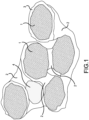
- stanchion-encapsulated titanium dioxide as used in the present invention is illustrated in the figures.
- titanium dioxide pigment particles 1 are depicted surrounded by polymeric coating 3.
- the stanchions 2 can form bridging between the particles or protrusions.
- Stanchions 2 are of the same material as polymeric coating 3.
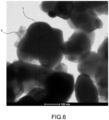
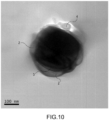
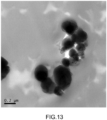
- Figs. 3-13 are TEM photos of a stanchion-encapsulated titanium dioxide.
- Fig. 7 an area of bridging between stanchions of multiple particles 5 can be seen in the bottom of the photo.
- a single particle 1 coated in a polymeric coating 3 is shown which further includes stanchions 2. That is, in this figure, bubble-like projections extend from the surface of a polymeric coating of a particle, in this example, from the methyl methacrylate coating over a titanium oxide particle.
- polymer coating details of a single particle are shown.
- aqueous TiO 2 suspensions were diluted with distilled water and sonicated in a sonicator (Cole-Parmer Model 8890) for 5 minutes. A drop of the solution was put on a 300 mesh Formvar grid and allowed to sit for 5 minutes. The remaining solution was gently blotted away and the grid was allowed to air dry. The sample grids were subsequently examined in bright field mode on an FEI Tecnai Spirit BioTWIN transmission electron microscope operating at 120 kV. Images were collected on an Eagle 2k x 2k camera and subsequently converted to tiff format.
- An alternative method was to embed the encapsulated TiO 2 powders in a resin, for example an acrylic or an epoxy resin, in an embedding mold, and then the sample was cut into ultrathin sections (40-60 nm thick) using a diamond knife by ultra-microtome (Richelt Ultracut E) after the resin had been cured. The captured sections were place on copper grids, and images were subsequently collected on a Hitachi H-7500 transmission electron microscope.
- a resin for example an acrylic or an epoxy resin
- SEM images were collected with a field emission scanning electron microscope (FESEM), for example, Helio Nanolab TM 650 manufactured by FEI Company (5350 NE Dawson Creek Drive, Hillsboro, OR 97124).
- FESEM field emission scanning electron microscope
- the sample of aqueous TiO 2 suspensions were frozen and prepared in a cryo specimen preparation chamber, and the sample was then milled with focused ion beam (FIB) to reveal the cross section of the sample, polished to remove the rough milling artifacts. Images were then collected after a small amount of water was liberated from the across section, revealing the morphology and structure of the particles.
- titanium dioxide pigment particles used in the stanchion-encapsulation are not particularly limited.
- a variety of forms including rutile, anatase, brookite, and amorphous are known and are suitable for use in the present invention.
- Rutile and anatase can be photocatalytic.
- Titanium dioxide particles can be surface treated with materials such as aluminum oxide, silicon dioxide, tetra ethoxysilane, or zinc oxide. Such surface treatments can be applied to increase dispersibility, uv absorption, or to alter photocatalytic properties.
- the titanium dioxide particles are an effective pigment size which can range from 1 nm (nanometer) to 2000 nm, or even to 5000 nm.
- the uncoated titanium dioxide particles ranges from 1 nm to 2000 nm, more often from 10 nm to 1000 nm, and sometimes from 20 nm to 500 nm.
- the titanium dioxide particles comprise 30 to 70%, more typically 40 to 60%, and in some cases around 50% (e.g. +/- 5), of the total weight of the stanchion-encapsulated titanium dioxide.
- the polymeric material used to at least partially surround the pigment particle comprises a polymer selected from the group consisting of polyacrylate, polymethacrylate, polyalkyl(meth)acrylate, polystyrene, melamine formaldehyde, urea formaldehyde, polyvinyl alcohol, polyvinyl acetate, and combinations thereof.
- the polymeric material can be made of one or more polymers and optionally with additional ingredients therein. In principle any polymer that can be formed on the pigment particle, optionally with an intervening particle surface coating(s) or treatment(s), can be used.
- the polymeric material comprises at least one polymer selected from polyacrylate, polymethacrylate, polyalkyl(meth)acrylate, polystyrene, melamine formaldehyde, urea formaldehyde, polyvinyl alcohol, polyvinyl acetate, and combinations thereof.
- the alkyl group is generally a C1 to C24, but more typically is a C1-C8, or C1-C4 group including straight and branched forms.
- the polymeric material not only partially or completely surrounds the particle (e.g., as a particle coating or wall material) but also forms the stanchions. The same polymeric material is used to form the coating and the stanchions.
- the stanchion-encapsulated titanium dioxide usually contains from 30 to 70%, often 40 to 60%, and in some embodiments around 50% (e.g. 50% +/- 5) by weight of the polymeric material.
- the stanchion-encapsulated titanium dioxide results in encapsulated pigment particles having a coated particle size from 1 nm to 7500 nm, more typically from 1 to 5000 nm, more commonly from 3 nm to about 3500 nm, and sometimes from 10 nm to 2500 nm, or even from 10 nm to 2000 nm. Larger particles of a size from 2 microns to 100 microns or from 2 microns to 1000 microns are possible, if the polymeric coated particulates are agglomerated.
- a method for determining the median particle size of the coated particles of the present invention is detailed below.
- Median particle size is measured using a Zetasizer, made by Malvern Instruments, Ltd, Enigma Business park, Grovewood Road, Malvern, Worcestershire, WR14 1XZ, United Kingdom. Samples for particle size evaluation are prepared by diluting 1 drop of the encapsulated TiO 2 slurry in 1 milliliter of de-ionized water in a cuvette, which is then placed in the sample cell of the instrument. The instrument will display the results, including volume weighted median size.
- the features of the stanchion-encapsulated titanium dioxide contribute to a reduced density of particles in the composition.
- the encapsulated pigment particle composition has a lower density value as compared to the density value of the unencapsulated pigment.
- the stanchion-encapsulated titanium dioxide can have a density of less than 2.72 g/cm 3 , which is around 34% lower than the nominal density value of un-encapsulated pigment TiO 2 material (e.g. 4.23 g/cm 3 ).
- the density value of the encapsulated particle composition of the invention can be at least 10%, normally at least 20%, typically at least 30%, and sometimes at least 40% lower than the density value of the un-encapsulated pigment material.
- the encapsulation process transforms one or more monomeric materials into a polymeric coating on a particle such as titanium dioxide, and also can give rise to stanchioning and one or more macro molecular particle separators.
- Applicants have surprisingly found that by carefully managing mixing speed range of the coating process and concentration gradient during monomer addition, the size and degree of stanchioning and formation of particle separators can be affected.
- particle separators can be separately added. More efficiently, the separators are optimized to form during the encapsulation process, along with the stanchioning.
- the stanchions are of the same polymeric material as the polymeric coating.
- the particle separators and stanchions are the same polymeric materials as the polymeric coating on the particles. However, optionally, each can be formed from a different monomeric material.
- by-products can form. These by-products are residual dense shells or spheroids or particulates of wall material polymers.
- the particle separators however can be useful by contributing to an increased spacing between the coated particles in the composition.
- the stanchions, and particle separators individually or combined, allow for a reduced density of the coated particles required and lead to higher opacity values when the particle composition is used, for example, in a coating for paper.
- the quantity of particle separators can be augmented by addition. Particle separators can be obtained by centrifuging and filtration from conventional microencapsulation processes.
- the present composition and process employ such previously discarded wall balls or form them in-situ as useful particle separators in the present invention.
- Discrete particle separators are formed from a polymeric material of the stanchions or coating layer and can be in the form of small spherical structures.
- the discrete particles separators are formed between the particles of the composition and cause separation of the particles and have a particle size range between 1 nm to 5 um ( microns), or even from 1 nm to 2 um or even from 1 nm to 15 microns or even from 1 nm to 100 microns.
- a desirable range for the size of the particle separators is from 5 nanometers to 1500 nanometers.
- the discrete particle separators can range in size from 0.01d to about 3.5d or even from 0.01d to about 5 d, where d is the diameter of the polymeric coated particle.
- the discrete particle separators contribute to increasing the spacing of the particles. Reduced density of the coated particles and higher opacity values also result from the presence of the particle spacers. In addition, similarly to the stanchions of the present invention, the discrete particle separators contribute to a higher level of brightness.
- the dispersing agents can be an organic or an inorganic chemical, or a combination thereof.
- the particle in water suspension can be prepared by any means, such as a mechanical shear, a homogenizer, a rotorstator mixer, an in-line mixer, a microfluidic mixer, or an ultrasonic device.
- Initiators and/or catalysts may be used to initiate the polymerization reaction. Selection of initiators and/or catalysts depends on the wall materials used. For acrylic monomers, sodium persulfate, ammonium persulfate, or redox initiators may be used.
- the charge of the encapsulated particle can be modified.
- the charge of the encapsulated particle can be altered in zeta potential.
- the observed zeta potential tends to be positive at low pH and lower or negative at high pH.
- the encapsulated particle can be modified to be anionic, nonionic, or cationic.
- Cationic emulsifiers can include amines with primary, secondary or tertiary functionality.
- Nonionic emulsifiers can include polymers with hydroxyl, ether, ester, ketone and amide functionality.
- Cationic emulsifiers can be selected from palmitamidopropyltrimonium chloride, distearyl dimonium chloride, cetyltrimethylammonium chloride, quaternary ammonium compounds, fatty amines, aliphatic ammonium halides, alkyldimethylbenzylammonium halides, alkyldimethylethylammonium halides, polyethyleneimine, poly(2-dimethylamino)ethyl methacrylate)methyl chloride quaternary salt, poly(1-vinylpyrrolidone-co-2-dimethylaminoethyl methacrylate), poly(acrylamide-co-diallyldimethylammonium chloride), poly(allylamine), poly[bis(2-chloroethyl)ether-alt-1,3-bis[3-(dimethylamino)propyl]urea] quaternized, and poly(dimethylamine-co-epichlor
- Cationic emulsifier can include polyalkylenimine compounds wherein the alkylene moieties are from 2 and 8 carbons, and more useful are molecular weights of from 1000 to about 250000.
- Cationic emulsifiers include palmitamidopropyltrimonium chloride (trademark Varisoft Patch, Evonik Degussa GmbH, Essen, Germany) distearyl dimonium chloride, cetyltrimethylammonium chloride, and polyethyleneimine.
- Useful amines can include, by way of illustration and not limitation, amine modified vinyl monomers including amine modified acrylates or methacrylates such as mono or diacrylate amines, mono or dimethacrylate amines, amine modified polyetheracrylates and amine modified polyethermethacrylates, aminoalkyl acrylates or aminoalkyl methacrylate.
- amine modified vinyl monomers including amine modified acrylates or methacrylates such as mono or diacrylate amines, mono or dimethacrylate amines, amine modified polyetheracrylates and amine modified polyethermethacrylates, aminoalkyl acrylates or aminoalkyl methacrylate.
- the amines can include primary, secondary or tertiary amines and can include tertiary butyl aminethylmethacrylate, diethylaminoethyl methacrylate, or dimethylaminoethyl methacrylate.
- Nonionic emulsifier can be selected from polyalkylene glycol ether, condensation products of alkyl phenols, aliphatic alcohols, or fatty acids with alkylene oxide, ethoxylated alkyl phenols, ethoxylated arylphenols, ethoxylated polyaryl phenols, carboxylic esters solubilized with a polyol, polyvinyl alcohol, polyvinyl acetate, or copolymers of polyvinyl alcohol polyvinyl acetate, polyacrylamide, poly(N-isopropylacrylamide), poly(2-hydroxypropyl methacrylate), poly(2-ethyl-2-oxazoline), poly(2-isopropenyl-2-oxazoline-co-methyl methacrylate), poly(methyl vinyl ether), and polyvinyl alcohol-co-ethylene).
- Suitable emulsifiers can also include amphoteric emulsifiers and zwitterionic emulsifiers.
- the emulsifier is physically or chemically bound or entangled to the external surface of the encapsulated pigment particles.
- Such physical bindings include, for example, hydrogen bonding, ionic interactions, entanglement, hydrophobic interactions, and electron transfer interactions.
- Such chemical bindings include, for example, covalent bindings such as covalent grafting and crosslinking.
- the emulsifier can be added during the process of encapsulation or as a post-treatment after the encapsulate is formed.
- the emulsifier is typically present at a level by weight of from about 0.1% to about 40%, from about 0.5% to about 10%, or from about 0.5% to about 5%, by weight of the encapsulated particle.
- the polymeric wall material is a polyacrylate or polyalkylacrylate, to which the emulsifier is added during the process of encapsulation, or as a post- treatment.
- Anionic emulsifiers can include, by way of illustrating and not limitation, watersoluble salts of alkyl sulfates, alkyl ether sulfates, alkyl isothionates, alkyl carboxylates, alkyl sulfosuccinates, alkyl succinamates, alkyl sulfate salts such as sodium dodecyl sulfate, alkyl sarcosinates, alkyl derivatives of protein hydrolyzates, acyl aspartates, alkyl or alkyl ether or alkylaryl ether phosphate esters, sodium dodecyl sulphate, phospholipids or lecithin, or soaps, sodium, potassium or ammonium stearate, oleate or palmitate, alkylarylsulfonic acid salts such as sodium dodecylbenzenesulfonate, sodium dialkylsulfosuccinates, dioctyl s
- anionic emulsifiers that have acrylate functionality since these can be covalently linked to the shell or wall portion of the polymeric coating encapsulating the pigment particles, particularly when the polymeric material encapsulating the solid particles is polyacrylate or an alkyl acrylate acrylic acid copolymer.
- emulsifiers can be included.
- Anionic emulsifiers can include, but are not limited to poly(meth)acrylic acid; copolymers of (meth)acrylic acids and its (meth)acrylates with C1-C26 alkyl, C1-C22 alkyl, such as butyl, copolymers of (meth)acrylic acids and (meth)acrylamide; carboxyvinylpolymer, acrylate copolymers such as acrylate/C10-30 alkyl acrylate crosspolymer, acrylic acid/vinyl ester copolymer/acrylates/vinyl Isodecanoate crosspolymer, acrylates/ trademarks Palmeth-25 acrylate copolymer, Acrylate/Steareth-20 Itaconate copolymer, and Acrylate/Celeth-20 Itaconate copolymer, polystyrene sulphonate, copolymers of methacrylic acid and acrylamidomethylpropane sulfonic acid, and copoly
- neutralizing agents may be included to neutralize the anionic emulsifiers herein.
- neutralizing agents include sodium hydroxide, potassium hydroxide, ammonium hydroxide, monoethanolamine, diethanolamine, triethanolamine, diisopropanolamine, aminomethylpropanol, tromethamine, tetrahydroxypropyl ethylenediamine, and mixtures thereof.
- anionic emulsifiers include, for example, Carbomer supplied from Noveon under the trademark Carbopol 981 and Carbopol 980, acrylates/C10-30 alkyl acrylate copolymers sold under name Pemulen TR-1, Pemulen TR-2, Carbopol 1342, Carbopol 1382, and Carbopol ETD 2020, such as available from Noveon, sodium carboxymethylcellulose (Hercules CMC series), and acrylate copolymer (trademark Capigel from Seppic).
- Carbomer supplied from Noveon under the trademark Carbopol 981 and Carbopol 980
- acrylates/C10-30 alkyl acrylate copolymers sold under name Pemulen TR-1, Pemulen TR-2, Carbopol 1342, Carbopol 1382, and Carbopol ETD 2020, such as available from Noveon, sodium carboxymethylcellulose (Hercules CMC series), and acrylate copolymer (trademark Capigel
- the pigment may be coated, such as with a cationic polymer.
- the encapsulated pigment particle can be considered a microcapsule.
- anionic polymeric wall material encapsulating the solid particle the cationic polymer allows partial or complete neutralization of the negative electrical charge borne by the encapsulated solid particles, or microcapsule wall material, or even the conversion of the negatively-charged encapsulated particles into positively-charged encapsulated particles.
- useful cationic polymers can comprise cationic cellulose derivatives, such as those available under the trademark Ucare, and quaternized gums, such as quaternized guar gums available under the trademark Jaguar (Rhodia), polyethylene imine, such as those available commercially under the trademark Lupasol (BASF), cationic polyacrylates and acrylamides, gelatine and quaternized protein hydrolysates, and quaternized amino silicones.
- cationic cellulose derivatives such as those available under the trademark Ucare
- quaternized gums such as quaternized guar gums available under the trademark Jaguar (Rhodia)
- polyethylene imine such as those available commercially under the trademark Lupasol (BASF)
- BASF cationic polyacrylates and acrylamides
- gelatine and quaternized protein hydrolysates such as those available commercially under the trademark Lupasol (BASF)
- quaternized amino silicones such as those available under the trademark Ucare
- quaternized gums such as
- cationic compounds that can be used include the polyquaternium materials which have a plurality of quaternary ammonium groups, polymeric species such as diallyl dimethyl ammonium chloride/acrylamide polymers, for example, those available under the trademark Merquat (Nalco), and copolymers of vinyl pyrrolidone and quaternized dimethylaminoalkyl methacrylate, for example, those available under the trademark Gafquat HS 50 and HS 100 (ISP).
- polyquaternium materials which have a plurality of quaternary ammonium groups
- polymeric species such as diallyl dimethyl ammonium chloride/acrylamide polymers, for example, those available under the trademark Merquat (Nalco)
- copolymers of vinyl pyrrolidone and quaternized dimethylaminoalkyl methacrylate for example, those available under the trademark Gafquat HS 50 and HS 100 (ISP).
- the surface properties of the encapsulated particles can be altered by incorporating different monomers and/or oligmers with desired functionalities.
- monomers with carboxylic groups include acylic acid, methacrylic acid, crotonic acid, 2-ethylacrylic acid, 2-pentenic acid, 4-pentenic acid, 2-propylacrylic acid, 2-octenoic acid, 3-vinylbenzoic acid, 4-vinylbenzoic acid, trans -3-benzoylacrylic (4-oxo-4-phenyl-2-butenoic) acid, 2-bromoacrylic acid, 2-bromomethyl-acrylic acid, 10-undecenoic acid, palmitoleinic acid, fumaric acid, and maleic acid.
- Examples of monomers with amino groups include methacrylamide, N-methyl methacrylamide, N-(2-methacryloyloxyethyl)ethyleneurea, and 3-dimethylaminopropyl)methacrylamide.
- the surface properties of the encapsulated particles can be altered by using different initiators with desired functionalities.
- initiators include 4, 4'-azobis(4-cyanovaleric acid), 2,2'-azobis(2-methylpropionamidine) dihydrochloride, 2,2'-azobis[2-(2-imidazolin-2-yl)propane]dihydrochloride, 2,2'-azobis[2-(2-imidazolin-2-yl)propane]disulfate dehydrate, 2,2'-azobis[N-(2-carboxyethyl)-2-methylpropionamidine]hydrate, 2,2'-azobis[2-(2-imidazolin-2-yl)propane], 2,2'-azobis(1-imino-1-pyrrolidino-2-ethylpropane)dihydrochloride, and 2,2'-azobis[2-methyl-N-(2-hydroxyethyl)propionamide.
- the coating on the base paper contains the binder and stanchion-encapsulated titanium dioxide as described above, and may contain additional ingredients.
- the amount of the stanchion-encapsulated titanium dioxide is not particularly limited and is generally within the range of 1 to 60%, more typically from 1 to 45%, and often 1 to 30%, by weight, of the coating. Often the weight of the encapsulated pigment in terms of titanium dioxide is a convenient measure.
- the stanchion-encapsulated titanium dioxide has an equivalent TiO 2 content of 2.5 mg; i.e., only 2.5 mg of TiO 2 are present in the 5 mg of the encapsulate in this hypothetical.
- the amount of the dispersion in terms of titanium dioxide is often within the range of 1 to 50%, more likely 2 to 20 %, and sometimes 2.5%, 5%, 7.5%, 10%, or 15%.
- the stanchion-encapsulated titanium dioxide provides TiO 2 in an amount of 1 to 10%, by weight based on the total weight of the coating.
- preferred coated papers of the present invention have a brightness that is at least 99.7% the brightness of a comparative coated paper that is otherwise identical in composition and formation but which replaces the stanchion-encapsulated titanium dioxide with non-encapsulated titanium dioxide and which uses twice the amount of titanium dioxide in comparison to the amount of titanium dioxide provided by the stanchion-encapsulated titanium dioxide. In some embodiments the brightness is at least 99.8%, and even at least 99.9%. In some embodiments the brightness is superior.
- the coated paper according to the invention using stanchion encapsulated titanium dioxide has an opacity equivalent to or better as compared to a coated paper using a substantially equivalent but non-encapsulated titanium dioxide, but the coated paper according to the invention using 75% or less of stanchion-encapsulated pigment.
- equivalent or better gloss is achieved but using 75% or less of the stanchion encapsulated pigment as compared to a coated paper using a substantially equivalent non-encapsulated titanium dioxide.
- equivalent or higher gloss is achieved using lower calendar pressure with the paper using stanchion encapsulated pigment as compared to a coated paper using non-encapsulated titanium dioxide.
- the coated paper according to the invention wherein the pigment is a rutile titanium dioxide
- the paper was found to have an Einlehner Abrasion of less than 10 mg.
- the coated paper according to the invention using stanchion encapsulated titanium dioxide has an Einlehner abrasion value at least 50% less when compared to the Einlehner value of a coated paper using an equivalent amount of the same titanium dioxide which is non-encapsulated.
- the coated paper using stanchion-encapsulated titanium dioxide has a Sheffield Smoothness equivalent to or better than coated paper using two times (2x) by weight of a substantially equivalent non-encapsulated titanium dioxide.
- the stanchion encapsulated pigment can comprise a filler for paper.
- the paper comprises cellulose pulp and filler wherein the filler comprises a stanchion-encapsulated pigment.
- the pigment is titanium dioxide.
- Such paper at a loading level of 50% by weight or less of stanchion-encapsulated titanium dioxide as compared to a paper using non-encapsulated titanium dioxide has an opacity which is equivalent or higher than the paper using a non-encapsulated titanium dioxide.
- paper according to the invention using stanchion-encapsulated titanium dioxide at an equivalent loading level or less, as a filler has a higher brightness as compared to a paper filled using the same or similar titanium dioxide which is non-encapsulated.
- the coated paper coating may contain additives such as other pigments (calcium carbonate, clays such as kaolin), surfactants, dispersants, lubricants, thickeners, anti-foaming agents, opacifying agents, and optical brightening agents.
- additives such as other pigments (calcium carbonate, clays such as kaolin), surfactants, dispersants, lubricants, thickeners, anti-foaming agents, opacifying agents, and optical brightening agents.
- the additional pigments may be used in small or large amounts. Generally the other additives are used in small amounts, e.g., 0 to 10%, often 1 to 5%.
- the coated paper can be made using known techniques.
- a paper coating mixture is formed that contains water, the binder, and the stanchion-encapsulated titanium dioxide or other pigment, and optionally any additional pigments, particle separators, and additives.
- the mixture is generally, though not necessarily, a suspension of the solid stanchion-encapsulated titanium dioxide or pigment.
- the binder may be dissolved, gelled and/or swollen/ or dispersed in the water.
- the additional ingredients, if any, may be dissolved or suspended or both.
- the paper coating mixture is formed by combining the paper coating ingredients into water, optionally with a surfactant or dispersant.
- the solids are dispersed by mixing and the preferably stable aqueous dispersion is coated onto or into the base paper. Depending on substrate porosity, some of the coating is absorbed into the paper substrate.
- the application can be by spraying, blade coating, rod, air knife, slot die, gravure, flexographic, rotogravure, reverse roll coating, flood coating, slide coating, curtain coating, spraying, brushing or any other suitable coating technique or alternatively could be incorporated as a fill, such as into the wet end of a Fourdrinier paper machine thereby incorporated into the paper during paper formation. Further information on coating methods is disclosed in Modem Coating and Drying, Edward Cohen and Edgar Gutoff, 1992 VCH Publishers, Inc . Subsequent drying removes the water and forms the coating on the paper or in the paper as a fill.
- the coated paper may be subject to calendaring.
- the calendaring process improves gloss but usually at the expense of opacity.
- the more efficient brightening and gloss achieved by the stanchion-encapsulated titanium dioxide can permit calendaring to be avoided or to be undertaken with less severe conditions.
- Example 1 Stanchion encapsulation of titanium dioxide from a pre-dispersed TiO2 slurry.
- Example 2 Stanchion encapsulation of titanium dioxide from dry powders.
- TiO 2 suspension To a pre-dispersion reactor was added 159 grams of de-ionized water at room temperature, followed by addition of 0.9 grams of sodium polyphosphate under agitation. After mixed for 10 min, 91.3 grams of titanium dioxide powder (Ti-Pure R796+, available from DuPont) was added to the reactor with continued agitation. The pH of the suspension was adjusted to 9.6 with 10% sodium hydroxide solution. The suspension was then homogenized at 10,000 rpm with a homogenizer from Polytron for 3 min, and the TiO 2 particle size was then analyzed with a Malvern Zetasizer available from Malvern Instruments Ltd., Enigma Business Park, Grovewood Road, Worcestershire, WR14 1XZ, United Kingdom.
- Ti-Pure R796+ available from DuPont
- Encapsulation To a reactor was added 498 grams of De-ionized water, followed by 0.19 grams of sodium dodecyl sulfate (SDS, available from Sigma Aldrich) under agitation with a three blade propeller. After mixing for 10 minutes, the TiO 2 suspension prepared above was transferred into this reactor. The reactor was then purged with nitrogen at a flow rate of 300 ml/min. To the reactor was added 91.3 grams of methyl methacrylate (MMA), followed by 0.9 grams of potassium persulfate (KPS), both available from Sigma Aldrich. The reactor temperature was ramped from room temperature to 65°C over 90 minutes at a rate of 0.44°C/min, and then was held at 65°C for 8 hours to complete. The agitation speed was controlled at 275 rpm during this reaction period. The content of the reactor was then cooled to room temperature at a rate of 1°C per minute.
- SDS sodium dodecyl sulfate
- Example 3 Coated paper using encapsulated TiO 2 of Example 1.
- the coating mixture was prepared according to formula in Table 1 with encapsulated TiO 2 from Example 1. The mixture was thoroughly mixed with a stirrer, and was then coated on a Domtar 34# base paper with a coating rod. The coated paper was ready for testing after it has been dried. Table 1. Coating formula with binders TiO2 Slurry Control RPS Vantage (trademark of DuPont) Ex.
- Example 4 Coated Paper using a coated free sheet formula
- a coating mixture was prepared according to the formula in Table 2 based on encapsulated TiO2 from Example 1. The mixture was thoroughly mixed with a stirrer, and was then coated on a Domtar 34# base paper with a coating rod. The coated paper was tested following drying. Table 2. Coated free sheet formula. TiO2 Slurry Control RPS Vantage (trademark of DuPont) Ex.
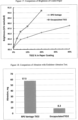
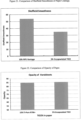
- the opacity of the coated papers from Examples 3 and 4 was measured with an opacimeter (Model BNL-3, manufactured by Technidyne Corporation, New Albany, IN). Comparison of opacity of paper coating according to the invention with conventional titanium dioxide coating is presented in Figures 15 and 16 .
- the brightness of the coated paper from Example 3 was measured with a Color Touch 2, Model ISO, manufactured by Technidyne Corporation, New Albany, IN. Comparison of brightness (UV excluded) of paper coating according to the invention with conventional titanium dioxide coating is presented in Figure 17 .
- Abrasion resistance was measured according to the Einlehner Abrasion Testing of Pigment. The procedure of the Einlehner AT-1000 (bronze) as follows:
- Einlehner AT-1000 (bronze).
- a cleaned, pre-weighed phosphorbronze test screen supplied by Hans Einlehner, Inc, is clamped to the bottom of the test cylinder.
- the test slurry prepared by thoroughly mixing 1.00.0g pigment (dry basis) with 978.0 g H2O, is poured into the test cylinder.
- the testing body is fitted with PVC hose sections supplied by Hans Einlehner, Inc. and placed in its proper position in the test cylinder. After 174000 spindle rotations, the experiment is stopped.
- the test screen is washed, dried and weighed. The weight loss (in mg) suffered by the test screen yields the Einlehner value,
- the encapsulated TiO2 particles yielded less abrasive values in the Einlehner test than a control sample, a commercial rutile TiO 2 , RPS Vantage.
- Example 8 Test of Gloss of Paper Coating.
- Example 9 Test of Gloss of Coated Paper at Different Calendar Pressures.
- the coated paper from Example 4 was run through a calendar (Beloit Wheeler Corporation, Kalamazoo, MI) at a pressure at 1000, 2000 and 3000 PSI, respectively, and the Gloss at 75 degree of the calendared paper was tested with Technidyne Model T48, according to TAPPI Test Method T480. Comparison of the gloss of the paper coated according to the invention was made as compared to a paper with a conventional titanium dioxide coating. Results are presented in Figure 20 .
- Refined mixed northern hardwood and southern softwood were used as the furnish.
- the hardwood contained 1.9% carbonate as buffer.
- the conventional titanium dioxide Ti-Pure R796+ available from Dupont and the encapsulated titanium dioxide from Example 2 were added at 100, 200, 400, and 800 lb/ton.
- Retention chemistry consisted of cationic starch, alum, and anionic polymer was used. Handsheets were made to TAPPI standard weight of 60 gram per square meter.
- the opacity of the paper handsheets from Example 10 was measured with an opacimeter (Model BNL-3, manufactured by Technidyne Corporation, New Albany, IN). Comparison of opacity of paper coating according to the invention with conventional titanium dioxide coating is presented in Figure 22 .
- the brightness of the paper handsheets from Example 10 was measured with a Color Touch 2, Model ISO, manufactured by Technidyne Corporation, New Albany, IN. Comparison of brightness (UV excluded) of paper coating according to the invention with conventional titanium dioxide coating is presented in Figure 23 .
- Table 3 presents Einlehner abrasion values reported in the literature by others for conventional titanium dioxides.
- Table 3 Bronze Einlehner Abrasion of Several Pigments Pigment Einlehner* (mg) Rutile-Coated 44.2 Rutile-A" 39.6 Anatase-A 32.6 Rutile-A 31.8 Rutile-C 15.9 Anatase-B 11.6 Anatase-C 9.0 Anatase-D 8.4 CaCO 3 (ppt) 5.8 * Averaged value of at least three test results.
- the dimension of stanchions and the average number of stanchions per pigment particle of encapsulated TiO 2 particles from Example 2 were measured from TEM images with method described previously.
- the measured average length and width of the stanchions were 41mn and 80.1 nm, respectively, and the average number of stanchions per particle was 3.6 (as shown in Table 4 and Table 5.
Landscapes
- Chemical & Material Sciences (AREA)
- Organic Chemistry (AREA)
- Pigments, Carbon Blacks, Or Wood Stains (AREA)
- Paper (AREA)
- Compositions Of Macromolecular Compounds (AREA)
- Paints Or Removers (AREA)
- Cosmetics (AREA)
Claims (14)
- Papier couché comprenant un papier de base ayant un revêtement sur celui-ci ; ledit revêtement comprenant un liant choisi dans le groupe constitué par un amidon, un alcool vinylique, un latex, une carboxyméthylcellulose et des combinaisons correspondantes, des particules de pigment de dioxyde de titane encapsulées par étai, les particules de pigment étant au moins partiellement entourées par un revêtement polymérique qui comprend un polymère choisi dans le groupe constitué par un polyacrylate, un polyméthacrylate, un poly((méth)acrylate d'alkyle), un polystyrène, une mélamine formaldéhyde, une urée formaldéhyde, un poly(alcool vinylique), un poly(acétate de vinyle) et des combinaisons correspondantes, les étais pouvant former un pont entre les particules ou les saillies, et les étais étant du même matériau polymérique que le revêtement polymérique.
- Papier couché selon la revendication 1, ledit pigment encapsulé par étai comprenant 1 à 30 % en poids dudit revêtement.
- Papier couché selon la revendication 1, le pigment comprenant 40 à 60 % en poids dudit pigment encapsulé par étai.
- Papier couché selon la revendication 1, ledit dioxyde de titane encapsulé par étai étant présent en une quantité qui fournit du dioxyde de titane dans la plage de 2 à 10 % en poids dudit revêtement.
- Papier couché selon la revendication 1, le pigment étant un dioxyde de titane de type rutile et ledit papier ayant une abrasion Einlehner de moins de 10 mg.
- Papier couché selon la revendication 1, ledit dioxyde de titane encapsulé para étai ayant une moyenne de 0,2 à 6 étais par particules de dioxyde de titane.
- Papier couché selon la revendication 1, ledit dioxyde de titane encapsulé par étai ayant une longueur moyenne d'étai qui est dans la plage de 10 à 500 nm.
- Papier couché selon la revendication 1, ledit revêtement comprenant en outre(a) au moins un pigment choisi parmi des carbonates de calcium, des argiles et des combinaisons correspondantes ; ou(b) au moins un additif choisi parmi des tensioactifs, des dispersants, des lubrifiants, des épaississants, des agents antimousses, des agents opacifiants et des agents azurants optiques.
- Composition de revêtement pour papier, qui comprend un mélange d'eau, d'un liant choisi dans le groupe constitué par un amidon, un alcool vinylique, un latex, une carboxyméthylcellulose et des combinaisons correspondantes, et de particules de pigment de dioxyde de titane encapsulées par étai, les particules de pigment étant au moins partiellement entourées par un revêtement polymérique qui comprend un polymère choisi dans le groupe constitué par un polyacrylate, un polyméthacrylate, un poly((méth)acrylate d'alkyle), un polystyrène, une mélamine formaldéhyde, une urée formaldéhyde, un poly(alcool vinylique), un poly(acétate de vinyle) et des combinaisons correspondantes, les étais pouvant former un pont entre les particules ou les saillies, et les étais étant du même matériau polymérique que le revêtement polymérique.
- Composition de revêtement selon la revendication 9, la composition de revêtement comprenant en outre au moins un pigment choisi parmi des carbonates de calcium, des argiles et des combinaisons correspondantes.
- Produit de papier produit par revêtement d'un tapis de base avec la composition de revêtement selon la revendication 9 ou 10,(a) ledit papier étant soumis à un calandrage après ledit revêtement ; ou(b) ledit papier n'étant pas soumis à un calandrage après ledit revêtement.
- Papier comprenant une pâte de cellulose et une charge, la charge comprenant des particules de pigment de dioxyde de titane encapsulées par étai, les particules de pigment étant au moins partiellement entourées par un revêtement polymérique qui comprend un polymère choisi dans le groupe constitué par un polyacrylate, un polyméthacrylate, un poly((méth)acrylate d'alkyle), un polystyrène, une mélamine formaldéhyde, une urée formaldéhyde, un poly(alcool vinylique), un poly(acétate de vinyle) et des combinaisons correspondantes, les étais pouvant former un pont entre les particules ou les saillies, et les étais étant du même matériau polymérique que le revêtement polymérique.
- Papier couché, composition de revêtement, produit de papier ou papier selon une quelconque revendication précédente, comprenant en outre des séparateurs de particules.
- Papier couché, composition de revêtement, produit de papier ou papier selon une quelconque revendication précédente, comprenant en outre des séparateurs de particules, le revêtement polymérique, les étais et les séparateurs de particules étant formés du même matériau polymérique.
Applications Claiming Priority (3)
| Application Number | Priority Date | Filing Date | Title |
|---|---|---|---|
| US201361836017P | 2013-06-17 | 2013-06-17 | |
| US14/136,663 US10208428B2 (en) | 2013-06-17 | 2013-12-20 | Coated paper |
| PCT/US2014/041919 WO2014204747A2 (fr) | 2013-06-17 | 2014-06-11 | Papier couché |
Publications (3)
| Publication Number | Publication Date |
|---|---|
| EP3011105A2 EP3011105A2 (fr) | 2016-04-27 |
| EP3011105A4 EP3011105A4 (fr) | 2017-01-11 |
| EP3011105B1 true EP3011105B1 (fr) | 2023-12-20 |
Family
ID=52019469
Family Applications (2)
| Application Number | Title | Priority Date | Filing Date |
|---|---|---|---|
| EP14813764.9A Active EP3011105B1 (fr) | 2013-06-17 | 2014-06-11 | Papier couché |
| EP14814107.0A Active EP3010982B1 (fr) | 2013-06-17 | 2014-06-11 | Composition comprenant des particules solides encapsulées et son utilisation pour un revêtement de papier |
Family Applications After (1)
| Application Number | Title | Priority Date | Filing Date |
|---|---|---|---|
| EP14814107.0A Active EP3010982B1 (fr) | 2013-06-17 | 2014-06-11 | Composition comprenant des particules solides encapsulées et son utilisation pour un revêtement de papier |
Country Status (4)
| Country | Link |
|---|---|
| US (2) | US10208428B2 (fr) |
| EP (2) | EP3011105B1 (fr) |
| CA (2) | CA2897208C (fr) |
| WO (2) | WO2014204747A2 (fr) |
Families Citing this family (4)
| Publication number | Priority date | Publication date | Assignee | Title |
|---|---|---|---|---|
| US9809725B2 (en) * | 2013-06-17 | 2017-11-07 | Encapsys, Llc | Paint with encapsulated solid particles |
| CN110467836A (zh) * | 2019-09-19 | 2019-11-19 | 上海沐婉文化传媒有限公司 | 一种绘画颜料的配方及其制备方法 |
| CN110679591B (zh) * | 2019-10-28 | 2021-09-21 | 上海悦联生物科技有限公司 | 一种农药组合物及其制备方法 |
| CN112391868A (zh) * | 2020-11-17 | 2021-02-23 | 济南森瑞达纸业有限公司 | 一种无荧光剂无光铜板纸的制备方法 |
Family Cites Families (20)
| Publication number | Priority date | Publication date | Assignee | Title |
|---|---|---|---|---|
| US3133893A (en) | 1957-07-30 | 1964-05-19 | American Cyanamid Co | Pigment particles coated with polymer and method of preparing the same |
| US4771086A (en) | 1982-09-02 | 1988-09-13 | Union Carbide Corporation | Encapsulating finely divided solid particles in stable suspensions |
| SU1281576A1 (ru) * | 1984-10-31 | 1987-01-07 | Предприятие П/Я М-5927 | Способ получени модифицированного карбоната кальци |
| US4981882A (en) | 1989-03-31 | 1991-01-01 | Union Carbide Chemicals And Plastics Company Inc. | Method for enhancing encapsulation efficiency in coating particles in aqueous dispersions |
| AU671963B2 (en) * | 1991-12-03 | 1996-09-19 | Rohm And Haas Company | Aqueous dispersion of composite particles including polymeric latex |
| US6080802A (en) | 1991-12-03 | 2000-06-27 | Rohm And Haas Company | Process for preparing an aqueous dispersion of composite particles including polymeric latex adsorbed to titanium dioxide |
| US5344487A (en) * | 1992-02-12 | 1994-09-06 | Whalen Shaw Michael | Layered composite pigments and method of making same |
| SG84480A1 (en) * | 1992-04-10 | 2001-11-20 | Rohm & Haas | Polymeric particles |
| US6406747B1 (en) * | 2000-11-28 | 2002-06-18 | Xerox Corporation | Methods of encapsulating cores using ink jets or fogs |
| FR2823213B1 (fr) * | 2001-04-05 | 2007-06-08 | Peintures Jefco Francis | Copolymere greffe et concentre liquide de charges minerales en contenant et leur utilisation pour la preparation de peintures en milieu aqueux et/ou organique |
| EP1445288B1 (fr) | 2003-01-24 | 2017-03-08 | Rohm And Haas Company | Particule composites organiques-inorganiques et procédé de leurs préparations |
| US7452416B2 (en) * | 2004-05-17 | 2008-11-18 | Cpm Industries | Cationic titanium dioxide pigments |
| FR2873127B1 (fr) * | 2004-07-13 | 2008-08-29 | Omya Development Ag | Procede de fabrication de particules pigmentaires autoliantes, seches ou en suspension ou dispersion aqueuses, contenant des matieres inorganiques et des liants |
| DE102005025374A1 (de) * | 2005-05-31 | 2006-12-07 | Basf Ag | Polymer-Pigment-Hybride für die Papierherstellung |
| CA2601958C (fr) | 2006-10-03 | 2011-07-12 | Rohm And Haas Company | Papier revetu d'un liant a pigments organiques creux et articles en carton et methodes de fabrication connexes |
| US8236431B2 (en) * | 2006-10-03 | 2012-08-07 | Rohm And Haas Company | Hollow organic pigment core binder coated paper and paperboard articles and methods for making the same |
| DE102007059681A1 (de) * | 2007-12-12 | 2009-06-18 | Omya Development Ag | Komposits aus anorganischen Mikropartikeln mit phosphatierter Oberfläche und Nano-Erdalkalikarbonatpartikeln |
| US8067089B2 (en) | 2008-05-01 | 2011-11-29 | Appleton Papers Inc. | Cationic microcapsule particles |
| EP2161304B1 (fr) * | 2008-09-04 | 2014-04-23 | Rohm and Haas Company | Particule de pigment opacifiant |
| EP2343344B1 (fr) * | 2010-01-08 | 2018-03-07 | Akzo Nobel Coatings International B.V. | Encapsulation de pigments avec du latex polymère préparé par polymérisation de mini-émulsions |
-
2013
- 2013-12-20 US US14/136,663 patent/US10208428B2/en active Active
-
2014
- 2014-06-11 EP EP14813764.9A patent/EP3011105B1/fr active Active
- 2014-06-11 WO PCT/US2014/041919 patent/WO2014204747A2/fr not_active Ceased
- 2014-06-11 CA CA2897208A patent/CA2897208C/fr active Active
- 2014-06-11 CA CA2897211A patent/CA2897211C/fr active Active
- 2014-06-11 WO PCT/US2014/041945 patent/WO2014204754A2/fr not_active Ceased
- 2014-06-11 EP EP14814107.0A patent/EP3010982B1/fr active Active
- 2014-06-13 US US14/304,371 patent/US20140370272A1/en not_active Abandoned
Also Published As
| Publication number | Publication date |
|---|---|
| WO2014204754A3 (fr) | 2015-02-19 |
| CA2897208C (fr) | 2021-06-15 |
| WO2014204747A3 (fr) | 2015-04-09 |
| US20140370272A1 (en) | 2014-12-18 |
| EP3010982A2 (fr) | 2016-04-27 |
| EP3010982A4 (fr) | 2016-12-21 |
| CA2897211A1 (fr) | 2014-12-24 |
| WO2014204754A2 (fr) | 2014-12-24 |
| EP3010982B1 (fr) | 2024-08-07 |
| WO2014204747A2 (fr) | 2014-12-24 |
| EP3011105A4 (fr) | 2017-01-11 |
| EP3011105A2 (fr) | 2016-04-27 |
| US10208428B2 (en) | 2019-02-19 |
| US20140370271A1 (en) | 2014-12-18 |
| CA2897211C (fr) | 2022-12-06 |
| CA2897208A1 (fr) | 2014-12-24 |
Similar Documents
| Publication | Publication Date | Title |
|---|---|---|
| KR100597335B1 (ko) | 안정한 수성 분산액, 이의 제조방법, 및 이를 사용하는 피복 조성물 및 기록 매체 | |
| CN101460573B (zh) | 无机和/或有机微粒和纳米白云石颗粒的复合物 | |
| AU769380B2 (en) | Formulation suitable for ink receptive coatings | |
| CN101970563B (zh) | 具有磷酸盐化表面的无机微米颗粒与碱土金属碳酸盐纳米颗粒的复合物 | |
| TWI579429B (zh) | 製造經塗覆基質的方法 | |
| US8382945B2 (en) | Expandable microspheres and methods of making and using the same | |
| EP3011105B1 (fr) | Papier couché | |
| MX2008014767A (es) | Compuestos de microparticulas inorganicas y/u organicas y nanoparticulas de dolomita. | |
| EP2419463B1 (fr) | Particules polymères organiques, compositions de couchage du papier et procédés correspondants | |
| CA2340862A1 (fr) | Composition de couchage a base d'eau pour papier ou carton | |
| US9809725B2 (en) | Paint with encapsulated solid particles | |
| KR20060009882A (ko) | 첨가제 프리믹스를 함유하는 수성 계 및 그의 형성 방법 | |
| Abhari | Application of Suspension-polymerized Latexes in Surface Sizing and Pigment Coating of Paper |
Legal Events
| Date | Code | Title | Description |
|---|---|---|---|
| PUAI | Public reference made under article 153(3) epc to a published international application that has entered the european phase |
Free format text: ORIGINAL CODE: 0009012 |
|
| 17P | Request for examination filed |
Effective date: 20151030 |
|
| AK | Designated contracting states |
Kind code of ref document: A2 Designated state(s): AL AT BE BG CH CY CZ DE DK EE ES FI FR GB GR HR HU IE IS IT LI LT LU LV MC MK MT NL NO PL PT RO RS SE SI SK SM TR |
|
| AX | Request for extension of the european patent |
Extension state: BA ME |
|
| DAX | Request for extension of the european patent (deleted) | ||
| A4 | Supplementary search report drawn up and despatched |
Effective date: 20161213 |
|
| RIC1 | Information provided on ipc code assigned before grant |
Ipc: D21H 25/14 20060101ALI20161207BHEP Ipc: D21H 19/58 20060101ALI20161207BHEP Ipc: D21H 19/38 20060101ALI20161207BHEP Ipc: D21H 19/36 20060101AFI20161207BHEP Ipc: D21H 19/66 20060101ALI20161207BHEP Ipc: D21H 19/60 20060101ALI20161207BHEP Ipc: C09C 1/36 20060101ALI20161207BHEP Ipc: C09C 3/10 20060101ALI20161207BHEP |
|
| STAA | Information on the status of an ep patent application or granted ep patent |
Free format text: STATUS: EXAMINATION IS IN PROGRESS |
|
| 17Q | First examination report despatched |
Effective date: 20210317 |
|
| GRAP | Despatch of communication of intention to grant a patent |
Free format text: ORIGINAL CODE: EPIDOSNIGR1 |
|
| STAA | Information on the status of an ep patent application or granted ep patent |
Free format text: STATUS: GRANT OF PATENT IS INTENDED |
|
| INTG | Intention to grant announced |
Effective date: 20230918 |
|
| GRAS | Grant fee paid |
Free format text: ORIGINAL CODE: EPIDOSNIGR3 |
|
| GRAA | (expected) grant |
Free format text: ORIGINAL CODE: 0009210 |
|
| STAA | Information on the status of an ep patent application or granted ep patent |
Free format text: STATUS: THE PATENT HAS BEEN GRANTED |
|
| AK | Designated contracting states |
Kind code of ref document: B1 Designated state(s): AL AT BE BG CH CY CZ DE DK EE ES FI FR GB GR HR HU IE IS IT LI LT LU LV MC MK MT NL NO PL PT RO RS SE SI SK SM TR |
|
| REG | Reference to a national code |
Ref country code: GB Ref legal event code: FG4D |
|
| REG | Reference to a national code |
Ref country code: DE Ref legal event code: R096 Ref document number: 602014089151 Country of ref document: DE |
|
| REG | Reference to a national code |
Ref country code: CH Ref legal event code: EP |
|
| P01 | Opt-out of the competence of the unified patent court (upc) registered |
Effective date: 20231213 |
|
| REG | Reference to a national code |
Ref country code: IE Ref legal event code: FG4D |
|
| PG25 | Lapsed in a contracting state [announced via postgrant information from national office to epo] |
Ref country code: GR Free format text: LAPSE BECAUSE OF FAILURE TO SUBMIT A TRANSLATION OF THE DESCRIPTION OR TO PAY THE FEE WITHIN THE PRESCRIBED TIME-LIMIT Effective date: 20240321 |
|
| REG | Reference to a national code |
Ref country code: LT Ref legal event code: MG9D |
|
| PG25 | Lapsed in a contracting state [announced via postgrant information from national office to epo] |
Ref country code: LT Free format text: LAPSE BECAUSE OF FAILURE TO SUBMIT A TRANSLATION OF THE DESCRIPTION OR TO PAY THE FEE WITHIN THE PRESCRIBED TIME-LIMIT Effective date: 20231220 |
|
| REG | Reference to a national code |
Ref country code: NL Ref legal event code: MP Effective date: 20231220 |
|
| PG25 | Lapsed in a contracting state [announced via postgrant information from national office to epo] |
Ref country code: ES Free format text: LAPSE BECAUSE OF FAILURE TO SUBMIT A TRANSLATION OF THE DESCRIPTION OR TO PAY THE FEE WITHIN THE PRESCRIBED TIME-LIMIT Effective date: 20231220 |
|
| PG25 | Lapsed in a contracting state [announced via postgrant information from national office to epo] |
Ref country code: LT Free format text: LAPSE BECAUSE OF FAILURE TO SUBMIT A TRANSLATION OF THE DESCRIPTION OR TO PAY THE FEE WITHIN THE PRESCRIBED TIME-LIMIT Effective date: 20231220 Ref country code: GR Free format text: LAPSE BECAUSE OF FAILURE TO SUBMIT A TRANSLATION OF THE DESCRIPTION OR TO PAY THE FEE WITHIN THE PRESCRIBED TIME-LIMIT Effective date: 20240321 Ref country code: FI Free format text: LAPSE BECAUSE OF FAILURE TO SUBMIT A TRANSLATION OF THE DESCRIPTION OR TO PAY THE FEE WITHIN THE PRESCRIBED TIME-LIMIT Effective date: 20231220 Ref country code: ES Free format text: LAPSE BECAUSE OF FAILURE TO SUBMIT A TRANSLATION OF THE DESCRIPTION OR TO PAY THE FEE WITHIN THE PRESCRIBED TIME-LIMIT Effective date: 20231220 Ref country code: BG Free format text: LAPSE BECAUSE OF FAILURE TO SUBMIT A TRANSLATION OF THE DESCRIPTION OR TO PAY THE FEE WITHIN THE PRESCRIBED TIME-LIMIT Effective date: 20240320 |
|
| REG | Reference to a national code |
Ref country code: AT Ref legal event code: MK05 Ref document number: 1642533 Country of ref document: AT Kind code of ref document: T Effective date: 20231220 |
|
| PG25 | Lapsed in a contracting state [announced via postgrant information from national office to epo] |
Ref country code: NL Free format text: LAPSE BECAUSE OF FAILURE TO SUBMIT A TRANSLATION OF THE DESCRIPTION OR TO PAY THE FEE WITHIN THE PRESCRIBED TIME-LIMIT Effective date: 20231220 |
|
| PG25 | Lapsed in a contracting state [announced via postgrant information from national office to epo] |
Ref country code: SE Free format text: LAPSE BECAUSE OF FAILURE TO SUBMIT A TRANSLATION OF THE DESCRIPTION OR TO PAY THE FEE WITHIN THE PRESCRIBED TIME-LIMIT Effective date: 20231220 Ref country code: RS Free format text: LAPSE BECAUSE OF FAILURE TO SUBMIT A TRANSLATION OF THE DESCRIPTION OR TO PAY THE FEE WITHIN THE PRESCRIBED TIME-LIMIT Effective date: 20231220 Ref country code: NO Free format text: LAPSE BECAUSE OF FAILURE TO SUBMIT A TRANSLATION OF THE DESCRIPTION OR TO PAY THE FEE WITHIN THE PRESCRIBED TIME-LIMIT Effective date: 20240320 Ref country code: NL Free format text: LAPSE BECAUSE OF FAILURE TO SUBMIT A TRANSLATION OF THE DESCRIPTION OR TO PAY THE FEE WITHIN THE PRESCRIBED TIME-LIMIT Effective date: 20231220 Ref country code: LV Free format text: LAPSE BECAUSE OF FAILURE TO SUBMIT A TRANSLATION OF THE DESCRIPTION OR TO PAY THE FEE WITHIN THE PRESCRIBED TIME-LIMIT Effective date: 20231220 Ref country code: HR Free format text: LAPSE BECAUSE OF FAILURE TO SUBMIT A TRANSLATION OF THE DESCRIPTION OR TO PAY THE FEE WITHIN THE PRESCRIBED TIME-LIMIT Effective date: 20231220 |
|
| PG25 | Lapsed in a contracting state [announced via postgrant information from national office to epo] |
Ref country code: IS Free format text: LAPSE BECAUSE OF FAILURE TO SUBMIT A TRANSLATION OF THE DESCRIPTION OR TO PAY THE FEE WITHIN THE PRESCRIBED TIME-LIMIT Effective date: 20240420 |
|
| PG25 | Lapsed in a contracting state [announced via postgrant information from national office to epo] |
Ref country code: CZ Free format text: LAPSE BECAUSE OF FAILURE TO SUBMIT A TRANSLATION OF THE DESCRIPTION OR TO PAY THE FEE WITHIN THE PRESCRIBED TIME-LIMIT Effective date: 20231220 Ref country code: AT Free format text: LAPSE BECAUSE OF FAILURE TO SUBMIT A TRANSLATION OF THE DESCRIPTION OR TO PAY THE FEE WITHIN THE PRESCRIBED TIME-LIMIT Effective date: 20231220 |
|
| PG25 | Lapsed in a contracting state [announced via postgrant information from national office to epo] |
Ref country code: SK Free format text: LAPSE BECAUSE OF FAILURE TO SUBMIT A TRANSLATION OF THE DESCRIPTION OR TO PAY THE FEE WITHIN THE PRESCRIBED TIME-LIMIT Effective date: 20231220 |
|
| PG25 | Lapsed in a contracting state [announced via postgrant information from national office to epo] |
Ref country code: SM Free format text: LAPSE BECAUSE OF FAILURE TO SUBMIT A TRANSLATION OF THE DESCRIPTION OR TO PAY THE FEE WITHIN THE PRESCRIBED TIME-LIMIT Effective date: 20231220 Ref country code: SK Free format text: LAPSE BECAUSE OF FAILURE TO SUBMIT A TRANSLATION OF THE DESCRIPTION OR TO PAY THE FEE WITHIN THE PRESCRIBED TIME-LIMIT Effective date: 20231220 Ref country code: RO Free format text: LAPSE BECAUSE OF FAILURE TO SUBMIT A TRANSLATION OF THE DESCRIPTION OR TO PAY THE FEE WITHIN THE PRESCRIBED TIME-LIMIT Effective date: 20231220 Ref country code: IT Free format text: LAPSE BECAUSE OF FAILURE TO SUBMIT A TRANSLATION OF THE DESCRIPTION OR TO PAY THE FEE WITHIN THE PRESCRIBED TIME-LIMIT Effective date: 20231220 Ref country code: IS Free format text: LAPSE BECAUSE OF FAILURE TO SUBMIT A TRANSLATION OF THE DESCRIPTION OR TO PAY THE FEE WITHIN THE PRESCRIBED TIME-LIMIT Effective date: 20240420 Ref country code: EE Free format text: LAPSE BECAUSE OF FAILURE TO SUBMIT A TRANSLATION OF THE DESCRIPTION OR TO PAY THE FEE WITHIN THE PRESCRIBED TIME-LIMIT Effective date: 20231220 Ref country code: CZ Free format text: LAPSE BECAUSE OF FAILURE TO SUBMIT A TRANSLATION OF THE DESCRIPTION OR TO PAY THE FEE WITHIN THE PRESCRIBED TIME-LIMIT Effective date: 20231220 Ref country code: AT Free format text: LAPSE BECAUSE OF FAILURE TO SUBMIT A TRANSLATION OF THE DESCRIPTION OR TO PAY THE FEE WITHIN THE PRESCRIBED TIME-LIMIT Effective date: 20231220 |
|
| PG25 | Lapsed in a contracting state [announced via postgrant information from national office to epo] |
Ref country code: PT Free format text: LAPSE BECAUSE OF FAILURE TO SUBMIT A TRANSLATION OF THE DESCRIPTION OR TO PAY THE FEE WITHIN THE PRESCRIBED TIME-LIMIT Effective date: 20240422 Ref country code: PL Free format text: LAPSE BECAUSE OF FAILURE TO SUBMIT A TRANSLATION OF THE DESCRIPTION OR TO PAY THE FEE WITHIN THE PRESCRIBED TIME-LIMIT Effective date: 20231220 |
|
| PG25 | Lapsed in a contracting state [announced via postgrant information from national office to epo] |
Ref country code: PT Free format text: LAPSE BECAUSE OF FAILURE TO SUBMIT A TRANSLATION OF THE DESCRIPTION OR TO PAY THE FEE WITHIN THE PRESCRIBED TIME-LIMIT Effective date: 20240422 Ref country code: PL Free format text: LAPSE BECAUSE OF FAILURE TO SUBMIT A TRANSLATION OF THE DESCRIPTION OR TO PAY THE FEE WITHIN THE PRESCRIBED TIME-LIMIT Effective date: 20231220 |
|
| REG | Reference to a national code |
Ref country code: DE Ref legal event code: R097 Ref document number: 602014089151 Country of ref document: DE |
|
| PG25 | Lapsed in a contracting state [announced via postgrant information from national office to epo] |
Ref country code: DK Free format text: LAPSE BECAUSE OF FAILURE TO SUBMIT A TRANSLATION OF THE DESCRIPTION OR TO PAY THE FEE WITHIN THE PRESCRIBED TIME-LIMIT Effective date: 20231220 |
|
| PLBE | No opposition filed within time limit |
Free format text: ORIGINAL CODE: 0009261 |
|
| STAA | Information on the status of an ep patent application or granted ep patent |
Free format text: STATUS: NO OPPOSITION FILED WITHIN TIME LIMIT |
|
| PG25 | Lapsed in a contracting state [announced via postgrant information from national office to epo] |
Ref country code: SI Free format text: LAPSE BECAUSE OF FAILURE TO SUBMIT A TRANSLATION OF THE DESCRIPTION OR TO PAY THE FEE WITHIN THE PRESCRIBED TIME-LIMIT Effective date: 20231220 |
|
| PG25 | Lapsed in a contracting state [announced via postgrant information from national office to epo] |
Ref country code: SI Free format text: LAPSE BECAUSE OF FAILURE TO SUBMIT A TRANSLATION OF THE DESCRIPTION OR TO PAY THE FEE WITHIN THE PRESCRIBED TIME-LIMIT Effective date: 20231220 Ref country code: DK Free format text: LAPSE BECAUSE OF FAILURE TO SUBMIT A TRANSLATION OF THE DESCRIPTION OR TO PAY THE FEE WITHIN THE PRESCRIBED TIME-LIMIT Effective date: 20231220 |
|
| 26N | No opposition filed |
Effective date: 20240923 |
|
| PG25 | Lapsed in a contracting state [announced via postgrant information from national office to epo] |
Ref country code: MC Free format text: LAPSE BECAUSE OF FAILURE TO SUBMIT A TRANSLATION OF THE DESCRIPTION OR TO PAY THE FEE WITHIN THE PRESCRIBED TIME-LIMIT Effective date: 20231220 |
|
| REG | Reference to a national code |
Ref country code: CH Ref legal event code: PL |
|
| PG25 | Lapsed in a contracting state [announced via postgrant information from national office to epo] |
Ref country code: LU Free format text: LAPSE BECAUSE OF NON-PAYMENT OF DUE FEES Effective date: 20240611 |
|
| PG25 | Lapsed in a contracting state [announced via postgrant information from national office to epo] |
Ref country code: IE Free format text: LAPSE BECAUSE OF NON-PAYMENT OF DUE FEES Effective date: 20240611 |
|
| PG25 | Lapsed in a contracting state [announced via postgrant information from national office to epo] |
Ref country code: BE Free format text: LAPSE BECAUSE OF NON-PAYMENT OF DUE FEES Effective date: 20240630 Ref country code: CH Free format text: LAPSE BECAUSE OF NON-PAYMENT OF DUE FEES Effective date: 20240630 |
|
| REG | Reference to a national code |
Ref country code: BE Ref legal event code: MM Effective date: 20240630 |
|
| PGFP | Annual fee paid to national office [announced via postgrant information from national office to epo] |
Ref country code: DE Payment date: 20250627 Year of fee payment: 12 |
|
| PGFP | Annual fee paid to national office [announced via postgrant information from national office to epo] |
Ref country code: GB Payment date: 20250627 Year of fee payment: 12 |
|
| PGFP | Annual fee paid to national office [announced via postgrant information from national office to epo] |
Ref country code: FR Payment date: 20250625 Year of fee payment: 12 |
|
| PG25 | Lapsed in a contracting state [announced via postgrant information from national office to epo] |
Ref country code: CY Free format text: LAPSE BECAUSE OF FAILURE TO SUBMIT A TRANSLATION OF THE DESCRIPTION OR TO PAY THE FEE WITHIN THE PRESCRIBED TIME-LIMIT; INVALID AB INITIO Effective date: 20140611 |
|
| PG25 | Lapsed in a contracting state [announced via postgrant information from national office to epo] |
Ref country code: HU Free format text: LAPSE BECAUSE OF FAILURE TO SUBMIT A TRANSLATION OF THE DESCRIPTION OR TO PAY THE FEE WITHIN THE PRESCRIBED TIME-LIMIT; INVALID AB INITIO Effective date: 20140611 |