EP3012093A1 - Procede et systeme de fabrication d'un ressort a lame - Google Patents
Procede et systeme de fabrication d'un ressort a lame Download PDFInfo
- Publication number
- EP3012093A1 EP3012093A1 EP15189832.7A EP15189832A EP3012093A1 EP 3012093 A1 EP3012093 A1 EP 3012093A1 EP 15189832 A EP15189832 A EP 15189832A EP 3012093 A1 EP3012093 A1 EP 3012093A1
- Authority
- EP
- European Patent Office
- Prior art keywords
- leaf spring
- strip material
- winding core
- winding
- semi
- Prior art date
- Legal status (The legal status is an assumption and is not a legal conclusion. Google has not performed a legal analysis and makes no representation as to the accuracy of the status listed.)
- Granted
Links
Images



Classifications
-
- B—PERFORMING OPERATIONS; TRANSPORTING
- B29—WORKING OF PLASTICS; WORKING OF SUBSTANCES IN A PLASTIC STATE IN GENERAL
- B29C—SHAPING OR JOINING OF PLASTICS; SHAPING OF MATERIAL IN A PLASTIC STATE, NOT OTHERWISE PROVIDED FOR; AFTER-TREATMENT OF THE SHAPED PRODUCTS, e.g. REPAIRING
- B29C70/00—Shaping composites, i.e. plastics material comprising reinforcements, fillers or preformed parts, e.g. inserts
- B29C70/04—Shaping composites, i.e. plastics material comprising reinforcements, fillers or preformed parts, e.g. inserts comprising reinforcements only, e.g. self-reinforcing plastics
- B29C70/28—Shaping operations therefor
- B29C70/30—Shaping by lay-up, i.e. applying fibres, tape or broadsheet on a mould, former or core; Shaping by spray-up, i.e. spraying of fibres on a mould, former or core
- B29C70/32—Shaping by lay-up, i.e. applying fibres, tape or broadsheet on a mould, former or core; Shaping by spray-up, i.e. spraying of fibres on a mould, former or core on a rotating mould, former or core
-
- B—PERFORMING OPERATIONS; TRANSPORTING
- B29—WORKING OF PLASTICS; WORKING OF SUBSTANCES IN A PLASTIC STATE IN GENERAL
- B29C—SHAPING OR JOINING OF PLASTICS; SHAPING OF MATERIAL IN A PLASTIC STATE, NOT OTHERWISE PROVIDED FOR; AFTER-TREATMENT OF THE SHAPED PRODUCTS, e.g. REPAIRING
- B29C70/00—Shaping composites, i.e. plastics material comprising reinforcements, fillers or preformed parts, e.g. inserts
- B29C70/04—Shaping composites, i.e. plastics material comprising reinforcements, fillers or preformed parts, e.g. inserts comprising reinforcements only, e.g. self-reinforcing plastics
- B29C70/06—Fibrous reinforcements only
-
- B—PERFORMING OPERATIONS; TRANSPORTING
- B29—WORKING OF PLASTICS; WORKING OF SUBSTANCES IN A PLASTIC STATE IN GENERAL
- B29C—SHAPING OR JOINING OF PLASTICS; SHAPING OF MATERIAL IN A PLASTIC STATE, NOT OTHERWISE PROVIDED FOR; AFTER-TREATMENT OF THE SHAPED PRODUCTS, e.g. REPAIRING
- B29C70/00—Shaping composites, i.e. plastics material comprising reinforcements, fillers or preformed parts, e.g. inserts
- B29C70/04—Shaping composites, i.e. plastics material comprising reinforcements, fillers or preformed parts, e.g. inserts comprising reinforcements only, e.g. self-reinforcing plastics
- B29C70/28—Shaping operations therefor
- B29C70/30—Shaping by lay-up, i.e. applying fibres, tape or broadsheet on a mould, former or core; Shaping by spray-up, i.e. spraying of fibres on a mould, former or core
- B29C70/34—Shaping by lay-up, i.e. applying fibres, tape or broadsheet on a mould, former or core; Shaping by spray-up, i.e. spraying of fibres on a mould, former or core and shaping or impregnating by compression, i.e. combined with compressing after the lay-up operation
- B29C70/347—Shaping by lay-up, i.e. applying fibres, tape or broadsheet on a mould, former or core; Shaping by spray-up, i.e. spraying of fibres on a mould, former or core and shaping or impregnating by compression, i.e. combined with compressing after the lay-up operation combined with compressing after the winding of lay-ups having a non-circular cross-section, e.g. flat spiral windings
-
- B—PERFORMING OPERATIONS; TRANSPORTING
- B32—LAYERED PRODUCTS
- B32B—LAYERED PRODUCTS, i.e. PRODUCTS BUILT-UP OF STRATA OF FLAT OR NON-FLAT, e.g. CELLULAR OR HONEYCOMB, FORM
- B32B15/00—Layered products comprising a layer of metal
- B32B15/04—Layered products comprising a layer of metal comprising metal as the main or only constituent of a layer, which is next to another layer of the same or of a different material
- B32B15/08—Layered products comprising a layer of metal comprising metal as the main or only constituent of a layer, which is next to another layer of the same or of a different material of synthetic resin
-
- B—PERFORMING OPERATIONS; TRANSPORTING
- B32—LAYERED PRODUCTS
- B32B—LAYERED PRODUCTS, i.e. PRODUCTS BUILT-UP OF STRATA OF FLAT OR NON-FLAT, e.g. CELLULAR OR HONEYCOMB, FORM
- B32B15/00—Layered products comprising a layer of metal
- B32B15/14—Layered products comprising a layer of metal next to a fibrous or filamentary layer
-
- B—PERFORMING OPERATIONS; TRANSPORTING
- B32—LAYERED PRODUCTS
- B32B—LAYERED PRODUCTS, i.e. PRODUCTS BUILT-UP OF STRATA OF FLAT OR NON-FLAT, e.g. CELLULAR OR HONEYCOMB, FORM
- B32B25/00—Layered products comprising a layer of natural or synthetic rubber
- B32B25/04—Layered products comprising a layer of natural or synthetic rubber comprising rubber as the main or only constituent of a layer, which is next to another layer of the same or of a different material
- B32B25/08—Layered products comprising a layer of natural or synthetic rubber comprising rubber as the main or only constituent of a layer, which is next to another layer of the same or of a different material of synthetic resin
-
- B—PERFORMING OPERATIONS; TRANSPORTING
- B32—LAYERED PRODUCTS
- B32B—LAYERED PRODUCTS, i.e. PRODUCTS BUILT-UP OF STRATA OF FLAT OR NON-FLAT, e.g. CELLULAR OR HONEYCOMB, FORM
- B32B25/00—Layered products comprising a layer of natural or synthetic rubber
- B32B25/10—Layered products comprising a layer of natural or synthetic rubber next to a fibrous or filamentary layer
-
- B—PERFORMING OPERATIONS; TRANSPORTING
- B32—LAYERED PRODUCTS
- B32B—LAYERED PRODUCTS, i.e. PRODUCTS BUILT-UP OF STRATA OF FLAT OR NON-FLAT, e.g. CELLULAR OR HONEYCOMB, FORM
- B32B27/00—Layered products comprising a layer of synthetic resin
- B32B27/06—Layered products comprising a layer of synthetic resin as the main or only constituent of a layer, which is next to another layer of the same or of a different material
- B32B27/08—Layered products comprising a layer of synthetic resin as the main or only constituent of a layer, which is next to another layer of the same or of a different material of synthetic resin
-
- B—PERFORMING OPERATIONS; TRANSPORTING
- B32—LAYERED PRODUCTS
- B32B—LAYERED PRODUCTS, i.e. PRODUCTS BUILT-UP OF STRATA OF FLAT OR NON-FLAT, e.g. CELLULAR OR HONEYCOMB, FORM
- B32B27/00—Layered products comprising a layer of synthetic resin
- B32B27/12—Layered products comprising a layer of synthetic resin next to a fibrous or filamentary layer
-
- B—PERFORMING OPERATIONS; TRANSPORTING
- B32—LAYERED PRODUCTS
- B32B—LAYERED PRODUCTS, i.e. PRODUCTS BUILT-UP OF STRATA OF FLAT OR NON-FLAT, e.g. CELLULAR OR HONEYCOMB, FORM
- B32B3/00—Layered products comprising a layer with external or internal discontinuities or unevennesses, or a layer of non-planar shape; Layered products comprising a layer having particular features of form
- B32B3/26—Layered products comprising a layer with external or internal discontinuities or unevennesses, or a layer of non-planar shape; Layered products comprising a layer having particular features of form characterised by a particular shape of the outline of the cross-section of a continuous layer; characterised by a layer with cavities or internal voids ; characterised by an apertured layer
- B32B3/263—Layered products comprising a layer with external or internal discontinuities or unevennesses, or a layer of non-planar shape; Layered products comprising a layer having particular features of form characterised by a particular shape of the outline of the cross-section of a continuous layer; characterised by a layer with cavities or internal voids ; characterised by an apertured layer characterised by a layer having non-uniform thickness
-
- B—PERFORMING OPERATIONS; TRANSPORTING
- B32—LAYERED PRODUCTS
- B32B—LAYERED PRODUCTS, i.e. PRODUCTS BUILT-UP OF STRATA OF FLAT OR NON-FLAT, e.g. CELLULAR OR HONEYCOMB, FORM
- B32B37/00—Methods or apparatus for laminating, e.g. by curing or by ultrasonic bonding
- B32B37/0046—Methods or apparatus for laminating, e.g. by curing or by ultrasonic bonding characterised by constructional aspects of the apparatus
- B32B37/0053—Constructional details of laminating machines comprising rollers; Constructional features of the rollers
-
- B—PERFORMING OPERATIONS; TRANSPORTING
- B32—LAYERED PRODUCTS
- B32B—LAYERED PRODUCTS, i.e. PRODUCTS BUILT-UP OF STRATA OF FLAT OR NON-FLAT, e.g. CELLULAR OR HONEYCOMB, FORM
- B32B37/00—Methods or apparatus for laminating, e.g. by curing or by ultrasonic bonding
- B32B37/0076—Methods or apparatus for laminating, e.g. by curing or by ultrasonic bonding characterised in that the layers are not bonded on the totality of their surfaces
-
- B—PERFORMING OPERATIONS; TRANSPORTING
- B32—LAYERED PRODUCTS
- B32B—LAYERED PRODUCTS, i.e. PRODUCTS BUILT-UP OF STRATA OF FLAT OR NON-FLAT, e.g. CELLULAR OR HONEYCOMB, FORM
- B32B37/00—Methods or apparatus for laminating, e.g. by curing or by ultrasonic bonding
- B32B37/10—Methods or apparatus for laminating, e.g. by curing or by ultrasonic bonding characterised by the pressing technique, e.g. using action of vacuum or fluid pressure
-
- B—PERFORMING OPERATIONS; TRANSPORTING
- B32—LAYERED PRODUCTS
- B32B—LAYERED PRODUCTS, i.e. PRODUCTS BUILT-UP OF STRATA OF FLAT OR NON-FLAT, e.g. CELLULAR OR HONEYCOMB, FORM
- B32B37/00—Methods or apparatus for laminating, e.g. by curing or by ultrasonic bonding
- B32B37/14—Methods or apparatus for laminating, e.g. by curing or by ultrasonic bonding characterised by the properties of the layers
- B32B37/16—Methods or apparatus for laminating, e.g. by curing or by ultrasonic bonding characterised by the properties of the layers with all layers existing as coherent layers before laminating
- B32B37/18—Methods or apparatus for laminating, e.g. by curing or by ultrasonic bonding characterised by the properties of the layers with all layers existing as coherent layers before laminating involving the assembly of discrete sheets or panels only
- B32B37/187—Methods or apparatus for laminating, e.g. by curing or by ultrasonic bonding characterised by the properties of the layers with all layers existing as coherent layers before laminating involving the assembly of discrete sheets or panels only the layers being placed in a carrier before going through the lamination process
-
- B—PERFORMING OPERATIONS; TRANSPORTING
- B32—LAYERED PRODUCTS
- B32B—LAYERED PRODUCTS, i.e. PRODUCTS BUILT-UP OF STRATA OF FLAT OR NON-FLAT, e.g. CELLULAR OR HONEYCOMB, FORM
- B32B38/00—Ancillary operations in connection with laminating processes
- B32B38/0012—Mechanical treatment, e.g. roughening, deforming, stretching
-
- B—PERFORMING OPERATIONS; TRANSPORTING
- B32—LAYERED PRODUCTS
- B32B—LAYERED PRODUCTS, i.e. PRODUCTS BUILT-UP OF STRATA OF FLAT OR NON-FLAT, e.g. CELLULAR OR HONEYCOMB, FORM
- B32B38/00—Ancillary operations in connection with laminating processes
- B32B38/18—Handling of layers or the laminate
- B32B38/1808—Handling of layers or the laminate characterised by the laying up of the layers
-
- B—PERFORMING OPERATIONS; TRANSPORTING
- B32—LAYERED PRODUCTS
- B32B—LAYERED PRODUCTS, i.e. PRODUCTS BUILT-UP OF STRATA OF FLAT OR NON-FLAT, e.g. CELLULAR OR HONEYCOMB, FORM
- B32B5/00—Layered products characterised by the non- homogeneity or physical structure, i.e. comprising a fibrous, filamentary, particulate or foam layer; Layered products characterised by having a layer differing constitutionally or physically in different parts
- B32B5/02—Layered products characterised by the non- homogeneity or physical structure, i.e. comprising a fibrous, filamentary, particulate or foam layer; Layered products characterised by having a layer differing constitutionally or physically in different parts characterised by structural features of a fibrous or filamentary layer
- B32B5/024—Woven fabric
-
- B—PERFORMING OPERATIONS; TRANSPORTING
- B32—LAYERED PRODUCTS
- B32B—LAYERED PRODUCTS, i.e. PRODUCTS BUILT-UP OF STRATA OF FLAT OR NON-FLAT, e.g. CELLULAR OR HONEYCOMB, FORM
- B32B5/00—Layered products characterised by the non- homogeneity or physical structure, i.e. comprising a fibrous, filamentary, particulate or foam layer; Layered products characterised by having a layer differing constitutionally or physically in different parts
- B32B5/02—Layered products characterised by the non- homogeneity or physical structure, i.e. comprising a fibrous, filamentary, particulate or foam layer; Layered products characterised by having a layer differing constitutionally or physically in different parts characterised by structural features of a fibrous or filamentary layer
- B32B5/026—Knitted fabric
-
- B—PERFORMING OPERATIONS; TRANSPORTING
- B32—LAYERED PRODUCTS
- B32B—LAYERED PRODUCTS, i.e. PRODUCTS BUILT-UP OF STRATA OF FLAT OR NON-FLAT, e.g. CELLULAR OR HONEYCOMB, FORM
- B32B5/00—Layered products characterised by the non- homogeneity or physical structure, i.e. comprising a fibrous, filamentary, particulate or foam layer; Layered products characterised by having a layer differing constitutionally or physically in different parts
- B32B5/22—Layered products characterised by the non- homogeneity or physical structure, i.e. comprising a fibrous, filamentary, particulate or foam layer; Layered products characterised by having a layer differing constitutionally or physically in different parts characterised by the presence of two or more layers which are next to each other and are fibrous, filamentary, formed of particles or foamed
- B32B5/24—Layered products characterised by the non- homogeneity or physical structure, i.e. comprising a fibrous, filamentary, particulate or foam layer; Layered products characterised by having a layer differing constitutionally or physically in different parts characterised by the presence of two or more layers which are next to each other and are fibrous, filamentary, formed of particles or foamed one layer being a fibrous or filamentary layer
- B32B5/26—Layered products characterised by the non- homogeneity or physical structure, i.e. comprising a fibrous, filamentary, particulate or foam layer; Layered products characterised by having a layer differing constitutionally or physically in different parts characterised by the presence of two or more layers which are next to each other and are fibrous, filamentary, formed of particles or foamed one layer being a fibrous or filamentary layer another layer next to it also being fibrous or filamentary
-
- B—PERFORMING OPERATIONS; TRANSPORTING
- B32—LAYERED PRODUCTS
- B32B—LAYERED PRODUCTS, i.e. PRODUCTS BUILT-UP OF STRATA OF FLAT OR NON-FLAT, e.g. CELLULAR OR HONEYCOMB, FORM
- B32B7/00—Layered products characterised by the relation between layers; Layered products characterised by the relative orientation of features between layers, or by the relative values of a measurable parameter between layers, i.e. products comprising layers having different physical, chemical or physicochemical properties; Layered products characterised by the interconnection of layers
- B32B7/04—Interconnection of layers
- B32B7/12—Interconnection of layers using interposed adhesives or interposed materials with bonding properties
-
- F—MECHANICAL ENGINEERING; LIGHTING; HEATING; WEAPONS; BLASTING
- F16—ENGINEERING ELEMENTS AND UNITS; GENERAL MEASURES FOR PRODUCING AND MAINTAINING EFFECTIVE FUNCTIONING OF MACHINES OR INSTALLATIONS; THERMAL INSULATION IN GENERAL
- F16F—SPRINGS; SHOCK-ABSORBERS; MEANS FOR DAMPING VIBRATION
- F16F1/00—Springs
- F16F1/36—Springs made of rubber or other material having high internal friction, e.g. thermoplastic elastomers
- F16F1/366—Springs made of rubber or other material having high internal friction, e.g. thermoplastic elastomers made of fibre-reinforced plastics, i.e. characterised by their special construction from such materials
- F16F1/368—Leaf springs
-
- B—PERFORMING OPERATIONS; TRANSPORTING
- B29—WORKING OF PLASTICS; WORKING OF SUBSTANCES IN A PLASTIC STATE IN GENERAL
- B29C—SHAPING OR JOINING OF PLASTICS; SHAPING OF MATERIAL IN A PLASTIC STATE, NOT OTHERWISE PROVIDED FOR; AFTER-TREATMENT OF THE SHAPED PRODUCTS, e.g. REPAIRING
- B29C53/00—Shaping by bending, folding, twisting, straightening or flattening; Apparatus therefor
- B29C53/56—Winding and joining, e.g. winding spirally
- B29C53/564—Winding and joining, e.g. winding spirally for making non-tubular articles
-
- B—PERFORMING OPERATIONS; TRANSPORTING
- B29—WORKING OF PLASTICS; WORKING OF SUBSTANCES IN A PLASTIC STATE IN GENERAL
- B29K—INDEXING SCHEME ASSOCIATED WITH SUBCLASSES B29B, B29C OR B29D, RELATING TO MOULDING MATERIALS OR TO MATERIALS FOR MOULDS, REINFORCEMENTS, FILLERS OR PREFORMED PARTS, e.g. INSERTS
- B29K2105/00—Condition, form or state of moulded material or of the material to be shaped
- B29K2105/06—Condition, form or state of moulded material or of the material to be shaped containing reinforcements, fillers or inserts
- B29K2105/12—Condition, form or state of moulded material or of the material to be shaped containing reinforcements, fillers or inserts of short lengths, e.g. chopped filaments, staple fibres or bristles
-
- B—PERFORMING OPERATIONS; TRANSPORTING
- B29—WORKING OF PLASTICS; WORKING OF SUBSTANCES IN A PLASTIC STATE IN GENERAL
- B29L—INDEXING SCHEME ASSOCIATED WITH SUBCLASS B29C, RELATING TO PARTICULAR ARTICLES
- B29L2031/00—Other particular articles
- B29L2031/774—Springs
-
- B—PERFORMING OPERATIONS; TRANSPORTING
- B32—LAYERED PRODUCTS
- B32B—LAYERED PRODUCTS, i.e. PRODUCTS BUILT-UP OF STRATA OF FLAT OR NON-FLAT, e.g. CELLULAR OR HONEYCOMB, FORM
- B32B2260/00—Layered product comprising an impregnated, embedded, or bonded layer wherein the layer comprises an impregnation, embedding, or binder material
- B32B2260/02—Composition of the impregnated, bonded or embedded layer
- B32B2260/021—Fibrous or filamentary layer
- B32B2260/023—Two or more layers
-
- B—PERFORMING OPERATIONS; TRANSPORTING
- B32—LAYERED PRODUCTS
- B32B—LAYERED PRODUCTS, i.e. PRODUCTS BUILT-UP OF STRATA OF FLAT OR NON-FLAT, e.g. CELLULAR OR HONEYCOMB, FORM
- B32B2260/00—Layered product comprising an impregnated, embedded, or bonded layer wherein the layer comprises an impregnation, embedding, or binder material
- B32B2260/04—Impregnation, embedding, or binder material
- B32B2260/046—Synthetic resin
-
- B—PERFORMING OPERATIONS; TRANSPORTING
- B32—LAYERED PRODUCTS
- B32B—LAYERED PRODUCTS, i.e. PRODUCTS BUILT-UP OF STRATA OF FLAT OR NON-FLAT, e.g. CELLULAR OR HONEYCOMB, FORM
- B32B2262/00—Composition or structural features of fibres which form a fibrous or filamentary layer or are present as additives
- B32B2262/02—Synthetic macromolecular fibres
- B32B2262/0261—Polyamide fibres
- B32B2262/0269—Aromatic polyamide fibres
-
- B—PERFORMING OPERATIONS; TRANSPORTING
- B32—LAYERED PRODUCTS
- B32B—LAYERED PRODUCTS, i.e. PRODUCTS BUILT-UP OF STRATA OF FLAT OR NON-FLAT, e.g. CELLULAR OR HONEYCOMB, FORM
- B32B2262/00—Composition or structural features of fibres which form a fibrous or filamentary layer or are present as additives
- B32B2262/10—Inorganic fibres
- B32B2262/101—Glass fibres
-
- B—PERFORMING OPERATIONS; TRANSPORTING
- B32—LAYERED PRODUCTS
- B32B—LAYERED PRODUCTS, i.e. PRODUCTS BUILT-UP OF STRATA OF FLAT OR NON-FLAT, e.g. CELLULAR OR HONEYCOMB, FORM
- B32B2262/00—Composition or structural features of fibres which form a fibrous or filamentary layer or are present as additives
- B32B2262/10—Inorganic fibres
- B32B2262/106—Carbon fibres, e.g. graphite fibres
-
- B—PERFORMING OPERATIONS; TRANSPORTING
- B32—LAYERED PRODUCTS
- B32B—LAYERED PRODUCTS, i.e. PRODUCTS BUILT-UP OF STRATA OF FLAT OR NON-FLAT, e.g. CELLULAR OR HONEYCOMB, FORM
- B32B2605/00—Vehicles
-
- B—PERFORMING OPERATIONS; TRANSPORTING
- B32—LAYERED PRODUCTS
- B32B—LAYERED PRODUCTS, i.e. PRODUCTS BUILT-UP OF STRATA OF FLAT OR NON-FLAT, e.g. CELLULAR OR HONEYCOMB, FORM
- B32B2605/00—Vehicles
- B32B2605/08—Cars
-
- F—MECHANICAL ENGINEERING; LIGHTING; HEATING; WEAPONS; BLASTING
- F16—ENGINEERING ELEMENTS AND UNITS; GENERAL MEASURES FOR PRODUCING AND MAINTAINING EFFECTIVE FUNCTIONING OF MACHINES OR INSTALLATIONS; THERMAL INSULATION IN GENERAL
- F16F—SPRINGS; SHOCK-ABSORBERS; MEANS FOR DAMPING VIBRATION
- F16F2226/00—Manufacturing; Treatments
Definitions
- the present invention relates to a method for producing a leaf spring made of a fiber composite material and to an arrangement for producing a leaf spring made of a fiber composite material according to the features of the independent claims.
- Leaf springs made of fiber composite material play an important role in modern automotive engineering.
- a leaf spring By using a winding process, a leaf spring can be manufactured with cycle times suitable for mass production.
- preimpregnated tape materials are very easy to handle.
- the band material can be designed in different ways. It may be in the form of a broad bundle of individual fibers which are aligned parallel to each other and held together only by a few fibers oriented transversely to the preferred direction. It is also possible that the individual fibers of the fiber material are intertwined or interwoven. It may be a single band, the width of which coincides with the width of the semi-finished leaf spring to be produced, or a plurality of bands which are then deposited parallel to one another or else one above the other on the winding core. The person skilled in the art is familiar with terms such as “tape”, “towpreg” or "roving".
- the fiber material is fibers of glass, carbon, aramid or other common in the manufacture of fiber composite components materials.
- the concrete design of the strip material of fiber material depends on the requirements that are placed on the component to be manufactured. According to these requirements, the strip material and the fiber material are selected.
- the band materials used are preimpregnated with a matrix resin.
- a matrix resin may be thermoplastic or thermoset materials.
- the matrix resin is already present in the semifinished leaf spring product and does not have to be laboriously injected into a dry preform, as in the case of an RTM process.
- Another advantage is the good handling of these materials in production. They are usually slightly tacky at room temperature, but the matrix resin is not so fluid that the production facility is contaminated by resin splashes. This problem occurs in particular in wet winding process, where frequent cleaning work is necessary, which in turn increase the downtime.
- the strip material is wound under tension on a winding core. This is of particular relevance to the process according to the invention.
- the individual layers of the strip material are thereby deposited on each other with the greatest possible avoidance of air inclusions. Air pockets form during compression of the Semifinished leaf spring blemishes in the leaf spring that adversely affect the mechanical properties of the spring. It comes as a result of delamination, which in turn leads to failure of the entire leaf spring.
- the individual layers of the strip material abut one another over the whole area and air pockets do not occur.
- the individual layers are wrinkle-free and precisely laid one on top of the other.
- a pressure means which presses the layers of the strip material to one another again and also presses the fiber material in cavities, which are formed on the winding core for shaping the leaf spring semi-finished product.
- the pressure means thus enables a full-surface and wrinkle-free adhesive connections of adjacent layers with one another, since the pre-impregnated strip materials are slightly sticky and can adhere to one another. The more intimately this adhesion is pronounced, the better the individual layers will crosslink each other during later curing. The result is a more durable and more durable leaf spring with a long service life.
- adjacent layers are understood in this context to be layers of the strip material which are laid on top of one another during winding.
- the winding core has in the winding direction on the circumference at least two cavities for shaping the leaf spring semi-finished product.
- a finished leaf spring most of the fibers are aligned longitudinally of the spring.
- the strip material in a preferred direction parallel over-and / or placed side by side, which corresponds to the longitudinal direction of the spring.
- This preferred direction in the storage of the strip material is referred to as the winding direction.
- the at least two cavities are formed lying one behind the other in the circumferential direction. This makes it possible to produce several semi-finished leaf spring products simultaneously in one winding process and to minimize the waste of fiber material.
- the leaf spring semi-finished their intended shape is specified, whereby the handling when inserting into the pressing tool is facilitated and the formation of the finished leaf spring is simplified.
- the strip material is cut off and the finished semi-finished leaf spring products are removed and removed from their cavities.
- the separation is done by cutting or punching.
- a pressing tool is provided with a release agent and the leaf spring semi-finished inserted into the pressing tool and the tool is closed.
- the semi-finished products are then subjected to a surface pressure of preferably 1 to 10 bar and a temperature of preferably 120 ° C to 160 ° C.
- the matrix resin cross-links and hardens, creating the leaf spring.
- the exact production parameters in terms of pressure and temperature depend on the matrix resin used and the geometry of the leaf spring.
- leaf spring semi-finished products are processed simultaneously in a pressing tool. This again improves the cycle time of the production.
- the tool consists of upper and lower tool, both of which have a controlled temperature control. It can also be provided that the temperature is regulated differently in different areas.
- the winding core rotates about an axis of rotation perpendicular to the winding direction for winding up the strip material. This simplifies the manufacturing process in particular, since thus no additional manipulator for depositing the strip material on the winding core is necessary. This will be the beginning of the band or bands of the Fiber material attached to the winding core, for example, clamped, glued or simply knotted.
- the tape material is provided on a spool and withdrawn from the spool by the winding operation.
- This embodiment also serves to improve the production process.
- the strip material is automatically transported to the winding core by the bobbins mounted on a corresponding gate.
- guide elements for example Teflon rolls with grooves, can be provided.
- the strip material is wound onto the winding core under tension.
- the rotation of the coils when removing the strip material is regulated. This ensures that the strip material always remains under tension during winding and does not sag.
- the regulation of the rotation of the coils takes place electronically.
- a plurality of bands of the strip material are provided, each strip having a width which is smaller than the width of the leaf spring semi-finished product.
- the layer structure of the semi-finished leaf spring and thus the finished leaf spring depends on the technical requirements that are placed on the product.
- the use of a strip material, which has the entire intended width of the leaf spring semi-finished product allows a relatively rapid construction of the semifinished product during winding, at the same time, however, is less flexible in terms of the layer structure and the material guide during winding is more complicated. Therefore, it is preferably provided to produce the semifinished product from narrower strip materials.
- the leadership of the narrower bands is easier and it is possible to introduce different band materials locally in the leaf spring blank. In this case, both the fiber materials can be varied as well as the structure of the strip materials themselves in terms of fiber volume content or fiber orientation.
- the ideal layer structure for the intended leaf spring is calculated beforehand. For example, a plurality of strip materials next to each other form a position of the leaf spring semi-finished product. It is also possible for a plurality of strip materials to form a layer of the semifinished sheet-semi-finished product one above the other and / or next to one another and / or overlapping.
- the term "layer” means in particular a closed layer of a leaf spring composed of several layers.
- winding core is moved during winding by a designated distance in the direction of the axis of rotation.
- a movement in the direction in which the axis of rotation points The winding core is thus displaced or moved back and forth on the axis of rotation. This allows a further possibility of variation in the design of the layer structure. This makes it possible to store individual layers of strip material offset from one another on the winding core.
- strip material with a width smaller than the intended width of the leaf-spring semi-finished product is deposited on the winding core.
- the winding core is moved between two revolutions by a distance which is smaller than the width of the strip material, preferably the distance corresponds to half the width of the strip material. If a single strip material is used, strip sections are overlapped on top of one another and thus a position of the leaf spring semi-finished product is generated, it being ensured that no gaps are created between the individual narrow strips.
- the winding core is moved after a fixed number of revolutions in the opposite direction, so that the strip material is wound alternately overlapping.
- the first Direction overlap occurs in this first direction, in the movement in the second direction, the overlap takes place in the other direction.
- such a layer structure can be produced in which a plurality of strip materials form a layer and the individual layers are offset from each other by exactly half the width of a strip material.
- the strip materials are deposited parallel to one another on the winding core in order to form a first fiber layer.
- the total width of the parallel stored strip materials is smaller by half the width of a strip material than the intended width of the leaf spring semi-finished product.
- the first fiber layer lies flush against a longitudinal side of the cavities of the winding core. After a first rotation of the winding core is moved by a distance in the direction of the axis of rotation, which corresponds to half the width of a strip material.
- a second fiber layer is deposited on the winding core, wherein the second fiber layer is placed flush with the other longitudinal side of the cavities of the winding core.
- any layer structure can be produced.
- a suitable movement of the winding core during the winding operation enables the generation of thickness variations in the leaf spring.
- a further advantageous embodiment of the invention provides that before, during or after winding additional intermediate layers of fiber material are introduced into the leaf spring semi-finished product.
- additional intermediate layers of fiber material are introduced into the leaf spring semi-finished product.
- the leaf spring can be locally thickened.
- These additional liners may be any types of fibrous materials. It can be textiles (ie woven or knitted fabrics), single or multiple Fiber bundles, additional strip materials and the like are introduced. It is also possible to incorporate fiber materials of materials other than those used principally for the leaf spring in order to locally produce special characteristics of the leaf spring.
- the intermediate layers can form a complete position of the leaf spring semi-finished product or be provided only as a regionally position.
- At least one element made of non-fibrous material for example of metal or an elastomer, is introduced into the leaf-spring semi-finished product.
- These elements can also serve to reinforce the leaf spring or generally locally affect the mechanical properties of the spring. It is also possible to integrate connecting elements such as bearing eyes in the leaf spring.
- the force with which the pressure means presses the strip material is set.
- the force with which the pressure means presses the strip material can be electronically controlled.
- the strip material is pressed with a pressure roller as pressure means.
- a pressure roller in particular has the advantage that the fiber material is pressed particularly gently into the cavities and any resulting wrinkles are equalized. Also, the removal of trapped air is accomplished by a pressure roller technically very simple.
- the roll is preferably not used immediately after the strip material has been deposited on the winding core to give the fiber material time to settle. If the winding core rotates, the pressure roller can remain essentially stationary.
- the leaf spring is subjected to a further heat treatment after the pressing. This leads to an advantageous effect on the cycle times by the leaf springs are removed in the fully cured state from the press tool and spent for final curing in a tempering furnace. The pressing tool is then faster free for the next leaf spring semi-finished product.
- the leaf spring can still be machined in an additional process step, for example, be subjected to trimming, punching or grinding.
- the invention relates to an arrangement for producing a leaf spring made of a fiber composite material with a device for providing pre-impregnated with matrix resin strip material made of fiber material and with a winding core having circumferentially in the winding direction at least two cavities for shaping a leaf spring semi-finished, and with a pressure means, by the adjacent layers of the strip material on the winding core are adhesively connectable and air inclusions between adjacent layers of the strip material are removable, and a tool for pressing the leaf spring semi-finished to cure the matrix resin for producing a leaf spring.
- the design of the device according to the invention with a pressure means the production of leaf springs is improved in several respects. As already described above, it is of particular relevance for the invention that air pockets and wrinkles are avoided in the production of leaf springs made of fiber composite material.
- the pressing means adjacent layers of the strip material are pressed against each other and pressed the entire leaf semi-finished spring in the forming cavities of the winding core. This creates an intimate adhesive bond between the layers, thereby facilitating and improving the crosslinking of the matrix resin during the later curing process. At the same time existing air pockets are pressed from the leaf spring blank.
- the band material should be wound under tension on the winding core.
- the device for providing the strip material is a controlled coil. Under a controlled coil is understood that the unwinding the rotation of the coil is controlled so that it is always ensured that the strip material is wound under tension on the winding core.
- an electronic control of the coil is provided. This enables a fluid production process.
- the device according to the invention is not limited to the use of a single coil.
- a multiplicity of coils with different strip materials can also be used. These coils may for example be mounted on a rack or a gate.
- the pressure means is designed as a pressure roller.
- This pressure roller is preferably mounted so that the wound strip material, after it has been placed on the winding core, is pressed by the pressure roller.
- the pressure roller rolls in the winding direction. As a result, air inclusions between layers of the leaf spring semi-finished product are pressed immediately after the deposition of the strip material from the semifinished product.
- the pressing force of the pressure means is adjustable.
- the pressing can be tailored to the respective component. It is avoided that the matrix resin is pressed by excessive pressure force from the cavities and contaminated the winding core and other components of the device or pressed too low pressure force the layers of fiber material are not the entire surface together.
- the pressure force is generally chosen in the amount of a few bar.
- the adjustment of the pressing force can be done by pneumatic or electromotive or similarly designed elements.
- a further embodiment of the invention provides that the winding core for winding the strip material about an axis perpendicular to the winding direction is rotatable. This embodiment is used in particular to obtain short cycle times. As a result of the rotation of the winding core, the strip material is automatically removed from the provisioning devices. There is no need for a manipulator that guides the strip material around the winding core, whereas a simple rotational movement of the winding core is easier to produce.
- the strip material can be kept under tension during winding, which is advantageous for the air-tight production of the leaf spring semi-finished product.
- the strip material in conjunction with the provision of the strip material on coils, in particular controlled coils, the strip material can advantageously be wound up under tension.
- the invention is designed such that the winding core is movable in the direction of the axis of rotation. This makes it possible that the strip material is wound overlapping. This can ensure that no gaps and potential defects in the leaf spring semi-finished product arise.
- the part of the method according to the invention which involves the winding of strip material 1, 1a, 1b onto a winding core 3 is disclosed in US Pat Fig. 1 shown.
- the strip material 1, 1a, 1b is provided on spools 2, 2a, 2b.
- the strip material 1, 1a, 1b are so-called towpregs, bundles of glass fiber material preimpregnated with synthetic resin.
- the material of which the fibers are made and the matrix resin are generally chosen depending on the technical requirements of the leaf spring.
- the strip materials 1, 1a, 1b have a width of two to ten millimeters each.
- the resin content is 0.5 to 1.5 grams / meter.
- a single strip material is used whose width corresponds to the width of the finished leaf spring.
- the strip material 1, 1a, 1b is guided via guide elements 9 to the winding core 3 and clamped thereto.
- the guide elements 9 may be, for example, plastic rollers, but also tubes, rail elements and the like. If necessary, a release film must still be removed from the strip material 1, 1a, 1b used, for example by a winding unit, not shown, drawing off the release film in opposite directions to the guide direction of the strip material 1, 1a, 1b.
- a winding unit not shown
- For the attachment of the strip materials 1, 1 a, 1 b to the winding core 3 are mechanical fastening types such as terminals or nodes as well as cohesive connections, such as the use of adhesive.
- the matrix resin present in the strip material 1, 1a, 1b can be used for an adhesive bond by briefly heating it up, as a result of which the resin becomes viscous and sticky.
- cavities 5, 6, 7 are provided which serve the shaping of the leaf spring semi-finished product. They are circumferentially formed in a winding direction W.
- the geometry of the cavities 5, 6, 7 corresponds to the intended outer configuration of the leaf spring semi-finished products. It should be noted that in the production of the finished leaf spring, the leaf spring semi-finished product is pressed in a tool, not shown, and under certain circumstances undergoes a change in size. Accordingly, this change in size must be maintained in the design of the semifinished product.
- the strip material 1, 1a, 1b is wound on the winding core 3 in a winding direction W under tension and wrinkle-free. This is ensured by a preferably electronic regulation of the coils 2, 2a, 2b.
- the control is such that the strip material 1, 1 a, 1 b at any time under tension and sags at any point of the Zu manufacturedweges. This is assisted by the guide elements 9.
- the winding core 3 preferably rotates in a direction of rotation R about an axis of rotation 8. This rotational movement is likewise controlled in order to be able to ensure winding under tension.
- a robot or manipulator can be used to rotate and move the winding core 3, but it is also possible to rotate the winding core about a fixed axis.
- the winding core 3 is here equipped with three cavities 5, 6, 7. But it can also be provided only two or four or more cavities. Accordingly, the design of the winding core 3 and its movement scheme during the winding process can be correspondingly more complex.
- the pressure means 10 is configured in the present example as a pressure roller.
- the pressure means 10 presses the strip material 1, 1a, 1b with a pressure force F in the cavities 5, 6, 7. This air bubbles are pressed out between the fiber layers and at the same time adhesively bonded together the fiber layers.
- the matrix resin of the strip material 1, 1a, 1b is slightly tacky, so that the individual superimposed fiber layers adhere very well to one another by the pressure of the pressure means 10. As a result of these measures, the individual fiber layers lie together over the entire surface. This also facilitates the subsequent curing process, in which the molecules of the matrix resin crosslink with one another, and improves the quality of the finished leaf spring.
- the strip materials 1, 1 a, 1 b are cut off and the finished semi-finished leaf spring products are removed from the cavities 5, 6, 7.
- the leaf spring semi-finished products are not shown in detail heated tool with a preferably isothermal temperature control, which preferably consists of an upper and a lower tool, inserted. Between upper and lower tool there is a mold cavity whose inner surface corresponds to the geometry of the finished leaf spring. The inner surface of the tool is provided with a release agent to facilitate later removal of the finished leaf spring.
- the semi-finished leaf spring for 5 to 60 minutes with a surface pressure of 1 to 10 bar and a temperature of 120 ° C to 160 ° C is applied, so that the matrix resin cross-links and cures.
- the strip material 1, 1a, 1b is selected in terms of fiber material (glass, carbon, aramid and the like), matrix resin (eg, thermoset, thermoplastic) and processing (rovings, towpreg, tape, woven or laid textile and the like), and a suitable layer structure is calculated , There are a variety of variation options to choose from.
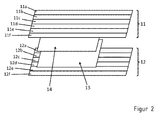
- Fig. 2 is a layer structure shown in an exploded view, in which between individual fiber layers 11, 12 additional intermediate layers 13, 14 are introduced from fiber material. These lead to a local thickening of the finished leaf spring. This is necessary for example in leaf springs, which are installed in a chassis in the vehicle longitudinal direction (longitudinal leaf springs). The sections where these leaf springs are tied to the chassis, have a larger cross-section than the rest of the spring.
- Fig. 2 consist of the fiber layers 11, 12 of individual strip materials 11 af, 12a-f, which are stored flush side by side. From layered fiber layers 11, 12, the leaf spring semi-finished product is constructed, in which the band materials 11 af, 12a-f are wound onto the winding core 3.
- the winding process is stopped and the intermediate layers 13, 14 manually or automatically introduced into the leaf spring semi-finished product.
- the intermediate layers 13, 14, which are also called patches, are in this case woven textile layers which are just as wide as the fiber layers 11, 12. Thereafter, the winding process is continued with the application of the fiber layer 11.
- a fiber layer 15 comprising individual strip materials 15a-f is wound up flush with a side wall 6a of the cavity 6 ( Fig. 3b ).
- the width of the strip materials 15a-f is selected such that a fiber layer is narrower than the width b of the cavity 6 by half the width of the strip materials 15a-f.
- the winding core 3 is moved on the rotation axis 8 by a movement B1 of the winding core 3 by a distance which preferably corresponds to half the width of a strip material 15a-f.
- a fiber layer 16 consisting of individual strip materials 16a-f is wound up flush with the other side wall 6b of the cavity 6.
- the band materials 16a-f cover the abutting edges of the underlying band materials 15a-f.
- the winding core 3 is therefore moved alternately in each opposite direction after each revolution, so that the strip material is wound alternately overlapping and no unwanted gaps and air pockets in the leaf spring semi-finished.
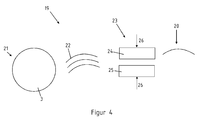
- FIG. 4 1 shows an arrangement 19 for producing a leaf spring 20.
- the arrangement 19 initially has the previously described device 21 for producing a semi-finished leaf spring 22.
- the winding core 3 is wound in the manner described above and at least two leaf spring semi-finished products 22, preferably three leaf spring semi-finished products 22, produced. These are then fed to a downstream tool 23 for pressing a leaf spring semi-finished product inserted therein.
- the tool 23 for pressing as a forming press comprising an upper tool 24 and lower tool 25 is formed. Applying a pressing force 26, this is closed and removed after opening the produced leaf spring 20.
Landscapes
- Engineering & Computer Science (AREA)
- Mechanical Engineering (AREA)
- Chemical & Material Sciences (AREA)
- Composite Materials (AREA)
- General Engineering & Computer Science (AREA)
- Textile Engineering (AREA)
- Physics & Mathematics (AREA)
- Fluid Mechanics (AREA)
- Moulding By Coating Moulds (AREA)
Applications Claiming Priority (1)
| Application Number | Priority Date | Filing Date | Title |
|---|---|---|---|
| DE102014115461.4A DE102014115461A1 (de) | 2014-10-23 | 2014-10-23 | Verfahren und Vorrichtung zur Herstellung einer Blattfeder |
Publications (2)
| Publication Number | Publication Date |
|---|---|
| EP3012093A1 true EP3012093A1 (fr) | 2016-04-27 |
| EP3012093B1 EP3012093B1 (fr) | 2017-04-05 |
Family
ID=54324907
Family Applications (1)
| Application Number | Title | Priority Date | Filing Date |
|---|---|---|---|
| EP15189832.7A Active EP3012093B1 (fr) | 2014-10-23 | 2015-10-14 | Procede et systeme de fabrication d'un ressort a lame |
Country Status (3)
| Country | Link |
|---|---|
| US (1) | US9855710B2 (fr) |
| EP (1) | EP3012093B1 (fr) |
| DE (1) | DE102014115461A1 (fr) |
Families Citing this family (5)
| Publication number | Priority date | Publication date | Assignee | Title |
|---|---|---|---|---|
| US20180345604A1 (en) | 2017-06-02 | 2018-12-06 | Arris Composites Llc | Aligned fiber reinforced molding |
| US12226961B2 (en) * | 2018-10-12 | 2025-02-18 | Arris Composites Inc. | Preform charges and fixtures therefor |
| DE102018219698A1 (de) * | 2018-11-16 | 2020-05-20 | Audi Ag | Verfahren zum Herstellen eines Drucktanks zur Speicherung von Brennstoff in einem Kraftfahrzeug mit einem vorimprägnierten Faserstrang |
| WO2020123145A1 (fr) * | 2018-11-30 | 2020-06-18 | Arris Composites Inc. | Pièces composites renforcées par des fibres, moulées par compression et procédés de fabrication |
| CN114905768A (zh) * | 2022-06-02 | 2022-08-16 | 贵州翰凯斯智能技术有限公司 | 一种汽车板簧的加工方法 |
Citations (6)
| Publication number | Priority date | Publication date | Assignee | Title |
|---|---|---|---|---|
| US3142598A (en) * | 1961-10-02 | 1964-07-28 | Pacific Plastics Company Inc | Method of making resin-impregnated glass fiber automobile leaf springs |
| EP0005916A1 (fr) | 1978-05-26 | 1979-12-12 | GKN Group Services Limited | Fabrication de ressorts |
| GB2113599A (en) * | 1981-12-11 | 1983-08-10 | William Brandt Goldsworthy | Reinforced plastic composite articles |
| GB2131347A (en) * | 1982-12-02 | 1984-06-20 | Nhk Spring Co Ltd | Fibre reinforced plastics plate and process for manufacturing the same |
| DE102008028441A1 (de) * | 2008-06-17 | 2009-12-31 | Eads Deutschland Gmbh | Verfahren und Vorrichtung zur Herstellung eines ringförmigen Vorformlings aus Fasermaterialhalbzeug, sowie Verwendung derartiger Verfahren und Vorrichtungen |
| DE102011012654A1 (de) | 2011-02-28 | 2012-08-30 | Benteler Sgl Gmbh & Co. Kg | Verfahren zur Herstellung einer Blattfeder als Faserverbundbauteil sowie Blattfeder |
Family Cites Families (3)
| Publication number | Priority date | Publication date | Assignee | Title |
|---|---|---|---|---|
| JPS59146816A (ja) * | 1983-02-10 | 1984-08-22 | Nhk Spring Co Ltd | Frp板の製造方法 |
| DE3527964C1 (de) * | 1985-08-03 | 1987-04-16 | Boehler Ag | Verfahren und Vorrichtung zur Herstellung von langgestreckten Koerpern mit faserverstaerktem Kunststoff |
| DE102011104071A1 (de) * | 2011-06-11 | 2012-12-13 | Daimler Ag | Blattfeder und Verfahren zu deren Herstellung |
-
2014
- 2014-10-23 DE DE102014115461.4A patent/DE102014115461A1/de not_active Ceased
-
2015
- 2015-10-14 EP EP15189832.7A patent/EP3012093B1/fr active Active
- 2015-10-22 US US14/920,507 patent/US9855710B2/en active Active
Patent Citations (6)
| Publication number | Priority date | Publication date | Assignee | Title |
|---|---|---|---|---|
| US3142598A (en) * | 1961-10-02 | 1964-07-28 | Pacific Plastics Company Inc | Method of making resin-impregnated glass fiber automobile leaf springs |
| EP0005916A1 (fr) | 1978-05-26 | 1979-12-12 | GKN Group Services Limited | Fabrication de ressorts |
| GB2113599A (en) * | 1981-12-11 | 1983-08-10 | William Brandt Goldsworthy | Reinforced plastic composite articles |
| GB2131347A (en) * | 1982-12-02 | 1984-06-20 | Nhk Spring Co Ltd | Fibre reinforced plastics plate and process for manufacturing the same |
| DE102008028441A1 (de) * | 2008-06-17 | 2009-12-31 | Eads Deutschland Gmbh | Verfahren und Vorrichtung zur Herstellung eines ringförmigen Vorformlings aus Fasermaterialhalbzeug, sowie Verwendung derartiger Verfahren und Vorrichtungen |
| DE102011012654A1 (de) | 2011-02-28 | 2012-08-30 | Benteler Sgl Gmbh & Co. Kg | Verfahren zur Herstellung einer Blattfeder als Faserverbundbauteil sowie Blattfeder |
Also Published As
| Publication number | Publication date |
|---|---|
| US20160114537A1 (en) | 2016-04-28 |
| EP3012093B1 (fr) | 2017-04-05 |
| DE102014115461A1 (de) | 2016-04-28 |
| US9855710B2 (en) | 2018-01-02 |
Similar Documents
| Publication | Publication Date | Title |
|---|---|---|
| DE102008011410B4 (de) | Pultrusionsverfahren zur Herstellung eines profilierten Preforms oder eines profilierten FVK-Bauteils, Pultrusionsanlage sowie Press-Vorrichtung zur Durchführung des Verfahrens | |
| EP1342553B1 (fr) | Procédé pour la fabrication d'un cadre de fenêtre d'avion en matériau composite renforcé de fibres et appareil pour mettre en oeuvre le procédé | |
| DE102012110354B4 (de) | Formwerkzeug, Steuermittel, Verfahren und Anlage zum Herstellen eines, vorzugsweise faserverstärkten, Kunststoffbauteils | |
| EP3012093B1 (fr) | Procede et systeme de fabrication d'un ressort a lame | |
| DE102008051121B4 (de) | Vorrichtung und Verfahren zum Drapieren und Vorformen gekrümmter Profilstrukturteile aus Fasergewirken | |
| EP1197315A2 (fr) | Procédé pour la fabrication des préformes en matière composite renforcées par des fibres et préforme ainsi obtenue | |
| DE202012104148U1 (de) | Formwerkzeug, Steuermittel und Anlage zum Herstellen eines, vorzugsweise faserverstärkten, Kunststoffbauteils | |
| EP3037248B1 (fr) | Procédé de fabrication d'un élément sandwich | |
| DE102013007609A1 (de) | Verfahren zur Herstellung eines faserverstärkten Kunststoffbauteils | |
| DE102018114008A1 (de) | Vorrichtung und Verfahren zur Erzeugung dreidimensionaler Gegenstände | |
| DE102010050969A1 (de) | Verfahren zur Herstellung eines FVK-Formteiles | |
| DE102021128605A1 (de) | Formgebungsanlage zum Herstellen eines Verbundkörpers | |
| EP3463825B1 (fr) | Procédé pour la fabrication d'un élément en matériau composite à base de fibres | |
| DE10251580A1 (de) | Verfahren zum Herstellen eines Bauelementes aus faserverstärktem Kunststoff | |
| DE102015211670A1 (de) | Verfahren und Vorrichtung zur Serienfertigung von Bauteilen aus einem faserverstärkten Verbundmaterial | |
| DE102013003538A1 (de) | Bauteil mit einer Kernstruktur und einer aus faserverstärktem Kunststoff gebildeten Deckschicht, sowie Verfahren zu dessen Herstellung | |
| EP3793793A1 (fr) | Procédé de fabrication d'un profilé creux présentant des courbures et des sections transversales variables | |
| EP2150397A2 (fr) | Procédé de réalisation d'éléments structurels en matières plastiques renforcées par fibres | |
| EP2492111B1 (fr) | Utilisation d'un dispositif de tressage, procédé de fabrication d'une jante dotée d'un dispositif de tressage divisible ainsi que jante de véhicule | |
| DE102011082192A1 (de) | Verfahren und Vorrichtung zum Herstellen von Prepregs aus Wickelverfahren | |
| DE102016208687B4 (de) | Verfahren zur Herstellung eines Faser-Halbzeugs und eines Faserverbundbauteils, Faserverbundbauteil sowie Werkzeug | |
| DE10146253C2 (de) | Verfahren zur Herstellung faserverstärkter Rohre | |
| WO2013174366A2 (fr) | Procédé de fabrication d'un élément composite renforcé de fibres au moyen de l'établissement d'un vide, et utilisation associée | |
| DE102014223565A1 (de) | Verfahren zur Herstellung eines Faserhalbzeugs und Faserhalbzeug | |
| DE102017111230A1 (de) | Formkörper und Verfahren zur Herstellung eines Formkörpers |
Legal Events
| Date | Code | Title | Description |
|---|---|---|---|
| PUAI | Public reference made under article 153(3) epc to a published international application that has entered the european phase |
Free format text: ORIGINAL CODE: 0009012 |
|
| AK | Designated contracting states |
Kind code of ref document: A1 Designated state(s): AL AT BE BG CH CY CZ DE DK EE ES FI FR GB GR HR HU IE IS IT LI LT LU LV MC MK MT NL NO PL PT RO RS SE SI SK SM TR |
|
| AX | Request for extension of the european patent |
Extension state: BA ME |
|
| 17P | Request for examination filed |
Effective date: 20160426 |
|
| RIC1 | Information provided on ipc code assigned before grant |
Ipc: B29L 31/00 20060101ALN20160906BHEP Ipc: B29C 70/34 20060101AFI20160906BHEP Ipc: B32B 37/10 20060101ALI20160906BHEP Ipc: B32B 38/18 20060101ALI20160906BHEP Ipc: B29C 70/32 20060101ALI20160906BHEP Ipc: B29C 53/56 20060101ALI20160906BHEP Ipc: B32B 38/00 20060101ALI20160906BHEP Ipc: B29C 70/06 20060101ALI20160906BHEP Ipc: B32B 5/26 20060101ALI20160906BHEP Ipc: B29K 105/12 20060101ALN20160906BHEP Ipc: B32B 37/00 20060101ALI20160906BHEP Ipc: F16F 1/368 20060101ALI20160906BHEP |
|
| GRAP | Despatch of communication of intention to grant a patent |
Free format text: ORIGINAL CODE: EPIDOSNIGR1 |
|
| INTG | Intention to grant announced |
Effective date: 20161110 |
|
| GRAS | Grant fee paid |
Free format text: ORIGINAL CODE: EPIDOSNIGR3 |
|
| GRAA | (expected) grant |
Free format text: ORIGINAL CODE: 0009210 |
|
| AK | Designated contracting states |
Kind code of ref document: B1 Designated state(s): AL AT BE BG CH CY CZ DE DK EE ES FI FR GB GR HR HU IE IS IT LI LT LU LV MC MK MT NL NO PL PT RO RS SE SI SK SM TR |
|
| REG | Reference to a national code |
Ref country code: GB Ref legal event code: FG4D Free format text: NOT ENGLISH |
|
| REG | Reference to a national code |
Ref country code: CH Ref legal event code: EP |
|
| REG | Reference to a national code |
Ref country code: AT Ref legal event code: REF Ref document number: 881415 Country of ref document: AT Kind code of ref document: T Effective date: 20170415 |
|
| REG | Reference to a national code |
Ref country code: IE Ref legal event code: FG4D Free format text: LANGUAGE OF EP DOCUMENT: GERMAN |
|
| REG | Reference to a national code |
Ref country code: DE Ref legal event code: R096 Ref document number: 502015000814 Country of ref document: DE |
|
| REG | Reference to a national code |
Ref country code: NL Ref legal event code: MP Effective date: 20170405 |
|
| REG | Reference to a national code |
Ref country code: LT Ref legal event code: MG4D |
|
| PG25 | Lapsed in a contracting state [announced via postgrant information from national office to epo] |
Ref country code: NL Free format text: LAPSE BECAUSE OF FAILURE TO SUBMIT A TRANSLATION OF THE DESCRIPTION OR TO PAY THE FEE WITHIN THE PRESCRIBED TIME-LIMIT Effective date: 20170405 |
|
| PG25 | Lapsed in a contracting state [announced via postgrant information from national office to epo] |
Ref country code: GR Free format text: LAPSE BECAUSE OF FAILURE TO SUBMIT A TRANSLATION OF THE DESCRIPTION OR TO PAY THE FEE WITHIN THE PRESCRIBED TIME-LIMIT Effective date: 20170706 Ref country code: FI Free format text: LAPSE BECAUSE OF FAILURE TO SUBMIT A TRANSLATION OF THE DESCRIPTION OR TO PAY THE FEE WITHIN THE PRESCRIBED TIME-LIMIT Effective date: 20170405 Ref country code: HR Free format text: LAPSE BECAUSE OF FAILURE TO SUBMIT A TRANSLATION OF THE DESCRIPTION OR TO PAY THE FEE WITHIN THE PRESCRIBED TIME-LIMIT Effective date: 20170405 Ref country code: ES Free format text: LAPSE BECAUSE OF FAILURE TO SUBMIT A TRANSLATION OF THE DESCRIPTION OR TO PAY THE FEE WITHIN THE PRESCRIBED TIME-LIMIT Effective date: 20170405 Ref country code: LT Free format text: LAPSE BECAUSE OF FAILURE TO SUBMIT A TRANSLATION OF THE DESCRIPTION OR TO PAY THE FEE WITHIN THE PRESCRIBED TIME-LIMIT Effective date: 20170405 Ref country code: NO Free format text: LAPSE BECAUSE OF FAILURE TO SUBMIT A TRANSLATION OF THE DESCRIPTION OR TO PAY THE FEE WITHIN THE PRESCRIBED TIME-LIMIT Effective date: 20170705 |
|
| PG25 | Lapsed in a contracting state [announced via postgrant information from national office to epo] |
Ref country code: BG Free format text: LAPSE BECAUSE OF FAILURE TO SUBMIT A TRANSLATION OF THE DESCRIPTION OR TO PAY THE FEE WITHIN THE PRESCRIBED TIME-LIMIT Effective date: 20170705 Ref country code: SE Free format text: LAPSE BECAUSE OF FAILURE TO SUBMIT A TRANSLATION OF THE DESCRIPTION OR TO PAY THE FEE WITHIN THE PRESCRIBED TIME-LIMIT Effective date: 20170405 Ref country code: RS Free format text: LAPSE BECAUSE OF FAILURE TO SUBMIT A TRANSLATION OF THE DESCRIPTION OR TO PAY THE FEE WITHIN THE PRESCRIBED TIME-LIMIT Effective date: 20170405 Ref country code: PL Free format text: LAPSE BECAUSE OF FAILURE TO SUBMIT A TRANSLATION OF THE DESCRIPTION OR TO PAY THE FEE WITHIN THE PRESCRIBED TIME-LIMIT Effective date: 20170405 Ref country code: IS Free format text: LAPSE BECAUSE OF FAILURE TO SUBMIT A TRANSLATION OF THE DESCRIPTION OR TO PAY THE FEE WITHIN THE PRESCRIBED TIME-LIMIT Effective date: 20170805 Ref country code: LV Free format text: LAPSE BECAUSE OF FAILURE TO SUBMIT A TRANSLATION OF THE DESCRIPTION OR TO PAY THE FEE WITHIN THE PRESCRIBED TIME-LIMIT Effective date: 20170405 |
|
| REG | Reference to a national code |
Ref country code: DE Ref legal event code: R082 Ref document number: 502015000814 Country of ref document: DE Representative=s name: BOCKERMANN KSOLL GRIEPENSTROH OSTERHOFF, DE Ref country code: DE Ref legal event code: R081 Ref document number: 502015000814 Country of ref document: DE Owner name: BENTELER AUTOMOBILTECHNIK GMBH, DE Free format text: FORMER OWNER: BENTELER SGL GMBH & CO. KG, 33102 PADERBORN, DE Ref country code: DE Ref legal event code: R097 Ref document number: 502015000814 Country of ref document: DE |
|
| PG25 | Lapsed in a contracting state [announced via postgrant information from national office to epo] |
Ref country code: DK Free format text: LAPSE BECAUSE OF FAILURE TO SUBMIT A TRANSLATION OF THE DESCRIPTION OR TO PAY THE FEE WITHIN THE PRESCRIBED TIME-LIMIT Effective date: 20170405 Ref country code: SK Free format text: LAPSE BECAUSE OF FAILURE TO SUBMIT A TRANSLATION OF THE DESCRIPTION OR TO PAY THE FEE WITHIN THE PRESCRIBED TIME-LIMIT Effective date: 20170405 Ref country code: CZ Free format text: LAPSE BECAUSE OF FAILURE TO SUBMIT A TRANSLATION OF THE DESCRIPTION OR TO PAY THE FEE WITHIN THE PRESCRIBED TIME-LIMIT Effective date: 20170405 Ref country code: RO Free format text: LAPSE BECAUSE OF FAILURE TO SUBMIT A TRANSLATION OF THE DESCRIPTION OR TO PAY THE FEE WITHIN THE PRESCRIBED TIME-LIMIT Effective date: 20170405 Ref country code: EE Free format text: LAPSE BECAUSE OF FAILURE TO SUBMIT A TRANSLATION OF THE DESCRIPTION OR TO PAY THE FEE WITHIN THE PRESCRIBED TIME-LIMIT Effective date: 20170405 |
|
| PLBE | No opposition filed within time limit |
Free format text: ORIGINAL CODE: 0009261 |
|
| STAA | Information on the status of an ep patent application or granted ep patent |
Free format text: STATUS: NO OPPOSITION FILED WITHIN TIME LIMIT |
|
| PG25 | Lapsed in a contracting state [announced via postgrant information from national office to epo] |
Ref country code: SM Free format text: LAPSE BECAUSE OF FAILURE TO SUBMIT A TRANSLATION OF THE DESCRIPTION OR TO PAY THE FEE WITHIN THE PRESCRIBED TIME-LIMIT Effective date: 20170405 Ref country code: IT Free format text: LAPSE BECAUSE OF FAILURE TO SUBMIT A TRANSLATION OF THE DESCRIPTION OR TO PAY THE FEE WITHIN THE PRESCRIBED TIME-LIMIT Effective date: 20170405 |
|
| 26N | No opposition filed |
Effective date: 20180108 |
|
| PG25 | Lapsed in a contracting state [announced via postgrant information from national office to epo] |
Ref country code: SI Free format text: LAPSE BECAUSE OF FAILURE TO SUBMIT A TRANSLATION OF THE DESCRIPTION OR TO PAY THE FEE WITHIN THE PRESCRIBED TIME-LIMIT Effective date: 20170405 Ref country code: MC Free format text: LAPSE BECAUSE OF FAILURE TO SUBMIT A TRANSLATION OF THE DESCRIPTION OR TO PAY THE FEE WITHIN THE PRESCRIBED TIME-LIMIT Effective date: 20170405 |
|
| REG | Reference to a national code |
Ref country code: IE Ref legal event code: MM4A |
|
| REG | Reference to a national code |
Ref country code: FR Ref legal event code: ST Effective date: 20180629 |
|
| PG25 | Lapsed in a contracting state [announced via postgrant information from national office to epo] |
Ref country code: LU Free format text: LAPSE BECAUSE OF NON-PAYMENT OF DUE FEES Effective date: 20171014 |
|
| REG | Reference to a national code |
Ref country code: BE Ref legal event code: MM Effective date: 20171031 |
|
| PG25 | Lapsed in a contracting state [announced via postgrant information from national office to epo] |
Ref country code: BE Free format text: LAPSE BECAUSE OF NON-PAYMENT OF DUE FEES Effective date: 20171031 Ref country code: FR Free format text: LAPSE BECAUSE OF NON-PAYMENT OF DUE FEES Effective date: 20171031 |
|
| PG25 | Lapsed in a contracting state [announced via postgrant information from national office to epo] |
Ref country code: MT Free format text: LAPSE BECAUSE OF FAILURE TO SUBMIT A TRANSLATION OF THE DESCRIPTION OR TO PAY THE FEE WITHIN THE PRESCRIBED TIME-LIMIT Effective date: 20170405 |
|
| PG25 | Lapsed in a contracting state [announced via postgrant information from national office to epo] |
Ref country code: IE Free format text: LAPSE BECAUSE OF NON-PAYMENT OF DUE FEES Effective date: 20171014 |
|
| REG | Reference to a national code |
Ref country code: CH Ref legal event code: PL |
|
| PG25 | Lapsed in a contracting state [announced via postgrant information from national office to epo] |
Ref country code: HU Free format text: LAPSE BECAUSE OF FAILURE TO SUBMIT A TRANSLATION OF THE DESCRIPTION OR TO PAY THE FEE WITHIN THE PRESCRIBED TIME-LIMIT; INVALID AB INITIO Effective date: 20151014 |
|
| PG25 | Lapsed in a contracting state [announced via postgrant information from national office to epo] |
Ref country code: LI Free format text: LAPSE BECAUSE OF NON-PAYMENT OF DUE FEES Effective date: 20181031 Ref country code: CH Free format text: LAPSE BECAUSE OF NON-PAYMENT OF DUE FEES Effective date: 20181031 |
|
| PG25 | Lapsed in a contracting state [announced via postgrant information from national office to epo] |
Ref country code: CY Free format text: LAPSE BECAUSE OF FAILURE TO SUBMIT A TRANSLATION OF THE DESCRIPTION OR TO PAY THE FEE WITHIN THE PRESCRIBED TIME-LIMIT Effective date: 20170405 |
|
| PG25 | Lapsed in a contracting state [announced via postgrant information from national office to epo] |
Ref country code: MK Free format text: LAPSE BECAUSE OF FAILURE TO SUBMIT A TRANSLATION OF THE DESCRIPTION OR TO PAY THE FEE WITHIN THE PRESCRIBED TIME-LIMIT Effective date: 20170405 |
|
| PG25 | Lapsed in a contracting state [announced via postgrant information from national office to epo] |
Ref country code: TR Free format text: LAPSE BECAUSE OF FAILURE TO SUBMIT A TRANSLATION OF THE DESCRIPTION OR TO PAY THE FEE WITHIN THE PRESCRIBED TIME-LIMIT Effective date: 20170405 |
|
| PG25 | Lapsed in a contracting state [announced via postgrant information from national office to epo] |
Ref country code: PT Free format text: LAPSE BECAUSE OF FAILURE TO SUBMIT A TRANSLATION OF THE DESCRIPTION OR TO PAY THE FEE WITHIN THE PRESCRIBED TIME-LIMIT Effective date: 20170405 |
|
| PG25 | Lapsed in a contracting state [announced via postgrant information from national office to epo] |
Ref country code: AL Free format text: LAPSE BECAUSE OF FAILURE TO SUBMIT A TRANSLATION OF THE DESCRIPTION OR TO PAY THE FEE WITHIN THE PRESCRIBED TIME-LIMIT Effective date: 20170405 |
|
| GBPC | Gb: european patent ceased through non-payment of renewal fee |
Effective date: 20191014 |
|
| PG25 | Lapsed in a contracting state [announced via postgrant information from national office to epo] |
Ref country code: GB Free format text: LAPSE BECAUSE OF NON-PAYMENT OF DUE FEES Effective date: 20191014 |
|
| REG | Reference to a national code |
Ref country code: AT Ref legal event code: MM01 Ref document number: 881415 Country of ref document: AT Kind code of ref document: T Effective date: 20201014 |
|
| PG25 | Lapsed in a contracting state [announced via postgrant information from national office to epo] |
Ref country code: AT Free format text: LAPSE BECAUSE OF NON-PAYMENT OF DUE FEES Effective date: 20201014 |
|
| PGFP | Annual fee paid to national office [announced via postgrant information from national office to epo] |
Ref country code: DE Payment date: 20251029 Year of fee payment: 11 |