EP3012111A1 - Dispositif de maintien de feuille longue, et imprimante - Google Patents
Dispositif de maintien de feuille longue, et imprimante Download PDFInfo
- Publication number
- EP3012111A1 EP3012111A1 EP14814386.0A EP14814386A EP3012111A1 EP 3012111 A1 EP3012111 A1 EP 3012111A1 EP 14814386 A EP14814386 A EP 14814386A EP 3012111 A1 EP3012111 A1 EP 3012111A1
- Authority
- EP
- European Patent Office
- Prior art keywords
- shaft
- locking groove
- holding shaft
- locking
- regulating member
- Prior art date
- Legal status (The legal status is an assumption and is not a legal conclusion. Google has not performed a legal analysis and makes no representation as to the accuracy of the status listed.)
- Granted
Links
Images






Classifications
-
- B—PERFORMING OPERATIONS; TRANSPORTING
- B41—PRINTING; LINING MACHINES; TYPEWRITERS; STAMPS
- B41J—TYPEWRITERS; SELECTIVE PRINTING MECHANISMS, i.e. MECHANISMS PRINTING OTHERWISE THAN FROM A FORME; CORRECTION OF TYPOGRAPHICAL ERRORS
- B41J33/00—Apparatus or arrangements for feeding ink ribbons or like character-size impression-transfer material
- B41J33/14—Ribbon-feed devices or mechanisms
-
- B—PERFORMING OPERATIONS; TRANSPORTING
- B41—PRINTING; LINING MACHINES; TYPEWRITERS; STAMPS
- B41J—TYPEWRITERS; SELECTIVE PRINTING MECHANISMS, i.e. MECHANISMS PRINTING OTHERWISE THAN FROM A FORME; CORRECTION OF TYPOGRAPHICAL ERRORS
- B41J17/00—Mechanisms for manipulating page-width impression-transfer material, e.g. carbon paper
- B41J17/22—Supply arrangements for webs of impression-transfer material
- B41J17/24—Webs supplied from reels or spools attached to the machine
-
- B—PERFORMING OPERATIONS; TRANSPORTING
- B65—CONVEYING; PACKING; STORING; HANDLING THIN OR FILAMENTARY MATERIAL
- B65H—HANDLING THIN OR FILAMENTARY MATERIAL, e.g. SHEETS, WEBS, CABLES
- B65H16/00—Unwinding, paying-out webs
- B65H16/02—Supporting web roll
- B65H16/06—Supporting web roll both-ends type
-
- B—PERFORMING OPERATIONS; TRANSPORTING
- B65—CONVEYING; PACKING; STORING; HANDLING THIN OR FILAMENTARY MATERIAL
- B65H—HANDLING THIN OR FILAMENTARY MATERIAL, e.g. SHEETS, WEBS, CABLES
- B65H75/00—Storing webs, tapes, or filamentary material, e.g. on reels
- B65H75/02—Cores, formers, supports, or holders for coiled, wound, or folded material, e.g. reels, spindles, bobbins, cop tubes, cans, mandrels or chucks
- B65H75/18—Constructional details
- B65H75/24—Constructional details adjustable in configuration, e.g. expansible
- B65H75/241—Constructional details adjustable in configuration, e.g. expansible axially adjustable reels or bobbins
-
- B—PERFORMING OPERATIONS; TRANSPORTING
- B65—CONVEYING; PACKING; STORING; HANDLING THIN OR FILAMENTARY MATERIAL
- B65H—HANDLING THIN OR FILAMENTARY MATERIAL, e.g. SHEETS, WEBS, CABLES
- B65H2301/00—Handling processes for sheets or webs
- B65H2301/40—Type of handling process
- B65H2301/41—Winding, unwinding
- B65H2301/413—Supporting web roll
- B65H2301/4134—Both ends type arrangement
- B65H2301/41342—Both ends type arrangement shaft transversing the roll
- B65H2301/41344—Both ends type arrangement shaft transversing the roll the roll being fixed to the shaft (e.g. by clamping)
-
- B—PERFORMING OPERATIONS; TRANSPORTING
- B65—CONVEYING; PACKING; STORING; HANDLING THIN OR FILAMENTARY MATERIAL
- B65H—HANDLING THIN OR FILAMENTARY MATERIAL, e.g. SHEETS, WEBS, CABLES
- B65H2403/00—Power transmission; Driving means
- B65H2403/50—Driving mechanisms
- B65H2403/52—Translation screw-thread mechanisms
-
- B—PERFORMING OPERATIONS; TRANSPORTING
- B65—CONVEYING; PACKING; STORING; HANDLING THIN OR FILAMENTARY MATERIAL
- B65H—HANDLING THIN OR FILAMENTARY MATERIAL, e.g. SHEETS, WEBS, CABLES
- B65H2801/00—Application field
- B65H2801/03—Image reproduction devices
-
- B—PERFORMING OPERATIONS; TRANSPORTING
- B65—CONVEYING; PACKING; STORING; HANDLING THIN OR FILAMENTARY MATERIAL
- B65H—HANDLING THIN OR FILAMENTARY MATERIAL, e.g. SHEETS, WEBS, CABLES
- B65H2801/00—Application field
- B65H2801/03—Image reproduction devices
- B65H2801/12—Single-function printing machines, typically table-top machines
Definitions
- This invention relates to a long sheet material holding device and a printer.
- a printer is provided with a print head that prints predetermined information on a print medium and a print unit having a platen roller provided to face the print head by interposing the print medium.
- predetermined information is printed on a print medium by conveying the print medium while nipping it between the print head and the rotating platen roller.
- a printer using an ink ribbon impregnated with ink such as a heat transfer type printer or a dot impact type printer, has a ribbon feeding shaft (as an example of the long sheet material holding device) and a ribbon winding shaft (as an example of the long sheet material holding device).
- the ink ribbon is delivered from the ribbon feeding shaft, passes through the print head, and is wound around the ribbon winding shaft so as to form a feeding route.
- the ribbon feeding shaft or the ribbon winding shaft has a holding shaft for winding and holding the ink ribbon in a roll-like manner, and a regulating member into which the holding shaft is inserted movably along an axial direction of the holding shaft so as to be locked in a plurality of portions in order to regulate the position of the regulating member depending on a width of the ink ribbon.
- JP 2005-314047 A there is discussed a method of conveying a paper sheet in a printer using an ink ribbon.
- an adjustable width of the regulating member is coarsely set. Therefore, it is difficult to accurately adjust the width. Therefore, it is difficult to regulate the regulating member in a suitable position of the holding shaft depending on various types of ink ribbons having different widths.
- the accurate adjustment of the regulating member may be possible if a groove train having a plurality of grooves is formed in the holding shaft, and another groove train engaged with the aforementioned groove train is formed in the regulating member, so that both groove trains are locked to each other. However, when a strong force is applied to the regulating member, they may be easily unlocked so as to generate a positional deviation.
- Such a problem is not only for the ribbon feeding shaft or the ribbon winding shaft, but is also a common problem of many long sheet material holding devices that hold the long sheet material such as an ink ribbon.
- a long sheet material holding device includes a holding shaft configured to hold a long sheet material in a roll shape, a pair of first locking groove trains arranged in parallel with each other along the axial direction of the holding shaft, the pair of first locking groove trains having a series of grooves respectively, the series of grooves extending across the axial direction of the holding shaft, each of the series of grooves being provided with slope surfaces sloped along the axial direction of the holding shaft and oppositely to each other and perpendicular surfaces perpendicular to the axial direction of the holding shaft, a regulating member provided to allow the holding shaft to be inserted thereinto and to be movable along the axial direction of the holding shaft, the regulating member being configured to regulate a position of the long sheet material held by the holding shaft, and a pair of locking members provided in the regulating member to match the pair of first locking groove trains, each of the locking members having a second locking groove train, the second locking groove train having a series of grooves, the series of grooves having surfaces
- each of the pair of the locking members includes a control knob manipulated by an operator and a groove train portion positioned oppositely to the control knob with respect to a swing point, the groove train portion being provided with the second locking groove train, the locking members being swingable between an engagement position where the second locking groove trains are engaged with the first locking groove trains and a disengagement position where the second locking groove trains are disengaged from the first locking groove trains, the long sheet material holding device further includes a biasing member configured to bias the locking member toward the engagement position, and the locking member is displaced from the engagement position to the disengagement position when the control knobs of the pair of locking members are manipulated against a biasing force of the biasing member.
- the holding shaft is provided with a scale, the scale indicating a fixation position of the regulating member corresponding to a width of the long sheet material with respect to the holding shaft.
- the long sheet material holding device in addition to any one of the first, second, and third aspect of the present invention, further includes a stopper inserted into one end of the holding shaft, the stopper being configured to prevent the regulating member from being removed from the holding shaft.
- a printer includes a print head configured to print predetermined information on a print medium by using an ink ribbon impregnated with ink, a platen roller provided to face the print head by interposing the print medium, a ribbon feeding shaft configured to feed the ink ribbon to the print head, and a ribbon winding shaft configured to wind out the ink ribbon consumed by the print head, wherein any one of the ribbon feeding shaft and the ribbon winding shaft is the long sheet material holding device described above.
- both of a plurality of grooves of the first locking groove trains formed in the holding shaft and a plurality of grooves of the second locking groove trains formed in the locking member of the regulating member and engaged with the first locking groove trains are formed in series. Therefore, using the long sheet material holding device according to these aspects, it is possible to accurately adjust a position of the regulating member inserted into the holding shaft.
- a pair of first locking groove trains formed in the holding shaft have a plurality of grooves extending across the axial direction of the holding shaft, each of the plurality of grooves having slope surfaces sloped along the axial direction of the holding shaft and oppositely to each other and perpendicular surfaces perpendicular to the axial direction of the holding shaft.
- a pair of second locking groove trains provided in the locking member of the regulating member has a plurality of grooves having surfaces formed to match the slope surfaces and the perpendicular surfaces of the grooves of the first locking groove trains.
- a slide of the regulating member is prevented in both directions of the holding shaft. Therefore, it is possible to improve a locking strength of the regulating member to the holding shaft. In addition, a positional deviation of the regulating member is not easily generated even when a strong force is applied to the regulating member.
- a housing 11 has a lower casing 11a, an upper casing 11b as a cover installed open/closably to the lower casing 11a, and a front cover 11c that covers a notch portion formed on the front face of the lower casing 11a.
- a main body 20 is housed in the housing 11 as illustrated in FIG. 3 .
- a horizontally long discharge port 12 for discharging a continuous paper sheet P (print medium) printed by the main body 20 is formed on the front face of the housing 11.
- a pair of hinge portions 13a and 13b are formed integrally with the lower casing 11a in a rear side of the lower casing 11a.
- a hinge portion 14a corresponding to the hinge portion 13a and a hinge portion 14b corresponding to the hinge portion 13b are formed integrally with the upper casing 11b.
- the hinge portions 13a and 14b have a cylindrical shape extending in a horizontal direction and has a long hole 15 formed across nearly a half circle.
- the hinge portions 13b and 14a have protrusions 16 inserted into the hinge portions 14b and 13a, respectively, having a cylindrical shape, and the leading edges of the protrusions 16 are provided with pin holes 17 visible through the long holes 15 when they are inserted into the hinge portions 14b and 13a.
- the upper casing 11b is open/closably installed to the lower casing 11a.
- the stopper pin to move inside the long hole 15 and abut on its one end as the upper casing 11b is opened, it is possible to regulate a movable range of the upper casing 11b.
- a window hole 18 is provided on the upper face of the upper casing 11b.
- This window hole 18 is positioned to match an input unit 21 (unit for inputting various types of setup information such as the number of print sheets) and a display unit 22 (unit for displaying information input from the input unit) provided in the main body 20 housed in the housing 11, so that an operator can manipulate the input unit 21 and obtain information displayed on the display unit 22 by using this window hole 18.
- the printer 10 extracts, in a sheet shape, a roll-like continuous paper sheet P having a plurality of labels temporarily attached with a predetermined interval along a longitudinal direction of a long liner having a surface applied with a releasing agent, and print predetermined information on the labels.
- the printer 10 has a main body 20 defining a conveying passage A of the continuous paper sheet P.
- the print medium printed by the printer 10 is not limited to the continuous paper sheet P. Instead, various other print media may also be employed, such as a tag continuous paper sheet having successive tags (labels of shipping tags or price tags) or individual label or tag pieces obtained by segmenting the label continuous paper sheet or the tag continuous paper sheet.
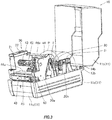
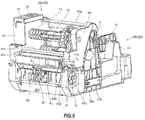
- the main body 20 has a print unit 20a that performs printing on the continuous paper sheet P and a feeding unit 20b that feeds the continuous paper sheet P to the print unit 20a.
- a print unit 20a that performs printing on the continuous paper sheet P
- a feeding unit 20b that feeds the continuous paper sheet P to the print unit 20a.
- connective concave portions 23a formed in both ends of the width direction of the print unit 20a are fitted to connective convex portions 23b formed in both ends of the width direction of the feeding unit 20b to match the connective concave portions 23a
- the print unit 20a and the feeding unit 20b are integrally connected to each other as illustrated in FIG. 6 .
- the feeding unit 20b has a core guide 30 that penetrates through a core PZ of the continuous paper sheet P wound around in a roll shape and rotatably supports the continuous paper sheet P, a pair of roll width regulating guides 31 slidably installed across the core guide 30 to regulate both side surfaces of the continuous paper sheet P supported by the core guide 30, and a core guide support portion 32 that supports both ends of the core guide 30.
- the print unit 20a is provided with a thermal head 40 (print head) having a heating element and a platen roller 41 rotatably provided to face the thermal head 40.
- the thermal head 40 and the platen roller 41 constitute a print unit.
- the print unit 20a is provided with a ribbon feeding shaft 42 that rotatably supports the ink ribbon R (as an example of the long sheet material) impregnated with ink and wound around in a roll shape to feed the ink ribbon R to the thermal head 40, and a ribbon winding shaft 43 (as an example of the long sheet material holding device) that winds out the consumed ink ribbon R subjected to heat transfer of ink to the continuous paper sheet P through the thermal head 40.
- the ink ribbon R extracted from the ribbon feeding shaft 42 defining a traveling path going by way of the thermal head 40 and is wound around the ribbon winding shaft 43.
- the platen roller 41 is formed of a hard rubber member and has a platen gear 41a installed in one end.
- the platen gear 41a is coupled to a driving gear 46a installed in a rotation shaft of the driving motor 46 via a gear 47 so that the platen roller 41 is rotatably driven by the driving motor 46.
- the thermal head 40 is pressed toward the platen roller 41 by an elastic element (not shown) provided in the thermal head 40.
- the platen roller 41 is rotated along with the thermal head 40 by nipping the continuous paper sheet P, the roll-like continuous paper sheet P supported by the core guide 30 is extracted and conveyed. As a result, the conveying passage A of the continuous paper sheet P is formed in the main body 20. In addition, predetermined information is printed by the thermal head 40 while the rear surface of the continuous paper sheet P is supported by the platen roller 41.
- the roll-like continuous paper sheet P supported by the core guide 30 is extracted, and a damper roller 50 is arranged in the conveying passage A of the continuous paper sheet P up to the thermal head 40.
- the damper roller 50 has an upper end rotatably supported by the lower end of the roller suspension rod 51 installed in the support frame 44 via a shaft portion 50a. As the damper roller 50 is rotated by pressing the continuous paper sheet P, the continuous paper sheet P is conveyed along the defined conveying passage A in a tensioned state without being loosened.
- a sensor for detecting existence of the continuous paper sheet P is embedded, and a width regulating guide 52 that regulates the width direction of the continuous paper sheet P in a proper position and guides the continuous paper sheet P to the thermal head 40 is further arranged.
- the aforementioned support frame 44 is provided as a pair connected to each other with a connecting plate 44a arranged suitably.
- a pair of the support frames 44 support both ends of the thermal head 40, the platen roller 41, the ribbon feeding shaft 42, and the ribbon winding shaft 43, and the upper end of the roller suspension rod 51 opposite to the damper roller 50. It is noted that the input unit 21 and the display unit 22 described above are arranged on the upper surface of one of the support frames 44.
- the printer according to this embodiment is a heat transfer type printer using the thermal head 40 as a print head.
- a dot impact type printer may also be employed, in which fine tips corresponding to dots arranged lengthwise and breadthwise are tapped to the ink ribbon R.
- a sensor unit 45 having a sensor 48 for detecting the continuous paper sheet P placed in the corresponding position is installed to face the thermal head 40 and match the traveling path of the ink ribbon R.
- a sensor 49 is arranged in the opposite side of the sensor 48 with respect to the continuous paper sheet P.
- the senor 49 is formed from a light-emitting element
- the sensor 48 provided in the sensor unit 45 is formed from a photodetector capable of receiving light irradiated from the sensor 49. Therefore, when the continuous paper sheet P is placed between the sensors 48 and 49, the light from the sensor 49 is blocked by the continuous paper sheet P, so that the sensor 48 does not receive the light, and it is detected that the continuous paper sheet P is positioned in the downstream side of the thermal head 40. Meanwhile, when the continuous paper sheet P is not placed between the sensors 48 and 49, the light from the sensor 49 is received by the sensor 48, so that it is detected that there is no continuous paper sheet P in the downstream side of the thermal head 40.
- the print unit 20a of the main body 20 includes a lower print unit S1 (lower main body) having the platen roller 41, and an upper print unit S2 (upper main body) having the thermal head 40 or the support frame 44.
- the upper print unit S2 is installed in the lower print unit S1 by using the pivot point F and is pivoted with respect to the pivot point F so as to be opened from or closed to the lower print unit S1.
- the lower print unit S1 is provided with a locking claw 53
- the upper print unit S2 is provided with a locking pin (not shown) engaged with the locking claw 53 when the print unit 20a is closed.
- the locking pin is engaged with the locking claw 53
- the upper print unit S2 is locked to the lower print unit S1 in a closed position, so that opening is prohibited.
- the engagement between the locking pin and the locking claw 53 may be released by handling a release lever (not shown) and pivoting the upper print unit S2 upward with respect to the pivot point F.
- the lower print unit S1 has the sensor 49 or the width regulating guide 52 in addition to the platen roller 41. Furthermore, the lower print unit S1 has a long hole 54 extending in a vertical direction. The shaft portion 50a of the damper roller 50 is inserted into the long hole 54, so that the damper roller 50 can move vertically. It is noted that the damper roller 50 is rotatably supported by the lower end of the roller suspension rod 51 via the shaft portion 50a as described above.
- the upper print unit S2 has the ribbon feeding shaft 42, the ribbon winding shaft 43, and the sensor unit 45 having the sensor 48 in addition to the thermal head 40 and the support frame 44.
- the upper print unit S2 is provided with the roller support portion 51a that pivotably supports the upper end of the roller suspension rod 51.
- the support frame 44 is provided with shaft support portions 42a and 43a that detachably support the ribbon feeding shaft 42 and the ribbon winding shaft 43, respectively.
- the shaft support portion 43a corresponding to the ribbon winding shaft 43 is provided to be rotatable by virtue of a driving force from the motor 46 by interposing a plurality of gear trains and a transmission gear (not shown) provided in the end of the side distant from platen gear 41a.
- the upper print unit S2 is set to the open position by opening the upper casing 11b, so that the damper roller 50 moves to the upside of the long hole 54.
- the damper roller 50 moves to the upside of the long hole 54.
- the sensor unit 45 having the sensor 48 for detecting the continuous paper sheet P in the vicinity of the downstream side of the thermal head 40 is provided pivotably upward with respect to the point 45a provided in one end ( FIGS. 5 and 6 ) of the width direction of the thermal head 40.
- a holding protrusion 45b protruding to the opposite side of the point 45a of the sensor unit 45 is held by a holding portion 44b provided in the support frame 44 (refer to FIGS. 5 and 6 ).
- the sensor unit 45 As the sensor unit 45 is pivoted upward with respect to the point 45a from the first position, the sensor unit 45 moves to the second position farther than the first position from the thermal head 40. In this second position, a wide space is formed in front of the thermal head 40 since the sensor unit 45 does not exist. For this reason, if the ink ribbon R is mounted by setting the sensor unit 45 in the second position as described below, it is possible to cause the ink ribbon R to pass through a gap between the thermal head 40 and the sensor 48.
- the ribbon winding shaft 43 is uninstalled from the shaft support portion 43a of the support frame 44, and the consumed ink ribbon R wound around the ribbon winding shaft 43 is removed. Then, the ribbon winding shaft 43 is installed to the shaft support portion 43a of the support frame 44 again.
- the upper print unit S2 is switched from the close position ( FIG. 7 ) to the open position ( FIG. 8 ), and the ribbon feeding shaft 42 is uninstalled from the shaft support portion 42a of the support frame 4. Then, a new ink ribbon R is set in the ribbon feeding shaft 42.
- the sensor unit 45 is pivoted from the first position to the second position, so that the sensor unit 45 does not exist in front of the thermal head 40.
- a tip of the new ink ribbon R is extracted from the ribbon feeding shaft 42, is guided to the ribbon winding shaft 43 by way of the thermal head 40, and is fixed to the ribbon winding shaft 43.
- the ink ribbon R is tightened by rotating the ribbon feeding shaft 42 or the ribbon winding shaft 43.
- the sensor unit 45 is returned from the second position to the first position through pivoting (so that the ink ribbon R is interposed between the sensor unit 45 and the thermal head 40), and the upper print unit S2 is returned from the open position ( FIG. 8 ) to the close position ( FIG. 7 ).
- the upper print unit S2 is returned from the open position ( FIG. 8 ) to the close position ( FIG. 7 ).
- replacement of the ink ribbon R is completed.
- a gap is formed between the sensor unit 45 and the thermal head 40. This gap defines a part of the traveling path of the ink ribbon R extending from the ribbon feeding shaft 42 to the ribbon winding shaft 43.
- the ribbon feeding shaft 42 is provided with a holding shaft 91 that windingly holds the ink ribbon R as a long sheet material in a roll-like manner and an annular regulating member 92 having a through-hole 92a where the holding shaft 91 is inserted thereinto and move along its axial direction in order to regulate a position of the ink ribbon R wound around the holding shaft 91.
- Long grooves 91a extending from the end in the axial direction are formed in two portions of the holding shaft 91 radially opposite to each other in the side into which the regulating member 92 is inserted. Meanwhile, a protrusion 92b is formed in the through-hole 92a of the regulating member 92 to match the long groove 91a of the holding shaft 91. Therefore, the regulating member 92 is movable along the axial direction of the holding shaft 91 while the protrusion 92b is inserted into the long groove 91a. As a result, the regulating member 92 is not rotatable against the holding shaft 91.
- a scale 91b indicating a fixing position of the regulating member 92 with respect to the holding shaft 91 corresponding to the width of the ink ribbon R wound around the holding shaft 91 is formed inside the opposite long groove 91a of the holding shaft 91.
- the scale 91b for example, numerical figures such as "60,” “70,” or “80” are engraved to match the width of the ink ribbon R.
- a pair of first locking groove trains 91c and 91d are formed in the holding shaft 91 in parallel with each other along the axial direction of the holding shaft 91 in both sides of the long groove 91a having scale 91b.
- a phrase "arranged or provided in parallel” is not limited to a state that a pair of first locking groove trains 91c is provided side by side longitudinally as illustrated in FIGS. 9 and 10 . That is, for example, a pair of first locking groove trains 91c may be provided oppositely in a radial direction of the holding shaft 91 regardless of an interval between a pair of first locking groove trains 91c.
- the first locking groove trains 91c and 91d are sets of plural successive grooves 61c and 61d extending across the axial direction of the holding shaft 91.
- the grooves 61c and 61d have slope surfaces 71c and 71d, respectively, sloped along the axial direction of the holding shaft 91 and oppositely to each other, and perpendicular surfaces 81c and 81d perpendicular to the axial direction of the holding shaft 91.
- the aforementioned regulating member 92 are provided with a pair of locking members 92x and 92y corresponding to the pair of first locking groove trains 91c and 91d, respectively, in order to fix the regulating member 92 to the holding shaft 91.
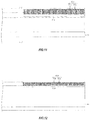
- a pair of locking members 92x and 92y are provided with second locking groove trains 92c and 92d, respectively, having a series of grooves 62c and 62d, respectively, having surfaces to match the slope surfaces 71c and 71d, respectively, and the perpendicular surfaces 81c and 81d, respectively, of the grooves 61c and 61d, respectively, of the first locking groove trains 91c and 91d, respectively (that is, having the surfaces 72c and 82c corresponding to the slope surface 71c and perpendicular surface 81c, respectively, of the groove 61c, and the surfaces 72d and 82d corresponding to the slope surface 71d and the perpendicular surface 81d, respectively, of the groove 61d) (refer to FIG. 13 ).
- the regulating member 92 is fixed to the holding shaft 91.
- a pair of locking members 92x and 92y have control knobs 92xa and 92ya, respectively, protruding outward from the outer diameter of the regulating member 92 to allow manipulation of an operator, and groove train portions 92xb and 92yb, respectively, formed in the side opposite to the control knobs 92xa and 92ya, respectively, with respect to a swing point T and provided with the second locking groove trains 92c and 92d, respectively.
- the locking members 92x and 92y are displaced by swinging between an engagement position where the second locking groove trains 92c and 92d are engaged with the first locking groove trains 91c and 91d, respectively, of the holding shaft 91 and a disengagement position where the second locking groove trains 92c and 92d are disengaged from the first locking groove trains 91c and 91d, respectively.
- the regulating member 92 is provided with a biasing member (not shown) such as a torsion spring or a plate spring in order to bias the locking members 92x and 92y toward the engagement position.
- a biasing member such as a torsion spring or a plate spring in order to bias the locking members 92x and 92y toward the engagement position.
- the locking members 92x and 92y are displaced from the engagement position to the disengagement position, so that the regulating member 92 can move along the axial direction of the holding shaft 91.
- control knobs 92xa and 92ya of a pair of locking members 92x and 92y move to make an arc with respect to the swing point T. Therefore, an operator can displace the locking members 92x and 92y from the engagement position to the disengagement position with easy manipulation by pressing the control knobs 92xa and 92ya slanted along the aforementioned arc shape instead of pressing toward the center of the regulating member 92.
- the structures of the locking members 92x and 92y are not limited to a swingable structure as described in this embodiment. Instead, various structures may be employed as long as the locking members 92x and 92y can be displaced between an engagement position where the second locking groove trains 92c and 92d are engaged with the first locking groove trains 91c and 91d and a disengagement position where the second locking groove trains 92c and 92d are disengaged from the first locking groove trains 91c and 91d.
- a stopper 93 is inserted into one end of the holding shaft 91 in order to prevent removal of the regulating member 92 from the holding shaft 91.
- the stopper 93 is provided with a pair of locking portions 93a extending in the axial direction of the holding shaft 91 and a pair of stopper pieces 93b protruding in a radial direction.
- the locking portion 93a is engaged with a concave portion (not shown) formed in an inner wall of the holding shaft 91, and the stopper 93 is fixed to the holding shaft, so that the stopper piece 93b interferes with the regulating member 92 so as to prevent removal of the regulating member 92 from the holding shaft 91.
- stopper 93 may not be necessarily provided because it aims to prevent the regulating member 92 from being removed from the holding shaft 91 unintentionally.
- a convex portion 91e is formed to provide a joint for transmitting a driving force from the motor 46. It is noted that, as described above, the driving force from the motor 46 is transmitted to the ribbon winding shaft 43, but is not transmitted to the ribbon feeding shaft 42. Therefore, the convex portion 91e of the ribbon feeding shaft 42 does not substantially serve as a joint, unlike the convex portion 91e of the ribbon winding shaft 43.
- the ribbon winding shaft 43 has a similar structure as illustrated in FIG. 15 .
- the holding shaft 91 of the ribbon winding shaft 43 is provided with a catch 94 such as a plate spring in order to prevent a pipe-like member (not shown) for fixing a tip of the ink ribbon R to be wound from being drifted when it is inserted as illustrated in FIG. 15 .
- the holding shaft 91 of the ribbon feeding shaft 42 is provided with a catch 94 such as a plate spring in order to prevent a pipe-like member (not shown) wound with the ink ribbon R from being drifted when it is inserted. Note that the catch of the ribbon feeding shaft 42 is not illustrated for simplicity purposes.
- both of the plurality of grooves 61c and 61d of the first locking groove trains 91c and 91d of the holding shaft 91 and the plurality of grooves 62c and 62d of the second locking groove trains 92c and 92d formed in the locking members 92x and 92y of the regulating member 92 and engaged with the first locking groove trains 91c and 91d are formed successively in series. Therefore, it is possible to accurately adjust a position of the regulating member 92 inserted into the holding shaft 91.
- the series of grooves 61c and 61d of the pair of first locking groove trains 91c and 91d of the holding shaft 91 are provided in parallel along the axial direction of the holding shaft 91 and extend across the axial direction of the holding shaft 91.
- the series of grooves 61c and 61d have the slope surfaces 71c and 71d sloped along the axial direction of the holding shaft 91 and oppositely to each other and the perpendicular surfaces 81c and 81d perpendicular to the axial direction of the holding shaft 91.
- the series of grooves 62c and 62d of the second locking groove trains 92c and 92d of the pair of locking members 92x and 92y engaged with the pair of first locking groove trains 91c and 91d to fix the regulating member 92 to the holding shaft 91 have surfaces to match each of the slope surfaces 71c and 71d and each of the perpendicular surfaces 81c and 81d of the grooves 61c and 61d of the first locking groove trains 91c and 91d, i.e., the surfaces 72c and 82c corresponding to the slope surface 71c and the perpendicular surface 81c, respectively, of the groove 61c and the surfaces 72d and 82d corresponding to the slope surface 71d and the perpendicular surface 81d, respectively, of the groove 61d.
- the first locking groove train 91c of the holding shaft 91 is engaged with the second locking groove train 92c of the locking member 92x provided in the regulating member 92 as illustrated in FIG. 13A .
- the surface 82c of the second locking groove train 92c abuts on the perpendicular surface 81c of the first locking groove train 91c perpendicular to the axial direction of the holding shaft 91, so that a slide of the regulating member 92 with respect to the holding shaft 91 is prevented.
- the surface 82d of the second locking groove train 92d abuts on the perpendicular surface 81d of the first locking groove train 91d perpendicular to the axial direction of the holding shaft 91, so that a slide of the regulating member 92 with respect to the holding shaft 91 is prevented.
- the long sheet material holding device according to this invention may also be employed in various devices for holding various long sheet materials in a roll shape without limiting to such a ribbon feeding shaft 42 or ribbon winding shaft 43.
- this invention is applied to a standalone type printer not connected to a personal computer (PC) but provided with the input unit.
- this invention may also be applied to an online type printer connected to a PC whereby necessary input manipulations are performed.
Landscapes
- Impression-Transfer Materials And Handling Thereof (AREA)
- Handling Of Continuous Sheets Of Paper (AREA)
- Electronic Switches (AREA)
Applications Claiming Priority (2)
| Application Number | Priority Date | Filing Date | Title |
|---|---|---|---|
| JP2013131098A JP6023666B2 (ja) | 2013-06-21 | 2013-06-21 | 長尺シート体保持装置およびプリンタ |
| PCT/JP2014/061775 WO2014203622A1 (fr) | 2013-06-21 | 2014-04-25 | Dispositif de maintien de feuille longue, et imprimante |
Publications (3)
| Publication Number | Publication Date |
|---|---|
| EP3012111A1 true EP3012111A1 (fr) | 2016-04-27 |
| EP3012111A4 EP3012111A4 (fr) | 2017-08-16 |
| EP3012111B1 EP3012111B1 (fr) | 2018-09-19 |
Family
ID=52104365
Family Applications (1)
| Application Number | Title | Priority Date | Filing Date |
|---|---|---|---|
| EP14814386.0A Not-in-force EP3012111B1 (fr) | 2013-06-21 | 2014-04-25 | Dispositif de maintien de feuille longue, et imprimante |
Country Status (4)
| Country | Link |
|---|---|
| US (1) | US9539839B2 (fr) |
| EP (1) | EP3012111B1 (fr) |
| JP (1) | JP6023666B2 (fr) |
| WO (1) | WO2014203622A1 (fr) |
Families Citing this family (4)
| Publication number | Priority date | Publication date | Assignee | Title |
|---|---|---|---|---|
| CN107584909B (zh) * | 2016-07-07 | 2023-06-23 | 深圳市博思得科技发展有限公司 | 一种用于标签打印机的色带轴及标签打印机 |
| JP6891654B2 (ja) * | 2017-06-14 | 2021-06-18 | セイコーエプソン株式会社 | ロール体支持装置および印刷装置 |
| CN107317265A (zh) * | 2017-06-27 | 2017-11-03 | 重庆渝丰鑫新线缆科技有限公司 | 一种电力电缆施放作业架 |
| US20260034817A1 (en) * | 2024-07-31 | 2026-02-05 | Brady Worldwide, Inc. | Printer ribbon orientation system and method |
Family Cites Families (16)
| Publication number | Priority date | Publication date | Assignee | Title |
|---|---|---|---|---|
| SE447712B (sv) * | 1985-05-08 | 1986-12-08 | Santrade Ltd | Verktygskoppling |
| JPH0229262Y2 (fr) * | 1986-09-30 | 1990-08-06 | ||
| DE3817644A1 (de) * | 1988-05-25 | 1989-11-30 | Hilti Ag | Werkzeug mit laengsnuten am einsteckende |
| US5348210A (en) * | 1990-06-14 | 1994-09-20 | Ball Burnishing Machine Tools Limited | Joints |
| JP3163505B2 (ja) * | 1991-06-07 | 2001-05-08 | 日本ピストンリング株式会社 | シャフトを嵌合部材に圧入してなる機械要素及びその製造方法 |
| JP3770521B2 (ja) * | 1998-07-27 | 2006-04-26 | 東芝テック株式会社 | 転写プリンタ |
| DE69938838D1 (de) * | 1998-11-12 | 2008-07-10 | Black & Decker Inc | Futter, bohrer, zusammenbau dafür und montagemethode |
| JP2000351493A (ja) * | 1999-06-14 | 2000-12-19 | Teraoka Seiko Co Ltd | ラベルプリンタのラベルロール紙セット装置 |
| US6592287B1 (en) * | 1999-09-21 | 2003-07-15 | General Electric Company | Self-fixtured joint assembly and its preparation |
| DE19954969A1 (de) * | 1999-11-16 | 2001-06-07 | Bosch Gmbh Robert | Vorrichtung zum Verbinden einer Welle mit einem Ring |
| US6622953B2 (en) * | 1999-12-22 | 2003-09-23 | Fuji Photo Film Co., Ltd. | Roll holder device for supporting recording material roll and supply magazine with the same |
| JP3420754B2 (ja) * | 2000-10-10 | 2003-06-30 | 株式会社豊田自動織機 | プロペラシャフト |
| JP2005161523A (ja) * | 2003-11-28 | 2005-06-23 | Sato Corp | 用紙の幅ガイド装置およびこれを用いたプリンタ |
| JP2005314047A (ja) | 2004-04-28 | 2005-11-10 | Sato Corp | 印字装置 |
| US9038937B2 (en) * | 2012-08-30 | 2015-05-26 | Brady Worldwide, Inc. | Size-adjustable and securable media spindle apparatus |
| JP5272150B2 (ja) | 2012-10-12 | 2013-08-28 | サトーホールディングス株式会社 | サーマルプリンタ |
-
2013
- 2013-06-21 JP JP2013131098A patent/JP6023666B2/ja not_active Expired - Fee Related
-
2014
- 2014-04-25 WO PCT/JP2014/061775 patent/WO2014203622A1/fr not_active Ceased
- 2014-04-25 US US14/900,454 patent/US9539839B2/en not_active Expired - Fee Related
- 2014-04-25 EP EP14814386.0A patent/EP3012111B1/fr not_active Not-in-force
Also Published As
| Publication number | Publication date |
|---|---|
| JP6023666B2 (ja) | 2016-11-09 |
| EP3012111A4 (fr) | 2017-08-16 |
| WO2014203622A1 (fr) | 2014-12-24 |
| US9539839B2 (en) | 2017-01-10 |
| EP3012111B1 (fr) | 2018-09-19 |
| US20160152057A1 (en) | 2016-06-02 |
| JP2015003481A (ja) | 2015-01-08 |
Similar Documents
| Publication | Publication Date | Title |
|---|---|---|
| EP2468518B1 (fr) | Imprimante compacte avec verrouillage de trame d'impression | |
| EP3012111B1 (fr) | Dispositif de maintien de feuille longue, et imprimante | |
| KR102365829B1 (ko) | 인자 유닛 및 서멀 프린터 | |
| KR102541304B1 (ko) | 인자 유닛 및 서멀 프린터 | |
| EP3088195B1 (fr) | Imprimante | |
| US9802422B2 (en) | Printer for printing of printable objects and ink ribbon cassette for use in a printer | |
| EP4209440B1 (fr) | Imprimante | |
| US9393816B2 (en) | Printer | |
| EP2703177B1 (fr) | Imprimante | |
| EP3546230B1 (fr) | Module d'imprimante thermique et imprimante thermique | |
| EP3562679B1 (fr) | Mécanisme de réglage de tangente de tête d'impression | |
| EP3006217B1 (fr) | Imprimante | |
| EP2927006B1 (fr) | Imprimante | |
| JP2009184808A (ja) | シート材搬送機構およびプリンタ | |
| JP2005178309A (ja) | 印字媒体用センサー支持装置 | |
| JP6302374B2 (ja) | サーマルプリンタ用紙ガイド装置 | |
| US10118419B2 (en) | Sheet detection device and printer | |
| JP2013220879A (ja) | 印刷媒体供給機構 | |
| JP6074333B2 (ja) | プリンタ | |
| JP5959408B2 (ja) | プリンタ | |
| JP2013052606A (ja) | プリンター | |
| JP4775570B2 (ja) | プリンタ | |
| JP2019166672A (ja) | プリンタ | |
| KR20140045645A (ko) | 양면 인쇄형 프린터의 리본 공급 장치 |
Legal Events
| Date | Code | Title | Description |
|---|---|---|---|
| PUAI | Public reference made under article 153(3) epc to a published international application that has entered the european phase |
Free format text: ORIGINAL CODE: 0009012 |
|
| 17P | Request for examination filed |
Effective date: 20160114 |
|
| AK | Designated contracting states |
Kind code of ref document: A1 Designated state(s): AL AT BE BG CH CY CZ DE DK EE ES FI FR GB GR HR HU IE IS IT LI LT LU LV MC MK MT NL NO PL PT RO RS SE SI SK SM TR |
|
| AX | Request for extension of the european patent |
Extension state: BA ME |
|
| DAX | Request for extension of the european patent (deleted) | ||
| A4 | Supplementary search report drawn up and despatched |
Effective date: 20170718 |
|
| RIC1 | Information provided on ipc code assigned before grant |
Ipc: B65H 75/24 20060101ALI20170712BHEP Ipc: B41J 17/24 20060101AFI20170712BHEP Ipc: B65H 16/06 20060101ALI20170712BHEP |
|
| GRAP | Despatch of communication of intention to grant a patent |
Free format text: ORIGINAL CODE: EPIDOSNIGR1 |
|
| STAA | Information on the status of an ep patent application or granted ep patent |
Free format text: STATUS: GRANT OF PATENT IS INTENDED |
|
| INTG | Intention to grant announced |
Effective date: 20180507 |
|
| RIN1 | Information on inventor provided before grant (corrected) |
Inventor name: MAEKAWA HITOSHI |
|
| GRAS | Grant fee paid |
Free format text: ORIGINAL CODE: EPIDOSNIGR3 |
|
| GRAA | (expected) grant |
Free format text: ORIGINAL CODE: 0009210 |
|
| STAA | Information on the status of an ep patent application or granted ep patent |
Free format text: STATUS: THE PATENT HAS BEEN GRANTED |
|
| AK | Designated contracting states |
Kind code of ref document: B1 Designated state(s): AL AT BE BG CH CY CZ DE DK EE ES FI FR GB GR HR HU IE IS IT LI LT LU LV MC MK MT NL NO PL PT RO RS SE SI SK SM TR |
|
| REG | Reference to a national code |
Ref country code: GB Ref legal event code: FG4D |
|
| REG | Reference to a national code |
Ref country code: CH Ref legal event code: EP |
|
| REG | Reference to a national code |
Ref country code: AT Ref legal event code: REF Ref document number: 1042796 Country of ref document: AT Kind code of ref document: T Effective date: 20181015 |
|
| REG | Reference to a national code |
Ref country code: IE Ref legal event code: FG4D |
|
| REG | Reference to a national code |
Ref country code: DE Ref legal event code: R096 Ref document number: 602014032653 Country of ref document: DE |
|
| REG | Reference to a national code |
Ref country code: NL Ref legal event code: MP Effective date: 20180919 |
|
| PG25 | Lapsed in a contracting state [announced via postgrant information from national office to epo] |
Ref country code: NO Free format text: LAPSE BECAUSE OF FAILURE TO SUBMIT A TRANSLATION OF THE DESCRIPTION OR TO PAY THE FEE WITHIN THE PRESCRIBED TIME-LIMIT Effective date: 20181219 Ref country code: SE Free format text: LAPSE BECAUSE OF FAILURE TO SUBMIT A TRANSLATION OF THE DESCRIPTION OR TO PAY THE FEE WITHIN THE PRESCRIBED TIME-LIMIT Effective date: 20180919 Ref country code: BG Free format text: LAPSE BECAUSE OF FAILURE TO SUBMIT A TRANSLATION OF THE DESCRIPTION OR TO PAY THE FEE WITHIN THE PRESCRIBED TIME-LIMIT Effective date: 20181219 Ref country code: RS Free format text: LAPSE BECAUSE OF FAILURE TO SUBMIT A TRANSLATION OF THE DESCRIPTION OR TO PAY THE FEE WITHIN THE PRESCRIBED TIME-LIMIT Effective date: 20180919 Ref country code: FI Free format text: LAPSE BECAUSE OF FAILURE TO SUBMIT A TRANSLATION OF THE DESCRIPTION OR TO PAY THE FEE WITHIN THE PRESCRIBED TIME-LIMIT Effective date: 20180919 Ref country code: GR Free format text: LAPSE BECAUSE OF FAILURE TO SUBMIT A TRANSLATION OF THE DESCRIPTION OR TO PAY THE FEE WITHIN THE PRESCRIBED TIME-LIMIT Effective date: 20181220 Ref country code: LT Free format text: LAPSE BECAUSE OF FAILURE TO SUBMIT A TRANSLATION OF THE DESCRIPTION OR TO PAY THE FEE WITHIN THE PRESCRIBED TIME-LIMIT Effective date: 20180919 |
|
| REG | Reference to a national code |
Ref country code: LT Ref legal event code: MG4D |
|
| PG25 | Lapsed in a contracting state [announced via postgrant information from national office to epo] |
Ref country code: HR Free format text: LAPSE BECAUSE OF FAILURE TO SUBMIT A TRANSLATION OF THE DESCRIPTION OR TO PAY THE FEE WITHIN THE PRESCRIBED TIME-LIMIT Effective date: 20180919 Ref country code: LV Free format text: LAPSE BECAUSE OF FAILURE TO SUBMIT A TRANSLATION OF THE DESCRIPTION OR TO PAY THE FEE WITHIN THE PRESCRIBED TIME-LIMIT Effective date: 20180919 Ref country code: AL Free format text: LAPSE BECAUSE OF FAILURE TO SUBMIT A TRANSLATION OF THE DESCRIPTION OR TO PAY THE FEE WITHIN THE PRESCRIBED TIME-LIMIT Effective date: 20180919 |
|
| REG | Reference to a national code |
Ref country code: AT Ref legal event code: MK05 Ref document number: 1042796 Country of ref document: AT Kind code of ref document: T Effective date: 20180919 |
|
| PG25 | Lapsed in a contracting state [announced via postgrant information from national office to epo] |
Ref country code: EE Free format text: LAPSE BECAUSE OF FAILURE TO SUBMIT A TRANSLATION OF THE DESCRIPTION OR TO PAY THE FEE WITHIN THE PRESCRIBED TIME-LIMIT Effective date: 20180919 Ref country code: RO Free format text: LAPSE BECAUSE OF FAILURE TO SUBMIT A TRANSLATION OF THE DESCRIPTION OR TO PAY THE FEE WITHIN THE PRESCRIBED TIME-LIMIT Effective date: 20180919 Ref country code: NL Free format text: LAPSE BECAUSE OF FAILURE TO SUBMIT A TRANSLATION OF THE DESCRIPTION OR TO PAY THE FEE WITHIN THE PRESCRIBED TIME-LIMIT Effective date: 20180919 Ref country code: IS Free format text: LAPSE BECAUSE OF FAILURE TO SUBMIT A TRANSLATION OF THE DESCRIPTION OR TO PAY THE FEE WITHIN THE PRESCRIBED TIME-LIMIT Effective date: 20190119 Ref country code: PL Free format text: LAPSE BECAUSE OF FAILURE TO SUBMIT A TRANSLATION OF THE DESCRIPTION OR TO PAY THE FEE WITHIN THE PRESCRIBED TIME-LIMIT Effective date: 20180919 Ref country code: ES Free format text: LAPSE BECAUSE OF FAILURE TO SUBMIT A TRANSLATION OF THE DESCRIPTION OR TO PAY THE FEE WITHIN THE PRESCRIBED TIME-LIMIT Effective date: 20180919 Ref country code: CZ Free format text: LAPSE BECAUSE OF FAILURE TO SUBMIT A TRANSLATION OF THE DESCRIPTION OR TO PAY THE FEE WITHIN THE PRESCRIBED TIME-LIMIT Effective date: 20180919 Ref country code: IT Free format text: LAPSE BECAUSE OF FAILURE TO SUBMIT A TRANSLATION OF THE DESCRIPTION OR TO PAY THE FEE WITHIN THE PRESCRIBED TIME-LIMIT Effective date: 20180919 Ref country code: AT Free format text: LAPSE BECAUSE OF FAILURE TO SUBMIT A TRANSLATION OF THE DESCRIPTION OR TO PAY THE FEE WITHIN THE PRESCRIBED TIME-LIMIT Effective date: 20180919 |
|
| PG25 | Lapsed in a contracting state [announced via postgrant information from national office to epo] |
Ref country code: SK Free format text: LAPSE BECAUSE OF FAILURE TO SUBMIT A TRANSLATION OF THE DESCRIPTION OR TO PAY THE FEE WITHIN THE PRESCRIBED TIME-LIMIT Effective date: 20180919 Ref country code: SM Free format text: LAPSE BECAUSE OF FAILURE TO SUBMIT A TRANSLATION OF THE DESCRIPTION OR TO PAY THE FEE WITHIN THE PRESCRIBED TIME-LIMIT Effective date: 20180919 Ref country code: PT Free format text: LAPSE BECAUSE OF FAILURE TO SUBMIT A TRANSLATION OF THE DESCRIPTION OR TO PAY THE FEE WITHIN THE PRESCRIBED TIME-LIMIT Effective date: 20190119 |
|
| REG | Reference to a national code |
Ref country code: DE Ref legal event code: R097 Ref document number: 602014032653 Country of ref document: DE |
|
| PLBE | No opposition filed within time limit |
Free format text: ORIGINAL CODE: 0009261 |
|
| STAA | Information on the status of an ep patent application or granted ep patent |
Free format text: STATUS: NO OPPOSITION FILED WITHIN TIME LIMIT |
|
| PG25 | Lapsed in a contracting state [announced via postgrant information from national office to epo] |
Ref country code: DK Free format text: LAPSE BECAUSE OF FAILURE TO SUBMIT A TRANSLATION OF THE DESCRIPTION OR TO PAY THE FEE WITHIN THE PRESCRIBED TIME-LIMIT Effective date: 20180919 |
|
| 26N | No opposition filed |
Effective date: 20190620 |
|
| PG25 | Lapsed in a contracting state [announced via postgrant information from national office to epo] |
Ref country code: SI Free format text: LAPSE BECAUSE OF FAILURE TO SUBMIT A TRANSLATION OF THE DESCRIPTION OR TO PAY THE FEE WITHIN THE PRESCRIBED TIME-LIMIT Effective date: 20180919 |
|
| REG | Reference to a national code |
Ref country code: CH Ref legal event code: PL |
|
| REG | Reference to a national code |
Ref country code: BE Ref legal event code: MM Effective date: 20190430 |
|
| PG25 | Lapsed in a contracting state [announced via postgrant information from national office to epo] |
Ref country code: MC Free format text: LAPSE BECAUSE OF FAILURE TO SUBMIT A TRANSLATION OF THE DESCRIPTION OR TO PAY THE FEE WITHIN THE PRESCRIBED TIME-LIMIT Effective date: 20180919 Ref country code: LU Free format text: LAPSE BECAUSE OF NON-PAYMENT OF DUE FEES Effective date: 20190425 |
|
| PG25 | Lapsed in a contracting state [announced via postgrant information from national office to epo] |
Ref country code: LI Free format text: LAPSE BECAUSE OF NON-PAYMENT OF DUE FEES Effective date: 20190430 Ref country code: CH Free format text: LAPSE BECAUSE OF NON-PAYMENT OF DUE FEES Effective date: 20190430 |
|
| PG25 | Lapsed in a contracting state [announced via postgrant information from national office to epo] |
Ref country code: BE Free format text: LAPSE BECAUSE OF NON-PAYMENT OF DUE FEES Effective date: 20190430 |
|
| PG25 | Lapsed in a contracting state [announced via postgrant information from national office to epo] |
Ref country code: TR Free format text: LAPSE BECAUSE OF FAILURE TO SUBMIT A TRANSLATION OF THE DESCRIPTION OR TO PAY THE FEE WITHIN THE PRESCRIBED TIME-LIMIT Effective date: 20180919 |
|
| PG25 | Lapsed in a contracting state [announced via postgrant information from national office to epo] |
Ref country code: IE Free format text: LAPSE BECAUSE OF NON-PAYMENT OF DUE FEES Effective date: 20190425 |
|
| PG25 | Lapsed in a contracting state [announced via postgrant information from national office to epo] |
Ref country code: CY Free format text: LAPSE BECAUSE OF FAILURE TO SUBMIT A TRANSLATION OF THE DESCRIPTION OR TO PAY THE FEE WITHIN THE PRESCRIBED TIME-LIMIT Effective date: 20180919 |
|
| PG25 | Lapsed in a contracting state [announced via postgrant information from national office to epo] |
Ref country code: HU Free format text: LAPSE BECAUSE OF FAILURE TO SUBMIT A TRANSLATION OF THE DESCRIPTION OR TO PAY THE FEE WITHIN THE PRESCRIBED TIME-LIMIT; INVALID AB INITIO Effective date: 20140425 Ref country code: MT Free format text: LAPSE BECAUSE OF FAILURE TO SUBMIT A TRANSLATION OF THE DESCRIPTION OR TO PAY THE FEE WITHIN THE PRESCRIBED TIME-LIMIT Effective date: 20180919 |
|
| PG25 | Lapsed in a contracting state [announced via postgrant information from national office to epo] |
Ref country code: MK Free format text: LAPSE BECAUSE OF FAILURE TO SUBMIT A TRANSLATION OF THE DESCRIPTION OR TO PAY THE FEE WITHIN THE PRESCRIBED TIME-LIMIT Effective date: 20180919 |
|
| P01 | Opt-out of the competence of the unified patent court (upc) registered |
Effective date: 20230411 |
|
| PGFP | Annual fee paid to national office [announced via postgrant information from national office to epo] |
Ref country code: FR Payment date: 20230424 Year of fee payment: 10 Ref country code: DE Payment date: 20230420 Year of fee payment: 10 |
|
| PGFP | Annual fee paid to national office [announced via postgrant information from national office to epo] |
Ref country code: GB Payment date: 20230419 Year of fee payment: 10 |
|
| REG | Reference to a national code |
Ref country code: DE Ref legal event code: R119 Ref document number: 602014032653 Country of ref document: DE |
|
| GBPC | Gb: european patent ceased through non-payment of renewal fee |
Effective date: 20240425 |
|
| PG25 | Lapsed in a contracting state [announced via postgrant information from national office to epo] |
Ref country code: DE Free format text: LAPSE BECAUSE OF NON-PAYMENT OF DUE FEES Effective date: 20241105 |
|
| PG25 | Lapsed in a contracting state [announced via postgrant information from national office to epo] |
Ref country code: GB Free format text: LAPSE BECAUSE OF NON-PAYMENT OF DUE FEES Effective date: 20240425 |
|
| PG25 | Lapsed in a contracting state [announced via postgrant information from national office to epo] |
Ref country code: FR Free format text: LAPSE BECAUSE OF NON-PAYMENT OF DUE FEES Effective date: 20240430 |
|
| PG25 | Lapsed in a contracting state [announced via postgrant information from national office to epo] |
Ref country code: GB Free format text: LAPSE BECAUSE OF NON-PAYMENT OF DUE FEES Effective date: 20240425 Ref country code: FR Free format text: LAPSE BECAUSE OF NON-PAYMENT OF DUE FEES Effective date: 20240430 Ref country code: DE Free format text: LAPSE BECAUSE OF NON-PAYMENT OF DUE FEES Effective date: 20241105 |