EP3013085A1 - Verfahren zum Senden von Daten aus einem sicheren Token an einen entfernten Server - Google Patents
Verfahren zum Senden von Daten aus einem sicheren Token an einen entfernten Server Download PDFInfo
- Publication number
- EP3013085A1 EP3013085A1 EP14306684.3A EP14306684A EP3013085A1 EP 3013085 A1 EP3013085 A1 EP 3013085A1 EP 14306684 A EP14306684 A EP 14306684A EP 3013085 A1 EP3013085 A1 EP 3013085A1
- Authority
- EP
- European Patent Office
- Prior art keywords
- response
- command
- server
- secure token
- secured
- Prior art date
- Legal status (The legal status is an assumption and is not a legal conclusion. Google has not performed a legal analysis and makes no representation as to the accuracy of the status listed.)
- Withdrawn
Links
- 238000000034 method Methods 0.000 title claims abstract description 15
- 230000004044 response Effects 0.000 claims abstract description 85
- 230000008901 benefit Effects 0.000 description 4
- 230000006870 function Effects 0.000 description 1
Images


Classifications
-
- H—ELECTRICITY
- H04—ELECTRIC COMMUNICATION TECHNIQUE
- H04L—TRANSMISSION OF DIGITAL INFORMATION, e.g. TELEGRAPHIC COMMUNICATION
- H04L63/00—Network architectures or network communication protocols for network security
- H04L63/08—Network architectures or network communication protocols for network security for authentication of entities
-
- H—ELECTRICITY
- H04—ELECTRIC COMMUNICATION TECHNIQUE
- H04W—WIRELESS COMMUNICATION NETWORKS
- H04W12/00—Security arrangements; Authentication; Protecting privacy or anonymity
- H04W12/03—Protecting confidentiality, e.g. by encryption
- H04W12/037—Protecting confidentiality, e.g. by encryption of the control plane, e.g. signalling traffic
-
- H—ELECTRICITY
- H04—ELECTRIC COMMUNICATION TECHNIQUE
- H04W—WIRELESS COMMUNICATION NETWORKS
- H04W12/00—Security arrangements; Authentication; Protecting privacy or anonymity
- H04W12/30—Security of mobile devices; Security of mobile applications
- H04W12/35—Protecting application or service provisioning, e.g. securing SIM application provisioning
-
- H—ELECTRICITY
- H04—ELECTRIC COMMUNICATION TECHNIQUE
- H04W—WIRELESS COMMUNICATION NETWORKS
- H04W4/00—Services specially adapted for wireless communication networks; Facilities therefor
- H04W4/50—Service provisioning or reconfiguring
-
- H—ELECTRICITY
- H04—ELECTRIC COMMUNICATION TECHNIQUE
- H04W—WIRELESS COMMUNICATION NETWORKS
- H04W4/00—Services specially adapted for wireless communication networks; Facilities therefor
- H04W4/70—Services for machine-to-machine communication [M2M] or machine type communication [MTC]
Definitions
- the present invention relates to methods of sending data from a secure token to an distant server. It relates particularly to methods of securely sending a response corresponding to a command initiated by an applicative server.
- a secure token is a tamper-resistant component able to store data and to provide services in a secure manner.
- a secure token is a physical component which has a limited amount of memory, a processor with limited capabilities and is devoid of battery.
- a UICC Universal Integrated Circuit Card
- a secure token can be installed, fixedly or not, in a terminal, like a mobile phone for example.
- the terminals are constituted by machines that communicate with other machines for M2M (Machine to Machine) applications.
- a secure token can be in the format of a smart card.
- a secure token may be a chip soldered to the mother-board of the host device and constitute an embedded-secure element (eSE).
- eSE embedded-secure element
- a secure token can contain several emulated UICC.
- a secure token can comprise an application intended to communicate with a distant applicative server.
- Most of the Telecom solutions rely on a communication protocol based on command/response between an applicative server and an application embedded in a secure token. This protocol is mapped into a secured Command Packet in a SM (short message) MT (mobile terminated) and a secured response packet in a SM MO (mobile originated) for the communication.
- SM short message
- SM MO mobile originated
- Such a design can take benefit of the security layer of the communication channel of the Telecom operator for the applicative server to send a command and for the on-token application to send a response.
- the secure tokens concerned in this invention can utilize such a secure communication channel.
- the responses are managed by a dedicated handler, called EnvelopeResponseHandler, in the UICC.
- the ETSI TS 102 223 describes the principle of a proactive session which allows a UICC to send proactive commands to its hosting device.
- the proactive commands are managed in the UICC through a specific handler called ProactiveHandler.
- An object of the invention is to solve the above mentioned technical problem.
- the object of the present invention is a method for managing a response generated by an application which is embedded in a secure token acting as an UICC, in response to a first command requesting opening a proactive session.
- An applicative server relies on an OTA server to send the first command to the secure token.
- the first command is secured with a security layer provided by the OTA server. The method comprises the following steps:
- the secure token may send to the applicative server an intermediate response to said first command, said intermediate response comprising a request for a time extension and said intermediate response being secured with the security layer provided by the OTA server.
- the request may comprise a time extension expressed as a fixed duration, an indefinite duration or the occurrence of a specified event.
- the secure token may send to the applicative server a message indicating that the response can be retrieved.
- the message may be sent directly to the applicative server without using the security layer provided by the OTA server.
- Another object of the present invention is secure token acting as an UICC and including an application able to run a first command requesting opening a proactive session.
- the first command is initiated by an applicative server and secured with a security layer provided by an OTA server.
- the application is able to generate a response corresponding to the first command.
- the secure token is configured to handle a second command requesting the sending of the response.
- the secure token is configured to build a secured response packet comprising the response secured with the security layer provided by the OTA server and to send the secured response packet to the OTA server in response to the second command.
- the secure token may be configured to send to the applicative server an intermediate response to said first command, said intermediate response comprising a request for a time extension, said intermediate response being secured with the security layer provided by the OTA server.
- the secure token may be configured to send to the applicative server a message indicating that the response can be retrieved.
- Another object of the present invention is system including an applicative server and a secure token according to the invention, wherein the applicative server is configured to send the second command after an event and to get the response from the OTA server in response to sending of the second command.
- the event may be selected from a set comprising the receipt of a message indicating that the response can be retrieved, a specific duration after the receipt of a request for a time extension at applicative server side and a predefined duration after the sending of the first command.
- the invention may apply to any types of secure token configured to act as a UICC.
- the secure token may be a smart card, an UICC, an embedded-UICC (eUICC), an embedded-SIM or a software-implemented UICC.
- the secure token may be coupled to any type of host machine having a baseband and able to establish a communication session with the secure token.
- the host machine may be a mobile phone, a tablet PC, a vehicle, a meter, a slot machine, a TV or a computer.
- Figure 1 shows a first example of message exchange between an applicative server SV0 and an applet A0 embedded in a secure token according to the prior art.
- Over The Air mechanism (also known as OTA) is defined inter alia by the GSM 03.40, GSM 03.48 and ETSI/SCP-3GPP-3GPP2 standards. These documents specify specific protocols and a security layer known as "03.48 security layer”.
- the applicative server SV0 sends a command through a message to the OTA server SV2. Then the OTA server SV2 builds a SM MT containing the message. The OTA server SV2 secures the content of the SM MT by using the 03.48 security layer. Then the applet deciphers the received SM MT, executes the command, generates a response, and provides the response to the EnvelopeResponseHandler. Then the operating system of the secure token builds a SM M0, and sends it to the OTA server through the 03.48 security layer. Then the OTA server deciphers the SM M0, retrieves the response and sends the response to the applicative server SV0.
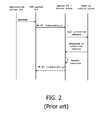
- Figure 2 shows a second example of message exchange between the applicative server SV0 and the applet A0 embedded in a secure token according to the prior art.
- the command initiated by the applicative server SV0 requests the applet A0 to open a proactive session.
- the command is sent from the applicative server SV0 to the applet A0 in a way similar to the example of Figure 1 .
- the proactive session may wait for a data selected by the user of the mobile phone hosting the secure token.
- the applet A0 must send the response corresponding to the received command, the 03.48 security layer is no more available.
- the EnvelopeResponseHandler content must be posted before the first invocation of a ProactiveHandler.send method or before the termination of the processToolkit, so that the Applet can offer these data to the mobile equipment (e.g. 9Fxx/9Exx/91xx).
- the EnvelopeResponseHandler is no more available.
- the SM MO containing the response cannot be transmitted in the same way it was sent in the example of Figure 1 .
- the dotted line shows that the message cannot be sent.
- Figure 3 shows an example of message exchange between an applicative server SV1 and an applet A1 embedded in a secure token according to the invention.
- the command C1 initiated by the applicative server SV1 requests the applet A1 to open a proactive session.
- the command C1 is sent from the applicative server SV1 to the applet A1 in a way similar to the example of Figure 1 .
- the proactive session may display a data to the user through the screen of the mobile phone. For instance, the proactive Display Text command may be run.
- the secure session established between the OTA server SV2 and the secure token is closed.
- the applet generates a response R1 corresponding to the execution of the command C1.
- the applicative server SV1 sends another command C2 to the secure token TK.
- the command C2 requests the sending of the response R1.
- the command C2 is secured by the security layer provided by the OTA server SV2.
- the applicative server SV1 sends the command C2 to the OTA server SV2 which in turn builds a SM MT comprising the command C2 and sends the SM MT to the secure token TK.
- the secure token TK generates a secured response packet R2S which comprises the response R1 secured with the security layer provided by the OTA server SV2.
- the secured response packet R2S may be a SM MO secured with the 0348 security mechanism.
- the secured response packet R2S is sent from the secure token to the OTA server SV2 which in turn retrieves the response R1 from the secured response packet R2S and sends the response R1 to the applicative server SV1.
- the applicative server is able to associate the received response R1 with the first command C1.
- the secure token TK may send an intermediate response IR to the applicative server SV1 for requesting additional time before opening the proactive session.
- the sending of this intermediate response IR is optional.
- the intermediate response IR may be securely sent via the OTA server SV2 using the security layer provided by the OTA server SV2.
- the intermediate response IR comprises a request RQ for a time extension.
- the time extension can be expressed as a duration fixed by the secure token TK, a duration to be determined by the applicative server SV1 (e.g. indefinite duration) or the occurrence of a specified event.
- the specified event may be the receipt of a further message indicating that the response R1 can be retrieved from the secure token TK or the fact that a new communication session must be established with the secure token TK for any reasons.
- the secure token TK may send a message MG to the applicative server SV1 for indicating that the response R1 is available at secure token side and can be retrieved.
- the sending of this message MG is optional.
- the secure token TK may directly send to the applicative server SV1 the message MG encapsulated in SM MO.
- the message MG is not secured by the security layer provided by the OTA server SV2.
- the applicative server SV1 will send the command C2 as described above.
- An advantage of the invention is to reuse the security layer of ETSI TS 102 225 for the sending of the applicative command to the secure token. It allows taking benefit of the secure messaging mechanism already designed for secure tokens acting as an UICC. Compared to existing applications, the application A1 does not have to implement an additional function for managing its own security layer.
- the invention avoids the management of an additional set of keys (for securing the sending of the response R1) by the applicative server and a fleet of secure tokens.
- the secure token may comprise any number of virtual UICC and the application is not necessarily an applet.
Landscapes
- Engineering & Computer Science (AREA)
- Computer Security & Cryptography (AREA)
- Computer Networks & Wireless Communication (AREA)
- Signal Processing (AREA)
- Computer Hardware Design (AREA)
- Computing Systems (AREA)
- General Engineering & Computer Science (AREA)
- Mobile Radio Communication Systems (AREA)
- Computer And Data Communications (AREA)
Priority Applications (5)
| Application Number | Priority Date | Filing Date | Title |
|---|---|---|---|
| EP14306684.3A EP3013085A1 (de) | 2014-10-23 | 2014-10-23 | Verfahren zum Senden von Daten aus einem sicheren Token an einen entfernten Server |
| PCT/EP2015/070765 WO2016062452A1 (en) | 2014-10-23 | 2015-09-10 | Method of sending data from a secure token to a distant server |
| ES15763879T ES2700589T3 (es) | 2014-10-23 | 2015-09-10 | Método de transmisión de datos desde un dispositivo electrónico seguro a un servidor |
| EP15763879.2A EP3210403B1 (de) | 2014-10-23 | 2015-09-10 | Verfahren zum senden von daten aus einem sicheren token an einen entfernten server |
| US15/519,669 US10587599B2 (en) | 2014-10-23 | 2015-10-09 | Method of sending data from a secure token to a distant server |
Applications Claiming Priority (1)
| Application Number | Priority Date | Filing Date | Title |
|---|---|---|---|
| EP14306684.3A EP3013085A1 (de) | 2014-10-23 | 2014-10-23 | Verfahren zum Senden von Daten aus einem sicheren Token an einen entfernten Server |
Publications (1)
| Publication Number | Publication Date |
|---|---|
| EP3013085A1 true EP3013085A1 (de) | 2016-04-27 |
Family
ID=51897211
Family Applications (2)
| Application Number | Title | Priority Date | Filing Date |
|---|---|---|---|
| EP14306684.3A Withdrawn EP3013085A1 (de) | 2014-10-23 | 2014-10-23 | Verfahren zum Senden von Daten aus einem sicheren Token an einen entfernten Server |
| EP15763879.2A Not-in-force EP3210403B1 (de) | 2014-10-23 | 2015-09-10 | Verfahren zum senden von daten aus einem sicheren token an einen entfernten server |
Family Applications After (1)
| Application Number | Title | Priority Date | Filing Date |
|---|---|---|---|
| EP15763879.2A Not-in-force EP3210403B1 (de) | 2014-10-23 | 2015-09-10 | Verfahren zum senden von daten aus einem sicheren token an einen entfernten server |
Country Status (4)
| Country | Link |
|---|---|
| US (1) | US10587599B2 (de) |
| EP (2) | EP3013085A1 (de) |
| ES (1) | ES2700589T3 (de) |
| WO (1) | WO2016062452A1 (de) |
Cited By (1)
| Publication number | Priority date | Publication date | Assignee | Title |
|---|---|---|---|---|
| US10136283B2 (en) | 2014-12-30 | 2018-11-20 | Stmicroelectronics S.R.L. | Methods for providing a response to a command requesting the execution of a proactive command |
Families Citing this family (2)
| Publication number | Priority date | Publication date | Assignee | Title |
|---|---|---|---|---|
| US10715513B2 (en) * | 2017-06-30 | 2020-07-14 | Microsoft Technology Licensing, Llc | Single sign-on mechanism on a rich client |
| CN114244887B (zh) * | 2021-12-16 | 2023-05-12 | 中国联合网络通信集团有限公司 | 通道管理方法、装置和电子设备 |
Citations (1)
| Publication number | Priority date | Publication date | Assignee | Title |
|---|---|---|---|---|
| US7353044B2 (en) * | 2000-06-22 | 2008-04-01 | Cp8 Technologies | Method for processing and transmitting data on a mobile telephone network and microchip onboard system |
Family Cites Families (3)
| Publication number | Priority date | Publication date | Assignee | Title |
|---|---|---|---|---|
| US8924268B1 (en) * | 2005-09-14 | 2014-12-30 | OneDemand.com, Inc. | System and method for assessing loan servicer performance in prosecuting security interest enforcement actions |
| US8346853B2 (en) * | 2010-05-27 | 2013-01-01 | Robert Paul Morris | Methods, systems, and computer program products for processing an attached command response |
| DE102011075257B4 (de) * | 2011-05-04 | 2013-11-21 | Vodafone Holding Gmbh | Beantwortung von Anfragen mittels des Kommunikationsendgeräts eines Nutzers |
-
2014
- 2014-10-23 EP EP14306684.3A patent/EP3013085A1/de not_active Withdrawn
-
2015
- 2015-09-10 ES ES15763879T patent/ES2700589T3/es active Active
- 2015-09-10 EP EP15763879.2A patent/EP3210403B1/de not_active Not-in-force
- 2015-09-10 WO PCT/EP2015/070765 patent/WO2016062452A1/en not_active Ceased
- 2015-10-09 US US15/519,669 patent/US10587599B2/en not_active Expired - Fee Related
Patent Citations (1)
| Publication number | Priority date | Publication date | Assignee | Title |
|---|---|---|---|---|
| US7353044B2 (en) * | 2000-06-22 | 2008-04-01 | Cp8 Technologies | Method for processing and transmitting data on a mobile telephone network and microchip onboard system |
Non-Patent Citations (1)
| Title |
|---|
| ETSI ET AL: "Digital cellular telecommunications system (Phase 2+); Subscriber Identity Module Application Programming Interface (SIM API) for Java Card; Stage 2 (3GPP TS 43.019 version 6.0.0 Release 6) GLOBAL SYSTEM FOR MOBILE COMMUNICATIONS", HTTP://WWW.ETSI.ORG, 1 December 2004 (2004-12-01), pages 1 - 26, XP055163384, Retrieved from the Internet <URL:http://www.etsi.org/deliver/etsi_ts/143000_143099/143019/06.00.00_60/ts_143019v060000p.pdf> [retrieved on 20150120] * |
Cited By (2)
| Publication number | Priority date | Publication date | Assignee | Title |
|---|---|---|---|---|
| US10136283B2 (en) | 2014-12-30 | 2018-11-20 | Stmicroelectronics S.R.L. | Methods for providing a response to a command requesting the execution of a proactive command |
| EP3241375B1 (de) * | 2014-12-30 | 2019-04-24 | STMicroelectronics Srl | Verfahren zur bereitstellung einer antwort auf einen scp80-befehl zur anforderung der ausführung eines proaktiven befehls, zugehörige universelle karte mit integriertem schaltkreis, mobile vorrichtung, server und computerprogrammprodukt |
Also Published As
| Publication number | Publication date |
|---|---|
| EP3210403B1 (de) | 2018-07-04 |
| EP3210403A1 (de) | 2017-08-30 |
| ES2700589T3 (es) | 2019-02-18 |
| US20170244691A1 (en) | 2017-08-24 |
| WO2016062452A1 (en) | 2016-04-28 |
| US10587599B2 (en) | 2020-03-10 |
Similar Documents
| Publication | Publication Date | Title |
|---|---|---|
| US8676260B2 (en) | Method of managing information by a large capacity UICC | |
| US8745187B2 (en) | System and method for installing smart card applet | |
| US8744406B2 (en) | Proactive commands over secure channel between a mobile equipment and a UICC | |
| CN102770850B (zh) | 用于与主设备通信的令牌,对应的通信系统和方法 | |
| US20140273973A1 (en) | Method and system for replacing key deployed in se of mobile terminal | |
| EP3210403B1 (de) | Verfahren zum senden von daten aus einem sicheren token an einen entfernten server | |
| US10136283B2 (en) | Methods for providing a response to a command requesting the execution of a proactive command | |
| EP3714392B1 (de) | Verfahren zur verwaltung von privilegien in einer manipulationssicheren vorrichtung mit mehreren softwarebehältern | |
| KR101952793B1 (ko) | 가입자 아이덴티티 모듈(sim)액세스 프로파일(sap)의 개선들 | |
| CN108684036B (zh) | 电子终端及其基于可信执行环境的eSIM数据处理方法 | |
| US20180107840A1 (en) | Method of restoring a secure element to a factory state | |
| US9332374B2 (en) | Communication interface method for SE equipped on mobile terminal and SE using the same | |
| EP2595420A1 (de) | Verfahren zum Senden einer Nachricht an ein sicheres Element | |
| CN120958860A (zh) | 虚拟订户身份模块分发 | |
| EP3202173B1 (de) | Verfahren zum senden von daten aus einem sicheren token zu einem server | |
| EP3138360B1 (de) | Verfahren zur verwaltung von profilen in einem token | |
| US20150304426A1 (en) | Method of managing an application in a secure element |
Legal Events
| Date | Code | Title | Description |
|---|---|---|---|
| PUAI | Public reference made under article 153(3) epc to a published international application that has entered the european phase |
Free format text: ORIGINAL CODE: 0009012 |
|
| AK | Designated contracting states |
Kind code of ref document: A1 Designated state(s): AL AT BE BG CH CY CZ DE DK EE ES FI FR GB GR HR HU IE IS IT LI LT LU LV MC MK MT NL NO PL PT RO RS SE SI SK SM TR |
|
| AX | Request for extension of the european patent |
Extension state: BA ME |
|
| STAA | Information on the status of an ep patent application or granted ep patent |
Free format text: STATUS: THE APPLICATION IS DEEMED TO BE WITHDRAWN |
|
| 18D | Application deemed to be withdrawn |
Effective date: 20161028 |