EP3013967B1 - Procédés de récupération d'huile à partir de procédés de production de produits de fermentation et procédés de production de produits de fermentation - Google Patents
Procédés de récupération d'huile à partir de procédés de production de produits de fermentation et procédés de production de produits de fermentation Download PDFInfo
- Publication number
- EP3013967B1 EP3013967B1 EP14817250.5A EP14817250A EP3013967B1 EP 3013967 B1 EP3013967 B1 EP 3013967B1 EP 14817250 A EP14817250 A EP 14817250A EP 3013967 B1 EP3013967 B1 EP 3013967B1
- Authority
- EP
- European Patent Office
- Prior art keywords
- amylase
- alpha
- protease
- fermentation
- seq
- Prior art date
- Legal status (The legal status is an assumption and is not a legal conclusion. Google has not performed a legal analysis and makes no representation as to the accuracy of the status listed.)
- Active
Links
Images



Classifications
-
- C—CHEMISTRY; METALLURGY
- C11—ANIMAL OR VEGETABLE OILS, FATS, FATTY SUBSTANCES OR WAXES; FATTY ACIDS THEREFROM; DETERGENTS; CANDLES
- C11B—PRODUCING, e.g. BY PRESSING RAW MATERIALS OR BY EXTRACTION FROM WASTE MATERIALS, REFINING OR PRESERVING FATS, FATTY SUBSTANCES, e.g. LANOLIN, FATTY OILS OR WAXES; ESSENTIAL OILS; PERFUMES
- C11B13/00—Recovery of fats, fatty oils or fatty acids from waste materials
-
- C—CHEMISTRY; METALLURGY
- C12—BIOCHEMISTRY; BEER; SPIRITS; WINE; VINEGAR; MICROBIOLOGY; ENZYMOLOGY; MUTATION OR GENETIC ENGINEERING
- C12N—MICROORGANISMS OR ENZYMES; COMPOSITIONS THEREOF; PROPAGATING, PRESERVING, OR MAINTAINING MICROORGANISMS; MUTATION OR GENETIC ENGINEERING; CULTURE MEDIA
- C12N9/00—Enzymes; Proenzymes; Compositions thereof; Processes for preparing, activating, inhibiting, separating or purifying enzymes
- C12N9/14—Hydrolases (3)
- C12N9/48—Hydrolases (3) acting on peptide bonds (3.4)
- C12N9/50—Proteinases, e.g. Endopeptidases (3.4.21-3.4.25)
- C12N9/52—Proteinases, e.g. Endopeptidases (3.4.21-3.4.25) derived from bacteria or Archaea
-
- C—CHEMISTRY; METALLURGY
- C11—ANIMAL OR VEGETABLE OILS, FATS, FATTY SUBSTANCES OR WAXES; FATTY ACIDS THEREFROM; DETERGENTS; CANDLES
- C11B—PRODUCING, e.g. BY PRESSING RAW MATERIALS OR BY EXTRACTION FROM WASTE MATERIALS, REFINING OR PRESERVING FATS, FATTY SUBSTANCES, e.g. LANOLIN, FATTY OILS OR WAXES; ESSENTIAL OILS; PERFUMES
- C11B3/00—Refining fats or fatty oils
- C11B3/003—Refining fats or fatty oils by enzymes or microorganisms, living or dead
-
- C—CHEMISTRY; METALLURGY
- C12—BIOCHEMISTRY; BEER; SPIRITS; WINE; VINEGAR; MICROBIOLOGY; ENZYMOLOGY; MUTATION OR GENETIC ENGINEERING
- C12N—MICROORGANISMS OR ENZYMES; COMPOSITIONS THEREOF; PROPAGATING, PRESERVING, OR MAINTAINING MICROORGANISMS; MUTATION OR GENETIC ENGINEERING; CULTURE MEDIA
- C12N9/00—Enzymes; Proenzymes; Compositions thereof; Processes for preparing, activating, inhibiting, separating or purifying enzymes
- C12N9/14—Hydrolases (3)
- C12N9/24—Hydrolases (3) acting on glycosyl compounds (3.2)
- C12N9/2402—Hydrolases (3) acting on glycosyl compounds (3.2) hydrolysing O- and S- glycosyl compounds (3.2.1)
- C12N9/2405—Glucanases
- C12N9/2408—Glucanases acting on alpha -1,4-glucosidic bonds
- C12N9/2411—Amylases
- C12N9/2414—Alpha-amylase (3.2.1.1.)
- C12N9/2417—Alpha-amylase (3.2.1.1.) from microbiological source
-
- C—CHEMISTRY; METALLURGY
- C12—BIOCHEMISTRY; BEER; SPIRITS; WINE; VINEGAR; MICROBIOLOGY; ENZYMOLOGY; MUTATION OR GENETIC ENGINEERING
- C12N—MICROORGANISMS OR ENZYMES; COMPOSITIONS THEREOF; PROPAGATING, PRESERVING, OR MAINTAINING MICROORGANISMS; MUTATION OR GENETIC ENGINEERING; CULTURE MEDIA
- C12N9/00—Enzymes; Proenzymes; Compositions thereof; Processes for preparing, activating, inhibiting, separating or purifying enzymes
- C12N9/14—Hydrolases (3)
- C12N9/24—Hydrolases (3) acting on glycosyl compounds (3.2)
- C12N9/2402—Hydrolases (3) acting on glycosyl compounds (3.2) hydrolysing O- and S- glycosyl compounds (3.2.1)
- C12N9/2405—Glucanases
- C12N9/2408—Glucanases acting on alpha -1,4-glucosidic bonds
- C12N9/2411—Amylases
- C12N9/2428—Glucan 1,4-alpha-glucosidase (3.2.1.3), i.e. glucoamylase
-
- C—CHEMISTRY; METALLURGY
- C12—BIOCHEMISTRY; BEER; SPIRITS; WINE; VINEGAR; MICROBIOLOGY; ENZYMOLOGY; MUTATION OR GENETIC ENGINEERING
- C12N—MICROORGANISMS OR ENZYMES; COMPOSITIONS THEREOF; PROPAGATING, PRESERVING, OR MAINTAINING MICROORGANISMS; MUTATION OR GENETIC ENGINEERING; CULTURE MEDIA
- C12N9/00—Enzymes; Proenzymes; Compositions thereof; Processes for preparing, activating, inhibiting, separating or purifying enzymes
- C12N9/14—Hydrolases (3)
- C12N9/48—Hydrolases (3) acting on peptide bonds (3.4)
- C12N9/50—Proteinases, e.g. Endopeptidases (3.4.21-3.4.25)
-
- C—CHEMISTRY; METALLURGY
- C12—BIOCHEMISTRY; BEER; SPIRITS; WINE; VINEGAR; MICROBIOLOGY; ENZYMOLOGY; MUTATION OR GENETIC ENGINEERING
- C12N—MICROORGANISMS OR ENZYMES; COMPOSITIONS THEREOF; PROPAGATING, PRESERVING, OR MAINTAINING MICROORGANISMS; MUTATION OR GENETIC ENGINEERING; CULTURE MEDIA
- C12N9/00—Enzymes; Proenzymes; Compositions thereof; Processes for preparing, activating, inhibiting, separating or purifying enzymes
- C12N9/14—Hydrolases (3)
- C12N9/48—Hydrolases (3) acting on peptide bonds (3.4)
- C12N9/50—Proteinases, e.g. Endopeptidases (3.4.21-3.4.25)
- C12N9/58—Proteinases, e.g. Endopeptidases (3.4.21-3.4.25) derived from fungi
-
- C—CHEMISTRY; METALLURGY
- C12—BIOCHEMISTRY; BEER; SPIRITS; WINE; VINEGAR; MICROBIOLOGY; ENZYMOLOGY; MUTATION OR GENETIC ENGINEERING
- C12P—FERMENTATION OR ENZYME-USING PROCESSES TO SYNTHESISE A DESIRED CHEMICAL COMPOUND OR COMPOSITION OR TO SEPARATE OPTICAL ISOMERS FROM A RACEMIC MIXTURE
- C12P7/00—Preparation of oxygen-containing organic compounds
- C12P7/02—Preparation of oxygen-containing organic compounds containing a hydroxy group
- C12P7/04—Preparation of oxygen-containing organic compounds containing a hydroxy group acyclic
- C12P7/06—Ethanol, i.e. non-beverage
- C12P7/08—Ethanol, i.e. non-beverage produced as by-product or from waste or cellulosic material substrate
- C12P7/10—Ethanol, i.e. non-beverage produced as by-product or from waste or cellulosic material substrate substrate containing cellulosic material
-
- C—CHEMISTRY; METALLURGY
- C12—BIOCHEMISTRY; BEER; SPIRITS; WINE; VINEGAR; MICROBIOLOGY; ENZYMOLOGY; MUTATION OR GENETIC ENGINEERING
- C12P—FERMENTATION OR ENZYME-USING PROCESSES TO SYNTHESISE A DESIRED CHEMICAL COMPOUND OR COMPOSITION OR TO SEPARATE OPTICAL ISOMERS FROM A RACEMIC MIXTURE
- C12P7/00—Preparation of oxygen-containing organic compounds
- C12P7/64—Fats; Fatty oils; Ester-type waxes; Higher fatty acids, i.e. having at least seven carbon atoms in an unbroken chain bound to a carboxyl group; Oxidised oils or fats
-
- B—PERFORMING OPERATIONS; TRANSPORTING
- B01—PHYSICAL OR CHEMICAL PROCESSES OR APPARATUS IN GENERAL
- B01D—SEPARATION
- B01D3/00—Distillation or related exchange processes in which liquids are contacted with gaseous media, e.g. stripping
- B01D3/001—Processes specially adapted for distillation or rectification of fermented solutions
- B01D3/002—Processes specially adapted for distillation or rectification of fermented solutions by continuous methods
-
- C—CHEMISTRY; METALLURGY
- C12—BIOCHEMISTRY; BEER; SPIRITS; WINE; VINEGAR; MICROBIOLOGY; ENZYMOLOGY; MUTATION OR GENETIC ENGINEERING
- C12Y—ENZYMES
- C12Y302/00—Hydrolases acting on glycosyl compounds, i.e. glycosylases (3.2)
- C12Y302/01—Glycosidases, i.e. enzymes hydrolysing O- and S-glycosyl compounds (3.2.1)
- C12Y302/01001—Alpha-amylase (3.2.1.1)
-
- C—CHEMISTRY; METALLURGY
- C12—BIOCHEMISTRY; BEER; SPIRITS; WINE; VINEGAR; MICROBIOLOGY; ENZYMOLOGY; MUTATION OR GENETIC ENGINEERING
- C12Y—ENZYMES
- C12Y302/00—Hydrolases acting on glycosyl compounds, i.e. glycosylases (3.2)
- C12Y302/01—Glycosidases, i.e. enzymes hydrolysing O- and S-glycosyl compounds (3.2.1)
- C12Y302/01003—Glucan 1,4-alpha-glucosidase (3.2.1.3), i.e. glucoamylase
-
- C—CHEMISTRY; METALLURGY
- C12—BIOCHEMISTRY; BEER; SPIRITS; WINE; VINEGAR; MICROBIOLOGY; ENZYMOLOGY; MUTATION OR GENETIC ENGINEERING
- C12Y—ENZYMES
- C12Y304/00—Hydrolases acting on peptide bonds, i.e. peptidases (3.4)
-
- Y—GENERAL TAGGING OF NEW TECHNOLOGICAL DEVELOPMENTS; GENERAL TAGGING OF CROSS-SECTIONAL TECHNOLOGIES SPANNING OVER SEVERAL SECTIONS OF THE IPC; TECHNICAL SUBJECTS COVERED BY FORMER USPC CROSS-REFERENCE ART COLLECTIONS [XRACs] AND DIGESTS
- Y02—TECHNOLOGIES OR APPLICATIONS FOR MITIGATION OR ADAPTATION AGAINST CLIMATE CHANGE
- Y02E—REDUCTION OF GREENHOUSE GAS [GHG] EMISSIONS, RELATED TO ENERGY GENERATION, TRANSMISSION OR DISTRIBUTION
- Y02E50/00—Technologies for the production of fuel of non-fossil origin
- Y02E50/10—Biofuels, e.g. bio-diesel
-
- Y—GENERAL TAGGING OF NEW TECHNOLOGICAL DEVELOPMENTS; GENERAL TAGGING OF CROSS-SECTIONAL TECHNOLOGIES SPANNING OVER SEVERAL SECTIONS OF THE IPC; TECHNICAL SUBJECTS COVERED BY FORMER USPC CROSS-REFERENCE ART COLLECTIONS [XRACs] AND DIGESTS
- Y02—TECHNOLOGIES OR APPLICATIONS FOR MITIGATION OR ADAPTATION AGAINST CLIMATE CHANGE
- Y02W—CLIMATE CHANGE MITIGATION TECHNOLOGIES RELATED TO WASTEWATER TREATMENT OR WASTE MANAGEMENT
- Y02W30/00—Technologies for solid waste management
- Y02W30/50—Reuse, recycling or recovery technologies
- Y02W30/74—Recovery of fats, fatty oils, fatty acids or other fatty substances, e.g. lanolin or waxes
Definitions
- the present invention relates to processes of recovering oil from a fermentation product production process.
- Fermentation products such as ethanol are typically produced by first grinding starch-containing material in a dry-grind or wet-milling process, then degrading the material into fermentable sugars using enzymes and finally converting the sugars directly or indirectly into the desired fermentation product using a fermenting organism.
- Liquid fermentation products are recovered from the fermented mash (often referred to as "beer mash"), e.g., by distillation, which separate the desired fermentation product from other liquids and/or solids.
- the remaining faction is referred to as "whole stillage”.
- the whole stillage is dewatered and separated into a solid and a liquid phase, e.g., by centrifugation.
- wet cake (or “wet grains") and the liquid phase (supernatant) is referred to as "thin stillage”.
- Wet cake and thin stillage contain about 35 and 7% solids, respectively.
- Dewatered wet cake is dried to provide "Distillers Dried Grains” (DDG) used as nutrient in animal feed.
- DDG Disdens Dried Grains
- Thin stillage is typically evaporated to provide condensate and syrup or may alternatively be recycled directly to the slurry tank as “backset”. Condensate may either be forwarded to a methanator before being discharged or may be recycled to the slurry tank.
- the syrup may be blended into DDG or added to the wet cake before drying to produce DDGS (Distillers Dried Grain with Solubles).
- WO 2012/088303 discloses processes for producing fermentation products by liquefying starch-containing material at a pH in the range from 4.5-5.0 at a temperature in the range from 80-90°C using a combination of alpha-amylase having a T1 ⁇ 2 (min) at pH 4.5, 85°C, 0.12 mM CaCl2) of at least 10 and a protease having a thermostability value of more than 20% determined as Relative Activity at 80°C/70°C; followed by saccharification and fermentation.
- alpha-amylase having a T1 ⁇ 2 (min) at pH 4.5, 85°C, 0.12 mM CaCl2
- a protease having a thermostability value of more than 20% determined as Relative Activity at 80°C/70°C; followed by saccharification and fermentation.
- WO 2013/082486 discloses processes for producing fermentation products by liquefying starch-containing material at a pH in the range between from above 5.0-7.0 at a temperature above the initial gelatinization temperature using an alpha-amylase; a protease having a thermostability value of more than 20% determined as Relative Activity at 80°C/70°C; and optionally a carbohydrate-source generating enzyme followed by saccharification and fermentation.
- WO 2011/126897 discloses processes of recovering oil by converting starch-containing materials into dextrins with alpha-amylase; saccharifying with a carbohydrate source generating enzyme to form sugars; fermenting the sugars using fermenting organism; wherein the fermentation medium comprises a hemicellulase; distilling the fermentation prodct to form whole stillage; separating the whole stillage into thin stillage and wet cake; and recovering oil from the thin stillage.
- the fermentation medium may further comprise a protease.
- WO2012/084225 concerns methods of improving fermentation processes and by-products by subjecting fermented mash after fermentation to an enzyme composition comprising enzymes capable of degrading one or more fermentation components followed by separating the desired fermentation product.
- the present invention relates to processes of recovering/extracting oil from fermentation product production processes comprising the steps of:
- the oil is recovered during and/or after liquefying the starch-containing material; from the whole stillage; from the thin stillage; or from the syrup.
- liquefaction step a In an embodiment between 0.5-100 micro gram Pyrococcus furiosus protease per gram DS (dry solids) is present and/or added in liquefaction step a). In an embodiment between 0.5-10 micro gram Pyrococcus furiosus protease per gram DS (dry solids) is present and/or added in liquefaction step a). In an embodiment between 1-50 micro gram Pyrococcus furiosus protease per gram DS is present and/or added in liquefaction step a). In an embodiment between 1-10 micro gram Pyrococcus furiosus protease per gram DS is present and/or added in liquefaction step a).
- liquefaction step a In an embodiment between 1.5-5 micro gram Pyrococcus furiosus protease per gram DS is present and/or added in liquefaction step a). In an embodiment around or more than 1.5 micro gram Pyrococcus furiosus protease per gram DS is present and/or added in liquefaction step a). In an embodiment around or more than 2 micro gram Pyrococcus furiosus protease per gram DS is present and/or added in liquefaction step a). In an embodiment around or more than 3 micro gram Pyrococcus furiosus protease per gram DS is present and/or added in liquefaction step a). In a preferred embodiment the Pyrococcus furiosus protease is the mature sequence shown in SEQ ID NO: 13 herein or one having at least 90% or 95% identity thereof.
- the alpha-amylase used is the one shown in SEQ ID NO: 1 or an alpha-amylase having at least 95% identity thereto.
- alpha-amylase examples can be found below in the "Alpha-Amylases Present and/or Added In Liquefaction"-section below.
- Preferred alpha-amylases are Bacillus sp. alpha-amylases or variants thereof, especially derived from Bacillus stearothermophilus or Bacillus licheniformis.
- the alpha-amylase is a Bacillus stearothermophilus alpha-amylase variant comprising a double deletion in positions I181*+G182* (using SEQ ID NO: 1 for numbering).
- Preferred alpha-amylases include Bacillus stearothermophilus alpha-amylase variants, such as one shown in SEQ ID NO: 1 herein with the following mutations:
- a glucoamylase is present and/or added in liquefaction.
- suitable glucoamylase can be found in the "Glucoamylase Present And/Or Added In Liquefaction" section below.
- the glucoamylase has a thermostability of at least 80°C, preferably at least 82°C, such as at least 84°C, such as at least 86°C, such as at least 88°C at pH 4.0 determined as Differential Scanning Calorimitry (DSC) as described in Example 3 below.
- DSC Differential Scanning Calorimitry
- the glucoamylase has a thermostability of at least 80°C, preferably at least 82°C, such as at least 84°C, such as at least 86°C, such as at least 88°C, such as at least 90°Cat pH 4.8 determined as Differential Scanning Calorimitry (DSC) as described in Example 3 below.
- DSC Differential Scanning Calorimitry
- Example 3 Table 6 below.
- Preferred glucoamylases include Penicillium oxalicum glucoamylases, such as one shown in SEQ ID NO: 14 herein having a K79V substitution and preferably further one of the following:
- liquefaction is carried out at a temperature between 80-90°C, such as around 85°C. In a preferred embodiment liquefaction is carried out at a pH in the range pH above 5.0 to 6.0.
- a glucoamylase is present and/or added in saccharification and/or fermentation.
- suitable glucoamylases can be found in the "Glucoamylase Present And/Or Added In Saccharification And/Or Fermentation" section below.
- an enzyme composition comprising:
- alpha-amylase examples can be found below in the "Alpha-Amylases Present And/Or Added In Liquefaction" section below.
- a glucoamylase is present and/or added in liquefaction.
- suitable glucoamylase can be found in the "Glucoamylase Present And/Or Added In Liquefaction" section below.
- the enzyme composition may comprise a glucoamylase and the ratio between alpha-amylase and glucoamylase in liquefaction is between 1:1 and 1:10, such as around 1:2 (micro gram alpha-amylase : micro gram glucoamylase).
- the inventors have found that an increased amount of oil can be recovered in liquefaction or downstream from fermentation when combining an alpha-amylase, a high amount of Pyrococcus furiosus protease and optionally a glucoamylase compared to when adding an alpha-amylase in liquefaction and a protease during fermentation (SSF).
- SSF protease during fermentation
- the invention relates to processes of recovering oil from a fermentation product production process comprising the steps of:
- the oil is recovered/extracted during and/or after liquefying the starch-containing material. In an embodiment the oil is recovered from the whole stillage. In an embodiment the oil is recovered from the thin stillage. In an embodiment the oil is recovered from the syrup.
- liquefaction step a In an embodiment between 0.5-100 micro gram Pyrococcus furiosus protease per gram DS (dry solids) DS is present and/or added in liquefaction step a). In an embodiment between 0.5-10 micro gram Pyrococcus furiosus protease per gram DS (dry solids) DS is present and/or added in liquefaction step a). In an embodiment between 1-50 micro gram Pyrococcus furiosus protease per gram DS is present and/or added in liquefaction step a). In an embodiment between 1-10 micro gram Pyrococcus furiosus protease per gram DS is present and/or added in liquefaction step a).
- micro gram Pyrococcus furiosus protease per gram DS is present and/or added in liquefaction step a). In an embodiment around or more than 1 micro gram Pyrococcus furiosus protease per gram DS is present and/or added in liquefaction step a). In an embodiment around or more than 1.5 micro gram Pyrococcus furiosus protease per gram DS is present and/or added in liquefaction step a). In an embodiment around or more than 2 micro gram Pyrococcus furiosus protease per gram DS is present and/or added in liquefaction step a).
- micro gram Pyrococcus furiosus protease per gram DS is added and/or present during liquefaction. In an embodiment between 2.75-5 micro gram Pyrococcus furiosus protease per gram DS is added and/or present during liquefaction. In a preferred embodiment around or more than 3 micro gram Pyrococcus furiosus protease per gram DS are present and/or added in liquefaction step a).
- the Pyrococcus furiosus protease is one having at least 80%, such as at least 85%, such as at least 90%, such as at least 95%, such as at least 96%, such as at least 97%, such as at least 98%, such as at least 99% identity to SEQ ID NO: 13 herein.
- no nitrogen-compound, such as urea is present and/or added in steps a)-c), such as during saccharification step b), fermentation step c), or simultaneous saccharification and fermentation (SSF).
- steps a)-c such as during saccharification step b), fermentation step c), or simultaneous saccharification and fermentation (SSF).
- ppm such as 50-800 ppm, such as 100-600 ppm, such as 200-500 ppm nitrogen-compound, preferably urea, is present and/or added in steps a)-c), such as in saccharification step b) or fermentation step c) or in simultaneous saccharification and fermentation (SSF).
- steps a)-c such as in saccharification step b) or fermentation step c) or in simultaneous saccharification and fermentation (SSF).
- the fermentation product is recovered after fermentation, such as by distillation.
- the fermentation product is an alcohol, preferably ethanol, especially fuel ethanol, potable ethanol and/or industrial ethanol.
- 2.5-5 micro gram Pyrococcus furiosus protease per gram DS is added and/or present during liquefaction.
- 2.75-50 micro gram Pyrococcus furiosus protease per gram DS is added and/or present during liquefaction.
- the Pyrococcus furiosus protease is the one shown in SEQ ID NO: 13 herein or the Pyrococcus furiosus protease is one having at least 80%, such as at least 85%, such as at least 90%, such as at least 95%, such as at least 96%, such as at least 97%, such as at least 98%, such as at least 99% identity to SEQ ID NO: 13 herein.
- steps a)-c) No nitrogen-compound is present and/or added in steps a)-c), such as during saccharification step b) or fermentation step c) or simultaneous saccharification and fermentation (SSF).
- ppm such as 50-800 ppm, such as 100-600 ppm, such as 200-500 ppm nitrogen-compound, preferably urea, is present and/or added in steps a)-c), such as during saccharification step b) or fermentation step c) or simultaneous saccharification and fermentation (SSF).
- steps a)-c such as during saccharification step b) or fermentation step c) or simultaneous saccharification and fermentation (SSF).
- the alpha-amylase added during liquefaction step a) in a process of the invention may be bacterial alpha-amylases, which typically are stable at a temperature used in liquefaction.
- the alpha-amylase is from a strain of the genus Bacillus.
- the alpha-amylase is the Bacillus stearothermophilus alpha-amylase shown in SEQ ID NO: 1 herein, such as one having at least 95%, such as at least 96%, such as at least 97%, such as at least 98%, such as at least 99% identity to SEQ ID NO: 1 herein.
- Bacillus stearothermophilus alpha-amylase or variant thereof is truncated, preferably at the C-terminal, preferably truncated to have around 491 amino acids, such as from 480-495 amino acids.
- Bacillus stearothermophilus alpha-amylase has a double deletion at positions 1181 + G182, and optionally a N193F substitution (using SEQ ID NO: 1 for numbering).
- Bacillus stearothermophilus alpha-amylase has a double deletion at positions R179 + G180 and optionally a N193F substitution (using SEQ ID NO: 1 for numbering). In an embodiment the Bacillus stearothermophilus alpha-amylase has a substitution at position S242, preferably S242Q substitution.
- Bacillus stearothermophilus alpha-amylase has a substitution at position E188, preferably E188P substitution.
- the alpha-amylase has a T1 ⁇ 2 (min) at pH 4.5, 85°C, 0.12 mM CaCl 2 ) of at least 10.
- the alpha-amylase has a T1 ⁇ 2 (min) at pH 4.5, 85°C, 0.12 mM CaCl 2 ) of at least 15.
- the alpha-amylase has a T1 ⁇ 2 (min) at pH 4.5, 85°C, 0.12 mM CaCl 2 ) of at least 20.
- the alpha-amylase has a T1 ⁇ 2 (min) at pH 4.5, 85°C, 0.12 mM CaCl 2 )of at least 25.
- the alpha-amylase has a T1 ⁇ 2 (min) at pH 4.5, 85°C, 0.12 mM CaCl 2 ) of at least 30.
- the alpha-amylase has a T1 ⁇ 2 (min) at pH 4.5, 85°C, 0.12 mM CaCl 2 )of at least 40.
- the alpha-amylase has a T1 ⁇ 2 (min) at pH 4.5, 85°C, 0.12 mM CaCl 2 )of at least 50.
- the alpha-amylase has a T1 ⁇ 2 (min) at pH 4.5, 85°C, 0.12 mM CaCl 2 )of at least 60. In embodiment the alpha-amylase has a T1 ⁇ 2 (min) at pH 4.5, 85°C, 0.12 mM CaCl 2 ) between 10-70.
- the alpha-amylase has a T1 ⁇ 2 (min) at pH 4.5, 85°C, 0.12 mM CaCl 2 ) between 15-70.
- the alpha-amylase has a T1 ⁇ 2 (min) at pH 4.5, 85°C, 0.12 mM CaCl 2 ) between 20-70.
- the alpha-amylase has a T1 ⁇ 2 (min) at pH 4.5, 85°C, 0.12 mM CaCl 2 ) between 25-70.
- the alpha-amylase has a T1 ⁇ 2 (min) at pH 4.5, 85°C, 0.12 mM CaCl 2 ) between 30-70.
- the alpha-amylase has a T1 ⁇ 2 (min) at pH 4.5, 85°C, 0.12 mM CaCl 2 ) between 40-70.
- the alpha-amylase has a T1 ⁇ 2 (min) at pH 4.5, 85°C, 0.12 mM CaCl 2 ) between 50-70.
- the alpha-amylase has a T1 ⁇ 2 (min) at pH 4.5, 85°C, 0.12 mM CaCl 2 )between 60-70.
- the alpha-amylase is selected from the group of Bacillus stearothermophilus alpha-amylase variants with the following mutations in addition to I181*+G182*, and optionally N193F: - V59A+Q89R+G112D+E 129V+K177L +R 179E+K220P+N224L+Q254S; - V59A+Q89R+E129V+K177L +R 179E+H208Y +K220P+N224L +Q254S; - V59A+Q89R+E129V+K177L+R179E+K220P+N224L+Q254S+D269E+D281 N; - V59A+Q89R+E 129V+K177L +R 179E+K220P+N224L +Q254S+I270L; - V59A+Q89R+E129V+K177L +R 179E+K2
- the alpha-amylase variant has at least 95%, such as at least 96%, at least 97%, at least 98%, at least 99%, but less than 100% identity to the mature part of the polypeptide of SEQ ID NO: 1 herein.
- the alpha-amylase may according to the invention be present and/or added in a concentration of 0.1-100 micro gram per gram DS, such as 0.5-50 micro gram per gram DS, such as 1-25 micro gram per gram DS, such as 1-10 micro gram per gram DS, such as 2-5 micro gram per gram DS.
- a glucoamylase is present and/or added in liquefaction step a) in a process of the invention (i.e., oil recovery process and fermentation product production process).
- the glucoamylase present and/or added in liquefaction has a heat stability at 85°C, pH 5.3, of at least 20%, such as at least 30%, preferably at least 35% determined as disclosed in Example 2 herein or Example 8 in WO 2011/127802
- the glucoamylase has a relative activity pH optimum at pH 5.0 of at least 90%, preferably at least 95%, preferably at least 97% determined as disclosed in Example 2 herein or Example 8 in WO 2011/127802 .
- the glucoamylase has a pH stability at pH 5.0 of at least at least 80%, at least 85%, at least 90% determined as disclosed in Example 2 herein or Example 8 in WO 2011/127802 .
- the glucoamylase present and/or added in liquefaction step a) is derived from a strain of the genus Penicillium, especially a strain of Penicillium oxalicum disclosed as SEQ ID NO: 2 in WO 2011/127802 or SEQ ID NOs: 9 or 14 herein.
- the glucoamylase has at least 80%, more preferably at least 85%, more preferably at least 90%, more preferably at least 91%, more preferably at least 92%, even more preferably at least 93%, most preferably at least 94%, and even most preferably at least 95%, such as even at least 96%, at least 97%, at least 98%, at least 99% or 100% identity to the mature polypeptide shown in SEQ ID NO: 2 in WO 2011/127802 or SEQ ID NOs: 9 or 14 herein.
- the glucoamylase has a thermostability of at least 80°C, preferably at least 82°C, such as at least 84°C, such as at least 86°C, such as at least 88°C at pH 4.0 determined as Differential Scanning Calorimitry (DSC) as described in Example 3 below.
- DSC Differential Scanning Calorimitry
- the glucoamylase has a thermostability of at least 80°C, preferably at least 82°C, such as at least 84°C, such as at least 86°C, such as at least 88°C, such as at least 90°C at pH 4.8 determined as Differential Scanning Calorimitry (DSC) as described in Example 3 below.
- DSC Differential Scanning Calorimitry
- Example 3 Table 6 below.
- the glucoamylase is a variant of the Penicillium oxalicum glucoamylase shown in SEQ ID NO: 2 in WO 2011/127802 or SEQ ID NO: 14 herein having a K79V substitution (using the mature sequence shown in SEQ ID NO: 14 for numbering), such as a variant disclosed in WO 2013/053801 .
- Penicillium oxalicum glucoamylase has a K79V substitution (using SEQ ID NO: 14 for numbering) and preferably further one of the following substitutions:
- the glucoamylase present and/or added in liquefaction is the Penicillium oxalicum glucoamylase having a K79V substitution and preferably further one of the following substitutions:
- the glucoamylase variant has at least 75% identity preferably at least 80%, more preferably at least 85%, more preferably at least 90%, more preferably at least 91%, more preferably at least 92%, even more preferably at least 93%, most preferably at least 94%, and even most preferably at least 95%, such as even at least 96%, at least 97%, at least 98%, at least 99%, but less than 100% identity to the mature part of the polypeptide of SEQ ID NO: 14 herein.
- the glucoamylase may be added in amounts from 0.1- 100 micro grams EP/g, such as 0.5-50 micro grams EP/g, such as 1-25 micrograms EP/g, such as 2-12 micrograms EP/g DS.
- a glucoamylase is present and/or added in saccharification and/or fermentation, preferably simultaneous saccharification and fermentation (SSF), in a process of the invention (i.e., oil recovery process and fermentation product production process).
- SSF simultaneous saccharification and fermentation
- the glucoamylase present and/or added in saccharification and/or fermentation is of fungal origin, preferably from a stain of Aspergillus, preferably A. niger, A. awamori, or A. oryzae; or a strain of Trichoderma, preferably T. reesei; or a strain of Talaromyces, preferably T. emersonii.
- the glucoamylase is derived from Talaromyces, such as a strain of Talaromyces emersonii, such as the one shown in SEQ ID NO: 19 herein,
- the glucoamylase is derived from a strain of the genus Pycnoporus, in particular a strain of Pycnoporus sanguineus described in WO 2011/066576 (SEQ ID NOs 2, 4 or 6), such as the one shown as SEQ ID NO: 4 in WO 2011/066576 or SEQ ID NO: 18 herein.
- the glucoamylase is derived from a strain of the genus Gloeophyllum, such as a strain of Gloeophyllum sepiarium or Gloeophyllum trabeum, in particular a strain of Gloeophyllum as described in WO 2011/068803 (SEQ ID NO: 2, 4, 6, 8, 10, 12, 14 or 16).
- the glucoamylase is the Gloeophyllum sepiarium shown in SEQ ID NO: 2 in WO 2011/068803 or SEQ ID NO: 15 herein.
- the glucoamylase is derived from Gloephyllum serpiarium, such as the one shown in SEQ ID NO: 15 herein. In an embodiment the glucoamylase is selected from the group consisting of:
- the glucoamylase is derived from Gloeophyllum trabeum such as the one shown in SEQ ID NO: 17 herein. In an embodiment the glucoamylase is selected from the group consisting of:
- the glucoamylase is derived from a strain of the genus Nigrofomes, in particular a strain of Nigrofomes sp. disclosed in WO 2012/064351 (SEQ ID NO: 2).
- Glucoamylases may in an embodiment be added to the saccharification and/or fermentation in an amount of 0.0001-20 AGU/g DS, preferably 0.001-10 AGU/g DS, especially between 0.01-5 AGU/g DS, such as 0.1-2 AGU/g DS.
- compositions comprising glucoamylase include AMG 200L; AMG 300 L; SANTM SUPER, SANTM EXTRA L, SPIRIZYMETM PLUS, SPIRIZYMETM FUEL, SPIRIZYMETM B4U, SPIRIZYMETM ULTRA, SPIRIZYMETM EXCEL and AMGTM E (from Novozymes A/S); OPTIDEXTM 300, GC480, GC417 (from DuPont.); AMIGASETM and AMIGASETM PLUS (from DSM); G-ZYMETM G900, G-ZYMETM and G990 ZR (from DuPont).
- the glucoamylase is present and/or added in saccharification and/or fermentation in combination with an alpha-amylase.
- alpha-amylase examples include glutamate
- an alpha-amylase is present and/or added in saccharification and/or fermentation in a process of the invention.
- the alpha-amylase is of fungal or bacterial origin.
- the alpha-amylase is a fungal acid stable alpha-amylase.
- a fungal acid stable alpha-amylase is an alpha-amylase that has activity in the pH range of 3.0 to 7.0 and preferably in the pH range from 3.5 to 6.5, including activity at a pH of about 4.0, 4.5, 5.0, 5.5, and 6.0.
- the alpha-amylase present and/or added in saccharification and/or fermentation is derived from a strain of the genus Rhizomucor, preferably a strain the Rhizomucor pusillus, such as one shown in SEQ ID NO: 3 in WO 2013/006756 , such as a Rhizomucor pusillus alpha-amylase hybrid having an Aspergillus niger linker and starch-bonding domain, such as the one shown in SEQ ID NO: 16 herein, or a variant thereof.
- alpha-amylase present and/or added in saccharification and/or fermentation is selected from the group consisting of:
- the alpha-amylase is a variant of the alpha-amylase shown in SEQ ID NO: 13 having at least one of the following substitutions or combinations of substitutions: D165M; Y141W; Y141R; K136F; K192R; P224A; P224R; S123H + Y141W; G20S + Y141W; A76G + Y141W; G128D + Y141W; G128D + D143N; P219C + Y141W; N142D + D143N; Y141W + K192R; Y141W + D143N; Y141W + N383R; Y141W + P219C + A265C; Y141W + N142D + D143N; Y141W+ K192R V410A; G128D + Y141W + D143N; Y141W+ D143N + P219C; Y141W + D143N + K192R; G128D +
- the alpha-amylase is derived from a Rhizomucor pusillus with an Aspergillus niger glucoamylase linker and starch-binding domain (SBD), preferably disclosed as SEQ ID NO: 13 herein, preferably having one or more of the following substitutions: G128D, D143N, preferably G128D+D143N (using SEQ ID NO: 13 for numbering).
- SBD Rhizomucor pusillus with an Aspergillus niger glucoamylase linker and starch-binding domain
- the alpha-amylase variant present and/or added in saccharification and/or fermentation has at least 75% identity preferably at least 80%, more preferably at least 85%, more preferably at least 90%, more preferably at least 91%, more preferably at least 92%, even more preferably at least 93%, most preferably at least 94%, and even most preferably at least 95%, such as even at least 96%, at least 97%, at least 98%, at least 99%, but less than 100% identity to the mature part of the polypeptide of SEQ ID NO: 16 herein.
- the alpha-amylase is derived from a strain of Aspergillus, such as Aspergillus niger, such as the one shown as SEQ ID NO: 9 in US patent No. 8,048,657 ; or Aspergillus kawachi, such as the one shown as SEQ ID NO: 5 in US patent No. 8,048,657 .
- the alpha-amylase is derived from a strain of Trichoderma reesei, such as the one shown in SEQ ID NO: 13 in US patent No. 8,048,657 .
- the ratio between glucoamylase and alpha-amylase present and/or added during saccharification and/or fermentation may preferably be in the range from 500:1 to 1:1, such as from 250:1 to 1:1, such as from 100:1 to 1: 1, such as from 100: 2 to 100:50, such as from 100:3 to 100:70.
- a pullulanase may be present and/or added during liquefaction step a) and/or saccharification step b) or fermentation step c) or simultaneous saccharification and fermentation.
- Pullulanases (E.C. 3.2.1.41, pullulan 6-glucano-hydrolase), are debranching enzymes characterized by their ability to hydrolyze the alpha-1,6-glycosidic bonds in, for example, amylopectin and pullulan.
- Contemplated pullulanases include the pullulanases from Bacillus amyloderamificans disclosed in U.S. Patent No. 4,560,651 , the pullulanase disclosed as SEQ ID NO: 2 in WO 01/151620 , the Bacillus deramificans disclosed as SEQ ID NO: 4 in WO 01/151620 , and the pullulanase from Bacillus acidopullulyticus disclosed as SEQ ID NO: 6 in WO 01/151620 and also described in FEMS Mic. Let. (1994) 115, 97-106 .
- pullulanases contemplated according to the present invention included the pullulanases from Pyrococcus woesei, specifically from Pyrococcus woesei DSM No. 3773 disclosed in WO92/02614 .
- the pullulanase is a family GH57 pullulanase, wherein the pullulanase preferably includes an X47 domain as disclosed in WO 2011/087836 . More specifically the the pullulanase may be derived from a strain from the genus Thermococcus, including Thermococcus litoralis and Thermococcus hydrothermalis or a hybrid thereof. In an embodiment the pullulanase is the truncated Thermococcus hydrothermalis pullulanase at site X4 or a T. hydrothermalis / T. litoralis hybrid enzyme with truncation site X4 disclosed in WO 2011/087836 or shown in SEQ ID NO: 12 herein.
- the pullulanase is one comprising an X46 domain disclosed in WO 2011/076123 (Novozymes).
- the pullulanase may according to the invention be added in an effective amount which include the preferred amount of about 0.0001-10 mg enzyme protein per gram DS, preferably 0.0001-0.10 mg enzyme protein per gram DS, more preferably 0.0001-0.010 mg enzyme protein per gram DS.
- Pullulanase activity may be determined as NPUN. An Assay for determination of NPUN is described in the "Materials & Methods"-section below.
- Suitable commercially available pullulanase products include PROMOZYME D, PROMOZYMETM D2 (Novozymes A/S, Denmark), OPTIMAX L-300 (Genencor Int., USA), and AMANO 8 (Amano, Japan).
- processes of the invention may comprise the steps of:
- the pH during liquefaction is between above 4.5-6.5, such as 4.5-5.0, such as around 4.8, or a pH between 5.0-6.2, such as 5.0-6.0, such as between 5.0-5.5, such as around 5.2, such as around 5.4, such as around 5.6, such as around 5.8.
- the temperature during liquefaction is above the initial gelatinization temperature, preferably in the range from 70-100°C, such as between 75-95°C, such as between 75-90°C, preferably between 80-90°C, especially around 85°C.
- a jet-cooking step is carried out before liquefaction in step a).
- the jet-cooking is carried out at a temperature between 110-145°C, preferably 120-140°C, such as 125-135°C, preferably around 130°C for about 1-15 minutes, preferably for about 3-10 minutes, especially around about 5 minutes.
- saccharification and fermentation is carried out sequentially or simultaneously.
- saccharification is carried out at a temperature from 20-75°C, preferably from 40-70°C, such as around 60°C, and at a pH between 4 and 5.
- fermentation or simultaneous saccharification and fermentation is carried out carried out at a temperature from 25°C to 40°C, such as from 28°C to 35°C, such as from 30°C to 34°C, preferably around about 32°C.
- fermentation is ongoing for 6 to 120 hours, in particular 24 to 96 hours.
- the fermentation product is recovered after fermentation, such as by distillation.
- the fermentation product is an alcohol, preferably ethanol, especially fuel ethanol, potable ethanol and/or industrial ethanol.
- the starch-containing starting material is whole grains.
- the starch-containing material is selected from the group of corn, wheat, barley, rye, milo, sago, cassava, manioc, tapioca, sorghum, rice, and potatoes.
- the fermenting organism is yeast, preferably a strain of Saccharomyces, especially a strain of Saccharomyces cerevisae.
- the alpha-amylase is a bacterial or fungal alpha-amylase.
- saccharification step b) and fermentation step c) are carried out simultaneously or sequentially.
- the temperature in step (a) is above the initial gelatinization temperature, such as at a temperature between 80-90°C, such as around 85°C.
- a process of the invention further comprises a pre-saccharification step, before saccharification step b), carried out for 40-90 minutes at a temperature between 30-65°C.
- saccharification is carried out at a temperature from 20-75°C, preferably from 40-70°C, such as around 60°C, and at a pH between 4 and 5.
- fermentation step c) or simultaneous saccharification and fermentation (SSF) are carried out carried out at a temperature from 25°C to 40°C, such as from 28°C to 35°C, such as from 30°C to 34°C, preferably around about 32°C.
- the fermentation step c) or simultaneous saccharification and fermentation (SSF) are ongoing for 6 to 120 hours, in particular 24 to 96 hours.
- separation in step e) is carried out by centrifugation, preferably a decanter centrifuge, filtration, preferably using a filter press, a screw press, a plate-and-frame press, a gravity thickener or decker.
- the fermentation product is recovered by distillation.
- the ratio between alpha-amylase and glucoamylase in liquefaction is between 1:1 and 1:10, such as around 1:2 (micro gram alpha-amylase per g DS : micro gram glucoamylase per gram DS).
- the ratio between alpha-amylase and protease in liquefaction is in the range between 1:1 and 1:25, such between 1:1.2 and as 1:10, such as around 1:1.4 (micro gram alpha-amylase per gram DS : micro gram protease per gram DS).
- the ratio between alpha-amylase and protease in liquefaction is in the range between 1:1 and 1:25, such between 1:1.2 and as 1:10, such as around 1:1.4 (micro gram alpha-amylase per g DS : micro gram protease per gram DS).
- the environment in which fermentation is carried out is often referred to as the "fermentation media” or “fermentation medium”.
- the fermentation medium includes the fermentation substrate, that is, the carbohydrate source that is metabolized by the fermenting organism.
- the fermentation medium may comprise nutrients and growth stimulator(s) for the fermenting organism(s).
- Nutrient and growth stimulators are widely used in the art of fermentation and include nitrogen sources, such as ammonia; urea, vitamins and minerals, or combinations thereof.
- fermenting organism refers to any organism, including bacterial and fungal organisms, especially yeast, suitable for use in a fermentation process and capable of producing the desired fermentation product.
- suitable fermenting organisms are able to ferment, i.e., convert, sugars, such as glucose or maltose, directly or indirectly into the desired fermentation product, such as ethanol.
- Examples of fermenting organisms include fungal organisms, such as yeast.
- Preferred yeast includes strains of Saccharomyces spp., in particular, Saccharomyces cerevisiae.
- Suitable concentrations of the viable fermenting organism during fermentation are well known in the art or can easily be determined by the skilled person in the art.
- the fermenting organism such as ethanol fermenting yeast, (e.g., Saccharomyces cerevisiae ) is added to the fermentation medium so that the viable fermenting organism, such as yeast, count per mL of fermentation medium is in the range from 10 5 to 10 12 , preferably from 10 7 to 10 10 , especially about 5 ⁇ 10 7 .
- yeast examples include, e.g., RED STARTM and ETHANOL REDTM yeast (available from Fermentis/Lesaffre, USA), FALI (available from Fleischmann's Yeast, USA), SUPERSTART and THERMOSACCTM fresh yeast (available from Ethanol Technology, WI, USA), BIOFERM AFT and XR (available from NABC - North American Bioproducts Corporation, GA, USA), GERT STRAND (available from Gert Strand AB, Sweden), and FERMIOL (available from DSM Specialties).
- RED STARTM and ETHANOL REDTM yeast available from Fermentis/Lesaffre, USA
- FALI available from Fleischmann's Yeast, USA
- SUPERSTART and THERMOSACCTM fresh yeast available from Ethanol Technology, WI, USA
- BIOFERM AFT and XR available from NABC - North American Bioproducts Corporation, GA, USA
- GERT STRAND available from Gert Strand AB, Sweden
- FERMIOL available from DSM Specialties
- starch-containing material may be used according to the present invention.
- the starting material is generally selected based on the desired fermentation product.
- starch-containing materials suitable for use in a process of the invention, include whole grains, corn, wheat, barley, rye, milo, sago, cassava, tapioca, sorghum, rice, peas, beans, or sweet potatoes, or mixtures thereof or starches derived therefrom, or cereals. Contemplated are also waxy and non-waxy types of corn and barley.
- the starch-containing material, used for ethanol production according to the invention is com or wheat.
- Fermentation product means a product produced by a process including a fermentation step using a fermenting organism.
- Fermentation products contemplated according to the invention include alcohols (e.g., ethanol, methanol, butanol; polyols such as glycerol, sorbitol and inositol); organic acids (e.g., citric acid, acetic acid, itaconic acid, lactic acid, succinic acid, gluconic acid); ketones (e.g., acetone); amino acids (e.g., glutamic acid); gases (e.g., H 2 and CO 2 ); antibiotics (e.g., penicillin and tetracycline); enzymes; vitamins (e.g., riboflavin, B 12 , beta-carotene); and hormones.
- alcohols e.g., ethanol, methanol, butanol
- polyols such as glycerol, sorbitol and inos
- the fermentation product is ethanol, e.g., fuel ethanol; drinking ethanol, i.e., potable neutral spirits; or industrial ethanol or products used in the consumable alcohol industry (e.g., beer and wine), dairy industry (e.g., fermented dairy products), leather industry and tobacco industry.
- Preferred beer types comprise ales, stouts, porters, lagers, bitters, malt liquors, happoushu, high-alcohol beer, low-alcohol beer, low-calorie beer or light beer.
- processes of the invention are used for producing an alcohol, such as ethanol.
- the fermentation product, such as ethanol, obtained according to the invention may be used as fuel, which is typically blended with gasoline. However, in the case of ethanol it may also be used as potable ethanol.
- the fermentation product may be separated from the fermentation medium.
- the slurry may be distilled to extract the desired fermentation product (e.g., ethanol).
- the desired fermentation product may be extracted from the fermentation medium by micro or membrane filtration techniques.
- the fermentation product may also be recovered by stripping or other method well known in the art.
- oil is recovered during and/or after liquefying, from the whole stillage, from the thin stillage or from the syrup.
- Oil may be recovered by extraction.
- oil is recovered by hexane extraction.
- Other oil recovery technologies well-known in the art may also be used.
- An enzyme composition may comprise an alpha-amylase and a Pyrococcus furiosus protease suitable for use in a liquefaction step in a process of the invention.
- An enzyme composition may comprise:
- the ratio between alpha-amylase and protease may be in the range between 1:1.2 and 1:10, such as around 1:1.4 (micro gram alpha-amylase : micro gram protease).
- the enzyme composition may comprise a glucoamylase and the ratio between alpha-amylase and glucoamylase in liquefaction is between 1:1 and 1:10, such as around 1:2 (micro gram alpha-amylase : micro gram glucoamylase).
- the alpha-amylase in the enzyme composition may be a bacterial or fungal alpha-amylase.
- the alpha-amylase may be from the genus Bacillus, such as a strain of Bacillus stearothermophilus, in particular a variant of a Bacillus stearothermophilus alpha-amylase, such as the one shown in SEQ ID NO: 3 in WO 99/019467 or SEQ ID NO: 1 herein.
- Bacillus stearothermophilus alpha-amylase or variant thereof maybe truncated, preferably to have around 491 amino acids, such as from 480-495 amino acids.
- the Bacillus stearothermophilus alpha-amylase may have a double deletion, preferably at positions 1181 + G182 and optionally a N193F substitution, or double deletion of R179 and G180 (using SEQ ID NO: 1 for numbering).
- the Bacillus stearothermophilus alpha-amylase may have a substitution at position S242, preferably S242Q substitution.
- the Bacillus stearothermophilus alpha-amylase may have a substitution at position E188, preferably E188P substitution.
- the alpha-amylase may have a T1 ⁇ 2 (min) at pH 4.5, 85°C, 0.12 mM CaCl 2 ) of at least 10, such as at least 15, such as at least 20, such as at least 25, such as at least 30, such as at least 40, such as at least 50, such as at least 60, such as between 10-70, such as between 15-70, such as between 20-70, such as between 25-70, such as between 30-70, such as between 40-70, such as between 50-70, such as between 60-70.
- the alpha-amylase may be selected from the group of Bacillus stearothermphilus alpha-amylase variants with the following mutations:
- the alpha-amylase variant may have at least 75% identity preferably at least 80%, more preferably at least 85%, more preferably at least 90%, more preferably at least 91%, more preferably at least 92%, even more preferably at least 93%, most preferably at least 94%, and even most preferably at least 95%, such as even at least 96%, at least 97%, at least 98%, at least 99%, but less than 100% identity to the mature part of the polypeptide of SEQ ID NO: 1 herein.
- the alpha-amylase may be a Bacillus licheniformis alpha-amylase, or a variant thereof.
- the Bacillus licheniformis alpha-amylase may be the one shown in SEQ ID NO: 21 herein.
- the alpha-amylase may have at least 80%, more preferably at least 85%, more preferably at least 90%, more preferably at least 91%, more preferably at least 92%, even more preferably at least 93%, most preferably at least 94%, and even most preferably at least 95%, such as even at least 96%, at least 97%, at least 98%, at least 99% identity to the mature part of the polypeptide of SEQ ID NO: 21 herein.
- the enzyme composition may comprise a Bacillus licheniformis alpha-amylase and a Pyrococcus furiosus protease.
- the enzyme composition may further comprise a glucoamylase.
- the Pyrococcus furiosus may be the one shown in SEQ ID NO: 13 herein.
- the Pyrococcus furiosus protease may be one having at least 80%, such as at least 85%, such as at least 90%, such as at least 95%, such as at least 96%, such as at least 97%, such as at least 98%, such as at least 99% identity to SEQ ID NO: 13 herein.
- the enzyme composition may further comprise the glucoamylase shown in SEQ ID NO: 14, or a variant thereof.
- the glucoamylase may have a heat stability at 85°C, pH 5.3, of at least 20%, such as at least 30%, preferably at least 35% determined as disclosed in Example 2 herein or Example 8 in WO 2011/127802 .
- the glucoamylase may have a relative activity pH optimum at pH 5.0 of at least 90%, preferably at least 95%, preferably at least 97% determined as disclosed in Example 2 herein or Example 8 in WO 2011/127802 .
- the glucoamylase may have a pH stability at pH 5.0 of at least at least 80%, at least 85%, at least 90% determined as disclosed in Example 2 herein or Example 8 in WO 2011/127802 .
- the glucoamylase may be derived from a strain of the genus Penicillium, especially a strain of Penicillium oxalicum disclosed as SEQ ID NO: 2 in WO 2011/127802 or SEQ ID NOs: 9 or 14 herein.
- the glucoamylase may have at least 80%, more preferably at least 85%, more preferably at least 90%, more preferably at least 91%, more preferably at least 92%, even more preferably at least 93%, most preferably at least 94%, and even most preferably at least 95%, such as even at least 96%, at least 97%, at least 98%, at least 99% or 100% identity to the mature polypeptide shown in SEQ ID NO: 2 in WO 2011/127802 or SEQ ID NOs: 9 or 14 herein.
- the glucoamylase may have a thermostability of at least 80°C, preferably at least 82°C, such as at least 84°C, such as at least 86°C, such as at least 88°C at pH 4.0 determined as Differential Scanning Calorimitry (DSC) as described in Example 3 below.
- DSC Differential Scanning Calorimitry
- the glucoamylase may have a thermostability of at least 80°C, preferably at least 82°C, such as at least 84°C, such as at least 86°C, such as at least 88°C, such as at least 90°C at pH 4.8 determined as Differential Scanning Calorimitry (DSC) as described in Example 3 below.
- DSC Differential Scanning Calorimitry
- Example 3 Table 6 below.
- the glucoamylase may be a variant of the Penicillium oxalicum glucoamylase disclosed as SEQ ID NO: 2 in WO 2011/127802 or SEQ ID NO: 14 herein having a K79V substitution (using the mature sequence shown in SEQ ID NO: 14 for numbering) such as a variant disclosed in WO 2013/053801 .
- Penicillium oxalicum glucoamylase have have a K79V substitution (using SEQ ID NO: 14 for numbering) and preferably further one of the following substitutions:
- the glucoamylase may be the Penicillium oxalicum glucoamylase having a K79V substitution (using SEQ ID NO: 14 for numbering) and further one of the following substitutions:
- the glucoamylase variant has at least 75% identity preferably at least 80%, more preferably at least 85%, more preferably at least 90%, more preferably at least 91%, more preferably at least 92%, even more preferably at least 93%, most preferably at least 94%, and even most preferably at least 95%, such as even at least 96%, at least 97%, at least 98%, at least 99%, but less than 100% identity to the mature part of the polypeptide of SEQ ID NO: 14 herein.
- composition may further comprise a pullulanase.
- the pullulanase may be a family GH57 pullulanase, wherein the pullulanase preferably includes an X47 domain as disclosed in WO 2011/087836 .
- the pullulanase may be derived from a strain from the genus Thermococcus , including Thermococcus litoralis and Thermococcus hydrothermalis or a hybrid thereof.
- the pullulanase may be the truncated Thermococcus hydrothermalis pullulanase at site X4 or a T. hydrothermalis / T. litoralis hybrid enzyme with truncation site X4 disclosed in WO 2011/087836 or shown in SEQ ID NO: 12 herein.
- the enzyme composition may comprise
- the enzyme composition may comprise:
- the enzyme composition may comprise:
- the ratio between alpha-amylase and protease may be in the range between 1:1.2 and 1:10, such as around 1:1.4 (micro gram alpha-amylase : micro gram protease).
- the ratio between alpha-amylase and glucoamylase may be between 1:1 and 1:10, such as around 1:2 (micro gram alpha-amylase : micro gram glucoamylase).
- Identity The relatedness between two amino acid sequences or between two nucleotide sequences is described by the parameter "identity”.
- the degree of identity between two amino acid sequences may be determined by the program "align” which is a Needleman-Wunsch alignment (i.e. a global alignment).
- the program is used for alignment of polypeptide, as well as nucleotide sequences.
- the default scoring matrix BLOSUM50 is used for polypeptide alignments, and the default identity matrix is used for nucleotide alignments.
- the penalty for the first residue of a gap is -12 for polypeptides and -16 for nucleotides.
- the penalties for further residues of a gap are -2 for polypeptides, and -4 for nucleotides.
- FASTA is part of the FASTA package version v20u6 (see W. R. Pearson and D. J. Lipman (1988), “Improved Tools for Biological Sequence Analysis", PNAS 85:2444-2448 , and W. R. Pearson (1990) "Rapid and Sensitive Sequence Comparison with FASTP and FASTA," Methods in Enzymology 183:63- 98 ).
- FASTA protein alignments use the Smith-Waterman algorithm with no limitation on gap size (see “ Smith-Waterman algorithm”, T. F. Smith and M. S. Waterman (1981) J. Mol. Biol. 147:195-197 ).
- a solution of 0.2% of the blue substrate AZCL-casein is suspended in Borax/NaH 2 PO 4 buffer pH9 while stirring. The solution is distributed while stirring to microtiter plate (100 microL to each well), 30 microL enzyme sample is added and the plates are incubated in an Eppendorf Thermomixer for 30 minutes at 45°C and 600 rpm. Denatured enzyme sample (100°C boiling for 20min) is used as a blank. After incubation the reaction is stopped by transferring the microtiter plate onto ice and the colored solution is separated from the solid by centrifugation at 3000rpm for 5 minutes at 4°C. 60 microL of supernatant is transferred to a microtiter plate and the absorbance at 595nm is measured using a BioRad Microplate Reader.
- protease-containing sample is added to a microtiter plate and the assay is started by adding 100 microL 1mM pNA substrate (5 mg dissolved in 100 microL DMSO and further diluted to 10 mL with Borax/NaH 2 PO 4 buffer pH 9.0). The increase in OD 405 at room temperature is monitored as a measure of the protease activity.
- Glucoamylase activity may be measured in Glucoamylase Units (AGU).
- the Novo Glucoamylase Unit is defined as the amount of enzyme, which hydrolyzes 1 micromole maltose per minute under the standard conditions 37°C, pH 4.3, substrate: maltose 23.2 mM, buffer: acetate 0.1 M, reaction time 5 minutes.
- An autoanalyzer system may be used. Mutarotase is added to the glucose dehydrogenase reagent so that any alpha-D-glucose present is turned into beta-D-glucose. Glucose dehydrogenase reacts specifically with beta-D-glucose in the reaction mentioned above, forming NADH which is determined using a photometer at 340 nm as a measure of the original glucose concentration.
- an acid alpha-amylase When used according to the present invention the activity of an acid alpha-amylase may be measured in AFAU (Acid Fungal Alpha-amylase Units) or FAU-F.
- AFAU Acid Fungal Alpha-amylase Units
- FAU-F FAU-F
- AFAU Acid alpha-amylase activity
- Acid alpha-amylase activity may be measured in AFAU (Acid Fungal Alpha-amylase Units), which are determined relative to an enzyme standard. 1 AFAU is defined as the amount of enzyme which degrades 5.260 mg starch dry matter per hour under the below mentioned standard conditions.
- Acid alpha-amylase an endo-alpha-amylase (1,4-alpha-D-glucan-glucanohydrolase, E.C. 3.2.1.1) hydrolyzes alpha-1,4-glucosidic bonds in the inner regions of the starch molecule to form dextrins and oligosaccharides with different chain lengths.
- the intensity of color formed with iodine is directly proportional to the concentration of starch.
- Substrate Soluble starch, approx. 0.17 g/L Buffer: Citrate, approx. 0.03 M Iodine (l2): 0.03 g/L CaCl 2 : 1.85 mM pH: 2.50 ⁇ 0.05
- FAU-F F ungal Alpha- A mylase U nits ( F ungamyl) is measured relative to an enzyme standard of a declared strength. Reaction conditions Temperature 37°C pH 7.15 Wavelength 405 nm Reaction time 5 min Measuring time 2 min
- KNU Alpha-amylase activity
- the alpha-amylase activity may be determined using potato starch as substrate. This method is based on the break-down of modified potato starch by the enzyme, and the reaction is followed by mixing samples of the starch/enzyme solution with an iodine solution. Initially, a blackish-blue color is formed, but during the break-down of the starch the blue color gets weaker and gradually turns into a reddish-brown, which is compared to a colored glass standard.
- KNU Kilo Novo alpha amylase Unit
- Endo-pullulanase activity in NPUN is measured relative to a Novozymes pullulanase standard.
- One pullulanase unit (NPUN) is defined as the amount of enzyme that releases 1 micro mol glucose per minute under the standard conditions (0.7% red pullulan (Megazyme), pH 5, 40°C, 20 minutes). The activity is measured in NPUN/ml using red pullulan.
- the stability of a reference alpha-amylase Bacillus stearothermophilus alpha-amylase with the mutations I181*+G182*+N193F truncated to 491 amino acids (SEQ ID NO: 1 numbering)) and alpha-amylase variants thereof was determined by incubating the reference alpha-amylase and variants at pH 4.5 and 5.5 and temperatures of 75°C and 85°C with 0.12 mM CaCl 2 followed by residual activity determination using the EnzChek® substrate (EnzChek® Ultra Amylase assay kit, E33651, Molecular Probes).
- Purified enzyme samples were diluted to working concentrations of 0.5 and 1 or 5 and 10 ppm (micrograms/ml) in enzyme dilution buffer (10 mM acetate, 0.01% Triton X100, 0.12 mM CaCl 2 , pH 5.0). Twenty microliters enzyme sample was transferred to 48-well PCR MTP and 180 microliters stability buffer (150 mM acetate, 150 mM MES, 0.01% Triton X100, 0.12 mM CaCl 2 , pH 4.5 or 5.5) was added to each well and mixed. The assay was performed using two concentrations of enzyme in duplicates. Before incubation at 75°C or 85°C, 20 microliters was withdrawn and stored on ice as control samples.
- Incubation was performed in a PCR machine at 75°C and 85°C. After incubation samples were diluted to 15 ng/mL in residual activity buffer (100 mM Acetate, 0.01% Triton X100, 0.12 mM CaCl 2 , pH 5.5) and 25 microliters diluted enzyme was transferred to black 384-MTP. Residual activity was determined using the EnzChek substrate by adding 25 microliters substrate solution (100 micrograms/ml) to each well. Fluorescence was determined every minute for 15 minutes using excitation filter at 485-P nm and emission filter at 555 nm (fluorescence reader is Polarstar, BMG). The residual activity was normalized to control samples for each setup.
- residual activity buffer 100 mM Acetate, 0.01% Triton X100, 0.12 mM CaCl 2 , pH 5.5
- Residual activity was determined using the EnzChek substrate by adding 25 microliters substrate solution (100 micrograms/ml) to each
- T1 ⁇ 2 (min) T(min)*LN(0.5)/LN(%RA/100), where T is assay incubation time in minutes, and %RA is % residual activity determined in assay.
- Penicillium oxalicum glucoamylase is disclosed in SEQ ID NO: 9 herein.
- the glucose concentration was determined by Wako kits.
- the optimal temperature for Penicillium oxalicum glucoamylase at the given conditions is between 50°C and 70°C and the glucoamylase maintains more than 80% activity at 95°C.
- Penicillium oxalicum glucoamylase is stable up to 70 °C after preincubation for 15 min in that it maintains more than 80% activity.
- the Reaction condition assay described above was performed at pH 2.0, 3.0, 3.5, 4.0, 4.5, 5.0, 6.0 7.0, 8.0, 9.0, 10.0 and 11.0.
- the following buffer 100mM Succinic acid, HEPES, CHES, CAPSO, 1mM CaCl 2 , 150mM KCI, 0.01% Triton X-100, pH adjusted to 2.0, 3.0, 3.5, 4.0, 4.5, 5.0, 6.0 7.0, 8.0, 9.0, 10.0 or 11.0 with HCl or NaOH.
- Penicillium oxalicum glucoamylase at the given conditions has the highest activity at pH 5.0.
- the Penicillium oxalicum glucoamylase is active in a broad pH range in the it maintains more than 50% activity from pH 2 to 7.
- the Reaction condition assay was modifed in that the enzyme solution (50micro g/mL) was preincubated for 20 hours in buffers with pH 2.0, 3.0, 3.5, 4.0, 4.5, 5.0, 6.0 7.0, 8.0, 9.0, 10.0 and 11.0 using the buffers described under pH optimum. After preincubation, 20 microL soluble starch to a final volume of 100 microL was added to the solution and the assay was performed as described above.
- Penicillium oxalicum glucoamylase is stable from pH 3 to pH 7 after preincubation for 20 hours and it decreases its activity at pH 8.
- Penicillium oxalicum Glucoamylase Variants (PoAMG) - Thermostability Analysis by Differential Scanning Calorimitry (DSC)
- Penicillium oxalicum glucoamylase (PoAMG) variants having substitutions and/or deletions at specific positions were constructed basically as described in Example 3 and purified as described in Example 4 in WO2013/053801 .
- thermostability of the purified Glucoamylase Po PE001 (SEQ ID NO: 14 with K79V) derived variants were determined at pH 4.0 or 4.8 (50 mM Sodium Acetate) by Differential Scanning Calorimetry (DSC) using a VP-Capillary Differential Scanning Calorimeter (MicroCal Inc., Piscataway, NJ, USA).
- the thermal denaturation temperature, Td (°C) was taken as the top of the denaturation peak (major endothermic peak) in thermograms (Cp vs. T) obtained after heating enzyme solutions in selected buffers (50 mM Sodium Acetate, pH 4.0 or 4.8)at a constant programmed heating rate of 200 K/hr.
- Sample- and reference-solutions (approximately 0.3 ml) were loaded into the calorimeter (reference: buffer without enzyme) from storage conditions at 10°C and thermally pre-equilibrated for 10 minutes at 20°C prior to DSC scan from 20°C to 110°C. Denaturation temperatures were determined with an accuracy of approximately +/- 1°C.
- SSF Simultaneous Saccharification and Fermentation: Penicillin was added to each mash to a final concentration of 3 ppm and adjusted to pH 5.0 with either 40% sulfuric acid or 45% potassium hydroxide as needed. Next, a portion of this mash was transferred to test tubes and represents "urea-free" fermentations, or ones which are considered to be nitrogen limited. Once the "urea-free" mashes were processed, the remaining mashes were dosed with urea up to a final concentration of 200 ppm and transferred to test tubes for fermentation. All test tubes were drilled with a 1/64" bit to allow CO 2 release.
- HPLC analysis used an Agilent 1100/1200 combined with a Bio-Rad HPX-87H Ion Exclusion column (300 mm x 7.8 mm) and a Bio-Rad Cation H guard cartridge.
- the mobile phase was 0.005 M sulfuric acid and processed samples at a flow rate of 0.6 ml/min, with column and RI detector temperatures of 65 and 55°C, respectively. Fermentation sampling took place after 54 hours by sacrificing 3 tubes per treatment. Each tube was processed by deactivation with 50 ⁇ L of 40% v/v H 2 SO 4 , vortexing, centrifuging at 1460xg for 10 minutes, and filtering through a 0.45 ⁇ m Whatman PP filter.
- Samples were stored at 4°C prior to and during HPLC analysis.
- the method quantified analytes using calibration standards for DP4+, DP3, DP2, glucose, fructose, acetic acid, lactic acid, glycerol and ethanol (% w/v).
- a four point calibration including the origin is used for quantification.
- Ethanol Performance Of Various Proteases On Limited Dosage Of Exogenous Nitrogen Addition
- the performance of various proteases using limiting dosage of exogenous nitrogen was also tested. It is investigates how the substrates produced from these proteases affect fermentation rate, carbohydrate consumption and glycerol formation.
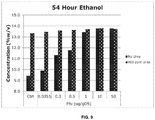
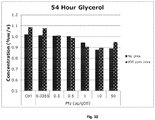
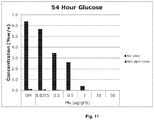
- SSF Simultaneous Saccharification and Fermentation: Penicillin was added to each mash to a final concentration of 3 ppm and pH was adjusted to 5.0. Next, portions of this mash were transferred to test tubes to represent "urea-free" fermentations and are considered nitrogen limited. Once the "urea-free" mashes were processed, the remaining mashes were dosed with urea up to a final concentration of 800 ppm and also transferred to test tubes. All test tubes were drilled with a 1/64" bit to allow CO 2 release. Furthermore, equivalent solids were maintained across all treatments through the addition of water as required to ensure that the urea versus urea-free mashes contained equal solids.
- Fermentation was initiated through the addition of Glucoamylase U (0.50 AGU/gDS), water and rehydrated yeast. Yeast rehydration took place by mixing 5.5 g of ETHANOL REDTM into 100 mL of 32°C tap water for at least 15 minutes and dosing 100 ⁇ l per test tube.
- HPLC analysis used an Agilent 1100/1200 combined with a Bio-Rad HPX-87H Ion Exclusion column (300 mm x 7.8 mm) and a Bio-Rad Cation H guard cartridge.
- the mobile phase was 0.005 M sulfuric acid and processed samples at a flow rate of 0.6 ml/min, with column and RI detector temperatures of 65 and 55°C, respectively. Fermentation sampling took place after 54 hours by sacrificing 3 tubes per treatment. Each tube was processed by deactivation with 50 ⁇ L of 40% v/v H 2 SO 4 , vortexing, centrifuging at 1460xg for 10 minutes, and filtering through a 0.45 ⁇ m Whatman PP filter.
- Samples were stored at 4°C prior to and during HPLC analysis.
- the method quantified analytes using calibration standards for DP4+, DP3, DP2, glucose, fructose, acetic acid, lactic acid, glycerol and ethanol (% w/v).
- a four point calibration including the origin is used for quantification.
Landscapes
- Chemical & Material Sciences (AREA)
- Life Sciences & Earth Sciences (AREA)
- Health & Medical Sciences (AREA)
- Organic Chemistry (AREA)
- Engineering & Computer Science (AREA)
- Wood Science & Technology (AREA)
- Zoology (AREA)
- Bioinformatics & Cheminformatics (AREA)
- Genetics & Genomics (AREA)
- Microbiology (AREA)
- Biotechnology (AREA)
- Biochemistry (AREA)
- General Engineering & Computer Science (AREA)
- General Health & Medical Sciences (AREA)
- Molecular Biology (AREA)
- Biomedical Technology (AREA)
- Medicinal Chemistry (AREA)
- Chemical Kinetics & Catalysis (AREA)
- Oil, Petroleum & Natural Gas (AREA)
- General Chemical & Material Sciences (AREA)
- Mycology (AREA)
- Enzymes And Modification Thereof (AREA)
- Preparation Of Compounds By Using Micro-Organisms (AREA)
- Micro-Organisms Or Cultivation Processes Thereof (AREA)
Claims (5)
- Procédé de récupération d'huile à partir d'un processus de production de produit de fermentation comprenant les étapes de :a) liquéfaction de matière contenant de l'amidon à une température supérieure à la température de gélatinisation initiale en utilisant :- l'alpha-amylase illustrée dans la SEQ ID N°1 ou une alpha-amylase ayant au moins 95 % d'identité avec celle-ci ; et- plus de 0,5 microgramme de protéase par gramme de matière sèche (MS) où la protéase est celle illustrée dans la SEQ ID N°13 dans la présente invention ou une protéase ayant au moins 80 % d'identité avec celle-ci ;b) saccharification en utilisant une glucoamylase ;c) fermentation en utilisant un organisme de fermentation ;d) récupération du produit de fermentation pour former une drêche complète ;e) séparation de la drêche complète en drêche fine et gâteau humide ;f) éventuellement concentration de la drêche fine en sirop ;
dans lequel l'huile est récupérée à partir :- de la matière contenant de l'amidon liquéfiée après l'étape a) ; et/ou- du flux en aval de l'étape de fermentation c). - Procédé selon la revendication 1, dans lequel l'huile est récupérée pendant et/ou après la liquéfaction de la matière contenant de l'amidon ; à partir de la drêche complète ; de la drêche fine ; ou du sirop.
- Procédé selon l'une quelconque des revendications 1 à 2, dans lequel 0,5 à 100 microgrammes de protéase de Pyrococcus furiosus par gramme MS, tel que 1 à 50 microgrammes de protéase de Pyrococcus furiosus par gramme MS, tel que 1 à 10 microgrammes de protéase de Pyrococcus furiosus par gramme MS, tel que 1,5 à 5 microgrammes de protéase de Pyrococcus furiosus par gramme MS, tel que pas plus de 1,5 microgramme de protéase de Pyrococcus furiosus par gramme MS sont présents et/ou ajoutés à l'étape de liquéfaction a).
- Procédé selon l'une quelconque des revendications 1 à 3, dans lequel la protéase de Pyrococcus furiosus est une protéase ayant au moins 85 %, tel qu'au moins 90 %, tel qu'au moins 95 %, tel qu'au moins 96 %, tel qu'au moins 97 %, tel qu'au moins 98 %, tel qu'au moins 99 % d'identité avec la SEQ ID N°13 de la présente invention.
- Procédé selon l'une quelconque des revendications 1 à 4, dans lequel aucun composé azoté n'est présent et/ou ajouté au cours des étapes a) à c), tel qu'au cours de l'étape de saccharification b), l'étape de fermentation c), ou l'étape de saccharification et fermentation simultanées (SFS).
Priority Applications (1)
| Application Number | Priority Date | Filing Date | Title |
|---|---|---|---|
| PL14817250T PL3013967T3 (pl) | 2013-06-24 | 2014-06-20 | Sposoby odzyskiwania oleju z procesów wytwarzania produktów fermentacji i sposoby wytwarzania produktów fermentacji |
Applications Claiming Priority (5)
| Application Number | Priority Date | Filing Date | Title |
|---|---|---|---|
| US201361838650P | 2013-06-24 | 2013-06-24 | |
| US201361863727P | 2013-08-08 | 2013-08-08 | |
| US201461943794P | 2014-02-24 | 2014-02-24 | |
| US201461991866P | 2014-05-12 | 2014-05-12 | |
| PCT/US2014/043444 WO2014209800A1 (fr) | 2013-06-24 | 2014-06-20 | Procédés de récupération d'huile à partir de procédés de production de produits de fermentation et procédés de production de produits de fermentation |
Publications (3)
| Publication Number | Publication Date |
|---|---|
| EP3013967A1 EP3013967A1 (fr) | 2016-05-04 |
| EP3013967A4 EP3013967A4 (fr) | 2016-12-28 |
| EP3013967B1 true EP3013967B1 (fr) | 2021-10-20 |
Family
ID=52142575
Family Applications (3)
| Application Number | Title | Priority Date | Filing Date |
|---|---|---|---|
| EP19181257.7A Pending EP3572519A1 (fr) | 2013-06-24 | 2014-06-20 | Procédé d'extraction d'huile à partir de résidus dilués de distillation |
| EP14817743.9A Active EP3013968B1 (fr) | 2013-06-24 | 2014-06-20 | Procédé d'extraction d'huile à partir de résidus dilués de distillation |
| EP14817250.5A Active EP3013967B1 (fr) | 2013-06-24 | 2014-06-20 | Procédés de récupération d'huile à partir de procédés de production de produits de fermentation et procédés de production de produits de fermentation |
Family Applications Before (2)
| Application Number | Title | Priority Date | Filing Date |
|---|---|---|---|
| EP19181257.7A Pending EP3572519A1 (fr) | 2013-06-24 | 2014-06-20 | Procédé d'extraction d'huile à partir de résidus dilués de distillation |
| EP14817743.9A Active EP3013968B1 (fr) | 2013-06-24 | 2014-06-20 | Procédé d'extraction d'huile à partir de résidus dilués de distillation |
Country Status (8)
| Country | Link |
|---|---|
| US (8) | US10035973B2 (fr) |
| EP (3) | EP3572519A1 (fr) |
| CN (4) | CN116334149A (fr) |
| CA (2) | CA2915065C (fr) |
| ES (2) | ES2903010T3 (fr) |
| HU (1) | HUE057274T2 (fr) |
| PL (1) | PL3013967T3 (fr) |
| WO (2) | WO2014209789A1 (fr) |
Families Citing this family (28)
| Publication number | Priority date | Publication date | Assignee | Title |
|---|---|---|---|---|
| EP2654567B1 (fr) | 2010-12-22 | 2018-04-04 | Novozymes North America, Inc. | Procédé de production d'un produit de fermentation à partir de matières contenant de l'amidon |
| WO2014209789A1 (fr) * | 2013-06-24 | 2014-12-31 | Novozymes A/S | Procédé d'extraction d'huile à partir de résidus dilués de distillation |
| US11939552B2 (en) * | 2013-06-24 | 2024-03-26 | Novozymes A/S | Process of recovering oil |
| WO2016196202A1 (fr) * | 2015-05-29 | 2016-12-08 | Novozymes A/S | Polypeptides ayant une activité protéase et polynucléotides codant pour ceux-ci |
| BR112018006696A2 (pt) | 2015-10-01 | 2018-10-09 | Poet Res Inc | métodos e sistemas para obter óleo a partir de uma composição de vinhoto |
| CN108699570A (zh) | 2015-12-22 | 2018-10-23 | 诺维信公司 | 从酒糟水提取油的工艺 |
| WO2018098124A1 (fr) | 2016-11-23 | 2018-05-31 | Novozymes A/S | Polypeptides ayant une activité protéase et polynucléotides codant pour ceux-ci |
| MX2019007335A (es) * | 2016-12-21 | 2019-09-09 | Dupont Nutrition Biosci Aps | Métodos para usar serina proteasas termoestables. |
| US12110531B2 (en) | 2017-06-16 | 2024-10-08 | Danstar Ferment Ag | Method for increasing oil yield during ethanol production |
| US12357005B2 (en) | 2017-06-19 | 2025-07-15 | Icm, Inc. | Single cell protein process and product-oxygen free |
| CA3008883C (fr) | 2017-06-19 | 2022-09-06 | Icm, Inc. | Separation de vinasse fractionnee et produits de matiere premiere |
| CA3072341A1 (fr) | 2017-08-11 | 2019-02-14 | Poet Research, Inc. | Systemes et procedes pour extraire de l'huile d'une matiere vegetale |
| CN111148830A (zh) * | 2017-10-04 | 2020-05-12 | 诺维信公司 | 具有蛋白酶活性的多肽和编码其的多核苷酸 |
| KR102316445B1 (ko) * | 2019-11-29 | 2021-10-26 | 씨제이제일제당 주식회사 | 신규 세린 프로테아제 변이체 |
| KR102613549B1 (ko) | 2021-03-12 | 2023-12-13 | 씨제이제일제당 주식회사 | 신규 세린 프로테아제 변이체 |
| BR112023021348A2 (pt) * | 2021-04-16 | 2023-12-19 | Poet Res Inc | Método e emulsão para aumentar o rendimento de óleo de milho em um processo de fermentação de biorrefinaria |
| WO2022256691A1 (fr) * | 2021-06-04 | 2022-12-08 | Amyris, Inc. | Procédés de purification de cannabinoïde |
| CN119630280A (zh) | 2022-05-14 | 2025-03-14 | 诺维信公司 | 用于预防、处理、抑制和/或消除植物病原性侵染和感染的组合物和方法 |
| CN120380140A (zh) | 2022-12-19 | 2025-07-25 | 诺维信公司 | 具有阿魏酸酯酶和/或乙酰木聚糖酯酶活性的碳水化合物酯酶家族1(ce1)多肽和编码其的多核苷酸 |
| EP4638725A1 (fr) | 2022-12-19 | 2025-10-29 | Novozymes A/S | Polypeptides de la famille 3 de gludice estérase (ce3) présentant une activité acétyl xylane estérase et polynucléotides codant pour ceux-ci |
| WO2024137252A1 (fr) | 2022-12-19 | 2024-06-27 | Novozymes A/S | Procédé de réduction de la viscosité du sirop à la fin d'un processus de production d'un produit de fermentation |
| EP4638768A2 (fr) | 2022-12-19 | 2025-10-29 | Novozymes A/S | Procédés de production de produits de fermentation faisant appel à des enzymes de dégradation de fibres avec levure modifiée |
| CN120693401A (zh) | 2022-12-19 | 2025-09-23 | 诺维信公司 | 包含阿拉伯呋喃糖苷酶和木聚糖酶的组合物及其用于增加半纤维素纤维溶解的用途 |
| EP4724591A2 (fr) * | 2023-06-12 | 2026-04-15 | ICM, Inc. | Procédés de traitement avancés pour produire des aliments pour animaux à haute teneur en protéines et/ou des produits à base de fibres à faible teneur en matières grasses à partir de grains de céréales secs et broyés |
| AU2024303961A1 (en) | 2023-06-13 | 2025-12-11 | Novozymes A/S | Processes for producing fermentation products using engineered yeast expressing a beta-xylosidase |
| KR20250054900A (ko) * | 2023-10-16 | 2025-04-24 | 씨제이제일제당 (주) | 신규 세린 프로테아제 변이체 |
| WO2025128568A1 (fr) | 2023-12-11 | 2025-06-19 | Novozymes A/S | Composition et son utilisation pour augmenter la solubilisation de fibres hémicellulosiques |
| WO2026008449A2 (fr) | 2024-07-04 | 2026-01-08 | Novozymes A/S | Procédé de production d'un produit de fermentation et d'un co-produit protéique concentré |
Family Cites Families (56)
| Publication number | Priority date | Publication date | Assignee | Title |
|---|---|---|---|---|
| US4560651A (en) | 1981-04-20 | 1985-12-24 | Novo Industri A/S | Debranching enzyme product, preparation and use thereof |
| US5192677A (en) | 1986-05-08 | 1993-03-09 | Cornell Research Foundation Inc. | Alkali and heat stable protease from thermomonospora fusca |
| FI930381L (fi) | 1990-08-01 | 1993-03-26 | Novo Nordisk As | Nya vaermestabila pullulanaser |
| US5231017A (en) * | 1991-05-17 | 1993-07-27 | Solvay Enzymes, Inc. | Process for producing ethanol |
| US5756339A (en) | 1994-06-13 | 1998-05-26 | Takara Shuzo Co., Ltd. | Hyperthermostable protease gene |
| CN1128879C (zh) | 1995-12-12 | 2003-11-26 | 宝酒造株式会社 | 超耐热蛋白酶基因 |
| WO1997029179A1 (fr) | 1996-02-12 | 1997-08-14 | Gist-Brocades B.V. | Procede de production d'un mout fermentescible |
| US5705379A (en) | 1996-10-23 | 1998-01-06 | Cornell Research Foundation, Inc. | Nucleotide sequences encoding a thermostable alkaline protease |
| EP0994191B1 (fr) | 1997-06-10 | 2006-03-01 | Takara Bio Inc. | Systeme pour exprimer une proteine hyperthermostable |
| AR017331A1 (es) | 1997-10-13 | 2001-09-05 | Novozymes As | Polipeptidos mutantes de alfa-amilasas, aditivo para detergentes y composiciones detergentes que los comprenden. |
| WO1999028448A1 (fr) | 1997-11-26 | 1999-06-10 | Novo Nordisk A/S | Glucoamylase thermostable |
| EP1250423B1 (fr) | 2000-01-12 | 2008-09-03 | Novozymes A/S | Variantes de pullulanase et procedes servant a preparer ces variantes presentant des proprietes predeterminees |
| AR032392A1 (es) | 2001-01-19 | 2003-11-05 | Solvay Pharm Gmbh | Mezcla de enzimas, preparado farmaceutico y utilizacion de dicho preparado. |
| EP1373539A2 (fr) | 2001-03-19 | 2004-01-02 | Novozymes A/S | Procede ameliore de fermentation |
| BR0214653B1 (pt) | 2001-12-07 | 2015-01-06 | Novozymes As | Construção de ácido nucléico, vetor de expressão recombinante, célula de microorganismo hospedeiro recombinante, método para produzir um polipeptídeo, uso de pelo menos uma protease, método para melhorar o valor nutricional de uma ração animal, aditivo para ração animal, composição de ração animal, e, método para o tratamento de proteínas egetais. |
| US20030180900A1 (en) | 2002-02-08 | 2003-09-25 | Oreste Lantero | Methods for producing ethanol from carbon substrates |
| CN102277341B (zh) | 2003-03-10 | 2015-07-22 | 诺维信公司 | 酒精产品生产方法 |
| ES2251893T1 (es) | 2003-04-04 | 2006-05-16 | Novozymes A/S | Reduccion de la viscosidad de una pasta. |
| WO2005052146A2 (fr) | 2003-11-19 | 2005-06-09 | Genencor International, Inc. | Serine proteases, acides nucleiques codants pour les enzymes a serine et vecteurs et cellules hotes les contenant |
| RU2006144096A (ru) | 2004-05-13 | 2008-06-20 | Новозаймз Норт Америка, Инк. | Способ производства ферментационного продукта |
| US20070184150A1 (en) | 2004-07-13 | 2007-08-09 | Novozymes North America,Inc. | Liquefaction process |
| US7601858B2 (en) | 2004-08-17 | 2009-10-13 | Gs Cleantech Corporation | Method of processing ethanol byproducts and related subsystems |
| EP2365068B1 (fr) | 2004-12-22 | 2017-03-01 | Novozymes A/S | Enzymes pour le traitement de l'amidon |
| CN101115843A (zh) | 2005-02-07 | 2008-01-30 | 诺维信北美公司 | 发酵产品产生方法 |
| CN101268195A (zh) * | 2005-09-20 | 2008-09-17 | 诺维信北美公司 | 产生发酵产物的方法 |
| US7919289B2 (en) * | 2005-10-10 | 2011-04-05 | Poet Research, Inc. | Methods and systems for producing ethanol using raw starch and selecting plant material |
| CN103798505A (zh) | 2005-11-08 | 2014-05-21 | 诺维信北美公司 | 酒糟脱水 |
| DE102005062984A1 (de) | 2005-12-28 | 2007-07-05 | Henkel Kgaa | Wasch- oder Reinigungsmittel mit spezieller Amylase |
| CA2642838A1 (fr) | 2006-02-16 | 2007-08-30 | Gs Industrial Design, Inc. | Procede de liberation du petrole colle present dans les residus entiers et peu epais |
| JP5463294B2 (ja) | 2007-10-18 | 2014-04-09 | ダニスコ・ユーエス・インク | 発酵用酵素ブレンド |
| MX2010008358A (es) | 2008-02-04 | 2010-08-30 | Danisco Us Inc | Variantes de alfa-amilasa de bacillus stearothermophilus y usos de las mismas. |
| US8173412B2 (en) | 2008-03-07 | 2012-05-08 | Golden Corn Technologies, Llc | Method of liberating bound oil present in stillage |
| US20110097779A1 (en) | 2008-06-23 | 2011-04-28 | Chee-Leong Soong | Processes for Producing Fermentation Products |
| US8702819B2 (en) * | 2008-09-10 | 2014-04-22 | Poet Research, Inc. | Oil composition and method of recovering the same |
| EP2411512B1 (fr) * | 2009-03-24 | 2013-11-20 | Meito Sangyo Co., Ltd. | Protéase coagulant le lait, de type amélioré, dérivée d'un micro-organisme |
| MX2012006096A (es) | 2009-11-30 | 2012-07-03 | Novozymes North America Inc | Polipeptidos que tienen actividad glucoamilasa y polinucleotidos que codifican para los mismos. |
| ES2534067T3 (es) * | 2009-12-01 | 2015-04-17 | Novozymes A/S | Polipéptidos que tienen actividad de glucoamilasa y polinucleótidos que codifican los mismos |
| CN102753680B (zh) | 2009-12-11 | 2015-05-13 | 诺维信公司 | 蛋白酶变体 |
| CN102933227A (zh) | 2009-12-22 | 2013-02-13 | 诺维信公司 | 包含增强性多肽和淀粉降解酶的组合物及其用途 |
| US20120270267A1 (en) | 2010-01-04 | 2012-10-25 | Novozymes A/S | Alpha-Amylases |
| EP2553111B1 (fr) * | 2010-03-30 | 2016-05-11 | Novozymes A/S | Procede pour augmenter les produits secondaires de procedes de fermentation |
| US9617527B2 (en) * | 2010-04-14 | 2017-04-11 | Novozymes A/S | Polypeptides having glucoamylase activity and polynucleotides encoding same |
| MX338068B (es) | 2010-04-14 | 2016-04-01 | Novozymes As | Polipeptidos que tienen actividad de glucoamilasa y polinucleotidos que codifican los mismos. |
| CN102939386B (zh) * | 2010-04-14 | 2016-04-13 | 诺维信公司 | 产生发酵产物的方法 |
| CN103298932B (zh) | 2010-11-08 | 2016-08-10 | 诺维信公司 | 具有葡糖淀粉酶活性的多肽和编码该多肽的多核苷酸 |
| WO2012084225A1 (fr) | 2010-12-22 | 2012-06-28 | Direvo Industrial Biotechnology Gmbh | Amélioration de procédés et de sous-produits de fermentation |
| EP2654567B1 (fr) | 2010-12-22 | 2018-04-04 | Novozymes North America, Inc. | Procédé de production d'un produit de fermentation à partir de matières contenant de l'amidon |
| BR112014000143B1 (pt) * | 2011-07-06 | 2021-04-06 | Novozymes A/S | Variante de alfa-amilase, polinucleotídeo isolado, vetor de expressão, célula hospedeira, métodos de produzir uma variante de alfa-amilase, para produzir um produto de fermentação a partir de um material contendo amido, e, para a produção um derivado de amido enzimaticamente modificado |
| MX353581B (es) | 2011-10-11 | 2018-01-19 | Novozymes North America Inc | Procesos para producir productos de fermentacion. |
| EA201490649A1 (ru) | 2011-10-11 | 2014-07-30 | Новозимс А/С | Варианты глюкоамилазы и кодирующие их полинуклеотиды |
| IN2014CN04905A (fr) * | 2011-12-02 | 2015-09-18 | Novozymes As | |
| US20140024064A1 (en) | 2012-07-23 | 2014-01-23 | Butamax(Tm) Advanced Biofuels Llc | Processes and systems for the production of fermentative alcohols |
| WO2014209789A1 (fr) * | 2013-06-24 | 2014-12-31 | Novozymes A/S | Procédé d'extraction d'huile à partir de résidus dilués de distillation |
| US9951364B2 (en) | 2013-09-11 | 2018-04-24 | Novozymes A/S | Processes for producing fermentation products |
| MX2019007335A (es) | 2016-12-21 | 2019-09-09 | Dupont Nutrition Biosci Aps | Métodos para usar serina proteasas termoestables. |
| MX386582B (es) | 2017-03-15 | 2025-03-19 | Int N&H Denmark Aps | Métodos para usar una serina proteasa de arqueas. |
-
2014
- 2014-06-20 WO PCT/US2014/043392 patent/WO2014209789A1/fr not_active Ceased
- 2014-06-20 CN CN202211121099.1A patent/CN116334149A/zh active Pending
- 2014-06-20 EP EP19181257.7A patent/EP3572519A1/fr active Pending
- 2014-06-20 HU HUE14817250A patent/HUE057274T2/hu unknown
- 2014-06-20 US US14/901,504 patent/US10035973B2/en not_active Expired - Fee Related
- 2014-06-20 EP EP14817743.9A patent/EP3013968B1/fr active Active
- 2014-06-20 US US14/901,508 patent/US10093882B2/en active Active
- 2014-06-20 ES ES14817250T patent/ES2903010T3/es active Active
- 2014-06-20 EP EP14817250.5A patent/EP3013967B1/fr active Active
- 2014-06-20 CA CA2915065A patent/CA2915065C/fr active Active
- 2014-06-20 CA CA2915063A patent/CA2915063C/fr active Active
- 2014-06-20 ES ES14817743T patent/ES2754203T3/es active Active
- 2014-06-20 CN CN201480035858.XA patent/CN105339501A/zh active Pending
- 2014-06-20 WO PCT/US2014/043444 patent/WO2014209800A1/fr not_active Ceased
- 2014-06-20 PL PL14817250T patent/PL3013967T3/pl unknown
- 2014-06-20 CN CN202310897916.0A patent/CN117089583A/zh active Pending
- 2014-06-20 CN CN201480035861.1A patent/CN105339502A/zh active Pending
-
2018
- 2018-04-18 US US15/956,274 patent/US10731104B2/en active Active
- 2018-09-04 US US16/121,027 patent/US10844318B2/en active Active
-
2019
- 2019-05-06 US US16/404,068 patent/US10781398B2/en active Active
- 2019-06-24 US US16/449,703 patent/US10920172B2/en active Active
-
2021
- 2021-01-13 US US17/147,623 patent/US11505765B2/en active Active
-
2023
- 2023-02-09 US US18/166,975 patent/US11965143B2/en active Active
Non-Patent Citations (1)
| Title |
|---|
| None * |
Also Published As
Similar Documents
| Publication | Publication Date | Title |
|---|---|---|
| EP3013967B1 (fr) | Procédés de récupération d'huile à partir de procédés de production de produits de fermentation et procédés de production de produits de fermentation | |
| US12227785B2 (en) | Compositions comprising a low pH alpha-amylase and a thermostable protease for liquefaction | |
| EP2558584B1 (fr) | Procédés pour produire des produits de fermentation | |
| EP2364363A2 (fr) | Procédés de production de produits de fermentation | |
| US11015212B2 (en) | Methods of reducing foam during ethanol fermentation | |
| EP2326723B1 (fr) | Procédés de production de produits de fermentation | |
| WO2020206058A1 (fr) | Procédé de production d'un produit de fermentation | |
| EP2245172B1 (fr) | Production de produits de fermentation en présence d'une aldéhyde déshydrogénase |
Legal Events
| Date | Code | Title | Description |
|---|---|---|---|
| PUAI | Public reference made under article 153(3) epc to a published international application that has entered the european phase |
Free format text: ORIGINAL CODE: 0009012 |
|
| 17P | Request for examination filed |
Effective date: 20160125 |
|
| AK | Designated contracting states |
Kind code of ref document: A1 Designated state(s): AL AT BE BG CH CY CZ DE DK EE ES FI FR GB GR HR HU IE IS IT LI LT LU LV MC MK MT NL NO PL PT RO RS SE SI SK SM TR |
|
| AX | Request for extension of the european patent |
Extension state: BA ME |
|
| DAX | Request for extension of the european patent (deleted) | ||
| A4 | Supplementary search report drawn up and despatched |
Effective date: 20161125 |
|
| RIC1 | Information provided on ipc code assigned before grant |
Ipc: C12P 7/64 20060101AFI20161121BHEP |
|
| STAA | Information on the status of an ep patent application or granted ep patent |
Free format text: STATUS: EXAMINATION IS IN PROGRESS |
|
| 17Q | First examination report despatched |
Effective date: 20171031 |
|
| GRAP | Despatch of communication of intention to grant a patent |
Free format text: ORIGINAL CODE: EPIDOSNIGR1 |
|
| STAA | Information on the status of an ep patent application or granted ep patent |
Free format text: STATUS: GRANT OF PATENT IS INTENDED |
|
| INTG | Intention to grant announced |
Effective date: 20210618 |
|
| GRAS | Grant fee paid |
Free format text: ORIGINAL CODE: EPIDOSNIGR3 |
|
| GRAA | (expected) grant |
Free format text: ORIGINAL CODE: 0009210 |
|
| STAA | Information on the status of an ep patent application or granted ep patent |
Free format text: STATUS: THE PATENT HAS BEEN GRANTED |
|
| AK | Designated contracting states |
Kind code of ref document: B1 Designated state(s): AL AT BE BG CH CY CZ DE DK EE ES FI FR GB GR HR HU IE IS IT LI LT LU LV MC MK MT NL NO PL PT RO RS SE SI SK SM TR |
|
| REG | Reference to a national code |
Ref country code: GB Ref legal event code: FG4D |
|
| REG | Reference to a national code |
Ref country code: CH Ref legal event code: EP |
|
| REG | Reference to a national code |
Ref country code: IE Ref legal event code: FG4D |
|
| REG | Reference to a national code |
Ref country code: DE Ref legal event code: R096 Ref document number: 602014080796 Country of ref document: DE |
|
| REG | Reference to a national code |
Ref country code: AT Ref legal event code: REF Ref document number: 1439998 Country of ref document: AT Kind code of ref document: T Effective date: 20211115 |
|
| REG | Reference to a national code |
Ref country code: NL Ref legal event code: FP |
|
| REG | Reference to a national code |
Ref country code: LT Ref legal event code: MG9D |
|
| REG | Reference to a national code |
Ref country code: AT Ref legal event code: MK05 Ref document number: 1439998 Country of ref document: AT Kind code of ref document: T Effective date: 20211020 |
|
| REG | Reference to a national code |
Ref country code: ES Ref legal event code: FG2A Ref document number: 2903010 Country of ref document: ES Kind code of ref document: T3 Effective date: 20220330 |
|
| REG | Reference to a national code |
Ref country code: HU Ref legal event code: AG4A Ref document number: E057274 Country of ref document: HU |
|
| PG25 | Lapsed in a contracting state [announced via postgrant information from national office to epo] |
Ref country code: RS Free format text: LAPSE BECAUSE OF FAILURE TO SUBMIT A TRANSLATION OF THE DESCRIPTION OR TO PAY THE FEE WITHIN THE PRESCRIBED TIME-LIMIT Effective date: 20211020 Ref country code: LT Free format text: LAPSE BECAUSE OF FAILURE TO SUBMIT A TRANSLATION OF THE DESCRIPTION OR TO PAY THE FEE WITHIN THE PRESCRIBED TIME-LIMIT Effective date: 20211020 Ref country code: FI Free format text: LAPSE BECAUSE OF FAILURE TO SUBMIT A TRANSLATION OF THE DESCRIPTION OR TO PAY THE FEE WITHIN THE PRESCRIBED TIME-LIMIT Effective date: 20211020 Ref country code: BG Free format text: LAPSE BECAUSE OF FAILURE TO SUBMIT A TRANSLATION OF THE DESCRIPTION OR TO PAY THE FEE WITHIN THE PRESCRIBED TIME-LIMIT Effective date: 20220120 Ref country code: AT Free format text: LAPSE BECAUSE OF FAILURE TO SUBMIT A TRANSLATION OF THE DESCRIPTION OR TO PAY THE FEE WITHIN THE PRESCRIBED TIME-LIMIT Effective date: 20211020 |
|
| PG25 | Lapsed in a contracting state [announced via postgrant information from national office to epo] |
Ref country code: IS Free format text: LAPSE BECAUSE OF FAILURE TO SUBMIT A TRANSLATION OF THE DESCRIPTION OR TO PAY THE FEE WITHIN THE PRESCRIBED TIME-LIMIT Effective date: 20220220 Ref country code: SE Free format text: LAPSE BECAUSE OF FAILURE TO SUBMIT A TRANSLATION OF THE DESCRIPTION OR TO PAY THE FEE WITHIN THE PRESCRIBED TIME-LIMIT Effective date: 20211020 Ref country code: PT Free format text: LAPSE BECAUSE OF FAILURE TO SUBMIT A TRANSLATION OF THE DESCRIPTION OR TO PAY THE FEE WITHIN THE PRESCRIBED TIME-LIMIT Effective date: 20220221 Ref country code: NO Free format text: LAPSE BECAUSE OF FAILURE TO SUBMIT A TRANSLATION OF THE DESCRIPTION OR TO PAY THE FEE WITHIN THE PRESCRIBED TIME-LIMIT Effective date: 20220120 Ref country code: LV Free format text: LAPSE BECAUSE OF FAILURE TO SUBMIT A TRANSLATION OF THE DESCRIPTION OR TO PAY THE FEE WITHIN THE PRESCRIBED TIME-LIMIT Effective date: 20211020 Ref country code: HR Free format text: LAPSE BECAUSE OF FAILURE TO SUBMIT A TRANSLATION OF THE DESCRIPTION OR TO PAY THE FEE WITHIN THE PRESCRIBED TIME-LIMIT Effective date: 20211020 Ref country code: GR Free format text: LAPSE BECAUSE OF FAILURE TO SUBMIT A TRANSLATION OF THE DESCRIPTION OR TO PAY THE FEE WITHIN THE PRESCRIBED TIME-LIMIT Effective date: 20220121 |
|
| REG | Reference to a national code |
Ref country code: DE Ref legal event code: R097 Ref document number: 602014080796 Country of ref document: DE |
|
| PG25 | Lapsed in a contracting state [announced via postgrant information from national office to epo] |
Ref country code: SM Free format text: LAPSE BECAUSE OF FAILURE TO SUBMIT A TRANSLATION OF THE DESCRIPTION OR TO PAY THE FEE WITHIN THE PRESCRIBED TIME-LIMIT Effective date: 20211020 Ref country code: SK Free format text: LAPSE BECAUSE OF FAILURE TO SUBMIT A TRANSLATION OF THE DESCRIPTION OR TO PAY THE FEE WITHIN THE PRESCRIBED TIME-LIMIT Effective date: 20211020 Ref country code: RO Free format text: LAPSE BECAUSE OF FAILURE TO SUBMIT A TRANSLATION OF THE DESCRIPTION OR TO PAY THE FEE WITHIN THE PRESCRIBED TIME-LIMIT Effective date: 20211020 Ref country code: EE Free format text: LAPSE BECAUSE OF FAILURE TO SUBMIT A TRANSLATION OF THE DESCRIPTION OR TO PAY THE FEE WITHIN THE PRESCRIBED TIME-LIMIT Effective date: 20211020 Ref country code: DK Free format text: LAPSE BECAUSE OF FAILURE TO SUBMIT A TRANSLATION OF THE DESCRIPTION OR TO PAY THE FEE WITHIN THE PRESCRIBED TIME-LIMIT Effective date: 20211020 Ref country code: CZ Free format text: LAPSE BECAUSE OF FAILURE TO SUBMIT A TRANSLATION OF THE DESCRIPTION OR TO PAY THE FEE WITHIN THE PRESCRIBED TIME-LIMIT Effective date: 20211020 |
|
| PLBE | No opposition filed within time limit |
Free format text: ORIGINAL CODE: 0009261 |
|
| STAA | Information on the status of an ep patent application or granted ep patent |
Free format text: STATUS: NO OPPOSITION FILED WITHIN TIME LIMIT |
|
| 26N | No opposition filed |
Effective date: 20220721 |
|
| PG25 | Lapsed in a contracting state [announced via postgrant information from national office to epo] |
Ref country code: AL Free format text: LAPSE BECAUSE OF FAILURE TO SUBMIT A TRANSLATION OF THE DESCRIPTION OR TO PAY THE FEE WITHIN THE PRESCRIBED TIME-LIMIT Effective date: 20211020 |
|
| PG25 | Lapsed in a contracting state [announced via postgrant information from national office to epo] |
Ref country code: SI Free format text: LAPSE BECAUSE OF FAILURE TO SUBMIT A TRANSLATION OF THE DESCRIPTION OR TO PAY THE FEE WITHIN THE PRESCRIBED TIME-LIMIT Effective date: 20211020 |
|
| PG25 | Lapsed in a contracting state [announced via postgrant information from national office to epo] |
Ref country code: MC Free format text: LAPSE BECAUSE OF FAILURE TO SUBMIT A TRANSLATION OF THE DESCRIPTION OR TO PAY THE FEE WITHIN THE PRESCRIBED TIME-LIMIT Effective date: 20211020 |
|
| REG | Reference to a national code |
Ref country code: CH Ref legal event code: PL |
|
| PG25 | Lapsed in a contracting state [announced via postgrant information from national office to epo] |
Ref country code: LU Free format text: LAPSE BECAUSE OF NON-PAYMENT OF DUE FEES Effective date: 20220620 Ref country code: LI Free format text: LAPSE BECAUSE OF NON-PAYMENT OF DUE FEES Effective date: 20220630 Ref country code: IE Free format text: LAPSE BECAUSE OF NON-PAYMENT OF DUE FEES Effective date: 20220620 Ref country code: CH Free format text: LAPSE BECAUSE OF NON-PAYMENT OF DUE FEES Effective date: 20220630 |
|
| PG25 | Lapsed in a contracting state [announced via postgrant information from national office to epo] |
Ref country code: IT Free format text: LAPSE BECAUSE OF FAILURE TO SUBMIT A TRANSLATION OF THE DESCRIPTION OR TO PAY THE FEE WITHIN THE PRESCRIBED TIME-LIMIT Effective date: 20211020 |
|
| P01 | Opt-out of the competence of the unified patent court (upc) registered |
Effective date: 20230516 |
|
| PG25 | Lapsed in a contracting state [announced via postgrant information from national office to epo] |
Ref country code: MK Free format text: LAPSE BECAUSE OF FAILURE TO SUBMIT A TRANSLATION OF THE DESCRIPTION OR TO PAY THE FEE WITHIN THE PRESCRIBED TIME-LIMIT Effective date: 20211020 Ref country code: CY Free format text: LAPSE BECAUSE OF FAILURE TO SUBMIT A TRANSLATION OF THE DESCRIPTION OR TO PAY THE FEE WITHIN THE PRESCRIBED TIME-LIMIT Effective date: 20211020 |
|
| PG25 | Lapsed in a contracting state [announced via postgrant information from national office to epo] |
Ref country code: MT Free format text: LAPSE BECAUSE OF FAILURE TO SUBMIT A TRANSLATION OF THE DESCRIPTION OR TO PAY THE FEE WITHIN THE PRESCRIBED TIME-LIMIT Effective date: 20211020 |
|
| PGFP | Annual fee paid to national office [announced via postgrant information from national office to epo] |
Ref country code: NL Payment date: 20250526 Year of fee payment: 12 |
|
| PGFP | Annual fee paid to national office [announced via postgrant information from national office to epo] |
Ref country code: PL Payment date: 20250529 Year of fee payment: 12 Ref country code: DE Payment date: 20250521 Year of fee payment: 12 |
|
| PGFP | Annual fee paid to national office [announced via postgrant information from national office to epo] |
Ref country code: GB Payment date: 20250522 Year of fee payment: 12 |
|
| PGFP | Annual fee paid to national office [announced via postgrant information from national office to epo] |
Ref country code: BE Payment date: 20250526 Year of fee payment: 12 |
|
| PGFP | Annual fee paid to national office [announced via postgrant information from national office to epo] |
Ref country code: FR Payment date: 20250523 Year of fee payment: 12 |
|
| PGFP | Annual fee paid to national office [announced via postgrant information from national office to epo] |
Ref country code: HU Payment date: 20250610 Year of fee payment: 12 |
|
| PGFP | Annual fee paid to national office [announced via postgrant information from national office to epo] |
Ref country code: ES Payment date: 20250702 Year of fee payment: 12 |
|
| PG25 | Lapsed in a contracting state [announced via postgrant information from national office to epo] |
Ref country code: TR Free format text: LAPSE BECAUSE OF FAILURE TO SUBMIT A TRANSLATION OF THE DESCRIPTION OR TO PAY THE FEE WITHIN THE PRESCRIBED TIME-LIMIT Effective date: 20211020 |