EP3016027A2 - System zur detektion eines menschlichen körperteils und verfahren zur detektion eines menschlichen körperteils - Google Patents
System zur detektion eines menschlichen körperteils und verfahren zur detektion eines menschlichen körperteils Download PDFInfo
- Publication number
- EP3016027A2 EP3016027A2 EP15190927.2A EP15190927A EP3016027A2 EP 3016027 A2 EP3016027 A2 EP 3016027A2 EP 15190927 A EP15190927 A EP 15190927A EP 3016027 A2 EP3016027 A2 EP 3016027A2
- Authority
- EP
- European Patent Office
- Prior art keywords
- body part
- human body
- feature
- point
- pixels
- Prior art date
- Legal status (The legal status is an assumption and is not a legal conclusion. Google has not performed a legal analysis and makes no representation as to the accuracy of the status listed.)
- Withdrawn
Links
Images






Classifications
-
- G—PHYSICS
- G06—COMPUTING OR CALCULATING; COUNTING
- G06V—IMAGE OR VIDEO RECOGNITION OR UNDERSTANDING
- G06V40/00—Recognition of biometric, human-related or animal-related patterns in image or video data
- G06V40/10—Human or animal bodies, e.g. vehicle occupants or pedestrians; Body parts, e.g. hands
-
- G—PHYSICS
- G06—COMPUTING OR CALCULATING; COUNTING
- G06F—ELECTRIC DIGITAL DATA PROCESSING
- G06F18/00—Pattern recognition
- G06F18/20—Analysing
- G06F18/23—Clustering techniques
-
- G—PHYSICS
- G06—COMPUTING OR CALCULATING; COUNTING
- G06T—IMAGE DATA PROCESSING OR GENERATION, IN GENERAL
- G06T7/00—Image analysis
- G06T7/70—Determining position or orientation of objects or cameras
- G06T7/73—Determining position or orientation of objects or cameras using feature-based methods
-
- G—PHYSICS
- G06—COMPUTING OR CALCULATING; COUNTING
- G06V—IMAGE OR VIDEO RECOGNITION OR UNDERSTANDING
- G06V10/00—Arrangements for image or video recognition or understanding
- G06V10/40—Extraction of image or video features
- G06V10/42—Global feature extraction by analysis of the whole pattern, e.g. using frequency domain transformations or autocorrelation
- G06V10/422—Global feature extraction by analysis of the whole pattern, e.g. using frequency domain transformations or autocorrelation for representing the structure of the pattern or shape of an object therefor
- G06V10/426—Graphical representations
-
- G—PHYSICS
- G06—COMPUTING OR CALCULATING; COUNTING
- G06V—IMAGE OR VIDEO RECOGNITION OR UNDERSTANDING
- G06V10/00—Arrangements for image or video recognition or understanding
- G06V10/70—Arrangements for image or video recognition or understanding using pattern recognition or machine learning
- G06V10/74—Image or video pattern matching; Proximity measures in feature spaces
- G06V10/75—Organisation of the matching processes, e.g. simultaneous or sequential comparisons of image or video features; Coarse-fine approaches, e.g. multi-scale approaches; using context analysis; Selection of dictionaries
- G06V10/757—Matching configurations of points or features
-
- G—PHYSICS
- G06—COMPUTING OR CALCULATING; COUNTING
- G06T—IMAGE DATA PROCESSING OR GENERATION, IN GENERAL
- G06T2207/00—Indexing scheme for image analysis or image enhancement
- G06T2207/10—Image acquisition modality
- G06T2207/10004—Still image; Photographic image
- G06T2207/10012—Stereo images
-
- G—PHYSICS
- G06—COMPUTING OR CALCULATING; COUNTING
- G06T—IMAGE DATA PROCESSING OR GENERATION, IN GENERAL
- G06T2207/00—Indexing scheme for image analysis or image enhancement
- G06T2207/30—Subject of image; Context of image processing
- G06T2207/30196—Human being; Person
-
- G—PHYSICS
- G06—COMPUTING OR CALCULATING; COUNTING
- G06V—IMAGE OR VIDEO RECOGNITION OR UNDERSTANDING
- G06V10/00—Arrangements for image or video recognition or understanding
- G06V10/40—Extraction of image or video features
- G06V10/44—Local feature extraction by analysis of parts of the pattern, e.g. by detecting edges, contours, loops, corners, strokes or intersections; Connectivity analysis, e.g. of connected components
- G06V10/443—Local feature extraction by analysis of parts of the pattern, e.g. by detecting edges, contours, loops, corners, strokes or intersections; Connectivity analysis, e.g. of connected components by matching or filtering
- G06V10/449—Biologically inspired filters, e.g. difference of Gaussians [DoG] or Gabor filters
- G06V10/451—Biologically inspired filters, e.g. difference of Gaussians [DoG] or Gabor filters with interaction between the filter responses, e.g. cortical complex cells
- G06V10/454—Integrating the filters into a hierarchical structure, e.g. convolutional neural networks [CNN]
Definitions
- the present disclosure relates to a human body part detection system and a human body part detection method.
- a technique for detecting a human body part by using a depth image including information on depth from a predetermined point is known.
- Such a technique is applicable to fields such as video games, interaction between a human and a computer, monitoring systems, video-conference systems, healthcare, robots, and automobiles.
- a user can enjoy video games by operating a gaming machine by a change of a posture and gesture without using a keyboard or a mouse.
- U.S. Patent Application Publication No. 2013/0266182 discloses a method for detecting a posture of a person on the basis of a depth image including, as a pixel value, information on depth which is a three-dimensional measurement value.
- this method one or more adjacent offset pixels are selected for each pixel of the depth image which is a target of learning, and association between the pixel and a human body part is stored as learning data on the basis of pixel values of these pixels.
- the degree of association between a target pixel in the depth image and the human body part is calculated on the basis of the target pixel, pixel values of offset pixels, and the learning data.
- One non-limiting and exemplary embodiment provides a human body part detection system and a human body part detection method that make it possible to accurately and effectively detect a body part in various postures.
- the techniques disclosed here feature a human body part detection system including: a storage in which a learning model which is a result of learning of a feature of a human body part is stored; an acquirer that acquires a depth image; an extractor that extracts a human area from the depth image; and a human body part detector that detects the human body part on the basis of the human area and the learning model, the human body part detection unit including: a base point detector that detects a base point in the human area; a calculator that calculates a direction of a geodesic path at a first point on the basis of a shortest geodesic path from the base point to a first point in the human area; a selector that selects a pair of pixels on the depth image that are located at positions obtained after rotating, around the first point, positions of a pair of pixel used for calculation of the feature in the learning model in accordance with the direction; a feature calculator that calculates a feature at the first point on the basis of information on depth of the selected pair of pixels;
- Fig. 1 is a block diagram illustrating an example of a configuration of the human body part detection system 100 according to the present embodiment.
- the human body part detection system 100 includes a depth image acquisition unit 102, a foreground human area extraction unit 104, a learning model storing unit 106, and a human body part detection unit 108.
- the depth image acquisition unit 102 acquires a depth image from a depth camera or a recording device.
- the foreground human area extraction unit 104 extracts an area of a human that exists before the background (hereinafter referred to as a foreground human area) by using information on depth in the depth image. Note that the foreground human area extraction unit 104 may extract a foreground human area on the basis of three-dimensional connected component analysis.
- the learning model storing unit 106 stores therein data of a learning model and the like obtained as a result of learning of a feature of a human body part.
- the data of the learning model includes information such as information on the position of a pixel selected for calculation of the feature and information on a pair of pixels that will be described later.
- the human body part detection unit 108 detects the human body part included in the foreground human area extracted by the foreground human area extraction unit 104 on the basis of the learning model stored in the learning model storing unit 106 and then assigns the detected part a label indicative of the part.
- Fig. 2 is a block diagram illustrating an example of a configuration of the human body part detection unit 108 according to the present embodiment.
- the human body part detection unit 108 includes a base point detection unit 202, a vector calculation unit 204, a selection unit 206, a feature calculation unit 208, and a label determination unit 210.
- the base point detection unit 202 detects a base point in the foreground human area extracted by the foreground human area extraction unit 104.
- the base point is, for example, a point at a position corresponding to the center of gravity, the average, or the median of three-dimensional coordinates of pixels included in the foreground human area in a real-world coordinate system.
- the base point detection unit 202 includes a three-dimensional coordinate acquisition unit 202a that acquires three-dimensional coordinates in the real-world coordinate system from the depth image and a base point calculation unit 202b that calculates a base point in the foreground human area by using the acquired three-dimensional coordinates.
- the vector calculation unit 204 calculates a reference vector directed in a geodesic direction at a first point by calculating the shortest geodesic path connecting the base point and the first point.
- the reference vector is calculated on the basis of geodesic gradient of the foreground human area.
- the first point is a predetermined point in the foreground human area and is different from the base point.
- the selection unit 206 calculates positions obtained after rotating the positions of a pair of pixels used for calculation of the feature in the learning model in accordance with the direction of the reference vector and then selects pixels at the calculated positions on the depth image as pixels used for calculation of feature.
- the pair of pixels is two different pixels that are spaced by a predetermined distance from the first point in a predetermined direction.
- the feature calculation unit 208 calculates a feature of the human body part at the first point on the basis of depth information of the pair of pixels. This calculation method will be described later in detail.
- the label determination unit 210 determines a label corresponding to the human body part on the basis of the feature of the human body part at the first point and the learning model.
- the label determination unit 210 includes an input unit 210a that accepts input of the feature of the human body part at the first point, a feature search unit 210b that searches for the feature of the human body part at the first point in the learning model, and a determination unit 210c that determines a label corresponding to the human body part on the basis of the searched feature.
- the feature search unit 210b may use a deep artificial neural network to search for the feature of the human body part at the first point.
- the determination unit 210c may determine the label by logistic regression analysis.
- the coverage is a circular cover range of the local feature descriptor within the depth image I where p c is the center of the cover range and r is the radius of the cover range.
- the feature list F is a list of pairs of pixels ⁇ P 1 , ..., P n ⁇ .
- (p u ,p v ) is a pair of pixels in the feature list F
- t is a threshold value.
- the threshold value t is set to a value such that the probability of occurrence of 0 and the probability of occurrence of 1 are the same in the comparison function ⁇ (p u ,p v ).
- I(p c ) is depth at a pixel located at the center p c of the cover range
- ⁇ is a constant determined on the basis of the size of the cover range in the real-world space and a focal length of the depth camera. Intuitively, the value of ⁇ should be made large as the subject becomes closer to the depth camera, and vice versa.
- the reference vector is a vector indicative of a reference direction of the local descriptor.
- a cover range of a local feature descriptor as a geodesic immutable descriptor is expressed as follows:
- FIG. 3A through 3D Each of the circles illustrated in Figs. 3A through 3D is a circle having a radius r and having center at the first point p c and indicates a cover range of the local feature descriptor.
- a 1-bit feature at the first point p c is generated by comparison between the pixel p u and the pixel p v in the pixel pair by using the comparison function expressed by the expression (1).
- comparison is performed in a plurality of pixel pairs as illustrated in Fig. 3B , and a binary string is constituted by features obtained by the comparison. This binary string is used as a feature at the first point p c .
- the pair of pixels p u and p v is specified by a polar coordinate system defined by the reference vector as illustrated in Fig. 3C .
- the first point p c is regarded as a pole
- the direction ⁇ of the reference vector is regarded as a direction of the polar axis.
- two parameters are determined.
- One of the two parameters is an angle expressed as follows: ⁇ u ⁇ [ 0 , 2 ⁇ )
- the other one of the two parameters is a distance expressed as follows: r u ⁇ [ 0 , r )
- an angle and a distance are determined for pixels included in each of the pairs. Note that since the angle ⁇ u is a relative angle measured from the direction ⁇ of the reference vector, all of the pixels pairs are in a covariant relationship with respect to the reference vector.
- f g represents a foreground human area extracted from the depth image by the foreground human area extraction unit 104
- p o represents a base point in f g .
- an undirected graph G (V, E) is generated from the image f g .
- a point set V is constituted by all points of f g
- a branch set E is constituted by adjacency relationships in f g .
- the weight of each branch corresponds to a Euclidean distance between adjacent points.
- a geodesic path length between two points is defined as a weighted total sum of shortest paths and is, for example, efficiently calculated by a Dijkstra's algorithm.
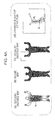
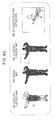
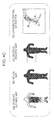
- the leftmost column (a) of Figs. 4A through 4D illustrates a geodesic path length map obtained by calculating a geodesic path length from each point to the base point p o in f g .
- the second column from the left of Figs. 4A through 4D illustrates a distance to the base point p o by an isoline map.
- the result of calculation of the direction ⁇ is illustrated in the third column (c) from the left of Figs. 4A through 4D .
- the direction ⁇ thus calculated is a direction of the geodesic path obtained by the above calculation.
- the fourth column (d) from the left of Figs. 4A through 4D is an enlarged view of an arm part (part surrounded by a rectangle) in four different postures illustrated in the third column (c).
- positions obtained after rotating the positions of a pair of pixels used for calculation of the feature in the learning model in accordance with the direction ⁇ of the reference vector are calculated. Then, a pair of pixels located at the calculated positions on the depth image is selected as pixels used for calculation of a feature.
- Figs. 5A and 5B are diagrams illustrating a method for selecting a pair of pixels in a case where no rotation correction is performed.
- Figs. 6A through 6C are diagrams illustrating a method for selecting a pair of pixels in a case where rotation correction is performed.
- a base point 401 can be calculated on the basis of three-dimensional coordinates of pixels included in a foreground human area in a real-world coordinate system as described above.
- the base point 401 is a point at a position corresponding to the center of gravity, the average, or the median of the three-dimensional coordinates of the pixels included in the foreground human area in the real-world coordinate system.
- a reference vector 406 at the first point 404 is determined by calculating a shortest geodesic path 408 from the base point 401 to a first point 404.
- a feature at the first point 404 in a certain posture is calculated by using a pair of pixels 402, and the feature thus calculated are stored as learning data.
- This learning data is used when a human body part is specified.
- Fig. 6C illustrates a method for selecting the pair of pixels 402 in a case where the posture has changed.
- the direction of the reference vector 406 is rotated.
- Positions obtained after rotating the positions of the pair of pixels 402 illustrated in Fig. 6B in accordance with the rotation are calculated, and the pair of pixels 402 located at the calculated positions on the depth image is selected as pixels used for calculation of a feature.
- a feature at the first point 404 is calculated by using the selected pair of pixels 402, and the part is specified by comparison with the learning data. This maintains consistency of feature calculation using the pair of pixels 402, thereby achieving immutability against a change of the posture.
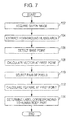
- Fig. 7 is a flow chart illustrating an example of the human body part detection processing in the present embodiment.
- the depth image acquisition unit 102 of the human body part detection system 100 acquires a depth image from a depth camera or a recording medium (Step S102). Then, the foreground human area extraction unit 104 extracts a foreground human area from the depth image (Step S104).
- the base point detection unit 202 detects a base point in the foreground human area (Step S106). Then, the vector calculation unit 204 calculates a reference vector at a first point by calculating a shortest geodesic path) from the base point to the first point (Step S108).
- the selection unit 206 calculates positions obtained after rotating the positions of a pair of pixels used for calculation of a feature in a learning model in accordance with the direction of the reference vector and selects pixels located at the calculated positions on the depth image as pixels used for calculation of a feature (Step S110).
- the feature calculation unit 208 calculates the feature at the first point on the basis of information on depth of the selected pair of pixels (Step S112).
- This feature is a binary string representing a local feature obtained by applying the expression (1) to various pairs of pixels.
- the label determination unit 210 determines a label corresponding to a human body part on the basis of the feature at the first point and the learning model (Step S114). This specifies the human body part.
- positions after rotating positions of a pair of pixels used for calculation of a feature in a learning model in accordance with a direction of a reference vector are calculated. Then, pixels located at the calculated positions on a depth image is used as pixels used for calculation of a feature. It is therefore possible to accurately and effectively detect a body part in various postures.
- a body part is detected on a pixel basis.
- a body part may be detected on a superpixel basis, which is a group of a plurality of pixels.
- a superpixel basis which is a group of a plurality of pixels.
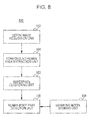
- Fig. 8 is a block diagram illustrating an example of a configuration of the human body part detection system 500 according to the present embodiment.
- constituent elements that are similar to those of the human body part detection system 100 illustrated in Fig. 1 are given identical reference signs, and description thereof is omitted.
- the human body part detection system 500 includes a superpixel clustering unit 506 in addition to a depth image acquisition unit 102, a foreground human area extraction unit 104, a learning model storing unit 106, and a human body part detection unit 108 described with reference to Fig. 1 .
- the superpixel clustering unit 506 unifies a plurality of pixels in a depth image as a superpixel. For example, the superpixel clustering unit 506 unifies approximately ten thousand pixels that constitutes the foreground human area as approximately several hundred superpixels.
- a method for unifying pixels as a superpixel is not limited to a specific one.
- the superpixel clustering unit 506 may unify pixels as a superpixel by using three-dimensional coordinates (x, y, z) of pixels included in a depth image in a real-world coordinate system.
- a procedure of processing for detecting a human body part is similar to that illustrated in Fig. 7 .
- processing for unifying a plurality of pixels in a depth image as superpixels by the superpixel clustering unit 506 is performed between Step S104 and Step S106 in Fig. 7 .
- processing is performed not on pixels but on superpixels.
- a plurality of pixels in a depth image are unified as superpixels.
- One advantage of this is to allow an improvement in robustness against noise contained in the depth information.
- Another advantage is to allow a marked improvement in processing time. This advantage is described in detail below.
- a calculation time of the Dijkstra's algorithm needed to generate a geodesic distance map is O(
- is the number of branches in the graph
- is the number of points in the graph.
- the processing time is directly related to the number of pixels in a foreground human area f g . Therefore, if the number of pixels can be reduced, it is possible to improve the processing time.
- Depth information obtained by a depth camera or a depth sensor contains noise. This noise occurs due to the influence of a shadow of an object, and in a case where a depth sensor using infrared rays is used, due to the influence of environmental light stronger than the infrared rays, the influence of a material of an object that scatters the infrared rays, and the like. Pixel-basis feature calculation is more susceptible to such noise.
- a pixel-based structure is replaced with a superpixel-based structure.
- superpixel clustering is performed on the basis of pixel elements [I, a, b, x, y] where I, a, and b are color elements in a Lab color space, and x and y are coordinates of a pixel.
- clustering is performed on the basis of elements [x, y, z, L] where x, y, and z are three-dimensional coordinates in a real-world coordinate system, and L is a label of a pixel.
- L is an option and is used in off-line learning and evaluation processing.
- a consistent label can be given to pixels included in the same superpixel as illustrated in Figs. 9A and 9B .
- pixels 602 of a head part are unified as some superpixels 604 having the same human body part label. Only three-dimensional coordinates [x, y, z] in the real-world coordinate system may be used to unify pixels as superpixels during actual off-line identification processing.
- the average of values of depth of all pixels belonging to each superpixel is allocated as the depth of the superpixel. Comparison of a pair of pixels is replaced with comparison of a pair of superpixels.
- Fig. 10 illustrates a plurality of superpixels including a superpixel 702 corresponding to a first point p c , and hexagonal superpixels P u '708 and P v '710 corresponding to a pair of pixels p u 704 and p v 706.
- the pair of pixels p u 704 and p v 706 are mapped in the superpixels P u '708 and P v '710, respectively.
- Comparison of depth using the expression (1) is performed by using the average of values of depth of the pixels belonging to the superpixel P u '708 and the average of values of depth of the pixels belonging to the superpixel P v '710.
- a direction r of a reference vector is a direction of a shortest geodesic path to a base point p o in the foreground human area.
- a foreground human area is constituted by approximately ten thousand pixels, but these pixels can be unified as several hundred superpixels by superpixel clustering. It is therefore possible to markedly reduce the processing time. Furthermore, information on depth that varies from one pixel to another is replaced with the average of values of depth of pixels in each superpixel. This makes it possible to markedly improve the robustness against noise.
- the human body part detection systems 100 and 500 according to the embodiments described above may handle high-dimensional non-linear data by using a deep network.
- the deep network is, for example, based on SdA (Stacked denoising Autoencoders).
- SdA SdA-layerx feature space.
- SdA can remove irrelevant derivations in input data while preserving discrimination information that can be used for identification and recognition.
- a process of data transmission from a topmost layer to a deep layer in SdA generates a series of latent representations having different abstraction capabilities. As the layer becomes deeper, the level of abstraction becomes higher.
- a deep network is constituted by five layers, i.e., an input layer 802, three hidden SdA layers 806, 808, and 810, and an output layer 814.
- the input layer 802 takes in a feature 804 of a binary string.
- the final hidden layer 810 generates a non-dense binary string feature 812 for discrimination.
- Each layer is constituted by a set of nodes, and all of the nodes are connected with nodes in an adjacent layer.
- the number of nodes in the input layer 802 is equal to the number n of pairs of pixels.
- a binary string that represents a feature at a first point is directly given to the deep network as input to the input layer 802.
- the number d of nodes in the output layer 814 coincides with the number of labels representing human body parts. That is, the number of labels coincides with the number of human body parts.
- linear regression identification such as logistic regression is applied to the output layer 814, and an identification result of each part of the human body is obtained.
- learning data of a true value is created to learn a feature of a human body part.
- This learning data may include a true value label corresponding to a human body part in a depth image.
- a plurality of learning examples may be selected to improve robustness. By such learning, a learning model which is a result of learning of a feature of a human body part is obtained.
- a human body part is specified.
- the position of a joint connecting human body parts may be further estimated.
- the position of a joint of a human body is estimated on the basis of a label corresponding to a human body part determined in Step S114 of Fig. 7 and three-dimensional coordinates corresponding to the human body part.
- the position of a joint is estimated by using a result of calculation of a central position of each part of the human body.
- the position of the joint may be moved from the central position.
- Fig. 12 illustrates examples of skeletal joints of a human body that can be estimated.
- the skeletal joints that can be estimated are, for example, a right hand 902, a left hand 904, a right elbow 906, a left elbow 908, a right shoulder 910, a left shoulder 912, a head 914, a neck 916, a waist 918, a right hip 920, and a left hip 922.
- the joints of the right hand 902 and the left hand 904 may be moved farther from the body so as to be located closer to actual positions of the hands of the person. This further improves usability.
- the estimated skeletal joints can be used for recognition of human actions, postures, and gestures and is also effective for device control and the like.
- the human body part detection systems 100 and 500 and arithmetic devices of modules included in the human body part detection systems 100 and 500 are generally realized by ICs (Integrated Circuits), ASICs (Application-Specific Integrated Circuits), LSIs (Large Scale Integrated Circuits), DSPs (Digital Signal Processor), or the like or may be also realized by a CPU-based processor included in a PC (Personal Computer).
- ICs Integrated Circuits
- ASICs Application-Specific Integrated Circuits
- LSIs Large Scale Integrated Circuits
- DSPs Digital Signal Processor
- modules can be realized by LSIs each having a single function or by a single unified LSI having a plurality of functions.
- the modules can be also realized by an IC, a system LSI, a super LSI, an ultra LSI, or the like, which are different in terms of the degree of integration, instead of an LSI.
- means to accomplish unification is not limited to an LSI and may be, for example, a special circuit or a general-purpose processor.
- a special microprocessor such as a DSP in which an instruction can be given by a program command, an FPGA (Field Programmable Gate Array) that can be programmed after production of an LSI, or a processor in which LSI connection and arrangement can be reconfigured can be used for the same purpose.
- the LSI may be replaced with a new technique by using a more advanced production and processing technique. Unification can be achieved by using such a technique.
- the human body part detection systems 100 and 500 may be, for example, incorporated into an image acquisition device such as a digital still camera or a movie camera.
- the human body part detection systems 100 and 500 may be, for example, mounted in a stand-alone device that operates as an image capture system such as a capture system for professionals.
- the application range of the human body part detection systems 100 and 500 according to the present disclosure is not limited to the range described above, and the human body part detection systems 100 and 500 can be mounted in other types of devices.
- the present disclosure is useful for a system and a method for detecting a human body part.
Landscapes
- Engineering & Computer Science (AREA)
- Theoretical Computer Science (AREA)
- Computer Vision & Pattern Recognition (AREA)
- Physics & Mathematics (AREA)
- General Physics & Mathematics (AREA)
- Multimedia (AREA)
- Data Mining & Analysis (AREA)
- Evolutionary Computation (AREA)
- Artificial Intelligence (AREA)
- Health & Medical Sciences (AREA)
- Medical Informatics (AREA)
- Software Systems (AREA)
- General Health & Medical Sciences (AREA)
- Databases & Information Systems (AREA)
- Computing Systems (AREA)
- Human Computer Interaction (AREA)
- General Engineering & Computer Science (AREA)
- Life Sciences & Earth Sciences (AREA)
- Evolutionary Biology (AREA)
- Bioinformatics & Computational Biology (AREA)
- Bioinformatics & Cheminformatics (AREA)
- Image Analysis (AREA)
- Image Processing (AREA)
Applications Claiming Priority (1)
| Application Number | Priority Date | Filing Date | Title |
|---|---|---|---|
| JP2014221586A JP2016091108A (ja) | 2014-10-30 | 2014-10-30 | 人体部位検出システムおよび人体部位検出方法 |
Publications (2)
| Publication Number | Publication Date |
|---|---|
| EP3016027A2 true EP3016027A2 (de) | 2016-05-04 |
| EP3016027A3 EP3016027A3 (de) | 2016-06-15 |
Family
ID=54360886
Family Applications (1)
| Application Number | Title | Priority Date | Filing Date |
|---|---|---|---|
| EP15190927.2A Withdrawn EP3016027A3 (de) | 2014-10-30 | 2015-10-22 | System zur detektion eines menschlichen körperteils und verfahren zur detektion eines menschlichen körperteils |
Country Status (3)
| Country | Link |
|---|---|
| US (1) | US20160125243A1 (de) |
| EP (1) | EP3016027A3 (de) |
| JP (1) | JP2016091108A (de) |
Cited By (1)
| Publication number | Priority date | Publication date | Assignee | Title |
|---|---|---|---|---|
| CN114973305A (zh) * | 2021-12-30 | 2022-08-30 | 昆明理工大学 | 一种针对拥挤人群的精确人体解析方法 |
Families Citing this family (16)
| Publication number | Priority date | Publication date | Assignee | Title |
|---|---|---|---|---|
| US11841920B1 (en) | 2016-02-17 | 2023-12-12 | Ultrahaptics IP Two Limited | Machine learning based gesture recognition |
| US11854308B1 (en) * | 2016-02-17 | 2023-12-26 | Ultrahaptics IP Two Limited | Hand initialization for machine learning based gesture recognition |
| US11714880B1 (en) | 2016-02-17 | 2023-08-01 | Ultrahaptics IP Two Limited | Hand pose estimation for machine learning based gesture recognition |
| JP6586239B2 (ja) * | 2016-08-29 | 2019-10-02 | 株式会社日立製作所 | 撮影装置及び撮影方法 |
| US11205103B2 (en) | 2016-12-09 | 2021-12-21 | The Research Foundation for the State University | Semisupervised autoencoder for sentiment analysis |
| CN106875444B (zh) * | 2017-01-19 | 2019-11-19 | 浙江大华技术股份有限公司 | 一种目标物定位方法及装置 |
| EP3624051A4 (de) | 2017-05-12 | 2020-03-25 | Fujitsu Limited | Abstandsbildverarbeitungsvorrichtung, abstandsbildverarbeitungssystem, abstandsbildverarbeitungsverfahren und abstandsbildverarbeitungsprogramm |
| EP3624052A4 (de) * | 2017-05-12 | 2020-03-18 | Fujitsu Limited | Abstandsbildverarbeitungsvorrichtung, abstandsbildverarbeitungssystem, abstandsbildverarbeitungsverfahren und abstandsbildverarbeitungsprogramm |
| CN109200576A (zh) * | 2018-09-05 | 2019-01-15 | 深圳市三宝创新智能有限公司 | 机器人投影的体感游戏方法、装置、设备和存储介质 |
| WO2020184066A1 (ja) * | 2019-03-13 | 2020-09-17 | Necソリューションイノベータ株式会社 | 関節位置推定装置、関節位置推定方法およびコンピュータ読み取り可能な記録媒体 |
| GB2586319B (en) * | 2019-05-20 | 2022-10-26 | Disney Entpr Inc | Automated image synthesis using a comb neural network architecture |
| US11232296B2 (en) * | 2019-07-10 | 2022-01-25 | Hrl Laboratories, Llc | Action classification using deep embedded clustering |
| CN111652047B (zh) * | 2020-04-17 | 2023-02-28 | 福建天泉教育科技有限公司 | 基于彩色图和深度图的人体姿势识别方法及存储介质 |
| CN112446871B (zh) * | 2020-12-02 | 2022-11-15 | 山东大学 | 一种基于深度学习和OpenCV的隧道裂缝识别方法 |
| CN114973334A (zh) * | 2022-07-29 | 2022-08-30 | 浙江大华技术股份有限公司 | 人体部件关联方法、装置、电子装置和存储介质 |
| CN116863469B (zh) * | 2023-06-27 | 2024-05-14 | 首都医科大学附属北京潞河医院 | 一种基于深度学习的手术解剖部位识别标注方法 |
Citations (1)
| Publication number | Priority date | Publication date | Assignee | Title |
|---|---|---|---|---|
| US20130266182A1 (en) | 2009-05-01 | 2013-10-10 | Microsoft Corporation | Human body pose estimation |
Family Cites Families (7)
| Publication number | Priority date | Publication date | Assignee | Title |
|---|---|---|---|---|
| CN102622606B (zh) * | 2010-02-03 | 2013-07-31 | 北京航空航天大学 | 基于测地模型的人体骨骼提取和朝向判定方法 |
| WO2012046392A1 (ja) * | 2010-10-08 | 2012-04-12 | パナソニック株式会社 | 姿勢推定装置及び姿勢推定方法 |
| KR101227569B1 (ko) * | 2011-05-26 | 2013-01-29 | 한국과학기술연구원 | 골프 스윙 분석을 위한 신체 부위별 위치 추적 장치 및 방법 |
| AU2011265383A1 (en) * | 2011-12-20 | 2013-07-04 | Canon Kabushiki Kaisha | Geodesic superpixel segmentation |
| KR101849373B1 (ko) * | 2012-01-31 | 2018-04-17 | 한국전자통신연구원 | 인체의 관절구조를 추정하기 위한 장치 및 방법 |
| EP2674913B1 (de) * | 2012-06-14 | 2014-07-23 | Softkinetic Software | Modellierungsanpassung und -verfolgung für dreidimensionales Objekt |
| JP6388205B2 (ja) * | 2014-02-25 | 2018-09-12 | パナソニックIpマネジメント株式会社 | 表示制御プログラム、表示制御装置、および表示装置 |
-
2014
- 2014-10-30 JP JP2014221586A patent/JP2016091108A/ja active Pending
-
2015
- 2015-10-19 US US14/886,931 patent/US20160125243A1/en not_active Abandoned
- 2015-10-22 EP EP15190927.2A patent/EP3016027A3/de not_active Withdrawn
Patent Citations (1)
| Publication number | Priority date | Publication date | Assignee | Title |
|---|---|---|---|---|
| US20130266182A1 (en) | 2009-05-01 | 2013-10-10 | Microsoft Corporation | Human body pose estimation |
Cited By (1)
| Publication number | Priority date | Publication date | Assignee | Title |
|---|---|---|---|---|
| CN114973305A (zh) * | 2021-12-30 | 2022-08-30 | 昆明理工大学 | 一种针对拥挤人群的精确人体解析方法 |
Also Published As
| Publication number | Publication date |
|---|---|
| US20160125243A1 (en) | 2016-05-05 |
| JP2016091108A (ja) | 2016-05-23 |
| EP3016027A3 (de) | 2016-06-15 |
Similar Documents
| Publication | Publication Date | Title |
|---|---|---|
| EP3016027A2 (de) | System zur detektion eines menschlichen körperteils und verfahren zur detektion eines menschlichen körperteils | |
| Zubizarreta et al. | A framework for augmented reality guidance in industry | |
| CN102402680B (zh) | 人机交互系统中手部、指示点定位方法和手势确定方法 | |
| CN108052896B (zh) | 基于卷积神经网络与支持向量机的人体行为识别方法 | |
| US9189855B2 (en) | Three dimensional close interactions | |
| Davies et al. | Advanced methods and deep learning in computer vision | |
| CN109558879A (zh) | 一种基于点线特征的视觉slam方法和装置 | |
| CN104392223B (zh) | 二维视频图像中的人体姿态识别方法 | |
| Rastiveis et al. | A fuzzy decision making system for building damage map creation using high resolution satellite imagery | |
| US20240161325A1 (en) | Improved vision-based measuring | |
| Zhang et al. | A visual-inertial dynamic object tracking SLAM tightly coupled system | |
| CN111652168B (zh) | 基于人工智能的群体检测方法、装置、设备及存储介质 | |
| CN120147541B (zh) | 一种基于自适应关键帧的3d场景重建方法及系统 | |
| Li et al. | Hierarchical semantic parsing for object pose estimation in densely cluttered scenes | |
| Falomir et al. | Qualitative distances and qualitative image descriptions for representing indoor scenes in robotics | |
| Zhang et al. | Real-time dynamic visual-inertial SLAM and object tracking based on lightweight deep feature extraction matching | |
| Sock et al. | Active 6d multi-object pose estimation in cluttered scenarios with deep reinforcement learning | |
| Faujdar et al. | Human pose estimation using artificial intelligence with virtual gym tracker | |
| Ayubi et al. | The prototype of hand gesture recognition for elderly people to control connected home devices | |
| EP4309147A1 (de) | Verbesserte ausrichtungserkennung auf der basis von tiefenlernen | |
| Liu et al. | Robust 3-D object recognition via view-specific constraint | |
| Daudt et al. | Learning to understand earth observation images with weak and unreliable ground truth | |
| Li et al. | Peduncle detection of sweet pepper based on color and 3D feature | |
| Kuznetsova et al. | Hand pose estimation from a single rgb-d image | |
| Sablatnig | Increasing flexibility for automatic visual inspection: the general analysis graph |
Legal Events
| Date | Code | Title | Description |
|---|---|---|---|
| PUAI | Public reference made under article 153(3) epc to a published international application that has entered the european phase |
Free format text: ORIGINAL CODE: 0009012 |
|
| AK | Designated contracting states |
Kind code of ref document: A2 Designated state(s): AL AT BE BG CH CY CZ DE DK EE ES FI FR GB GR HR HU IE IS IT LI LT LU LV MC MK MT NL NO PL PT RO RS SE SI SK SM TR |
|
| AX | Request for extension of the european patent |
Extension state: BA ME |
|
| PUAL | Search report despatched |
Free format text: ORIGINAL CODE: 0009013 |
|
| AK | Designated contracting states |
Kind code of ref document: A3 Designated state(s): AL AT BE BG CH CY CZ DE DK EE ES FI FR GB GR HR HU IE IS IT LI LT LU LV MC MK MT NL NO PL PT RO RS SE SI SK SM TR |
|
| AX | Request for extension of the european patent |
Extension state: BA ME |
|
| RIC1 | Information provided on ipc code assigned before grant |
Ipc: G06K 9/62 20060101ALI20160506BHEP Ipc: G06K 9/00 20060101AFI20160506BHEP Ipc: G06K 9/46 20060101ALI20160506BHEP |
|
| 17P | Request for examination filed |
Effective date: 20161018 |
|
| RBV | Designated contracting states (corrected) |
Designated state(s): AL AT BE BG CH CY CZ DE DK EE ES FI FR GB GR HR HU IE IS IT LI LT LU LV MC MK MT NL NO PL PT RO RS SE SI SK SM TR |
|
| 17Q | First examination report despatched |
Effective date: 20170420 |
|
| STAA | Information on the status of an ep patent application or granted ep patent |
Free format text: STATUS: THE APPLICATION HAS BEEN WITHDRAWN |
|
| 18W | Application withdrawn |
Effective date: 20170913 |