EP3016508B1 - Ajout d'ingrédients à un produit granulaire - Google Patents
Ajout d'ingrédients à un produit granulaire Download PDFInfo
- Publication number
- EP3016508B1 EP3016508B1 EP14736742.9A EP14736742A EP3016508B1 EP 3016508 B1 EP3016508 B1 EP 3016508B1 EP 14736742 A EP14736742 A EP 14736742A EP 3016508 B1 EP3016508 B1 EP 3016508B1
- Authority
- EP
- European Patent Office
- Prior art keywords
- curd
- ingredients
- ingredient
- grains
- curd grains
- Prior art date
- Legal status (The legal status is an assumption and is not a legal conclusion. Google has not performed a legal analysis and makes no representation as to the accuracy of the status listed.)
- Active
Links
Images
Classifications
-
- A—HUMAN NECESSITIES
- A23—FOODS OR FOODSTUFFS; TREATMENT THEREOF, NOT COVERED BY OTHER CLASSES
- A23C—DAIRY PRODUCTS, e.g. MILK, BUTTER OR CHEESE; MILK OR CHEESE SUBSTITUTES; PREPARATION THEREOF
- A23C19/00—Cheese; Cheese preparations; Making thereof
- A23C19/06—Treating cheese curd after whey separation; Products obtained thereby
-
- A—HUMAN NECESSITIES
- A01—AGRICULTURE; FORESTRY; ANIMAL HUSBANDRY; HUNTING; TRAPPING; FISHING
- A01J—MANUFACTURE OF DAIRY PRODUCTS
- A01J25/00—Cheese-making
- A01J25/11—Separating whey from curds; Washing the curds
- A01J25/111—Separating whey from curds; Washing the curds by continuous separation
-
- A—HUMAN NECESSITIES
- A01—AGRICULTURE; FORESTRY; ANIMAL HUSBANDRY; HUNTING; TRAPPING; FISHING
- A01J—MANUFACTURE OF DAIRY PRODUCTS
- A01J25/00—Cheese-making
- A01J25/11—Separating whey from curds; Washing the curds
- A01J25/117—Filter design
-
- A—HUMAN NECESSITIES
- A01—AGRICULTURE; FORESTRY; ANIMAL HUSBANDRY; HUNTING; TRAPPING; FISHING
- A01J—MANUFACTURE OF DAIRY PRODUCTS
- A01J25/00—Cheese-making
- A01J25/12—Forming the cheese
-
- A—HUMAN NECESSITIES
- A01—AGRICULTURE; FORESTRY; ANIMAL HUSBANDRY; HUNTING; TRAPPING; FISHING
- A01J—MANUFACTURE OF DAIRY PRODUCTS
- A01J25/00—Cheese-making
- A01J25/12—Forming the cheese
- A01J25/13—Moulds therefor
Definitions
- the present invention relates to food processing, and in particular it relates to adding ingredients to food product during production thereof.
- the invention will be exemplified within the field of cheese making.
- Adding ingredients to cheese may be done in several manners.
- the procedure of adding an ingredient involves mixing devices which distribute the ingredients in the curd mass, or complex dosing systems which spread ingredients over a large area or volume of curd.
- Other methods involves dosing all ingredients at once into a batch of curd and whey, which subsequently is mixed in curd vats or buffer tanks over time to achieve proper distribution.
- Known methods suffer the drawback of being time consuming in regard of dosing and distribution of ingredients.
- the ingredient of a consecutive batch differs from the ingredient used in a present batch the time and effort needed for proper shift-over between ingredients (to prevent drag of ingredients between batches or different types of cheeses as ingredients attach to equipment parts and layers) is considerable.
- Another cumbersome operation may be the pre-processing of ingredients to achieve right ingredient behaviour after dosing to achieve proper distribution.
- Such pre-processing may include pre-wetting ingredients to prevent ingredients to float or sediment into a batch of curd and whey.
- An aim is to eliminate or at least alleviate one or more of these drawbacks. Though being limited to cheese production in its description, the device and methods may be used in other applications where it is desired to add a smaller amount of ingredients or additives to a larger amount of granular product.
- a method for adding ingredients to a mass of curd comprises the step of separating whey from curd grains, and a step of transferring curd grains from the separating step to a step of arranging the curd grains in a mould, wherein a step of adding the ingredients is performed in the transferring step.
- the step of transferring the curd grains comprises allowing the grains to fall under gravity from a separating device to a mould.
- the unconstraint transport minimizes fouling as well as wear on curd grains.
- the grains may fall freely, and in other embodiments a mass of falling curd particles will be gently guided to a particular part of a mould.
- the added ingredients may in some embodiments be transported to an injection point by means of a fluid flow.
- the ingredient may be entrained in a gas flow or entrained or mixed into a liquid flow.
- the curd grains are allowed to fall under gravity as the ingredients are added to them.
- the velocity and rotation of the curd grains as they fall, as well as collisions between curd grains, will stimulate a chaotic pattern of movement, which in turn facilitate a good mix and distribution of ingredient in the mass of curd grains.
- One clear advantage is that since the curd grains are falling freely, there is no processing equipment that can be fouled by curd grains or ingredient.
- the step of separating the curd grains from the whey is performed with separation means in the form of a conical sieve.
- a beneficial effect will be that a momentum will be imparted to the curd grains as they accelerate down the sloping walls of the conical sieve, and at the same time they will be concentrated to a smaller volume. Both these effects will benefit the mix in of ingredients.
- the curd grains When the addition of ingredient is commenced the curd grains will tumble and rotate as they exit the sieve, which further improves the mixing.
- the sieve may be rotating around a longitudinal axis of symmetry. Having a rotating sieve adds several benefits to the present invention.
- the rotation may facilitate and improve the distribution of curd grains over a filter area, and also tumbles the curd grains as the mass of falling curd grains reaches the mixing area.
- the rotation may also induce further momentum to the curd grains.
- Another more general advantage is that the rotation may reduce the risk of curd grains adhering to the sieve, which could result in an uneven flow of curd grains.
- the conical sieve may also be arranged to vibrate.
- a vibration may result in advantages partly overlapping with the beneficial effects of rotation, yet with an emphasis on that it will assist in preventing curd grains from clinging in to the sieve.
- the step of adding of ingredient to the curd grains is performed by arranging a nozzle in a narrow region of the conical sieve ejecting a flow of fluid and ingredient in a longitudinal direction towards an outlet of the conical sieve. In this way the added ingredient will be injected in the centre of a flow of curd grains, and it will be directed outwards and away from the conical sieve such that satisfactory mixing is achieved without excessive fouling of processing equipment.
- the nozzle is arranged along the longitudinal axis of symmetry of the conical sieve.
- the nozzle may be embodied as a specially designed nozzle, optimized for the product to be added, yet in the present embodiment it merely consists of one end of the ingredient conduit. It is preferred that the ingredient is added in a position such that there is little or no risk for the ingredient to contact the operational part of the sieve, in order to facilitate cleaning and minimise efforts to prevent drag of ingredients at product or ingredient shift-over.
- the fluid may be air entraining a dry or moistures ingredient or water (or another fluid) entraining or containing a wet ingredient.
- the method may comprise, preceding the already mentioned steps, the step of pumping a mix of curd grains and whey from a buffer tank to a separation means.
- the invention relates to a device for adding ingredients to a mass of curd grains.
- a device for adding ingredients to a mass of curd grains will have an inlet end for receiving a mass of curd grains and an outlet end directing the curd grains towards a mould, wherein a nozzle for injecting ingredient in the mass of curd grains is arranged in the area of the outlet end.
- "In the area of the outlet end” may designate several different positions, and examples include in the same level of the outlet end, slightly upstream the outlet end, or slightly downstream the outlet end. A point with this position is that the ingredient may be added to the curd grains in an efficient manner without fouling the equipment. For this reason it may also be preferred that the nozzle is arranged to inject the ingredient in a downstream direction, i.e.
- the inlet end is arranged at a higher level than the outlet end, such that gravity may be the force driving the curd grains through the device.
- An advantage of the invention is that the undesired behaviours of ingredients when added to a fluid, ie. flooting, sedimenting, dissolving are for major part overcome as ingredients are directly dosed to the pre-drained curd particles where they attach to their wet surfaces.
- Dissolvable ingredients can only partly dissolve in the limited film of whey covering the pre-drained curd particles and retention to the cheese is increased by quick start of pressing entrapping the ingredients in the cheese body or by adding dissolvable ingredients into so called carriers, such as lactose, starch, salt which will release the ingredients to the cheese in time after the cheese is pressed.
- the device has sloping sidewalls such as to impart a momentum to the curd grains on their way from the inlet to the outlet.
- the sloping sidewalls form part of a conical sieve, arranged to separate the curd grains from residual whey.
- the conical sieve may be arranged to rotate and/or vibrate in accordance with the present description.
- a nozzle is arranged for the injection of ingredient to the curd grains.
- the nozzle may be arranged to inject a mixture of gas and ingredient in a direction out through the outlet of the device, such that mixing of ingredients and curd grains is effected when the curd grains are unsupported by the device.
- the nozzle may be arranged in a narrow region of the conical sieve ejecting a flow of gas and ingredient in a longitudinal direction towards an outlet of the conical sieve.
- the nozzle injects a mixture of liquid, preferably water, and ingredient. Addition of ingredient with a mixture of gas, e.g.
- the gas flow is adding a better and more constant control on the speed and path of ingredients and prevents internal fouling of the dosing unit as the constant flow of gas prevents high humidity around the curd mass to enter the inner sides of the dosing units.
- the nozzle may be embodied as a specially designed nozzle, optimized for the product to be added, yet in the present embodiment it merely consists of the ingredient conduit. It is preferred that the ingredient is added in a position such that there is little or no risk for the ingredient to contact the operational part of the sieve, in order to facilitate cleaning.
- one or several additional nozzles may be provided for injecting at least one additional ingredient.
- the one or several additional nozzles may be placed next to said nozzle. Alternatively or as a complement one or several additional nozzles may be placed inside said nozzle.
- a device for adding ingredients to a mass of curd grains having an inlet end for receiving a mass of curd grains and an outlet end directing the curd grains towards a mould, wherein a nozzle is provided for injecting ingredient in the mass of curd grains in the area of the outlet end.
- ingredients comprising larger particles it may be sufficient to have the nozzle provided in an upper part of the device such that the ingredients can fall down into the area of the outlet end.
- Ingredients dosed may be distributed throughout the curd mass as result of the tumbling and turbulent path of curd grains downwards to the mould without use of additional ingredient mixing and distribution tools.
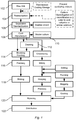
- Fig. 1 illustrates a flow chart for a typical process of manufacturing cheese, in this particular example semi-hard cheese or cheddar cheese.
- the flow chart is quite complex in that it includes several available optional process steps, and for the purposes of the present invention it is sufficient to consider a portion of the leftmost track.
- a process of manufacturing a semi-hard cheese may comprise the steps of manufacturing curd (step 108) by raw milk (step 102) being pasteurized (step 104) and separated and standardized (step 106) using a starting culture (step 110), rennet, etc, all in accordance with prior art.
- step 112 the curd is drained, i.e. the whey is removed to the largest extent possible.
- Cutting of curd into granules of desired size facilitates drainage of whey.
- the curd is arranged in a mould (step 114) fully or partly defining the shape of the cheese, or is formed in another manner.
- Subsequent steps may include a Pressing step 116, a Brining step 118 and Ripening step 120 before the end product is distributed in step 122.
- ingredients may be added in order to affect flavour and texture of the cheese, as well as the shelf life.
- Common ingredients include salt, microbiological cultures, colours, flavours and spices. Since the present invention relates mainly to the addition of ingredients a brief discussion around techniques that may be used will be given. There are several ways of adding ingredients, examples including:
- this adding procedure has an advantage in that ingredients are dosed into a more concentrated volume of curd and whey in which majority of whey is already removed in prior machinery reducing losses to whey and limiting the amounts of ingredient fouled whey.
- the problem associated with change of ingredient, i.e. the cleaning issue, would still be a problem.
- Adding ingredients inline to pre-drained curd and mixing it up throughout the whole curd mass is a technique commonly used in the process of manufacturing Cheddar cheese and Pasta Filata. Salt or brine is dosed over curd in a mixing unit (using a single dosing unit) or over a larger area of curd on a conveyor (e.g. with multiple dosing units like sprayers). Similar to the previous example an advantage of these systems is that ingredients are added after majority of whey is drained from the curd and less whey is contaminated/fouled with ingredients. A disadvantage is that mixing tools are required to distribute ingredients throughout the whole curd mass.
- a variation of this technique involves manual spreading of ingredients over a layer of pre-drained curd and mixing it up manually (or automated). This variant is hardly used in industrialized processes, but in combination of pre-press vats it is known that some herbs which cannot be mixed up well in curd and whey mixtures are spread manually over a large curd bed area and afterwards are manually mixed up.
- the present invention strives at optimizing a process of dosing small quantities of ingredients to large quantities of curd and getting it well distributed throughout the mass. This process should be performed with minimal time consumption, minimal fouling of equipment, minimal damage to ingredients or curd, minimal losses of ingredients, minimal drag of ingredient remains between batches and minimal retention of ingredients to whey combined with proper distribution of the ingredients throughout the cheese mass.
- the present description embodies the invention in the context of manufacturing of cheese, it may be applied to other fields as well, e.g. where flavours, color agents, or other ingredients are to be added to a granular material.
- a method for adding ingredients to a granulated product which in the following will be described in relation to an embodiment where ingredients are added to curd grains in a step of manufacturing cheese.
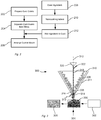
- a method is disclosed in Fig. 2 and will be described in the following, and it basically comprises two paths and a junction point where the two paths meet.
- the first path (to the left in Fig. 2 ) represents a regular cheese manufacturing process, where a curd is prepared from processed milk, summarized in step 202.
- the curd is subsequently cut into curd grains and are separated from the whey in step 204 and arranged in moulds in step 206.
- the second path (to the right in Fig.
- step 2 represents an ingredient-addition track, where one or more ingredients are dosed (step 208), transported (step 210), and added to the curd (step 212).
- a pre-mix of ingredients is thus dosed as one combined stream to the curd, but it is also possible to dose multiple ingredients separately to the curd using multiple dosing (208), transport (210) and addition units (212).
- the step of adding the ingredient will occur after a step of separating curd grains from whey, and before or during a step of arranging the curd grains to a mould.
- the addition is made in a transition area between the separating step 204 and the arranging step 206. It is to be understood that more whey will be separated from the curd grains during the subsequent step of pressing the mass of curd grains in the mould, yet after the separating step 204 in the inventive method to achieve best performances most whey has been separated.
- the disclosed method will result in a minimal fouling of equipment since it is performed basically as a last processing step before arranging the curd grains in the mould, and at best in the transition period of curd falling from processing equipment into a mould limiting ingredient contact to (almost) only the curd and mould.
- Further beneficial effects include that there will be a minimal loss of ingredients (which in other methods may be lost when the whey is drained), and an associated advantage is that the dosing of ingredient may be reliably determined since most whey has been drained when the ingredient is added.
- the adding of ingredient is performed as the curd grains fall under gravity from the separating step to the arranging step, which will minimize damage induced on the curd as compared to a method where mechanical mixing is performed.
- the amount of ingredient added to a certain amount of curd is controlled.
- the amount as such depends on a particular recipe to begin with, and starting from that recipe the rate at which the ingredient as added will be dependent on a feed rate for the curd grains, the amount of whey residues, etc. Such considerations all relate to control issues which a skilled person would handle if given the direct task to do so.
- the one envisaged in the present embodiment is a dosing screw of conventional design and hygienic dosing pumps for liquid ingredients.
- the exact type of dosing screw and pump used is preferably matched to the type of ingredient to be added.
- the transport 210 of the ingredient to the junction point is performed by means of an airstream carrying the ingredient in a transport conduit.
- an airstream will have several advantages, one being that the mix of air and ingredient will facilitate the mixing of ingredient and curd grains at the junction point. Simply put the curd grains will be sprayed with ingredient in the transition from the separating step to the arranging step, which will provide a more efficient mixing than if the ingredients would be merely poured into the curd grains.
- the flow of air may be added to the transport conduit in such a way that an ejector effect is achieved, i.e. that the ingredients are sucked into the transport conduit by an under pressure generated by the flowing air.
- Such an ejector effect may be accomplished by adding the flow of air downstream the point where the ingredient is dosed, or added upstream the same point, i.e. there are more than one constructional solution for obtaining an ejector effect (venturi feed, eductor feed and other terms may be used with a basically analogous meaning).
- venturi feed, eductor feed and other terms may be used with a basically analogous meaning.
- the theory behind the ejector effect and ejectors is considered to be well known, and it will not be discussed in any further detail in the present disclosure.
- the disclosed manner in which the ingredient is dosed and transported to the curd is simple and straightforward, it basically consists of a dosing device and a pipe leading the ingredient to the curd.
- This non-complex layout vouches for a reliable operation and simple cleaning.
- More complex options could include an active nozzle where the dosing as such is effected by settings of the nozzle, comparable to a fuel injector.
- Such solutions are not excluded from use in embodiments of the present invention, though they are presently not preferred.
- the air may obviously be replaced with another gas if considered suitable.
- a fluid such as water may be used to transport the ingredient to the junction point, and in still other embodiments the fluid as such will constitute the ingredient.
- a situation where the ingredient is a liquid opens up for an injector type nozzle which may be controlled by injection pressure and opening characteristics (time, dimensions etc), or merely by control of a mass flow, both providing controllable and well established methods in other fields of technology.
- the mix of ingredients and air is injected into a mass of falling curd grains that have left the separating step 204 and are about to enter the arranging step 206.
- the motion of the ingredients combined with the motion of the curd grains will ensure a satisfactory mixing of the two.
- the ingredient added will be prone to adhere to the surface of the curd grains since this surface is moist.
- the ingredients are added in a dry format, but added ingredients may also be in a moistures format such as parts of fruit, vegetables and others It may be preferred to introduce the ingredient in a symmetrical way, such as to promote an even and homogenous distribution of ingredient.
- an injection nozzle is arranged concentrically in an outlet of a separation device, such that may inject the ingredient into and along with the mass of falling curd grains encircling the injection nozzle in a doughnut shape, which will also be explained in more detail in relation to a particular embodiment.
- the present invention relates to a device for adding ingredients to a granulated product, which in line with the previously disclosed method will be described in an embodiment relating to cheese manufacturing.
- a device for adding ingredients to a granulated product which in line with the previously disclosed method will be described in an embodiment relating to cheese manufacturing.
- Most general features of such a device have been disclosed in the description of the embodiment of the inventive method, though reference numerals relating to the device was intentionally left out from that part of the description for the purpose of increasing readability.
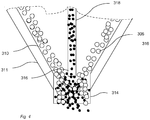
- a device 300 for adding ingredient to a mass of curd is shown in the schematic cross section of Fig. 3 showing a portion of a cheese processing line of which an inventive device according to one embodiment of the present invention is utilized.
- the device 300 may preferably have a shape having a rotational symmetry around a longitudinal axis 312.
- Fig. 3 it is shown how empty moulds 302 entering from the right are arranged in a filling position 304 where they are filled with cheese curd 306 (the larger granules in Fig. 3 ) mixed with ingredient 308 (the smaller granules in Fig. 3 ) and forwarded to subsequent processing steps.
- the device 300 is fed with a mix of curd grains 306 and whey (not shown) from a buffer tank or curd preparation vat (not shown).
- the mix is distributed at one or more locations in an upper portion of a conical sieve 310, which in some embodiments may be arranged to rotate around its longitudinal axis of symmetry 312, resulting in an improved distribution of curd.
- a major portion of the whey will pass through the sieve 310 and collected as the curd 306 grains follow the sloping walls of the sieve 310 under the influence of gravity.
- the whey passing through the sieve 310 may follow the interior of an outer shell 311 to a drain 313, where it is collected.
- the curd grains 306 While the whey is collected and pumped out from the device 300 the curd grains 306 will fall out of a centrally arranged outlet 314 in a lower end of the conical sieve 310. When falling out the curd grains 306 will fall into a mould 302 arranged immediately below the outlet 314. Guide means (not shown) may be arranged to guide the curd grains 306 and ingredient to a particular portion of the mould, e.g. in order to obtain optimal distribution of curd in the mould. Once the mould 302 is full it will be incremented forward to consecutive processing steps, illustrated by the mould comprising a cheese volume with ingredient distributed therein as shown at 305.
- a nozzle 316 is arranged in the area of the outlet, and this nozzle 316 is used to spread and direct the ingredients towards the curd 306.
- the nozzle 316 is merely an extension of the conduit 318 leading the ingredients from a dosing device 320 to the curd 306.
- the nozzle 316 is thus the end of the conduit 318, which may have the form of stainless steel tubing having a circular cross section.
- the nozzle 316 may comprise one or more deflection plates (not shown) or other flow controllers to guide the flow of ingredients such as to improve the distribution thereof.
- Such deflection plates may comprise a cone distributing the flow in all directions or an inclined plate deflecting the flow in one direction, yet there are obviously more ways of introducing some extra turbulence in the mixing process.
- the dosing device 320 is arranged at a first end of the conduit 318 leading from the dosing device 320 to the nozzle 306 and comprises a dosing screw (not shown in detail). Downstream the dosing device 320 an air conduit 322 branches into the ingredient line. The air will act as a carrier gas and pull the ingredient towards the point of injection (the nozzle). The air will also support the distribution of ingredients onto the curd grains. Also the airstream prevents humidity to enter the interiors of the dosing conduit 318 preventing ingredients to attach to its surfaces. Though air has been used as an example, any other suitable carrier gas may be used, such as nitrogen. The gas may be sterilized, HEPA-filtered or prepared in any suitable way.
- the air addition point may have an ejector-like configuration.
- a particular configuration may be optimized on one particular ingredient or group of ingredients to be entrained or arranged to provide an acceptable performance on all or a majority of foreseeable ingredients.
- the air addition point may be pointed direct to or along the ingredient supply point in such way that ingredients are quickly releasing itself when supplied from the dosing device 320.
- liquid ingredient is to be used, or more generally, if an ingredient carried by a liquid is to be used a different ingredient-feed system should be used, yet apart from that the inventive idea is still applicable. Therefore it may be more appropriate to use the word "carrier fluid" than "carrier gas". If using a carrier liquid a similar ejector technique may be used, though the dosing device may be replaced by one better serving the purpose.
- An alternative when dealing with liquid-carried ingredients is mixed with water or other liquid in a pre-step, after which the prepared mixture is provided to the injection point at a suitable rate (e.g. a mass-flow rate).
Landscapes
- Life Sciences & Earth Sciences (AREA)
- Animal Husbandry (AREA)
- Environmental Sciences (AREA)
- Chemical & Material Sciences (AREA)
- Engineering & Computer Science (AREA)
- Food Science & Technology (AREA)
- Polymers & Plastics (AREA)
- Dairy Products (AREA)
Claims (15)
- Procédé pour ajouter des ingrédients à une masse de caillé, comprenant les étapes consistant à :séparer (204) le lactosérum des grains (306) de caillé,transférer les grains de caillé de l'étape de séparation à une étape (206) de rangement des grains de caillé dans un moule (302),dans lequel :on effectue une étape (212) d'ajout d'ingrédients pendant l'étape de transfert,on effectue l'étape de séparation des grains de caillé du lactosérum à l'aide d'un moyen de séparation ayant la forme d'un tamis (310) conique, eton effectue l'étape d'ajout d'ingrédient aux grains de caillé en disposant dans une zone étroite du tamis conique un embout (316) qui éjecte une circulation de fluide et d'ingrédient dans une direction longitudinale vers la sortie (314) du tamis conique.
- Procédé selon la revendication 1, dans lequel l'étape de transfert des grains de caillé implique de permettre aux grains de tomber par gravité d'un dispositif de séparation dans un moule.
- Procédé selon l'une quelconque des revendications précédentes, dans lequel les ingrédients sont transportés (210) vers les grains de caillé au moyen d'une circulation de fluide.
- Procédé selon l'une quelconque des revendications précédentes, comprenant l'étape consistant à permettre aux grains de caillé de tomber par gravité lorsqu'on leur ajoute les ingrédients.
- Procédé selon la revendication 1, dans lequel le tamis conique est en rotation autour d'un axe longitudinal de symétrie.
- Procédé selon la revendication 1 ou 5, dans lequel le tamis conique est à secousse.
- Dispositif pour ajouter des ingrédients à une masse de grains (306) de caillé, comportant une extrémité d'entrée pour recevoir une masse de grains de caillé et une extrémité de sortie (314) dirigeant les grains de caillé vers un moule (302), dans lequel on utilise un embout (316) pour injecter l'ingrédient dans la masse de grains de caillé dans la zone de l'extrémité de sortie, dans lequel des parois latérales en pente font partie d'un tamis conique (310) qui est agencé pour séparer les grains de caillé du lactosérum résiduel.
- Dispositif selon la revendication 7, dans lequel le dispositif comporte des parois latérales en pente de façon à donner de la vitesse aux grains de caillé sur leur chemin de l'entrée à la sortie.
- Dispositif selon la revendication 7 ou 8, dans lequel l'ingrédient est incorporé dans une circulation de fluide avant d'être injecté dans la masse de grains de caillé.
- Dispositif selon la revendication 7, dans lequel le tamis conique est agencé pour tourner autour d'un axe longitudinal de symétrie.
- Dispositif selon la revendication 7 ou 10, dans lequel le tamis conique est agencé pour vibrer.
- Dispositif selon l'une quelconque des revendications 7 à 11, dans lequel l'embout est agencé pour injecter un mélange de fluide et d'ingrédient vers l'extérieur par la sortie du dispositif, de telle sorte que le mélange d'ingrédients et de grains de caillé se réalise quand les grains de caillé ne sont plus soutenus par le dispositif.
- Dispositif selon l'une quelconque des revendications 7 à 12, dans lequel un ou plusieurs embouts supplémentaires sont disposés pour injecter au moins un ingrédient supplémentaire.
- Dispositif selon la revendication 13, dans lequel lesdits embouts supplémentaires sont placés à côté dudit embout.
- Dispositif selon la revendication 13, dans lequel lesdits embouts supplémentaires sont placés à l'intérieur dudit embout.
Applications Claiming Priority (2)
| Application Number | Priority Date | Filing Date | Title |
|---|---|---|---|
| SE1350830 | 2013-07-03 | ||
| PCT/EP2014/064145 WO2015001002A1 (fr) | 2013-07-03 | 2014-07-03 | Ajout d'ingrédients à un produit granulaire |
Publications (2)
| Publication Number | Publication Date |
|---|---|
| EP3016508A1 EP3016508A1 (fr) | 2016-05-11 |
| EP3016508B1 true EP3016508B1 (fr) | 2017-08-23 |
Family
ID=51162770
Family Applications (1)
| Application Number | Title | Priority Date | Filing Date |
|---|---|---|---|
| EP14736742.9A Active EP3016508B1 (fr) | 2013-07-03 | 2014-07-03 | Ajout d'ingrédients à un produit granulaire |
Country Status (5)
| Country | Link |
|---|---|
| US (1) | US10130109B2 (fr) |
| EP (1) | EP3016508B1 (fr) |
| EA (1) | EA201690131A1 (fr) |
| ES (1) | ES2643791T3 (fr) |
| WO (1) | WO2015001002A1 (fr) |
Family Cites Families (4)
| Publication number | Priority date | Publication date | Assignee | Title |
|---|---|---|---|---|
| FR1458172A (fr) * | 1965-05-12 | 1966-03-04 | Nouveau procédé de fabrication en continu de fromages frais sans utilisation de présure et produits obtenus par ledit procédé | |
| US3887718A (en) * | 1972-08-19 | 1975-06-03 | Grace Machinery Company Inc | Method and apparatus for processing cottage cheese curd and like foods |
| SU931134A1 (ru) * | 1980-04-07 | 1982-05-30 | Всесоюзный Научно-Исследовательский Институт Маслодельной И Сыродельной Промышленности Научно-Производственного Объединения "Углич" | Устройство дл обезвоживани молочно-белкового сгустка |
| EP0779032A1 (fr) * | 1995-11-17 | 1997-06-18 | Nordex Food A/S | Procédé et installation de préparation d'un fromage contenant des particules comestibles |
-
2014
- 2014-07-03 ES ES14736742.9T patent/ES2643791T3/es active Active
- 2014-07-03 EA EA201690131A patent/EA201690131A1/ru unknown
- 2014-07-03 US US14/902,386 patent/US10130109B2/en active Active
- 2014-07-03 WO PCT/EP2014/064145 patent/WO2015001002A1/fr not_active Ceased
- 2014-07-03 EP EP14736742.9A patent/EP3016508B1/fr active Active
Non-Patent Citations (1)
| Title |
|---|
| None * |
Also Published As
| Publication number | Publication date |
|---|---|
| US20160366902A1 (en) | 2016-12-22 |
| EP3016508A1 (fr) | 2016-05-11 |
| WO2015001002A1 (fr) | 2015-01-08 |
| US10130109B2 (en) | 2018-11-20 |
| ES2643791T3 (es) | 2017-11-24 |
| EA201690131A1 (ru) | 2016-06-30 |
Similar Documents
| Publication | Publication Date | Title |
|---|---|---|
| AU2005270507B2 (en) | Method and apparatus for consumable powder reconstitution and frothing | |
| US20080299264A1 (en) | Coated food product, a composition, a method, and apparatus for making it | |
| US5855671A (en) | Salting Device | |
| EP3016508B1 (fr) | Ajout d'ingrédients à un produit granulaire | |
| EP0492716B1 (fr) | Procédé de traitement de fromage avec liquide | |
| EP0175715B1 (fr) | Coagulateur continude fromage | |
| EP3100620B1 (fr) | Procédé et dispositif de remplissage portionné d'une préparation alimentaire | |
| EP3166394B1 (fr) | Procédé et agencement de remplissage de moules avec du caillé de fromagerie | |
| JP5593267B2 (ja) | 粒状チーズの製造方法、粒状チーズ入り飲食品の製造方法、および粒状チーズの製造装置 | |
| CN114828639A (zh) | 用于粉末处理设备的喷嘴装置 | |
| CN205337490U (zh) | 一种用于制造鱼豆腐的生产系统 | |
| EP1604567B1 (fr) | Appareil pour préparer le caillé et pour alimenter un appareil de traitement du caillé | |
| ES317521A1 (es) | Instalacion para la fabricacion en continuo de queso | |
| HK1108606B (en) | Method and apparatus for consumable powder reconstitution and frothing |
Legal Events
| Date | Code | Title | Description |
|---|---|---|---|
| PUAI | Public reference made under article 153(3) epc to a published international application that has entered the european phase |
Free format text: ORIGINAL CODE: 0009012 |
|
| 17P | Request for examination filed |
Effective date: 20160203 |
|
| AK | Designated contracting states |
Kind code of ref document: A1 Designated state(s): AL AT BE BG CH CY CZ DE DK EE ES FI FR GB GR HR HU IE IS IT LI LT LU LV MC MK MT NL NO PL PT RO RS SE SI SK SM TR |
|
| AX | Request for extension of the european patent |
Extension state: BA ME |
|
| DAX | Request for extension of the european patent (deleted) | ||
| GRAP | Despatch of communication of intention to grant a patent |
Free format text: ORIGINAL CODE: EPIDOSNIGR1 |
|
| STAA | Information on the status of an ep patent application or granted ep patent |
Free format text: STATUS: GRANT OF PATENT IS INTENDED |
|
| INTG | Intention to grant announced |
Effective date: 20170302 |
|
| GRAS | Grant fee paid |
Free format text: ORIGINAL CODE: EPIDOSNIGR3 |
|
| GRAA | (expected) grant |
Free format text: ORIGINAL CODE: 0009210 |
|
| STAA | Information on the status of an ep patent application or granted ep patent |
Free format text: STATUS: THE PATENT HAS BEEN GRANTED |
|
| AK | Designated contracting states |
Kind code of ref document: B1 Designated state(s): AL AT BE BG CH CY CZ DE DK EE ES FI FR GB GR HR HU IE IS IT LI LT LU LV MC MK MT NL NO PL PT RO RS SE SI SK SM TR |
|
| REG | Reference to a national code |
Ref country code: GB Ref legal event code: FG4D |
|
| REG | Reference to a national code |
Ref country code: CH Ref legal event code: EP |
|
| REG | Reference to a national code |
Ref country code: AT Ref legal event code: REF Ref document number: 920292 Country of ref document: AT Kind code of ref document: T Effective date: 20170915 |
|
| REG | Reference to a national code |
Ref country code: IE Ref legal event code: FG4D |
|
| REG | Reference to a national code |
Ref country code: DE Ref legal event code: R096 Ref document number: 602014013519 Country of ref document: DE |
|
| REG | Reference to a national code |
Ref country code: ES Ref legal event code: FG2A Ref document number: 2643791 Country of ref document: ES Kind code of ref document: T3 Effective date: 20171124 |
|
| REG | Reference to a national code |
Ref country code: SE Ref legal event code: TRGR |
|
| REG | Reference to a national code |
Ref country code: NL Ref legal event code: MP Effective date: 20170823 |
|
| REG | Reference to a national code |
Ref country code: LT Ref legal event code: MG4D |
|
| REG | Reference to a national code |
Ref country code: AT Ref legal event code: MK05 Ref document number: 920292 Country of ref document: AT Kind code of ref document: T Effective date: 20170823 |
|
| PG25 | Lapsed in a contracting state [announced via postgrant information from national office to epo] |
Ref country code: NO Free format text: LAPSE BECAUSE OF FAILURE TO SUBMIT A TRANSLATION OF THE DESCRIPTION OR TO PAY THE FEE WITHIN THE PRESCRIBED TIME-LIMIT Effective date: 20171123 Ref country code: HR Free format text: LAPSE BECAUSE OF FAILURE TO SUBMIT A TRANSLATION OF THE DESCRIPTION OR TO PAY THE FEE WITHIN THE PRESCRIBED TIME-LIMIT Effective date: 20170823 Ref country code: NL Free format text: LAPSE BECAUSE OF FAILURE TO SUBMIT A TRANSLATION OF THE DESCRIPTION OR TO PAY THE FEE WITHIN THE PRESCRIBED TIME-LIMIT Effective date: 20170823 Ref country code: AT Free format text: LAPSE BECAUSE OF FAILURE TO SUBMIT A TRANSLATION OF THE DESCRIPTION OR TO PAY THE FEE WITHIN THE PRESCRIBED TIME-LIMIT Effective date: 20170823 Ref country code: LT Free format text: LAPSE BECAUSE OF FAILURE TO SUBMIT A TRANSLATION OF THE DESCRIPTION OR TO PAY THE FEE WITHIN THE PRESCRIBED TIME-LIMIT Effective date: 20170823 Ref country code: FI Free format text: LAPSE BECAUSE OF FAILURE TO SUBMIT A TRANSLATION OF THE DESCRIPTION OR TO PAY THE FEE WITHIN THE PRESCRIBED TIME-LIMIT Effective date: 20170823 |
|
| PG25 | Lapsed in a contracting state [announced via postgrant information from national office to epo] |
Ref country code: LV Free format text: LAPSE BECAUSE OF FAILURE TO SUBMIT A TRANSLATION OF THE DESCRIPTION OR TO PAY THE FEE WITHIN THE PRESCRIBED TIME-LIMIT Effective date: 20170823 Ref country code: RS Free format text: LAPSE BECAUSE OF FAILURE TO SUBMIT A TRANSLATION OF THE DESCRIPTION OR TO PAY THE FEE WITHIN THE PRESCRIBED TIME-LIMIT Effective date: 20170823 Ref country code: BG Free format text: LAPSE BECAUSE OF FAILURE TO SUBMIT A TRANSLATION OF THE DESCRIPTION OR TO PAY THE FEE WITHIN THE PRESCRIBED TIME-LIMIT Effective date: 20171123 Ref country code: IS Free format text: LAPSE BECAUSE OF FAILURE TO SUBMIT A TRANSLATION OF THE DESCRIPTION OR TO PAY THE FEE WITHIN THE PRESCRIBED TIME-LIMIT Effective date: 20171223 Ref country code: GR Free format text: LAPSE BECAUSE OF FAILURE TO SUBMIT A TRANSLATION OF THE DESCRIPTION OR TO PAY THE FEE WITHIN THE PRESCRIBED TIME-LIMIT Effective date: 20171124 Ref country code: PL Free format text: LAPSE BECAUSE OF FAILURE TO SUBMIT A TRANSLATION OF THE DESCRIPTION OR TO PAY THE FEE WITHIN THE PRESCRIBED TIME-LIMIT Effective date: 20170823 |
|
| PG25 | Lapsed in a contracting state [announced via postgrant information from national office to epo] |
Ref country code: DK Free format text: LAPSE BECAUSE OF FAILURE TO SUBMIT A TRANSLATION OF THE DESCRIPTION OR TO PAY THE FEE WITHIN THE PRESCRIBED TIME-LIMIT Effective date: 20170823 Ref country code: CZ Free format text: LAPSE BECAUSE OF FAILURE TO SUBMIT A TRANSLATION OF THE DESCRIPTION OR TO PAY THE FEE WITHIN THE PRESCRIBED TIME-LIMIT Effective date: 20170823 Ref country code: RO Free format text: LAPSE BECAUSE OF FAILURE TO SUBMIT A TRANSLATION OF THE DESCRIPTION OR TO PAY THE FEE WITHIN THE PRESCRIBED TIME-LIMIT Effective date: 20170823 |
|
| REG | Reference to a national code |
Ref country code: DE Ref legal event code: R097 Ref document number: 602014013519 Country of ref document: DE |
|
| PG25 | Lapsed in a contracting state [announced via postgrant information from national office to epo] |
Ref country code: SM Free format text: LAPSE BECAUSE OF FAILURE TO SUBMIT A TRANSLATION OF THE DESCRIPTION OR TO PAY THE FEE WITHIN THE PRESCRIBED TIME-LIMIT Effective date: 20170823 Ref country code: EE Free format text: LAPSE BECAUSE OF FAILURE TO SUBMIT A TRANSLATION OF THE DESCRIPTION OR TO PAY THE FEE WITHIN THE PRESCRIBED TIME-LIMIT Effective date: 20170823 Ref country code: SK Free format text: LAPSE BECAUSE OF FAILURE TO SUBMIT A TRANSLATION OF THE DESCRIPTION OR TO PAY THE FEE WITHIN THE PRESCRIBED TIME-LIMIT Effective date: 20170823 Ref country code: IT Free format text: LAPSE BECAUSE OF FAILURE TO SUBMIT A TRANSLATION OF THE DESCRIPTION OR TO PAY THE FEE WITHIN THE PRESCRIBED TIME-LIMIT Effective date: 20170823 |
|
| REG | Reference to a national code |
Ref country code: FR Ref legal event code: PLFP Year of fee payment: 5 |
|
| PLBE | No opposition filed within time limit |
Free format text: ORIGINAL CODE: 0009261 |
|
| STAA | Information on the status of an ep patent application or granted ep patent |
Free format text: STATUS: NO OPPOSITION FILED WITHIN TIME LIMIT |
|
| 26N | No opposition filed |
Effective date: 20180524 |
|
| PG25 | Lapsed in a contracting state [announced via postgrant information from national office to epo] |
Ref country code: SI Free format text: LAPSE BECAUSE OF FAILURE TO SUBMIT A TRANSLATION OF THE DESCRIPTION OR TO PAY THE FEE WITHIN THE PRESCRIBED TIME-LIMIT Effective date: 20170823 |
|
| PGFP | Annual fee paid to national office [announced via postgrant information from national office to epo] |
Ref country code: ES Payment date: 20180802 Year of fee payment: 5 |
|
| PGFP | Annual fee paid to national office [announced via postgrant information from national office to epo] |
Ref country code: SE Payment date: 20180710 Year of fee payment: 5 Ref country code: CH Payment date: 20180713 Year of fee payment: 5 |
|
| GBPC | Gb: european patent ceased through non-payment of renewal fee |
Effective date: 20180703 |
|
| PG25 | Lapsed in a contracting state [announced via postgrant information from national office to epo] |
Ref country code: LU Free format text: LAPSE BECAUSE OF NON-PAYMENT OF DUE FEES Effective date: 20180703 Ref country code: MC Free format text: LAPSE BECAUSE OF FAILURE TO SUBMIT A TRANSLATION OF THE DESCRIPTION OR TO PAY THE FEE WITHIN THE PRESCRIBED TIME-LIMIT Effective date: 20170823 |
|
| REG | Reference to a national code |
Ref country code: BE Ref legal event code: MM Effective date: 20180731 |
|
| REG | Reference to a national code |
Ref country code: IE Ref legal event code: MM4A |
|
| PG25 | Lapsed in a contracting state [announced via postgrant information from national office to epo] |
Ref country code: GB Free format text: LAPSE BECAUSE OF NON-PAYMENT OF DUE FEES Effective date: 20180703 Ref country code: IE Free format text: LAPSE BECAUSE OF NON-PAYMENT OF DUE FEES Effective date: 20180703 |
|
| PG25 | Lapsed in a contracting state [announced via postgrant information from national office to epo] |
Ref country code: BE Free format text: LAPSE BECAUSE OF NON-PAYMENT OF DUE FEES Effective date: 20180731 |
|
| PG25 | Lapsed in a contracting state [announced via postgrant information from national office to epo] |
Ref country code: MT Free format text: LAPSE BECAUSE OF NON-PAYMENT OF DUE FEES Effective date: 20180703 |
|
| REG | Reference to a national code |
Ref country code: CH Ref legal event code: PL |
|
| REG | Reference to a national code |
Ref country code: SE Ref legal event code: EUG |
|
| PG25 | Lapsed in a contracting state [announced via postgrant information from national office to epo] |
Ref country code: TR Free format text: LAPSE BECAUSE OF FAILURE TO SUBMIT A TRANSLATION OF THE DESCRIPTION OR TO PAY THE FEE WITHIN THE PRESCRIBED TIME-LIMIT Effective date: 20170823 |
|
| PG25 | Lapsed in a contracting state [announced via postgrant information from national office to epo] |
Ref country code: SE Free format text: LAPSE BECAUSE OF NON-PAYMENT OF DUE FEES Effective date: 20190704 |
|
| PG25 | Lapsed in a contracting state [announced via postgrant information from national office to epo] |
Ref country code: PT Free format text: LAPSE BECAUSE OF FAILURE TO SUBMIT A TRANSLATION OF THE DESCRIPTION OR TO PAY THE FEE WITHIN THE PRESCRIBED TIME-LIMIT Effective date: 20170823 Ref country code: CH Free format text: LAPSE BECAUSE OF NON-PAYMENT OF DUE FEES Effective date: 20190731 Ref country code: LI Free format text: LAPSE BECAUSE OF NON-PAYMENT OF DUE FEES Effective date: 20190731 |
|
| PG25 | Lapsed in a contracting state [announced via postgrant information from national office to epo] |
Ref country code: CY Free format text: LAPSE BECAUSE OF FAILURE TO SUBMIT A TRANSLATION OF THE DESCRIPTION OR TO PAY THE FEE WITHIN THE PRESCRIBED TIME-LIMIT Effective date: 20170823 Ref country code: MK Free format text: LAPSE BECAUSE OF NON-PAYMENT OF DUE FEES Effective date: 20170823 Ref country code: HU Free format text: LAPSE BECAUSE OF FAILURE TO SUBMIT A TRANSLATION OF THE DESCRIPTION OR TO PAY THE FEE WITHIN THE PRESCRIBED TIME-LIMIT; INVALID AB INITIO Effective date: 20140703 |
|
| PG25 | Lapsed in a contracting state [announced via postgrant information from national office to epo] |
Ref country code: AL Free format text: LAPSE BECAUSE OF FAILURE TO SUBMIT A TRANSLATION OF THE DESCRIPTION OR TO PAY THE FEE WITHIN THE PRESCRIBED TIME-LIMIT Effective date: 20170823 |
|
| REG | Reference to a national code |
Ref country code: ES Ref legal event code: FD2A Effective date: 20201126 |
|
| PG25 | Lapsed in a contracting state [announced via postgrant information from national office to epo] |
Ref country code: ES Free format text: LAPSE BECAUSE OF NON-PAYMENT OF DUE FEES Effective date: 20190704 |
|
| P01 | Opt-out of the competence of the unified patent court (upc) registered |
Effective date: 20230426 |
|
| PGFP | Annual fee paid to national office [announced via postgrant information from national office to epo] |
Ref country code: DE Payment date: 20250728 Year of fee payment: 12 |
|
| PGFP | Annual fee paid to national office [announced via postgrant information from national office to epo] |
Ref country code: FR Payment date: 20250725 Year of fee payment: 12 |