EP3017323B1 - Procédé et dispositifs pour mesurer l'éloignement d'un objet - Google Patents
Procédé et dispositifs pour mesurer l'éloignement d'un objet Download PDFInfo
- Publication number
- EP3017323B1 EP3017323B1 EP14736681.9A EP14736681A EP3017323B1 EP 3017323 B1 EP3017323 B1 EP 3017323B1 EP 14736681 A EP14736681 A EP 14736681A EP 3017323 B1 EP3017323 B1 EP 3017323B1
- Authority
- EP
- European Patent Office
- Prior art keywords
- frequency
- transmission
- signal
- transmission signal
- distance
- Prior art date
- Legal status (The legal status is an assumption and is not a legal conclusion. Google has not performed a legal analysis and makes no representation as to the accuracy of the status listed.)
- Active
Links
Images


Classifications
-
- G—PHYSICS
- G01—MEASURING; TESTING
- G01V—GEOPHYSICS; GRAVITATIONAL MEASUREMENTS; DETECTING MASSES OR OBJECTS; TAGS
- G01V3/00—Electric or magnetic prospecting or detecting; Measuring magnetic field characteristics of the earth, e.g. declination, deviation
- G01V3/12—Electric or magnetic prospecting or detecting; Measuring magnetic field characteristics of the earth, e.g. declination, deviation operating with electromagnetic waves
-
- F—MECHANICAL ENGINEERING; LIGHTING; HEATING; WEAPONS; BLASTING
- F41—WEAPONS
- F41H—ARMOUR; ARMOURED TURRETS; ARMOURED OR ARMED VEHICLES; MEANS OF ATTACK OR DEFENCE, e.g. CAMOUFLAGE, IN GENERAL
- F41H11/00—Defence installations; Defence devices
- F41H11/12—Means for clearing land minefields; Systems specially adapted for detection of landmines
- F41H11/13—Systems specially adapted for detection of landmines
- F41H11/136—Magnetic, electromagnetic, acoustic or radiation systems, e.g. ground penetrating radars or metal-detectors
-
- G—PHYSICS
- G01—MEASURING; TESTING
- G01S—RADIO DIRECTION-FINDING; RADIO NAVIGATION; DETERMINING DISTANCE OR VELOCITY BY USE OF RADIO WAVES; LOCATING OR PRESENCE-DETECTING BY USE OF THE REFLECTION OR RERADIATION OF RADIO WAVES; ANALOGOUS ARRANGEMENTS USING OTHER WAVES
- G01S13/00—Systems using the reflection or reradiation of radio waves, e.g. radar systems; Analogous systems using reflection or reradiation of waves whose nature or wavelength is irrelevant or unspecified
- G01S13/74—Systems using reradiation of radio waves, e.g. secondary radar systems; Analogous systems
- G01S13/76—Systems using reradiation of radio waves, e.g. secondary radar systems; Analogous systems wherein pulse-type signals are transmitted
-
- G—PHYSICS
- G01—MEASURING; TESTING
- G01S—RADIO DIRECTION-FINDING; RADIO NAVIGATION; DETERMINING DISTANCE OR VELOCITY BY USE OF RADIO WAVES; LOCATING OR PRESENCE-DETECTING BY USE OF THE REFLECTION OR RERADIATION OF RADIO WAVES; ANALOGOUS ARRANGEMENTS USING OTHER WAVES
- G01S13/00—Systems using the reflection or reradiation of radio waves, e.g. radar systems; Analogous systems using reflection or reradiation of waves whose nature or wavelength is irrelevant or unspecified
- G01S13/74—Systems using reradiation of radio waves, e.g. secondary radar systems; Analogous systems
- G01S13/82—Systems using reradiation of radio waves, e.g. secondary radar systems; Analogous systems wherein continuous-type signals are transmitted
-
- G—PHYSICS
- G01—MEASURING; TESTING
- G01S—RADIO DIRECTION-FINDING; RADIO NAVIGATION; DETERMINING DISTANCE OR VELOCITY BY USE OF RADIO WAVES; LOCATING OR PRESENCE-DETECTING BY USE OF THE REFLECTION OR RERADIATION OF RADIO WAVES; ANALOGOUS ARRANGEMENTS USING OTHER WAVES
- G01S7/00—Details of systems according to groups G01S13/00, G01S15/00, G01S17/00
- G01S7/02—Details of systems according to groups G01S13/00, G01S15/00, G01S17/00 of systems according to group G01S13/00
- G01S7/03—Details of HF subsystems specially adapted therefor, e.g. common to transmitter and receiver
-
- G—PHYSICS
- G01—MEASURING; TESTING
- G01S—RADIO DIRECTION-FINDING; RADIO NAVIGATION; DETERMINING DISTANCE OR VELOCITY BY USE OF RADIO WAVES; LOCATING OR PRESENCE-DETECTING BY USE OF THE REFLECTION OR RERADIATION OF RADIO WAVES; ANALOGOUS ARRANGEMENTS USING OTHER WAVES
- G01S7/00—Details of systems according to groups G01S13/00, G01S15/00, G01S17/00
- G01S7/02—Details of systems according to groups G01S13/00, G01S15/00, G01S17/00 of systems according to group G01S13/00
- G01S7/28—Details of pulse systems
Definitions
- the invention relates to a method for determining the distance of an object, which contains at least one non-linear component, in particular a semiconductor component, which, when irradiated with a high-frequency transmission signal, generates an object signal with twice and/or three times the frequency of the transmission signal and emits it again.
- the invention also relates to devices for carrying out such a method.
- the primary high-frequency radiation induces a voltage at the pn junctions of the corresponding semiconductor component, which acts like a current-carrying conductor and thus induces its own electromagnetic field, whose second and/or third harmonics (secondary high-frequency radiation) in turn be received and evaluated by a receiving and evaluating unit via a receiving antenna.
- the DE 20 2008 000 995 U1 discloses a gate for detecting semiconductor junctions.
- the semiconductor transitions in the objects are irradiated by means of high-frequency pulses and the irradiated object is determined by the reflecting harmonics and the reflection is measured and evaluated. A distance measurement is not planned.
- the US 3,732,567A discloses an apparatus for locating electrically non-linear objects.
- the device emits an excitation signal which, when reflected from an electrically non-linear link, generates an electromagnetic wave that has a higher harmonic than the excitation wave.
- the device can receive the higher harmonic signal and compare both signals with each other.
- the composite signal has an amplitude that is proportional to the distance to the nonlinear object and is used to measure the distance.
- the technique used is similar to that used in CW-FM radar altitude measurement.
- the US 3,781,879 A discloses a radar system for motor vehicles.
- a received signal reflected by the target has essentially the same frequency as the transmitted signal.
- An antenna is designed to emit a polarized beam of electromagnetic energy in a given direction.
- Another antenna is designed to intercept a polarized beam of electromagnetic energy from a given direction.
- the radar target contains a receiving and directional antenna.
- the output of the antenna is coupled to a harmonics generator that includes a passive non-linear element.
- the output signal of the harmonics generator contains components of the fundamental frequency of the beam as well as harmonics of this fundamental frequency.
- a filter passes this harmonic to a directional antenna, which is designed to return a polarized beam to the radar system.
- the target thus represents a rejecting passive reflector.
- the invention is therefore based on the object of specifying a method for determining the distance from objects with at least one non-linear component which, when irradiated with a high-frequency transmission signal, generates an object signal with twice or three times the frequency of the transmission signal.
- the invention is essentially based on the idea of considering the nonlinear component or the nonlinear components with the aid of a simple or simplified measurement setup.
- a modified secondary radar principle is used to determine the distance of objects with non-linear components.
- the object responds to the received transmission signal by emitting an object signal induced by the transmission signal from the depletion layer transition at twice or three times the frequency of the transmission signal.
- the distance can also be measured by irradiating the object using a frequency-modulated, continuous transmission signal (FMCW method).
- FMCW method frequency-modulated, continuous transmission signal
- the modulation can be, for example, a linear frequency modulation of the transmission signal with a sawtooth or triangular curve or a modulation with a square-wave modulation voltage curve.
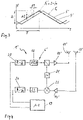
- Fig.1 1 is a device for determining the distance of an object 2, which contains at least one non-linear component 3, in particular a semiconductor component, which, when irradiated with a high-frequency transmission signal 4 ( Fig.2 ) generates an object signal 5 with twice the frequency of the transmission signal 4 and emits it again.
- the device 1 comprises a transmission device 6 for generating the pulsed, high-frequency transmission signals 4.
- a high-frequency oscillator 7 is connected to a transmission antenna 11 via an amplitude modulator 9 containing an electronic switch 8 and a power amplifier 10 .
- the device 1 has a receiving device 12 for receiving the object signals 5 .
- This consists essentially of a receiving antenna 13, a low-noise amplifier 14 and a counter 15, which is connected both to the amplifier 14 and to the transmitting device 6.
- the output of the counter 15 is connected to an evaluation and control unit 16 comprising a microcomputer.
- This evaluation and control unit 16 is also connected to the amplitude modulator 9 via an electrical line 17 .
- the evaluation and control unit 16 causes the electronic switch 8 of the amplitude modulator 9 to close for a predetermined period of time. During this period of time, a pulsed transmission signal 4 is emitted by the transmission antenna 11 and reaches the non-linear component 3 of the object 2. At the same time, the counter 15 is activated and starts counting at a predetermined clock frequency.
- the correspondingly amplified received pulse causes the counting process of the counter 15 to end.
- FMCW frequency-modulated transmission signals
- Fig.3 and 4 explained in more detail for the case of triangular (ie linear) frequency modulation. It was assumed that the distance between the measuring device and the object remains essentially constant and therefore Doppler frequencies do not have to be taken into account. In addition, only object signals should be processed, the frequency of the second harmonic of correspond to the frequency of the transmission signal.
- the frequency difference ⁇ f between the corrected transmission signal 4' and the object signal 5' at any point in time is a measure of the time difference ⁇ t between the transmission of the transmission signal 4' and the reception of the object signal 5' and thus of the distance.
- the illustrated device 1 'for determining the distance of the corresponding object comprises a transmission device 6' with a voltage-controlled oscillator (VCO) 18. This is fed by a microcomputer 19 acting as a ramp generator with a downstream D/A converter 20. The output signal of the oscillator 18 is partly radiated via a power amplifier 10' and a transmission antenna 11' and, after passing through a frequency doubler 21, reaches a mixing stage 22 as a corrected transmission signal 4'.
- VCO voltage-controlled oscillator
- the object signals 5′ emitted by the nonlinear component of the object reach a receiving device 12′ of the device 1′ via a receiving antenna 13′ and are also fed there to the mixing stage 22 via a low-noise amplifier 14′.
- FSK Frequency Shift Keying
- From the frequency jump of the corrected Transmitted signal 4 "is the runtime measured until this frequency jump is registered in the received object signal 5".
- the invention is of course not limited to the exemplary embodiments described above.
- the reception frequency can also be corrected (divided by a factor of two or three) instead of correcting (doubling or tripling) the transmission frequency.
- the frequency of the transmission signal can also be modulated, for example, with a sawtooth voltage signal.
- distortion of the object signals can occur if several non-linear components are present in an object whose distance is to be measured.
- the determined distance which has to be corrected/calibrated in a post-processing step, changes depending on the component.
- a possible classification using the absolute value curves of the two harmonics is used for this purpose. Classification means that an unknown component is compared with an existing database. If there is a high probability of a match using various search methods/similarity methods, a calibration/correction method can be introduced and the distance determination can be corrected.
Landscapes
- Engineering & Computer Science (AREA)
- Remote Sensing (AREA)
- Radar, Positioning & Navigation (AREA)
- Physics & Mathematics (AREA)
- General Physics & Mathematics (AREA)
- Computer Networks & Wireless Communication (AREA)
- Life Sciences & Earth Sciences (AREA)
- Electromagnetism (AREA)
- General Engineering & Computer Science (AREA)
- Acoustics & Sound (AREA)
- Environmental & Geological Engineering (AREA)
- Geology (AREA)
- General Life Sciences & Earth Sciences (AREA)
- Geophysics (AREA)
- Radar Systems Or Details Thereof (AREA)
Claims (10)
- Procédé de détermination de la distance d'un objet (2) qui contient au moins un composant non linéaire (3), en particulier un composant semi-conducteur, qui, lorsqu'il est irradié avec un signal d'émission à haute fréquence (4), génère un signal d'objet (5-5") ayant le double et/ou le triple de la fréquence du signal d'émission (4) et l'émet à nouveau, comprenant les caractéristiques:a) l'objet (2) est irradié avec un signal d'émission pulsé (4), et les signaux d'objet pulsés (5) induits par les composants non linéaires (3) et ayant le double et/ou le triple de la fréquence du signal de transmission (4) sont reçus;b) ensuite, la différence de temps (Δt) entre l'émission du signal d'émission pulsé (4) et la réception du signal d'objet (5) est déterminée, et la distance par rapport à l'objet (2) est déterminée à partir de celle-ci.
- Procédé de détermination de la distance d'un objet (2) qui contient au moins un composant non linéaire (3), en particulier un composant semi-conducteur, qui, lorsqu'il est irradié avec un signal d'émission à haute fréquence (4), génère un signal d'objet (5-5") ayant le double et/ou le triple de la fréquence du signal d'émission (4) et l'émet à nouveau, comprenant les caractéristiques:a) l'objet (2) est irradié avec un signal d'émission modulé périodiquement en fréquence, et les signaux d'objet (5'; 5") induits par les composants non linéaires sont reçus à deux et/ou trois fois la fréquence du signal d'émission;b) puis, la différence de fréquence (Δf) entre la fréquence (fe) du signal d'objet (5'; 5") reçu et la fréquence (fs) qui est augmentée d'un facteur de deux ou trois selon les harmoniques reçues, du signal d'émission actuel corrigé (4'; 4") résultant lors de la réception du signal d'objet est déterminée, et la distance par rapport à l'objet (2) est déterminée à partir de celle-ci.
- Procédé selon la revendication 2, caractérisé par le fait que, pour la comparaison de fréquence entre la fréquence (fe) du signal d'objet et la fréquence (fs') du signal d'émission actuel corrigé (4'), on procède à une correction de la fréquence (fe) du signal d'objet par un facteur de deux ou trois au lieu de doubler ou de tripler la fréquence d'émission (fs).
- Procédé selon la revendication 2 ou 3, caractérisé par le fait qu'un signal d'émission modulé en fréquence de façon linéaire est utilisé en tant que signal d'émission.
- Procédé selon la revendication 2 ou 3, caractérisé par le fait qu'un signal d'émission modulé par modulation par déplacement de fréquence est utilisé en tant que signal d'émission.
- Dispositif de détermination de la distance d'un objet (2) qui contient au moins un composant non linéaire (3), en particulier un composant semi-conducteur, qui, lorsqu'il est irradié avec un signal d'émission à haute fréquence (4), génère un signal d'objet (5-5") ayant le double et/ou le triple de la fréquence (fs) du signal d'émission (4) et l'émet à nouveau, comprenant les caractéristiques:a) le dispositif (1) comprend un dispositif d'émission (6) destiné à générer des signaux d'émission pulsés à haute fréquence (4), un dispositif de réception (12) destiné à recevoir des signaux d'objet (5) dont la fréquence (fe) correspond au double et/ou au triple de la fréquence (fs) des signaux d'émission (4), et au moins une antenne émettrice (11) destinée à émettre les signaux d'émission (4) ainsi qu'au moins une antenne réceptrice (13) destinée à recevoir les signaux d'objet (5);b) le dispositif d'émission (6) et le dispositif de réception (12) sont reliés à un dispositif de circuit pour déterminer la différence de temps (Δt) entre l'émission d'un signal d'émission pulsé (4) et la réception du signal d'objet (5) induit par ce signal d'émission (4) ainsi que pour déterminer la distance (R) de l'objet (2) à partir de la différence de temps (Δt) déterminée.
- Dispositif de détermination de la distance d'un objet (2) qui contient au moins un composant non linéaire (3), en particulier un composant semi-conducteur, qui, lorsqu'il est irradié avec un signal d'émission à haute fréquence (4), génère un signal d'objet (5-5") ayant le double et/ou le triple de la fréquence (fs) du signal d'émission (4) et l'émet à nouveau, comprenant les caractéristiques:a) le dispositif (1') comprend un dispositif d'émission (6') destiné à générer des signaux d'émission à haute fréquence modulés périodiquement en fréquence, un dispositif de réception (12') destiné à recevoir des signaux d'objet (5'; 5") dont la fréquence correspond au double et/ou au triple de la fréquence (fs) des signaux d'émission, et au moins une antenne émettrice (11') destinée à émettre les signaux d'émission ainsi qu'une antenne réceptrice (13') destinée à recevoir les signaux d'objet (5),b) le dispositif d'émission et le dispositif de réception sont reliés à un dispositif de circuit au moyen duquel la différence de fréquence (Δf) entre la fréquence (fe) du signal d'objet (5'; 5") reçu et la fréquence (fs) qui est augmentée d'un facteur de deux ou trois selon les harmoniques reçues, du signal d'émission actuel corrigé résultant lors de la réception du signal d'objet (5'; 5") est déterminée, etc) un micro-ordinateur (19) est monté en aval du dispositif de circuit au moyen duquel la distance de l'objet (2) peut être déterminée à partir de ladite différence de fréquence (Δf).
- Dispositif selon la revendication 7, caractérisé par le fait que le dispositif est conçu de telle manière que, pour la comparaison de fréquence entre la fréquence d'objet (fe) et la fréquence d'émission actuel (fs), on procède à une division de la fréquence de réception (fe) par le facteur de deux ou trois au lieu de doubler ou de tripler la fréquence d'émission (fs).
- Dispositif selon la revendication 7 ou 8, caractérisé par le fait que le dispositif d'émission (6') comprend un oscillateur (18) commandé en tension qui est modulable au moyen d'une tension de modulation en dent de scie ou triangulaire.
- Dispositif selon la revendication 7 ou 8, caractérisé par le fait que le dispositif d'émission (6') comprend un oscillateur (18) commandé en tension qui est modulable au moyen d'une tension de modulation en créneau.
Applications Claiming Priority (2)
| Application Number | Priority Date | Filing Date | Title |
|---|---|---|---|
| DE102013011220.6A DE102013011220A1 (de) | 2013-07-05 | 2013-07-05 | Verfahren und Vorrichtungen zur Bestimmung der Entfernung eines Objektes |
| PCT/EP2014/063516 WO2015000784A2 (fr) | 2013-07-05 | 2014-06-26 | Procédé et dispositifs pour mesurer l'éloignement d'un objet |
Publications (2)
| Publication Number | Publication Date |
|---|---|
| EP3017323A2 EP3017323A2 (fr) | 2016-05-11 |
| EP3017323B1 true EP3017323B1 (fr) | 2022-07-20 |
Family
ID=51162726
Family Applications (1)
| Application Number | Title | Priority Date | Filing Date |
|---|---|---|---|
| EP14736681.9A Active EP3017323B1 (fr) | 2013-07-05 | 2014-06-26 | Procédé et dispositifs pour mesurer l'éloignement d'un objet |
Country Status (4)
| Country | Link |
|---|---|
| EP (1) | EP3017323B1 (fr) |
| DE (1) | DE102013011220A1 (fr) |
| DK (1) | DK3017323T3 (fr) |
| WO (1) | WO2015000784A2 (fr) |
Cited By (1)
| Publication number | Priority date | Publication date | Assignee | Title |
|---|---|---|---|---|
| RU2830970C1 (ru) * | 2024-04-19 | 2024-11-28 | федеральное государственное бюджетное образовательное учреждение высшего образования "Нижегородский государственный технический университет им. Р.Е. Алексеева" (НГТУ) | Способ повышения точности определения дальности до нелинейного рассеивателя при помощи нелинейного радиолокатора, использующего линейно-частотно-модулированные зондирующие сигналы |
Families Citing this family (2)
| Publication number | Priority date | Publication date | Assignee | Title |
|---|---|---|---|---|
| DE102018128962A1 (de) | 2018-11-19 | 2020-05-20 | Rheinmetall Waffe Munition Gmbh | Verfahren zur Bestimmung der Position eines Objektes, Vorrichtung zur Bestimmung der Position eines Objektes und System |
| CN109507642A (zh) * | 2018-12-29 | 2019-03-22 | 广西科技大学 | 一种基于噪声调频技术的非线性目标谐波检测方法 |
Family Cites Families (7)
| Publication number | Priority date | Publication date | Assignee | Title |
|---|---|---|---|---|
| US3732567A (en) * | 1970-09-21 | 1973-05-08 | Nasa | Junction range finder |
| US3781879A (en) * | 1972-06-30 | 1973-12-25 | Rca Corp | Harmonic radar detecting and ranging system for automotive vehicles |
| JP3726441B2 (ja) * | 1997-03-18 | 2005-12-14 | 株式会社デンソー | レーダ装置 |
| GB0103429D0 (en) | 2001-02-13 | 2001-03-28 | Audiotel Internat Ltd | Non-linear junction detector |
| US7639178B1 (en) * | 2005-11-04 | 2009-12-29 | Rockwell Collins, Inc. | System and method for detecting receivers |
| DE102006038627A1 (de) | 2006-08-17 | 2008-02-21 | Rheinmetall Waffe Munition Gmbh | Vorrichtung und Verfahren zur Detektion von nichtlinearen elektronischen Bauelementen oder Schaltungen insbesondere einer Sprengfalle oder dergleichen |
| DE202008000995U1 (de) * | 2008-01-23 | 2008-07-31 | Gundolf, Klaus | Schleuse zur Detektion von Halbleiterübergängen |
-
2013
- 2013-07-05 DE DE102013011220.6A patent/DE102013011220A1/de not_active Withdrawn
-
2014
- 2014-06-26 EP EP14736681.9A patent/EP3017323B1/fr active Active
- 2014-06-26 DK DK14736681.9T patent/DK3017323T3/da active
- 2014-06-26 WO PCT/EP2014/063516 patent/WO2015000784A2/fr not_active Ceased
Cited By (1)
| Publication number | Priority date | Publication date | Assignee | Title |
|---|---|---|---|---|
| RU2830970C1 (ru) * | 2024-04-19 | 2024-11-28 | федеральное государственное бюджетное образовательное учреждение высшего образования "Нижегородский государственный технический университет им. Р.Е. Алексеева" (НГТУ) | Способ повышения точности определения дальности до нелинейного рассеивателя при помощи нелинейного радиолокатора, использующего линейно-частотно-модулированные зондирующие сигналы |
Also Published As
| Publication number | Publication date |
|---|---|
| WO2015000784A2 (fr) | 2015-01-08 |
| EP3017323A2 (fr) | 2016-05-11 |
| DK3017323T3 (da) | 2022-09-05 |
| DE102013011220A1 (de) | 2015-01-08 |
| WO2015000784A3 (fr) | 2015-03-19 |
Similar Documents
| Publication | Publication Date | Title |
|---|---|---|
| DE4244608C2 (de) | Mittels eines Computers durchgeführtes Radarverfahren zur Messung von Abständen und Relativgeschwindigkeiten zwischen einem Fahrzeug und vor ihm befindlichen Hindernissen | |
| EP2850387B1 (fr) | Appareil de mesure de l'éloignement optique comprenant un dispositif d'étalonnage pour la prise en considération de la diaphonie | |
| DE102017207648B4 (de) | Verfahren und Vorrichtung zur Messung einer Schichtdicke eines Objekts | |
| EP1185881B1 (fr) | Dispositif telemetrique et procede pour le calibrage d'un dispositif telemetrique | |
| DE10164030A1 (de) | Verfahren und Schaltungsanordnung zum Messen der Entfernung eines Gegenstandes | |
| DE2411806C2 (de) | Modulationsgenerator für ein Puls-Doppler-Radarsystem | |
| EP2440949B1 (fr) | Procédé et dispositif pour mesurer une variation de distance | |
| EP1825293B1 (fr) | Procede electronique de mesure | |
| DE10208332A1 (de) | Pulsradarvorrichtung und Verfahren zum Erfassen, zum Detektieren und/oder zum Auswerten von mindestens einem Objekt | |
| DE69310004T2 (de) | Verfahren und Vorrichtung zur Feststellung des Erreichens eines vorausbestimmten Abstandes eines Punktreflektors mittels der Laufzeit einer kontinuierlichen Welle | |
| DE102015115462A1 (de) | Verfahren zur Messung des Füllstands eines in einem Behälter befindlichen Füllgutes | |
| EP3017323B1 (fr) | Procédé et dispositifs pour mesurer l'éloignement d'un objet | |
| WO2019234034A1 (fr) | Procédé d'exploitation pour un système lidar, unité de commande, système lidar et dispositif | |
| DE1591117C1 (de) | Einrichtung zur Durchfuehrung eines Impuls-Radarverfahrens mit Empfang nach der Sampling-Methode | |
| EP2707743A1 (fr) | Procédé permettant de faire fonctionner un capteur de distance et dispositif permettant de mettre en uvre ledit procédé | |
| DE4207627C2 (de) | Hochauflösendes Pulsradar mit pseudo-statistischer Modulation | |
| EP3255464B1 (fr) | Circuit récepteur pour armoire à micro-ondes | |
| EP3884299A1 (fr) | Procédé pour la détermination de la position d'un objet, dispositif pour la détermination de la position d'un objet et système | |
| DE102020131288A1 (de) | Verfahren zum Betreiben einer Detektionsvorrichtung zur Bestimmung von Entfernungsgrößen, Detektionsvorrichtung und Fahrzeug mit wenigstens einer Detektionsvorrichtung | |
| DE102005058114B4 (de) | Verfahren und Schaltung zur Abstandsmessung nach dem Radarprinzip | |
| DE19631590A1 (de) | Radarsystem, insbesondere für Kfz-Anwendungen | |
| DE1915813C (de) | Fahrzeugermittlungsvorrichtung | |
| DE102015215408A1 (de) | Annäherungssensor und Verfahren zum Erkennen einer Annäherung an ein Fahrzeuginnenverkleidungsteil eines Fahrzeugs | |
| DE2317385C3 (de) | Vorrichtung zum Vorbestimmen von Fahrzeugzusammenstößen | |
| DE3239501A1 (de) | Verfahren zum messen kurzer entfernungen und anordnung zur durchfuehrung des verfahrens |
Legal Events
| Date | Code | Title | Description |
|---|---|---|---|
| PUAI | Public reference made under article 153(3) epc to a published international application that has entered the european phase |
Free format text: ORIGINAL CODE: 0009012 |
|
| 17P | Request for examination filed |
Effective date: 20151126 |
|
| AK | Designated contracting states |
Kind code of ref document: A2 Designated state(s): AL AT BE BG CH CY CZ DE DK EE ES FI FR GB GR HR HU IE IS IT LI LT LU LV MC MK MT NL NO PL PT RO RS SE SI SK SM TR |
|
| AX | Request for extension of the european patent |
Extension state: BA ME |
|
| RIN1 | Information on inventor provided before grant (corrected) |
Inventor name: CAMP, MICHAEL Inventor name: SCHMITZ, JUERGEN Inventor name: JUNG, MARKUS Inventor name: DUDEK, ELLEN Inventor name: GRAF, ALEXANDER |
|
| DAX | Request for extension of the european patent (deleted) | ||
| STAA | Information on the status of an ep patent application or granted ep patent |
Free format text: STATUS: EXAMINATION IS IN PROGRESS |
|
| 17Q | First examination report despatched |
Effective date: 20210114 |
|
| GRAP | Despatch of communication of intention to grant a patent |
Free format text: ORIGINAL CODE: EPIDOSNIGR1 |
|
| STAA | Information on the status of an ep patent application or granted ep patent |
Free format text: STATUS: GRANT OF PATENT IS INTENDED |
|
| INTG | Intention to grant announced |
Effective date: 20220210 |
|
| RAP3 | Party data changed (applicant data changed or rights of an application transferred) |
Owner name: RHEINMETALL WAFFE MUNITION GMBH |
|
| GRAS | Grant fee paid |
Free format text: ORIGINAL CODE: EPIDOSNIGR3 |
|
| GRAA | (expected) grant |
Free format text: ORIGINAL CODE: 0009210 |
|
| STAA | Information on the status of an ep patent application or granted ep patent |
Free format text: STATUS: THE PATENT HAS BEEN GRANTED |
|
| AK | Designated contracting states |
Kind code of ref document: B1 Designated state(s): AL AT BE BG CH CY CZ DE DK EE ES FI FR GB GR HR HU IE IS IT LI LT LU LV MC MK MT NL NO PL PT RO RS SE SI SK SM TR |
|
| REG | Reference to a national code |
Ref country code: GB Ref legal event code: FG4D Free format text: NOT ENGLISH |
|
| REG | Reference to a national code |
Ref country code: CH Ref legal event code: EP |
|
| REG | Reference to a national code |
Ref country code: DE Ref legal event code: R096 Ref document number: 502014016322 Country of ref document: DE |
|
| REG | Reference to a national code |
Ref country code: AT Ref legal event code: REF Ref document number: 1505878 Country of ref document: AT Kind code of ref document: T Effective date: 20220815 |
|
| REG | Reference to a national code |
Ref country code: IE Ref legal event code: FG4D Free format text: LANGUAGE OF EP DOCUMENT: GERMAN |
|
| REG | Reference to a national code |
Ref country code: DK Ref legal event code: T3 Effective date: 20220829 |
|
| REG | Reference to a national code |
Ref country code: NL Ref legal event code: FP |
|
| REG | Reference to a national code |
Ref country code: LT Ref legal event code: MG9D |
|
| PG25 | Lapsed in a contracting state [announced via postgrant information from national office to epo] |
Ref country code: SE Free format text: LAPSE BECAUSE OF FAILURE TO SUBMIT A TRANSLATION OF THE DESCRIPTION OR TO PAY THE FEE WITHIN THE PRESCRIBED TIME-LIMIT Effective date: 20220720 Ref country code: RS Free format text: LAPSE BECAUSE OF FAILURE TO SUBMIT A TRANSLATION OF THE DESCRIPTION OR TO PAY THE FEE WITHIN THE PRESCRIBED TIME-LIMIT Effective date: 20220720 Ref country code: PT Free format text: LAPSE BECAUSE OF FAILURE TO SUBMIT A TRANSLATION OF THE DESCRIPTION OR TO PAY THE FEE WITHIN THE PRESCRIBED TIME-LIMIT Effective date: 20221121 Ref country code: NO Free format text: LAPSE BECAUSE OF FAILURE TO SUBMIT A TRANSLATION OF THE DESCRIPTION OR TO PAY THE FEE WITHIN THE PRESCRIBED TIME-LIMIT Effective date: 20221020 Ref country code: LV Free format text: LAPSE BECAUSE OF FAILURE TO SUBMIT A TRANSLATION OF THE DESCRIPTION OR TO PAY THE FEE WITHIN THE PRESCRIBED TIME-LIMIT Effective date: 20220720 Ref country code: LT Free format text: LAPSE BECAUSE OF FAILURE TO SUBMIT A TRANSLATION OF THE DESCRIPTION OR TO PAY THE FEE WITHIN THE PRESCRIBED TIME-LIMIT Effective date: 20220720 Ref country code: FI Free format text: LAPSE BECAUSE OF FAILURE TO SUBMIT A TRANSLATION OF THE DESCRIPTION OR TO PAY THE FEE WITHIN THE PRESCRIBED TIME-LIMIT Effective date: 20220720 Ref country code: ES Free format text: LAPSE BECAUSE OF FAILURE TO SUBMIT A TRANSLATION OF THE DESCRIPTION OR TO PAY THE FEE WITHIN THE PRESCRIBED TIME-LIMIT Effective date: 20220720 |
|
| PG25 | Lapsed in a contracting state [announced via postgrant information from national office to epo] |
Ref country code: PL Free format text: LAPSE BECAUSE OF FAILURE TO SUBMIT A TRANSLATION OF THE DESCRIPTION OR TO PAY THE FEE WITHIN THE PRESCRIBED TIME-LIMIT Effective date: 20220720 Ref country code: IS Free format text: LAPSE BECAUSE OF FAILURE TO SUBMIT A TRANSLATION OF THE DESCRIPTION OR TO PAY THE FEE WITHIN THE PRESCRIBED TIME-LIMIT Effective date: 20221120 Ref country code: HR Free format text: LAPSE BECAUSE OF FAILURE TO SUBMIT A TRANSLATION OF THE DESCRIPTION OR TO PAY THE FEE WITHIN THE PRESCRIBED TIME-LIMIT Effective date: 20220720 Ref country code: GR Free format text: LAPSE BECAUSE OF FAILURE TO SUBMIT A TRANSLATION OF THE DESCRIPTION OR TO PAY THE FEE WITHIN THE PRESCRIBED TIME-LIMIT Effective date: 20221021 |
|
| REG | Reference to a national code |
Ref country code: DE Ref legal event code: R097 Ref document number: 502014016322 Country of ref document: DE |
|
| PG25 | Lapsed in a contracting state [announced via postgrant information from national office to epo] |
Ref country code: SM Free format text: LAPSE BECAUSE OF FAILURE TO SUBMIT A TRANSLATION OF THE DESCRIPTION OR TO PAY THE FEE WITHIN THE PRESCRIBED TIME-LIMIT Effective date: 20220720 Ref country code: RO Free format text: LAPSE BECAUSE OF FAILURE TO SUBMIT A TRANSLATION OF THE DESCRIPTION OR TO PAY THE FEE WITHIN THE PRESCRIBED TIME-LIMIT Effective date: 20220720 Ref country code: CZ Free format text: LAPSE BECAUSE OF FAILURE TO SUBMIT A TRANSLATION OF THE DESCRIPTION OR TO PAY THE FEE WITHIN THE PRESCRIBED TIME-LIMIT Effective date: 20220720 |
|
| PLBE | No opposition filed within time limit |
Free format text: ORIGINAL CODE: 0009261 |
|
| STAA | Information on the status of an ep patent application or granted ep patent |
Free format text: STATUS: NO OPPOSITION FILED WITHIN TIME LIMIT |
|
| PG25 | Lapsed in a contracting state [announced via postgrant information from national office to epo] |
Ref country code: SK Free format text: LAPSE BECAUSE OF FAILURE TO SUBMIT A TRANSLATION OF THE DESCRIPTION OR TO PAY THE FEE WITHIN THE PRESCRIBED TIME-LIMIT Effective date: 20220720 Ref country code: EE Free format text: LAPSE BECAUSE OF FAILURE TO SUBMIT A TRANSLATION OF THE DESCRIPTION OR TO PAY THE FEE WITHIN THE PRESCRIBED TIME-LIMIT Effective date: 20220720 |
|
| 26N | No opposition filed |
Effective date: 20230421 |
|
| PG25 | Lapsed in a contracting state [announced via postgrant information from national office to epo] |
Ref country code: AL Free format text: LAPSE BECAUSE OF FAILURE TO SUBMIT A TRANSLATION OF THE DESCRIPTION OR TO PAY THE FEE WITHIN THE PRESCRIBED TIME-LIMIT Effective date: 20220720 |
|
| PG25 | Lapsed in a contracting state [announced via postgrant information from national office to epo] |
Ref country code: SI Free format text: LAPSE BECAUSE OF FAILURE TO SUBMIT A TRANSLATION OF THE DESCRIPTION OR TO PAY THE FEE WITHIN THE PRESCRIBED TIME-LIMIT Effective date: 20220720 |
|
| PG25 | Lapsed in a contracting state [announced via postgrant information from national office to epo] |
Ref country code: MC Free format text: LAPSE BECAUSE OF FAILURE TO SUBMIT A TRANSLATION OF THE DESCRIPTION OR TO PAY THE FEE WITHIN THE PRESCRIBED TIME-LIMIT Effective date: 20220720 |
|
| PG25 | Lapsed in a contracting state [announced via postgrant information from national office to epo] |
Ref country code: MC Free format text: LAPSE BECAUSE OF FAILURE TO SUBMIT A TRANSLATION OF THE DESCRIPTION OR TO PAY THE FEE WITHIN THE PRESCRIBED TIME-LIMIT Effective date: 20220720 |
|
| REG | Reference to a national code |
Ref country code: CH Ref legal event code: PL |
|
| REG | Reference to a national code |
Ref country code: BE Ref legal event code: MM Effective date: 20230630 |
|
| PG25 | Lapsed in a contracting state [announced via postgrant information from national office to epo] |
Ref country code: LU Free format text: LAPSE BECAUSE OF NON-PAYMENT OF DUE FEES Effective date: 20230626 |
|
| REG | Reference to a national code |
Ref country code: IE Ref legal event code: MM4A |
|
| PG25 | Lapsed in a contracting state [announced via postgrant information from national office to epo] |
Ref country code: LU Free format text: LAPSE BECAUSE OF NON-PAYMENT OF DUE FEES Effective date: 20230626 |
|
| PG25 | Lapsed in a contracting state [announced via postgrant information from national office to epo] |
Ref country code: IE Free format text: LAPSE BECAUSE OF NON-PAYMENT OF DUE FEES Effective date: 20230626 |
|
| PG25 | Lapsed in a contracting state [announced via postgrant information from national office to epo] |
Ref country code: IE Free format text: LAPSE BECAUSE OF NON-PAYMENT OF DUE FEES Effective date: 20230626 Ref country code: CH Free format text: LAPSE BECAUSE OF NON-PAYMENT OF DUE FEES Effective date: 20230630 |
|
| PG25 | Lapsed in a contracting state [announced via postgrant information from national office to epo] |
Ref country code: BE Free format text: LAPSE BECAUSE OF NON-PAYMENT OF DUE FEES Effective date: 20230630 |
|
| REG | Reference to a national code |
Ref country code: AT Ref legal event code: MM01 Ref document number: 1505878 Country of ref document: AT Kind code of ref document: T Effective date: 20230626 |
|
| PG25 | Lapsed in a contracting state [announced via postgrant information from national office to epo] |
Ref country code: AT Free format text: LAPSE BECAUSE OF NON-PAYMENT OF DUE FEES Effective date: 20230626 |
|
| PG25 | Lapsed in a contracting state [announced via postgrant information from national office to epo] |
Ref country code: AT Free format text: LAPSE BECAUSE OF NON-PAYMENT OF DUE FEES Effective date: 20230626 |
|
| PG25 | Lapsed in a contracting state [announced via postgrant information from national office to epo] |
Ref country code: BG Free format text: LAPSE BECAUSE OF FAILURE TO SUBMIT A TRANSLATION OF THE DESCRIPTION OR TO PAY THE FEE WITHIN THE PRESCRIBED TIME-LIMIT Effective date: 20220720 |
|
| PG25 | Lapsed in a contracting state [announced via postgrant information from national office to epo] |
Ref country code: BG Free format text: LAPSE BECAUSE OF FAILURE TO SUBMIT A TRANSLATION OF THE DESCRIPTION OR TO PAY THE FEE WITHIN THE PRESCRIBED TIME-LIMIT Effective date: 20220720 |
|
| PGFP | Annual fee paid to national office [announced via postgrant information from national office to epo] |
Ref country code: DE Payment date: 20250618 Year of fee payment: 12 |
|
| PGFP | Annual fee paid to national office [announced via postgrant information from national office to epo] |
Ref country code: GB Payment date: 20250618 Year of fee payment: 12 Ref country code: DK Payment date: 20250625 Year of fee payment: 12 |
|
| PGFP | Annual fee paid to national office [announced via postgrant information from national office to epo] |
Ref country code: NL Payment date: 20250618 Year of fee payment: 12 |
|
| PGFP | Annual fee paid to national office [announced via postgrant information from national office to epo] |
Ref country code: FR Payment date: 20250625 Year of fee payment: 12 |
|
| PG25 | Lapsed in a contracting state [announced via postgrant information from national office to epo] |
Ref country code: CY Free format text: LAPSE BECAUSE OF FAILURE TO SUBMIT A TRANSLATION OF THE DESCRIPTION OR TO PAY THE FEE WITHIN THE PRESCRIBED TIME-LIMIT; INVALID AB INITIO Effective date: 20140626 |
|
| PG25 | Lapsed in a contracting state [announced via postgrant information from national office to epo] |
Ref country code: HU Free format text: LAPSE BECAUSE OF FAILURE TO SUBMIT A TRANSLATION OF THE DESCRIPTION OR TO PAY THE FEE WITHIN THE PRESCRIBED TIME-LIMIT; INVALID AB INITIO Effective date: 20140626 |
|
| PGFP | Annual fee paid to national office [announced via postgrant information from national office to epo] |
Ref country code: IT Payment date: 20250624 Year of fee payment: 12 |
|
| PG25 | Lapsed in a contracting state [announced via postgrant information from national office to epo] |
Ref country code: TR Free format text: LAPSE BECAUSE OF FAILURE TO SUBMIT A TRANSLATION OF THE DESCRIPTION OR TO PAY THE FEE WITHIN THE PRESCRIBED TIME-LIMIT Effective date: 20220720 |