EP3017364B1 - Système et procédé pour la rationalisation de développement d'interface utilisateur - Google Patents
Système et procédé pour la rationalisation de développement d'interface utilisateur Download PDFInfo
- Publication number
- EP3017364B1 EP3017364B1 EP14819710.6A EP14819710A EP3017364B1 EP 3017364 B1 EP3017364 B1 EP 3017364B1 EP 14819710 A EP14819710 A EP 14819710A EP 3017364 B1 EP3017364 B1 EP 3017364B1
- Authority
- EP
- European Patent Office
- Prior art keywords
- data
- scene
- collaborative
- platform
- computing device
- Prior art date
- Legal status (The legal status is an assumption and is not a legal conclusion. Google has not performed a legal analysis and makes no representation as to the accuracy of the status listed.)
- Active
Links
Images







Classifications
-
- G—PHYSICS
- G06—COMPUTING OR CALCULATING; COUNTING
- G06F—ELECTRIC DIGITAL DATA PROCESSING
- G06F8/00—Arrangements for software engineering
- G06F8/30—Creation or generation of source code
- G06F8/38—Creation or generation of source code for implementing user interfaces
-
- G—PHYSICS
- G06—COMPUTING OR CALCULATING; COUNTING
- G06T—IMAGE DATA PROCESSING OR GENERATION, IN GENERAL
- G06T13/00—Animation
-
- G—PHYSICS
- G06—COMPUTING OR CALCULATING; COUNTING
- G06T—IMAGE DATA PROCESSING OR GENERATION, IN GENERAL
- G06T2200/00—Indexing scheme for image data processing or generation, in general
- G06T2200/24—Indexing scheme for image data processing or generation, in general involving graphical user interfaces [GUIs]
Definitions
- the present invention relates generally to user interface development.
- the present invention further relates to solutions for aiding in the development of natural user interfaces (NUI).
- NUI natural user interfaces
- a user interface generally refers to a mechanism that facilitates interaction between a human and a machine.
- a UI may also be called a human-machine interface or a human-computer interface in various contexts.
- a UI may be provided to allow users to interact with and control software programs, including, for example, operating system software and various application software (e.g., office suites, media players, graphics editors, games, etc.).
- a user interface may also be provided to allow users to interact with and control web applications presented by way of web pages displayed in web browsers.
- a user interface may also be provided to allow users to interact with and control a variety of electronic devices. For example, electronic devices such as cameras, DVD players, music players, set-top boxes, mobile devices, and so on all have UI components.
- a user interface may also be integrated with various machines and devices such as, for example, vehicles (on dashboards), elevators, security alarm systems, and so on.
- a UI may include textual elements and graphical elements.
- a UI may include active elements that receive user input (e.g., buttons, controls, scroll bars, etc.) or provide user output, and passive elements that serve to frame content/information and to provide sensory cues to users (e.g., visual or audio cues).
- user input e.g., buttons, controls, scroll bars, etc.
- passive elements that serve to frame content/information and to provide sensory cues to users (e.g., visual or audio cues).
- Many Uls include a combination of such elements.
- a user interface may be adapted to receive user input by way of signals from input devices (e.g., a keyboard, a mouse, or a touch screen), voice recognition, gestures, or the like.
- input devices e.g., a keyboard, a mouse, or a touch screen
- voice recognition e.g., voice recognition, gestures, or the like.
- UX user experience
- UI elements are designed in part around user workflows driven when a user interacts with system features that are part of the overall UX.
- Natural user interface is the common parlance used by designers and developers of human-machine interfaces (or human-computer interfaces) to refer to a user interface that is (1) effectively invisible, or becomes invisible with successive learned interactions, to its users, and (2) is based on "natural” elements.
- Natural in this context means that the elements need not be learned, or require less learning, as they mimic known or already learned processes.
- the natural elements are contrasted for example with the artificial user elements used for example in control interfaces that are not created based on natural user interface principles.
- NUI elements are created using processes involving both designers and programmers.
- Designers use such tools as AFTER EFFECTS TM to compose the look and feel of a UI or UX., i.e., to define a design intent.
- US 2012/174000 A1 describes a graphical user interface screen design, generating, based on the data representative of the graphical user interface screen design, abstraction data representative of the graphical user interface screen design, and generating, based on the abstraction data, computing code configured to be processed by target computing devices having different computing platforms to render graphical user interface screens in accordance with the graphical user interface screen design.
- WO 01/95102 A1 describes a method using a processor, a display and peripherals. It comprises the following steps: creating entities intervening in the definition of a browsing interface, defining the evolution of said entities in time; working out with the processor a structure of a first type H; reading and interpreting said data structure; working out by the processor of entities corresponding to said structure; possibly displaying some entities in accordance with the models described by said structure, taking into account by the processor of the user's actions on the peripherals to monitor and modify the interface and to browse through the contents.
- a computer network implemented system provides a development platform for streamlining the creation of a graphical user interface having natural user interface (NUI) attributes (the "platform”).
- NUI natural user interface
- the platform is based on a novel and innovative development framework and workflow that enables the creation of executable GUI elements.
- a computer network implemented system provides a development platform for streamlining the creation of graphical user interface having natural user interface (NUI) attributes (the "platform”).
- NUI natural user interface
- the platform is based on a novel and innovative development framework and workflow that enables the creation of UI assets.
- the development platform allows designers and developers to collaborate to create GUI assets in a novel and innovative manner.
- the development platform manages and provides a collaborative user interface development environment.
- the overall workflow is streamlined thereby allowing new collaborative methods and ways of working, including for example making modifications to a user interface development quickly or possibly in real time upon receipt of feedback from a designer, allowing tighter and more efficient working relationships between collaborators.
- the platform also allows larger teams to work together more effectively by providing a consistent way of completing work elements, allowing multiple individuals to pick up project tasks, with minimal effort required for a new person to a project to get up to speed.
- the development platform automates steps previously performed by a developer or a designer, thereby improving development efficiency and reducing costs.
- the development platform also facilitates parallel completion of some tasks by designers and developers, resulting in more efficient collaboration.
- the development platform simplifies collaboration between developers and designers. As a result, some steps previously requiring a developer may be executed by a designer, and possibly vice versa.
- FIG. 1 there is depicted a development platform server (100) interconnected with a designer computing device (4) and a developer computing device (6), by way of a communication network (8).
- Designer computing device (4) may be operated by one or more designers (2) to access data and services provided by development platform server (100).
- developer computing device (6) may be operated by one or more developers to access data and services provided by development platform server (100).
- Designer computing device (4) and developer computing device (6) may each be a conventional network-interconnected computing device. As such, the architecture of designer computing device (4) and developer computing device (6) is not specifically illustrated. Each of designer computing devices (4) and developer computing device (6) may include a processor, network interface, display, and memory, and may be a desktop personal computer, a laptop computing device, a network computing device, a tablet computing device, a personal digital assistance, a mobile phone, or the like.
- Network (8) may be any network capable of carrying data including the Internet, Ethernet, plain old telephone service (POTS) line, public switch telephone network (PSTN), integrated services digital network (ISDN), digital subscriber line (DSL), coaxial cable, fiber optics, satellite, mobile, wireless (e.g. Wi-Fi, WiMAX), SS7 signaling network, fixed line, local area network, wide area network, and others, including any combination of these.
- POTS plain old telephone service
- PSTN public switch telephone network
- ISDN integrated services digital network
- DSL digital subscriber line
- coaxial cable fiber optics
- satellite mobile
- wireless e.g. Wi-Fi, WiMAX
- SS7 signaling network fixed line, local area network, wide area network, and others, including any combination of these.
- FIG. 2 schematically illustrates development platform server (100), in accordance with one example embodiment of the present invention.
- server (100) may include at least one central processing unit (“CPU") (102) connected to a storage unit (104) and to memory (106).
- CPU central processing unit
- storage unit 10
- memory 106
- CPU (102) may be any type of processor, such as, for example, any type of general-purpose microprocessor or microcontroller (e.g., an Intel TM x86, PowerPC TM , ARM TM processor, or the like), a digital signal processing (DSP) processor, an integrated circuit, a programmable read-only memory (PROM), or any combination thereof.
- processors such as, for example, any type of general-purpose microprocessor or microcontroller (e.g., an Intel TM x86, PowerPC TM , ARM TM processor, or the like), a digital signal processing (DSP) processor, an integrated circuit, a programmable read-only memory (PROM), or any combination thereof.
- DSP digital signal processing
- PROM programmable read-only memory
- Storage unit (104) may include one or more storage devices such as a hard disk, solid-state disk, or the like. Storage unit (104) may also be partly or wholly cloud-based, accessible via a network such as network (8).
- Memory (106) may include a suitable combination of any type of computer memory that is located either internally or externally such as, for example, random-access memory (RAM), read-only memory (ROM), compact disc read-only memory (CDROM), electro-optical memory, magneto-optical memory, erasable programmable read-only memory (EPROM), and electrically-erasable programmable read-only memory (EEPROM), or the like.
- RAM random-access memory
- ROM read-only memory
- CDROM compact disc read-only memory
- electro-optical memory magneto-optical memory
- EPROM erasable programmable read-only memory
- EEPROM electrically-erasable programmable read-only memory
- the CPU (102) may process an operating system (101), application program (103), and data (123).
- the operating system (101), UI development software (103), and data (123) may be stored in storage unit (104) and loaded into memory (106), as may be required.
- Operating software (101) may, for example, be a Microsoft Windows TM , Unix TM , Linux TM , OSX TM operating system or the like.
- UI development software (103) and data (123), when processed at CPU (102), provide the functionality of the development platform described herein, as further detailed below.
- UI development software (103) may be implemented in a high level procedural or object oriented programming or scripting language, or both. However, alternatively software (103) may be implemented in assembly or machine language, if desired. The language may be a compiled or interpreted language.
- Server (100) may further include a graphics processing unit (GPU) 122 which is operatively connected to CPU (102) and to memory (106) to offload intensive image processing calculations from CPU (102) and run these calculations in parallel with CPU (102).
- GPU graphics processing unit
- An operator (107) may interact with server (100) using a video display (108) connected by a video interface (105), and various input/output devices such as a keyboard (110), mouse (112), and disk drive (114) connected by an I/O interface (109).
- mouse (112) may be configured to control movement of a cursor in video display (108), and to operate various graphical user interface (GUI) controls appearing in the video display (108) with a mouse button.
- Disk drive (114) may be configured to accept computer readable media (116).
- Server (100) may connect to one or more networks such as network (8) via network interface (111).
- Network interface (111) allows server (100) to communicate by way of wired or wireless communications with other computing devices such as designer computing devices (4) and developer computing devices (6).
- Server (100) may be embodied in various form factors including one or more desktop and laptop computers, and wireless mobile computer devices such as tablets, smart phones and super phones. It will be appreciated that the present description does not limit the size or form factor of the computing device on which the present system and method may be embodied.
- FIG. 3 illustrates a development platform (10) provided by server (100), in accordance with an example embodiment of the present invention.
- server (100) is linked to a server application (52) that includes a collaborative development system (54), which may be implemented as an application repository.
- the collaborative development system (54) includes a display utility (11) and a project management utility (13).
- display utility (11) presents a series of screens made accessible to platform users to access the functions and features described herein.
- project management utility (13) may incorporate standard features for creating and managing UI development related projects.
- collaborative development system (54) also integrates the resources of a 3D rendering system (12), which may be implemented as a middleware resource as shown in FIG. 1 .
- the 3D rendering system (12) is programmed to display and animate UI elements.
- the rendering system (12) renders UI elements using the assets in a way that related effects are accurately rendered.
- the platform (10) allows rendering to be completed partly or wholly by designer computing device (4) or developer computing device (6).
- server (100) provides online access to the functions of the 3D rendering system (12) in order to enable access to platform users to UI assets developed using the collaborative development system (54).
- Such users may, for example, include designers (2) or developers (3) accessing platform (10) by way of network (8).
- the display utility (11) may present a project panel (to access features of the project management utility (13)), a composition panel, and a timeline panel.
- the project panel acts as a bin to import stills, video, and audio footage items. Footage items from the project panel are used in the timeline panel, where layer order and timing can be adjusted.
- the items visible at the current time marker are displayed in the composition panel, which is used to add transitions and other effects. Panels may be presented to either designer computing device (4) or developer computing device (6).
- the composition panel allows a designer to capture the various elements and information indicative of their intent relative to the UI design, to enable creation of a series of UI assets that are encoded with sufficient information to enable their rendering with significantly reduced development effort than in prior art solutions.
- the assets referred to herein incorporate coding elements corresponding to relevant effects such as position, animation, and "look".
- the elements together represent the design intent that is important to convey the important elements for accurately rendering a NUI.
- the platform (10) is designed to encode the assets with state to state transitions such that the assets themselves can be manipulated (to change order and make modifications for example), and yet these assets are also executable, e.g., to exhibit encoded behavior and presentation.
- a designer uses an existing motion graphics / visual graphics platform (11) ("visual graphics platform"), such as AE, and the output from the visual graphic platform is imported to the platform (10) of the present invention. Importing may include transmitting the data to the platform (10) by way of network (8).
- the output generally consists of video content that shows UI elements organized in an animated workflow that illustrates interaction with the UI elements.
- the 3D rendering system (12) includes: (A) a scene manager (16), (B) a scene renderer (17), and (C) a timeline utility (18).
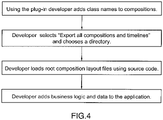
- FIG. 4 A representative implementation of the invention is shown in FIG. 4 as a possible workflow for practicing the invention.
- a platform user who is a designer creates a UI layout and associated animations for example using AE or a similar platform.
- a platform user who is a developer loads an AE project file into AE, wherein AE includes a plug-in in accordance with the present invention.
- C Using the plug-in the platform user who is a developer adds class names to compositions, based on the present invention.
- the platform user who is a developer optionally selects "Export all compositions and timelines" or equivalent from the plug-in and chooses a directory.
- the platform user who is a developer loads root composition layout files using source code.
- the platform user who is a developer adds business logic and data to the application.
- a platform user who is a designer may access the platform (10) by operating designer computing device (4).
- a platform user who is a developer may access the platform (10) by operating developer computing device (6).
- a computer implemented method for designing and implementing a series of UI elements in a streamlined way.
- One implementation of the method consists of: (A) decomposing a UI design into a series of UI components (usually UI designer); (B) creating UI controls for the UI design, using a design tool or composition tool (usually UI designer); (C) add behavior class names for each behavior control (usually UI designer); (D) export UI controls to an asset file (usually UI designer); (E) import UI controls into source code (UI designer or UI developer); (F) access or generate specific code to handle business logic (for example what happens when a specific button is pushed) (usually UI developer); (G) Export UI controls to asset files (UI Developer); (H) import UI controls into source code (UI Developer); and (I) write or import specific code to handle business logic - e.g. what happens when a button is pushed (UI Developer).
- an additional step consists of iterating the UI controls using the design tool.
- a "UI control” is an element of a GUI that displays an information arrangement changeable by the user, such as a window or a text box.
- UI controls can have both presentation and behavior.
- the input to the platform (10) may consist of output files from a number of systems such as: (A) graphics files such as PNG or JPEG; (B) scene trees such as those generated by such platforms as AFTER EFFECTS TM (AE) of Adobe; or (C) animation files generated by AE or FLASH TM .
- A graphics files such as PNG or JPEG
- B scene trees such as those generated by such platforms as AFTER EFFECTS TM (AE) of Adobe
- C animation files generated by AE or FLASH TM .
- platform (10) handles both time-based animation files and frame-based animation files.
- the platform (10) receives as input files from a motion graphics /visual effects platform such as AE.
- AE is used to develop sophisticated videos using a large number of effects and a 3D stage.
- Adobe publishes an API which allows developers to extract information within the content.
- There are many commercial graphical design tools which help designers create 3D content in this way such as Maya TM , 3D Studio TM , Blender TM , etc. , and the present invention may interoperate with such platforms as well.
- the platform (10) includes an extractor (15) that analyzes the output files.
- the computer system provides a number of tools that allows platform users to add class names to as to identify components that are UI controls.
- the extractor (15) analyzes, and identifies, components that constitute UI controls.
- the platform (10) categorizes UI controls into "presentation" related UI controls and "behavior related" UI controls.
- UI controls can have both presentation and behavior.
- the extractor is operable to differentiate between presentation related attributes and behavior related attributes, and generate UI assets based on the input in a way that attributes are encoded based on their type, i.e. whether they are presentation or behavior related.
- This aspect allows the UI assets to be manipulated as required by the designer, and also for UI assets to encode the designer's intent for aspects of the computer system operations managed by developer users.
- the presentation may consist of: (A) location (position, scale, rotation), (B) opacity (how translucent it is), (C) bitmaps (the graphics to display the control), (D) visual effects (lighting, shadows, blur), and (D) animations (how parts of the control move in response to events).
- the behavior consists of: states of the control (pushed up, pushed down, scrolling, etc) information on how to transition from one state to another.
- the presentation of a UI control is developed in a commercial tool that UI designers know how to use, and then exported as asset files.
- This workflow is for UI controls that are described in 3D space, using a 3D coordinate system and a camera which determines how they are rendered on the screen. These controls are described visually using a tree structure, where each node in the tree can be a graphical element to display, as shown in FIG. 8 .
- This graphical element can be a single quad of triangles, or a large mesh of many thousands of triangles.
- the behavior may be defined in C++ classes within the platform (10), by instantiating appropriate classes for the UI control when the asset file is loaded.
- presentation and behavior are separated, they need to communicate with each other. For example, at some point a change in the behavior may trigger a particular visual effect, and so this effect has to be communicated to the behavior code.
- presentation content can communicate to the behavior code, for example specific presentation related names can be used to name each element. These names can then be used in behavior code to identify a particular element. Markers can be added to timelines thereby indicating for example for an animation, a start, end and name for a particular portion of an animation. The behavior code can then use this to extract a specific animation based on a name.
- Assigning a class name to a control - each UI control can have a string associated with it which indicates the C++ class that will be instantiated when the asset file is loaded. This is the mechanism used to bind the presentation to behavior.
- a single UI control can export two files - a layout file and a timeline file.
- the layout files describe the attributes of each node in the control such as position, rotation, anchor point, scale, orientation opacity source - either a bitmap file, a solid color, or another UI control.
- the export process becomes recursive and writes files for each embedded control. During this process, animation information is saved within a separate timeline file.
- the animation information contains data needed to change attributes of nodes within the control over time.
- FIG. 7 illustrates the process of importation of files to the platform (10).
- Importing layout files results in creating C++ classes that both render to the screen and provide UI behavior.
- Rendering is achieved by using a 3D scene graph data model, which allows the user interface to be hardware accelerated by a GPU.
- Behavior is achieved by classes which are derived from a base view class. This base view class is in turn derived from a base scene node, as shown in FIG. 8 for example.
- Importing .timeline files results in creating instances of the timeline class.
- This class stores all information required to animate attributes of the scene tree that was created when importing the .layout file.
- the timeline markers are used to create named timelines of a given duration that will be started and stopped based on UI behavior and state.
- the scene manager (16) allows a user to define a 3D scene for a UI project using a tree structure, wherein each component corresponds to a UI element, and its position in the tree structure is indicative of the UI elements position in 3D space.
- FIG. 8 illustrates the operations of the scene manager (16), wherein a tree structure comprising a plurality of nodes that are called scene nodes.
- the scene manager (16) assists platform users in being able to organize UI scenes and their relationships with one another.
- the scene manager (16) also is configured to enable transformations of scenes through the UI that it presents. For example application of a transform to a specific node applies the same transformation to all of its child nodes, if any.
- the scene renderer (17) includes a data modeller (20) to drive the rendering of UI elements.
- the scene nodes contain not only their position data, but other data related to rendering such as for example vertex, mesh and material data, thereby enabling the scene renderer (17) to render on a node by node basis if this is requested by a user.
- the scene renderer (17) in one implementation, is programmed to render 3D graphics on a wide range of rendering APIs such as OpenGL ES 2.0, DirectX, PS3, etc..
- the scene renderer (17) requests a display list from the scene manager (16).
- the display list can consist of an optimized data stream that compiles information for each scene node.
- the scene renderer (17) uses abstract constructs for rendering one or more UI graphical objects, including meshes, materials, and uniform buffers. Significantly, these graphical objects represent sufficient information for rendering as 3D objects.
- the UI graphical objects are not however a concrete implementation; these using the sub-classes explained below. This way, however, the platform users can interact with 3D content without the need to use underlying rendering APIs that would be required in order to execute to a graphics processing unit ("GPU").
- GPU graphics processing unit
- the design of the scene renderer (17) allows a user to generate generic 3D drawings and a range of effects. This allows a designer to compose UI elements, review and make changes to UI elements. In effect, this allows a designer to advance the development of UI and UX elements, without the need to wait for work product from programmers. This speeds up the development process and saves resources. It also allows designers to engage in a development process that is more natural and therefore allows designers to be more creative by following inspiration and testing particular design ideas. The disintermediation of the design process that is involved in prior art solutions, where the workflow is divided between designers and programmers is far less advantageous than the present invention.
- a key insight of the present invention is the particular level of rendering capability provided, and the UI design features that are associated with the rendering capability.
- the timeline utility (18) is used to animate scene nodes (transform, opacity) and their contents (vertices, shader variables, etc).
- the timeline utility (18) provides a list of "tracks", where each track corresponds to one attribute for animation.
- Each track also contains any number of key times, which are used to identify at what point a value changes to a new value.
- the key times can also be expressed as Bezier curves which indicate how the values change over time.
- the rendering system workflow consists of: (A) current time is evaluated and updated; (B) user input is received and handled; (C) timelines are updated with a new time; (D) this results in an update to affected scene nodes and their content; (E) the scene manager is processed; (F) any dirty scene nodes re-calculate their composite world matrices; (G) a draw list is rendered; and (H) the draw list is destroyed.
- the rendering system (22) of the present invention can be implemented over a middleware layer (24), as shown in FIG. 3 .
- the computer system also includes one or more libraries (26).
- the libraries (26) may include for example templates for different UI development projects.
- the libraries (26) may also include routines for items such as image decoding, text glyph rendering, etc.
- a template may include a look for a view, or layout.
- the layout may contain one or more scene nodes that together define the graphical elements for a view.
- a template can also define the animations for a view for example how items move and relate together when responding to specific states.
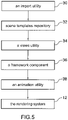
- the platform (10) may include: (A) an import utility (30); (B) scene templates (32) repository; (C) a views utility (34); (D) a framework component (36); (E) an animation utility (38); and (F) the rendering system (12).
- the framework component (36) acts as connector or communication layer between the various components in order to enable the workflows described.
- the import utility (30) extracts information from one or more tools and makes the information available to the other components.
- the views utility (34) may include common UI behaviors, for example ListView, PushButtonView, etc.
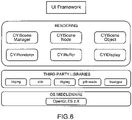
- a representative implementation of the rendering system (12) may be implemented with the components shown in FIG. 6 . These may include: (A) a component referred to as a CYIDisplay, which is a display component, which abstracts access to the OpenGL hardware; (B) a component referred to as the CYIBuffer, which contains bitmap data and blitting routines for both hardware and software buffers; (C) a component referred to as a CYIRenderer, which contains a list of scene node data, renders using OpenGL; (D) a component referred to as the CYISceneNode, which contains a building block of graphics sub-components, and provides a scene tree that includes positional information (this is no the component where drawing occurs); (E) a component referred to as the CYISceneObject, which is what the user draws; and finally (F) a component referred to as the CYISceneManager, which returns a render list of scene nodes and provides scene node data to the renderer
- the platform (10) uses After Effects TM from Adobe. What follows is an example of the operation of the platform (10), working with After Effects ("AE").
- a UI design tool such as AE can communicate with the server application (52) shown in FIG. 3 .
- a plug-in may be provided (not shown) which incorporates aspects of the features described into a UI design tool such as AE.
- UI design features such as those available through AE, as an example, may be implemented to the server application (52).
- What follows is an example of the implementation of the present invention, wherein features of a UI design tool such as AE are enhanced using a plug-in, including by optionally leveraging the resources of the server (100) that includes collaborative development features that enhance the UI development functions.
- AE files consist of nested compositions. Each composition can have layers and/or other compositions.
- the platform (10) may include a plug-in that extracts files from AE, and specifically layout files for each composition from AE.
- the layout files extracted from AE may include: (A) a list of layers used in the composition, the layers containing 3D positional data such as position, rotation, anchor point, scale, orientation; and (B) a list of sources used in the composition, which may include bitmaps, NULL objects, solid colors, or compositions.
- a platform user can name a composition. Class names are assigned fro the purposes of the scene view. The various elements for the composition are defined. Width/height for the scene may be selected using 2D coordinates.
- the plug-in exports timeline related information from AE (although AE does not contain a timeline concept similar to that used by the platform.
- Each track an element's property - such as position rotation.
- key time information is obtained. This includes for example what a particular value was at a given time, i.e. that at time X track Y had Z value. Rate of change can be determined using for example Bezier control points.
- Marker information is obtained from AE that represents logical or functional elements. For example, one marker may indicate 'pushdown', another 'pushup'. These have a start time and duration and allow the platform (10) to automatically bind behavior state to the animation. For example, if the composition class name is 'CYIPushButtonView', and the timeline contained a marker for 'ondown', then that part of the timeline would be used when the user pushes down on the button
- the platform aligns automatically the various elements with the timeline automatically.
- the platform loads the layout file for the root composition and automatically loads other layout files for any embedded compositions. These other layout files are created as CYIAETemplate instances and stored in the asset manager. Timeline files are automatically loaded as well, one per composition. The timeline data is stored in the CYIETTemplate instance.
- a scene tree of CYISceneView (or derived) instances are created, complete with timeline animation data, from the CYIAETemplates.
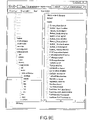
- FIGS. 9A , 9B , 9C , 9D , 9E , and 9F illustrate the operation of the present invention by referring to a series of representative screenshot views of the platform of the present invention, in one representative implementation of the present invention.
- FIGS. 9A-9F in order to illustrate the operation of the present invention, access to features of the platform (10) are shown as enhancements to AE.
- FIG. 9A shows a screen displayed by the platform (10) that a UI designer user would use to create a UI layout using for example animations from AE.
- the UI designer can define the position of UI items, how they animate, and how they interact with one another.
- FIG. 9B shows that any given UI design is made of multiple components, each component being for example a composition from AE.
- each button, or list item, in a given UI design is its own composition.
- the UI developer then adds animations to the components, and puts specific markers on the timelines to give a context to the timeline. For example, they can add 'DownOn, 'UpPn', etc. markers to the timeline for a button.
- FIG. 9C illustrates a screen where the UI developer can access various other tools to create complex UI controls in order to generate looks and animations based on the UI content.
- FIG. 9D shows a representative screen once a project has been assigned to a software developer.
- the platform (10) integrates tools and workflows that are used by designers and developers respectively, in a seamless manner.
- the developer can provide each composition a class name by adding information in.
- FIG. 9E shows a representative screen displaying the functions of the plugin.
- the plugin of the platform (10) allows the developer to write a timeline and a layout file for each composition.
- the developer then loads the top-level root composition layout file.
- This file in turn loads all of the compositions it uses, along with their timeline files.
- a working UI tree is created that can be rendered with a 3D engine, and can be interacted with by the user.
- the final step is for the software developer to add business logic - what happens when a button is pushed, what kind of data is used in the list view, etc.
- Platform (10) may be used to create a large variety of human-machine interfaces / human-computer interfaces, including, for example, interfaces for various software programs, web applications, and electronic devices.
- software programs may include office suites, media players, graphics editors, games, to name but a few examples.
- web applications may include social networking applications, video streaming applications, blogs, banking applications, to name but a few examples.
- electronic devices include a wide range of devices such as cameras, DVD players, music players, set-top boxes, mobile devices, and so on.
- Platform (10) may also be used to create interfaces for machines and facilities, such as vehicles (on dashboards), elevators, exercise equipment, intercoms, and so on.
- UI is used broadly herein to encompass all such human-machine interfaces / human-computer interfaces.
- UI element refers to any element found in such interfaces, including textual elements, graphical elements, active elements, passive elements, etc. As noted, some elements may serve to frame content/information and/or to provide sensory cues to users (e.g., visual or audio cues).
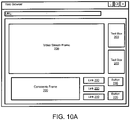
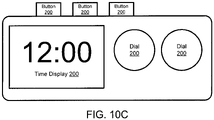
- FIG. 10A , 10B , and 10C illustrate a few example UIs that may be created using platform (10).
- FIG. 10A illustrates a user interface for a web application that delivers video streaming (e.g., similar to Youtube TM , Netflix TM or the like).
- this user interface includes a variety of UI elements 200, including various frames/boxes for presenting information and data, user operable links and buttons, etc.
- FIG. 10B illustrates a user interface for a media player application for media playback (e.g., similar to iTunes TM , Windows Media Player TM , Winamp TM or the like). As shown, this user interface includes a variety of UI elements 200, including various panels and user-operable controls.
- a media player application for media playback e.g., similar to iTunes TM , Windows Media Player TM , Winamp TM or the like.
- this user interface includes a variety of UI elements 200, including various panels and user-operable controls.
- FIG. 10C illustrates a user interface for an example electronic device, namely, an alarm clock radio.
- this user interface includes various UI elements, including displays and controls.
- UI elements may correspond to physical components that can be manipulated by a user.
- the collaborative platform of the present invention enables designers and programmers to collaborate on complex UI development projects in an efficient manner.
- the platform enables rapid prototyping and creation of demonstration UI assets that users can provide feedback on, thereby improving the user engagement levels of UI assets.
- UI assets can be swapped out, thus enabling rapid development of UI assets based on different scenarios.
- the platform permits the capture of the designer's intent in an efficient manner.
- the development platform allows development of UI assets across several operating systems.
- the systems and methods of the described embodiments are capable of being distributed, at least partly, in a computer program product including a physical, non-transitory computer readable medium that bears computer usable instructions for one or more processors.
- the medium may be provided in various forms, including one or more diskettes, compact disks, tapes, chips, magnetic and electronic storage media, volatile memory, non-volatile memory and the like.
- Non-transitory computer-readable media may include all computer-readable media, with the exception being a transitory, propagating signal.
- the term non-transitory is not intended to exclude computer readable media such as primary memory, volatile memory, RAM and so on, where the data stored thereon may only be temporarily stored.
- the computer useable instructions may also be in various forms, including compiled and non-compiled code.
- the disclosure provides systems, devices, methods, and computer programming products, including non-transient machine-readable instruction sets, for use in implementing such methods and enabling the functionality described previously.
Landscapes
- Engineering & Computer Science (AREA)
- Theoretical Computer Science (AREA)
- Software Systems (AREA)
- General Engineering & Computer Science (AREA)
- Physics & Mathematics (AREA)
- General Physics & Mathematics (AREA)
- Human Computer Interaction (AREA)
- Processing Or Creating Images (AREA)
- User Interface Of Digital Computer (AREA)
Claims (15)
- Système pour une plate-forme de développement d'UI, UI, le système comprenant :un réseau ;un premier dispositif informatique fournissant une plateforme collaborative de développement d'UI (54)un deuxième dispositif informatique et un troisième dispositif informatique, chacun en communication avec la plate-forme collaborative de développement d'UI (54) par l'intermédiaire du réseau ;la plateforme collaborative de développement d'UI (54) étant adaptée pour :
générer une pluralité de structures de données par un concepteur exploitant le deuxième dispositif informatique pour définir une intention de conception d'une UI particulière comprenant une pluralité d'éléments d'UI, chaque élément d'UI ayant une animation associée, chacune de la pluralité de structures de données étant associée à l'un de la pluralité d'éléments d'UI, dans lequel la plate-forme collaborative de développement d'UI comprend un composant de rendu (12) adapté pour rendre la pluralité d'éléments d'UI, dans lequel chacune de la pluralité de structures de données comprend des données permettant le rendu par le composant de rendu (12) de l'élément d'UI associé à cette structure de données, dans lequel les données permettant le rendu par le composant de rendu (12) de l'élément d'UI comprennent des données reflétant des transitions d'état à état pour cet élément d'UI et des données reflétant l'agencement de l'élément d'UI pour définir une position de l'élément d'UI dans l'UI particulière, les données reflétant des transitions d'état à état comportant une chronologie fournissant une liste de pistes, chaque piste contenant des temps clés définissant l'instant auquel un attribut de l'animation associée change ; etgénérer un code source en association avec au moins une de la pluralité de structures de données par un développeur exploitant le troisième dispositif informatique, le code source comprenant une logique implémentant l'intention de conception. - Système selon la revendication 1, dans lequel la plate-forme collaborative de développement d'UI (54) est adaptée pour fournir une interface utilisateur graphique qui permet au concepteur de coder les transitions d'état à état.
- Système selon la revendication 1, dans lequel le composant de rendu (12) est adapté pour traiter les données reflétant des transitions d'état à état afin de fournir un élément d'UI exécutable.
- Système selon la revendication 1, dans lequel chacune de la pluralité de structures de données comprend des données reflétant des caractéristiques de l'élément d'UI associé à cette structure de données, les caractéristiques comprenant un ou plusieurs d'un emplacement de l'élément, d'un aspect de l'élément et d'une image associée à l'élément, et dans lequel la plate-forme collaborative de développement d'UI (54) fournit une interface utilisateur graphique qui permet de modifier les caractéristiques.
- Système selon la revendication 1, dans lequel la plate-forme collaborative de développement d'UI comprend un composant d'importation adapté pour recevoir et stocker un contenu vidéo pour l'interface utilisateur particulière provenant d'une plate-forme graphique distincte.
- Système selon la revendication 1, dans lequel la plate-forme collaborative de développement d'UI (54) comprend un module d'extension logicielle pour intégrer au moins une partie de la plate-forme collaborative de développement d'UI (54) dans une plate-forme graphique distincte.
- Système selon la revendication 1, dans lequel la plate-forme collaborative de développement d'UI (54) est adaptée pour recevoir des données reflétant l'intention de conception à partir du deuxième dispositif informatique.
- Système selon la revendication 7, dans lequel la plate-forme collaborative de développement d'UI (54) comprend un composant de décomposition adapté pour traiter les données reflétant l'intention de conception afin d'identifier automatiquement la pluralité d'éléments d'UI.
- Système selon la revendication 8, dans lequel le composant de décomposition est en outre adapté pour identifier un type de chacun des éléments d'UI comme élément de présentation ou élément comportemental.
- Système selon la revendication 1, dans lequel la plateforme collaborative de développement d'UI (54) traite la pluralité des structures de données pour générer au moins une partie du code source.
- Procédé de développement d'interface utilisateur, UI, le procédé comprenant :la présentation d'une première interface utilisateur à un concepteur exploitant un premier dispositif informatique ;en réponse à une entrée du concepteur, reçue à partir du premier appareil informatique, la génération d'une pluralité de structures de données qui définissent une intention de conception d'une UI particulière comprenant une pluralité d'éléments d'UI, chacune de la pluralité de structures de données étant associée à un de la pluralité d'éléments d'UI, chaque élément d'UI ayant une animation associée, dans lequel la plate-forme collaborative de développement d'UI comprend un composant de rendu (12) adapté pour rendre la pluralité d'éléments d'UI, dans lequel chacune de la pluralité de structures de données comprend des données permettant le rendu par le composant de rendu (12) de l'élément d'UI associé à cette structure de données, dans lequel les données permettant le rendu par le composant de rendu (12) de l'élément d'UI comprennent des données reflétant des transitions d'état à état pour cet élément d'UI et des données reflétant l'agencement de l'élément d'UI pour définir une position de l'élément d'UI dans l'UI particulière, les données reflétant des transitions d'état à état comportant une chronologie fournissant une liste de pistes, chaque piste contenant des temps clés définissant l'instant auquel un attribut de l'animation associée change ;la présentation d'une deuxième interface utilisateur à un développeur exploitant un deuxième appareil informatique ; eten réponse à une entrée du développeur, reçue à partir du deuxième dispositif informatique, la génération d'un code source en association avec au moins une de la pluralité de structures de données, le code source comprenant une logique implémentant l'intention de conception.
- Procédé selon la revendication 11 comprenant en outre : le rendu d'au moins un élément d'UI en traitant les données reflétant des transitions d'état à état.
- Système selon la revendication 1 comprenant en outre un gestionnaire de scène (16) permettant au concepteur de définir une scène 3D pour l'interface utilisateur particulière à l'aide d'une arborescence d'une pluralité de nœuds de scène, chaque nœud correspondant à un élément d'UI respectif, dans lequel une position du nœud de scène dans l'arborescence est indicative de la position de l'élément d'UI respectif dans la scène 3D, dans lequel les données reflétant l'agencement de l'élément d'UI définissent la position de l'élément d'UI dans la scène 3D.
- Procédé selon la revendication 11 comprenant la fourniture d'un gestionnaire de scène (16) permettant au concepteur de définir une scène 3D pour l'interface utilisateur particulière à l'aide d'une arborescence d'une pluralité de nœuds de scène, chaque nœud correspondant à un élément d'UI respectif, dans lequel une position du nœud de scène dans l'arborescence est indicative de la position de l'élément d'UI respectif dans la scène 3D, dans lequel les données reflétant l'agencement de l'élément d'UI définissent la position de l'élément d'UI dans la scène 3D.
- Support non transitoire lisible par machine stockant des déclarations et instructions destinées à être exécutées par un processeur, le processeur étant configuré pour exécuter les étapes selon la revendication 11.
Priority Applications (1)
| Application Number | Priority Date | Filing Date | Title |
|---|---|---|---|
| EP22196528.8A EP4130978B1 (fr) | 2013-07-02 | 2014-06-30 | Système et procédé de rationalisation du développement d'une interface utilisateur |
Applications Claiming Priority (2)
| Application Number | Priority Date | Filing Date | Title |
|---|---|---|---|
| US13/933,351 US9858050B2 (en) | 2013-07-02 | 2013-07-02 | System and method for streamlining user interface development |
| PCT/CA2014/000530 WO2015000054A1 (fr) | 2013-07-02 | 2014-06-30 | Système et procédé pour la rationalisation de développement d'interface utilisateur |
Related Child Applications (1)
| Application Number | Title | Priority Date | Filing Date |
|---|---|---|---|
| EP22196528.8A Division EP4130978B1 (fr) | 2013-07-02 | 2014-06-30 | Système et procédé de rationalisation du développement d'une interface utilisateur |
Publications (3)
| Publication Number | Publication Date |
|---|---|
| EP3017364A1 EP3017364A1 (fr) | 2016-05-11 |
| EP3017364A4 EP3017364A4 (fr) | 2017-03-29 |
| EP3017364B1 true EP3017364B1 (fr) | 2022-09-21 |
Family
ID=52133694
Family Applications (2)
| Application Number | Title | Priority Date | Filing Date |
|---|---|---|---|
| EP14819710.6A Active EP3017364B1 (fr) | 2013-07-02 | 2014-06-30 | Système et procédé pour la rationalisation de développement d'interface utilisateur |
| EP22196528.8A Active EP4130978B1 (fr) | 2013-07-02 | 2014-06-30 | Système et procédé de rationalisation du développement d'une interface utilisateur |
Family Applications After (1)
| Application Number | Title | Priority Date | Filing Date |
|---|---|---|---|
| EP22196528.8A Active EP4130978B1 (fr) | 2013-07-02 | 2014-06-30 | Système et procédé de rationalisation du développement d'une interface utilisateur |
Country Status (4)
| Country | Link |
|---|---|
| US (2) | US9858050B2 (fr) |
| EP (2) | EP3017364B1 (fr) |
| CA (1) | CA2922860C (fr) |
| WO (1) | WO2015000054A1 (fr) |
Families Citing this family (23)
| Publication number | Priority date | Publication date | Assignee | Title |
|---|---|---|---|---|
| US9501140B2 (en) * | 2012-11-05 | 2016-11-22 | Onysus Software Ltd | Method and apparatus for developing and playing natural user interface applications |
| CA3047851C (fr) | 2016-12-21 | 2023-12-05 | You I Labs Inc. | Systeme et procede de deploiement d'application d'interface utilisateur en nuage |
| CN108021367B (zh) * | 2017-12-15 | 2020-11-17 | 广州赛意信息科技股份有限公司 | 一种基于元数据架构的ui开发系统及方法 |
| CN109710258A (zh) * | 2018-12-28 | 2019-05-03 | 北京金山安全软件有限公司 | 微信小程序界面生成的方法及装置 |
| CA3151093A1 (fr) * | 2019-07-25 | 2021-01-28 | Robert Bosch Gmbh | Systeme et procede de developpement et de deploiement d'interface utilisateur graphique dans un systeme en temps reel |
| CN110569096B (zh) * | 2019-08-20 | 2022-10-18 | 上海沣沅星科技有限公司 | 去代码化制作人机交互界面的系统、方法、介质及设备 |
| CN110853121B (zh) * | 2019-10-25 | 2023-02-10 | 稿定(厦门)科技有限公司 | 基于ae的跨平台数据处理的方法及装置 |
| CN111258693B (zh) * | 2020-01-13 | 2024-04-09 | 奇安信科技集团股份有限公司 | 远程显示方法及装置 |
| US11470327B2 (en) | 2020-03-30 | 2022-10-11 | Alibaba Group Holding Limited | Scene aware video content encoding |
| CN113590103B (zh) * | 2020-04-30 | 2024-02-02 | 广东中砼物联网科技有限公司 | 实现图形化无代码开发用户界面的方法、计算机设备、存储介质 |
| CN117891369A (zh) * | 2020-07-29 | 2024-04-16 | 华为技术有限公司 | 一种跨设备的对象拖拽方法及设备 |
| CN112068909B (zh) * | 2020-07-31 | 2023-10-20 | 中核核电运行管理有限公司 | 一种核电运行规程移动执行卡片生成系统及方法 |
| CN112486483A (zh) * | 2020-11-23 | 2021-03-12 | 广州经传多赢投资咨询有限公司 | 基于xml的ui框架实现方法、系统、装置及存储介质 |
| CN112862668B (zh) * | 2021-02-01 | 2024-02-06 | 北京恒泰实达科技股份有限公司 | 一种从设计效果图到可视化实施画面转换的方法 |
| CN113296759B (zh) * | 2021-05-12 | 2023-11-28 | 广州博冠信息科技有限公司 | 用户界面处理方法、用户界面处理系统、设备及存储介质 |
| CN113268236B (zh) * | 2021-05-20 | 2024-03-08 | 湖南大学 | 一种rpa系统中基于功能增强技术的ui元素拾取方法和系统 |
| CN113867694B (zh) * | 2021-09-27 | 2022-06-24 | 上海汇付支付有限公司 | 一种智能生成前端代码的方法和系统 |
| US11704093B2 (en) * | 2021-09-27 | 2023-07-18 | Salesforce, Inc. | Rapid prototyping of user experience components and related application functionality |
| US11861329B2 (en) * | 2022-01-18 | 2024-01-02 | Dell Products, L.P. | Method and apparatus for codifying user experience designs and managing the codified user experience designs |
| CN114845173B (zh) * | 2022-05-30 | 2023-08-22 | 杭州国芯科技股份有限公司 | 一种机顶盒主菜单生成方法 |
| CN119094727B (zh) * | 2024-08-02 | 2025-08-12 | 北京易智时代数字科技有限公司 | 一种速生成裸眼3D Windows可执行程序的方法 |
| CN119336317B (zh) * | 2024-08-23 | 2026-04-17 | 江西格如灵科技股份有限公司 | 一种基于Unity的图形绘制方法、系统、存储介质及设备 |
| CN119201096B (zh) * | 2024-11-08 | 2025-02-21 | 河北华通科技股份有限公司 | 一种低代码组态搭建方法及系统 |
Citations (1)
| Publication number | Priority date | Publication date | Assignee | Title |
|---|---|---|---|---|
| US6747651B1 (en) * | 1998-07-18 | 2004-06-08 | National University Of Singapore | System and method for creating bounding volume hierarchies utilizing model simplification |
Family Cites Families (11)
| Publication number | Priority date | Publication date | Assignee | Title |
|---|---|---|---|---|
| FR2810130B1 (fr) * | 2000-06-08 | 2004-04-16 | Hypnotizer | Procede de structuration, de transfert et d'interpretation d'un ensemble d'informations destinees a la conception d'interfaces graphiques |
| EP1331564A1 (fr) * | 2002-01-24 | 2003-07-30 | Siemens Aktiengesellschaft | Contrôle de charge intelligent basé sur la logique floue pour environnement distribué |
| CA2388101A1 (fr) * | 2002-02-01 | 2003-08-01 | Concepts Egeria Inc. | Interface utilisateur conceptuelle |
| US20040205515A1 (en) * | 2003-04-10 | 2004-10-14 | Simple Twists, Ltd. | Multi-media story editing tool |
| US7958454B2 (en) * | 2005-04-19 | 2011-06-07 | The Mathworks, Inc. | Graphical state machine based programming for a graphical user interface |
| US8281238B2 (en) * | 2009-11-10 | 2012-10-02 | Primal Fusion Inc. | System, method and computer program for creating and manipulating data structures using an interactive graphical interface |
| US8963847B2 (en) | 2010-12-06 | 2015-02-24 | Netflix, Inc. | User interface for a remote control device |
| US9098294B2 (en) | 2010-12-31 | 2015-08-04 | Verizon Patent And Licensing Inc. | Building block based graphical user interface design and development systems and methods |
| US8938685B2 (en) * | 2010-12-31 | 2015-01-20 | Verizon Patent And Licensing Inc. | Automated graphical user interface design and development systems and methods |
| US8982132B2 (en) * | 2011-02-28 | 2015-03-17 | Adobe Systems Incorporated | Value templates in animation timelines |
| US9152539B2 (en) | 2011-08-03 | 2015-10-06 | Verizon Patent And Licensing Inc. | Tag-based graphical user interface production systems and methods |
-
2013
- 2013-07-02 US US13/933,351 patent/US9858050B2/en active Active
-
2014
- 2014-06-30 EP EP14819710.6A patent/EP3017364B1/fr active Active
- 2014-06-30 CA CA2922860A patent/CA2922860C/fr active Active
- 2014-06-30 EP EP22196528.8A patent/EP4130978B1/fr active Active
- 2014-06-30 WO PCT/CA2014/000530 patent/WO2015000054A1/fr not_active Ceased
-
2017
- 2017-12-28 US US15/856,465 patent/US20180203675A1/en not_active Abandoned
Patent Citations (1)
| Publication number | Priority date | Publication date | Assignee | Title |
|---|---|---|---|---|
| US6747651B1 (en) * | 1998-07-18 | 2004-06-08 | National University Of Singapore | System and method for creating bounding volume hierarchies utilizing model simplification |
Also Published As
| Publication number | Publication date |
|---|---|
| EP3017364A4 (fr) | 2017-03-29 |
| US20150012905A1 (en) | 2015-01-08 |
| EP3017364A1 (fr) | 2016-05-11 |
| EP4130978B1 (fr) | 2025-04-23 |
| CA2922860C (fr) | 2021-11-02 |
| US9858050B2 (en) | 2018-01-02 |
| WO2015000054A1 (fr) | 2015-01-08 |
| US20180203675A1 (en) | 2018-07-19 |
| EP4130978A1 (fr) | 2023-02-08 |
| CA2922860A1 (fr) | 2015-01-08 |
Similar Documents
| Publication | Publication Date | Title |
|---|---|---|
| EP3017364B1 (fr) | Système et procédé pour la rationalisation de développement d'interface utilisateur | |
| US11003422B2 (en) | Methods and systems for visual programming using polymorphic, dynamic multi-dimensional structures | |
| US7818690B2 (en) | Framework for creating user interfaces containing interactive and dynamic 3-D objects | |
| US20110258534A1 (en) | Declarative definition of complex user interface state changes | |
| Tang et al. | A platform independent game technology model for model driven serious games development | |
| US8739120B2 (en) | System and method for stage rendering in a software authoring tool | |
| US9159168B2 (en) | Methods and systems for generating a dynamic multimodal and multidimensional presentation | |
| Dörner et al. | Content creation and authoring challenges for virtual environments: from user interfaces to autonomous virtual characters | |
| Brown | Silverlight 5 in action | |
| Molina Massó et al. | Towards virtualization of user interfaces based on UsiXML | |
| CN117742677A (zh) | 一种xr引擎低代码开发平台 | |
| Gao et al. | [Retracted] Realization of Music‐Assisted Interactive Teaching System Based on Virtual Reality Technology | |
| US8379028B1 (en) | Rigweb | |
| WO2024230324A1 (fr) | Procédé et appareil de traitement d'application enfant, dispositif informatique et support de stockage | |
| CN117788764A (zh) | 一种基于WebGL的元宇宙孵化器的方法 | |
| Vanderdonckt | Animated transitions for empowering interactive information systems | |
| Magni | Delphi GUI Programming with FireMonkey: Unleash the full potential of the FMX framework to build exciting cross-platform apps with Embarcadero Delphi | |
| US8566734B1 (en) | System and method for providing visual component layout input in alternate forms | |
| Pleuss et al. | Model-driven development of interactive multimedia applications with MML | |
| Griffith et al. | MARTA: Modern Automatic Renderings from Text to Animation | |
| Hering et al. | 3DCIS: A real-time browser-rendered 3d campus information system based on webgl | |
| Charalambos | nub: A Rendering and Interaction Library for Visual Computing in Processing | |
| Pham | Develop maintainable animated Android applications | |
| Akinshipe et al. | Harnessing Unreal Engine for the Development of Extended Reality Platforms for Remote Building Management | |
| CN118535244A (zh) | 组态动画配置方法、装置、电子设备及存储介质 |
Legal Events
| Date | Code | Title | Description |
|---|---|---|---|
| PUAI | Public reference made under article 153(3) epc to a published international application that has entered the european phase |
Free format text: ORIGINAL CODE: 0009012 |
|
| 17P | Request for examination filed |
Effective date: 20160202 |
|
| AK | Designated contracting states |
Kind code of ref document: A1 Designated state(s): AL AT BE BG CH CY CZ DE DK EE ES FI FR GB GR HR HU IE IS IT LI LT LU LV MC MK MT NL NO PL PT RO RS SE SI SK SM TR |
|
| AX | Request for extension of the european patent |
Extension state: BA ME |
|
| DAX | Request for extension of the european patent (deleted) | ||
| A4 | Supplementary search report drawn up and despatched |
Effective date: 20170223 |
|
| RIC1 | Information provided on ipc code assigned before grant |
Ipc: G06F 9/44 20060101AFI20170218BHEP |
|
| STAA | Information on the status of an ep patent application or granted ep patent |
Free format text: STATUS: EXAMINATION IS IN PROGRESS |
|
| 17Q | First examination report despatched |
Effective date: 20190520 |
|
| REG | Reference to a national code |
Ref country code: DE Ref legal event code: R079 Ref document number: 602014085010 Country of ref document: DE Free format text: PREVIOUS MAIN CLASS: G06F0009440000 Ipc: G06F0008380000 |
|
| RAP1 | Party data changed (applicant data changed or rights of an application transferred) |
Owner name: WM INTERACTIVE MEDIA HOLDINGS INC. |
|
| RAP1 | Party data changed (applicant data changed or rights of an application transferred) |
Owner name: WARNERMEDIA DIRECT, LLC |
|
| GRAP | Despatch of communication of intention to grant a patent |
Free format text: ORIGINAL CODE: EPIDOSNIGR1 |
|
| STAA | Information on the status of an ep patent application or granted ep patent |
Free format text: STATUS: GRANT OF PATENT IS INTENDED |
|
| RIC1 | Information provided on ipc code assigned before grant |
Ipc: G06F 8/38 20180101AFI20220321BHEP |
|
| INTG | Intention to grant announced |
Effective date: 20220407 |
|
| GRAS | Grant fee paid |
Free format text: ORIGINAL CODE: EPIDOSNIGR3 |
|
| GRAA | (expected) grant |
Free format text: ORIGINAL CODE: 0009210 |
|
| STAA | Information on the status of an ep patent application or granted ep patent |
Free format text: STATUS: THE PATENT HAS BEEN GRANTED |
|
| AK | Designated contracting states |
Kind code of ref document: B1 Designated state(s): AL AT BE BG CH CY CZ DE DK EE ES FI FR GB GR HR HU IE IS IT LI LT LU LV MC MK MT NL NO PL PT RO RS SE SI SK SM TR |
|
| REG | Reference to a national code |
Ref country code: GB Ref legal event code: FG4D |
|
| REG | Reference to a national code |
Ref country code: CH Ref legal event code: EP |
|
| REG | Reference to a national code |
Ref country code: IE Ref legal event code: FG4D |
|
| REG | Reference to a national code |
Ref country code: DE Ref legal event code: R096 Ref document number: 602014085010 Country of ref document: DE |
|
| REG | Reference to a national code |
Ref country code: AT Ref legal event code: REF Ref document number: 1520276 Country of ref document: AT Kind code of ref document: T Effective date: 20221015 |
|
| REG | Reference to a national code |
Ref country code: LT Ref legal event code: MG9D |
|
| REG | Reference to a national code |
Ref country code: NL Ref legal event code: MP Effective date: 20220921 |
|
| PG25 | Lapsed in a contracting state [announced via postgrant information from national office to epo] |
Ref country code: SE Free format text: LAPSE BECAUSE OF FAILURE TO SUBMIT A TRANSLATION OF THE DESCRIPTION OR TO PAY THE FEE WITHIN THE PRESCRIBED TIME-LIMIT Effective date: 20220921 Ref country code: RS Free format text: LAPSE BECAUSE OF FAILURE TO SUBMIT A TRANSLATION OF THE DESCRIPTION OR TO PAY THE FEE WITHIN THE PRESCRIBED TIME-LIMIT Effective date: 20220921 Ref country code: NO Free format text: LAPSE BECAUSE OF FAILURE TO SUBMIT A TRANSLATION OF THE DESCRIPTION OR TO PAY THE FEE WITHIN THE PRESCRIBED TIME-LIMIT Effective date: 20221221 Ref country code: LV Free format text: LAPSE BECAUSE OF FAILURE TO SUBMIT A TRANSLATION OF THE DESCRIPTION OR TO PAY THE FEE WITHIN THE PRESCRIBED TIME-LIMIT Effective date: 20220921 Ref country code: LT Free format text: LAPSE BECAUSE OF FAILURE TO SUBMIT A TRANSLATION OF THE DESCRIPTION OR TO PAY THE FEE WITHIN THE PRESCRIBED TIME-LIMIT Effective date: 20220921 Ref country code: FI Free format text: LAPSE BECAUSE OF FAILURE TO SUBMIT A TRANSLATION OF THE DESCRIPTION OR TO PAY THE FEE WITHIN THE PRESCRIBED TIME-LIMIT Effective date: 20220921 |
|
| REG | Reference to a national code |
Ref country code: AT Ref legal event code: MK05 Ref document number: 1520276 Country of ref document: AT Kind code of ref document: T Effective date: 20220921 |
|
| PG25 | Lapsed in a contracting state [announced via postgrant information from national office to epo] |
Ref country code: HR Free format text: LAPSE BECAUSE OF FAILURE TO SUBMIT A TRANSLATION OF THE DESCRIPTION OR TO PAY THE FEE WITHIN THE PRESCRIBED TIME-LIMIT Effective date: 20220921 Ref country code: GR Free format text: LAPSE BECAUSE OF FAILURE TO SUBMIT A TRANSLATION OF THE DESCRIPTION OR TO PAY THE FEE WITHIN THE PRESCRIBED TIME-LIMIT Effective date: 20221222 |
|
| PG25 | Lapsed in a contracting state [announced via postgrant information from national office to epo] |
Ref country code: SM Free format text: LAPSE BECAUSE OF FAILURE TO SUBMIT A TRANSLATION OF THE DESCRIPTION OR TO PAY THE FEE WITHIN THE PRESCRIBED TIME-LIMIT Effective date: 20220921 Ref country code: RO Free format text: LAPSE BECAUSE OF FAILURE TO SUBMIT A TRANSLATION OF THE DESCRIPTION OR TO PAY THE FEE WITHIN THE PRESCRIBED TIME-LIMIT Effective date: 20220921 Ref country code: PT Free format text: LAPSE BECAUSE OF FAILURE TO SUBMIT A TRANSLATION OF THE DESCRIPTION OR TO PAY THE FEE WITHIN THE PRESCRIBED TIME-LIMIT Effective date: 20230123 Ref country code: ES Free format text: LAPSE BECAUSE OF FAILURE TO SUBMIT A TRANSLATION OF THE DESCRIPTION OR TO PAY THE FEE WITHIN THE PRESCRIBED TIME-LIMIT Effective date: 20220921 Ref country code: CZ Free format text: LAPSE BECAUSE OF FAILURE TO SUBMIT A TRANSLATION OF THE DESCRIPTION OR TO PAY THE FEE WITHIN THE PRESCRIBED TIME-LIMIT Effective date: 20220921 Ref country code: AT Free format text: LAPSE BECAUSE OF FAILURE TO SUBMIT A TRANSLATION OF THE DESCRIPTION OR TO PAY THE FEE WITHIN THE PRESCRIBED TIME-LIMIT Effective date: 20220921 |
|
| PG25 | Lapsed in a contracting state [announced via postgrant information from national office to epo] |
Ref country code: SK Free format text: LAPSE BECAUSE OF FAILURE TO SUBMIT A TRANSLATION OF THE DESCRIPTION OR TO PAY THE FEE WITHIN THE PRESCRIBED TIME-LIMIT Effective date: 20220921 Ref country code: PL Free format text: LAPSE BECAUSE OF FAILURE TO SUBMIT A TRANSLATION OF THE DESCRIPTION OR TO PAY THE FEE WITHIN THE PRESCRIBED TIME-LIMIT Effective date: 20220921 Ref country code: IS Free format text: LAPSE BECAUSE OF FAILURE TO SUBMIT A TRANSLATION OF THE DESCRIPTION OR TO PAY THE FEE WITHIN THE PRESCRIBED TIME-LIMIT Effective date: 20230121 Ref country code: EE Free format text: LAPSE BECAUSE OF FAILURE TO SUBMIT A TRANSLATION OF THE DESCRIPTION OR TO PAY THE FEE WITHIN THE PRESCRIBED TIME-LIMIT Effective date: 20220921 |
|
| REG | Reference to a national code |
Ref country code: DE Ref legal event code: R097 Ref document number: 602014085010 Country of ref document: DE |
|
| PG25 | Lapsed in a contracting state [announced via postgrant information from national office to epo] |
Ref country code: NL Free format text: LAPSE BECAUSE OF FAILURE TO SUBMIT A TRANSLATION OF THE DESCRIPTION OR TO PAY THE FEE WITHIN THE PRESCRIBED TIME-LIMIT Effective date: 20220921 Ref country code: AL Free format text: LAPSE BECAUSE OF FAILURE TO SUBMIT A TRANSLATION OF THE DESCRIPTION OR TO PAY THE FEE WITHIN THE PRESCRIBED TIME-LIMIT Effective date: 20220921 |
|
| PLBE | No opposition filed within time limit |
Free format text: ORIGINAL CODE: 0009261 |
|
| STAA | Information on the status of an ep patent application or granted ep patent |
Free format text: STATUS: NO OPPOSITION FILED WITHIN TIME LIMIT |
|
| PG25 | Lapsed in a contracting state [announced via postgrant information from national office to epo] |
Ref country code: DK Free format text: LAPSE BECAUSE OF FAILURE TO SUBMIT A TRANSLATION OF THE DESCRIPTION OR TO PAY THE FEE WITHIN THE PRESCRIBED TIME-LIMIT Effective date: 20220921 |
|
| 26N | No opposition filed |
Effective date: 20230622 |
|
| PG25 | Lapsed in a contracting state [announced via postgrant information from national office to epo] |
Ref country code: SI Free format text: LAPSE BECAUSE OF FAILURE TO SUBMIT A TRANSLATION OF THE DESCRIPTION OR TO PAY THE FEE WITHIN THE PRESCRIBED TIME-LIMIT Effective date: 20220921 |
|
| REG | Reference to a national code |
Ref country code: DE Ref legal event code: R082 Ref document number: 602014085010 Country of ref document: DE |
|
| PG25 | Lapsed in a contracting state [announced via postgrant information from national office to epo] |
Ref country code: MC Free format text: LAPSE BECAUSE OF FAILURE TO SUBMIT A TRANSLATION OF THE DESCRIPTION OR TO PAY THE FEE WITHIN THE PRESCRIBED TIME-LIMIT Effective date: 20220921 |
|
| PG25 | Lapsed in a contracting state [announced via postgrant information from national office to epo] |
Ref country code: MC Free format text: LAPSE BECAUSE OF FAILURE TO SUBMIT A TRANSLATION OF THE DESCRIPTION OR TO PAY THE FEE WITHIN THE PRESCRIBED TIME-LIMIT Effective date: 20220921 |
|
| REG | Reference to a national code |
Ref country code: CH Ref legal event code: PL |
|
| REG | Reference to a national code |
Ref country code: BE Ref legal event code: MM Effective date: 20230630 |
|
| PG25 | Lapsed in a contracting state [announced via postgrant information from national office to epo] |
Ref country code: LU Free format text: LAPSE BECAUSE OF NON-PAYMENT OF DUE FEES Effective date: 20230630 |
|
| REG | Reference to a national code |
Ref country code: IE Ref legal event code: MM4A |
|
| PG25 | Lapsed in a contracting state [announced via postgrant information from national office to epo] |
Ref country code: LU Free format text: LAPSE BECAUSE OF NON-PAYMENT OF DUE FEES Effective date: 20230630 |
|
| PG25 | Lapsed in a contracting state [announced via postgrant information from national office to epo] |
Ref country code: IE Free format text: LAPSE BECAUSE OF NON-PAYMENT OF DUE FEES Effective date: 20230630 |
|
| PG25 | Lapsed in a contracting state [announced via postgrant information from national office to epo] |
Ref country code: IE Free format text: LAPSE BECAUSE OF NON-PAYMENT OF DUE FEES Effective date: 20230630 Ref country code: CH Free format text: LAPSE BECAUSE OF NON-PAYMENT OF DUE FEES Effective date: 20230630 |
|
| PG25 | Lapsed in a contracting state [announced via postgrant information from national office to epo] |
Ref country code: IT Free format text: LAPSE BECAUSE OF FAILURE TO SUBMIT A TRANSLATION OF THE DESCRIPTION OR TO PAY THE FEE WITHIN THE PRESCRIBED TIME-LIMIT Effective date: 20220921 Ref country code: BE Free format text: LAPSE BECAUSE OF NON-PAYMENT OF DUE FEES Effective date: 20230630 |
|
| PG25 | Lapsed in a contracting state [announced via postgrant information from national office to epo] |
Ref country code: BG Free format text: LAPSE BECAUSE OF FAILURE TO SUBMIT A TRANSLATION OF THE DESCRIPTION OR TO PAY THE FEE WITHIN THE PRESCRIBED TIME-LIMIT Effective date: 20220921 |
|
| PG25 | Lapsed in a contracting state [announced via postgrant information from national office to epo] |
Ref country code: BG Free format text: LAPSE BECAUSE OF FAILURE TO SUBMIT A TRANSLATION OF THE DESCRIPTION OR TO PAY THE FEE WITHIN THE PRESCRIBED TIME-LIMIT Effective date: 20220921 |
|
| PGFP | Annual fee paid to national office [announced via postgrant information from national office to epo] |
Ref country code: DE Payment date: 20250507 Year of fee payment: 12 |
|
| PGFP | Annual fee paid to national office [announced via postgrant information from national office to epo] |
Ref country code: GB Payment date: 20250508 Year of fee payment: 12 |
|
| PGFP | Annual fee paid to national office [announced via postgrant information from national office to epo] |
Ref country code: FR Payment date: 20250508 Year of fee payment: 12 |
|
| PG25 | Lapsed in a contracting state [announced via postgrant information from national office to epo] |
Ref country code: CY Free format text: LAPSE BECAUSE OF FAILURE TO SUBMIT A TRANSLATION OF THE DESCRIPTION OR TO PAY THE FEE WITHIN THE PRESCRIBED TIME-LIMIT; INVALID AB INITIO Effective date: 20140630 |
|
| PG25 | Lapsed in a contracting state [announced via postgrant information from national office to epo] |
Ref country code: HU Free format text: LAPSE BECAUSE OF FAILURE TO SUBMIT A TRANSLATION OF THE DESCRIPTION OR TO PAY THE FEE WITHIN THE PRESCRIBED TIME-LIMIT; INVALID AB INITIO Effective date: 20140630 |
|
| PG25 | Lapsed in a contracting state [announced via postgrant information from national office to epo] |
Ref country code: TR Free format text: LAPSE BECAUSE OF FAILURE TO SUBMIT A TRANSLATION OF THE DESCRIPTION OR TO PAY THE FEE WITHIN THE PRESCRIBED TIME-LIMIT Effective date: 20220921 |