EP3018071B1 - Emballage pour la protection d'objets et son procédé de fabrication - Google Patents
Emballage pour la protection d'objets et son procédé de fabrication Download PDFInfo
- Publication number
- EP3018071B1 EP3018071B1 EP14819910.2A EP14819910A EP3018071B1 EP 3018071 B1 EP3018071 B1 EP 3018071B1 EP 14819910 A EP14819910 A EP 14819910A EP 3018071 B1 EP3018071 B1 EP 3018071B1
- Authority
- EP
- European Patent Office
- Prior art keywords
- packaging
- sheet
- zones
- pads
- joint
- Prior art date
- Legal status (The legal status is an assumption and is not a legal conclusion. Google has not performed a legal analysis and makes no representation as to the accuracy of the status listed.)
- Active
Links
Images

Classifications
-
- B—PERFORMING OPERATIONS; TRANSPORTING
- B65—CONVEYING; PACKING; STORING; HANDLING THIN OR FILAMENTARY MATERIAL
- B65D—CONTAINERS FOR STORAGE OR TRANSPORT OF ARTICLES OR MATERIALS, e.g. BAGS, BARRELS, BOTTLES, BOXES, CANS, CARTONS, CRATES, DRUMS, JARS, TANKS, HOPPERS, FORWARDING CONTAINERS; ACCESSORIES, CLOSURES, OR FITTINGS THEREFOR; PACKAGING ELEMENTS; PACKAGES
- B65D81/00—Containers, packaging elements, or packages, for contents presenting particular transport or storage problems, or adapted to be used for non-packaging purposes after removal of contents
- B65D81/02—Containers, packaging elements, or packages, for contents presenting particular transport or storage problems, or adapted to be used for non-packaging purposes after removal of contents specially adapted to protect contents from mechanical damage
- B65D81/03—Wrappers or envelopes with shock-absorbing properties, e.g. bubble films
-
- B—PERFORMING OPERATIONS; TRANSPORTING
- B31—MAKING ARTICLES OF PAPER, CARDBOARD OR MATERIAL WORKED IN A MANNER ANALOGOUS TO PAPER; WORKING PAPER, CARDBOARD OR MATERIAL WORKED IN A MANNER ANALOGOUS TO PAPER
- B31B—MAKING CONTAINERS OF PAPER, CARDBOARD OR MATERIAL WORKED IN A MANNER ANALOGOUS TO PAPER
- B31B50/00—Making rigid or semi-rigid containers, e.g. boxes or cartons
- B31B50/60—Uniting opposed surfaces or edges; Taping
- B31B50/64—Uniting opposed surfaces or edges; Taping by applying heat or pressure, e.g. by welding
-
- B—PERFORMING OPERATIONS; TRANSPORTING
- B31—MAKING ARTICLES OF PAPER, CARDBOARD OR MATERIAL WORKED IN A MANNER ANALOGOUS TO PAPER; WORKING PAPER, CARDBOARD OR MATERIAL WORKED IN A MANNER ANALOGOUS TO PAPER
- B31D—MAKING ARTICLES OF PAPER, CARDBOARD OR MATERIAL WORKED IN A MANNER ANALOGOUS TO PAPER, NOT PROVIDED FOR IN SUBCLASSES B31B OR B31C
- B31D5/00—Multiple-step processes for making three-dimensional [3D] articles
- B31D5/0039—Multiple-step processes for making three-dimensional [3D] articles for making dunnage or cushion pads
- B31D5/0073—Multiple-step processes for making three-dimensional [3D] articles for making dunnage or cushion pads including pillow forming
-
- B—PERFORMING OPERATIONS; TRANSPORTING
- B65—CONVEYING; PACKING; STORING; HANDLING THIN OR FILAMENTARY MATERIAL
- B65D—CONTAINERS FOR STORAGE OR TRANSPORT OF ARTICLES OR MATERIALS, e.g. BAGS, BARRELS, BOTTLES, BOXES, CANS, CARTONS, CRATES, DRUMS, JARS, TANKS, HOPPERS, FORWARDING CONTAINERS; ACCESSORIES, CLOSURES, OR FITTINGS THEREFOR; PACKAGING ELEMENTS; PACKAGES
- B65D81/00—Containers, packaging elements, or packages, for contents presenting particular transport or storage problems, or adapted to be used for non-packaging purposes after removal of contents
- B65D81/02—Containers, packaging elements, or packages, for contents presenting particular transport or storage problems, or adapted to be used for non-packaging purposes after removal of contents specially adapted to protect contents from mechanical damage
- B65D81/05—Containers, packaging elements, or packages, for contents presenting particular transport or storage problems, or adapted to be used for non-packaging purposes after removal of contents specially adapted to protect contents from mechanical damage maintaining contents at spaced relation from package walls, or from other contents
- B65D81/051—Containers, packaging elements, or packages, for contents presenting particular transport or storage problems, or adapted to be used for non-packaging purposes after removal of contents specially adapted to protect contents from mechanical damage maintaining contents at spaced relation from package walls, or from other contents using pillow-like elements filled with cushioning material, e.g. elastic foam, fabric
- B65D81/052—Containers, packaging elements, or packages, for contents presenting particular transport or storage problems, or adapted to be used for non-packaging purposes after removal of contents specially adapted to protect contents from mechanical damage maintaining contents at spaced relation from package walls, or from other contents using pillow-like elements filled with cushioning material, e.g. elastic foam, fabric filled with fluid, e.g. inflatable elements
Definitions
- the scope of the invention is packaging to protect objects or appliances, especially voluminous electrical household appliances such as refrigerators, washing machines, dishwashers, ovens or similar, comprising at least one protective cover composed of at least two layered films or sheets, each film with at least one layer of plastic, the two stacked layers of film are joined by transverse and longitudinal joint lines, these joint lines preferably made using heat sealing, creating pads of different sizes which are filled with fluid to protect the aforesaid objects or appliances from rubbing, knocks and/or vibrations during storage and/or transport until they are put into service at the final user's address.
- Packaging for objects comprises a variety of covers or elements, commonly but not exclusively, two covers, one upper and one lower, or two sides, one left and one right, or one back and one front, or a base upon which the object is positioned and a lid which is positioned on top of the object, four edge protectors which at least partially cover the four edges of the object, from the base to the lid, and panels halfway up the sides of the object, used to spread the load produced by fork-lift truck forks.
- packaging can include four edge protectors that extend past its top and bottom so as to make the base and lid or just one of them unnecessary, as described, for example, in the Spanish utility model published under number ES 1069687 U .
- Packaging can also be conceived to protect one of the faces of the object during transport, as described, for example, in patent ES 2382853 A1 .
- packaging with more or less covers, and with one arrangement or another is usually complemented by a plastic shrink wrap or stretch wrap, or a cardboard box, to prevent movement of the packaging parts or elements of which the packing is composed and, of course, the packaged and protected object.
- covers that constitute conventional packaging are usually made from cardboard and/or cut or moulded EPS (expanded polystyrene).
- This type of packaging is sufficient to protect all types of objects and appliances at a reasonable cost.
- manufacturing them requires a large amount of energy in the form of steam and compressed air.
- This characteristic in some cases leads the packaging manufacturing company to build transformation facilities close to its customers, with the investment costs this involves.
- This type of product also requires moulds to be built, which are generally made from metal, to make it possible to obtain the shapes to fit the object to be packaged.
- Another characteristic feature of this packaging, particularly those made from EPS is that even though they are fully recyclable materials, collecting and transporting discarded packaging requires significant investments due, again, to its low density and the ratio of transport cost per kilogram of material transported.
- plastic bubble wrapping or bubble packaging is also used in packaging. This is characterised by having closed bubbles, i.e. separate bubbles, of equal size and uniform distribution throughout the surface of the plastic sheet supporting them, so giving protection to the object partially or completely enveloped by the bubbled plastic, protecting its surface and cushioning impacts and/or vibrations.
- this type of packaging does not intentionally adapt the size, shape and position of the bubbles to the object surface details or to its shape or outline. Also, in the case of using a cardboard box, for example, to complete the packaging, this can leave gaps between the packaged object and the box containing it.
- bubbled plastic in which the bubbles have become larger pads
- the patents US 10 7254932 and US 8366594 describe packaging of this type which is conceived to fill the gap between the object or set of objects placed in a cardboard box.
- this type of protection generally has all or a large proportion of the pads connected together, and if one of them breaks, all the rest connected to it will lose the air contained in them, rendering the packaging useless.
- Another possibility is that they have one-way air valves to make each pad independent, and if any break, the rest will hold the air inside them and the protection capability of the packaging will not be lost entirely.
- these items make the packaging more expensive
- None of these types of packaging are usually made in situ, i.e. alongside the object or appliance production line, nor are they made when needed, i.e. they are manufactured somewhere other than where they are used and before they need to be used, hence after being manufactured they need to be stored and transported to the object or appliance producer's factory.
- Patent documents JPH0741051A and US5340632A disclose a packaging to protect objects or appliances, comprising at least one protective cover composed of at least two stacked films, the two stacked layers of film being joined by transverse joint lines and longitudinal joint lines. Said joint lines form pads filled with fluid.
- Patent document US2008250753A1 discloses the preamble of claim 1.
- the purpose of the invention is to provide packaging for objects or appliances which is at least as secure against rubbing, knocks and/or vibrations as current packaging made from plastics and/or cardboard, and is made to achieve economic savings in manufacturing and distribution, as well as achieving greater ease of recycling.
- the economic saving is mainly due to the packaging detailed in the invention using less raw material, a fraction of the energy used in manufacturing current packaging, and a much more favourable ratio of transport cost per kilogram of material transported, due to the density of the material transported being several times higher than that of current packaging made from cardboard and/or EPS.
- the greater ease of recycling comes from the use of less raw material, and that the packaging fluid can be extracted easily by breaking or cutting the pads, hence the discarded packaging will occupy less space and have a higher density than current packaging, improving the transport cost per transported kilogram of material to be recycled.
- the first purpose of the invention is achieved by making available packing to protect objects or appliances, especially voluminous electrical household appliances such as refrigerators, washing machines, dishwashers, ovens or similar, characterised in that it comprises at least one protective cover composed of at least two stacked films or sheets, each film with at least one layer of plastic, the two stacked layers of film are joined by transverse and longitudinal joint lines, where these joint lines form pads filled with fluid, and this protective cover has at least one layer of pads, with fold zones, gap zones and with the possibility of having closure zones, such that this protective cover specifically fits the surface and outline of the object to be protected during storage and transport, from manufacture until it is put into service at the final user's address.
- the packaging can be made up of one or several protective covers, obtained from a film or sheet which is preferably multilayer and has at least one plastic layer.
- the film or sheet is preferably a multilayer plastic material, where these can be layers of different materials, such as paper, cardboard or metal or a combination of different materials in one film.
- both the transverse joint lines and the longitudinal joint lines can have constant or varying spacing to form pads of the same or different dimensions.
- each fluid-filled pad in the protective cover is appropriately configured in dimensions, shape and position for the protective cover to fit the details of the object's external surface and to its shape or general outline and to protect it during storage and transport.
- the protective cover is the result of folding the packaging sheet, which is an intermediate product in the process to obtain the packaging detailed in the invention of the invention, in a process described later.
- the concept of the packaging sheet will now be explained to facilitate understanding of the characteristics of the protective cover which is the subject of the invention.
- the packaging sheet comprises the same characteristics as the protective cover, except that it is flat and therefore does not have the characteristics of a three-dimensional element, that is, for example, that it is formed of a single layer of pads and not several layers of pads, from which the protective cover can be configured.
- the packaging sheet like the protective cover derived from it, comprises fold zones as well as the pads, which correspond to areas in which the pads are of a size and position so as to allow the sheet to be folded in these zones to fit the general shape of the object it is desired to pack and protect in the end, such that the fold zones facilitate the folding of the packaging sheet, leading to different types of protective covers, such as bases or lids, edge protectors, corner protectors, panels, etc.
- the packaging sheet with the pads and the fold zones also includes gap zones, as areas where the pads are of the appropriate size and position to adapt the protective cover to the surface details of certain areas of the object to be packaged, such as recesses, projections, etc.
- the pads form a closed, fluid-filled cavity in each case. That is to say, the pads are not connected together, thus preventing the fluid from one pad to flow to another.
- one part of the pads can be connected together; in this case the cavity will be open. This connection is made using channels of appropriate dimensions, allowing fluid to flow from one pad to another at a controlled rate to increase control over the protection of the object to be packaged. Both configurations can coexist in the same protective cover
- the pads and their configuration will have the function of cushioning the packaged object from the blows and/or vibrations it could receive during transport, storage or handling.
- the protection against impacts or vibrations is provided by the capacity the plastic used has to deform without breaking, up to a certain limit, thus absorbing the energy from that impact or vibration.
- the connected pads provide additional protection by allowing the fluid to move in a given direction at a controlled rate in the event of an impact or vibration. When the fluid flows through a narrow passage, the rate of deformation of certain pads can be controlled, thus making it possible to improve packaging design.
- the packaging sheet which is a flat element of a certain thickness, adopts a shape in three dimensions, so leading to the protective cover.
- This has an internal surface that can adapt to the external surface details of the object and enclose it entirely or partially, and in a preferred configuration, a basically flat external surface which fits the internal surface of the final wrap, commonly a sheet of shrink wrap or stretch wrap plastic or a cardboard box, and in another configuration, the external surface of the protective cover adopts a shape which is basically not flat, for decorative and/or structural reasons.
- the packaging with its protected object can be housed in a cardboard box or wrapped in a sheet of shrink wrap or stretch wrap plastic.
- Another objective of the invention is the method or procedure for transforming the film to obtain the fluid-filled pads.
- the procedure comprises three stages; Stage 1: Shaping of the transverse joints; Stage 2: Shaping of the longitudinal joints and simultaneous fluid filling, shaping of the gap and closure zones; and Stage 3: Folding the packaging sheet and obtaining the protective cover.
- Stage 1 Shaping of the transverse joints
- Stage 2 Shaping of the longitudinal joints and simultaneous fluid filling, shaping of the gap and closure zones
- Stage 3 Folding the packaging sheet and obtaining the protective cover.
- the packaging is preformed uninflated, delivered in rolls or boxes as preformed sheet and needs to be inflated one by one, which is why all the pads or chambers are connected.
- the protective cover is made alongside the production line for the objects or appliances when this object or appliance is finished and ready to be packaged.
- this is based on stacking at least two films of the appropriate width and thickness, and composed of at least one layer of plastic, and consists of joining the films by means of transverse joint lines forming transverse channels between each two consecutive transverse joint lines.
- These transverse channels are open on at least one of their ends to give a preformed sheet characterised, logically, by having transverse channels open on at least one of their sides; the subsequent joining by means of longitudinal joint lines to form pads, fold zones, gap zones and closure zones, filling these pads with a fluid in the longitudinal joint execution phase, to create the packaging sheet; when folding the packaging sheet at the fold zones, this packaging sheet can be closed onto itself using the closure zones, creating the protective cover which is the objective of the invention.
- preformed sheet and “packaging sheet” are understood to mean two intermediate states or semi-finished products between the initial film and the protective cover which is the objective of the invention.
- the initial films are moved in a longitudinal direction, that is to say in the direction of the longest dimension of the films, at a controlled speed, in which the appropriately spaced transverse joints are made in the films to form the aforementioned transverse channels that can be of different widths in the same preformed sheet.
- These joints can be made by welding or by using adhesive.
- welding any system or method known for welding plastics can be used, such as using heat or radiofrequency vibration for example, and in an ideal process, the shaping system can be based on the use of at least one roller of the appropriate length and sufficient diameter to obtain a number of welds per minute as determined in the packaging design, in accordance with production needs for the protective cover.
- the cylinder shall have, welding bands on its external surface in the shape and thickness required for the design of the protective cover to be obtained.
- the welding bands on the cylinder can be moved so that they can project out from the external surface of the cylinder, or be flush with it or concealed in it, thus making it possible to vary the number of joint lines per linear metre of preformed sheet, and avoid the need to manufacture a different cylinder for each number of joint lines per linear metre of preformed sheet needed.
- This system makes it possible to make uniformly spaced or non-uniformly spaced joint lines to adapt the size of the pads to the outline of the object to be protected.
- the joint between the films to obtain the packaging sheet can be made using adhesive, with the adhesive being deposited on one of the plastic films by spraying, then stacking the second film on the first, already impregnated with adhesive, and joining the two films using pressure rollers. The two films will join at the lines printed on the first film.
- preformed sheet The intermediate material called "preformed sheet” is obtained in this way. Forming the joint lines in separate stages makes it possible to prepare and store reels of preformed sheet before it is required for use, if necessary, thus enabling the rate of packaging production to be matched to the production rate of the objects.
- the size, thickness and shape of the joint lines is determined by the type of film, the size of the transverse channel formed by two contiguous joint lines, the fluid they are to contain and the shape of the packaging sheet that is desired.
- the dimensions, position and separation between the transverse channels this is determined depending on the dimension and shape of the object to be packaged, and the relative position of the channel with respect to the surface shapes of the packaged object. For example, if there is a hollow in the surface of the object to be packaged, the position of the transverse channel or channels in that zone will be defined so as to enable pads to be created to fill said hollow. Another example is if the packaging sheet needs to cover a curved surface, such as an edge of the object to be packaged, in the transverse direction of the packaging sheet. In this first stage, transverse channels will be positioned to allow such a rotation or folding of the packaging sheet.
- the transverse channels will in any case form an angle of between 90° and 0° with the longest dimension direction of the sheet, or if the sheet dimensions are equal, with either of the main sheet directions.
- the second stage in the packaging sheet manufacturing procedure is performed by making longitudinal joints on the preformed sheet obtained in the previous stage, by means of a system of joint modules arranged in a group, and comprising joint wheels and evacuation wheels, as well as the appropriate mechanisms to allow the separate vertical movement of each wheel as well as the appropriate means for producing joints by welding the films, via a thermal or vibration method or by any other system known for joining plastic.
- Each joint module can form welds independently of the rest of the modules, thus producing pads of different sizes in the same packaging sheet, creating fold zones, gap zones and closure zones on the packaging sheet.
- the longitudinal joints are made at the same time that fluid is introduced into the transverse channels from at least one of their sides, giving rise to fluid-filled pads, such that the transverse channels are in this case inflated by introducing a fluid through the open side or sides of the transverse channels.
- the channels are subdivided into parts, which are not necessarily equal, to form fluid-filled pads of an appropriate size and position to fit the outline and surface of the object area to be covered.
- the fluid can be a gas or mixture of gases, a liquid or foam.
- each joint module is positioned independent to the rest of the modules and in an appropriate place with respect to the preformed sheet from the previous shaping stage to make longitudinal joint lines, such that these modules are positioned in a group to join the centre of the sheet first and extend the joints towards the sides of the preformed sheet.
- This arrangement from the center to the outside is what enables the joint to be made between the two films at the same time that the fluid is introduced.
- Each joint module of those participating in the longitudinal joint stage for the preformed sheet which will constitute the packaging sheet contains one or more evacuation wheels, the function of which is to prevent fluid from entering the pads, leaving them totally or partially empty of fluid.
- evacuation wheels can be configured to join, for example by welding, or only bring together the two plastic layers or films forming the preformed sheet.
- the fold zones leave spaces without pads, or with pads of the appropriate size and position, to facilitate folding of the packaging sheet to adopt the shape of the outline of the object to be packaged.
- the gap zones are for the packaging sheet to take the shape of the surface of the object to be packaged, that is to say to fill hollows in the object surface or leave spaces for projecting zones of the object surface, enabling it, once packaged, to take on a principally parallelepiped or cylindrical shape to facilitate covering either in a cardboard box or in a plastic shape.
- the closure zones are specific packaging sheet development zones, allowing the closure of the packaging sheet onto itself to obtain a compact, easy to handle packaging piece. These closure zones are necessary if the protective cover is composed of more than one layer of pads; the closure zones are not needed with a single layer of pads.
- the longitudinal joint lines form an angle of between 0° and 90° in the direction of the longest dimension of the sheet, or if the sheet dimensions are equal, with the direction taken in the first shaping stage.
- the obtained packaging sheet is folded in a third stage, not shown in any figures.
- the folding is done in a specific order to obtain the appropriate shape of the outline of the packaging piece, whether in the form of a panel, edge protection, lid, etc., of the thickness required for the packaging piece, and with the position required for the fold and gap zones of said packaging piece, in the appropriate place depending on the surface of the object to be packaged, to protect it from impacts and vibrations.
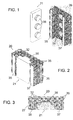
- Shown in Figure 1 is a combination of the object to be packaged (21)/protective cover (20) not assembled, in which the object (21) can be seen to have projecting parts (38) which fit into the gap zones (36) in the protective cover (20), showing how the protective cover (20) as a whole wraps around and perfectly fits the shape or outline of the object to be protected (21) whether it has these projecting parts (38) or recesses.
- the protective cover (20) will always adapt to the shape or outline of the object to be protected (21).
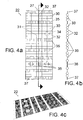
- this Figure 1 shows the protective cover (20) obtained by folding the packaging sheet (22) of Figure 4a at the fold zones (35), with the gap zones (36) for the projecting parts (38), and the corresponding closure zones (37) already joined, such that the protective cover (20) is completed and can be used to wrap and protect the object (21).
- FIG 2 Shown in Figure 2 is a perspective section of a protective cover (20) assembled with the object to be protected (21), with folding at the zones (35), to determine packaging with an appropriate configuration in which gaps are established in accordance with the shape of the object to be protected (21).
- FIG. 3 Shown in Figure 3 is a section of the assembly represented in Figure 2 , in which the mid-line (27) of the already folded packaging sheet (22), the pads or bags (32), the fold zones (35) and the already joined closure zones (37) can be seen.
- the protective cover (20) is constituted based on the packaging sheet (22) of Figure 4a , which is obtained from one or more sheets or films with at least one layer of plastic (23). These sheets or films are joined together by means of transverse joints (30) and longitudinal joints (31), forming bags or pads (32) which will be filled with a fluid (33). These bags or pads (32) can be closed or open, as shown in the detail referenced with (34) in Figure 4a , where four bags or pads (32) are connected together so that the fluid (33) passes from one to another.
- gap zones (36) to fit projecting parts (38) or recessed parts of the object to be protected (21), finally with closure zones (37) of the packaging sheet (22), enabling the closure of said sheet (22) onto itself to give the packaging cover (20) rigidity.
- the fluid (33) needed to fill the pads or bags (32) is introduced at the same time that the longitudinal joints (31) are made in the transformation zone of the second stage (26), as shown in Figures 8 and 9 .
- the shapes and sizes of the pads (32) can be of a larger or smaller size, always appropriate to the protective cover (20) to be obtained and more specifically to the type of object to be protected (21).
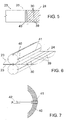
- Figure 5 shows the first transformation stage (25), starting from the stacking of films (23) with at least one layer of plastic which are drawn in the longitudinal direction towards the transformation zone (25) where the film (23) joining system is located, and they are joined together by means of transverse joint lines (30) such that the transverse joints (30) determine transverse channels open (39) at one or both ends (43) of the resulting sheet (24).
- the joining of the transverse lines (30) can be performed by welding or using adhesive.
- one or two cylinders (40) can be used with welding bands (41) on their external surface and appropriately spaced to make the aforementioned transverse joint lines (30).
- a characteristic feature is that these welding bands (41) in the cylinders (40) can be moved radially such that they can project from the external 5 surface of the cylinder (40) or be flush with said surface, as represented in Figure 7 , where an appropriate mechanism (42) makes the aforementioned movements on the welding bands (41).
- transverse joint or joints (30) can also be made using adhesive with the device and mechanisms or means appropriate for the purpose.
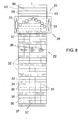
- a second shaping phase shown in Figure 8 the longitudinal joints (31) are made, and at the same time, the pads (32) formed by these longitudinal joints (31) and the transverse joints (30) are filled with fluid (33), using in this case a system of joint modules (44) as represented in Figures 9 and 10 , each of which has at least one joint wheel (45) and at least one evacuation wheel (46), where both types of wheels (45 and 46) are enabled to move independently in the vertical direction.
- a system of joint modules (44) as represented in Figures 9 and 10 , each of which has at least one joint wheel (45) and at least one evacuation wheel (46), where both types of wheels (45 and 46) are enabled to move independently in the vertical direction.
- Each joint module (44) is positioned independently from the rest of the modules (44) and in an appropriate place with respect to the preformed sheet (24) obtained in the previous shaping stage, with these modules (44) positioned in a group.
- the centre of the preformed sheet (24) is joined first and then the longitudinal joints (31) are extended to the sides (43) of said sheet (24), from the centre to the side, permitting the creation of the joint between the two films (23) to form the packaging sheet (22), while at the same time introducing the fluid (33).
- fold zones (35) can be arranged in the packaging sheet (22) in both the transverse and longitudinal directions.
Landscapes
- Engineering & Computer Science (AREA)
- Mechanical Engineering (AREA)
- Buffer Packaging (AREA)
- Wrappers (AREA)
Claims (9)
- Procédé de fabrication pour produire un emballage sous la forme d'un enrobage protecteur (20) destiné à protéger des objets (21), commençant à partir d'au moins deux films superposés (23) ayant une largeur et une épaisseur adaptées et composés d'au moins une couche de plastique, la procédure comprenant les étapes suivantes consistant à :- assembler les films (23) au moyen de lignes d'assemblage transversales (30) formant des canaux transversaux (39) entre des lignes d'assemblage transversales (30) consécutives, où lesdits canaux transversaux (39) sont ouverts sur au moins une de leurs extrémités (43), donnant ainsi une feuille préformée (24) ; et- effectuer l'assemblage au moyen de lignes d'assemblage longitudinales (31), pour former des coussins (32), des zones de pliage (35), des zones intermédiaires (36) et des zones de fermeture (37) ;caractérisé en ce que la procédure comprend également les étapes consistant à :- effectuer l'assemblage au moyen des lignes d'assemblage longitudinales (31) après l'assemblage des films (23) au moyen des lignes d'assemblage transversales (30) ;- effectuer le remplissage des coussins (32) avec un fluide (33) durant la phase de réalisation (26) de l'assemblage longitudinal pour donner une feuille d'emballage (22) ;- et à plier la feuille d'emballage (22) au niveau des zones de pliage (35), ladite feuille d'emballage (22) pouvant être fermée sur elle-même au moyen des zones de fermeture (37), créant ainsi l'enrobage protecteur (20),les lignes d'assemblage longitudinales (31) sont réalisées dans la feuille préformée (24) de l'étape précédente au moyen d'un système de modules d'assemblage (44) agencés en un groupe, chacun d'eux ayant au moins une roue d'assemblage (45) et au moins une roue d'évacuation (46), où ces roues (45 et 46) ont le mécanisme approprié qui leur permet d'être déplacés indépendamment en direction verticale, depuis et vers les films superposés (23) et ont également les moyens appropriés pour produire l'assemblage en soudant les films, la fonction de la/des roue(s) d'évacuation (46) étant d'empêcher tout fluide de pénétrer dans les coussins (32), les laissant partiellement ou totalement vides de tout fluide.
- Procédé de fabrication pour produire un emballage (20) destiné à protéger des objets (21) selon la revendication 1, dans lequel les canaux transversaux (39) d'une feuille préformée (24) donnée peuvent être de largeur différente pour épouser le contour ou la forme de l'objet à emballer (21).
- Procédé de fabrication pour produire un emballage (20) destiné à protéger des objets (21) selon la revendication 1 ou 2, dans lequel les lignes d'assemblage transversales (30) peuvent être réalisées par soudage ou au moyen d'un adhésif.
- Procédé de fabrication pour produire un emballage (20) destiné à protéger des objets (21) selon la revendication 3, dans lequel des rouleaux ou cylindres (40) sont utilisés dans le soudage des lignes d'assemblage transversales (30), qui sont munis de bandes de soudure (41), préparées pour pouvoir se déplacer radialement (42) et pour sortir de la surface externe des cylindres (40) ou pour rester dissimulées à l'intérieur de ceux-ci.
- Procédé de fabrication pour produire un emballage (20) destiné à protéger des objets (21) selon la revendication 3, dans lequel les lignes d'assemblage transversales (30) réalisées avec un adhésif sont produites en pulvérisant l'adhésif sur le film (23) qui doit former la feuille préformée (24).
- Procédé de fabrication pour produire un emballage (20) destiné à protéger des objets (21) selon l'une quelconque des revendications 1 à 5, dans lequel chaque module d'assemblage (44) peut former des soudures indépendamment du reste des modules d'assemblage (44), produisant des coussins (32) de différentes tailles sur la même feuille d'emballage (22), créant ainsi les zones de pliage (35), les zones intermédiaires (36) et les zones de fermeture (37) sur la feuille d'emballage (22).
- Procédé de fabrication pour produire un emballage (20) destiné à protéger des objets (21) selon l'une quelconque des revendications 1 à 6, dans lequel les lignes d'assemblage longitudinales (31) et l'introduction du fluide (33) dans les canaux transversaux (39) par au moins une de leurs extrémités (43) sont réalisées en même temps et dans la même zone de mise en forme de la phase de réalisation (26) de l'assemblage longitudinal.
- Procédé de fabrication pour produire un emballage (20) destiné à protéger des objets (21) selon l'une quelconque des revendications 1 à 7, dans lequel le fluide (33) pour le remplissage des coussins (32) peut être un gaz, un mélange de gaz, un liquide ou une mousse.
- Procédé de fabrication pour produire un emballage (20) destiné à protéger des objets (21) selon l'une quelconque des revendications 1 à 8, dans lequel la feuille d'emballage (22) est pliée au niveau des zones de pliage (35) dans un ordre déterminé dans la conception de l'emballage, formant ainsi l'enrobage protecteur (20).
Applications Claiming Priority (2)
| Application Number | Priority Date | Filing Date | Title |
|---|---|---|---|
| ES201330988A ES2537257B1 (es) | 2013-07-02 | 2013-07-02 | Embalaje para protección de objetos y procedimiento de fabricación del mismo |
| PCT/ES2014/070537 WO2015001159A1 (fr) | 2013-07-02 | 2014-07-01 | Emballage pour la protection d'objets et son procédé de fabrication |
Publications (3)
| Publication Number | Publication Date |
|---|---|
| EP3018071A1 EP3018071A1 (fr) | 2016-05-11 |
| EP3018071A4 EP3018071A4 (fr) | 2017-03-01 |
| EP3018071B1 true EP3018071B1 (fr) | 2017-12-27 |
Family
ID=52143148
Family Applications (1)
| Application Number | Title | Priority Date | Filing Date |
|---|---|---|---|
| EP14819910.2A Active EP3018071B1 (fr) | 2013-07-02 | 2014-07-01 | Emballage pour la protection d'objets et son procédé de fabrication |
Country Status (5)
| Country | Link |
|---|---|
| US (1) | US20160176606A1 (fr) |
| EP (1) | EP3018071B1 (fr) |
| CN (1) | CN105492341B (fr) |
| ES (2) | ES2537257B1 (fr) |
| WO (1) | WO2015001159A1 (fr) |
Families Citing this family (5)
| Publication number | Priority date | Publication date | Assignee | Title |
|---|---|---|---|---|
| CN104596186A (zh) * | 2015-01-15 | 2015-05-06 | 海信容声(广东)冰箱有限公司 | 冰箱内饰固定装置、使用该装置的冰箱及其使用方法 |
| US10351287B2 (en) * | 2016-06-28 | 2019-07-16 | International Business Machines Corporation | Method for using a package insert for cushioning an object |
| CN111712436B (zh) * | 2018-02-07 | 2022-04-08 | 朗派公司 | 自动垫料适应设备和方法 |
| ES2989426T3 (es) * | 2020-06-01 | 2024-11-26 | Agil Packaging System S L | Estación de soldadura |
| US20250002240A1 (en) | 2023-06-30 | 2025-01-02 | Ryan Curtis | Adaptable foam grid system for insertion into protective case. |
Family Cites Families (27)
| Publication number | Priority date | Publication date | Assignee | Title |
|---|---|---|---|---|
| US2958620A (en) * | 1956-09-26 | 1960-11-01 | Ono Iwao | Plastic elastic products of piece-goods |
| US3817803A (en) * | 1972-06-19 | 1974-06-18 | Fmc Corp | Method of making a cellular cushioning structure |
| JPS60134874A (ja) * | 1983-11-11 | 1985-07-18 | オリヒロ株式会社 | 緩衝材の製造方法ならびに製造装置 |
| ATE125486T1 (de) * | 1991-05-03 | 1995-08-15 | Michel Chappuis | Polsterungselement zum verpacken von körpern und vorrichtung zum herstellen eines polsterungselementes. |
| US5216868A (en) * | 1992-01-28 | 1993-06-08 | Andrew K. Cooper | Packaging product and machine for making same |
| JPH0741051A (ja) * | 1993-07-23 | 1995-02-10 | Hideyuki Suzuki | 緩衝材及び緩衝材の製造方法及び緩衝材を用いた容器 |
| US5660662A (en) * | 1995-04-25 | 1997-08-26 | Testone Enterprises, Inc. | Method and apparatus for forming filled cushions, and filled cushions |
| US7536837B2 (en) * | 1999-03-09 | 2009-05-26 | Free-Flow Packaging International, Inc. | Apparatus for inflating and sealing pillows in packaging cushions |
| AU2001227931A1 (en) * | 2000-01-20 | 2001-07-31 | Free-Flow Packaging International, Inc. | System, method and material for making pneumatically filled packing cushions |
| MY121480A (en) * | 2000-11-30 | 2006-01-28 | Sun A Kaken Co Ltd | Buffer packing bag |
| US7220476B2 (en) * | 2001-05-10 | 2007-05-22 | Sealed Air Corporation (Us) | Apparatus and method for forming inflated chambers |
| JP2002362620A (ja) * | 2001-06-11 | 2002-12-18 | Matsushita Electric Ind Co Ltd | 包装装置 |
| US20040231291A1 (en) * | 2003-05-23 | 2004-11-25 | Jean-Marc Slovencik | Stock material, protective packaging product and method |
| US7273142B2 (en) * | 2004-02-17 | 2007-09-25 | Sealed Air Corporation (Us) | Packaging cushion delivery system |
| US7254932B2 (en) * | 2004-11-18 | 2007-08-14 | Air-Paq, Inc. | Multi-purpose air-packing method and system |
| US7621104B2 (en) * | 2005-01-31 | 2009-11-24 | Sealed Air Corporation (Us) | Inflatable mailer, apparatus and method for preparing the same |
| US7992615B2 (en) * | 2006-06-15 | 2011-08-09 | Young Seok Kim | Manufacturing machine of packing material inflated with air |
| CN101152915A (zh) * | 2006-09-29 | 2008-04-02 | 廖耀鑫 | 复层异类基材的缓冲包装装置 |
| TW200827253A (en) * | 2006-12-29 | 2008-07-01 | Chieh-Hua Liao | Block reinforced air enclosure and manufacture thereof |
| TW200827254A (en) * | 2006-12-29 | 2008-07-01 | Chieh-Hua Liao | Apparatus and method for manufacturing double layer air cylinder type air enclosure |
| US8567159B2 (en) * | 2007-04-12 | 2013-10-29 | Sealed Air Corporation (Us) | Apparatus and method for making inflated articles |
| CN101549774B (zh) * | 2008-03-31 | 2013-09-18 | 上海尼禄国际贸易有限公司 | 一种空气包装装置及其生产方法 |
| ES1069687Y (es) | 2008-12-30 | 2009-08-06 | Bsh Electrodomesticos Espana | Embalaje para aparato electrodomestico |
| ES2382853B1 (es) | 2010-02-25 | 2013-04-26 | BSH Electrodomésticos España S.A. | Embalaje para aparato electrodomestico y aparato electrodomestico con dicho embalaje |
| TWI440589B (zh) * | 2011-08-26 | 2014-06-11 | Yaw Shin Liao | 自動調節夾持壓力之緩衝氣袋 |
| US8936156B1 (en) * | 2012-04-05 | 2015-01-20 | Inflatable Packaging, Inc. | Inflatable packaging cushion with product suspension pocket |
| US9969136B2 (en) * | 2013-04-19 | 2018-05-15 | Sealed Air Corporation (Us) | Inflatable pouches |
-
2013
- 2013-07-02 ES ES201330988A patent/ES2537257B1/es not_active Expired - Fee Related
-
2014
- 2014-07-01 US US14/392,243 patent/US20160176606A1/en not_active Abandoned
- 2014-07-01 WO PCT/ES2014/070537 patent/WO2015001159A1/fr not_active Ceased
- 2014-07-01 ES ES14819910.2T patent/ES2661260T3/es active Active
- 2014-07-01 EP EP14819910.2A patent/EP3018071B1/fr active Active
- 2014-07-01 CN CN201480043774.0A patent/CN105492341B/zh active Active
Non-Patent Citations (1)
| Title |
|---|
| None * |
Also Published As
| Publication number | Publication date |
|---|---|
| US20160176606A1 (en) | 2016-06-23 |
| EP3018071A1 (fr) | 2016-05-11 |
| CN105492341A (zh) | 2016-04-13 |
| ES2661260T3 (es) | 2018-03-28 |
| CN105492341B (zh) | 2018-12-14 |
| ES2537257B1 (es) | 2016-03-09 |
| ES2537257A1 (es) | 2015-06-03 |
| EP3018071A4 (fr) | 2017-03-01 |
| WO2015001159A1 (fr) | 2015-01-08 |
Similar Documents
| Publication | Publication Date | Title |
|---|---|---|
| EP3018071B1 (fr) | Emballage pour la protection d'objets et son procédé de fabrication | |
| US2934867A (en) | Packaging fluent products | |
| CA1125709A (fr) | Materiau d'emballage et methode de realisation d'un emballage | |
| US20140134302A1 (en) | Damage Resistant Package | |
| KR20150130271A (ko) | 주문형 팽창식 포장 | |
| KR101752101B1 (ko) | 단열성 및 보관성이 향상된 포장시트의 제조방법 | |
| JPH07309371A (ja) | 包装材料およびその製造方法 | |
| CN101513952A (zh) | 可重复利用的多功能立体密封包装材料及其制造方法 | |
| CA2450519A1 (fr) | Dispositif et methode d'emballage | |
| JP6806975B2 (ja) | 断熱性および保管性が向上した包装シートの製造方法 | |
| US20070095693A1 (en) | Compressed layered roll package and associated method | |
| JP5539183B2 (ja) | 消費物品の密封バンドルを生成する方法 | |
| CN109689364B (zh) | 隔热性以及保管性得到提升的包装膜的制造方法 | |
| WO2005044688A1 (fr) | Materiau pour systeme de coussin d'air universel | |
| WO2004074133A1 (fr) | Element d'amortissement pneumatique en forme de cadre | |
| US20070051656A1 (en) | Shock absorbing device for air-column sheet | |
| JP2002037341A (ja) | 商品包装袋及びその製造方法 | |
| KR102462013B1 (ko) | 재활용 가능한 빙과류 포장지 | |
| EP3248901B1 (fr) | Sac d'emballage gonflable de protection | |
| KR100970985B1 (ko) | 과일포장판의 제조방법 | |
| JP2017007694A (ja) | 容器用シート材および該容器用シート材によって構成される容器 | |
| JP3957494B2 (ja) | 緩衝用包装材およびその製造方法 | |
| JP5146893B1 (ja) | ブロック型空気封入緩衝材及びその製造方法 | |
| KR200417130Y1 (ko) | 이중 포장지 | |
| CN222906290U (zh) | 一种具有空间可调的纸盒 |
Legal Events
| Date | Code | Title | Description |
|---|---|---|---|
| PUAI | Public reference made under article 153(3) epc to a published international application that has entered the european phase |
Free format text: ORIGINAL CODE: 0009012 |
|
| 17P | Request for examination filed |
Effective date: 20160128 |
|
| AK | Designated contracting states |
Kind code of ref document: A1 Designated state(s): AL AT BE BG CH CY CZ DE DK EE ES FI FR GB GR HR HU IE IS IT LI LT LU LV MC MK MT NL NO PL PT RO RS SE SI SK SM TR |
|
| AX | Request for extension of the european patent |
Extension state: BA ME |
|
| DAX | Request for extension of the european patent (deleted) | ||
| A4 | Supplementary search report drawn up and despatched |
Effective date: 20170201 |
|
| RIC1 | Information provided on ipc code assigned before grant |
Ipc: B65D 81/05 20060101ALI20170126BHEP Ipc: B65D 81/03 20060101AFI20170126BHEP Ipc: B31D 5/00 20170101ALI20170126BHEP |
|
| RAP1 | Party data changed (applicant data changed or rights of an application transferred) |
Owner name: AGIL PACKAGING SYSTEM, S.L. |
|
| RIN1 | Information on inventor provided before grant (corrected) |
Inventor name: REDONDO GARCIA, ELADIO EDUARDO |
|
| GRAP | Despatch of communication of intention to grant a patent |
Free format text: ORIGINAL CODE: EPIDOSNIGR1 |
|
| RIC1 | Information provided on ipc code assigned before grant |
Ipc: B65D 81/05 20060101ALI20170707BHEP Ipc: B31D 5/00 20170101ALI20170707BHEP Ipc: B65D 81/03 20060101AFI20170707BHEP |
|
| INTG | Intention to grant announced |
Effective date: 20170814 |
|
| GRAS | Grant fee paid |
Free format text: ORIGINAL CODE: EPIDOSNIGR3 |
|
| GRAA | (expected) grant |
Free format text: ORIGINAL CODE: 0009210 |
|
| AK | Designated contracting states |
Kind code of ref document: B1 Designated state(s): AL AT BE BG CH CY CZ DE DK EE ES FI FR GB GR HR HU IE IS IT LI LT LU LV MC MK MT NL NO PL PT RO RS SE SI SK SM TR |
|
| REG | Reference to a national code |
Ref country code: GB Ref legal event code: FG4D |
|
| REG | Reference to a national code |
Ref country code: CH Ref legal event code: EP |
|
| REG | Reference to a national code |
Ref country code: AT Ref legal event code: REF Ref document number: 958059 Country of ref document: AT Kind code of ref document: T Effective date: 20180115 |
|
| REG | Reference to a national code |
Ref country code: IE Ref legal event code: FG4D |
|
| REG | Reference to a national code |
Ref country code: DE Ref legal event code: R096 Ref document number: 602014019226 Country of ref document: DE |
|
| REG | Reference to a national code |
Ref country code: ES Ref legal event code: FG2A Ref document number: 2661260 Country of ref document: ES Kind code of ref document: T3 Effective date: 20180328 |
|
| PG25 | Lapsed in a contracting state [announced via postgrant information from national office to epo] |
Ref country code: FI Free format text: LAPSE BECAUSE OF FAILURE TO SUBMIT A TRANSLATION OF THE DESCRIPTION OR TO PAY THE FEE WITHIN THE PRESCRIBED TIME-LIMIT Effective date: 20171227 Ref country code: NO Free format text: LAPSE BECAUSE OF FAILURE TO SUBMIT A TRANSLATION OF THE DESCRIPTION OR TO PAY THE FEE WITHIN THE PRESCRIBED TIME-LIMIT Effective date: 20180327 Ref country code: LT Free format text: LAPSE BECAUSE OF FAILURE TO SUBMIT A TRANSLATION OF THE DESCRIPTION OR TO PAY THE FEE WITHIN THE PRESCRIBED TIME-LIMIT Effective date: 20171227 |
|
| REG | Reference to a national code |
Ref country code: NL Ref legal event code: MP Effective date: 20171227 |
|
| REG | Reference to a national code |
Ref country code: LT Ref legal event code: MG4D |
|
| REG | Reference to a national code |
Ref country code: AT Ref legal event code: MK05 Ref document number: 958059 Country of ref document: AT Kind code of ref document: T Effective date: 20171227 |
|
| PG25 | Lapsed in a contracting state [announced via postgrant information from national office to epo] |
Ref country code: HR Free format text: LAPSE BECAUSE OF FAILURE TO SUBMIT A TRANSLATION OF THE DESCRIPTION OR TO PAY THE FEE WITHIN THE PRESCRIBED TIME-LIMIT Effective date: 20171227 Ref country code: RS Free format text: LAPSE BECAUSE OF FAILURE TO SUBMIT A TRANSLATION OF THE DESCRIPTION OR TO PAY THE FEE WITHIN THE PRESCRIBED TIME-LIMIT Effective date: 20171227 Ref country code: BG Free format text: LAPSE BECAUSE OF FAILURE TO SUBMIT A TRANSLATION OF THE DESCRIPTION OR TO PAY THE FEE WITHIN THE PRESCRIBED TIME-LIMIT Effective date: 20180327 Ref country code: LV Free format text: LAPSE BECAUSE OF FAILURE TO SUBMIT A TRANSLATION OF THE DESCRIPTION OR TO PAY THE FEE WITHIN THE PRESCRIBED TIME-LIMIT Effective date: 20171227 |
|
| PG25 | Lapsed in a contracting state [announced via postgrant information from national office to epo] |
Ref country code: NL Free format text: LAPSE BECAUSE OF FAILURE TO SUBMIT A TRANSLATION OF THE DESCRIPTION OR TO PAY THE FEE WITHIN THE PRESCRIBED TIME-LIMIT Effective date: 20171227 |
|
| REG | Reference to a national code |
Ref country code: FR Ref legal event code: PLFP Year of fee payment: 5 |
|
| PG25 | Lapsed in a contracting state [announced via postgrant information from national office to epo] |
Ref country code: CY Free format text: LAPSE BECAUSE OF FAILURE TO SUBMIT A TRANSLATION OF THE DESCRIPTION OR TO PAY THE FEE WITHIN THE PRESCRIBED TIME-LIMIT Effective date: 20171227 Ref country code: CZ Free format text: LAPSE BECAUSE OF FAILURE TO SUBMIT A TRANSLATION OF THE DESCRIPTION OR TO PAY THE FEE WITHIN THE PRESCRIBED TIME-LIMIT Effective date: 20171227 Ref country code: SK Free format text: LAPSE BECAUSE OF FAILURE TO SUBMIT A TRANSLATION OF THE DESCRIPTION OR TO PAY THE FEE WITHIN THE PRESCRIBED TIME-LIMIT Effective date: 20171227 Ref country code: EE Free format text: LAPSE BECAUSE OF FAILURE TO SUBMIT A TRANSLATION OF THE DESCRIPTION OR TO PAY THE FEE WITHIN THE PRESCRIBED TIME-LIMIT Effective date: 20171227 |
|
| PG25 | Lapsed in a contracting state [announced via postgrant information from national office to epo] |
Ref country code: AT Free format text: LAPSE BECAUSE OF FAILURE TO SUBMIT A TRANSLATION OF THE DESCRIPTION OR TO PAY THE FEE WITHIN THE PRESCRIBED TIME-LIMIT Effective date: 20171227 Ref country code: PL Free format text: LAPSE BECAUSE OF FAILURE TO SUBMIT A TRANSLATION OF THE DESCRIPTION OR TO PAY THE FEE WITHIN THE PRESCRIBED TIME-LIMIT Effective date: 20171227 Ref country code: RO Free format text: LAPSE BECAUSE OF FAILURE TO SUBMIT A TRANSLATION OF THE DESCRIPTION OR TO PAY THE FEE WITHIN THE PRESCRIBED TIME-LIMIT Effective date: 20171227 Ref country code: IS Free format text: LAPSE BECAUSE OF FAILURE TO SUBMIT A TRANSLATION OF THE DESCRIPTION OR TO PAY THE FEE WITHIN THE PRESCRIBED TIME-LIMIT Effective date: 20180427 Ref country code: SM Free format text: LAPSE BECAUSE OF FAILURE TO SUBMIT A TRANSLATION OF THE DESCRIPTION OR TO PAY THE FEE WITHIN THE PRESCRIBED TIME-LIMIT Effective date: 20171227 |
|
| REG | Reference to a national code |
Ref country code: DE Ref legal event code: R097 Ref document number: 602014019226 Country of ref document: DE |
|
| PLBE | No opposition filed within time limit |
Free format text: ORIGINAL CODE: 0009261 |
|
| STAA | Information on the status of an ep patent application or granted ep patent |
Free format text: STATUS: NO OPPOSITION FILED WITHIN TIME LIMIT |
|
| PG25 | Lapsed in a contracting state [announced via postgrant information from national office to epo] |
Ref country code: DK Free format text: LAPSE BECAUSE OF FAILURE TO SUBMIT A TRANSLATION OF THE DESCRIPTION OR TO PAY THE FEE WITHIN THE PRESCRIBED TIME-LIMIT Effective date: 20171227 |
|
| 26N | No opposition filed |
Effective date: 20180928 |
|
| PG25 | Lapsed in a contracting state [announced via postgrant information from national office to epo] |
Ref country code: SI Free format text: LAPSE BECAUSE OF FAILURE TO SUBMIT A TRANSLATION OF THE DESCRIPTION OR TO PAY THE FEE WITHIN THE PRESCRIBED TIME-LIMIT Effective date: 20171227 |
|
| REG | Reference to a national code |
Ref country code: CH Ref legal event code: PL |
|
| PG25 | Lapsed in a contracting state [announced via postgrant information from national office to epo] |
Ref country code: LU Free format text: LAPSE BECAUSE OF NON-PAYMENT OF DUE FEES Effective date: 20180701 Ref country code: MC Free format text: LAPSE BECAUSE OF FAILURE TO SUBMIT A TRANSLATION OF THE DESCRIPTION OR TO PAY THE FEE WITHIN THE PRESCRIBED TIME-LIMIT Effective date: 20171227 |
|
| REG | Reference to a national code |
Ref country code: BE Ref legal event code: MM Effective date: 20180731 |
|
| REG | Reference to a national code |
Ref country code: IE Ref legal event code: MM4A |
|
| PG25 | Lapsed in a contracting state [announced via postgrant information from national office to epo] |
Ref country code: LI Free format text: LAPSE BECAUSE OF NON-PAYMENT OF DUE FEES Effective date: 20180731 Ref country code: CH Free format text: LAPSE BECAUSE OF NON-PAYMENT OF DUE FEES Effective date: 20180731 Ref country code: IE Free format text: LAPSE BECAUSE OF NON-PAYMENT OF DUE FEES Effective date: 20180701 |
|
| PG25 | Lapsed in a contracting state [announced via postgrant information from national office to epo] |
Ref country code: BE Free format text: LAPSE BECAUSE OF NON-PAYMENT OF DUE FEES Effective date: 20180731 |
|
| PG25 | Lapsed in a contracting state [announced via postgrant information from national office to epo] |
Ref country code: MT Free format text: LAPSE BECAUSE OF NON-PAYMENT OF DUE FEES Effective date: 20180701 |
|
| PG25 | Lapsed in a contracting state [announced via postgrant information from national office to epo] |
Ref country code: TR Free format text: LAPSE BECAUSE OF FAILURE TO SUBMIT A TRANSLATION OF THE DESCRIPTION OR TO PAY THE FEE WITHIN THE PRESCRIBED TIME-LIMIT Effective date: 20171227 |
|
| PG25 | Lapsed in a contracting state [announced via postgrant information from national office to epo] |
Ref country code: PT Free format text: LAPSE BECAUSE OF FAILURE TO SUBMIT A TRANSLATION OF THE DESCRIPTION OR TO PAY THE FEE WITHIN THE PRESCRIBED TIME-LIMIT Effective date: 20171227 |
|
| PG25 | Lapsed in a contracting state [announced via postgrant information from national office to epo] |
Ref country code: HU Free format text: LAPSE BECAUSE OF FAILURE TO SUBMIT A TRANSLATION OF THE DESCRIPTION OR TO PAY THE FEE WITHIN THE PRESCRIBED TIME-LIMIT; INVALID AB INITIO Effective date: 20140701 Ref country code: MK Free format text: LAPSE BECAUSE OF NON-PAYMENT OF DUE FEES Effective date: 20171227 Ref country code: SE Free format text: LAPSE BECAUSE OF FAILURE TO SUBMIT A TRANSLATION OF THE DESCRIPTION OR TO PAY THE FEE WITHIN THE PRESCRIBED TIME-LIMIT Effective date: 20171227 Ref country code: GR Free format text: LAPSE BECAUSE OF FAILURE TO SUBMIT A TRANSLATION OF THE DESCRIPTION OR TO PAY THE FEE WITHIN THE PRESCRIBED TIME-LIMIT Effective date: 20171227 |
|
| PG25 | Lapsed in a contracting state [announced via postgrant information from national office to epo] |
Ref country code: AL Free format text: LAPSE BECAUSE OF FAILURE TO SUBMIT A TRANSLATION OF THE DESCRIPTION OR TO PAY THE FEE WITHIN THE PRESCRIBED TIME-LIMIT Effective date: 20171227 |
|
| P01 | Opt-out of the competence of the unified patent court (upc) registered |
Effective date: 20230522 |
|
| PGFP | Annual fee paid to national office [announced via postgrant information from national office to epo] |
Ref country code: ES Payment date: 20250806 Year of fee payment: 12 |
|
| PGFP | Annual fee paid to national office [announced via postgrant information from national office to epo] |
Ref country code: DE Payment date: 20250729 Year of fee payment: 12 |
|
| PGFP | Annual fee paid to national office [announced via postgrant information from national office to epo] |
Ref country code: IT Payment date: 20250721 Year of fee payment: 12 |
|
| PGFP | Annual fee paid to national office [announced via postgrant information from national office to epo] |
Ref country code: GB Payment date: 20250728 Year of fee payment: 12 |
|
| PGFP | Annual fee paid to national office [announced via postgrant information from national office to epo] |
Ref country code: FR Payment date: 20250725 Year of fee payment: 12 |