EP3018251B1 - Verfahren zur rückgewinnung von hydrolysat in einem prehydrolysesulfat-kochverfahren für zellstoffherstellung - Google Patents
Verfahren zur rückgewinnung von hydrolysat in einem prehydrolysesulfat-kochverfahren für zellstoffherstellung Download PDFInfo
- Publication number
- EP3018251B1 EP3018251B1 EP15193392.6A EP15193392A EP3018251B1 EP 3018251 B1 EP3018251 B1 EP 3018251B1 EP 15193392 A EP15193392 A EP 15193392A EP 3018251 B1 EP3018251 B1 EP 3018251B1
- Authority
- EP
- European Patent Office
- Prior art keywords
- liquid
- digester
- hydrolysate
- draining
- prehydrolysis
- Prior art date
- Legal status (The legal status is an assumption and is not a legal conclusion. Google has not performed a legal analysis and makes no representation as to the accuracy of the status listed.)
- Active
Links
Images







Classifications
-
- D—TEXTILES; PAPER
- D21—PAPER-MAKING; PRODUCTION OF CELLULOSE
- D21C—PRODUCTION OF CELLULOSE BY REMOVING NON-CELLULOSE SUBSTANCES FROM CELLULOSE-CONTAINING MATERIALS; REGENERATION OF PULPING LIQUORS; APPARATUS THEREFOR
- D21C1/00—Pretreatment of the finely-divided materials before digesting
- D21C1/02—Pretreatment of the finely-divided materials before digesting with water or steam
-
- D—TEXTILES; PAPER
- D21—PAPER-MAKING; PRODUCTION OF CELLULOSE
- D21C—PRODUCTION OF CELLULOSE BY REMOVING NON-CELLULOSE SUBSTANCES FROM CELLULOSE-CONTAINING MATERIALS; REGENERATION OF PULPING LIQUORS; APPARATUS THEREFOR
- D21C1/00—Pretreatment of the finely-divided materials before digesting
- D21C1/04—Pretreatment of the finely-divided materials before digesting with acid reacting compounds
-
- D—TEXTILES; PAPER
- D21—PAPER-MAKING; PRODUCTION OF CELLULOSE
- D21C—PRODUCTION OF CELLULOSE BY REMOVING NON-CELLULOSE SUBSTANCES FROM CELLULOSE-CONTAINING MATERIALS; REGENERATION OF PULPING LIQUORS; APPARATUS THEREFOR
- D21C1/00—Pretreatment of the finely-divided materials before digesting
-
- D—TEXTILES; PAPER
- D21—PAPER-MAKING; PRODUCTION OF CELLULOSE
- D21C—PRODUCTION OF CELLULOSE BY REMOVING NON-CELLULOSE SUBSTANCES FROM CELLULOSE-CONTAINING MATERIALS; REGENERATION OF PULPING LIQUORS; APPARATUS THEREFOR
- D21C11/00—Regeneration of pulp liquors or effluent waste waters
-
- D—TEXTILES; PAPER
- D21—PAPER-MAKING; PRODUCTION OF CELLULOSE
- D21C—PRODUCTION OF CELLULOSE BY REMOVING NON-CELLULOSE SUBSTANCES FROM CELLULOSE-CONTAINING MATERIALS; REGENERATION OF PULPING LIQUORS; APPARATUS THEREFOR
- D21C11/00—Regeneration of pulp liquors or effluent waste waters
- D21C11/0007—Recovery of by-products, i.e. compounds other than those necessary for pulping, for multiple uses or not otherwise provided for
-
- D—TEXTILES; PAPER
- D21—PAPER-MAKING; PRODUCTION OF CELLULOSE
- D21C—PRODUCTION OF CELLULOSE BY REMOVING NON-CELLULOSE SUBSTANCES FROM CELLULOSE-CONTAINING MATERIALS; REGENERATION OF PULPING LIQUORS; APPARATUS THEREFOR
- D21C3/00—Pulping cellulose-containing materials
-
- D—TEXTILES; PAPER
- D21—PAPER-MAKING; PRODUCTION OF CELLULOSE
- D21C—PRODUCTION OF CELLULOSE BY REMOVING NON-CELLULOSE SUBSTANCES FROM CELLULOSE-CONTAINING MATERIALS; REGENERATION OF PULPING LIQUORS; APPARATUS THEREFOR
- D21C7/00—Digesters
- D21C7/12—Devices for regulating or controlling
-
- D—TEXTILES; PAPER
- D21—PAPER-MAKING; PRODUCTION OF CELLULOSE
- D21C—PRODUCTION OF CELLULOSE BY REMOVING NON-CELLULOSE SUBSTANCES FROM CELLULOSE-CONTAINING MATERIALS; REGENERATION OF PULPING LIQUORS; APPARATUS THEREFOR
- D21C9/00—After-treatment of cellulose pulp, e.g. of wood pulp, or cotton linters ; Treatment of dilute or dewatered pulp or process improvement taking place after obtaining the raw cellulosic material and not provided for elsewhere
Definitions
- the present invention relates to a method for producing pulp. More particularly, it concerns a displacement batch cooking process recovering a first treatment liquid in a displacement batch pulping process by draining off the first treatment liquid from digester and not using a displacement liquid.
- the inventive method may preferably be used in a prehydrolysis step either as a steam or liquid phase prehydrolysis, wherein the recovery of the by-products is improved.
- a hydrolysate is withdrawn by draining in at least one phase obtaining a strong first liquid, preferably without using any displacement liquid and thereafter any residual hydrolysate may be displaced, possibly using a displacement liquid.
- a first treatment liquid is added for the prehydrolysis and is present during the same.
- a hydrolysate is withdrawn obtaining a strong first liquid, preferably without using any displacement liquid and thereafter any residual hydrolysate may be displaced, possibly using a displacement liquid.
- the prehydrolysis-sulfate (Kraft) cooking for the production of special pulps having a high content of alpha cellulose was developed in the 1930's, see e.g. Rydholm, S. E., Pulping Processes, pp. 649 to 672, Interscience Publishers, New York, 1968 .
- the basic idea is to remove as much hemicellulose as possible from cellulose fibers in connection with delignification, so as to obtain a high content of alpha cellulose. This is essential because the various end uses of such pulps, dissolving pulp for instance, do not tolerate short-chained hemicellulose molecules with a randomly grafted molecular structure.
- a separate prehydrolysis step permits the desired adjustment of the hydrolysis of hemicelluloses by varying the hydrolysis conditions.
- the prehydrolysis is carried out either as a steam or water phase prehydrolysis, or in the presence of a catalyst.
- steam organic acids liberated from wood during the process establish the necessary pH conditions and perform a major part of the hydrolysis
- small amounts of mineral acid or sulfur dioxide may be added to "assist" the prehydrolysis.
- autohydrolysis the prehydrolysis stage is carried out without any addition of acids. Conventionally is autohydrolysis established at some 30-40° C higher temperature than with acid addition.
- the hydrolysate and the prehydrolyzed cellulosic material are neutralized in the reactor with alkaline neutralizing liquor so as to produce neutralized hydrolysate and neutralized prehydrolyzed cellulosic material.
- hydrolysate both in the free liquid outside the chips and also trapped and immobilized inside the chips.
- Bio Pulping as much as possible of the hydrolysate can be recovered before the neutralization step in order to be able to utilize the carbohydrates released in the prehydrolysis as an additional product from the mill.
- a separate washing stage in which the digester is first filled up with a washing liquid and then the liquid containing the carbohydrates is displaced from the digester, can be used between the prehydrolysis and cooking stages.
- US 8,262,854 describes an improved method for treating lignocellulosic material, wherein the digester and its contents are first heated with direct steam to a predetermined hydrolysis temperature in a steam phase and then a small volume of washing liquid is introduced into the top of the digester which washing liquid is trickling down through the chips column and removed from the lower end of the digester.
- the hydrolysate is recovered by utilizing trickle-bed type down-flow of hydrolysate.
- the first fraction of the trickled-down hydrolysate is collected as a product fraction and the second fraction is discharged from the digester to a hot hydrolysate storage tank to be used as the first trickle flow liquid in the next batch.
- EP 2430233 is disclosed another method to recover the hydrolysate from a steam phase prehydrolysis much quicker than that possible using the trickle down method as disclosed in US 8,262,854 .
- water is introduced into the digester after prehydrolysis at top and bottom and subjected to internal circulation while filling the digester. The water filling may be continued until the entire chip volume inside digester is drenched in water.
- the water with its content of hydrolysate is displaced by another liquid using conventional displacement and the process may continue by a neutralization cooking process known in the art.
- the displaced hydrolysate is diluted by the another liquid used during displacement.
- SAEED ABRAR ET AL Mass balances of components dissolved in the pre-hydrolysis liquor of kraft-based dissolving pulp production process from Canadian Hardwoods
- BIOMASS AND ENERGY Vol. 39, pages 14-19 regards the conversion of biomass feed stock for the purpose of producing fuel and chemicals.
- the three main biopolymers, i.e., cellulose, hemicelluloses, and lignin, which are the dominant chemical constituents in lignocellulosic raw materials are to be converted to the building blocks for biofuels, biochemical and biomaterials mass balances of components dissolved in the pre-hydrolysis liquor of kraft-based dissolving pulp production process from Canadian hardwoods.
- SE 0 600 678 L discloses a method for extraction of hemicellulose by cooking of lignocellulosic materials in a chemical-containing liquid at acid, neutral or weakly alkaline conditions for obtaining cellulosic pulp in a chemical or chemi-mechanical way, wherein a portion of the cooking liquid is extracted from the cooking and is subjected to ultra-filtering or reversed osmosis for removing at least a significant portion of the hemicellulose contained in the cooking liquor before the hemicellulose-free liquor preferably is returned to the cooking.
- the removal of hemicellulose at least is performed in state of the cooking where precipitation of hemicellulose from the lignocellulosic material to the liquor is at maximum or almost at maximum and the precipitated hemicellulose is in polymeric state or in an essentially polymeric state.
- US 3 294 623 A discloses a process for preparing cellulose pulp which is particularly useful in the preparation of dissolving grade wood pulps for conversion to produce rayon and other cellulose derivative products having greater strength, durability, and other desirable characteristics.
- the object of the present invention is to optimize the recovery of a first treatment liquid in a displacement batch pulping process, said first treatment liquid having highest possible concentration of valuable compounds dissolved in the first treatment liquid, avoiding excessive dilution of the first treatment liquid and extracting largest possible volumes of this undiluted first treatment liquid.
- the claimed method is applied for recovering a hydrolysate after prehydrolysis, where the hydrolysate is kept at highest possible concentration of the hydrolysate in aspects of the carbohydrate content.
- the prehydrolysis can be carried out either as a steam or liquid phase, e.g. water phase prehydrolysis.
- the first treatment liquid is added to a digester after a steam prehydrolysing step to wash out the steam condensate and the carbohydrates dissolved therein, while for a liquid phase prehydrolysis the first treatment liquid is the liquid added for the prehydrolysis and being present during the prehydrolysis.
- hydrolysate means a liquid phase containing hydrolysis products from pretreated cellulose material.
- the hydrolysate comprises the first treatment liquid present during the prehydrolysis and carbohydrates removed from the cellulose material, while for steam prehydrolysis the first treatment liquid drained off is understood to comprise a mixture of condensate and carbohydrates present in the wood matrix, and the liquid used to catch the mixture of condensate and carbohydrates.
- the mixture of condensate and carbohydrates after a steam hydrolysis is only present in form of liquid layers in the wood matrix, and at concentrations well over what could be possible to obtain after a water hydrolysis, and practically impossible to drain off after the hydrolysis.
- the liquid drained off from the digester is also referred to as a strong first liquid in the following.
- An undiluted strong first liquid preferably may be recovered without having to use any wash liquids.
- undiluted is meant a first treatment liquid that is not diluted by any displacement liquid, or the first treatment liquid added to catch the steam condensate with its content of carbohydrates.
- Such an undiluted strong first liquid is kept at high temperature, preferably at hydrolysis temperature, if liquid phase, e.g. water phase prehydrolysis is done, else some degrees lower temperature after steam prehydrolysis depending on temperature of the catching liquid and is most beneficial for the heat economy of the subsequent sugar recovery process, reducing the bulk load of water in such system that needs to be reduced by distillation, evaporation or other methods.
- the draining technique of the invention is preventing any dilution that may occur as the chip bed inside of digester very seldom offers a uniform flow resistance over the horizontal cross section, nor in the vertical direction. This leads to that displacement liquids often find its way through the chip bed in streaks of lowest flow resistance, i.e. causing a "channeling" effect that wash out certain chip volumes around these streaks while other parts of the chip volume is less washed out by any displacement front of wash liquids.
- the invention may be applied both after steam hydrolysis, as well as liquid filled hydrolysis, but requires liquid filling after the steam hydrolysis or using the residual process liquid after liquid filled hydrolysis.
- the invention relates to a method for recovering a first treatment liquid in a displacement batch pulping process in a digester equipped with a bottom, a top and a middle liquid exchange position, said method comprising filling the digester with a first treatment liquid.
- the method is characterized in that the process continues by,
- the inventive method for recovering a first treatment liquid is further improved by implementation after a prehydrolysis, wherein the first treatment liquid is used during prehydrolysis of the digester content to produce an acidic hydrolysate containing the carbohydrates dissolved in the hydrolysate during the prehydrolysis.
- the process continues by,
- the carbohydrate concentration in this strong first liquid could thus be kept at highest possible concentration, which is beneficial for the sugar recovery process.
- the skilled man understands that the carbohydrate concentration will differ for hardwood or softwood as this depends on the type of wood being (pre)hydrolysed, as there is a difference in hemicelllulose content of hardwood and softwood and also a variance in each of these groups.
- the skilled person will also clearly understand the meaning of the term “strong” and "weak” liquids, as the concept of obtaining strong and weak liquids is well established in the field of pulp mills.
- the inventive method for recovering a first treatment liquid is further improved by implementation after a prehydrolysis, wherein after filling the digester with a first treatment liquid during or after the prehydrolyzing step the first treatment liquid contained in the digester is subjected to circulation within the digester by withdrawing the first treatment liquid from middle liquid exchange position and reintroduction to top and bottom of digester such that the first treatment liquid volume passes the chip volume at least one time, thus washing out the carbohydrates dissolved in the hydrolysate or removed from the cellulosic material.
- the displacement ratio could be higher than one time, and up to 5-10 times, especially if the prehydrolysis is done in steam phase.
- the inventive method for recovering a first treatment liquid may be further improved by implementation after a prehydrolysis, wherein the draining is assisted by displacing steam, especially low pressure steam or gases through the digester, said steam or gases added via the top liquid exchange position and wherein the pressure and temperature (preferably 150°C - 180°C) in the strong first liquid is maintained.
- steam preferably low pressure steam (low pressure (LP) is typically, but not necessarily, a pressure in the range of 0.35 - 0.45 MPa (absolute) corresponding to a saturation temperature of 139°C - 148°C)
- the inventive method for recovering a first treatment liquid is further improved by implementation after a prehydrolysis, wherein draining is done by withdrawing the strong first liquid through the middle liquid exchange position and in final phases displacing the residual strong first liquid kept in the digester below the middle liquid exchange position via a displacement liquid using hot water added to bottom liquid exchange position displacing the residual strong first liquid out through the middle liquid exchange position.
- This will limit risks for dilution of the residual strong first liquid as the displacement is only performed in a small volume of the digester (volume below mid screen), and channeling effects will have less impact on distortion of the displacement front trough the comminuted cellulose material kept in the digester.
- the inventive method for recovering a first treatment liquid is further improved by implementation after a prehydrolysis, wherein the strong first liquid is kept at the prehydrolysis temperature (preferably 150°C - 180°C) and stored in accumulator tank before processing in a sugar recovery process using the carbohydrates dissolved in the hydrolysate.
- the prehydrolysis temperature preferably 150°C - 180°C
- the inventive method can be further improved by after finished draining of the first treatment liquid and obtaining the strong first liquid is the digester filled with hot water again until the volume of comminuted cellulosic material is submerged in hot water, where after the hot water content is subjected to circulation such that the hot water volume is circulated at least one time,
- This second wash out phase may catch the residual carbohydrates wetting the drained comminuted cellulose material, and during circulation will displace some of residuals bound in the comminuted material.
- the concentration of the carbohydrates will be considerably lower than in the strong first liquid and this weak hydrolysate or second liquid may be used as the first treatment liquid in a following batch cycle, such that the carbohydrate content in the first treatment liquid is already elevated at initial filling of the digester, and thus may increase the carbohydrate yield in the drained first treatment liquid.
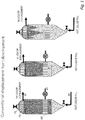
- Figure 1 shows a conventional displacement cycle in a batch digester, where a 1 st liquor is displaced via a top screen TS by adding a 2 nd displacement liquor via an inlet in the bottom.
- the batch digester includes a bottom, a top and a middle liquid exchange position.
- the bottom liquid exchange position includes at least an inlet for adding different liquors, and conventionally there may be dedicated inlets for each type of liquors or steam to be introduced.
- the mid liquid exchange position includes at least a mid screen MS which is the essential withdrawal position used when withdrawing and circulating the cooking liquor, but the screen may also be used for adding treatment liquors or steam. Using the mid screen also as a distributor in special phases helps to keep the screen open.
- a pump (MP) is located in the withdrawal line from the mid screen, and if filled grey as in figure 1 , the pump is shut off.
- the volume of the digester is about 300m 3 , which of course may vary dependent on intended capacity of the digester.
- the mid screen is typically located in lower 1/3 of the digester, with a volume of 100m 3 below mid screen and thus 200m 3 above mid screen.
- the top liquid exchange position includes at least one feed screen FS in chip inlet and a larger top screen TS.
- the feed screen is a steam injector of a well known design that adds a swirling motion to the inflow of comminuted cellulose material during filling such that an even upper surface of comminuted cellulose material is obtained.
- the top screen is a screen used to withdraw gases but also withdrawing displaced liquors.
- the three figures show from left to right show how the displacement front is developed inside the batch digester during the displacement process.
- left figure is hot liquor added, and here filling the entire bottom cone part, as displacement liquor to bottom of digester will displace the 1 st liquor out through the top.
- This example of prior art shows the conventional displacement of a 1 st liquid with a different 2 nd liquid, and the 2 nd liquid here is hot liquor.
- digester Only one digester is shown, but typically are a number of digesters used operated in sequence and thus in different phases of the cook. If, for example, 5 digesters are operated, the first digester is started and then the remaining digesters are started at some time interval which time interval may correspond to 1/5 of the total cooking cycle time for one digester. Cooked pulp may then be blown to a blow tank at regular intervals, and the process liquids stored in accumulators and atmospheric tanks may be used in another digester minimizing inactive dwell time for the liquids used.
- the piping system is simplified showing only one liquid addition point for washed liquid WL, Wash filtrate, low pressure LP- and medium pressure MP-steam but in a real system are individual piping connected to the digester.
- the invention may be applied to any batch cooking phase, where the first treatment liquid needs to be kept in an undiluted form at largest possible volumes.
- the first treatment liquid may be a hydrolysate or any other process liquid that catches dissolved compounds from the comminuted cellulosic material treated in the batch digester.
- the first treatment liquid may also be warm or hot liquor from a preheating sequence ahead of any type of cook.
- the first treatment liquid may also be different impregnation liquors or liquids containing polysulfide, anthraquinone, CCE (cold caustic extraction) filtrate or similar.
- the following figures show a sequential prehydrolysis process ahead of a kraft cook, where the invention is applied in the phase of recovering the hydrolysate after prehydrolysis.
- the hydrolysate For further processing of the hydrolysate it is essential that the hydrolysate has as high carbohydrate content as possible, catch as much as possible of the dissolved carbohydrates, while avoiding dilution of the hydrolysate with water or chemicals that may hamper the recovery process. High water content reduces the heat economy of the subsequent recovery process.
- Fig.2 is shown the very first phase of batch cooking, where comminuted cellulose material is fed into a digester during low pressure (LP) steam addition through top and bottom liquid exchange positions, and venting gases through the middle point liquid exchange position.
- the steam added to top is injected using a conventional swirl inducing inlet that helps spreading the comminuted cellulose material in an even layer inside digester.
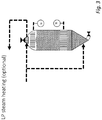
- Fig.3 is shown an optional extension of the low pressure steam heating in a filled digester heating the comminuted cellulose material towards the condensation point of the low pressure steam, typically at some 130-140°C at the most.
- Fig.4 is shown an optional final steam heating phase where the filled digester is heated towards full prehydrolysis temperature using medium pressure steam (MP, preferably appr. 11- 13 bar, 200°C).
- MP medium pressure steam
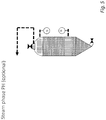
- Fig.5 is shown an optional steam phase prehydrolysis, where the temperature is maintained for a sufficient time in a prehydrolysis stage at a temperature of preferably between about 120°C and 180°C and preferably during at least 20 minutes so as to produce a prehydrolyzed cellulosic material and an acidic hydrolysate to subject the material in the digester to full hydrolysis, i.e. reaching the necessary P-factor.
- Fig.6 a filling of the digester with hot water and/or hydrolysate, which could be done directly after Fig. 2 , 3 or 4 or alternatively after a steam phase prehydrolysis shown in figure 5 .
- water or hydrolysate is introduced to bottom liquid exchange position until the liquid level cover the comminuted cellulose material inside the digester.
- Fig.7 a subsequent circulation phase in the digester where the treatment liquid is withdrawn from the middle liquid exchange position and reintroduced to both top and bottom liquid exchange position.
- this is a wash-out phase after steam phase hydrolysis ( Fig.5 )
- the circulation ratio of the treatment liquid may be well over 1.5 times the total volume of the treatment liquid, possibly up to 5-10 times, especially if the prehydrolysis is done in steam phase.
- the digester will be kept at this temperature and pressure until the prehydrolysis step is completed, i.e. the required P- factor has been reached.
- P-factor is a defined factor to control the prehydrolysis stage, taking the temperature and time into account (as e.g. H-factor); Herbert Sixta, Handbook of Pulp, Volume 1, Wiley- VCH Verlag, 2006, pages 343-345 .
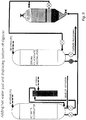
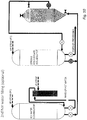
- FIG 8 is shown the inventive recovery of the first treatment liquid, which after a water phase prehydrolysis is the hydrolysate.
- Recovery starts with draining the hydrolysate from at least the middle liquid exchange position, and sending the hydrolysate to a strong first liquid accumulator.
- the draining may be assisted by adding a hot displacement gas through the digester, such as low pressure LP steam.
- a compressor may assist this displacement gas but the important thing is that no larger volumes of displacement liquids are used.
- the comminuted cellulose material is at full prehydrolysis temperature essentially no volumes of condensate is formed using low pressure steam, which may dilute the hydrolysate.
- the draining could be done without steam addition, and in such case the pressure is reduced while lowering the liquid level, and the liquor will flash off primarily steam in the void above liquor level.
- the recovered strong first liquid is thereafter sent to further processing in a sugar recovery process using the carbohydrates dissolved in the hydrolysate.
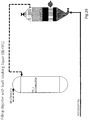
- Fig.9 is the draining continued until the hydrolysate level is approaching the middle liquid exchange position and the residual volume of hydrolysate kept below the middle liquid exchange position is displaced by adding hot water to the bottom liquid exchange position.
- the addition of hot water may continue until the hydrolysate is displaced and withdrawn from mid screen to such an extent that the hydrolysate starts to become diluted, which may be detected by a pH or conductivity sensor in withdrawal outlet.
- the order of dilution of the hydrolysate is reduced considerably compared with a displacement of the entire batch volume.
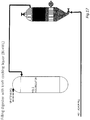
- a second optional wash could continue, which purpose is to catch the part of hydrolysate that is wetting the surface of the comminuted material in the digester, as well as enable a diffusion of a part of the hydrolysate that is bound in the comminuted material.
- the supply of hot water could continue until the volume of comminuted material is submerged in hot water.
- FIG 11 then is shown a circulation phase where the hot water is withdrawn from mid screen and recirculated to top and bottom. Such an intensified liquid circulation may leach out more of the hydrolysate bound in the comminuted material.
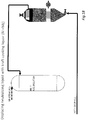
- the optional second wash is then as shown in figure 12 ended by draining the weaker hydrolysate to a dedicated weak hydrolysate accumulator.
- the weak hydrolysate or second liquid may preferably be used for filling the digester ahead of a liquid filled prehydrolysis, or as wash out liquid after a steam phase hydrolysis.
- This optional wash requires an extra dedicated accumulator tank for storing the weak hydrolysate, and is only considered in mills where the yield of carbohydrates is optimized at expense of investment costs for the extra accumulator.
- FIG 13 the start of the neutralizing phase is shown, where hot white liquor HWL is added to digester in order to swing the pH of the content from acidic conditions to alkaline.
- the hot white liquor black in figure
- the hot white liquor is only added in an amount partially filling the digester, forming a hot white liquor pad.
- the residual weak hydrolysate is withdrawn in mid screen and may be directed to the weak hydrolysate accumulator, until the white liquor pad reaches the mid screen as seen in figure 14 .
- figure 15 is shown how the white liquor pad further displace a residual volume of weak hydrolysate upwardly.
- hot liquor fill Directly after this volume of hot white liquor is added hot liquor fill as shown in figure 16 .
- the pad with hot white liquor (black in figure) is pushed upwards swinging the pH to alkaline conditions ahead of the hot liquor filling, the latter having the substantial charge of alkali for the subsequent kraft cook.
- HBL hot black liquor
Landscapes
- Life Sciences & Earth Sciences (AREA)
- Engineering & Computer Science (AREA)
- Wood Science & Technology (AREA)
- Paper (AREA)
Claims (8)
- Verfahren zur Rückgewinnung einer ersten Behandlungsflüssigkeit, die Hydrolyse-Nebenprodukte enthält, in einem Batch-Verdrängungs-Aufschlussprozess in einem mit zerkleinertem Cellulosematerial gefüllten Kocher, der mit einer unteren Flüssigkeitsaustauschposition, einer oberen Flüssigkeitsaustauschposition und einer mittleren Flüssigkeitsaustauschposition ausgestattet ist, wobei das Verfahren umfasst
Füllen des Kochers mit einer ersten Behandlungsflüssigkeit während einer Flüssigphasen-Vorhydrolyse oder nach einem Dampf-Vorhydrolyseschritt, dadurch gekennzeichnet, dass der Prozess dadurch fortgesetzt wird, dass- nach dem Füllen des Kochers mit der ersten Behandlungsflüssigkeit während oder nach dem Vorhydrolyseschritt, die erste Behandlungsflüssigkeit, die in dem Kocher enthalten ist, innerhalb des Kochers einer Zirkulation unterworfen wird, durch Abziehen der ersten Behandlungsflüssigkeit von der mittleren Flüssigkeitsaustauschposition und Wiedereinführen dieser in die obere und untere Flüssigkeitsaustauschposition des Kochers, so dass das erste Behandlungsflüssigkeitsvolumen das Chipvolumen mindestens einmal durchläuft, so dass die Kohlenhydrate ausgewaschen werden, die in dem Hydrolysat gelöst sind oder aus dem Cellulosematerial entfernt sind;- Ableiten der ersten Behandlungsflüssigkeit, die nun Nebenprodukte, vorzugsweise Kohlenhydrate, enthält, aus dem Kocher über eine der mittleren und/oder unteren Flüssigkeitsaustauschpositionen in mindestens einer ersten Ableitphase;- Senden mindestens eines Teils der Flüssigkeit, die in der ersten Ableitphase erhalten wurde, zu einer bestimmten Verarbeitungsposition entweder zur Verwendung in einer anderen Phase des Batch-Aufschlussprozesses oder zur Weiterverarbeitung, wobei mindestens ein Teil des Inhalts der Flüssigkeit, die in der ersten Ableitphase erhalten wurde, zur Rückgewinnung von Hydrolyse-Nebenprodukten, vorzugsweise Kohlenhydraten, verwendet wird. - Verfahren zur Rückgewinnung einer ersten Behandlungsflüssigkeit gemäß Anspruch 1, wobei die erste Behandlungsflüssigkeit während der Vorhydrolyse des zerkleinerten Cellulosematerials verwendet wird, um ein saures Hydrolysat zu erzeugen, das die Kohlenhydrate enthält, die im Hydrolysat während der Vorhydrolyse gelöst wurden, dadurch gekennzeichnet, dass
nach der Vorhydrolysestufe der Prozess fortgesetzt wird durch- Ableiten des Hydrolysats aus dem Kocher über eine der mittleren und / oder unteren Flüssigkeitsaustauschpositionen in mindestens einer ersten Ableitphase,- Senden mindestens eines Teils der Flüssigkeit, die in der ersten Ableitphase erhalten wurde, zur Weiterverarbeitung in einem Zuckerrückgewinnungsverfahren unter Verwendung der im Hydrolysat gelösten Kohlenhydrate. - Verfahren gemäß Anspruch 2, wobei das Ableiten durch Verdrängung von Dampf, vorzugsweise Niederdruckdampf oder -gasen durch den Kocher unterstützt wird, wobei der Dampf oder die Gase über die obere Flüssigkeitsaustauschposition zugegeben werden und wobei der Druck und die Temperatur, vorzugsweise im Bereich von 120 °C - 180 °C, in der Flüssigkeit, die in der ersten Ableitphase erhalten wurde, erhalten bleiben.
- Verfahren gemäß Anspruch 2, wobei das Ableiten durch Abziehen der Flüssigkeit, die in der ersten Ableitphase erhalten wurde, durch die mittlere Flüssigkeitsaustauschposition und in Endphasen durch Verdrängen der restlichen Flüssigkeit, die in der ersten Ableitphase erhalten wurde und die im Kocher unterhalb der mittleren Flüssigkeitsaustauschposition gehalten wird, über eine Verdrängung unter Verwendung von heißem Wasser, das an der unteren Flüssigkeitsaustauschposition hinzugefügt wird und das die restliche Flüssigkeit, die in der ersten Ableitphase erhalten wurde, durch die mittlere Flüssigkeitsaustauschposition nach draußen verdrängt.
- Verfahren gemäß Anspruch 2, wobei die Flüssigkeit, die in der ersten Ableitphase erhalten wurde, bei der Vorhydrolysetemperatur, vorzugsweise bei 150 °C-180 °C, gehalten wird und in einem bestimmten Sammeltank gelagert wird, bevor sie in einem Zuckerrückgewinnungsverfahren unter Verwendung der im Hydrolysat gelösten Kohlenhydrate verarbeitet wird.
- Verfahren gemäß Anspruch 2, wobei nach Abschluss des Ableitens der ersten Behandlungsflüssigkeit, der Kocher wieder mit heißem Wasser gefüllt wird, bis das Volumen des zerkleinerten Cellulosematerials in heißes Wasser eingetaucht ist, wobei nachdem der Heißwasserinhalt einer Zirkulation ausgesetzt wurde, so dass das Heißwasservolumen mindestens einmal zirkuliert wurde,- Ableiten des Heißwasservolumens aus dem Kocher über eine der mittleren und / oder unteren Flüssigkeitsaustauschpositionen in mindestens einer zweiten Ableitsphase, wobei eine schwache zweite Flüssigkeit erhalten wird;- Senden wenigstens eines Teils der schwachen zweiten Flüssigkeit zu einem bestimmten zweiten Sammler, um als die erste Behandlungsflüssigkeit vor der Vorhydrolyse in einem nachfolgenden Batch-Zyklus verwendet zu werden.
- Verfahren gemäß einem der vorhergehenden Ansprüche, wobei die Vorhydrolyse durchgeführt wird, bis ein Ziel-P-Faktor erreicht ist.
- Verfahren gemäß einem der vorhergehenden Ansprüche, wobei die in den Kocher eingefüllte erste Behandlungsflüssigkeit ausgewählt ist aus der Gruppe, bestehend aus Wasser, Wasser, das mindestens eine Mineralsäure oder Schwefeldioxid enthält, Imprägnierlaugen, Flüssigkeiten, die Polysulfid enthalten, Anthrachinon und kaltes kaustisches Extraktionsfiltrat.
Applications Claiming Priority (1)
| Application Number | Priority Date | Filing Date | Title |
|---|---|---|---|
| SE1451339A SE539706C2 (en) | 2014-11-07 | 2014-11-07 | Method for recovering hydrolyzate |
Publications (2)
| Publication Number | Publication Date |
|---|---|
| EP3018251A1 EP3018251A1 (de) | 2016-05-11 |
| EP3018251B1 true EP3018251B1 (de) | 2018-01-03 |
Family
ID=54557237
Family Applications (1)
| Application Number | Title | Priority Date | Filing Date |
|---|---|---|---|
| EP15193392.6A Active EP3018251B1 (de) | 2014-11-07 | 2015-11-06 | Verfahren zur rückgewinnung von hydrolysat in einem prehydrolysesulfat-kochverfahren für zellstoffherstellung |
Country Status (4)
| Country | Link |
|---|---|
| US (1) | US9663896B2 (de) |
| EP (1) | EP3018251B1 (de) |
| BR (1) | BR102015028113B1 (de) |
| SE (1) | SE539706C2 (de) |
Families Citing this family (5)
| Publication number | Priority date | Publication date | Assignee | Title |
|---|---|---|---|---|
| SE538454C2 (en) * | 2014-11-27 | 2016-07-12 | Valmet Oy | Method for displacement in batch digesters |
| US10358719B2 (en) * | 2016-11-23 | 2019-07-23 | Applied Materials, Inc. | Selective deposition of aluminum oxide on metal surfaces |
| SE540305C2 (en) * | 2017-02-07 | 2018-06-05 | Valmet Oy | System and method for silica removal in a pulping process |
| SE1950606A1 (en) | 2019-05-22 | 2020-10-13 | Valmet Oy | A method for extracting hydrolysate, a batch cooking system and a hydrolysate extracting arrangement |
| SE543253C2 (en) * | 2019-06-26 | 2020-11-03 | Valmet Oy | Method for extracting hemicellulose from lignocellulosic material |
Citations (2)
| Publication number | Priority date | Publication date | Assignee | Title |
|---|---|---|---|---|
| US3294623A (en) * | 1966-02-23 | 1966-12-27 | Int Paper Co | Continuous digestion and purification with recirculation of liquor |
| SE0600678L (sv) * | 2006-03-24 | 2007-09-25 | Domsjoe Fabriker Ab | Förfarande för utvinning av hemicellulosa vid uppslutning av lignocellulosamaterial medelst kemikalieinnehållande vätska |
Family Cites Families (13)
| Publication number | Priority date | Publication date | Assignee | Title |
|---|---|---|---|---|
| US5059284A (en) * | 1989-10-30 | 1991-10-22 | Beloit Corporation | Apparatus to displace a digester from both ends |
| CA2037717C (en) * | 1990-09-17 | 1996-03-05 | Bertil Stromberg | Extended kraft cooking with white liquor added to wash circulation |
| AT398588B (de) | 1992-12-02 | 1994-12-27 | Voest Alpine Ind Anlagen | Verfahren zur herstellung von viskosezellstoffen |
| FI122654B (fi) * | 1997-12-08 | 2012-05-15 | Ovivo Luxembourg Sarl | Menetelmä paperisellumassan valmistamiseksi |
| FI122655B (fi) * | 1998-11-06 | 2012-05-15 | Ovivo Luxembourg Sarl | Eräprosessi massan valmistamiseksi |
| FI117477B (fi) * | 2004-05-28 | 2006-10-31 | Metso Paper Inc | Sihtielin |
| US20060231222A1 (en) * | 2005-04-19 | 2006-10-19 | Bianchini Craig A | Method and apparatus to decrease steam consumption in conventional batch digesters |
| FI123036B (fi) | 2006-02-10 | 2012-10-15 | Metso Paper Inc | Menetelmä hydrolyysituotteiden talteenottamiseksi |
| FI20065105A0 (fi) * | 2006-02-10 | 2006-02-10 | Metso Paper Inc | Menetelmä hydrolyysituotteiden talteenottamiseksi |
| FI123100B (fi) | 2010-03-11 | 2012-11-15 | Metso Paper Inc | Menetelmä sivutuotteiden talteenottamiseksi |
| US8951388B2 (en) * | 2011-04-08 | 2015-02-10 | Pec-Tech Engineering And Construction Pte Ltd | Method and system for efficient production of dissolving pulp in a kraft mill producing paper grade pulp with a continuous type digester |
| EP2707539B1 (de) | 2011-05-13 | 2019-05-08 | Valmet Aktiebolag | Kompaktes verfahren zur herstellung von vorhydrolysiertem zellstoff |
| SE538454C2 (en) * | 2014-11-27 | 2016-07-12 | Valmet Oy | Method for displacement in batch digesters |
-
2014
- 2014-11-07 SE SE1451339A patent/SE539706C2/en unknown
-
2015
- 2015-11-03 US US14/930,701 patent/US9663896B2/en active Active
- 2015-11-06 BR BR102015028113-7A patent/BR102015028113B1/pt active IP Right Grant
- 2015-11-06 EP EP15193392.6A patent/EP3018251B1/de active Active
Patent Citations (2)
| Publication number | Priority date | Publication date | Assignee | Title |
|---|---|---|---|---|
| US3294623A (en) * | 1966-02-23 | 1966-12-27 | Int Paper Co | Continuous digestion and purification with recirculation of liquor |
| SE0600678L (sv) * | 2006-03-24 | 2007-09-25 | Domsjoe Fabriker Ab | Förfarande för utvinning av hemicellulosa vid uppslutning av lignocellulosamaterial medelst kemikalieinnehållande vätska |
Non-Patent Citations (1)
| Title |
|---|
| SAEED ABRAR ET AL: "Mass balances of components dissolved in the pre-hydrolysis liquor of kraft-based dissolving pulp production process from Canadian hardwoods", BIOMASS AND BIOENERGY, vol. 39, 15 September 2010 (2010-09-15), pages 14 - 19, XP028903069, ISSN: 0961-9534, DOI: 10.1016/J.BIOMBIOE.2010.08.039 * |
Also Published As
| Publication number | Publication date |
|---|---|
| EP3018251A1 (de) | 2016-05-11 |
| SE539706C2 (en) | 2017-11-07 |
| BR102015028113A2 (pt) | 2016-06-21 |
| US20160130753A1 (en) | 2016-05-12 |
| US9663896B2 (en) | 2017-05-30 |
| SE1451339A1 (en) | 2016-05-08 |
| BR102015028113A8 (pt) | 2021-08-24 |
| BR102015028113B1 (pt) | 2022-04-05 |
Similar Documents
| Publication | Publication Date | Title |
|---|---|---|
| CA2641686C (en) | Method for recovering hydrolysis products | |
| US4668340A (en) | Method of countercurrent acid hydrolysis of comminuted cellulosic fibrous material | |
| RU2546497C1 (ru) | Компактный способ производства предварительно гидролизованной целлюлозы | |
| CA2761757C (en) | Method for producing pulp | |
| JPH08503744A (ja) | ビスコースパルプの製造方法 | |
| US9663896B2 (en) | Method for recovering hydrolysate | |
| CN102016162A (zh) | 预水解硫酸盐蒸煮方法 | |
| WO2017142445A1 (en) | Method for recovering concentrated hydrolysate after hydrolysis of cellulose material | |
| US9631317B2 (en) | Method for displacement in batch digesters | |
| US20060175029A1 (en) | Batch process for preparing pulp | |
| US20230374730A1 (en) | Apparatuses, methods and systems for yield increase in a kraft cooking plant | |
| EP3673110B1 (de) | Verbessertes kompaktes verfahren zur herstellung von vorhydrolysiertem zellstoff | |
| SE1950402A1 (en) | Method for extracting hemicellulose from lignocellulosic material |
Legal Events
| Date | Code | Title | Description |
|---|---|---|---|
| PUAI | Public reference made under article 153(3) epc to a published international application that has entered the european phase |
Free format text: ORIGINAL CODE: 0009012 |
|
| AK | Designated contracting states |
Kind code of ref document: A1 Designated state(s): AL AT BE BG CH CY CZ DE DK EE ES FI FR GB GR HR HU IE IS IT LI LT LU LV MC MK MT NL NO PL PT RO RS SE SI SK SM TR |
|
| AX | Request for extension of the european patent |
Extension state: BA ME |
|
| 17P | Request for examination filed |
Effective date: 20160509 |
|
| RBV | Designated contracting states (corrected) |
Designated state(s): AL AT BE BG CH CY CZ DE DK EE ES FI FR GB GR HR HU IE IS IT LI LT LU LV MC MK MT NL NO PL PT RO RS SE SI SK SM TR |
|
| STAA | Information on the status of an ep patent application or granted ep patent |
Free format text: STATUS: EXAMINATION IS IN PROGRESS |
|
| 17Q | First examination report despatched |
Effective date: 20170321 |
|
| GRAP | Despatch of communication of intention to grant a patent |
Free format text: ORIGINAL CODE: EPIDOSNIGR1 |
|
| STAA | Information on the status of an ep patent application or granted ep patent |
Free format text: STATUS: GRANT OF PATENT IS INTENDED |
|
| RIC1 | Information provided on ipc code assigned before grant |
Ipc: D21C 1/00 20060101ALI20170628BHEP Ipc: D21C 1/02 20060101AFI20170628BHEP Ipc: D21C 7/12 20060101ALI20170628BHEP Ipc: D21C 11/00 20060101ALI20170628BHEP |
|
| INTG | Intention to grant announced |
Effective date: 20170720 |
|
| GRAS | Grant fee paid |
Free format text: ORIGINAL CODE: EPIDOSNIGR3 |
|
| GRAA | (expected) grant |
Free format text: ORIGINAL CODE: 0009210 |
|
| STAA | Information on the status of an ep patent application or granted ep patent |
Free format text: STATUS: THE PATENT HAS BEEN GRANTED |
|
| AK | Designated contracting states |
Kind code of ref document: B1 Designated state(s): AL AT BE BG CH CY CZ DE DK EE ES FI FR GB GR HR HU IE IS IT LI LT LU LV MC MK MT NL NO PL PT RO RS SE SI SK SM TR |
|
| REG | Reference to a national code |
Ref country code: GB Ref legal event code: FG4D |
|
| REG | Reference to a national code |
Ref country code: CH Ref legal event code: EP Ref country code: AT Ref legal event code: REF Ref document number: 960377 Country of ref document: AT Kind code of ref document: T Effective date: 20180115 |
|
| REG | Reference to a national code |
Ref country code: IE Ref legal event code: FG4D |
|
| REG | Reference to a national code |
Ref country code: DE Ref legal event code: R096 Ref document number: 602015007144 Country of ref document: DE |
|
| REG | Reference to a national code |
Ref country code: NL Ref legal event code: MP Effective date: 20180103 |
|
| REG | Reference to a national code |
Ref country code: LT Ref legal event code: MG4D |
|
| PG25 | Lapsed in a contracting state [announced via postgrant information from national office to epo] |
Ref country code: NL Free format text: LAPSE BECAUSE OF FAILURE TO SUBMIT A TRANSLATION OF THE DESCRIPTION OR TO PAY THE FEE WITHIN THE PRESCRIBED TIME-LIMIT Effective date: 20180103 |
|
| PG25 | Lapsed in a contracting state [announced via postgrant information from national office to epo] |
Ref country code: ES Free format text: LAPSE BECAUSE OF FAILURE TO SUBMIT A TRANSLATION OF THE DESCRIPTION OR TO PAY THE FEE WITHIN THE PRESCRIBED TIME-LIMIT Effective date: 20180103 Ref country code: HR Free format text: LAPSE BECAUSE OF FAILURE TO SUBMIT A TRANSLATION OF THE DESCRIPTION OR TO PAY THE FEE WITHIN THE PRESCRIBED TIME-LIMIT Effective date: 20180103 Ref country code: NO Free format text: LAPSE BECAUSE OF FAILURE TO SUBMIT A TRANSLATION OF THE DESCRIPTION OR TO PAY THE FEE WITHIN THE PRESCRIBED TIME-LIMIT Effective date: 20180403 Ref country code: LT Free format text: LAPSE BECAUSE OF FAILURE TO SUBMIT A TRANSLATION OF THE DESCRIPTION OR TO PAY THE FEE WITHIN THE PRESCRIBED TIME-LIMIT Effective date: 20180103 Ref country code: CY Free format text: LAPSE BECAUSE OF FAILURE TO SUBMIT A TRANSLATION OF THE DESCRIPTION OR TO PAY THE FEE WITHIN THE PRESCRIBED TIME-LIMIT Effective date: 20180103 |
|
| PG25 | Lapsed in a contracting state [announced via postgrant information from national office to epo] |
Ref country code: IS Free format text: LAPSE BECAUSE OF FAILURE TO SUBMIT A TRANSLATION OF THE DESCRIPTION OR TO PAY THE FEE WITHIN THE PRESCRIBED TIME-LIMIT Effective date: 20180503 Ref country code: LV Free format text: LAPSE BECAUSE OF FAILURE TO SUBMIT A TRANSLATION OF THE DESCRIPTION OR TO PAY THE FEE WITHIN THE PRESCRIBED TIME-LIMIT Effective date: 20180103 Ref country code: SE Free format text: LAPSE BECAUSE OF FAILURE TO SUBMIT A TRANSLATION OF THE DESCRIPTION OR TO PAY THE FEE WITHIN THE PRESCRIBED TIME-LIMIT Effective date: 20180103 Ref country code: GR Free format text: LAPSE BECAUSE OF FAILURE TO SUBMIT A TRANSLATION OF THE DESCRIPTION OR TO PAY THE FEE WITHIN THE PRESCRIBED TIME-LIMIT Effective date: 20180404 Ref country code: PL Free format text: LAPSE BECAUSE OF FAILURE TO SUBMIT A TRANSLATION OF THE DESCRIPTION OR TO PAY THE FEE WITHIN THE PRESCRIBED TIME-LIMIT Effective date: 20180103 Ref country code: RS Free format text: LAPSE BECAUSE OF FAILURE TO SUBMIT A TRANSLATION OF THE DESCRIPTION OR TO PAY THE FEE WITHIN THE PRESCRIBED TIME-LIMIT Effective date: 20180103 Ref country code: BG Free format text: LAPSE BECAUSE OF FAILURE TO SUBMIT A TRANSLATION OF THE DESCRIPTION OR TO PAY THE FEE WITHIN THE PRESCRIBED TIME-LIMIT Effective date: 20180403 |
|
| REG | Reference to a national code |
Ref country code: DE Ref legal event code: R097 Ref document number: 602015007144 Country of ref document: DE |
|
| PG25 | Lapsed in a contracting state [announced via postgrant information from national office to epo] |
Ref country code: IT Free format text: LAPSE BECAUSE OF FAILURE TO SUBMIT A TRANSLATION OF THE DESCRIPTION OR TO PAY THE FEE WITHIN THE PRESCRIBED TIME-LIMIT Effective date: 20180103 Ref country code: RO Free format text: LAPSE BECAUSE OF FAILURE TO SUBMIT A TRANSLATION OF THE DESCRIPTION OR TO PAY THE FEE WITHIN THE PRESCRIBED TIME-LIMIT Effective date: 20180103 Ref country code: AL Free format text: LAPSE BECAUSE OF FAILURE TO SUBMIT A TRANSLATION OF THE DESCRIPTION OR TO PAY THE FEE WITHIN THE PRESCRIBED TIME-LIMIT Effective date: 20180103 Ref country code: EE Free format text: LAPSE BECAUSE OF FAILURE TO SUBMIT A TRANSLATION OF THE DESCRIPTION OR TO PAY THE FEE WITHIN THE PRESCRIBED TIME-LIMIT Effective date: 20180103 |
|
| PLBE | No opposition filed within time limit |
Free format text: ORIGINAL CODE: 0009261 |
|
| STAA | Information on the status of an ep patent application or granted ep patent |
Free format text: STATUS: NO OPPOSITION FILED WITHIN TIME LIMIT |
|
| PG25 | Lapsed in a contracting state [announced via postgrant information from national office to epo] |
Ref country code: CZ Free format text: LAPSE BECAUSE OF FAILURE TO SUBMIT A TRANSLATION OF THE DESCRIPTION OR TO PAY THE FEE WITHIN THE PRESCRIBED TIME-LIMIT Effective date: 20180103 Ref country code: SK Free format text: LAPSE BECAUSE OF FAILURE TO SUBMIT A TRANSLATION OF THE DESCRIPTION OR TO PAY THE FEE WITHIN THE PRESCRIBED TIME-LIMIT Effective date: 20180103 Ref country code: SM Free format text: LAPSE BECAUSE OF FAILURE TO SUBMIT A TRANSLATION OF THE DESCRIPTION OR TO PAY THE FEE WITHIN THE PRESCRIBED TIME-LIMIT Effective date: 20180103 Ref country code: DK Free format text: LAPSE BECAUSE OF FAILURE TO SUBMIT A TRANSLATION OF THE DESCRIPTION OR TO PAY THE FEE WITHIN THE PRESCRIBED TIME-LIMIT Effective date: 20180103 |
|
| 26N | No opposition filed |
Effective date: 20181005 |
|
| PG25 | Lapsed in a contracting state [announced via postgrant information from national office to epo] |
Ref country code: SI Free format text: LAPSE BECAUSE OF FAILURE TO SUBMIT A TRANSLATION OF THE DESCRIPTION OR TO PAY THE FEE WITHIN THE PRESCRIBED TIME-LIMIT Effective date: 20180103 |
|
| REG | Reference to a national code |
Ref country code: DE Ref legal event code: R119 Ref document number: 602015007144 Country of ref document: DE |
|
| REG | Reference to a national code |
Ref country code: CH Ref legal event code: PL |
|
| PG25 | Lapsed in a contracting state [announced via postgrant information from national office to epo] |
Ref country code: MC Free format text: LAPSE BECAUSE OF FAILURE TO SUBMIT A TRANSLATION OF THE DESCRIPTION OR TO PAY THE FEE WITHIN THE PRESCRIBED TIME-LIMIT Effective date: 20180103 Ref country code: LU Free format text: LAPSE BECAUSE OF NON-PAYMENT OF DUE FEES Effective date: 20181106 |
|
| REG | Reference to a national code |
Ref country code: BE Ref legal event code: MM Effective date: 20181130 |
|
| REG | Reference to a national code |
Ref country code: IE Ref legal event code: MM4A |
|
| PG25 | Lapsed in a contracting state [announced via postgrant information from national office to epo] |
Ref country code: CH Free format text: LAPSE BECAUSE OF NON-PAYMENT OF DUE FEES Effective date: 20181130 Ref country code: LI Free format text: LAPSE BECAUSE OF NON-PAYMENT OF DUE FEES Effective date: 20181130 |
|
| PG25 | Lapsed in a contracting state [announced via postgrant information from national office to epo] |
Ref country code: FR Free format text: LAPSE BECAUSE OF NON-PAYMENT OF DUE FEES Effective date: 20181130 Ref country code: IE Free format text: LAPSE BECAUSE OF NON-PAYMENT OF DUE FEES Effective date: 20181106 Ref country code: DE Free format text: LAPSE BECAUSE OF NON-PAYMENT OF DUE FEES Effective date: 20190601 |
|
| PG25 | Lapsed in a contracting state [announced via postgrant information from national office to epo] |
Ref country code: BE Free format text: LAPSE BECAUSE OF NON-PAYMENT OF DUE FEES Effective date: 20181130 |
|
| PG25 | Lapsed in a contracting state [announced via postgrant information from national office to epo] |
Ref country code: MT Free format text: LAPSE BECAUSE OF NON-PAYMENT OF DUE FEES Effective date: 20181106 |
|
| PG25 | Lapsed in a contracting state [announced via postgrant information from national office to epo] |
Ref country code: TR Free format text: LAPSE BECAUSE OF FAILURE TO SUBMIT A TRANSLATION OF THE DESCRIPTION OR TO PAY THE FEE WITHIN THE PRESCRIBED TIME-LIMIT Effective date: 20180103 |
|
| PG25 | Lapsed in a contracting state [announced via postgrant information from national office to epo] |
Ref country code: PT Free format text: LAPSE BECAUSE OF FAILURE TO SUBMIT A TRANSLATION OF THE DESCRIPTION OR TO PAY THE FEE WITHIN THE PRESCRIBED TIME-LIMIT Effective date: 20180103 |
|
| PG25 | Lapsed in a contracting state [announced via postgrant information from national office to epo] |
Ref country code: HU Free format text: LAPSE BECAUSE OF FAILURE TO SUBMIT A TRANSLATION OF THE DESCRIPTION OR TO PAY THE FEE WITHIN THE PRESCRIBED TIME-LIMIT; INVALID AB INITIO Effective date: 20151106 Ref country code: MK Free format text: LAPSE BECAUSE OF NON-PAYMENT OF DUE FEES Effective date: 20180103 |
|
| GBPC | Gb: european patent ceased through non-payment of renewal fee |
Effective date: 20191106 |
|
| PG25 | Lapsed in a contracting state [announced via postgrant information from national office to epo] |
Ref country code: GB Free format text: LAPSE BECAUSE OF NON-PAYMENT OF DUE FEES Effective date: 20191106 |
|
| REG | Reference to a national code |
Ref country code: AT Ref legal event code: UEP Ref document number: 960377 Country of ref document: AT Kind code of ref document: T Effective date: 20180103 |
|
| P01 | Opt-out of the competence of the unified patent court (upc) registered |
Effective date: 20230503 |
|
| PGFP | Annual fee paid to national office [announced via postgrant information from national office to epo] |
Ref country code: AT Payment date: 20251118 Year of fee payment: 11 |
|
| PGFP | Annual fee paid to national office [announced via postgrant information from national office to epo] |
Ref country code: FI Payment date: 20251118 Year of fee payment: 11 |