EP3018920B1 - Identification d'utilisateur de véhicule à l'aide de données de motif d'utilisateur - Google Patents
Identification d'utilisateur de véhicule à l'aide de données de motif d'utilisateur Download PDFInfo
- Publication number
- EP3018920B1 EP3018920B1 EP14192042.1A EP14192042A EP3018920B1 EP 3018920 B1 EP3018920 B1 EP 3018920B1 EP 14192042 A EP14192042 A EP 14192042A EP 3018920 B1 EP3018920 B1 EP 3018920B1
- Authority
- EP
- European Patent Office
- Prior art keywords
- user
- vehicle
- data
- node
- user identification
- Prior art date
- Legal status (The legal status is an assumption and is not a legal conclusion. Google has not performed a legal analysis and makes no representation as to the accuracy of the status listed.)
- Active
Links
Images




Classifications
-
- G—PHYSICS
- G05—CONTROLLING; REGULATING
- G05B—CONTROL OR REGULATING SYSTEMS IN GENERAL; FUNCTIONAL ELEMENTS OF SUCH SYSTEMS; MONITORING OR TESTING ARRANGEMENTS FOR SUCH SYSTEMS OR ELEMENTS
- G05B19/00—Program-control systems
- G05B19/02—Program-control systems electric
- G05B19/04—Program control other than numerical control, i.e. in sequence controllers or logic controllers
-
- B—PERFORMING OPERATIONS; TRANSPORTING
- B60—VEHICLES IN GENERAL
- B60W—CONJOINT CONTROL OF VEHICLE SUB-UNITS OF DIFFERENT TYPE OR DIFFERENT FUNCTION; CONTROL SYSTEMS SPECIALLY ADAPTED FOR HYBRID VEHICLES; ROAD VEHICLE DRIVE CONTROL SYSTEMS FOR PURPOSES NOT RELATED TO THE CONTROL OF A PARTICULAR SUB-UNIT
- B60W50/00—Details of control systems for road vehicle drive control not related to the control of a particular sub-unit, e.g. process diagnostic or vehicle driver interfaces
- B60W50/0098—Details of control systems ensuring comfort, safety or stability not otherwise provided for
-
- B—PERFORMING OPERATIONS; TRANSPORTING
- B60—VEHICLES IN GENERAL
- B60R—VEHICLES, VEHICLE FITTINGS, OR VEHICLE PARTS, NOT OTHERWISE PROVIDED FOR
- B60R16/00—Electric or fluid circuits specially adapted for vehicles and not otherwise provided for; Arrangement of elements of electric or fluid circuits specially adapted for vehicles and not otherwise provided for
- B60R16/02—Electric or fluid circuits specially adapted for vehicles and not otherwise provided for; Arrangement of elements of electric or fluid circuits specially adapted for vehicles and not otherwise provided for electric constitutive elements
- B60R16/037—Electric or fluid circuits specially adapted for vehicles and not otherwise provided for; Arrangement of elements of electric or fluid circuits specially adapted for vehicles and not otherwise provided for electric constitutive elements for occupant comfort, e.g. for automatic adjustment of appliances according to personal settings, e.g. seats, mirrors, steering wheel
-
- B—PERFORMING OPERATIONS; TRANSPORTING
- B60—VEHICLES IN GENERAL
- B60R—VEHICLES, VEHICLE FITTINGS, OR VEHICLE PARTS, NOT OTHERWISE PROVIDED FOR
- B60R25/00—Fittings or systems for preventing or indicating unauthorised use or theft of vehicles
-
- B—PERFORMING OPERATIONS; TRANSPORTING
- B60—VEHICLES IN GENERAL
- B60W—CONJOINT CONTROL OF VEHICLE SUB-UNITS OF DIFFERENT TYPE OR DIFFERENT FUNCTION; CONTROL SYSTEMS SPECIALLY ADAPTED FOR HYBRID VEHICLES; ROAD VEHICLE DRIVE CONTROL SYSTEMS FOR PURPOSES NOT RELATED TO THE CONTROL OF A PARTICULAR SUB-UNIT
- B60W40/00—Estimation or calculation of non-directly measurable driving parameters for road vehicle drive control systems not related to the control of a particular sub unit, e.g. by using mathematical models
- B60W40/08—Estimation or calculation of non-directly measurable driving parameters for road vehicle drive control systems not related to the control of a particular sub unit, e.g. by using mathematical models related to drivers or passengers
-
- H—ELECTRICITY
- H04—ELECTRIC COMMUNICATION TECHNIQUE
- H04L—TRANSMISSION OF DIGITAL INFORMATION, e.g. TELEGRAPHIC COMMUNICATION
- H04L67/00—Network arrangements or protocols for supporting network services or applications
- H04L67/01—Protocols
- H04L67/12—Protocols specially adapted for proprietary or special-purpose networking environments, e.g. medical networks, sensor networks, networks in vehicles or remote metering networks
-
- H—ELECTRICITY
- H04—ELECTRIC COMMUNICATION TECHNIQUE
- H04L—TRANSMISSION OF DIGITAL INFORMATION, e.g. TELEGRAPHIC COMMUNICATION
- H04L67/00—Network arrangements or protocols for supporting network services or applications
- H04L67/2866—Architectures; Arrangements
- H04L67/30—Profiles
- H04L67/306—User profiles
-
- H—ELECTRICITY
- H04—ELECTRIC COMMUNICATION TECHNIQUE
- H04W—WIRELESS COMMUNICATION NETWORKS
- H04W4/00—Services specially adapted for wireless communication networks; Facilities therefor
- H04W4/02—Services making use of location information
- H04W4/025—Services making use of location information using location based information parameters
- H04W4/027—Services making use of location information using location based information parameters using movement velocity, acceleration information
-
- B—PERFORMING OPERATIONS; TRANSPORTING
- B60—VEHICLES IN GENERAL
- B60W—CONJOINT CONTROL OF VEHICLE SUB-UNITS OF DIFFERENT TYPE OR DIFFERENT FUNCTION; CONTROL SYSTEMS SPECIALLY ADAPTED FOR HYBRID VEHICLES; ROAD VEHICLE DRIVE CONTROL SYSTEMS FOR PURPOSES NOT RELATED TO THE CONTROL OF A PARTICULAR SUB-UNIT
- B60W2540/00—Input parameters relating to occupants
- B60W2540/043—Identity of occupants
-
- B—PERFORMING OPERATIONS; TRANSPORTING
- B60—VEHICLES IN GENERAL
- B60W—CONJOINT CONTROL OF VEHICLE SUB-UNITS OF DIFFERENT TYPE OR DIFFERENT FUNCTION; CONTROL SYSTEMS SPECIALLY ADAPTED FOR HYBRID VEHICLES; ROAD VEHICLE DRIVE CONTROL SYSTEMS FOR PURPOSES NOT RELATED TO THE CONTROL OF A PARTICULAR SUB-UNIT
- B60W2710/00—Output or target parameters relating to a particular sub-units
- B60W2710/30—Auxiliary equipments
Definitions
- the present invention relates generally to a vehicle user identification node for enabling configuration of vehicle user settings of a vehicle.
- a drawback with the known art is that it requires a hand-held device to be carried with the driver or passenger before entering the vehicle for user identification. It also requires that user specific ID data is pre-stored in the hand-held device, whereby the hand-held device has to be personal to the specific user. Another drawback is that the preferences of the user have to be pre-stored in the vehicle.
- US20130297099A1 some of the above mentioned drawbacks when configuration of vehicle user settings of a vehicle are addressed, enabling the preferences of the user to be stored at a server remote from the vehicle.
- US20130297099A1 describes a method for adapting the settings in more than one vehicle to a specific user.
- An object of the present invention is to enable a configuration of vehicle user settings, which is more convenient to use for any user of the vehicle.
- a method performed by a vehicle information node for enabling configuration of vehicle settings of a vehicle, the method comprising:
- the method further comprises determining configuration settings for the vehicle based on the user identification data.
- the first user pattern data comprises walking pattern data.
- the first user pattern data comprises first user 3D accelerometer data.
- user identification data comprises at least one of: specific personal ID data, anonymous ID data, preference data concerning the vehicle settings, first user pattern data , second user pattern data.
- the first user pattern data further comprises first user gyroscopic sensor data and/or first user barometric height data.
- the first user pattern data is received from a remote node.
- the remote node is a hand-held device such as a smartphone, car key or tablet computer.
- the user identification data is received from a remote node, storing second user pattern data and the user identification data.
- user identification data is received from an internal database of the vehicle identification node, storing second user pattern data and user identification data.
- a vehicle user identification node for enabling configuration of a vehicle user settings for a vehicle, the node is arranged to:
- the vehicle user identification node is further being arranged to:
- a computer program comprising computer readable code means, which when run in a connected vehicle user identification node arranged to enable configuration vehicle user settings of a vehicle causes the connected vehicle driver identification node arranged to enable configuration vehicle user settings of a vehicle to perform the method according to any of the above embodiments, for example as described in [0005]-[0014].
- a computer program product comprising a computer readable medium and a computer program according to the above embodiment, for example as described in [0017] wherein the computer program is stored on the computer readable medium.
- a vehicle or vessel comprising a vehicle user identification node (100) according to any of the previously described embodiments, for instance according to [0015]-[0016].
- a vehicle may comprise any type of vehicle including but not limited to a car or a commercial vehicle, truck or lorry.
- Fig.1 shows a perspective view of a vehicle 270 comprising a vehicle user identification node 100 for enabling configuration of vehicle user settings of a vehicle 270, wherein the vehicle user identification node 100 may comprise one of e.g. the following: a TEM (Telematics Module), a CEM (Central Electronic Module) or an ECU (Electronic Control Module).
- the vehicle 270 further comprises a vehicle settings node 200 for configuration of the user settings of the vehicle 270, wherein the vehicle settings node 200 may comprise one of e.g. the following: a CEM, ECU
- first user pattern data is received in a vehicle user identification node 100.
- First user pattern data may for instance be received from a client node 300 wirelessly, via for example WiFi/Wireless Local Area Network (WLAN), Bluetooth, Bluetooth Low Energy (Bluetooth LE), or Bluetooth Smart, Radio Frequency Identification (RFID), ZigBee not limiting to other wireless communication means suitable for short or medium range wireless communication.
- the vehicle user identification node 100 requests first user pattern data from the client node 300.
- the first user pattern data comprises walking pattern data, i.e.
- the client node 300 is equipped with a 3-axis or 3D accelerometer for measuring linear acceleration in three dimensions, i.e. along X, Y and Z, enabling measuring or detecting the acceleration, shake, vibration shock or fall of the client node 300 .
- the client node 300 is adapted to measure 3D accelerometer data.
- the first user pattern data comprises 3D accelerometer data.
- the walking pattern data comprises 3D accelerometer data.
- the client node 300 is equipped with a barometric sensor, i.e. a barometer or pressure sensor for measuring the height position of the client node 300.
- the first user pattern data comprises height data.
- walking pattern data comprises height data.
- the client node 300 is equipped with a gyroscopic sensor that is adapted to detect a 3D or 3-axis angular acceleration around the X, Y, and Z axes, enabling precise calculation of yaw, pitch and roll of the client node 300.
- the first user pattern data comprises gyroscopic data.
- walking pattern data comprises gyroscopic data.
- the client node 300 is equipped with at least the 3D accelerometer and the gyroscopic sensor wherein when combined, the data from the 3D accelerometer and the gyroscopic data provides a precise information concerning the movement of the client node 300 in space.
- the data alone or when combined, thus enable the recognition and analysis of the walking pattern of the user carrying the client node 300.
- the vehicle user identification node 100 requests user identification data based on the first user pattern data.
- the request may be sent to a remote node 400 or an internal database 150.
- the vehicle user identification node 100 or the remote node 400 compares or matches the first user pattern data with pre-stored second user pattern data.
- the second user pattern data comprises a first user pattern data, i.e. data that is pre-stored for identification purposes.
- second user pattern data comprises 3D accelerometer data and/or height data and/or gyroscopic data.
- the second user pattern data may be pre-stored in a memory comprised in a vehicle 270, or in a remote node 400.
- a specific user identification data is assigned to a specific second user pattern data, i.e. each second user pattern data is unique for a specific user which may be identified/determined on the basis of the second user accelerometer data.
- the first user pattern data may be automatically stored in the memory 150 of the vehicle or the remote node 400 respectively.
- the vehicle user identification node 100 receives user identification data based on the comparison and/or matching between first user pattern data and second user pattern data leading to a determination of the user identification data which may have been carried out in the vehicle identification node 100 or a remote node 400.
- the comparison and/or matching between first user pattern data and second user pattern data to determine user identification data is carried out in an intermediate step between S110 and S120 as described above, i.e.
- the determining of user identification data based on the comparison and/or matching between first user pattern data and second user pattern data is carried out. These steps S115, S116 may be carried out in the user identification node 100 or the remote node 400.
- the user identification data comprises personal data, i.e. a specific personal ID.
- the user identification data comprises preference data concerning the vehicle settings.
- the user identification data comprises first user pattern data if the user has not previously set or programmed any vehicle settings preferences and this is the first time the user uses the vehicle.
- the user identification data comprises second user pattern data wherein the identification is not carried out in full, for instance if the user has not previously set or programmed any vehicle settings preferences, but has previously used the vehicle.
- the identification is carried out solely on the basis of the recognition of the user characteristics, i.e. user pattern data.
- the vehicle may thus recognize a user without having access to the specific user ID.
- the vehicle may thus be able to store first user pattern data into second user pattern data as a result of using the vehicle 270.
- An anonymous ID may be matched with second user data, e.g. person A, B, C, D etc.
- the user is asked to identify himself upon approaching the vehicle 270.
- the identification request may be sent to the remote node 400 but also presented on a display in the vehicle 270.
- the vehicle user identification node 100 transmits the user identification data to the vehicle settings node 200 for configuration of vehicle settings.
- the vehicle user settings may comprise essentially any settings of the vehicle that may be personalized for an optimized driving experience, comfort and safety.
- the vehicle settings comprise at least one of seat position, driving wheel position settings, heating or air condition settings, sound system settings, temperature settings, mirror settings, audio settings comprising radio or CD or streaming settings, telephone or handsfree settings, display settings, navigation settings, light settings etc.
- the vehicle user settings node 200 comprises means for storing user settings preferences that may be entered manually by a user or as a result of the actual employed settings by the user of the vehicle.
- the vehicle settings node 200 may thus have learning capabilities and adapt and update the preferences of a specific user, so that the latest preferences are always used.
- an illustrative procedure may comprise the following steps.
- a person aiming to enter and use a vehicle either as a driver or passenger appreciates if the vehicle user settings have been adapted according to his preferences already when entering or directly following upon entering the vehicle.
- a user may appreciate if the vehicle settings have been adapted to the user pattern or characteristics of the specific user even if he/she has not previously programmed any settings preferences.
- the driver or passenger hereinafter referred to as the vehicle user, is equipped with a hand-held device such as e.g.
- the hand-held device may be carried in for example the vehicle users hand, pocket or bag.
- the hand-held device is further equipped with a 3D accelerometer for measuring acceleration in three dimensions.
- the hand-held device may further be equipped with a gyroscopic sensor for defining the angular acceleration and orientation of the hand-held device.
- the hand-held device may further be equipped with an air pressure sensing device such as a barometer/barometric sensor for measuring the height/air pressure of the hand-held device.
- the hand-held device is a car key, or a smart car-key, or smart-key, equipped with the above technical functions.
- the hand-held device continuously advertises its presence via the wireless communication functionality and the vehicle scans for slave devices within a certain range around the vehicle depending on the type of wireless communication.
- a connection might be established if a pairing of the hand-held device has taken place previously or upon a request and confirmation by the vehicle user by for instance typing a connection password in the hand-held device.
- a vehicle identification node 100 requests first user pattern data from the hand-held device which initiates a user pattern recording by using the built-in 3D accelerometer in the hand-held device and possibly also the gyroscopic sensor and/or the barometric sensor in the hand-held device.
- the first user pattern data comprises walking pattern data.
- the 3D acceleration data is represented as vectors having a direction and magnitude which are collected with a fixed but adjustable sample rate, and stored to create a pair-wise repeated pattern for each step, i.e. right step and left step respectively, carried out by the vehicle user as he/she is approaching the vehicle.
- the first user pattern data is then transferred from the hand-held device to the vehicle identification node 100, which receives the first user pattern data.
- the vehicle user identification node 100 thereafter requests user identification data based on the first user pattern data. Thereafter, the vehicle user identification node 100 or a remote node 400 compares, i.e. matches the received first user pattern data with pre-stored second user pattern data to which a specific user has been assigned.
- the second user pattern data is pre-stored in an internal database 150 in the vehicle or in a remote node 400, such as an external database,
- the second user pattern data which relates to a specific user has a certain tolerance to take into account and compensate for differences in walking pattern for a user originating from e.g. type of shoes used, injuries, walking surface, etc.
- the vehicle user identification node 100 receives user identification data, i.e. the specific user that is approaching the vehicle.
- the vehicle identification node may initiate the storing of an anonymous user A in connection to the second user pattern data, either in the remote node 400 or in the database 150 in the vehicle 270.
- the user may be asked to identify himself or herself via the remote node 400 or by the vehicle identification node 200 in the vehicle 270 after entering the same. The next time the user approaches the vehicle 270 he/she may be recognized either as a specific verified person or as the anonymous person A. Since such user has employed certain settings in the vehicle during the first time use, the vehicle settings node 200 can initiate the latest used settings accordingly.
- the gyroscopic data and/or the barometric height sensor data may further enhance the first user pattern data to enable a more reliable and fast user identification step, since some differentiation can for instance be carried out already in determining the height in which the hand-held device is carried.
- the vehicle user identification node 100 then transmits the user identification data to a vehicle settings node 200 for the configuration of vehicle settings of the vehicle 270.
- the user identification data may thus comprise any of verified user information, i.e. user ID data, anonymous user ID data, first user pattern data, second user pattern data, user preference data together with user ID data. If a user uses the vehicle 270 for the first time and has not entered or preprogrammed any preferences, the vehicle identification node may still transmit the first user data which can be interpreted by the vehicle settings node into assumed preferred settings. For instance, the first user pattern data comprises information that may be translated into an assumed and likely length of the driver, whereby the seat position settings is adjusted accordingly. Thus, to a certain level, the vehicle settings node 200 may use first user pattern data to configure the vehicle user settings. According to one embodiment, the vehicle settings node 200 comprises pre-stored information concerning the personal preferences of the settings of the vehicle 270.
- Such preferences may comprise the seat position, ventilation, air condition, temperature settings, mirror settings, preferred radio stations, or audio including specific music or podcasts or audio books to be streamed or by other means played in connection to entering the vehicle.
- Other preferences may include certain themes in the vehicle, display settings, light settings, navigation settings etc.
- the possibility to measure signal strength of the signals transmitted from the hand-held device and the vehicle 270 may be used. For instance, with Bluetooth LE, it is possible to measure signal strength. The signal strength may thereby be interpreted as a measure of distance.
- a Bluetooth LE antenna By placing a Bluetooth LE antenna at several strategic positions in the vehicle 270, for instance at each corner of the vehicle 270 the identification of which hand-held device and thereby user is closest to a specific corner and hence, a seat in the vehicle 270, is enabled. Which hand-held device that belongs to the driver may thus be determined whereby the correct settings may be configured according to the described process above.
- configuration of vehicle settings may be carried out for more than one vehicle user simultaneously as the vehicle may be divided into specific climate zones concerning for instance ventilation and temperature. Each driver naturally uses his own seat which may be adjusted according to personal preferences.
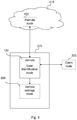
- Fig. 3 shows an illustration of embodiments with the vehicle user identification node 100, vehicle settings node 200, a computer environment 410 comprising a remote node 400.
- the remote node 400 may be arranged in the computer environment 410.
- Examples of computer environments are, network connected computer, application server, web server, data facility, computer cloud, hosting service, not limiting the term computer environment to other suitable terms for a computer environment 410.
- the computer environment 410 may be arranged such that the remote node 400 may be enabled to communicate with vehicle user identification node 100.
- the communication may be performed over the public Internet, or a virtual private network over the Internet, or a closed TCP/IP-network, carried by GSM/GPRS (Global System for Mobile Communications/ General Packet Radio Service), 3G (third generation of mobile telecommunications technology), LTE (Long term Evolution), WLAN, Satellite, or an operator/service provider specific network for information services, not limiting the solution to use other types of networks.
- GSM/GPRS Global System for Mobile Communications/ General Packet Radio Service
- 3G third generation of mobile telecommunications technology
- LTE Long term Evolution
- WLAN Satellite
- Satellite or an operator/service provider specific network for information services
- first user pattern data is transmitted by wire or wirelessly.
- the vehicle user identification node 100 requests second user pattern data concerning the vehicle user based on the first user pattern data from an internal database 150, the remote node 400.
- the first user pattern data corresponding to unique characteristics of a vehicle user approaching the vehicle is compared/matched with a pre-stored, second user pattern data stored in the remote node 400 or the internal database 150.
- second user pattern data is stored in the internal database 150 and/or the remote node 400.
- the vehicle user identification node 100 transmits user identification data to the vehicle settings node 200 for configuration of the vehicle settings of the vehicle 270.
- the remote node 400 is a server/database accessible via the web, whereby a user may update his user settings preferences as well as registering his/her user pattern data by the aid of a hand-held device. This may be preferred prior to using a new vehicle, such as for instance a bought or rented car.
- Fig. 4 discloses a vehicle user identification node 100 for enabling configuration of the vehicle settings of the vehicle 270.
- the node 100 is arranged to receive first user pattern data concerning the vehicle user by a vehicle communication unit 130.
- a controller 110 is thereafter arranged to request user identification data based on the first user pattern data.
- a vehicle communication unit 140, and an external remote node communication unit 140 respectively is arranged to receive user identification data from a remote node 400 or an internal database 150 respectively.
- the controller 110 is arranged to compare first user pattern data with second user pattern data.
- the node 100 is further being arranged to determine user identification data, i.e. the specific user known through the second user pattern data that matches the first user pattern data in a determination unit 160.
- the node 100 is further being arranged to transmit user identification data to a vehicle user settings node 200 for configuration of the vehicle settings of the vehicle 270.
- the comparing/matching of the first user pattern data and the second user pattern data for the determination of user identification data is carried out in the remote node 400.
- the user identification data may be transmitted by the vehicle communication unit 130.
- the node may further be arranged to determine user characteristics for the vehicle user based on the received first user pattern data in a determination unit 160. The determination of user characteristics may be performed by the controller 110. The user characteristics may than be transmitted by the vehicle communication unit 130 to the vehicle user settings node 200.
- Fig. 5 shows an illustration of embodiments of a vehicle user identification node 100.
- the vehicle user identification node 100 may be implemented, by means of program modules of a respective computer program comprising code means which, when run by a processing unit 250 causes the vehicle user identification node100 to perform the above-described actions.
- the processing unit 250 may comprise a single Central Processing Unit (CPU), or could comprise two or more processing units.
- the processing unit 250 may include general purpose microprocessors, instruction set processors and/or related chips sets and/or special purpose microprocessors such as Application Specific Integrated Circuits (ASICs).
- ASICs Application Specific Integrated Circuits
- the processing unit 250 may also comprise a storage for caching purposes.
- Each computer program may be carried by a computer program product 260 in the vehicle user identification node 100, shown in Fig. 1 , 2 , 4 , 5 , et al, in the form of a memory having a computer readable medium and being connected to the processing unit 250.
- the computer program product 260 or memory thus comprises a computer readable medium on which the computer program is stored e.g. in the form of computer program modules "m".
- the memory 260 may be a flash memory, a Random-Access Memory (RAM), a Read-Only Memory (ROM) or an Electrically Erasable Programmable ROM (EEPROM), and the program modules m could in alternative embodiments be distributed on different computer program products in the form of memories within the vehicle user identification node 100.
- the vehicle user identification node 100 may further comprise a communication interface 265.
- the communication interface 265 may be arranged to communicate with for example the vehicle user settings node 200, or remote node 400.
- the communication interface 265 may comprise chip set adopted for communication via CAN bus (Controller Area Network) or communication adopted to ISO 11898.
- Other examples of standards which may be supported by the communication interface 265 are: ZigBee, Bluetooth, RFID (Radio frequency identification), USB (Universal serial bus), or IEEE 802.11 (Institute of Electrical and Electronics Engineers), including but not limited to 802.11 a/b/n or other similar forthcoming standards.
- the communication interface 265 may comprise an antenna.
- the communication interface 265 may be connectable to an external antenna.
- the vehicle user identification node 100 may further comprise one or more storage units 266 and further functionality 267 useful for the vehicle user identification node 100 to serve its purpose as vehicle user identification node, such as power supply, internal communications bus, internal cooling, database engine, operating system, not limiting to other functionalities.
Landscapes
- Engineering & Computer Science (AREA)
- Computer Networks & Wireless Communication (AREA)
- Signal Processing (AREA)
- Automation & Control Theory (AREA)
- Mechanical Engineering (AREA)
- Transportation (AREA)
- Physics & Mathematics (AREA)
- Health & Medical Sciences (AREA)
- Computing Systems (AREA)
- General Health & Medical Sciences (AREA)
- Medical Informatics (AREA)
- Mathematical Physics (AREA)
- Human Computer Interaction (AREA)
- General Physics & Mathematics (AREA)
- Traffic Control Systems (AREA)
- Telephone Function (AREA)
Claims (14)
- Procédé exécuté par un noeud d'identification d'utilisateur de véhicule (100) pour permettre la configuration de réglages d'utilisateur de véhicule d'un véhicule (270), le procédé comprenant :- la réception (S100) de premières données de configuration d'utilisateur,- la demande (S110) de données d'identification d'utilisateur en fonction de premières données de configuration d'utilisateur,- la réception (S120) de données d'identification d'utilisateur,- la transmission (S130) de données d'identification d'utilisateur à un noeud de réglages de véhicule pour la configuration de réglages d'utilisateur de véhicule du véhicule (270), caractérisé en ce que les premières données de configuration d'utilisateur comprennent des premières données de configuration de marche d'utilisateur et dans lequel lesdites données d'identification d'utilisateur comprennent lesdites premières données de configuration de marche d'utilisateur.
- Procédé selon la revendication 1, comprenant en outre :- la détermination de réglages de configuration du véhicule (270) en fonction des données d'identification d'utilisateur.
- Procédé selon l'une quelconque des revendications précédentes, dans lequel les premières données de configuration d'utilisateur comprennent des premières données d'accéléromètre 3D d'utilisateur.
- Procédé selon l'une quelconque des revendications précédentes, dans lequel les données d'identification d'utilisateur comprennent au moins l'une de : données d'ID personnelle spécifiques, données d'ID anonymes, données de référence concernant les réglages de véhicule, secondes données de configuration d'utilisateur.
- Procédé selon l'une quelconque des revendications précédentes, dans lequel les premières données de configuration d'utilisateur comprennent en outre des premières données de capteur gyroscopique d'utilisateur et/ou des premières données de hauteur barométrique d'utilisateur.
- Procédé selon l'une quelconque des revendications précédentes, dans lequel les premières données de configuration d'utilisateur sont reçues depuis un noeud distant (300).
- Procédé selon la revendication 6, dans lequel le noeud distant (300) est un dispositif portatif tel qu'un téléphone intelligent, une clé de voiture ou une tablette informatique.
- Procédé selon l'une quelconque des revendications précédentes, dans lequel les données d'identification d'utilisateur sont reçues depuis un noeud distant (400), mémorisant des secondes données de configuration d'utilisateur et les données d'identification d'utilisateur.
- Procédé selon l'une quelconque des revendications précédentes, dans lequel les données d'identification d'utilisateur sont reçues depuis une base de données interne (150) du noeud d'identification de véhicule (100), mémorisant des secondes données de configuration d'utilisateur et des données d'identification d'utilisateur.
- Noeud d'identification d'utilisateur de véhicule pour permettre la configuration de réglages d'utilisateur de véhicule d'un véhicule (270), le noeud étant agencé pour :- recevoir des premières données de configuration d'utilisateur par une unité de communication de noeud distant externe (140),- demander des données d'identification d'utilisateur en fonction de la première configuration d'utilisateur par un contrôleur (110),- recevoir des données d'identification d'utilisateur depuis une base de données interne (150) par une unité de communication de véhicule (130) ou un noeud distant (400) par une unité de communication de noeud distant externe (140),transmettre des données d'identification d'utilisateur à un noeud de réglages de véhicule pour la configuration de réglages d'utilisateur de véhicule du véhicule (270), le noeud étant caractérisé en ce qu'il est agencé pour
transmettre des données d'identification d'utilisateur comprenant des premières données de configuration d'utilisateur comprenant des premières données de configuration de marche d'utilisateur et utiliser celles-ci pour la configuration des réglages d'utilisateur de véhicule. - Noeud d'identification d'utilisateur de véhicule selon la revendication 10, étant agencé en outre pour :- déterminer des réglages de configuration du véhicule (270) en fonction des données d'identification d'utilisateur.
- Programme informatique, comprenant un moyen de code lisible par ordinateur, lequel, à son exécution dans un noeud d'identification d'utilisateur de véhicule (100) connecté agencé pour permettre la configuration de réglages d'utilisateur de véhicule d'un véhicule (270) amène le noeud d'identification d'utilisateur de véhicule (100) connecté agencé pour permettre la configuration de réglages d'utilisateur de véhicule d'un véhicule (170) à exécuter le procédé selon l'une quelconque des revendications 1 à 9.
- Produit de programme informatique, comprenant un support lisible par ordinateur et un programme informatique selon la revendication 12, dans lequel le programme informatique est mémorisé sur le support lisible par ordinateur.
- Véhicule (270) ou vaisseau (280) comprenant un noeud d'identification d'utilisateur de véhicule (100) selon l'une quelconque des revendications 10 et 11.
Priority Applications (3)
| Application Number | Priority Date | Filing Date | Title |
|---|---|---|---|
| EP14192042.1A EP3018920B1 (fr) | 2014-11-06 | 2014-11-06 | Identification d'utilisateur de véhicule à l'aide de données de motif d'utilisateur |
| US14/923,580 US10286917B2 (en) | 2014-11-06 | 2015-10-27 | Vehicle user identification using user pattern data |
| CN201510725121.7A CN105589347B (zh) | 2014-11-06 | 2015-10-29 | 使用用户模式数据的车辆用户识别 |
Applications Claiming Priority (1)
| Application Number | Priority Date | Filing Date | Title |
|---|---|---|---|
| EP14192042.1A EP3018920B1 (fr) | 2014-11-06 | 2014-11-06 | Identification d'utilisateur de véhicule à l'aide de données de motif d'utilisateur |
Publications (2)
| Publication Number | Publication Date |
|---|---|
| EP3018920A1 EP3018920A1 (fr) | 2016-05-11 |
| EP3018920B1 true EP3018920B1 (fr) | 2018-04-04 |
Family
ID=51904693
Family Applications (1)
| Application Number | Title | Priority Date | Filing Date |
|---|---|---|---|
| EP14192042.1A Active EP3018920B1 (fr) | 2014-11-06 | 2014-11-06 | Identification d'utilisateur de véhicule à l'aide de données de motif d'utilisateur |
Country Status (3)
| Country | Link |
|---|---|
| US (1) | US10286917B2 (fr) |
| EP (1) | EP3018920B1 (fr) |
| CN (1) | CN105589347B (fr) |
Families Citing this family (17)
| Publication number | Priority date | Publication date | Assignee | Title |
|---|---|---|---|---|
| KR101716218B1 (ko) * | 2015-11-10 | 2017-03-15 | 현대자동차주식회사 | 차량 및 그 제어방법 |
| CN108883744B (zh) * | 2016-01-19 | 2021-10-22 | 福特全球技术公司 | 用户识别系统和方法 |
| US9764742B1 (en) * | 2016-01-29 | 2017-09-19 | State Farm Mutual Automobile Insurance Company | Driver identification among a limited pool of potential drivers |
| US9707911B1 (en) * | 2016-03-21 | 2017-07-18 | Ford Global Technologies, Llc | Identifying a driver of a vehicle |
| US10747860B2 (en) * | 2016-08-22 | 2020-08-18 | Lenovo (Singapore) Pte. Ltd. | Sitting posture for biometric identification |
| US10239490B2 (en) * | 2017-02-08 | 2019-03-26 | Huf North America Automotive Parts Mfg. Corp. | System and method for communicating with a vehicle |
| US11180154B2 (en) | 2017-10-17 | 2021-11-23 | The Regents Of The University Of Michigan | Fingerprinting drivers based on vehicle turns |
| US11160507B2 (en) | 2017-10-30 | 2021-11-02 | Palatiumcare, Inc. | Information and passive biometric systems and methods |
| US10476967B2 (en) * | 2017-11-14 | 2019-11-12 | Ford Global Technologies, Llc | Vehicle cabin mobile device detection system |
| US10469589B2 (en) * | 2017-11-14 | 2019-11-05 | Ford Global Technologies, Llc | Vehicle cabin mobile device sensor system |
| JP7010121B2 (ja) * | 2018-04-11 | 2022-01-26 | トヨタ自動車株式会社 | 車載端末装置 |
| WO2020131174A2 (fr) | 2018-12-21 | 2020-06-25 | Polaris Industries Inc. | Gestion de véhicules et d'accessoires récréatifs |
| CN111818110A (zh) * | 2019-04-10 | 2020-10-23 | 上海博泰悦臻电子设备制造有限公司 | 共享数据记录方法、共享终端以及共享数据记录系统 |
| US11163270B2 (en) * | 2019-07-10 | 2021-11-02 | Lear Corporation | Vehicle occupant data collection and processing with artificial intelligence |
| US20210139001A1 (en) * | 2019-11-12 | 2021-05-13 | Aptiv Technologies Limited | System and method for adjusting vehicle settings based on height of portable wireless device |
| US12311855B2 (en) * | 2021-01-29 | 2025-05-27 | Toyota Motor North America, Inc. | Correcting a mismatched user profile for vehicle settings |
| US12223334B2 (en) * | 2022-03-02 | 2025-02-11 | Samsung Electronics Co., Ltd. | Electronic device and method of setting operation mode thereof |
Family Cites Families (40)
| Publication number | Priority date | Publication date | Assignee | Title |
|---|---|---|---|---|
| FI110549B (fi) * | 2001-06-29 | 2003-02-14 | Nokia Corp | Menetelmä ja järjestely liikkeen määrittämiseksi |
| US20070005404A1 (en) * | 2005-06-09 | 2007-01-04 | Drive Diagnostics Ltd. | System and method for providing driving insurance |
| US7870022B2 (en) * | 2008-06-12 | 2011-01-11 | Alpine In Motion Llc | System and method for offering and fulfilling situation-based, location specific rewards and offers to mobile-oriented consumers |
| US20110087538A1 (en) * | 2008-06-12 | 2011-04-14 | Alpine In Motion Llc. | System and method for offering and fulfilling situation-based, location specific rewards and offers to mobile-oriented consumers |
| US8606629B2 (en) * | 2008-06-12 | 2013-12-10 | Google, Inc. | Providing coupons with a mobile computer of a merchant |
| US20090309759A1 (en) * | 2008-06-13 | 2009-12-17 | Darin Scot Williams | Car-finder method and aparatus |
| US8996332B2 (en) * | 2008-06-24 | 2015-03-31 | Dp Technologies, Inc. | Program setting adjustments based on activity identification |
| TWI384853B (zh) * | 2008-10-29 | 2013-02-01 | Mstar Semiconductor Inc | 識別標籤資訊提醒系統與方法及使用其之可攜式識別標籤資訊提醒裝置 |
| US9398536B2 (en) * | 2009-05-29 | 2016-07-19 | Qualcomm Incorporated | Method and apparatus for movement detection by evaluating elementary movement patterns |
| US10408623B2 (en) * | 2009-06-12 | 2019-09-10 | Microsoft Technology Licensing, Llc | Retracing steps |
| US20110196571A1 (en) * | 2010-02-09 | 2011-08-11 | At&T Mobility Ii Llc | System And Method For The Collection And Monitoring Of Vehicle Data |
| EP2544914B1 (fr) * | 2010-03-12 | 2019-03-13 | Tata Consultancy Services Ltd. | Systeme de securite vehiculaire, de personnalisation et de surveillance cardiaque d'un conducteur |
| US8287055B2 (en) * | 2010-09-28 | 2012-10-16 | Robert Bosch Gmbh | Brake control of a vehicle based on driver behavior |
| US20120129545A1 (en) * | 2010-11-19 | 2012-05-24 | IIlume Software, Inc. | Systems and methods for selectively invoking positioning systems for mobile device control applications using multiple sensing modalities |
| US20120129460A1 (en) * | 2010-11-19 | 2012-05-24 | Illume Software, Inc. | Systems and methods for selectively invoking positioning systems for mobile device control applications using wireless network measurements |
| US20120129544A1 (en) * | 2010-11-19 | 2012-05-24 | Illume Software, Inc. | Systems and methods for selectively invoking positioning systems for mobile device control applications using accelerometer measurements |
| GB2488954A (en) * | 2010-12-15 | 2012-09-12 | Andrew William Wright | Logging driving information using a mobile telecommunications device |
| US9014888B2 (en) * | 2011-07-21 | 2015-04-21 | Saturna Green Systems Inc. | Vehicle communication, analysis and operation system |
| US9612797B2 (en) * | 2011-08-25 | 2017-04-04 | Ford Global Technologies, Llc | Method and apparatus for a near field communication system to exchange occupant information |
| DE102011111899A1 (de) * | 2011-08-30 | 2013-02-28 | Gm Global Technology Operations, Llc | Detektionsvorrichtung und Verfahren zur Detektion eines Trägers eines Sende-/Empfangsgeräts, Kraftfahrzeug |
| US8594861B2 (en) * | 2012-02-27 | 2013-11-26 | Toyota Motor Engineering & Manufacturing North America, Inc. | Systems and methods for communicating with a vehicle user |
| US9442888B2 (en) * | 2012-03-07 | 2016-09-13 | Zipcar, Inc. | Apparatus and methods for renting and controlling occupancy of a vehicle |
| US20140309862A1 (en) * | 2013-04-15 | 2014-10-16 | Flextronics Ap, Llc | User profile exchange via vehicle supported communications protocol |
| US8918231B2 (en) * | 2012-05-02 | 2014-12-23 | Toyota Motor Engineering & Manufacturing North America, Inc. | Dynamic geometry support for vehicle components |
| WO2013184877A2 (fr) * | 2012-06-08 | 2013-12-12 | Airbiquity Inc. | Évaluation de données de capteurs électroniques permettant d'identifier à distance un véhicule à moteur et de télésurveiller un comportement d'un conducteur |
| US20130332156A1 (en) * | 2012-06-11 | 2013-12-12 | Apple Inc. | Sensor Fusion to Improve Speech/Audio Processing in a Mobile Device |
| US8878669B2 (en) * | 2013-01-31 | 2014-11-04 | KHN Solutions, Inc. | Method and system for monitoring intoxication |
| US9780967B2 (en) * | 2013-03-14 | 2017-10-03 | Telogis, Inc. | System for performing vehicle diagnostic and prognostic analysis |
| US20150170031A1 (en) * | 2013-05-01 | 2015-06-18 | Google Inc. | Determining parking of a vehicle |
| US9193359B2 (en) * | 2013-08-12 | 2015-11-24 | GM Global Technology Operations LLC | Vehicle systems and methods for identifying a driver |
| US20150091713A1 (en) * | 2013-09-27 | 2015-04-02 | Tobias Kohlenberg | System and method for vehicle theft detection |
| US9639978B2 (en) * | 2013-12-04 | 2017-05-02 | Verizon Telematics Inc. | Method and system for avatar replay based on mobile sensor information |
| EP2891589B1 (fr) * | 2014-01-06 | 2024-09-25 | Harman International Industries, Incorporated | Identification automatique d'un conducteur |
| DE102014207807A1 (de) * | 2014-04-25 | 2015-10-29 | Bayerische Motoren Werke Aktiengesellschaft | Personenbezogene Fahrerunterstützung |
| US9224302B1 (en) * | 2014-05-21 | 2015-12-29 | Rockwell Collins, Inc. | Four dimensional flight management with time control system and related method |
| US9760702B1 (en) * | 2014-07-14 | 2017-09-12 | Jpmorgan Chase Bank, N.A. | Systems and methods for driver authentication through embedded sensing |
| US9714037B2 (en) * | 2014-08-18 | 2017-07-25 | Trimble Navigation Limited | Detection of driver behaviors using in-vehicle systems and methods |
| KR101698515B1 (ko) * | 2015-01-16 | 2017-01-20 | 현대자동차주식회사 | 웨어러블 기기를 이용한 길 안내 제공 방법 및 이를 수행하는 차량 |
| US9728084B2 (en) * | 2015-02-25 | 2017-08-08 | Here Global B.V. | Method and apparatus for providing vehicle classification based on automation level |
| US20210272207A1 (en) * | 2015-08-28 | 2021-09-02 | State Farm Mutual Automobile Insurance Company | Vehicular driver profiles and discounts |
-
2014
- 2014-11-06 EP EP14192042.1A patent/EP3018920B1/fr active Active
-
2015
- 2015-10-27 US US14/923,580 patent/US10286917B2/en active Active
- 2015-10-29 CN CN201510725121.7A patent/CN105589347B/zh active Active
Non-Patent Citations (1)
| Title |
|---|
| None * |
Also Published As
| Publication number | Publication date |
|---|---|
| EP3018920A1 (fr) | 2016-05-11 |
| CN105589347A (zh) | 2016-05-18 |
| US10286917B2 (en) | 2019-05-14 |
| US20160129916A1 (en) | 2016-05-12 |
| CN105589347B (zh) | 2020-05-19 |
Similar Documents
| Publication | Publication Date | Title |
|---|---|---|
| US10286917B2 (en) | Vehicle user identification using user pattern data | |
| US10868359B2 (en) | Hybrid on board unit and roadside unit supporting wave-V2X and C-V2X | |
| EP2819894B1 (fr) | Procédé et système permettant la personnalisation de véhicules | |
| US10343682B2 (en) | Vehicle operation based on activity tracking | |
| KR101774661B1 (ko) | 운전자세 제어장치 및 방법 | |
| JP7078636B2 (ja) | 車両用のインテリジェントイベントシステム及び方法 | |
| US20190378355A1 (en) | Remote vehicle electronics configuration | |
| US9813878B1 (en) | Method and apparatus for vehicle occupant location detection | |
| CN106794822A (zh) | 用于遥控车辆安全装置的至少一个第一功能的方法 | |
| CN105829175A (zh) | 无线电通信系统和距离测量方法 | |
| US12134368B2 (en) | User-to-vehicle interaction | |
| CN109152088B (zh) | 无线装置连接管理方法 | |
| US10595182B1 (en) | Managing short-range wireless communications (SRWC) at a vehicle | |
| US20190082378A1 (en) | Location-based vehicle and mobile device integration system | |
| EP3340190B1 (fr) | Système de communication de véhicule | |
| US10935265B2 (en) | Biometric air conditioning control system | |
| KR20140106792A (ko) | 차량 콤포넌트 제어 유닛 및 차량 콤포넌트 제어를 위한 휴대용 단말 | |
| KR20180068477A (ko) | 원격 제어 시스템 및 원격 제어 방법 | |
| JP2019153106A (ja) | 車載システム、及び、乗降認証システム | |
| KR102611775B1 (ko) | 그룹 메시지의 전달 방법 및 이를 수행하는 전자 장치 | |
| CN111016911A (zh) | 识别车辆乘员的方法和装置 | |
| CN106561034B (zh) | 用于构造传感器的利用信息的设备及其方法 | |
| US11736471B2 (en) | Method of re-assigning address to network device | |
| KR101791661B1 (ko) | 차량진단 장치 연결 방법 및 이를 위한 장치 | |
| CN120034768A (zh) | 车载麦克风设备控制方法、校准方法及设备 |
Legal Events
| Date | Code | Title | Description |
|---|---|---|---|
| PUAI | Public reference made under article 153(3) epc to a published international application that has entered the european phase |
Free format text: ORIGINAL CODE: 0009012 |
|
| AK | Designated contracting states |
Kind code of ref document: A1 Designated state(s): AL AT BE BG CH CY CZ DE DK EE ES FI FR GB GR HR HU IE IS IT LI LT LU LV MC MK MT NL NO PL PT RO RS SE SI SK SM TR |
|
| AX | Request for extension of the european patent |
Extension state: BA ME |
|
| 17P | Request for examination filed |
Effective date: 20161111 |
|
| RBV | Designated contracting states (corrected) |
Designated state(s): AL AT BE BG CH CY CZ DE DK EE ES FI FR GB GR HR HU IE IS IT LI LT LU LV MC MK MT NL NO PL PT RO RS SE SI SK SM TR |
|
| GRAP | Despatch of communication of intention to grant a patent |
Free format text: ORIGINAL CODE: EPIDOSNIGR1 |
|
| INTG | Intention to grant announced |
Effective date: 20171031 |
|
| GRAS | Grant fee paid |
Free format text: ORIGINAL CODE: EPIDOSNIGR3 |
|
| GRAA | (expected) grant |
Free format text: ORIGINAL CODE: 0009210 |
|
| AK | Designated contracting states |
Kind code of ref document: B1 Designated state(s): AL AT BE BG CH CY CZ DE DK EE ES FI FR GB GR HR HU IE IS IT LI LT LU LV MC MK MT NL NO PL PT RO RS SE SI SK SM TR |
|
| REG | Reference to a national code |
Ref country code: GB Ref legal event code: FG4D |
|
| REG | Reference to a national code |
Ref country code: CH Ref legal event code: EP |
|
| REG | Reference to a national code |
Ref country code: AT Ref legal event code: REF Ref document number: 986836 Country of ref document: AT Kind code of ref document: T Effective date: 20180415 |
|
| REG | Reference to a national code |
Ref country code: IE Ref legal event code: FG4D |
|
| REG | Reference to a national code |
Ref country code: DE Ref legal event code: R096 Ref document number: 602014023241 Country of ref document: DE |
|
| REG | Reference to a national code |
Ref country code: SE Ref legal event code: TRGR |
|
| REG | Reference to a national code |
Ref country code: NL Ref legal event code: MP Effective date: 20180404 |
|
| REG | Reference to a national code |
Ref country code: LT Ref legal event code: MG4D |
|
| PG25 | Lapsed in a contracting state [announced via postgrant information from national office to epo] |
Ref country code: NL Free format text: LAPSE BECAUSE OF FAILURE TO SUBMIT A TRANSLATION OF THE DESCRIPTION OR TO PAY THE FEE WITHIN THE PRESCRIBED TIME-LIMIT Effective date: 20180404 |
|
| PG25 | Lapsed in a contracting state [announced via postgrant information from national office to epo] |
Ref country code: FI Free format text: LAPSE BECAUSE OF FAILURE TO SUBMIT A TRANSLATION OF THE DESCRIPTION OR TO PAY THE FEE WITHIN THE PRESCRIBED TIME-LIMIT Effective date: 20180404 Ref country code: BG Free format text: LAPSE BECAUSE OF FAILURE TO SUBMIT A TRANSLATION OF THE DESCRIPTION OR TO PAY THE FEE WITHIN THE PRESCRIBED TIME-LIMIT Effective date: 20180704 Ref country code: PL Free format text: LAPSE BECAUSE OF FAILURE TO SUBMIT A TRANSLATION OF THE DESCRIPTION OR TO PAY THE FEE WITHIN THE PRESCRIBED TIME-LIMIT Effective date: 20180404 Ref country code: LT Free format text: LAPSE BECAUSE OF FAILURE TO SUBMIT A TRANSLATION OF THE DESCRIPTION OR TO PAY THE FEE WITHIN THE PRESCRIBED TIME-LIMIT Effective date: 20180404 Ref country code: AL Free format text: LAPSE BECAUSE OF FAILURE TO SUBMIT A TRANSLATION OF THE DESCRIPTION OR TO PAY THE FEE WITHIN THE PRESCRIBED TIME-LIMIT Effective date: 20180404 Ref country code: ES Free format text: LAPSE BECAUSE OF FAILURE TO SUBMIT A TRANSLATION OF THE DESCRIPTION OR TO PAY THE FEE WITHIN THE PRESCRIBED TIME-LIMIT Effective date: 20180404 Ref country code: NO Free format text: LAPSE BECAUSE OF FAILURE TO SUBMIT A TRANSLATION OF THE DESCRIPTION OR TO PAY THE FEE WITHIN THE PRESCRIBED TIME-LIMIT Effective date: 20180704 |
|
| PG25 | Lapsed in a contracting state [announced via postgrant information from national office to epo] |
Ref country code: RS Free format text: LAPSE BECAUSE OF FAILURE TO SUBMIT A TRANSLATION OF THE DESCRIPTION OR TO PAY THE FEE WITHIN THE PRESCRIBED TIME-LIMIT Effective date: 20180404 Ref country code: HR Free format text: LAPSE BECAUSE OF FAILURE TO SUBMIT A TRANSLATION OF THE DESCRIPTION OR TO PAY THE FEE WITHIN THE PRESCRIBED TIME-LIMIT Effective date: 20180404 Ref country code: LV Free format text: LAPSE BECAUSE OF FAILURE TO SUBMIT A TRANSLATION OF THE DESCRIPTION OR TO PAY THE FEE WITHIN THE PRESCRIBED TIME-LIMIT Effective date: 20180404 Ref country code: GR Free format text: LAPSE BECAUSE OF FAILURE TO SUBMIT A TRANSLATION OF THE DESCRIPTION OR TO PAY THE FEE WITHIN THE PRESCRIBED TIME-LIMIT Effective date: 20180705 |
|
| REG | Reference to a national code |
Ref country code: AT Ref legal event code: MK05 Ref document number: 986836 Country of ref document: AT Kind code of ref document: T Effective date: 20180404 |
|
| PG25 | Lapsed in a contracting state [announced via postgrant information from national office to epo] |
Ref country code: PT Free format text: LAPSE BECAUSE OF FAILURE TO SUBMIT A TRANSLATION OF THE DESCRIPTION OR TO PAY THE FEE WITHIN THE PRESCRIBED TIME-LIMIT Effective date: 20180806 |
|
| REG | Reference to a national code |
Ref country code: DE Ref legal event code: R097 Ref document number: 602014023241 Country of ref document: DE |
|
| PG25 | Lapsed in a contracting state [announced via postgrant information from national office to epo] |
Ref country code: AT Free format text: LAPSE BECAUSE OF FAILURE TO SUBMIT A TRANSLATION OF THE DESCRIPTION OR TO PAY THE FEE WITHIN THE PRESCRIBED TIME-LIMIT Effective date: 20180404 Ref country code: DK Free format text: LAPSE BECAUSE OF FAILURE TO SUBMIT A TRANSLATION OF THE DESCRIPTION OR TO PAY THE FEE WITHIN THE PRESCRIBED TIME-LIMIT Effective date: 20180404 Ref country code: CZ Free format text: LAPSE BECAUSE OF FAILURE TO SUBMIT A TRANSLATION OF THE DESCRIPTION OR TO PAY THE FEE WITHIN THE PRESCRIBED TIME-LIMIT Effective date: 20180404 Ref country code: SK Free format text: LAPSE BECAUSE OF FAILURE TO SUBMIT A TRANSLATION OF THE DESCRIPTION OR TO PAY THE FEE WITHIN THE PRESCRIBED TIME-LIMIT Effective date: 20180404 Ref country code: RO Free format text: LAPSE BECAUSE OF FAILURE TO SUBMIT A TRANSLATION OF THE DESCRIPTION OR TO PAY THE FEE WITHIN THE PRESCRIBED TIME-LIMIT Effective date: 20180404 Ref country code: EE Free format text: LAPSE BECAUSE OF FAILURE TO SUBMIT A TRANSLATION OF THE DESCRIPTION OR TO PAY THE FEE WITHIN THE PRESCRIBED TIME-LIMIT Effective date: 20180404 |
|
| PGFP | Annual fee paid to national office [announced via postgrant information from national office to epo] |
Ref country code: SE Payment date: 20181213 Year of fee payment: 5 |
|
| PLBE | No opposition filed within time limit |
Free format text: ORIGINAL CODE: 0009261 |
|
| STAA | Information on the status of an ep patent application or granted ep patent |
Free format text: STATUS: NO OPPOSITION FILED WITHIN TIME LIMIT |
|
| PG25 | Lapsed in a contracting state [announced via postgrant information from national office to epo] |
Ref country code: SM Free format text: LAPSE BECAUSE OF FAILURE TO SUBMIT A TRANSLATION OF THE DESCRIPTION OR TO PAY THE FEE WITHIN THE PRESCRIBED TIME-LIMIT Effective date: 20180404 Ref country code: IT Free format text: LAPSE BECAUSE OF FAILURE TO SUBMIT A TRANSLATION OF THE DESCRIPTION OR TO PAY THE FEE WITHIN THE PRESCRIBED TIME-LIMIT Effective date: 20180404 |
|
| PGFP | Annual fee paid to national office [announced via postgrant information from national office to epo] |
Ref country code: GB Payment date: 20181114 Year of fee payment: 5 |
|
| 26N | No opposition filed |
Effective date: 20190107 |
|
| PG25 | Lapsed in a contracting state [announced via postgrant information from national office to epo] |
Ref country code: SI Free format text: LAPSE BECAUSE OF FAILURE TO SUBMIT A TRANSLATION OF THE DESCRIPTION OR TO PAY THE FEE WITHIN THE PRESCRIBED TIME-LIMIT Effective date: 20180404 |
|
| REG | Reference to a national code |
Ref country code: CH Ref legal event code: PL |
|
| PG25 | Lapsed in a contracting state [announced via postgrant information from national office to epo] |
Ref country code: MC Free format text: LAPSE BECAUSE OF FAILURE TO SUBMIT A TRANSLATION OF THE DESCRIPTION OR TO PAY THE FEE WITHIN THE PRESCRIBED TIME-LIMIT Effective date: 20180404 Ref country code: LU Free format text: LAPSE BECAUSE OF NON-PAYMENT OF DUE FEES Effective date: 20181106 |
|
| REG | Reference to a national code |
Ref country code: BE Ref legal event code: MM Effective date: 20181130 |
|
| REG | Reference to a national code |
Ref country code: IE Ref legal event code: MM4A |
|
| PG25 | Lapsed in a contracting state [announced via postgrant information from national office to epo] |
Ref country code: CH Free format text: LAPSE BECAUSE OF NON-PAYMENT OF DUE FEES Effective date: 20181130 Ref country code: LI Free format text: LAPSE BECAUSE OF NON-PAYMENT OF DUE FEES Effective date: 20181130 |
|
| PG25 | Lapsed in a contracting state [announced via postgrant information from national office to epo] |
Ref country code: IE Free format text: LAPSE BECAUSE OF NON-PAYMENT OF DUE FEES Effective date: 20181106 Ref country code: FR Free format text: LAPSE BECAUSE OF NON-PAYMENT OF DUE FEES Effective date: 20181130 |
|
| PG25 | Lapsed in a contracting state [announced via postgrant information from national office to epo] |
Ref country code: BE Free format text: LAPSE BECAUSE OF NON-PAYMENT OF DUE FEES Effective date: 20181130 |
|
| PG25 | Lapsed in a contracting state [announced via postgrant information from national office to epo] |
Ref country code: MT Free format text: LAPSE BECAUSE OF NON-PAYMENT OF DUE FEES Effective date: 20181106 |
|
| PG25 | Lapsed in a contracting state [announced via postgrant information from national office to epo] |
Ref country code: TR Free format text: LAPSE BECAUSE OF FAILURE TO SUBMIT A TRANSLATION OF THE DESCRIPTION OR TO PAY THE FEE WITHIN THE PRESCRIBED TIME-LIMIT Effective date: 20180404 |
|
| PG25 | Lapsed in a contracting state [announced via postgrant information from national office to epo] |
Ref country code: MK Free format text: LAPSE BECAUSE OF NON-PAYMENT OF DUE FEES Effective date: 20180404 Ref country code: CY Free format text: LAPSE BECAUSE OF FAILURE TO SUBMIT A TRANSLATION OF THE DESCRIPTION OR TO PAY THE FEE WITHIN THE PRESCRIBED TIME-LIMIT Effective date: 20180404 Ref country code: HU Free format text: LAPSE BECAUSE OF FAILURE TO SUBMIT A TRANSLATION OF THE DESCRIPTION OR TO PAY THE FEE WITHIN THE PRESCRIBED TIME-LIMIT; INVALID AB INITIO Effective date: 20141106 |
|
| REG | Reference to a national code |
Ref country code: SE Ref legal event code: EUG |
|
| PG25 | Lapsed in a contracting state [announced via postgrant information from national office to epo] |
Ref country code: IS Free format text: LAPSE BECAUSE OF FAILURE TO SUBMIT A TRANSLATION OF THE DESCRIPTION OR TO PAY THE FEE WITHIN THE PRESCRIBED TIME-LIMIT Effective date: 20180804 |
|
| PG25 | Lapsed in a contracting state [announced via postgrant information from national office to epo] |
Ref country code: SE Free format text: LAPSE BECAUSE OF NON-PAYMENT OF DUE FEES Effective date: 20191107 |
|
| GBPC | Gb: european patent ceased through non-payment of renewal fee |
Effective date: 20191106 |
|
| PG25 | Lapsed in a contracting state [announced via postgrant information from national office to epo] |
Ref country code: GB Free format text: LAPSE BECAUSE OF NON-PAYMENT OF DUE FEES Effective date: 20191106 |
|
| P01 | Opt-out of the competence of the unified patent court (upc) registered |
Effective date: 20231212 |
|
| PGFP | Annual fee paid to national office [announced via postgrant information from national office to epo] |
Ref country code: DE Payment date: 20251022 Year of fee payment: 12 |