EP3019571B2 - Procédé permettant d'envelopper un produit étendu en longueur, par exemple en particulier des fils ou des ensembles de câbles - Google Patents
Procédé permettant d'envelopper un produit étendu en longueur, par exemple en particulier des fils ou des ensembles de câbles Download PDFInfo
- Publication number
- EP3019571B2 EP3019571B2 EP14738812.8A EP14738812A EP3019571B2 EP 3019571 B2 EP3019571 B2 EP 3019571B2 EP 14738812 A EP14738812 A EP 14738812A EP 3019571 B2 EP3019571 B2 EP 3019571B2
- Authority
- EP
- European Patent Office
- Prior art keywords
- adhesive
- carrier
- adhesive tape
- elongate material
- fleece
- Prior art date
- Legal status (The legal status is an assumption and is not a legal conclusion. Google has not performed a legal analysis and makes no representation as to the accuracy of the status listed.)
- Active
Links
Images

Classifications
-
- C—CHEMISTRY; METALLURGY
- C09—DYES; PAINTS; POLISHES; NATURAL RESINS; ADHESIVES; COMPOSITIONS NOT OTHERWISE PROVIDED FOR; APPLICATIONS OF MATERIALS NOT OTHERWISE PROVIDED FOR
- C09J—ADHESIVES; NON-MECHANICAL ASPECTS OF ADHESIVE PROCESSES IN GENERAL; ADHESIVE PROCESSES NOT PROVIDED FOR ELSEWHERE; USE OF MATERIALS AS ADHESIVES
- C09J7/00—Adhesives in the form of films or foils
- C09J7/20—Adhesives in the form of films or foils characterised by their carriers
- C09J7/21—Paper; Textile fabrics
-
- C—CHEMISTRY; METALLURGY
- C09—DYES; PAINTS; POLISHES; NATURAL RESINS; ADHESIVES; COMPOSITIONS NOT OTHERWISE PROVIDED FOR; APPLICATIONS OF MATERIALS NOT OTHERWISE PROVIDED FOR
- C09J—ADHESIVES; NON-MECHANICAL ASPECTS OF ADHESIVE PROCESSES IN GENERAL; ADHESIVE PROCESSES NOT PROVIDED FOR ELSEWHERE; USE OF MATERIALS AS ADHESIVES
- C09J7/00—Adhesives in the form of films or foils
- C09J7/30—Adhesives in the form of films or foils characterised by the adhesive composition
- C09J7/35—Heat-activated
-
- C—CHEMISTRY; METALLURGY
- C09—DYES; PAINTS; POLISHES; NATURAL RESINS; ADHESIVES; COMPOSITIONS NOT OTHERWISE PROVIDED FOR; APPLICATIONS OF MATERIALS NOT OTHERWISE PROVIDED FOR
- C09J—ADHESIVES; NON-MECHANICAL ASPECTS OF ADHESIVE PROCESSES IN GENERAL; ADHESIVE PROCESSES NOT PROVIDED FOR ELSEWHERE; USE OF MATERIALS AS ADHESIVES
- C09J2203/00—Applications of adhesives in processes or use of adhesives in the form of films or foils
- C09J2203/302—Applications of adhesives in processes or use of adhesives in the form of films or foils for bundling cables
-
- C—CHEMISTRY; METALLURGY
- C09—DYES; PAINTS; POLISHES; NATURAL RESINS; ADHESIVES; COMPOSITIONS NOT OTHERWISE PROVIDED FOR; APPLICATIONS OF MATERIALS NOT OTHERWISE PROVIDED FOR
- C09J—ADHESIVES; NON-MECHANICAL ASPECTS OF ADHESIVE PROCESSES IN GENERAL; ADHESIVE PROCESSES NOT PROVIDED FOR ELSEWHERE; USE OF MATERIALS AS ADHESIVES
- C09J2400/00—Presence of inorganic and organic materials
- C09J2400/20—Presence of organic materials
- C09J2400/26—Presence of textile or fabric
- C09J2400/263—Presence of textile or fabric in the substrate
-
- C—CHEMISTRY; METALLURGY
- C09—DYES; PAINTS; POLISHES; NATURAL RESINS; ADHESIVES; COMPOSITIONS NOT OTHERWISE PROVIDED FOR; APPLICATIONS OF MATERIALS NOT OTHERWISE PROVIDED FOR
- C09J—ADHESIVES; NON-MECHANICAL ASPECTS OF ADHESIVE PROCESSES IN GENERAL; ADHESIVE PROCESSES NOT PROVIDED FOR ELSEWHERE; USE OF MATERIALS AS ADHESIVES
- C09J2409/00—Presence of diene rubber
-
- C—CHEMISTRY; METALLURGY
- C09—DYES; PAINTS; POLISHES; NATURAL RESINS; ADHESIVES; COMPOSITIONS NOT OTHERWISE PROVIDED FOR; APPLICATIONS OF MATERIALS NOT OTHERWISE PROVIDED FOR
- C09J—ADHESIVES; NON-MECHANICAL ASPECTS OF ADHESIVE PROCESSES IN GENERAL; ADHESIVE PROCESSES NOT PROVIDED FOR ELSEWHERE; USE OF MATERIALS AS ADHESIVES
- C09J2461/00—Presence of condensation polymers of aldehydes or ketones
Definitions
- the invention relates to a method for sheathing elongated material such as, in particular, lines or cable sets.
- Adhesive tapes have long been used in industry for the production of cable harnesses.
- the adhesive tapes are used to bundle a large number of electrical lines before installation or in an already assembled state, in order to reduce the space required by the bundle of lines by bandaging and to achieve additional protective functions.
- Cable wrapping tapes with film and textile backings, which are usually coated on one side with different pressure-sensitive adhesives, are widespread.
- Current cable sets wrapped with adhesive tape are initially flexible in principle. In order to keep the individual strands of the cable set in a certain shape so that they can be guided around the engine in the engine compartment, for example, without touching the engine, injection-molded parts that have been attached subsequently are usually used.
- fiber composite plastics by GW Ehrenstein, Hanser, 2006, ISBN 3-446-22716-4 the use of fibers (in particular glass fibers or polyester fibers) in combination with resins (in particular epoxy resins) is known to produce fiber-reinforced plastics.
- the adhesive tape which is used for sheathing elongated material such as cable harnesses in an automobile.
- the adhesive tape consists of a carrier with an upper side and a lower side, the carrier having a width B T in relation to the transverse direction, and an adhesive strip made of a reactive heat-activated adhesive having a width B K of at least 3 mm and not more than 50% of the width B T.
- the elongated material is sheathed in the axial direction by the adhesive tape.
- the reactive, hardening adhesive leads to a tube with very high sealing strength, since "structural bonding" occurs, but not to a rigid, shaping bond.
- the WO 2010/086244 A1 describes an adhesive film comprising a non-woven carrier and two layers of heat-activated adhesives arranged on both sides of the non-woven carrier. Both adhesives have penetrated the non-woven carrier in such a way that a total of between 20% and 92% of the inter-fiber volume of the non-woven carrier in the adhesive film composite is impregnated with the adhesive, with the proviso that the adhesives penetrated on both sides of the flow carrier are each at least 10% of the inter-fiber volume of the Identify flow carrier in the network.
- the areas of application include the bonding of metals, plastic parts and glasses. Use for bandaging cables is not mentioned.
- the present invention is based on the object of making available a method which enables a particularly simple, inexpensive and rapid sheathing of elongated material such as, in particular, lines or cable sets, and which leads to a stiffened sheathed material.
- a cable set plan corresponds to the actual spatial arrangement of the individual cable looms in the cable set, i.e. which cable loom is bent at which point at which angle, where the positions of branches or ties are and which plugs are used at the ends of the cable looms.
- every adhesive penetrates into the textile during the coating on a textile carrier A carrier in order to be able to anchor in the carrier.
- the adhesive flows around the individual fibers or yarns, so that the adhesive layer can no longer be separated from the carrier.
- the anchoring is usually so strong that such an adhesive tape can be unwound from a roll without problems, without the anchoring of the adhesive tearing and so-called rewinding of the adhesive occurring (the adhesive is then on the back of the carrier).
- it is expected of most pressure-sensitive adhesive tapes that they can be detached from the substrate again, that is to say that they can be picked up again without leaving a trace. This means that the adhesive tape must not break adhesively between the carrier and the adhesive.
- more than 25%, more preferably more than 50%, of the adhesive has sunk into the carrier.
- a numerical value of, for example, 25% means that the adhesive has penetrated over a layer thickness of 25% of the thickness of the textile carrier, i.e. in a carrier with a thickness of 100 ⁇ m over a layer thickness of 25 ⁇ m within the carrier, starting from the surface of the carrier on which the adhesive is coated, and in a direction perpendicular to the plane spanned by the longitudinal or transverse direction.
- the amount of coated adhesive is chosen such that a good part of the partially sunken adhesive layer still protrudes beyond the carrier.
- the thickness of the non-sunken layer of adhesive is preferably more than 25 ⁇ m, more preferably more than 50 ⁇ m, more preferably more than 100 ⁇ m.
- the adhesive leads to structural bonding and thus stiffening of the carrier, the position of the carrier fibers or threads being fixed to one another.
- the carrier is completely impregnated, that is to say over 100% of the carrier thickness, with the adhesive, so that all the carrier fibers are fixed.
- the amount of adhesive applied can be chosen such that a sublayer of the adhesive still projects beyond the carrier.
- the adhesive tape is guided around the elongated material in a helical line.
- the winding is preferably carried out in such a way that the new layer of adhesive tape partially overlaps the one underneath, preferably by 50%.
- the adhesive tape can be passed around the item a second time.
- This second winding preferably also takes place in the form of a helical line, preferably with an offset.
- the winding can take place in the same direction as the first winding, i.e. also from left to right, but it can also take place in the opposite direction.
- Adhesive tapes with carriers of this type can be torn by hand relatively easily, which is also of particular importance for the purpose described and the particularly preferred processing as a wrapping tape for bundling cables in automobiles.
- a tear strength in the transverse direction of less than 10 N which is determined in accordance with AFERA standard 4007, serves as a criterion for the hand-tearability of the adhesive tape. Only in the case of very high basis weights or thicknesses of the carrier used can the hand tearability not be given, or only to a limited extent. In this case, however, perforations can be present to optimize hand tearability.
- All known textile carriers such as knitted fabrics, scrims, ribbons, braids, needle-punched textiles, felts, woven fabrics (including plain, twill and satin weave), knitted fabrics (including warp-knitted fabrics and knitted fabrics) or non-woven fabrics can be used as carriers, whereby under "non-woven” at least textile Flat structures according to EN 29092 (1988) as well as stitchbonded nonwovens and similar systems are to be understood.
- Spacer fabrics and knitted fabrics with lamination can also be used. Such spacer fabrics are in the EP 0 071 212 B1 disclosed. Spacer fabrics are mat-shaped laminated bodies with a cover layer made of a fiber or filament fleece, an underlayer and individual or tufts of retaining fibers between these layers, which are distributed over the surface of the laminate and needled through the particle layer and connect the cover layer and the underlayer to one another. As an additional but not required feature, according to EP 0 071 212 B1 particles of inert rock particles, such as sand, gravel or the like, are present in the holding fibers. The holding fibers needled through the particle layer hold the cover layer and the backing layer at a distance from one another and they are connected to the top layer and the backing layer.
- inert rock particles such as sand, gravel or the like
- Nonwovens have proven to be particularly advantageous which are strengthened in particular by sewing over them with separate threads or by knitting them together.
- Such consolidated nonwovens are produced, for example, on stitchbonding machines of the "Malimo" type from Karl Mayer, formerly Malimo, and can be obtained from Hoftex Group AG, among others.
- a Malivlies is characterized in that a transverse fiber fleece is consolidated by the formation of meshes from fibers of the fleece.
- a fleece of the Kunit or Multiknit type can also be used as the carrier.
- a Kunit fleece is characterized in that it arises from the processing of a longitudinally oriented fiber fleece into a flat structure which has meshes on one side and mesh webs or pile fiber folds on the other, but has neither threads nor prefabricated flat structures.
- Such a nonwoven has also been produced for a long time on stitchbonding machines of the "Malimo" type from Karl Mayer.
- Another characteristic feature of this fleece is that, as a longitudinal fiber fleece, it can absorb high tensile forces in the longitudinal direction.
- a multiknit fleece is characterized in comparison to the Kunit fleece in that the fleece is solidified by piercing with needles on both sides, both on the top and on the underside.
- the starting product for a Multiknit is usually one or two single-sided meshed pile fiber nonwoven fabrics produced according to the Kunit process. In the end product, both nonwoven tops are formed into a closed surface by intermingling fibers and are connected to one another by almost vertical fibers.
- a stitched fleece is formed from a fleece material with a large number of seams running parallel to one another. These seams are created by sewing in or stitching continuous textile threads.
- stitchbonding machines of the "Malimo" type from Karl Mayer are known.
- Needle felts are also particularly suitable.
- a pile of fibers is made into a flat structure with the help of needles provided with barbs.
- the material is solidified on a needle bar, whereby the individual fibers intertwine to form a solid sheet.
- the number and design of the needling points determine the strength and strength of the fiber structures, which are usually light, air-permeable and elastic.
- a staple fiber fleece that is pre-consolidated by mechanical processing in the first step or that is a wet fleece that has been laid hydrodynamically, with between 2% by weight and 50% by weight of the fibers of the fleece being melt fibers, in particular between 5% by weight % And 40% by weight of the fibers of the nonwoven.
- a fleece is characterized in that the fibers are laid wet or, for example, a staple fiber fleece is pre-consolidated by the formation of stitches from fibers of the fleece by needling, sewing, air and / or water jet processing.
- the heat setting takes place, whereby the strength of the fleece is increased again by the melting or melting of the melt fibers.
- binders in solid, liquid, foamed or pasty form.
- binders in solid, liquid, foamed or pasty form.
- solid binders as a powder to trickle in, as a film or as a grid or in the form of binding fibers.
- Liquid binders are dissolved in water or organic solvents or can be applied as a dispersion.
- Binding dispersions are predominantly chosen for adhesive bonding: thermosets in the form of phenolic or melamine resin dispersions, elastomers as dispersions of natural or synthetic rubbers or mostly dispersions of thermoplastics such as acrylates, vinyl acetates, polyurethanes, styrene-butadiene systems, PVC and the like. as well as their copolymers. Normally these are anionic or non-ionically stabilized dispersions, but in special cases cationic dispersions can also be advantageous.
- binder application can be carried out in accordance with the prior art and is, for example, in Standard works on coating or non-woven technology such as “non-woven fabrics” (Georg Thieme Verlag, Stuttgart, 1982 ) or “ Textile technology-nonwovens production "(employers group Inteltextil, Eschborn, 1996 ) to read.
- binding agents in the order of magnitude of 1% to 50%, in particular 3% to 20%, based on the weight of the fiber nonwoven, should generally be added.
- the binder can be added during the manufacture of the nonwoven, during mechanical pre-consolidation or in a separate process step, which can be carried out in-line or off-line. After the binder has been added, a temporary state must be created for the binder in which it becomes sticky and bonds the fibers adhesively - this can be achieved during the drying of dispersions, for example, but also by heating, with further variation options being given by applying pressure over the entire area or in parts are.
- the activation of the binding agent can take place in known drying tunnels, but with a suitable selection of binding agents also by means of infrared radiation, UV radiation, ultrasound, high-frequency radiation or the like.
- the binder For the later end use it makes sense, but is not absolutely necessary, for the binder to have lost its tack after the end of the nonwoven manufacturing process. It is advantageous that volatile components such as fiber auxiliaries are removed by thermal treatment and thus a fleece with favorable fogging values is created, so that when a low-fogging adhesive is used, an adhesive tape with particularly favorable fogging values can be produced, and the carrier thus also has a very low fogging value.
- the carrier has a surface that is smoothly sanded on one or both sides, preferably a surface that is smoothly sanded over the entire area in each case.
- the smoothly ground surface may be chintzed, as is the case, for example, in the EP 1 448 744 A1 is explained. In this way, the repellability of dirt is improved.
- the starting materials for the carrier are in particular (chemical) fibers (staple fiber or continuous filament) made of synthetic polymers, also called synthetic fibers, made of polyester such as polyethylene terephthalate, polyamide, polyimide, aramid, polyolefin, polyacrylonitrile or glass, (chemical) fibers made of natural polymers such as cellulosic fibers (viscose, modal, lyocell, cupro, acetate, triacetate, cellulon), such as rubber fibers, such as vegetable protein fibers and / or such as animal protein fibers and / or natural fibers made of cotton, sisal, flax, silk, hemp, linen, coconut or wool .
- the present invention is not restricted to the materials mentioned, but rather a large number of other fibers can be used to produce the fleece, which is evident to the person skilled in the art without having to be inventive.
- yarns made from the specified raw materials are also suitable.
- individual threads can be made from a mixed yarn, i.e. have synthetic and natural components.
- the warp threads and the weft threads are each made of one type.
- the warp threads and / or the weft threads can each consist only of synthetic threads or threads made from natural raw materials.
- the material used for the carrier is preferably polyester or glass, particularly preferably polyester, due to its excellent aging resistance and excellent media resistance to chemicals and operating media such as oil, gasoline, antifreeze and the like.
- polyester and glass have the advantage that they lead to a very abrasion-resistant and temperature-resistant carrier, which is of particular importance for the special purpose of bundling cables in automobiles and, for example, in the engine compartment.
- the weight per unit area of the textile carrier is advantageously between 30 g / m 2 and 300 g / m 2, more advantageously between 50 g / m 2 and 200 g / m 2 , particularly advantageously between 60 g / m 2 and 150 g / m 2 , entirely particularly advantageously between 70 g / m 2 and 100 g / m 2 .
- a fabric or a fleece made of polyester is used as the carrier, which has a weight per unit area of between 60 g / m 2 and 150 g / m 2 .
- the curable adhesive is self-adhesive, or a self-adhesive layer is applied at least partially to the curable adhesive. Cables can then be bundled with the adhesive tape and / or the adhesive tape can be attached to the cable set by spiral winding without any further aids.
- a self-adhesive also known as pressure-sensitive adhesive
- a pressure-sensitive adhesive is an adhesive which allows a permanent bond to almost all substrates even under relatively light pressure and which can be removed from the substrate again after use, essentially without leaving any residue.
- a pressure-sensitive adhesive has a permanent pressure-sensitive adhesive effect at room temperature, that is to say has a sufficiently low viscosity and high tack, so that it wets the surface of the respective adhesive base even with slight pressure.
- the bondability of the adhesive is based on its adhesive properties and the redetachability on its cohesive properties.
- the rigidity of the cable set can be increased by a self-adhesive adhesive, because the adhesive also sticks to the cables of the cable set and thus fixes their position to one another and to the surrounding (already rigid) carrier.
- the curable adhesive is understood to mean a structural adhesive (construction adhesive, assembly adhesive) (see Römpp, Georg Thieme Verlag, document ID RD-19-04489, last update: September 2012 ).
- structural adhesives are adhesives that form adhesive bonds that can maintain a specified strength in a structure for a specified longer period of time (according to ASTM definition: "bonding agents used for transferring required loads between adherends exposed to service environments typical for the structure involved "). They are therefore adhesives for chemical and physically highly stressable bonds which, when cured, contribute to the solidification of the bonded substrates and are used to manufacture structures made of metals, ceramics, concrete, wood or reinforced plastics.
- the structural adhesives according to the invention are based in particular on (thermosetting) reactive adhesives (phenolic resins, epoxy resins, polyimides, polyurethanes and others).
- the curable adhesive can be elastic in order to ensure a permanent sheathing that is insensitive to vibrations and twisting.
- reactive heat-activatable adhesives are used as adhesives. These have very good dimensional stability if the elastomeric component has a high degree of elasticity. Furthermore, the reactive resins mean that a crosslinking reaction can occur which significantly increases the bond strength.
- heat-activatable adhesives based on nitrile rubbers and phenolic resins can be used, for example commercially available in the product tesa® 8401 from tesa.
- the addition of these reactive resin / hardener systems also leads to a lowering of the softening temperature of the abovementioned polymers, which advantageously lowers their processing temperature and speed.
- the suitable product is a self-adhesive product at room temperature or slightly elevated temperatures. When the product is heated, there is also a short-term decrease in viscosity, which means that the product can also wet rough surfaces.
- the compositions for the adhesive can be varied within a wide range by changing the type and proportion of raw materials. Other product properties such as color, thermal or electrical conductivity can also be achieved through targeted additions of dyes, mineral or organic fillers and / or carbon or metal powders.
- all acrylonitrile-butadiene copolymers with an acrylonitrile content of 15 to 50% by weight can be used as nitrile rubbers in adhesives according to the invention.
- Copolymers of acrylonitrile, butadiene and isoprene can also be used.
- the proportion of 1,2-linked butadiene is variable.
- the aforementioned polymers can be hydrogenated to different degrees and fully hydrogenated polymers with a double bond fraction of less than 1% can also be used.
- All of these nitrile rubbers are carboxylated to a certain degree; the proportion of acid groups is preferably 2 to 15% by weight.
- Such systems are commercially available, for example, under the name Nipol 1072 or Nipol NX 775 from Zeon.
- Hydrogenated carboxylated nitrile rubbers are commercialized by Lanxess under the name Therban XT VP KA 8889.
- Epoxy resins are usually understood to mean both monomeric and oligomeric compounds with more than one epoxy group per molecule. This can be reaction products of glycidic esters or epichlorohydrin Bisphenol A or bisphenol F or mixtures of the two. Epoxy novolak resins obtained by reacting epichlorohydrin with the reaction product of phenols and formaldehyde can also be used. It is also possible to use monomeric compounds with several epoxy end groups, which are used as thinners for epoxy resins. Elastically modified epoxy resins can also be used.
- epoxy resins examples include Araldite TM 6010, CY-281 TM, ECN TM 1273, ECN TM 1280, MY 720, RD-2 from Ciba Geigy, DER TM 331, 732, 736, DEN TM 432 from Dow Chemicals, Epon TM 812, 825, 826, 828, 830 etc. from Shell Chemicals, HPT TM 1071, 1079 also from Shell Chemicals, Bakelite TM EPR 161, 166, 172, 191, 194 etc. from Bakelite AG.
- aliphatic epoxy resins are, for example, vinyl cyclohexane dioxides such as ERL-4206, 4221, 4201, 4289 or 0400 from Union Carbide Corp.
- Elasticized epoxy resins are available from Noveon under the name Hycar.
- Epoxy thinners monomeric compounds with several epoxy groups are, for example, Bakelite TM EPD KR, EPD Z8, EPD HD, EPD WF, etc. from Bakelite AG or Polypox TM R 9, R12, R 15, R 19, R 20 etc. from UCCP .
- the adhesive furthermore preferably contains more than one epoxy resin.
- Novolak resins that can be used are, for example, Epi-Rez TM 5132 from Celanese, ESCN-001 from Sumitomo Chemical, CY-281 from Ciba Geigy, DEN TM 431, DEN TM 438, Quatrex 5010 from Dow Chemical, RE 305S from Nippon Kayaku, Epiclon TM N673 from DaiNippon Ink Chemistry or Epicote TM 152 from Shell Chemical.
- Melamine resins such as Cymel TM 327 and 323 from Cytec can also be used as reactive resins.
- Terpene phenolic resins such as NIREZ TM 2019 from Arizona Chemical can also be used as reactive resins.
- phenolic resins such as, for example, YP 50 from Toto Kasei, PKHC from Union Carbide Corp. can also be used as reactive resins. and BKR 2620 from Showa Union Gosei Corp. insert.
- phenolic resole resins can also be used as reactive resins, also in combination with other phenolic resins.
- polyisocyanates such as Coronate TM L from Nippon Polyurethan Ind., Desmodur TM N3300 or Mondur TM 489 from Bayer can also be used as reactive resins.
- resins that increase the bond strength are also added; very advantageously in a proportion of up to 30% by weight, based on the adhesive.
- Tackifying resins to be added which can be used are without exception all tackifier resins known and described in the literature. Preference is given to non-hydrogenated, partially or fully hydrogenated resins based on indene, rosin and rosin derivatives, hydrogenated polymers of dicyclopentadiene, non-hydrogenated, partially, selectively or fully hydrogenated hydrocarbon resins based on C 5 , C 5 / C 9 - Or Cg monomer streams, polyterpene resins based on ⁇ -pinene and / or ⁇ -pinene and / or ⁇ -limonene or hydrogenated polymers of preferably pure C 8 and C 9 aromatics.
- elastomers can also be used.
- unmodified elastomers can also be used, such as polyvinyl alcohol, polyvinyl acetate, styrene block copolymers, polyvinyl formal, polyvinyl butyral or soluble polyesters.
- Copolymers with maleic anhydride such as a copolymer of polyvinyl methyl ether and maleic anhydride, for example available under the name Gantrez TM, sold by ISP, can also be used.
- plasticizers can increase the elasticity of the crosslinked adhesive.
- low molecular weight polyisoprenes, polybutadienes, polyisobutylenes or polyethylene glycols and polypropylene glycols or plasticizers based on polyethylene oxides, phosphate esters, aliphatic carboxylic acid esters and benzoic acid esters can be used as plasticizers.
- aromatic carboxylic acid esters, higher molecular weight diols, sulfonamides and adipic acid esters can also be used.
- the adhesive does not escape from the adhesive joint during gluing and hot pressing. During this process, the epoxy resins cross-link with the elastomers, creating a three-dimensional network.
- Suitable accelerators are imidazoles, commercially available under 2M7, 2E4MN, 2PZ-CN, 2PZ-CNS, P0505, L07N from Shikoku Chem. Corp. or Curezol 2MZ from Air Products.
- HMTA hexamethylenetetramine additives are also suitable as crosslinkers.
- fillers for example fibers, carbon black, zinc oxide, titanium dioxide, chalk, solid or hollow glass spheres, microspheres made of other materials, silica, silicates
- nucleating agents for example fibers, carbon black, zinc oxide, titanium dioxide, chalk, solid or hollow glass spheres, microspheres made of other materials, silica, silicates
- blowing agents for example fibers, carbon black, zinc oxide, titanium dioxide, chalk, solid or hollow glass spheres, microspheres made of other materials, silica, silicates
- nucleating agents for example fibers, carbon black, zinc oxide, titanium dioxide, chalk, solid or hollow glass spheres, microspheres made of other materials, silica, silicates
- blowing agents for example fibers, carbon black, zinc oxide, titanium dioxide, chalk, solid or hollow glass spheres, microspheres made of other materials, silica, silicates
- adhesive strength-enhancing additives and thermoplastics for example in Be added in the form of primary and secondary antioxidants or in the form of light stabilizers
- further additives are added to the adhesive, such as, for example, polyvinyl formal, polyacrylate rubbers, chloroprene rubbers, ethylene-propylene-diene rubbers, methyl-vinyl-silicone rubbers, fluorosilicone rubbers, tetrafluoroethylene-propylene copolymer rubbers, butyl rubbers , Styrene-butadiene rubbers.
- Polyvinyl butyrals are available under Butvar TM from Solucia, under Pioloform TM from Wacker and under Mowital TM from Kuraray.
- Polyacrylate rubbers are available from Zeon under the name Nipol AR TM.
- Chloroprene rubbers are available from Bayer under the name Baypren TM.
- Ethylene-propylene-diene rubbers are available under Keltan TM from DSM, under Vistalon TM from Exxon Mobil and under Buna EP TM from Bayer.
- Methyl vinyl silicone rubbers are available as Silastic TM from Dow Corning and as Silopren TM from GE Silicones.
- Fluorosilicone rubbers are available as Silastic TM from GE Silicones.
- Butyl rubbers are available from Exxon Mobil as Esso Butyl TM.
- Styrene-butadiene rubbers are available as Buna S TM from Bayer, and Europrene TM from Eni Chem and as Polysar S TM from Bayer.
- Polyvinyl formals are available as Formvar TM from Ladd Research.
- thermoplastic materials from the group of the following polymers: polyurethanes, polystyrene, acrylonitrile-butadiene-styrene terpolymers, polyesters, rigid polyvinyl chlorides, soft polyvinyl chlorides, polyoxymethylenes, polybutylene terephthalates, Polycarbonates, fluorinated polymers such as polytetrafluoroethylene, polyamides, ethylene vinyl acetates, polyvinyl acetates, polyimides, polyethers, copolyamides, copolyesters, polyolefins such as polyethylene, polypropylene, polybutene, polyisobutene and poly (meth) acrylates.
- thermoplastic materials from the group of the following polymers: polyurethanes, polystyrene, acrylonitrile-butadiene-styrene terpolymers, polyesters, rigid polyvinyl chlorides, soft polyvinyl chlorides, polyoxymethylenes
- the bond strength of the heat-activatable adhesive can be increased by further targeted addition of additives.
- additives for example, polyimine or polyvinyl acetate copolymers can also be used as additives that promote adhesion.
- the constituents of the adhesive are dissolved in a suitable solvent, for example butanone, and coated onto a flexible substrate that is provided with a release layer, for example a release paper or a release film, and dried so that the mass is removed from the Substrate can easily be removed again.
- a suitable solvent for example butanone
- a release layer for example a release paper or a release film
- diecuts, rolls or other shaped bodies can be produced at room temperature.
- Corresponding shaped bodies are then glued onto the carrier, preferably at an elevated temperature.
- the admixed epoxy resins do not yet enter into a chemical reaction at the lamination temperature, but only react with the acid or acid anhydride groups during the production of the sheathing from the adhesive tape according to the invention.
- the adhesive preferably crosslinks at temperatures above 150 ° C.
- the thickness of the applied adhesive is advantageously between 50 ⁇ m and 500 ⁇ m, more advantageously between 100 ⁇ m and 250 ⁇ m, particularly advantageously between 100 ⁇ m and 200 ⁇ m.
- the adhesive tape can have a cover material with which the one or two layers of adhesive are covered until use. All of the materials listed in detail above are also suitable as covering materials. Preference is given to using a non-linting material such as a plastic film or a well-glued, long-fiber one Paper.
- flame retardancy is desired for the adhesive tape described, this can be achieved by adding flame retardants to the carrier and / or the adhesive.
- flame retardants can be organic bromine compounds, if necessary with synergists such as antimony trioxide, but with regard to the halogen-free nature of the adhesive tape, red phosphorus, organophosphorus, mineral or intumescent compounds such as ammonium polyphosphate are preferably used alone or in conjunction with synergists.
- adheresive tape in the context of this invention includes all flat structures such as films or film sections extended in two dimensions, tapes with extended length and limited width, tape sections and the like, ultimately also diecuts or labels.
- the adhesive tape can be produced in the form of a roll, that is to say rolled up on itself in the form of an Archimedean spiral.
- a back varnish can be applied to the back of the adhesive tape in order to favorably influence the unwinding properties of the adhesive tape wound into an Archimedean spiral.
- this backing varnish can be equipped with silicone or fluorosilicone compounds and with polyvinyl stearyl carbamate, polyethylene imine stearyl carbamide or organofluorine compounds as dehesive (abhesive) substances or for a non-stick coating.
- the adhesive composition can be applied in the longitudinal direction of the adhesive tape in the form of a strip which has a smaller width than the carrier of the adhesive tape.
- several parallel strips of the adhesive can also be coated on the carrier material.
- the position of the strip on the carrier can be freely selected, an arrangement directly on one of the edges of the carrier being preferred.
- the adhesive is applied over the entire surface of the carrier.
- the sheathing can take place in such a way that the adhesive strip is stuck to one part on the adhesive tape itself and another part on the item.
- the adhesive tape does not destroy the same when glued to cables with PVC sheathing and cables with polyolefin sheathing if a composite of cables and adhesive tape according to LV 312 is stored at temperatures above 100 ° C and for up to 3000 h and then the cables be bent around a mandrel.
- the adhesive tape according to the invention is outstandingly suitable for wrapping cables, can be easily unwound for simple processing and shows no cable embrittlement even in the high temperature classes T3 and T4 over 3000 h.
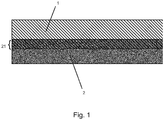
- the adhesive tape which consists of a non-woven carrier 1, to which a layer of a curable adhesive 2 is applied on one side, which is also self-adhesive. 25% of the adhesive has sunk into the carrier (21), which results in optimal anchoring.
- a section of a cable harness is shown which is composed of a bundle of individual cables 7 and which is connected to the adhesive tape 3 according to the invention, shown here in simplified form, according to the method shown in FIG Figure 1 described variant is coated.
- the adhesive tape 3 is guided around the wiring harness in a spiral movement.
- the section of the wiring harness shown shows two windings I and II of the adhesive tape 3. Further windings would extend to the left; these are not shown here.
- the adhesive tape 3 is wound with an offset 3V of 50%, which is indicated in this figure by the darker color.
- Example 1 Fleece equipped on one side with a heat-activatable adhesive
- the Maliwatt carrier is hot-laminated with the adhesive based on nitrile rubber and phenolic resin at a temperature of 130 ° C., as a result of which the adhesive penetrates 25% into the carrier.
- a pocket laminator LM 260 (S2 Laminiertechnik GmbH) at a temperature of 130 ° C is used as the laminator. One pass takes place.
- the adhesive tape When sheathing a cable set, the adhesive tape is guided around eight wires of a cable with an ETFE sheathing with an overlap of 50% in a helical line.
- the sheathed cables have a length of 120mm.
- the flexural rigidity F1 is then measured using a method analogous to LV 112 "Bending Force of Lines".
- the distance lv is 100 mm.
- the bending force F1 is measured after a 15 mm deformation (only one bend).
- the cable set is then cured for 15 minutes at 175 ° C in a convection oven.
- the flexural rigidity F2 is then measured using a method analogous to LV 112 "Bending Force of Lines".
- the distance lv is 100 mm.
- the bending force F2 is measured after a 15 mm deformation (only one bend).
- the strength factor describes the increase in the bending force after curing and is calculated as the quotient of numerator F2 to denominator F1.
- Example 2 Fleece equipped on both sides with a heat-activatable adhesive
- the Maliwatt backing is hot-laminated on both sides with an adhesive based on nitrile rubber and phenolic resin at a temperature of 130 ° C., as a result of which 25% of the adhesive penetrates the backing.
- a pocket laminator LM 260 (S2 Laminiertechnik GmbH) at a temperature of 130 ° C is used as the laminator. One pass takes place.
- the adhesive tape When sheathing a cable set, the adhesive tape is guided around 16 cores of a cable with an ETFE sheathing with an overlap of 50% in a helical line.
- the sheathed cables have a length of 120 mm.
- the flexural rigidity F1 is then measured using a method analogous to LV 112 "Bending Force of Lines".
- the distance lv is 100 mm.
- the bending force F1 is measured after a 15 mm deformation (only one bend).
- the cable set is then cured for 15 minutes at 175 ° C in a convection oven.
- the flexural rigidity F2 is then measured using a method analogous to LV 112 "Bending Force of Lines".
- the distance lv is 100 mm.
- the bending force F2 is measured after a 15 mm deformation (only one bend).
- the strength factor describes the increase in the bending force after curing and is calculated as the quotient of numerator F2 to denominator F1.
- template Sample diameter [mm] F1 (15mm) [N] F2 (15mm) [N] Strength factor F2 / F1 [-] Var 1, Maliwatt, mass 200 ⁇ m 10 41.6 128.5 3.09 Var 1, Maliwatt, 200 ⁇ m mass, double-wound 13th 32.1 141.1 4.40 Var 1, Maliwatt, 125 ⁇ m mass 10 39.4 98.1 2.49 Var 1, Maliwatt, 125 ⁇ m mass, double-wound 13th 35.7 121.2 3.39 Var 2, Maliwatt, mass 200 ⁇ m 12th 31.7 201.4 6.35 Var 1, needle felt, mass 200 ⁇ m 13th 38.0 76.3 2.01 Var 1, needle fleece, 200 ⁇ m mass, wrapped twice 17th 39.3 90.1 2.29 Var 1, needle fleece, 125 ⁇ m mass 11th 43.0 71.6 1.67 Var 1, needle fleece, 125 ⁇ m mass, wrapped twice 15th
- tesa® HAF 8475 and tesa® HAF 8400 are linerless, heat-activated films based on nitrile rubber and phenolic resin.
Landscapes
- Chemical & Material Sciences (AREA)
- Organic Chemistry (AREA)
- Adhesive Tapes (AREA)
- Adhesives Or Adhesive Processes (AREA)
- Package Frames And Binding Bands (AREA)
- Decoration Of Textiles (AREA)
- Insulated Conductors (AREA)
- Details Of Indoor Wiring (AREA)
Claims (8)
- Procédé d'enrobage d'un produit allongé, tel que notamment des conduites ou des faisceaux de câbles, selon lequelune bande adhésive comprenant un support textile et un matériau adhésif durcissable appliqué sur l'ensemble de la surface sur au moins un côté du support, le matériau adhésif étant enfoncé à hauteur de plus de 25 % dans le support après l'application sur le support (déterminé par la méthode indiquée dans la description), est menée en hélice autour du produit allongé ou le produit allongé est enveloppé dans la direction axiale par la bande adhésive,le produit allongé incluant la bande adhésive enveloppante est mis selon l'agencement souhaité, notamment selon le projet de faisceau de câble,le produit allongé est maintenu selon cet agencement,le matériau adhésif durcissable est amené à durcir par l'apport d'une énergie de rayonnement, telle que de la chaleur.
- Procédé selon la revendication 1, caractérisé en ce que le matériau adhésif est enfoncé à hauteur de plus de 50 % dans le support après l'application sur le support.
- Procédé selon la revendication 1, caractérisé en ce que le matériau adhésif imprègne entièrement le support après l'application sur le support.
- Procédé selon l'une quelconque des revendications 1 à 3 précédentes, caractérisé en ce que le matériau adhésif durcissable est autoadhésif ou une couche de matériau autoadhésif est au moins partiellement appliquée sur le matériau adhésif durcissable.
- Procédé selon au moins l'une quelconque des revendications précédentes, caractérisé en ce que le support présente un poids superficiel de 30 à 300 g/m2, de préférence de 50 à 200 g/m2, de manière davantage préférée de 60 à 150 g/m2.
- Procédé selon au moins l'une quelconque des revendications précédentes, caractérisé en ce qu'un tissu, un non-tissé ou un tricot est utilisé en tant que support.
- Procédé selon au moins l'une quelconque des revendications précédentes, caractérisé en ce que le support est constitué par du polyester ou des fibres de verre.
- Procédé selon au moins l'une quelconque des revendications précédentes, caractérisé en ce qu'un adhésif activable thermiquement réactif constitué par un caoutchouc de nitrile et une résine de phénol est utilisé en tant que matériau adhésif durcissable.
Applications Claiming Priority (2)
| Application Number | Priority Date | Filing Date | Title |
|---|---|---|---|
| DE102013213725 | 2013-07-12 | ||
| PCT/EP2014/064723 WO2015004190A1 (fr) | 2013-07-12 | 2014-07-09 | Procédé permettant d'envelopper un produit étendu en longueur, par exemple en particulier des fils ou des ensembles de câbles |
Publications (3)
| Publication Number | Publication Date |
|---|---|
| EP3019571A1 EP3019571A1 (fr) | 2016-05-18 |
| EP3019571B1 EP3019571B1 (fr) | 2019-03-06 |
| EP3019571B2 true EP3019571B2 (fr) | 2021-11-17 |
Family
ID=51177063
Family Applications (1)
| Application Number | Title | Priority Date | Filing Date |
|---|---|---|---|
| EP14738812.8A Active EP3019571B2 (fr) | 2013-07-12 | 2014-07-09 | Procédé permettant d'envelopper un produit étendu en longueur, par exemple en particulier des fils ou des ensembles de câbles |
Country Status (7)
| Country | Link |
|---|---|
| EP (1) | EP3019571B2 (fr) |
| JP (1) | JP2016533000A (fr) |
| CN (1) | CN105378017A (fr) |
| BR (1) | BR112015032765A2 (fr) |
| ES (1) | ES2728310T3 (fr) |
| MX (1) | MX2016000289A (fr) |
| WO (1) | WO2015004190A1 (fr) |
Cited By (1)
| Publication number | Priority date | Publication date | Assignee | Title |
|---|---|---|---|---|
| DE102021126466A1 (de) | 2021-10-13 | 2023-04-13 | Tesa Se | Klebeband und Verfahren zum Ummanteln von langgestrecktem Gut insbesondere Leitungen |
Families Citing this family (24)
| Publication number | Priority date | Publication date | Assignee | Title |
|---|---|---|---|---|
| EP3170657B1 (fr) | 2015-11-19 | 2020-09-09 | 3M Innovative Properties Company | Film adhésif structurel multicouche |
| DE102017127618A1 (de) * | 2017-11-22 | 2019-05-23 | Faist Chemtec Gmbh | Klebeelement, Öffnung, wie ein Konstruktionsloch, ein Karosserieloch, ein Lackablaufloch und/oder eine Lackablauföffnung, und System aus Klebeelement und Trägerelement |
| DE102017127893A1 (de) * | 2017-11-24 | 2019-05-29 | Certoplast Technische Klebebänder Gmbh | Verfahren zur Herstellung einer Ummantelung für langgestrecktes Gut |
| US10297370B1 (en) | 2017-12-14 | 2019-05-21 | Tesa Se | Forming a rigid cable harness with a curable sleeve |
| DE102019103124B4 (de) | 2019-02-08 | 2022-02-03 | Tesa Se | Thermisch härtbares Klebeband, Verwendung zum Ummanteln von langgestrecktem Gut insbesondere Leitungen und Kabelstrang |
| DE102019103123A1 (de) | 2019-02-08 | 2020-08-13 | Tesa Se | Thermisch erweichbares Klebeband und Verfahren zum Ummanteln von langgestrecktem Gut insbesondere Leitungen |
| DE102019103120A1 (de) | 2019-02-08 | 2020-08-13 | Tesa Se | UV-härtbares Klebeband und Verfahren zum Ummanteln von langgestrecktem Gut insbesondere Leitungen |
| DE102019103121A1 (de) | 2019-02-08 | 2020-08-13 | Tesa Se | Schrumpffolie und Verfahren zum Ummanteln von langgestrecktem Gut insbesondere Leitungen |
| DE102019103122A1 (de) * | 2019-02-08 | 2020-08-13 | Tesa Se | Mit Feuchtigkeit härtbares Klebeband und Verfahren zum Ummanteln von langgestrecktem Gut insbesondere Leitungen |
| JP7215364B2 (ja) * | 2019-07-16 | 2023-01-31 | 株式会社オートネットワーク技術研究所 | ワイヤーハーネス |
| JP7215365B2 (ja) * | 2019-07-16 | 2023-01-31 | 株式会社オートネットワーク技術研究所 | ワイヤーハーネス |
| DE102019210708B4 (de) | 2019-07-19 | 2025-06-26 | Tesa Se | Verwendung eines thermisch härtbaren Klebebands zum Ummanteln von langgestrecktem Gut, insbesondere Kabelsätzen |
| DE102019211178B3 (de) | 2019-07-26 | 2020-09-17 | Tesa Se | Verfahren zum Ummanteln von langgestrecktem Gut, ummanteltes Gut und dessen Verwendung |
| DE102019212589A1 (de) | 2019-08-22 | 2021-02-25 | Tesa Se | Verfahren zum Ummanteln von langgestrecktem Gut, insbesondere Leitungen |
| DE102019212592A1 (de) | 2019-08-22 | 2021-02-25 | Tesa Se | Verfahren zum Ummanteln von langgestrecktem Gut, insbesondere Leitungen |
| DE102019212591A1 (de) | 2019-08-22 | 2021-02-25 | Tesa Se | Verfahren zum Ummanteln von langgestrecktem Gut, insbesondere Leitungen |
| US12091594B2 (en) | 2019-08-23 | 2024-09-17 | Tesa Se | Thermally softenable strip and method for covering elongated articles, in particular lines |
| CN113928909B (zh) * | 2020-07-08 | 2024-06-25 | 德莎欧洲股份公司 | 用于制造胶带板卷的方法 |
| DE102020212233B4 (de) | 2020-09-29 | 2025-07-31 | Tesa Se | Klebeband zum Ummanteln von langgestrecktem Gut wie insbesondere Kabelsätzen und Verwendung des Klebebands zur Ummantelung |
| DE102021210731B4 (de) | 2021-06-04 | 2025-06-18 | Tesa Se | Klebeband und Verfahren zum Ummanteln von langgestrecktem Gut insbesondere Leitungen sowie Kabelstrang |
| WO2022253985A1 (fr) | 2021-06-04 | 2022-12-08 | Tesa Se | Ruban adhésif et procédé de recouvrement d'articles allongés, en particulier de lignes |
| DE102021133426A1 (de) * | 2021-12-16 | 2023-06-22 | Tesa Se | Verfahren zur Ummantelung von strangförmigen Elementen |
| EP4269520A1 (fr) | 2022-04-27 | 2023-11-01 | tesa SE | Ruban adhésif pour gainer des articles allongés tels que des faisceaux de câbles et procédé de gainage |
| DE102022126654A1 (de) | 2022-10-13 | 2024-04-18 | Tesa Se | Klebeband und Verfahren zum Ummanteln von langgestrecktem Gut insbesondere Leitungen |
Citations (1)
| Publication number | Priority date | Publication date | Assignee | Title |
|---|---|---|---|---|
| JP2004056861A (ja) † | 2002-07-17 | 2004-02-19 | Three M Innovative Properties Co | 片面熱硬化型成形テープ |
Family Cites Families (4)
| Publication number | Priority date | Publication date | Assignee | Title |
|---|---|---|---|---|
| GB2030991B (en) | 1977-02-09 | 1982-11-24 | Nitto Electric Ind Co | Heat activatable pressuresensitive adhesive tape of sheet |
| DE102009006935A1 (de) * | 2009-01-30 | 2010-08-05 | Tesa Se | Träger verstärkte hitzeaktivierbare Klebemassen |
| DE102011005200A1 (de) * | 2011-03-07 | 2012-09-13 | Tesa Se | Klebeband zum Ummanteln von langgestrecktem Gut wie insbesondere Kabelsätzen und Verfahren zur Ummantelung |
| DE102011075160A1 (de) * | 2011-05-03 | 2012-11-08 | Tesa Se | Verfahren zur Herstellung eines Klebebandes insbesondere zum Umwickeln von Kabeln aus einem offenen textilen Träger und einer darauf einseitig beschichteten Haftklebemasse |
-
2014
- 2014-07-09 EP EP14738812.8A patent/EP3019571B2/fr active Active
- 2014-07-09 ES ES14738812T patent/ES2728310T3/es active Active
- 2014-07-09 JP JP2016524812A patent/JP2016533000A/ja active Pending
- 2014-07-09 WO PCT/EP2014/064723 patent/WO2015004190A1/fr not_active Ceased
- 2014-07-09 CN CN201480039714.1A patent/CN105378017A/zh active Pending
- 2014-07-09 BR BR112015032765A patent/BR112015032765A2/pt not_active Application Discontinuation
- 2014-07-09 MX MX2016000289A patent/MX2016000289A/es unknown
Patent Citations (1)
| Publication number | Priority date | Publication date | Assignee | Title |
|---|---|---|---|---|
| JP2004056861A (ja) † | 2002-07-17 | 2004-02-19 | Three M Innovative Properties Co | 片面熱硬化型成形テープ |
Cited By (1)
| Publication number | Priority date | Publication date | Assignee | Title |
|---|---|---|---|---|
| DE102021126466A1 (de) | 2021-10-13 | 2023-04-13 | Tesa Se | Klebeband und Verfahren zum Ummanteln von langgestrecktem Gut insbesondere Leitungen |
Also Published As
| Publication number | Publication date |
|---|---|
| MX2016000289A (es) | 2016-04-28 |
| EP3019571B1 (fr) | 2019-03-06 |
| WO2015004190A1 (fr) | 2015-01-15 |
| BR112015032765A2 (pt) | 2017-07-25 |
| ES2728310T3 (es) | 2019-10-23 |
| JP2016533000A (ja) | 2016-10-20 |
| CN105378017A (zh) | 2016-03-02 |
| EP3019571A1 (fr) | 2016-05-18 |
Similar Documents
| Publication | Publication Date | Title |
|---|---|---|
| EP3019571B2 (fr) | Procédé permettant d'envelopper un produit étendu en longueur, par exemple en particulier des fils ou des ensembles de câbles | |
| EP2826828B1 (fr) | Procédé destiné à l'enrobage de produit allongé, comme notamment des conduites ou des ensemble de câbles | |
| EP2497805B1 (fr) | Utilisation d'un ruban adhésif pour enrober des faisceaux de câbles | |
| EP2522705B1 (fr) | Utilisation d'une bande de collage destinée à l'enrobage de marchandise allongée, comme notamment des ensemble de câbles et marchandise allongée enrobée d'une bande de collage | |
| EP2520628B1 (fr) | Utilisation d'une bande de collage destinée à l'enrobage de marchandise allongée, comme notamment des ensemble de câbles et marchandise allongée enrobée de la bande de collage | |
| EP2520627B1 (fr) | Utilisation d'une bande de collage destinée à l'enrobage de marchandise allongée, comme notamment des ensemble de câbles et marchandise allongée enrobée de la bande de collage | |
| EP3540024B1 (fr) | Bande adhésive destinée au groupement d'une marchandise allongée comme, en particulier des jeux de câbles, et procédé de groupement de marchandise allongée | |
| EP3433330B1 (fr) | Bande adhésive pour enrober des produits allongés, comme en particulier des ensembles de cables et procédé d' enrobage | |
| DE102011075160A1 (de) | Verfahren zur Herstellung eines Klebebandes insbesondere zum Umwickeln von Kabeln aus einem offenen textilen Träger und einer darauf einseitig beschichteten Haftklebemasse | |
| EP4092092B1 (fr) | Bande adhésive permettant d'envelopper une marchandise allongée telle que, en particulier les faisceaux de câbles et procédé d'enveloppement | |
| US20150013874A1 (en) | Method for jacketing elongate material, especially leads or cable looms | |
| EP4004951A1 (fr) | Procédé de chemisage d'articles allongés, en particulier de lignes | |
| DE102018213969A1 (de) | Klebeband zum Ummanteln von langgestrecktem Gut wie insbesondere Kabelsätzen und Verfahren zur Ummantelung | |
| EP2497807B1 (fr) | Utilisation d'un ruban adhésif pour le bandage de câbles | |
| DE102019211874B4 (de) | Klebeband zum Umwickeln von Kabeln und Verwendung | |
| EP4010444A1 (fr) | Ruban adhésif pour recouvrir des produits allongés, comme, en particulier, des ensembles de câbles, et procédé de recouvrement | |
| DE102020212233B4 (de) | Klebeband zum Ummanteln von langgestrecktem Gut wie insbesondere Kabelsätzen und Verwendung des Klebebands zur Ummantelung | |
| DE102023108284A1 (de) | Klebeband zum Ummanteln von langgestrecktem Gut wie insbesondere Kabelsätzen und Verfahren zur Ummantelung | |
| WO2024200730A2 (fr) | Ruban adhésif utilisé pour gainer des produits allongés, en particulier des faisceaux de câbles, et procédé de gainage |
Legal Events
| Date | Code | Title | Description |
|---|---|---|---|
| PUAI | Public reference made under article 153(3) epc to a published international application that has entered the european phase |
Free format text: ORIGINAL CODE: 0009012 |
|
| 17P | Request for examination filed |
Effective date: 20160212 |
|
| AK | Designated contracting states |
Kind code of ref document: A1 Designated state(s): AL AT BE BG CH CY CZ DE DK EE ES FI FR GB GR HR HU IE IS IT LI LT LU LV MC MK MT NL NO PL PT RO RS SE SI SK SM TR |
|
| AX | Request for extension of the european patent |
Extension state: BA ME |
|
| DAX | Request for extension of the european patent (deleted) | ||
| STAA | Information on the status of an ep patent application or granted ep patent |
Free format text: STATUS: EXAMINATION IS IN PROGRESS |
|
| 17Q | First examination report despatched |
Effective date: 20180705 |
|
| REG | Reference to a national code |
Ref country code: DE Ref legal event code: R079 Ref document number: 502014011044 Country of ref document: DE Free format text: PREVIOUS MAIN CLASS: C09J0007040000 Ipc: C09J0007210000 |
|
| RIC1 | Information provided on ipc code assigned before grant |
Ipc: C09J 7/35 20180101ALI20180814BHEP Ipc: C09J 7/21 20180101AFI20180814BHEP |
|
| GRAP | Despatch of communication of intention to grant a patent |
Free format text: ORIGINAL CODE: EPIDOSNIGR1 |
|
| STAA | Information on the status of an ep patent application or granted ep patent |
Free format text: STATUS: GRANT OF PATENT IS INTENDED |
|
| INTG | Intention to grant announced |
Effective date: 20180925 |
|
| GRAS | Grant fee paid |
Free format text: ORIGINAL CODE: EPIDOSNIGR3 |
|
| GRAA | (expected) grant |
Free format text: ORIGINAL CODE: 0009210 |
|
| STAA | Information on the status of an ep patent application or granted ep patent |
Free format text: STATUS: THE PATENT HAS BEEN GRANTED |
|
| AK | Designated contracting states |
Kind code of ref document: B1 Designated state(s): AL AT BE BG CH CY CZ DE DK EE ES FI FR GB GR HR HU IE IS IT LI LT LU LV MC MK MT NL NO PL PT RO RS SE SI SK SM TR |
|
| REG | Reference to a national code |
Ref country code: GB Ref legal event code: FG4D Free format text: NOT ENGLISH |
|
| REG | Reference to a national code |
Ref country code: CH Ref legal event code: EP Ref country code: AT Ref legal event code: REF Ref document number: 1104503 Country of ref document: AT Kind code of ref document: T Effective date: 20190315 |
|
| REG | Reference to a national code |
Ref country code: DE Ref legal event code: R096 Ref document number: 502014011044 Country of ref document: DE |
|
| REG | Reference to a national code |
Ref country code: IE Ref legal event code: FG4D Free format text: LANGUAGE OF EP DOCUMENT: GERMAN |
|
| REG | Reference to a national code |
Ref country code: RO Ref legal event code: EPE |
|
| REG | Reference to a national code |
Ref country code: NL Ref legal event code: MP Effective date: 20190306 |
|
| REG | Reference to a national code |
Ref country code: LT Ref legal event code: MG4D |
|
| PG25 | Lapsed in a contracting state [announced via postgrant information from national office to epo] |
Ref country code: NO Free format text: LAPSE BECAUSE OF FAILURE TO SUBMIT A TRANSLATION OF THE DESCRIPTION OR TO PAY THE FEE WITHIN THE PRESCRIBED TIME-LIMIT Effective date: 20190606 Ref country code: FI Free format text: LAPSE BECAUSE OF FAILURE TO SUBMIT A TRANSLATION OF THE DESCRIPTION OR TO PAY THE FEE WITHIN THE PRESCRIBED TIME-LIMIT Effective date: 20190306 Ref country code: SE Free format text: LAPSE BECAUSE OF FAILURE TO SUBMIT A TRANSLATION OF THE DESCRIPTION OR TO PAY THE FEE WITHIN THE PRESCRIBED TIME-LIMIT Effective date: 20190306 Ref country code: LT Free format text: LAPSE BECAUSE OF FAILURE TO SUBMIT A TRANSLATION OF THE DESCRIPTION OR TO PAY THE FEE WITHIN THE PRESCRIBED TIME-LIMIT Effective date: 20190306 |
|
| PG25 | Lapsed in a contracting state [announced via postgrant information from national office to epo] |
Ref country code: LV Free format text: LAPSE BECAUSE OF FAILURE TO SUBMIT A TRANSLATION OF THE DESCRIPTION OR TO PAY THE FEE WITHIN THE PRESCRIBED TIME-LIMIT Effective date: 20190306 Ref country code: HR Free format text: LAPSE BECAUSE OF FAILURE TO SUBMIT A TRANSLATION OF THE DESCRIPTION OR TO PAY THE FEE WITHIN THE PRESCRIBED TIME-LIMIT Effective date: 20190306 Ref country code: NL Free format text: LAPSE BECAUSE OF FAILURE TO SUBMIT A TRANSLATION OF THE DESCRIPTION OR TO PAY THE FEE WITHIN THE PRESCRIBED TIME-LIMIT Effective date: 20190306 Ref country code: BG Free format text: LAPSE BECAUSE OF FAILURE TO SUBMIT A TRANSLATION OF THE DESCRIPTION OR TO PAY THE FEE WITHIN THE PRESCRIBED TIME-LIMIT Effective date: 20190606 Ref country code: GR Free format text: LAPSE BECAUSE OF FAILURE TO SUBMIT A TRANSLATION OF THE DESCRIPTION OR TO PAY THE FEE WITHIN THE PRESCRIBED TIME-LIMIT Effective date: 20190607 Ref country code: RS Free format text: LAPSE BECAUSE OF FAILURE TO SUBMIT A TRANSLATION OF THE DESCRIPTION OR TO PAY THE FEE WITHIN THE PRESCRIBED TIME-LIMIT Effective date: 20190306 |
|
| REG | Reference to a national code |
Ref country code: ES Ref legal event code: FG2A Ref document number: 2728310 Country of ref document: ES Kind code of ref document: T3 Effective date: 20191023 |
|
| PG25 | Lapsed in a contracting state [announced via postgrant information from national office to epo] |
Ref country code: EE Free format text: LAPSE BECAUSE OF FAILURE TO SUBMIT A TRANSLATION OF THE DESCRIPTION OR TO PAY THE FEE WITHIN THE PRESCRIBED TIME-LIMIT Effective date: 20190306 Ref country code: IT Free format text: LAPSE BECAUSE OF FAILURE TO SUBMIT A TRANSLATION OF THE DESCRIPTION OR TO PAY THE FEE WITHIN THE PRESCRIBED TIME-LIMIT Effective date: 20190306 Ref country code: SK Free format text: LAPSE BECAUSE OF FAILURE TO SUBMIT A TRANSLATION OF THE DESCRIPTION OR TO PAY THE FEE WITHIN THE PRESCRIBED TIME-LIMIT Effective date: 20190306 Ref country code: AL Free format text: LAPSE BECAUSE OF FAILURE TO SUBMIT A TRANSLATION OF THE DESCRIPTION OR TO PAY THE FEE WITHIN THE PRESCRIBED TIME-LIMIT Effective date: 20190306 Ref country code: PT Free format text: LAPSE BECAUSE OF FAILURE TO SUBMIT A TRANSLATION OF THE DESCRIPTION OR TO PAY THE FEE WITHIN THE PRESCRIBED TIME-LIMIT Effective date: 20190706 |
|
| PG25 | Lapsed in a contracting state [announced via postgrant information from national office to epo] |
Ref country code: PL Free format text: LAPSE BECAUSE OF FAILURE TO SUBMIT A TRANSLATION OF THE DESCRIPTION OR TO PAY THE FEE WITHIN THE PRESCRIBED TIME-LIMIT Effective date: 20190306 Ref country code: SM Free format text: LAPSE BECAUSE OF FAILURE TO SUBMIT A TRANSLATION OF THE DESCRIPTION OR TO PAY THE FEE WITHIN THE PRESCRIBED TIME-LIMIT Effective date: 20190306 |
|
| REG | Reference to a national code |
Ref country code: DE Ref legal event code: R026 Ref document number: 502014011044 Country of ref document: DE |
|
| PLBI | Opposition filed |
Free format text: ORIGINAL CODE: 0009260 |
|
| PLAX | Notice of opposition and request to file observation + time limit sent |
Free format text: ORIGINAL CODE: EPIDOSNOBS2 |
|
| PG25 | Lapsed in a contracting state [announced via postgrant information from national office to epo] |
Ref country code: IS Free format text: LAPSE BECAUSE OF FAILURE TO SUBMIT A TRANSLATION OF THE DESCRIPTION OR TO PAY THE FEE WITHIN THE PRESCRIBED TIME-LIMIT Effective date: 20190706 |
|
| PLBB | Reply of patent proprietor to notice(s) of opposition received |
Free format text: ORIGINAL CODE: EPIDOSNOBS3 |
|
| 26 | Opposition filed |
Opponent name: CERTOPLAST TECHNISCHE KLEBEBAENDER GMBH Effective date: 20191205 |
|
| PG25 | Lapsed in a contracting state [announced via postgrant information from national office to epo] |
Ref country code: DK Free format text: LAPSE BECAUSE OF FAILURE TO SUBMIT A TRANSLATION OF THE DESCRIPTION OR TO PAY THE FEE WITHIN THE PRESCRIBED TIME-LIMIT Effective date: 20190306 |
|
| PG25 | Lapsed in a contracting state [announced via postgrant information from national office to epo] |
Ref country code: SI Free format text: LAPSE BECAUSE OF FAILURE TO SUBMIT A TRANSLATION OF THE DESCRIPTION OR TO PAY THE FEE WITHIN THE PRESCRIBED TIME-LIMIT Effective date: 20190306 Ref country code: MC Free format text: LAPSE BECAUSE OF FAILURE TO SUBMIT A TRANSLATION OF THE DESCRIPTION OR TO PAY THE FEE WITHIN THE PRESCRIBED TIME-LIMIT Effective date: 20190306 |
|
| REG | Reference to a national code |
Ref country code: CH Ref legal event code: PL |
|
| GBPC | Gb: european patent ceased through non-payment of renewal fee |
Effective date: 20190709 |
|
| PG25 | Lapsed in a contracting state [announced via postgrant information from national office to epo] |
Ref country code: TR Free format text: LAPSE BECAUSE OF FAILURE TO SUBMIT A TRANSLATION OF THE DESCRIPTION OR TO PAY THE FEE WITHIN THE PRESCRIBED TIME-LIMIT Effective date: 20190306 |
|
| PLAS | Information related to reply of patent proprietor to notice(s) of opposition deleted |
Free format text: ORIGINAL CODE: EPIDOSDOBS3 |
|
| REG | Reference to a national code |
Ref country code: BE Ref legal event code: MM Effective date: 20190731 |
|
| PG25 | Lapsed in a contracting state [announced via postgrant information from national office to epo] |
Ref country code: GB Free format text: LAPSE BECAUSE OF NON-PAYMENT OF DUE FEES Effective date: 20190709 |
|
| PG25 | Lapsed in a contracting state [announced via postgrant information from national office to epo] |
Ref country code: BE Free format text: LAPSE BECAUSE OF NON-PAYMENT OF DUE FEES Effective date: 20190731 Ref country code: LU Free format text: LAPSE BECAUSE OF NON-PAYMENT OF DUE FEES Effective date: 20190709 Ref country code: LI Free format text: LAPSE BECAUSE OF NON-PAYMENT OF DUE FEES Effective date: 20190731 Ref country code: CH Free format text: LAPSE BECAUSE OF NON-PAYMENT OF DUE FEES Effective date: 20190731 |
|
| PLBB | Reply of patent proprietor to notice(s) of opposition received |
Free format text: ORIGINAL CODE: EPIDOSNOBS3 |
|
| PG25 | Lapsed in a contracting state [announced via postgrant information from national office to epo] |
Ref country code: IE Free format text: LAPSE BECAUSE OF NON-PAYMENT OF DUE FEES Effective date: 20190709 |
|
| REG | Reference to a national code |
Ref country code: AT Ref legal event code: MM01 Ref document number: 1104503 Country of ref document: AT Kind code of ref document: T Effective date: 20190709 |
|
| PG25 | Lapsed in a contracting state [announced via postgrant information from national office to epo] |
Ref country code: AT Free format text: LAPSE BECAUSE OF NON-PAYMENT OF DUE FEES Effective date: 20190709 |
|
| PG25 | Lapsed in a contracting state [announced via postgrant information from national office to epo] |
Ref country code: CY Free format text: LAPSE BECAUSE OF FAILURE TO SUBMIT A TRANSLATION OF THE DESCRIPTION OR TO PAY THE FEE WITHIN THE PRESCRIBED TIME-LIMIT Effective date: 20190306 |
|
| PG25 | Lapsed in a contracting state [announced via postgrant information from national office to epo] |
Ref country code: MT Free format text: LAPSE BECAUSE OF FAILURE TO SUBMIT A TRANSLATION OF THE DESCRIPTION OR TO PAY THE FEE WITHIN THE PRESCRIBED TIME-LIMIT Effective date: 20190306 Ref country code: HU Free format text: LAPSE BECAUSE OF FAILURE TO SUBMIT A TRANSLATION OF THE DESCRIPTION OR TO PAY THE FEE WITHIN THE PRESCRIBED TIME-LIMIT; INVALID AB INITIO Effective date: 20140709 |
|
| PUAH | Patent maintained in amended form |
Free format text: ORIGINAL CODE: 0009272 |
|
| STAA | Information on the status of an ep patent application or granted ep patent |
Free format text: STATUS: PATENT MAINTAINED AS AMENDED |
|
| PGFP | Annual fee paid to national office [announced via postgrant information from national office to epo] |
Ref country code: CZ Payment date: 20210708 Year of fee payment: 8 |
|
| 27A | Patent maintained in amended form |
Effective date: 20211117 |
|
| AK | Designated contracting states |
Kind code of ref document: B2 Designated state(s): AL AT BE BG CH CY CZ DE DK EE ES FI FR GB GR HR HU IE IS IT LI LT LU LV MC MK MT NL NO PL PT RO RS SE SI SK SM TR |
|
| REG | Reference to a national code |
Ref country code: DE Ref legal event code: R102 Ref document number: 502014011044 Country of ref document: DE |
|
| PGFP | Annual fee paid to national office [announced via postgrant information from national office to epo] |
Ref country code: ES Payment date: 20210928 Year of fee payment: 8 Ref country code: RO Payment date: 20210701 Year of fee payment: 8 |
|
| PG25 | Lapsed in a contracting state [announced via postgrant information from national office to epo] |
Ref country code: ES Free format text: LAPSE BECAUSE OF FAILURE TO SUBMIT A TRANSLATION OF THE DESCRIPTION OR TO PAY THE FEE WITHIN THE PRESCRIBED TIME-LIMIT Effective date: 20211117 Ref country code: CZ Free format text: LAPSE BECAUSE OF FAILURE TO SUBMIT A TRANSLATION OF THE DESCRIPTION OR TO PAY THE FEE WITHIN THE PRESCRIBED TIME-LIMIT Effective date: 20190306 |
|
| PG25 | Lapsed in a contracting state [announced via postgrant information from national office to epo] |
Ref country code: MK Free format text: LAPSE BECAUSE OF FAILURE TO SUBMIT A TRANSLATION OF THE DESCRIPTION OR TO PAY THE FEE WITHIN THE PRESCRIBED TIME-LIMIT Effective date: 20190306 |
|
| PG25 | Lapsed in a contracting state [announced via postgrant information from national office to epo] |
Ref country code: RO Free format text: LAPSE BECAUSE OF NON-PAYMENT OF DUE FEES Effective date: 20220709 |
|
| P01 | Opt-out of the competence of the unified patent court (upc) registered |
Effective date: 20230526 |
|
| PGFP | Annual fee paid to national office [announced via postgrant information from national office to epo] |
Ref country code: DE Payment date: 20250722 Year of fee payment: 12 |
|
| PGFP | Annual fee paid to national office [announced via postgrant information from national office to epo] |
Ref country code: FR Payment date: 20250725 Year of fee payment: 12 |