EP3020748A1 - Polyamides à base de (2-oxazolinyl)-furane - Google Patents
Polyamides à base de (2-oxazolinyl)-furane Download PDFInfo
- Publication number
- EP3020748A1 EP3020748A1 EP14193170.9A EP14193170A EP3020748A1 EP 3020748 A1 EP3020748 A1 EP 3020748A1 EP 14193170 A EP14193170 A EP 14193170A EP 3020748 A1 EP3020748 A1 EP 3020748A1
- Authority
- EP
- European Patent Office
- Prior art keywords
- fdcaox
- monomer
- polyamide
- oxazolinyl
- group
- Prior art date
- Legal status (The legal status is an assumption and is not a legal conclusion. Google has not performed a legal analysis and makes no representation as to the accuracy of the status listed.)
- Withdrawn
Links
- 0 C[C@]1N=C(C(OC(*)=C)=C*)OC1I* Chemical compound C[C@]1N=C(C(OC(*)=C)=C*)OC1I* 0.000 description 2
Images


Classifications
-
- C—CHEMISTRY; METALLURGY
- C08—ORGANIC MACROMOLECULAR COMPOUNDS; THEIR PREPARATION OR CHEMICAL WORKING-UP; COMPOSITIONS BASED THEREON
- C08L—COMPOSITIONS OF MACROMOLECULAR COMPOUNDS
- C08L77/00—Compositions of polyamides obtained by reactions forming a carboxylic amide link in the main chain; Compositions of derivatives of such polymers
- C08L77/12—Polyester-amides
-
- C—CHEMISTRY; METALLURGY
- C07—ORGANIC CHEMISTRY
- C07D—HETEROCYCLIC COMPOUNDS
- C07D413/00—Heterocyclic compounds containing two or more hetero rings, at least one ring having nitrogen and oxygen atoms as the only ring hetero atoms
- C07D413/14—Heterocyclic compounds containing two or more hetero rings, at least one ring having nitrogen and oxygen atoms as the only ring hetero atoms containing three or more hetero rings
-
- C—CHEMISTRY; METALLURGY
- C08—ORGANIC MACROMOLECULAR COMPOUNDS; THEIR PREPARATION OR CHEMICAL WORKING-UP; COMPOSITIONS BASED THEREON
- C08G—MACROMOLECULAR COMPOUNDS OBTAINED OTHERWISE THAN BY REACTIONS ONLY INVOLVING UNSATURATED CARBON-TO-CARBON BONDS
- C08G69/00—Macromolecular compounds obtained by reactions forming a carboxylic amide link in the main chain of the macromolecule
- C08G69/44—Polyester-amides
Definitions
- the invention pertains to polyamides obtainable from (2-oxazolinyl)-furan derived monomers, to resins and shaped products comprising said polymer, to a process for manufacturing said polyamides and to the use of (2-oxazolinyl)-furan derived monomers for polymerization reactions.
- US 4,474,942 pertains to cross-linked polyesteramides obtained from the polymerization of bis(2-oxazoline) compounds and dicarboxylic acids.
- the bis(2-oxazoline) compounds comprise an alkyl chain core or an benzene core.
- Nery et al. (Macromol. Chem. Phys. 2003, 204, p. 1755-1764 ) describe the polymerization of bis(2-oxazoline) compounds with carboxylic acids.
- 2,2'-arylene-bis(2-oxazolines) are used as bisoxazoline monomers, as e.g. 2,2'-(1,3-phenylene) bis(2-oxazoline).
- polyamides obtainable from a mixture comprising a monomer which comprises a (2-oxazolinyl)-furan group show increased branching and crosslinking rates and therefore allow faster curing.
- the monomer used in the invention is an (2-oxazolinyl)-furan derived monomer which generally is 2,5-furandicarboxylic acid (FDCA)-based.
- FDCA may be derived from biomass sources and therefore, depending on the choice of the other monomers used in the polymerization, the polyamide of the invention may be based on renewable sources.
- the polyamide may be obtained from a (monomer) mixture which comprises a monomer which comprises a (2-oxazolinyl)-furan group (which monomer is herein also referred to as "FDCAox” or “FDCAox monomer”) and further comprises a bis-, tri- or multifunctional carboxylic acid, amine, sulfide, alcohol or amide or any combination thereof (also referred to as non-FDCAox monomer).
- carboxylic acids or alcohols are used, more preferably dicarboxylic acids or diols.
- the resulting polymer is a polyetheramide
- dicarboxylic acids when dicarboxylic acids are used, a polyesteramide is obtained.
- dicarboxylic acids use can be made of aliphatic dicarboxylic acids, as e.g. malonic acid, sebacic acid, succinic acid, glutaric acid, adipic acid, pimelic acid, suberic acid, azelaic acid, dodecandioic acid, dimer acid, eicosandioic acid and thiodipropionic acid.
- aromatic dicarboxylic acids may be used as monomers, including but not limited to phthalic acid, naphthalenedicarboxylic acid, diphenylsulfonedicarboxylic acid and diphenylmethanedicarboxylic acid.
- aromatic diols are preferred.
- the aromatic diol has the formula: HO-Ar-(X-Ar) m -OH, wherein Ar is a phenyl or naphthyl group which may be substituted by a methyl or methoxy group, m is 0 or 1, and X is selected from a bond, S, O, SO, SO 2 , CO, CH 2 and C(CH 3 ) 2 . Positioning of the hydroxy groups is preferably para with respect to other functional groups, but may also be meta or ortho.
- the aromatic phenyl or naphthyl groups may independently be substituted by one to four methyl or methoxy groups.
- the positions of the hydroxy groups may be meta or ortho, but the para position as depicted in the above examples is preferred.
- the FDCAox monomer used in the current invention is of formula I, where each R 1 is independently of one another selected from a proton and an alkyl group and R 2 is selected from moieties comprising an oxazolinyl, carboxylic acid, amine, amide or sulfide group.
- the FDCAox monomer of formula I comprises moiety R 2 .
- Moiety R 2 comprises one of the above listed functional groups.
- Moiety R 2 may also comprise a linker group, e.g. a (bivalent) carbon group as linker between the functional group comprised in R 2 and the furan ring of the FDCAox monomer.
- the linker may be any suitable group, including a furan group, a benzene group, an alkanediyl group or combinations thereof.
- a FDCAox monomer of formula II is used, more particular 2,5-bis(4,5-dihydrooxazol-2-yl)furan, (referred to as "2,5-FDCAox", where each R1 is a proton).
- 2,5-FDCAox 2,5-bis(4,5-dihydrooxazol-2-yl)furan
- An alkyl is an aliphatic moiety with a total number of carbon atoms between 1 and 10, preferably between 1 and 5, i.e. a functional group comprising only carbon and hydrogen atoms derived from an alkane by removing one hydrogen atom.
- This definition includes unbranched carbon chains and branched carbon chains, i.e. isomers.
- Examples are: methyl, ethyl, propyl or isopropyl.
- An alkanediyl group is of the formula -(CH 2 ) n -, where n is between 1 and 12, preferably between 1 and 5.
- the monomer mixture from which the polyamide of the invention is obtainable may comprise a FDCAox monomer or combinations of different FDCAox monomers together with a non-FDCAox monomer or combinations of different non-FDCAox monomers.
- FDCAox monomers and non-FDCAox monomers may be used.
- the equivalent ratio between FDCAox and non-FDCAox monomer in the monomer mixture may be 1:1 to 100:1, preferably 1-5:1, more preferably 1.5-2.5:1. Specific embodiments are equivalent ratios of 2.25:1, 2:1, 1.75:1 and 1.25:1.
- the polyamide of the present invention has a crosslinking degree of at least 5%, preferably at least 10 %, more preferably at least 20% or even higher.
- the enhanced branching and cross-linking might be attributed to an increased nucleophilicity of the 2,5-furandicarboxamide.
- the 2,5-furandicarboxamide is formed when the 2-oxazoline ring of the FDCAox monomer is opened during the polymerization reaction.
- the increased nucleophilicity could result from intra-molecular hydrogen bonding between the free electron pairs of the oxygen of the furan ring with the proton of the amide group.
- the N-H bond of the amide groups weakens and the nitrogen becomes more electron rich and thus a better nucleophile. This might subsequently enhance the reactivity of this amide group towards (2-oxazoline) groups.
- a tertiary amide and a trifurcate bond could be formed which results in branching.
- the present invention also relates to a resin composition comprising the polyamide of the current invention.
- the resin is a thermoset resin.
- the resin composition may also be a mixture of different polyamides of this invention.
- a polymer derived from a monomer mixture with a ratio of the FDCAox monomer used in the invention to the non-FDCAox monomers of 2:1 may be mixed with a polymer derived from a monomer mixture with a ratio of the FDCAox monomer to the non-FDCAox monomers of 1:2.
- the polymers of the resin composition may be derived from different monomer mixtures comprising different FDCAox and non-FDCAox monomers in combination.
- the resin composition may comprise at least two different polyesteramides derived from monomer mixtures comprising different dicarboxylic acids and/or different FDCAox monomers, optionally from monomer mixtures of different equivalent ratios of the dicarboxylic acid to the FDCAox monomers.
- the resin comprises reinforcements and/or fillers.
- Reinforcements may be fibrous reinforcements, preferably inorganic, natural or synthetic fibers. Suited are e.g. glass fibers, carbon fibers, polyamide fibers, aramid fibers, nylon or polyester fibers. In one embodiment different fibrous reinforcements are combined in one resin composition.
- filler materials may be added to the resin composition.
- fillers include oxides, hydroxides, carbonates, silicates, particulate carbon or metal powder.
- Fibrous reinforcements and fillers may each be added to the resin composition in an amount of 10 wt% - 70 wt%, more preferably 20 wt% to 80 wt%, and more preferably 30 to 90 wt%.
- the resin composition of the invention may be used to form shaped products.
- Shaped products comprising the resin composition of current invention are a further object of this invention.
- the shaped products may be films, polymer glasses, coatings, adhesives or laminates.
- the shaped products may be obtained by polymerization of the FDCAox monomer with non-FDCAox monomers.
- Another object of current invention is a process for manufacturing a polyamide from a mixture of monomers, whereby a monomer which comprises a 2-oxazolinyl-furan group is reacted with a bis-, tris- or multifunctional carboxylic acid, amine, sulfide or an alcohol or any combinations thereof.
- the monomer which comprises a 2-oxazolinyl-furan group is described above.
- a monomer of formula I as defined in claim 3 and above, more preferably a monomer of formula II or III as defined in claim 4 and above is used for the polymerization reaction.
- 0.01-10 wt%, preferably 0.1-7 wt%, more preferably 0.2 -5 wt%, or 0.5 -2 wt% of a catalyst is added to the mixture of monomers.
- the catalyst may be selected from phosphorous acid esters, organic phosphonous acids and inorganic salts or combinations thereof.
- phosphorous acid esters are employed, as e.g. diesters and triesters, in particular triphenyl phosphite (TPP), tris(nonylphenyl) phosphite, triethyl phosphite, tri-n-butyl phosphite, tris(2-ethylhexyl) phosphite, tristearyl phosphite, diphenylmonodecyl phosphite, tetraphenyl dipropylene glycol diphosphite, tetraphenyltetra(tridecyl)pentaerythritol tetraphosphite, diphenyl phosphite, 4,4'-butylidenebis(3-methyl-6-t-butylphenyl-ditrid
- One or more different FDCAox monomers may be mixed with one or more bis-, tri-or multifunctional carboxylic acid, amine, sulfide, alcohol or amide (the non-FDCAox monomers).
- the reaction temperature will be at least 150 °C, preferably at least 180 °C, more preferably at least 200 °C. As a general maximum for the reaction temperature 350 °C may be mentioned.
- the polymer branching may be influenced by adjusting the reaction temperature and the catalyst concentration. With increasing amounts of catalyst (the branching degree of the polymer increases with increasing catalyst concentration. For example this can be observed when 0, 0.5, 1, 2, 5 or 7 wt% of catalyst, as e.g. triphenyl phosphite, are added to a monomer mixture comprising FDCAox (e.g. 2,5-FDCAox and a bifunctional carboxylix acid (e.g. sebacic acid) at an equivalent ratio of 1-2.5 eq. of FDCAox to 1 of the bifunctional carboxylic acid and using a reaction temperature of 200°C).
- the branching frequency increases when the reaction temperature is increased, independently of the addition of catalyst.
- reaction temperature of the monomer mixture (with or without catalyst) is chosen from 150°C, 170°C, 200°C, 210°C and 230°C
- each further increase of the reaction temperatures will give accelerated branching, meaning that the branching concentration after the same reaction time is higher in samples with a higher reaction temperature.
- melt polymerization procedures may be used to manufacture the polyamide of the invention, alternatively the polyamide of the invention may be manufactured in a high boiling solvents, including but not limited to N,N'-dimethylformamide, N,N'dimethylacetamide, N-Methyl-2-pyrrolidone (NMP) or dimethylsulfoxide.
- a high boiling solvents including but not limited to N,N'-dimethylformamide, N,N'dimethylacetamide, N-Methyl-2-pyrrolidone (NMP) or dimethylsulfoxide.
- solvents are added to the polymerization reaction, preferably dipolar solvents, as e.g. NMP ( N -Methyl-2-pyrrolidone), and are deposited on a surface prior to polymerization. During this polymerization process (which is sometimes referred to as curing), the solvent evaporates, leaving a thin cross-linked coating on the substrate.
- dipolar solvents as e.g. NMP ( N -Methyl-2-pyrrolidone
- a nitrogen-rich atmosphere is preferred as a reaction condition.
- the reaction temperature may be kept constant during the reaction but it may also be increased during the curing process. Especially for curing reactions it might be advantageous to increase the reaction temperature during the reaction. For example, a temperature of 150°C could be used at the reaction start which is gradually or step-wise increased to the maximum reaction temperature.
- the (combinations of) FDCAox and the (combinations of) non-FDCAox monomers may be mixed at an equivalent ratio of 1:1 to 100:1, preferably 1-5:1, more preferably 1.5-2.5:1. Specific embodiments are equivalent ratios of 2.25:1, 2:1, 1.75:1 and 1.25:1.
- the present invention is further directed to the use of monomers comprising a (2-oxazolinyl)-furan group for polymerization reactions.
- monomers comprising a (2-oxazolinyl)-furan group for polymerization reactions.
- the embodiments of the monomer which comprises a (2-oxazolinyl)-furan group are described above.
- a monomer of formula I as defined in claim 3 and above, more preferably a monomer of formula II or III as defined in claim 4 and above is used for the polymerization reaction.
- 2,5-Furandicarboxylic acid (2,5-FDCA) was obtained from Atomole, China (>99 wt%).
- Sebacic acid (SeA) 2-chloroethylamine hydrochloride, triphenylphosphite (TPP), thionyl chloride, sodium hydroxide, and potassium hydroxide were purchased from Sigma.
- Irganox 1330 antioxidant was a kind gift from Ciba Specialty Chemicals.
- 1,3-bis(4,5-dihydrooxazol-2-yl)benzene (IAox) was purchased from TCI Europe.
- Deuterated dimethyl sulfoxide (DMSO- d 6, 99.9% atom D) was acquired from Cambridge Isotope Laboratories.
- 2,5-furandicarboxylic acid (16.4 g, 0.105 mol) was reacted with an excess of thionyl chloride (27.5 mL, 0.23 mol), in the presence of a catalytic amount of DMF (100 ⁇ L) in a 250 mL three-neck flask at 80 °C for four hours.
- a condenser was connected to the flask to allow refluxing of thionyl chloride and the reaction was conducted under an argon rich atmosphere.
- the released gaseous SO 2 and HCl were passed through an aqueous NaOH solution, neutralizing the hydrochloric acid.
- Reaction mixtures were prepared by weighing and grinding 2,5-FDCAox (1.0 to 2.5 eq), SeA (1 eq), Irganox 1330 (1 wt%), and TPP (0 to 7 wt%) using a mortar and pestle.
- Samples prepared for DMAc-SEC and DSC analysis were loaded into 1 mL glass vials and immersed in an oil-bath at the desired temperature of 160 °C for the desired reaction time (0 - 60 minutes) prior to analysis.
- Samples prepared for DMTA analysis were preheated to 160 °C for one minute until a clear casting liquid was obtained. The casting liquid was then poured onto a Teflon film and cured in an oven at 200 °C under a nitrogen rich atmosphere for 10 minutes to one hour.
- 2,5-FDCAox (2.25 eq) was cured with SeA (1 eq) in the presence of 5 wt% TPP using the following procedure.
- a solution of 2,5-FDCAox (139.3 mg, 0.675 mmol), sebacic acid (60.7 mg, 0.3 mmol) and triphenylphosphite (10 mg, 5 wt%) was prepared in 0.6 mL N-Methyl-2-Pyrrolidone at 100 °C.
- This solution was subsequently applied to Q-panels, preheated in an oven at 200 °C, using a coating applicator frame with a spacing of 120 ⁇ m.
- the obtained coatings were cured by heating the coated panels in an oven at 200 °C for 1 hour under a nitrogen rich atmosphere.
- N,N-Dimethylacetamide size exclusion chromatography was performed on a Waters Alliance system equipped with a Water 2413 refractive index detector (40 °C), a Waters 2695 separation module, a Waters 2996 photodiode array detector, a PSS GRAM guard column followed by 2 PSS GRAM columns in series of 100 ⁇ (10 ⁇ m particles) and 3000 ⁇ (10 ⁇ m particles) at 60 °C.
- TGA thermogravimetricanalysis
- DSC Differential scanning calorimetry
- DMTA Dynamic mechanical thermal analysis
- the obtained polymer films were reshaped into rectangles of 20 mm x 5 mm and were measured in the DMTA from -50 °C to 225 °C at a heating rate of 2 °C/min, a frequency of 1 Hz, and an amplitude of 10 ⁇ m. If required, the samples were kept under isothermal conditions at 200 °C to follow the curing process of the sample. Glass transition temperatures were calculated from the maximum in the tan ⁇ trace obtained during heating of the sample.
- Coating thicknesses of the solvent-borne coatings were measured using a magnetic induction coating thickness gauche (LD0400 by Thermimport Quality Control). Reverse impact tests were performed by dropping a weight of 1 kg from a controlled height of 100 cm on the backside of the coated panels and the pencil hardness test was performed by scratching the obtained coating with pencils of increasing hardness. Chemical resistance was determined by the acetone double rub test in which the material is rubbed back and forth (double rubs) by an acetone drenched cloth 100 times.
- a magnetic induction coating thickness gauche LD0400 by Thermimport Quality Control
- a polyesteramide according to the invention was prepared as described above from a mixture of monomers comprising 2,5-bis(4,5-dihydrooxazol-2-yl)furan (2,5-FDCAox) and sebacic acid.
- a polyesteramide was prepared in the same way from a mixture of monomers comprising 1,3-bis(4,5-dihydrooxazol-2-yl)benzene (IAox) and sebacic acid.
- IAox is a bisoxazoline compound having a benzene core instead of a furan ring.
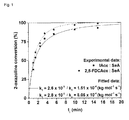
- the 2-oxazoline conversion was monitored during the polymerization of an equimolar mixture of 2,5-FDCAox or IAox and sebacic acid (SeA) at 160 °C.
- the monomers were mixed in the solid state and heated for a fixed reaction time (t r ) using a salt bath. After cooling back to room temperature, the obtained polymers were dissolved in deuterated dimethylsulfoxide (DMSO- d 6 ) and analyzed using 1 H NMR analysis.
- DMSO- d 6 deuterated dimethylsulfoxide
- the 2-oxazoline conversion was calculated from the 1 H NMR spectra of the products obtained after polymerization for varying times t r (1 to 15 minutes). First, the fraction of unreacted 2-oxazoline groups was obtained after dividing the value of the integral of the CH 2 N resonance (4.35 ppm) by the value of the integral of the resonance of the furanic protons (7.13 ppm). Next, the conversion was calculated via subtraction of the 2-oxazoline fraction from 1.00 and converted to percentages. A correction for the number of protons was performed prior to the subtraction.
- the fraction of unreacted 2-oxazoline groups in the IAox polymerization was calculated using the resonance of CH 2 N proton at 4.35 ppm and the aromatic proton at 8.30 ppm.
- the 2-oxazoline conversion as a function of reaction time was used for data fitting with differential equations (1) - (3).
- the data fitting was performed using non-linear regression, yielding reaction constants k 1 and k 2 ( Figure 1 ).
- the thermal properties of the polymers obtained after one hour of polymerization were evaluated using DSC analysis.
- the samples were measured at a heating and cooling rate of 10 °C / min and the second heating runs are depicted in Figure 3 .
- T g glass transition temperature
- T g glass transition temperature
- TPP can be used to selectively accelerate the branching reaction occurring in the polymerization of 2,5-FDCAox with SeA.
- the addition of this catalyst decreases the reaction and curing time, facilitating the synthesis of renewable polymer glasses and coatings within reasonable reaction times.
- DMTA analysis was performed on cured glasses and the glass transition temperatures were determined from the peak in the tan( ⁇ ) trace.
- Figure 4 shows the characteristic behavior of systems of a) IAox : SeA (2.25 : 1) and b) 2,5-FDCAox : SeA (2.25 : 1) containing 5 wt% TPP.
- the samples were cured for 10 minutes in an oven preheated to 200 °C prior to the DMTA analysis to prevent breaking of the samples above T g during the DMTA experiment.
- FIG. 5 shows the normalized intensity signal obtained from FTIR plotted against the glass transition temperatures found via DMTA analysis for the different polymer glasses.
- Solvent-borne coatings were prepared using NMP as a solvent and were cured at 200 °C, as is described above in the coating procedure.
- the obtained coatings had a thickness of approximately 35 ⁇ m and were sufficiently cross-linked as was indicated by the acetone double rub test. Furthermore, the coatings were soft, as became evident from the pencil hardness test (2H). This indicates that the materials were not densely cross-linked, which was confirmed through FTIR analysis; the coatings showed an average normalized intensity of 1.6 (the vibration at 1417 cm -1 ) corresponding to a T g around 80 °C, as follows from the data shown in Figure 5 .
- Figure 1 Conversion of 2-oxazoline groups over time during melt-polymerization of equimolar mixtures IAox and SeA (squares) or 2,5-FDCAox and SeA (circles) at 160 °C, as calculated from the 1 H NMR spectra. The theoretical curves and reaction constants found after data fitting are shown for the IAox system (continuous line) 2,5-FDCAox system (dotted line).
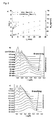
- Figure 2 Changes of the weight-average molecular weight ( M w ) and over time during the polymerization of 2,5-FDCAox with SeA and IAox with SeA in an equimolar ratio performed at 160 °C, as observed in DMAc-SEC analysis.
- Figure 2a shows an overview of changes in the M w and of both reactions over time
- Figures 2b and 2c show changes in the DMAc-SEC chromatograms observed over time for the systems containing 2,5-FDCAox and IAox respectively.
- the dotted lines in Figure 2a are added to guide the eye.
- Figure 3 Second heating DSC curves of the polymers obtained after one hour of polymerization of 2,5-FDCAox and SeA and and IAox and SeA at 160 °C. It can be seen that the system containing IAox has a lower glass transition temperature and shows a small melting endotherm above 100°C. In contrast, the 2,5-FDCAox based polymer does not show a melting endotherm and exhibits a broad glass transition temperature, characteristic for branched and cross-linked polymers.
Landscapes
- Chemical & Material Sciences (AREA)
- Organic Chemistry (AREA)
- Health & Medical Sciences (AREA)
- Chemical Kinetics & Catalysis (AREA)
- Medicinal Chemistry (AREA)
- Polymers & Plastics (AREA)
- Polyamides (AREA)
Priority Applications (1)
| Application Number | Priority Date | Filing Date | Title |
|---|---|---|---|
| EP14193170.9A EP3020748A1 (fr) | 2014-11-14 | 2014-11-14 | Polyamides à base de (2-oxazolinyl)-furane |
Applications Claiming Priority (1)
| Application Number | Priority Date | Filing Date | Title |
|---|---|---|---|
| EP14193170.9A EP3020748A1 (fr) | 2014-11-14 | 2014-11-14 | Polyamides à base de (2-oxazolinyl)-furane |
Publications (1)
| Publication Number | Publication Date |
|---|---|
| EP3020748A1 true EP3020748A1 (fr) | 2016-05-18 |
Family
ID=51900259
Family Applications (1)
| Application Number | Title | Priority Date | Filing Date |
|---|---|---|---|
| EP14193170.9A Withdrawn EP3020748A1 (fr) | 2014-11-14 | 2014-11-14 | Polyamides à base de (2-oxazolinyl)-furane |
Country Status (1)
| Country | Link |
|---|---|
| EP (1) | EP3020748A1 (fr) |
Cited By (1)
| Publication number | Priority date | Publication date | Assignee | Title |
|---|---|---|---|---|
| EP3296347A1 (fr) * | 2016-09-20 | 2018-03-21 | Evonik Degussa GmbH | Nouvel élément structural dien à utiliser dans des systèmes polymères de (hétéro)-diels-alder à réticulation réversible |
Citations (2)
| Publication number | Priority date | Publication date | Assignee | Title |
|---|---|---|---|---|
| EP0097937A1 (fr) * | 1982-06-28 | 1984-01-11 | Takeda Chemical Industries, Ltd. | Polyesteramides réticulés et leur production |
| CN1884283A (zh) * | 2006-07-05 | 2006-12-27 | 汕头大学 | 手性3、4-二取代-2、5-双-[2′-(4′、4′-二取代-5′、5′-二取代噁唑啉)]呋喃化合物及其合成方法和应用 |
-
2014
- 2014-11-14 EP EP14193170.9A patent/EP3020748A1/fr not_active Withdrawn
Patent Citations (3)
| Publication number | Priority date | Publication date | Assignee | Title |
|---|---|---|---|---|
| EP0097937A1 (fr) * | 1982-06-28 | 1984-01-11 | Takeda Chemical Industries, Ltd. | Polyesteramides réticulés et leur production |
| US4474942A (en) | 1982-06-28 | 1984-10-02 | Takeda Chemical Industries, Ltd. | Cross-linked polyesteramide from bis(2-oxazoline) |
| CN1884283A (zh) * | 2006-07-05 | 2006-12-27 | 汕头大学 | 手性3、4-二取代-2、5-双-[2′-(4′、4′-二取代-5′、5′-二取代噁唑啉)]呋喃化合物及其合成方法和应用 |
Non-Patent Citations (7)
| Title |
|---|
| DATABASE WPI Week 200740, Derwent World Patents Index; AN 2007-413586, XP002738495 * |
| KEMPE K ET AL: "Synthesis and characterization of a series of diverse poly(2-oxazoline)s", JOURNAL OF POLYMER SCIENCE, PART A: POLYMER CHEMISTRY, vol. 47, no. 15, 1 August 2009 (2009-08-01), JOHN WILEY AND SONS INC. USA, pages 3829 - 3838, XP002738497, DOI: 10.1002/POLA.23448 * |
| LAURENT NÉRY ET AL: "Kinetic and Mechanistic Studies of Carboxylic Acid-Bisoxazoline Chain-Coupling Reactions", MACROMOLECULAR CHEMISTRY AND PHYSICS, vol. 204, no. 14, 1 September 2003 (2003-09-01), pages 1755 - 1764, XP055182950, ISSN: 1022-1352, DOI: 10.1002/macp.200350036 * |
| NERY ET AL., MACROMOL. CHEM. PHYS., vol. 204, 2003, pages 1755 - 1764 |
| ROSSEGGER E ET AL: "Design Strategies for Functionalized Poly(2-oxazoline)s and Derived Materials", POLYMERS MDPI AG SWITZERLAND, vol. 5, no. 3, September 2013 (2013-09-01), pages 956 - 1011, XP002738496, ISSN: 2073-4360, DOI: 10.3390/POLYM5030956 * |
| WEI JIE LI ET AL: "A facile and efficient synthesis of bis(oxazoline)s", JOURNAL OF HETEROCYCLIC CHEMISTRY, vol. 47, no. 6, 23 August 2010 (2010-08-23), pages 1340 - 1343, XP055183124, ISSN: 0022-152X, DOI: 10.1002/jhet.477 * |
| WILSENS, CAROLUS ET AL: "Synthesis, kinetics, and characterization of bio-based thermosets obtained through polymerization of a 2,5-furandicarboxylic acid-based bis(2-oxazoline) with sebacic acid", POLYMER CHEMISTRY, vol. 6, 13 February 2015 (2015-02-13), pages 2707 - 2716, XP002738498, Retrieved from the Internet <URL:http://pubs.rsc.org/en/content/articlepdf/2015/py/c4py01609b> [retrieved on 20150416], DOI: 10.1039/c4py01609b * |
Cited By (1)
| Publication number | Priority date | Publication date | Assignee | Title |
|---|---|---|---|---|
| EP3296347A1 (fr) * | 2016-09-20 | 2018-03-21 | Evonik Degussa GmbH | Nouvel élément structural dien à utiliser dans des systèmes polymères de (hétéro)-diels-alder à réticulation réversible |
Similar Documents
| Publication | Publication Date | Title |
|---|---|---|
| Allen et al. | Physical and mechanical properties of flexible polybenzoxazine resins: Effect of aliphatic diamine chain length | |
| Allen et al. | Effect of phenol substitution on the network structure and properties of linear aliphatic diamine-based benzoxazines | |
| Dumas et al. | Chavicol benzoxazine: Ultrahigh Tg biobased thermoset with tunable extended network | |
| EP2691466B1 (fr) | Composition durcissable, article, procédé de durcissement et produit de réaction | |
| Zhang et al. | Synthesis, curing kinetics and thermal properties of a novel self-promoted fluorene-based bisphthalonitrile monomer | |
| EP2771402B1 (fr) | Durcissement de benzoxazines par amine/époxyde | |
| EP2900731A1 (fr) | Composition de polybenzoxazine | |
| CN103874721A (zh) | 苯并*嗪的胺/硫醇固化 | |
| TWI801430B (zh) | 新穎三嗪類化合物、其組合物及其製備方法 | |
| Hu et al. | Synthesis and properties of polyesters derived from renewable eugenol and α, ω-diols via a continuous overheating method | |
| EP2493958A1 (fr) | Compositions contenant de la benzoxazine | |
| Vijayakumar et al. | Structurally diverse benzoxazines: synthesis, polymerization, and thermal stability | |
| CN101437895A (zh) | 树脂烧结物以及搭载有该树脂烧结物的电子设备 | |
| EP3233811A1 (fr) | Compositions de benzoxazine durcissables dotées d'une stabilité thermique améliorée | |
| Hu et al. | Polyesters derived from bio-based eugenol and 10-undecenoic acid: synthesis, characterization, and structure–property relationships | |
| Zhang et al. | Contribution of blocking positions on the curing behaviors, networks and thermal properties of aromatic diamine-based benzoxazines | |
| JP5498200B2 (ja) | ベンゾオキサジン環を有する熱硬化性樹脂の製造方法、及びベンゾオキサジン環を有する熱硬化性樹脂 | |
| AU2017262682B2 (en) | Benzothiazoles as latent catalysts for benzoxazine resins | |
| EP3020748A1 (fr) | Polyamides à base de (2-oxazolinyl)-furane | |
| EP2336221A1 (fr) | Compositions durcissables | |
| WO2010033028A1 (fr) | Résine réticulée re-déformable, composition, furane substitué et procédés pour les préparer | |
| WO2000061650A1 (fr) | Elaboration de resines de benzoxazines a faible viscosite | |
| JP7673462B2 (ja) | カーボネート結合を有する熱可塑性樹脂 | |
| Rao et al. | Synthesis and characterization of difunctional benzoxazines from aromatic diester diamine containing varying length of aliphatic spacer group: Polymerization, thermal and viscoelastic characteristics | |
| WO2009053483A1 (fr) | Systèmes adhésifs utilisant des imines et leurs sels, précurseurs d'oléfines à déficience électronique et leurs coréactifs |
Legal Events
| Date | Code | Title | Description |
|---|---|---|---|
| PUAI | Public reference made under article 153(3) epc to a published international application that has entered the european phase |
Free format text: ORIGINAL CODE: 0009012 |
|
| AK | Designated contracting states |
Kind code of ref document: A1 Designated state(s): AL AT BE BG CH CY CZ DE DK EE ES FI FR GB GR HR HU IE IS IT LI LT LU LV MC MK MT NL NO PL PT RO RS SE SI SK SM TR |
|
| AX | Request for extension of the european patent |
Extension state: BA ME |
|
| STAA | Information on the status of an ep patent application or granted ep patent |
Free format text: STATUS: THE APPLICATION IS DEEMED TO BE WITHDRAWN |
|
| 18D | Application deemed to be withdrawn |
Effective date: 20161119 |