EP3021249A1 - Système pour la saisie sécurisée d'un code privé - Google Patents
Système pour la saisie sécurisée d'un code privé Download PDFInfo
- Publication number
- EP3021249A1 EP3021249A1 EP14306806.2A EP14306806A EP3021249A1 EP 3021249 A1 EP3021249 A1 EP 3021249A1 EP 14306806 A EP14306806 A EP 14306806A EP 3021249 A1 EP3021249 A1 EP 3021249A1
- Authority
- EP
- European Patent Office
- Prior art keywords
- secure
- application
- execution platform
- electronic device
- private code
- Prior art date
- Legal status (The legal status is an assumption and is not a legal conclusion. Google has not performed a legal analysis and makes no representation as to the accuracy of the status listed.)
- Withdrawn
Links
Images




Classifications
-
- G—PHYSICS
- G06—COMPUTING OR CALCULATING; COUNTING
- G06F—ELECTRIC DIGITAL DATA PROCESSING
- G06F21/00—Security arrangements for protecting computers, components thereof, programs or data against unauthorised activity
- G06F21/30—Authentication, i.e. establishing the identity or authorisation of security principals
- G06F21/31—User authentication
- G06F21/36—User authentication by graphic or iconic representation
-
- G—PHYSICS
- G06—COMPUTING OR CALCULATING; COUNTING
- G06Q—INFORMATION AND COMMUNICATION TECHNOLOGY [ICT] SPECIALLY ADAPTED FOR ADMINISTRATIVE, COMMERCIAL, FINANCIAL, MANAGERIAL OR SUPERVISORY PURPOSES; SYSTEMS OR METHODS SPECIALLY ADAPTED FOR ADMINISTRATIVE, COMMERCIAL, FINANCIAL, MANAGERIAL OR SUPERVISORY PURPOSES, NOT OTHERWISE PROVIDED FOR
- G06Q20/00—Payment architectures, schemes or protocols
- G06Q20/38—Payment protocols; Details thereof
- G06Q20/382—Payment protocols; Details thereof insuring higher security of transaction
- G06Q20/3823—Payment protocols; Details thereof insuring higher security of transaction combining multiple encryption tools for a transaction
-
- G—PHYSICS
- G06—COMPUTING OR CALCULATING; COUNTING
- G06Q—INFORMATION AND COMMUNICATION TECHNOLOGY [ICT] SPECIALLY ADAPTED FOR ADMINISTRATIVE, COMMERCIAL, FINANCIAL, MANAGERIAL OR SUPERVISORY PURPOSES; SYSTEMS OR METHODS SPECIALLY ADAPTED FOR ADMINISTRATIVE, COMMERCIAL, FINANCIAL, MANAGERIAL OR SUPERVISORY PURPOSES, NOT OTHERWISE PROVIDED FOR
- G06Q20/00—Payment architectures, schemes or protocols
- G06Q20/38—Payment protocols; Details thereof
- G06Q20/40—Authorisation, e.g. identification of payer or payee, verification of customer or shop credentials; Review and approval of payers, e.g. check credit lines or negative lists
- G06Q20/401—Transaction verification
- G06Q20/4012—Verifying personal identification numbers [PIN]
-
- H—ELECTRICITY
- H04—ELECTRIC COMMUNICATION TECHNIQUE
- H04L—TRANSMISSION OF DIGITAL INFORMATION, e.g. TELEGRAPHIC COMMUNICATION
- H04L67/00—Network arrangements or protocols for supporting network services or applications
- H04L67/01—Protocols
- H04L67/12—Protocols specially adapted for proprietary or special-purpose networking environments, e.g. medical networks, sensor networks, networks in vehicles or remote metering networks
- H04L67/125—Protocols specially adapted for proprietary or special-purpose networking environments, e.g. medical networks, sensor networks, networks in vehicles or remote metering networks involving control of end-device applications over a network
Definitions
- the present invention relates to a system for securely entering a private code on a first electronic device.
- Such system may be used in a non-limitative example for any application which needs a secure code entry.
- More and more payments may be executed via a device such as a mobile phone which communicates with a merchant contactless point of sale terminal, said mobile phone holding a contactless payment application for this purpose, such as Mastercard paypass MPP, or Visa Mobile payment application VMPA.
- the point of sale terminal may request a private code and the user of said mobile phone enters his private code such as a personal identification code by means of the mobile phone's user interface, said private code being dedicated to said payment transaction. If the private code is valid, the payment transaction is performed by means of the unit processor of said mobile phone and by means of said point of sale terminal.
- a system for securely entering a private code on a first electronic device comprising:
- a secure execution platform acts as a firewall between applications belonging to said secure execution platform and other applications outside said secure execution platform. Therefore, the private code may not be retrieved from a secure execution platform by such other applications. Moreover, as the private code is ciphered, it may not be used by other applications to which it is not dedicated, as said other applications don't have the means to decipher said private code.
- system in accordance with the invention further comprises the following characteristics.
- the first secure execution platform and the second secure execution platform is a same secure execution platform which is a trusted execution environment.
- the first secure execution platform is a trusted execution environment and the second secure execution platform is a secure element.
- the first secure execution platform is a secure element and the second secure execution platform is a secure element.
- said first electronic device is a portable electronic device and said second electronic device is a remote server.
- said first electronic device and said second electronic device are a same portable electronic device.
- said first electronic device is a mobile phone, or a tablet, or a smart phone, or a notebook.
- the target application is a bank payment application or a one-time password generation application.
- a first electronic device for securely entering a private code
- said first electronic device comprising a user interface and a first unit processor adapted to process a host application
- said first electronic device further comprises a first secure execution platform adapted to process a secure application, and wherein:
- the first electronic device further comprises the following characteristics.
- the first secure execution platform and the second secure execution platform is a same secure execution platform which is a trusted execution environment.
- the first secure execution platform is a trusted execution environment and the second secure execution platform is a secure element.
- the first secure execution platform is a secure element and the second secure execution platform is a secure element.
- said private code is ciphered using public key algorithm.
- a portable electronic device for securely entering a private code wherein said portable electronic device comprises:
- the portable electronic device further comprises the following characteristics.
- the first secure execution platform and the second secure execution platform is a same secure execution platform which is a trusted execution environment.
- the first secure execution platform is a trusted execution environment and the second secure execution platform is a secure element.
- the first secure execution platform is a secure element and the second secure execution platform is a secure element.
- said portable electronic device is a mobile phone, or a tablet, or a smart phone, or a notebook.
- the target application is a bank payment application or a one-time password generation application.
- said private code is ciphered using public key algorithm.
- a method for securely entering a private code on a first electronic device comprising a user interface and a first unit processor adapted to process a host application, wherein said method comprises:
- the present invention relates to a system SYS for securely entering a private code PCODE on a first electronic device PD1.
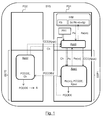
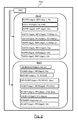
- Said system SYS is illustrated in Fig. 1 and the different functionalities of its different components are illustrated in Fig. 2 and in Fig. 3 .
- the system SYS comprises:
- the first electronic device PD1 comprises:
- the second electronic device PD2 comprises:
- an application is a set of one or more programs designed to carry out operations for a specific purpose.
- a unit processor comprises one or a plurality of processors.
- the first electronic device PD1 will permit the input of the private code PCODE in a secure manner, said private code PCODE being used by the second application App2 of said second electronic device PD2.
- the private code is a pin code PIN, a passphrase, a passcode etc.
- the target application App2 is the application which supports an encrypted code verification.
- the target application App2 is a bank payment application, such as an EMV ("Europay Mastercard Visa") application.
- the user puts his first electronic device PD1 onto the merchant point of sale terminal POS or brings it near said point of sale terminal POS in a contactless way.
- the point of sale terminal POS requests the private code for the bank payment transaction.
- the user enters his private code PCODE by means of the user interface IHM via the keyboard kb or screen (if said screen is a tactile screen sc) of the first electronic device PD1.
- a secure execution platform SEP is a secure area within the electronic devices PD1, PD2. It ensures that data and programs related to an application which are stored within said secure area are protected with respect to confidentiality and integrity. Other applications outside the secure execution platform SEP may not access to those data and programs without authorization.
- a secure execution platform SEP acts as a firewall with regards to said other applications.
- a secure execution platform SEP comprises a specific operating system for executing the applications which are stored within the secure area. Said operating system is different from the operating system of the first unit processor PR1 which executes the host application App3.
- the first secure execution platform SEP1 comprises the operating system of the first unit processor PR1 (which executes the host application App3) and a specific secure software enabling secure execution of said secure application App1. Therefore, a second application App2 of the second secure execution platform SEP2 may not access fraudulently to the data of the first application App1 of the first secure execution platform SEP1 unless said first application App1 authorized such access.
- the first electronic device PD1 and the second electronic device PD2 are described hereinafter in details.
- the first electronic device PD1 is a portable electronic device.
- the portable electronic device is a mobile phone, a tablet, a smart phone, a notebook etc.
- the host application App3 is a mobile phone application.
- the secure application App1 will permit a user to securely enter a private code without the possibility for any malware to read his private code and use it fraudulently.
- the secure application App1 is stored (its data and its programs) in the first secure execution platform SEP1.
- the functionalities of the first electronic device PD1 are illustrated in Fig. 2 .
- the first electronic device PD1 are processed by the first electronic device PD1 by means of the first unit processor PR1 via the host application App3, or by means of said first secure execution platform SEP1 via the secure application App1.
- the first secure execution platform SEP1 of the first electronic device PD1 is adapted via said secure application App1 to:
- the characters vc are digits dg, and there are ten digits.
- the scrambled image Rs is a first security means to enter the private code PCODE as the user of the first electronic device PD1 is able to recognize the characters vc displayed within said image, but not a fraudulent application (also called malware) running in said first electronic device PD1. It is to be noted that the generation of the random scrambled image Rs is performed upon request of the host application App3.
- mapping of the selected positions Ps to the private code PCODE is performed in a non-limitative example via an association table between said selected positions Ps (which corresponds to some pixels of the screen Sc) and the characters vc at these positions Ps.
- said first unit processor PR1 of the first electronic device PD1 is adapted via said host application App3 to:
- said first electronic device PD1 When the user has selected the characters vc on the user interface IHM which correspond to its private code PCODE, said first electronic device PD1 is adapted by means of said first unit processor PR1 via said host application App3 to transmit said selected positions Ps on said random scrambled image Rs to said secure application App1 (function illustrated in Fig. 2 TX(PR1 (App3), SEP1 (App1), Ps)).
- the private code PCODE is ciphered using a public key algorithm. That is to say the encryption is asymmetric as it uses a pair of public key KpuA-private key KpvA.
- a public key Kpuc also called code encryption public key
- Kpuc is used for the ciphering (also called encryption) of the private code PCODE.
- said public key algorithm uses a RSA algorithm or ELC algorithm. These algorithms being well-known by the man skilled in the art, they are not described here.
- said first unit processor PR1 of the first electronic device PD1 is further adapted via said host application App3 to:
- the certificate request stage may be triggered if there is a human interface in the host application App3 enabling the user to access to the target application App2 and when said human interface is used by said user.
- Said first secure execution platform SEP1 of the first electronic device PD1 is further adapted via said secure application App1 to:
- Said public key Kpuc is therefore securely stored in the first secure execution platform SEP1.
- the random scrambled image Rs may not be displayed on the user interface IHM of the first electronic device PD1. It is to be reminded that the scrambled image Rs is generated upon request of said host application App3. If the certificate chain CCE is not valid, there won't be any generation of scrambled image Rs by the secure application App1.
- the secure execution platform SEP1 is adapted via said secure application App1 to store the certificate of the certificate authority used to sign the last certificate of the certificate chain CCE.
- Said certificate chain CCE comprises the code encryption public key Kpuc corresponding to the private key of the target application used to decipher the ciphered PCODE, a signature Sg1 performed with the root private key KpvA of the certificate authority.
- said first electronic device PD1 via the secure application App1 checks the different certificates of the certificate chain CCE, it checks that it has been signed by the right certificate authority such as VISA®, MASTERCARD® etc. The checking is performed with the root public key KpuA corresponding to the root private key KpvA of the certificate authority.
- the root public key KpuA is stored in the first secure execution platform SEP1 of the first electronic device PD1. It is to be noted that the storage of the root public key KpuA has been previously be performed during a customization phase before said first electronic device PD1 is dispatched to the end-user or during the download of the secure application App1 in the first secure execution platform SEP1 of the first electronic device PD1.
- said first unit processor PR1 of said first electronic device PD1 is further adapted via said host application App3 to:
- said challenge Ch is a random generated by said second execution platform SEP2 via the second application App2.
- said challenge Ch is transmitted when the first unit processor PR1 via the host application App3 transmits the selected positions Ps on said random scrambled image Rs to said secure application App1.
- said first secure execution platform SEP1 of said first electronic device PD1 is further adapted via said secure application App1 to:
- a target application session begins with the first request from the host application App3 to the target application App2, that is to say with the first certificate request.
- said private code PCODE is ciphered with a shared symmetric key.
- a same secret key Ks is shared between the first secure execution platform SEP1 and the second secure execution platform SEP2.
- the first secure execution platform SEP1 encrypts the private code PCODE with said secret key Ks, and the second secure execution platform SEP2 decrypts said private code PCODE with said secret key Ks.
- said symmetric key algorithm is a DES or a triple DES or an AES algorithm.
- the functionalities of the second electronic device PD2 are illustrated in Fig. 3 . They are processed by the second electronic device PD2 by means of the second secure execution platform SEP2 via said target application App2.
- the second secure execution platform SEP2 of said second electronic device PD2 is adapted via said target application App2 to:
- said second secure application App2 is stored (its data and its programs) in the second secure execution platform SEP2.
- the private code PCODE is securely deciphered in a secure execution platform.
- the action A is a verification of said private code PCODE (function illustrated in dotted lines in Fig. 3 VERIF(SEP2(App2),PCODE)).
- the action A is the generation of said one-time password OTP based on said private code PCODE (function illustrated in dotted lines in Fig. 3 GEN(SEP2(App2),OTP)).
- said second secure execution platform SEP2 of said second electronic device PD2 is further adapted via said target application App2 to transmit said certificate chain CCE to said host application App3 upon request (function illustrated in Fig. 3 TX(SEP2(App2), PR1 (App3), CCE(Kpuc))).
- said second secure execution platform SEP2 of said second electronic device PD2 is further adapted via said target application App2 to:
- said challenge Ch may be used for the ciphering of the private code PCODE using a public key algorithm or using a shared symmetric key algorithm.
- the first electronic device PD1 and the second electronic device PD2 are different.
- the first electronic device PD1 is a portable electronic device
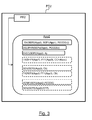
- the second electronic device PD2 is a remote server RSR as illustrated in Fig. 4
- the first portable electronic device PD1 is a mobile phone MB.
- the mobile phone is taken as a non-limitative example in the following.
- the first portable device PD1 is a tablet, a smart phone, a notebook etc.
- the target application App2 is a contact payment application and the host application App3 which is the mobile phone application serves as a gateway that conveys the EMV protocol and the remote server RSR is connected to a banking network.
- the payment application uses only the contact interface of the mobile phone MB.
- the private code PCODE is never in clear in the first electronic device PD1.
- the user securely authenticates to the remote server RSR.
- the second secure execution platform SEP2 within said remote server RSR is a secure element SE which is a hardware security module.
- the first secure execution platform SEP1 is a trusted execution environment TEE or a secure element SE.
- the encryption of the private code PCODE may be performed using a public key algorithm described above.
- a TEE is a secure area that resides in the main processor of a mobile phone (or any other portable electronic device such as smart phone, tablets etc.). It ensures that sensitive data are stored, processed and protected in a trusted environment.
- the TEE manages and executes safe execution of authorized security softwares, known as 'trusted applications'.
- TEE as an isolated execution environment permits the trusted applications to provide protection, confidentiality, integrity and data access rights.
- the first electronic device PD1 and the second electronic device PD2 are different, in a second non-limitative variant (not illustrated) the first electronic device PD1 is a portable electronic device, and the second electronic device PD2 is a secure element SE.
- the secure element is in a non-limitative embodiment a smart card.
- This secure element SE may be a NFC "Near Field Communication” card, or a card which is connected to the portable electronic device PD1 via an USB connection in a non-limitative example.
- the first electronic device PD1 and the second electronic device PD2 are the same electronic device.
- the electronic device PD1/PD2 is a portable electronic device.
- the portable electronic device PD1/PD2 is a mobile phone MB. The mobile phone is taken as a non-limitative example in the following.
- the portable electronic device PD1/PD2 is a tablet, a smart phone, a notebook etc.
- the portable electronic device PD1/PD2 for securely entering a private code PCODE wherein said portable electronic device PD1/PD2 comprises:
- the mobile phone MB is connected to the merchant contactless point of sale POS.
- the target application App2 is a contactless payment application, for instance mastercard paypass MPP or visa mobile payment application VPMA. If the private code PCODE is required, it is never entered on the merchant POS, but it is entered on the mobile phone MB.
- the first secure execution platform SEP1 and the second secure execution platform SEP2 is a same secure execution platform which is a trusted execution environment TEE as illustrated in Fig. 5 .
- the encryption of the private code PCODE is performed using a proprietary encryption algorithm.
- a shared symmetric key algorithm may be also used but the EMV application App2 needs to be modified accordingly.
- the first secure execution platform SEP1 is a trusted execution environment TEE and the second secure execution platform SEP2 is a secure element SE as illustrated in Fig. 6 .
- the secure element is in a non-limitative embodiment a smart card.
- the secure element SE may be the SIM card which runs the bank payment application App2 supporting the encrypted code verification.
- the encryption of the private code PCODE is performed using a public key algorithm described above or a shared symmetric key algorithm described above.
- the first secure execution platform SEP1 is a first secure element SE1 and the second secure execution platform SEP2 is a second secure element SE2 as illustrated in Fig. 7 .
- the first secure element SE1 may be the SIM card, whereas the second secure element SE2 is a dedicated payment card which runs the bank payment application App2 supporting the encrypted code verification, such as in a non-limitative example an EMV ("Europay Mastercard Visa") secure element SE2.
- EMV Europay Mastercard Visa
- the encryption of the private code PCODE is performed using a public key algorithm described above or a shared symmetric key algorithm described above.
- the system SYS which has been described carries out a method MTH for securely entering a private code PCODE on a first electronic device PD1, said first electronic device PD1 comprising a first unit processor PR1, a user interface IHM and a host application App3.
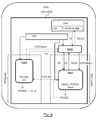
- Said method MTH is illustrated in Fig. 8 and Fig. 9 .
- step 1) the first secure execution platform SEP1 generates a random scrambled image Rs comprising a plurality of characters vc via said secure application App1.
- step 2) the first secure execution platform SEP1 transmits said random scrambled image Rs to said host application App3 via said secure application App1.
- step 3 the first unit processor PR1 receives said random scrambled image Rs and display said random scrambled image Rs on said user interface IHM via said host application App3 (step 4).
- the user selects position Ps on said random scrambled image Rs which is displayed on the user interface IHM.
- step 5 the first unit processor PR1 transmits said selected positions Ps on said random scrambled image Rs to said secure application App1 via said host application App3.
- step 6 upon reception of selected positions Ps on said random scrambled image Rs, the first secure execution platform SEP1 maps said selected positions Ps to a private code PCODE via said secure application App1.
- step 7 the first secure execution platform SEP1 ciphers said private code PCODE.
- step 8 the first secure execution platform SEP1 transmits via said secure application App1 said ciphered private code PCODEc to said target application App2 of a second electronic device PD2 within a second secure execution platform SEP2.
- step 9 the second secure execution platform SEP2 receives said ciphered private code PCODEc via said target application App2;
- step 10 the secure execution platform SEP2 deciphers said ciphered private code PCODEc to obtain said private code PCODE via said second application App2;
- step 11 the secure execution platform SEP2 executes an action A based on said private code PCODE via said target application App2.
- Fig. 9 illustrates the method MTH which comprises the further non-limitative stages of:
- the code encryption key transmission phase PH1 is described hereinafter.
- step 1) the first unit processor PR1 requests via said host application App3 a certificate chain CCE to said target application App2, said certificate chain CCE comprising a public key Kpuc.
- step 2) the second secure execution platform SEP2 transmits via said target application App2 said certificate chain CCE to said host application App3 upon request.
- step 3 the first unit processor PR1 receives via said host application App3 said certificate chain CCE from said target application App2.
- step 4 the first unit processor PR1 transmits via said host application App3 said certificate chain CCE to said secure application App1.
- the first secure execution platform SEP1 Upon reception on said certificate chain CCE (in step 5), the first secure execution platform SEP1 checks via said first application App1 said certificate chain CCE (step 6).
- step 7 if said certificate chain CCE is valid, the first secure execution platform SEP1 stores via said first application App1 said public key Kpuc.
- the ciphering stage PH2 is described below.
- step 1) the first unit processor PR1 requests via said host application App3 a challenge Ch to said target application App2;
- step 2) the second secure execution platform SEP2 generates via said target application App2 a challenge Ch, and in step 3) transmits said challenge Ch to said host application App3 upon request.
- step 4 the first unit processor PR1 receives via said host application App3 said challenge Ch, and in step 5) transmits via said host application App3 said challenge Ch to said secure application App1.
- the challenge Ch is transmitted at the same time as the transmission of the selected positions Ps of said random scrambled image Rs to said secure application App1.
- step 6 the first secure execution platform SEP1 receives via said secure application App1 said challenge Ch and in step 7) ciphers via said secure application App1 said private code PCODE based on said challenge Ch and on said public key Kpuc.
- code encryption key transmission stage and the ciphering stage are performed during different times.
- the secure application App1 may be implemented in the target application App2 such as the EMV payment application if for example, the EMV application provider decided to do so and modify the EMV application app2 accordingly.
- some embodiments of the invention may comprise one or a plurality of the following advantages:
Landscapes
- Engineering & Computer Science (AREA)
- Business, Economics & Management (AREA)
- Computer Security & Cryptography (AREA)
- Accounting & Taxation (AREA)
- Theoretical Computer Science (AREA)
- Physics & Mathematics (AREA)
- General Physics & Mathematics (AREA)
- Finance (AREA)
- Strategic Management (AREA)
- General Business, Economics & Management (AREA)
- Health & Medical Sciences (AREA)
- Computing Systems (AREA)
- General Health & Medical Sciences (AREA)
- Medical Informatics (AREA)
- Computer Networks & Wireless Communication (AREA)
- Signal Processing (AREA)
- Computer Hardware Design (AREA)
- Software Systems (AREA)
- General Engineering & Computer Science (AREA)
- Storage Device Security (AREA)
Priority Applications (1)
| Application Number | Priority Date | Filing Date | Title |
|---|---|---|---|
| EP14306806.2A EP3021249A1 (fr) | 2014-11-13 | 2014-11-13 | Système pour la saisie sécurisée d'un code privé |
Applications Claiming Priority (1)
| Application Number | Priority Date | Filing Date | Title |
|---|---|---|---|
| EP14306806.2A EP3021249A1 (fr) | 2014-11-13 | 2014-11-13 | Système pour la saisie sécurisée d'un code privé |
Publications (1)
| Publication Number | Publication Date |
|---|---|
| EP3021249A1 true EP3021249A1 (fr) | 2016-05-18 |
Family
ID=52011113
Family Applications (1)
| Application Number | Title | Priority Date | Filing Date |
|---|---|---|---|
| EP14306806.2A Withdrawn EP3021249A1 (fr) | 2014-11-13 | 2014-11-13 | Système pour la saisie sécurisée d'un code privé |
Country Status (1)
| Country | Link |
|---|---|
| EP (1) | EP3021249A1 (fr) |
Cited By (1)
| Publication number | Priority date | Publication date | Assignee | Title |
|---|---|---|---|---|
| JP2018133797A (ja) * | 2017-02-14 | 2018-08-23 | 株式会社ユニオンプレイス | IoTデバイス |
Citations (4)
| Publication number | Priority date | Publication date | Assignee | Title |
|---|---|---|---|---|
| GB2457733A (en) * | 2008-02-25 | 2009-08-26 | Mobank Ltd | Securing inputting of sensitive information |
| EP2204758A2 (fr) * | 2008-12-31 | 2010-07-07 | Intel Corporation | Procédés et systèmes pour le rendu direct d'une image et faire correspondre une entrée d'utilisateur dans un domaine de mémoire sécurisée |
| US20130301830A1 (en) * | 2012-05-08 | 2013-11-14 | Hagai Bar-El | Device, system, and method of secure entry and handling of passwords |
| WO2014111689A1 (fr) * | 2013-01-18 | 2014-07-24 | Licentia Group Limited | Dispositif d'authentification et procédés associés |
-
2014
- 2014-11-13 EP EP14306806.2A patent/EP3021249A1/fr not_active Withdrawn
Patent Citations (4)
| Publication number | Priority date | Publication date | Assignee | Title |
|---|---|---|---|---|
| GB2457733A (en) * | 2008-02-25 | 2009-08-26 | Mobank Ltd | Securing inputting of sensitive information |
| EP2204758A2 (fr) * | 2008-12-31 | 2010-07-07 | Intel Corporation | Procédés et systèmes pour le rendu direct d'une image et faire correspondre une entrée d'utilisateur dans un domaine de mémoire sécurisée |
| US20130301830A1 (en) * | 2012-05-08 | 2013-11-14 | Hagai Bar-El | Device, system, and method of secure entry and handling of passwords |
| WO2014111689A1 (fr) * | 2013-01-18 | 2014-07-24 | Licentia Group Limited | Dispositif d'authentification et procédés associés |
Cited By (2)
| Publication number | Priority date | Publication date | Assignee | Title |
|---|---|---|---|---|
| JP2018133797A (ja) * | 2017-02-14 | 2018-08-23 | 株式会社ユニオンプレイス | IoTデバイス |
| US10757571B2 (en) | 2017-02-14 | 2020-08-25 | Unionplace Co., Ltd. | Internet of things device |
Similar Documents
| Publication | Publication Date | Title |
|---|---|---|
| US11238139B2 (en) | Methods for securely storing sensitive data on mobile device | |
| US10491379B2 (en) | System, device, and method of secure entry and handling of passwords | |
| US9800562B2 (en) | Credential recovery | |
| US9684900B2 (en) | Authentication on mobile device using two-dimensional code | |
| US20160104154A1 (en) | Securing host card emulation credentials | |
| EP2098985A2 (fr) | Architecture sûre pour lecteurs financiers | |
| US20090222383A1 (en) | Secure Financial Reader Architecture | |
| US9443068B2 (en) | System and method for preventing unauthorized access to information | |
| EP3413253B1 (fr) | Procédé et système de protection par mot de passe de carte bancaire | |
| WO2015065249A1 (fr) | Procédé et système de protection d'informations contre une utilisation non autorisée (variantes) | |
| CN102667800A (zh) | 用于与安全元件的安全交互的方法 | |
| US20110202772A1 (en) | Networked computer identity encryption and verification | |
| US20150288684A1 (en) | Device assembly for carrying out or enabling an electronic service and a method for securely inputting authorization data | |
| EP3320664B1 (fr) | Procédé d'authentification d'une communication d'un dispositif d'authentification et au moins un serveur d'authentification utilisant le facteur local | |
| EP3021249A1 (fr) | Système pour la saisie sécurisée d'un code privé | |
| KR102445379B1 (ko) | 서버 장치의 동작 방법, 단말의 동작 방법 및 서버 장치 | |
| KR101394147B1 (ko) | 모바일에서 안전하게 인증서를 사용하는 방법 | |
| CN114531236A (zh) | 一种密钥的处理方法、装置及电子设备 | |
| CN110945553A (zh) | 交易方法、硬件钱包和交易设备 | |
| JP2012186604A (ja) | Pinを暗号化する暗号化機能が携帯端末に実装されていることを確認できる携帯端末検証システム | |
| JP2012186604A5 (fr) |
Legal Events
| Date | Code | Title | Description |
|---|---|---|---|
| PUAI | Public reference made under article 153(3) epc to a published international application that has entered the european phase |
Free format text: ORIGINAL CODE: 0009012 |
|
| AK | Designated contracting states |
Kind code of ref document: A1 Designated state(s): AL AT BE BG CH CY CZ DE DK EE ES FI FR GB GR HR HU IE IS IT LI LT LU LV MC MK MT NL NO PL PT RO RS SE SI SK SM TR |
|
| AX | Request for extension of the european patent |
Extension state: BA ME |
|
| STAA | Information on the status of an ep patent application or granted ep patent |
Free format text: STATUS: THE APPLICATION HAS BEEN PUBLISHED |
|
| STAA | Information on the status of an ep patent application or granted ep patent |
Free format text: STATUS: THE APPLICATION IS DEEMED TO BE WITHDRAWN |
|
| 18D | Application deemed to be withdrawn |
Effective date: 20161119 |