EP3021987B1 - Appareil de transport d'articles - Google Patents
Appareil de transport d'articles Download PDFInfo
- Publication number
- EP3021987B1 EP3021987B1 EP13889620.4A EP13889620A EP3021987B1 EP 3021987 B1 EP3021987 B1 EP 3021987B1 EP 13889620 A EP13889620 A EP 13889620A EP 3021987 B1 EP3021987 B1 EP 3021987B1
- Authority
- EP
- European Patent Office
- Prior art keywords
- carrier
- lane
- lanes
- diverters
- adjacent
- Prior art date
- Legal status (The legal status is an assumption and is not a legal conclusion. Google has not performed a legal analysis and makes no representation as to the accuracy of the status listed.)
- Active
Links
Images



Classifications
-
- B—PERFORMING OPERATIONS; TRANSPORTING
- B65—CONVEYING; PACKING; STORING; HANDLING THIN OR FILAMENTARY MATERIAL
- B65G—TRANSPORT OR STORAGE DEVICES, e.g. CONVEYORS FOR LOADING OR TIPPING, SHOP CONVEYOR SYSTEMS OR PNEUMATIC TUBE CONVEYORS
- B65G47/00—Article or material-handling devices associated with conveyors; Methods employing such devices
- B65G47/52—Devices for transferring articles or materials between conveyors i.e. discharging or feeding devices
- B65G47/68—Devices for transferring articles or materials between conveyors i.e. discharging or feeding devices adapted to receive articles arriving in one layer from one conveyor lane and to transfer them in individual layers to more than one conveyor lane or to one broader conveyor lane, or vice versa, e.g. combining the flows of articles conveyed by more than one conveyor
- B65G47/71—Devices for transferring articles or materials between conveyors i.e. discharging or feeding devices adapted to receive articles arriving in one layer from one conveyor lane and to transfer them in individual layers to more than one conveyor lane or to one broader conveyor lane, or vice versa, e.g. combining the flows of articles conveyed by more than one conveyor the articles being discharged or distributed to several distinct separate conveyors or to a broader conveyor lane
-
- B—PERFORMING OPERATIONS; TRANSPORTING
- B07—SEPARATING SOLIDS FROM SOLIDS; SORTING
- B07B—SEPARATING SOLIDS FROM SOLIDS BY SIEVING, SCREENING, SIFTING OR BY USING GAS CURRENTS; SEPARATING BY OTHER DRY METHODS APPLICABLE TO BULK MATERIAL, e.g. LOOSE ARTICLES FIT TO BE HANDLED LIKE BULK MATERIAL
- B07B13/00—Grading or sorting solid materials by dry methods, not otherwise provided for; Sorting articles otherwise than by indirectly controlled devices
- B07B13/14—Details or accessories
- B07B13/16—Feed or discharge arrangements
-
- B—PERFORMING OPERATIONS; TRANSPORTING
- B07—SEPARATING SOLIDS FROM SOLIDS; SORTING
- B07C—POSTAL SORTING; SORTING INDIVIDUAL ARTICLES, OR BULK MATERIAL FIT TO BE SORTED PIECE-MEAL, e.g. BY PICKING
- B07C5/00—Sorting according to a characteristic or feature of the articles or material being sorted, e.g. by control effected by devices which detect or measure such characteristic or feature; Sorting by manually actuated devices, e.g. switches
- B07C5/36—Sorting apparatus characterised by the means used for distribution
-
- B—PERFORMING OPERATIONS; TRANSPORTING
- B65—CONVEYING; PACKING; STORING; HANDLING THIN OR FILAMENTARY MATERIAL
- B65G—TRANSPORT OR STORAGE DEVICES, e.g. CONVEYORS FOR LOADING OR TIPPING, SHOP CONVEYOR SYSTEMS OR PNEUMATIC TUBE CONVEYORS
- B65G43/00—Control devices, e.g. for safety, warning or fault-correcting
-
- B—PERFORMING OPERATIONS; TRANSPORTING
- B65—CONVEYING; PACKING; STORING; HANDLING THIN OR FILAMENTARY MATERIAL
- B65G—TRANSPORT OR STORAGE DEVICES, e.g. CONVEYORS FOR LOADING OR TIPPING, SHOP CONVEYOR SYSTEMS OR PNEUMATIC TUBE CONVEYORS
- B65G47/00—Article or material-handling devices associated with conveyors; Methods employing such devices
- B65G47/74—Feeding, transfer, or discharging devices of particular kinds or types
- B65G47/76—Fixed or adjustable ploughs or transverse scrapers
- B65G47/766—Adjustable ploughs or transverse scrapers
-
- B—PERFORMING OPERATIONS; TRANSPORTING
- B65—CONVEYING; PACKING; STORING; HANDLING THIN OR FILAMENTARY MATERIAL
- B65G—TRANSPORT OR STORAGE DEVICES, e.g. CONVEYORS FOR LOADING OR TIPPING, SHOP CONVEYOR SYSTEMS OR PNEUMATIC TUBE CONVEYORS
- B65G2201/00—Indexing codes relating to handling devices, e.g. conveyors, characterised by the type of product or load being conveyed or handled
- B65G2201/02—Articles
- B65G2201/0202—Agricultural and processed food products
- B65G2201/0211—Fruits and vegetables
-
- B—PERFORMING OPERATIONS; TRANSPORTING
- B65—CONVEYING; PACKING; STORING; HANDLING THIN OR FILAMENTARY MATERIAL
- B65G—TRANSPORT OR STORAGE DEVICES, e.g. CONVEYORS FOR LOADING OR TIPPING, SHOP CONVEYOR SYSTEMS OR PNEUMATIC TUBE CONVEYORS
- B65G47/00—Article or material-handling devices associated with conveyors; Methods employing such devices
- B65G47/34—Devices for discharging articles or materials from conveyor
- B65G47/46—Devices for discharging articles or materials from conveyor and distributing, e.g. automatically, to desired points
- B65G47/51—Devices for discharging articles or materials from conveyor and distributing, e.g. automatically, to desired points according to unprogrammed signals, e.g. influenced by supply situation at destination
- B65G47/5104—Devices for discharging articles or materials from conveyor and distributing, e.g. automatically, to desired points according to unprogrammed signals, e.g. influenced by supply situation at destination for articles
Definitions
- the present subject matter relates to article carriers for use in grading apparatus and in particular, but not exclusively, for use in grading fruit.
- Processing lines for articles such as fruit often require different quality articles to be separated.
- the use of one or more video cameras is one known method of automatically sensing characteristics of articles.
- the method and apparatus described in US patent number 4,825,068 uses a video camera in conjunction with mirrors to obtain a picture of each article as it travels past the line of sight of the mirrors.
- the mirrors enable a larger portion of the article, which is typically generally spherically shaped, to be simultaneously viewed by the camera.
- Article carriers are used to transport articles such as fruit through various measurement stages for grading purposes and to eject fruit at a required location dependent on the result of the grading process.
- Such article carriers usually include an endless circuit of carriers or cups on a conveyor chain with the cup situated to unload fruit at one of a plurality of stations. There is also often a requirement to carry large numbers of incoming fruit using a plurality of parallel carriers.
- Such article carrier apparatus having multiple conveyor chains or belts are arranged to receive individual fruit articles into respective cups, the fruit being delivered on an adjacent infeed shelf.
- the infeed shelf receives fruit and is typically inclined downwardly towards the plurality of article carriers, and may narrow in order to concentrate received fruit towards the article carriers.
- Some infeed shelves incorporate diverters which are typically blunt protrusions extending perpendicularly from the infeed shelve and angled to guide the fruit articles towards the incoming cups of the article conveyor chain.
- the diverters may also be used to balance the numbers of fruit directed to each article carrier to ensure high capacity carriage on each of the article carriers, for example, by ensuring that sufficient numbers of fruit articles are delivered to the article carriers at the outer ends of the parallel article carriers.
- the diverters are typically fixed and may be integral with the infeed shelf, however manual alignment or angling of the diverters may be provided in some infeed shelves.
- US 2011/0180368 discloses another example of a prior art device, which in this case is an automatic packaging apparatus for rapidly, accurately and gently distributing randomly oriented objects, such as fresh fruits and vegetables, into multiple packaging machines. More particularly, US 2011/0180368 discloses an article carrying apparatus according to the preamble of claim 1 and a method for operating an article carrying apparatus according to the preamble of method claim 7.
- the invention provides an article carrying apparatus according to claim 1 comprising: a plurality of carrier lanes each for receiving and conveying a number of articles; one or more diverters arranged to control the distribution of received articles into each of the plurality of carrier lanes, the one or more diverters being positioned at a receiving end of the carrier lanes and between adjacent carrier lanes, the diverters being individually controllable to rotate so that an input channel for a carrier lane can be enlarged or restricted by adjusting adjacent diverters in order to increase or reduce a flow of articles to the carrier lane; a sensor arranged to determine a capacity use parameter for each carrier lane; and a controller arranged to control the position of the one or more diverters dependent on the determined capacity use parameters.
- the articles are fruit and the capacity use parameter is the cupfill of a lane.
- the diverters are individually rotatable, and are positioned at a receiving end of the lane and between respective adjacent lanes.
- the controller may be arranged to adjust the positions of diverters adjacent a lane dependent on a difference in the capacity use parameter of that lane and the capacity use parameters of adjacent lanes.
- the controller may be arranged to adjust the positions of diverters adjacent a lane dependent on differences between the capacity use parameter of that lane and an average capacity use parameter derived from the capacity use parameters for each of a plurality of groups of adjacent lanes, where each group of adjacent lanes comprises a different number of adjacent lanes.
- the controller may be arranged to adjust the positions of diverters adjacent a lane dependent on a lane adjustment parameter.
- the lane adjustment may comprise the sum of a plurality of group differences between the capacity use parameter of that lane and the average capacity use parameters of each group of adjacent lanes, divided by the harmonic number of the total number of groups of adjacent lanes.
- controller is arranged to adjust the positions of the diverters dependent on differences between the capacity use parameters of adjacent lanes.
- the controller is arranged to adjust the positions of the diverters using a plurality of differences between the capacity use parameter of each lane and an average capacity use parameter derived from the capacity use parameters for a plurality of groups of adjacent lanes, each group of adjacent lanes comprising a different number of adjacent lanes.
- the controller is arranged to adjust the position of each diverter using the lane adjustment parameter of adjacent lanes, and to adjust the position of each diverter dependent on a final adjustment parameter derived from averaging the lane adjustment parameters of adjacent lanes when in the same direction or which is derived from the larger of the lane adjustment parameters when in opposite directions.
- each carrier lane comprises a plurality of cups each for receiving an item, and the capacity use parameter is the cupfill of the respective carrier lane.
- the senor comprises a camera arranged to view carried articles on each respective carrier lane.
- the article carrying apparatus further comprises an infeed tray located adjacent or arranged to incorporate the diverters.
- the controller may be for an item carrying apparatus having a plurality of carrier lanes each for receiving and conveying a number of items, one or more diverters arranged to control the distribution of received items into the lanes, and a sensor arranged to determine a capacity use parameter for each lane; with the controller being arranged to control the position of each diverter dependent on the determined capacity use parameters.
- the invention provides a method of operating an article carrying apparatus according to claim 7 having a plurality of carrier lanes each for receiving and conveying a number of articles, a number of diverters arranged to control the distribution of received articles into the carrier lanes, each one of the diverters being positioned at a receiving end of the carrier lanes adjacent and between respective carrier lanes, the diverters being individually controllable to rotate so that an input channel for a carrier lane can be enlarged or restricted by adjusting adjacent diverters in order to increase or reduce a flow of articles to the carrier lane, each of the carrier lanes comprising an input channel, and a sensor, the method comprising: determining a capacity use parameter for each of the plurality of carrier lanes using the sensor and controlling the position of the one or more diverters dependent on the determined capacity use parameters.
- controllers and methods corresponding to the above apparatus are also provided.
- the article carrier apparatus 100 comprises a plurality of carrier lanes 120 (1-x) for receiving and carrying a number of articles 160.
- the carrier lanes may each comprise an endless chain loop of cups each for receiving and carrying a respective article such as an item of fruit.
- the carrier lanes may comprise an endless belt loop sufficiently narrow to receive one fruit at a time.
- the carrier lanes 120 are arranged in parallel although alternative embodiments may provide for different relative arrangements of the carrier lanes.
- the carrier lanes receive fruit such as cherries or other food articles 160 from one or more infeed tray 110.
- the infeed tray 110 is typically sloping down towards the carrier lanes 120 and may narrow in order to direct the articles 160 towards the carrier lane cups or continuous belt.
- the infeed tray 110 receives fruit or other articles 160 from a coupled apparatus such as a fruit washer.
- the plurality of carrier lanes 120 carry the articles 160 either to another article processing apparatus, or to other carrier lanes or chutes according to a sorting assessment of the respective articles based for example on size, colour, number of blemishes etc.
- the cups of the carrier lanes are individually controllable to divert their respective food article into an appropriate sorting lane or chute.
- the sorting is typically carried out using an automatic sorter 140 which might use video cameras to monitor passing articles in order to determine size, shape, colour, blemishes, and other parameters which can then be used to sort the respective fruit article.
- An automatic sorter is described in international PCT patent application WO 2010/008303 .
- the output from the automatic sorter or sensor 140 can then be used to control the respective carrier lanes in order to deliver fruit to appropriate downstream sorting channels.
- the article carrier apparatus comprises a number of diverters 130 (1-z) arranged to control the distribution of fruit to the carrier lanes 120.
- the diverters 130 shown in the embodiment are located adjacent and between respective carrier lanes 120.
- diverters 130 (1-z) are individually controllable to rotate so that an input channel for a particular carrier lane 120 can be enlarged or restricted by adjusting the adjacent diverters in order to increase or reduce the flow of fruit to said carrier lane.
- the distribution of articles across the carrier lanes can be made more uniform, thus increasing the overall capacity of the article carrier apparatus.
- the article carrier apparatus 100 further comprises a sensor 140 and a controller 150.
- the sensor 140 can be an automatic sorting device, for example as previously described. Such devices may incorporate cameras in order to monitor various aspects of each passing fruit article, for example size and colour. In alternative embodiments a simpler sensor may simply monitor the percentage of cups holding a fruit article 160, or the number of fruit articles carried by each article carrier per unit time - this may be useful for example where the article carriers are continuous belts.
- the sensor 140 generates a capacity use parameter (Ci) for each lane. Where cup type article carriers are used, such a capacity use parameter is known as the cupfill of the lane as will be appreciated by those skilled in the art.
- the capacity use parameter (Ci) for each lane is then output to the controller 150 which uses this data to automatically control the position of each diverter 130.
- the controller 150 uses this data to automatically control the position of each diverter 130.
- some carrier lanes 120 having a high cupfill may have their adjacent diverters rotated inwardly to restrict the number of fruit 160 entering that lane, whereas other lanes may have their adjacent diverters rotated outwardly to increase the size of the input channel and hence of the number of fruit entering the lane in order to increase its cupfill.
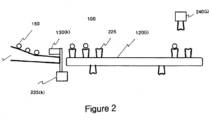
- FIG 2 shows a side view of the article carrier apparatus 100 of Figure 1 .
- a single carrier lane 120 (i) is shown which comprises a number of cups 225 for receiving the fruit articles 160.
- a camera 240 (i) forming part of the sensor 140 determines whether each cup carries an article 160. This information is used to determine the cupfill of the lane 120 (i) as could be appreciated by those skilled in the art.
- a diverter 130 (k) on one side of the lane 120 (i) is rotated by an actuator 235 (k) controlled by the controller 150. Similar actuators control the other diverters 130 (1-z).
- the controller 150 controls the individual diverters 130 according to a series of algorithms in order to more evenly distribute fruit articles across the carrier lanes.
- FIG. 3 a flow chart for a control system loop algorithm 300 is shown.
- the control system loop algorithm 300 waits for the next control cycle timer to elapse.
- a typical timer value is 30 seconds and provides that the dynamic fruit load of the article carrier apparatus is checked periodically.
- the algorithm checks at step 310 whether the average cupfill of the parallel carrier lanes exceeds a threshold, and that the infeed is running. When the infeed is running, fruit or other articles are delivered to the infeed tray 110. If the average cupfill is below the threshold (for example 50%) or the infeed is not running, then the control system algorithm maintains a steady position, indicated by step 315.
- the threshold for example 50%
- the diverters remain in their previous positions, and the next timer is set before moving back to step 305. If at step 310, the average cupfill or other capacity use parameter (Ci) exceeds a threshold such as 50%, and the infeed is running (fruit is being fed on to the infeed tray 110), then the control system 150 moves to the lane delta algorithm indicated by step 320.
- a threshold such as 50%
- the control system 150 moves to the lane delta algorithm indicated by step 320.
- Such a state is indicative of high numbers of fruit being carried by the article carrier apparatus 100, and that it would benefit from even distribution of fruit across the lanes.
- the lane delta algorithm 400 first determines a capacity use parameter (Ci) for each lane at step 405.
- the capacity use parameter (Ci) is the cupfill which can be determined using the cameras of the sensor 140 (240).
- LaneDelta for each lane corresponds to how much the input channel to the lane should increase or decrease in order to obtain a cupfill similar to those of adjacent lanes.
- groups (j) of adjacent lanes are analysed for each lane (i) currently under consideration, as indicated by step 415.
- Other lane groups may be defined up to a largest group W including all adjacent lanes. Although the groups have been defined as increasing one adjacent lane on each side, this is not necessary and other allocations of groups may alternatively be defined. Taking into account more and more distant adjacent lanes by grouping them as shown improves the stability and efficiency of the article distribution algorithms employed by the embodiments. Thus an algorithm with more groups is typically more efficient at distributing fruit evenly across all of the carrier lanes and avoids "hunting" of the diverters.
- the algorithm calculates the average capacity use parameter (Cijav) for the current group.
- This parameter is simply the summation of for example the cupfill (Ci) for each of the lane carriers in the current group (j) divided by the number of lanes in the group.
- the algorithm 400 calculates a group difference parameter (Dij) between the capacity use parameter (Ci) of the current lane and the average (Cijav) for the current group (j).
- the algorithm determines whether there are further lane groups to process for the current lane, and if so returns to step 415.
- step 435 the algorithm 400 proceeds to step 435 where the group difference parameters (Dij) are summed.
- the sum of the group difference parameters is then divided by the jth harmonic number (Hj).
- the harmonic number is a known mathematical function which is the sum of the reciprocals of natural numbers up to the number j of lane groups employed. This results in a constant scaling factor where an increase in number of lanes has a lower influence. This value then becomes the lane adjustment parameter LaneDelta (i) for the current lane (i) under consideration.
- the LaneDelta (i) value of a lane is a parameter representing a desired adjustment in article capacity for the current lane; in order to more evenly distribute the articles across the apparatus 100.
- step 440 the algorithm considers whether there are further lanes to process, and if so returns to step 410 where group processing of the next lane is carried out. If all lanes have been completed, the controller 150 moves on to a diverter adjustment algorithm as indicated at step 445.
- a diverter adjustment algorithm is shown in the flow chart of Figure 5 .
- the diverter adjustment algorithm 500 receives adjustment requests for each diverter from the lane to its left and the lane to its right.
- the LaneDelta (i) values determined in the LaneDelta algorithm of Figure 4 are used, and correspond to lane adjustment parameters. These adjustment requests are compared in order to determine a final rotational adjustment for each diverter in order to best meet the requirements of each lane in the context of more evenly distributing fruit articles to all of the lanes of the article carrying apparatus.
- a lower control value (Diverter(i-1).RightRequest) requests movement of the diverter to the left and a higher value requests movement of the diverter to the right. These correspond respectively to requesting the diverter to open and close the input channel to the lane or the gap between the diverters either side of the lane entrance.
- the LaneDelta has been determined from the previous lane delta algorithm 400, and A is a constant which can be optimised by experiment or simulation.
- the control valve corresponds to a percentage of the maximum diverter rotational range. Where the LaneDelta(i) is positive, this will result in a negative control value for the Diverter(i-1) RightRequest control valve which corresponds to a request to move the diverter to the left.
- the diverter number to the left of the lane is one less than the lane number, hence the use of (i-1) in the equation.
- the diverter to the left is diverter 1 (ie i-1)
- the diverter to the right is diverter 2 (ie i)
- a request to the diverter right of the current lane (i) is also determined: Diverter i .
- LeftRequest LaneDelta i * A .
- LaneDelta value is positive, then this corresponds to a request to the right hand diverter of the lane to move left.
- the effect of these two steps 510 and 515 is that if the lane adjustment parameter for the current lane (LaneDelta(i)) is negative, then the right request for the left diverter (Diverter(i-1).LeftRequest) is less than 0 (negative) thereby requesting the left diverter to move left.
- the left request for the right diverter (Request(i).RightDiverter) is larger than 0 (positive) which will request the right diverter to move right.
- the combined result is a request for a larger input channel or gap between left and right diverters for the current lane in order to allow more fruit articles to be received, thereby increasing its capacity use parameter.
- LaneDelta If the LaneDelta is positive (greater than 0) then the right request for the left diverter is larger than 0 causing a request for the left diverter to move right and if the left request for the RightDiverter is less than 0 (negative) this causes a request for the right diverter to move left.
- the combined result is a request for a smaller gap between the two diverters of the current lane in order to reduce the amount of fruit articles being received and hence reduces its capacity use parameter.
- step 520 the algorithm 500 determines whether there are further lanes to consider and if so returns to step 505 so that left and right diverter request values (Diverter(i-1).RightRequest and Diverter(i).LeftRequest) can be determined for the next lane. Note that many of the diverters will receive adjustment requests from two adjacent lanes, on the left and right of the diverter. If all lanes have been processed, the algorithm 500 proceeds to step 525 so that the various requests for moving each diverter can be considered and a final adjustment value settled upon for implementing movement of each diverter.
- left and right diverter request values Diverter(i-1).RightRequest and Diverter(i).LeftRequest
- the algorithm determines a Diverter(k).FinalAdjustment value which is dependent on the various adjustment request values from adjacent lanes and determined in the preceding steps.
- Each diverter (k) will have an adjustment request from the lane to its left (Diverter(k).RightRequest) and the lane to its right (Diverter(k).LeftRequest).
- Different methods of combining these requests are used depending on whether the adjustment requests are in the same direction (eg rotate right) or opposite (eg one request to rotate left by a value and another request to rotate left by another value).
- the algorithm 500 determines whether the adjustment request values from each adjacent lane are for the same direction (i.e. whether the sign of the value for the left request and the right request from the adjacent lanes are the same).
- step 540 determines which request value is larger.
- the algorithm uses the larger of the two request values.
- the algorithm moves to step 550 where the Diverter(k).FinalAdjustment is allocated the Diverter (k).LeftRequest value. If this is not the case, then the Diverter(k).FinalAdjustment variable is assigned the Diverter (k).RightRequest value at step 545.
- the difference between the two adjustment requests could be used.
- step 555 the Diverter (k).Final Adjustment value assigned is implemented for the current diverter 130(k) using its respective actuator 235 (k).
- step 560 the algorithm 500 determines whether further diverters require processing and if so returns to step 525 for the next diverter. If all diverters have been completed, then the algorithm moves to step 565 which represents a return to the control system loop algorithm of Figure 3 .
- Any methods here disclosed or claimed may be implemented using a computer program product which when implemented on a computer causes the computer to execute the methods.
- a computer and/or computer program product may be implemented by any suitable processor and computer program, for example a general purpose processor and computer code instructions on a memory device CD ROM or the like or a downloaded file, a digital signal processor, ASIC or FPGA for example.
Landscapes
- Engineering & Computer Science (AREA)
- Mechanical Engineering (AREA)
- Branching, Merging, And Special Transfer Between Conveyors (AREA)
- Control Of Conveyors (AREA)
- Specific Conveyance Elements (AREA)
- Discharge Of Articles From Conveyors (AREA)
- Chain Conveyers (AREA)
Claims (7)
- Appareil de transport d'articles (100) comprenant :une pluralité de voies de transport (120) chacune pour recevoir et transporter un certain nombre d'articles (160) ;un ou plusieurs déviateurs (130) agencés pour commander la distribution d'articles reçus (160) dans chacune de la pluralité de voies de transport (120), caractérisé en ce que les un ou plusieurs déviateurs (130) sont positionnés au niveau d'une extrémité de réception des voies de transport (120) et entre des voies de transport adjacentes, les déviateurs (130) pouvant être commandés individuellement pour pivoter de sorte qu'un canal d'entrée pour une voie de transport puisse être élargi ou réduit en ajustant des déviateurs adjacents afin d'augmenter ou de réduire un flux d'articles sur la voie de transport ;un capteur (140) agencé pour déterminer un paramètre d'utilisation de capacité pour chaque voie de transport (120) ; etun dispositif de commande (150) agencé pour commander la position des un ou plusieurs déviateurs en fonction des paramètres d'utilisation de capacité déterminés.
- Appareil (100) selon la revendication 1, dans lequel le dispositif de commande (150) est en outre agencé pour ajuster les positions de déviateurs adjacents à une voie de transport particulière en fonction d'une différence du paramètre d'utilisation de capacité de la voie de transport particulière et des paramètres d'utilisation de capacité de voies de transport adjacentes.
- Appareil (100) selon l'une quelconque des revendications 1 ou 2, dans lequel le dispositif de commande (150) est en outre agencé pour ajuster les positions de déviateurs adjacents à la voie de transport particulière en fonction de différences entre le paramètre d'utilisation de capacité de la voie de transport particulière et un paramètre d'utilisation de capacité moyen dérivé des paramètres d'utilisation de capacité pour chacun d'une pluralité de groupes de voies de transport adjacentes, chaque groupe de voies de transport adjacentes comprenant un nombre différent de voies de transport adjacentes.
- Appareil (100) selon une quelconque revendication précédente, dans lequel chaque voie de transport (120) comprend une pluralité de gobelets (225) chacun pour recevoir un article, et dans lequel le paramètre d'utilisation de capacité est l'un parmi : un pourcentage de gobelets contenant un article ; et un nombre d'articles transportés par chaque gobelet par unité de temps.
- Appareil (100) selon une quelconque revendication précédente, dans lequel le capteur (140) comprend une caméra agencée pour visualiser des articles transportés sur chaque voie de transport respective.
- Appareil (100) selon une quelconque revendication précédente, comprenant en outre un plateau d'alimentation (110) situé de manière adjacente ou agencé pour intégré les un ou plusieurs déviateurs (150).
- Procédé de fonctionnement d'un appareil de transport d'articles (100) présentant une pluralité de voies de transport (120) chacune pour recevoir et transporter un certain nombre d'articles (160), un certain nombre de déviateurs (130) étant agencés pour commander la distribution d'articles reçus (160) dans les voies de transport (120), chacune des voies de transport comprenant un canal d'entrée et un capteur (140), caractérisé en ce que chacun des déviateurs (130) est positionné au niveau d'une extrémité de réception des voies de transport (120) adjacentes et entre des voies de transport respectives, les déviateurs (130) pouvant être commandés individuellement pour pivoter de sorte qu'un canal d'entrée pour une voie de transport puisse être élargi ou réduit en ajustant des déviateurs adjacents afin d'augmenter ou de réduire un flux d'articles sur la voie de transport, le procédé comprenant les étapes consistant à :déterminer un paramètre d'utilisation de capacité pour chacune de la pluralité de voies de transport (120) en utilisant le capteur (140) ; etcommander la position des un ou plusieurs déviateurs (130) en fonction des paramètres d'utilisation de capacité déterminés.
Applications Claiming Priority (1)
| Application Number | Priority Date | Filing Date | Title |
|---|---|---|---|
| PCT/NZ2013/000129 WO2015009164A1 (fr) | 2013-07-19 | 2013-07-19 | Appareil de transport d'articles |
Publications (3)
| Publication Number | Publication Date |
|---|---|
| EP3021987A1 EP3021987A1 (fr) | 2016-05-25 |
| EP3021987A4 EP3021987A4 (fr) | 2017-05-17 |
| EP3021987B1 true EP3021987B1 (fr) | 2023-04-26 |
Family
ID=52346506
Family Applications (1)
| Application Number | Title | Priority Date | Filing Date |
|---|---|---|---|
| EP13889620.4A Active EP3021987B1 (fr) | 2013-07-19 | 2013-07-19 | Appareil de transport d'articles |
Country Status (8)
| Country | Link |
|---|---|
| US (1) | US9475655B2 (fr) |
| EP (1) | EP3021987B1 (fr) |
| AU (1) | AU2013394431B2 (fr) |
| CL (1) | CL2016000068A1 (fr) |
| ES (1) | ES2944843T3 (fr) |
| PL (1) | PL3021987T3 (fr) |
| PT (1) | PT3021987T (fr) |
| WO (1) | WO2015009164A1 (fr) |
Families Citing this family (3)
| Publication number | Priority date | Publication date | Assignee | Title |
|---|---|---|---|---|
| US9533837B2 (en) * | 2014-12-18 | 2017-01-03 | Compac Technologies Limited | Article carrier apparatus |
| IT202000018859A1 (it) * | 2020-07-31 | 2022-01-31 | Gd Spa | Unità di trasporto di articoli |
| WO2022150742A1 (fr) | 2021-01-11 | 2022-07-14 | Durand-Wayland, Inc. | Procédés et systèmes de tri de produits |
Citations (1)
| Publication number | Priority date | Publication date | Assignee | Title |
|---|---|---|---|---|
| DE19514928A1 (de) * | 1994-12-13 | 1996-06-20 | Kronseder Maschf Krones | Verfahren und Vorrichtung zum Beschicken einer Gassenverteilung für Gefäße |
Family Cites Families (15)
| Publication number | Priority date | Publication date | Assignee | Title |
|---|---|---|---|---|
| US2942718A (en) * | 1956-08-28 | 1960-06-28 | Fischer Ag Georg | Cooling system for foundry molds |
| US3122231A (en) * | 1960-06-21 | 1964-02-25 | Cutler Hammer Inc | Memory type storage conveyor system |
| US3153487A (en) * | 1960-08-30 | 1964-10-20 | Cutler Hammer Inc | Storage conveyor system |
| US3173557A (en) * | 1962-02-16 | 1965-03-16 | Electrolux Ab | Conveyor system |
| GB1517511A (en) * | 1974-07-19 | 1978-07-12 | Metal Box Co Ltd | Conveyor handling apparatus |
| IL58404A (en) * | 1976-02-20 | 1982-11-30 | Pennwalt Corp | Color sorter for fruit and the like |
| JPS5316675A (en) * | 1976-06-14 | 1978-02-15 | Continental Group | Detector for detecting quantity and density of product |
| DE4142621A1 (de) * | 1991-12-21 | 1993-06-24 | Schlafhorst & Co W | Speichereinrichtung einer spulmaschine fuer voneinander unabhaengige caddy's |
| US5411131A (en) * | 1994-06-13 | 1995-05-02 | Haegele; Richard P. | Non-synchronous conveyor system for assembly operations |
| WO1997014636A1 (fr) * | 1995-10-18 | 1997-04-24 | Sandvik Aktiebolag | Mecanisme de triage |
| ES2166330B1 (es) * | 2000-05-17 | 2003-02-16 | Gomez Gines Sanchez | Almacen automatico optimizado. |
| FR2907437B1 (fr) * | 2006-10-24 | 2009-07-03 | Sidel Participations | Table de repartition de bouteilles a l'entree de couloirs a file unique |
| WO2010008303A1 (fr) | 2008-07-15 | 2010-01-21 | Anzpac Systems Limited | Procédé et appareil améliorés pour l'inspection d'un article |
| US20110180368A1 (en) | 2010-01-25 | 2011-07-28 | Douglas Eugene Rockstead | Fruit and vegetable distributor system |
| DK177381B1 (en) * | 2011-08-16 | 2013-03-04 | Crisplant As | Cross-belt sorting system |
-
2013
- 2013-07-19 PT PT138896204T patent/PT3021987T/pt unknown
- 2013-07-19 EP EP13889620.4A patent/EP3021987B1/fr active Active
- 2013-07-19 ES ES13889620T patent/ES2944843T3/es active Active
- 2013-07-19 WO PCT/NZ2013/000129 patent/WO2015009164A1/fr not_active Ceased
- 2013-07-19 AU AU2013394431A patent/AU2013394431B2/en active Active
- 2013-07-19 PL PL13889620.4T patent/PL3021987T3/pl unknown
-
2014
- 2014-12-18 US US14/575,960 patent/US9475655B2/en active Active
-
2016
- 2016-01-13 CL CL2016000068A patent/CL2016000068A1/es unknown
Patent Citations (1)
| Publication number | Priority date | Publication date | Assignee | Title |
|---|---|---|---|---|
| DE19514928A1 (de) * | 1994-12-13 | 1996-06-20 | Kronseder Maschf Krones | Verfahren und Vorrichtung zum Beschicken einer Gassenverteilung für Gefäße |
Also Published As
| Publication number | Publication date |
|---|---|
| AU2013394431A1 (en) | 2016-01-21 |
| ES2944843T3 (es) | 2023-06-26 |
| PL3021987T3 (pl) | 2023-08-28 |
| EP3021987A1 (fr) | 2016-05-25 |
| AU2013394431B2 (en) | 2018-12-06 |
| WO2015009164A1 (fr) | 2015-01-22 |
| PT3021987T (pt) | 2023-05-11 |
| EP3021987A4 (fr) | 2017-05-17 |
| US20150101908A1 (en) | 2015-04-16 |
| CL2016000068A1 (es) | 2016-10-21 |
| US9475655B2 (en) | 2016-10-25 |
Similar Documents
| Publication | Publication Date | Title |
|---|---|---|
| EP3233675B1 (fr) | Appareil de support d'articles | |
| US10925289B2 (en) | Method and system for batching size adjusted food items | |
| US10160599B2 (en) | Chute and sorting installation, and method for sorting articles | |
| US20180126420A1 (en) | Apparatus and method for sorting articles | |
| EP3021987B1 (fr) | Appareil de transport d'articles | |
| EP3999458A1 (fr) | Système de gestion d'emballage de convoyeur de détection de portée pour mesurer et contrôler la densité des colis sur un convoyeur | |
| EP3140050B1 (fr) | Création des charges par images | |
| US20020134710A1 (en) | Method of automatically sorting objects and combining objects to assortments | |
| US20160309728A1 (en) | Grading system | |
| NL2012909B1 (nl) | Verdeelsysteem voor het aan een verenkelaar aanvoeren van onregelmatig gevormde producten, zoals peren, en transportsysteem en werkwijze daarvoor. | |
| JP4942974B2 (ja) | 整列装置 | |
| WO2015174853A1 (fr) | Commande de vitesse de porteur | |
| WO2018193484A1 (fr) | Correction de rétroaction pour systèmes de classification | |
| NL1012050C2 (nl) | Werkwijze en inrichting voor het gelijkmatig verdelen van producten. |
Legal Events
| Date | Code | Title | Description |
|---|---|---|---|
| PUAI | Public reference made under article 153(3) epc to a published international application that has entered the european phase |
Free format text: ORIGINAL CODE: 0009012 |
|
| 17P | Request for examination filed |
Effective date: 20160107 |
|
| AK | Designated contracting states |
Kind code of ref document: A1 Designated state(s): AL AT BE BG CH CY CZ DE DK EE ES FI FR GB GR HR HU IE IS IT LI LT LU LV MC MK MT NL NO PL PT RO RS SE SI SK SM TR |
|
| AX | Request for extension of the european patent |
Extension state: BA ME |
|
| DAX | Request for extension of the european patent (deleted) | ||
| A4 | Supplementary search report drawn up and despatched |
Effective date: 20170421 |
|
| RIC1 | Information provided on ipc code assigned before grant |
Ipc: B07B 13/00 20060101AFI20170413BHEP Ipc: B65G 47/51 20060101ALI20170413BHEP Ipc: B65G 47/71 20060101ALI20170413BHEP Ipc: B65G 47/76 20060101ALN20170413BHEP |
|
| STAA | Information on the status of an ep patent application or granted ep patent |
Free format text: STATUS: EXAMINATION IS IN PROGRESS |
|
| 17Q | First examination report despatched |
Effective date: 20190524 |
|
| RIC1 | Information provided on ipc code assigned before grant |
Ipc: B65G 47/76 20060101ALN20220729BHEP Ipc: B07C 5/36 20060101ALI20220729BHEP Ipc: B07B 13/16 20060101ALI20220729BHEP Ipc: B65G 47/51 20060101ALI20220729BHEP Ipc: B65G 47/71 20060101ALI20220729BHEP Ipc: B07B 13/00 20060101AFI20220729BHEP |
|
| GRAJ | Information related to disapproval of communication of intention to grant by the applicant or resumption of examination proceedings by the epo deleted |
Free format text: ORIGINAL CODE: EPIDOSDIGR1 |
|
| GRAP | Despatch of communication of intention to grant a patent |
Free format text: ORIGINAL CODE: EPIDOSNIGR1 |
|
| STAA | Information on the status of an ep patent application or granted ep patent |
Free format text: STATUS: GRANT OF PATENT IS INTENDED |
|
| INTG | Intention to grant announced |
Effective date: 20221014 |
|
| INTG | Intention to grant announced |
Effective date: 20221019 |
|
| INTC | Intention to grant announced (deleted) | ||
| RIC1 | Information provided on ipc code assigned before grant |
Ipc: B65G 47/76 20060101ALN20221020BHEP Ipc: B07C 5/36 20060101ALI20221020BHEP Ipc: B07B 13/16 20060101ALI20221020BHEP Ipc: B65G 47/51 20060101ALI20221020BHEP Ipc: B65G 47/71 20060101ALI20221020BHEP Ipc: B07B 13/00 20060101AFI20221020BHEP |
|
| RIC1 | Information provided on ipc code assigned before grant |
Ipc: B65G 47/76 20060101ALN20221024BHEP Ipc: B07C 5/36 20060101ALI20221024BHEP Ipc: B07B 13/16 20060101ALI20221024BHEP Ipc: B65G 47/51 20060101ALI20221024BHEP Ipc: B65G 47/71 20060101ALI20221024BHEP Ipc: B07B 13/00 20060101AFI20221024BHEP |
|
| INTG | Intention to grant announced |
Effective date: 20221108 |
|
| GRAS | Grant fee paid |
Free format text: ORIGINAL CODE: EPIDOSNIGR3 |
|
| GRAA | (expected) grant |
Free format text: ORIGINAL CODE: 0009210 |
|
| STAA | Information on the status of an ep patent application or granted ep patent |
Free format text: STATUS: THE PATENT HAS BEEN GRANTED |
|
| AK | Designated contracting states |
Kind code of ref document: B1 Designated state(s): AL AT BE BG CH CY CZ DE DK EE ES FI FR GB GR HR HU IE IS IT LI LT LU LV MC MK MT NL NO PL PT RO RS SE SI SK SM TR |
|
| REG | Reference to a national code |
Ref country code: GB Ref legal event code: FG4D |
|
| REG | Reference to a national code |
Ref country code: CH Ref legal event code: EP |
|
| REG | Reference to a national code |
Ref country code: DE Ref legal event code: R096 Ref document number: 602013083693 Country of ref document: DE |
|
| REG | Reference to a national code |
Ref country code: PT Ref legal event code: SC4A Ref document number: 3021987 Country of ref document: PT Date of ref document: 20230511 Kind code of ref document: T Free format text: AVAILABILITY OF NATIONAL TRANSLATION Effective date: 20230505 |
|
| REG | Reference to a national code |
Ref country code: AT Ref legal event code: REF Ref document number: 1562459 Country of ref document: AT Kind code of ref document: T Effective date: 20230515 |
|
| REG | Reference to a national code |
Ref country code: IE Ref legal event code: FG4D |
|
| REG | Reference to a national code |
Ref country code: NL Ref legal event code: FP |
|
| P01 | Opt-out of the competence of the unified patent court (upc) registered |
Effective date: 20230327 |
|
| REG | Reference to a national code |
Ref country code: ES Ref legal event code: FG2A Ref document number: 2944843 Country of ref document: ES Kind code of ref document: T3 Effective date: 20230626 |
|
| REG | Reference to a national code |
Ref country code: GR Ref legal event code: EP Ref document number: 20230400760 Country of ref document: GR Effective date: 20230710 |
|
| REG | Reference to a national code |
Ref country code: LT Ref legal event code: MG9D |
|
| REG | Reference to a national code |
Ref country code: AT Ref legal event code: MK05 Ref document number: 1562459 Country of ref document: AT Kind code of ref document: T Effective date: 20230426 |
|
| PG25 | Lapsed in a contracting state [announced via postgrant information from national office to epo] |
Ref country code: SE Free format text: LAPSE BECAUSE OF FAILURE TO SUBMIT A TRANSLATION OF THE DESCRIPTION OR TO PAY THE FEE WITHIN THE PRESCRIBED TIME-LIMIT Effective date: 20230426 Ref country code: NO Free format text: LAPSE BECAUSE OF FAILURE TO SUBMIT A TRANSLATION OF THE DESCRIPTION OR TO PAY THE FEE WITHIN THE PRESCRIBED TIME-LIMIT Effective date: 20230726 Ref country code: AT Free format text: LAPSE BECAUSE OF FAILURE TO SUBMIT A TRANSLATION OF THE DESCRIPTION OR TO PAY THE FEE WITHIN THE PRESCRIBED TIME-LIMIT Effective date: 20230426 |
|
| PG25 | Lapsed in a contracting state [announced via postgrant information from national office to epo] |
Ref country code: RS Free format text: LAPSE BECAUSE OF FAILURE TO SUBMIT A TRANSLATION OF THE DESCRIPTION OR TO PAY THE FEE WITHIN THE PRESCRIBED TIME-LIMIT Effective date: 20230426 Ref country code: LV Free format text: LAPSE BECAUSE OF FAILURE TO SUBMIT A TRANSLATION OF THE DESCRIPTION OR TO PAY THE FEE WITHIN THE PRESCRIBED TIME-LIMIT Effective date: 20230426 Ref country code: LT Free format text: LAPSE BECAUSE OF FAILURE TO SUBMIT A TRANSLATION OF THE DESCRIPTION OR TO PAY THE FEE WITHIN THE PRESCRIBED TIME-LIMIT Effective date: 20230426 Ref country code: IS Free format text: LAPSE BECAUSE OF FAILURE TO SUBMIT A TRANSLATION OF THE DESCRIPTION OR TO PAY THE FEE WITHIN THE PRESCRIBED TIME-LIMIT Effective date: 20230826 Ref country code: HR Free format text: LAPSE BECAUSE OF FAILURE TO SUBMIT A TRANSLATION OF THE DESCRIPTION OR TO PAY THE FEE WITHIN THE PRESCRIBED TIME-LIMIT Effective date: 20230426 |
|
| PG25 | Lapsed in a contracting state [announced via postgrant information from national office to epo] |
Ref country code: FI Free format text: LAPSE BECAUSE OF FAILURE TO SUBMIT A TRANSLATION OF THE DESCRIPTION OR TO PAY THE FEE WITHIN THE PRESCRIBED TIME-LIMIT Effective date: 20230426 |
|
| PG25 | Lapsed in a contracting state [announced via postgrant information from national office to epo] |
Ref country code: SK Free format text: LAPSE BECAUSE OF FAILURE TO SUBMIT A TRANSLATION OF THE DESCRIPTION OR TO PAY THE FEE WITHIN THE PRESCRIBED TIME-LIMIT Effective date: 20230426 |
|
| REG | Reference to a national code |
Ref country code: DE Ref legal event code: R097 Ref document number: 602013083693 Country of ref document: DE |
|
| PG25 | Lapsed in a contracting state [announced via postgrant information from national office to epo] |
Ref country code: SM Free format text: LAPSE BECAUSE OF FAILURE TO SUBMIT A TRANSLATION OF THE DESCRIPTION OR TO PAY THE FEE WITHIN THE PRESCRIBED TIME-LIMIT Effective date: 20230426 Ref country code: SK Free format text: LAPSE BECAUSE OF FAILURE TO SUBMIT A TRANSLATION OF THE DESCRIPTION OR TO PAY THE FEE WITHIN THE PRESCRIBED TIME-LIMIT Effective date: 20230426 Ref country code: RO Free format text: LAPSE BECAUSE OF FAILURE TO SUBMIT A TRANSLATION OF THE DESCRIPTION OR TO PAY THE FEE WITHIN THE PRESCRIBED TIME-LIMIT Effective date: 20230426 Ref country code: EE Free format text: LAPSE BECAUSE OF FAILURE TO SUBMIT A TRANSLATION OF THE DESCRIPTION OR TO PAY THE FEE WITHIN THE PRESCRIBED TIME-LIMIT Effective date: 20230426 Ref country code: DK Free format text: LAPSE BECAUSE OF FAILURE TO SUBMIT A TRANSLATION OF THE DESCRIPTION OR TO PAY THE FEE WITHIN THE PRESCRIBED TIME-LIMIT Effective date: 20230426 Ref country code: CZ Free format text: LAPSE BECAUSE OF FAILURE TO SUBMIT A TRANSLATION OF THE DESCRIPTION OR TO PAY THE FEE WITHIN THE PRESCRIBED TIME-LIMIT Effective date: 20230426 |
|
| PG25 | Lapsed in a contracting state [announced via postgrant information from national office to epo] |
Ref country code: MC Free format text: LAPSE BECAUSE OF FAILURE TO SUBMIT A TRANSLATION OF THE DESCRIPTION OR TO PAY THE FEE WITHIN THE PRESCRIBED TIME-LIMIT Effective date: 20230426 |
|
| PG25 | Lapsed in a contracting state [announced via postgrant information from national office to epo] |
Ref country code: MC Free format text: LAPSE BECAUSE OF FAILURE TO SUBMIT A TRANSLATION OF THE DESCRIPTION OR TO PAY THE FEE WITHIN THE PRESCRIBED TIME-LIMIT Effective date: 20230426 |
|
| REG | Reference to a national code |
Ref country code: CH Ref legal event code: PL |
|
| PLBE | No opposition filed within time limit |
Free format text: ORIGINAL CODE: 0009261 |
|
| STAA | Information on the status of an ep patent application or granted ep patent |
Free format text: STATUS: NO OPPOSITION FILED WITHIN TIME LIMIT |
|
| PG25 | Lapsed in a contracting state [announced via postgrant information from national office to epo] |
Ref country code: LU Free format text: LAPSE BECAUSE OF NON-PAYMENT OF DUE FEES Effective date: 20230719 |
|
| GBPC | Gb: european patent ceased through non-payment of renewal fee |
Effective date: 20230726 |
|
| PG25 | Lapsed in a contracting state [announced via postgrant information from national office to epo] |
Ref country code: LU Free format text: LAPSE BECAUSE OF NON-PAYMENT OF DUE FEES Effective date: 20230719 |
|
| 26N | No opposition filed |
Effective date: 20240129 |
|
| REG | Reference to a national code |
Ref country code: IE Ref legal event code: MM4A |
|
| PG25 | Lapsed in a contracting state [announced via postgrant information from national office to epo] |
Ref country code: CH Free format text: LAPSE BECAUSE OF NON-PAYMENT OF DUE FEES Effective date: 20230731 Ref country code: GB Free format text: LAPSE BECAUSE OF NON-PAYMENT OF DUE FEES Effective date: 20230726 |
|
| PG25 | Lapsed in a contracting state [announced via postgrant information from national office to epo] |
Ref country code: SI Free format text: LAPSE BECAUSE OF FAILURE TO SUBMIT A TRANSLATION OF THE DESCRIPTION OR TO PAY THE FEE WITHIN THE PRESCRIBED TIME-LIMIT Effective date: 20230426 |
|
| PG25 | Lapsed in a contracting state [announced via postgrant information from national office to epo] |
Ref country code: SI Free format text: LAPSE BECAUSE OF FAILURE TO SUBMIT A TRANSLATION OF THE DESCRIPTION OR TO PAY THE FEE WITHIN THE PRESCRIBED TIME-LIMIT Effective date: 20230426 |
|
| PG25 | Lapsed in a contracting state [announced via postgrant information from national office to epo] |
Ref country code: IE Free format text: LAPSE BECAUSE OF NON-PAYMENT OF DUE FEES Effective date: 20230719 |
|
| PG25 | Lapsed in a contracting state [announced via postgrant information from national office to epo] |
Ref country code: IE Free format text: LAPSE BECAUSE OF NON-PAYMENT OF DUE FEES Effective date: 20230719 |
|
| PG25 | Lapsed in a contracting state [announced via postgrant information from national office to epo] |
Ref country code: BG Free format text: LAPSE BECAUSE OF FAILURE TO SUBMIT A TRANSLATION OF THE DESCRIPTION OR TO PAY THE FEE WITHIN THE PRESCRIBED TIME-LIMIT Effective date: 20230426 |
|
| PG25 | Lapsed in a contracting state [announced via postgrant information from national office to epo] |
Ref country code: BG Free format text: LAPSE BECAUSE OF FAILURE TO SUBMIT A TRANSLATION OF THE DESCRIPTION OR TO PAY THE FEE WITHIN THE PRESCRIBED TIME-LIMIT Effective date: 20230426 |
|
| PGFP | Annual fee paid to national office [announced via postgrant information from national office to epo] |
Ref country code: PL Payment date: 20250609 Year of fee payment: 13 |
|
| PGFP | Annual fee paid to national office [announced via postgrant information from national office to epo] |
Ref country code: NL Payment date: 20250613 Year of fee payment: 13 Ref country code: BE Payment date: 20250619 Year of fee payment: 13 |
|
| PGFP | Annual fee paid to national office [announced via postgrant information from national office to epo] |
Ref country code: PT Payment date: 20250630 Year of fee payment: 13 |
|
| PGFP | Annual fee paid to national office [announced via postgrant information from national office to epo] |
Ref country code: FR Payment date: 20250610 Year of fee payment: 13 |
|
| PGFP | Annual fee paid to national office [announced via postgrant information from national office to epo] |
Ref country code: GR Payment date: 20250618 Year of fee payment: 13 |
|
| PG25 | Lapsed in a contracting state [announced via postgrant information from national office to epo] |
Ref country code: CY Free format text: LAPSE BECAUSE OF FAILURE TO SUBMIT A TRANSLATION OF THE DESCRIPTION OR TO PAY THE FEE WITHIN THE PRESCRIBED TIME-LIMIT; INVALID AB INITIO Effective date: 20130719 |
|
| PG25 | Lapsed in a contracting state [announced via postgrant information from national office to epo] |
Ref country code: HU Free format text: LAPSE BECAUSE OF FAILURE TO SUBMIT A TRANSLATION OF THE DESCRIPTION OR TO PAY THE FEE WITHIN THE PRESCRIBED TIME-LIMIT; INVALID AB INITIO Effective date: 20130719 |
|
| REG | Reference to a national code |
Ref country code: DE Ref legal event code: R081 Ref document number: 602013083693 Country of ref document: DE Owner name: TOMRA FOOD (BELGIUM) NV, BE Free format text: FORMER OWNER: COMPAC TECHNOLOGIES LTD., AUCKLAND, NZ |
|
| PGFP | Annual fee paid to national office [announced via postgrant information from national office to epo] |
Ref country code: ES Payment date: 20250807 Year of fee payment: 13 |
|
| PGFP | Annual fee paid to national office [announced via postgrant information from national office to epo] |
Ref country code: DE Payment date: 20250604 Year of fee payment: 13 |
|
| PGFP | Annual fee paid to national office [announced via postgrant information from national office to epo] |
Ref country code: TR Payment date: 20250708 Year of fee payment: 13 Ref country code: IT Payment date: 20250623 Year of fee payment: 13 |
|
| REG | Reference to a national code |
Ref country code: ES Ref legal event code: PC2A Owner name: TOMRA FOOD (BELGIUM) NV Effective date: 20260224 |