EP3021991B1 - Feuillard laminé à froid sous forme de fil plat ou de profilés en acier à haute résistance destinés à être utilisés dans des tuyaux souples, en particulier des tuyaux souples pour applications offshore, ainsi que procédé de fabrication de tels feuillards laminés à froid - Google Patents
Feuillard laminé à froid sous forme de fil plat ou de profilés en acier à haute résistance destinés à être utilisés dans des tuyaux souples, en particulier des tuyaux souples pour applications offshore, ainsi que procédé de fabrication de tels feuillards laminés à froid Download PDFInfo
- Publication number
- EP3021991B1 EP3021991B1 EP14750684.4A EP14750684A EP3021991B1 EP 3021991 B1 EP3021991 B1 EP 3021991B1 EP 14750684 A EP14750684 A EP 14750684A EP 3021991 B1 EP3021991 B1 EP 3021991B1
- Authority
- EP
- European Patent Office
- Prior art keywords
- cold
- rolled
- narrow strip
- wire
- steel
- Prior art date
- Legal status (The legal status is an assumption and is not a legal conclusion. Google has not performed a legal analysis and makes no representation as to the accuracy of the status listed.)
- Active
Links
Images
Classifications
-
- C—CHEMISTRY; METALLURGY
- C22—METALLURGY; FERROUS OR NON-FERROUS ALLOYS; TREATMENT OF ALLOYS OR NON-FERROUS METALS
- C22C—ALLOYS
- C22C38/00—Ferrous alloys, e.g. steel alloys
- C22C38/04—Ferrous alloys, e.g. steel alloys containing manganese
-
- F—MECHANICAL ENGINEERING; LIGHTING; HEATING; WEAPONS; BLASTING
- F16—ENGINEERING ELEMENTS AND UNITS; GENERAL MEASURES FOR PRODUCING AND MAINTAINING EFFECTIVE FUNCTIONING OF MACHINES OR INSTALLATIONS; THERMAL INSULATION IN GENERAL
- F16L—PIPES; JOINTS OR FITTINGS FOR PIPES; SUPPORTS FOR PIPES, CABLES OR PROTECTIVE TUBING; MEANS FOR THERMAL INSULATION IN GENERAL
- F16L11/00—Hoses, i.e. flexible pipes
- F16L11/04—Hoses, i.e. flexible pipes made of rubber or flexible plastics
- F16L11/10—Hoses, i.e. flexible pipes made of rubber or flexible plastics with reinforcements not embedded in the wall
-
- B—PERFORMING OPERATIONS; TRANSPORTING
- B21—MECHANICAL METAL-WORKING WITHOUT ESSENTIALLY REMOVING MATERIAL; PUNCHING METAL
- B21B—ROLLING OF METAL
- B21B1/00—Metal-rolling methods or mills for making semi-finished products of solid or profiled cross-section; Sequence of operations in milling trains; Layout of rolling-mill plant, e.g. grouping of stands; Succession of passes or of sectional pass alternations
- B21B1/16—Metal-rolling methods or mills for making semi-finished products of solid or profiled cross-section; Sequence of operations in milling trains; Layout of rolling-mill plant, e.g. grouping of stands; Succession of passes or of sectional pass alternations for rolling wire rods, bars, merchant bars, rounds wire or material of like small cross-section
-
- B—PERFORMING OPERATIONS; TRANSPORTING
- B21—MECHANICAL METAL-WORKING WITHOUT ESSENTIALLY REMOVING MATERIAL; PUNCHING METAL
- B21B—ROLLING OF METAL
- B21B1/00—Metal-rolling methods or mills for making semi-finished products of solid or profiled cross-section; Sequence of operations in milling trains; Layout of rolling-mill plant, e.g. grouping of stands; Succession of passes or of sectional pass alternations
- B21B1/22—Metal-rolling methods or mills for making semi-finished products of solid or profiled cross-section; Sequence of operations in milling trains; Layout of rolling-mill plant, e.g. grouping of stands; Succession of passes or of sectional pass alternations for rolling plates, strips, bands or sheets of indefinite length
-
- B—PERFORMING OPERATIONS; TRANSPORTING
- B21—MECHANICAL METAL-WORKING WITHOUT ESSENTIALLY REMOVING MATERIAL; PUNCHING METAL
- B21C—MANUFACTURE OF METAL SHEETS, WIRE, RODS, TUBES, PROFILES OR LIKE SEMI-MANUFACTURED PRODUCTS OTHERWISE THAN BY ROLLING; AUXILIARY OPERATIONS USED IN CONNECTION WITH METAL-WORKING WITHOUT ESSENTIALLY REMOVING MATERIAL
- B21C1/00—Manufacture of metal sheets, wire, rods, tubes or like semi-manufactured products by drawing
- B21C1/003—Drawing materials of special alloys so far as the composition of the alloy requires or permits special drawing methods or sequences
-
- B—PERFORMING OPERATIONS; TRANSPORTING
- B22—CASTING; POWDER METALLURGY
- B22D—CASTING OF METALS; CASTING OF OTHER SUBSTANCES BY THE SAME PROCESSES OR DEVICES
- B22D7/00—Casting ingots, e.g. from ferrous metals
-
- C—CHEMISTRY; METALLURGY
- C21—METALLURGY OF IRON
- C21D—MODIFYING THE PHYSICAL STRUCTURE OF FERROUS METALS; GENERAL DEVICES FOR HEAT TREATMENT OF FERROUS OR NON-FERROUS METALS OR ALLOYS; MAKING METAL MALLEABLE, e.g. BY DECARBURISATION OR TEMPERING
- C21D1/00—General methods or devices for heat treatment, e.g. annealing, hardening, quenching or tempering
- C21D1/18—Hardening; Quenching with or without subsequent tempering
- C21D1/25—Hardening, combined with annealing between 300 degrees Celsius and 600 degrees Celsius, i.e. heat refining ("Vergüten")
-
- C—CHEMISTRY; METALLURGY
- C21—METALLURGY OF IRON
- C21D—MODIFYING THE PHYSICAL STRUCTURE OF FERROUS METALS; GENERAL DEVICES FOR HEAT TREATMENT OF FERROUS OR NON-FERROUS METALS OR ALLOYS; MAKING METAL MALLEABLE, e.g. BY DECARBURISATION OR TEMPERING
- C21D1/00—General methods or devices for heat treatment, e.g. annealing, hardening, quenching or tempering
- C21D1/26—Methods of annealing
- C21D1/30—Stress-relieving
-
- C—CHEMISTRY; METALLURGY
- C21—METALLURGY OF IRON
- C21D—MODIFYING THE PHYSICAL STRUCTURE OF FERROUS METALS; GENERAL DEVICES FOR HEAT TREATMENT OF FERROUS OR NON-FERROUS METALS OR ALLOYS; MAKING METAL MALLEABLE, e.g. BY DECARBURISATION OR TEMPERING
- C21D6/00—Heat treatment of ferrous alloys
- C21D6/004—Heat treatment of ferrous alloys containing Cr and Ni
-
- C—CHEMISTRY; METALLURGY
- C21—METALLURGY OF IRON
- C21D—MODIFYING THE PHYSICAL STRUCTURE OF FERROUS METALS; GENERAL DEVICES FOR HEAT TREATMENT OF FERROUS OR NON-FERROUS METALS OR ALLOYS; MAKING METAL MALLEABLE, e.g. BY DECARBURISATION OR TEMPERING
- C21D6/00—Heat treatment of ferrous alloys
- C21D6/005—Heat treatment of ferrous alloys containing Mn
-
- C—CHEMISTRY; METALLURGY
- C21—METALLURGY OF IRON
- C21D—MODIFYING THE PHYSICAL STRUCTURE OF FERROUS METALS; GENERAL DEVICES FOR HEAT TREATMENT OF FERROUS OR NON-FERROUS METALS OR ALLOYS; MAKING METAL MALLEABLE, e.g. BY DECARBURISATION OR TEMPERING
- C21D6/00—Heat treatment of ferrous alloys
- C21D6/008—Heat treatment of ferrous alloys containing Si
-
- C—CHEMISTRY; METALLURGY
- C21—METALLURGY OF IRON
- C21D—MODIFYING THE PHYSICAL STRUCTURE OF FERROUS METALS; GENERAL DEVICES FOR HEAT TREATMENT OF FERROUS OR NON-FERROUS METALS OR ALLOYS; MAKING METAL MALLEABLE, e.g. BY DECARBURISATION OR TEMPERING
- C21D8/00—Modifying the physical properties of ferrous metals or ferrous alloys by deformation combined with, or followed by, heat treatment
- C21D8/02—Modifying the physical properties of ferrous metals or ferrous alloys by deformation combined with, or followed by, heat treatment during manufacturing of plates or strips
-
- C—CHEMISTRY; METALLURGY
- C21—METALLURGY OF IRON
- C21D—MODIFYING THE PHYSICAL STRUCTURE OF FERROUS METALS; GENERAL DEVICES FOR HEAT TREATMENT OF FERROUS OR NON-FERROUS METALS OR ALLOYS; MAKING METAL MALLEABLE, e.g. BY DECARBURISATION OR TEMPERING
- C21D8/00—Modifying the physical properties of ferrous metals or ferrous alloys by deformation combined with, or followed by, heat treatment
- C21D8/02—Modifying the physical properties of ferrous metals or ferrous alloys by deformation combined with, or followed by, heat treatment during manufacturing of plates or strips
- C21D8/0221—Modifying the physical properties of ferrous metals or ferrous alloys by deformation combined with, or followed by, heat treatment during manufacturing of plates or strips characterised by the working steps
- C21D8/0226—Hot rolling
-
- C—CHEMISTRY; METALLURGY
- C21—METALLURGY OF IRON
- C21D—MODIFYING THE PHYSICAL STRUCTURE OF FERROUS METALS; GENERAL DEVICES FOR HEAT TREATMENT OF FERROUS OR NON-FERROUS METALS OR ALLOYS; MAKING METAL MALLEABLE, e.g. BY DECARBURISATION OR TEMPERING
- C21D8/00—Modifying the physical properties of ferrous metals or ferrous alloys by deformation combined with, or followed by, heat treatment
- C21D8/02—Modifying the physical properties of ferrous metals or ferrous alloys by deformation combined with, or followed by, heat treatment during manufacturing of plates or strips
- C21D8/0221—Modifying the physical properties of ferrous metals or ferrous alloys by deformation combined with, or followed by, heat treatment during manufacturing of plates or strips characterised by the working steps
- C21D8/0236—Cold rolling
-
- C—CHEMISTRY; METALLURGY
- C21—METALLURGY OF IRON
- C21D—MODIFYING THE PHYSICAL STRUCTURE OF FERROUS METALS; GENERAL DEVICES FOR HEAT TREATMENT OF FERROUS OR NON-FERROUS METALS OR ALLOYS; MAKING METAL MALLEABLE, e.g. BY DECARBURISATION OR TEMPERING
- C21D8/00—Modifying the physical properties of ferrous metals or ferrous alloys by deformation combined with, or followed by, heat treatment
- C21D8/02—Modifying the physical properties of ferrous metals or ferrous alloys by deformation combined with, or followed by, heat treatment during manufacturing of plates or strips
- C21D8/0247—Modifying the physical properties of ferrous metals or ferrous alloys by deformation combined with, or followed by, heat treatment during manufacturing of plates or strips characterised by the heat treatment
- C21D8/0263—Modifying the physical properties of ferrous metals or ferrous alloys by deformation combined with, or followed by, heat treatment during manufacturing of plates or strips characterised by the heat treatment following hot rolling
-
- C—CHEMISTRY; METALLURGY
- C21—METALLURGY OF IRON
- C21D—MODIFYING THE PHYSICAL STRUCTURE OF FERROUS METALS; GENERAL DEVICES FOR HEAT TREATMENT OF FERROUS OR NON-FERROUS METALS OR ALLOYS; MAKING METAL MALLEABLE, e.g. BY DECARBURISATION OR TEMPERING
- C21D8/00—Modifying the physical properties of ferrous metals or ferrous alloys by deformation combined with, or followed by, heat treatment
- C21D8/02—Modifying the physical properties of ferrous metals or ferrous alloys by deformation combined with, or followed by, heat treatment during manufacturing of plates or strips
- C21D8/0247—Modifying the physical properties of ferrous metals or ferrous alloys by deformation combined with, or followed by, heat treatment during manufacturing of plates or strips characterised by the heat treatment
- C21D8/0273—Final recrystallisation annealing
-
- C—CHEMISTRY; METALLURGY
- C21—METALLURGY OF IRON
- C21D—MODIFYING THE PHYSICAL STRUCTURE OF FERROUS METALS; GENERAL DEVICES FOR HEAT TREATMENT OF FERROUS OR NON-FERROUS METALS OR ALLOYS; MAKING METAL MALLEABLE, e.g. BY DECARBURISATION OR TEMPERING
- C21D8/00—Modifying the physical properties of ferrous metals or ferrous alloys by deformation combined with, or followed by, heat treatment
- C21D8/06—Modifying the physical properties of ferrous metals or ferrous alloys by deformation combined with, or followed by, heat treatment during manufacturing of rods or wires
-
- C—CHEMISTRY; METALLURGY
- C21—METALLURGY OF IRON
- C21D—MODIFYING THE PHYSICAL STRUCTURE OF FERROUS METALS; GENERAL DEVICES FOR HEAT TREATMENT OF FERROUS OR NON-FERROUS METALS OR ALLOYS; MAKING METAL MALLEABLE, e.g. BY DECARBURISATION OR TEMPERING
- C21D9/00—Heat treatment, e.g. annealing, hardening, quenching or tempering, adapted for particular articles; Furnaces therefor
- C21D9/08—Heat treatment, e.g. annealing, hardening, quenching or tempering, adapted for particular articles; Furnaces therefor for tubular bodies or pipes
-
- C—CHEMISTRY; METALLURGY
- C21—METALLURGY OF IRON
- C21D—MODIFYING THE PHYSICAL STRUCTURE OF FERROUS METALS; GENERAL DEVICES FOR HEAT TREATMENT OF FERROUS OR NON-FERROUS METALS OR ALLOYS; MAKING METAL MALLEABLE, e.g. BY DECARBURISATION OR TEMPERING
- C21D9/00—Heat treatment, e.g. annealing, hardening, quenching or tempering, adapted for particular articles; Furnaces therefor
- C21D9/08—Heat treatment, e.g. annealing, hardening, quenching or tempering, adapted for particular articles; Furnaces therefor for tubular bodies or pipes
- C21D9/14—Heat treatment, e.g. annealing, hardening, quenching or tempering, adapted for particular articles; Furnaces therefor for tubular bodies or pipes wear-resistant or pressure-resistant pipes
-
- C—CHEMISTRY; METALLURGY
- C21—METALLURGY OF IRON
- C21D—MODIFYING THE PHYSICAL STRUCTURE OF FERROUS METALS; GENERAL DEVICES FOR HEAT TREATMENT OF FERROUS OR NON-FERROUS METALS OR ALLOYS; MAKING METAL MALLEABLE, e.g. BY DECARBURISATION OR TEMPERING
- C21D9/00—Heat treatment, e.g. annealing, hardening, quenching or tempering, adapted for particular articles; Furnaces therefor
- C21D9/52—Heat treatment, e.g. annealing, hardening, quenching or tempering, adapted for particular articles; Furnaces therefor for wires; for strips ; for rods of unlimited length
-
- C—CHEMISTRY; METALLURGY
- C21—METALLURGY OF IRON
- C21D—MODIFYING THE PHYSICAL STRUCTURE OF FERROUS METALS; GENERAL DEVICES FOR HEAT TREATMENT OF FERROUS OR NON-FERROUS METALS OR ALLOYS; MAKING METAL MALLEABLE, e.g. BY DECARBURISATION OR TEMPERING
- C21D9/00—Heat treatment, e.g. annealing, hardening, quenching or tempering, adapted for particular articles; Furnaces therefor
- C21D9/52—Heat treatment, e.g. annealing, hardening, quenching or tempering, adapted for particular articles; Furnaces therefor for wires; for strips ; for rods of unlimited length
- C21D9/525—Heat treatment, e.g. annealing, hardening, quenching or tempering, adapted for particular articles; Furnaces therefor for wires; for strips ; for rods of unlimited length for wire, for rods
-
- C—CHEMISTRY; METALLURGY
- C22—METALLURGY; FERROUS OR NON-FERROUS ALLOYS; TREATMENT OF ALLOYS OR NON-FERROUS METALS
- C22C—ALLOYS
- C22C38/00—Ferrous alloys, e.g. steel alloys
- C22C38/001—Ferrous alloys, e.g. steel alloys containing N
-
- C—CHEMISTRY; METALLURGY
- C22—METALLURGY; FERROUS OR NON-FERROUS ALLOYS; TREATMENT OF ALLOYS OR NON-FERROUS METALS
- C22C—ALLOYS
- C22C38/00—Ferrous alloys, e.g. steel alloys
- C22C38/002—Ferrous alloys, e.g. steel alloys containing In, Mg, or other elements not provided for in one single group C22C38/001 - C22C38/60
-
- C—CHEMISTRY; METALLURGY
- C22—METALLURGY; FERROUS OR NON-FERROUS ALLOYS; TREATMENT OF ALLOYS OR NON-FERROUS METALS
- C22C—ALLOYS
- C22C38/00—Ferrous alloys, e.g. steel alloys
- C22C38/02—Ferrous alloys, e.g. steel alloys containing silicon
-
- C—CHEMISTRY; METALLURGY
- C22—METALLURGY; FERROUS OR NON-FERROUS ALLOYS; TREATMENT OF ALLOYS OR NON-FERROUS METALS
- C22C—ALLOYS
- C22C38/00—Ferrous alloys, e.g. steel alloys
- C22C38/06—Ferrous alloys, e.g. steel alloys containing aluminium
-
- C—CHEMISTRY; METALLURGY
- C22—METALLURGY; FERROUS OR NON-FERROUS ALLOYS; TREATMENT OF ALLOYS OR NON-FERROUS METALS
- C22C—ALLOYS
- C22C38/00—Ferrous alloys, e.g. steel alloys
- C22C38/12—Ferrous alloys, e.g. steel alloys containing tungsten, tantalum, molybdenum, vanadium, or niobium
-
- C—CHEMISTRY; METALLURGY
- C22—METALLURGY; FERROUS OR NON-FERROUS ALLOYS; TREATMENT OF ALLOYS OR NON-FERROUS METALS
- C22C—ALLOYS
- C22C38/00—Ferrous alloys, e.g. steel alloys
- C22C38/14—Ferrous alloys, e.g. steel alloys containing titanium or zirconium
-
- C—CHEMISTRY; METALLURGY
- C22—METALLURGY; FERROUS OR NON-FERROUS ALLOYS; TREATMENT OF ALLOYS OR NON-FERROUS METALS
- C22C—ALLOYS
- C22C38/00—Ferrous alloys, e.g. steel alloys
- C22C38/16—Ferrous alloys, e.g. steel alloys containing copper
-
- C—CHEMISTRY; METALLURGY
- C22—METALLURGY; FERROUS OR NON-FERROUS ALLOYS; TREATMENT OF ALLOYS OR NON-FERROUS METALS
- C22C—ALLOYS
- C22C38/00—Ferrous alloys, e.g. steel alloys
- C22C38/18—Ferrous alloys, e.g. steel alloys containing chromium
-
- C—CHEMISTRY; METALLURGY
- C22—METALLURGY; FERROUS OR NON-FERROUS ALLOYS; TREATMENT OF ALLOYS OR NON-FERROUS METALS
- C22C—ALLOYS
- C22C38/00—Ferrous alloys, e.g. steel alloys
- C22C38/18—Ferrous alloys, e.g. steel alloys containing chromium
- C22C38/20—Ferrous alloys, e.g. steel alloys containing chromium with copper
-
- C—CHEMISTRY; METALLURGY
- C22—METALLURGY; FERROUS OR NON-FERROUS ALLOYS; TREATMENT OF ALLOYS OR NON-FERROUS METALS
- C22C—ALLOYS
- C22C38/00—Ferrous alloys, e.g. steel alloys
- C22C38/18—Ferrous alloys, e.g. steel alloys containing chromium
- C22C38/22—Ferrous alloys, e.g. steel alloys containing chromium with molybdenum or tungsten
-
- C—CHEMISTRY; METALLURGY
- C22—METALLURGY; FERROUS OR NON-FERROUS ALLOYS; TREATMENT OF ALLOYS OR NON-FERROUS METALS
- C22C—ALLOYS
- C22C38/00—Ferrous alloys, e.g. steel alloys
- C22C38/18—Ferrous alloys, e.g. steel alloys containing chromium
- C22C38/24—Ferrous alloys, e.g. steel alloys containing chromium with vanadium
-
- C—CHEMISTRY; METALLURGY
- C22—METALLURGY; FERROUS OR NON-FERROUS ALLOYS; TREATMENT OF ALLOYS OR NON-FERROUS METALS
- C22C—ALLOYS
- C22C38/00—Ferrous alloys, e.g. steel alloys
- C22C38/18—Ferrous alloys, e.g. steel alloys containing chromium
- C22C38/26—Ferrous alloys, e.g. steel alloys containing chromium with niobium or tantalum
-
- C—CHEMISTRY; METALLURGY
- C22—METALLURGY; FERROUS OR NON-FERROUS ALLOYS; TREATMENT OF ALLOYS OR NON-FERROUS METALS
- C22C—ALLOYS
- C22C38/00—Ferrous alloys, e.g. steel alloys
- C22C38/18—Ferrous alloys, e.g. steel alloys containing chromium
- C22C38/28—Ferrous alloys, e.g. steel alloys containing chromium with titanium or zirconium
-
- C—CHEMISTRY; METALLURGY
- C22—METALLURGY; FERROUS OR NON-FERROUS ALLOYS; TREATMENT OF ALLOYS OR NON-FERROUS METALS
- C22C—ALLOYS
- C22C38/00—Ferrous alloys, e.g. steel alloys
- C22C38/18—Ferrous alloys, e.g. steel alloys containing chromium
- C22C38/32—Ferrous alloys, e.g. steel alloys containing chromium with boron
-
- C—CHEMISTRY; METALLURGY
- C22—METALLURGY; FERROUS OR NON-FERROUS ALLOYS; TREATMENT OF ALLOYS OR NON-FERROUS METALS
- C22C—ALLOYS
- C22C38/00—Ferrous alloys, e.g. steel alloys
- C22C38/18—Ferrous alloys, e.g. steel alloys containing chromium
- C22C38/40—Ferrous alloys, e.g. steel alloys containing chromium with nickel
-
- C—CHEMISTRY; METALLURGY
- C22—METALLURGY; FERROUS OR NON-FERROUS ALLOYS; TREATMENT OF ALLOYS OR NON-FERROUS METALS
- C22C—ALLOYS
- C22C38/00—Ferrous alloys, e.g. steel alloys
- C22C38/18—Ferrous alloys, e.g. steel alloys containing chromium
- C22C38/40—Ferrous alloys, e.g. steel alloys containing chromium with nickel
- C22C38/46—Ferrous alloys, e.g. steel alloys containing chromium with nickel with vanadium
-
- C—CHEMISTRY; METALLURGY
- C22—METALLURGY; FERROUS OR NON-FERROUS ALLOYS; TREATMENT OF ALLOYS OR NON-FERROUS METALS
- C22C—ALLOYS
- C22C38/00—Ferrous alloys, e.g. steel alloys
- C22C38/18—Ferrous alloys, e.g. steel alloys containing chromium
- C22C38/40—Ferrous alloys, e.g. steel alloys containing chromium with nickel
- C22C38/48—Ferrous alloys, e.g. steel alloys containing chromium with nickel with niobium or tantalum
-
- C—CHEMISTRY; METALLURGY
- C22—METALLURGY; FERROUS OR NON-FERROUS ALLOYS; TREATMENT OF ALLOYS OR NON-FERROUS METALS
- C22C—ALLOYS
- C22C38/00—Ferrous alloys, e.g. steel alloys
- C22C38/18—Ferrous alloys, e.g. steel alloys containing chromium
- C22C38/40—Ferrous alloys, e.g. steel alloys containing chromium with nickel
- C22C38/58—Ferrous alloys, e.g. steel alloys containing chromium with nickel with more than 1.5% by weight of manganese
-
- F—MECHANICAL ENGINEERING; LIGHTING; HEATING; WEAPONS; BLASTING
- F16—ENGINEERING ELEMENTS AND UNITS; GENERAL MEASURES FOR PRODUCING AND MAINTAINING EFFECTIVE FUNCTIONING OF MACHINES OR INSTALLATIONS; THERMAL INSULATION IN GENERAL
- F16L—PIPES; JOINTS OR FITTINGS FOR PIPES; SUPPORTS FOR PIPES, CABLES OR PROTECTIVE TUBING; MEANS FOR THERMAL INSULATION IN GENERAL
- F16L11/00—Hoses, i.e. flexible pipes
- F16L11/24—Hoses, i.e. flexible pipes wound from strips or bands
-
- B—PERFORMING OPERATIONS; TRANSPORTING
- B21—MECHANICAL METAL-WORKING WITHOUT ESSENTIALLY REMOVING MATERIAL; PUNCHING METAL
- B21B—ROLLING OF METAL
- B21B1/00—Metal-rolling methods or mills for making semi-finished products of solid or profiled cross-section; Sequence of operations in milling trains; Layout of rolling-mill plant, e.g. grouping of stands; Succession of passes or of sectional pass alternations
- B21B1/22—Metal-rolling methods or mills for making semi-finished products of solid or profiled cross-section; Sequence of operations in milling trains; Layout of rolling-mill plant, e.g. grouping of stands; Succession of passes or of sectional pass alternations for rolling plates, strips, bands or sheets of indefinite length
- B21B2001/221—Metal-rolling methods or mills for making semi-finished products of solid or profiled cross-section; Sequence of operations in milling trains; Layout of rolling-mill plant, e.g. grouping of stands; Succession of passes or of sectional pass alternations for rolling plates, strips, bands or sheets of indefinite length by cold-rolling
-
- B—PERFORMING OPERATIONS; TRANSPORTING
- B21—MECHANICAL METAL-WORKING WITHOUT ESSENTIALLY REMOVING MATERIAL; PUNCHING METAL
- B21B—ROLLING OF METAL
- B21B1/00—Metal-rolling methods or mills for making semi-finished products of solid or profiled cross-section; Sequence of operations in milling trains; Layout of rolling-mill plant, e.g. grouping of stands; Succession of passes or of sectional pass alternations
- B21B1/22—Metal-rolling methods or mills for making semi-finished products of solid or profiled cross-section; Sequence of operations in milling trains; Layout of rolling-mill plant, e.g. grouping of stands; Succession of passes or of sectional pass alternations for rolling plates, strips, bands or sheets of indefinite length
- B21B2001/225—Metal-rolling methods or mills for making semi-finished products of solid or profiled cross-section; Sequence of operations in milling trains; Layout of rolling-mill plant, e.g. grouping of stands; Succession of passes or of sectional pass alternations for rolling plates, strips, bands or sheets of indefinite length by hot-rolling
-
- C—CHEMISTRY; METALLURGY
- C21—METALLURGY OF IRON
- C21D—MODIFYING THE PHYSICAL STRUCTURE OF FERROUS METALS; GENERAL DEVICES FOR HEAT TREATMENT OF FERROUS OR NON-FERROUS METALS OR ALLOYS; MAKING METAL MALLEABLE, e.g. BY DECARBURISATION OR TEMPERING
- C21D1/00—General methods or devices for heat treatment, e.g. annealing, hardening, quenching or tempering
- C21D1/18—Hardening; Quenching with or without subsequent tempering
- C21D1/19—Hardening; Quenching with or without subsequent tempering by interrupted quenching
- C21D1/22—Martempering
-
- C—CHEMISTRY; METALLURGY
- C21—METALLURGY OF IRON
- C21D—MODIFYING THE PHYSICAL STRUCTURE OF FERROUS METALS; GENERAL DEVICES FOR HEAT TREATMENT OF FERROUS OR NON-FERROUS METALS OR ALLOYS; MAKING METAL MALLEABLE, e.g. BY DECARBURISATION OR TEMPERING
- C21D2211/00—Microstructure comprising significant phases
- C21D2211/001—Austenite
-
- C—CHEMISTRY; METALLURGY
- C22—METALLURGY; FERROUS OR NON-FERROUS ALLOYS; TREATMENT OF ALLOYS OR NON-FERROUS METALS
- C22C—ALLOYS
- C22C38/00—Ferrous alloys, e.g. steel alloys
- C22C38/08—Ferrous alloys, e.g. steel alloys containing nickel
-
- F—MECHANICAL ENGINEERING; LIGHTING; HEATING; WEAPONS; BLASTING
- F16—ENGINEERING ELEMENTS AND UNITS; GENERAL MEASURES FOR PRODUCING AND MAINTAINING EFFECTIVE FUNCTIONING OF MACHINES OR INSTALLATIONS; THERMAL INSULATION IN GENERAL
- F16L—PIPES; JOINTS OR FITTINGS FOR PIPES; SUPPORTS FOR PIPES, CABLES OR PROTECTIVE TUBING; MEANS FOR THERMAL INSULATION IN GENERAL
- F16L11/00—Hoses, i.e. flexible pipes
- F16L11/04—Hoses, i.e. flexible pipes made of rubber or flexible plastics
- F16L11/08—Hoses, i.e. flexible pipes made of rubber or flexible plastics with reinforcements embedded in the wall
- F16L11/081—Hoses, i.e. flexible pipes made of rubber or flexible plastics with reinforcements embedded in the wall comprising one or more layers of a helically wound cord or wire
- F16L11/083—Hoses, i.e. flexible pipes made of rubber or flexible plastics with reinforcements embedded in the wall comprising one or more layers of a helically wound cord or wire three or more layers
-
- Y—GENERAL TAGGING OF NEW TECHNOLOGICAL DEVELOPMENTS; GENERAL TAGGING OF CROSS-SECTIONAL TECHNOLOGIES SPANNING OVER SEVERAL SECTIONS OF THE IPC; TECHNICAL SUBJECTS COVERED BY FORMER USPC CROSS-REFERENCE ART COLLECTIONS [XRACs] AND DIGESTS
- Y10—TECHNICAL SUBJECTS COVERED BY FORMER USPC
- Y10T—TECHNICAL SUBJECTS COVERED BY FORMER US CLASSIFICATION
- Y10T428/00—Stock material or miscellaneous articles
- Y10T428/12—All metal or with adjacent metals
- Y10T428/12493—Composite; i.e., plural, adjacent, spatially distinct metal components [e.g., layers, joint, etc.]
- Y10T428/12771—Transition metal-base component
- Y10T428/12861—Group VIII or IB metal-base component
- Y10T428/12951—Fe-base component
-
- Y—GENERAL TAGGING OF NEW TECHNOLOGICAL DEVELOPMENTS; GENERAL TAGGING OF CROSS-SECTIONAL TECHNOLOGIES SPANNING OVER SEVERAL SECTIONS OF THE IPC; TECHNICAL SUBJECTS COVERED BY FORMER USPC CROSS-REFERENCE ART COLLECTIONS [XRACs] AND DIGESTS
- Y10—TECHNICAL SUBJECTS COVERED BY FORMER USPC
- Y10T—TECHNICAL SUBJECTS COVERED BY FORMER US CLASSIFICATION
- Y10T428/00—Stock material or miscellaneous articles
- Y10T428/12—All metal or with adjacent metals
- Y10T428/12493—Composite; i.e., plural, adjacent, spatially distinct metal components [e.g., layers, joint, etc.]
- Y10T428/12771—Transition metal-base component
- Y10T428/12861—Group VIII or IB metal-base component
- Y10T428/12951—Fe-base component
- Y10T428/12972—Containing 0.01-1.7% carbon [i.e., steel]
-
- Y—GENERAL TAGGING OF NEW TECHNOLOGICAL DEVELOPMENTS; GENERAL TAGGING OF CROSS-SECTIONAL TECHNOLOGIES SPANNING OVER SEVERAL SECTIONS OF THE IPC; TECHNICAL SUBJECTS COVERED BY FORMER USPC CROSS-REFERENCE ART COLLECTIONS [XRACs] AND DIGESTS
- Y10—TECHNICAL SUBJECTS COVERED BY FORMER USPC
- Y10T—TECHNICAL SUBJECTS COVERED BY FORMER US CLASSIFICATION
- Y10T428/00—Stock material or miscellaneous articles
- Y10T428/12—All metal or with adjacent metals
- Y10T428/12493—Composite; i.e., plural, adjacent, spatially distinct metal components [e.g., layers, joint, etc.]
- Y10T428/12771—Transition metal-base component
- Y10T428/12861—Group VIII or IB metal-base component
- Y10T428/12951—Fe-base component
- Y10T428/12972—Containing 0.01-1.7% carbon [i.e., steel]
- Y10T428/12979—Containing more than 10% nonferrous elements [e.g., high alloy, stainless]
Definitions
- the invention relates to a cold-rolled narrow strip in the form of flat wire or profiles made of a high-strength steel for use in flexible pipes, in particular in flexible pipes for offshore applications according to the preamble of claim 1 and a method for producing such cold-rolled narrow strips according to the preamble of claim 12 and Uses of the cold rolled narrow strip according to claims 24 and 28.
- Flexible pipes are used in many areas of technology for a wide variety of purposes and primarily have the task of conducting fluid media such as water, oil, gas or the like and shielding them from the environment.
- fluid media such as water, oil, gas or the like
- such flexible pipes are subject to a wide variety of influences, on the one hand influences from the mechanical load due to the area of use and the environment and on the other hand influences due to the physical properties and chemical composition of the fluids to be conducted.
- the flexible pipes are used for use in the sea.
- the flexible pipes are used to conduct water and / or aggressive liquids such as oil or gases, which are to be brought, for example, from the sea floor to the sea surface, the flexible pipes being able to be designed, if necessary, by appropriate design in order to be at least at water depths 2500 m to be used.
- Such liquids or gases are transported over long distances, so that the flexible tubes also have corresponding lengths and are subject to high loads both due to their own weight and due to the forces acting from the environment.
- Such flexible pipes for offshore applications have been known for a long time and are manufactured according to various standards.
- Such flexible pipes usually have an inner tube-like and flexible core, which receives the medium to be transported, which guides the medium to be transported and seals it off from the environment.
- This flexible core is usually made from polymeric materials.
- the flexible core is usually surrounded by one or more reinforcement layers made of steel materials, the steel materials being applied to the flexible core in the form of wound steel wires or steel strips due to the necessary flexibility.
- the flexible core and the one or more reinforcement layers are not fastened to one another relative to one another, but can shift to one another to a small extent, which improves the flexibility and flexibility of the flexible pipes.
- the reinforcement layers surround the flexible core and, on the one hand, protect it against environmental pollution and reinforce the flexible pipe against stress during transport, laying and operation of such flexible pipes. Additional layers of polymeric materials can be arranged between the layers of the reinforcement layers and / or the flexible core. In some constructions of such flexible pipes, a carcass-like reinforcement of the flexible core is carried out, whereby the high pressure load on the inner core due to the high ambient pressure during deep water use is to be absorbed.
- the reinforcement layers are made of steel wires or steel strips, which are wound helically around the flexible core in the manufacture of the flexible pipe.
- Reinforcement layers of different tasks can also be provided on such a flexible pipe, for example as a pure reinforcement layer made of flat strips lying next to one another or as a so-called form-fitting profile, in which the steel strips wound next to one another are profiled and mechanically anchored to one another via a form-fit connection and thereby a more stable bond than that simple reinforcement tapes.
- the tapes to be processed must be profiled accordingly in advance. If, in the following, one speaks of reinforcement tapes in a simplified manner, the different known designs of metallic reinforcement elements on such flexible pipes can always be meant, regardless of their arrangement in the individual layers of the flexible pipe and their construction from one or more parallel helically wound strands of a reinforcement layer.
- Compound layers or ribbons can be used in place of one or more metallic layers for the pipe structure to reduce the weight of the flexible pipe.
- the flexible pipes are usually manufactured from individual pieces, since they often require longer lengths than can be manufactured from a primary material. It must therefore be possible to weld the reinforcement layers of the respective sections to one another permanently and with a high load capacity, so that the steels used for the reinforcement layers must have good weldability.
- Austenitic steels containing manganese or high manganese so-called TWIP steels (TWIP - twinning induced plasticity) have been developed in recent years as hot and cold rolled strips, via the flat production route (steel mill - slab (rectangular format) made of continuous casting or cast block - hot strip or thin strip - cold strip) and used in particular for structural components in automotive engineering.
- TWIP steels compared to other high-strength steels are high initial strength in hot strip, high hardening during cold forming and extremely good plasticity.
- Some alloy concepts also offer good weldability and greatly improved resistance to hydrogen-induced cracking.
- the object of the present invention is therefore to make flat wire or narrow strip with a profiled cross section from a new high-strength
- the invention relates to a narrow strip in the form of flat wire or form-fitting profiles made of a high-strength steel having an austenitic structure with TWIP properties with the following composition in% by weight C 0.2 - 0.9% Mn 12-25% Si up to 0.5% Al 0.5 - 2.0% Cr 1.8 - 3.5% S max. 0.005% P max. 0.06% N max. 0.1% Mo max. 1.5% B max. 0.01% Ni max. 2.0% Cu max. 2.0% Nb 0.02-0.35% and / or V 0.02-0.35 as well as optional Ca max.
- Such flat wires or narrow strips with a profiled cross-section made of high-strength steel with the composition according to the invention are particularly suitable for the production of reinforcement layers in flexible pipes for oil and natural gas production and for the transport of liquefied petroleum gas (FLNG) with sour gas conditions (acidic attack media), since in addition to high initial strength in hot strip, high strengthening during cold forming and extremely good plasticity and thus meet the mechanical requirements for such flat wires or narrow strips for the relevant areas of application to a particularly high degree. It has also been shown that the high-strength steel according to the invention also has good weldability when using known welding technologies and a greatly improved resistance to hydrogen-induced cracking.
- FLNG liquefied petroleum gas
- sour gas conditions acidic attack media
- This greatly improved resistance to hydrogen-induced crack formation can be attributed above all to the addition of 1.8 - 3.5% by weight of the element chromium, since the chromium forms finely divided chromium carbides and chromium nitrides with the elements carbon and nitrogen Serve hydrogen entry as a hydrogen scavenger and prevent hydrogen-induced crack formation via this mechanism.
- the steel according to the invention is particularly suitable for use under sour gas conditions, as are often the case when flexible pipes are used.
- the finely divided excretions have a grain-refining effect, which in turn reduces the sensitivity to cracks and improves the deformability.
- the alloy according to the invention also differs significantly from the steel according to FIG WO 2012/1717530 A1 , which explicitly calls for the chromium content to be low and regards it only as an inevitable accompanying element, but at most limited to a value of 0.15% by weight. Another difference lies in the low silicon content of the steel according to the invention, which may only be in the range of up to 0.5% by weight. The much higher proportions of silicon in the WO 2012/1717530 A1 are expressly required there for the processability of the steel and can be reduced to a low value for the steel according to the invention be limited.
- the processing of the steel according to the invention via the wire-shaped starting materials and cold rolling / cold profiling can achieve mechanical properties which are above the properties of high-strength steels known hitherto for the applications according to the invention.
- the high-strength steel for R p0.2 between 1000 and 1500 MPa, for R m between 1100 - 1700 MPa and for A80 between 6 - 25% these values are such that even with smaller material cross sections the required load capacity of the flexible pipes made from them is achieved or vice versa can be produced more resilient pipes with the same dimensions of the flexible tubes.
- the high-strength steel for the flat wire or the narrow strip has an austenitic structure, in particular also with TWIP properties. Structures of this type have a high initial strength in hot strip, a high level of hardening during cold forming and extremely good plasticity during forming, and moreover they offer good weldability and greatly improved resistance to hydrogen-induced cracking.
- the high-strength steel can be used for a narrow strip with round or flat or defined rolled edges as a reinforcing strip for the production of wound reinforcement layers.
- Such reinforcement tapes are mostly used for the outer layers of the flexible pipe and, in order to ensure good flexibility of the flexible pipe, must have corresponding mobility of the reinforcement layers wound therefrom, which is also determined by the edge design of the narrow tapes.
- This edge design can be produced in a particularly simple manner in the steel according to the invention and can be guaranteed dimensionally stable.
- the high-strength steel can be used for a narrow strip with a profiled cross section as a positive-locking profile, in particular a Z-profile as a reinforcing strip for the production of wound reinforcement layers.
- Such reinforcement layers made from the narrow strips of flexible pipes according to the invention are usually arranged directly above the flexible hose-like conductor and in particular also have to meet strength properties with regard to the compression of the flexible hose-like conductor.
- such a narrow band can be used as a holder with a corresponding cross section for another elongated element, such elongated elements being able to have, for example, metallic or multicomponent or polymeric materials to improve strength and buoyancy.
- the invention further relates to a method for producing cold-rolled narrow strip in the form of flat wire or form-fitting profiles from a high-strength steel according to claim 1, in which the high-strength steel is cast into billets or blocks after melting and an optional secondary metallurgical treatment of the melt, the billets or blocks are rolled and descaled by means of hot rolling to wire diameters between 5 - 30 mm and then drawn on a drawing system in one or more pulls in the cold state as wire to a defined intermediate diameter, after which this steel wire is interposed in one or more passes with at least one Annealing treatment to the final dimensions and the final shape is cold rolled. It is characteristic of this manufacturing process that the entire manufacturing process extends over the wire rail, i.e.
- steel alloys which are particularly suitable are cold-flat-rolled wires and cold-rolled profiles can be produced directly from wire.
- a steel alloy according to the invention which has been melted in the electric steelworks is post-treated by secondary metallurgy, which is then degassed in a vacuum system and cast into billets in continuous casting or in blocks. These directly cast or blocked square billets are then heated to temperatures of approx. 1150 ° C in a heating furnace and rolled and cooled in a wire rod mill to wire diameters between 5 - 30 mm.
- the 1 to 3 ton wire rod bundle can then be pickled in mixed acids for descaling or mechanically descaled.
- the scale-free wire rod is then drawn on a drawing system in one or more passes when cold to a defined intermediate diameter.
- a drawing system By pulling the steel wire, the ovality of the wire is eliminated and a pre-consolidation is created.
- the defined drawing diameter is selected to match the final cross-section and the expected width during cold rolling.
- the cold drawn steel wire can be rolled to an intermediate dimension, at least one annealing treatment and at least one cold rolling to a rectangular final dimension by means of flat rolling the wire with rounded or defined rolled edges. This is the way of producing wires / narrow strips as reinforcing strips in the reinforcement layers of corresponding flexible pipes.
- the cold drawn steel wire can be cold rolled in one or more passes on a defined intermediate profile, then annealed at least once and at least once cold rolled onto the profiled final shape, in particular a Z-shaped or otherwise profiled final shape, in particular a profile shape a positive locking profile.
- profiled final shape in particular a Z-shaped or otherwise profiled final shape, in particular a profile shape a positive locking profile.
- These form-fitting profiles have particularly high mechanical longitudinal and transverse stabilities due to the form-fitting fixing of adjacent wires / narrow strips to one another during the production of the flexible pipe and do not impair the flexibility of the flexible pipe to any great extent.
- a highly precise cross-sectional shape is also important so that the interlaced strips can be firmly attached to one another.
- the end profile can be rolled directly without rolling onto an intermediate profile.
- an annealing treatment in particular stress relieving annealing or stress relieving annealing of the wire / narrow strip produced is optionally carried out.
- the mechanical properties of the wire / narrow strip produced can be influenced further after the last shaping, in particular the annealing treatment can serve as a final treatment for setting the mechanical values and / or for reducing the internal stresses.
- the annealing treatment between the drawing and / or rolling treatments can be carried out as hood annealing in the coil under a protective gas, preferably under an H 2 atmosphere.
- a protective gas preferably under an H 2 atmosphere.
- the entire coil is annealed at the same time, which has advantages in terms of energy technology.
- the annealing treatment between the drawing and / or rolling treatments is carried out in a continuous process with conductive or also with inductive heating. Only short sections are used here of the wire / narrow strip is heated locally during the passage through appropriate heating devices, as a result of which a more targeted temperature control and a more targeted influence on the structural change due to annealing can be achieved, but at the same time a reduction in the throughput time of the wire / narrow strip is also associated.
- the temperature profile achieved can include rapid heating and accelerated or controlled cooling of the wire with each heat treatment in order to produce an optimal texture and properties in the steel.
- melt in the steel mill with a metallurgical calcium treatment with min. 0.0015% Ca is used to influence the inclusion size and inclusion form of the non-metallic inclusions.
- This treatment leads to finely distributed and molded Ca inclusions, which, in contrast to coarse and linear inclusions, are insensitive to acidic media (hydrogen-induced stress crack corrosion).
- the invention further describes a use of the cold-rolled flat wire or narrow strip with profiled form-fitting profiles according to claim 1 for a flexible pipe for oil and natural gas production and for the transport of liquefied petroleum gas (FLNG) with sour gas conditions (acidic attack media), having an inner tubular fluid conductor and at least one layer of reinforcing strips made of high-strength steel for flat wire or narrow strip with a profiled cross-section according to claim 1 arranged helically in the fluid conductor or wound on or over the fluid conductor.
- FLNG liquefied petroleum gas
- sour gas conditions acidic attack media
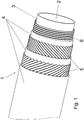
- the drawing shows a particularly preferred embodiment of a flexible tube using the wires / narrow strips according to the invention.
- a flexible tube 1 which is made using the steel or narrow strips / wires according to the invention, consists of an inner tubular inner tube 3, which has an elongated opening 2 for the conduction of fluids such as liquids or gases.
- the tubular inner tube 3 usually consists of a polymeric material and seals the elongated opening 2 and thus the fluid to be conducted from the environment.
- the tubular inner tube 3 is surrounded by several layers of polymer and at least two layers of reinforcing tape 5 and optionally one (or also several layers) of a positive-locking profile 6.
- the positive-locking profile 6 can be wound helically on the inner tube 3 at a small helix angle, as shown here.
- the interlocking profile 6 has such a cross-section that, due to the helical winding, adjacent turns of the same or one or more other interlocking profiles 6 can interlock positively along their edges and thus form a much more stable bond than if the interlocking profiles 6 just be wrapped side by side.
- the wound form-fitting profiles 6 can contribute significantly to the strength properties of the flexible tube 1.
- the reinforcing tape 5 forming this layer (or also a plurality of reinforcing tapes 5 wound side by side) can touch at the edges, but are not connected to each other.
- the reinforcing tape 5 forming this layer is also wound at a significantly larger helix angle.
- Table 1 chemical analysis of two sample alloys alloy C. Si Mn P S Al Cr N Ni V Nb 1 0.42 0.38 18.8 0.019 0.001 1.3 2.4 0.0070 0.68 0.12 0.01 2nd 0.35 0.36 17.5 0.016 0.001 1.2 2.5 0.0065 0.53 0.02 0.11 alloy Rp0.2 (MPa) Rm (MPa) Rp / Rm Elongation at break A80 (%) 1 1146 1267 0.904 16 1 1037 1238 0.838 18th 1 992 1218 0.814 20th 2nd 1103 1217 0.906 18th 2nd 1012 1193 0.848 19th 2nd 941 1176 0.800 21 1 1232 1430 0.862 13 1 1362 1567 0.869 9 1 1429 1664 0.859 8th 1 1481 1718 0.862 6
- Examples 3, 6 and 10 in Table 2 represent reference examples not belonging to the invention.
- ⁇ b> ⁇ u> Part number list ⁇ /u> ⁇ /b> 1 - flexible pipe 2nd - elongated opening 3rd - tubular inner tube 4th - Layers of polymers 5 - reinforcement tape 6 - positive locking profile
Landscapes
- Chemical & Material Sciences (AREA)
- Engineering & Computer Science (AREA)
- Mechanical Engineering (AREA)
- Metallurgy (AREA)
- Materials Engineering (AREA)
- Organic Chemistry (AREA)
- Thermal Sciences (AREA)
- Crystallography & Structural Chemistry (AREA)
- Physics & Mathematics (AREA)
- General Engineering & Computer Science (AREA)
- Health & Medical Sciences (AREA)
- Child & Adolescent Psychology (AREA)
- Manufacturing & Machinery (AREA)
- Rigid Pipes And Flexible Pipes (AREA)
- Heat Treatment Of Steel (AREA)
- Metal Extraction Processes (AREA)
Claims (28)
- Feuillard laminé à froid sous la forme d'un fil plat ou de profilés à complémentarité de forme en acier à résistance élevée, présentant une structure austénitique avec des propriétés TWIP, avec une composition suivante en % en poids
C 0,2 - 0,9 %,
Mn 12 - 25 %,
Si jusqu'à 0,5 %,
Al 0,5 - 2,0 %,
Cr 1,8 - 3,5 %,
S au max. 0,005 %,
P au max. 0,06 %
N au max. 0,1 %,
Mo au max. 1,5 %,
B au max. 0,01 %
Ni au max. 2,0 %,
Cu au max. 2,0 %,
Nb 0,02 - 0,35 % et/ou V 0,02 - 0,35
ainsi qu'en option
Ca au max. 0,015 %,
Ti 0,01 - 0,35 %,
et le reste étant du fer et des impuretés inévitables liées à la fabrication, avec des valeurs mécaniques suivantes
Rp0,2 1000 - 1500 MPa,
Rm 1100 - 1700 MPa,
A80 6 - 25 %,
pour la fabrication de couches d'armature dans des tubes flexibles pour l'extraction de pétrole et de gaz naturel ainsi que pour le transport de gaz naturel liquéfié (GNL) avec des conditions de gaz acide pour des milieux agressifs acides. - Feuillard laminé à froid selon la revendication 1, caractérisé en ce que la teneur en C est de 0,3 - 0,6 %.
- Feuillard laminé à froid selon la revendication 1, caractérisé en ce que la teneur en Mn est de 16 - 23 %.
- Feuillard laminé à froid selon la revendication 1, caractérisé en ce que la teneur en Si est de 0,2 - 0,5 %.
- Feuillard laminé à froid selon la revendication 1, caractérisé en ce que la teneur en Al est de 0,80 - 1,5 %.
- Feuillard laminé à froid selon la revendication 1, caractérisé en ce que la teneur en Cr est de 2,0 à 2,7 %.
- Feuillard laminé à froid selon la revendication 1, caractérisé en ce que la teneur en S est au max. de 0,003 %.
- Feuillard laminé à froid selon la revendication 1, caractérisé en ce que la teneur en P est au max. de 0,035 %.
- Feuillard laminé à froid selon la revendication 1, caractérisé en ce que la teneur en Nb et/ou en V est de respectivement 0,05 - 0,20 %.
- Feuillard laminé à froid selon l'une quelconque des revendications précédentes, caractérisé en ce que le feuillard présente des arêtes rondes ou plates ou laminées de manière définie.
- Feuillard laminé à froid selon l'une quelconque des revendications précédentes, caractérisé en ce que le feuillard présente une section transversale sous la forme d'un profilé en Z.
- Procédé servant à fabriquer un feuillard laminé à froid sous la forme d'un fil plat ou de profilés à complémentarité de forme à partir d'un acier à résistance élevée selon la revendication 1,
caractérisé en ce que
l'acier à résistance élevée est coulé en billettes ou en blocs, les billettes ou les blocs sont laminés au moyen d'un laminage à chaud sur un diamètre de fil entre 5 - 30 mm et sont décalaminés, puis est tréfilé en tant que fil sur un diamètre intermédiaire défini dans l'état froid en une ou plusieurs passes sur une installation de tréfilage, ledit fil d'acier étant après quoi laminé à froid sur les dimensions finales et la forme finale en une ou plusieurs passes en intercalant au moins un traitement de recuit. - Procédé selon la revendication 12, caractérisé en ce que la matière fondue en acier est traitée avec un traitement au calcium avec une teneur en Ca au min. de 0,0015 % en poids.
- Procédé selon la revendication 12, caractérisé en ce qu'un alliage en acier fondu dans une aciérie électrique selon la revendication 1 est traité ultérieurement selon une technique de métallurgie secondaire, est dégazéifié dans une installation sous vide et est coulé par coulée continue en des billettes ou des blocs.
- Procédé selon l'une quelconque des revendications 12 à 14, caractérisé en ce que les billettes ou les blocs coulés directement ou adaptés dans des blocs, de préférence carrés sont réchauffés dans un four de chauffage à des températures d'env. 1150 °C et sont laminés dans une ligne de fil de laminage sur un diamètre de fil entre 5 - 30 mm puis sont refroidis.
- Procédé selon l'une quelconque des revendications 12 à 15, caractérisé en ce que le fil d'acier laminé à chaud est décapé aux fins du décalaminage, en particulier est décapé dans des acides lactiques ou est décalaminé mécaniquement, puis est tréfilé sur un diamètre intermédiaire défini dans l'état froid en une ou plusieurs passes sur une installation de tréfilage.
- Procédé selon la revendication 12 à 16, caractérisé en ce que le fil d'acier tréfilé à froid se voit conférer au moyen d'un laminage à plat du fil une dimension intermédiaire, au moyen d'un traitement de recuit et d'au moins un laminage à froid une dimension finale rectangulaire avec des arêtes rondes ou plates ou laminées de manière définie.
- Procédé selon l'une quelconque des revendications 12 à 17, caractérisé en ce que le fil d'acier tréfilé à froid est laminé sur un profil intermédiaire défini en une ou plusieurs passes au moyen d'un laminage à froid, puis est recuit au moins une fois et se voit conférer par au moins un laminage à froid la forme finale profilée, en particulier une forme de profilé d'un profilé à complémentarité de forme profilée en forme de Z ou d'une autre manière.
- Procédé selon la revendication 18, caractérisé en ce qu'un traitement de recuit est effectué après le laminage à froid sur la forme finale profilée.
- Procédé selon la revendication 19, caractérisé en ce qu'est effectué après le laminage à froid sur la forme finale profilée un recuit de détente ou un recuit de stabilisation dans la plage de températures entre 400 - 700 °C.
- Procédé selon l'une quelconque des revendications 17 à 20, caractérisé en ce que le traitement de recuit est effectué entre les traitements de tréfilage et/ou de laminage en tant que recuit sous cloche dans la bobine, sous un gaz protecteur, de préférée sous une atmosphère de H2.
- Procédé selon l'une quelconque des revendications 17 à 20, caractérisé en ce que le traitement de recuit est effectué entre les traitements de tréfilage et/ou de laminage dans le procédé continu avec un chauffage par conduction.
- Procédé selon l'une quelconque des revendications 17 à 20, caractérisé en ce que le traitement de recuit est effectué entre les traitements de tréfilage et/ou de laminage dans le procédé continu avec un chauffage par induction.
- Utilisation du feuillard laminé à froid sous la forme d'un fil plat ou de profilés à complémentarité de forme selon la revendication 1 en tant que bande d'armature pour des couches d'armature pour un tube flexible pour l'extraction de pétrole et de gaz naturel ainsi que pour le transport de gaz naturel liquéfié (GNL) avec des conditions de gaz acide (milieux agressifs acides), le tube flexible présentant un conduit de fluide de type tuyau flexible ainsi qu'au moins une couche de bandes d'armature disposées de manière hélicoïdale dans le conduit de fluide ou enroulées sur ou par-dessus le conduit de fluide, composées de l'acier à résistance élevée pour le feuillard laminé à froid sous la forme de fil plat ou de profilés selon la revendication 1.
- Utilisation du feuillard laminé à froid selon la revendication 24, caractérisé en ce que le feuillard peut être employé en tant que profilé à complémentarité de forme formé de manière correspondante dans sa section transversale.
- Utilisation du feuillard laminé à froid selon la revendication 25, caractérisé en ce que le feuillard avec une section transversale profilée peut être employé en tant que profilé en Z en tant que bande d'armature pour la fabrication de couches d'armature enroulées.
- Utilisation du feuillard laminé à froid selon la revendication 24, caractérisée en ce que l'acier à résistance élevée pour un feuillard avec des arêtes rondes ou plates ou laminées de manière définie peut être employé en tant que bande de renforcement pour la fabrication de couches d'armature enroulées.
- Utilisation du feuillard laminé à froid selon la revendication 1 pour des carcasses dans une partie centrale flexible de type tuyau flexible du tube flexible.
Applications Claiming Priority (2)
| Application Number | Priority Date | Filing Date | Title |
|---|---|---|---|
| DE102013012118.3A DE102013012118A1 (de) | 2013-07-18 | 2013-07-18 | Kaltgewalztes Schmalband in Form von Flachdraht oder Profilen aus einem hochfesten Stahl für den Einsatz in flexiblen Rohren, insbesondere in flexiblen Rohren für Offshore-Anwendungen sowie Verfahren zur Herstellung derartiger kaltgewalzter Schmalbänder |
| PCT/DE2014/000370 WO2015007265A2 (fr) | 2013-07-18 | 2014-07-16 | Feuillard laminé à froid sous forme de fil plat ou de profilés en acier à haute résistance destinés à être utilisés dans des tuyaux souples, en particulier des tuyaux souples pour applications offshore, ainsi que procédé de fabrication de tels feuillards laminés à froid |
Publications (2)
| Publication Number | Publication Date |
|---|---|
| EP3021991A2 EP3021991A2 (fr) | 2016-05-25 |
| EP3021991B1 true EP3021991B1 (fr) | 2020-03-18 |
Family
ID=51352377
Family Applications (1)
| Application Number | Title | Priority Date | Filing Date |
|---|---|---|---|
| EP14750684.4A Active EP3021991B1 (fr) | 2013-07-18 | 2014-07-16 | Feuillard laminé à froid sous forme de fil plat ou de profilés en acier à haute résistance destinés à être utilisés dans des tuyaux souples, en particulier des tuyaux souples pour applications offshore, ainsi que procédé de fabrication de tels feuillards laminés à froid |
Country Status (9)
| Country | Link |
|---|---|
| US (1) | US10378681B2 (fr) |
| EP (1) | EP3021991B1 (fr) |
| CN (1) | CN105392909B (fr) |
| AU (2) | AU2014292565A1 (fr) |
| BR (1) | BR112016000406B1 (fr) |
| DE (1) | DE102013012118A1 (fr) |
| DK (1) | DK3021991T3 (fr) |
| MY (1) | MY177659A (fr) |
| WO (1) | WO2015007265A2 (fr) |
Families Citing this family (9)
| Publication number | Priority date | Publication date | Assignee | Title |
|---|---|---|---|---|
| DE102016010172A1 (de) | 2016-08-18 | 2018-02-22 | C.D. Wälzholz GmbH | Verfahren zum Verschweißen kaltgewalzter Schmalbänder in Form von Flachdraht oder Profilen aus einem TWIP-Stahl sowie kaltgewalztes Schmalband in Form von Flachdraht oder Profilen aus einem TWIP-Stahl, insbesondere für den Einsatz in flexiblen Rohren für Offshore-Anwendungen |
| WO2018174270A1 (fr) * | 2017-03-24 | 2018-09-27 | 新日鐵住金株式会社 | Fil machine et fil d'acier plat |
| CN110709528A (zh) * | 2017-04-11 | 2020-01-17 | 蒂森克虏伯钢铁欧洲股份公司 | 经冷轧、罩式退火的扁钢产品及其制造方法 |
| CN108330406A (zh) * | 2018-05-17 | 2018-07-27 | 东北大学 | 一种高强度高塑性冷轧中锰钢及其制备方法 |
| EP3674425B1 (fr) * | 2018-12-31 | 2022-05-04 | Baker Hughes Energy Technology UK Limited | Fil d'acier |
| CN111270157A (zh) * | 2020-02-28 | 2020-06-12 | 江苏汉唐环保科技有限公司 | 一种金属软管及制备工艺 |
| CN111118412B (zh) * | 2020-03-10 | 2021-07-20 | 晟普特(北京)防护科技有限公司 | 一种防弹钢板及其热处理方法 |
| CN113275405B (zh) * | 2021-04-23 | 2024-02-06 | 中国科学院合肥物质科学研究院 | 一种twip钢丝直接拉拔成形的方法 |
| CN116926443B (zh) * | 2022-04-07 | 2025-12-16 | 南京钢铁股份有限公司 | 超低温钢及其热处理工艺和应用 |
Family Cites Families (8)
| Publication number | Priority date | Publication date | Assignee | Title |
|---|---|---|---|---|
| FR2796083B1 (fr) * | 1999-07-07 | 2001-08-31 | Usinor | Procede de fabrication de bandes en alliage fer-carbone-manganese, et bandes ainsi produites |
| DK200001510A (da) * | 2000-10-10 | 2000-10-10 | Nkt Flexibles Is | Armeret fleksibel rørledning |
| DE102004048443B3 (de) | 2004-10-02 | 2005-12-01 | C.D. Wälzholz-Brockhaus GmbH | Verfahren zur walztechnischen Verformung von draht- und stabförmigem Vormaterial, Vorrichtung zur Durchführung des Verfahrens sowie nach dem Verfahren hergestelltes Flachprofil |
| EP2553305A4 (fr) | 2010-03-31 | 2014-06-18 | Nat Oilwell Varco Denmark Is | Conduite souple non liée et système offshore |
| EP2383353B2 (fr) * | 2010-04-30 | 2025-12-31 | ThyssenKrupp Steel Europe AG | Acier à résistance élevée comprenant du Mn, produit plat en acier composé d'un tel acier et son procédé de fabrication |
| EP2402472B2 (fr) | 2010-07-02 | 2017-11-15 | ThyssenKrupp Steel Europe AG | Acier à résistance élevée pouvant être déformé à froid et produit plat en acier constitué d'un tel acier |
| WO2012171753A1 (fr) | 2011-06-17 | 2012-12-20 | Unilever N.V. | Récipient souple |
| BR112013032388B1 (pt) | 2011-06-17 | 2020-09-29 | National Oilwell Varco Denmark I / S | Tubo flexível não unido para aplicações fora da costa, e, uso de aço manganês |
-
2013
- 2013-07-18 DE DE102013012118.3A patent/DE102013012118A1/de not_active Withdrawn
-
2014
- 2014-07-16 MY MYPI2016700085A patent/MY177659A/en unknown
- 2014-07-16 CN CN201480040024.8A patent/CN105392909B/zh active Active
- 2014-07-16 BR BR112016000406-0A patent/BR112016000406B1/pt active IP Right Grant
- 2014-07-16 WO PCT/DE2014/000370 patent/WO2015007265A2/fr not_active Ceased
- 2014-07-16 US US14/905,302 patent/US10378681B2/en active Active
- 2014-07-16 DK DK14750684.4T patent/DK3021991T3/da active
- 2014-07-16 AU AU2014292565A patent/AU2014292565A1/en not_active Abandoned
- 2014-07-16 EP EP14750684.4A patent/EP3021991B1/fr active Active
-
2018
- 2018-05-15 AU AU2018203405A patent/AU2018203405B2/en active Active
Non-Patent Citations (1)
| Title |
|---|
| None * |
Also Published As
| Publication number | Publication date |
|---|---|
| WO2015007265A3 (fr) | 2015-05-14 |
| US10378681B2 (en) | 2019-08-13 |
| DK3021991T3 (da) | 2020-06-22 |
| MY177659A (en) | 2020-09-23 |
| EP3021991A2 (fr) | 2016-05-25 |
| AU2018203405A1 (en) | 2018-06-07 |
| CN105392909B (zh) | 2018-02-27 |
| CN105392909A (zh) | 2016-03-09 |
| BR112016000406B1 (pt) | 2020-10-20 |
| US20160178093A1 (en) | 2016-06-23 |
| AU2014292565A1 (en) | 2016-02-04 |
| WO2015007265A2 (fr) | 2015-01-22 |
| AU2018203405B2 (en) | 2020-07-09 |
| DE102013012118A1 (de) | 2015-01-22 |
Similar Documents
| Publication | Publication Date | Title |
|---|---|---|
| EP3021991B1 (fr) | Feuillard laminé à froid sous forme de fil plat ou de profilés en acier à haute résistance destinés à être utilisés dans des tuyaux souples, en particulier des tuyaux souples pour applications offshore, ainsi que procédé de fabrication de tels feuillards laminés à froid | |
| EP2663411B1 (fr) | Procédé de fabrication d'un produit en acier plat laminé a chaud | |
| EP3535431B1 (fr) | Produit d'acier à teneur en manganèse intermédiaire pour application à basse température et son procédé de fabrication | |
| EP2840159B1 (fr) | Procédé destiné à la fabrication d'un composant en acier | |
| WO2017068008A1 (fr) | Tube composite constitué d'un tube de support et d'au moins un tube de protection et procédé de fabrication associé | |
| EP3325678B1 (fr) | Acier léger deformable de construction présentant des propriétés mécaniques améliorées et procédé de fabrication de produit semi-fini à partir de cet acier | |
| WO2013113304A2 (fr) | Acier multiphases très résistant, aux propriétés améliorées lors de sa fabrication et de son traitement | |
| DE3240621A1 (de) | Stahldraht fuer den litzenstahlkern eines stahlverstaerkten aluminiumleiters und verfahren zu dessen herstellung | |
| DE102014102452A1 (de) | Verfahren zur Herstellung von warmgewalzten, nahtlosen Rohren aus umwandlungsfähigem Stahl, insbesondere für Rohrleitungen für Tiefwasseranwendungen und entsprechende Rohre | |
| WO2016078644A1 (fr) | Acier polyphasé, trempé à l'air et à haute résistance, ayant d'excellentes propriétés de mise en oeuvre et procédé de production d'une bande avec cet acier | |
| WO2014206772A1 (fr) | Barreau de crible, crible à barreaux et procédé de fabrication d'un barreau de crible | |
| DE3238718A1 (de) | Verfahren zur herstellung eines zweiphasen-walzstahlprodukts und hiernach hergestellte produkte | |
| WO2018210673A1 (fr) | Procédé de fabrication d'un tuyau en acier résistant à l'usure, tuyau en acier résistant à l'usure et utilisation de ce type de tuyau en acier | |
| JP5783067B2 (ja) | 金網 | |
| EP3329026B1 (fr) | Procede de fabrication de tubes hydroformes en acier fortement allié | |
| DE3134532A1 (de) | "stahl, verfahren zu seiner herstellung und seine verwendung zur herstellung von elektrogeschweissten rohrerzeugnissen" | |
| EP4047105A1 (fr) | Produit en acier plat laminé à chaud et procédé de fabrication d'un produit en acier plat laminé à chaud | |
| DE2545171B2 (de) | Verfahren zum Herstellen von Drahtgittern | |
| EP3469108B1 (fr) | Procédé de fabrication d'une bande d'acier laminée à froid présentant des propriétés trip à partir d'un acier à résistance élevée contenant du manganèse | |
| EP3771746A1 (fr) | Acier, produit plan en acier, procédé de fabrication d'un produit plan en acier et utilisation | |
| EP4211279A1 (fr) | Produit plat en acier laminé à chaud et procédé de production d'un produit plat en acier laminé à chaud | |
| DE3222292A1 (de) | Legierung vom invar-typ mit niedriger waermeausdehnung und einem extrem hohen widerstand gegen waermerisse beim schweissen | |
| EP1802894B1 (fr) | Chaine en acier haute resistance pour les basses temperatures | |
| EP3500389B1 (fr) | Procédé de soudure d'une bande étroite laminée à froid sous la forme d'un fil plat ou d'un élément profilé en acier twip utilisable dans des tuyaux flexibles et bande laminée à froid soudée | |
| DE112023003677T5 (de) | Beschichtetes Stahlblech auf Zinkbasis |
Legal Events
| Date | Code | Title | Description |
|---|---|---|---|
| PUAI | Public reference made under article 153(3) epc to a published international application that has entered the european phase |
Free format text: ORIGINAL CODE: 0009012 |
|
| 17P | Request for examination filed |
Effective date: 20160203 |
|
| AK | Designated contracting states |
Kind code of ref document: A2 Designated state(s): AL AT BE BG CH CY CZ DE DK EE ES FI FR GB GR HR HU IE IS IT LI LT LU LV MC MK MT NL NO PL PT RO RS SE SI SK SM TR |
|
| AX | Request for extension of the european patent |
Extension state: BA ME |
|
| DAX | Request for extension of the european patent (deleted) | ||
| STAA | Information on the status of an ep patent application or granted ep patent |
Free format text: STATUS: EXAMINATION IS IN PROGRESS |
|
| 17Q | First examination report despatched |
Effective date: 20170918 |
|
| REG | Reference to a national code |
Ref country code: DE Ref legal event code: R079 Ref document number: 502014013824 Country of ref document: DE Free format text: PREVIOUS MAIN CLASS: B21C0037040000 Ipc: B21C0001000000 |
|
| GRAP | Despatch of communication of intention to grant a patent |
Free format text: ORIGINAL CODE: EPIDOSNIGR1 |
|
| STAA | Information on the status of an ep patent application or granted ep patent |
Free format text: STATUS: GRANT OF PATENT IS INTENDED |
|
| RIC1 | Information provided on ipc code assigned before grant |
Ipc: C21D 9/14 20060101ALI20191016BHEP Ipc: C22C 38/18 20060101ALI20191016BHEP Ipc: C22C 38/58 20060101ALI20191016BHEP Ipc: B21C 1/00 20060101AFI20191016BHEP Ipc: C21D 6/00 20060101ALI20191016BHEP Ipc: C21D 1/22 20060101ALI20191016BHEP Ipc: C22C 38/06 20060101ALI20191016BHEP Ipc: C22C 38/04 20060101ALI20191016BHEP Ipc: B22D 7/00 20060101ALI20191016BHEP Ipc: C22C 38/48 20060101ALI20191016BHEP Ipc: C22C 38/08 20060101ALI20191016BHEP Ipc: C21D 1/30 20060101ALI20191016BHEP Ipc: C21D 9/52 20060101ALI20191016BHEP Ipc: C21D 8/06 20060101ALI20191016BHEP Ipc: C21D 8/02 20060101ALI20191016BHEP Ipc: C21D 1/25 20060101ALI20191016BHEP Ipc: F16L 11/08 20060101ALI20191016BHEP Ipc: C21D 9/08 20060101ALI20191016BHEP Ipc: C22C 38/00 20060101ALI20191016BHEP Ipc: C22C 38/12 20060101ALI20191016BHEP |
|
| INTG | Intention to grant announced |
Effective date: 20191105 |
|
| GRAS | Grant fee paid |
Free format text: ORIGINAL CODE: EPIDOSNIGR3 |
|
| GRAA | (expected) grant |
Free format text: ORIGINAL CODE: 0009210 |
|
| STAA | Information on the status of an ep patent application or granted ep patent |
Free format text: STATUS: THE PATENT HAS BEEN GRANTED |
|
| AK | Designated contracting states |
Kind code of ref document: B1 Designated state(s): AL AT BE BG CH CY CZ DE DK EE ES FI FR GB GR HR HU IE IS IT LI LT LU LV MC MK MT NL NO PL PT RO RS SE SI SK SM TR |
|
| REG | Reference to a national code |
Ref country code: GB Ref legal event code: FG4D Free format text: NOT ENGLISH |
|
| REG | Reference to a national code |
Ref country code: DE Ref legal event code: R096 Ref document number: 502014013824 Country of ref document: DE |
|
| REG | Reference to a national code |
Ref country code: AT Ref legal event code: REF Ref document number: 1245328 Country of ref document: AT Kind code of ref document: T Effective date: 20200415 Ref country code: IE Ref legal event code: FG4D Free format text: LANGUAGE OF EP DOCUMENT: GERMAN |
|
| REG | Reference to a national code |
Ref country code: DK Ref legal event code: T3 Effective date: 20200615 |
|
| PG25 | Lapsed in a contracting state [announced via postgrant information from national office to epo] |
Ref country code: RS Free format text: LAPSE BECAUSE OF FAILURE TO SUBMIT A TRANSLATION OF THE DESCRIPTION OR TO PAY THE FEE WITHIN THE PRESCRIBED TIME-LIMIT Effective date: 20200318 Ref country code: FI Free format text: LAPSE BECAUSE OF FAILURE TO SUBMIT A TRANSLATION OF THE DESCRIPTION OR TO PAY THE FEE WITHIN THE PRESCRIBED TIME-LIMIT Effective date: 20200318 Ref country code: NO Free format text: LAPSE BECAUSE OF FAILURE TO SUBMIT A TRANSLATION OF THE DESCRIPTION OR TO PAY THE FEE WITHIN THE PRESCRIBED TIME-LIMIT Effective date: 20200618 |
|
| REG | Reference to a national code |
Ref country code: NL Ref legal event code: MP Effective date: 20200318 |
|
| PG25 | Lapsed in a contracting state [announced via postgrant information from national office to epo] |
Ref country code: SE Free format text: LAPSE BECAUSE OF FAILURE TO SUBMIT A TRANSLATION OF THE DESCRIPTION OR TO PAY THE FEE WITHIN THE PRESCRIBED TIME-LIMIT Effective date: 20200318 Ref country code: GR Free format text: LAPSE BECAUSE OF FAILURE TO SUBMIT A TRANSLATION OF THE DESCRIPTION OR TO PAY THE FEE WITHIN THE PRESCRIBED TIME-LIMIT Effective date: 20200619 Ref country code: LV Free format text: LAPSE BECAUSE OF FAILURE TO SUBMIT A TRANSLATION OF THE DESCRIPTION OR TO PAY THE FEE WITHIN THE PRESCRIBED TIME-LIMIT Effective date: 20200318 Ref country code: HR Free format text: LAPSE BECAUSE OF FAILURE TO SUBMIT A TRANSLATION OF THE DESCRIPTION OR TO PAY THE FEE WITHIN THE PRESCRIBED TIME-LIMIT Effective date: 20200318 Ref country code: BG Free format text: LAPSE BECAUSE OF FAILURE TO SUBMIT A TRANSLATION OF THE DESCRIPTION OR TO PAY THE FEE WITHIN THE PRESCRIBED TIME-LIMIT Effective date: 20200618 |
|
| REG | Reference to a national code |
Ref country code: LT Ref legal event code: MG4D |
|
| PG25 | Lapsed in a contracting state [announced via postgrant information from national office to epo] |
Ref country code: NL Free format text: LAPSE BECAUSE OF FAILURE TO SUBMIT A TRANSLATION OF THE DESCRIPTION OR TO PAY THE FEE WITHIN THE PRESCRIBED TIME-LIMIT Effective date: 20200318 |
|
| PG25 | Lapsed in a contracting state [announced via postgrant information from national office to epo] |
Ref country code: IS Free format text: LAPSE BECAUSE OF FAILURE TO SUBMIT A TRANSLATION OF THE DESCRIPTION OR TO PAY THE FEE WITHIN THE PRESCRIBED TIME-LIMIT Effective date: 20200718 Ref country code: CZ Free format text: LAPSE BECAUSE OF FAILURE TO SUBMIT A TRANSLATION OF THE DESCRIPTION OR TO PAY THE FEE WITHIN THE PRESCRIBED TIME-LIMIT Effective date: 20200318 Ref country code: RO Free format text: LAPSE BECAUSE OF FAILURE TO SUBMIT A TRANSLATION OF THE DESCRIPTION OR TO PAY THE FEE WITHIN THE PRESCRIBED TIME-LIMIT Effective date: 20200318 Ref country code: SK Free format text: LAPSE BECAUSE OF FAILURE TO SUBMIT A TRANSLATION OF THE DESCRIPTION OR TO PAY THE FEE WITHIN THE PRESCRIBED TIME-LIMIT Effective date: 20200318 Ref country code: LT Free format text: LAPSE BECAUSE OF FAILURE TO SUBMIT A TRANSLATION OF THE DESCRIPTION OR TO PAY THE FEE WITHIN THE PRESCRIBED TIME-LIMIT Effective date: 20200318 Ref country code: EE Free format text: LAPSE BECAUSE OF FAILURE TO SUBMIT A TRANSLATION OF THE DESCRIPTION OR TO PAY THE FEE WITHIN THE PRESCRIBED TIME-LIMIT Effective date: 20200318 Ref country code: PT Free format text: LAPSE BECAUSE OF FAILURE TO SUBMIT A TRANSLATION OF THE DESCRIPTION OR TO PAY THE FEE WITHIN THE PRESCRIBED TIME-LIMIT Effective date: 20200812 Ref country code: SM Free format text: LAPSE BECAUSE OF FAILURE TO SUBMIT A TRANSLATION OF THE DESCRIPTION OR TO PAY THE FEE WITHIN THE PRESCRIBED TIME-LIMIT Effective date: 20200318 |
|
| REG | Reference to a national code |
Ref country code: DE Ref legal event code: R097 Ref document number: 502014013824 Country of ref document: DE |
|
| PLBE | No opposition filed within time limit |
Free format text: ORIGINAL CODE: 0009261 |
|
| STAA | Information on the status of an ep patent application or granted ep patent |
Free format text: STATUS: NO OPPOSITION FILED WITHIN TIME LIMIT |
|
| PG25 | Lapsed in a contracting state [announced via postgrant information from national office to epo] |
Ref country code: ES Free format text: LAPSE BECAUSE OF FAILURE TO SUBMIT A TRANSLATION OF THE DESCRIPTION OR TO PAY THE FEE WITHIN THE PRESCRIBED TIME-LIMIT Effective date: 20200318 Ref country code: IT Free format text: LAPSE BECAUSE OF FAILURE TO SUBMIT A TRANSLATION OF THE DESCRIPTION OR TO PAY THE FEE WITHIN THE PRESCRIBED TIME-LIMIT Effective date: 20200318 |
|
| 26N | No opposition filed |
Effective date: 20201221 |
|
| PG25 | Lapsed in a contracting state [announced via postgrant information from national office to epo] |
Ref country code: MC Free format text: LAPSE BECAUSE OF FAILURE TO SUBMIT A TRANSLATION OF THE DESCRIPTION OR TO PAY THE FEE WITHIN THE PRESCRIBED TIME-LIMIT Effective date: 20200318 Ref country code: PL Free format text: LAPSE BECAUSE OF FAILURE TO SUBMIT A TRANSLATION OF THE DESCRIPTION OR TO PAY THE FEE WITHIN THE PRESCRIBED TIME-LIMIT Effective date: 20200318 |
|
| REG | Reference to a national code |
Ref country code: CH Ref legal event code: PL |
|
| PG25 | Lapsed in a contracting state [announced via postgrant information from national office to epo] |
Ref country code: CH Free format text: LAPSE BECAUSE OF NON-PAYMENT OF DUE FEES Effective date: 20200731 Ref country code: LI Free format text: LAPSE BECAUSE OF NON-PAYMENT OF DUE FEES Effective date: 20200731 Ref country code: LU Free format text: LAPSE BECAUSE OF NON-PAYMENT OF DUE FEES Effective date: 20200716 |
|
| PG25 | Lapsed in a contracting state [announced via postgrant information from national office to epo] |
Ref country code: SI Free format text: LAPSE BECAUSE OF FAILURE TO SUBMIT A TRANSLATION OF THE DESCRIPTION OR TO PAY THE FEE WITHIN THE PRESCRIBED TIME-LIMIT Effective date: 20200318 |
|
| PG25 | Lapsed in a contracting state [announced via postgrant information from national office to epo] |
Ref country code: IE Free format text: LAPSE BECAUSE OF NON-PAYMENT OF DUE FEES Effective date: 20200716 |
|
| REG | Reference to a national code |
Ref country code: AT Ref legal event code: MM01 Ref document number: 1245328 Country of ref document: AT Kind code of ref document: T Effective date: 20200716 |
|
| PG25 | Lapsed in a contracting state [announced via postgrant information from national office to epo] |
Ref country code: AT Free format text: LAPSE BECAUSE OF NON-PAYMENT OF DUE FEES Effective date: 20200716 |
|
| PG25 | Lapsed in a contracting state [announced via postgrant information from national office to epo] |
Ref country code: TR Free format text: LAPSE BECAUSE OF FAILURE TO SUBMIT A TRANSLATION OF THE DESCRIPTION OR TO PAY THE FEE WITHIN THE PRESCRIBED TIME-LIMIT Effective date: 20200318 Ref country code: MT Free format text: LAPSE BECAUSE OF FAILURE TO SUBMIT A TRANSLATION OF THE DESCRIPTION OR TO PAY THE FEE WITHIN THE PRESCRIBED TIME-LIMIT Effective date: 20200318 Ref country code: CY Free format text: LAPSE BECAUSE OF FAILURE TO SUBMIT A TRANSLATION OF THE DESCRIPTION OR TO PAY THE FEE WITHIN THE PRESCRIBED TIME-LIMIT Effective date: 20200318 |
|
| PG25 | Lapsed in a contracting state [announced via postgrant information from national office to epo] |
Ref country code: MK Free format text: LAPSE BECAUSE OF FAILURE TO SUBMIT A TRANSLATION OF THE DESCRIPTION OR TO PAY THE FEE WITHIN THE PRESCRIBED TIME-LIMIT Effective date: 20200318 Ref country code: AL Free format text: LAPSE BECAUSE OF FAILURE TO SUBMIT A TRANSLATION OF THE DESCRIPTION OR TO PAY THE FEE WITHIN THE PRESCRIBED TIME-LIMIT Effective date: 20200318 |
|
| PGFP | Annual fee paid to national office [announced via postgrant information from national office to epo] |
Ref country code: BE Payment date: 20250611 Year of fee payment: 12 |
|
| PGFP | Annual fee paid to national office [announced via postgrant information from national office to epo] |
Ref country code: FR Payment date: 20250521 Year of fee payment: 12 |
|
| PGFP | Annual fee paid to national office [announced via postgrant information from national office to epo] |
Ref country code: DK Payment date: 20250714 Year of fee payment: 12 Ref country code: DE Payment date: 20250326 Year of fee payment: 12 |
|
| PGFP | Annual fee paid to national office [announced via postgrant information from national office to epo] |
Ref country code: GB Payment date: 20250716 Year of fee payment: 12 |