EP3024253A1 - Audiosystem und Verfahren - Google Patents
Audiosystem und Verfahren Download PDFInfo
- Publication number
- EP3024253A1 EP3024253A1 EP14194268.0A EP14194268A EP3024253A1 EP 3024253 A1 EP3024253 A1 EP 3024253A1 EP 14194268 A EP14194268 A EP 14194268A EP 3024253 A1 EP3024253 A1 EP 3024253A1
- Authority
- EP
- European Patent Office
- Prior art keywords
- processor
- positions
- virtual
- channel
- audio data
- Prior art date
- Legal status (The legal status is an assumption and is not a legal conclusion. Google has not performed a legal analysis and makes no representation as to the accuracy of the status listed.)
- Withdrawn
Links
Images



Classifications
-
- H—ELECTRICITY
- H04—ELECTRIC COMMUNICATION TECHNIQUE
- H04S—STEREOPHONIC SYSTEMS
- H04S7/00—Indicating arrangements; Control arrangements, e.g. balance control
- H04S7/30—Control circuits for electronic adaptation of the sound field
- H04S7/302—Electronic adaptation of stereophonic sound system to listener position or orientation
- H04S7/303—Tracking of listener position or orientation
-
- H—ELECTRICITY
- H04—ELECTRIC COMMUNICATION TECHNIQUE
- H04R—LOUDSPEAKERS, MICROPHONES, GRAMOPHONE PICK-UPS OR LIKE ACOUSTIC ELECTROMECHANICAL TRANSDUCERS; ELECTRIC HEARING AIDS; PUBLIC ADDRESS SYSTEMS
- H04R3/00—Circuits for transducers
-
- H—ELECTRICITY
- H04—ELECTRIC COMMUNICATION TECHNIQUE
- H04S—STEREOPHONIC SYSTEMS
- H04S7/00—Indicating arrangements; Control arrangements, e.g. balance control
- H04S7/30—Control circuits for electronic adaptation of the sound field
- H04S7/301—Automatic calibration of stereophonic sound system, e.g. with test microphone
-
- H—ELECTRICITY
- H04—ELECTRIC COMMUNICATION TECHNIQUE
- H04S—STEREOPHONIC SYSTEMS
- H04S2400/00—Details of stereophonic systems covered by H04S but not provided for in its groups
- H04S2400/01—Multi-channel, i.e. more than two input channels, sound reproduction with two speakers wherein the multi-channel information is substantially preserved
Definitions
- Various embodiments relate to an audio system and to a corresponding method.
- various embodiments relate to techniques of routing channels of a multi-channel audio data to output channels of the audio system.
- Playback of the multi-channel audio data can be achieved by employing a respectively configured audio system which typically comprises at least one processor having a respective number of output channels and possibly an amplifier as an end stage to which speakers may be connected.
- the multi-channel audio data is provided with respect to a certain standard arrangement of speaker positions. If the positions of the speakers connected to the output channels do not deviate significantly from this standard arrangement, a good listening experience may be achieved. In particular, it may be possible to compensate to some extent for a misalignment of the positions of the speakers with respect to the standard arrangement. E.g., differences in the distance between the various speakers with respect to an audio sweet spot may be compensated for.
- the audio sweet spot is therefore defined with respect to the positions of the speakers.
- playback of the plurality of speakers may be synchronized with respect to each other. Playback of surround sound becomes possible.
- typically a particularly good listening experience may be provided if the listening position of a user coincides with an audio sweet spot.
- an audio system comprising at least one processor.
- the at least one processor is configured to receive multi-channel audio data from an audio source.
- the multi-channel audio data includes a plurality of channels.
- the at least one processor comprises a plurality of output channels. Each output channel is configured to be connected to a respective speaker.
- the at least one processor is coupled to a memory.
- the at least one processor is further configured to receive, from the memory, preset positions of the plurality of speakers and virtual positions.
- the virtual positions are associated with the plurality of channels of the multi-channel audio data.
- the at least one processor is further configured to establish control instructions based on the preset positions and the virtual positions.
- the at least one processor is further configured to route the channels of the multi-channel audio data to the output channels based on the control instructions.
- the multi-channel audio data may comprise two, three, four, five, six, seven, or even more channels.
- Each channel of the multi-channel audio data may relate to a specific audio track which is specified by digital or analogue audio data.
- the audio source may be a storage medium which stores the multi-channel audio data.
- the audio source is a recording entity which records the multi-channel audio data.
- Each one of the plurality of output channels may comprise a respective connector to which a speaker can be connected using, e.g., a wired connection.
- the speakers are connectable to the output channels via a wireless data communication.
- the output channels may each comprise a wireless interface.
- the audio system also comprises the speakers.
- speakers are separate entities.
- the routing comprises audio processing of at least one channel of the multi-channel audio data is executed based on the control data.
- the audio processing may employ techniques of digital audio processing and / or analogue audio processing.
- the audio processing may include applying filters, effects such as echo, fade, etc., delays, and / or phase shifts, etc.
- each channel of the multi-channel audio data is fixedly routed to a given output channel.
- each channel of the multi-channel audio data is fixedly associated with a certain speaker and is audibly perceived at the respective preset position of the certain speaker. From this routing according to reference implementations, the audio sweet spot may result.
- the routing of the channels of the multi-channel audio data is flexibly set based on the control instructions.
- the virtual positions of the speakers - corresponding to the different channels of the multi-channel audio data - can be flexibly set.
- the routing can include a phase shift or delay for the various output channels, i.e., audio processing. There may not be a fixed one-to-one correspondence between channels of the multi-channel audio data and the output channels.
- the preset positions of the speakers may correspond to the actual positions of the speakers; i.e., the preset positions may be provided measuring the actual position of the speakers and / or retrieving the actual position of the speakers from a user input and / or estimating the actual position of the speakers, etc. Thus, the preset positions may be an approximation of the actual positions of the speakers.
- the virtual positions may correspond to positions where the audio content of the associated channel of the multi-channel audio data is audibly perceived by a listener; in other words, different channels of the multi-channel audio data may be perceived at the different virtual positions.
- a channel of the multi-channel audio data is audibly perceived at the virtual position which may be flexibly set.
- the virtual positions may be set to conform with a listening position which may be defined in terms of location and / or orientation. In other words, the virtual position may be referred to as an emulated position of a respective virtual speaker.
- the virtual positions may coincide or deviate from the preset positions.
- the virtual positions may be flexibly set or may be varied. This allows to account for changes in the listening position within or even outside of the audio sweet spot.
- each channel of the multi-channel audio data may be routed to a different output channel.
- at least one channel of the multi-channel audio data is routed to a plurality of output channels.
- the number of channels of the multi-channel audio data and output channels may vary.
- the at least one processor may be configured to route a first number of channels of the multi-channel audio data to a second number of output channels based on the control instructions.
- the first number may be larger or smaller than the second number.
- the audio system may be a 7.1-audio system, i.e., providing seven output channels and an additional bass output channel.
- the multi-channel audio data may provide five audio channels. Then it may be possible to use all seven output channels to flexibly emulate various virtual positions which, e.g., deviate from the actual positions of the speakers.
- the routing may include routing at least one channel of the multi-channel audio data to more than one output channel.
- the at least one processor may be configured to route at least one channel of the multi-channel audio data to two or more output channels based on the control instructions.
- the control instructions may specify the amplitudes of each output channel to which the at least one channel of the multi-channel audio data is routed.
- the least one processor is configured to mix at least two channels of the multi-channel audio data to a given output channel based on the control instructions.
- playback of a superposition of a plurality of channels of the multi-channel audio data may be implemented. Then, it becomes possible to flexibly specify the virtual positions for a plurality of channels of the multi-channel audio data.
- Said mixing may correspond to adding the amplitudes of the at least two channels of the multi-channel audio data in a defined manner; in particular, an amplitude or relative contribution to the signal output via the given output channel may be specified for each one of the at least two channels.
- Such information may be provided in the control instructions.
- the virtual positions of the speakers such that a virtual stage defined by the channels of the multi-channel audio data conforms with the listening position.
- the virtual stage may be defined in terms of left-right / front-rear directions of the content of the multi-channel audio data.
- Audible perception of surround sound may be positioned with respect to the virtual stage. E.g., if the listening position is rotated by 180°, in a scenario where the virtual positions are not adapted, left and right perception, as well as front and rear perception will be interchanged, respectively. Then, the listening position is rotated, but the virtual stage remains fixed. A degraded listening experience would result.
- By correspondingly adjusting the virtual positions e.g., by turning the virtual stage by 180°, it is possible to compensate for this.
- the channels can be distributed among the speakers in a manner that the virtual positions are perceived by a listener at positions that are optimal for the given listening situation. This allows to compensate, e.g., for off-center positioning of center speakers or main speakers which are not symmetrically placed.
- the audio system may further comprise a human machine interface (HMI).
- HMI human machine interface
- the HMI may be configured to receive a user input from a user of the audio system.
- the at least one processor may be configured to determine and write to the memory at least one of the preset positions and / or at least one of the virtual positions based on the user input.
- the HMI may comprise elements selected from the group comprising: a keyboard, a mouse, a display, a remote control, a wireless transceiver configured to wirelessly receive the user input from a portable user equipment, a Local Area Network (LAN) transceiver configured to receive the user input from a LAN.
- a wireless transceiver configured to wirelessly receive the user input from a portable user equipment
- a Local Area Network (LAN) transceiver configured to receive the user input from a LAN.
- the user may be able to specify the virtual positions and / or the preset positions in an application executed on a smartphone.
- the user input may take various forms.
- the user input may specify, for each one of the speakers, a coordinate corresponding to the preset position and a coordinate corresponding to the virtual position; the coordinates may be defined in a reference coordinate system.
- the user may be able to flexibly set and modify all of the preset positions and the virtual positions according to his needs.
- the user may be able to manually move the virtual positions using the remote control and / or a smartphone application.
- the user input is restricted to a more specific information.
- the user input may relate to a specific mapping or offset between virtual positions and preset positions.
- the user input may indicate, for each one of the plurality of speakers, a rotation of a corresponding one of the virtual positions with respect to a reference direction.
- the reference direction may be optionally defined with respect to an orientation of the preset positions of the plurality of speakers.
- the reference direction may be defined by the preset positions, e.g., by the preset position of a center speaker or the like.
- the user may adjust the virtual positions based on the preset positions. This may make it comparably simple to achieve a desired listening experience.
- the user input may indicate a uniform rotation of the virtual positions with respect to the reference direction.
- the orientation of the virtual stage may be of value where the orientation of the listening position changes, e.g., without a change of the position of the listening position.
- the user employs two or more displays for synchronized playback of accompanying visual content. In such a scenario, the user can manually turn the audibly perceived stage.
- the preset positions for the speakers may correspond to the actual positions of the speakers.
- the reference direction is defined by means of the actual positions of the speakers; e.g., the reference direction may be defined as a center direction symmetrically located between left and right directions defined by the respective speakers connected to the corresponding output channels. Then, it is possible that by specifying the rotation of the respective virtual positions with respect to the reference direction, particular ones or all of the virtual positions are offset against the reference direction.
- the user input may indicate a selection of a given one of a plurality of candidate virtual positions as the at least one virtual position determined by the at least one processor based on the user input.
- the user may define and store the plurality of candidate virtual positions as the presets. This allows fast and simple selection of the virtual positions.
- the presets are provided for certain preferred or reoccurring listening positions, e.g., on a couch, a writing table, etc.
- the different listening positions different screens for playback of an accompanying visual content may be used.
- the listener may be orientated in another direction. The listener may switch between different listening positions, e.g., when moving from one part of a room to another part of the room.
- the user input indicates a radial offset between the at least one virtual position determined by the at least one processor based on the user input and a reference radial distance.
- the reference radial distance is defined with respect to the preset positions.
- the radial offset may be achieved by appropriately adjusting amplitudes, phase, and / or delay of the routing of the various channels of the multi-channel audio data.
- the at least one processor may be configured to execute a positioning routine.
- the positioning routine may comprise the at least one processor routing a given channel of the multi-channel audio data at two or more output channels based on the control instructions established for a present virtual position.
- the positioning routine further comprises the HMI receiving the user input indicating an offset value for the present virtual position and the at least one processor adjusting said routing of the given channel of the multi-channel audio data based on the offset value.
- Channels of the multi-channel audio data other than the given channel may be muted. In such a manner, it is possible that the user can manually move the virtual sound sources and receive audible feedback as part of the positioning routine. In such a manner, it is possible that the user can accurately position the virtual position of a speaker.
- the user input may indicate an assignment of the at least one virtual position determined by the at least one processor based on the user input to the at least one preset position determined by the at least one processor based on the user input.
- the virtual positions of a specific channel of the multi-channel audio data may be mapped to certain preset positions.
- the virtual positions may not deviate from the preset positions; nonetheless, a specific routing of channels of the multi-channel audio data to output channels is implemented depending on the user input.
- the user may easily switch the routing of the output channels between different channels of the multi-channel audio data.
- the user input may specify one or more parameters.
- the parameters specified by the user input may vary in various scenarios.
- the user input may indicate the at least one virtual position of the at least one speaker and / or the at least one preset position determined by the at least one processor based on the user input with respect to at least one of a position of a display, a position of a user, a head orientation of the user, and a reference coordinate system. In this manner, it becomes possible that the user can easily select the appropriate preset position(s) and / or virtual position(s).
- the virtual positions are determined on input parameters other than the user input.
- a calibration routine may be executed by the at least one processor.
- the calibration routine may comprise the at least one processor routing a reference signal via the output channels and the at least one processor controlling at least two microphone interfaces to each receive a recording of a playback of the reference signal as a respective calibration track.
- the at least one processor may be configured to determine the virtual positions based on the detected calibrations signals.
- stereo recording becomes possible.
- the playback may be executed serially via the output channels; only one channel may be activated at a time.
- the reference signal may be a pulse train signal and / or a signal of a given frequency or frequency bandwidth.
- the reference direction may, in turn, be defined with the reference coordinate system and / or a user input.
- the reference coordinate system may be defined by a setup of microphones connected to the microphone interfaces.
- control instructions may allow to appropriately route the channels of the multi-channel audio data to the output channels of the audio system such that the virtual positions are emulated based on the preset positions.
- various techniques of determining the control instructions may be employed.
- the at least one processor is configured to determine the control instructions for each one of the virtual positions based on a spatial difference between the respective virtual position and at least one respective neighboring one of the preset positions.
- the at least one processor may be alternatively or additionally configured to determine the control instructions based on a difference vector between the virtual positions and the position of the listening position.
- a length and / or orientation of the difference vector may be taken into account.
- an amplitude of the routing to the different output channels may be determined by the spatial distance between said virtual position and each one of the two preset positions. Further, in order to appropriately account for a direction at which the user is located, the difference vector between the virtual positions and the listening position may be taken into account.
- the preset positions are determined based on the user input. However, alternatively or additionally, it is also possible, e.g., to measure or otherwise establish the preset positions of the speakers.
- the audio system may further comprise the at least two microphone interfaces.
- the at least one processor may be configured to execute the calibration routine.
- the at least one processor may further be configured to determine the preset positions of the plurality of speakers based on the detected calibration signals.
- the determining of the virtual positions and / or the preset positions may involve detecting time differences between the detecting of the playback at each one of the at least two microphone interfaces. Triangulation techniques may be employed.
- a method comprises at least one processor of an audio system receiving multi-channel audio data from an audio source.
- the multi-channel audio data includes a plurality of channels.
- the method further comprises the at least one processor receiving preset positions of a plurality of speakers connectable to the audio system via respective output channels.
- the method further comprises the at least one processor receiving virtual positions associated with the plurality of channels of the multi-channel audio data.
- the method further comprises the at least one processor establishing control instructions based on the virtual positions and further based on the preset positions.
- the method further comprises the at least one processor routing the channels of the multi-channel audio data to the output channels based on the control instructions.
- the audio system can be configured to execute the method according to the presently discussed aspect.
- effects may be achieved which can be achieved for the audio system according to a further embodiment.
- the audio system may be an audio-video receiver or the like.
- the processor is capable of routing the various channels of the multi-channel audio data to one or more output channels.
- the routing may include audio processing, e.g., applying filters, adding effects, adding delay, and / or adding a phase shift.
- Speakers can be connected to the output channels.
- This routing is based on control instructions.
- the control instructions are determined based on preset positions of the speakers and further based on virtual positions associated with the channels of the multi-channel audio data.
- the preset positions can correspond to actual positions of the speakers while the virtual positions of the speakers can correspond to positions where a virtual speaker corresponding to the associated channel of the multi-channel audio data is audibly perceived by a user.
- the virtual positions may or may not deviate from the preset positions.
- FIG. 1 Such a scenario is illustrated in FIG. 1 .
- the preset positions 120-1 - 120-5 of the speakers are shown.
- the preset positions 120-1 - 120-5 are the actual positions of the speakers.
- the preset positions 120-1 - 120-5 may be specified by a user via a respective user input or may be measured using, e.g., two or more microphones.
- FIG. 1 it can be seen that the left/right preset positions 120-1 and 120-3 are not symmetrically arranged with respect to the center preset position 120-2.
- 5.1 multi-channel audio data is played back using conventional techniques in this scenario, a degraded listening experience results. This is because the left channel of the 5.1 audio data is routed to the speaker corresponding to the preset position 120-1, the center channel of the 5.1 audio data is routed to the speaker corresponding to the preset position 120-2, and so forth.
- the virtual stage is distorted. The surround sound perceived by the user does not match the content of the multi-channel audio data.
- the 5.1 audio data is compiled with respect to a certain standard arrangement of speakers.
- the standard arrangement e.g., the actual positions of left and right front speakers should be symmetrically arranged with respect to a front center speaker.
- the preset positions 110-1 - 110-5 deviate from the standard arrangement.
- the degraded listening experience resulting from this can correspond to a user at a listening position 150 not perceiving playback of a certain channel of the multi-channel audio data at a position conforming with the position for which the content of this channel is provided; the virtual stage may be distorted or otherwise negatively affected.
- the listening position 150 should be positioned and orientated such that the playback of the multi-channel audio data fits to the playback of the accompanying visual content on a display 160.
- the virtual stage and the display 160 should be aligned.
- the listening position 150 may be associated with an orientation (indicated in FIG. 1 by the arrow). If the listener is orientated along said orientation, the audio content may be perceived consistently with the video content.
- a center image may coincide with the position of the display 160; the center image is typically the perceived location for a centered or mono audio signal.
- Such an orientation of the listening position 150 may be of importance also where there is no video content, e.g., for audio-only recordings implementing the perception of surround sound.
- the virtual positions 110-1 - 110-5 are arranged according to the standard arrangement for which the 5.1 audio data is compiled, i.e., highly symmetrical and at defined radial distances with respect to the audio listening 150.
- the virtual stage is properly aligned.
- the perception of surround sound is aligned with the content of the multi-channel audio data.
- the virtual positions 110-1 - 110-4 are emulated by routing the channels of the multi-channel audio data to the output channels based on respectively determined control instructions.
- the control instructions are determined based on the preset positions 120-1 - 120-5 and based on the virtual positions 110-1 - 110-5. In particular, when determining the control instructions, the distance 180 between the virtual positions 110-1 - 110-4 and neighboring preset positions 120-1 - 120-5 can be taken into account.
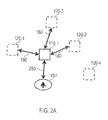
- the emulation of a given virtual position 110-1 is shown at greater detail in FIG. 2A .
- the virtual position 110-1 is emulated by routing the corresponding channel of the multi-channel audio data to the three physical speakers located at the preset positions 120-1, 120-2, 120-3 via the respective output channels.
- the routing can include a delay or phase shift for the corresponding output channels such that a coherent superposition of the signals originating from the different physical speakers is audibly perceived.
- the amplitude with which the given channel is routed to each one of the speakers at the preset positions 120-1 - 120-3 can be set appropriately. Then, the origin of the corresponding sound is perceived at the virtual position 110-1.
- FIG. 2B the routing of the respective channel 210-1 of the audio data 211 is illustrated.
- the channel 210-1 is routed to the three output channels 291-1, 291-2, 291-3 corresponding to the three physical speakers 290-1, 290-2, 290-3 discussed with respect to FIG. 2A .
- the respective control data 215 specifies to which of the output channels 291-1 - 291-3 the channel 210-1 of the multi-channel audio data 211 is routed at what amplitude (given in percentage in FIG. 2B ), as well as a delay (given in milliseconds in FIG. 2B ).
- the control data may specify further or different information such as phase, filter parameters, etc.
- FIG. 2B the scenario is shown for the single channel 210-1 of the multi-channel audio data 211.
- the processor mixes the plurality of channels 210-1 - 210-4 to a given output channel 291-1.
- the virtual positions 110-1 - 110-5 for a plurality of channels 210-1 - 210-4 may be flexibly set.
- control data 215 can specify amplitude, phase, delay, and / or frequency filter parameters, etc. to achieve this effect.
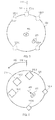
- the preset positions 120-1 - 120-5 are shown which result in the virtual stage being in conformity with the content of the multi-channel audio data at a first listening position 150.
- a scenario is shown where a second listening position 350 deviates from the first listening position 150.
- the second listening position 350 has a different location and a different orientation than the first listening position 150; it is possible that both the first and second listening positions 150, 350 are located within the audio sweet spot (not shown in FIG. 3 ).
- Such a scenario may result if, e.g., the user has moved to a writing table or working desk at the second listening position 350. It is then desirable to adjust or set the virtual positions 110-1 - 110-5 such that at the second listening position 350 the virtual stage is correctly perceived.
- the virtual positions 110-1 - 110-5 may be set by a user input received via a HMI of the audio system and / or automatically set, e.g., according to a calibration routine.
- the virtual positions 110-1 - 110-5 may be set, according to the user input 410, such that the first listening position 150 is transitioned to the second listening position 350 (cf. FIG. 4 ), thus resulting in a turning and shifting of the virtual stage.
- the user input 410 has two components: first, a change of the location of the virtual positions 110-1 - 110-5; second, a change of the orientations of the virtual positions 110-1 - 110-5.
- the amplitude of playback for the left/right/center virtual positions 110-1 - 110-3 is increased (illustrated in FIG. 4 by the larger squares).
- the virtual positions 110-1 - 110-4 are defined with respect to a reference radial distance 320.
- the virtual positions 110-1 - 110-5 are offset against the reference radial distance 320.
- the user input 410 can indicate a corresponding radial offset.
- amplitudes, phase and / or delay are adjusted.
- this scenario further corresponds to a turning of the virtual stage.
- a respective user input 410 specifying a respective rotation of the reference direction 311 of the virtual positions 110-1 - 110-5 with respect to the reference direction 310 of the preset positions 120-1 -120-5 may be relied upon.
- a user can conveniently rotate the virtual stage at arbitrary angles.
- different listening positions 150, 350 can be taken into account; e.g., with respect to the display 160 (cf. FIG. 1 ).
- a virtual turn of the listening direction or listening environment becomes possible.
- the user input 410 can take various forms. E.g., the user input 410 can be defined with respect to the position of the display 160, the listening position 150, 350, a head orientation of the user, or a reference coordinate system. By such techniques, the user may easily specify the desired virtual positions 110-1 - 110-5.
- FIGs. 3 and 4 a uniform rotation of the virtual positions 110-1 - 110-5 with respect to the reference direction 310 is shown; thus, the virtual stage is uniformly rotated.
- the virtual position 110-1 - 110-5 of only a single channel 210-1 - 210-4 of the multi-channel audio data 211 is rotated.
- the user input 410 may operate according to presets.
- the user may predefine certain listening positions 150, 350. Then, by selecting a specific listening position 150, 350, respectively by selecting specific candidate virtual positions from the list of presets, a simple and fast control becomes possible.
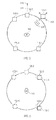
- FIG. 5 a positioning routine allowing to freely move the virtual position 110-3 according to the user input 410 is shown.
- the respective channel 210-1 - 210-4 of the multi-channel audio data 211 is routed to the output channels according to control data which corresponds to a present virtual position 110-3.
- the corresponding playback 500 is perceived by the user.
- Other channels of the multi-channel audio data 211 may be muted.
- the present virtual position 110-3 may be audibly perceived by the user.
- the user can freely move around the present virtual position 110-3 and the control data is correspondingly updated.
- the corresponding user input 410 can be an offset value of the present virtual position 110-3.
- the corresponding user input 410 may be in polar coordinates or Cartesian coordinates; the user may select the respective coordinate system.
- FIG. 6 a scenario is shown where the virtual positions 110-1, 110-2 of stereo two-channel audio data 211 are assigned to the preset positions 120-3, 120-4.
- the corresponding speakers (not shown in FIG. 6 ) are assigned to the corresponding channels 210-1 - 210-4 of the multi-channel audio data 211.
- a 5.1 audio system is used to play back the stereo two-channel audio data.
- the front right speaker and right surround speaker are mapped to the front left and front right channel, respectively.
- an orientation of the virtual stage can be turned by 90° if compared to the conventional case.
- the turning is not restricted to a 90° turn.
- This scenario enables to preserve a correct orientation of the virtual stage even if the listener turns, e.g., by 90°.
- the user may add a custom channel mapping which fits the specific demands of the specific listening environment.
- the physical speaker fulfills a different role than intended by the standard arrangement for which the multi-channel audio data is provided.
- the front-right speaker - according to the standard arrangement - may be assigned as the rear-left speaker.
- the audio system comprises a larger number of output channels.
- the audio system comprises a larger number of output channels.
- a center speaker located in-between the virtual positions 110-1, 110-2.
- 5.1 multi-channel audio data may be played back.
- FIG. 7 a schematic illustration of a sound system 600 according to various embodiments is shown.
- the sound system 600 comprises a first processor 610 and a second processor 620.
- the processors 610, 620 may be implemented as a multi-core processor and / or rely on distributed computing.
- the first processor 610 establishes communication with an HMI 630 and a memory 611.
- the first processor 610 is configured to determine the control data.
- the second processor 620 is configured to handle the multi-channel audio data.
- the second processor 620 is configured to execute the routing. It should be understood that generally the functionality of the first and second processor 610, 620 may also be implemented in a single processor or shared between a larger number of processors (not shown in FIG. 7 ).
- the sound system 600 further comprises the memory 611.
- the memory 611 stores control data for the first processor 610. Executing the control data causes the first processor 610 to execute techniques according to various embodiment explained above. In particular, executing the control data causes the processor 610 to execute techniques associated with the establishing of the control instructions 215 based on the present positions 120-1 - 120-5 and virtual positions 110-1 - 110-5.
- the first processor 610 provides the control data to the second processor 620 to route the channels 610-1 - 610-4 of the multi-channel audio data 211 to the output channels 291-1 - 291-5 based on the control instructions 215.
- the second processor 620 in the scenario of FIG. 7 can be configured to flexibly forward different inputs associated with the audio tracks of the channels of the multi-channel audio data to the different output channels 291-1 - 291-5 as part of the routing based on the control instructions. For this, it is possible to implement a comparably simple switching matrix where input channels are associated with one or more output channels 291-1 - 291-5. It is also possible that the second processor 620 is configured to individually and / or coherently process the audio tracks of the channels of the multi-channel audio data (audio processing). E.g., the second processor 620 may include a digital signal processor (DSP); i.e., the audio processing may be implemented in hardware and / or in software.
- DSP digital signal processor
- the audio source 621 provides the multi-channel audio data 211 including the plurality of channels 210-1 - 210-4. Content of the multi-channel audio data is positioned with respect to the virtual stage.
- the audio system 600 comprises five output channels 291-1 - 291-5.
- Five speakers 290-1 - 290-5 are connected to the output channels 291-1 - 291-5.
- the audio system 600 may comprise an end stage.
- the end stage may comprise an amplifier.
- the amplifier may be configured to amplify audio signals for each one of the output channels 291-1 - 291-5.
- the sound system 600 further comprises two microphone interfaces which are connected to microphone 640-1, 640-2.
- the processors 610, 620 are configured to execute a calibration routine.
- the calibration routine comprises routing reference signals via the output channels 291-1 - 291-5.
- the second processor 620 receives a recording of the playback of the reference signal as a respective calibration track.
- the first processor 610 is configured to determine the preset positions 120-1 - 120-5 of the plurality of speakers 290-1 - 290-4.
- Employing such a calibration routine it becomes possible to determine the preset positions 120-1 - 120-5 as the actual positions of the plurality of speakers 290-1 - 290-4 in an accurate manner.
- the first processor 610 is configured to determine the virtual positions 110-1 - 110-5 based on the calibration tracks; e.g., the first processor 610 can be configured determine the virtual positions 110-1 - 110-5 such that the virtual stage aligns with respect to a reference direction which may be defined by a setup of the microphones 640-1, 640-2 and / or a corresponding user input. Asymmetries between left and right orientations can be compensated for. A center image may be aligned with the reference direction.
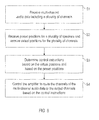
- FIG. 8 a flowchart of the method according to the various embodiments is shown.
- the multi-channel audio data 211 including the plurality of channels 210-1 - 210-4 is received from the audio source 612.
- the preset positions 120-1 - 120-5 of the plurality of speakers 290-1 - 290-5 are received.
- the preset positions can be stored in the memory 611.
- the virtual positions 110-1 - 110-5 for the plurality of channels 210-1 - 210-4 are received.
- the virtual positions can be stored in the memory 611.
- control instructions 215 are determined based on the virtual positions 110-1 - 110-5 and based on the preset positions 120-1 - 120-5.
- the channels 210-1 - 210-4 of the multi-channel audio data 211 are routed to the output channels 291-1 - 291-5 based on the control instructions 215.
- the techniques of routing have been primarily discussed in terms of forwarding an audio track associated with a given channel of the multi-channel audio data. It is possible that the routing includes techniques of audio processing. Here, it is possible that to some larger or smaller degree the audio tracks associated with the different channels of the multi-channel audio data are re-computed or modified according to the audio processing.
Landscapes
- Physics & Mathematics (AREA)
- Engineering & Computer Science (AREA)
- Acoustics & Sound (AREA)
- Signal Processing (AREA)
- Stereophonic System (AREA)
Priority Applications (3)
| Application Number | Priority Date | Filing Date | Title |
|---|---|---|---|
| EP14194268.0A EP3024253A1 (de) | 2014-11-21 | 2014-11-21 | Audiosystem und Verfahren |
| CN201510762427.XA CN105635906A (zh) | 2014-11-21 | 2015-11-10 | 音频系统和方法 |
| US14/942,465 US9686626B2 (en) | 2014-11-21 | 2015-11-16 | Audio system and method |
Applications Claiming Priority (1)
| Application Number | Priority Date | Filing Date | Title |
|---|---|---|---|
| EP14194268.0A EP3024253A1 (de) | 2014-11-21 | 2014-11-21 | Audiosystem und Verfahren |
Publications (1)
| Publication Number | Publication Date |
|---|---|
| EP3024253A1 true EP3024253A1 (de) | 2016-05-25 |
Family
ID=51904856
Family Applications (1)
| Application Number | Title | Priority Date | Filing Date |
|---|---|---|---|
| EP14194268.0A Withdrawn EP3024253A1 (de) | 2014-11-21 | 2014-11-21 | Audiosystem und Verfahren |
Country Status (3)
| Country | Link |
|---|---|
| US (1) | US9686626B2 (de) |
| EP (1) | EP3024253A1 (de) |
| CN (1) | CN105635906A (de) |
Cited By (3)
| Publication number | Priority date | Publication date | Assignee | Title |
|---|---|---|---|---|
| CN110786023A (zh) * | 2017-06-21 | 2020-02-11 | 雅马哈株式会社 | 信息处理装置、信息处理系统、信息处理程序以及信息处理方法 |
| EP4324217A4 (de) * | 2021-04-13 | 2025-03-19 | Spatialx Inc. | Adaptive strukturierte wiedergabe von audiokanälen |
| EP4589994A1 (de) * | 2024-01-19 | 2025-07-23 | Harman International Industries, Inc. | Neumischung von mehrkanalaudio auf basis der lautsprecherposition |
Families Citing this family (8)
| Publication number | Priority date | Publication date | Assignee | Title |
|---|---|---|---|---|
| KR101757531B1 (ko) * | 2015-05-07 | 2017-07-13 | 전자부품연구원 | 차량용 광 네트워크 기반 오디오 시스템 및 그의 브로드캐스팅 방법 |
| JP6904031B2 (ja) * | 2017-04-13 | 2021-07-14 | ヤマハ株式会社 | スピーカ位置検出システム、スピーカ位置検出装置、及びスピーカ位置検出方法 |
| US10869128B2 (en) | 2018-08-07 | 2020-12-15 | Pangissimo Llc | Modular speaker system |
| WO2022179701A1 (en) * | 2021-02-26 | 2022-09-01 | Fraunhofer-Gesellschaft zur Förderung der angewandten Forschung e.V. | Apparatus and method for rendering audio objects |
| US11985494B2 (en) * | 2021-04-07 | 2024-05-14 | Steelseries Aps | Apparatus for providing audio data to multiple audio logical devices |
| EP4449737A4 (de) * | 2021-12-15 | 2025-12-03 | Atieva Inc | Signalverarbeitung zur annäherung einer standardisierten studioerfahrung in einem fahrzeugaudiosystem mit nicht-standardisierten sprecherstandorten |
| US12610205B2 (en) | 2022-12-09 | 2026-04-21 | Bang & Olufsen A/S | Adaptive loudspeaker and listener positioning compensation |
| WO2025111945A1 (en) * | 2023-11-30 | 2025-06-05 | Harman International Industries , Incorporated | Audio system, and audio management method |
Citations (6)
| Publication number | Priority date | Publication date | Assignee | Title |
|---|---|---|---|---|
| US20040264704A1 (en) * | 2003-06-13 | 2004-12-30 | Camille Huin | Graphical user interface for determining speaker spatialization parameters |
| US20050152557A1 (en) * | 2003-12-10 | 2005-07-14 | Sony Corporation | Multi-speaker audio system and automatic control method |
| WO2006054270A1 (en) * | 2004-11-22 | 2006-05-26 | Bang & Olufsen A/S | A method and apparatus for multichannel upmixing and downmixing |
| US20060159276A1 (en) * | 2005-01-11 | 2006-07-20 | Takashi Tsutsui | Audio system |
| WO2012164444A1 (en) * | 2011-06-01 | 2012-12-06 | Koninklijke Philips Electronics N.V. | An audio system and method of operating therefor |
| US20140219455A1 (en) * | 2013-02-07 | 2014-08-07 | Qualcomm Incorporated | Mapping virtual speakers to physical speakers |
Family Cites Families (7)
| Publication number | Priority date | Publication date | Assignee | Title |
|---|---|---|---|---|
| JP4449998B2 (ja) * | 2007-03-12 | 2010-04-14 | ヤマハ株式会社 | アレイスピーカ装置 |
| GB2457508B (en) * | 2008-02-18 | 2010-06-09 | Ltd Sony Computer Entertainmen | System and method of audio adaptaton |
| WO2012025580A1 (en) * | 2010-08-27 | 2012-03-01 | Sonicemotion Ag | Method and device for enhanced sound field reproduction of spatially encoded audio input signals |
| JP5118267B2 (ja) * | 2011-04-22 | 2013-01-16 | パナソニック株式会社 | 音声信号再生装置、音声信号再生方法 |
| US20140056430A1 (en) * | 2012-08-21 | 2014-02-27 | Electronics And Telecommunications Research Institute | System and method for reproducing wave field using sound bar |
| EP2922313B1 (de) * | 2012-11-16 | 2019-10-09 | Yamaha Corporation | Audiosignalverarbeitungsvorrichtung und audiosignalverarbeitungssystem |
| US9357309B2 (en) * | 2013-04-23 | 2016-05-31 | Cable Television Laboratories, Inc. | Orientation based dynamic audio control |
-
2014
- 2014-11-21 EP EP14194268.0A patent/EP3024253A1/de not_active Withdrawn
-
2015
- 2015-11-10 CN CN201510762427.XA patent/CN105635906A/zh active Pending
- 2015-11-16 US US14/942,465 patent/US9686626B2/en active Active
Patent Citations (6)
| Publication number | Priority date | Publication date | Assignee | Title |
|---|---|---|---|---|
| US20040264704A1 (en) * | 2003-06-13 | 2004-12-30 | Camille Huin | Graphical user interface for determining speaker spatialization parameters |
| US20050152557A1 (en) * | 2003-12-10 | 2005-07-14 | Sony Corporation | Multi-speaker audio system and automatic control method |
| WO2006054270A1 (en) * | 2004-11-22 | 2006-05-26 | Bang & Olufsen A/S | A method and apparatus for multichannel upmixing and downmixing |
| US20060159276A1 (en) * | 2005-01-11 | 2006-07-20 | Takashi Tsutsui | Audio system |
| WO2012164444A1 (en) * | 2011-06-01 | 2012-12-06 | Koninklijke Philips Electronics N.V. | An audio system and method of operating therefor |
| US20140219455A1 (en) * | 2013-02-07 | 2014-08-07 | Qualcomm Incorporated | Mapping virtual speakers to physical speakers |
Non-Patent Citations (1)
| Title |
|---|
| THEILE G ET AL: "Wave field synthesis: A promising spatial audio rendering concept", ACOUSTICAL SCIENCE AND TECHNOLOGY, ACOUSTICAL SOCIETY OF JAPAN, TOKYO, JP, vol. 25, no. 6, 1 June 2004 (2004-06-01), pages 393 - 399, XP002409670, ISSN: 1346-3969, DOI: 10.1250/AST.25.393 * |
Cited By (4)
| Publication number | Priority date | Publication date | Assignee | Title |
|---|---|---|---|---|
| CN110786023A (zh) * | 2017-06-21 | 2020-02-11 | 雅马哈株式会社 | 信息处理装置、信息处理系统、信息处理程序以及信息处理方法 |
| US11172295B2 (en) | 2017-06-21 | 2021-11-09 | Yamaha Corporation | Information processing device, information processing system, and information processing method |
| EP4324217A4 (de) * | 2021-04-13 | 2025-03-19 | Spatialx Inc. | Adaptive strukturierte wiedergabe von audiokanälen |
| EP4589994A1 (de) * | 2024-01-19 | 2025-07-23 | Harman International Industries, Inc. | Neumischung von mehrkanalaudio auf basis der lautsprecherposition |
Also Published As
| Publication number | Publication date |
|---|---|
| US20160150346A1 (en) | 2016-05-26 |
| US9686626B2 (en) | 2017-06-20 |
| CN105635906A (zh) | 2016-06-01 |
Similar Documents
| Publication | Publication Date | Title |
|---|---|---|
| US9686626B2 (en) | Audio system and method | |
| US7123731B2 (en) | System and method for optimization of three-dimensional audio | |
| EP4250747B1 (de) | Drahtlose koordination von audioquellen | |
| EP3103269B1 (de) | Tonsignalverarbeitungsvorrichtung und verfahren zur wiedergabe eines binauralen signals | |
| EP2503800B1 (de) | Räumlich konstanter Raumklang | |
| US11647353B2 (en) | Non-transitory computer-readable medium having computer-readable instructions and system | |
| EP3213532B1 (de) | Filter zur impedanzanpassung und entzerrung für raumklangerzeugung für kopfhörer | |
| US20110316967A1 (en) | Facilitating communications using a portable communication device and directed sound output | |
| GB2543276A (en) | Distributed audio capture and mixing | |
| Frank | Source width of frontal phantom sources: Perception, measurement, and modeling | |
| JP6111603B2 (ja) | 音響再生システム | |
| US10531218B2 (en) | System and method for creating crosstalk canceled zones in audio playback | |
| US20230269536A1 (en) | Optimal crosstalk cancellation filter sets generated by using an obstructed field model and methods of use | |
| US20060078129A1 (en) | Sound system with a speaker box having multiple speaker units | |
| US20230199426A1 (en) | Audio signal output method, audio signal output device, and audio system | |
| KR101109038B1 (ko) | 다채널 스피커와 헤드 트랙커를 이용한 3차원 입체 음향 재생 시스템 및 방법 | |
| WO2006125849A1 (en) | A real time localization and parameter control method, a device, and a system | |
| US20190289394A1 (en) | Method for adjusting listener location and head orientation within a physical or virtual space | |
| KR101071895B1 (ko) | 청취자 위치 추적 기법에 의한 적응형 사운드 생성기 | |
| EP4268478B1 (de) | Vorrichtung und verfahren zur personalisierten binauralen audiowiedergabe | |
| Okuro et al. | Reproduction of varied sound image localization for real source in stereo audio system | |
| Gamper et al. | Audio augmented reality in telecommunication through virtual auditory display | |
| JP2023092961A (ja) | オーディオ信号出力方法、オーディオ信号出力装置及びオーディオシステム | |
| O'Toole et al. | Virtual 5.1 surround sound localization using head-tracking devices | |
| Merchel et al. | Evaluation of a new stereophonic reproduction method with moving “sweet spot” using a binaural localization model |
Legal Events
| Date | Code | Title | Description |
|---|---|---|---|
| AK | Designated contracting states |
Kind code of ref document: A1 Designated state(s): AL AT BE BG CH CY CZ DE DK EE ES FI FR GB GR HR HU IE IS IT LI LT LU LV MC MK MT NL NO PL PT RO RS SE SI SK SM TR |
|
| AX | Request for extension of the european patent |
Extension state: BA ME |
|
| PUAI | Public reference made under article 153(3) epc to a published international application that has entered the european phase |
Free format text: ORIGINAL CODE: 0009012 |
|
| STAA | Information on the status of an ep patent application or granted ep patent |
Free format text: STATUS: THE APPLICATION IS DEEMED TO BE WITHDRAWN |
|
| 18D | Application deemed to be withdrawn |
Effective date: 20161126 |