EP3024416B1 - Prothèse implantable - Google Patents
Prothèse implantable Download PDFInfo
- Publication number
- EP3024416B1 EP3024416B1 EP14750577.0A EP14750577A EP3024416B1 EP 3024416 B1 EP3024416 B1 EP 3024416B1 EP 14750577 A EP14750577 A EP 14750577A EP 3024416 B1 EP3024416 B1 EP 3024416B1
- Authority
- EP
- European Patent Office
- Prior art keywords
- branches
- adhesive portion
- adherent
- prosthesis according
- prosthesis
- Prior art date
- Legal status (The legal status is an assumption and is not a legal conclusion. Google has not performed a legal analysis and makes no representation as to the accuracy of the status listed.)
- Not-in-force
Links
Images


Classifications
-
- A—HUMAN NECESSITIES
- A61—MEDICAL OR VETERINARY SCIENCE; HYGIENE
- A61F—FILTERS IMPLANTABLE INTO BLOOD VESSELS; PROSTHESES; DEVICES PROVIDING PATENCY TO, OR PREVENTING COLLAPSING OF, TUBULAR STRUCTURES OF THE BODY, e.g. STENTS; ORTHOPAEDIC, NURSING OR CONTRACEPTIVE DEVICES; FOMENTATION; TREATMENT OR PROTECTION OF EYES OR EARS; BANDAGES, DRESSINGS OR ABSORBENT PADS; FIRST-AID KITS
- A61F2/00—Filters implantable into blood vessels; Prostheses, i.e. artificial substitutes or replacements for parts of the body; Appliances for connecting them with the body; Devices providing patency to, or preventing collapsing of, tubular structures of the body, e.g. stents
- A61F2/0063—Implantable repair or support meshes, e.g. hernia meshes
-
- A—HUMAN NECESSITIES
- A61—MEDICAL OR VETERINARY SCIENCE; HYGIENE
- A61F—FILTERS IMPLANTABLE INTO BLOOD VESSELS; PROSTHESES; DEVICES PROVIDING PATENCY TO, OR PREVENTING COLLAPSING OF, TUBULAR STRUCTURES OF THE BODY, e.g. STENTS; ORTHOPAEDIC, NURSING OR CONTRACEPTIVE DEVICES; FOMENTATION; TREATMENT OR PROTECTION OF EYES OR EARS; BANDAGES, DRESSINGS OR ABSORBENT PADS; FIRST-AID KITS
- A61F2/00—Filters implantable into blood vessels; Prostheses, i.e. artificial substitutes or replacements for parts of the body; Appliances for connecting them with the body; Devices providing patency to, or preventing collapsing of, tubular structures of the body, e.g. stents
- A61F2/0077—Special surfaces of prostheses, e.g. for improving ingrowth
-
- A—HUMAN NECESSITIES
- A61—MEDICAL OR VETERINARY SCIENCE; HYGIENE
- A61F—FILTERS IMPLANTABLE INTO BLOOD VESSELS; PROSTHESES; DEVICES PROVIDING PATENCY TO, OR PREVENTING COLLAPSING OF, TUBULAR STRUCTURES OF THE BODY, e.g. STENTS; ORTHOPAEDIC, NURSING OR CONTRACEPTIVE DEVICES; FOMENTATION; TREATMENT OR PROTECTION OF EYES OR EARS; BANDAGES, DRESSINGS OR ABSORBENT PADS; FIRST-AID KITS
- A61F2/00—Filters implantable into blood vessels; Prostheses, i.e. artificial substitutes or replacements for parts of the body; Appliances for connecting them with the body; Devices providing patency to, or preventing collapsing of, tubular structures of the body, e.g. stents
- A61F2/0063—Implantable repair or support meshes, e.g. hernia meshes
- A61F2002/0072—Delivery tools therefor
-
- A—HUMAN NECESSITIES
- A61—MEDICAL OR VETERINARY SCIENCE; HYGIENE
- A61F—FILTERS IMPLANTABLE INTO BLOOD VESSELS; PROSTHESES; DEVICES PROVIDING PATENCY TO, OR PREVENTING COLLAPSING OF, TUBULAR STRUCTURES OF THE BODY, e.g. STENTS; ORTHOPAEDIC, NURSING OR CONTRACEPTIVE DEVICES; FOMENTATION; TREATMENT OR PROTECTION OF EYES OR EARS; BANDAGES, DRESSINGS OR ABSORBENT PADS; FIRST-AID KITS
- A61F2/00—Filters implantable into blood vessels; Prostheses, i.e. artificial substitutes or replacements for parts of the body; Appliances for connecting them with the body; Devices providing patency to, or preventing collapsing of, tubular structures of the body, e.g. stents
- A61F2/0077—Special surfaces of prostheses, e.g. for improving ingrowth
- A61F2002/0086—Special surfaces of prostheses, e.g. for improving ingrowth for preferentially controlling or promoting the growth of specific types of cells or tissues
-
- A—HUMAN NECESSITIES
- A61—MEDICAL OR VETERINARY SCIENCE; HYGIENE
- A61F—FILTERS IMPLANTABLE INTO BLOOD VESSELS; PROSTHESES; DEVICES PROVIDING PATENCY TO, OR PREVENTING COLLAPSING OF, TUBULAR STRUCTURES OF THE BODY, e.g. STENTS; ORTHOPAEDIC, NURSING OR CONTRACEPTIVE DEVICES; FOMENTATION; TREATMENT OR PROTECTION OF EYES OR EARS; BANDAGES, DRESSINGS OR ABSORBENT PADS; FIRST-AID KITS
- A61F2/00—Filters implantable into blood vessels; Prostheses, i.e. artificial substitutes or replacements for parts of the body; Appliances for connecting them with the body; Devices providing patency to, or preventing collapsing of, tubular structures of the body, e.g. stents
- A61F2/0077—Special surfaces of prostheses, e.g. for improving ingrowth
- A61F2002/009—Special surfaces of prostheses, e.g. for improving ingrowth for hindering or preventing attachment of biological tissue
Definitions
- the present invention relates to the field of implantable medical devices.
- Such a prosthesis is notably implanted in the peritoneal cavity in order to repair the abdominal wall.
- the adherent portion is intended to be placed against the peritoneum to be colonized by human tissue, while the non-adherent portion is configured to limit adhesions that occur between the prosthesis and the abdominal organs after the surgical procedure.
- WO 99/06079 discloses such a rectangular-shaped composite prosthesis in which the non-adherent part consists of a rectangular-shaped polysaccharide film which protrudes laterally by several millimeters from the adhering part made of porous knit, in order to avoid contact between the viscera and the peripheral edge of the adherent part.
- This prosthesis does not, however, prevent adhesions at the peripheral edge of the adherent portion. These adhesions appear because it is not possible to contact, in a uniform manner, the adherent plane part with the concave surface of the peritoneum. Folds form in the prosthesis, which has the effect of creating free adherent zones in which the adherent portion does not come into contact with the peritoneum. It therefore happens that the viscera adhere to these free adherent zones, which is likely to complicate the healing of the peritoneum.
- GB 2430372 discloses an implantable prosthesis having an adherent portion consisting of a plurality of adherent portions disjoint from each other which extend radially around a sleeve.
- US 2003/0212462 discloses an implantable prosthesis having an adherent portion in the form of a heart.
- An object of the invention is to provide an implantable prosthesis that overcomes the aforementioned drawbacks, and in which it further reduces the risk of adhesion formation between the viscera and the adherent portion.
- the adherent part has a central part and has a star shape which comprises a plurality of branches which extend from the central part of the adherent part, the adherent part comprising a plurality of notches, each notch being located between two adjacent branches.
- the adherent part better marries the concave surface of the peritoneum, which has the effect of substantially reducing or preventing the formation of free adherence zones.
- the branches deform to conform to the concave form of the peritoneum.
- the branches being in contact with the peritoneum, the adherent part remains in good contact with the peritoneum, and in particular along the peripheral edge of the adherent part.
- the adherent and non-adherent parts are flexible.
- non-adherent portion also protrudes laterally from the periphery of the adhering portion, as soon as the first peripheral edge of the adherent portion is set back from the second peripheral edge.
- the branches of the adherent portion are joined to each other in that they extend from the central portion of the adherent portion.
- the minimum width of the non-adherent peripheral strip is between 3 mm and 6 mm.
- the number of branches is between four and ten, preferably six.
- each branch extends radially along a height and extends in point from the central part of the adherent portion towards its top.
- the vertex is rounded.
- the base of the branch is wider than its summit.
- the branches preferably have the same height. However, without departing from the scope of the present invention, some of the whales may have higher heights than others.
- the branches have a height of between 3 mm and 50 mm. Such a range of heights allows a good conformation of the branches, and the adherent part, the peritoneum.
- the width of the nonadherent peripheral strip is between 3 mm and 10 mm at the top of the branches.
- the central portion has a span preferably between 40 mm and 90 mm.
- the branches form a single piece with the central part.
- the adhering portion is for example obtained by cutting a porous knit to give it a star shape.
- the branches are inserts that are attached to the central portion.
- the central portion has a circular or oval shape.
- the radius of the central portion is preferably greater than or equal to the height of the branches of the adherent portion.
- the adhering portion is made of a textile material. This is for example, but not exclusively a knit stitch knit Chain or Raschel type.
- the adherent portion is preferably constituted, at least in part, PLLA.
- the branches are made of a textile material which is more rigid than the textile material constituting the central part.
- the non-adherent portion is in the form of a disk or an oval.
- This disc or oval shape makes it easier to adapt to the concave form of the peritoneum than the rectangular shape of the prior art.
- the non-adherent part also has a star shape, and the branches of the non-adherent part are superimposed with branches of the adherent part.
- the adherent portion has at least as many branches as the non-adherent portion.
- An advantage of the star shape of the non-adherent part is to further improve the conformation of the prosthesis to the concave form of the peritoneum. It is furthermore avoided that the non-adherent part forms folds between the branches of the adherent part, where organic tissues could be gathered.
- the branches of the non-adherent portion project laterally branches of the adherent portion to define the non-adherent peripheral band.
- the minimum width of the nonadherent peripheral strip is between 5 mm and 15 mm between two adjacent branches.
- the implantable prosthesis has the shape of a star.
- the non-adherent portion comprises a central portion from which extend in point the branches of the non-adherent portion.
- the tops of the branches of the non-adherent portion are rounded.
- the adherent part is made of knit, while the non-adherent part is a polymer film.
- the polymeric film is a resorbable lactic acid polymer.
- the film is attached to the knit by seaming or fusing microfilaments onto the yarn.
- This expansion means is for example an inflatable balloon that the surgeon can inflate via a tube.
- This inflatable balloon is preferably housed in a pocket attached to the portion adherent.
- the pouch preferably has the shape of a thick disc and comprises a knit wall attached to the adherent portion and provided with an orifice for removal of the balloon after implantation of the prosthesis.
- the prosthesis is flat or, in an advantageous variant, has a convex shape in order to further marry the concave shape of the peritoneum.
- the implantable prosthesis 100 is an intraperitoneal prosthesis.
- This type of prosthesis is also called intra-peritoneal visceral plaque.
- the prosthesis is flexible to conform to the concavity of the peritoneum.
- the figure 1 illustrates in plan view the implantable prosthesis 100.
- the latter has the general shape of a center disk O whose diameter D is of the order of 100 mm.
- the prosthesis 100 has a thickness E of the order of 500 microns.
- the prosthesis 100 is of the composite type and comprises an adherent portion 102 integral with a non-adherent portion 104.
- the adherent portion 102 is designed to form adhesions with organic tissues, while the non-adherent portion 104 is designed to inhibit the formation of adhesions with organic tissues.
- the adherent portion 102 comes into contact with the peritoneum to adhere to it, while the non-adherent portion 104 forms a barrier that contacts the viscera to prevent them from adhering. with the peritoneum during the healing period.
- the adherent portion is a knit stitch knit Chain or Raschel.
- the knit has a resorbable portion and a non-absorbable portion.
- the knit could be entirely non-absorbable.
- the knit has a resorbable portion made with a monofilament of about 200 dtex PLLA, and a non-resorbable portion made with a monofilament of about 70 dtex polypropylene.
- the non-adherent portion 104 is a resorbable polymeric lactic acid film.
- the polymer film is attached to the knit by sewing or fusing the monofilaments to the film.
- the adherent portion 102 has a thickness e1 of the order of 475 microns while the non-adherent portion 104 has a thickness e2 of the order of 25 microns.
- the adhering portion 102 has a first peripheral edge 102a .
- the non-adherent portion 104 disk-shaped in this example, has a second peripheral edge 104a which is circular.
- the first peripheral edge 102a of the adherent portion 102 is recessed from the second peripheral edge 104a of the non-adherent portion 104 so as to partially expose the adherent portion defining between the first peripheral edge 102a and the second edge device 104a , a nonadherent peripheral band 106 which surrounds the adherent portion 102 .
- the non-adherent peripheral strip 106 is in the same plane as the non-adherent portion 104, and has the same thickness e2.
- nonadherent peripheral strip 106 does not cover the periphery of the adhering portion 102.
- the nonadherent peripheral band 106 defined between the first peripheral edge 102a and the second peripheral edge 104a , has a width I which is defined between the first peripheral edge 102a and the second peripheral edge 104a .
- Imin is called the minimum radial width of the nonadherent peripheral strip 106 and Imax, the maximum width of the nonadherent peripheral strip 106.
- the adhering portion 102 has a star shape which comprises a plurality of branches 108 .
- the adherent part has six branches 108 .
- Each of the branches 108 extends radially from a central portion 110 of the adhering portion.
- the adhering portion further comprises a plurality of notches 109 , each of the notches 109 being located between two adjacent branches.
- the branches are joined to each other due to the fact that they extend from the central portion 110 of the adherent portion.
- the adherent part therefore extends continuously between the different branches.
- Each branch 108 extends radially at a height H and has a vertex 108a and a base 108b .
- Each branch extends in tip from the central part to its summit.
- the branches have the same height H , of the order of 20 mm.
- the base of each branch is wider than its summit.
- Each branch thus has a convergent part towards its summit.
- we note that the tops of the branches are rounded.
- the diameter d of the central portion 110 where the branches extend has the general shape of a disc whose diameter is of the order of 60 mm in this example.
- the center of the non-adherent disk-shaped portion is substantially coincidental with the center of the central portion of circular shape.
- the prosthesis has a central symmetry of center O.
- the minimum width Imin of the nonadherential peripheral strip 106 is situated at the level of the apex 108a of the branches 108 .
- the width Imin corresponding to the minimum shrinkage, is of the order of 5 mm.
- the maximum width Imax corresponding to the maximum shrinkage, is located between two consecutive branches and of the order of 40 mm.
- the branches 108 form a single piece with the central portion 110 .
- the radius R of the central portion is slightly greater than the height H of the branches of the gripping portion. Also, the branches have small dimensions compared to those of the central part.
- This figure schematically shows a portion of the abdomen, in a section taken above the navel.
- the prosthesis adopts the concavity of the peritoneum 24 and remains uniformly in contact with the peritoneum after placement on the surgical site.
- the prosthesis takes the form of an umbrella during its transfer inside the peritoneum by the surgeon, then redeploys to come into contact with the peritoneum.
- the prosthesis of the example of the figure 3 In particular, it aims to treat the hernias of the white line opposite the two right muscles of the abdominal wall or even the umbilical hernias.
- the second embodiment of the implantable prosthesis according to the present invention differs from the first in that the non-adherent portion 204 also has a star shape.
- the non-adherent portion 204 has six branches 220 which are superimposed with the branches 208 of the adherent portion.
- the non-adherent portion comprises a central portion 221 from which extend radially pointed branches 220 of the non-adherent portion.
- the branches of the non-adherent portion extend in point towards their respective peaks, the latter being rounded.
- the non-adherent peripheral portion 206 which surrounds the adherent portion 202 has a width I , of the order of 5 mm, which is substantially constant along the entire periphery of the prosthesis 200 .
- non-adherent peripheral portion 206 is defined between the first peripheral edge 202 a of the adherent portion 202 and the second peripheral edge 204 a of the non-adherent portion 204 .
- the width I of the non-adherent peripheral band is between 3 and 10 mm, and this all around the prosthesis.
- the branches 208 of the gripping portion 202 form a single piece with the central portion 210 .
- branches 208 ' of the gripping portion 202 are inserts which are attached to the central portion 210' .
- the branches 208 ' of the gripping portion 202 are made of a textile material which is more rigid than the textile material constituting the central portion 210' .
- branches 208 ' are welded through welds 209' to the central portion 210 ' .
- the implantable prosthesis 300 illustrated on the figure 7 is a variant of that of the figure 4 .
- the central portion 310 of the adherent portion 302 has a substantially oval shape.
- These longitudinal and transverse dimensions are referenced T1 and T2 on the figure 7 . It is found that the half width of the central portion, considered according to the transverse dimension T2 , is greater than the height H of the branches. Also, the branches here again have small dimensions compared to those of the central part.
- the adhering portion 302 has eight branches 308 .
- the non-adherent portion 304 also has eight branches 320 .
- the width A of the prosthesis 300 is of the order of 125 mm, while the length B is of the order of 155 mm.
- the prosthesis 200 further comprises a removable expansion means 500 , which is in the form of an inflatable balloon 502 .
- the balloon 502 is connected to the end of an inflation tube 504 .
- the balloon In the deflated state, the balloon has the shape of a flexible pellet which is intended to be introduced through an orifice 506 inside a pocket 508 fixed to the adherent portion 202 of the prosthesis 200 .
- the 508 pocket has an outer wall 510 attached to the gripping portion 202 .
- the outer wall 510 is made of knit and is sewn to the knit of the adherent part. One could however provide a fixation by welding.
- the outer wall 510 is in the form of a disc inscribed within the adherent star-shaped portion 202.
- the balloon When a fluid is pumped into the tube 504, the balloon inflates, which has the effect of giving a convex shape to the prosthesis 200 , and to improve its conformation to the concavity of the peritoneum.
- the balloon After implantation of the prosthesis, the balloon is evacuated through the orifice 506 after being deflated beforehand.
Landscapes
- Health & Medical Sciences (AREA)
- Cardiology (AREA)
- Oral & Maxillofacial Surgery (AREA)
- Transplantation (AREA)
- Engineering & Computer Science (AREA)
- Biomedical Technology (AREA)
- Heart & Thoracic Surgery (AREA)
- Vascular Medicine (AREA)
- Life Sciences & Earth Sciences (AREA)
- Animal Behavior & Ethology (AREA)
- General Health & Medical Sciences (AREA)
- Public Health (AREA)
- Veterinary Medicine (AREA)
- Prostheses (AREA)
Description
- La présente invention a trait au domaine des dispositifs médicaux implantables.
- Plus précisément, l'invention concerne une prothèse implantable qui comporte :
- une partie adhérente pouvant former des adhérences avec des tissus organiques, la partie adhérente présentant un premier bord périphérique ;
- une partie non-adhérente, inhibant la formation d'adhérences avec des tissus organiques, solidaire de la partie adhérente et présentant un second bord périphérique, le premier bord périphérique étant en retrait du second bord périphérique de manière à découvrir partiellement la partie non-adhérente en définissant, entre le premier bord périphérique et le second bord périphérique, une bande périphérique non-adhérente qui entoure la partie adhérente.
- Une telle prothèse est notamment implantée dans la cavité péritonéale afin de réparer la paroi abdominale.
- Traditionnellement, la partie adhérente est destinée à être placée contre le péritoine pour être colonisée par les tissus humains, tandis que la partie non-adhérente est configurée pour limiter les adhérences qui se produisent entre la prothèse et les organes abdominaux après l'intervention chirurgicale.
-
WO 99/06079 - Cette prothèse ne permet toutefois pas d'éviter les adhérences au niveau du bord périphérique de la partie adhérente. Ces adhérences apparaissent car il n'est pas possible de mettre en contact, de manière uniforme, la partie adhérente plane avec la surface concave du péritoine. Des plis se forment dans la prothèse, ce qui a pour effet de créer des zones adhérentes libres dans lesquelles la partie adhérente ne vient pas en contact du péritoine. Il arrive donc que les viscères viennent adhérer sur ces zones adhérentes libres, ce qui est de nature à compliquer la cicatrisation du péritoine.
-
GB 2430372 -
US 2003/0212462 décrit une prothèse implantable ayant une partie adhérente en forme de coeur. - Un objet de l'invention est de proposer une prothèse implantable qui remédie aux inconvénients précités, et dans laquelle on diminue encore le risque de formation d'adhérence entre les viscères et la partie adhérente.
- L'invention atteint son but par le fait que la partie adhérente a une partie centrale et présente une forme en étoile qui comprend une pluralité de branches qui s'étendent depuis la partie centrale de la partie adhérente, la partie adhérente comportant une pluralité d'échancrures, chaque échancrure étant située entre deux branches adjacentes.
- Grâce à sa forme en étoile, la partie adhérente épouse mieux la surface concave du péritoine, ce qui a pour effet de diminuer sensiblement, voire éviter la formation de zones d'adhérence libres.
- Dit autrement, les branches se déforment pour épouser la forme concave du péritoine. Les branches étant en contact avec le péritoine, la partie adhérente reste bien en contact avec le péritoine, et notamment le long du bord périphérique de la partie adhérente. A ce titre, on comprend que les parties adhérente et non-adhérente sont souples.
- On comprend par ailleurs que la partie non-adhérente déborde également latéralement de la périphérie de la partie adhérente, dès lors que le premier bord périphérique de la partie adhérente est en retrait du second bord périphérique.
- Les branches de la partie adhérente sont jointives les unes aux autres par le fait qu'elles s'étendent depuis la partie centrale de la partie adhérente.
- De préférence, la largeur minimale de la bande périphérique non-adhérente est comprise entre 3 mm et 6 mm
- De préférence, le nombre de branches est compris entre quatre et dix, de préférence six.
- Avantageusement, chaque branche s'étend radialement selon une hauteur et s'étend en pointe depuis la partie centrale de la portion adhérente vers son sommet. De préférence, le sommet est arrondi. Encore de préférence, la base de la branche est plus large que son sommet.
- Les branches présentent préférentiellement la même hauteur. Toutefois, sans sortir du cadre de la présente invention, certaines des baleines pourraient présenter des hauteurs supérieures aux autres.
- De manière préférentielle, les branches présentent une hauteur comprise entre 3 mm et 50 mm. Une telle gamme de hauteurs permet une bonne conformation des branches, et de la partie adhérente, au péritoine. De préférence, la largeur de la bande périphérique non-adhérente est comprise entre 3 mm et 10 mm au niveau du sommet des branches.
- Avantageusement, la partie centrale présente une envergure comprise de préférence entre 40 mm et 90 mm.
- Selon un mode de réalisation avantageux, les branches forment une seule pièce avec la partie centrale. Pour ce faire, la partie adhérente est par exemple obtenue en découpant un tricot poreux pour lui donner une forme en étoile.
- Selon une variante, les branches sont des pièces rapportées qui sont fixées à la partie centrale.
- Avantageusement, la partie centrale présente une forme circulaire ou ovale. Le rayon de la partie centrale est préférentiellement supérieur ou égal à la hauteur des branches de la partie adhérente.
- De préférence, la partie adhérente est réalisée dans une matière textile. Il s'agit par exemple, mais non exclusivement d'un tricot de mailles jetées de type Chaine ou Raschel. La partie adhérente est préférentiellement constituée, au moins en partie, de PLLA.
- Selon une variante, les branches sont réalisées dans une matière textile plus rigide que la matière textile constituant la partie centrale.
- Dans un mode de réalisation, la partie non-adhérente présente la forme d'un disque ou d'un ovale.
- Cette forme en disque ou ovale permet de mieux s'adapter à la forme concave du péritoine que la forme rectangulaire de l'art antérieure.
- Selon un autre mode de réalisation particulièrement avantageux, la partie non-adhérente présente également une forme en étoile, et les branches de la partie non-adhérente sont superposées avec des branches de la partie adhérente.
- Ainsi, la partie adhérente comporte au moins autant de branches que la partie non-adhérente.
- Un intérêt de la forme en étoile de la partie non-adhérente est d'améliorer encore la conformation de la prothèse à la forme concave du péritoine. On évite en outre que la partie non-adhérente ne forme des plis entre les branches de la partie adhérente, où pourraient s'amasser des tissus organiques.
- Là-encore, les branches de la partie non-adhérente débordent latéralement des branches de la partie adhérente de façon à définir la bande périphérique non-adhérente. De préférence, la largeur minimale de la bande périphérique non-adhérente est comprise entre 5 mm et 15 mm entre deux branches adjacentes.
- On comprend donc que, dans ce mode de réalisation avantageux, la prothèse implantable présente la forme d'une étoile.
- Avantageusement, la partie non-adhérente comporte une portion centrale d'où s'étendent en pointe les branches de la partie non-adhérente.
- Encore de préférence, les sommets des branches de la partie non-adhérente sont arrondis.
- Selon une variante avantageuse, la partie adhérente est réalisée en tricot, tandis que la partie non-adhérente est un film polymère. De préférence, mais non exclusivement, le film polymère est un polymère résorbable d'acide lactique.
- Le film est fixé au tricot par couture ou fusion des microfilaments sur le fil.
- Pour améliorer le positionnement de la prothèse dans le corps lors de l'intervention, elle comporte en outre un moyen d'expansion amovible. Ce moyen d'expansion est par exemple un ballonnet gonflable que le chirurgien peut gonfler par l'intermédiaire d'un tube. Ce ballonnet gonflable est de préférence logé dans une poche fixée à la partie adhérente. La poche présente de préférence la forme d'un disque épais et comprend une paroi en tricot fixée à la partie adhérente et munie d'un orifice permettant le retrait du ballonnet après l'implantation de la prothèse.
- La prothèse est plane ou, dans une variante avantageuse, présente une forme bombée afin d'épouser encore mieux la forme concave du péritoine.
- L'invention sera mieux comprise à la lecture de la description qui suit de modes de réalisation de l'invention donnés à titre d'exemples non limitatifs, en référence aux dessins annexés, sur lesquels :
- la
figure 1 illustre un premier mode de réalisation d'une prothèse implantable selon l'invention, en vue de dessus, dans laquelle la partie adhérente présente une étoile à six branches, tandis que la partie non-adhérente présente la forme d'un disque ; - la
figure 2 représente la prothèse de lafigure 1 en vue de côté ; - la
figure 3 illustre la prothèse de lafigure 1 positionnée au contact du péritoine ; - la
figure 4 illustre un deuxième mode de réalisation d'une prothèse implantable selon l'invention, en vue de dessus, dans laquelle la partie non-adhérente présente également la forme d'une étoile à six branches ; - la
figure 5 représente la prothèse de lafigure 4 en vue de côté ; - la
figure 6 illustre une variante de la prothèse de lafigure 4 dans laquelle les branches de la partie adhérente sont rapportées ; - la
figure 7 illustre une variante de la prothèse de lafigure 4 , dans laquelle les parties adhérente et non-adhérente comportent chacune huit branches ; et - les
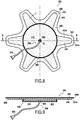
figures 8 et 9 représentent un autre mode de réalisation de la prothèse de lafigure 4 qui comporte en outre un ballonnet d'expansion. - A l'aide des
figures 1 à 3 , on va décrire un premier mode de réalisation d'une prothèse implantable 100 conforme à la présente invention. - Dans cet exemple, la prothèse implantable 100 est une prothèse intra-péritonéale. Ce type de prothèse est également appelée plaque viscérale intra-péritonéale. La prothèse est souple afin de venir se conformer à la concavité du péritoine.
- La
figure 1 illustre en vue de dessus la prothèse implantable 100. Cette dernière présente la forme générale d'un disque de centre O dont le diamètre D est de l'ordre de 100 mm. La prothèse 100 présente une épaisseur E de l'ordre de 500 microns. - La prothèse 100 est du type composite et comporte une partie adhérente 102 solidaire d'une partie non-adhérente 104.
- De manière traditionnelle, la partie adhérente 102 est conçue pour former des adhérences avec des tissus organiques, tandis que la partie non-adhérente 104 est conçue pour inhiber la formation d'adhérences avec des tissus organiques.
- Après avoir été implantée dans le corps humain, la partie adhérente 102 vient en contact du péritoine afin d'y adhérer, tandis que la partie non-adhérente 104 forme une barrière qui vient au contact des viscères afin d'empêcher ces dernières d'adhérer avec le péritoine pendant la période de cicatrisation.
- Dans cet exemple, la partie adhérente est un tricot de mailles jetées de type Chaine ou Raschel. De préférence, le tricot comporte une partie résorbable et une partie non résorbable. Selon une variante, le tricot pourrait être entièrement non résorbable.
- Dans cet exemple, le tricot comporte une partie résorbable réalisée avec un monofilament d'environ 200 dtex en PLLA, et une partie non résorbable réalisée avec un monofilament d'environ 70 dtex en polypropylène.
- Dans ce premier mode de réalisation, la partie non-adhérente 104 est film polymère résorbable d'acide lactique. Le film polymère est fixé au tricot par couture ou fusion des monofilaments sur le film.
- Dans cet exemple, la partie adhérente 102 présente une épaisseur e1 de l'ordre de 475 microns tandis que la partie non-adhérente 104 présente une épaisseur e2 de l'ordre de 25 microns.
- En se référant à nouveau à la
figure 1 , on constate que la partie adhérente 102 présente un premier bord périphérique 102a. La partie non-adhérente 104, en forme de disque dans cet exemple, comporte quant à elle un second bord périphérique 104a qui est circulaire. - Comme on le constate sur les
figures 1 et 2 , le premier bord périphérique 102a de la partie adhérente 102 est en retrait du second bord périphérique 104a de la partie non-adhérente 104 de manière à découvrir partiellement la partie adhérente en définissant, entre le premier bord périphérique 102a et le second bord périphérique 104a, une bande périphérique non-adhérente 106 qui entoure la partie adhérente 102. - A l'aide de la
figure 2 , on conçoit que la bande périphérique non-adhérente 106 est dans le même plan que la partie non-adhérente 104, et présente la même épaisseur e2. - On constate également que la bande périphérique non-adhérente 106 ne recouvre pas la périphérie de la partie adhérente 102.
- La bande périphérique non-adhérente 106, définie entre le premier bord périphérique 102a et le second bord périphérique 104a, présente une largeur I qui est définie entre le premier bord périphérique 102a et le second bord périphérique 104a.
- Sur la
figure 1 , on appelle Imin, la largeur radiale minimale de la bande périphérique non-adhérente 106 et Imax, la largeur maximale de la bande périphérique non-adhérente 106. - Conformément à l'invention, la partie adhérente 102 présente une forme en étoile qui comprend une pluralité de branches 108. Dans cet exemple, la partie adhérente comporte six branches 108. Chacune des branches 108 s'étend radialement depuis une partie centrale 110 de la partie adhérente.
- La partie adhérente comporte en outre une pluralité d'échancrures 109, chacune des échancrures 109 étant située entre deux branches adjacentes.
- Les branches sont jointives les unes aux autres grâce au fait qu'elles s'étendent depuis la partie centrale 110 de la partie adhérente. La partie adhérente s'étend donc continûment entre les différentes branches. Chaque branche 108 s'étend radialement selon une hauteur H et présente un sommet 108a, ainsi qu'une base 108b. Chaque branche s'étend en pointe depuis la partie centrale vers son sommet. Dans cet exemple, les branches présentent la même hauteur H, de l'ordre de 20 mm. La base de chaque branche est plus large que son sommet. Chaque branche comporte ainsi une partie convergente vers son sommet. En outre, on constate que les sommets des branches sont arrondis.
- Le diamètre d de la partie centrale 110 où s'étendent les branches présente la forme générale d'un disque dont le diamètre est de l'ordre de 60 mm dans cet exemple.
- On constate sur la
figure 1 que le centre de la partie non-adhérente en forme de disque est sensiblement confondu avec le centre de la partie centrale de forme circulaire. Par ailleurs, la prothèse présente une symétrie centrale de centre O. - A l'aide de la
figure 1 , on constate par ailleurs que la largeur minimale Imin de la bande périphérique non-adhérente 106 est située au niveau du sommet 108a des branches 108. Dans cet exemple, la largeur Imin, correspondant au retrait minimal, est de l'ordre de 5 mm. - On constate également que la largeur maximale Imax, correspondant au retrait maximal, est située entre deux branches consécutives et de l'ordre de 40 mm.
- Dans l'exemple de la
figure 1 , les branches 108 forment une seule pièce avec la partie centrale 110. - On constate par ailleurs que le rayon R de la partie centrale est légèrement supérieur à la hauteur H des branches de la partie adhérente. Aussi, les branches présentent des dimensions petites par rapport à celles de la partie centrale.
- En se référant à la
figure 3 , on va maintenant expliquer le positionnement de la prothèse 100 dans la zone péritonéale du patient. - Cette figure représente de façon schématique une portion de l'abdomen, selon une section prise au-dessus du nombril.
- Sur la
figure 3 , les références suivantes sont utilisées : - 10 :
- peau ;
- 12 :
- muscle droit de l'abdomen ;
- 14 :
- ligne blanche ;
- 16 :
- tissu sous cutané (couche graisseuse) ;
- 18 :
- muscle oblique externe ;
- 20 :
- muscle oblique interne ;
- 22 :
- muscle transverse de l'abdomen ;
- 24 :
- péritoine ;
- 26 :
- aponévrose du muscle oblique externe ;
- 28 :
- aponévrose du muscle oblique interne ;
- 30 :
- aponévrose du muscle transverse de l'abdomen.
- Comme on le constate sur la
figure 3 , la prothèse adopte la concavité du péritoine 24 et reste uniformément en contact avec le péritoine après son placement sur le site chirurgical. - De manière classique, pour sa mise en place, la prothèse prend la forme d'un parapluie lors de son transfert à l'intérieur du péritoine par le chirurgien, puis se redéploie pour venir au contact du péritoine.
- La prothèse de l'exemple de la
figure 3 vise en particulier à soigner les hernies de la ligne blanche en regard des deux muscles droits de la paroi abdominale ou bien encore les hernies ombilicales. - A l'aide des
figures 4 et 5 , on va maintenant décrire un deuxième mode de réalisation de la prothèse 200 selon l'invention. - Le deuxième mode de réalisation de la prothèse implantable selon la présente invention diffère du premier par le fait que la partie non-adhérente 204 présente également une forme en étoile.
- Dans l'exemple de la
figure 4 , la partie non-adhérente 204 présente six branches 220 qui sont superposées avec les branches 208 de la partie adhérente. La partie non-adhérente comporte une portion centrale 221 d'où s'étendent radialement en pointe les branches 220 de la partie non-adhérente. Les branches de la partie non-adhérente s'étendent en pointe vers leurs sommets respectifs, ces derniers étant arrondis. - On constate par ailleurs que la partie périphérique non-adhérente 206 qui entoure la partie adhérente 202 présente une largeur I, de l'ordre de 5 mm, qui est sensiblement constante selon tout le pourtour de la prothèse 200.
- On rappelle que la partie périphérique non-adhérente 206 est définie entre le premier bord périphérique 202a de la partie adhérente 202 et le second bord périphérique 204a de la partie non-adhérente 204.
- Dans l'exemple de réalisation de la
figure 4 , la largeur I de la bande périphérique non-adhérente est comprise entre 3 et 10 mm, et ce sur tout le pourtour de la prothèse. - Dans le deuxième mode de réalisation, les branches 208 de la partie adhérente 202 forment une seule pièce avec la partie centrale 210.
- Dans la variante de la
figure 6 , les branches 208' de la partie adhérente 202 sont des pièces rapportées qui sont fixées à la partie centrale 210'. Les branches 208' de la partie adhérente 202 sont réalisées dans une matière textile qui est plus rigide que la matière textile constituant la partie centrale 210'. Dans l'exemple de lafigure 6 , les branches 208' sont soudées, par l'intermédiaire de soudures 209' à la partie centrale 210'. On pourrait toutefois envisager une autre moyen de fixation sans sortir du cadre de la présente invention. - La prothèse implantable 300 illustrée sur la
figure 7 est une variante de celle de lafigure 4 . - Dans cette variante, la partie centrale 310 de la partie adhérente 302 présente une forme sensiblement ovale. Ces dimensions longitudinale et transversale sont référencées T1 et T2 sur la
figure 7 . On constate que la demi-largeur de la partie centrale, considérée selon la dimension transversale T2, est supérieure à la hauteur H des branches. Aussi, les branches présentent là-encore des dimensions petites par rapport à celles de la partie centrale. - Par ailleurs, la partie adhérente 302 comporte huit branches 308. La partie non-adhérente 304 comporte quant à elle également huit branches 320. La largeur A de la prothèse 300 est de l'ordre de 125 mm, tandis que la longueur B est de l'ordre de 155 mm.
- Bien évidemment, d'autres formes en étoile des parties adhérentes et non-adhérentes pourraient être envisagées, ainsi qu'un nombre différent de branches.
- Dans le mode de réalisation des
figures 8 et 9 , la prothèse 200 comporte en outre un moyen d'expansion 500 amovible, qui se présente sous la forme d'un ballonnet gonflable 502. - Le ballonnet 502 est relié à l'extrémité d'un tube de gonflage 504. A l'état dégonflé, le ballonnet présente la forme d'une pastille souple qui est prévue pour être introduite par un orifice 506 à l'intérieur d'une poche 508 fixée à la partie adhérente 202 de la prothèse 200. La poche 508 comporte une paroi extérieure 510 fixée à la partie adhérente 202. Dans cet exemple, la paroi extérieure 510 est réalisée en tricot et est cousue au tricot de la partie adhérente. On pourrait toutefois prévoir une fixation par soudure. Comme on le constate sur la
figure 8 , dans cet exemple, la paroi extérieure 510 présente la forme d'un disque inscrit à l'intérieur de la partie adhérente en forme d'étoile 202. - Lorsque l'on pompe un fluide dans le tube 504, le ballonnet se gonfle, ce qui a pour effet de donner une forme bombée à la prothèse 200, et d'améliorer sa conformation à la concavité du péritoine. Après implantation de la prothèse, le ballonnet est évacué par l'orifice 506 après avoir été préalablement dégonflé.
Claims (15)
- Prothèse implantable (100, 200, 200', 300) comportant :une partie adhérente (102, 202, 202', 302) pouvant former des adhérences avec des tissus organiques, la partie adhérente présentant un premier bord périphérique (102a, 202a, 302a) ;une partie non-adhérente (104, 204, 204', 304), inhibant la formation d'adhérences avec des tissus, solidaire de la partie adhérente et présentant un second bord périphérique (104a, 204a, 304a), le premier bord périphérique (102a) étant en retrait du second bord périphérique (104a) de manière à découvrir partiellement la partie non-adhérente en définissant, entre le premier bord périphérique et le second bord périphérique, une bande périphérique non-adhérente (106) qui entoure la partie adhérente (102) ;la partie adhérente (102, 202, 202', 302) ayant une partie centrale (110, 210, 210', 310) et présentant une forme en étoile qui comprend une pluralité de branches (108, 208, 208', 308) qui s'étendent depuis la partie centrale de la partie adhérente, la partie adhérente comportant une pluralité d'échancrures (109), chaque échancrure étant située entre deux branches adjacentes.
- Prothèse selon la revendication 1, dans laquelle chaque branche (108) s'étend radialement selon une hauteur (H), et s'étend en pointe depuis la partie centrale de la portion adhérente vers son sommet (108a).
- Prothèse selon la revendication 2, dans laquelle les branches présentent une hauteur (H) comprise entre 3 mm et 50 mm.
- Prothèse selon la revendication 2 ou 3, dans laquelle la largeur (I) de la bande périphérique non-adhérente est comprise entre 3 mm et 10 mm au niveau du sommet (108a) des branches (108).
- Prothèse selon l'une quelconque des revendications 1 à 4, dans laquelle les branches (108, 208, 308) forment une seule pièce avec la partie centrale (110, 210, 310).
- Prothèse selon l'une quelconque des revendications 1 à 4, dans laquelle les branches (208') sont des pièces rapportées qui sont fixées à la partie centrale (210').
- Prothèse selon l'une quelconque des revendications 1 à 6, dans laquelle la partie centrale (110, 210, 210', 310) présente une forme circulaire ou ovale.
- Prothèse selon la selon quelconque des revendications 1 à 7, dans laquelle le nombre de branches (108, 208, 208', 308) est compris entre quatre et dix.
- Prothèse selon l'une quelconque des revendications 1 à 8, dans laquelle la partie adhérente (102, 202, 202', 302) est réalisée dans une matière textile.
- Prothèse selon les revendications 6 et 9, dans laquelle les branches (208') sont réalisées dans une matière textile plus rigide que la matière textile constituant la partie centrale (210').
- Prothèse selon l'une quelconque des revendications 1 à 10, dans laquelle la partie non-adhérente (104, 204, 204', 304) présente la forme d'un disque ou d'un ovale.
- Prothèse selon l'une quelconque des revendications 1 à 10, dans laquelle la partie non-adhérente (204, 204', 304) présente également une forme en étoile, et dans laquelle les branches (220) de la partie non-adhérente sont superposées avec des branches (208, 208', 308) de la partie adhérente.
- Prothèse selon la revendication 12, dans laquelle la partie non-adhérente comporte une portion centrale (221) d'où s'étendent en pointe les branches (220) de la partie non-adhérente.
- Prothèse selon l'une quelconque des revendications 1 à 13, dans laquelle la partie adhérente (102, 202, 202', 302) est réalisée en tricot, tandis que la partie non-adhérente est un film polymère.
- Prothèse selon l'une quelconque des revendications 1 à 14, comportant en outre un moyen d'expansion amovible (500).
Applications Claiming Priority (2)
| Application Number | Priority Date | Filing Date | Title |
|---|---|---|---|
| FR1357362A FR3008884B1 (fr) | 2013-07-25 | 2013-07-25 | Prothese implantable |
| PCT/FR2014/051917 WO2015011417A1 (fr) | 2013-07-25 | 2014-07-24 | Prothèse implantable |
Publications (2)
| Publication Number | Publication Date |
|---|---|
| EP3024416A1 EP3024416A1 (fr) | 2016-06-01 |
| EP3024416B1 true EP3024416B1 (fr) | 2017-05-10 |
Family
ID=49212948
Family Applications (1)
| Application Number | Title | Priority Date | Filing Date |
|---|---|---|---|
| EP14750577.0A Not-in-force EP3024416B1 (fr) | 2013-07-25 | 2014-07-24 | Prothèse implantable |
Country Status (5)
| Country | Link |
|---|---|
| US (1) | US20160166368A1 (fr) |
| EP (1) | EP3024416B1 (fr) |
| ES (1) | ES2633980T3 (fr) |
| FR (1) | FR3008884B1 (fr) |
| WO (1) | WO2015011417A1 (fr) |
Families Citing this family (3)
| Publication number | Priority date | Publication date | Assignee | Title |
|---|---|---|---|---|
| EP3273873B1 (fr) * | 2015-03-26 | 2021-10-27 | C.R. Bard Inc. | Dispositif de serrage actionné par force pour une prothèse implantable |
| FR3039057B1 (fr) | 2015-07-20 | 2017-08-11 | Edouard Pelissier | Protheses de reparation de hernies |
| US11013501B2 (en) * | 2017-12-08 | 2021-05-25 | Davol, Inc. | Method of protecting the peritoneum against tearing and other injury before an active surgical intervention at or near the peritoneum |
Citations (1)
| Publication number | Priority date | Publication date | Assignee | Title |
|---|---|---|---|---|
| WO2002022047A1 (fr) * | 2000-09-14 | 2002-03-21 | C.R. Bard, Inc. | Prothese implantable |
Family Cites Families (9)
| Publication number | Priority date | Publication date | Assignee | Title |
|---|---|---|---|---|
| US5176692A (en) * | 1991-12-09 | 1993-01-05 | Wilk Peter J | Method and surgical instrument for repairing hernia |
| FR2766716B1 (fr) * | 1997-08-01 | 2000-02-18 | Cogent Sarl | Prothese composite pour la prevention des adherences post-chirurgicales et son procede d'obtention |
| FR2835737B1 (fr) * | 2002-02-13 | 2004-12-10 | Cousin Biotech | Plaque herniaire a organe de deploiement non permanent |
| US7011688B2 (en) * | 2002-05-10 | 2006-03-14 | C.R. Bard, Inc. | Prosthetic repair fabric |
| GB2430372B (en) * | 2005-09-19 | 2010-09-29 | Stephen George Edward Barker | Reinforcement device |
| US7658719B2 (en) * | 2006-09-22 | 2010-02-09 | Creative Care Medical Solutions, Llc | Bandage bag |
| US20090148503A1 (en) * | 2007-10-12 | 2009-06-11 | Trieu Hai H | Topical devices and methods for assisting performance of surgical incision |
| US7943811B2 (en) * | 2007-10-24 | 2011-05-17 | Johnson & Johnson Industrial Ltda. | Adhesive bandage and a process for manufacturing an adhesive bandage |
| WO2009131949A1 (fr) * | 2008-04-21 | 2009-10-29 | Mattel Inc | Applicateurs de tatouage provisoire |
-
2013
- 2013-07-25 FR FR1357362A patent/FR3008884B1/fr not_active Expired - Fee Related
-
2014
- 2014-07-24 EP EP14750577.0A patent/EP3024416B1/fr not_active Not-in-force
- 2014-07-24 WO PCT/FR2014/051917 patent/WO2015011417A1/fr not_active Ceased
- 2014-07-24 US US14/907,301 patent/US20160166368A1/en not_active Abandoned
- 2014-07-24 ES ES14750577.0T patent/ES2633980T3/es active Active
Patent Citations (1)
| Publication number | Priority date | Publication date | Assignee | Title |
|---|---|---|---|---|
| WO2002022047A1 (fr) * | 2000-09-14 | 2002-03-21 | C.R. Bard, Inc. | Prothese implantable |
Also Published As
| Publication number | Publication date |
|---|---|
| ES2633980T3 (es) | 2017-09-26 |
| FR3008884A1 (fr) | 2015-01-30 |
| WO2015011417A1 (fr) | 2015-01-29 |
| EP3024416A1 (fr) | 2016-06-01 |
| US20160166368A1 (en) | 2016-06-16 |
| FR3008884B1 (fr) | 2017-01-06 |
Similar Documents
| Publication | Publication Date | Title |
|---|---|---|
| EP1100401B1 (fr) | Prothese pour le traitement chirurgical des hernies | |
| FR2929835A1 (fr) | Attache chirurgicale pour la fixation d'une prothese herniaire | |
| EP2334256B1 (fr) | Instrument chirurgical pour déployer une prothèse | |
| FR2951069A1 (fr) | Element de renfort d'un treillis | |
| FR2929834A1 (fr) | Clip chirurgical pour la fixation et le maintien d'une prothese herniaire | |
| FR2977790A1 (fr) | Prothese pour hernie ombilicale | |
| FR2953709A1 (fr) | Treillis renforce par une bague | |
| EP1024764A1 (fr) | Implant prothetique obturateur de canal anatomique, et ensemble d'obturation le comportant | |
| WO2006003314A1 (fr) | Implant pjrothetique de soutenement sous-uretral, instrument, kit d’introduction et methode chirurgicale pour son implantation | |
| WO1996041588A1 (fr) | Prothese interne sous forme d'un support textile ou autre et son appareil d'insertion par voie coelioscopique | |
| FR2808437A1 (fr) | Prothese de reparation herniaire | |
| EP3024416B1 (fr) | Prothèse implantable | |
| WO2014167131A1 (fr) | Prothese implantable de renfort, en particulier pour le renfort de la paroi abdominale | |
| FR2953710A1 (fr) | Prothese comprenant un treillis renforce | |
| FR3018043A1 (fr) | Manchon de compression sans coutures | |
| FR2778554A1 (fr) | Prothese textile implantable | |
| EP3027123B1 (fr) | Dispositif anastomotique pour joindre des lumens ou des visceres entre-eux | |
| FR2810536A1 (fr) | Implant textile de reparation | |
| FR3006581A1 (fr) | Prothese a base d’un textile pour voie laparoscopique | |
| FR3006580A1 (fr) | Prothese pour hernie | |
| EP2127614B1 (fr) | Dispositif d'ancrage et de guidage, procédé de fabrication d'un tel dispositif et implant prothétique équipé d'un tel dispositif | |
| FR2929836A1 (fr) | Dispositif pour le positionnement, le maintien et la fixation peripherique d'une prothese | |
| EP1919392B1 (fr) | Prothese de renfort sous forme d'une structure textile | |
| FR2872024A1 (fr) | Implant prothetique obturateur | |
| FR2972916A1 (fr) | Dispositif medical implantable pour la correction de la ptose mammaire et procede de correction de la ptose mammaire |
Legal Events
| Date | Code | Title | Description |
|---|---|---|---|
| PUAI | Public reference made under article 153(3) epc to a published international application that has entered the european phase |
Free format text: ORIGINAL CODE: 0009012 |
|
| 17P | Request for examination filed |
Effective date: 20160106 |
|
| AK | Designated contracting states |
Kind code of ref document: A1 Designated state(s): AL AT BE BG CH CY CZ DE DK EE ES FI FR GB GR HR HU IE IS IT LI LT LU LV MC MK MT NL NO PL PT RO RS SE SI SK SM TR |
|
| AX | Request for extension of the european patent |
Extension state: BA ME |
|
| DAX | Request for extension of the european patent (deleted) | ||
| GRAP | Despatch of communication of intention to grant a patent |
Free format text: ORIGINAL CODE: EPIDOSNIGR1 |
|
| INTG | Intention to grant announced |
Effective date: 20161209 |
|
| GRAS | Grant fee paid |
Free format text: ORIGINAL CODE: EPIDOSNIGR3 |
|
| GRAA | (expected) grant |
Free format text: ORIGINAL CODE: 0009210 |
|
| AK | Designated contracting states |
Kind code of ref document: B1 Designated state(s): AL AT BE BG CH CY CZ DE DK EE ES FI FR GB GR HR HU IE IS IT LI LT LU LV MC MK MT NL NO PL PT RO RS SE SI SK SM TR |
|
| REG | Reference to a national code |
Ref country code: GB Ref legal event code: FG4D Free format text: NOT ENGLISH |
|
| REG | Reference to a national code |
Ref country code: AT Ref legal event code: REF Ref document number: 891508 Country of ref document: AT Kind code of ref document: T Effective date: 20170515 Ref country code: CH Ref legal event code: EP |
|
| REG | Reference to a national code |
Ref country code: IE Ref legal event code: FG4D Free format text: LANGUAGE OF EP DOCUMENT: FRENCH |
|
| REG | Reference to a national code |
Ref country code: DE Ref legal event code: R096 Ref document number: 602014009765 Country of ref document: DE |
|
| REG | Reference to a national code |
Ref country code: FR Ref legal event code: PLFP Year of fee payment: 4 |
|
| REG | Reference to a national code |
Ref country code: NL Ref legal event code: MP Effective date: 20170510 |
|
| REG | Reference to a national code |
Ref country code: LT Ref legal event code: MG4D |
|
| REG | Reference to a national code |
Ref country code: ES Ref legal event code: FG2A Ref document number: 2633980 Country of ref document: ES Kind code of ref document: T3 Effective date: 20170926 |
|
| REG | Reference to a national code |
Ref country code: AT Ref legal event code: MK05 Ref document number: 891508 Country of ref document: AT Kind code of ref document: T Effective date: 20170510 |
|
| PG25 | Lapsed in a contracting state [announced via postgrant information from national office to epo] |
Ref country code: FI Free format text: LAPSE BECAUSE OF FAILURE TO SUBMIT A TRANSLATION OF THE DESCRIPTION OR TO PAY THE FEE WITHIN THE PRESCRIBED TIME-LIMIT Effective date: 20170510 Ref country code: AT Free format text: LAPSE BECAUSE OF FAILURE TO SUBMIT A TRANSLATION OF THE DESCRIPTION OR TO PAY THE FEE WITHIN THE PRESCRIBED TIME-LIMIT Effective date: 20170510 Ref country code: HR Free format text: LAPSE BECAUSE OF FAILURE TO SUBMIT A TRANSLATION OF THE DESCRIPTION OR TO PAY THE FEE WITHIN THE PRESCRIBED TIME-LIMIT Effective date: 20170510 Ref country code: NO Free format text: LAPSE BECAUSE OF FAILURE TO SUBMIT A TRANSLATION OF THE DESCRIPTION OR TO PAY THE FEE WITHIN THE PRESCRIBED TIME-LIMIT Effective date: 20170810 Ref country code: LT Free format text: LAPSE BECAUSE OF FAILURE TO SUBMIT A TRANSLATION OF THE DESCRIPTION OR TO PAY THE FEE WITHIN THE PRESCRIBED TIME-LIMIT Effective date: 20170510 Ref country code: GR Free format text: LAPSE BECAUSE OF FAILURE TO SUBMIT A TRANSLATION OF THE DESCRIPTION OR TO PAY THE FEE WITHIN THE PRESCRIBED TIME-LIMIT Effective date: 20170811 |
|
| PG25 | Lapsed in a contracting state [announced via postgrant information from national office to epo] |
Ref country code: LV Free format text: LAPSE BECAUSE OF FAILURE TO SUBMIT A TRANSLATION OF THE DESCRIPTION OR TO PAY THE FEE WITHIN THE PRESCRIBED TIME-LIMIT Effective date: 20170510 Ref country code: RS Free format text: LAPSE BECAUSE OF FAILURE TO SUBMIT A TRANSLATION OF THE DESCRIPTION OR TO PAY THE FEE WITHIN THE PRESCRIBED TIME-LIMIT Effective date: 20170510 Ref country code: PL Free format text: LAPSE BECAUSE OF FAILURE TO SUBMIT A TRANSLATION OF THE DESCRIPTION OR TO PAY THE FEE WITHIN THE PRESCRIBED TIME-LIMIT Effective date: 20170510 Ref country code: SE Free format text: LAPSE BECAUSE OF FAILURE TO SUBMIT A TRANSLATION OF THE DESCRIPTION OR TO PAY THE FEE WITHIN THE PRESCRIBED TIME-LIMIT Effective date: 20170510 Ref country code: NL Free format text: LAPSE BECAUSE OF FAILURE TO SUBMIT A TRANSLATION OF THE DESCRIPTION OR TO PAY THE FEE WITHIN THE PRESCRIBED TIME-LIMIT Effective date: 20170510 Ref country code: BG Free format text: LAPSE BECAUSE OF FAILURE TO SUBMIT A TRANSLATION OF THE DESCRIPTION OR TO PAY THE FEE WITHIN THE PRESCRIBED TIME-LIMIT Effective date: 20170810 Ref country code: IS Free format text: LAPSE BECAUSE OF FAILURE TO SUBMIT A TRANSLATION OF THE DESCRIPTION OR TO PAY THE FEE WITHIN THE PRESCRIBED TIME-LIMIT Effective date: 20170910 |
|
| PG25 | Lapsed in a contracting state [announced via postgrant information from national office to epo] |
Ref country code: RO Free format text: LAPSE BECAUSE OF FAILURE TO SUBMIT A TRANSLATION OF THE DESCRIPTION OR TO PAY THE FEE WITHIN THE PRESCRIBED TIME-LIMIT Effective date: 20170510 Ref country code: DK Free format text: LAPSE BECAUSE OF FAILURE TO SUBMIT A TRANSLATION OF THE DESCRIPTION OR TO PAY THE FEE WITHIN THE PRESCRIBED TIME-LIMIT Effective date: 20170510 Ref country code: SK Free format text: LAPSE BECAUSE OF FAILURE TO SUBMIT A TRANSLATION OF THE DESCRIPTION OR TO PAY THE FEE WITHIN THE PRESCRIBED TIME-LIMIT Effective date: 20170510 Ref country code: CZ Free format text: LAPSE BECAUSE OF FAILURE TO SUBMIT A TRANSLATION OF THE DESCRIPTION OR TO PAY THE FEE WITHIN THE PRESCRIBED TIME-LIMIT Effective date: 20170510 Ref country code: EE Free format text: LAPSE BECAUSE OF FAILURE TO SUBMIT A TRANSLATION OF THE DESCRIPTION OR TO PAY THE FEE WITHIN THE PRESCRIBED TIME-LIMIT Effective date: 20170510 |
|
| REG | Reference to a national code |
Ref country code: DE Ref legal event code: R097 Ref document number: 602014009765 Country of ref document: DE |
|
| PG25 | Lapsed in a contracting state [announced via postgrant information from national office to epo] |
Ref country code: SM Free format text: LAPSE BECAUSE OF FAILURE TO SUBMIT A TRANSLATION OF THE DESCRIPTION OR TO PAY THE FEE WITHIN THE PRESCRIBED TIME-LIMIT Effective date: 20170510 |
|
| REG | Reference to a national code |
Ref country code: CH Ref legal event code: PL |
|
| PLBE | No opposition filed within time limit |
Free format text: ORIGINAL CODE: 0009261 |
|
| STAA | Information on the status of an ep patent application or granted ep patent |
Free format text: STATUS: NO OPPOSITION FILED WITHIN TIME LIMIT |
|
| 26N | No opposition filed |
Effective date: 20180213 |
|
| REG | Reference to a national code |
Ref country code: IE Ref legal event code: MM4A |
|
| PG25 | Lapsed in a contracting state [announced via postgrant information from national office to epo] |
Ref country code: IE Free format text: LAPSE BECAUSE OF NON-PAYMENT OF DUE FEES Effective date: 20170724 Ref country code: CH Free format text: LAPSE BECAUSE OF NON-PAYMENT OF DUE FEES Effective date: 20170731 Ref country code: LI Free format text: LAPSE BECAUSE OF NON-PAYMENT OF DUE FEES Effective date: 20170731 |
|
| PG25 | Lapsed in a contracting state [announced via postgrant information from national office to epo] |
Ref country code: SI Free format text: LAPSE BECAUSE OF FAILURE TO SUBMIT A TRANSLATION OF THE DESCRIPTION OR TO PAY THE FEE WITHIN THE PRESCRIBED TIME-LIMIT Effective date: 20170510 |
|
| REG | Reference to a national code |
Ref country code: BE Ref legal event code: MM Effective date: 20170731 |
|
| PG25 | Lapsed in a contracting state [announced via postgrant information from national office to epo] |
Ref country code: LU Free format text: LAPSE BECAUSE OF NON-PAYMENT OF DUE FEES Effective date: 20170724 |
|
| REG | Reference to a national code |
Ref country code: FR Ref legal event code: PLFP Year of fee payment: 5 |
|
| PG25 | Lapsed in a contracting state [announced via postgrant information from national office to epo] |
Ref country code: BE Free format text: LAPSE BECAUSE OF NON-PAYMENT OF DUE FEES Effective date: 20170731 |
|
| PG25 | Lapsed in a contracting state [announced via postgrant information from national office to epo] |
Ref country code: MT Free format text: LAPSE BECAUSE OF FAILURE TO SUBMIT A TRANSLATION OF THE DESCRIPTION OR TO PAY THE FEE WITHIN THE PRESCRIBED TIME-LIMIT Effective date: 20170510 |
|
| PG25 | Lapsed in a contracting state [announced via postgrant information from national office to epo] |
Ref country code: MC Free format text: LAPSE BECAUSE OF FAILURE TO SUBMIT A TRANSLATION OF THE DESCRIPTION OR TO PAY THE FEE WITHIN THE PRESCRIBED TIME-LIMIT Effective date: 20170510 Ref country code: HU Free format text: LAPSE BECAUSE OF FAILURE TO SUBMIT A TRANSLATION OF THE DESCRIPTION OR TO PAY THE FEE WITHIN THE PRESCRIBED TIME-LIMIT; INVALID AB INITIO Effective date: 20140724 |
|
| PG25 | Lapsed in a contracting state [announced via postgrant information from national office to epo] |
Ref country code: CY Free format text: LAPSE BECAUSE OF FAILURE TO SUBMIT A TRANSLATION OF THE DESCRIPTION OR TO PAY THE FEE WITHIN THE PRESCRIBED TIME-LIMIT Effective date: 20170510 |
|
| PGFP | Annual fee paid to national office [announced via postgrant information from national office to epo] |
Ref country code: DE Payment date: 20190711 Year of fee payment: 6 Ref country code: IT Payment date: 20190724 Year of fee payment: 6 Ref country code: ES Payment date: 20190809 Year of fee payment: 6 Ref country code: FR Payment date: 20190724 Year of fee payment: 6 |
|
| PG25 | Lapsed in a contracting state [announced via postgrant information from national office to epo] |
Ref country code: MK Free format text: LAPSE BECAUSE OF FAILURE TO SUBMIT A TRANSLATION OF THE DESCRIPTION OR TO PAY THE FEE WITHIN THE PRESCRIBED TIME-LIMIT Effective date: 20170510 |
|
| PGFP | Annual fee paid to national office [announced via postgrant information from national office to epo] |
Ref country code: GB Payment date: 20190719 Year of fee payment: 6 |
|
| PG25 | Lapsed in a contracting state [announced via postgrant information from national office to epo] |
Ref country code: TR Free format text: LAPSE BECAUSE OF FAILURE TO SUBMIT A TRANSLATION OF THE DESCRIPTION OR TO PAY THE FEE WITHIN THE PRESCRIBED TIME-LIMIT Effective date: 20170510 |
|
| PG25 | Lapsed in a contracting state [announced via postgrant information from national office to epo] |
Ref country code: PT Free format text: LAPSE BECAUSE OF FAILURE TO SUBMIT A TRANSLATION OF THE DESCRIPTION OR TO PAY THE FEE WITHIN THE PRESCRIBED TIME-LIMIT Effective date: 20170510 |
|
| PG25 | Lapsed in a contracting state [announced via postgrant information from national office to epo] |
Ref country code: AL Free format text: LAPSE BECAUSE OF FAILURE TO SUBMIT A TRANSLATION OF THE DESCRIPTION OR TO PAY THE FEE WITHIN THE PRESCRIBED TIME-LIMIT Effective date: 20170510 |
|
| REG | Reference to a national code |
Ref country code: DE Ref legal event code: R119 Ref document number: 602014009765 Country of ref document: DE |
|
| GBPC | Gb: european patent ceased through non-payment of renewal fee |
Effective date: 20200724 |
|
| PG25 | Lapsed in a contracting state [announced via postgrant information from national office to epo] |
Ref country code: GB Free format text: LAPSE BECAUSE OF NON-PAYMENT OF DUE FEES Effective date: 20200724 Ref country code: FR Free format text: LAPSE BECAUSE OF NON-PAYMENT OF DUE FEES Effective date: 20200731 |
|
| PG25 | Lapsed in a contracting state [announced via postgrant information from national office to epo] |
Ref country code: DE Free format text: LAPSE BECAUSE OF NON-PAYMENT OF DUE FEES Effective date: 20210202 |
|
| PG25 | Lapsed in a contracting state [announced via postgrant information from national office to epo] |
Ref country code: IT Free format text: LAPSE BECAUSE OF NON-PAYMENT OF DUE FEES Effective date: 20200724 |
|
| REG | Reference to a national code |
Ref country code: ES Ref legal event code: FD2A Effective date: 20211230 |
|
| PG25 | Lapsed in a contracting state [announced via postgrant information from national office to epo] |
Ref country code: ES Free format text: LAPSE BECAUSE OF NON-PAYMENT OF DUE FEES Effective date: 20200725 |