EP3025206B1 - Device and method for optimising the movement of automated-guided vehicles - Google Patents
Device and method for optimising the movement of automated-guided vehicles Download PDFInfo
- Publication number
- EP3025206B1 EP3025206B1 EP14771380.4A EP14771380A EP3025206B1 EP 3025206 B1 EP3025206 B1 EP 3025206B1 EP 14771380 A EP14771380 A EP 14771380A EP 3025206 B1 EP3025206 B1 EP 3025206B1
- Authority
- EP
- European Patent Office
- Prior art keywords
- node
- vehicle
- automated
- vehicles
- mission
- Prior art date
- Legal status (The legal status is an assumption and is not a legal conclusion. Google has not performed a legal analysis and makes no representation as to the accuracy of the status listed.)
- Active
Links
Images
Classifications
-
- G—PHYSICS
- G05—CONTROLLING; REGULATING
- G05D—SYSTEMS FOR CONTROLLING OR REGULATING NON-ELECTRIC VARIABLES
- G05D1/00—Control of position, course, altitude or attitude of land, water, air or space vehicles, e.g. using automatic pilots
- G05D1/02—Control of position or course in two dimensions
- G05D1/021—Control of position or course in two dimensions specially adapted to land vehicles
- G05D1/0287—Control of position or course in two dimensions specially adapted to land vehicles involving a plurality of land vehicles, e.g. fleet or convoy travelling
- G05D1/0291—Fleet control
- G05D1/0297—Fleet control by controlling means in a control room
Definitions
- the present invention concerns a device and a method for optimising the movement of automated-guided vehicles, and the like.
- the present invention concerns a device and a method that makes it possible to optimise the movement of automated-guided vehicles used for example in various kinds of warehouses for transporting articles, so as to improve the routes that the vehicles must follow to reach the different stations, decreasing the transportation times of the articles, and preventing the creation of jams along the routes themselves.
- automated-guided vehicles such vehicles also being called AGV in its abbreviated form from the English words Automated Guided Vehicle.
- AGV Automated Guided Vehicle
- Such vehicles are for example widely used in various kinds of industrial warehouses for transporting articles of all kinds inside the warehouse.
- the articles for which AGVs are used can belong to different fields such as the ceramic field, the food field, the so-called beverage field, i.e. bottles, cans and the like, the so-called tissue field, i.e. rolls of paper in general and the like, the mechanical field for moving semi-worked products and finished pieces, etc..
- Such automated-guided vehicles can be of various types, and all cases a role of primary importance is the management of the routes followed by them, so as to execute the assigned missions - for example transporting articles between the various stations - with efficiency and speed.
- Known devices for managing the routes of automated-guided vehicles comprise, amongst other things, a so-called connection graph, i.e. a scheme of the possible routes through which the vehicles must be guided.
- the scheme of the routes consists of a certain number of nodes and segments that connect the nodes themselves.
- the whole size is calculated, i.e. the whole of the segments and nodes for which the calculated shape intersects with the shape of the segment considered.
- incompatible segments and nodes are defined as block sizes for the segment considered.
- a predetermined segment can be assigned to a vehicle only if:
- each segment has a release point, which is precisely the point of the segment that must be passed by a vehicle before the node can be declared free and can be engaged by another vehicle.
- deadlocks i.e. AGV holdups or blocks.
- the purpose of the present invention is therefore to propose a device and a method for optimising the movement of automated-guided vehicles, and the like, which improves the routes that the vehicles must follow to reach the different stations to carry out the assigned missions, so as to decrease the times necessary for example for the transportation of articles between the different stations, and preventing interference from being caused between the automated-guided vehicles along the routes themselves, especially in the case in which a large number of automated-guided vehicles is used.
- a particular purpose of the present invention is to make a device and method for optimising the movement of automated-guided vehicles, and the like, which allows the total nominal travel time of all of the routes carried out by the whole vehicle fleet in a certain area or warehouse to be decreased, thus obtaining a saving, not just of time, but also of money.
- the nominal travel time is defined as the sum of the nominal travel times of each segment of the route, determined as the ratio between the length and the nominal speed of the vehicle on each segment.
- the device for optimising the movement of automated-guided vehicles essentially comprises:
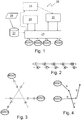
- the optimisation device 20 can optionally comprise a higher-level supervisor module 23, hence indicated in figure 1 with a broken line. This supervisor module is in turn in communication with the traffic management module 21 and with the solving module 25.
- the supervisor module Among the tasks of the supervisor module is the preliminary selection, in the medium term, of the routes, the advance allocation of routes to particular AGVs through optimising criteria, the sequencing of the loading and unloading missions so as to "pre-plan" the traffic.
- the optimisation device 20 also comprises a memory 26 in which the plan of the warehouse - the so-called layout - or the area in which the vehicles AGV must move is represented, and from this layout of the warehouse it is then possible to obtain the connection graph that is located in the respective connection graph module 27, which comprises an outline of the possible routes for the vehicles AGV.
- the connection graph is then used by the traffic management module 21 to move the vehicles AGV.
- the traffic management module 21 receives the data from the connection graph module 27 and the overall state of the system, i.e. the current position of the vehicles AGV, the missions that the vehicles must carry out, etc.
- the traffic management module 21 calculates, for each AGV, a reduced connection graph, i.e. a graph that is formed from the general graph portion that the AGV can actually reach in a predetermined number of steps, hereafter indicated as time frame T.
- a reduced connection graph i.e. a graph that is formed from the general graph portion that the AGV can actually reach in a predetermined number of steps, hereafter indicated as time frame T.
- This information i.e. the overall state of the system and the reduced connection graph for each vehicle AGV, are then passed to the solving module 25, which reprocesses it through an integer linear programming model, discussed hereafter, providing an optimised preliminary solution of the routes, in the form of a sequence of segments that each vehicle AGV must travel.
- the traffic management module 21 must check the actual compatibility of the solution and thus check the assignments of the route segments to the vehicles in question.
- the solving module 25 provides a sequence of segments "b” and "c” for the vehicle AGV1, whereas for the vehicle AGV2, it provides the sequence of segments "a” and "d".
- the device 21 carries out the following activities:
- the reassignment module 24 is recalled, which reassigns the AGVs - among those that can be reassigned - to activate the missions.
- the vehicles AGV that can be reassigned are those that are not connected, by this term meaning the vehicles AGV engaged in a mission from the start moment of picking up a load of products up to the end of unloading of the load.
- the reassignment module 24 assigns the missions to the vehicles AGV in a mathematically optimised manner, i.e. minimising the sum of the nominal time relative to the shortest routes (i.e. the routes that allow the destination to be reached in the shortest time possible without considering possible deviations needed to avoid "jams") that the vehicles must carry out to move from the final node of the segment assigned up to that moment to the respective mission destination nodes.
- the reassignment module 24 reassigns the missions to the vehicles AGV, minimising the sum of the travel times of the vehicles themselves until the respective mission objective has been reached.
- the objective function to be minimised is the sum of all the nominal travel times from the final point of each vehicle AGV, meaning the point in which the given segments end up to that moment.
- the aforementioned sum of all the distances is calculated in advance based on the predetermined routes, for each pair of nodes, through an algorithm for calculating the minimum routes (like for example the known Dijkstra algorithm).
- each node of the connection graph has an associated matrix that comprises all of the minimum nominal times towards the other nodes, calculated with the calculation algorithm of the minimum routes.
- the solving module 25 generates an integer linear programming model using the data received from the traffic management module 21.
- the solving module 25 comprises a memory in which the elements of the integer linear programming that define the system are recorded: variables, coefficients of the objective function, matrix of the constraints; the solving module 25 also comprises an actual linear solver.
- the solving module uses an approximate linear model, in which:
- the calculation of the minimum distances between each pair of nodes of the connection graph is carried out.
- a calculation is carried out, for example, through the Dijkstra algorithm, then a matrix is associated to each node of the graph that comprises all the minimum distances towards the other nodes.
- the incompatibilities of the routes for the vehicles AGV identified are verified, in advance, through the analysis of the graph.
- the pair of segments (1,2) and (5,4) can also have the same problem: after assignment to two different vehicles AGV, the vehicle on the node 4. can only travel along the segment (4,3), which is incompatible with the segment (1,2). As a result the segments (1,2) and (5,4) also have a so-called static incompatibility, which will be discussed hereafter.
- the scheme of figure 3 represents another example of incompatibility with 3 segments.
- a first vehicle AGV1 is routed on the segment (8,1)
- a second vehicle AGV2 is routed on the segment (7,2)
- a third vehicle AGV3 is routed on the segment (9,3)
- the segment (1,4) for the first vehicle is blocked by the node 2
- the segment (2,5) for the second vehicle is blocked by the node 3
- the segment (3,6) for the third vehicle is blocked by the node 1.
- connection graph i.e. through a suitable algorithm the details of which will be provided hereafter.
- the solving module 25 will apply suitable constraints to prevent the AGVs from being located on such groups of incompatible segments.
- One particular case to be considered is that of two-directional segments. In general, it is better to avoid a vehicle AGV continuing to move back and forth on two-directional segments: this situation is comparable to the above indicated livelocks and, even when it does not take the system into an irresolvable condition, it causes a loss of time and, therefore, a drop in performance.
- the last segment assigned to a vehicle not to be such that its final node hinders, in the sense of incompatibility between movements, other AGVs manoeuvring near to the respective mission nodes. In this way the AGVs leaving their missions are ensured a route towards the next destination, without needing to wait for the entering vehicles to free up the segment.
- no-stop nodes since the AGVs are not permitted to make stops on such nodes.
- the algorithm for the identification of the no-stop nodes will be described hereafter.
- route sections significantly in advance: for example, to decide the order of entry of the AGVs in an area of the plant.
- the task of planning in advance, "at an another level", the travel along these corridors can be carried out by the high-level module 23, which, in any case, delegates to the solver 25 object of this invention the task of solving the "local" problem of selecting the approach route to the corridor, of assigning segments to all the vehicles present in order to avoid deadlock.
- linear optimisation models specify the relationship between the decision variables and the parameters, calculating a representative measurement to be optimised and other resulting variables.
- constraints set limitations to the space of the possible decisions; the admissible values of the decision variables are determined through a series of equality or inequality constraints.
- variable X n v 0 represents the initial condition, representing the current state of the system.
- n X n v t 1 ⁇ v , t ⁇ v X n v t ⁇ 1 ⁇ n , t X n v t + 1 ⁇ ⁇ n ′ ⁇ V n X n ′ v t ⁇ n , v , t ⁇ T that have the following meaning:
- a further "static constraint makes all the relative positions of a set of vehicles that would lead the system to a deadlock unpermitted, i.e. in the condition in which no AGV is free to move without bumping into another.
- the set of unpermitted positions is determined a priori, once for all, from the graph and from the segment/segment and node/segment incompatibility rules already discussed through an ad hoc algorithm that will be described hereafter.
- the constraints of this type are called static constraints since they are calculated a priori and do not depend on the type of mission of the AGVs or on the relative disconnected or connected state.
- the number s of incompatible segments correspond to the number s of vehicles taken into consideration.
- the second member is a constant that expresses the number of variables present at the first member, decreased by 1.
- the nodes considered in the optimisation step are only those that can be reached by a certain vehicle v within the time period T , starting from the node occupied at the time period 0.
- B(n) is an additional parameter different from zero if the node " n " is not a mission node
- D(n, v) it is the nominal travel time of the minimum route between the node "n” and the mission node of the AGV "v”
- the reassignment module of the missions 24 redirects it towards a position, called home position.
- the node closest to the AGV among those belonging to a predefined set (stored in the module 27) and not occupied by other AGVs is selected as the home position.
- the coefficients in objective function are equal to 1 for the nodes on which the vehicles are located, and equal to 2 for all of the other nodes.
- the same principle can be easily applied to the case in which the AGVs without a mission are directed towards the so-called home positions.
- the cost of the virtual segment ( n , n ) which represents the behaviour "stay on the same node for a time period ", is set at 1, while the cost of the segment ( n, m ), with n ⁇ m, is set at 2; with these selections, also in this case a vehicle without a mission stays in the initial position unless it constitutes an obstacle for the other vehicles with missions assigned; as an additional rule, for each vehicle without a mission, we then consider a "repulsion force" from the mission nodes of other AGVs, so as to reduce the interference between the vehicles with and without a mission.
- the additional cost by which the coefficients f ( n, v, t ) of the vehicle v is multiplied for all the nodes n that are, or can be, the mission of other AGVs is given by the formula RepulsionMax ⁇ minD v * RepulsionCoeff where RepulsionMax and RepulsionCoeff are design parameters, and minD(v) is the minimum distance between the node in which the vehicle v without destination is located and the mission nodes of all the others.
- An important technical advantage is that the method for optimising the movement of automated-guided vehicles, and the like, allows the routes that the vehicles must follow between stations to carry out the assigned missions to be optimised, reducing the time necessary for the transportation of articles, and ensuring that jams cannot be created along the routes, even in the case of a high number of automated-guided vehicles.
- the method for optimising the movement of automated-guided vehicles, and the like also allows a saving, not just of time, but also of money. It has thus been seen how the invention achieves the proposed purposes.
Landscapes
- Engineering & Computer Science (AREA)
- Aviation & Aerospace Engineering (AREA)
- Radar, Positioning & Navigation (AREA)
- Remote Sensing (AREA)
- Physics & Mathematics (AREA)
- General Physics & Mathematics (AREA)
- Automation & Control Theory (AREA)
- Control Of Position, Course, Altitude, Or Attitude Of Moving Bodies (AREA)
- Traffic Control Systems (AREA)
Applications Claiming Priority (2)
| Application Number | Priority Date | Filing Date | Title |
|---|---|---|---|
| IT000178A ITVR20130178A1 (it) | 2013-07-26 | 2013-07-26 | Dispositivo e metodo per l'ottimizzazione della movimentazione di veicoli a guida automatica, e simili |
| PCT/IB2014/063349 WO2015011661A2 (en) | 2013-07-26 | 2014-07-23 | Device and method for optimising the movement of automated-guided vehicles, and the like |
Publications (2)
| Publication Number | Publication Date |
|---|---|
| EP3025206A2 EP3025206A2 (en) | 2016-06-01 |
| EP3025206B1 true EP3025206B1 (en) | 2017-09-06 |
Family
ID=49263408
Family Applications (1)
| Application Number | Title | Priority Date | Filing Date |
|---|---|---|---|
| EP14771380.4A Active EP3025206B1 (en) | 2013-07-26 | 2014-07-23 | Device and method for optimising the movement of automated-guided vehicles |
Country Status (4)
| Country | Link |
|---|---|
| EP (1) | EP3025206B1 (it) |
| ES (1) | ES2644703T3 (it) |
| IT (1) | ITVR20130178A1 (it) |
| WO (1) | WO2015011661A2 (it) |
Cited By (2)
| Publication number | Priority date | Publication date | Assignee | Title |
|---|---|---|---|---|
| DE102020214005A1 (de) | 2020-11-08 | 2022-05-12 | Fraunhofer-Gesellschaft zur Förderung der angewandten Forschung eingetragener Verein | Methode zur effizienten Routenplanung von Fahrzeugen in einem Sortiersystem |
| EP4664230A1 (en) * | 2024-06-10 | 2025-12-17 | Kollmorgen Automation AB | Method and system for identifying travel blocking situations |
Families Citing this family (9)
| Publication number | Priority date | Publication date | Assignee | Title |
|---|---|---|---|---|
| DE102016009255B4 (de) * | 2016-07-29 | 2023-01-26 | Kuka Roboter Gmbh | Koordinierung von Pfaden mehrerer beweglicher Maschinen |
| CN107067779A (zh) * | 2016-11-30 | 2017-08-18 | 英华达(上海)科技有限公司 | 自动导引运输车交通管制系统及方法 |
| CN110347178B (zh) * | 2019-06-21 | 2021-11-05 | 东华大学 | 一种基于空间几何特征的无人机航迹规划方法 |
| US12124261B2 (en) * | 2020-11-20 | 2024-10-22 | Rapyuta Robotics Co., Ltd. | Systems and methods for optimizing route plans in an operating environment |
| CN112783211A (zh) * | 2021-01-06 | 2021-05-11 | 中国人民解放军陆军装甲兵学院 | 一种基于剖分理论的无人机与地面装甲编队协同控制方法 |
| EP4095640B1 (en) * | 2021-05-26 | 2025-01-22 | Volvo Autonomous Solutions AB | Method and system for controlling a plurality of vehicles, in particular autonomous vehicles |
| EP4113241B1 (en) * | 2021-07-01 | 2023-08-16 | Volvo Autonomous Solutions AB | Method and system for traffic control of a plurality of vehicles, in particular autonomous vehicles |
| CN115981264B (zh) * | 2023-02-28 | 2025-06-24 | 上海交通大学 | 一种考虑冲突的agv调度与数量联合优化方法 |
| CN117094629B (zh) * | 2023-09-18 | 2024-05-10 | 兰州交通大学 | 一种危险品满载配送路径优化和车辆调度方法 |
-
2013
- 2013-07-26 IT IT000178A patent/ITVR20130178A1/it unknown
-
2014
- 2014-07-23 WO PCT/IB2014/063349 patent/WO2015011661A2/en not_active Ceased
- 2014-07-23 EP EP14771380.4A patent/EP3025206B1/en active Active
- 2014-07-23 ES ES14771380.4T patent/ES2644703T3/es active Active
Non-Patent Citations (1)
| Title |
|---|
| None * |
Cited By (2)
| Publication number | Priority date | Publication date | Assignee | Title |
|---|---|---|---|---|
| DE102020214005A1 (de) | 2020-11-08 | 2022-05-12 | Fraunhofer-Gesellschaft zur Förderung der angewandten Forschung eingetragener Verein | Methode zur effizienten Routenplanung von Fahrzeugen in einem Sortiersystem |
| EP4664230A1 (en) * | 2024-06-10 | 2025-12-17 | Kollmorgen Automation AB | Method and system for identifying travel blocking situations |
Also Published As
| Publication number | Publication date |
|---|---|
| EP3025206A2 (en) | 2016-06-01 |
| WO2015011661A3 (en) | 2015-07-02 |
| ES2644703T3 (es) | 2017-11-30 |
| ITVR20130178A1 (it) | 2015-01-27 |
| WO2015011661A2 (en) | 2015-01-29 |
| WO2015011661A9 (en) | 2015-08-13 |
Similar Documents
| Publication | Publication Date | Title |
|---|---|---|
| EP3025206B1 (en) | Device and method for optimising the movement of automated-guided vehicles | |
| CN118863472B (zh) | 一种面向智慧仓储管理的agv叉车协同调度方法及系统 | |
| Ribino et al. | Agent-based simulation study for improving logistic warehouse performance | |
| CN110182527B (zh) | 用于货架阵列的出入库控制方法和搬运系统 | |
| EP3152712B1 (en) | Methods, systems and apparatus for controlling movement of transporting devices | |
| Skinner et al. | Optimisation for job scheduling at automated container terminals using genetic algorithm | |
| US20230075128A1 (en) | Column generation methods and systems for routing and scheduling in robotic and vehicular applications | |
| CN110182528B (zh) | 用于货架阵列的出入库控制方法和搬运系统 | |
| Thanos et al. | Dispatch and conflict-free routing of capacitated vehicles with storage stack allocation | |
| Hamzheei et al. | An ant colony-based algorithm for finding the shortest bidirectional path for automated guided vehicles in a block layout | |
| US20240174446A1 (en) | Managing a warehouse having robots of different types | |
| CN116719329B (zh) | 路径规划方法、系统、设备及存储介质 | |
| Hsueh | A simulation study of a bi-directional load-exchangeable automated guided vehicle system | |
| CN116339257A (zh) | Agv多车调度系统以及相关调度方法 | |
| Solichudin et al. | Conflict-free dynamic route multi-AGV using dijkstra floyd-warshall hybrid algorithm with time windows | |
| Rathi et al. | Dynamic prioritization for conflict-free path planning of multi-robot systems | |
| Vivaldini et al. | Automatic routing of forklift robots in warehouse applications | |
| Tus et al. | Metaheuristics for the two-dimensional container pre-marshalling problem | |
| Li | Task Assignment and Path Planning for Autonomous Mobile Robots in Stochastic Warehouse Systems | |
| Stavrou et al. | Assignment and coordination of autonomous robots in container loading terminals | |
| Akiyama et al. | A multi-commodity flow model for guide path layout design of AGV systems | |
| Fazlollahtabar et al. | A Monte Carlo simulation to estimate TAGV production time in a stochastic flexible automated manufacturing system: a case study | |
| Stubbe et al. | Efficient online scheduling and routing for automated guided vehicles in loop-based graphs | |
| Giglio | A Petri net model for an open path multi-AGV system | |
| Srivastav et al. | Introduction to the flexible manufacturing system in Industry 4.0 |
Legal Events
| Date | Code | Title | Description |
|---|---|---|---|
| PUAI | Public reference made under article 153(3) epc to a published international application that has entered the european phase |
Free format text: ORIGINAL CODE: 0009012 |
|
| 17P | Request for examination filed |
Effective date: 20151127 |
|
| AK | Designated contracting states |
Kind code of ref document: A2 Designated state(s): AL AT BE BG CH CY CZ DE DK EE ES FI FR GB GR HR HU IE IS IT LI LT LU LV MC MK MT NL NO PL PT RO RS SE SI SK SM TR |
|
| AX | Request for extension of the european patent |
Extension state: BA ME |
|
| DAX | Request for extension of the european patent (deleted) | ||
| GRAP | Despatch of communication of intention to grant a patent |
Free format text: ORIGINAL CODE: EPIDOSNIGR1 |
|
| INTG | Intention to grant announced |
Effective date: 20170223 |
|
| GRAS | Grant fee paid |
Free format text: ORIGINAL CODE: EPIDOSNIGR3 |
|
| GRAA | (expected) grant |
Free format text: ORIGINAL CODE: 0009210 |
|
| AK | Designated contracting states |
Kind code of ref document: B1 Designated state(s): AL AT BE BG CH CY CZ DE DK EE ES FI FR GB GR HR HU IE IS IT LI LT LU LV MC MK MT NL NO PL PT RO RS SE SI SK SM TR |
|
| REG | Reference to a national code |
Ref country code: GB Ref legal event code: FG4D |
|
| REG | Reference to a national code |
Ref country code: CH Ref legal event code: EP Ref country code: AT Ref legal event code: REF Ref document number: 926523 Country of ref document: AT Kind code of ref document: T Effective date: 20170915 |
|
| REG | Reference to a national code |
Ref country code: IE Ref legal event code: FG4D |
|
| REG | Reference to a national code |
Ref country code: DE Ref legal event code: R096 Ref document number: 602014014279 Country of ref document: DE |
|
| REG | Reference to a national code |
Ref country code: NL Ref legal event code: FP |
|
| REG | Reference to a national code |
Ref country code: ES Ref legal event code: FG2A Ref document number: 2644703 Country of ref document: ES Kind code of ref document: T3 Effective date: 20171130 |
|
| REG | Reference to a national code |
Ref country code: LT Ref legal event code: MG4D |
|
| PG25 | Lapsed in a contracting state [announced via postgrant information from national office to epo] |
Ref country code: LT Free format text: LAPSE BECAUSE OF FAILURE TO SUBMIT A TRANSLATION OF THE DESCRIPTION OR TO PAY THE FEE WITHIN THE PRESCRIBED TIME-LIMIT Effective date: 20170906 Ref country code: NO Free format text: LAPSE BECAUSE OF FAILURE TO SUBMIT A TRANSLATION OF THE DESCRIPTION OR TO PAY THE FEE WITHIN THE PRESCRIBED TIME-LIMIT Effective date: 20171206 Ref country code: SE Free format text: LAPSE BECAUSE OF FAILURE TO SUBMIT A TRANSLATION OF THE DESCRIPTION OR TO PAY THE FEE WITHIN THE PRESCRIBED TIME-LIMIT Effective date: 20170906 Ref country code: HR Free format text: LAPSE BECAUSE OF FAILURE TO SUBMIT A TRANSLATION OF THE DESCRIPTION OR TO PAY THE FEE WITHIN THE PRESCRIBED TIME-LIMIT Effective date: 20170906 Ref country code: FI Free format text: LAPSE BECAUSE OF FAILURE TO SUBMIT A TRANSLATION OF THE DESCRIPTION OR TO PAY THE FEE WITHIN THE PRESCRIBED TIME-LIMIT Effective date: 20170906 |
|
| REG | Reference to a national code |
Ref country code: AT Ref legal event code: MK05 Ref document number: 926523 Country of ref document: AT Kind code of ref document: T Effective date: 20170906 |
|
| PG25 | Lapsed in a contracting state [announced via postgrant information from national office to epo] |
Ref country code: LV Free format text: LAPSE BECAUSE OF FAILURE TO SUBMIT A TRANSLATION OF THE DESCRIPTION OR TO PAY THE FEE WITHIN THE PRESCRIBED TIME-LIMIT Effective date: 20170906 Ref country code: RS Free format text: LAPSE BECAUSE OF FAILURE TO SUBMIT A TRANSLATION OF THE DESCRIPTION OR TO PAY THE FEE WITHIN THE PRESCRIBED TIME-LIMIT Effective date: 20170906 Ref country code: BG Free format text: LAPSE BECAUSE OF FAILURE TO SUBMIT A TRANSLATION OF THE DESCRIPTION OR TO PAY THE FEE WITHIN THE PRESCRIBED TIME-LIMIT Effective date: 20171206 Ref country code: GR Free format text: LAPSE BECAUSE OF FAILURE TO SUBMIT A TRANSLATION OF THE DESCRIPTION OR TO PAY THE FEE WITHIN THE PRESCRIBED TIME-LIMIT Effective date: 20171207 |
|
| PG25 | Lapsed in a contracting state [announced via postgrant information from national office to epo] |
Ref country code: PL Free format text: LAPSE BECAUSE OF FAILURE TO SUBMIT A TRANSLATION OF THE DESCRIPTION OR TO PAY THE FEE WITHIN THE PRESCRIBED TIME-LIMIT Effective date: 20170906 Ref country code: RO Free format text: LAPSE BECAUSE OF FAILURE TO SUBMIT A TRANSLATION OF THE DESCRIPTION OR TO PAY THE FEE WITHIN THE PRESCRIBED TIME-LIMIT Effective date: 20170906 Ref country code: CZ Free format text: LAPSE BECAUSE OF FAILURE TO SUBMIT A TRANSLATION OF THE DESCRIPTION OR TO PAY THE FEE WITHIN THE PRESCRIBED TIME-LIMIT Effective date: 20170906 |
|
| PG25 | Lapsed in a contracting state [announced via postgrant information from national office to epo] |
Ref country code: SM Free format text: LAPSE BECAUSE OF FAILURE TO SUBMIT A TRANSLATION OF THE DESCRIPTION OR TO PAY THE FEE WITHIN THE PRESCRIBED TIME-LIMIT Effective date: 20170906 Ref country code: EE Free format text: LAPSE BECAUSE OF FAILURE TO SUBMIT A TRANSLATION OF THE DESCRIPTION OR TO PAY THE FEE WITHIN THE PRESCRIBED TIME-LIMIT Effective date: 20170906 Ref country code: AT Free format text: LAPSE BECAUSE OF FAILURE TO SUBMIT A TRANSLATION OF THE DESCRIPTION OR TO PAY THE FEE WITHIN THE PRESCRIBED TIME-LIMIT Effective date: 20170906 Ref country code: IS Free format text: LAPSE BECAUSE OF FAILURE TO SUBMIT A TRANSLATION OF THE DESCRIPTION OR TO PAY THE FEE WITHIN THE PRESCRIBED TIME-LIMIT Effective date: 20180106 Ref country code: SK Free format text: LAPSE BECAUSE OF FAILURE TO SUBMIT A TRANSLATION OF THE DESCRIPTION OR TO PAY THE FEE WITHIN THE PRESCRIBED TIME-LIMIT Effective date: 20170906 |
|
| REG | Reference to a national code |
Ref country code: DE Ref legal event code: R097 Ref document number: 602014014279 Country of ref document: DE |
|
| PLBE | No opposition filed within time limit |
Free format text: ORIGINAL CODE: 0009261 |
|
| STAA | Information on the status of an ep patent application or granted ep patent |
Free format text: STATUS: NO OPPOSITION FILED WITHIN TIME LIMIT |
|
| REG | Reference to a national code |
Ref country code: FR Ref legal event code: PLFP Year of fee payment: 5 |
|
| PG25 | Lapsed in a contracting state [announced via postgrant information from national office to epo] |
Ref country code: DK Free format text: LAPSE BECAUSE OF FAILURE TO SUBMIT A TRANSLATION OF THE DESCRIPTION OR TO PAY THE FEE WITHIN THE PRESCRIBED TIME-LIMIT Effective date: 20170906 |
|
| 26N | No opposition filed |
Effective date: 20180607 |
|
| PG25 | Lapsed in a contracting state [announced via postgrant information from national office to epo] |
Ref country code: SI Free format text: LAPSE BECAUSE OF FAILURE TO SUBMIT A TRANSLATION OF THE DESCRIPTION OR TO PAY THE FEE WITHIN THE PRESCRIBED TIME-LIMIT Effective date: 20170906 |
|
| REG | Reference to a national code |
Ref country code: CH Ref legal event code: PL |
|
| PG25 | Lapsed in a contracting state [announced via postgrant information from national office to epo] |
Ref country code: LU Free format text: LAPSE BECAUSE OF NON-PAYMENT OF DUE FEES Effective date: 20180723 Ref country code: MC Free format text: LAPSE BECAUSE OF FAILURE TO SUBMIT A TRANSLATION OF THE DESCRIPTION OR TO PAY THE FEE WITHIN THE PRESCRIBED TIME-LIMIT Effective date: 20170906 |
|
| REG | Reference to a national code |
Ref country code: BE Ref legal event code: MM Effective date: 20180731 |
|
| REG | Reference to a national code |
Ref country code: IE Ref legal event code: MM4A |
|
| PG25 | Lapsed in a contracting state [announced via postgrant information from national office to epo] |
Ref country code: LI Free format text: LAPSE BECAUSE OF NON-PAYMENT OF DUE FEES Effective date: 20180731 Ref country code: CH Free format text: LAPSE BECAUSE OF NON-PAYMENT OF DUE FEES Effective date: 20180731 Ref country code: IE Free format text: LAPSE BECAUSE OF NON-PAYMENT OF DUE FEES Effective date: 20180723 |
|
| PG25 | Lapsed in a contracting state [announced via postgrant information from national office to epo] |
Ref country code: BE Free format text: LAPSE BECAUSE OF NON-PAYMENT OF DUE FEES Effective date: 20180731 |
|
| PG25 | Lapsed in a contracting state [announced via postgrant information from national office to epo] |
Ref country code: MT Free format text: LAPSE BECAUSE OF NON-PAYMENT OF DUE FEES Effective date: 20180723 |
|
| PG25 | Lapsed in a contracting state [announced via postgrant information from national office to epo] |
Ref country code: TR Free format text: LAPSE BECAUSE OF FAILURE TO SUBMIT A TRANSLATION OF THE DESCRIPTION OR TO PAY THE FEE WITHIN THE PRESCRIBED TIME-LIMIT Effective date: 20170906 |
|
| PG25 | Lapsed in a contracting state [announced via postgrant information from national office to epo] |
Ref country code: PT Free format text: LAPSE BECAUSE OF FAILURE TO SUBMIT A TRANSLATION OF THE DESCRIPTION OR TO PAY THE FEE WITHIN THE PRESCRIBED TIME-LIMIT Effective date: 20170906 |
|
| PG25 | Lapsed in a contracting state [announced via postgrant information from national office to epo] |
Ref country code: CY Free format text: LAPSE BECAUSE OF FAILURE TO SUBMIT A TRANSLATION OF THE DESCRIPTION OR TO PAY THE FEE WITHIN THE PRESCRIBED TIME-LIMIT Effective date: 20170906 Ref country code: MK Free format text: LAPSE BECAUSE OF NON-PAYMENT OF DUE FEES Effective date: 20170906 Ref country code: HU Free format text: LAPSE BECAUSE OF FAILURE TO SUBMIT A TRANSLATION OF THE DESCRIPTION OR TO PAY THE FEE WITHIN THE PRESCRIBED TIME-LIMIT; INVALID AB INITIO Effective date: 20140723 |
|
| PG25 | Lapsed in a contracting state [announced via postgrant information from national office to epo] |
Ref country code: AL Free format text: LAPSE BECAUSE OF FAILURE TO SUBMIT A TRANSLATION OF THE DESCRIPTION OR TO PAY THE FEE WITHIN THE PRESCRIBED TIME-LIMIT Effective date: 20170906 |
|
| REG | Reference to a national code |
Ref country code: DE Ref legal event code: R081 Ref document number: 602014014279 Country of ref document: DE Owner name: E80 GROUP S.P.A., IT Free format text: FORMER OWNER: ELETTRIC 80 S.P.A., VIANO, REGGIO EMILIA, IT |
|
| REG | Reference to a national code |
Ref country code: NL Ref legal event code: HC Owner name: E80 GROUP S.P.A.; IT Free format text: DETAILS ASSIGNMENT: CHANGE OF OWNER(S), CHANGE OF OWNER(S) NAME; FORMER OWNER NAME: ELETTRIC 80 S.P.A. Effective date: 20220809 |
|
| REG | Reference to a national code |
Ref country code: ES Ref legal event code: PC2A Owner name: E80 GROUP S.P.A. Effective date: 20221104 |
|
| P01 | Opt-out of the competence of the unified patent court (upc) registered |
Effective date: 20230515 |
|
| REG | Reference to a national code |
Ref country code: DE Ref legal event code: R079 Ref document number: 602014014279 Country of ref document: DE Free format text: PREVIOUS MAIN CLASS: G05D0001020000 Ipc: G05D0001430000 |
|
| PGFP | Annual fee paid to national office [announced via postgrant information from national office to epo] |
Ref country code: NL Payment date: 20250726 Year of fee payment: 12 |
|
| PGFP | Annual fee paid to national office [announced via postgrant information from national office to epo] |
Ref country code: ES Payment date: 20250801 Year of fee payment: 12 |
|
| PGFP | Annual fee paid to national office [announced via postgrant information from national office to epo] |
Ref country code: DE Payment date: 20250729 Year of fee payment: 12 |
|
| PGFP | Annual fee paid to national office [announced via postgrant information from national office to epo] |
Ref country code: IT Payment date: 20250723 Year of fee payment: 12 |
|
| PGFP | Annual fee paid to national office [announced via postgrant information from national office to epo] |
Ref country code: GB Payment date: 20250728 Year of fee payment: 12 |
|
| PGFP | Annual fee paid to national office [announced via postgrant information from national office to epo] |
Ref country code: FR Payment date: 20250725 Year of fee payment: 12 |