EP3025683B1 - Fussprothese - Google Patents
Fussprothese Download PDFInfo
- Publication number
- EP3025683B1 EP3025683B1 EP15191212.8A EP15191212A EP3025683B1 EP 3025683 B1 EP3025683 B1 EP 3025683B1 EP 15191212 A EP15191212 A EP 15191212A EP 3025683 B1 EP3025683 B1 EP 3025683B1
- Authority
- EP
- European Patent Office
- Prior art keywords
- prosthesis according
- foot prosthesis
- loop
- foot
- pin
- Prior art date
- Legal status (The legal status is an assumption and is not a legal conclusion. Google has not performed a legal analysis and makes no representation as to the accuracy of the status listed.)
- Active
Links
Images



Classifications
-
- A—HUMAN NECESSITIES
- A61—MEDICAL OR VETERINARY SCIENCE; HYGIENE
- A61F—FILTERS IMPLANTABLE INTO BLOOD VESSELS; PROSTHESES; DEVICES PROVIDING PATENCY TO, OR PREVENTING COLLAPSING OF, TUBULAR STRUCTURES OF THE BODY, e.g. STENTS; ORTHOPAEDIC, NURSING OR CONTRACEPTIVE DEVICES; FOMENTATION; TREATMENT OR PROTECTION OF EYES OR EARS; BANDAGES, DRESSINGS OR ABSORBENT PADS; FIRST-AID KITS
- A61F2/00—Filters implantable into blood vessels; Prostheses, i.e. artificial substitutes or replacements for parts of the body; Appliances for connecting them with the body; Devices providing patency to, or preventing collapsing of, tubular structures of the body, e.g. stents
- A61F2/50—Prostheses not implantable in the body
- A61F2/60—Artificial legs or feet or parts thereof
- A61F2/66—Feet; Ankle joints
-
- A—HUMAN NECESSITIES
- A61—MEDICAL OR VETERINARY SCIENCE; HYGIENE
- A61F—FILTERS IMPLANTABLE INTO BLOOD VESSELS; PROSTHESES; DEVICES PROVIDING PATENCY TO, OR PREVENTING COLLAPSING OF, TUBULAR STRUCTURES OF THE BODY, e.g. STENTS; ORTHOPAEDIC, NURSING OR CONTRACEPTIVE DEVICES; FOMENTATION; TREATMENT OR PROTECTION OF EYES OR EARS; BANDAGES, DRESSINGS OR ABSORBENT PADS; FIRST-AID KITS
- A61F2/00—Filters implantable into blood vessels; Prostheses, i.e. artificial substitutes or replacements for parts of the body; Appliances for connecting them with the body; Devices providing patency to, or preventing collapsing of, tubular structures of the body, e.g. stents
- A61F2/50—Prostheses not implantable in the body
- A61F2002/5007—Prostheses not implantable in the body having elastic means different from springs, e.g. including an elastomeric insert
-
- A—HUMAN NECESSITIES
- A61—MEDICAL OR VETERINARY SCIENCE; HYGIENE
- A61F—FILTERS IMPLANTABLE INTO BLOOD VESSELS; PROSTHESES; DEVICES PROVIDING PATENCY TO, OR PREVENTING COLLAPSING OF, TUBULAR STRUCTURES OF THE BODY, e.g. STENTS; ORTHOPAEDIC, NURSING OR CONTRACEPTIVE DEVICES; FOMENTATION; TREATMENT OR PROTECTION OF EYES OR EARS; BANDAGES, DRESSINGS OR ABSORBENT PADS; FIRST-AID KITS
- A61F2/00—Filters implantable into blood vessels; Prostheses, i.e. artificial substitutes or replacements for parts of the body; Appliances for connecting them with the body; Devices providing patency to, or preventing collapsing of, tubular structures of the body, e.g. stents
- A61F2/50—Prostheses not implantable in the body
- A61F2002/5016—Prostheses not implantable in the body adjustable
- A61F2002/503—Prostheses not implantable in the body adjustable for adjusting elasticity, flexibility, spring rate or mechanical tension
-
- A—HUMAN NECESSITIES
- A61—MEDICAL OR VETERINARY SCIENCE; HYGIENE
- A61F—FILTERS IMPLANTABLE INTO BLOOD VESSELS; PROSTHESES; DEVICES PROVIDING PATENCY TO, OR PREVENTING COLLAPSING OF, TUBULAR STRUCTURES OF THE BODY, e.g. STENTS; ORTHOPAEDIC, NURSING OR CONTRACEPTIVE DEVICES; FOMENTATION; TREATMENT OR PROTECTION OF EYES OR EARS; BANDAGES, DRESSINGS OR ABSORBENT PADS; FIRST-AID KITS
- A61F2/00—Filters implantable into blood vessels; Prostheses, i.e. artificial substitutes or replacements for parts of the body; Appliances for connecting them with the body; Devices providing patency to, or preventing collapsing of, tubular structures of the body, e.g. stents
- A61F2/50—Prostheses not implantable in the body
- A61F2002/5016—Prostheses not implantable in the body adjustable
- A61F2002/5033—Prostheses not implantable in the body adjustable for adjusting damping
-
- A—HUMAN NECESSITIES
- A61—MEDICAL OR VETERINARY SCIENCE; HYGIENE
- A61F—FILTERS IMPLANTABLE INTO BLOOD VESSELS; PROSTHESES; DEVICES PROVIDING PATENCY TO, OR PREVENTING COLLAPSING OF, TUBULAR STRUCTURES OF THE BODY, e.g. STENTS; ORTHOPAEDIC, NURSING OR CONTRACEPTIVE DEVICES; FOMENTATION; TREATMENT OR PROTECTION OF EYES OR EARS; BANDAGES, DRESSINGS OR ABSORBENT PADS; FIRST-AID KITS
- A61F2/00—Filters implantable into blood vessels; Prostheses, i.e. artificial substitutes or replacements for parts of the body; Appliances for connecting them with the body; Devices providing patency to, or preventing collapsing of, tubular structures of the body, e.g. stents
- A61F2/50—Prostheses not implantable in the body
- A61F2/60—Artificial legs or feet or parts thereof
- A61F2/66—Feet; Ankle joints
- A61F2002/6614—Feet
-
- A—HUMAN NECESSITIES
- A61—MEDICAL OR VETERINARY SCIENCE; HYGIENE
- A61F—FILTERS IMPLANTABLE INTO BLOOD VESSELS; PROSTHESES; DEVICES PROVIDING PATENCY TO, OR PREVENTING COLLAPSING OF, TUBULAR STRUCTURES OF THE BODY, e.g. STENTS; ORTHOPAEDIC, NURSING OR CONTRACEPTIVE DEVICES; FOMENTATION; TREATMENT OR PROTECTION OF EYES OR EARS; BANDAGES, DRESSINGS OR ABSORBENT PADS; FIRST-AID KITS
- A61F2/00—Filters implantable into blood vessels; Prostheses, i.e. artificial substitutes or replacements for parts of the body; Appliances for connecting them with the body; Devices providing patency to, or preventing collapsing of, tubular structures of the body, e.g. stents
- A61F2/50—Prostheses not implantable in the body
- A61F2/60—Artificial legs or feet or parts thereof
- A61F2/66—Feet; Ankle joints
- A61F2002/6614—Feet
- A61F2002/6657—Feet having a plate-like or strip-like spring element, e.g. an energy-storing cantilever spring keel
Definitions
- the invention relates to a prosthetic foot.
- every prosthetic foot is to enable the wearer to appear as comfortable as possible and, thanks to the spring properties of the prosthesis, to act as smoothly as possible and to walk closer to the real foot.
- foot prostheses which have a lower part which touches the floor when running.
- An elastic damping element is arranged on the lower part and is primarily offset in the direction of the heel area.
- a metal plate with a suitable fastening means, for example a pyramid holder, is then provided on this elongated damping element, on which a connecting shaft or the like, with which the entire prosthesis is fastened to the leg stump, can be arranged.
- the damping element provides the elastic mobility of this plate relative to the lower part.
- rope or belt loops are provided in front of and behind the plate-side connecting means, for example the pyramid receptacle, which overlap the plate and run to the lower part, and are either fastened to or under this.
- the holding plate is firmly connected or clamped to the lower part in this way.
- These rope or belt connections are flexible insofar as it is possible for the holding plate to deflect relative to the lower part, both in the rear heel area and in the front area located virtually in the center of the foot.
- rebound and thus relaxation of the damping element via the rope or belt loops is limited so that the pretension remains. This double limitation of movement ultimately results in a limitation of the relative mobility of the lower part and the plate relative to one another.
- the invention is therefore based on the problem of specifying an improved prosthetic foot.
- the prosthetic foot provides, on the one hand, a one-piece component forming the upper part and the lower part, which component is preferably made of a carbon fiber composite material, and is therefore a multilayer laminate component.
- Upper part and lower part are connected to each other via a deflection in the toe region, the deflection in the region between z. B. 135 ° - 180 °.
- the connecting means for example the pyramid holder, is located on the upper part.
- the upper part and lower part are spaced apart from one another, but lie approximately congruently one above the other.
- the elastic damping element for example made of a rubber-like material, which serves as an impact damper as described, thus dampening the relative movement from the upper part to the lower part. So both are coupled to each other via the damping element, they form a spring in the area between the damping element and the tip of the foot, which is bent and curved when running is claimed.
- the damping element is usually connected flat to the upper and / or lower part, mostly glued.
- a pressure-soft and tensile connection means which connects the upper part and the lower part to one another, this connection means being guided directly through the damping element in a recess there.
- the damping means is in the area near the heel, in which, for example, the pyramid receptacle is ultimately also arranged, the connection of the upper part to the lower part is consequently also provided in the area below the pyramid receptacle.
- this connecting means is pressure-soft, which means that it yields under load, so that the damping element can deflect.
- it is also tension-resistant, that is to say that the damping element is limited to spring out via the connecting means. In the unloaded state, the connecting means defines the maximum distance from the upper part to the lower part in this area.
- the connecting means is guided through the damping element and thus virtually through the pivot point, the relative movement from the upper part to the lower part and thus the pivoting around the pivot point is not limited by this connecting means neither in the heel region nor in the foot center region or toe region lying in front of it.
- the spring travel is therefore not limited as long as the springs are not in contact, which occurs when rolling over the tip of the foot at the end of the movement. In the event of spring contact, i.e.
- the damping element is preferably not connected to the upper part, so that, in extreme cases, this can move relative to the damping element when viewed in the longitudinal direction of the foot. Lifting it off is not possible using the tensile fastener.
- the foot prosthesis according to the invention consequently enables a significantly more comfortable walking that is closer to that of the real foot.
- the thrust forces occurring in the anterior-posterior direction are not completely prevented, since there are no cable and belt connections limiting the movement, as described in the introduction, so that there are no jerky and noticeable interruptions in the rolling movement.
- the connecting means itself is preferably a rope or a band, wherein the rope or band can either consist of plastic fibers that are high-strength and abrasion-resistant, or of steel wire.
- the rope or band can form a loop, the ends being fixed in a common holding element which is fastened to the lower part, while the loop is fastened to the upper part via a loop holding element which extends through it.
- a fixed connection of the connecting means is only provided on the lower part, where the holding element is fastened accordingly, while the loop is fixed on the upper part via a corresponding loop holding element.
- This loop holding element is preferably a pin which rests on the upper side of the upper part and which passes through the loop which penetrates the upper part in an opening.
- the pin thus serves as a replacement bearing on which the loop is attached. It is in turn supported on the top of the upper part, so that there is consequently a firm connection from the upper part to the lower part.
- a holding element is arranged on the upper part, via which the pin is secured against axial displacement.
- the pin is consequently fixed in its position via this holding element, which is arranged on the upper side of the upper part, so it cannot move in its longitudinal direction and, in extreme cases, slip out of the loop.
- the holding element is, for example, plate-shaped and can have one or two protruding tabs which engage in the opening on the upper part, and two further tabs between which the pin is accommodated. Due to the plate-like design, the holding element is never too high.
- the holding element is virtually fixed in position in the transverse direction or in the longitudinal direction of the pin fixed to it, via the one or the two projecting tabs which protrude toward the underside and which engage in the opening on the upper part side, through which the loop runs, so it cannot itself in move that direction.
- the pin itself is fixed between two further tabs that protrude from the top of the holding element.
- Such a configuration of the holding element is particularly easy to manufacture if the holding element is a holding plate. This is because the corresponding opening in the holding element, through which the loop extends, and the tabs can be easily formed in a simple punching process.
- the pin can also be inserted into a holding plate arranged on the upper side of the upper part.
- This holding plate can carry the fastening means, for example the pyramid receptacle, for example if the upper part is designed accordingly. Since this holding plate is to be arranged above the damping element in such a prosthesis configuration, the fixing of the pin on the holding plate is appropriate in this case.
- the opening that is penetrated by the loop is preferably designed as a slot that extends along the upper part.
- This slot can, for example, extend into the middle area of the prosthesis, so it has a certain length. In extreme cases, it even allows a certain degree of mobility the loop in the slot or the pin, provided that it lies directly on the surface.
- the design as a slot it is of course also conceivable to design the opening as a simple bore.
- Such a holding element is preferably designed as a sleeve in which the rope or band is glued, poured or clamped, the sleeve engaging through the lower part or the upper part in an opening.
- a radial collar is provided on the sleeve, which rests on the lower part or on the upper part, provided that such a sleeve is also to be fastened there.
- the rope or band is first glued or poured into the sleeve to be fixed on the lower part, or is appropriately clamped there, preferably by pouring or gluing.
- the sleeve is then inserted into the lower part and the rope or band is guided into the opening in the damping element.
- the sleeve is now attached to the lower part, for example also glued or cast.
- the upper part is then pressed firmly against the lower part, so that the damping element is compressed. This makes it possible to move the pen through the z. B. to slide through the slot loop and to position it accordingly on the upper part or the holding plate, whereupon the pressure is released again and the connecting means is mounted.
- the rope end there is inserted into the sleeve and glued or potted in it, after which the pressure is relieved after the potting or adhesive has hardened and the sleeve, for example likewise via a corresponding radial collar, is correspondingly fixed to the upper part.
- the sleeve can of course each extend a bit into the elastomer, which has a corresponding widening in this area.
- a third embodiment with regard to the connection of the rope or band with the upper part and the lower part provides for the rope or band to be laminated directly onto the upper part and the lower part.
- the component forming the lower part or upper part preferably consists of a carbon fiber composite material, which usually consists of several carbon fiber layers laminated one above the other.
- the damping element which of course should have a slot-like opening for this purpose in order to push it between the upper part and lower part.
- an essential element is that the rope or band passes through the damping element in a corresponding recess.
- This recess can be designed as a through hole or as a slot, which is optionally open on one side of the damping element. If the damping element is already glued to the lower part before the rope or band is assembled, the recess is preferably designed as an opening through which the rope or band can be guided. If the rope or band is mounted beforehand, the recess is expediently designed as a slot, so that the damping element can be pushed between the upper part and the lower part and the rope or band runs into the slot.
- At least one reinforcing element influencing its damping behavior can be used on the damping element be attachable.
- an insertion receptacle is provided on the damping element, into which the reinforcing element can be inserted.
- This can be a form-fitting connection, which means that the plug-in receptacle and the reinforcing element are correspondingly geometrically shaped.
- Such a reinforcing element e.g. B. from a different hardness than the damping element having plastic, for example, can be provided only on the heel back of the damping element, or on the opposite side.
- a cover which can be detachably attached to the upper part and which covers the fastening region of the connecting means can be provided, such a cover, of course, only being required if the rope or band is fixed either via the pin or a sleeve fixed on the upper part.
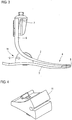
- Figure 1 shows an inventive prosthetic foot 1, consisting of an upper part 2 and a lower part 3, see also the Figures 2 and 3 ,
- the upper part 2 and the lower part 3 are realized by means of a one-piece component 4, the upper part 2 and the lower part 3 being connected to one another in the toe region via a deflection 5.
- the upper part 2 ends in a vertical section 6, on which a fastening means 7 for connecting a prosthesis socket, for example, is arranged via suitable fastening screws 8.
- the component 4 is a one-piece component, preferably made of a carbon fiber composite material. This means that the upper part 2 and the lower part 3 can be formed in a single manufacturing process. As can be seen, the upper part 2 and the lower part 3 are vertically congruent one above the other, ie they run one above the other.
- a longitudinal slot 9 is provided on the upper part 2, which will be discussed below.
- An opening 10 is formed, which will also be discussed below. Slot 9 and opening 10 serve to arrange a connecting element, which is also described below.
- a damping element 11 made of an elastic, rubber-like material is arranged between the upper part 2 and the lower part 3. It is preferably only firmly connected to the lower part 3, for example glued.
- an insertion receptacle 12 is formed, into which an insertion element, which is not shown here, can be used to vary the damping behavior, which is held there in a form-fitting manner.
- a cover 29 is detachably arranged on the upper part 2.
- the Figures 4 - 7 show in detail the damping element 11 and the connecting means 13 penetrating it, via which the upper part 2 and the lower part 3 are connected to one another.
- the damping element has an opening 21, which in the example shown is designed as a simple through hole, see in particular the sectional view in FIG Figure 7 .
- the connecting means 13 comprises a rope 14, preferably a rope made of plastic fibers, but the use of a wire rope is also conceivable.
- the rope 14 is designed as a loop 15. With its two ends, the rope 14 is received in a holding element 16, here in the form of a sleeve 17, and firmly anchored therein by means of a casting compound 18. In the assembly position, the sleeve 17 is inserted into the opening 10 on the lower part and rests on the underside 20 of the lower part 3 via a radial collar 19.
- the cable 14 is guided through the opening 21 of the damping element 11 and emerges towards the upper part 2. It passes through the upper part 2 in the slot 9, that is, it is passed through the slot 9.
- a loop holding element 22, here in the form of a pin 23, is inserted through the loop 15. In the assembly position, the pin 23 is located, see the sectional view according to Figure 7 , on the top 24 of the upper part 2. This fixes the cable 14 to the upper part 2.
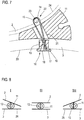
- FIG. 8 shows in the form of three basic representations I, II and III the relative movement of the upper part 2 to the lower part 3. It is assumed that the view I shows the heel attachment process, ie when the heel section 24 of the lower part 3 touches the ground. As can be seen, the upper part 2 can pivot in or deflect towards the heel without the connecting means 13, that is to say the cable connection, limiting this movement in any way. In Figure 8 the respective swivel area is shown covered, nevertheless the basic principle can be seen from this.
- Illustration II shows the condition when the prosthesis lies flat with the lower part on the floor.
- Upper part 2 and lower part 3 run, only loaded vertically, one above the other, the transition from the situation according to illustration I to illustration II via the connecting means 13 being in no way impeded.
- Representation III finally shows the rolling process over the toe 25 of the lower part 3.
- the upper part 2 can deflect in the area of the toe to the lower part 3, while a movement apart is possible in the heel area.
- the prosthesis according to the invention thus ensures that the thrust forces occurring in the anterior-posterior direction are not completely prevented, or in any way there is no relative mobility limited by the connecting means, so that there are no jerky interruptions in the rolling movement that are perceptible to the user. Rather, there is a round, homogeneous placement and rolling process.
- Figure 9 shows a schematic diagram of the entire foot prosthesis 1, corresponding to the schematic diagrams Figure 8 .
- Figure 10 shows a further embodiment of a prosthetic foot 1 according to the invention, the same reference numerals being used for the same components.
- This also has an upper part 2 and a lower part 3, which consist of a one-piece carbon fiber composite component 4. Here, too, they merge into one another via a deflection 5.
- a damping element 11 is provided between the upper part 2 and lower part 3, the upper part 2 being geometrically different in this embodiment than in the previously described embodiment.
- the upper part 2 runs almost parallel to the lower part 3 towards the heel area.
- a holding plate 26 is arranged on the upper part 2 and carries the fastening element, to which, for example, a connecting shaft is attached.
- a connection means 13 comprising a rope 14, which forms a loop 15.
- the lower rope ends are in turn received in a sleeve 17 which is fastened to the lower part in a manner corresponding to that described in the previous figures.
- the cable 14 in turn runs through an opening 21 in the damping element 11. It is guided through an opening provided in the upper part 2 to a recess 27 in the holding plate 26, in which recess a pin 23 is inserted, on which in turn the loop 15 is suspended.
- the pin 23 is fixed in a corresponding insertion holder on the holding plate 26. Consequently, here the pin 23 is not attached directly to the upper part 2, but to the holding plate 26 fastened on the upper part side.
- Figure 11 shows a further embodiment in which the rope 14 is directly laminated to the upper part 2 and the lower part 3.
- the basic illustration shows the individual rope fibers 28 which are integrated in the upper part 2 and the lower part 3 directly into the laminate or resin matrix. They in turn pass through the damping element 11, which is only retrofitted in this embodiment and which, for example, has a suitable slot for this purpose, which leads into the corresponding opening 21, so that the damping element 11 between the upper part 2 and the lower part 3, the cable 14 in itself receiving, can be pushed.
- Figure 12 finally shows an embodiment in which the connecting means 13 has both a sleeve 17 fixed to the lower part 3 and a sleeve 17 fixed to the upper part 2.
- the rope 14 is consequently fixed with its ends in two sleeves 17, it does not form a loop in this embodiment.
- the function is basically the same as described for the above embodiments.
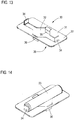
- FIG 13 shows a holding element 30 in the form of a plate-shaped holding plate 31, which the fixing of the in the embodiment according to the Figures 1-7 provided pin serves.
- the holding plate 31 has a central opening 32.
- two further tabs 36 are provided, which are positioned centrally between the tabs 34, but, as said, project to the other side.
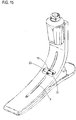
- the tabs 36 engage in the slot 9, see the illustration in FIG Figure 15 , By means of this tab engagement, the holding plate 31 itself is secured against lateral displacement, so that it cannot move in this direction.
Landscapes
- Health & Medical Sciences (AREA)
- Transplantation (AREA)
- Biomedical Technology (AREA)
- Cardiology (AREA)
- Oral & Maxillofacial Surgery (AREA)
- Engineering & Computer Science (AREA)
- Orthopedic Medicine & Surgery (AREA)
- Heart & Thoracic Surgery (AREA)
- Vascular Medicine (AREA)
- Life Sciences & Earth Sciences (AREA)
- Animal Behavior & Ethology (AREA)
- General Health & Medical Sciences (AREA)
- Public Health (AREA)
- Veterinary Medicine (AREA)
- Prostheses (AREA)
Description
- Die Erfindung betrifft eine Fußprothese.
- Fußprothesen sind in unterschiedlicher Ausgestaltung bekannt, zum Beispiel aus der
EP 2 420 212 , die eine Fußprothese gemäß des Oberbegriffes von Anspruch 1 offenbart. - Ziel jeder Fußprothese ist es dem Träger ein möglichst komfortables und aufgrund der Federeigenschaften der Prothese gedämpftes Auftreten sowie ein dem realen Fuß angenähertes Laufen zu ermöglichen. Bekannt sind unter anderem Fußprothesen, die ein Unterteil aufweisen, das beim Laufen bodenseitig aufsetzt. Am Unterteil angeordnet ist eine elastisches Dämpfungselement, das primär Richtung Fersenbereich versetzt angeordnet ist. Auf diesem länglichen Dämpfungselement ist sodann eine Metallplatte mit einem geeigneten Befestigungsmittel, beispielsweise einer Pyramidenaufnahme vorgesehen, an welcher ein Verbindungsschaft oder dergleichen, mit dem die gesamte Prothese am Beinstumpf befestigt wird, angeordnet werden kann. Das Dämpfungselement stellt die elastische Beweglichkeit dieser Platte relativ zum Unterteil zur Verfügung. Um eine gewisse Vorspannung innerhalb des Dämpfungselements zu erreichen sind vor und hinter dem plattenseitigen Verbindungsmittel, also beispielsweise der Pyramidenaufnahme, Seil- oder Gurtschlaufen vorgesehen, die die Platte übergreifen und zum Unterteil laufen, und entweder an diesem befestigt sind oder dieses untergreifen. Hierüber wird die Halteplatte fest mit dem Unterteil verbunden respektive verspannt. Diese Seil- bzw. Gurtverbindungen sind insoweit flexibel, als ein Einfedern der Halteplatte relativ zum Unterteil möglich ist, und zwar sowohl im hinteren Fersenbereich als auch im vorderen, quasi fußmittig befindlichen Bereich. Jedoch wird ein Ausfedern und damit eine Relaxation des Dämpfungselements über die Seil- oder Gurtschlaufen begrenzt, so dass die Vorspannung bleibt. Aus dieser doppelten Bewegungsbegrenzung resultiert letztlich eine Begrenzung der Relativbeweglichkeit von Unterteil und Platte zueinander. Beim Aufsetzen mit dem Fersenabschnitt ist zwar ein fersenseitiges Einfedern möglich, jedoch kann das vordere Halteplattenende nicht folgen, da es über die dortigen Seil- oder Gurtschlaufe bewegungsbegrenzt ist. Beim Abrollen kann die Halteplatte zwar im vorderen Bereich relativ zum Unterteil einfedern, jedoch ist im Fersenbereich ein Ausfedern nicht möglich, da die Relativbeweglichkeit über die dortige Seil- oder Gurtverbindung begrenzt ist. Das heißt, dass eine Bewegung um den eigentlichen Drehpunkt zwischen dem Rückfuß und dem Vorderfußhebel, also zwischen Halteplatte und Unterteil, nur begrenzt möglich ist, da die Bewegung in beide Richtungen begrenzt ist.
- Der Erfindung liegt damit das Problem zugrunde, eine demgegenüber verbesserte Fußprothese anzugeben.
- Zur Lösung dieses Problems schlägt die Erfindung eine Fußprothese gemäß Anspruch 1 vor.
- Erfindungsgemäß sieht die Fußprothese zum einen ein das Oberteil und das Unterteil bildendes einstückiges Bauteil vor, das bevorzugt aus einem Kohlenstofffaserverbundwerkstoff gefertigt ist, mithin also ein mehrlagiges Laminatbauteil ist. Oberteil und Unterteil sind über eine Umlenkung im Fußspitzenbereich miteinander verbunden, wobei die Umlenkung im Bereich zwischen z. B. 135° - 180° geführt ist. Am Oberteil befindet sich das Verbindungsmittel, also beispielsweise die Pyramidenaufnahme. Oberteil und Unterteil sind voneinander beabstandet, liegen jedoch näherungsweise deckungsgleich übereinander. Zwischen ihnen ist im Fersenbereich das elastische Dämpfungselement, beispielsweise aus einem gummiartigen Material, angeordnet, das wie beschrieben als Auftrittsdämpfer dient, mithin also die Relativbewegung von Oberteil zum Unterteil dämpft. Beide sind also über das Dämpfungselement miteinander gekoppelt, sie bilden im Bereich zwischen dem Dämpfungselement und der Fußspitze eine Feder, die beim Laufen gebogen und beansprucht wird. Das Dämpfungselement ist üblicherweise flächig mit dem Ober- und/oder Unterteil verbunden, zumeist verklebt.
- Erfindungsgemäß ist nun ein druckweiches und zugfestes Verbindungsmittel vorgesehen, das das Oberteil und das Unterteil miteinander verbindet, wobei dieses Verbindungsmittel unmittelbar durch das Dämpfungselement in einer dortigen Ausnehmung geführt ist. Das heißt, dass das Dämpfungsmittel letztlich durch den Drehpunkt, gebildet von dem Dämpfungselement, geführt ist. Da das Dämpfungsmittel im fersennahen Bereich ist, in dem letztlich auch beispielsweise die Pyramidenaufnahme angeordnet ist, ist folglich die Verbindung des Oberteils mit dem Unterteil ebenfalls im Bereich unterhalb der Pyramidenaufnahme vorgesehen. Dieses Verbindungsmittel ist einerseits druckweich, das heißt, dass es bei Belastung nachgibt, so dass das Dämpfungselement einfedern kann. Darüber hinaus ist es aber auch zugfest, das heißt, dass ein Ausfedern des Dämpfungselements über das Verbindungsmittel begrenzt ist. Das Verbindungsmittel definiert im unbelasteten Zustand den maximalen Abstand von Oberteil zu Unterteil in diesen Bereich.
- Da erfindungsgemäß das Verbindungsmittel durch das Dämpfungselement und damit quasi durch den Drehpunkt geführt ist, ist über dieses Verbindungsmittel die Relativbewegung von Oberteil zu Unterteil und damit das Verschwenken um den Drehpunkt weder im Fersenbereich noch im davor liegenden Fußmittelbereich respektive Fußspitzenbereich begrenzt. Das heißt, dass das Dämpfungselement und folglich das Oberteil zum Unterteil quasi um den Drehpunkt relativ weit und unbegrenzt einfedern respektive verschwenken können, mithin also eine deutlich verbesserte Relativbewegung von Oberteil zu Unterteil möglich ist. Der Federweg wird folglich nicht begrenzt, solange die Federn nicht in Kontakt stehen, was beim Abrollen über die Fußspitze zum Ende der Bewegung erfolgt. Bei einem Federkontakt, wenn also das Oberteil gegen das Unterteil läuft, wandert der quasi virtuelle Drehpunkt aus dem Dämpfungselement nach vorne in den Kontaktpunkt des Oberteils zum Unterteil, und die Verbindung spannt das Oberteil gegen das Unterteil, was zu einem progressiven Kraftanstieg führt. Es ist somit eine beachtliche Relativbeweglichkeit von Oberteil zum Unterteil in Fußlängsrichtung gegeben, was insbesondere durch die Kopplung über das einzige Verbindungsmittel, das durch das Dämpfungselement läuft, erreicht wird. Zum anderen kann hierzu auch noch beitragen, dass das Dämpfungselement bevorzugt nicht mit dem Oberteil verbunden ist, so dass sich dieses im Extremfall in Fußlängsrichtung gesehen relativ zum Dämpfungselement bewegen kann. Ein Abheben davon ist über das zugfeste Verbindungsmittel ausgeschlossen.
- Insgesamt wird mit der erfindungsgemäßen Fußprothese folglich ein wesentlich komfortableres und dem realen Fuß angenähertes Laufen ermöglicht. Die auftretenden Schubkräfte in Anterior-Posterior-Richtung werden nicht vollständig unterbunden, da keine die Bewegung begrenzenden Seil- und Gurtverbindungen, wie einleitend beschrieben, vorgesehen sind, so dass keine ruckartigen und für den Anwender spürbaren Unterbrechungen in der Abrollbewegung entstehen.
- Das Verbindungsmittel selbst ist bevorzugt ein Seil oder ein Band, wobei das Seil oder Band entweder aus Kunststofffasern, die hochfest und abriebfest sind, oder aus Stahldraht bestehen kann.
- Hinsichtlich der Ausgestaltung des Verbindungsmittels sowie seiner Befestigung sind unterschiedliche Alternativen denkbar. Gemäß einer ersten Erfindungsalternative kann das Seil oder Band eine Schlaufe bilden, wobei die Enden in einem gemeinsamen Halteelement fixiert sind, das am Unterteil befestigt ist, während die Schlaufe über ein sie durchgreifendes Schlaufenhalteelement am Oberteil befestigt ist. Bei dieser Ausgestaltung ist eine feste Verbindung des Verbindungsmittels nur am Unterteil gegeben, wo das Halteelement entsprechend befestigt ist, während die Schlaufe am Oberteil über ein entsprechendes Schlaufenhalteelement fixiert ist.
- Dieses Schlaufenhaltelement ist bevorzugt ein Stift, der an der Oberseite des Oberteils aufliegt und der die das Oberteil in einer Durchbrechung durchgreifende Schlaufe durchgreift. Der Stift dient also als Wiederlager, an dem die Schlaufe eingehängt ist. Er ist seinerseits an der Oberseite des Oberteils aufgelagert, so dass folglich eine feste Verbindung von Oberteil zum Unterteil gegeben ist.
- Zweckmäßig ist es, wenn am Oberteil ein Halteelement angeordnet ist, über das der Stift gegen ein axiales Verschieben gesichert ist. Über dieses Halteelement, das an der Oberseite des Oberteils angeordnet ist, ist der Stift folglich in seiner Position fixiert, er kann sich also nicht in seiner Längsrichtung bewegen und im Extremfall aus der Schlaufe herausrutschen. Das Halteelement ist beispielsweise plättchenförmig ausgeführt und kann eine oder zwei abstehende Laschen, die in die oberteilseitige Durchbrechung eingreifen, sowie zwei weitere Laschen, zwischen denen der Stift aufgenommen ist, aufweisen. Durch die plättchenartige Ausgestaltung baut das Halteelement in keinem Fall allzu hoch auf. Über die zu seiner Unterseite vorspringende eine oder über die beiden vorspringenden Laschen, die in die oberteilseitige Durchbrechung, durch die die Schlaufe läuft, eingreifen, ist das Halteelement quasi in Querrichtung respektive in Längsrichtung des an ihm fixierten Stiftes positionsfixiert, kann sich also selbst nicht in diese Richtung bewegen. Der Stift selbst ist zwischen zwei weiteren Laschen, die an der Oberseite des Halteelements abstehen, fixiert.
- Eine solche Ausgestaltung des Halteelements ist insbesondere dann einfach herstellbar, wenn das Halteelement ein Halteblech ist. Denn die entsprechende Durchbrechung des Halteelements, durch die Schlaufe greift, sowie die Laschen können ohne weiteres in einem einfachen Stanzvorgang ausgeformt werden.
- Alternativ dazu kann der Stift auch in eine an der Oberseite des Oberteils angeordnete Halteplatte eingesteckt sein. Diese Halteplatte kann beispielsweise bei entsprechender Ausgestaltung des Oberteils das Befestigungsmittel, also beispielsweise die Pyramidenaufnahme tragen. Da diese Halteplatte oberhalb des Dämpfungselements bei einer solchen Prothesenausgestaltung anzuordnen ist, bietet sich in diesem Fall die Fixierung des Stiftes an der Halteplatte an.
- Die Durchbrechung, die von der Schlaufe durchgriffen ist, ist bevorzugt als Schlitz, der sich längs des Oberteils erstreckt, ausgeführt. Dieser Schlitz kann sich beispielsweise bis in den mittleren Prothesenbereich erstrecken, erweist also eine gewisse Länge auf. Er ermöglicht im Extremfall sogar eine gewisse Beweglichkeit der Schlaufe in dem Schlitz respektive des Stiftes, sofern dieser auf der Oberfläche direkt aufliegt. Wie beschrieben kommt es beim Abrollen zu einer Berührung von Oberteil und Unterteil und bei einem weiteren Abrollen zu einem hohen Kraftanstieg, verbunden mit einer Relativverschiebung des Oberteils zum Unterteil. Dieser kann die Schlaufe und der Stift wenn nötig letztlich folgen, da sie sich aufgrund der Schlitzausgestaltung geringfügig bewegen können. Alternativ zur Ausführung als Schlitz ist es selbstverständlich auch denkbar, die Durchbrechung als einfache Bohrung auszuführen.
- Eine Erfindungsalternative zu der beschriebenen Ausgestaltung, bei der das Seil oder Band mittels eines Stiftes fixiert ist, sieht vor, das Seil oder Band mit beiden Enden jeweils in einem Halteelement zu fixieren, wobei das eine Halteelement am Unterteil und das andere Halteelement am Oberteil befestigt ist. Hier läuft also das Seil oder Band geradlinig vom Unterteil zum Oberteil, wo es über die Halteelemente entsprechend befestigt ist.
- Ein solches Halteelement, unabhängig davon, ob nun eines oder zwei vorgesehen sind, ist bevorzugt als Hülse ausgeführt, in der das Seil oder Band eingeklebt, eingegossen oder eingeklemmt ist, wobei die Hülse das Unterteil oder das Oberteil in einer Durchbrechung durchgreift. Beispielsweise ist an der Hülse ein Radialbund vorgesehen, der am Unterteil oder am Oberteil, sofern auch dort eine solche Hülse zu befestigen ist, anliegt. Sowohl bei der Schlaufenausführung als auch bei der Ausführung ohne Schlaufe wird das Seil oder Band in der am Unterteil festzulegenden Hülse zunächst eingeklebt oder eingegossen oder dort entsprechend verklemmt, wobei bevorzugt das Eingießen oder Einkleben genutzt wird. Anschließend wird die Hülse am Unterteil eingesetzt und das Seil oder Band in die Durchbrechung am Dämpfungselement geführt. Die Hülse wird nun am Unterteil befestigt, beispielsweise ebenfalls verklebt oder eingegossen. Sodann wird das Oberteil fest gegen das Unterteil gedrückt, so dass das Dämpfungselement komprimiert wird. Dies ermöglicht es, den Stift durch die z. B. durch den Schlitz geführte Schlaufe zu schieben und entsprechend am Oberteil oder der Halteplatte zu positionieren, woraufhin der Druck wieder entlastet wird und das Verbindungsmittel montiert ist. Wird eine zweite Hülse am Oberteil benötigt, so wird das dortige Seilende in die Hülse eingesetzt und in dieser verklebt oder vergossen, wonach nach Aushärten des Vergusses oder des Klebers der Druck entlastet wird und die Hülse, beispielsweise ebenfalls über einen entsprechenden Radialbund, entsprechend am Oberteil fixiert ist. Die Hülse kann sich dabei natürlich jeweils ein Stück weit in das Elastomer erstrecken, das eine entsprechende Aufweitung in diesem Bereich aufweist.
- Eine dritte Ausgestaltung hinsichtlich der Verbindung des Seils oder Bandes mit dem Oberteil und dem Unterteil sieht vor, das Seil oder Band unmittelbar am Oberteil und am Unterteil einzulaminieren. Wie beschrieben besteht das das Unterteil oder Oberteil bildende Bauteil bevorzugt aus einem Kohlenstofffaserverbundwerkstoff, der üblicherweise aus mehreren übereinander laminierten Kohlenstofffaserlagen besteht. Im Rahmen dieses Herstellungsprozesses ist es nun denkbar, sogleich das Seil oder Band mit seinen Fasern oder Drähten am Oberteil und am Unterteil einzulaminieren, so dass es letztlich ebenfalls Teil des einstückigen Bauteils ist. Es ist sodann lediglich noch erforderlich, das Dämpfungselement zu montieren, das zu diesem Zweck natürlich eine schlitzartige Öffnung aufweisen sollte, um es zwischen Oberteil und Unterteil zu schieben.
- Wie beschrieben ist ein wesentliches Element, dass das Seil oder Band das Dämpfungselement in einer entsprechenden Ausnehmung durchsetzt. Diese Ausnehmung kann als Durchgangsbohrung ausgeführt sein, oder als Schlitz, der gegebenenfalls an einer Seite des Dämpfungselements offen ist. Ist das Dämpfungselement vor dem Montieren des Seiles oder Bandes bereits am Unterteil verklebt, so ist die Ausnehmung bevorzugt als Durchbrechung ausgeführt, durch die das Seil oder Band geführt werden kann. Wird das Seil oder Band zuvor montiert, so ist die Ausnehmung zweckmäßigerweise als Schlitz ausgeführt, so dass das Dämpfungselement zwischen Oberteil und Unterteil geschoben werden kann und dabei das Seil oder Band in den Schlitz läuft.
- Zur Variation des Dämpfungsverhaltens kann am Dämpfungselement wenigstens ein dessen Dämpfungsverhalten beeinflussendes Verstärkungselement anbringbar sein. Hierzu ist beispielsweise eine Einsteckaufnahme am Dämpfungselement vorgesehen, in die das Verstärkungselement einsteckbar ist. Es kann sich hierbei um eine formschlüssige Verbindung handeln, das heißt, dass die Einsteckaufnahme wie auch das Verstärkungselement entsprechend geometrisch ausgeformt sind. Ein solches Verstärkungselement, z. B. aus einem eine andere Härte als das Dämpfungselement aufweisenden Kunststoff, kann beispielsweise nur an der Fersenrückseite des Dämpfungselements vorgesehen sein, oder auch an der gegenüberliegenden Seite.
- Schließlich kann eine am Oberteil lösbar anbringbare Abdeckung vorgesehen sein, die den Befestigungsbereich des Verbindungsmittels abdeckt, wobei eine solche Abdeckung natürlich nur dann benötigt wird, wenn das Seil oder Band entweder über den Stift oder eine oberteilseitig festgelegte Hülse fixiert ist.
- Weitere Vorteile und Einzelheiten der Erfindung ergeben sich aus dem im Folgenden beschriebenen Ausführungsbeispiel sowie anhand der Zeichnungen. Dabei zeigen:
- Figur 1
- eine Perspektivansicht einer erfindungsgemäßen Fußprothese,
- Figur 2
- eine Perspektivansicht um 90° gedreht,
- Figur 3
- eine Seitenansicht der Fußprothese,
- Figur 4
- eine Perspektivansicht des Dämpfungselements mit zugeordnetem Verbindungsmittel von schräg oben,
- Figur 5
- die Anordnung aus
Figur 4 von schräg unten, - Figur 6
- eine Vorderseitenansicht der Anordnung aus
Figur 4 , - Figur 7
- eine Schnittansicht durch die Anordnung in Richtung der Linie VII-VII aus
Figur 6 , - Figur 8
- eine Prinzipdarstellung dreier unterschiedlicher Laufsituationen zur Erläuterung der Relativbeweglichkeit von Oberteil zu Unterteil,
- Figur 9
- eine weitere Prinzipdarstellung dazu,
- Figur 10
- eine Schnittansicht durch eine Fußprothese einer zweiten Ausführungsform,
- Figur 11
- eine Prinzipdarstellung einer weiteren Möglichkeit der Befestigung des Seiles oder Bandes,
- Figur 12
- eine Prinzipdarstellung einer weiteren Möglichkeit der Befestigung des Seiles oder Bandes mit zwei Hülsen,
- Figur 13
- eine Perspektivansicht eines Halteelements in Form eines Halteblechs,
- Figur 14
- eine Perspektivdarstellung des Halteelements mit daran angeordnetem Stift, und
- Figur 15
- eine Perspektivansicht einer erfindungsgemäßen Fußprothese mit Halteelement und Stift.
-
Figur 1 zeigt eine erfindungsgemäß Fußprothese 1, bestehend aus einem Oberteil 2 und einem Unterteil 3, siehe hierzu auch dieFiguren 2 und3 . Das Oberteil 2 und das Unterteil 3 sind mittels eines einstückigen Bauteils 4 realisiert, wobei das Oberteil 2 und das Unterteil 3 im Fußspitzenbereich über eine Umlenkung 5 miteinander verbunden sind. Das Oberteil 2 läuft in diesem Ausführungsbeispiel in einen vertikalen Abschnitt 6 aus, an dem ein Befestigungsmittel 7 zur Verbindung beispielsweise eines Prothesenschaftes über geeignete Befestigungsschrauben 8 angeordnet ist. - Das Bauteil 4 ist ein einstückiges Bauteil, vorzugsweise aus einem Kohlenstofffaserverbundwerkstoff. Das heißt, dass das Oberteil 2 und das Unterteil 3 in einem einzigen Herstellvorgang ausgebildet werden können. Ersichtlich liegen das Oberteil 2 und das Unterteil 3 vertikal gesehen deckungsgleich übereinander, sie verlaufen also übereinander.
- Am Oberteil 2 ist ein längslaufender Schlitz 9 vorgesehen, auf den nachfolgend noch eingegangen wird. Am Unterteil 3 ist, siehe
Figur 7 , eine Durchbrechung 10 ausgebildet, auf die nachfolgend ebenfalls noch eingegangen wird. Schlitz 9 und Durchbrechung 10 dienen der Anordnung eines Verbindungselements, das nachfolgend ebenfalls noch beschrieben wird. - Zwischen dem Oberteil 2 und dem Unterteil 3 ist ein Dämpfungselement 11 aus einem elastischen, gummiartigen Material angeordnet. Es ist vorzugsweise nur mit dem Unterteil 3 fest verbunden, beispielsweise verklebt. An der fersennahen Rückseite des Dämpfungselements 11 ist eine Einsteckaufnahme 12 ausgebildet, in die zur Variation des Dämpfungsverhaltens bei Bedarf ein Einsteckelement, das hier nicht näher gezeigt ist, eingesetzt werden kann, das dort formschlüssig gehaltert ist. Oberseitig ist eine Abdeckung 29 lösbar am Oberteil 2 angeordnet.
- Die
Figuren 4 - 7 zeigen im Detail das Dämpfungselement 11 sowie das es durchgreifende Verbindungsmittel 13, über das das Oberteil 2 und das Unterteil 3 miteinander verbunden sind. Das Dämpfungselement weist eine Durchbrechung 21 auf, die im gezeigten Beispiel als einfache Durchgangsbohrung ausgeführt ist, siehe insbesondere die Schnittansicht inFigur 7 . Das Verbindungsmittel 13 umfasst in diesem Ausführungsbeispiel ein Seil 14, vorzugsweise ein Seil aus Kunststofffasern, denkbar ist aber auch die Verwendung eines Drahtseils. Das Seil 14 ist als Schlaufe 15 ausgeführt. Mit seinen beiden Enden ist das Seil 14 in einem Halteelement 16, hier in Form einer Hülse 17, aufgenommen und darin über eine Vergussmasse 18 fest verankert. In der Montagestellung ist die Hülse 17 in die Durchbrechung 10 am Unterteil eingesetzt und liegt über einen Radialbund 19 an der Unterseite 20 des Unterteils 3 auf. - Das Seil 14 ist durch die Durchbrechung 21 des Dämpfungselements 11 geführt und tritt zum Oberteil 2 hin aus. Es durchgreift das Oberteil 2 im Schlitz 9, ist also durch den Schlitz 9 durchgeführt. Ein Schlaufenhalteelement 22, hier in Form eines Stiftes 23, ist durch die Schlaufe 15 gesteckt. In der Montagestellung liegt der Stift 23, siehe die Schnittansicht gemäß
Figur 7 , auf der Oberseite 24 des Oberteils 2 auf. Hierüber erfolgt die Fixierung des Seils 14 am Oberteil 2. - Über das Verbindungsmittel 13 ist folglich eine druckweiche, jedoch zugfeste Verbindung von Oberteil und Unterteil realisiert, wobei sich das Verbindungsmittel 13 durch das Dämpfungselement 11 erstreckt. Da das Dämpfungselement 11 letztlich den Drehpunkt bildet, um den das Oberteil 2 relativ zum Unterteil 3 beim Laufen während des Aufsetzens der Ferse bis zum Abrollvorgang über die Fußspitze dreht, ist folglich keinerlei Bewegungsbegrenzung respektive Hebelbegrenzung im Rückfuß- und Vorderfußhebelbereich gegeben.
- Die Prinzipdarstellungen gemäß
Figur 8 machen dies deutlich. DieFigur 8 zeigt in Form von drei Prinzipdarstellungen I, II und III die Relativbewegung des Oberteils 2 zum Unterteil 3. Es sei angenommen, dass die Ansicht I den Fersenaufsetzvorgang, wenn also der Fersenabschnitt 24 des Unterteils 3 am Boden aufsetzt, zeigt. Ersichtlich kann hierbei das Oberteil 2 zur Ferse hin einschwenken respektive einfedern, ohne dass das Verbindungsmittel 13, also die Seilverbindung, diese Bewegung in irgendeiner Weise begrenzt. InFigur 8 ist der jeweilige Verschwenkbereich überzogen dargestellt, gleichwohl ist hieraus das Grundprinzip ersichtlich. - Darstellung II zeigt den Zustand, wenn die Prothese flächig mit dem Unterteil am Boden aufliegt. Oberteil 2 und Unterteil 3 laufen, lediglich vertikal belastet, übereinander, wobei der Übergang von der Situation gemäß Darstellung I zur Darstellung II über das Verbindungsmittel 13 in keiner Weise behindert ist.
- Darstellung III zeigt schließlich den Abrollvorgang über die Fußspitze 25 des Unterteils 3. Hier kann das Oberteil 2 im Bereich der Fußspitze zum Unterteil 3 einfedern, während im Fersenbereich eine Auseinanderbewegung möglich ist.
- Auch diese Bewegung ist in keiner Weise über das Verbindungsmittel 13 begrenzt oder eingeschränkt.
- Damit gewährleistet die erfindungsgemäße Prothese, dass die auftretenden Schubkräfte in Anterior-Posterior-Richtung nicht vollständig unterbunden werden respektive es in keiner Weise zu einer durch das Verbindungsmittel begrenzten Relativbeweglichkeit kommt, so dass keine ruckartigen und für den Anwender spürbaren Unterbrechungen in der Abrollbewegung entstehen. Vielmehr ergibt sich ein runder, homogener Aufsetz- und Abrollvorgang.
-
Figur 9 zeigt eine Prinzipdarstellung der gesamten Fußprothese 1, entsprechend den Prinzipdarstellungen ausFigur 8 . Ersichtlich kommt es beim Laufen beim Übergang von Darstellung II zur Darstellung III zu einem Anliegen des Oberteils 2 am Unterteil 3. Bei diesem Kontakt wandert der virtuelle Drehpunkt aus dem Dämpfungselement 11 in den Kontaktpunkt zwischen Oberteil 2 und Unterteil 3. Die aus Oberteil 2 und Unterteil 3 gebildete Feder wird also gegeneinander gespannt, es kommt zu einem progressiven Kraftanstieg bei fortgesetzter Abrollbewegung. -
Figur 10 zeigt eine weitere Ausgestaltung einer erfindungsgemäßen Fußprothese 1, wobei für gleiche Bauteile gleiche Bezugszeichen verwendet werden. Auch diese weist ein Oberteil 2 und ein Unterteil 3 auf, die aus einem einstückigen Kohlenstofffaserverbund-Bauteil 4 bestehen. Sie gehen auch hier über eine Umlenkung 5 ineinander über. - Vorgesehen ist wiederum ein Dämpfungselement 11 zwischen Oberteil 2 und Unterteil 3, wobei bei dieser Ausgestaltung das Oberteil 2 geometrisch gesehen anders ausgeführt ist als bei der zuvor beschriebenen Ausgestaltung. Hier läuft das Oberteil 2 zum Fersenbereich hin quasi genähert parallel zum Unterteil 3. Am Oberteil 2 ist eine Halteplatte 26 angeordnet, die das Befestigungselement trägt, an dem beispielsweise ein Verbindungsschaft angebracht wird.
- Vorgesehen ist auch hier wiederum ein Verbindungsmittel 13, umfassend ein Seil 14, das eine Schlaufe 15 bildet. Die unteren Seilenden sind wiederum in einer Hülse 17 aufgenommen, die am Unterteil in entsprechender Weise wie zu den vorhergehenden Figuren beschrieben, befestigt ist. Das Seil 14 läuft wiederum durch eine Durchbrechung 21 im Dämpfungselement 11. Es ist durch eine im Oberteil 2 vorgesehene Durchbrechung zu einer Ausnehmung 27 in der Halteplatte 26 geführt, in welcher Ausnehmung ein Stift 23 eingesteckt ist, an dem wiederum die Schlaufe 15 eingehängt ist. Der Stift 23 ist in einer entsprechenden Einsteckhalterung an der Halteplatte 26 fixiert. Hier findet folglich die Befestigung des Stiftes 23 nicht unmittelbar am Oberteil 2, sondern an der oberteilseitig befestigten Halteplatte 26 statt.
-
Figur 11 zeigt eine weitere Ausgestaltung, bei der am Oberteil 2 und am Unterteil 3 das Seil 14 unmittelbar einlaminiert ist. In der Prinzipdarstellung sind die einzelnen Seilfasern 28 gezeigt, die im Oberteil 2 und am Unterteil 3 direkt in die Laminat- oder Harzmatrix eingebunden sind. Sie durchlaufen wiederum das Dämpfungselement 11, das bei dieser Ausgestaltung erst nachträglich montiert wird, und das hierzu beispielsweise einen geeigneten Schlitz aufweist, der in die entsprechende Durchbrechung 21 führt, so dass das Dämpfungselement 11 zwischen Oberteil 2 und Unterteil 3, das Seil 14 in sich aufnehmend, geschoben werden kann. -
Figur 12 zeigt schließlich eine Ausführungsform, bei der das Verbindungsmittel 13 sowohl eine an dem Unterteil 3 festgelegte Hülse 17 als auch eine an dem Oberteil 2 festgelegte Hülse 17 aufweist. Das Seil 14 ist hier folglich mit seinen Enden in zwei Hülsen 17 fixiert, es bildet bei dieser Ausgestaltung keine Schlaufe. Die Funktion ist jedoch grundsätzlich die gleiche wie zu den vorstehenden Ausführungsformen beschrieben. -
Figur 13 zeigt ein Halteelement 30 in Form eines plättchenförmigen Halteblechs 31, das der Fixierung des bei der Ausführungsform gemäß derFiguren 1 - 7 vorgesehenen Stiftes dient. Das Halteblech 31 weist eine mittige Durchbrechung 32 auf. An der Oberseite 33 sind zwei von ihr abstehende Laschen 34 vorgesehen, zwischen denen, sieheFigur 14 , der Stift 23 aufgenommen ist. Hierüber ist er folglich axial festgelegt, er kann sich also nicht in seiner Längsrichtung bewegen. - An der Unterseite 35 des Halteblechs 31 sind zwei weitere Laschen 36 vorgesehen, die positionsmäßig mittig zwischen den Laschen 34 angeordnet sind, jedoch wie gesagt zur anderen Seite vorspringen. Die Laschen 36 greifen in den Schlitz 9 ein, siehe die Darstellung gemäß
Figur 15 . Durch diesen Lascheneingriff ist das Halteblech 31 selbst gegen seitliches Verschieben gesichert, so dass es sich in dieser Richtung nicht bewegen kann. - In der in
Figur 15 gezeigten Montagestellung greift die Schlaufe 15 durch den Schlitz 9 sowie die Durchbrechung 32 des Halteblechs 31, der Stift 23 seinerseits durchgreift wiederum die Schlaufe 15. Der Stift selbst ist in der länglichen Durchbrechung 32, die sich, sieheFigur 13 , von einer Lasche 34 zur anderen Lasche 34 erstreckt, aufgenommen, kann sich folglich auch in dieser Richtung nicht aus respektive von dem Halteblech 21 bewegen. Das heißt, dass selbst im Falle einer geringfügigen Bewegung längs des Schlitzes 9 stets das Halteblech 31 und der Stift 23 gemeinsam wandern. Ein Lösen des Stiftes 23 vom Halteblech 31 respektive aus der Schlaufe 15 ist damit ausgeschlossen.
Claims (19)
- Fußprothese, umfassend ein Oberteil (2) und ein beim Laufen bodenseitig aufsetzendes Unterteil (3), die übereinander und voneinander beabstandet verlaufen und an der Fußspitze miteinander verbunden sind, wobei das Oberteil (2) und das Unterteil (3) mittels eines einstückigen Bauteils (4) gebildet sind, und wobei im fersennahen Bereich ein elastisches Dämpfungselement (11) zwischen dem Oberteil (2) und dem Unterteil (3) angeordnet und mit dem Oberteil (2) und/oder dem Unterteil (3) verbunden ist, dadurch gekennzeichnet, dass
ein das Oberteil (2) und das Unterteil (3) verbindendes, durch eine Ausnehmung (21) im Dämpfungselement (11) und durch einen Drehpunkt, gebildet von dem Dämpfungselement (11) geführtes, druckweiches und zugfestes Verbindungsmittel (13) vorgesehen ist, um welchen Drehpunkt das Oberteil (2) relativ zum Unterteil (3) beim Laufen während des Aufsetzens der Ferse bis zum Abrollen über die Fußspitze drehen kann. - Fußprothese nach Anspruch 1, dadurch gekennzeichnet, dass das Verbindungsmittel (13) ein Seil (14) oder Band ist.
- Fußprothese nach Anspruch 2, dadurch gekennzeichnet, dass das Seil (14) oder Band aus Kunststofffasern oder Stahldraht ist.
- Fußprothese nach Anspruch 2 oder 3, dadurch gekennzeichnet, dass das Seil (14) oder Band eine Schlaufe (15) bildet, wobei die Enden in einem gemeinsamen Halteelement (16) fixiert sind, das am Unterteil (3) befestigt ist, während die Schlaufe (15) über ein sie durchgreifendes Schlaufenhalteelement (22) am Oberteil (2) festgelegt ist.
- Fußprothese nach Anspruch 4, dadurch gekennzeichnet, dass das Schlaufenhalteelement (22) ein Stift (23) ist, der an der Oberseite (24) des Oberteils (2) aufliegt und wobei der Stift (23) eine das Oberteil (2) in einer Durchbrechung (9) durchgreifenden Schlaufe (15) durchgreift.
- Fußprothese nach Anspruch 4, dadurch gekennzeichnet, dass das Schlaufenhalteelement (22) ein Stift (23) ist, der in eine an der Oberseite (24) des Oberteils (2) angeordneten Halteplatte (26) eingesteckt ist, und wobei der Stift (23) eine das Oberteil (2) in einer Durchbrechung durchgreifenden Schlaufe (15) durchgreift.
- Fußprothese nach Anspruch 6, gekennzeichnet durch ein am Oberteil (2) angeordnetes Halteelement (30), über das der Stift (23) axial gegen ein Verschieben gesichert ist.
- Fußprothese nach Anspruch 7, dadurch gekennzeichnet, dass an dem Halteelement (30), das plättchenförmig ausgeführt ist, eine oder zwei abstehende Laschen (34), die in die oberteilseitige Durchbrechung (9) eingreifen, und zwei weitere Laschen (36), zwischen denen der Stift (23) aufgenommen ist, vorgesehen sind.
- Fußprothese nach Anspruch 7 oder 8, dadurch gekennzeichnet, dass das Halteelement (30) ein Halteblech (31) ist.
- Fußprothese nach einem der Ansprüche 5 bis 9, dadurch gekennzeichnet, dass die Durchbrechung als Schlitz (9), der sich längs des Oberteils (2) erstreckt, oder als Bohrung ausgeführt ist.
- Fußprothese nach Anspruch 2 oder 3, dadurch gekennzeichnet, dass das Seil (2) oder Band mit beiden Enden jeweils in einem Halteelement (16) fixiert ist, wobei das eine Halteelement (16) am Unterteil (3) und das andere Halteelement (16) am Oberteil (2) befestigt ist.
- Fußprothese nach einem der Ansprüche 4 bis 11, dadurch gekennzeichnet, dass ein Halteelement (16) als Hülse (17) ausgeführt ist, in der das Seil (14) oder Band eingeklebt, eingegossen oder eingeklemmt ist, wobei die Hülse (17) das Unterteil (3) oder das Oberteil (2) in einer Durchbrechung (10) durchgreift.
- Fußprothese nach Anspruch 12, dadurch gekennzeichnet, dass die Hülse (17) am Unterteil (3) oder am Oberteil (2) verklebt ist.
- Fußprothese nach Anspruch 2 oder 3, dadurch gekennzeichnet, dass das Seil (14) oder Band mit jeweils einem Ende am Unterteil (3) und am Oberteil (2) einlaminiert ist.
- Fußprothese nach einem der vorangehenden Ansprüche, dadurch gekennzeichnet, dass die am Dämpfungselement (11) vorgesehene Ausnehmung (21) eine Durchgangsbohrung oder Schlitz, der gegebenenfalls an einer Seite des Dämpfungselements (11) offen ist, ist.
- Fußprothese nach einem der vorangehenden Ansprüche, dadurch gekennzeichnet, dass am Dämpfungselement (11) wenigstens ein dessen Dämpfungsverhalten beeinflussendes Versteifungselement anbringbar ist.
- Fußprothese nach Anspruch 16, dadurch gekennzeichnet, dass am Dämpfungselement (11) eine Einsteckaufnahme (12) vorgesehen ist, in die das Versteifungselement einsteckbar ist.
- Fußprothese nach einem der vorangehenden Ansprüche, dadurch gekennzeichnet, dass eine am Oberteil (2) lösbar anbringbare Abdeckung (29), die den Befestigungsbereich des Verbindungsmittels (13) abdeckt, vorgesehen ist.
- Fußprothese nach einem der vorangehenden Ansprüche, dadurch gekennzeichnet, dass das einstückige Bauteil (4) aus einem Kohlenstofffaserverbundwerkstoff ist.
Applications Claiming Priority (1)
| Application Number | Priority Date | Filing Date | Title |
|---|---|---|---|
| DE102014117210.8A DE102014117210B3 (de) | 2014-11-25 | 2014-11-25 | Fußprothese |
Publications (2)
| Publication Number | Publication Date |
|---|---|
| EP3025683A1 EP3025683A1 (de) | 2016-06-01 |
| EP3025683B1 true EP3025683B1 (de) | 2019-12-25 |
Family
ID=54360136
Family Applications (1)
| Application Number | Title | Priority Date | Filing Date |
|---|---|---|---|
| EP15191212.8A Active EP3025683B1 (de) | 2014-11-25 | 2015-10-23 | Fussprothese |
Country Status (3)
| Country | Link |
|---|---|
| US (1) | US9844450B2 (de) |
| EP (1) | EP3025683B1 (de) |
| DE (1) | DE102014117210B3 (de) |
Families Citing this family (9)
| Publication number | Priority date | Publication date | Assignee | Title |
|---|---|---|---|---|
| US10842653B2 (en) | 2007-09-19 | 2020-11-24 | Ability Dynamics, Llc | Vacuum system for a prosthetic foot |
| ITVR20120251A1 (it) * | 2012-12-27 | 2014-06-28 | Pedro Hornos | Piede artificiale |
| US10874528B2 (en) | 2017-03-09 | 2020-12-29 | Matthew J. Habecker | Foot prosthesis with dynamic variable keel resistance |
| US12414867B1 (en) | 2018-06-01 | 2025-09-16 | Össur Iceland Ehf | Prosthetic feet with increased flexibility to accommodate different heel heights |
| US12605260B2 (en) * | 2018-12-06 | 2026-04-21 | Otto Bock Healthcare Lp | Prosthetic foot with reinforced spring connection |
| CN111494070B (zh) * | 2020-04-22 | 2021-08-10 | 吉林大学 | 一种具有人体横向足弓特征的变刚度假肢脚板 |
| US12263102B2 (en) | 2020-08-28 | 2025-04-01 | Össur Iceland Ehf | Prosthetic foot with variable stiffness ankle |
| WO2022180516A1 (en) * | 2021-02-26 | 2022-09-01 | Össur Iceland Ehf | Mechanical prosthetic foot for multiple activity levels |
| EP4489696A1 (de) * | 2022-03-10 | 2025-01-15 | Össur Iceland ehf | Mechanischer prothesenfuss für mehrere aktivitätsniveaus |
Family Cites Families (8)
| Publication number | Priority date | Publication date | Assignee | Title |
|---|---|---|---|---|
| US4959073A (en) * | 1988-06-06 | 1990-09-25 | John Merlette | Foot prosthesis and method of making same |
| US6572659B1 (en) * | 2001-11-01 | 2003-06-03 | Michael W. Ryan | Prosthetic foot |
| AU2003279838A1 (en) * | 2002-10-08 | 2004-05-04 | Applied Composite Technology Inc. | Prosthetic foot with resilient ankle and olbique attachment |
| DE102006004132B4 (de) * | 2006-01-27 | 2019-04-25 | Ottobock Se & Co. Kgaa | Künstlicher Fuß und Verfahren zur Steuerung der Bewegung eines künstlichen Fußes |
| US8317877B2 (en) * | 2008-08-18 | 2012-11-27 | The Ohio Willow Wood Company | Prosthetic foot |
| DE102010034893A1 (de) * | 2010-08-19 | 2012-02-23 | Medi Gmbh & Co. Kg | Fußprothese |
| DE102011014994A1 (de) * | 2011-03-23 | 2012-09-27 | Otto Bock Healthcare Gmbh | Prothesenfußeinsatz und Prothesenfuß |
| DE102012006023B4 (de) * | 2012-03-27 | 2013-12-24 | Medi Gmbh & Co. Kg | Fußprothese |
-
2014
- 2014-11-25 DE DE102014117210.8A patent/DE102014117210B3/de active Active
-
2015
- 2015-10-23 EP EP15191212.8A patent/EP3025683B1/de active Active
- 2015-11-19 US US14/945,923 patent/US9844450B2/en active Active
Non-Patent Citations (1)
| Title |
|---|
| None * |
Also Published As
| Publication number | Publication date |
|---|---|
| US9844450B2 (en) | 2017-12-19 |
| EP3025683A1 (de) | 2016-06-01 |
| DE102014117210B3 (de) | 2016-02-11 |
| US20160143750A1 (en) | 2016-05-26 |
Similar Documents
| Publication | Publication Date | Title |
|---|---|---|
| DE102014117210B3 (de) | Fußprothese | |
| EP1920128B1 (de) | Anordnung mit einem scharnier, insbesondere möbelscharnier | |
| DE102011116280B4 (de) | Verbindungssystem und Prothesensystem | |
| EP3307105B1 (de) | Verstellbarer schuh | |
| EP2916678B1 (de) | Schuh, insbesondere sportschuh | |
| DE102010034893A1 (de) | Fußprothese | |
| DE60112208T2 (de) | Verbesserte Kupplung eines Stiefels an ein Snowboard | |
| WO2005113081A1 (de) | Langlauf- oder telemarkbindung | |
| DE3142530A1 (de) | "ski-schuh" | |
| DE202005017160U1 (de) | Befestigungsschiene für einen langgestreckten Gegenstand | |
| EP2317038A2 (de) | Schlossbügelanordnung eines Fahrzeugschlosses, insbesondere für eine Fronthaube | |
| DE102011112980B4 (de) | Set aufweisend einen Taucherschuh, einer Taucherflosse sowie einer Kraftübertragungsverbindung zwischen dem Taucherschuh und der Taucherflosse | |
| CH660837A5 (de) | Skischuh. | |
| DE10113107B4 (de) | Ährenheber für Erntemaschinenmähsysteme | |
| EP1846116B1 (de) | Ski oder dergleichen schneegleitgerät mit bindungs-montagehilfe | |
| DE202006019489U1 (de) | Vorrichtung zur Aufnahme eines Fußes oder eines Schuhs auf einem Sportgerät | |
| EP1680987A1 (de) | Polsterelement und Federelement hierfür | |
| DE102011086679A1 (de) | Bindung für Gleitbrett mit Stützglied | |
| DE202007013692U1 (de) | Pferdehufschuh | |
| DE102016201131A1 (de) | Sportschuh mit einer Schale umfassend Hartkunststoff, Verbundwerkstoffe oder eine Kombination davon | |
| AT514895B1 (de) | Bindungstragplatte zum Verbinden einer Schibindung mit einem Schi sowie damit ausgestatteter Schi | |
| EP3445458B1 (de) | Schwimmschuh | |
| DE102010043214A1 (de) | Variabler Schuhabsatz und Schuh | |
| AT397349B (de) | Skibremse | |
| DE102010000814B4 (de) | Hufschuh |
Legal Events
| Date | Code | Title | Description |
|---|---|---|---|
| PUAI | Public reference made under article 153(3) epc to a published international application that has entered the european phase |
Free format text: ORIGINAL CODE: 0009012 |
|
| AK | Designated contracting states |
Kind code of ref document: A1 Designated state(s): AL AT BE BG CH CY CZ DE DK EE ES FI FR GB GR HR HU IE IS IT LI LT LU LV MC MK MT NL NO PL PT RO RS SE SI SK SM TR |
|
| AX | Request for extension of the european patent |
Extension state: BA ME |
|
| STAA | Information on the status of an ep patent application or granted ep patent |
Free format text: STATUS: REQUEST FOR EXAMINATION WAS MADE |
|
| 17P | Request for examination filed |
Effective date: 20161122 |
|
| RBV | Designated contracting states (corrected) |
Designated state(s): AL AT BE BG CH CY CZ DE DK EE ES FI FR GB GR HR HU IE IS IT LI LT LU LV MC MK MT NL NO PL PT RO RS SE SI SK SM TR |
|
| RAP1 | Party data changed (applicant data changed or rights of an application transferred) |
Owner name: OESSUR ICELAND EHF |
|
| RIC1 | Information provided on ipc code assigned before grant |
Ipc: A61F 2/50 20060101ALN20190607BHEP Ipc: A61F 2/66 20060101AFI20190607BHEP |
|
| GRAP | Despatch of communication of intention to grant a patent |
Free format text: ORIGINAL CODE: EPIDOSNIGR1 |
|
| STAA | Information on the status of an ep patent application or granted ep patent |
Free format text: STATUS: GRANT OF PATENT IS INTENDED |
|
| INTG | Intention to grant announced |
Effective date: 20190719 |
|
| GRAS | Grant fee paid |
Free format text: ORIGINAL CODE: EPIDOSNIGR3 |
|
| GRAA | (expected) grant |
Free format text: ORIGINAL CODE: 0009210 |
|
| STAA | Information on the status of an ep patent application or granted ep patent |
Free format text: STATUS: THE PATENT HAS BEEN GRANTED |
|
| AK | Designated contracting states |
Kind code of ref document: B1 Designated state(s): AL AT BE BG CH CY CZ DE DK EE ES FI FR GB GR HR HU IE IS IT LI LT LU LV MC MK MT NL NO PL PT RO RS SE SI SK SM TR |
|
| REG | Reference to a national code |
Ref country code: GB Ref legal event code: FG4D Free format text: NOT ENGLISH |
|
| REG | Reference to a national code |
Ref country code: CH Ref legal event code: EP |
|
| REG | Reference to a national code |
Ref country code: AT Ref legal event code: REF Ref document number: 1216313 Country of ref document: AT Kind code of ref document: T Effective date: 20200115 |
|
| REG | Reference to a national code |
Ref country code: DE Ref legal event code: R096 Ref document number: 502015011308 Country of ref document: DE |
|
| REG | Reference to a national code |
Ref country code: IE Ref legal event code: FG4D Free format text: LANGUAGE OF EP DOCUMENT: GERMAN |
|
| REG | Reference to a national code |
Ref country code: NL Ref legal event code: MP Effective date: 20191225 |
|
| PG25 | Lapsed in a contracting state [announced via postgrant information from national office to epo] |
Ref country code: FI Free format text: LAPSE BECAUSE OF FAILURE TO SUBMIT A TRANSLATION OF THE DESCRIPTION OR TO PAY THE FEE WITHIN THE PRESCRIBED TIME-LIMIT Effective date: 20191225 Ref country code: BG Free format text: LAPSE BECAUSE OF FAILURE TO SUBMIT A TRANSLATION OF THE DESCRIPTION OR TO PAY THE FEE WITHIN THE PRESCRIBED TIME-LIMIT Effective date: 20200325 Ref country code: NO Free format text: LAPSE BECAUSE OF FAILURE TO SUBMIT A TRANSLATION OF THE DESCRIPTION OR TO PAY THE FEE WITHIN THE PRESCRIBED TIME-LIMIT Effective date: 20200325 Ref country code: GR Free format text: LAPSE BECAUSE OF FAILURE TO SUBMIT A TRANSLATION OF THE DESCRIPTION OR TO PAY THE FEE WITHIN THE PRESCRIBED TIME-LIMIT Effective date: 20200326 Ref country code: LV Free format text: LAPSE BECAUSE OF FAILURE TO SUBMIT A TRANSLATION OF THE DESCRIPTION OR TO PAY THE FEE WITHIN THE PRESCRIBED TIME-LIMIT Effective date: 20191225 Ref country code: SE Free format text: LAPSE BECAUSE OF FAILURE TO SUBMIT A TRANSLATION OF THE DESCRIPTION OR TO PAY THE FEE WITHIN THE PRESCRIBED TIME-LIMIT Effective date: 20191225 Ref country code: LT Free format text: LAPSE BECAUSE OF FAILURE TO SUBMIT A TRANSLATION OF THE DESCRIPTION OR TO PAY THE FEE WITHIN THE PRESCRIBED TIME-LIMIT Effective date: 20191225 |
|
| REG | Reference to a national code |
Ref country code: LT Ref legal event code: MG4D |
|
| PG25 | Lapsed in a contracting state [announced via postgrant information from national office to epo] |
Ref country code: HR Free format text: LAPSE BECAUSE OF FAILURE TO SUBMIT A TRANSLATION OF THE DESCRIPTION OR TO PAY THE FEE WITHIN THE PRESCRIBED TIME-LIMIT Effective date: 20191225 Ref country code: RS Free format text: LAPSE BECAUSE OF FAILURE TO SUBMIT A TRANSLATION OF THE DESCRIPTION OR TO PAY THE FEE WITHIN THE PRESCRIBED TIME-LIMIT Effective date: 20191225 |
|
| PG25 | Lapsed in a contracting state [announced via postgrant information from national office to epo] |
Ref country code: AL Free format text: LAPSE BECAUSE OF FAILURE TO SUBMIT A TRANSLATION OF THE DESCRIPTION OR TO PAY THE FEE WITHIN THE PRESCRIBED TIME-LIMIT Effective date: 20191225 |
|
| PG25 | Lapsed in a contracting state [announced via postgrant information from national office to epo] |
Ref country code: NL Free format text: LAPSE BECAUSE OF FAILURE TO SUBMIT A TRANSLATION OF THE DESCRIPTION OR TO PAY THE FEE WITHIN THE PRESCRIBED TIME-LIMIT Effective date: 20191225 Ref country code: PT Free format text: LAPSE BECAUSE OF FAILURE TO SUBMIT A TRANSLATION OF THE DESCRIPTION OR TO PAY THE FEE WITHIN THE PRESCRIBED TIME-LIMIT Effective date: 20200520 Ref country code: EE Free format text: LAPSE BECAUSE OF FAILURE TO SUBMIT A TRANSLATION OF THE DESCRIPTION OR TO PAY THE FEE WITHIN THE PRESCRIBED TIME-LIMIT Effective date: 20191225 Ref country code: RO Free format text: LAPSE BECAUSE OF FAILURE TO SUBMIT A TRANSLATION OF THE DESCRIPTION OR TO PAY THE FEE WITHIN THE PRESCRIBED TIME-LIMIT Effective date: 20191225 Ref country code: CZ Free format text: LAPSE BECAUSE OF FAILURE TO SUBMIT A TRANSLATION OF THE DESCRIPTION OR TO PAY THE FEE WITHIN THE PRESCRIBED TIME-LIMIT Effective date: 20191225 |
|
| PG25 | Lapsed in a contracting state [announced via postgrant information from national office to epo] |
Ref country code: SM Free format text: LAPSE BECAUSE OF FAILURE TO SUBMIT A TRANSLATION OF THE DESCRIPTION OR TO PAY THE FEE WITHIN THE PRESCRIBED TIME-LIMIT Effective date: 20191225 Ref country code: IS Free format text: LAPSE BECAUSE OF FAILURE TO SUBMIT A TRANSLATION OF THE DESCRIPTION OR TO PAY THE FEE WITHIN THE PRESCRIBED TIME-LIMIT Effective date: 20200425 Ref country code: SK Free format text: LAPSE BECAUSE OF FAILURE TO SUBMIT A TRANSLATION OF THE DESCRIPTION OR TO PAY THE FEE WITHIN THE PRESCRIBED TIME-LIMIT Effective date: 20191225 |
|
| REG | Reference to a national code |
Ref country code: DE Ref legal event code: R097 Ref document number: 502015011308 Country of ref document: DE |
|
| PG25 | Lapsed in a contracting state [announced via postgrant information from national office to epo] |
Ref country code: DK Free format text: LAPSE BECAUSE OF FAILURE TO SUBMIT A TRANSLATION OF THE DESCRIPTION OR TO PAY THE FEE WITHIN THE PRESCRIBED TIME-LIMIT Effective date: 20191225 Ref country code: ES Free format text: LAPSE BECAUSE OF FAILURE TO SUBMIT A TRANSLATION OF THE DESCRIPTION OR TO PAY THE FEE WITHIN THE PRESCRIBED TIME-LIMIT Effective date: 20191225 |
|
| PLBE | No opposition filed within time limit |
Free format text: ORIGINAL CODE: 0009261 |
|
| STAA | Information on the status of an ep patent application or granted ep patent |
Free format text: STATUS: NO OPPOSITION FILED WITHIN TIME LIMIT |
|
| PG25 | Lapsed in a contracting state [announced via postgrant information from national office to epo] |
Ref country code: SI Free format text: LAPSE BECAUSE OF FAILURE TO SUBMIT A TRANSLATION OF THE DESCRIPTION OR TO PAY THE FEE WITHIN THE PRESCRIBED TIME-LIMIT Effective date: 20191225 |
|
| 26N | No opposition filed |
Effective date: 20200928 |
|
| PG25 | Lapsed in a contracting state [announced via postgrant information from national office to epo] |
Ref country code: IT Free format text: LAPSE BECAUSE OF FAILURE TO SUBMIT A TRANSLATION OF THE DESCRIPTION OR TO PAY THE FEE WITHIN THE PRESCRIBED TIME-LIMIT Effective date: 20191225 |
|
| PG25 | Lapsed in a contracting state [announced via postgrant information from national office to epo] |
Ref country code: PL Free format text: LAPSE BECAUSE OF FAILURE TO SUBMIT A TRANSLATION OF THE DESCRIPTION OR TO PAY THE FEE WITHIN THE PRESCRIBED TIME-LIMIT Effective date: 20191225 |
|
| REG | Reference to a national code |
Ref country code: DE Ref legal event code: R119 Ref document number: 502015011308 Country of ref document: DE |
|
| REG | Reference to a national code |
Ref country code: CH Ref legal event code: PL |
|
| PG25 | Lapsed in a contracting state [announced via postgrant information from national office to epo] |
Ref country code: MC Free format text: LAPSE BECAUSE OF FAILURE TO SUBMIT A TRANSLATION OF THE DESCRIPTION OR TO PAY THE FEE WITHIN THE PRESCRIBED TIME-LIMIT Effective date: 20191225 Ref country code: LU Free format text: LAPSE BECAUSE OF NON-PAYMENT OF DUE FEES Effective date: 20201023 |
|
| REG | Reference to a national code |
Ref country code: BE Ref legal event code: MM Effective date: 20201031 |
|
| PG25 | Lapsed in a contracting state [announced via postgrant information from national office to epo] |
Ref country code: DE Free format text: LAPSE BECAUSE OF NON-PAYMENT OF DUE FEES Effective date: 20210501 |
|
| PG25 | Lapsed in a contracting state [announced via postgrant information from national office to epo] |
Ref country code: BE Free format text: LAPSE BECAUSE OF NON-PAYMENT OF DUE FEES Effective date: 20201031 Ref country code: CH Free format text: LAPSE BECAUSE OF NON-PAYMENT OF DUE FEES Effective date: 20201031 Ref country code: LI Free format text: LAPSE BECAUSE OF NON-PAYMENT OF DUE FEES Effective date: 20201031 |
|
| PG25 | Lapsed in a contracting state [announced via postgrant information from national office to epo] |
Ref country code: IE Free format text: LAPSE BECAUSE OF NON-PAYMENT OF DUE FEES Effective date: 20201023 |
|
| REG | Reference to a national code |
Ref country code: AT Ref legal event code: MM01 Ref document number: 1216313 Country of ref document: AT Kind code of ref document: T Effective date: 20201023 |
|
| PG25 | Lapsed in a contracting state [announced via postgrant information from national office to epo] |
Ref country code: AT Free format text: LAPSE BECAUSE OF NON-PAYMENT OF DUE FEES Effective date: 20201023 |
|
| PG25 | Lapsed in a contracting state [announced via postgrant information from national office to epo] |
Ref country code: TR Free format text: LAPSE BECAUSE OF FAILURE TO SUBMIT A TRANSLATION OF THE DESCRIPTION OR TO PAY THE FEE WITHIN THE PRESCRIBED TIME-LIMIT Effective date: 20191225 Ref country code: MT Free format text: LAPSE BECAUSE OF FAILURE TO SUBMIT A TRANSLATION OF THE DESCRIPTION OR TO PAY THE FEE WITHIN THE PRESCRIBED TIME-LIMIT Effective date: 20191225 Ref country code: CY Free format text: LAPSE BECAUSE OF FAILURE TO SUBMIT A TRANSLATION OF THE DESCRIPTION OR TO PAY THE FEE WITHIN THE PRESCRIBED TIME-LIMIT Effective date: 20191225 |
|
| PG25 | Lapsed in a contracting state [announced via postgrant information from national office to epo] |
Ref country code: MK Free format text: LAPSE BECAUSE OF FAILURE TO SUBMIT A TRANSLATION OF THE DESCRIPTION OR TO PAY THE FEE WITHIN THE PRESCRIBED TIME-LIMIT Effective date: 20191225 |
|
| P01 | Opt-out of the competence of the unified patent court (upc) registered |
Effective date: 20230518 |
|
| PGFP | Annual fee paid to national office [announced via postgrant information from national office to epo] |
Ref country code: GB Payment date: 20251020 Year of fee payment: 11 |
|
| PGFP | Annual fee paid to national office [announced via postgrant information from national office to epo] |
Ref country code: FR Payment date: 20251017 Year of fee payment: 11 |