EP3027619B1 - Bicyclische harnstoffe und thiadiazolidin-1,1-dioxide als cetp-hemmer - Google Patents
Bicyclische harnstoffe und thiadiazolidin-1,1-dioxide als cetp-hemmer Download PDFInfo
- Publication number
- EP3027619B1 EP3027619B1 EP14832256.3A EP14832256A EP3027619B1 EP 3027619 B1 EP3027619 B1 EP 3027619B1 EP 14832256 A EP14832256 A EP 14832256A EP 3027619 B1 EP3027619 B1 EP 3027619B1
- Authority
- EP
- European Patent Office
- Prior art keywords
- alkyl
- optionally substituted
- independently
- het
- halogens
- Prior art date
- Legal status (The legal status is an assumption and is not a legal conclusion. Google has not performed a legal analysis and makes no representation as to the accuracy of the status listed.)
- Active
Links
- 0 Cc1cc(C(O)=O)ccc1-c(cn1)cc(C(C=CC(C2)C(F)(F)F)=C2[C@@](CC[C@@]2[C@@](*3cc(C(F)(F)F)cc(C(F)(F)F)c3)N3C)N2C3=O)c1OC Chemical compound Cc1cc(C(O)=O)ccc1-c(cn1)cc(C(C=CC(C2)C(F)(F)F)=C2[C@@](CC[C@@]2[C@@](*3cc(C(F)(F)F)cc(C(F)(F)F)c3)N3C)N2C3=O)c1OC 0.000 description 3
- IWKUMBZDNOWPAT-UNCTUWKVSA-N CC(C)c(cc(-c1c([C@H](CC[C@H]2[C@@H](c3cc(C(F)(F)F)cc(C(F)(F)F)c3)N3C)N2C3=O)cc(C(F)(F)F)cc1)c(OC)c1)c1F Chemical compound CC(C)c(cc(-c1c([C@H](CC[C@H]2[C@@H](c3cc(C(F)(F)F)cc(C(F)(F)F)c3)N3C)N2C3=O)cc(C(F)(F)F)cc1)c(OC)c1)c1F IWKUMBZDNOWPAT-UNCTUWKVSA-N 0.000 description 1
- QADDKYZZQGBVGJ-NLJOTIRTSA-N COc(ccc(CCC(O)=O)c1)c1-c1c([C@H](CC[C@H]2[C@@H](c3cc(F)cc(C(F)(F)F)c3)N3)N2S3(=O)=O)cc(C(F)(F)F)cc1 Chemical compound COc(ccc(CCC(O)=O)c1)c1-c1c([C@H](CC[C@H]2[C@@H](c3cc(F)cc(C(F)(F)F)c3)N3)N2S3(=O)=O)cc(C(F)(F)F)cc1 QADDKYZZQGBVGJ-NLJOTIRTSA-N 0.000 description 1
- OALGEFDHGMQSHY-TWLDFKIOSA-N Cc(nccc1)c1-c(cc1-c2c([C@H](CC[C@H]3[C@@H](c4cc(C(F)(F)F)cc(C(F)(F)F)c4)N4)N3C4=O)cc(C(F)(F)F)cc2)ccc1OC Chemical compound Cc(nccc1)c1-c(cc1-c2c([C@H](CC[C@H]3[C@@H](c4cc(C(F)(F)F)cc(C(F)(F)F)c4)N4)N3C4=O)cc(C(F)(F)F)cc2)ccc1OC OALGEFDHGMQSHY-TWLDFKIOSA-N 0.000 description 1
Classifications
-
- C—CHEMISTRY; METALLURGY
- C07—ORGANIC CHEMISTRY
- C07D—HETEROCYCLIC COMPOUNDS
- C07D487/00—Heterocyclic compounds containing nitrogen atoms as the only ring hetero atoms in the condensed system, not provided for by groups C07D451/00 - C07D477/00
- C07D487/02—Heterocyclic compounds containing nitrogen atoms as the only ring hetero atoms in the condensed system, not provided for by groups C07D451/00 - C07D477/00 in which the condensed system contains two hetero rings
- C07D487/04—Ortho-condensed systems
-
- A—HUMAN NECESSITIES
- A61—MEDICAL OR VETERINARY SCIENCE; HYGIENE
- A61K—PREPARATIONS FOR MEDICAL, DENTAL OR TOILETRY PURPOSES
- A61K31/00—Medicinal preparations containing organic active ingredients
- A61K31/33—Heterocyclic compounds
- A61K31/395—Heterocyclic compounds having nitrogen as a ring hetero atom, e.g. guanethidine or rifamycins
- A61K31/41—Heterocyclic compounds having nitrogen as a ring hetero atom, e.g. guanethidine or rifamycins having five-membered rings with two or more ring hetero atoms, at least one of which being nitrogen, e.g. tetrazole
- A61K31/4164—1,3-Diazoles
- A61K31/4188—1,3-Diazoles condensed with other heterocyclic ring systems, e.g. biotin, sorbinil
-
- A—HUMAN NECESSITIES
- A61—MEDICAL OR VETERINARY SCIENCE; HYGIENE
- A61K—PREPARATIONS FOR MEDICAL, DENTAL OR TOILETRY PURPOSES
- A61K31/00—Medicinal preparations containing organic active ingredients
- A61K31/33—Heterocyclic compounds
- A61K31/395—Heterocyclic compounds having nitrogen as a ring hetero atom, e.g. guanethidine or rifamycins
- A61K31/435—Heterocyclic compounds having nitrogen as a ring hetero atom, e.g. guanethidine or rifamycins having six-membered rings with one nitrogen as the only ring hetero atom
- A61K31/44—Non condensed pyridines; Hydrogenated derivatives thereof
- A61K31/4427—Non condensed pyridines; Hydrogenated derivatives thereof containing further heterocyclic ring systems
- A61K31/4439—Non condensed pyridines; Hydrogenated derivatives thereof containing further heterocyclic ring systems containing a five-membered ring with nitrogen as a ring hetero atom, e.g. omeprazole
-
- A—HUMAN NECESSITIES
- A61—MEDICAL OR VETERINARY SCIENCE; HYGIENE
- A61K—PREPARATIONS FOR MEDICAL, DENTAL OR TOILETRY PURPOSES
- A61K31/00—Medicinal preparations containing organic active ingredients
- A61K31/33—Heterocyclic compounds
- A61K31/395—Heterocyclic compounds having nitrogen as a ring hetero atom, e.g. guanethidine or rifamycins
- A61K31/495—Heterocyclic compounds having nitrogen as a ring hetero atom, e.g. guanethidine or rifamycins having six-membered rings with two or more nitrogen atoms as the only ring heteroatoms, e.g. piperazine or tetrazines
- A61K31/505—Pyrimidines; Hydrogenated pyrimidines, e.g. trimethoprim
- A61K31/519—Pyrimidines; Hydrogenated pyrimidines, e.g. trimethoprim ortho- or peri-condensed with heterocyclic rings
-
- A—HUMAN NECESSITIES
- A61—MEDICAL OR VETERINARY SCIENCE; HYGIENE
- A61K—PREPARATIONS FOR MEDICAL, DENTAL OR TOILETRY PURPOSES
- A61K31/00—Medicinal preparations containing organic active ingredients
- A61K31/70—Carbohydrates; Sugars; Derivatives thereof
- A61K31/7135—Compounds containing heavy metals
- A61K31/714—Cobalamins, e.g. cyanocobalamin, i.e. vitamin B12
-
- A—HUMAN NECESSITIES
- A61—MEDICAL OR VETERINARY SCIENCE; HYGIENE
- A61K—PREPARATIONS FOR MEDICAL, DENTAL OR TOILETRY PURPOSES
- A61K45/00—Medicinal preparations containing active ingredients not provided for in groups A61K31/00 - A61K41/00
- A61K45/06—Mixtures of active ingredients without chemical characterisation, e.g. antiphlogistics and cardiaca
-
- A—HUMAN NECESSITIES
- A61—MEDICAL OR VETERINARY SCIENCE; HYGIENE
- A61P—SPECIFIC THERAPEUTIC ACTIVITY OF CHEMICAL COMPOUNDS OR MEDICINAL PREPARATIONS
- A61P3/00—Drugs for disorders of the metabolism
- A61P3/06—Antihyperlipidemics
-
- A—HUMAN NECESSITIES
- A61—MEDICAL OR VETERINARY SCIENCE; HYGIENE
- A61P—SPECIFIC THERAPEUTIC ACTIVITY OF CHEMICAL COMPOUNDS OR MEDICINAL PREPARATIONS
- A61P9/00—Drugs for disorders of the cardiovascular system
- A61P9/10—Drugs for disorders of the cardiovascular system for treating ischaemic or atherosclerotic diseases, e.g. antianginal drugs, coronary vasodilators, drugs for myocardial infarction, retinopathy, cerebrovascula insufficiency, renal arteriosclerosis
-
- A—HUMAN NECESSITIES
- A61—MEDICAL OR VETERINARY SCIENCE; HYGIENE
- A61P—SPECIFIC THERAPEUTIC ACTIVITY OF CHEMICAL COMPOUNDS OR MEDICINAL PREPARATIONS
- A61P9/00—Drugs for disorders of the cardiovascular system
- A61P9/12—Antihypertensives
-
- C—CHEMISTRY; METALLURGY
- C07—ORGANIC CHEMISTRY
- C07D—HETEROCYCLIC COMPOUNDS
- C07D513/00—Heterocyclic compounds containing in the condensed system at least one hetero ring having nitrogen and sulfur atoms as the only ring hetero atoms, not provided for in groups C07D463/00, C07D477/00 or C07D499/00 - C07D507/00
- C07D513/02—Heterocyclic compounds containing in the condensed system at least one hetero ring having nitrogen and sulfur atoms as the only ring hetero atoms, not provided for in groups C07D463/00, C07D477/00 or C07D499/00 - C07D507/00 in which the condensed system contains two hetero rings
- C07D513/04—Ortho-condensed systems
Definitions
- This invention relates to chemical compounds that inhibit cholesterol ester transfer protein (CETP) and are expected to have utility in raising HDL-C, lowering LDL-C, and in the treatment and prevention of atherosclerosis.
- CETP cholesterol ester transfer protein
- CHD coronary heart disease
- stroke and peripheral vascular disease represent a truly enormous burden to the health care systems of the industrialized world.
- CHD coronary heart disease
- stroke and peripheral vascular disease represent a truly enormous burden to the health care systems of the industrialized world.
- CHD coronary heart disease
- stroke and peripheral vascular disease represent a truly enormous burden to the health care systems of the industrialized world.
- CHD coronary heart disease
- cholesteryl ester transfer protein a plasma glycoprotein that catalyzes the movement of cholesteryl esters from HDL to the apoB containing lipoproteins, especially VLDL (see Hesler, C.B., et. al. (1987) Purification and characterization of human plasma cholesteryl ester transfer protein. J. Biol. Chem. 262(5), 2275-2282 )). Under physiological conditions, the net reaction is a heteroexchange in which CETP carries triglyceride to HDL from the apoB lipoprotein and transports cholesterol ester from HDL to the apoB lipoprotein.
- CETP plays a role in reverse cholesterol transport, the process whereby cholesterol is returned to the liver from peripheral tissues.
- many animals do not possess CETP, including animals that have high HDL levels and are known to be resistant to coronary heart disease, such as rodents (see Guyard-Dangremont, V., et. al., (1998) Phospholipid and cholesteryl ester transfer activities in plasma from 14 vertebrate species. Relation to atherogenesis susceptibility, Comp. Biochem. Physiol. B Biochem. Mol. Biol. 120(3), 517-525 ).
- statins such as simvastatin and atorvastatin represent
- statins only achieve a risk reduction of approximately one-third in the treatment and prevention of atherosclerosis and ensuing atherosclerotic disease events.
- few pharmacologic therapies are available that favorably raise circulating levels of HDL-C.
- Certain statins and some fibrates offer modest HDL-C gains.
- Niacin provides an effective therapy for raising HDL-C but suffers from patient compliance issues, due in part to side effects such as flushing.
- Drugs that inhibit CETP have been under development with the expectation that they will effectively raise HDL cholesterol levels and also reduce the incidence of atherosclerosis in patients.
- Torcetrapib was the first drug that was tested in a long-term outcomes clinical trial.
- the clinical trial of torcetrapib was terminated early due to a higher incidence of mortality in patients to whom torcetrapib and atorvastatin were administered concomitantly compared with patients who were treated with atorvastatin alone.
- the cause of the increased mortality is not completely understood, but it is not believed to be associated with the CETP inhibiting effects of the drug.
- Dalcetrapib was recently tested in a Phase III outcomes trial, which was terminated early because the interim data did not show a clinical benefit. There were no safety issues detected for dalcetrapib.
- Anacetrapib is currently the only CETP inhibitor being tested in a large scale Phase III clinical outcomes trial.
- Data from the recently completed DEFINE Phase II/III trial of anacetrapib are promising. Patients who were treated with anacetrapib along with baseline statin therapy showed an increase of HDL-C of 138% and a decrease of LDL-C of 40% compared with patients who were treated with just a statin. See: N. Engl. J. Med. 2010: 363: 2406-15 .
- the DEFINE study was not carried out on a large enough scale to serve as a pivotal outcomes trial, but the data in the DEFINE trial were sufficient to indicate that an increase in mortality for patients treated with anacetrapib is unlikely. Additional drug candidates are in development.
- Evacetrapib currently appears to be the next CETP inhibitor that will proceed to a Phase III outcomes trial. Additional compounds are being sought that may have properties that are advantageous compared with the CETP inhibitors that have so far been studied or are currently being studied. Such properties may include, for example, higher potency, reduced off-target activity, better pharmacodynamics, higher bioavailability, or a reduced food effect compared with many of the highly lipophilic compounds that have so far been studied. "Food effect” refers to the variability in exposure to the active drug that occurs depending on when the patient had last eaten, whether or not the drug is administered with food, and the fat content of the food.
- the compound of Formula I is a potent CETP inhibitor, having the utilities described herein:
- substituent groups defined above may have alternative values independent of one another, as written below.
- Such embodiments include pharmaceutically acceptable salts where such salts are possible.
- R 1 is -C 1 -C 5 alkyl, -OC 1 -C 5 alkyl, halogen, -NR 6 R 7 , HET(3), or C 3-6 cycloalkyl optionally having 1-2 double bonds, wherein -C 1 -C 5 alkyl and -OC 1 -C 5 alkyl are optionally substituted with 1-7 halogens, and wherein HET(3) and C 3-6 cycloalkyl optionally having 1-2 double bonds are optionally substituted with 1-3 substituent groups which are each independently halogen, CH 3 , CF 3 , OCH 3 , or OCF 3 .
- R 1 is CH 3 , CF 3 , -OCH 3 , -OCF 3 , halogen, or -NR 6 R 7 .
- At least one of D 1 , D 2 , and D 3 is CR 2 , CR 3 , or CR 4 , where R 2 , R 3 , and R 4 are each independently H, -C 1 -C 5 alkyl, -OC 1 -C 5 alkyl, or halogen, wherein -C 1 -C 5 alkyl and -OC 1 -C 5 alkyl are optionally substituted with 1-7 halogens.
- R 2 , R 3 , and R 4 are each independently H, C 1-3 alkyl, CF 3 , -OC 1-3 alkyl, -OCF 3 , or halogen.
- each R 5 is independently -C 1 -C 5 alkyl, -OC 1 -C 5 alkyl, or halogen, where -C 1 -C 5 alkyl and -OC 1 -C 5 alkyl are optionally substituted with 1-7 halogens.
- R 5 is independently CH 3 , CF 3 , -OCH 3 , -OCF 3 , or halogen.
- R 6 and R 7 are each independently H or -C 1 -C 5 alkyl.
- R 6 and R 7 are each independently H or -C 1 -C 3 alkyl.
- R 6 and R 7 are each independently H or -CH 3 .
- R 8 is H or -C 1 - 3 alkyl optionally substituted with 1-3 halogens.
- R 8 is H or -CH 3 .
- R 9 is H or -C 1 - 5 alkyl.
- R 9 is H or -C 1 - 3 alkyl.
- R 9 is H or -CH 3 .
- a 1 is phenyl, HET(1), or C 3 -C 6 cycloalkyl optionally having 1-2 double bonds, where A 1 is optionally substituted with one substituent group Z and is optionally substituted with 1-3 groups which are each independently halogen, -OH, -CN, -C 1-5 alkyl optionally substituted with 1-7 halogens, or -OC 1-5 alkyl optionally substituted with 1-7 halogens.
- a 1 is phenyl, HET(1), or C 3 -C 6 cycloalkyl optionally having 1-2 double bonds, wherein A 1 is optionally substituted with one substituent group Z and is optionally substituted with 1-3 groups which are each independently -C 1-3 alkyl optionally substituted with 1-5 halogens, -OC 1-3 alkyl optionally substituted with 1-5 halogens, halogen, -OH, or -CN.
- Z is A 3 , -(CH 2 ) 1-3 -CO 2 R 8 , -(CH 2 ) 1-3 -C(O)NR 6 R 7 , -(CH 2 ) 1-3 -SO 2 NR 6 R 7 , -CO 2 R 8 , -C(O)NR 6 R 7 , -SO 2 NR 6 R 7 , or -(CH 2 ) 1-3 -HET(2), where HET(2) is optionally substituted with 1-3 substituents which are independently -C 1-3 alkyl optionally substituted with 1-5 halogens, -OC 1-3 alkyl optionally substituted with 1-5 halogens, halogen or NR 6 R 7 .
- a 3 is phenyl, C 3 -C 6 cycloalkyl optionally having 1-2 double bonds, or HET(1), where A 3 is optionally substituted with 1-3 groups which are each independently -C 1 -C 5 alkyl optionally substituted with 1-7 halogens, -OC 1 -C 5 alkyl optionally substituted with 1-7 halogens, -OH, or halogen, and is optionally substituted with one group which is HET(2), -C 1-2 alkylene-CO 2 R 8 , -C 1-2 alkylene-C(O)NR 6 R 7 , -C 1 -C 2 alkylene-SO 2 NR 6 R 7 , -CO 2 R 8 , -C(O)NR 6 R 7 , -SO 2 NR 6 R 7 , or -C(O)NR 6 C 3-6 cycloalkyl wherein C 3-6 cycloalkyl is optionally substituted with 1-3 substituents which are independently selected from
- a 3 is phenyl, C 3 -C 6 cycloalkyl optionally having 1-2 double bonds, or HET(1), wherein A 3 is optionally substituted with 1-3 groups which are each independently CH 3 , CF 3 , -OCH 3 , -OCF 3 , -OH, or halogen, and is optionally substituted with one group which is HET(2), -(CH 2 ) 1-2 -CO 2 R 8 , -(CH 2 ) 1-2 -C(O)NR 6 R 7 , -(CH 2 ) 1-2 -SO 2 NR 6 R 7 , -CO 2 R 8 , -C(O)NR 6 R 7 , -SO 2 NR 6 R 7 , or -C(O)NR 6 cyclopropyl, wherein cyclopropyl is optionally substituted with 1-3 substituents which are independently selected from 1-3 halogens, one CH 3 , and one -CN, and HET(2) is optional
- a 2 is phenyl or HET(1), where A 2 is optionally substituted with 1-3 substituent groups which are each independently C 1-5 alkyl optionally substituted with 1-7 halogens, -OC 1-5 alkyl optionally substituted with 1-7 halogens, halogen, -OH, -CN, or C 3-6 cycloalkyl optionally substituted with 1-3 substituents which are each independently halogen, CF 3 , CH 3 , -OCF 3 , or -OCH 3 .
- a 2 is phenyl or HET(1), wherein A 2 is substituted with 1-3 substituent groups which are each independently CH 3 , CF 3 , -OCH 3 , -OCF 3 , halogen, -CN, -OH, or C 3-4 cycloalkyl optionally substituted with 1-3 substituents which are each independently halogen, CF 3 , CH 3 , -OCF 3 , or -OCH 3 .
- a is 0, 1, or 2.
- R 1 is CH 3 , CF 3 , -OCH 3 , -OCF 3 , F, Cl, or -NR 6 R 7 .
- D 1 is N or CR 2 , wherein R 2 is H, -C 1-3 alkyl, F, or Cl.
- D 2 is N or CR 3 , wherein R 3 is H, -C 1-3 alkyl, F, or Cl.
- D 3 is N or CR 4 , wherein R 4 is H, -C 1-3 alkyl, F, or Cl.
- At least one of D 1 , D 2 , or D 3 is CR 2 , CR 3 , or CR 4 .
- R 5 is H or CH 3 .
- a 1 is phenyl, pyridinyl, pyrazinyl, pyrimidinyl, pyridazinyl, pyrazolyl, imidazolyl, isoxazolyl, thiazolyl, oxadiazolyl, thiadiazolyl, oxazolyl, pyrrolyl, thienyl, furyl, cyclopropyl, cyclobutyl, cyclohexyl, cyclohexenyl, cyclopentyl, or cyclopentenyl, wherein A 1 is optionally substituted with 1-3 groups which are each independently F, Cl, -OCH 3 , -OCF 3 , -C 1-3 alkyl, -CN, or CF 3 , and optionally one substituent group Z.
- Z is A 3 , -CH 2 CH 2 CO 2 R 8 , -CH 2 CH 2 C(O)NR 6 R 7 , -CH 2 CH 2 SO 2 NR 6 R 7 , or -CH 2 CH 2 -HET(2), wherein HET(2) is optionally substituted with 1-2 substituent groups which are each independently CH 3 , CF 3 , -OCH 3 ,-OCF 3 , halogen, or NR6R7.
- R 8 is H or -CH 3 .
- R 9 is H or -CH 3 .
- a 2 is phenyl or HET(1) wherein A 2 is substituted with 1-3 substituent groups which are each independently CF 3 , CH 3 , F, Cl, -CN, or cyclopropyl.
- a is 0 or 1.
- a is 0.
- the compound has Formula 1a, including pharmaceutically acceptable salts thereof.
- R 1 is CF 3 , F, or -N(CH 3 ) 2 .
- D 1 is N or CR 2 , wherein R 2 is H or C 1-3 alkyl.
- D 2 is N or CR 3 , wherein R 3 is H or CH 3 .
- D 3 is N or CR 4 , wherein R 4 is H or CH 3 .
- a 1 is phenyl, pyridinyl, thienyl, furyl, cyclohexenyl, or cyclopentenyl, wherein A 1 is optionally substituted with 1-3 groups which are each independently F, Cl, -OCH 3 , isopropyl, -CN, -CH 3 , or CF 3 , and optionally one substituent group Z.
- Z is A 3 , -CH 2 CH 2 CO 2 R 8 , -CH 2 CH 2 -(5-oxo-4,5-dihydro-1,3,4-oxadiazol-2-yl), or -CH 2 CH 2 -(5-amino-1,3,4-oxadiazol-2-yl).
- R 8 is H or -CH 3 .
- R 9 is H or -CH 3 .
- a 2 is phenyl or pyridinyl, wherein A 2 is substituted with 1 or 2 groups which are each independently CF 3 , CH 3 , F, or Cl.
- R 1 is CF 3 .
- D 1 is N or CR 2 , wherein R 2 is H.
- D 2 is CR 3 , wherein R 3 is H.
- D 3 is CR 4 , wherein R 4 is H.
- a 1 is phenyl or pyridinyl, wherein A 1 is optionally substituted with 1-3 groups which are each independently F, -OCH 3 , or isopropyl, and optionally one substituent group Z.
- Z is A 3 or -CH 2 CH 2 CO 2 R 8 .
- R 8 is H or -CH 3 .
- R 9 is H or -C 1 - 5 alkyl
- a 2 is phenyl or pyridinyl, wherein A 2 is substituted with 1-2 groups which are selected from CF 3 and F.
- X is -S(O) 2 -.
- alkyl groups and substituents based on alkyl groups may be linear or branched unless otherwise indicated.
- references to the compound(s) of formula I or Ia are meant to also include subsets of compounds of formula I or Ia as may be defined herein, and also are meant to include the specific numbered examples provided herein.
- Alkyl means saturated carbon chains which may be linear or branched or combinations thereof, unless the carbon chain is defined otherwise.
- alkyl groups include methyl, ethyl, propyl, isopropyl, n-butyl, sec-butyl, tert-butyl, pentyl, hexyl, heptyl, octyl, nonyl, and the like.
- Alkylene groups are alkyl groups that are difunctional rather than monofunctional. For example, methyl is an alkyl group and methylene (-CH 2 -) is the corresponding alkylene group. Alkyl groups that are shown as difunctional are alkylene groups, even if they are referred to as alkyl groups.
- alkenyl means carbon chains which contain at least one carbon-carbon double bond, and which may be linear or branched or combinations thereof. Examples of alkenyl include vinyl, allyl, isopropenyl, pentenyl, hexenyl, heptenyl, 1-propenyl, 2-butenyl, 2-methyl-2-butenyl, and the like.
- Alkynyl means carbon chains which contain at least one carbon-carbon triple bond, and which may be linear or branched or combinations thereof. Examples of alkynyl include ethynyl, propargyl, 3-methyl-1-pentynyl, 2-heptynyl and the like.
- Cycloalkyl means a saturated carbocyclic ring having from 3 to 8 carbon atoms, unless otherwise stated. The term also includes a cycloalkyl ring fused to an aryl group. Examples of cycloalkyl include cyclopropyl, cyclopentyl, cyclohexyl, cycloheptyl, and the like.
- Cycloalkenyl means a non-aromatic carbocyclic ring having one or more double bonds, but less than the number of double bonds that are required for the cycloalkenyl to be aromatic.
- Aryl when used to describe a substituent or group in a structure means a monocyclic or bicyclic compound in which the rings are aromatic and which contain only carbon ring atoms.
- aryl can also refer to an aryl group that is fused to a cycloalkyl or heterocycle.
- Preferred "aryls” are phenyl and naphthyl. Phenyl is generally the most preferred aryl group.
- Heterocycle or “heterocyclic” means a fully or partially saturated or aromatic cyclic compound containing 1 or more heteroatom groups which may be one or more of N, S, O, S(O), S(O) 2 , or (N)R, and may have one or more double bonds, where R is H or a substituent group.
- heterocycles when heterocycles are defined herein, the definition will include the number of ring members, the number of double bonds (if any), and the specific heteroatoms. The heterocycles in some cases will be aromatic, depending on the number of double bonds (e.g. 6-membered ring with 3 double bonds). Aromatic heterocycles are also referred to as heteroaromatics.
- S(O), S(O) 2 , and N(R) are referred to as heteroatom groups, and each heteroatom group is counted as one ring member, as is also the case for N, S, and O.
- Benzoheterocycle represents a phenyl ring fused to a heterocyclic ring. Examples include indole, benzofuran, 2,3-dihydrobenzofuran and quinoline.
- Boc is tert -butoxycarbonyl.
- n-Bu is n-butyl
- t-Bu is tert-butyl
- Ceramic® is a trade name for diatomaceous earth.
- DBU is 1,8-diazabicyclo[5.4.0]undec-7-ene.
- D-Epoxone is a commercial epoxidation catalyst.
- DIPEA and DIEA are N,N-diisopropylethylamine.
- DCM dichloromethane
- DIBAL diisobutylaluminum hydride
- DMF N,N-dimethylformamide
- DMAP is 4-dimethylaminopyridine.
- DMSO dimethyl sulfoxide
- DOPC 1,2-dioleoyl-sn-glycero-3-phosphocholine.
- dppf' is 1,1'-bis(diphenylphosphino)ferrocene.
- EDTA is ethylenediaminetetraacetic acid.
- EtOAc is ethyl acetate
- Halogen includes fluorine, chlorine, bromine and iodine.
- HATU is O -(7-azabenzotriazol-1-yl)- N , N , N , N -tetramethyluronium hexafluorophosphate, a peptide coupling reagent.
- HPLC high pressure liquid chromatography
- IPA is isopropyl alcohol.
- i-pr and i Pr represent isopropyl.
- LAH lithium aluminum hydride
- LCMS liquid chromatograpy-mass specrtrometry
- LDA lithium diisopropyl amide
- LiHMDS is lithium hexamethyldisilazide.
- MCPBA meta-chloroperbenzoic acid
- MsCl is methanesulfonyl chloride
- MS-ESI electrospray ionization mass spectrometry
- MTBE is methyl t-butyl ether.
- NMP N-methyl-2-pyrrolidone
- OXONE® is a commercial persulfate oxidizing agent from DuPont.
- PEG poly(ethylene glycol).
- RT and rt are abbreviations for room temperature.
- SFC supercritical fluid chromatography
- TAA triethylamine
- TFA is trifluoroacetic acid.
- THF tetrahydrofuran
- TLC is thin layer chromatography
- TMS is trimethylsilyl
- composition as in pharmaceutical composition, is intended to encompass a product comprising the active ingredient(s) and the inert ingredient(s) that make up the carrier, as well as any product which results, directly or indirectly, from combination, complexation or aggregation of any two or more of the ingredients, or from dissociation of one or more of the ingredients, or from other types of reactions or interactions of one or more of the ingredients.
- pharmaceutical compositions of the present invention encompass any composition made by admixing a compound of Formula I and a pharmaceutically acceptable carrier.
- tetrazole means a 2 H -tetrazol-5-yl substituent group and tautomers thereof.
- the compounds disclosed herein generally have at least one asymmetric center, and can thus occur as pure stereoisomers and as mixtures of stereoisomers, including racemates, racemic mixtures, single enantiomers, mixtures of enantiomers, diastereomeric mixtures and individual diastereomers in all ratios.
- the invention includes all possible enantiomers and diastereomers and mixtures of two or more stereoisomers, for example mixtures of enantiomers and/or diastereomers, in all ratios.
- enantiomers are a subject of the invention in enantiomerically pure form, both as levorotatory and as dextrorotatory antipodes, in the form of racemates and in the form of mixtures of the two enantiomers in all ratios.
- the invention includes both the cis form and the trans form as well as mixtures of these forms in all ratios.
- the preparation of individual stereoisomers can be carried out, if desired, by separation of a mixture by customary methods, for example by chromatography or crystallization, by the use of stereochemically uniform starting materials for the synthesis or by stereoselective synthesis.
- a derivatization can be carried out before a separation of stereoisomers.
- the separation of a mixture of stereoisomers can be carried out at an intermediate step during the synthesis of a compound of Formula I or it can be done on a final racemic product.
- Absolute stereochemistry may be determined by X-ray crystallography of crystalline products or crystalline intermediates which are derivatized, if necessary, with a reagent containing a stereogenic center of known configuration.
- compounds of this invention are capable of tautomerization, all individual tautomers as well as mixtures thereof are included in the scope of this invention.
- the present invention includes all such isomers, as well as salts, solvates (which includes hydrates) and solvated salts of such racemates, enantiomers, diastereomers and tautomers and mixtures thereof.
- Different stereoisomers having the same 2-dimensional chemical structure may have different levels of activity with respect to CETP inhibition, so that some stereoisomers may have higher activity than others.
- the compounds that are potent inhibitors of CETP may have utility in patients for raising HDL-C, lowering LDL-C, treating dyslipidemia, and for preventing, treating or delaying the onset of conditions that are related to atherosclerosis.
- Stereoisomers that have little or no activity may have utility as research tools for better understanding CETP inhibition. All stereoisomers and mixtures of stereoisomers of the claimed compounds thus have utility.
- the compounds of Formula I may also occur as atropisomers (rotamers) due to hindered rotation, which may be observable by NMR spectroscopy, and in some cases may be stable enough with respect to conversion by bond rotation to other atropisomers that they can be isolated and assayed.
- the invention also includes the corresponding pharmaceutically acceptable salts.
- the compounds of Formula I which contain acidic groups can be used according to the invention, for example, as alkali metal salts, alkaline earth metal salts or as ammonium salts.
- such salts include but are not limited to sodium salts, potassium salts, calcium salts, magnesium salts or salts with ammonia or organic amines such as, for example, ethylamine, ethanolamine, triethanolamine or amino acids.
- Compounds of Formula I which contain one or more basic groups i.e.
- the invention also includes, in addition to the salt forms mentioned, inner salts or betaines (zwitterions). Salts can be obtained from the compounds of Formula I by customary methods which are known to the person skilled in the art, for example by combination with an organic or inorganic acid or base in a solvent or dispersant, or by anion exchange or cation exchange from other salts.
- the present invention also includes all salts of the compounds of Formula I which, owing to low physiological compatibility, are not directly suitable for use in pharmaceuticals but which can be used, for example, as intermediates for chemical reactions or for the preparation of pharmaceutically acceptable salts.
- compounds of the present invention may exist in one or more amorphous forms and/or one or more crystalline forms, and as such all amorphous and crystalline forms and mixtures thereof of the compounds of Formula I are intended to be included within the scope of the present invention.
- some of the compounds of the instant invention may form solvates with water (i.e., a hydrate) or common organic solvents.
- solvates and hydrates, particularly the pharmaceutically acceptable solvates and hydrates, of the instant compounds are likewise encompassed within the scope of this invention, along with un-solvated and anhydrous forms.
- references to the compounds of Formula I and Ia and to the examples are meant to also include the pharmaceutically acceptable salts and prodrugs, where such salts and prodrugs are possible.
- Prodrugs which are compounds that are converted to the compound of Formula I as they are being administered to a patient or after they have been administered to a patient, are also compounds of formula I in the sense that they provide the claimed pharmaceutically active drug moiety to the patient.
- the atoms may exhibit their natural isotopic abundances, or one or more of the atoms may be artificially enriched in a particular isotope having the same atomic number, but an atomic mass or mass number different from the atomic mass or mass number predominantly found in nature.
- the present invention is meant to include all suitable isotopic variations of the compounds of generic Formula I and Formula II.
- different isotopic forms of hydrogen (H) include protium ( 1 H) and deuterium ( 2 H).
- Protium is the predominant hydrogen isotope found in nature. Enriching for deuterium may afford certain therapeutic advantages, such as increasing in vivo half-life or reducing dosage requirements, or may provide a compound useful as a standard for characterization of biological samples.
- Isotopically-enriched compounds within generic Formula I can be prepared without undue experimentation by conventional techniques well known to those skilled in the art or by processes analogous to those described in the Schemes and Examples herein using appropriate isotopically-enriched reagents and/or intermediates.
- the compounds disclosed herein, including pharmaceutically acceptable salts thereof, are potent inhibitors of CETP.
- the compounds may therefore be useful in treating mammalian patients, preferably human patients, having diseases and conditions that are treated by inhibition of CETP.
- One aspect of the present invention provides a compound of Formual I for use in treating or reducing the risk of developing a disease or condition that may be treated or prevented by inhibition of CETP.
- the patient is a human or mammal, but is most often a human.
- a "therapeutically effective amount” is the amount of compound that is effective in obtaining a desired clinical outcome in the treatment of a specific disease.
- the invention is a compound of Formula I or Ia, or a pharmaceutically acceptable salt thereof, for use in treating atherosclerosis.
- the invention is a compound of Formula I or Ia, or a pharmaceutically acceptable salt thereof, for use in raising HDL-C.
- the invention is a compound of Formula I or Ia, or a pharmaceutically acceptable salt thereof, for use in lowering LDL-C.
- the invention is a compound of Formula I or Ia, or a pharmaceutically acceptable salt thereof, for use in treating dyslipidemia.
- the invention is the use of the compound of Formula I or Ia or a pharmaceutically acceptable salt thereof for the manufacture of a medicament for the treatment of atherosclerosis.
- the inventon is the compound of Formula I or Ia or a pharmaceutically acceptable salt thereof for use in the treatment of atherosclerosis.
- Diseases or conditions that may be treated with the compounds of Formula I, or which the patient may have a reduced risk of developing as a result of being treated with the compounds of Formula I include: atherosclerosis, peripheral vascular disease, dyslipidemia, hyperbetalipoproteinemia, hypoalphalipoproteinemia, hypercholesterolemia, hypertriglyceridemia, familial-hypercholesterolemia, cardiovascular disorders, angina, ischemia, cardiac ischemia, stroke, myocardial infarction, reperfusion injury, angioplastic restenosis, hypertension, vascular complications of diabetes, obesity, endotoxemia, and metabolic syndrome.
- atherosclerosis peripheral vascular disease
- dyslipidemia hyperbetalipoproteinemia, hypoalphalipoproteinemia, hypercholesterolemia, hypertriglyceridemia, familial-hypercholesterolemia, cardiovascular disorders, angina, ischemia, cardiac ischemia, stroke, myocardial infarction, reperfusion injury, angioplastic restenosis, hypertension, vascular complications
- the compounds disclosed herein are particularly effective in raising HDL-C and/or increasing the ratio of HDL-C to LDL-C.
- the compounds may also be effective in reducing LDL-C, and may be effective in treating dyslipidemia.
- These changes in HDL-C and LDL-C may be beneficial in treating atherosclerosis, reducing or delaying the development of atherosclerosis, reducing the risk of developing atherosclerosis, or preventing atherosclerosis.
- the compounds disclosed herein may thus be beneficial in treating atherosclerosis, reducing or delaying the development of atherosclerosis, reducing the risk of developing atherosclerosis, or preventing atherosclerosis.
- CETP inhibitor co-administered with an HMG-CoA reductase inhibitor is indicated to reduce the risk of coronary mortality, myocardial infarction, coronary revascularization procedures, ischemic stroke, and cardiovascular death.
- CETP inhibitor co-administered with a statin is indicated to reduce elevated LDL-C, apolipoprotein B (ApoB), lipoprotein a (Lp(a)), non-HDL-C, and total cholesterol; and increase HDL-C and apolipoprotein A-1 (Apo A-1) in patients with mixed or primary dyslipidemia.
- Any suitable route of administration may be employed for providing a mammal, especially a human, with an effective dose of the compounds described herein.
- oral, rectal, topical, parenteral, ocular, pulmonary, nasal, and the like may be employed.
- Dosage forms include tablets, troches, dispersions, suspensions, solutions, capsules, creams, ointments, aerosols, and the like.
- the compound of Formula I is administered orally.
- Oral administration will usually be carried out using tablets.
- Examples of doses in tablets include 0.1 mg, 0.5 mg, 1 mg, 2 mg, 5 mg, 10 mg, 25 mg, 50 mg, 60 mg, 70 mg, 80 mg, 90 mg, 100 mg, 110 mg, 120 mg, 130 mg, 140 mg, 150 mg, 160 mg, 170 mg, 180 mg, 190 mg, 200 mg, 210 mg, 220 mg, 230 mg, 240 mg, 250 mg, 275 mg, 300 mg, 350 mg, 400 mg, 450 mg, 500 mg, and 1000 mg.
- Other oral forms can also have the same dosages (e.g. capsules).
- a preferred dose is likely in the range of 50-200 mg.
- compositions which comprise the compound of Formula I and a pharmaceutically acceptable carrier.
- the pharmaceutical compositions of the present invention comprise the compound of Formula I or a pharmaceutically acceptable salt as an active ingredient, as well as a pharmaceutically acceptable carrier and optionally other therapeutic ingredients.
- pharmaceutically acceptable salts refers to salts prepared from pharmaceutically acceptable non-toxic bases or acids including inorganic bases or acids and organic bases or acids.
- a pharmaceutical composition may also comprise a prodrug, or a pharmaceutically acceptable salt thereof, if a prodrug is administered.
- a pharmaceutical composition may also consist essentially of the compound of Formula I, or a pharmaceutically acceptable salt of the compound, and a pharmaceutically acceptable carrier, without other thereapeutic ingredients.
- compositions may be formulated to be suitable for oral, rectal, topical, parenteral (including subcutaneous, intramuscular, and intravenous), ocular (ophthalmic), pulmonary (nasal or buccal inhalation), or nasal administration, although the most suitable route in any given case will depend on the nature and severity of the conditions being treated and on the nature of the active ingredient. They may be conveniently presented in unit dosage form and prepared by any of the methods well-known in the art of pharmacy.
- the compound of Formula I can be combined as the active ingredient in intimate admixture with a pharmaceutical carrier according to conventional pharmaceutical compounding techniques.
- the carrier may take a wide variety of forms depending on the form of preparation desired for administration, e.g., oral or parenteral (including intravenous).
- any of the usual pharmaceutical media may be employed, such as, for example, water, glycols, oils, alcohols, flavoring agents, preservatives, coloring agents and the like in the case of oral liquid preparations, such as, for example, suspensions, elixirs and solutions; or carriers such as starches, sugars, microcrystalline cellulose, diluents, granulating agents, lubricants, binders, disintegrating agents and the like in the case of oral solid preparations such as, for example, powders, hard and soft capsules and tablets, with the solid oral preparations being preferred over the liquid preparations.
- oral liquid preparations such as, for example, suspensions, elixirs and solutions
- carriers such as starches, sugars, microcrystalline cellulose, diluents, granulating agents, lubricants, binders, disintegrating agents and the like in the case of oral solid preparations such as, for example, powders, hard and soft capsules and tablets, with the solid oral preparations being preferred over the liquid preparation
- tablets and capsules represent the most advantageous oral dosage unit form in which case solid pharmaceutical carriers are obviously employed. If desired, tablets may be coated by standard aqueous or nonaqueous techniques. Such compositions and preparations should contain at least 0.1 percent of active compound. The percentage of active compound in these compositions may, of course, be varied and may conveniently be between about 2 percent to about 60 percent of the weight of the unit. The amount of active compound in such therapeutically useful compositions is such that an effective dosage will be obtained.
- the active compound can also be administered intranasally as, for example, liquid drops or spray.
- the tablets, pills, capsules, and the like may also contain a binder such as gum tragacanth, acacia, corn starch or gelatin; excipients such as dicalcium phosphate; a disintegrating agent such as corn starch, potato starch, alginic acid; a lubricant such as magnesium stearate; and a sweetening agent such as sucrose, lactose or saccharin.
- a dosage unit form is a capsule, it may contain, in addition to materials of the above type, a liquid carrier such as a fatty oil.
- tablets may be coated with shellac, sugar or both.
- a syrup or elixir may contain, in addition to the active ingredient, sucrose as a sweetening agent, methyl and propylparabens as preservatives, a dye and a flavoring such as cherry or orange flavor.
- the compound of formula I may also be administered parenterally.
- Solutions or suspensions of the compound can be prepared in water suitably mixed with a surfactant such as hydroxypropylcellulose.
- Dispersions can also be prepared in glycerol, liquid polyethylene glycols and mixtures thereof in oils. Under ordinary conditions of storage and use, these preparations may contain a preservative to prevent the growth of microorganisms.
- the pharmaceutical forms suitable for injectable use include sterile aqueous solutions or dispersions and sterile powders for the extemporaneous preparation of sterile injectable solutions or dispersions.
- the form must be sterile and must be fluid to the extent that easy syringability exists. It must be stable under the conditions of manufacture and storage and must be preserved against the contaminating action of microorganisms such as bacteria and fungi.
- the carrier can be a solvent or dispersion medium containing, for example, water, ethanol, polyol (e.g. glycerol, propylene glycol and liquid polyethylene glycol), suitable mixtures thereof, and vegetable oils.
- the compound of Formula I may be used in pharmaceutical combinations with other drugs that may also be useful in the treatment or amelioration of the diseases or conditions for which the compound of Formula I is useful.
- Such other drugs may be administered, by a route and in an amount commonly used therefor, contemporaneously or sequentially with the compound of Formula I.
- a pharmaceutical composition in unit dosage form containing such other drugs and the compound of Formula I is preferred.
- the combination therapy also includes therapies in which the compound of Formula I and one or more other drugs are administered concomitantly, on the same or different schedules.
- the drugs that are administered, whether alone or in combination with other drugs include the free-acid, free-base, and pharmaceutically acceptable salt forms, pro-drug forms (including but not limited to esters), and salts of pro-drugs of the medicinal agents where chemically possible
- the drugs When oral formulations are used, the drugs may be combined into a single combination tablet or other oral dosage form, or the drugs may be packaged together as separate tablets or other oral dosage forms. It is also contemplated that when used in combination with one or more other active ingredients, the compound of formula I and the other active ingredients may be used in lower doses than when each is used singly. Accordingly, the pharmaceutical compositions of the compound of formula I include those that contain one or more other active ingredients, in addition to the compound of Formula I.
- the compound of Formula I will likely be approved initially for coadministration with a statin, which could be administered in the form of a fixed dose combination of the compound of formula I and a statin. Additional drugs may also be administered in combination with the compound of Formula I and the statin, either by coadministration or in a fixed dose combination.
- the compound of formula I and the drugs that are administered with it may be administered as pharmaceutically acceptable salts, as prodrugs, or otherwise formulated for immediate release, extended release, or controlled release, as necessary.
- statins that may be administered in combination with the compound of Formula I include, but are not limited to, (i) simvastatin and lovastatin which are marketed as ZOCOR® and MEVACOR® in lactone prodrug form and function as inhibitors after administration, and (ii) dihydroxy open ring acid HMG-CoA reductase inhibitors such as atorvastatin (particularly the calcium salt sold in LIPITOR®), rosuvastatin (particularly the calcium salt sold in CRESTOR®), pravastatin (particularly the sodium salt sold in PRAVACHOL®), fluvastatin (particularly the sodium salt sold in LESCOL®), and pitavastatin (particularly the calcium salt sold in LIVALO®), and (iii) other statins that may yet be developed.
- Preferred statins for combination therapy include atorvastatin, rosuvastatin, and simvasatin, as described above.
- Cholesterol absorption inhibitors and particularly ezetimibe (ZETIA®), as well as other cholesterol asorption inhibitors, such as stanol esters, beta-sitosterol, sterol glycosides such as tiqueside, and other azetidinones, may be administered with the compound of Formula I or II, generally with a statin, as described above.
- the preferred cholesterol absorbtion inhibitor is ezetimibe.
- Combinations of the compound of formula I with a statin and a cholesterol inhibitor, such as ezetimibe are also contemplated.
- Preferred 3-component combinations include combinations of the compound of formula I with simvastatin, atorvastatin, or rosuvastatin in combination with ezetimibe, where the statins may be salt forms or prodrugs as described above.
- the combination of simvastatin with ezetimibe is currently marketed as VYTORIN®.
- cholesterol reducing drugs that may be coadministered with the compound of formula I in addition to HMG-CoA reductase inhibitors (statins) and cholesterol absorption inhibitors include (i) bile acid sequestrants, as for example cholestyramine, colestipol, dialkylaminoalkyl derivatives of a cross-linked dextran, Colestid®, and LoCholest®, (ii) niacin and related compounds, such as nicotinyl alcohol, nicotinamide, and nicotinic acid or a salt thereof, in an immediate release or extended release form, which may optionally be in the form of a combination with a DP-1 antagonist, such as laropiprant, (iii) PPAR ⁇ agonists, such as gemfibrozil and fenofibric acid derivatives (fibrates), including clofibrate, fenofibrate, bezafibrate, ciprofibrate, and
- the compound of formula I can be combined with compounds that are useful for treating other diseases, such as diabetes, hypertension and obesity, as well as other anti-atherosclerotic compounds.
- Such combinations may be used to treat one or more of such diseases as diabetes, obesity, atherosclerosis, and dyslipidemia, or more than one of the diseases associated with metabolic syndrome.
- the combinations may exhibit synergistic activity in treating these diseases, allowing for the possibility of administering reduced doses of active ingredients, such as doses that otherwise might be sub-therapeutic.
- Examples of other active ingredients that may be administered in combination with a compound of formula I include, but are not limited to, compounds that are primarily anti-diabetic compounds, including:
- the invention is a pharmaceutical composition
- a pharmaceutical composition comprising the compound of Formula I or la, or a pharmaceutically acceptable salt thereof, a pharmaceutically acceptable carrier, and one or more of the following active ingredients:
- the compounds of this invention can be advantageously administered in combination with antidiabetic compounds.
- Preferred combinations with antidiabetic compounds include combinations of the compounds disclosed herein with DP-IV inhibitors (sitagliptin, vildagliptin, saxagliptin, alogliptin, linagliptin, dutogliptin, teneligliptin, omarigliptin, and gemigliptin), combinations with biguanides, and combinations with both a DP-IV inhibitor and a biguanide.
- the preferred DP-IV inhibitor is sitagliptin, and the preferred biguanide is metformin in the formulations and salt forms described above.
- antiobesity compounds such as 5-HT(serotonin) inhibitors, neuropeptide Y5 (NPY5) inhibitors, melanocortin 4 receptor (Mc4r) agonists, cannabinoid receptor 1 (CB-1) antagonists/inverse agonists, and ⁇ 3 adrenergic receptor agonists.
- active ingredients that can be advantageously used in combination with the compounds described herein include active ingredients that are used to treat inflammatory conditions, such as aspirin, non-steroidal anti-inflammatory drugs, glucocorticoids, azulfidine, and selective cyclooxygenase-2 (COX-2) inhibitors, including etoricoxib, celecoxib, rofecoxib, and Bextra.
- active ingredients that are used to treat inflammatory conditions, such aspirin, non-steroidal anti-inflammatory drugs, glucocorticoids, azulfidine, and selective cyclooxygenase-2 (COX-2) inhibitors, including etoricoxib, celecoxib, rofecoxib, and Bextra.
- COX-2 selective cyclooxygenase-2
- Antihypertensive compounds may also be used advantageously in combination therapy with the compound of formula I.
- antihypertensive compounds include thiazide-like diuretics, e.g., hydrochlorothiazide (HCTZ or HCT); angiotensin converting enzyme inhibitors (e.g, alacepril, benazepril, captopril, ceronapril, cilazapril, delapril, enalapril, enalaprilat, fosinopril, imidapril, lisinopril, moveltipril, perindopril, quinapril, ramipril, spirapril, temocapril, or trandolapril); dual inhibitors of angiotensin converting enzyme (ACE) and neutral endopeptidase (NEP) such as omapatrilat, sampatrilat and
- ACE angiotensin
- calcium channel blockers e.g., amlodipine, nifedipine, verapamil, diltiazem, felodipine, gallopamil, niludipine, nimodipine, nicardipine, bepridil, nisoldipine
- potassium channel activators e.g., nicorandil, pinacidil, cromakalim, minoxidil, aprilkalim, loprazolam
- sympatholitics e.g., beta-adrenergic blocking drugs (e.g., acebutolol, atenolol, betaxolol, bisoprolol, carvedilol, metoprolol, metoprolol tartate, nadolol, propranolol, sotalol, timolol); alpha adrenergic blocking drugs (e.g., doxazocin, prazocin or alpha
- Preferred antihypertensives that may be used in combination with the CETP inhibitors disclosed herein include one or more of an angiotensin II antagonist (losartan), an ACE inhibitor (enalapril or captopril), and hydrochlorothiazide.
- Anti-obesity compounds may be administered in combination with the compounds of Formula I, including: (1) growth hormone secretagogues and growth hormone secretagogue receptor agonists/antagonists, such as NN703 and hexarelin; (2) protein tyrosine phosphatase-1B (PTP-1B) inhibitors; (3) cannabinoid receptor ligands, such as cannabinoid CB 1 receptor antagonists or inverse agonists; (4) anti-obesity serotonergic agents, such as fenfluramine, dexfenfluramine, phentermine, and sibutramine; (5) ⁇ 3-adrenoreceptor agonists, such as AD9677/TAK677 (Dainippon/Takeda), CL-316,243, SB 418790, BRL-37344, L-796568, BMS-196085, BRL-35135A, CGP12177A, BTA-243, Trecadrine, Zeneca D7114, and
- a patient having metabolic syndrome is characterized as having three or more symptoms selected from the following group of five symptoms: (1) abdominal obesity; (2) hypertriglyceridemia; (3) low high-density lipoprotein cholesterol (HDL); (4) high blood pressure; and (5) elevated fasting glucose, which may be in the range characteristic of Type 2 diabetes if the patient is also diabetic.
- Each of these symptoms is defined clinically in the Third Report of the National Cholesterol Education Program Expert Panel on Detection, Evaluation and Treatment of High Blood Cholesterol in Adults (Adult Treatment Panel III, or ATP III), National Institutes of Health, 2001, NIH Publication No.
- Patients with metabolic syndrome have an increased risk of developing the macrovascular and microvascular complications that are listed above, including atherosclerosis and coronary heart disease.
- the combinations described above may ameliorate more than one symptom of metabolic syndrome concurrently (e.g. two symptoms, three symptoms, four symptoms, or all five of the symptoms).
- LDL low density lipoprotein
- CETP enzyme production group, In Vitro Pharmacology, MRL Rahway
- HRP 3H-cholesterol ester high density lipoprotein
- the reaction proceeds for 2 hours at 37°C, after which time it is quenched by the addition of 12% acetic acid.
- PVT streptavadin-coated scintillation proximity beads which have been brought to room temperature, are then added at a concentration of 4 mg/ml.
- the assay is then mixed and counted after one half hour in a Microbeta plate reader.
- Reagents and sources are: [3H] cholesteryl oleate (GE #TRK.886), [3H] Triolein (Perkin-Elmer NET-431), Butylated hydroxyl toluene (Aldrich, #D4740-4), DOPC (Sigma, # P6354), Sodium Bromide (Fisher scientific #S255-500), PEG 8000 (Fisher, #BP233-1), and human HDL (Intracel Corp #RP-036).
- An in vitro assay for determining IC 50 's to identify compounds that inhibit CETP transfer activity is performed based on a modification of a published method ( Morton and Zilversmit, (1981) A plasma inhibitor of triglyceride and cholesteryl ester transfer activities, J. Biol. Chem. 256(23), 11992-11995 ).
- the ability of inhibitors to alter CETP activity is performed using two different assays: one using recombinant CETP and one using an endogenous plasma source of CETP. Both assays measure the transfer of [3H] cholesteryl oleate or [3H] triolein from exogenous LDL to HDL.
- Radiolabeled donor particles are generated by first combining 100 ⁇ l of 200 ⁇ M butylated hydroxyl toluene in CHCl 3 , 216 ⁇ L of 21.57 mM DOPC in EtOH, and either 500 ⁇ Ci [3H]-triolein (Perkin Elmer #NET-431) or 500 ⁇ Ci [3H]-cholesteryl oleate (GE #TRK886) in a glass tube. Reagents are mixed, dried under nitrogen, and then resuspended in 2 mL of 50 mM Tris, 27 ⁇ M EDTA at pH 7.4. After a brief vortex, the solution is sonicated until clear and mixed with 20 mL of fresh human serum.
- the mixture is incubated overnight at 37°C.
- the [3H] labeled LDL substrate is separated at 1.063 g/ml density by sequential ultracentrifugal flotation in NaBr according to the method of Havel, Eder, et al., 1955, and Chapman, Goldstein, et al., 1981. Once isolated the particles are dialyzed 3x in CETP buffer (50 mM Tris, pH 7.4, 100 mM NaCl, 1 mM EDTA). Human HDL is purchased from Intracel and used as the acceptor particles.
- Transfer assays are performed in a 96-well v-bottom polypropylene plate.
- an assay cocktail is prepared with the final concentrations 128 ⁇ g/mL HDL, 20 nM rCETP, 2% human serum, and 1 x CETP buffer.
- 1 ⁇ L of each test compound diluted in DMSO is added to 47 ⁇ L of assay cocktail per well and incubated at 37°C for 1 hour.
- 2 ⁇ L radiolabeled LDL is added. After an additional 60 min of incubation at 37°C, the transfer action is terminated by precipitation of LDL with an equal volume of 20% W/V PEG 8000.
- the plates are centrifuged at 2000 rpm for 30 minutes at 4°C. A 40 ⁇ L aliquot of the HDL-containing supernatant is transferred to a Packard OptiplateTM with 200 ⁇ L of MicroScintTM 20. After mixing, plates are counted by liquid scintillation. Counts present in the supernatant for blanks (wells containing only HDL acceptor, CETP buffer and DMSO) are subtracted from those containing test compounds and used to correct for nonspecific transfer.
- Step 1 To a 500 mL three-neck RBF equipped with a magnetic stirring bar were added, under N 2 atmosphere, 3-bromo-4-chloro-benzotrifluoride (16.5 mL, 110 mmol) and dry THF (150 mL). The resulting solution was cooled to 0 °C. To this solution was added i -PrMgBr (110 mL, 110 mmol) and the reaction was warmed to rt and stirred for 1 h.
- reaction mixture was cooled to -78 °C, and a solution of (2S)-1- t -butyl 2-ethyl 5-methoxypyrrolidine-1,2-dicarboxylate (25.0 g, 91.5 mmol) in THF (50 mL) was added dropwise. The resulting reaction mixture was allowed to warm up to rt and was stirred for 14 h. The reaction mixture was cooled to 0 °C, and saturated aqueous NH 4 Cl solution (100 mL) was added followed by aqueous NH 4 OH solution (100 mL) and water (300 mL). The layers were separated. The aqueous layer was extracted with EtOAc (3 x 200 mL).
- Step 2 To a 250 mL RBF containing a solution of (2S,5S)-1-tert-butyl 2-ethyl 5-(2-chloro-5-(trifluoromethyl)phenyl)pyrrolidine-1,2-dicarboxylate (4.00 g, 9.48 mmol) and 1-bromo-3,5-bis(trifluoromethyl)benzene (2.5 mL, 14.22 mmol) in diethyl ether (40 mL) was added n -BuLi (1.6 M in hexanes, 8.9 mL, 14.2 mmol) dropwise at -78 °C.
- the resulting solution was stirred at that temperature for 2 h, and was allowed to warm to rt and stirred for another 3 h.
- the reaction was quenched by addition of saturated NH 4 Cl solution (20 mL). It was diluted with diethyl ether (100 mL) and the layers were separated. The organic layer was rinsed with water (3 x 200 mL), dried over brine and anhydrous Na 2 SO 4 and concentrated.
- Step 3 To a solution of (2S,5S)-tert-butyl 2-(3,5-bis(trifluoromethyl)benzoyl)-5-(2-chloro-5-(trifluoromethyl)phenyl)pyrrolidine-1-carboxylate (2.00 g, 3.39 mmol) in MeOH (20 mL), were added NH 4 OAc (2.61 g, 33.9 mmol) and NaCNBH 3 (639 mg, 10.2 mmol). The resulting reaction mixture was heated in a 100 mL pressure tube at 100 °C for 16 h. After cooling to rt, silica gel was added to the reaction mixture to make a slurry.
- Step 4 To a solution (2S,5S)-tert-butyl 2-((R)-amino(3,5-bis(trifluoromethyl)phenyl)methyl)-5-(2-chloro-5-(trifluoromethyl)phenyl)pyrrolidine-1-carboxylate (620 mg, 1.05 mmol) in CH 2 Cl 2 (5 mL), was added a solution of HCl in dioxane (10 mL) and the reaction was stirred at rt for 4 h. The reaction solution was concentrated, the residue was partitioned between CH 2 Cl 2 and 10% NaHCO 3 aqueous solution.
- Step 5 To a solution of (R)-(3,5-bis(trifluoromethyl)phenyl)((2S,5S)-5-(2-chloro-5-(trifluoromethyl)phenyl)pyrrolidin-2-yl)methanamine (525 mg, 1.07 mmol) in CH 2 Cl 2 (10 mL), were added Et 3 N (0.45 mL, 3.21 mmol) and triphosgene (476 mg, 1.60 mmol) at 0 °C. The resulting reaction mixture was allowed to warm up to rt and stirred for 3 h. It was then diluted with CH 2 Cl 2 , rinsed with 1.5 N HCl aqueous solution and water, dried over anhydrous Na 2 SO 4 and concentrated.
- Step 1 LDA (lithium diisopropyl amide) preparation: To a solution of diisopropylamine (5.8 mL, 41.3 mmol) in THF (40 mL), at -78 °C in a 250 mL 3 neck RBF, was added n-butyl lithium (1.6 M in hexane, 25.8 mL, 6.49 mmol) and the resulting solution was stirred at that temperature for 0.5 h.
- n-butyl lithium 1.6 M in hexane, 25.8 mL, 6.49 mmol
- Step 2 To a solution of 5-chloro-4-iodo-2-(trifluoromethyl)pyridine (18.2 g, 59.2 mmol) in diethylether (200 mL), at -78 °C in a 1L 3 neck RBF, was added n-butyl lithium (1.6 M in hexane, 44.5 mL, 71.1 mmol). The resulting solution was stirred at that temperature for 10 minutes and ethyl- N -Boc-(S)-pyroglutamate (16.75 g, 65.2 mmol) in diethylether (130 mL) was added slowly, and the resulting solution was stirred at that temperature for 1 h.
- Step 3 A solution of ethyl (S)-2-((tert-butoxycarbonyl)amino)-5-(5-chloro-2-(trifluoromethyl)pyridin-4-yl)-5-oxopentanoate (18 g, crude) in HCl in EtOAc (200 mL) in a 500 mL RBF was stirred at room temperature for 2 h. The reaction solution was concentrated and the residue obtained was taken up in EtOAc (250 mL), washed with aqueous 10% NaHCO 3 (2 x 150 mL), water (2 x 150 mL), dried over anhydrous Na 2 SO 4 and concentrated.
- Step 4 To a solution of ethyl (S)-5-(5-chloro-2-(trifluoromethyl)pyridin-4-yl)-3,4-dihydro-2H-pyrrole-2-carboxylate (5.0 g, 15.6 mmol) in MeOH : AcOH (1:1; 30 mL) at -30 °C in a 250 mL 3 neck RBF, was added sodium borohydride (1.18 g, 31.2 mmol) and the resulting solution was stirred at 0 °C for 2 h. The reaction mixture was quenched with water (25 mL) and concentrated.
- Step 5 To a solution of ethyl (2S,5S)-5-(5-chloro-2-(trifluoromethyl)pyridin-4-yl)pyrrolidine-2-carboxylate (1.6 g, 4.96 mmol) in dichloromethane (8 mL) at 0 °C in a 50 mL RBF, was added triethyl amine (1.74 mL, 12.4 mmol) and DMAP (1.5 g, 12.4 mmol) and the resulting solution was stirred at room temperature for 16 h.
- Step 6 To a N 2 purged solution of 1-(tert-butyl) 2-ethyl (2S,5S)-5-(5-chloro-2-(trifluoromethyl)pyridin-4-yl)pyrrolidine-1,2-dicarboxylate (1.7 g, 4.0 mmol) and 1-bromo-3,5-bis(trifluoromethyl)benzene (2.95 g, 10.1 mmol) in MTBE (25 mL) stirring at -78 °C in a 250 mL RBF was added dropwise n-BuLi (1.6 M in hexanes, 5.8 mL, 9.2 mmol), and the resulting solution was stirred at that temperature for 0.5 h.
- n-BuLi 1.6 M in hexanes, 5.8 mL, 9.2 mmol
- Step 7 To a solution of tert-butyl (2S,5S)-2-(3,5-bis(trifluoromethyl)benzoyl)-5-(5-chloro-2-(trifluoromethyl)pyridin-4-yl)pyrrolidine-1-carboxylate (1.4 g, 2.37 mmol) and (R)-2-methylpropane-2-sulfinamide (1.44 g, 11.9 mmol) in THF (5 mL) at room temperature in a 100 mL RBF was added titanium (IV) ethoxide (14 mL), and the resulting solution was heated at 70 °C for 12 h. Water (100 mL) was added to the reaction mixture.
- Step 8 To a solution of tert-butyl (2S,5S)-2-((E)-(3,5-bis(trifluoromethyl)phenyl)((tert-butylsulfinyl)imino)methyl)-5-(5-chloro-2-(trifluoromethyl)pyridin-4-yl)pyrrolidine-1-carboxylate (600 mg, 0.86 mmol) in THF (6 mL), at -78 °C in a 100 mL 3 neck RBF was added, DIBAL-H (1.0 M in toluene, 1.73 mL, 1.72 mmol) and the resulting solution was stirred at that temperature for 0.5 h.
- DIBAL-H 1.0 M in toluene, 1.73 mL, 1.72 mmol
- Step 9 To a solution of tert-butyl (2S,5S)-2-((1R)-(3,5-bis(trifluoromethyl)phenyl)((tert-butylsulfinyl)amino)methyl)-5-(5-chloro-2-(trifluoromethyl)pyridin-4-yl)pyrrolidine-1-carboxylate (480 mg, 0.69 mmol) in dichloromethane (1 mL), in a 50 mL RBF, was added HCl in dioxane (8 mL) and the resulting solution was stirred at room temperature for 16 hours.
- Step 10 To a solution of (R)-(3,5-bis(trifluoromethyl)phenyl)((2S,5S)-5-(5-chloro-2-(trifluoromethyl)pyridin-4-yl)pyrrolidin-2-yl)methanamine (250 mg, 0.51 mmol) in CH 2 Cl 2 (12.5 mL), stirring at 0 °C, were added Et 3 N (0.21 mL, 1.52 mmol) and triphosgene (226 mg, 0.76 mmol) and the reaction was allowed to stir at that temperature for 1 h. The reaction mixture was concentrated.
- Step 1 To a 250 mL RBF was added 4-bromo-3-methylbenzoic acid (10g, 46.5 mmol), DMAP (8.52 g, 69.8 mmol) and tert-butyl alcohol (100 mL). Di- tert -butyl dicarbonate (12.96 mL, 55.8 mmol) was added via syringe to the solution, which caused vigorous bubbling, foaming and the loss of some material. The remaining reaction mixture was heated at 70 °C overnight. The reaction was cooled to room temperature and the volatiles were removed under reduced pressure.
- Step 2 To a 250 mL RBF was added 1,1'-bis(di-tert-butylphosphino)ferrocene palladium dichloride (0.317 g, 0.487 mmol), tert -butyl 4-bromo-3-methylbenzoate (6.6 g, 24.34 mmol), bis(pinacolato)diboron (7.42 g, 29.2 mmol), potassium acetate (5.97 g, 60.9 mmol) and dioxane (25 mL). The system was flushed with nitrogen and was heated at 125 °C overnight.
- Step 3 To a 250 mL RBF was added 5-bromo-3-chloro-2-methoxypyridine (1.5 g), tribasic potassium phosphate (2.86 g, 13.5 mmol), bis(diphenylphosphino)ferrocene]palladium(II) dichloromethane adduct (0.275 g, 6.74 mmol), tert-butyl 3-methyl-4-(4,4,5,5-tetramethyl-1,3,2-dioxaborolan-2-yl)benzoate (2.27 g, 7.13 mmol), dioxane (50 mL) and water (3 mL). The flask was sealed and was stirred at 80 °C overnight.
- 5-bromo-3-chloro-2-methoxypyridine 1.5 g
- tribasic potassium phosphate 2.86 g, 13.5 mmol
- Step 4 To a 250 mL RBF was added tert -butyl 4-(5-chloro-6-methoxypyridin-3-yl)-3-methylbenzoate (4.5 g, 13.5 mmol), bis(pinacolato)diboron (6.85 g, 27.0 mmol), potassium acetate (3.97g, 40.4 mmol), and chloro(2-dicyclohexylphosphino-2',4',6'-triisopropyl-1,1'-biphenyl)[2-(2'-amino-1,1'-biphenyl)]palladium(II) (0.212 g, 0.27 mmol) followed by anhydrous dioxane (50 mL).
- Step 1 To a solution of 3-bromo-2-methylpyridine (5.0 g, 28.7 mmol) in dichloromethane (100 mL) at 0 °C in a 250 mL 3 neck RBF, was added m-CPBA (10.25 g, 57.5 mmol). The resulting solution was stirred at room temperature for 16 h. The reaction solution was concentrated to remove the solvent. The crude product was purified by column chromatography (30% EtOAc in petroleum ether) to yield the intermediate N-oxide compound which was taken up in triethylamine (50 mL) and TMS-CN (50 mL) in a 250 mL sealed tube and heated at 80 °C for 8 h. The reaction solution was concentrated.
- Step 2 To a solution of 5-bromo-6-methylpicolinonitrile (5.0 g, 25.2 mmol) in 1,4-dioxane (50 mL) in a 100 mL sealed tube was added 2-(4-methoxyphenyl)-4,4,5,5-tetramethyl-1,3,2-dioxaborolane (4.21 g, 27.7 mmol), and the reaction solution was deoxygenated by alternately evacuating and purging with argon for 10 minutes. Na 2 CO 3 (6.7 g, 63.2 mmol) in water (5 mL) was added, and the mixture was again deoxygenated by alternately evacuating and purging with argon for 10 minutes.
- Step 3 To a solution of 5-(4-methoxyphenyl)-6-methylpicolinonitrile (12.3 g, 55.6 mmol) in dichloromethane (20 mL) and water (60 mL) in a 500 mL 3 neck RBF, was added KBrO 3 (1.85 g, 11.1 mmol) followed by dropwise addition of Br 2 (2.18 mL, 41.7 mmol) for 10 minutes. The resulting solution was stirred at room temperature for 16 h. The reaction mixture was diluted with dichloromethane (200 mL), and the layers were separated.
- Step 4 A solution of 5-(3-bromo-4-methoxyphenyl)-6-methylpicolinonitrile (5.0 g, 16.5 mmol) in 9N HCl (100 mL) in a 250 mL sealed tube was heated to 90 °C for 16 h. The reaction solution was concentrated under reduced pressure to remove the solvent and was co-evaporated with toluene (2 x 50 mL) to yield 5-(3-bromo-4-methoxyphenyl)-6-methylpicolinic acid.
- Step 5 To a solution of 5-(3-bromo-4-methoxyphenyl)-6-methylpicolinic acid (6.4 g, 19.87 mmol) in t -butanol (40 mL), was added pyridine (9.63 mL, 119.2 mmol) slowly. The reaction mixture was cooled to 0 °C and 4-toluenesulfonyl chloride (370 mg, 1.94 mmol) was added. The resulting solution was stirred at room temperature for 2 h. The reaction was quenched by the addition of saturated NaHCO 3 solution (20 mL) and stirred for 30 mins.The reaction solution was extracted with MTBE (2 x 100 mL).
- Step 6 To a solution of tert-butyl 5-(3-bromo-4-methoxyphenyl)-6-methylpicolinate (500 mg, 1.32 mmol) in 1,4-dioxane (10 mL) in a 50 mL sealed tube were added 4,4,4',4',5,5,5',5'-octamethyl-2,2'-bi(1,3,2-dioxaborolane) (502 mg, 1.98 mmol), KOAc (392 mg, 3.96 mmol), and the reaction solution was deoxygenated by alternately evacuating and purging with argon for 10 minutes.
- Step 1 To a solution of 3-bromo-2-methylpyridine (20.0 g, 116.2 mmol) in 1,4-dioxane (150 mL) in a 500 mL sealed tube was added (4-methoxyphenyl)boronic acid (19.4 g, 127.6 mmol), and the reaction solution was deoxygenated by alternately evacuating and purging with argon for 5 minutes. Na 2 CO 3 (30.7 g, 290.1 mmol) in water (75 mL) was added, and the reaction was again deoxygenated by alternately evacuating and purging with argon for 10 minutes.
- Step 2 To a solution of 3-(4-methoxyphenyl)-2-methylpyridine (17.5 g, 87.9 mmol) in dichloromethane (20 mL) and water (80 mL), in a 500 mL 3 neck RBF, was added KBrO 3 (2.93 g, 17.6 mmol) followed by dropwise addition of Br 2 (3.39 mL, 65.94 mmol) for 10 minutes. The resulting solution was stirred at room temperature for 16 h. The reaction solution was diluted with dichloromethane (200 mL), and the layers were separated.
- Step 3 To a solution of 3-(3-bromo-4-methoxyphenyl)-2-methylpyridine (500 mg, 1.80 mmol) in 1,4-dioxane (10 mL) in a 50 mL sealed tube were added 4,4,4',4',5,5,5',5'-octamethyl-2,2'-bi(1,3,2-dioxaborolane) (913 mg, 3.59 mmol) and KOAc (533 mg, 5.39 mmol), and the reaction solution was deoxygenated by alternately evacuating and purging with argon for 10 minutes.
- the compounds of the present invention can be synthesized according to the general scheme outlined below.
- the examples which are CETP inhibitors based on the assay data provided in the examples, were synthesized using the procedures described below.
- the starting materials in the schemes are commercially available or are readily synthesized by a person skilled in the art.
- Step 1 To a 2-5 ml microwave reaction vial was charged intermediate A1 (20 mg, 0.039 mmol) along with methyl 4-(6-methoxy-5-(4,4,5,5-tetramethyl-1,3,2-dioxaborolan-2-yl)pyridin-3-yl)-3-methylbenzoate (19.46 mg, 0.043 mmol), potassium phosphate (18.07 mg, 0.085 mmol) and chloro(2-dicyclohexylphosphino-2',4',6'-triisopropyl-1,1'-biphenyl)[2-(2-aminoethyl)phenyl)]palladium(II) (XPhos PreCatalyst, Aldrich, 1.430 mg, 1.935 ⁇ mol).
- the vial was sealed and degassed and refilled with nitrogen. Solvent THF (1ml) and Water (0.1 ml) were then added and the vial was degassed again. The mixture was then exposed to microwave irridation at 100 °C for 30 min. The mixture was then diluted with ethyl acetate (5 ml), filtered through a syringe filter, and was washed with ethyl acetate (2x1 mL).
- Step 2 A 20 ml sample vial was charged with methyl 4-(5-(2-((1R,5S,7aS)-1-(3,5-bis(trifluoromethyl)phenyl)-3-oxohexahydro-1H-pyrrolo[1,2-c]imidazol-5-yl)-4-(trifluoromethyl)phenyl)-6-methoxypyridin-3-yl)-3-methylbenzoate (28 mg, 0.038 mmol) along with THF (0.5 ml), MeOH (0.500 ml), and water (0.1 ml), followed by addition of lithium hydroxide monohydrate (12 mg, 0.286 mmol). The mixture was then stirred at room temperature for 15 hrs overnight.
- Step 1 1-Cyano-2-ethoxy-2-oxoethylidenaminooxy)dimethylamino-morpholino-carbenium hexafluorophosphate (COMU coupling reagent, 19.72 mg, 0.046 mmol) was added to a solution of 4-(5-(2-((1R,5S,7aS)-1-(3,5-bis(trifluoromethyl)phenyl)-3-oxohexahydro-1H-pyrrolo[1,2-c]imidazol-5-yl)-4-(trifluoromethyl)phenyl)-6-methoxypyridin-3-yl)-3-methylbenzoic acid (33.4 mg, 0.046 mmol), 1-aminocyclopropanecarbonitrile hydrochloride (5.47 mg, 0.046 mmol) and DIEA (0.024 ml, 0.138 mmol) in DMF (1.0 ml).
- Step 1 To a solution of (1R,5S,7aS)-1-(3,5-bis(trifluoromethyl)phenyl)-5-(2-chloro-5-(trifluoromethyl)phenyl)tetrahydro-1H-pyrrolo[1,2-c]imidazol-3(2H)-one (50 mg, 0.097 mmol) in THF (5 mL) and water (1 mL) were added methyl 4-(4-methoxy-3-(4,4,5,5-tetramethyl-1,3,2-dioxaborolan-2-yl)phenyl)cyclohexanecarboxylate (54 mg, 0.15 mmol) and K 3 PO 4 (45 mg, 0.21 mmol), and the reaction was deoxygenated by alternately evacuating and purging with argon for 10 min.
- X-phos precatalyst (4 mg, 0.005 mmol) was added and the reaction was again deoxygenated for 5 min.
- the reaction flask was sealed and the mixture was heated at 60 °C for 3 h.
- the reaction was then diluted with EtOAc, rinsed with water, dried over anhydrous Na 2 SO 4 and concentrated.
- Step 2 To a solution of methyl 4-(2'-((1R,5S,7aS)-1-(3,5-bis(trifluoromethyl)phenyl)-3-oxohexahydro-1H-pyrrolo[12-c]imidazol-5-yl)-6-methoxy-4'-(trifluoromethyl)-[1,1'-biphenyl]-3-yl)cyclohexanecarboxylate (55 mg, 0.07 mmol) in THF/MeOH/H 2 O (3.5 mL), was added LiOH•H 2 O (10 mg, 0.23 mmol) and the reaction was stirred at rt for 18 h.
- the crude reaction product was acidified by the addition of citric acid and extracted with MTBE.
- the organic layer was dried over anhydrous Na 2 SO 4 and concentrated to yield 4-(2'-((1R,5S,7aS)-1-(3,5-bis(trifluoromethyl)phenyl)-3-oxohexahydro-1H-pyrrolo[1,2-c]imidazol-5-yl)-6-methoxy-4'-(trifluoromethyl)-[1,1'-biphenyl]-3-yl)cyclohexanecarboxylic acid.
- Example 4 4- ⁇ 5-[2- ⁇ (1R,5S,7aS)-1-[3,5-bis(trifluoromethyl)phenyl]-2-methyl-3-oxohexahydro-1H-pyrrolo[1,2-c]imidazol-5-yl ⁇ -4-(trifluoromethyl)phenyl]-6-methoxypyridin-3-yl ⁇ -3-methylbenzoic acid Calcd: 738.2 Found: 738.2 1500
- Example 5 4- ⁇ 5-[2- ⁇ (1R,5S,7aS)-1-[3,5-bis(trifluoromethyl)phenyl]-3-oxohexahydro-1H-pyrrolo[1,2-c]imidazol-5-yl ⁇ -4-(trifluoromethyl)phenyl]-6-methoxypyridin-3
Landscapes
- Health & Medical Sciences (AREA)
- Chemical & Material Sciences (AREA)
- Organic Chemistry (AREA)
- Life Sciences & Earth Sciences (AREA)
- Veterinary Medicine (AREA)
- Animal Behavior & Ethology (AREA)
- Public Health (AREA)
- General Health & Medical Sciences (AREA)
- Pharmacology & Pharmacy (AREA)
- Medicinal Chemistry (AREA)
- Epidemiology (AREA)
- Engineering & Computer Science (AREA)
- Bioinformatics & Cheminformatics (AREA)
- Nuclear Medicine, Radiotherapy & Molecular Imaging (AREA)
- Chemical Kinetics & Catalysis (AREA)
- General Chemical & Material Sciences (AREA)
- Molecular Biology (AREA)
- Heart & Thoracic Surgery (AREA)
- Cardiology (AREA)
- Vascular Medicine (AREA)
- Urology & Nephrology (AREA)
- Diabetes (AREA)
- Hematology (AREA)
- Obesity (AREA)
- Pharmaceuticals Containing Other Organic And Inorganic Compounds (AREA)
Claims (15)
- Eine Verbindung der Formel I oder ein pharmazeutisch annehmbares Salz davon:
 wobei X -C(=O)-, -S(O)2-, -C(=S) oder -C(=NR) ist, wobei R H, -CN, -C1-C5-Alkyl, Phenyl, C3-6-Cycloalkyl, das gegebenenfalls 1-2 Doppelbindungen besitzt, oder HET(3) ist, wobei wenn R Phenyl, C3-6-Cycloalkyl oder HET(3) ist, R gegebenenfalls substituiert ist mit 1-5 Substituentengruppen, die jeweils unabhängig Halogen, -CN, -C1-C4-Alkyl, das gegebenenfalls mit 1-5 Halogenen substituiert ist, -OC1-C4-Alkyl, das gegebenenfalls mit 1-5 Halogenen substituiert ist, C3-6-Cycloalkyl, das gegebenenfalls mit 1-5 Halogenen substituiert ist, -NR6R7, -CO2R8, -C(O)NR6R7 oder -SO2NR6R7 sind, und wenn R -C1-C5-Alkyl oder -OC1-C5-Alkyl ist, R gegebenenfalls substituiert ist mit 1-5 Substituentengruppen, die unabhängig Halogen, -OC1-C4-Alkyl, das gegebenenfalls mit 1-5 Halogenen substituiert ist, -CN, C3-6-Cycloalkyl, das gegebenenfalls mit 1-5 Halogenen substituiert ist, -NR6R7, -CO2R8, -C(O)NR6R7 oder-SO2NR6R7 sind,R1 H, -C1-C5-Alkyl, -OC1-C5-Alkyl, -C2-C5-Alkenyl, -OC2-C5-Alkenyl, -C2-C5-Alkinyl, -OC2-C5-Alkinyl, -OH, Halogen, -CN, -NR6R7, -CO2R8, -C(O)NR6R7, -SO2NR6R7, HET(3) oder C3-6-Cycloalkyl, das gegebenenfalls 1-2 Doppelbindungen besitzt, ist, wobei -C1-C5-Alkyl, -OC1-C5-Alkyl, -C2-C5-Alkenyl, -OC2-C5-Alkenyl, -C2-C5-Alkinyl und -OC2-C5-Alkinyl jeweils gegebenenfalls substituiert sind mit 1-7 Halogenen, und wobei HET(3) und C3-6-Cycloalkyl, das gegebenenfalls 1-2 Doppelbindungen besitzt, gegebenenfalls substituiert sind mit 1-3 Substituentengruppen, die jeweils unabhängig Halogen, -C1-C3-Alkyl, -OC1-C3-Alkyl, -C2-C3-Alkenyl, -OC2-C3-Alkenyl, -C2-C3-Alkinyl oder -OC2-C3-Alkinyl sind, wobei -C1-C3-Alkyl, -OC1-C3-Alkyl, -C2-C3-Alkenyl, -OC2-C3-Alkenyl, -C2-C3-Alkinyl und -OC2-C3-Alkinyl jeweils gegebenenfalls mit 1-7 Halogenen substituiert sind,R6 und R7 jeweils unabhängig H, -C1-C5-Alkyl, Phenyl, Naphthyl, C3-6-Cycloalkyl, das gegebenenfalls 1-2 Doppelbindungen besitzt, oder HET(3) sind, wobei Phenyl, Naphthyl, C3-6-Cycloalkyl und HET(3) gegebenenfalls substituiert sind mit 1-3 Substituentengruppen, die jeweils unabhängig Halogen, -C1-C3-Alkyl, -OC1-C3-Alkyl, -C2-C3-Alkenyl, -OC2-C3-Alkenyl, -C2-C3-Alkinyl oder -OC2-C3-Alkinyl sind, wobei -C1-C3-Alkyl, -OC1-C3-Alkyl, -C2-C3-Alkenyl, -OC2-C3-Alkenyl, -C2-C3-Alkinyl und -OC2-C3-Alkinyl jeweils gegebenenfalls mit 1-7 Halogenen substituiert sind,R8 H oder -C1-5-Alkyl, das gegebenenfalls mit 1-7 Halogenen substituiert ist, ist,R9 H oder -C1-5-Alkyl, das gegebenenfalls mit 1-7 Halogenen substituiert ist, ist,HET(3) ein 3-6-gliedriger heterocyclischer Ring ist, der 1-3 Heteroatomgruppen besitzt, die jeweils unabhängig N, NH, O, S, S(O) oder S(O)2 sind, und gegebenenfalls 1-3 Doppelbindungen besitzt,die gestrichelte Linie in Formel I eine optionale Doppelbindung bedeutet,D1 N oder CR2 ist,D2 N oder CR3 ist,D3 N oder CR4 ist,R2, R3 und R4 jeweils unabhängig H, -C1-C5-Alkyl, -OC1-C5-Alkyl, -C2-C5-Alkenyl, -OC2-C5-Alkenyl, -C2-C5-Alkinyl, -OC2-C5-Alkinyl, -OH, Halogen, -CN, -NR6R7, -CO2R8, -C(O)NR6R7 oder -SO2NR6R7 sind, wobei -C1-C5-Alkyl, -OC1-C5-Alkyl, -C2-C5-Alkenyl, -OC2-C5-Alkenyl, -C2-C5-Alkinyl und -OC2-C5-Alkinyl gegebenenfalls mit 1-7 Halogenen substituiert sind,jedes R5 unabhängig -C1-C5-Alkyl, -OC1-C5-Alkyl, -C2-C5-Alkenyl, -OC2-C5-Alkenyl, -C2-C5-Alkinyl, -OC2-C5-Alkinyl, -OH, Halogen, -CN, -NR6R7, -CO2R8, -C(O)NR6R7 oder -SO2NR6R7 ist, wobei -C1-C5-Alkyl, -OC1-C5-Alkyl, -C2-C5-Alkenyl, -OC2-C5-Alkenyl, -C2-C5-Alkinyl und -OC2-C5-Alkinyl gegebenenfalls mit 1-7 Halogenen substituiert sind,A1 Phenyl, HET(1) oder C3-C8-Cycloalkyl, das gegebenenfalls 1-2 Doppelbindungen besitzt, ist, wobei A1 gegebenenfalls substituiert ist mit einer Substituentengruppe Z und gegebenenfalls substituiert ist mit 1-3 Gruppen, die jeweils unabhängig -C1-C5-Alkyl, -OC1-C5-Alkyl, -C2-C5-Alkenyl, -OC2-C5-Alkenyl, -C2-C5-Alkinyl, -OC2-C5-Alkinyl, Halogen, -OH oder CN sind, wobei -C1-C5-Alkyl, -OC1-C5-Alkyl, -C2-C5-Alkenyl, -OC2-C5-Alkenyl, -C2-C5-Alkinyl und -OC2-C5-Alkinyl gegebenenfalls mit 1-7 Halogenen substituiert sind,HET(1) ein 5- oder 6-gliedriger heterocyclischer Ring ist, der 1-4 Heteroatomgruppen besitzt, die jeweils unabhängig -N-, -NH-, -S-, -O-, -S(O)- oder -S(O)2- sind, gegebenenfalls eine Gruppe -C(=O)- besitzt und gegebenenfalls 1-3 Doppelbindungen besitzt,Z A3, -C1-C3-Alkylen-CO2R8, -C1-C3-Alkylen-C(O)NR6R7, -C1-C3-Alkylen-SO2NR6R7, -CO2R8, -C(O)NR6R7, -SO2NR6R7 oder-C1-C3-Alkylen-HET(2) ist, wobei -C1-C3-Alkylen bei allen Verwendungen gegebenenfalls mit 1-7 Halogenen substituiert ist und HET(2) gegebenenfalls substituiert ist mit 1-3 Substituenten, die unabhängig -C1-3-Alkyl, das gegebenenfalls mit 1-5 Halogenen substituiert ist, -OC1-3-Alkyl, das gegebenenfalls mit 1-5 Halogenen substituiert ist, Halogen oder NR6R7 sind,A3 Phenyl, C3-C6-Cycloalkyl, das gegebenenfalls 1-2 Doppelbindungen besitzt, oder HET(1) ist, wobei A3 gegebenenfalls substituiert ist mit 1-3 Gruppen, die jeweils unabhängig -C1-C5-Alkyl, -OC1-C5-Alkyl, -C2-C5-Alkenyl, -OC2-C5-Alkenyl, -C2-C5-Alkinyl, -OC2-C5-Alkinyl, Halogen, -OH oder -CN sind, wobei -C1-C5-Alkyl, -OC1-C5-Alkyl, -C2-C5-Alkenyl, -OC2-C5-Alkenyl, -C2-C5-Alkinyl und -OC2-C5-Alkinyl gegebenenfalls mit 1-7 Halogenen substituiert sind, und A3 gegebenenfalls substituiert ist mit einer Gruppe, die HET(2), -C1-4-Alkylen-CO2R8, -C1-4-Alkylen-C(O)NR6R7, -C1-C4-Alkylen-SO2NR6R7, -CO2R8, -C(O)NR6R7, -SO2NR6R7 oder -C(O)NR6C3-6-Cycloalkyl ist, wobei das C3-6-Cycloalkyl gegebenenfalls substituiert ist mit 1-3 Substituenten, die unabhängig ausgewählt sind aus Halogen, C1-2-Alkyl und -CN, wobei -C1-C4-Alkylen bei allen Verwendungen gegebenenfalls mit 1-7 Halogenen substituiert ist, und wobei HET(2) gegebenenfalls substituiert ist mit 1-3 Gruppen, die jeweils unabhängig Halogen, -C1-5-Alkyl, das gegebenenfalls mit 1-7 Halogenen substituiert ist, -OC1-5-Alkyl, das gegebenenfalls mit 1-7 Halogenen substituiert ist, oder NR6R7 sind,HET(2) ein 5-6-gliedriger heterocyclischer Ring ist, der 1-3 Heteroatomgruppen besitzt, die jeweils unabhängig N, NH, O oder S sind, gegebenenfalls eine Gruppe -C(=O)- besitzt und gegebenenfalls 1-3 Doppelbindungen besitzt,A2 Phenyl oder HET(1) ist, wobei A2 gegebenenfalls substituiert ist mit 1-3 Substituentengruppen, die jeweils unabhängig -C1-C5-Alkyl, -OC1-C5-Alkyl, -C2-C5-Alkenyl, -OC2-C5-Alkenyl, -C2-C5-Alkinyl, -OC2-C5-Alkinyl, Halogen, -CN, -OH oder C3-6-Cycloalkyl sind, wobei -C1-C5-Alkyl, -OC1-C5-Alkyl, -C2-C5-Alkenyl, -OC2-C5-Alkenyl, -C2-C5-Alkinyl und -OC2-C5-Alkinyl gegebenenfalls mit 1-7 Halogenen substituiert sind, und C3-6-Cycloalkyl gegebenenfalls substituiert ist mit 1-3 Substituenten, die jeweils unabhängig Halogen, -C1-C3-Alkyl oder -OC1-C3-Alkyl sind, wobei -C1-C3-Alkyl und -OC1-C3-Alkyl jeweils gegebenenfalls mit 1-7 Halogenen substituiert sind, unda 0 oder eine ganze Zahl von 1-3 ist.
 - Die Verbindung nach Anspruch 1 oder ein pharmazeutisch annehmbares Salz davon, wobei
R1 -C1-C5-Alkyl, -OC1-C5-Alkyl, Halogen, -NR6R7, HET(3) oder C3-6-Cycloalkyl, das gegebenenfalls 1-2 Doppelbindungen besitzt, ist, wobei -C1-C5-Alkyl und -OC1-C5-Alkyl gegebenenfalls mit 1-7 Halogenen substituiert sind, und wobei HET(3) und C3-6-Cycloalkyl, das gegebenenfalls 1-2 Doppelbindungen besitzt, gegebenenfalls substituiert sind mit 1-3 Substituentengruppen, die jeweils unabhängig Halogen, CH3, CF3, OCH3 oder OCF3 sind,
wenigstens eines von D1, D2 und D3 CR2, CR3 oder CR4 ist,
R2, R3 und R4 jeweils unabhängig H, -C1-C5-Alkyl, -OC1-C5-Alkyl oder Halogen sind, wobei -C1-C5-Alkyl und -OC1-C5-Alkyl gegebenenfalls mit 1-7 Halogenen substituiert sind,
jedes R5 unabhängig -C1-C5-Alkyl, -OC1-C5-Alkyl oder Halogen ist, wobei -C1-C5-Alkyl und -OC1-C5-Alkyl gegebenenfalls mit 1-7 Halogenen substituiert sind,
A1 Phenyl, HET(1) oder C3-C6-Alkyl, das gegebenenfalls 1-2 Doppelbindungen besitzt, ist, wobei A1 gegebenenfalls substituiert ist mit einer Substituentengruppe Z und gegebenenfalls substituiert ist mit 1-3 Gruppen, die jeweils unabhängig Halogen, -OH, -CN, -C1-5-Alkyl, das gegebenenfalls mit 1-7 Halogenen substituiert ist, oder -OC1-5-Alkyl, das gegebenenfalls mit 1-7 Halogenen substituiert ist, sind,
A3 Phenyl, C3-C6-Cycloalkyl, das gegebenenfalls 1-2 Doppelbindungen besitzt, oder HET(1) ist, wobei A3 gegebenenfalls substituiert ist mit 1-3 Gruppen, die jeweils unabhängig -C1-C5-Alkyl, das gegebenenfalls mit 1-7 Halogenen substituiert ist, -OC1-C5-Alkyl, das gegebenenfalls mit 1-7 Halogenen substituiert ist, -OH oder Halogen sind, und gegebenenfalls substituiert ist mit einer Gruppe, die HET(2), -C1-2-Alkylen-CO2R8, -C1-2-Alkylen-C(O)NR6R7, -C1-C2-Alkylen-SO2NR6R7, -CO2R8, -C(O)NR6R7, -SO2NR6R7 oder -C(O)NR6C3-6-Cycloalkyl ist, wobei C3-6-Cycloalkyl gegebenenfalls substituiert ist mit 1-3 Substituenten, die unabhängig ausgewählt sind aus Halogen, C1-2-Alkyl und -CN, wobei -C1-C2-Alkylen gegebenenfalls mit 1-3 Halogenen substituiert ist, und wobei HET(2) gegebenenfalls substituiert ist mit 1-3 Gruppen, die jeweils unabhängig Halogen, -C1-5-Alkyl, das gegebenenfalls mit 1-7 Halogenen substituiert ist, -OC1-5-Alkyl, das gegebenenfalls mit 1-7 Halogenen substituiert ist, oder NR6R7 sind, und
A2 Phenyl oder HET(1) ist, wobei A2 gegebenenfalls substituiert ist mit 1-3 Substituentengruppen, die jeweils unabhängig C1-5-Alkyl, das gegebenenfalls mit 1-7 Halogenen substituiert ist, -OC1-5-Alkyl, das gegebenenfalls mit 1-7 Halogenen substituiert ist, Halogen, -OH, -CN oder C3-6-Cycloalkyl, das gegebenenfalls substituiert ist mit 1-3 Substituenten, die jeweils unabhängig Halogen, CF3, CH3, -OCF3 oder -OCH3 sind, sind. - Die Verbindung nach Anspruch 2 oder ein pharmazeutisch annehmbares Salz davon,
wobei X -C(=O)- oder -S(O)2- ist,
R1 CH3, CF3, -OCH3, -OCF3, Halogen oder -NR6R7 ist,
R6 und R7 jeweils unabhängig H oder -C1-C5-Alkyl sind,
R2, R3 und R4 jeweils unabhängig H, C1-3-Alkyl, CF3, -OC1-3-Alkyl, -OCF3 oder Halogen sind,
jedes R5 unabhängig CH3, CF3, -OCH3, -OCF3 oder Halogen ist,
A1 Phenyl, HET(1) oder C3-C6-Cycloalkyl, das gegebenenfalls 1-2 Doppelbindungen besitzt, ist, wobei A1 gegebenenfalls substituiert ist mit einer Substituentengruppe Z und gegebenenfalls substituiert ist mit 1-3 Gruppen, die jeweils unabhängig -C1-3-Alkyl, das gegebenenfalls mit 1-5 Halogenen substituiert ist, -OC1-3-Alkyl, das gegebenenfalls mit 1-5 Halogenen substituiert ist, Halogen, -OH oder CN sind,
jedes HET(1) ein 5- oder 6-gliedriger heterocyclischer Ring ist, der 1-3 Heteroatomgruppen besitzt, die jeweils unabhängig -N-, -NH-, -S- oder-O- sind, gegebenenfalls eine Gruppe -C(=O)- besitzt und gegebenenfalls 1-3 Doppelbindungen besitzt,
Z A3, -(CH2)1-3-CO2R8, -(CH2)1-3-C(O)NR6R7, -(CH2)1-3-SO2NR6R7, -CO2R8, -C(O)NR6R7, -SO2NR6R7 oder -(CH2)1-3-HET(2) ist, wobei HET(2) gegebenenfalls substituiert ist mit 1-3 Substituenten, die unabhängig -C1-3-Alkyl, das gegebenenfalls mit 1-5 Halogenen substituiert ist, -OC1-3-Alkyl, das gegebenenfalls mit 1-5 Halogenen substituiert ist, Halogen oder NR6R7 sind,
R8 H oder -C1-3-Alkyl, das gegebenenfalls mit 1-3 Halogenen substituiert ist, ist,
R9 H oder -C1-5-Alkyl ist,
A3 Phenyl, C3-C6-Cycloalkyl, das gegebenenfalls 1-2 Doppelbindungen besitzt, oder HET(1) ist, wobei A3 gegebenenfalls substituiert ist mit 1-3 Gruppen, die jeweils unabhängig CH3, CF3, -OCH3, -OCF3, -OH oder Halogen sind, und gegebenenfalls substituiert ist mit einer Gruppe, die HET(2), -(CH2)1-2-CO2R8, -(CH2)1-2-C(O)NR6R7, -(CH2)1-2-SO2NR6R7, -CO2R8, -C(O)NR6R7, -SO2NR6R7 oder -C(O)NR6-Cyclopropyl ist, wobei Cyclopropyl gegebenenfalls substituiert ist mit 1-3 Substituenten, die unabhängig ausgewählt sind aus 1-3 Halogenen, einem CH3 und einem -CN, und HET(2) gegebenenfalls substituiert ist mit 1-3 Gruppen, die jeweils unabhängig CH3, CF3, -OCH3, -OCF3, Halogen oder NR6R7 sind,
A2 Phenyl oder HET(1) ist, wobei A2 substituiert ist mit 1-3 Substituentengruppen, die jeweils unabhängig CH3, CF3, -OCH3, -OCF3, Halogen, -CN, -OH oder C3-4-Cycloalkyl, das gegebenenfalls substituiert ist mit 1-3 Substituenten, die jeweils unabhängig Halogen, CF3, CH3, -OCF3 oder -OCH3 sind, sind, und
a 0, 1 oder 2 ist. - Die Verbindung nach Anspruch 3 oder ein pharmazeutisch annehmbares Salz davon, wobei:R1 CH3, CF3, -OCH3, -OCF3, F, Cl oder -NR6R7 ist,R6 und R7 jeweils unabhängig H oder -C1-C3-Alkyl sind,D1 N oder CR2 ist, wobei R2 H, -C1-3-Alkyl, F oder Cl ist,D2 N oder CR3 ist, wobei R3 H, -C1-3-Alkyl, F oder Cl ist,D3 N oder CR4 ist, wobei R4 H, -C1-3-Alkyl, F oder Cl ist,wenigstens eines von D1, D2 oder D3 CR2, CR3 oder CR4 ist,R5 H oder CH3 ist,A1 Phenyl, Pyridinyl, Pyrazinyl, Pyrimidinyl, Pyridazinyl, Pyrazolyl, Imidazolyl, Isoxazolyl, Thiazolyl, Oxadiazolyl, Thiadiazolyl, Oxazolyl, Pyrrolyl, Thienyl, Furyl, Cyclopropyl, Cyclobutyl, Cyclohexyl, Cyclohexenyl, Cyclopentyl oder Cyclopentenyl ist, wobei A1 gegebenenfalls substituiert ist mit 1-3 Gruppen, die jeweils unabhängig F, Cl, -OCH3, -OCF3, -C1-3-Alkyl, -CN oder CF3 sind, und gegebenenfalls einer Substituentengruppe Z,Z A3, -CH2CH2CO2R8, -CH2CH2C(O)NR6R7, -CH2CH2SO2NR6R7 oder -CH2CH2-HET(2) ist, wobei HET(2) gegebenenfalls substituiert ist mit 1-2 Substituentengruppen, die jeweils unabhängig CH3, CF3, -OCH3, -OCF3, Halogen oder NR6R7 sind,R8 H oder -CH3 ist,R9 H oder -C1-3-Alkyl ist,HET(2) ein 5-gliedriger heterocyclischer Ring ist, der 1-3 Heteroatomgruppen besitzt, die jeweils unabhängig N, NH, O oder S sind, gegebenenfalls eine Gruppe -C(=O) besitzt und gegebenenfalls 1-3 Doppelbindungen besitzt,A3 Phenyl, Cyclopropyl, Cyclobutyl, Cyclohexyl, Cyclohexenyl, Cyclopentyl, Cyclopentenyl oder HET(1) ist, wobei HET(1) Pyridinyl, Pyrazinyl, Pyrimidinyl, Pyridazinyl, Pyrazolyl, Imidazolyl, Isoxazolyl, Thiazolyl, Oxadiazolyl, Thiadiazolyl, Oxazolyl, Pyrrolyl, Thienyl, Furyl oder ein 5-6-gliedriger heterocyclischer Ring ist, der 1-2 Heteroatomgruppen besitzt, die unabhängig -N-, -NH- oder-O- sind, und gegebenenfalls eine -C(=O)-Gruppe, wobei A3 gegebenenfalls substituiert ist mit 1-2 Gruppen, die jeweils unabhängig CH3, CF3, -OCH3, -OCF3, -OH oder Halogen sind, und gegebenenfalls substituiert ist mit 1 Gruppe, die -CO2R8, -C(O)NR6R7, -SO2NR6R7, HET(2) oder -C(O)NR6-Cyclopropyl ist, wobei Cyclopropyl gegebenenfalls substituiert ist mit 1-3 Substituenten, die unabhängig ausgewählt sind aus 1-3 Halogenen, einem CH3 und einem -CN, und HET(2) gegebenenfalls substituiert ist mit 1-2 Substituentengruppen, die jeweils unabhängig CH3, CF3, -OCH3, -OCF3, Halogen oder NR6R7 sind,A2 Phenyl oder HET(1) ist, wobei A2 substituiert ist mit 1-3 Substituentengruppen, die jeweils unabhängig CF3, CH3, F, Cl, -CN oder Cyclopropyl sind, unda 0 oder 1 ist.
- Die Verbindung nach Anspruch 4 mit der Formel la oder ein pharmazeutisch annehmbares Salz davon:
 wobei R1 CF3, F oder -N(CH3)2 ist,R6 und R7 jeweils unabhängig H oder -CH3 sind,D1 N oder CR2 ist, wobei R2 H oder C1-3-Alkyl ist,D2 N oder CR3 ist, wobei R3 H oder CH3 ist,D3 N oder CR4 ist, wobei R4 H oder CH3 ist,A1 Phenyl, Pyridinyl, Thienyl, Furyl, Cyclohexenyl oder Cyclopentenyl ist, wobei A1 gegebenenfalls substituiert ist mit 1-3 Gruppen, die jeweils unabhängig F, Cl, -OCH3, Isopropyl, -CN, -CH3 oder CF3 sind, und gegebenenfalls einer Substituentengruppe Z,Z A3, -CH2CH2CO2R8, -CH2CH2-(5-Oxo-4,5-dihydro-1,3,4-oxadiazol-2-yl) oder -CH2CH2-(5-Amino-1,3,4-oxadiazol-2-yl) ist,R8 H oder -CH3 ist,R9 H oder -CH3 ist,A3 Phenyl, Cyclobutyl, Cyclopentyl, Cyclohexyl oder HET(1) ist, wobei HET(1) Pyridinyl, 6-Oxopiperidinyl, 2-Oxo-1,3-oxazolidinyl, 2-Oxo-1,3-oxazinanyl, 5-Oxopyrrolidinyl, -(5-Oxo-4,5-dihydro-1,3,4-oxadiazol-2-yl) oder -(5-Amino-1,3,4-oxadiazol-2-yl) ist, wobei A3 gegebenenfalls substituiert ist mit 1-2 Gruppen -CH3, -OCH3 oder-OH, und gegebenenfalls substituiert ist mit 1 Gruppe, die -CO2R8 oder -C(=O)NH-Cyclopropyl, das gegebenenfalls substituiert ist mit 1-3 Gruppen, unabhängig ausgewählt aus einem -CN und 1-3 Halogenen, ist, undA2 Phenyl oder Pyridinyl ist, wobei A2 substituiert ist mit 1 oder 2 Gruppen, die jeweils unabhängig CF3, CH3, F oder Cl sind.
 - Die Verbindung nach Anspruch 5 mit der Formel 1a oder ein pharmazeutisch annehmbares Salz davon, wobei
R1 CF3 ist,
D1 N oder CR2 ist, wobei R2 H ist,
D2 CR3 ist, wobei R3 H ist,
D3 CR4 ist, wobei R4 H ist,
A1 Phenyl oder Pyridinyl ist, wobei A1 gegebenenfalls substituiert ist mit 1-3 Gruppen, die jeweils unabhängig F, -OCH3 oder Isopropyl sind, und gegebenenfalls einer Substituentengruppe Z,
Z A3 oder -CH2CH2CO2R8 ist,
R8 H oder -CH3 ist,
R9 H oder -CH3 ist,
A3 Phenyl, Cyclohexyl oder HET(1) ist, wobei HET(1) Pyridinyl oder 5-Oxopyrrolidinyl ist, wobei A3 gegebenenfalls substituiert ist mit 1-2 Gruppen -CH3 und gegebenenfalls substituiert ist mit 1 Gruppe, die -CO2R8 oder -C(=O)NH-Cyclopropyl, das einen geminalen -CN-Substituenten am Cyclopropylring besitzt, ist, und
A2 Phenyl oder Pyridinyl ist, wobei A2 substituiert ist mit 1-2 Gruppen, die ausgewählt sind aus CF3 und F. - Die Verbindung nach einem der Ansprüche 1-6 oder ein pharmazeutisch annehmbares Salz davon, wobei X -C(=O)- ist.
- Die Verbindung nach einem der Ansprüche 1-6 oder ein pharmazeutisch annehmbares Salz davon, wobei X -S(O)2- ist.
- Die Verbindung nach Anspruch 6 oder ein pharmazeutisch annehmbares Salz davon mit der nachstehenden Struktur:


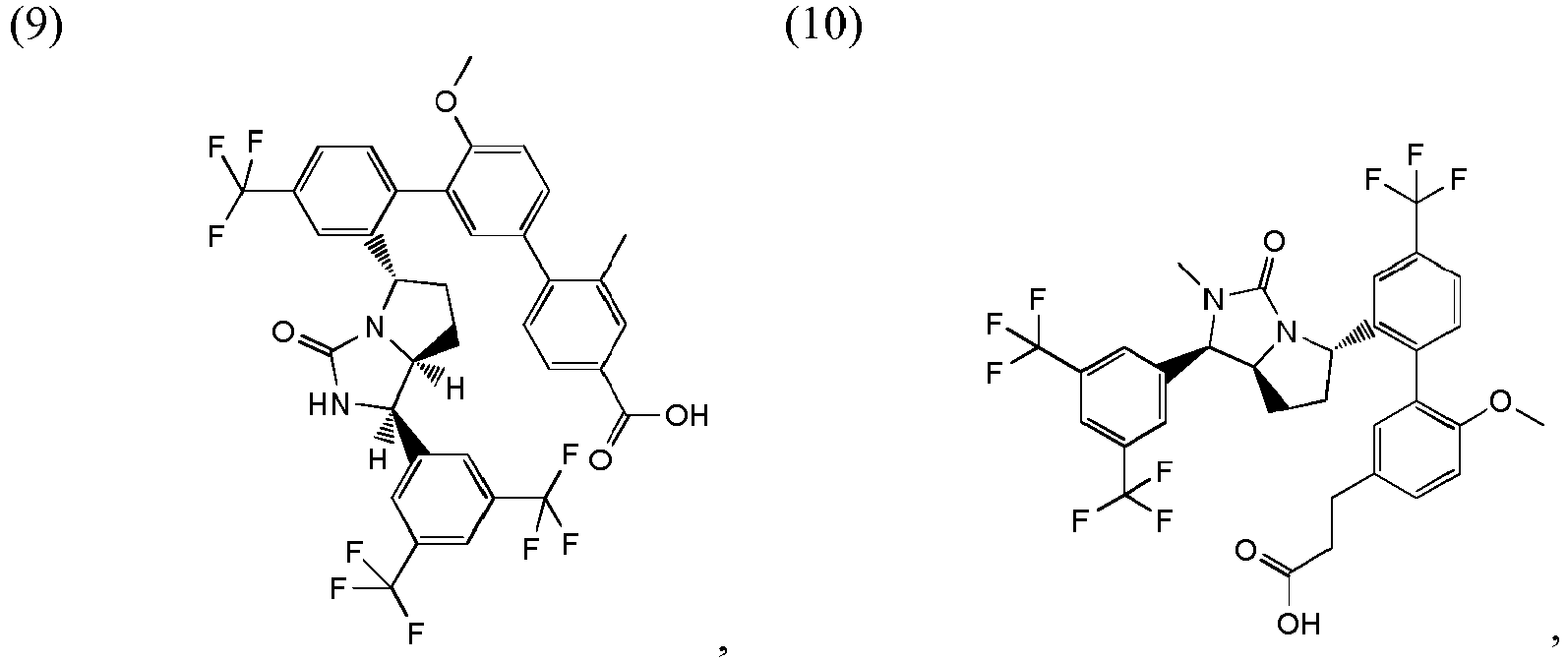


- Eine pharmazeutische Zusammensetzung, die die Verbindung nach einem vorhergehenden Anspruch oder ein pharmazeutisch annehmbares Salz davon und einen pharmazeutisch annehmbaren Träger umfasst.
- Die Verwendung der Verbindung nach einem der Ansprüche 1-9 oder eines pharmazeutisch annehmbaren Salzes davon zur Herstellung eines Medikaments zur Behandlung von Atherosklerose.
- Die Verbindung nach einem der Ansprüche 1-9 oder ein pharmazeutisch annehmbares Salz davon zur Verwendung bei der Behandlung von Atherosklerose.
- Eine pharmazeutische Zusammensetzung, umfassend die Verbindung nach einem der Ansprüche 1-9 oder ein pharmazeutisch annehmbares Salz davon, einen pharmazeutisch annehmbaren Träger und einen oder mehrere Wirkstoffe, ausgewählt aus der Gruppe bestehend aus:(i) HMG-CoA-Reduktase-Inhibitoren,(ii) Gallensäuresequestriermitteln,(iii) Niacin und verwandten Verbindungen,(iv) PPARα-Agonisten,(v) Cholesterinabsorptionsinhibitoren,(vi) Acyl-CoA:Cholesterin-Acyltransferase(ACAT)-Inhibitoren,(vii) phenolischen Antioxidantien,(viii) mikrosomales Triglycerid-Transferprotein (MTP)/ApoB-Sekretions-Inhibitoren,(ix) antioxidativen Vitaminen,(x) Thyromimetika,(xi) LDL (Low-Density-Lipoprotein)-Rezeptorinduktoren,(xii) Thrombozytenaggregationsinhibitoren,(xiii) Vitamin B12 (auch bekannt als Cyanocobalamin),(xiv) Folsäure oder ein pharmazeutisch annehmbares Salz oder ein pharmazeutisch annehmbarer Ester davon,(xv) FXR- und LXR-Liganden,(xvi) Mitteln, die die ABCA1-Gen-Expression steigern,(xvii) Ileum-Gallensäure-Transportern und(xviii) Niacinrezeptoragonisten.
- Eine Kombination, umfassend eine Verbindung nach einem der Ansprüche 1-9 oder ein pharmazeutisch annehmbares Salz davon und andere Arzneistoffe, die zur Behandlung oder Prävention von Atherosklerose geeignet sind.
- Eine Verbindung nach einem der Ansprüche 1-9 oder ein pharmazeutisch annehmbares Salz davon zur Verwendung in der Therapie.
Applications Claiming Priority (2)
| Application Number | Priority Date | Filing Date | Title |
|---|---|---|---|
| US201361859981P | 2013-07-30 | 2013-07-30 | |
| PCT/US2014/048353 WO2015017302A2 (en) | 2013-07-30 | 2014-07-28 | Bicyclic ureas and thiadiazolidine-1,1-dioxides as cetp inhibitors |
Publications (3)
| Publication Number | Publication Date |
|---|---|
| EP3027619A2 EP3027619A2 (de) | 2016-06-08 |
| EP3027619A4 EP3027619A4 (de) | 2017-01-18 |
| EP3027619B1 true EP3027619B1 (de) | 2019-01-02 |
Family
ID=52432544
Family Applications (1)
| Application Number | Title | Priority Date | Filing Date |
|---|---|---|---|
| EP14832256.3A Active EP3027619B1 (de) | 2013-07-30 | 2014-07-28 | Bicyclische harnstoffe und thiadiazolidin-1,1-dioxide als cetp-hemmer |
Country Status (3)
| Country | Link |
|---|---|
| US (1) | US9981970B2 (de) |
| EP (1) | EP3027619B1 (de) |
| WO (1) | WO2015017302A2 (de) |
Families Citing this family (16)
| Publication number | Priority date | Publication date | Assignee | Title |
|---|---|---|---|---|
| US10923204B2 (en) | 2010-08-20 | 2021-02-16 | Attopsemi Technology Co., Ltd | Fully testible OTP memory |
| US10229746B2 (en) | 2010-08-20 | 2019-03-12 | Attopsemi Technology Co., Ltd | OTP memory with high data security |
| US9818478B2 (en) | 2012-12-07 | 2017-11-14 | Attopsemi Technology Co., Ltd | Programmable resistive device and memory using diode as selector |
| US10916317B2 (en) | 2010-08-20 | 2021-02-09 | Attopsemi Technology Co., Ltd | Programmable resistance memory on thin film transistor technology |
| US10192615B2 (en) | 2011-02-14 | 2019-01-29 | Attopsemi Technology Co., Ltd | One-time programmable devices having a semiconductor fin structure with a divided active region |
| US10586832B2 (en) | 2011-02-14 | 2020-03-10 | Attopsemi Technology Co., Ltd | One-time programmable devices using gate-all-around structures |
| WO2015054088A1 (en) | 2013-10-10 | 2015-04-16 | Merck Sharp & Dohme Corp. | 3,3'-disubstituted indolines as inhibitors of cholesterol ester transfer protein |
| CN105814064A (zh) | 2013-12-17 | 2016-07-27 | 默沙东公司 | 作为胆固醇酯转运蛋白的抑制剂的稠合双环异噁唑啉类 |
| EP3174537B1 (de) | 2014-07-29 | 2021-06-23 | Merck Sharp & Dohme Corp. | Monocyclische isoxazoline als hemmer des cholesterinestertransferproteins |
| WO2017011279A1 (en) * | 2015-07-13 | 2017-01-19 | Merck Sharp & Dohme Corp. | Bicyclic heterocycles as inhibitors of cholesterol ester transfer protein |
| US11062786B2 (en) | 2017-04-14 | 2021-07-13 | Attopsemi Technology Co., Ltd | One-time programmable memories with low power read operation and novel sensing scheme |
| US11615859B2 (en) | 2017-04-14 | 2023-03-28 | Attopsemi Technology Co., Ltd | One-time programmable memories with ultra-low power read operation and novel sensing scheme |
| US10535413B2 (en) | 2017-04-14 | 2020-01-14 | Attopsemi Technology Co., Ltd | Low power read operation for programmable resistive memories |
| US10726914B2 (en) | 2017-04-14 | 2020-07-28 | Attopsemi Technology Co. Ltd | Programmable resistive memories with low power read operation and novel sensing scheme |
| US10770160B2 (en) | 2017-11-30 | 2020-09-08 | Attopsemi Technology Co., Ltd | Programmable resistive memory formed by bit slices from a standard cell library |
| US12483429B2 (en) | 2021-06-01 | 2025-11-25 | Attopsemi Technology Co., Ltd | Physically unclonable function produced using OTP memory |
Family Cites Families (18)
| Publication number | Priority date | Publication date | Assignee | Title |
|---|---|---|---|---|
| GB1393230A (en) | 1972-11-03 | 1975-05-07 | Lepetit Spa | Pyrrolo-1,2-c imidazol-3-one derivatives |
| CA2562082C (en) | 2004-04-13 | 2013-06-25 | Merck & Co., Inc. | Cetp inhibitors for the treatment and prevention of atherosclerosis |
| DOP2005000123A (es) | 2004-07-02 | 2011-07-15 | Merck Sharp & Dohme | Inhibidores de cetp |
| US8486983B2 (en) | 2005-12-05 | 2013-07-16 | Merck Sharp & Dohme Corp. | Self-emulsifying formulations of CETP inhibitors |
| EP1973889B1 (de) | 2005-12-30 | 2016-08-24 | Merck Sharp & Dohme Corp. | Cetp-inhibitoren |
| NZ568904A (en) | 2005-12-30 | 2011-05-27 | Merck Sharp & Dohme | 1,3-oxazolidin-2-one derivatives useful as CETP inhibitors |
| WO2007081570A2 (en) | 2005-12-30 | 2007-07-19 | Merck & Co., Inc. | Cholesteryl ester transfer protein inhibitors |
| EP1971595B1 (de) | 2005-12-30 | 2013-10-16 | Merck Sharp & Dohme Corp. | Cetp-inhibitoren |
| CA2689523A1 (en) | 2007-06-20 | 2008-12-24 | Merck Sharp & Dohme Corp. | Cetp inhibitors derived from benzoxazole arylamides |
| WO2008156715A1 (en) | 2007-06-20 | 2008-12-24 | Merck & Co., Inc. | Cetp inhibitors derived from benzoxazole arylamides |
| EP2166847B1 (de) | 2007-06-20 | 2014-11-19 | Merck Sharp & Dohme Corp. | Cetp-hemmer aus benzoxazolarylamiden |
| WO2009084501A1 (ja) | 2007-12-27 | 2009-07-09 | Asahi Kasei Pharma Corporation | スルタム誘導体 |
| CN103269592B (zh) | 2010-10-29 | 2016-05-11 | 默沙东公司 | 环胺取代的噁唑烷酮cetp抑制剂 |
| US9126976B2 (en) | 2011-08-19 | 2015-09-08 | Merck Sharp & Dohme Corp. | Substituted benzopiperazines as CETP inhibitors |
| JO3210B1 (ar) | 2011-10-28 | 2018-03-08 | Merck Sharp & Dohme | مثبط منصهر لبروتين نقل الكوليسترليستير اوكسازوليدينون ثمائي الحلقة |
| WO2013165854A1 (en) | 2012-05-02 | 2013-11-07 | Merck Sharp & Dohme Corp. | Cyclic amine substituted heterocyclic cetp inhibitors |
| EP2934518B1 (de) | 2012-12-19 | 2020-02-19 | Merck Sharp & Dohme Corp. | Spirocyclische cetp-hemmer |
| WO2014099834A1 (en) | 2012-12-20 | 2014-06-26 | Merck Sharp & Dohme Corp. | Therapeutic thiazolidinone compounds |
-
2014
- 2014-07-28 WO PCT/US2014/048353 patent/WO2015017302A2/en not_active Ceased
- 2014-07-28 US US14/908,180 patent/US9981970B2/en active Active
- 2014-07-28 EP EP14832256.3A patent/EP3027619B1/de active Active
Non-Patent Citations (1)
| Title |
|---|
| None * |
Also Published As
| Publication number | Publication date |
|---|---|
| EP3027619A2 (de) | 2016-06-08 |
| WO2015017302A2 (en) | 2015-02-05 |
| EP3027619A4 (de) | 2017-01-18 |
| US20160185784A1 (en) | 2016-06-30 |
| US9981970B2 (en) | 2018-05-29 |
| WO2015017302A3 (en) | 2015-11-19 |
Similar Documents
| Publication | Publication Date | Title |
|---|---|---|
| EP3027619B1 (de) | Bicyclische harnstoffe und thiadiazolidin-1,1-dioxide als cetp-hemmer | |
| EP2771345B1 (de) | Kondensierte bicyclische oxazolidinon-cetp-hemmer | |
| EP3322420B1 (de) | Bicyclische heterocyclen als inhibitoren des cholesterinestertransferproteins | |
| EP2934519B1 (de) | Therapeutische thiazolidinonverbindungen | |
| EP2934518B1 (de) | Spirocyclische cetp-hemmer | |
| EP3174537B1 (de) | Monocyclische isoxazoline als hemmer des cholesterinestertransferproteins | |
| EP2844252B1 (de) | Cyclische aminsubstituierte heterocyclische verbindungen als cetp-hemmer | |
| EP3083642B1 (de) | Kondensierte bicyclische isoxazoline als hemmer des cholesterinestertransferproteins | |
| EP3054945B1 (de) | 3,3'-disubstituierte indoline als hemmer des cholesterinestertransferproteins | |
| HK1195558B (en) | Fused bicyclic oxazolidinone cetp inhibitor | |
| NZ625435B2 (en) | Fused bicyclic oxazolidinone cetp inhibitor |
Legal Events
| Date | Code | Title | Description |
|---|---|---|---|
| PUAI | Public reference made under article 153(3) epc to a published international application that has entered the european phase |
Free format text: ORIGINAL CODE: 0009012 |
|
| AK | Designated contracting states |
Kind code of ref document: A2 Designated state(s): AL AT BE BG CH CY CZ DE DK EE ES FI FR GB GR HR HU IE IS IT LI LT LU LV MC MK MT NL NO PL PT RO RS SE SI SK SM TR |
|
| AX | Request for extension of the european patent |
Extension state: BA ME |
|
| 17P | Request for examination filed |
Effective date: 20160519 |
|
| RAX | Requested extension states of the european patent have changed |
Extension state: ME Payment date: 20160519 Extension state: BA Payment date: 20160519 |
|
| RBV | Designated contracting states (corrected) |
Designated state(s): AL AT BE BG CH CY CZ DE DK EE ES FI FR GB GR HR HU IE IS IT LI LT LU LV MC MK MT NL NO PL PT RO RS SE SI SK SM TR |
|
| A4 | Supplementary search report drawn up and despatched |
Effective date: 20161221 |
|
| RIC1 | Information provided on ipc code assigned before grant |
Ipc: A61P 9/10 20060101ALI20161215BHEP Ipc: C07D 513/04 20060101ALI20161215BHEP Ipc: A61P 3/06 20060101ALI20161215BHEP Ipc: A61K 31/4188 20060101ALI20161215BHEP Ipc: A61K 31/433 20060101ALI20161215BHEP Ipc: A61K 31/4436 20060101ALI20161215BHEP Ipc: A61K 31/4439 20060101ALI20161215BHEP Ipc: C07D 487/04 20060101AFI20161215BHEP Ipc: A61P 9/12 20060101ALI20161215BHEP |
|
| GRAP | Despatch of communication of intention to grant a patent |
Free format text: ORIGINAL CODE: EPIDOSNIGR1 |
|
| STAA | Information on the status of an ep patent application or granted ep patent |
Free format text: STATUS: GRANT OF PATENT IS INTENDED |
|
| INTG | Intention to grant announced |
Effective date: 20170926 |
|
| RIN1 | Information on inventor provided before grant (corrected) |
Inventor name: VACHAL, PETR Inventor name: KRIKORIAN, ARTO, D. Inventor name: SHAO, PENGCHENG, PATRICK Inventor name: LIU, JIAN |
|
| GRAJ | Information related to disapproval of communication of intention to grant by the applicant or resumption of examination proceedings by the epo deleted |
Free format text: ORIGINAL CODE: EPIDOSDIGR1 |
|
| STAA | Information on the status of an ep patent application or granted ep patent |
Free format text: STATUS: REQUEST FOR EXAMINATION WAS MADE |
|
| INTC | Intention to grant announced (deleted) | ||
| GRAP | Despatch of communication of intention to grant a patent |
Free format text: ORIGINAL CODE: EPIDOSNIGR1 |
|
| STAA | Information on the status of an ep patent application or granted ep patent |
Free format text: STATUS: GRANT OF PATENT IS INTENDED |
|
| INTG | Intention to grant announced |
Effective date: 20180319 |
|
| GRAJ | Information related to disapproval of communication of intention to grant by the applicant or resumption of examination proceedings by the epo deleted |
Free format text: ORIGINAL CODE: EPIDOSDIGR1 |
|
| STAA | Information on the status of an ep patent application or granted ep patent |
Free format text: STATUS: REQUEST FOR EXAMINATION WAS MADE |
|
| GRAP | Despatch of communication of intention to grant a patent |
Free format text: ORIGINAL CODE: EPIDOSNIGR1 |
|
| STAA | Information on the status of an ep patent application or granted ep patent |
Free format text: STATUS: GRANT OF PATENT IS INTENDED |
|
| INTC | Intention to grant announced (deleted) | ||
| INTG | Intention to grant announced |
Effective date: 20180810 |
|
| GRAS | Grant fee paid |
Free format text: ORIGINAL CODE: EPIDOSNIGR3 |
|
| GRAA | (expected) grant |
Free format text: ORIGINAL CODE: 0009210 |
|
| STAA | Information on the status of an ep patent application or granted ep patent |
Free format text: STATUS: THE PATENT HAS BEEN GRANTED |
|
| AK | Designated contracting states |
Kind code of ref document: B1 Designated state(s): AL AT BE BG CH CY CZ DE DK EE ES FI FR GB GR HR HU IE IS IT LI LT LU LV MC MK MT NL NO PL PT RO RS SE SI SK SM TR |
|
| AX | Request for extension of the european patent |
Extension state: BA ME |
|
| REG | Reference to a national code |
Ref country code: GB Ref legal event code: FG4D |
|
| REG | Reference to a national code |
Ref country code: CH Ref legal event code: EP Ref country code: AT Ref legal event code: REF Ref document number: 1084213 Country of ref document: AT Kind code of ref document: T Effective date: 20190115 |
|
| REG | Reference to a national code |
Ref country code: IE Ref legal event code: FG4D |
|
| REG | Reference to a national code |
Ref country code: DE Ref legal event code: R096 Ref document number: 602014039278 Country of ref document: DE |
|
| REG | Reference to a national code |
Ref country code: NL Ref legal event code: MP Effective date: 20190102 |
|
| REG | Reference to a national code |
Ref country code: LT Ref legal event code: MG4D |
|
| REG | Reference to a national code |
Ref country code: AT Ref legal event code: MK05 Ref document number: 1084213 Country of ref document: AT Kind code of ref document: T Effective date: 20190102 |
|
| PG25 | Lapsed in a contracting state [announced via postgrant information from national office to epo] |
Ref country code: NL Free format text: LAPSE BECAUSE OF FAILURE TO SUBMIT A TRANSLATION OF THE DESCRIPTION OR TO PAY THE FEE WITHIN THE PRESCRIBED TIME-LIMIT Effective date: 20190102 |
|
| PG25 | Lapsed in a contracting state [announced via postgrant information from national office to epo] |
Ref country code: NO Free format text: LAPSE BECAUSE OF FAILURE TO SUBMIT A TRANSLATION OF THE DESCRIPTION OR TO PAY THE FEE WITHIN THE PRESCRIBED TIME-LIMIT Effective date: 20190402 Ref country code: LT Free format text: LAPSE BECAUSE OF FAILURE TO SUBMIT A TRANSLATION OF THE DESCRIPTION OR TO PAY THE FEE WITHIN THE PRESCRIBED TIME-LIMIT Effective date: 20190102 Ref country code: PL Free format text: LAPSE BECAUSE OF FAILURE TO SUBMIT A TRANSLATION OF THE DESCRIPTION OR TO PAY THE FEE WITHIN THE PRESCRIBED TIME-LIMIT Effective date: 20190102 Ref country code: ES Free format text: LAPSE BECAUSE OF FAILURE TO SUBMIT A TRANSLATION OF THE DESCRIPTION OR TO PAY THE FEE WITHIN THE PRESCRIBED TIME-LIMIT Effective date: 20190102 Ref country code: SE Free format text: LAPSE BECAUSE OF FAILURE TO SUBMIT A TRANSLATION OF THE DESCRIPTION OR TO PAY THE FEE WITHIN THE PRESCRIBED TIME-LIMIT Effective date: 20190102 Ref country code: PT Free format text: LAPSE BECAUSE OF FAILURE TO SUBMIT A TRANSLATION OF THE DESCRIPTION OR TO PAY THE FEE WITHIN THE PRESCRIBED TIME-LIMIT Effective date: 20190502 Ref country code: FI Free format text: LAPSE BECAUSE OF FAILURE TO SUBMIT A TRANSLATION OF THE DESCRIPTION OR TO PAY THE FEE WITHIN THE PRESCRIBED TIME-LIMIT Effective date: 20190102 |
|
| PG25 | Lapsed in a contracting state [announced via postgrant information from national office to epo] |
Ref country code: RS Free format text: LAPSE BECAUSE OF FAILURE TO SUBMIT A TRANSLATION OF THE DESCRIPTION OR TO PAY THE FEE WITHIN THE PRESCRIBED TIME-LIMIT Effective date: 20190102 Ref country code: HR Free format text: LAPSE BECAUSE OF FAILURE TO SUBMIT A TRANSLATION OF THE DESCRIPTION OR TO PAY THE FEE WITHIN THE PRESCRIBED TIME-LIMIT Effective date: 20190102 Ref country code: LV Free format text: LAPSE BECAUSE OF FAILURE TO SUBMIT A TRANSLATION OF THE DESCRIPTION OR TO PAY THE FEE WITHIN THE PRESCRIBED TIME-LIMIT Effective date: 20190102 Ref country code: BG Free format text: LAPSE BECAUSE OF FAILURE TO SUBMIT A TRANSLATION OF THE DESCRIPTION OR TO PAY THE FEE WITHIN THE PRESCRIBED TIME-LIMIT Effective date: 20190402 Ref country code: IS Free format text: LAPSE BECAUSE OF FAILURE TO SUBMIT A TRANSLATION OF THE DESCRIPTION OR TO PAY THE FEE WITHIN THE PRESCRIBED TIME-LIMIT Effective date: 20190502 Ref country code: GR Free format text: LAPSE BECAUSE OF FAILURE TO SUBMIT A TRANSLATION OF THE DESCRIPTION OR TO PAY THE FEE WITHIN THE PRESCRIBED TIME-LIMIT Effective date: 20190403 |
|
| REG | Reference to a national code |
Ref country code: DE Ref legal event code: R097 Ref document number: 602014039278 Country of ref document: DE |
|
| PG25 | Lapsed in a contracting state [announced via postgrant information from national office to epo] |
Ref country code: EE Free format text: LAPSE BECAUSE OF FAILURE TO SUBMIT A TRANSLATION OF THE DESCRIPTION OR TO PAY THE FEE WITHIN THE PRESCRIBED TIME-LIMIT Effective date: 20190102 Ref country code: AT Free format text: LAPSE BECAUSE OF FAILURE TO SUBMIT A TRANSLATION OF THE DESCRIPTION OR TO PAY THE FEE WITHIN THE PRESCRIBED TIME-LIMIT Effective date: 20190102 Ref country code: DK Free format text: LAPSE BECAUSE OF FAILURE TO SUBMIT A TRANSLATION OF THE DESCRIPTION OR TO PAY THE FEE WITHIN THE PRESCRIBED TIME-LIMIT Effective date: 20190102 Ref country code: AL Free format text: LAPSE BECAUSE OF FAILURE TO SUBMIT A TRANSLATION OF THE DESCRIPTION OR TO PAY THE FEE WITHIN THE PRESCRIBED TIME-LIMIT Effective date: 20190102 Ref country code: SK Free format text: LAPSE BECAUSE OF FAILURE TO SUBMIT A TRANSLATION OF THE DESCRIPTION OR TO PAY THE FEE WITHIN THE PRESCRIBED TIME-LIMIT Effective date: 20190102 Ref country code: IT Free format text: LAPSE BECAUSE OF FAILURE TO SUBMIT A TRANSLATION OF THE DESCRIPTION OR TO PAY THE FEE WITHIN THE PRESCRIBED TIME-LIMIT Effective date: 20190102 Ref country code: CZ Free format text: LAPSE BECAUSE OF FAILURE TO SUBMIT A TRANSLATION OF THE DESCRIPTION OR TO PAY THE FEE WITHIN THE PRESCRIBED TIME-LIMIT Effective date: 20190102 Ref country code: RO Free format text: LAPSE BECAUSE OF FAILURE TO SUBMIT A TRANSLATION OF THE DESCRIPTION OR TO PAY THE FEE WITHIN THE PRESCRIBED TIME-LIMIT Effective date: 20190102 |
|
| PLBE | No opposition filed within time limit |
Free format text: ORIGINAL CODE: 0009261 |
|
| STAA | Information on the status of an ep patent application or granted ep patent |
Free format text: STATUS: NO OPPOSITION FILED WITHIN TIME LIMIT |
|
| PG25 | Lapsed in a contracting state [announced via postgrant information from national office to epo] |
Ref country code: SM Free format text: LAPSE BECAUSE OF FAILURE TO SUBMIT A TRANSLATION OF THE DESCRIPTION OR TO PAY THE FEE WITHIN THE PRESCRIBED TIME-LIMIT Effective date: 20190102 |
|
| 26N | No opposition filed |
Effective date: 20191003 |
|
| PG25 | Lapsed in a contracting state [announced via postgrant information from national office to epo] |
Ref country code: MC Free format text: LAPSE BECAUSE OF FAILURE TO SUBMIT A TRANSLATION OF THE DESCRIPTION OR TO PAY THE FEE WITHIN THE PRESCRIBED TIME-LIMIT Effective date: 20190102 Ref country code: SI Free format text: LAPSE BECAUSE OF FAILURE TO SUBMIT A TRANSLATION OF THE DESCRIPTION OR TO PAY THE FEE WITHIN THE PRESCRIBED TIME-LIMIT Effective date: 20190102 |
|
| REG | Reference to a national code |
Ref country code: CH Ref legal event code: PL |
|
| PG25 | Lapsed in a contracting state [announced via postgrant information from national office to epo] |
Ref country code: TR Free format text: LAPSE BECAUSE OF FAILURE TO SUBMIT A TRANSLATION OF THE DESCRIPTION OR TO PAY THE FEE WITHIN THE PRESCRIBED TIME-LIMIT Effective date: 20190102 |
|
| REG | Reference to a national code |
Ref country code: BE Ref legal event code: MM Effective date: 20190731 |
|
| PG25 | Lapsed in a contracting state [announced via postgrant information from national office to epo] |
Ref country code: LU Free format text: LAPSE BECAUSE OF NON-PAYMENT OF DUE FEES Effective date: 20190728 Ref country code: CH Free format text: LAPSE BECAUSE OF NON-PAYMENT OF DUE FEES Effective date: 20190731 Ref country code: LI Free format text: LAPSE BECAUSE OF NON-PAYMENT OF DUE FEES Effective date: 20190731 Ref country code: BE Free format text: LAPSE BECAUSE OF NON-PAYMENT OF DUE FEES Effective date: 20190731 |
|
| PG25 | Lapsed in a contracting state [announced via postgrant information from national office to epo] |
Ref country code: IE Free format text: LAPSE BECAUSE OF NON-PAYMENT OF DUE FEES Effective date: 20190728 |
|
| PG25 | Lapsed in a contracting state [announced via postgrant information from national office to epo] |
Ref country code: CY Free format text: LAPSE BECAUSE OF FAILURE TO SUBMIT A TRANSLATION OF THE DESCRIPTION OR TO PAY THE FEE WITHIN THE PRESCRIBED TIME-LIMIT Effective date: 20190102 |
|
| PG25 | Lapsed in a contracting state [announced via postgrant information from national office to epo] |
Ref country code: MT Free format text: LAPSE BECAUSE OF FAILURE TO SUBMIT A TRANSLATION OF THE DESCRIPTION OR TO PAY THE FEE WITHIN THE PRESCRIBED TIME-LIMIT Effective date: 20190102 Ref country code: HU Free format text: LAPSE BECAUSE OF FAILURE TO SUBMIT A TRANSLATION OF THE DESCRIPTION OR TO PAY THE FEE WITHIN THE PRESCRIBED TIME-LIMIT; INVALID AB INITIO Effective date: 20140728 |
|
| PG25 | Lapsed in a contracting state [announced via postgrant information from national office to epo] |
Ref country code: MK Free format text: LAPSE BECAUSE OF FAILURE TO SUBMIT A TRANSLATION OF THE DESCRIPTION OR TO PAY THE FEE WITHIN THE PRESCRIBED TIME-LIMIT Effective date: 20190102 |
|
| REG | Reference to a national code |
Ref country code: DE Ref legal event code: R081 Ref document number: 602014039278 Country of ref document: DE Owner name: MERCK SHARP & DOHME LLC, RAHWAY, US Free format text: FORMER OWNER: MERCK SHARP & DOHME CORP., RAHWAY, N.J., US |
|
| REG | Reference to a national code |
Ref country code: GB Ref legal event code: 732E Free format text: REGISTERED BETWEEN 20221013 AND 20221019 |
|
| PGFP | Annual fee paid to national office [announced via postgrant information from national office to epo] |
Ref country code: GB Payment date: 20250612 Year of fee payment: 12 |
|
| PGFP | Annual fee paid to national office [announced via postgrant information from national office to epo] |
Ref country code: FR Payment date: 20250612 Year of fee payment: 12 |
|
| PGFP | Annual fee paid to national office [announced via postgrant information from national office to epo] |
Ref country code: DE Payment date: 20250616 Year of fee payment: 12 |